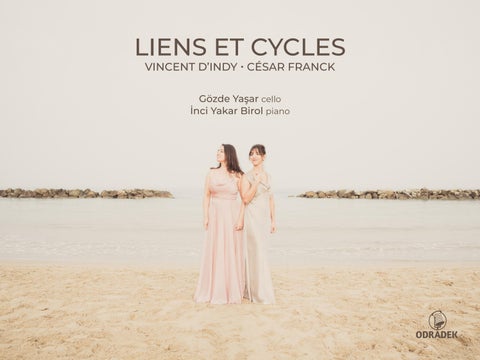
LIENS ET CYCLES VINCENT D’INDY � CÉSAR FRANCK Gözde Yaşar cello İnci Yakar Birol piano
VINCENT D’INDY (1851-1931)
Cello Sonata in D major, Op. 84 (1924/25)
1. I. Entrée: Modéré 2. II. Gavotte en rondeau: Tranquillement 3. III. Air: Très lent 4. IV. Gigue: Gaîment
07'38 02'55 05'02 03'24
CÉSAR FRANCK (1822-1890)
Cello Sonata in A major, FWV 8
(1886, arr. from violin by Jules Delsart) 5. I. Allegretto ben moderato 6. II. Allegro 7. III. Recitativo-Fantasia. Ben moderato – Molto lento 8. IV. Allegretto poco mosso 9.
Mélancolie, for cello and piano in E minor, FWV 10
(1885, arr. from violin)
06'24 08'57 07'49 06'44 05' 19
Total Play Time: 54' 18
Gözde Yaşar cello İnci Yakar Birol piano
ENG
This album brings together the cello and piano sonatas of César Franck and his student Vincent d’Indy as a reflection on continuity — of form, of thought, and of life itself. Franck infused the cyclic form with the expressive depth of the Romantic spirit, allowing recurring themes to generate a unified and lyrical narrative. In his music, return becomes revelation. D’Indy, his devoted student, embraced and systematized this principle, elevating it into a structural and philosophical foundation. What emerges between them is more than pedagogy: it is a transmission of artistic vision — a living continuum.
In this dialogue between teacher and student, we witness a shared language shaped across generations. Each theme, like life itself, is born, grows, transforms, and returns — carrying within it the memory of its origins. This album traces that journey: a cycle of sound, of lineage, and of enduring musical thought.
For us, this recording is not simply about teacher and student, nor about two French sonatas. It is about inheritance: how artistic ideas persist, evolve, and resurface across generations. The cyclic principle becomes a metaphor for artistic continuity itself.
Gözde Yaşar and İnci Yakar Birol
The relationship between César Franck (1822–1890) and Vincent d’Indy (1851–1931) was one of the most influential teacher-student connections in late 19th-century French music history. D’Indy was not only Franck’s pupil, but also became his most important biographer and administrator of his musical legacy. He joined Franck’s organ class at the Paris Conservatoire in 1872 and became one of the leading members of the socalled ‘Bande à Franck’, a group of pupils who were uncompromisingly devoted to their master. Vincent d’Indy adopted Franck’s compositional ideas, in particular the cyclical principle (the use of common thematic motifs throughout all movements of a work). They also shared their admiration for Bach, Beethoven and Wagner, which contrasted with the musical mainstream in France at the time. After Franck’s death, d’Indy worked tirelessly to promote his works. In 1906, he published a detailed biography of César Franck, which, although considered somewhat biased, is regarded as a fundamental work for understanding Franck’s methods and his revolutionary impact in Paris. In 1894, together with Alexandre Guilmant and Charles Bordes, he founded the Paris Schola Cantorum, which opened two years later as a school for the performance and composition of sacred music. Here, Franck’s strict contrapuntal style was continued, although the music academy differed from the aesthetics of the Paris Conservatoire. D’Indy was a close friend of Franck and often referred to him reverently as the ‘maître angélique’. Nevertheless, he is considered one of the most influential figures in French musical life, who not only kept Franck’s musical legacy alive, but also developed it further. At the same time, he was enthusiastic about Wagner and attended the first Bayreuth Festival in 1876, an experience that greatly influenced his early style. With the founding of the Paris Schola Cantorum in 1894, he set a precedent for the renewal of French music. He promoted the cultivation of early music, Gregorian chant and folk music, combining tradition with artistic vision. His Cello Sonata, Op. 84, reflects all these experiences: technical mastery, historical awareness and a mature, luminous tonal language. It is not a loud declaration, but a confident late work full of style, spirit and musical nobility. Although it is not one of his best-known chamber music works, it is nevertheless a late work full of light, elegance and maturity, composed between 1924 and 1925, when the composer was already over seventy years old. After moving to the south of France, d’Indy found a brighter, more relaxed style. The sonata is an expression of this late creative phase. It combines masterful form with charm, lightness with cultivated tonal beauty.
Although the work is called a sonata, it is based on the form of a Baroque suite. With Entrée, Gavotte, Air and Gigue, d’Indy takes up historical dance forms and at the same time gives them a modern, colourful tone: the Entrée opens the work elegantly and nobly, with clear lines and a fine dialogue between cello and piano. The following Gavotte in rondo style surprises with its playful sophistication; the pizzicato of the cello is reminiscent of the sound of a lute and lends the music a dance-like lightness. In the third movement, the Air, the composer’s poetic side comes to the fore. Gentle, song-like and carried by a fine melancholy, an intimate sound space full of warmth unfolds here. The finale, a lively Gigue, concludes the work with energy and rhythmic verve: a modern homage to Baroque dance, brilliant and stylish at the same time. César Franck, born in Liège and later famous as titular organist of the Parisian church of Sainte-Clotilde, had a lasting influence on French music. As a professor at the Paris Conservatoire, he inspired an entire generation of composers. His students revered him as ‘Père Franck’, a spiritual innovator and passionate artist. The Violin sonata in A major by the ‘angelic master’ is full of emotion, depth and radiant beauty of sound. It is one of the masterpieces of Romantic chamber music and was written in 1886 as a wedding gift for the Belgian violinist Eugène Ysaÿe. The work was enthusiastically celebrated at its premiere in Brussels in December of the same year. From there, it began its triumphant march through the concert halls of Europe and remains part of the standard repertoire of great violinists to this day. What makes this sonata so special is its inner coherence and emotional power: it opens with a delicate motif of falling thirds, which recurs in ever-changing colours throughout all four movements. This cyclical form lends the music a fascinating unity and depth. The first movement touches the listener with its lyrical warmth and floating poetic sound. It is more of a slow introductory movement than a classical first sonata movement. The second, a turbulent, passionate scherzo in D minor, unfolds its energy and tension in stark contrast to the first. In the third movement, dreamy freedom is combined with vocal expressiveness. It is reminiscent of Wagner’s chromaticism and hints at the opening theme. The concluding Allegretto poco mosso presents a canon between violin and piano and ends in exuberant joy. It captivates with its radiant character, light optimism and rousing momentum.
Franck’s music never seems superficial or showy. It’s really moving, with rich harmonies and a masterful blend of both instruments, which meet on equal terms in dialogue, resonance and shared breath. So it’s more than just a well-written and consistently composed concert piece. Rather, it is a resounding declaration of Romanticism, a work full of soul and expression. This recording is based on the famous arrangement by French cellist Jules Delsart (1844-1900), which was also in circulation shortly after the original was published and was authorised by Franck himself. The work has been an integral part of the cello repertoire since its inception, all the more so since Franck left no explicit cello sonata or anything similar, apart from a few early works for piano, violin and violoncello. Also included in a transcription is Mélancolie, a heartfelt piece that was published posthumously in 1911. It was composed around 1886 at the height of Franck’s creative powers, at the same time as the violin sonata cited above, and is based on one of his solfège exercises, which he wrote for his singing students. It is a short, characteristic piece that is often regarded as a lyrical intermezzo and features the harmonies typical of the French composer. Thematically, it contrasts a melancholic, legato melody with another theme characterised by an iambic (short-long) rhythm. As on this album, the work is also frequently heard in concerts together with the violin sonata. Antonio Gómez Schneekloth
Text by Antonio Gómez Schneekloth / Odradek Records, LLC is licensed under a Creative Commons Attribution-NoDerivatives 4.0 International License. Permissions beyond the scope of this license may be available at www.odradek-records.com.
Gözde Yaşar began performing as a soloist at an early age, appearing with the Bilkent Youth Symphony Orchestra in 2003. During her studies she performed regularly with the Bilkent Academic Symphony Orchestra; she toured Turkey and Europe with the Anatolian Chamber Orchestra.
After receiving a Fulbright Scholarship in 2007, she continued her studies in the United States at the SUNY Purchase College Conservatory of Music in New York, where she won the 2008 Concerto Competition and performed Dvořák’s Cello Concerto in B minor with the Purchase Orchestra. She later pursued doctoral studies at the University of Maryland and participated in various masterclasses and early music programs, including the Baroque Performance Institute at Oberlin Conservatory. Currently, she is a faculty member at the Mimar Sinan Fine Arts University State Conservatory in Istanbul and remains active as a chamber musician. She has performed numerous premieres with the Turkish NGO Klasik Keyifler, and is a member of the İstanbul Baroque and NK Ensemble. She also performs with the Borusan Istanbul Philharmonic Orchestra.
İnci Yakar Birol began her musical education studying piano and composition at the Mimar Sinan Fine Arts University (MSGSÜ) Istanbul State Conservatory, and continued her studies at the Hochschule für Musik Saar in Germany. Supported by scholarships from institutions such as Eczacıbaşı, the Richard Wagner Verband, and the Bruno Meindl Foundation, she completed her studies in Germany, earning her “Concert Pianist” and subsequently “Soloist” diplomas.
Throughout her career in Europe, she performed at the Schwetzingen Mozart Festival in Germany and made recordings for SR-2KulturRadio. She gave concerts as a soloist with orchestras at the Luxembourg Philharmonie, Metz-Arsenal in France, and in Saarbrücken, Germany. She also regularly takes the stage at distinguished concert halls across Turkey, presenting solo and chamber music performances.
Her original composition Sesli Kitap, featured on her solo album Saygun’a Saygı, won the second prize at the Sonus International Composition Competition in the USA. Following this achievement, she performed her own works alongside compositions by Saygun at the gala concert in Washington D.C.
İnci Yakar Birol continues to perform domestically and internationally, serves as a jury member for international competitions, and currently teaches as a Professor at the MSGSÜ Istanbul State Conservatory.
DE Dieses Album beinhaltet die Cello- und Klaviersonaten von César Franck und seinem Schüler Vincent d’Indy als Reflexion über die Kontinuität der Form, des gedanklichen Ansatzes und des Lebens selbst. Franck durchdrang die zyklische Form mit der expressiven Tiefe des romantischen Geistes, wobei durch die wiederkehrenden Themen eine einheitlich lyrische Erzählung entstehen konnte. In seiner Musik bedeutet Wiederkehr Offenbarung. D’Indy, sein treuer Schüler, übernahm dieses Prinzip und systematisierte es, wodurch er es zur strukturellen und philosophischen Grundlage erhob. Was zwischen den beiden Komponisten entsteht, ist weit mehr als ein rein pädagogischer Ansatz, es ist die Übermittlung einer künstlerischen Anschauung – ein lebendiges Kontinuum.
In diesem Dialog zwischen Lehrer und Schüler werden wir Zeugen einer gemeinsamen Sprache, die sich über Generationen hinweg ausgebildet hat. Jedes Thema wird sozusagen geboren, wie das Leben selbst, es wächst, verändert sich und taucht erneut mit der Erinnerung an die eigenen Ursprünge auf. Diese CD zeichnet diesen Werdegang als Kreislauf des Klanges, Ursprünge und Dauerhaftigkeit einer musikalischen Denkweise nach.
Für uns handelt es sich weder von einer simplen Lehrer-Schüler Beziehung, noch von zwei weiteren französischen Sonaten. Es geht um das Erbe, darum, wie künstlerisches Gedankengut fortbesteht, sich weiterentwickelt und über Generationen hinweg erneut erwacht: Das zyklische Prinzip wird zur Metapher künstlerischer Kontinuität selbst. Gözde Yaşar and İnci Yakar Birol
Die Beziehung zwischen César Franck (1822–1890) und Vincent d’Indy (1851–1931) war eine der prägendsten Lehrer-Schüler-Beziehungen in der französischen Musikgeschichte des späten 19. Jahrhunderts. D’Indy war nicht nur Francks Schüler, sondern entwickelte sich zu seinem wichtigsten Biografen und Verwalter seines musikalischen Erbes. Er trat 1872 in die Orgelklasse von Franck am Pariser Konservatorium ein und wurde zu einem der führenden Mitglieder der sogenannten „Bande à Franck”, einer Gruppe von Schülern, die ihrem Meister kompromisslos ergeben waren. Vincent d’Indy übernahm Francks kompositorisches Gedankengut, insbesondere das zyklische Prinzip (Verwendung gemeinsamer thematischer Motive über alle Sätze eines Werkes hinweg). Ebenso teilten sie ihre Bewunderung für Bach, Beethoven und Wagner, was sie in Kontrast zur damals in Frankreich populären Musik stellte. Nach Francks Tod setzte sich d’Indy unermüdlich für die Verbreitung von dessen Werken ein. Im Jahr 1906 veröffentlichte er eine ausführliche Biografie über César Franck, die zwar als teilweise parteiisch gilt, aber als grundlegendes Werk zum Verständnis von Francks Methoden und seiner revolutionären Wirkung in Paris gilt. 1894 gründete er zusammen mit Alexandre Guilmant und Charles Bordes die Pariser Schola Cantorum, die als Schule für die Aufführung und Komposition geistlicher Musik zwei Jahre später eingeweiht wurde. Hier galten weiterhin die Regeln von Francks streng kontrapunktischem Stil, wobei sich diese Musikhochschule von der Ästhetik des Pariser Konservatoriums entfernt hielt. D’Indy war eng mit Franck befreundet und bezeichnete ihn oft in ehrfürchtiger Haltung als den „maître angélique”. Dennoch gilt er als eine der prägnantesten Persönlichkeiten des französischen Musiklebens, der nicht nur Francks musikalisches Erbe lebendig hielt, sondern es weiterentwickelte… Zugleich begeisterte er sich für Wagner und besuchte 1876 die ersten Bayreuther Festspiele, ein Erlebnis, das seinen frühen Stil stark beeinflusste. Mit der Gründung der Pariser Schola Cantorum im Jahr 1894 setzte er ein Zeichen für die Erneuerung der französischen Musik. Er förderte die Pflege alter Musik, des gregorianischen Chorals und der Volksmusik, und verband Tradition mit künstlerischer Vision. Seine Cellosonate, op. 84 spiegelt all diese Erfahrungen wider: handwerkliche Meisterschaft, historische Bewusstheit und eine gereifte, lichte Klangsprache. Sie ist kein lautes Bekenntnis, sondern ein souveränes Spätwerk voller Stil, Geist und musikalischer Noblesse. Obwohl sie nicht zu seinen bekanntesten Kammermusikwerken gehört, stellt sie jedoch gleichzeitig ein Spätwerk voller Leuchtkraft, Eleganz und
Reife dar, das zwischen 1924 und 1925 entstand, zu einer Zeit, als der Komponist bereits über siebzig Jahre alt war. Nach seiner Übersiedlung in den Süden Frankreichs fand d’Indy zu einem helleren, gelösteren Stil. Die Sonate ist Ausdruck dieser späten Schaffensphase und verbindet meisterhafte Form mit Charme, so wie Leichtigkeit mit kultivierter Klangschönheit. Obwohl das Werk als Sonate bezeichnet wird, orientiert es sich an der Form einer barocken Suite. Mit Entrée, Gavotte, Air und Gigue greift d’Indy historische Tanzformen auf, und verleiht ihnen zugleich einen modernen, farbenreichen Ton: Das Entrée eröffnet das Werk elegant und nobel, mit klaren Linien und feinem Dialog zwischen Cello und Klavier. Die folgende Gavotte im Rondo-Stil überrascht mit spielerischer Raffinesse; das Pizzicato des Cellos erinnert an den Klang einer Laute und verleiht der Musik tänzerische Leichtigkeit. Im dritten Satz, dem „Air“, zeigt sich die poetische Seite des Komponisten. Sanft, gesanglich und von feiner Melancholie getragen, entfaltet sich hier ein inniger Klangraum voller Wärme. Das Finale, eine lebhafte Gigue, beschließt das Werk mit Energie und rhythmischem Schwung: eine moderne Hommage an den barocken Tanz, brillant und zugleich stilvoll. César Franck, in Lüttich geboren und später als Titularorganist der Pariser Kirche Sainte-Clotilde berühmt geworden, prägte die französische Musik nachhaltig. Als Professor am Pariser Conservatoire inspirierte er eine ganze Generation von Komponisten. Seine Schüler verehrten ihn als „Père Franck“, als geistigen Erneuerer und leidenschaftlichen Künstler. Die Violinsonate in A-Dur des „engelhaften Meisters” ist voller Gefühl, Tiefe und strahlender Klangschönheit. Sie zählt zu den Meisterwerken der romantischen Kammermusik und entstand 1886 als Hochzeitsgeschenk für den belgischen Geiger Eugène Ysaÿe. Schon bei der Uraufführung im Dezember desselben Jahres in Brüssel wurde das Werk begeistert gefeiert. Von dort aus trat es seinen Siegeszug durch die Konzertsäle Europas an und gehört bis heute zum festen Repertoire großer Geiger. Was diese Sonate so besonders macht, sind ihre innere Geschlossenheit und ihre emotionale Kraft: Ein zartes Motiv aus fallenden Terzen eröffnet sie und kehrt in neuen Schattierungen immer wieder auf. Die zyklische Form verleiht der Musik eine faszinierende Einheit und Tiefe. Der erste Satz berührt mit lyrischer Wärme und schwebender Klangpoesie. Es ist eher ein langsamer Einleitungssatz, als ein klassischer erster Sonatensatz. Der Zweite, ein turbulentes, leidenschaftliches Scherzo in d-Moll, entfaltet seine Energie und Spannung im starken Kontrast zum Ersten. Im dritten Satz verbindet sich träumerische Freiheit mit gesanglicher
Ausdruckskraft. Er erinnert an Wagners Chromatik und greift das Anfangsthema andeutungsweise auf. Das abschließende Allegretto poco mosso präsentiert einen Kanon zwischen Violine und Klavier und endet in überschwänglicher Freude. Es besticht durch seinen strahlenden Charakter mit lichtem Optimismus und einem mitreißenden Schwung. Francks Musik wirkt niemals oberflächlich oder effekthascherisch. Sie überzeugt durch innige Empfindung, reiche Harmonik und eine meisterhafte Verbindung beider Instrumente, die sich im Dialog, im Widerklang, im gemeinsamen Atem auf Augenhöhe begegnen. Sie ist daher mehr als nur ein gelungenes und konsequent durchkomponiertes Konzertstück. Vielmehr handelt es sich um ein klingendes Bekenntnis einer beseelten und tief empfundenen Romantik. Die vorliegende Aufnahme beruht auf dem berühmten Arrangement des französischen Cellisten Jules Delsart (1844-1900), das kurz nach Erscheinen des Originals ebenfalls im Umlauf war und von Franck selbst genehmigt wurde. Das Werk gehört seit seinen Anfängen zum festen Bestandteil des CelloRepertoires, um so mehr da ja Franck keine explizite Cellosonate oder etwas Ähnliches hinterließ, wenn man von einigen Frühwerken für Klavier, Violine und Violoncello absieht. Ebenfalls in einer Transkription ist Mélancolie zu hören, ein inniges Stück, das posthum 1911 veröffentlicht wurde. Es entstand um 1886 auf dem Höhepunkt Franck’s Schaffenskraft, zeitgleich mit der oben zitierten Violinsonate, und basiert auf einer seiner Solfège-Übungen, die er für seine Gesangsstudenten schrieb. Es handelt sich um ein kurzes, charakteristisches Stück, das oft als lyrisches Intermezzo betrachtet wird, während es die für den französischen Komponisten typische Harmonik aufweist. Thematisch bildet sich ein Kontrast zwischen einer melancholischen, legato getragenen Melodie und einem weiteren Thema, das sich durch einen jambischen (kurz-lang) Rhythmus charakterisiert. So wir auf dieser CD, ist das Werk auch in Konzerten häufig zusammen mit der Violinsonate zu hören. Antonio Gómez Schneekloth
Autor des Textes Antonio Gómez Schneekloth / Odradek Records, LLC ist im Besitz einer Creative CommonsNamensnennung-Keine Bearbeitungen-4.0 Internationalen Lizenz. Genehmigungen, die über den Geltungsrahmen dieser Lizenz hinausgehen, kann man bei www.odradek-records.com erhalten.
Gözde Yaşar begann schon früh als Solistin aufzutreten und spielte 2003 mit dem Bilkent Youth Symphony Orchestra. Während ihres Studiums trat sie regelmäßig mit dem Bilkent Academic Symphony Orchestra auf und tourte mit dem Anatolian Chamber Orchestra durch die Türkei und Europa. Nachdem sie 2007 ein Fulbright-Stipendium erhalten hatte, setzte sie ihr Studium in den Vereinigten Staaten am SUNY Purchase College Conservatory of Music in New York fort, wo sie 2008 den Concerto Competition gewann und mit dem Purchase Orchestra Dvořáks Cellokonzert in h-Moll aufführte. Später promovierte sie an der University of Maryland und nahm an verschiedenen Meisterkursen und Programmen für Alte Musik teil, darunter am Baroque Performance Institute am Oberlin Conservatory.
Derzeit ist sie Dozentin am Staatlichen Konservatorium der Mimar Sinan Universität der Schönen Künste in Istanbul und weiterhin als Kammermusikerin tätig. Sie hat zahlreiche Uraufführungen mit der türkischen NGO Klasik Keyifler gespielt und ist Mitglied des İstanbul Baroque und des NK Ensembles. Außerdem tritt sie mit dem Borusan Istanbul Philharmonic Orchestra auf.
İnci Yakar Birol begann ihre musikalische Ausbildung mit einem Studium der Klavier- und Kompositionskunst an der Mimar Sinan Fine Arts University (MSGSÜ) Istanbul State Conservatory und setzte ihr Studium an der Hochschule für Musik Saar in Deutschland fort. Mit Stipendien von Institutionen wie Eczacıbaşı, dem Richard Wagner Verband und der Bruno Meindl Foundation schloss sie ihr Studium in Deutschland ab und erwarb ihr Diplom als „Konzertpianistin“ und anschließend als „Solistin“. Im Laufe ihrer Karriere in Europa trat sie beim Mozartfest in Schwetzingen in Deutschland auf und machte Aufnahmen für SR-2KulturRadio. Sie gab Konzerte als Solistin mit Orchestern in der Philharmonie Luxemburg, im Metz-Arsenal in Frankreich und in Saarbrücken in Deutschland. Außerdem tritt sie regelmäßig in renommierten Konzertsälen in der ganzen Türkei auf und präsentiert dort Solo- und Kammermusikkonzerte.
Ihre Originalkomposition Sesli Kitap, die auf ihrem Soloalbum Saygun’a Saygı zu hören ist, gewann den zweiten Preis beim Sonus International Composition Competition in den USA. Nach diesem Erfolg spielte sie ihre eigenen Werke neben Kompositionen von Saygun beim Galakonzert in Washington D.C. İnci Yakar Birol tritt weiterhin im In- und Ausland auf, ist Jurymitglied bei internationalen Wettbewerben und lehrt derzeit als Professorin am MSGSÜ Istanbul State Conservatory.
Vincent D’indy Recorded at Studio Odradek 14&15 November 2025 Piano: Steinway D Piano technician: Francesco Tufano Editor & Sound Engineer: Flavia Massimo César Franck Recorded at The MIAM Recording Studio November 3&4 2024 Piano: Steinway D Editor & Sound Engineer: Oğuz Öz Mastering: Thomas Vingtrinier, Sequenza Studio, Paris
Photos: TommasoTuzj.com Graphics: MarcoAntonetti.com odradek-records.com
℗ & © 2026 Odradek Records, LLC, Lawrence (KS) USA. ODRCD476 All rights reserved. Unauthorized copying, hiring, lending, public performance, and broadcasting of this sound recording are strictly prohibited.