A GLOBAL ROADMAP FOR ACTION
A patient-informed summary of global expert research priorities
WHY PROGRESS IS POSSIBLE NOW
Ovarian cancer remains a complex and challenging disease and progress has been slower than in other cancers. Most women are diagnosed at an advanced stage, and relapse and drug resistance remain common. Improvements in survival have been modest. Despite these challenges, scientific understanding has advanced significantly. We now know far more about how ovarian cancer begins, the different types, and how it evolves and develops resistance. New technologies such as DNA sequencing have given scientists unprecedented insights into tumour biology, the surrounding environments, and why treatments succeed or fail.
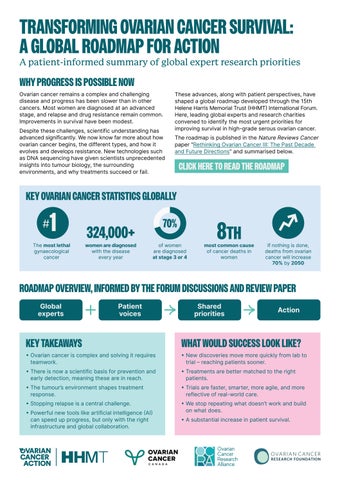
KEY OVARIAN CANCER STATISTICS GLOBALLY ROADMAP
These advances, along with patient perspectives, have shaped a global roadmap developed through the 15th Helene Harris Memorial Trust (HHMT) International Forum. Here, leading global experts and research charities convened to identify the most urgent priorities for improving survival in high-grade serous ovarian cancer. The roadmap is published in the Nature Reviews Cancer paper “Rethinking Ovarian Cancer III: The Past Decade and Future Directions” and summarised below.
The most lethal gynaecological cancer
324,000+ women are diagnosed with the disease every year of women are diagnosed at stage 3 or 4
8TH 70%
most common cause of cancer deaths in women If nothing is done, deaths from ovarian cancer will increase 70% by 2050
KEY TAKEAWAYS
• Ovarian cancer is complex and solving it requires teamwork.
• There is now a scientific basis for prevention and early detection, meaning these are in reach.
• The tumour’s environment shapes treatment response.
• Stopping relapse is a central challenge.
• Powerful new tools like artificial intelligence (AI) can speed up progress, but only with the right infrastructure and global collaboration.

WHAT WOULD SUCCESS LOOK LIKE?
• New discoveries move more quickly from lab to trial – reaching patients sooner.
• Treatments are better matched to the right patients.
• Trials are faster, smarter, more agile, and more reflective of real-world care.
• We stop repeating what doesn’t work and build on what does.
• A substantial increase in patient survival.

URGENT RESEARCH PRIORITIES FOR TRANSFORMING OVARIAN CANCER SURVIVAL
1
Prevention, initiation and early detection: improving outcomes through risk reduction and earlier diagnosis
Many ovarian cancers begin in the fallopian tubes, which has led to important shifts in prevention strategies. Genetic testing for BRCA1/2 and other risk genes is becoming more widely available, helping identify individuals at higher risk. For these individuals, staged risk-reducing surgeries – removing the fallopian tubes first and the ovaries later – is being explored as a way to lower cancer risk while delaying early menopause. For those at average risk, opportunistic salpingectomy (removing fallopian tubes during routine surgery) is emerging as an effective populationlevel prevention strategy. Expanding awareness and access to these strategies is essential to reduce ovarian cancer diagnoses.
Early cellular changes, known as serous tubal intraepithelial carcinomas (STICs), can appear years before ovarian cancer. Advances in technologies, including single-cell and spatial transcriptomic studies, are allowing researchers to look at cancer at the level of individual cells and understand how these early changes develop and vary across different areas of the tissue. AI-enhanced pathology is further improving our ability to detect and interpret these changes. However, clear guidance on how to manage STICs and prevent progression to ovarian cancer is still urgently needed. Despite these advances, early detection remains a significant challenge. Current tools like CA125 and transvaginal ultrasound lack sensitivity, but advances in molecular profiling, identification of early biomarkers, and AI-driven approaches are creating new opportunities to detect ovarian cancer earlier, identify individuals at high risk and improve the accuracy of diagnosis and screening.
“I was lucky to be diagnosed early. But luck is not a strategy.”
Lisa, HHMT Patient Advocate
2
Tumour ecosystem: understanding cancer’s surrounding environment will inform better treatment options
Ovarian cancers sit within a “tumour microenvironment”: the neighbourhood of blood vessels, structural tissue and immune and support cells that surround them and help cancers grow, block treatments from working, and promote disease spread or relapse. Microenvironments differ between tumours and are shaped by individual health factors, the cancer’s genetic makeup, where it is in the body, and prior treatments.
A better understanding of this ecosystem will allow researchers to develop better and more personalised therapies. To achieve this, researchers must collect tumour samples over time, develop clinically relevant models that reflect real patient biology, and integrate genetic and treatment data using AI in ways that are affordable and scalable for routine clinical care.
“Every woman seems to experience this cancer differently. Research needs to understand why.”
Anon, OCA Research Network Volunteer
3
Immunity and immunotherapy: harnessing the immune system to fight ovarian cancer
Our immune system can recognise and attack cancer cells. In ovarian cancer, tumours containing certain immune cells are linked with better survival, indicating the immune system can influence outcomes. However, most immunotherapies have had limited success because ovarian cancers use several strategies to hide from or suppress immune attack, and different tumour sites within the same patient may respond differently.
Effective immunotherapies remain promising, and if successful will offer more and better treatment options for patients. Progress will depend on developing new approaches, identifying which patients will benefit, and designing more effective combination treatments. To achieve this, researchers must develop better tumour experimental models, identify biomarkers that can predict response, learn from long-term survivors, and collect tumour samples over time to track how immune responses change during treatment.
“Immunotherapy will bring us longer, happier lives with our families.”
Anne, HHMT Patient Advocate
4
Acquired resistance to current treatments: understanding and overcoming treatment failure
Many ovarian cancers initially respond to treatment but later develop resistance as the tumour adapts through genetic and biological changes within cancer cells and their surrounding environment. This resistance is a major reason the disease returns and long-term treatment options become limited.
Understanding how resistance develops is key to preventing or delaying relapse and improving outcomes. To achieve this, researchers must collect tumour samples over time to track how cancers change during treatment, develop tests that predict which therapies are most likely to work, and use blood-based approaches to monitor treatment response in real time. They must also identify and target resistant cancer cell populations early, and use large datasets and AI to detect warning signs of resistance, guide clinical trials, and explain why some patients experience long-lasting responses while others do not.
“Ovarian cancer doesn’t play nice. Platinum resistance is one of our biggest problems.
5
New therapies and future trial design: advancing personalised treatment approaches
The standard treatment for ovarian cancer is a combination of surgery and chemotherapy and has not changed in over 30 years. Maintenance therapy with PARP inhibitors has improved outcomes, particularly for patients with BRCA mutations and other DNA faults, though the optimal timing, use, and length of treatment is still being studied.
Developing new targeted therapies, including antibody-drug conjugates, is essential to expand treatment options and improve outcomes. However, the high cost and length of clinical trials remain significant barriers to progress. To overcome this, researchers must design faster, more adaptive trials, integrate tumour profiling and advanced technologies to match treatments to the right patients, and use early trial data to quickly identify and scale effective therapies while discontinuing those that do not work.
“Chemotherapy bashed my body. We need treatments that make the journey
URGENT RESEARCH PRIORITIES FOR TRANSFORMING OVARIAN CANCER SURVIVAL
Research priority
Prevention, initiation and early detection
Ovarian cancer often develops silently, making it hard to detect. Understanding how it begins, identifying people at higher risk, and finding it early can improve survival and outcomes.
What this could achieve
• Increased uptake of targeted prevention strategies, including risk-reducing salpingo-oophorectomy (for those at high risk) and opportunistic salpingectomy (for those at average risk).
• Earlier diagnosis through better symptom awareness and identification of those at an increased risk.
• Fewer women developing ovarian cancer.
How we’ll get there
• Expand awareness and access to prevention strategies by identifying high-risk individuals through genetic screening and integrating prevention approaches into routine care.
• Develop strategies to detect cancer earlier using biomarkers, AI and advanced diagnostic technologies.
• Research into how precancers (STICs) develop and build consensus on how to manage them to prevent progression to ovarian cancer.
Why it’s so important
“I was lucky to be diagnosed early. But luck is not a strategy.”
Lisa, HHMT Patient Advocate
Tumour ecosystem
The neighbourhood surrounding the cancer, which can help it grow, block treatments from working, and promote disease spread or return.
Immunity and immunotherapy
The immune system can recognise and attack cancer, but immunotherapies have had limited success because ovarian cancers use several strategies to hide from or suppress immune attack.
• A better understanding of ovarian cancer biology and development.
• More effective and personalised treatment options.
• Delayed or prevented relapse.
• A better understanding of ovarian cancer in the context of the immune system.
• More effective and personalised treatment options.
• Delayed or prevented relapse.
• Collect tumour samples over time.
• Develop clinically relevant disease models.
• Integrate genetic and treatment data.
• Apply AI to guide treatment decisions.
• Develop strategies to stop the tumour hiding from the immune system.
• Identify markers that predict which patients will benefit.
• Develop effective combination therapies.
• Track immune response in patients over time.
• Learn from long-term survivors.
“Every woman seems to experience this cancer differently. Research needs to understand why.”
Anon, OCA Research Network Volunteer
“Immunotherapy will bring us longer, happier lives with our families.”
Anne, HHMT Patient Advocate
Acquired resistance to current treatments
Many ovarian cancers initially respond to treatment, but as the cancer adapts, it can eventually develop drug resistance.
New therapies and future trial design
Many patients face limited treatment options, making it essential to develop new targeted therapies and personalised approaches to improve survival and quality of life.
• Earlier identification of treatment resistance.
• Delayed or prevented relapse.
• More durable responses to existing therapies.
• Development of better targeted therapies, including antibody-drug conjugates (ADCs).
• More personalised treatment options for patients, especially those who do not currently benefit
• Track how tumours change during treatment.
• Develop tools to detect resistance patterns and predict treatment responses early.
• Monitor response using blood-based tests.
• Develop new targeted therapies (e.g. ADCs).
• Design faster, more adaptive trials.
• Match treatments to patients.
• Scale effective treatments quickly.
• Integrate advanced technologies into trials.
“Ovarian cancer doesn’t play nice. Platinum resistance is one of our biggest problems. Let’s get it solved.”
Lilliana, HHMT Patient Advocate
“Chemotherapy bashed my body. We need treatments that make the journey easier – not harder.”
Sbba, HHMT Patient Advocate


Without greater alignment and collaboration, progress will remain slow, research will continue to be duplicated, and survival rates will not improve at the pace women urgently need.
These new research priorities will:
Provide researchers with insights from experts for consideration in their study designs
Inform future funding calls and investment decisions
Influence trial design and research strategy
Shape conversations with policymakers and health systems
The priorities must guide the next wave of research and investment globally. The goal is measurable change in outcomes for women with ovarian cancer.
“The most effective way of achieving meaningful progress in detecting and fighting ovarian cancer is to have a global roadmap for action.”
Shirin, Patient Advocate
Authors: Faye Hobbs1, Jessica Lawson2, Amy Wilson3
Contributors: Sarah DeFeo4, David Hunt3, Kristin McGowan4, Marie-Claire Platt1, Alicia Tone2
With special thanks to our lived experience experts, and HHMT Co-Chairs Professors Fran Balkwill and David Bowtell who reviewed this summary.
1. Ovarian Cancer Action, United Kingdom
2. Ovarian Cancer Canada, Canada
3. Ovarian Cancer Research Foundation, Australia,
4. Ovarian Cancer Research Alliance, USA