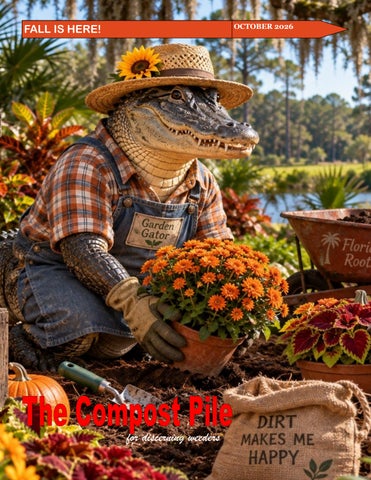
OCTOBER 2026
FALL IS HERE!
for discerning weeders
An Okaloosa County Master Gardener Volunteer Publication
October 2026
From the Editors
2
Updated Publications
3
Spotlight on……….
4-6
New Recruits
6
Photos, Events, and Word of the Day
7
Garden Shed—First Aid
8
The It Girl of Fall
9-11
Bibliophile’s Corner
11
Last Word
12
Please submit articles, photos, recipes, etc. no later than November 30th to be included in the next issue of The Compost Pile which is due out December/January Please remember when submitting photos to let us know who took the picture and provide us some information as to content.
An Okaloosa County Master Gardener Volunteer Publication
October 2026
FROM THE EDITOR The year is starting to wind down, but the Master We have a new group of trainees who will become Gardener Volunteers just keep going!
interns come November!
There is progress at the Sheila Dunning
The lecture series will wind down in October and
Extension Building and soon we’ll have our
then begin back up in March with a fantastic
nursery up and running at that facility. Of course playlist! there have been some bumps along the way but
On a side note, remember that this publication is
change is never easy. But our group, we definitely only as good as the articles and photos that we know how to make the most of whatever situation receive. Please take some time during the next we find ourselves in and always come out strong- few months to send us your ideas, photos, and er and better than before! articles! Speaking of change, the weather appears to
Have fun out there and enjoy the season!
finally have gotten the message that Fall is here! Enjoy the cool temperatures while we have them. I’m sure in a few months we’ll be complaining about the cold. In the meantime, we can enjoy the
Plentiful Plantings The Editors
brief respite from the heat while enjoying less sweating in the gardens!
Sign outside of the Okaloosa Technical College. Photo credit: Kathy Foster
An Okaloosa County Master Gardener Volunteer Publication
2
October 2026
UPDATED PUBLICATIONS SS-FOR-21/FR149: Conservation Easements: An Option for Preserving Current Land Uses HS1315/HS1315: CRISPR Gene Editing in Strawberry PI289/PI289: The Facts about Mothballs FCS3440/FY1581: Grapes (Vitis rotundifolia) FCS3458/FY1609: Persimmons (Diospyros kaki)
FA195/FA195: Preventing Escape of Non-Native Species from Aquaculture Facilities in Florida, Part 1: General Considerations and Regulations
An Okaloosa County Master Gardener Volunteer Publication
FA196/FA196: Preventing Escape of Non-Native Species from Aquaculture Facilities in Florida, Part 2: Facility Evaluation Strategies FA197/FA197: Preventing Escape of Non-Native Species from Aquaculture Facilities in Florida, Part 3: Structural Strategies FPS124/FP124: Chiococca alba: Snowberry FPS142/FP142: Coreopsis leavenworthii: Leavenworth's Tickseed FPS136/FP136: Coleus scutellarioides: Coleus
3
October 2026
SPOTLIGHT ON…...
Photo Credit: Forest Hecker, UF/IFAS Frogfruit: A Little Florida Native with a Curious Name and a Big Job Have you ever spotted a low-growing plant creeping through your lawn with tiny purpleand-white flowers that look a little like miniature match heads? Your first thought might be, “I need to get rid of that weed.” But before reaching for the weed killer, take another look. You may have frogfruit (Phyla nodiflora), a Florida native that might deserve to stay. Frogfruit—also called turkey tangle fogfruit, matchweed and capeweed—is a tough little perennial that can serve as a groundcover, lawn companion and pollinator plant. It can even be used as an alternative to traditional turfgrass in some areas. For a plant that spends most of its life just a few inches off the ground, frogfruit does a surprising amount of work.
What's with the Name? Let's get the obvious question out of the way: What does frogfruit have to do with frogs? Apparently, not much. Its original name was fogfruit. During medieval times, once the hay fields were harvested this little plant would put out flowers while there was low fog over the fields. Just like with a game of telephone, the term morphed into frogfruit, An Okaloosa County Master Gardener Volunteer Publication
probably due to its preference for wetter areas where frogs and toads like to be. Whatever you call it, Phyla nodiflora avoids the confusion. Small Plant, Big Personality Frogfruit belongs to the verbena family. It grows by sending stems, called stolons, horizontally across the soil. These stems can root where their nodes touch the ground, allowing the plant to gradually form a dense mat. The foliage generally stays only about 1 to 3 inches tall, although flowering stems may reach around 6 inches. Under favorable conditions, a plant can spread several feet. Then there are those flowers. Small white, pinkish or lavender flowers surround a darker center, giving each flower head its distinctive match-head appearance. In much of Florida, frogfruit blooms during the warmer months, generally from spring into fall. Those tiny flowers aren't just attractive—they're also feeding wildlife. Butterflies Love It This may be frogfruit's best selling point. The flowers attract bees, butterflies and other pollinators, but frogfruit provides more than nectar. It is also a larval host plant, meaning certain butterflies lay their eggs on it and their caterpillars use it for food. Frogfruit is a host 4
October 2026
SPOTLIGHT (cont’d.) plant for butterflies including the Phaon crescent, common buckeye and white peacock. Its flowers also provide nectar for insects such as the ceraunus blue butterfly and native bees. So, if you see caterpillars chewing on your frogfruit, don't immediately assume you have a pest problem. Those chewed leaves may mean the plant is doing exactly what we want a native host plant to do. Sometimes a slightly ragged plant is a sign of a successful butterfly garden. Is It a Weed? Well...where is it growing? A weed is simply a plant growing where it isn't wanted. Frogfruit can spread into an irrigated lawn, and if your goal is a perfectly uniform stand of turfgrass, you may not appreciate its enthusiasm. But move that same plant into a butterfly garden, mixed lawn or area where you need a low-growing groundcover, and suddenly that spreading habit becomes an advantage. Where Can You Use It? Frogfruit doesn't have to be confined to the lawn. It can make an attractive living groundcover around taller plants or along the edges of landscape beds. Its trailing growth also makes it suitable for containers and hanging baskets. It can be incorporated into mixed lawns, including areas with bahiagrass or St. Augustinegrass, or planted as part of a butterfly or pollinator garden. Frogfruit can also be useful around ponds, rain gardens and other moist areas when site conditions are suitable. That gives homeowners quite a few options for a plant they may previously have considered nothing more than a weed. A Good Fit for Northwest Florida Frogfruit's adaptability is another reason it An Okaloosa County Master Gardener Volunteer Publication
deserves attention. UF/IFAS recommends it for approximately USDA Hardiness Zones 8a through 11, which includes Northwest Florida. It grows in full sun to partial shade and tolerates sandy, loamy and clay soils as well as a range of soil pH. It also handles both moist and relatively dry conditions. Once established, frogfruit has moderate to high drought tolerance, although prolonged drought may cause it to decline or go dormant. And if yours looks terrible after one of our Northwest Florida cold snaps, don't give up on it too quickly. Frogfruit may go dormant or suffer freeze injury during winter. Once consistently warm weather returns, established plants can recover and begin growing again. Easy Does It Another nice feature of frogfruit is that it generally doesn't require a lot of fuss. Its creeping stems naturally root as they travel across the ground, and cuttings can be rooted in moist potting soil or even water. Plugs can also be planted and allowed to spread. There are no reported major pest or disease concerns, making established frogfruit relatively low maintenance. That can be especially valuable in a FloridaFriendly Landscape. Choosing plants suited to our conditions can help reduce the amount of water, fertilizer, pesticides and maintenance needed to keep a landscape attractive. There is one important thing to remember, though: if you planted frogfruit for butterflies, think carefully before treating caterpillars with an insecticide. You may be eliminating the very wildlife you planted it to support. Could This Be Part of the Florida Lawn of the Future? 5
October 2026
SPOTLIGHT (cont’d.) Frogfruit has attracted enough attention that University of Florida researchers have been evaluating it for traits such as compact growth, persistence, resilience, flowering and improved winter color. The goal is to explore whether frogfruit could become an even more useful lawn companion or turf alternative. That's quite a change in perspective for a plant that many homeowners have spent years trying to eliminate.
Frogfruit offers many of the characteristics we're increasingly looking for in Florida landscapes: low growth, drought tolerance, some traffic tolerance, flowers for pollinators, food for butterfly caterpillars and relatively low maintenance. Maybe It Isn't a Weed After All
Frogfruit is a good reminder that sometimes the difference between a weed and a desirable plant is simply our expectation. If it appears in the middle of a carefully maintained turfgrass lawn, you may not want it there. But in a butterfly garden, mixed lawn, native landscape or low-maintenance groundcover area, that exact same plant can be an asset. For Northwest Florida homeowners, frogfruit offers an especially useful combination. It's native, adapted to our climate, tolerant of different soil and moisture conditions, easy to propagate and valuable to pollinators. So, the next time you notice those tiny purple-and-white match heads peeking through the grass, don't be too quick to reach for the weed killer. Take a closer look. That little “weed” might be doing more good in your yard than you realized.
New Master Gardener Trainees—Looking forward to this group joining the ranks! Left to Right: Mark Yuschak, Janee Goraum, Deborah Medla, Megan Barys, Leann Stone, Carolyn Ketchel, Steven Standley, Diane Riexinger, Pat Casey, Raymond Nelson, and Joe Whitfield Photo Credit: Marg Stewart An Okaloosa County Master Gardener Volunteer Publication
6
October 2026
WORD OF THE DAY BENISON: an archaic word meaning a blessing or something regarding with gratitude. Find benison in the little things—the cooling air, a quiet morning, and food from the garden.
Folks are serious bargain hunters at our last plant sale! Photo Credit: Larry Williams
An Okaloosa County Master Gardener Volunteer Publication
7
October 2026
The Garden Shed How I Ditched the Blue Stuff and Learned to Love My Soil Sixteen years ago, as a Master Gardener in training, I learned one of gardening's basic principles: Feed the soil, not just the plant. I'm sure we still teach it. But somewhere along the way, it's remarkably easy to forget. I did. For years I've been a devoted Miracle-Gro user. You know the stuff—the bright blue crystals that dissolve in the watering can and seem to make plants stand up and salute. And I still think it's awesome, so the title of this article is a little misleading. I haven't actually ditched the blue stuff. I've simply relegated it to the "I want blooms tomorrow" shelf. Miracle-Gro is practically crack for plants, and sometimes that's exactly what a gardener wants. What has changed is the way I think about feeding my garden. Recently I began experimenting with Elm Dirt Plant Juice, an organic liquid plant food containing worm castings, plant nutrients and microorganisms. I was skeptical enough to do what gardeners have always done: I tried it and watched. One of the most noticeable responses came from my many miniature roses. The change was striking. But the roses weren’t alone. Annuals, perennials and container plants that received Plant Juice responded with healthier-looking growth. This wasn't a controlled experiment, and I'm not pretending it was. There were plenty of variables. But when virtually every treated plant seems happier, a gardener pays attention. I went further and started thinking about the health of the soil itself; then I went down the soil-microbe rabbit hole, learning (or re-learning) that healthy soil is a remarkably active ecosystem populated by bacteria, fungi and countless other organisms involved in the decomposition and nutrient cycling. Organic matter feeds this community and improves the soil's ability to hold water and nutrients— particularly valuable in our Florida sand. Suddenly all those years of spreading mulch seemed considerably more valuable than I had thought. But it wasn’t enough. Plants need An Okaloosa County Master Gardener Volunteer Publication
by Karen Harper nutrients, and water-soluble fertilizers have a very useful characteristic: those nutrients are available quickly. That's precisely why Miracle-Gro can produce such gratifying results. But feeding a plant and improving its soil aren't necessarily the same job. That's the lesson I've rediscovered. After gardening on this soil for 36 years, I realized there were likely some nutrients that would need replenishing. Elm Dirt Plant Juice led me to experiment further, including trying Dr. Raifya's Mycorrhizal Fungi Powder. I started with one little packet of mycorrhizal fungi, which seemed perfectly reasonable until I discovered it was barely enough to treat my roses. Then I looked around at the daylilies, annuals, perennials, citrus, blueberries and the other ten thousand or so plants in my yard. (That number may be a slight exaggeration.) And I'm now buying mycorrhizal fungi by the pound. I'm not declaring war on synthetic fertilizer, nor have I become doctrinaire about "organic" gardening, although I lean that way when I can. I’m looking at my plants and I'm thinking more long term, I'm increasingly inclined to think about what's happening in the soil around its roots. But If company is coming Saturday and I want the patio annuals looking spectacular? Hand me the blue stuff. After sixteen years, I've come full circle to one of the first lessons I was taught. I haven't really ditched the blue stuff. I've just stopped trying to make it do all the work.
Photo Credit: Karen Harper
8
October 2026
The “It Girl” of Fall There are plants that quietly sit in the corner looking pretty, and then there are plants that walk into October like they have a pumpkin spice latte in one hand and a tiny witch hat in the other. Tiger Paws Begonia is definitely the second kind. With its rich green foliage, dramatic copper markings, and delightfully fuzzy stems, Tiger Paws has just the right amount of attitude for the fall garden. Its unusual leaves bring to mind tiny tiger stripes, adorable woodland creatures, and all the cozy autumn colors we start craving the minute September rolls around. Add a little pumpkin spice, a fuzzy blanket, and a candle that smells suspiciously like “Harvest Moon,” and this begonia has basically found its people. Tiger Paws is a rhizomatous begonia, grown primarily for its foliage rather than its flowers. Its compact growth habit and uniquely patterned leaves make it an especially fun and showy plant for the begonia enthusiast. Those fuzzy petioles add another layer of texture, almost as if they’re daring you to reach out and touch them, sounds a lot like that enchanted spindle that lured Sleeping Beauty into a century long nap. Admire them closely, but perhaps keep your fingers to yourself. For gardeners who love coleus, caladiums, or other foliage focused plants, Tiger Paws fits right in. But unlike those familiar garden favorites, this begonia brings a little woodland whimsy to the party. Its foliage looks especially An Okaloosa County Master Gardener Volunteer Publication
by Dana Jolman
striking when paired with warm autumn tones, making it a natural choice for a seasonal plant display. Basically, if fall had a plant bestie, Tiger Paws would be wearing an oversized cardigan, carrying a Pumpkin Spice Latte, and saying, “Sorry, I can’t. I have to go to the plant nursery.” Care: Keeping Your Little Pumpkin Spice Queen Happy
Tiger Paws may look a little wild, but its care is fairly straightforward once you understand what makes begonias happy. Think bright but gentle light, consistent moisture, good drainage, and plenty of airflow. Light: Provide bright, indirect light or filtered sunlight. Gentle morning sun is usually fine, but harsh afternoon rays can scorch the foliage. Think dappled woodland light rather than sitting your begonia directly in the Florida sun for an afternoon tanning session. Soil: Use a loose, well-draining potting mix rich in organic matter. Begonias like moisture, but their roots also need oxygen. A mix amended with perlite, bark, or another drainage-friendly material can help keep the roots happy. Water: Keep the soil evenly moist but never soggy. Allow the surface to dry slightly before watering again, then water thoroughly. Overwatering can quickly lead to root problems, so don’t let the cozy fall vibes convince you that your begonia needs a daily pumpkin-spice 9
October 2026
It Girl (cont’d.) hydration ritual.
Petiole Cuttings: A healthy leaf with its petiole can also be rooted in a moist propagation Humidity: Tiger Paws appreciate humidity, medium. Keep it warm, humid, and in bright, inespecially indoors or in dry conditions. Grouping direct light while new roots and growth develop. plants together or creating a humid microclimate can help. Just remember that humidity needs to Stem Cuttings: Healthy stems can be rooted in be paired with good air circulation. We want moist, well-draining propagation media. Keep the tropical spa day, not tropical swamp. cutting warm and lightly humid while it establishes. Temperature: Keep your Tiger Paws warm and Division: Mature protected from cold drafts. plants with multiple Like many tropical growing points can begonias, it prefers temsometimes be peratures above 60°F and divided during may begin to sulk when repotting. Each temperatures drop. section should have healthy roots and a Fertilizer: During active growing point before growth, feed with a being potted balanced fertilizer at the separately. recommended diluted rate. Regular, moderate feeding And remember, can encourage healthy propagation is an foliage and growth without experiment. Some overwhelming the plant. cuttings will root like Remember: fertilizer is they have seasoning, not the whole somewhere to be, meal. while others will sit there contemplating Propagation: Making their life choices. More Little Tiger Paws That’s part of gardening. Try If there is one thing different methods, observe the results, and learn gardeners have learned, it is that owning one interesting plant is often just the beginning of the what works best in your growing conditions. problem. Thankfully, Tiger Paws gives us TONS For Master Gardener Volunteers, Tiger Paws is of options. more than just a cute addition to the fall plant table. It provides an opportunity to talk about Leaf Cuttings: Healthy leaves can be used for propagation, with sections or portions of the leaf rhizomatous growth, foliage characteristics, light requirements, moisture management, humidity, placed against a moist propagation medium. and several methods of vegetative propagation. Under warm, humid conditions, new plantlets Its unusual appearance also makes it an easy may develop. conversation starter because let’s be honest, An Okaloosa County Master Gardener Volunteer Publication
10
October 2026
It Girl (cont’d.) somebody is going to see those fuzzy stems and immediately ask, “What IS that?” And maybe that’s one of the best things about plants. They don’t all have to be perfectly predictable. Some bring flowers, some bring fragrance, and some show up looking like they got dressed specifically for October. Tiger Paws brings a little bit of the wild into our cozy fall season. It has the warm, earthy personality of autumn without needing to bloom orange or yellow to earn its place on the seasonal stage. Give it the right conditions and those
beautifully patterned leaves can keep the fall feeling going long after the pumpkin spice has disappeared from the coffee shop menu. So grab your favorite sweater, pour yourself something warm, put on your favorite spooky season playlist, and give this little begonia the attention it deserves. Keep growing, keep experimenting, and remember: there’s always room for one more plant. Photo Credit: Dana Jolman
BIBLIOPHILE’S CORNER The Drunken Botanist: The Plants that Create the World’s Great Drinks: 10th Anniversary Edition, by Amy Stewart The New York Times-bestselling guide to botany and booze celebrates its 10th anniversary with an updated edition—now including a guide to planting your very own cocktail garden to go with more than fifty drink recipes. This book is the ideal gift for every cocktail aficionado and the perfect drinks book for every plant lover.
Weeds of the South, by Charles Bryson & Michael DeFelice Weeds and invasive plants can threaten the safe, efficient, and sustainable production of food, feed, fiber, and biofuel. Featuring more than 1,500 full-color photographs, this field guide helps identify 400 of the most troublesome weeds and invasive plants found throughout the southern United States. Developed with input from more than 40 weed scientists and botanists, the guide shows plants at different stages of growth and provides information on their origin, habitat, distribution, biology, identifying characteristics, and potential toxicity. Each species account includes photographs, distribution maps, scientific and common names, seedling and leaf characteristics, reproductive features, and other important identification details. An Okaloosa County Master Gardener Volunteer Publication
11
October 2026
LAST WORD
by Marg Stewart Okay, I’m going to take a moment to toot my own horn so to speak. Happy Hubby is no longer the only published author residing in Chateau Stewart.
Yes, I did it! Quite honestly, it would not have happened without having been the editor of The Compost Pile for all this time. The books is a compilation of the greatest disasters ahem, hits from this publication. I got to thinking about how long I’ve been an editor of The Compost Pile. Way back in the dark ages, when we were still housed on Old Bethel Road, I agreed to take over from Lynn Fabian. She had been the editor for seven years. As time went on, (and on, and on) I figured that I would retire once I completed seven and a half years.
Long story short, except for very short retirement, I’ve been one of the editors for almost 13 years now. That’s the equivalent of 68 in cat years! My where does time go? There have been a lot of changes during this time. We moved the Crestview office to the new building on Airport Road in 2012. We got flooded out of the building on Hollywood (multiple times) until that building was deemed unsuitable. Then we have been at the OTC facility and now we’re waiting for the final construction of the nursery area at the Sheila Dunning Extension Building. Time and change. Two things that we have no control over. Sure, we like to think we can control change but the universe tends to laugh at our attempts. Take two trees behind the office. Both were struck by lightning quite a few years ago. One of them fell over several years back. The other is still standing, dead, but still standing. There are huge chunks missing out of it now and every time there is a wind storm, I keep expecting it to topple. But it hasn’t. It’s still standing there, defiant. An Okaloosa County Master Gardener Volunteer Publication
I know that one day it will fall over. That time and change will take their toll and return that tree back into the earth. But I do applaud its stubborn refusal to do so easily. As gardeners, we’re all about time. The right time to plant, the right time to water, the right time to fertilize. Time is the task-master to all we do. Change is the CFO of our endeavors. Drought, rain that seems like it will never end, heat, insects, all create changes in our world that we then find the time to deal with appropriately or when we’re totally frustrated, with a front-end loader, bulldozer, and Astro turf. Humans, we’re obsessed with change and time. Luna(tic) the resident commander of the household, could care less. Time is immaterial and change is simply an excuse to poke her furry paws into what she perceives as something new. Straws in the holder? Something for her to investigate and then cart around the house. Box from Amazon? Something to flip over and create a snooze spot. You moved a chair 1/8 inch to the right? Must investigate completely.
So my thought is this. Rather than being concerned with time and/or change—we should try to be like the tree and Luna. Be stubborn to not let things move you until you are good and ready but stay curious enough to investigate any change, no matter how big or how small (or how much consternation you cause the other inhabitants of your world) and make them an adventure! Have a section of the garden that needs weeding? Go ahead and weed it when you’re good and ready and while you’re at it, see how many different things are inhabiting that area. Need to prune something? See if any of the castoffs would make a good walking stick. And remember—take time to enjoy the garden!
Plentiful Plantings Time is a great teacher, but unfortunately it kills all its pupils. Hector Berlioz
12
October 2026
An Equal Opportunity Institution
Mission To assist Extension Agents in providing research-based horticultural education to Florida residents. Vision To be the most trusted resource for horticultural education in Florida.
The Compost Pile is a quarterly publication created by the Okaloosa County Master Gardener Volunteers. Marg Stewart—Editor Karen Harper, Debbie Sewell Co-Editors