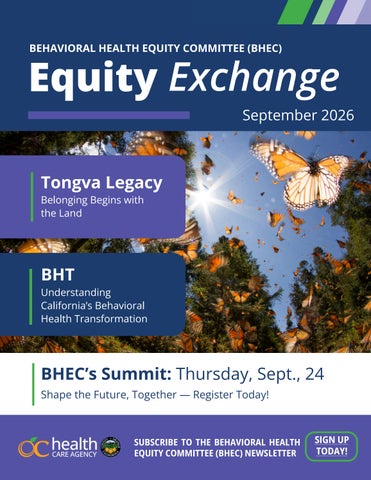
BEHAVIORAL HEALTH EQUITY COMMITTEE (BHEC)
Equity Exchange September 2026
Tongva Legacy Belonging Begins with the Land
BHT
Understanding California’s Behavioral Health Transformation
BHEC’s Summit: Thursday, Sept., 24 Shape the Future, Together — Register Today!
SUBSCRIBE TO THE BEHAVIORAL HEALTH EQUITY COMMITTEE (BHEC) NEWSLETTER
SIGN UP TODAY!
JOIN US!
BHEC THE SUMMIT Behavioral Health Equity Committee
September 24, 2026 9:00 a.m. - 4:00 p.m. Behavioral Health Training Center 750 The City Drive South Orange, CA 92868
Scan Here to Register
https://forms.cloud.microsoft/g/zwc9pVnJcJ
SHAPING THE FUTURE, TOGETHER
REGISTER TODAY!
Workgroup Presentations Asian American & Pacific Islander (AAPI) Beyond the Surface: Culturally Responsive Approaches to SUD & Mental Health with Asian-American Clients
Black/African-American
The Fourth Trimester: When Black Mothers Need Us Most
Deaf & Hard of Hearing (D/HH) Seeing Beyond Sound: A Lens on Deaf Culture
Indigenous/Native
Building System of Care for OC Native Families
LatinX
Holding on to Hope: The Power of Storytelling in Times of Fear & Family Separation
LGBTQ+
Affirming Connections: How Supportive Adults Can Make a Difference for LGBTQ+ Youth
Spirituality
Engaging Spirituality: Living within a Spiritual Worldview for Coping, Resilience and Connection
Substance Use Disorder (SUD) Opioid Overdose Prevention Training
A Message from Our Equity Services Manager By Dr. Deana Helmy, EdD, MBA, LMFT, She series
With heartfelt gratitude, I welcome you to this edition of the BHEC Equity Exchange—a space shaped by the dedication, wisdom, and partnership of our Orange County community. Each page reflects the collective journey we share: advancing equity, breaking down barriers, and building a behavioral health system where everyone feels seen, heard, and valued. This quarter, our workgroups have deepened relationships, fostered a sense of belonging, and expanded access to services that honor the diversity of our county. From forging new partnerships with local organizations to creating linguistically accessible pathways that guide community members to vital resources, our progress is rooted in collaboration and a commitment to equity for all. We also recognize the challenges that remain—systemic disparities, stigma, and the need for greater engagement. Yet, it is through your voices, your leadership, and your willingness to connect that we continue to move forward. Together, we are not only responding to immediate needs but also laying the foundation for lasting change. I thank you for your partnership, advocacy, and unwavering commitment to making Orange County a place where equity is not just a vision but a reality. Warmly, Dr. Deana Helmy Equity Services Manager Behavioral Health Services – OC Health Care Agency
Behavioral Health Equity Committee The Behavioral Health Equity Committee is dedicated to impacting behavioral health services by promoting recovery and wellness in diverse communities. Collectively, we aim to: Create awareness Eliminate disparities Reduce stigma Increase engagement Recommend community-informed policies Expand equitable access to behavioral health services Work to ensure culturally responsive, inclusive, intersectional and trauma-informed care in Orange County
Cultural Awareness Highlights July 2026 BIPOC (Black, Indigenous, and People of Color) Mental Health Month Disability Pride Month Independence Day National Minority Mental Health Awareness Month Pioneer Day The Korean War Remembrance Day
August 2026 Asian American & Pacific Islander Heritage Month Overdose Awareness Day
September 2026 California Native American Day Deaf Awareness Month Hispanic Heritage Month Mid-Autumn Festival National Recovery Month National Suicide Prevention Month Rosh Hashanah
What is BHEC? The Behavioral Health Equity Committee (BHEC)
is
Orange
County’s
Asian American & Pacific Islander (AAPI)
Cultural
Competence Committee, serving in an advisory capacity to the Behavioral Health Director, providing recommendations for culturally and linguistically responsive services for our diverse communities.
Black/ AfricanAmerican (B/AA) Deaf & Hard of Hearing (DHH)
The Department of Health Care Services (DHCS)
is
updating
statewide
Cultural
Competence Plan (CCP) guidance. Counties will no longer submit a separate CCP report; instead, cultural competence work will be integrated into existing Behavioral Health
Indigenous/ Native American (I/N)
Services Administration (BHSA) reporting.
LatinX
This shift strengthens accountability and uses BHSA’s
robust
data,
planning,
and
community engagement processes to better support culturally responsive care.
LGBTQ+
BHEC continues to play a key role in this work.
Through
eight
(8)
specialized
Spirituality
workgroups, BHEC helps shape strategies that advance equity, improve access, and uplift
community
voice
across
County’s behavioral health system.
Get involved! Email:
Wesley Shain wshain@ochca.com
Orange
Substance Use Disorder (SUD)
Advancing Behavioral Health Equity: What It Really Means Behavioral health equity ensures that everyone – regardless of race, ethnicity, income, language, or identity – has fair and just access to quality mental health and substance use services and achieves equitable outcomes. As defined by the Substance Abuse and Mental Health Services Administrator (SAMHSA), equity is about “consistent and systematic, fair, just, and impartial treatment of all individuals, including those in historically underserved communities.”1 This means removing barriers, tailoring care to cultural needs, and closing gaps in outcomes. Why it matters: Equity isn’t just access – it’s about making sure care works for everyone.
Equality
Substance Abuse and Mental Health Services Administration. 2023. Behavioral Health Equity Fact Sheet. U.S. Department of Health and Human Services. https://www.samhsa.gov/sites/default/files/health-equity-fact-sheet.pdf 1
Equity
Spotlight: State of Public Health in Orange County Orange County Health Officer Dr. Regina Chinsio‑Kwong (Dr. CK) delivered this year’s State of Health in Orange County 2026 Address, outlining our community’s progress — and the challenges still ahead. A Year of Progress and Pressure California has made gains in life expectancy and infant health, yet disparities, behavioral health needs, and system strain continue to grow. In Orange County, we face similar pressures: financial constraints, policy shifts, workforce shortages, and an information landscape that affects public trust. Resilience & Reinvention This year’s theme highlights how public health is evolving. Across the OC Health Care Agency (HCA), teams are strengthening data systems, modernizing communication, refining core services, and investing in a resilient workforce — all to stay responsive with limited resources. Where Behavioral Health Connects Dr. CK emphasized the deep link between public health and behavioral health. The HCA’s Mental Health Awareness theme — Hope. Heal. Thrive. — aligns with this year’s message: staying future‑focused, acknowledging strain, and building stronger, more sustainable systems. Evolving With Our Community The Agency has faced increased demand and financial uncertainty, shifting some functions to community partners better equipped to sustain them — a reminder that protecting public health is a shared responsibility. Moving Forward With Hope Though some data is challenging, Dr. CK highlighted growing partnerships and community solutions that offer real hope. Progress in behavioral health continues to come from working together.
BHEC| Equity Exchange
CULTURE CORNER
Acknowledging Our Land, and Ancestors Curated by Indigenous/Native Workgroup
For thousands of years, a vibrant maritime culture thrived across Southern California. Nearly 100 villages formed a network of clans and trade routes that connected mountains to the sea and extended far beyond the region. The Tongva people—pronounced tong‑vay and meaning “People of the Earth”—are the original caretakers of this land. They have lived here since time immemorial and have never given up or surrendered these lands. In 1994, California recognized the Gabrielino/Tongva Nation as the first people of the Los Angeles Basin, but like many tribes in the state, they still do not have federal recognition.
Behavioral Health Connection: Native and Indigenous communities center wellness on the whole person —mind, body, spirit, community, and relationship to the land. This holistic approach reflects key behavioral health principles that emphasize belonging, cultural identity, and honoring lived experience. Supporting Indigenous wellness means uplifting traditional knowledge, respecting community leadership, and ensuring care that is culturally grounded and truly accessible.
BHEC| Equity Exchange
CULTURE CORNER
Tongva homelands span the Los Angeles Basin and four Southern Channel Islands, covering much of today’s Los Angeles and Orange Counties and parts of Riverside and San Bernardino. In Orange County, this includes the San Joaquin Hills, Santiago Canyon, and Aliso Creek. The Tongva maintain a deep relationship with this land — its climate, its pathways from mountains to sea, and its abundant life. We honor their enduring presence and influence. Pow Wows are widely recognized as vibrant community gatherings where Native people celebrate culture through dance, drumming, and tradition. It’s important to note their origins. Pow wows originated among tribes from the plains regions of the United States. In California, Indigenous communities historically held a variety of celebrations, ceremonies, and gatherings unique to their cultures. Today, these gatherings are commonly referred to as "Big Time," reflecting the diversity and richness of California's Native traditions. Many of these events are open to the public, offering opportunities to respectfully learn and participate.
BHEC| Equity Exchange
CULTURE CORNER
What is Deaf Culture? Curated by the Deaf and Hard of Hearing Workgroup
Deaf culture is described as a rich social and linguistic community centered on American Sign Language (ASL), shared values, and a collective Deaf Identity. In the audiological context, the Deaf/Hard-of-Hearing community comprises individuals with a continuous range of hearing loss, from mild to profound, with an estimated population of 300,000 in Orange County, representing 10% of the full population, according to the National Association of the Deaf.
Anyone can learn ASL & Deaf Culture? Where? ASL & Deaf Culture classes are typically offered at local colleges and universities and are usually taught by Deaf Native ASL instructors. Information on class schedules can be found on the colleges and universities’ websites.
BHEC| Equity Exchange
CULTURE CORNER
Language and Communication American Sign Language (ASL) is the 3rd most used language of communication in the U.S. ASL is widely regarded as the cornerstone of Deaf culture, emphasizing a shared language, values, and identity. ASL is a fully developed language with its own grammar, syntax, and spatial rules, like any foreign language, distinct from English. Facial expressions, body posture, and eye gaze are integral to communication, conveying nuance and emotion.
Heart to Heart in ASL Recently, America and the world have been mourning the unexpected death of American icon and actress Kaylee Hosteller (a Deaf Native user of ASL). Kaylee played Jia in the Godzilla vs. Kong (2021) films (action-packed sci-fi monster movies) and shared a special bond with Kong, communicating in ASL. Eye contact was central to their relationship. A heartwarming moment shows Kong conveying an important message to Jia in ASL.
Behavioral Health Connection:
Godzilla vs. Kong (2021)
Kong’s use of American Sign Language to communicate with Jia in Godzilla vs. Kong reflects core behavioral health values: honoring different communication needs, building trust through connection, and recognizing the power of relationship in healing. This moment illustrates how attuned, accessible communication supports emotional safety — reminding us that wellbeing grows when people are truly seen, heard, and understood.
Did You Know? Psychiatric Advance Directive (PAD) empowers you to make your behavioral health treatment preferences known, even in a crisis. Your voice matters, and with a PAD, You ensure it is heard. #MyPlanMyVoice Visit www.myplanmyvoice.com to learn more
BHEC| Equity Exchange
POLICY PULSE
Join the Behavioral Health Advisory Board (BHAB) Make a meaningful impact on mental health and substance use services in our community Who is BHAB? The Behavioral Health Advisory Board (BHAB) is a volunteer board comprising 14 members, plus one member of the Orange County Board of Supervisors (BOS), that works in partnership with the County of Orange to support a responsive, effective, and community-centered behavioral health system. What does BHAB Do? BHAB Members: Share input & recommendations with the BOS and Behavioral Health leadership. Review community behavioral health needs, services, and outcomes. Help identify gaps, concerns, and opportunities for improvement. Bring forward the experiences and perspectives of individuals, families, and communities. Review system performance information and offer recommendations to help strengthen services.
Attend BHAB General Meetings
Stay Engaged. Share Your Voice. Support Behavioral Health in Orange County When: Every 4th Wednesday, 10:00-11:45AM Where: 601 N. Ross St., Santa Ana, CA 92701 (MPR & Conference Room #104) Hybrid Option: Zoom Meeting ID 958 6249 1099 Zoom Link: https://zoom.us/j/95862491099 In-person attendance encouraged; hybrid option available
POLICY PULSE
BHEC| Equity Exchange
BHAB’s Goal To strengthen Orange County’s behavioral health system by bringing forward community perspectives and providing informed recommendations to County leadership. Now Recruiting: 4 Open Seats There are currently four (4) volunteer vacancies on the Behavioral Health Advisory Board (BHAB). This is a valuable opportunity for community members to use their voice and help shape the future of behavioral health services. Vacancies: Consumer Family Member 1st District Representative (must reside in 1st District) 4th District Representative (must reside in 4th District)
Requirements to Serve Must reside in Orange County Must be available for monthly meetings (Second & Fourth Wednesdays; 10:00-11:45am) May not work for a contracted Behavioral Health Services (BHS) provider unless identifying as a consumer (see bylaws for details) Interested in Joining? Contact: Karla Perez at kperez@ochca.com for more information
BHAB Member Application
POLICY PULSE
BHEC| Equity Exchange
Understanding California’s Behavioral Health Transformation The
BIG
pi c tu re
California is in the middle of a major effort called Behavioral Health Transformation. The goal is to modernize behavioral health to improve accountability, increase transparency, and expand the capacity of behavioral health care facilities.1 This work will implement Proposition 1 (2024), a ballot initiative Californians approved in 2024. Proposition 1 provides up to $6.4 billion in bonds to expand supportive housing, treatment settings, and community-based behavioral health services and updates how categorical behavioral health funds can be used.2
Behavioral Health Transformation is not starting from scratch – it builds on California’s robust, ongoing behavioral health initiatives, including, but not limited to: CalAIM (improving Medi--Cal care) BH-CONNECT Children and Youth Behavioral Health Initiative (CYBHI) Medi-Cal Mobile Crisis services 988 Suicide & Crisis Lifeline expansion Behavioral Health Continuum Infrastructure Program (BHCIP) Together, these efforts are reshaping how Californians access mental health and substance use services – from crisis response, to prevention, to long-term care. California Department of Health Care Services. (n.d.). Behavioral Health Transformation. https://www.dhcs.ca.gov/behavioral-healthtransformation/ 1
California Department of Health Care Services. (2024). Proposition 1 fact sheet. https://www.dhcs.ca.gov/behavioral-healthtransformation/proposition-1-fact-sheet/ 2
BHEC| Equity Exchange
POLICY PULSE
How We Got Here What’s in Proposition 1 (2024)? Two pieces of legislation created the language behind Proposition 1: SB 326 – Behavioral Health Services Act (BHSA) AB 531 – Behavioral Health Bond Act SB 326 (BHSA): Modernizing how behavioral health care is funded. Replaces the older Mental Health Services Act (MHSA) of 2004. Under this updated structure, the State now: Prioritizes people with the most significant behavioral health needs Includes treatment for substance use disorders (SUD) Expands housing-related supports Strengthens transparency and accountability Focuses on equity – ensuring communities with the greatest disparities are not left behind.
Wait...What was the MHSA again? California’s Mental Health Services Act (MHSA) was approved by voters in 2004 and funded by a 1% tax on personal income over $1 million. MHSA expanded community‑driven mental health services across the state — from prevention and early intervention to treatment, innovation, workforce development, and the infrastructure counties need to deliver care.
BHEC| Equity Exchange
POLICY PULSE
What’s New in Behavioral Health: Making Behavioral Health More Equitable Across California New Statewide Standards Are on the Way. State leaders from the California Department of Health Care Services (DHCS) shared updates on the work underway to improve behavioral health services for all Californians. The state plans to release updated tools to help counties measure behavioral health quality. These include an updated policy manual, a technical guide, and an overview of the theory of change that explains California's direction. Why it Matters: This helps create consistency across counties, so services feel more coordinated and transparent for residents. A Stronger Focus on Equity The Quality and Equity Advisory Committee (QEAC) discussed and shared how to measure equity in behavioral health, meaning, how to make sure everyone gets the care they need, especially communities that have historically been underserved. In Everyday Words: The State wants to track whether gaps in access or outcomes are shrinking, not just whether overall numbers look better. Updating Cultural Competency Requirements The Cultural Competency Plan (CCP) will now be incorporated into The Behavioral Health Integrated Plan (BHIP), which will be updated annually. Why this Matters: It helps ensure care is respectful, culturally informed, and tailored to the people being served.
Orange County Out of the Darkness Walk Saturday, September 26, 2026 Mike Ward Park 20 Lake Road, Irvine, CA 92604 Register at afsp.org/OrangeCountyWalk
WORKGROUP WIRE
BHEC| Equity Exchange
LGBTQ+ Workgroup The
LGBTQ+
workgroup
focused
on
building meaningful relationships with local organizations and leaders serving LGBTQ+ communities. Through targeted outreach and consistent engagement, the subcommittee successfully established connections with representatives from four
community‑based
LGBTQ+
organizations. These new relationships support the Equity Integration Action Plan (EIAP) priority of Community Trust & Engagement
and
Representation
&
Workforce Equity. Moving forward, the workgroup will continue cultivating these partnerships into the year, with the ongoing goal of expanding community representation and ensuring LGBTQ+ voices and perspectives guide equity‑centered planning across Behavioral Health Services.
4th Annual Recovery Happens Picnic A Free & Sober Community Event
Saturday October 17, 2026 10 a.m. – 2 p.m. RSVP TODAY
IN COLLABORATION WITH
320 E. Orangewood Ave., Anaheim, CA
Family Fun Activities • • • • • • • •
https://forms.office.com/g/tjJJqpWTXF
PonderosaParkFamily Resource Center
Arts & Crafts* Bring yourpicnic blanket andlawn chairs Community & Wellness Resources Complimentary Lunch Provided* Free Opportunity Drawing* Music Outdoor Games Photo Booth *While supplies last
WORKGROUP WIRE
BHEC| Equity Exchange
LatinX Workgroup The LatinX Workgroup focused on educating community members about behavioral health and social service resources available through the County of Orange and external partners. Workgroup leads supported individuals in navigating services from OC Links, OC Navigator, the countywide fentanyl awareness campaign, OIRA (Office of Immigrants and Refugees), Casa de la Familia, and additional community agencies. The group also provided consistent access to vital local supports—including information on food banks, housing resources, and community event flyers. One challenge encountered was increasing community engagement, a priority the workgroup will continue addressing through outreach, relationship‑building, and culturally attuned engagement strategies into the next quarter.
OC Navigator is an online resource navigation platform created by the OC Health Care Agency to help residents independently search for local behavioral health, social, and wellness resources.
OC Links is Orange County’s 24/7 Behavioral Health Information & Referral Line. It connects residents to the County’s Behavioral Health Services (BHS), including mental health, substance use treatment, crisis services, and prevention programs.
BHEC| Equity Exchange
WORKGROUP WIRE
Deaf & Hard of Hearing (DHH) Workgroup The DHH Workgroup dedicated this quarter to developing collaborative services in partnership with Dayle McIntosh Center (DMC), focusing specifically on housing support for Deaf and Hard of Hearing individuals. After receiving an in‑depth presentation from DMC’s Housing Services team, the workgroup held a structured follow‑up discussion to explore opportunities for deeper collaboration. One key need identified was the creation of a dedicated referral form connecting OC Navigator’s DHH Resource Guide directly to DMC’s housing services—ensuring consumers can access linguistically appropriate navigation support in ASL. This effort aligns with Equity Integration Action Plan (EIAP) priorities around Navigation & Service Coordination and Language & Cultural Accessibility and sets the foundation for more accessible housing pathways for DHH community members.
Never a Bother Youth Suicide Prevention Campaign
Free Outreach Toolkits Now Available ! Toolkits can be used to support youth suicide prevention efforts in schools, clinics, programs serving youth and families, at community events and more.
What’s Included:
Each toolkit contains over 700 pre-printed items in English and Spanish, including: Palm cards on: Suicide Warning Signs, Coping Skills, How to Help, Getting Help, and Positive Childhood Experiences Posters, pocket cards, stickers, and youth activity books *Individual item quantities can be viewed on the storefront website
Maximum 2 toolkits per order. Questions? Email info@NeveraBother.org
How to Order: View toolkit materials and place an order at the Never a Bother Storefront. *Limited quantity available, whilesupplieslast.Items may be delivered in multiple shipments.
Recovery is a journey. Across California, peer specialists are coming together to build collective support. Discover how PADs can continue to empower your wellbeing.
At www.myplanmyvoice.com
Fostering Belonging: Building Bridges Across Diverse Communities June’s Meeting Recap The Behavioral Health Equity Committee (BHEC) convened its quarterly public meeting to address the current climate affecting communities and to foster hope, healing, and resiliency. In light of ongoing discussions within BHEC’s monthly Steering Committee meetings about the broader climate impacting local communities, the committee focused on the 2024 Orange County Hate Crimes Report and the effects of hate-motivated incidents on mental and behavioral well-being. BHEC curated a presentation on empowerment
and
cross-collaboration
titled
“Fostering
Belonging:
Building Bridges Across Diverse Communities.”
“Belonging is one of the strongest protective factors for behavioral health. It isn’t built through a single program or conversation, but through creating spaces where people feel seen, heard, and valued. Our hope for this meeting was to bring together diverse voices, learn from one another’s lived experiences, and inspire meaningful action toward building more connected, resilient, and compassionate communities.”
— Dr. Luna Lu, Clinical Director, AASCSC
Deputy Director of Behavioral Health Services, Michelle Smith, opened the meeting by affirming that equity remains a cornerstone of the Agency’s mission. Left to right: Carmen Katsarov, CalOptima Health; Dawn Smith, OC HCA; Dr. Delyn Fraley, Western Youth Services; Dr. Deana Helmy, OC HCA; Belisa Davis, 211 OC; Marina Haroon, OC Links.
The presentation began with participant introductions, and BHEC was pleased to welcome several new community members, representatives from community-based organizations, college students, and attendees from various County of Orange departments. To ground the conversation, attendees were asked, “What hopeful trends are you seeing in your community?” Responses highlighted increasing unity, cultural awareness, reduced stigma around behavioral health, stronger collaboration, and expanding community engagement - particularly through peer support and youth choosing a substance-free lifestyle. The program featured a diverse panel of leaders: Beck Levin, Diversity Coordinator, Disability Rights California; Citlali Arvizu, Native American Community Wellness Provider and Advocate; Deirdre R. Harris, President, NAACP Orange County.
Left to right: Dr. Luna Lu, AASCSC; Beck Levin, Disability Rights California; Citlali Arvizu, Native American Community Wellness Provider; Deirdre R. Harris, NAACP Orange County; Dr. Deana Helmy, OC HCA.
Left to right: Courtney Glazer-Mapfumo, OC District Attorney; Michelle Smith, OC HCA; Dr. Deana Helmy, OC HCA; Dr. Luna Lu, AASCSC.
Each panelist shared experiences of belonging, insights from their respective communities, and perspectives on strengthening connections across diverse groups. Their dialogue concluded with action-oriented reflections and a live audience Q&A. As part of the meeting’s Resource Spotlight, BHEC welcomed Deputy District Attorney Courtney Glazer-Mapfumo, Esq., LCSW, who provided an overview of the Orange County District Attorney’s Special Prosecutions & Hate Crimes Unit and its work prosecuting hate crimes in Orange County. She also shared information about a new tool that the District Attorney’s Office will soon release to make it easier for community members to report hate incidents and hate crimes. In addition to being a POST-Certified Hate Crimes Trainer, she brings a decade of social work experience in Los Angeles and San Bernardino counties.
The meeting concluded with a closing ritual using herbs of intention - lavender, sage, and rosemary - led by workgroup co-leads for Spirituality, Deaf and Hard of Hearing, and Indigenous/Native. The ritual fostered a sense of belonging, drawing on guidance from plant relatives and aromatherapy practices. Overall, the meeting was very well-received. Participant feedback highlighted appreciation for the diverse panel, the attorney’s presentation, the meaningful connections formed with like-minded community members, and a shared commitment to building more inclusive and supportive communities.
SPECIAL THANK YOU TO OUR PANEL ORGANIZATIONS:
Resource Spotlight:
Integrating Peer Support in Crisis Care Settings Toolkit A practical, field-informed guide that helps organizations build and strengthen peer support roles in crisis and emergency settings. Why This Toolkit Matters Peer support is essential to culturally responsive and trauma‑informed crisis care. This toolkit offers clear steps to help agencies integrate peers effectively and sustainably. What’s Inside Program Foundations: Readiness, culture change, planning & sustainability. Peer Role Clarity: Roles, boundaries & workflows to support effective practice. Workforce Development: Hiring, onboarding, training & supervision strategies. Ethics & Cultural Responsiveness: Documentation, role fidelity & Tribal considerations. Why We’re Sharing It This resource strengthens our equity-focused efforts by uplifting lived experience, improving crisis‑care quality, and supporting workforce growth across diverse communities. Explore the Toolkit Download and share with partners working to enhance peer support in crisis settings.
Harborview Behavioral Health Institute. (2026). Integrating peer support in crisis care settings toolkit. University of Washington. https://bhinstitute.uw.edu/wpcontent/uploads/2026/06/Integrating-Peer-Support-in-Crisis-Care-Settings-Toolkit.pdf
Mental Health Coloring Page
Take a mindful moment to relax, recharge, and color. Coloring is a simple activity that can help reduce stress, improve focus, and encourage creativity - one color at a time.
DOWNLOAD HERE: Mental Health Color Sheet
September 24, 2026 9:00 a.m. - 4:00 p.m. Behavioral Health Training Center 750 The City Drive South Orange, CA 92868
https://forms.cloud.microsoft/g/zwc9pVnjcj
BHEC Steering Committee Co-Chairs Dr. Deana Helmy, EdD, LMFT, MBA Health Services Manager, OC Health Care Agency Dr. Luna Lu, PsyD Clinical Director, AASCSC
Community Members Duan Tran, MSW Professor, Cal State Fullerton Johnice Williams Community Liaison Mario Ortega Chief Executive Officer, Abrazar, Inc. Rebecca Freeman Roman Catholic Diocese of Orange Virginia (Gina) Arvizu-Sanchez, LCSW Project Director, Sacred Path
County Members April Thornton, LMFT Program Manager, OC Health Care Agency Belinda McCleese, LMFT BHC II, OC Health Care Agency Claudia Gonzalez de Griese, LMFT BHC II, OC Health Care Agency Dr. Golnoush (Goli) Hooshvar, Ph.D., LMFT BHC II, OC Health Care Agency Nichole Duplesse Health Program Specialist, OC Health Care Agency Wesley Shain, MHA Staff Specialist, OC Health Care Agency
Important Dates & Events Behavioral Health Advisory Board (BHAB) - General Meeting Every 4th Wednesday of the Month 10:00 AM - 11:45 AM 601 N. Ross St., Santa, CA 92701 MPR & County Conference Center Rm #104
Behavioral Health Advisory Board (BHAB) - Study Committee Meeting Every 2nd Wednesday of the Month 10:00 AM - 11:45 AM 601 N. Ross St., Santa, CA 92701 MPR & County Conference Center Rm #104
Behavioral Health Equity Committee - Summit September 24, 2026 - 9:00 AM - 4:00 PM Behavioral Health Training Center 750 The City Drive South Orange, CA 92868
Stay Connected. Stay Informed. We’ve included the Q1 and Q2 Equity Exchange so new readers can quickly access past editions, review key updates, and stay informed.
Q2 Newsletter
Q1 Newsletter
BHEC| Equity Exchange