JOURNAL FOR CITY AND COUNTY COUNCILS
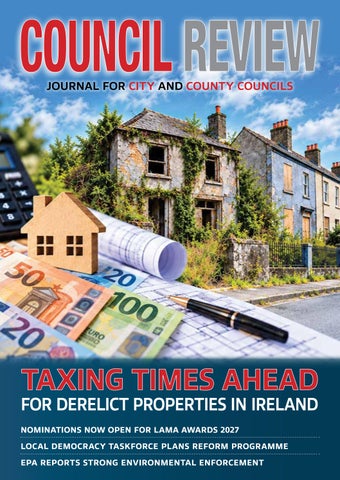
TAXING TIMES AHEAD
FOR DERELICT PROPERTIES IN IRELAND NOMINATIONS NOW OPEN FOR LAMA AWARDS 2027 LOCAL DEMOCRACY TASKFORCE PLANS REFORM PROGRAMME EPA REPORTS STRONG ENVIRONMENTAL ENFORCEMENT
LOW FARES HAVE LANDED Book now at Ryanair.com
JOURNAL FOR CITY AND COUNTY COUNCILS
contents 4
NEWS UPDATE
16
DERELICT PROPERTY TAX
20
LAMA AWARDS 2027
25
LOCAL DEMOCRACY TASKFORCE
29
LOCAL GOVERNMENT AWARDS 2026
33
ENVIRONMENTAL ENFORCEMENTS
39
LOCAL ENVIRONMENTAL FUNDS
47
NATIONAL PROPERTY SUMMIT
ISSUE 79
A centralised Derelict Property Tax (DPT), which is to be collected by the Revenue Commissioners, will replace the local-authority managed Derelict Sites Levy, with legislation for the new tax to be included in the Finance Bill 2026.
TAXING TIMES AHEAD
FOR DERELICT PROPERTIES IN IRELAND NOMINATIONS NOW OPEN FOR LAMA AWARDS 2027 LOCAL DEMOCRACY TASKFORCE PLANS REFORM PROGRAMME EPA REPORTS STRONG ENVIRONMENTAL ENFORCEMENT
Nominations for the LAMA All-Ireland Community & Council Awards 2027 will remain open until 27 November, with next year’s awards ceremony returning to the Dublin Royal Convention Centre on 27 February.
Derelict Property Tax Page 16
The Government’s Local Democracy Taskforce Report and Implementation Plan 2026-2029 has set out a comprehensive programme of reforms designed to strengthen local democracy, empower communities and enhance the role of elected councillors across Ireland. This year’s Excellence in Local Government Award winners will be announced on 26 November, with awards to presented across 16 different categories, while one council will be named ‘Local Authority of the Year 2026’. Dún Laoghaire-Rathdown County Council, Galway City Council and South Dublin County Council met the required standard across all National Enforcement Priorities (NEPs) in 2025, according to the Environmental Protection Agency.
COUNCIL REVIEW 14 Upper Fitzwilliam Street, Dublin 2. Tel: 01-6785165 Email: admin@councilreview.ie
The Local Environmental Action Fund (LEAF) – the largest-ever community fund of its kind in Ireland for local authorities – forms part of a major new national funding initiative of over €3m for Tidy Towns groups, residents’ associations and community groups.
Editor Grace Heneghan
This year’s National Property Summit on 25 November will bring together developers and investors, senior planners and architects, local authorities, approved housing bodies, financial institutions, construction executives, proptech innovators, sustainability experts.
Managing Director Patrick Aylward
49
DUBLIN BELFAST ECONOMIC CORRIDOR
53
HERITAGE & CLIMATE ACTION
57
ALL ISLAND HERITAGE NETWORK
63
DUBLIN CITY KNOWLEDGE HUB
67
BETTER PUBLIC SERVICE AWARDS
Graphic Design Niall McHugh Advertisement Co-ordinator Audrey Fitzgerald Follow the magazine on X(Twitter)@councilreviews Facebook /councilreview
Local Democracy Taskforce Page 25
National Property Summit Page 47
Principles that underpin success in elite sport can serve to strengthen collaboration across the Dublin Belfast Economic Corridor (DBEC), to unlock economic growth and competitiveness across the region, industry leaders and infrastructure providers were told at the latest meeting of the DBEC’s Industry Advisory Panel in Dublin in September. The Office of Public Works (OPW) was officially presented with a European Heritage Award for its training programme to improve energy efficiency in heritage properties around the country, during the Heritage and Climate Symposium on 15 September. A new network for local authority heritage officers, announced at the Heritage Council’s inaugural all-island conference in Monaghan Peace Campus in early September, will bring together heritage officers from Ireland’s 31 local authorities and staff with heritage-related roles from Northern Ireland’s 11 local authorities.
Heritage & Climate Page 53
Dublin City Knowledge Hub – a new online platform for the capital and the first initiative of its kind developed by a local authority in Ireland – provides access to a wide range of data on the demographic, social, economic, housing and environmental characteristics of the city.
JOUR NAL FOR CIT Y AND COUNT Y COUNCILS
This year’s Better Public Services Awards were presented across 12 categories to government departments, public sector agencies and organisations, all of which are aligned with the Public Service Transformation 2030 Strategy.
www.councilreview.ie 1
Dublin City Online Hub Page 63
ISSUE 79
JOUR NAL FOR CIT Y AND COUNT Y COUNCILS
contents 77
HOUSING INVESTMENT
83
GREENWAY NETWORKS
Approval has been granted for 82 projects under the €Ibn Housing Infrastructure Investment Fund to deliver up to 200,000 homes. Administered by the new Housing Activation Office, this is the largest housing infrastructure investment fund to be announced in Ireland for many years. A new national website, launched at the National Active Travel and Greenways Conference in Cork in September, now showcases Ireland’s growing greenway network and provides a central source of information on routes, facilities, attractions and visitor information.
91
IPB INSURANCE CENTENARY
101
HOUSING AGENCY
107
LEADER PROGRAMME
111
GALWAY WATERWAYS
115
KILKENNY PUBLIC ARTS
125
WATERFORD OUTDOORS
128
LITTER SURVEY 2026
138
EU CLIMATE NEUTRAL MISSION
139
EUROPEAN REGIONS & CITIES WEEK
Housing Investment Page 77
IPB Insurance marks a century as the country’s only indigenous mutual insurer, supporting Ireland's local authorities, public bodies and the communities. Here’s an overview of events to have taken place since the start of IPB’s centenary celebrations in January 2026. Local authorities are getting to know more about Multi-Unit Developments (MUDs) and Owners’ Management Companies (OMCs) where services, amenities and facilities are shared between owners, writes David Rouse, MUDs Advisor with The Housing Agency. As LEADER programme celebrates 35th anniversary, during that time it has adopted a community-led model, placing the decision-making in the hands of local people to identify their own priorities and shape development strategies which reflect needs of the community.
Greenway Networks Page 83
Galway City Council is the first local authority in Ireland to receive funding under the European Urban Initiative (EUI) Innovative Actions (AI) programme, for a threeyear project to bring the canals that once powered the city’s mills and industries back to life. Kilkenny is putting community front and centre in the local authority’s approach to public art and investment under the Government’s Per Cent for Art Scheme. Introduced almost 50 years ago, the scheme directs that 1% of the cost of any publicly funded capital, infrastructural and building development can be allocated to the commissioning of a work of art.
IPB Centenary Page 91
The Waterford Outdoor Recreation Plan 2026–2030 (the first such dedicated plan for the city and county) now aims to provide a co-ordinated framework for the sustainable development, management and promotion of outdoor recreation throughout Waterford.
Whilst every effort has been made to ensure that the information included is correct, the publisher cannot accept responsibility for errors,omissions or discrepancies. The views expressed are not necessarily those of the publisher.
All rights reserved Council Review © 2026
www.councilreview.ie
In this year’s Irish Business Against Litter (IBAL) survey, which revealed that low litter levels are on a par with last year. Sligo Town topped the league table, ahead of Monaghan and Leixlip, with Waterford – once again ranked Ireland’s cleanest city – finishing in fourth spot.
Galway Waterways Page 111
The government has approved a new funding proposal of €2 million to support Cork, Dublin and Galway on the ‘EU Climate-Neutral and Smart Cities Mission’, which will support these three cities to deliver projects on their journey to a sustainable climate-neutral future. The European Committee of the Regions publishes the seventh edition of its EU Annual Report on the State of Regions and Cities on 12 October, under the motto ‘Strong Regions. Strong Europe’.
2
EU Regions & Cities Page 139
FROM NATURE, FOR HEALTH NATURE. SCIENCE. EXPERTISE. SINCE 1978
Global Leaders in Extraction Cara Partners, is undertaking a major expansion and modernisation of the site. The expansion will significantly increase the extraction capacities while further strengthening the company’s position within the industry.
Little Island Industrial Estate, Wallingstown, Cork, Ireland
The project aims to elevate efficiency, technological capability, and uncompromising quality to the next level. Scheduled for completion in 2029, this project reflects our commitment to enabling sustainable growth - From Nature, For Health
+353 21 452 0500 info@carapartners.ie 3
www.carapartners.ie
NEWS UPDATE ENTRIES NOW OPEN FOR NATIONAL PROPERTY AWARDS 2027 Entries are now open for the National Property Awards 2027, which will take place on 25 February next in Dublin’s Mansion House. Entries for the 2027 awards close on 25 November, with winners to be announced at a black-tie gala dinner in the Round Room at the Mansion House on 25 February 2027.
The comprehensive list of 17 categories will identify the highest level of achievement across the residential and commercial sectors. The National Property Awards, in association with Business Post, will recognise those who have excelled in all aspects of the industry. Now in their sixth year, the awards programme continues to celebrate individuals and organisations making a difference to Ireland’s property industry.
2027 Award Categories: • ESG/Sustainability Initiative of the Year •
Renovation/Redevelopment/Repurpose of the Year
•
Developer of the Year
•
Social Housing Development of the Year
•
Marketing Team of the Year
•
Social Media Campaign of the Year
•
Placemaking Initiative of the Year
•
Property Management Company of the Year
•
Proptech Award of the Year
•
Emerging Proptech Company Award of the Year
•
Irish Agency of the Year
•
Corporate Social Responsibility (CSR) Initiative Project of the Year
•
Asset Management Company of the Year
•
Buyer's Agent of the Year
•
Future Leader in Property of the Year
•
Outstanding Property Leader (Judges’ Choice)
•
Lifetime Achievement Award (Judges’ Choice)
For more information visit https://nationalpropertyawards.ie/
CHAMBERS IRELAND PRESIDENT PUTS COMPETITIVENESS AT TOP OF BUSINESS AGENDA Chambers Ireland has elected Natalie McGuinness as its new president. The appointment comes at a critical time for Irish enterprise, as Ireland’s largest business network puts cost pressures and international competitiveness at the centre of its agenda. Natalie McGuinness, commercial strategist and independent non-executive director, will represent 37 Chamber members and more than 9,000 businesses across the country. Speaking on her election, she said that Ireland has a strong economy, but our competitiveness cannot be taken for granted. “Changes in technology, along with global economic and geopolitical shifts are fundamentally changing the way businesses invest and grow. My priority as president will be to ensure the experience of businesses, large and small, is heard in economic policymaking. Our focus will be practical in terms of what needs to change to help businesses innovate and succeed both locally and internationally.” Ian Talbot, Chief Executive of Chambers Ireland, said that Natalie McGuinness understands the pressures businesses are facing and brings strong commercial, governance and Chamber experience to the role. “Government needs to tackle the cost of doing business, infrastructure delivery and giving businesses confidence in an
increasingly uncertain global trading environment. If Ireland is to continue to attract investment and support business growth, we need to get the fundamentals right,” he added.
Chambers Ireland Chief Executive Ian Talbot pictured with the newly-elected President Natalie McGuinness.
4
ARMY|AIR CORPS|NAVAL SERVICE
RECRUITING NOW REVISED PAY RATES
ACCOMMODATION+ MEALS
PHYSICAL WELLBEING
ANNUAL LEAVE
TRAVEL
EXTERNAL EDUCATION
HEALTHCARE
PENSION + LIFE INSURANCE
ADDITIONAL ALLOWANCES
Increase each year according to rank. Recently revised & increased as part of the Public Sector Pay Deal 2024-2025 42k from Sept 2025
28 days, minimum plus public holidays and additional specific Defence Forces Holidays throughout the calender year.
Free semi-private occupational healthcare, dental and pharmaceutical services
Free accommodation and meals to all personnel on basic training and career courses.
Deploy on peacekeeping and humanitarian missions around the world whilst representing Ireland.
Free gym access, professional training and organised sports clubs that cater for all abilities. You can even represent Ireland competing against other international militaries.
Access to paid external education courses through our Directorate of Training and Education Branch.
Additional operational duty allowances. Single Public Service Pension Scheme Overseas Armed Duty Allowance is for all new entrants. TAX-FREE whilst deployed.
WELL- BEING SUPPORT
Professionally qualified personnel support services available at all times.
5
FIS 1
27/02/2026 12:04
NEWS UPDATE UP TO €38M INVESTMENT FOR GREENWAY PROJECTS DURING 2025 Local authorities were paid €37.9 million for greenways in 2025, according to a new report by Transport Infrastructure Ireland (TII) on its payments to councils for greenways and active travel last year. TII is the approving authority for roads and greenways and provides funding and support to local authorities to deliver these programmes in line with government policy. The active travel investment relates to footways and cycleways on the roads network. The TII report shows that €35.2 million was spent on greenway projects, while an additional €2.7 million was paid to councils for "greenways asset renewal", which covers capital investment to upgrade, repair, and protect existing off-road cycling and walking paths.
Wexford County Council: €2,988,593 Wicklow County Council: €483,418 Further payments of €2.7m to the following: Limerick City and County Council: €366,313 Louth County Council: €208,328 Mayo County Council: €1,217,038 Meath County Council: €633,098 Offaly County Council: €3,998 Waterford City and County Council: €86,894 Westmeath County Council: €203,224 The Joint Oireachtas Committee on Agriculture and Food was told that the average cost of greenway projects currently stands at around €2m per kilometre. Lorcan O'Connor, Chief Executive of TII, told the committee in June that around 60 greenway projects were currently at "various stages of development" TII has average funding of around €60 million per year to progress "a portfolio of projects". The Department of Transport has appointed consultants to carry out a review of the National Greenway Strategy to inform the future policy context for delivery of projects.
Local authority payments during 2025: Cavan County Council: €120,353 Clare County Council: €745,738 Cork County Council: €4,108,234 Donegal County Council: €2,269,601 Fingal County Council: €595,412; Galway County Council: €1,854,884 Kerry County Council: €7,830,617 Kildare County Council: €2,941,402 Kilkenny County Council: €300,439 Leitrim County Council: €1,423,222 Limerick City and County Council: €313,550 Louth County Council: €330,073 Mayo County Council: €1,557,303 Meath County Council: €1,135,142 Monaghan County Council: €372,018 Offaly County Council: €163,915 Roscommon County Council: €1,042,253 Sligo County Council: €554,205 South Dublin County Council: €2,098,146 Tipperary County Council: €271,468 Waterford City and County Council: €456,587 Westmeath County Council: €1,257,699
Lorcan O'Connor, TII Chief Executive, said that 60 greenway projects are at various stages of development.
DEPARTMENT DATA SHOWS CONTINUED INCREASE IN NEW HOME STARTS Since the beginning of the year, 8,408 new homes have commenced, an increase of 184% on the 2,961 units commenced during the first quarter of 2025, according to data from the Department of Housing, Local Government and Heritage. The data shows that the number of new homes being built throughout the country continues to grow, indicating building momentum in the sector. It builds on figures the last two years, when 85,723 homes were built, representing an increase of 43% compared with the combined total for the previous two-year period (2022 and 2023). The data follows the AIB’s latest Irish Construction PMI survey which showed that building activity in the residential sector posted its second successive month of growth for the first time since the first half of 2025.
Minister for Housing, Local Government and Heritage, James Browne TD, said: "To see these numbers growing month-on-month alongside positive data across other key indicators in the sector, such as the AIB Construction PMI survey. It shows that momentum is building in a way that puts us on the right track to meet the goals set out under our Housing Action Plan – Delivering Homes, Building Communities.” The Minister said he intends to use every lever available, to minimise red tape and maximise delivery. “This will require increased public delivery of social and affordable housing, but also a serious increase in private sector home building.” Of the 2,939 units commenced in March 2026, 1,635 (55%) are scheme dwellings, 932 (32%) are apartments and 372 (13%) are for one-off units. A total of 43% (1,276 units) were in the four Dublin local authorities. The most units commenced were in Fingal County (686), followed by South Dublin County (277) and Dun-Laoghaire Rathdown (178).
6
SLIGO
Clinical Team of the Year Irish Healthcare Centre Awards 2025
At the core of everything we do at Kingsbridge Private Hospital is the understanding that your health is of paramount importance.
From outstanding medical treatments to sophisticated diagnostic and therapeutic care, our hospital in Sligo provides a centre of excellence for a range of treatments and procedures while working among some of the top Consultants in the North West. Kingsbridge Private Hospital Sligo is a Joint Commission International Accredited Hospital.
Kingsbridge Private Hospital Sligo, Ray MacSharry Road, Gardenhill, Sligo, Co. Sligo, F91 XO547
kingsbridgeprivatehospital.ie
NEWS UPDATE DUBLIN AMONG WORLD'S LEADING CITIES IN GLOBAL CITIES INDEX 2026 Dublin has been ranked sixth out of 1,000 cities worldwide in the latest Oxford Economics Global Cities Index, underlining the capital's position as one of the world's leading cities for economic strength, sustainability and human capital. The ranking places Dublin among the top-performing cities globally and reflects the strength of the wider city region as a centre for investment, innovation, talent and international business. The Oxford Economics index highlights Dublin's strong performance across a range of indicators, including economics, human capital and environment. Dublin ranks 12th globally for economics, 35th for human capital and 9th for environment. Lord Mayor of Dublin, Cllr Daryl Barron said "This ranking is recognition of the people, communities, businesses and institutions that contribute to the
city's success every day. While there are challenges to address, particularly in relation to housing and affordability, this result demonstrates Dublin's strengths and its continued attractiveness as a place to live, work, study and invest." Chief Executive of Dublin City Council, Richard Shakespeare, noted that Dublin's position in the Global Cities Index reflects
the city's strong economic foundations, talented workforce and commitment to sustainability. “It is particularly encouraging to see Dublin recognised for its environmental performance, reflecting the collective efforts being made across the city to address climate change and build a more resilient future,” he noted.
For further information visit www.oxfordeconomics.com/global-cities-index/
HERITAGE COUNCIL’S NEW RESEARCH POINTS TO COMMUNITY LANDSCAPES The Heritage Council’s new independent research has examined how communities can play a sustained role in the management of heritage-rich landscapes across Ireland. The main findings suggests that community involvement is most effective where: · Governance structures are clear and formal · Funding is long-term rather than project-by-project · Communities are consulted before key decisions are made · A successful integration of traditional land management knowledge with professional expertise
Commissioned by the Heritage Council and carried out by an interdisciplinary team at 12 Foot Insight, the independent research draws on literature review, policy analysis, stakeholder interviews, a national survey, and ten Irish and international case studies. The research treats landscape as an integrated space, encompassing natural, built, cultural and intangible heritage, rather than separating these into distinct management silos. This framing reflects how communities experience and relates to the places they live in, and it points toward more coherent approaches to conservation, land use and governance. Catherine Casey, Head of Climate Change with the Heritage Council said: “Ireland's landscapes the product of millennia of human activity, shaped by farming, fishing, habitation, memory and meaning. They also face mounting pressures, from agricultural intensification and biodiversity loss to climate change and the expanding development. “The question of who manages these landscapes, how, and with what degree of community involvement is increasingly important and increasingly contested. Therefore, the commissioning of this piece of important research is timely and offers insights into how we can empower communities and decision makers to take important actions.”
8
9
NEWS UPDATE CAVAN MAKES MAJOR PROGRESS IN €187M ANTI-DERELICTION EFFORT Cavan County Council has made significant progress in combatting dereliction across the county, with over €187 million currently being invested in transforming vacant or derelict properties into social housing and community facilities. Several recent housing developments have seen such properties demolished or renovated to make way for new, high-quality, energy-efficient social homes. In total, 113 homes have been delivered by Cavan County Council in the past 18 months. A further 137 homes are under construction, while an additional 220 units are at various stages of planning and design. Approved housing bodies will deliver another 98 homes across Cavan in the next two years. The local authority has also refurbished and returned 31 units in its own housing stock to use this year to date. In addition, Cavan County Council has allocated over €10 million under the Croí Cónaithe Vacant Property Refurbishment Grant, with 175 applications paid out – allowing homeowners to restore and occupy previously vacant and derelict homes. A further 314 properties have been approved in principle, with refurbishment work on the majority of these expected to be completed within the next 12 months. Redevelopment projects are also being delivered across the county by Cavan County Council in a €62m investment through the Urban Regeneration Development Fund (URDF), the Rural Regeneration Development Fund (RRDF) and SEUPB’s PEACEPLUS programme supplemented by up to €12 million in Cavan County Council’s own funds. Cathaoirleach of Cavan County Council, Cllr Carmel Brady recently visited some of the sites being transformed from dereliction to thriving community housing. “It is really heartening to look at some of these old, dilapidated, empty
buildings knowing that they will soon be family homes, providing shelter, heat, and security to those who need it, and creating memories for generations to come,” noted Cllr Brady. Eoin Doyle, Chief Executive of Cavan County Council, said the council developed a series of Town and Village Revitalisation Plans several years ago, with a view to reenergising the urban landscape of the county. “In transforming derelict and vacant properties into not only social housing, but also critical community infrastructure, we are re-energising town cores across the county, providing a much-needed boost to local economies, and helping boost social and community cohesion, all the while creating jobs through engaging local contractors,” he added.
Cavan County Council’s Cathaoirleach Cllr Carmel Brady and Chief Executive Eoin Doyle with council officials at one of the derelict sites to be transformed in Cavan.
NEW FLOOD PROTECTION EQUIPMENT FOR FIVE LOCAL AUTHORITY HUBS Sligo, Galway City, Mallow, Cavan and Portlaoise have been designated as the five locations to receive new emergency flood equipment, as part of a nationwide effort to improve the response to localised flood events. The Minister of State with responsibility for the Office of Public Works (OPW), Kevin ‘Boxer’ Moran TD, said that these locations will make this new emergency response equipment available to all parts of the country. The 20 pumps and mobile water-filled flood barriers (aquadams) will provide local authorities with the agility and flexibility to further improve their response to flood events. Following Storm Chandra, earlier this year, that affected the east and south east of the country, the Government tasked the OPW with procuring pumps and mobile water-filled flood barriers to supplement emergency equipment stocks across all local authorities. The OPW has worked closely with the County and City Management Association (CCMA) and the market to procure this equipment. The OPW published a tender competition for the pumps and barriers over the summer, and the tender evaluations are currently being finalised.
The Minister said it is expected that the frameworks to draw down this equipment will be in place and available to the local authorities by November 2026. He added said that while the OPW has sourced these barriers and pumps, they will be managed by the local authorities, and the equipment will be made available for deployment by local authorities nationally. For a full list of flood relief schemes and further information visit www.floodinfo.ie.
Galway City is one of five locations to receive the new emergency flood equipment.
10
Critical Power Solutions
Logstrup (Ireland) Ltd specializes in providing high-quality, custom-built electrical switchgear solutions. Their primary focus is on delivering innovative, reliable, and efficient products that meet the unique needs of various industries, including data centers, renewable energy, and infrastructure projects. With a commitment to excellence, Logstrup (Ireland) Ltd ensures that all their products are designed and manufactured to the highest standards of safety and performance.
www.logstrup.com
Tel: 093-70900 11
NEWS UPDATE LONGFORD’S HOUSING DELIVERY IS CAUSE FOR CONCERN – OPR PLANNING REVIEW Longford County Council’s Planning Review, published by the Office of the Planning Regulator (OPR) has found that while Longford had the most significant county-level increase in population in the period before the last Census was conducted (2016-2022), housing delivery has been an issue of concern over the past decade. The report considers performance across a range of planning-related functions and makes eight focused recommendations, designed to assist the council to strengthen its planning department’s operational resilience, build capacity for service improvement and the ability to support wider strategic objectives. While the report acknowledges that the council continues to deliver on its core planning functions, it also recognises the significant commitment that has been necessary from the planning team to achieve its statutory responsibilities in the face of significant resource constraints. The OPR’s analysis recognises the potential for Longford County Council to strengthen its approach to land activation, address vacancy and dereliction, and capitalise on the county’s strategic opportunities to deliver sustainable development, compact growth and regeneration in line with national policy objectives. The Planning and Development Act 2024 gives the OPR the discretion to review how planning bodies carry out their work. This includes reviewing local authorities, An Coimisiún Pleanála and the Regional Assemblies. The local authority reviews allow the OPR to monitor performance across the sector, identify shared challenges and promote learning between planning officials. The reviews are designed as a developmental support, not an inspection, while the OPR recommendations focus on improvement of the local authority planning services.
Longford County Council is the 11th local authority planning review completed by the OPR, all of which are available on the OPR’s website www.opr.ie/reviews-programme/ The OPR continues its engagement after each review is completed to track progress on agreed recommendations and support implementation. Longford County Council is now to work with the OPR to secure implementation of the review recommendations.
TOWN AND VILLAGE RENEWAL SCHEME FUNDING AVAILABLE Funding is now available for this year’s Town and Village Renewal Scheme, which was recently launched by Minister for Rural and Community Development and the Gaeltacht, Dara Calleary TD. The scheme, which was first introduced in 2016, is funded under Project Ireland 2040. It forms part of a suite of measures designed to support the revitalisation of rural Ireland by focusing on stimulating town centre economic and social regeneration. It is key measure directly supporting the objectives of ‘Our Rural Future and the Town Centre First’ policy. Funding is now available for proposals which can be submitted under two distinct headings – (1) Main Scheme and (2) Project Development Measure.
Main Scheme: Funding will range from €50,000 to €500,000. The focus is on town centre regeneration and enhancing economic and social vibrancy in line with Town Centre First Policy; with projects sought to include the following: • Drive town centre regeneration. • Support town/village centre plaza development. • Develop green spaces/recreational amenities in town/village centres. • Include an emphasis on climate action elements. • Enhance streetscapes. • Support provision of infrastructure (e.g. public realm works, service provisions, canopies) to facilitate town or village centre markets (e.g. farmers markets, open-air markets, local trader markets, artisan markets); • Upgrade/refurbish community centres. • Bring vacant and derelict buildings and sites back into use as multi-purpose community spaces. Project Development Measure: • Funding provided to get a project shovel ready for a future funding call. • Includes development costs, e.g. detailed design, preparation for the planning and/or procurement consideration of climate action elements, appropriate assessments etc. • The maximum level of funding is €50,000 per project.
All queries should be emailed to: townandvillage@drcdg.gov.ie. The closing date for online applications is Monday 19 October.
12
13
Louth County Council
LOUTH ACHIEVES ISO 45001 OCCUPATIONAL HEALTH AND SAFETY CERTIFICATION Louth County Council has achieved certification to I.S. ISO 45001:2018, the internationally recognised standard for Occupational Health and Safety Management Systems, following a successful assessment by the National Standards Authority of Ireland (NSAI).
I
SO 45001:2018 provides organisations with a framework to create safer workplaces by identifying and managing risks, preventing work-related injuries and ill health, and supporting continual improvement. The certification, awarded by NSAI in June, provides Louth County Council with independent verification that its health and safety management practices meet international best-practice standards and that robust systems are in place to protect employees and support safe service delivery across a diverse range of operational and administrative functions. As part of the certification process, the council underwent a comprehensive assessment of its Occupational Health and Safety Management System by the NSAI. Maintaining certification requires ongoing external audits and regular reviews to ensure compliance with the requirements of the standard and to demonstrate continual improvement in health and safety performance. The accreditation covers a broad range of council services, including Roads, Housing, Libraries, Facilities Management, Environment, Planning and Regeneration, Corporate/HR, Community and Enterprise, IT and Finance. It builds upon Louth County Council's existing ISO 45001 certification for fire service operations and demonstrates a strong organisational commitment to employee wellbeing, risk management, and continuous improvement. Jerome Lambe, Head of Safety at Louth County Council, said that achieving ISO 45001 certification was “a significant accomplishment for the organisation” and reflects the ongoing commitment to improving the council’s safety management system. “It has been the culmination of a considerable body of work across the council and demonstrates the commitment of staff at all levels to embedding health and safety into our day-to-day operations and service delivery.
Jim Campbell, Executive Health & Safety Officer; Jerome Lambe, Head of Safety; Cllr Dolores Minogue, Cathaoirleach of Louth County Council; David Conway, Chief Executive of Louth County Council; Debbie McAreavey, Facilities & Safety Section; and Finbar Gethins, Senior Executive Officer, pictured with Louth County Council's I.S. ISO 45001:2018 certification.
"A safe and healthy workplace is fundamental to the delivery of effective public services, and this certification recognises the strong culture of safety that has been developed across Louth County Council." David Conway, Chief Executive of Louth County Council, said that the award was a major organisational achievement. "Achieving ISO 45001 certification is a significant milestone for the organisation and a strong reflection of the sustained commitment to maintaining and improving our safety management system. “This accreditation is an incredibly positive development and provides clear assurance of the high standards being applied across the organisation. It demonstrates our commitment to good governance, continuous improvement, and to developing and valuing our staff, all of which are key priorities in Louth County Council's Corporate Plan 2024-2029. By supporting a safe and healthy working environment, we are also strengthening our capacity to deliver high-quality public services to the people of County Louth." The Chief Executive thanked Jerome Lambe, Head of Safety, his safety team 14 SPONSORED CONTENT
members Jim Campbell and Debbie McAreavey, Finbar Gethins, Senior Executive Officer, Human Resources, and Joanna Kelly, Acting Director of Services, HR, Corporate and Community Delivery, for their work in reaching this important milestone. The certification builds on Louth County Council's broader commitment to excellence, accountability, and continuous improvement in service delivery. The council also holds ISO 50001 certification for energy management, reflecting its commitment to best practice across a range of organisational functions. As a result of the certification, it is now listed on the NSAI Certified Company Search and is entitled to use the NSAI ISO 45001 Certification Mark and the IQNET Certified Management System mark, providing further recognition of its commitment to workplace health and safety. The achievement aligns closely with the ambitions set out in Louth County Council's Corporate Plan 2024-2029 and reflects its commitment to good governance, staff wellbeing, and the delivery of high-quality public services for the people of County Louth.
Louth Visit / Invest / Live
At the heart of the Dublin-Belfast Economic Corridor A region with unrivalled access to highly skilled talent and robust infrastructure Connected by Euro Route Motorway High-speed rail link and deep-sea modern ports Easy access to Dublin and Belfast International Airports High-quality, affordable residential property available 95% access to high-speed 1GB broadband Over 70km of stunning, uncongested coastal spaces Quality leisure and tourism facilities Thriving urban centres in Dundalk and Drogheda Vibrant arts and culture scene Proven success across multiple industries A flourishing start-up scene and developed economic clusters Dense population of young, highly skilled and mobile workforce Dynamic educational institutions
www.louthcoco.ie 15
Louth
Derelict Property Tax
TAXING TIMES AHEAD FOR DERELICT PROPERTIES IN IRELAND A centralised Derelict Property Tax (DPT), which is to be collected by the Revenue Commissioners, will replace the local-authority managed Derelict Sites Levy. And with legislation for the new tax planned for inclusion in the Finance Bill 2026, a preliminary national register is expected in 2027 before the full tax rollout takes place.
I
reland has close to 20,000 derelict residential properties. Enforcement is being overhauled, political pressure is mounting, and the legal framework is about to change. For local authority staff responsible for dealing with derelict sites, 2026 is shaping up to be a pivotal year. The GeoDirectory Residential Buildings Report (Q4 2025), prepared by EY Economic Advisory, recorded 19,438 derelict residential units across the State. While this represents a 3.3% decrease compared to the previous year, the number remains quite high. The report found that dereliction is not evenly distributed, with Connacht accounting for over one third of all derelict residential buildings nationally. Mayo has the highest concentration, with 14.1% of all derelict properties in the country, followed by Donegal and Galway. ‘DERELICT SITES’ DÁIL DEBATE The Tánaiste and Minister for Finance, Simon Harris, replied to questions on the proposed new Derelict Property Tax (DPT) from Sinn Féin TDs Thomas Gould from Cork North Central and Pearse Doherty from Donegal during a Dáil Debate on ‘Derelict Sites’ in July. The Tánaiste said that the DPT is intended to encourage the activation of derelict properties and sites. “The planned introduction of this tax, announced in last year’s Budget, will replace the Derelict Sites Levy and
will be collected by the Revenue Commissioners. Revenue does not have a role in collecting outstanding Derelict Site Levies. “Once the new tax is legislated for, the legislation cannot have a retrospective effect. This is established in case law. Therefore, any derelict site levies that are outstanding will remain the responsibility of each local authority to collect.” Mr Harris said he intends to legislate for the DPT as part of Finance Bill 2026, dependent on engagement from stakeholders and will also be influenced by any advice he will receive from the Attorney General. “This timeline is necessary to allow local authorities to prepare and publish a preliminary register of derelict properties in 2027, with the tax coming into effect as quickly as possible thereafter.” Once the DPT is operational, the Tánaiste said that he remains confident this will incentivise owners of derelict properties to take action to bring these homes back into use and ultimately contribute to the housing stock. REACTION FROM AILG However, the Association of Irish Local Government (AILG) has expressed disappointment at comments made 16
by the Tánaiste, suggesting that local authorities have "badly failed" in administering the Derelict Sites Levy. The national representative body for Ireland's elected councillors said that while there is broad agreement across local government that the current derelict sites regime requires significant reform, it is important that the considerable work undertaken by local authorities to tackle vacancy and dereliction over many years is recognised. AILG Executive Director Tommy Moylan said that local authorities acknowledge the frustration felt by
The Tánaiste and Minister for Finance, Simon Harris TD.
PARTNERING FOR SUCCESS FOR OVER 20 YEARS. We work alongside our customers to understand their challenges and deliver better outomes.
About Alternative Heat
Why Choose AH?
A privately owned company, established in 2005, with experience and expertise in the design and build of offsite, prefabricated MEP solutions. Offering turnkey solutions, designed and fabricated inhouse, we supply to a wide range of markets throughout the UK, Ireland and mainland Europe. Our key market sectors range from Data Centres and large scale District Heating schemes, to high rise Residential and Healthcare projects. 17
Advanced manufacturing facilites Skilled and experienced teams Robost processes and quality assurance Scalable to meet customer demand Dundalk Office Coes Road Business Park, Coes Road, Dundalk, Co. Louth A91 CFY5 T: +44 (0) 28 4377 0700 E: info@alternativeheat.co.uk
www.alternativeheat.co.uk
DESIGN | FABRICATION | DELIVERY | INSTALLATION | COMMISSIONING
Derelict Property Tax
to ensure revenues generated are reinvested in local communities and returned to local authorities to support regeneration initiatives, town centre renewal programmes and local vacancy reduction strategies. "The debate should focus on how best to strengthen the tools available to local authorities rather than assigning blame to the very organisations that have led efforts to revitalise communities across Ireland," Moylan added. "Local government stands ready to work constructively with Government to ensure that any new system is effective, fair and capable of delivering the shared objective of bringing more vacant and derelict properties back into use."
KEY DETAILS OF THE REFORM * Replacement of Levy: The new Derelict Property Tax (DPT) will supersede the existing 7% annual levy that local authorities managed under the Derelict Sites Act 1990.
AILG Executive Director Tommy Moylan. communities when vacant and derelict properties remain unused. “Councils share that frustration and have worked tirelessly to address these challenges despite significant limitations within the existing legislative framework,” he added. However, he said that it was disappointing to hear suggestions that local authorities have somehow failed in this area. “The reality is that councils have consistently highlighted weaknesses in the existing system while working proactively to bring properties back into use through regeneration programmes, vacant homes initiatives, compulsory purchase powers, grants and direct engagement with property owners." “LIMITATIONS OF LEGISLATION” Local authorities have been at the forefront of addressing vacancy and dereliction in towns, villages and cities throughout Ireland. Through Town Centre First initiatives, Urban Regeneration and Development Fund projects, Rural Regeneration and Development Fund projects, Croí Cónaithe schemes, Repair and Lease initiatives, Buy and Renew programmes,
Vacant Property Refurbishment Grants, Compulsory Purchase Orders and the work of dedicated Vacant Homes Officers, councils have helped bring thousands of vacant and derelict properties back into productive use. The AILG Executive Director pointed out that local authorities have repeatedly raised concerns regarding difficulties in tracing ownership, lengthy statutory procedures, complex probate and legal processes and the practical challenges involved in enforcing and collecting the levy under the Derelict Sites Act 1990. "The issue has never been a lack of commitment from local authorities. Rather, it has been the limitations of legislation that is now more than three decades old," Mr Moylan said. "For that reason, local government has consistently supported the modernisation of the derelict sites regime. We welcome efforts to strengthen the system and ensure that more vacant and derelict properties are brought back into productive use." The AILG also said it was vital that any new nationally administered Derelict Property Tax should include a mechanism 18
* Centralized Collection: The Revenue Commissioners will administer and collect the new tax on a self-assessment basis, addressing historical underenforcement and difficulties local authorities faced in collection. * Local Authority Role: Local authorities will continue to be responsible for identifying, inspecting, and maintaining the public Derelict Sites Register, as well as pursuing Compulsory Purchase Orders (CPOs). * Outstanding Levies: Any legacy or outstanding derelict site levies incurred before the new system takes effect remain the responsibility of individual local authorities to collect, as the new tax cannot be applied retrospectively. * Timeline: Legislation for the DPT is planned for inclusion in the Finance Bill 2026, with a preliminary national register expected in 2027 before full tax rollout.
19
LAMA Awards 2027
NOMINATIONS NOW OPEN FOR LAMA AWARDS 2027 Nominations for the LAMA All-Ireland Community & Council Awards 2027 will remain open until 27 November, with next year’s awards ceremony returning to the Dublin Royal Convention Centre on 27 February.
T
he 2026 LAMA All-Ireland Community & Council Awards celebrated three significant milestones – the 20th anniversary of the awards programme, 40 years of the LAMA Executive, and a century of main sponsorship by IPB Insurance. The LAMA Awards, now in their 21st year, continue to grow nationally each year to celebrate collaboration between communities and councils throughout the country. The annual event brings together local authorities, communities, businesses, and public sector organisations to celebrate excellence, innovation, and achievement in local government and community development. Every year these awards provide the platform to showcase outstanding local initiatives, honour unsung heroes, and acknowledge the remarkable contributions that enrich and strengthen communities across the country. Ivan Yates, broadcaster, businessman and former politician, will once again be Master of Ceremonies (MC) for the 2027 LAMA All Ireland Community & Council Awards.
LAMA AWARD CATEGORIES FOR 2027 COMMUNITY INITIATIVES • Best Irish Festival • Best Inclusive Community Wellbeing Initiative • Ceangal Local Heritage • Best Green Sustainable Initiative • Community Volunteer of the Year • Best Community Transport Initiative ECONOMIC DEVELOPMENT INITIATIVES • Best Business Working with the Community • Best Enterprise & Start-Up Hub • Best Community-Scale Enhancements • Best Irish Language Initiative INFRASTRUCTURE INITIATIVES • Best Inclusive Public Realm & Accessibility Project • Best Housing Regeneration & Urban Planning • Best Transformative Capital Projects • Reimagining Public Places
South Dublin County Council took home LAMA’s ‘Council of the Year’ award for 2026.
COLLABORATION AND LEADERSHIP INITIATIVES • Best Use of Technology and Innovation in Local Government • Best Digital Transformation Initiative • Best Sustainable Infrastructure & Climate Action • Best Social Enterprise of the Year • Best Tourism Initiative • Best CSR Project in a Community • Best Community Wellbeing Initiative • Best Communications Initiative/Excellence in Local Government Communications ENVIRONMENTAL INITIATIVES • Excellence in Sustainable Major Infrastructure Delivery • Best Local Authority Energy Decarbonisation
Dun Laoighaire-Rathdown County Council picked up the Grand Prix Award for 2026 for the most shortlisted and winning projects combined over an aggregate score.
OVERALL AWARD • National Impact Award • Council of the Year • Grand Prix Award (Outstanding Excellence) For further information visit https://lamaawards.ie/
20
gasnetworks.ie
If you smell gas at home or on the street, call Gas Networks Ireland on:
1800 20 50 50 • • • • •
Open windows and doors Don’t smoke, vape or use a naked flame Don’t unplug or switch anything electrical on or off Turn off the gas at the meter Then, no matter who your gas supplier is, call our 24 hour emergency service.
Don’t use a phone in the immediate area of the leak, use a neighbour’s or call from outside. If you can’t get through, call 999 or 112. In the interests of public safety all emergency calls are recorded.
21
County Museum Dundalk
COUNTY MUSEUM SHOWCASES LOUTH DOWN THROUGH THE YEARS The County Museum, Dundalk – one of Ireland’s finest and largest museums – is dedicated to chronicle and showcase the historical development of Louth over the past 5,000 years, from the impact of the first settlers, the introduction of Christianity, the influence of the Vikings to the subsequent legacy of the Normans.
T
he wars of religion, industrial growth, the Famine, the introduction of partition and the economic hardship experienced and endured locally (and nationally) over the course of much of the 20th Century are some of the other changes experienced in the county during that time. Architecturally it is located in a restored warehouse, arguably the perfect location for an exhibition that highlights and showcases an area with a strong industrial identity and self-image. However, what distinguishes it is the quality of the collection. This is an award-winning interpretation both inspired by and built on, a magnificent collection of artefacts that chronicle a story of survival and innovation; of a county that has experienced physical, economic, and psychological hardship and yet endured. This is a museum which reflects the storied, complicated nature of the lives of Louth and its citizens. There’s a famous saying from the US which holds that “if you want to understand someone, walk a mile in their shoes”. This is a theme that is revisited continuously at the museum perhaps most appropriately in the display of shoes. Dundalk was once the shoe capital of Ireland – with companies such as Clark’s, Halliday’s and Blackthorn just some of the shoe factories based there. This exhibition comprises shoes for everyone, for all occasions, for all stages of life. In an industrial area, the story is as much about the contribution of the worker
County Museum Dundalk is housed in a restored 18th century warehouse, once part of Dundalk Distillery.
as it is the tycoon. It is in this museum where the grace and innocence of a young Irish dancer is celebrated adjacent to the memory of a fallen solider from the Korean War replete with Purple Heart and beret. It is here where the careers of sporting trailblazers such as Israel Olatunde and Deirdre Gogarty are commemorated alongside the achievement of Arcticexplorer Sir Francis Leopold McClintock and educationalist Vere Foster. Amidst lives of great accomplishment are legacies to which Louth, and, indeed, Irish society are forever indebted. The museum’s mission statement holds to the idea of ‘inspiring a familiarity with the past through the collection, conservation and communication of the cultural heritage of County Louth and its wider community’. This principle is at the heart of all that the museum does – through the collection of items (historic or current) for future generations to view and experience; the development of eye-catching, all embracing exhibitions which not only capture the nature of a particular moment or person in time but also the heady excitement that define the era; or the organisation of events (be they lectures, workshops or conferences) that An exhibition to celebrate 'The Corrs' who allow a greater interrogation of the past hail from Dundalk showcased a unique in a manner that is accessible, interesting collection of memorabilia from the band and most importantly relevant. at the County Museum this summer. This is a museum that recognises the 22 SPONSORED CONTENT
complicated nature of history, one that defies easy explanation but looks to provide a considered, comprehensive narrative that rewards closer inspection. These are stories of aspiration and failure, economic boom, bust and re-birth; these are the stories of our ancestors who sought to make their own way in life, a people who endured famine and war and yet prevailed, providing later generations with the inspiration to survive and thrive. Their story is our story; this is the story of us.
The Corrs on Display
Jocelyn Street Dundalk, Co. Louth A91 EFY9
tel: +353 (0)42 9392999 Email: museum@louthcoco.ie
COLLECTION • LEGACY • MEMORY
COME VISIT OUR NEWEST EXHIBITION SINCE 1994 THE COUNTY MUSEUM, DUNDALK HAS FOCUSED ON LOUTH’S GREATEST HISTORICAL EVENTS. OVER THE COMING MONTHS THE MUSEUM WILL REFLECT ON THE COUNTY’S QUIETER MOMENTS, HIGHLIGHTING THE CHANGING NATURE OF LIFE AS EXPERIENCED BY ITS CITIZENS IN PLAY, WORK AND DEED. 23
JOIN US AS WE UNLOCK THE PAST…
24
Local Democracy Taskforce
TASKFORCE PLANS PROGRAMME OF LOCAL DEMOCRACY REFORMS The Government’s Local Democracy Taskforce Report and Implementation Plan 2026-2029 has set out a comprehensive programme of reforms designed to strengthen local democracy, empower communities and enhance the role of elected councillors across Ireland.
T
he most significant reforms include the establishment of Municipal Councils in every local authority, the creation of new Council Oversight and Governance Committees, in addition to stronger mechanisms for councillors to influence local policy priorities and funding decisions. The establishment of a formal National and Local Government Forum to strengthen co-operation between central and local government has also been mooted. The Minister for Housing, Local Government and Heritage, James Browne TD, and the Minister of State with responsibility for Local Government and Planning, John Cummins TD, published the Local Democracy Taskforce Report and launched the Local Democracy Taskforce Government Implementation Plan 2026–2029 in July. The Implementation Plan translates the recommendations of the Local Democracy Taskforce into a clear programme of action, comprising up to 80 measures to be delivered between 2026–2029. The reforms will support a more responsive, democratic, accountable and empowered system of local government. Launching the plan, Minister James Browne said: “This Implementation Plan marks a significant milestone in
The Association of Irish Local Government (AILG) and the Local Authority Members Association (LAMA) welcomed the taskforce report and the implementation plan. our commitment to strengthening local democracy and ensuring that local government has the authority, capacity and support needed to deliver for people. “The reforms will empower councillors, enhance accountability, improve community engagement, and strengthen the relationship between national and local government. Most importantly, they will ensure that local voices play a greater role in shaping decisions that affect people's everyday lives.”
Sinn Féin's Thomas Gould TD has cautioned that the reforms risk becoming “superficial kites” flown by the government rather than genuine decentralisation. 25
Minister of State with responsibility for Local Government and Planning John Cummins TD said that while local authority executives perform a critical role in delivering services and implementing policy, over time there has been a shift in where decision-making power lies. “These recommendations are about restoring the correct balance; strengthening democratic oversight and ensuring councillors have the tools, information and authority they need to represent the people who elected them.” Minister Cummins, who served as a councillor for 11 years before entering national politics, said he knows first-hand that strong local government depends on strong partnerships. “Delivering for communities requires elected members, executive teams and central government working together with mutual respect and a shared commitment to better outcomes. These reforms are designed to strengthen those relationships while ensuring local government is more accountable, more responsive and better equipped to meet the needs of the communities it serves.”
We are a Silica Sand and Beach Pebble processing plant based in Co. Wexford. We produce materials for a range of different uses. Resin Bond Surfaces We work in conjunction with VUBA UK, leading suppliers of Resin materials in Ireland. Some samples of this resin surface can be seen in the following places: The Greenway Dublin Port Resin Surfaces
Leopardstown Racecourse Resin Surface
Manchester Hospital UK Resin Surface Other samples of resin surfaces are The Queens entrance at Ascot racecourse UK and Punchestown Racecourse Co. Kildare.
Restoration We supply various grades of Sharp White Silica Sand for lime mortar mix used in all types of conservation and restoration works. Examples include:
Christchurch Cathedral
Industrial Sands • Train Break Systems for British Rail and LUAS Tram System • Water Filteration For Uisce Eireann and Thames Water • Combustion Sand for Edenderry Power Station and Shotten Power Station UK • Tile Adhesive for ARC & Bostick Products • Synthetic Sport Sand for Ireland & UK Pitch Installers • Anti Slip Paint addititve for International Paints Affirmation At Inish Pebble we maintain a high standard of pratice in relation to environment and restoration. We have facilitated research relating to The CLEAR Project (Lagoon research Project by AQUAFACT, funded by NPWS and the EPA) The project has hightlighted the lake at Inish Pebble for it’s potential for restoration and creation of Lagoonal Habitats. Dr. Geoff Oliver is employed to regularly update a survey of aquatic flora and fauna in our lagoon at Inish, Co Wexford. The lagoon at Inish Pebble will feature in Chapter 8 , The Lands Edge in Coastal Lagoons Ecology & Restoration Project by Dr. Geoff Oliver, Dr. Cillian Roden & Dr. Brendan O’Connor. At Inish Pebble we endeavour to continue doing business in a sustainable and responsible manner with a view to leaving 26 behind a valued Salt Water Lagoonal Habitat for the future.
Dublin Castle
Decorative Beach Pebble / Cobble We supply a range of rounded beach pebble and cobbles grades for decorative uses on driveways, walkways, gabions, waterfeatures, gardens.
Tel: 053 9129525 085 8503823 | 086 8314323 Email: office@inishpebble.com Website: www.inishpebble.com Newtown, Kilmore Quay, Co. Wexford
Local Democracy Taskforce
IMPLEMENTATION STEERING GROUP An Implementation Steering Group, chaired by the Department of Housing, Local Government and Heritage, will oversee and co-ordinate delivery of the programme across Government, local authorities and sectoral stakeholders, and will report directly to both Ministers. The Government Implementation Plan will be delivered through a combination of legislative changes, administrative reforms and sustained collaboration between all partners in the local government sector. Government will continue to explore other mechanisms for reforming local government during this implementation phase. The reforms provide a clear roadmap to strengthen local democracy in Ireland by giving elected councillors a stronger role in local decision-making, enhancing accountability within local authorities and improving the supports available to councillors as they represent their communities. The report also recommends practical reforms that will support councillors in carrying out their representative role, including statutory response timeframes for councillor representations, improved access to information from public bodies, enhanced administrative supports and expanded education and professional development. LANDMARK FOR LOCAL DEMOCRACY The Association of Irish Local Government (AILG) and the Local Authority Members Association (LAMA) welcomed the taskforce report and the implementation plan. Both organisations applaud the Government’s commitment to strengthen engagement between national and local government and reinforce the principle that decisions should be taken as close as possible to the communities affected. Following the report’s release in July, Cllr Mary Hanna Hourigan, the then AILG President, said it was a landmark day for local democracy. “For the first time, we have a clear roadmap to strengthen the role of elected members, enhance local decision-making and ensure local communities have a stronger voice in shaping the future of their areas. “This is not about giving councillors more power for its own sake; it’s about ensuring the people local communities elect have the authority, supports and tools they need to deliver better
outcomes for the communities they represent. “The commitment to early implementation of national-local government engagement structures is particularly significant. It recognises that councillors should have a more meaningful voice in how national policy is implemented at local level, helping to ensure that implementation is informed by local knowledge and delivers better outcomes for citizens. "AILG is committed to working with the Government, LAMA and our local government partners to ensure these reforms are successfully delivered for councillors and, most importantly, for the communities they serve." LAMA Chairperson Cllr. Damien Ryan has said that the Implementation Plan provides a credible framework for strengthening local government through reforms to governance, devolution and the policy-making role of elected members. "The report also recognises that the role of councillors continues to evolve and places greater responsibility on elected members across many aspects of local government. As these reforms are implemented, it will be important that councillors are properly supported so they can continue to deliver effectively for their communities.” SINN FÉIN’S ‘SUPERFICIAL KITES’ However, opposition figures, such as Sinn Féin's Thomas Gould TD, have cautioned that the reforms risk becoming “superficial kites” flown by the government rather than genuine decentralisation. Gould pointed to the lack of expanded fiscal and functional powers – such as local waste management control – and claimed that new municipal councils must lead to real delivery rather than acting as talking shops. “We believe that there are key issues like waste that could be within the remit of local authorities right now. Municipal Councils cannot just be talking shops. They must be places of real action and real delivery for communities. “Sinn Féin has long called for the re-establishment of Town Councils. This report must be the first step in that process. That can’t happen on its own, it must be accompanied by real action to give local authorities and local elected members back their voice and power in their communities.” 27
IMPLEMENTATION PLAN 2026-2029 Eight Objectives • Strengthen community engagement and local decision-making. • Enhance the democratic role of councillors. • Improve engagement between central and local government. • Support greater devolution of functions. • Increase transparency and public understanding. • Strengthen financial autonomy and sustainability. • Enhance governance and accountability. • Promote greater representation and inclusivity in local government. Key Actions • Establishing Municipal Councils across all local authority areas with enhanced budgetary and decision-making powers. • Introducing formal structures to strengthen councillor oversight of local authority performance and governance. • Expanding training, research and policy supports for councillors. • Creating strengthened arrangements for engagement between local government, government departments and state agencies. • Developing a framework to support the devolution of additional functions to local government. • Increasing transparency through publication of performance information, service delivery data and governance reports. • Exploring new sources of local government revenue and greater financial flexibility. • Strengthening the role and capacity of oversight bodies. • Advancing measures to improve diversity and representation in local government.
Leading Manufacturer of Veterinary Pharmaceuticals
» Powders » Injectables » Intramammaries » Nutritional Products
Made by Experts, Recommended by Professionals! 28
Tel: +353 49 5553203 www.univet.ie
Excellence In Local Government Awards
FINALISTS FOR LOCAL GOVERNMENT AWARDS 2026 The Excellence in Local Government Award winners will be announced on 26 November at the Crowne Plaza Hotel, Santry in Dublin. Awards will be presented across 16 different categories, with one council to be named ‘Local Authority of the Year 2026’.
T
he Chambers Ireland Excellence in Local Government Awards are held annually in conjunction with the Department of Housing, Local Government and Heritage, and sponsored by Perigus Energy. Congratulating the shortlisted entrants, John Cummins, Minister of State for Local Government and Planning said he is pleased continue our long-standing support for these awards, which are an important opportunity to acknowledge the commitment of local authorities to public service in their communities. Ian Talbot, Chief Executive of Chambers Irelan,d said that the Excellence in Local Government Awards shortlist features projects that represent the hard work and ambitious planning
29
that takes place at local level all around the country. “The awards showcase the volume of work that local authorities are delivering, which so often goes unnoticed. In Chambers all around the country they know the important role played by the local authorities.” Talbot congratulated each of the shortlisted local authorities and acknowledged “the excellent work undertaken at local government level nationwide”. TJ Hunter, MD of Ireland and the UK at Perigus Energy, added: "The initiatives highlighted play a crucial role in all of our everyday lives and it’s so important to ensure that this hard work and care for citizens and place doesn’t go unrecognised. Every year, I’m blown away by the calibre of the projects being shortlisted, and this year is no different.”
Excellence In Local Government Awards
The shortlist features nationwide projects ranging from sustainable environment and biodiversity initiatives to climate change adaptations. FRONTRUNNERS • Dublin City Council: 12 entries • Kilkenny County Council: 11 entries • Cork County Council: 8 entries • Limerick City & County Council: 8 entries • Galway County Council: 8 entries STRONG CONTENDERS • South Dublin County Council: 6 entries • Clare County Council: 6 entries • Waterford City & County Council: 5 entries • Kildare County Council: 5 entries • Donegal County Council: 4 entries • Meath County Council: 4 entries • Cavan County Council: 4 entries • Laois County Council: 4 entries Sustainable Environment & Biodiversity • Carlow County Council - Turning Lawns into Lunch for Urban Pollinators • Cork County Council - A-A AGORA / Harpers Island • Dun Laoghaire County Council Shanganagh Castle Estate - Leading the Way to a Better Future for All • Kilkenny County Council - The Kilkenny Recycled Boardwalks and Riverside Biodiversity Enhancement Programme • Limerick City & County Council - Foynes to Limerick Road Scheme Excess/Repurposed Material • South Dublin County Council Pollinator Action Plan 2026–2030 • Wicklow County Council - ReFarm Wicklow: A New Partnership for Nature on Farms
Climate Change • Dun Laoghaire County Council Roebuck Road Housing – Setting the Standard for Sustainable Living • Dublin City Council - Rainscapes • Kilkenny County Council - Grey to Green Climate-Resilient Safe School Route • Limerick City & County Council Askeaton Pool & Leisure Centre Energy Upgrade & Flood Remediation • Monaghan County Council - Monaghan Area Based Retrofit Initiative (MABRI) • Waterford City & County Council Ballymacarbry Community Solar Sharing Project Health & Wellbeing • Cork City Council - Marina Park & Promenade • Cork County Council - Together in Wellbeing: Delivering Mental Health Support across Cork County • Dublin City Council - Dublin Nights Help Zone: Aka The Nee Naw • Galway County Council - Connemara Dementia Cafe Initiative • Kildare County Council - Compassion in Action- Trauma Informed Practice Conference • Louth County Council - Dear Future Me • South Dublin County Council- Inclusive Age-Friendly Outdoor Gym Programme Diversity & Inclusion • Donegal County Council - Inclusive Cycling Initiative achieving Centre of Excellence • Dublin City Council - Dublin City Council Sensoria 2025 • Galway City Council - Bóithrín na Saoirse: Traveller Group Housing Scheme • Galway County Council - Park Lodge: State of the art bungalow for three high needs individuals with intellectual disability and autism • Leitrim County Council - Bright Sparks • Meath County Council - Stay Up All Night Book Club • South Dublin County Council - Cycling Inclusion Centre of Excellence
30
Age Friendly Initiative • Cavan County Council - The Art of Life • Dublin City Council - St. Finbar's Court • Galway County Council - Climate Drive 60+ • Kilkenny County Council - Sing for Memory • Laois County Council - Live Well Health & Wellbeing Expo Event (Live Well) • Limerick City & County Council – Rightsizing: Age Friendly Accommodation in Limerick • Louth County Council - The Memory Cafe in Dundalk & Drogheda Libraries • Wicklow County Council - The Green Thread: Connecting Culture, Climate and Community Heritage and Built Environment • Clare County Council - Inis Cealtra (Holy Island) Visitor Experience • Cork City Council - Restoration of Shandon Clock • Donegal County Council - 'Working Over By': Donegal Emigrant Working Lives in Scotland • Dublin City Council - St Anne's Park Community Archaeology Programme 2021-2025 • Kildare County Council - Shackleton Experience • Wexford County Council - Duncannon Fort Refurbishment Phase 1 Urban Revival • Clare County Council - Ennis public realm regeneration & streetscape activation • Cork County Council - Revitalising Bandon Town Centre – A Long Term, Integrated Urban Regeneration Programme • Kilkenny County Council - Watergate Park • Laois County Council - Portarlington Market House • Laois County Council - Portlaoise Convent Lands - a landmark housing regeneration and urban renewal initiative • Waterford City & County Council Regeneration of Cappoquin • Wexford County Council - The Shambles Rejuvenation
Excellence In Local Government Awards
Municipal District Initiative • Cork County Council - Ringaskiddy Active Travel and Urban Realm Project • Cork County Council - Municipal District LPT Strategic Investment Fund • Cork County Council - Enhancing Road Safety Education and Outcomes in Local Communities • Donegal County Council - Put Us to Work • Galway County Council - Tuam Palace Grounds Sensory Garden and Active Recreation • Kilkenny County Council - Electric Fire Appliance • Kilkenny County Council - Team Up to Clean Up – Together for Kilkenny Promoting Economic Development • Cavan County Council - 'Created in Cavan' food and drink network • Dublin City Council - Dublin City NightTime Economy Programme • Kilkenny County Council #ShopKilkenny • Limerick City & County Council Twilight Thursday – Limerick City • Mayo County Council - Innovation Quarter (IQ) Ballina • Meath County Council - Thrive Centre of Business Excellence • Waterford City & County Council - Waterford Enterprise Ecosystem Collaboration Initiative Local Authority Innovation • Donegal County Council - Centralised Billing for Roadworks Licencing • Meath County Council - Meath Strategic Energy Site Study • Monaghan County Council - The Project Children Stories - A Legacy of Peace Lives on in Monaghan • South Dublin County Council - Innovation Square Cost Rental Development • Tipperary County Council - Vacant Business Re-Open Grant Platform- VBR
Supporting Sustainable Communities • Carlow County Council - Embracing Change: Building Sustainable Communities • Clare County Council - Birds of a Feather • Cork County Council - West Cork Islands: Distinct Communities, Shared Challenges • Dublin City Council - Crowdfund Dublin City • Galway City Council - Living My Life Project • Galway County Council - Leenane Community Park • Fingal County Council - GLAS@TU Dublin Community Garden • Laois County Council - Abbeyleix: Growing a Sustainable, Inclusive Community Together • Waterford City & County Council Waterford’s Community Climate Action Programme (Phase 1) Festival of the Year • Dublin City Council - TwinkleTown 2025 in partnership with Dublin City Council • Galway County Council - Ballinasloe Mid-Summer Festival • Kildare County Council - Kildare Inclusivity Festival 2026 • Kilkenny County Council - St. Patrick's Festival Kilkenny • Limerick City & County Council Limerick’s Ireland, Home of Halloween Festival 2025 • Meath County Council - Samhain Festival of Food & Culture Supporting Tourism • Clare County Council - The Burren & Cliffs Explorer Shuttle Bus • Dublin City Council - Hosting of Ireland’s First NFL Game – Croke Park, September 2025 • Fingal County Council - Explore Fingal Markets • Kerry County Council - Upgrading Works to Bray Head Signal Tower, Valentia Island, Kerry • Kilkenny County Council - Six After 6 – Activating Kilkenny’s Evening Cultural Economy • Leitrim County Council - Tullaghan Coastal Park • Limerick City & County Council - Great Days Out (in Limerick) summer tourism campaign
31
Sustaining the Arts • Cavan County Council -Dance Connects • Clare County Council - Banner Brains: Still in Clare • Dublin City Council - Hugh Lane Gallery Offsite Education & Community Outreach Citywide Programme • Galway County Council - Tiny Mutiny • Kilkenny County Council - Tea Houses of Kilkenny • Limerick City & County Council Dance Connections – An Inclusive Dance Artists Training project Irish Language & Culture • Galway County Council - Scoil an Phiarsaigh 2025 • Waterford City & County Council CAD AS DUIT? Placenames of Déise Community Roadshow • Clare County Council - Inis Dom • Cavan County Council - Oiliúint Gaeilge • Dublin City Council - Foraois - A choice of weekly Gaeltacht-style experiences for Dublin's youth • Kildare County Council - Scéim na bhFáinní - Mol an Óige agus Tiocfaidh Sí! • South Dublin County Council Bronntanas – Irish Language Festival Communications • Limerick City & County Council - The Val the Viking Project • Monaghan County Council - Tackling Dereliction in Monaghan: Croí Cónaithe in Action • Kilkenny County Council - Supporting Sustainable Farming in Kilkenny Through Education and Smart Alerts • Dublin City Council - Dublin City Council Brand Refresh • Kildare County Council - The Shackleton Experience: A Flagship Story of Regeneration • Cork County Council - Smart Mobility Communication: The M28 App, Digital Platform and Interactive 3D Model • South Dublin County Council Cyber Security Month: a county-wide engagement campaign
džƉĞƌƚƐ ŝŶ Ăůů ĂƐƉĞĐƚƐ ŽĨ dƌĂĐŬ Θ ŝǀŝů ŶŐŝŶĞĞƌŝŶŐ
>ĂďŽƵƌ ͼ tĞůĚŝŶŐ ͼ WůĂŶƚ ͼ dƌĂŝŶŝŶŐ ŝǀŝů Θ ^ƚƌƵĐƚƵƌĂů ŶŐŝŶĞĞƌŝŶŐ ͼ ĐĐƌĞĚŝƚĂƚŝŽŶ hŶŝƚ ϭϬ KƐďĞƌƐƚŽǁŶ /ŶĚƵƐƚƌŝĂů WĂƌŬ͕ ĂƌĂŐŚ ZŽĂĚ͕ EĂĂƐ Ž͘ <ŝůĚĂƌĞ dĞů͗ нϯϱϯ ;ϬͿϱϳ ϴϲϰ ϲϬϲϳ
ǁǁǁ͘ŐƉdžƌĂŝů͘ĐŽŵ 32
Environmental Enforcement
STRONG ENVIRONMENTAL ENFORCEMENT PERFORMANCE BY LOCAL AUTHORITIES The majority of Ireland’s 31 local authorities demonstrated high performance in delivering the National Enforcement Priorities (NEPs), with Dún Laoghaire-Rathdown County Council, Galway City Council and South Dublin County Council meeting the required standard across all NEPs, according to the latest report from the Environmental Protection Agency (EPA).
T
he EPA report found that 83% of the National Enforcement Priority work carried out by local authorities met the required standard of strong or excellent last year, an increase of 4% compared to 2024. However, the report also identifies performance gaps, with 17% of NEP assessments falling below the required standard. The Agency points out that local authorities need to maintain momentum and prioritise environmental enforcement focusing, in particular, on waste segregation, discharges to water and transport noise. It found that two local authorities – Leitrim County Council and Sligo County Council failed to meet the required standard across multiple enforcement priorities. The report assesses performance against the National Enforcement Priorities (NEPs), which target the most significant environmental risks and compliance challenges across the country. The report shows strong overall performance by local authorities in delivering their environmental enforcement responsibilities, while identifying some areas requiring improvement. During 2025, Ireland’s 31 local authorities employed 668 environmental
staff, responsible for enforcing 10,700 licences, permits and certificates. They carried out more than 252,000 inspections, responded to 85,500 environmental complaints, took 23,550 enforcement actions, and initiated 386 prosecutions.
33
CONSISTENT ENFORCEMENT NEEDED Dr Tom Ryan, Director of the EPA’s Office of Environmental Enforcement, said: “Local authorities play a vital role in protecting Ireland’s environment and communities. In 2025, most local authorities demonstrated strong overall environmental enforcement performance. “Improvements were evident across several key enforcement priorities with increased inspection and enforcement activity. However, some local authorities such as Leitrim and Sligo County Councils need to do much better.” He added that their report has also identified areas where stronger and more consistent enforcement is needed, particularly in relation to waste segregation, discharges to water and transport noise. “Local authorities must address these shortcomings by prioritising and allocating appropriate resources to maintain the positive momentum and to ensure consistent and effective environmental protection across the country,” noted Dr Ryan. The EPA will continue to monitor performance and work with local authorities to improve environmental
Thank you for your support
34
Environmental Enforcement
outcomes and ensure effective enforcement across all sectors. Ray Cullinane, Programme Manager of the EPA Office of Environmental Enforcement, said the findings highlight the importance of targeting enforcement activity where it can achieve the greatest environmental benefit. “It is particularly encouraging that all 31 local authorities met the required standard for illegal waste enforcement, demonstrating the impact of focused and coordinated action. They should now build on this success to ensure effective enforcement across all priority areas, in delivering better environmental outcomes for communities across Ireland.” LOCAL AUTHORITY PERFORMANCE FRAMEWORK The EPA supervises local authorities and assesses their environmental inspection and enforcement performance under the EPA's Local Authority Performance Framework. There are 15 National Enforcement Priorities (NEPs) which focus on delivering positive environmental outcomes for air quality, water quality and waste management. The report sets out results of the EPA’s assessment of the 15 NEPs for the 31 local authorities. Each NEP was scored according to a four-point scale; Excellent, Strong, Moderate or Limited. To achieve a ‘strong’ or ‘excellent’ score, local authorities must provide evidence of satisfactory risk-based selection of inspections and appropriate follow-up of issues, focused on improving compliance and environmental outcomes.
Practice Regulations and reduce the impact on water quality. They must also prioritise the inspection and enforcement of trade and sewage effluent discharge licences to water, particularly those that are a significant pressure on receiving water quality.
Theme
Waste Water Air & Noise
Waste Enforcement: Ireland’s waste generation is too high and there has been no significant progress to reach the mandatory recycling targets. Greater consistency in waste enforcement by local authorities is needed across non-compliant households and apartment complexes, to support waste segregation and use of the three-bin system. Water Enforcement: In 2025, farm inspections were 66% higher, and farm enforcement actions were 68% higher than in 2024. Local authorities must sustain this increased level of farm-inspection activity and should increase follow-up enforcement to drive compliance with the Good Agricultural
35
Governance Processes
National Enforcement Priorities (NEPs) in 2025 • Tackling Illegal Waste Activities and MultiAgency Sites/Operators of Concern • Construction and Demolition Material • Household Waste • Commercial Waste • Plastics and Producer Responsibility Initiatives • Pressures from Agriculture (Farmyards) slurry/soiled water collection and storage • Pressures from Agriculture (Farmland)- slurry and fertiliser spreading • Discharge Licences/Misconnections • Local Water Quality Pressures including Septic Tanks and Private Water Supplies • Solid Fuel • Air Quality Monitoring and Data Use • Environmental Noise Directive (ENDs) • Local Air & Noise Investigations • Planning for Environmental Inspections and Compliance • Recording & Reporting of Environmental Inspections, Compliance and Enforcement Data
* European Parliament and Council Recommendation 2001/331/ EC on the Recommended Minimum Criteria for Environmental Inspections in member states, known as RMCEI.
Ag cruthú Contae forásach, bríomhar atá tarraingteach, ionchuimsitheach agus inrochtana do gach duine
Halla an Chontae, Dún Laoghaire, Co. Bhaile Átha Cliath
Fón: 01 205 4700 Ríomhphost: info@dlrcoco.ie Gréasán: www.dlrcoco.ie 36
Environmental Enforcement
Air & Noise Enforcement: Local authorities assigned a much lower level of resources to air and noise enforcement (9%) than waste enforcement (57%) and water enforcement (34%) in 2025. Ireland's air quality is generally good and currently complies with EU standards; however, with tighter air quality limits due to come into effect in 2030, additional measures will be required to safeguard air quality in towns and cities. Local authorities need to maintain the inspection campaign of solid fuel producers, retailers and distributors, to ensure only approved solid fuels are available for sale and to protect public health from harmful air pollutants. Many local authorities made little progress on delivering the measures in their Noise Action Plans (NAPs) in 2025. Greater action is needed to reduce exposure to transport noise and the impact on people’s health and wellbeing. Local authorities, in collaboration with transport infrastructure bodies, need to focus implementation of NAPs on the priority areas identified using strategic noise mapping. Peat Enforcement: The unauthorised large-scale extraction of peat continues will be a significant environmental issue for some local authorities. While large scale peat extraction is not a National Enforcement Priority, the EPA has identified 44 sites of interest in at least eight local authority areas 37
– Longford, Westmeath, Roscommon, Sligo, Offaly, Kildare, Tipperary and Galway. The EPA has stated that local authorities need to ensure that, where large peat extraction is taking place, it is properly authorised and approved under Planning legislation. The EPA published a report on Large Scale Illegal Peat Extraction in June 2025.
What has 43 ACRES and is Ireland’s LARGEST events venue? BANQUETS
CONCERTS CONFERENCES EXHIBITIONS MEETINGS ASSOCIATIONS
Book your event today, create change tomorrow. Scan the QR code or visit RDS.ie 01 240 7200
38
Local Environmental Funding
COMMUNITY GROUPS TO TURN OVER NEW ‘LEAF’ WITH €3M+ IN FUNDING The Local Environmental Action Fund (LEAF) – the largest-ever co-ordinated community fund of its kind in Ireland for local authorities – forms part of a major new national funding initiative of over €3m for Tidy Towns groups, residents’ associations and community groups which are undertaking environmental and climate action activities.
T
he IPB Insurance & Local Authorities Community Fund – the Local Environmental Action Fund (LEAF) – is a €3m+ partnership between the local government insurer and the 31 local authorities. LEAF provides the support for environmental enhancement, biodiversity and climate action projects in communities across the country. The launch marks IPB Insurance’s 100 years of supporting local authorities and communities across Ireland. Launched by Minister for Local Government and Planning John Cummins in Tramore, Co. Waterford, at the end of April, the fund reflects a shared commitment by local authorities and their mutual insurer to empower local communities to deliver practical, grassroots environmental action in their own areas. Minister Cummins described the Tidy Towns groups, residents’ associations and community organisations across Ireland as “the backbone of our towns and neighbourhoods,
driving real, visible improvements that enhance where we live, work and raise our families”. He added that this initiative is a strong example of what can be achieved through partnership. LEAF supports Tidy Towns’ committees and groups undertaking similar activities, including residents’ associations and other voluntary community groups registered with local Public Participation Networks (PPNs). It encourages collaboration with schools, community organisations, sports clubs and local stakeholders under the theme ‘Communities Working Together for Climate’. Developed in partnership with the County & City Management Association (CCMA) and its Rural, Community, Culture and Heritage (RCCH) Committee, LEAF will see up to €100,000 available in each local authority area through matched funding by each local authority. The match will comprise of existing allocated grants and
Pictured (l-r): Paddy Mahon, Chair, County & City Management Association (CCMA), John Kearns, CEO, IPB Insurance, John Cummins T.D., Minister of State for Local Government, John Hogan, Chair, IPB Insurance and Seán McKeown, Chief Executive of Waterford City & County Council, along with (right) Annette McNeill and Tracy McEneaney of Tramore Tidy Towns and (left) Anne Kennedy and Liam Horan of the Belvedere Manor residence. 39
40
Local Environmental Funding
funds such as Tidy Towns supports, residents’ association funding streams, climate and environmental funding programmes, as well as other relevant local authority funding streams and initiatives. This approach enables projects of varying scale to proceed nationwide. INSURANCE PARTNERSHIP The fund has been launched on the first anniversary of the start of the Tidy Towns Insurance Scheme partnership between IPB and local authority members, whereby eligible Tidy Towns no longer need to procure or pay for insurance. John Hogan, Chair of IPB Insurance, highlighted the importance of the fund during IPB’s Centenary Year. “IPB Insurance protects our members who serve the public and their communities. Our mutual ethos goes beyond insurance;
it’s about giving back and supporting initiatives that strengthen communities and enhance places. “In our Centenary Year, this fund represents a meaningful investment in the future of towns and communities across Ireland, delivered in partnership with the local authorities who founded IPB.” CCMA Chairperson Paddy Mahon said; “Local authorities play a leadership role in supporting community development, environmental stewardship and climate action at local level. This substantial funding will enable Tidy Towns and other voluntary groups to deliver practical, locally led initiatives, supported by local authorities. This partnership between local government and IPB Insurance supports communities and partners together to deliver meaningful local action that enhances everyday life in our cities, towns and villages.”
€50,000 FUNDING FOR MONAGHAN COUNTY COUNCIL Monaghan County Council is to receive an additional €50,000 in funding, which will be made available to Tidy Towns groups, Residents’ Associations and others who undertake similar activities that support community-led projects focused on environmental enhancement, biodiversity and climate action. This year alone, the local authority has allocated over €90,000 through its Environment, Biodiversity and Circular Economy Fund, providing significant support to Tidy Towns groups, residents’ associations and other voluntary organisations. Robert Burns, Chief Executive of Monaghan County Council, said the community fund in Monaghan recognises and strengthens the vital work carried out by the local Tidy Towns groups and community organisations. “These groups are at the heart of our communities, driving real improvements in environmental quality, biodiversity and civic pride. This funding will help enable practical, locally led projects that enhance our towns, villages and neighbourhoods for everyone. This initiative also highlights the power of partnership between local government and IPB Insurance, delivering meaningful investment directly to our communities.” Cllr PJ O’Hanlon, Cathaoirleach of Monaghan County Council, remarked that the fund is a recognition of the hard work and commitment of tidy towns and residents’ groups to ensure the towns and villages in the county are maintained to a high standard.
CLARE COUNTY COUNCIL COLLECTS €100,000 FOR COMMUNITY FUNDS For Clare County Council, €100,000 in funding will be made available to local Tidy Towns, residents’ associations and groups undertaking similar activities that support community-led projects focused on environmental enhancement, biodiversity and climate action. Gordon Daly, Chief Executive of Clare County Council, said, “This fund in Clare recognises and strengthens the vital work carried out by our local Tidy Towns groups and community organisations. These groups are at the heart of our communities, driving real improvements in environmental quality, biodiversity and civic pride. “This funding will help enable practical, locally led projects that enhance our towns, villages and neighbourhoods for everyone. This initiative also highlights the power of partnership between local government and IPB Insurance, delivering meaningful investment directly to our communities.”
Pictured at the launch of the Local Environmental Action Fund in Monaghan (l-r): Shane Treanor, Climate Graduate, Climate Action; Niall Malone, Administrative Officer of Environment; Eilish Morgan, Community Climate Action Officer; Robert Burns, Chief Executive, Cllr P.J. O’Hanlon, Cathaoirleach, Tom Keane, Head of Stakeholder Engagement & CSE, IPB Insurance; Niamh McGeown, Clerical Officer, Environment; and Nial O’Connor, Monaghan’s Assistant Director of Services.
Pictured at the launch of the Local Environmental Action Fund in Clare at Spanish Point (l-r): Maeve McCarey, Brand Development Manager, IPB Insurance; Clare County Council’s Senior Executive Engineer, Climate Action, Conor McDonagh and Chief Executive Gordon Daly; John Hogan, Chairman, IPB Insurance; Dara Dever, Climate Action Officer, Clare County Council; and Tom Keane, Head of Stakeholder Engagement and CSE, IPB Insurance.
41
At Irish Bottling Company, we help international spirits and beverage brands bottle, package and ship from the heart of Ireland — with the quality, provenance and reliability that “Bottled in Ireland” demands. √ Flexible run sizes — from first production to full-scale √ Blending, bottling, labelling & packaging under one roof √ Revenue-bonded warehousing and full export/customs handling √ HACCP & ISO-standard quality you can put your name behind Whether you’re launching in the EU or scaling globally, we make it simple to produce in Ireland.
Email: hdu@origenxgroup.com Mobile: +353 87 606 3636 Ready to bring your brand to Ireland? Reach out to me directly — I’d be glad to talk through your next production run and how we can help you grow.
Harry Dunne Site Director
42
We are ISO 9001 APRROVED
Irish Property Awards
ENTRIES OPEN FOR PROPERTY INDUSTRY EXCELLENCE AWARDS 2026
Entries are now open for the KPMG Irish Independent Property Industry Excellence Awards, marking 11 years of recognising the leadership, innovation and purpose driving Ireland’s property industry. A new category for 2026 will focus on subcontractors and SMEs who have contributed to property projects across any sector.
T
he Property Industry Excellence Awards (often called the ‘Oscars’ of the Irish property sector) is one of the largest business networking events on the property industry calendar, bringing together over 1,000 leading figures from the sector. The closing date for entries across the ten category awards is 2 October, and the overall winners will be announced on 5 November at the awards ceremony in the Clayton Hotel, Burlington Road, Dublin. According to Carmel Logan, Partner and Head of Real Estate at KPMG Ireland: “The property sector continues to show remarkable resilience and ambition, from large-scale commercial, industrial and critical infrastructure, identifying and enacting solutions to the delivery of much-needed housing.” She added that these awards play an important role in capturing the full breadth of the industry – recognising the commercial success and leadership, innovation and purpose that drive a lasting impact. “The ambition across Ireland’s property sector is clear, and with housing at the top of the national agenda, there is an acute need to champion those turning that intent into real, lasting impact,” Logan noted. 43
Some members of the judging panel (l-r): David Colbert, Managing Partner, Sheehan & Company LLP, Solicitors; Meabh Smith, Communications Director, Construction Industry Federation; Tomás Kelly, President, Society of Chartered Surveyors Ireland; Carmel Logan, Partner and Head of Real Estate at KPMG Ireland (Pic: Mark Condren)
44
Irish Property Awards
AWARDS ON MERIT ALONE As the only property awards programme endorsed by relevant industry bodies it holds a unique position – it does not permit commercial sponsorship of the award categories, to maintain the integrity of the judging process and to ensure that every winner earns their accolade on merit alone. Entries are assessed by an independent judging panel, which has been drawn from across the industry’s key sectors – planning, architecture, construction, agency, finance, technology, engineering, advisory, academic and state sectors. New judges joining the panel this year include Tomás Kelly, President of the Society of Chartered Surveyors Ireland; David Howard, Director of Property Industry Ireland; Meabh Smith, Communications Director at the Construction Industry Federation, and Kay Maguire, President of the Institute of Professional Auctioneers and Valuers.
Construction Award – Bennett ProTech Award – Land Development Agency
Developer Award – CAIRN
KPMG Ireland’s Jim Clery, Partner (left) and Carmel Logan, Partner and Head of Real Estate (right) presented the Lifetime Achievement Property Excellence Award for 2025 to Stephen Vernon, one of Ireland’s most influential property figures with a distinguished career that includes the landmark development and sale of Blanchardstown Shopping Centre. Renowned for blending real estate expertise with sharp financial acumen, Vernon has built loyal teams and enduring partnerships across the property industry at home and abroad.
SNAPSHOT OF SOME CATEGORY AWARDS PRESENTED IN 2025:
Placemaking & Planning Award – CAIRN
THE TEN PROPRTY AWARD CATEGORIES 1. Construction Project Award: Completed projects of any scale or sector on the island of Ireland. 2. Developer Award: Firms actively shaping Ireland’s built environment. 3. Subcontractor Award (new for 2026): Subcontractors and SMEs who contributed to property projects across any sector. 4. Architecture Award: Irish projects demonstrating design excellence and positive impact. 5. Placemaking & Planning Award: Transformation or conservation of public spaces that enhance community and quality of life. 6 Agency of the Year Award (two categories): agencies with 10 or fewer employees, and those with more than 10 employees. 7. PropTech Award: Irish-based technology providers leading digital transformation across property and construction. 8. Real Estate Investment & Asset Management Award: Firms that deliver outstanding investment performance while demonstrating excellence in asset management and strategic foresight. 9. Rising Star Award: Emerging professionals with under 10 years’ experience and a focus on legal, finance and funding. 10. Housing Award: Projects addressing Ireland’s urgent housing need across social, cooperative, public and private delivery. For entry details, eligibility criteria and judging information, visit www.propertyexcellenceawards.com
Housing Award – Iveagh Trust 45
Empowering Ireland’s Future-Ready Public Service
The IPA is focused on supporting a capable, confident and effective Public Service in Ireland. Responsible for strengthening the capability and leadership required to meet complex demands, make sound decisions and contribute to better public services, the Institute provides learning and leadership development that is evidence-based, practice-led and focused on application at a whole-of-government level. Whatever your education, learning and development needs, the IPA’s multiple specialist services will support and advise you and your team:
NUI-Accredited Academic Programmes Professional Programmes and Advisory Services Leadership Development Services Digital Learning Strategic International Programmes 46
Learn more at www.ipa.ie
National Property Summit
NATIONAL PROPERTY SUMMIT 2026 SET FOR 25 NOVEMBER This year’s National Property Summit will bring together key actors shaping the trajectory of Ireland’s real estate landscape. These include developers and investors, senior planners and architects, local authorities, approved housing bodies, financial institutions, construction executives, proptech innovators, sustainability experts and national policymakers.
I
reland’s property sector is entering one of the most consequential periods of transformation in its modern history. Pressures to accelerate housing delivery, reconfigure commercial real estate, modernise infrastructure, reform planning, embed sustainability, and evolve investment models are converging at unprecedented scale. ‘Transformation and the Future of Ireland’s Real Estate Landscape’ is the theme for the 13th Business Post National Property Summit, which takes place on Wednesday 25 November. The event which takes place at the Radisson Blu Royal Hotel in Dublin will convene the full ecosystem for a concentrated day of insight, analysis and high level dialogue. It offers a rare opportunity to engage directly with the individuals driving national strategy, major capital programmes, and the reforms reshaping market dynamics. Through a full programme of keynote addresses, expert panels, fireside conversations, and applied case studies, the Summit will highlight the forces redefining Ireland’s property landscape. Participants will gain an insight into actionable intelligence on planning reform, viability and cost pressures, ESG and climate related obligations, infrastructure delivery challenges, capital flows and financing trends, and the evolving expectations of communities, businesses, and government. The agenda has been designed to equip senior leaders with the strategic insight required to navigate uncertainty, unlock opportunity, and deliver resilient, future proofed development. Now in its 13th year, the National Property Summit will serve as a marketplace of ideas and a catalyst for coordinated action. It’s where public and private sectors meet, where partnerships take shape, and where the conversations that influence policy, investment, and long term planning begin. For further information visit https://propertysummit.ie/
47
Topics include • Financing, investment and capital markets • Planning reform and system modernisation • Housing delivery and viability • Commercial real estate outlook • Urban regeneration and regional development • Infrastructure, transport and utilities • ESG, sustainability and climate aligned development • Construction costs, skills and supply chain pressures • AI, proptech, data and digital transformation • Public-private collaboration and policy direction Who should attend • Policy leaders and government strategists • Senior public sector executives involved in planning, housing, and infrastructure • Corporate level operational leaders overseeing property, development, or construction • Capital allocators and institutional investment leaders • Sustainability and ESG leadership teams
• Digital transformation, AI, and proptech leadership • Regional and local authority senior managers • Planning system leaders and regulatory influencers • Housing delivery and social housing programme leaders • Commercial real estate strategists and portfolio leaders • Urban regeneration and placemaking leaders • Infrastructure, utilities, and transport programme leaders • Construction and engineering leadership teams • Supply chain, procurement, and cost management leaders • Workforce, skills, and talent development leaders in construction and property • Data, analytics, and digital innovation specialists in the built environment • MMC (Modern Methods of Construction) and off site manufacturing leaders • Urban policy researchers and think tank influencers • Community development and social impact programme leaders
PROUD TO SUPPORT THE COMMUNITIES WE SERVE
Throughout our communities we work with charitable and sporting organisations, take leading roles in supporting fundraisers and maintain strong relationships. Our people, our facilities, our retail branches and our farm families all play their part in creating innovative initiatives that raise vital funds.
Scan QR code to read more.
100% farmer-owned, world-class food and nutrition business. www.tirlan.com 48
Cross-Border Economic Corridor
DUBLIN BELFAST ECONOMIC CORRIDOR CROSS-BORDER COLLABORATION IS KEY Principles that underpin success in elite sport can serve to strengthen collaboration across the Dublin Belfast Economic Corridor (DBEC), helping to unlock economic growth and competitiveness across the region, industry leaders and infrastructure providers were told at the latest meeting of the DBEC’s Industry Advisory Panel in Dublin in September.
T
he importance of collaboration was a central theme of the fourth meeting of the DBEC’s Industry Advisory Panel. The guest speaker Phil Moore, Director of HighPerformance Sport at the Sport Ireland Institute, sharing insights on how the principles that underpin success in elite sport can help organisations, regions and partnerships achieve high performance and long-term success. Addressing panel members in Dublin on 11 September, Moore explored how collaboration drives high performance and the lessons this offers for building strong partnerships, successful places and recognised regional brands. Drawing on his experience working with elite athletes, coaches and sporting organisations, he highlighted how shared ambition, trust, strong leadership and a clear sense of purpose are critical ingredients in creating high-performing teams and delivering long-term success. His presentation provided a framework for examining how stronger partnerships can support the continued development of the DBEC, a key economic region stretching between the island's two largest cities.
For further information about the Dublin Belfast Economic Corridor visit www.dbec.info The themes discussed align closely with the DBEC’s ambition to strengthen economic co-operation across the Corridor and enhance its competitiveness as a location for investment, innovation and growth. Through a facilitated discussion following Phil Moore’s presentation, delegates explored the relationship
Phil Moore, Director of High-Performance Sport at the Sport Ireland Institute, addressed the recent meeting of the Dublin Belfast Economic Corridor’s Industry Advisory Panel where he shared insights on how the principles that underpin success in elite sport can help regions like DBEC achieve high performance and long-term success. 49
between collaboration and successful economic corridors, the importance of placemaking and corridor branding, lessons business may learn from sporting success, and opportunities to further strengthen the identity and value proposition of the DBEC. Updates on several initiatives designed to strengthen economic collaboration across the Corridor were outlined, including the forthcoming C-CASE (Cross-Border Collaboration to Activate the Skills Ecosystem) project, for which DBEC is a strategic partner. OPPORTUNITIES FOR GROWTH David Conway, Chair of the DBEC’s Industry Advisory Panel and Chief Executive of Louth County Council, said: “Through the Industry Advisory Panel, organisations such as EirGrid, work alongside industry and key stakeholders to address shared challenges and identify opportunities for growth. This collaborative approach is helping to shape solutions on priorities including infrastructure, energy capacity, skills development, investment and regional competitiveness.
Block Management, Auctioneers, Valuers, Estate Agents and Asset Property Managers
Paula Barrett Properties Ltd Unit 13, Block 5, Port Tunnel Business Park, Clonshaugh, Dublin D17 HY93 Ph: 01 5481570 | Email: info@paulabarrettproperties.ie | www.paulabarrettproperties.ie 50 PSRA Licence No. 1923
Cross-Border Economic Corridor
David Conway, Chair of the Dublin Belfast Economic Corridor’s Industry Advisory Panel and Chief Executive of Louth County Council, and Errol Close (right), Chief Corporate Services Officer at EirGrid, which hosted a recent meeting of the panel in Dublin in September. “As the Corridor continues to develop, we encourage businesses, infrastructure providers, investors, education partners and other stakeholders to play an active role in shaping its future and contributing to its long-term success. By working collectively on shared priorities, we can strengthen the competitiveness of the Corridor and realise its full economic potential." Phil Moore, Director of High-Performance Sport at the Sport Ireland Institute, said that successful teams, organisations and places share many of the same characteristics – a clear identity and ambition, plus a commitment to working together towards common objectives. “Those qualities help build trust, create strong brands and deliver meaningful results. The Dublin Belfast Economic Corridor has significant strengths and opportunities. Realising that potential will depend on continued collaboration between business, academia, government and infrastructure partners to create a compelling proposition for investment, talent and growth.” NORTH-SOUTH INTERCONNECTOR The meeting was hosted by Industry Advisory Panel member EirGrid Group plc at its offices in the Oval Office Complex, Ballsbridge, Dublin. EirGrid and SONI, as the transmission system operators for Ireland and Northern Ireland, continue to progress the North South Interconnector, a key cross-border infrastructure project for the all-island electricity transmission system. Errol Close, Chief Corporate Services Officer at EirGrid, said: “EirGrid and SONI continue to progress the North South Interconnector, a high-priority project for the all-island transmission system. The project’s strategic importance has also been recognised by the Irish Government through its designation as critical infrastructure under the Critical Infrastructure Act 2026 and by our regulator, the Commission for Regulation of Utilities, in its most recent price review determination.” He concluded that the North South Interconnector would play a vital role in supporting regional growth, enabling investment and strengthening the infrastructure that underpins economic development across the Corridor. Follow DBEC on LinkedIn: www.linkedin.com/showcase/ dublinbelfasteconomiccorridor 51
DBEC Industry Advisory Panel The DBEC Industry Advisory Panel was formed in November 2025 to support the ongoing work of the Dublin Belfast Economic Corridor (DBEC). The panel represents businesses operating across the region – from start-ups and SMEs to large multinationals – and includes sectoral representation spanning transport, energy, offshore technology, construction, professional and financial services, food manufacturing, agriculture, broadband connectivity, and life and health sciences. The panel is a key pillar of DBEC’s strategy to ensure effective collaboration between DBEC and private industry. It provides a forum for industry experts to engage with DBEC, helping to shape its strategic direction and inform future outcomes. The panel will work with DBEC to ensure that the insights of private sector businesses in the region are represented, and that real business needs can be met to continue economic growth, leverage strategic opportunities and encourage further investment. Full list of members of the DBEC Industry Advisory Panel: • Translink NI • Iarnród Éireann • Belfast Harbour Commissioners • EirGrid • Dowds Group • Farrans Construction • Retech Offshore • The Fintech Corridor • Mott MacDonalds Consulting • KPMG Future Analytics • Deloitte Ireland Ltd • Keelings • Openreach NI • National Broadband Ireland • Almac Pharmaceuticals • Pilgrim’s Europe About DBEC: The Dublin-Belfast Economic Corridor (DBEC) is a strategic cross-border partnership representing over 2.2 million people and 38% of the island’s business base. Established in 2021, DBEC fosters a thriving and sustainable economic ecosystem through collaboration among eight local authorities, universities, and stakeholders.
Providing caring, effective, innovative, flexible and inclusive pathways for all our students and learners, which are reflective of the diverse needs of our community. Schools Further Education & Training Outdoor Education Music Education Youth Work
______________________ MARSHAL HOUSE, DOORADOYLE ROAD, LIMERICK, V94 HAC4 P: 061 442 100 info@lcetb.ie | www.lcetb.ie
52
Heritage & Climate Action
HERITAGE SYMPOSIUM SHOWCASES OPW’S AWARD-WINNING TRAINING PROGRAMME The Office of Public Works (OPW) was officially presented with a European Heritage Award for its training programme to improve energy efficiency in heritage properties around the country, during the Heritage and Climate Symposium on 15 September at the National Gallery of Ireland. The event highlighted Ireland’s role in advancing practical responses to climate change while protecting cultural heritage.
T
he symposium was jointly organised by the Office of Public Works (OPW), the Department of Housing, Local Government and Heritage and ICOMOS (International Council on Monuments and Sites) Ireland. Minister of State with Responsibility for the OPW, Kevin ‘Boxer’ Moran TD, said, “The Heritage and Climate Symposium is an important opportunity to share knowledge, strengthen collaboration and promote practical solutions that support both conservation and sustainability. “The innovation and work of the OPW team shows how we can protect our historic buildings while also improving their energy performance for the future. The OPW’s award-winning training initiative demonstrates real leadership and innovation in helping us meet these challenges. The OPW’s work in this
area is setting an important standard for the sustainable care of historic buildings, both nationally and across Europe.” The symposium explored the role heritage can play in climate action with the morning session focusing on climate policy, risk management, adaptation planning and the role of communities in protecting cultural heritage under changing climate conditions. Speakers included Andrew Potts, Jacqui Donnelly, Pauline Gleeson, Gareth John, Dr Hannah Fluck and Martha Farrell. ICOMOS Ireland President, Angela Rolfe said it’s critical that conservation-led, evidence-based research and case studies are shared as widely as possible. “By listening to and learning from experts and our colleagues we can effectively engage communities by demonstrating that heritage can be part of the
Pictured at the National Gallery of Ireland for the Heritage and Climate Symposium on 15 September (l-r): Jacqui Donnelly, Senior Architect, Department of Housing, Local Government and Heritage; Audrey Farrell, Senior Conservation Architect, OPW; Andrew Potts, Heritage and Climate Action Adviser, Europa Nostra; Gráinne Shaffrey, Director, Shaffrey Architects, Dr. Riin Alatalu, Vice President, ICOMOS. 53
54
Heritage & Climate Action
solution. We must value and invest in the re-use and upgrading of all of our existing built heritage and landscapes, making demolition the exception rather than the norm”. The second part of the symposium focused on climate mitigation in heritage buildings. Dr Riin Alatalu presented the implementation of the European Energy Performance of Buildings Directive (EEPD), while Dr Rosanne Walker, UCD, discussed considerations of traditional Irish building materials. HERITAGE PROFESSIONALS UPSKILLED Audrey Farrell, OPW’s Senior Architect, showcased their award-winning initiative ‘Improving the Energy Performance of Heritage Properties in State Care’, which has upskilled over 400 public sector heritage professionals and managers. Highlights of the OPW initiative’s case studies was presented by Grainne Shaffrey, Shaffrey Architects, and Andrew Lundberg, Passivate Consultants. This training initiative marks a major achievement for Irish heritage conservation and climate action. At the award ceremony, OPW was officially presented with the prestigious 2026 European Heritage Award/Europa Nostra Award in the Education, Training & Skills category.
Rosemary Collier, OPW’s Head of Heritage Services and Capital Works Delivery. Launched by the OPW in 2021, the initiative developed practical guidance and a technical training programme to help public authorities improve the energy performance of historic buildings without compromising their heritage value. The project has trained more than 400 public-sector professionals and has been presented as a model that could be used more widely across Europe. It has been recognised for offering a practical way to
SOME FACTS AND FIGURES The European Heritage Awards/Europa Nostra Awards are regarded as Europe’s most prestigious awards in the field of cultural heritage. Each year, these awards recognise exemplary achievements in conservation, research, education and awareness, with winners selected by an international jury of heritage experts. In 2026, the OPW’s initiative was chosen by the Awards’ Jury from among 261 eligible applications submitted by organisations and individuals from 40 European countries, highlighting its significance and impact within the sector. This initiative was delivered by bringing together the expertise within the OPW and specialists in the private sector with the following contributors; Trinomics; Shaffrey Architects; Passivate Building Energy Consulting; ARUP Engineering; Technological University of the Shannon (TUS). It was co-funded by the European Union via the EU Structural Reform Support Technical Support Instrument (TSI). The initiative was first launched in 2021 when the OPW developed practical steps around how to address the complex challenge of enhancing energy efficiency in these unique properties without losing any of the heritage value. A guidance document called ’OPW Approaches to Improving the Energy Performance of Heritage Properties in State Care’ was developed along with six case studies covering a range of heritage building types. In 2025, the initiative which was co-funded by the EU culminated in a three-day training programme, attended by over 400 stakeholders from across the public sector. This training was delivered by 35 leading Irish and international experts and was designed to upskill and empower public sector professionals to commission and design sensitive; effective and innovative energy improvement works for heritage properties.
55
balance climate action with conservation. Together, the symposium and award ceremony highlight Ireland’s role in advancing practical responses to climate change while protecting cultural heritage. The symposium forms part of an Associated Presidency Event under Ireland’s 2026 EU Presidency. It reflects the Presidency theme, ‘Ni neart go cur le cheile – Strength with unity’, which emphasises shared European action on climate change.
These resources and training are now also available to the general public online on the OPW website by using this link. Further information is available at Europa Nostra webpage. ICOMOS (International Council on Monuments and Sites) is a non-governmental organisation established by UNESCO in 1965. It is made up of a network of experts, who work for the conservation and protection of cultural heritage across the world on a voluntary basis. ICOMOS has more than 11,000 members in 132 countries and 31 International Scientific Committees. ICOMOS is an Advisory Body of the World Heritage Committee working to implement the UNESCO World Heritage Convention, reviewing nominations for cultural and mixed World Heritage Sites and monitoring and advising on the conservation status of inscribed properties. This work is informed by ICOMOS Charters, which are constantly being reviewed and updated. ICOMOS Ireland is one of more than 110 global National Committees.
56
Heritage Network
ALL-ISLAND NETWORK OF LOCAL AUTHORITY HERITAGE PROFESSIONALS Plans to establish a new network for local authority heritage officers were announced at the Heritage Council’s inaugural all-island conference in Monaghan Peace Campus in early September. The programme will bring together heritage officers from Ireland’s 31 local authorities and staff with heritage-related roles from Northern Ireland’s 11 local authorities.
H
eritage professionals and senior local authority leaders gathered in Monaghan for the Heritage Council’s inaugural all-island conference, ‘Shared Island: Building Connections, Exchanging Knowledge’ to hear plans for the new all-island network. The conference at Monaghan Peace Campus formed part of the Shared Island Heritage Networks Programme, to focus on the strategic role of local authorities in supporting and delivering heritage at local level, at a time when their responsibilities across built, natural and cultural heritage continue to grow. The conference programme included a panel discussion with three local authority chief executives – Robert Burns, Monaghan County Council; Alison McCullagh, Fermanagh and Omagh District Council; and Lar Power, Kilkenny County Council – exploring how heritage is led, resourced and delivered by local authorities across the island, and the opportunities for greater collaboration and shared learning.
Pictured at Monaghan Peace Campus (l-r): Fergal Keane, author and former BBC journalist; Cllr Aidan Campbell, Cathaoirleach of Monaghan County Council; Virginia Teehan, Chief Executive of the Heritage Council, and Robert Burns, Chief Executive of Monaghan County Council.
Author and former BBC journalist, Fergal Keane, Chairperson of the Heritage Council, Dr Martina Moloney, Chief Executive of Monaghan County Council, Robert Burns, Chief Executive of the Heritage Council, Virginia Teehan, MC for the event Bryan Dobson and Chief Executive of Fermanagh & Omagh District Council, Alison McCullagh. 57
Monaghan’s Chief Executive, Robert Burns, said: “Local authorities have an important role to play in protecting, managing and celebrating the heritage of the places and communities we serve. Having dedicated heritage expertise within our organisations helps us to integrate heritage into wider priorities, from regeneration and placemaking to biodiversity, climate action and community development. Creating opportunities for local authority heritage professionals to share experience, learn from one another and build stronger connections across the island can only strengthen the work being delivered at local level.” Author and former BBC journalist Fergal Keane delivered the conference’s keynote address, situating the work of local authority heritage professionals and
58
Heritage Network
opportunities for greater connection and collaboration within the wider Shared Island context. The Shared Island Heritage Networks Programme is currently in development, and the Heritage Council will work collaboratively with local authority heritage professionals and other key stakeholders over the coming months to shape how the network will operate in practice. Other programme strands include funding for collaborative all-island heritage projects, the annual all-island conference and the development of a publicly accessible digital repository for local authority heritage material. The Chief Executive of the Heritage Council, Virginia Teehan, said: “Local authorities are playing an increasingly important role in delivering heritage policy and projects on the ground across built, natural and cultural heritage. As the range of heritage responsibilities, disciplines and professional roles within local government continues to expand, there is growing value
in creating stronger opportunities for professional exchange, collaboration and relationship-building across the island. “The Heritage Council has a longstanding partnership with local authorities through Ceangal, our Local Authority Heritage Programme, and we see every day the value that dedicated heritage expertise brings to local places and communities. “The Shared Island Heritage Networks Programme builds on that work by creating new opportunities for local authority heritage professionals in Ireland and Northern Ireland to connect, share knowledge and learn from one another. At its heart will be a new all-island network to support ongoing professional exchange and collaboration. We are delighted to be leading the development and delivery of the programme, and today’s inaugural conference is an important opportunity to bring people together, strengthen existing relationships and create new connections across the island.”
The five-year Shared Island Heritage Networks Programme is led by the Heritage Council and funded through the Shared Island initiative. It will establish, for the first time, an all-island heritage network, bringing together heritage officers from Ireland’s 31 local authorities and staff with heritage-related roles from the 11 local authorities in Northern Ireland. The programme aims to strengthen collaboration, knowledge-sharing and peer support among local authority heritage professionals across the island. Alongside the all-island network, it will provide funding for collaborative all-island projects, host an annual all-island conference for heritage professionals, and develop a publicly accessible digital repository for local authority heritage material. The programme builds on the long-established Heritage Officer Network in local authorities across Ireland, and forms part of the Heritage Council’s wider programme of Shared Island initiatives. It is currently in its establishment phase and being developed through ongoing engagement with stakeholders.
Ceangal – the Heritage Council's Local Authority Heritage Programme – brings together Heritage Officers, Biodiversity Officers and, from 2026, Archivists and Architectural Conservation Officers working in local authorities across Ireland and is delivered in partnership between the Heritage Council and Local Government Ireland. The programme builds on a partnership between the Heritage Council and local authorities that dates from the initiation of the Heritage Officer Programme in 1999. Since September 2021, heritage officers have been employed in every local authority in Ireland. Ceangal provides a single, coherent framework for the Heritage Council’s support to local authority heritage professionals, creating a cohesive link between the work of local authorities in the heritage sector and the support provided by the Heritage Council across the four professional groups.
59
For further information, visit https://www.heritagecouncil.ie
Reduce your carbon emissions by up to 90% compared to conventional diesel.
Renewable Diesel
Contact our sales team today
+353 (0) 21 439 6950 inverinfo@greenergy.com www.inverenergy.ie
60 Available now at 13 Inver service stations.
Scan the QR code to learn more about HVO benefits
Decarbonising Zones
CARLOW COMMUNITY ZONES IN ON CLIMATE ACTION Carlow County Council is shining a spotlight on local people helping to create a cleaner, greener and more sustainable low-carbon future through Carlow Town's Decarbonising Zone. From firefighters and sports clubs to community leaders and council staff, climate action is happening in every corner of Carlow Town.
F
rom emergency services and community organisations to sports clubs, council staff and local families, people across Carlow are taking practical action to reduce emissions, support biodiversity and make their town a better place to live. For example, assistant Chief Fire Officer Ray Reagan’s team is leading the way in sustainable emergency response; Carlow County Fire and Rescue Service has introduced Ireland's first emergency service vehicle powered by Hydrotreated Vegetable Oil (HVO), combining loweremission fuel with intelligent vehicle software and solar technology. The pioneering fire engine is also believed to be the first of its kind globally to combine these technologies, reducing its carbon footprint by up to 95% compared to a traditional diesel vehicle. To coincide with Climate Action Week (3-12 October), local climate champions and their projects have featured across Carlow County Council's digital channels, as part of the campaign under the national ‘We're Taking Climate Action’ initiative. The aim is to highlight the positive impact of community-led climate action across the town. Jannette O'Brien, Climate Action Co-ordinator with Carlow County Council, said that the story of Carlow's Decarbonising Zone is ultimately a story about people. From firefighters and sports clubs to community leaders, council staff and local families, people from all walks of life are playing their part and doing their bit. “Climate action isn't something happening somewhere else. It's happening here in Carlow every day through practical actions that are making a real difference. This campaign is an opportunity to celebrate those local climate heroes and show how small actions can add up to significant change.
“Investing in our future is not just about funding projects. It's about building awareness, supporting behaviour change and working together with schools, businesses, community groups and local agencies to create lasting impact." The Chief Executive of Carlow County Council, Coilín O'Reilly, said: "Carlow Town's Decarbonising Zone demonstrates what can be achieved when a community works towards a shared goal. The zone represents an investment in Carlow's future, through infrastructure and innovation, and the partnerships and community participation that make lasting change possible. “The people who featured in this campaign show how local leadership, innovation and collaboration can help deliver national climate ambitions at a
local level. Their efforts help to create a more sustainable, resilient and futurefocused town for generations to come. “Carlow's experience shows that meaningful climate action is most effective when communities are empowered to take ownership of the transition and work together towards a common purpose." Carlow Town’s Decarbonising Zone is one of 41 such zones identified by local authorities across Ireland as part of their Climate Action Plans. The zone is a defined area where climate mitigation, climate adaptation and biodiversity measures are united to help reduce greenhouse gas emissions and support the transition to a low-carbon future. It acts as a demonstration area, showcasing what is possible through local climate action and innovation.
Climate champions from across Carlow gathered at Carlow Fire Station for the launch of the Carlow Town Decarbonising Zone campaign, which highlights local people, organisations and community leaders helping to build a greener, lowercarbon future through everyday climate action. The campaign forms part of the national ‘We're Taking Climate Action" initiative. 61
STAY & DINE BY THE SEA This Summer, embrace everything that Malahide has to offer with the perfect staycation by the coast. Our Stay & Dine package brings together a serene coastal escape with exceptional dining.
Love the Grand Life. WWW.THEGRAND.IE | +353 1 845 0000 | BOOKING@THEGRAND.IE
62
Local Data Hub
NEW ONLINE PLATFORM PROVIDES ACCESS TO DATA ON DUBLIN CITY Dublin City Council has collaborated with Maynooth University’s All-Island Research Observatory to launch the Dublin City Knowledge Hub. This new online platform – the first initiative of its kind developed by a local authority in Ireland – provides access to a wide range of data on the demographic, social, economic, housing and environmental characteristics of the city.
T
he Dublin City Knowledge Hub represents the first stage in an innovative initiative to make authoritative public data more accessible to policymakers, elected members, community organisations, researchers and the public. Bringing together over 20 interactive dashboards and mapping applications in a single location, the Hub enables users to explore and better understand local conditions across Dublin City. It has been designed as a practical evidence base to support informed decision-making across a wide range of sectors. All data published through the online platform has been drawn from public sources, including the Central Statistics Office (CSO), the Department of Housing, Local Government and Heritage, Pobal, the Environmental Protection Agency (EPA), the Sustainable Energy Authority of Ireland (SEAI) and Geological Survey Ireland. By bringing these datasets together in a single, easy-to-use platform, the project demonstrates the value of the reuse of publicly funded data and supports the objectives of Ireland's National Open Data Strategy. The Hub provides an integrated collection of interactive local-level dashboards and mapping applications covering a broad range of topics. It establishes an important foundation for evidence-based planning, service delivery and policy development across the city. The platform has also been designed with future development in mind. As new datasets become available, including results from Census 2027, the Knowledge Hub will continue to expand, providing an evolving evidence base to support decision-making over the coming years.
Pictured at the launch of the Hub at Dublin City Hall on 20 July (l-r): Eileen Quinlivan, Dublin City Council Assistant Chief Executive, Lord Mayor of Dublin Daryl Barron, and Justin Gleeson, Director of the All-Island Research Observatory at Maynooth University.
PUBLIC DATA COLLABORATION The Dublin City Knowledge Hub has been developed through a long-standing collaboration between Dublin City Council and the All-Island Research Observatory (AIRO) at Maynooth University. The initiative reflects a shared commitment to improving access to public data and supporting betterinformed decisions through innovative digital tools. The Lord Mayor of Dublin, Cllr Daryl Barron, said that the Knowledge Hub provides an important new resource for understanding the changing social, 63
economic, housing and environmental characteristics of Dublin City. “Making high-quality local data more accessible, the platform will support better planning, more informed decisionmaking and greater public understanding of the city and its communities. This is great new tool that will support both DCC in our work but also provides a useful resource for many of our stakeholders that operate in all areas across the city." Justin Gleeson, Director of the AllIsland Research Observatory (AIRO) at Maynooth University, said the Hub demonstrates what can be achieved
CSC specialise in a range of planning support services related to BRE Light Studies and 3D Visuals
• Daylight Analysis - BRE Standards • Photomontage - Verifiable Imagery • 3D Modelling, Marketing & Visualisation • Video presentations
Chris Shackleton Consulting Ltd. Email: chris@shackleton.ie
Phone: +353-86-8206374
Website: https://shackleton.ie/ie
64
Address: 19 Waterside Crescent, Swords Road, Malahide, Co Dublin, K36 DF74.
Local Data Hub
HUB POINTS TO DETAILED INFORMATION The platform provides information at Local Electoral Area, Dublin City Committee Area and Small Area level (local areas with approximately 75 households), allowing users to examine local patterns across the city. The Hub includes detailed information on: • Population and demographic profiles, including age structure and population change. • Citizenship, ethnicity and other social characteristics. • Health and wellbeing indicators. • Income and deprivation measures. • Housing activity, including planning permissions, commencements and completions. • Residential property prices for new and second-hand homes based on the Property Price Register. • Environmental indicators covering a range of themes across Dublin City and the wider region.
The Knowledge Hub provides access to a range of local data on the demographic, social, economic, housing and environmental characteristics of Dublin City.
through collaboration between local government and the research sector. “By bringing together authoritative public datasets in an accessible and interactive format, the platform makes local evidence available to a much wider audience and provides a strong foundation for future planning, research and community engagement. It’s brilliant to see Dublin City Council taking the lead on this new initiative – the combination of solid data and excellent visualisation tools make this a great resource."
AIRO is the leading spatial analysis and planning unit within the Maynooth University Social Science Institute (MUSSI). Operating since 2006, the unit is now recognised as a national leader in spatial analysis and socio-economic research in Ireland. In addition to supporting Maynooth University on internal data analytics projects, the AIRO team collaborates with government departments, regional authorities and local authorities across Ireland to support policy and planning initiatives. For more information visit www.maynoothuniversity.ie/airo
ABOUT AIRO: The All-Island Research Observatory (AIRO) at Maynooth University undertakes contracted applied research projects in socio-demographic and economic analysis, spatial planning and environmental analysis. AIRO also provides access to a range of free data visuals and mapping toolkits designed to improve evidence informed planning in Ireland.
To view the Dublin City Knowledge Hub visit www.dublincityknowledgehub.ie 65
66
Public Service Awards
BETTER PUBLIC SERVICE SECTOR AWARD WINNERS FOR 2026
This year’s Better Public Services Awards were presented across 12 categories to government departments, public sector agencies and organisations, all of which are aligned with the Public Service Transformation 2030 Strategy. This annual celebration recognises outstanding achievements in innovation, collaboration and delivery across the civil and public service. Award Categories and Winning Projects PILLAR 1 – DIGITAL AND INNOVATION AT SCALE Category 1: Digital First Department of Health and the HSE Project Title: National Scaling of Acute Virtual Wards Category 2: Joined-Up Public Services Department of Children, Disability and Equality and Tusla, the Child and Family Agency Project Title: Cross Government Implementation of Barnahus in Ireland Category 3: Innovation at Scale Department of Rural and Community Development and the Gaeltacht and Dublin City Council Project Title: Gaeilge365 PILLAR 2 – WORKFORCE AND ORGANISATION OF THE FUTURE Category 4: Leading Through Learning Department of Public Expenditure Infrastructure Public Service Reform and Digitalisation (OGP), InterTradeIreland and Department of Enterprise Tourism and Employment Project Title: Government Supply Expo Category 5: Driving Equality, Diversity and Inclusion Department of Rural and Community Development and the Gaeltacht, Meath County Council, An Garda Síochána, Department of Health, Department of Housing, Local Government & Heritage, Department of Transport, Department of Culture, Communications and Sports and the Health Service Executive (HSE) Project Title: Age Friendly Ireland Shared Service Office (Meath County Council)
For further information about the Better Public Service Awards email bpsevents@per.gov.ie. Category 6: Shaping the Workforce of the Future Department of Social Protection (DSP) Project Title: Strategic Workforce Planning. From Insights to Action: Transforming Our Workforce Future PILLAR 3 – EVIDENCE INFORMED POLICY AND SERVICES DESIGNED FOR AND WITH OUR PUBLIC Category 7: Human-Centred Policy and Service Design Department of Health, HSE and the Pharmaceutical Society of Ireland Project Title: Delivery of the Common Conditions Service by community pharmacists in Ireland Category 8: Strategic Use of Data to Deliver Efficiency in Public Services Department of Agriculture, Food and Marine, Teagasc, Bord Bia and the Irish Cattle Breeding Federation Project Title: 'AgNav' - a voluntary digital sustainability platform, available to farmers and advisors across Ireland Category 9: Strategic Use of Data to Guide Improvements in Policy Development and Implementation Department of Transport and An Garda Síochána Project Title: Irish Motor Insurance Database
Pictured (l-r): Marianne Cassidy, Assistant Secretary and Head of Public Service Transformation in the Department of Public Expenditure, Infrastructure, Public Sector Reform and Digitalisation (DPER); Claire Cummings; DPER Public Sector Transformation Lead; Minister Jack Chambers; Minister Frank Feighan; and Pauline Mulligan, CEO of the Local Government Management Agency and Public Service Leadership Board member. Pictured at this year’s Better Public Services Awards presentation in the Whyte Recital Hall at the Royal Irish Academy of Music in Dublin on 25 June. 67
PILLAR 4 – BETTER PUBLIC SERVICES: A VISION FOR OUR FUTURE Category 10: Delivering in a Dynamic Environment OPW and the Office of the Revenue Commissioners Project Title: Rosslare Europort Terminal 7 and Enabling Works Category 11: Climate Action and Sustainable Government Department of Transport and Department of Climate, Energy and the Environment Project Title: Development of Ireland’s first Sustainable Aviation Fuel Policy Roadmap Category 12: World Class Public Services Department of Social Protection Project Title: Establishment of MyFutureFund – Automatic Enrolment Retirement Savings System
Xerox Technology Park Dundalk, Ireland
Balmoral is committed to enhancing value for our stakeholders through practical and positive asset management across our diverse portfolio, while remaining alert to new acquisition opportunities in Ireland, the UK, and Europe. If you wish to speak with us about any of our available properties or any opportunities in your property portfolio, please contact us at info@bilplc.com or +353 1 8872700
M1 Business Park Dublin, Ireland
Baldonnell Business Park Dublin, Ireland
Balmoral International Land Holdings, 29 North Anne68Street, Dublin 7, D07 PH36 | www.balmoralland.com
Public Services Award
AGE FRIENDLY INITIATIVE WINS PRESTIGIOUS PUBLIC SERVICE AWARD Leading a transformative programme to adapt society for population ageing, Meath County Council is using a national shared service model to improve services and facilities for older people. Now after a decade of work to support older people, Age Friendly Ireland has been acknowledged by the Better Public Services Awards with a national award in the category of Driving Equality, Diversity and Inclusion.
T
he annual Better Public Services Awards programme celebrates and honours outstanding achievements in innovation, collaboration and delivery across the civil and public service. Ireland is experiencing rapid population ageing; there are now 891,100 people aged 65 and over, representing 16.1% of the population. The country is on a trajectory to join other ‘super ageing’ countries by 2040 when older people will exceed 20% of the total population. This growing cohort will have diverse needs arising from changes in mobility, sensory conditions, dementia, health care needs, and changing family structures. Through its Global Network for Age
Friendly Cities and Communities, the World Health Organisation helps cities and countries prepare for this ageing demographic. The WHO framework focuses on eight domains (or policy areas) that need to embed Age Friendly thinking. Ireland is the first country in the world to be fully affiliated with the global network across all administrative areas and is, therefore, considered to be at the forefront of global Age Friendly practice. The Age Friendly shared service is supported by a National Advisory Group comprising local authorities, government departments, public agencies and private sector representation. The Department of Rural and Community Development and the Gaeltacht was the nominating
Bairbre NicAongusa, Assistant Secretary of Department of Rural and Community Development and the Gaeltacht, Catherine McGuigan, Meath’s Chief Officer of Age Friendly Ireland, Kieran Kehoe, Chief Executive of Meath County Council, Emer Coveney, National Programme Manager for Age Friendly Ireland, at the Better Public Service Awards on 25 June at the Royal Irish Academy of Music in Dublin.
69 SPONSORED CONTENT
department for the Better Public Services Awards, with support from other National Advisory Group members. A core principle of the Age Friendly movement is collaboration and co-design with citizens. Across the country, Older People’s Councils bring the voice of older people into local democratic processes. Through these structures, older people are directly involved in shaping their communities, through research, consultation, walkability audits and the delivery of projects. Age Friendly Ireland delivers four main programmes of work: * National Core Programme provides a framework for each local authority to implement a local Age Friendly Strategy. Local programmes deliver actions to provide walkable streets, housing and transportation options, access to key services and opportunities for older people to participate in community activities. * National Technical Programme accelerates the delivery of Age Friendly housing and public realm projects, by providing design guidance and training, and working strategically with organisations such as Irish Rail and the GAA to ensure buildings and services are accessible. * National Communications Programme promotes a positive image of ageing, addressing stereotypes associated with ageism, and promotes the scale up of good practice initiatives. National events and conferencing provide opportunities for older citizens to engage directly with political leaders, government officials, public and private services. * Healthy Age Friendly Homes Programme is a support co-ordination service that assists over ten thousand older people every year to remain living independently. Local coordinators provide one-to-one support for housing adaptations and grants, access to services, and help with rightsizing.
CORPORATE BRANDING EXPERTS EVENTS & TRADE FAIR MERCHANDISE CORPORATE GIFTS PROMOTIONAL MARKETING MATERIAL ADVERTISING SPECIALTIES
Brandhub is your local branded merchandise provider working in partnership with some of Ireland’s most respected companies.
We are your No.1 source for Promotional Merchandise.
QUALITY
EXPERTISE
CREATIVE
LOCAL
Premium branded products from trusted suppliers.
Decades of experience delivering effective brand solutions.
Smart ideas and custom solutions that make an impact.
Proudly supporting Irish businesses nationwide.
Let’s build your brand, together.
Call us on:
(01) 963 0704 70
www.brandhub.ie
Public Services Award
These programmes bring about transformational and lasting change in relation to: Citizen participation – inclusion of the voice of older people in public policy development, research processes, and local strategy implementation means that the wisdom of older people informs all aspects of Irish society and that services, buildings and policies are future-proofed for ageing communities. Design of the built environment – designing homes that are Age Friendly from the outset reduces the need for adaptations in later life, reduces costs for public spending and improves quality of life for individuals. This programme of work will ensure that there is a stock of suitable housing for older people in the long term. Design of public realm and regeneration programmes with older people’s interests in mind will ensure that older people can continue to participate in their communities at any age. Supporting independence –the Healthy Age Friendly Homes Programme supports people to remain living at home for longer, bringing lasting benefits by supporting independent living and access to essential services in the community. Transformation in attitudes towards ageing – attitudinal change is another of the most significant long-term benefits from the work of Age Friendly Ireland. The National Communications Programme is challenging ageist thinking by promoting the voice and representation of older people in the media, focusing on positive examples of ageing and the contribution that older people make to society. MEATH LEADS BY EXAMPLE Kieran Kehoe, Chief Executive of Meath County Council, described the public service award as “a significant recognition of the leadership shown by Meath County Council in delivering the Age Friendly Ireland Shared Service on behalf of all local authorities”. He added that it reflects the strength of collaboration across the public sector and a shared commitment to ensuring that older people are supported to live full, active and connected lives in their communities. “We are very proud to play a central role in an initiative that has placed Ireland at the forefront of agefriendly practice worldwide.” Cllr Sarah Reilly, An Cathaoirleach of Meath County Council, added that the award is a fantastic recognition of the positive impact that Age Friendly Ireland is having in communities across the country.
The Older People’s Council Convention is held annually by Age Friendly Ireland.
“We are extremely proud that this nationally significant programme is delivered from Meath on behalf of all local authorities. It demonstrates the value of partnership, innovation and inclusion in creating communities where older people can continue to live active, connected and fulfilling lives." STAKEHOLDERS IN AGE FRIENDLY IRELAND’S NATIONAL ADVISORY GROUP: Department of Rural and Community Development and the Gaeltacht, Meath County Council, Carlow County Council, Fingal County Council, An Garda Síochána, Department of Health, Department of Housing, Local Government & Heritage, Department of Transport, Department of Culture, Communications and Sports, the Health Service Executive (HSE) and Chambers Ireland Project Title: Age Friendly Ireland Shared Service Office in Meath County Council NATIONAL AGE FRIENDLY AWARDS Age Friendly Ireland also runs its own National Age Friendly Recognition & Achievement Awards, to celebrate the organisations, community groups, local businesses and people who are creating meaningful improvements in the lives of older people across Ireland. The award categories are aligned with the eight domains of the WHO framework. Past winners have included St Joseph’s Housing Development in Waterford, which converted an old convent building into age-friendly 71
apartments for right-sizing, and Tirlán for their age-friendly approach to customer service in their network of CountryLife and FarmLife stores. This year, the National Age Friendly Awards will be hosted by Limerick City and County Council with the gala night taking place in the Strand Hotel Limerick on 8 October. Over 160 applications were submitted with 36 projects shortlisted by a panel of six independent judges. These projects demonstrate that some of the best solutions come from listening to older people and working together locally. Communities across the country are finding innovative ways to support older people to live well, stay connected and remain active. Achieving national recognition by being shortlisted for these awards is an effective way to replicate and scale up good practice. Catherine McGuigan, Meath’s Chief Officer of the Shared Service, explained that while the awards celebrate excellent projects, they also set a standard. “They are a showcase of practical solutions for government departments, public bodies, statutory agencies, businesses and community and voluntary organisations setting out what Age Friendly leadership looks like and challenge all of us to do more.” She added that each shortlisted project was chosen for its “outstanding impact, innovation, and potential to inspire lasting change in other communities”. For further information: www.agefriendlyireland.ie and www.agefriendlyhomes.ie
72
Irish Language Programme
AWARD-WINNING ‘GAEILGE365’ RAISES PROFILE OF IRISH LANGUAGE ACROSS PUBLIC SERVICE SECTOR The Irish language is having a moment. Amidst the rise in active Irish speakers, particularly the younger generation, and conscious of the need to create open spaces for more people to practice the language, Dublin City Council has developed ‘Gaeilge365’ in partnership with the Department of Rural and Community Development, writes Michael McHale.
F
rom music to film, podcasts to social media, rarely has it been more popular to have a ‘cúpla focal’. In response to the growing popularity of the Irish language, the ‘Gaeilge365’ programme has been designed to bring Irish into the heart of public services, rather than it being seen as a legal obligation. The success of the programme has seen its expansion across Dublin’s four local authorities, and it was recently recognised at the Better Public Services Awards 2026, where it received the ‘Best Innovation Project at Scale in Public Services’ accolade. “The traditional approach to Irish language in a lot of public sector provision has been in forms that need to be in Irish or a fada missing on a road sign,” according to ‘Gaeilge365’ Programme Manager Dáithí de Buitléir. “Those things are all important from a rights-based perspective. However, what we’re looking to do is see how we can maximise the developmental impact of local authority services to accelerate the journey towards a bilingual future which so many people, particularly younger generations, are really striving towards.”
A 2022 survey of Dubliners found that at least two-thirds would like to see or hear more Irish in the capital, with interest highest among 18-to-34-year-olds. Younger people were also more likely to speak Irish regularly compared to older respondents. Overall, the majority agreed that the language should be used more widely in local services, businesses, and signage. BUILDING A BILINGUAL DUBLIN One year after this survey, ‘Gaeilge365’ was born. Beginning as a Dublin City Council (DCC) project, Dublin’s other local authorities soon saw the benefits an innovative programme like this could bring to its communities and came on board in 2024. According to de Buitléir, changes to the Irish Language Act, committing the public service to a target where 20 per cent of its new recruits will be Irish speakers by the end of 2030, “started a lot of conversations within the sector”. “The likes of Richard Shakespeare (Chief Executive) and Eileen Quinlivan (Assistant Chief Executive) in DCC recognised that there was a real opportunity. If we’re just bringing loads of Irish speakers into the system and not necessarily thinking about how
Daithí de Buitléir, ‘Gaeilge365’ Programme Manager (on the right) pictured with (l-r): Rónán Mac Lochlainn, Irish Language Development Officer, Dún Laoghaire-Rathdown County Council; Pauline Mulligan, Chief Executive Officer, Local Government Management Agency; Tríona Ní Mhathúna, Assistant Principal Officer, Department of Rural and Community Development & Gaeltacht; and Frank Feighan TD, Minister of State, Department of Public Expenditure, National Infrastructure, Public Service Reform and Digitalisation, following the presentation of the ‘Best Innovation Project at Scale in Public Services’ Award. 73
LANGUAGE SERVICES FOR LOCAL AUTHORITIES
Every voice heard Every community included Professional language support helping local authorities
deliver accessible equitable and person-centred services
500+
LANGUAGES AND DIALECTS
ONE PARTNER MULTIPLE WAYS TO CONNECT Face-to-face interpreting Telephone interpreting on demand Video and simultaneous interpreting Multilingual and Irish translation Voice-over services
Supporting local authorities across Ireland Waterford Meath Kilkenny Kildare Dublin Offaly Laois Roscommon Louth Cork
Make language access simple
translit.com
Talk to Translit about a tailored language solution for your council
74
info@translit.com
☎ (01) 459 5158
Irish Language Programme
we can unlock the additional skills that those people must drive more impact, then we’re missing a trick. “At the same time, if we’re not seen to be driving impact in relation to building a bilingual Dublin, it is going to be a lot harder to attract the bilingual workforce, because people will ultimately gravitate towards employers that share their values.” GAELTACHT X FUTURE SKILLS As part of efforts to bolster the Irish language within local authorities, a twoweek immersive programme was recently held for public-service staff in Dublin who wanted to feel more confident in the language. Taking place in the capital and in partnership with the City of Dublin Education and Training Board (CDETB), the ‘Gaeltacht X Future Skills’ programme focussed on building competence in using Irish in the workplace. “As opposed to sending somebody to Connemara and learning Irish through ceili dancing and other kind of cultural activities – which are obviously very beneficial and very positive – we decided to try a new approach where they'd learn Irish through using AI and through improving leadership and creativity skills,” explained Dáithí de Buitléir. ‘Gaeilge365’ also collaborated with the Office of Public Works for ‘Binsí Comhrá’, a project which has seen the installation of public benches with signage encouraging Irish speakers to practice the language with others open to having a conversation ‘as Gaeilge’.
The benches have proven widely popular – so much so that talks are now underway to roll them out to other parts of the country. YOUTH PROJECT OPPORTUNITIES Youth projects like ‘Foraois’ and ‘Snámh le Spraoi’ are also bringing Irish outside of the classroom and giving young people the opportunities to use Irish as an everyday language in sport, arts and friendship. The impact of this work was highlighted when the latest Programme for Government committed to expanding the ‘Gaeilge365’ programme across all city and county councils in the country, “ensuring local authorities significantly increase opportunities for people to use the Irish language and function as a growth engine for the bilingual society we aspire to build”. While this work is in its early stages, the ‘Gaeilge365’ Programme Manager sees working with other public or private bodies as a key step in building on the project’s success. “We've a developmental remit in relation to the Irish language and are open to engaging with partners from public sector or other sectors about ways in which the use of the Irish language can be grown in Dublin and the ways in which their services and impact can be grown as a result of that.” INNOVATION THROUGH IRISH The efforts of de Buitléir and his colleagues were highlighted at the Better Public Services Awards which celebrate
excellence, innovation and civic impact across the Irish public sector. The awards, which saw 36 teams shortlisted across 12 categories, were presented by Minister for Public Expenditure, Infrastructure, Public Service Reform and Digitalisation, Jack Chambers TD, at the Royal Irish Academy of Music in early July. Speaking at the awards ceremony, Minister Chambers said: “The winning projects see digital transforming how people engage with the State, data improving decisions and outcomes, and services designed around real user needs. We see innovation not just tested but scaled and a clear commitment to inclusion and sustainability.” Dáithí de Buitléir said that ‘Gaeilge365’ programme winning the award for ‘Innovation at Scale’ serves to highlight the positive impact their work is having on wider society. “The fact that an Irish language innovation programme has been chosen as the best example of innovation from a workforce of 425,000 people is a massive sign,” he said. “It shows what is possible when you put innovation through Irish at the core of your services, as opposed to it being something that's an afterthought or seen as a duty. There's now so much vibrancy, so much passion for the Irish language. By harnessing that we're unlocking massive potential, which is driving economic growth, social cohesion, community connectivity, and massive cultural benefits.”
The Better Public Services Awards serve to celebrate excellence, innovation and civic impact across the Irish public sector. This year’s awards scheme, which saw 36 teams shortlisted across 12 categories, were presented by Minister for Public Expenditure, Infrastructure, Public Service Reform and Digitalisation, Jack Chambers TD. 75
76
Housing Investment Fund
FIRST PROJECTS APPROVED UNDER NEW €1BN HOUSING INVESTMENT FUND FOR IRELAND Approval has been granted for 82 new projects under the €Ibn Housing Infrastructure Investment Fund (HIIF), which will have the potential to deliver up to 200,000 homes. Administered by the new Housing Activation Office within the Department of Housing, this is the largest housing infrastructure investment fund to be announced in Ireland for many years.
T
he approved projects, which will be supported in the first phase of the €1bn HIIF programme, will directly enable the delivery of 86,000 new homes and provide the potential for a further 113,000 homes. The 82 projects, which have been accepted into the programme, represent a total direct expected investment of approximately €862m. This will be complemented by supporting investment which will be triggered across the water, energy and transport sectors. These projects are the first to be supported as part of the multi-annual fund under the updated National Development Plan (NDP) 2025-2035, which is committed to unlocking land and enabling the delivery of housing at scale. The projects were announced by the Minister for Housing, Local Government and Heritage, James Browne TD and Minister of State for Planning and Local Government, John Cummins TD at Government Buildings in June. Minister James Browne said that local authorities and the Land Development Agency were invited to apply for funding in the first Call for Applications, to progress infrastructure projects, “This will unlock housing in towns and cities across the country – with an emphasis on shovel ready projects and works which can be quickly started,” he added. He said that the projects announced will be supported and accelerated under the HIIF programme. “Across the country, zoned land is lying idle because the critical enabling infrastructure needed to support housing development is not in place. These funded projects will directly tackle this problem. By investing at scale now, we can accelerate home building.” PROVIDING CRUCIAL INFRASTRUCTURE Minister of State John Cummins added that the Housing Infrastructure Investment Fund will provide the crucial infrastructure to get construction moving in towns across Ireland. He said he was particularly pleased to see a good mix of projects being funded – with a good geographical spread across the country. “To tackle the housing crisis, we need to build houses, but we also need to build the best possible environment for delivering more homes. That is why infrastructure is so important. The Housing Activation Office, working with local authorities and others, has identified obstacles and blockages within the system that we can now target through the Housing Infrastructure Investment Fund. 77
“The projects being funded will create the infrastructure and environment on the ground to realise the full potential of lands across the country and help deliver the extra homes our communities need.” The projects approved include sites that enable local activation in towns across the country, as well as projects that enable housing delivery at scale on more strategic landbanks in and around the state’s five cities.
Minister of State for Planning and Local Government, John Cummins TD, and The Minister for Housing, Local Government and Heritage, James Browne TD, pictured at Government Buildings in June to announce the 82 projects being supported in the first phase of the €1bn Housing Infrastructure Investment Fund.
78
Housing Investment Fund
The Housing Activation Office will co-ordinate the multiagency investment required at all levels, working directly with utilities and transport agencies, including Uisce Éireann and ESB Networks, to ensure that complementary investment is provided and that lands are fully serviced and ready to deliver housing. The Department will continue to develop the HIIF programme and intends to broaden the approach in future calls to include a range of public and private sector delivery partners. Housing Infrastructure Investment Fund (HIIF): Part of the Government’s National Housing Plan ‘Delivering Homes, Building Communities 2025–2030’, HIIF has been designed to provide the infrastructure to unlock key housing sites in town and cities nationwide. The fund will complement investment by other government departments and infrastructure agencies, such as Uisce Éireann and ESB Networks, which have received funding under the updated NDP to support housing growth. This will ensure that lands identified and prioritised for housing are serviced and ready to deliver homes. Under Call 1, the HIIF is prioritising advanced and deliverable infrastructure projects with a housing activation timeframe of 2026–2028. Grant funding has also been made available to develop projects that are at an earlier stage in their development. The criteria of the HIIF programme are also likely to evolve over time having regard to the infrastructural needs of the country, sectoral capacities to deliver infrastructure and
housing, and changes in the broader policy and legislative landscapes nationally and at an EU level. The primary aim is to build a rolling programme of investment that addresses obstacles to the delivery of housing. Housing Activation Office: The Programme for Government 2025 proposed a Strategic Housing & Infrastructure Delivery Office under the Minister for Housing to help co-ordinate and accelerate home building by unblocking infrastructure delays, and co-ordinate investment in servicing zoned land. The Housing Activation Office (HAO) includes senior experts from Uisce Éireann, ESB Networks, the National Transport Authority, Transport Infrastructure Ireland, and the local government sector. Its role is to co-ordinate stakeholders, identify infrastructure blockages, and unlock land for housing development – especially in larger towns and cities where homes can be delivered at scale. The HAO in the Department of Housing, Local Government and Heritage will manage and implement the fund, with the Government’s National Housing Plan ‘Delivering Homes, Building Communities’ highlighting that for the HAO to succeed, it is imperative that funding is available to unlock the delivery of key infrastructure projects. Housing activation delivery and industry groups will meet quarterly and will provide a forum for regular engagement with government departments and infrastructure agencies and industry officials to support the work of the Housing Activation Office.
The projects include sites that will enable local activation in towns across the country, as well as those that enable large-scale housing delivery on more strategic landbanks in and around the state’s five cities. 79
D E L I V E R I N G P R A C T I C A L , I N N O VAT I V E
& COMMERCIAL HOUSING SOLUTIONS With demand for housing in Ireland now higher than ever before, getting projects over the line
can be a challenge. Our specialist housing team have unrivalled legal insights into the provision of all types of housing and in particular, social and affordable housing. We recognise that
housing development as a strategic investment requires bespoke legal advice. Beauchamps can assist and navigate you through the unique and complex issues surrounding housing delivery including all related regulatory and governance matters.
Get in touch: Fidelma McManus, Partner and Head of Housing E: f.mcmanus@beauchamps.ie | T: +353 (0) 1 4180 600 80
Beauchamps LLP | Riverside Two | Sir John Rogerson’s Quay | Dublin 2 | D02 KV60
Beauchamps
FROM LAND TO HOMES: PLANNING FOR DELIVERY FROM THE OUTSET Ireland has entered a period of significant investment in housing-enabling infrastructure, with the first round of the €1 billion Housing Infrastructure Investment Fund supporting 82 projects, which is expected to enable approximately 86,000 homes. According to Conor McEvoy, Housing Partner at Beauchamps, that investment meets a wider challenge: turning planning permissions into delivered housing.
C
entral Bank analysis found that around a quarter of units granted permission between 2017 and 2020 lapsed without construction commencing within five years, highlighting that permission alone is not enough. For councils, this challenge arises across direct-build, design-and-build, turnkey, Part V, affordable purchase, cost rental and mixed-tenure developments. Whatever the model, delivery requires planning, procurement, construction, land, infrastructure and long-term management to be considered together from the outset. PLANNING BEYOND PERMISSION Permission is a critical milestone, but only one part of getting a development ready for delivery. Conditions, phasing and approved plans affect when homes can be delivered and how the completed development will work. Security for roads and services and special development contributions can also affect costs and where risk ultimately sits. On larger schemes, planning, phasing and ownership should therefore be considered together. Roads and open spaces may be taken in charge while other areas remain privately managed. Infrastructure may also serve several phases or different owners, creating dependencies that continue after an individual phase is completed. Understanding the end position early allows those dependencies to be dealt with in the procurement, construction and property arrangements rather than fixed later at greater cost. FOLLOW THE INFRASTRUCTURE A road, drainage network or utility connection may unlock several sites, phases or ownerships, so infrastructure
needs to be considered beyond the boundary of an individual development. The Housing Activation Office’s role in co-ordinating councils, utilities and infrastructure agencies reflects this at policy level. At project level, that coordination must also carry through into the legal and delivery arrangements. The legal arrangements must, therefore, follow the infrastructure across those boundaries, making clear who is responsible for delivering, owning and maintaining it and ensuring that the necessary permanent rights are in place. PLAN FOR LONG-TERM MANAGEMENT The management structure should reflect how the completed development will actually operate: what will be taken in charge, and to what standard; what will remain privately managed; and what infrastructure or common areas will be shared. These questions are best addressed early, particularly where council homes will rely on privately managed areas or shared infrastructure. Where an owner’s management company retains responsibility for parts of a development, its governance also matters. Where the Multi-Unit Developments Act 2011 applies, it 81 SPONSORED CONTENT
provides a framework for matters including common areas, service charges and sinking funds. If the council nominates directors, their role in decisions affecting its homes and shared infrastructure should also be considered, recognising that directors’ duties are owed to the company. START WITH THE END IN MIND The wider test is whether the development still works once any developer and other delivery partners have left. Does the council's ability to occupy or service its homes depend on another party's land or obligations? If roads or services remain outstanding, are the council's rights protected and could this create additional costs or liabilities years after completion? For a council that may own and manage these homes for decades, these are not simply issues to address at completion. They should be considered from the outset rather than managed as problems later. Recent infrastructure investment presents a major opportunity, but the next challenge is alignment, co-ordination and delivery, so that investment translates not simply into development capacity, but into homes and communities that work long after construction has finished.
Precast Concrete Solutions for the Irish Construction Industry
Phone: 045 891 300 Email: sales@stresslite.ie 82
Website: www.stresslite.ie
IPB Insurance
A CENTURY OF PROTECTING IRELAND’S PUBLIC INTEREST
As IPB Insurance marks a century serving and supporting Ireland's local authorities, public bodies and the communities as the country’s only indigenous mutual insurer, here’s an overview of the events which have taken place since the start of IPB’s centenary programme in January 2026 and what lies ahead for the next 100 years.
T
he story of IPB Insurance begins in the uncertain early years of the Irish Free State. The Civil War had left central and local government carrying a mountain of debt, budgets were under severe strain, and councils across the country were struggling to meet the cost of insuring the infrastructure and public services on which their communities depended. At a meeting of the General Council of County Councils on 9 December 1925, a decision was taken that would shape the next century of Irish public sector insurance: that public bodies should take responsibility for arranging their own insurance. Behind it lay a simple conviction, and one that still defines the organisation today, that as a nation Ireland can and should support its own interests. That resolution was given effect through the Local Authorities (Mutual
Assurance) Act 1926. On 13 September 1926 IPB was established as Ireland’s first mutual insurance company for public bodies. It was a practical act of self-sufficiency by a young State, and an early expression of the belief that value created by Irish public bodies should be retained in Ireland. SERVING A GROWING STATE From the outset, IPB's purpose was to protect the insurable interests of its member local authorities. As the State itself expanded, so too did the organisation's remit. Vocational Education Committees were brought within the scope of the 1926 Act by the Local Authorities (Mutual Assurance) Act 1935, and in 1971 a Ministerial Order extended the arrangement to the Health Boards, IPB having already insured their predecessor health authorities for decades.
IPB Council Nominees, pictured with John Hogan, IPB Board Chair, following the company’s 100th AGM in the Mansion House in May. 83
Today IPB serves 54 members spanning local authorities, education and training boards, the HSE, the Land Development Agency, the National Transport Authority and Transport Infrastructure Ireland, insuring schools, hospitals, Ireland’s road network, third level institutions, heritage sites and civic buildings in every county. There are few communities in the country that IPB does not touch in some way. ONLY INDIGENOUS MUTUAL It is the country’s only indigenous mutual non-life insurer and its only wholly Irishowned general insurer. It is regulated by the Central Bank of Ireland and holds an A- (stable) rating from S&P Global, reflecting its financial strength. The significance of the mutual model is practical rather than sentimental. IPB has no external shareholders. Its members are its owners, and surplus is returned to them rather than extracted from the system. Through its mutual business model, IPB consistently returns significant value to public body Members through annual distributions, complemented by proactive risk management support that helps prevent claims before they occur. It is public value delivered at no cost to the taxpayer. The range of services has broadened considerably. IPB is now one of the largest liability insurers in the State and a leading insurer across public services, infrastructure and utilities, education and skills, health and childcare, social and community housing, and the community and voluntary sector. Innovation has continued: a national Tidy Towns insurance scheme, launched nationally in 2025 in partnership with all 31 local authority Members, now provides cover to more than 700
Supporting the Mental Health & Wellbeing of Local Authority Employees Lena By Inspire delivers trusted, people‑centred mental health and wellbeing services to Irish local authorities and public sector organisations nationwide. With over 25 years’ experience, Lena is a trusted, dependable partner in supporting employees working in complex, high‑demand environments. As a social enterprise, Lena reinvests surplus back into community mental health services, delivering genuine social value alongside professional, evidence‑based care. All services are delivered by Ireland‑based clinicians, with flexible access in‑person, online or by telephone.
Expert care, with your people at the centre. Our services include Employee Assistance Programmes, counselling and specialist therapeutic interventions, Critical Incident (CISM) Response and Psychological Support Programmes for teams exposed to trauma, and training, coaching, mediation and dispute resolution. Lena is an approved supplier on the OGP Framework for Counselling and Psychological Support Programmes (Lot 2). Competitive rates and procurement requirements are already in place, enabling fast, compliant access with reduced administration. www.lenabyinspire.com
enquiries@lenabyinspire.com 84
IPB Insurance
enhancement projects. It is the largest single element of a corporate social engagement programme that has committed over €20m since 2012.
In April Minister John Cummins (pictured with John Hogan, IPB Board Chair) officially launched the Local Environmental Action Fund (LEAF) in Tramore, a €3m partnership with local authorities, a special centenary fund to support Tidy Towns and similar groups undertake environmental initiatives. volunteer groups at no cost to them, removing a real barrier for the people who quietly maintain the places the rest of us enjoy. CENTENARY YEAR OF CELEBRATION The centenary programme opened on 21 January 2026, when Minister of State with special responsibility for Financial Services, Credit Unions and Insurance, Robert Troy TD, joined IPB’s board, leadership team and staff at head office at their Grand Canal Square to unveil a commemorative plaque. Chair John Hogan and Chief Executive John Kearns spoke about IPB’s history, its role in the Irish insurance market and the contribution of past and present staff. A full year of engagement followed. February was a celebration of the very successful Social Enterprise Development Fund at Croke Park after eight years of support for early-stage social enterprises. IPB’s 100th Annual General Meeting was held at the Mansion House on 1 May, where the mutual reported a surplus of €52m for 2025 despite a more demanding claims environment, including the impact of Storm Éowyn. In June, IPB and Dublin City Council hosted the Biennial Congress of the Association of Mutual Insurers and Co-operatives in Europe, with a Lord
Mayor’s reception at City Hall, a fireside chat with the former President of Ireland Mary Robinson at Trinity College and a gala dinner at the Irish Museum of Modern Art. In July, IPB launched its third Sustainability Strategy at the Mary Robinson Climate and Nature Conference in Ballina. On 13 September, IPB turned 100, the culmination of a 100-day digital campaign sharing one fact a day from the company's history. On 17 September, some 350 guests attended the Members' Centenary Event in the Round Room at the Mansion House, a building insured by IPB and the setting for the first sitting of Dáil Éireann. The IPB Pride of Place Awards, now in their 24th year, will take place at the Convention Centre Dublin in an enlarged centenary edition, before the year closes in December. Running through all of this has been the Local Environmental Action Fund (LEAF), a special centenary fund launched in April by Minister for Local Government & Planning John Cummins TD. Delivered in partnership with the 31 local authorities on a matched basis, the €3.1m grant fund supports Tidy Towns, residents’ associations and community organisations delivering biodiversity, climate action and environmental 85
DO MORE THAN INSURE IPB enters its second century with a clear ambition. Under ‘Strategy 2029’ it is targeting €250m in gross written premium, growing its footprint across the community and voluntary, education and youth, health and social care, and state and semi-state sectors, including approved housing bodies, childcare and third level institutions. Equally important is the intent to do more than insure. IPB wants to work with the Government, members and the wider sector on the insurance problems that matter, from flood risk to affordable cover for community and voluntary organisations. One hundred years ago, local authorities and their elected representatives decided that Ireland should look after its own insurable interests. A century on, that decision has resulted in a successful Irish institution that is as relevant today as it was in the early days of the foundation of the State.
John Hogan, IPB Board Chair, welcomed members and special guests to the Centenary Celebration in the Round Room at the Mansion House on 17 September.
Insuring
Ireland At IPB Insurance, we are proud to be Ireland’s only indigenous mutual insurer. From the Cliffs of Moher to the Spire in Dublin, we have been protecting our Members and clients nationwide for 100 years.
working to make a difference | www.ipb.ie IPB Insurance CLG, trading as IPB Insurance,86is regulated by the Central Bank of Ireland.
Age Friendly Ireland
AGE FRIENDLY IRELAND AND IPB INSURANCE CELEBRATE LONG-STANDING PARTNERSHIP Age Friendly Ireland, the body supporting Ireland’s 31 local authorities to deliver the government’s vision of an age-friendly Ireland, has marked a long-standing partnership and commitment with IPB Insurance in supporting local authorities, older people and more age friendly communities across Ireland.
T
he partnership has for many years reflected the natural alignment between Age Friendly Ireland’s local government-led model and IPB Insurance’s role as Ireland’s local government mutual insurer. IPB also supports the flagship National Age Friendly Recognition and Achievement Awards, which serve to celebrate the individuals, organisations, local authorities and community initiatives working to improve the lives of older people across the country. Limerick City and County Council will host this year’s National Age Friendly Recognition and Achievement Awards on 8 October at the Limerick Strand Hotel. There are eight award categories overall, aligned to the World Health Organisation themes, with each one having a meaningful impact on the lives of older people in Ireland. (see side panel). MULTI-AGENCY COLLABORATION Ireland first began its Age Friendly journey in 2009, and the programme was strengthened significantly in 2017 when Age Friendly Ireland became an official local government shared service hosted by Meath County Council. This has enabled the national programme to support and guide all 31 local authorityled Age Friendly Programmes across Ireland. The Meath Age Friendly County Initiative, launched in 2011, played an important role in this development, helping to demonstrate how local authority leadership, partnership with older people and multi-agency collaboration could improve the way communities plan for ageing. Since then, the Age Friendly model has grown into a national programme, supporting practical change across housing, transport, public spaces, services, community participation and wellbeing. Kieran Kehoe, Chief Executive, Meath County Council, said: "This year marks the 10th anniversary of the National Age Friendly Recognition and Achievement Awards, and the calibre
Marty Whelan is the MC for the National Age Friendly Recognition and Achievement Awards. For more information visit www.agefriendlyireland.ie 87
Representatives from Meath Co Co and IPB Insurance marked the continued partnership between Age Friendly Ireland and the country’s local government mutual insurer in June. of projects remains exceptional. This year we also celebrate our partnership with IPB as the principal sponsor to our Age Friendly Recognition and Achievement Awards.” “This year also marks the centenary anniversary of IPB Insurance, so it’s a milestone celebratory event for both organisations. This partnership and awards ceremony are a testament to the long-standing collaboration Age Friendly Ireland has with IPB Insurance where we recognise the work of everyone, from our local government colleagues, community and voluntary organisations, older people, statutory organisations, the business community and others, across Ireland who work tirelessly to support older people in their communities.” SUPPORTING LOCAL COMMUNITIES John Kearns, CEO of IPB Insurance, said that as Ireland’s local government mutual insurer, their partnership with Age Friendly Ireland reflects a shared purpose, supporting initiatives that strengthen communities and deliver meaningful impact for people across the country. “Local authorities are at the heart of creating safe, inclusive and connected communities, and the Age Friendly Ireland model shows what can be achieved when local leadership, national co-ordination and the voice of older people come together. “In IPB Insurance’s centenary year, it is fitting to celebrate a partnership that reflects our mutual ethos and our commitment to supporting local authorities as they plan for Ireland’s changing demographic future.” Kearns added that the local-to-national approach that shaped the development of Age Friendly Ireland can be seen throughout the organisation’s programmes, particularly in Healthy Age Friendly Homes, which supports older people to live safely and independently in their own homes for longer. Following a pilot phase delivered through local authorities, the programme is now delivered nationwide, with dedicated local support co-ordinators working across all 31 local authorities.
88
Greenways Funding
SHARED IRELAND FUNDING ON TRACK FOR FOUR BORDER GREENWAYS Four greenway projects in the border region are to receive additional funding under the Shared Island Greenways Development Fund, which will support the progression of projects in Sligo-Enniskillen, Lifford-Derry, Derry-Buncrana and Warrenpoint-Newcastle.
T
aoiseach Micheál Martin, Minister for Transport, Darragh O’Brien, and Northern Ireland Minister for Infrastructure, Liz Kimmins MLA, announced the funding in June, under the Shared Island Greenways Development Fund. The fund which was established by the Government of Ireland in November 2025 to support the progression of greenway projects in the border region. It supports implementing the National Development Plan objective to “continue development of an island-wide greenway network to link the Atlantic coast with the Eastern seaboard across the border region”. Shared island funding will be used in conjunction with other funding sources to progress four greenway schemes, where possible. Taoiseach Micheál Martin said that the funding will help progress the four schemes through design and planning phases. “Building on the success of the Carlingford Lough Greenway and the North-West Greenway Network, the development of these new routes will improve connectivity, generate sustainable tourism and recreation, and boost the local economy in each region.”
Funding will advance plans to create greenway from Sligo to Enniskillen. ISLAND-WIDE NETWORK “This is also an important step towards creating an island-wide greenway network to link the Atlantic coast with the eastern seaboard across the border region – a key objective under the revised National Development Plan,” the Taoiseach added.
Almost €400,000 in Shared Island funding will progress two new cross-border greenway projects linking Donegal and Derry.
89
Minister for Transport, Darragh O’Brien said that greenways have represented a tremendous success for rural Ireland showcasing a beautiful landscape. “They bring visitors to overlooked areas and helping small local businesses to thrive as well as providing an outdoor recreational facility that all members of the community can enjoy,” he noted. Minister O’Brien said that the funding for greenways in the border region again reflects the Government’s commitment to balanced regional development and all-island collaboration through the Shared Island initiative, adding that this fund will support local authorities in delivering these projects. IMPROVING CONNECTIVITY Minister for Infrastructure in the Northern Ireland Executive, Liz Kimmins said: “Cross-border greenways provide a transformative opportunity to enhance sustainable transport, tourism and regional connectivity. This funding
Bovale Developments, decades of experience, building quality neighbourhoods.
Contact: info@bovale.com | Phone: 01 8904911 Address: 27 Dublin Rd, Swords, Co. Dublin K67H4X8 90
Greenways Funding
Construction works on the Narrow Water Bridge project in Down have necessitated the closure of a section of the Carlingford Lough Greenway for six months, according to Louth County Council. demonstrates commitment to further develop sustainable transport on a cross-border basis. This all enhances the island of Ireland as a place where people want to live and work, to visit and invest.” Funding over the next two years has been confirmed for Sligo-Enniskillen, Derry-Buncrana, Warrenpoint-Newcastle and Lifford-Derry greenway schemes. They all have the potential to strengthen the appeal of these regions, while encouraging visitors to further explore the regions, extend their stay, and generate greater economic benefits for local communities. Department of Transport Shared Island funding of €25,000 and Department for Infrastructure funding of 23,200 will progress preliminary design development work on a proposed greenway route between Warrenpoint and Newcastle in Co. Down. Department of Transport Shared Island Funding of €350,000 will be available for the Sligo to Enniskillen project this year; with €260,000 to support the Derry to Buncrana scheme and €137,500 to support the Lifford to Derry scheme. Further funding will be available to support this programme in Northern Ireland in 2026 and 2027, subject to the public expenditure approval process and future budget availability. The Department of Transport has also committed to providing funding to support greenway schemes in Ireland (to a minimum of 50%). Funding may be subject to reallocation between schemes in the event of any unforeseen issues that impact on progress. The Warrenpoint to Newcastle scheme will seek to build upon the success of the Carlingford Lough Greenway and harness the opportunities from completion of the Narrow Water Bridge in 2027, to extend this cross-border greenway network and showcase the landscapes of Down. It will also complement the Shared Destinations project for Carlingford Lough resourced through the Shared Island Fund to deliver a network of trailheads, trails and water access points across the region, increasing connectivity between tourism assets, and complemented by delivery of a Destination Experience Strategy to promote the region. The Derry to Buncrana Greenway and the Lifford to Derry Greenway will complement the North-West Greenway Network which has delivered cross-border greenway and active travel connectivity between Derry and Donegal. 91
THE FOUR CROSS-BORDER GREENWAY PROJECTS Sligo to Enniskillen Funding will be provided to support project costs associated with closing out ‘Phase 3: Design and Environmental Evaluation’ for this cross-border route. Derry to Buncrana Funding will be provided to support project costs associated with closing out ‘Phase 3: Design and Environmental Evaluation’ for section in Co. Donegal. Funding is available to progress the scheme in Co. Derry to enabling works (prior to construction) Warrenpoint to Newcastle
Funding will be provided to support project costs associated with completing a feasibility study for this proposed route in County Down.
Lifford-Derry
Funding will be provided to support project costs associated with closing out ‘Phase 3: Design and Environmental Evaluation’ for section in Co. Donegal. Funding is available to ensure a connection with the Foyle Valley Greenway is progressed in Co. Derry.
Boost Your Career with Engineers Ireland All engineering grades, from Graduate in Engineering up to City or County Engineer, list a master’s degree in engineering attained after completing an integrated master’s level programme of at least four years’ duration, accredited by Engineers Ireland, amongst the educational requirements for these roles.
Engineers Ireland membership offers enormous opportunities for engineers working in local government to advance their careers. Through access to professional titles that act as mark of competence and expertise, to high-quality continuing professional development and training, advocacy for the profession, and enormous networking opportunities, Engineers Ireland membership gives engineers many of the tools they need to succeed at all stages of their careers.
Additionally, senior engineering grades within local authorities now also recognise both honours degrees (NFQ Level 8) accredited by Engineers Ireland, and the registered professional title of Chartered Engineer, as some of the minimum educational requirements for these positions.
In particular, Engineers Ireland’s Public Sector Division provides members with an opportunity to engage with other engineers working in similar fields and organisations.
Such changes recognise the value of Engineers Ireland’s accredited educational programmes and the assurance of quality that the title of Chartered Engineers provides.
Additionally, Engineers Ireland’s professional title of Chartered Engineer and its accredited qualifications have been recently recognised within the new qualifications framework for engineering grades in local authorities.
Begin your route to membership of Engineers Ireland www.engineersireland.ie membership@engineersireland.ie 01 665 1334
92
Greenway Network
GOVERNMENT ROLLS OUT GREENWAYS WEBSITE AT ACTIVE TRAVEL CONFERENCE
A new national website, launched at this year’s National Active Travel and Greenways Conference in Cork in September, now showcases Ireland’s growing greenway network and provides a central source of information on routes, facilities, attractions and visitor information.
T
he annual National Active Travel and Greenways Conference, which took place in Cork on 1011 September, brought together representatives from local authorities, Transport Infrastructure Ireland, the National Transport Authority, and other key stakeholders involved in the delivery of walking, cycling and greenway infrastructure across Ireland. Addressing the conference, Minister for Transport Darragh O'Brien highlighted the Government's continued commitment to active travel, with €360 million allocated for walking and cycling infrastructure in 2026. “This website is a one-stop shop for anyone using a greenway for travel or for leisure, with easy-to-access information on routes, facilities and visitor amenities. It will help even more people discover and enjoy our growing greenway network.” Minister O’Brien noted that supporting the use of greenways is only one part of the picture. “Supporting the people who deliver them is equally important, which is the purpose of the Active Travel and Greenways Conference. As we continue to invest significantly in walking and cycling infrastructure, it is essential to support the people who plan, design and deliver these projects with opportunities for learning, collaboration and knowledge sharing. “Walking and cycling deliver significant health, social, environmental and economic benefits, both for individuals and communities. This conference is an important forum to exchange expertise and best practice, in turn helping to support the successful delivery of high-quality and accessible active travel and greenway projects across the country.
The Department of Transport's Active Travel and Greenways Conference took place in Cork on 10-11 September. Pictured (l-r): Caoimhin O Ciaruain, Assistant Secretary- Climate Action at Department of Transport; Cllr Bernard Moynihan, Mayor of Cork County; Geraldine Fitzpatrick, Head of Roads and Greenways Capital Programme, Transport Infrastructure Ireland; Cllr Damian Boylan, Padraig Barret, Director of Services, Roads, Transportation and Area Services, Cork County Council; and Conor Geraghty, Head of Active and Sustainable Travel Investment, National Transport Authority. The conference provided a platform for stakeholders to share insights, discuss emerging challenges and opportunities, and strengthen collaboration in support of Ireland's active travel and greenway ambitions. This website provides easy access to accurate and up-to-date information about Ireland’s completed greenway routes.
For further information visit https://greenways.gov.ie/.
93
It includes detailed route information, interactive maps, access travel planning tools, and route updates. The site features greenway routes that fulfil defined criteria including length, gradient, surface finish, associated facilities and whether the route is open to the public. As the national network grows, the website will be updated and expanded to include additional greenways and connecting active travel infrastructure. Information has been provided primarily by local authorities on the range of services and amenities available on a specific greenway route, such as the availability of toilets, water fountains and playgrounds. This information is displayed on individual routes pages, but the detail provided may differ between routes. Specific information on bike hire operators and cafés located in direct proximity to the greenway route may feature on a route page. This information should not be regarded as a recommendation for their specific services.
Find your dream holiday home today, a perfect home is waiting for you.
We know your holiday home is your private getaway, and we treat it that way.
www.harryfarrellsons.ie Call us on (01) 458 9410 | Email: info@harryfarrellsons.ie Call in to our Sales Centre at Tay Lane, Rathcoole, Co. Dublin 94
IPA Strategy
IPA STRATEGY TO STRENGTHEN LEADERSHIP ACROSS PUBLIC SERVICE The Institute of Public Administration (IPA) has launched its new Statement of Strategy, which sets out the IPA’s ambition to deepen its role as a strategic partner to the government and the wider public service over the period 2026–2030.
I
reland’s public service is operating in a period of sustained transformation, as accelerating digital change and complex policy challenges reshape how public services are designed, led and delivered. These changes require new and enhanced skills, strengthened capabilities and fresh approaches to learning and development. Jack Chambers TD, Minister for Public Expenditure, Infrastructure, Public Service Reform and Digitalisation, who launched the IPA’s new strategy, said that it marks an important milestone in the ambition to build a public service that is equipped, empowered and ready to meet the challenges and opportunities of the future. The Minister noted that ‘Learning for Tomorrow – Empowering Ireland's FutureReady Public Service’ sets out a bold vision for developing the skills, leadership and innovation needed across the Public Service to serve our communities with excellence. “The IPA has a vital role to play in supporting public servants at every stage of their careers, fostering a culture of continuous learning and adaptability. This strategy will help ensure our public service remains resilient, responsive and future-focused in a rapidly changing world,” he added.
To read the report visit www.ipa.ie/ statement-of-strategy/
Jack Chambers TD, Minister for Public Expenditure, Infrastructure, Public Service Reform and Digitalisation, pictured with (l-r): Fiona Quinn, Vice Chair of the IPA Board and Assistant Secretary General of the Dept of Housing, Local Government and Heritage; Helen Brophy, IPA Director General; and Mary Hurley, Chair of the IPA Board and Secretary General of the Dept of Rural and Community Development and the Gaeltacht. LEADERSHIP AND DELIVERY At the heart of the IPA’s new strategy is a clear proposition: learning is a strategic lever for strengthening public service capability, leadership and delivery. The strategy sets out a framework for delivering the learning pathways and progressive development journeys required to build capacity across the public service over time, translating learning into impact in practice. The IPA’s strategy is structured around four interconnected pillars: empowering public servants through its role as a trusted learning partner; enabling highquality digital learning at scale through a shared digital learning ecosystem; strengthening leadership and peer connection through a modern Centre for Learning Excellence; and enabling better public services through organisational impact. Each pillar is supported by a set of objectives, creating an integrated framework for how the IPA will reinforce its role as a future-ready learning partner to the whole of Government. Helen Brophy, IPA Director General, said their role is to act as a strategic partner to the public service, supporting the development of capability that is relevant, applied and sustained over time.” “We launch this strategy at a time of 95
significant change and transformation. Public bodies are expected to collaborate across boundaries, share platforms and data, and develop skills that keep pace with technological, societal and policy change. “Learning sits at the heart of this agenda and is a key lever in how public services can continue to improve in Ireland. Our vision is that the IPA will empower the Public Service to deliver for Ireland’s future.” The framework was developed and prioritised through a structured consultation process, informed by engagement with the IPA Board, staff and senior stakeholders across the public service. Throughout the strategy period, ongoing evaluation will assess how effectively the strategy is being delivered and how capability is being strengthened in practice. The new strategy follows the implementation of the IPA’s ‘A New Era of Learning’ strategy, which was completed in December 2025 ahead of schedule. Key achievements under the previous strategy included the successful transfer of the One Learning and Senior Public Service functions from the Department of Public Expenditure, Infrastructure, Public Service Reform and Digitalisation to the IPA, in line with the ‘Better Public Services: Public Service Transformation 2030 Strategy’.
Your event, your way, in a space that works for you.
Contact us: +353 (0)64 6671502
Our forward-thinking team bring our exceptional venue to life, working with you to align every detail to your vision and ensuring every moment is seamless and unforgettable. Set in stunning Killarney, we offer bespoke event solutions - from premium accommodation and exquisite cuisine to cutting-edge audiovisual support and dynamic networking opportunities - all under one roof.
96
gleneaglekillarney.ie
Adaptive Re-Use Housing
ADAPTIVE RE-USE UNLOCKS KEY HOUSING INVESTMENT OPTIONS
A new report, which examines ways to unlock investment for housing through adaptive re-use, has been launched by Dublin City Council, in response to central policy challenge of how to finance urgently needed housing while meeting statutory climate targets.
A
daptive Re-use is a process in which buildings are adapted for new uses while retaining their historic fabric and features. This is within a context where the built environment is a major source of emissions and existing delivery models are not achieving outcomes at the required scale or pace. FACE Dublin was delivered by the Centre for Public Impact (CPI) and the TransCap Initiative through a strategic research partnership commissioned by Dublin City Council and supported by the Dublin Metropolitan Climate Action Regional Office (CARO). FACE Dublin builds on work undertaken by the council over the last few years to embed circular economy and whole life carbon principles into our work. A key challenge we face as local government is investment to meet our ambition. FACE Dublin has interrogated the system that shapes the capacity of local government to deliver on housing and climate targets in a manner that is just and efficient. Dennis Keeley, Assistant Chief Executive of Dublin City Council, said that FACE Dublin brings a fresh and necessary perspective to rethinking how dual housing and climate challenges are addressed as a city and a country. “Applying systems innovation and systemic finance lens to understand how policies, planning, funding flows, organisational structures and incentives interact – and how they can be reshaped to unlock progress and catalyse implementation, FACE Dublin has provided a clear practical and phased approach to help make Dublin a leader in tackling vacancy and dereliction, maximising return on public and private investment to enhance Dublin’s resilience as a liveable city.” Gabrielle Beran, Programme Director at the Centre for Public Impact, said “FACE Dublin demonstrates what’s possible when a city tackles complex challenges with fresh thinking and
genuine collaboration. Through engagement with more than 90 stakeholders, this work has shown the strength of Dublin’s commitment to delivering housing while meeting climate goals. “We work with governments around the world to address complex public challenges, and Dublin City Council’s ambition and openness to innovation have made this a standout partnership. FACE Dublin positions the city at the forefront of circular urban regeneration and offers a practical model for how cities can rethink finance to unlock systemic change.” Dominic Hofstetter, Executive Director at the TransCap Initiative, said, “We have the solutions to deliver affordable, climate friendly housing for all communities. The challenge of implementation is multi-layered and complex. “It calls on DCC to lay out and take ownership of a bold vision, secure buy-in across the public and private sphere and match the right kinds of capital with the right kind of interventions. *Centre for Public Impact (CPI): The non-profit organisation reimagines
government to work better for people and the planet. CPI’s climate action team uses skills as system thinkers, facilitators, designers, and project managers to support those in and around government to build new capabilities, collaborate, foster cultures of experimentation and learning, and navigate complexity. The centre applies an ecosystem approach to address the root causes of challenges by bringing key actors together to build new understandings of problems and co-create solutions. For more information visit https://centreforpublicimpact.org/ourwork/climate-change/ * TransCap Initiative (TCI): TCI is a non-profit open innovation initiative working to develop, test and scale systemic investing, through research and conceptual development, prototyping and network weaving. TCI collaborates with wealth owners, institutional investors, foundations, financial intermediaries, researchers, public-sector bodies, and other innovators. For more information visit www.transformation.capital/
An example of adaptive re-use – 14/15 Fitzwilliam Quay – which will deliver 15 new homes to the Ringsend area. Work is already underway to procure a works contractor with a view to being onsite early 2027. 97
WATER IS OUR PASSION for Pharma & Biotech
BWT Pharma & Biotech Ltd BWT is the perfect partner for critical ultra- pure media for more than five decades. lf the end product and production depends on safe generation of sufficient water of the required quality, BWT units and services are the right choice. All over the world, sales, consulting, service and after sales are always close to customers to ensure their satisfaction. For this purpose BWT has three own production sites in Switzerland, United States and China, a great organisation with many experienced specialists and a strong global network. The comprehensive range extends from the potable water inlet to the point of use. Generators for Purified Water, Water for Injection, and Pure Steam in line with the European Pharmacopoeia, United States Pharmacopoeia, and Chinese Pharmacopoeia are the heart of our business. lt is rounded off with systems for monitoring, storing, and distributing the media as well as periodic or continuous sanitization of storage and distribution system. Suitable units are available for pretreatment through filtration for maximum reliability in difficult feed water conditions. Full support is indispensable for maximum service life and consistently high quality.
Address: 34 Duleek Business Park Duleek, Co. Meath, Ireland Eir Code: A92 DYY2
In After Sales & Service, BWT's specialists ensure the long-term availability of systems worldwide. This is through scheduled maintenance, modifications, spare parts management, and rapid assistance.
98
Pride of Place Awards 2026
PRIDE OF PLACE AWARDS FOR COMMUNITIES ACROSS IRELAND The ‘IPB Pride of Place Awards’ for 2026 will be hosted by Dublin City Council on Saturday 24 October. Over 850 delegates from around the country are expected to travel to the Convention Centre in Dublin for the event which is now in its 24th year and remains the largest community awards scheme in the country.
T
he ‘IPB Pride of Place Awards’ is an annual competition organised by peacebuilding charity Co-operation Ireland and sponsored by IPB Insurance. It was established to promote and celebrate excellence in community development, and to recognise the selfless efforts of individuals and groups who work tirelessly to make their local neighbourhoods better places to live, work, and socialise. The awards were founded by Dr O’Regan, who played a significant role in advancing peace and addressing conflict arising from the Troubles in Northern Ireland. In 1978, he founded Co-operation North, to break down cross-border divisions through economic, cultural, and social co-operation between the Republic of Ireland and Northern Ireland. As well as being the 24th consecutive year of the awards, 2026 also celebrates the 100-year anniversary of the headline sponsor, IPB Insurance. Chief Executive of Dublin City Council Richard Shakespeare said: “This is a celebration of the extraordinary people and groups whose dedication, vision and community spirit continue to make towns, villages and neighbourhoods better places to live, work and visit.” The invaluable work carried out by volunteers and local organisations throughout the country plays a vital role in building strong, connected and vibrant communities, while also setting an inspiring example for future generations.”
Pride of Place launch
99
DCC launch Pride of Place Awards Ian Jeffers, CEO of Co-operation Ireland said: “Pride of Place continues to showcase the very best of community spirit across Ireland. Every year we see inspiring examples of people coming together to improve their local areas, strengthen connections and create places where everyone feels they belong. “It is a fitting celebration of the extraordinary work being carried out by communities in every county across the island and an opportunity for us all to celebrate the centenary of IPB Insurance, which shares our mission of bringing people together so that peace can prosper. Tom Dowling, Chairman of IPB Pride of Place, said: “The purpose of these awards to meaningfully acknowledge and celebrate the work that our incredible communities all over the island of Ireland. Our Pride of Place nominees nominated by their local authority are consistently working to make their places wonderful caring places to live in. Our judges are looking forward to another year of inspirational judging experiences.” John Hogan, IPB Chairperson, said: “As we mark IPB’s centenary year, it’s especially fitting that this year’s awards will be among the largest ever, hosted in the Convention Centre, featuring a special IPB centenary award. We look forward to recognising the outstanding achievements of communities across Ireland in October.”
Turning Complex Ideas into Precise Solutions
Medical Aerospace
Experts in bespoke medical, aerospace, and industrial component assembly and manufacturing
Industrial
t: +353 61 308 686 e: info@takumiprecision.com
takumiprecision.com
Main Contractor
Developer
Architect
Assigned Certifier
100
The Housing Agency
UNDERSTANDING APARTMENTS, MULTI-UNIT DEVELOPMENTS, AND OWNERS’ MANAGEMENT COMPANIES Local authorities are getting to know more about Multi-Unit Developments (MUDs) and Owners’ Management Companies (OMCs) – residential developments, such as apartments, where services, amenities and facilities are shared between owners, writes David Rouse, MUDs Advisor with The Housing Agency.
T
he term MUD is not restricted to developments made up of apartments only. Duplexes, townhouses, semidetached and detached houses may also be part of a MUD. The defining features are the presence of shared facilities and services, and an owners’ management company (OMC). An OMC owns and controls the common areas of a development, including shared building structures, corridors, hallways, lifts, carparks, and gardens. OMCs facilitate the provision of shared services such as block insurance, repairs and maintenance, waste management, and security. Every owner in the development is automatically a member of the OMC. Purchasing a home in a MUD, or a managed estate, is different to buying a traditional standalone house, or a house in an estate that does not have an OMC. It is important to consider the shared services and common areas that go with a managed estate having an OMC, and the duties and responsibilities arising for homeowners, and for the OMC. Guidance is available on The Housing Agency’s website under ‘Tips on Buying your First Home’ at www.housingagency. ie/housing-information/tips-buying-your-first-home. Instances when local authorities encounter OMCs include: • Grants of planning permission • Part V (soon to be Part 7) acquisitions • Acquiring additional social homes (outside Part V) or acquiring homes for cost rental use • Entering into arrangements with a developer to sell affordable purchase housing • Long-term leasing • Mortgage to rent transactions • Taking in charge • Regulation waste management • Work of fire services This list is not exhaustive. Readers familiar with the topic will probably cite plenty of other instances. We’ll reflect later in this article on some of the instances listed. Growing component of housing Apartments and MUDs are a growing component of the housing stock, for example: 101
• 33% of all housing completions nationally in 2025 were apartments. • The proportion in 2019 was 17%. • In Q1 of 2026 apartments made up 95% of housing completions in the Dublin City Council area. UNDERSTANDING THE BASICS Understanding the basic facts of OMCs and MUDs is, therefore, becoming increasingly important for local authorities. Based on The Housing Agency’s engagement with local authority staff – through the Housing Practitioners’ Conference, in-house training for staff, and direct queries – it appears that housing personnel of most councils are familiar with the principles of MUDs. However, staff in departments such as finance, planning, engineering and roads are presented with scenarios where a knowledge of MUDs is helpful.
for Ireland and Northern Ireland
Authorised Distributor & Sole Importer of
Website: https://www.oil.ie/ Phone: IRELAND | 1850 401 401 NORTHERN IRELAND | +44 (0) 2890322426 102
The Housing Agency
SHARED SERVICES AND FACILITIES The shared services and facilities associated with apartment living are better understood than was the case a decade or two ago. In most cases, homes that are part of a MUD are subject to legal terms and conditions contained in a head lease (sometimes referred to as a ‘main lease’). This is an important legal document. The head lease is an agreement (or a contract), made between the developer, the OMC, and the individual property owners in the estate (who, as noted earlier, are also members of the OMC). The head lease, which shows proof of title (or ownership) of a property, sets out the rights and obligations between the parties; these are often referred to in the lease as the ‘covenants’.
MANAGEMENT CHARGES Typically, these facilities are provided and maintained by the OMC, and are funded through annual management charges, which may include a contribution to a sinking fund. In most cases, the terms of the head lease and other title documents determine how homeowners contribute to the costs of upkeep of shared spaces, and the provision of shared services. An OMC is required to issue an annual budget for these costs, and an annual report. These documents should explain how annual management charges are calculated, how costs are apportioned to individual properties, and the detail behind the running of the estateinformation essential to local authorities’ budgeting for long-term costs of homes they own in MUDs.
LEASING AND HOUSE RULES In their engagement with MUDs, local authorities should give careful consideration to the terms of head leases and house rules. Typically, all owners and sub-lessors in MUDs are bound by the terms of the head lease. The head lease usually defines the parts of land or buildings owned by individual homeowners, and the parts owned by the OMC. With the help of a legal advisor, by reading the terms of a head lease, owners in a MUD, including local authorities, may understand matters including:
Taking in Charge: It may be that there are parts of the estate that have been, or are due to be, taken in charge by the local authority. Understanding the areas of the estate taken in charge by the local authority, and the parts owned and controlled by the OMC, helps owners to appreciate how the associated costs of upkeep of the estate are funded.
• Whether homes are owned outright (often call ‘freehold’), or through a leasehold arrangement; • The extent of involvement with the OMC and the other owners in the development, and
Insurance: In most developments that have a mix of houses, duplexes, apartments, and commercial or retail properties, the provisions of the head lease will determine who is responsible for insuring the buildings, and other parts of the estate. Depending on the terms of the title documents, it may be that owners of standalone houses, or commercial premises are responsible for arranging their own building insurance cover.
• Obligations owed to the OMC by individual owners: responsibilities such as contributing to the OMC’s annual budget or adhering to certain restrictions on making changes to the property.
Newsletter for MUDs and OMCs: The Housing Agency recently launched MUD Matters, a newsletter for people involved with MUDs and OMCs. To subscribe to this newsletter, visit the Agency’s website at www.housingagency.ie/mud-mattersnewsletter
Even standalone houses in MUDs benefit from access to certain shared spaces and services controlled by the OMC. Examples include internal roads and footpaths; lighting, gardens, green spaces or playgrounds; waste collection; security services or installations such as gates or CCTV; or public liability insurance associated with shared spaces.
Housing Agency Outreach Sessions: The Housing Agency’s work supports sustainability, good governance, and 103
best practice in the MUDs sector. In September and October, it will hold evening networking and information meetings for stakeholders in MUDs. Local authority staff, directors of OMCs, homeowners, service providers, and other interested parties are invited to attend. The sessions will cover: • Self-directed networking and knowledge sharing amongst participants • Challenges faced by OMCs & managed estates • Roles and responsibilities • Resources available Date
Venue
9 September
Carlton Hotel, Blanchardstown, Dublin, D15 EYX5
16 September
Ashling Hotel, Dublin, D08 P38N
23 September Rochestown Park Hotel, Cork, T12 AKC8 30 September Gateway Hotel, Dundalk, A91 EF88 7 October
Athlone Springs Hotel, Athlone, N37 F9T3
21 October
Treacy’s West County Hotel, Ennis, V95 C9CT
Registration, free of charge, is required to attend. Details will be available via The Housing Agency’s MUD Matters newsletter and on its website www. housingagency.ie. To contact The Housing Agency’s MUDs team, email MUD@housingagency.ie. About the Author: David Rouse, MUDs Advisor with The Housing Agency, engages with stakeholders in the sector, including local authorities, AHBs, professional bodies, state organisations, OMCs, and residents. David is a Fellow of Chartered Accountants Ireland and is a Business and Law graduate of UCD. All views expressed in this article are those of the author.
The Housing Agency
TACKLING VACANCY Creating New Homes and Revitalising Our Communities Rundown, empty and derelict buildings are not only an eyesore blighting communities across Ireland, but they’re also a source of frustration for locals, particularly those in need of a home. That is why the Housing Agency continues to support local authorities as they work to combat dereliction in their areas by bringing vacant properties back into use.
A
t a time of immense housing challenges, when every lever to increase housing supply must be used, bringing existing vacant properties back into use is vital. These properties can provide muchneeded new homes and breathe new life into villages, towns, and cities. Reusing existing buildings also makes sense from a sustainability point of view as renovating is less carbon intensive than constructing new buildings. The Government’s Housing Plan, Delivering Homes, Building Communities (which was published in 2025), sets a target of delivering a minimum of 300,000 new homes of all types by 2030. A major goal of the plan is to reduce the number of derelict and empty properties across the country, including long-term vacant houses as well as underused units in towns and cities.
Vacant Property Refurbishment Grant The Vacant Property Refurbishment Grant has proved popular with the public, with more than 3,000 vacant or derelict homes brought back into use in 2025 alone, and over 4,500 since the start of the scheme in July 2022. Up to the end of June 2026, in excess of 6,300 grants had been issued totalling almost €350m. The owner of a vacant property can apply to their local authority for the grant, which provides funding of up to €50,000 for refurbishment costs to a property
which will either be the applicant’s permanent home or will become a rental property. Where a property is deemed to be derelict, in other words structurally unsound and dangerous, a top-up grant of up to €20,000 is also available. Additional support on these maximum grant levels is available in cases where more than one residential unit is being created in a vacant former commercial/ public use building. A top-up on existing grant levels of up to €20,000 is available where two residential units are being
The Housing Agency recognises the importance of addressing vacancy and we do this by: • Providing a support service advising local authorities on the compulsory purchase of vacant properties. • Providing professional and technical services to assist in the proposed development of vacant properties. • Co-ordinating the Vacant Homes Officers’ Network. • Supporting the implementation of the Vacant Property Refurbishment Grant and the Repair and Leasing Scheme. The Property Optimisation Unit (POU) within The Housing Agency supports local authorities to address vacancy in their areas. It also assists the Department of Housing, Local Government and Heritage (DHLGH) with the Vacant Property Refurbishment Grant, the Repair and Leasing Scheme, as well as guidance on compulsory purchase orders and compulsory acquisition.
A house pictured before and after it was renovated with the assistance of the Vacant Property Refurbishment Grant.
104 SPONSORED CONTENT
The Housing Agency
created and up to €40,000 where three or more residential units are created in the former commercial/public use building. For vacant space above the shop units, a grant of up to €95,000 is available for the refurbishment/conversion of the first residential unit above the shop, with an additional up to €20,000 payable for the second unit created and a further €20,000 where three or more residential units are created, up to a maximum of €135,000. An Expert Advice Grant of up to €5,000 is also available in certain circumstances. The POU checks the charge documents on behalf of local authorities for the grant. This helps to streamline the legal process, thereby enabling quicker grant drawdowns and reducing legal costs for local authorities. Each charge document must be thoroughly checked to review the verification of information, before it can be returned to the local authority and applicant for signing. Repair and Leasing Scheme The Repair and Leasing Scheme is a nationwide initiative designed to bring vacant properties back into use for social housing. Local authorities or approved housing bodies provide interest-free loans of up to €80,000 per unit to property owners to carry out repairs on their property, which must have been vacant for at least 12 months. The repairs are to bring the properties back up to rental standards. In return, the property owner leases the property back to the local authority or approved housing body for up to 25 years, with the loan paid back over the term of the lease in the form of a reduced rent. When considering a property for inclusion in the scheme, the local authority will assess it against several criteria. These include that the property is suitable for social housing, the appropriateness of the scale and mixed tenure of the proposal, and that value for money will be achieved under the proposal. The Housing Agency is currently seeking submissions for the Repair and Leasing Scheme through an open Expression of Interest. Under this EOI there are two options available to proposers: vacant residential properties where there is a minimum of five units within a local authority area, and conversions of vacant non-residential properties such as overthe-shop units which will provide a minimum of five units.
• It capitalised on the impact of its approach – it posted compulsory acquisition notices in batches in newspapers to create a bigger impact and discussed their actions on local radio and news. This provided a clear message to the public that the council was taking tackling dereliction seriously. • Some properties were kept for the housing directorate while others were sold on the open market – there has been strong demand for these properties, helped by the other vacancy activation measures which exist, especially the Vacant Property Refurbishment Grant. Limerick’s success has been recognised by the Department of Housing, Local Government and Heritage. The local authority has worked with the department and The Housing Agency’s POU to develop guidance and training for other local authorities. Tackling vacancy not only provides new homes, but it also revitalises local areas, restores a sense of pride among communities, and stops a spiral into dereliction. The longer a property remains vacant, the more likely it is to fall into disrepair and become derelict. This is why bringing vacant properties back into use has been a priority of housing policy for several years. The Housing Agency will continue to support local authorities as they work to combat vacancy and dereliction in their areas. For further information about the work of The Housing Agency in the area of vacancy, including the Housing Insights series, visit www.housingagency.ie If your local authority requires the assistance of the Property Optimisation Unit, please contact POU@housingagency.ie
Housing Insights on Limerick The Housing Agency seeks to share good practice in housing, and, in 2025, we profiled the work of Limerick City and County Council in tackling dereliction. Our ‘Housing Insights’ report showed how Limerick became a leader among local authorities in the use of compulsory acquisition under the Derelict Sites Act (1990). Between 2019 and 2023, Limerick accounted for over 52% of the 326 total compulsory acquisitions conducted throughout Ireland. Limerick City and County Council achieved this due to several steps: • In 2017 it re-structured its teams to bring those dealing with vacancy and dereliction into one team. • It had financial and legal supports made available to it, as well as supportive leadership. • It built up experience and confidence through test cases – including for more complex properties or where there were objections.
A major goal of the plan is to reduce the number of derelict and empty properties across the country, including long-term vacant houses as well as underused units in towns and cities.
105 SPONSORED CONTENT
NATIONWIDE DELIVERIES Email: dennehytransport@gmail.com Contact: 066 976 4423
| sales@pjnestor.ie | 094 903 2054
www.pjnestor.ie
Belcarra, Castlebar, Co. Mayo 106
Rural Development
LEADER PROGRAMME CELEBRATES 35 YEARS OF SUPPORTING RURAL DEVELOPMENT
Ireland’s rural communities are marking a significant milestone this year as the LEADER programme reaches its 35th anniversary. During that time, it has adopted a community-led model that places decision-making power in the hands of local people, enabling communities to identify their own priorities and shape development strategies which reflect local needs.
T
he LEADER programme has been a cornerstone of rural development policy in Ireland for 35 years, with groups across the country acknowledged for their sustained contribution to local development since the programme was first introduced in 1991. Launched on 15 March 1991 by Ray McSharry, then EU Commissioner for Agriculture and Rural Development Irish Commissioner, LEADER was designed to address the challenges facing rural areas that traditional policy approaches had struggled to resolve. Minister for Rural and Community Development and the Gaeltacht, Dara Calleary TD, recently acknowledged LEADER’s long-term impact and the organisations and the volunteers who
have contributed to its success Over the past 35 years, the LEADER model has become a central pillar of rural development policy in Ireland. Its bottom-up approach allows Local Action Groups (LAGs) to work with community organisations, businesses and individuals to support projects that strengthen local economies, enhance infrastructure and improve quality of life in rural areas. FUNDING ENPOWERS COMMUNITIES Minister Calleary paid tribute to the former EU Commissioner for his foresight and leadership during his tenure, which resulted in major reforms of the Common Agricultural Policy. He said that LEADER funding enabled rural communities to deliver meaningful change through locally driven development initiatives. 107
“Grant-aid awarded under the LEADER programme has played a critical role in empowering communities across rural Ireland by providing community groups, businesses and individuals with the resources required to direct local development in their own areas” – Dara Calleary TD, Minister for Rural and
Community Development and the Gaeltacht
We are a specialist Road Safety Consultancy Our Road Safety Auditors are Qualified to work for TII, HA and in the Middle East
Our Clients Include: • TII • Local Authorities • Contractors • Consulting Engineers • Private Developers • Community Groups
Email: admin@brutonceng.ie
Phone: 041 988 1456 Office 108
086 806 7075 Norman Bruton
Rural Development
“Grant-aid awarded under the LEADER programme has played a critical role in empowering communities across rural Ireland by providing community groups, businesses and individuals with the resources required to direct local development in their own areas. This has helped communities address specific local challenges, strengthen resilience, support job creation and improve social and economic wellbeing.” Under the current LEADER Programme (2023–2027), to date over 1,000 projects have been approved nationwide, with funding exceeding €50 million. These projects span a broad range of initiatives involving community organisations, social enterprises and rural businesses. The programme operates through a network of 33 LAGs working across 28 sub-regional areas. These groups implement Local Development Strategies designed to respond to local priorities within a national framework. Funding under the current programme focuses on three broad themes: economic development and job creation, rural infrastructure and social inclusion, and the sustainable development of the rural environment including climate action. With an overall budget of €180m, the programme continues to play an important role in supporting enterprise,
strengthening communities and improving services in rural Ireland. THE FUTURE OF LEADER LEADER, funded as part of the EU’s Common Agricultural Policy (CAP), has evolved through several programming periods since its launch. The programme began with a pilot phase known as LEADER I between 1991 and 1993, followed by LEADER II from 1994 to 1999 and LEADER+ from 2000 to 2006. From 2007 onwards, LEADER became an integral part of Ireland’s Rural Development Programme, continuing through the 2014–2020 period and a short transitional phase between 2021 and 2022 before the launch of the current programme. The future of LEADER will be closely linked to the next phase of the CAP beyond 2027. The development of
the EU’s next Multiannual Financial Framework and CAP regulations will determine the funding and structure of rural development supports across Europe. Minister Calleary confirmed that Ireland will continue to advocate strongly for LEADER within these negotiations, noting that the development of the CAP post-2027 is a matter of significant importance for his department. As these EU negotiations progress, the Minister said he will continue to advocate for the LEADER programme to remain a core element of the new CAP framework and for the continued prioritisation of a well-funded LEADER programme in the coming years. Further details are available through the Department of Rural and Community Development and the LEADER webpage at www.gov.ie/LEADER
Place Engage is a public consultation tool for immersive, digital placemaking and stakeholder engagement. Linked to the New European Bauhaus movement, the Place Engage team – founding members of the Public Consultation Institute of Ireland – are currently contributing to an international, multidisciplinary body of work to establish best practice in integrated on and offline public consultation for the private and public sectors in Europe. For details visit https://placeengage.com/ 109
Ireland’s leading structural steel contractor Specialists in structural steel, metal decking & cladding works. Fabrication & erection of all structural steel framed buildings. ISO9001:2008 certified & CE Marking approved. Safe-T-Cert accredited.
Duggan Steel The Square, Millstreet Co. Cork, Ireland Telephone: +353 (0)29-70072 email: duggansteel@duggansteel.ie Web: www.duggansteel.ie
Providing Quality Care Service
Childcare Eldercare Persons Seeking International Protection +353 (0)90 666 5710 info@bridgestockcare.ie RBK House, Castle Street, Roscommon, F42 NR 79
Caring for People since 2001
bridgestockcare.ie
National QMark Award Winners
110
Galway’s Waterway Project
EU GRANTS GALWAY CITY COUNCIL €3.36M FOR WATERWAY PROJECT
Galway City Council has become the first local authority in Ireland to receive funding under the European Urban Initiative (EUI) Innovative Actions (AI) programme, having been awarded €3.36m through the European Regional Development Fund (ERDF) for a three-year project to bring the canals that once powered the city’s mills and industries back to life.
T
he ground-breaking WATERWAY (‘Water And Tourism Energy Resources for a Winning Active Galway’) project aims to revitalise the city’s historic canals as a source of clean energy, education, and public engagement. The total project value is estimated to be in the region of €4.2m, reflecting Galway’s growing leadership in local climate innovation. The WATERWAY initiative is fully aligned with the Galway City Climate Action Plan and Ireland’s national targets under the Climate Action and Low Carbon Development Acts. The project will see the installation of three small-scale hydropower turbines at selected sites, bringing the canals that once powered the city’s mills and industries back to life. The proposed locations currently being reviewed are the Mill Street Canal, Terryland Waterworks and the Mclaughlin Building, Nuns Island. All the locations are to go undergo detailed design to finalise appropriate design considerations. Some of the locations being considered already contain existing infrastructure such as turbines, sluices and culverts, allowing for modern energy production with minimal disruption to sites. These turbines will harness the natural flow of the canals to generate electricity for public use, including powering buildings and EV charging, while also delivering clean, renewable energy back to the electrical grid. The micro hydropower initiative is safe for wildlife above and below the water. This project involves the modernisation of existing systems and adheres to the published guidelines in Ireland and the EU. Authorised smolt screens are used to prevent any fish from entering, who can pass downstream as normal through a free-flowing passage, avoiding any disruption to fish migration patterns.
MODEL FOR IRELAND AND BEYOND Earlier this year, the Sustainable Energy Authority of Ireland (SEAI) highlighted the urgent need for faster action to meet climate goals. The WATERWAY project is responding to that challenge by offering a scalable model for energy transition in Irish cities. Derek Pender, Director of Service at Galway City Council, said it represents a significant step forward in Galway’s commitment to sustainability and innovation. “Once operational, the Galway City project will serve as a demonstration site for other local authorities across Ireland and the EU, showing how underused water infrastructure can be reimagined to deliver positive environmental, economic, and social impacts,” he added. No equipment will be installed in the main Corrib River, and the project will strictly focus on the city’s purpose-built existing industrial canals. More information about the hydropower turbines can be found on the project’s website. The WATERWAY project team has completed Environmental Impact Assessment (EIA) Screening, and Appropriate Assessment (AA) Screening for each location. The screening process has been undertaken by leading independent expert Irish environmental consultants. This detailed process has unanimously concluded that the project is screened out of the requirement for a full EIA, AA/ NIS (Natura Impact Statement). This has confirmed the project is a very low risk and will not have adverse effects on the environment. The initiative is delivered in full compliance with Irish planning regulations and EU directives.
Galway’s Mill Street Canal, Terryland Waterworks at Dyke Road and the Mclaughlin Building on Nuns Island are under review as the selected sites for three small-scale hydropower, to bring the canals that once powered the city’s mills and industries back to life. 111
Large Commercial & Small Private Vehicles NCT / CVRT Failure Repair Service Crash Repairs • Expert Refinishing • Fabrication Automotive Electrical We are the sole approved application specialists for Tectyl® anticorrosion products in Dublin Established in 1980 & family run Trading from the same premises for over 40 years We hold a current VOC certificate St. Annes Business Park, Ballystruan Lane, Swords, Co. Dublin, K67 F2R4 018427305 / 0872838063 • frank.day@hotmail.com • www.frankdaymotors.ie
112
Galway’s Waterway Project
LOCAL AND EUROPEAN PARTNERSHIP The project brings together a highly skilled team of local, regional, and international partners: • Galway City Council – Project lead, site development, public engagement, and strategic delivery. • University of Galway – Creation of new training modules and upskilling programmes in green energy technologies aimed at students, earlycareer professionals, and residents interested in sustainability and climate innovation. • Quirke Renewable Systems Ltd – Technical lead on feasibility studies and delivery of the initial hydropower pilot installation. • Galway City Community Network (GCCN) – Leading community outreach, workshops, and inclusion of local voices. • Northern and Western Regional Assembly (NWRA) – Co-ordination of replication activities, policy alignment, and dissemination.
Galway City Council’s project group pictured at the launch of WATERWAY in February. (© Cormac MacMahon Galway City Council) professionals, with new academic modules developed by the University of Galway focused on hydropower, sustainability, and innovation. “Importantly, the energy generated through WATERWAY will provide ongoing revenue that is reinvested into local climate initiatives, community campaigns, and future green infrastructure.”
The project is currently in its early phase, with site preparation, engineering studies, and public engagement underway. Galway City Council has launched a dedicated website – www. galwaycity.ie/waterway - where the public can track progress, explore resources, and get involved in upcoming workshops and events.
GALWAY CITY’S WATER HERITAGE In 2025, Galway City Council won the ‘Best Trail/Waterway in Ireland’ category EDUCATION, COMMUNITY AND LEGACY award at the All-Ireland Community and Damien Redington, Galway City Council’s Council Awards’, in recognition of the Climate Action Co-ordinator, said, “A council’s work in opening the canals and key component of WATERWAY is the rivers as public amenities. establishment of a ‘Living Lab’ – a space WATERWAY will build on that success for workshops, learning experiences, by creating a new outdoor museum and site visits aimed at schools, colleges, trail, allowing residents and visitors to community groups, and the public. This learn about Galway’s industrial past and will ensure Galway residents are not only sustainable future. informed but actively involved in the city’s The turbines will be used to both power climate transformation. infrastructure and become educational “The project will also help train landmarks, embedded into Galway’s Ireland’s next generation of climate green urban fabric.
Installing the hydropower turbines: It is expected that the first turbine will be installed later this year, following detailed feasibility studies, environmental assessments, and community engagement. The remaining two installations will be publicly procured to appoint a contractor later in the project lifecycle, with all systems scheduled to be operational by the end of the project in early 2029.
Galway City Council and its partners will now work closely with engineering consultants, environmental experts, and other key stakeholders to ensure the project delivers measurable benefits in energy efficiency, carbon reduction, and public awareness.
Training Opportunities: The University of Galway is developing new modules and training opportunities in renewable energy and hydropower as part of the WATERWAY project. These are expected to launch later this year, with pilot programmes and short courses offered initially, followed by integration into formal academic programmes in the following years. WATERWAY will run until March 2029. However, its legacy in clean energy, education, community benefits and heritage preservation will likely extend well beyond the project’s formal end date.
No equipment will be installed in the main Corrib River, and the project will strictly focus on the city’s purpose-built existing industrial canals. 113
For more information, visit www.galwaycity.ie/waterway or email Climate@GalwayCity.ie.
114
Kilkenny Public Arts
COMMUNITY REMAINS CENTRAL TO THE PUBLIC ARTS IN KILKENNY Kilkenny is putting community front and centre in the local authority’s approach to public art and investment under the Government’s Per Cent for Art Scheme. Introduced almost 50 years ago, the scheme directs that 1% of the cost of any publicly funded capital, infrastructural and building development can be allocated to the commissioning of a work of art.
L
ocal authorities are one of the most important commissioners of public art in the country and all have invested deeply in permanent art works and projects over the years. However, Kilkenny is one local authority which is taking a more diverse, inclusive and community-focused approach. Kilkenny’s vision for public arts is to ensure that those people who live in and visit Kilkenny experience the captivating, challenging and culturally diverse highquality public art projects, explains longserving Arts Officer, Mary Butler. “People tend to assume that public art means permanent works, such as statues and sculptures, often along a roadside,” Mary says. “However, public arts have the potential to be so much more, and we are embracing that in Kilkenny. “By commissioning theatre makers, dancers, visual artists and filmmakers we are enabling artists across art forms to connect authentically with the people of Kilkenny, creating work that excites, challenges, and inspires.
“The work of the Arts Office supports artists and connects communities through a wide range of activities,” according to Mary Butler, Arts Officer with Kilkenny County Council. (Photo: Dylan Vaughan) “The work of the Arts Office supports artists and connects communities through a wide range of arts activities. Our work is developmental and empowering and as part of our Public Arts Programmes, we’re very much working to ensure that the projects we are progressing have community engagement at their core.”
Kilkenny County Council is taking a more diverse, inclusive and community-focused approach to the public arts scene. 115
ALL TO PLAY FOR Among the ongoing, community-focused programme in Kilkenny is Fearghus Ó Conchúir’s All to Play For, a short dance film celebrating Kilkenny’s deep-rooted hurling and camogie traditions. It premiered at the end of May to an invited audience of those involved in the project, amongst them, the featured sporting heroes from the county. The stories told can be similar in every
Cavan Summer Review Advert 260507 copy.pdf
1
07/05/2026
11:50
BUILD WITH CONFIDENCE; BUILD WITH CONSCIENCE.
IT’S MANNOK MADE
INTRODUCING
ULTRA WHITE CEMENT BAGGED CEMENT
C
M
Y
CM
MY
PIR & EPS INSULATION
CY
CMY
K
ROOF TILES
CERTIFIED FULL FILL CAVITY WALL INSULATION
PRECAST CONCRETE PRODUCTS
ED LOADS
MIX SUSTAINABLY
AIRCRETE THERMAL BLOCKS mannokbuild.com
m e n
Integrated Destination Marketing
�e��n�Strategic Implementation Tourism & Food Specialisation
071 9120890 broudermarketing.ie
2025 Council Annual Yearbook.indd 1
22/06/2026 11:24:22
116
Kilkenny Public Arts
county, making it a true celebration of Ireland’s camogie and hurling heritage, according to Mary Butler. Plans for public screenings are now well underway. Kilkenny-based theatre company Asylum Productions is also engaging with the local community ahead of The Alice Project, an epic reimagining of that most notorious of local stories; the tale of Dame Alice Kyteler and the Kilkenny Witch Trials of 1324. A major public performance will take place this August, with the story being told in five different parts, in five different locations across the city during Kilkenny Arts Festival. The search is on locally for a community dance act, a community choir and actors for a group of witch hunters. Work will also continue into next year on Córa, by Michael Gallen, a multidisciplinary project blending choral music, documentary, poetry, design, and animation to craft an evocative film about the heritage of Irish healing practices.
Choreographer Fearghus Ó Conchúir pictured at the launch of his cinematic dance film ‘All to Play For’, celebrating the source and energy of former hurling and camogie stars, which premiered in Kilkenny in May. (Photo: Dylan Vaughan) Pauline O’ Connell’s project From Hide to Heel explores and celebrates the intertwined leather and shoemaking traditions in Kilkenny. It tells the story of Padmore and Barnes, the boot factory in Kilkenny. Mary Hilda Cavanagh, Cathaoirleach of Kilkenny County Council, said; “Kilkenny County Council is proud to support such Public Art. Our approach to investment is not defined by permanence alone, but by its ability to connect, to inspire, and to engage. It is something we are committed to building on – and continuing to broaden the scope of what public arts can be, and who it is for.”
''From Hide to Heel' comes to Kilkenny in 2027 and tells the story of the boot factory - Padmore and Barne - in Kilkenny. 117
“As part of our Public Arts Programmes, we’re working to ensure that the projects have community engagement at their core” noted Mary Butler.
Secure Management Solutions (SMS) is a security company founded by highly experienced security company managers with 80 years of experience together. The business provides professional manned guarding services, security audits and also provides technology based surveillance solutions to Corporate, Commercial, Government organizations and other private sector clients including logistical organizations.
Freight Escort
Security Services
Mobile Services
Combined Services
Technology Solutions
Secure Management Solutions Limited Phone: 01- 4660703, 01- 4660704 Website: www.sms-ireland.ie Email: sales@sms-ireland.ie Address: 2055 Castledrive, Citywest Business Campus, Naas Road, Dublin 24, D24 X2XT
Northgate Vehicle Hire Supporting Ireland’s essential services with flexible van hire solutions.
Web: www.northgatevehiclehire.ie Phone: 01 866 5656 Address: Unit 200a Northwest Business Park, Ballycoolin, Dublin 11. 118
Cherrywood Arena Plans
KEY SUPPORT FOR CHERRYWOOD ARENA PLANS Cherrywood on Dublin’s southside is one step closer on becoming home to Ireland’s first winter sports and entertainment arena after plans for the proposed development were formally backed from Dún Laoghaire-Rathdown County Council, Dublin Chamber and Tourism Ireland.
T
he endorsements come as the project developer – Prime Arena – prepares to submit a planning application and continues discussions with Government over grant funding. The proposed venue would combine yearround winter sports facilities with a large indoor arena capable of hosting international sporting events, concerts, conferences and exhibitions. According to the company, the arena would attract more than 1.3 million visitors annually, positioning Cherrywood as a major new destination for tourism, entertainment and sport. When completed, the centre will have two Olympic-sized ice rinks, an 8,000+ capacity arena expandable to 10,500 for major events and concerts, and year-round access to ice sports, concerts, family entertainment, conferences and major international events. The venue will be designed by sports architecture firm Populous, globally renowned for designing stadiums and arenas like the Sphere in Las Vegas, Tottenham Hotspur’s Stadium, Yankee Stadium in New York and the Climate Pledge Arena in Seattle. The project has long been pitched as a catalyst for the continued development of Cherrywood, one of the country’s largest strategic urban expansion areas, with supporters arguing it
would complement the area’s growing residential and commercial population. LOCAL AREA TRANSFORMATION John O’Toole, Head of Economic Development with Dún Laoghaire-Rathdown County Council, described the proposal as having the potential to transform both the local area and the wider region. “The potential to have Ireland’s first dedicated winter sports and entertainment arena earmarked for development in Cherrywood is transformational,” he said. “Once constructed, it will contribute significantly to our ambitions across sport, tourism and culture, supporting further economic growth and opportunity throughout Dún Laoghaire-Rathdown and the wider region.” O’Toole said the development would generate both direct and indirect economic benefits, including employment, visitor spending and increased investment. “A venue of this scale will deliver significant direct and indirect economic benefits, from job creation and visitor spending to strengthened destination branding and the activation of Cherrywood as a vibrant new town centre,” he added.
A computer-generated image of what the Cherrywood Arena will look like when it’s completed. 119
15 years of experience delivering large-scale festivals, corporate and cultural events. Planning your next event? Talk to SHERPA. brian@sherpa.ie | www.sherpa.ie
Contact: 01 6108768 info@siteinvestigations.ie
We provide a comprehensive range of geotechnical investigations, laboratory testing and technical reporting to Local Authorities, Consulting Engineers, Private Clients and other design professionals backed up by experienced engineering and technical staff.
Site Investigations Ltd The Grange, 12th Lock Road Lucan Co. Dublin
Site Investigations Ltd undertake projects from small to large scale investigations including commercial and residential developments, school extensions and new builds, road and rail infrastructure, water and waste water services, contaminated ground and marine investigations.
120
Cherrywood Arena Plans
The backing from the Economic Development Division in Dún LaoghaireRathdown County Council has been viewed by the developers as an important endorsement ahead of the planning process, particularly given the strategic importance of Cherrywood within the county’s long-term development plans. INTERNATIONAL EVENTS Prime Arena says the venue will be capable of hosting major international sporting competitions alongside concerts, family entertainment, conferences and exhibitions throughout the year, helping to address what it describes as a shortage of large indoor event facilities in Ireland. The company believes the inclusion of year-round winter sports facilities would also open up opportunities for ice hockey, figure skating, curling and recreational skating, while creating training facilities currently unavailable elsewhere in the State. Dublin Chamber is also supporting the proposal and has described it as a potentially transformative addition to the capital’s economy. Chief Executive Mary Rose Burke said the arena could strengthen Dublin’s appeal as an international destination while delivering benefits across a range of sectors. “Prime Arena would deliver a significant and lasting boost to Dublin’s economy, supporting businesses across hospitality, tourism, retail and local services while further strengthening the city’s international reputation as a dynamic, globally competitive destination for world-class sport, entertainment and major events,” she said. “The project has the potential to become one of the most transformative
entertainment and tourism developments delivered in the State in recent years.” Support has also come from Tourism Ireland, which believes the venue could help attract additional overseas visitors by expanding Ireland’s capacity to host large international events. TOURISM OPPORTUNITIES Tourism Ireland Chief Executive Alice Mansergh said the proposed arena would strengthen Ireland’s tourism offering beyond the traditional summer season. “The Prime Arena development would offer opportunities to attract visitors from overseas,” she said. “The development would have the capacity to host sizeable sporting events, concerts, conferences and exhibitions, all of which have the potential to attract visitors and generate economic benefits throughout the year.”
Dublin Chamber’s Chief Executive Mary Rose Burke.
Developers argue that the ability to host events across all seasons would provide a more consistent economic impact than facilities reliant on peak tourism periods. The latest endorsements represent another milestone for a project that has been gathering support from business, tourism and sporting organisations over recent months. Prime Arena says the backing demonstrates broad recognition of the role the venue could play in strengthening Ireland’s international competitiveness while providing infrastructure capable of attracting major events that currently bypass the country. John O’Toole, Head of Economic The company also argues that the arena Development Division at Dún Laoghairewould complement existing national Rathdown County Council. 121
Tourism Ireland’s Chief Executive Alice Mansergh. strategies aimed at growing tourism, encouraging international investment and expanding Ireland’s sporting infrastructure. RAPIDLY EXPANDING SUBURB For Cherrywood itself, the development could become a defining feature of the rapidly expanding suburb. Originally conceived as a major new town on Dublin’s southern outskirts, it has undergone significant residential and commercial development in recent years, supported by the extension of the Luas Green Line and major investment in roads, housing and public infrastructure. Developers argue that a purpose-built arena would increase Ireland’s ability to host international competitions and touring productions while providing year-round facilities for domestic sporting organisations and community use. Despite the growing list of endorsements, the project must still navigate the planning process before construction can begin. A planning application is expected to be lodged later this summer, after which the proposal will be subject to the statutory assessment process, including opportunities for public submissions. The company is also continuing to engage with Government regarding grant funding as it seeks to advance the multimillion-euro development. Should planning permission and funding be secured, Prime Arena says the project would represent a new category of national infrastructure, combining sport, entertainment and tourism in a single venue designed to serve both local communities and international audiences.
“Our mission is to provide an innovative nationwide service to our customers. Our business exists to provide a no- dig service to help improve the underground pipe network by surveying and repairing using non-invasive technologies”
Castlebar – (094) 9038795 Pipeline Renovation
www.usa-ltd.ie Blessington – (045) 394010 Manhole & Other Asset Surveys
▪ Drainage Area surveys and network mapping Manhole to manhole lining ▪ Pumping station surveys Lateral lining ▪ GPS / Topographical surveys Blind-shot lining ▪ Flow & load surveys Localised repairs ▪ SWO/CSO surveys Lateral sealing ▪ Impermeable area survey Robotic cutting using Wamax / Picote / Springbok Joint Sealing using Hydrotite seals Sewer Cleaning Pipe re-rounding ▪ Blockage removal CCTV Surveys ▪ Lateral cleaning ▪ Planned maintenance cleaning ▪ Mainline Surveys ▪ Lateral inspection Pipeline & Manhole Integrity Testing ▪ Network mapping & connectivity surveys ▪ Pipeline testing for IPC compliance ▪ Pollution surveys ▪ Drain Integrity Study ▪ ▪ ▪ ▪ ▪ ▪ ▪ ▪
122
Report Production ▪ ▪ ▪ ▪
Infonet Wincan-web Taking in charge report Rehabilitation schedules and costings
Manhole Renovation ▪ ▪ ▪ ▪ ▪
Manhole / ironworks replacement Manhole structural relining Manhole chemical protection Manhole leak sealing using chemical injection Manhole Re-benching
Other Services ▪ ▪
GPR Surveys Watermains Cleaning
Mayo County Council
MAYO MAKES ITS MARK WITH RANGE OF HOUSING DEVELOPMENTS Mayo is currently undergoing a major development push driven by a €47.5 million housing investment programme, substantial regional infrastructure funding, and targeted urban regeneration. Key strategic moves by the Mayo County Council focus heavily on resolving the housing crisis, upgrading regional transit networks, and revitalising vacant town centres.
M
ayo County Council’s ambitious housing delivery programme was showcased earlier this year when three new developments were officially opened by Minister Dara Calleary, and he also turned the sod on six major housing projects across the county in February. In total, this marked the completion of 17 new homes in Church Manor, Ballina; Mount Street, Claremorris; and Cross West, while also commencing construction on 125 additional homes at sites in Ballina, Ballyhaunis, and four urban locations in Ballinrobe. Together, these milestones represent 142 new homes for individuals and families throughout Mayo. Minister for Social Protection and Minister for Rural and Community Development and the Gaeltacht, Dara Calleary TD, said it was “a red-letter day for Mayo” with a €47.5 million investment in housing. “In Ballina, Ballyhaunis, Claremorris, Cross and Ballinrobe, 142 families will soon be able to call a house a home and that is what is most important.” He thanked Mayo County Council and the Minister for Housing, James Browne, for an unwavering determination to deliver on housing, adding that Minister Browne is steadfast in his focus, not just in Mayo but across the country. “Similarly, Mayo County Council have demonstrated a commitment to increase their supply of housing in the county.
I will work with them to ensure that this progress not just continues but increases in the years ahead”. SUSTAINABLE DEVELOPMENTS Chief Executive of Mayo County Council, Kevin Kelly, outlined that the council is deeply committed to delivering the homes which, he said, the people of Mayo need and deserve. “Housing is one of the most urgent challenges facing local authorities today, and we are determined to lead from the front. Our plans are not just ambitious – they are being actively delivered in communities right across Mayo. “We are investing in high quality homes in both urban and rural areas, ensuring that every part of the county benefits from sustainable, well planned development. This work reflects our long standing commitment to supporting families, strengthening communities, and building a better future for Mayo. The Chief Executive also acknowledged the support of elected members and the dedication of municipal district offices, architects, and the council’s Housing Section, “whose professionalism and drive are central to success”. He also thanked the contractors and engineering partners for their collaboration on these developments.
Ballina’s housing development at Church Manor is one of many projects to form part of Mayo County Council’s €47.5m housing investment programme. The houses were officially opened in February 2026 by Mayo’s Minister Dara Calleary TD, who is pictured with Alan Dillon TD, Minister of State at the Department of Enterprise, Tourism and Employment, Senator Mark Duffy, council officials and elected representatives. 123
Boost your Financial Wellbeing
Feel one step ahead when it comes to your money! Understand your payslip What are your sick pay entitlements? Get to know your pension scheme Saving, mortgages & so much more...
Make an appointment today Call (01) 470 8081 or visit Cornmarket.ie This communication is for advertising purposes. Cornmarket Group Financial Services Ltd. is regulated by the Central Bank of Ireland.
22716 Council Review Magazine advert 09-26 D1.indd 1
22716 Council Review Magazine advert 09-26
23/09/2026 16:22
JK Multimedia/JK Sensory supplier of all AV and Sensory Products to Schools and Libraries
Website: www.jksensory.ie Email: info@jksensory.ie
Website: www.jkmultimedia.ie Email: james@jkmultimedia.ie aoife@jkmultimedia.ie 124
Contact No: 087-0520851 Contact No: 059-9727066
Outdoor Recreation
WATERFORD ROLLS OUT FIRST EVER DEDICATED PLAN FOR THE GREAT OUTDOORS! The Waterford Outdoor Recreation Plan (2026–2030) – the first such dedicated plan for the city and county – has been rolled out to provide a co-ordinated framework for the sustainable development, management and promotion of outdoor recreation throughout Waterford.
D
eveloped through a collaborative partnership approach led by the Waterford Outdoor Recreation Committee (WORC), the five-year plan sets out a co-ordinated framework to increase participation in outdoor recreation, improve access and infrastructure, support inclusive opportunities and protect Waterford's natural environment. Outdoor recreation activities covered by the plan include walking, hiking, cycling, mountain biking, paddle sports, swimming, angling and a range
Pictured at the launch of the Waterford Outdoor Recreation Plan at the Anne Valley Walk in Dunhill on 12 June (l-r): Rosarie Kealy, CEO, Waterford Sports Partnership, David Abbott, Outdoor Recreation Officer, Waterford Sports Partnership, Niamh Walsh, Assistant Principal, Walks Scheme and Comhairle na Tuaithe, Department of Rural and Community Development and the Gaeltacht, Cólleen Devine, Director of Participation, Sport Ireland, Ned Brennan, Director of Service, WCCC & Chair of Waterford Outdoor Recreation Committee (WORC), Cllr Seamus Ryan, then Mayor of Waterford City and County, Ciara Munnelly, Outdoor Development Manager, Sport Ireland and Johnny Brunnock, Trails Officer, WCCC. 125
of nature-based activities that take place throughout Waterford's diverse landscapes and waterways. From the Waterford Greenway and Copper Coast to the Comeragh Mountains, Blackwater Valley, beaches, and forests, Waterford offers exceptional opportunities for people to connect with nature and enjoy the outdoors. Inclusivity is a central principle of the plan, recognising that outdoor recreation should be accessible to everyone regardless of age, ability or background. By improving infrastructure, strengthening partnerships and reducing barriers to participation, the plan aims to create more opportunities for people to enjoy the physical, mental and social benefits that come from spending time outdoors. MULTI-AGENCY PARTNERSHIP The plan has been informed by extensive consultation with community groups, outdoor recreation clubs, landowners, statutory agencies and the public through stakeholder workshops, engagement
Ace Building & Carpentry Ltd We are a facilities maintenance and building contractor company with over 20 years of experience.
Ace Building & Carpentry Ltd Phone: 087 133 9129
Email: facilities@acebuilding.ie
Address: Millview, Loughnacush, Derrinturn, Naas, Co. Kildare, W91K274.
Icon Entertainments has earned a solid reputation, based on our comprehensive knowledge of the needs of our clients. With over 20 years of experience in the industry, we can provide almost any level of entertainment and equipment that may be required for your event. We have organised sound and lighting equipment with technical support as well as performers for a huge range of events from school shows to St Patrick's day parades to Summer festivals and more. Icon Entertainments will be able to guide you through your event needs in a professional and stress-free manner.
Email: iconents@gmail.com
Phone: +353 86 831 1851 / +353 1 841 1589
Address: 11 Fullam Terrace, Balbriggan, K32 AY05
www.iconentertainments.com 126
Outdoor Recreation
protection of our natural environment. A key priority over the coming months will be the establishment of a Waterford Outdoor Recreation Stakeholder Forum.”
Peter Jones, Waterford Sports Partnership, Sinéad Breathnach, WCCC, and Eoin Morrissey, Healthy Waterford, pictured at the launch of Waterford Outdoor Recreation Plan 2026–2030. events and an online survey. The plan was developed by the Waterford County Outdoor Recreation Committee, a multi-agency partnership established to provide strategic leadership for outdoor recreation across the county. The committee includes representatives from Waterford City and County Council, Waterford Sports Partnership, Waterford Leader Partnership, Fáilte Ireland, Coillte, the National Parks and Wildlife Service (NPWS), Swim Ireland and Get Ireland Walking. Working together with communities, landowners, outdoor recreation clubs and tourism stakeholders, the committee has developed a shared vision for the sustainable future of outdoor recreation in Waterford. As part of the national outdoor recreation strategy ‘Embracing Ireland's Outdoors 2023–2027’, Waterford was selected as one of just six counties nationally to participate in Sport Ireland's Outdoor Recreation Officer pilot programme. The role, currently held by David Abbott in Waterford Sports Partnership, has been central to co-ordinating the development of the plan and supporting the work of the Waterford Outdoor Recreation Committee. SUPPORTING HEALTHY COMMUNITIES The plan was launched at the Anne Valley Walk in Dunhill on 12 June by then Mayor of Waterford City and County, Cllr Seamus Ryan. He was accompanied
by Minister of State John Cummins TD, with elected members, representatives from local and national agencies, outdoor recreation clubs and partner organisations. Cllr Ryan acknowledged that Waterford is fortunate to have some of Ireland's most spectacular natural amenities, from its coastline and beaches to mountains, rivers, forests and the Waterford Greenway. “Outdoor recreation plays a vital role in supporting healthy communities, enhancing quality of life and connecting people with nature. As Waterford's first Outdoor Recreation Plan, this document provides a clear roadmap for the next five years, ensuring that we continue to develop and manage these valuable resources in a sustainable and inclusive way. Through continued collaboration, we can ensure that outdoor recreation delivers lasting benefits for our communities, our environment and our local economy,” he noted. Ned Brennan, Director of Services with Waterford City and County Council and Chair of the Waterford County Outdoor Recreation Committee, added that the plan reflects the strength of partnership working across Waterford. “It has brought together local authorities, state agencies, sporting organisations, tourism bodies, community groups and landowners around a shared vision for outdoor recreation in the county. “The consultation process demonstrated the value that people place on outdoor recreation and the importance of balancing increased participation and access with the 127
STAKEHOLDER FORUM The forum will provide an opportunity for local communities, clubs, landowners and outdoor enthusiasts to contribute to the implementation of the plan and help shape the future development of outdoor recreation throughout Waterford,” Brennan pointed out. Rosarie Kealy, CEO of Waterford Sports Partnership, said, “Outdoor recreation provides enormous benefits for physical health, mental wellbeing and social connection. This plan will help ensure that more people of all ages and abilities have opportunities to access and enjoy the outdoors. “Through Sport Ireland's Outdoor Recreation Officer pilot programme, Waterford has developed strong partnerships and a co-ordinated approach to the development of outdoor recreation. Waterford Sports Partnership looks forward to continuing this work with communities, clubs and partner organisations as we implement the plan and encourage greater participation in outdoor recreation across the county.” Funding for the development of the plan was provided by the Department of Rural and Community Development and the Gaeltacht, while the Outdoor Recreation Officer programme is managed by Sport Ireland. https://waterfordcouncil.ie/services/ community-and-sport/waterfordoutdoor-recreation-plan-2026-2030/
Litter Survey 2026
LITTER SURVEY SHOWS CONTINUED CLEAN UP ACROSS URBAN AREAS
There has been further progress in towns and cities which were previously litter blackspots, according to this year’s survey by Irish Business Against Litter (IBAL), which reveals that reduced litter levels are on a par with last year. Sligo topped the league table, ahead of Monaghan and Leixlip, with Waterford – once again Ireland’s cleanest city – finishing in fourth spot overall.
T
his year’s IBAL survey has shown continued progress nationwide; 27 towns were deemed ‘clean’ with particularly significant improvements in Navan, Carlow and Athlone. And while no other town or city occupied the ‘seriously littered’ or ‘litter blackspot’ categories at the foot of the IBAL table, only one location out of the 40 cities and town surveyed was categorised as ‘littered’. An Taisce, the environmental organisation, which conducts the annual survey on behalf of IBAL, praised Sligo in particular, for its top-ranking approach roads, an “exceptionally freshly presented” retail park and the “complete absence of litter” throughout the Great War Memorial Garden in the town. Continuing a trend of recent years, most of the socially disadvantaged urban areas have improved year on year, with Dublin North Inner City, Cork Northside, Galway’s Ballybane and Ballymun all progressing from ‘littered’ to ‘moderately littered’.
However, for the first time, Limerick City Centre was the one location branded as ‘littered’. An Taisce inspectors lamented the dearth of clean sites within the city centre and several sites that are heavily littered on a consistent basis, with the environmental group noting Limerick’s rating had dropped from the previous year. The city’s heavily littered areas included Mount Kenneth Place and the entrance to Henry St Car Park; the residential area of Grattan Court; the recycle facility on Dock Road and the laneway at Cruises St Car Park. SUSTAINED IMPROVEMENT According to IBAL’s spokesperson Conor Horgan, “We hope that we’re on the cusp of a real breakthrough in disadvantaged areas of Dublin and Cork. For 15 years we’ve surveyed these areas and for the first time we’re seeing evidence of sustained improvement due to greater investment from the city councils in 128
Litter Survey 2026
Dublin and Cork. If plans in Dublin for the elimination of domestic waste collection in bags across the inner city are realised, we will have a much cleaner capital city.” Once again, the study showed a low number of very heavily littered sites among the 500-plus sites surveyed compared to previous years. “The job’s not done, but across the country, local authorities appear to have upped their game when it comes to tackling persistently littered sites and dumping in our towns and cities,” Horgan noted. However, the report also found that plastic bottle and canned litter were found in 19% and 22% respectively of sites surveyed – the highest levels since the introduction of the Deposit Return Scheme (DRS) in February 2024. “If we had hoped that the DRS would see this litter disappear from our streets, it’s not happening,” Horgan said. He added that the 15 cent or 25 cent does not appear enough to incentivise some people to return bottles or cans. “That said, by reducing this litter by 50%-plus, the scheme’s impact on overall cleanliness levels is beyond dispute.”
Since 2002, IBAL has commissioned An Taisce to carry out litter surveys of Ireland’s main towns and cities according to international standards. The towns and cities are then ranked in an anti-litter league table format. The environmental agency receives annual funding from the Department of Climate, Energy and the Environment (through the Circular Economy Fund) to conduct the survey on behalf of the business group each year.
MAIN SOURCES OF LITTER The prevalence of coffee cups was at its highest level since 2023, making it one of the main sources of litter on Irish streets, behind sweet papers, fast food wrappers, plastic bags and cigarette butts. “Talk of a ‘latte levy’ has all but vanished, yet coffee cup litter clearly has not. The Government inaction on this persistent problem is baffling,” Horgan pointed out. The study also revealed a significant increase in cigarette butt litter compared to 2025. IBAL warns that butts are “not only unsightly but are a toxic single-use plastic that contaminate the marine and IBAL League Table land environment”.
129
About IBAL: Set up in 1996, Irish Business Against Litter is an alliance of companies with a shared belief that continued economic prosperity – notably in the areas of tourism, food and direct foreign investment – is contingent on a clean, litter-free environment. As part of IBAL’s Anti-Litter League, An Taisce monitors towns independently and in accordance with international grading standards. For further details visit https://ibal.ie/anti-litter-league/
Landline: (01) 864 0569 Anthony Mobile: +353 87 253 0707 David Mobile: +353 87 949 2699
We provide a wide range of machinery for hire. JCB’s, Track Machines, Mini-Diggers, Teleporters, Dumpers, Vac-Ex Trucks, Tipper Trucks & Grab Trucks. Anthony Patton Limited, Coultry, Cloghran, Co.Dublin
Custom Designs. Meticulous Craftsmanship. Perfect Synergy.
130
Litter Survey 2026
SLIGO RETAINS CROWN AS IRELAND’S CLEANEST TOWN For the second consecutive year, Sligo was once again officially named Ireland’s Cleanest Town, securing top spot in the nationwide survey by Irish Business Against Litter (IBAL). The survey highlighted several standout features across Sligo. Particular praise was given to its top-ranking approach roads, the “exceptionally freshly presented” Retail Park, and the “complete absence of litter” throughout the Great War Memorial Garden. Sligo County Council’s Chief Executive Martin Lydon said that retaining the title of Ireland’s cleanest town was a testament to the consistent and collaborative work happening across the county. “From our Tidy Towns volunteers, community groups, local businesses and our council teams, this achievement highlights what can be accomplished when we work together with a shared vision for a cleaner, more sustainable environment. We will continue to build on this progress – protecting our environment, supporting tourism, and ensuring our towns and public areas remain spotless throughout the year.”
IBAL’s Conor Horgan (pictured beside Martin Lydon, Chief Executive of Sligo County Council) presented Ireland’s Cleanest Town award in early June to the then Cathaoirleach of Sligo County Council, Cllr Dónal Gilroy, alongside council staff and local representatives.
WATERFORD RANKED AS IRELAND’S CLEANEST CITY Waterford has once again emerged as Ireland’s Cleanest City in the Irish Business Against Litter (IBAL) Anti-Litter League 2026, with the Viking City ranking fourth overall out of 40 cities and towns, a jump of two places from the previous survey. Waterford was classed as ‘Cleaner Than European Norms’, according to the 2026 survey which noted: “As has been the case over many years, Waterford City is again the top-ranking city in our survey. A few sites which had been heavily littered previously were deserving of the top litter grade this time around.” Gabriel Hynes, Director of Services with Waterford City and County Council, said that “the commitment and hard work of so many groups and organisations working together is once again recognised, with Waterford proudly achieving standards of cleanliness that surpass European norms. “We are determined to build on this success and retain our status through continued collaboration, targeted initiatives and community-led programmes that encourage everyone to play their part in keeping Waterford clean, welcoming and litter-free.”
Waterford City Centre at night.
The IBAL 2026 survey has shown continued progress nationwide, with particularly significant improvements in Navan, Carlow and Athlone.
131
Whelan Plant Sales Ltd. specialises in the supply and service of new and used Mobile Plant and Equipment. We act as sole Importer and Distributor for Republic of Ireland for the full range of Hyundai Construction Equipment since 1994. We are also Importer and Distributer for Kubota Mini Excavators and Daemo Hydraulic Attachments. We also trade extensively in used equipment on the international market. George Whelan Snr established Whelan Plant Sales in 1979, and since then we gained great experience and knowledge of this sector.
Phone: +353 (0) 65 6840488 Email: info@www.whelanplantsales.ie Website: www.whelanplantsales.ie
Whelan Plant Sales Ltd, Carrowdotia, Barefield, Ennis, Co. Clare, Ireland.
DH CONTRACTORS LTD General Building Contractor working with several Councils in the Leinster area. Members of CIF Home Bond National Guild & Fully Insured
Call: 0872542138
Seamus: 086 061 0224 | Enda: 087 223 0373
Email: dhcontractorsltd@gmail.com
Office: 074 972 1071 Email: faulknerfuneralservice@gmail.com
132
Waste Recycling
IRELAND’S RECYCLING RECORD BELOW EU COLLECTION TARGET Irish consumers recycled over 21 million electronic and electrical waste items last year, up from nearly 18.8 million in 2024, according to new data from WEEE Ireland. However, the country’s largest e-waste recycling scheme warns that the European measurement system fails to capture the full picture of the nation’s recycling progress, with Ireland falling short of Europe’s 65 per cent collection target.
W
aste Electrical & Electronic Equipment (WEEE) Ireland has said that by measuring recycling as a percentage of sales, the system does not properly reflect longer product lifespans or emerging waste
streams. The organisation’s annual report, which detailed the progress in its 20th year of operation, showed that close to 39,000 tonnes of e-waste were collected nationwide last year - or 7,425 truckloads. The report also revealed that 84 per cent of counties increased their WEEE recycling rates year-on-year, while an average 82 per cent of materials collected were recovered for reuse in manufacturing, exceeding EU recovery requirement of 80 per cent. The e-waste haul included 18.5 million small appliances, 1.9 million lighting products, 278,222 TVs and monitors and 123,060 fridge-freezers; 1,284 tonnes of portable waste batteries were also collected, achieving the EU’s 45 per cent battery collection target. CIRCULAR ECONOMY PERFORMANCE Lithium battery collection more than doubled in five years, while more than 1.4 million vape devices were recycled through WEEE Ireland’s national takeback scheme. WEEE Ireland’s CEO Leo Donovan said the current system measures e-waste collection against the volume of new electrical goods placed onto the market over the previous three-year period, with Ireland falling short of Europe’s 65 per cent collection target. “In 2025, Irish producers placed 25kg of household electrical equipment per person on the market. “Ireland is recycling more electrical waste than ever before, and consumers are making a real effort to do the right thing. However, Europe’s current measurement system was designed for a very different market,” Donovan noted.
“Current collection rate targets do not adequately reflect modern consumption patterns, long product lifespans, or emerging technologies such as solar PV systems and heat pumps” – Leo Donovan, CEO of WEEE Ireland “Current collection rate targets do not adequately reflect modern consumption patterns, long product lifespans, or emerging technologies such as solar PV systems and heat pumps. These products may not enter the recycling stream for decades, yet they are already included in today’s sales-based targets.” He said that with the re-evaluation of the WEEE Directive in progress, WEEE Ireland supports a more modern approach to measuring the effectiveness of national recycling systems.” Donovan pointed out that “quality recovery” is becoming just as important as collection volumes as Europe seeks to secure critical raw materials needed for renewable energy systems and future manufacturing technologies. “Europe is moving towards a model where circular economy performance will matter just as much as collection volumes. The focus now must move beyond simply collecting waste to ensuring valuable materials including lithium, copper, cobalt and aluminium are recovered to strict standards and kept within the circular economy. “Ireland is well positioned to respond to those changes due to sustained investment in our recycling infrastructure, compliance systems and public awareness campaigns over the past two decades.” Consumers are encouraged to recycle old and broken electricals and waste batteries free of charge through local authority civic amenity centres, participating retailers and WEEE Ireland collection events nationwide. For more information visit www.weeeireland.ie.
133
CYBER SECURITY & MANAGED IT
Public services can’t afford downtime. Neither can the people relying on them. When systems fail or a breach occurs, the consequences are visible, public, and hard to recover from. Ekco works with public sector organisations across Ireland to reduce cyber risk, keep critical services running, and manage technology complexity at scale.
2,000+
500+
24/7
CUSTOMERS
SECURITY & CLOUD ENGINEERS
OPERATIONAL SUPPORT
TALK TO US
ek.co 134
Heritage Network
UNESCO PROJECT HERALDS CROSSBORDER HERITAGE NETWORK A new all island initiative will bring Ireland’s UNESCO designated sites into a single collaborative network for the first time. Dublin will play a key role in this new cross border partnership, drawing on two of the city’s UNESCO designations – Dublin Bay Biosphere Reserve and Dublin City of Literature – to drive creative exchanges, environmental learning, youth programmes and long term strategic planning across the network.
T
he ‘UNESCO Together’ project is fully funded through the PEACEPLUS Change Makers Programme. Led by Newry, Mourne and Down District Council and the Mourne Gullion Strangford UNESCO Global Geopark, it will run for two years, focusing on peacebuilding, reconciliation, youth engagement and shared heritage. Dublin will play a key role in shaping this new cross border partnership, drawing on the capital’s two UNESCO designations, Dublin Bay Biosphere Reserve and Dublin City of Literature. Through these partnerships, Dublin will help drive creative exchanges, environmental learning, youth programmes and long term strategic planning across the network. As a UNESCO City of Literature, Dublin supports, promotes and develops literary heritage and contemporary literary life in the city, enhancing the position of creativity as the key to sustainable development. Dublin became the world's fourth UNESCO City of Literature in 2010, joining an expanding group of cities worldwide as part of the UNESCO Creative Cities Network. The Dublin UNESCO City of Literature office is managed by Dublin City Libraries, working with Dublin’s creative community to continually strengthen the city’s literary profile and experience.
Howth is one of the natural peninsulas of the Dublin Bay UNESCO Biosphere – the only biosphere reserve in the world encompassing a capital city. The Dublin Bay UNESCO Biosphere Reserve is a leading example of how a major city can protect sensitive natural environments while supporting sustainable community use. In partnership with Fingal and Dún Laoghaire–Rathdown County Councils, Dublin Port Company, Fáilte Ireland and the National Parks and Wildlife Service, Dublin City Council seeks to connect people and nature by inspiring a greater understanding and appreciation of Dublin Bay’s unique natural heritage. Through this collaborative approach, it demonstrates the value of environmental stewardship across administrative boundaries, balancing biodiversity
As a UNESCO City of Literature, Dublin supports, promotes and develops literary heritage and contemporary literary life in the city. Pictured is Kevin Street Library. 135
conservation, recreation, education and sustainable economic activity within a shared landscape. UNESCO Together will link Ireland’s Biosphere Reserves, Creative Cities, World Heritage Sites, Global Geoparks and Tentative Sites, creating new opportunities for shared learning, sustainable tourism and community engagement. More than 650 cross border participations are planned, including workshops, cultural events, environmental activities and online exchanges. Lord Mayor of Dublin, Daryl Barron, said that the Dublin Bay UNESCO Biosphere Reserve and Dublin UNESCO City of Literature showcase the city’s unique natural environment and a rich cultural heritage. “By working with UNESCO partners across the island, we have an opportunity to strengthen connections, inspire young people, share knowledge and demonstrate how culture and nature can help build more sustainable, inclusive and resilient communities." At its core, the project will develop a long term roadmap for UNESCO collaboration across Ireland, which includes exploring a future UNESCO Tourism Trail celebrating the island’s cultural and natural landmarks. For more information about UNESCO Creative Cities Network visit https://en.unesco.org/creative-cities/home
The smarter choice for heat pump systems Introducing the new Grant Quick Recovery cylinder range - designed and manufactured by Grant for seamless integration with the Grant Aerona R290 heat pump. Designed to support efficient low-temperature heating performance. - Rapid heat recovery - Optimised for low-temperature systems - Smart pre-plumbed options available - Seamless Aerona R290 heat pump integration - Backed by Grant technical support
Discover the QR Cylinder Range
www.grant.ie
136
Grant
GRANT INVESTS €8M IN NEW CYLINDER RANGE AND EXPANSION OF FACILITIES
W
• Duplex stainless steel inner shell for enhanced durability and corrosion resistance • Optimised for integration with renewable heating systems
PERFORMANCE-LED ENGINEERING The new Grant QR Cylinders have been developed to meet the practical and technical requirements of modern lowtemperature heating systems, combining strong thermal performance with longterm reliability. The key technical features include the following: • High surface area heat exchange coils to maximise heat transfer from lowtemperature heat sources • Large internal coil constructed from DN25 stainless steel tubing to support rapid recovery performance • Advanced insulation to minimise standing heat loss and improve overall system efficiency
Grant’s founder Stephen Grant and CEO Niall Fay showcase the company’s new range of cylinders
solution including heat pumps, cylinders and controls - all designed to work seamlessly together. This single-manufacturer approach simplifies specification and installation while helping ensure the complete heating system works seamlessly together to The range is available in capacities from maximise overall system performance. 150 to 300 litres, with standard, slimline, Commenting on the launch, Stephen Smart pre-plumbed and Smart integrated Grant, Founder of Grant said, “As heat configurations to suit a wide variety of installation requirements. Suitable for both pump adoption continues to grow, the role of the cylinder in overall system new build and deep retrofit applications, performance has never been more the cylinders provide flexibility across a important. Our new QR cylinders have broad range of residential projects. been specifically developed to work in DESIGNED WITH INSTALLATION IN MIND harmony with low-temperature systems, delivering the recovery performance, Ease of installation has been a key consideration throughout the development efficiency and reliability that installers and HEAT PUMP PERFORMANCE of the new range. The cylinders incorporate homeowners expect. Our investment in Although often overlooked, the hot water practical, installer-friendly features designed design and manufacturing reflects our long-term commitment to innovation and to cylinder is a key component within any heat to streamline handling, positioning and supporting the heating industry with highpump system. As heat pumps operate at system integration on site. lower temperatures than traditional heating Smart pre-plumbed models are supplied quality, future-ready solutions.” Backed by continued investment in systems, a cylinder designed specifically with factory-fitted components to simplify for low-temperature operation can help installation, reduce time on site and support research, product development and maximise heat transfer, improve hot water consistent system performance. Combined manufacturing, Grant continues to support Ireland's transition to lower carbon heating recovery and support overall system with Grant’s established technical and through innovative technologies designed performance. training support, and aftersales service, and manufactured in Ireland. Unlike standard cylinders adapted the new cylinders provide a dependable, for renewable systems, the new Grant straightforward solution for specifying and Think Heating. Think Grant. QR Cylinder range has been developed installing heat pump systems. specifically for low-temperature operation, Visit www.grant.ie to learn more about enabling installers and specifiers to maximise FULLY INTEGRATED HEATING SOLUTION Grant’s integrated heating solutions. The launch further strengthens Grant’s the efficiency and output of air source heat integrated approach to home heating, Follow Grant on LinkedIn @GrantEngineeringULC pumps, including the award-winning Grant offering installers a complete system and YouTube @GrantEngineeringIe Aerona R290 heat pump range. Featuring high-efficiency heat exchange coils and optimised internal design, the cylinders are designed to deliver rapid heat-up times and consistent hot water availability, even under demanding usage profiles. The range also supports faster recovery and improved system responsiveness - key requirements for modern, well-insulated homes. ith heat pump adoption quickly growing across Ireland’s new-build and retrofit sectors, Grant has launched its Quick Recovery Cylinder range to optimise modern, low-temperature heating systems. Designed and manufactured by Grant, the range is backed by an €8 million investment in product development and expanded production facilities. This strengthens Grant’s manufacturing capacity and supports demand for highperformance, heat pump-ready hot water solutions across Ireland, the UK and Europe. For local authorities, approved housing bodies and developers, it provides a purpose-designed hot water solution.
137 SPONSORED CONTENT
EU Climate Neutral Mission
CITIES MISSION ACCELERATOR FUND' FOR CORK, DUBLIN AND GALWAY The government has approved a new funding proposal of €2 million to support Cork, Dublin and Galway on the ‘EU ClimateNeutral and Smart Cities Mission’, which will support these three cities to deliver projects on their journey to a sustainable climateneutral future.
T
he European Commission set up the EU Climate-Neutral and Smart Cities Mission in 2021 to support 100 cities across the European Union to become climate neutral by 2030 and to pave the way for all cities in Europe to be climate neutral by 2050. Cork and Dublin were selected from over 300 cities to be part of the initiative, while Galway City was selected to be part of the EU Pilot Cities Programme. Cork and Dublin will receive €800,000 each while Galway will receive €400,000 under the new fund, titled 'Cities Mission Accelerator Fund'. There has been significant engagement with these cities on the fund which puts forward 21 strategic and city-led proposals to assist these cities to reduce carbon emissions, support resilience and adaptation, and improve overall quality of life.
Examples of projects include extending transport network sensors in Cork City to providing data for demand management of car travel and promoting a sustainable modal shift. Meanwhile, a series of local events (Eat the Streets) will be delivered in Dublin City to encourage people to reduce food waste and eat more healthily; while a green roof and permeable paving will be installed at a local authority owned building in Galway City. Upon approving the €2m funding Minister for Climate, Energy and the Environment Darragh O'Brien said that this new Cities Mission Accelerator Fund will support Ireland’s three largest cities to deliver meaningful, place-based climate action. CLIMATE NEUTRALITY “It will assist them on their path to climate neutrality. Reaching climate neutrality in these cities will help them to become places which provide citizens with a good quality of life by reducing pollution, providing safer transport, and creating more sustainable communities,” the Minister noted. David Joyce, Director of Service for the Emergency Management and Climate Action Directorate at Cork City Council, said the council warmly welcomes the significant financial support from the Department of Climate, Energy and the Environment this year to accelerate climate action in Cork City. “We are using this funding to help decarbonise public buildings, better
manage and monitor the transport network, retrofit heritage homes, and build our capacity to deliver. This funding will help us to build momentum towards our goal of Cork as a net-zero, climateresilient city as soon as possible." Dennis Keeley, Dublin City Council’s Assistant Chief Executive for Climate and Urban Resilience, said that the department’s funding is a key support for Dublin City Council in transforming the city into a place that is sustainable, healthier and safer for everyone. “Dublin City Council is deeply committed to pursuing the goal of climate neutrality. This will only be achieved by a multi-faceted approach that tackles adapting to the effects of climate change along with reducing emissions. These projects touch on reducing food waste, tackling flooding, encouraging sustainable travel and enhancing the public realm, key aspects of creating the city we all want to live in,” he added. Leonard Cleary, Galway City Council’s Chief Executive, said: "The 2026 Accelerator Fund represents a significant opportunity for Galway City Council to enhance the delivery of climate actions at a local level. “We are delighted to receive this support from the Department of Climate, Energy and the Environment, which will help us deliver practical projects that reduce carbon emissions, enhance biodiversity, and improve quality of life for communities across Galway City."
The European Commission set up the ‘EU Climate-Neutral and Smart Cities Mission’ in 2021 to support 100 cities across the EU to become climate neutral by 2030. 138
EUROPEAN FOCUS
LATEST EU ANNUAL REPORT ON THE STATE OF REGIONS AND CITIES
The European Committee of the Regions will publish the seventh edition of its EU Annual Report on the State of Regions and Cities on 12 October, under the motto ‘Strong Regions. Strong Europe’.
T
his review will provide a snapshot of the most pressing challenges faced by regions and cities across Europe, as well as solutions from the ground to inform policy decisions for Europe's future. The President of the European Committee of the Regions, Kata TÜTTŐ, will deliver her address on the state of EU regions and cities, based on the annual report, during the opening of the European Week of Regions and Cities, which takes place from 12 to 14 October. The EU Annual Report will take stock of the situation across Europe's territories and provide insights and new findings on how regions and cities shape the future of EU competitiveness, work on solutions for secure and resilient places and fight for a strong Europe. In statement released by the EU Committee of the Regions, it says this “recognises the need to protect democracy on the ground, support local finance and ensure fair living conditions for all. It will show the pivotal role played by regions and cities for Europe's most pressing and long-term transformations and their power to deliver a more cohesive, competitive, resilient and fairer Europe.” The European Week of Regions and Cities (EURegionsWeek) is a Brussels’ flagship event on Cohesion Policy, co-organised by the European Commission’s Directorate-General for Regional and Urban Policy (DG REGIO) and the European Committee of the Regions (CoR). EU REGIONS WEEK Since its launch in 2003, when regional offices in Brussels opened their doors to regional policy experts and practitioners, the EURegionsWeek has grown into the EU’s largest event dedicated to Cohesion Policy. Each year, it attracts thousands of participants, including politicians, public officials at all levels (EU, national, regional and local), private sector representatives, policymakers, academics, journalists and EU citizens.
Kata TÜTTŐ, President of the European Committee of the Regions, will address the report’s findings on the state of EU regions and cities 139
For more information on EURegions Week visit https://eu-regions-week.europa.eu/ The event serves as a communication and networking platform fostering cooperation, exchanging knowledge and addressing regional and urban challenges. Each edition features a unique motto that aligns with the EU's political priorities. By bringing together a diverse community, the EURegionsWeek creates an open and collaborative space in Brussels and across Europe for capacity-building, learning and experience-sharing. It facilitates cooperation between regions and cities, engaging political, administrative, private sector representatives in a single forum. The programme includes sessions and workshops designed and implemented by selected partners. It also offers formal and informal networking opportunities, high-level discussions and interactive activities to ensure a memorable and impactful experience for participants and partners. PANORAMIC AI PLATFORM Additionally, this year the European Committee of the Regions will go one step further in the use of AI tools. Recorded sessions will benefit from the Panoramic AI platform dedicated to the EURegionsWeek 2026. Panoramic AI is a new platform which enables participants to easily revisit sessions and speeches of the EURegionsWeek 2026. For details visit http://regions-and-cities.cor-panoramic.eu. The platform allows all participants to rewatch streamed sessions, find and share short video clips on social media, highlight CoR members and other relevant speakers, and ask any question about the sessions. Panoramic AI provides accurate answers based on official recordings and transcripts, using official sources to give reliable information while keeping the original context.
EUROPEAN FOCUS
FINALISTS FOR EUROPEAN GREEN CAPITAL AND GREEN LEAF AWARDS 2028 The European Commission has shortlisted eight cities for the final stage of the European Green Capital and Green Leaf Awards 2028, which serve to recognise excellence in urban sustainability. The winners will be announced on 8 October at an award ceremony in this year’s European Green Capital, Guimarães in Portugal.
A
ll eight finalists, out of 27 eligible applicants, were deemed ‘exemplary cities’ that can inspire others with effective measures to ensure a high quality of life and lower pollution in well-governed urban spaces. In the first stage, a panel of independent experts thoroughly assessed each application. The finalists were selected based on their accomplishments and ambitions to address urban challenges faced by cities due to climate change, pollution, and biodiversity loss. The cities were assessed across seven environmental areas – air quality, water management; biodiversity, green areas and sustainable land use; waste and circular economy; noise pollution; climate change mitigation; and climate change adaptation. EUROPEAN GREEN CAPITAL (Cities with populations over 100,000) Aalborg (Denmark) has an integrated approach to climate change adaptation, embedding resilience measures in municipal and local plans. Citizen participation is key, with the city keeping them well informed and encouraging active participation. The city has a high-performing waste management system. Bielsko-Biała (Poland) demonstrates significant progress in climate change mitigation. The city put in place more than 30 bespoke actions, which have led to emission reductions from heating and buildings. The modernisation of district heating has also delivered major gains in energy efficiency. Bielsko-Biała’s features an active Energy Cluster and a city Eco-advisor. Košice (Slovakia) engages residents in adaptation governance through targeted initiatives, while businesses contribute through water stewardship that reduces pressure on the public drinking water network. The municipality systematically embeds comprehensive air quality data in its spatial planning processes. Porto (Portugal) has a high score across all urban sustainability domains, especially in water management and climate change adaptation. Over the past decade, the city has enhanced
urban water resilience and sustainability through infrastructure upgrades, ecosystem restoration, and active community engagement. Porto adopts a holistic vision to ensure that sustainability efforts mutually reinforce one another. Zaragoza (Spain) performs strongly overall, particularly in urban biodiversity, green areas and sustainable land use. The city has implemented a Green Infrastructure Master Plan, which establishes diverse strategies to maximise and connect green components across the city. EUROPEAN GREEN LEAF (Cities with 20,000 to 100,000 in population) Benidorm (Spain) performs highly across urban sustainability domains and demonstrates a strong commitment to water management and climate change adaptation. The city has been able to reduce emissions while managing high levels of tourism. Benidorm actively employs green infrastructure to counter the urban heat island effect and enhance water management. Chiclana de la Frontera (Spain) has a strong climate change mitigation framework and a clear monitoring structure, supported by a carbon footprint tool and a public energy information platform. The city’s ‘Zone of Good Emotions’, Low Emission Zone campaign, workshops on electricity bills, and the ‘Chiclana Sostenible’ Local Energy Community are good examples of successful public participation campaigns. Estarreja (Portugal) stands out for achievements in air quality and climate change mitigation. The city has encouraged active mobility, with more than half the number of internal trips made on foot or by public transport. Urban regeneration efforts focus on improving the energy efficiency of residential buildings and the development of green and blue spaces. The European Green Capital winner will receive a financial award of €600,000 to implement their strategy in co-operation with citizens and stakeholders. Meanwhile, the European Green Leaf winner will receive a financial award of €200,000 to help organise activities during their title year and support further transformation. 140
RMLA provides strategic & commercially focused advice to public sector bodies & private clients.
Your Vision Our Expertise Shared Success
PROFESSIONAL SERVICES Town Planning
RMLA are committed to providing professional & commercially focused advice that our clients can trust.
Spatial and Strategic Planmaking RMLA are market leaders in statutory, non-statutory & strategic planmaking for Local Authorities including long term Spatial & Economic Plans.
Funding Applications
Expertise
Professional Planning Consultants led by Directors with over 20 years’ experience each.
RMLA are specialists in Public Sector Funding Applications with a focus on Regeneration & Public Realm schemes.
Complementary Service Offer Expertise & experience enables us to offer complementary services throughout a project.
Economic and Business Advice RMLA has both the economic & business case experience & expertise to guide projects through the requirements of the Infrastructure Guidelines & all Project Lifecycle Stages.
Project Management
Track record of managing multi-disciplinary teams in the successful delivery of large-scale public & private sector projects.
Client Focused
RMLA operates a director-led approach ensuring we fully understand our clients’ needs.
FEATURED PROJECTS
Carlow Town Centre
Strategic planning framework to guide sustainable growth, regeneration & enhanced connectivity in Carlow Town.
Balbriggan URDF
Business case for the delivery of transformative regeneration through the Urban Regeneration & Development Fund (URDF).
Dunsink Urban Area Plan
A strategic framework for a transit-orientated, sustainable & inclusive new urban area quarter in Dublin.
Clara Town Centre First Plan
A long-term strategy for creating a viable, vibrant & attractive Town Centre for Clara, Co. Offaly.
MANAGEMENT TEAM
Robert Mc Loughlin
Muirenn Duffy
Caoimhe Ní Raghallaigh
Brendan Boyle
Simon Bradshaw
Managing Director
Director
Director
Associate Director
Associate
Phone: +353 (01) 513 1408 Email: info@rmla.ie Web: www.rmla.ie Address: Unit 3B, Santry Avenue Industrial Estate, Santry Avenue, Santry, Dublin D09 PH04
Redefine Your Space with NorDan Delivering windows and doors that are crafted to last generations. Redefining quality and luxury for almost a century. Our windows and doors are not just built to last, but crafted to inspire. For more information visit nordan.ie
Alu-Clad Windows
Alu-Clad Doors
NorDan’s Timber/Alu-Clad Windows combine the classic warmth and beauty of timber on the inside with a tough weather-resistant aluminium cladding on the outside.
Merging timeless elegance and enduring strength, NorDan’s Timber/Alu-Clad Doors are perfect for those seeking stylish yet practical modern living solutions.
Aluminium Windows
Aluminium Door
The ideal solution for modern homes and commercial properties, offering a huge range of design possibilities, enhanced energy efficiency, and premium performance.
The perfect solution for the contemporary needs of residential and commercial properties that highlight energy efficiency, low maintenance, and versatile design options.
Entrance Doors NorDan’s Entrance Doors have been designed with durability and energy efficiency at the core. With contemporary and traditional designs available, there is a perfect match available for your perfect welcome home.
20
year
40
year
30
year
60
year
Timber Warranty
Life Expectancy
Alu-Clad Warranty
Life Expectancy
on timber products against rot & fungus
on timber products
on alu-clad products against rot and fungus
on alu-clad products
Visit our Showrooms Dublin | Cork |.Galway — 01 460 1111 info@nordan.ie www.nordan.ie