Worcester County School Board orders independent financial audit following misconduct charges
By Santino Guido ROC Edition Editor
In response to recent criminal charges involving a former senior administrator, the Worcester County Board of Education on April 21 approved a comprehensive, independent review of financial activity across the school system.
The action came during a public meeting in which the board unanimously voted to authorize the engagement of an independent qualified firm to examine all financial transactions, systems and internal controls within Worcester County
Public Schools. The scope of that review will be determined solely by the outside firm to ensure full independence, objectivity and transparency, free from internal direction or limitation.
The charges that prompted the action involve alleged misconduct by former Administrator Denise “Dee” Shorts. According to a criminal charging document filed by the Maryland State Prosecutor, the senior school executive has, for approximately six years, been using her school-issued credit card to make personal purchases, with the total cost accumulating to more
than $100,000. This alleged embezzlement was discovered in an audit spanning those years, an audit that the superintendent at the time, Louis H. Taylor, attempted to waive. While the case itself will proceed through the court system, the board’s focus has now shifted toward understanding how such activity could occur over an extended period and what steps are necessary to prevent it from happening again.
Superintendent Dr. Annette Wallace addressed the situation, calling the alleged misuse of public funds a serious breach of trust,
Worcester County water and sewer billing concerns and proposed rate changes head to May 5 public hearing
By Sherrie Clifford ROC Edition Publisher
Worcester County residents are being urged to review their water and sewer bills and attend a public hearing on May 5 as officials address reported billing inconsistencies alongside proposed rate changes for fiscal year 2026-27.
The hearing will take place at 6 p.m. in the Commissioners Meeting Room at the Worcester County Government Center in Snow Hill and is open to the public. The meeting is expected to provide information on both current billing concerns
and proposed rate adjustments that could impact a majority of county customers.
Recent quarterly water and sewer bills have drawn increased attention, with some customers experiencing higher-than-expected charges while others report little change.
The variation has raised questions about billing accuracy, consistency and how usage is calculated across different service areas.
At the center of the issue is the county’s usage-based billing system, particularly for properties with multiple equivalent dwelling
See PUBLIC HEARING page 4
OCEAN PINES • WEST OCEAN CITY • BERLIN MD
A MESSAGE FROM THE PUBLISHER
Facts matter, accountability matters and so does trust
By Sherrie Clifford Owner / Publisher, ROC Edition
Candidate for Worcester County Commissioner,
District 6
A free and independent press is not a luxury in a community. It is a responsibility.
That responsibility guides every issue of ROC Edition. Whether covering local government, financial reporting, school systems or community issues, the standard remains the same: facts first, clarity always, accountability without exception.
Recent news surrounding Worcester County Public Schools has raised difficult but necessary questions. These are not easy stories to write, but when public funds and public trust are involved, the community deserves accurate information presented clearly and without distortion. The coverage reflects events during a specific timeframe involving the administration of Worcester County Public Schools, including the period when Louis H. Taylor served as
FINANCIAL AUDIT
Continued from page 1
particularly given that the funds from the credit card were intended to purchase educational material for students. She emphasized that the school system has already begun implementing changes to strengthen financial controls, including updates to purchasing procedures and approval processes.
As part of her remarks, Dr. Wallace recommended that the board authorize an independent review with a scope broad enough to evaluate the entirety of the system’s financial operations. The purpose of that review is to identify any additional unauthorized activity, assess the adequacy of current financial practices and provide clear recommendations to strengthen oversight and accountability moving forward.
Board President Todd Ferrante also addressed the community, acknowledging the seriousness of the situation and the concerns raised by families, staff and residents. He stated that misuse of public funds represents a breach of trust and affirmed the board’s commitment to pursuing restitution to the greatest extent possible.
superintendent and Denise “Dee” Shorts served within that administrative structure.
ROC stands for Residents Oversight Community. From the beginning, the mission has been straightforward: Provide the facts, ask the right questions and make information accessible so residents can understand what is happening and why it matters. That mission does not change based on the subject or the individuals involved.
My background is in systems, oversight and accountability, not politics. For more than 25 years, I have worked in highly regulated financial and data environments where accuracy is critical and oversight is constant. I transitioned into the financial industry at the Philadelphia Stock Exchange, now part of NASDAQ, and later built a data management company serving exchanges, banks and trading platforms nationwide. In those environments, systems are built on controls, checks and verifications at every level.
In addition to approving the independent review, the board voted to direct legal counsel to contact the Office of the State Prosecutor regarding the submission of a victim impact statement. That statement is intended to represent the interests of students affected by the loss of funds, particularly those in vulnerable populations.
The independent review approved by the board is expected to examine financial activity and preventive measures in detail. By placing control of the review’s scope with an outside firm, the board has signaled that the process should proceed without limitation, allowing for a full and objective assessment.
For the community, the focus now turns to what that review will reveal and how the findings will be used to strengthen the system.
Rebuilding trust will depend not only on addressing past actions, but on demonstrating that the safeguards in place today are capable of preventing similar issues in the future.
The board’s decision to move forward with an independent review represents the beginning of that process.
That experience shapes how I approach this newspaper and my decision to run for Worcester County commissioner for District 6.
Communities, like financial systems, rely on structure, transparency and consistent oversight. When those elements are strong, they protect public resources and maintain confidence. When they are not, questions follow.
The role of a newspaper is not to decide outcomes. It is to inform the public by presenting facts without bias or speculation so readers can draw their own conclusions.
As a candidate for Worcester County commissioner, my priorities are clear: financial discipline, protecting taxpayers and accountable leadership. Those priorities are reflected in how this publication reports on issues that affect communities throughout Worcester County. Transparency applies here as well. ROC Edition accepts advertising from local businesses and political candidates. Advertising does not influence our reporting, and
all editorial content is developed independently.
ROC Edition will continue to report facts as they become available. Because in the end, facts matter. Accountability matters. And trust is built through results, not explanations.
Authority: Clifford for Commissioner District 6, Robert Wheatley, Treasurer
Publisher’s Note:
ROC Edition accepts paid advertising from candidates. Advertising does not influence news coverage, and all editorial content is developed independently. ROC Edition does not endorse candidates in its news reporting.
Former WCPS administrator charged as oversight and audit practices come into focus
By Santino Guido ROC Edition Editor
A former senior administrator with Worcester County Public Schools is facing multiple criminal charges in a case involving alleged financial misconduct over an extended period of time.
According to Maryland judicial records, Denise “Dee” Shorts has been charged with theft of more than $100,000, embezzlement and misconduct in office. A plea hearing is scheduled for June 18, 2026 in Worcester County District Court.
The charges stem from alleged conduct spanning six years, from 2019 through October 2025, a period that has drawn increasing attention to how financial activity was monitored over time.
The issue did not surface immediately. Instead, it emerged through the routine legislative audit process, which reviewed financial activity from July 1, 2019 through June 30, 2025.
As auditors worked through that review, irregularities began to surface, prompting closer examination and ultimately a referral to the Office of the State Prosecutor.
What began as an audit finding soon developed into a formal investigation. In December 2025, a search and seizure warrant was executed at the board of education building, and Shorts was placed on administrative leave as investigators continued their work.
By early 2026, the audit findings were beginning to take clearer shape. On Feb. 23, the Maryland Department of Legislative Services released initial results referencing “identified questionable purchases by a management employee” that had been referred to the Office of the State Prosecutor, with a full report expected to follow.
As the situation continued to unfold, the employee’s status within the school system also changed. On March 26, Shorts submitted her intent to vacate her position, with the board of education acting on
that separation in its April meeting. Concerns were also raised by several of the attendees at the April meeting over the school system’s handling of the first financial review. Initially, a waiver request was submitted by then-Superintendent Louis H. Taylor which sought to postpone the audit cycle to 2032. This request was ultimately rescinded by the Worcester County commissioners, allowing the audit to proceed and discover the irregularities.
School system officials have stated that they cooperated fully
with both the audit and the investigation. In response, additional financial oversight measures have been implemented within the finance department as part of the initial corrective steps.
The board of education has also acknowledged the seriousness of the situation, emphasizing that safeguarding public resources is a core responsibility and that any misuse of funds intended to support students and staff is unacceptable.
The case remains ongoing and no determination has been made. The outcome will be decided in court.
PUBLIC HEARING
Continued from page 1
units, or EDUs. An EDU represents a standardized measure of water and wastewater usage, calculated by the county as 250 gallons per day. Properties assigned multiple EDUs are allocated greater system capacity.
Under the current structure, customers are charged a lower rate for the first 22,500 gallons of quarterly usage, followed by a higher rate for additional usage. Concerns have emerged that some customers may be reaching higher billing tiers more quickly than expected, even when overall usage aligns with property size and capacity.
A review of the billing structure is underway to determine the scope of the issue, including how usage thresholds are applied and how billing tiers impact customers with multiple EDUs.
At the same time, the county is proposing rate adjustments across most of its water and wastewater service areas. The proposed changes would apply to 10 of the county’s 11 sanitary service areas, with no increase currently proposed for the West Ocean City service area.
The proposal includes an increase of approximately 5% to the base
fee, which is a fixed charge applied regardless of water usage. Additional adjustments are also being considered for how usage is billed for both residential and commercial customers.
These proposed changes are intended to address ongoing financial challenges within the county’s water and sewer systems, including rising operational costs, infrastructure maintenance needs and a prolonged period without rate adjustments in prior years.
In addition to current billing concerns and proposed rate changes, the county continues to address long-standing financial issues within specific service areas.
One example involves The Landings service area along Route 611, where a $188,000 debt tied to a water infrastructure project dating back to 2006 was recently reviewed during the budget process. Although the county paid the cost using general funds, the expense remained assigned to the service area.
The commissioners voted to write off the debt rather than pass the cost on to homeowners, bringing closure to an issue that had remained unresolved for years.
The county continues to rely on both user fees and general fund
support to maintain system operations, with more than $1.1 million in general fund contributions included in the current budget proposal to assist financially challenged service areas.
At the same time, some ratepayers are expected to see a reduction in certain charges. Worcester County Commissioner Chip Bertino said Ocean Pines customers will see a decrease in their quarterly bills due to a reduction in the debt service charge from $36 to $18 per equivalent dwelling unit, effective July 1. The adjustment was made using unspent project funds and interest earnings to retire bonds issued in 2014 and 2015.
Under the proposed FY26-27 budget, a typical quarterly bill based on 22,500 gallons of usage would be approximately $349.95, compared with $367.95 under an earlier proposal. Base quarterly bills are expected to be lower than the current year.
Officials are also awaiting a decision from the Maryland Department of the Environment regarding a potential $15 quarterly Bay Restoration Fee. If implemented, overall bills would still remain slightly lower than current levels.
The final budget is scheduled for
approval on June 2, 2026.
The intersection of billing concerns and proposed rate changes makes the May 5 hearing an important opportunity for residents to better understand how current charges are calculated and how future rates may be structured.
Residents are encouraged to review their most recent bills carefully and identify any discrepancies or questions prior to attending the hearing. Public input will be accepted, and those planning to attend or speak are encouraged to pre-register through county administration.
Additional information, including detailed rate schedules and service area breakdowns, is available through the county’s public works department.
As the review process continues, the focus remains on identifying billing inconsistencies, ensuring accurate charges and establishing a rate structure that supports longterm system stability.
For residents, the May 5 hearing represents an opportunity to ask questions and better understand how water and sewer costs may change moving forward.
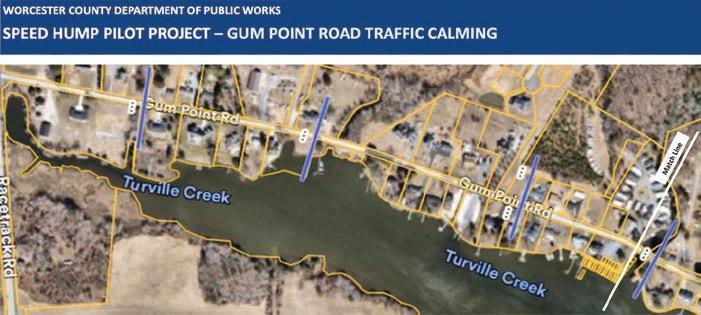
Gum Point Road speed hump project screeches to a halt after unanimous commissioner vote
By Sherrie Clifford ROC Edition Publisher
A proposed speed hump pilot project along Gum Point Road in Berlin has been halted following a unanimous vote by the Worcester County commissioners to cancel both the public hearing and the planned installation.
The decision came after county administration requested approval to not move forward with the project based on community feedback received after an earlier vote to schedule a public hearing.
The project had been introduced as a traffic calming measure to address concerns about speeding and safety along Gum Point Road in the Route 589 area. Serving as a pilot project, it would have seen the installation of seven speed humps whose efficacy would then be evaluated to assist in future decision-making on similar problems.
Following the April 7 decision to schedule a public hearing, the county received numerous letters expressing opposition to the project. Concerns raised by residents included potential delays for emergency responders, possible damage to vehicles and boat trailers and the potential impact on property values.
Based on that feedback, administration requested that the county not move forward with the hearing or the pilot program. The commissioners approved that request unanimously, effectively stopping the project before it advanced to the public hearing stage.
Public comments at a recent commissioners meeting reflected a divided response, with some residents continuing to support traffic calming measures along the roadway. Laura Parker, a resident of Gum Point Road, described
going door to door along portions of the roadway and collecting signatures from neighbors in favor of addressing speeding concerns, noting that a majority of those directly impacted supported moving forward with the pilot program.
Dennis Parker, who also lives on Gum Point Road, raised concerns about ongoing speeding, particularly along curves, and referenced 27 signatures collected from residents in support of taking action, which were presented at the meeting.
Residents in certain sections of Gum Point Road identified speeding as an ongoing concern, particularly along curves and areas with limited visibility. Traffic patterns include local residents as well as non-local drivers accessing the public boat ramp along the roadway, contributing to increased traffic volume and ongoing safety concerns.
Community outreach efforts also indicated support for testing traffic calming measures in the most impacted areas, even as broader opposition to the project was expressed.
At the same time, concerns were raised regarding communication and timing, including limited notice surrounding scheduling changes and how input was collected and considered.
While the pilot project will not move forward, the underlying issue of traffic safety along Gum Point Road remains unresolved.
Future efforts to address conditions along the corridor may include continued enforcement, additional traffic studies or alternative approaches to traffic calming.
For now, the proposed speed hump pilot project has been formally halted, but discussions surrounding safety and traffic conditions on Gum Point Road are expected to continue.
ROC Edition • Worcester County Public Works Worcester County commissioners unanimously stall the installation of speed humps along Gum Point Road in response to community feedback.
Fire will not stop Go Green OC’s composting effort
By Cindy Hoffman Contributing Writer
Go Green OC’s composting efforts hit a major hurdle on April 17 when its bobcat loader caught fire and was completely destroyed.
“We filled the bobcat with gas like usual, and it seems like a spark ignited somewhere in the engine,” Josh Chamberlain, the founder of Go Green OC, said.
The Bishopville Volunteer Fire Department came to the rescue and was able to put out the fire, but the bobcat was lost.
The loss of this critical piece of equipment will not stop Chamberlain and his group of over 100 volunteers from continuing their mission to compost food waste from almost 30 restaurants, businesses, hotels, festivals and the Ocean City Convention Center this season.
“Go Green activities will not be put on hold. We are borrowing a really old tractor right now, which actually broke down today, and might possibly rent one while we shop for a used one.”
The group has launched a GoFundMe campaign to raise money for a used bobcat.
“Unfortunately, we do not have insurance coverage because the value of insuring the bobcat outweighed the cost of the premium,” Chamberlain said.
For eight years, Go Green OC has been running the largest composting operation on the Eastern Shore of Maryland, diverting more than 1.3 million pounds of food waste from incineration, to date. The organization has also implemented zero waste systems at large scale events including Boardwalk Rock, Oceans Calling and Country Calling.
One might assume that this is a massive effort, requiring a lot of machinery, staff and resources. But it is actually run with one staff person, Alyssa Howard, one truck, a lot of trash cans, a bobcat and volunteers.
The process is pretty simple. Howard weighs and picks up full trash cans twice a week from participating restaurants in the morning and brings them to the farm in Worcester County, where the composting happens. Volunteers meet Howard at the farm to unload the cans, slash open bags and pick out any contaminants such as plastic or rubber gloves. They rinse the cans out, let them air dry and reload the truck for the next pick up.
The next steps require some basic science. “We are taking the food waste, which is our nitrogen-rich material and mixing that with the
The Go Green OC’s bobcat was destroyed by a sudden fire. The organization has launched a GoFundMe campaign to raise the down payment for a used bobcat.
wood chips, which is our carbon-rich material,” Garvey Heiderman, owner of the Hobbit Restaurant, founder of Ocean Compost LLC and director of compost operations for Go Green OC, said. The ratio is three to one, wood chips to food. Tree services provide the wood chips for free.
The compost pile is aerated with a blower that moves air through PVC pipes at its base. Pipes go under the pile to keep the core cool and the top of the pile warm. It takes about three to four weeks for the active process to be done.
“Part of what we are trying to do here is to take food waste and yard waste and turn it into a valuable renewable resource that sequesters carbon and helps the waterways,” explained Heiderman.
Heiderman emphasizes the fact that this process is taking products that are considered waste, like food and wood chips, that would otherwise go into landfills and release methane and turning it into something good for the environment.
“The participating restaurants don’t save any money by composting, they simply do it because they believe in it,” he said. “The composting agreement doesn’t cost the town any money, they simply redirect payment that would normally go to the incineration company to Ocean Compost for the weight they remove from the waste stream, so it is a complete wash financially.”
“That’s how we (Ocean Compost) derive our revenue,” Heiderman said.
OC experienced
The whole process would not work without the dedicated and determined volunteers organized through Go Green OC. But it also does not work without a running bobcat. Those interested can go to tinyurl.com/HelpGoGreenOC
For those interested in volunteering, donating or learning more about the composting effort in Ocean City, visit the Go Green OC website, gogreenwithoc.org
ROC Edition • Josh Chamberlain
ROC Edition • Josh Chamberlain
Go Green
a major setback on April 17 when its bobcat caught fire. The Bishopville Volunteer Fire Department was on site to put the fire out.
Route 611 data project tied to transatlantic cable advances abroad as local questions and resistance grow
By Sherrie Clifford ROC Edition Publisher
A proposed cable landing project along Route 611 near Ocean City is drawing increased attention as it enters the earliest stage of Worcester County’s development review process, raising questions about land use, infrastructure and long-term impact on one of the region’s most prominent corridors.
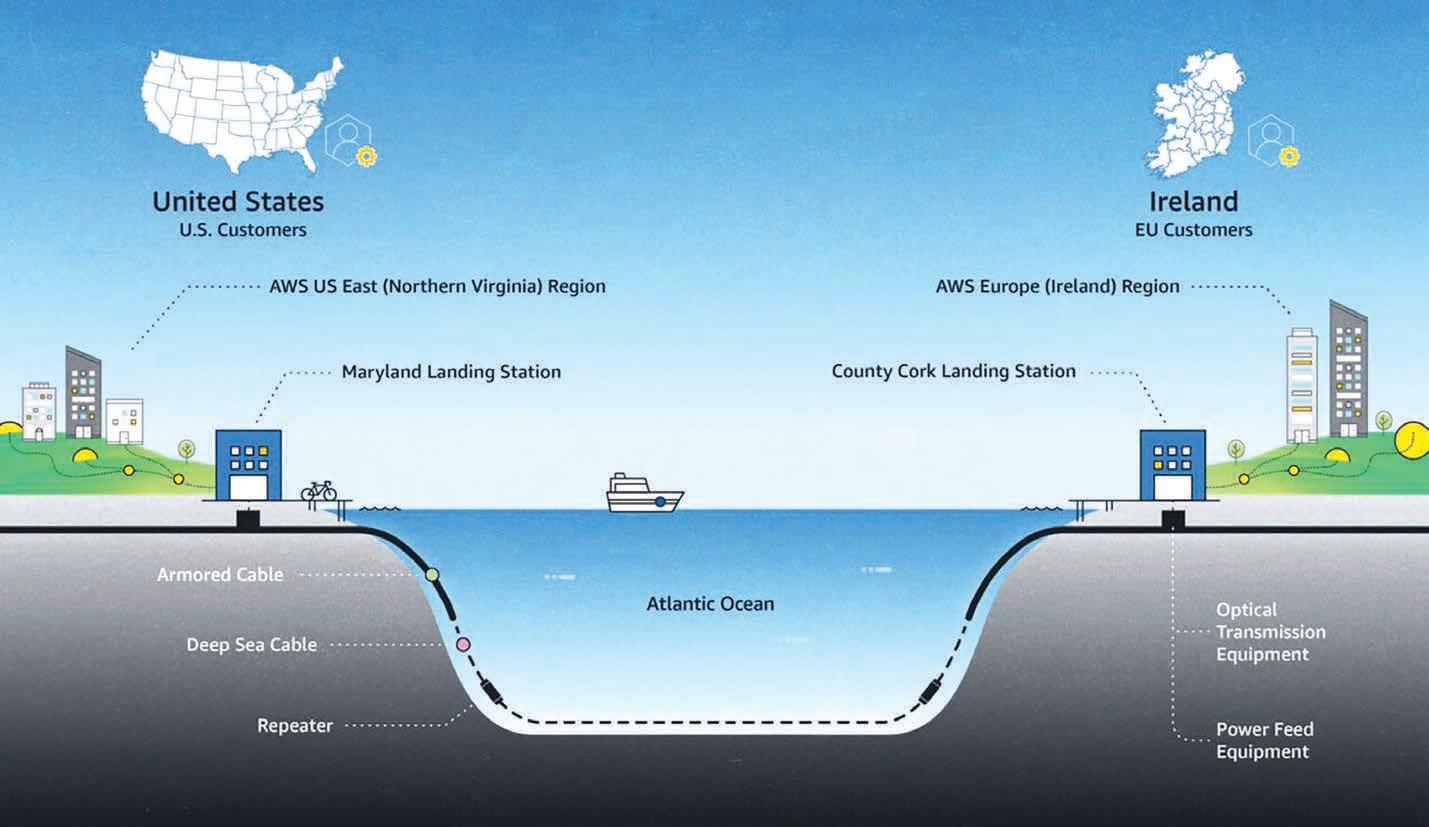
The project site sits along the Route 611 gateway to Assateague Island, an area widely recognized for its environmental significance and scenic character. Globalinx, the company proposing the cable landing station, has secured a lease with the town of Ocean City to establish the station at the Ocean City Municipal Airport on Route 611. The company has also acquired land next to the United Methodist Church in Snug Harbor to build a facility supporting the cable landing station. The purpose of such a project would be to connect transatlantic fiber optic cables, used by Amazon Web Services, to land-based
infrastructure. While still in preliminary review, the proposal has already prompted discussion among residents and local officials.
Worcester County Commissioner Eric Fiori, who represents District 3 where the project is proposed, said in a public Facebook post that he is “adamantly opposed to this industrialization of our beautiful gateway into Assateague Island.”
Fiori emphasized that the project remains in its earliest phase and that the public should understand its current status within the county’s review process.
“In Worcester County, every development proposal begins with the Technical Review Committee,” he said. “This is only a preliminary vetting process where county staff evaluate feasibility. At this stage, the County Commissioners have no authority to approve, deny or formally comment on the project.”
The proposal has only recently entered the Technical Review Committee or TRC phase, where county staff from multiple departments evaluate feasibility, identify
potential issues and request additional information from the developer. According to Fiori, many key questions remain unanswered and commissioners have not yet received a complete or detailed plan.
Despite the early stage, concerns have already been raised regarding both the scale of the proposed facility and the level of information being provided.
“County administration, myself and county staff have made multiple requests for the developer to participate in a public meeting,” Fiori said. “While they initially agreed, they have since been largely unresponsive.”
A public meeting is expected to be scheduled in the coming days at a larger venue to give residents the opportunity to hear more about the project and provide input. Officials indicated the meeting will move forward regardless of whether the developer participates.
The project has been widely described as a data center, though available information indicates it may function more specifically as a
cable landing station, serving as a connection point where subsea fiber optic cables transition to land-based networks.
The proposed facility is expected to be approximately 24,000 square feet and situated on roughly five acres, with initial power demand projected in the range of several megawatts and the potential to increase over time as additional infrastructure is added.
The project is also part of a larger international initiative involving the Fastnet transatlantic subsea cable system, which is being developed to connect the United States and Ireland. The Ocean City location is expected to serve as the U.S. landing point for that system, positioning the area as a new entry point for global data transmission.
The system is being developed in connection with Amazon Web Services as part of a broader effort to expand transatlantic digital infrastructure. If completed, the project would represent a significant addition to the region’s role in international data connectivity.
ROUTE 611
Continued from page 9
The international component of the project has already received formal approval. In Ireland, Cork County Council granted planning permission on April 20, 2026 for a corresponding cable landing station that will serve as the eastern endpoint of the Fastnet system. The transatlantic cable is expected to connect Maryland to County Cork and is currently projected to become operational in 2028.
Facilities of this type are designed to support communications and data transmission systems and typically require continuous power along with backup systems to maintain operations. Plans for the project include underground routing of fiber optic cables from the shoreline to the facility using horizontal drilling methods, minimizing surface disruption while creating a direct connection between subsea infrastructure and land-based networks.
As more details have emerged, several unresolved issues have been identified by county officials and staff. Among the primary concerns is whether the project is compatible with existing C-2 zoning requirements.
Additional questions include the use of large-scale diesel fuel storage, estimated at approximately 20,000 gallons, along with backup generator systems and whether potential noise and visual impacts would meet local standards. There are also concerns related to water usage, cooling system requirements and sewer capacity, as well as increased energy demand and its potential effect on local utility infrastructure and costs.
Infrastructure considerations have also been raised, including possible conflicts with planned bike and pedestrian pathways and the feasibility of routing cables through existing state rights-of-way.
The project is also tied to a broader agreement to bring transatlantic fiber infrastructure to the Ocean City area, with financial arrangements providing compensation over the course of a long-term lease and additional revenue tied to future cable installations. Specifically, Ocean City has agreed to lease public land at the airport on Route 611 for the cable landing station under terms that provide $800,000 over a 25-year period for the first four cables, with $200,000 for each additional cable beyond that.
In addition to concerns raised by county officials, nearby property owners and community groups have expressed opposition, citing potential impacts on energy usage, environmental conditions and overall quality of life.
The system is being developed in connection with Amazon Web Services as part of a broader effort to expand transatlantic digital infrastructure.
Questions have also been raised about whether the scale and intensity of the proposed facility align with surrounding land uses, particularly given its proximity to residential communities and environmentally sensitive areas.
According to available information, the facility would operate with limited on-site staffing and would resemble a standard commercial or industrial building. Cables associated with the project would remain underground and backup systems would be used primarily during power interruptions.
According to Fiori, the information provided to date has not fully addressed key concerns.
“To date, the responses provided have been vague, incomplete and lacking in factual detail,” he said.
Fiori also stressed that the project remains far from final approval and will continue through multiple layers of review.
“The proposed data center/cable landing project has only just entered this early TRC phase. It is far from complete,” he said on Facebook.
Following the TRC process, the proposal would be required to move through additional stages, which may include formal site plan review, planning commission consideration and potential public hearings before any final approvals are granted. At each stage, further documentation, technical review and public input would be expected.
Fiori said transparency and public involvement will be key as the process moves forward.
“Our community deserves transparency, accountability and real answers — not uncertainty and deflection,” he said. “We will continue to push for full disclosure and ensure the public has a voice before this project goes any further.”
The proposal remains under review and no final approvals have been granted locally. Additional details are expected as the process continues and upcoming meetings are anticipated to provide further clarity on the scope, impact and direction of the project.
How many seats is too many? When service, loyalty and responsibility collide
By Sherrie Clifford ROC Edition Publisher
Public service is built on trust. Whether someone is elected, serves on a homeowner association board or holds a full-time leadership position, the expectation is the same: decisions are made in the best interest of those they represent.
There is nothing wrong with holding more than one role. Many individuals balance a full-time job with volunteer or appointed positions, and communities benefit from that involvement. In many cases, this is not about serving over time, but about serving on multiple boards at the same time, where overlapping responsibilities begin to raise questions about balance, independence and fiduciary responsibility.
But the standard changes when those roles involve taxpayer dollars or homeowner funds.
For those in full-time paid leadership positions funded by taxpayers, the responsibility is clear. These roles require sustained focus, oversight and the ability to make decisions that are free from outside influence. The public expects that the time, attention and judgment required for those positions come first.
A similar expectation exists within HOA environments, where board members are entrusted with managing homeowner funds, contracts and community assets. These are not passive roles. They carry direct financial responsibility to those who pay into the system.
When individuals in these positions also sit on other boards that intersect with funding, financial institutions, foundations or organizations that operate within the same space, the lines of responsibility begin to blur.
Even when no rules are broken, the question remains: Where does the fiduciary duty sit when decisions, funding or influence cross between organizations that share leadership?
This is where the issue becomes more than theoretical.
In some cases, one board may be in a position to request funding, support or financial services from another board where the same individual serves. In others, organizations may operate within the same network of relationships, sharing resources, visibility or influence. Even when proper procedures are followed, the overlap raises legitimate concerns about independence.
The expectation is not only that decisions are made appropriately, but that they are made without competing obligations or the appearance of influence. Residents and taxpayers expect that the individuals responsible for managing their money are doing so with a clear and undivided focus.
Time and capacity also cannot be ignored.
Each board position carries its own set of responsibilities: meetings, preparation, review of materials and decision-making. A full-time leadership role already demands significant time and attention. As additional roles are added, those demands do not diminish. They accumulate.
There are only so many hours in a day. When responsibilities begin to overlap, something inevitably gives. The concern is not whether someone is capable. It is whether the primary role begins to receive less time, less oversight or less engagement than it requires.
In some cases, holding multiple board positions can also be viewed as a reflection of influence or standing within the community. While experience and involvement are valuable, there is a point where the number of roles held can raise questions about whether the focus remains on effective service or begins to shift toward maintaining a broader presence across organizations.
This is not about discouraging service. Communities need individuals who are willing to contribute their time and experience. But there is a difference between participation and concentration of roles, particularly when those roles involve financial oversight.
The standard should remain clear: When taxpayer dollars or homeowner funds are involved, independence must be unquestioned and the primary responsibility must come first.
Transparency matters. Disclosure matters. But so does judgment.
At some point, adding another board seat is no longer about service. It becomes a question of balance, capacity and trust.
Public service is not measured by how many roles one person holds. It is measured by how clearly they can separate them and how well they fulfill the responsibility of the one that matters most.
From racing legends to a dining landmark: The legacy of Riddle Farm ahead of the Kentucky Derby
By Sherrie Clifford ROC Edition Publisher
As the excitement builds toward the Kentucky Derby, few may realize that a piece of that storied tradition is rooted right here in Worcester County. In Berlin, the community now known as GlenRiddle stands on land once called Riddle Farm, part of a nationally recognized thoroughbred operation owned by Samuel D. Riddle.
In the early 20th century, Riddle established his farm as part of a broader racing and breeding program that would become synonymous with excellence in American horse racing. While his horses trained and raced on major tracks across the country, the Berlin property played an important role in his operations, supporting the development and care of elite thoroughbreds.
At the center of that legacy is Man o’ War, widely regarded as one of the greatest racehorses of all time. Foaled in 1917 and purchased by Riddle as a yearling, the chestnut colt quickly showed exceptional speed and strength. His dominance on the track was immediate and overwhelming, winning 20 of his 21 races and often by staggering margins. Known as “Big Red,” Man o’ War shattered records and redefined expectations in the sport, later being named “Horse of the 20th Century.” His success helped elevate American racing to national prominence and brought widespread attention to the breeding programs that produced him.
That legacy carried forward through his son, War Admiral, who secured racing’s highest achievement by winning the Triple Crown in 1937. With victories in the Kentucky Derby, Preakness Stakes and Belmont Stakes, War Admiral cemented the Riddle name as one of the most respected in the history of the sport.
In 1938, War Admiral faced a Kentucky horse named Seabiscuit in a historic match race at Pimlico Race Course in Maryland. Known as the “Race of the Century,” Seabiscuit defeated the Triple Crown winner by four lengths in the 1 3/16-mile race, a result that captured national attention and became one of the most iconic moments in American horse racing. The event drew an estimated 40 million radio listeners, nearly half the population of the United States at the time and further cemented
Maryland’s place in racing history.
Another notable horse connected to Riddle’s program was Crusader, a champion of the 1920s whose success further strengthened the reputation of the breeding and racing operation tied to Riddle Farm. Together, these horses helped define an era, elevating the farm’s status within a network of elite racing and breeding operations across the country.
Riddle Farm in Berlin was part of a broader system of properties used to support breeding, development and management of thoroughbreds at the highest level. During its time, the farm contributed to a program that shaped the direction of American horse racing, with a legacy that extended far beyond the Eastern Shore.
Over time, as the landscape of horse racing changed, so did the use of the land. Today, GlenRiddle in Berlin stands as a premier residential community and golf club built on the historic grounds of Riddle’s former farm. In the early 2000s, the property was transformed into a planned community featuring two championship golf courses, Man O’ War and War Admiral, along with residential neighborhoods and a marina. While the land has evolved, its connection to racing history remains an important part of its identity.
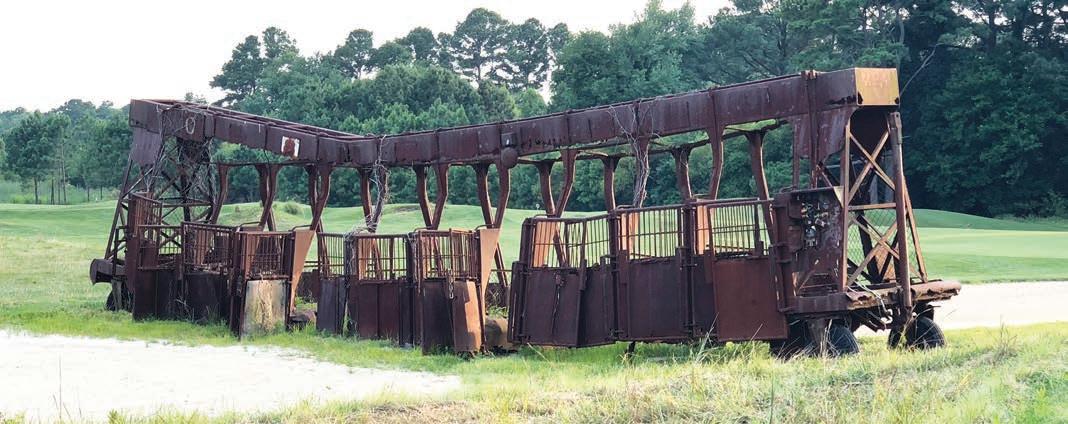
One of the most visible and meaningful links to that past is the original stable structure, which has been preserved and repurposed as the Ruth’s Chris Steak House and clubhouse. What was once home to thoroughbred horses now serves as a gathering place for the community, blending history with modern use. Much of the original structure was carefully retained, including beams, timber framing and even stall doors and hardware, some of which have
been incorporated into the design of the building.
Inside, the space reflects a deliberate effort to honor its origins. Custom finishes and lighting have been designed to match the period of the farm’s operation, while historical displays, artwork and photography throughout the building tell the story of Riddle Farm and the horses that made it famous. Murals and paintings by local artist Patrick Henry depict scenes from the farm during its peak, offering visitors a visual connection to the past.
A museum-style presentation within the building highlights the life and legacy of Man o’ War and the broader impact of Riddle’s breeding program. Exhibits also commemorate the historic War Admiral and Seabiscuit match race, reinforcing the national significance of the farm’s history. Outside, a horseshoe-shaped Man o’ War Memorial, modeled after the original built in 1952, serves as a tribute to the horse that helped define an era of racing.
Today, the surrounding grounds reflect a different kind of activity, with golf courses replacing training areas and homes built where pastures once stood. Yet the story of the land remains layered beneath the surface, connecting residents and visitors to a time when the property played a role in shaping one of the most celebrated chapters in American horse racing.
As the Kentucky Derby approaches, Riddle Farm’s legacy offers a meaningful local connection to a national tradition. The horses that carried the Riddle name helped define the sport, and the land in Berlin remains a quiet but powerful reminder of that history.
Man o’ War, whose influence shaped generations of champions,
is buried at the Kentucky Horse Park, where his legacy continues to be honored alongside his son, War Admiral.
From Man o’ War to War Admiral and through one of the most iconic races ever run against Seabiscuit, the impact of Riddle’s operation continues to resonate. What was once a center of thoroughbred excellence has become a place where history is preserved, repurposed and still very much part of the community today.
ROC Edition • Sherrie Clifford, Publisher Painting by local artist Patrick L. Henry is prominently displayed within the halls of GlenRiddle Golf Club.
OPLGA Member/Member Tournament returns May 12 with Kentucky Derby theme
By Sherrie Clifford ROC Edition Publisher
The Ocean Pines Ladies’ Golf Association (OPLGA) will host its annual Member/Member Golf Tournament on Tuesday, May 12 at the Ocean Pines Golf Course, bringing together members for one of the first major events of the season.
This year’s event embraces the spirit of the Kentucky Derby with a “Run for the Roses” theme, adding a festive and social element to a day focused on golf, camaraderie and community.
The tournament will follow a two-person scramble format, allowing teams of OPLGA members to pair up and compete while enjoying a relaxed and engaging style of play. Registration begins at 8:30 a.m., with a 9:00 a.m. shotgun start.
Participants will compete for first and second place prizes, along with closest-to-the-pin contests. Additional opportunities include a cash back split raffle and optional mulligans, adding to the day’s activities both on and off the course.
Following play, participants will gather at the Clubhouse Grille for lunch, where the Derby theme will continue through décor and atmosphere. A cash bar will be available, with plans for a signature Mint Julep cocktail to reflect the traditional drink of the Kentucky Derby.
Organizers have also arranged themed decorations and details throughout the event, including red and yellow accents, floral centerpieces and equestrian-inspired touches that tie back to the history of horse racing.
The Member/Member tournament is designed to bring players together at the start of the golf season, offering a combination of friendly competition and social connection within the OPLGA community.
With strong participation expected, the event reflects the continued enthusiasm and involvement of OPLGA members, as well as the efforts of the volunteer committee working behind the scenes to ensure a successful day.
As the season gets underway, the Member/Member tournament sets the tone for a full schedule of events ahead, combining golf with a celebration of tradition and community.
ROC Edition • Sherrie Clifford, Publisher Kentucky Derby spirit to be displayed May 12 at OPLGA’s annual Member/ Member Golf Tournament, with this year’s theme being “Run for the Roses.” Pictured is 2015 Triple Crown winner, American Pharoah (left), and Ocean Pines golfer Colette Horn (right).
Series by Sherrie Clifford, Candidate for Worcester County Commissioner, District 6
#1. Because You Asked: Should a public-school Superintendent serve on the board of a bank where the school system holds its accounts?
Serving on a bank’s board can raise a conflict-of-interest concern when that same institution holds a school system’s accounts. The issue is not that something improper is happening, but that a Superintendent may carry fiduciary responsibilities in two directions at once. In the public role, the duty is to act solely in the best financial interest of the school system and its taxpayers. In a private board role, the duty is to act
in the best interest of the bank and its shareholders. Those interests can align, but they can also diverge in ways that warrant closer attention.
Situations involving where funds are deposited, how banking services are structured, or whether contracts are renewed can introduce questions about independence. Even when proper procedures such as recusal are followed, the appearance of influence or preferential treatment can still matter. In public service, maintaining trust depends not only on what decisions are made, but on whether those decisions are seen as fully objective and free of competing interests.
#2. Because You Asked: Should public schools remain funded for all students, or should parents’ choices determine where education dollars go?
School choice can offer families more flexibility, but directing public funding to follow each student rather than supporting the public school system raises important questions about oversight, management, and long-term stability. Public schools are designed to serve every child and rely on consistent funding to support facilities, staffing, transportation, and programs.
That includes specialized schools
like Cedar Chapel Special School, which operates within Worcester County Public Schools to serve students with more complex needs. When funding shifts out with each student, many of those costs remain.
Over time, that can weaken the system itself, reducing opportunities and resources for the students who remain.
There are also structural differences that cannot be overlooked.
Public schools are required to accept and serve all students, including those with special needs or higher levels of support. Non-public schools may have discretion in admissions. If funding follows the student but access does not, it creates an uneven system where
See YOU ASKED page 15
YOU ASKED
Continued from page 14
public schools, including programs like Cedar Chapel, carry broader responsibility with fewer resources. Homeschooling adds another layer, raising questions about accountability, oversight, and how outcomes are measured when public funds are directed to individual families.
It also raises a broader question about how we fund education as a community. Public schools have traditionally been supported by all taxpayers, including those without children in the system, because an educated population benefits the entire community. If funding becomes individualized, at what point does that shift? Should homeowners without children direct their taxes elsewhere, or opt out? Do residents whose children have graduated stop contributing? These are not simple policy changes. They go to the foundation of how public education is supported, and whether it remains a shared investment or becomes a series of individual choices.
#3. Because You Asked: Hello Candidate Clifford I was wondering how long you have been a resident of Worcester County and what career work you have accomplished in Worcester County?
I have been a resident of Worcester County for six years and moved here in mid-2020 to be closer to family. Since arriving, I have made it a priority not just to live here, but to become actively involved and contribute to the community.
I founded ROC Edition, a local newspaper focused on providing clear, factual reporting and helping residents better understand local decisions, financial matters and governance. It has grown into a trusted source for many, printing over 8,000 copies each month and distributed through more than 62 locations across Worcester County. I also founded the “Ocean Pines ROC” community Facebook group, which has more than 4,700 members and provides a space for residents to stay
informed, share information and engage in local issues.
I currently serve on the Ocean Pines Budget and Finance Committee, where I review financials, ask questions and work to ensure decisions are supported by accurate information.
My professional career spans more than 25 years in highly regulated financial and data environments servicing stock exchanges and Wall Street financial institutions, where oversight, accuracy and accountability were essential. That experience shapes how I approach budgets, decision-making and public service. I believe in strong communities, responsible leadership and financial discipline in how public dollars are managed.
#4. Because You Asked: What is your Platform?
My platform is built on Financial Discipline, Protecting Taxpayers and Accountable Leadership. That begins with reviewing budgets and truly knowing what is in them. Every dollar matters. I bring more than
25 years of experience in oversight-driven environments where accuracy, controls and transparency are expected, not optional.
I am committed to protecting our public school system. Strong schools are the foundation of a strong community. That means responsible funding, proper oversight and making sure resources are used effectively for students, teachers and long-term success.
Public safety is a priority. Supporting our police and first responders means ensuring they have the resources, staffing and leadership they need to do their jobs safely and effectively, while also maintaining accountability and public trust.
Above all, accountability matters. Leadership means asking the tough questions, understanding the details and making decisions that are clear, responsible and in the best interest of the community. This campaign is about delivering results you can measure, not explanations or excuses you have to accept.
Know who you are voting for: Why background matters more than name recognition
By Sherrie Clifford ROC Edition Publisher
As election season approaches, voters are once again faced with an important responsibility: choosing who will represent their interests and manage public resources. While campaign signs, social media posts and friendly introductions can shape first impressions, they do not tell the full story.
Knowing who you are voting for goes far beyond name recognition or personality. It requires understanding a candidate’s background, both legally and financially, and taking the time to review information that is publicly available.
Many assume these concerns only apply at the highest levels of government. In reality, they exist at every level, including HOA boards and county leadership. The decisions made in these roles directly impact budgets, taxes and the long-term financial health of a community.
Public records are available for a reason. Resources such as federal court systems like PACER, state judicial case search tools and campaign finance reporting databases provide access to information that helps
voters make informed decisions. These records offer insight into legal history, financial responsibility and how a candidate has handled obligations over time.
This is not about making accusations. It is about understanding patterns. A candidate’s history can reflect how they manage risk, respond to challenges and handle financial responsibility. Those same traits will carry into how they manage taxpayer dollars and serve the public.
Voters should also pay attention to what is already being discussed in the public arena. Questions raised at meetings, within the community or on social media may not always provide answers, but they can highlight areas that deserve closer attention. When concerns exist, whether related to financial matters, oversight or past decisions, they should not be ignored.
It is equally important to observe how a campaign responds under pressure. Are questions addressed directly or does the messaging shift toward managing perception? Does it feel like transparency or does it feel like damage control? These are signals voters can evaluate for themselves.
Campaign finance is another critical piece of the picture. Where is the money coming from? Are contributions reported accurately and on time? Do the visible campaign efforts align with what is disclosed in official filings?
When significant resources are being spent, whether on signage, advertising or outreach, there should be a clear and transparent record to support it. Gaps between what is visible and what is reported raise questions that deserve answers.
At the local level, these issues matter even more. Homeowner association boards and county commissioners are responsible for decisions that directly affect property values, infrastructure and community services. These are decisions that impact residents every day.
It is easy to support a candidate who is well known, approachable
or widely liked. However, leadership requires more than personality. It requires accountability, sound judgment and a demonstrated ability to manage both responsibility and resources.
Voters have more power than they often realize. Taking the time to review information, ask questions and look beyond surface impressions can make the difference between electing someone who serves the community effectively and someone who does not.
In the end, elections are not just about individuals. They are about the direction of a community and the stewardship of taxpayer money. Every vote contributes to that outcome.
Knowledge is power. And informed voters shape the future.
Considering a run for the Ocean Pines Board of Directors? Part 4 of a four-part series
By Sherrie Clifford ROC Edition Publisher
By the time you reach this point in the series, you have likely thought about why you want to run, what the role involves and what voters should be looking for in a candidate. Part 4 focuses on what many candidates overlook: what it actually means to serve once the election is over.
Winning a seat on the Ocean Pines Association Board of Directors is not the finish line. It is the starting point of responsibility, oversight and decision-making that affects approximately 8,500 properties.
The transition from candidate to director requires an immediate shift in mindset. Campaigning is about ideas and messaging. Serving is about governance, fiduciary responsibility and accountability to the entire community, not just those who supported you.
One of the first realities new board members face is the volume and complexity of information. Financial reports, contracts, capital projects, reserve studies, legal considerations and operational updates are part of every board cycle. Understanding how to read and question this information is not optional. It is essential.
Just as important is a working knowledge of the association’s governing documents. These documents define how the community
operates, what authority the board has and how decisions must be made. They are not simply reference materials. They are the foundation for every action taken by the board. Directors are expected to know them, follow them and apply them consistently.
Directors are also responsible for decisions that may go beyond routine operations. Referendums, for example, can shape the future of the community through major capital investments or policy changes. Understanding the scope, financial impact and long-term obligations tied to these decisions is a critical part of the role.
Monthly board meetings are where much of this work comes together. These meetings are not just procedural, they are decision points. Board members are expected to come prepared, having reviewed agendas and supporting materials in advance, ready to ask questions and make informed decisions in a public setting.
Resident engagement is another key component. Board members regularly hear from homeowners, whether through formal meetings, emails or direct conversations. Resident complaints and concerns are part of the process. Listening, responding appropriately and ensuring concerns are addressed within the structure of the association requires both professionalism and consistency.
Contract review and approvals are also central to board responsibilities. From large capital projects to vendor agreements, these decisions involve financial commitments that can impact the community for years. Directors must evaluate terms, question assumptions and ensure that agreements are in the best interest of the association.
Working with the general manager is a key part of effective governance. The board is responsible for setting direction and providing oversight, while the general manager handles daily operations and staff. The board does not manage day-to-day operations or personnel. Maintaining a high level of respect for the general manager’s role and professional expertise, along with clear roles, accountability and open communication, is essential to a productive and professional working relationship.
Directors are expected to exercise fiduciary duty. That means acting in the best interest of the association as a whole, not individual interests, social circles or outside influences. Every vote carries weight, especially when it involves community spending, long-term projects or contractual commitments.
Another key responsibility is maintaining independence. Board service is not about aligning with a group or becoming part of an inner circle. It is about independent thinking, asking questions and making decisions based on facts. When independence is lost, trust begins to erode.
Transparency also becomes a critical part of the role. Residents expect decisions to be made in the open, with clear explanations and supporting information. While certain matters must remain confidential, the majority of board business should be conducted in a way that builds confidence, not confusion.
Time commitment is another factor that is often underestimated. Board members are expected to attend meetings, review materials in advance, participate in discussions and remain informed between meetings. This is not a passive role. It requires preparation and engagement.
Equally important is how board members conduct themselves. Professionalism matters. Respectful dialogue, adherence to governing documents and following proper procedures such as Robert’s Rules
are all part of effective governance. Disagreements will happen, but how they are handled defines the strength of the board.
There is also the responsibility of oversight. Directors are not there to manage day-to-day operations, but they are responsible for ensuring that management is operating effectively, budgets are followed and decisions align with the association’s long-term goals. Asking the right questions is part of that oversight.
For those considering a run, this is the moment to reflect honestly. Are you prepared to understand and apply governing documents? Are you willing to review contracts in detail and evaluate major decisions like referendums? Can you handle resident concerns with professionalism while maintaining independence? Are you ready to work constructively with the general manager while holding management accountable?
Serving on the board is an opportunity to make a meaningful impact. It can strengthen the community, improve transparency and ensure responsible financial management. But it also requires commitment, discipline and a willingness to put the community first.
Elections bring choices. Service brings responsibility.
As this four-part series concludes, the message is simple. If you are considering a run for the Ocean Pines Board of Directors, understand not just how to get elected, but what it truly means to serve.
Because in the end, the role is not about holding a position. It is about earning trust and keeping it.
ROC Edition • Sherrie Clifford, Publisher
By Sherrie Clifford ROC Edition Publisher
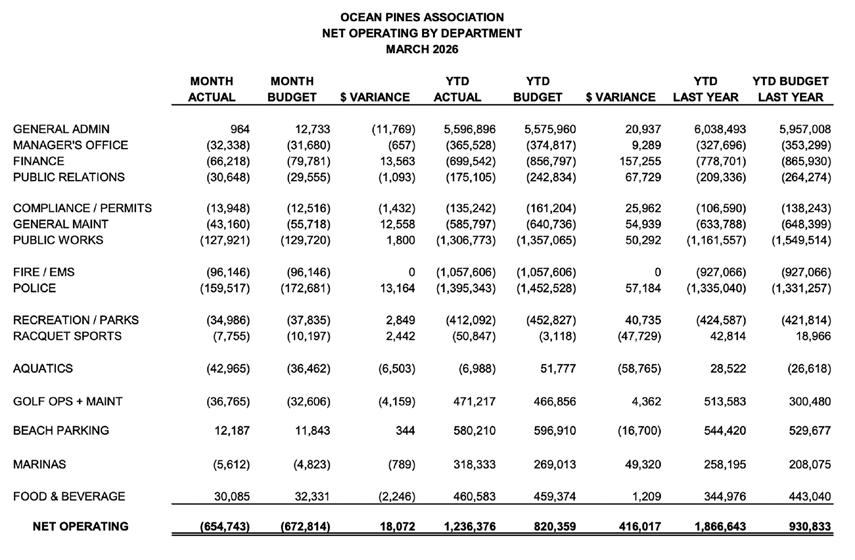
Ocean Pines Association financial results for March reflect steady fiscal performance, despite being impacted by poor weather conditions.
Marinas continued to perform well, supported by operational improvements including changes in fuel sourcing and vendor management.
review to improve overall performance and competitiveness.
YEAR-TO-DATE PERFORMANCE
MONTHLY OVERVIEW
March closed with a positive operating variance of $18,072, with lower-than-expected expenses helping to offset revenues that came in below budget.
Revenues were under budget by $30,722, while expenses were under budget by $48,794, leading to the overall favorable variance.
The results were largely influenced by weather conditions, particularly impacting golf operations during both February and March. Extended closures limited activity during what is typically a key period.
Viola noted that the course “was closed for the longest I’ve ever seen in 25 years,” reflecting the unusual impact of the winter season.
Despite the weather hurdles, overall performance remained stable, with most departments maintaining expected levels of operation.
DEPARTMENT PERFORMANCE
Golf Operations were below budget for the month due to weather-related disruptions, although long-term performance remains strong following several years of increased investment and higher budget expectations.
Public Works and Finance contributed favorable results, reflecting continued focus on managing expenses and maintaining operational efficiency.
Food and Beverage performance remains significantly stronger than prior years. While March results were close to budget, overall performance continues to exceed historical levels, reflecting sustained growth in this area.
Recreation and Parks maintained stable performance, supported by expense control and ongoing revenue efforts.
Aquatics continues to experience higher operating costs, driven by the expense of maintaining facilities during colder months, including heating and increased utility costs tied to water and wastewater.
Racquet Sports experienced lower-than-expected membership levels, resulting in reduced revenue compared to projections and continued negative performance against budget. New advertising efforts have been implemented to increase memberships and drive drop-in activity, while pricing and membership structures remain under
Ocean Pines remains in a strong financial position year to date, reporting a positive operating variance of $416,017.
Revenues are over budget by $143,013, while expenses are under budget by $273,004, reflecting disciplined financial management across departments.
Viola noted that performance throughout the year has remained within expected ranges, with final results influenced in part by weather conditions and seasonal activity.
RESERVES AND FINANCIAL POSITION
The association continues to maintain a solid reserve position, with approximately $6 million projected in reserves following
current year expenditures.
March financials reflect steady performance in the face of weather hurdles ROC Ledger ROC Tribute
Viola noted that this level has been built over several years and plays a critical role in supporting ongoing maintenance, infrastructure improvements and capital projects.
During the month, the association also utilized available favorable funds to support storm cleanup efforts, including the use of outside contractors and equipment, allowing work to be completed efficiently without delaying other operations.
BOTTOM LINE
March results reflect Ocean Pines’ steady performance and disciplined expense control in the face of weather-related disruptions. Following suit are year-to-date results, with Ocean Pines maintaining a favorable financial position heading into the final month of the fiscal year.
Cash and investments: Strong liquidity position supports stability and planning
By Sherrie Clifford ROC Edition Publisher
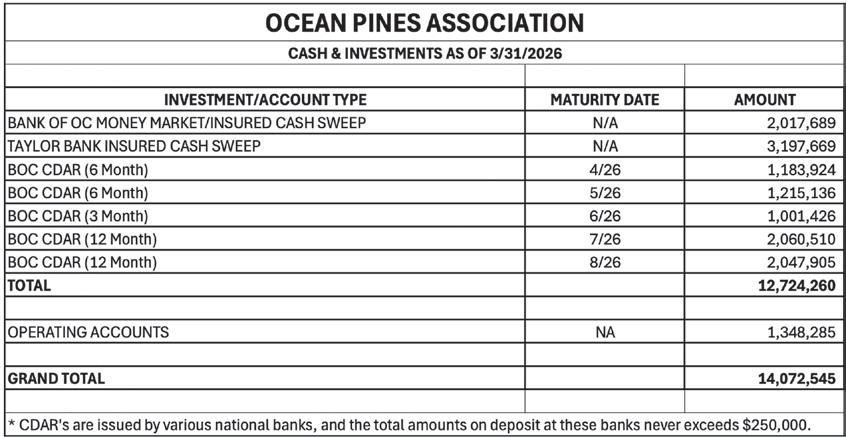
As of March 31, 2026, the Ocean Pines Association reported a total of $14,072,545 in cash and investments, reflecting a strong and stable financial position heading into the close of the fiscal year.
Of that total, $12,724,260 is held in investments, with an additional $1,348,285 in operating accounts to support day-to-day expenses and short-term obligations.
The association’s investment strategy continues to focus on both liquidity and protection, with funds distributed across insured cash sweep accounts and CDAR (Certificate of Deposit Account Registry) programs. These structures allow funds to be spread across multiple financial institutions, ensuring that deposits remain within FDIC insurance limits while still functioning as a single, accessible account.
A significant portion of the funds is held in CDAR accounts with staggered maturity dates ranging from April through August 2026. This laddered approach provides ongoing access to funds as they mature over time, reducing risk while maintaining flexibility to meet operational needs, capital projects and unexpected expenses.
In addition to the CDAR accounts, funds are also held in insured cash sweep accounts through Bank of Ocean City and Taylor Bank. These accounts provide immediate liquidity while maintaining insurance protection across multiple banks.
This structured approach reflects a balance between preserving capital and maintaining access to funds, which is critical for an organization managing ongoing operations, infrastructure investments and seasonal fluctuations in revenue.
The strength of the association’s cash position also supports its ability to respond to unplanned events. As seen during recent storm cleanup efforts, available funds allowed management to act quickly, utilizing contractors and equipment without delaying necessary work.
Overall, the current cash and investment position provides Ocean Pines with both financial stability and operational flexibility. With a strong reserve base and a disciplined approach to managing funds, the association remains well-positioned to support future maintenance needs, capital improvements and long-term planning initiatives.
Reserve fund grows to $6.88 million as contributions and interest outpace capital spending
By Sherrie Clifford ROC Edition Publisher
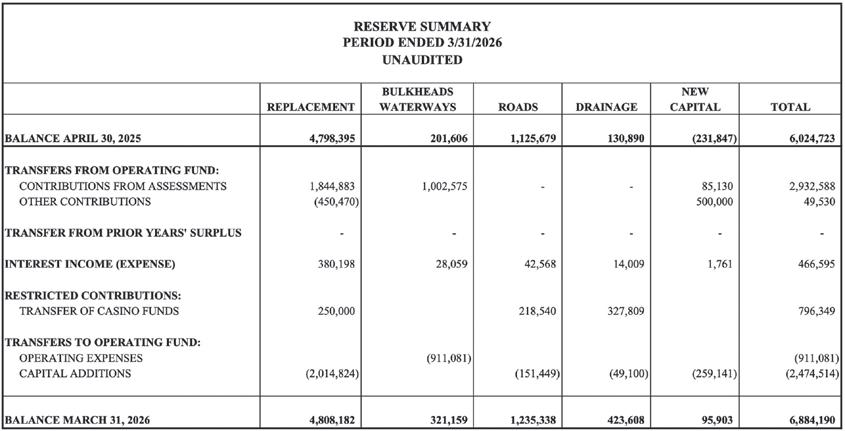
This reserve summary shows how Ocean Pines’ capital funds have changed over the course of the fiscal year, from April 30, 2025 through March 31, 2026. These reserves are set aside for major infrastructure and long-term projects, including replacement items, bulkheads and waterways, roads, drainage and new capital projects.
The total reserve balance increased
from approximately $6.02 million to $6.88 million, reflecting a net gain of about $860,000 during the period.
The increase is primarily driven by contributions from assessments, which added around $2.93 million into the reserve funds, along with interest income of about $466,000 and restricted casino funds totaling roughly $796,000. These inflows were partially offset by transfers back to the operating fund and capital spending, including over
$2.47 million in capital additions and $911,000 used for operating expenses. The largest reserve category remains Replacement at $4.8 million, while Roads, Drainage and Bulkheads all show moderate growth. Overall, the chart reflects steady funding of reserves alongside ongoing use of those funds for planned infrastructure and capital improvements.
Progress continues across key projects as Ocean Pines moves toward summer season
By Sherrie Clifford ROC Edition Publisher
The April 25 Ocean Pines Association General Manager’s report, presented by General Manager John Viola and Senior Director of Administration Linda Martin, highlighted continued progress across major projects, infrastructure improvements and seasonal preparations. Most initiatives remain on track as Ocean Pines transitions into its busiest time of year, with Viola emphasizing a continued focus on collaboration across staff and the community, noting that “together we’re better.”
FIREHOUSE
The South Fire Station project remains in active progress with a green status, although a minor site adjustment is underway.
During early site work, areas of soil were identified as having a higher organic content than required. That material will be removed and replaced with a sand and clay fill mixture, with completion expected within the next one to two weeks. Public Works is assisting with part of the work to help manage costs.
Finalized plans are expected to be submitted to Worcester County during the first week of May for the foundation permit. Once that phase begins, the construction timeline is estimated at approximately 55 to 60 weeks.
“That came up … It’s not a major thing, and we’ll certainly take care of it,” Viola said.
YACHT CLUB TIKI KITCHEN
The Tiki Kitchen project continues to move forward on schedule and remains in green status.
Installation of the metal roof is scheduled for the week of April 27, followed by the start of interior construction. The project
is structured as a shared effort, with Ocean Pines responsible for the building and Touch of Italy managing kitchen operations.
The kitchen will serve patrons at the pool and patio through wait staff service. Food orders will not be placed directly at the kitchen window but will be delivered to guests by staff.
The project remains on track for completion in time for the start of the summer season.
GOLF PAVILION
The Golf Pavilion project remains on hold. No construction is planned for this summer, and the project will be reviewed again in the fall as part of ongoing evaluation.
IRRIGATION
The multi-phase irrigation project continues to show steady progress, with Phase II now complete. Phase I, completed in 2025, included holes one, two, three, nine and 19, along with improvements to the fourth tee and installation of the main pumping station. Phase II expanded coverage to holes four through eight, as well as holes 10 and 18 and the practice green.
The next stage will focus on holes 11 through 17 and will be completed over two additional phases in the coming years. Both completed phases have remained on schedule and within budget.
18TH FAIRWAY
Restoration work on the 18th fairway is receiving strong feedback from both members and visiting golfers.
The redesigned pond allows for increased water retention, reducing reliance on the aquifer and supporting irrigation needs. The improvements have enhanced overall course conditions and playability heading into the season.
MAINTENANCE
Maintenance efforts across Ocean Pines are focused on seasonal readiness.
Golf course fairway bathrooms are being painted and repairs are underway, with all work expected to be completed by the beginning of the season. In addition to exterior improvements, interior fixtures are being addressed to enhance overall condition and usability.
At the Swim and Racquet Club, new partitions are being installed
and flooring improvements are underway.
Public Works began mowing common areas and medians on April 20 following delays caused by extended storm cleanup efforts.
Residents are reminded that, based on budget changes, Public Works will no longer maintain grass in easements and drainage areas. Property owners are responsible for maintaining those areas in front of their homes.
BEAUTIFICATION
Seasonal plantings and landscaping continue to enhance the appearance of Ocean Pines, with cherry blossoms and tulips in bloom across the community. Plans are also underway to expand sunflower plantings following strong positive feedback from prior seasons.
The cleanup effort following February’s storm is nearing completion, with all primary debris collection completed by April 24.
The operation included the use of rented equipment from Worcester County and support from outside contractors. Large volumes of debris were processed using grinding equipment, with materials repurposed through county systems.
“We’ve gone everywhere at least once, if not several times,” Viola said.
Residents are now expected to follow standard disposal procedures, including bundling branches and using designated yard waste collection methods, as bulk pickup has concluded.
BOTTOM LINE
The April general manager report reflects steady progress across key projects and daily operations, with most initiatives remaining on track. While minor adjustments are part of ongoing work, overall performance remains consistent as Ocean Pines prepares for the summer season.
There are times when something doesn’t quite add up. It may not be obvious or fully formed, just a detail that seems off or a pattern that raises a quiet question. In those moments, most people hesitate. They tell themselves they need more information. They assume someone else will notice.
That instinct is understandable. People want to be fair. They want to avoid raising concerns that may not lead anywhere. They don’t want to be wrong.
But waiting has consequences.
In any system, especially those involving public funds, complex financial activity or election systems, timing matters. Questions raised early can be examined while records are available, transactions can be traced and context is still clear. When something is brought forward in real time, there is an opportunity to confirm, clarify or correct before issues become larger and more difficult to address.
That becomes even more important when the concern may involve individuals in positions of authority. When those responsible for oversight are also part of the system being questioned, hesitation can increase and the instinct to wait can be even stronger. That is precisely when timely awareness matters most.
Strong systems depend on those moments being taken seriously. There is a familiar phrase often used in public safety: “If you see something, say something.” While it is commonly associated with security, the principle applies just as much to financial systems, governance and any process where accuracy and trust matter.
As time passes, the window for clarity begins to close. Information becomes harder to retrieve. Details lose context. What may have been easily verified at one point becomes far more difficult to piece together later. In some cases, the ability to fully understand what happened is lost altogether.
This is not about assigning blame. It is about recognizing that concerns
rarely begin with certainty, but with awareness and a question that deserves attention.
That does not mean every concern will lead to a finding. It means systems remain open to review while the information still exists to answer those questions.
There is an important distinction between raising a concern and making an accusation. One invites review. The other assumes an outcome. What systems need is the former. They need people willing to say, “This may need a closer look,” without feeling that they must have all the answers before speaking up.
That is how problems are prevented, not just addressed.
In hindsight, it is always easier to see where something could have been raised earlier. But in the moment, uncertainty often leads to delay and delay can limit what can be done.
When concerns are not raised in time, the impact can extend far beyond a single decision or event. Outcomes may shift, directions may change and the people placed in positions of responsibility may not reflect what was originally intended. Over time, those shifts can alter the course of an organization and correcting that course can take years.
For any organization, the lesson is not just about what happened, but about how to respond when something does not feel right. There should be clear paths to raise concerns and those paths should be understood and used. Early awareness, even when incomplete, gives systems the best chance to work as intended.
In the end, the difference is not always what was known, but when it was raised and that timing can make all the difference.
Leadership without conditions: a standard that matters
There are moments when leadership reveals itself not through public statements, but through private actions. This is one of those moments.
On March 30 at 2:36 p.m., I received an unsolicited Facebook text message from the vice president of the Ocean Pines Association Board of Directors, who also serves as president of the Worcester County Veterans Memorial organization. The message came without prompting and referenced a potential business relationship connected to the Worcester County Veterans Memorial, an effort that I have supported and covered over time, including providing assistance at no charge under the direction of Marie Gilmore.
In that message, he wrote, “I want to have a business relationship with you regarding the Veterans Memorial but I cannot do it with your association with,” referring to an Ocean Pines homeowner he specifically named, urging, “I hope you will consider and do the right thing and distant [sic] yourself from her because it doesn’t give your site and newspaper a good look.” This is not a misunderstanding or a matter of interpretation. It reflects a business relationship conditioned on personal association.
That distinction matters. Business relationships tied to community organizations should be based on merit, service and the value provided to the community, not on personal alignment or preference. When those lines begin to blur, it raises broader questions about how decisions are being approached and whether all residents are being treated fairly and consistently.
No board member, regardless of title, has the authority to dictate who residents can associate with, support or stand beside. That principle is fundamental to any community built on participation, transparency and trust. The individual referenced in that message is an Ocean Pines homeowner in good standing, with no convictions, no financial issues and no violations. She is educated, actively involved in the community and has a record of service in Ocean Pines that includes years of volunteer work and appointment to the board of directors from October 2021 into August 2022, when she was asked to step in and assist. That record stands on its own.
When leadership begins to draw lines around who is acceptable and who is not, based not on conduct but on perspective, it creates an environment where people hesitate to speak. Participation declines.
ROC Edition Political Advertising Policy
ROC Edition accepts paid political advertising from candidates, campaigns and issue-based organizations.
All political advertisements must clearly include a “paid for by” disclaimer identifying the sponsoring committee or organization, as required by applicable law.
The publication of political advertising does not constitute endorsement by ROC Edition, its ownership or its staff. ROC Edition remains committed to providing independent, factual reporting and does not endorse candidates or political positions.
All political advertisements are clearly identified as paid content and are presented separately from editorial material.
ROC Edition reserves the right to accept or reject any advertisement at its discretion.
Fewer voices are heard and decisions become concentrated among fewer individuals. That is how transparency erodes, not all at once, but gradually, through pressure applied behind the scenes.
Elected officials are chosen to serve the entire community, not a select group within it. That responsibility includes engaging with residents who may disagree, ask difficult questions or express concerns in ways that may not always be comfortable. No resident should be marginalized or excluded simply because they voice an opinion or because their tone is not preferred. Service requires listening, not selecting.
This is not about one message alone. It is about what that message represents. A mindset where influence is applied quietly, where access may be conditioned and where disagreement is treated as something to be managed rather than respected. Communities do not become stronger under those conditions. They become smaller, more controlled and less accountable. I want to be equally clear in response. I will not be influenced, pressured or negotiated into distancing myself from anyone in this community. I will not trade integrity for access and I will not
accept the idea that participation in Ocean Pines or elsewhere comes with conditions set by a select few. Business relationships, community involvement and public service should never depend on personal alignment with board members or their preferences.
Residents deserve leadership that welcomes engagement, not discourages it. Leadership that answers questions, not avoids them. Leadership that understands the difference between disagreement and disloyalty and respects the independence of the people it serves.
When that respect is lost, so is trust. And once trust is lost, it is not easily restored.
This community is made up of residents who care deeply about where they live, who volunteer their time, ask questions and stay engaged because they believe in Ocean Pines. Those voices should be encouraged, not pushed aside. If leadership cannot make that distinction, then it raises a larger question about the role they are choosing to play.
Is this about serving the community or controlling it? Because it cannot be both.
Sherrie Clifford Publisher, ROC Edition
Keep the college experience STANDING Room Only
“Life would be infinitely happier if we could only be born at the age of 80 and gradually approach the age of 18.” Prophetic words from the great Mark Twain. Or would it!
When I was a freshman in high school, my goal was to either play professional baseball or to be a successful businessman, wear a suit and a fancy tie to work and earn a $200-a-week salary. Today, that is the cost of standing in the checkout line at a grocery store.
I began my professional career in the newspaper field as a printer’s apprentice, then was promoted to a sports writer and columnist, covering and working with high school and college athletes, and in time moved on to professional sports coverage in print and on-air broadcasting. In the early years, I stood on the sidelines during many athletic championships played out on the unlighted little league and high school fields, eventually graduating to the weathering coverage of domed complexes at professional sport stadiums.
A lot has changed since my pre-Baltimore Memorial Stadium days in the early 1950s and 60s, when it was thought by my classmates that the letter “A” in the classroom was tantamount to Arsenic and Algebra
CHANGING TIMES
One day, during the 1968 practice session on the Baltimore Colt football practice field in Westminster, Md., I was recording background info from one of the Colt coaches when he handed me a white lettersized document. Knowing I was interested in recording sports history, he told me it was a file he kept in his portfolio for years and thought I would find it interesting. Typewritten on the wrinkled document was a contact dated 1944, signed by Curly Lambeau, coach and manager of the Green Bay Packers professional football team, addressed to Ed. J. McGroarty. It read, “Enclosed you will find regular league
STANDING Room Only
STANDING Room Only
By Roger Marino
By Roger Marino
By Roger Marino
contracts for your signature. We will start you at $150 per game, pay your transportation to Green Bay and $35.00 per week living expenses until the first game. We will gladly increase the amount of this contract as soon as you are playing the kind of ball deserving of more money. Our first practice is August in Green Bay. Of course, you know we will furnish all football equipment.”
This document is a testament to the beginnings of one of America’s great sports activities. The contract is in my possession to this day as evidence to football’s rapid financial growth and popularity. And every sports lover will recognize the signature on the letter-head and compare it to the huge signage above the playing field in Green Bay, Wis., titled Lambeau Field.
Today, count the salaries on any professional field of play, and you couldn’t get many countries to match the numbers on the back of a single star athlete.
From little league, to middle school, to high school, to college and into the major leagues, a monumental task to perform before millions of cheering classmates and fans in the stadium and on television. What more can a 21-year-old ballplayer ask?
Today, promoters are asking for much more than a paid education for our youngsters. More dollar compensation is the carrot for their 14-plus-years of achievement that began with the hard work put in on the tiny, grassy hometown fields. They want candidates to be paid as an inducement to play on a college team. And they are doing just that.
We now have a college football player valued at $6 million in benefits for his appearances on the field of play and television. Another player with a bounty of $10 million and another with a price tag of $14 million.
Many athletes are attending universities offering a $90,000 per-year scholarship. And some decide to extend their university
My 30,000 days of life experience shouts out to a young, aspirant athletic star to enjoy the classroom days because they only come once in a lifetime. Embrace the tedious hours of study, and digest the process of thinking and debating with courtesy, just as you will on the athletic field and the classroom.
stay and salary to pursue other degrees, continuing the academic ride and playing time from graduation at age 21 to age 23-24. And according to their continued ability on the playing field which translates to their ability to fill the stands with patrons willing to pay for the food and drink offered at interesting prices.
How about the days that only come once in a lifetime. My 30,000 days of life experience shouts out to a young, aspirant athletic star to enjoy the classroom days because they only come once in a lifetime. Embrace the tedious hours of study, and digest the process of thinking and debating with courtesy, just as you will on the athletic field and the classroom. Enjoy the adoration and interactions with and from your classmates. Enjoy the proms, the concerts, the bonfires and daily friendship encounters. Enjoy the drumroll of the pomp and circumstance process; it passes all too quickly. Just as the lights are dimmed on the athletic field, the last book closed and the grades and degrees are handed out, your scholastic career will see the final curtain drawn on the closing chapter of your educational fun and games. Only to begin another adventure.
YOUTHFUL DREAMING
In high school, my best friends consisted of a band of five athletes. We were together on the field, after school and in the classroom. George
and I were on the state championship track team and my greatest thrill was to hand off the baton on the final leg of the quarter-mile race and watch my friend blaze us to victory. As youngsters, we would sit sipping a Coke and dream about our future. George always settled on his ultimate desire, to get a college degree. We were all poor kids and not many of our classmates had the financial means to go to college. George set his goal toward getting a scholarship to pay his way. He invested all of his time and energy and meager savings on the books and on the field of play so that, one day, he would sit in a lecture auditorium and eventually stand on stage with a diploma in his hand. How proud his family would be. My friend dreamed out loud his ultimate goal. A proud member of our “big five,” George made it. He received an academic and athletic scholarship, playing football and running track for a Pennsylvania university. In his first year, he attended the classes and lectures and worked out on the fields of competition right up to his first big game, a game he would never participate in. During his sophomore year, opening day, George, a starting running back, died from a sudden heart attack as he was leaving his dorm for the playing field. His dream of becoming a medical doctor shattered. A lifetime goal stolen from one of our “big five.”
COLLEGE
Continued from page 24
For a child to enter a scholastic sports adventure with the thought of making buckets of money at their sport of choice, early in life, is like dismissing a middle part of youthful living. And to continue that financial quest throughout his or her days in school is disastrous to a fun-loving, adventuresome time called growing up. A time of life we all experience that the quickest way to double your money is to fold it.
The most lucrative college financial assistance is presented to the gridiron players. The most difficult to obtain is a wrestling scholarship. There are many scholastic scholarships available and awarded by educational institutions to male and female
athletes in a variety of sports.
If someone is fortunate to be selected to participate athletically on a college level, it is even more critical that he or she isn’t thinking of the size of the paycheck during their collegiate career. The most lifetime memories come from their achievements in the classroom, on the field of play and the friends you meet. All vital memories in the game of life. Someday, if you qualify, the dollar will come for your performance on the field or in this competitive business world. And what you can contribute within the concrete pillars of society is something that history will embrace.
Should we pay our students to play sports? Taking their mind off the real meaning of education and concentrating on financial fortune at that critical age can make them
OP Board criticized for lack of election outreach LETTER TO THE EDITOR
Dear Editor:
Seven months ago, the Ocean Pines Association Board of Directors voted to eliminate eight committees, sidelining dozens of volunteers who had spent years contributing their time, ideas and expertise to this community. Committees have long been part of the foundation of Ocean Pines and residents have consistently benefited from their work. Removing them eliminated an important channel for community input.
One committee the board cannot eliminate is the Search Committee, as it is required by our governing documents. Its purpose is to encourage participation in the election process, seek out a diverse range of potential candidates and support residents who may be interested in running. The board was required to establish this committee by March 1. That did not happen.
With three seats open this year, and the possibility that all three incumbents may seek re-election, this failure raises serious concerns. Last year’s election had to be extended due to a lack of candidates, and I was the only non-incumbent candidate. That should have served as a clear signal that greater effort was needed to engage the community.
As of this May 1 publication date, there are only 10 days remaining
forever regretful of the loss of the greatest educational experience in life. With talent, the dollar will come. Whether on the field or in the technical business world or both.
Think back to my entrance into the sports arena and further back in sports-time to Curly Lambeau’s day on the field of play, when athletes battled for the thrill of the game. When young people were motivated and aspired to someday make it financially, academically, to the big leagues: College!
KEEP THE COLLEGE EXPERIENCE
Nothing compares to the feeling of getting your first perfect grade, as a little leaguer, as a high school athlete or in college. An achievement that conforms to the academic icing on the student’s 16th birthday cake. Don’t blow out the candles
too soon. Let’s keep the education in the game.
Parents, teachers, politicians, coaches, sports enthusiasts, hold the line. Keep the kid in scholastic athletics and the politics out of bounds as well as the lucrative financial incentives offered to kids edging their way out of their teens. That huge financial carrot, waved as future payoffs on the mind of high schoolers sitting behind a desk, can be a deterrent to the career-learning process. Play offense in the classroom. Score big and often.
The ribbon-tied trophy you hold on the graduation-day platform will be with you, from the playing field to the shelf of life, visible forever in a corner office next to the boardroom.
before the May 11 candidate application deadline. Many residents may be hearing about this deadline for the first time unless they happened to see it briefly on an electronic sign or heard it mentioned in a recent podcast. It was not included in recent email communications, the quarterly newsletter or prominently displayed on the Ocean Pines Association website or social media channels. The board has not actively promoted it and with the Communications Committee no longer in place, there is no structured effort to ensure residents are informed.
For residents who feel unheard, who are frustrated by the lack of communication and open discussion or who want a board that engages with the broader community rather than a limited circle, this is the time to step forward. Ocean Pines benefits from individuals who are willing to listen, ask questions and bring thoughtful perspectives to the table. Candidate applications are due May 11 and can be found online on the board of directors page of the Ocean Pines Association website.
If you believe in stronger engagement, better communication, and broader representation, I encourage you to consider running.
Amy Peck Ocean Pines Homeowner
ROC Edition publishes obituaries as a community service.
Obituaries appearing in ROC Edition are prepared in coordination with Burbage Funeral Home and submitted on behalf of families they serve.
All obituary content is reviewed and written in standard newspaper style.
Photographs are welcome.
ROC Life
Recovering an endangered bird
By Cindy Hoffman Contributing Writer
“Build it and they will come.” That is exactly what has happened for five years thanks to a Herculean effort to create an artificial island to provide safe habitat for nesting terns by the Maryland Coastal Bays Program (MCBP), Maryland Department of Natural Resources (DNR) and Audubon Mid-Atlantic.
In April of 2021, dozens of volunteers braved a cold but sunny day to launch 18 wood-framed dock floats into the water off the South Point boat ramp. Three boats slowly and carefully pulled the floats to a designated site off the coast, where volunteers attached them together to create a 2,400-square-foot island, weighing in at 38 tons, covered in clam shell and low wooden structures to provide shade and protection from predators.
The following day, volunteers put final touches on the island, including carpeting between each segment of the rafts to avoid having chicks slip through. Small tent-shaped shelters were installed to protect the birds from predators. The structures were painted by participants of the Assateague Coastal Trust’s Coast Kids program and MCBP’s Bay Day event in Ocean Pines. Side boards frame the island to keep chicks on the platform and a ramp goes down to the water for birds as they fledge.
The island is also equipped with a solar panel to provide lights to alert boat traffic and cameras to allow the team to remotely monitor it. Maryland DNR signs state the platform is closed from April 1 through Sept. 15 for nesting. The platform is stabilized by four plow anchors and has historically withstood 60 mph winds.
This effort is critical to the recovery of common terns in Maryland, a state-listed endangered species. In 2020, there were approximately 30 pairs nesting on natural islands in Maryland. The population had declined by 90% since the 1980s.
The artificial island helps maintain a core population of the common tern while natural habitat is restored.
ROC Edition • Kim Abplanalp
In 2021, volunteers with MCBP, Maryland DNR and Audubon MidAtlantic launched dock floats to build an artificial island, providing a protected nesting habitat for endangered common terns.
“This is a stop-gap measure while we’re going through the process of getting material and permits for new islands,” MCBP Bird Habitat Coordinator Kim Abplanalp said. “One of the main reasons for this decline is loss of nesting habitat.” They traditionally nest on small islands in the Maryland coastal bays. All of these are eroding away due to sea level rise caused by climate change and changes in sentiment dynamics.
In 2021, Dave Brinker, avian conservation ecologist from DNR’s Natural Heritage Program, who had been working and monitoring the coastal bays for more than 30 years, came to the conclusion that something needed to be done to recover the common tern before it was too late. He engaged MCBP to create a bird habitat program, with permitting done by Audubon Mid-Atlantic and
See ENDANGERED page 29
ENDANGERED
Continued from page 28
funding from the Pittman-Robertson Fund through Maryland DNR. Todd Peterson and John Collins, two local professional woodworkers, were enlisted to help build the floating docks. The first year resulted in 23 nests with 22 chicks fledged, an 82% success rate.
The second year, they expanded the platform and had 155 nests and banded 159 chicks.
“We were incredibly thrilled to have this kind of success,” Abplanalp said.
Each year gets better and better. In 2022, DNR, Peterson and Collins expanded the platform to 48 feet by 48 feet, which enabled it to host 155 nests, followed by 323 nests in 2023. Many of the same terns were nesting again on the artificial island, with close to an 80% return rate, indicating that the birds had become strongly attached to the new breeding site.
In 2025, for the first time, royal terns also nested on the tern raft, a great surprise for Abplanalp.
“I was actually speaking on a boat tour by Audubon Mid-Atlantic when we pulled up to show them the common terns and I gasped, ‘Oh my word … we’ve got royal terns!’ That was a Friday. The day before I had been working on the raft, and they were nowhere to be found. Friday we saw them and by Sunday we had eleven eggs. Royal terns lay one egg per couple. That’s how ready and desperate they were to find a place to lay eggs,” said Abplanalp.
From 29 nests, eight royal tern chicks fledged. Fortunately, royal terns and common terns have historically been in close proximity to each other in colonies along with black skimmers. “The more birds, the safer they are. There is power in numbers.”
The dock floats have small walls and limited space, as opposed to a natural island, which slopes down to the water line. With walls, there are times when they have trouble getting out of each other’s way.
Royal terns are not predatorial towards common terns, but they are much larger, which can cause a problem with accidental injury to eggs or chicks.
“The bottom line is … we need more islands for colonial waterbirds to nest. We’ve lost almost 70% of our islands in the coastal bays.” They need islands where they are safe from mammals, like foxes and raccoons that will eat their eggs or chicks.
Through five seasons, the breeding platform has provided
safe habitat for more than 1,100 common tern nests, with more than 1,100 tern chicks fledging from the site, making it the most productive breeding site for terns in the state, according to Maryland DNR.
Volunteers visit the artificial island weekly to count nests and band birds. Thanks to tagging of the birds, scientists know that individual birds that arrive on the tern raft have traveled from as far as Punta Rusa, Argentina, which is south of Buenos Aires, their wintering grounds.
Volunteers are crucial in these projects because Maryland Coastal Bays simply does not have the funding for the necessary staffing of this project. Volunteers also get the community more informed about the issues in the coastal bays, primarily erosion due to sea level rise compounded by land subsidence, Abplanalp said. “Land in the coastal bays is literally sinking, causing not just island but marsh loss as well.”
Maryland Coastal Bays is in the process of designing, permitting and exploring funding sources to restore and create more natural habitat for terns.
“Three years ago we placed crushed clam shells, the same material we use on the tern raft, on a historical breeding beach behind Macky’s on Reedy Beach. Last year, we got a late common tern colony that fledged 31 chicks,” said Abplanalp. “This year, I coordinated a project by DNR’s Wildlife and Heritage Service along with Western Resource Conservation and Development to place 230 cubic yards of crushed clam shell on West Reedy, a small little patch of land just west of Reedy Beach proper, where the only colony of laughing gulls exist in Maryland. We are targeting both common and royal terns as well as black skimmers.”
Another island of great concern is South Point Spoils in Chincoteague Bay that is eroding rapidly. It hosts the only colony of brown pelicans and double-crested cormorants in the coastal bays.
Maryland DNR is one of the major funding sources for this and other projects by Maryland Coastal Bays, which coordinates the projects. It is a huge economic driver for the state and county. Other funders include U.S. Fish and Wildlife Restoration, DNR’s Wildlife and Heritage Service, Maryland Ornithological Society, Howard County Bird Club, Audubon Mid-Atlantic and private donors.
ROC Edition • Kim Abplanalp
The 2,400 square-foot nesting habitat (pictured above) includes many birdaccomodating features, perhaps the most visible of which are the tentlike structures that were installed to keep the avian occupants safe from predators.
Summer registration opens for Ocean Pines Bocce League
By Santino Guido ROC Edition Editor
As the curtains close on a spring season spent in friendly competition, the Ocean Pines Bocce League is looking ahead to its upcoming season, having officially opened registration for the summer league.
Membership is open to the general public and is neither exclusive to residents nor to those who regularly score four points each round. People who wish to register for the league must fill out a registration form and pay a $25 nonrefundable membership fee in the form of a check made payable to the Ocean Pines Association. This fee covers the entirety of the season, including the championship tournament. Registration forms can be found at the Ocean Pines Community Center front desk and are to be submitted there along with the check before the deadline on June 1 at 5 p.m.
Registration must be done as a two- or four-member team; however, it is possible for individuals to register by themselves and get drafted to a team. In case certain players are unable to attend a match, each team is allowed to have a maximum of four preregistered substitute players who are exempt from paying the membership fee.
The summer league lasts for nine weeks, beginning on June 11 and ending on August 6, with matches scheduled on Thursdays, Fridays, Sundays and Mondays at the Yacht Club’s new synthetic bocce courts from 4 to 8 p.m.
Whether one is a lifelong bocce enthusiast or simply a person looking for a hobby that is both physically and socially enriching, the bocce ball league could be a great fit. The sport is beloved by many for its light exercise and accessibility, making one’s victory predicated on strategy and skill rather than on endurance or brute strength. It is likely due to those reasons that bocce ball has experienced such rapid adoption among the Ocean Pines area ever since Michael Galello, the director of the club, started the league last year.
“It’s a great sport for people who are looking to get out to socialize and develop an interest into a sport that’s not taxing on you physically, but you need strategy, you need skill,” explained Galello. “You develop those things … To me, that is what’s so special about the game.”
ROC Edition • Sherrie Clifford, Publisher
Registration opens for Ocean Pines’ summer bocce league. Registration forms are available at the Ocean Pines Community Center, where they are also to be submitted along with a $25 membership fee.
With entrance into the league in high demand, people are encouraged to organize and register their team sooner rather than later.
For more information on the summer league, contact Michael Galello at mgalello@aol.com or at 410-430-8491.