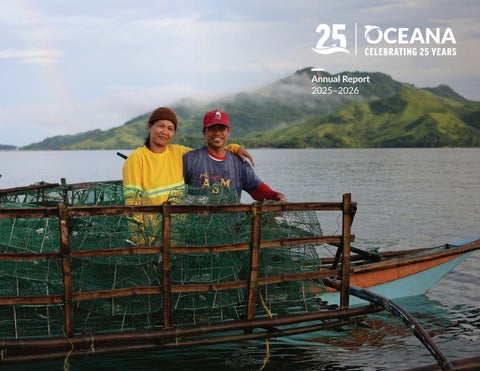
Annual Report 2025–2026
Annual Report 2025-2026* This annual report reflects the combined operations of all Oceana organizations, including Oceana, Inc. and our affiliates, as well as information concerning Oceana Canada, an independent charity. Oceana campaigns in North, South, and Central America; Africa; Asia; and Europe. Oceana is the largest international advocacy organization dedicated solely to ocean conservation. We are rebuilding abundant and biodiverse oceans by winning science-based policies that stop overfishing, protect habitats and threatened species, curb oil and plastic pollution, and increase transparency at sea. With more than 350 victories, Oceana’s campaigns are delivering results — for the oceans, for coastal communities, and for the planet. A restored ocean means that 1 billion people can enjoy a healthy, climate-smart seafood meal every day, forever. Over nine million members, e-activists, and social media followers support Oceana internationally. Together, we can save the oceans and help feed the world. To learn more, please visit Oceana.org.
Letter From The CEO
3
Oceana’s Approach
5
How We Work
9
Victories
10
On The Water
29
Science & Policy Reports
35
Law
37
Grassroots & Advocacy
39
Oceana Around The World
43
Strategic Communications
49
Support Oceana
51
Financial Summary
53
Leadership
55
Cover photo © Oceana/Alvin Simon
* This report features campaign updates from July 2025 to June 2026 and financial information for the calendar year 2025.
1
An artisanal fisher hauls in his nets in Brazil’s Parnaíba Delta.
© Rare/Enrico Marone
2
Letter From The CEO
and restore our oceans. Today, Oceana is a global organization with teams in 10 countries and the European Union, over 300 dedicated staff across six continents, and nine million supporters. Together, we have helped stop destructive fishing like bottom trawling, restore fisheries, protect coastal livelihoods, and limit the expansion of offshore drilling.
We are celebrating Oceana’s 25th anniversary this year, and the milestone tells us something important: What we do works. For example, in 2000, less than 1% of the waters off the countries where we operate were protected. Today, thanks to campaigning by Oceana and our allies, almost 20% of those waters are now protected.
Along the way, we achieved landmark victories. In 2004, we persuaded Royal Caribbean Cruises to stop dumping virtually untreated sewage and other waste into the ocean. In 2016, we launched Global Fishing Watch with SkyTruth and Google, marking a huge step forward for transparency in the fishing sector. In 2024, following our campaigning, Amazon announced it was removing plastic air pillows from all delivery packaging.
victory with the newly-established Panaon Island Protected Seascape in the Philippines. As in many places around the world, reefs in the Philippines have faced steady declines over the last 40 years, but Panaon is an exception — coral-rich waters teeming with marine life. Its protection will help ensure that those reefs, and the livelihoods of the people who depend on them, can thrive for generations to come. In the U.S. state of California, Oceana recently helped secure several important victories to protect marine animals from entanglement in fishing gear. This spring, when the state’s Dungeness crab fishery was closed to conventional fishing gear to prevent whale entanglements, the Department of Fish and Wildlife authorized the use of “on-demand” gear for the first time ever, allowing fishers to keep fishing while reducing risk to whales.
Today, the momentum continues.
3
This achievement, along with countless others — from rebuilding fish populations to increasing transparency at sea to protecting ocean animals — is possible through strategic, targeted campaigns to change policy in coastal countries around the world. None of it would have been possible without supporters like you.
The cover of this year’s report features a husband-and-wife fishing team in the Philippines who are carrying on a legacy of sustainable fishing. They represent our many incredible smallscale fisher allies in the Philippines and around the world.
Another new California law is phasing out the use of mile-long fishing nets anchored to the seafloor. Removing these nets from the water will protect more than 100 different ocean animals from being unintentionally entangled in the nearly invisible nets. These were all causes Oceana championed together with our allies.
Twenty-five years ago, a small group of ocean advocates came up with a bold plan to protect
Thanks to key support from artisanal fishers and community leaders, we achieved an exciting
It feels especially meaningful that in our 25th year we are starting an important new chapter
— launching campaigns in Ghana and thus our first office in Africa. In the past decade, Oceana has expanded our focus to not just who catches the most fish, but also who needs fish the most. Ghana is home to one of the continent’s largest fish-based economies, and we will campaign there alongside coastal communities to rebuild fish populations, increase food and nutrition security, and strengthen coastal livelihoods. We are excited about what lies ahead. As we celebrate this milestone, we are also looking to the future and advancing new campaigns in additional coastal countries while building on our successes in the countries where we already work, from Chile to the United Kingdom to Canada. We have learned a lot in 25 years of ocean advocacy, and we plan on continuing this critical work. The challenges facing our oceans are urgent, and the need for action is great. But if the last 25 years have proven anything, it is that together, we can achieve extraordinary progress for the oceans.
With deep appreciation,
James F. Simon CEO Oceana
© Oceana/Michael Aboya
4
Oceana’s Approach Oceana campaigns to win policy victories that restore abundance and biodiversity in the world’s oceans, which cover two-thirds of our planet and play a key role in mitigating climate change. Healthy marine ecosystems full of life support fisheries that can feed more than a billion people a healthy seafood meal every day, forever. We can preserve the oceans for future generations while protecting a critical food source — wild seafood — that requires no fresh water or arable land to produce, yields minimal greenhouse gas emissions, and provides an affordable, healthy protein to people who depend on it around the world. Just 29 countries and the European Union are responsible for nearly 90% of the global fish catch. We can — on a country-by-country basis — win policy victories that help protect and restore the oceans worldwide. Oceana campaigns alongside coastal communities for policies that are based in science and rely on five proven strategies that help restore healthy oceans.
5
Stop Overfishing
Protect Habitat
Curb Pollution
Increase Transparency
Protect Species
OCEANA’S APPROACH
Stop Overfishing Half of global fisheries are overfished, and another 40% are fished to maximum levels. When fisheries are properly managed, the fish come back. OUR IMPACT: Oceana campaigns around the world to implement fisheries management plans and catch limits to stop overfishing and rebuild ocean abundance. In the United States, the European Union, the United Kingdom, and Chile, the percentage of fisheries with management plans has more than doubled since 2000, and the percentage of fisheries with catch limits has increased to 79%. © Oceana/LX
© Oceana/Juan Cuetos
6
OCEANA’S APPROACH
`
` `
Protect Habitat
Curb Pollution
Stopping destructive fishing methods like bottom trawling and protecting vulnerable ecosystems will preserve places that are crucial to both marine animals and local fishing communities.
Pollution undermines the health of ocean ecosystems and accelerates climate change.
OUR IMPACT: Oceana mounts expeditions and collects scientific data to help win protections for key ocean habitats. In 2000, less than 1% of the waters off the countries where Oceana currently operates were protected. Oceana and our allies have now protected almost 20% of these waters.
© Joshua Vela-Fonseca
7
OUR IMPACT: Oceana fights new offshore drilling to help prevent oil spills and reduce greenhouse gas emissions. Over 120,000 kilometers (75,000 miles) of coastline in the United States and Belize are currently protected from the threat of offshore drilling, covering more than 6.6 million square kilometers (2.5 million square miles) of ocean. Oceana and our allies have also passed policies that would eliminate the use of more than 1.5 million metric tons of unnecessary single-use plastic each year by 2033. © Insituto Mar Urbano/Ricardo Gomes
OCEANA’S APPROACH
Increase Transparency
Protect Species
Timely and accurate data is needed to improve fishing policies and deter illegal conduct at sea, which threatens marine life, human rights, and food security.
Marine animals are at risk, whether from speeding vessels, entanglement in fishing gear, or capture in commercial fisheries. Each year, fishing gear alone kills or injures millions of non-targeted animals, including sharks, whales, dolphins, fish, and sea turtles.
OUR IMPACT: Oceana and our allies have successfully required large commercial fishing vessels to be publicly trackable by satellite and expanded boat-to-plate traceability of seafood. Around 120,000 commercial fishing vessels — about one-third of the world’s industrial fishing fleet — can now be tracked on the Global Fishing Watch map, created by Oceana in partnership with SkyTruth and Google, in near-real time, for free. © The Outlaw Ocean Project/Ed Ou
OUR IMPACT: Oceana campaigns to protect species threatened with extinction from their top threats. Oceana and our allies have won more than 85 policy victories to protect important species including sharks, sea turtles, and whales.
© Oceana/Perrin James
8
How We Work The good news is that we can restore the oceans to their former abundance. Over 25 years, Oceana and our allies have won more than 350 policy victories, and we have the tools to continue winning on behalf of our oceans and the hundreds of millions of people who rely on them. We are: Campaign-Driven We strategically create policy campaigns that make measurable progress toward our mission of protecting and restoring the oceans. Our campaigns are specific, targeted, and designed to be won in a three- to five-year timeframe. Fact-Based Our advocacy relies on science to help us understand the ocean’s threats and identify practical, effective solutions. We conduct research on a variety of issues that affect marine environments and species, from illegal and destructive fishing to plastic pollution and offshore drilling.
Clam harvesters gather clams at a mangrove swamp in Altata Bay in Sinaloa, Mexico.
© Oceana/Fernando Brito
Expedition-Powered We recognize that getting on the water — alongside scientists, divers, photographers, campaigners, and artisanal fisher allies — helps us bring these important marine places to life and make a stronger case for their protection. Oceana’s expeditions have powered our campaigns and resulted in victories across the globe. Multi-Disciplinary Oceana’s campaign teams consist of scientists, lawyers, advocates, communicators, and grassroots organizers, who develop innovative strategies and achieve tangible results for the oceans. People-Focused Oceana’s work is supported by our allies, including smallscale fishers around the world, who are powerful partners in our campaigns to increase ocean abundance and support local livelihoods. Oceana has a global base of over nine million supporters, including 1.6 million Wavemakers, who use their voices to protect and restore the oceans.
9
Researchers maneuver rafts while on an expedition in the North Sea.
© Oceana/Juan Cuetos
2025-2026
Victories Oceana leverages law, science, grassroots activism, advocacy, and strategic communications to win policy changes that add up to global impact. With the help of our allies, Oceana has won more than 350 victories that restore ocean abundance. Here is what we accomplished from July 2025 to June 2026.
© Joshua Vela-Fonseca
10
Protecting Habitat
Victories Philippines Protects Coral-Rich Waters of Panaon Island AUGUST 2025 - President Marcos of the Philippines approved the creation of the Panaon Island Protected Seascape, safeguarding 610 square kilometers (236 square miles) of coral-rich waters that are home to endangered species such as whale sharks, hawksbill turtles, and Philippine ducks. While many of the country’s reefs have steadily declined over the last 40 years, Panaon Island is an exception, with above-average coral cover. Local communities were key allies for securing these protections, which will address threats from climate change, illegal and destructive fishing, and plastic pollution — and ensure that life in these waters, and the livelihoods of those who depend on them, can thrive for generations to come.
11
HABITAT VICTORIES
Many species of coral live on the ocean floor off California’s coast, along with animals such as sea stars, nudibranchs, and anemones.
© Oceana
Deep-Sea Coral Gardens Protected in U.S. State of California DECEMBER 2025 - The U.S. National Marine Fisheries Service adopted new measures to protect deep-sea coral gardens on Sur Ridge, offshore of Monterey, California. The protections will prevent the use of all bottom contact fishing gears and advance coral research and restoration efforts.
© Oceana/Danny Ocampo
12
HABITAT VICTORIES
This coral is now protected as part of Cabliers Bank, a 400,000-year-old cold water reef in the Alboran Sea.
© Oceana
Spain Bans Destructive Bottom Trawling in Cabliers Bank JULY 2025 - Spain banned all bottom fishing, including destructive bottom trawling, in the biologicallyrich Cabliers Bank, which is home to an ancient coral reef first documented by Oceana in 2011. The reef supports an extraordinary diversity of life, including deep-sea corals, sponges, and commercially important species that are currently overexploited.
13
© Oceana/Félix Aguado
Spain Designates Six New Marine Protected Areas OCTOBER 2025 - Spain approved five new marine protected areas and one area of special importance for birds. With this expansion, 22.45% of Spain’s waters are now designated for protection, bringing the country closer to delivering on its commitment to protect 30% of its seas by 2030. The new protected areas span 17,000 square kilometers (more than 6,500 square miles) and include parts of the Mallorca Channel, Seco de Palos, the Capbretón canyon system, the Alboran Sea, and the Central Catalan Coast. Oceana’s scientific expeditions and advocacy helped secure these designations, which will safeguard biodiversity, support coastal communities, and promote sustainable fishing. Oceana will continue to campaign for the proper management of these areas to prevent destructive activities, such as bottom trawling.
14
Scotland Protects Over 100,000 Square Kilometers of Ocean from Destructive Fishing SEPTEMBER 2025 - Scotland protected five marine protected areas (MPAs) from destructive bottom trawling, encompassing over 100,000 square kilometers (38,000 square miles) of Scottish seas, including the West of Scotland MPA, which is known as a biodiversity hotspot. An additional 53,000 square kilometers (20,000 square miles) of the United Kingdom’s seas are now protected for the first time against this destructive fishing method that bulldozes everything in its path. With these new measures, more than 30% of U.K. seas are now protected from bottom trawling. Partial protections were also announced for 15 other MPAs, and Oceana continues to campaign for their full protection from bottom trawling.
15
HABITAT VICTORIES
Artisanal fishing is an important livelihood and cultural cornerstone in Palawan, Philippines.
© Oceana/Alvin Simon
Philippines’ Province of Palawan Reserves Municipal Waters for Small-Scale Fishers APRIL 2026 - The provincial government of Palawan passed an ordinance that prohibits commercial fishing within its 15-kilometer municipal waters zone, strengthening and backing up national laws that give preference to small-scale fishers, and supporting local food security and livelihoods.
© Oceana/Juan Cuetos
16
Increasing Transparency
Victories
Mediterranean Fishing Vessels Required to Obtain Permanent Identification Numbers to Increase Transparency NOVEMBER 2025 - The General Fisheries Commission for the Mediterranean agreed to new transparency measures for all fishing vessels measuring 20 meters (~65 feet) or more in length, following campaigning by Oceana and our allies. Specifically, vessels will be required to have International Maritime Organization (IMO) numbers. An IMO number is a permanent and unique identifier that stays with a vessel throughout its lifespan, even if its name, flag, or ownership change. This makes it much harder for vessels to hide their identity, increasing transparency and helping authorities to prevent illegal fishing in the Mediterranean, one of the most overexploited seas in the world.
17
TRANSPARENCY VICTORIES
Some fishing vessels use a higher-than-reported engine power.
© Oceana/Josep Antoni Cruz
Spain Strengthens Rules on Fishing Vessel Engines to Protect Fisheries NOVEMBER 2025 - A new law in Spain strengthens controls on fishing vessel engines by requiring stricter verification when engines are installed and creating a pathway for vessel owners to declare their real engine power. These reforms will help prevent engine power fraud, which can lead to overcapacity and overfishing, and ensure fishing activity is accurately reported.
© Oceana/Enrique Talledo
18
Curbing Pollution
Victories Canada’s Court of Appeal Upholds Federal Authority to Regulate Plastics JANUARY 2026 - Canada’s Federal Court of Appeal affirmed the government’s authority to list plastic manufactured items as toxic under the Canadian Environmental Protection Act. This decision restores the federal government’s ability to regulate plastics and avoid pollution at a national level. Oceana Canada, represented by Ecojustice, intervened in support of the government, advocating for science-based solutions to reduce unnecessary plastics and hold plastic producers accountable. New research released by Oceana Canada shows overwhelming public support for strong federal regulation of single-use plastics, and this ruling clears the way for Canada to move forward with practical measures.
19
POLLUTION VICTORIES
New Jersey’s new legislation will lower the volume of plastic restaurant utensils that end up in the oceans.
© Shutterstock/Kanittha Boon
New Law in U.S. State of New Jersey Limits Single-Use Plastics JANUARY 2026 - A new law in New Jersey will reduce single-use plastics at restaurants by requiring businesses to provide utensils and condiments for takeout and delivery only upon customer request. Full-service restaurants also must provide reusable utensils for dine-in customers.
© The Canadian Press Images Photo/Oceana Canada and EARTHDAY.ORG
20
Protecting Species
Victories U.S. State of Oregon Adopts New Plan to Recover Critically Endangered Orcas AUGUST 2025 - A new plan in Oregon will aid critically endangered Southern Resident orcas, of which only 73 remain in the North Pacific Ocean. The management plan, adopted by the Oregon Fish and Wildlife Commission, addresses the greatest threats to the whales’ recovery, including lack of prey (Chinook salmon), vessel noise and disturbance, and pollution. Actions will include restoring habitat for Chinook salmon and protecting ocean waters from future destructive activities, like dredging or construction, that could harm the orcas as they feed off the Oregon coast. Oceana advocated for this plan, including a requirement to review its effectiveness at least once every five years.
21
SPECIES VICTORIES
Entanglements are one of the top threats to critically endangered North Atlantic right whales.
© Florida Fish and Wildlife Center with NOAA permit No. 594-1759
Canada Releases National Strategy to Reduce Whale Entanglements in Fishing Gear FEBRUARY 2026 - Canada released a fishing gear strategy to help protect critically endangered North Atlantic right whales from entanglements. The framework will assess entanglement risk, establish pilot areas for on-demand fishing gear, and, if proven effective, designate areas where this gear will be used to lower risks to right whales.
© Shuttertock/Karoline Cullen
22
SPECIES VICTORIES
A humpback whale is severely entangled off the coast of Baja California.
© Álvaro Herrero
New Rules in California’s Recreational Crab Fishery Will Help Prevent Animal Entanglements AUGUST 2025 - New rules in the U.S. state of California reduce the risk of entanglement of endangered whales and sea turtles in the recreational Dungeness crab fishery. The rules require the fishery to close in response to entanglements, as well as have unique line markings to easily identify the source in the event of an entanglement.
23
© Oceana/Danny Ocampo
U.S. State of California Protects Ocean Biodiversity, Phases Out Dangerous Set Gillnets OCTOBER 2025 - A new law in the state of California protects ocean biodiversity by phasing out the use of set gillnets — milelong fishing nets anchored to the seafloor intended to catch halibut and white sea bass. Removing this fishing gear from the water will protect over 100 different ocean animals, including sea lions and sharks, from being unintentionally entangled in these nearly invisible nets. Oceana championed this law, which allows existing permit holders to continue fishing through their retirement and gradually phases out the set gillnet fishery. Oceana has also advocated for hook and line fishing methods as a safe and effective alternative to set gillnets.
24
Whale-Safe Gear Approved for California’s Coonstripe Shrimp Fishery FEBRUARY 2026 - California authorized the voluntary use of on-demand gear in the state’s coonstripe shrimp fishery, which will help reduce whale entanglements typically caused by the vertical ropes used with conventional fishing traps.
25
PROTECT SPECIES VICTORIES
Innovative “on-demand” crab fishing gear is significantly safer for whales.
© Oceana/Geoff Shester
California Approves On-Demand Gear to Reduce Whale Entanglements DECEMBER 2025 - California approved ropeless on-demand gear as a whale-safe alternative to conventional crab fishing gear. Fishers were able to use the pop-up gear during any closures of the California Dungeness crab fishery in Spring 2026 and will be able to in future spring seasons when the fishery is closed to protect whales.
© Shutterstock/Chase Dekker
26
Stopping Overfishing
Victories
New Measures in the US Will Help Restore Overfished Atlantic Cod JUNE 2026 - New federal measures in the United States will help rebuild the chronically overfished New England Atlantic cod fishery. The management plan will incorporate more accurate genetic data to assist with the recovery of four distinct cod populations and require every vessel in the fishery to have an observer on board to ensure accurate data on catch amounts and bycatch.
27
OVERFISHING VICTORIES
© Shutterstock/slowmotiongli
28
On The Water Around the world, Oceana’s expeditions bring to life the essential underwater areas we seek to protect. We document unique habitats through photos, video, and scientific data — and collaborate with local communities and other allies to persuade policymakers to protect these exceptional places. Since Oceana’s inaugural voyage across the Atlantic Ocean and Mediterranean Sea in 2005, we have led more than 65 scientific expeditions and conducted thousands of ocean surveys. These expeditions have been instrumental in Oceana protecting over 10 million square kilometers (over 4 million square miles) of ocean habitat. From July 2025 to June 2026, Oceana embarked on expeditions in two ecologically important areas:
Juneau
Ottawa Toronto
Portland
Halifax
New York Washington, D.C. Monterey
Fort Lauderdale Mexico City
Belmopan
• California Channel Islands, United States • Southern Newfoundland Slope, Canada
Lima Brasilia
Oceana Offices July 2025 – June 2026 Expeditions Earlier Expeditions
Circle size corresponds to approximate expedition distance.
29
Santiago
Copenhagen London Cornwall
Brussels Geneva
Madrid
Manila Accra
30
ON THE WATER
UNITED STATES California Channel Islands In November 2025, Oceana completed its third expedition to explore and document ocean biodiversity around the Channel Islands off Southern California. This was the final in a series of expeditions in partnership with Swiss watchmaker, Blancpain, and in collaboration with marine geneticist Dr. Adrian Munguia-Vega. The expedition series supports Oceana’s campaigns to restore ocean abundance in California and Blancpain’s ongoing commitment to ocean exploration and preservation. Over four days at sea, the expedition team conducted scuba diving surveys at 11 sites to document fish, corals, and other seafloor habitats, and collected water samples at 28 different sites for analysis using cutting edge environmental DNA (eDNA) science techniques to identify what marine species live and travel through this diverse and abundant ocean area. To date, Oceana has identified more than 13,000 unique species around the Channel Islands using eDNA.
A research diver skims a bed of seagrass. © Oceana/Danny Ocampo
Oceana’s expedition team spent four days at sea around the Channel Islands.
31
Kelp and forage fish at Cortes Bank.
© Oceana/Danny Ocampo
© Oceana
ON THE WATER
CANADA Southern Newfoundland Slope
The Polar Prince, research vessel for the second leg of the expedition in October 2025, on-site at the Southern Newfoundland Slope.
A researcher documented mushroom corals and soft corals.
© Oceana Canada/ Fisheries and Oceans Canada
© Evermaven/Oceana Canada
Oceana Canada Marine Scientist Izzy Jubinville examines nautical charts.
© Evermaven/ Oceana Canada
Across two expeditions in July and October 2025, Oceana explored the Southern Newfoundland Slope — a vast, deep-sea area defined by steep slopes, submarine canyons, and complex channels. A collaboration with Canada’s Fisheries and Oceans department, the expedition aimed to improve understanding of this rich but little-explored ecosystem and strengthen the scientific foundation needed to support resilient and sustainable oceans. Scientists, storytellers, and crew spent 21 days at sea, deploying deep-sea drop cameras at 35 sites. The expedition documented habitats including extensive, undisturbed thickets of large gorgonian bamboo coral colonies estimated to be more than 100 years old and fields of abundant sea pens (a form of coral), supporting a remarkable diversity of species, including crabs, halibut, redfish, black dogfish, and endangered northern wolffish. The team also saw marine mammals, including a rare blue whale, pilot whales, and dolphins. Biologists collected water samples for eDNA analysis, enabling detection of species even when cameras did not observe them.
32
33
Science & Policy Reports
Law Grassroots Organizing & Advocacy Oceana Around The World Strategic Communications
© Oceana/Rommel Cabrera
34
Science & Policy Reports
Oceana wins victories for the oceans through effective campaigns based in science and research. Reports published from July 2025 to June 2026 include:
© Oceana/Carlos Suárez
Europe | Flags of Convenience and Hidden Ownership: EU-owned Fishing Vessels in High-Risk Jurisdictions The European Union is a global leader in the fight against illegal fishing, yet a major blind spot remains: EU citizens and companies can own vessels operating under non-EU flags, including high-risk flags of convenience with weak oversight. Because these vessels are not required to be registered with EU authorities, their activities — including potential links to illegal, unreported, and unregulated fishing — often remain hidden. This report shows how a lack of transparency enables profits from opaque or unlawful foreign fishing to flow back into the EU unchecked.
35
© Oceana/Paco Serrano
© Oceana/Enrique Talledo
Mexico | Bait and Switch: Ongoing Deception, Pending Solution
Chile | How Clean are Chile’s Beaches Really?
Oceana’s latest seafood fraud report in Mexico reveals that 38% of fish and shellfish sampled across 10 major cities were mislabeled — nearly double the international average — based on genetic analysis of 1,262 samples collected in markets and restaurants. The report documents how species substitution harms consumers financially, undermines small-scale fishers through unfair competition, and enables the covert commercialization of threatened species such as mako and thresher sharks. It makes the case for a mandatory seafood traceability policy in Mexico — from boat to plate.
Oceana collaborated with researchers from Universidad Católica del Norte to carry out a national beach litter survey across 60 sandy beaches in Chile. Data revealed that single-use plastics continue to pollute beaches despite existing regulations. As plastic products break apart into smaller fragments, they become even harder to clean up and pose greater risks to marine life. The findings make a clear case for stronger enforcement, expanded policies, and sustained action to keep plastic pollution off of Chile’s coasts.
SCIENCE & POLICY REPORTS
Stop Overfishing
•
•
Brazil | Fishery Audit Brazil 2024: The State of Fisheries Amid Climate Change
•
Brazil | Pathways Toward Climate-Resilient Fisheries in Brazil
•
Canada | Fishery Audit 2025: Unlocking Canada’s Potential for Abundant Oceans
•
Canada | Little Being, Big Foundation: Where Rebuilding Ocean Abundance Begins
•
Chile | Marine Conservation in Chile 20262030
•
•
Chile | Updated Trawling Footprint Using the VMS Tool, 2019–2023
•
•
Europe | Navigating Change: The Economic Impact of the Western Mediterranean Multinational Plan
•
Peru | The Growth of the Artisanal Fishing Fleet in Peru
•
Philippines | Philippine Fisheries Assessment: A Glimpse of RA 10654’s 10-Year Implementation
•
United Kingdom | Deep Decline: State of the UK’s Fish Populations 2025
Protect Habitat •
•
Increase Transparency
Philippines | Net Loss: How Governance Gaps are Sinking Philippine Fisheries
Europe | Deep-Sea Ecosystems of the Mediterranean Sea: Ecological Importance and Vulnerability to Climate Change and Bottom Fishing Europe | Implementing the EU Nature Restoration Regulation at Sea Europe | Putting Ocean Health and Coastal Communities First: Towards a European Ocean Act that Delivers Europe | Putting Small-Scale Fishers First: Securing Cyprus’ Coastal Waters for Sustainable Fishing
•
Chile | Pilot Plan to Evaluate the Operation of Portable Electronic Satellite Positioning Devices (VMS) on Artisanal Vessels under 12 Meters in Length
•
Europe | Engines Under Control: The Challenge of Putting an End to Fishing Vessel Engine Power Fraud in the Spanish Mediterranean
•
Europe | Hidden Owners, Hidden Crimes: Why Beneficial Ownership Transparency Matters for Fisheries Enforcement
•
Europe | The Hidden Cost of Unlabelled Seafood: The Risk of Consuming Unethical and Unsustainable Seafood in Europe
•
Global | Behind the Fleet: Mapping the Global Network of Service Providers Keeping Distant-Water Fishing Afloat
•
Peru | A Snapshot of Fishing in Peru
Protect Species •
Peru | Can Bycatch be Reduced in Trawl Fishing?
Curb Pollution •
United Kingdom | Oil Field Files
36
Law
Oceana’s legal efforts win victories by ensuring governments finalize new rules and protections, follow science-based management principles, and enforce key provisions of laws. Our efforts in court lead to real, in-the-water change.
© Oceana/Don Mammoser
37
© Oceana
© NOAA Fisheries/Christin Khan
Peru | Oceana Defends Prohibition on Industrial Fishing within the Paracas National Reserve
Europe | Oceana and ClientEarth Take Spain’s Inaction Over Illegal Fishing Threat in West Africa to Supreme Court
United States | Oceana Defends Vessel Strike Protections for North Atlantic Right Whales
Peru’s Supreme Court upheld a lower court’s decision to continue the prohibition on industrial fishing in the country’s natural protected areas. This decision in January 2026 came after a lawsuit by the National Fisheries Society (SNP) attempted to secure permission for industrial fishers to access the famous Paracas National Reserve, an area reserved for small-scale fishers. After their request to fish in Paracas National Reserve was denied in October 2023, SNP sued the Peruvian National Protected Areas Service to nullify the industrial fishing ban in natural protected areas in January 2024.
Oceana and ClientEarth appealed to Spain’s Supreme Court in April 2025 after authorities declined to investigate Spanish vessels suspected of illegal fishing in West African waters. The case, now being appealed in the Superior Court of Madrid, focuses on vessels that are owned by Spanish companies but operate under foreign flags in the waters of Senegal and GuineaBissau. Despite alleged breaches of fisheries laws, Spanish authorities refused to open investigations.
In January 2026, Oceana filed a legal document in defense of the government’s seasonal speed restrictions to protect endangered North Atlantic right whales from vessel strikes along the U.S. East Coast. Oceana provided facts about the dire population status of this species, their unique susceptibility to vessel strikes, and the lack of other available solutions to prevent these strikes. Oceana is currently awaiting a decision.
LAW
Protect Species
© Oceana/Enrique Talledo
Europe | Oceana and ClientEarth Take Spanish Government Back to Court Over Destructive Bottom Trawling in Marine Protected Areas In March 2026, Oceana and ClientEarth brought the Spanish Government to court again for systematically allowing destructive bottom trawling in the country’s marine protected areas (MPAs). Spain’s Ministry of Agriculture, Fisheries, and Food issues yearly fishing licenses allowing bottom trawling to take place in MPAs, without any assessment of the impacts on marine habitats and species, as required by law. This allows bottom trawling on vulnerable seabeds, which are home to sensitive and endangered species, as well as unique ecosystems and habitats, which support fishing resources and mitigate climate change.
•
International | Oceana-Spurred International Investigation into U.S. Protection of North Atlantic Right Whales Concludes
•
United States | Oceana Joins Lawsuit Against Decision to Override Endangered Species Protections in Gulf of Mexico
Protect Habitat
© CA FOIA
United States | Oceana Forces Disclosure of Bycatch Photos and Data in California Trawl Fishery In October 2025, a federal district court ruled that the U.S. government illegally withheld photos of bycatch and unlawfully denied Oceana access to other records. The court ruled that under the plain language of U.S. fisheries law, the government has “complete discretion” to release observer information that does not disclose the identity or business of any person, including photographs, so those documents could not be withheld under the U.S. Freedom of Information Act. In response to the ruling, the government released dozens of photographs of bycatch from the California trawl fishery.
•
Peru | Oceana Sues the Peruvian State to Enforce the Prohibition on Industrial Fishing in the Nazca Ridge National Reserve
Curb Pollution •
United States | Oceana Sues to Defend California’s Groundbreaking Plastic Pollution Reduction Law
38
Grassroots Organizing & Advocacy More than nine million supporters and advocates — ranging from local fishers to activists on social media — help Oceana and our allies win victories all over the world.
BRAZIL
BELIZE
39
Oceana Hosts Fishers Advocacy Workshop
Oceana Makes Waves with Stop the Plastic Tsunami Advocacy Week
As part of Reef Week 2026, Oceana hosted its Fisher Advocacy Workshop series in Belize City and Independence Village. The workshops brought together more than 50 local fishers to build communication and advocacy skills through expert-led presentations, interactive group activities, and breakout sessions. Participants left better equipped to engage peers and stakeholders across Belize’s fisheries sector and to champion their call for more inclusive and representative fisheries management.
In August 2025, organizations from the Stop the Plastic Tsunami Campaign, representing regions across Brazil, carried out an intensive week of advocacy and mobilization in the federal capital. Participants delivered a manifesto to senators, legislative staff, and members of the executive branch, including representatives from President Lula’s Office for Institutional Relations — calling for the approval of Oceana’s plastic-free bill in the Federal Senate. A major highlight was securing an in-person meeting with a senator who has been stalling the bill for two years in the Economic Affairs Committee.
© Oceana/Kenneth Grant
© Oceana/Maiara Dourado
GRASSROOTS
CHILE Oceana Coordinates Community-Based Workshops for Marine Protection
© Oceana/Catalina Sapag
In Chilean Patagonia, Oceana worked with local communities toward the goal of securing approval of a marine protected area (MPA) management plan in Caleta Tortel. Oceana’s team coordinated workshops for 10 local tourism operators and put together educational activities for children to increase awareness about the proposed MPA and champion local stewardship of these important waters. The team also met with Tortel’s mayor to reaffirm municipal support for the MPA and its management plan and joined with local allies to maintain pressure on national authorities on the plan’s long-pending approval.
EUROPE Oceana Convenes Small-Scale Fishers to Protect Common Fisheries Policy
© Oceana/Enalia Physis
In December 2025, Oceana’s team in Europe met with small-scale fishers from Cyprus to learn about the pressures facing artisanal fishing communities, and to discuss the European Union’s Common Fisheries Policy. The policy aims to support small-scale fishers and address overfishing but currently is at risk of being weakened and is not fully implemented across the EU. Oceana organized a meeting between small-scale fishers, NGOs, and senior EU officials to create a united base of support to defend the Common Fisheries Policy informed by fishers’ lived experiences.
MEXICO Oceana Brings Oaxaca Fishing Communities Together to Help Red Snapper Fishery
© Oceana/Guillermo Perez
Oceana brought together fishing communities, scientists, government authorities, and partner organizations to help secure an abundant future for red snapper — and everyone who depends on it — off the coast of Oaxaca, Mexico. At the second Red Snapper Management Plan Assembly in Puerto Escondido, local fishers worked alongside other stakeholders to shape science-based management plans that reflect on-the-water experience. By ensuring community voices are central to the process, Oceana is helping create stronger public policies that will rebuild one of Oaxaca’s most important fisheries.
40
GRASSROOTS
PERU Oceana Serves Up Advocacy at Peru’s Culinary Hola Fest The “Blue Defenders”— Oceana’s volunteer program in Peru — brought the organization’s campaigns to the Hola Fest cultural and culinary festival in Lima in May 2026. Volunteers told the story behind every plate of ceviche, highlighted the thousands of jobs generated by small-scale fishing in the country, and spoke to the urgent need to protect Peru’s marine reserves from industrial fishing. Interested attendees signed up to become volunteers with Oceana.
© Oceana
PHILIPPINES Oceana Hosts World Oceans Day Celebration in the Philippines
© Oceana
On World Oceans Day in the Philippines, Oceana partnered with coastal communities to amplify youth and artisanal fisherfolk voices. The group formed a human banner of the number 15 to represent the campaign to protect the 15-kilometer municipal waters zone from destructive commercial fishing. Youth and fishers exchanged stories about their relationship with the ocean, mutually encouraging the groups toward a sustained partnership to protect the sea, which is the primary source of food and livelihoods in the Philippines.
UNITED STATES Oceana Leads Unified Opposition to Federal Drilling Proposal Facing the threat of increased offshore oil drilling in U.S. waters, Oceana’s field team led a “Don’t Drill” Florida press conference in January 2026, which featured state elected officials, business leaders, commercial and recreational fishers, as well as science and conservation leaders. The event showed unified opposition to a federal proposal to massively expand offshore drilling off Florida’s Gulf Coast and called on the U.S. administration to withdraw plans to expand drilling in the proposed areas. © Oceana/Chloe Mckenna
41
© Oceana/Juan Cuetos
42
Oceana Around The World Oceana leads and participates in important events with our supporters around the world. These events range from government hearings to international symposiums on the oceans to media appearances and more. Notable events from July 2025 to June 2026 include:
Oceana delivered a briefing on the 2025 Fishery Audit to senior federal staff at Fisheries and Oceans Canada. From left to right: Jack Daly, marine scientist; Rebecca Schijns, fishery scientist; Hanna Vatcher, North Atlantic right whale campaigner; and Dr. Robert Rangeley, director of science. © Oceana
Oceana Board Chair Diana Thomson and CEO James Simon attended Oceana’s 2025 New York Gala.
Oceana joined the Global Climate March in Belém, Brazil in November 2025. From left to right: Maria Vieira, an artisanal fisherwoman from Pará; Miriam Bozzetto, Oceana campaign analyst; Líder Gamgora, member of the World Forum of Fisher Peoples; Mariana Mendes, from the Pará Network of Women of the Tides and Waters. © Oceana/Nathalia Carvalho
43
© BFA/Jason Sean Weiss
Oceana’s leader in Europe, Vera Coelho, spoke at the 2026 Our Ocean Conference during an Oceana-organized briefing, “Advancing Transparency in Fisheries: Uncovering Beneficial Ownership to Combat Illegal Fishing in Africa.”
© Oceana
AROUND THE WORLD
To highlight the need to protect the Gulf of Mexico, Oceana, in collaboration with Barrio Warrior Colectivo A.C., created the mural “El Golfo de México nos une” (“The Gulf of Mexico unites us”) in the heart of Mexico City.
Oceana’s Campaign Director in Europe Nicolas Fournier (center) spoke on a panel at the World Oceans Summit in Cascais, Portugal in September 2025 about strengthening marine protected areas through policy, innovation, and accountability. © Oceana
Fishers, tourism workers, and Indigenous Nahua and Nuntajiiyi communities took to the streets in Veracruz to demand accountability, transparency, and reparations following a recent Gulf of Mexico oil spill — an environmental crisis that Oceana has actively documented and denounced since its onset. © Oceana/Felix Marquez
Oceana’s Campaign and Policy Director in Belize, Jacinta Usher, received the inaugural International Women in Conservation Award at the 2025 IWIC Summit in Belize. © Oceana/Ian Torres
© Oceana/Miriam Longsworth
44
AROUND THE WORLD
Sailors for the Sea attended the World Sailing Annual Conference in Dún Laoghaire, Ireland in November 2025 to discuss global participation in the Clean Regattas and Clean Class programs. Sailors for the Sea team members Steff Ruf (center left) and Emily Conklin (center right) met with World Sailing’s Head of Sustainability, Alexandra Rickham and Sustainability Executive, Rebecca Videlo.
© Oceana/Steff Ruf
SeaChange Co-Chair Jeff Blasingame, Oceana Board Member and SeaChange Co-Chair Elizabeth Wahler, and SeaChange Vice Chairs Kelly Brochu and Gabe Serrato-Buelna at Oceana’s 2025 SeaChange Summer Party.
© MOVI Inc.
The Blue Defenders, members of Oceana’s volunteer program in Peru, protested in front of the Congress of the Republic in May 2026 to demand that a law permanently banning industrial fishing in the country’s marine protected areas be passed.
As the environmental partner of Boardmasters, one of the largest surf and music festivals in Europe, Oceana hosted a science and storytelling event with marine biologist and photographer Madeline St. Clair and wildlife filmmaker Lizzy Daly in conversation with Oceana’s leader in the U.K., Hugo Tagholm. © Oceana/Karl Mackie
45
© Oceana/Jesús Cuzcano
AROUND THE WORLD
Oceana CEO James Simon and Campaign and Research Director in the Philippines, Rhea Yray-Frossard, visit a fishing community in Daram, Samar. © Oceana
Event honoree Laura Dern, Oceana Board Member Ted Danson, Mary Steenburgen, and Oceana Board Member Sam Waterston at the 2025 New York Gala. Waterston emceed the gala, which raised more than $2.6 million to support Oceana’s campaigns. © BFA/Jason Sean Weiss
During the Our Ocean Conference in Mombasa, Kenya, Oceana’s leader in Ghana, Sonia Kwami, gave remarks at a reception to mark the Mombasa Declaration, where 16 countries committed to advance global fisheries transparency and strengthen efforts to combat illegal fishing.
© Oceana/Franz Mahr
Oceana Ambassador Cobie Smulders visited the California State Capitol to speak out against the U.S. administration’s plan to to open California’s coast to expanded oil and gas drilling. © Nicole Sepulveda
46
AROUND THE WORLD
Oceana representatives Nora Ives, Roderick Smith, and Hunter Miller at the 2025 North Atlantic right whale festival in Fernandina Beach, © Oceana Florida.
Oceana’s team in Brazil participated in COP30 in November 2025. From left to right: Nathalia Carvalho, social media analyst; Martin Dias, science director; Miriam Bozzetto, campaign analyst; Iran Magno, senior campaign strategist; Ademilson Zamboni, vice president; Patrícia Bonilha, communications director; and Letícia Canton, senior marine scientist. © Oceana/Nathalia Carvalho
Regina Scully, Oceana Board Emeritus Director and Gala Co-Chair Susan Rockefeller, Oceana Board Member Sam Waterston, and Dede McMahon attended Oceana’s 2025 New York Gala. © BFA/Jason Sean Weiss
47
Oceana CEO James Simon and Chief Scientist Kathryn Matthews speak with leaders from the Canoe and Fishing Gear Owners Association of Ghana during a trip to Ghana’s coast. © Oceana/Tess Geers
AROUND THE WORLD
Oceana’s leader in the U.S., Beth Lowell, California Campaign Director & Senior Scientist Geoff Shester, and Biossance Vice President of Marketing Laura Staves attended an Oceana event in Orange County, California. © Kevin Warn
Oceana Board Member Jean Weiss and Angela Kinsey at the 2025 SeaChange Summer Party, which raised more than $1.7 million to support Oceana’s campaigns. © Capture Imaging, Inc.
Oceana was featured prominently at the Ladera Sur Festival, an event in Santiago, Chile dedicated to the natural environment. From left to right: Oceana Senior Vice President Liesbeth van der Meer, Barbara Tupper, general editor of Ladera Sur, and Arturo Clement, then-president of Salmon Chile. © Oceana/Pablo Acuña
During the Our Ocean Conference in Mombasa, Kenya, Oceana hosted a listening circle with local women leaders. From left to right: Blue Ventures’ Science Communications Specialist Catherine Muyonga; local leaders Amina Komora, Zulfa Hassan, Raabia Hawa; actress and Oceana Ambassador Kate Walsh, and Oceana Board Member Christina Chemtai Hicks. © Oceana/Franz Mahr
48
Strategic Communications Oceana’s campaigners design media and communications strategies that target key decision-makers, inform the public, and help achieve victories. Oceana and our scientists and policy experts are quoted in top media outlets every year, from The New York Times, to El Pais, to the Associated Press. Here are some of our press highlights from July 2025 to June 2026: Oceana-commissioned poll finds French citizens largely back quota system overhaul
80% drop in Ghana’s fisheries prompts Oceana expansion
“Oceans and fishing are at the heart of Ghana’s coastal communities and have sustained families for generations.”
Alteran para venta peso de pescado
– Sonia Kwami, Oceana‘s Leader in Ghana © Oceana/Michael Aboya
Laura Dern and Bloomberg Philanthropies’ Patti Harris to Be Honored at Oceana’s New York Gala
Canada’s plan to boost its economy must include rebuilding wild fisheries
Trump is said to propose opening California coast to drilling
© Kevin Warn
The effects of oil spills continue to take their toll on the Peruvian coast
The Gulf of Mexico is a Treasure Worth Protecting
49
Marcos declares Panaon Island a protected seascape
Long-wrought WTO agreement aimed at reducing overfishing takes effect
The future of the ocean will be shaped in Africa
Ted Danson, actor and founder of Oceana: “Spain is an important player and could change the fishing sector in the world”
STRATEGIC COMMUNICATIONS
The source of your fish may change how many ‘forever chemicals’ you eat
How the ‘Galapagos of west Africa’ is plundered by floating fish factories
Meet the ‘God Squad,’ the powerful endangered species panel that just pared back protections
International treaty aimed at protecting ocean life ratified
The Paracas Reserve: A natural haven in the heart of the Peruvian desert
Canada can restore healthy fish populations within a decade
Chinese fishing fleet raises alarm in northern Chile
Call to end overfishing to save British fish supper as key stocks face collapse
Campaigners Disappointed As Plastic Treaty Talks End With No Agreement
PH losing 45 million kilos of fish a year – conservation group
Oceana honors Wavemakers at 2025 AGM
Rare species of whale see uptick in births. What’s behind the population boost © NOAA
50
Support Oceana Donate to Oceana
Planned Gifts and Bequests
Gift of Appreciated Securities
Each of us has the power to help save the oceans and feed the world. Your support allows Oceana to carry out targeted campaigns to protect the climate, end overfishing, safeguard habitats and species, curb ocean pollution, and increase transparency at sea. Oceana wins victories that restore ocean abundance and biodiversity for generations to come. Become part of a growing base of ocean advocates by joining Oceana today.
Choose to leave a gift to Oceana through your will or living trust. You may also designate Oceana as the beneficiary of your life insurance policy or retirement plans.
Stocks and mutual funds held for more than one year may qualify for charitable tax deduction at their full market value when donated directly to Oceana. You may avoid paying capital gains taxes and use the savings to support Oceana’s campaigns.
You can provide financial contributions to Oceana via web, phone, or mail. Credit card donations may be made on a sustaining basis by designating a monthly, quarterly, or annual contribution. Checks may be mailed to our headquarters at the address below. Supporters who give $1,000 or more annually receive a variety of benefits, including Oceana Magazine, invitations to special events, and updates throughout the year. Visit us at Oceana.org/donate Oceana, Inc. 1025 Connecticut Ave. NW, Suite 200 Washington, DC 20036 USA
51
© Shutterstock/Leonardo Gonzalez
Contact Oceana at plannedgiving@oceana.org or +1.202.833.3900 to learn more about ways to give and become a LegaSea Circle member.
Adopt an Animal Donor Advised Fund Use a Donor Advised Fund to make a one-time or recurring gift, or to make Oceana the beneficiary of your fund for a future gift.
Many of the world’s most iconic creatures rely on healthy oceans for their habitat and food. Adopting a sea creature is the perfect gift for friends and family and supports Oceana’s campaigns. Show your support for ocean conservation with an animal plush, t-shirt, or other item from our online store at gift.oceana.org.
Charitable IRA Rollovers The charitable IRA rollover — or qualified charitable distribution (QCD) — is a simple and financially smart way to support Oceana. If you are 70½ or older, you can donate directly from your IRA to Oceana, and your gift may offer tax advantages. If you are 73 or over, your gift can count toward your required minimum distribution (RMD) for the year, potentially lowering your taxable income. And it’s a tax-free gift to Oceana.
Make Every Day Earth Day Oceana is a member of EarthShare, a federation representing the nation’s most respected environmental and conservation charities in hundreds of workplace giving campaigns. To find out how you and your workplace can support Oceana through an EarthShare campaign, email wavemaker@oceana.org.
Take Action
Follow Oceana
Become a Wavemaker and join supporters from around the world who have signed up with Oceana to protect our oceans. Being a Wavemaker means you will advocate for safer fishing gear to protect whales from entanglements and for stopping ocean plastic pollution at the source to prevent harm to marine life. With you by our side, we can fight these and other important threats. Every day, more irreplaceable ocean habitats are threatened by destructive fishing and pollution. Take action to help protect our oceans by visiting Oceana.org/ takeaction.
Follow Oceana on social media for breaking news from all around the world and insights into our research and campaigns.
The Tide Through Oceana’s monthly giving program, The Tide, ocean advocates help shape the future of the oceans with their sustained support. Visit Oceana.org/thetide
@Oceana
By The Numbers: Instagram Followers:
2.9 Million
Facebook Followers:
1+ Million @Oceana
@Oceana
X Followers:
478,000
Other Social Media Followers: @Oceana
@Oceana
@OceanaOrg
3+ Million Wavemakers:
1.6+ Million Total Supporters Worldwide:
9.2 Million
52
Financial Summary Oceana’s support comes from foundations, organizations, and individuals in more than 150 countries. Oceana benefits not only from cash contributions, but also from generous in-kind contributions of goods and services. Oceana’s contributors provide the support that is essential to our campaigns to preserve and rebuild ocean life. In 2025, Oceana received cash and commitments from our generous donors totaling $71 million, of which approximately $41 million was time- or programrestricted support and approximately $30 million was unrestricted. Expenses totaled $50 million in 2025, of which $28 million was paid from restricted funds, and $22 million was paid from unrestricted funds. Of every dollar of expenses, approximately 74 cents were spent directly on Oceana’s programs. The remainder was spent on general and administrative costs (about 15 cents) and raising funds (about 11 cents). Including cash received and commitments for additional contributions in future years, Oceana ended 2025 with nearly $73 million in net assets available for use in 2026 and beyond. Financial data was derived from audited financial statements, copies of which are available upon request, and are posted on the websites for the following Oceana entities: Oceana, Inc.; Oceana Canada; Fundación Oceana; Friends of Oceana; Oceana Belize; Oceana Brasil; Oceana in Chile; Oceana Mexico; Oceana Peru; Oceana Philippines; and Oceana U.K. Donations to the various Oceana entities may be tax deductible. 53
2025 Revenue $71,137,277
95% 1% 4%
Grants & Contributions Special Events Other Income
2025 Expenses $50,490,800
11%
74%
15%
Total Program Services General & Administrative Fundraising
Oceana Consolidated Net Assets as of 12.31.25 Unrestricted Temporarily restricted for 2023 Temporarily restricted for 2024 Temporarily restricted for 2025 Temporarily restricted for 2026 Temporarily restricted for 2027 Temporarily restricted for 2028 Temporarily restricted for 2029 Temporarily restricted for 2030 Temporarily restricted for 2031 Temporarily restricted for 2032
2022 2023 2024 2025 Millions of Dollars
5
10
15
20
25
30
35
40
45
50
Several of the largest donors provide multi-year funding, often on 2-3 year cycles. The changes in net assets above reflect that funding cycle.
55
60
65
70
75
FINANCIAL SUMMARY
2025
UNRESTRICTED
RESTRICTED
TOTAL
$25,624,612
$41,542,054
$67,166,666
3,072,679
-
3,072,679
Investment Income
558,950
-
558,950
In-Kind Revenue
323,231
-
323,231
Loan Forgiveness
-
-
-
Employee Retention Tax Credit
-
-
-
Miscellaneous
27,052
-
27,052
Foreign Currency Transaction (Gains) Losses
(11,301)
-
(11,301)
Satisfaction of Time Restrictions
1,629,507
(1,629,507)
-
Satisfaction of Program Restrictions
26,401,919
(26,401,919)
-
57,626,649
13,510,628
71,137,277
Revenue and Support Grants and Contributions Special Events
Net Assets Released from Restrictions:
Total Revenue and Support Expenses Program Services
-
United States Oceans
12,863,138
-
12,863,138
International Activities
18,003,128
-
18,003,128
Communications
3,206,826
-
3,206,826
Law
1,126,349
-
1,126,349
Marine Science
2,184,564
-
2,184,564
18,030
-
18,030
37,402,035
-
37,402,035
Oceana Action, Inc. Total Program Services Supporting Services General and Administrative
7,414,251
-
7,414,251
585,106
-
585,106
Fundraising - Other
5,089,408
-
5,089,408
Total Supporting Services
13,088,765
-
13,088,765
Total Expenses
50,490,800
-
50,490,800
Change in Net Assets
7,135,849
13,510,628
20,646,477
Fundraising - Cost of Direct Benefit to Donors
Net Assets (Beginning of Year)
$37,751,742
$14,356,378
$52,108,120
Net Assets (End of Year)
$44,887,591
$27,867,006
$72,754,597
54
Leadership Board of Directors Diana Thomson, Chair As the Chair of Oceana’s Board of Directors, Thomson brings a wealth of experience as the Chair of The Nikita Foundation, a Toronto-based charity she co-founded in 2012. The Nikita Foundation supports charitable initiatives in the areas of health, education, and environmental protection.
Oceana’s Board of Directors, April 2026.
55
© Oceana/Patrick Mustain
María Eugenia Girón, Vice Chair Girón is Vice Chair of Oceana’s Board of Directors and co-founder of the Women Corporate Directors Chapter in Spain, as well as a jury member at the European Innovation Council for Horizon Europe and the “Green Deal,” and an Environmental, Social, and Governance expert at ECODA (Institute of Directors in Europe). Previously she was Chair of the Board of Fundación Diversidad and a member of the Board of IC-A. Girón is an associate professor for entrepreneurship at IE Business School and INCAE and an angel investor. Previously, she served as CEO of Carrera y Carrera jewelry company and VP at Loewe. Girón holds an industrial engineering degree from ICAI and an MBA from Harvard Business School. She received the ICAI Javier Benjumea award in 2024.
BOARD OF DIRECTORS
Sara Lowell, Treasurer Lowell is a long-time ocean philanthropist and board member of the Marisla Foundation. She is also the Foundation’s Marine Conservation Program Director and oversees efforts to create marine protected areas, advance sustainable fisheries, and protect coastal lands in California, Hawaii, Baja California, Chile, and the broader Pacific. James Sandler, Secretary Sandler was a member of Oceana’s founding Board of Directors and is in charge of the Sandler Foundation’s environmental giving. Keith Addis, President Addis is the co-founder of Industry Entertainment, a talent management and film/television production company in Los Angeles, and more recently cofounded Constellation Media Group in Beverly Hills. Addis has served on the Oceana Board since 2001 in various positions including Vice Chair and Chairman and now serves as Board President. Addis is married to producer Keri Selig and is a graduate of Columbia University. Salla Alfieri Originally from Finland and now based in Connecticut, Alfieri has experience spanning international business, finance, the arts, and philanthropy. She is the founder of Reserve International, developing one of the first continuous supply chains for Finnish malt
extract into the U.S. market. Alfieri has also been recognized by the Academy of Motion Picture Arts and Sciences for screenwriting. Her philanthropic work supports environmental conservation, ocean health, sustainability, food security, and education. Herbert M. Bedolfe, III Bedolfe, the Executive Director of the Marisla Foundation, was one of Oceana’s founders and was Chair of the Board from 2002 — 2008. During that time, Oceana’s victories included the protection of over 1.8 million kilometers (700,000 square miles) of ocean habitat from destructive trawling, the commitment of a large cruise line to stop dumping inadequately treated sewage and wastewater into the ocean, and a decision by the European Union to shut down illegal driftnetters. Ted Danson To most, Danson is known for TV and movie acting roles, but for those in the conservation movement, he is much more famous for his work as a passionate ocean advocate and Oceana spokesman. Danson helped create the American Oceans Campaign in 1987, which eventually became Oceana in 2001. In the last two decades, Danson’s stellar acting career has been complemented by his staunch ocean advocacy. He has appeared in public service announcements, appealed to donors, and testified before the government on the condition of our oceans.
Nicholas Davis Davis currently serves as the President of EuroAmerica, a Chilean insurance and financial services group. Davis is the founder of Fundación Punta de Lobos, a non-profit organization aiming to protect and preserve the Chilean coastline and its ecosystems. This organization seeks to educate, create awareness, and become a national example by implementing scalable models of conservation, focused on coastline public access, marine protected areas, and zoning tools and regulations. Patrice Etlin Etlin joined Advent International in 1997 and started the firm’s investment activities in Brazil. As one of Advent’s global Managing Partners and member of the Executive Committee, he helps oversee the firm’s strategic direction and investment activities, with a particular focus on Latin America. Etlin has 29 years of private equity experience and has led, co-led or participated in over 30 investments in the region. He received an undergraduate degree in electronic engineering from the University of São Paulo, a master’s in industrial engineering from École Centrale de Paris and an MBA from INSEAD. Maya Gabeira Gabeira is a retired Brazilian big wave surfer, best known for setting the 2020 World Record for the biggest wave at 73.3 feet ever surfed by a woman, and the biggest wave surfed by anyone — male or female — that year. As an ESPY award winner and 7x Big Wave Award
56
BOARD OF DIRECTORS
champion, Gabeira is one of the most influential female surfers of all time. She is also passionately committed to, and a fierce advocate for, restoring the world’s oceans. César Gaviria Gaviria served as the President of Colombia from 1990 to 1994 and facilitated the country’s entrance into the international economy. Colombia’s Constitution of 1991 strengthened democracy and defended human rights and justice. Gaviria served as Secretary General of the Organization of American States from 1994 to 2004. Since 2009, he has served as a founding member of the Global Commission on Drug Policy. Gaviria has served as director of the Colombian Liberal Party since 2017, playing a pivotal role in the pursuit of peace and defending democracy. Loic Gouzer Gouzer is the founder and CEO of Fair Warning, an innovative, curated art auction platform. He previously served as the Co-Chairman of PostWar and Contemporary Art at Christie’s, where he masterminded the record-breaking sale of Leonardo da Vinci’s Salvator Mundi. A dedicated environmental activist, Gouzer played a pivotal role in securing funding to create Global Fishing Watch. Christina Chemtai Hicks, Ph.D. Hicks is a Professor at Lancaster University, U.K., and an interdisciplinary social scientist and marine conservationist. Hicks works on
57
fisheries governance and conservation, food justice and nutrition, and the politics of finance and investment in fisheries and food systems. Hicks is a Pew Fellow in Marine Conservation, an ISI Highly Cited Researcher, and has won several awards for her work, including the Phillip Leverhulme Prize in Geography and the Royal Geographical Society’s Gill Memorial award.
for the Sea, now a component of Oceana. He served on the Pew Oceans Commission and was previously the Citizen Chair of the National Park Foundation. He and his wife Susan are active in overseeing an organic and biodynamic farm in upstate New York, and they like to use the phrase “Healthy Seas, Healthy Soils” to describe their collaborative work.
Jena King King founded the Jena and Michael King Foundation with her late husband in 1999. The foundation has supported the efforts of 78 environmental and humanitarian nonprofits. As an advocate for the environment and human health, King is also a founding member of C.O.A.C.H. for Kids, an organization that provides medical assistance to underserved children.
Lex Sant Sant is president of The Summit Foundation in Washington, D.C. He is a trustee emeritus of The Trust for Public Land. He has previously been a trustee at The Chesapeake Bay Foundation, Island Press, and Maret School.
Daniel Pauly, Ph.D. Pauly is a world-renowned fisheries scientist and co-recipient of the 2023 Tyler Prize for Environmental Achievement. He currently serves as the Principal Investigator of the Sea Around Us initiative at the University of British Columbia’s Institute for the Oceans and Fisheries. His global, multi-year analyses of fisheries catches and marine ecosystems have allowed him to reach startling and important conclusions — most critical among them that fish populations are declining rapidly all over the world. David Rockefeller, Jr. David Rockefeller, Jr. is a lifelong sailor and conservationist and was a founder of Sailors
Matthew Sawyer Sawyer is the Chairman and CEO of Art Weiss Industrial Properties. Throughout his career in commercial real estate, Sawyer’s expertise has covered construction, management, and leasing. A passionate philanthropist, Sawyer founded the Asher Foundation, which supports initiatives focused on marine conservation, youth education, and community support. Simon Sidamon-Eristoff Sidamon-Eristoff leads the tax-exempt organizations group at Kalbian Hagerty LLP in Washington, D.C. He has deep experience working with national and international nonprofit organizations as a board member, as a staff member, and as outside counsel. He has chaired the boards of the Chesapeake Bay Foundation, Oceana, and American Friends of Georgia. He
BOARD OF DIRECTORS
has served as General Counsel for American Farmland Trust and as a staff attorney for the Trust for Public Land and the Rails-to-Trails Conservancy. Rashid Sumaila, Ph.D. Sumaila is a professor and Director of the Fisheries Economics Research Unit and the OceanCanada Partnership at the University of British Columbia, as well as the co-recipient of the 2023 Tyler Prize for Environmental Achievement. He specializes in bioeconomics, marine ecosystem valuation, and the analysis of global issues such as fisheries subsidies, illegal fishing, climate change, and oil spills. Elizabeth Wahler Wahler is a long-time ocean advocate and philanthropist. Growing up on the California Coast, and having a father who pioneered carbon capture, she has a deep love and interest in protecting our oceans. Her business career is technology-centric, specializing in working on the tools of tomorrow and creating strategic solutions to simplify complex problems. She serves as an advisor to tech start-ups, is an angel investor, and is proficient in fundraising. She currently serves as event chair for Oceana’s highly successful SeaChange Summer Party. Sam Waterston Waterston brings to the organization a wealth of talent and resources in support of Oceana’s programming and mission. As an actor, his trophy
case includes television awards such as the Emmy, Golden Globe, and Screen Actors Guild and theater awards like the OBIE and Drama Desk. Other accolades include an Academy Award nomination for his role as journalist Sydney Schanberg in 1984’s The Killing Fields and six Emmy Award nominations for his roles in I’ll Fly Away and Law & Order. Waterston grew up in New England, where he saw the effects of fisheries collapses on the life of seaside towns.
Antha Williams Williams leads Bloomberg Philanthropies’ environment program, supporting climate and environment initiatives to accelerate the transition to clean energy, improve air quality, advance city and local climate action, protect ocean ecosystems, and help unlock sustainable finance. Previously, Williams has led philanthropic and advocacy efforts supporting climate action, clean energy, and health care and immigration reform.
Jean Weiss Weiss is a philanthropist with a business background in training and development. She worked for The American Funds, a member of The Capital Groups Companies. Weiss’s connection to Oceana began the day the BP Deepwater Horizon oil rig blew up and destroyed the marine life, fishing industries, and way of life in her hometown on the Louisiana Gulf Coast.
Susan Rockefeller — Emeritus Director Rockefeller is a documentary filmmaker and principal of Louverture Films. She is founder of Musings, a digital magazine which highlights ideas and inspiration for a better world. Susan is a member of the Academy of Motion Picture Arts and Sciences, Council on Foreign Relations, and a painter of landscapes and mindscapes. She lives with her husband David in New York.
© Oceana/Mauricio Altamirano
58
Executive Committee James F. Simon Chief Executive Officer Kathryn Matthews, Ph.D. Chief Scientist and Senior Vice President
Hugo Tagholm Executive Director and Vice President, United Kingdom Renata Terrazas Vice President, Mexico
Liesbeth van der Meer, DVM Senior Vice President
Ademilson Zamboni, Ph.D. Vice President, Brazil
Daniel Olivares Senior Vice President
Kathy A. Whelpley Chief of Staff
Joshua Laughren Senior Vice President
Michael Hirshfield, Ph.D. Senior Advisor
Janelle Chanona Vice President, Belize Vera Coelho Executive Director and Vice President, Europe Dustin Cranor Vice President, Global Marketing and Communications Von Hernandez Vice President, Philippines Sonia Kwami Vice President, Ghana Beth Lowell Vice President, United States
59
© Valarie Van Cleave
60
Global Headquarters
Asia: Manila
1025 Connecticut Ave NW, Suite 200 Washington, DC 20036 USA phone: +1.202.833.3900 toll-free: +1.877.7.OCEANA
North America: Ft. Lauderdale | Halifax | Juneau | Mexico City | Monterey | New York | Ottawa | Portland | Toronto
Africa: Accra
Central America: Belmopan
Europe: Brussels | Copenhagen | Cornwall | Geneva | London | Madrid
South America: Brasilia | Lima | Santiago
Oceana is the largest international organization dedicated solely to ocean conservation. Our mission is to rebuild abundant and biodiverse oceans by winning science-based policies that stop overfishing, protect habitats and threatened species, curb oil and plastic pollution, and increase transparency at sea. With more than 350 victories, Oceana’s campaigns are delivering results – for the oceans, for coastal communities, and for the planet. A restored ocean means that 1 billion people can enjoy a healthy, climate-smart seafood meal every day, forever. Together, we can save the oceans and help feed the world. Join us at Oceana.org.
Editor Sarah Holcomb Designer Alan Po