F A L L
2 0 2 6
M A G A Z I N E
N i g h tm are at S e a
Ba ck From th e Brink
Ask a Scie ntist
Forced labor in the fishing industry
Stories of endangered animals
How many fish are in the sea?
OCEANA.ORG
Board of Directors Diana Thomson, Chair María Eugenia Girón, Vice Chair Sara Lowell, Treasurer James Sandler, Secretary Keith Addis, President Salla Alfieri Herbert M. Bedolfe, III Ted Danson Nicholas Davis Patrice Etlin Maya Gabeira César Gaviria Loic Gouzer Christina Chemtai Hicks, Ph.D. Jena King Ben Koerner Daniel Pauly, Ph.D. David Rockefeller, Jr. Lex Sant Matthew Sawyer Simon Sidamon-Eristoff Rashid Sumaila, Ph.D. Elizabeth Wahler Sam Waterston Jean Weiss Antha Williams Susan Rockefeller, Emeritus Director
Ocean Council Susan Rockefeller, Founder Kelly Hallman, Vice Chair Dede McMahon, Vice Chair Anonymous Samantha Bass Violaine and John Bernbach Rick Burnes Vin Cipolla Barbara Cohn Ann Colley Edward Dolman Kay and Frank Fernandez Carolyn and Chris Groobey J. Stephen and Angela Kilcullen Ann Luskey Peter Neumeier Carl and Janet Nolet Ellie Phipps Price David Rockefeller, Jr. Andrew Sabin Elias Sacal Regina K. and John Scully Maria Jose Peréz Simón Sutton Stracke Mia M. Thompson David Treadway, Ph.D. Edgar and Sue Wachenheim, III Valaree Wahler David Max Williamson Raoul Witteveen Leslie Zemeckis
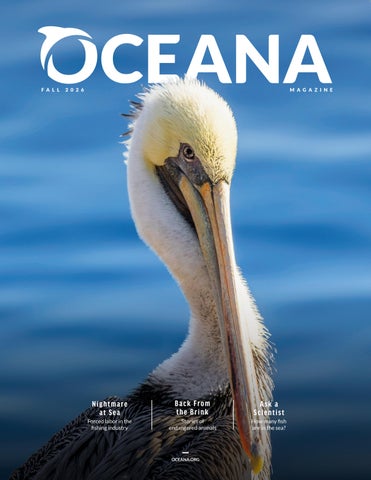
Editorial Staff Editor Sarah Holcomb Designer Flo Reynier Cover Photo: © Oceana/Patrick Mustain A brown pelican off California’s coast.
International Communications Director Gillian Spolarich Creative Director Patrick Mustain
Please Recycle.
Oceana Staff James F. Simon Chief Executive Officer
Features
Contents
Kathryn Matthews, Ph.D. Chief Scientist and Senior Vice President
3 | CEO Note Oceana campaigns for healthier, more transparent oceans
Liesbeth van der Meer, DVM Senior Vice President Daniel Olivares Senior Vice President
4 | For the Win Oceana celebrates new victories around the world
Joshua Laughren Senior Vice President
6 | News & Notes Ghana establishes first marine protected area, protest at Coca-Cola’s shareholder meeting, and more
Janelle Chanona Vice President, Belize © Oceana/Flo Reynier
Vera Coelho Executive Director and Vice President, Europe
Nightmare at Sea
12
8 | Q&A
Meet Sonia Kwami, Oceana’s new leader in Ghana
Dustin Cranor Vice President, Global Marketing and Communications
12 | Nightmare at Sea Forced labor in the commercial fishing industry
Von Hernandez Vice President, Philippines Sonia Kwami Vice President, Ghana
20 | Back From the Brink Stories of endangered ocean animals
Beth Lowell Vice President, United States Hugo Tagholm Executive Director and Vice President, United Kingdom
28 | Ask a Scientist How many fish are in the sea? © Oceana/Patrick Mustain
20
30 | Oceana’s Victories
To help navigate Oceana’s work, look for these five icons representing our major campaigns.
31 | Supporter Spotlight
Back From the Brink
Renata Terrazas Vice President, Mexico Ademilson Zamboni, Ph.D. Vice President, Brazil Kathy A. Whelpley Chief of Staff Michael Hirshfield, Ph.D. Senior Advisor
Curb Pollution
Protect Habitat
Stop Overfishing
Increase Transparency
Looking back at big wins over the last year
Fiona O’Callaghan: How a next-generation philanthropist is protecting the ocean
32 | Parting Shot A fish-filled sea in the Galapagos
Protect Species
Oceana Magazine is published by Oceana Inc. For questions or comments about this publication, please call our membership department at +1.202.833.3900 or write to Oceana’s Member Services at 1025 Connecticut Ave. NW, Suite 200, Washington, DC 20036 USA. Oceana’s Privacy Policy: Your right to privacy is important to Oceana, and we are committed to maintaining your trust. Personal information (such as name, address, phone number, email) includes data that you may have provided to us when making a donation or taking action as a Wavemaker on behalf of the oceans. This personal information is stored in a secure location. For our full privacy policy, please visit Oceana.org/privacy-policy.
1
Board of Directors Diana Thomson, Chair María Eugenia Girón, Vice Chair Sara Lowell, Treasurer James Sandler, Secretary Keith Addis, President Salla Alfieri Herbert M. Bedolfe, III Ted Danson Nicholas Davis Patrice Etlin Maya Gabeira César Gaviria Loic Gouzer Christina Chemtai Hicks, Ph.D. Jena King Ben Koerner Daniel Pauly, Ph.D. David Rockefeller, Jr. Lex Sant Matthew Sawyer Simon Sidamon-Eristoff Rashid Sumaila, Ph.D. Elizabeth Wahler Sam Waterston Jean Weiss Antha Williams Susan Rockefeller, Emeritus Director
Ocean Council Susan Rockefeller, Founder Kelly Hallman, Vice Chair Dede McMahon, Vice Chair Anonymous Samantha Bass Violaine and John Bernbach Rick Burnes Vin Cipolla Barbara Cohn Ann Colley Edward Dolman Kay and Frank Fernandez Carolyn and Chris Groobey J. Stephen and Angela Kilcullen Ann Luskey Peter Neumeier Carl and Janet Nolet Ellie Phipps Price David Rockefeller, Jr. Andrew Sabin Elias Sacal Regina K. and John Scully Maria Jose Peréz Simón Sutton Stracke Mia M. Thompson David Treadway, Ph.D. Edgar and Sue Wachenheim, III Valaree Wahler David Max Williamson Raoul Witteveen Leslie Zemeckis
Editorial Staff Editor Sarah Holcomb Designer Flo Reynier Cover Photo: © Oceana/Patrick Mustain A brown pelican off California’s coast.
International Communications Director Gillian Spolarich Creative Director Patrick Mustain
Please Recycle.
Oceana Staff James F. Simon Chief Executive Officer
Features
Contents
Kathryn Matthews, Ph.D. Chief Scientist and Senior Vice President
3 | CEO Note Oceana campaigns for healthier, more transparent oceans
Liesbeth van der Meer, DVM Senior Vice President Daniel Olivares Senior Vice President
4 | For the Win Oceana celebrates new victories around the world
Joshua Laughren Senior Vice President
6 | News & Notes Ghana establishes first marine protected area, protest at Coca-Cola’s shareholder meeting, and more
Janelle Chanona Vice President, Belize © Oceana/Flo Reynier
Vera Coelho Executive Director and Vice President, Europe
Nightmare at Sea
12
8 | Q&A
Meet Sonia Kwami, Oceana’s new leader in Ghana
Dustin Cranor Vice President, Global Marketing and Communications
12 | Nightmare at Sea Forced labor in the commercial fishing industry
Von Hernandez Vice President, Philippines Sonia Kwami Vice President, Ghana
20 | Back From the Brink Stories of endangered ocean animals
Beth Lowell Vice President, United States Hugo Tagholm Executive Director and Vice President, United Kingdom
28 | Ask a Scientist How many fish are in the sea? © Oceana/Patrick Mustain
20
30 | Oceana’s Victories
To help navigate Oceana’s work, look for these five icons representing our major campaigns.
31 | Supporter Spotlight
Back From the Brink
Renata Terrazas Vice President, Mexico Ademilson Zamboni, Ph.D. Vice President, Brazil Kathy A. Whelpley Chief of Staff Michael Hirshfield, Ph.D. Senior Advisor
Curb Pollution
Protect Habitat
Stop Overfishing
Increase Transparency
Looking back at big wins over the last year
Fiona O’Callaghan: How a next-generation philanthropist is protecting the ocean
32 | Parting Shot A fish-filled sea in the Galapagos
Protect Species
Oceana Magazine is published by Oceana Inc. For questions or comments about this publication, please call our membership department at +1.202.833.3900 or write to Oceana’s Member Services at 1025 Connecticut Ave. NW, Suite 200, Washington, DC 20036 USA. Oceana’s Privacy Policy: Your right to privacy is important to Oceana, and we are committed to maintaining your trust. Personal information (such as name, address, phone number, email) includes data that you may have provided to us when making a donation or taking action as a Wavemaker on behalf of the oceans. This personal information is stored in a secure location. For our full privacy policy, please visit Oceana.org/privacy-policy.
1
Your support makes an ocean of difference
Welcome to the fall edition of Oceana Magazine. This issue’s cover features a brown pelican — a bird whose remarkable comeback stands as one of the great conservation success stories made possible by the U.S. Endangered Species Act. In the mid-20th century, pesticides devastated California’s brown pelican population. Banning those harmful chemicals and protecting the birds’ habitat sparked an extraordinary recovery. Today, thousands of brown pelicans once again breed on islands off the California coast.
Call us today at +1.202.833.3900, email us at info@oceana.org, visit Oceana.org/give, or use the envelope provided in this magazine to make a donation. Oceana is a tax-exempt 501(c)(3) organization and contributions are tax-deductible to the fullest extent of the law.
Our feature story, “Back From the Brink” (page 20), introduces five other remarkable marine animals. Some, like the pelican, are making encouraging recoveries. Others, including the North Atlantic right whale, face an increasingly uncertain future. As the Endangered Species Act continues to be weakened under the current U.S. administration and Congress, I hope this beautifully photographed story inspires you to support our work to protect these extraordinary animals and the ocean ecosystems they depend on.
© Oceana/Sergio Gosálvez
Again and again, we are reminded that the health of the ocean,
Please Give Generously Today A healthy, fully restored ocean could feed more than 1 billion people each day, forever.
marine life, and people are inseparable. Our feature story “Nightmare at Sea” (page 12) explores the often-overlooked human rights abuses that occur aboard commercial fishing vessels. Hidden from public view, these abuses are far more common than many people realize. For decades, thousands of migrant workers have been recruited aboard fishing vessels with promises of good jobs, only to find themselves trapped hundreds of miles from shore. Many endure unsanitary living conditions, grueling 20-hour workdays, inadequate medical care, and no way to contact the outside world. Our team sat down with several former fishers-turned-advocates who are now bravely sharing their experiences. Their stories are harrowing, but they are essential reading. They underscore why our work to bring greater transparency and accountability to commercial fishing is so important. Another highlight of this issue is our Q&A with Sonia Kwami, our new leader in Ghana (page 8). Sonia shares what inspired her to join Oceana and why Ghana is uniquely positioned to make significant progress in protecting and restoring the ocean. Earlier this year, the country established its first marine protected area — a milestone you can read more about in our “News and Notes.” As Sonia 3
explains, whether people live along the coast or hundreds of miles inland, healthy oceans matter to everyone in Ghana. Fish is central to the country’s diet, livelihoods, and even childhood nutrition, since small, local fish are commonly used to make baby food. There is no shortage of fascinating stories in this issue — from our scientist Tess Geers’ column tackling the deceptively simple question, “How many fish are in the sea?” to our supporter spotlight featuring next-generation philanthropist Fiona O’Callaghan. I hope you enjoy reading them as much as we enjoyed bringing them to you. Thank you, as always, for making our campaigns possible. Your support is essential to protecting and restoring our oceans around the world. With gratitude,
James F. Simon Oceana CEO
FALL 2026 | Oceana.org
Your support makes an ocean of difference
Welcome to the fall edition of Oceana Magazine. This issue’s cover features a brown pelican — a bird whose remarkable comeback stands as one of the great conservation success stories made possible by the U.S. Endangered Species Act. In the mid-20th century, pesticides devastated California’s brown pelican population. Banning those harmful chemicals and protecting the birds’ habitat sparked an extraordinary recovery. Today, thousands of brown pelicans once again breed on islands off the California coast.
Call us today at +1.202.833.3900, email us at info@oceana.org, visit Oceana.org/give, or use the envelope provided in this magazine to make a donation. Oceana is a tax-exempt 501(c)(3) organization and contributions are tax-deductible to the fullest extent of the law.
Our feature story, “Back From the Brink” (page 20), introduces five other remarkable marine animals. Some, like the pelican, are making encouraging recoveries. Others, including the North Atlantic right whale, face an increasingly uncertain future. As the Endangered Species Act continues to be weakened under the current U.S. administration and Congress, I hope this beautifully photographed story inspires you to support our work to protect these extraordinary animals and the ocean ecosystems they depend on.
© Oceana/Sergio Gosálvez
Again and again, we are reminded that the health of the ocean,
Please Give Generously Today A healthy, fully restored ocean could feed more than 1 billion people each day, forever.
marine life, and people are inseparable. Our feature story “Nightmare at Sea” (page 12) explores the often-overlooked human rights abuses that occur aboard commercial fishing vessels. Hidden from public view, these abuses are far more common than many people realize. For decades, thousands of migrant workers have been recruited aboard fishing vessels with promises of good jobs, only to find themselves trapped hundreds of miles from shore. Many endure unsanitary living conditions, grueling 20-hour workdays, inadequate medical care, and no way to contact the outside world. Our team sat down with several former fishers-turned-advocates who are now bravely sharing their experiences. Their stories are harrowing, but they are essential reading. They underscore why our work to bring greater transparency and accountability to commercial fishing is so important. Another highlight of this issue is our Q&A with Sonia Kwami, our new leader in Ghana (page 8). Sonia shares what inspired her to join Oceana and why Ghana is uniquely positioned to make significant progress in protecting and restoring the ocean. Earlier this year, the country established its first marine protected area — a milestone you can read more about in our “News and Notes.” As Sonia 3
explains, whether people live along the coast or hundreds of miles inland, healthy oceans matter to everyone in Ghana. Fish is central to the country’s diet, livelihoods, and even childhood nutrition, since small, local fish are commonly used to make baby food. There is no shortage of fascinating stories in this issue — from our scientist Tess Geers’ column tackling the deceptively simple question, “How many fish are in the sea?” to our supporter spotlight featuring next-generation philanthropist Fiona O’Callaghan. I hope you enjoy reading them as much as we enjoyed bringing them to you. Thank you, as always, for making our campaigns possible. Your support is essential to protecting and restoring our oceans around the world. With gratitude,
James F. Simon Oceana CEO
FALL 2026 | Oceana.org
For the Win
New law in US state of New Jersey limits single-use plastics
Oceana and its allies achieved five new victories to help protect and restore the world’s oceans
A new law in New Jersey will reduce single-use plastics at restaurants by requiring businesses to provide utensils and condiments for takeout and delivery only upon customer request. Full-service restaurants also must provide reusable utensils for dine-in customers.
Canada’s Court of Appeal upholds federal authority to regulate plastics Canada’s Federal Court of Appeal affirmed the government’s authority to list plastic manufactured items as toxic under the Canadian Environmental Protection Act. This decision restores the federal government’s ability to regulate plastics and avoid pollution at a national level.
© The Canadian Press Images/Oceana Canada and EARTHDAY.ORG
Artist Benjamin von Wong created a plastic tap art installation, displayed in Ottawa, Canada during a legal battle over plastic regulation.
Canada releases national strategy to reduce whale entanglements in fishing gear Canada released a fishing gear strategy to help protect critically endangered North Atlantic right whales from entanglements. The framework will assess entanglement risk, establish pilot areas for on-demand gear, and, if successful, designate areas where this gear will be used to lower risks to right whales.
Whale-safe gear approved for California’s coonstripe shrimp fishery The U.S. state of California authorized the voluntary use of on-demand gear in the state’s coonstripe shrimp fishery, which will help reduce whale entanglements typically caused by the vertical ropes used with conventional fishing traps.
© Oceana
Artisanal fishers in the Philippine province of Palawan rely on coastal waters for their livelihoods.
Philippines province of Palawan reserves municipal waters for small-scale fishers The provincial government of Palawan passed the first provincial ordinance prohibiting all commercial fishing within its 15-kilometer municipal water zone, strengthening and backing up national laws that give preference to small-scale fishers in coastal waters. Through satellite monitoring, Oceana found that commercial fishing in Palawan’s
municipal waters has increased by 40% since 2022. This encroachment led to overfishing and habitat destruction — threatening coastal communities and artisanal fishers who rely on a healthy ocean for food security and livelihoods. Oceana is continuing to campaign for the same legal protections in other provinces.
4
© Florida Fish and Wildlife Conservation Commission, taken under NOAA permit 20556-01
North Atlantic right whale “Snowcone,” pictured alongside her calf, was spotted entangled in fishing gear.
5
FALL 2026 | Oceana.org
For the Win
New law in US state of New Jersey limits single-use plastics
Oceana and its allies achieved five new victories to help protect and restore the world’s oceans
A new law in New Jersey will reduce single-use plastics at restaurants by requiring businesses to provide utensils and condiments for takeout and delivery only upon customer request. Full-service restaurants also must provide reusable utensils for dine-in customers.
Canada’s Court of Appeal upholds federal authority to regulate plastics Canada’s Federal Court of Appeal affirmed the government’s authority to list plastic manufactured items as toxic under the Canadian Environmental Protection Act. This decision restores the federal government’s ability to regulate plastics and avoid pollution at a national level.
© The Canadian Press Images/Oceana Canada and EARTHDAY.ORG
Artist Benjamin von Wong created a plastic tap art installation, displayed in Ottawa, Canada during a legal battle over plastic regulation.
Canada releases national strategy to reduce whale entanglements in fishing gear Canada released a fishing gear strategy to help protect critically endangered North Atlantic right whales from entanglements. The framework will assess entanglement risk, establish pilot areas for on-demand gear, and, if successful, designate areas where this gear will be used to lower risks to right whales.
Whale-safe gear approved for California’s coonstripe shrimp fishery The U.S. state of California authorized the voluntary use of on-demand gear in the state’s coonstripe shrimp fishery, which will help reduce whale entanglements typically caused by the vertical ropes used with conventional fishing traps.
© Oceana
Artisanal fishers in the Philippine province of Palawan rely on coastal waters for their livelihoods.
Philippines province of Palawan reserves municipal waters for small-scale fishers The provincial government of Palawan passed the first provincial ordinance prohibiting all commercial fishing within its 15-kilometer municipal water zone, strengthening and backing up national laws that give preference to small-scale fishers in coastal waters. Through satellite monitoring, Oceana found that commercial fishing in Palawan’s
municipal waters has increased by 40% since 2022. This encroachment led to overfishing and habitat destruction — threatening coastal communities and artisanal fishers who rely on a healthy ocean for food security and livelihoods. Oceana is continuing to campaign for the same legal protections in other provinces.
4
© Florida Fish and Wildlife Conservation Commission, taken under NOAA permit 20556-01
North Atlantic right whale “Snowcone,” pictured alongside her calf, was spotted entangled in fishing gear.
5
FALL 2026 | Oceana.org
News & Notes
Protestors take a stand outside Coca-Cola’s shareholder meeting
Ghana establishes first marine protected area In April 2026, Ghana established the Greater Cape Three Points Marine Protected Area, the country’s first formally designated marine protected area (MPA). Covering more than 700 square kilometers (over 270 square miles) and spanning 21 coastal communities along Ghana’s Western coastline, the MPA includes critical fish spawning and nursery grounds, as well as rocky reefs and mangroves that are home to a host of species and protect coastlines from erosion. From planning to implementation, local voices helped shape this MPA, which is divided into different zones. Some zones will prohibit fishing in sensitive areas to allow for recovery, while others will continue regulated fishing by local communities to sustain livelihoods. The MPA marks an important policy achievement to support artisanal fishers who have relied on Ghana’s oceans for generations.
© Oceana/Jono Terry
Members of the London School of Hula and ‘Ori perform a traditional Samoan song and dance as part of a protest near the Coca-Cola Europacific Partners’ annual general meeting.
Oceana advances protections at Our Ocean Conference
© Oceana/Michael Aboya
The Greater Cape Three Points Marine Protected Area will support small-scale fishers’ livelihoods in Ghana.
Seafood fraud persists in Mexico, EU, Oceana reports
© Oceana/Vanya Vulperhorst
Outside the Coca-Cola Europacific Partners’ (CCEP) annual general meeting, a crowd of protestors, led by Oceana and members of the Samoan and Pacific Islander community, called on the company to reduce singleuse plastic and bring back reusable packaging systems. In 2021, Coca-Cola stopped selling its products in reusable glass bottles in Samoa, and waste has since been on the rise. Coca-Cola products account for about one-third of beverage plastic bottle waste in the country. At the cultural protest, members from the London School of Hula and ‘Ori performed traditional Samoan song and dance and presented a performance highlighting the connection between Pacific Island communities and the sea. Advocates delivered a symbolic “message in a bottle,” signed by organizations including Oceana.
Recent reports by Oceana reveal seafood fraud in Mexico and the European Union that is misleading consumers about the fish on their plates and hiding potential illegal practices and human rights abuses. In Mexico, researchers testing fish samples from restaurants and supermarkets found approximately four out of every 10 purchases were different species than the one on the menu or label, usually of lesser value. A separate investigation led by Oceana in 2025 combined DNA 6
analysis with EU trade data to reveal the hidden risks behind inadequately-labelled seafood in Italy and Belgium. The study found that the lack of labelling requirements for many squid products sold in the EU conceals potential links to illegal, unreported, and unregulated fishing; human rights abuse; and unsustainable fishing practices.
Squid rings at a fish market in Belgium.
In June, delegates from more than 100 countries converged in Mombasa, Kenya for the first Our Ocean conference hosted on the African continent. There, African nations unveiled new commitments toward the global goal of protecting 30% of the world’s oceans by 2030 and 16 countries adopted the Mombasa Declaration to combat illegal, unreported, and unregulated fishing. Oceana sent a team of senior leaders, scientists, and communicators to the conference — alongside actress and Oceana ambassador Kate Walsh — to advocate for protecting marine habitat, increasing transparency, and putting small-scale fishers at the center of decisions. Oceana Board Member Dr. Christina Chemtai Hicks moderated a listening circle featuring women leaders from the country’s coastal communities to discuss locally-led solutions for healthy oceans and communities.
© Oceana/Franz Mahr
Oceana hosted a listening circle with local women leaders during the Our Ocean Conference From left to right: Blue Ventures’ Science Communications Specialist Catherine Muyonga; local leaders Amina Komora, Zulfa Hassan, Raabia Hawa; actress and Oceana Ambassador Kate Walsh, and Oceana Board Member Dr. Christina Chemtai Hicks.
7
FALL 2026 | Oceana.org
News & Notes
Protestors take a stand outside Coca-Cola’s shareholder meeting
Ghana establishes first marine protected area In April 2026, Ghana established the Greater Cape Three Points Marine Protected Area, the country’s first formally designated marine protected area (MPA). Covering more than 700 square kilometers (over 270 square miles) and spanning 21 coastal communities along Ghana’s Western coastline, the MPA includes critical fish spawning and nursery grounds, as well as rocky reefs and mangroves that are home to a host of species and protect coastlines from erosion. From planning to implementation, local voices helped shape this MPA, which is divided into different zones. Some zones will prohibit fishing in sensitive areas to allow for recovery, while others will continue regulated fishing by local communities to sustain livelihoods. The MPA marks an important policy achievement to support artisanal fishers who have relied on Ghana’s oceans for generations.
© Oceana/Jono Terry
Members of the London School of Hula and ‘Ori perform a traditional Samoan song and dance as part of a protest near the Coca-Cola Europacific Partners’ annual general meeting.
Oceana advances protections at Our Ocean Conference
© Oceana/Michael Aboya
The Greater Cape Three Points Marine Protected Area will support small-scale fishers’ livelihoods in Ghana.
Seafood fraud persists in Mexico, EU, Oceana reports
© Oceana/Vanya Vulperhorst
Outside the Coca-Cola Europacific Partners’ (CCEP) annual general meeting, a crowd of protestors, led by Oceana and members of the Samoan and Pacific Islander community, called on the company to reduce singleuse plastic and bring back reusable packaging systems. In 2021, Coca-Cola stopped selling its products in reusable glass bottles in Samoa, and waste has since been on the rise. Coca-Cola products account for about one-third of beverage plastic bottle waste in the country. At the cultural protest, members from the London School of Hula and ‘Ori performed traditional Samoan song and dance and presented a performance highlighting the connection between Pacific Island communities and the sea. Advocates delivered a symbolic “message in a bottle,” signed by organizations including Oceana.
Recent reports by Oceana reveal seafood fraud in Mexico and the European Union that is misleading consumers about the fish on their plates and hiding potential illegal practices and human rights abuses. In Mexico, researchers testing fish samples from restaurants and supermarkets found approximately four out of every 10 purchases were different species than the one on the menu or label, usually of lesser value. A separate investigation led by Oceana in 2025 combined DNA 6
analysis with EU trade data to reveal the hidden risks behind inadequately-labelled seafood in Italy and Belgium. The study found that the lack of labelling requirements for many squid products sold in the EU conceals potential links to illegal, unreported, and unregulated fishing; human rights abuse; and unsustainable fishing practices.
Squid rings at a fish market in Belgium.
In June, delegates from more than 100 countries converged in Mombasa, Kenya for the first Our Ocean conference hosted on the African continent. There, African nations unveiled new commitments toward the global goal of protecting 30% of the world’s oceans by 2030 and 16 countries adopted the Mombasa Declaration to combat illegal, unreported, and unregulated fishing. Oceana sent a team of senior leaders, scientists, and communicators to the conference — alongside actress and Oceana ambassador Kate Walsh — to advocate for protecting marine habitat, increasing transparency, and putting small-scale fishers at the center of decisions. Oceana Board Member Dr. Christina Chemtai Hicks moderated a listening circle featuring women leaders from the country’s coastal communities to discuss locally-led solutions for healthy oceans and communities.
© Oceana/Franz Mahr
Oceana hosted a listening circle with local women leaders during the Our Ocean Conference From left to right: Blue Ventures’ Science Communications Specialist Catherine Muyonga; local leaders Amina Komora, Zulfa Hassan, Raabia Hawa; actress and Oceana Ambassador Kate Walsh, and Oceana Board Member Dr. Christina Chemtai Hicks.
7
FALL 2026 | Oceana.org
Sonia Kwami on Oceana’s launch in Ghana What draws you to ocean advocacy?
Sonia Kwami was appointed as Oceana’s new leader in Ghana in March 2026. She is an experienced campaigner, movement builder, and development leader with over 22 years of experience advancing social, economic, environmental, and climate justice. Kwami holds a Bachelor of Commerce degree and a Master of Arts in Democracy, Governance, Law, and Development from the University of Cape Coast, as well as an Executive Leadership Certificate from the University of Oxford. Based in Accra, she also serves on several boards to help strengthen governance and civil society.
SK: I am a campaigner. I love to fight for justice, from ensuring equitable education for girls to campaigning for climate action. The opportunity to work with fisherfolk, local communities, and women in the fishing industry brings all those passions together. Millions of Ghanaians rely a lot on the ocean for food and livelihoods. We also go to the sea for recreation — the beaches are filled with families during the holidays! As amazing as our coast is, Ghanaians are concerned about the polluting of our oceans. This problem is of national interest: Our food security, our tourism, and the wellbeing of our communities. That’s what drew me to this work. Tell us about your personal connection to the ocean. SK: I grew up in Accra for much of my childhood, right on Ghana’s coast. Every time we drove by the ocean I was drawn in by its vastness. I remember constantly asking my mother, “Does the ocean have an end?” She would always tell me, “no, it has no end!” The ocean truly has endless opportunities. It’s a critical food source. I remember women coming to the house when I was a child to 8
sell fish. (We Ghanaians love to spice and grill fish!) When I see the ocean today, I don’t just see water, I see something that connects all of us. Even those who are far away from the ocean in Ghana still rely on fish. What are the biggest threats facing Ghana’s waters today? SK: In addition to environmental threats like pollution, there are also threats from illegal, unreported, and unregulated fishing. Some industrial trawlers are making it difficult for smaller or artisanal fishers to catch enough fish. People want more transparency about who owns these vessels, where they are registered, and where the fish end up — whether that’s on the shores of Ghana or other countries. There are also too many boats in general, which leads to overfishing. The issues are urgent. Fishers say they don’t get enough fish; catch is reduced year by year. This also impacts the women who process and sell fish, and families who consume the fish. In Ghana, fish powder is commonly used in locallyprepared baby food, so declining fisheries have consequences for children’s health as well. When fishing livelihoods disappear, it even affects community safety. These are conversations happening in communities all the time.
© Oceana/Michael Aboya
Small-scale fishers’ canoes fill the port of Tema, Ghana.
We cannot wait for the oceans to be completely depleted to know that we have a crisis. It is a ticking time bomb. While we’ve been working on these issues for many years, Oceana is joining at a time when there is a lot of momentum. Tell us about Ghana’s new fisheries law and why it’s important. SK: In September 2025, our government passed the Fisheries and Aquaculture Act, which presents a lot of opportunities to protect local fishers and everyone who depends on the fishing value
chain. We also expanded our inshore exclusion zone from six to 12 nautical miles, giving small-scale fishers greater protection from industrial trawlers. These are significant steps, but strong implementation and enforcement will be important. There’s a strong interest — both on the part of our government and local communities — to restore our fisheries, especially given concerns about dwindling catch. Now it’s about making sure those protections deliver real benefits for the people who depend on the sea every day.
9
When I see the ocean today, I don’t just see water, I see something that connects all of us.
FALL 2026 | Oceana.org
Sonia Kwami on Oceana’s launch in Ghana What draws you to ocean advocacy?
Sonia Kwami was appointed as Oceana’s new leader in Ghana in March 2026. She is an experienced campaigner, movement builder, and development leader with over 22 years of experience advancing social, economic, environmental, and climate justice. Kwami holds a Bachelor of Commerce degree and a Master of Arts in Democracy, Governance, Law, and Development from the University of Cape Coast, as well as an Executive Leadership Certificate from the University of Oxford. Based in Accra, she also serves on several boards to help strengthen governance and civil society.
SK: I am a campaigner. I love to fight for justice, from ensuring equitable education for girls to campaigning for climate action. The opportunity to work with fisherfolk, local communities, and women in the fishing industry brings all those passions together. Millions of Ghanaians rely a lot on the ocean for food and livelihoods. We also go to the sea for recreation — the beaches are filled with families during the holidays! As amazing as our coast is, Ghanaians are concerned about the polluting of our oceans. This problem is of national interest: Our food security, our tourism, and the wellbeing of our communities. That’s what drew me to this work. Tell us about your personal connection to the ocean. SK: I grew up in Accra for much of my childhood, right on Ghana’s coast. Every time we drove by the ocean I was drawn in by its vastness. I remember constantly asking my mother, “Does the ocean have an end?” She would always tell me, “no, it has no end!” The ocean truly has endless opportunities. It’s a critical food source. I remember women coming to the house when I was a child to 8
sell fish. (We Ghanaians love to spice and grill fish!) When I see the ocean today, I don’t just see water, I see something that connects all of us. Even those who are far away from the ocean in Ghana still rely on fish. What are the biggest threats facing Ghana’s waters today? SK: In addition to environmental threats like pollution, there are also threats from illegal, unreported, and unregulated fishing. Some industrial trawlers are making it difficult for smaller or artisanal fishers to catch enough fish. People want more transparency about who owns these vessels, where they are registered, and where the fish end up — whether that’s on the shores of Ghana or other countries. There are also too many boats in general, which leads to overfishing. The issues are urgent. Fishers say they don’t get enough fish; catch is reduced year by year. This also impacts the women who process and sell fish, and families who consume the fish. In Ghana, fish powder is commonly used in locallyprepared baby food, so declining fisheries have consequences for children’s health as well. When fishing livelihoods disappear, it even affects community safety. These are conversations happening in communities all the time.
© Oceana/Michael Aboya
Small-scale fishers’ canoes fill the port of Tema, Ghana.
We cannot wait for the oceans to be completely depleted to know that we have a crisis. It is a ticking time bomb. While we’ve been working on these issues for many years, Oceana is joining at a time when there is a lot of momentum. Tell us about Ghana’s new fisheries law and why it’s important. SK: In September 2025, our government passed the Fisheries and Aquaculture Act, which presents a lot of opportunities to protect local fishers and everyone who depends on the fishing value
chain. We also expanded our inshore exclusion zone from six to 12 nautical miles, giving small-scale fishers greater protection from industrial trawlers. These are significant steps, but strong implementation and enforcement will be important. There’s a strong interest — both on the part of our government and local communities — to restore our fisheries, especially given concerns about dwindling catch. Now it’s about making sure those protections deliver real benefits for the people who depend on the sea every day.
9
When I see the ocean today, I don’t just see water, I see something that connects all of us.
FALL 2026 | Oceana.org
© Oceana/Michael Aboya
What do you and Oceana hope to accomplish in Ghana?
Our campaigns will be based on the key issues that our communities identify as critical.
© Oceana/Michael Aboya
10
Left: A small-scale fisher examines his nets. Top: A woman carries the catch to be processed.
SK: We want to ensure that Ghana’s oceans remain healthy and productive for generations to come. That starts with building strong community relationships. Our campaigns will be based on the key issues that our communities identify as critical. We must protect local fish from unscrupulous big vessels who try to overfish illegally. At the end of the day, we’re campaigning so that families can actually access fish, children have better nutrition, and people have reliable livelihoods. I’m excited to advocate alongside communities so that their rights and institutions are supported and protected. 11
What inspires you the most about working with coastal communities? SK: I’m inspired by their passion. They are committed! Many of these families have been fishing for generations and they have been able to live off the sea. If you go to the beach, you will see what I call “organized chaos.” People are shouting to buy or sell fish. Others are mending their nets. Canoes are lined up on the coastline. It is a whole community of people who depend on the oceans. Making sure that people can rely on this source of income, advocate for themselves, take care of their families, and access education and healthcare is what drives me.
FALL 2026 | Oceana.org
© Oceana/Michael Aboya
What do you and Oceana hope to accomplish in Ghana?
Our campaigns will be based on the key issues that our communities identify as critical.
© Oceana/Michael Aboya
10
Left: A small-scale fisher examines his nets. Top: A woman carries the catch to be processed.
SK: We want to ensure that Ghana’s oceans remain healthy and productive for generations to come. That starts with building strong community relationships. Our campaigns will be based on the key issues that our communities identify as critical. We must protect local fish from unscrupulous big vessels who try to overfish illegally. At the end of the day, we’re campaigning so that families can actually access fish, children have better nutrition, and people have reliable livelihoods. I’m excited to advocate alongside communities so that their rights and institutions are supported and protected. 11
What inspires you the most about working with coastal communities? SK: I’m inspired by their passion. They are committed! Many of these families have been fishing for generations and they have been able to live off the sea. If you go to the beach, you will see what I call “organized chaos.” People are shouting to buy or sell fish. Others are mending their nets. Canoes are lined up on the coastline. It is a whole community of people who depend on the oceans. Making sure that people can rely on this source of income, advocate for themselves, take care of their families, and access education and healthcare is what drives me.
FALL 2026 | Oceana.org
Feature
NIGHTMARE AT SEA Forced labor in the commercial fishing industry by Sarah Holcomb
Rizky Oktaviana was working as a waiter at a Japanese restaurant in Jakarta when a recruiter arrived at his door one day with an exciting job prospect: Work on a foreign fishing vessel and make a handsome salary of $350 USD per week, plus bonuses and holidays. Oktaviana had a college degree in science, and didn’t consider himself the office-job type, so advancing his career at sea seemed like a smart move. Before signing the contract, he asked the director of the recruitment agency a series of questions to better understand the job. Instead of the conversation settling his concerns, however, Oktaviana received the first of many threats: “Do not sign, and you’ll owe us $2,000 USD,” the director reportedly told him. Oktaviana knew that the agency already had his private documents, including his Indonesian ID card and education certificates, and if he walked away, they likely wouldn’t be returned. He also faced the social pressure of cancelling his plans and having to answer to those in his hometown. “I felt set up,” Oktaviana says. The sour events that preceded Oktaviana going to work on a foreign
fishing vessel only foreshadowed worse transpirings out on the high seas, where external contact was impossible; land was thousands of miles away; and nothing was as promised. There, he would meet others, Indonesian migrant workers like himself, many trying to support their families in a struggling job market while their dreams darkened into a nightmare.
Life at sea While some challenges of life at sea come with the territory — seasickness, cramped space, and homesickness to name a few — many Indonesian migrant fishers describe the conditions on bad-acting foreign fleets as unlivable. Some reported that they were regularly served expired or rotten food, at times had to drink dirty water, and were subjected to 20+ hour workday schedules. The few hours for sleep were hardly enough to survive on, much less to do the labor-intensive work of manning a fishing vessel. Fishers typically piled into a single room to sleep, each person with a patch of floor so small they had to contort their bodies to fit inside it.
12
Oktaviana recalls that the boat’s captain, who hailed from a different country than the migrant workers (and had his own room), regularly threatened the fishers to comply with his demands. Because of the lack of Wi-Fi, there was no way to report abuses or to get help while at sea, says another former fisher, Adrian Dogdodo Basar, who has since become a human rights activist working to protect others from forced labor at sea. These abuses at sea are not new, and perpetrators have faced little accountability or justice. A 2021 study estimates that 128,000 fishers are in forced labor globally, and another suggests 20% of migrant fishers are from southeast Asia. They endure deception, violence, coercion, and abuse on vessels that can remain at sea for years at a time, far from any government oversight. The long stints at sea are made possible by a practice known as “transshipment,” in which other vessels restock supplies, refuel, and transfer the catch to allow the main fishing vessel to avoid going ashore to dock or be inspected. As a result, the migrant workers have few opportunities to reach the outside
© The Outlaw Ocean Project/Ed Ou
13
FALL 2026 | Oceana.org
Feature
NIGHTMARE AT SEA Forced labor in the commercial fishing industry by Sarah Holcomb
Rizky Oktaviana was working as a waiter at a Japanese restaurant in Jakarta when a recruiter arrived at his door one day with an exciting job prospect: Work on a foreign fishing vessel and make a handsome salary of $350 USD per week, plus bonuses and holidays. Oktaviana had a college degree in science, and didn’t consider himself the office-job type, so advancing his career at sea seemed like a smart move. Before signing the contract, he asked the director of the recruitment agency a series of questions to better understand the job. Instead of the conversation settling his concerns, however, Oktaviana received the first of many threats: “Do not sign, and you’ll owe us $2,000 USD,” the director reportedly told him. Oktaviana knew that the agency already had his private documents, including his Indonesian ID card and education certificates, and if he walked away, they likely wouldn’t be returned. He also faced the social pressure of cancelling his plans and having to answer to those in his hometown. “I felt set up,” Oktaviana says. The sour events that preceded Oktaviana going to work on a foreign
fishing vessel only foreshadowed worse transpirings out on the high seas, where external contact was impossible; land was thousands of miles away; and nothing was as promised. There, he would meet others, Indonesian migrant workers like himself, many trying to support their families in a struggling job market while their dreams darkened into a nightmare.
Life at sea While some challenges of life at sea come with the territory — seasickness, cramped space, and homesickness to name a few — many Indonesian migrant fishers describe the conditions on bad-acting foreign fleets as unlivable. Some reported that they were regularly served expired or rotten food, at times had to drink dirty water, and were subjected to 20+ hour workday schedules. The few hours for sleep were hardly enough to survive on, much less to do the labor-intensive work of manning a fishing vessel. Fishers typically piled into a single room to sleep, each person with a patch of floor so small they had to contort their bodies to fit inside it.
12
Oktaviana recalls that the boat’s captain, who hailed from a different country than the migrant workers (and had his own room), regularly threatened the fishers to comply with his demands. Because of the lack of Wi-Fi, there was no way to report abuses or to get help while at sea, says another former fisher, Adrian Dogdodo Basar, who has since become a human rights activist working to protect others from forced labor at sea. These abuses at sea are not new, and perpetrators have faced little accountability or justice. A 2021 study estimates that 128,000 fishers are in forced labor globally, and another suggests 20% of migrant fishers are from southeast Asia. They endure deception, violence, coercion, and abuse on vessels that can remain at sea for years at a time, far from any government oversight. The long stints at sea are made possible by a practice known as “transshipment,” in which other vessels restock supplies, refuel, and transfer the catch to allow the main fishing vessel to avoid going ashore to dock or be inspected. As a result, the migrant workers have few opportunities to reach the outside
© The Outlaw Ocean Project/Ed Ou
13
FALL 2026 | Oceana.org
Feature
From left to right: Former fishers-turned advocates Resi Yulianto, Rizky Oktaviana, and Adrian Dogdodo Basar, and the leader of the Union of Indonesian Migrant Workers (SBMI) Hariyanto Suwarno. © Oceana/Flo Reynier
14
15
FALL 2026 | Oceana.org
Feature
From left to right: Former fishers-turned advocates Resi Yulianto, Rizky Oktaviana, and Adrian Dogdodo Basar, and the leader of the Union of Indonesian Migrant Workers (SBMI) Hariyanto Suwarno. © Oceana/Flo Reynier
14
15
FALL 2026 | Oceana.org
Feature
world or escape from the boat — and could be moved onto another vessel during the transshipment, forced to stay at sea. “In some places, fisheries and human rights abuses manifest with violence against the crew. Oftentimes we see wages being withheld. Sometimes crews are kept at sea for extended periods of time without access to medical care or contact with loved ones,” says Oceana’s Senior Director of Global Transparency Maisie Pigeon. When working on a Taiwanese-owned tuna fishing vessel that he says was illegally fishing sharks and squid, Basar remembers the day his friend’s leg started to swell. Worried about an infection, the crew asked the captain for medicine, though they couldn’t be sure what pills were in the bottle he was given — labelled in Mandarin — or if it had expired. Basar’s friend took a turn for the worse, and days later, died. “I can’t do this anymore,” Basar recalls telling the captain, pleading with him to dock so that the crew could give their friend a proper burial. Instead, says Basar, “the vessel continued to operate and the captain put my friend’s body in the ship’s freezer along with the fish.” He said they were forced to keep working as usual for two more months, and the captain threatened to blacklist their passports — barring them from future employment — if they didn’t. Basar’s voice trembled as he recounted the story during a trip to Washington, D.C. in May of 2026, organized by the U.S. IUU and Labor Rights Coalition to raise awareness of these issues. “Would you buy the fish if you knew that my friend’s body was in the same freezer as your fish?”
In the dark © Oceana/Flo Reynier
Rizky Oktaviana worked aboard a trawling fishing vessel and has since dedicated his life and career to fighting for the rights of fishers.
16
Worldwide, fish is rarely traced from the fishing vessel to the consumer’s plate, leaving most consumers unaware of the illegal
practices and human rights abuses rife throughout the supply chain. An estimated one in five wild fish comes from illegal, unreported, and unregulated (IUU) fishing — practices that can also overlap with forced labor — and generate up to $36.4 billion in illegal profits each year. Lack of national and international regulation and adequate enforcement has allowed abuses to continue at sea largely unabated. Boats that carry the catch to shore via transshipment often end up mixing fish — those legally and illegally caught — together, making it easier to give illegally caught fish a new identity. Illegal fishing vessels also commonly use “flags of convenience,” flying the flag of a different country with looser regulations. In the U.S., where 90% of seafood is imported, only some imported fish is required to be traced from the boat to the U.S. border, says Pigeon. In 2026, the Cape Town Agreement, an international agreement drafted nearly 15 years earlier to improve safety requirements aboard fishing vessels, received its final ratifications, and will go into effect in 2027. Among the 65 countries that have signed on, authorities are responsible for ensuring vessels flying their country’s flags must adhere to global minimum safety standards. “It’s a small step, but an important one,” says Pigeon. The Coalition for Fisheries Transparency, co-chaired by Oceana, Environmental Justice Foundation, and Global Fishing Watch, also launched the Mombasa Declaration at the 2026 Our Ocean Conference. The Declaration is a global call to action for countries to establish transparency, accountable, and fair fishing practices. This vital first step of countries publicly committing to transparent reforms “gives us really good ground to begin to develop new policies to advance transparency in the 16 countries that have committed so far,” she says.
17
Meanwhile, in the U.S., Oceana and other organizations are pushing Congress and the administration to strengthen import controls requiring catch documentation and traceability for all seafood imports, provide increased resources for the government to fight IUU fishing, and expand the tools the U.S. has to ensure that all seafood sold in the U.S. is safe, legally caught, responsibly sourced, and honestly labeled. In Europe, campaigners are pushing to hold insurance companies and other businesses that service fishing vessels accountable if they do not screen for illegal fishing activity. “IUU fishing and human rights and labor abuses at sea are inextricably linked,” she says. “As companies are looking to cut corners, they’re exploiting their workers and they’re over-exploiting the ocean itself. If we have better information about vessels, we have better tools to combat both the destructive impact of illegal fishing on the oceans and the human rights abuses happening on fishing vessels.” Transparency alone will not solve the pervasive problem, Pigeon explains. “Disclosure of information is not the end goal. It’s a tool to put in place better policies. But better information ultimately leads to better decisions that protect the oceans and the people who depend on them.”
Into the unknown In 2013, several fishing vessels were impounded off the coast of South Africa for illegal fishing. Approximately 75 fishers were aboard — including Oktaviana. Some of the fishers shared their stories with the press, and their testimonies of slavery-like working conditions exploded into international headlines. Despite the news traveling throughout South Africa, Indonesia, and beyond, the crew spent two weeks stranded in Cape Town, sleeping on the boat and relying on
FALL 2026 | Oceana.org
Feature
world or escape from the boat — and could be moved onto another vessel during the transshipment, forced to stay at sea. “In some places, fisheries and human rights abuses manifest with violence against the crew. Oftentimes we see wages being withheld. Sometimes crews are kept at sea for extended periods of time without access to medical care or contact with loved ones,” says Oceana’s Senior Director of Global Transparency Maisie Pigeon. When working on a Taiwanese-owned tuna fishing vessel that he says was illegally fishing sharks and squid, Basar remembers the day his friend’s leg started to swell. Worried about an infection, the crew asked the captain for medicine, though they couldn’t be sure what pills were in the bottle he was given — labelled in Mandarin — or if it had expired. Basar’s friend took a turn for the worse, and days later, died. “I can’t do this anymore,” Basar recalls telling the captain, pleading with him to dock so that the crew could give their friend a proper burial. Instead, says Basar, “the vessel continued to operate and the captain put my friend’s body in the ship’s freezer along with the fish.” He said they were forced to keep working as usual for two more months, and the captain threatened to blacklist their passports — barring them from future employment — if they didn’t. Basar’s voice trembled as he recounted the story during a trip to Washington, D.C. in May of 2026, organized by the U.S. IUU and Labor Rights Coalition to raise awareness of these issues. “Would you buy the fish if you knew that my friend’s body was in the same freezer as your fish?”
In the dark © Oceana/Flo Reynier
Rizky Oktaviana worked aboard a trawling fishing vessel and has since dedicated his life and career to fighting for the rights of fishers.
16
Worldwide, fish is rarely traced from the fishing vessel to the consumer’s plate, leaving most consumers unaware of the illegal
practices and human rights abuses rife throughout the supply chain. An estimated one in five wild fish comes from illegal, unreported, and unregulated (IUU) fishing — practices that can also overlap with forced labor — and generate up to $36.4 billion in illegal profits each year. Lack of national and international regulation and adequate enforcement has allowed abuses to continue at sea largely unabated. Boats that carry the catch to shore via transshipment often end up mixing fish — those legally and illegally caught — together, making it easier to give illegally caught fish a new identity. Illegal fishing vessels also commonly use “flags of convenience,” flying the flag of a different country with looser regulations. In the U.S., where 90% of seafood is imported, only some imported fish is required to be traced from the boat to the U.S. border, says Pigeon. In 2026, the Cape Town Agreement, an international agreement drafted nearly 15 years earlier to improve safety requirements aboard fishing vessels, received its final ratifications, and will go into effect in 2027. Among the 65 countries that have signed on, authorities are responsible for ensuring vessels flying their country’s flags must adhere to global minimum safety standards. “It’s a small step, but an important one,” says Pigeon. The Coalition for Fisheries Transparency, co-chaired by Oceana, Environmental Justice Foundation, and Global Fishing Watch, also launched the Mombasa Declaration at the 2026 Our Ocean Conference. The Declaration is a global call to action for countries to establish transparency, accountable, and fair fishing practices. This vital first step of countries publicly committing to transparent reforms “gives us really good ground to begin to develop new policies to advance transparency in the 16 countries that have committed so far,” she says.
17
Meanwhile, in the U.S., Oceana and other organizations are pushing Congress and the administration to strengthen import controls requiring catch documentation and traceability for all seafood imports, provide increased resources for the government to fight IUU fishing, and expand the tools the U.S. has to ensure that all seafood sold in the U.S. is safe, legally caught, responsibly sourced, and honestly labeled. In Europe, campaigners are pushing to hold insurance companies and other businesses that service fishing vessels accountable if they do not screen for illegal fishing activity. “IUU fishing and human rights and labor abuses at sea are inextricably linked,” she says. “As companies are looking to cut corners, they’re exploiting their workers and they’re over-exploiting the ocean itself. If we have better information about vessels, we have better tools to combat both the destructive impact of illegal fishing on the oceans and the human rights abuses happening on fishing vessels.” Transparency alone will not solve the pervasive problem, Pigeon explains. “Disclosure of information is not the end goal. It’s a tool to put in place better policies. But better information ultimately leads to better decisions that protect the oceans and the people who depend on them.”
Into the unknown In 2013, several fishing vessels were impounded off the coast of South Africa for illegal fishing. Approximately 75 fishers were aboard — including Oktaviana. Some of the fishers shared their stories with the press, and their testimonies of slavery-like working conditions exploded into international headlines. Despite the news traveling throughout South Africa, Indonesia, and beyond, the crew spent two weeks stranded in Cape Town, sleeping on the boat and relying on
FALL 2026 | Oceana.org
Feature
locals to bring them food since they did not have the legal papers to go ashore. That was followed by months in an overcrowded detention center. Meanwhile, Basar escaped when his Vanuatu-flagged vessel was docked in Taiwan, but with no ID, phone, or money since he was never paid. Basar is not the only one in this situation; the Union of Indonesian Migrant Workers says that many migrant workers must fend for themselves to find an embassy or consulate in a foreign country and make their way back home.
We have to put pressure on. The people’s power is more important than anything.
Others, like Resi Yulianto, return in debt after being forced to pay large sums to recruiters before even stepping on board the vessel. This debt deeply impacted Yulianto’s family, eventually tearing it apart.
-Rizky Oktaviana
When Oktaviana finally arrived home to Indonesia after months stranded in South Africa, he, too, had not received any pay for his years working on the vessel. Today, he advocates for fisher rights, including receiving their rightful pay. Oktaviana and Basar are training to become lawyers so others do not face the same injustice. “Because of my experience being a victim, I decided to fight for and defend others like me,” Basar says. “We have to tell [consumers] the real situation,” Oktaviana emphasizes. “We have to put pressure on. The people’s power is more important than anything.”
© The Outlaw Ocean Project/Ed Ou
18
19
A squid fishing vessel in the South Atlantic.
FALL 2026 | Oceana.org
Feature
locals to bring them food since they did not have the legal papers to go ashore. That was followed by months in an overcrowded detention center. Meanwhile, Basar escaped when his Vanuatu-flagged vessel was docked in Taiwan, but with no ID, phone, or money since he was never paid. Basar is not the only one in this situation; the Union of Indonesian Migrant Workers says that many migrant workers must fend for themselves to find an embassy or consulate in a foreign country and make their way back home.
We have to put pressure on. The people’s power is more important than anything.
Others, like Resi Yulianto, return in debt after being forced to pay large sums to recruiters before even stepping on board the vessel. This debt deeply impacted Yulianto’s family, eventually tearing it apart.
-Rizky Oktaviana
When Oktaviana finally arrived home to Indonesia after months stranded in South Africa, he, too, had not received any pay for his years working on the vessel. Today, he advocates for fisher rights, including receiving their rightful pay. Oktaviana and Basar are training to become lawyers so others do not face the same injustice. “Because of my experience being a victim, I decided to fight for and defend others like me,” Basar says. “We have to tell [consumers] the real situation,” Oktaviana emphasizes. “We have to put pressure on. The people’s power is more important than anything.”
© The Outlaw Ocean Project/Ed Ou
18
19
A squid fishing vessel in the South Atlantic.
FALL 2026 | Oceana.org
Juan Fernández fur seal Population: ~250,000 Status: Healthy
© Oceana/Eduardo Sorensen
Once thought extinct, the Juan Fernández fur seal has made one of the most remarkable comebacks in marine conservation. Found only in Chile’s remote Juan Fernández archipelago and Desventuradas Islands, the species was hunted nearly to extinction for its fur during the 18th and 19th centuries. In 1965, a surviving colony of 200 animals was rediscovered. Thanks to legal protections, an end to commercial hunting, and stronger marine conservation measures — including marine protected areas and management plans that Oceana helped create — the species dramatically rebounded. Today, its population is estimated at over 250,000. While climate change and disease remain threats, these fur seals’ success shows what’s possible when marine wildlife is given a chance to recover.
Humboldt penguin Population: 23,800 adults Status: Endangered © Oceana/Steve De Neef
Back From the Brink Stories of endangered ocean animals Faced with threats like industrial fishing, climate change, ship traffic, and plastic pollution — sometimes all at once — thousands of marine species around the world are fighting to survive. But history shows that policy protections can successfully bring struggling species back from the brink. Meet six ocean animals that have faced — or are facing — the threat of extinction and discover how policy change can make the difference.
Green sea turtle South Atlantic Ocean Subpopulation: ~77,000 adults Status: Healthy
Historically hunted for their meat, shells, and eggs, green sea turtles were near extinction. Even after poaching was banned in the United States, they continued to struggle — getting entangled in fishing gear, struck by boats, and losing their nesting beaches. In 1978, the Endangered Species Act provided a lifeline. Protections under this U.S. law led to critical conservation efforts that included 20
reducing incidental catch in fishing gear, safeguarding nesting sites, and restoring vital habitats. When shrimp trawling threatened green turtles in the southeastern U.S., the Endangered Species Act helped spur the government and fishing industry to innovate a new shrimp fishing gear that lets turtles escape. In Florida, green sea turtle nests soared from nearly zero in 1978 to over 200,000 in recent years.
Along the stark desert coasts and rocky cliffs of Chile and Peru lives the Humboldt penguin, who, unlike its Antarctic relatives, nests in sun-baked landscapes in one of the driest regions on Earth. But warming oceans, industrial fishing, oil pollution, and habitat disturbance have put enormous pressure on the population. Thanks to a decade of campaigning by Oceana and its artisanal fisher allies, Chile established the Humboldt National Reserve in 2023. When the Dominga mining company sought to gain access to this key habitat, Oceana and its allies led a campaign opposing the mining project, using legal action, advocacy, and scientific evidence to push regulators and courts to conserve the area for the marine life and communities who depend on it. These penguins are currently endangered, so ensuring the protections hold will be critical to their future.
© Oceana/Eduardo Sorensen
21
FALL 2026 | Oceana.org
Juan Fernández fur seal Population: ~250,000 Status: Healthy
© Oceana/Eduardo Sorensen
Once thought extinct, the Juan Fernández fur seal has made one of the most remarkable comebacks in marine conservation. Found only in Chile’s remote Juan Fernández archipelago and Desventuradas Islands, the species was hunted nearly to extinction for its fur during the 18th and 19th centuries. In 1965, a surviving colony of 200 animals was rediscovered. Thanks to legal protections, an end to commercial hunting, and stronger marine conservation measures — including marine protected areas and management plans that Oceana helped create — the species dramatically rebounded. Today, its population is estimated at over 250,000. While climate change and disease remain threats, these fur seals’ success shows what’s possible when marine wildlife is given a chance to recover.
Humboldt penguin Population: 23,800 adults Status: Endangered © Oceana/Steve De Neef
Back From the Brink Stories of endangered ocean animals Faced with threats like industrial fishing, climate change, ship traffic, and plastic pollution — sometimes all at once — thousands of marine species around the world are fighting to survive. But history shows that policy protections can successfully bring struggling species back from the brink. Meet six ocean animals that have faced — or are facing — the threat of extinction and discover how policy change can make the difference.
Green sea turtle South Atlantic Ocean Subpopulation: ~77,000 adults Status: Healthy
Historically hunted for their meat, shells, and eggs, green sea turtles were near extinction. Even after poaching was banned in the United States, they continued to struggle — getting entangled in fishing gear, struck by boats, and losing their nesting beaches. In 1978, the Endangered Species Act provided a lifeline. Protections under this U.S. law led to critical conservation efforts that included 20
reducing incidental catch in fishing gear, safeguarding nesting sites, and restoring vital habitats. When shrimp trawling threatened green turtles in the southeastern U.S., the Endangered Species Act helped spur the government and fishing industry to innovate a new shrimp fishing gear that lets turtles escape. In Florida, green sea turtle nests soared from nearly zero in 1978 to over 200,000 in recent years.
Along the stark desert coasts and rocky cliffs of Chile and Peru lives the Humboldt penguin, who, unlike its Antarctic relatives, nests in sun-baked landscapes in one of the driest regions on Earth. But warming oceans, industrial fishing, oil pollution, and habitat disturbance have put enormous pressure on the population. Thanks to a decade of campaigning by Oceana and its artisanal fisher allies, Chile established the Humboldt National Reserve in 2023. When the Dominga mining company sought to gain access to this key habitat, Oceana and its allies led a campaign opposing the mining project, using legal action, advocacy, and scientific evidence to push regulators and courts to conserve the area for the marine life and communities who depend on it. These penguins are currently endangered, so ensuring the protections hold will be critical to their future.
© Oceana/Eduardo Sorensen
21
FALL 2026 | Oceana.org
Brown pelican Population: ~70,000 breeding pairs in California Status: Healthy
© Oceana/Steve De Neef
Whale shark Population: Unknown Status: Endangered
The whale shark — the world’s largest fish — can grow up to 12 meters (40 feet) long, roughly the length of a school bus, yet it feeds almost entirely on tiny plankton. In the last 75 years, whale shark populations have dropped by at least 50% globally. In the Philippines, home to the
world’s second-largest known whale shark population, these gentle giants were once hunted for their meat and fins. The country’s nationwide ban on catching, processing, and selling whale sharks in 1998 helped turn the tide, and set a standard for other countries around the world. In 2025, after campaigning by Oceana and its artisanal fisher allies, the Philippine government strengthened those protections by establishing the 22
Panaon Island Protected Seascape, a vast marine sanctuary that includes important habitat for whale sharks and other marine life. Recovery remains challenging — whale sharks grow slowly and still face threats from fishing, accidental capture, vessel strikes, and illegal hunting. Still, with strong protections and sustained conservation efforts, these iconic ocean giants could make a comeback.
© Oceana/Patrick Mustain
23
Nearly wiped out by the feather trade, then poisoned by pesticides, California’s brown pelican population is the original success story of the U.S. Endangered Species Act (ESA). In the late 1800s, these iconic coastal birds were hunted relentlessly for their feathers, prized in high fashion. Then, in the 1950s, they faced a new threat: DDT. This toxic pesticide made its way up the food chain, causing pelican eggshells to thin and break before chicks could hatch. Their numbers plummeted. Listed as endangered in 1970 under the precursor to the Endangered Species Act, the brown pelican’s turning point came when DDT was banned in the United States in 1972 and with habitat protection thanks to the ESA. As DDT contamination levels dropped, their populations rebounded. By 2009, they were removed from the endangered species list.
FALL 2026 | Oceana.org
Brown pelican Population: ~70,000 breeding pairs in California Status: Healthy
© Oceana/Steve De Neef
Whale shark Population: Unknown Status: Endangered
The whale shark — the world’s largest fish — can grow up to 12 meters (40 feet) long, roughly the length of a school bus, yet it feeds almost entirely on tiny plankton. In the last 75 years, whale shark populations have dropped by at least 50% globally. In the Philippines, home to the
world’s second-largest known whale shark population, these gentle giants were once hunted for their meat and fins. The country’s nationwide ban on catching, processing, and selling whale sharks in 1998 helped turn the tide, and set a standard for other countries around the world. In 2025, after campaigning by Oceana and its artisanal fisher allies, the Philippine government strengthened those protections by establishing the 22
Panaon Island Protected Seascape, a vast marine sanctuary that includes important habitat for whale sharks and other marine life. Recovery remains challenging — whale sharks grow slowly and still face threats from fishing, accidental capture, vessel strikes, and illegal hunting. Still, with strong protections and sustained conservation efforts, these iconic ocean giants could make a comeback.
© Oceana/Patrick Mustain
23
Nearly wiped out by the feather trade, then poisoned by pesticides, California’s brown pelican population is the original success story of the U.S. Endangered Species Act (ESA). In the late 1800s, these iconic coastal birds were hunted relentlessly for their feathers, prized in high fashion. Then, in the 1950s, they faced a new threat: DDT. This toxic pesticide made its way up the food chain, causing pelican eggshells to thin and break before chicks could hatch. Their numbers plummeted. Listed as endangered in 1970 under the precursor to the Endangered Species Act, the brown pelican’s turning point came when DDT was banned in the United States in 1972 and with habitat protection thanks to the ESA. As DDT contamination levels dropped, their populations rebounded. By 2009, they were removed from the endangered species list.
FALL 2026 | Oceana.org
Feature
Humboldt penguins live in the rocky cliffs along the coastlines of Chile and Peru, and are currently endangered.
© Oceana
24
25
FALL 2026 | Oceana.org
Feature
Humboldt penguins live in the rocky cliffs along the coastlines of Chile and Peru, and are currently endangered.
© Oceana
24
25
FALL 2026 | Oceana.org
North Atlantic right whale Population: 380 individuals Status: Critically endangered
Species that have recovered throughout the past century offer hope for the North Atlantic right whale: If given the chance, they can thrive once more.
The North Atlantic right whale is one of the world’s most endangered large whales, with only around 380 individuals remaining after centuries of commercial whaling nearly drove the species to extinction. Named the “right” whale to hunt because it swam slowly and typically floated after death, the species received international protection after commercial whaling bans were introduced in the 20th century. Yet recovery has been slow. Today, North Atlantic right whales migrate through some of the busiest fishing and shipping corridors along the eastern coasts of the United States and Canada, where entanglements in fishing gear and vessel strikes remain the leading causes of death. Oceana and its allies are currently campaigning to protect the U.S. Endangered Species Act from attacks that attempt to weaken it, arguing that removing those protections will push species like the North Atlantic right whale closer to extinction. Species that have recovered throughout the past century offer hope for the North Atlantic right whale: If given the chance, they can thrive once more. — While some marine animals have remarkably rebounded, for most, recovery is not an obvious beforeand-after. As the pressures facing our oceans grow and change, the importance of policy protections only grows more clear. Protecting and strengthening legislation, such as the Endangered Species Act in the United States, directly affects whether species recover or slip toward collapse. These stories are still urgently unfolding — and we all have a role to play in what happens next.
©Florida Fish and Wildlife Conservation Commission, taken under NOAA research permit 15488.
26
27
FALL 2026 | Oceana.org
North Atlantic right whale Population: 380 individuals Status: Critically endangered
Species that have recovered throughout the past century offer hope for the North Atlantic right whale: If given the chance, they can thrive once more.
The North Atlantic right whale is one of the world’s most endangered large whales, with only around 380 individuals remaining after centuries of commercial whaling nearly drove the species to extinction. Named the “right” whale to hunt because it swam slowly and typically floated after death, the species received international protection after commercial whaling bans were introduced in the 20th century. Yet recovery has been slow. Today, North Atlantic right whales migrate through some of the busiest fishing and shipping corridors along the eastern coasts of the United States and Canada, where entanglements in fishing gear and vessel strikes remain the leading causes of death. Oceana and its allies are currently campaigning to protect the U.S. Endangered Species Act from attacks that attempt to weaken it, arguing that removing those protections will push species like the North Atlantic right whale closer to extinction. Species that have recovered throughout the past century offer hope for the North Atlantic right whale: If given the chance, they can thrive once more. — While some marine animals have remarkably rebounded, for most, recovery is not an obvious beforeand-after. As the pressures facing our oceans grow and change, the importance of policy protections only grows more clear. Protecting and strengthening legislation, such as the Endangered Species Act in the United States, directly affects whether species recover or slip toward collapse. These stories are still urgently unfolding — and we all have a role to play in what happens next.
©Florida Fish and Wildlife Conservation Commission, taken under NOAA research permit 15488.
26
27
FALL 2026 | Oceana.org
Ask a Scientist
How many fish are in the sea? Ask a parent how many fish are in the ocean and they might tell you, “plenty.” Ask a fisheries scientist and the answer gets more complicated. They might respond with, well, what do you mean by fish? Do you mean fish, fish (yes, sharks are fish; no jellyfish and starfish are not fish), or just adult fish, or all marine life?
Tess Geers Senior Research Director Tess Geers is Oceana’s Senior Research Director and has contributed her expertise in fisheries science, monitoring and evaluation, food and nutrition security, and more to the organization for over a decade. While Geers grew up playing in the lakes and streams of Michigan, the tropical waters of the Bahamas inspired her passion for marine science and conservation. Most recently, she helped launch Oceana’s campaign efforts in Ghana.
Regardless of the answer to that question, the process of counting fish, or any marine life for that matter, is complicated. Professor John Shepherd, a physicist and mathematician who studied fisheries, famously said “counting fish is like counting trees, except they are invisible and they keep moving,” to which Eric Schwaab, an ecologist, added “and they eat each other.” In very rare instances, fisheries scientists visually count most or all of the fish in a population — by watching salmon swimming up a clear stream, for example. But most of the time, since we can’t count each individual fish, we rely on a combination of observations, sampling methods, and models to produce an estimate of the entire population size. How we count fish depends on their behavior and their environment. Reef fish are often counted by divers recording every individual of every species in a pre-determined area and then extrapolating to the larger reef ecosystem. Bottom-dwelling fish are 28
counted with trawl surveys. Each year, scientists drag nets through specific areas and count all the fish that are caught. Scientists usually count schooling fish using acoustic surveys. Sound waves are sent out and depending on the speed and frequency of the waves returning, fish aggregations are detected. Acoustic surveys can even differentiate between species. Based on these surveys we can create a measure of abundance, known as “catch per unit effort.” The calculation uses the precise effort or time spent catching or observing the fish, and exactly how much area the scientists covered, to estimate the population biomass (the weight of fish in the population, since scientists generally count fish by weight not individuals). Catch per unit effort data can also be gathered from fishers, though this can sometimes lead to a falsely high estimate of the population size since fishers target only where the fish are rather than covering an entire predetermined area. Data from both scientists and fishers is important, and it all needs to be understood in the context of particular species. Now imagine trying to do that for every species of fish in every part of the world’s oceans! And that’s not all… figuring out current abundance is one thing, but
© Joshua Vela-Fonseca
knowing how many fish there might be tomorrow, next month, a year from now, or five years from now is another. Any Indigenous or traditional coastal community who has lived in concert with the sea for generations will tell you that fish populations are always changing. They change from season to season and year to year; some fish migrate and others don’t; and there are environmental clues that help predict how plentiful the fish might be.
The numbers scientists calculate can help bring ocean conservation into sharper focus.
These fluctuations in population are influenced by myriad factors, including environmental conditions, food availability, predation, how many fish are being caught, etc. And so, to estimate a fish population with any degree of certainty, we need to incorporate all these bits of information. Regular data collection and state of the art modeling help fisheries managers come up with sustainable management measures. But, it doesn’t take a rocket (or in this case fisheries) scientist to know that it’s important to protect the juveniles, leave the big females (because they’ll produce the most offspring in years to come), and allow plenty of fish to grow and reproduce in future years. Unfortunately, one thing we now know for sure is there are less fish in the sea than there were two centuries ago. There are countless historic accounts of people seeing fish schooling so thick they felt they could walk across their backs 29
as if on solid ground. Despite fish’s incredible ability to rebuild when fishing pressure is lowered, many species and regions, like the Mediterranean, have not yet been given the opportunity to do so. So, while I could tell you that the current number of fish in the sea is probably somewhere in the trillions, the better question is, how can we make sure there are still plenty of fish in the sea for years to come? To that, I say we must take care of our oceans, our climate, and the communities whose lives and livelihoods depend on the oceans. The numbers scientists calculate can help bring ocean conservation into sharper focus, offering a picture of where fish populations are under stress so that we can advocate for catch limits and policies that will help them grow, not dwindle. Counting fish is one way we can help ensure abundant seas for future generations.
FALL 2026 | Oceana.org
Ask a Scientist
How many fish are in the sea? Ask a parent how many fish are in the ocean and they might tell you, “plenty.” Ask a fisheries scientist and the answer gets more complicated. They might respond with, well, what do you mean by fish? Do you mean fish, fish (yes, sharks are fish; no jellyfish and starfish are not fish), or just adult fish, or all marine life?
Tess Geers Senior Research Director Tess Geers is Oceana’s Senior Research Director and has contributed her expertise in fisheries science, monitoring and evaluation, food and nutrition security, and more to the organization for over a decade. While Geers grew up playing in the lakes and streams of Michigan, the tropical waters of the Bahamas inspired her passion for marine science and conservation. Most recently, she helped launch Oceana’s campaign efforts in Ghana.
Regardless of the answer to that question, the process of counting fish, or any marine life for that matter, is complicated. Professor John Shepherd, a physicist and mathematician who studied fisheries, famously said “counting fish is like counting trees, except they are invisible and they keep moving,” to which Eric Schwaab, an ecologist, added “and they eat each other.” In very rare instances, fisheries scientists visually count most or all of the fish in a population — by watching salmon swimming up a clear stream, for example. But most of the time, since we can’t count each individual fish, we rely on a combination of observations, sampling methods, and models to produce an estimate of the entire population size. How we count fish depends on their behavior and their environment. Reef fish are often counted by divers recording every individual of every species in a pre-determined area and then extrapolating to the larger reef ecosystem. Bottom-dwelling fish are 28
counted with trawl surveys. Each year, scientists drag nets through specific areas and count all the fish that are caught. Scientists usually count schooling fish using acoustic surveys. Sound waves are sent out and depending on the speed and frequency of the waves returning, fish aggregations are detected. Acoustic surveys can even differentiate between species. Based on these surveys we can create a measure of abundance, known as “catch per unit effort.” The calculation uses the precise effort or time spent catching or observing the fish, and exactly how much area the scientists covered, to estimate the population biomass (the weight of fish in the population, since scientists generally count fish by weight not individuals). Catch per unit effort data can also be gathered from fishers, though this can sometimes lead to a falsely high estimate of the population size since fishers target only where the fish are rather than covering an entire predetermined area. Data from both scientists and fishers is important, and it all needs to be understood in the context of particular species. Now imagine trying to do that for every species of fish in every part of the world’s oceans! And that’s not all… figuring out current abundance is one thing, but
© Joshua Vela-Fonseca
knowing how many fish there might be tomorrow, next month, a year from now, or five years from now is another. Any Indigenous or traditional coastal community who has lived in concert with the sea for generations will tell you that fish populations are always changing. They change from season to season and year to year; some fish migrate and others don’t; and there are environmental clues that help predict how plentiful the fish might be.
The numbers scientists calculate can help bring ocean conservation into sharper focus.
These fluctuations in population are influenced by myriad factors, including environmental conditions, food availability, predation, how many fish are being caught, etc. And so, to estimate a fish population with any degree of certainty, we need to incorporate all these bits of information. Regular data collection and state of the art modeling help fisheries managers come up with sustainable management measures. But, it doesn’t take a rocket (or in this case fisheries) scientist to know that it’s important to protect the juveniles, leave the big females (because they’ll produce the most offspring in years to come), and allow plenty of fish to grow and reproduce in future years. Unfortunately, one thing we now know for sure is there are less fish in the sea than there were two centuries ago. There are countless historic accounts of people seeing fish schooling so thick they felt they could walk across their backs 29
as if on solid ground. Despite fish’s incredible ability to rebuild when fishing pressure is lowered, many species and regions, like the Mediterranean, have not yet been given the opportunity to do so. So, while I could tell you that the current number of fish in the sea is probably somewhere in the trillions, the better question is, how can we make sure there are still plenty of fish in the sea for years to come? To that, I say we must take care of our oceans, our climate, and the communities whose lives and livelihoods depend on the oceans. The numbers scientists calculate can help bring ocean conservation into sharper focus, offering a picture of where fish populations are under stress so that we can advocate for catch limits and policies that will help them grow, not dwindle. Counting fish is one way we can help ensure abundant seas for future generations.
FALL 2026 | Oceana.org
Oceana’s victories over the last year With the help of its allies, Oceana has won 19 victories in the last 12 months
Supporter Spotlight Fiona O’Callaghan
Spain designates six new marine protected areas
Philippines’ province of Palawan reserves municipal waters for small-scale fishers
Philippines protects coral-rich waters of Panaon Island
Canada releases national strategy to reduce whale entanglements in fishing gear
How a next-generation philanthropist is protecting the ocean parents, praising the way “my family empowers me to test and learn, which I really believe will help us become the best funders we can be.”
Scotland protects over 100,000 square kilometers of ocean from destructive fishing
Whale-safe gear approved for California’s coonstripe shrimp fishery
Oregon adopts new plan to recover critically endangered orcas
Canada’s Court of Appeal upholds federal authority to regulate plastics
New rules in California’s recreational crab fishery will help prevent animal entanglements
New law in New Jersey limits single-use plastics
Spain bans destructive bottom trawling in Cabliers Bank
Deep-sea coral gardens protected in California California approves pop-up gear to reduce whale entanglements
Canada begins rebuilding depleted fish populations with science-based plans
Spain strengthens rules on fishing vessel engines to protect fisheries
Chile approves management plan for NazcaDesventuradas Marine Park
Mediterranean fishing vessels required to obtain permanent identification numbers to increase transparency
New rebuilding plan finalized for overfished Pacific sardines
California protects ocean biodiversity and reduces animal entanglements
© Benoît Grogan-Avignon
Young U.K.-based philanthropist Fiona O’Callaghan notes an interesting trend among her age group when it comes to environmental action: “Research suggests younger generations care deeply in principle about climate change, but there’s a real gap between stated values and actual behavior.” O’Callaghan attributes the gap to a rising cost of living, plus a growing sense of fatigue and futility. The biggest barrier for many isn’t attitude, but autonomy, she says. “The question isn’t really whether Gen Z cares — it’s whether they’ll be given the freedom to act on it.” In a room full of foundation leaders, O’Callaghan, a self-described “Zillennial” born on the cusp between the Millennial and Gen Z generations, often finds herself the only person under 40. Despite having innovative ideas about how to drive change, young leaders in philanthropy often “don’t have the freedom to give it a go,” she notes. O’Callaghan is quick to credit her
© Oceana/Mauricio Altamirano
30
O’Callaghan’s parents started their philanthropic journey by making adhoc donations to charity — “random acts of kindness” — and decided in 2024 to create the Harrington Foundation to focus on strategic giving. O’Callaghan’s background as a strategy consultant gave her the skills and passion to helm the foundation’s establishment and vision for investing in social and environmental change. The family takes a venture approach with three guiding principles: take risks, catalyze capital, and apply a learning mindset. O’Callaghan credits her brother, who works in climate tech, with inspiring her passion for the environment and helping her understand the ocean’s role in mitigating climate change. The two also share fond memories of summers in a fishing village in southern Spain, eating fresh fish on the beach, and paddling around the horseshoe-shaped bay — experiences that grew her love for the sea at an early age, and paved the way for O’Callaghan’s decision to support Oceana. “I have spent two years searching for the very best organizations to fund within the environmental space, and the decision to support Oceana is the one I feel most confident about,” O’Callaghan says. The organization’s expertise — from its campaigners to lawyers to marine scientists — and its balanced, nuanced
31
approach stood out, according to the young philanthropist. “This isn’t an organization trying to stop fishing; it’s trying to protect oceans and support communities to fish sustainably — recognizing how vital that is for nutrition, livelihoods, and local culture.” “The campaign that resonates most with me is the work supporting small-scale fishers in the Philippines,” says O’Callaghan. “I love the logic of mutual benefit at its heart: helping fishers store and preserve their catch means they lose far less to waste, communities have access to more fish, and overall fishing pressure is reduced. A genuine win for fishers, communities, and the ocean.”
My family empowers me to test and learn, which I really believe will help us be the best funders we can be. When giving to Oceana, “we choose to provide unrestricted, multi-year funding because I have deep conviction in the team’s expertise, complete trust in their ability to make the best decisions for the oceans, and belief in their vision,” she explains. “I hope to see more families including the next generation in their philanthropic decision-making and taking a more innovative and trust-based approach to their grant-making.” FALL 2026 | Oceana.org
Oceana’s victories over the last year With the help of its allies, Oceana has won 19 victories in the last 12 months
Supporter Spotlight Fiona O’Callaghan
Spain designates six new marine protected areas
Philippines’ province of Palawan reserves municipal waters for small-scale fishers
Philippines protects coral-rich waters of Panaon Island
Canada releases national strategy to reduce whale entanglements in fishing gear
How a next-generation philanthropist is protecting the ocean parents, praising the way “my family empowers me to test and learn, which I really believe will help us become the best funders we can be.”
Scotland protects over 100,000 square kilometers of ocean from destructive fishing
Whale-safe gear approved for California’s coonstripe shrimp fishery
Oregon adopts new plan to recover critically endangered orcas
Canada’s Court of Appeal upholds federal authority to regulate plastics
New rules in California’s recreational crab fishery will help prevent animal entanglements
New law in New Jersey limits single-use plastics
Spain bans destructive bottom trawling in Cabliers Bank
Deep-sea coral gardens protected in California California approves pop-up gear to reduce whale entanglements
Canada begins rebuilding depleted fish populations with science-based plans
Spain strengthens rules on fishing vessel engines to protect fisheries
Chile approves management plan for NazcaDesventuradas Marine Park
Mediterranean fishing vessels required to obtain permanent identification numbers to increase transparency
New rebuilding plan finalized for overfished Pacific sardines
California protects ocean biodiversity and reduces animal entanglements
© Benoît Grogan-Avignon
Young U.K.-based philanthropist Fiona O’Callaghan notes an interesting trend among her age group when it comes to environmental action: “Research suggests younger generations care deeply in principle about climate change, but there’s a real gap between stated values and actual behavior.” O’Callaghan attributes the gap to a rising cost of living, plus a growing sense of fatigue and futility. The biggest barrier for many isn’t attitude, but autonomy, she says. “The question isn’t really whether Gen Z cares — it’s whether they’ll be given the freedom to act on it.” In a room full of foundation leaders, O’Callaghan, a self-described “Zillennial” born on the cusp between the Millennial and Gen Z generations, often finds herself the only person under 40. Despite having innovative ideas about how to drive change, young leaders in philanthropy often “don’t have the freedom to give it a go,” she notes. O’Callaghan is quick to credit her
© Oceana/Mauricio Altamirano
30
O’Callaghan’s parents started their philanthropic journey by making adhoc donations to charity — “random acts of kindness” — and decided in 2024 to create the Harrington Foundation to focus on strategic giving. O’Callaghan’s background as a strategy consultant gave her the skills and passion to helm the foundation’s establishment and vision for investing in social and environmental change. The family takes a venture approach with three guiding principles: take risks, catalyze capital, and apply a learning mindset. O’Callaghan credits her brother, who works in climate tech, with inspiring her passion for the environment and helping her understand the ocean’s role in mitigating climate change. The two also share fond memories of summers in a fishing village in southern Spain, eating fresh fish on the beach, and paddling around the horseshoe-shaped bay — experiences that grew her love for the sea at an early age, and paved the way for O’Callaghan’s decision to support Oceana. “I have spent two years searching for the very best organizations to fund within the environmental space, and the decision to support Oceana is the one I feel most confident about,” O’Callaghan says. The organization’s expertise — from its campaigners to lawyers to marine scientists — and its balanced, nuanced
31
approach stood out, according to the young philanthropist. “This isn’t an organization trying to stop fishing; it’s trying to protect oceans and support communities to fish sustainably — recognizing how vital that is for nutrition, livelihoods, and local culture.” “The campaign that resonates most with me is the work supporting small-scale fishers in the Philippines,” says O’Callaghan. “I love the logic of mutual benefit at its heart: helping fishers store and preserve their catch means they lose far less to waste, communities have access to more fish, and overall fishing pressure is reduced. A genuine win for fishers, communities, and the ocean.”
My family empowers me to test and learn, which I really believe will help us be the best funders we can be. When giving to Oceana, “we choose to provide unrestricted, multi-year funding because I have deep conviction in the team’s expertise, complete trust in their ability to make the best decisions for the oceans, and belief in their vision,” she explains. “I hope to see more families including the next generation in their philanthropic decision-making and taking a more innovative and trust-based approach to their grant-making.” FALL 2026 | Oceana.org
A photographer swims through a school of fish in the Galapagos.
© Joshua Vela-Fonseca
32
33
FALL 2026 | Oceana.org
A photographer swims through a school of fish in the Galapagos.
© Joshua Vela-Fonseca
32
33
FALL 2026 | Oceana.org
1025 Connecticut Ave NW, Suite 200 Washington, DC 20036 USA phone: +1.202.833.3900 toll-free: +1.877.7.OCEANA
Global Headquarters: Washington, D.C. Africa: Accra Asia: Manila Central America: Belmopan Europe: Brussels | Copenhagen | Cornwall | Geneva | London | Madrid North America: Ft. Lauderdale | Halifax | Juneau | Mexico City | Monterey | New York | Ottawa | Portland | Toronto South America: Brasilia | Lima | Santiago
About 10% of the world’s Atlantic puffins can be found in the British Isles during the summer, where they breed and nest. © Valarie Van Cleave
Go to Oceana.org and give today. Oceana’s accomplishments wouldn’t be possible without the support of its members.
You can help Oceana restore our oceans with your financial contribution. Call us today at +1.877.7.OCEANA, visit us online at Oceana.org/give, or use the envelope provided in this magazine. You can also invest in the future of our oceans by remembering Oceana in your will. Please contact us to find out how. All contributions to Oceana are tax-deductible. Oceana is a 501(c)(3) organization as designated by the Internal Revenue Service.