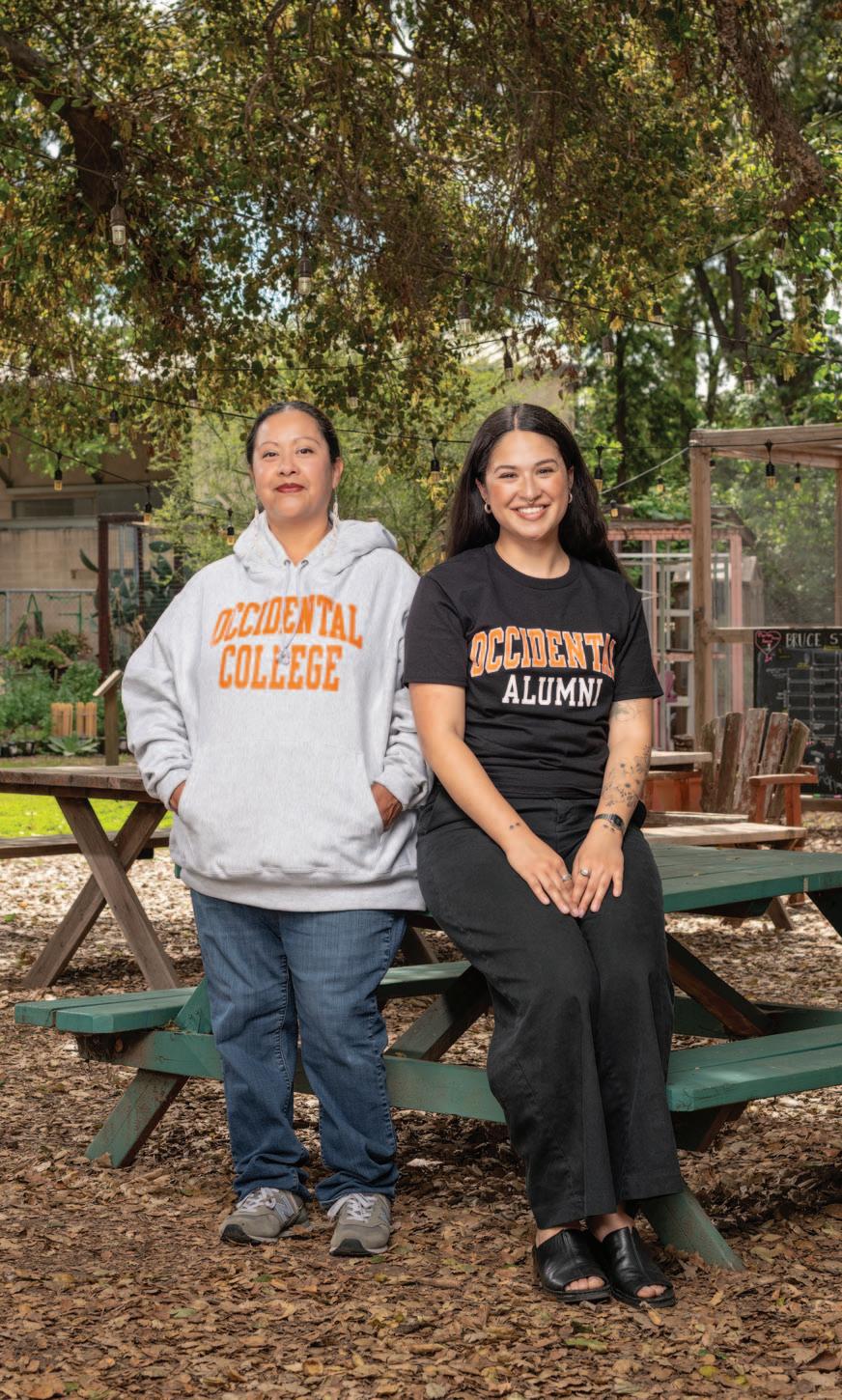
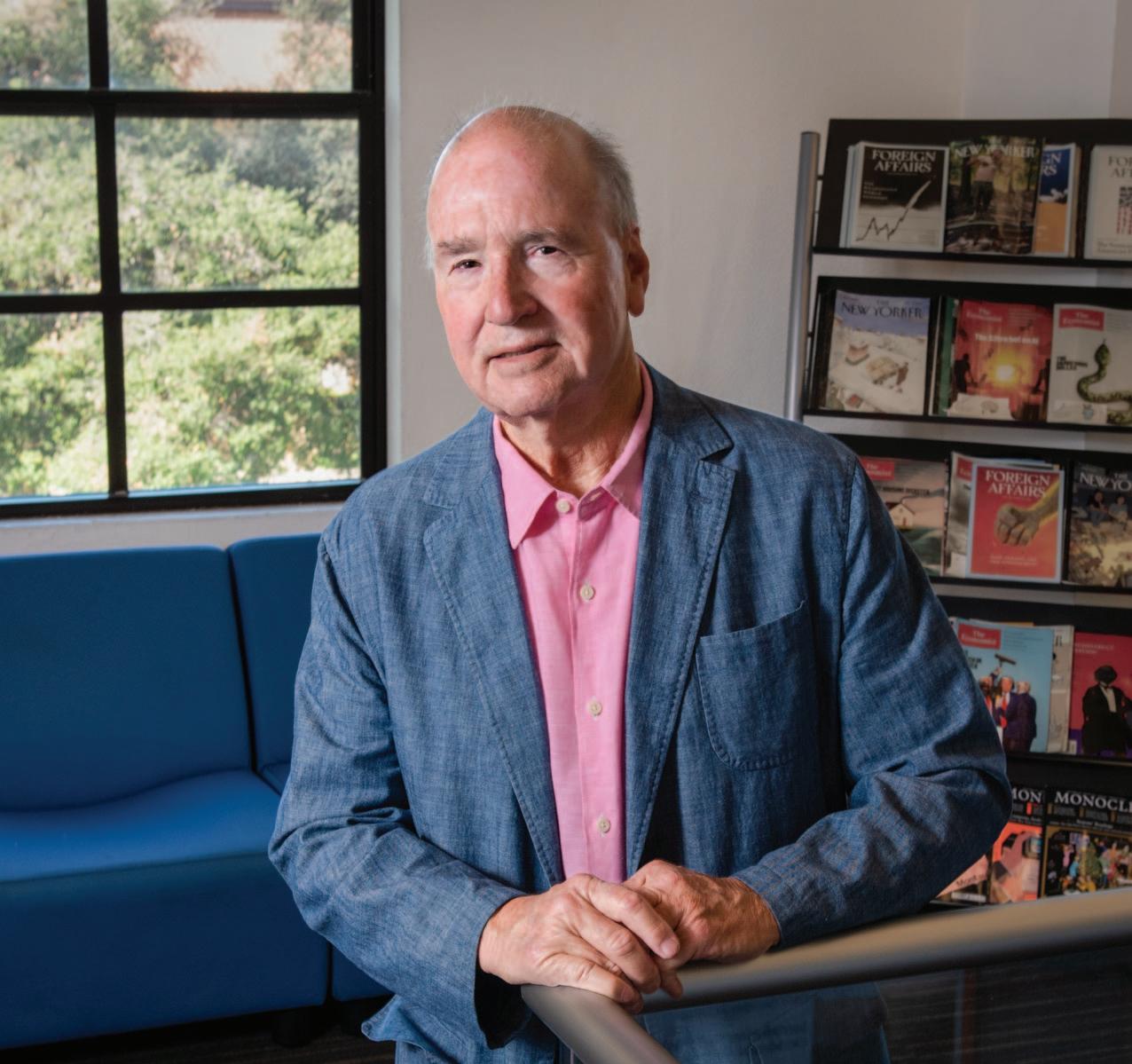
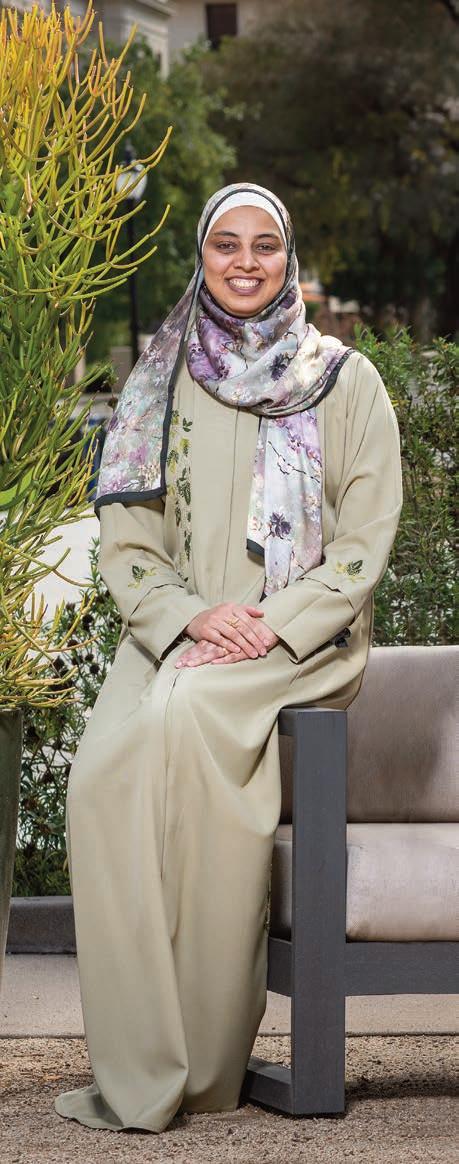
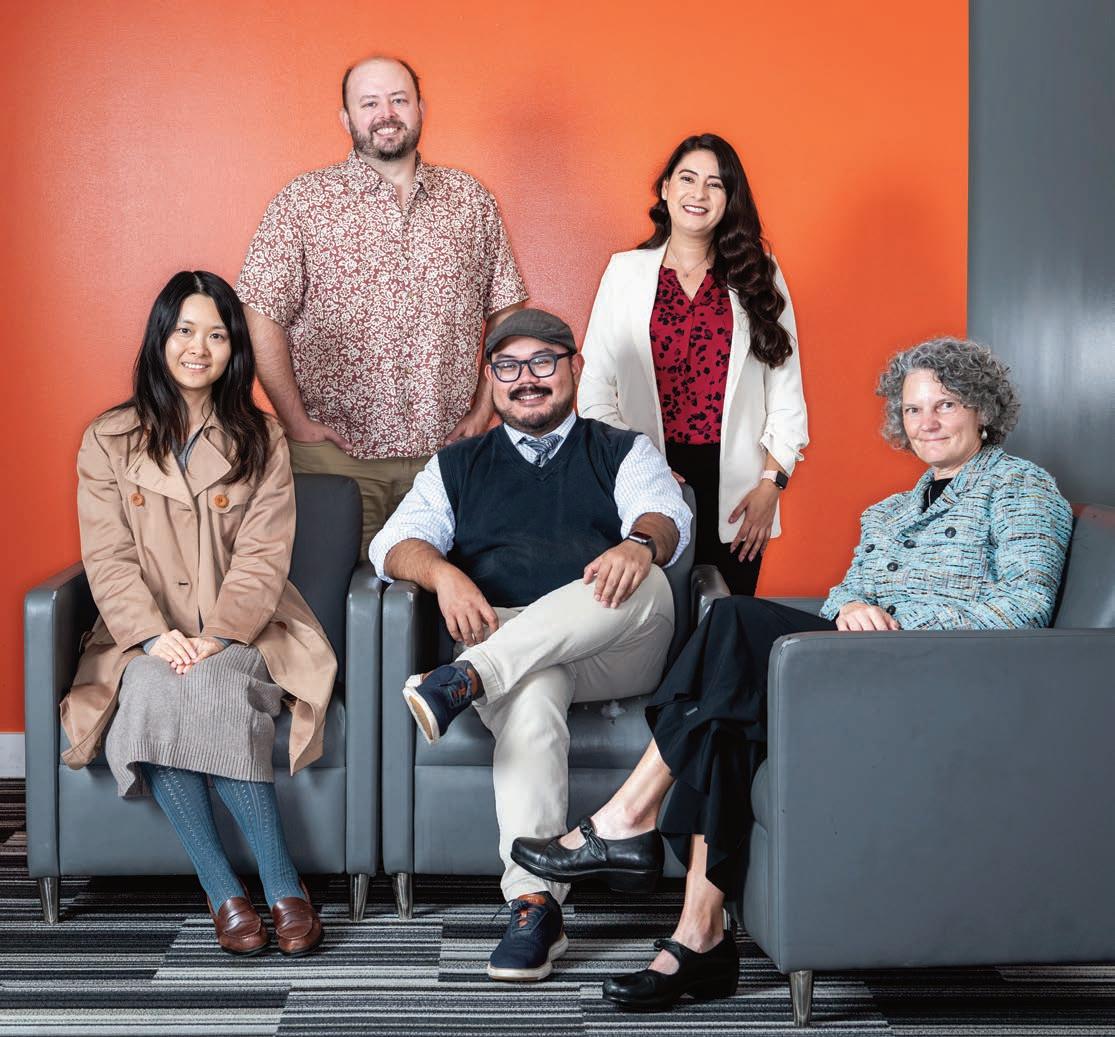
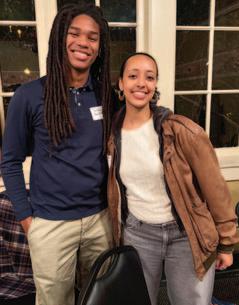
Celestina Castillo Executive Director Center for Community Based Learning
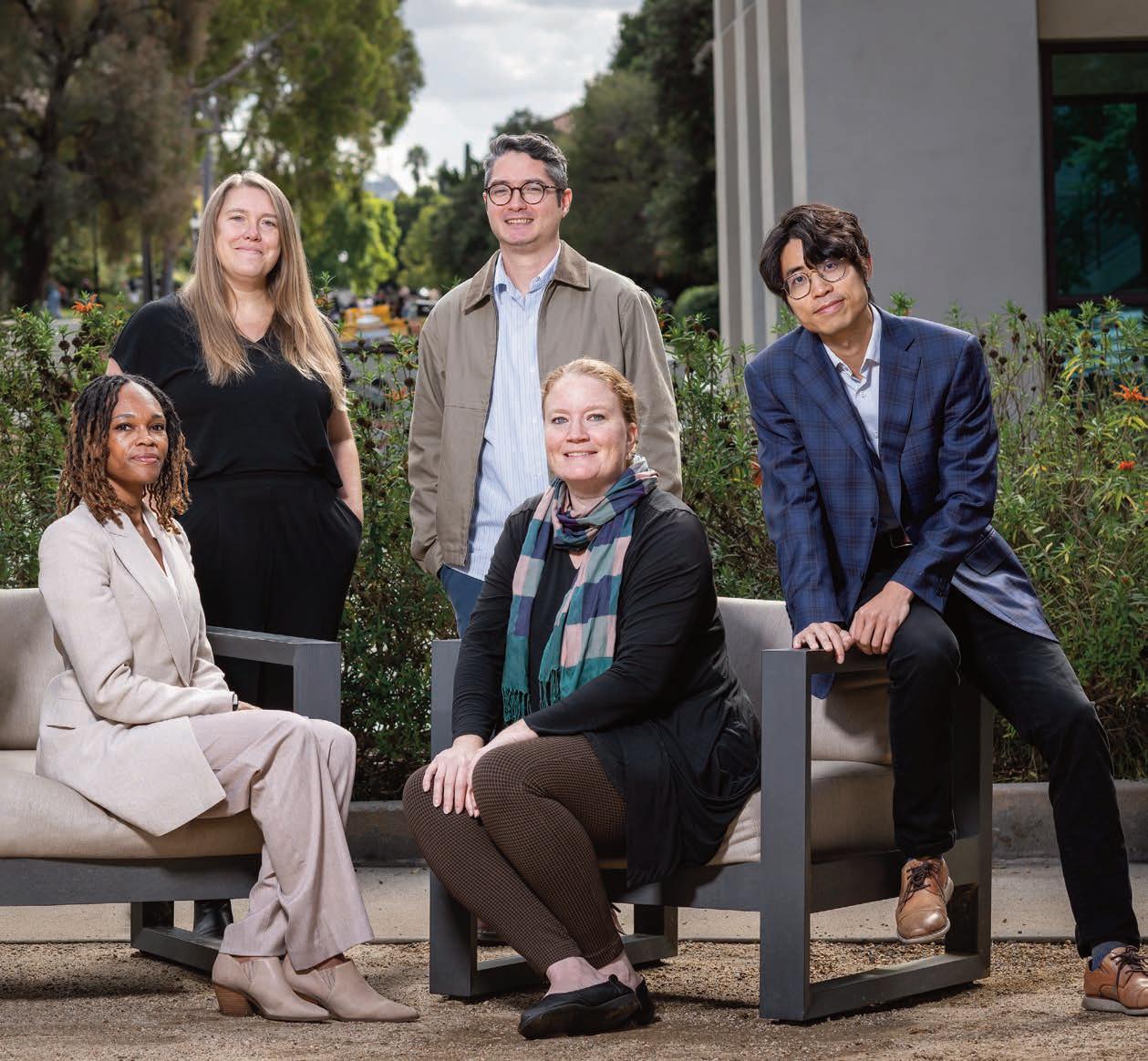
Kelsey Sablan Martin ’19 Assistant Director Center for Community Based Learning
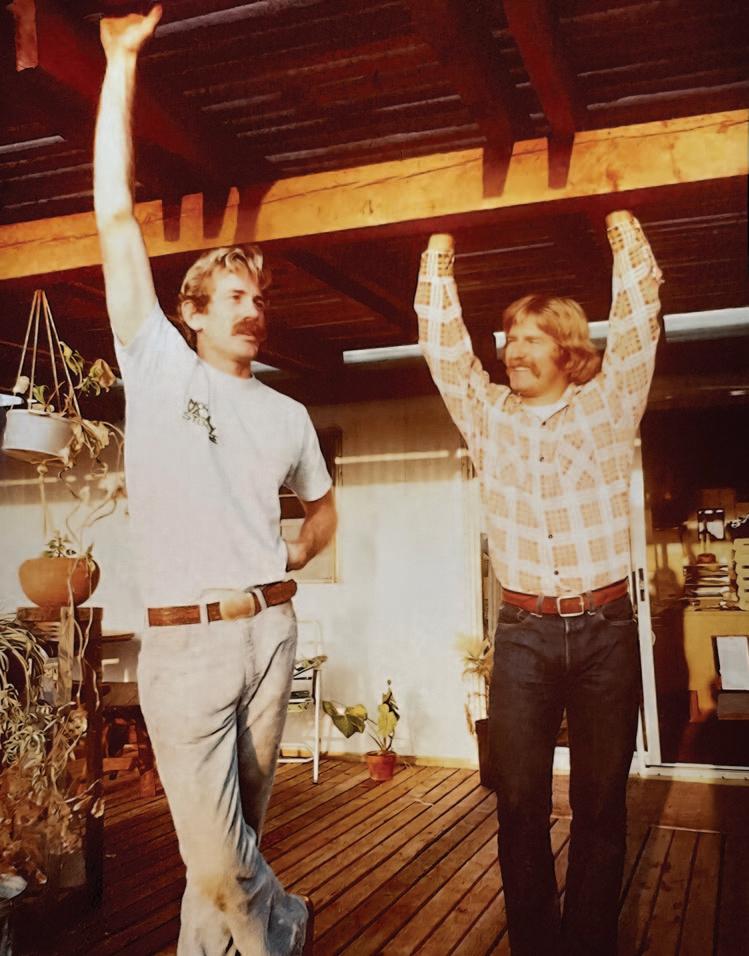
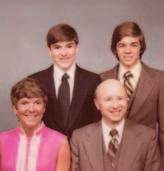
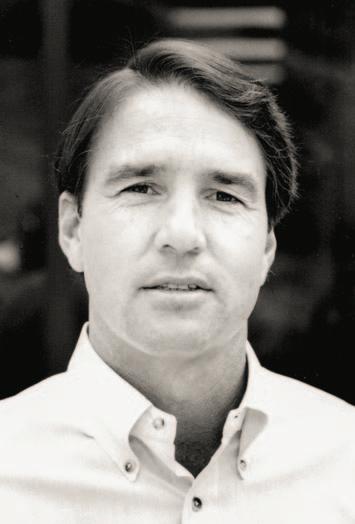
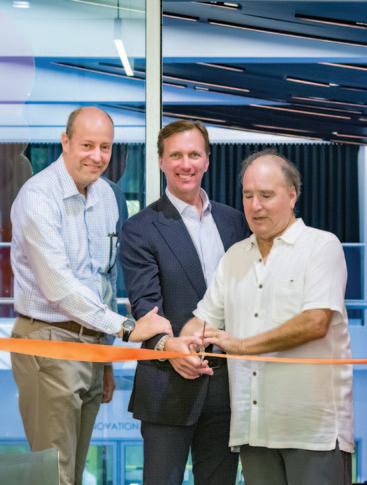
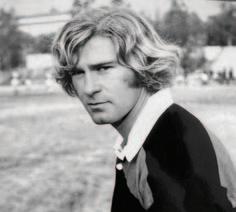
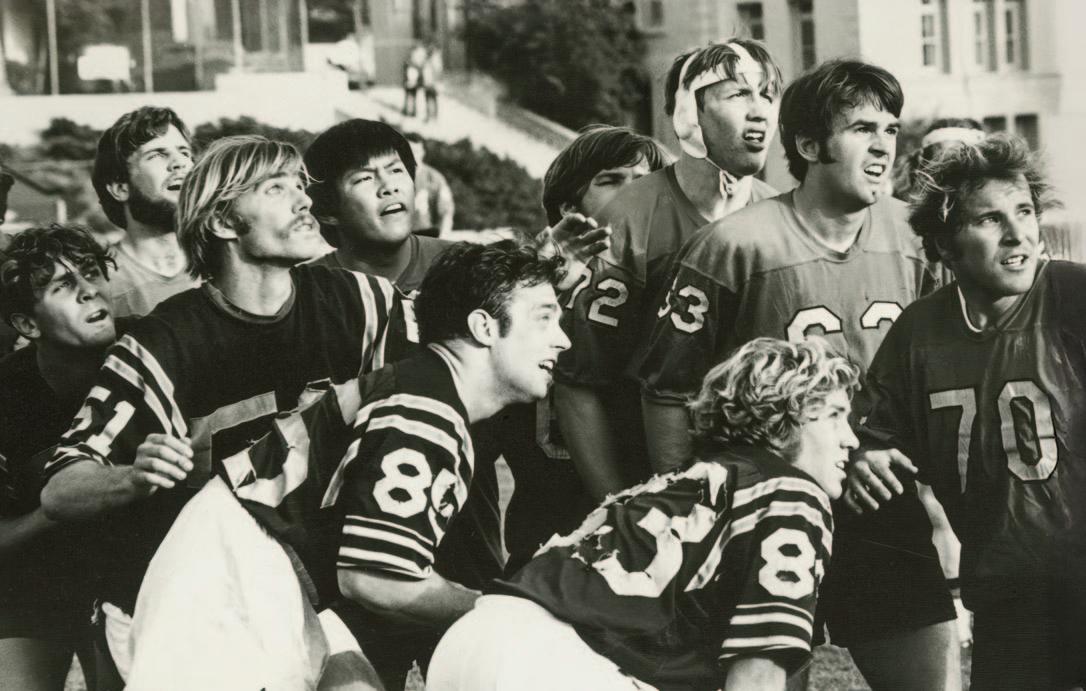
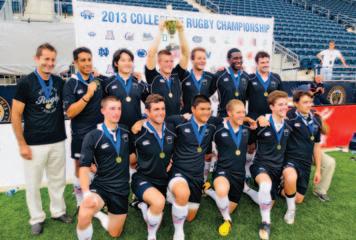
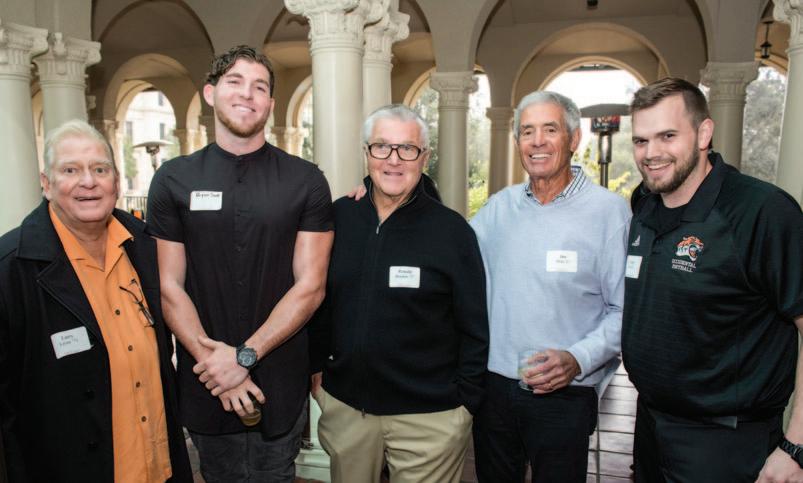
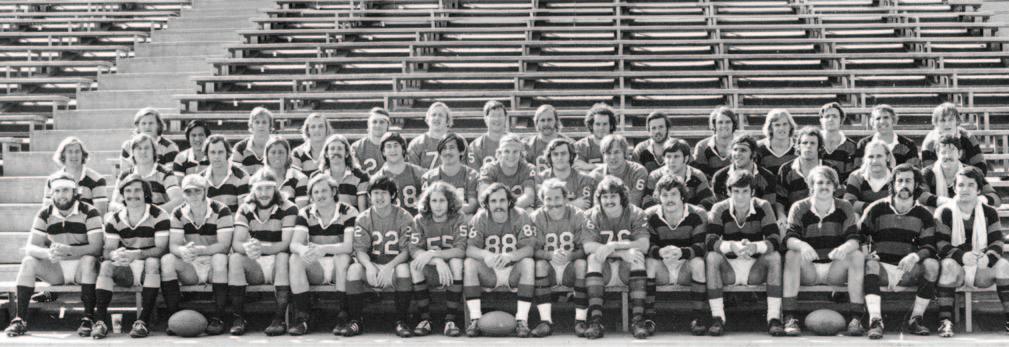
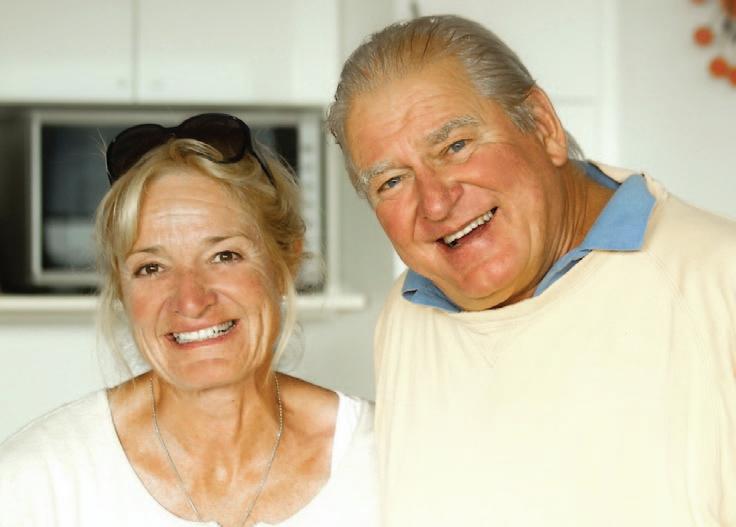
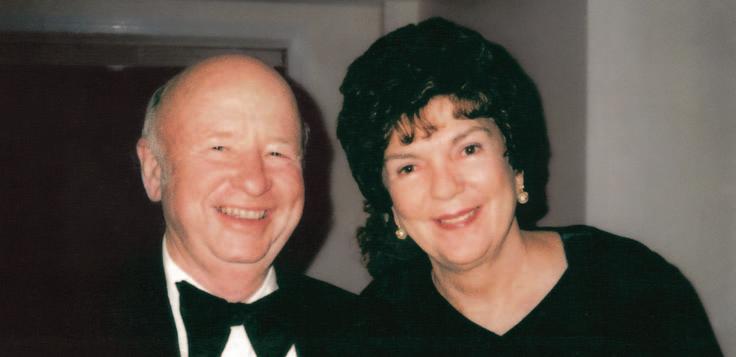
Dennis Crane ’72, left, and Larry Layne ’71 in 1977—“the days of playing rugby and building North Valley Storage,” recalls colleague Charlene Wright.
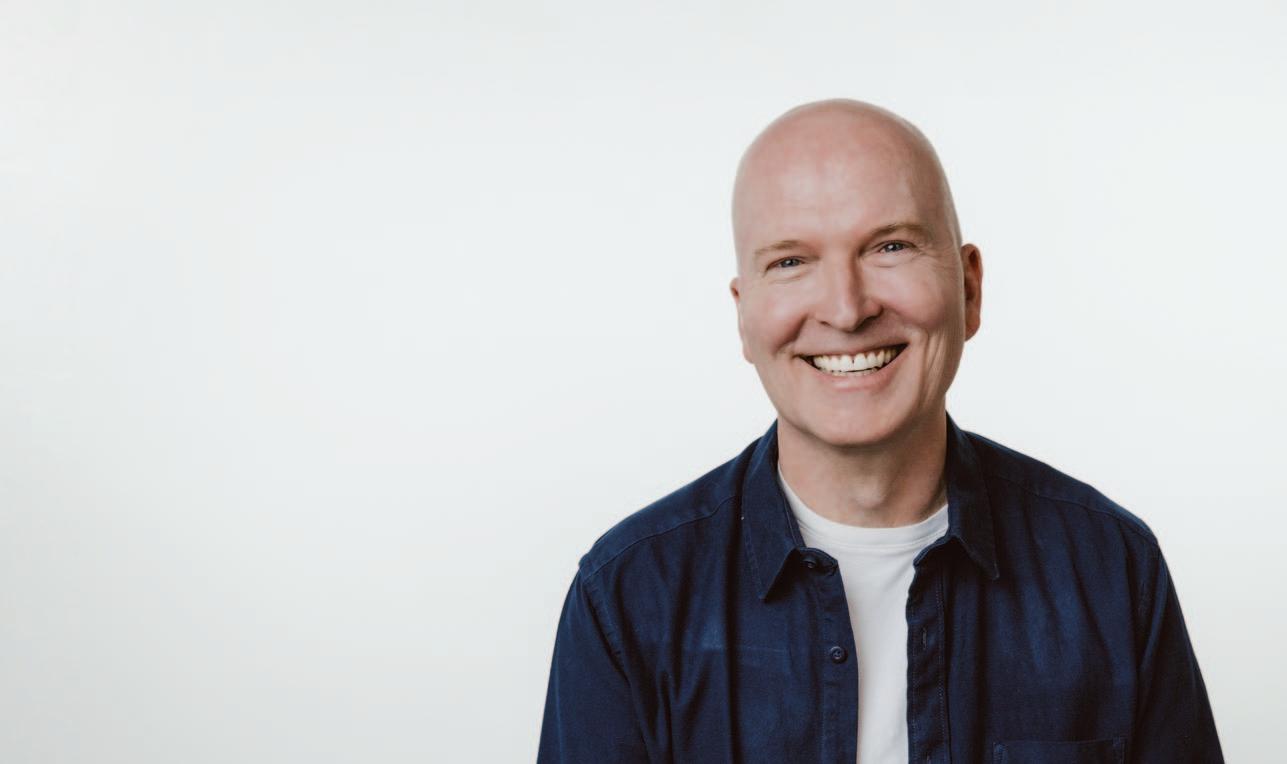
Stritikus on the power of community partners and shared purpose in preparing Oxy students to lead impactful lives beyond campus. Also: Isn’t that Steve Carell on campus?
the Quad Oxy punches a ticket to the Slamdance Film Festival; Supreme Court Justice Sonia Sotomayor speaks in Thorne Hall; CCBL marks its 25th year; and 10 student interns go inside the LA Phil.
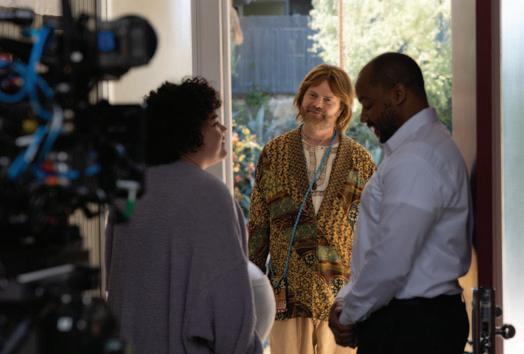
Thom Harp ’92, below, waited for years to direct his first movie— and after a long birthing process, he’s the proud father of two features.
Class notes, and a tribute to Steve Hinchliffe ’55.
10
The Ambassadude Abides
As a diplomat, dealmaker, and master connector, Derek Shearer brought global leaders, policymakers, and a U.S. president to the classroom over his 45 years at Oxy.
14
Theatre Brats
Two children of Oxy professors grew up immersed in the magic of Shakespeare, Shaw, and Gilbert & Sullivan —in an era when a plucky little drama festival became their whole world.
18
Out of the Foxhole
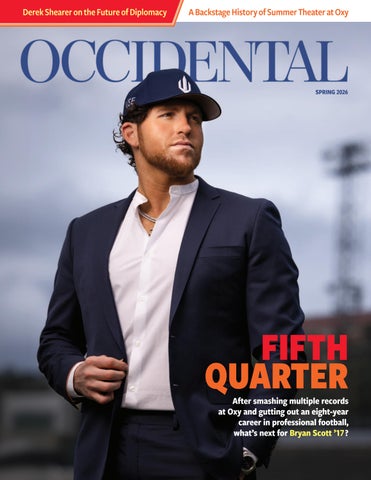
After smashing multiple records at Oxy and gutting out an eight-year career in professional football, what’s next for Bryan Scott ’17?
24
A scholarship gift from the Richard King Mellon Foundation honoring Shirley and Dale Morter ’56 will bring students from southwestern Pennsylvania to Oxy.
Pitch Perfect
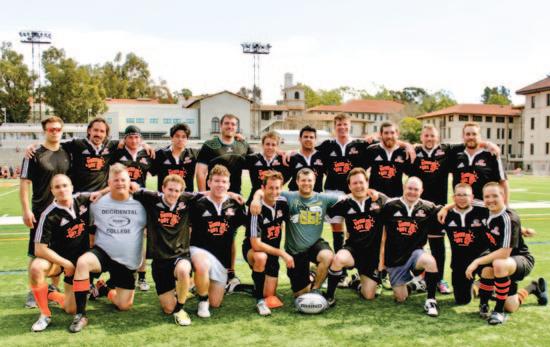
Larry Layne ’71 came to love rugby as a student-athlete—and an estate gift will provide a swift kick to its future at Oxy for generations to come.
28
16 Faculty, 16 Stories
Fifteen tenure-track faculty (and a veteran kinesiology professor) discuss their favorite classes, their passion for teaching, and what brought them to Oxy (Location!).
» FROM PRESIDENT STRITIKUS
Why Oxy’s Work Matters
In my daily interactions with students at Occidental—whether in class, at an event on campus, or walking across the Quad— I am continually reminded of the value of a liberal arts education. Despite the ongoing challenges facing higher education, an urban liberal arts college such as ours is a powerful model. It equips students with the skills, perspective, and adaptability needed to lead lives of purpose and make a meaningful impact in the world.
I see this manifest in the work we do every day at Oxy. This spring, we launched the Hollywood Bowl-Occidental College Internship Program (page 9), an exciting new partnership with the LA Phil that each summer will offer 10 Oxy students an exclusive opportunity to intern at three iconic L.A. venues: the Hollywood Bowl, Walt Disney Concert Hall, and The Ford.
As Jamila Chambers, executive director of the Hameetman Career Center, puts it, “This partnership is a powerful reflection of the Occidental Promise—where Oxy’s liberal arts education comes to life beyond
“Every time I speak with alumni, I’m struck by how deeply they care about the next generation of Tigers and the experiences at Oxy that shaped their own lives.”
the classroom, empowering students to integrate critical thinking, creativity, and real-world application at the highest level within the dynamic landscape of L.A.” Community support plays a crucial role in making opportunities like this possible. Every time I speak with alumni, I’m struck by how deeply they care about the next generation of Tigers and the experiences at Oxy that shaped their own lives. Their generosity helps ensure that our students can pursue opportunities from the field to the lab and everywhere in between.
On April 21, we celebrated our seventh annual Day For Oxy as Tigers from across the globe came together to support our students and invest in their futures. Every one of your contributions helps fuel the Occidental experience and strengthens the opportunities we can provide.
As the semester comes to a close, I look forward to senior comps and Commencement, two of my favorite traditions of the academic year. Watching our students share the culmination of their work and then cross the stage to begin the next chapter of their lives is a powerful reminder of why this work matters. It captures the very best of our students: their curiosity, dedication, and the promise of what comes next.
Together, we can continue to build a future worthy of that promise.
Tom Stritikus
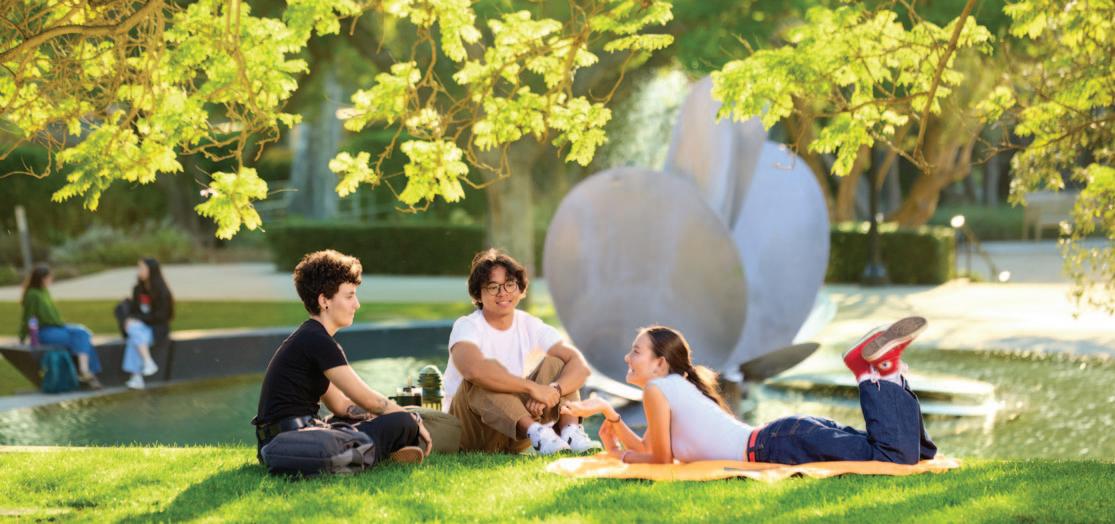
Occidental students relax near Lucille Gilman Fountain on an idyllic fall afternoon.
Photo by William Vasta
The Magic of Oxy
What a great article on Tammy Bird ’84 and her incredible dedication on behalf of her South L.A.-area high school students (“Catalyzing the Public Good,” Fall 2025). I can’t tell you how grateful I am to you in telling her story in the magazine. As I’m sure you are aware, it was the 1992 Rodney King incident and resulting neighborhood riots that brought Mike Hoover ’65 into the story.
Hoover was born missing a “fear gene.” At Oxy, he kept a few rattlesnakes in his dorm and allowed them to “exercise” in the evenings out of their cage! (Fortunately, I had no knowledge of this and would have slept in a car.) Adventure photography was his calling, and learning of Tammy introducing an outstanding science program in a primarily Black school immediately caught his attention.
What were the chances of Tammy, with her focus on providing a first-class multifaceted science experience for kids at three different high schools, joining world-renowned photographer-adventurer Hoover? And, both at Occidental? Magic. And the story goes on.
Ron Whitney ’64
Santa Rosa
Century Note
Congratulations to Dick Anderson on the publication of his 100th issue of Occidental magazine, which in typical fashion went unremarked in the Fall 2025 issue. Because Dick has been editor for 26 years—longer than anyone else in the magazine’s 106-year history, as far as I know—many readers may not realize the breadth and scope of his accomplishments.
But what is most impressive about his leadership is his willingness to report on campus controversies—the kind of articles not often seen in other alumni magazines. (Any USC alumnus can testify to this.) Dick’s insistence on giving readers a complete picture of Occidental is rare. Most college administrations won’t countenance it, and most editors won’t push for it. Dick is not most editors.
Jim Tranquada
Ventura
Tranquada was director of communications at Occidental from 2000-23.
I am writing to express the significant disappointment felt by me, many of my Delta Omicron Tau sisters and other non-Delta Oxy alumni I have talked with, regarding the placement of the articles “Change Comes to the Delta House” and “At 125, Alpha Sorority Gets a Glow-up” (Fall 2025).
ON LOCATION
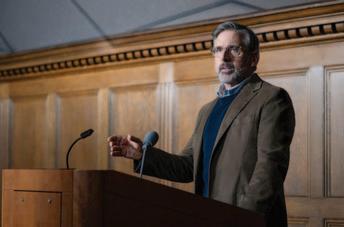
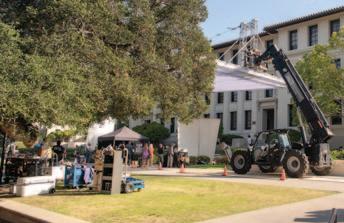
As anyone looking for a parking space on lower campus while the cameras are rolling could tell you, it’s been a busy year for film production at Occidental in the greatest burst of activity since the mid-’90s heyday of Beverly Hills, 90210. Recent productions include Rooster, the new HBO series starring Steve Carell as a visiting professor at the fictitious Ludlow College (where “Wisdom begins with wonder,” according to a banner on the Quad); The Shards, an adaptation of Bret Easton Ellis’ 2023 novel by prolific writer-producer Ryan Murphy, which premieres on FX in August; and the evergreen FX comedy It’s Always Sunny in Philadelphia, whose cast signed a life-sized cutout of Danny DeVito that’s on display in the Academic Commons.
Over the last 10 months, there have been 42 days of production activity on campus, according to Milena Warns, Oxy’s senior associate director of special events and projects. In addition to the aforementioned series, a number of national advertisers have filmed on campus, including Sprite, AT&T, Volkswagen, Chick-fil-A, and Liberty Mutual. And while Limu Emu and Doug were nowhere to be found, at least it’s always sunny at Occidental. » FROM THE READERS
The magazine Dick was hired to revive was a sad, thin tabloid-size survivor of major budget cuts. Dick turned it back into a real, four-color magazine filled with news, features, and striking photography and illustra tions that offered a whole new perspective on Oxy. Suddenly the Admission Office started using reprints of articles for recruitment; College fundraisers began using articles to support grant proposals; and the President’s Office put current issues on display for visitors.
Under Dick’s editorship, the magazine has won multiple regional and national awards.
Placing these two articles in the same edition—and especially following each other —was thoughtless and callous. For many Deltas, this article is the first they are hearing about the fate of their beloved 124-yearold Delta Omicron Tau sorority and its house. I applaud the success of the Alpha house renovation; however, the Delta article placement in the same issue and immediately after really drove the nail in the coffin.
As your article correctly showcases, the history and friendships fostered by Delta Omicron Tau extend far beyond the years spent at Oxy. These connections deserve to be honored with more consideration than was shown by this editorial decision.
Beth Kartub Raff ’82
Santa Ana
Deltas Deserved Better
Steve Carell, as best-selling novelist Greg Russo, takes to the Choi Auditorium stage in the sitcom Rooster, which debuted on HBO in March.
A Liberty Mutual ad shoot: O Limu, where art thou?
Photo by Don Milici
Photos by Patrick Wymore/HBO (Rooster) and Marc Campos (Liberty)
FROM THE QUAD
A Ticket to Slamdance
Oxy students and alumni find pathways into the Slamdance Film Festival, gaining industry exposure and experience following its move to Los Angeles
Despite living in Salt Lake City, Utah— an hour’s drive from the birthplace of the Slamdance Film Festival, the upstart alternative to the older and better-heeled Sundance—“I had never heard of Slamdance,” says Max Brown ’25, who majored in media arts and culture (MAC) at Oxy. “Sundance was on my radar, but I didn’t experience it much—festival passes were so expensive.”
Brown enrolled at Oxy in fall 2021 after deferring his admission for a year during the pandemic. During his gap year, he worked as a ski instructor in Utah and for the family business as a guide, taking tourists down the Colorado River through the Grand Canyon.
He connected with Slamdance President and co-founder Peter Baxter through his river guiding job in what might be described as one degree of separation. In the summer of 2023, Brown says, “I was taking somebody down the river who asked me what I wanted to do with my life.” (His passenger was Marlon Robbins, who at the time was dating Baxter’s daughter.) “I told him that I wanted to be a filmmaker, and he said, ‘I know somebody who could be very helpful for you.’ Then he gave me Peter’s contact information.”
Meeting over coffee at a cafe in Silver Lake that fall, “Max started asking me all kinds of questions about filmmaking, and he started speaking about the faculty here and what he was doing at Oxy,” Baxter recalls. “One thing led to another, and I eventually said to Max, ‘Why don’t you think about working at the festival as an intern?’ ”
In January 2024, Brown and a couple of fellow MAC majors drove out to Utah for the festival to work as assistants. (“We informally represented Occidental that year,” he says.) Months later, Slamdance announced that the festival was moving from Park City to Los
Angeles, and Occidental became one of its first community partners in L.A.
“Peter told me they had been thinking about the move for a long time,” says Brown, who worked as an executive assistant leading up to and during the 2025 festival. Last year, Slamdance enlisted 16 interns through its partnership with Oxy, in addition to Brown and another student, for a total of 18 Tigers.
“It was very cool going from working at the festival’s last year in Utah to starting the first year in L.A. with this partnership,” says Brown, whose senior comps film, The Taxidermy of Man, screened at the TCL Chinese Theatre in Hollywood on February 27 during the Golden State Film Festival. “Slamdance and Occidental really came together because of right place, right time in so many ways.”
“To support the next generation of filmmakers is part of what Slamdance does, but it can also do it through showing how a festival works,” Baxter says. “Oxy is front and center of that. It’s a beautiful thing.”
Slamdance’s L.A. headquarters on Melrose Avenue is nothing fancy. “It’s a funky space that has really high ceilings, three separate rooms, and some cool old festival posters,” says Lizzie Friedrich ’25, who started working for Slamdance as a creative assistant prior to her senior year. She was quickly promoted to production coordinator, then festival coordinator, and most recently festival producer.
Prior to the Slamdance-Oxy partnership, she says, “I had no idea how a film festival even worked. I was drawn to Slamdance initially because I was trying to keep our film club, Studio 1600, together.”
Friedrich likens her work to being the “connective tissue” between departments, even taking on some of the festival director’s responsibilities in their absence. “I’ve learned a lot about working with sponsors, but I’m more on the production side. Today, we’re going to check out the venues, pick up filmmaker bags, and deal with run-of-show and signage. There’s a lot of stuff.”
Friedrich also had a hand in hiring classmates and 2025 festival interns Lily Calvert and Hayden Jennings for the 2026 festival, which ran from February 19 to March 6.
“Max Brown and I were in the same comps group,” Calvert recalls, “and he and Lizzie encouraged me to intern at Slamdance last year. At the time, I was deep in comps mode, but I went and met all these awesome filmmakers. I wound up working in projection, so I got to watch a lot of films.”
Coming off a summer of “soul-crushing” work as a production assistant on a reality TV show, Calvert joined the Slamdance team last November as social media and digital content manager. Among their many tasks, they build individual web pages for the festival’s themed activities, such as Writers’ Day
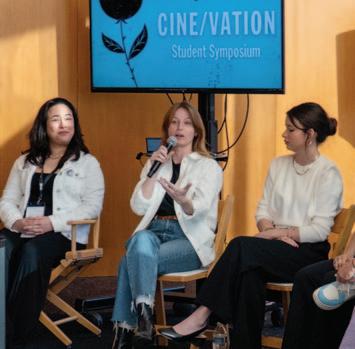
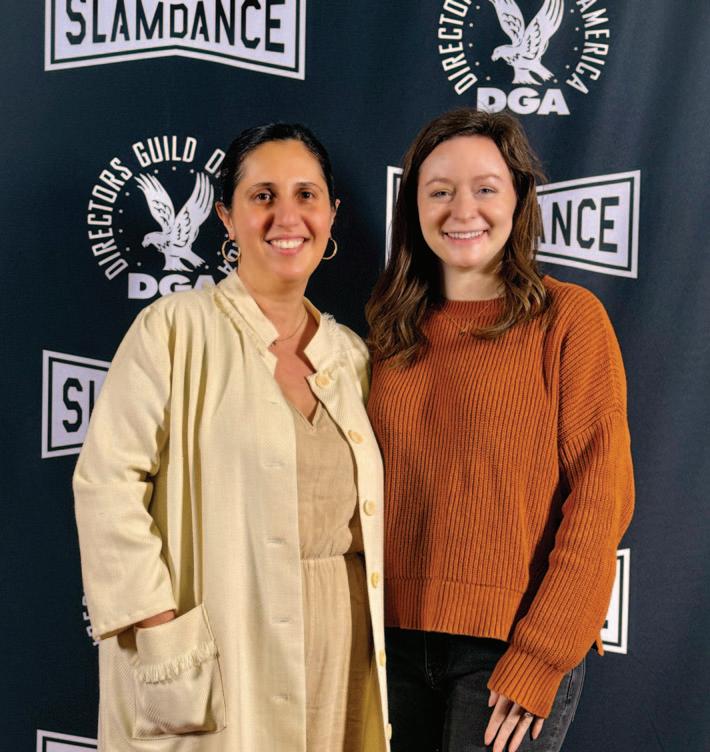
above: Diana Keeler ’09, left, Occidental’s director of digital media and production, moderates a Cine\Vation Student Symposium on February 22 at the Directors Guild of America.
and Market Monday, while making sure that the “shopfront window,” as Baxter calls the landing page, contains all the information that patrons need and is easily accessible. Calvert also is in charge of managing the content for the virtual festival—141 films in all—which runs the week after the festival.
Among the festival’s more than 10,000 attendees in 2025 were VIPs such as Bob Weir and Richard Kind. “I was on VIP relations for one day last year, and I got to walk around with George Takei and his husband, which was really exciting,” Calvert says.
That accessibility to filmmakers and filmgoers alike adds to the festival’s low-key charm. “There are no barriers at Slamdance,” Jennings says. “You can chat with the person whose film you just watched.”
Having done social media content for Oxy’s Marketing and Communications and Admission offices, Jennings jumped at Baxter’s offer to do public relations and marketing for Slamdance—dealing with publicists and the media, as well as organizing a symposium panel for college students moderated by Diana Keeler ’09, Occidental’s director of digital media and production. “Working with Peter is like having one of your college professors as your boss,” Jennings says. “It’s rare to find someone like him in the industry.”
“Last year during the festival, I didn’t really talk to Peter much, but I very distinctly remember getting our checks, and he had handwritten us all thank-you notes,” Calvert adds. “That stuck with me.”
Nineteen Oxy students, including four returning seniors from the 2025 festival, worked at Slamdance this year. The internships are open to all majors who might be interested in careers related to the film industry. Every student in Oxy’s Theater and Performance Studies Department, for instance, has to take theater tech classes. “They all have tech experience that translates directly to what we do,” Jennings says.
Looking beyond Slamdance, “I want to be a screenwriter,” Jennings says—he wrote a TV pilot and a pitch for his senior comps— “and I want to keep exploring PR in the film world.” He’s also producing a feature film with a number of Oxy friends: “It’s a big undertaking but we all want the skills to produce our own stuff on the side and be like these Slamdance filmmakers.”
“My senior comps was a documentary, and I did a couple of docs through Oxy’s Undergraduate Research Center,” Calvert says. “To make documentaries for a living would be the dream. Until then, I’ll continue doing social media—that’s what pays the bills.”
“I’m entering the vortex again,” Anahid Yahjian ’11 says in late January, describing the imminent arrival of her second child (a baby girl, born days later) and mere weeks before her latest short film, Domestic Demon, had its world premiere at the International Film Festival Rotterdam in the Netherlands, followed by its North American debut at Slamdance on February 20.
After her first child turned 1, Yahjian (who directs narrative, documentary, experimental, and branded films and content under her production company Medulla Creative) stepped away from filmmaking entirely for a year. The pause was partly practical—she wanted to be present with her son—but it was also exploratory. “I started doing more community-based social justice activities in my neighborhood,” she says. “I also participated in multiple oral storytelling events where you just get up and tell a story. I couldn’t believe how satisfying that was— and quick compared to making a film.”
By the beginning of 2024, “As we were contemplating having another kid, I said, ‘Before I do that, I want to get back into the field,’” Yahjian recalls. In her absence, the film industry had shifted dramatically. The
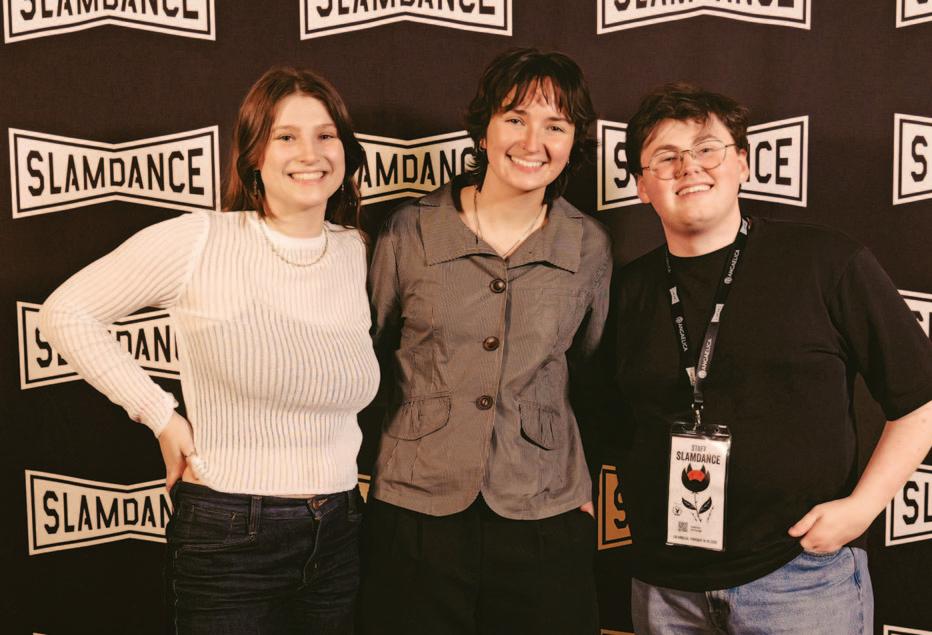
left: From left, Lizzie Friedrich ’25, Lily Calvert ’25, and Hayden Jennings ’25 share a red-carpet moment during the 2026 Slamdance Film Festival.
below, l-r: Vidar Hondorf ’24, Jacki Jackman ’24, and Max Brown ’25 at the 2024 festival in Park City, Utah.
Photos courtesy Lizzie Friedrich ’25 and Max Brown ’25
aftershocks of the pandemic, the writers’ and actors’ strikes, and the contraction of the streaming boom had reshaped the landscape.
“I felt like a person who’d been hiding in a bunker and comes out years later to a changed world,” Yahjian says. “That took me months to process and grieve.” In response, she decided, “I had to carve a new place for myself. It felt like going back to the beginning in many ways.”
Yahjian majored in English and comparative literary studies at Oxy, with a minor in art history and visual arts and a concentration in creative writing. “To this day, those three things represent my creative interests,” she says. “I still use the same interdisciplinary liberal arts approach in everything I do.”
Domestic Demon began without a script, a crew, or even a clear plan. “It took me a second to put my brain back in film mode,” Yahjian recalls. “I had a series of images in my head that started to accrue as I wrote them down on my phone. They were all built
around the space I had been existing in as a new mom—my house and my neighborhood —and the ways in which this place had become my sanctuary and my prison.”
She reached out to her friend and longtime collaborator, cinematographer Lauren Guiteras, with a simple idea: “Let’s just make something. At my house.” The two of them shot the film entirely in Yahjian’s Glendale home and surroundings, working loosely from her shot list while improvising along the way.
One day they focused on macro textures —close, abstracted images that distort the familiar—and another on shadows, silhouettes, and movement. Many images were discovered in the moment; a dead bird on the driveway became part of the film. So did soap bubbles, light patterns, and the surfaces of domestic life.
“Ever since I was a child, I’ve been a person who sees magic and wonder and strangeness all around me all the time,” Yahjian says. That sensibility, combined with clear
influences—David Lynch most notably— shapes the film’s tone. The suburban setting, with its manicured calm, becomes a site of unease, echoing Yahjian’s long-standing fascination with what lies beneath the surface of American domestic life.
Months after shooting, Yahjian wrote a poetic narrative for the film, eventually distilling it down to 10 lines, which became the skeleton for the edit. The narration is in Western Armenian, her native dialect, which is considered endangered by UNESCO. “This is the language that I was mothered in,” she says, “and the one that I am mothering my kid in.”
At its core, Domestic Demon is about the long, ongoing transformation of motherhood, sometimes referred to as matrescence. It draws on Yahjian’s own experience of postpartum depression, as well as the isolating conditions of becoming a parent during the lockdown. Viewers have found connections to their own experiences of isolation, identity, and change. For Yahjian, that openness is part of the point: Four years into parenthood, “I still feel like I’m changing.”
Yahjian worked with Portland, Ore.-based editor Emily Cargill, who also was a new mother, to assemble the six-minute short in time for festival submissions. Another firsttime mom, Rotterdam programmer Cristina Kolozsváry-Kiss, invited the film to premiere in the Tiger Short competition a few months later. (She calls Yahjian’s film “a visual poem about the alienation of postpartum.”)
Even as Domestic Demon began its festival life, Yahjian was already at work on her next project. Based on an experience she had while living in Armenia post-Oxy, Nelly follows two Armenian American women who intervene in a violent encounter and are forced to confront their own assumptions. The three-day shoot took place once again at her home, with a cast and crew of more than 30—a marked contrast to Domestic Demon’s minimalist production. But this time, she was eight months pregnant.
In anticipation of the birth of her second child, Yahjian says, “We’re prepared for another round of postpartum depression, but every pregnancy is different. Every child is different. It’s just another transformation.
“At this stage, it’s clear that I’ve made my best work in the midst of being a parent,” she adds. “That’s a really special thing. So I’m excited by what it may bring, even if it’s a little Lynchian.”—DICK ANDERSON
Anahid Yahjian ’11, left—writer, director, producer, and star of Domestic Demon—with editor Emily Cargill at the film’s domestic premiere screening at the Slamdance Film Festival on February 20.
Photo by Broderick Fox
Weaving Community Into Curriculum
Working with faculty across the academic spectrum, Occidental’s Center for Community-Based
Learning has become part of the institutional fabric
Growing up in Highland Park, “Occidental has always been part of my life,” Celestina Castillo says. Her mother participated in the College’s Upward Bound program in the 1970s, and in her five years (2003-08) of working at the nonprofit Los Angeles County Children’s Planning Council, Castillo collaborated with Occidental’s Center for Community-Based Learning (CCBL) on educational organizing efforts in Northeast Los Angeles.
Founded in November 2001 by a group of Oxy faculty and then-President Ted Mitchell, CCBL was designed to build longterm, reciprocal partnerships with community organizations, with faculty embedding community engagement into the curriculum.
The program steadily grew under the leadership of founding director Maria Avila, and when the assistant director position at CCBL opened in 2009, colleagues encouraged Castillo to apply. Following Avila’s departure, Castillo served as director from 2013 to 2020, when she left Oxy to pursue a Ph.D. in gender studies at UCLA. She returned to Oxy as CCBL’s executive director in 2023.
Kelsey Sablan Martin ’19 was raised in Beaverton, Ore., and graduated with a sociology degree from Oxy but jokes that she “majored in CCBL.” After completing her studies, Sablan Martin worked at Whitman College helping to build a community-engaged learning initiative. Drawing on her CHamoru identity and the Indigenous feminist framework she encountered at CCBL, she later completed a master’s degree in Indigenous education at the University of British Columbia. At the start of 2025, Sablan Martin reconnected with her mentor as CCBL’s assistant director. When she learned of the opening, returning to Oxy felt like a calling, she says: “I couldn’t be prouder to be back in this office doing the work that we do.”
Community-based learning at Oxy does not follow a single template. When new faculty arrive, CCBL meets them where they are. The office helps identify potential part-
ners, facilitates introductions, assists with budgeting and transportation logistics, and offers project support funding. Community partners receive honoraria for their time and expertise.
Central to many courses is the Education in Action (EIA) program. About 20 student facilitators each semester provide leadership and logistical coordination. In ARTS 100, the Arts Education Practicum, Oxy students teach art workshops to local youth at Oxy Arts. The course often includes partnerships with organizations like Heart of Los Angeles.
In POLS 253, Theorizing Membership and Migration, students of Associate Professor of Politics Kai Yui Samuel Chan explore citizenship, borders, and diaspora. Recently, they partnered with Immigo L.A., creating short videos to help community members prepare for their citizenship test.
Professor of Economics Bevin Ashenmiller’s Sustainability Lab (ECON 201) offers another model. Students operate a campus thrift store, Touchdown Thrift, learning firsthand about sustainable business practices. The course draws on partnerships with organizations such as Remainders Creative Reuse in Pasadena and Suay, a textile recycling leader.
For years, much of CCBL’s labor remained invisible. That has begun to change, however, as community-based learning has become increasingly central to the College’s identity. Sablan Martin has noticed the shift, especially compared to other institutions. “If a new faculty member comes in now, they know this is part of the norm,” she says. Policies supporting tenure and promotion make it possible to integrate community engagement deeply into academic life.
That institutional commitment has paid dividends for Oxy. The College first earned the Carnegie Foundation for the Advancement of Teaching’s Carnegie elective classification for community engagement in 2008 and was reclassified most recently in January. Since the 2015 review, the number of community-engaged courses and participating students has more than doubled.
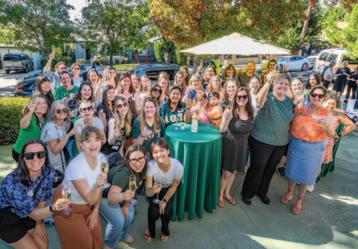
As CCBL observes its 25th anniversary this year, the office is planning alumni gatherings and celebratory events. The guest list could get crowded: Hundreds of students have participated directly through EIA roles, and many more through coursework. “There have been bumps along the way,” Castillo says, “but I think CCBL has gotten deeper into the culture of the institution.”
Three Judicial Trailblazers
U.S.
Supreme Court Justice Sonia Sotomayor and California legal powerhouses
Patricia Guerrero and Mary Murguia reflect on their heritage and resilience
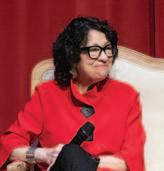
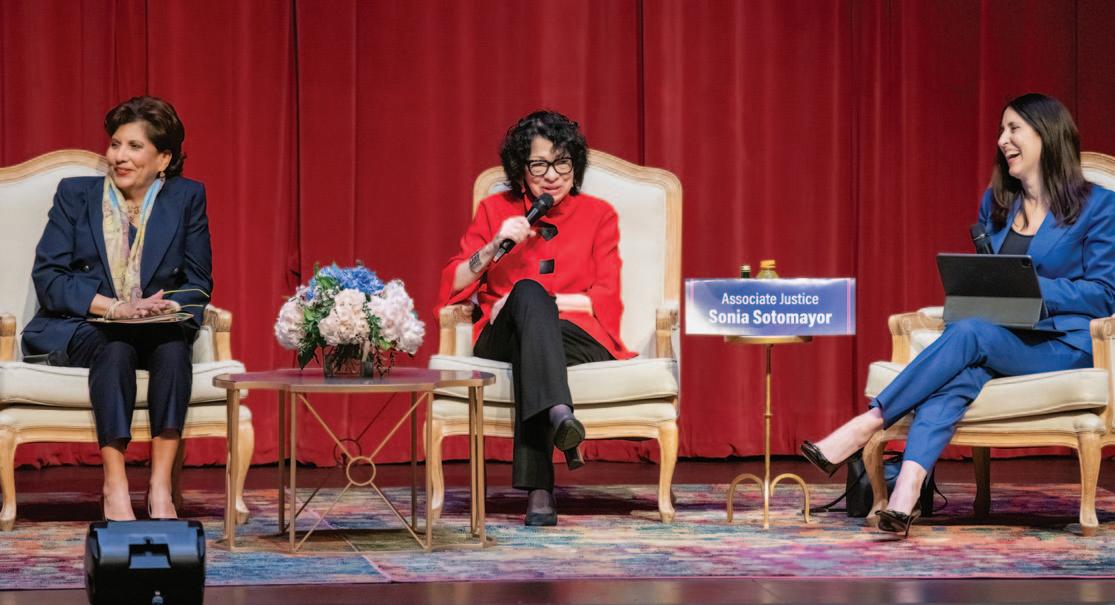
Occidental College hosted three Latina pioneers in the judiciary—U.S. Supreme Court Justice Sonia Sotomayor, who was nominated by President Barack Obama ’83 to the nation’s highest court in 2009; Patricia Guerrero, chief justice of the Supreme Court of California since 2023; and Mary Murguia, chief judge of the U.S. Ninth Circuit Court of Appeals since 2021—for a wide-ranging discussion on heritage, education, and public service on February 6 in Thorne Hall.
California Supreme Court Associate Justice Kelli M. Evans served as moderator for the event, sharing the Thorne Hall stage on her birthday with “three of my personal heroes and role models,” she said. (Likewise, Chief Justice Guerrero turned to Justice Sotomayor and said, “I’m pinching myself sitting next to you.”)
Presented by the California Unity Bar, much of the nearly 90-minute conversation
focused on the justices’ shared Latino backgrounds, their paths to the bench, and the challenges and rewards of judicial service. A recurring theme was the transformative power of education. “Education was the key to all success in America,” Justice Sotomayor said. “With education, you can do anything you want in this country.”
The daughter of Mexican immigrants, Chief Justice Guerrero was born and raised in California’s Imperial Valley. Her father, who had a fifth-grade education, found steady work as a cowboy at a feed lot—“I think I would’ve been a cowgirl if it had been up to him,” she noted with a smile. From her mother, Chief Justice Guerrero said, “I learned I had self-confidence. I also learned the importance of helping other people.”
Chief Judge Murguia reflected on parents who endured hardship, discrimination, and physically demanding labor, yet emphasized
above: Chief Judge Murguia, Justice Sotomayor, and Chief Justice Guerrero discussed their shared Latino backgrounds, their paths to the bench, and the challenges and rewards of judicial service.
education and perseverance. Her father left school after eighth grade and worked in a steel plant, while her mother lost her own mother at a young age. Despite being told where they could sit or which bathrooms they could use, the family emphasized resilience. “The sun shines for everyone,” her father told his children, six of whom went on to earn postsecondary degrees, including law degrees.
Describing herself as a “proud Nuyorican,” Justice Sotomayor recalled that her family was part of the first wave of Puerto Rican migration to New York in the 1940s. Her mother served in the Women’s Army Corps during World War II and later became a practical nurse, while her father had only a sixth-grade education.
Photo by Marc Campos
Justice Sotomayor described her family as “very proud Americans,” adding that her Puerto Rican heritage remains central to her identity.
Addressing the students in the audience directly, Justice Sotomayor emphasized that the nation’s story is unfinished. “Know that you have a role,” she said, urging young people to aspire to positions of leadership and service, including the Supreme Court itself.
In discussing the challenges she has faced throughout her career, Justice Sotomayor recounted the intense scrutiny surrounding her Supreme Court nomination. “It took a friend who came up to me and said, ‘Sonia, this is not about you—get over yourself. This is about my 8-year-old Puerto Rican daughter who needs to see someone on that court that looks like her.’
“Life has a lot of potholes,” Justice Sotomayor added. “Each time you fall into one you climb out and do it again.”
In a lighter moment, Justice Evans asked each jurist what their dream job would be outside the judiciary. “I’ve wanted to be a lawyer and a judge since I was 10, but I think being baseball commissioner would be cool,” Justice Sotomayor—a die-hard New York Yankees fan—said to laughter.
Chief Justice Guerrero replied, “I would want to be an elementary school teacher,” specifically teaching third or fifth grade, while Chief Judge Murguia admitted, “If I could sing, I would be a Broadway music star.” (“She has a nice voice,” Justice Sotomayor told the audience.)
In closing, Justice Evans asked the justices how people can remain hopeful during “an inflection point” in the nation. The last word was left to Justice Sotomayor, who responded with a question to the audience: “What choice do you have?” With so many problems in the world, she said, each person must choose one that feels personal. “There’s a problem that has your name on it that you can fix,” she said. “If we all care deeply enough, we can change things.”
The event marked just the third time in Thorne Hall’s 88-year history that Occidental College has hosted a Supreme Court justice. In February 1949, Associate Justice William O. Douglas delivered three talks on campus as part of the inaugural Remsen D. Bird Lectureships. In January 1971, retired Chief Justice Earl Warren spoke at Opening Convocation in Thorne Hall.
Summer With the LA Phil
A donor-funded 10-week internship program will take 10 Oxy students inside the operations of the LA Phil
This summer, 10 Occidental students will get an exclusive opportunity to work behind the scenes of the Hollywood Bowl, Walt Disney Concert Hall, or The Ford—taking on meaningful projects, receiving mentorship from industry professionals, and immersing themselves in the creativity and excellence of the LA Phil.
Funded by an anonymous donor to Oxy, the Hollywood Bowl-Occidental College Internship Program will offer participants the chance to explore career pathways across 10 high-impact sectors, including philanthropy, programs, marketing, social media, data and evaluation, production, and management.
“By welcoming Occidental students into our venues and our teams, we’re investing in the next generation of creative leaders with hands-on learning that demystifies how a cultural institution operates—from artistic programming to audience engagement and production,” says Meghan Umber, president of the Hollywood Bowl and chief programming officer for the LA Phil. “We’re excited to support students as they experience firsthand the collaborative spirit that drives our work.”
“This partnership is a powerful reflection of the Occidental Promise—where Oxy’s liberal arts education comes to life beyond the classroom, empowering students to integrate critical thinking, creativity, and real-
world application at the highest level within the dynamic landscape of Los Angeles,” says Hameetman Career Center Executive Director Jamila Chambers. “Through these internships, Oxy students will not only explore potential career pathways but also deepen their sense of purpose, access, and possibility in one of the world’s most creative cities.”
Open to students from any major, the program will fully fund participants’ living expenses and provide a stipend, ensuring that this transformative opportunity is accessible to all. The inaugural cohort of interns will be announced in May.
The Hollywood Bowl-Occidental College partnership builds on Oxy’s expanding opportunities for students to engage with the music business industry. Following the 2024 launch of the John Branca Institute of Music, the College—recognized by Billboard as a top music business school—recently welcomed renowned producer Michael Lloyd as the inaugural Linda and Mike Curb Visiting Fellow and will introduce three new music business courses this fall.
This new program will add to the breadth of funded summer internships available to Occidental students, including InternLA, the Undergraduate Research Center’s Summer Research Program, and the recently expanded Justice Summer Program.
Photo by Timothy Norris
Amba ssadude Abides The
As a diplomat, dealmaker, and master connector, Derek Shearer brought global leaders, policymakers, and a U.S. president to the classroom over his 45 years at Oxy
By BEN BERGMAN ’04 Photo by KEVIN BURKE
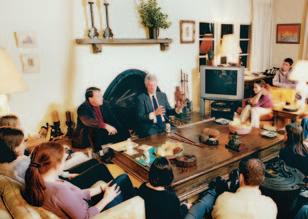
S A BRIGHT-EYED OCCIDENTAL sophomore in 2002, I enrolled in Professor Derek Shearer’s Politics 231 course covering the foreign policy of the Clinton presidency because I heard Shearer brought interesting guest speakers to class. On the first day of class, Shearer handed out the syllabus and told us the first speaker would be Bill Clinton himself—little over a year removed from leaving the White House.
One day later, sitting in the living room of Shearer’s mother’s home in Brentwood, my 24 classmates and I listened as Clinton, casually sipping a Diet Coke, fielded questions from us for an hour and a half, spanning everything from Federal Reserve Chair Alan Greenspan to the Mexican financial crisis.
During his 45 years at Occidental, Shearer has brought countless luminaries to campus,
including former Secretary of State Warren Christopher; Admiral William Fallon, former head of U.S. Pacific and Central Commands; and Derek Chollet, who served as U.S. assistant secretary of defense for international security affairs under President Barack Obama ’83. He has a Rolodex for the ages and is not afraid to put it to good use.
In the case of Clinton, they have known each other since they met at a pub in Oxford when Clinton was a Rhodes Scholar in 1969. Shearer served as a senior adviser during Clinton’s 1992 campaign, and after he was elected, he appointed Shearer ambassador to Finland.
Shearer helped coordinate the administration’s strategy for the Nordic-Baltic region and hosted Clinton’s 1997 summit with then-Russian President Boris Yeltsin. Shearer also played a role in establishing the White House’s National Economic Council.
Shearer’s sometimes unorthodox approach to diplomacy “went beyond serving California wines at official dinners, giving See’s Candy as dinner gifts, and serving Bay Area microbrew tastings,” he wrote in a 2021 opinion piece for the Washington Monthly. “On Saturdays, I was the point guard on the embassy team that competed in an industrial league where we played against businessmen from leading companies.”
While serving in Finland, Shearer was awarded the unofficial title of “Ambassadude,” a nickname given to him by Sakke
Rice photo by Marc Campos | Additional photos courtesy Derek Shearer unless noted
left: Greeting Condoleezza Rice, former U.S. Secretary of State, and Oxy trustee Chip Blacker ’72 in 2016. center: With Bill Clinton at Brown University in 2022 right: With wife Sue Toigo and Michelle Obama in 2017.
Järvenpää, lead singer of the Leningrad Cowboys, the Finnish rock band who performed at Shearer’s 50th birthday in Helsinki. The name stuck long after he returned to Eagle Rock, where he continued to use his diplomatic skills in making introductions for students or bringing together donors in 2014 to build the McKinnon Center for Global Affairs (named for Shearer’s former student, investor Ian McKinnon ’89, and his wife, Sonnet).
“Derek is this incredible bridge who knows more people, remembers more history, and connects more dots than almost
anybody I know,” says Eric Garcetti, the former mayor of Los Angeles and U.S. ambassador to India, who started his professional career as an adjunct professor of diplomacy and world affairs at Occidental. “It’s been a gift for Oxy to have somebody like that in such a global city, from such a global perspective, to connect this community with the world.”
Shearer—who will retire this spring as Stuart Chevalier Professor of Diplomacy and World Affairs and director of the McKinnon Center for Global Affairs—has never been
one for lectures, textbooks, or exams. Instead, he emphasizes critical thinking and writing, skills that are useful for wherever his students’ careers may take them. He wants them to have the chance to directly question those with firsthand knowledge, whether they be journalists, diplomats, or presidents.
In January 2025, Shearer and his wife of more than 20 years, Sue Toigo, were evacuated from their Pacific Palisades home for two months because of the Palisades Fire. (Fortunately, their house was spared.) I recently sat down with Shearer at his home
to talk about his contributions to Oxy, his views on diplomacy in the Trump era, and what’s next (besides a pick-up game of basketball).
After teaching on campus for more than four decades, what do you think is unique about the Occidental education?
The combination of the Oxy education is intellectually rigorous and reality-based. All the opportunities we give students—such as the Kahane U.N. Program, Campaign Semester, our internships in Los Angeles, and study abroad opportunities in over 30 different countries—let students test ideas against the real world.
I’ve always said to students, “If you don’t understand the world as it is, you can’t change it.”
The major skill we teach our students is critical thinking, and they learn to express themselves in both written and oral forms. At Oxy, you can’t escape writing papers. I never give multiple-choice exams because in my field, there’s no right answer. It’s more important that you approach the problem critically before proposing a solution.
Oxy is small enough that you don’t interface with teaching assistants. If you show up for class, you can talk to your professor and take them out for coffee. I mean, you invited me onto your KOXY radio show.
I certainly remember that, and it was great to have you. You’re always sending intros between students, alums, and others without expecting anything in return. You, more than anyone I know, are the master at connecting people. What is your secret?
“If you don’t understand the world as it is, you can’t change it.”
I don’t know if it’s a secret, but it’s partly my upbringing. My parents were both journalists. [Shearer’s father, Lloyd, who died in 2001, wrote “Walter Scott’s Personality Parade” in Parade magazine from 1958 to 1991.] They liked meeting people and entertaining, and having people over. The idea was that your life is richer if you have friends and know interesting people.
When I see an opportunity, especially for students, to make an introduction, it doesn’t cost me anything but a little time. It’s a return on my social capital that makes me happy. I really enjoy the fact that people get to meet each other.
Most of diplomacy is pretty serious. Why have you focused so much on teaching students soft power like sports, music, and food?
Sports, culture, music, and food are all important aspects of diplomacy. As an ambassador, I practiced all those forms of diplo-
macy, and I thought that, as a professor, it was a good way to reach students who aren’t all that into global affairs but are very into sports.
Sports in the 21st century have become so globalized and so political, everything from Yao Ming coming as the first Chinese sports diplomat to the politics of the Olympics, to the politics of the upcoming World Cup, where Iran will play at SoFi Stadium.
You have devoted your entire professional career to diplomacy, which is out of vogue these days. USAID is being defunded, and the Defense Department has been renamed the Department of War. What’s it like for you seeing the shift away from diplomacy?
I thought the country had reached a place where women were empowered, diversity was embraced as a strength, and America was seen as a positive force in the world. It’s discouraging, but I’m not giving up. There are younger people in the diplomatic world whom I have hope for. We’re going to have to repair the damage, and I’ve always been very practical-minded. I’m not retreating.
Are your students still excited about pursuing a career in diplomacy?
I recently had lunch with some student editors at the Occidental newspaper, one of whom is a DWA major applying to the Foreign Service. I asked if he was a bit depressed, and he said, “It’ll take a year or two to get in, and by that time, after the next election, things will change, and they’ll need me.”
That made me feel good, because sometimes I find that people my age are like, “We worked so hard for all this, and look at what’s happening.”
Occidental recently announced the creation of the Derek Shearer Endowed Pres-
Shearer at Occidental in a 1992 photo.
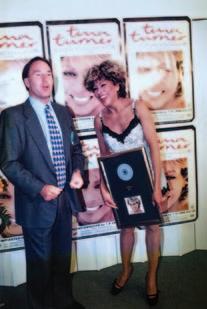
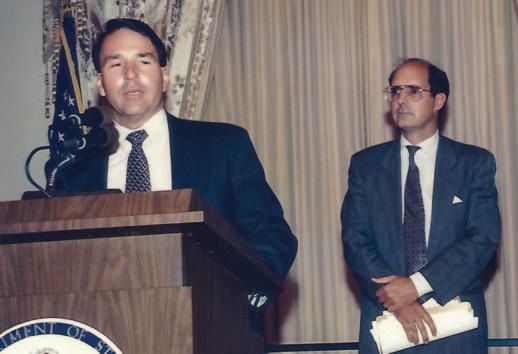
above left: Shearer welcomes Tina Turner to Helsinki in 1996. right: Speaking at his swearing-in as U.S. ambassador to Finland in 1994 at the State Department in Washington, D.C., as Strobe Talbott, deputy secretary of state (and his brother-in-law), looks on.
Photo by Frances Hill
idential Professor of Practice, thanks to the generosity of Sonnet and Ian McKinnon. What does this professorship of practice mean to you?
A named professorship at Oxy is an honor—even more so because this position reflects the scope of my intellectual pursuits. As a professorship of practice, it encompasses the fields of public policy, business, and entrepreneurship—all subjects about which I have written and taught at the College—as well as international affairs. Whoever holds the post will engage the world as it is, taking a reality-based, non-ideological approach to teaching and research as I tried to do in my time at Occidental.
What were your impressions of Ian McKinnon as a student?
Ian is the best student I taught at Oxy. From the first day in my public policy seminar, Ian’s intellectual curiosity and analytical prowess were on display. Fellow students would sometimes complain that Ian was the perfect student—and he was, but he is more than the ideal student. Ian is one of the most decent, generous, and caring people I have met in my life. Sue and I are proud to consider him a member of our family.
When I returned to the College after government service, Occidental was going through a tough time financially. I suggested to President Mitchell that he appoint Ian to the Occidental Board of Trustees and make him head of the investment committee. Ian accepted the appointment and strengthened the endowment—a game changer for Oxy.
What are you most proud of from your decades at Oxy?
One is all the students like yourself and many others that I’ve gotten to know. Some have become friends and colleagues, and most of them have gone on to do good work. That’s like an extension of having your own children, which is very rewarding because it lives on after you.
The other is that I helped develop and institutionalize major initiatives. I established the first public policy major, and then we created an international and public affairs center. I convinced Peter Dreier to join Oxy, and he went on to establish the Urban & Environmental Policy Institute and Campaign Semester. Later, I played a key role in ensuring the U.N. program was on a sound financial footing.
And then there’s the social capital. If you walk through Johnson Hall, you’ll find framed pictures of the various practitioners, journalists, diplomats, and politicians I brought to Oxy so students could interact with people engaged in the real world.
What are your plans for retirement?
I don’t entirely know the answer because our world was turned upside down by the fire. Given the state of politics and the very slow rebuilding of the neighborhood, we don’t want to make any big decisions. I’ll do some guest speaking, and I have a couple of writing projects, including a small book on my advice on the state of the world.
The country is threatened by authoritarian rule in D.C. and the international system is broken by autocracies using force, ignoring morality and international norms. But there are good people fighting against the chaos and trying to restore hope and democracy.
Any words of advice for now?
Show up, get involved, stay balanced, and have a vision of the world you’d like to live in; then figure out a way to make it happen. Along the way, cherish family and friends, share food and books, play sports, and get a good dog. Ben Bergman ’04 majored in politics at Occidental. He is currently a senior correspondent for Business Insider
left: Then-President Jonathan Veitch, Ian McKinnon ’89, and Shearer at the dedication of the Derek Shearer Conference Room in 2019. above: Onetime adjunct professor Eric Garcetti, former Los Angeles mayor and U.S. ambassador to India, speaks to Shearer’s students in Choi Auditorium in February. below: With his wife, Sue, and “ambassadog,” Wyatt, at their Pacific Palisades home.
Photos by Marc Campos (left) and Dick Anderson (right)
By LAURA PAXSON and ESCOTT O. NORTON
Two children of Oxy professors grew up immersed in the magic of Shakespeare, Shaw, and Gilbert & Sullivan—in an era when a plucky little drama festival became their whole world
N THE SUMMER OF 1960 , Omar Paxson ’48, Sally Norton, and John Ingle ’50 launched a repertory theater company on the Occidental College campus. It was a leap of faith on a Depression-era budget, fueled by their belief in the transformative power of live theater and conviction that hard work could accomplish anything. As Omar’s daughter and Sally’s son, we grew up in that world two shy, awkward kids who found a friendly place to fit in among quirky and creative people. We had the run of rehearsal halls, musty costume rooms, dusty scene shops, and giant outdoor performance spaces. We learned to sit still and be silent while big people rehearsed long, talky plays. Our parents sent us on stage when we were barely out of diapers. We cut planks of wood with power saws before we were qualified, climbed much too high on lighting towers, learned to make popcorn in industrial poppers, and routinely stayed up past midnight.
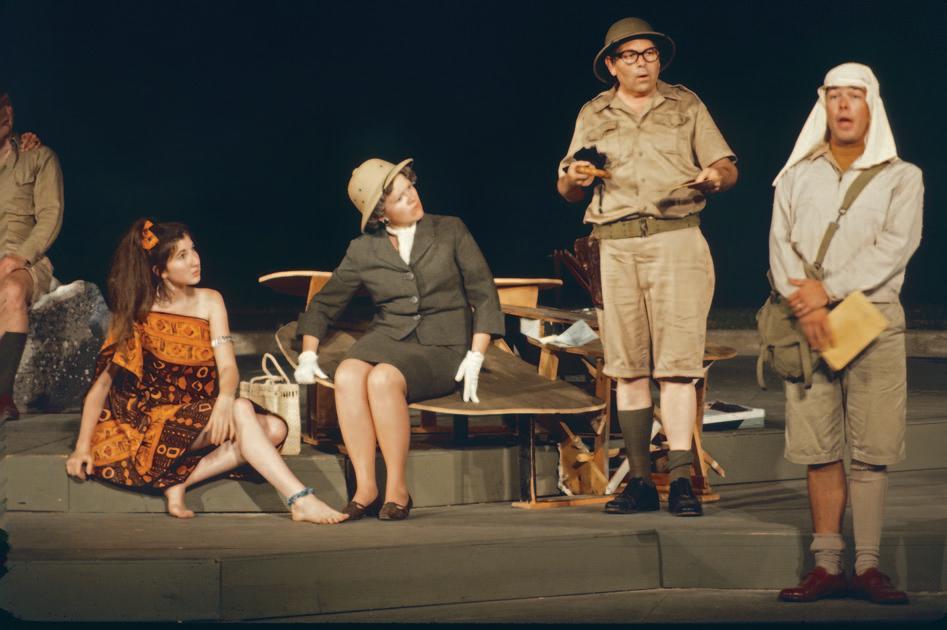
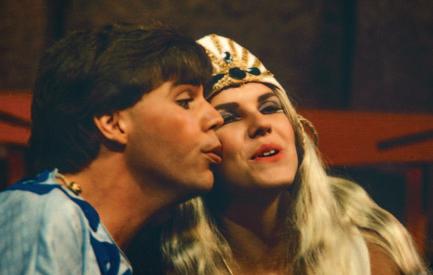
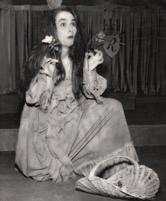
above: Authors Laura Paxson (left, in 1975) and Escott Norton (right, in 1968) at Remsen Bird Hillside Theater. left: Omar Paxson ’48 and Josie Dapar ’59 in a 1962 production of Shakespeare’s Much Ado About Nothing
We never knew any other way of life and secretly pitied our friends with parents who came home at 5 p.m. for dinner. Ours would dip their toes in for a family meal before heading back to the theater for rehearsals every night. They were constantly working, but work was fun. Ours was a world where optimism prevailed and every problem had a solution. In 1960, America felt young and our parents reflected that youth; all three were under 40 and one was only 26 when they embarked on their project. Their goal was to provide an educational experience for Occidental students and quality performances of classical plays for community members from the Greater Los Angeles area. Also, to break even. None of them were sure it would survive beyond one season, let alone endure four decades.
To say it changed lives would be a massive understatement.
That first summer, with a 32-member company, Omar, Sally, and John mounted productions of three comedies: Androcles and the Lion, A Midsummer Night’s Dream, and Iolanthe. The triumvirate of Shaw, Shakespeare, and Gilbert & Sullivan would form the backbone of subsequent seasons in which young actors received training in classical theater and audiences saw mostly jolly plays produced by enthusiastic people. Omar, Sally, and John took small paychecks, more a symbolic gesture than anything else, and
there was enough money left over to pay a pianist. The schedule was demanding and the hours long. Rehearsals took place Monday through Friday from 7 p.m. to midnight, plus all day Saturday. Each play received 40 hours of rehearsal time.
The venue was the great outdoors, starting on the steps of Thorne Hall, later moving to Remsen Bird Hillside Theater. There was an undeniable romance in performing under the stars where eucalyptus trees loomed and occasional mists descended fortuitously upon productions of Brigadoon. At the same time, actors contended with all the challenges of performing outside: punishing L.A. heat and air pollution, mosquitos, occasional fires, police helicopters circling overhead, and hunting coyote packs. On a handful of occasions, rainstorms required a massive undertaking to move the evening’s production to inside Thorne Hall. Costumes, props, and lighting had to be transported, the set dismantled, then adjusted, and directors had two hours
before curtain to rearrange blocking for the actors. Not a single show was ever canceled. An egalitarian ethic prevailed, set by our parents. They were always known as Omar, Sally, and John. No last names or title, and everyone did everything. An actor might have a major role in one play, be in the chorus of the musical, then paint scenery, sew buttons on costumes, learn how to hang lights, or build props the rest of the time. Frugality was key. Set pieces were salvaged from junk yards and costumes were fashioned out of donations, culled from existing stock in the Occidental College Drama Department, or scavenged from the wardrobes of company members. Attendance for all rehearsals was mandatory and lines had to be memorized by the first rehearsal. There was no down time. This can-do spirit accompanied by fly-by-the-seat-of-the-pants necessity created an extraordinary esprit de corps. Who needed sleep and food? We lived, breathed, and ate theater.
left: From left, Joanna (Hall) Gleason ’72, Sally Norton, Omar Paxson ’48, and Gary Davis ’68 in Shaw’s Too True to Be Good (1968).
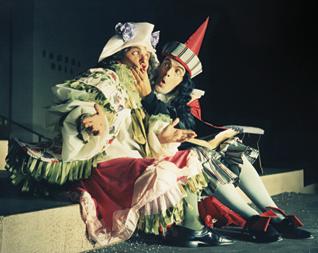
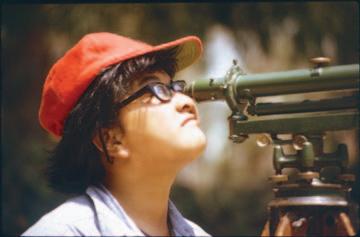
below left: Dean Simons ’59 and John Ingle ’50 in Moliere’s The Would-Be Gentleman (1962). center: Sally Norton in Oklahoma! (1973). right: Laura Paxson, Ken Bryant ’78, and Steve Wayland ’80 in Shaw’s Androcles and the Lion (1977).
Photos from the Oxy Summer Drama Festival Archive. Josie Dapar ’59 took the majority of photos. Additional photography by Will Moffitt ’70, Joe Friezer, and Escott Norton
below:
Our parents were the first to arrive for the nightly rehearsals and the last to leave. They planned, budgeted, directed, acted, and mentored the college students. They designed costumes, built sets, cleaned the bathrooms, watered the lawn, set up chairs, answered the phone, sold the tickets, handed out programs, and made the popcorn—all the while believing that hard work done in the Theater was the most fun anyone could possibly ever have. Theater problems were happy problems. They brought us along for the wild ride. We watched rehearsals late into the night since it was cheaper to let us roam the theater than to hire babysitters. The Norton children fell asleep on the cement steps of Hillside Theater, still warm from the summer sun. John Ingle’s daughters learned to sew in the costume shop and Laura Paxson negotiated a gig taking notes for John when his stage manager was behind the light board calling the show. Our parents threw us onstage for plays requiring children regardless of the subject matter. Laura was one of four children recruited to sing for Claire Zachanassian in
The Visit. Omar always encouraged his own children, as well as his students, to grapple with the big ideas in great plays. The upshot was the opportunity to experience plays with adult themes from a very young age.
More light-hearted experiences included being in the wedding party in Italian Straw Hat when we were recruited to run all over the theater, hopping over prone bodies in a madcap chase scene. Escott Norton, then age 3, had a bathroom emergency during a tableau. His father, Oakley Norton ’56, shifted in front of him and Escott relieved himself off the back of the stage. The Ingle daughters built a plaster replica of Macbeth’s severed head, dripping with blood, for the 1969 production of The Scottish Play, in which their father played the lead. The prop went home with them at the end of the season, providing years of compelling Halloween decorations.
The Occidental College Summer Drama Festival defined our childhood, adolescence, and young adult years as we morphed from observers to full participants. The festival crackled with energy and there was nothing
more exciting than the onset of summer, but not for the obvious reasons. For us summer meant more work, not leisure time. More important, it meant being part of something larger than ourselves.
Our parents invited us into an adult world, filled with charismatic college students, great plays, and late nights. We sewed, built properties and sets, acted, directed, hung the lights, stage managed, and ran the box office. We became night owls. Regardless of our individual passions, or the various directions our lives ultimately took, Summer Theater went absolutely bone deep. It’s in our DNA.
The ghosts of past performances linger at Thorne Hall and Hillside Theater. Ghosts of seasoned actors, neophytes, and everyone in between. A scrappy little orchestra accompanies Tary Ismond as he belts out “If I Were a Rich Man” from Fiddler on the Roof. Lisa Mudge-Meckel ’57, as the doomed Joan of Arc, kneels in prayer. Carol Stromme Shelton ’69 vamps her Mata Hari number in Little Mary Sunshine. Chris Shelton ’68 M’69
reclines on
right: Chris Shelton ’68 M’69 and Susan Tanner in Threepenny Opera (1971).
Sandy Egan ’82 and Jane Schless ’82 in A Funny Thing Happened on the Way to the Forum (1981). bottom: Josie Dapar ’59 was never far from her camera.
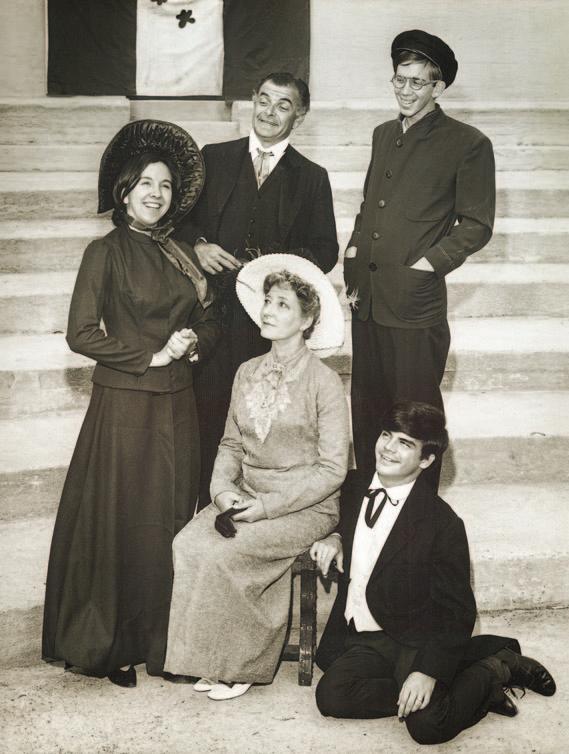
left: A 1966 Summer Theater production of Shaw’s Major Barbara directed by Omar Paxson starred (standing, l-r) Patti Mitchell ’69, John Ingle, Alan Freeman ’66 M’67; Daphne Lorne, seated; and Clem Dunbar ’65 M’66, kneeling below: A Summer Theater work crew in an undated photo. bottom: Cora Lauridsen in Gilbert & Sullivan’s Ruddigore (1961).
the grass, a few feet from the front row, looking up to the stars for “To be or not to be.”
Marti Rolph ’66’s sweet singing and Pedro Martinez’s lyrical dancing in The Boyfriend Ellyn Gersh Lerner ’73 leading chorines in a zesty “Take Back Your Mink” in Guys and Dolls. Gary Davis ’68, whipping casts into shape with his lightning-swift work tempo. David Parrish ’74, popping his outraged head out of the Turkish bath in Misalliance. Craig Fees ’74, thoroughly committed to ferocity and slobbering friendliness, in Androcles and the Lion. Sally Norton, a hilarious Veta Louise, in Harvey, Lucy Lee ’78, as her equally hilarious daughter, and Tom Shelton ’77 as whimsical Elwood P. Dowd, whose best friend was an invisible 6-foot-tall rabbit. John Ingle, embodying the delusional Peer Gynt. Omar Paxson and Josie Dapar ’59, as the original dumb-and-dumber duo of Dogberry and Verges from Much Ado About Nothing
The sets designed by Dave Gibson ’67, with lighting by Ward Carlisle ’73. Grace-Lynn Ingle ’51 and Marlene Gothold at the piano.
All the actors who ever fell off the stage, missed an entrance, flubbed a line, forgot a prop, or performed when they were sick.
The big ideas endure as well: Intellectual freedom versus faith in Inherit the Wind. Jealousy leading to mischief and mayhem in A Midsummer Night’s Dream. Tragic vendettas in Romeo and Juliet. Innocent coming-of-age stories in Ah! Wilderness and I Remember Mama The unorthodox behaviors of the best wacky family you’d ever want to know from You Can’t Take It With You. The value of the smallest events in life revealed in Our Town. Women’s rights in every Shaw play. Serious themes to sink one’s teeth into and silliness to entertain.
Our parents gave us a stage for our playground; all we had to do was show up on time and work hard. A sprawling cast of characters came together with a common goal they knew was good, even ennobling. Such audacious enterprises often fizzle or flame out. Summer Theater was an idealistic experiment that lasted, until it didn’t, and we are not alone in mourning its passing.
Dozens of Summer Theater alumni went on to professional careers in the theater. Others enjoyed their brief time in the footlights and chose other professions. Many became teachers. To a person, they maintain, Summer Theater changed their lives. We were spoiled and transformed—every one of us. Perhaps we were all lucky Theatre Brats.
Hey Kids, Let’s Put on a Book!
Behind the curtain with Theatre Brats authors
Laura Paxson and Escott Norton
What are your earliest memories of Summer Theater?
Laura Paxson: In 1963, my mother [Helen Paxson ’52] played the Green Woman in Peer Gynt. She wore this long brown wig and my gosh, I loved that wig. I wore it around the house—it was as long as I was. They finally took it away from me because they were pulling three-foot hairs out of my baby brother’s mouth.
Escott Norton: I was born into Summer Theater—and living on Escarpa Drive, Occidental became my front yard. Once I was old enough to leave the house on my own, I was exploring campus all the time. I could buy candy real cheap at the bookstore.
What inspired you to do this book?
Laura: In November 2024, when Escott put together a ceremony to hang the first Summer Theater placard from 1960 in the lobby of Keck Theater, he invited family of the three founders [Omar Paxson ’48, Sally Norton, and John Ingle ’50] to speak. I flew down from Portland, Ore., and it was such a joyous event. After I got home, I wrote to Escott and said, “We have to write a book about this, and it has to be called Theatre Brats.”
Escott: More than a decade ago, when Josie Dapar donated her collection of Summer Theater slides to the library, I took it upon myself to catalog them. We’ve gone through over 10,000 slides, looking at all these faces and reliving all these stories. It’s been in my head to do this book for a long time, but Laura kicked things into gear with her email.
Laura: We’re not trying to create a hagiography, but we do feel lucky we had such creative, idiosyncratic parents.
Talk about taking this from an idea to a manuscript.
Laura: Even before we set up the structure of the book—with chapters as acts and subchapters are scenes—we created 13 questions to ask everyone. Over time, we got more than 70 completed questionnaires from Summer Theater participants, almost all of them alumni.
Escott: Our initial focus was the generation from the first five years. We’re losing these people, and it was important to get as many
The children of Summer Theater reunited at Oxy’s Keck Theater in 2024. From left, Trevor Norton and sister Cari Dawson; the Ingle twins, Jenny Bandy and Jessica Pretkus; Laura Paxson; and Escott Norton.
firsthand memories as we could as soon as possible.
Where are you at in marrying the text to the photography?
Escott: I could put a picture to every story. Josie captured some wonderful images—faces, productions, stages being built, costumes being sewn, even picnics and beach outings. It’s a treasure trove.
Who’s the audience for this book?
Escott: The stories aren’t just specific to Summer Theater—they’ll resonate with anyone who’s been involved in community theater or dreamed of it.
Laura: It’s for anyone who’s ever been in a play where a fellow actor missed an entrance. Why do people remain so engaged after all these years?
Laura: Jim Martin described Summer Theater as “a socialist heaven—I loved it.” It was the sense that everybody did everything. There were no egos, no prima donnas, and you did not sit on the sidelines. If there was a button to be sewn, you were sewing it.
Escott: My impression is that we all knew each other as one giant community, even though it was spread over 39 years.
Laura: Someone referred to Sally as the mother, John as the impresario, and my dad as the heart and soul. Summer Theater spoiled us for everything else because nothing else was ever as good as that experience.
Escott: As kids, we were thrown into situations we weren’t qualified for. I had college students working under me when I was a kid. What’s the most surprising thing you’ve learned working on this?
Escott: Realizing how much of an impact it made on people who weren’t related by blood. Seeing how much our parents were loved and appreciated has been amazing.
Laura: Summer Theater was so utopian in so many ways. And all the utopian societies failed, and in the end Summer Theater went away too. But they all started out with these egalitarian ideals. It’s fascinating going down that rabbit hole.
Theatre Brats will be published this fall. To learn more, visit theatrebratsbook.com
After smashing multiple records at Oxy and gutting out an eight-year career in professional football, what’s next for Bryan Scott ’17?
BY DICK ANDERSON
RYAN SCOTT ’17 MAY HAVE NEVER PLAYED football at Oxy were it not for Brett Kassel, who would become his future roommate. Newly hired football coach Doug Semones had ventured to the West Torrance Lions Club All-Star Football Game at Mira Costa High School in South Bay to recruit Kassel as a long snapper for the Tigers—which he did. But Scott, who had to wait until his senior year of high school to start his first varsity game, was making a pretty good showing himself.
“My mom and dad were cheering in the stands,” Scott recalls, “and Coach Semones came down to me after the game to introduce himself and he said, ‘How’d you like to take a trip to Occidental?’”
Prior to Semones’ overtures, Scott had gone unrecruited out of Palos Verdes High School. He made inquiries about being a walk-on at San Diego State and TCU, but “they kind of said no,” he recalls.
Even so, it took a little convincing to sell Scott on being a Bengal. “I’ve lived 45 minutes away, my entire life, born and raised in Southern California, but I had never heard of Occidental,” he admits. After Bryan and his dad, Bob, visited the Oxy campus for the first time, they came away a bit underwhelmed by its size.
Ultimately, it was his mother, Leslie, who urged him to take a second look. “My mom said to me, ‘Bryan, I think you’re making a mistake. Coach Semones is a good man, and Oxy has a great academic program. I think you should go to practice one day.’”
When he walked into Jack Kemp Stadium at 6 a.m., “All the guys are cheering,” he says, “and I look up and the scoreboard says Patterson Field. My grandfather was
Major General James H. Patterson”—a personal hero— “so I took that as a sign.” After spending the day at Oxy, Scott committed two days later.
“My mom made me look at the College in a different way,” he says, “but Coach Semones changed my life with a quick trip to see my college roommate.”
Scott’s professional journey is rooted in perseverance, with opportunities and obstacles: early looks from NFL teams (Rams, Falcons, and Chiefs); spots on CFL rosters (Vancouver, Edmonton, and Toronto); and engagements
Additional photos by Marc Campos (pages 19, 21) and Kirby Lee (page 19, 20) | Other photos courtesy Bryan Scott ’17
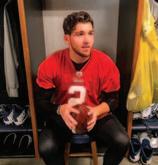
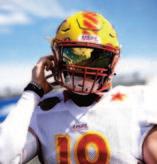
top, l-r: Scott as starting quarterback for the Tigers; in the L.A. Rams locker room; with the USFL’s Philadelphia Stars; and the CFL’s Toronto Argonauts. above: Prepping for pro day in February 2017 with Norm Chow, left, former offensive coordinator for USC, and son Carter, who was then Scott’s agent.
PHOTO BY MAX S. GERBER
of varying lengths with other leagues (TSL, XFL, and USFL). He persevered through injuries, roster cuts, and a pandemic. He was rewarded with trophies, championships, and the respect of his mentors and peers.
“Bryan wasn’t going to let anybody dissuade him from chasing his dream,” says one famous mentor, Super Bowl XVII champion and 1983 NFL MVP Joe Theismann. “I love that quality about him. He was going to do what he possibly could do to be able to get into the game. He played a bit and got a taste of it, and now he’s gone to another phase of his life.”
Occidental and SCIAC Leader in
4Career passing yards: 9,073
4Completions: 763
4Total offense: 9,475 yards
Occidental Record Holder in
4Passing yards per game: 339.8
In the aftermath of the Argonauts’ Grey Cup victory on Nov. 17, 2024, at BC Place Stadium in Vancouver, Scott drank in the moment as his teammates celebrated all around him. “I’m holding the Grey Cup, looking up on the gray sky inside the dome with confetti coming down everywhere. It felt like a beautiful end to this chapter.”
4Single-game passing yards: 476
4Single-game passing touchdowns: 6
2016: SCIAC Player of the Year
41st Team All-Conference QB
43,058 passing yards, 27 TDs
2015: SCIAC Player of the Year
41st Team All-Conference QB
42,541 passing yards, 22 TDs
2014: IFAF Tournament MVP
(Kuwait City, Kuwait)
41,998 total yards, 17 TDs
2013: SCIAC Newcomer of the Year
42nd Team All-Conference
41,476 total yards, 11 TDs in 6 games
Darnell Arceneaux didn’t arrive at Oxy on a carefully mapped path. A standout quarterback for St. Louis High School in Honolulu, the University of Utah, and the Hawai‘i Islanders of the Arena Football League, he pivoted to coaching after his playing days were over. He returned to his high school alma mater and was 2014 Heisman Trophy winner Marcus Mariota’s football coach in his formative years as a quarterback.
Arceneaux and Semones had known each other for years—first as high school rivals (“I ended up beating Doug in three consecutive state championships”) and later as colleagues in arena football. When Semones landed at Oxy, Arceneaux saw the
news on his Facebook feed and tossed off a casual comment—“Let me know if you’re looking for a quarterback coach”—to which Semones replied, “Dude, are you ready?”
Within days, Arceneaux was on staff with the Tigers, stepping into a Division III program that he quickly came to appreciate for its depth and tradition. He and Semones worked together during their four years at Oxy, which coincided with Scott’s time in jersey No. 18.
“Bryan was this kid who came out of nowhere,” Arceneaux recalls. “He had this big side arm, but it was all over the place, and his footwork was bad. But this kid was just a sponge. He kept learning, absorbing the arm angles that quarterbacks need to be successful, and manipulating his feet a little bit better in the pocket.
“He started to learn how to study like a quarterback, how to read defenses like a quarterback,” Arceneaux says. And he earned every rep. “Bryan is one of the hardest working athletes I’ve ever coached,” he says. “Everything that he got at Oxy he earned—no one gave him anything.”
Even his opportunity came the hard way—sitting behind starting quarterback Tommy Edwards ’14 in his first year until an injury sidelined Edwards during the third game of the season. “Then we went with Bryan,” Arceneaux says, “and when his number was called, that cat was ready.”
Starting on the road against Claremont-Mudd-Scripps the following Saturday, Scott went 19-for-38 for 222 yards, throwing one touchdown and running for a second in the Tigers’ 38-30 win. He finished his freshman campaign passing for 1,476 yards and throwing 11 touchdowns in his six games as a starter, going 4-2 for the Tigers and being honored as SCIAC Newcomer of the Year.
“Darnell is the greatest coach I’ve ever had,” Scott says. “He made me a better football player, but also the greatest leader I could be.”
Dylan Tedford ’17 grew up in Fallon, Nev., and enrolled at Willamette University in Salem, Ore., where he hoped to play football. Even before the season began, “I got hurt early in camp,” he says. As the semester progressed, he began looking for a change of environment.
The following semester, Tedford transferred to Oxy, where he joined the Tigers as a wide receiver. On the first day of spring practice, “Bryan and I chatted for two hours after lunch,” he says. It became clear that they had much in common—from their faith to their outlook on life.
“Bryan wanted everybody on the team to feel like part of the community and to do their best for each other,” Tedford says. “I was fully committed to Oxy football because those were my guys.”
Coach Semones called it the “foxhole” mentality—a shorthand for trust, accountability, and shared sacrifice —and Scott and his teammates ran with the idea, even designating the ATO basement as such (with his parents chipping in to furnish the space). “Everything was centered around the foxhole,” Tedford says, describing an
Scott led Occidental to a 21-14 Homecoming win over ClaremontMudd-Scripps at Jack Kemp Stadium on Oct. 25, 2014.
environment where the standard was simple: “Be the type of guy that you would want to look at in a foxhole.”
The idea shaped daily behavior, from practice habits to how players supported one another off the field. “Everybody was all about each other—and all about the team,” Tedford recalls, a dynamic that made the program feel both tightly bonded and purpose-driven.
Tedford’s return to the game was brief. Just weeks into the season, he recalls, “I got a really bad concussion one morning at practice”—compounding a history of head injuries—“and then got some news from a doctor that just said, ‘Hey, probably best to hang it up.’
“For a few weeks there, I was pretty bummed out,” Tedford says. “Bryan was great at keeping me involved and making me feel like I was still one of the guys.”
After a year at Oxy, Tedford went home to Nevada, completing his degree at the University of Nevada, Reno. Even after he transferred, Tedford and Scott stayed in close touch. “It was like nothing had changed—I just wasn’t going to practice every day,” he says. Tedford returned to campus for several games, but one stands out: Occidental’s 35-27 win over defending SCIAC champs Chapman on Oct. 17, 2015, during Scott’s junior year.
Following a series of rushes by Kwame Do ’16, Scott connected with Devon Bullock ’16 to score the go-ahead touchdown, “and it was absolute pandemonium on the field,” Tedford recalls. “I looked directly at Bryan and knew how much he had put in for that moment and how much it meant to him to get it done with his guys. Seeing him enjoy that environment with everybody was electric.”
Today, Tedford lives in Carson City and works in the office of Gov. Joe Lombardo as a legal counsel and policy adviser. “It’s been a great way to learn about our state and a good way to get involved,” he says. And one day, Scott says, “Dylan will be the best man at my wedding.”
Scott’s most improbable play came not as a Tiger or in the pros but during the International Federation of American Football U-19 World Championship in Kuwait in July 2014.
Starting the third quarter trailing Team Canada 14-12 in the gold medal game, “The coaches put me in to spark the team,” he recalls. On that opening drive, it was 3rd and 6 for Team USA with the ball. Facing an all-out blitz from Canada, Scott looked at his roommate, Cal Poly Humboldt wide receiver Chase Krivashei, with whom he’d become tight over four games in nine days. “We don’t say anything to each other, but I’m hoping he sees what I see, which is there’s no one in the middle.”
On the next play, Scott took the ball—“Everybody’s in my face”—and threw a pass in the middle maybe 25 yards down the field. After taking a hit on the play, he continues, “All I hear is this cheering in the stands. And I’m thinking, ‘What is happening? Did I throw a pick?’”
In fact, Krivashei caught the ball, broke a tackle, and scored a touchdown to put Team USA ahead. That was the first of four consecutive touchdown drives—with no incompletions—culminating in a final score of 40-17.
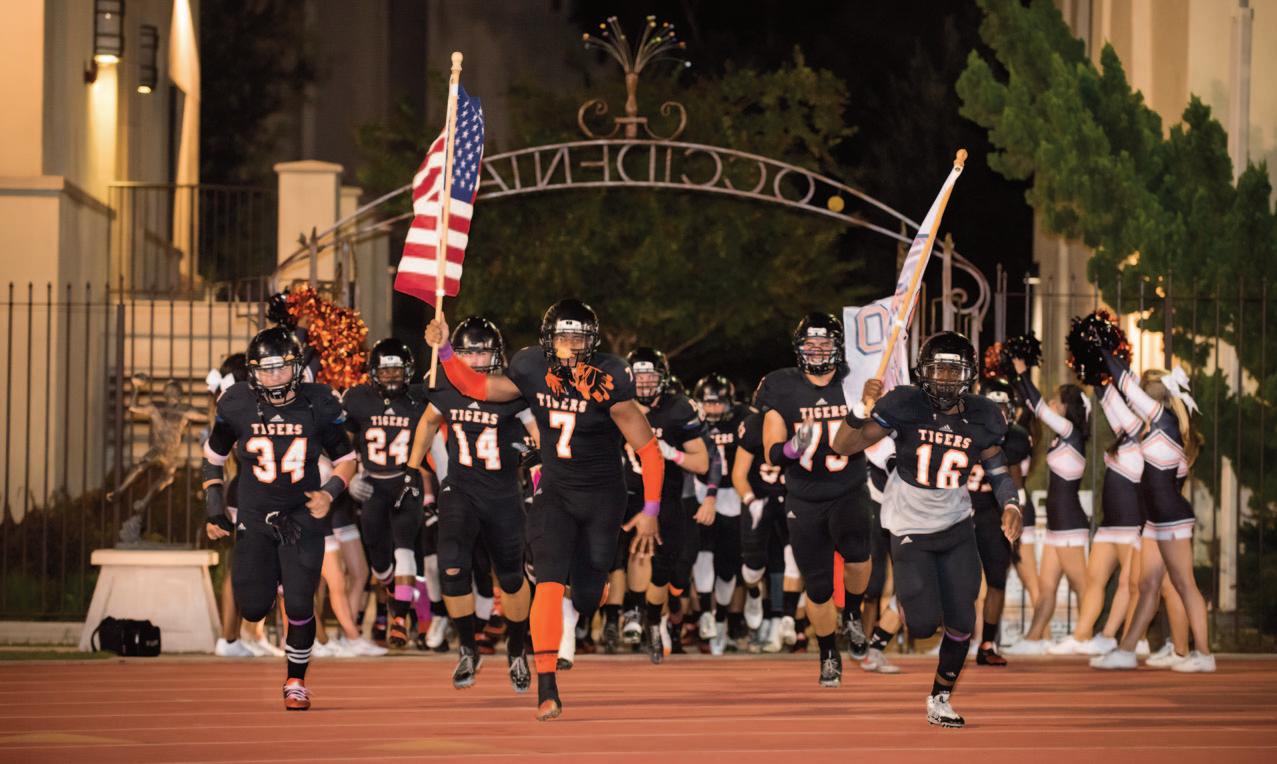
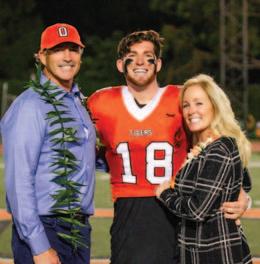
Field prior to the start of their Homecoming contest in 2015. (The rally flag was the idea of Scott and his teammates.) above: Bryan with his parents, Bob and Leslie Scott, on Senior Night in 2016.
top: The Tigers charge onto Patterson
Scott wound up in a Toronto Argonauts uniform thanks to Jim Barker, the team’s director of player personnel and Vance Mueller ’86’s offensive coordinator during his playing days at Oxy.
“We just boat-raced them after that play,” recalls Scott, who received the MVP trophy from Kuwaiti royalty.
Scott’s professional football journey began during his senior season with a surprise visit from Atlanta Falcons college scouting coordinator Sae Woon Jo, a former defensive line and linebackers coach at Oxy. He interviewed with Jo, who was later in attendance when Scott surpassed Oxy leader Andy Collins ’07 and broke Cal Lutheran quarterback Tom Bonds’ SCIAC career passing record in a 57-56 loss at La Verne on Oct. 15, 2016
Jo’s visit “awakened an impossible dream for me,” says Scott, who ended his Occidental career with 9,073 yards and 77 touchdowns in 33 career games. “When he interviewed me and said, ‘Dude, you can do this,’ sometimes that’s all you need to hear.”
a deep post corner that drew loud applause from the gathering of invited spectators in the stands, mostly family members of participants.” His photo was prominently featured in the Times’ sports section the next day.
After the Rams, Scott’s agent signed him to play in The Spring League (TSL), a three-week showcase for developing players, with four teams playing two games each in Austin, Texas. Participants were split into four teams based on where they went to college. And Scott was placed on the West team playing for Bart Andrus, a veteran football coach who currently is head coach of the Frankfurt Galaxy in the European League of Football.
During position meetings, Andrus worked with all 12 quarterbacks—including Johnny Manziel, the 2012 Heisman Trophy winner and former Cleveland Browns quarterback. Scott impressed Andrus with his “great football IQ” and the ability to get the ball out on time.
The games were all streamed by Turner Sports, with the West team winning both its contests—including a 34-17 rout of Manziel’s South team—and Scott being named league MVP. “I went from having Johnny Manziel as my screensaver freshman year at Oxy to playing him and beating him.”
When TSL morphed into an actual league in the fall of 2020, Scott played for Andrus’ team, the Generals. “I drafted him first overall,” Andrus says. The six squads played all their games at the Alamodome in San Antonio, Texas, before COVID forced the league to shorten the season. Three weeks later, on December 15, the top two teams played in the championship game at Camping World Stadium in Orlando, Fla. The Generals beat the Aviators 37–14, and Scott was named offensive MVP of the game.
2024: Grey Cup Champion (Toronto Argonauts)
2022: USFL Third Overall Draft Pick (Philadelphia Stars)
2021: NFL Workouts with the New Orleans Saints and Indianapolis Colts
On March 22, 2017, Scott faced his most important audience yet. While training alongside USC skill-position players JuJu Smith-Schuster, Adoree’ Jackson, and Isaac Whitney, Scott was asked to throw at USC’s pro day when they needed a quarterback. The eyes of every NFL team would be on him, as the Division III quarterback stepped onto USC’s Cromwell Field surrounded by elite Division I prospects, league executives, and even Seattle Seahawks coach Pete Carroll.
2020: The Spring League Champion (All games played at the Alamodome in San Antonio, Texas)
4League MVP
4League Championship Game MVP
2018: The Spring League Champion (All games played at the Kelly Reeves Athletic Complex in Round Rock, Texas)
4League MVP
4Passing Yards Leader
4Passing Touchdowns Leader
After a full day of testing, his moment in the spotlight had come. “I remember grabbing the football and thinking, ‘I don’t know if I can throw this thing.’ I’ve never had that happen to me in my entire life. And then I threw an easy up pass, which is a warm-up pass, and then another one, and then it just started flowing.”
What followed was a near-flawless performance; as Los Angeles Times NFL reporter Sam Farmer wrote, Scott completed “62 of 64 passes with one drop, and finishing the workout by hitting JuJu Smith-Schuster on
After that campaign, Scott was as determined as ever to find his way to the NFL. In 2021, he had workouts with the New Orleans and Indianapolis Colts, neither of which resulted in a signing. Through his agent, Jamie King, Scott was introduced to Theismann, who got his professional start with the Canadian Football League’s Toronto Argonauts. “Bryan was so determined to play in the NFL that it took me a while to say, ‘Some of us have gone a different route than from college to the NFL. Sometimes you have to go someplace else where you get a chance to play,’” Theismann says.
“When the USFL started up again, he was my first pick,” Andrus says, Scott had a knack for getting to know his teammates quickly—“a major asset for a quarterback, especially when you have a short time to prepare.”
In week two of the 2022 season, the Philadelphia Stars defeated the Pittsburgh Maulers 30-23 in a game that included the first three-point conversion in pro football history. Andrus called the play, which Scott executed—a throw from the 10-yard line to running back Paul Terry—capping a 272-yard, three-touchdown performance. Scott’s jersey, Andrus’ call sheet, and the game ball were displayed at the Pro Football Hall of Fame during the 2022 USFL Championship game in Canton, Ohio.
The high of that milestone was short-lived. In week three, Scott suffered a knee injury against the New Jersey Generals, sidelining him for the remainder of the season.
In his 10 starts as a pro, Scott lost only once. “I was always this underdog who found ways to win,” he says of his gridiron career. His last play as a Tiger was a touchdown pass against Chapman, and his final play on the field for the Argonauts was a TD pass as well.
With his game clock ticking down, Scott started 2024 with the Toronto Argonauts in a depth role. He returned to the team that November as a reserve—one week before the Grey Cup championship. Then confetti ensued.
Scott wears a wristband of his own creation with the words “Live Your Why.” “My ‘Why’ is what wakes me up in the morning,” he says. “I want to help other people by making RISE as successful as it can be—not just for my family but for theirs too. Occidental set me up for that.”
Following his retirement from football, Scott founded RISE Environmental with a commitment to delivering reliable environmental services, innovative waste logistics solutions, and responsible recycling practices. “We do a lot of transportation of wastewater and hazardous waste,” says Scott, who majored in urban and environmental policy at Oxy. “It’s what my dad did for nearly 30 years.”
In a full-circle moment, Scott is learning the business from his original coach—his father. In 1988, brothers Bob and Jim Scott started a company called EnviroServ (short for Environmental Recovery Services Inc.) with an initial $5,000 investment. Over the next three decades, they grew the business into a leading player in hazardous and non-hazardous waste management on the West Coast before selling it to Waste Management in 2016.
Growing up, Scott knew little of the specifics of his father’s work—but what stayed with him was the life it made possible. Owning his own company meant control over his time and allowed him to show up for his son as a coach and as a dad. “We would get there before everybody for every sport. Baseball, I was there 45 minutes early hitting and pitching. Basketball, same thing—I had to make a certain number of shots before practice. Football, we’d throw every route on the tree before I started. That’s because he had EnviroServ—he was the boss.
“Rise was my mother’s word for me when I was an athlete,” he says. “There are old videotapes of me playing basketball in fourth or fifth grade, and she’s going, ‘Rise up, Bryan, rise up. Let’s go.’ And I’m like, ‘OK, Mom.’” He smiles. “She wasn’t an athlete herself, but she’s a little general. She’s the entire mental, emotional side of me.”
That foundation, he says, started with the people around him. “My Oxy teammates were all smarter than me—every single one of them,” he adds with a laugh. “Taking what I learned about leadership as a quarterback, I want to create my own foxhole with RISE.”
He carries that same mindset into business, using his football IQ as a bridge to his future endeavors. “My team-
mates trusted in me,” he says. “If I can help them become an accountant or a project manager, why not?
“If someone were to come to me right now and say you get to relive one week of your life, I would say I want to practice with my Oxy football team,” he says. “I’d want to be around my coaches who are among my best friends to this day. I’d want to be around those 50 guys in the foxhole—to get up at 5:30 a.m. and go to practice, then to class, and hang out with each other the rest of the day.”
“No matter what facet of life it is that Bryan wants to pursue, I wouldn’t bet against him,” Tedford says. “No matter what situation I’ve been in with him, I’ve been glad he was there. That’s a testament to the way that he conducts himself, and I’m proud he considers me a friend. Honestly, what more can you ask of somebody?”
Scott returned to the Occidental campus in April to participate in a panel about career opportunities after college. “Football or no football, this place will always be my school,” he says.
Photo by Max S. Gerber
Larry Layne ’71 came to love rugby as a student-athlete— and an estate gift will provide a swift kick to its future at Oxy
By DICK ANDERSON
F THE COUNTLESS SOCIAL gatherings he organized over his lifetime, Larry Layne ’71 may be best remembered for his legendary opening day outings to Dodger Stadium—a ritual that was born during his time at Oxy sitting in the cheap seats at Chavez Ravine with his rugby buddies. In decades to follow, the guest list grew to encompass hundreds of acquaintances from every facet of his life: athletes, artists, politicians, and more. That tradition became so ingrained that the Los Angeles Times reported on the 1999 gathering when Larry had to miss his own party because he had flown to England to help his fiancée, Sheelagh Boyd, with her move to the United States.
The couple met a few years earlier, when Sheelagh—who at the time was a surgical pathologist living in Nottingham—was visiting the United States with a couple of friends. To give her traveling companions some time alone, she signed up for a 229-mile bike trip from Eureka down to San Francisco.
When the cyclists gathered for a casual meet-and-greet the night before setting off together, “Larry turned up with a tray of the most incredible appetizers that I have ever seen,” Sheelagh recalls. “Nobody ever does anything like that. How he got them from L.A. up to Eureka, I do not know. I remember thinking, ‘Gosh, this is an unusual guy.’”
On the first day of cycling, she says, “The signpost had been knocked down so I was
not sure which way to go. But Larry, who absolutely loved paper maps all his life, was standing at the junction with a map in his hands and saved the day. I didn’t even realize that it was the same person with the appetizers, but he was basically cutting the next five miles off the route. There’s no way he was going to do three sides to a square if he could go right across it. He knew the shortcuts. And that’s how I met Larry.”
Sheelagh soon became familiar with Larry’s love of all sports, rugby foremost among them. As it happened, “I was always a rugby fan”—it’s a big sport in her native
top: Larry Layne ’71 during his first year at coach of the Tigers in 1972. above: Members of the 1971 Oxy rugby team. Team photo by Doug Riddle ’71
above: Occidental bulldozed its way through seven top competitors to win the National Small College Rugby Organizations’ National 7s Championship in June 2013. right, l-r: Larry Layne ’71, Bryan Scott ’17, Ron Botchan ’57, Jim Mora ’57, and Assistant Coach Casey Landry at a March 2018 event to support the Oxy football program.
Ireland—“and my father would have played a lot of rugby in his day,” she says.
“Larry loved bringing people together,” says John Engle ’72. “Of course, the number of people he most liked to bring together was 15—as in a rugby side.”
“Whether it was through some fraternity guys or other people he met right off the bat, Larry’s interest in rugby started because he went to Oxy,” says his brother, Steve Layne. “Occidental had a really good program.”
In April, the College announced a more than $9 million planned gift from the Larry Layne Trust. Of that total, 30 percent will be designated for a rugby endowment that will ensure that Oxy will have the resources to field a robust rugby program in perpetuity. (In a celebration befitting its namesake, the gift will be recognized in conjunction with the inaugural Larry Layne ’71 Athletic Achievement Award at Homecoming & Family Weekend in October.) It’s his ultimate gesture to the College—bridging the past, present, and future of the sport he loved most.
Larry’s talent for organization manifested itself during his days as a student at Sylmar High School, where he was captain of the football team and student body president his senior year. With roughly half the enroll ment of its rivals, “We got our butts kicked in high school,” he told Edgar Hirst in 2023—and to make matters worse, “We also had the only football field in the entire valley that did not have lights, so we had to play day games.”
Larry started a campaign to raise $50,000 to install Friday night lights on the field, which he succeeded in doing (with a little boost from his dad, Howard Layne ’45). But
he was no stranger to mounting gargantuan tasks—like selling enough “candy bars or peanut brittle or whatever” to bring the Righteous Brothers to campus for a noon concert in the school auditorium or erecting a giant “SHS” on the side of the mountain made from broken bags of gypsum from the local lumber yard.
Howard Layne enrolled at Oxy from Hollywood High School and was a member of the football and diving teams as well as an ATO. He met his future wife, Beth Odell ’46, and they were married in 1945.
A veteran of World War II who took part in the Battle of Iwo Jima, Howard became a licensed building contractor and worked with his father before going into business for himself. He built houses, industrial buildings, airplane hangars, libraries, and a car wash.
“My father purchased the empty lot next to the house where he stored materials left over from the last job,” Larry recalled. “I played with the materials, like wood. I liked building stuff.”
Coming out of high school, Larry applied to both Stanford and Oxy, and ultimately decided he would get more playing time suiting up for the Tigers football team. (Fun fact: As a student at San Fernando Middle School, Larry’s P.E. instructor was Jim Mora ’57— and for his students who did well enough in his class, Mora would rent a bus to take them to watch him coach football at Oxy.)
While Larry came to Oxy for football, rugby soon became his passion. “When I finished all my economics major requirements,
I then sort of took another major—rugby,” he said. “I had so much fun playing rugby.”
Rugby made its debut at Occidental in the winter of 1965, and the Tigers opened their maiden season in Westwood on February 6 with a 10-6 win over UCLA’s JV squad—the first of two matches with the Bruins. Oxy’s schedule that first year also included San Fernando Valley State, San Diego State, Santa Barbara Rugby Club, Pomona, and Loyola.
Drawing upon Mora’s roster of gridiron players, former track and football letterman Mike Quint ’58 assembled the first Oxy rugby team. Quint wasn’t quite the level of athlete as some of his Oxy football teammates—Jack Kemp ’57, Mora, and Ron Botchan ’57 among them—but in rugby, he found his niche.
Quint’s time as a student at Oxy was “the glory days of his life,” writes son Peter Quint ’87. In the 1960s, he notes, “There were no amateur track clubs like they have now, so I think forming the Oxy rugby team became his extracurricular activity.
“More than anyone I have ever known, my dad invested in time, energy, and very frequent contact with the men with whom he participated in athletics during his college years,” Peter adds. “He enjoyed the footballlike intensity of rugby, and the intramural club-like atmosphere with less equipment to invest in appealed to him as a worthy activity.”
“Mike Quint was a great coach who was tolerant of our lack of knowledge,” recalls Joel Sheldon ’66. “He made the environment welcoming and fun while teaching us the game and pushing us to be the best we could be.
Left photo courtesy Patrick Guthrie ’86 | Right photo by Marc Campos
“When we started, we were given old football jerseys that were not even used for practice, and we no idea about the rules— very different than football,” Sheldon adds. “I remember going down to the only sporting goods store in L.A. where we could find that sold rugby equipment with my roommate, Rich Verry ’67, to buy the one and only ball we started with. Practices were held in an Eagle Rock park over the hill from Oxy.”
Quint’s inaugural squad set the template for Oxy rugby for decades to follow: In their first season, the Tigers went undefeated, winning all seven of their matches. “We were a pretty ragtag group but we played really well together,” says Pete Tingom ’68.
guys are on the field the whole time. They depend on and count on each other throughout the 90-minute game.”
For Dave Milam ’66, rugby began with a blur of exhaustion and discovery. “I remember our very first game. A number of us had never seen a game and certainly not been in one,” he recalls. “Having no sense of pace, or being fit for rugby yet, I wasn’t the only one laying prone exhausted after the game.”
What stayed with him was not just the physical toll but the distinct rhythm of the sport—the continuous flow between offense and defense, the absence of huddles, and the camaraderie that extended beyond competition. “The game was refreshing,” says Milam,
“Larry loved bringing people together,” says John Engle ’72. “Of course, the number of people he most liked to bring together was 15—as in a rugby side.”
In the years to follow, the Tigers’ skills progressed measurably, even when the wonloss record didn’t fully reflect it. Following an 8-7 campaign in 1968—Larry’s freshman year at Oxy—Quint declared, “Oxy is now recognized as a first-class team; we have prestige and can be proud of our team. In four years we have progressed from an aggressive game of keep away to one of the best in the land—in my opinion, one of the five best college teams in the country.”
As a student-athlete at Occidental, Larry played varsity football under coaches Doug Gerhart ’58 and Bob Black ’64 and rugby for Quint and his successor as coach, Mike Luttrell ’67 (“the hooker on our team and a real tough guy,” one teammate recalls).
“Rugby—and certainly Oxy rugby—is a very unique brotherhood, almost mystic, amongst all the players at Oxy and even worldwide,” Dave Farmer ’67 says. “It’s not the same as football, because the entire 15
who went on to play two more years in graduate school on the East Coast.
USC, after winning the football national championship in 1967, lost its rugby match to Oxy. (After this match, Trojans football coach John McKay reportedly forbade his players from playing rugby because they might get hurt. “The truth was that USC could not stand the thought of Oxy beating them,” Farmer says. Adding to the lore, Ray “Grog” Wicken ’69 flattened Trojan Tim Rossovich, a first-round pick in the 1968 NFL/AFL draft, “much to Rossovich’s chagrin and Grog’s and his teammates’ delight,” Farmer adds.)
After five seasons of coaching the Tigers, for which he took a salary of $1 a year, Quint stepped aside as head coach, and Luttrell took over with the 1970 squad. After Larry graduated from Oxy the following year, he remained involved with the Oxy ruggers as head coach over the next two years. Even as he pursued his MBA at UCLA (a two-year
program that he stretched into five), his love for rugby took greater root as a member of the Bruins’ 1975 Monterey national championship squad. In 1979, he helped found and coach the women’s rugby team for the Bruins.
His gift for organizing proved to be an asset for his chosen profession: construction. Unlike his father and grandfather, Larry had a different vision for his business—building public storage spaces on pieces of land unsuitable for anything other than storage.
Larry viewed storage as “a cash cow,” he said in 2023, and “I wanted to build incomeproducing property. [My dad] never admitted it, but 95 percent of his net worth were these industrial buildings that he built when he couldn’t find work to keep his crew working on real construction.”
When he was getting the business off the ground, Larry turned to a number of his Oxy buddies to help. A skeptical Howard Layne asked his longtime friend, developer and Oxy trustee Jack Samuelson ’46, to dispatch an associate to help out with the operation.
“A few days later this grumpy-looking old ex-Marine-like guy showed up,” Larry recalled. He introduced Samuelson’s associate to his crew—a mix of rugby and football players as well as a few women off the track, softball, and basketball squads. “And he said, ‘Oh my Lord. Where’d you get these people?’ They’re all willing to help out and learn.”
In 1977, Nova Storage opened a recreational vehicle storage yard in Mission Hills on the site of its first self-storage facility, which opened in 1980. Over time, Larry dotted the perimeter of California’s freeways with storage locations in Lancaster, Downey, South Gate, Lynwood, Gardena, Palmdale, and Adelanto—and he owned every property.
During the late ’70s and early ’80s, Larry was busy building his businesses and still deeply involved in rugby, playing hooker for the Santa Monica Rugby Club and occasion-
left: Members of the 1972 men’s rugby team, Layne’s first year as head coach of the Tiger ruggers. The season culminated with a trip to the Monterey Tournament, Occidental’s fourth visit to the country’s premier rugby contest in the program’s seven years.
Photo courtesy Occidental College Special Collections
ally for California-level representative touring sides like the Grizzlies and the Cougars. “The big prize—the U.S. Eagles team—always eluded him,” Engle says. “While he had the skill and the will, he didn’t quite have the size for international rugby.”
He continued to find time for the Oxy rugby program as well. He suited up many times for the Oxy Olde Boys rugby team following its founding in 1981 and lent his financial support to the team many times over. “Larry was a great guy and motivator,” says Michael Farmer ’70, who played rugby for seven years at Oxy. “He was always there to get everyone up for the match and during the game.” (Not to be outdone, Michael’s father, Bill Farmer ’50, played for the Oxy Olde Boys for 25 years—until he was 69.)
As a non-SCIAC sport, rugby was never a priority of the athletics program. In the 1980s, toward the end of Richard C. Gilman’s presidency, the team formally took residence in the College’s burgeoning club sports program, where it remains today.
When University of Sussex exchange student Michael Godfree arrived at Occidental in the 1975-76 academic year, he was steeped in a rugby culture that felt foreign to his American teammates. “I started talking to the rugby guys and they were looking at me like I stepped off the moon,” he says.
Godfree went home to Sussex to complete his degree, came back to Oxy newly married (to art and art history professor Linda Lyke), and would eventually serve as head coach of the men’s rugby team for more than 25 years, stepping aside in 2006.
During his tenure, Occidental produced a notable group of players who went on to represent the United States in international competition. Dave Hodges ’90 is one of an elite few players to appear in four Rugby World Cups, twice captaining the Eagles— the U.S. men’s national rugby union team. William Jefferson ’79 earned notice not only with the Eagles but also in France, where he
became a fixture with the French Barbarians. On the women’s side, Jos Bergman ’89 captained the USA Women’s National team at the 1998 World Cup in Amsterdam. Additional Occidental players contributed to the USA 7s program, including Craig Hartley ’91, George Conahey ’89, and Jon Finstuen ’85.
In more recent years, key contributors to the Oxy rugby experience have included Patrick Guthrie ’86, who helped coach the women’s rugby team in its early years and worked with the men’s and Olde Boys teams for roughly two decades; Jeremy Castro ’99, who coached the men’s squad to a Final Four berth in 2011; Resident Associate Professor Malek Moazzam-Doulat ’92, who has served as a coach and adviser to the program for more than two decades; and Michael Yauch ’79, who was the heart and soul of Oxy Olde Boys for 30 years prior to his death in 2018.
The Dodgers Stadium opening day social continued until about a decade ago, when “a big block of tickets became harder to get and Larry’s health was starting to deteriorate and
it wasn’t feasible for him to get into ‘Dodger Heaven,’” Sheelagh recalls.
When Larry died in December 2024, “My first feeling was that things will never be the same,” Engle said at his memorial service. “It’s true … but I at least have a rugby side full of wonderful memories that will stay with me as long as I am around, and I am very thankful to kind, funny, generous Larry for all of them.”
What does Sheelagh miss about him the most? “Just the way he loved people and he always thought about others. If he saw something in a shop that he thought somebody would like, he would buy it for them. He was a very thoughtful guy.”
Happily, the memories of his benevolence endure. Sister Linda Layne recalls: “Larry took my two sons to Dodger Stadium every time we visited and my little one wrote a paper for his religion class about what a spiritual experience it was to be there. Isn’t that funny?”
A full oral history of Oxy rugby will follow in a later issue. To share your rugby memories, email the magazine at oxymag@oxy.edu.
far left: Members of the Oxy Olde Boys in the 1990s. left: Oxy’s women’s rugby team play in their first scrimmage against UCLA’s women in 2023. below: Larry Layne ’71 and wife Sheelagh Boyd in an undated photo.
Photos courtesy Patrick Guthrie ’86 (top left), Dylan Herbert ’25/The Occidental (top right), and Sheelagh Boyd (above)
16 Faculty, 16 Stories
Fifteen new tenure-track faculty and a veteran kinesiology professor discuss their favorite classes, their passion for teaching, and what brought them to Oxy (hint: Location!)
By DICK ANDERSON Photos by MARC CAMPOS
Alaa Abdelfattah, Economics
Alaa Abdelfattah grew up in Cairo, Egypt, and lived through the Arab Spring around the time she was heading to college. “I planned to major in economics and politics to be an agent of change for my country,” she explains. “When I got to college I was really sold on economics’ emphasis on causality and the notion that we need to identify the real causes of inequality to address them instead of the Band-Aid solutions we often apply. So, I abandoned politics, majored in economics and minored in English and American literature, and the rest is history.”
After the 2011 “revolution,” she says, “It seemed that a lot of men lost their jobs and women were carrying the torch. This had me thinking that national shocks—whether it be a political upheaval, a pandemic, or a financial crisis—could affect different groups differently and, depending on a locality’s demographic composition, different places differently. So, when I got to grad school, I decided to test the theory.”
Abdelfattah, who joined the Occidental faculty last fall as an assistant professor of economics, is currently teaching two classes: ECON 101 and Urban Economics (ECON 323). The latter “is fun to teach at Oxy,” she says, “because we get to learn about cities in an interactive way. One task I assign my students is to walk around a neighborhood of their choice in Los Angeles and take note of
food, healthcare, and school access options to test the consumer city theory we are learning in class.”
Abdelfattah is one of 15 new tenure-track appointments at Occidental this year at the assistant professor level. (A 16th appointment, Vanessa Yingling, joins Oxy as a fully tenured professor of kinesiology.) In the pages to follow, we learn a little more about their research, their classes, and even a few “Eureka!” moments that sparked their academic pursuits. To read their full bios, visit oxy.edu/magazine.
Tiffany Wheatland-Disu, Black Studies
When Tiffany Wheatland-Disu visited Oxy in January 2025, she was drawn to the newness of the Department of Black Studies, impressed by the “dynamism and methodological diversity” of the faculty’s research and scholarship, and excited by the prospect of contributing to the shaping of Black studies at the College.
Pursuing her master’s in international affairs at The New School sparked an interest in development economics. “Much of history is shaped by the choices we make in times of scarcity and abundance alike,” she says. “The study of economics is fundamental to understanding the complex histories of past and present societies”—nowhere better demonstrated than in the field of African history.
Inspired by her “dear friend,” Maurice Carney, co-founder and executive director of
Friends of the Congo, she developed a course (BLST 212) that engages students in critical analysis of the pivotal role of Africa in fueling the global Green Energy transition.
“The Democratic Republic of the Congo possesses an estimated $24 trillion in natural resource wealth, yet the vast majority of Congolese citizens remain impoverished,” she says. “In my class Fueling the Green Energy Revolution: The New Scramble for Africa, students are encouraged to consider the centrality of the Congo’s resources to our daily lives, critically interrogate dominant narratives of sustainability, and reimagine more just models of development for all.”
Madeline Wander ’08, Urban and Environmental Policy
Madeline Wander enrolled at Oxy eager to study and pursue social justice, “but as a first-year, I had little direction,” she says.
Professor Amy Lyford’s First Year Seminar titled Architecture, Urbanism, and the Politics of Space in Los Angeles helped give her that direction—and soon after, she learned about the Urban and Environmental Policy Department. “UEP is a gem,” Wander says. “It not only helps students develop understandings and analyses of what they see in the world but provides tangible opportunities to get involved in the work on the ground.”
Through internships and in-class engagement with community organizers, the UEP program was Wander’s conduit to getting involved in social movements, which continues to drive her work as an engaged scholar in and of Los Angeles. “Even after I graduated, my former professors continued to provide guidance and connections as I found my place in the movement for social justice.”
Returning to Oxy as an assistant professor, to the very department that was so influential on her own trajectory, “I can now contribute to UEP’s scholarship—particularly in the areas of transportation and racial inequality—and engage with undergraduates
toward questioning systems of oppression, imagining what a more just world could look like, and planning how we might get there.”
Joel Walsh, Computer Science
“I didn’t know much about Occidental before moving to L.A.,” Joel Walsh admits. “I began to hang out with a friend’s partner and her crew, all of whom went to Oxy. They described an idyllic undergraduate experience where they had opportunities to do research and get to know their professors. It sounded great.” As luck would have it, both Walsh and his friend—the aforementioned Madeline Wander—were hired by Oxy this year.
From left: Assistant professors Alaa Abdelfattah (economics), Tiffany Wheatland-Disu (Black studies), Madeline Wander ’08 (urban and environmental policy), Joel Walsh (computer science), Margaret Gaida (history), and Kai Yui Samuel Chan (politics).
Walsh first became interested in computer science as a high school math teacher. “In California at that time you had to have a mathematics credential to teach computer science. I became the comp sci teacher and STEAM Club adviser and we all learned how to code together. When I went back to graduate school, I knew that I wanted to really learn how a computer works, and how computing could support human flourishing.”
Of his current course load, Walsh is particularly enjoying COMP 395: Deep Learning. “When I was a grad student, I thought deep learning was magic, so now I get to teach magic,” he says. “Students can expect to develop an understanding of the mathematics behind Deep Learning, and how to use Python frameworks that are standard in industry like Pytorch, Numpy, and Scikit-Learn.”
Margaret Gaida, History
After completing a B.A. in physics and a master’s in philosophy of science, Margaret Gaida took some time away from academia to explore other career possibilities. She studied Arabic and moved to Tunis, Tunisia, where she learned about medieval Muslim scholar Ibn al-Haytham, whose optical works were translated into Latin and then cited by the Renaissance sculptor Lorenzo Ghiberti.
“I was fascinated by this story,” she says, “and when I spoke to a mentor about possible career trajectories, he mentioned the history of science.” She had a background in both Latin and Arabic as well as some technical mathematical skills from her physics studies—the perfect combination for working on the Arabic-Latin translation movement in the 12th and 13th centuries, and astronomy, astrology, and optics.
“Once I got my hands on the rare books in the History of Science Collections at the University of Oklahoma, and then manuscripts at the Vatican Library, I was hooked for life,” Gaida declares.
Kai Yui Samuel Chan, Politics
Born and raised in Hong Kong, Kai Yui Samuel Chan’s undergraduate years were marked by an “extremely vibrant intellectual and contentious political atmosphere,” which greatly shaped his intellectual and personal journey. “My initial intellectual puzzle arose out of my participation in the 2014 Umbrella Movement in Hong Kong: How should activists organize democratically in the absence of
hierarchical authorities and formal procedures?” This question led him into political theory at UC Berkeley, and his interests have since broadened to how people should think about political relationships, both national and transnational.
In his current class, Theorizing Membership and Migration (POLS 253), students consider fundamental theoretical questions: What is the nature of a political community? What is the meaning of citizenship? How should we think about a world that features asymmetrical patterns of mobility? “While there is no way we can talk about this course without also discussing what is currently happening in this country,” Chan says, “it also tries to get students to step back, both by examining theories and concepts, and by looking at cases of other countries.”
A recent assignment asked students to pick a non-U.S. example to illustrate a principle of citizenship allocation. “Folks chose cases from all the major continents,” he says. “I’ve learned a lot from reading the papers!”
Alberto López Martín, Spanish Native Spaniard Alberto López Martín’s interest in the country’s literature and graphic narrative lies in “better understanding political and economic contexts considered moments of crisis or emergency through the cultural production that emerges alongside them,” he says. “I am particularly interested in exploring how cultural discourses such as historical memory related to Francoism or Spain’s environmentalist tradition are represented in comics and poems, and in examining the role these texts play in amplifying, enriching, or complicating such debates.”
He’s hard-pressed to choose a favorite class—“I’ve been fortunate enough to teach courses on ecocriticism, graphic narrative, and migrant narratives in Spain”—but ultimately cites the Spanish Studies senior seminar he taught at Oxy last fall. The classroom conversations “helped me better understand the culture of the College,” he says. “For me, it is very important that, through our readings and conversations, our students develop a deep understanding of cultural phenomena and ecosocial challenges in the Spanish-speaking world and their connections to global issues and to those in the United States; and, of course, that they also refine their Spanish and feel comfortable using the language.”
Carla Macal, Critical Theory & Social Justice Born in Guatemala but raised in Los Angeles, Carla Macal’s interest in critical theory and social justice stems from her academic background in sociology, social work, and geography. “I am very much an interdisciplinary, first-generation scholar who is curious about how systems of oppression generate social inequality.” She cites mentors at UC Irvine (Rudy Torres), the University of Oregon (Laura Pulido), and UCLA (Victor Narro) “who supported me academically and have written extensively about inequality in Los Angeles, looking at the formation of settler colonialism and structural violence.”
Macal’s specialty lies in the intersections of anti-colonial feminisms and popular education pedagogies of Paulo Freire and bell hooks. Last semester, she taught Decolonizing Education (CTSJ 227), where students engaged and learned about nontraditional methods like testimonio, body mapping, and counter-data. “Students created a humansized body map and individual body maps about their environment, home, and geographical location,” she says. “It was great to see the participatory experience this class engaged in and how students can apply these methods in their comps or other classes.”
Dusty Madison, Physics
“I’ve been fascinated by outer space for as long as I can remember,” Dusty Madison says. “More precisely, I’ve always been a little terrified of space. It’s so big and empty and I’ve always struggled to wrap my head around it. I had a love for space before I even knew what physics was—and when I finally took a class in high school, things really clicked for me.”
As a gravitational-wave astrophysicist, Madison appreciates the precise quantitative reasoning that physics entails. “Physics research requires a lot of creativity, but not just any creative idea will do,” he says. Things eventually have to hold up to experimental or observational tests.”
Madison insists that he doesn’t have a favorite class to teach. “There’s so much fascinating content to be covered in any physics class that I can find things I am passionate about and that I want to make the students passionate about.” He was happy to teach Astronomy (PHYS 102) last semester: “We cover tons of cool stuff about astronomy. It’s an excellent class for anyone interested in dipping their toes into the physics pond.”
Manuela Borzone brings a global, interdisciplinary sensibility to her teaching in Spanish and French studies, shaped by her academic path from Argentina to Los Angeles, with a few stops along the way. “I love working with students in the liberal arts,” she says, recalling how exposure to a small New England
ful and highly creative connections between disciplines that students were making.” That experience, combined with Oxy’s location— big city, warm weather, with the ocean and mountains well within reach—sealed the deal.
A native Spanish speaker, Borzone is passionate about language in all its complexity,
and Dusty Madison (physics). Seated: Manuela Borzone (Spanish and French studies) and Summer Sloane-Britt (art and art history).
equally invested in literature and the arts, noting their “power to compel us to think about the human condition.” Her scholarly focus grew out of her own migration experience, leading her toward comparative approaches before specializing in Southern Cone studies.
Standing, l-r: Assistant professors Alberto Lopez Martin (Spanish), Carla Macal (critical theory and social justice),
Last fall, Borzone taught The Argentinian Imagination (SPAN 374), a course she designed to introduce students to the culture of the country through its literary and cultural production from the 1810s to the present; its syllabus spans short stories, novels, music, film, and graphic narrative, as well as history, politics, and a pinch of economics. “Focusing solely on one literary tradition from multiple angles allows us to go really deep,” she says, “and I think students come away really interested in studying abroad in Argentina or, if they are returning from study abroad, to continue to broaden their interest in the country.”
Summer Sloane-Britt, Art and Art History
Summer Sloane-Britt began volunteering at museums in middle school. “My community was full of artists and creative people, often frustrated with how historians or writers positioned their work,” she recalls. “I decided that I didn’t want to be an artist; instead, I wanted to serve as a voice for artists, advocating for their viewpoints, relating their work to sociopolitical contexts, and honoring their distinctive journeys.”
Sloane-Britt’s primary area of focus examines how liberation movements and photography intersect. While doing graduate research on the Black Freedom Movement,
she discovered Mexican-American photographer Maria Varela’s images of cooperative farms in the rural American South, a project commissioned by the Student Nonviolent Coordinating Committee (SNCC).
The more images she found from SNCC, the more focused Sloane-Britt’s research became. “An important part of my current book project is the attempt to intervene in considering U.S. organizing worlds as detached from one another, instead looking for the intersections.” She points to Varela, who worked with SNCC before moving to land rights organizing in New Mexico and shared images with the United Farm Workers. “The images she
professor Vanessa Yingling (kinesiology).
Standing: Assistant professors Eric Bjorklund (sociology) and Alyssa Rodriguez (biology).
Seated, l-r: Assistant professors Meiqing Zhang (computer science) and Frank Macabenta (biology), and
made were emotionally received by farmers who felt connected to one another, despite geography or having never met, through their common struggle for self-determination in the wake of American imperialism.”
Meiqing Zhang, Computer Science
“The logic and problem-solving involved in computer science can be very fun, rewarding, and even aesthetically pleasing,” says Meiqing Zhang. Coming from a social science background, she found “the challenge and promise of combining computational approaches with social inquiry quite fascinating.”
Last semester, Zhang taught natural language processing (NLP), a rapidly evolving field. “We covered the contemporary state-ofart approaches to NLP as well as the evolution of techniques leading up to large language models. Students learned NLP with deep learning and the architecture underpinning LLMs, which can be applied to a variety of natural language tasks.”
Outside of work, Zhang says, “I tend to be spontaneous. Los Angeles has much to offer through its food, cultural, arts and sports scenes.” That totally computes.
Frank Macabenta, Biology
Frank Macabenta has been interested in both science and art since he was a child. He was introduced to developmental biology in grad school when he did a rotation in a fruit fly lab. “The high-resolution images of immunostained tissues we obtained using confocal microscopy felt like a union of two of my biggest passions,” he says. “Fruit flies are extraordinarily well-suited to introducing undergraduate students to both introductory and advanced concepts in biology through their ease of handling, relevance to human biology—60 percent of genes are conserved between fruit flies and humans—and the vast array of genetics, cell, and molecular biology tools we have available.”
As a student at the University of Guam, Macabenta got to know and interact with his professors “way more than if I had gone to a much larger university,” he says. Looking at Occidental under the microscope after several years at Cal State Monterey Bay, where he worked with an “incredibly diverse” student body, “It is clear that the rich learning environment at Oxy reflects the values that have shaped my own journey as a scientist and an educator.”
Vanessa Yingling, Kinesiology
After 25 years of kinesiology education and research, Vanessa Yingling was hired to help reimagine Occidental’s Kinesiology Department during a period of transition, an opportunity she fully embraces. “Kinesiology is a dynamic, multifaceted discipline that works well with other departments and programs,” she says. “Students benefit from an integrated multidisciplinary education in the field, whether their goals are pursuing a doctorate in physical therapy or other healthcare professions, working in the community, or owning a small business.”
Occidental’s focus on community partnerships aligns with Yingling’s vision for a kinesiology program—to translate academic knowledge into applied practice. “Equipping students with the skills to critically evaluate information and distinguish reliable sources from pseudoscience is crucial for their success in academia and beyond,” she says.
“Engaging with students as we build a research infrastructure in the department has been rewarding and fun to watch,” Yingling
passionate about while providing the tools to focus my interests on formal research.”
Last semester, Bjorklund taught “two very different but equally fun courses” at Oxy. Health & Illness (SOC 320) examines the organization of health across multiple levels of society through such topics as the medicalization of life, structural health inequalities, the role of healthcare systems, and contemporary challenges in U.S. medicine.
Culture, Power, and Music (SOC 310) is built along the idea “that music is an organic social process,” he says. “Its meaning rests in its ability to point beyond itself to the social world it is embedded in.” Students examine how aspects of social life such as ritual, identity, protest, intimacy, and values are represented through music, and how humans use music to make sense of the world.
Alyssa Rodriguez, Biology
Alyssa Rodriguez first took an interest in biology after she did a strawberry DNA extraction experiment in middle school. “I was in awe of the DNA dripping from the end of a
“I love how Oxy cultivates engagement through communitycentered programs that give students the opportunity to explore the region’s culture and natural environment,” Macabenta says.
adds. The department held a Kinesiology on the Quad event last semester, and she introduced the Occidental Kinesiology Research Group (OxyKRG) “to provide the structure as we grow research in the department with few faculty.” Modeled after a similar group she had at Cal State East Bay, its goal is “to prepare students not just to consume science but to create it—with integrity, curiosity, and the skills needed for graduate study, professional advancement, and lifelong engagement with kinesiology.”
Eric Bjorklund, Sociology
“Like a lot of students entering college, I had never heard of sociology,” Eric Bjorklund says. But from his very first class (SOC 101), “I was hooked. Growing up I was passionate about history—it unlocked the past and provided a powerful lens for contextualizing the present. The sociological perspective felt like the missing piece of the puzzle.
“Likewise, I became deeply engaged in politics and direct action via the punk/hardcore scene. Sociology captured what I was
toothpick at the end of the experiment, knowing I was holding the molecular code to all life,” she says. It’s a moment she strives to recreate as her students perform the same experiment in her Introduction to Cellular and Molecular Biology class at Oxy.
What comes after strawberries? In Rodriguez’s upper-division Principles of Biochemistry (BIO 322) course, students look at a variety of biochemical concepts including 3D protein structure, enzyme kinetics, and metabolic processes in humans. “The laboratory component to this class includes two module experiments that last over a month each,” she explains. “It is wonderful to see students grasp concepts week to week, keep a detailed lab notebook, and write a formal lab report at the end of each module.”
Much as she experienced as an undergrad at the University of San Diego, Rodriguez looks forward to being a mentor to her students: teaching them foundational knowledge, guiding them toward their career goals, and introducing them to the international scientific community at conferences.
Fertile Imagination
Thom Harp ’92 waited for years to direct his first movie—and after a long birthing process, he’s the proud father of two features
As a student filmmaker at Occidental, Thom Harp ’92’s storytelling choices gravitated toward affairs of the heart—even if his approach to the subject matter feels a little jaded in hindsight. His senior comps film, Be My Girl, was about a man who is in love with a blow-up doll and the marital troubles that ensued. An earlier short, The Proof Is in the Pudding, depicted a 1950s housewife who poisons her husband with the titular dessert. “I was not in a good place with relationships,” he admits with a laugh.
More than three decades later, Harp is still in touch with his emotions, with a pair of comedies that tackle the prospect of parenthood from wildly divergent perspectives. Home Delivery, which opened in theaters nationwide on March 27, centers on a young newlywed who invites her estranged family to witness the home birth of her first child. It’s his follow-up to The Donor Party, his 2023 feature about a single woman trying to conceive a baby through a one-night stand unbeknownst to the prospective father.
“The kinds of stories I’m attracted to are where there’s someone who gets a really bad idea, but it’s a really good bad idea,” says Harp, whose comic short films have played
at festivals worldwide and garnered more than a million views on Funny or Die. Thirty years into his career, Home Delivery and The Donor Party are his first two features.
While Harp is a bit of a late bloomer by comparison with many of his contemporaries, “I said yes to all of the opportunities that gave me richness in life,” he notes. “I said yes to going to Alaska with my wife. I said yes to having kids in the middle of her med school. Each of those opportunities ends up being something that is part of who I am—and it naturally comes out in the work.”
After a brief flirtation with psychology, Harp wound up double majoring in film and theater—a period he remembers as “being drunk on creativity.” Film and media studies professors Chick Strand and Esther Yao “gave us the freedom to figure out what we wanted to make. I was focused on narrative filmmaking. I even bought a light meter and rented a dolly for my senior comps.”
After graduating, Harp worked as a camera assistant and cinematographer. He got back together with Karin Patterson ’92, whom he had briefly dated in college. Karin, who had majored in kinesiology at Oxy, told
him she was applying to med school, and the couple made a pact “to go wherever she got into school,” Thom says. The couple was married in 1995, and after spending a year in Karin’s native Alaska, they moved to Seattle for med school, Portland, Ore., for her intern year, and back to Seattle for her residency.
While Karin was studying to be a dermatologist, the couple was living off of Thom’s income, “which fluctuated wildly,” he says. “Some months I would do really well, and other months I would get two days of work.”
He was shooting his first feature when Karin visited the set one day with the welcome news that they were having a baby.
Their second child, Quinlan, was born midway through Karin’s studies, and his arrival marked a turning point in Harp’s career. “Together, we decided that I would stay at home and raise the kids, and I would shift my focus to writing,” he says. “I had this idea that became The Donor Party about someone who was desperately trying to get pregnant because of the craziness that we went through.”
Fatherhood changed his approach to writing as well. “While I was changing my eldest, there was a massive diaper blowout,” he recalls, “and my baby was smiling and
Photo by Sela Shiloni
laughing and having the best time.” In that moment, he had a messy epiphany: “How can I take this world seriously? The only way to survive is having a sense of humor.” The first feature he wrote was a comedy, and he’s never looked back since.
Harp found a writing partner in Seattle, advertising professional Mike Standish, and they wrote a script called Booty Camp that landed them a manager. In 2005, they were invited to make a short film for the Seattle International Film Festival: “You had to write a film in a week, shoot it in a week, edit it in a week, and then present it at the festival,” he says. “Our film was a love letter to John Hughes movies called Driver’s Ed, and the audience was blown away.”
Their next short, filmed at a fortune cookie factory in Seattle and titled Fortune Hunters, starred Gedde Watanabe (16 Candles) and played at festivals worldwide.
In 2010, a feature-length treatment of Driver’s Ed was optioned by Paramount and came within a three-point turn of getting made. Harp moved his family to Los Angeles and began taking meetings. Then Paramount released a teen movie that crashed and burned at the box office, “so they decided not to do any more teen comedies,” he says.
“Everything fell apart after we moved. I lost my manager, my writing partner stepped away from the industry, and I felt like I’d put my family through a major upheaval for nothing,” he says. “Eventually, I wrote another script that helped get me back into the mix.”
One of the best pieces of advice Harp ever got came from filmmaker Lynn Shelton, with whom he came of age in the Seattle independent film scene. “I would shoot her short
films and she would edit my short films,” he recalls, “and she told me, ‘If you want to make something inexpensive, then you have to give yourself really strict parameters. You should be in one location for that whole day—you lose several hours loading up the truck again and moving to the next location. If everything happens over the course of a day, then it’ll help with the costume changes and the hair continuity.”
In 2014, he completed the first draft of Home Delivery, leaning into his ability to create strong characters and giving each one their own voice. “I wanted to tell a story that was intimate, character-driven, and producible,” he says. The film begins as a broad comedy and sneaks deeper emotions into the narrative as it unfolds.
“At its core, Home Delivery is about family dynamics—how complicated and messy those relationships are,” says Harp, who is a child of divorce. “But it’s also about what happens when something real forces everyone to show up for each other. The emotional core of the story comes from lived experience.”
Adhering to Shelton’s maxim, Home Delivery takes place over two days. (The film is dedicated to Shelton, who died of acute myeloid leukemia in 2020 at age 54.) “I wrote it to be cheap enough for me to direct—that was a non-negotiable,” Harp says. “I knew I could do a really good job with it because I knew that it would play into a lot of the strengths that I got at Oxy through the Theater Department, like working with a group of actors telling an ensemble story. I really wanted this one for myself.”
In 2019, Home Delivery finally secured funding, with Harp attached to direct. The pandemic threw a wrench into the schedule,
but filming commenced years later with an ensemble cast that includes Donald Faison, Joe Pantoliano, Peter MacNicol, Lesley Ann Warren, and a third-act appearance by Rainn Wilson as a midwife.
“One of the advantages of writing a small, ensemble piece is that you can give every character something meaningful to do,” Harp says. “Actors respond to that— they want moments to shine. I was also fortunate when we found Melanie Field for the lead. She was a revelation, bringing vulnerability and humor to the part.”
Harp wrote Wilson’s character with The Office stalwart in mind after directing a short for his production company, SoulPancake, titled Phil Ma: Fortune Cookie Writer, starring Randall Park. During the pandemic, the two collaborated on a 15-episode comedy podcast, Dark Air With Terry Carnation, starring Wilson as the embattled host of an AM radio paranormal call-in show.
“Rainn asked me to not only be one of the writers but also to produce the show. I ended up doing a lot of the directing as well,” he says. Performing the show over Zoom, “The writers and creatives would pitch jokes in the chat and Rainn was so fast and was able to incorporate our notes into the improv sections. We also had these scripted segments that were absolutely bonkers.”
Currently, Harp has a number of film projects in development. Crash Course—the screenplay formerly known as Driver’s Ed— is looking to go into production this summer with Harp as director (“Nothing is ever truly dead in this business”). He’s also working on a murder-mystery comedy, Killer Party, that he will direct for producer Josh Shader, and an adaptation of the New York Times bestseller Business or Pleasure for producer Margot Hand, whose Barb and Star Go to Vista Del Mar was a pandemic-era streaming hit.
While Harp may have forgone pursuing a psychology major at Oxy after an iffy grade in a statistics class, he’s never given up on trying to figure out relationships. “In Shakespeare, either everyone dies or everyone gets married—that’s the paradigm,” he says. “I have a great marriage and I believe in the possibility of great relationships, but I know that it comes with as many valleys as there are peaks. You can choose to see life as meaningless, or tragic, or hilarious. I choose hilarious because it gives me strength.”
—DICK ANDERSON
left: Actors Melanie Field, Rainn Wilson, and Donald Faison on the set of Home Delivery center: Home Delivery opened in more than 50 theaters nationwide in March. right: The Donor Party was released in 2023.
Photo courtesy The Lounge Booth
Morter
and wife Shirley on Jan. 1, 2000.
A Couple’s Legacy
A gift honoring Shirley and Dale Morter ’56 will bring students from southwestern Pennsylvania to Oxy
Over the years, by his reckoning, Shirley fostered nine children. Among them was Catharine Mellon Cathey, who lived with the Morters in Pittsburgh from age 12 to 17. “The Morters are family—they shepherded me through my adolescence as loving mentors,” Cathey says. “Shirley was my fierce defender, a strong female role model in a family of accomplished men. She instilled in me my love of travel with her enthusiasm for exploring.
“Dale was always available for advice, which he dispensed in his inimitable gentle way. He taught me to drive a stick shift and helped me choose my first car.” He even talked her out of wanting to be a truck driver, “a very brief career aspiration of mine.”
After Shirley’s death in November 2022, Dale read an article in Occidental magazine about a faculty recipient of a postdoctoral fellowship funded by a national philanthropy. Subsequently, he reached out to Cathey with the idea of creating an initiative to honor Shirley’s work with foster children. “My idea was it would be just in memory of her,” Dale says. “Catharine added me to the mix.”
When Chino High School class valedictorian Dale Morter ’56 visited Occidental for the first time, he had all but chosen Pomona. But a teacher at Chino—an Occidental graduate— urged him to take a look at Oxy. He got a campus tour from Dean of Men Ben Culley, who offered him a scholarship that same day.
“If I went to Pomona, I would have lived at home,” Morter recalls. Instead, he chose Oxy, where he majored in psychology, joined ATO fraternity, and eventually became a “dorm daddy” (’50s speak for resident assistant). “It worked out really well,” he says.
Seventy years after graduating from Oxy, Morter has facilitated a gift that will ensure that applicants from southwestern Pennsylvania will have the same opportunity he did. Thanks to a gift from the Richard King Mellon Foundation, the Dale C. Morter ’56 and Shirley Rudisill Morter Annual Scholarship Fund will award a minimum of $20,000 per year to support the educational experience of at least three students from the region.
Shirley Rudisill was born in Eagle Rock, Va., a small town located in the Shenandoah Valley. She met Morter through her brotherin-law when he was in personnel officers school. “I fell in love with Shirley,” Dale says. After completing his training, Dale was stationed in Japan, and he and Shirley were mar-
ried in 1958, navigating a dual civil ceremony between the American consulate and a Japanese ward office—with a giraffe in a trailer holding up traffic on the way back to base.
Upon returning from Japan in 1959, Morter enrolled at the University of North Carolina at Chapel Hill to pursue a master’s in psychology. “The Oxy faculty had a great reputation with UNC’s psychology department,” he says. “My Oxy degree was pretty much a guarantee of getting into Chapel Hill to graduate school.”
Dale helped establish and grow a mental health center in North Carolina before moving to Pittsburgh, where he worked as a clinical child psychologist at St. Francis General Hospital and maintained a private practice. Eventually, the Morters returned to the Tar Heel State, and Shirley continued her own distinguished career. She logged 34 years of service to UNC’s Department of Psychiatry over two separate stints, retiring in 2013 as director of administration for UNC’s private patient psychiatric practice.
The inspiration for the scholarship is rooted in Shirley’s generosity. “Shortly after we got married, Shirley tracked down an orphanage,” Dale recalls, “and we had two orphan boys spend the weekends with us during most of our time in Japan.”
“I was excited about the opportunity, given Occidental’s strong academic reputation,” says Cathey, who serves as president of the Richard King Mellon Foundation (RKMF). “I wanted to include Dale as an honoree. He is a proud Occidental alum.”
Foundation director Sam Reiman worked with Occidental’s Office of Institutional Advancement to develop a grant that aligned with RKMF’s mission to advance prosperity in southwestern Pennsylvania “and would fulfill Dale’s wish to let others learn about the work Shirley did,” Cathey says. The first Morter Scholars are expected to enroll at Oxy this fall.
Dale continues to live near Jordan Lake in Chapel Hill. His boating days are behind him, but he enjoys gardening, watching TV, and “fixing things around the house.” Younger son Chris is an attorney in Atlanta. Older son Greg (a physician) and wife Connie recently moved nearby. Grandson Benjamin and greatgrandson Dexter live in Carrollton, Va.
“When my family and I attended Shirley’s memorial, I was surprised to learn that Shirley and Dale had fostered many more young adults in North Carolina,” Cathey says. “Chris laughingly asked if I had thought I was the only one. I had. They made me feel that special. That was their magic.”
—DICK ANDERSON
Photo courtesy Dale Morter ’56
Dale
’56
Alumni Seals Honor Eight
Eight distinguished Occidental alumni and faculty will be honored with the 2026 Alumni Seal Awards during Alumni Reunion Weekend on June 6. This year’s honorees include Carri Patterson Grindon ’82, rector of Saint Mark’s Episcopal Church in Altadena (Alumna of the Year); Ian L. Mariani ’14, communications director for U.S. Senator Adam Schiff (Erica J. Murray ’01 Young Alumnus of the Year); Dan Pondella ’87 M’92, Occidental biology professor and ichthyologist (Professional Achievement); Erika Nuño ’00, founder of Champion City (Service to the College); Stephen Fluharty ’75, alumni volunteer leader and founder of Occidental Business Associates (Service to the College); Anne Egerton ’76, associate justice on the California Court of Appeal (Service to the Community); Ron Buckmire, dean of the School of Computer Science and Mathematics at Marist College and professor emeritus of mathematics (Faculty Emeriti); and Gary Martin, professor emeritus of biology (Faculty Emeriti). Presented by the Occidental College Alumni Association annually since 1965, the Alumni Seal Awards recognize inspiring individuals who represent the values and spirit at the core of the Oxy experience.
Exhibition Vibes With Visitors
A spectator examines a set of clay and metal sculptures during the opening night reception of Roksana Pirouzmand: everything was once something else on February 12 at Oxy Arts. The acclaimed solo exhibition by 2025-26 Wanlass Artist in Residence Roksana Pirouzmand, an Iranian multidisciplinary artist living in Los Angeles, ran through April 11.
UN Week Brings Diplomacy Home
As part of UN Week at Occidental on March 26, a panel including seniors (l-r) Erica Greenberg, Ruby Gower, Tejas Varma, Arden Courtney Collins, and Chloe Peyton recounted their experiences as interns last semester with the Kahane UN Program, now in its 40th year. For a full recap of UN Week, visit oxy.edu/magazine.
A Tiger Full of Cheer, and Two in the Bushes
First-year Seattle Seahawks dancer Esmé Brown ’19, left, lit up the Levi’s Stadium field during Super Bowl XL in Santa Clara, cheering on her team to their second NFL championship. A kinesiology major and campus dance leader at Oxy, she brings that same drive to her role as an account executive and top salesperson at Ocra. But she wasn’t the only Tiger on the field that day: Sabrina Degnan ’19, center, and James Alexander Young ’22, right, performed as two of the 500 shrubs in Bad Bunny’s halftime show—part of a living sugarcane field as a nod to the Puerto Rican superstar’s homeland. Debi tirar más fotos.
Regional Mixers Roundup
1. From left, Greg Allen, Helen Shafran ’87, Michelle Talal ’06, and Simon Bensussen at the Portland, Ore., Hometown Tiger Mixer, held at McMenamin’s Kennedy School on January 13. 2. Portland attendees Joshua Hamlett ’26 and Madison Stanford. 3. Angel City Brewery hosted the L.A. Hometown Tiger Mixer on January 15. Attendees included, l-r, Lucas Clark ’09, Ian Henry ’09, Jackie Provost ’01, Shelby King ’13, Varsha Yerasi, and Teagan Jarvis ’22. 4. Jane Wright ’21 and a friend at the L.A. mixer. 5. Peter Merry ’22 and Kayla Song enjoy bowling and brews at the Bay Area chapter’s Spare Time Social at Plank in Oakland on March 20.
Office of Communications F-36
1600 Campus Road
Los Angeles CA 90041-3314
Address Service Requested
Overcoming Every Hurdle
Derek Jimenez ’27 can sum up his Occidental experience in one word: “unbelievable.”
A first-generation college student, Derek is an art and art history and urban and environmental policy double major from Wellesley, Mass. He was raised by a single mother and grew up in government-subsidized housing in an affluential community. After pursuing a master’s in architecture, he plans to spend his career reimagining affordable living, designing homes where families can feel pride.
A milestone in Derek’s journey was a summer research experience on Chicane muralism and its impact on built environments. Traveling with his mom to Mexico City, he was able to study the roots of the movement and “really grasp what it means for Mexican muralism to live in the built environment.”
Closer to Oxy, he also spent time at the Estrada Courts affordable housing complex in Boyle Heights, which was constructed in World War II and is famous for its more than 85 murals, many of them painted by Chicane artists in the 1970s.
“Those murals reimagined the space,” he says. “Estrada Courts created a sense of culture and collective pride that could be seen throughout L.A. and it forced people to look at affordable housing in a new light.”
In the spring of his sophomore year, Derek was named one of eight Obama Scholars, Oxy’s signature leadership training program. “I’ve always known that I wanted to work in the public good, and my experience at Oxy and with the Obama Scholars Program has changed my trajectory. Now I know that I’m more than capable of doing whatever I imagine.”
His immersion in the Oxy community extends well beyond that. Derek has been a barista at the Green Bean, a resident assistant in Berkus Hall, and a hurdler for the Tigers. “Being a student athlete has been one of the highlights of my college experience,” he adds, “Occidental track and field has given me a family and friends that I will never forget.”
When you make a gift to the Oxy Fund, you’re supporting students like Derek. Your generosity provides the vital resources needed now and relieves our students from the burden of financial uncertainty, allowing them to focus on their dreams.