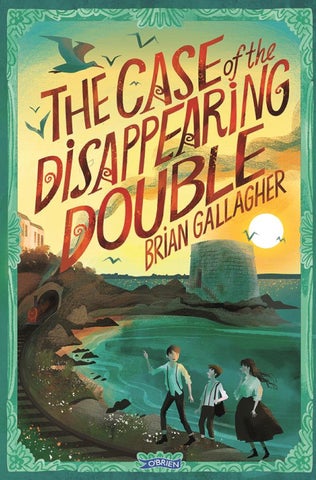
BRIAN GALLAGHER was born in Dublin. He is a full-time writer whose plays and short stories have been produced in Ireland, Britain and Canada. He has worked extensively in radio and television, writing many dramas and documentaries. Brian is the author of four adult novels. He has written many books for young readers, including: One Good Turn and Friend or Foe, both set in Dublin in 1916; Stormclouds, which takes place in Northern Ireland during the turbulent summer of 1969; Secrets and Shadows, a spy novel that begins with the North Strand bombings during the Second World War; Taking Sides, about the Irish Civil War; Across the Divide, set during the 1913 Lockout, Arrivals, a time-slip novel set between modern and early-twentieth-century Ontario; Pawns and its sequel, Spies, set during Ireland’s War of Independence; Resistance, an alternate history set in a Nazi-occupied Ireland; and Winds of Change, set during the Irish land wars. He has also written The Case of the Vanishing Painting and The Case of the Secret Signal, the first two adventures for Deirdre,Tim and Joe. Brian lives with his family in Dublin.
First published 2026 by The O’Brien Press Ltd, 12 Terenure Road East, Rathgar, Dublin 6, D06 HD27, Ireland. Tel: +353 1 4923333; E-mail: books@obrien.ie Website: obrien.ie The O’Brien Press is a member of Publishing Ireland ISBN: 978-1-78849-646-9 Text © copyright Brian Gallagher 2026 The moral rights of the author have been asserted. Copyright for typesetting, layout, editing, design © The O’Brien Press Ltd Layout and design by Emma Byrne Cover illustration by Dermot Flynn All rights reserved. No part of this publication may be reproduced or utilised in any form or by any means, electronic or mechanical, including for text and data mining, training artificial intelligence systems, photocopying, recording or in any information storage and retrieval system, without permission in writing from the publisher. 2467531 27 29 28 26 Printed and bound by Nørhaven Paperback A/S, Denmark. To the best of our knowledge, this book complies in full with the requirements of the General Product Safety Regulation (GPSR). For further information and help with any safety queries, please contact us at productsafety@obrien.ie. Published in
Dedication
For my son-in-law, Mark, and daughter-in-law, Shelby – great additions to our family.
Cast of Characters Deirdre Kavanagh, twin sister of her brother Tim Tim Kavanagh, Deirdre’s twin
Brendan Kavanagh, father of Deirdre and Tim Eileen Kavanagh, mother of Deirdre and Tim Joe Martin, Tim’s best friend
Robert Martin, Joe’s widowed father
Brother Walsh, Head Christian Brother at St John’s Catholic Boys’ Orphanage
Brother Tierney, Christian Brother and maths teacher at St John’s Catholic Boys’ Orphanage
Billy Smith, orphan at St John’s Catholic Boys’ Orphanage
Pierce, Billy’s close friend and orphan at St John’s Catholic Boys’ Orphanage Isobel Forsyth, schoolgirl.
Victor Forsyth, father of Isobel
Chief Superintendent Leech, Dublin Metropolitan Police officer Sadie Nolan, Maura Breslin and Beth Breslin, local girls
PART ONE
Encounters
CHAPTER ONE
St John’s Catholic Boys’ Orphanage BL ACKROCK, COUNTY DUBLIN.
Wednesday 3rd July 1912
B
illy Smith was determined to escape. He could feel his
heart pounding and he trembled as he lay in his bottom bunk. He took deep breaths to try to calm himself. He knew that escaping was risky, and that if he was caught, he faced a beating from
Brother Walsh. Escaping would mean freedom, though, and an end to the harsh life of the orphanage, with its bad food, strict discipline and frequent beatings.
The lights of the dormitory were out, and Billy had lain unmov-
ing in his bunk until he was sure that the other twenty boys in 9
the room were asleep. Time to go. But the thought of being caught made him fearful and he struggled to take the first step. Come on! he told himself.
Pulling back his sheet and coarse woollen blanket, he swung
his legs out of bed. The floor felt cool under his bare feet as he
moved quietly to his bedside locker. It had a metal handle that normally squeaked, but in planning his escape Billy had lubricated it with oil from the workshops, and now it swung open
soundlessly. Billy slipped off his pyjamas and dressed quickly, then he removed a small travel bag that he had hidden at the
back of the locker. In it was a change of clothes, a bottle of water, and some bread and cheese. It wasn’t much, but it would keep him going for a day or two.
He planned to take the ferry from Dublin to the bustling
port of Liverpool. He had heard that there was plenty of work there, and lads as young as twelve or thirteen could find jobs as
messenger boys. Billy knew nobody in Liverpool, and he would
be arriving with no job and nowhere to stay, but he didn’t care. Anything would be better that life in St John’s. Although only
thirteen, he was tall for his age, and he was willing to do any
sort of work to support himself. The orphans in St John’s were worked hard by the Congregation of Christian Brothers who
ran the place, but they got no payment, which meant that he couldn’t buy a ticket for the ferry. Still, crossing the Irish Sea to
England wasn’t a long voyage, and he reckoned that he could 10
stow away and stay hidden until he reached Liverpool.
First, though, he had to get out of St John’s. His pulses were racing
as he tiptoed towards the doorway leading from the dormitory
to the second-floor landing. Billy liked some of the other boys, especially his pal, Pierce, but saying goodbye now was out of the question, and instead he concentrated on what lay ahead.
He knew that the brothers patrolled the corridors outside the
dormitories, and he stood at the door listening intently. If he
stepped out onto the landing and ran into a patrolling brother, there could be no explaining being dressed and carrying a travel
bag. Straining his ears, he thought he heard a sound out in the corridor. He pressed himself flat against the wall of the dormitory, its gloomy interior faintly lit by the dim light that filtered in through the door that was always left open.
Billy’s stomach tightened. Someone was coming along the corri-
dor. He clearly heard the footsteps approaching, then to his horror
they stopped just outside the door. Billy held his breath, praying
that the patrolling brother wouldn’t step into the dormitory. To his relief the man didn’t enter the room. But neither did he move on. What was he doing? Surely he couldn’t know that Billy was
pressed against the wall just a few feet away. But if somehow he did know, was he playing cat and mouse?
After what seemed like an age, but was probably just a few
seconds, the mystery was solved. Billy heard the striking of a
match, then caught the whiff of smoke, and he realised that the 11
patrolling brother had stopped to light a cigarette. Billy breathed
a silent sigh of relief as the man headed off. He stood unmoving, giving the brother time to get to another part of the building. But
he couldn’t stay here too long and after a moment he chanced looking out into the corridor. It was all clear, and Billy moved swiftly, making for the stairs.
He descended, taking care to make no sound, then reached
the hallway on the ground floor. He turned left and made for the rear corridor, knowing that the front door would be locked at this
time of night. The rear door, however, was bolted from the inside, rather than locked with a key, and Billy made his way along the dimly-lit back corridor until he got to the door.
He reached out and pulled at the large metal bolt. It was heavy
and stiff, and Billy felt a stab of panic when it didn’t move. He
tried again, and this time it moved slightly, but still didn’t slide
open. Billy realised that he would have to pull really hard, but
that risked making a noise if the bolt snapped back into its frame. He hesitated for a moment, but there was no other option – he had to risk the noise if he wanted to get out of the building.
He pulled hard, and this time the bolt slid back. The slap as
it hit the back of the frame sounded loud to Billy, and he stood immobile, praying that none of the brothers who ran the orphanage were near enough to hear. After a moment he reckoned that he had got away with it and he reached for the handle and gently opened the back door.
12
The sweet smell of summer air hit his nostrils as he stepped
outside into the darkness. He saw the lights that were still on
in the nearby building where the brothers lived, and he moved
quickly, taking care not to crunch the gravel underfoot as he headed in the direction of the driveway.
Just as he reached the end of the brothers’ building, he thought
he saw a movement up ahead. He hadn’t yet got his night sight, and he wasn’t sure if he was imagining it. He moved on, then was shocked to hear a voice from just a few feet away. ‘Going somewhere?’
Billy swung round, startled, and his blood ran cold on recog-
nising the sneering tone and the lilting Kerry accent of Brother
Walsh, the Head Brother, and the most feared of all the orphanage staff. Before Billy could answer, Walsh came forward. ‘Who have we got here?’
Billy felt his knees trembling, but he knew that any delay in
answering would only anger Brother Walsh further. ‘Smith, sir. Billy Smith.’
‘Billy Smith. Why am I not surprised?’ said Walsh, his tone
almost conversational. Before Billy could respond, Walsh slapped him in the face. Billy fell to the ground, his face stinging and his head reeling.
‘Ungrateful little brat,’ said Walsh, grabbing Billy by the collar
and hauling him to his feet. ‘You need to be taught a lesson.’ ‘Please, sir!’ said Billy.
13
‘Please, sir, what?’
‘The flames, sir,’ cried Billy, pointing to behind Walsh.
Instinctively the brother looked behind him, and Billy swiftly
turned on his heel and sprinted down the drive. He heard the
sound of Walsh pursuing him and he ran flat out. Billy sensed
that he was pulling ahead of his pursuer and he put every ounce of his energy into widening the lead. Walsh was still running
after him, however, and Billy now saw that the gates at the end of the drive had been closed for the night. He would have to scale the wall.
Not slowing, Billy diverted from the drive and made for
the boundary wall, with Walsh still in hot pursuit. Billy
reached the wall and launched himself up. The wall was high, and he just about managed to grasp the top of it. He tried
to haul himself up, fighting back his panic as Walsh drew nearer. With one final heave he got his right leg onto the top
of the wall. Shifting his weight, he tried to pull his other leg
up. From the corner of his eye he saw Walsh leaping forward, then he felt a pull on his leg.
The brother had grasped his left ankle. Billy pulled hard, but
the brother held tight. In desperation, Billy dropped his right
leg and kicked backwards, catching Walsh with the blow. Walsh
cried out in anger and pain but without releasing Billy’s ankle.
Instead, the power of the man’s grip intensified and, to his horror, Billy felt himself falling as Walsh yanked his leg and pulled him 14
down from the wall. Billy hit the ground hard but was instantly pulled to his feet.
Walsh delivered two stinging blows, one to each cheek. ‘By
God, you’ll pay for this!’ he cried.
Billy felt his collar almost choking him, as Brother Walsh
tightened it around his neck, then he stumbled along helplessly as Walsh dragged him back towards the orphanage.
15
CHAPTER TWO
Thursday 4th July 1912
‘O
K, showtime!’ cried Tim. He was seated at his
favourite picnic spot on the banks of the Tolka river with his
twin sister Deirdre and their friend Joe. The morning sun shone down on the sparkling water, and the air carried the scent of
gorse. Tim loved the feeling that the summer holidays stretched out before them, but Joe was going to Limerick with his father
for a few days. Deirdre had proposed a farewell meal – even
though they would be seeing him again on Sunday night – and Tim had gone with the playful spirit of the occasion and suggested they each compose a limerick, seeing as that was where Joe was headed.
Tim loved any kind of word play and he had set the challenge
that they would each write one of the five-line comedy poems known as limericks. Tim was to write about Joe, Deirdre about Tim, and Joe about Deirdre.
‘Who’s going to go first?’ asked Joe. 16
‘All right, I’ll read mine,’ said Deirdre. She took a breath, then
began to recite.
We’ve all met the boy known as Tim,
And here’s what’s the matter with him, He was thrown out of school, For acting the fool,
Poor Tim – was incredibly dim! ‘I might have known I’d end up being insulted!’ said Tim. But
in fact, he thought his sister’s limerick was clever, and he gave her a crooked grin.
‘Here, I might as well get mine out of the way,’ said Joe. Tim nodded. ‘Off you go.’
Joe paused a moment, then recited. There once was a girl they called Dee, Who cried out when stung by a bee, Well, it hurt really bad,
And that made her feel sad,
Then she went home in time for her tea. ‘Not bad, Joe,’ conceded Deirdre.
‘Although the grammar?’ said Tim.
Joe looked at him quizzically. ‘What about it?’ 17
‘It shouldn’t be “hurt really bad”, it should be “hurt really
badly”.’
‘Ah here, it’s for fun. I’m not sitting an exam!’
‘True,’ said Deirdre. ‘Although it still doesn’t really make sense.
Why did she go home for her tea?’
‘Because it rhymes with bee!’ said Tim.
‘You’re all so smart, aren’t you?’ said Joe good-humouredly.
‘OK, Tim, let’s hear yours.’
Tim readied himself, then launched into his limerick. There once was a gardener called Joe,
Each weekend the grass he would mow, Ne’er a weed showed its face,
With our Joe round the place,
As he wielded his rake and his hoe. ‘Fair enough,’ said Joe.
‘Except that Joe was never a gardener,’ said Deirdre.
‘I was never thrown out of school,’ retorted Tim, ‘but it didn’t
stop you from putting it in your poem, did it?’ ‘There is that,’ admitted Deirdre.
Joe threw a twig into the slowly flowing waters of the Tolka
then turned to his friends.
‘Do you think … do you think we might have another adven-
ture? Another case to solve?’
18
The previous summer the three friends had helped Mr
Kavanagh, Tim and Deirdre’s father, to clear his name when he was wrongly suspected of taking part in a robbery. Then last
winter they had helped solve another case, after they stumbled across a kidnapping.
Tim considered his friend’s question. ‘Might be too much to
hope for, even though I’d love it.’
‘I’d love it too,’ said Deirdre. ‘It was brilliant outsmarting the
police.’
‘Well, we didn’t really outsmart them the second time,’ said
Tim. ‘We worked with Superintendent Leech, and that was even better.’
‘He was sound, all right,’ agreed Joe. ‘And the night we were
given our medals was one of the best nights of my life.’
‘The day the superintendent bought us all the icecream we
could eat was one of the best days of my life!’ said Deirdre.
Joe grinned. ‘Probably the biggest adventure for me this
summer will be surviving Granddad’s cooking.’ ‘Is it that bad?’ asked Tim.
Joe pulled a face. ‘Granddad is really gentle and kind, and I
love him, but he must be the worst cook in Limerick!’
‘Well, in that case, we’d better feed you up,’ said Tim. ‘So, time
for our picnic?’
‘Time for our picnic!’ agreed Deirdre and Joe.
19
*** ‘Good luck, Billy,’ whispered Pierce, Billy’s closest friend in the orphanage.
‘Thanks, Pierce,’ whispered Billy in return, admiring the other
boy for taking the risk of showing his support.
They were both standing in the heat in the main yard in St
John’s, and all the orphans were assembled in line for the spectacle to come. Billy was about to be publicly punished by Brother
Walsh, but he tried not to show his fear. He glanced around at the
assembled boys. Some, he knew, would be quietly on his side, like Pierce. Others would be relieved that he was about to be beaten and not them. And then there was a smaller group, the nastier boys, who seemed to enjoy seeing somebody getting a hiding.
Billy could see that every brother in the orphanage was gath-
ered here. All of them enforced the harsh rules of St John’s, though none of the others did so as enthusiastically as Brother
Walsh. Billy caught sight of the youngest brother, Brother Tier-
ney, who looked a bit uncomfortable. Billy liked Brother Tierney, who taught maths – Billy’s favourite subject in the school that was part of the orphanage. But however sympathetic Brother Tierney might be, no one went against the wishes of Walsh, the Head Brother.
‘Step forward, Billy Smith,’ cried Brother Walsh now.
Billy knew that the brother was going to make a production 20
of his punishment, and sure enough, Walsh now adopted a conversational tone.
‘Tell us why you’re here this morning, Smith,’ he said. ‘For punishment, Brother.’
‘And why do you need to be punished?’ ‘For running away, Brother.’
‘So you agree that you deserve punishment?’
Billy hesitated, reluctant to give Walsh the satisfaction of play-
ing his game. But he knew that if he defied him by refusing to answer, things would be even worse. ‘Yes, Brother,’ he answered reluctantly.
‘Yes, Brother, what?’
‘I deserve to be punished.’ ‘Step forward.’
Billy did as he was told. ‘Hold out both hands.’
Billy could feel all eyes on him, and he tried not to let his
hands shake as he held them out.
Slowly and with ceremony, Walsh took from his black robes
the weighted leather strap that he used for doling out punish-
ment. Without warning, he brought it down heavily onto Billy’s right hand.
A stinging pain shot up Billy’s arm, then Walsh brought the
leather down onto his left palm, and the pain shot up that arm too. Billy had no idea how many blows Walsh would inflict – he 21
suspected that the uncertainty was part of the brother’s plan – but he had endured the first two blows without flinching.
Brother Walsh took his time, then delivered two more vicious
blows to Billy’s outstretched hands. Despite his pain, Billy man-
aged not to cry out. Lots of boys were reduced to tears by Walsh, but Billy decided that the one way he could fight back was not to break down.
Walsh continued to slap his reddening hands. Despite the
agony, Billy sensed that those watching realised that he was defy-
ing Walsh in the only way that he could. The blows continued, but in spite of the searing pain, Billy gritted his teeth, kept his hands outstretched and refused to make a sound.
22
‘N
CHAPTER THREE
ext stop is ours, girls!’ cried Deirdre as the train
pulled out of Blackrock station, leaving a trail of thick black
smoke in its wake. It was the first week of the summer holidays and everyone was in good spirits, with school finished and the summer stretching out before them. Deirdre’s twin, Tim, had
got off at Blackrock Station to go swimming at the public baths
there with some of the boys from their neighbourhood. Deirdre, however, was going on to swim at Seapoint, with her friends Beth and Maura Breslin, and another neighbourhood girl, Sadie Nolan. Deirdre had never liked Sadie, who believed that her
family was a cut above everyone else, but she couldn’t stop Sadie from coming when a group of kids from the road had decided to go swimming.
‘Here, how do people in the sea greet each other?’ asked
Deirdre now.
‘Ah, not another one of your jokes,’ said Sadie.
Deirdre felt a twinge of irritation but decided not to let the
other girl get to her.
‘It’s all right, Sadie,’ she said. ‘You don’t have to laugh if you
don’t want to.’
‘How do people in the sea greet each other?’ asked Maura, a
smile playing on her lips even before she heard the answer. ‘They wave!’ replied Deirdre.
23
Beth and Maura laughed, while Sadie gave a brief fake smile
before regaining a straight face.
‘This is my first swim of the summer,’ said Beth. ‘I hope the
water won’t be really cold.’
‘It’s Ireland, Beth,’ said Deirdre. ‘Of course it’ll feel cold!’ ‘It will be grand once you get down,’ said Maura.
‘And it will be better than where the boys went,’ added
Deirdre. ‘The deep pool in Blackrock Baths always feels cold.’
‘Talking about the boys, why didn’t Joe Martin go with them?’
asked Sadie.
‘He’s gone down to Limerick with his dad,’ answered Deirdre. ‘I suppose he’d rather get doted on by his relations than be
with us,’ said Sadie.
‘He’s gone to visit his granddad,’ said Deirdre. ‘What’s wrong
with that?’
‘Nothing – if you think it’s OK to be spoiled because he’s the
only grandchild.’
‘His mam died, in case you’d forgotten,’ said Deirdre. ‘That was four years ago.’
Deirdre felt her anger mounting at Sadie’s cold-hearted atti-
tude, but she kept her voice reasonable. ‘Let me ask you a ques-
tion,’ she said to the other girl. ‘Last year, when your dad was taken to hospital with a heart attack, how did you feel?’ ‘That’s different.’
‘I know it’s different, but how did you feel?’ 24
‘Worried, of course.’
‘Then think how worried Joe must have been. Except that your
father got better. Joe’s mother got worse – and then died. So back
off, Sadie, OK?’
‘Fine,’ said Sadie curtly.
Just then the train began to slow down as it approached Sea-
point station.
‘Right,’ said Deirdre, ‘nearly there. ‘Let’s try to enjoy the rest
of our day.’
*** ‘Come on, Dad, be a sport!’ said Joe.
‘Normally people buy presents on the last day of a holiday,
Joseph.’
‘I know, but we mightn’t be in a bookshop again, Dad. And I’ll
buy Deirdre a stick of rock on the last day of our trip. Tim would love a Sherlock Holmes book, and they’ve got The Valley of Fear.’
His father said nothing. Joe knew that he was pushing his luck
in buying presents at all, with three days just about qualifying as a
holiday. Oh well, nothing ventured, nothing gained, he thought, and he looked appealingly at his father. ‘Please, Dad?’ ‘Oh, all right, then.’
‘Thanks. You’re a star!’
His father took up the book, then they headed for the cash desk. 25
Joe liked visiting Limerick, partly because he loved Granddad,
but also because his father seemed more relaxed when he was away from Dublin. Joe knew that Dad took very seriously his role
as a senior clerk with the Midland Great Western Railway, and
that being seen as respectable and proper was important to him. It was one of the reasons that Dad had been unenthusiastic when Joe and his friends had helped the police in solving two major
cases. Even though the children had received medals, and praise
from the officer in charge of the investigations, Chief Superintendent Leech, his father had been uncomfortable.
‘Now, The Valley of Fear,’ said Dad, handing the book to Joe
after paying the assistant.
‘Thanks, Dad.’ But although Joe couldn’t admit it openly, he wished that this summer they wouldn’t just read about adventure
but would actually have one. Was that too much to wish for?
Maybe so. But as Joe stepped out of the bookshop, and into the sunlit streets of Limerick, it was what he hoped for.
*** ‘Cut out that splashing!’ cried Brother Walsh.
Billy, Pierce, and some of the other boys had been larking about
in the sea but they stopped immediately on hearing the command from the Head Brother. During the summer the orphans
were brought to swim at Seapoint, and normally Billy loved the 26
freedom of swimming at the popular bathing spot. Today, however, he was conscious of not doing anything to draw Walsh’s
attention, and so he plunged beneath the waves and swam under-
water for as long as his breath held. He broke the surface then, swam parallel to the shore with an easy breaststroke.
Looking towards land, he saw Seapoint’s Martello tower,
around which bathers thronged on summer days like this. The
sun sparkled on the water, and in the distance, he could hear a barrel organ playing ‘Steamboat Bill’, a popular song from the
previous year. From here, everything looked happy and peaceful, and he flopped over and floated on his back. He allowed himself to drift and enjoy the feeling of being away from everything.
Deep down, though, he knew that for him peace was an illusion.
Since his escape bid, Brother Walsh had had it in for him and was ready to pounce at the slightest opportunity. Although a day had passed since the public beating, Billy’s blistered hands had stung
when he entered the salt water today. It had brought home to him
how much of an enemy he had made of Walsh, first by trying to run away, and then by his silent defiance when being punished.
Even as he floated now in the gently lapping water, he couldn’t
keep from worrying about his predicament. Life in the orphanage had never been easy, but since Walsh took over four years
ago it had become much more brutal. He didn’t know how much longer he could take having to be constantly on guard. Most boys were kept in the orphanage until they were fifteen, and the idea 27
of two more years of persecution from Brother Walsh seemed unbearable.
But what options did he have? Knowing Walsh as he did, there
was no chance that he would ever win him over, so what did that leave? Escape. It was the only way out.
Next time, though, he would have to plan it far better. He
couldn’t possibly face a second failed escape bid – and the beat-
ings that that would bring. No, this time he had to make certain that he got away unseen, and also that he had the means to remain at large.
His thoughts were disturbed by the shrill blast of a whistle. It
was the signal that the orphans were to finish the swim and begin dressing. Billy immediately turned over and began a fast Austral-
ian crawl back towards the shore, not wanting to give Walsh any excuse to punish him for delaying answering the whistle.
He reached the steps leading to the water and clambered up.
He was aware of Walsh’s eyes on him, and he felt anxious. But it only clarified his thinking as he made for where his clothes were
folded under a towel. This couldn’t go on. It might take a while to organise, but he simply had to escape.
*** Deirdre luxuriated in the summer sunshine, sitting back against
the warm stone wall at Seapoint. The girls had finished their 28
swim and were relaxing now and listening to the music from a barrel organ playing ‘Mother Macree’. Lots of people were swimming, and down at the rocks that rose from the water, boys were fishing for crabs.
Deirdre watched bemusedly as they caught a crab, examined it
for a moment, and then threw it back into the sea.
‘What’s the point of that?’ she said. ‘They don’t eat the crabs;
they don’t keep them as pets. Why take them out and then throw them back in?’
‘Just the challenge of catching them, I suppose,’ answered Beth. ‘It doesn’t seem like much of a challenge – they’re catching
loads of them!’
‘They’re doing it for fun,’ said Sadie. ‘Not everything has to be
a challenge. Not everyone has to win a medal.’
Deirdre knew that this was a snide reference to the police
medal that she had won with Tim and Joe. ‘I never boasted about getting a police medal, Sadie,’ she said. ‘In fact, I don’t think I ever even told you, so there’s no need to be jealous.’ ‘Who’s jealous?’ snapped Sadie.
‘Well, it seemed for a second like you were. But we’re on
our summer holidays, so let’s not argue. I’m going down for a paddle.’
Deirdre rose and headed towards the water’s edge. She nor-
mally tried to avoid conflict with Sadie, but today the other girl
had been mean about Joe, and Deirdre had been annoyed on her 29
friend’s behalf. Why did people like Sadie always have to be so negative?’ she wondered.
Mam said that folks who were mean and jealous were actually
to be pitied, as they weren’t happy in their own lives, and Deirdre
felt that this was probably true. But it was still hard to get on with Sadie.
Putting the other girl from her thoughts, Deirdre casu-
ally strolled on in the July sunshine, gently humming ‘Mother
Macree’ to herself. Up ahead she saw a group of boys and she came to a sudden halt. Were her eyes deceiving her? Her friend
Joe had gone to Limerick for three days yesterday, yet here he was ahead of her.
‘Joe!’ she said.
The boy didn’t answer, and Deirdre was taken aback. A whistle
blew, and the boys with whom he was standing formed a line.
‘Joe!’ she said again, and this time he looked at her. He showed
no sign of recognition, however, and after a moment he turned
away and strode off with the other boys. Deirdre stood unmoving, amazed by what had just happened. It looked like Joe was part of some sort of school, but that made no sense. And why hadn’t he recognised her? And what on earth was he doing here, when he had told everyone he would be in Limerick?
30