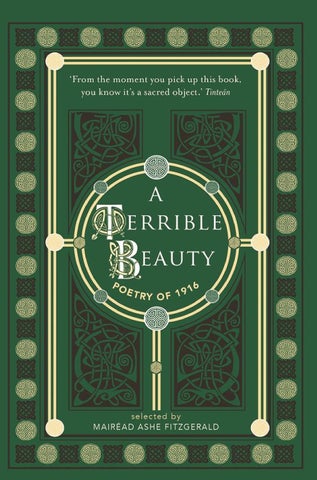
a errible eauty ‘There is no shortage of books with information and background on the events and personalities involved in the Rising of 1916. But for an emotional response, for something that may persuade us what happened was the outcome of good intentions and high nobility, we need to turn to the poets and how they perceived it … a beautifully produced little book that makes the point more powerfully than a dozen treatises.’ Irish Echo
Mairéad Ashe FitzGerald was the author of Thomas Johnson Westropp (1860–1922) An Irish Antiquary, Exploring the World of Colmcille, Castles of Ireland and was the editor of Best-Loved Yeats.
a errible eauty POE
TRY OF 191
6
selected b y MA IRÉA D A SH E FITZG ER AL D
I l l us tra ti o ns & D es i gn by E m m a By r n e
First published in paperback 2026 by The O’Brien Press Ltd. 12 Terenure Road East, Rathgar, Dublin 6, D06 HD27, Ireland. Tel: +353 1 4923333; E-mail: books@obrien.ie; Website: obrien.ie First published in hardback 2015, reprinted 2016. The O’Brien Press is a member of Publishing Ireland. ISBN: 978-1-78849-640-7 Copyright for introduction, selection, and biographical content © Mairéad Ashe FitzGerald 2015 The moral rights of the author have been asserted. Copyright for illustrations © Emma Byrne Copyright for typesetting, editing, layout and design © The O’Brien Press Ltd All rights reserved. No part of this publication may be reproduced or utilised in any form or by any means, electronic or mechanical, including for text and data mining, training artificial intelligence systems, photocopying, recording or in any information storage and retrieval system, without permission in writing from the publisher. 87654321 30 29 28 27 26 Cover illustration: Emma Byrne Printed and bound by Opolgraf, Poland The paper in this book is produced using pulp from managed forests. To the best of our knowledge, this book complies in full with the requirements of the General Product Safety Regulation (GPSR). For further information and help with any safety queries, please contact us at productsafety@obrien.ie. Every effort has been made to trace copyright holders and to obtain their permission for the use of copyright material. The publisher apologises for any errors or omissions and would be grateful if notified of any corrections that should be incorporated in future reprints or editions of this book. Published in
ACK NOW L E DGE M E NTS Sincere thanks to the Librarian and staff of the Library of the Royal Irish Academy and also to the staff at Special Collections in University College Dublin for their generous assistance and for allowing access to their unique material. The editor and publisher gratefully acknowledge permission to include the following copyright material: Bax, Arnold (Dermot O’Byrne): ‘A Dublin Ballad—1916’, ‘Martial Law in Dublin’, ‘Shells at Oranmore’. The poems are reproduced by permission of the Bax Estate and are copyright. Colum, Padraic: ‘The Rebel. Roger Casement, 1864–1916’. By kind permission of the Estate of Padraic Colum. O’Casey, Seán: ‘Thomas Ashe’ © The Estate of Seán O’Casey. By kind permission of the Estate of Seán O’Casey, care of Macnaughton Lord Representation of 44 South Molton Street, London, W1K 5RT. Stephens, James: ‘Spring—1916’. Reproduced by permission of The Society of Authors as the literary representatives of the Estate of James Stephens.
TA B L E O F C O NTE NTS A COUNTRY’S AWAKENING
11
THE CONFLUENCE OF DREAMS Patrick Pearse (1879–1916)
17
The Rebel 21 Fornocht Do Chonac Thú
24
Renunciation (Translation of Fornocht Do Chonac Thú) 26 The Fool 28 Mise Éire 30 I Am Ireland (Translation of Mise Éire)
31
The Mother 32 The Wayfarer 33
Thomas MacDonagh (1878–1916)
35
Wishes for My Son 39 Of a Poet Patriot 42 An Bonnán Buí 43 The Yellow Bittern (Translation of An Bonnán Buí by Cathal Buí Mac Giolla Gunna) 45 The Poet Captain 47
Joseph Mary Plunkett (1887–1916)
51
I See His Blood upon the Rose
55
The Little Black Rose Shall be Red at Last
56
The Stars Sang in God’s Garden
57
This Heritage to the Race of Kings
58
The Dark Way 59 To Grace 61
WHEN THE DAWN IS COME George William Russell (Æ) (1867–1935)
65
A Leader 68 On Behalf of Some Irishmen Not Followers of Tradition
69
Salutation 71 Continuity 73
Francis Ledwidge (1887–1917)
75
Thomas MacDonagh 79 Ireland 80 To Mrs Joseph Plunkett
81
The Dead Kings 82 O’Connell Street 84 A Soldier’s Grave 85
William Butler Yeats (1865–1939)
87
Easter 1916 91 Sixteen Dead Men 95 The Rose Tree 96 In Memory of Eva Gore-Booth and Con Markiewicz 97
AFTERMATH & REQUIEM Eva Gore-Booth (1870–1926)
101
Heroic Death, 1916 103 Easter Week 104 Comrades 104 Francis Sheehy-Skeffington
105
Roger Casement 106
Dermot O’Byrne (Sir Arnold Bax) (1883–1953)
109
A Dublin Ballad—1916 111 Martial Law in Dublin
114
Shells at Oranmore 115
James Stephens (1880–1950)
117
Spring—1916 119
Seán O’Casey (1880–1964)
125
Thomas Ashe 127
Thomas Ashe (1885–1917) 129 Let Me Carry Your Cross for Ireland, Lord!
132
Joyce Kilmer (1886–1918) 135 Easter Week 137
Joseph Campbell (1879–1944)
139
Fires 142 The Storm-Thrush on the Shaking Tree
143
Dora Sigerson Shorter (1866–1918)
145
The Star 147 The Dead Soldier 148
Padraic Colum (1881–1972)
151
The Rebel. Roger Casement, 1864–1916
153
Canon Charles O’Neill (1887–1963)
154
The Foggy Dew 155
index of first lines
158
A COUNTRY ’S AWAKENING
T
he trauma of the Great Famine had left Ireland with a fractured society and a culture on the verge of extinction. The drain of emigration, the near demise of the Irish language, alongside the erosion of modes of thought and knowledge from past generations were causing a slow death for a national culture. However, by the end of the nineteenth century improved literacy, more secure land tenure and an increased politicisation of the people had led to a reawakening of a sense of Irishness. The stage was set for a life-giving movement inspired by a new generation of Irish people – people of vision and energy, idealists who found a cause in saving and promoting Irish culture. There was a prevailing atmosphere of renewal and youth which brought a revitalised energy to the Irish language, the visual arts, literature, the theatre and the sporting arena. A new enthusiasm for the ancient Gaelic games of football 11
and hurling was generated with the foundation of the Gaelic Athletic Association in 1884; the Gaelic League was founded by Douglas Hyde, Eoin MacNeill and others with the purpose of restoring and promoting Irish language and culture; Irish music was celebrated through the Feis Ceoil, founded in 1897. The glories of early Celtic art found a new life under the momentum of the Irish Arts and Crafts movement; this was expressed in the works of artists such as Sarah Purser, who established the stainedglass studio of An Túr Gloine, and in the various artistic enterprises of the Yeats sisters. While WB Yeats and Lady Gregory were committed to founding a national theatre, Dublin was full of theatres run by the young. Patrick Pearse, Thomas MacDonagh and Joseph Mary Plunkett, whose poetic works are included in this book, were all engaged in theatrical pursuits: writing and staging plays, and founding theatres and literary journals. All three were poets and writers and, like many of their associates, they were engaged in every aspect of the cultural revival. Poetry had a long history of living underground in the Gaelic tradition, and dreams of nationhood and the longing for freedom found expression in a particular way in poetry. Little wonder, then, that the 12
same three poets, Pearse, MacDonagh and Plunkett, were among those who walked out on Easter Monday morning 1916 to set their country free. Their poetry expresses that longing for freedom that the authorities, fully taken up with parliamentarian and rebel movements, were blind to. In the aftermath of the Rising, the executions of the leaders and their callous burial without ceremony in a mass grave* generated an outpouring of poetry. Written by almost every poet who took part in the literary revival, these poems, many of which are placed in this collection, gave words to the depth of anger, pride, grief and identity growing amongst the people. The Rising was a glorious failure, but a people was awakening to the possibilities of nationhood, and the transforming events of Easter 1916 were immortalised by the poet WB Yeats: ‘All changed, changed utterly, a terrible beauty is born.’
* Fourteen of the leaders were buried in a mass grave at Arbour Hill in Dublin. Thomas Kent was executed in Cork and buried in the grounds of Cork Prison. Roger Casement was hanged in Pentonville Prison in London in August 1916, and buried in quicklime. 13
THE CONFLUENCE OF DREAMS
PaTRICK PEARSE (1879–1916)
T
he son of an English father and an Irish mother, Patrick Pearse (Pádraic Mac Piarais) was born in what was then Great Brunswick Street (now Pearse Street) in Dublin in 1879. Passionately devoted to Irish culture, he joined the newly formed Gaelic League in 1895, at seventeen, and went on to become editor of its newspaper, An Claidheamh Soluis, in 1903. He believed that Ireland could only attain a true identity and lasting independence through a revived Irish language and literature which had been nearly destroyed due to famine, emigration and a hostile education system. Founding St Enda’s School for boys and St Ita’s for girls saw Pearse in his role as gifted and reforming educationalist. His belief in the importance of the arts and creativity attracted the young, the talented, those looking for a cause, to teach in his schools, amongst them his brother, Willie Pearse, a sculptor 17
and actor; Thomas MacDonagh, a poet and future leader in the 1916 Rising; Mary Maguire Colum, a writer and critic; and teacher Louise Gavan Duffy, who spent Easter Week in the General Post Office (GPO) during the Rising. Pearse’s choice of the beautiful surroundings of The Hermitage in Rathfarnham for St Enda’s was part of this philosophy and attracted other like-minded idealists. Artists such as Sarah Purser, Jack B Yeats and Beatrice Elvery gave paintings. WB Yeats, Douglas Hyde, Edward Martyn, George Moore, the poets Joseph Campbell and Padraic Colum, and Máire Nic Shiubhlaigh of the Abbey Theatre visited the school, gave lectures and attended the plays put on by the pupils. It was a place where cultural nationalism flourished. Pearse’s own writings poured out of St Enda’s: translations of poems from Irish, stories such as Íosagán agus Scéalta Eile and dramas and essays. Pearse had a deep and scholarly knowledge of Gaelic literature and translated numerous poems from the early modern period by poets such as Geoffrey Keating (Seathrún Céitinn), Piaras Feiritéar and others. He wrote extensively on the subject of education and his essay entitled The Murder Machine was widely influential. Pearse also gradually became prominent in revolutionary circles and moved towards a more 18
military position. He was a founder-member of the Irish Volunteers in 1913 and was a member of the Irish Republican Brotherhood (IRB). The public platform suited Pearse; he had a growing reputation for eloquence and leadership. He was chosen by Thomas Clarke to give what was an electrifying and oft-quoted oration over the grave of the old Fenian Jeremiah O’Donovan Rossa in Glasnevin Cemetery in August 1915: They think that they have pacified Ireland. They think that they have pacified half of us and intimidated the other half. They think that they have foreseen everything, think that they have provided against everything; but the fools, the fools, the fools! they have left us our Fenian dead, and while Ireland holds these graves, Ireland unfree shall never be at peace. Extract from Pearse’s speech over the grave of Jeremiah O’Donovan Rossa in Glasnevin Cemetery. Pearse played a central role in the IRB planning of the coming insurrection. The courage and leadership that he displayed as commander-in-chief in the GPO determined to a great extent the course of events of that fateful week. The Rising ultimately ended in 19
surrender on Saturday, 29 April. Pearse was held in Arbour Hill Barracks, away from his comrades, from Saturday until Tuesday, 2 May, when he was brought to Richmond Barracks for court martial. He spoke from the dock and was given the death sentence, which he received with characteristic composure. A writer to the last, Pearse spent the hours before his death in Kilmainham Jail leaving instructions for his literary affairs and composing some final letters to his family and his last poem, ‘The Wayfarer’. He was executed by firing squad at dawn on Wednesday, 3 May. The poems selected here reflect the range of Pearse’s poetry, some of which he wrote in Irish with translations in English. They show the spirit of selfsacrifice and renunciation that informed his life’s work, and most of all, the soul of the rebel who so desired to see his country freed.
20
TH E R EB E L I am come of the seed of the people, the people that sorrow, That have no treasure but hope, No riches laid up but a memory Of an Ancient glory. My mother bore me in bondage, in bondage my mother was born, I am of the blood of serfs; The children with whom I have played, the men and women with whom I have eaten, Have had masters over them, have been under the lash of masters, And, though gentle, have served churls; The hands that have touched mine, the dear hands whose touch is familiar to me, Have worn shameful manacles, have been bitten at the wrist by manacles, Have grown hard with the manacles and the task-work of strangers, I am flesh of the flesh of these lowly, I am bone of their bone, I that have never submitted; I that have a soul greater than the souls of my people’s masters, I that have vision and prophecy and the gift of fiery speech, I that have spoken with God on the top of His holy hill. 21
And because I am of the people, I understand the people, I am sorrowful with their sorrow, I am hungry with their desire: My heart has been heavy with the grief of mothers, My eyes have been wet with the tears of children. I have yearned with old wistful men, And laughed or cursed with young men; Their shame is my shame, and I have reddened for it, Reddened for that they have served, they who should be free, Reddened for that they have gone in want, while others have been full, Reddened for that they have walked in fear of lawyers and of their jailers With their writs of summons and their handcuffs, Men mean and cruel! I could have borne stripes on my body rather than this shame of my people. And now I speak, being full of vision; I speak to my people, and I speak in my people’s name to the masters of my people. I say to my people that they are holy, that they are august, despite their chains, That they are greater than those that hold them, and stronger and purer, That they have but need of courage, and to call on the name of their God, 22
God the unforgetting, the dear God that loves the peoples For whom He died naked, suffering shame. And I say to my people’s masters: Beware, Beware of the thing that is coming, beware of the risen people, Who shall take what ye would not give. Did ye think to conquer the people, Or that Law is stronger than life and than men’s desire to be free? We will try it out with you, ye that have harried and held, Ye that have bullied and bribed, tyrants, hypocrites, liars!
23
FO R NO C H T D O C H O NAC T H Ú Fornocht do chonac thú, A áille na háille, Is do dhallas mo shúil Ar eagla go stánfainn. Do chualas do cheol, A bhinne na binne, Is do dhúnas mo chluas Ar eagla go gclisfinn. Do bhlaiseas do bhéal, A mhilse na milse, Is chruas mo chroí Ar eagla mo mhillte. Do dhallas mo shúil, Is mo chluas do dhúnas, Do chruas mo chroí Is mo mhian do mhúchas;
24
Do thugas mo chúl Ar an aisling a chumas, ’S ar an ród seo romham M’aghaidh do thugas. Do thugas mo ghnúis Ar an ród seo romham, Ar an ngníomh do-chím, ’S ar an mbás do-gheobhad.
25
RE NUNC I AT I O N (Tr a ns lation of FORNOCHT D O CHO NAC T HÚ ) Naked I saw thee, O beauty of beauty, And I blinded my eyes For fear I should fail. I hear thy music, O melody of melody, And I closed my ears For fear I should falter. I tasted thy mouth, O sweetness of sweetness, And I hardened my heart For fear of my slaying. I blinded my eyes, And I closed my ears, I hardened my heart And I smothered my desire.
26
I turned my back On the vision I had shaped, And to this road before me I turned my face. I have turned my face To this road before me, To the deed that I see And the death I shall die.
27
TH E FO O L Since the wise men have not spoken, I speak that am only a fool; A fool that hath loved his folly, Yea, more than the wise men their books or their counting houses, or their quiet homes, Or their fame in men’s mouths; A fool that in all his days hath done never a prudent thing, Never hath counted the cost, nor recked if another reaped The fruit of his mighty sowing, content to scatter the seed; A fool that is unrepentant, and that soon at the end of all Shall laugh in his lonely heart as the ripe ears fall to the reaping-hooks And the poor are filled that were empty, Tho’ he go hungry. I have squandered the splendid years that the Lord God gave to my youth In attempting impossible things, deeming them alone worth the toil. Was it folly or grace? Not men shall judge me, but God. I have squandered the splendid years: Lord, if I had the years I would squander them over again, Aye, fling them from me! For this I have heard in my heart, that a man shall scatter, not hoard, 28
Shall do the deed of to-day, nor take thought of to-morrow’s teen, Shall not bargain or huxter with God; or was it a jest of Christ’s And is this my sin before men, to have taken Him at His word? The lawyers have sat in council, the men with the keen, long faces, And said, ‘This man is a fool,’ and others have said, ‘He blasphemeth’; And the wise have pitied the fool that hath striven to give a life In the world of time and space among the bulks of actual things, To a dream that was dreamed in the heart, and that only the heart could hold. O wise men, riddle me this: what if the dream come true? What if the dream come true? and if millions unborn shall dwell In the house that I shaped in my heart, the noble house of my thought? Lord, I have staked my soul, I have staked the lives of my kin On the truth of Thy dreadful word. Do not remember my failures, But remember this my faith. And so I speak. Yea, ere my hot youth pass, I speak to my people and say: Ye shall be foolish as I; ye shall scatter, not save; Ye shall venture your all, lest ye lose what is more than all; Ye shall call for a miracle, taking Christ at His word. And for this I will answer, O people, answer here and hereafter, O people that I have loved shall we not answer together? 29
MISE ÉIRE Mise Éire: Sine mé ná an Chailleach Bhéarra. Mór mo ghlóir: Mé a rug Cú Chulainn cróga. Mór mo náir: Mo chlann féin a dhíol a máthair. Mise Éire: Uaigní mé ná an Chailleach Bhéarra.
30
I AM I R E LA N D (Tr a n sl ation of M ISE ÉIRE) I am Ireland: I am older than the old woman of Beare. Great my glory: I that bore Cuchulainn the valiant. Great my shame: My own children that sold their mother. I am Ireland: I am lonelier than the Old Woman of Beare.
31
TH E MOT H E R I do not grudge them: Lord, I do not grudge My two strong sons that I have seen go out To break their strength and die, they and a few, In bloody protest for a glorious thing, They shall be spoken of among their people, The generations shall remember them, And call them blessed; But I will speak their names to my own heart In the long nights; The little names that were familiar once Round my dead hearth. Lord, thou art hard on mothers: We suffer in their coming and their going; And tho’ I grudge them not, I weary, weary Of the long sorrow—And yet I have my joy: My sons were faithful, and they fought.
32
TH E WAY FA R E R The beauty of the world hath made me sad, This beauty that will pass; Sometimes my heart hath shaken with great joy To see a leaping squirrel in a tree, Or a red lady-bird upon a stalk, Or little rabbits in a field at evening, Lit by a slanting sun, Or some green hill where shadows drifted by Some quiet hill where mountainy man hath sown And soon would reap; near to the gate of Heaven; Or children with bare feet upon the sands Of some ebbed sea, or playing on the streets Of little towns in Connacht, Things young and happy. And then my heart hath told me: These will pass, Will pass and change, will die and be no more, Things bright and green, things young and happy; And I have gone upon my way Sorrowful. Written by Pearse in Kilmainham Jail on the night before his execution.
33
THOMAS MACDONAGH (1878–1916)
T
homas MacDonagh was born in 1878 in Cloughjordan, County Tipperary, where his parents were school teachers. He was educated at Rockwell College near Cashel, County Tipperary, by the Holy Ghost Fathers and studied there for the priesthood before moving to a teaching post in St Kieran’s College, Kilkenny, in 1901. There he discovered the Gaelic League and immediately became swept up in the nationalist movement. Five years’ teaching in St Colman’s in Fermoy, County Cork, followed before MacDonagh moved to Dublin in 1908 to join Patrick Pearse in St Enda’s as assistant headmaster. MacDonagh was blessed with a lighthearted personality, well suited to act as a foil to the seriousness of Pearse as headmaster. Padraic Colum called him ‘a wonderfully good comrade, an eager friend, a happy-hearted companion’ with ‘a flow of 35
wit and humour’. Together, MacDonagh and Pearse were a perfect team with shared interests: both were literary men and both were charismatic teachers with a love of poetry, theatre and the Irish language. MacDonagh was already well known in literary circles by the time he came to St Enda’s. His play When the Dawn is Come (with its theme of Irish insurrection) was accepted by WB Yeats and Lady Gregory and staged in the Abbey Theatre in 1907. He had published three books of poetry by 1906. As early as 1903 he had sent some of his poems to WB Yeats, who responded with advice and encouragement. Yeats advised him to read and translate from Irish in order to fully experience the Irish mode of expression. Indeed, MacDonagh’s translations, with their internal rhyme and assonance, beautifully preserve the fluidity and rhythm of the originals. He read English, French and Irish at University College Dublin and became an inspired lecturer in the Department of English there. Thomas MacDonagh and Muriel Gifford were married in 1912 and they had two children, Donagh and Barbara. Muriel, who came from a Protestant Unionist family in Dublin, was an artist. Her sister was Grace Gifford, who was to marry Joseph Plunkett in Kilmainham Jail shortly before his execution. 36
MacDonagh was a literary innovator and critic, arguing for the individuality of national and cultural traditions. He made an immense contribution to the study and development of Irish literature in English. He believed that Irish writing must find a new separate identity in a time of transition, influenced by the Irish way of speech and by Irish music. His book Literature in Ireland is regarded as one of the most important works of literary criticism written in Ireland in the twentieth century. He was one of the founders of The Irish Review, an influential journal devoted to art and literature. He found time to act as manager to the Irish Theatre, which was founded by Joseph Plunkett and Edward Martyn. By 1913, like Pearse, he was progressing from cultural nationalist to military separatist. With the founding of the Irish Volunteers in 1913, MacDonagh, a man of ideas and organisational competence, emerged as a natural leader. He became a member of the General Council and acted as director of training. He played a central role in planning for an insurrection, and Easter Monday 1916 saw him as commandant of a garrison in Jacob’s Biscuit Factory, an enormous building in central Dublin. Máire Nic Shiubhlaigh, a great patriot, a member of Cumann na mBan and a renowned actress in the Abbey 37
Theatre, was in Jacob’s Factory for the entire week of the Rising. She left a first-hand description of those events in her fine book, The Splendid Years, where she remembers MacDonagh’s optimism and enthusiasm, giving encouragement to his garrison during the long hours and days of Easter Week. Dismayed by news of the surrender on Saturday, which only reached them on Sunday, MacDonagh was persuaded to meet with General Lowe and he and his comrades reluctantly laid down their arms. For his role in the Rising and his signature on the Proclamation, Thomas MacDonagh was tried by court martial at Kilmainham Jail and executed by firing squad on the morning of Wednesday, 3 May.
38
WI S HE S FO R MY S O N Born on Saint Cecilia’s Day 1912 Now, my son, is life for you, And I wish you joy of it,— Joy of power in all you do, Deeper passion, better wit Than I had who had enough, Quicker life and length thereof, More of every gift but love. Love I have beyond all men, Love that now you share with me— What have I to wish you then But that you be good and free, And that God to you may give Grace in stronger days to live? For I wish you more than I Ever knew of glorious deed, Though no rapture passed me by That an eager heart could heed, Though I followed heights and sought Things the sequel never brought.
39
Wild and perilous holy things Flaming with a martyr’s blood, And the joy that laughs and sings Where a foe must be withstood, Joy of headlong happy chance Leading on the battle dance. But I found no enemy, No man in a world of wrong, That Christ’s word of charity Did not render clean and strong— Who was I to judge my kind, Blindest groper of the blind? God to you may give the sight And the clear undoubting strength Wars to knit for single right, Freedom’s war to knit at length, And to win, through wrath and strife, To the sequel of my life.
40
But for you, so small and young, Born on Saint Cecilia’s Day, I in more harmonious song Now for nearer joys should pray— Simpler joys: the natural growth Of your childhood and your youth, Courage, innocence, and truth: These for you, so small and young, In your hand and heart and tongue.
41
O F A P O E T PAT R I OT His songs were a little phrase Of eternal song, Drowned in the harping of lays More loud and long. His deed was a single word, Called out alone In a night when no echo stirred To laughter or moan. But his songs new souls shall thrill, The loud harps dumb, And his deed the echoes fill When the dawn is come.
42