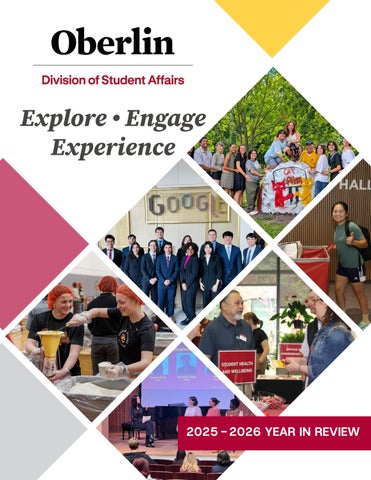
Explore • Engage Experience
2025 - 2026 YEAR IN REVIEW
Over the past five academic years, the Division of Student Affairs has been intentional about reimagining how we respond proactively to our students’ evolving needs while preserving the educational experience that makes Oberlin distinctive. The 2025–2026 Student Affairs Year in Review reflects our collective effort and commitment to centering the student experience—guided throughout by our division’s mission of “empowering students to explore possibilities, engage with their communities, and experience personal growth and development.”
Message from the VICE PRESIDENT and DEAN of STUDENTS
With more than 200 student organizations, Oberlin offers an abundance of possibilities for exploration. Students are encouraged to stay curious, discover new interests, build connections through community, and take full advantage of the diverse pathways available to them, both inside and outside the classroom. Our focus on engagement has opened a myriad of opportunities for students to connect with their communities, on and off campus. Whether through local community service, OC Votes, Rise Against Hunger, or the inaugural Impact Cleveland Winter Term project, Obies are making a meaningful difference through active learning and engagement. Through purposeful investment in campus life, we have supported students’ holistic growth and development as part of their overall Oberlin experience. That has meant strengthening health and wellness resources through the launch of our Certified Peer Wellness Ambassador Program, Tele-Mental Health services, Student-Athlete Wellness initiatives, Personalized Student Success Coaching, and an expanded Accommodated Testing Center. And, this summer, the completion of Wilder Hall’s third floor renovation with revitalized gathering spaces for students.
2 | Division of Student Affairs - YEAR IN REVIEW 2025 - 2026
A Message from the VICE PRESIDENT and DEAN of STUDENTS
Throughout, our focus has remained constant - to foster an inclusive community where every student feels a sense of belonging and mattering. Looking ahead, our commitment is to further elevate the Oberlin student experience through implementation of the Student Affairs Strategic Compass— Empowering Students to Thrive. Our aim is to continue building a seamless network of support that cultivates a culture of excellence through innovative and strategic partnerships. Student Affairs at Oberlin remains anchored in one unwavering, non-negotiable pillar - our students. As you read this Year in Review, I hope you will recognize the collective effort of the dedicated professionals, campus partners, and, most importantly, the students who continue to shape our campus. Every accomplishment reflected in these pages affirms our shared belief that an excellent student experience extends beyond the classroom and is foundational to student success. Thank you for your continued partnership, support, and shared commitment to the transformative power of the Oberlin student experience. Together, we will continue reimagining the role of Student Affairs in advancing student success by elevating the student experience so that every Obie can thrive. With gratitude,
MISSION The Division of Student Affairs collaborates in empowering our students to explore possibilities, engage with their communities, and experience personal growth and development, by co-creating a holistic and transformative living learning environment. Through these experiences, they are prepared to lead with purpose and thrive in a diverse and complex global society.
VISION Our vision is to reimagine Student Affairs at Oberlin College and Conservatory as a model of inclusive excellence among selective liberal arts institutions, recognized for educationally-purposeful, innovative, and high impact programs and services, that foster a holistic and transformative student experience which empowers students to thrive personally, academically, and socially.
Karen C. Goff Vice President and Dean of Students
Oberlin College & Conservatory | 3
Table of CONTENTS Student Affairs Leadership Team.......................................................6 Center for Student Success ................................................................8 Career Exploration and Development...........................................16 Student Leadership and Involvement............................................20 • Student Conduct and Community Standards ....................26 • Student Support and Outreach ................................................27 Center for Intercultural Engagement.............................................28 Multifaith Chaplaincy and Sustained Dialogue...........................38 Residence Life.........................................................................................42 Student Health and Well-Being........................................................46 Campus Safety ......................................................................................54 Strategic Initiatives ...............................................................................58 Student Learning Goals & Outcomes ...........................................63 Shared Values..........................................................................................64
COVER PHOTO CREDITS Top, L-R: Cat in the Cream Coffeehouse - Staff at The Rock – Photo by OSLI, Ashby Business Scholars visit to Boston Google Office – Photo by CED, Rise Again Hunger Even – Photo by Mike Crupi Bottom, L- R: Woodland Hall inaugural move-in – Photo by Tanya Rosen Jones, All Roads Lead to Oberlin – Photo by SHAW, Student Success Panel – Photo by CSS
4 | Division of Student Affairs - YEAR IN REVIEW 2025 - 2026
Connection Fair – Photo by Communications
Oberlin College & Conservatory | 5
Student Affairs LEADERSHIP TEAM
Kipp Colvin Dean of Student Success
Lori Ebihara Director of Student Affairs, Operations, and Planning
Christopher Jorgenson Assistant Vice President and Dean for Intercultural Engagement
Thom Julian Senior Associate Dean of Students
6 | Division of Student Affairs - YEAR IN REVIEW 2025 - 2026
Student Affairs LEADERSHIP TEAM
Andrew Oni Assistant Vice President for Student Health and Well-Being
Anthony Pernell McGee Executive Director, Career Exploration and Development
Eric Rooks Director of Campus Safety
Mark Zeno Assistant Vice President and Dean of Residential Life and Auxiliary Services Oberlin College & Conservatory | 7
Center for STUDENT SUCCESS
8 | Division of Student Affairs - YEAR IN REVIEW 2025 - 2026
Center for STUDENT SUCCESS
Every Student, Every Day, Succeeding. MISSION To address and nurture the evolving and diverse needs of all students at Oberlin College and Conservatory by providing purposeful and enriching co-curricular learning and developmental opportunities. Guided by student feedback, data, and best practices, the center aims to positively impact institutional retention as well as student engagement, belonging, and satisfaction. Department Learning Outcomes Students who engage with Center for Student Success programs and services will develop holistic skills aligned with the Council for the Advancement of Standards in Higher Education. These outcomes include understanding and applying their values, interests, skills, and strengths; building self-efficacy and resilience; developing and utilizing supportive networks; and strengthening practical skills that contribute to their academic, personal, and professional success.
DEPARTMENT OUTCOMES Experienced
5,042
Served
touch points across all functions
1,540 unique students
Engaged with
51%
BGM (Brenda Grier-Miller) Scholars Orientation – Photo by CSS
of the student body
Oberlin College & Conservatory | 9
Success Coaching Success Coaching experienced strong yearover-year growth, recording 1,990 total student interactions, including 1,517 one-onone appointments with 468 unique students. One-on-one appointments increased by 22%, unique coaching participation rose by 19%, and overall engagement across one-on-one coaching, group coaching, and Sophomore Success grew by 24%, with unique group coaching participation increasing by 9%. Coaches focused on retention and persistence by expanding partnerships with Athletics, the Conservatory, the College of Arts and Sciences, the Center for Engaged Liberal Arts
(CELA), the Afrikan Heritage House, the Office of Fellowships, the Mellon Mays Undergraduate Fellowship, the Undergraduate Summer Research Institute, and the Watson Fellowship. Coaching supported students during highpressure academic periods including midterms, major declaration, the final six weeks of the semester, and Winter Term. The most common coaching topics included time management, value alignment, and supportive relationships, all of which align directly with student persistence, belonging, and holistic development.
10 | Division of Student Affairs - YEAR IN REVIEW 2025 - 2026
Center for STUDENT SUCCESS
7+ Appointments 13% (62/482) 4-6 Appointments 9% (45/482)
Frequency Count of 1:1 Coaching Appointments
2-3 Appointments 26% (127/482)
1 Appointment 51% (248/482)
100% of students engaging in group Success Coaching
reported being strongly satisfied or satified with the service they received from the coaching. Along with individual Success Coaching, our staff facilitated 15 group coaching sessions throughout the year. These sessions engaged students in athletics teams, ensembles, and student organizations.
Oberlin College & Conservatory | 11
Learning Enhancement Across the Disciplines (LEAD) LEAD continued to demonstrate strong growth and impact during the 2025–26 academic year, with enrollment increasing by 32% across the fall and spring semesters. Students also reported gains in identifying their strengths (11.8%), building new skills (18.8%), and connecting with new campus resources (6.8%). Overall satisfaction remained high, with 88% of students surveyed (n = 111) indicating that they would recommend a LEAD course to a friend or peer at Oberlin. LEAD also undertook proactive intervention efforts. During instructor training, LEAD faculty and staff committed to utilizing Student Support and Outreach reporting when concerns regarding student engagement or attendance emerged. This collaborative approach enhanced early identification of student needs and reinforced partnerships between academic and student support units.
Class Standing Distribution The LEAD program experienced significant growth and impact. Total enrollment increased by 32 percent compared to the previous year, demonstrating continued student interest in opportunities that complement and enhance the academic experience through skill development, self-discovery, and practical application. LEAD engaged students from across class years and academic divisions.
12 | Division of Student Affairs - YEAR IN REVIEW 2025 - 2026
Center for STUDENT SUCCESS Student Learning Students reported increased confidence in their ability to articulate their strengths, identify campus resources and support systems, and develop or strengthen skills that contribute to their success at Oberlin.
First-Generation and Income-Eligible (FGIE) Support FGIE services formed deeper collaborations to support students in their transition into and through collegiate spaces. In addition to regularly scheduled programming, Oberlin’s QuestBridge Scholars became a chartered student organization, and CSS sponsored a firstgeneration student leader to attend an out-ofstate conference. 2026 also marked the first celebration of National Quest Day on campus. Engagement in annual programming increased, as did alumni support for FGIE students. The Tri-Alpha, FGIE Honor Society, executed the 2026 induction ceremony, contributing to a 32% increase in student membership and a 25% increase in alumni engagement. FGIE students reported strong satisfaction, connection, and belonging across CSS programs and initiatives. All peer mentors were satisfied or more than satisfied with their experience, while 77% of retreat participants felt very connected to the FGIE community. Among Brenda GrierMiller Scholars, 82% made new friends during orientation, 80% found LEAD 110 beneficial or very beneficial, 69% reported a sense of
belonging at Oberlin, and 61% of firstyear scholars were satisfied with the Peer Mentor Program.
Oberlin College & Conservatory | 13
Learning and Development Learning & Development expanded the reach of CliftonStrengths and Appreciative Education through scalable, strengths-based initiatives embedded in Orientation, Residence Life, Athletics, academic courses, and employee development. Programming generated 1,656 student touchpoints with 1,165 unique students, up from 1,189 touchpoints and 938 unique students the previous year. Among incoming students, 89% completed the CliftonStrengths assessment prior to Orientation, exceeding the target of 79%, while 98% of survey respondents
identified their dominant CliftonStrengths domain and 96% identified and explained a CliftonStrengths theme with which they strongly connected. Additional efforts included a collaboration with Residence Life and campus partners that engaged 171 students and 34 departments in a 34-day challenge, and strengths-informed training for 77 resident assistants, building institutional capacity to support belonging, leadership, persistence, and student success.
The Class of 2029’s Top Five CliftonStrengths EMPATHY RELATOR DEVELOPER LEARNER INPUT Strategic Thinking
33%
Executing
Relationship Building
14%
14 | Division of Student Affairs - YEAR IN REVIEW 2025 - 2026
42%
Influencing
11%
Center for STUDENT SUCCESS
Student Success Panel - Photo by CSS
Oberlin College & Conservatory | 15
Career Exploration AND DEVELOPMENT
16 | Division of Student Affairs - YEAR IN REVIEW 2025 - 2026
CAREER EXPLORATION AND DEVELOPMENT
Your Future Starts Here. MISSION To help Obies chart a meaningful path toward their professional future. Our holistic mentoring approach encourages each student to discern and develop the skills, values, and direction best aligned with their evolving career goals. We offer one-on-one advising as well as cohort programming to inspire connections and empower students to excel in their chosen fields.
Advancing Student Success Through Career Exploration, Experiential Learning, and Professional Development Career Exploration and Development (CED) advances student success by helping students connect their academic experiences to meaningful career pathways through advising, experiential learning, employer and alumni engagement, and strategic campus partnerships. During 2025-26, CED expanded access to career resources, increased student engagement, strengthened collaborations across campus, and enhanced experiential learning opportunities.
IMPACT AT A GLANCE
Ashby Business Scholars visit to Boston Google Office – Photo by CED
Oberlin College & Conservatory | 17
Learning Beyond the Classroom 472 Experiential Learning Opportunities Students gained real-world experience through internships, research, career treks, health care training, and other experiential learning programs. Initiatives such as Winter Term micro-internships, Summer Experience funding, emergency medical technician training, Ashby Business Scholars, and Law and Justice Scholars enabled students to apply classroom learning, build career readiness competencies, and expand professional networks.
Connecting Students to Careers and Community 1,137 Students Received Career Advising 1,063 Students Participated in Career Programs
Expanding Access and Opportunity $1.69 Million Invested in Experiential Learning CED reduced financial and structural barriers to experiential learning by investing more than $1.69 million through Summer Experience funding, Internship+, Winter Term programs, and related initiatives. These investments enabled more students to participate in internships, research, health care training, global learning, and other high-impact experiences.
Student engagement increased through career advising, employer engagement, networking, and career programming. CED events drew 1,063 unique students (a 25 percent increase), and 1,137 students received career advising (a 20 percent increase). CED also expanded partnerships with more than 287 employers, along with faculty, alumni, and community organizations, creating greater access to internships, mentorship, experiential learning, and career exploration.
Internship+ Program The Internship+ funding cycle demonstrated strong alignment between student demand and available program resources. During this cycle, 322 applications were processed, resulting in $1.33 million in funding awarded. Compared with 2024-25, applications declined by 11.9 percent, while total funding requested decreased by 20.5 percent, bringing demand within the program’s funding allocation. As a result, 95 percent of available
18 | Division of Student Affairs - YEAR IN REVIEW 2025 - 2026
CAREER EXPLORATION AND DEVELOPMENT
funding was awarded, reflecting more efficient use of resources in the support of high-impact experiential learning opportunities.
Summer Experience Funding
Photo Credits Above:“The First 90 Days on the Job” talk with President Ambar – Photo by Alvin Smith Left: Internship+ Program - Summer Health Professions Education Program – Photo from CED
The Summer Experience funding cycle similarly reflected strong alignment between student demand and donor-supported resources. CED processed 94 applications, awarding more than $312,000 in funding. Although applicant volume and funding requests declined from the previous year, available donor resources remained well matched to student demand.
Oberlin College & Conservatory | 19
Student Leadership AND INVOLVEMENT
20 | Division of Student Affairs - YEAR IN REVIEW 2025 - 2026
STUDENT LEADERSHIP AND INVOLVEMENT
Find Your Place. Find Your People. MISSION Student Involvement To support the development of the whole student outside the classroom by providing programs and services that meet the social, cultural, educational, spiritual, and recreational needs of all members of the Oberlin College community through student organizations, programs, and services.
MISSION Campus Recreation To energize, engage, and empower the Oberlin community through a variety of recreational offerings, including group fitness classes, intramural and club sports, fitness challenges, outdoor recreation, and physical education classes.
MISSION Student Leadership and Civic Engagement To enhance the leadership skills and practices of Oberlin students through interactive and experiential programming.
Cat in the Cream Coffeehouse staff at The Rock – Photo from OSLI.
Oberlin College & Conservatory | 21
given its sixth consecutive Voter Friendly Campus designation through the Fair Election Center’s Campus Vote Project.
Annual Highlights Top programs: Presence logged 1,662 events, with 54,193 total attendees and 3,778 unique attendees. The top programs include (not including orientation programming):
• Rise Against Hunger, a meal packaging community service event, was launched this year in partnership with the Bonner Center and Student Senate. Over 100 students volunteered.
• Solarity: Secret Garden (May) - 1,150 attendees • Solarity: Subzero (December) - 761 attendees
• Chartering of Omicron Delta Kappa, a national leadership honor society: Student Leadership has transitioned its honor society and is on track to charter Oberlin’s chapter of Omicron Delta Kappa in Fall 2026. Six students have applied to be on the student executive board.
• Senior Week Prom (May) – 529 attendees • Jane Remover at the ‘Sco (September) - 528 attendees • WOBC Fall Coverband Showcase (November) – 481 attendees • WOBC Spring Coverband Showcase (April) - 461 attendees • Dukes by Assembly (March) - 362 attendees • D&D Drag Ball (April) - 358 attendees
Civic Engagement and OC Votes • OC Votes registered over 200 new voters and 500 voters for the general and primary elections in November 2025 and May 2026. While engagement was lower than a presidential election year, this was promising engagement for a primary year. In addition, OC Votes hosted a meet the local candidates night in the Cat in the Cream. • This year was the inaugural Impact Cleveland Winter Term project, where 13 students spent the month making connections with local nonprofits and learning about ways to make an impact w their community. Highlights included volunteering for the Playhouse Square charity ball; guest speakers from community partners including the Fair Housing Center; and an overnight trip to Cleveland with final class presentations and a leadership panel. • Oberlin College and Conservatory was
Improvements to student organization advisor resources: During the 2024-25 year, our office focused on improving the resources available for student organization advisors while increasing communication and expectations. Through this, we launched the student organization advisor luncheon training series, which trained over 65 advisors. We also created a student organization advisor manual.
Successful campus signature programs: During 2025-26, we improved several of our institution-wide signature programs including but not limited to: • Orientation and welcome week: A new line dancing event and a new transfer orientation track featuring a transfer orientation brunch and bowling night. • Orientation Feedback: 88 percent of students reported that orientation helped connect them with their peers. 94 percent of students reported that orientation helped them connect with campus resources. 90 percent of students reported that orientation provided them with the tools to be successful academically.
22 | Division of Student Affairs - YEAR IN REVIEW 2025 - 2026
STUDENT LEADERSHIP AND INVOLVEMENT
Connect Cleveland – Photo by Communications
88 percent of students reported that orientation helped students learn about applicable policies.
a 5 percent increase in private bookings, and had 3,648 total staff/student bowlers, with 1,016 unique college bowlers.
91 percent of students reported that their orientation experience was good or better than previous years.
•G rowth with student organizations: 37 new student organizations were chartered, bringing our total number of active student organizations to above 200. Highlighted new organizations include Oberlin Figure Skating, the One Love Foundation, Hard in the Paint sports magazine, and the Ohio Students Association.
•P arents and Family Weekend: The campus hosted 344 families. Highlights included the dean’s wine and cheese reception, a Sharing Stages concert with the Conservatory and Athletics, and several campus productions including the opera. • College Lanes certification and successes: The College Lanes received U.S. Bowling Congress gold status through 2028, certifying them as quality lanes. The lanes also reinvigorated the club bowling team, had
Oberlin College & Conservatory | 23
Presence Engagement Data (8/18/2025-6/1/2026) Total Engagement Data 32.61
70
1662
54193
3778
Active Organizations
Active Events
Total Attendees
Unique Attendees
Average Attendees
Demographic Data *Please note that data for events under 50 attendees shows as “Hidden”
Degree
Class Year
24 | Division of Student Affairs - YEAR IN REVIEW 2025 - 2026
Athlete Status
STUDENT LEADERSHIP AND INVOLVEMENT
Student Honor Code Committee Graduating Seniors – Photo by Zubin Bhattacharya
Retention Efforts Student Leadership and Involvement contributed to retention efforts on campus. This included: • An increase in unique engagement numbers: From last year, our engagement numbers increased as we had 281 additional unique attendees, and our average attendees per event increased by 4. • Collaboration with Student Support and Outreach (SSO): For students who reported disconnection from campus resources, the Office of Student Leadership and Involvement
(OSLI) partnered with SSO and met with students to provide individualized involvement recommendations. • LEAD 220 Credit Recovery: Student Leadership continued to offer LEAD 220 as a second-module credit recovery course to help students who may need credit assistance while learning about leadership foundations.
Oberlin College & Conservatory | 25
Student Leadership and Involvement
Student Conduct and Community Standards MISSION The Oberlin College and Conservatory conduct system seeks to create an environment that educates students about the relationship between their personal freedom and their responsibilities to their community, that promotes the orderly functioning of the community, that holds all members of the community accountable for their behavior, and that promotes habits of effective and engaged citizenship. Annual Highlights
•S ustainability and AI panel: In collaboration with the Office of Environmental Sustainability, we hosted a panel on the environmental impacts and benefits of artificial intelligence in December. Over 75 community members attended.
Conduct cases: During the 2025-26 academic year, the Office of Student Conduct and Community Standards resolved 167 cases (up 29 from 2024-25) in an average timeline of 14.92 days. Honor code charter revisions: During the May general faculty meeting, the revised honor code charter was approved. This revised charter removed the faculty proctoring ban, updated the artificial intelligence clause, and made changes for additional clarity. Artificial intelligence (AI) task force: The Office of the Dean of Students participated in the institution’s Year of AI Exploration. Outside of the new honor code charter revision, major accomplishments include: • Facilitation of student survey: During the fall semester, 852 students completed a survey regarding AI use, and the results have informed our educational and policy work. It has also sparked beneficial conversations across the student body. • Academics and AI panel: In collaboration with Student Senate, hosted a panel on the academic impact of AI. The panel was held in December and had over 75 attendees.
FERPA training: Student Conduct staff (including residential hearing officers) participated in a FERPA training presented by the Office of the General Counsel. This was beneficial to learn more about compliance and protecting students’ information in the conduct process. Open expression observers (OEO): Observers responded to or educated students on several high-profile activism events including the fall protest of the Board of Trustees and the May Day walkout. This year also included interactions with activism regarding Jewish life on campus, undocumented student issues, and other potential matters in an effort to maintain community standards.
26 | Division of Student Affairs - YEAR IN REVIEW 2025 - 2026
Student Leadership and Involvement
Student Support and Outreach (SSO) MISSION Student Support and Outreach promotes student wellness and facilitates student success by providing case management, referrals to campus and community resources, and support to students experiencing difficulties.
Accomplishments • Campus collaborations: Collaborated with a variety of offices including Student Health and Well-Being, Counseling and Psychological Services, Campus Safety, the Title IX Office, the Dean of Students’ Office, the Student Success Center, the Office of Student Leadership and Involvement, and the Office for Disability and Access. In addition to hosting and attending tabling events, SSO taught multiple QPR (question, persuade, refer) classes, led LEAD classes, sought Title IX compliance training, taught CliftonStrengths sessions during orientation, presented at Oberlin Day, and participated in the student support panel presented by the Center for Student Success. • Improved communication efforts with students and key campus partners: Met with the Center for Student Success and Counseling and Psychological Services to discuss collaboration efforts to provide highneed students with coordinated care. Also implemented extended hours and created a brochure to educate students about services and offer alternative times to meet with our office.
• Increase in Uber Health utilization: Efforts to promote scheduling services through Uber Health increased with students attending a variety of specialized services previously inaccessible to them because of travel and financial limitations. • Types of student support: SSO engaged a total of 1,397 support concerns. The top presenting concerns included mental health (250), depressed moods (155), physical/ medical (107), lack of energy/motivation (102), anxiety and panic attacks (96), and adjusting to college life (81), and loneliness/ social life (78). • Readiness to return: Established success planning meetings to help students navigate their return to campus after a voluntary medical leave of absence. A system for monitoring student retention rates based on their interactions with SSO is in-progress.
Oberlin College & Conservatory | 27
Center For INTERCULTURAL ENGAGEMENT
28 | Division of Student Affairs - YEAR IN REVIEW 2025 - 2026
Center for INTERCULTURAL ENGAGEMENT
Local Community. Global Mindset. MISSION To recognize, embrace, and celebrate the intersectionality of student identities at Oberlin College and Conservatory in an effort to create a sense of inclusion and belonging. Annual Highlights The 2025–26 academic year represented a period of organizational resilience for the Center for Intercultural Engagement (CIE) while navigating an increasingly complex national landscape for higher education, diversity initiatives, and immigration. The center remained steadfast in cultivating a campus environment where every student experiences belonging, support, and opportunity for meaningful engagement. One of the defining characteristics of the year was the center’s emphasis on cross-departmental collaboration for signature programs such as Asian Night Market, International Education Week, Interfaith Week, Lavender Celebration, Neurodiversity Week, Unity Celebration, and Women’s History Month programming. Leadership transitions required staff to assume expanded responsibilities while maintaining a high level of service to students. Despite leadership vacancies, professional staff ensured continuity of operations, maintained external partnerships, supported institutional search processes, and preserved the quality of student services across each CIE unit. Several initiatives experienced measurable growth and milestones. The Asian Night Market welcomed more than 300 attendees. The Lavender Celebration reached record participation, recognizing 145 graduates while welcoming more than 250 attendees. International Education Week partnerships grew, while Interfaith Week engaged hundreds through workshops, dialogue, and religious observances. The Multicultural Resource Commons celebrated its 30th anniversary. The Office for Disability and Access (ODA) experienced continued growth in students utilizing accommodations while strengthening accommodated testing, executive functioning coaching, assistive technology, and accessibility initiatives. Posse Scholars International Education Worlds Fair – Photo by CIE
Oberlin College & Conservatory | 29
The annual Posse Plus retreat brought together students, faculty, and staff for conversations on identity, leadership, and community engagement. The center also coordinated several important milestones for graduating Posse Scholars, including the annual Posse graduation brunch in partnership with the president’s office and commencement staff. Graduation stoles, presidential recognition, and Posse mentors celebrated the accomplishments of graduating Posse Scholars. As leadership responsibilities shifted, the onboarding of new institutional liaisons helped maintain Oberlin’s strong relationships with Posse Foundation staff and positioned the program for continued success as administrative support transfers from CIE to CSS.
Office for Disability and Access (ODA) As student demand for accommodations increased, the ODA adapted its services to meet changing needs. By the conclusion of the academic year, more than 1,015 students were registered with the office (with more applications pending), representing growth in both academic and housing accommodations; over one-third of the student population was registered with the office. This increase reflected not only greater awareness of available services, but also the institution’s ongoing commitment to supporting students with diverse learning, physical, psychological, and health-related needs. Accommodated Testing Center (ATC) The ATC remained one of the office’s highest-impact student services. Throughout the academic year, the number of exams facilitated grew, requiring significant operational planning and coordination. During final examinations, hundreds of accommodated exams were administered, including at satellite locations across campus. Staff cross-training
made it possible for multiple staff members to administer exams during busy periods. Accessibility and Campus Partnerships ODA adopted a case management model that assigns each registered student a primary access coordinator to streamline communication and improve continuity of care. ODA also redesigned portions of its accommodation registration process, reducing appointments while maintaining individualized support and allowing staff to devote additional time to complex student cases and consultation with faculty and campus partners. ODA partnered with Residence Life regarding housing accommodations, with AVI concerning dining accessibility and food allergen concerns, with Counseling and Psychological Services (CAPS) on wellness programming, and with faculty members seeking to create more accessible classroom environments. Several educational initiatives advanced campus accessibility. Neurodiversity Celebration Week brought together students, faculty, and staff through workshops, film screenings, guest speakers, and discussions designed to increase awareness while celebrating neurodiverse experiences. Additional programming focused on Appreciative Education, disability inclusion, executive functioning, sensory accessibility, and supporting students through universal design principles. Assessment and Continuous Improvement Survey findings demonstrated that many students believed they had fully implemented their accommodations even when official accommodation letters had not yet been distributed to faculty. This insight prompted the office to strengthen communication strategies and develop reminders early each semester to ensure students fully utilize available accommodations.
30 | Division of Student Affairs - YEAR IN REVIEW 2025 - 2026
Center for INTERCULTURAL ENGAGEMENT The office also monitored trends in accommodation requests to illustrate evolving student needs and provide data for institutional planning and resource allocation.
International Student and Scholar Services (ISSS) The 2025–26 academic year marked significant growth and innovation for ISSS. While federal immigration compliance remained a core responsibility, the office continued evolving into a comprehensive student success unit that integrates immigration advising, intercultural engagement, and community building with the addition of a program coordinator and a director focused on enhancing belonging, strengthening retention, and improving the student experience for Oberlin’’s international community.
serve as the foundation for student transition and success at Oberlin. Despite global visa delays and unpredictable arrival schedules, the ISSS team coordinated transportation logistics, airport arrivals, immigration documentation review, and orientation programming. Assessment data demonstrated the success of these efforts. Student feedback indicated high levels of satisfaction with communication and orientation programming and identified opportunities for improvement, particularly regarding participation among graduate students, conservatory students, and students arriving after visa delays. The international peer mentor (IPM) program expanded throughout the academic year. Recruitment efforts generated a highly competitive applicant pool, allowing ISSS to strengthen mentor selection while developing a waitlist for future participation. Assessment data regarding the peer mentors showed high satisfaction:
International Student Orientation International student orientation continued to
I found my Peer to be _____ before and during international orientations.
27 RESPONSES
Oberlin College & Conservatory | 31
Immigration Advising and Compliance ISSS provided high-quality immigration advising while navigating a complex federal regulatory environment. The office processed hundreds of immigration-related requests, including I-20 issuance, SEVIS registration, SEVIS transfers, Optional Practical Training (OPT), Curricular Practical Training (CPT), STEM OPT, J-1 scholar documentation, and Social Security application support. Staff coordinated transportation to government agencies, accompanied students to immigration biometrics appointments, and assisted with Social Security Administration visits to ensure students completed immigration processes. ISSS strengthened Oberlin’s immigration infrastructure by expanding Designated School Official (DSO) capacity by partnering with Career Exploration and Development (CED) for career-related DSO support and adding a DSO to ISSS staff. ISSS has continued submitting federal compliance updates, including applying for authorization to issue immigration documentation for Oberlin’s new Bachelor of Science degree. Recognizing that immigration advising extends beyond documentation, ISSS also delivered educational workshops covering topics such as tax filing, employment authorization, OPT, CPT, and immigration pathways following graduation. International Education and Community Building Community-building initiatives moved beyond traditional compliance services. International Education Week remained the office’s signature annual program. ISSS coordinated a week of collaborative educational programming celebrating global perspectives and intercultural learning. The highlight of the week is the World’s Fair, highlighting Oberlin’s diverse international community. One World’s Fair attendee wrote, “I really appreciated the creativity and effort that
went into each booth; many students offered traditional foods, games, and interactive activities, which made the experience both educational and engaging. It was inspiring to see how the event fostered cross-cultural understanding and celebration, allowing attendees to learn about diverse perspectives in a hands-on, memorable way..” ISSS also launched Passport Café Hour, designed to create informal opportunities for intercultural dialogue through regionally themed conversations and cultural refreshments. Pilot events featuring Asian, African, Latin American, European, and Middle Eastern drinks and snacks generated enthusiastic student participation and positive feedback throughout the spring semester, and staff developed plans for expanding the initiative into a permanent component of ISSS programming.
Office of Religious and Spiritual Life (ORSL) ORSL helps students explore and celebrate religious identity, interfaith engagement, and spirituality. Building upon the momentum of previous years, ORSL created opportunities for students to explore their own faith traditions while engaging respectfully and meaningfully with those of others. Interfaith Student Council (ISC) The ISC brought together students representing a wide range of religious, spiritual, and philosophical traditions to build relationships, develop leadership skills, and foster dialogue across differences. Incorporating the Speaking Across Conflict framework, the council drew upon nationally recognized dialogue practices to help students develop practical skills for navigating disagreement with empathy, curiosity, and respect. Council members also represented Oberlin at regional conferences focused on peace studies and interfaith engagement.
32 | Division of Student Affairs - YEAR IN REVIEW 2025 - 2026
Center for INTERCULTURAL ENGAGEMENT Religious and Spiritual Programming ORSL provided comprehensive support for Oberlin’s religious communities while expanding educational programming designed to increase religious literacy. Faculty lunchand-learn events explored topics ranging from South Asian religious traditions and women’s poetry to religion, philosophy, sanctuary movements, and Jewish wisdom. Workshops invited students to engage with Arabic and Hebrew calligraphy, ritual development, multifaith dialogue, and faithbased storytelling, encouraging participants to explore shared values and meaningful differences across traditions. The office also continued its monthly Compline services in collaboration with the Oberlin
Conservatory, creating contemplative spaces that brought together music, spirituality, and community. Interfaith Week Interfaith Week, ORSL’s signature annual program, continued to experience growth. Programming included faculty presentations, interactive workshops, religious observances, student-led discussions, faith community open houses, multifaith dialogue experiences, and the popular Oberlin Faith Stories program, where students, faculty, and staff reflected upon the ways their religious or spiritual identities have shaped their personal journeys.
Oberlin College & Conservatory | 33
Asian Night Market – Photo by CIE
Supporting Religious Communities
Multicultural Resource Commons (MRC)
The office worked closely with Jewish student organizations, particularly in response to the sudden departure of a community rabbi, to coordinate high holiday services, Shabbat programming, Passover observances, and commencement activities while proactively planning space reservations and religious accommodations for the coming academic year. Staff facilitated ongoing conversations among Jewish organizations, community rabbis, student leaders, AVI, and campus administrators to ensure students had consistent access to religious resources, kosher dining, and appropriate worship spaces. Similarly, ORSL partnered with the Muslim Student Association throughout Ramadan, coordinating community iftar meals and educational programs that welcomed participants from across campus.
The MRC continued in its commitment to supporting historically marginalized communities while fostering opportunities for intercultural learning and collaboration.
Throughout the year, ORSL created educational digital displays, Campus Digest announcements, and social media content highlighting major religious holidays and observances. These communications served educational and community-building purposes by increasing awareness of the many traditions represented within the Oberlin community.
Student Leadership and Organizational Support Supporting student organizations remained at the heart of the MRC’s work. Staff provided advising, logistical assistance, leadership coaching, and administrative support to identity-based organizations, helping student leaders with event planning, budgeting, organizational transitions, and institutional processes. Particular attention was devoted to strengthening relationships with organizations including Brotherhood, Amigos de Apoyo, ABUSUA, the African Student Association (ASA), Obies for Undocumented Inclusion (OUI), and La Alianza. Rather than serving solely as an event resource, the MRC became a collaborative partner that empowered student leaders to develop sustainable organizations while creating meaningful opportunities for community building.
34 | Division of Student Affairs - YEAR IN REVIEW 2025 - 2026
Center for INTERCULTURAL ENGAGEMENT Signature Programming One of the year’s most significant accomplishments was the continued growth of Colors of Rhythm. Attendance nearly doubled from the previous year, welcoming more than 400 participants to engage with performances, community vendors, and local artisans. This dynamic celebration of intercultural expression connected students, faculty, staff, alumni, and community members through music, dance, food, and artistic performance. More than 300 people attended the Asian Night Market, a partnership with ISSS that highlighted the richness of Asian cultures through cuisine, art, and performances. The annual Unity Celebration, an important Commencement tradition, recognized the diverse experiences and accomplishments of historically marginalized communities. Community Building and Student Engagement
networking social, Afro-Latine programming, heritage month celebrations, and identitybased discussions. Homecoming Weekend provided an opportunity to recognize the MRC’s 30th anniversary and celebrate its lasting impact.
Gender, Sexuality, and Attraction Initiatives (GSAI) GSAI continued its support of students of all gender identities, gender expressions, and sexual orientations. Queertober was a signature initiative with educational programming, community celebrations, collaborative events, and campus-wide visibility efforts that celebrated LGBTQ+ history while highlighting the diversity of queer experiences at Oberlin. Additional programming included the Exploring Gender series, community dialogues, Trans Day of Remembrance, Queer Tabletop Social, and collaborations with local LGBTQ+ organizations.
The MRC further cultivated community through programs such as the Strength in Sisterhood
Event attendance analysis shows involvement from all class years and strong attendance:
Oberlin College & Conservatory | 35
36 | Division of Student Affairs - YEAR IN REVIEW 2025 - 2026
Center for INTERCULTURAL ENGAGEMENT Leadership Development and Student Organizations
Women’s Programming and Educational Partnerships
The GSAI Advisory Board developed into an important mechanism for student voice. Board members provided feedback regarding office priorities, assessed programs, and contributed ideas for future initiatives.
GSAI expanded programming focused on women’s leadership, gender equity, and intersectional identity. Women’s History Month featured collaborative educational programs that explored women’s experiences through historical, cultural, and religious perspectives. Programs such as “The Many Lives of India’s Women Poets,” presented in partnership with ORSL, and the Strength in Sisterhood networking social, developed alongside the MRC, brought together students, faculty, and staff for conversations centered on leadership, identity, and community.
The office advised and supported studentled initiatives including the Sexual Information Center (SIC), the Women and Trans Collective, LILAC House, and recipients of CemelliRobertson grants. Particular attention was devoted to the sustainability of the Sexual Information Center. GSAI collaborated with campus administrators, legal counsel, and student leaders to clarify advising structures, organizational expectations, and institutional support while preserving the peer education model.
Lavender Celebration The 2026 Lavender Celebration welcomed a record number of graduating students, recognizing approximately 145 graduates while drawing more than 250 attendees and distributing additional recognition cords throughout Commencement Weekend. The sustained growth of the event reflects both increased visibility of LGBTQ+ students on campus and the importance of providing meaningful opportunities to celebrate identity, resilience, and achievement. Partnerships and Institutional Engagement The office cultivated important community partnerships with organizations including Central Outreach, Planned Parenthood, Riveon, the LGBT Community Center of Greater Cleveland, LGBTQ Lorain County, and TransOhio. These collaborations connected students with affirming health care providers, advocacy organizations, educational resources, and LGBTQ+ communities beyond Oberlin.
Unity Celebration – Photo by Communications
Oberlin College & Conservatory | 37
Multifaith Chaplaincy
and Sustained Dialogue
38 | Division of Student Affairs - YEAR IN REVIEW 2025 - 2026
MULTIFAITH CHAPLAINCY AND SUSTAINED DIALOGUE
Diverse Traditions, Shared Belonging. MISSION To acknowledge and affirm all members of our community, including people of religion and no religion, in a shared journey toward wholeness and a common commitment to building more durable, just, land-responsive, and hopeful communities. The office pursues this mission campus-wide by extending confidential pastoral care to students, faculty, and staff; promoting religious and philosophical pluralism and interfaith engagement; facilitating dialogue grounded in beneficial vulnerability and trust; providing rituals and remembrances that mark significant moments in community life; and offering moral and ethical grounding for the complex issues of our time. The office increased its investment in the people who sustain this work and in the physical and social spaces that make it possible. Barefoot Dialogue socials expanded for facilitators, both as a student employment community and as an at-large gathering, while early planning began on a four-year
developmental model to support Barefoot and the broader program hosted at Lewis House -- this model takes effect in fall 2026. Land Celebrations continued to anchor the non-membership-based community active at Lewis House, and a growing student interest in informal third spaces has reinforced the value of recent facility upgrades. Additional community touchpoints this year included Bowl-Foot, an employee bowling night at the college lanes hosted by the Barefoot student leadership team, and a Senior Send-Off, a full community event celebrating the end of the semester and graduating seniors.
Barefoot Dialogue facilitators – Photo by MCSD.
Oberlin College & Conservatory | 39
Highlights The Multifaith Chaplaincy and Sustained Dialogue continued to foster faith-related and secular relationships and programming with students, faculty, and staff through both its ongoing annual offerings and newly emerging initiatives. Programming • Multifaith one-on-one pastoral care and small group facilitation • Spirituali-Tea series, a Chaplaincy support circle for trans students • Weekly Multifaith e-News for religious and non-religious communities, featuring high holy day observances and social justice opportunities • Waffle Wednesday socials, third-space gatherings, and student-led “non-judgmental tabling” • Martin Luther King Jr. Day of Service • Multifaith baccalaureate celebration and the “Dear Students: Faculty Letters to the Class of 2026” initiative • Support for Rabbi Alison Vann in response to a campus crisis, on behalf of Jewish Life and the campus at large • Weekly sits through the Oberlin Meditation Fellowship at Lewis House • Guest presentations by the Multifaith Chaplain-in-Residence, including “What is Theravada Buddhism?” “Faith and Sexuality,” and “Ghosts and Thai Buddhism” • Launch of Oberlin Multifaith Student Chaplains Dialogue Initiatives Sustained dialogue remained the core of the office’s programming this year, spanning identity-based groups, cross-campus partnerships, and off-campus representation. • Three religious sustained dialogue groups: two multifaith dialogue groups representing four
or more traditions, and one Jewish intragroup dialogue including students who self-identify as conservative, moderate, or liberal • Thirteen biweekly Barefoot groups, composed across diverse circles and affinity groups • Three cross-office dialogue collaborations, meeting this year’s goal of at least three partnerships — with Residence Life (three halls); BRANCHES for STEM Dialogue; a student-led Artificial Intelligence conversation series; the Warmke Farms Student ServiceLearning Project; and Oberlin Community Services • Middlebury Social Justice Invitational: Oberlin students facilitated two Barefoot Dialogues on Higher Education in Turbulent Times at the annual Think Tank in Washington, D.C., alongside participants from 21 colleges and universities • Oberlin Dialogue Collective, Year Two: monthly in-service dialogues alternating between students and staff/faculty, addressing Race and Class at Oberlin (Part II), Student Belonging and Social Mapping on Campus, AI and Us, and Higher Education in Turbulent Times • Campus-Wide Dialogue on Higher Education in Turbulent Times, convening five groups of 10 to 12 students, faculty, and staff • Bowl-Foot: student employee bowling and appreciation night • Senior Send-Off: full community celebration of the end of the semester and graduating seniors Senior send-off blessings – Photo from MCSD.
40 | Division of Student Affairs - YEAR IN REVIEW 2025 - 2026
MULTIFAITH CHAPLAINCY AND SUSTAINED DIALOGUE
In Their Own Words Anonymous narrative assessment data reflect the character and impact of this work in participants’ own words. A small selection is offered here as representative of a much larger body of feedback. “Barefoot Dialogue, for me, has always been a place where I can come for a delicious meal and a conversation where I know, whether everyone agrees or no one agrees or anything in between, that I will be heard and accepted.” — Dialogue Participant “I’ve worked at other institutions where this type of organizing would never be allowed.” — Higher Education in Turbulent Times Participant “So many facilitators are deeply committed to the role, going above and beyond because this work is more than a normal job. It carries a special kind of meaning.” — Facilitator “I believed in that moment that joy is radical. One of the participants shared an anecdote about ‘freedom’ as a verb, something you actively do. To laugh felt like we were verbing freedom.” — Higher Education in Turbulent Times Participant
Oberlin College & Conservatory | 41
RESIDENCE LIFE
42 | Division of Student Affairs - YEAR IN REVIEW 2025 - 2026
RESIDENCE LIFE
More Than A Room. A Home Away From Home. MISSION The Office of Residence Life offers housing and program resources for diverse communities to promote learning, leadership, and belonging. Residential Housing With the addition of Woodland Hall this year and its 402 new beds, we were able to expand several housing services including additional accommodated housing requests through the Office of Disability and Access. Through Conservatory partnerships, expanded music practice spaces were provided in Fairchild Hall. The 2040 Housing Master Plan continued to be reviewed in light of new state legislation and student survey feedback. The ongoing work on this plan will identify partnership opportunities within the Wilder Renovation Project and the Dining Master Plan. Looking ahead, it is anticipated that this collaboration will identify the style of apartment accommodations and central dining. Renderings for this project will start this summer, with construction beginning in the Fall of 2027.
Inaugural Woodland Hall move-in – Photo by Tanya Rosen-Jones
Oberlin College & Conservatory | 43
Langston Hall dedication – Photo by Tanya Rosen-Jones
Living Learning Communities (LLCs) The Living Learning Communities (LLCs) continued to offer all students the opportunity to live in residential spaces centered around shared interests, intercultural exchange, or languages. The LLCs provided a supportive environment where students created meaningful connections, explored their passions, and engaged in tailored programs and events. One of priorities during the year included enhancing faculty and academic department communication, specifically implementing intentional assessment protocols and processes which helped identify and address student experiences and concerns. New LLCs included trans themed housing, planning for
queer themed housing, and further partnership with Student Health and Well-Being to expand access for wellness focused housing options.
Langston Hall Dedication Oberlin formally dedicated the student residence Langston Hall to its namesake, John Mercer Langston, one of Oberlin’s earliest Black graduates, who went on to become the first Black lawyer in Ohio admitted to the bar. Langston had a long list of other achievements, such as helping establish the Howard University School of Law, serving as its founding dean, and becoming Virginia’s first Black congressman.
44 | Division of Student Affairs - YEAR IN REVIEW 2025 - 2026
RESIDENCE LIFE Residential Engagement The Residential Curricular Model (RCM) program partnered with the Office of Institutional Effectiveness and Planning to develop an annual Resident Satisfaction Survey to address student needs and concerns. The survey provided opportunities to enhance our current programs, residential facilities, and engagement initiatives to ensure that student experience and belonging are at the forefront. The RCM also implemented the Clifton Strengths initiative in collaboration with the Center for Student Success to help students identify how their strengths can be utilized in their academic and professional career objectives.
On-Call Support Refinements were made to the on-call system training program. On-call is a support network where Campus Safety and student affairs personnel dispatch the need for student services after hours. Training for all on-call personnel included the support process to help students navigate the available resources upon their return to campus.
Dining Updates In exploring expanded dining hours and proximity to residential spaces and other learning and community spaces, the 2030 Dining Master Plan continued to focus on identifying three dining locations for three campus zones (south, central, and north). The reinstatement of a fourth meal option at Stevenson Hall this past Fall accommodated the schedules of participants in student organizations, club sports, and studentathletes. Student card swipe usage expanded to a weekly swipe count instead of a daily swipe count. This weekly allowance provided more flexibility for students to manage their meals more efficiently throughout the semester.
New Roommates – Photo by Yevhen Gulenko
Oberlin College & Conservatory | 45
Student Health and WELL-BEING
46 | Division of Student Affairs - YEAR IN REVIEW 2025 - 2026
STUDENT HEALTH AND WELL-BEING
Fostering a Culture of Care and Compassion. MISSION To create a thriving environment where students feel safe, healthy, and able to support their wellness through a culture of personal and communal advocacy.
Student Health and Well-Being (SHAW) SHAW engaged with the campus community through a wide range of outreach initiatives, workshops and committees, and LEAD classes to promote student health, safety, and well-being. At the start of the academic year, SHAW provided resource training to resident assistants, presented at Campus Safety 101 training, hosted an open house, and provided resources and first-aid support to students and their families during student move-in. During Mental Health Awareness Week in October, SHAW departments partnered to offer a variety of programs promoting mental well-being, including a sensory garden, therapy dog visits, a queer healing series focused on somatic healing and expression, a DIY aromatherapy stress ball workshop, Wellness Ambassador outreach, and digital
coping resources. SHAW leadership strengthened campus partnerships through ongoing collaboration with the Student Well-Being Advisory Group (SWAG) and the Student Senate liaison for safety, health, and well-being. SHAW also hosted its third annual self-compassion and heart health event in partnership with the Conservatory. Throughout the spring semester, Counseling and Psychological Services (CAPS) expanded clinical programming by launching a Cognitive Processing Therapy group for students with post-traumatic stress disorder and continuing a coping skills group that helped participants build mindfulness, emotion regulation, stress tolerance, self-compassion, and interpersonal communication skills to enhance emotional wellbeing and resilience.
All Roads Lead to Oberlin – Photo by SHAW
Oberlin College & Conservatory | 47
COUNSELING AND PSYCHOLOGICAL SERVICES (CAPS) Year at a Glance CAPS utilization rate: Served 709 unique students, representing a 23.5 percent utilization rate against a total enrollment of 3,014. This figure notably surpasses the national benchmark of 10–20 percent for comparable institutions, placing the department in the high-utilization tier and signaling both strong student awareness and a growing demand for mental health and wellness support on campus. The department delivered 4,080 appointments, with students averaging 5.8 visits each, a pattern that reflects not just accessibility, but sustained meaningful care. These metrics emphasize the department’s role in student success and retention and present a compelling case for strategic investment in resources and expanded capacity. A zero waitlist was maintained for both therapy and ADHD assessment. The clinical load index (CLI) of 122 indicates that CAPS staff are handling more clients compared to 81 percent of counseling centers in the nation. Psychiatric utilization rate: Psychiatry served 358 students, representing a utilization rate of 12 percent of the total enrolled student population (N = 3,014). With a total of 1,219 psychiatric appointments, the average number of appointments per student served was 3.4.. The utilization rate indicates substantial demand for psychiatric care. The average number of appointments per student highlights the need for adequate psychiatric staffing and service capacity. Accreditation renewal: The International Association of Counseling Services renewed CAPS’ accreditation.
students seeking services late in the semester. A total of 250 students were served through walk-in appointments during the academic year. Since its launch in February 2024, the telehealth partnership with Uwill has registered 638 students. Uwill is a confidential teletherapy service that offers professional mental health support and is available to all students.
Outreach CAPS provided 232 outreach hours, serving more than 1,240 students, faculty, staff, and parents through educational programs, workshops, and campus partnerships. Programming included the fall LEAD course The Artist’s Way and the spring LEAD course Cultivating Mindful Awareness, as well as therapy dog visits during fall and spring reading periods to promote stress reduction. CAPS also facilitated Question, Persuade, Refer (QPR) suicide prevention and Trauma 101 workshops, presented Managing Your Emotions Behind the Wheel during Winter Term driving school, and offered educational sessions on body neutrality and disordered eating. Additional outreach included partnering with the Office of Religious and Spiritual Life to host a Shabbat dinner, providing food sensitivity and disordered eating training for AVI Foodsystems staff, co-facilitating a campuswide dialogue with the Multifaith Chaplaincy and Sustained Dialogue, and supporting the Oberlin Dance Collective’s performance of Laugh and Cry Can Live in the Same House, which fostered conversation around emotional well-being and mental health.
Triage, daily walk-ins, and teletherapy Beginning in the third week of April, triage appointments transitioned to peak demand consultations, a single-session, case management model designed to support 48 | Division of Student Affairs - YEAR IN REVIEW 2025 - 2026
STUDENT HEALTH AND WELL-BEING
Total appointments: Individual (3,908) and group/couple (172). Individual appointments consistently exceeded group appointments throughout the reporting period. Individual appointments peaked in April with 587 appointments. Group appointments reached their highest levels in March and April 2026.
Outreach Programs Completed 232 outreach hours, serving more than 1,240 students, faculty, staff, and parents. Programming highlights included: LEAD courses The Artist’s Way (fall semester) and Cultivating Mindful Awareness (spring semester), Therapy dogs during end of the semester reading periods, and QPR and Trauma 101 workshops.
STUDENT-ATHLETE WELLNESS (SAW) Year at a Glance Utilization rate: Served 104 unique student-athletes through 426 counseling appointments. This represents a 25 percent utilization rate among 416 student-athletes, with students averaging 4.1 counseling sessions each. The data supports continued investment in mental health resources, preventive programming, and collaboration with Athletics to promote student well-being and success. Assessment
Oberlin College & Conservatory | 49
New counseling service utilization among student-athletes fluctuated, with peaks in September and early spring semester. Engagement among returning clients increased steadily, reaching its highest level in March.
Top presenting concerns Presenting concerns of student-athletes varied throughout the year, but the most frequent seen included personal concerns (stress and anxiety), social concerns (loneliness, coping with change, social skills, relationships), and academic concerns (time management, procrastination, motivation, decisionmaking).
Outreach Programs As a newly established department, SAW introduced its services to coaches and athletics trainers and provided mental health crisis emergency training. Additional program support for staff and student-athletes included LEAD courses on self-compassion and CAPS resources, Building Team Culture (women’s basketball), Journaling for Success (women’s basketball), Managing Anxiety on the Court (men’s tennis), Managing Anxiety on the Field (softball, women’s lacrosse), and athletic mental performance. SAW also met with athletic trainers to explore collaboration with the Conservatory on injury prevention and preventive services.
50 | Division of Student Affairs - YEAR IN REVIEW 2025 - 2026
STUDENT HEALTH AND WELL-BEING
STUDENT HEALTH SERVICES (SHS) Year at a Glance SHS utilization rate: Served 1,919 unique students, nearly two-thirds (63.7 percent) of the total enrollment of 3,014 students, and delivered 2,473 appointments. Of those served, 66.7 percent (1,279 students) were returning patients.
gastroenterology and dermatology. Continued investment in preventive care, mental health support, and campus wellness initiatives, coupled with strengthened specialty care partnerships and care coordination efforts, enhanced access to services and supported positive health outcomes. 608 influenza vaccinations were administered, representing an estimated vaccination uptake rate of 20.2 percent of the enrolled student population (N = 3,014).
Referral trends indicated that orthopedics and CAPS account for the highest volume of specialty referrals, followed by
Oberlin College & Conservatory | 51
TOTAL APPOINTMENTS IN 2025-26: 2,473 Category
Year
%
Attended
2,174
87.9
Not Seen
172
6.97
Cancelled by Clinic
52
2.10
Cancelled by Patient
56
2.26
Rescheduled
20
.80
A strong majority of clients (88 percent) attended their scheduled appointments. Rates of noshows, cancellations, and rescheduled appointments remained low.
High-risk sexual behaviors and STI screening were the primary reasons for visits to SHS.
52 | Division of Student Affairs - YEAR IN REVIEW 2025 - 2026
STUDENT HEALTH AND WELL-BEING Outreach Programs In collaboration with Student Health Promotion and Prevention Services (SHPP), SHS provided smoking cessation services to all students through the Clear the Air program. Health promotion efforts also included an educational event on skin cancer and sexually transmitted infection (STI) prevention in preparation for spring break. In recognition of Testicular Cancer Awareness Month, SHS offered breast and testicular cancer screening education to promote early detection and increase awareness of self-screening practices.
SHPP advanced a smoke- and vape-free campus through the Clear the Air campaign which is supported through a $20,000 Truth Initiative grant award. The grant helped expand tobacco prevention efforts through student-led awareness campaigns, installation of vape disposal receptacles, creation of a tobacco and vape cessation video, and a published online fact sheet on the health risks of smoking and vaping.
Winter Term collaborations included partnering with Career Exploration and Development (CED) and Lorain County Community College EMT program for the third consecutive year and animal-based laboratory coursework in the Science Center.
The Wellness Ambassadors program supported the culture of care through a variety of peer-led wellness initiatives and prevention efforts. Programs included Craft Your 2026, which encouraged students to reflect on their personal growth, identify goals for the coming year, and leverage their individual strengths to support overall well-being, and Rest and Recharge, a community bonfire in Tappan Square that promoted connection and stress relief. Wellness Ambassadors also hosted Conservatory-focused events, including a pre-performance wellness ritual and a Quit Together tobacco cessation pop-up in support of the Clear the Air campaign.
STUDENT HEALTH PROMOTION AND PREVENTION SERVICES (SHPP) Year at a Glance SHHP continued to strengthen campus wellbeing through education, peer leadership, and prevention initiatives. QPR (Question, Persuade, Refer) trainings equipped participants with the skills to recognize signs of emotional distress or suicidal ideation, initiate supportive conversations, and connect individuals with appropriate resources. Through the Wellness Ambassadors program, 11 NASPA Certified Peer Educators provided peer support, facilitated workshops, and conducted outreach promoting all eight dimensions of wellness (emotional, physical, social, occupational, intellectual, environmental, spiritual, and financial).
Outreach Programs
Additional prevention initiatives included facilitating Question, Persuade, Refer (QPR) suicide prevention training and partnering with the Student Senate on the Naloxone Box Campaign to educate the campus community about harm reduction resources and overdose prevention.
Oberlin College & Conservatory | 53
CAMPUS SAFETY
54 | Division of Student Affairs - YEAR IN REVIEW 2025 - 2026
CAMPUS SAFETY
Safety is Not a Checklist. It’s a Mindset. MISSION The Campus Safety Office at Oberlin College and Conservatory advances a safe, inclusive, and supportive living-learning environment by protecting life and property, fostering trust, and engaging the community with professionalism, integrity, and compassion. Through collaboration and service, we empower students to thrive, promote well-being, and contribute to a respectful and diverse campus where all individuals feel a strong sense of belonging.
A Year of Progress and Partnership The 2025–26 academic year was a transformative year for Campus Safety, marked by organizational growth, enhanced emergency preparedness, technology modernization, and increased engagement with the Oberlin community.
Emergency Preparedness and Response One of the most significant accomplishments of the year was the implementation of the Board of Trustees Incident Action Plan, which established a framework for managing large-scale campus
events. Campus Safety also began working closely with Prepared Campus Consulting to develop a comprehensive emergency management program. As part of this effort, the Incident Management Team was established and participated in threat and hazard identification and risk assessment (THIRA) sessions to identify risks and improve preparedness. Additional planning efforts focused on the future development of an emergency operations center and the implementation of updated emergency response procedures.
Campus Safety bicycle registration – Photo by Zubin Bhattacharya
Oberlin College & Conservatory | 55
Campus Safety also worked with county officials and campus leaders to review response plans for emerging concerns, including federal law enforcement actions that could impact campus operations. These discussions helped strengthen communication protocols and emergency notification procedures. Campus Safety also worked with county officials and campus leaders to review response plans for emerging concerns, including federal law enforcement actions that could impact campus operations. These discussions helped strengthen communication protocols and emergency notification procedures.
Technology and Operational Enhancements Campus Safety invested heavily in technology and infrastructure improvements, transitioning from a server-based system to a cloudbased dispatch and reporting platform to provide greater accessibility and improve field reporting capabilities. New patrol vehicles were deployed, and all vehicles were equipped with laptop computers that allow officers to complete reports and access information without returning to the office. Dispatch operations were upgraded through the installation of a new desktop workstation which enhanced display port capabilities. Radio system upgrades were implemented during the year, and a new radio repeater was installed to ensure an alternate radio channel would be available during emergency outages. Campus Safety worked closely with the Center for Information Technology and ID Card offices to support future access control implementation and the expansion of tap-access technology throughout all academic and administrative facilities.
Student Support and Campus Services Supporting student success remained a central focus throughout the year. During Welcome Week, Campus Safety delivered Campus Safety 101 to all incoming students, providing education on personal safety, fire safety, theft prevention, emergency notifications, blue light phones, and well-being resources. Assessment efforts began to identify future opportunities to strengthen the program and improve educational outcomes. The department also oversaw bicycle registration, partnered with Residence Life and the Conservatory to address student safety concerns, and provided direct support through services such as student lockout assistance. During the year, Campus Safety responded to 3,924 student lockout requests, and Campus Safety’s Rideline shuttle transported 15,275 students. New activity tracking measures better assessed service utilization and identified opportunities for improvement. The College conducted a successful ObieAlert emergency notification test, reaching 96 percent of registered users in under two minutes. This performance demonstrates the reliability and speed of the ObieAlert system and its ability to rapidly notify the campus community during critical incidents.
Emergency Communications and ObieAlert Communication and emergency notification capabilities expanded through ObieAlert, adding hundreds of new users and increasing participation among students, faculty, staff, and campus partners. Campus Safety promoted enrollment during events such as the Employee Wellness Fair and Family Weekend and improved system usability and accessibility. The spring semester emergency notification
56 | Division of Student Affairs - YEAR IN REVIEW 2025 - 2026
CAMPUS SAFETY test demonstrated strong delivery rates across text messages, email, and voice calls. Additional improvements included opt-in emergency notifications for visitors attending Commencement and other major campus events, as well as the addition of campus partners such as AVI and Scioto Services to emergency communication groups.
Employee Development and Organizational Growth The department made substantial progress in workforce development and employee engagement. Three campus safety officers earned field training officer certification, allowing the department to move toward a formalized 12-week San Jose Field Training Program model. Additional training opportunities included FERPA instruction, Transact Campus access training, and Human Resources-led hiring and interview best practices workshops. The department also explored the implementation of communications training officers to enhance dispatcher onboarding and professional development. Employee wellness efforts included participation in a campus step challenge and team-building opportunities designed to support morale and professional growth.
Collaboration and Community Engagement Collaboration remained one of Campus Safety’s greatest strengths during the year. The department worked with Residence Life, Student Affairs, Human Resources, Information Technology, General Counsel, the ID Card Office, and campus partners to address operational needs and improve services.
Campus Safety maintained a visible presence at community events including Family Weekend, the Employee Wellness Fair, campus resource fairs, and outreach programs to increase awareness of safety resources. Assessment, Compliance, and Data-Driven Decision Making Assessment and compliance efforts continued to be a priority. Campus Safety published the annual security and fire safety report in accordance with the federal Clery Act and completed all CAMPUS Act reporting requirements for the Ohio Department of Higher Education. New data collection efforts improved timely reporting, response time monitoring, educational program evaluation, and service utilization measures. Activity tracking was expanded for services such as Rideline transportation, and the collection and analysis of Campus Safety operational data improved. These efforts are helping the department establish meaningful performance indicators that will support data-driven decision making in the future.
By the Numbers 175 medical transports 244 nonmedical transports 334 emergency service request work orders 1,336 nonemergency work orders for campus community 154 smoke detector alarms 263 parking violations
Partnerships also extended to the Oberlin Fire Department, the Oberlin Police Department, the FBI Joint Terrorism Task Force, and Prepared Campus Consulting to improve information sharing, emergency planning, and coordinated response. Oberlin College & Conservatory | 57
Strategic INITIATIVES
58 | Division of Student Affairs - YEAR IN REVIEW 2025 - 2026
STRATEGIC INITIATIVES
Over the past five academic years, we have reimagined and strengthened a shared vision for the Division of Student Affairs at Oberlin College and Conservatory. Together, we have made meaningful progress in enhancing the student experience. Now, we are positioned to embark upon the next exciting chapter—envisioning the strategic direction that will guide our work and shape the Oberlin student experience for years to come. To help us chart this course, we partnered with Credo Powered by Carnegie, who facilitated a collaborative, community-driven process. From the onset, campus-wide insight and ideas were essential in developing a framework that will chart the future of Student Affairs at Oberlin. .
TIMELINE September 16-17, 2025 - Retreat SALT (Student Affairs Leadership Team) engage in a Strategic Planning Retreat with Credo. November 6, 2025 - Community Day Campus stakeholder engagement event. Collective input was received from faculty, staff, students, key groups, and committees. February 19, 2026 - Planning Team I Meeting Planning Team conducts analysis of community ideas, including scanning for operational vs. strategic items. Top ideas emerge as possible strategic initiatives. March 17, 2026 - Finalize up to Top 16 Ideas Planning Team selects primary and secondary KPI for each idea. Clarify definitions and selected strategic ideas.
Week of March 30, 2026 Community Feedback Clearly stated, measurable, actionable, and KPI aligned initiatives are shared with the Community to gather feedback. April 14, 2026 - Planning Team II Meeting Planning Team brings the plan into final shape, ensuring the strategic initiatives align with the most important goals of the plan. April 15, 2026 Presentation by Credo and Planning Team co-chairs to the Executive Leadership Team. Summer 2026 Implementation planning commences with all initiatives prioritized, including descriptions, success metrics, sponsors, budgets, and timelines. Fall 2026 Implementation
Commencement 2026 – Photo by Scott Shaw
Oberlin College & Conservatory | 59
EXCELLENCE THROUGH INNOVATIVE AND STRATEGIC PARTNERSHIPS
1. CENTRALIZED STUDENT RESOURCES
2. STUDENT CO-CURRICULAR JOURNEY
Key Performance Indicators
Key Performance Indicators + Learning Outcomes + Career Outcomes
+ Retention/Persistence + Student Satisfaction Description
Description
• Create a one-stop student resource portal
• Coordinate and scaffold integrated pathways
by identifying, locating, and systematizing student resources using universal design to improve navigation of the campus ecosystem.
Definition of Success • An accessible, centralized platform for
navigating resources and connecting with offices. Students will consistently and proactively use the right resources at the right time, receiving coordinated support across their academic and co-curricular journeys.
for students’ co-curricular learning and development, highlighting the Division of Student Affairs’ contribution to learning throughout their Oberlin experience.
Definition of Success • Students will have a clear co-curricular journey, aligning student development pathways of each area within the Division of Student Affairs. Students are able to articulate their learning and growth relative to defined student learning outcomes
60 | Division of Student Affairs - YEAR IN REVIEW 2025 - 2026
STRATEGIC INITIATIVES
3. STUDENT-CENTERED SPACES Key Performance Indicators + Student Satisfaction + Belonging Description • Identify, assess and reimagine campus
facilities that meet the needs of the everevolving student population with an emphasis on accessible third spaces for recreation, community building, and academic pursuits.
Definition of Success • Guided by the facilities master plan,
enhance and expand student campus spaces to support learning and belonging. Increase student satisfaction and traffic in third spaces.
4. STRENGTHEN CAMPUS COLLABORATION Key Performance Indicators + Retention/Persistence + Learning Outcomes Description • Facilitate intentional opportunities for
faculty and other campus partners to engage with Student Affairs by leveraging existing structures for greater exchange of knowledge and resources.
Definition of Success • Faculty and other campus partners
demonstrate an increased understanding of divisional resources, proactively partner on student concerns and initiatives, and deepen cross-institutional relationships.
5. CULTURE OF CARE AND WELLNESS Key Performance Indicators + Wellbeing + Retention/Persistence Description • Cultivate a campus environment that prioritizes
holistic well-being by integrating the dimensions of wellness into all aspects of the student experience, empowering all students to thrive personally, academically, and socially.
Definition of Success • Students proactively engage in their well-being
through all stages of their Oberlin journey, and benefit from a coordinated and student-centric network of care and support.
6. EMPOWERING FUTURES Key Performance Indicators + Career Outcomes + Learning Outcomes Description • Students engage in a continuous
developmental process that fosters personal growth and lifelong learning, preparing them for career success. Connect students to both “told and untold” post-graduation stories that reflect the breadth of Oberlin outcomes. Definition of Success
• Students articulate their academic, creative,
and experiential learning, which translates into skills and post-graduate readiness through an integrated campus career ecosystem.
Oberlin College & Conservatory | 61
7. STRATEGIC TALENT MANAGEMENT AND DEVELOPMENT
Definition of Success • A fully developed student crisis response
plan with a trained incident response team ready to manage student-impacting emergencies.
Key Performance Indicators + Retention/Persistence + Student Satisfaction Description • Develop a proactive, mission-driven talent
strategy that anticipates evolving student and divisional needs while aligning staffing models, roles, and hiring practices – intentionally invests in staff development, well-being, and long-term professional growth to sustain high-performing and supported teams.
Definition of Success • Student Affairs strategically recruits and
retains talent attuned to evolving student needs and institutional priorities. Staffing structures are intentional and sustainable, resulting in improved student access to services, stronger staff capacity, and more effective delivery of programs and support.
8. STUDENT CRISIS RESPONSE Key Performance Indicators + Wellbeing + Student Satisfaction
9. BELONGING THROUGH INTERCULTURAL ENGAGEMENT Key Performance Indicators + Belonging + Student Satisfaction Description • Co-create opportunities for students to explore their identities while engaging across diverse perspectives through intentional intercultural education programs, inclusive spaces, collaborative partnerships, and equitable processes. Prioritize sustained interaction through facilitated dialogues, shared experiences, and community-building to deepen understanding and belonging.
Definition of Success • Students feel a strong sense of belonging, engage regularly in meaningful intercultural interactions that foster connection and growth, and experience intercultural engagement woven throughout their Oberlin journey.
Description • Create a comprehensive student
emergency and crisis response plan, parallel with the institutional plan. This ensures campus preparedness to provide student-centered response to issues that cause significant disruption on-campus.
62 | Division of Student Affairs - YEAR IN REVIEW 2025 - 2026
STUDENT LEARNING GOALS & OUTCOMES
STUDENT LEARNING GOALS & OUTCOMES Explore Possibilities Lifelong Learning and Achievement • Explore Opportunities - Explore professional opportunities
that connect with your career and academic aspirations.
• Draw Connections - Articulate how your skills and values
apply across academic, workplace, and co-curricular environments.
• Pursue Growth - Participate in meaningful experiences that
promote personal and professional growth.
Engage with their Communities Civic and Social Responsibility • Global Citizenship - Understand global citizenship within
a diverse and complex society.
• Intercultural Appreciation - Engage across diverse perspectives
and communities.
• Community Engagement - Participate in community efforts that
contribute to positive social change.
Experience Personal Growth & Development Interpersonal and Intrapersonal Skills • Leadership - Demonstrate leadership that
empowers others to commit, collaborate, and take meaningful action toward collective goals.
• Communication - Express thoughts and ideas clearly in diverse contexts. • Self-Awareness - Identify and clarify your
strengths, skills, and values.
• Wellbeing - Develop lifestyle habits that will
contribute to sustained health and wellbeing
Oberlin College & Conservatory | 63
Shared VALUES
A Commitment to Intercultural Development and Competence. To foster and facilitate a community that promotes identity formation and reconciliation, resulting in a sense of belonging where individual differences are celebrated.
A Commitment to Excellence. To achieve a culture of high standards towards constituents and strive to create an environment that fosters ongoing learning, innovation, and advancement.
A Commitment to Integrity. To ensure all practices, interactions, and behaviors are authentic, ethical, and model the way in our conduct and decisions.
A Commitment to the Student Experience. To provide co-curricular experiences that promote holistic development, encompassing a liberal arts education rooted in critical thinking, leadership and global citizenship.
64 | Division of Student Affairs - YEAR IN REVIEW 2025 - 2026
SHARED VALUES
A Commitment to Accountability.
Student Affairs Annual Retreat – Photo by Student Affairs
To work consistently with one another, while maintaining a strong sense of reliability, responsibility, and respect.
A Commitment to a Culture of Care and Joy. To promote and model a culture of wellbeing through intentional self and community care, while exhibiting joy in our practice as educators and practitioners
Oberlin College & Conservatory | 65
“ STUDENTS are… Important people on this campus. Not cold enrollment statistics, but flesh & blood, human beings with feelings & emotions like our own. Not people to be tolerated so that we can do our own thing.
THEY ARE OUR THING. Not dependent on us. Rather we are both interdependent upon one another. Not an interruption of our work, but the purpose of it.
Without students there would be no need for this institution Anthony J. D’Angelo, Collegiate Empowerment, founder
66 | Division of Student Affairs - YEAR IN REVIEW 2025 - 2026
”
Year in Review 2025-2026
© Oberlin College & Conservatory • 173 West Lorain Street | Oberlin, OH 44074