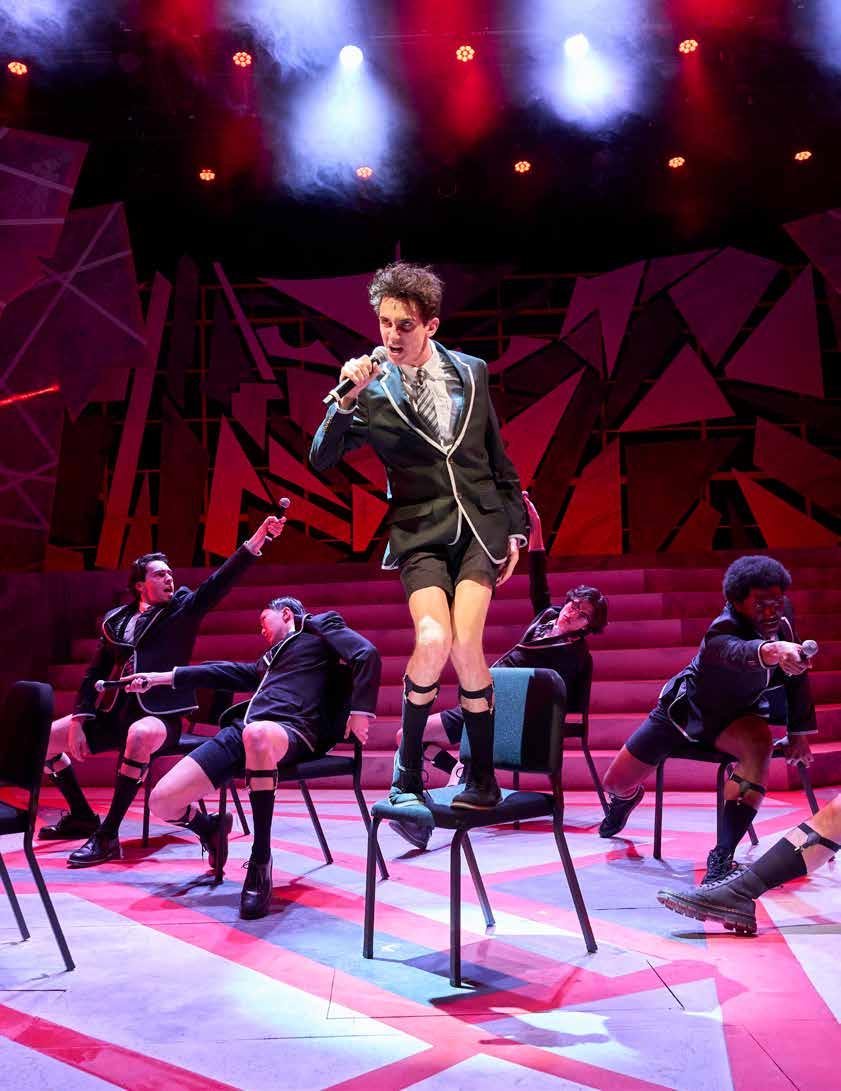
Broadway’s future stars find a home at Oberlin
Two
Renowned
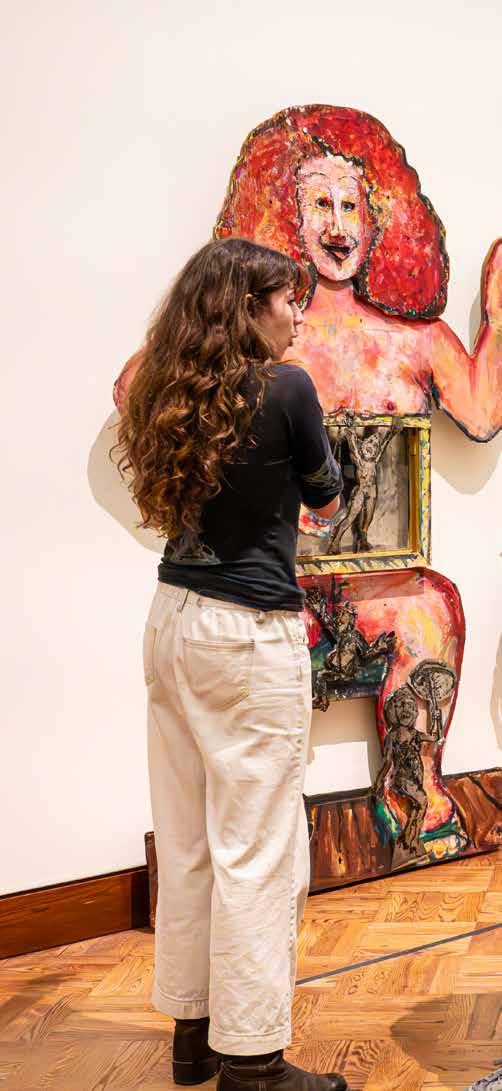
Photo by Roger Mastroianni
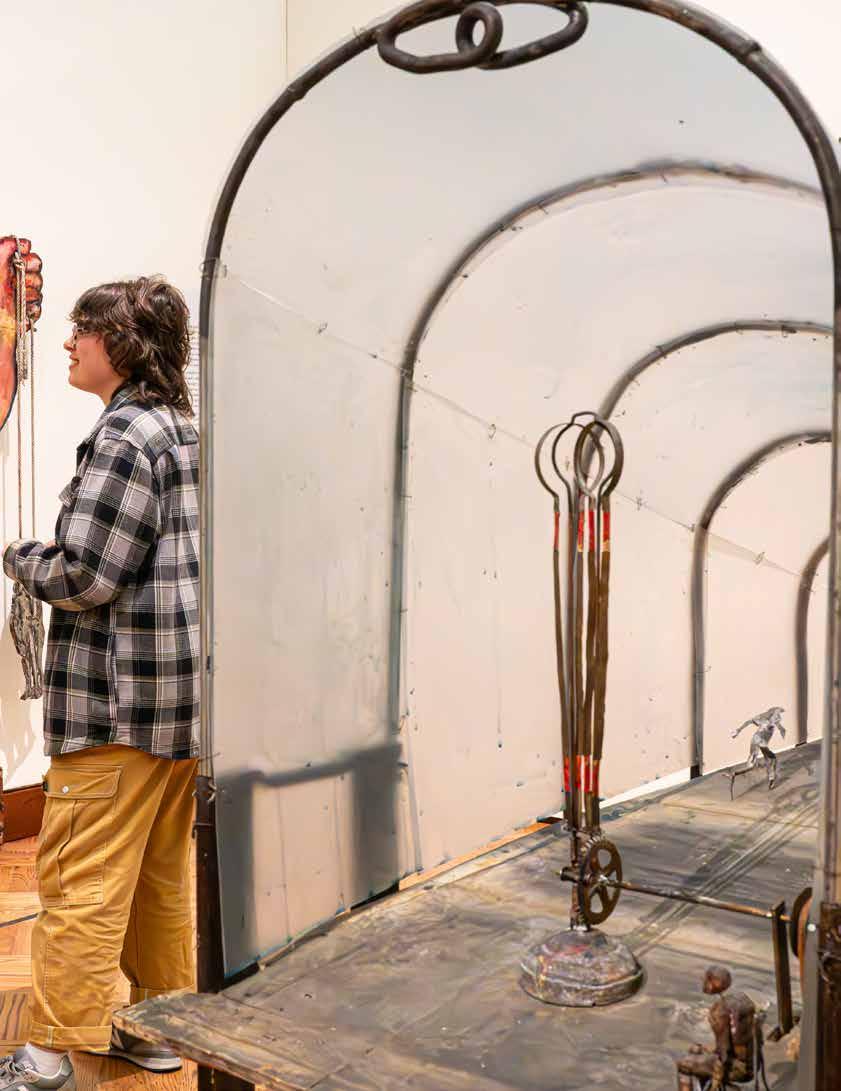
GIVING FLOWERS
Earlier this year,
the Allen Memorial Art Museum held a celebrated exhibition touting the artist June Leaf.
PHOTO BY ALAINA BATTLE
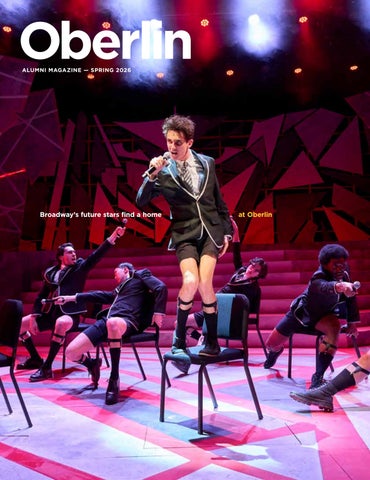
Broadway’s future stars find a home at Oberlin
Two
Renowned
Earlier this year,
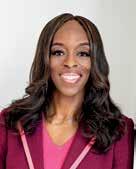
EVERY SPRING, STUDENTS INTERESTED IN ATTENDING OBERLIN COLLEGE and Conservatory visit campus. I never miss a chance to meet them and explain why I believe Oberlin is the best institution in the country. After all, I have a unique perspective: My triplets just finished their first year here, so now I’m not just Oberlin’s president—I’m also an Obie mom.
One big difference I’ve noticed is the students here at Oberlin err on the side of doing things. They jump into any situation, think critically, and come up with unique solutions. It’s no wonder Obies also love experiential learning. They thrive in a lab, out in the community, at museums—anywhere they can dig in and make a difference.
At Oberlin, opportunities for experiential learning prepare students for the real world. In this magazine, you’ll read a spotlight on undergraduates doing incredible scientific research, leading them to meaningful internships and admission to graduate school. You’ll also learn about our new music theater program, where students are performing with professional theater companies, learning what it takes to be practicing artists.
Oberlin’s academic curriculum is also preparing students for the future. In the conservatory’s recording arts and production major, students learn how to run sound for campus productions. This fall Oberlin is launching a Bachelor of Science degree option, as well as a critical AI studies minor and an integrative concentration in sport studies and management. Students can also study with successful alums like Aimee Lee ’99, a worldrenowned hanji scholar who teaches a class about papermaking every Winter Term.
In a testament to Oberlin’s approach, students and recent graduates have won multiple prestigious fellowships and grants this spring. Ella Halbert ’23 received a graduate research fellowship from the U.S. National Science Foundation (NSF) to conduct wildlife and ecology research at the Smithsonian Tropical Research Institute, while Zosia Greer ’27 earned a Goldwater Scholarship.
Chudi Martin ’24 earned a Gates Cambridge Scholarship, which funds full postgraduate study at the University of Cambridge, while Leo Hidy ’23 received a Marshall Scholarship to pursue graduate study in the United Kingdom. And as this magazine goes to press, Oberlin has so far received 16 Fulbright fellowships this year, including five prestigious Fulbright Study/Research Awards.
Truly, if you want to know why I think Oberlin is the best institution in the country, it’s because our students don’t just talk about change. Our students make change happen and literally go out and change the world for good.
Carmen Twillie Ambar President, Oberlin College and Conservatory
Vol. 121 No. 1
Editor
Annie Zaleski
Art Director
Nicole Fansler
Magazine Designer
Lesley Busby
Graphic Designer
Nick Giammarco
Editorial Assistants
Grace Connell ’27, Sloane DiBari ’27
Executive Director, Office of Communications
Kelly Viancourt
Vice President for Communications
Josh Jensen
The Oberlin Alumni Magazine (ISSN 0029-7518), founded in 1904, is published by Oberlin’s Office of Communications and distributed to alumni, parents, and friends of Oberlin College.
Office of Communications
247 W. Lorain St., Suite C Oberlin, OH 44074
Phone: 440.775.8182 Fax: 440.775.6575
Email: alum.mag@oberlin.edu www.oberlin.edu/oam
Oberlin Alumni Association
Dewy Ward ’34 Alumni Center
65 E. College St., Suite 4 Oberlin, OH 44074
Phone: 440.775.8692
Fax: 440.775.6748
Email: alumni@oberlin.edu www.oberlin.edu/alumni
POSTMASTER
Send changes to Oberlin College, 173 W. Lorain St., Oberlin, OH 44074
A number of things move me to tears of joy: music, my granddaughter, and most recently Oberlin’s accomplishment in reaching the goal of carbon neutrality [“The Sustainability Issue,” Fall 2025]. Bravissimo!!! Very, very proud of my alma mater.
Deborah Swanger Fortier ’72
New York City
I loved seeing the carbon neu trality timeline in the Sustainability Issue, as it placed my own time at Oberlin in a
decades-long context. When I arrived on campus in September 2001, the AJLC was quite new, and we learned that Professor [David] Orr had been allowed to fundraise for it only if he didn’t tap any usual donors. What a huge shift happened over the next few years! When I declared an environmental studies major, the name of the major still raised eyebrows. By the time I graduated in 2005, it was the secondmost popular major after English, and the college was delighted to use the AJLC in promotional materials. I also remember serving as a student on an advisory committee to the Board of Trustees in 2004 as it was preparing the comprehensive environmental policy referenced in the timeline. Thank you for showing us older Enviro Alumni the fruits of those early years.
Rabbi Shoshana Meira Friedman ’05 Boston
The current issue is inspiring. One of my fondest memories of my time at Oberlin was hearing Dr. King speak in
1957. I went to all three speeches.
Don Rankin ’60
Greenwich, Rhode Island
In the Fall 2025 “Losses” section, the last name of Marty Dugan ’73 was inadvertently misspelled. The magazine apologizes for the error; Marty’s name was subsequently updated on the online section.
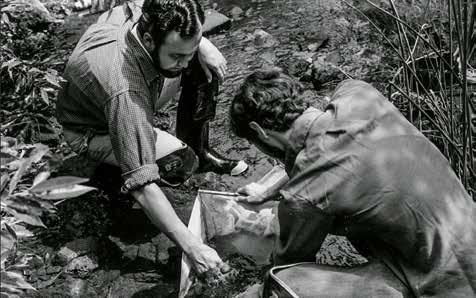
The mystery men in the Fall 2025 archival photo [“Class Notes”] have been revealed! Emeritus Professor of Biology David Egloff is at left, while Willem Brakel ’71 is on the right. “We’re collecting samples for a study we published in 1973 on pollution in Plum Creek,” Egloff says of the photo [see below], which originally illustrated a recap of a 1970 event he co-presented with Phil Volland ’72. “That event was one of many that eventually resulted in the creation of the environmental studies program,” Egloff adds, noting that college faculty accepted his proposals for the program in 1980.
Brakel also found Oberlin formative. “This was my first immersion (literally!) in freshwater ecology research, which eventually led to a career centered on marine and aquatic ecology and then international/regional environment, science, and technology policy,” he says, noting he’s retired from the U.S. Foreign Service and as an adjunct professor of environmental science at American University but remains a commissioner representing the District of Columbia on the Interstate Commission on the Potomac River Basin (ICPRB). “I’m forever grateful to David for that introduction.”
Send letters to the editor, story tips, and pitches to alum.mag@oberlin.edu. If you are submitting a letter to the editor, please specify that your note is for publication and include your class year, location, and how your name should appear in print.
BY SLOANE DIBARI ’27
The musical adaptation of Alison Bechdel ’81’s graphic memoir becomes a Winter Term success
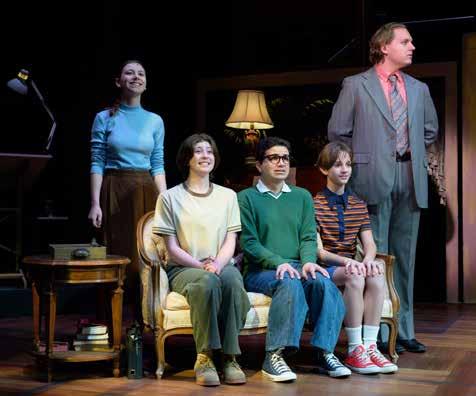
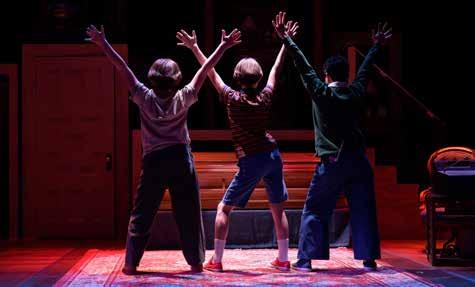
When Visiting Assistant Professor of Theater Katy Early ’16 had the opportunity to serve as faculty director for a theater production, she chose Fun Home, the musical adaptation of Alison Bechdel ’81’s 2006 graphic memoir.
There was so much enthusiasm for the production, which ended up being a student-driven 2026 Winter Term project in the theater department, that Early and her crew decided to doublecast the show.
“The excitement was there from the jump,” Early says. “It felt like a good connection between my interest and student interest. … [And] it’s been important to me to work on this [musical] with students.”
The enthusiasm makes sense. In 2007, the graphic novel—which tells the story of Bechdel’s coming of age and coming out with a strong focus on her
relationship with her closeted father— won the GLAAD Media Award, the Stonewall Book Award, the Publishing Triangle Judy Grahn Award for Lesbian Nonfiction, and the Lambda Literary
Award. The 2015 Broadway musical adaptation, meanwhile, was nominated for 12 Tony Awards and took home five, including Best Musical.
Critics have praised both versions of Fun Home for their nuanced explorations of queerness. To inform the set and costume design, Early and the student cast and crew immersed themselves in Oberlin’s archives to find artifacts of queer life during Bechdel’s time as a student.
“That task of archiving queer life is so important to the DNA of this show and [is] what Alison Bechdel is doing with her life,” Early says.
Dallas Street ’26, who portrayed Alison in the Maple Avenue cast, cites as inspiration a presentation by Lee Must ’25, who came to campus to present his research on the Oberlin queer archives to the cast and crew.
Street says the Fun Home production also had its own collaborative “master
doc” in which cast and crew members contributed notes and research. For example, he researched Bechdel’s old blog posts for the production.
Working under Associate Professor of Theater Chris Flaharty, costume design associate Calcifer Avins ’27 drew inspiration from Oberlin archival photographs for their costume design for the character of Joan, Bechdel’s college girlfriend.
Avins says they and Flaharty also heavily referenced the Fun Home graphic novel in their design, particularly in the way that Bechdel drew her family. “We’re seeing what kind of pants they wore,” says Avins, who is interested in pursuing a career in costume design. “What are the shapes of the collars? How does Alison differentiate herself from her brothers with her clothes?”
Fun Home is, in part, a story of selfdiscovery, a lot of which takes place at Oberlin. As a result, Early and Street say the production was unique in that it paid special attention to the campus environment.
“We have talked a lot about how to break the fourth wall a little bit with an Oberlin audience specifically,” Street says, noting this is especially true in scenes where Bechdel is an undergraduate discovering her lesbian identity.
Avins says the musical was personally meaningful to her, as well as her peers on the cast and crew, which created an “incredibly dynamic” work environment.
Street, meanwhile, emphasizes that what made the show truly special was the passion coming from the queer students involved. He says his role as Alison was deeply important to him.
“To be trusted with a story like this at all feels really special,” Street says. “I don’t know when else I would be able to play a butch character. I figured out that I was butch at Oberlin, and so being able to do this here, now, in my final semester, just feels like a goodbye.”
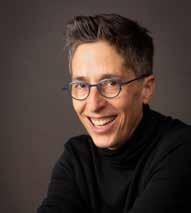
For Alison Bechdel ’81, having her alma mater stage the musical adaptation of Fun Home was a full-circle moment: Much of her coming-out story takes place during her time as a studio art and art history student at Oberlin. This production closely followed the publication of Bechdel’s latest graphic novel, 2025’s Spent. For more of our conversation with Bechdel, visit: go.oberlin.edu/bechdeloam.
In a 2018 OAM Q&A, you talked about how different Oberlin was then from when you were a student. How does it feel for Fun Home to return to where a lot of it took place, but in this different cultural landscape? I think that’s more for people there now to say. What’s it like to see this vision of life 40 years ago, or 45 years ago? Does it feel different? Obviously, it was a big deal then to come out. One thing that I’ve been aware of my whole adult life after Oberlin is the rather rapid pace
of progress in terms of acceptance of queer people. It was always kind of like, “Wow. This is really happening. This is amazing.” It was not something I expected would proceed so quickly or so thoroughly, like with the Supreme Court decision in 2015 about gay marriage. And now, of course, we’re learning that all that progress is easily undone. So, that’s a strange moment, too. I’m not feeling terribly triumphant, like, “Oh, look at all the progress we’ve made.” I used to feel that way, but that is very much under revision right now.
A lot of people still think of Oberlin as kind of a bubble in that regard. Do you think that persistent emphasis on progress and acceptance still exists at Oberlin?
I think that’s the most wonderful thing about Oberlin. Clearly, it has persisted over time. I’m pretty certain that if I had transferred to any other college, I would not have come out as soon as I did. There was just something about the atmosphere at Oberlin, which was exactly what I needed then. People were talking about these things in a way that they weren’t at other places, so I feel very lucky. It’s easy to poke fun at Oberlin’s incredible openness and progressivism, but it’s real. It’s a real thing and a worthy goal. I’m very proud of my association with it —Sloane DiBari ’27
BY ELIZABETH WEINSTEIN ’02
A new major puts students behind the sound of live performance and studio work
When Riley Newfield ’29 applied early decision to Oberlin, he hadn’t yet been admitted to the conservatory—he just knew the campus felt right. A guitarist who spent the pandemic learning Metallica and Black Sabbath, he first encountered studio work in high school while watching an engineer record his band, I’d Rather Sleep. “Being on the performance side of that process, I was really intrigued and wanted to learn more about how that works,” Newfield says. Now the student from Albany, California, who’s planning to pursue a Double Degree in music and Africana studies, is part of the inaugural cohort of the recording arts and production (RA&P) major.
Oberlin launched the major in fall 2024 in response to intense interest in a previous recording arts program geared toward postgraduates, says Associate Professor of Recording Arts and Production Andrew Garver, the cochair alongside Director of Conservatory Audio Services Andrew Tripp. That interest only continued to grow: Garver says they were aiming to enroll three students in the major’s first class but immediately expanded the program to six students per year due to the number of applicants.
Housed in the conservatory’s Division of Contemporary Music alongside composition and the electronic musicgeared TIMARA, the program is grounded in both musical fluency and technical skill. Students take courses in aural skills, music theory, and audio engineering. They also work in the conservatory’s recording studio in Clonick Hall, which Garver describes as the audio equivalent of an IMAX
theater: “You can hear every detail of what you’re doing.”
“A lot of what we learn in our first year is, ‘How do you plug a mic in correctly? How do you wrap a cable?’” Newfield says. “You get good at it—you get fast at it—by just doing it over and over.”
By their second year, students are in the studio class alongside first-year students, recording several large ensemble performances a semester. “It’s about getting your hands dirty,” says
Jay Musasa ’28, “navigating sound equipment, setting everything up for a performance—with large ensembles, the approach to recording is more sophisticated than a regular student recital.”
Musasa, a singer and multiinstrumentalist from Zimbabwe, came to Oberlin with experience in production and recording, but he hadn’t formally trained in music. “My idea of a studio session was doing top-line songwriting with a vocalist,” he says. “The approach to that is totally different from when you’re doing recording sessions for an
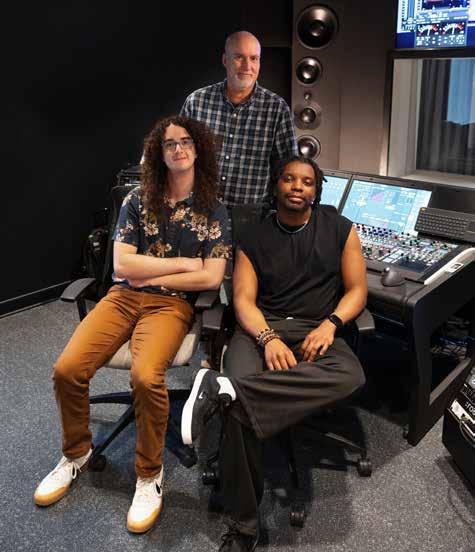
orchestra or with classical music.”
Ultimately, Musasa was drawn to Oberlin for the opportunity to study music alongside business within a liberal arts curriculum. He produced his first album in high school, collaborating with Blank Space Records in South Africa, before signing a distribution deal with EMPIRE Africa. Musasa records music under the name WUNDERCHILD., blending his African roots with contemporary sounds. When he arrived on campus, he worried his sound wouldn’t fit. “Most of the music I make is a far cry from what a lot of other students here are playing and making,” Musasa says. “But the more I’ve grown, the less I feel out of place.”
The program gets more tailored as students progress. By the third year, students take on independent projects, choosing electives to specialize in live sound, studio work, or wherever their interests lead.
Musasa’s goal is to create music professionally with other artists and eventually compose for film. “The world of songwriting and producing isn’t something where you get a 9-to-5 job,” he says. “That’s part of why I decided to also get a business degree—I could channel it toward my music dreams.”
Before joining the conservatory faculty in 2015, Tripp worked at Music@Menlo, at the Aspen Music Festival and School, and as a freelance engineer in Cincinnati. Garver, who came to Oberlin in 2022, is a Grammy-nominated mastering engineer with more than 30 years in the industry. He worked at A&M Studios, cutting lacquer masters for vinyl—a high-stakes process with no margin for error—for albums by artists like U2, Rage Against the Machine, and Madonna.
Tripp and Garver bring complementary strengths to the major— the former on the musical side, the latter on the technical. In their classrooms, they focus less on specific gear or
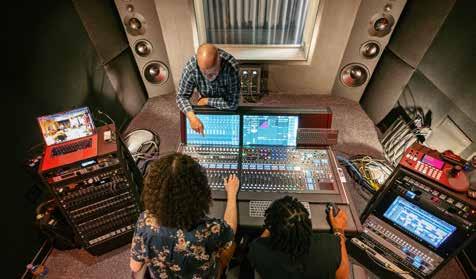
software and more on fundamentals.
“There’s the hobby approach, where you’re doing it for yourself and you’re really your own critic,” Garver says. “And then there’s doing this for other people. How do you get your expertise up to the level where people want to pay for the work you’re doing?
“It’s not just sitting in class talking theoretically about gear,” he adds. “It’s more, ‘Here are the pieces of gear—now go use them.’”
For Newfield, that has meant unlearning what he calls “privileging myself in the process” and instead focusing on supporting a performance from behind the scenes. After getting his start running sound for high school
theater, he’s leaned into theatrical audio at Oberlin, working as a sound designer or assistant sound designer on student productions including Legally Blonde and the student-written Eurydice Tells Orpheus Goodbye.
“It’s another way that I can be part of a performance through the expertise I’ve gained,” he says, citing things like making sure the audience for a musical in Wilder Main Theater can hear the singers over the pit band. “Once you’re going, you’re going. There’s no going back and fixing something. It’s happening in the moment.”
For Garver, that’s ultimately what the training is for: catching dream moments in action.
Keep in touch with Oberlin!
Have you recently moved?
Share your new contact info online: go.oberlin.edu/oam-address-update
Submit
You can now submit a class note (along with a photo) online: go.oberlin.edu/submit-class-notes Connect on Social Media
groups/oberlin.alumni oberlincollege oberlincon oberlin-college
ACADEMIC INQUIRY
The course of study offers a humanities-grounded approach to the transformative technology
In recent years, colleges and universities have been grappling with the best ways to respond to artificial intelligence, a rapidly changing technology that’s becoming increasingly pervasive.
As a liberal arts institution that centers undergraduate learning and responds to challenges with interdisciplinary creativity, Oberlin is uniquely equipped to be a leader in preparing students to navigate and engage with sophisticated technologies.
In fact, the college feels a deep responsibility to ensure our students become responsible stewards of AI and is responding to the technology in ways that align with Oberlin’s mission and history. All year, faculty and staff have been leading cross-disciplinary conversations about the opportunities and challenges of AI, especially in light of concerns over environmental impact, job displacement, intellectual property extraction, and cognitive debt.
And in the fall, Oberlin is launching a new critical AI studies minor with a solid foundation in both science and the humanities, enabling students to understand and analyze the ethical, cultural, environmental, political, economic, technological, and labor effects of AI.
“We’re entering a world where, over the next five to 10 years, AI is going to impact most jobs and careers,” says Adam Eck, Oberlin’s David H. and Margaret W. Barker Associate Professor of Computer Science and Business and Data Science. “Oberlin’s minor focuses

on helping students be better decisionmakers in those spaces and prepares them for the 21st-century-plus world that they’ll inherit.”
Students pursuing the minor are required to take two foundational classes: Intro to Critical AI Studies and a course on methods of critique. From there, they’ll take two electives within four broad categories: decision-making and learning; epistemology and the history of science; applications and practice; and societal impacts.
In practice, the minor complements multiple majors at Oberlin; students can choose electives in fields such as philosophy, anthropology, psychology, neuroscience, economics, music, and math. “If you’re in STEM, you might take a course in AI applications,” says Assistant Professor of Computer Science Michael McCarrin. “If you’re on the humanities side, your courses might be more on the history and epistemology of science.”
By offering this minor, Oberlin is a leader in critical AI studies—an emerging field informed by “a confluence of forces,” McCarrin says.
“It captures two necessary things,” he explains. “One is a critical theory of technology in general. It’s important for computer scientists—but maybe everybody who’s going through school right now—to have some sense of this.
“And the other one is just a response to the moment we’re in right now,”
McCarrin continues. “If we did this 10 years ago, maybe it would have been called critical data studies. But AI has become such an overwhelming cultural phenomenon that we want to impress its relevance.”
The critical AI studies minor is distinguished by its emphasis on the humanities as well as the sciences, positing that these areas of study complement each other.
“In developing AI technologies, there are all kinds of assumptions at work about what human beings care about and need,” says Professor of Philosophy Katherine Thomson-Jones. “In the humanities, we can uncover, articulate, and critique these assumptions. In this way, humanists can provide scientists with a clear motivation and direction for the development and implementation of AI.
“It’s also a matter of having the abilit y to think clearly and critically about what is appropriate and ethical when it comes to having AI in our lives,” she adds. “More than anything, we want developers and users of AI to make principled, farsighted, and openminded decisions about AI and to feel intellectually empowered to do so. The humanities enables this.”
Accordingly, Oberlin’s minor is deliberately accessible to any student interested in the field; the only prerequisite is an introductory class in computer science, data science, or data structures.
“We want students to have some understanding of technical systems and how AI works,” Eck says. “They should have the ability to distinguish what’s actually happening in these systems and understand, mathematically and algorithmically, what’s actually going on behind the scenes.”
The flexibilit y of the critical AI studies minor means broad career applications for STEM-focused students. For example, computer science majors might guide ethical conversations around building AI systems, while global health majors can use their knowledge when creating policy.
The same flexibility holds true for humanities grads. “A humanities graduate can use this minor to become the person who can speak clearly about ethics, representation, and
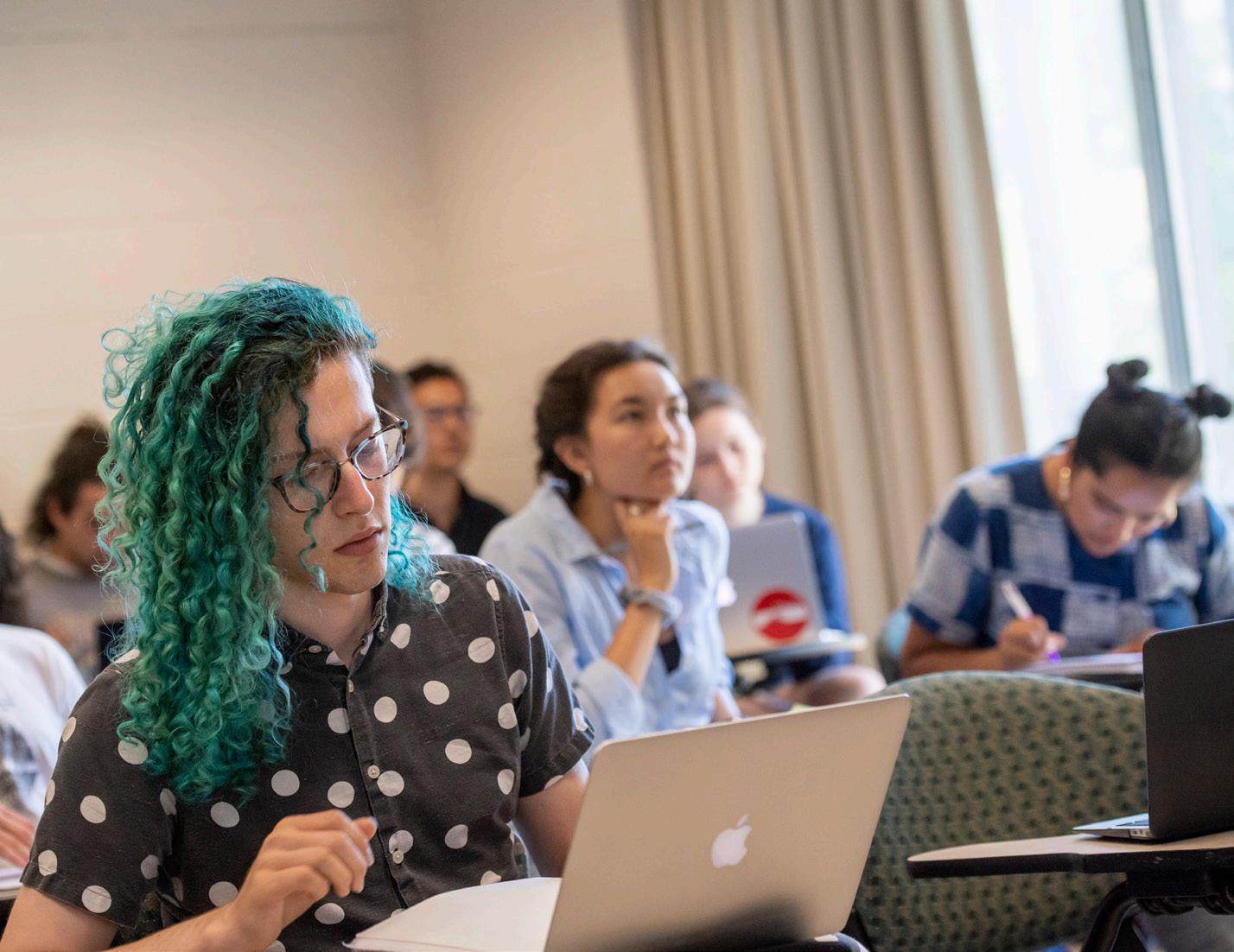
DATA INSIGHTS “We want students to have some understanding of technical systems and how AI works,” says professor Adam Eck.
accountability in spaces that often want to reduce everything to ‘innovation,’” says Assistant Professor of Dance and Africana Studies Talawa Presto. “They can help organizations decide what kind of AI is being used—generative, retrievalbased, probabilistic—and what risks and
“Oberlin’s minor focuses on helping students be better decision-makers…and prepares them for the 21st-century-plus world that they’ll inherit.”
responsibilities come with each.”
Multiple faculty members note that knowing AI’s technical side makes students better communicators of critiques and analyses, no matter which
academic or career path they choose.
“A lot of large language model interaction is designed around approval,” explains Presto. “Systems like ChatGPT are often optimized to keep you engaged and to give you outputs you’re likely to like—sometimes even more than they’re optimized to be correct or to challenge you toward better thinking.
“That matters for education, and it matters for democracy,” he adds. “Critical AI studies should equip students to recognize that dynamic—to ask not only, ‘Is this persuasive?’ but, ‘Is this grounded, accountable, and true enough to act on?’”
Eck concurs. “Students will have an understanding of how the systems work, what their strengths and weaknesses are. And they’ll be aware of AI’s impacts so that they can factor that into their decision-making: Where should we be using AI? Where is it beneficial or harmful to us? How is it impacting the world?”
BY SLOANE DIBARI ’27
Two alums expand the dialogue around sport at Oberlin
At Oberlin, sport has long been something students do. Now, it’s something they can study. William G. Smith Associate Professor of Sociology and Comparative American Studies
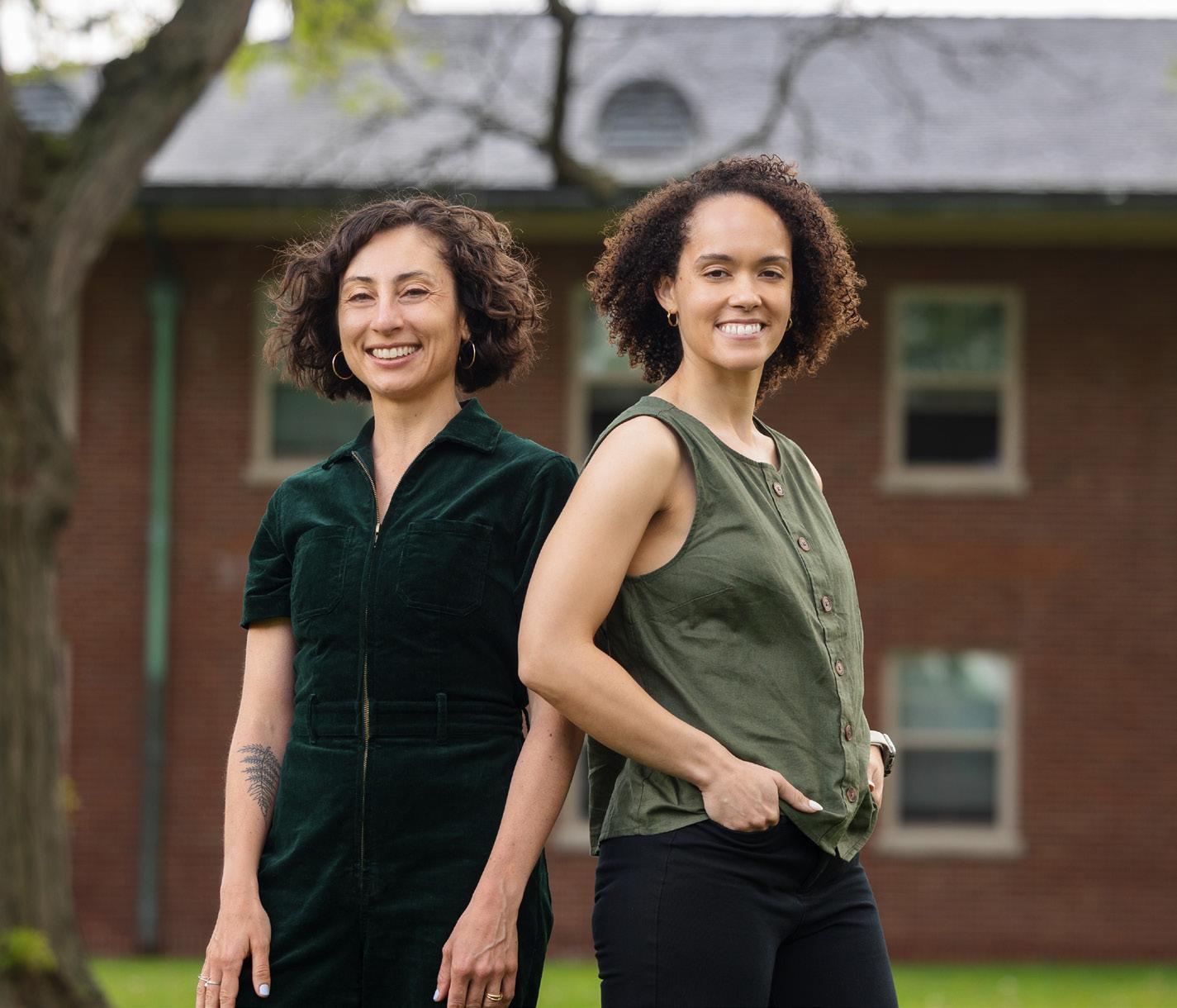
Alicia Smith-Tran ’10 and Program Director of Community-Engaged Research and Learning Jo Line ’11 are the inaugural cochairs of a new integrative concentration in sport studies and management. Launching this fall, the interdisciplinary program examines how sport intersects with economic power, social change, and cultural influence.
“There are more students who are interested in sport academically, but also as a career path,” Smith-Tran says. Line agrees: “We have a lot of alumni who work in the sport industry, so there’s evidence that there’s interest and success
“This field examines sport broadly as a concept and social phenomenon. It asks why sport is so significant or what makes something a sport.”
for Obies going into this industry.”
Developed with input from faculty, administrators, athletic staff, and alumni,
the integrative concentration draws from multiple disciplines. The foundational course, Introduction to Sport Studies and Management, introduces topics spanning communication, business, analytics, education, and health. Sociology of Sport, meanwhile, examines sport in relation to “identity, education, the body, fandom, and the economy.” Courses such as Documentary Production allow students to explore sport through filmmaking.
That the concentration is called sport studies—not sports studies—is deliberate. “This field examines sport broadly as a concept and social phenomenon,” SmithTran explains. “It asks why sport is so significant or what makes something a sport. It’s similar to why we don’t call the academic fields ‘genders studies’ or ‘races and ethnic studies.’ In these examples, researchers are studying gender and race as constructs and concepts with courses that think about how race and gender came to be prominent features of society.”
Smith-Tran and Line particularly look forward to seeing how students approach the experiential learning component of the program. They envision students pursuing internships with professional teams, volunteering with Northeast Ohio sport-focused nonprofits, or coaching recreational teams.
These experiences could lead students down a multitude of career paths. “Within [the] professional sport industry, you could be [a] sustainability director and be responsible for thinking about anything from waste from large sporting events to the impact of constructing sport venues,” Line says. “Or you could be the HR director within a sport organization.”
The sport studies and management program can also build transferable skills and experiences for non-sport careers, Line adds. After an internship with a sport-focused nonprofit, for example, a student might find that they enjoy the nonprofit field in general and will work with different kinds of organizations later on in their career.
Both Line and Smith-Tran have built careers on the study of sport. Smith-Tran has studied the sociology of sport and physical activity in relation to topics such as race and racism and the experiences of Black women in recreational running. Line, who is also a lecturer in comparative American studies, has explored the experiences of women runners across different cultural contexts through a Thomas J. Watson Fellowship and continues to study sport team dynamics. These interests led Smith-Tran and Line back to Oberlin—and eventually to each other—in leading the charge toward sport-related academics at the college. As undergrads, Smith-Tran
The 2026 Carbon Neutral Award honors the commitment to decarbonization.
During this year’s Higher Education Climate Leadership Summit, Oberlin’s longstanding commitment to decarbonization earned the college the 2026 Carbon Neutral Award. The summit, which was hosted by the higher education climate advocacy nonprofit Second Nature and took place March 8-10 in Chicago, recognized the 20th anniversary of a prominent climate commitment signed in 2006 by Oberlin and 11 other U.S. colleges and universities. That pact formally set Oberlin on a path toward carbon neutrality—a mission outlined in the fall 2025 alumni magazine.
Although the landmark climate commitment grew to include some 900 U.S. higher ed institutions, Oberlin is one of
played basketball, and Line ran track and cross country. While on different teams, both were part of the broader Oberlin athletics community. Their time as student athletes was deeply meaningful to both of them, which was another motivation as they built the sport studies and management program.
“To be able to be part of it as a faculty member and to get to work with Jo, who is an amazing athlete and scholar—it’s kind of awesome that the stars aligned and we get to do this together,” SmithTran says. “I love that we’re both alums and former student-athletes and that our work is in this area and we can share it with students.”
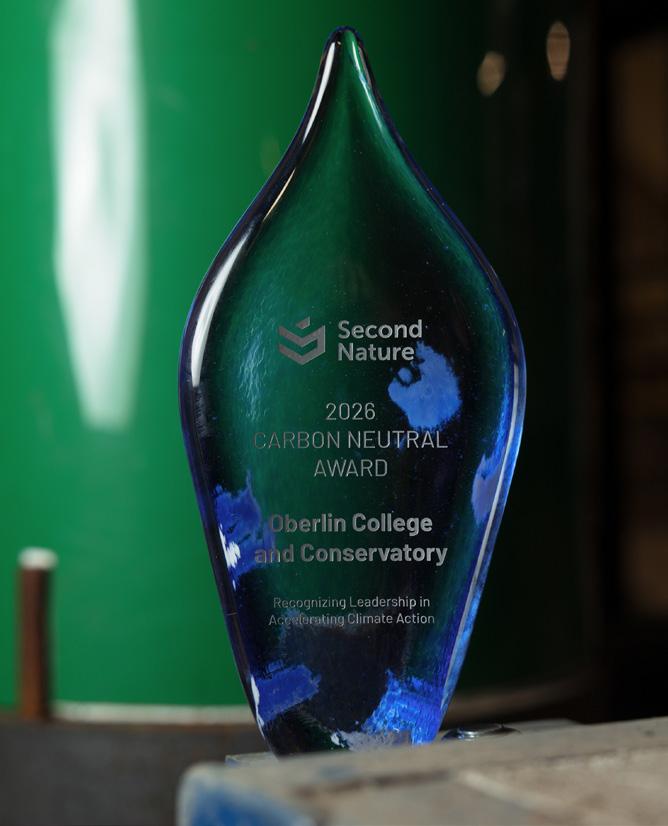
only 17 U.S. campuses to claim carbon neutrality, according to Second Nature. It is also the only carbon-neutral campus in Ohio. Oberlin’s Carbon Neutral Award coincides with the completion of thirdparty verification of the institution’s carbon-neutrality claim, a review of data conducted by UL Solutions in 2025 and early 2026. According to Second Nature, Oberlin is the only college or university in the nation to have completed thirdparty verification of its carbon-neutral status—a step the organization calls a model for institutions everywhere.
BY HANNA RASKIN ’98
The men’s wing of Barrows Hall has been known as the Monastery for about as long as any resident of the first-year dorm can recall, even though there’s no specific belief system associated with it. But soon after Martin Philip ’92 moved in, he and his new friends felt called to correct that situation.
“Our first weekend, we went to Lorenzo’s,” Philip says of the pizzeria that opened on Main Street in 1982 and served a mid-rise crust that wowed the young men. “My roommate was like, ‘We’re going to start a pizza religion.’ We were going to eat pizza every week.”
Their faith fizzled, perhaps because of the discipline required to eat a pie at a designated time—or perhaps because of the self-control it takes not to eat pizza more frequently. But Philip’s spiritual relationship with what’s commonly referred to as America’s favorite food didn’t end there.
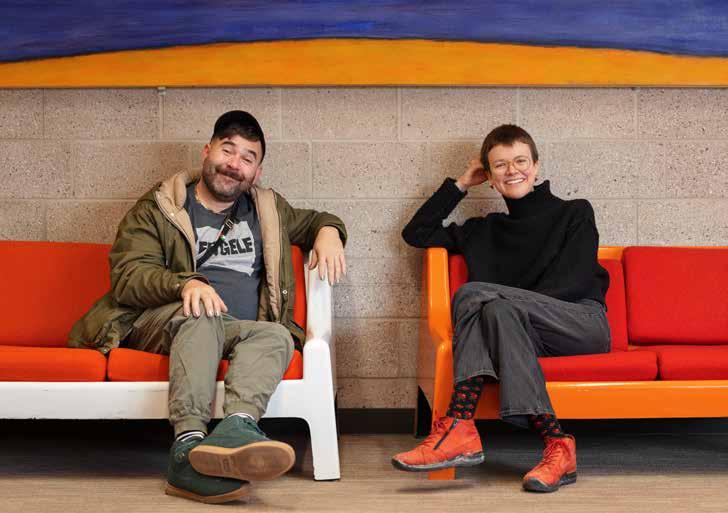
It informs the newly published, instant New York Times bestseller King Arthur Baking Company’s The Book of Pizza: Recipes for Every Pizza Maker Philip, head baker for the Vermontbased company, cowrote the zippy and authoritative monograph with a fellow King Arthur employee, editorial director David Tamarkin ’00.
The product of years of research and recipe testing, The Book of Pizza is a compendium of popular regional pizza styles, ranging from tavern to Grandma. Through illustrations and accessible language, the cookbook highlights the charms of home-baked pizza so brightly that reading it cover to cover nearly guarantees the incipient purchase of a pizza stone.
“Convenience is not the only possibility in terms of baking,” Philip

says. “Food takes effort, but that doesn’t mean it shouldn’t be part of your life.”
Tamarkin, who shares Philip’s commitment to craft, staunchly agrees that pizza—which the two consider a sophisticated form of bread rather than a handy platform for melted cheese— shouldn’t be dismissed as an exigency option.
“Pizza making is a valuable use of your time because it can be so collaborative and fun,” Tamarkin says. “If I’m having you over for pizza, I’m going to bake it while you’re there, and we’re going to eat it while it’s burning our fingertips. That’s
a community experience.”
It’s not surprising that both Philip and Tamarkin are champions of the unhurried process. While they followed different paths to King Arthur, they proceeded along their circuitous routes at a similarly ambling tempo, dictated by their zeal for connection.
“I think of an Oberlin student as someone who is curious, engaged, and alive in the world and leaning into what they’re passionate about,” says Philip, whose daughter graduated from Oberlin in 2025. “I really feel who I am today is so much a representation of who I was as a student,
even though I wasn’t the perfect student.”
Philip, who attended high school in the Arkansas Ozarks and hoped to parlay his love for singing into a profession, was initially rejected by Oberlin. But he ended up on campus for a summer seminar, at which vocal performance faculty members ruled the admissions committee had made a mistake.
Post-graduation, he became an investment banker instead of pursuing opera. “Long story short, New York City broke me,” he says. “Trying to make money, I ended up on the wrong track.”
Although Philip was by then more than a decade removed from working an oven for pay—one of his stints was in North Olmsted, Ohio, at the Great Northern Mall location of Italian Oven, where he learned that a scattering of smoked Gouda pacifies pizza buyers seeking evidence of wood firing—he joined King Arthur in 2006.
Like Philip, Tamarkin amassed a string of failing grades in high school. “When I found out about Oberlin, that’s what motivated me,” says the Ohio native. “I was
not a shoo-in, so I really campaigned the admissions guy very hard.”
Tamarkin landed a job at CBS News after graduation. “My first day, the Concorde crashed, and then it was 9/11,” he says. “I had three very intense years, and I was increasingly like, ‘This is not for me.’”
He then shifted to food writing but eventually chafed at that role too. “It was taking a toll,” he says. “I was feeling gross and really struggling with the ethics of being a restaurant critic.” On a whim, he applied to King Arthur in 2021.
Finally, it was time for the collaborators to come together. And, as it happened, it was time for pizza. “There has never been a better time to go out and get great pizza,” Philip says, emphasizing that the new book aims to interpret the current pizza renaissance for home cooks. “Trust me: These are the good old days of pizza.”
Hanna Raskin ’98 is editor and publisher of The Food Section , an award-winning newsletter covering food and drink across the American South.

Makes 705 grams, enough for two 13-inch pizzas
367 grams (3 cups plus 1 tablespoon) unbleached bread flour, plus more for dusting
45 grams (6 tablespoons) whole wheat flour
12 grams (2 teaspoons) fine salt 1/4 teaspoon instant yeast
12.5 grams (1 tablespoon) extra-virgin olive oil
8 grams (1.5 teaspoons) sourdough culture (optional)
7 grams (1 teaspoon) honey
253 grams (1 cup plus 2 tablespoons) cool water (60° to 70°F)
In a large bowl, combine the flours, salt, and yeast; then add the oil, sourdough culture (if using), honey, and water. Mix to combine, then knead the dough by hand in the bowl until you have a rough but cohesive dough. Cover and let it rest at room temperature for 1 hour. Lightly dust a work surface with flour and place the dough on it. Divide into 2 equal pieces (about 352 grams per piece). Tightly ball the dough, place seam side-down in a lightly greased container, and cover tightly. Let rise at room temperature for 8 to 10 hours. At this point, the dough is ready to use, or it can be refrigerated for up to 3 days. Let the refrigerated dough rest at room temperature while your oven preheats, at least 1 hour.
Excerpted from King Arthur Baking Company’s The Book of Pizza: Recipes for Every Pizza Maker. Copyright © 2026 by King Arthur Baking Company. Reproduced by permission of Simon Element, an imprint of Simon & Schuster. All rights reserved.
AUTHOR SPOTLIGHT
BY SERENA ZETS ’22
How Oberlin helped authors Sam Sax ’09 and Fiona Warnick ’22 find their voices
At Oberlin, a class with an exceptional professor might lead you to a major you never considered—or even an entirely unintended second degree. Likewise, an ExCo or work-study opportunity may make you realize you want to be an educator yourself. An experience on campus might inspire your artistic
life beyond Oberlin. Or maybe your Oberlin experience itself will be an amalgamation of all of the paths above.
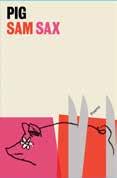
Sam Sax ’09 was the type of Obie open to trying anything during college. The celebrated author and poet only took one creative writing class at Oberlin. “I didn’t know there was a track for professionalizing my art,” Sax says. “I was just moving toward the thing I loved [writing] because I loved it.” Instead, Sax built their artistic practice through classroom experiences and on-campus performance opportunities.
Faculty in multiple disciplines, including Professor of Theater and A fricana Studies Caroline Jackson-Smith
and Emeritus Professor of Studio Art and Africana Studies Johnny Coleman, collapsed the invisible border Sax had been taught to believe existed between academic and activist. Their involvement in the long-form improv group the Sunshine Scouts equipped them with the ability to trust their artistic instincts and learn how to build worlds. “If there wasn’t something there [at Oberlin], you had to build it,” Sax says. “A ton of collaborative and collective work happened across campus.”
Post-Oberlin, Sax has built a robust creative life. They’ve published eight books and chapbooks, including their National Book Award-longlisted debut
novel Yr Dead, a self-described “queer, Jewish, Diasporic coming-of-age tale” about protagonist Ezra confronting their death after lighting themself on fire. Sax approaches such a harrowing topic headon with the lyricism and introspection of a poet, creating an imaginative rumination on queerness, religion, and life itself.
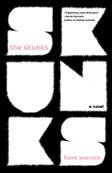
This spirit of experimentation and reflection rings true for Fiona Warnick ’22, author of The Skunks, reviewed in The New York Times and named a mustread book of 2024 by Time. The book follows the malaise of protagonist Isabel during the summer after graduation when she returns home to western Massachusetts and attempts to figure out what to do next.
Warnick worked on The Skunks during her time at Oberlin, logging long afternoons in the Local and Slow Train coffee shops or writing after her shifts at Azariah’s Café in the Terrell Main Library. Her capstone thesis class, taught by Allegra Hyde, former assistant professor of creative writing, gave her more opportunities to polish the manuscript. Warnick ended up selling The Skunks to Tin House right as she graduated and credits her Oberlin workshop experience with strengthening the draft to the point it was publishable.
“Recently I met someone who’s applying for an MFA because she’s never been in a workshop, and I felt like, ‘Oh, right, most people don’t leave undergrad having been in a workshop class basically every semester,’” Warnick says. “Oberlin already gave me that—the chance to develop my sense of what I
like and don’t like, which in my opinion is the point of workshop.”
On top of their writing lives, both are educators. For the past five years, Sax has taught in ITALIC, an immersive arts program for first-year students at Stanford. “My favorite part of teaching is getting to be in arts school again alongside my students,” Sax shares. “Together we’re grounding ourselves in our bodies and experimentation and play and accepting being an amateur in something.”
Meanwhile, Warnick teaches kindergarten at St. Ann’s School in Brooklyn, New York. At Oberlin, she was a teaching assistant for multiple creative writing courses and took a formative
“Most people don’t leave undergrad having been in a workshop class basically every semester. Oberlin already gave me that— the chance to develop my sense of what I like and don’t like.”
class called Teaching Imaginative Writing. Taught by Emerita Professor of Creative Writing Lynn Powell, the latter enabled Warnick to design and teach poetry workshops to sixth graders at a local middle school. “I remember thinking that class felt so much more real than anything else that had happened to me at Oberlin,” Warnick says. “The stakes weren’t a grade. This group of 12-year-olds was going to have a positive or negative relationship to poetry based on what we did.”
“At the heart of it, the question is, ‘What can art do, and why are we doing this?’” Sax says. “The poems butt up against the material and real terror of the world and how our art practices are part of it.”
Following the success of The Skunks, Warnick sold her second novel, Alex, which is publishing in early 2027. “After you write something, you ask yourself as a writer, ‘Is that it?’” Warnick says. “It was affirming to know I could do it again—I could write a second book.” She began the novel as a joke at the suggestion of her agent, who recommended she have something new and distracting to work on while experiencing the stress of selling and editing The Skunks. A “situationship novel where all the sex scenes are replaced by endnotes told in rhymed sonnets,” it’s quite different from her last effort, she adds. “It’s about college. It’s about how romance interacts—or doesn’t—with the rest of our lives.”
In February 2025, the authors joined forces on campus for a reading in Dye Lecture Hall at the invitation of Warnick’s mentor, Associate Professor of Creative Writing Emily Barton. “I saw many transformative talks there,” Sax says. “It was special to step into the physical space that had been so special for me.” For Warnick, returning to campus was just as moving. “It was wild that the seniors in the audience were freshmen when I was a senior,” she says. “I had been their TA, and now I had this book. Because they’d known me, hopefully it felt like, ‘That can be me next.’”
Sax is simultaneously working on a new book of poems and a new novel. The poems draw their forms and structures from other practices, an idea Sax has been tinkering with while lecturing in ITALIC and learning from their students.

NONFICTION
Through the Gates of Hell: American Injustice at Guantanamo Bay
Joshua Colangelo-Bryan ’92 (HUMANITAS MEDIA)
Joshua Colangelo- Bryan serves as special counsel at Human Rights First, building on his long professional history defending democracy and human rights. But in 2004, he was working for a law firm representing six Bahraini detainees at the U.S. detention camp in Guantanamo Bay, Cuba. Although then-Secretary of Defense Donald Rumsfeld labeled these men “among the most dangerous, best-trained, vicious killers on the face of the Earth,” ColangeloBryan soon discovered a far different narrative. Written in the first person, the gripping Through the Gates of Hell documents
his time defending Jaber Mohammed, who disclosed horrific and violent abuses of power and spent years in Guantanamo Bay before being freed. ColangeloBryan keeps the narrative moving with vivid dialogue and detail, making Through the Gates of Hell a compelling read. —Annie Zaleski
Zoe Dubno ’17 (SCRIBNER)
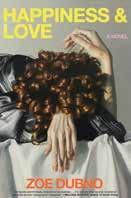
From the very first page, the narrator of Zoe Dubno’s debut novel Happiness and Love oozes disdain. She’s sitting “in the corner seat of the white linen sofa” at her so-called friend Eugene’s house, “watching the rest of the party and regretting my decision to attend.” All around her are “the very people that I had spent the last five years avoiding” while living abroad; however, the death of her friend Rebecca precipitated this
unwanted reunion. If you guessed that these party guests are insufferable, you’d be correct—and as the plot of Happiness and Love unfolds, with page after page of knotty, discursive text, readers are privy to Dubno’s withering observations and astute takedowns of pretentious creative elites. An absorbing and delightful read. —AZ
Su Friedrich ’75 (SEVEN STORIES)
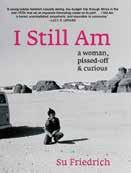
In 1976, 21-year-old Su Friedrich took a five-month solo trip through nine countries in North and West Africa, documenting the trek in her journal and through letters, drawings, and blackand-white photographs. Fifty years later, the experimental filmmaker and visual artist has annotated these priceless artifacts with footnotes and additional commentary. The result
is I Still Am, a fascinating autobiographical travelogue that weaves together history, philosophy, and the arts through a contemporary lens. Friedrich’s hindsight analysis is insightful and vivid, as are her initial observations from her trip. While watching events at the Women’s Talent Week in Ghana, she was bowled over by the unfettered performances. “Compared to some cultural or social displays, for example by U.S. women, this had no sense of apology or absurdity or modesty,” she writes. “They were absolutely together and fiercely proud, especially in the dancing, where the shared energy and communication was intense.” —AZ
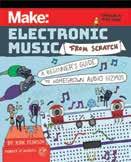
Kirk Pearson ’17 (MAKE COMMUNITY)
The wildly creative workshop, lab, and music
and sound studio Dogbotic does it all: composition, research, and even building their own instruments. Now studio founder Kirk Pearson is sharing Dogbotic’s knowledge with the rest of the world via the comprehensive Make: Electronic Music from Scratch. Subtitled A Beginner’s Guide to Homegrown Audio Gizmos, the book starts with “a people’s history of electronic music”—meaning familiar names such as Wendy Carlos and Robert Moog are mentioned alongside lesser-known figures such as Thaddeus Cahill, builder of the Telharmonium—and goes on to cover the ins and outs of electricity itself, along with detailed instructions on how to build things such as oscillators and amps. Between the whimsical illustrations and Pearson’s accessible, engaging writing style, Electronic Music from Scratch demystifies and empowers. —AZ

Craig A. Miller, MD, with Charlene Drew Jarvis ’62, PhD (GEORGETOWN UNIVERSITY PRESS)
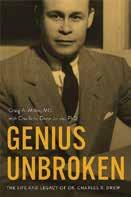
Dr. Charles R. Drew’s groundbreaking research into blood and plasma storage led to America’s first large-scale blood bank. Drawing on a vast collection of archival materials collected by Drew’s daughter, current Oberlin board of trustees member Charlene Drew Jarvis ’62, Genius Unbroken meticulously chronicles the doctor’s trailblazing life and career, which was tragically cut short after he died in a car accident at age 50. He pointed out racist medical policies—among other things, he criticized the American Medical Association’s ban of Black doctors from having staff privileges in white hospitals, and a U.S. military policy of refusing blood from Black donors—and was an
advocate for civil rights and healthcare equity. “Dr. Drew was a physician, a scientist, and a humanitarian,” Jarvis writes. “His voice can be amplified by your knowledge of him.” —AZ
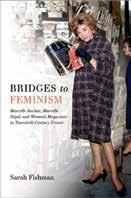
Sarah Fishman ’79 (OXFORD UNIVERSITY PRESS)
From the mid-20th century onward, Americans looking for answers to their thorniest questions turned to the syndicated columns of Ann Landers and Dear Abby. But in France, the advice queens were journalists Marcelle Auclair at Marie-Claire and Marcelle Ségal at Elle, a pair of feminist trailblazers who espoused women’s rights. Via deep historical research into their upbringing (Ségal’s Jewish parents came to France from Russia, while
Auclair moved to Chile with her family as a young child) and close readings of the duo’s columns, Bridges to Feminism chronicles how these two women became such prominent voices. Fishman’s analysis is rigorous and fascinating; as a result, the book makes a substantial case that Auclair and Ségal deserve much wider recognition. —AZ
Simona Supekar ’00 (BLOOMSBURY)
In her 20s, professor and PEN/Bellwether Prize finalist Simona Supekar found herself in an unexpected place in her career: the stock photography industry. Drawing on ideas from great thinkers such as Edward Said and tales from Supekar’s work as a “keyworder,” or someone who tags stock photos with descriptive words or phrases to make them easily searchable, Stock Photo explores
this art form’s surprising history. Merging memoir and philosophy, the book is by turns deeply emotional and critically incisive; for example, Supekar examines how colonialist ideals, racism , and sexism manifest in stock photography. In the end, Stock Photo is a one-of-akind social commentary that emphasizes the importance of representation. —Sloane DiBari ’27
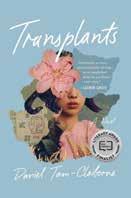
Daniel Tam-Claiborne ’09 (REGALO PRESS)
Transplants focuses on two characters who meet on a university campus in Qixian, China. Shy and studious Lin is a college student who rescues animals and gets into a romantic entanglement with her English teacher, Travis. The latter’s roommate, the restless Liz, is also an American English teacher at the same college. Liz’s quest is equilibrium, as she’s
reeling from her mom’s death and determined to seek answers about her familial roots. As Transplants unfolds, Lin’s and Liz’s lives converge (and diverge) in unexpected ways: Lin moves to America and forges a new life, while Liz decides to stay in Qixian even after discovering earth-shaking secrets about her past. TamClaiborne is an evocative writer and wonderful storyteller, ensuring Transplants is a beautiful treatise on soul-searching and self-discovery. —AZ
Chris Brokaw ’86 (12XU)
Chris Brokaw’s sprawling discography grows more impressive by the year. He’s recently scored several films and recorded albums with Belly’s Tanya Donelly and his own underground rock supergroup Pullman. Even in the midst of all of his
other ventures, Brokaw’s latest solo effort, Ghost Ship, feels sharply focused. Moving artfully between Sonic Youth-esque walls of post-punk noise (“Anything Anymore”) and somber guitars reminiscent of his work with slowcore genre staple Codeine, Brokaw plays to his strengths with hauntingly beautiful results.
—SD
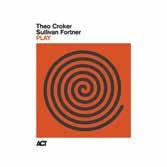
Theo Croker ’07 and Sullivan Fortner ’08 (ACT MUSIC + VISION)
Theo Croker ’07
(DOM RECS/STAR PEOPLE NATION)
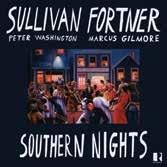
Sullivan Fortner ’08 with Peter Washington and Marcus Gilmore (ARTWORK RECORDS)
Pianist Sullivan Fortner ’08 and trumpeter Theo Croker ’07 have had a prolific few years—a lucky thing for listeners. In November,
the longtime friends and frequent collaborators released the improvised full-length Play. A dynamic dialogue between two true masters of their respective instruments, the album features 14 well-crafted compositions that are delightfully free-flowing. The pair’s separate endeavors are also must-listens. Dream Manifest finds Croker in his nu-jazz element, as his trumpet leads a sublime arrangement of sonic textures: exhilarating bass grooves, synth lines, digital dance beats, and vocals from guests like Estelle and the up-and-coming Tyreek McDole ’23. Meanwhile, Fortner’s Grammy-winning Southern Nights pairs complex piano with the impeccable rhythm section of bassist Peter Washington and drummer Marcus Gilmore. With stunning renditions of New Orleans compositions (including the Allen Toussaint-penned title track), Southern Nights is a

love letter to the city’s rich musical history. —SD
Dot Dot DOT (DOTOSPHERE)
Since making waves with the early-’00s Long Island hip-hop group Northern State, Correne Spero ’98 has gone on to found Trust Tree, a nonprofit that empowers young girls and gender-nonconforming youth in central Arkansas through music and art. She’s also continued to embrace alternative rap and indie rock through solo work and collaborative efforts. On Dot Dot Dot, the debut album from her newest rock band DOT, Spero and her bandmates infuse sunny, twee guitar pop with punkrock bravado. In a short and sweet 29 minutes, DOT moves artfully between the modernity-induced restlessness of tracks like “Daydreaming” and coy notquite-love songs like “Take You Out” and “Crush.” —SD
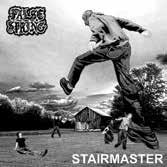
False Spring (SELF-RELEASED)
With their debut EP Stairmaster, False Spring refines the miniature earthquakes of their Oberlin co-op shows into 23 loud, glorious minutes. Stairmaster opens with the seasick guitar riffage of “Share My Dopa,” reminiscent of the post-hardcore-inflected noise rock of the ’80s and ’90s—unsurprising, considering guitarist Owen Neaman ’27 took lessons with The Jesus Lizard’s Duane Denison. However, all five members of False Spring have composition credits on every track; and Liam Powers ’27, Isen Ritchie, and Lillian Sugrue ’27 alternate between guitar and bass. (Other Oberlin band members include Mateo Gregorio ’27 and Liam Kozel ’25.) The band melds influences from old-school noise rock and dreamy fourth- and fifth-wave emo for an explosive start to
what’s sure to be an eventful career. —SD
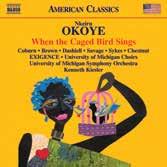
Nkeiru Okoye ’93 (NAXOS)
Nkeiru Okoye ’93 has had a pivotal few years. Not only did she compose a piece commemorating the historic election of President Barack Obama for BBC Radio 3, but she also had a piano miniature appear on the Latin Grammy-winning album Kaleidoscope. Now comes When the Caged Bird Sings, her Naxos debut and the first album devoted entirely to her music. A self-described “musical ceremony rooted in Black womanhood, community, ritual, and healing,” the 17-song collection features four soloists, a full orchestra, and a chamber choir of singing actors who are portraying congregants in the African American church. The results are a beautiful, inspirational
tapestry encompassing opera, gospel, jazz, and classical. “It is a call to gather, to witness, and to rise,” Okoye says. “Every phrase carries the weight of history and the promise of transformation.” —AZ
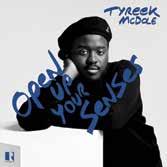
Tyreek McDole ’23 (ARTWORK RECORDS)
After becoming the second male singer to ever win the Sarah Vaughan International Jazz Vocal Competition, jazz performance major Tyreek McDole makes his fulllength recording debut with Open Up Your Senses. The critically acclaimed album features 13 of McDole’s enchanting variations on jazz songs new and old. He lends his velvety baritone to compositions by legends Pharoah Sanders and B.B. King as well as contemporary virtuosos like Nicholas Payton. Senses is as much a masterful tribute to the greats as it is proof of a rapidly rising star. —SD
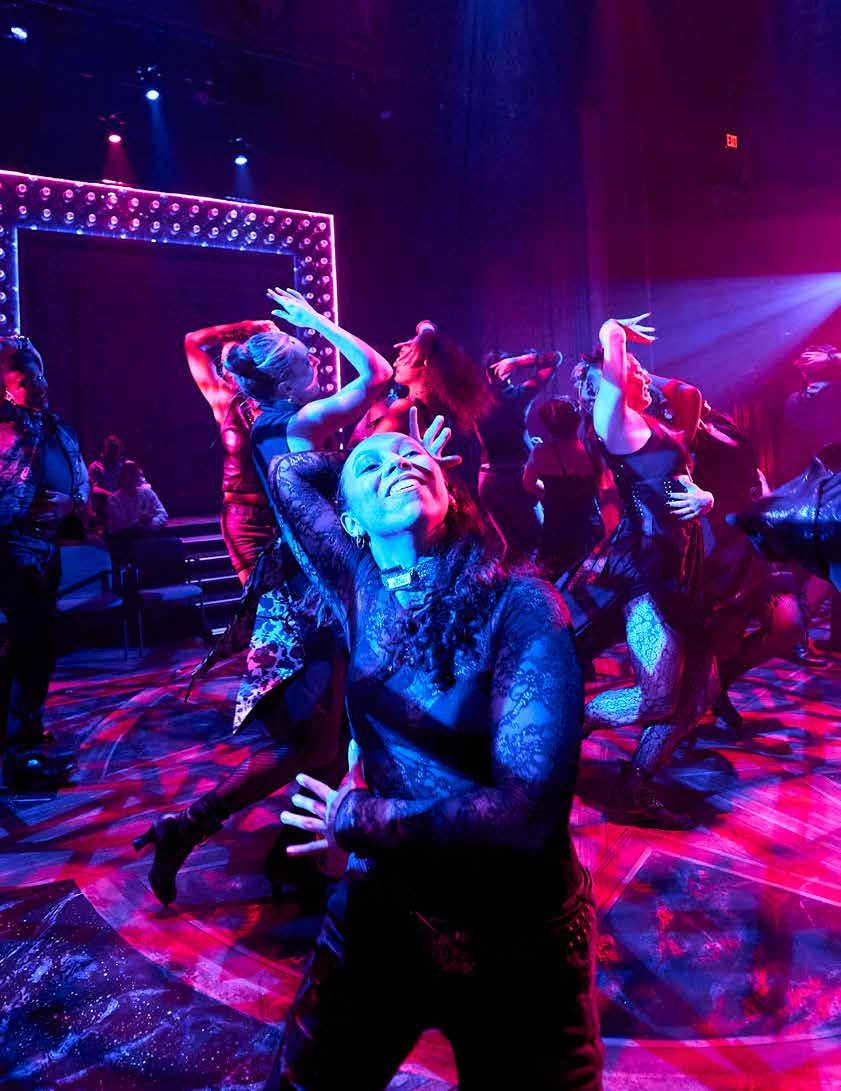
OBERLIN’S NEW MUSIC THEATER PROGRAM IS PRODUCING TOMORROW’S BROADWAY STARS.
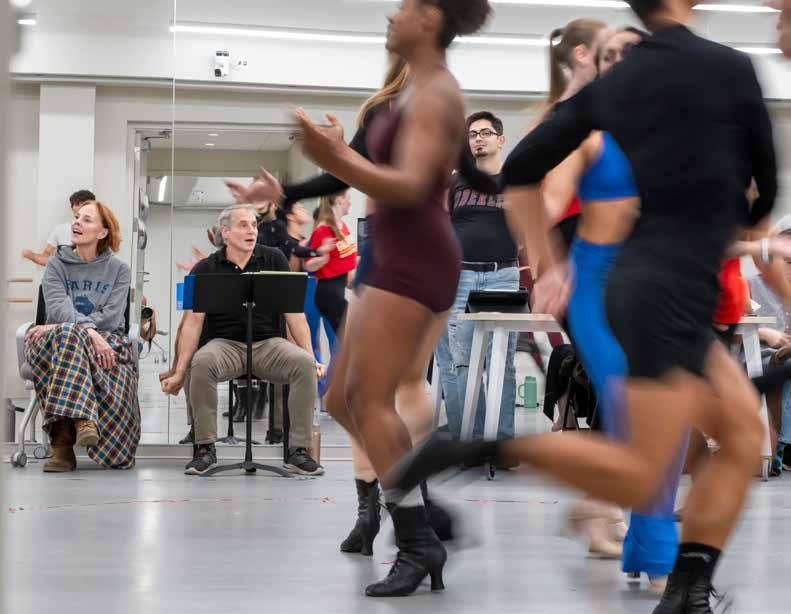
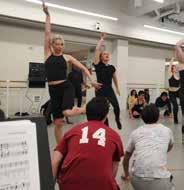
It’s not even noon, but the members of the Oberlin Music Theater Class of 2026 are deep into an intense rehearsal. Swiftly moving in and out of their dance formations as they cross the shiny gray floor of the Birenbaum, the nine students are singing “One Night in Bangkok” from Chess, but with a twist.
Cheekily revised as “One Day at Showcase,” the song’s new lyrics give a wink and a nod to a very specific target audience: Broadway agents who just might hold the key to the group’s dreams. “I can feel an agent staring right at me,” the students sing as Assistant Professor of Music Theater Matthew Webb plays a pulsing piano bass line from the side of the room.
Perched on a pair of barstools, Professor of Music Theater Victoria Bussert and Assistant Professor of Music Theater Lauren Marousek watch intently, interjecting with corrections and encouragement.
“Sharp, physically!” Bussert calls. “Yes. Yes! Again.”
Ultimately, these fourth-year students will perform this song and others at a New York City showcase, an annual tradition where the students highlight their individual artistry for dozens of interested agents. It’s a pressure-filled moment in a competitive industry.
This morning, these students have many more weeks of rehearsal to go before their pilgrimage to the East Coast. But when the time comes, they’ll be ready to represent Oberlin on a national stage and give the industry a taste of what the school’s new music theater program has to offer.
Over the years, Oberlin alums have made an impact on music theater, both on and off Broadway. Audiences continue to hum along to tunes by composer John Kander ’51 (Cabaret, Chicago) and are wowed by the master puppeteering in director Julie Taymor ’74’s The Lion King. Obies are also Tony winners: Natasha Katz ’81 has nabbed eight for lighting design, while Montana Levi Blanco ’07 took home one for costume design. Throughout the industry, Oberlin-trained performers, designers, and producers have risen to prominence, including actors Judy Kuhn ’81 and Will Chase ’92 and musician Seth Rudetsky ’88, to name a few.
Oberlin’s music theater program builds on this legacy.
Launched in fall 2025, the program prepares students to join the professional world immediately after graduation. Its 14 faculty members, all specialists in their respective art forms, train students in the trifecta of voice, acting, and dance. “These faculty members are working professionals, which makes a huge difference,” says Bussert, who brings decades of teaching experience along with 40 years of directing award-winning shows in Cleveland and internationally.
“The industry embraced us immediately in our first year because people knew our work as a team.”
understood the importance of building a specialized music theater curriculum. For example, music theater faculty do not cross-teach in other areas, freeing them up to focus squarely on the program’s needs. That aspect “is really important, and it’s rare,” Bussert says.
“ The first thing Bill said to me was, ‘We’re either going to create a world-class program, or we’re not interested in doing it.’ That’s very different from the way most music theater programs have been created.”
Rehearsals and dance cla sses take place in the Conservatory East Studios (or Con East), an 8,600-squarefoot space whose sleek glass facade adjoins the Hotel at Oberlin. The facility, which is the home of the music theater program, features two multipurpose studios, a recording control room, and offices for faculty and staff.
“ THE FIRST THING BILL SAID TO ME WAS,‘WE’RE EITHER GOING TO CREATE A WORLDCLASS PROGRAM, OR WE’RE NOT INTERESTED IN DOING IT.”’
Known for her determined and exacting manner, Bussert has the kind of magnetic personality that draws in dedicated students and faculty. Her work ethic and passion for music theater elevates her professional and college-level productions, and she is fond of saying that music theater is more than a simple combination of music and theater. “We are our own art form,” she notes.
From her first meetings with President Carmen Twillie Ambar and Dean of the Conservatory William Quillen, Bussert knew that Oberlin
Bussert has carefully adorned her office with cozy lighting, photos, and colorful decorations.
Yellow neon lettering proclaims, “This must be the place,” underneath a neon outline of red lips.
Many of the music theater faculty members have been working with Bussert for years and possess deep industry connections in the professional world. What the team has
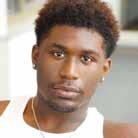


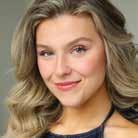
established at Oberlin “is not a new program—it’s a new relationship,” Bussert says. “ Oberlin really took a risk by saying, ‘We think this art form deserves its own training program at a first-class conservatory.’ The support we get here makes us want to work even harder because we want to live up to that reputation.”
Students pursue a Bachelor of Music degree while having the flexibility to take courses in both the college and the conservatory. Bussert says the students have responded enthusiastically to these interdisciplinary learning opportunities, exploring passions such as creative writing and conducting and taking courses such as Shakespeare and The Black Perspective, taught by Associate Professor of Music
Theater and Africana Studies
Justin Emeka ’95. In turn, the program is influencing Oberlin’s curriculum; for example, Barker Professor of Music Theory Jared Hartt chose to teach first-year students music theory using the songs from the music theater program’s productions.
The music theater faculty members have extensive Broadway and academic experience, offering classes that sharpen students’ performance skills and business acumen. Assistant Professor of Music Theater
Laura Welsh spent more than 20 years as a professional actor at Great Lakes Theater in Cleveland and around the country before pivoting to full-time teaching four years ago. This year, she taught acting fundamentals, Shakespeare,
and a course called The Business of the Business, which ensures that students understand the logistics of life as a working actor. “You are your own business, and no one would start a business without a five-year plan,” she says. To that end, students connect with agents, managers, and casting directors as part of their studies and benefit from sessions with a personal trainer and a sports psychologist.
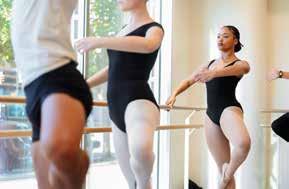
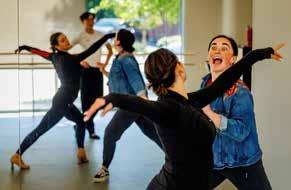
During Winter Term, Con East buzzed with activity. On a Friday morning in Studio B, Assistant Professor of Music Theater Alex Sanchez paced among second-year students while teaching a dance number from On Your Feet!, a peppy jukebox musical set to songs by Gloria Estefan
Sanchez’s ballet-centric approach grounds students in the fundamentals, preparing them for an industry that expects them to quickly learn combos in jazz, tap, contemporary, hip-hop, and more. “When they are asked to adapt, they’ll have the foundation to pick up those styles,” he says.
One of the program’s newest faculty additions, Sanchez brings decades of performing and choreographing experience on Broadway and beyond. Among other things, he performed in the original Broadway casts of Fosse and The Red Shoes and performed in the Lincoln Center Theater revival of Carousel. This year, he choreographed the inaugural music theater production of Natasha, Pierre and the Great Comet of 1812 and directed Oberlin’s production of The World Goes ’Round, taking the student cast to Hidden Valley, California, in January and Playhouse Square in Cleveland in May.
Like many other members of the music theater faculty, Sanchez remains a practicing artist. “I’m experiencing the industry, so I can bring that knowledge to the students,” Sanchez says. In the studio, he holds them to a professional standard. “I bring that intensity into class every day.”
As Sanchez continued teaching the On Your Feet! choreography, Kaymond Ivey ’28 of Rochester, New York, attentively watched his own steps in the wall of mirrors. The youngest of nine children, many with musical talents of their own, Ivey developed a love of performing—and a thick skin—while growing up. That helped prepare him for the demands of music theater training—and for Bussert’s wellknown straightforwardness: “She never beats around the bush.”
Ivey initially studied music education for a semester at another university but missed performing. Once accepted into the music theater program, he started building his resume, landing roles in his first musicals—Little Shop of Horrors, A Chorus Line, and Beautiful: The Carole King Musical—over a span of three months in 2024. Ivey says the support he received from Bussert and other faculty mentors helped him make the leap and commit to his music theater journey.
“ I had a lot of insecurity before, not really sure of who I was and what musical theater was,” he says. “ Now, I am a completely different artist, completely different performer. And it’s all to do with this team.”
At Oberlin, voice teacher Jaron LeGrair became another mentor Ivey can lean on for support. When LeGrair began teaching at the school this year, Ivey was thrilled—LeGrair’s educational YouTube and TikTok videos had been inspiring him for years. “ I would watch his videos all the time, and I would try to apply it to what I was doing,” he says. “He’s a genius.”
Jai McAllister ’27 studies with LeGrair as well. “ He is incredible at allowing us to embrace our natural voice and explore other things
that we may want to grow in,” she says.
For McAllister, the idea of finding her voice has defined much of her collegiate journey. Steeped in sacred African American music during her childhood, she learned all kinds of instruments from her grandfather—the twokeyboard organ, the Hawaiian guitar, the viola.
“ I felt like I had multiple voices, and I didn’t know which one was really me,” she says. “But I’ve been able to find that ease this year.”
McAllister has been
enjoying studying vocal pedagogy with Associate Professor of Voice
Martha Guth ’98, creating choreography in a dance practicum, and soaking up as many music theory classes as possible. “The faculty are always extremely confident in our abilities to be versatile,” she says. “ You learn a lot about yourself when you start to step outside of your foundation as a performer.”
While in-class time is crucial, the music theater program
also recognizes the need for professional performing experiences. The program collaborates yearly with Beck Center for the Arts in Lakewood, Ohio, and students are also often cast in shows at Great Lakes Theater and its sister companies, the Idaho Shakespeare Festival and the Lake Tahoe Shakespeare Festival. All graduating students have the ability to qualify to join the Actors’ Equity Association.
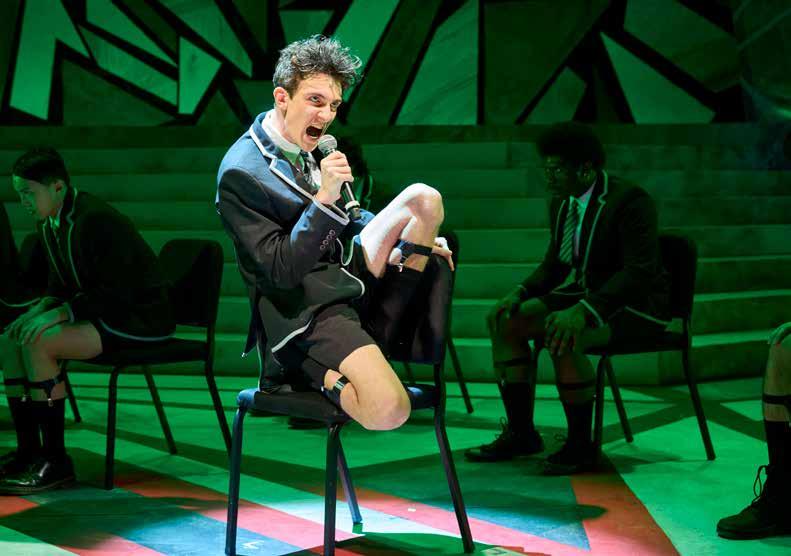
Music theater students have also been cast in theater productions on campus. “In my first year, I knew that I was going to have opportunities, but I don’t think I expected to be performing as much as I am,” says Seger Ott-Rudolph ’29. So far, he’s been a part of the company in The SpongeBob Musical at the Beck Center; starred as Bruce Bechdel in Oberlin Theater’s production of Fun Home; and performed in Stranger Sings! The Parody Musical.
At 19, Ott-Rudolph is a seasoned performer, possessing both a steely calmness and a relaxed curiosity. “My mom tells me that before I spoke, I sang,” he says. In middle school and high school in Maryland, he participated in Young Artists of America at Strathmore and earned accolades from the YoungArts National Arts Competition and the Brandon Victor Dixon Awards. He was also a finalist in the 2025 National High School Music Theatre Awards, popularly known as the Jimmy Awards Ott-Rudolph chose Oberlin because it encourages professional work and brings in well-respected names in the
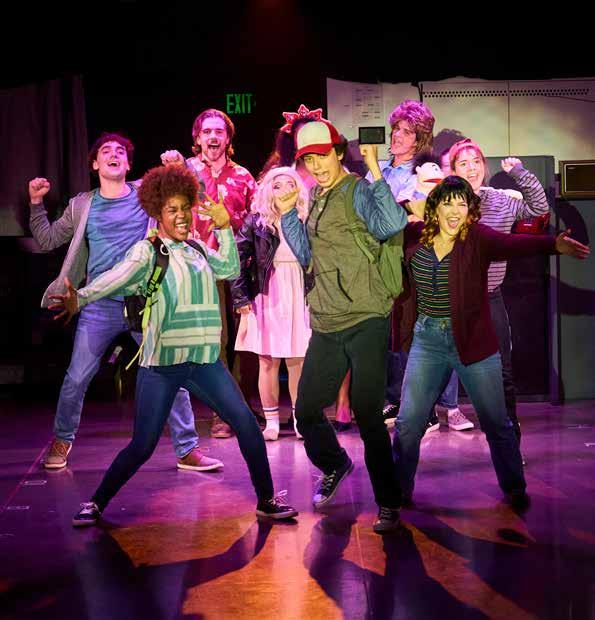
THE UPSIDE DOWN Jai McAllister ’27 (above) and Izzy Baker ’26 (below) appeared in a spring production of Stranger Sings! The Parody Musical.
industry. During Winter Term, first-year students enjoyed an industry-focused boot camp of workshops with guest artists including New York City-based choreographer Lainie Sakakura and the artistic leaders from Great Lakes Theater, Sara Bruner and Jacqueline Miller.
While getting up for 8 a.m. dance class five days a week initially felt daunting, he says it only improved his athlete mentality. “This is my passion,” he says. “I work hard, and I play hard.”
Izzy Baker ’26 was also surprised by how much she enjoyed the increased focus on dance training. “I love it,” she
says. “ Getting moving in the morning really helps me wake up.”
She didn’t consider herself a dancer before college. “Now, I feel like I can go into an audition and kill a dance call,” she says. As a nod to the effort, she included a dance break in her showcase performance. “I wanted to show that off for myself.”
Baker has loved theater since playing young Cosette in Les Misérables as a child: “ Being able to communicate with people in a live setting—there’s nothing like it,” she says. “I knew I wanted to do it for the rest of my life.”
With a love of comedy, Baker is drawn to quirky, entertaining characters like Mrs. Lovett in Sweeney Todd—a dream role. She finds a bit of herself in each character she portrays. “That’s the key,” she says. “In each performance, everybody has to sprinkle in a little bit of them to make it genuine.”
Having served as assistant director on Bussert’s 2025 production of Waitress at the Beck Center, she hopes to one day further explore her passions for script writing and directing.
Baker and Elliot Block ’26 also speak highly of their class with Associate Professor of Jazz Voice La Tanya Hall. Hall is “phenomenal,” Block says. “It’s what I imagined Oberlin would be like—getting into a room and collaborating with different artists.”
Originally from New Jersey, Block began acting in high school
before training up his singing voice when the pandemic hit. Inspired by Broadway tenor Jeremy Jordan, Block is drawn toward both heartfelt vocal performances and comedy. “That’s the lane where I would most see myself as an actor— someone who makes people laugh,” he says.
Like Baker, he balances school productions, liberal arts classes, and outside work. In the fall, he was in the company of Sunday in the Park with George at Great Lakes Theater, where performances briefly overlapped with rehearsals for Oberlin’s Natasha, Pierre and the Great Comet of 1812. With such an intensive schedule, keeping his mind and body in shape is paramount. Embracing his athleticism, Block recently earned a personal training certificate—a side gig he can pursue while taking auditions after graduation.
“ It’s super rewarding to have this opportunity to be at the school and to be the first class to graduate from musical theater,” he says. “ I’ve learned a lot about being a team player this year. My drama teacher in high school told me, ‘You have to be two out of three things: You have to be nice; you have to work hard; and you have to be talented.’ I’ve tried my best to achieve all three.”
“IT’S TRULY A CHANCE TO SHOW THAT WE LOVE THEATER, AND IT’S A WAY TO EXPRESS OURSELVES AND BE AUTHENTIC.” “
the Cyclone. Marcus Alonso showcased acting with the heartbreaking “You Don’t Need To Love Me” from If/Then. And Ryan James Sweeney showed versatility on guitar and piano, ratcheting up the energy with “30/90” from Tick, Tick… Boom! before the group said a cheerful goodbye with Abba’s “Waterloo.”
As the students performed, agents and industry representatives flipped through headshots and resumes and scribbled notes. After the showcase, the students booked well over 100 appointments with agents or managers to talk potential representation.
“ There was a lot of anxiety going into the week,” Block says. “But at the same time, it’s truly just a chance to show that we love theater, and it’s a way to express ourselves and be authentic.”
Late March in New York City still held a wintry chill as attendees arrived at the Alvin Ailey American Dance Theater, but excitement buzzed in the air—the Class of 2026 had made it to showcase. Downstairs in the 275-seat theater, friends, family, and agents exchanged greetings and cheered warmly when etiquette allowed. Despite the pressure, the nine seniors radiated confidence.
True to form, Block consistently drew chuckles while portraying the earnestly awkward Mr. Knightley in the title song from Emma Justin Lee-Price ventured into jazzy R&B with Stevie Wonder’s “Sir Duke,” moonwalking in an easy groove. Baker did an acrobatic duet with Lee-Price during an enthusiastic take on The Act ’s “Arthur in the Afternoon.” She then upped the emotional intensity with a stirring vocal performance of Aida ’s “I Know the Truth.”
Reese Henrick’s sultry delivery and sparkly black pantsuit elevated the Judy Garland-popularized “The Man That Got Away.” A flurry of bubbles blown from stage left announced Capri Castriotta and her graceful Glinda in Wicked ’s “No One Mourns the Wicked.” Tobias Yeung lit up the stage with his choreography, twirling and voguing with ease during “And You Don’t Even Know It” from Everybody’s Talking about Jamie
Bebe Moss’ operatic singing voice took the spotlight, effortlessly reaching impressive heights in “The Ballad of Jane Doe” from Ride
Later in the night, a reception celebrated not only the showcases, but also the
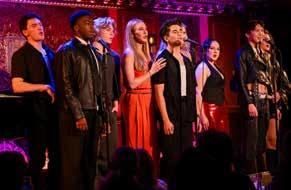
group’s concluding cabaret performance at 54 Below.
Industry legends Judy Kuhn ’81 and Seth Rudetsky ’88 hosted the festivities, performing a few selections including “Do You Love Me?” from Fiddler on the Roof before listening to each student and their choice of song.
Block used part of his set to invite Baker up to perform “Move On” from Sunday in the Park with George. In the song, Dot encourages George to find inspiration in life’s small beauties and to keep moving forward.
As the two sang, Rudetsky and Kuhn listened intently, particularly to the tender final verse from Baker:
Anything you do
Let it come from you
Then it will be new
Give us more to see “Life will continue to bring new things, you know?” Baker later says, reflecting on the performance. “That’s what it’s all about.”
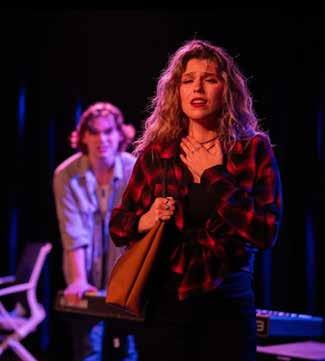
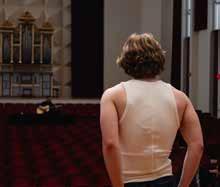
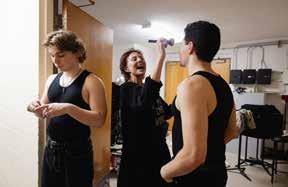
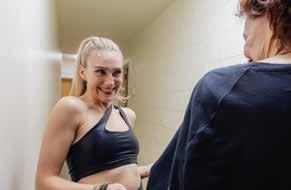

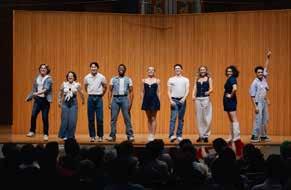
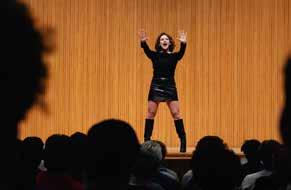
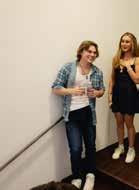
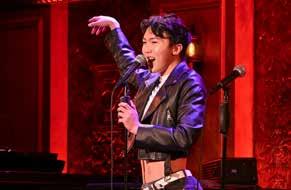
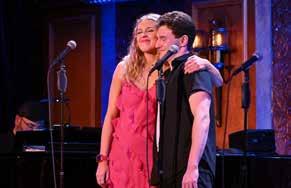
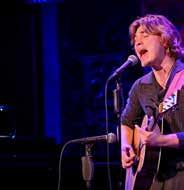
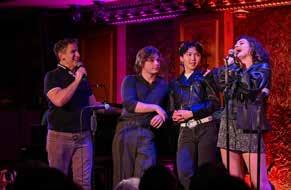
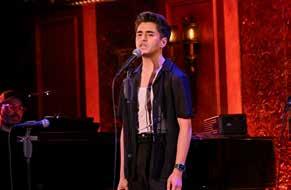
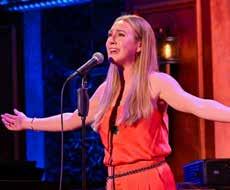
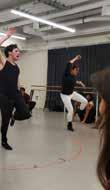
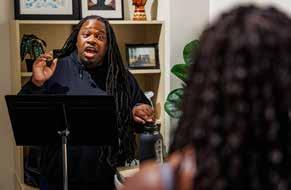
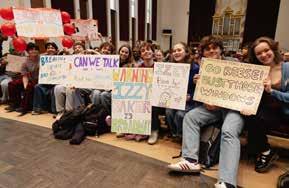
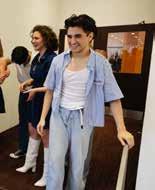

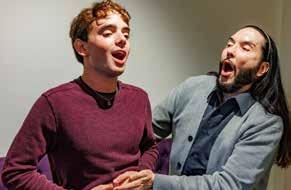
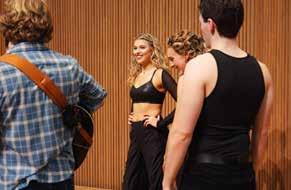
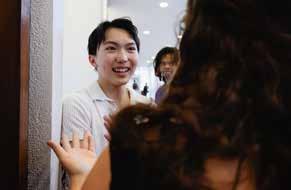
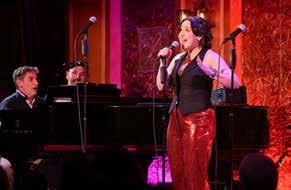
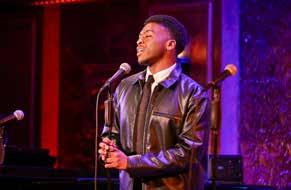
For the last 18 years, every one of Victoria Bussert’s fourth-year students has signed with an agent after showcasing. The 19th was no exception. Within two weeks of the 2026 showcase, every member of the Class of 2026 signed with professional representation. For the next academic year, Oberlin’s music theater program received more than 750 applicants; Bussert and her team personally sat in on all 550 auditions. “That’s more than I’ve ever had in my years in academia,” Bussert says. “I expect we’ll be over 1,000 next year.”
Here’s where the Class of 2026 ended up: Marcus Alonso: The Luedtke Agency ★ Izzy Baker: CGF Talent ★ Elliot Block: Daniel Hoff Agency ★ Capri Castriotta: HCKR; Buchwald ★ Reese Henrick: Pantera/Murphy the Agency ★ Bebe Moss: The Talent House; Bohemia Group ★ Justin Lee-Price: The Mine Agency ★ Ryan James Sweeney: CGF Talent; Buchwald ★ Tobias Yeung: Boals, Winnett & Associates
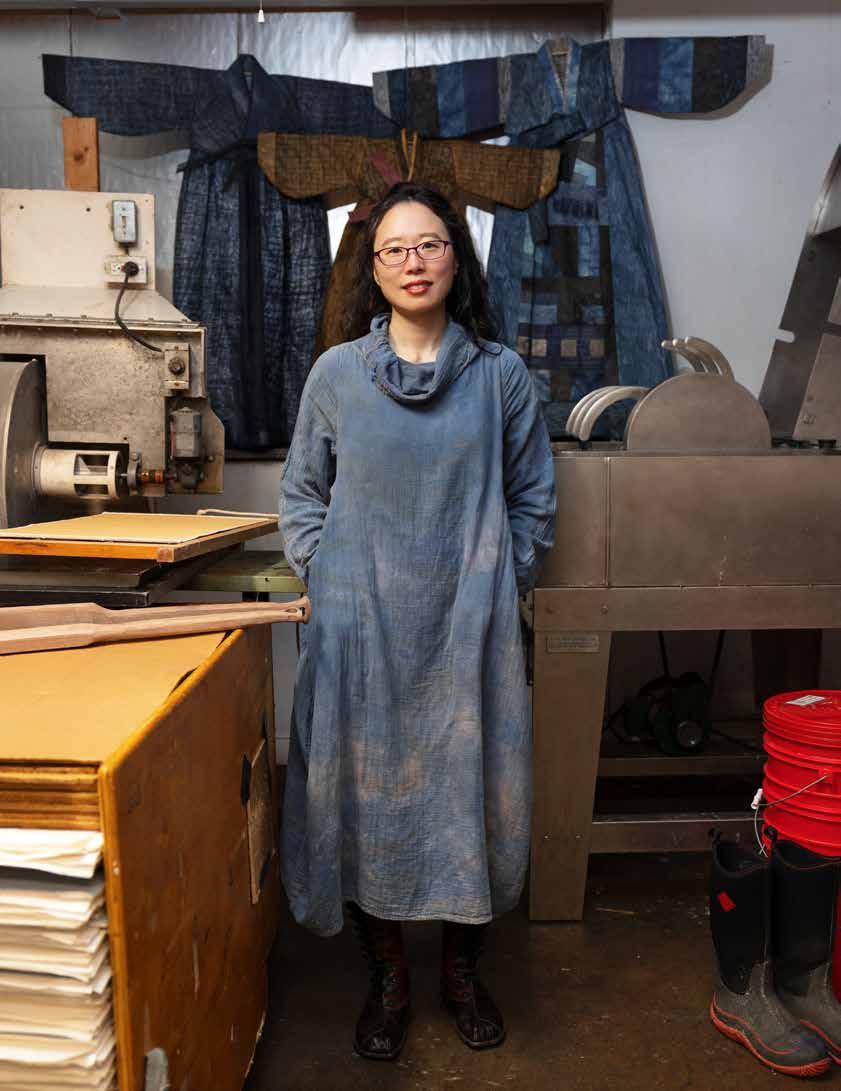
Aimee Lee ’99 is a renowned hanji scholar and teacher. Having found her inspiration at Oberlin, she now shares her art and knowledge with the world.
By Annie Nickoloff Photography
By Tanya Rosen-Jones ’ 97
Eight students filter into a small classroom in the Special Collections area of the Mary Church Terrell Main Library and take their places at tables covered in paper. Some sheets are swirled with marbled ink, while others show stringy bits of plant fiber, flattened in natural textures. Pages that look like accordions stretch across desks: the makings of soon-to-be books.
Aimee Lee ’99 stands at the head of the room in front of her own neat stacks of papers, booklets, and zines.
Not all books are alike. She holds a notebook and, in one motion, unfurls it into a single sheet of paper that sports just a few cuts and folds. “This is what we call a snake,” she says. Then she picks up a geometric-looking doughnut shape, fidgeting the paper loop to revea l new faces around the center. “This is that 3D flexagon I mentioned.”
For the most part, the students don’t take notes. Instead, they pick up their own sheets of paper and start folding. Lee does the same, as an overhead camera captures, on a screen behind her, a zoomed-in video of her hands and tools as she explains the importance of following paper grain and double-checking measurements. It’s learning by doing.
A few weeks before this, at the start of Lee’s Winter Term class, students forged the paper they now fold. At the end of the course, each student will leave with at least 10 handmade books.
This class has been enormously popular since Lee started teaching it in 2014. Approximately 90 students have taken the Winter Term class, and she says she has to turn people away every year.
“This class is basically improv,” Lee says, shrugging, in response to a student who’s inquiring about how many more book forms Lee will teach in the Winter Term.
To answer the question: At this stage in the class, at least five—maybe more.
This hands-on approach is how Lee first studied hanji, which translates to
“Korean paper.” She was first exposed to making hanji as part of a designfocused Fulbright research fellowship to South Korea. (In 2021, Lee returned as a Fulbright senior scholar to study hanji tools.)
In the years since, she has established herself as a renowned hanji scholar and teacher, writing the first Englishlanguage book on hanji and opening North America’s first hanji studio. Her works have appeared in galleries across the United States and in Taiwan, India, Australia, China, Chile, and the United Arab Emirates and are in the library collections of acclaimed institutions including the Metropolitan Museum of Art, Yale University, and the Museum of Modern Art (MoMA).
She makes more than just books. Hanji, made of inner mulberry bark, is renowned for its durability and versatility and has been used since ancient times as a writing surface and for various household goods and clothing items. Using hanji, Lee constructs dresses and other garments;
densely woven ducks and chamber pots; expansive art books; and abstract fine art installations.
Before studying visual arts, she considered a career as a violinist. Having pivoted to paper, she now shares her knowledge of Asian and European papermaking styles with her students, emphasizing a global perspective that resonates.
“It’s all on the menu,” she explains. “I know they’re still working directly from the plant, seeing it all the way through to paper, and then they’re working with paper to see it all the way through to the book. I will always show them Asian styles, European styles. I will always give them cultural context, history, background, chemistry, science information so that they have a good grounding.”
Weeks before transferring to their classroom in Special Collections, students start by squeezing into the small-but-mighty papermaking studio that Lee has built up, piece by piece, over the past decade in the basement
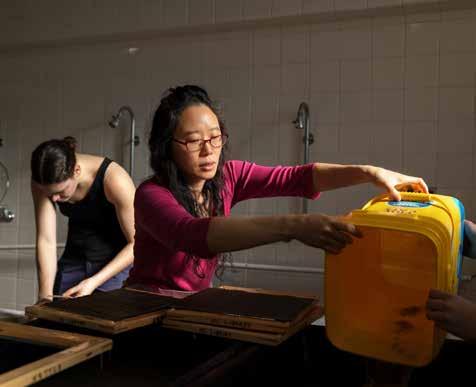
of Hales Gymnasium. There, they start at the beginning of t he papermaking process: stripping twigs and shredding fibers.
In this room, Lee has accumulated used equipment such as her prized stainless steel Hollander beater, which macerates fibers into pulp. Many of the tools are celebrated in her latest book, 2025’s As Good As Our Tools: Equipment and Tool Makers for Hand Papermaking.
A fridge contains rows of former yogurt containers, which hold processed pulp, much of which was made from harvested milkweed stems or mulberry stalks. She hand-built the stacks of screen-andframe tools that students swoop into vats of cloudy slurry to pull individual pages into existence.
Lee says. “The process is very healing and therapeutic for me, and part of that process is including the landscape in this way. That, to me, is second nature.”
Lee has taken over this corner of the former Oberlin gym, where the shower room’s marble slab walls serve as an ideal surface for drying paper sheets. Here, Lee shares a world of techniques
“When you can connect to the actual land and the plants, it really calms you.”
learned from decades of study around the world, especially in Korea.
Memorial Art Museum when a key detail spiked her interest.
“The curator at the time was showing us one that he said was actually on Korean paper, because Chinese painters often preferred Korean paper,” Lee says.
“That was kind of my ‘aha’ moment, where I was like, ‘Why am I studying Chinese art? I don’t know anything of Korean art. And how can I know anything about Korean art if I don’t speak Korean?’”
That summer, Lee enrolled in an intensive Korean language program. For the next decade, she practiced until she felt fluent enough to research hanji in Korea, following her Master of Fine Arts from Columbia College Chicago.
Each screen is named after a different plant used to make paper.
“When you can connect to the actual land and the plants, it really calms you,”
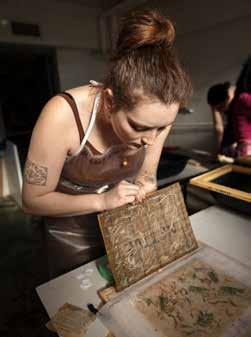
Though Korean was Lee’s first language, she says she had “a very classic, first-generation-born American rejection of the culture.” That changed after one Chinese art history class at Oberlin. Then 19, Lee and her classmates were studying a Chinese landscape scroll painting at the Allen
Through trial and error, Lee sought out a hanji teacher willing to take her on as a student, and she lived in a motel that was 20-minute walk away from a hanji mill. Then she learned jiseung—a Korean form of paper basketry—from another teacher.
“It just went on and on from there,” Lee says. “One thing would lead to the next.”

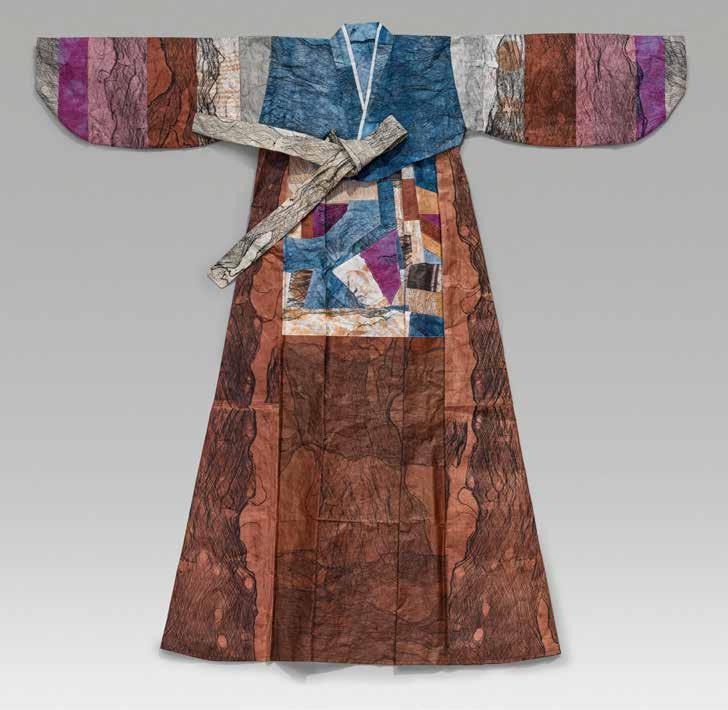
And on and on: Lee lived in New York while establishing her hanji practice at an arts center in Cleveland called the Morgan Conservatory. She relocated to Northeast Ohio full time in 2013. Ever since, she has built up her career in the region, regularly traveling for workshops, art shows, and stints of teaching. In her almost two decades of crafting hanji, Lee has saved odds and ends, amassing a library of paper scraps reflecting various moments of her artistic career.
Some of those pieces come together in a paper dress of patchworked colors and textures. For much of last year, the work of art, titled Multi, has hung on the wall at the Allen Memorial Art Museum
along with several other smaller dresses and a jacket in the Fibers of Becoming exhibition.
The idea behind Multi came from Lee’s Oberlin class, adopting a term that some of her multiracial students used for themselves—a straightforward way to encapsulate a person’s varied and sometimes complicated cultural backgrounds.
Lee’s delicate dress is a centerpiece of Fibers of Becoming alongside the work of two other artists who practice East Asian papermaking, Sarah Brayer and Lin Yan.
The paper is art on its own in Lee’s hands. But it’s also a canvas.
Beneath the dresses is a glass case with an open artist book. Made of large sheets of blue-and-white paper, it’s inscribed with Lee’s handwritten original poetry on each page: Walk into your own dark & unruly spaces sit with yourself
It’s messy
There is chaos before there can be art. Lee’s bits of teenage inspiration. Art forms, slowly fading away in faraway corners of the world. The splashes of paper pulp.
Yet, the practice brings Lee a kind of peace. She ends the poem with a beginning of sorts:
Every time you return to yourself you can recreate a whole world. Joan L. Danforth Curator of Asian Art Kevin Greenwood deliberately centered Lee’s work within the exhibition.
“She’s really at the forefront of this particular field and is a brilliant contemporary artist as well,” he says. “She’s educating this whole generation of students interested in Korean paper.”
Lee has taught as an instructor and visiting artist at institutions both in and outside of Ohio, but most consistently at Oberlin, where she teaches the Winter Term course and leads a hanji retreat in the summer or fall. She prefers the shortened time frame, compared to semester-long courses.
“I don’t like being hemmed in by whatever grading rubrics; I hate things like that,” she says. “That’s why I love Winter Term. I love teaching. I just get it done in one month.”
It helps her stay organized in her busy art schedule, too. This year, Lee
is featured in two solo shows: one from March to June at Bainbridge Island Museum of Art, another at Kent State University Museum in August. Then, in the fall, she’ll lead her first hanji summit—a two-week residency at the Penland School of Craft in North Carolina, in which Lee will bring together her former students of the Korean diaspora for an intensive papermaking experience.
A few years ago, in the A Consolation of Things show [see sidebar], Lee exhibited her traditional paper dresses alongside tightly woven pots, vessels, and lampshades. Multicolored ducks were perched near a window, where strings of paper bricks hung like a clunky beaded curtain.
The paper, in Lee’s work, is more than just a surface for scribbles. It’s a message in itself.
“You can get so deep in just a single sheet of paper,” Lee says. “Just within the materials themselves, there’s so much richness. There’s so much story.”
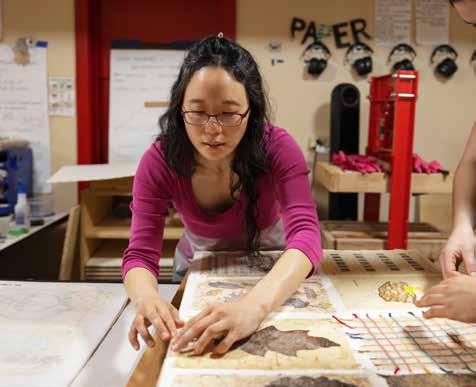
Michelle Li-Shen ’25, who has worked as Lee’s studio assistant in the past, says Lee’s papermaking class factored into her decision to go to Oberlin. Majoring in studio art and classical composition, LiShen connected with Lee’s own background as a violinist and papermaker.
“Aimee completely changed my world,” Li-Shen says. “Here was someone who comes from a background of music, but then she pursued visual arts, and then she’s done all this really cool research on Korean papermaking, and she’s really paved the way for Korean papermaking in the U.S. Overall, she’s really empowered a lot of people of color to look into their heritage and see what else is out there, other than the very Western, whitedominated fields.”
S.R. Lejeune ’15 took one of Lee’s earliest papermaking Winter Terms at Oberlin, marking the start of a passion for the art form. Today, they work as an artist and instructor in papermaking and paper casting, among other sculptural media.
“The opportunity to get into making paper felt really in line with what it felt like to be an Oberlin student,” Lejeune says. “Bringing this lens of criticality and trying to understand how things work, from the beginning—how things are made. I was just totally hooked.”
Lee and Lejeune were featured artists of the Cleveland Sculpture Center’s A Consolation of Things show in 2020 and 2021.
“On some level, I’ll always consider Aimee to be like a mentor and really look up to her,” Lejeune says. “That show also marked this moment where we were able to also develop a friendship and a presence in each other’s lives as artists. She’s been a very special influence in my life.”
hen you think about it, anything can be a book, from classic bound volumes to Star Trek fanfiction scrawled in indie zines from the 1960s.
Phoebe Dickinson ’26 explored this early Trekkie content—specifically, a story titled “Star Drek,” by Ruth Berman, first published in a cheaply printed science fiction fantasy zine called Pantopon—in a paper for her book studies minor. The course of study expanded her thinking around the world of books.
“You can think about, ‘Why was this book made, and who made it, and who was it made for?’” says Dickinson, a biology major who also earned an English minor. “It just opens up a lot more questions that you can ask about books other than just, ‘What do they say?’”
At Oberlin, those open-ended questions are at the heart of the book studies minor, an interdisciplinary program that asks students to look beyond texts and consider books as physical objects shaped by culture, history, and technology. Started as a weekend workshop organized by Senior Associate Dean of the College of Arts and Sciences Laura Baudot and Donald R. Longman Professor of English and Comparative Literature Wendy Beth Hyman, the initiative has bloomed into a course of study that broadly intersects with majors such as anthropology, psychology, art history, East Asian Studies, studio arts, and cinema studies.
At its core, the minor is based on the premise that the study of books—these primary and secondary drafts of history— remains critical to understanding culture. Courses are far-ranging, examining topics such as medieval
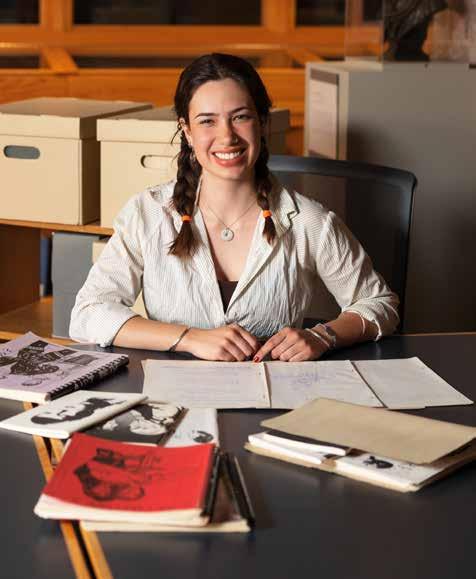
European manuscripts, early modern Japanese books, and graphic novels.
The whole point of the minor is “to think about the relationship between medium and message,” Hyman says. “It’s widely ranging from papyrus to cuneiform, through the origin of the novel, through multimedia design, screen printing.”
Much of book studies digs into historical formats of books, like tablets, parchment, and prints created with movable type. But in hands-on Winter Term classes like the papermaking intensive, led by Aimee Lee ’99, or
another on letterpress printing, students walk away with their own creations.
The minor also encourages students to page through the book’s many historical forms. The holdings in Oberlin’s main, science, art, conservatory, and special collections libraries play an important role in that experience.
Here’s a tip-of-the-iceberg view of Oberlin’s collections, mainly compiled through alumni donations: North African Torah scrolls; a 7,000-piece Spanish Golden Age drama collection; preserved one-of-a-kind artist books;
antislavery tracts; and the archives of the groundbreaking feminist book publisher Seal Press. The medium of each is just as fascinating as the stories it may contain; for example, Mildred C. Jay Professor of Medieval Art History Erik Inglis ’89 has learned more about world history by studying Chinese wood block printing and Korean movable type.
“If you’re focused only on the European book,” he says, “you’re actually belated when it comes to printing.”
Oberlin’s library collections are key to Inglis’ Intro to Book Studies course. His classes spend about 25 percent of their time in libraries or museums conducting research and exploring a preserved history of media.
found inspiration in a beaded Dakota hymnal, containing a collection of hymns in the Dakota language, in Oberlin’s Special Collections. The cover is a work of art in itself: an animal hide featuring vibrant glass beaded images of a cross and flowers.
Lyons, who majored in English and cinema studies and minored in gender,
“If you’re focused only on t he European book, you’re actually belated when it comes to printing.”
“The intro course is the constant discovery of stuff that’s already in the library, which is one of the really exciting things about it,” Inglis says. “It’s taking an asset that Oberlin has and making it useful as much as possible.”
In Inglis’ class, Caleigh Lyons ’25
sexuality, and feminist studies, says the class paper had a big impact on her academic career. Her research on the hymnal earned Oberlin’s Alison Scott Ricker Research Award and was used in her application for Brown University’s master’s in public humanities program, where Lyons now studies aspects of librarianship and archive work.
“I think realizing that all the stuff is there for the students, it takes a
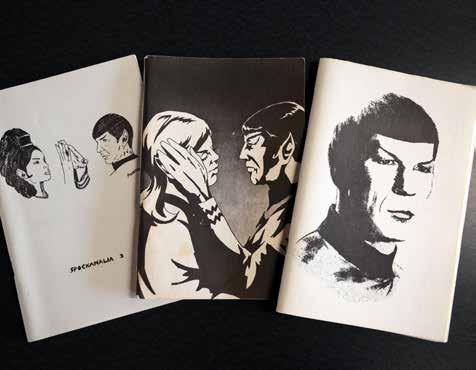
minute to realize that,” Lyons says about Oberlin’s collections. “But having classes that are in Special Collections or in the Allen [Memorial Art Museum] can lay the seeds.”
Hyman has seen former book studies students find careers as book cover designers, teachers, librarians, and archivists. One alum participated in a conservation program in Rome, where they learned how to preserve historical texts and recover information.
English major Loie Schiller ’26 plans to use her book studies minor in a postgraduation apprenticeship with a bookbinder to learn more about bookmaking. Then, she hopes to learn more about conservation and book restoration.
“I think it’s really important to keep those traditions alive, of historical bookbinding, and also to figure out new ways to do it and continue to innovate with that form,” Schiller says. “In the current digital age, especially with AI, I think there’s a real desire for physical, tactile, real experience that books can provide in a way that being online can’t.”
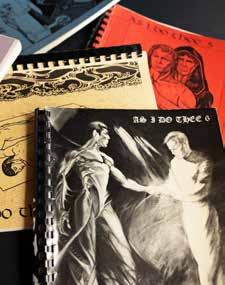
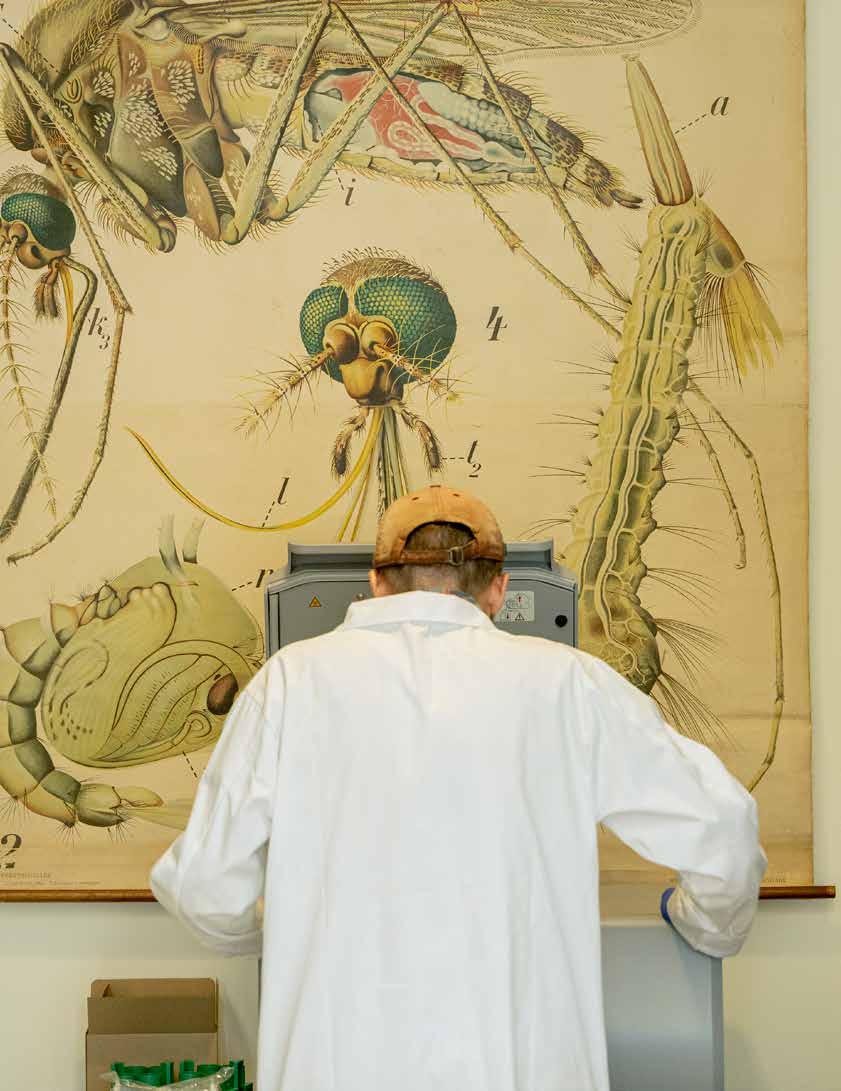
At Oberlin, undergraduates work alongside faculty members on incredible scientific breakthroughs.
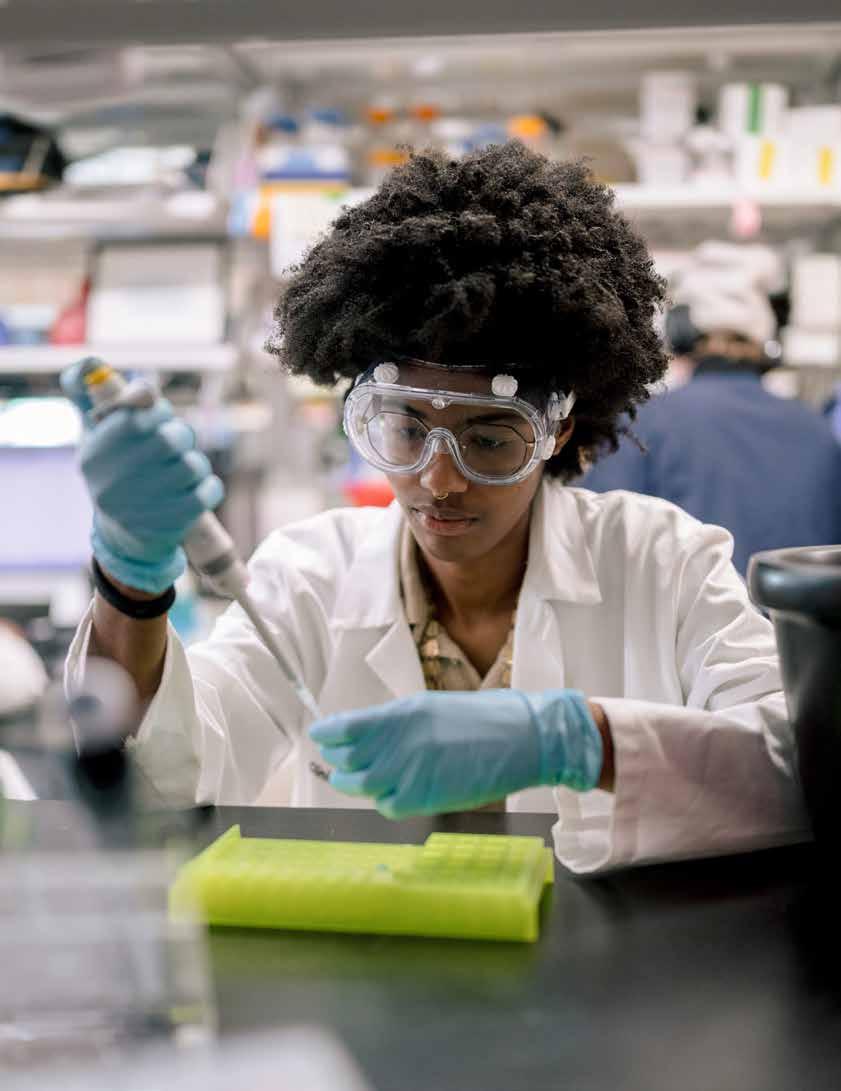
IIn fall 2026, Oberlin will start offering students pursuing a wide range of eligible majors—including biochemistry, neuroscience, physics, geosciences, and biology—the option to earn a Bachelor of Science degree. Not only does this degree reflect Oberlin’s spirit of interdisciplinary inquiry, but it affirms the impressive scientific research and academic training that happens on campus every day. Students are presenting at symposia, coauthoring papers in scientific journals, and building skills for graduate school and beyond. The following projects represent a small fraction of the research that happens on campus every day—and illustrate the robust support system students have as they pursue worldchanging discoveries.
Via peer mentorship and an array of programs and events, the Center for Learning, Education, and Research in the Sciences (CLEAR) provides tailored support for students historically excluded from STEM fields. For example, dedicated academic tutors help students thrive in foundational STEM classes, while post-graduation career panels and seasonal community events build community.
Julia Ludwig ’27 started as a CLEAR mentor and later became a CLEAR coordinator, a leadership position in which she helps
the next generation of mentors support future superstar scientists. The biochemistry and neuroscience double
major already knows plenty about success: Her research project
“Identification and Characterization of Environmentally and Clinically Derived Pathogens,” which she completed in the Gaybe Lab, run by Assistant Professor of Biology Gaybe Moore ’15, isolated and analyzed bacteria found on campus.
Using the Galleria mellonella infection model, Ludwig discovered that a strain of bacteria that usually doesn’t cause disease in humans, Priestia megaterium, actually triggered more of an immune response. “My findings suggest that these species may possess overlooked pathogenic traits,” she says. “This contributes to a growing understanding that microbial classifications may need to be reevaluated as new evidence emerges.”
Ludwig, who was invited to present a poster on this research at a biomedical conference for minority scientists, envisions additional work to understand why and how this occurs.
“Understanding these pathways could offer deeper insights into bacterial-host interactions,” she says, “and inform better strategies for infection control in both healthcare and community settings.”
D IS FOR DOUBLE
Double Degree students hold majors in both the college and the conservatory, so they can pursue research alongside their artistic training.
You can frequently find Molly Foley ’25 in a performance space. A Double Degree student who majored in biochemistry and horn performance, Foley played in multiple ensembles. However, Foley is equally at home conducting research. After her first year, she joined Professor of Chemistry and Biochemistry Matt Elrod’s atmospheric chemistry lab, where she was part of the team that published a paper in the August 2025 ACS ES&T Air. Next, she joined the lab of Associate Professor of Chemistry and Biochemistry Lisa Ryno, studying how lactose, glucose, and galactose
influence bacterial biofilm formation, composition, and antibiotic sensitivity.
In summer 2025, these experiences led Foley, who was supported by Oberlin’s Internship+ program, to a biogeochemical lab for a summer research experience. She spent a month at the Georgia Institute of Technology and another month with her lab aboard a research boat roughly 100 miles offshore in the Atlantic Ocean, collecting samples and conducting fieldwork. “Working in two different chemistry labs at Oberlin allowed me to feel confident conducting research independently.”

II IS FOR INTERNSHIP+
Earmarked for thirdyear students, Oberlin’s Internship+ program provides funding for high-quality summer experiential learning opportunities, ensuring that Obies can explore career interests and build their professional networks.
Last summe r, Victoria Adair ’26 was an undergraduate research fellow at Columbia University. A psychology major with a concentration in data science, she designed a research project on the neural mechanisms of social categorization, including a literature review, a proposal, data analysis, and an oral report.
“One of my primary goals was to go through the process of creating, proposing, and beginning a research project from the ground up in a quantitative
“One of my primary goals was to go through the process of creating, proposing, and beginning a research project from the ground up in a quantitative area of psychology.”
area of psychology,” Adair says. “Since I plan to pursue a career in research, it was essential to develop the ability to turn broad interests into testable questions and manage projects productively and efficiently.”
This experience built on her work as a research assistant in the Asian American Identity and Mental Health Lab of Assistant Professor of Psychology and Comparative American Studies Danielle GodonDecoteau. Together, they worked on a qualitative study on how second-generation Asian Americans initiate conversations about race with their elders. Adair presented the lab’s research results at several conferences, taking third prize for a poster at the Asian American Psychological Association’s annual convention, and wrote a final report for submission to a journal.

Many undergraduates present their research at regional and national conferences and symposia.
In the lab of Assistant Professor of Neuroscience Michelle Johnson, Haley Gottesman ’26 studies fused in sarcoma (FUS), a binding protein present in about 10 percent of people living with frontotemporal lobar degeneration (FTD). In these cases, DNA damage
causes FUS to accumulate in cell cytoplasm. However, researchers are unsure why this damage occurs and how the FUS came to settle in the cytoplasm, both of which could be key to understanding why these people develop FTD.
In her honors thesis, “The Impact of PhosphorylationDephosphorylation Dynamics on Fused in Sarcoma (FUS) Subcellular Localization in Response to DNA Damage,” Gottesman used techniques such as biochemical fractionation and fixed-cell time course experiments to identify the mechanisms behind these FUS FTD cases. “We determined methodological immunofluorescence conditions such as block, permeabilization condition, and primary antibody to alter the visualization of FUS subcellular localization within cells,” she says.
At Oberlin, Gottesman presented sophisticated research like this at several professional conferences. “ Interacting with mentors from all over and discussing with a diverse group of peers from across disciplines provided me with transferable skills.”
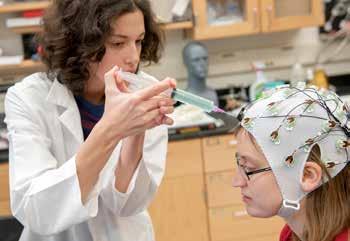
S IS FOR STRONG
The STRONG program supports first-generation and income-eligible students from backgrounds traditionally underrepresented in STEM.
Computer science and mathematics major Tanisha Shende ’26, who entered Oberlin as a STRONG scholar, has landed prestigious summer research positions at Cornell University and the MIT Media Lab, funded in part by a 2025 Goldwater Scholarship. Focusing on humancomputer interaction, human-centered design, and accessibility, Shende explores how technology can reinforce and mitigate social issues.
“I study how AI can describe images and surroundings to blind and
low-vision people, but also how it can perpetuate labor exploitation and environmental harm and remain a legally ambiguous space where digital harm outpaces regulation and case law.”
Having published five papers to date, Shende credits her STEM and humanities coursework as a catalyst for her success.
“I’ve already done a lot of work in making existing technology more accessible for disabled people. Regardless of my specialization, I want the technology I study and develop to contribute to social good.”
“I assisted in diagnosing infectious diseases and saw firsthand how lack of data delayed treatment.”


OO IS FOR OSRI
The Oberlin Summer Research Institute (OSRI) is an immersive eight-week residential program that offers faculty-mentored research alongside skill development, academic advancement, and personal and professional growth.
While still in high school, Maria Mozumdar ’28 conducted research at a children’s hospital in Bangladesh. “I assisted in diagnosing infectious diseases and saw firsthand how lack of data delayed
treatment,” she says. “That experience made me realize that research— especially data-driven research—was essential to improving health care outcomes.” In college, Mozumdar was drawn to research opportunities that combined biostatistics and global health, so she developed the skills to address real-world disparities, particularly in under-resourced settings like Bangladesh.
Her 2025 OSRI presentation, “Integrating Survival Analysis and Machine Learning to Predict Breast Cancer Outcomes in Young Women,” investigates survival trends and risk factors in women under 40. Mozumdar applied classical statistical modeling techniques and machine learning to existing data to identify the demographic, clinical, and tumor-related factors that most influence patient outcomes.
“The goal is to better understand the unique challenges faced by young women with breast cancer and provide insights that can inform earlier detection, personalized treatment, and more inclusive public health strategies,” she says. “By combining data science with public health, this research aims to bridge gaps in cancer care and reduce age-related disparities in survival outcomes.”

Since Oberlin is an undergraduate-only institution, students work closely with faculty members on their research.
Shaswat Gajurel ’27’s childhood was filled with memories of his parents conducting research and writing papers on internal medicine. A biochemistry and biology major, he is
Students have access to a variety of funding sources through Oberlin, including fellowships, scholarships, and grants.
following in his family’s footsteps by working with Professor of Biology Aaron Goldman on research into molecular evolution prior to the emergence of the Last Universal Common Ancestor (LUCA). More specifically, the Goldman lab studies universal paralog families—protein groups with duplicated members present in the LUCA.
“We reconstruct the amino acid sequences of ancestral proteins, shedding light on the
Luke De Carlo-McCann ’26’s geosciences and anthropology studies have taken him to Alaska, where his collaborative research focuses in and around the Sitka area, particularly on intertidal fieldwork and ecology. He has also served as a committee member on the Arctic Research Consortium of the United States (ARCUS). After graduation, De CarloMcCann, who’s also earned a prestigious Goldwater Scholarship and the Nexial Prize, plans to head back to Alaska, this time as a biological science technician with the U.S. Fish and Wildlife Service.
De Carlo-McCann’s research is a long-term project involving California mussels; it “investigates how changing environmental and climatic conditions are recorded in [their] shells … and what this means for the stability of the species and those
ancient genetic landscape of life on Earth,” Gajurel says. “By unraveling the evolutionary history encoded in these proteins, we aim to uncover pivotal insights into the origins and early diversification of life.”
Goldman’s expertise and mentorship has been invaluable, Gajurel says.
“On a more personal level, his guidance has improved my technical skills and taught me the importance of patience. If something goes wrong, just try again or try a new methodology.”


Undergraduate Research
who rely on it as a traditional source of food into the future,” he says.
By tracking the growth of mineral crystals in these shells, De Carlo-McCann can record ocean changes and climate variations over time. “For thousands of years, this edible species has remained integral to the culture, economy, and diet of Indigenous coastal communities,” he says.
“My work emphasizes the impacts these changes have on the growth of this species and the human communities that depend on it as a source of food.”
De Carlo-McCann’s research has been supported by multiple funding sources, including a Western Society of Malacologists James H. McLean Student Grant in Collections-Based Research and an award from the Abbie Helene Roth ’90 Science Research Fund.
Intensive (URI) courses offer hands-on research experiences guided by faculty—and let students immerse themselves in research within their field of study.
From a young age, Anna Fritz ’26 has been fascinated by the brain. Her Oberlin classes, specifically Professor Michelle Johnson’s Developmental Neurobiology course and Professor Gunnar Kwakye’s Laboratory in Neurotoxicology and Neurodegeneration URI,
only intensified her interest. “I began to appreciate the complexity of neural development, the vulnerability of the brain to toxic insults, and the intricate molecular pathways underlying neurodegenerative diseases,” she says. “Through hands-on experiments, critical analysis of primary literature, and discussions on translational implications, I gained a deeper understanding of how basic neuroscience can inform therapeutic strategies.” Fritz is currently studying gene-environment interactions in Huntington’s disease with Kwakye. Last summer, she pursued a Boston University Summer Program in Neuroscience. In the program’s STEPP Lab, a sensorimotor rehabilitation engineering lab, she focused on a project related to speech disorders in Parkinson’s disease. “This internship gave me direct insight into my post-Oberlin goals,” she says. “I am confident that I want to pursue translational and patient-centered research into neurodegenerative diseases.”
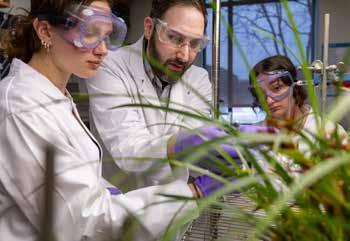
1960
Barbara Stechow Harris published a memoir, Sixteen Going On Seventeen: On Tour With The Trapp Family Singers, about her experiences traveling and performing with the Trapp Family Singers during the mid-1950s. Barbara was a teenager when she was asked to join the troupe on tour, and the book “offers a unique, personal glimpse into the lives of the von Trapps and their musical journey, as well as the author’s growth from a teenage musician into a more seasoned artist.” Learn more at: barbaraharrisbooks.com.
1963
Greg Feinsinger, M.D. was presented the 2025 Humanitarian Award by his medical school alma mater, University of Colorado Anschutz School of Medicine, for his post-retirement pro bono work involving preventive care, including reversing disease through plant-based, whole-food nutrition, and efforts to improve the health of the local Latino immigrant community.
Jane Marsh appears in Who’s Who in Classical Music and was recently invited to be included in the upcoming edition of Who’s Who in America. Jane was the first singer to win a gold medal in the International Tchaikovsky Competition and has also been awarded the New York Handel Medal, which honors contributions to the world of vocal performance. Visit her website: janemarsh.com.
1966
Jane Hopkins’ second book about cemeteries, Buried Rochester New York Area: Two
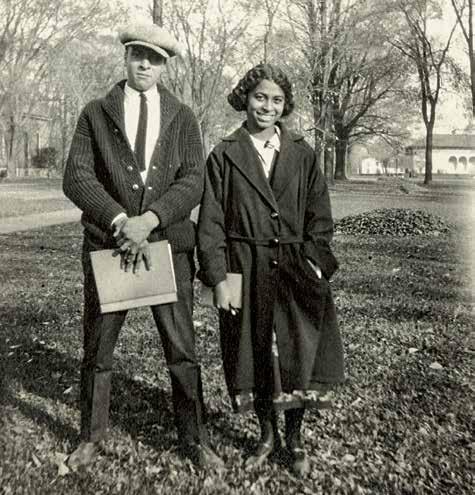
HISTORY MAKER Sydonia Byrd enrolled as a student of the Oberlin Conservatory of Music in 1922, and this photo comes from an album that Sydonia compiled during her time on campus. She also attended the New England Conservatory of Music and the Jordan School of Music before returning to Indianapolis to work as a music teacher, specializing in theory and harmony. In 1927, Harlem Renaissance writer Countee Cullen dedicated a poem, then titled “Advice to a Proud Lady (Sydonia’s Poem),” to her. Follow the Oberlin College Archives’ Instagram (@oberlincollegearchives) for more glimpses of Obie history.
Hundred Years of Cemetery History, was published in 2025. It follows her 2022 book Cemetery Reflections.
1967
Curtis “Corky” Seltzer has published his ninth book and third novel, The Past Rises. Part of the Becker Trilogy—which he says is a “traditional blend of history, murder, and current political-cultural conflict”—this new
book is “a love story that navigates violence of many kinds.” Besides his degree from Oberlin, Seltzer, a selfproclaimed “farmer, land consultant, and arbitrator,” earned a master’s and a doctorate from Columbia University. He and his family have lived and worked on their cattle and timber farms at the foot of Snowy Mountain in Highland County, Virginia, for more than four decades after spending mo st
of the 1970s in West Virginia.
1968
After college, Sam Johnson moved to New Mexico for a few years and then relocated to Oaxaca, Mexico, where he married, bought land, and had four kids. “Since 1974, I have worked as a language teacher, specializing in applied linguistics,” Sam says. “I also teach reading and writing to students majoring in the teaching of languages, as well as a class in ecology.” Sam has seven grandchildren, has remained a member of the Baha’i faith since 1969, and says he would love to hear from classmates. On Facebook, he’s the Sam Johnson with a picture of Chihiro and Haku flying through the air.
1970
Tom Powers and Jan Ting attended their 50th reunion at Harvard Law School in October. Both are retired; Tom was an environmental lawyer, while Jan was a law professor at Temple University.
For the fourth time in eight years, Connie Springer was accepted into the international Embracing Our Differences art contest in Sarasota, Fla.
1971
Susan Harris released Hippies in
Europe, 1969: A Memoir, which includes commentary and more than 100 photos. “Four others from our Class of 1971 also feature in the story, and a photo of friends at Tank,” Susan notes. To see more, visit: hippiesineurope.us.
1972
Constance Fullilove recently published Woke and Mentally Healthy: An African American Primer on Mental Wellness (Blessed Pen Ink). “The book crosses the genres of self-improvement and nonfiction,” she says, noting it’s “considered especially relevant to those seeking ways of maintaining their mental well-being, and/or those that they serve, considering the challenges
of the world in which we now live.”
Having convened on Zoom through most of the COVID-19 years, several classmates—including Leslie Lawrence, Jessica (Schorr) Saxe, Joan Nachman Lane, Laura (Freundlich) Muessig , and Marta (Braiterman) Tanenbaum —finally staged an in-person reunion in May 2025. Coming together from five different states, their meetup kicked off with lunch at Essex Market in Manhattan, N.Y.
SJ Rozan’s 21st novel, First Do No Harm (Pegasus Crime), was released in January.
1973
Karen Johnson Pittman is the recipient of the 2026 NEA Foundation Award for Outstanding Service to Public Education. From the award announcement: “Often called the ‘godmother’ of the positive youth development movement, Pittman has championed integrating academic learning with social-emotional development and out-of-school opportunities, fundamentally reshaping how educators and policymakers
understand youth success.” Karen gives thanks to emeritus sociology professor Jim Walsh for “learning and inspiration.”
Stephen Skowronek ’s new book The Adaptability Paradox: Political Inclusion and Constitutional Resilience (University of Chicago Press) examines the institutional crises that have attended the democratization of the Constitution. The book asks just how adaptable the United States’ 18th-century governmental framework is.
In May 2025, Paul Solyn earned a graduate certificate in eco-spirituality at Hartford International University for Religion and Peace.
1974
John Levy received the 2025 Shelley Memorial Award from the Poetry Society of America. The award, which is given to one or two poets a year, has been around since 1930.
David Mayers published Seekers and
Partisans: Americans Abroad in the Crisis Years, 1935–1941 (Cambridge University Press), a book that “recounts the tales of individual Americans, some well-known and some not, who strove to understand their nation and its place in the world in the roiled years 1935–41.” In addition to Helen Keller, W.E.B. Du Bois, and Ezra Pound, people
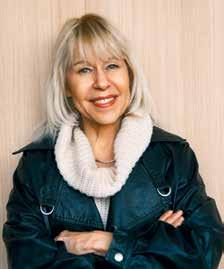
Scheyer ’74
featured include John Robinson, a Black aviator who in 1935 led the Ethiopian air force against the Italian invasion; Agnes Smedley, who joined the Chinese communists during the Sino-Japanese war; and Anna Louise Strong, who was drawn to Stalin’s USSR.
Lauri Scheyer was awarded a 2025 American Book Award with A.B. Spellman for Between the Night and Its Music: New and Selected Poems by A.B. Spellman (Wesleyan University Press); in addition to being the book’s editor, Lauri wrote the book’s scholarly introduction.
In February, architect Susan van der Meulen led a Q&A with Siobhan Moroney, author of Chicagoland Dream Houses: How a Mid-Century Architecture Competition Reimagined the American Home. Susan’s father, the architect John van der Meulen, submitted designs for this competition.
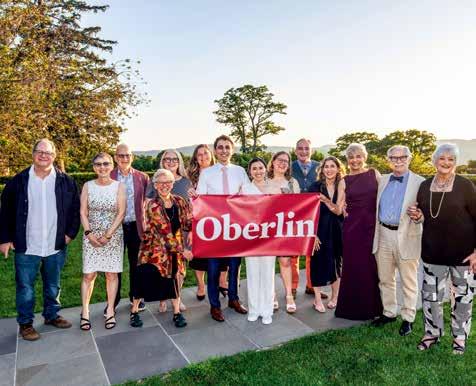
Mitch Weiss is producing an offBroadway musical, Julián Mesri’s Last Coffee in Rockville, that has a first preview date of July 9, 2026.
1975
Deborah Krupp Ketai’s chapbook
A Matter of Taste: Poems of Hunger and Thirst (Citizens for Decent Literature Press) has been awarded the Brian Fugett Memorial Prize. Additionally, Deborah was named a finalist in the 2026 Saints & Sinners Poetry Competition, which is part of the Tennessee Williams Festival. Two of her sonnets are forthcoming in an anthology of Shakespearean sonnets by Quillkeepers Press, while her poem “the immigrant” was published in the Hartford Arts Pages, and another poem, “Live long enough, and life becomes a
Turner seascape,” will appear in the Paddock Review
Michael O’Donnell MBA, MPH, PhD was ranked the No. 1 Top Scholar in the United States and No. 3 in the world for 2025 by ScholarGPS in the field of health promotion based on his lifetime publications.
Jonathan Farber has been volunteering as a psychologist in Israel, working with trauma victims of the October 7, 2023, atrocities and learning new trauma treatment techniques developed by Israelis. He continues to live and work in Chapel Hill, N.C. (with the fourth child now out of the nest!), and practices in Washington, D.C. Jonathan is the editor of Voices: The Art and Science of Psychotherapy, the journal of the American Academy of Psychotherapists , which primarily consists of first-person accounts. He welcomes Obie therapists to send tales from their work!
Lance Lubin is the musical director of the Sunshine City Chorus in St. Petersburg, Fla. In May 2025, the chorus was one of 10 to compete in the Florida state contest. Despite being the smallest chorus, with only 13 performers onstage, “we are proud to say that we won and are now the Florida state champions,” Lance says. He also sings in a barbershop quartet called Dewey, Singum & Howe.
1977
Anita DeAngelis and Jim Wilson married in Montgomery County, Maryland, on January 15, 2026. Anita met Jim in January 1975 when she and Deena (Moss) Webb rode with him in his 1967 VW bug from Philadelphia to Denver based on an Oberlin ride board offer. Anita and Jim reconnected in August 2024 at the Washington D.C., Oberlin Alumni Club ice cream social. In catching up on their lives,
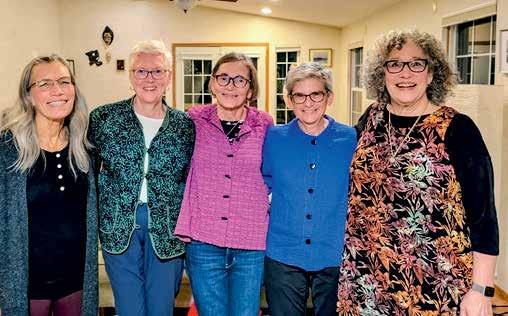
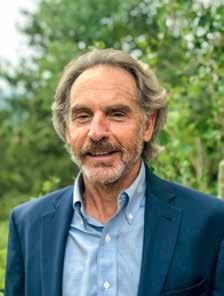
they learned that their spouses of many years had died of cancer the previous year. Their marriage continues a family tradition for Jim, as his parents and maternal grandparents are also Oberlin couples: Harold F. Wilson ’48 and Alice Steer Wilson ’48 and two members of the Class of 1924, James W. Steer and Margery Binkerd Steer. Believe it or not, the former couple also met via an Oberlin ride board.
Ellen Hammond, alongside
Peggy Dorf, Lisa Wheaton, Lynn (Friedman) Bernot , and Ann Silversmith ’78, enjoyed an impromptu women’s swimming reunion in Portland, Ore. The October gathering began with a toast to coaches M.J. Culhane, Sue McGarry, Judy Flohr, C.J. Heckman, and Dick Michaels. “We reviewed yellowed clippings from the Oberlin Review and reminisced about our debt to Title IX, our lifetime bests (LTBs), making political statements at away meets, and after-practice dinners at Dascomb,” Ellen says. Some of the group still swims regularly; others now focus on weight training, hiking, and running. Lynn recently completed her final Big 6 marathon.
Greg Rodzenko recently concluded 14 years as a volunteer for Engineers Without Borders (EWB), completing projects in Ecuador, Kenya, and India and for the Navajo Nation in Arizona. Working with the organization was “an incredibly grounding experience,” he says, as his work focused on water supply and disinfection, as well as solar power. “In Kenya, farmers plant corn by hand, using a forked stick to dig small holes, without machines or livestock,” Greg says. “Kenyan families often have
to decide to spend money on food or for bleach to disinfect drinking water. There is often not enough for both.”
1978
Elise Goldman retired in June 2025 after 45 years in education, serving as a teacher, administrator, and curriculum coordinator in New York public and independent schools. That same week, she celebrated the wedding of son Gabriel Richman ’15 to Lindsay Goldman in front of many other Obies. Besides Elise and Gabriel, attendees included Joe Karten ’88, Eve Mensch, Carl Emont ’76, Marian Hertz ’79, Lauren GoldmanBrown ’87, Madison GoldmanRogers ’13, Miranda Rutherford ’15, Joshua Goldman-Brown ’87, Rebecca Rosen ’92 , and the late professor Marlene Rosen.
Jamie Greenblatt ’s play Female, Ashkenazi with a Sewing Machine, staged in August 2025 by Arts Judaica in Chicago, premiered a musical score by Richard Jennings in the Freygish scale. According to dramaturg Melissa Hillman, the play is “about illness, ancestry, family, and hope” and ”juxtapos[es] lyrical language with earthy, funny, immediate dialogue and gorgeous visuals.”
After 25 years, Vera Kochanowsky has retired as director of Carmina and Illuminare, two nonprofit choral organizations she founded in the Washington, D.C., area. Vera continues to perform and teach harpsichord and chamber music privately. Inspired by a 2024 trip to Japan, she published her third book and first volume of poetry, 101 Haiku: A Journey through the Seasons. To learn more, visit booksbyvera.com.
George & David Lewis: Deeply Rooted celebrates the pair’s long, collaborative artistic career. Working primarily in the medium of concrete for the garden and home, the pair has sold work worldwide. Their small garden gallery on Bainbridge Island, Wash., welcomed 5,000 visitors a year at its peak. The exhibition is part of Handwork 2026, a yearlong celebration of American craft in over 250 museums. David and George are now retired and recently celebrated their 35th wedding anniversary.
Tom Rosenberg recently finished his 45th year as artistic director of the Fischoff National Chamber Music Competition. “I was also awarded the National Arts Advocate of the Year by Chamber Music America,” he says. “I continue to teach cello and chamber music at Carleton and Macalester colleges and perform in the Isles Ensemble in Minneapolis.”
1980
Michel Droge was one of 31 visual
artists selected for a residency at the Joan Mitchell Center in New Orleans. Recipients of the honor receive private studio space, a weekly materials stipend, on-site studio assistants, professional development, and community-building opportunities.
Sandy Wolf (Charlene S. Sollott) has published two volumes of her memoir, The Best Damn Version of You: Your Worth Doesn’t Need a Stamp of Approval. The books trace how bodies, ideals, and self-perception evolve across generations. They are grounded in lived experience from Sandy’s four decades in swimwear retail, private fitness training, and caregiving. By reflecting
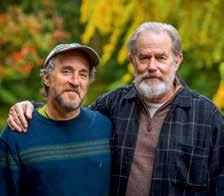
David Lewis and his husband, George, have been honored with a threemonth retrospective exhibition at the Bainbridge Island Museum of Art. Graves ’ 85
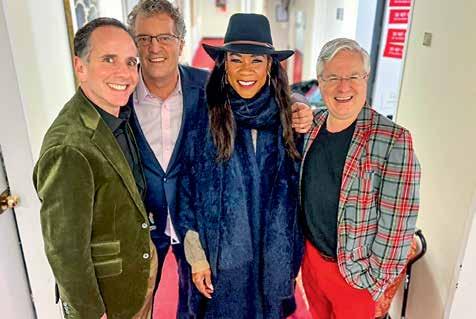
on body image, identity, and power, her writing explores the intersections of family, work, resilience, and the stories people are taught to hide or prove.
Carolyn Levine retired from a career in journalism and publishing in May 2025 after being laid off as a federal contractor. She spent the last 17 years as a science writer and editor on contracts with the National Institutes of Health. After a period of transition, she is enjoying more time for exercise and hiking, learning mahjong, seeing friends and family, and exploring this next phase of life.
The Youth Orchestras of San Antonio (YOSA) named Mary Ellen Spencer Goree the Private Music Teacher of the Year for 2025. She has maintained an active private teaching studio in San Antonio since 1988, the year she moved to the city to join the San Antonio Symphony. Mary Ellen also is a frequent sectional coach for YOSA and several local high schools; taught at the University of Texas at San Antonio between 1999 and 2017; and is the principal second violin of the San Antonio Philharmonic.
Having retired from a 40-year career in health education and public health research, Adena Cohen-Bearak recently began pursuing a long-held dream: a master’s in creative writing. She recently finished her first semester at the Solstice creative writing program at Lasell University in Newton, Mass., and is now working on creative nonfiction projects.
Paul Kijinski’s new middle-grade novel, After Hollywood, tells the story of 13-year-old Jordan Lesniak. “For five seasons, millions watched him play Tanner Stanley, a wisecracking kid from the hit sitcom Stanley Cups,” Paul writes. “But now the show is canceled, the cameras are gone, and Jordan is back in Akron, Ohio—just another junior high kid trying to figure out who he really is.” Written especially for readers between the ages of 9 and 13, the novel “will resonate with anyone who appreciates a coming-of-age story with elements of faith, friendship, and first love,” Paul adds.
Michael J. Martin retired from Penn State University in June 2025. During his 35-year career, he was a professional leader and advocate for positive youth development, devoting his life’s work to cooperative extension service. Michael was selected as an International 4-H Youth Exchange Representative to Costa Rica while in college and later was instrumental in raising over $11 million to support the 4-H Youth Development Program. He also worked in four land-grant university extension systems and provided international service in Eastern Europe.
Released in May 2026, Bill Tortolano’s
Swinging against the Axis: Glenn Miller’s WWII Army Air Forces Band at Yale (University Press of Mississippi) “explores not only Miller’s compositional style, but also his managerial and organizational innovations that would change the way military bands do business today.”
1984
Cedric Powell published his second book, Racial Justice in American Land Use (Cambridge University Press), in 2025. He writes that the book “brings together environmental law and property scholars, historians, urban planners, and structural inequality theorists to explore racial land policies from 1917 to the present.”
1985
The audio recording of Lâle Davidson’s first novel, Blue Woman Burning (Red Penguin Books), was released in December on KOBO, Everand, and Apple Books. Lâle reads the semi-autobiographical magical realist novel, which author Erika Schickel describes like so: “Haunting and dreamlike, Blue Woman Burning takes us on an unforgettable journey through a broken family’s hidden past and one woman’s struggle to transcend it.” For more information, visit laledavidson.com.
Kate Davis recently enjoyed a retreat in Vermont’s Green Mountains with Jena Osman and Margaret Vetare Kate lives in Corrales, N.M., where she practices psychotherapy and teaches dance fitness. Jena teaches poetry at Temple University and is learning to be a tree tender. Margaret makes music in Beacon, N.Y., and spends time in nature.
In August 2025, Gretchen Engel retired from the Center for Death Penalty Litigation after 33 years with the organization, the last 12 years as the executive director. She celebrated her retirement at an event featuring
MY NAME IS CHUCK BIRENBAUM. SINCE JULY 2025 I’VE SERVED AS CHAIR OF the Oberlin College and Conservatory board of trustees. I know many of you already. For those of you I have yet to meet, this letter serves as an introduction.
I graduated from Oberlin in 1979 as a government major. Poetry is a passion, and I spent a lot of time in the creative writing department. In my senior year the late English professor David Young invited me to a special study with him. That experience was formative: I considered applying to creative writing graduate programs like the Iowa Writers’ Workshop and even had pieces published in various literary mags and flash publications.
Ultimately, I attended Georgetown University Law Center, which kicked off a legal career that has now spanned more than four decades. Currently, I’m an attorney who focuses my practice on labor and employment law at Greenberg Traurig in San Francisco, where I chair the firm’s Northern California offices.
I’ve been on the board of trustees since 2014, and my daughter Julia graduated from Oberlin in 2017, so my perspective as a board chair is shaped by my years as a student, parent, trustee, and longtime advocate for students. When interviewing for this position with a board search committee, we discussed trends demonstrating intensifying challenges for higher education generally, and Oberlin specifically, in the coming years.
Our discussions also covered another subject: board reform. The board had not really taken a hard look at itself as an organization for some time. How is it organized? How are the committees working, and are they engaged in generative thinking? Do they collaborate? Is the board overseeing what matters? Board review is timely and urgent to support President Ambar, her executive leadership team, faculty, and students.
Over the past year, we have worked on strengthening the board’s governance and visibility, passing numerous board reforms and continuing to study and act on others. As a new board chair, I spend time with trustees to learn about their visions for Oberlin and their individual goals. I’m visiting many alumni, faculty, and students, along with other people who support and are connected to Oberlin, and attend campus events. For example, in March, I watched students pitch business concepts at the Entrepreneurship Pathfinder Program Showcase. And as part of my outreach to alumni, I am writing this column.
As the board of trustees strengthens its support and contributions to Oberlin, we will ensure the college not only prepares students to make a living; Oberlin will prepare undergraduates to live a fruitful life. I hope you all consider leaning into support for Oberlin; now is the time to step up.
Charles S. “Chuck” Birenbaum ’79 Chair, Board of Trustees
renowned public interest lawyer Bryan Stevenson. Gretchen looks forward to spending more time outside and with friends in Durham, N.C.
A mini-reunion of Obies took place backstage following a recent performance of Porgy and Bess at the Metropolitan Opera, as three managers joined in celebration of Denyce Graves : Bill Palant ’91, Jeffrey Vanderveen ’87, and Matthew Horner ’91.
The second edition of Audie Klotz’s Norms in International Relations (Cornell University Press) “revisits the global struggle against apartheid and considers its impact on how we grapple with race and racism in international relations today.”
Having mastered audio for commercial release since 1985, Ken Love is now doing business as FivePoints Mastering. The Nashville resident has mastered four Grammy winners, most recently Zach Top’s Ain’t in It for My Health , which won Best Traditional Country Album. Ken notes he’s “especially proud of the sonics on this one” and says “vinyl enthusiasts should check out the 12-inch, 45 rpm double LP.” He enjoys a happy life with his wife, Paula
Wade, and dog, Jolene.
Daniel Schorr played guitars, bass, drums, and percussion on his new album, High Valley Lament. These 12 original songs mark a step in Dan’s musical evolution that began in the Oberlin band the Volares 40 years ago, he writes.
Julia Schwartz continues to have an active musical life. In 2025, six of her works premiered in Switzerland, Germany, and France. Julia also conducts two choirs in Germany and one in Switzerland. See www. juliaschwartz.ch.
1986
At this year’s Killer Nashville Writers’ Conference, Stealing Time (Linden Tree Press)—coauthored by Norman Birnbach and Tilia Klebenov Jacobs ’88 —was named a 2025 Silver Falchion Finalist and a 2025 Silver Falchion Award Judges’ Top Pick. The pair also published a new middle-grade novel, Why Should I Trust You? (Linden Tree Press).
The Teatro Regio in Parma, Italy, recently premiered Linda Beard Fairtile’s critical edition of Giuseppe
Verdi’s Otello. The score will be published by the University of Chicago Press and Ricordi.
Musical America named Jed Gaylin one of the Top 30 Professionals of the Year for 2025, in recognition of his work as a music director and conductor.
In December, Susan McLaughlin appeared before the House Financial Services Committee’s Task Force on Monetary Policy, Treasury Market Resilience, and Economic Prosperity to discuss the risks associated with the continued growth of the federal debt and policy actions that could be taken to augment the market’s capacity to intermediate it.
During a recent visit to Israel, RabbiCantor Danielle Bensimhom ’01
was surprised and delighted to see a few Oberlin caps on the rack of a store in the Old City of Jerusalem. The culprit was Joshua Shuman, who secretly pushed the hats to the seller once he discovered Danielle was also an alum. The pair originally met at a Jerusalem dinner where small talk included phrases like ”Oh, you also went to Oberlin?” and “Oh, my granddaughter went to Oberlin!”
Brian Bromberg and Lena Zairis were married at the Center Avenue Synagogue in Fort Lee, New Jersey. A lifetime resident of Brooklyn and Manhattan, N.Y., Brian notes his beloved “finally convinced him” to leave New York City for Fort Lee.
Sue Heilbronner published Never Ask for the Sale: Supercharge Your Business with the Power of Passionate Ambivalence (Hachette). “The book distills lessons from my work as an executive coach, investor, and former tech executive— practical tools for leaders, founders, and professionals at any career stage,” Sue says. “Because so many alumni are building teams, growing companies, and navigating an uncertain workforce, I think this topic would resonate with the Oberlin community.”
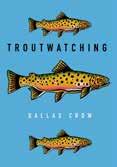
Dallas Crow ’s second poetry chapbook, Troutwatching (Finishing Line Press), is a wide-ranging collection that explores life with sons, animals, and art. The poems, which are set in Alaska, the Pacific Northwest, the Mountain West, the Midwest, and Appalachia, are in response to “pizza, pumpkins, paintings, photographs and front-page current events both horrific and awe-inspiring.”
Dallas is a high school English teacher in Atlanta, and his poems have appeared in Connecticut River Review, Florida Review, Louisiana Literature, and more.
Physics major Hanna Kamperman ’28 won an award for “Musical Triangle’s Sound Waves Reveal New Acoustic Phenomenon,” a piece she wrote for the National Association of Science Writers summer mentoring program. Her mentor and editor was David Ehrenstein, who also majored in physics.
Seth Rudetsky ended up “hosting, sassing, singing, and playing piano” for a concert in November at Carnegie Hall, he says. Seth was joined by a symphony orchestra and Broadway stars such as Santino Fontana, Nikki M. James, Andrea Martin, and Jessie Mueller. Broadway World raved that Seth was “a tour de force of energy and knowledge of the Broadway theater business” and that he and the performers “set Carnegie Hall on fire” with their talent.
1989
Loren Blackford was named executive director of the Sierra Club, making her the first woman to hold the role in the organization’s 133-year history.
Scott Pike, a professor of environmental science and archaeology at Willamette University, received the Archaeological Institute of America’s Excellence in Undergraduate Teaching Award. Presented annually to a single educator, the award recognizes innovative and inclusive teaching as well as outstanding mentorship. Since joining Willamette in 2005, Scott has created global research opportunities for students, including partnerships at the Ness of Brodgar in Orkney, Scotland, and drone-based geoarchaeological projects in Greece.
Heidi Rabinowitz is celebrating 20
years of her podcast The Book of Life: A Podcast about Jewish Kidlit (Mostly)! A retrospective episode aired in December, featuring interview clips from every year of the show. A commemorative miniature foldable book is available for download at bookoflifepodcast.com.
Victoria Theodore worked on four musicals in 2025. She was music director of 3 Summers of Lincoln at the La Jolla Playhouse in La Jolla, Calif.; composer, arranger, orchestrator, music supervisor, and copyist of the American Conservatory Theater production of Co-Founders; co-composer and arranger of a workshop of Marian, which is being presented at the University of Michigan’s 2026 New Theater Works Festival; and music director of a workshop of Jelly’s Last Jam in Bristol, Pa. In addition to her theater work, she performed around the country with her band, EnSpirits.
1990
Martha Bayne coedited Nothing Compares to You: What Sinead O’Connor
Means to Us (Altria/One Signal), a collection of personal essays reflecting on the singer’s life and legacy. The book features contributions from Zoe Zolbrod and Millicent Souris ’94 The Obie trio and other contributors celebrated the book’s July 2025 release with events in Dublin; West Cork, Ireland; Brooklyn, N.Y.; and Chicago.
The 10th anniversary celebration of Étude Arts turned into a mini-Oberlin reunion, as Bill Palant hosted a festive evening in honor of the classical music artist management agency he leads as managing director. Attendees included Matthew Horner, Andrew Peters ’92 , Danielle Kolker, Peter Nicholson, Lenore Rosenberg ’74, Kristin (Neilson) Lancino ’82 , and Jeffrey Vanderveen ’87.
In July 2025, Joan Ellison made her European debut, singing her symphony concert Get Happy! The Judy Garland Songbook with the Niall Kinsella Orchestra at the National Concert Hall in Dublin and the National Opera House in Wexford, Ireland. Joan also restored all the orchestral arrangements played in the concert from original sources, an effort she says “has been a labor of love!”
Chuck Webster had four shows of his paintings and drawings in spring of 2026. These include a survey of 20092025 work at 1GAP Gallery in Brooklyn, N.Y., and a solo show of new drawings at Hunted Projects in Edinburgh, Scotland. His work also is included in group shows at the Peninsula Art Space in New York City and Savage Wonder Arts Center in Beacon, N.Y. Chuck works in his Brooklyn studio every day; find him on Instagram at @chuckwebster.
1993
Jennifer Grant, PhD recently published an article in Discover Artificial Intelligence comparing how
students perceive the use of “everyday chatbots” to understand the risk profiles of specific medicines. Jennifer also published an ACS ViewPoint article, “Undergraduate STEM Research: Critical for Competition.”
1994
Former Obie roommates Cynthia McGregor and Emily Peckham ’96 visited their daughters Caitlyn Dwyer ’30 and Abby Ames ’28 during Oberlin Family Weekend in November. Cynthia resides in San Diego and is Professor of Music at Southwestern College. Emily splits time between Maine and Cambridge, Mass., and is the director of the Council for the Arts at Massachusetts Institute of Technology.
1995
Damon Hamm’s sculpture From Orion is on display in downtown Freeport, Ill., as part of the Freeport Art Museum Sculpture Walk.
Rebecca Holt Stay and her husband, Randy, recently celebrated their 50th wedding anniversary with their six
adult children and 19 grandchildren. Rebecca directed all of the Church of Jesus Christ of Latter-day Saints’ humanitarian aid in Europe, partnering with groups including Muslim Aid, the Red Cross, ETP Slovakia, and Caritas to deliver wheelchairs and clean
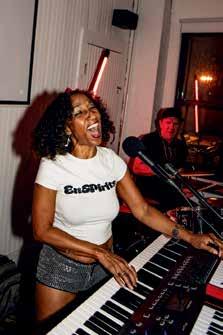
water systems and provide medical training. She later returned to Europe to coordinate 500 refugee aid projects in 39 countries. When home, Rebecca teaches biblical studies through the LDS Institute of Religion.
Gary Shteyngart released a new novel, Vera, or Faith, that was longlisted for the Joyce Carol Oates Prize and was named a best book of 2025 by media including Time, the Washington Post, National Public Radio, and Oprah Daily. Gary’s first collection of personal essays, The Sensualist: Essays on Pure Pleasure, which will be available in November, “collects his most electric pieces, showcasing why the New York Times describes Gary as ‘one of his generation’s most exhilarating writers.’”
1996
After 25 years of shaping the field of
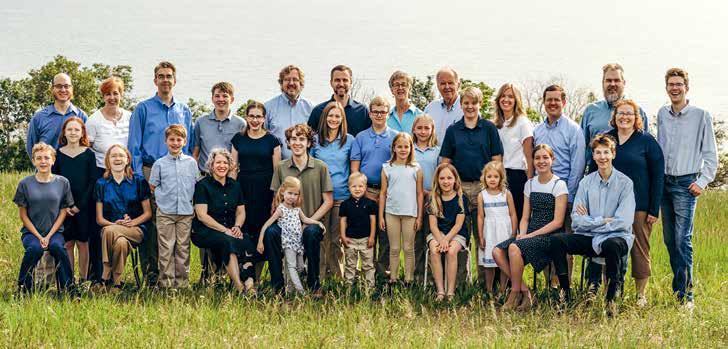
consumer neuroscience at Merchant Mechanics, Dr. Kimberly Rose Clark now directs the Dartmouth Initiative for Research on Energy Communication Transformation (DIRECT) Lab at Dartmouth College. “Using neuroscience, psychology, and behavioral science, we study how messaging truly motivates diverse audiences, combining lab and field research for real-world solutions,” she says. “We empower policymakers and communities with science-based insights for lasting climate action. With a collaborative, people-centered team, we welcome inquiries from those interested in sustainability, science communication, or behavioral research.”
1997
Farah Emeka was elected to the Oberlin Municipal Court in November, making her the first Black woman to serve as a judge in Lorain County.
1998
Stephen Baer has released Stickology: How to Build Unbreakable Connections with Employees and Customers for Life
The book exposes the engagement deficit affecting businesses and explores how organizations can build lasting commitment from employees and customers. Through 30 paired case studies, Stickology contrasts organizations that build meaningful connections with those that rely on superficial touchpoints, equipping leaders with the knowledge to create authentic, sustainable connections.
Next Stage Press published Elana Gartner ’s play Because of Beth. In the aftermath of Beth’s death, her loved ones—including her feuding daughters, her estranged ex-husband, and her overwhelmed fiancé—seek to mourn her in their own way. Instead, they are forced to deal with one another and the complicated ties that bind them together. The script includes two monologues for young women that have
been used in the classroom for auditions and competitions.
As director of development and special projects at Libertas School of Memphis, Sarah (Kotok) Newstok spearheaded an $11 million capital campaign to fund a new 34-acre
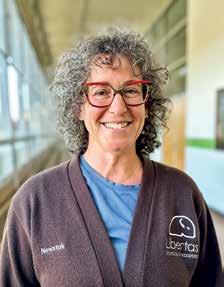
middle school campus, which opened in January. The public Montessoribased institution is one of the fastestimproving, highest-achieving schools among its peers across Tennessee.
In 2025, Mirabai Weismehl Rosenfeld achieved two significant milestones at the legendary Golden Hall of Vienna’s Musikverein: a solo appearance and a performance as concertmaster of the Dubrovnik Symphony Orchestra, the latter a position she’s held since 2018. Mirabai will also appear as a soloist at this year’s Dubrovnik Summer Festival. Trained in the Vamos Studio at the conservatory, Mirabai remains deeply grateful for the foundation that made these moments possible. “And a very special note,” she adds. “Happy 103rd birthday to my dear Coco, who reads this magazine with joy as an honorary Obie!”
Beginning in April, Corey Stoll spent two months costarring with Cecily Strong in an off-Broadway revival of Tom Noonan’s What Happened Was... at
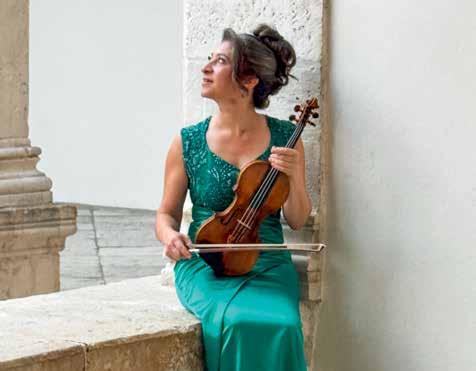
Audible’s Minetta Lane Theatre.
Tina Yarrington is a maternalfetal medicine physician taking care of birthing people with high-risk pregnancies. “Inspired by my Oberlin core to find the greater challenge, I moved from Boston to New Mexico two years ago,” Tina writes. “I focus on bridging complex pregnancy care in a maternal health desert, doing outreach to the Navajo Nation and Indigenous communities across the state.” Tina adds that she’s also “recommitted myself to the music I loved at Oberlin” and is singing in a chorale for the first time in 20 years. “Come visit me in New Mexico!”
2001
In September 2025, Beatriz
Victoria Albina NP, MPH, SEP released End Emotional Outsourcing: How to Overcome Your Codependent, Perfectionist, People-Pleasing Habits and Reclaim Your Life (Balance/Hachette). Based on the concept of “emotional outsourcing,” a phrase that Bea developed “to describe the codependent habits that keep us stuck,” the book “explores the origins, both personal and systemic, of these tendencies, and coaches readers through a science-backed program of thought work and somatic practices.” A nurse practitioner and a master certified life coach, Bea is also the host of the Feminist Wellness podcast.
2002
Virocano Bhikkhu (Grisha Krivchenia) reports that he lives in a majestic forest in northeast Thailand
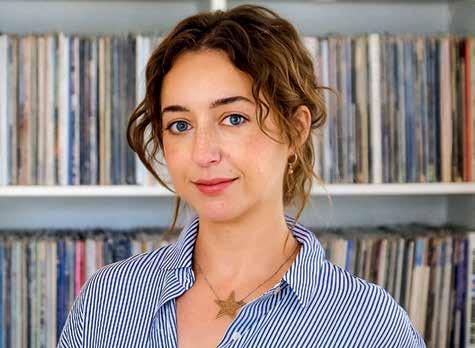
in a small hut under a cliff. His community consists of senior Ajaans (teachers), 35 monks, two nuns, and an extensive network of generous, hardworking laypeople. Virocano would like to hear from anyone who shared music, meditation, or meals during his time in the conservatory and the co-ops. He’s also happy to correspond with any Obie interested in Dhamma practice but cautions to expect a slow reply since he accesses the Internet about once per week: virocanobhikkhu@gmail.com.
Mark Engleson made his fiction debut in Propagule magazine with the story “Biting People’s Heads Off.”
Gabriel McCormick was selected as a 2025 Eisenhower USA Fellow to study educational ethics in the development of new teachers and the mentorship of early-career teachers in Finland and Spain. During the fellowship, Gabriel met with scholars, educators, and government officials from both
countries to learn how they support newly qualified teachers to make ethical decisions, while also sharing practices from the EdEthics team at the Stanford Graduate School of Education.
Anne Middleton recently did a TEDx Talk that’s available now on YouTube. “As much as I’d love to be a famous tree-hugger,” Anne shares, “this is about reframing how we approach conservation.”
Matthew Ozawa recently directed an acclaimed new production of Richard Wagner’s Parsifal for the San Francisco Opera. He is celebrating his fourth season as chief artistic officer at Lyric Opera of Chicago, where he spearheads all artistic planning and activities, including a recent Billy Corgan collaboration. His website is matthewozawa.com.
Katie Studley was appointed head of Nashville editorial at Spotify, where she leads editorial strategy for the market’s music team. She was previously Nashville vice president at
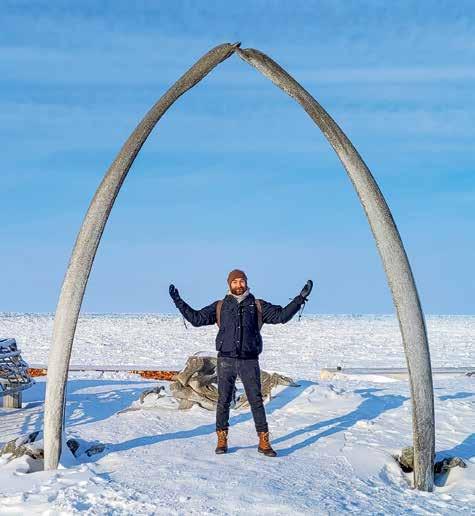
the Orchard and vice president of operations and marketing director at Third Man Records. Katie began her career in artist development and marketing at the folk/Americana label Thirty Tigers
Ryan E. Holman released a new poetry chapbook, 2025’s Even Goddesses Need Smoke Breaks (Bottlecap Features). The 15 curated poems “shed light on how women subvert, thwart, and surpass
society’s expectations, especially in the archetypes of goddesses and witches,” Ryan shares. “The title is drawn from an excerpted pair of lines from the text, the very ‘unladylike’ act of smoking, and the ways in which that idea intersects with the burnt offerings to deities in ages past.”
At American Public Media, Sanden Totten and his co-workers created popular kids podcasts such as Brains On!, Smash Boom Best, and Forever Ago After 10 years, Sanden and his team have secured the rights to these podcasts and are going independent as full owners of these shows. Visit www.brainson.org.
In early 2026, Michael Sakir
conducted the world premiere of Time to Act with the Pittsburgh Opera.
David Unger and Rachel Unger ’08 welcomed their fourth child, Joseph Maximilian, in March 2025.
Brian Pugh was elected to a fifth two-year term as mayor of Croton-onHudson, N.Y. Since Brian was elected in 2017, the New York State Energy Research & Development Authority named the village the No. 1 Clean Energy Community in New York state, while USA Today deemed it the Best Place to Live in New York.
In 2025, Be Steadwell published their debut novel, Chocolate Chip City, which tells the story of the Jones sisters—three enchanted Black women searching for purpose as adults in modern-day Washington, D.C. Be is also a queer pop composer, an adjunct lecturer at Howard University, and a filmmaker whose short films Vow of Silence and Black Tea have screened in film festivals around the world, including Black Star, HBO OutFest, the Schomburg Center for Research in Black Culture, and Inside Out Toronto.
Woan Foong Wong has been promoted to associate professor of economics with tenure at the University of Oregon. She thanks her professors at Oberlin College, particularly Barbara Craig and Kenneth Kuttner, for their support and guidance in preparing her for a research career, starting with her honors thesis.
Terence Hsieh wrapped up two years on the Soul Power II World Tour with singer-songwriter David Tao ( 陶 喆). He also produced an album for Taiwanese indie R&B artist LINION, featuring arrangements from Chase Jackson ’13 and saxophone work
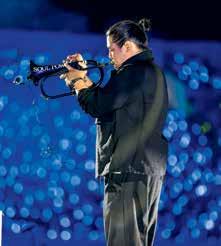
by Alex Cummings ’13. In August 2025, Terence wrapped filming on Season 8 of the Chinese Idol TV singing competition show Singer with JQ Whitcomb ’02 .
Edward Kriz helped former National Institutes of Health director and presidential envoy Elias Zerhouni write 2025’s Disease Knows No Politics (Rowman & Littlefield), a timely medical and political memoir that defends the NIH and emphasizes the importance of keeping politics out of science and medicine. Anthony Fauci and Mike Bloomberg, among others, gave endorsements.
Nicholas Parlato earned his doctorate in government and environmental geography at the University of Alaska Fairbanks. His research concerns improving equity and accountability in relationships between Arctic Indigenous communities and government agencies tasked with regulating resource development and use. He planned
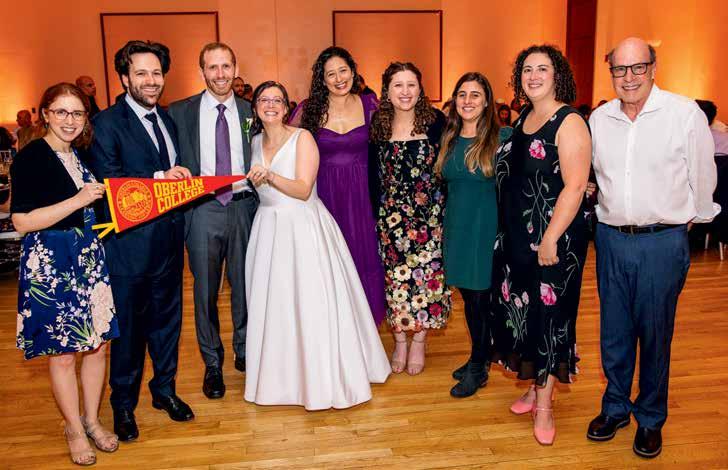
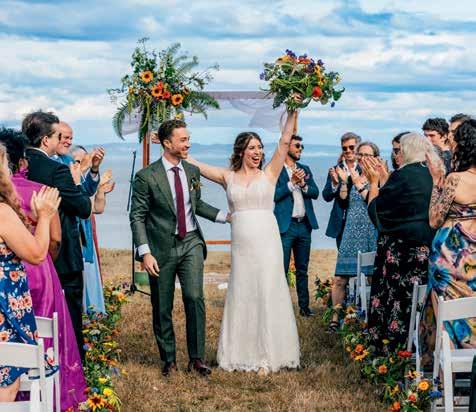
to begin a postdoctoral fellowship in Norway in spring 2026 on related topics.
Talia Greenberg married Gideon Katsh in November. During the ceremony, the officiating rabbi mentioned the couple’s first vacation together—their April 2024 trip to Oberlin to see the eclipse. Many Obies attended the wedding, including Einav Silverstein , Ari Feinberg ’14, Samia Mansour ’10, Becky Berenbon ’16, Elana Pontecorvo, Liora Lebowitz , and Michael Green ’79
Zoe Bluffstone married Zachary Karson in August 2025 in Port Townsend, Wash. The celebration included Obies Alison Kronstadt , Joelle Velez, Joey Velez ’17, and Liam Campbell ’26. Zoe and Zack live in Washington, D.C.
2017
Ryan Murphy and Bren Case were married in North Carolina in May 2024. Margaret Saigh and Franklin Sussman were guests of honor.
Two members of this class were named 2026 Forbes 30 Under 30 honorees. Each appeared on a list that reflects their expertise and talents. Jack Brewster (media) is the founder of Newsreel, an interactive and social news app that aims to increase media literacy and engagement among young people. A politics major and baseball player, Jack credits his research at Oberlin (and in Germany as a Fulbright research scholar) for inspiring the idea for Newsreel. Amanda Asofsky (games) works at Wizards of the Coast, the company responsible for games such as Dungeons & Dragons and Magic: The Gathering. A studio art major at Oberlin, Amanda is a digital product manager of Magic: The Gathering Arena and led the integration of a Final Fantasy set into that game.
William Kennedy was invited to speak at IBM TechXchange in Orlando about leveraging generative AI in planning analytics. William, an associate consultant at Application Consulting Group, was a computer science major and a member of the baseball team.


2023
Henry Game appeared on the TV show New Day Cleveland to discuss his company Complete Painting, which provides interior and exterior painting and light construction to residential and commercial customers. Henry is the chief operating officer, hiring and supervising crews and overseeing quality and customer satisfaction.
2025
Leonora Tepper reported that six Oberlin alumni from four generations attended a Yiddish immersion retreat in upstate New York at Yiddish Vokh. “Each year, over 100 Yiddish speakers of all ages get together to speak only Yiddish for a week while also participating in activities such as classes, lectures, workshops, music, and art.”
Class Notes are prepared from a variety of sources but are drawn mainly from personal and professional news submitted by college and conservatory alums. What makes a good class note? When you’re proud to share something, we want to hear about it!
Good news! You can now submit your class note (along with a photo) online: go.oberlin.edu/submit-class-notes
Did you know that Oberlin has a planned giving society?
Charles Martin Hall, Class of 1885, revolutionized modern industry with his 1886 discovery of an efficient process for producing aluminum. He later co-founded the company that became known as ALCOA, building one of the great industrial enterprises of his time.
Hall left a $10 million bequest to Oberlin upon his 1914 death. It remains the largest gift in our history, valued at roughly $325 million when indexed for inflation today.
Oberlin established the Charles Martin Hall Society in his honor. The society, over 1,000 members strong, welcomes all donors who have included Oberlin in their estate plans or who have established life income gifts such as charitable trusts or annuities.
Oberlin was built on visionary philanthropy and continues to thrive because of it. We are grateful to our members and look forward to welcoming other people who wish to join.
If you are interested in making a planned gift, learning more about charitable gift annuities, or informing us that you have already included Oberlin in your estate plans, please contact Director of Planned Giving Timothy Mann at 440-775-5561 or tmann@oberlin.edu
William Byrnes
Professor of Theater
January 19, 2026
Sidney Rosenfeld
Emeritus Professor of German
June 11, 2024
Dan Wall
Associate Professor of Jazz Piano
April 14, 2026
David Young
Emeritus Longman Professor of English and Creative Writing
May 3, 2025
1947
Alice Takemoto
January 6, 2026
1948
Sarah Gamble Epstein
August 17, 2025
Linna McIntyre
May 25, 2024
1949
Daniel R. Block
March 6, 2025
1950
Mort Schrag
October 20, 2025
Carol Westerman
September 30, 2025
1951
Margaret Evans
December 3, 2025
Louise Knowlton
2023
1952
Katherine J. Nelson
August 10, 2018
Richard R. Nelson
January 28, 2025
1953
Ethel Ackerson
October 11, 2025
Philip L. Read
September 15, 2025
1954
James B. “Jim” Wolf
August 23, 2025
1955
Mary Ann Briggs
September 27, 2025
Jimmie Sue Daniels December 1, 2023
1956
Sue Patterson Bielawski September 22, 2025
Eileen Tate Cline November 17, 2023
1957
Anne Reinhart November 1, 2025
William “Bill” Miller Speidel September 24, 2025
1958
Jacklyn Bray Brunt April 2025
Rethel “Petie” Dorain April 15, 2024
Frank N. Jones March 1, 2026
1959
Marvin Blickenstaff January 23, 2026
1960
Anne Chamberlain November 7, 2025
Doreen Kolt 2025
Judith Wolfe Mark August 28, 2025
Howard Rowland May 2025
1961
Robert K. Hobbs
July 17, 2025
Jane Eleanor Hush September 9, 2025
Marilyn Dare Watson September 19, 2025
1962
Michael Oldfather December 6, 2025
1963
Robert Woolman Houghton February 26, 2026
1964
Jane Simerl Rodeheffer January 15, 2025
1965
Rosita Daskal Albert February 6, 2025
Mary Ida Goetze March 24, 2025
1966
David Cowles May 2, 2024
Marc Prensky May 15, 2025
Irene Stock June 13, 2020
1967
John H. Gibbon October 1, 2025
1969
Susan Elisabeth Hochschild Godshall October 11, 2025
1970
Carolynn Tempest Baer December 22, 2025
Steve Caccavo November 6, 2025
Neil E. Reiner August 7, 2025
1971
Robert “Bob” Feinstein March 18, 2022
Bradford B. Woelfel November 27, 2025
1972
Gerald Eisenberg November 12, 2025
1973
Marcia Goldberg 2021
1976
Rev. Graylan Scott Hagler February 17, 2026
Randall Lockette June 29, 2024
Lillie Sharon Ransom October 11, 2025
Alexandra Zabriskie Sholl April 4, 2013
1981
Dale Menchhofer September 7, 2023
1983
Thomas Brennan September 5, 2025
Delores Simmons October 28, 2025
1986
David Kukla July 1, 2023
Kelli Francine Mealy October 23, 2024
1990
Janice Jones Sept. 19, 2025
1991
Jessica Gray Gilliam-Valls
September 9, 2025
Matthew Stephan March 15, 2025
2004
Charles Grover December 3, 2025
*Please note that this list represents losses reported to OAM between August 27, 2025, and January 16, 2026. Death notices may be submitted by emailing alum.mag@oberlin.edu with “Losses” in the subject line and either a link to a published online obituary or a letter confirming the date of death and class year of the deceased. Printed obituaries may also be mailed to Oberlin Alumni Magazine, 247 W. Lorain St., Suite C, Oberlin, OH 44074. Links to online obituaries published by newspapers, funeral homes, or legacy websites are available at oberlin.edu/alumni/losses.
During its March meeting, Oberlin’s Alumni Leadership Council (ALC) celebrated the service of outgoing Oberlin Alumni Association president Jan Weintraub Cobb ’71. “I am so very grateful for the experiences I have had in that role,” Jan says, noting that during her tenure the ALC achieved the following:
● Developed a shared future-focused mindset among members that prioritizes investing volunteer energy, service, and philanthropy into supporting Oberlin’s current and future students and supporting meaningful oppor tunities for alumni to stay engaged and connected with one another.
● Reinvigorated its Careers Committee with a focus on supporting career preparation and navigation for students and alumni.
● Worked with faculty and staff members to identify specific activities ALC members can undertake to strengthen the college and conservatory for the students of today and the future.
● Developed mechanisms to help tell the stor y of positive volunteer impact on Oberlin.
We’d also like to welcome incoming Oberlin Alumni Association president Tiffanie Luckett ’99, who has proudly volunteered for Oberlin since her graduation.
She serves as managing director of programs at the Progressive Multiplier Fund, helping powerbuilding nonprofits find financial liberation to be self-determined and financially resilient. Tiffanie also holds an AM from the University of Chicago. She lives on Chumash and Tongva land in Los Angeles.
OFFER CAREER HELP TO CURRENT OBIES!
Do you (or does your employer) hire interns during the summer? Can you offer a micro-internship during Winter Term? Are you connected to other professional opportunities for college students? If your answer is yes to any (or all!) of these questions, Oberlin would love to hear from you. By posting a job or internship, you can help students gain valuable career experience. Learn how to submit here: www.oberlin.edu/career/alumni/post-jobs
Incredibly, 2027 marks the 100-year anniversary of the Charles Beebe Martin Memorial Lectures, an Oberlin tradition that brings renowned classics scholars to campus for a week-long academic experience. As we approach this milestone anniversary, Nathan A. Greenberg Professor of Classics Kirk Ormand is looking to connect with alums who attended past lectures and found them meaningful. Please email kormand@oberlin.edu.
Oberlin’s 2026 commencement coverage: oberlin.edu/commencement
Photos from Oberlin’s 25th and 50th class reunions: flickr.com/people/oberlin/
Upcoming regional events for Oberlin alums: advance.oberlin.edu/events
“What I love about music, what made me want to play, what touches me is not entertaining people, but building community. I come from the African American background where music is not just the show—it’s a way to heal, mourn, build community, empower. I learned I had to create my own value.” —Drummer and composer LaFrae Sci ’94, profiled in the Dayton Daily News for creating a traveling classroom curriculum based on Dayton’s funk legacy
“[‘I’m Your Man’] has hooks for days, a singalong powerpop anthem in its first half that gives way to a triumphant coda: ‘It’s not easy/But it’s all right,’ frontman P.J. McCormick repeats with a bittersweet optimism.” —The music website Stereogum describing My Wonderful Boyfriend, a new trio featuring P.J. McCormick ’20, Griffin Jennings ’17, and Cena Loffredo ’19
“I find that difficulty can be subjective. Sometimes everyone’s going to be like, ‘This was a four out of five; it was really hard.’ But sometimes a board will get the whole range of scores.”
Wyna Liu ’05, speaking to The Atlantic on her work as editor of the New York Times game Connections
“Ohio was definitely the place where I truly fell in love with documentary filmmaking.” Drew Dickler ’12 , speaking to the Buckeye Flame before her short film Big Bass debuted as part of the Cleveland International Film Festival’s DReam Maker Shorts program
“I had a one-hour show on Thursdays at 3 a.m. with my friend Natalie. We played all-female rock/indie artists for our whole hour. Even though I’d almost always end up missing class the next day and other people scoffed at the idea of going to the student center at 3 a.m., we thought we hit the jackpot.”
Brady Marks ’19, program director at 107.3 FM Alternative Cleveland, on her WOBC show
“This is Ella’s house. Verve was founded as a label for the great Ella Fitzgerald. She couldn’t get a record deal that was fair or that she wanted. So Norm Granz, her manager, started it as an independent label. In fact, we still have the plaque from when she and Norman first opened Verve in 1956 sitting in our lobby.”
Jamie Krents ’97, president and CEO of Verve Label Group, telling Downbeat about the jazz label turning 70
“People expressed a feeling of relief about not needing to be checking their emails or checking their texts or checking the news. That allowed us to spend a lot of time just talking to each other. … A lot of people felt very connected to each other. Not having the devices gave them some kind of mental space.”
Ozzie Frazier ’27, describing to the Associated Press what happened when students ran the Harkness Dining co-op without emails or spreadsheets during Winter Term
“I was already interested in the idea of visiting tropical forests, but he was the one actually responsible for getting me there. … Though I had watched birds since I was 5, it was from him that I learned the importance of using your ears to find and identify birds. The work with Professor Willis for a month in Panama and six months in Brazil opened doors to my future work in tropical forests.” —Biology major Doug Wechsler ’73, speaking to Chestnut Hill Local on the impact of the late professor Edwin O. Willis
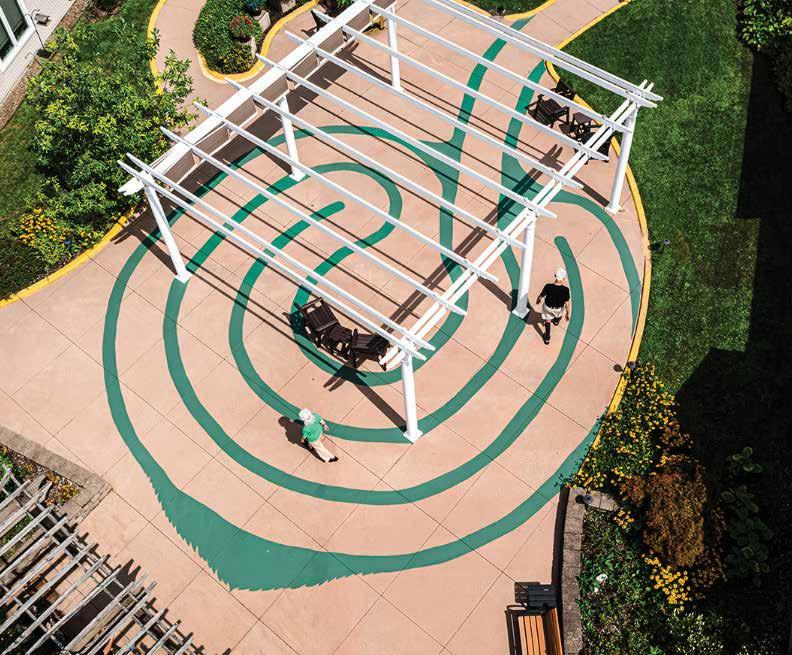

“ Oberlin [said] ‘We think this art form deserves its own training program at a first-class conservatory.’ The support we get here makes us want to work even harder because we want to live up to that reputation.” —PROFESSOR