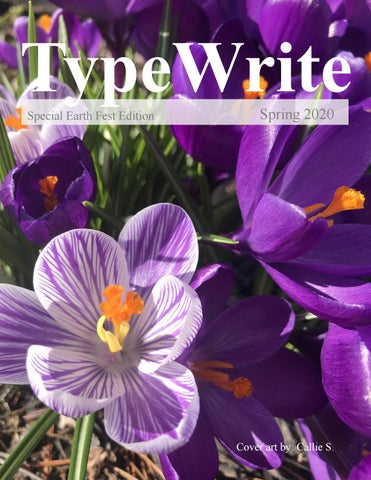
TypeWrite Special Earth Fest Edition
Spring 2020
Cover art by: Callie S.
Contents Year 03
Earth Fest Edition April 2020
Earth Fest 2020: A Celebration of Biodiversity By Brett Bloom Earth By: Anna Sondek Oak Farm’s Natural Resource Management Plan By: John Brittenham
Their Eyes By: Greg F. Springtime! By: Kristine Landrum Phenology By: Derek Hale Memories of the St. Mary’s River By Emma Coville
04-05 06 07-10 11 12 14 15
Erdkinder: What We’ve Learned By: Oak Farm Middle School
16-17
Editor’s Note
Hello!
Welcome to the first Earth Fest special Edition of TypeWrite! Many months ago Brett and I began tossing
around the idea of an Earth Fest centered issue, and I was immediately on board. While we are not able to celebrate our beautiful earth together today, we felt as though it was very important that we highlight the incredible people working on our campus and the students that love the environment in which we learn. Montessori is based on the principle that “the world is our classroom”. I strongly believe that the earth is here for us to love and learn from . Here at Oak Farm, we are able to relish in the earth’s beauty and gain understanding and clarity about ourselves and our purpose in our wider world.
Earth Fest 2020: A Celebration of Biodiversity By Brett B. “Biodiversity” is a concatenation of “biological” and “diversity.” The term was first coined in 1985. A simple definition is the variety of living things—plants, animals, microbes, fungi—found in a given ecosystem. When the diversity is high, the health of the landscape is too. It is more resilient and can withstand disasters, and other pressures like human pollution and development. Biodiversity is a driving theme of Ecoliteracy work on and off campus this school year. Biodiversity loss is one of many major consequences of climate breakdown that is impacting our planet due to human activities. Building awareness through fostering biodiversity at our school is a small step we can take to address this problem and prepare students for daunting ecological challenges ahead. Oak Farm has nearly 50 of its 100 acres in conservation. This is where biodiversity can unfold. There are 10 distinct habitats in various states of preservation, restoration, and future planning. An important goal of ours is to enhance existing biodiversity and to do what we can to foster ever more of it in the prairies, wetlands, and forest. Each micro- climate on our campus has a different configuration of creatures living in it, which makes for an incredibly rich resource for our students to study.
At Oak Farm students can go out and see a dozen species of butterflies in the prairie instead of sitting inside reading about them; classroom study greatly benefits from that crux of Montessori pedagogy: learning through direct experience and meaningful work. Or maybe a teacher wants to take students into a wetland to look at the egg sacks of various species of salamanders. Another class asks students to sit in the same spot in the woods once a week all year long to observe micro-changes in the same setting, generating phenology charts. An exuberant teacher realizes they can take students into a swamp to study ice as a part of understanding the various states water can take. Our campus is a giant classroom with an infinite number of lessons waiting to be discovered. The scenarios mentioned above have already happened at Oak Farm. High School Science Teacher, Wesley Kromer, and I worked with students in our Eco Impact class to look at biodiversity in the upland prairie in the middle of campus, taking pictures of butterflies we found there was a good way to focus our efforts. Primary and Lower Elementary students have reported numerous sitings of salamanders, particularly spotted blue salamanders, around our campus. They have learned that this is increasingly rare in Indiana, a landscape once dominated by wetlands. Part of supporting biodiversity is protecting what is already in place. We are working to increase biodiversity on campus. John Brittenham— restoration ecologist with Blue Heron Ministries and Oak Farm parent—has put together a Natural Resource Management Plan we will use as a guide. He summarizes the plan in the following pages. It creates a roadmap for the coming decades of work necessary to achieve biodiversity and ambitious conservation goals. We have already come a long way; in just the past two years, I have seen a significant increase in flora and fauna at Oak Farm.
Earth
By: Anna Sondek
Earth, so many ways and experiences. We are rooted there. I run as the pigs chase. Smell the compost and rich smell of the substances within it. The cold crispness of the air. The birds chirping and flying down and back. The rooster crowing loudly for all to hear. The crunch of leftover dead leaves. The sound of the breeze. It all reminds me every moment we are outside the earth is alive; we might just realize. When new friends come, like little goats, you realize how special the world can be. The cute little faces and the tiny noses too make you wonder how special they are. The cat comes up into the hayloft walking ever slightly across the wooden boards and jumping into the warmth and shelter of hay and straw. The rustling of animals and hay is heard. Quiet, yet not. Peaceful yet wondrous. The Earth is a most mysterious and sacred place. Only those who dare to adventure out into the unknown will really understand that their backyard or park isn’t really the same every time they go out. We have to preserve this place we call the Earth, our home. The beauty of it is so amazing. Just take time every day to look at the sunset and then it really reminds you how special our Earth is.
Oak Farm is Getting a Natural Resource Management Plan By: John Brittenham Oak Farm’s campus is an amazing asset to the school and everyone that is connected to it. Already the 100 acre property is recognized for its incredible beauty and unique natural features. It is a place where children and adults alike develop a connection to and appreciation for the natural world. At the same time, there is tremendous potential for the natural features of Oak Farm to be even more inspirational, more immersive, and more beautiful all while becoming ecologically healthier and more diverse. Environmental stewardship is an important part of Oak Farm’s Vision and Values and Montessori education in general. “The land is where our roots are.” said Maria Montessori “The children must be taught to feel and live in harmony with the Earth.” In order to help facilitate this vision, Blue Heron Ministries was asked to create a natural recourse management plan. This plan would be used as a resource to guide current and future management planning and actions on the Oak Farm Campus. The management plan outlines what natural communities looked like historically around Oak Farm, the current condition of natural habitats at Oak Farm, what ecological restoration efforts could be accomplished on the property, reasons for implementing these restoration activities, an estimate of how much time and funding would be required to accomplish the restoration activities, and how students and volunteers can be involved with restoration efforts. The overarching vision that guides the management plan is to restore and create a diverse, beautiful, and healthy self -sustaining landscape that provides both educational opportunities and connections for the students and community of Oak Farm and ecological benefits for the wildlife found within the campus. An additional vision is to demonstrate how people can be active stewards of the landscape in such a way that benefits both humans and wildlife.
Over the past 200 years, the habitats on the Oak Farm campus have endured much change, stress, and degradation. The result is a landscape today in various conditions of health and unhealth. To be healthy, the landscape must be productive, sustainably interconnected, and able to withstand stress, such as disease, climatic changes, flooding, the invasion of new organisms, etc. Just like the human body is considered healthy if it can maintain a constant state of homeostasis, so an ecosystem that maintains a state of homeostasis, while retaining high biodiversity, is considered healthy. This is not to say that ecosystems are fixed and static. They are dynamic and are constantly changing and evolving as conditions change. But, if the stress to the system becomes too great, the system can fail and many of the structures and organisms present on the landscape can be disrupted or removed all together. The results are loss of biodiversity and loss of ecological functions. The landscape becomes degraded and out of balance. According to early survey notes from 1829 of the area surrounding Oak Farm and the modern-day composition of the 9 acre woods behind the Victorian Farmhouse, it can be reasonably speculated that most of the area at Oak Farm was composed of oak dominated forests. Since that time, the vast majority of the 100 acre property (at least 60%) has been tilled and used for row crop agriculture. Of the remaining 40%, likely all of it was used for agricultural practices of some kind, such as grazing and hay production. Because of this, much of the campus has been degraded so severely that very little of the original ecosystem still remains. Much of the campus is therefore like a blank canvas on which many different habitats can be created. The decision then becomes what habitats to manage towards.
Picture above: Oak Savanna
Picture above: mesic prairie
Picture above: dry-mesic upland forest
The current status of northeast Indiana’s most threatened and degraded habitats is an important consideration when deciding what natural communities to create or restore on Oak Farm’s campus. Creating and restoring threatened habitats not only teaches people about the habitats themselves, but also creates habitats most in need of habitat restoration and recreation. In the early 1800s, just prior to the EuroAmerican settlement of Indiana, it is estimated that 18 to 20 million acres of forested land existed in Indiana. Today, that number has dropped to 4.9 million (I had 9 million previously) acres of forest, just 25% of the original acres. Less than 1,500 of those acres are old growth or undisturbed forest. There is no estimate on how many acres of savanna existed around the area in the 1800s, but oak savannas were certainly present and intermixed throughout the area. They would have occupied sites next to prairies or in places frequently burned by American Indians. Today, no examples of these habitats exist in northern Indiana. Of the roughly two million original acres of prairie in Indiana, only 1,000 acres of undisturbed prairie are left. Finally, of the roughly 1 million acres of wetland in Indiana, only 134,046 acres are left. Of all the habitat types, the prairie and oak savanna habitats are the most degraded and imperiled in our area and in the Midwest overall. Open oak and hickory forests are also declining in northeast Indiana as beech and maple forests begin to replace many of the existing oak and hickory forests. This is true for the 9 acre woods behind the Victorian Farmhouse. This is primarily due to the removal of fire from the landscape. Restoring these communities would make the biggest difference to threatened and endangered habitats in northeast Indiana. The most important tool for the long-term success of these systems is the use of prescribed fire and is a vital component of the restoration and management of these areas. Wetlands are another highly threatened habitat in Indiana, especially in northeast Indiana. Of the remaining wetlands, most are highly degraded by sedimentation, nutrient increases, and invasive species invasions. Restoring the wetlands on campus should also be a high priority. The lowest priority for restoration would be for beech and maple forests. This habitat type is becoming more and more common state wide and locally as forests continue to develop in the absents of fire. Having a representative beech and maple forest is recommended, but preference should be given to restoring oak and hickory and prairie habitats whenever possible.
The intention of the management plan is to create a representative habitat on campus of 10 unique native habitat types. The ten habitats are: mesic savanna, dry-mesic upland forest, mesic upland forest, forested swamp, shrub swamp, mesic prairie, wet-mesic prairie, emergent marsh, submergent marsh, and oldfield. These communities would be created or restored across the campus in locations where site conditions are appropriate. Additional goals would be to create and maintain greater than half of the campus as natural habitats and minimize the amount of space designated to mowed lawn and non-native species. The name “Oak Farm Montessori School� carries with it a rich meaning, full of history and nuance. The name speaks of a history of place, a philosophy of education, the interdependency of people with the environment, and a hope for the future, just to name a few. There are oak trees today on the campus of Oak Farm because American Indian peoples once frequented the area and burned it often, living in balance with natural processes while benefiting from them. EuroAmerican settlers then developed and farmed the land, living in the way they were taught and thought best. Today, the campus is being actively restored in many areas, helping to repair the broken relationships between different parts of the environment and between people and the environment. A farm still functions on the campus, allowing students to interact with and care for animals and plants that provide for human needs. This is the perfect setting to prepare students for the future; to work through the problems that our past and current lifestyles have brought about and come up with solutions. With a knowledge of the past, a clear-eyed vision of the present, and a plan for the future, Oak Farm is well situated to continue to inspire and educate children by connecting them with the campus’s natural communities, all while modeling responsibility to and care for the environment.
2019 aerial photograph of oak farm campus
1939 aerial photograph of oak farm campus
Their Eyes By: Greg F. I walk out of my car eager to start the day. A look at the sun and embrace it’s rays as I walk to the barn pondering my thoughts. I wonder what the day will become and what it will not as I enter the barn and see all my friends. I cut out the thoughts that were just loose ends and get in my boots, get the shovels and the wheelbarrow. I walk past the alpacas and up to the cows. The way they look at me just makes me think,
Wow. I think, why am I here in this moment right now?
The life in their huge beautiful eyes just blows me away and I think, this is why I’m here right now, today. I walk in the pen suddenly full of grief when I look down and see 60 pounds of manure at my feet but I will not be stopped by the poop that was dropped so I power through and right then I thought, this is it. This is what it is like to be a farmer, as I embrace the wind to work hard and not be stopped and to look into the eye of your animal for it to make your heart throb. It is beautiful. It really is. So look into their eyes and you can get through it.
Phenology Journal Entry By: Derek Hale
Today it is sunny outside, but there is snow on the ground. The wind is blowing and the few leaves in the trees are rattling.
When I look over there is a deer. The deer is young. A little buck- his antlers were only spikes. He is tan in color, but my time watching him did not last long because he smelled my phenology partner and was gone.
I hear a blue jay and a nut hatch. When I look around on a stump next to me there is a mushroom. The animal must have brought the mushroom there because it wasn’t there when I went phenology journaling last week. Whatever animal ate the mushroom must have used the stump like a table.
I hear Steve the pileated woodpecker. In the corner of my eye I see a silhouette. I hear a call “eeer eeer” like a screech. It’s a hawk but as soon as I see it; it is gone.
Memories of the St. Mary’s River By Emma Coville A few weeks into my Freshman year, the first official year of OFHS, seven students and a few teachers piled into two cars, southbound to the Tri State Watershed Alliance in downtown Fort Wayne. This was our first off-campus trip for our Friday Environmental Impact class with Oak Farm’s very own ecoliteracy coordinator, Brett Bloom. Before now, we had spent our time discussing the meaning of ecoliteracy and environmental stewardship. Today, as we pulled into the gravel parking lot of the Watershed Alliance, we would be putting our new skills to practice. At the sound of our arrival, the Watershed Alliance’s conservation guru, Dan Wire, came out to greet us. He showed us into the large garage where the organization kept their tools. We were doled out gloves, pruning shears, hacksaws, and even a chainsaw (for Brett, of course!). With our proper equipment, our guide led us down the bridge over the St. Mary’s River and down a path on the river’s west side. It was a beautiful day for a walk, a pleasant, sunny September afternoon. Soon, Dan stopped in front of a large thicket of brush and small trees, so thick you could not see the water’s edge 20 yards away. He told us that our two-hour task was to cut down all of the invasive plants and toss the remains into the bed of his pickup truck. We immediately got to work, cutting and hacking to our hearts’ delight. At the end of the afternoon, we were sweaty, sore, and proud of our accomplishments: our small but mighty group had successfully removed every invasive plant from the river’s edge to the pathway between the two edges marked by caution tape. Dan thanked us profusely for our help and said how much it meant to the Watershed Alliance that this space was now clear- it was now free to be planted with native species. The new plants would take root in this space and prevent erosion, improve water quality, and support local pollinators and wildlife. I believe I speak for our whole Environmental Impact group when I say that we ended up exhausted, but incredibly grateful for this opportunity to contribute to the environmental health of our community!
Erdkinder: What We’ve Learned Oak Farm Middle School
[The alpacas] have taught me that it’s good to push harder than your abilities. Pat has also taught me that if it’s a job worth doing then it’s a job worth doing well. -Isabelle Alonzo, 7th year
In the chicken coup, I feel like I’m at home. I feel happy, calm, and peaceful when I hear the hens cluck. When I’m with the hens, I feel like I’m where I belong, like this is where I’m meant to be. When the hens start to get used to me, they start to come closer, but that takes a long time to happen. When it does, I feel so much happier. It’s like I’ve been accepted into the flock. -Charolette Deihl, 7th year
The farm demonstrates how anything can happen and everything can go downhill quickly. -Miles Rahn , 7th year
One day I came in to see that Steve [a pig] and the other one had torn off a metal feeder. A big, 100 pound feeder. This feeder had been torn off the wall as if it was a toy. Not only that but the feeder was left on the ground with a multitude of dents in it. The feeder was practically useless. It now sits one the wall as a symbol for new farm workers to never underestimate a pig. -Grayson Pettit, 7th year
Moo Moo Baa Baa We work on the farm. It does no harm to work on the farm. -Nate Green, 7th year
Seeds grow to plants Young calves grow to big cows Us young, eager adults just ready to make a change in the world. Work together, big dreams, big change, We all support each other and don’t give up No matter what. -Carter Cox, 7th year
Working on the farm in the morning is… fun. The animals somehow calm me down and working in the greenhouse is warm. It’s nice to go out and see the animals before we have to go inside and start working. The greenhouse has made me realize that if you don’t care for something and put effort into it, it won’t thrive. It needs care and attention to survive, like all living things on the farm. -Layla Simmons, 7th year
I’m in Kalahari where the roosters and ducks are so there’s a lot of noise. Most people would say it smells really bad, but I can’t smell it anymore. Or maybe I’ve gone nose blind like they say in those Febreeze commercials. Now that I’ve started connecting with the [hens], I can’t look the same at a store bought egg. Seriously. There have been times when I’ve gone to bake a cake or something and end up staring at the eggs for an unnecessary amount of time. -Kit Yager, 8th year
Thank you!