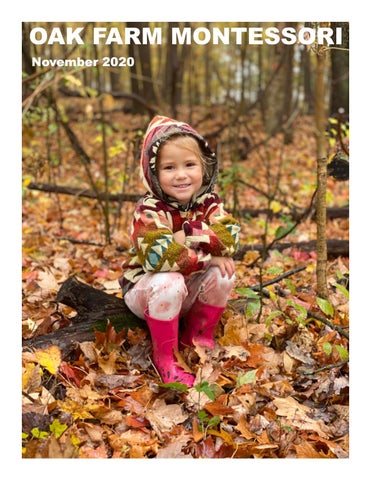
OAK FARM MONTESSORI November 2020
Sweet or salty? Coffee or tea? Most of us have opinions on our preferences and when to enjoy them. But why is it so difficult to understand that our children also enjoy choice? From birth, children are feverishly seeking independence. Cries to be fed lead to cries to be heard, “I want to do it myself.” is often heard from Toddlers and preschoolers while adolescents and young adults physically distance themselves to develop autonomy. Maria Montessori recognized this need for choice and created her philosophy after carefully observing children’s instinctive nature to work for longer periods in a focused manner when they, the child, chose what lessons to practice instead of the adult. However, she also saw the importance of a prepared environment in which the child knows the ‘limits’ or norms of the classroom. The first weeks of school are filled with lessons in grace and courtesy, writing classroom expectations together and older students mentoring younger students. Not only does this framework encourage independence, but also interdependence as they realize that they are part of a community that can make contributions to the whole. As you read this month’s newsletter, you will learn about choice and why it is such an important part of the Montessori philosophy. You will see examples of how choice is woven into the various aspects of the student’s daily routine, including how the learning environment is set up. As adults, we all understand the impact that our choices have on the life we live. We also understand that freedom to choose is a fundamental human need; another reason it is such an integral part of Montessori and the empowerment that our students experience when allowed to make choices as part of their learning. Our founder, Lorene Dekko Salsbery, also saw the importance of choice and wanted to give educational opportunities to families in Northeast Indiana. Did you know that she visited multiple schools and methods of education before she chose Montessori? Investing both her financial resources and time, she became a student of Montessori herself while opening the school to serve her community. This upcoming month, our school will be celebrating the many attributes that made Lorene who she was and how grateful we are for the positive impact she made on our school. During the week of November 9th – 13th, we will honor Lorene’s fun-loving spirit and personality by observing Spirit Week. Those who worked with Lorene and knew her can recall the times she would dress up, right along with the students, for a particular course of study or the infamous student restaurant that was a staple in the early years or that she was the first one to throw a Cool Whip© pie out the window during messy games—which also happened to be one of Lorene’s favorite campus traditions. Throughout the week, we will also honor Lorene’s passion and philanthropy for our school. All students will have the opportunity to choose to financially support our school. Students in Primary through Upper will participate in the “Acoin for Change” drive and our secondary students will integrate this learning into their daily schedule as well. Both are reminders that no financial gift is too small to make a positive impact. Many nonprofits participate in the Day of Giving the Tuesday after Thanksgiving; however, at OFMS we have chosen to celebrate this day on Lorene’s birthday. As for us, we could not think of a better way to honor Lorene’s philanthropic spirit and passion for Montessori than through a day where others can honor her and financially support a cause that was so near to her heart. A choice that has become her legacy. Oak Farm Montessori is a choice for families because of Lorene’s philanthropic spirit and the continued support of families, faculty and community members. We encourage you to take time to reflect on how her choices and her legacy has impacted your family. If you would like to join the celebration and say, “Thanks” to our founder, won’t you consider choosing OFMS in your gift giving this year?
Candice 2
“Choice, choice, choice. Montessori trusts the child with choices, yet adults do not have the choice in choosing an educational system that reflects their family values. Well, you can, but you must have money. Money to pay taxes and then money to pay private tuition. On my dad’s grave is the inscription, “Only the educated are free.” Freedom: the freedom to choose, the freedom to be educated; but first, you must have money. At this point, I knew our choices in Northeast Indiana, and there was not a single non-traditional choice for people in the counties where I grew up and had known people for a lifetime. I thought, “This is what I can give back to the community.” Lorene Dekko Salsbery
#supportourschool
Freedom to
move
Candy Slabaugh, Toddler2 Teacher
The Montessori Infant and Toddler environments at Oak Farm Montessori School are full of opportunities for the children to make choices. It is through keen observation that the adults in the environments know what the individual child needs or wants. You will not find any kind of equipment to hold or support the child. We use floor beds, low tables and chairs, and everything is designed to fit the child and allow for the freedom of movement. The youngest of children may be laid on his or her back or tummy for floor time. If the child shows signs that he or she wants to move to a different position, the adult will go near to them and talk to them using words such as, “I see you are upset, would you like me to help you move positions?” The adult is observant and this allows the child to communicate and make a choice through verbal or nonverbal communication. The children get to choose what work they would like to explore, where they would like to work, who they want to work with, if they want to eat, and where they want to sit and eat. It is important for a toddler to have the opportunity to make choices. This allows them to become independent and know that they have value and meaning as part of our community. Having the freedom to make choices gives each of us a sense of control in at least part of our lives. We all want and enjoy freedom throughout our activities; children are no exception. Providing them choices gives them the satisfaction of making a decision. You will hear adults at OFMS using words like, “You may walk on the sidewalk or run in the grass.” “Would you like you help or would you like to do it by yourself?”, “Do you want fruit and a vegetable?” Providing choices that are both safe and have the desired outcome make either option a win-win for both the child and the adult. We also remember to allow natural consequences for the young child. If a child chooses to jump in the mud, he or she will become muddy. Getting muddy is a natural consequence of jumping in the mud. The choices we all make either drive us forward or pull us back. What a great lesson in life to learn as a young child that our choices impact not only ourselves but those around us. 4
the power of choice Ashley buckles, primary 2 teacher
As Primary Montessori teachers, we know that the three-year-old child is entering the “conscious mind”, which, in part, means a strong desire to be independent is emerging. Caregivers have the option to either lean into a child’s independence, or go against it. Here, at Oak Farm Montessori, we strongly believe in leaning into it. What can be confused as strong-willed behavior, is actually a natural drive inside our young children that will help them develop into self-sufficient beings. Our environment is set up to foster this independence, but we adults must also think about how our words are either encouraging or discouraging this self-sufficiency. The Primary classroom is full of choice. Sometimes you will hear us ask, “What would you like to work on?” Our shelves are full of work, and the child is free to choose anything he has received a lesson on. For some children, we need to assist them in the choosing process by narrowing down the choices. We might say, “Would you like to do the pink tower or gluing work?” Our goal is for the children to be intrinsically motivated and to choose a work because they are drawn to it, not because a teacher told them to do it. When someone enters our environment for the first time, they are usually in awe and wonder how the children can function so autonomously; the secret is a prepared environment that encourages choice. You may notice when you observe a Primary classroom that the teachers use a certain type of language with the children. We carefully select our words, which help us guide the children, rather than control them. When we demand something of a child, rather than offering a choice, the child will usually resist. Instead of saying, “Clean up,” we might say, “Would you like to clean up by yourself or would you like me to help you?” This empowers the child to take control of what is happening and the temptation to resist usually diminishes. We encourage you, as parents, to offer choices to your children. One important thing to remember, though, is only offer choices that are truly choices, and to limit it to 2-3 choices. Be prepared for your child to choose either, and to be content with their decision. It can take some time for this to be second nature, but you, too, can see the power of choice unfold in your own home. #supportourschool
Providing options sets the stage for success Michael Miller, Lower 1 Teacher
Choice is an intrical part of the lower elementary classroom. Students begin their day by choosing the work that they will accomplish and the order in which they will accomplish said work. Students also have the option of choosing their work space and their work partners. As the day continues, students work with their chore team partners to complete chores they’ve pre-selected as a team and support the classroom environment by making choices to clean and restore the various classroom spaces. They also have choices when they eat their snack, use the restroom, and care for themselves and their personal needs. When preparing to head outdoors for playtime or learning opportunities, students decide what weather appropriate clothing will keep them the most comfortable while being outdoors. The lower elementary classroom is built on the basis of offering students choice. Additionally, students who need more support in the classroom are encouraged by being given more choices. Students may choose to utilize tools such as sound canceling headphones, wiggle seats, and gum. Students may choose to use the peace area in the classroom in order to refocus their brain, take a mask-break, or solve a conflict with a peer. Students are able to experience choice in a myriad of ways to best support them and their work in lower elementary. Finally, when working with your elementary child at home, be sure to offer them various choices, but within the limits that you provide. For example, set the expectation that your child will get dressed, but offer them choice in what they may wear. If your child pushes the boundary about getting dressed, limit the choices to only two you feel are acceptable. For example, you may wear the green shirt or the blue shirt today, but we are getting dressed. Another example in choice would be setting the expectation that your child will help care for the home, but offering acceptable options in how they may help. For example, it might be acceptable to you that your child helps load the dishwasher, vacuum the stairs, and run a load of laundry, so offer those choices. However, you might only feel comfortable offering your child the choice to sweep the kitchen or dust the shelves. If the end goal is that your child helps care for the home, choice can be an excellent way to help each of you meet that end goal.
6
In the kitchen with
Chef Joe Advocate for healthy
food and local sourcing The choices in the kitchen are simple, it’s just cooking, right? I have experienced all sorts of “choices” while living life in the kitchen. After, spending the better part of 20 years grinding in the hot kitchens in Pennsylvania, Indianapolis and now Fort Wayne, Indiana, I didn’t always have a choice when it came to the food that nourished my body. Working any position in a restaurant, other than owner, executive chef, sous chef, or manager, means you order and serve what is asked of you. Working in fine dining restaurants taught me how important the quality of food and how it is prepared matters to the end result. I also learned that not everyone cares how food is sourced, grown, or processed.
“Freedom of choice allows for the children to make choices for themselves.” -Maria Montessori
In the years of working long hours, in many kitchens, I made time to self-reflect on my path and decided to make a change. I gave up the fancy job (Executive Chef Partner) to follow a dream and become a culinary educator at The Art Institute of Indianapolis. The choice had setbacks financially and sometimes made me think twice about that choice, but it offered me perspective; the chance to teach my style of classical cooking, and provided an opportunity to work on my own business, goals, and life dreams. Through working as a lead culinary instructor, the opportunistic “choices” gave me the chance to connect with the community, learn from passionate farmers, students, business professionals and artisans to create a business platform. Several years have passed since I left teaching full time, but that hasn’t stopped the pursuit for choices in my personal life. My wife, Courtni, and I now run two successful food trucks, a bone broth business and a beverage company. When we discovered Oak Farm Montessori School was in search of a chef, the choice of becoming a part of the OFMS family was the easiest decision I have ever made. The school was already living true to the principles and beliefs we held as a family; we knew we belonged here. I now have the opportunity to offer my knowledge and expertise to our youth; modeling how community is essential to the growth and development of our children and young adults. #supportourschool
Students use their workplans to plan their day. Upper teachers observe our students and connect them to the materials they are ready and interested in. Hannah says, “What helps me are the different types of works listed and follow-ups with their due dates. I prioritize what I need to get done and then I have time to do things of my choosing. I like to do pin maps, word ladders, and additional creative writing”.
8
Nancy Bradtmiller, Upper Elementary 2 Teacher
Planting seeds
Andy has had a curiosity for atoms and molecules since being a 4th year. At the start of the year he decided to build different molecules every week. This is a model of hydrochorothiazide. Andy says, “I’ve been wanting to do something fascinating and cool. There are so many possibilities when exploring molecules.”
U
pper Elementary students developmentally are in the “Stage of the Absorbent Mind” so they are given the freedom to explore, examine, and interact with the multitude of materials in our classrooms. Montessori defines school as “a prepared environment in which the child is set free from undue adult intervention and can live life according to the law of development”. Upper students have the “freedom” to follow their inner guide and we, their teachers, realize this internal motivation is so intense there is little need to redirect them. Our role as their Montessori guides is to link our students to the materials that interest them. We might ask, “How can I help you today?” Because our aim is not to “pour” the information into the child, but let the child’s work with materials reveal the concepts that lie within. From our observations, we determine the needs and interests of the students. When adults try to assert expectations or shape children to fit their ideals, the child is pushed from their natural course of development. We see evidence of this when students become sullen and withdrawn because they are asked to do a task of little interest to them.
“We are already in the possession of the secret…The child must learn by his own individual activity, being given a mental freedom to take what he needs, and not be questioned in his choice. Our teaching must only answer the mental needs of the child, never dictate them.” Maria Montessori (Montessori, 1973)
Elementary children are in a period when they are developing their personalities. No one can teach them qualities of good character. Personality is the result of children being allowed to work effectively without disruption or impediment. We see Upper students become energized and productive when they are free to act on tasks that interests them. They yearn to do meaningful work and serve others, making life more pleasurable for them. The outcome is that Upper students naturally develop virtues related to working hard: diligence, perseverance, cooperation, and responsibility. In order to be effective, parents and teachers must believe in the power of our children to perform their work of self-construction. To do this, we must acknowledge the child’s central and active role in their own development. Our job is to “plant the seeds”
“I like to be able to choose where we sit at lunch. I like that we can choose what book to read and what books to write about.” Tyler
Anna talked about her research topics saying, “I like to learn about unusual animals like honey badgers, ostriches, and komodo dragons. They are animals people don’t think about every day. I think these animals are more interesting than animals picked for research more often”.
#supportourschool
“A child needs freedom within limits� -Maria Montessori
Heather Lemmon, Middle School Teacher Middle school opens students to so many new and stimulating choices. At the secondary level, and especially the Middle School level, freedom within limits is a key component to the curriculum. Students have many choices ranging from their deep learning topics in academic classes, to whether or not the MS Microeconomy will purchase a calf and just about everything in between. Students have the opportunity to make choices that will affect them as individuals and choices that will affect the group and even choices that will affect their business. All of these choices are put in place through the prepared environment. Even when choice seemingly springs up out of nowhere the environment has been prepared in such a way that allows students to have freedom of choice. Choice is imperative for this developmental plane. Adolescents at the third plane of development are testing and trying out their independence. Their social life is extremely important as is justice. Having opportunities in their classes to choose research ideas and topics that are important to them makes learning exciting and meaningful at the same time! Students will dig deep in their learning and then just be bubbling over with excitement to share what they have learned. As a teacher in an environment that focuses on choice, it is a true pleasure to witness meaningful learning at its best. Here is a real-life middle school example of choice: Recently, the students needed to make a decision on whether or not to purchase a calf for microeconomy. The Microeconomy Erdkinder group researched the costs associated with raising this animal from start to finish including processing costs of the animal. This information was presented to the community over several Community Meetings. Students were able to ask questions, get clarification, send the group back to get more information, and eventually vote as a group about the calf. This is a big commitment for these students to undertake and it will definitely mean more to them knowing it was a choice they made. Cleaning that stall will be just a little more enjoyable. 10
SOFT SKILLS L E A D TO
S T R O N G A D U LT S
B o n n i e B l o o m , C re a t i ve M e d i a Te a c h e r
Choice in a Montessori educational environment gives students a sense of self-determination. No two students are alike, nor do they learn in the same way. As students practice and develop their own decision making abilities, they develop into independent adults. The Oak Farm Montessori High School (OFMHS) program fosters and strengthens the soft skills of its students by providing choices in curriculum and educational opportunities. Students are supported to make strong choices throughout their four years here. High school lead teacher, Jenn Jordan has worked to expand the traditional Oak Farm Portrait of a Graduate (“life-long learner”, “ global citizen,” “leader”, and “emotionally literate”) to ten major dispositions. These are core concepts of the program as well as foundational soft skills that OFMHS students are encouraged to develop. All ten major dispositions are relevant in understanding Montessori education but number seven: Autonomous, sticks out as particularly related to “choice”. An autonomous student, is self-confidant, intrinsically motivated, and makes value-centered decisions. They are able to self-advocate for what they need in the educational environment and in life. Some of the many opportunities for choice at OFMHS include: Innolab, Bike Shop, Business program, Capstone project work, Self-Expression classes, and Intersession themes. In Innolab work time for example, students choose to work on various projects and learn technical skills. Self-expression classes rotate quarterly, allowing multiple opportunities for students to find something creative that they enjoy. Jon Agler heads the business program and works with students to foster their entrepreneurial spirit and ideas. Several students have gone on to found and run their own business. Choice is key in creating strong , independent adults!
#supportourschool
O
ur school’s founder, Lorene Dekko Salsbery, was an entrepreneur who found her passion in early childhood education. That passion, when matched with her vivacious personality, drive and financial resources, put Oak Farm Montessori School on a path for excellence in education. Not just any education, but one that provided parents in Northeast Indiana educational choice and accessibility. Not just any educational choice, but one where the environment was designed to meet each child where they are and to maximize that child’s learning potential. This educational choice was to be free of government funding and state requirements for testing or curriculum implementation. She knew that to accomplish this, it would require funding that exceeded program fees and tuition. She also realized that to fulfill her vision of a premier Montessori school that was accessible to all and would serve infants through 12th grade, in the rural community where she grew up, it would take philanthropy. The philanthropy at Oak Farm Montessori started with her personal financial investment in the school. She then engaged her family’s private foundation, the Dekko Foundation, in fulfilling her vision. Together, this philanthropy has played a vital role in who we are today and the strong financial positioning that we have as an organization.
12
Teacher Entrepreneur Philanthropist Kim Davidson, Stategic Partnership Director
As parents, we make a choice about where to send our children to school. Some choose public, some private, some parochial, some college prep. As parents of Oak Farm Montessori students, we have chosen to send our children here. Each family has a different story to tell and a different reason why they are here. For some, that is the prepared environment where our students move freely throughout the day engaged in their learning, the vast campus with so many learning opportunities beyond the indoor classroom, the Montessori philosophy, or maybe, all of these. Regardless of the reason, we have all chosen Oak Farm Montessori for our children’s education. Oak Farm Montessori is a school. It is also a non-profit that relies on the support and generosity of investors. Absent state and federal funding, we must find a balance between the two to achieve high quality programming and a sustainable financial model. We have been blessed with investors like the Dekko Foundation and many other donors over the past 20 years, but much like our desire to develop young adults who are responsible and independent, it is in this vein that we too must begin to further diversify our revenue streams and take more ownership of our school’s financial sustainability—now and into the future. People often think of investors as large donors who write large checks and they are right; however, it is also important to realize that most non-profits don’t sustain themselves with an abundance of large gifts from community donors. An investor is anyone who provides a financial gift to the school—regardless of the amount. For this reason, most non-profits build their sustainability through individual donors who are committed to, and invested in their mission. Most often this is those closest to the organization and who benefit from its mission daily. In our case, this includes faculty, parents, grandparents and our board of directors. These investors are committed and consistent, and many times their gifts are $250 or less. In the past three years, we have consistently had an increase in the number of families who support our school with financial gifts. While these gifts have varied from a few dollars to several thousand, we celebrate each gift and the cumulative impact we can have on our greater community. The amount of these gifts is not important. What is important is to know that over the past three years, our community has collectively invested over $629,775 in our school through a variety of giving opportunities. THAT is worthy of celebration for a school with less than 300 students and approximately 175 families. As we move into the next 20 years, continuing to invest in our mission will be important. For our OFMS community to make an investment in our school sends a powerful message to our children, the faculty who guide our children daily and the external community that we are beginning to ask to invest in our school as well. It assures them that, “We believe in our school and we are choosing to allocate our financial resources to insure that OFMS is not only here for our children, but for future generations.” Oak Farm Montessori School is deeply rooted in philanthropy. From the beginning roots of our founder, to the tree trunk that has supported us for years, through the Dekko Foundation, to the branches of our families that have contributed to the school over the years. Each of these investors has provided the nourishment the leaves of our giving tree needed to impact students on our campus and the world beyond. Will you please join us as we continue to build our sustainability and provide the important tools needed for Oak Farm Montessori to impact students today and in the future? #supportourschool
Mark your Founders Day Virtual
Event
calendars
november 10, 2020
Community Coffee
Half Day
In-Service
Thanksgiving
november 12, 2020 November 24, 2020
Break
november 25, 2020 november 26, 2020 november 27, 2020
TALL OAK FUND
SGO
VOLUNTEER
DAY OF GIVING
SUPPORT OUR SCHOOL