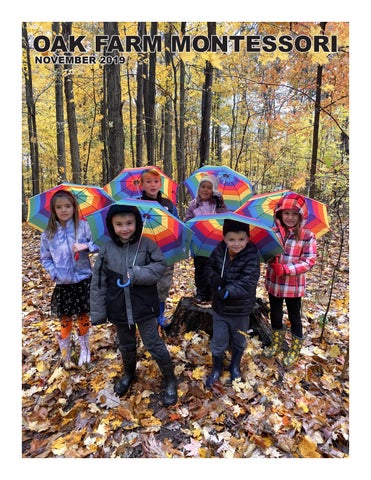
OAK FARM MONTESSORI NOVEMBER 2019
Leadership and Independence It’s amazing what our children and adolescents can do when we, as adults, get out of their way! Leadership and Independence. We want this for our children, yet too often we insert ourselves and impede the development of these skills. Often times we do not even realize we are even doing it; even though it is likely with the best intentions. Whether that is doing a task for them that they can do themselves (so guilty of this one myself), offering our own experiences of advice when unsolicited by our children (yep, this one too), or giving direction on things the way we want them to be done, even when our children are capable of making that decision for themselves (I am beginning to wonder how Jack has grown into the strong-willed, independent 7 year old he is already). Everytime we insert ourselves, we rob our children the opportunity and experience to develop into the fully actualized human we want them to become.‌ We do this because we do not want our children to have a lack of confidence or to face feelings of embarrassment, regret, or rejection. But, how can they grow into independent compassionate leaders if we do not give them the opportunity to experience these feelings, as hard as it is to watch them hurting? We must get out of the way and empower them to make decisions that they are capable of doing, even if we already know what the outcome might be.
Great news! Our kids are resilient and adaptable. Don’t beat yourself up if you helped your toddler get their shoes on when she could do it herself. Don’t beat yourself up if you tell your 7 year old to take off his socks running across the wood floor so he doesn’t run into the stone column in your living room. Don’t beat yourself up if you told your teenager you would talk to the teacher even though you know they should take responsibility. Instead, acknowledge that you do it and then do better next time (trust me, we get lots of chances as parents).
Children are as independent as you expect them to be. -Maria Montessori
This month’s theme in our newsletter is Leadership and Independence. You will read how these opportunities are given to our children everyday at Oak Farm, beginning with infants all the way through high school. In our Vision and Values document, Lorene Dekko Salsbery, defines leadership in our Portrait of a Graduate (our students) as…
Self-Motivated
Compassionate
Empathetic
Collaborative
Self-Disciplined
I challenge you this month to be mindful of the ways you might be inserting yourself into the lives of children you interact with on a regular basis (all with the best intentions of course). Try to implement one or two of the ways shared in this newsletter to empower yourchildren to foster Leadership and Independence. Enjoy the ride as you learn and grow through your own experiences!
Candice
Help me to do it myself! Ashley Knudson, Infant Teacher
The journey to independence begins on the day we are born and can be achieved much easier with a prepared environment. In the Montessori environment, independence is an ongoing, organic process with practical life lessons being of high importance. As a child learns to pour water, prepare a snack, put on a coat and shoes, care for the environment and care for others; independence takes root and grows. Therefore, encouraging and providing children with the opportunities and materials to “do for themselves� not only fosters independence, but also builds confidence and self-esteem. Children are often able to do much more than we realize, which is why role modeling for children is so important. It encourages children to accept the challenge of doing things for themselves. The Montessori philosophy is so beautiful as it offers these opportunities for growth with three year cycles; offering older children to role model for younger students at all ages of development.
Building Leadership Ashley Buckles, Primay 2 Teacher
After entering a Primary classroom for the first time, most people can’t help but to be astonished by the independence and leadership skills the children possess. Despite being young children, only 3-6 years old, Primary children carry an incredible desire to complete tasks on their own and to lead each other. The strongest leaders, by far, are the Kindergarten students. After spending 3 or more years in the classroom, their confidence in leading the other children is apparent as you observe them. You’ll see our leaders teaching other children how to roll up rugs, clean up their lunch, sit at community, and a host of other tasks. These Kindergarteners have a special way of helping the younger children, a way that is foreign to us teachers. Children trust and respect their peers, which makes them the perfect leaders. Many times I sit back and watch the Kindergarten students lead the other children, and the beauty of the 3-year cycle is apparent. Sometimes it feels as if I could walk out of the room, and they would keep the room in order without me. Independence is cultivated from the first day a child enters Primary. The children are taught how to independently put their belongings in their cubbies, pour water, serve themselves a snack, wash their hands, choose a work off the shelf, and the list goes on. As teachers, we are teaching them to be independent by giving lessons, and then stepping out of their way. Many people comment on how the Primary teacher does not stand out when you enter the classroom, and sometimes you even have to look for her. This is intentional. We must get out of the way and let the children learn, as their independence guides their way. As Montessorians, we know that children are extremely capable if we believe in them. With our prepared environment, which has been set up so intentionally, the children can thrive and work as if the teacher does not exist in that moment. When a child has a false belief that he needs help, we may respond by asking, “Hmmm.. what are you going to do next? I can’t wait to see!” Our words are always relaying the message that we believe in them and know they are capable of being independent. And once the children believe this as well, their potential begins to unfold.
Classroom Leadership Meghan Dougherty, Lower 3 Teacher
Maria Montessori believed that leadership could be cultivated in any classroom through independence, respect, and responsibility. You can see this in action in many different ways within a Lower Elementary classroom. Caring for our environment is one of the ways our community comes together. Every student has a responsibility in this task. For example, the students unload the dishwasher, water plants, and set a place setting in preparation for lunch. The students work as a team to complete these jobs. Each job team has a leader to help guide, organize and reflect on the job team’s success. The greatest Another way you can see leadership within the classroom is watching the students work independently. With independence comes responsibility. Responsibility to stay focused, to work towards a goal, and complete a work from beginning to end. While working, the students might need to ask a classmate for help or decide to work on a project together. Everyone in the community is able to help another; this fosters mentorship that is carried on throughtout every level and age group. Think of the leadership and pride this opportunity instills in a child he or she will take with them into adulthood and beyond.
sign of success for a teachere is to be able to say, “The children are now working as if I did not exist.� Maria Montessori
Upper guides lead the way... Nancy Bradtmiller, UE2 Teacher
Aspects of our ‘Portrait of a Graduate’ are witnessed every day in Upper Elementary classrooms. By their nature, our students desire to understand the world in which they live, possess a deep moral character and love to interact with others. Knowing this about our students, upper guides prepare the environment and lessons to develop the qualities of a good leader. Leaders are considered to be peacemakers, responsible, collaborative, self-motivated and disciplined. Maria Montessori believed, “An education capable of saving humanity is no small undertaking; it involves the spiritual development of man, the enhancement of his value as an individual, and the preparation of young people to understand the times in which they live.” Leadership is layered into Upper’s three year cycle. Sixth year responsibilities, along with classroom contributions, are learned and earned over the years. As returning students, fifth and sixth years are familiar with classroom procedures and the proper use of materials; therefore, good resources for younger students when they need assistance. Research has found that effective managers plan, establish and teach procedures. As role-models and mentors to their younger classmates, they play a key role in the smooth running of the classroom. When asked about her role as a sixth year, Grace enthusiastically responded, “I like the added responsibilities of a sixth year!” Communication, collaboration and cooperation are encouraged during community meetings which is a time to discuss decisions and procedures that influence the classroom. At the start of the school year, Upper classrooms determine ground rules using OFMS’s Guiding Principles; including: “Care of Self”, “Care of Others”, and “Care of the Environment”. These group discussions foster understanding and autonomy since the group worked together to formulate them. After leading a small group lesson, Lily exclaimed, “Now, I understand why we need procedures and ground rules!” During community meetings, students have an equal voice and are encouraged to use their reasoning skills to comprehend the decisions and actions of other people. As students listen to one another and explain their point of view, they eventually work together to come to a resolution. Later, the group will assess whether the issue has been resolved satisfactorily; making changes as needed. Upper Elementary students are preparing themselves to be leaders of the 21st Century. They have been given the opportunity to make choices about their work, learn to manage their time wisely and to collaborate on a common task. Our students build strong relationships with their peers and with adults, making them empathetic to the needs of others and able to find common ground when there are differing opinions. They are self-motivated and have learned to be resourceful when gathering information. Montessori viewed education as a means to develop children’s personalities so they can achieve independence. As Montessori said, “The greatest gifts we can give our children are the roots of responsibility and the wings of independence.”
David is one of Upper’s Ambassadors. He gives tours to visitors and said, “I feel responsible and glad to share Upper Elementary classrooms with visitors”.
Derek made a work to show what he has learned at the farm. He said, “I feel good about sharing my work with others.”
Elizabeth wrote a letter to The Ski Pole to secure items for our gala project.. She said, “I’m glad to have helped my class”.
Building a sense of ownership Jon Agler, Middle School Teacher
Every morning, in freezing rain or shine, the middle school students start their day with what we call Erdkinder (“children of the earth”). The early morning time allotted for this work, caring for the farm and the animals, begins as a high point in the day for all of the students; but, as the year goes on, their excitement dwindles. Scraping frozen manure and mending fences in February with frozen fingers can be a drag on even the strongest of morales. As staff, we often ask, “How do we make the work relevant to help build motivation in the difficult months?” One solution to this problem has come through our farm tours. Every middle school student spends one trimester planning and facilitating tours for other classrooms around the Oak Farm campus. As the students prepare their lessons for the tours, their most challenging task is to see the lesson through the eyes of the younger child. They spend time researching and conversing, but do not take it seriously until we have a tour scheduled. As soon as they see the tour scheduled on the calendar, they all kick their work into high gear. At times, frantically working right up to the final minutes before the first bus of elementary students arrive. They are always nervous and unprepared for the energy that comes with a bus full of elementary or primary students. As their teacher, it is at times difficult to stand back and to not step in to assist with crowd management. However, as soon as they are able to get everyone settled and begin giving their lessons, “Therefore work another side of them comes out. They no longer act as nervous on the land is an middle schoolers, but as part-owners of the farm. We hear them introduction both begin to use pronouns such as ‘mine’ and ‘ours’ to describe the to nature and to animals and the work. They show excitement as they talk about civilization and gives the personalities and temperament of the animals. Their lessons a limitless field for begin to seem less like an assigned presentation and more like a scientific and historic welcomed opportunity to share about the work where they find the most pride. Developing a sense of ownership for their work studies.” helps for it to become meaningful; ultimately helping them to Maria Montessori develop the independence needed to be successful adults.
Independent Talkers Sarah Holland, Speech Language Pathologist Independence is a common goal across campus, and communication is no exception. Our independent communicators look a bit different at each level. As early as infancy; wants, needs, and feelings are communicated through facial expressions, body language, and vocalizations. Children begin to say their first words at one, and then their vocabulary explodes. In toddlerhood and primary years, children begin to build sentences with their vocabulary. They learn to use their words and sentences to communicate their wants, needs, thoughts, and ideas. Word structure, sentence structure, and vocabulary continues to mature through early elementary years. Then,students are tasked with putting these verbal language skills into writing. Communication continues to be developed and refined all the way through the high school years and into adulthood. Children learn the function of communication, and how to do it effectively, by watching and listening. They continue to learn by engaging in back and forth communications. Here are some ways you can integrate communication development into your daily car ride to and from school: • WH-QUESTIONS: Ask your child a variety of wh-questions (who, what, when, where, why) and encourage them to ask you questions about your day. Sample questions: Who did you play with at playtime? What did you eat for lunch? What was your favorite work today? Where did you work today? When did you go outside? • MODELING: If you get the infamous “I don’t know” or “Nothing” response, model how to respond by telling them about your day. • SEQUENCING: Prompt your child to sequence the events for the day by using transition words. Samples include: What did you do first? And what did you do next? And then what? What did you do after lunch? What was the last thing you did before carline? • DESCRIBING: Practice describing the items that you see by playing, “I Spy.” • ARTICULATION: Create a sound journal. Have your child find things that start with each letter. They can write the word and/or draw a picture. • FIGURATIVE LANGUAGE: As you’re listening to music on the radio, discuss the figurative language that you hear in the songs.
“More high school students say that “making a contribution to society” is important… However, they have not quite mastered making those dreams a reality. Their always online lives, with lots of talk but not much action, may have something to do with that.” Jean M. Twenge iGen: Why today’s superconnected kids are growing up less rebellious, more tolerant, less happy and completely unprepared for adulthood (2017)
MAKING A DIFFERENCE Jenn Jordan, High School Teacher
Supporting our students to move from talk to action is an important part of our high school program. Although we offer our students a variety of opportunities for leadership in the Bike Shop, TypeWrite, Yearbook and other important components of our school community, in this article I want to highlight the ways we are helping our students take action on issues they care about beyond the boundaries of Oak Farm; through our Environmental and Social Impact courses. Environmental Impact During their freshman and sophomore years, students spend Friday afternoons in this hands-on, service-oriented class for which they also receive Environmental Science credits. This year’s class has already worked with ACRES to collect native seeds for future planting. In the past two years our students have done service learning projects with Tri-State Watershed Alliance and Merry Lea, as well. After these experiences, when given the opportunity to present at the Stewardship Network Conference, some of our students traveled to East Lansing and gave their first conference presentation on how Oak Farm works to have a positive environmental impact; impressing conference attendees with their intelligence and dedication.
Social Impact For their junior and senior years, students switch to our social impact class. Although this class has only been active for a couple of months, we have already begun pursuing multiple service projects which have helped our students to connect their minds, hearts and hands to take the lead on work with lasting community benefits. Building on the knowledge and environmental engagement our Oak Farm students have developed across all levels of their schooling, students started by creating an application for a competitive grant to help establish a “nature classroom” at the new Community Learning Center in Kendallville. Working through the application process as a team, they wrote about city demographics, conducted an analysis of strengths and weaknesses, and spoke with important contacts in Kendallville. This last endeavor included having Mayor Handshoe to lunch at the High School to discuss this plan and other ways that our students could become youth leaders in Kendallville.
Never doubt that a small group of thoughtful, committed citizens can change the world; indeed, it’s the only thing that ever has. -- Margaret Mead
As if that wasn’t enough, students then engaged with an opportunity to produce a 25-minute segment for a series, by teens and for teens, which will be shown on local PBS stations next year. The students have already begun planning their segment with the working title “Adulting 101” with storyboarding and scriptwriting. Covering topics that our juniors know a lot about for their age, like personal finance, job interviews and following your dreams. The students hope that by sharing what they’ve learned with the broader community they can help other teens navigate some difficult transitions. These are just a few examples of the opportunities for leadership that our students have taken on. Seeing how well they have managed so far, I have no doubt that our high school students are a group of thoughtful, committed citizens who are going to change the world.
Founder’s Day A celebration to honor our founder, her passion and her vision Kim Davidson, Strategic Partnership Director
As we begin the month of November, it is a month of celebration and thanksgiving. At Oak Farm, the end of the month is marked by Grandparents Day, early dismissal and the Thanksgiving holiday. However, we also have a tradition of starting the month with our own thanksgiving and celebration by honoring our founder, Lorene Dekko Salsbery’s birthday. The first Founder’s Day was celebrated in 2014 on the Lower Elementary campus. Since that time, the celebration has been incorporated into the other levels in a variety of age-appropriate ways. We honor her on her birthday, November 10th, unless it falls on a weekend. In which case, it is celebrated on the Friday before. Founder’s Day is important as it recognizes the person who had the vision and the determination to make Oak Farm Montessori School a reality. However, we also want to be sure we recognize the person Lorene was and the many attributes she had that made founding the school a reality. In her Founder’s letter, Lorene confesses that she was not a strong student and that most who knew her would be surprised that she founded, lead and taught in a school. As I reflect on this idea, a conversation I had this summer comes to mind. In late July, I was asked to show a visitor around the school. This is not an unusual request and I was happy to help; however, this gentleman asked me a question that made me stop and think, “Was Lorene an educator or an entrepreneur?” Great question and something that I can honestly say, I never thought about. As a former colleague and I thought about it, we agreed that Lorene was an entrepreneur and Oak Farm is where her passion met her entrepreneurial spirit. Lorene had several businesses before Oak Farm Montessori; however, as she became a mom and was looking for options for her own daughters
childcare and education, she realized that there were not many. That is where her passion for Montessori, fueled by her entrepreneurial and philanthropic spirit, became the vision that is now Oak Farm Montessori School. A vision that she was committed to personally and professionally. Another important characteristic of Lorene’s was her philanthropic spirit. Not only did she reach out to her family’s private foundation to invest in the school, but she also used her own resources to build the school she envisioned. Her resources were not limited to financial support. She was on campus each day overseeing the daily happenings, building projects and ensuring that the school maintained a focus on being a premier Montessori School where all were welcomed and anyone committed to the philosophy would always be able to afford an Oak Farm education. Lastly, Lorene had a zest for life. The last day of school and messy games in Lower Elementary were one of her favorite days of the year. She loved having fun and celebrating with her students. Did you know she actually started the tradition of messy games and was known to have opened the windows of the Red Barn and actually throw whipped cream pies out at people?! While I am not proposing that we throw pies at each other on Founder’s Day; or turn it into messy games, I do believe that Lorene’s legacy is broader than founding the school. While that is important, it is equally important to note the qualities and characteristics that made her efforts successful and long-lasting. This year, Founder’s Day will continue with each level having their own special celebration honoring and respecting Lorene’s work. In addition, we are also going to expand our celebration to include opportunities for students to learn and practice philanthropy, honor her zest for life through special events throughout the week and a Day of Giving on Friday, November 8th. As Lorene showed us in the way she lived her life, we all have something to give and can be a part of something bigger than ourselves; even in the most unsuspecting ways. Reflecting and celebrating all the ways her legacy has benefited our Oak Farm community seems like a fitting way to honor our founder.