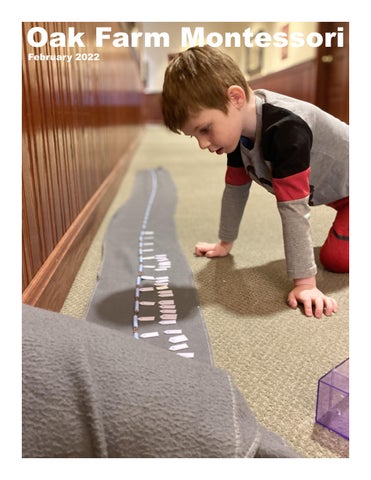
Oak Farm Montessori February 2022
Candice 2
HEAD OF SCHOOL
Do you remember the anticipation of turning double digits, sweet sixteen or twentyone? These milestones in age have been granted a certain rite of passage and responsibility by society. However, are we really more capable of driving, voting or drinking an alcoholic beverage just because of a date on the calendar? Maria Montessori studied the development of the child from development in the womb through adulthood. In doing so she realized that each stage of development is a rebirth, and while there is a distinct plane of development that occurs; each individual moves through these stages in their own time. Montessori saw the benefit in multi-age classrooms early on in her work. Younger children longed for new lessons and exploration, while older children exhibited mastery by practicing and teaching the lessons they had already learned. Unlike a traditional model where children are sorted by their age into classrooms, Montessori classrooms have a robust range of children who work collaboratively and independently throughout the day. As a third year in his lower elementary classroom, Jack loves to be a role model and resource to his first and second year friends. Not only is he gaining confidence in his own abilities through repetition, he is practicing empathy and leadership for his community. Next year, as he moves to the upper elementary building, he in turn will look up to the sixth year students as guides in his development. The three year cycle in each of our levels provides students with the opportunity to learn, practice and teach. If a child needs an extra year to master the curriculum or needs a more challenging work plan to meet their academic pursuits; our Montessori trained teachers are there to facilitate and guide them to meet their full potential. Our Moving Up meetings held in January and February are a great way to prepare your family for the next level and the exciting opportunities it brings. In this month’s newsletter, discover the many ways a multi-age classroom benefits the individual child and the community as a whole.
Reaping the benefits Bayley siewek, toddler 1 teacher
Montessori classrooms are diversified, multi-aged environments that meet the developmental needs of each child within a three-year cycle. There are many benefits as to why Montessori classrooms are structured in this way. One of these benefits is to instill safety and security in the environment. Teachers are able to get to know each individual child, and their families, during their work together in a three-year cycle; opposed to shuffling different children and families out each and every year. Multi-aged classrooms also allow educators to both meet and understand each student on a level tailored to their individual needs.
Children who are a part of a multi-age classroom for the entire three-year cycle, truly get the honor of moving from the role of an explorer and observer, hungry for more, before becoming a leader who continues to master and repeat a work time and time again. Younger children naturally look up to and emulate older peers; they are sponges to their environment. For older children in a multi-age classroom, the benefits are limitless. Maria Montessori believed that true growth and education begins at birth and continues on from there. This is another reason that Montessori classrooms are set up with multi-age dynamics even at the infant and toddler ages. Once a child continuously masters a work or material and is able to then demonstrate and lead a younger child in that work, it enables more confidence, patience, and empathy towards the younger child and the work itself. Older children model grace and courtesy towards the work, the environment, and one another. Another area that is heightened in a multi-age classroom is social skills. This sets the child up for success long after school years are complete as the workforce is also geared to mixed age groups. No work force has the same age of people working at one set time. There are people of all ages, from all different skill levels, brainstorming and working together. These are just a few of the many benefits of children being part of a multi-age classroom.
#supportourschool
4
Natural
BEAUTY
Tia Matney, Primary 1 Teacher
O
ne of the most beautiful things you will see in a Montessori classroom is the support and love the students offer to each other. Having mixed age groups in a Montessori classroom has many benefits. By combining multiple age groups into one classroom, the Montessori method creates a diverse environment. Each age represents a different phase of development, experiences and social/emotional maturity. These differences also affect every other ability of the child. Guides in the classroom learn to focus on the range of talents and abilities within the class as a whole; acknowledging that each child is an individual. When introducing a lesson on botany, the younger student may practice with learning the nomenclature, or naming, of the parts of a plant. Older students may do independent research about their favorite flower or plant and write about their discoveries. While as a whole classroom, they may dissect the parts of a flower at community time and offer an opportunity to share knowledge with peers. The wide range of learning opportunities presented in our classrooms meets the needs of each child at their individual ability in a meaningful way. The added beauty of the mixed age group is that students are always absorbed in learning; whether it is direct work they are practicing or indirectly by observing their peers or teachers. Montessori meets each child where they are and provides support to help them reach their full potential.
#supportourschool
6
You lead, I’ll follow. Ryan Gould & Kim Green P.E. Teachers
There are many benefits to having mixed-aged classrooms when it comes to Physical Education. We are able to work on skill development while, at the same time, teaching leadership and responsibility. Our students benefit from having older mentors who are leaders and can successfully model skills and behaviors. The younger students are able to follow the example provided to them and learn from classmates, as well as their teacher. Older students are able to sharpen their leadership skills and grow by being responsible. The PE classroom is set up to foster continuity and confidence by allowing students to learn and grow their skills within the three year window. For example, a 1st year student will have a very basic understanding of a game like kickball. They are trying to learn where the bases are, what to do after they kick the ball, and how to catch the ball if it is kicked to them. Our 3rd year students become “experts” on the basic rules and want to move on to higher level processes like keeping score and recording “outs”. Another added benefit to having mixed-aged PE classes is that our older students can be leaders. We are able to do station work, or at other times have multiple activities going on in the same class period. In those cases, our oldest students can lead or teach a station which allows for more individual needs to be met. It is very rewarding to watch the older students teach our younger students and help them become more confident along the way. #supportourschool
Valuable Lessons Abby Roughia, Lower 4 Teacher Imagine applying for a job and the only qualification is that you are 36 years old by June 1st. Can you imagine? Think of all of the wisdom, years of experience, and excitement for a new career the employer would be missing by applying such a constraint! Now, apply that same thinking to children and their “work environment”. There is a beautiful relaxation that comes with learning in a Montessori classroom. Each child learning at their own pace, within a threeyear time frame, gives the child permission for the occasional regression of a skill. Not to mention honoring the sensitive period of a child; the time when he or she has an intense interest in a particular content area. Teachers are able to follow those natural cycles a child 8
goes through without fear of the child “falling behind”. There are also times when the guide is able to see that a child needs to spend more time on social-emotional skills. The three-year span gives us wiggle room to allow the child the freedom to grow and develop according to their natural path. In a multi-age environment the younger children are inspired by the challenging work they see older students being able to do. They set goals about their own learning based on what they observe and look forward to the day that they will get those lessons as well. They also learn how to trust their older peers and recognize their wisdom is worthy of modeling. Since we are meeting the child right where they are, some are ready to receive
lessons that wouldn’t typically be given in that particular grade in a traditional environment. All the while, the older students are practicing patience as they teach the younger students all that they know. By teaching others, they are solidifying their learning, becoming mentors as well as strong leaders. These are skills that will serve them for the rest of their lives. Skills they will use as parents, in their workplaces, and within friendships. From the perspective of a guide, we can take a deep breath and trust that the children will get exactly to the place where they need to be by following the child. We learn to observe carefully and spring into action when readiness for any given topic is shown. We can also practice pausing while older children lead younger children in a lesson or figuring out a work they are struggling with. Older children bring an additional perspective that a younger child may not have thought of when learning a new lesson; a wise leader who nudges his friend toward success.
“We must all walk together on this path of life, for all things are part of the universe, and are connected with each other to form one whole unity.” – Maria Montessori
Relationships have time to blossom in a multi-age, three-year learning environment. Teachers have several years to get to know a child, REALLY know them. Their likes, dislikes, behaviors; all the things that make a child who they are. Additionally, the relationships that teachers can make with families over the course of three years can also strengthen the overall experience for the child. The depth of knowledge about one another is solidified and a deeper level of comfort and trust is present. Let’s get back to your imagination again, think of people at your job who started after you. Were you aware of their age? Did you teach them something? Maybe you even trained them on the job? Did they teach you something? I would imagine the answer to all of these is an undeniable, “Yes”. The truth is, each of us is valuable and brings a unique perspective to the table. We are ALL interconnected, and that truth holds the key to the value of a multi-age classroom. #supportourschool
Leaning i nt o l ead ership Courtney Pillars, UE 1 Teacher One of the elements that makes Montessori education stand apart is our mixed-age classrooms. This remains true in the upper elementary classroom. Our classroom environments encompass children spanning from nine to twelve years of age. The mixed-age group presents opportunities for models and leaders within the environment. Sixth year students are often found giving lessons to fifth or fourth year students upon request from their younger peers. We expect our sixth year students to really lean into their leadership skills in all areas of the day. This may mean reminding others where to find a specific work on the shelf or merely leading by example to make sure the community is healthy and thriving. Mixed-age classrooms in upper elementary foster skill progression fluidity. Learning is not linear for any of us. There are periods of rapid growth, periods of steady progress, and times spent in plateaus. This is normal and will vary across subject areas for individual children. In our classrooms, kids can work and progress at their own rates. These lines are further blurred when we don’t rely on typical grade levels. Having a mixed-age classroom also fosters strong relationships. When a student is in the same upper elementary class for three years, it allows us to really get to know them; not just as a learner, but as a person. The child-teacherparent team is already established and can work together on a deeper level and with greater understanding of strengths and goals with the support of having three years to work together. Mixed-age classrooms in upper elementary also provide enhanced social opportunities. Diversity is important on all levels, and that includes spending time with people of different ages. We have so much to learn from each other, and children gain all sorts of skills from their interactions in a mixed-age classroom such as empathy, patience, and open-mindedness. 10
#supportourschool
A Community of Learners:
All Creatures Great and Small!
Crystal Leu, MS Farm Manager
T
he middle school farm provides ample opportunities for all learners to develop new skills and knowledge from each other in very unique ways. Not only are we a learning community of mixed-age students, but they also interact with a variety of animals and the natural environment that also pushes their learning curve. As the farm manager I may be biased, but I think we have the perfect environment for everyone, from the youngest to the oldest, to learn and grow together! As a community of learners: teachers, students, and all creatures great and small, we problem solve real world challenges and learn together; each and everyday. Our students start the day working together in teams to complete the tasks necessary to keep our barn, greenhouse, and student run business operating as smoothly as possible. Erdkinder, which translates as 12
“children of the earth”, is a time when students can fall naturally into the roles of teacher and learner with their peers. Student Erdkinder teams are designed with intention to provide opportunities for our 8th year students to pass along their experience to the 7th year students who are new to the farm, but also provide opportunities to stretch their own learning. Work on daily tasks is often accompanied by demonstrations by one student to the other on how to effectively complete a task; from properly cleaning a pen, how to transplant a new seedling, or how to understand a spreadsheet in the microeconomy. The amount of knowledge and skills shared within the community during this time is endless! The mentoring continues during monthly farm pull-out days when students spend an extended Erdkinder with their team for the day. We focus on topics for their assigned
area and other needs around the farm that require longer time to complete than can be accomplished in the normal 30-45 minutes of daily Erdkinder. Often during this time, the peer learning becomes less one sided as students get to know each other and share their strengths and passions. The younger students begin to take on more responsibility and become equal partners in the work. During Erdkinder and farm pullout days there are also discussions related to the principles of the Cowboy Ethics Ten Principles to live by. Often our 8th year students take the lead in discussions on these principles and provide examples to help our 7th year students understand these life skills and how to apply them to their own lives. Many examples also require how to work well with each other on the projects they must complete academically. The mixing of age levels provides the chance to continue learning from each other; not just outside, but in the regular classroom as well. Our older students do a great job helping the new students navigate their way through the many changes they are experiencing as young adults; not just at a new level at school, but in their lives in general! A mixed-age classroom is an essential part of the sustainability and continuity of the learning culture at the middle school which allows our students to maintain a working farm, greenhouse and small business. Without the mentoring that occurs, we would always be starting over with each new group to teach necessary skills. But instead, our community is continually learning from each other and empowering the next level with the confidence to lead the learning in the future!
COWBOY ETHICS 10 principles to live by
1. Live each day with courage. 2. Take pride in your work. 3. Always finish what you start. 4. Do what has to be done. 5. Be tough, but fair. 6. When you make a promise, keep it. 7. Ride for the brand. 8. Talk less, and say more. 9. Remember that some things aren’t for sale. 10. Know where to draw the line.
#supportourschool
Presentations of Learning Amy Norton, HS English/Humanities Teacher
A
t Oak Farm Montessori High School we feel so lucky to have students who are at the third plane of development: Adolescence, 14-18 year olds. This is a critical period of development because students are constantly growing in higher-order thinking skills, peer relationships, and personal responsibility. They are searching for their place -figuring out their gifts, talents, and passions and how they will use these to change the world for the better. It truly is a blessing to be able to guide these students in their development at this stage. At Oak Farm Montessori High School, there are two presentations of learning that foster the students’ growth and exploration in this plane of development: the Passport of Learning and the Capstone Project. Both of these projects help students explore where they want to go in life through authentic, meaningful work. And both projects flourish because they are tackled in a multi-age school environment. 14
Benefits of Multi-Age At OFMHS, the freshmen and juniors have a close-up look at what the older students are doing for this authentic work-- and are inspired. As the sophomores and seniors work through the rigor and challenges of their projects, they serve as examples in academic, cognitive, emotional, and social skills growth. They build grit throughout the process and confidence in presenting their work. The younger students not only discover the passions of their older peers-they also observe perseverance throughout a project.They are there, at the sidelines, rooting for their older peers and growing in their own growth mindsets. Socrates said, “To know thyself is the beginning of wisdom.” OFMHS works hard to guide the students with this in mind. As the younger students begin the foundational work of their project journeys, they have a good big-picture-view of the purpose behind what they are doing because they are in a
multi-age class. For example, when a 9th year student is doing an AchieveWorks Personality assessment in Naviance, they will not only get to know themselves as unique humans, they will see the greater wisdom of being self-aware as they view their older peers’ Passport of Learning presentations. The older students will highlight how their own personality assessment relates to success in their work habits and productivity, communication, and is leading them toward career interests. The idea of competition is eliminated because the attention in our work is focused upon the diverse talents, passions, and abilities of these older students. We have witnessed them overcoming challenges and growing through their own effort. We have listened as they realized their own potential today and in the fourth plane of development --and we all celebrate that work as a community. Passport of Learning The Passport of Learning is a
formal presentation students give at the end of their 10th year. During 9th and 10th grades, students explore their talents and personality traits, name their areas of growth, and declare where their passions lie. They use the many tools offered in Naviance (the leading college, career, and life readiness platform) to discover their strengths, their aptitudes, and the career clusters that match their interests. They look at this in relation to their own work at school and develop a formal presentation of their learning which is presented to a broader school community audience as well as parents. Wesley Wolheter, a current Junior at OFMHS, states, “The Passport Presentation allowed me to look at my journey through Oak Farm and identify my growth. It allowed my parents to hear about what I
felt about my journey in my own words. ” Capstone Project The Capstone project builds upon the Passport of Learning. This project focuses on the student’s long-term commitment to a personal passion which capitalizes on what they have discovered about themselves in their Passport of Learning work. It is one aspect of Oak Farm Montessori High School where the students move outside the walls of the school and engage with the community. Students complete a self-directed, personal growth project with the assistance of at least two adult mentors of their choosing. It is real-world work where they find relevance and opportunities for growth. They begin with a project proposal, move into a literature review, sustain a
research methodologies inquiry and choose one to conduct in their own project, write a thesis, and present formally both within and beyond the OFMS community. Collaboration with adults in this work forges comfort and further confidence as these young adults graduate and move toward their chosen paths (whether that is career, post-secondary education, or enlistment). This year, our seniors are exploring ways to support foster families and using content analysis research to explore representation in children’s and young adult literature. Last year seniors explored food pathways and family history, the psychological effects of art education, depression in senior citizens in nursing home facilities,and the benefits of a youth advisory board on a nonprofit organization.
#supportourschool
Mark your Moving Up to Make up
Lower
calendars
Snow Day
Infants - High School in session
Mid-Winter Break Tall Oak Gala
School Closed
Preview Party
Infant / Toddler
Closed
February 10th, 2022 february 11th, 2022 february 14th, 2022 February 18th, 2022 february 25th, 2022
“To provide a Montessori environment that inspires children to reach their potential through meaningful work.”
Oak Farm Montessori School | 502 Lemper Road | Avilla, IN 46710 | 260.897.4270 | www.oakfarm.org