12 minute read
OpINION – ‘FOrmINg, StOrmINg, NOrmINg . . . ’

Falling on your FEEt
the local and the global: our curriculum should do both
martin thrupp thrupp@waikato.ac.nz
tHISCOLUmNISabout what I see as the significant responsibility of principals to influence the balance of the curriculum taught in schools. It seems almost audacious to write on this topic in the same week it is not hard to think of a that it is reported that teacher sick days are up 50 per cent on last year and that VARIETy OF CONTExTS the number of students missing from the nation’s schools has almost doubled in the past nine months. Many principals that will create headwinds for the ENACTMENT OF are in survival mode. But bear with me, as I think curriculum decisions are part THE NEw HISTORIES of the solution. Bringing the matter into sharp relief is CuRRICuLuM. the new Aotearoa New Zealand Histories curriculum launched back in March, the first effort of the Ministry of Education’s new curriculum centre, Te Poutāhū. It will shine some light on our country’s neglected colonising history and is a very worthy project. It’s also apparent the Ministry has done a really sterling job of consulting on the new curriculum as well as trialling it, producing resources, some PD and so on.
Still, there’s a big remaining problem, and it’s nicely summed up in the Ministry website link called ‘Implementation information for schools and kura’. You see, curriculum is like education policy, it is never simply implemented in the ways policymakers would wish for. Instead as it gets put into practice it goes through processes of translation and reinterpretation related to context. Academics refer to this as ‘enactment’.
It is not hard to think of a variety of contexts that will create headwinds for the enactment of the new histories curriculum. One is national politics. A change of Government will dampen political enthusiasm for the curriculum, especially if ACT, with its concerns about ‘ethno-nationalism’, becomes a coalition partner.
Community context will likely be a mixed bag. Depending on their ethnic and socio-economic makeup, and geographic location, some communities and sections of communities are likely to be far more pre-disposed towards learning about local histories than others. Some communities/sections of communities will most likely love it, some will resent the power issues raised, and some won’t see it as a priority.
The context of childhood and youth is a further issue. However worthy a topic, unless it has some appeal to young learners then teachers face an uphill battle. Try presenting young people with the United Nations Sustainable Development Goals and watch their eyes glaze over.
The context of teacher education, past and present is another problem. A skilled teacher can do a lot to make any topic palatable but teacher education programmes have become shorter and teachers are poorly prepared for social sciences teaching. Finally, even as the new histories curriculum got launched, we have had a barrage of calamitous global concerns to add to the pandemic this year. Russia invaded Ukraine, since then we have had China seeking more influence in our region, there is the threat of global recession and famine and the climate emergency becoming more obvious with heat waves, fires and floods in so many countries. ONE STOP SHOP! TWO POPULAR MATHS SERIES Give your students the best advantage to excel at maths. They use our textbooks, while you have all our free online teacher support.
YOUR STUDENTS DESERVE THIS!
mel@caxed.co.nz www.caxed.co.nz
The Challenger 1000
Portable PA system with stand and wireless microphone
For sports, Assembly, Jump Jam and performances.
Best sounding portable PA in New Zealand. Fully featured, top quality and easy to use. Includes a weather cover for outdoor use.
Built-in trolley and powerful rechargeable batteries so you can take it anywhere. $2495+gst for the wireless PA system
$2495 + gst
School Bells and Buzzers
Made in the USA
With the built-in remote scheduling function on the Netbell products, it is super easy to expand your timed alert and school bell system. • Control and program your bells easily from a PC • Simple to set up and program • Easily extendable • Free software is only needed to set up the schedule – doesn’t need a dedicated PC
Call Now 0800 433927 sales@edwardsnz.co.nz edwardsnz.co.nz
A recent headline from The Guardian says it all: We’re living in an age of permanent crisis – let’s stop planning for a ‘return to normal’. With global online platforms like Tik-Tok global issues often weigh just as heavily on children as local ones.
So what to do as a principal? I suggest sticking with a generous view of the school curriculum. Some features of such a view might be: ■ That as a selection of knowledge and ideas, the curriculum is always coloured by the national politics of the day which are important but may not always be in the best interests of the particular children in our care. ■ Yes, local consultation and discussion is important but there needs to be enthusiastic and worthwhile learning happening, that trumps everything else. So what will actually appeal to children – and teachers – and make them excited to come to school? ■ The Social Sciences curriculum goes wider than the
Aotearoa New Zealand Histories curriculum even if that is the new focus at the moment. Aspects of geography, politics and economics are all needed in order to make sense of the world. ■ That teachers should be encouraged to spend some time on global developments so that children have a chance to process the horrifying news they are being increasingly faced with. ■ Thinking of the local as a reflection of the global. For instance, when the statue of Captain John Hamilton was removed from the centre of Kirikiriroa in 2020, it was at the request of Waikato Tainui but also in the wake of the Black
Lives Matter movement which saw the defacing and toppling of statues of colonisers in other countries as well. ■ Recognising that there is a large New Zealand diaspora, presently around 15 per cent of the population, who live in other countries. Connecting the local with the global will benefit the many young Kiwis who will end up living overseas where our national preoccupations will often fade but will still resonate in some way in the countries to which they migrate. ■ Thinking of the local as a place to draw strength for the global. Hopefully the Aotearoa New Zealand Histories curriculum will highlight local examples of perseverance, forbearance, commitment, selflessness and the like, along with past injustices. ■ Thinking of the local as a way to respond to the global, for children to have agency. For instance, it seems clear that taking some local environmental action is a way to combat growing eco-anxiety, as it offers a chance to do something in our small corner of the world.
Overall, although time is always a constraint, it can’t be one or the other when it comes to the local and global in the curriculum. Schools really do have to address both in order to best prepare children for the lives ahead of them.
ForMing, StorMing, norMing . . .
HeLeN kINSey-wIgHtmAN
It wAS greAt watching our students having fun at their ball last week. It has been a long road back to some semblance of normality for this year’s Y13. Watching our Y13 Dean greeting students with genuine warmth saw me appreciating the relationships that are built within our school.
I was also really heartened to hear Chris Hipkins’ acknowledgement of school leaders work in supporting students through Covid in his address to the PPTA Conference. Talking about the conference on his Facebook page he says:
‘It was a great opportunity to thank some of our school leaders for the amazing work they’ve done keeping our education system going over the past two and a half years in exceptionally challenging circumstances. It was also an opportunity to talk about our education reform programme and to acknowledge that while schools and teachers have faced so much uncertainty it hasn’t always been the best time to progress big changes. Our government remains committed to ongoing improvement in education, but we also need to accept that right at the moment just getting through each day is a challenge for many and the pace of change needs to adapt to that. Education reform is something we should do with, rather than to, our educators.’ So, we are over halfway through the year – as I tick off 2 terms in my new job I have been reflecting on the work it takes to build a team and at times really missing the trust and ability to be vulnerable that existed in my previous leadership team. Building trust and effective working relationships in a new place takes time and now more than ever time is at a premium. On several occasions lately I have referred to the model of team development whose stages are most familiar to me and I’ve talked about forming, storming and norming. During the Term 2 break, as I reflected on the last 6 months I realised I have never read the theory and couldn’t name the theorist behind the model. A quick Google later and I have discovered that this model of team development was published in 1965 by psychologist Bruce Tuckman. In their study of the role of nurses in team leadership, Manges, Scott-Cawiezell & Ward i summarise Tuckman’s model and the behaviour required of a leader at each of the stages: ■ Forming is about setting the stage and requires coordinating behaviours i.e., Purposefully picking the team; Facilitating the team to identify goals; Ensuring the development of a shared mental model. ■ Storming is about resolving conflict and tension and requires coaching behaviours i.e., Acting as a resource person to the team; Developing mutual trust; Calming the work environment. ■ Norming and performing are about successfully implementing and sustaining projects that require empowering behaviours i.e., Getting feedback from staff;
Allowing for the transfer of leadership; Setting aside time for planning and engaging the team. ■ Outperforming and adjourning are about expanding initiative and integrating new members and require supporting behaviours i.e., Allowing for flexibility in team roles;
Assisting in the timing and selection of new members;
Creating future leadership opportunities. Whilst 6 months sounds a long time, 22 weeks doesn’t and given that our senior leadership team only meet together once a week for 2 hours, it should be no surprise that we are firmly situated within the storming stage. Since this stage is when ‘individuals start to push against the established boundaries and conflict, or friction can arise between team members as their true characters – and their preferred ways of working – surface and clash with other people’s.’ ii I find this a difficult place to be – being the only female on the team I have also been thinking about the role that gender plays too.
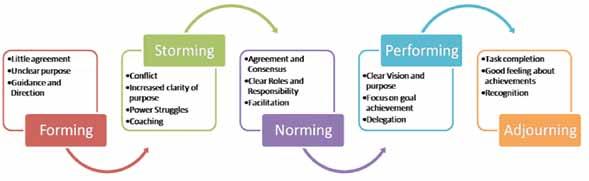
My main concern is how to accelerate the team through the storming stage and into norming and performing as quickly as possible. Thankfully, Tuckman does offer some strategies for this, he suggests that building interpersonal relationships and task activity to support effective group progression. Unfortunately, in education, time is always at a premium and the time needed to build whanaungatanga and manaakitanga within our team will necessarily require an investment of time, which will need to be carved out of other more apparently immediate concerns.
As I have thought about this, I know that this is the most pressing dilemma for all my colleagues whose primary role is teaching students. Yet, as with effective teambuilding, relationships also lie at the heart of all of the research-based initiatives that we are aiming to implement in the classroom. Positive Behaviour 4 Learning (PB4L) is relationship based; culturally responsive pedagogy is dependent on effective relationships; restorative practice is only possible where a relationship exists which can be restored and even curriculum initiatives require relationships – implementing Aotearoa NZ histories involves ‘growing productive and reciprocal partnerships for learning between our school and whānau, hapū, and iwi.’ iii
If you Google ‘short cuts to relationship building’ you will find business experts offering ‘10 remarkable habits to build rapport with anyone’ iv such as: smile with your eyes, use touch carefully, share something about yourself, mirror the other person, treat everyone with respect, reinforce trust with your body language, suspend your ego, flatter and praise, take your time to listen and get your subject talking and moving. Ultimately though, as Marie-Claire Ross says,
‘You can’t talk your way into trust, you have to behave your way into it . . . Taking the time to listen to others, show interest in them and following up your words with action is important.’ v When it feels like time is shorter than ever, spending it building quality relationships may be the most effective way to ensure we support our whole community to meet our goals.
reFereNCeS
i Manges, Kirstin; Scott-Cawiezell, Jill; Ward, Marcia M. (201701-01). ‘Maximizing Team Performance: The Critical Role of the
Nurse Leader’. Nursing Forum. 52 (1): 21–29. ii https://www.mindtools.com/pages/article/newLDR_86.htm iii https://assets.education.govt.nz/public/Documents/Aotearoa-
NZ-histories/ANZH_LLC_Guide1_2022.pdf iv 10 remarkable habits to instantly spark a relationship with anyone Peter Economy the business guy www.inc.com v https://www.marie-claireross.com/blog/how-to-build-strongerfaster-relationships-in-a-new-role
We teach people to save lives
In a Fun & InteractIve envIronment
• FASE “First Aid for the School Environment”
– 4Hr Basic First Aid Course for general teaching staff • 1 Day Workplace First Aid – 8hrs for designated
First Aiders and office staff • 2 Day Workplace First Aid – for Gateway/Star students. Units – 6400, 6401, 6402 • 2 Day Outdoor First Aid – for staff leading EOTC activities & Outdoor ed. students. Units – 6400 series & 424
nZQa cateGorY one ProvIDer For all aid course information please call email us on admin@first-training.co.nz or call us on 0800 1ST AID or 09 838 2110 www.first-training.co.nz
MAGAZINE
You can now access the current and past issues of NZ Principal magazine online

You can search by magazine issue, article name or author
visit www.nzprincipal.co.nz