O C TO B E R – N O V E M B E R 2 0 2 6
UPHOLDING A REPUTATION
Paul Olsen puts new stamp on established business PAGE 32
SELF-CERTIFICATION IS LIVE How opt-in endorsement works
THE BRAINS BEHIND DRAINS
Advances in drainage technologies
IS YOUR BUSINESS CYBER SMART?
PAGE 12
PAGE 58
PAGE 18
Protect what’s precious
A few words EDITOR
Volume 78, Number 5 MAGAZINE TEAM CEO Greg Wallace EDITOR Beverly Sellers 0272 923 923 bsellers@masterplumbers.org.nz PRINT Blue Star 33 Jackson Street, Petone, Wellington DESIGN SCG Senior Designer – Julian Pettitt SCG Senior Account Director – LauraGrace McFarland Designer – Tal Gerassi scg.net.nz SUBSCRIPTIONS NZ Plumber is published six times a year by Master Plumbers, Gasfitters & Drainlayers NZ. Members receive all six editions. If you wish to opt out, please email admin@masterplumbers.org.nz To order an annual subscription, go to www.masterplumbers.org.nz MAILING LIST For enquiries, or to update your details: admin@masterplumbers.org.nz Non-Master Plumbers’ members with address detail changes should notify the PGD Board direct, giving their registration number: registration@pgdb.co.nz TO ADVERTISE advertising@masterplumbers.org.nz
NZ Plumber is the official magazine of Master Plumbers, Gasfitters & Drainlayers NZ Inc. Contact details for the Master Plumbers board, staff, branches and associations are available at www.masterplumbers.org.nz ©NZ Plumber 2013. Registered as a Newspaper, GPO, Wellington, ISSN 0111-4379. NZ Plumber is subject to copyright in its entirety. The contents may not be reproduced in any form, either in whole or in part, without written permission of the publisher. All rights reserved in material accepted for publication, unless initially specified otherwise. All letters and other material forwarded to the magazine will be assumed intended for publication unless clearly labelled ‘Not for Publication’. Views expressed in articles in NZ Plumber magazine are not necessarily those of Master Plumbers, Gasfitters & Drainlayers NZ Inc, or of the Editor. While every effort has been made to ensure the accuracy of the information included in this publication, the publisher and the Editor take no responsibility for errors or omissions or for any consequences of reliance on this information. Publication of advertising material implies no endorsement of either a product or service.
An industry milestone
Gasfitters can self-certify, electricians can self-certify... and finally plumbers and drainlayers can too. It’s been a long time in the making, with a huge amount of advocacy work by Master Plumbers behind the scenes, and now the new opt-in self-certification scheme for certifying plumbers and drainlayers is open for applications. This edition’s feature article takes a look at how the new system works, what work is eligible, and how to apply for an endorsement to self-certify. Turn to page 12 for the lowdown. With New Zealand’s Cyber Smart week running in October, this is a great time to remind plumbing businesses of the most common cyber threats, how to avoid an attack, and what to do if you think a scammer has caught you out. As AI developments increase the frequency and sophistication of cyber fraud, make sure you’re protecting what matters most in your business. Read more on page 18. We’ve had feedback from drainlaying businesses that you’d like to see more dedicated drainage articles in the
magazine... and we’ve listened. Turn to page 58 for an overview of technological advances in the sector and there’ll be more content to follow. For the gasfitting readers among you, we provide a round-up of gas industry developments on page 50, including a new gas consumer campaign and work well underway for a second biomethane production plant for New Zealand. Biomethane is among the opportunities for New Zealand’s renewable energy future. Rooftop solar combined with heat pump water heating is another and it is already being embraced by plumbing businesses, as our project article on page 46 shows.
Beverly Sellers Editor, NZ Plumber bsellers@masterplumbers.org.nz
This publication uses vegetable based inks and environmentally responsible paper produced from Forest Stewardship Council® (FSC®) certified, Mixed Source pulp from Responsible Sources.
Paper produced using Elemental Chlorine Free (ECF) and manufactured under the strict ISO14001 Environmental Management System.
nzplumber
01
CONTENTS O CTO B E R- N OV E M B E R 2 02 6
12
ON THE TOOLS
45 46
45
Raising asbestos awareness Electrician Andrew Winder’s personal mission
Milking the savings Two dairy farm projects that combine rooftop solar with hot water heat pumps
TECHNICAL THEME:
GAS FUTURES
48
7
12
WHAT’S UP
FEATURES
7
12
Lead-free compliance The plumber’s responsibility
8
Updates Changes to granny flat exemptions and new gas standards in force this November
10 11
18
Protecting what’s precious 5 scams to look out for and how to react
MASTER PLUMBERS
25 02
How plumbers and drainlayers can apply to opt in
We
Training & events for the remainder of 2026
nzplumber
32
25
Member benefit Take the Business Profitability Check
Bulletin Introducing new independent board member Peter Kelly
ON THE COVER
37
Platinum Partner profile
38
A day with the CEO
41
50
Loyalty & leadership Paul Olsen’s journey to ownership of Whitehead Plumbing & Gas
Self certification goes live
Helping hands around NZ
Calendar
26
Why detailed design considerations matter at Nero
What Profile Plumbing gained from their day with Master Plumbers CEO Greg Wallace
52 56
GasNZ CEO Jeffrey Clarke on the current state of play for the gas industry
Gas lines News updates in brief from gas gentailers, suppliers and distributors
Positioned for the future A tour of Kohler’s new Auckland headquarters
The pressure vessel Small addition, big difference
58
The brains behind our drains
66
Products & services
Masterlink news Tips on keeping hold of good people
Gas industry futures
How technology is transforming the drainage industry
What’s new to market in the PGD sector
BUSINESS SMARTS
73 74 76 77 78
78
73
Steady as she goes Building sector report shows steady pipeline of project work
Reach out About the MATES helpline and services
90 days isn’t forever The importance of understanding how the 90-day trial works
Forgot to mention... Why a near miss should always be reported
CAREER STARTERS
81
81
Hitting his groove Meet adult apprentice and ARG member Nathan Giddens
82
Solutions focused
84
Next steps for NEXA
86
Building leaders
Plumbing World Scholarship winner Eric Gruythuysen loves a puzzle solved
AND FINALLY...
90 92
90
10 minutes with... Drainlayer and NZ Darts #1 Ben Robb
Dodgy plumbing Under sinks, under decks, underground
92
Significant progress for the new industry-led training academy
Masterlink apprentices return from their Outward Bound course
Public health wait lists Discover the increasingly popular solution to this employer’s problem
86
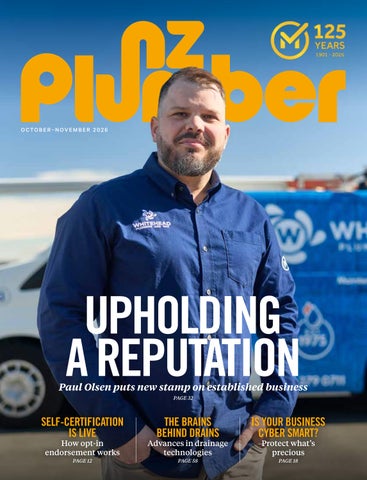
ON THE COVER Paul Olsen has been at the helm of Whitehead Plumbing & Gas in Christchurch for nearly two years, having come through the company as an apprentice under Mark Whitehead 21 years ago. With a core group of eight around him for valued support, Paul is investing in the business with an updated brand, technology, equipment and systems to ensure the team are well supported, and the company is positioned for future growth.
This magazine is subject to NZ Media Council procedures. A complaint must first be directed in writing, within one month of publication, to the editor’s email address. If not satisfied with the response, the complaint may be referred to the Media Council PO Box 10-879, The Terrace, Wellington 6143; info@mediacouncil.org.nz. Or use the online complaint form at www.mediacouncil.org.nz Please include copies of the article and all correspondence with the publication.
Scan to read NZ Plumber online!
Turn to page 32 to read about Paul’s journey to company ownership. Cover photograph: Dean Mackenzie
nzplumber
03
Report CEO
CEO’S REPORT
After nearly 10 years of advocacy—and, at times, frustration—we’re very pleased that New Zealand finally has a self-certification scheme for plumbers and drainlayers. Over the past month, I’ve spoken to many members wanting clarity on the scheme, and I would say there’s a fair bit of misunderstanding about how it works. Firstly, Certifying Plumbers and Drainlayers have always been liable for the work they do, whether or not the job is inspected by the council. Liability does not, and never has, sat with the council. Secondly, as a Certifying Plumber or Drainlayer, you must apply as an individual for an endorsement to self-certify. However, your insurance will be linked to the company you work for. Thirdly, the process isn’t hard. It requires an application, a declaration of insurance, relevant online training, and proof that you have a quality assurance programme in place. Over the years, I’ve heard many complaints about how inspections are carried out by builders or non-qualified tradespeople with limited knowledge of plumbing and drainage. As I’ve said many times before, our trades should ultimately take responsibility for the work they complete. Gas self-certification has been in place since 2013. The electrical industry has been self-certifying for decades, most of Australia self-certifies—and, when it comes to most renovations and repair work, plumbers and drainlayers already self-certify. We know self-certification reduces delays, increases productivity, and provides better outcomes for the industry. So, we hope that uptake of this scheme will be significant. I also want to address the elephant in the room, which is the fees. Master
04
nzplumber
Plumbers has strongly advocated for a lower fee structure, but the opt-in nature of the scheme has added some complexity. Whilst we don’t agree with the current fee structure, we hope the PGDB will complete a review once the scheme has had time to bed in and will adjust the fees in future. Remember, too, that councils currently charge for each plumbing and drainage inspection. This cost will be removed by the new regime, so there will be savings over the three-year self-certification endorsement period. With a new
We know self-certification reduces delays, increases productivity, and provides better outcomes for the industry.
residential build usually requiring four plumbing inspections, the cost reduction should be between $920 and $1,000. However, it’s not just about the financial benefit. There are also productivity gains. We’ve had reports of inspection wait times between three to 10 days, which leads to lost time and earnings—not to mention stress. One member who does a lot of drainage told me he has sleepless nights in the middle of winter when he hears the rain on the roof, worrying the pipes he’s worked on are floating away because he hasn’t been able to backfill them. I would like to think members will back their own and their team’s workmanship by applying to self-certify. The efficiencies,
financial savings and productivity gains should be assessed as part of the benefits of opting into the scheme. On a different note, I want to address the lead-free requirements that came into effect this May. It’s very clear there are still some rogue suppliers selling non lead-free products. I am pleased to see the PGDB backing the science and reminding practitioners of their responsibility to ensure the safety of the water New Zealanders drink. Licensed practitioners are aware that the products they install must comply with the Building Code. The new lead-free regime is just an addition to this. It’s very frustrating that reputable suppliers and merchants have proactively complied, and are ensuring their customers do the same, while some others are more focused on profit than public health and safety. Unfortunately, it will probably take a licensed practitioner to be prosecuted for the whole industry to take note that it is the practitioner’s responsibility to comply with the Building Code when installing products in contact with drinking water, whether that be water pipes, tapware or hot water. Finally, New Zealand’s general election is on 7 November. In the previous edition, we highlighted key political party views on issues for the building and construction industry. No matter what your political persuasion, I encourage you to have your say and get out and vote. Master Plumbers awaits the outcome with confidence that we can work constructively with whatever government is formed. Greg Wallace, CEO Master Plumbers, Gasfitters & Drainlayers NZ
AMERICAN STANDARD EXCLUSIVELY DISTRIBUTED IN NEW ZEALAND BY NERO TAPWARE With over 150 years of bathroom expertise, American Standard delivers trusted performance, practical innovation and lasting quality — now backed by Nero’s local sales, service and support.
INDUSTRY NEWS Before installing a product, check that it meets lead-free requirements.
THE PLUMBER’S RESPONSIBILITY
What’s up
LEAD-FREE COMPLIANCE
Plumbers should be satisfied the products they install that come in contact with drinking water are compliant and lead free. If you cannot confirm that, do not install them. WORDS: PLUMBERS, GASFITTERS & DRAINLAYERS BOARD
The purpose of the Plumbers, Gasfitters, and Drainlayers Act 2006 is to protect the health and safety of the public by ensuring that people who carry out sanitary plumbing are competent to do so. For plumbers, that responsibility is not only about how work is installed but also making sound decisions about the products being installed in drinking water systems. From 2 May 2026, G12/AS1 Amendment 14 introduced lead free requirements for copper alloy plumbing products used in contact with drinking water. Under this compliance pathway, those products must have a weighted average lead content of no more than 0.25% (0.25% is deemed to be lead free). The Board is aware that some resellers may still be selling leaded products. The fact that a product is available for sale does not necessarily mean it complies with the recent changes. Plumbers should ensure that the
products they install are compliant before installation. Safe drinking water depends on the complete plumbing system. That includes the pipework, fittings, valves, taps, mixers and other products that water passes through before it reaches the consumer. A plumber cannot reasonably meet their public health responsibility if they install a product without being satisfied that it is suitable and compliant for use with drinking water. Before installing a product, check the product information, certification and markings to make sure there is appropriate evidence that it meets the lead-free requirements. Do not assume a product is compliant simply because it is available from a merchant, appears in a catalogue, or has been supplied by someone else on the job. If you cannot confirm that a product in contact with drinking water is compliant and lead free, do not install it. nzplumber
07
RECENT CHANGES TO GRANNY FLAT EXEMPTIONS, A NEW PRE-QUALIFICATION TEMPLATE FOR SMALLER CONTRACTORS, AND THE NEW GAS INSTALLATION STANDARDS IN EFFECT FROM NOVEMBER.
NEW PRE-QUALIFICATION TEMPLATE TO HELP SMALL BUSINESSES WorkSafe has created a new prequalification template designed to make it easier for construction businesses to be brought on to jobs. The template can be used by small businesses and sole traders to gather and present information about their health and safety practices. It has been created in response to frustration about a lack of consistency and duplication within New Zealand’s prequalification systems. Businesses can be asked to get a new prequalification for every job they tender for, with differing requirements for each. They can also be asked for the same information multiple times, for the same job. WorkSafe New Zealand has released a position statement alongside the template to clarify expectations around the use of pre-qualifications and support a more consistent approach. The template should be used alongside the position statement.
FORM
Risk-based health and safety pre-qualification information About pre-qualification Pre-qualification helps hiring businesses check, before work starts, whether a contractor can manage its health and safety risks. WorkSafe New Zealand expects hirers to ask contractors about their work health and safety as part of good practice. However, pre-qualification is not compulsory. Pre-qualification can be done in various ways, including through conversations. Reasonable evidence for how you manage risks should depend on the size and complexity of the work, the degree of risk involved, and the potential for harm. Pre-qualification is only one part of contractor management and should sit alongside consultation, coordination, onboarding or induction, supervision and other on-the-job due diligence.
Using this template This template is not a checklist. The template covers core topics that are common in pre-qualification. It aims to help small businesses tendering for work think about and bring together examples of their health and safety practices. This can help make pre-qualification conversations easier. While the questions below are not a checklist, they can help you get started. If you do not have formal records or documents for an area of pre-qualification, consider how else you could describe or show your health and safety planning and practices. Can you give real examples? Can a referee confirm that, and how it went? Do you have photos, emails or other types of information that backs up what you describe? This template supports WorkSafe’s position on pre-qualification: The work health and safety information needed before hiring contractors. WorkSafe does not manage how this template is used or see any user details.
Common health and safety topics for pre-qualification
1. Business information Give a summary of your business size and the experience you have that relates to the work that you’re prequalifying for:
2. Key personnel Name of person responsible for your health and safety:
Health and safety qualifications and experience of nominated person:
What are the main health risks and safety risks for the types of work you do: (reference these when relevant in the information you
Key worker roles on the project: (or for the services you provide)
provide on the following topics)
Health and safety qualifications and experience of your workers in those key roles:
3. Sub-contractors References For similar work. 1.
Name:
Will you use sub-contractors for this project: If no, skip to part 4
Yes
No
Which tasks will they carry out:
Contact number: 2. Name: Contact number:
How do you assess their ability to do the work: (such as qualifications and training)
Find the template and position statement at www.worksafe.govt.nz/managing-health-andsafety/getting-started/understanding-the-law/ overlapping-duties
WSNZ_5093_Jul 26
3. Name: Contact number:
worksafe.govt.nz 0800 030 040
Changes to granny flat building consent exemptions Changes to the granny flat building consent exemption came into effect on 8 October that make it easier to use existing water supply, wastewater and stormwater services. If the property is already connected to a council or other utility provider, you may be able to use or modify those connections for a granny flat. A building consent isn’t required to make these changes, but you must get the agreement of the utility provider and any approvals required. If the property uses on-site systems, such as rainwater, wastewater treatment or stormwater disposal systems, you may be able to continue using them or upgrade them for the granny flat.
08
nzplumber
The systems must have enough capacity and comply with the Building Code. If council or other utility services are not available, or cannot support an additional connection, you may be able to install a new on-site system for the granny flat. The changes also allow more building products to be used. Granny flats can be built using certified composite structural building products. This includes some Structural Insulated Panel (SIP) systems and solid timber building systems. The building product must be used: within the scope and limitations of its registered product certificate (CodeMark) in accordance with the manufacturer’s instructions, to ensure it complies with the Building Code.
Updated guidance and other supporting resources are available on the Building Performance website at www.building.govt.nz. Contact building@mbie.govt.nz if you have any questions.
1/3
What’s up INDUSTRY NEWS
GUIDELINES
STANDARDS SPOTLIGHT
These standards are cited in the Gas (Safety and Measurement) Amendment Regulations 2025. You must choose one version of AS/NZS 5601.1 and stick to this for the whole installation, or part installation, that you are carrying out. You can’t switch between the two for the work. The unamended version of AS/NZS 5601.1 2013 can still be used for the repair and maintenance of an existing installation. However, if the repair includes any alterations or additions, it must comply with one of the cited standards listed above.
Gas certification example When completing gas certificates, you should state which version of AS/NZS 5601 you are certifying the work to. For example: Description of gasfitting work: Run new gas supply using 32mm PEX multilayer pipe and 20mm copper pipe from 2 x 45kg LPG cylinders. Pipe run as per diagram is low level external mounted on east wall of the house and is UV protected etc. The work has been done in accordance with means of compliance: AS/NZS 5601.1.2013, including Amendments 1, 2, 3 and 4. Note: This is because the 2022 version doesn’t allow multilayer pipe above ground external to a building.
Key changes Key changes from the unamended AS/NZ 5601.1: 2013 and AS/NZS 5601.2 2013 standards include: Allowance for a jointing compound to be applied to the face of a copper flare, olive, and galvanised steel mac union. This jointing compound can still not be used to compensate for ill-fitting joints. In all cases, if you choose to apply jointing compound, it must be a proper jointing compound that is non-setting. A new requirement for a regulator to be fitted to an endorsed appliance as well as a certified appliance. Mobile commercial catering equipment installations (ie, food trucks) should now use Part 1 of the standard. New normative appendix R for spillage testing of combustion products. New informative appendix O for gas appliance commissioning. New informative appendix Q, comprising a gas installation checklist. Multilayer gas pipe can still be installed outside and protected from UV under the amended AS/NZS 5601.1 2013. It cannot be installed outside under the 2022 version. The 2022 version also contains fire emergency isolation provisions for multilayer pipe. Domestic cooking appliance clearance to a downward facing combustible surface (eg, rangehood) is now 650mm from the supporting surface of the cooking vessels (was 600mm from the highest part of the burner). If replacing an existing installation and cooking appliance, the rangehood can remain at 600mm.
GOOD
From 13 November 2026, gasfitters must use only gas installation standards: AS/NZS 5601.2 2020, including Amendments 1 and 2 AS/NZS 5601.1 2022, including Amendments 1 and 2 OR AS/NZS 5601.1 2013, including Amendments 1, 2, 3 and 4
PRACTICE
Changes to AS/NZS 5601 in effect from 13 November
Working at height in New Zealand GOOD PRACTICE GUIDELINES FOR MANAGING THE RISKS FROM WORKING AT HEIGHT August 2026
WORKING AT HEIGHT GUIDANCE UPDATED AND WORKPLACE ASSESSMENTS UNDERWAY WorkSafe has updated its best practice guidance on working safely at height. The new guidance adds current WorkSafe notification and notifiable-event requirements, and introduces examples around risk management, safety decking, worker engagement, competency, and contemporary control expectations. The updated guidance makes it clear that preventing falls should be actively managed. Businesses must identify where people could fall and use suitable controls, such as edge protection, scaffolding, safe access, and equipment appropriate for the task. WorkSafe is also reminding construction businesses that a prohibition notice means work must stop, after an Auckland company was recently sentenced and fined for allowing workers to work at height while a notice was in place. “Working at height cannot be treated as business-as-usual until something goes wrong. Businesses need to plan the work, involve workers, put the right controls in place, and make sure they stay in place for as long as the risk exists,” says WorkSafe Area Manager Parani Wiki. Health and safety inspectors will be doing workplace assessments focusing on how the risk of falls from working at height is being managed at residential building sites between October and December. Find the updated guidance at www. worksafe.govt.nz/topic-and-industry/ working-at-height/working-at-height-in-nz
nzplumber
09
What’s up INDUSTRY NEWS
Helping hands around New Zealand.
Zenith Water New Zealand’s team spent time at Harbour View Beach Reserve during Plastic Free July, helping care for an important bird habitat on Auckland Harbour. What stood out wasn’t how much rubbish was collected, but how little visible plastic pollution was found, says Country Manager Daniel Cuthbert. “This was an encouraging reminder that community awareness, refill habits, clean-up initiatives and thousands of small everyday actions are making a difference. There is still work to do, but moments like this remind us that when communities care, progress follows.”
Kemp House, New Zealand’s oldest building, is getting a roof makeover. The 204-year old Kerikeri house was built in 1822 from native timbers by missionary carpenters and Māori sawyers for Reverend John Butler, with the Kemp family moving in around 10 years later. The shingles were on their last legs but the wooden structure beneath, including the 10
nzplumber
Inspire Plumbing and Drainage in Porirua is among the sponsors of The Whitireia Foundation Scholarships, which provide financial assistance towards tuition fees for domestic students planning to study with Whitireia and WelTec. This year, Inspire Plumbing and Drainage sponsored a $5,000 scholarship for Nkechika Azolukwam, who is in the third and final year of completing her Bachelor of Nursing at Whitireia. The Whitireia Foundation has supported students since 1999, and in 2026 is awarding more than $100,000 in scholarships across more than 40 recipients. “We’re proud to be one of the sponsors helping make that happen,” says the company.
original kauri beams, are in incredibly good condition for their age, says Heritage New Zealand. Henwood Construction of Kerikeri is leading the re-roofing project, which began by covering the house with a protective waterproof membrane. Heritage New Zealand hopes to reveal the new roof in time for summer and has turned to the public for financial support.
“Unanticipated price hikes in the cost of materials caused by rising fuel prices have stretched the budget for this project to the limit,” says project supervisor Boris Bogdanovich. “Every little bit of support from Kiwis really helps, and we’re so grateful to all those people who have already donated.” People wanting to support the project can go to www.heritage.org.nz/donate
What’s up CALENDAR
TRAINING & EVENTS Activities during the rest of the year... and beyond.
Hutt Valley/Wairarapa Master Plumbers Coastguard Charity Auction Dinner 30 OCT – UPPER HUTT
2026 Volcanic Plateau Master Plumbers Awards 30 OCT – TAUPŌ www.masterplumbers.org.nz/events
www.masterplumbers.org.nz/events
Wellington Master Plumbers AGM
Backflow Prevention Course
3 NOV – WELLINGTON
9 NOV – LOWER HUTT
www.masterplumbers.org.nz/events
www.masterplumbers.org.nz/training
SAVE THE DATE!
2027 New Zealand Plumbing Conference
Wellington Master Plumbers Kids’ Christmas Party
5-7 MAY 2027 – CHRISTCHURCH
28 NOV – WELLINGTON
Registration opens this November!
www.masterplumbers.org.nz/events
For all upcoming Master Plumbers training and events, go to www.masterplumbers.org.nz/events nzplumber
11
Certifying Plumbers and Certifying Drainlayers can now opt to apply for a three-year self-certification endorsement to sign off eligible work without the need for a council inspection.
12
nzplumber
Feature SELF-CERTIFICATION
The new self-certification scheme for plumbers and drainlayers launched on 7 September, and practitioners can now opt to apply for an endorsement to sign off eligible work. NZ Plumber provides a lowdown on how the scheme operates.
nzplumber
13
U
nder the scheme, which is regulated by the Plumbers, Gasfitters, and Drainlayers Board (PGDB), Certifying Plumbers and Certifying Drainlayers can choose to apply for a three-year self-certification endorsement to sign off eligible work without the need for a council inspection.
How to apply for endorsement Self-certification is not automatically applied to your licence. You must obtain a self-certification endorsement before you can self-certify work. To apply, you must: Hold a current Certifying Plumber or Certifying Drainlayer licence Complete the PGDB’s online selfcertification training—takes around 2 hours Have appropriate insurance Have appropriate business recordkeeping and quality assurance systems Pay the application fee and audit levy of $2,260. This covers the full threeyear endorsement period (ie, around $753 per year).
How the fee and audit levy are used The fee and audit levy fund the systems and oversight needed to run the scheme, including processing applications, maintaining the register and online systems, providing practitioner support, and carrying out monitoring and audits.
A consent may include work that can be selfcertified and work that must be inspected, so checking the consent is crucial before work starts. Because this is a new scheme, the PGDB says it does not yet know how many practitioners will choose to join. The fee and audit levy has been based on best available estimates of uptake, certification volumes, audit activity, and operating costs. The PGDB will review the fee and levy to ensure it’s set at the right level as it monitors participation levels and scheme operating costs.
What work can be self-certified The self-certification scheme only applies to certain eligible plumbing and drainlaying work: on residential and commercial buildings up to three storeys (except apartment blocks)
14
nzplumber
designed to an Acceptable Solution or Verification Method for on-site systems—these can be selfcertified using a different compliance method if no Acceptable Solution or Verification Method exists. An on-site system includes systems for circulating, disposing of, storing, supplying, pumping or re-using water, as well as irrigation. All plumbing and drainlaying work must still comply with the Building Code.
If people under your supervision are carrying out self-certifiable plumbing or drainage work, you must personally inspect the work to certify it.
Check the consent before starting work Architects, designers, builders and property owners can now apply for building consents that allow for eligible plumbing and drainlaying work to be self-certified instead of inspected. Building consent authorities (BCAs) ultimately make the decision about whether work can be self-certified, but plumbers and drainlayers should know what work can’t be self-certified. This includes work in firewalls, common walls, apartments, and any building over three storeys. Make sure you always see the building consent, so you know if the work can be self-certified. A consent may include a combination of work that can be selfcertified and work that must be inspected, so checking the consent is crucial before work starts.
Certifier responsibilities & certificates of compliance If you self-certify, you take on clear responsibilities: ensuring the work meets all relevant Building Code requirements, as well as certifying it complies with the building consent only eligible work can be self-certified completing and submitting the required documents to support a certificate of compliance keeping proper records of work, decisions, and statements around those decisions. If you self-certify work, you take on personal responsibility for its compliance with the building consent. You are liable for the work that you sign off. If you have people working under your supervision carrying out self-certifiable plumbing or drainlaying work, you must personally inspect the work to certify it. You can’t rely on photos, videos, or test results from your supervisees. You must issue a certificate of compliance confirming the work complies with the
building consent to the BCA, PGDB and property owner within 10 business days of completing the work. This is a legal requirement, and you cannot withhold the certificate for any reason. You must also keep your own copies of certificates of compliance. Don’t rely solely on the PGDB’s self-certification register. Certificates of compliance must use the PGDB’s prescribed form. Supporting documents must include: Photos of the work
Feature SELF-CERTIFICATION
Test details and results (for example, pressure or flood tests) ‘As-built’ plans if the work differs from the building consent (or an explanation of the differences). Certificates of compliance replace the need for the BCA to inspect the work and will be used by the BCA as part of the code compliance certificate process. Standard inspections apply if an amendment or minor variation causes work to fall outside the scope of self-certification.
Artisan app & self-certification register Once you have completed the endorsement application process, you will gain access to the self-certification register, where you can create and manage your inspection projects. The register works in tandem with the Artisan digital inspection app, which can be downloaded free from the Apple App Store or Google Play. Before using Artisan for on-site inspections, you need to link your
registered Artisan account with the selfcertification register. Once completed, you will be able to view your inspection records dashboard, with details of all your draft, in-progress and completed inspection projects. Artisan enables you to capture the necessary inspection evidence via photographs, notes, comments or PDF document uploads. Step-by-step guidance on how to use the app and register are available at www.pgdb.co.nz
nzplumber
15
Audits of self-certified work The PGDB will carry out audits of selfcertified work records. Audits will check your endorsement to self-certify, your work records, certificates of compliance issued, and your supporting decision making. The eligibility of the self-certified work will also be checked along with compliance with the building consent and building code. Audits are set in legislation to give confidence the scheme is operating as it should, and public health and safety is protected. Practitioners will be notified in advance of an audit, with information on how to prepare. Good record keeping will ensure a straightforward audit process. Where gaps are identified, the PGDB will work with you to resolve them.
Professional Indemnity insurance provides protection for anyone who signs off work.
Public register of endorsed practitioners Customers can choose how eligible work is signed off. They can use an endorsed plumber or drainlayer to self-certify their work, or have it inspected by a BCA. Consumers are being advised by the PGDB to: Check the PGDB’s public register to see if a plumber or drainlayer is endorsed to self-certify work Ask the plumber or drainlayer if they hold civil liability insurance On the building consent application, list the work to be self-certified and the name and registration number of the selfcertifying plumber or drainlayer, if known Let the BCA know the name and number of the self-certifying plumber or drainlayer Keep the certificate of compliance and supporting documents supplied by the plumber or drainlayer Make sure this certificate is included in the application for a code compliance certificate.
Certifying Plumbers and Drainlayers can apply for a three-year selfcertification endorsement in the Trade Login of the Plumbers, Gasfitters, and Drainlayers Board (PGDB) website: www.pgdb.co.nz The website also has guidance materials and videos to help you become familiar with the new selfcertification scheme. If you have any queries, you can contact the PGDB using their dedicated self-certification email address: self-cert@pgdb.co.nz
16
nzplumber
APPROPRIATE INSURANCE IS A
REQUIREMENT
To be able to become endorsed to self-certify, Certifying Plumbers and Drainlayers must hold appropriate insurance. With your increased responsibilities and exposure, Professional Indemnity (PI) insurance is essential. PI insurance protects you when an error in your professional services results in a
financial loss for a client. This could be an error in design work, calculations, technical advice or system specification. Insurance broker Gallagher remind practitioners that PI provides protection for anyone who designs a system, signs off work, gives advice, or offers specialist expertise—it’s not just for big commercial firms or complex projects.
Gallagher is the preferred insurance broker for Master Plumbers. For more information on how Professional Indemnity Insurance can support your business, members can email masterplumbers@ajg.co.nz
Feature SELF-CERTIFICATION
Building and Construction Minister Simon Watts acknowledged the efforts of Master Plumbers in his self-certification launch announcement in September.
POSITIVE OUTCOME AFTER YEARS OF ADVOCACY
Master Plumbers has welcomed the launch of the selfcertification scheme for Certifying Plumbers and Drainlayers. Chief Executive Greg Wallace says the new regime represents nearly 10 years of advocacy and brings plumbing and drainlaying more closely into line with gasfitting, which has operated under a self-certification model for more than a decade. “The scheme is a practical, common-sense reform that recognises the skills and professional responsibility of qualified tradespeople,” says Greg Wallace.” It will reduce unnecessary delays and costs while maintaining accountability and safety. “This outcome was achieved thanks to a strong partnership between industry and Government. We look forward to continuing this relationship with Building and Construction Minister Simon Watts, who we were delighted to host at Jason Brown Plumbing & Gas in Wellington in September to mark the rollout of the self-certification scheme.” Master Plumbers will work closely with the industry and the PGDB as the scheme beds in to ensure it is well implemented. The benefits of self-certification will extend well beyond the plumbing and drainlaying sector, says Greg. “Last year around 36,000 homes were consented in New Zealand, and most required plumbing or drainlaying work. This reform means fewer bottlenecks, less time waiting on inspections, and more efficient delivery of housing and infrastructure projects.”
Cover that stands behind your work Today’s plumbing work includes design, advice and specifications, and that means more risk. As the industry moves towards self-certification, professional responsibility and accountability are becoming even more important. Professional Indemnity insurance covers you when advice, design work, specifications or certification-related decisions lead to financial loss.
Connect with us 0800 866 766 | masterplumbers@ajg.co.nz
Scammers want to get access to your money and precious data, so do what you can to keep it safe.
PROTECT WHAT’S
PRECIOUS
Every day in New Zealand, trades businesses face risks to their cashflow, reputation and business continuity through cyber fraud—and AI is seeing attacks increase in frequency and sophistication. Here are 5 scams to be on the lookout for, plus what to do if you think you’ve been targeted. 18
nzplumber
Feature CYBER SAFETY
M
ore than half of New Zealand’s small to medium businesses have been exposed to a cyber threat, according to 2025 research commissioned by the National Cyber Security Centre (NCSC)—with scam calls, phishing and impersonation scams the main contributors. This is up 17% on the previous year, as threats increase in frequency and sophistication. AI is making cyber threats faster, more scalable and harder to spot. Cyber criminals can use it to create convincing scams, impersonate trusted people and organisations, and personalise attacks using information found online. For business, that means your people are increasingly likely to encounter threats that look and sound legitimate. An email might look right. A voice might sound right. A request might appear to come from a colleague, supplier or senior leader. Helping your own team recognise the risks and know what to do is an important part of protecting your business. The perception by some that they are already doing enough is preventing them from implementing some of the most important cyber security practices, like using two-factor authentication (2FA) and regularly backing up their data and files. “2FA is a simple and effective way of adding an extra layer of protection to online accounts that can often prevent the majority of online attacks,” says NCSC’s Mike Jagusch. As a business owner, you also have an obligation under the Privacy Act to protect your customers’ personal data. The more you collect, the more valuable it is to an attacker, so only collect what you really need and only give access to staff who really need it. Have a response plan in place to deal with a data breach. Focus your efforts on protecting the areas of your business that would be hardest hit by a cyber attack—and make sure everyone in your workplace is educated about the risks.
1 PHISHING SCAM What it is Phishing is a type of email scam or email fraud that attempts to get individuals to share confidential financial information, like bank account numbers and passwords. Phishing scams can seem specifically targeted at you, but the scam is actually being sent to hundreds, if not thousands, of people at the same time. Text and voice message phishing is another form of threat.
Recognise the risks
What to do
Be cautious of emails that: Have a deal or offer that’s too good to be true Contain spelling and grammatical errors Urge you to act immediately Come from an email address or contain a hyperlink to an address not associated with the business it is meant to represent Are from senders you don’t recognise, or where their name does not appear correctly Come from companies you’ve had no interaction with Feature logos that don’t look right.
To avoid being the target of a ransomware attack: Always keep your operating system and apps updated. Enable automatic updates for Windows and other applications like Office Regularly back up your files on all devices by saving data to an external hard drive and then disconnecting it, and/or using cloud backups for online storage Install and regularly update anti-virus and anti-ransomware software Install a firewall to block untrustworthy traffic Do not enable macros in Microsoft Office.
What to do If you think you’ve received a phishing email: Do not open it or reply to it—and mark it as junk mail If you’re unsure, contact the legitimate organisation via their official channels to check If you open the email in error and click any links or attachments, check for malware on your device using a trusted security app or by contacting your IT specialist Contact your bank immediately if you provided any personal or security related information Forward the scam email to the legitimate organisation to make them aware If you believe you have been exposed to identity theft, NetSafe recommend you contact iDCare, who provide free help and support for New Zealanders.
2 RANSOMWARE What it is Ransomware is a type of malicious software designed to block access to your files or computer system until a ransom is paid. By encrypting (scrambling) your files, ransomware makes them unreadable. The attacker then demands a ransom, often in an online currency like Bitcoin, to restore access.
Recognise the risks Avoid: Visiting unsafe or suspicious websites Opening emails or files from unknown senders Clicking on malicious links in social media posts. The first indication of an attack is usually a pop-up text file, an email, or a new background screen on your computer informing you that you’ve been targeted. Or you might find yourself unable to access or open any of your files. Paying the ransom does not guarantee data recovery.
If you’re attacked, use your most recent backup to restore your system. If no backup is available, you can reinstall your operating system (this may erase all files). Contact an IT support professional for help and report the incident to the NCSC (see details over the page).
3 IMPERSONATION SCAM What it is Impersonation scams typically involve a scammer taking over or creating a new account to pose as an individual, organisation, brand or business with the aim of stealing personal or financial information. Scammers might even use ‘deep fake’ photos or videos edited with AI to create convincing profile pictures and posts or videos. They are often aimed at tricking the contacts of the impersonated person. Scammers set up a link on the impersonation account for people to click on, which goes to a fake website requesting login and credit card details.
Recognise the risks Be wary of messages from a friend or family member claiming to have new contact details. If you’re unsure, contact them via another platform to check Don’t trust unfamiliar products or links just because they’re recommended by someone you know online Be cautious of urgent requests for personal details or money Beware of requests for help with account access or verification codes Review the privacy settings on your public social media accounts, so only approved followers can see your photos, and protect your personal account information Don’t respond to unfamiliar requests— block and report the sender.
nzplumber
19
number, then hang up and call IRD back at 0800 775 247. IRD will never ask you to make payments via pre-paid credit cards or gift cards.
What to do If you believe you’ve fallen victim to a tax scam: Immediately notify your bank if you’ve given your bank or card details Contact IDCare (see details on the right) If you have shared your driver’s licence details, arrange for a replacement Report any scam emails, phone calls, or text messages to IRD at phishing@ ird.govt.nz. With emails, you can just forward them to that address.
5 INVOICE SCAM What it is Invoice fraud is a type of scam where scammers send fake invoices, pretending to be a trusted seller or service provider you usually deal with. They may impersonate a trusted organisation or someone you may owe money to. The invoice will usually come in an email and ask you to send money to the bank account number on the invoice. This screensaver is part of the Cyber Smart Week resource pack, and includes a number of cyber risks in the image.
What to do If you are being impersonated: Post an announcement on social media to warn your contacts Report the fake account to the social media platform, either in-app or via their online form, as ‘abuse’ and an ‘impersonation account’ Report the linked website to the site host, who may have terms and conditions against this type of impersonation Follow steps to re-secure your account: reset passwords, review login activity, enable two-factor authentication (2FA) Report any new impersonation accounts to the platform. If you’ve lost money or your personal information has been compromised, contact IDCare for advice (see below).
4 TAX SCAM What it is A tax scam is where scammers attempt to steal personal information or money by posing as Inland Revenue (IR), and sometimes the Police. Tax scammers may contact you via email, text message or phone and say you
20
nzplumber
are due a tax refund and need to provide your banking details to be able to claim it. Alternatively, they may claim that you owe Inland Revenue and need to pay right away. Their primary goal is to trick you into providing your banking or identity details, which they can then use to steal money from your account.
Recognise the risks Be cautious of any communications regarding tax bills or refunds. Don’t click on any links asking you to pay or claim money or input your bank details. Instead, manually log into your myIR account through the official IRD website to verify any claims. If you get an email claiming to be from IRD, check it comes from an email address ending with @ird.govt.nz. If you are due a refund, IRD will never include the amount of your refund in an email. Check the number of any text claiming to be from IRD. IRD uses four-digit codes for texting, not regular phone numbers. If you receive a call stating that there’s an investigation into overdue taxes, don’t provide your banking details or log into your online banking. In case of doubt, ask for the caller’s name and
Recognise the risks Don’t pay an invoice you weren’t expecting—check via the sender’s publicly listed contact details If the email or invoice requests a change to the payment information, such as bank account details, be suspicious. Verify the change via publicly available contact details Check the sender’s email address is the same as listed on their official website, or the same address they usually contact you from.
What to do If you paid an invoice and are now concerned it’s a scam, contact your bank immediately. They may be able to recover the money. Also report it to the NCSC (see details right) for advice and so they can alert the company being impersonated. This article includes information from ncsc.govt.nz, ownyouronline.govt.nz and netsafe.org.nz
Cyber Smart Week in October, led by New Zealand’s National Cyber Security Centre (NCSC), has a free supporter pack with readyto-use resources, including engagement activities and cyber security guidance to make it easy for your team to get involved. You can also watch their webinar recordings. Sign up for the pack at www.ncsc.govt.nz
Feature CYBER SAFETY
BASIC STEPS TOWARDS ONLINE SECURITY
A cyber attack can lock you out of critical systems.
HOW CYBER COVER CAN HELP YOU RECOVER When you think about risks to your plumbing business, things like vehicles, tools, equipment and health and safety are probably top of mind. But as more day-to-day operations rely on technology, cyber attacks are becoming an increasingly significant risk for plumbing businesses large and small. Whether you’re managing jobs through scheduling software, storing customer information, processing EFTPOS payments, ordering materials online, or sending invoices electronically, your business could be a target for cyber criminals. A ransomware attack, phishing email, malware infection or data breach can disrupt operations, lock you out of critical systems, and potentially expose sensitive customer and business information. In one recent case, a plumbing business had its email account compromised, allowing a scammer to send fake bank account details to customers. While no data was stolen, the business still needed specialist cyber and legal support to investigate the incident and manage its response.
Fortunately, they had cyber insurance in place, which covered more than $11,000 in costs and provided access to the expertise they need to recover quickly and minimise any disruption. The financial impact of these attacks can be significant. Beyond the immediate costs of restoring systems and recovering data, a cyber incident can result in lost income, reputational damage, legal expenses, and the costs associated with notifying affected customers and responding to privacy breaches. Cyber insurance can help businesses respond to and recover from these events. Depending on the cover selected, it may include: data recovery and restoration costs business interruption losses cyber extortion and ransomware events crisis management support legal advice access to specialist experts, who can help contain and resolve an incident quickly. As plumbing businesses continue to embrace digital tools, it’s worth taking a fresh look at whether your insurance programme reflects the way your business operates today. A conversation with your Gallagher broker can help identify potential cyber exposures and determine whether cyber insurance could provide an additional layer of protection for your business. 0800 866 766; masterplumbers@ajg.co.nz
1. Use long, strong, unique passwords for every account 2. Turn on multi-factor authentication (MFA) 3. Think before you click 4. Think before you share with AI or online 5. Review your privacy settings 6. Keep work and personal separate 7. Turn on automatic updates 8. Delete old apps and accounts 9. Educate your people—your strongest line of defence 10. Know how quickly you can patch vulnerabilities, and what to do if things go wrong.
GUIDANCE & SERVICES National Cyber Security Centre: Cyber security information and services, including incident reporting. www.ncsc.govt.nz/report/ business-and-individuals Own Your Online: Information for businesses on how to be more secure online and what to do if you’ve been affected by an online incident. Take their online security assessment tool to get a free customised action plan for your business. www.ownyouronline.govt.nz/ business Netsafe: Information and guidance plus an AI-assisted service for quick and trusted scam advice. netsafe.org.nz iDCare: If you believe you have been exposed to identity theft, not-for-profit service iDCare provide free help and support for New Zealanders. www.idcare.org Privacy Commissioner: If you’ve been exposed to a notifiable privacy breach, you must notify the Privacy Commissioner within 72 hours. www.privacy.org.nz/ responsibilities/privacybreaches/notify-us
nzplumber
21
Feature CYBER SAFETY
“I was in the middle of installing gas pipework and trying to concentrate on my work while dealing with what I believed was an urgent security issue.”
A scam caller impersonating a member of the KiwiBank fraud team led to temporary financial loss in this real-life example.
CASE STUDY:
MATTHEW MCGRATH Certifying Plumber, Gasfitter and Drainlayer OWNER OF MCGRATH SERVICES NZ Sophisticated scams are actively targeting plumbing businesses and other trades, as Matthew McGrath learnt the hard way. He shares his story here.
I
recently had over $14,000 stolen from my business bank account via a bank impersonation scam. I am hoping to raise awareness, so this doesn’t happen to anyone else, as it is absolutely devastating and heartbreaking.
Phone call from ‘fraud team’
I received a phone call from someone claiming to be from the Kiwibank fraud team. They explained there had been suspicious unauthorised transactions attempted on my account from an online casino and they needed to secure my account immediately to prevent any further fraudulent activity. The woman on the phone sounded like a New Zealander, was extremely professional, and had an excellent understanding of Kiwibank’s banking systems. She already knew my name, address, phone number and email address, which I assume may have been obtained through publicly available sources, such as the Companies Register. Naturally, I was extremely concerned and wanted to stop any fraudulent transactions. Unfortunately, I was also in the middle of 22
nzplumber
installing gas pipework and was trying to concentrate on my work while dealing with what I believed was an urgent security issue. The caller then told me they needed to reset my online banking access and asked me to read out the verification code that had been sent to my phone. Believing I was speaking to Kiwibank’s fraud team, I followed their instructions. Like many people probably would, I trusted them. What I didn’t realise was that I was actually resetting my own internet banking password and giving the scammer the information they needed to access my account. Within minutes, they logged into my internet banking and transferred $14,100 out of my account—$9,000 to an ANZ account and $5,100 to another Kiwibank account. When the call ended, I genuinely believed my account had been secured. In reality, I had been locked out of my own banking while the scammers emptied my account.
“You’ve been scammed”
Around 20 minutes later, the real Kiwibank fraud team contacted me and asked whether
I had authorised the recent transfers. Confused, I replied, “I just got off the phone with you, and you sorted everything out.” Their response was one I’ll never forget. “That wasn’t Kiwibank. You’ve been scammed.” It was only then I realised what had happened. I went through a range of emotions—shock, anger, embarrassment and disappointment. I couldn’t believe I had fallen victim to something I’d heard so many warnings about over the years. Kiwibank immediately began trying to recover the money, although they explained there was no guarantee they would be successful. I was also instructed to report the incident to the police, which I did straight away.
Successful bank investigation
The bank’s investigation took around 20 business days. During that time, I had just $40 left in my business account. It was an incredibly stressful period, not knowing whether I would ever recover the money. Thankfully, following their investigation, Kiwibank reimbursed the full amount. I am incredibly grateful to the team for the support they provided throughout the process. I’m sharing my experience because these scammers aren’t just targeting elderly or vulnerable people anymore. They’re targeting business owners, tradies and busy people who are juggling multiple tasks throughout the day. If my story helps prevent even one person from being scammed, then sharing it will have been worthwhile. There is no guarantee you’ll recover your money, and the emotional stress alone is something I wouldn’t wish on anyone.
Simple piece of advice
My advice is simple: if you receive an unexpected phone call from your bank, Inland Revenue, NZTA, or any other organisation asking you to reset passwords, provide verification codes or confirm login details, end the call politely and contact the organisation yourself using the official phone number listed on its website. Remember, your bank will never ask you over the phone to provide your password, read out security codes, or give them information that allows them to access your online banking.
HydraHeat® Hot Water Heat Pump Range is now Solar PV compatible
HydraHeat� Integrated
HydraHeat® Split
When connected to a suitable solar PV system, the HydraHeat® Integrated and Split Systems can utilise available solar-generated electricity to heat water, helping homeowners make better use of the energy their solar system produces. This provides an added benefit for customers considering a hot water heat pump alongside solar PV, helping them increase self-consumption of renewable energy while reducing their reliance on electricity from the grid.
More flexibility. More renewable energy. nzplumber
23
Our Partners
Master Plumbers, Gasfitters & Drainlayers NZ thanks the following Partners for their support: PLATINUM PARTNERS
GOLD PARTNERS
SILVER PARTNERS
®
CLEARLITE BATHROOMS
24
nzplumber
MEMBER BENEFIT
Master Plumbers
CHECK YOUR PROFITABILITY
Being busy doesn’t necessarily mean your business is making money. A new tool from Master Plumbers lets you take a quick check. Your charge-out rates need to cover the real cost of running your business, after you’ve allowed for overheads, such as wages, vehicles, insurance, software and office admin. Master Plumbers has created a simple tool to help members work through the numbers. Called The Profitability Check, it will help you: Work out your annual business overheads Test and adjust the assumptions to reflect your business See what your current charge-out rate is earning you Understand what you need to charge to achieve the margin your business needs
See how much profit you could be missing out on each year—and what an increase in your margin could mean for your business now and into the future. Keeping your business afloat is one thing. Making it profitable is another. This is one of the practical tools available to help members make better decisions around profitability.
Take the Profitability Check at www.masterplumbers.org.nz/Web/Member-BenefitsDiscounts/Profitability-Check.aspx
nzplumber
25
MASTER PLUMBERS WANTS A RETURN TO TWO-YEAR APPRENTICESHIP BOOST GOVERNMENT FUNDING AT INITIAL PAYMENT LEVELS, AS OUR INDUSTRY FACES A DIRE SHORTAGE OF WORKERS.
Plumbing workforce crisis in the media Master Plumbers CEO Greg Wallace and member businesses Jarvis Plumbing, Gasworks & Drainage and Hutt Gas & Plumbing featured on RNZ Morning Report in August, discussing the multiple factors behind the shortage of qualified plumbers, gasfitters and drainlayers in New Zealand. Economics consultancy firm Infometrics forecasts a shortfall of around 1,450 skilled practitioners in 2027, due to a combination of economic recovery, a retiring baby boomer generation, and young people jumping the ditch for more opportunity. A bigger pipeline of apprentices is the obvious solution—though not an immediate fix, given the five-year qualification. Yet, despite plenty of interest from young people in securing a PGD apprenticeship, particularly at the end of the school year, only 17% of employers commit to training the people that the whole industry needs. The Apprenticeship Boost scheme, launched in 2020, saw a steep increase in apprentice numbers, with employers receiving $1,000 per month for the first year of an apprenticeship and $500 per month
for the second year—acknowledging the investment, time and effort involved in training an apprentice. However, this has dropped back by 23% since payments were reduced to $500 per month for the first year only. Master Plumbers wants to see funding levels returned to the initial rollout. “Every single construction project in New Zealand needs plumbing, gasfitting, and drainlaying,” Rhiannon Jarvis told reporter Charlotte Cook. “We’re talking about protecting drinking water, sanitation, public health, gas. Without enough skilled plumbers, it’s going to be pretty hard to put that infrastructure and housing in place that we need.”
PETER KELLY JOINS MASTER PLUMBERS BOARD AS INDEPENDENT DIRECTOR Peter Kelly was appointed in August as the Board’s second Independent Director, alongside Board Chair Felicity Caird. Peter brings financial governance expertise and a broad perspective drawn from commercial, public sector, and notfor-profit governance in New Zealand and Ireland. A Fellow of Chartered Accountants Ireland (FCA) and a Chartered Member of the Institute of Directors New Zealand (CMInstD), he spent 19 years as Managing Director of a multi-site premium retail and hospitality business in New Zealand before focusing full-time on governance. “Master Plumbers exists to serve its members and to advocate powerfully for a sector that matters enormously to New Zealand’s homes, businesses,
26
nzplumber
and infrastructure. That combination of commercial rigour and community purpose is exactly what I find most rewarding in governance work,” says Peter. “I bring strong financial and audit oversight experience, and I hope to help the board make good decisions, not just comfortable ones." As well as serving on the Master Plumbers Board, Peter is an independent director at Kidney Health New Zealand. He has held governance roles across elected local government, national political boards, and enterprise development agencies in Ireland. He previously served two terms as Director and Chair of the Audit & Risk Committee at membership organisation Retail NZ and currently serves as an
Independent Member of the Finance & Risk Committee of the Veterinary Council of New Zealand. “Good governance isn’t about power, it’s about purpose,” Peter says. “Master Plumbers has a clear mandate, a strong membership, and real influence over the future of the sector in Aotearoa. I’m here to help the organisation fulfil that purpose as effectively as possible."
Master Plumbers
NEWS
ANOTHER SUCCESSFUL PLUMBER’S NIGHT AT THE TROTS...
A great night was had at Auckland’s Alexandra Park in August, with over 200 plumbers, merchants and suppliers turning up for the Plumber’s Night at the Trots. The event is so successful, it’s become a regular feature on the industry calendar.
...AND ANOTHER ENJOYABLE LADIES IN PLUMBING EVENT Apex Valves and Hydroflow have kindly hosted Auckland Master Plumbers Ladies in Plumbing events in 2026, and the group have another planned at Allproof in December. “Our catch-ups provide a relaxed environment for women working in plumbing, drainage and gasfitting
MACDONALD INDUSTRIES CELEBRATES 60 YEARS
2026 marks a significant milestone for MacDonald Industries, as the New Zealandowned company celebrates 60 years of supporting the commercial plumbing industry. Since its beginnings in 1966, MacDonald Industries has grown alongside New Zealand’s plumbing and construction sectors, supplying innovative, reliable and fit-for-purpose plumbing and washroom solutions across New Zealand and Australia.
The MacDonald Industries team celebrating 60 years.
Over six decades, MacDonald Industries products have found their way into an incredibly diverse range of projects—from schools, hospitals and aged care facilities to stadiums, prisons, public amenities and major commercial developments.
businesses to meet, network and build relationships,” says co-organiser Andrea Lovell of Heron Plumbing. “We learn more about supplier products, services, and manufacturing processes, while also making new connections and strengthening the sense of community among women in our industry.”
While products and technology have evolved considerably since 1966, the company’s focus has remained much the same: providing quality solutions, practical technical knowledge and dependable service to the industry. Today, MacDonald Industries works closely with plumbing merchants, consultants, architects, contractors and facility operators to help create environments that are safer, more hygienic, accessible, durable and easier to maintain. Reaching 60 years is also an opportunity to recognise the people and partnerships behind the business. MacDonald Industries credits its longevity to the ongoing support of its customers, merchants, suppliers and industry partners, along with the contribution of the many team members who have been part of the company over the past six decades. As MacDonald Industries looks to the future, it remains committed to supporting New Zealand’s commercial plumbing industry, embracing new technology and continuing to deliver the specialist solutions and service it has built its reputation on. Here’s to the next chapter: Together Improving the Everyday.
nzplumber
27
Master Plumbers
NEWS
HYDROFLOW IS THE EXCLUSIVE DISTRIBUTOR OF THE ORIGINAL SPACE TRAP MANUFACTURED BY HAIGH Hydroflow is proud to announce its appointment as the exclusive distributor of the Original Space Trap manufactured by Haigh in New Zealand, one of the country's most recognised and trusted plumbing products. For many years, the Original Space Trap has been the preferred choice of plumbers, merchants, contractors, and specifiers throughout New Zealand. Designed and manufactured locally, it has earned its reputation through proven performance, dependable quality, and ease of installation across a wide range of plumbing applications. As the exclusive New Zealand distributor, Hydroflow is now the official source of the Original Space Trap range within New Zealand. Customers can continue to access the same trusted product they have relied on for years, now backed by Hydroflow's nationwide distribution network, local stock availability, technical expertise, and dedicated customer support. The Original Space Trap remains unchanged, delivering the same quality, reliability, and performance that have made it an industry-leading solution. What has changed is how customers access the range in New Zealand. With Hydroflow now responsible for New Zealand distribution, customers can continue to purchase the Original Space Trap range through their usual merchant channels, supported by Hydroflow’s nationwide distribution network, reliable product availability, technical expertise, and dedicated customer support. Don’t settle for look-alikes. The Original Space Trap manufactured by Haigh has earned its reputation through decades of proven performance, quality craftsmanship, and trusted reliability. While similar products may be available, Hydroflow is the exclusive distributor of the genuine Original Space Trap range in New Zealand, ensuring customers continue to receive the same product, manufactured to the same specifications and quality standards that made it the industry’s trusted choice. Whether you’re specifying products for a new development, replenishing merchant stock, or sourcing solutions for day-to-day installations, Hydroflow provides access to the complete Original Space Trap range throughout New Zealand, backed by expert advice and responsive service. The Original Space Trap manufactured by Haigh. The same trusted product. The same proven performance. Now exclusively distributed by Hydroflow in New Zealand.
28
nzplumber
IN MEMORY OF ROB TEINA
Rob Teina, owner of Supreme Plumbing in West Auckland, passed away in August after a short illness. Rob was a highly respected member of the plumbing industry and a proud advocate for creating opportunities for others to enter the trade. He founded member business Supreme Plumbing in 2015, with employee Tom Kerrison becoming a business partner in 2021.
“Be real, be original, be yourself, be true, be kind, be strong” ROB TEINA
Pacific Enterprise Award winner’s speech, 2020
Rob became a recognisable face in the industry, building a loyal following through Supreme Plumbing’s social media videos and the Plumbing World Helps online video series. A proud Cook Islander, he spoke openly about being one of only a small number of qualified Pasifika and Māori plumbers in the industry and was keen to assist others into the trade. Speaking to Business North last year, he said, “I’m passionate about training and creating opportunities for people who might not otherwise get a foot in the door.” Supreme Plumbing became known for its strong community focus, sponsoring local sports clubs and kindergartens, and providing financial support for families and other small businesses during the Covid-19 pandemic. Rob’s leadership was recognised at the 2020 SunPix Pacific Peoples Awards, with the Pacific Enterprise Award. He will be remembered for his generosity, infectious personality, willingness to mentor others, and positive impact. Our sincere condolences to Rob’s wife Violet, their three children, and to Tom, Lauren and the wider Supreme Plumbing team.
RON LEEMING
9 AUGUST 1928 – 21 AUGUST 2026 It is with sadness that we acknowledge the passing of Waikato Master Plumbers Life Member Ron Leeming, at the age of 98. Ron was a valued member of the Waikato plumbing community and his contribution to the branch and the wider industry over many years was greatly appreciated. His Waikato Life Membership reflected the respect in which he was held and the service he gave to Master Plumbers. Our thoughts are with Ron’s whānau, friends and all who knew and worked alongside him.
Master Plumbers
NEWS
MEET NEW BOARD INTERN RHIANNON JARVIS Rhiannon Jarvis says she is already enjoying the learning and personal growth to be gained from sitting around the Master Plumbers Board table, having been selected for the 2026 Master Plumbers Board Intern Programme. Rhiannon and her husband Dan own Jarvis Plumbing + Gasworks + Drainage, a second-generation plumbing family business, based in Lower Hutt. “As part of the leadership team, my role covers everything from business development, marketing and financial management through to people development, culture and overseeing our apprenticeship programme,” she says. “No two days are ever the same, which is one of the things I love most about it.” In 2017, Dan left his family plumbing business, Jarvis Plumbgas Services Ltd, and the couple went into business for themselves. “We then purchased my in-law’s business when they retired in 2023, merging the two.” During this time, Rhiannon says she’s had the privilege of helping grow the business from a one-manband to 16, while learning alongside an incredible team. “So, I can relate to the issues our membership face at all those different stages of growth, from a one-man-band working out of the garage/kitchen to larger companies with premises and a medium sized team.” Their business provides residential plumbing, gasfitting and drainlaying throughout the Hutt Valley and Wellington region, with work ranging from maintenance and renovations through to drainage, heating, rural septics and pumps, filtration systems, hot water systems and new builds. “Our overarching value is that a business should have a purpose beyond profit,” says Rhiannon. “What this means for us is we look after our people so they can be at their best, we train the next generation, we look after our customers with quality work, future proofing and fair pricing, and then we look after our community with a percentage of profits regularly being invested back into the community through donations and sponsorships.” The Jarvis family have been part of Master Plumbers for more than 40 years and Rhiannon is an Executive Member of the Master Plumbers Hutt Valley/Wairarapa Branch, where she’s been involved
WELCOME
A warm welcome to new Master Plumbers member businesses: Response Plumbing Ltd – Auckland PlumbMech Plumbing & Drainlaying – Waikato Supreme Plumbing & Gas Ltd – Manawatū Delaney Projects Ltd – Wellington TA Plumbing Services Ltd – Nelson Michael Jones Plumbing Ltd – Marlborough Tussock Plumbing, Gasfitting & Drainlaying Ltd – Canterbury Coronet Plumbing and Gas Ltd – Queenstown Lakes District McDowell Plumbing Ltd – Southland 30
nzplumber
in member events, industry engagement and branch initiatives. The support, she says, goes well beyond technical advice. “It’s the relationships, the networking, the advocacy on behalf of members and the sense of belonging to something bigger than your own business. Being involved has given me the confidence to play a bigger part in our business—gaining more knowledge and feeling confident we are doing all the right things, providing best practice guidelines on H&S and HR, and meeting other Master Plumbers in your community who are generous with their knowledge.” When Rhiannon first heard about the Board Internship, she was curious to find out what the world of governance was all about. With a family of three young adult kids while also raising two young children, she was elected as a parent representative onto the Wa Ora Montessori School Board of Trustees for some board experience, then waited till the next intern opportunity to throw her hat in the ring. “I’m incredibly grateful to have been selected and it’s pretty cool to think I will be able to contribute my thoughts to the conversation that creates the vision for the next five, 10, even 50 years for Master Plumbers,” she says. “The governance world excites me as it’s the ability to shape the future of our industry. It will be fascinating to learn how the vision and strategy is created at board level and then watch how it turns into actions that actively improves the lives of those in the industry.”
WANT TO JOIN?
Master Plumbers is here to support all businesses in the plumbing, gasfitting and drainlaying industry. Members are Quality Assured and backed by the Master Plumbers Guarantee. We offer a wide range of business resources, health and safety, employment, legal and technical support, plus training and member discounts—and we advocate for our members as a collective industry voice. Get in touch today! Contact 0800 502 102 membership@masterplumbers.org.nz
We don’t just work in the trade. We own it. We’re backing New Zealand Plumbers with dependable service, trusted partnerships, and a shared commitment to building strong, successful trade businesses. TALK TO THE TEAM THAT HAS YOUR BACK.
Branches Nationwide plumbingworld.co.nz
Paul Olsen is supported by a management team of eight at Whitehead Plumbing & Gas.
LOYALTY & LEADERSHIP
In 21 years, Paul Olsen has gone from a Masterlink apprentice with a placement at Whitehead Plumbing and Gas to Managing Director of the Christchurch-based company. NZ Plumber caught up with Paul to talk about his journey to business ownership. WORDS: BEVERLY SELLERS PHOTOGRAPHY: DEAN MACKENZIE
P
aul’s loyalty to Whitehead Plumbing and Gas is not unique to him, he says. “We have a team of 21 with a good core group of eight, who have been at Whitehead Plumbing for over 10 years, which is cool to see.”
32
nzplumber
When Paul started, Mark Whitehead was at the helm. Since establishing the business in 1975, Mark’s name had become well-known across Canterbury, with a reputation for high-quality workmanship. The company had just been awarded a
major contract at Summerset Wigram and Mark offered Paul the opportunity to run the site. This was to become a two and half year project, taking in two more local rest homes, which saw Paul increasingly taking on a project management role. His
Master Plumbers
shareholding in Whitehead Plumbing & Gas also grew over time, becoming the full owner after Mark passed away in 2024. “I learned a lot from Mark,” says Paul. “Probably the biggest thing was to ask for help within your plumbing community. He had a good network of people with different knowledge and skills sets across New Zealand.” As part of the Canterbury Master Plumbers executive team, Paul has found the networking enormously helpful. “The biggest asset you can have is communication with your fellow members,” he says. “It can be pretty lonely at the top, and only other business owners truly understand what you go through day in day out. It doesn’t matter if you’ve got two staff, 20 or 200, you all face the same problems.”
Updating the brand With such a strong brand in the Canterbury region, Paul had no interest in changing the name when he took over ownership. However, he did want to put his own stamp on the business. So, when he needed to invest in his fleet, he decided it was time to create a new look. “Whitehead is in capital letters to make it stand out and we’ve placed it inside a circular pipe surrounded by six water droplets, each representing a different division in the company,” he explains. “Two represent maintenance, two represent drainage, and the other two represent our project work.” As a sign of respect to Mark, another water droplet with a small gas flame inside acknowledges the 1975 establishment date on the company’s vans, business cards and uniforms. Their updated website and Facebook page also display the brand, with Paul using both as a means to educate consumers. “I want to showcase what’s happening in the market, like going lead free or hot water heat pump systems, and acknowledge the different areas we can assist in.”
“Over the last few years, we’ve invested heavily in our people, our equipment, and technology and systems, which has positioned us well for future growth,” he says. The company structure has also been clearly defined within the three divisions of maintenance, drainage and projects, headed up by the senior leadership team, which also comprises an operations manager and finance manager.
Developing the culture Aaron Peterson, who heads up the project division, has worked at the company for 20 years and trained Paul when he first started. “Aaron is a huge asset to the team,” says Paul. “Over the years, he has supported most of our team members in developing their plumbing and gasfitting skills.” Paul has tried to create a team and a culture where everyone has responsibilities and pulls their weight. “Our team leaders meet with the operations manager every two weeks and we have a senior leadership meeting every month,” he says. Trevor provided business coaching for Whitehead Plumbing and Gas before becoming an independent director and has been a great support, helping with the
MEMBER PROFILE
business decisions and the new structure. “He carries out the performance reviews for management staff, checks in with me and keeps us all on track with our budgeting,” says Paul. “We’re running a customer service, so we need to make sure we have good cashflow forecasts, good systems and processes, and our team are well organised and understand what needs to happen.” For Paul, having this broader support is priceless. “Even though I’ve been with the company for over 20 years, I’ve only owned it outright for coming up two years. So, it’s still a new role for me really and I’m definitely still learning.”
Staying connected with the team Describing himself as an ‘active relaxer’, he says he is constantly thinking about how to improve things or assist his team. “We’re all different, so I want to make sure I’m getting the best out of everyone. From the Dale Carnegie courses, I learned that different groups of people take instruction in different ways. Some like it to be written down, some spoken. I wouldn’t say I’m perfect by any means, but I have picked up a lot of skills, including listening.”
Investing in the business With his trades background, Paul says he didn’t have many administration or management skills at the start, so there was a lot to learn. He has made use of a business advisory service, completed leadership courses with Dale Carnegie NZ and become more involved with the Canterbury Master Plumbers and national upskilling opportunities. He also benefits from the help of former Auckland plumbing business owner Trevor Helm, as an independent director.
Paul still likes to help out on the tools when needed.
nzplumber
33
Master Plumbers
MEMBER PROFILE
The updated company brand is proudly displayed on vans, uniforms, and marketing channels.
He also wants to stay connected—pulling on the boots and jacket and helping the team on the worksite if needed. “I might not be as quick on the tools as I once was, but it’s about giving them confidence that they are doing a good job, and we are a group of people doing this for each other.” In the years since the three Summerset projects, the company has continued to carry out maintenance work for the rest homes and has increased its in-house drainage capacity. “We’ve also picked up a lot of schools, bars, cafes, and a couple of architectural homes, and we’re always trying to grow our commercial maintenance,” says Paul, adding that Christchurch is an exciting place to be right now. To help with the workload, Whitehead Plumbing and Gas currently has four apprentices. Skilled staff shortages are a significant issue in Canterbury and Paul says businesses must focus on getting more apprentices through the door. “It’s not going to fix the problem tomorrow, it’s a long game, but I can say hand on heart that we do our duty of training apprentices— and that started from Mark.”
Balancing work and family As someone who always has ideas for improvement in his head, Paul is aware he also puts a lot of pressure on himself to have all the answers. When he bought the business, he spent six months working with
34
nzplumber
a personal coach to help him out with his own life goals. As a father of two, Mya, 12 and Jude, eight, with his wife Kareena, his priority is for the business to be successful for his own family. “Like any parent, you want to make sure your kids have everything they can, whether it’s sports or music,” he says. “Kareena doesn’t work in the business— she is a teacher aide at the kids’ school— but I couldn’t do what I do financially or emotionally without her. She takes our children to school, picks them up, makes their lunch and dinner, takes them to training, and is a massive ambassador for Whitehead Plumbing, with a really good network within the plumbing community.” A key driver for the new company structure was to make sure the business can run on its own with Paul away, enabling him to spend more time with his family. That happened for the first time this year, with a five-week family holiday to Europe, which tied in with the NZPM trip to Dublin. Having just turned 40, Paul has reluctantly hung up his rugby league boots after a few too many broken bones and slow Sundays, so the holiday provided a good outlet until he finds another. He also enjoys watching their children play football and hockey over winter, with tennis coming up soon, and Whitehead Plumbing and Gas are keen sponsors of sports, including touch, rowing, tennis and football clubs and Canterbury Rugby League.
“We’ve sponsored the CRL junior programme for nine years,” says Paul. “Three years ago, we started sponsoring the men’s and the referee progamme, and in 2024 we helped them initiate a CRL Tamariki swimming programme. Every 10-year-old who signs up gets the opportunity to have free swimming lessons at the city council pools. I’d love to keep doing that as long as I can.”
Planning for the future With his significant investment in the business since stepping up to full ownership, Paul is excited to see what lies ahead. The crucial thing is to have a plan, he says. “We know what line of work we like, we know what kind of people we want in our business, we know what kind of work they like doing, and we know where we want to grow. We’ve just got to stick to the plan and check in quarterly to make sure we’re on track. “Like any business journey, there have been ups and downs and no doubt something else will come along. No one saw the earthquakes coming, no one saw Covid coming—you’ve got to be open to whatever the world throws at you. But I have confidence in the quality of people we have around us, from our tradespeople to our office staff. “Everything we achieve is a team effort, and we work hard for company success, not individual success, which is great.”
Master Plumbers
PLATINUM PARTNER PROFILE
Central to Nero’s direction is using design, innovation and local support to help create bathroom spaces that are more comfortable, more dependable and built for long-term value.
N
ero believes that clever design should be behind everything they do. The bathroom is one of the most familiar spaces in daily life yet truly considered bathroom design often begins with a closer look at the details behind those everyday experiences. Are the materials trustworthy? Can the space support people of different ages and abilities? Will the products continue to perform reliably over time? And can good design make the space more enjoyable to use? These are the questions that continue to shape how Nero approaches the role of a modern bathroom brand.
Global GreenTag certification Material health and transparency form an important part of that approach. Key products within Nero’s Zen SS316L Collection have achieved a Global GreenTag Product Health Declaration™ with a PlatinumHEALTH HealthRATE™ rating. This independent, third-party certification assesses material health, ingredient transparency and chemical safety, helping architects, designers and project teams make more informed product selections based on clear and credible information.
For Nero, accessibility and aesthetics should not be treated as competing priorities, but as equally important parts of the same bathroom experience.
industry professionals access to a more comprehensive product offering.
Exclusive distributor of American Standard
Beyond functionality, bathrooms should also allow room for personal expression. The latest additions to Nero’s finish palette, Rome Bronze and Tumbled Antique Brass, are now available across the Mecca and Serenity collections. Rome Bronze offers a deeper, more architectural tone, while Tumbled Antique Brass brings warmth and a gently aged quality, creating new possibilities for pairing with stone, timber and a broader range of interior palettes. Whether through greater material transparency, more inclusive spaces, broader product choice or richer design expression, each of these developments ultimately points to the same goal: creating bathrooms that better support real life.
As expectations around complete and coordinated bathroom spaces continue to grow, individual products can no longer define the space on their own. This is where Nero’s relationship with American Standard adds another dimension. With more than 150 years of bathroom industry heritage, American Standard brings deep expertise in product design, performance and innovation. As its exclusive distributor in Australia and New Zealand, Nero connects American Standard’s toilets, ceramic basins and broader bathroom solutions with its own local market knowledge, distribution network and support, giving
New additions to Nero’s finish palette
Nero has become the exclusive distributor of American Standard products in New Zealand and Australia.
Contemporary care products The idea of better living also extends to how spaces serve different people. Nero’s Mecca Care Collection brings safety, comfort and contemporary design together within accessible and assistedliving bathrooms. From grab rails, shower solutions and seating to components that can be configured around different spatial requirements, the collection challenges the idea that care products need to focus on function alone.
nzplumber
37
Profile Plumbing owner Ben Johnson with Master Plumbers CEO Greg Wallace.
A DAY WITH THE CEO Master Plumbers CEO Greg Wallace recently spent a day in Auckland with the Profile Plumbing team, winners of the CEO for a Day competition. NZ Plumber talked with them about what they took from the day. WORDS: GILL STARLING PHOTOGRAPHY: ROBIN HODGKINSON
“There’s no point being busy just to be busy.” EMMA PUTT
I
Business Support, Profile Plumbing
t’s a simple statement but one that gets to the heart of the matter. Day to day there is plenty of work for Ben Johnson and his team at Profile Plumbing in Auckland, but the longer-term strategic vision was missing. So, Emma, Ben’s sister who works in the business, entered the Master Plumbers competition to win a day with CEO Greg Wallace.
Apprentice to employer of 14 Ben’s story starts in 2004, straight out of school, with his plumbing apprenticeship.
38
nzplumber
He kept upskilling, eventually becoming a Certifying Plumber, Gasfitter and Drainlayer, and adding roofing to his toolkit along the way. Just over a decade ago, he took the leap and started his own business. Within six months, he’d taken on an apprentice. “I didn’t intend to grow the business to this size—it just happened organically,” Ben says. “Each year I hired a new guy because we carried on being busy. Now we’re a team of 14 people, including four apprentices.”
Growth needs structure Profile Plumbing has grown its team, its revenue and its customer base, but the structure that got them here isn’t the structure that’ll take them further. Ben is being
stretched in too many directions and knows this isn’t sustainable in the longer term. “Every day is full of solving the issues in front of me,” he says. “It’s always so busy that it’s hard to make the time to step away and consider goals for the future.” For a business that had never managed to carve out time for strategy planning, winning the CEO for a Day competition was a genuine turning point. Ben had picked up bits and pieces before—listening to podcasts, the occasional online business course—but nothing that compared to a full, intensive day working alongside Greg. The packed agenda included shared discussion on aspects such as structure and delegation, growth and service mix, and numbers and profitability, with the goal
Master Plumbers
COMPETITION WINNERS
of developing a one-page roadmap for the years ahead. Ben, Emma and Office Manager Tash Steedman also learned more about the benefits of engaging with the resources and activities on offer to Master Plumbers members, with Emma and Tash having since participated in the Auckland Master Plumbers Ladies in Plumbing event and Hydroflow factory tour.
Time saving with AI One of the biggest lightbulb moments from the day with Greg? How much time AI could hand back to them. The team is now using AI in meetings, cutting out the tedious job of scribbling notes by hand. Emma’s been particularly won over by its analytical capabilities, summarising financial reports like profit and loss statements in minutes. They have also become accustomed to using the Master Plumbers Ester AI estimating tool in the quoting process and they recently signed up for Toby, Master Plumbers’ new AI codes and standards assistant. “The team are using Toby on site, which is saving so much time,” Ben says. “Often the guys would phone me for information, but now they’re more likely to look things up themselves, which is more efficient.”
Ben’s sister Emma Putt (seated), who works in the business, was part of the shared discussion, along with Office Manager Tash Steedman.
In just over 10 years, Profile Plumbing has grown to a team of 14, including four apprentices.
nzplumber
39
Celebrating 50 Years of Heat Pump Innovation For 50 years, STIEBEL ELTRON has been at the forefront of heat pump technology engineering efficient, reliable, and future‑ready solutions for homes around the world. This milestone reflects our commitment to sustainable innovation, precision German design, and delivering exceptional comfort through smarter hot water and heating systems.
Hot Water | Heating | Ventilation | Cooling www.stiebel-eltron.co.nz
Master Plumbers
MASTERLINK NEWS
ADVICE ON KEEPING HOLD OF YOUR VALUABLE APPRENTICES... PLUS A SHOUT OUT TO SOME IN PARTICULAR!
“Stop losing your best people (before they even think about leaving)” A few Masterlink hosts have raised this with me lately, and it’s a fair frustration: you invest years hiring, training and developing an apprentice, they finally get their ticket—and then they’re gone. Sometimes to the outfit down the road. Increasingly, to Australia, chasing the big bucks. Two different competitors, but the same underlying problem and, honestly, the same answer. Start with the honest bit: no contract clause fixes this, and no Kiwi wage is going to out-bid an Australian one dollar-for-dollar right now. Restraint of trade clauses are worth a conversation with your employment lawyer as part of a solid agreement, but they won’t stop someone determined to leave—and they definitely won’t stop a plane ticket. The real protection isn’t legal, and it isn’t purely financial either. It’s the future you’re offering. The businesses keeping their best people are having the career conversation early—before the final exam, not after. What does year five look like here? A path to leading a team, running jobs themselves, a stake in the business down the track? People weighing up a bigger Australian wage are also weighing up the cost of living overseas, distance from family, and starting again from
Rhys Nimmo
General Manager, Masterlink and Master Plumbers
nothing. Give them a genuine ‘somewhere to go’ here, and the equation isn’t as one-sided as it looks. Let’s be real. Pay still matters. Know what the market, including the Australian market, is doing, and don’t let it be a surprise. The grass isn’t always greener over the other side of the ditch. If one of your staff leaves you for another business based on a few extra dollars per hour, as much as it hurts, perhaps they’re not the kind of people you want. Last issue, we talked about building your team into a workforce: culture is king. Delegate real responsibility, real ownership over their own patch, and you’ve made staying with you worth more than a bigger number on a payslip somewhere else. You can’t out-pay every competitor, overseas or across town. But you can out-invest them in the one thing neither can easily copy—a future worth sticking around for in a place they care about.
A CHAT WITH THE MINISTER Just six weeks into her Masterlink apprenticeship, Cal was getting on with her day at host business Jason Brown Plumbing & Gas when Master Plumbers brought Building and Construction Minister Simon Watts to the workshop to announce the rollout of self-certification for plumbers and drainlayers. When the Minister learned there was an apprentice on site, he wanted to hear from her. “I was definitely caught off guard,” says Cal. “I hadn’t expected to be speaking in front of everyone, so I was mainly trying not to overthink it and just answer honestly. Once we got into it, it was actually quite easy because he was asking about why I chose the trade and what my experience has been like so far. “When you’re only six weeks into an apprenticeship, you tend to assume you’re too new to have much of a perspective. But being asked made me realise there is some value in hearing about what attracts people into the trade. It was unexpected, but I really appreciated the opportunity to contribute.”
nzplumber
41
Master Plumbers
MASTERLINK NEWS
Masterlink milestones WELCOME Nau mai, haere mai to new Masterlink apprentices: Hope Beker Rose Line Plumbing, Wanaka Kane Meta Morrinsville Plumbing and Gas Services Jed Smith GG Don, Christchurch Tristan Rakatau Volcanic Plumbing, Taupō Kupa Kiri McIvor Plumbers & Gasfitters Wanaka Carl Macredie Jason Brown Plumbing & Gas, Wellington Jeremy Smith Bassett Plumbing & Drainage, Auckland Jacob Cox Plumbcraft, Auckland Rebekah Wagener SOS Plumbing, Mangonui Harlan Te Wiki Karl Boniface Plumbing, Invercargill Kyle Nelhams Ian Stephens Plumbers, Auckland Rikki Anderson Hi Flo Plumbing, Oamaru Duke Reeves Bassett Plumbing & Drainage, Auckland Jayden Page Jason Brown Plumbing & Gas, Wellington
SURVEYING HOSTS AND APPRENTICES In the 2026 Masterlink survey of host businesses, respondents gave an overall satisfaction rating of 4.1 out of 5. Hosts particularly value the quality of apprentices joining their teams (97%) and the apprentice placement process (99%). The service offered by Masterlink regional managers also received a high satisfaction rating (96%), as did the payroll and timesheet management (98%). As one respondent put it: “I think Masterlink
can be a real benefit, especially to small companies, to reduce admin and keep apprentices moving forward through their apprenticeships.” Masterlink apprentices were also surveyed in 2026, giving a 76% overall satisfaction rating. Regional managers were rated highly for being easy to get hold of, with one apprentice saying: “Very helpful with exam support and always available for help and support.”
GOVERNMENT’S FEES FREE SCHEME TO END ON 31 DECEMBER The Fees Free scheme allows eligible learners to apply to Inland Revenue for reimbursement of their final two years of study costs once they have completed their qualification. The scheme officially ends on 31 December 2026, with
apprentices who complete their qualifications by this date having until 31 December 2027 to apply. Apprentices who had their fees covered upfront through the previous version of the Fees Free scheme are not eligible to apply.
GET IN TOUCH Need an apprentice in your business? Masterlink is here to help.
Peter Shields Apprentice Training Manager 021 289 0255
42
nzplumber
Steve Meadows Auckland & Northland 027 558 5441
Callum Dimond Auckland 021 773 296
Helen Mitchell Central North Island 027 297 5140
Emma Dunkley Upper South Island 021 433 615
Johnny Allen Lower South Island 021 356 748
ALL THE WAY TO THE FINALS! Masterlink apprentices were among the eight regional winners in the new NEXA apprentice division of Plumbing World’s 2026 Young Plumber of the Year competition. They were due to compete in this division of the national finals in Hamilton on 14 October as this edition of NZ Plumber went to print. Congratulations to: Northern: Emma McCardle, hosted by Allan Plumbing and Gas Solutions Waikato/King Country: Mason Tombleson, hosted by CF Reese Plumbing & Electrical Wellington/Marlborough: Cameron White, hosted by Benchmark Plumbing Canterbury: Hunter Jenner, hosted by ON Plumbing
The Rheem® APVE® range is the best replacement for existing low-pressure cylinders. It installs like a low-pressure cylinder – and upgrades to mains pressure with a simple valve change.
NZ Made
NZ Meps
10
10 year tank warranty
Over 25 sizes
ALL PRESSURE™ and APVE® are trademarks owned by Rheem New Zealand Limited. © 2026 Rheem New Zealand Limited.
Cameron White and Emma McCardle are two of the three Masterlink apprentices to win their Young Plumber of the Year regional finals in the apprentice division.
All Pressure™ – the smart upgrade for every low-pressure installation. rheem.co.nz
Trusted! Comply to current & future standards Hansen Easy Fit Compression Fittings Hansen Easy Fit ID Compression Fittings Hansen True Fit Threaded Fittings Hansen True Fit Tank Fittings Hansen Full Flow Ball Valves Hansen Fastflo Valves Hansen Superflo Plastic & Brass Valves Hansen Easy Fit Poly Fittings
✔ ✔ ✔ ✔ ✔ ✔ ✔ ✔
Standard for water services to comply AS/NZS 3500.1:2025 The with the NZ Building Code of products for safe use in contact AS/NZS 4020:2018 Testing with drinking water *Effective April 2025 AS/NZS 3500.1:2025 is the applicable standard for all products (water supply) to comply with the NZ building code. All products used for contact with drinking water must also conform to AS/NZS 4020:2018 (**AS/NZS 3500.1:2025 Appendix B). For more information please visit www.hansenproducts.com/compliance
www.hansenproducts.co.nz Time Tested and Trusted for over 60 years
On the tools
TOOLBOX TIP
RAISING ASBESTOS AWARENESS At just 49, electrician Andrew Winder has terminal mesothelioma, a cancer directly linked to asbestos exposure. With the time he has left, Andrew is sharing his story to help ensure every trades apprentice learns to recognise potential absestoscontaining materials, what to do if they encounter them, and how to manage the risk of exposure. This is something Andrew was unaware of as an apprentice electrician back in 2002. “The reality is, I knew very little about asbestos, as I didn’t think I needed to,” he says. “There was virtually no asbestos awareness in my trades training or workplace experience. Looking back, between 2002 and 2011, I had drilled well over 100 asbestos-lined electrical panels, and when you drill those panels, you’re right up close, holding the panel.” Since 2020, when he first received specialist attention, Andrew has undergone two major surgeries and is now receiving palliative immunotherapy. “ACC has covered this treatment and also the time away from work because my cancer has been recognised as
Andrew and Cherie Winder are now focused on making the most of the time they have together.
asbestos-related,” he says. “So, I remain incredibly grateful for that support because it has allowed [my partner] Cherie and me to focus on what matters most: family, each other, making the most of the time that we have.” As Andrew says, asbestos doesn’t discriminate between occupations. Asbestos training is a component of a plumbing and drainlaying apprenticeship, and Andrew wants this to be the case for every construction trade apprenticeship in New Zealand.
PHOTOGRAPH: GRANT GRIEVE.
Andrew Winder says he knew little about asbestos dangers as an apprentice electrician—and he has a message to share for all trades apprentices.
“On top of that, employers reinforcing and delivering to their employees the most up-to-date information and policies would be beneficial,” he says. “My story cannot change what happened to me, but if sharing it means that one young apprentice or tradesperson stops, recognises asbestos, and knows what to do instead of disturbing it, then perhaps something positive can come from this. Awareness cannot change the past, but it can absolutely change the future.”
Visit Andrew’s page on LinkedIn to watch his video. Asbestos guidance, resources, and online learning for tradespeople is available at www.worksafe.govt.nz/topic-and-industry/asbestos
nzplumber
45
MILKING THE SAVINGS
As New Zealanders increasingly look for energy efficient ways to heat their water and homes, Aaron Flood at Premier Heating has found a rewarding line of work in hot water heat pump installations combined with rooftop solar.
A
aron Flood took over the New Plymouth-based Premier Heating business five years ago, when he moved to New Zealand from Ireland. Over this time, he says, they have gained good knowledge of HWHP systems and completed several successful projects, including two recent dairy farms. Former Taranaki Bulls player Kevin Barrett—father of the Barrett All Blacks legends—and former Ireland and Taranaki Bulls rugby player Michael Bent were each looking to optimise the rooftop solar and hot water production on their dairy farms.
WORDS: BEVERLY SELLERS Kevin had made the move to rooftop solar a couple of years previously and was wanting to use as much of the power on site as possible, rather than exporting it to the grid. Michael had also recently installed solar through Solar One, who partner with Premier Heating on combined solar and hot water heat pump projects. “I think as an industry, it’s a great example of the collaboration that should be happening,” says Aaron. “They don’t know plumbing, we don’t know electrical—but together we can give a really good package to clients.”
Dairy farm efficiencies Taranaki has more than 2,500 dairy farms, most with at least two cylinders on site, heating anywhere from 700 to 1,200 litres of water a day. “During milking season—let’s say 10 months of the year—they have to heat their water up once, if not twice, a day to clean the milking machines,” explains Aaron. “Then, when the milk gets collected, they have to wash out the tank and heat the water up to 80°C. So, that’s a huge amount of electric heat and most of them are heating them with standard resistive elements. “But with heat pump technology, we can save them about 60-70% on their heat up costs. On one of the farms we’ve worked on, that’s saving him about $12,000 a year.” By incorporating hot water heating into the rooftop solar, some farmers are also changing their milking times to make the most of the sunshine hours. “They’re bringing their milking in an hour earlier to utilise the power from the solar and basically getting the whole second milk for free.”
Keeping it simple
This 12kW Ritter heat pump is the heat source for the two 600L cylinders at Michael Bent’s dairy shed.
46
nzplumber
Importantly, says Aaron, there’s no difference in the way farm workers go about their daily operations. “We’ve kept it really simple, installing stainless steel cylinders and off-the-shelf components. The heat source is the only thing that changes. The heat pump does all the heavy lifting, getting the water up to 70°C in three and half hours compared to the previous seven and a half hours—and we can pull in the resistive element for the last 10-15°C. “If something did go wrong, they could literally flick a switch and be back on their original system. So, now they have a back-up, whereas before they were totally reliant on the elements. And, because the
On the tools HWHP & ROOFTOP SOLAR
elements aren’t getting used as much now, that should extend their life.” Aaron has also discovered that standard thermostats can overshoot their setting. “Because our readout is digital, we could tell the existing thermostat was heating up to 93°C. So, every single heat up, they were using 6kW more than they needed. Multiply that over 10 months of the year and that’s a huge additional cost.”
Return on investment For Solar One, the goal is for their rooftop solar clients to have zero energy costs at year end. “In summertime, you’ll be producing heaps of solar and exporting to the grid,” Aaron explains. “Then in winter, you’ll be pulling from the grid, but you’ll have the credits you built up over summer.” The upfront cost might mean it takes a farm 12 years to see the return on their investment. However, by installing a hot water heat pump for hot water heating, that could reduce to six or seven years. “It’s about sitting down with people and doing the calculations,” says Aaron. “If they can work out how much energy they’ve been using on their farm for the past two to four years, they can see the value in the investment.” A satisfied customer is one of his biggest rewards. “Some are paying $40k to $50k and that’s a big pill to swallow. But when they start saving dollars every single day, they genuinely love it. It’s improving people’s lives, making them happier. They have an app on their phone, which puts them in control.”
Getting it right Plumbers wanting to get involved with hot water heat pumps need to do their research and get good knowledge of the different products available, he advises. A good supplier should be able to answer any questions. “The basic principles are much the same as for a hot water cylinder, but there are a lot of requirements, like airflow around the units, where to put them, the noise of the unit, the distance from the house. There’s a good bit of learning and upskilling, but I find suppliers have been really, really helpful. “We wanted to put in good quality gear that’s supported in New Zealand, with easily available parts. We use Ritter heat pumps and Waterware have been a huge support. The hot water cylinders are bespoke, made by Sigma Sheetmetal, and they are also very supportive, as were Zip Plumbing Plus, who supply us with all the gear. We’re confident we can give
Aaron Flood (centre) at Michael Bent’s dairy farm, explaining how heat pump technology can save dairy farmers about 60-70% on their heat up costs.
customers good value, as long as they understand the investment upfront.” Waterware and Solar One both monitor their systems, so by next May, Aaron will have a full year’s data for both dairy farms. For now, he says, the surest sign things are working well is hearing nothing from the farmers. “We started in winter and they were under stress because they’re calving. It’s tough and they’re getting sleep deprived, so they don’t
A controller displays the temperature in each cylinder.
need any disruptions. It was important to me that this had to work for them, and I’ve been super delighted that it actually worked even better than I expected.”
Home and farm From here, Premier Heating will carry out a yearly service. This is particularly crucial in a dusty agricultural environment, as Aaron explains. “The air movement through the unit is really important. You’re checking the fan is clean and the collector isn’t filled up with dirt, as that is going to reduce efficiency.” The company also looks after the underfloor heating in Kevin Barrett’s house, and a hot water heat pump system could make good sense here too. Aaron’s advice to other plumbers wanting to add this technology to their service offering? “Have a conversation early and make sure your customers understand there’s a range of products out there. There’s still diesel. There’s still gas. And there’s heat pumps. Which one is going to be best for them long term, and how much is it going to cost? “I’d love for plumbers to see the opportunity that’s in front of them, build relationships with good electrical companies, and become the go-to person in their area.”
nzplumber
47
On the tools GAS FUTURES
TECHNICAL THEME
GAS INDUSTRY FUTURES Gas NZ Chief Executive Jeffrey Clarke appeared on Newstalk ZB’s Resident Builder Podcast in August, talking to presenter Peter Wolfkamp about the state of the gas industry in New Zealand. NZ Plumber provides a summary.
Renewable gas opportunities With New Zealand currently producing around 85% of electricity from renewable sources*, many households that use gas are considering moving to rooftop solar or hot water heat pumps to lower their emissions and help meet New Zealand’s carbon zero targets. Gas NZ chief executive Jeffrey Clarke noted that another renewable energy option available to New Zealand is to capture the methane gas from crop production, food production and kerbside green waste and turn it into gas. Countries around the world are developing these plants at scale, he said, with Denmark aiming to produce 100% of their natural gas from renewable gas by 2035. New Zealand currently has only one renewable gas facility, at Reporoa, which turns 75,000 tonnes of organic waste, from businesses and kerbside food scrap collections throughout the North Island into renewable energy products, including gas. Our country has a huge amount of organic feedstock that could be used to produce more renewable gas and plenty of developers are talking with waste suppliers and scoping plants, said Clarke. “Around the world, the vast volume of renewable gas production is generally from agricultural or industrial waste streams—the steady stream of effluent from meatworks, for example, or waste from a food manufacturing facility.” This year, Gas NZ released a biomethane strategy and action plan for the Government, which showed that New Zealand could quickly produce five petajoules of renewable gas by 2035. “That’s almost as much as all residential consumers use... and you don’t need to change the pipes and fittings to use that gas. You’re taking stuff that’s otherwise going to landfill and you’re generating energy.” Gas NZ proposes a gradual phasing out of organic materials going to landfill over the next 10 years. As a country, we shouldn’t be sending to landfill things that could go to anaerobic digestion to produce energy and fertiliser, said Clarke. The organisation believes New Zealand has the resources to produce up to 25 petajoules of biogas by 2050 if the Government takes leadership. “That would give developers confidence that they can invest now in a plant that’s going to cost them $20 million, as they will know there’s a supply of waste to come into it.”
Natural gas and LPG supply There’s a common perception that New Zealand is running out of gas. While some older gas fields are coming to an end, smaller, newer fields will continue to produce natural gas for quite some time, Clarke said. It’s also worth remembering that New Zealand has two types of gas supply: piped natural gas and LPG, generally supplied in cylinders. The South Island uses only LPG supply, with piped networks available in Wanaka, Dunedin and Christchurch. “In New Zealand, we are having a supply problem with natural gas because the gas fields are declining, but we don’t have a supply
48
nzplumber
“Around the world, the vast volume of renewable gas production is generally from agricultural or industrial waste streams.” JEFFREY CLARKE CEO, Gas NZ
problem with LPG,” explained Clarke. “About half our LPG is imported, mostly from Australia, and there is a huge supply of LPG in the world.” Natural gas makes up about 14% of New Zealand’s total energy sources. Of this, residential gas makes up just 6% of total gas use, with the remaining 94% being commercial and industrial. Large users—such as steel and glass foundries—need the high, fast heat that gas produces, so have very little flexibility in their choice of energy source. Other businesses with broader options are rightly looking to alternative sources when their plant needs replacing. Natural gas, including some biogas blends, remains an essential fuel for many homes and businesses, and the Commerce Commission expects gas use to continue for at least 20 years. *Source: MBIE Energy in New Zealand 2025
About Gas NZ Gas NZ represents the whole gas energy sector, from production, transmission and distribution to retail and installation. www.gasnz.org.nz
Three trades. One membership. Get practical tools, expert advice and exclusive savings to help grow your plumbing, gasfitting or drainlaying business with Master Plumbers. Supporting New Zealand’s PGD industry since 1901.
Become a Master Plumber today at masterplumbers.org.nz/join
Discover what membership means 125 years on
WITH A NEW CONSUMER GAS AWARENESS CAMPAIGN, AND A SECOND BIOGAS FACILITY DUE TO OPEN IN 2027, THERE’S PLENTY OF PROGRESS FOR NEW ZEALAND’S GAS INDUSTRY, AS OUR ROUND-UP SHOWS.
FIRSTGAS AWARENESS CAMPAIGN There’s been plenty of conversation about the future of gas, and plumbers and gasfitters are often the people customers turn to for practical advice. Firstgas has launched an ongoing awareness campaign to provide clear, factual information about the role of gas and help give customers confidence when making decisions about their energy needs. The message is simple: gas continues to play an important role in Kiwi homes and businesses. More than 300,000 homes and businesses use natural gas in New Zealand, but together they account for only a small share of total gas demand. For most customers, the bigger change over time is likely to be cost rather than the immediate availability of gas. A dedicated Firstgas online hub provides information and FAQs that gasfitters can use when talking with customers, including advice around gas supply, replacing appliances and planning ahead. Find out more: firstgas.co.nz/gas-continues-toplay-an-important-role-for-kiwis
The online Firstgas hub has information gasfitters can share with customers.
EECA PROVIDING BUSINESS SUPPORT FOR GAS TRANSITION EECA has developed resources and funding options to help businesses reduce their reliance on piped natural gas. These include support for measuring their current energy usage, exploring their options and find funding to implement their selected solution. Resources include: energy intensity calculator equipment maintenance and optimisation checklist information on alternative renewable fuel sources how-to guide for creating an asset replacement strategy co-funding options for independent advice and auditing implementation funding through the Gas Transition Loan Guarantee Scheme for eligible businesses whose annual consumption of piped natural gas is at least 1,000GJ.
FOOD WASTE POWERING NEW ZEALAND’S GAS NETWORK Ecogas is helping close the food and energy loop by turning food scraps and organic residues into renewable gas at its Reporoa facility. Through anaerobic digestion, it produces biogas, which First Renewables upgrades to pipeline-quality biomethane before it is injected into New Zealand’s gas network. Because biomethane is chemically identical to natural gas, it can be used in existing infrastructure and appliances without
50
nzplumber
modification. It also creates renewable electricity, bio-CO2 and nutrient-rich biofertiliser, while diverting organics from landfill. Ecogas is expanding this circular model in the South Island. Construction is underway on its Ōtautahi Christchurch Organics Processing Facility in South Hornby. From early 2027, it will process up to 100,000 tonnes of organic waste annually, producing renewable energy, biomass fuel and biofertiliser for Canterbury. “The facilities show how organic waste can support a more resilient, lower-emissions energy future for Aotearoa New Zealand,” says Ecogas CEO Peter McClean.
Ecogas produces biogas at its Reporoa organics processing facility and has another facility underway in Christchurch.
On the tools GAS FUTURES
TECHNICAL THEME
For the past 15 years, the Ahuroa Gas Storage Facility has been helping support New Zealand’s electricity system.
AHUROA HELPING KEEP NEW ZEALAND’S ENERGY FLOWING
When New Zealand’s energy system needs gas at short notice, the Ahuroa Gas Storage Facility (AGS) is like a giant underground energy battery, working behind the scenes to help support New Zealand’s electricity system. Located in South Taranaki, Ahuroa
stores natural gas deep underground and can quickly release it when electricity demand is high or renewable generation is low. At maximum withdrawal, it can deliver enough gas each day to generate around 10 gigawatt-hours of electricity, equivalent to the average daily electricity use of around half a million New Zealand households.* Owned by Flexgas, part of Clarus, Ahuroa is New Zealand’s only dedicated underground gas storage facility. Gas is stored around 2.5
Methanex closure impact on gas market Methanex has announced its decision to cease its New Zealand operations in early 2027, after more than four decades. The only methanol producer in NZ, and the country’s largest single gas user, Methanex has entered into an agreement to sell its NZ natural gas contracts to Genesis Energy, which supplies industrial, commercial and residential customers. As Ben Gerritsen of Clarus told Kathryn Ryan on RNZ’s Nine to Noon, the closure of Methanex is a major shift for the local Taranaki economy and for the energy system as a whole—with more gas
expected to become available in the market over the next few years. Methanex played a critical role in underwriting exploration and production of gas in New Zealand, said Gerritsen. Their closure increases the need to think creatively about other sources of supply, such as biogas. “We know there are long-term needs for gas in New Zealand, whether that’s for peak electricity generation, high-temperature process heat, consumers love gas at home. It’s imperative we look to those longer-term solutions to meet that demand.”
kilometres underground in a depleted natural gas reservoir. Like a bank, gas goes in and is taken out by its customers when it’s needed. As New Zealand’s energy system evolves, flexible gas infrastructure like Ahuroa can play an important role in supporting energy security and reliability. * Calculation: Based on Ahuroa's maximum withdrawal capacity of 65 TJ/day. Assumes a modern gas-fired power station conversion efficiency of approximately 55%, resulting in around 10 GWh of electricity. Household equivalent is based on average New Zealand household electricity consumption of approximately 7,300 kWh per year (MBIE).
GOVERNMENT TO INVEST IN HYDROGEN PROJECT The Government has announced it will invest $15 million towards a new facility in Southland to produce critical minerals and hydrogen, through the Regional Infrastructure Fund. Aspiring Materials has developed a patented process that produces green hydrogen while separating critical minerals from quarry waste. Its new commercial-scale plant is a $31 million project that will bring world-leading New Zealand technology to market, said Regional Development Minister Shane Jones in August.
nzplumber
51
POSITIONED FOR THE FUTURE A
A dedicated training space and contemporary showroom are among the key features at Kohler New Zealand’s new headquarters in Auckland.
fter 43 years at its Glenfield site, Kohler New Zealand has relocated its headquarters to a purposebuilt facility in Whenuapai, Auckland. Developed with Midpoint Investments and Aspec Construction, and located within the Spedding Industrial Estate, the new site brings together manufacturing, warehousing, offices, a showroom, research and development, and dedicated training spaces under one roof.
52
nzplumber
The facility brings together all Kohler New Zealand manufacturing operations, including the Englefield brand, reinforcing the company’s commitment to local manufacturing, customer support, and workforce development. “This facility represents our long-term commitment to New Zealand,” says Alexander Hyslop, General Manager of Kohler New Zealand. “It enables us to manufacture locally, invest in our people, strengthen
customer service, and build for the future.” Spanning more than 4,500 square metres, the facility has been designed to improve operational efficiency and collaboration while enhancing the experience for customers, suppliers, and employees. “By bringing key functions together in one location, Kohler can respond more quickly to market needs, maintain high-quality standards, and continue investing in New Zealand-made products,” says Hyslop.
On the tools FACTORY TOUR
The new 4,500m2 facility brings together all Kohler and Englefield manufacturing operations.
A new SAP Warehouse Management System streamlines warehouse operations, delivering a better customer experience.
nzplumber
53
On the tools FACTORY TOUR
Supporting industry professionals A standout feature of the new site is its dedicated training facility, created to support plumbers, merchants, installers, and industry partners. The training room hosts product education sessions and certification programmes, helping trade professionals stay up to date with the latest installation standards, technologies, and best practices. The facility will include a contemporary showroom, set to open on 26 October, where customers and partners will be able to experience Kohler and Englefield products firsthand and gain direct access to technical expertise.
Sustainably designed The Whenuapai site showcases a range of sustainability and efficiency initiatives that support Kohler’s global sustainability goals while creating a better workplace environment. Key features include: Extensive rooftop solar panels helping to reduce energy consumption Rainwater harvesting systems, rain gardens, and stormwater retention measures Energy-efficient LED lighting with motion sensors throughout warehouse areas High-performance insulation and optimised natural lighting End-of-trip facilities that support active and public transport commuting. These initiatives help reduce environmental impact while improving operational performance and long-term resilience.
Warehouse management system A key feature of the new Whenuapai facility is the SAP Warehouse Management System (WMS), designed to optimise the movement and storage of inventory across the site. Providing real-time stock visibility and end-to-end traceability, the system helps streamline warehouse operations, improve order accuracy, and reduce manual processes. This enhanced level of control enables faster decision-making and more efficient inventory management, delivering a better experience for customers. As the business continues to grow, the WMS provides a scalable foundation that supports increased capacity, operational efficiency, and future expansion across Kohler New Zealand’s supply chain.
Investing in New Zealand’s future “The move to Whenuapai represents more than a new building,” says Hyslop.
54
nzplumber
The move to Whenuapai represents Kohler’s confidence in NZ manufacturing and its commitment to supporting local jobs and skills, says General Manager Alexander Hyslop.
“It reflects Kohler’s confidence in New Zealand manufacturing and its commitment to supporting local jobs, skills, and innovation. “By maintaining design, engineering, production, and operational expertise locally, Kohler continues to deliver products tailored to New Zealand customers while strengthening its capability for future growth.” Peter Goodburn, Senior Operational Manager, says the facility provides a strong foundation for the years ahead.
“Our new warehouse gives us the space, technology, and resources to better serve our customers while creating a modern environment where our team can thrive. It’s an investment in our people, our customers, and the future of manufacturing in New Zealand.” The Whenuapai facility stands as a showcase of modern manufacturing, sustainability, customer engagement, and industry training, positioning Kohler New Zealand for continued growth and success for decades to come.
On the tools WATER SUPPLY
THE PRESSURE VESSEL Small addition, big difference Why every plumber should consider what a pressure vessel can do for the pump and the household water supply.
W
AUTHOR: DAVEY
hen we think about a domestic pressure system, the pump usually gets all the attention. It is the component doing the heavy lifting, after all. But there is another component that deserves a bigger place in the plumber’s toolkit: the pressure vessel. A correctly selected and installed vessel can reduce pump cycling, provide a more consistent water supply and help protect the pump and plumbing system from sudden pressure changes.
Giving the pump a break One of the biggest benefits of a pressure vessel is its ability to reduce pump cycling. Think about the everyday water demands in a typical home. Someone turns on a tap for a few seconds. A toilet cistern fills. A washing machine takes a small amount of water. Without a pressure vessel, these small demands can potentially cause the pump to start. A pressure vessel provides a reserve of pressurised water within the system. Smaller demands can be supplied from the vessel without the pump immediately needing to start. That means fewer starts and stops, helping reduce wear on the pump motor and associated components. It can also mean a quieter, smoother-running system for the household.
Water hammer protection Water hammer protection is another benefit that is easy to overlook. Water hammer occurs when flowing water is stopped or redirected suddenly. Think about a mixer tap being quickly closed or the solenoid valve in a dishwasher or washing machine shutting off. The moving water doesn’t simply stop politely. It creates a pressure surge that travels through the pipework. That pressure shock can be transferred back through the system towards the pump. A pressure vessel can act much like a shock absorber on a vehicle. Its air-charged bladder provides a cushion that can absorb and dampen sudden pressure changes, helping reduce the severity of pressure spikes travelling through the system. Diaphragm tanks are recognised as one method of suppressing the effects of water hammer. For the plumber, this means the pressure vessel isn’t just storing a little water. It can also provide another layer of protection for the pump, pipework and fittings. Think of it as the shock absorber for your water system.
56
nzplumber
Better pressure, better experience The vessel also acts as a buffer between the household and the pump. Instead of the pump responding to every small fluctuation in demand, the vessel can supply water during low-demand periods and help smooth pressure changes. For the customer, that can mean more consistent pressure and less noticeable pump operation.
Correct sizing for the pump Of course, bigger isn’t automatically better. The pressure vessel needs to be correctly sized for the pump, system pressure and expected water demand. Correct pre-charge is also important to ensure the vessel performs as intended. Within the Davey range, vessels are available from 8 litres through to 200 litres, providing options across domestic, rural and commercial applications. The key is to look at the complete system rather than treating the pressure vessel as an optional accessory. Pump + pressure vessel + correct settings = a better engineered pressure system.
Managing thermal expansion A pressure vessel can also play another important role in a mainspressure hot-water system. Under the current NZ Building Code G12/AS1, an appropriately selected and installed expansion vessel can be used to manage the effects of thermal expansion in a mains-pressure storage water-heating system. This provides an alternative method to a cold water expansion control valve (CWE) for managing that expansion. As water heats, it expands. In a closed mains-pressure system, that expansion needs somewhere to go. An expansion vessel provides that space and absorbs the increase in volume rather than discharging water during normal heating cycles. Importantly, the expansion vessel does not replace the required safety protection. G12/ AS1 sets requirements for vessel sizing, precharge and installation, while the appropriate temperature and pressure relief protection remains part of the system. So, next time you’re specifying a pressure system, don’t just ask: “What pump do I need?” Ask: “What does this pump need around it to do its job properly?” The answer just might be a pressure vessel. Davey pressure vessels are available from 8L through to 200L.
Visit our Gas Business Hub for resources to share with customers, and the latest info on the role of gas today and into the future.
If you’re specifying a new system, Davey has options with built in pressure vessels: Pump mounted DynaDrive DD60-10, DD90-11, DD160-19, XP25P8, XP35P8 and XP45P8.
The built-in EvoDrive ED60-09.
Base mounted X50, X70 and X90.
RETROFIT OR NEW SYSTEM? That annoying pump lag could be fixed without replacing the pump. A pressure vessel could be the missing piece between turning the tap and getting the pressure you expect. A pressure vessel can be retrofitted into an existing delivery line, storing a small volume of pressurised water so the system can respond faster to smaller water demands. It can also help reduce unnecessary pump starts and stops.
Stay connected. Scan to subscribe to our quarterly Gas Matters e-newsletter.
Wouldn’t be without it.
For more information, visit daveywater.com
nzplumber
57
At Auckland’s HydroCycle recycling facility, water is treated on site for reuse during processing, with surplus discharged safely to Watercare’s trade waste network.
From recovering resources from excavation waste to repairing pipes with ultraviolet light, today’s drainage specialists are applying increasingly sophisticated skills and technology to the infrastructure beneath our feet, as NZ Plumber discovers. AUTHOR: JE T’AIME HAYR
58
nzplumber
On the tools DRAINAGE TECHNOLOGIES
nzplumber
59
On the tools DRAINAGE TECHNOLOGIES
B
ecause drainage infrastructure is largely hidden underground, the old saying ‘out of sight, out of mind’ is particularly apt. Fortunately, advances in diagnostics, waste processing and trenchless rehabilitation are allowing faults to be identified faster, repairs to be completed with less disruption and waste to be managed more sustainably. These developments are increasingly valuable as some of our oldest underground infrastructure reaches the end of its intended working life. For drainage contractors, that evolution is reshaping the job itself. “Over the past two decades, drainage has become increasingly technical and specialised,” says Dan Adams, director of The Drain Company. “Today, it is as much about investigation and informed decision-making as it is about physical repair. CCTV diagnostics, trenchless rehabilitation, hydro excavation and better reporting allow us to understand what is happening underground, target the right solution and better protect property, infrastructure and the environment.”
Making the most of waste A less visible part of the industry is what happens to worksite waste once it’s moved off-site. At HydroCycle’s recycling facility in Auckland’s Penrose, the largest waste stream is generated by hydro excavation. Using highly pressurised water, hydroexcavation trucks break up soil, then vacuum the resulting mixture of water, clay, sand and aggregate into a holding tank. Once the truck is full, that mixture goes through a comprehensive sorting process. Peter McMenamin, director of HydroCycle, says material arriving at the facility is tipped into a receiving pond before being separated and dewatered. Pumps move the liquid through a centrifuge, where a polymer is added to help separate suspended solids from the water. The recovered water is treated to the standard required for discharge into Watercare’s trade-waste network, while separated solids are transported off site. Different components of the hydroexcavation material then take different routes: clay is sent to managed fill, while recovered sand and aggregate are supplied to civil contractors for reuse. Separating clay from large volumes of water is one of the more challenging parts of the operation. However, the process prevents useful sand and aggregate from simply being buried along with the remainder of the waste, Peter explains.
60
nzplumber
Washed aggregate and fines after processing at the HydroCycle recycling facility—clean, sorted, and ready for reuse.
“It means the aggregate and sand get used again, and the water is eventually treated by Watercare. HydroCycle also recycles water within its facility to wash recovered sand and aggregate.” Safeguards are required at each stage. Incoming material, recovered resources and water destined for the trade-waste network are tested for heavy metals and other contaminants. Unlike ordinary domestic wastewater, commercial and industrial liquid waste may carry additional risks, such as damage to the network, sewer blockages Operated much like a remote-controlled car, this tracked camera is able to pan, tilt and inspect a pipe from different angles.
or overflows, hazards to human health and environmental harm. For facilities such as HydroCycle, knowing what is entering and leaving the process is critical.
An eye on the underground A game-changing technological advancement for the drainage sector is the increased use of CCTV, which has helped drainage issues become more evidenceled. Cameras allow contractors to locate defects, identify the cause of a blockage and assess the condition of a pipe before recommending excavation or repair.
NZ
MADE
SUSTAINABLY MADE FROM RENEWABLE SOLAR ENERGY
On the tools DRAINAGE TECHNOLOGIES
until they fail. As councils, contractors and property owners face decisions about repair and replacement, better information can help distinguish an isolated blockage from a wider structural problem. Property purchasers, too, can benefit from a CCTV inspection, says Kevin. “A standard building inspection may not establish the condition of a property’s underground drainage. A pre-purchase CCTV inspection can identify damaged or displaced pipes, root intrusion, poor repairs and other defects that may otherwise remain hidden until after settlement. For house buyers, understanding the condition of the drains before purchasing can prevent unexpected disruption and significant repair costs later.”
Repair without the trench
The move from ambient-cured pipeliners to ultraviolet-cured systems has been a major change for the domestic drainage market.
Modern drainlayers may now carry CCTV equipment, hydrojetters and a selection of cutting heads and nozzles, allowing them to diagnose and resolve a much wider range of problems. What problems are we facing? “Our drainage networks are under pressure from population growth, increasing housing density and more intense rainfall events,” says Kevin Browne, owner of PROCAM CCTV Ltd. “As pipes age, the likelihood of defects increases. That said, not every old pipe is failing. In settled ground without significant external pressures, some remain in surprisingly good condition. However, because underground infrastructure is out of sight, deterioration may go unnoticed until the system stops functioning properly.” Kevin has found that tree root intrusion is common where joints, connections or defects allow roots to enter. Modern PVC pipes are generally better sealed and therefore less susceptible. CCTV technology has fundamentally changed the way these problems are investigated. Previously, if a stormwater or wastewater pipe failed, contractors might have needed to excavate simply to discover where the fault was located and could not always know at which end of the pipe to begin. Today, PROCAM CCTV Ltd can send a tracked camera, or crawler, through the line. Operated much like a remote-
62
nzplumber
controlled car, the wheeled unit has a camera that can pan, tilt and inspect the pipe from different angles. It can technically travel up to 300 metres along a straight pipeline, although most residential inspections cover considerably shorter distances. “We can identify where the issue is within the pipeline and what is causing it,” says Kevin. “The technology can also identify defective installation work and incorrect or potentially unauthorised connections between wastewater and stormwater systems. In one recent case, pipelines from a house had been connected to the wrong manholes, resulting in wastewater entering the stormwater system and stormwater entering the wastewater network.” What’s more, CCTV is increasingly used preventatively, particularly where construction is taking place near existing public pipelines. As Kevin explains: “Preand post-construction CCTV inspections are often required, with the footage and reports supplied to the relevant asset owner, such as Watercare or Auckland Council, to document the pipe’s condition before work begins and determine whether any damage has occurred during construction.” Inspection is important not only for responding to an immediate fault but for understanding the condition of assets that may otherwise remain out of sight
There are further technological advances that have been a gamechanger for the drainage sector. Once a damaged pipe has been identified, excavation is no longer the only way to repair it. Ryan Whittaker, director of Hawke’s Baybased RJ Plumbing & Drainage has worked in pipe rehabilitation for around 15 years. He says the move from ambient-cured liners to ultraviolet-cured systems has been a major change for the domestic drainage market. Pipelining effectively creates a new pipe inside the damaged one. A resinimpregnated liner is introduced through an existing chamber or a small access point and inverted into the drain using air—like turning a sock inside out. After it has been expanded to fit closely against the host pipe, a UV light train is passed through to cure and harden the resin. “With the older ambient-curing process, a contractor installing a liner over 10 or 30 metres might have needed to wait around three hours for it to cure,” Ryan says. “Now, UV equipment can cure a liner at approximately half a metre per minute. It gives us much more control over the curing process and significantly reduces the waiting time. Once we’ve installed the liner and sent the UV light through, it’s cured. “Excavating and repairing a failed pipe that runs beneath a building, road or concrete driveway could mean cutting floors or concrete, digging a trench along the length of the drain and then reconstructing the affected surfaces. With trenchless rehabilitation, access can often be made through an existing chamber or from a carefully selected point in a lawn or other easily reinstated area.” The benefits are clear—a 30-metre lining job can potentially be completed within
On the tools DRAINAGE TECHNOLOGIES
Proactive monitoring by Auckland Council over the past year identified 1,879 faulty septic tank or other onsite systems.
a day, compared with several days or even a week for excavation and reinstatement, depending on the site. Avoiding extensive digging can reduce disruption, construction waste and the cost of restoring driveways, flooring or landscaping. While the equipment represents a considerable business investment, Ryan believes growing awareness of trenchless options will continue to drive their use. “UV-cured pipelining technology has been used by larger contractors working on mains for many years, but it is increasingly being adopted in the domestic market for 100mm and 150mm sewer and stormwater pipes,” he says.
The compliance challenge Private onsite wastewater systems present another largely hidden infrastructure challenge. While most Auckland properties are connected to Watercare’s wastewater network, tens of thousands rely on septic tanks or other onsite systems and their owners are responsible for ensuring they are regularly inspected and maintained. Auckland Council says compliance has risen from approximately 25% to 75% over the past six years, with more than 30,000 onsite wastewater system owners engaging with the council to address their requirements. Amber Blundell, Auckland Council senior project specialist (compliance), says the greatest obstacle to achieving full
64
nzplumber
compliance is simply lack of awareness of inspection and maintenance requirements. “Under the Auckland Unitary Plan, required inspection and servicing intervals range from every six months to every three years depending on the system. Some owners are also unaware of basic care, such as which household cleaning products are suitable for use with their system.” Proactive monitoring over the past year identified 1,879 faulty systems. Amber says a significant proportion of faults involve effluent disposal fields and irrigation dripper lines, which are particularly vulnerable to blockages and damage. “Splits, cracks and severed lines are not uncommon, which can result in wastewater being applied unevenly or in excessive concentrations, leading to saturated soils and wastewater ponding at the surface.” The consequences extend beyond the individual property, as wastewater may contain pathogens and bacteria that pose a risk to human health and can contaminate surrounding waterways. Regular servicing detects minor faults so they can be repaired before they develop into more serious—and potentially more expensive—failures. For plumbers, drainlayers and wastewater servicing professionals, educating property owners is an important part of protecting the system and the wider environment.
Auckland Council says the increase in participation demonstrates that education and engagement can produce significant improvements in voluntary compliance. For the comparatively small number of persistently non-compliant properties, it intends to continue working with owners where possible, while introducing a more graduated response for those who do not engage. The aim, Amber says, is to ensure the system remains fair to the large majority of owners who are meeting their responsibilities.
An increasingly visible role From CCTV crawler cameras and UVcured liners to hydro excavation and water-recovery systems, today’s drainage technologies demonstrate how far the trade has progressed beyond digging trenches and laying pipes. While drainage infrastructure may remain out of sight, its condition has significant consequences for homes, businesses, public health and the environment. As networks age and pressures from urban growth, extreme weather and rising environmental expectations increase, the expertise required to inspect, maintain, repair and manage these systems is becoming increasingly specialised. As Dan Adams puts it succinctly: “Drainage is largely invisible when it’s working, but when it fails, the consequences can extend far beyond the pipe.”
Local knowledge. Nationwide support.
Keep apprentice training on site EarnLearn’s workplace assessment option means your Plumbing, Gasfitting & Drainlaying apprentices can spend less time at block courses and more time on the tools - building skills and adding value to your business.
Hit the ground running by using one of our EarnLearn Assessors, then train your own in-house Workplace Assessor when the time is right. With fee rebates available and support every step of the way, PGD training with EarnLearn is the smart choice. earnlearn.ac.nz 0800 327 648 (0800 EARN IT)
DISCOVER THE LATEST PRODUCTS AND TECHNOLOGIES FOR THE PLUMBING, DRAINAGE AND GAS SECTOR. Allproof expands NZ manufacturing footprint
South Island pipe facility scheduled for 2027 Family-owned New Zealand manufacturer Allproof is strengthening its local manufacturing capability, entering its second year of producing uPVC pipe to AS/NZS 1260 standards at its Pōkeno, Waikato facility. The operation has also achieved Best Environmental Practice (BEP) Certification for PVC production. Available from 32mm to 150mm in 6-metre socketed lengths, with further sizes to be added to the range soon, Allproof’s locally manufactured pipe provides plumbers and merchants with a New Zealandmade alternative, complementing its injection-moulded fittings produced at its Toitū Bronze-accredited Beach Haven facility. Sustainability is central to Allproof’s manufacturing strategy. Beach Haven’s rooftop solar generates an average 750 kWh daily, exceeding 1,000 kWh on peak days, while Pōkeno is preparing for a major solar installation projected to generate around 708 kWh daily. The company continues to invest in local production, with a new South Island pipe facility scheduled for completion in Rolleston, Canterbury, in 2027.
Englefield Sapphire Intelligent Toilet
Premium hygiene meets everyday practicality The new Englefield Sapphire Intelligent Toilet brings advanced bathroom technology within reach, combining premium hygiene, comfort and convenience in a practical floor-standing design. Unlike wall-hung intelligent toilets, Sapphire eliminates the need for an in-wall cistern, making it an attractive option for both renovations and new builds. Designed for everyday comfort, Sapphire features instant warm-water rear and front wash functions, a heated seat, warm-air dryer, automatic deodorisation, automatic flushing, and hands-free foot sensor operation. A Pre-Use Bowl Mist helps reduce residue accumulation for easier cleaning, while Revolution 360 flush technology delivers effective bowl rinsing and improved cleanliness. For installers, Sapphire is designed with flexibility in mind, offering both P-trap and S-trap compatibility. The product also incorporates an integral Air Gap that has been independently tested to AS/NZS 2845.2:2025. Combining intelligent functionality, modern styling and exceptional value, Sapphire delivers a premium bathroom experience without the premium price tag. Available from 12 October 2026. Visit https:// englefield.co.nz/blog/sapphire-intelligenttoilet for more information.
LeVivi Nest Shower
Designed around customer needs The new LeVivi Nest Shower introduces an innovative nesting door system that delivers a wider, more accessible shower opening, while helping keep bathroom floors dry. When opened, the door slides completely into the return panel, eliminating the common issue of water dripping onto the floor. Available in 1000 x 1000mm and 1200 x 900mm sizes, the Nest offers a generous overall height of 2015mm including the tray, creating a spacious and premium showering experience. It is available in Polished, Matt White and Matt Black finishes, with a choice of flat wall or moulded wall liners. The LeVivi Nest delivers practical benefits that homeowners will immediately appreciate, making it an easy recommendation for plumbers looking for a modern, premium shower solution. Available from Plumbing World. 66
nzplumber
On the tools PRODUCTS & SERVICES
NEW: Milwaukee M18™ REDLITHIUM™ HIGH OUTPUT™ XC5 Battery 50% more power
Small dwelling pump solutions From Saniflo SFA New Zealand
New Zealand ‘granny flat’ legislation makes it easier and more affordable to build a small stand-alone dwelling. The new dwelling must be new, single storey and stand-alone with a maximum floor area of 70sq m. The law permits the installation of standard bathrooms and kitchens. Saniflo SFA New Zealand has two options to consider if the new dwelling is unable to achieve traditional gravity fall to a sewerage connection: Option 1: The Sanicubic1 WP is an allin-one pump solution and ideal for use in small dwellings, as it can remove wastewater from multiple fixtures. The Sanicubic1 WP
comes with an alarm and features a powerful 1500W motor and an IP68 waterproof rating. The Sanicubic1 WP can connect to the existing main house sewerage system. Option 2: The Sanifos 280l GR is a fully packaged inground pump chamber that is ready-to-install. The unit has been designed for smaller single dwellings, cabins or granny flat situations, as it is able to remove the wastewater from multiple fixtures and importantly provide 24hr storage capacity in the event of a power outage. www.sfapumps.co.nz/plumberportal
The new M18™ REDLITHIUM™ HIGH OUTPUT™ XC5 Battery (M18HB5) from Milwaukee provides 50% more power compared to the M18™ REDLITHIUM™ 5.0Ah Battery. This battery delivers a balance of power, runtime and size that is fully compatible with 250+ M18™ solutions. The redesigned battery construction, with increased durability, delivers long-lasting performance and protection on the jobsite. This protection routes water away from the electronics and out of the battery, extending the battery’s runtime and life by minimising heat, and preventing battery failures from vibration or drops. Upgrade to the M18™ REDLITHIUM™ HIGH OUTPUT™ XC5 Battery to instantly upgrade power for your Milwaukee M18™ cordless tools. To book a test drive from your local Milwaukee Job Site Specialist, visit www. milwaukeetool.co.nz/jobsite-solutions
Teletrac Navman launches Energy Hub Tracking solution for mixed-energy fleet
Energy Hub is a new solution within Teletrac Navman’s TN360, designed to provide organisations with a unified view of energy usage across mixed-energy fleets. The solution combines electric vehicle (EV) charging visibility with traditional fuel data in a single platform, while supporting a broader range of alternative energy types beyond petrol and diesel. As the industry adopts mixed-energy fleets at an increasing rate, managing energy usage across fleet management platforms, fuel card systems, and multiple charging sources is only going to increase in difficulty. EV charging visibility & management: Monitor EV battery charge levels, charging activity, and charging locations, with alerts, reporting, and enhanced vehicle tracking Energy Hub insights & optimisation:
Gain a single view of fuel and EV energy consumption, with configurable dashboards, alerts, transaction analysis, and insights Fuel card integration & spend management: Consolidate fuel card transactions from multiple providers into TN360 to track spend, identify anomalies, reduce leakage, and streamline invoice reconciliation
Energy cost recovery & financial control: Support accurate energy cost reimbursement and expense management using trip classification, transaction reporting, and alerts. Find out more at www.teletracnavman. co.nz/product-resources/energy-hub
nzplumber
67
Caroma Liano II and Urbane II Heated Towel Rails Providing flexible placement
With a surface temperature of 40°C (+/-5), the innovative Liano II and Urbane II Heated Towel Rail range is available in single rail, ladder, vertical and horizontal designs, making it easier than ever to complement tapware, showers, and accessories across the entire Liano II and Urbane II ranges.
With low-voltage and mains-powered options, Caroma heated towel rails offer flexibility in placement when installed by a licensed electrician. Subtle warmth, thoughtful detailing and considered design make them a practical addition that elevates daily routines.
The ladder rail can be hardwired or plugged in for a retrofit application and is safe for use outside ‘wet areas’ (zone 2). The single towel rail comes with an optional double towel hook and is safe to use in ‘wet areas’ (zone 1). Towel rails are constructed from Stainless Steel 304. Residential, commercial and transformer colour options: Chrome, Matte Black, Brushed Nickel, Brushed Brass, Gunmetal and Brushed Bronze. Transformer required for vertical and horizontal single rails—sold separately (11225053T).
NEW TO HYDROFLOW PolySlab Hot Water Equipment Base Stronger, lightweight base
Stylish, stable, easy to install and built to last. PolySlab is a lightweight alternative to concrete pavers or plinths that: removes the need for heavy lifting installs on concrete, paving, grass, soil or gravel elevates the HWS by 51mm won’t crack like concrete. The modern, environmentally responsible alternative to bulky concrete bases, PolySlab is constructed from 100% recycled materials—keeping equipment supported while reducing waste and promoting sustainable building practices. Its lightweight, UV-stable design makes installation simple and safe, while its strength and durability ensure long-term performance around your home or business. Choose PolySlab for a cleaner, greener and smarter foundation for your hot water system. Two sizes available:
68
Product Code PSLABLRG
Description
Load Rating
Large Hot Water Base 690 x 690 x 51mm
500kg
PSLABSML
Small Hot Water Base 500 x 500 x 51mm
500kg
nzplumber
Introducing Hydroguard Single Stage Filtration Simple, reliable & cost effective
Hydroguard Single Stage Filtration is the ideal solution for homes on town or treated water where multiple stages of filtration are not required. It delivers a simple, reliable and cost-effective filtration option for residential and light commercial applications. Supplied with a CTO carbon block cartridge, the system helps reduce chlorine, taste and odour at the point of entry, improving water quality throughout the property. Each unit comes fully assembled for fast, easy installation and features a durable stainless-steel frame, weatherproof mounting bracket and stainless-steel thread for strength and corrosion resistance. Dual filter housing O-rings help minimise leaks, while compatibility with most standard 10-inch cartridges provides added flexibility. Available in 10-inch and 20-inch. For more information, visit hydroflow.co.nz
On the tools PRODUCTS & SERVICES
LATEST INNOVATION FROM RINNAI HydraHeat® Hot Water Heat Pump Range Now Solar PV Compatible
Enviroflo™ S Split 7kW Hot Water Heat Pump
Rinnai has enhanced its HydraHeat® Hot Water Heat Pump range with Solar PV compatibility, giving homeowners another way to make better use of renewable energy and reduce reliance on grid electricity. The HydraHeat® Integrated and Split systems can now utilise available solar-generated electricity to heat water when connected to a suitable solar PV system. This can help increase household self-consumption of renewable energy, while adding value for customers considering a hot water heat pump alongside solar. The update applies to HydraHeat® units manufactured from July 2026 onwards. Installers can identify compatible units by checking the serial number: WGZABX2321 or later for Integrated units, and TBZACD0203 or later for Split units. For plumbers and installers, this provides greater flexibility when specifying hot water solutions for homes with solar PV. Always check the unit serial number and latest technical documentation for installation requirements.
Rinnai has expanded its hot water heat pump offering with the new Enviroflo™ S Split 7kW Hot Water Heat Pump, where higher hot water demand meets performance. Available with 250L, 315L and 400L cylinders, the Enviroflo™ S Split combines energy-efficient heat pump technology with flexible installation. Its split design separates the heat pump from the storage cylinder, giving installers greater flexibility to position the system to suit different site requirements. With a COP of up to 4.37*, natural R290 refrigerant, quiet operation from just 45dB(A), and a 2.4kW electric backup element, it is engineered for reliable performance in New Zealand conditions from -10°C to 45°C. Ideal for larger family homes, multi-occupancy dwellings and light commercial applications, the Enviroflo™ S Split delivers an efficient solution for bigger hot water demands.
For higher hot water demands
*COP of 4.37 based on 19°C ambient, 19°C inlet water and 55°C outlet water temperature.
Rheem Transitions from LPVE to APVE® APVE becomes the preferred solution
Rheem New Zealand advises that production of the LPVE (Low Pressure Vitreous Enamel) cylinder range will progressively cease, with remaining stock expected to be available until December 2026. Over recent years, customer demand has increasingly shifted toward newer technologies that offer greater flexibility and performance. As part of this evolution, Rheem has developed the APVE® (All Pressure™ Vitreous Enamel) range, which has become the preferred solution for many replacement and new installation applications. To support customers into the future, existing LPVE products will be transitioned to the APVE® range, which has been specifically designed as a straightforward replacement option for low-pressure vitreous enamel cylinders. APVE® cylinders can be installed on existing low-pressure systems while also providing the
KemPress NZ range just got bigger
More flexibility, more solutions option to upgrade to mains pressure in the future through a simple valving change. They retain familiar installation dimensions, helping to simplify replacement projects, while offering enhanced versatility, long-term durability, and a 10-year cylinder warranty. Manufactured using Rheem’s Ultranamel® vitreous enamel technology, APVE® cylinders provide excellent resistance to corrosion and are designed to meet the needs of both current and future hot water system requirements.
MM Kembla’s KemPress NZ range is now available in 32mm, 40mm and 50mm. Latest additions include: Male/female bends Reducing tees Lead free unions. Available through plumbing merchants nationwide. Ask your local merchant or MM Brands territory manager about the new KemPress 32mm-50mm fittings range.
nzplumber
69
On the tools PRODUCTS & SERVICES
Marley enhances FlexiTrap Pop-Up performance Now with additional 4mm of lift
Marley has introduced a new generation of FlexiTrap Pop-Ups, delivering practical improvements that make installation and maintenance easier while enhancing everyday performance. One of the most noticeable upgrades is an additional 4mm of lift in the pop-up mechanism. While it may sound minor, the increased opening allows water to drain more freely, and faster drainage helps deliver a smoother user experience and can make final checks more efficient. The updated design also features a clear
silicone seal, replacing the previous black rubber seal. The new material offers improved resistance to chemicals, heat and wear, helping maintain reliable performance over time in demanding bathroom environments. Serviceability has also been improved. The new pop-up mechanism has been endurance tested to over 100,000 cycles ensuring long term reliability. If the pop-up mechanism ever needs replacing, plumbers can now change the plug unit independently without replacing the entire trap, reducing maintenance costs, waste, and time on site.
Felton’s Dual Check Valve Reliable backflow prevention
Felton’s dual check valve is a reliable backflow prevention device designed to fit seamlessly between a water outlet and hose. It consists of two independently acting check valves to prevent contamination of potable water sources by preventing backflow from non-potable sources. Featuring durable construction for reliable operation. Suitable for mains pressure and WaterMark certified. Available now through your local plumbing merchant in chrome, black and a range of PVD finishes. Find out more at www.felton.co.nz
Temporary manhole cover innovation Having worked alongside utility locating crews on active worksites, Ben Rodgers repeatedly saw permanent manhole covers being removed while work was carried out, with crews then needing to establish cones, barriers, and other controls around the opening. This led him to develop the TempMHC—a purpose-built, lightweight temporary cover that is highly visible, easy to transport and install, and provides an additional physical control over an open manhole during suitable non-vehicle work. Designed for plumbers, drainlayers, utility locators, CCTV crews, maintenance contractors, and other teams working around open manholes, TempMHC is made from durable, impact-resistant plastic in a bright, visible design for use on active worksites. Weather-resistant and suitable for repeated outdoor use, it is intended for temporary, non-vehicle applications only. Key features: Suitable for openings approximately 470-680 mm in diameter Adjustable stoppers beneath to suit a range of circular manhole openings Built-in handholds for easier lifting and positioning Slot for a utility locator’s tracer rod or similar equipment. TempMHC costs $500 plus GST per unit and is available through Ben’s company Aegis Products Ltd. aegisproducts.co.nz
70
nzplumber
SPARTAN® Dual PEX
SecuraOne range expands
SPARTAN® Dual PEX is now available to a wider range of New Zealand merchants and plumbers, giving the market greater access to a water and gas piping system designed to simplify installation while maintaining compliance with relevant industry standards. A key feature of the system is the use of a common fitting platform for both water and gas applications in DN16-32 sizes. This reduces the need for separate fitting inventories and allows installers to work across both services using the same crimping methodology. SPARTAN Dual PEX fittings for DN16-32 applications feature a no O-ring design. By eliminating the O-ring from the fitting assembly, the system removes the risk of pinched or rolled O-rings while maintaining a secure mechanical joint using Lead Free DZR brass fittings and stainless steel crimp rings. Supported by WaterMark and ApprovalMark certification and backed by a 50-year warranty, SPARTAN Dual PEX is available in a range of pipe sizes and configurations for residential and commercial water and gas installations.
Marley’s SecuraOne range continues to grow, with the addition of new SDR 7.4 transition couplings and female elbows designed to give plumbers more options when working across both new installations and maintenance jobs. The new 16mm and 20mm SDR 7.4 transition couplings make it easy to connect to existing SDR 7.4 pipe systems, helping simplify repairs, renovations and upgrades in homes where multiple plumbing systems may already be in place. It’s a practical addition that reduces the risk of being caught out on-site when unexpected connections are required. The range has also been expanded with additional female elbow options, providing a reliable solution when space is tight and the durability of a solid brass fitting is preferred. Like all SecuraOne fittings, the new additions feature robust lead-free brass construction, a secure copper crimp ring and a retainer with inspection windows to help verify full pipe insertion before crimping. Colour-coded end caps make identification quick and easy, helping support efficient installation and reliable performance.
Now more widely available across New Zealand
For greater on-site flexibility
ARE YOU TAKING ADVANTAGE OF THE MASTER PLUMBERS EXCLUSIVE MEMBER BENEFIT? MASTER PLUMBERS MEMBERS ARE ELIGIBLE FOR
Scan the QR code to activate your discount
BRUSHLESS CHAIN VISE RECIPRO SAW | JR003GZ
SPECIALISED RECIPRO BLADES S E-26191 E-26200
145mm x 1.6mm x 8T 5pk
E-26222 E-26244
145mm x 1.6mm x 8T 5pk
E-26587
350mm x 1.6mm x 8T 5pk
E-26216
E-26571 E-26593 E-26602 E-26618
200mm x 1.6mm x 8T 5pk 260mm x 1.6mm x 8T 5pk 260mm x 1.6mm x 8T 5pk 300mm x 1.6mm x 8T 5pk 200mm x 1.5mm 5pk 250mm x 1.5mm 5pk 280mm x 1.5mm 5pk
Bi Metal Straight Bi-Metal
Bi-Metal Curved
Diamond grit Curved
BUILDING PROJECT PIPELINE
STEADY AS SHE GOES The Master Builders 2026 State of the Sector survey report shows members are holding their ground through a challenging market.
“The sector has weathered a difficult period and its forward workload has held up,” said Registered Master Builders NZ Chief Executive Ankit Sharma on announcing the release of the organisation’s 2026 State of the Sector report in September. “We now need to make it easier for viable projects to move from intention to delivery.” The percentage of Master Builders reporting a strong or steady pipeline is up slightly on the previous year, from 64% to 68%. The proportion describing their pipeline as critically diminished has also nearly halved, from 11% to 6%. Sharma said the results showed a sector that had adapted to tougher conditions rather than waiting for the market to rescue it. “Many Master Builders have been through economic cycles like this before. They understand how to manage risk, respond early and keep their businesses focused through a challenging period.
“The important point is that the work has not disappeared. Pipelines are holding up, and builders remain more confident about their own businesses than they are about the wider economy and construction market.” Rising construction costs remain the most widely reported pressure, identified by 93% of respondents, while 87% identified weaker consumer demand as an issue. Consenting remains one of the most significant areas where uncertainty can be reduced. 68% of builders say their projects have been affected by consenting delays, and among homeowners who experienced significant delays, consenting was the main cause. “We support high standards, but achieving those standards should not require unnecessary cost, delay or inconsistency,” Sharma said. “A clearer and more proportionate consenting system would help builders deliver more efficiently and give homeowners greater certainty about when their project will start, what it will cost and when they can move in.”
Business smarts
The survey results show a building sector that has adapted to tougher conditions.
6%
25% Weakening pipeline
2026
Steady pipeline 43%
11% Critical
25% Weakening pipeline
2025
Characterisation of construction businesses’ forward demand or order books
Steady pipeline 41%
Strong pipeline 25%
Strong pipeline 23%
nzplumber
73
Business smarts MATES HELPLINE
When you call the MATES Helpline, you’ll speak with a trained counsellor who can provide immediate support.
REACH OUT If you or a mate is doing it tough, whether at work or home, here’s how MATES in Construction can help.
B
WORDS: MATES IN CONSTRUCTION
y now, you have probably seen a MATES car around town or a flag flying proudly on a construction site. You might even have met some of the MATES team, training workers or handing out resource cards and pens at events. MATES in Construction NZ is a charitable organisation focused on reducing suicide and improving mental health and wellbeing for workers and their families. Established in 2019, MATES’ approach is built on a simple idea: workers should look out for one another, feel able to talk about what is going on, and know how to connect themselves or a mate with professional help. MATES works directly with construction companies and sites through training, site visits, Case Management and a 24/7 helpline: 0800 111 315. Why does the MATES Helpline exist? The MATES Helpline exists to provide construction workers and their whānau with free, accessible, and timely support whenever they need it. Available 24 hours a day, 7 days a week, the Helpline is designed to reduce barriers to help-seeking—something research consistently shows is critical for suicide prevention and mental wellbeing.
74
nzplumber
Importantly, you do not need to be experiencing thoughts of suicide or be in crisis to call. Many people contact the Helpline simply because they are feeling overwhelmed, stressed, worried about someone else, or struggling with challenges that are affecting their wellbeing. Reaching out early can often prevent issues from becoming more serious.
“The key message is simple: you don’t have to wait until things become a crisis. If something is troubling you, it’s worth reaching out.” What happens when you call the Helpline? When you call the MATES Helpline, you’ll speak with a trained counsellor who can provide immediate support. Sometimes that means having someone to talk through a difficult situation with. Other times it may involve helping someone manage distress, develop a plan for the next steps, or connect with additional support. The Helpline is also an entry point into the MATES Case Management service. If ongoing support would be beneficial, the
counsellor can connect you with a MATES Case Manager who will work alongside you to address the challenges you’re facing. MATES Case Managers are qualified social workers and counsellors who support construction workers experiencing a wide range of challenges. Their role is to walk alongside workers, helping them navigate difficulties, connect with appropriate services, and access the support they need. The duration of support varies depending on each person’s circumstances and needs. Is support available online, over the phone, or in person? Support can be provided in a way that works best for the individual. The Helpline itself operates over the phone, while Case Management support can be delivered by phone or faceto-face, depending on a person’s preference and, in some cases, their location. The focus is on making support as accessible and practical as possible. Can you call about issues that aren’t work-related? Absolutely. People contact MATES about a wide range of issues, including relationship difficulties, financial stress, mental health concerns, alcohol and drug issues, employment challenges, family matters, grief and loss, and many other life pressures. Whatever is affecting a person’s wellbeing, MATES can provide support or help connect them with the right services. The key message is simple: you don’t have to wait until things become a crisis. If something is troubling you, it’s worth reaching out.
Save up to 40% on mains water usage Whether you have an existing home rainwater collection system or are starting from scratch, the Davey Rainbank smart controller easily integrates with your pump allowing you to seamlessly switch between mains water and rainwater.
Reach the 24/7 MATES in Construction Helpline on 0800 111 315.
TRAINING YOUR TEAM
MATES also focuses on prevention and building a culture where people are more comfortable looking out for each other. The MATES programme includes General Awareness Training (GAT), which recognises that construction workers are overrepresented in New Zealand’s suicide statistics and equips workers with practical skills to recognise when a mate may be struggling and connect them with support. Workers can then volunteer for Connector Training, learning how to recognise distress and connect a colleague with help, while ASIST (Applied Suicide Intervention Skills Training) provides more advanced training for responding to someone at immediate risk. Connector and ASIST workers play an integral role in the industry’s web of wellbeing, as they are mainly on-site, ready to listen and support a mate when they need it most. The aim is not only to provide help when someone reaches a crisis point. By providing training, resources and support, as an industry we can also create workplaces where asking for help, offering support and talking about mental health become part of everyday working life.
SAVE Minimise your water bills
FREEDOM Avoid impacts of water restrictions SUSTAINABILITY Do your bit by collecting and re-using rainwater Talk to your Davey reseller today
Find out more about the MATES in Construction training programme at https://mates.net.nz/mates-training
daveywater.com
0800 654 333
Business smarts YOUR PEOPLE
90 days isn’t forever 90-day trials must be set up properly and, once they end, the new employee has exactly the same rights as the rest of your team. WORDS: LISA DUSTON, PEOPLE & CULTURE MANAGER, MASTER PLUMBERS & MASTERLINK
C
alls to the Master Plumbers HR Helpline are often about a 90-day trial period, usually because it hasn’t gone to plan, or because the caller isn’t sure what happens once the 90 days are up. A trial only works if it’s done properly. It must be signed before the person starts, with time for them to get advice—not on their first day, and definitely not after. It must be worded correctly, and the person must be genuinely new to your business, not even a former casual worker. Get any of that wrong and the trial won’t hold up. If things aren’t working out, a trial lets you end the employment without the usual process—no warnings, no formal chance to respond. You don’t need to give a reason, but if they ask, tell them honestly. Two things still apply: 1. Notice – Give the notice set out in the agreement (or a reasonable period) and give it before the trial ends. The notice period itself can run past day 90 but miss the deadline to serve it and the trial is gone. 2. Good faith – Be honest and upfront throughout.
Serious misconduct is different: dismiss someone without notice and the trial won’t protect you, so follow a full disciplinary process. Once the 90 days pass, your new employee has the same rights as everyone else. If you want to change something— hours, duties, pay—have that conversation now, not six months down the track. Which brings us to changing agreements generally. Roles sometimes need to change, but you can’t simply update someone’s agreement because it suits you. Any change must be genuinely agreed, not just announced. Talk it through, explain why,
Grant Vortex Diesel Boilers
give them time to consider it, and put it in writing. A verbal ‘that’s fine’ over a cuppa won’t hold up later. The pattern is the same: get it in writing, get it agreed properly, and do it before it starts, not after it’s a problem.
If you’re ever unsure where you stand on a 90-day trial or a change to someone’s employment agreement, give the Master Plumbers HR team a call before you act. Find the HR Helpline in the member log-in at www.masterplumbers.org.nz
Grant Vortex Pro 58 -70kW condensing boiler house model
Highly efficient. Installer-friendly. Reliable. HVO Biofuel-ready.
Made in Ireland. Trusted by Installers. Available from Waterware NZ
Call: +64 9-273 9191 or visit www.waterware.co.nz
Grant Vortex 15 – 26kW condensing boiler (indoor / floor standing)
Business smarts HEALTH & SAFETY
Forgot to mention... A near miss is a free warning that should always be reported and acted on.
WORDS: LISA DUSTON, PEOPLE & CULTURE MANAGER, MASTER PLUMBERS & MASTERLINK
M
ost of us have a story like this: a pipe that missed someone’s foot by an inch, a ladder that wobbled but didn’t go over, a whiff of gas that was stronger than it should have been. Nothing happened— so nobody said anything. That’s the problem. A near miss is basically a free lesson: something almost went wrong, and you’ve just been handed a heads-up about a risk before it turns into an actual injury or an ACC claim. Shrug it off, and you’ve thrown that lesson away. It’s an easy thing to let slide, especially when everyone’s flat out. “Nothing actually happened” can feel like the end of the story. Usually, it means you just got lucky—and luck tends to run out.
Building a habit of reporting near misses, not just actual incidents, is one of the simplest ways to get ahead of the injuries that do end up costing time, money... and sometimes much worse. It doesn’t need to be a big process. A quick note in the job book, a message in the team chat, or a two-minute chat at smoko is enough to start with. What matters more than the process is the response. If someone reports a near miss and gets brushed off or, worse, ribbed for it, that’s the last one you’ll hear about. Treat every near miss as useful information, not a telling-off waiting to happen. Ask what happened, why, and what would stop it happening again—then actually do something with the answer. The sites with the best safety records aren’t usually the ones with the fewest near misses. They’re the ones where people feel comfortable speaking up about them.
Members can reach out to the Master Plumbers team for guidance on building better health and safety habits on site, before a near miss becomes something worse.
FIT MORE IN. GET MORE OUT. ALL NEW FORD TRANSIT COURIER
49,990
$
1
2
+ ORC & TYRE FEE
BOOK A TEST DRIVE TODAY
Contact your local Ford dealer or visit ford.co.nz
*Price excludes on-road costs, tyre fee and accessories. Overseas model shown. New Zealand specifications, configuration, and colours may vary. See Owner’s Manual for details and limitations. 2. Warranty conditions and exclusions apply. Visit www.ford.co.nz/owners/warranty for further information.
A supervisor running at reduced capacity while waiting on a hip replacement can leave a business with a costly gap.
PUBLIC HEALTH WAIT LISTS An employer’s problem As the public health system struggles to meet demand for its services, businesses are increasingly looking to group health cover to support their workers and maintain productivity. WORDS: HAMISH COLTMAN, INSURANCE ADVISER, ADVICE FINANCIAL
78
nzplumber
Business smarts GROUP HEALTH INSURANCE
E
very plumber knows the cost to a project of six weeks’ downtime when a machine breaks down. Fewer have costed this when it’s a person. New Zealand’s public health system handles emergencies well. Planned care is a different story. Figures compiled this year for the Association of Salaried Medical Specialists put the official waiting list for a first specialist assessment at almost 199,000 people as at December 2025—and that’s only the ones who made it onto a list. Around one in five referrals were declined outright in 2025, up from roughly one in six two years earlier. The underlying issue is that the public health system cannot meet the demand for its services. For construction, this lands harder than in most sectors, for a reason that catches many employers out: ACC.
Worker wear and tear ACC covers accidents. It does not cover degenerative or illness-related conditions—a significant contributor to what takes experienced operators off the tools. Worn knees and shoulders after 20 years on the tools, hernias, gallbladders,
ACC covers accidents. It does not cover degenerative or illnessrelated conditions.
That matters in an ageing, physically demanding workforce, where the people most likely to need treatment are often the ones an individual policy would exclude.
back conditions that developed rather than happened, cardiac investigations, cancer diagnosis. None of it is an ACC claim. All of it can mean months in a queue, leaving the business with a gap. That gap costs more than it looks like on paper. A supervisor running at reduced capacity for months while waiting on a hip. A plumber on light duties for a season. And sometimes the loss is permanent, because nine months of pain and uncertainty is long enough for a good person to start considering other work that doesn’t hurt.
For employers weighing it up, the questions worth asking are practical. What is the surgical limit, and does it include non-Pharmac medicines, where costs escalate fastest? Are immediate family members covered, given that a partner’s health crisis is just as likely to take an employee off site? How are pre-existing conditions treated at entry? What general exclusions apply— every policy in the market has them, and the lists differ. And what is the fringe benefit tax treatment, because employerpaid premiums are a fringe benefit and the after-tax cost is not the sticker price. None of it removes the waiting list. It does change who must wait in it.
Pre-existing conditions Growing numbers of plumbing businesses are responding by putting group health insurance in place. The structural advantage over individual cover is that, in many instances, pre-existing conditions can be accepted and staff aren’t declined or loaded on the basis of medical history.
Ask the right questions
About the author: Advice Financial is the preferred provider for the Master Plumbers member health insurance schemes, available to businesses of all sizes. www.advicefinancial.co.nz/grouphealth
Limitless, Uninterrupted Continuous Flow Hot Water Solutions ▶ No electrical power connection required ▶ No battery replacement ▶ No water flow restrictors
30
YEARS
HydroPower
Internal Compact
Bosch Condens 8300iW Hydronic Heating Boiler
Engineered & Manufactured in Germany
15 years tested durability in NZ conditions
RB4893HWH_Condens8300iW_Boiler_Ad_NZ_210x135mm.indd 1
25kW & 35kW heating boilers
35kW/40kW heating & domestic hot water boiler
Easier Service & Maintenance
bosch-homecomfort.co.nz PH: 0800 54 33 52
6/9/2024 3:07 PM
A P P R E N T I C E R E P R E S E N TAT I V E G R O U P
GROOVE
N
At 32, third-year Masterlink apprentice Nathan Giddens is the oldest apprentice member of the 2026 Apprentice Representative Group, and a busy father of two.
athan Giddens started his PGD apprenticeship at the age of 29. Having previously worked as a manager at PGG Wrightson’s distribution centre, as a dairy farmer for five years and a machine operator for another four, he brought plenty of experience in different fields to his new role at CF Reese Plumbing & Electrical in Hamilton. “I wanted something rewarding and that I could be proud of,” he says of the career switch. “To be able to show people I’ve got my plumbing, drainlaying and gasfitting tickets is the ultimate goal.” Describing himself as a dude who likes working with his hands, the stress of being stuck within four walls at the warehousing job slipped away when Nathan started his apprenticeship. He also loves the fact that the learning never stops in the PGD trades, even for those at the top of their tree—and he’s enjoying helping the newer apprentices at CF Reese. “It’s the beauty of the industry. You don’t hit a ceiling. You feel like you’re always progressing and you can’t get complacent.” Coming home happy each day is worth a lot to Nathan, particularly as he’s a father of two young girls, Nicolette, who’s nine, and Eleanor, four, with his wife Erana—and they have another baby on the way. He admits it can be hard to jump on the computer to study at the end of a busy working day and the children’s evening routine, but he’s managing to stay on track. Masterlink Regional Manager Helen Mitchell put Nathan’s name forward for the 2026 Apprentice Representative Group (ARG), for his good communication skills, confidence and ability to share valuable information with the ARG team, and he has enjoyed catching up with his fellow apprentice members at their first online meeting. While Nathan’s block course experience has been relatively smooth to date, he has experienced challenges with assignments, including delayed or incorrect marking, unclear wording, and guidance documents not being fully aligned with the questions asked.
Career starters
HITTING HIS
A former dairy farmer and machine operator, Nathan Giddens is loving his new career choice.
“It doesn’t give you much confidence as an apprentice when you’ve got to sit exams,” says Nathan, who’s planning to do his drainlaying registration this year. With so much on his plate, he still finds time to go to the gym before heading home at the end of the day and also fits in two kyokushin karate sessions a week. “I think my only rest day is Sunday,” he says. “I’m just trying to keep healthy and be a good role model for the kids too.”
nzplumber
81
Career starters PROFILE
“It keeps you thinking, it keeps your mind active and keeps you out of trouble!” says Eric Gruythuysen of a PGD trades career.
“It takes a lot of thinking to work out, like all the pipework in the walls, and making it all work within the regulations.” Despite the major setback, Eric increased the completion of his apprenticeship studies from 66 to 97 percent within 12 months and passed both his plumbing and drainlaying registration examinations. “I didn’t want to fall behind,” he says. “I think a lot of people, if they get that time off, are going to take a break and just relax if they can’t walk. I wanted to make sure I kept everything on track and did what I could to keep advancing my own career. If I couldn’t really help out in my job, then I could help get my apprenticeship papers done and get the company another qualified plumber. “Kumeu Plumbing gave me great support and just helped me out when I needed something.”
SOLUTIONS
FOCUSED Newly qualified plumber, gasfitter and drainlayer Eric Gruythuysen describes the work as like a satisfying puzzle—putting all the pieces together to finish a job and making it look like a piece of art.
E
WORDS: PETER WHITE PHOTOGRAPHY: ZACH STARK
ric Gruythuysen, 25, was awarded one of three $1,000 Plumbing World Scholarships at the 2026 NZ Plumbing Awards this June. The awards are presented annually to Masterlink apprentices who have consistently delivered quality work and shown real growth, both in their trade skills and as people, over the year. Eric was the overall winner, also receiving free attendance to the NZ Plumbing Conference.
82
nzplumber
“I was surprised when I heard I had been nominated but I am very happy to see my determination and the work that I put in was recognised,” says Eric.
Surgery recovery What made his achievement even more remarkable was he spent four months away from his work at Kumeu Plumbing in Auckland, recovering from ankle surgery after a football injury.
Job satisfaction What Eric loves most about his role is helping people with their plumbing issues, which can cause so much stress. “There is the satisfaction of doing a good job, like when I am doing a hot water cylinder and it looks amazing, even if no one is probably going to look in the cupboard and notice. “Plumbing and gas work are the most enjoyable parts because that is where you are going to see all the cool bits and pieces, like the showers and bathrooms, copper work and cylinders. “It takes a lot of thinking to work out, like all the pipework in the walls, and making it all work within the regulations.”
Masterlink support Eric is grateful for the help he received from Masterlink during his apprenticeship, especially from his regional manager Callum Dimond after his ankle surgery. “He could see I was really trying to put in the work. He made sure if I needed anything he was always there and able to help out while I was off. “Now I am trying to pass on the learning that I have made to the younger guys at our work.” Eric says career opportunities for young people entering the trades are plentiful, with a shortage of apprentices in many trades. “It keeps you thinking, it keeps your mind active and keeps you out of trouble!” This article first appeared in Issue 26 of Leaving School, a free guide to study and career options for high school students Years 12-13.
ET
DE
ED TO M GN E SI
AS/NZS 1260 & TE
ST
ED
ED
NZ BUILDING CODE & VER
IF
I
Install with
Confidence Complies with NZ Building Code & AS/NZS 1260
ALL PRESSURES | LEAD FREE | EUROPEAN CARTRIDGE | PEX HOSES
Introducing Greens Tapware’s new Lead Free Trade Ranges. Marrying design with functionally these ranges are both stunning and highly practical.
PVC-U DWV PIPES
iplex.co.nz 0800 800 262
LEAD COLD START TECHNOLOGY
EA
L
SN16
ALL PRESSURES
D FRE EA
D FRE
E
AP
SUITABLE FOR USE WITH
L
Product Catalogue
E
FITTINGS
Greens Tapware - designed and engineered in NZ since 1935 – fostering the plumbing industry today for a bright future tomorrow.
Career starters NEXA TRAINING ACADEMY
NEXT STEPS FOR NEXA The future of plumbing, gasfitting and drainlaying training continues to take shape, with significant progress made towards establishing the industry-led NEXA Training Academy.
A
s part of the wider redesign of the vocational education and training system, EarnLearn transitioned into the Energy and Infrastructure Industry Skills Board (EIISB) at the beginning of 2026. This created an opportunity for the plumbing, gasfitting and drainlaying (PGD) sector to determine how it wants workbased training to be delivered in the future. Master Plumbers, on behalf of the sector, has been leading the establishment of NEXA Training Academy (NEXA)—an industry-led and industry-owned Private Training Establishment (PTE).
and quality management framework that will underpin its future delivery. A significant milestone has also been reached through the NZQA PTE registration process, with NEXA’s application approved, subject to completion of the required transition arrangements. The objective throughout has been to establish more than simply a new training provider. NEXA is being designed to create stronger connections between apprentices, employers, workplace learning and off-job training, with the PGD industry having a direct role in shaping its future training system.
Shaped by the industry, for the industry
NEXA confirmed as preferred provider
While there are still formal approval and transition processes to complete, considerable work has already been undertaken to establish NEXA. NEXA has been set up as a separate organisation with its own Board and has developed the strategy, operating model
Extensive industry consultation was undertaken during February and March to understand what the sector wanted from its future work-based learning system. NEXA was subsequently evaluated against the key criteria identified through that consultation. The evaluation was
The NEXA Training Academy has been confirmed as the preferred receiving provider for PGD apprentices currently with EarnLearn.
84
nzplumber
undertaken by the EIISB, in collaboration with the Construction and Specialist Trades Industry Skills Board, to provide independence and ensure NEXA was considered alongside other available workbased learning options. Following this process, NEXA was recommended as the preferred receiving provider for PGD learners currently with EarnLearn. The recommendation was then put back to industry for confirmation, with 70% of respondents supporting NEXA as the preferred receiving provider. This provides an important mandate from the sector as NEXA moves into the next stage of the process.
Ensuring a smooth transition The next major milestone is formal approval by the Tertiary Education Commission (TEC) for NEXA to become the receiving organisation for PGD learners. Following approval, NEXA will work collaboratively with the EIISB and EarnLearn on the detailed transition of learners, staff, systems and operations. Getting the transition right is more important than simply achieving a particular date. A key priority will be maintaining continuity of training, retaining important operational knowledge and ensuring apprentices and employers experience as little disruption as possible. An exact transition date will be confirmed once the remaining approval and transition planning processes are sufficiently advanced.
What this means for now For current apprentices and employers, nothing changes at this stage. Apprentices should continue their training with EarnLearn and will continue to be supported through the existing arrangements. Employers looking to take on new apprentices should also continue to enrol them with EarnLearn as normal. As the transition progresses, industry will be kept informed of key milestones and any changes well in advance. NEXA’s destination remains clear: a future-focused, industry-led training organisation designed by the PGD sector, for the PGD sector.
ONE FITTING SYSTEM. WATER AND GAS. SORTED.
Spartan® Dual PEX gives merchants and plumbers one fitting system across both water and gas applications, helping simplify stockholding, installation and product selection. • Innovative no O-ring fittings. WaterMark and ApprovalMark certified. • Nationwide availability.
50 ASK YOUR PLUMBING MERCHANT FOR SPARTAN DUAL PEX.
YEAR
®
P I P I N G SY S T E M S
VISIT OUR WEBSITE FOR MORE INFO AQUALINE.CO.NZ
0800 88 99 14 ENQUIRIES@AQUALINE.CO.NZ
WaterMark
New Zealand’s Commercial Washroom Specialists Trusted for 60 years to deliver expert advice, quality products, and dependable solutions.
macdonaldindustries.co.nz MacDonald Industries Ad 2.indd 1
1/09/2026 10:14:48 am
BUILDING
LEADERS
Masterlink apprentices Cooper Robinson and Jackson Cutts scored places at this year’s Outward Bound Building Leaders course, thanks to earning Masterlink scholarships. The 16-day adventure—designed to be both a mental and physical challenge—is not for the faint-hearted, as NZ Plumber discovers. WORDS: DAWN ADAMS
O
utward Bound’s (OB) Building Leaders course is held each year at Anakiwa in Marlborough. It’s a life-enhancing experience for the group of construction trades apprentices selected to take part. The 16-day course helps develop and encourage leadership skills, resilience and self-awareness, while also promoting personal growth and a positive group culture. The lessons learned support apprentices in their current roles, future careers and life in general. Masterlink apprentices Cooper Robinson and Jackson Cutts were selected for this year’s Masterlink-funded scholarships to attend the course. By happy chance, they also got to celebrate their birthdays while there. Cooper was placed in Blake Watch—a team of nine—and Jackson was part of the eight-
86
nzplumber
strong Huria Watch for the duration, with instructors supporting each group’s learning. First up was a three-day sailing expedition through Queen Charlotte Sound to an OB base. Watch members needed to be able to adapt, communicate well, and sail as a team. A surprise mock ‘shipwrecked’ experience was thrown into the mix for some team members who had to swim to shore and then hike back to base.
“Experiences like this can really help young tradespeople recognise what they’re capable of and encourage them to step up both on the tools and within a team.” Jacob Smith
Contracts Manager, Plumbing & Gas Works
This was followed by time on the High Ropes course, coasteering (swimming, cliffjumping and rock-climbing) and kayaking. Some team members worked through their fear of heights with support from the group. There was a two-day ‘solo’ experience— time alone in nature with only the basics: shelter, food, and water. This was a chance for reflection—and to focus on their individual wellbeing—with no perception of time, as all devices were left at base. For their Mahi Aroha (service) project, the two watches combined their trade skills to complete tasks around the school. Cooper and Jackson worked together on a bathroom demo, capping off the water supply and stripping down the space with two apprentice builders. A climb on the last day took both teams to around 1300m, with a 21km half marathon concluding the course challenges.
Career starters BUILDING LEADERS
Cooper, second from right in back row, with his fellow team members on the Blake Watch.
COOPER ROBINSON, 24, works with Plumbing & Gas Works in Hamilton. Contracts Manager Jacob Smith says they nominated Cooper for the course because, as with all their apprentices, they see a lot of potential in him. “He’s a great team player who finds it easy to get along with others,” says Jacob, adding that Cooper is also very self-motivated with his correspondence work, and has already passed two of his registration exams. When Plumbing & Gas Works ran a workplace ‘Biggest Loser’ weight loss challenge late last year, Cooper lost an incredible 18kg over 10 weeks to win it and has managed to keep it off. “That showed everyone his level of determination,” says Jacob. Cooper says the 16 days he spent at OB were a great experience. “From meeting my Watch at the dock as strangers on the first day, to running a half marathon as friends at the end, it was something I will never forget. “OB has taught me to be comfortable in the uncomfortable, as when I am outside of my comfort
zone, that is where I grow. The skills I learnt through sailing, hiking and working collaboratively as a Watch, not as individuals, are skills I can transfer back into my apprenticeship. I want to say again, thank you to everyone who made OB for me possible.” Jacob hopes the opportunity helps Cooper build on the great momentum he’s already gained. “Experiences like this can really help young tradespeople recognise what they’re capable of and encourage them to step up both on the tools and within a team,” he says. Cooper’s Blake Watch instructors Kate Gloeggler and Tom Campbell have only positive feedback to share. “Cooper naturally brings people together,” says Tom. “Approachable, hardworking, and always wearing a smile, he leads with genuine care and emotional intelligence, making those around him feel supported and valued. “Cooper leads by example, and we have no doubt he will continue to make a positive impact both on the tools and within his team.”
Above: Getting ready to head off on the two-day ‘solo’ experience—time alone in nature with only shelter, food, and water (and no mobile phone).
nzplumber
87
Career starters BUILDING LEADERS
Jackson Cutts, back row second left, with his fellow Huria Watch teammates.
JACKSON CUTTS, 23, was nominated for the course by host company BOP Plumbing & Gas in Rotorua because of the growth, maturity, and leadership potential he has demonstrated. “As an industry, we need future leaders who are not only technically capable but also able to motivate others, solve problems, and lead by example,” says CFO Sarah Jamieson. “Jackson has shown all the early signs of becoming that kind of person.” She adds that Jackson is taking on more responsibility on site and is consistently committed to learning and working to a high standard. “What stands out most is his attitude—he is not afraid to ask questions, takes feedback on board, and is always looking for ways to improve.” Jackson is really grateful to have been given the opportunity by Masterlink and his employers to attend. “OB was an awesome life experience that pushed me outside my comfort zone and helped me grow personally and as a leader,” he says. “I developed valuable leadership, teamwork and resilience skills that I can take back into the plumbing industry, while also meeting some awesome people in the trades who I know will be lifelong friends.
88
nzplumber
“I’d highly recommend any other apprentice to give it a go—it’s an experience I’ll never forget.” Jackson’s Huria Watch instructors Ben Cockell and Iva Vasquez say his ability to connect with others, his authenticity, and his compassion and care for others made him a valued member of the team.
“He consistently helped maintain the group’s energy and positivity. His attitude inspired others to challenge themselves. A role model leader, his willingness to learn makes him capable and adaptable to new challenges.” Below: Preparing for the 1300m climbing challenge.
FULL-TIME PLUMBING TUTOR, WELTEC, PETONE Join our team as a full-time permanent tutor delivering practical and classroombased training in Plumbing, Drainlaying and Gasfitting. Applicants must hold a New Zealand Certificate or National Certificate in Plumbing, Drainlaying or Gasfitting, be a Licensed Practitioner or hold a Certifying qualification, and have relevant industry experience. No previous teaching experience is required. We are looking for people with strong communication skills, patience, adaptability, and a positive attitude. Full teacher training and support will be provided.
Contact Stig Brinkley on 021 148 1018 or Stig.Brinkley@WelTec.ac.nz
It’s quicker, easier and neater with the Apex Fast Fit Combi Pack. Just one pipe bend is required, and the cylinder-hugging installation sits tidily within the drip tray dimensions. With less joins, thanks to the integrated check valve and EVT, as well as a unique tee ball valve. Less time on the job means less cost. Now that’s straightforward.
ON THE SIDE
And finally... 10 MINUTES WITH...
BEN ROBB
Drainlayer and NZ Darts number one For drainlayer Ben Robb, throwing a few darts at his local after a busy day on the tools has resulted in him playing competitively. WORDS: DAWN ADAMS
90
nzplumber
And finally... ON THE SIDE
Ben is a drainlayer at AllGo Plumbing & Drainage in Auckland.
W
hat’s your role at AllGo Plumbing & Drainage? I’m a drainlayer—I’ve been working with AllGo since 2019. Why did you choose this career? I started drainlaying after the earthquakes in Christchurch. I like the personal aspect of what I do—I problem solve and find solutions for clients. How did you get into playing darts? In 2008, I ended up at the pub after work and there was darts. I joined the pub team, and then played for North Canterbury, then Canterbury and then for New Zealand. I’m now New Zealand number one... It’s kind of crazy. You’re known as Ben ‘Big Rig’ Robb— how did that come about? A bunch of us started playing darts at the same time. We used to watch UFC and came up with nicknames for ourselves. There was a UFC fighter called Big Rig, and so the name made sense—I’m Ben Robb, plus I’m a big guy. The World Series New Zealand Darts Masters was held this August. What was that like? It can be quite tough when there’s 3,000 people screaming, and you’ve got a 25-gram piece of metal to hit the target. But there’s
no better feeling than hitting a big double to win a match. It’s addictive. How often do you practice? Every day. I finish work about 5pm and spend time with the kids. Our youngest is three, a girl; our middle child’s another girl, five; and our boy’s 10. Then I catch up with my wife, and then I put in two hours’ practice. How do you fit playing darts around work and family? That’s the toughest part—the effort it takes to compete at a high standard. One weekend I was in Pukekohe; the next I was off to Amsterdam for the World Series Finals. I’ve got an amazing wife; she’s the first one to book my flights. She believes in what I can do. Rob at AllGo is super supportive. I’ve already had three months off this year. Having home and work understand and back me gives me a lot of confidence. Do your family get to see you compete? When I’m local… definitely. My wife comes on the big trips—we went to the World Cup this year in Germany. Do you still play socially? I play for the Howick Club on Wednesdays. I like to grow the game as well. I run a youth academy at the club once a month.
What’s been your most memorable match or tournament? There’s two: winning the Men’s Pairs with my mate at the World Cup in Denmark three years ago. We were the first Kiwis to win gold at a World Cup. And I played Aussie Simon Whitlock at the Darts Masters in Hamilton in 2019. He was number seven in the world, and I beat him; then I lost to the world champion 8–5 the next night. My friends and family were there… It was a big one for me. What’s the toughest part of competing at a professional level? The time away. The sacrifices. You miss birthdays… All my friends book their weddings around my schedule. Most of my kids’ birthdays are not celebrated on their birthdays. And the best part? Seeing the world. I’ve got to play darts in South Korea, America, England, Germany, Denmark. I’ve seen a lot of the world, and I’ve got to take my wife—who sacrifices so much—to those places. Any words for our readers? To the tradespeople who read this, are working hard and don’t find time for a social life… check out darts. It has a really welcoming community; it’s accessible and easy to play.
nzplumber
91
And finally... DODGY PLUMBING, GASFITTING & DRAINLAYING
Under sinks, under decks, underground... there’s dodgy work everywhere this edition.
Complete stinker
Oops, out of fall! “I dug this pan connection up recently,” says Shaun Rosacker of Bell Plumbing. “This is probably why the toilet kept blocking up!”
Thanks to Brook Wharfe of Mangawhai Gas and Plumbing for sending in this beauty. “Macerator taking a bathroom unit, including a toilet, poked into the gully with blue stripe 25mm LDPE pipe. When I got to the job, the owner was complaining about the noise and smell. The pipe had popped out of the gully and been pumping to under the deck. And when I removed the coupling they used to make a new connection, which was bad enough, it had a 40-50mm gap from the socket to the well-angled cut!”
Trapped? “I came across this homeowner’s attempt to plumb out his new kitchen pipework, which I was informed was working,” says Greg Keth of Keth Plumbing. “Nevertheless, I replaced his work and had a crawl under the house to change out the flexi with PVC pipework.”
Send your dodgy photos to the Ed: bsellers@masterplumbers.org.nz
92
nzplumber
More ways to connect Use the same SecuraOne® fitting with your choice of PEX or PB pipe, then complete the job with an expanding range of connection options. Fewer systems to manage. More ways to get the job done. Backed by Marley and a 25-year warranty.
NEW transition fittings & female elbows
S1C167.4
S1C207.4
S1FE1615
S1FE2015
S1FE2020
MDPE Main Couplers
S1MCPE2520
www.marley.co.nz/secura-one
S1MCPE2525
S1MCPE3225
S1MCPE3232
Don’t risk your reputation by specifying or installing anything less.
BRANZ-appraised for peace of mind The Marley OPTIM® DWV System is the only BRANZ-Appraised uPVC DWV system in New Zealand. OPTIM® is a complete range of DWV pipes and fittings that are also suitable for underground sewer applications utilising rubber ring jointing technology.
0800 MARLEY (0800 627539) | www.marley.co.nz