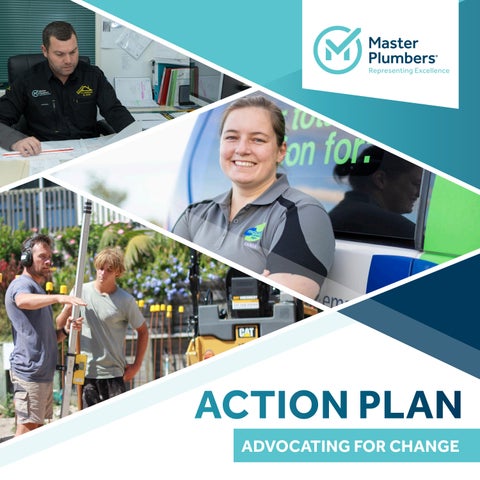
ACTION PLAN ADVOCATING FOR CHANGE
WHO WE ARE In 1901, Master Plumbers was founded by a dedicated group of plumbing professionals wanting to ensure the very highest standards for New Zealand’s plumbing industry and the community. Well over a century later, that intention hasn’t changed. Now with 18 branches and associations throughout the country, Master Plumbers is the largest national membership organisation for plumbers, gasfitters and drainlayers. It represents more than 70% of the trade and is the industry peak body. Master Plumbers is committed to promoting excellence in the trade and providing our members with the skills and resources to be the best. This commitment extends to future generations of trade professionals who we support through the Master Plumbers owned group apprentice training scheme, Masterlink. As guardians of safe drinking water and sanitation, our members play a significant role in protecting the health of New Zealanders. We make it our priority to advocate for critical industry issues that impact not only the sector, but public health and safety as well.
2
MASTER PLUMBERS 2023
FOREWORD The plumbing industry is vital to New Zealand’s future. Public health, environmental sustainability of our communities as well as building and construction all rely on plumbing that is safe and efficient. Plumbing is an essential part of all building and construction. There are more than 13,000 plumbers, gasfitters and drainlayers who, together, contribute $3bn to the national economy. The past few years have tested the resilience of our industry with significant damage to property and infrastructure resulting from storm events, critical workforce shortages, inefficient consenting processes and unsafe plumbing products. New Zealand is well overdue to fix these issues. Master Plumbers, with its unique insights, has identified the priority actions we believe are critical to the ongoing improvement of our industry and the safety of the communities we serve. We call on all political parties and the Government to commit to our action plan to build a stronger plumbing industry and a safer community.
Greg Wallace, CEO Master Plumbers, Gasfitters & Drainlayers NZ November 2023
“Our solutions will result in healthier outcomes, greater productivity, safer practices and a stronger industry overall – benefiting all New Zealanders. ACTION PLAN
3
1. Productivity & Workforce Capacity
Boost efficiency & grow the industry
THREE PRIORITIES
2. Climate & Environment Invest in sustainability & innovation
4
MASTER PLUMBERS 2023
3. Public Health & Safety
Ensure water quality & safety
OUR CALL TO ACTION 1. Productivity & Workforce Capacity
Plumbing, drainlaying and gasfitting businesses are stretched to the limit by a combination of staff shortages, weather event repairs and significant growth in building consents over time. Self-certification is utilised successfully for all gas and electrical work. Pilot programmes for plumbing and drainlaying in several major cities have shown selfcertification to be both an efficient and cost-effective solution, whilst maintaining quality standards. See page 6 Targeting the plumbing skills shortage is essential if we are to have a qualified base of professionals available in New Zealand. Ensuring the country can rely on a robust industry of plumbing professionals requires investment in apprentice growth and a comprehensive training regime. We need to ensure the next generation of tradespeople is fostered and provided with the best possible start to their careers. We also need to incentivise overseas trained plumbers to immigrate. See page 9
2. Climate & Environment
In order to ensure our industry is future-facing and wellplaced to meet the demands of New Zealand’s net zero carbon goals, Master Plumbers is committed to ensuring renewable gases, particularly biogas and hydrogen, can be utilised as viable forms of energy. See page 13
3. Public Health & Safety
Our country has profited from its clean, green image, but water quality in New Zealand leaves a lot to be desired. Recent events, such as the 2021 lead leaching spike in the East Otago towns of Waikouaiti and Karitane, have highlighted the significance of knowing what is in our water and regulating the products that deliver it to us. The plumbing industry is licensed, and protected under Ministry of Health guidelines due to its involvement with drinking water and sanitation. Plumbing products, by extension, cannot be treated the same as generic building products, as they have the potential to directly influence health outcomes. New Zealand needs mandatory third-party verification for all products that deliver water for human consumption; significantly lower acceptable levels of lead in the water supply; and greater transparency in water quality reporting across the country’s regional councils. See page 15 ACTION PLAN
5
1. PRODUCTIVITY & WORKFORCE CAPACITY Boost efficiency & grow the industry Self-Certification
A critical issue for the plumbing industry is long wait times for getting work inspected and consented. Labour shortages and consenting delays mean considerable hold ups for building and construction projects, which contributes to greater cost and inefficiency.
Self-certification is a consenting process. It involves an initial assessment of the work done by the tradesperson completing the work. It usually utilises advanced digital technology to give photographic and video evidence of compliance instead of the slow and cumbersome in-person inspections currently required by council inspectors.
Residential building consent numbers 49,528 2023 peak
GFC
50,000 45,000
Number of consents
40,000
31,423 2004 peak prior to GFC
35,000 30,000 25,000 20,000 15,000
14,425 sharp decline following GFC
10,000 1997
6
1999
MASTER PLUMBERS 2023
2001
2003
2005
2007
2009
2011
2013
2015
2017
2019
2021
2023
Electricians and gasfitters (who are generally also plumbers), are able to self-certify their work. Since the inception of this regime over a decade ago, there have been minimal problems and it has ensured efficient consenting of work. In Australia, plumbers are able to self-certify their work. However, there is no such regime in New Zealand for the plumbing and drainlaying trades. Consent delays and costs The requirement to obtain a building consent for a significant range of plumbing and drainlaying work creates application and processing costs. On new builds, plumbing works are inspected at least 4 times by council inspectors. Lengthy inspection wait times add enormously to construction costs. Delays in code compliance certification of plumbing and drainlaying work is now the norm, due to staff and resource shortages within most of the building consent authorities. For example, in the Queenstown-Lakes District, plumbers and drainlayers report an average 20-day wait for inspections, significantly holding up building projects. Slow inspection and consenting are also holding up building projects in Auckland, Waikato and Bay of Plenty.
The national average inspection wait time is 10-15 days. The associated costs vary, but one mid-sized commercial builder estimated a 5-day delay to be $100,000.1
1
Tauranga Hardware & Plumbing
Average wait times for plumbing inspections
AUCKLAND
14 DAYS
NELSON
7 DAYS
HAWKE’S BAY
14 DAYS
QUEENSTOWNLAKES DISTRICT
20 DAYS
ACTION PLAN
7
Lack of knowledge by inspectors The technical knowledge and qualifications of building inspectors – the people being relied on to certify plumbing and drainlaying – is nationally inconsistent. Many inspectors have had limited training – 5 days in plumbing and drainlaying matters – and no actual plumbing or drainlaying experience. This compares to the 7 years needed to obtain the qualification of a Certifying Plumber and 2 years for a Certifying Drainlayer. Nationwide shortage of inspectors Because there is a scarcity of inspectors, many councils forego any inspection and require the plumber to complete a PS3 or PS4 form. These forms have no statutory basis, are unlikely to absolve councils of liability, and may not meet the insurance requirements for plumbers and drainlayers. The reliance that councils place on these forms to avoid or limit their liability may be illusory. False assurance to consumers The building consent requirement creates a false impression of a safe installation for consumers. Many building consents have no inspections and no oversight. For example, in Auckland less than half of consented work receives an inspection. Inconsistent requirements There is a lack of consistency between councils, which creates complexity and costs for plumbers and drainlayers working across different districts and cities, and differing standards.
8
MASTER PLUMBERS 2023
Our Action Plan The ability for plumbers and drainlayers to self-certify their work. This would eliminate consenting delays, increase efficiency and help lower building costs, while also providing assurance to New Zealand consumers. Selfcertification would also bring consistency across the country and across the plumbing, gasfitting and drainlaying trades.
Ensure self-certification for plumbing and drainlaying requires: •
• • • •
Only Certifying Plumbers and Drainlayers with a current practising licence can selfcertify. Certifiers have a high skill level (plumbing can take up to five years of training and an additional 2 years to obtain Certifying status – a total of 7 years) Mandatory levels of insurance by anyone self-certifying Certified peer auditing, as well as roving inspections by council inspectors A rigorous disciplinary process Digital record keeping.
Skills Shortages
Because sanitary plumbing has significant health consequences, most work must only be carried out by authorised plumbers. That means we must ensure there is the necessary workforce. New Zealand simply does not have the workforce capacity to keep up with the usual workload, let alone the extensive repair work resulting from recent natural disasters and poorly maintained infrastructure. This has the potential to significantly hinder key government goals of developing more affordable housing and strengthening the country’s ailing infrastructure.
Plumbing also has an ageing workforce. More plumbers are leaving the trade each year than joining it. We still do not have enough apprentices, and only 36 plumbers were recruited from overseas in 2022. To convert their qualifications for New Zealand, each overseas plumber paid $6,500 to the Plumbers, Gasfitters & Drainlayers Board. Master Plumbers continues its efforts to grow the industry, primarily by training apprentices through Masterlink, but also by promoting the migration of skilled tradespeople to New Zealand.
Plumbers in Numbers 2022-2023
• 13,787 plumbers across all licence categories • 249 newly certified plumbers • 38% of PGD workforce are 55+ • 36 immigrants recruited • 4,322 total certifying plumbers
Estimated shortfall: 3,000 plumbers For the past four years, workforce shortages have been one of the most significant challenges facing Master Plumbers member businesses* *Annual Master Plumbers membership survey ACTION PLAN
9
“We estimate a current shortfall of 3,000 plumbers and drainlayers.” Greg Wallace, Master Plumbers CEO
The Government’s Apprenticeship Boost employer funding initiative, launched in 2021, has contributed to a significant increase in plumbing apprentice enrolments. By removing entry cost barriers, more apprentices have been able to undertake formal training. If the industry is to deliver on future needs, we must continue to incentivise young people into the plumbing profession and provide them with high-quality vocational training.
The Apprenticeship Boost initiative has delivered a 30% increase in apprentices
10
MASTER PLUMBERS 2023
Our Action Plan - Make the Apprenticeship Boost initiative permanent
- Provide incentives and a simple pathway to residence for migrants with recognised plumbing qualifications - Halve the fees for converting an overseas qualification.
Vocational Training
Following the creation of Te Pūkenga – the New Zealand Institute of Skills and Technology (which has seen the merging of the country’s 16 institutes of technology and polytechnics) – plumbing, gasfitting and drainlaying apprenticeship training now sits within Te Pūkenga’s EarnLearn division. The merger has not come without its challenges, a key issue being the lack of capacity at Te Pūkenga to provide block courses, which are the essential learning modules required to complete a trade apprenticeship, in an acceptable timeframe. Apprentice numbers have grown, but the capacity at training providers has not kept pace with demand. Due to block course delays, in 2022 more than 1,240 apprentices were unable to complete their apprenticeships within the normal 5-year duration. On average, apprentices are experiencing 6-9 month delays in being able to attend their block courses in order to complete their apprenticeship and become licenced. The number of ‘over-duration’ apprentices is growing, not lessening. The resulting delay in the apprentice’s ability to become licensed can discourage employers from taking them on to give them the on-job learning that is a central requirement to completing a plumbing qualification, exacerbating an already critical skills shortage.
52% of Master Plumbers members employing apprentices experienced first-year block course delays of more than 6 months, and 39% reported delays of 4-6 months
Colleen Upton ONZM General Manager, Hutt Gas and Plumbing, Wellington
“We employ 15 apprentices. The transition from Skills to Te Pūkenga has been frustrating, bewildering and irritating. The delays in block courses affect the apprentice’s pay rises and their progression through the system. Apprentices should be able to get, on average, three block courses a year. Some are getting one, some two, and I have heard of apprentices who have not been on a block course in 12 months. If we don’t get a dramatic improvement in this system, then the risk is that employers like us decide it is too hard to have apprentices and we opt out.”
* Based on a September 2023 membership survey ACTION PLAN
11
Other issues with the new training system must be addressed, including tutor shortages, substandard facilities and a lack of innovative training methods to convey rapidly evolving technologies. Master Plumbers is working collaboratively with Waihanga Ara Rau, the Workforce Development Council for construction and infrastructure, to ensure the review of plumbing, gasfitting and drainlaying qualifications is completed in a timely manner and with the aim of increasing the amount of practical training delivery at block courses. We propose the establishment of a workplace assessment model, where an apprentice’s on-job training would be recognised via an independent assessment – reducing their time spent at block courses. This would finally acknowledge the skill level of the work apprentices complete on the job. Employers would only be able to enrol apprentices into trades for which they are able to provide real workplace experience.
Our Action Plan - Workplace assessments to be carried out on the job by trained and certified assessors to expedite the completion of apprenticeships by providing an alternative route to block courses. Assessor training is already available via a 2-day certification scheme, making it easy to get assessors suitably upskilled. This, together with an audit scheme, which is also already in place, would provide surety of the skills of those being assessed - Ensure apprentices have access to worldclass facilities with high-quality instruction that prioritises course consistency, sufficient tutor support and training accessibility
- Greater industry involvement for unit standard development and training delivery.
12
MASTER PLUMBERS 2023
2. CLIMATE & ENVIRONMENT Investment in sustainability & innovation Renewable Gases
Consistent with New Zealand’s transition to a net zero carbon economy by 2050, the use of fossil gas in New Zealand is to be phased out by 2035. Low and zero carbon gases, such as hydrogen and biogas, are already being developed and trialled for energy supply in New Zealand and abroad. Modern gas appliances are efficient, and most could already take a blend of natural gas with renewable natural gas or hydrogen gas. Future appliances will be able to take 100% renewable and zero emissions gases and are under development. To promote and continue the development of specialised renewable gas appliances, manufacturers and suppliers need commitment from the Government that sufficient investment will be made in renewable gas technology and infrastructure.
Hydrogen, biogas, renewable natural gas and renewable LPG are clean or green gases that can be made from renewable resources without releasing more CO2 into the environment than they have taken out. HYDROGEN: Renewable hydrogen gas is produced using renewable electricity, by separating hydrogen from water. Renewable hydrogen gas is referred to as green hydrogen. In the future, it is possible that hydrogen gas will be used in homes in much the same way as fossil gas. BIOGAS: Biogas has been around for a while and is already used in many industries. It’s naturally produced from the decomposition of organic waste during anaerobic digestion. When biogas is processed to regulatory pipeline standards, it is considered renewable natural gas.
ACTION PLAN
13
Appropriate credentials must also be developed for trade professionals working with renewable gas to ensure safety and consistency across the industry. Master Plumbers has aligned with GasNZ and Master Plumbers Australia to develop quality standards and training for gasfitters in preparation for the future rollout of renewable gas. However, more commitment is needed from Government to create and enforce a robust training system. Licence endorsements could be utilised to formally recognise licence holders who have met the relevant training standards and are deemed commercially competent to work in a renewable gas specialty.
Our Action Plan -- Commitment from Government that renewable gas will be part of the energy transition
- The development of practical training via licence endorsements
- Robust standards for gasfitters in the use of renewable gases, such as biogas and hydrogen Create a new Centre of Excellence for gas training, including hydrogen and biogas.
14
MASTER PLUMBERS 2023
3. PUBLIC HEALTH & SAFETY Ensure water quality & drinking safety Lead in Plumbing Products
Lead content in plumbing products can cause toxic lead to leach into drinking water. There is no safe level of lead for human consumption. After years of raising the alarm about unsafe levels of lead in plumbing products, Master Plumbers is pleased that the Government has finally decided to limit the maximum allowable content of lead permitted in plumbing products that come into contact with drinking water. The updated Building Code reduces to 0.25% (effectively lead-free) the maximum allowable lead content of any product that contains copper alloys, intended for use in contact with drinking water for human consumption. This includes products such as pipe fittings, valves, taps, mixers, water heaters, and water meters. The transition period will end in September 2025, giving manufacturers and suppliers time to comply. While this is a considerable step forward in the interest of protecting public health, there is still no monitoring of plumbing products available for sale in New Zealand, and no mandatory requirement for independent thirdparty verification of these products. Therefore, the risk remains that substandard products with unacceptable levels of lead will continue to be sold in New Zealand.
Master Plumbers recommends that New Zealand adopts the Australian WaterMark Certification Scheme. The scheme provides consumers with peace of mind, and WaterMark products are also preferred by reputable merchants – and suppliers – as well as the plumbers who install them as a means of ensuring the product being purchased is safe for use.
WHAT IS WATERMARK?
WaterMark is an Australian certification scheme for plumbing and drainage products. Products displaying the mark have been verified by independent certifying authorities. WaterMark confirms the product is fit for purpose, complies with the Plumbing Code of Australia and meets relevant standards relating to product quality, specifically indicating the product is Lead Free.
ACTION PLAN
15
Exposure to high levels of lead can cause severe damage to the brain, blood and kidneys.
Health impacts from lead
Children under six are most at risk from lead poisoning. Even low levels of lead exposure have been found to permanently reduce cognitive ability and cause hyperactivity in children.
Adults Brain Memory loss, lack of concentration, headaches, irritability, depression
Cardiovascular High blood pressure
Body Fatigue, joint and muscle pain Digestive System Constipation, nausea and poor appetite
Nervous System Nerve damage, including numbness and pain in the extremities
Babies and children Kidneys Abnormal function and damage
Reproductive System Men: Decreased sex drive and sperm count anomalies Women: Spontaneous miscarriage
Blood Anemia
Kidneys Abnormal function and damage
Our Action Plan - Mandatory independent third-party verification of plumbing products, with compliance enforced at the point of sale - Easy consumer identification of lead-free products - Adoption of the Australian WaterMark model.
16
MASTER PLUMBERS 2023
Brain Behaviour problems, lower IQ, hearing loss, learning disabilities Body Decreased bone and muscle growth
Nervous System Damage
Water Quality
Whilst updates to the Building Code will provide much safer plumbing products in the future, it is imperative that the maximum acceptable value (MAV) for lead in the drinking water supply itself is reduced immediately.
“No safe level of lead exposure has been identified.” World Health Organization2
The reason for setting MAVs for contaminants in drinking water is to protect public health. It is not about whether drinking water suppliers can meet the drinking-water standards or the associated costs. It is about setting a maximum value for a contaminant in drinking water so that it can be safely consumed over a lifetime. New Zealand’s current MAV for lead is 0.01mg/L. Reducing the MAV to 0.005mg/L or less would align New Zealand with countries like Canada, Australia and the EU. It would send a clear message to the public, to drinking water suppliers and to manufacturers of pipes and tapware, that the Government considers the health of New Zealanders to be paramount, and that all necessary steps to reduce lead in drinking water have been implemented.
World Health Organization (2023). Exposure to lead: a major public health concern, third edition. Preventing disease through healthy environments. World Health Organization. https://www.who.int/publications/i/item/9789240078130 2
ACTION PLAN
17
Taumata Arowai, the new water services regulator for New Zealand, is responsible for determining and enforcing the drinking-water standards across the country’s regional councils. The regulator sets the MAVs for specific chemicals, including lead. Councils are at liberty to decide the exact water chemistry of their supplies, provided it doesn’t breach MAVs. There are few, if any, requirements for local councils to provide reporting on chemical dosing levels. Councils are only expected to provide water quality reports should their supplies exceed MAVs at any point, and these reports are not readily available to the public.
Water quality is a matter of public importance and greater transparency is crucial to the reporting and availability of information contained in these reports.
Our Action Plan - Implement a maximum acceptable value of 0.005mg/L, or lower, for lead in drinking water - Increase transparency of regional water quality reporting by councils to the public
- Greater oversight by Taumata Arowai as to how regional councils operate and report on water quality
18
MASTER PLUMBERS 2023
- A centralised public record of water quality reports for all regions.
ACTION PLAN 1. Productivity &Workforce Capacity Self-certification -
Develop a self-certification system for plumbing and drainlaying that prioritises the following key elements: o o o o o
Only licensed Certifying Plumbers and Drainlayers permitted to self-certify. They have a high-level of skills (it takes a total of 7 years to achieve Certifying status) Mandatory levels of insurance by anyone self-certifying
Certified peer auditing as well as roving inspections by council inspectors
2. Climate & Environment Renewable Gases -
-
Digital record keeping
Make the Apprenticeship Boost employer payment scheme permanent Provide incentives for young people to enter the plumbing trades
Develop a simpler pathway to residence for migrants with recognised plumbing qualifications. The existing process should be streamlined and the fees to convert overseas qualifications – currently sitting at $6,500 – should be halved
Vocational Training -
Develop practical training, by way of licence endorsements, and robust standards for gasfitters in the use of renewable gases, such as biogas and hydrogen Create a new Centre of Excellence for gas training, including hydrogen and biogas
A rigorous disciplinary process
3. Public Health & Safety
Skills Shortages -
Commitment from Government that renewable gas will be part of the energy transition
Introduce on-job workplace assessments by certified assessors to expedite the completion of apprenticeships by providing an alternative route to block courses
Ensure apprentices have access to world-class facilities with high-quality instruction that prioritises course consistency, sufficient tutor support and training accessibility
Deliver industry-led training through high-quality, innovative, and financially viable providers Facilitate greater industry involvement in standard development and training delivery
Lead in Plumbing Products -
Introduce mandatory independent third-party verification of plumbing products, with compliance to be enforced at the point of sale Provide easy consumer identification of lead-free products
Adopt the Australian WaterMark model as an easy way to ensure both these safeguards
Water Quality -
Implement a maximum acceptable value of 0.005mg/L lead in water, or lower Increase transparency of regional water quality reporting to ensure councils can make reports available to the public Taumata Arowai to have greater oversight of how regional councils are operating and reporting on water quality
Develop a centralised public record of water quality reports for all regions
ACTION PLAN
19
Contact: Greg Wallace, CEO Master Plumbers, Gasfitters and Drainlayers NZ Inc Ground Floor, 119 Ghuznee Street, Te Aro, Wellington 6011 PO Box 6606, Marion Square, Wellington 6141 0800 502 102 info@masterplumbers.org.nz
www.masterplumbers.org.nz
20
MASTER PLUMBERS 2023