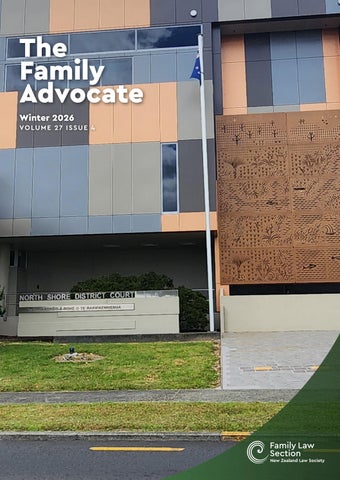
Family Advocate is the quarterly magazine of the Family Law Section of the New Zealand Law Society. Celebrating its 15th year anniversary in 2015, Family Advocate has been produced continuously since 1998. We welcome articles from readers and those involved in family law. These can be sent to the editor at the address below.
The closing date for the next issue is 12th June 2026
Family Law Section
Kath Moran
Family Law Section Manager
DX SP20202 or PO Box 5041, Lambton Quay Wellington 6145
04 463 2996 family@lawsociety.org.nz
C/ - Willis Legal, PO Box 219, Hastings 4156
estannard@willislegal.co.nz
06 878 6039
advertising@lawsociety.org.nz
The views expressed in Family Advocate are not necessarily those of the Family Law Section or the New Zealand Law Society. Unless otherwise stated, all articles in Family Advocate are licensed under a Creative Commons Attribution-NonCommercial 3.0 New Zealand license, the full terms of which are available at creativecommons.org/licenses/by-nc/3.0/ nz/. Attribution should include the Family Advocate, the volume and issue number, and the author's name if listed. Family Advocate is printed on an environmentally responsible paper, produced using elemental chlorine free (ECF), FSC® certified mixed source pulp sourced from well managed and legally harvested forests.
From the Chair
BY RICHARD SMITH
As we move through 2026, the Family Law Section continues to strive to meet the needs of our members and the broader legal community. I am pleased to share some significant updates on recent developments within the FLS, including new leadership appointments, ongoing educational initiatives, and the challenges we face as a profession.
FLS leadership changes
A call for nominations for the FLS executive was made in February. Two nominations were received for the three vacancies. I am delighted to congratulate Jess Babe (Christchurch), and Paul Muller (Auckland) who were duly elected to the FLS Executive. Their backgrounds, skills, expertise and commitment to family law will undoubtedly strengthen the FLS’s ability to serve our members effectively. To fill the third vacancy, the executive appointed John Gandy. John brings expertise in a wide range of family law and is based in West Auckland. The FLS executive is fortunate to have someone of his calibre joining our team.
Following our executive meeting on 10 April, I was re-elected as chair for another year. I am excited to continue working alongside our dedicated executive, including Colin Abernethy (Christchurch), who was elected as deputy, and Nazmeen Rasheed (Auckland), who was elected as treasurer.
FLS education
Education remains at the heart of what we do for our members. We’ve maintained our focus on delivering high-quality, relevant training. Our recent webinars have covered critical topics that directly impact practice quality and professional development. We recently hosted a webinar on robust judging and using the Family Court Rules, providing practical guidance on navigating and using the rules effectively. Our webinar series on professional supervision in family law has been particularly well-received, addressing the crucial need for ongoing professional development and support.
Most recently, we held a webinar on identifying possible indicators of child maltreatment in the role of lawyer for child.
For those who may have missed any of these, all webinars are available for purchase on the FLS website. We encourage all members to take advantage of these resources to enhance their practice and stay current with developments in family law. If you need assistance just email family@lawsociety.org.nz
Upcoming educational opportunities
Our educational calendar continues with several important events on the horizon. The CLE lawyer for child conference on 13 May in Auckland, both in person and online. Looking ahead to July, we have the CLE family violence conference on 14 July. This event will be delivered both in person and online from Wellington. Given the prevalence of family violence issues in family law proceedings, this conference will provide essential knowledge and practical tools for practitioners.
Te Au Reka implementation update
The long-awaited Te Au Reka system is finally approaching reality, with the ministry announcing rollout dates. This digital transformation of our court system will proceed in phases.
Phase one of Te Au Reka in the Family Court jurisdiction is scheduled to begin on 23 November, starting with the Christchurch and Ashburton District Courts, along with parts of the national services teams. Initially, this will introduce the new digital case management system for registry and judicial functions only. The Court’s portal will subsequently go live in March 2027 for the Family Court in the South Island. Once operational, the system will be mandatory for lawyers in those regions for all new cases and proceedings where it’s available.
The Ministry has committed to providing comprehensive training for the legal profession and sharing detailed information
at each rollout stage. We will ensure our FLS members receive regular updates and information through bulletins, Advocate, and dedicated webinars as we receive updates from the Ministry.
Addressing the shortage of family lawyers
One of the most pressing challenges facing our profession is the shortage of lawyers willing to undertake family law work, particularly legal aid cases. This issue affects practitioners nationwide and, unfortunately, there’s no quick solution on the horizon.
I see the responsibility falling on all of us to address this crisis. I want to acknowledge and thank those practitioners who currently take on graduate lawyers and invest in training the next generation of family lawyers. Your commitment is essential to the sustainability of our profession.
For those who haven’t yet considered taking on a summer clerk or a newly admitted graduate lawyer, but have thought about it, I strongly encourage you to take that step this year. Whether it’s taking on a law student for practical experience or employing a graduate lawyer, every contribution matters. It’s up to us to ensure the system continues functioning effectively and that everyone who needs family law representation can access it.
The challenges ahead are significant, but with continued collaboration, education, and commitment to developing new practitioners, we can work together to strengthen family law practice across New Zealand. ▪
Ngā mihi maioha Richard
From the Editor
BY EMILY STANNARD
Kia ora koutou katoa. Nau mai haere mai ki te tānga takurua ki Te Advocate
As usual, there have been many great contributions from around the motu. Thank you to everyone! The FLS elections were held in April, with Richard Smith being re-elected chair, and Colin Abernethy and Nazmeen Rasheed being elected deputy chair and treasurer respectively, congratulations, and so well deserved! We also welcomed Jessica Babe and John Gandy to the FLS executive.
In this edition, we were very lucky to have Margaret Casey KC as our featured interviewee. The first chair of the FLS, she was very generous with her time, and shared her journey through her career and advice for new lawyers. Margaret was also instrumental in organising the Fertility Law and Ethics Symposium held in October 2025. We have included an article and photos from the symposium in this edition. The recent Family Court case of Sov v Sov 1 highlights how many square pegs and round holes there are in surrogacy situations, and it is an example of how family law is always developing. In addition to Margaret Casey KC, we also have retired judge, Paul von Dadelszen, providing a glimpse into his time as a judge. He provides the answer to one of life’s great questions – why do we have paper cups
in court but the judges have glass ones?
Liz Lewes has written an excellent article on robust lawyering. It provides really useful tips at each stage of the court process to help cases move through the system. It also recognises the often harsh realities of practising family law with there being too many cases and not enough lawyers, judges or court time. I found it really encouraging as it gave ideas of how we can get cases through more efficiently by changing how we work, and not needing to rely on structural changes. It gives a timely reminder of the different tracks. Kesia Denhardt has written an excellent article on Steele v The Family Court at Christchurch & Callahan.2 That High Court judicial review decision considered the different tracks in the Family Court Rules 2002, in particular the court’s ability to make an interim parenting order in chambers. The article is well worth a read.
Another article which provides practical guidance is Dr Allan Cooke’s discussion on the role of lawyer for child in Oranga Tamariki Act and COCA cases. The thorough article provides an overview of lawyer for child’s role in both pieces of legislation.
In our previous two editions, we published the winner, then the first runner up of our inaugural essay competition. In this edition, we have the second runner
up, Henry Fitzgerald’s essay. “Breaking the Dyad” discusses polyamorous relationships and the Property (Relationships) Act 1976. The calibre of essays was extremely high in the essay competition. We will be running another essay competition with the criteria to be released in the next few months, so keep an eye out! Another case before the Supreme Court recently was the Walter v Rimmer litigation. The case was before the Supreme Court earlier this year and its decision will have a huge impact on how lawyers approach contracting out agreements.
One of my favourite parts about being the editor of the Advocate is the book giveaways. In this edition, we are very lucky to be able to give away a free copy of Family Law in New Zealand. Thank you very much to the Law Society library for facilitating this!
I hope you all keep well as we head into the winter months, and that you enjoy this edition. Ngā mihi nui to everyone who contributed. ▪
Noho ora mai, Emily
1. Sov v Sov [2025] NZFC 17372.
2. Steele v the Family Court at Christchurch & Callahan [2025] NZHC 1673.
New FLS executive members
Jess Babe, Ōtautahi
I’ve been practising as a family lawyer in the mighty Ōtautahi for over 14 years, spending that time at Cuningham Taylor Law. I’ve been lucky to work closely with a team of exceptional family lawyers, now boasting 9 in total, and in 2023 I joined the partnership. I provide services on both a private and Legal Aid basis in a variety of areas, including care of children, Oranga Tamariki, relationship property, family violence and family protection. In 2021 I was appointed to the Lawyer for Child list, and I am a very recent addition to the panel of lawyers instructed by the Central Authority. Outside of work, I sit on the Board of the Family Help Trust, a charitable organisation providing intensive social work services, and a Mana Alke provider. Ever since joining the profession I’ve been amazed and humbled by the fantastic mahi my colleagues do in the family law sphere. I’ve seen lawyers handle incredibly difficult situations and distressed clients with care, passion and aroha. The growth of the family law bar and the wellbeing of our practitioners is something I am passionate about and I’d like to do what I can to support and encourage this. We are necessary, we care and we should be valued and treasured. I see being elected to the FLS executive as a way to do what I can to give back to a profession that I love. ▪
John Gandy, West Auckland
John is a Director at Totara Law in West Auckland, leading the firm’s Litigation and Dispute Resolution team. He brings extensive experience across a broad range of jurisdictions. John’s practice sits at the intersection of family and general legal practice, working closely with colleagues across disciplines to deliver positive outcomes. He has a particular interest in law reform and addressing gaps in the legal system.
John is regularly appointed by the Family Court as lawyer for assist and lawyer for child. He is a panel member for Hague Convention proceedings. He has served on the Pacific Lawyer’s Association executive and is current Chair of the Tautai Contemporary Pacific Arts Board.
Committed to advocacy and sharing knowledge, John is passionate about supporting clients and colleagues alike. ▪
FLS regional representatives appointed
Gabrielle Thompson
Central Auckland
I am a senior associate at Lane Neave in Auckland specialising in separations and division of relationship property, contracting out agreements, and cases involving trusts and estates. I started my career at a leading provincial firm where I gained significant practical courtroom advocacy experience, regularly appearing for clients in the District Court, Family Court, High Court, and in alternative dispute resolution. I am also a member of the FLS Education Advisory Panel.
Nirusha George Central Auckland
I am a senior solicitor at Martelli McKegg, specialising in family law and civil disputes. My practice includes care of children matters, family violence, relationship property, trusts, and estates. As part of the family team working within the civil litigation team, I advance matters in both family and civil law. Working across these areas has given me a strong appreciation for the unique nature of family law.
Family law can present distinct practical and legal challenges, particularly when we are supporting clients through some of the most difficult and vulnerable times in their lives. I am passionate about family law and aim to work collaboratively with clients and other parties to achieve effective outcomes that minimise conflict. In my five years of practice, I have developed a deep appreciation for the unique culture of family lawyers in New Zealand. Our profession is highly collegial
and collaborative, and in my view, the work of the FLS is critical in fostering this.
The family law profession faces many challenges. I want to help ensure we continue to improve family law practice, particularly in a changing environment shaped by developments such as AI and broader global and cultural shifts. I look forward to contributing to the mahi of the FLS in my role as co-regional representative for Central Auckland.
Nyssa Willcocks Timaru
I have been in practice since 2009 and relocated to Timaru in 2011. I worked at a firm for 12 years, then as an employed barrister, and am now in sole practice. I am a lawyer for child, lawyer to assist and assist parties with COCA applications and family violence matters. I provide advice regarding relationship property, adoption, and surrogacy. I also practise in the mental health area. I hope to expand my practice to include youth advocate and lawyer for subject person work.
Outside of the law, I am an international women’s artistic gymnastics judge and have been appointed to several prestigious events this Olympic cycle, including the World University Games and World Championships 2025. I have recently been appointed to officiate at the Commonwealth Games this year and am aiming to be selected for the Los Angeles 2028 Olympics. ▪
Top: Gabrielle Thompson
Middle: Nirusha George
Bottom: Nyssa Willcocks
Competition - win a book
In this issue of Family Advocate, the New Zealand Law Society Library is proud to be giving away to one lucky winner a copy of Family Law In New Zealand, 22nd edition, 2025 (Lexis Nexis).
To enter the draw simply email library@lawsociety.org.nz with:
• “Win a Book” in the subject line;
• your first and last name.
• the correct answer to following question:
Name five Acts that the Family Court has jurisdiction
Only complete and correct entries will be accepted.
T&Cs
Only one entry per person. Entrants must hold a NZ postal address. Entries close at 5pm on 19 June 2026
Winner will be drawn at random on Monday 22 June 2026. The prize is not transferable or redeemable for cash, nor can it be exchanged for any other product or service. The judge’s decision is final.
Your personal information will only be used for purposes relating to the draw. The winner will be notified by email, and if they agree, their name will be published in Family Advocate and on the FLS LinkedIn page.
Further information about how the Law Society handles information including personal information is set out in the Law Society’s Information Handling Policy, which can be viewed here: https://www.lawsociety.org.nz/about-us/ contact/privacy-copyright-and-disclaimer/ information-handling-policy/ ▪
Margaret Casey KC
“If you ask me why I wanted to be a lawyer all I can say is I remember it was either law or journalism. I really wanted to do something different and not many women chose this option”
Where did you grow up?
In the heart of the King Country, in Taumarunui. That’s where I was born and that’s where I lived until I went to university in Auckland in 1979.
I attended primary school and secondary school there. I was supposed to go to boarding school in Auckland. I had two older brothers who attended Sacred Heart in Auckland, and the only good part about going to boarding school, that I could see, was the baking my grandmother made for their tuck boxes at the beginning of every term. They were both homesick, we are a very tight family, they were country boys, and they didn’t really thrive in the city. It looked pretty miserable to me, and I was not having a bar of that. I don’t recall having to work too hard to persuade my parents to let me attend the local high school and so did my two younger siblings. I had a really broad good education at Taumarunui High School, it was great, but I did have a lot of trouble persuading future employers of this.
Why did you want to be a lawyer?
The only downside of my high school education was that it wasn’t particularly visionary when it came to what girls could do. Being a lawyer wasn’t one of the career
paths ever discussed with me. Like a lot of potential lawyers, I was articulate (but chatty), did well in English, was in the debating team, and was something of a thespian. My careers advisor talked about teaching as the best option. When I asked about law I was told I could not do a law degree because Taumarunui High School was not zoned for a university that teaches law. That was the first time I thought that can’t be right. It didn’t make sense. My parents didn’t think it was right either, so Mum drove me four hours to Auckland. We just walked into the law school and asked to speak to someone about my options. We met Dean Northey who was very positive, normalised what I wanted to do and encouraged me to attend the following year. None of this information was online, the only way was to turn up in person and get the information from a reliable source. This was an early lesson for me and gave me a lifelong appreciation of how supportive parents can make all the difference in a young person’s life. They weren’t pushy or bold my parents, it was a big deal to do this, but they believed in giving me a choice. There were a few lawyers in my mother’s family so that also helped normalise my career options for my parents.
If you ask me why I wanted to be a
“That was my sliding doors moment. When I left, I was at a low point workwise. The degree was the rocket fuel I needed. It’s so interesting when you study with an older head, when you are paying for it, stepping out of your career path, you’re so much more motivated”
lawyer all I can say is I remember it was either law or journalism. I really wanted to do something different and not many women chose this option. I then became incensed when someone said I couldn’t be a lawyer and that made me determined to prove them wrong. So, in lots of ways, I didn’t think much about the why as I went through my degree, there was more of the “you said I couldn’t so just watch this space!” I can see now this might be a recurring theme in my career!
But I knew I liked finding solutions for things, I knew that I believed fairness was important. I am quite fond of rules, I like talking, I like persuading. I had a father who was an accountant and a mother who was a full-time mum to us, but they had also modeled a lot of community engagement, you look out for people, you try to help them, you try to change things for them, so that was also part of the thinking around you have to do something that can change things for people.
Was there anything else you wanted to do?
I had completed a conjoint degree, and my BA was in political science which I loved. I loved foreign policy. I had thought about going into foreign affairs, but I hadn’t learnt another language so that was a bit of an issue. I liked writing, research, and so was drawn to journalism. I did feel a bit underwhelmed after about four years
as a lawyer. I wasn’t thrilled by the daily grind. I found it stressful and didn’t feel I was particularly good at what I was doing. So, after four years I went to London and completed a master’s degree at Kings College, I was thirty then. I had worked in two firms and decided to do a master’s degree because there were things I was interested in, I wanted to do more research on those issues, and I wanted a more cerebral approach to law. I was thinking of going into academia, with further study I could investigate things that were new on the horizon in New Zealand and maybe do something with that information that didn’t feel stale in terms of law.
What was your master’s degree in?
I studied child law, comparative family law, alternative dispute resolution (ADR) and constitutional law and parliamentary sovereignty. ADR turned into mediation, which is a huge part of my practice now. Comparative family law looked at family law across multiple jurisdictions, and my practice now involves a lot of international work. The focus on child law was great because it was the preliminary stages of the development of Convention rights and as part of that I studied the Child Abduction Convention jurisprudence. The UK had already signed up to the 1980 Abduction Convention and New Zealand was just coming on board. By the time I finished
that LLM and reluctantly returned to New Zealand (and I only came back because my husband Ivan had taken leave and we had to come home), I realised I had planted the seeds for the kind of career that I wanted to practice.
That was my sliding doors moment. When I left, I was at a low point workwise. The degree was the rocket fuel I needed. It’s so interesting when you study with an older head, when you are paying for it, stepping out of your career path, you’re so much more motivated. I was not distracted by going to the pub, parties or relationships. You get much more sleep; you’re focused and want to do well with the time you have as opposed to my first degree. My first degree was a bit of “I’m at the university of life, I’m a country kid, I’ve come to the city and enjoying all the freedom and independence”. Study may not have been my priority!
Where was your first job after graduation?
I only had two solicitor jobs before I became a barrister. My first was at Fortune Manning, who employed four graduates out of law school on a subsidised work scheme, the government were encouraging firms to employ graduates because it was hard to get jobs. I worked in Manukau in their satellite office, and then went back into the city, and worked with Ross Knight who, at that stage, was a brand-new
partner in the family law team. He had been mentored by Bernie Kendall, who became a judge, and then Ross mentored me. After working across the litigation department (it was called the common law team in those days), I went to work for Rennie Cox, Garlick & Sparling, and I worked part time in the family law team and part time in the civil team. That was a classic small firm where you did everything, and it was a wonderful place to work.
How did you decide on family law?
It was good that it wasn’t where I started, and by the time I focused on it later in my career, I felt like I had chosen to go there. I liked it because it was so interesting from a people perspective. It had everything. Within that category of family law, there was a wide range of things you could do. If you were commercially focused, you could do the property stuff, trusts weren’t so much of a thing in the early days, but they were hovering there. If you liked parenting disputes there was a range of issues, there. There were issues around capacity just starting to emerge, there were issues around wills. There was so much that was about people, it was not as transactional as some of the other fields I had been working in. You don’t realise when choosing this area as a specialty that this is the twoedged sword of family law, that’s what wears you out. The more immersed you become in that as a career, the more days there are that you long for something that is transactional to give you a respite from the intensity of and responsibility for your clients. It also was a place where women could have a working space. It is interesting to go to a family law conference now and see that it is the men who are unicorns not the women. Early on there weren’t that many senior women, there weren’t women partners, there weren’t that many women judges, but I could see there was a growing number of women moving into this area, and that clients wanted a choice in terms of representation around gender. It felt like you weren’t going to have to fight quite as hard to be recognised.
You were the first chair of the Family Law Section; can you tell me a bit about what it was like being part of starting the FLS?
If I think about it, I feel a little bit unwell because I had a new baby, and it was a new role, so in a sense I had two new babies. We were the guinea pigs for the rest of the Law Society, so it was unchartered territory. We had a great family law committee, and we were devoted, passionate, and enthusiastic about this need for separate representation, and then it became reality. I had wanted to be that first Chair, I thought it was important that there was a young woman in that role, there were young women coming through, and if we were going to have this fresh approach then it should be someone who looked like me. Then we got everything we asked for but there was no roadmap. Every week was different, you were being asked to do media interviews on legal issues, we didn’t know where we were to have input or not, everyone was feeling their way. It was stressful, it was scary, it felt like all eyes were on us all the time, but it was also the most enormous fun and so interesting. That first Family Law Section, we were such a good team and the experience around the country on that committee was phenomenal. They knew how to play hard and how to work hard, our meetings were constructive but fun. If you do this role, there must be a lot of laughs in it.
In the end I got really sick, unsurprisingly, we were also doing a major renovation on our house, I had a new baby, I was back and forth to Wellington, there was no honorarium. I got a cough I couldn’t get rid of, I just seemed to stay unwell. After 18 months I spoke with Anna Somerville, and she agreed to take over. We didn’t have a Kath Moran, we didn’t have zoom calls, we barely had emails, we barely had cell phones, it was a lot to manage. I still feel pleased and proud to have been part of something that has become such a voice for family lawyers.
Why did you decide to become a barrister?
Because I did not want to be told what to do by anyone ever again. I wanted the freedom to develop the kind of practice that would keep me in love with being a lawyer, with my job. I wanted to run my own ship. I wanted to do what I wanted to do, how I wanted to do it. I wanted to be able to take risks around the choices of the kind of work I wanted to do. I never wanted to be a partner and report for partnership meetings, I like mentoring and teaching, but I didn’t want to be responsible for a team. That’s why I became a barrister, and again it was something people said I couldn’t do. I was told I was too young, people don’t go to the bar at your age, without being a partner, without more experience. I went to the bar when I came back from completing my master’s, so I had been away for 14 months, but at that stage I only had 4 or 5 years’ experience post admission. I did not have big firms that were going to brief me, I was just beginning to be known in the field of family law, but I was clear about what I wanted to do. I went to a set of chambers where they were really supportive and gave me space at a low rent to see if I could make it.
It’s hard to explain what it was like then. I was about to turn 32, there were not many women barristers. I don’t recall any women barristers holding themselves out as interested in mediation, doing “matrimonial work”, plus interested in medico legal issues. It was 1992, and I thought I’d give myself a year and see if it was working, and it did.
I love that there’s such a big independent bar now and that it has become an acceptable early career path, whereas when I started, a lot of people were saying it’s risky, you need to go back to a firm, you need to become a partner, then you need to take the leap. Sometimes when you take a step away from your life, like I had by going to London, you are braver when you come back because you’re not worried about what people think. It is a New Zealand thing, people give you reviews about your life and the way you
“You couldn’t be shy about the work you had done, and you couldn’t wait for someone to come to you and say let’s put together your CV and show the world you are fabulous at what you do”
live on a regular basis, but when you’re away you have the space to think about what you’re going to do and how you’re going to do it. And you just need to find a few like-minded people and away you go.
What have been some of the highlights of your career?
This is hard to answer, because when I think about highlights, I can only think about the ones that happened last year or the year before, but when you’ve been in practice for four decades, there are highlights in different phases and stages of your career.
At the beginning, the highlight was to go and do the post graduate study, having that space after having been in practice for a period to step outside of yourself and get a view of what was going on in law in NZ was an absolute highlight. Another highlight has been the law society work I’ve done. I’ve found it really rewarding, you meet such great people, with the FLS work it’s the ability to be part of things that are changing, the information you get, understanding what is happening in your field is good. I’ve particularly loved the teaching and seminar work I’ve done. I’ve loved it because it’s a really effective way of constantly upskilling. If you don’t understand a subject well enough to teach it, you shouldn’t be teaching it, it also then helps with your advocacy. It’s the same communication skills you bring to that. You must explain things to the judge and your client, you must be able to break down the issues, and to do all of that you need to understand the issue so well.
I taught at Auckland law school when the PRA was enacted in that first year, and the process of doing that meant I knew that piece of legislation inside out. The other new piece of legislation that I loved learning about and then being part of the education was when New Zealand implemented the Hague Convention on Child Abduction. When I came back from the UK that Act was just passed, Lex de Jong and I put our hands up to do an old school road show. We wrote an annotated version of the Act, and we spent hours learning about that legislation. These things pay off in terms of your practice because you acquire specialist knowledge, then you get instructed and you start working through the courts, and then you’re the one doing the appeals. That constant challenge to learn about new stuff ends up having the effect of you becoming a specialist, so that has been a highlight for me.
The other new area I have enjoyed developing has been mediation, seeing attitudes change, and seeing it grudgingly then enthusiastically accepted as a thing you can do as a lawyer. I’ve loved that. And then becoming a mediator after years of practice has been a pleasurable shift in focus.
My final passion for new stuff is the work I’ve done around reproductive law. What does it mean to be a parent in this century? The ways we make children. What is the legal impact? Developing an understanding of all that legislation and being part of the reform work that’s happening around that and around surrogacy has been really good and unexpectedly lead to international
work. That’s the best thing ever, to be working with lots of different countries. I’d been doing all this work for years on the Hague Convention on Child Abduction work, then I was appointed to an expert group in the Hague to be part of working on a new convention that would look at parentage and how you recognise parentage when you have things like cross-border parents and most controversially around surrogacy. So, to be going to that place where they create these conventions that impact on our career and our daily work, to be working with people from 28 different countries, and I have been doing that work for 10 years, has been really interesting and the icing on the cake because it leads to a lot more that keeps me engaged and excited about law.
What have been some of the most challenging parts of your career?
Still being here, just keeping going, understanding, and accepting that you need a lot of energy to be a lawyer. You can’t moan about that. I used to moan a lot in the early days about how knackered I was all the time. It’s a high-energy job and it takes a lot from you. There’s been the usual misogynistic, rude, chauvinistic, unfair practices, opportunities you’ve missed because you didn’t have the right connections or you weren’t the right sex, but it all pans it out over time. I do believe that. But there are low points and when that happens, you have got to have mates that you can moan to. I’m a great believer in decompressing moan, usually with a glass of wine involved
or a nice gin and always with some laughs. Humor always helps me to deal with the negative stuff. That and being determined not to be sunk by those moments. I have learned that for me I have to eventually stop grumbling and reset. You must think “what am I going to do about that and how am I going to replace that moment or that lost opportunity in my life?” Mostly that works!
You’re a KC, can you tell me a bit about your journey to that role?
I don’t really know what the journey was. I would like to be able to say you need to be able to do this, this, this, and this, and I don’t think I can because I’m not sure I’ve been structured enough to say what the plan was. I do think that a few years before I was made a QC, I realised you had to put your head above the parapet, and you had to be much more open about your own marvelousness. You couldn’t be shy about the work you had done, and you couldn’t wait for someone to come to you and say let’s put together your CV and show the world you are fabulous at what you do. When you decide what you want, you talk to someone and you start to curate your career decisions. You need someone who is going to be direct with you, and you need someone who is going to support you and go through your CV, and you need resilience when you get turned down. That’s quite a challenge for most of us.
What advice would you give a graduate starting in family law?
Be part of where the law is changing. Identify spaces where things need to change and be part of that. There are so many areas that we can be pushing change, if you just watch it will be interesting. Who knew you would be teaching about same sex parenting, transgender issues, transgender parents, identification, citizenship, and immigration issues that arise out of surrogacy, who knew? Keep an eye out, and if you get a case and it engages you, you do a lot of work on your own time to become an expert around those things. You look for variety and for the areas where people are trying to push change. There is a lot of it around families in 2026.
Get as much variety as you can, find someone whose work you admire and their work ethic and the way they operate, and watch everything they do. Stay in a firm as long as you can and suck up all the expertise of the people around you. Find a tribe, find your tribe, find your friends who make you laugh, who you can have a talk with or a chat with, and keep a compliments file. When someone sends you a card or sends a thank you or you hear a judge say you’ve done something good, keep a file because that’s what you go to on a difficult day. You might not look at them until you’re clearing out paper, and you find these things and you get a little buzz because you forget that you have changed people’s lives and made it an okay process for them.
Anything else?
It’s important there’s a component of your career where you engage in law society activities. Everyone I know who is satisfied with their career and has done well, they have engaged with law society work at some point in their career, it gives you a blue sky view of what’s going on, it takes you out of yourself, you meet great people, you have really good relationships, it keeps you engaged. I also think that ultimately what keeps you going as a family lawyer is that family lawyers are the best people who practice law, they usually have a good sense of humour, they are good fun at conferences, and if you sit outside of courtrooms, you can see lots of laughter, and it’s the only thing that keeps you sane. I think if you’re getting up every day and it’s dragging you down, because this job does drag you down, you’ve got to work out some way of recharging. It’s demanding work, but if you can laugh about a few things then you’re going to be okay.
My final comment is, it’s a really lengthy career this. I’m about to turn 65, and I did not think back at the start that I would still be having as good a time as I’m having. I feel like I have the perfect practice for the person I am and with my skill set. It works for me. When I was 25 and starting out, I never imagined that it would be a 40-year plus career, I don’t know why, I just didn’t think it would keep going and I don’t feel ready to stop yet. Maybe when Monday stops being a good day. ▪
Rising stars
Congratulations to Nirusha George and Hannah Rogers on becoming associates on 1 April 2026
Bridging Law, Ethics and Medicine
Reflections from the ANZ Fertility Law and Ethics Symposium
On 9 October last year, a small but enthusiastic contingent of New Zealand lawyers–Margaret Casey KC, Jennifer Wademan, Stewart Dalley, Zandra Wackenier, Rebecca Tierney, Val Farrow, and Selina Trigg, alongside her Honour Judge Pidwell–travelled to Melbourne to attend the inaugural ANZ Fertility Law and Ethics Symposium.
The symposium brought together a truly multidisciplinary cohort: judges, lawyers, psychologists, medical professionals, commissioners, counsellors, researchers and academics. Over two days, participants engaged in a rich and thought-provoking programme spanning medicine, law and ethics–an intersection that continues to define the rapidly evolving fertility landscape.
New Zealand was well represented on the programme. Judge Pidwell, Margaret Casey KC, Jennifer Wademan and Selina Trigg each contributed to presentations or panel discussions addressing law reform, the balancing of children’s best interests against the ethical complexities of assisted reproduction, and what the future might hold–if, as one session invited, we had a “magic wand.”
The symposium opened with a compelling keynote from Professor Claire Fenton-Glynn of Monash University. She highlighted several persistent ethical tensions in fertility law and policy, including the dilemma of whether courts should make legal orders in the context of unregulated or even illegal surrogacy arrangements, or decline to do so–potentially to the detriment of the child involved. These are not merely abstract concerns. They arise in real cases before courts and practitioners, underscoring the immediacy
of the issues discussed at the symposium. Indeed, their relevance was reinforced by the recent Family Court decision in Sov 1 (released after the symposium) which grapples with similar themes.
Across the two days, several key themes emerged. Participants explored the contrasting surrogacy frameworks in Australia and New Zealand. For New Zealand attendees, there was a degree of reassurance in recognising the relative coherence of our unified national system, particularly when compared with Australia’s confusing fragmented, state-based regimes.
There was also significant focus on law reform. Attendees examined developments underway in New Zealand, alongside reform efforts being advocated in Australia. These discussions reflected a shared recognition that existing legal frameworks are struggling to keep pace with technological advancement and changing social expectations around family formation.
Ethical challenges were a constant thread throughout the programme.
Conversations traversed issues such as family limits, the largely unregulated “wild west” of donor arrangements facilitated through social media and online platforms, and the enduring debate between altruistic and commercial surrogacy models. A recurring question was whether improved regulation, greater education, or a combination of both is required to mitigate risks and protect those involved–particularly children.
Among the many memorable moments was a powerful visual presentation by Emeritus Professor William Ledger, who shared footage capturing the precise moment at which life begins to form through IVF. The video served as a striking
and moving reminder of the human reality underpinning the legal and ethical frameworks under discussion.
Perhaps the most valuable aspect of the symposium, however, lay beyond the formal sessions. It was the opportunity to connect–across disciplines and jurisdictions–with others committed to promoting safe, ethical and effective fertility practices. These informal exchanges enabled a deeper understanding of the respective roles played by legal, medical and counselling professionals within the fertility ecosystem, and fostered a spirit of collaboration that will undoubtedly endure.
Special recognition is due to Margaret Casey KC, who served on the organising committee for this inaugural event. Her longstanding contribution to the field of surrogacy law is well known, and her role in “birthing” (pun intended) this symposium, alongside Australian colleagues, was instrumental to its success.
Indeed, the symposium was so well received that by the close of the first day, discussions were already underway about a future event. If that enthusiasm is any indication, this gathering may well mark the beginning of an important ongoing forum for engagement across Australia and New Zealand in this complex and evolving area of law. ▪
1. Sov v Sov [2025] NZFC 17372.
Sov v Sov International surrogacy and competing considerations
BY EMILY STANNARD
In Sov v Sov1 the Family Court considered an application by Mr Sov to adopt his son, Abel. Abel had been born in Tbilisi, Georgia using a surrogate. The case provides helpful commentary on the rights of a child, that the courts in Aotearoa New Zealand cannot regulate overseas surrogacy arrangements. In this case, if the adoption order was not granted, Abel would be stateless so the court’s hands were essentially tied.
Background
Mr Sov claimed he was in a de facto relationship with Ms Setha, and intended to enter into an arranged marriage with her. The court noted they had only lived together for one week and their only involvement with each other appeared to be in the surrogacy process.2 Under Georgian law, Mr Sov needed to be married or living with his partner for a year or more before the surrogacy could take place. The application was made on a joint tenancy agreement, and there was also no medical evidence provided as to why surrogacy should be used, other than Ms Setha’s age.3 After the surrogate became pregnant, Ms Setha then told Mr Sov she did not want to continue the relationship, and the surrogacy company replied expressing no concerns with Mr Sov continuing the process alone.4 There was no independent verification of the existence of the surrogacy company.
Legality of the surrogacy arrangement
Under Georgian law, the intended parents are listed on the birth certificate, and the surrogate is not, the parents must be heterosexual and either married or living together for one year for the surrogacy to be entered into. It was not clear whether the use of a surrogate from a country outside of Georgia (Uzbekistan) was permitted. The court held that Ms Setha and Mr Sov were not in a de facto relationship.5 It further noted at [31]:
There is an uncomfortable inference available that [Mr Sov]’s relationship with [Ms Setha] existed purely for the purpose of satisfying the requirements of the surrogacy agreement. Once the pregnancy was viable, the relationship ended. Without her, [Mr Sov] would not have been eligible to enter into a surrogacy agreement in Georgia.
Ms Setha and Mr Sov were listed as Abel’s parents on his birth certificate, and Mr Sov was able to apply for adoption alone under s 3 of the Adoption Act 1955.
Legislative framework and social worker’s report
Mr Sov was required to adopt Abel even though he was listed on the birth certificate because he was born via international surrogacy. This meant the Status of Children Act 1969 prevented him from being listed as the father under ss 22 and 26. The court
noted the effect of those provisions was to prevent sperm donors from having parental rights and responsibilities.6 The social worker’s report raised no concerns, other than the discrepancies regarding the de facto relationship, Mr Sov also declined to meet with the social worker.
Could the court make an adoption order when the surrogacy arrangement entered into was unlawful?
The Protocol for Adoption by New Zealandbased Intended Parents of Children Born by Surrogacy Overseas required that the surrogacy arrangement not be illegal in the country where it occurred. Applying New Zealand law, the surrogacy was illegal as Mr Sov was not in a de facto relationship, which was a requirement in Georgia. The court noted at [44]:
Applying New Zealand law, the surrogacy contract was illegal as [Mr Sov] misrepresented his relationship status. It would, therefore, be of no legal effect and courts would not enforce rights under it...The challenge here is that we have a child, with rights of his own, which must take precedence over the discrepancies in his creation.
The Family Court noted that the high level concern was if the court granted the order, this could be regarded as endorsing the process and upholding illegal contracts.7 However, the court was not considering immigration issues and it is bound to uphold the
principles of the UNCROC, and the Adoption Act 1955 allowed for the court to hear international surrogacy cases without restriction. The Adoption Act did not provide a barrier to creating the parent / child relationship with the biological father despite how the child was created. The only barrier would be if the father was not found to be a fit and proper person.8
Jurisdiction
The Family Court worked through the criteria, Mr Sov was a citizen, domiciled in Aotearoa New Zealand, Abel was under 20 years’ old. The Adoption (Intercountry Act) 1997 did not apply, as although Abel had only resided in Georgia, he was not domiciled there. It was always intended he would come to Aotearoa New Zealand with Mr Sov and live there. He was not permitted to live in Georgia long term. The Court held he was not a Georgian child being adopted by a New Zealand citizen.9
The surrogate’s consent was provided, along with an affidavit explaining her personal situation and reasons for becoming a surrogate. The egg donor was not required to provide her consent. While Ms Setha’s consent was not technically required, she provided her consent. The court noted that this was appropriate given she was on the birth certificate. She also set out in an affidavit that she did not want her relationship with Mr Sov to continue or
to be Abel’s parent.
The court considered whether Mr Sov was a fit and proper person. It noted that, but for s 26 of the Status of Children Act, Mr Sov would be recognised as Abel’s father. The court held that Parliament did not intend for s 26 to become a barrier for a biological father wanting to be recognised in law when the child is born via surrogacy.10
The grounds for “fit and proper person” did not put limits on what the court could take into account when making this assessment. Criminal convictions in and of themselves were not a complete barrier.11
The court held that Mr Sov was a fit and proper person, there were no issues in the social worker’s report other than the concerns about the surrogacy arrangement. Mr Sov was the only person wanting to parent Abel and Abel had the right to be cared for by his parent. It was not legally clear who the other parent was. It was not the egg donor, or Ms Setha who was on the birth certificate but had no biological or legal link under New Zealand law.12
Welfare and best interests and final adoption order in the first instance
The Court was satisfied that the adoption order was in Abel’s best interests as Mr Sov had cared for him since birth, and without the order, Abel would be in an
Essay competition second runner up
BY EMILY STANNARD
untenable position. Mr Sov was unable to live in Georgia indefinitely. The court held at [76]:
[Abel]’s welfare is my paramount consideration. His interests will undoubtedly be promoted by the making of the order. It will mean that he knows and will be cared for by his only parent. It will preserve his name and family relations. He will be raised in a home where he will have freedom of beliefs, the benefits of education. A final adoption order was made in the first instance.
Conclusion
Sov v Sov is an interesting case which highlights the complexity of international surrogacy arrangements and the different pieces of legislation which need to be considered in these cases. However, it also demonstrates that a child’s welfare and best interests should still be the guiding principle. ▪
1. In Sov v Sov [2025] NZFC 173372
2. Sov v Sov above at n 1 at [13].
3. At [16]-[17].
4. At [25].
5. At [30].
6. At [36].
7. At [47].
8. At [49].
9. At [54].
10. At [68].
11. At [69]-[70].
12. At [71] – [72].
Our second runner up in the inaugural FLS essay competition, Henry Fitzgerald, has written an insightful essay into how the Property (Relationships) Act 1976 (the PRA) deals with polyamorous relationships. Using the Supreme Court decision of Mead v Paul1 he discusses how the PRA is designed for couples rather than polyamorous relationships, and the challenges this can pose. We were fortunate to have such a high calibre of essays for our first competition and I hope you enjoy reading Henry’s article as much as I did. ▪ 1. Mead v Paul [2023] NZSC 70, [2023] 1 NZLR 261.
Breaking the Dyad: Polyamory and the Persistence of Coupledom in Mead v Paul
ESSAY BY HENRY FITZGERALD
Introduction
The Supreme Court’s decision in Mead v Paul grapples with the limits of New Zealand’s family law framework in the face of evolving relational realities.1 The case concerned whether the Property (Relationships) Act 1976 (PRA) can recognise the relationship property claims of individuals within a polyamorous triad. While the Court unanimously held that a triadic relationship could not itself constitute a de facto relationship under the PRA, the majority permitted its subdivision into overlapping dyadic relationships. This pragmatic solution sought to preserve legislative fidelity while achieving a just outcome. Yet it also exposes the ideological narrowness of the coupledom paradigm that underpins the PRA. This essay argues that while the Court preserved coupledom in form, its reasoning stretches the statutory language to accommodate relational plurality without confronting the underlying mono-normative framework, highlighting the urgent need for Parliament, not the courts, to reform family law in a way that affirms, rather than represses, relational diversity.
Case Summary and Doctrinal Analysis
Brett and Lilach Paul, married since 1993, and Fiona Mead formed a polyamorous triad in 2002, living together for fifteen years on a property registered in Fiona’s name. 2 When the relationship ended, Lilach and Brett each applied to the Family Court for a one-third share in the property under the PRA on the basis that it was relationship property. 3 Fiona protested the Family Court’s jurisdiction, arguing
that the parties did not have a qualifying de facto relationship under s 2D, which defines such relationships as existing “between 2 persons … who live together as a couple”. The Family Court referred this question to the High Court. 4
The High Court agreed with Fiona, holding that the PRA’s premise is coupledom and that any extension beyond dyadic relationships was a matter for Parliament.5 The Court of Appeal, however, adopted a broader interpretation. It emphasised that Parliament, through s 52A, had contemplated the possibility of a contemporaneous marriage and de facto relationship, and found that constituent dyadic relationships within a triad could qualify if they independently satisfied the s 2D indicia.6 On further appeal, the Supreme Court unanimously confirmed that a triadic relationship itself could not qualify.7 Further, a majority affirmed the Court of Appeal’s approach, holding that a polyamorous relationship is divisible into overlapping dyadic de facto relationships under the PRA.8 The majority reasoned that since ss 52A and 52B treat contemporaneous, non-exclusive relationships as consistent with s 2D(1) (b)’s “2 persons … who live together as a couple” requirement, courts should assess a polyamorous relationship’s constituent dyads independently under s 2D.9
However, this doctrinal move is conceptually strained. While ss 52A and 52B contemplate V-structures, 10 where one person maintains separate relationships with two others, they do not address triangle structures, where all three individuals are mutually “committed to a shared life with each other”, as was the case in Mead 11
As the minority warned, subdividing a triadic relationship into dyads creates a legal fiction: a triad is not merely the sum of discrete dyadic relationships but an integrated collective dynamic that the PRA’s dyadic framework struggles to capture.12 They also noted that recognising subdivided relationships could affect other statutory regimes, such as entitlement to sick leave under the Holidays Act 2003 when an employee’s partner is ill.13 They further warned that practical complexities, including serial breakups and multiple properties, could produce incoherent outcomes.14 The minority thus convincingly highlights how the majority’s approach involved a policy choice beyond the bounds of legitimate judicial interpretative “gap-filling”.15
The Ideological Grip of Coupledom
Although it presents itself as a neutral and rational legislative framework enforced by impartial courts, family law is fundamentally ideological, embodying societal ideas about how people should order their personal lives, ideas that shift over time according to who holds power.16 As Young argues, frameworks that claim neutrality often obscure the reality that they reflect the experience and priorities of dominant social groups.17 The PRA’s coupledom paradigm exemplifies this: while it appears formally neutral, it is structured around dyadic norms that dominate in Pākehā heterosexual contexts. This ostensibly universal framework thus marginalises and stigmatises the relational practices of groups whose lives depart from that norm, particularly queer communities,
where polyamorous relationships are more prevalent.18
Mead reveals the enduring grip of mono-normative ideology on family law. The Mead majority distorts triads to fit dyadic legal categories, reinforcing what Young calls a “unifying discourse” that demands conformity to dominant norms and legitimises structural dominance under the guise of impartial legal application.19 A genuinely inclusive family law regime would not merely accommodate difference within dyadic constraints to preserve ideological comfort but affirm the legitimacy and beauty of diverse relational structures on their own terms. The Mead majority missed an opportunity to engage with these critiques by maintaining coupledom through doctrinal sleight-of-hand. Notably, Chamberlain highlights that the Court split along gender lines,20 with the male judges forming the majority and the female judges dissenting. This division suggests judicial perspectives, shaped by broader social positions, can influence whether judges maintain the dominance of coupledom or expose its exclusionary limits.
As Xie emphasises, forcing plural relationships into artificial dyadic categories reinforces the structural exclusion of non-dyadic forms and perpetuates the marginalisation of polyamorous relationships within family law. 21 Although Maxwell characterises the subdivision approach as legally defensible, 22 he concedes that genuine recognition of polyamorous relationships requires comprehensive legislative change.23 The majority’s use of dyadic subdivision represents a conservatively pragmatic preservation of the coupledom paradigm, distorting the existing statutory framework to accommodate relational diversity without fundamentally challenging the mono-normative ideological limits of the PRA. Reform of the PRA is essential to move beyond the exclusionary fictions of coupledom and to govern contemporary relational realities with legitimacy.
Beyond Subdivision: Reimagining Legal Recognition
Building on the preceding ideological critique, Mead exposes the limits of judicial improvisation in the face of entrenched legislative structures. While courts can adapt law incrementally, they cannot confront the deep structural exclusions embedded in the PRA’s mono-normative design. The majority’s subdivision approach risks creating legal uncertainty without resolving the fundamental problem: the PRA’s unsuitability for polyamorous relationships. As the Law Commission cautions, expanding the PRA to include multi-partner relationships involves a complex policy shift requiring legislative reform, not ad hoc judicial reinterpretation.24
Instead of contorting polyamorous relationships into the PRA’s dyadic moulds, Parliament should enact a separate statute that affirms polyamorous relationships as a different and valid relational form, uses non-dyadic language, such as “each” rather than “both”, and adopts flexible property-division principles that account for variations in the duration and intensity of each partner’s involvement in the relationship The PRA should continue to address dyadic relationships, for which it remains wellsuited. While Maxwell suggests extending the PRA as a workable solution , 25 this approach risks perpetuating its mono-normativity or undermining its coherence for those in dyadic relationships. Recognising polyamorous relationships requires a distinct statutory foundation. This foundation should not retrofit a dyadic framework but reject the fiction of coupledom as a universal norm.
Crucially, as the Law Commission and Xie emphasise, any reform must be grounded in consultation with polyamorous communities.26 Without engaging with those affected, legislative solutions risk replicating the exclusions they seek to dismantle. Community-informed reform, not piecemeal judicial innovation, is essential to ensure family law’s legitimacy.
Conclusion: Rejecting the Fiction of Coupledom
This essay has argued that while the Court in Mead preserved coupledom in form, its reasoning reveals the ideological constraints of a legal paradigm built around dyadic norms. The decision underscores the contradictions within a framework that presents itself as neutral yet systematically suppresses relational diversity. By stretching the PRA to accommodate plural relationships without challenging its mono-normative foundations, the majority reinforced a model that dismisses difference. Legislative reform is urgently needed, not to retrofit diversity into an exclusionary structure but to affirm diverse relational forms. Without such reform, New Zealand family law will remain structurally indifferent to polyamorous realities, undermining its coherence and capacity to deliver justice. ▪
1. Mead v Paul [2023] NZSC 70, [2023] 1 NZLR 261.
2. At [5]–[6].
3. At [34].
4. At [35].
5. Paul v Mead [2020] NZHC 666, [2020] NZFLR 1042 at [31] and [56]–[57].
6. Paul v Mead [2021] NZCA 649, [2022] 2 NZLR 413 at [66] and [71]–[72].
7. Mead, above n 1, at [49] and [93].
8. At [89].
9. At [55] and [82]–[83].
10. At [56]–[57].
11. At [96].
12. At [95]–[98].
13. At [101].
14. At [103].
15. At [100].
16. Mark Henaghan “Ideologies of Family Law” in Henry Kha and Mark Henaghan (eds) Teaching Family Law: Reflections on Pedagogy and Practice (Routledge, Abingdon (England), 2024) 11 at 11.
17. Iris Marion Young Justice and the Politics of Difference (Princeton University Press, Princeton, 1990) at 5 and 12.
18. Stuart Maxwell “Popularising polyamory: Paul v Mead” (2022) 10 NZFLJ 207 at 209.
19. At 7 and 10.
20. Nikki Chamberlain “Litigation Section” [2024] NZLJ 52 at 53.
21. Flora X Xie “Throuple in paradise: an analysis of Mead v Paul and the division of property in polyamorous relationships” (2024) 11 NZFLJ 115 at 123–124.
22. At 212–213.
23. At 216.
24. Law Commission Review of the Property (Relationships) Act 1976 (R143, 2019) at [7.75].
25. At 216.
26. Law Commission, above n 24, at [7.75]; and Xie, above n 21, at 124.
My life as a District, Youth and Family Court Judge
This article is by retired Family, District, and Youth Court Judge Paul von Dadelszen and is based on talks he has given on his life in this role. It has also been published in the International Family Law journal.
This talk describes my career as a District, Youth and (particularly) Family Court Judge. I do that with one caveat. It is now some 14 years since I retired so I am not necessarily up-to-date with current law.
I start by outlining the hierarchy of the courts in New Zealand. The District Court sits at the bottom. Above it in ascending order are the High Court, the Court of Appeal and at the top, the Supreme Court. The top court used to be the Privy Council in London; appeals there were abolished in 2004.
The High Court hears serious criminal and civil matters and appeals from the District, Youth and Family Courts. The Court of Appeal hears appeals from the High Court and the Supreme Court further appeals.
Less serious crime is heard in the District Court. The Youth and Family Courts are divisions of the District Court. If the alleged offender is aged 14 to 17 years (or 12 and 13 years if the crime is particularly serious), then he or she appears in the Youth Court. I know that in some areas, hearings are held on local marae if appropriate. Now, back to me.
In about the middle of 1987 a letter came out of the blue from the then Chief District Court Judge inviting me to become a judge with a warrant to sit mainly in the Family Court. Nowadays – and not then – one can apply to become a judge and you have to go through a very strict interview process. At that time I was a partner (along with my father and brother) in Bannister & von Dadelszen. You may know that the firm is no longer in existence. I had a general practice but did specialise in family law.
“I had done my law degree. Having failed a couple of papers on the way, I did not excel at law school. Sport and the usual university antics were much more appealing than study”
I was sworn in at the end of 1987 and began the job in earnest early in the following year. It started with what was – and probably still is – called “potty training”. I sat in Wellington and Christchurch for about two weeks with other judges to “learn the ropes”.
One rather amusing thing I do recall is going to a function in Wellington not long after my appointment and meeting a lecturer from Victoria University where I had done my law degree. Having failed a couple of papers on the way, I did not excel at law school. Sport and the usual university antics were much more appealing than study. Anyway, this lecturer took one look at my badge (saying “Judge von Dadelszen”) and he was not quite quick enough to disguise the look of absolute amazement which crossed his face. He was obviously wondering how on earth I could have become a judge!
Following that potty training, I sat initially in Palmerston North for about eight
or nine years before being transferred back to Hawke’s Bay.
As you can imagine, moving from our home in Havelock North was not easy for the family. Our teenage children had to move schools and we left our friends behind. Furthermore, it was not particularly easy, especially for my wife, to form new friendships, given the role that I had. I do know that the children never let on – unless they really had to – just what their father did.
In those days there were just three Family Court Judges covering the circuit known as the Central Region. That circuit included Feilding, Levin, Whanganui, Napier, Hastings, Dannevirke, Waipukurau, Taihape, Ohakune, Taumarunui, Hawera and New Plymouth. So, for the time that I was based in Palmerston North I was away from there about two weeks every month.
Not great for family life.
I can tell you a couple of things about the Ohakune Court. First, for some time it had an open fire in the Courtroom which was lit during the winter. Secondly, after a while this court was closed, with defendants being summoned to appear in the Taihape Court. A number didn’t have transport so they used to sit on the Ohakune steps. When they didn’t appear at the Taihape Court, the judge would issue a warrant for their arrest. The police would go up to Ohakune and the defendants would get a free lift to Taihape.
Eventually the powers that be decided that there should be a full-time Family Court Judge, sitting in Napier, Hastings, Waipukurau and Dannevirke. I put my hand up very quickly and was fortunate enough to come back to what had been
my home town.
I now outline the jurisdiction of our Family Court.
There are a number of areas of conflict relating to the rearing of children which can arise, especially when there is an acrimonious relationship break up.
• Who should care for the child;
• What contact should the other parent have;
• If the caring parent wants to move, that will often be opposed by the other parent, especially if the proposed move is some distance away, even overseas;
• What school should the child attend;
• If the unmarried parents are not living together when the child is born, should the father be appointed a guardian (with the mother) so important decisions about health, schooling and upbringing have to be agreed upon by both parents;
• Arguments can arise about vaccinations.
I recall a number of cases when I had to decide if the child should be given the MMR (measles, mumps and rubella) vaccination, for example. And over the last three or four years there have been arguments about the need for the Covid vaccination.
The Family Court hears applications regarding adoptions, child support, domestic violence and property disputes and arguments about testamentary dispositions in wills.
In same sex relationships (where there is an anonymous sperm donor), there may also be an application to be appointed as a guardian, that is, in addition to the biological parent.
One important area of family law is that covered by the Protection of Personal and Property Rights Act 1988. As long as you
have the mental capacity to understand what you are doing, you can sign an enduring power of attorney, appointing a welfare guardian (to make decisions about residence, health and the like) or more than one person to be a property manager (to look after assets). This obviously will only come into effect if the person entering into this arrangement becomes mentally incapable. I would recommend doing this.
In the absence of an enduring power of attorney and that mental capacity is lacking, application can be made – usually by a family member – to the court for the appointment of the welfare guardian and/ or property manager.
I especially enjoyed adoptions. The applicants and child would come to the court for the hearing. Following the formalities, I would go down from the Bench and shake hands with the parents. We would then chat away quite informally.
Another task which I had was the consideration of mental health applications. About once a fortnight I would go to Lake Alice Hospital when I was in the Manawatū and the psychiatric unit at the Hastings hospital when I was back here to make a decision on an application for either an inpatient or outpatient (that is, a community treatment) order. I tried to make these occasions as informal as possible. We – the patient, the psychiatrist, the nurse, the District Inspector (a lawyer appointed to protect the patient’s rights) and I – would sit around a table. Once a patient tried to throw that table at me. For obvious reasons, it was nothing like a courtroom. If the patient was very unwell, I would see him or her in the patient’s room. Judges conducted mediation and
settlement conferences, the former about the care of children and the latter about property. That involved a relatively informal get together when each party – usually assisted by counsel – spoke of his and her wishes and concerns and the judge tried to help them resolve the dispute for themselves. Often (especially if the parties wanted it) the judge would give an indication of the likely outcome should the matter not be resolved and end up in court. Depending on the circumstances, this process might mean that the mediating judge would be disqualified from presiding at any hearing.
If a settlement was reached, the bonus was that the parties would be happier knowing that they had reached agreement. In disputes under the Care of Children Act the child or children would always be represented by his or her own lawyer (appointed and paid for by the court) at the mediation and any subsequent hearing. Subject to the view of that lawyer and the age of his or her young client, I would talk to the child in my Chambers before the hearing in order to get a better grasp of the issues and, especially – depending on the age and maturity of the child – what his or her wishes were about care and contact with the other parent. Obviously, one had to determine just how much weight should be given to the child’s wishes. Again, given the age and maturity, I would try and talk to the child once I knew what my decision would be in order to explain that and my reasons for it.
I recall particularly one occasion when I did this. The 14 year old obviously disagreed with the decision to which I had come. She stared me in the face, yelled “you effing b” (one’s imagination will tell what she really said) and stormed out of my Chambers.
There was always pressure to give a decision as soon as possible following a defended hearing. Sometimes, one could do that as soon as the hearing finished or very shortly thereafter. While what one said might not have been as well crafted as if it had been reserved and delivered later, it enabled the judge to talk directly to the
parties – eyeball them, as it were – which I think used to get any message across much better.
I recall one rather embarrassing occasion when a lawyer in the Courtroom was addressing me without standing up and I mildly told him off. There turned out to be a good reason for this – he was in a wheelchair!
Once a policeman and I gave CPR to a litigant who collapsed in court, pending the arrival of an ambulance.
During the latter years of my career, the Principal Family Court Judge was Peter Boshier who has recently retired as New Zealand’s Chief Ombudsman. Probably because we knew each other well, having been appointed to the Bench at about the same time, he asked me to fill in for him whenever he was away or on leave. That involved working in his office in Wellington and also attending meetings and conferences if he was unavailable. That took me to various places such as Singapore, Hong Kong, Brisbane and San Antonio, usually having to present a paper or join a panel discussion.
When I reached the age of 70 I reluctantly had to retire but I got a temporary warrant for another two years. This involved working part time in courts all around the country, filling in where judges were on leave or ill.
I recall one particular occasion when I was sitting in Christchurch. This was not long after the earthquake in early 2011 which badly damaged that city and court hearings were being held at the local racecourse. I had recently obtained an iPad (imported from the US, as they were not then available in New Zealand). I was using it on the Bench which was a table at the foot of a tiered room. This was noted by the lawyers who asked the Court Registrar during an adjournment what I was doing. They had not seen this device before.
About 10 or 12 years ago I was invited to visit Georgia – the country, not the US state – to talk to the judges there about how we do things in the Family Court in New Zealand. This I did twice. Obviously,
“When I reached the age of 70 I reluctantly had to retire but I got a temporary warrant for another two years. This involved working part time in courts all around the country, filling in where judges were on leave or ill”
the stays in Georgia included some sightseeing. Apart from meeting with and talking to the judges, two occasions stand out. I visited an 8th century church some way from Tbilisi, the capital. With the help of an interpreter, I talked with the Georgian Orthodox priest who was dressed all in black robes. During the discussion a cellphone rang. The priest took it out of his robes. The contrast between the old and the new was amazing.
I was also taken to the birthplace of Stalin – Gori – not far from the border with Russia. There is a statue of the dictator with one arm pointing to the sky. His childhood home was there, carefully preserved, and also the train carriage which took him around what was then the USSR. It is said that wine was first made in Georgia. I recall being driven past what looked like very ancient vines.
There were some risks in the job.
On one occasion I was escorted out of Palmerston North by the police on my way to Hawke’s Bay because of a perceived death threat.
At one time I became a target of a Men’s Group (comprising disgruntled fathers) who referred to me on their website as “VD”. When we were living back here in Hawke’s Bay, a number of those fathers protested outside our home and put some
white crosses in the green verge, representing, so it was claimed, the number of children the Family Court (and me in particular) had taken away from them. I vividly recall an incident in the Family Court in Napier. I was in the middle of giving my decision when I was suddenly aware that I was the target of a glass jug thrown at me by a woman sitting at one of the benches. Fortunately, it missed, crashing into the wall behind me. However, I got a bit wet. If you read my judgment, half way through is the comment in brackets – “judge pauses – is drenched with water”. As a result of that incident, glass jugs and glasses in courtrooms around the country were replaced with plastic ones.
I really enjoyed my time as a judge. Although my speciality was family law, I was also appointed a Youth Court Judge when coming back to Hawke’s Bay. And from time to time, I sat in the District Court hearing criminal matters. Especially in the Family Court, it was important to be calm and empathetic. And to be able to switch off, as it were, at the end of the day. I avoided talking about work at home as far as I could. The job wasn’t without its moments, as is fairly obvious. Notwithstanding that and the disruption to family life from time to time, I have no regrets at all. ▪
Robust Lawyering
This article covers matters raised at the Robust Lawyering webinar held by the FLS earlier this year.
BY LIZ LEWES
As her Honour Judge Doyle observed in her opening of the seminar on “Robust Judging”, the question is “how to achieve the best out of what we have got–because no help is coming”. Practising as a family lawyer has become increasingly difficult and frustrating. Significant delays, lawyer shortages, and limited judicial availability–both for hearings and box work–create real and harmful consequences for children and families.
The purpose of this article is to explore what we as lawyers can do to assist; to look at the tools we have in the kete for robust lawyering; and to use the rules available to us currently, to practice more efficiently and effectively.
The current system is so backlogged. We have a long cause fixture wait list in most courts of well over a year. In Wellington, there are 261 cases on the wait list for hearing time. We are aware that the 42-day timeframe1 for a hearing in Family Violence cases is never met. The Family Court Rules for Care of Children Act (COCA) cases provide for without notice applications to be set down for hearing when the judge makes an interim order, a directions conference set for three weeks2 and then set for the subsequent hearing not more than 3 weeks later.3 The timeframes envisaged and set down in our legislation are currently unachievable.
In most courts, the move has been to one long cause fixture rather than an early short cause that the without notice track envisages. Cases bounce from one directions conference to the next, while waiting on the long cause fixture list, as new issues arise and interlocutory applications are required to resolve contact, and holiday and travel issues that surface while we are
waiting for a hearing.
We are all aware that different regions and courts operate differently. We have some ideas listed below that might be operating in your court already. Please let us know if there are other ideas or practises that are working well in your area, or if you have any other suggestions for discussion. The intent of this article is to make us think about what we can do in our own work and with our colleagues to make use of the current tools to get cases moving through the court. Robust judging is half of the solution and robust lawyering must be the other half.
Some ideas raised in this paper include:
• using FDR – if not initially then after an interim order is in place;
• joint memoranda for directions conferences;
• a “rolling” chronology;
• seeking enforcement of filing and evidence rules;
• using the tracks, and making sure the case is on the right track;
• knowing your court event and seeking appropriate directions;
• seeking an interim order on the papers or at directions under r 416S of the Family Court Rules;
• seeking urgent front up court time for findings of fact;
• using Roundtable meetings either with just counsel or counsel and the parties;
• providing a hearing timetable and limiting the court time used to key issues.
Initial options
Statutory obligations are imposed on lawyers under s 7B of Care of Children Act 2004 (COCA) and Section 9A of the Family Court Act 1980. Realistic advice about the
risks of litigation, the length and stress of the proceedings and options for resolution should be explored and discussed frankly. For an on-notice application the party must provide evidence of both:
• attending Family Dispute Resolution within the last year:4
• completing a Parenting through separation program in the previous 2 years.5 We know that for our families, FDR is a great resource; it is now free, it is 12 hours of support and resources for a family.6 Although 7 are for the actual mediation and 5 are for administration. A large percentage of cases going through FDR end up not needing the Family Court. Mediated agreements that parents reach themselves are likely to be more effective than a court-imposed outcome.
When meeting with a client, the lawyer is aware of the reality of significant delay until an on-notice application will get seen by a judge let alone get a hearing and orders. The practical reality of carrying out a risk and safety assessment in our office has meant that the number of applications without notice has continued to be high. However, the more we can head more people out to FDR and a resolution in that space, the better.
FDR can also be a pathway the judge directs people back to if proceedings have been filed. Often parties want the perceived speed of a decisive court decision but, where suitable, lawyers could direct the case back, particularly if an interim order and holding pattern is established.
The Steele7 decision and the use of rule 416S to get interim orders at a first meeting with a judge based on the papers should give us the confidence to move away from without notice, knowing that the timeframes for assistance are manageable.
What documents to file Affidavits
The evidence should be relevant, outcomefocused, and centered on the child, not inflammatory or dominated by adult grievances.
Affidavits filed in support of without notice applications should be as concise as possible. The evidence should be short, focused on the children and to the point. The set format for the family violence affidavit could be adopted in the COCA case with subheadings to focus the content and to assist the judge.
Rule 416Q of the Family Court Rules sets out that a party cannot file further
affidavit evidence without leave. This means the starting point must be one clear, concise, focused affidavit that covers the key points. Perhaps knowing that judges can make interim orders on the papers or at an issues conference will ensure lawyers file evidence on time and affidavits include clear proposals and pathways forward.
Joint memorandum
I would suggest that before court events, a joint memorandum is filed. Start with a brief background of the proceedings to date and then set out each party’s position under clear headings. A single, wellstructured document is more useful to a judge with a full list compared to multiple competing memoranda. Set out what proposed order each party is seeking.
Remember that judges are now required to adjourn matters to a “next event” court date. Often, this feels like it is not needed and counsel can file a joint memorandum seeking to vacate a conference if it is not required.
Rolling chronology
A chronology is often left to the hearing. It would be a valuable to help a judge understand the case and the background quickly.
“Robust judging is half of the solution and robust lawyering must be the other half”
If it is put together earlier and updated as the case progresses–particularly in complex matters. An evolving chronology can give the judge a clear and consistent overview throughout.
Ensuring and challenging compliance with the rules
If the other party fails to comply with rules or directions, raise it. Although interlocutory applications (such as to strike out evidence) feel like they will create delays, failing to address noncompliance can prejudice the proper resolution of the case and lengthen the hearing.
Self-represented litigants are often given some leeway with the rules but ask for the court to set the same expectations. Some options are listed below:
• Rule 416Q of the FCR: If a second affidavit is filed without leave in breach of rule 416Q object and seek to have it removed from the record.
• Challenge evidence that is hearsay or opinion where inadmissible and get it struck out.
• Section 140 of COCA can be used to seek dismissal of proceedings that clearly conflict with the child’s welfare and best interests.
• Section 141 of COCA provides that further applications can only be begun with leave of the judge where a person has been persistently instituted vexatious proceedings.
Also note Rule 176 Family Court Rules, if an applicant fails to comply with directions, they may be prevented from taking further steps or the proceedings may be dismissed. If a respondent fails to comply, their ability to appeal or defend may be restricted on terms set by the presiding officer. There is also the new litigation abuse order. The jurisdiction for this is set out in s 12B the Family Court Act 19808. A judge, on application or of their own motion, can order that a party can only take further steps in a proceeding or a related proceeding or start a new proceeding with leave of a judge. This can be used to restrict repeat applications that are creating litigation abuse.
Family Court Rules
The indication at the recent seminar is that judges are now going to be using the FCR in terms of tracks and conferences.
Know your tracks, which track is the case on and does it need to be moved. I won’t repeat those tracks here, but read the rules. Rule 416D is a handy summary with flowcharts.
Be aware of the time frames set down for the tracks. On the without notice track, the timetable is very tight: 3 weeks to a Directions conference (r 416U), then 3 weeks to a hearing (r 416Z(5)). It is clear what is envisaged is a short cause finding of fact hearing. Many courts are reluctant to set a case down for an interim hearing. The short cause finding of fact hearing appears to be rarely used in some courts due to pressure on court time. Use the rules, and insist on the hearing. Often half a day spent at the start can give a clear road map, and factual findings that assist with moving the case
forward, resolving the case.
It appears r 416S will be used when the case is on a standard track. The judge or FCA can: direct an issues conference, direct a settlement conference, or direct that matters proceed to a hearing. Importantly, the judge can make any interim order they think fit.
Conferences
Know what track you are on, know what conference you are in, and ask for the appropriate directions or order.
Make sure your event notice specifies the correct event. Often, everything is labelled a directions conference. Issues conferences in the Wellington region are 30 minutes, so the judge has time to engage with the parties. Make sure your client attends. Understand the issues and get the case on the appropriate track at an early stage.
If parties can attend, there can be out-ofcourt discussions, and issues can be ironed out about contact and communication.
On the standard track we have the full suite of options:
• issues conference;
• judicial settlement conferences;
• directions conference;
• pre-hearing conference.
On the Without notice track, if a hearing has been set in the initial directions on the without notice platform directions when the without notice application has been filed, then there must be a directions conference within 3 weeks, followed by a hearing in 3 weeks. The rules do not provide for the backward and forward our courts are stuck in for the filing of evidence and reports. There is a flow chart and time frames set.
At a directions conference, r 416Z sets out where there is no response filed in the time limit it can be treated as a hearing and the application determined. There is no need for a formal proof hearing and formal notices to be sent out warning the respondent that final orders can be made.
Round table meetings
Round table meetings with counsel only or with counsel and the parties can be useful ways to achieve resolutions outside the courtroom. They can also provide space to discuss how to progress matters, or how to narrow the issues a court needs to decide. These can be “without prejudice” or off the record and they often result in joint memoranda for the next conference as suggested above.
Hearings
Lawyers can often talk to fill the space. Rule 416Z(4) provides that if it appears that some or all of the issues can be determined by submissions alone, the presiding officer must direct a submissions only hearing. This can streamline matters–for example, by separating guardianship from parenting disputes and allowing the final hearing to focus on core issues. I note that judges are reluctant to use submissions only hearing and are reluctant to carve off issues, but the rule provides for a mandatory requirement. Getting a decision on one smaller issue might mean that parties are more likely to compromise and resolve bigger issues.
A hearing timetable should be filed at the directions conference. This clarifies both the number and order of witnesses and also the time for cross-examination. Rule 416ZF sets clear times for the length of cross examination; this is mandatory unless the case is in the complex track or the judge considers there are good reasons for varying the time. All cases with a s133 report should be on the complex track, as the tracks do not set out delay for a s133. Lawyers often use questioning to fill the available, but strict time limits focus both the mind and the crossexamination.
The time limits are restrictive, and lawyers need to comply with s 92 of the Evidence Act 2006, and must cross examine a witness on significant matters that are relevant and in issues that contract the evidence of the witness.
The filing of agreed and disputed facts
“Know what track you are on, know what conference you are in, and ask for the appropriate directions or order. Make sure your event notice specifies the correct event”
could be a useful tool, if that was filed at a pre hearing conference, then it would give clarity to the hearing length and would mean that certain issues would not need to be covered in cross examination.
Delay is the current curse of the Family Court, particularly when compared with the High Court when the hearing date is set down at a very early juncture and then directions are made going back from the hearing date. One difficulty is that judicial rosters in the Family Court are only for 5 or 6 months out. If we go back to the tracks and if the case is on the without notice track, then under r 416J if an interim order is made, it must be directed to hearing. How often is that overlooked at our “first” directions conference. The rules are clear. Another issue to consider is what if it is a case when the outcome is predictable? Where one party’s case is not going to fly, and all the lawyers are aware. How is this targeting or using our limited resources? There is a balance with access to justice and parties being able to have their dispute determined and resolved. The answer might be in the length of hearing, crystallising the issues, the answer might be a s140 application to strike out. The answer might be a letter to legal aid advising the background and chance of success. The answer might be in a robust and clear indication of prospects of success from a
judge or FCA at a directions conference or judicial settlement conference.
Consider the submissions only hearing, maybe a finding on one issue will result in parties being willing to compromise and resolve other issues. However, in some courts it can be as long to wait for a one hour submissions only hearing as a half day hearing and it would impose additional work and reading time for a Judge to do 2 or 3 submissions only hearings in an afternoon.
There is the option of “solution focused hearings”, although this can depend on the willingness of the particular Judge. These hearing operate like a mediation, but the parties are sworn in. There is discussion of the issues to see if a compromise can be reached. If no agreement is reached, the judge makes a decision.
Conclusion
There is too much work coming into the Family Court for the lawyers and the system to cope with. The delay for hearings is out to two years in many courts. Although the FCAs have made a significant difference, the limits on their power is frustrating. The cap on judges is not going to be increased and the government is unlikely to increase funding into legal aid.
The challenge is how to practise more effectively, how to use what we have including the rules, the judges and our colleagues.
If there are strategies being employed in your region, please let me know, as it would be good to circulate ideas on what would work.
1. Family Violence Act 2018, s 147(3).
2. Family Court Rules 2002, r 416U.
3. Family Court Rules 2002, r 41 Z(5).
4. COCA s 46E.
5. COCA s 47B.
6. Family Dispute Resolution | Fair Way Resolution Limited www.fairwayresolution.com/help-for-you/family
7. Steele v Family Court at Christchurch and Callahan [2025] NZHC 1673.
8. A litigation abuse order can also be obtained in the District and Higher courts, and different legislation sets that out.
Steele v the Family Court at Christchurch & Callahan
[2025] NZHC 1673
BY KESIA DENHARDT
Many family lawyers will have at least heard mention of the recent High Court decision of Steele v the Family Court at Christchurch & Callahan.
The aim of this article is to summarise the key aspects of this decision.1
The judicial review application
The applicant mother, Ms Steele, applied to judicially review the decision of his Honour Judge Shearer to transfer a proceeding under the Care of Children Act 2004 (COCA) from the without notice track to the standard track and then issue an interim parenting order that provided the (then) respondent father, now second respondent, Mr Callahan, with supervised contact with the parties’ three children. This decision was made by His Honour in chambers on 25 March 2025.2
Family Court proceedings
Shortly after the end of their ten-year relationship, each party filed without notice applications against the other:
(a) First,3 the applicant sought a temporary protection order (which was granted) and an interim parenting order (which was declined). The COCA proceeding was placed on the without notice track and lawyer for child was appointed. In her Honour Judge Hambleton’s minute, her Honour recorded there could be contact by agreement between the parties (though there was subsequently no agreement and therefore no contact).
(b) Then4 the second respondent sought recission of the temporary protection order and an interim parenting providing for contact to be supervised
by his mother. Both applications were directed to proceed on notice.5 Directions were also made in the COCA proceeding for a hearing and for a directions conference to be allocated before that hearing.
Weeks later a judicial conference took place in the proceeding under the Family Violence Act 1995 (the FVA)6 and resulted in directions for a one-day hearing and a timetable for the filing of further evidence, including that the applicant file an affidavit in reply.
A directions conference was then allocated in the COCA proceeding (as directed),7 ahead of which a series of memoranda were filed. Whilst the second respondent sought the urgent allocation of a hearing to determine contact, that was opposed by the applicant on the basis that a Police investigation into a sexual abuse allegation
against the second respondent involving the youngest child had not yet concluded.8 At that time, an evidential video interview of the child had been conducted, and the second respondent was soon to be interviewed.9
Further evidence was then filed by and on behalf of the second respondent in both proceedings, and the applicant then sought an extension of time for filing her further evidence in terms of the directions earlier made.
Neither party sought to have the two proceedings consolidated.
The decision / orders
The proceedings were then referred to his Honour Judge Shearer in chambers boxwork.
Having considered all the above documents and noting that the directions conference in the COCA proceeding was still three weeks away, his Honour concluded that professionally supervised contact was the appropriate balance between the need to ensure the children’s safety and the children’s right to have a relationship with both their parents. In so doing, his Honour considered that such contact would unlikely undermine the Police inquiry.10
For the purposes of providing professionally supervised contact, his Honour noted there needed to be an interim parenting order to enable funding. He further noted that other directions, including in relation to the allocation of any hearing, could be discussed at the upcoming directions conference already allocated.
Ultimately his Honour made the following (seven) orders and directions on the papers:
(a) Pursuant to rule 416P(2)(j) [of the Family Court Rules 2002] I change the [COCA] proceedings from the without notice track to the standard track.
(b) Pursuant to rule 416S(3)(b) I make an interim parenting order granting [the applicant] the day-to-day care of the three children.
(c) The interim parenting order is to provide for professionally supervised contact, only, for [the second respondent] until further order of the Court. Visits are to be weekly and for a maximum of 2 hours.
(d) The [youngest child] is not required to attend the supervised visits if that is the recommendation/preference of the Police officer in charge of the criminal investigation. I authorise [lawyer for child] to copy this minute to the officer in charge and ask her to ascertain the Police position in writing, which is then to be circulated to other counsel and to the case officer.
(e) Section 60 funding for weekly professionally supervised contact is approved.
(f) The FCC is to make a referral to an approved community-based provider as a matter of urgency.
(g) The directions conference previously scheduled for 30 minutes at 10am on 14 April will now proceed on the same date and time as an issues conference on the standard track. Counsel and the presiding judge/associate may or may
not want to consider whether the proceedings then need to be transferred back to the without notice track.
Pleadings / submissions
Both parties acknowledged that as rule 416S(3)(b) allows a judge in chambers to make any interim orders they see fit, provided the proceedings are on the standard track, the judge first needed to transfer the COCA proceeding there from the without notice track in order to have the requisite jurisdiction to make the interim parenting order. In this way, it was agreed that the direction changing the track was effectively a means to an end.
However, that is where the parties distinctly parted ways.
Applicant’s statement of claim
The applicant argued that the judge failed to properly exercise his statutory power of decision-making on a number of grounds. At hearing, it was identified that her primary proposition was that the process, and particularly the failure to hear further from the parties before making the orders, was fundamentally flawed and a breach of the principles of natural justice under the New Zealand Bill of Rights Act 1990 (NZBORA).11
At its heart, the applicant’s case was that an important decision was made without notice to her, in circumstances where a directions conference had already been set down (which created an expectation that no orders would be made until then), there
was no new application (for a re-hearing of directions earlier made or otherwise), and not all evidence was in (as she had not yet filed her further evidence, which she intimated would better explain her reasoning for challenging all forms of contact).
It was submitted that by activating the jurisdiction to change tracks, so as to effectively re-hear the second respondent’s (unsuccessful) without notice application, the judge “suborned” the process by which proceedings are to be determined.
By way of relief, the applicant sought a declaration that the orders were unlawful and accordingly invalid, an order setting aside the orders and an order that the Family Court reconsider the application on a proper basis.12
Second respondent’s statement of defence
Whilst the second respondent accepted the track was changed without affording the parties the opportunity to be heard, he denied such consultation was required. He referred to rule 416P, the paramountcy provisions in section 4 of COCA and the principles in section 5.
He plead that the orders followed a consideration of all available evidence and submissions, were made to promote the welfare and best interests of the children in a timely way, and were ones which the judge was entitled to make pursuant to rule 416S(3)(b).
It was argued that in this case, the requirements of natural justice had to be informed by the relevant COCA provisions. He denied that the making of the orders breached NZBORA and asserted that, if they did, the judge’s actions were demonstrably justified.
In the alternative, the second respondent plead that if any rules were breached, the orders should not be discharged because the judge was entitled to make an order.
Relevant statutory/procedural regime
The Court detailed its examination of the relevant statutory and procedural regime at play, including:
(a) Sections 3, 4 and 5 of COCA – including the principle that decisions affecting a child should be made and implemented within a timeframe appropriate to their sense of time;13
(b) Rule 416J – which provides that without notice applications are to be initially considered on the papers in chambers14 and, following that consideration, a judge may make whatever directions they think fit, including making interim or final orders and must, in relation to each order sought, do one of three things;15
(c) Rule 416U – which applies when an interim order or no order is made;
(d) Rule 416P – the overarching regulation for proceedings to be dealt with on tracks, which empowers a judge to do (without limitation) ten particular things, including to change a track;16
(e) Rule 17 – a saving provision applying to any failure to comply with the rules. The second respondent invoked the latter as providing the appropriate response to any breach of the rules.17 Rule 17 makes clear that any breach must be treated as an irregularity and does not nullify any step taken in proceedings.18
On this point, the applicant essentially conceded that the judge’s decision to change the track, if standing alone but in some way constituting a breach of the rules, would have been subject to regularisation under section 17. However, it was the second aspect of the orders – proceeding to make an interim parenting order in the absence of a hearing – which tainted all
orders made, including the change of track, and thereby rendered them invalid.
Analysis / outcome:
Ultimately, the applicant’s judicial review application was dismissed. It was found that the applicant had not established that Judge Shearer, in making the orders, breached the applicant’s rights of natural justice. Rather, his Honour “was appropriately in a position to make a decision involving very limited, professionally supervised contact” – which he clearly viewed as the minimum reasonably necessary to ensure a continuity of relationship with both parents – “without convening a hearing.” The appropriate level of contact in the mid to long term would be a matter for another day.
In arriving at this outcome, the High Court held that:
(a) The proposition that the judge somehow failed in his obligation to the parties by not appreciating that the applicant had yet to file relevant evidence was untenable – the directions made for the filing of further evidence expressly related to the FVA (not COCA) proceeding.
(b) In any event, the parties’ positions had been set out in the material filed to date and, even if the applicant had filed her further evidence before the orders were made, it was unlikely it would have materially affected the outcome. It was also noted that by the time the judge considered the file, the Police process was complete (the second respondent
having been interviewed four days previously).
(c) The judge was entitled, indeed required, to consider the state of the COCA proceeding as it stood when it came before him (almost two months after contact had effectively been suspended). The prospect was a significant further delay before the scheduled directions conference and still further before a hearing. As can be seen, this decision shines a light on the ways in which the (38) regulations embedded between rules 416A to 416ZJ can be utilised by the judiciary. It seems likely to the author that rule 416S(3)(b) may be used more frequently in times to come. ▪
1. It is not intended as a substitute for reading the full decision of Osborne J.
2. Steele v Callahan FC Christchurch FAM-2025-009-147 (COCA) and FAM-2025-009-148 (FVA), 25 March 2025 (parties’ names anonymised).
3. On 27 January 2025.
4. On 19 February 2025.
5. With the time for filing any response abridged.
6. On 24 February 2025.
7. On 14 April 2025.
8. Lawyer for child also made submissions concerning the importance of the Police process not being undermined by the resumption of contact.
9. On 21 March 2025.
10. Thought if the police were of the contrary view, the youngest child should not have any contact, but the two older children could still have contact.
11. In particular, section 27(1).
12. The applicant also sought an interim order to stay the judge’s decision pending the outcome of her judicial review application, which was overtaken by the Family Court in the meantime ordering a stay.
13. At section 4(2)(a)(i).
14. At rule 416J(1).
15. At rule 416J(2).
16. At rule 416P(2)(j).
17. At rule 17(2).
18. At rule 17(1).
Beyond the Case: How Professional Supervision Supports Family Law Practice
BY TYSON WALTERS
This article forms part of a three-part webinar and publication series developed for the Family Law Section, exploring professional supervision and its relevance to legal practice.
It draws on the first session in the series, which focuses on what professional supervision is, how it works, and why it matters in the context of family law. While the webinar introduced these ideas through discussion, this article offers a written companion designed to provide a clear, accessible reference that can be returned to over time.
Family law is demanding work. It sits at the crossroads of legal complexity and human experience. Clients are often navigating conflict, distress, uncertainty, and significant life change. As practitioners, you are required to make careful decisions, hold professional boundaries, and provide clear advice in situations that are rarely straightforward.
In that context, it is not uncommon to leave a client meeting, mediation, or hearing and find yourself replaying it later in the day. You might revisit what was said, how you responded, or whether there was another way to approach the situation. Those moments are not incidental, they are central to professional practice.
They are also at the heart of professional supervision.
What is professional supervision?
Professional supervision is often misunderstood, particularly outside of professions where it has long been an established practice. At its core supervision is a structured, confidential, and ongoing professional relationship focused on learning through reflective practices. It provides protected
time to examine your work in depth, to explore decision-making, and to integrate experience into learning.
The Family Law Section describes supervision as a contractually agreed working relationship in which a trained supervisor supports a lawyer to review practice, discuss professional issues, and receive feedback, with the aim of improving practice, ensuring quality of service, and managing stress. Taken together, these definitions highlight several important features:
• supervision is structured and intentional, not informal
• it is focused on professional practice rather than personal therapy
• it is a career-long activity, regardless of experience
• it is client-centred, supporting the quality of service provided
• it integrates experience into learning through reflection.
Supervision is not something reserved for when things go wrong. It is a proactive, developmental process that supports good practice before issues arise. It’s a practice that not only helps you learn, but can also keep you safe.
More than a definition
Beyond formal definitions, supervision plays a broader role in professional life.
First, it supports ethical and safe practice. Family law regularly involves complex decision-making, boundary management, and situations where legal and ethical considerations intersect. Supervision provides a structured space to think these through before they become problems.
Second, it supports the management of professional relationships. The relational dynamics in family law can be intense, not only with clients but also with colleagues and opposing counsel. Supervision allows
practitioners to reflect on these interactions and consider how they are engaging within them.
Third, supervision is not a new or emerging idea. It has a well-established theoretical and research base across multiple professions. In fields such as social work, counselling, and healthcare, it is a routine part of professional life. Within legal practice, there is a growing interest in how supervision can be meaningfully integrated to support both practice and wellbeing.
Finally, supervision supports sustainable careers. The strongest practitioners do not work in isolation. They build structures around their practice that allow them to reflect, recalibrate, and continue to develop over time.
At its best, supervision is relational rather than transactional. Its effectiveness grows over time through trust, continuity, and reflective dialogue.
What professional supervision is not
Part of understanding professional supervision is also clarifying what it is not. Supervision is not therapy and while personal experiences may be discussed, this is only in relation to how they impact professional functioning. It is not line management or oversight either, as the supervisor does not assess performance or hold authority over employment. Supervision is not focused on practitioner compliance or review after something has gone wrong. Supervision also is not explicitly about providing answers. The supervisor’s role is not to tell you what to do, but to support your thinking, challenge assumptions, and facilitate reflection.
These distinctions matter because they shape how practitioners engage with
supervision. How you think about supervision, will inevitably influence how you engage with it.
The three functions of professional supervision
A helpful way to understand supervision is through its three core functions: normative, formative, and restorative. Effective supervision integrates all three. Focusing on one at the expense of another limits its value.
The normative function focuses on ethics, standards, and accountability. It provides space to examine complex decisions and ensure practice aligns with professional expectations. In family law, this might involve working through difficult boundary issues or considering the implications of a particular legal strategy.
The formative function focuses on learning and development. It supports the growth of professional skills, judgement, and identity. This may include reflecting on advocacy approaches, communication with clients, or patterns that emerge in your work.
The restorative function attends to the impact of the work itself. Family law regularly exposes practitioners to conflict, trauma, and emotional intensity. Supervision provides a space to process this, maintain perspective, and sustain longevity over time.
What happens in a supervision session?
Supervision is not an unstructured conversation, it follows a process.
Typically, a session begins with
identifying a focus or issue. This may be a case, a decision, or a situation that feels complex or unresolved. From there, the discussion moves into exploration and analysis. This involves unpacking the situation, examining assumptions, and considering different perspectives. Finally, the session turns toward application. This may involve identifying next steps, testing ideas, or considering how learning can be integrated into practice.
What does the research tell us?
Research into professional supervision, alongside broader work on reflective practice, highlights several consistent benefits that are directly relevant to legal practice. Supervision supports wellbeing and helps mitigate the impact of ongoing stress and exposure to difficult material. It has been shown to assist professionals in processing the emotional demands of their work and maintaining perspective over time (Weld, 2023). More broadly, supervision is recognised as a core mechanism for integrating experience into learning while also supporting practitioner wellbeing and sustainability (Beddoe & Davys, 2020).
It also strengthens relationships, and development of judgement. Supervision provides space to reflect on communication, boundary management, and role clarity, all of which are central to effective legal practice (McNamara, 2020). In relationally complex work, this reflective capacity can make a tangible difference in how practitioners engage with both clients and colleagues.
From a practice perspective, supervision strengthens ethical decision-making. It creates a structured environment to examine complex dilemmas, test assumptions, and consider the broader implications of professional choices (Frenkel, 2001). This is particularly relevant in family law, where decisions often sit within grey areas rather than clear-cut rules.
Taken together, the research points to supervision as more than a reflective exercise. It is a practical mechanism that supports how lawyers think, decide, relate, and sustain themselves in the work.
An invitation to think differently
For many lawyers, professional supervision is still unfamiliar territory. It can be easy to assume that experience alone is sufficient, or that reflection happens naturally in the course of work. However, without structure, reflection can remain surface-level or inconsistent.
Professional supervision offers something different. It creates a deliberate space to step back from the immediacy of practice, to examine experience in depth, and to continue developing over time. It supports both the quality of work and the sustainability of the practitioner. It is part of how professionals maintain and strengthen their practice. If nothing else, it invites a simple shift in thinking: Not just doing the work, but thinking about how and why you do the work. And in a field as complex and human as family law, that shift can make a meaningful difference. ▪
How Family Dispute Resolution can help families plan for change
BY TARRYN SKILLING
Despite existing in what could be considered a much simpler time, ancient Greek philosopher Heraclitus’ famous words “the only constant in life is change” still resonate today – particularly for tamariki and whānau navigating separation. Parental separation is not merely a single event; it often unfolds and evolves over time. For many whānau, what begins as a shift in living arrangements becomes an ongoing process of adjustment, requiring continuous adaptation and renegotiation as children’s needs, whānau circumstances and co-parenting relationships evolve. Such changes can be hard, they can bring uncertainty, disruption, and at times anxiety about what lies ahead. For separated mātua (parents), co-parenting often requires parents and kaitiaki (caregivers) to learn new skills, renegotiate roles, and adapt to shifting whānau dynamics. Whether it’s a tamaiti (child) simply progressing through key developmental stages, whānau relocations, the addition of a new pēpē (baby), re-partnering or the
addition of step-children and siblings. Change is not an interruption to family life; it is a defining feature of it.
Children’s needs over time
As well as life’s changes, children’s needs change significantly over the course of their development. Care arrangements that may be appropriate at one developmental stage can quickly become unsuitable as tamariki grow and mature. Research shows that rigid or static arrangements are less likely to meet these changing needs and are more likely to be met with resistance over time.
Care arrangements for tamariki should be safe, consistent, frequent, and predictable. Quality contact with both parents, where appropriate, is fundamental to supporting secure attachment relationships and the longterm wellbeing of tamariki. As tamariki transition into rangatahi (young people), however, their developmental needs shift. Rangatahi generally require more flexible arrangements that adapt to their academic and extracurricular commitments, and better reflect their growing autonomy and increasing social priorities. Research indicates that the most effective care arrangements provide a consistent and stable foundation, that enables flexibility and adaptability to ‘grow with’ tamariki and rangatahi as their needs and whānau circumstances change. However, the practicalities of such arrangements are also dependent on the level of co-operation and communication between co-parents, particularly in the context of high conflict or where there are safety considerations.
Families in transition – a changing landscape
Developing sustainable care arrangements
has become an increasing challenge as families today navigate a progressively complex sociopolitical and economic landscape, resulting in heightened pressure, financial vulnerabilities and significant uncertainty. Family Dispute Resolution (FDR) practitioners report a rise in urgency, heightened stress, and greater complexity in family dispute cases. This trend is particularly evident as more parents are relocating, both within Aotearoa and internationally, to secure stable employment, access affordable housing, meet the rising cost of living or to access more familial or community support.
These pressures are not just logistical, they directly shape children’s day-today experiences and sense of stability. Relocation can disrupt children’s attachment relationships with their parents or caregivers, wider whānau and other important people in their lives. It may also affect their learning and peer relationships due to the need to adjust to new educational and social environments. In addition, relocation can impact a child’s sense of cultural belonging and identity.
Supporting children through change
These changing realities highlight the complexity of determining child-focused care arrangements that are both practical and prioritise children’s needs. However, the challenges associated with separation and relocation can be mitigated through the development of clear, flexible and tamariki-focused Parenting Agreements, which include considerations for:
• predictable yet adaptable schedules
• meaningful, planned contact (in-person and virtual where needed, including across distance where practicable)
• clear communication methods between parents
• a clear process for reviewing, adjusting or updating arrangements over time
• support for children’s cultural identity. In long-distance co-parenting dynamics, maintaining strong relationships often requires more deliberate and creative planning, including scheduled virtual contact, longer but less frequent in-person contact, and clear agreements around travel responsibilities and costs. This requires greater cooperation and quality communication between parents and caregivers, which can be curated through the FDR pathway.
The role of Family Dispute Resolution
FDR plays a critical role in supporting whānau to not only resolve family disputes, but to plan for change in a way that is tamariki-focused, developmentally informed, adaptable over time and responsive to each family’s specific circumstances and needs. As a child-inclusive process, FDR meaningfully considers children’s voices, experiences, and developmental needs within mediation. This approach supports parents and caregivers to reach agreements collaboratively, helping to establish more sustainable and resilient co-parenting arrangements that genuinely reflect children’s best interests. As an alternative to, or
step before, Family Court, FDR’s collaborative approach has been shown to improve communication, enhance co-parenting relationships, and reduce conflict.
As of 1 July 2025, FDR became a free, nationwide service, delivered by Fair Way as the sole supplier. With the financial barrier removed, FDR offers parents and caregivers an opportunity to regain a sense of stability and control in an otherwise uncertain and high-pressure environment, without the added financial strain.
A further advantage of Parenting Agreements made through FDR is their capacity to be easily reviewed and adjusted as whānau circumstances change. Unlike Parenting Orders, which require a formal court application to vary, Parenting Agreements can be revisited by mutual agreement, offering a more accessible and collaborative approach.
It is important to acknowledge, however, that FDR is not suitable for all whānau. In cases where there is current family violence, tamariki safety concerns or significant power imbalances, alternative pathways may be required to ensure that all parties can participate safely and effectively.
Conclusion
Change is an inevitable part of life, particularly following separation. When whānau are supported to plan not only for
their current circumstances, but for what may change over time, they are better equipped to create stable, responsive arrangements that support the wellbeing of tamariki and rangatahi across different developmental stages.
In this way, FDR is not just about resolving disputes, it is about supporting whānau to build Parenting Agreements that can adapt and grow alongside their tamariki. By enabling shared decision-making and a child-focused, flexible approach, FDR helps lay the foundation for more sustainable co-parenting relationships.
This reflects a simple but important reality: there is no one-size-fits-all model for post-separation parenting and recognises that parents are often best placed to understand their children’s routines, needs, and whānau dynamics. Therefore, with tailored support through FDR, whānau can develop arrangements that are grounded in their lived experiences and capable of evolving as their children and lives change. ▪
Tarryn Skilling ( tarryn.skilling@ fairwayresolution.com) is an experienced Social Worker and Child Specialist at Fair Way based in Tāmaki Makaurau. For more on FDR visit www.fairwayresolution. com/fdr
Lawyer for Child –some thoughts to consider
BY DR ALLAN COOKE
Back in May 2025 I took part in a workshop organised by the FLS along with Simon Jefferson KC, fulfilling the role of a couple of recently retired practitioners offering reflections on the role of Lawyer for Child (LFC). Of particular interest to us is the need for those carrying out the role not to be complacent, to be lawyers first and foremost and not to get beyond our station as LFC – remembering that LFC are neither judges nor social workers but are no more than another participant in the proceedings and are not parties.
To be effective as a lawyer for children, we must engage in best practice and know the law. This is both the legislation that the proceedings are under, either the Care of Children Act 2004 (COCA) or the Family Violence Act 2018 (FVA), and the role description in s 9B of the Family Court Act 1980. The Family Court Rules 2002 should not be overlooked. There is also the practice note relating to LFC and the guidelines.1 Lawyers for children must be on top of the relevant literature relating to children, such as child development. Lawyers for children should also be aware of the challenges confronting children when parents are in dispute and when there are Oranga Tamariki Act 1989 (OTA) proceedings where the children face being or are removed from family and whānau.
Duality of views vs welfare and best interests
The role of LFC involves a well-known duality as prescribed by section 9B(1) – advocating for the child as the lawyer considers appropriate given the required welfare and best interests analysis and placing views that the child has and which are relevant to the issues before the court.2 That duality was confirmed by the High Court in Dvorak v Yamamoto.3 Section 9B is nonetheless a
complex section and deserves careful consideration. It conveys clear obligations on LFC, but this is not necessarily as clear cut as it might first seem.
Best interests advocacy
Subsection (1)(a) of s 9B is straightforward – it requires the lawyer to act for the child as the lawyer in his or her subjective assessment considers promotes the welfare and best interests of the child. This is not open-ended but requires the lawyer to go back to sections 4 and 5 of COCA or sections 4A, 5 and 13 of the OTA as the case may be, and to consider the facts of the case within the context of those provisions. The lawyer cannot come to a position which is bereft of factual and legal analysis. However, section 9B also provides discretion as to how discrete aspects of the role are to be carried out in any given instance.
First, and as is well known, in coming to the welfare and best interests conclusion, the lawyer may or may not take a position
which reflects the views of the child either in whole or in part. Given the dichotomy inherent in the subsection as between welfare and best interests,4 the structure of section 9B(1) nonetheless suggests that the lawyer is expected to take a welfare and best interests position in the first instance and then to provide an analysis as to why. The lawyer may also adopt a neutral stance as to welfare and best interests. If so, then again, the reasons why must be clearly articulated having regard to the facts and the applicable principles. As part of that exercise – the welfare and best interests assessment, and irrespective of how that is analysed, views may well be incorporated, especially where they are congruent with the welfare and best interests analysis. If not, then views must, in any event, be clearly, and possibly separately, placed before the court.
Meeting with the child and views
Both COCA (section 6), and the OTA (sections 5(1)(a) and 11) are of fundamental importance regarding involvement of and ascertaining the views of children. For COCA, children are to be given reasonable opportunities to express views on matters affecting the child, and these must be taken into account. There is then section 6(1AAA) – the purpose is to implement article 12 of UNCROC. This ostensibly qualifies the extent to which views must be taken into account as uses the expression age and maturity
Under OTA, section 5(1)(a) provides children must be encouraged and assisted to participate in and express views about any proceeding, process, or decision affecting them5 and their views should be taken into account. Sections 10(2)6 and 11 then come into play: the former requires LFC to explain the nature and legal implications of the proceedings and to be satisfied that the child understands the proceedings. On its face, section 10 (2) is quite unequivocal in its purport. There are no qualifications to its express terms, such as by reference to the circumstances of the case or to age and maturity.
Section 11 refers to participation and views of the child. It covers the entirety of an OT proceeding. The section is not absolute: It requires the child to be given reasonable opportunities to participate to the degree appropriate for their age and maturity – reflecting the qualification in article 12 of UNCROC.
There is then a rebuttable presumption that the lawyer will meet with the child. Section 9B(2) contains the initial requirement – the lawyer must meet with the child. This will occur at some time during the course of the proceedings and more than once if there is a defended hearing or in an OTA case, reviews of the plan.7
The purpose of meeting the child is made clear by section 9B(2) of the FCA:
“There had been an order directing a stay of proceedings in the Family Court. Once that was lifted and the Family Court was again seized of the case, as LFC I was advised by counsel for the Newtons that the older child did not want to have any meeting”
to facilitate the obligation of ascertaining views and communicating those to the court. There is then the significant caveat found in section 9B(3) – there need not be that meeting if a judge directs that there are “exceptional circumstances, and it is inappropriate for the lawyer to meet with the child”.8 This is of importance; If the lawyer considers there are “exceptional” circumstances and that word should be given its ordinary meaning, then application should be made for a direction from the court that the lawyer is not to meet with the child. It is something that therefore will be relatively rare. An instance occurred in the final Family Court hearing involving the children following the decision of the Court of Appeal in Newton v Family court at Auckland. 9 There had been an order directing a stay of proceedings in the Family Court. Once that was lifted and the Family Court was again seized of the case, as LFC I was advised by counsel for the
Newtons that the older child did not want to have any meeting. Having regard to the background of the case and the passage of time a direction was sought that exceptional circumstances existed. A further factor was that a meeting had occurred with the younger child who did express views – that child was concerned that anything said would be misrepresented by me in reporting and, as a safeguard, wanted the discussion to be recorded. Views about the issue before the court, contact with her maternal grandmother, were then expressed and set out in my report to the Court.10
Ascertaining views: Importantly, and assuming there are no exceptional circumstances that apply and noting that a meeting with a child is likely to occur on a number of occasions, the lawyer has a discretion about ascertaining views. This is clear from the wording of section 9B(2) –where it is expressed as being something
that shall occur unless the lawyer forms the view that to ascertain views would be contrary to the lawyer’s assessment of welfare and best interests. If the lawyer considers it inappropriate to ascertain views, then that need not occur. This goes beyond the situation where the child is unable to express any views at all – i.e. a newborn or pre-verbal infant. The implication is that the child is otherwise able to express views but for some very good reason, the lawyer considers that this should not occur. If this is the case, then the lawyer must explain why views have not been ascertained – and do so in the context of both the overarching statutory framework (whether it is OTA or COCA) and the issues in the case.
This was noted and approved by the Court of Appeal in Newton: [229] It would be difficult to overstate the importance in the scheme of COCA of the child’s right to express their own, authentic views on matters that affect
them, and to have the views they express taken into account. Ensuring that children are supported to exercise that right is an essential corollary of treating their welfare and best interests as a paramount consideration.
[234] The need for an LFC to exercise judgement about the matters on which a child’s view is sought is reflected in s 9B of the Family Court Act. The LFC must meet with the child. And, as s 9B(2) expressly provides, the LFC must ascertain the child’s views on matters affecting the child relevant to the proceedings if it is appropriate to do so. That judgement must of course be exercised having regard to the strong direction in s 6 of COCA, and article 12 of the CRC.
The message to be taken from this is that LFC must exercise appropriate judgement in each and every case. It may not be appropriate to ascertain views at any particular time and if this is the assessment be
prepared to say so with a reasoned analysis and push back against judges who take a different view. Newton was a COCA case, but the comments apply in the OTA as well. This will be discussed in the next part of this series in the next edition. ▪
1. And not overlooking section 6 of COCA and the obligation there in respect of views of children.
2. And putting aside for present purposes the obligations regarding compromising proceedings and advising the child about appeals.
3. Dvorak v Yamamoto [2017] NZHC 1591.
4. And notwithstanding that subsection (1) does not on its face place any priority between the paragraphs contained within it.
5. Note the breadth of this – which is very specific about what children have a right to know about.
6. Section 10(1) places the same obligations on the court, albeit that the wording refers to the child [or parent of guardian] who “appears before the court”.
7. Section 9B(2) – To facilitate the role set out in subsection (1)(b) the lawyer “must…”.
8. Section 9B(3).
9. Newton v Family Court at Auckland [2022] NZCA 207.
10. Lake v Newton [2023] NZFC 7726.
Case notes
Full copies of judgments summarised in this service are available through Westlaw NZ. These cases may contain publication restrictions. Any report of these proceedings must comply with ss 11B to 11D Family Court Act 1980.
CARE OF CHILDREN
D v P
D v P [2026] NZHC 424, High Court, Auckland, Mount J, 10/3/2026
Care of children – Parenting – Application – By relative
Family law – Care of children – Parenting – Orders
Family law – Care of children – Parenting – Welfare and best interests of the child
Family law – Family proceedings – Appeals
Unsuccessful appeal by D against Family Court (FC) decision to allow paternal grandmother, K, leave to apply for a parenting order for two-year old KW; KW’s parents separated in mid-2024; KW’s mother had day-to-day care of him and protection order against P, his father and K; KW’s mother died late 2024 and he then lived with his maternal grandfather, D, with help from his ex-partner; K applied for parenting order under s 47(2)(a) of the Care of Children Act 2004 (COCA) when P was not having contact with KW; once P resumed contact with KW, K’s application came under s 47(1)(d) of the COCA and required leave of court; FC granted leave finding that (a) application not frivolous, (b) K had an appropriate and sustainable interest in promoting welfare and best interests of KW and (c) an arguable case; K emphasised preservation of KW’s whakapapa and cultural identity; D argued FC erred given safety risks and temporary protection order, relying amongst other things, a 2017 excess breath alcohol conviction and untested allegations in an affidavit; FC considered safety concerns
were matters for substantive hearing; D claimed adding K’s application would lengthen proceedings, complicate consultation under s 5(c) of the COCA, risking more conflict and be inconsistent with continuity of care principles.
Held, Barker v Cargill (2007) 26 FRNZ 641 (HC) test was met, safety allegations were not clear cut and should be tested at substantive hearing; 2017 conviction was too remote to disqualify leave and nothing in Police or family harm records precluded substantive application; FC correctly identified and applied the legal test and agreed appropriate to grant leave; appeal dismissed.
K v T
K v T [2026] NZHC 769, High Court, New Plymouth, McHerron J, 27/3/2026
Family law – Care of children –Parenting – Relocation
Family law – Care of children – Parenting – Welfare and best interests of the child
Family law – Family violence (formerly Domestic violence)– Protection order
Family law – Family proceedings – Appeals
Family law – Family proceedings – Jurisdiction
Partially successful appeal by K against guardianship direction, interim parenting order and final protection order; K and T, joint guardians of C, now aged four, separated shortly after her birth in Taranaki; parties’ relationship characterised by ongoing conflict re C’s care and contact; Family Court (FC) made final protection order against K, who consented to final order but disputed T’s version of events; K subsequently charged with breaching
order; K had since moved to Northland; T applied under s 46R of the Care of Children Act 2004 (COCA) for leave to relocate with C to Australia; psychologist’s report favoured C remaining in NZ to maintain connections with K’s whānau and Te Ao Māori; FC Judge made interim order allowing relocation; issues on appeal whether (a) FC made material error re ongoing jurisdiction once C relocated to Australia and (b) FC erred in concluding best interest of child served by allowing relocation; K also sought removal of protection order.
Held, while appeal primarily related to evidential findings, it gave opportunity to fully ventilate evidential disputes and was important to C’s long-term welfare; FC Judge properly discharged responsibilities under s 5A of the COCA by having regard to protection order and surrounding circumstances and correctly concluded parents’ fraught communications posed psychological risk to C; however, relocation to Australia not likely to result in better protecting C against all forms of violence; although FC Judge sought to minimise parties’ contact by allowing them to live far apart this would not necessarily reduce conflict given breach of protection order through electronic contact; protection order against K and finding of breach, might impact on his ability to visit C in Australia if she relocated there; relocation likely to be more disadvantageous to C’s care than if she stayed in NZ and significantly disruptive as she had lived all her life in Taranaki; greater emphasis needed on maintaining positive aspects of existing relationships; primary rationale for FC allowing relocation appeared to have been its likely impact on K continuing to use
Court processes to achieve his objectives of obtaining more contact with C, not C’s welfare and best interests; FC Judge failed to give sufficient weight to psychologist’s conclusion that C’s psychological wellbeing, including meeting her cultural needs ‘would tend to favour [the child] remaining in Aotearoa NZ for it to work best’; while K’s allegations FC Judge predetermined outcome not supported Judge gave disproportionate weight to parties’ earlier conflict; protection order still necessary and parties urged to improve communications; appeal allowed in part.
SA v S
SA v S [2026] NZHC 600, High Court, Auckland, Arthur J, 17/3/2026
Family law – Care of children – Contact – Supervised Family law – Care of children – Parenting – Day-today care
Family law – Care of children – Parenting – Welfare and best interests of the child
Family law – Care of children – Parenting – Wishes of child
Family law – Family proceedings – Appeals
Partially successful appeal by SH against Family Court (FC) parenting order; SH and S separated in 2019 and until the end of 2023, made arrangements for sharing care of daughter N, now 12 years old; in January 2024 S obtained interim parenting order giving her day-to-day care of N and SH supervised contact; S told FC N was uncomfortable with unsupervised contact with SH, due to SH’s disparaging S and her family; proceeding adjourned to enable parties to engage in Family in Transition (FIT) therapy; at end of FIT period FC made
final parenting orders confirming new arrangement and urged parties to return to FIT; SH (a) asked Court to set aside parenting order and reinstate shared parenting arrangement or (b) remit matter to FC for rehearing with specific directions that FC address concerns raised in his appeal; N’s lawyer supported FC decision.
Held, difficulties arose from FIT stipulation that parties not pursue litigation while engaged in therapy; SH’s contention earlier shared parenting arrangements operated without harm to N and FC decision based on gender not supported by FC’s central concern being reasons for N’s reluctance to be with SH; while N indicated SH had ‘scared’ her she had been happy in his company on supervised visits and was open to other forms of contact where she felt secure due to location and presence of others; while N’s lawyer recognised N’s reports re SH being ‘angry’ might be overstated she considered SH’s behaviour genuinely worried N; N’s sometimes conflicted and confusing views not result of coaching by S; SH’s conduct and negative attitude to S impacted on relationship with N; N’s views taken into account and properly understood by FC Judge; purpose of supervision to ensure N maintained relationship in face of N’s expressed reluctance; requiring N to live with SH for significant periods would cause N anxiety and indicate that her wishes were ignored; decision to leave contact arrangements to agreement between parties did not place sufficient weight on N’s conflicting views; FC orders varied to provide baseline of face-to-face contact between N and SH, with leave to apply to FC for further orders; parties encouraged to resume FIT; appeal allowed in part.
T v K
T v K [2026] NZCA 21, Court of Appeal, Courtney, Mallon and Thomas JJ, 17/2/2026
Successful appeal against High Court (HC) decision (a) dismissing T’s strike-out application, (b) making order under HC inherent powers prohibiting him from continuing or commencing litigation to which K was party and (c) staying existing proceedings pending costs payment of $98,998; K, T’s former wife, left with their son P in 2016, obtaining final protection order against T and parenting order in her favour; K considered T’s mostly unsuccessful challenges to Court decisions psychological warfare with heavy emotional and financial costs; K applied under s 166 of the Senior Courts Act 2016 (SCA) for order restraining T from bringing, or continuing, any civil proceedings against her, which T sought to strike out; T also filed application under s 166 of the SCA; HC Judge declined K’s s 166 SCA application but made order under HC’s inherent jurisdiction and stayed T’s existing HC litigation; T appealed on grounds that (a) HC Judge lacked power to make order, (b) T not properly informed of basis for order or given chance to be heard and (c) strike-out application should not have been dismissed.
Held, T’s appeal against use of inherent HC power general appeal re whether inherent powers available in present case; T required to demonstrate HC Judge erred; if Judge entitled to invoke HC inherent powers Court would only intervene in
case of Judge’s error of law, failure to take relevant consideration into account, taking irrelevant consideration into account, or otherwise being plainly wrong; if Judge erred in invoking HC’s inherent powers, Court must decide whether threshold in s 166 of the SCA met and order appropriate; while neither party addressed issue r 48 of the Court of Appeal (Civil) Rules 2005 allowed Court to consider it; care required in exercising inherent HC powers to restrain a person from taking steps re court proceedings; while T heard re HC Judge’s proposal to make order other than what K sought, unlikely he realised Judge proposed to make order on different jurisdictional basis and his lack of objection based on lower costs total; lack of finite duration and express provision to apply for leave to bring or continue proceedings were significant disadvantages; threshold to make s 166 SCA order met and T’s own s 166 SCA application without merit; HC Judge erred in failing to consider whether grounds for s 166 order existed under s 167(4) of the SCA and failed to take T’s previous meritless applications into account as relevant considerations; HC Judge’s focus on costs orders obscured real issue of K’s dealing with burden of T’s relentless groundless litigation without representation, which engaged statutory purpose of s 166 of the SCA; extended order made under s 166 of the SCA restraining T from commencing or continuing civil proceedings re K or P in any court or tribunal for five-year period without HC leave; appeal allowed.
S v Family Court at Palmerston North
S v Family Court at Palmerston North [2026] NZHC 366, High Court, Palmerston North, McQueen J, 27/2/2026
Administrative law – Judicial review – Procedure –Stay of proceedings
Civil procedure – Orders – Interim
Family law – Relationship property – Division –Equal sharing
Family law – Relationship property – Family home – Orders
Unsuccessful application by S for interim order staying Family Court (FC) proceedings pending determination of her judicial review application; after S and her former husband (L) separated, L sought FC orders for equal division of relationship property under Property (Relationships) Act 1976 (PRA); S sought unequal division of relationship property, or postponement of equal division under s 26A of the PRA until their youngest child was no longer living with her on grounds that (a) family violence, including financial violence, occurred during relationship and (b) moving youngest child would cause undue hardship due to their autism and would affect her ability to provide for other children; FC Judge held equal distribution should not be postponed as undue hardship not established and ordered that home be sold and S pay L equal share of property; S sought judicial review on grounds FC failed to follow due process as L had perjured himself and intimidated her and acted ultra vires as she had withdrawn consent to process; S sought to stay FC judgment, in particular order for sale of home.
Held , while S’s judicial review proceedings not brought under PRA, it was related and guiding principle in s 1N(d) PRA applied; need for inexpensive, simple
and speedy resolution of proceedings; S’s failure to appeal against FC judgment and the delays in commencing judicial review claim and making application for an interim order counted against necessity for order; interim order preventing sale of family home would relieve S from the adverse effects of challenged decision until challenge heard and determined and preserve Court’s ability to grant effective relief if challenge was successful; however S had not provided independent documentation supporting her position, had not produced evidence substantiating claims about L’s conduct and could not point to FC errors of process; S’s complaint that she withdrew her consent to FC process not tenable ground for review; even if judicial review application successful relief discretionary and unlikely to be granted given existing appeal pathway; S did not refer to judicial review claim in application and appeared confused about its basis; interim order sought not in interests of justice; application declined.
S v L
S v L [2026] NZHC 563, High Court, Christchurch, Paulsen J, 12/3/2026
Family law – Family proceedings – Appeal
Family law – Relationship property – Agreements –Contracting out – Enforcement
Family law – Relationship property – Valuation –Date of hearing
Successful appeal by S against Family Court (FC) decision to award $107,500 to L under s 21 of the Property (Relationships) Act 1976 (PRA) agreement (PRA agreement) for her interest in family home; S and L were in de facto relationship from 2010 to 2018; during their de facto relationship the couple lived in a property S had acquired in 1988; S and L entered into PRA agreement
in 2013 to recognise S’s investment in the property, allowing him value of the property at the time ($380,000) as a separate interest; L did not commence proceedings until 2022; FC valued family home at hearing date using February 2024 valuation of $565,000; S claimed valuation should have been at separation not hearing, challenged treatment of mortgage and sought credit for improvements to property; S also raised timeliness and alleged judicial bias.
Held , out of time argument rejected as leave extending time had already been granted to L and not appealed by S; observed no evidence of improvements to property by S; where PRA agreement silent on date of valuation PRA should be applied as default position; s 2G of the PRA holds that date of valuation is date of hearing, not separation; found FC erred in treatment of mortgage; established PRA agreement protected S’s $380,000, then required deduction of mortgage from remainder as relationship debt; recalculated award using $565,000 value less $380,000, then less January 2024 mortgage of $35,005 resulting in award of half remaining amount of $74,997 to L; S successful in appeal but not on arguments he advanced; appeal allowed.
Hendriks v Hendriks
Hendricks v Hendricks [2026] NZHC 47, High Court, Whangarei, van Bohemen J, 28/1/2026
Wills, probate and administration –Testamentary capacity – Soundness of mind
Wills, probate and administration – Testamentary intentions
Wills, probate and administration – Validity
Unsuccessful application by KH for declaration that handwritten document signed by his brother, Jonathan Hendriks
(JH), on 24 April 2021 (Purported Will) was valid under s 14 of the Wills Act 2007; Purported Will dictated by JH to brother Douglas Hendriks (DH) and signed by JH in presence of Justice of the Peace (JP); JH’s daughters, TH and Rebecca Hendriks (RH), and his de facto partner Maya Fletcher (MF) opposed application on grounds Purported Will did not express JH’s testamentary intentions and JH did not have testamentary capacity when he signed it; JH diagnosed with Stage 4 lung cancer in December 2020 and died on 29 April 2021; in February 2021 JH and MF met solicitor, Ammundsen (A), to formalise dissolution of MF’s former marriage, sign Property (Relationships) Act 1976 (PRA) agreement and discuss new will; JH told A he wanted MF to have 50 per cent of his farm and life occupancy rights, with the other 50 per cent of the farm passing to KH, who could provide MF with farming assistance, under will; JH agreed balance of estate, after household chattels passed to MF, to go to TH and RH; property sharing agreement intended to bind KH and future executor of JH’s estate and MF’s life interest intended to be part of will; JH made Purported Will in hospital after JH and MF told JH’s condition terminal and he had only days to live; Purported Will referred to JH having signed half of farm to MF and expressed wish to leave other half to KH, left firearms to DH and excluded RH and TH.
Held, key question whether Purported Will expressed JH’s testamentary intentions; as text messages and family evidence indicated JH’s volatile personality and fluctuating relationships with family, including KH and children, JH’s change of position not attributable to effects of his cancer or its treatment; JH’s expressed intent re estate (a) to transfer half farm
to MF, (b) transfer other half to KH so KH could help MF run farm and (c) MF being able to live on farm for rest of her life; JH believed that, in signing Purported Will and in signing PRA agreement with MF, he had ‘signed across’ half of farm to MF; however documents did not include separate property agreement, binding on KH, giving MF life interest in JH’s half share of farm, as JH had discussed with A; Purported Will did not separately provide MF with life interest in farm; PRA Agreement did not comply with s 21F of the PRA and void unless declared valid by Family Court; net result of giving effect to Purported Will to transfer half of farm to KH, with other half forming part of JH’s estate, with no appointed executor; MF could claim residual half share but had no unfettered right to live on farm and could not prevent KH applying for sale or division under Property Law Act 2007; in context signed, Purported Will did not give effect to JH’s testamentary intentions, as expressed to his solicitor, even if he mistakenly believed it would do so; insufficient doubts to preclude JH having capacity when Purported Will signed; application declined.
UPCOMING CLE EVENTS
COURT ORDERED REMOVAL OF TRUSTEES
NAVIGATING UNDUE INFLUENCE AND FRAUDULENT CALUMNY
ELDER LAW CONFERENCE
WHERE PRACTICE AREAS INTERSECT – IMMIGRATION, CRIMINAL, EMPLOYMENT AND FAMILY LAW
HEALTH LAW CONFERENCE
ASSET PROTECTION UPDATE 2026 – ON DEMAND
Online 1 CPD hour
When: 22 June
Presenter: Liam McNeely
Online 2 CPD hours
When: 7 July
Presenters: Lisa McKeown and Joshua Pietrs
In-person Online 6.5 CPD hours
When: 30 July
Where: Wellington Chair: Theresa Donnelly
Online 1 CPD hour
When: 13 August
Presenter: Pooja Sundar
In-person Online 6 CPD hours
When: 8 October
Where: Wellington
Presenter: Dr Jonathan Coates
Demand 3.5 CPD hours
When: At your desk or device
EVIDENCE AND FAMILY VIOLENCE: WHAT PRACTITIONERS NEED TO KNOW 2026 - ON DEMAND