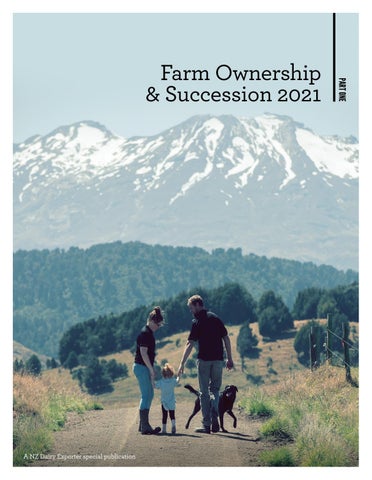
A NZ Dairy Exporter special publication
PART ONE
Farm Ownership & Succession 2021
There’s no time like the present to sort the future of your farm. 57% of kiwi farmers are considering succession planning. Are you one of them? Chat to one of our ASB Rural team today to see how we could help get your farm one step ahead for the future. 0800 787 252 ASB Rural Research, March 2021
asb.co.nz/rural ASB Bank Limited 56180 23594 0621
Welcome
CONTENTS 4 Research shows succession questions cut to the core. 6 Get started early on succession journey advises rural lawyer. 7 Change the mindset to see succession as an opportunity says ASB’s Ben Speedy. 8 Case study: A Waikato dairy farming family’s succession journey. 12 Case study: Growth underpins a successful North Canterbury family’s ownership transition plan. 15 Government calls for more succession planning.
to the first in a three-part series on farm succession produced by NZ Dairy Exporter with support from ASB Bank. Over the next three months, our editorial team will examine farm ownership transition from all sides. We’ll profile several farming families who are on the journey towards moving ownership of their business to the next generation. Our team will also look at how talented and committed farm managers and share milkers, often with limited equity, are hoping to achieve their goal of farm ownership. Finally, our writers will talk to the experts from the advisory sector and investigate some of the new opportunities in front of farmers trying to diversify their farm business to open up new revenue options for a smoother succession journey. We recognise there is no ‘silver bullet’ for success when it comes to farm succession. Our series aims to deliver pathways, advice and some inspiration to guide farm owners along the journey. We welcome your feedback. Tony Leggett Publisher, NZ Dairy Exporter
Farm Ownership & Succession 2021 is produced by NZ Farm Life Media, publisher of NZ Dairy Exporter and Country-Wide. Visit nzfarmlife.co.nz for details of how to subscribe to each magazine. Publisher: Tony Leggett, tony.leggett@nzfarmlife.co.nz, 027 4746 093. Contributors: Penny Clark-Hall, Tim Fulton, Sheryl Haitana, Phil Edmonds, Emma McCarthy, Brad Hanson, Karen Trebilcock. Designer: Emily Rees.
www.nzfarmlife.co.nz
3
Succession questions cut to the core BY: TIM FULTON
F
arm succession can feel like an admission of mortality so it’s no wonder so many farmers delay big decisions until it’s too late. If farms were any other asset, a property owner might delegate the job to an agent. If it was a bundle of shares, cash might move with barely a blink. But farms are bound up in flesh and blood, so farming is different. Farm succession is often described as a planning process, but less often as a ‘people process’. Lincoln University researcher Peter Nuthall puts it plainly in a 2016 paper, citing “reluctance to accept ageing” as one of the stumbling blocks for family-owned farms.
4
Nuthall and his Lincoln colleague Kevin Old found that despite the growth of modern agriculture and farm size, family ownership, as has been shown in many studies, continues to dominate. In a 2014 survey they found that in New Zealand, all but 9% of farms’ assets were either held personally and/or in conjunction with a spouse, possibly through partnerships or private companies. They also found that farmers over 65 years had only started transferring assets 10.4 years earlier. For farmers between 56 and 65 years, the asset transfer only started 5.9 years ago. Like other observers, Nuthall and Old concluded that farmers move slowly on farm succession because they associate it with
retirement, a loss of influence and, ultimately, their own mortality. Nuthall says some of the tension arises “where a farmer holds up progress to avoid loss of control. Sometimes “death dramatically solves this problem”, but just as often a farmer and family members simply “exhibit denial over the whole issue”. One of the most serious problems arises when one part believes there is an implicit understanding of what needs to happen. Unfortunately, sometimes the process is manipulated, Nuthall says. “Sometimes denial allows escape from uncomfortable situations. Another ploy is to segment the overall situation and move ahead in some areas but not others, thus maintaining control in key areas.” Nuthall says the priorities for succession should be efficient and fair distribution of assets to the next generation, smooth management transfer, looking after family relationships and providing for retirement. Hayden Peter studied farm succession for a Kellogg Rural Leadership project: Conversations should start early and be maintained; particularly as young people’s
www.nzfarmlife.co.nz
Henry Brandts-Giesen.
interest and capabilities change over time. Avoid making assumptions, as these can turn into expectations. Avoid devising a strategy at short notice, as a poorly planned and poorly executed strategy can harm family relationships. But do give praise: “Everybody likes praise, but farmers are very reluctant to give any sort of praise. Acknowledgement during succession planning can go a long way to building stronger family relationships.” Like other analysts, Peter urged farmers to focus on profitability as a bottom line for succession: “If a business isn’t profitable, the question has to be asked, ‘what is being achieved from succession?’ he asks. In his 2016 study, Peter points to a study of the sheep and beef sector by UMR on behalf of the Red Meat Profit Partnership, looking at the traits and motivations of high performers. “While profitability is critical, when it is boiled down, profits allow top performers to provide opportunities for their families to live the way of life that appeals so deeply to them.” Opportunity is widely seen as critical to farm succession. It may be that certain family members ‘getting the farm’ is not the fairest, best or most desirable result. Nor is the fairest result necessarily the most even transfer or distribution of assets. In other words, fair does not always mean equal. “Entrepreneurial family businesses are successful because they maintain the best of history, the foundations and the success of the family business legacy and adapt, change and capture new opportunities across multiple generations,” Peter finds. A legal specialist in succession planning, Henry Brandts-Giesen, suggests family business owners and their advisors overlook the importance of human elements. “Make no mistake, this is not a science, it is all about human behaviour around money which is often irrational. Sometimes intellectually brilliant succession plans are formulated but never see the light of day. A consequence of this can be that even the most diligent business owners often neglect or avoid having meaningful succession discussions. By the time they really need to engage their position may be weakened and valuations compromised.” Brandts-Giesen, head of private wealth
“MAKE NO MISTAKE, THIS IS NOT A SCIENCE, IT IS ALL ABOUT HUMAN BEHAVIOUR AROUND MONEY WHICH IS OFTEN IRRATIONAL...”
www.nzfarmlife.co.nz
for Dentons Kensington Swan, said the best results in his experience were based on a simple, documented and agreed game plan before any major moves were made. The steps should not be “tax driven” but should be predicated on independent valuations and reporting. Decisions should also be based on free flow of information between lawyers, accountants, bankers and other relevant professionals who work together from the outset. He recommends business owners and advisors consider financial products such as insurance to manage risk and annuities to manage cash flow and services such as wealth management, where there is liquidity. At a top level, business minders also need to distinguish between the different functions of advice, management and governance, and recognise the value of independent governance. Brandts-Giesen said in this regard the family lawyer and accountant may not always be independent and perhaps should concentrate on advice rather than governance, which involves a different and much wider set of fiduciary responsibilities. Rural law specialist Richard Parkes at Cavell Leitch said parents needed to put their own interests first when starting a succession process. Talking to the children was “consultation not permission” but their feedback had to be considered carefully, including discussion about the farm’s profitability. It was helpful to have off-farm assets and low debt, so succession was viable, he said. Beyond the farm, other rural industry professionals are also marshalling their resources. Workshops run by the NZ Institute of Primary Industry Management have been trying to meet growing demand for governance and succession advice, NZIPIM chief executive Stephen Macauley said. On-farm ownership was changing more rapidly within the primary industry as farm owners considered various governance structures and/or exit strategies. Traditional models of passing the farm on to the next generation had become increasingly difficult through the lack of capital or in satisfying multiple interests of other family members involved in the farm. A growing number of rural professionals are being asked to help navigate their clients through increasingly complicated transitional family arrangements, Macauley said.
5
Save early, take nothing for granted BY: TIM FULTON
H
ate to say it, but farmers are too lax when it comes to farm succession, rural lawyer Richard Parkes says. Parkes has worked with many South Island farmers, particularly in the high country, and has a particular interest in assisting farming families with farm succession plans and “asset protection structures”. He has seen plenty of good plans and good results, but also plenty of farming parents that delay with all their might on the question of succession. And some of it comes down to reluctance to pay for advice, he says. “It’s not so much that they can’t be bothered, it’s just that they don’t want to have to think about it. And I don’t think it’s about mortality, I just think they think ‘oh, that’s a long way off. I’ve got other things to be worried about right now.” So, even though the universal advice is ‘get onto it early’, many farmers are just lackadaisical about it, he says. Then again, Parkes sees a farming demographic that’s shedding sentimentality about succession. “I know plenty of farmers, especially those in their 40s and 50s, who are of a new
generation who don’t think that they need to be a caretaker and hand the farm over to the child. They’re telling their children now, while they’re at school, ‘listen, we are farming now but we are going to sell this farm and enjoy our retirement. Don’t expect to come back to the family farm’.” Other farm owners may decide that since none of their kids are ‘looking likely’ to take over, they’ll look at bringing in equity partners. “Some young person who is capable buys in five or 10 percent, and then over time that person buys more and more. And everyone knows that eventually they’ll either buy it out, or the farm will be sold. And everyone gets their shareholding.” If more traditional family succession is on the table, Parkes strongly recommends families create a company to hold shares in trust. Children should start building wealth early – straight after school is best - so that parents or a trust can progressively sell shares to succeeding offspring. “You have to start with that, because if you don’t start with that, you’re really nowhere. Even though [a takeover] is not going to happen for several years, at least it’s there on their radar as to how it’s going to eventually happen.” If there are three kids on the family farm, for instance, the eldest child might spend their first few adult years at university or take up farm work. “At that point in time, when that kid’s 18 or 19 years old, then that kid should be thinking about how they can develop some wealth to be able to possibly buy shares off their parents.” Shepherding or other jobs should be a first step to that equity-building, rather than simply part of CV-building or even biding time till a return to the home farm, Parkes says. “Maybe he or she goes out as a mechanic, it doesn’t matter, because they’re in a job. And what they should be doing is
“AT THAT POINT IN TIME, WHEN THAT KID’S 18 OR 19 YEARS OLD, THEN THAT KID SHOULD BE THINKING ABOUT HOW THEY CAN DEVELOP SOME WEALTH”
Richard Parkes.
6
buying a house or buying a dairy herd as a sharemilker. They should be borrowing money, based on their salary, to try and build their wealth.” Farming kids may be better positioned to build wealth at a young age than a debt-laden university student chasing a white-collar career. Even if a farming son or daughter needs help with a deposit on a house, they have an asset that’s increasing in value. After a decade or so, the children might be able to get serious about buying into the family business. By then, parents should have “a semblance of a plan” for succession, including figuring out the next step in their own lives. “Even if it doesn’t pan out, at least they’ve got the start of a plan because they’ve got the company, they’ve got the shareholding and they’re saying to their son, daughter or whoever it might be ‘this is the rough plan and this is how it’s going to work’.” The best decision may be that succession isn’t realistic because the farm isn’t profitable enough, or the kids aren’t ready and able to take it on. Inevitably, relationships and plans come unstuck. Parkes said in this situation, his inclination would be to try to keep pushing on with talks after perhaps “letting the dust settle for a few months while people get themselves together”. He recommends farmers appoint an independent facilitator – not a rural professional and not a lawyer, though he had facilitated talks himself when he knew a family well. “It’s got to be somebody who has a reasonable relationship with the family and has the skills to be able to get information out of each of the parties, in a way that gets it all out on the table. There needs to be a lot of trust,” he says. Often, agreeing on a plan comes down to seeing another person’s point of view. “The son might be saying ‘I want to be able to get on the farm and the parents are saying ‘that’s all well and good, but you’ve got no money to start buying in and we want to be able to retire from the farm and live a reasonable life’.”
www.nzfarmlife.co.nz
Succession plans are high on the priority list, says Ben Speedy.
PHOTO: BRAD HANSON
Opportunity amid change BY: BEN SPEEDY, ASB GENERAL MANAGER FOR RURAL
T
he primary sector has always been and will continue to be vital to New Zealand’s economic prosperity. So it’s important, as the current cohort of farmers retires, that we ensure a successful transition to the next generation. We recently conducted research with Kantar and spoke to Kiwi farmers throughout the country and across industries to understand the key issues keeping them up at night, and what’s on the horizon for them. Sixty per cent said succession planning was on their minds which shows there is a lot that can be done, and conversations that can be had, when it comes to thinking about ‘what next’ for the farm. Like any good business owner, food and fibre producers must have a plan for the future of their business. Succession can be hard for farmers and horticulturalists, and in fact bittersweet. In our experience, many of our customers who have put their whole adult lives into ensuring their farm is a functioning, profitable business have mixed emotions about the idea of selling or passing it on. In ASB Rural we work with clients by asking
www.nzfarmlife.co.nz
questions and getting them thinking about what a succession plan could look like for them and their business, then using our expertise and relationships to help make that happen. No two farms, farm owners or families are the same and farm succession plans won’t be either. Handing over the farm is a process that often takes time; we’ve worked with clients who have set their succession plan in motion over decades. It’s important to have independent, trusted voices at the decision table including your lawyer, accountant, or an independent facilitator such as your banker. Working with many different rural customers, with diverse backgrounds and interests, our rural bankers have been involved in supporting many succession plans and have a broad range of experience in the different options that might be available. We believe effective succession plans are bound together by a solid plan, with all parties communicating openly and remaining flexible. If you’re looking to hand the farm over, the best place to start can often be asking yourself two questions: what is the most important thing to you? and where do
you want to be at the end of this process? It’s true generational succession is common in New Zealand because, as we’ve seen historically, it generally offers the best result and for a long time was simply what was always done. But today, not every farm has a natural successor within the family and that’s where equity partnerships, leasing parts of the farm for different purposes, or selling to an independent third party entirely come into play. Diversification is another avenue to think about when it comes to planning your farm’s future. At its core, diversification is building additional revenue streams within your business today, while futureproofing it for the next generation. Historically New Zealand's farms have mainly engaged in sheep, beef and dairy farming but in recent years we’ve seen customers divesting sections of land traditionally used for grazing to forestry or horticulture, while others are seizing the opportunity for development and diversification for themselves. In fact, the same research we carried out showed 58% of farmers were considering adjusting their farming practices to further cater to changing customer demands or supply premiums. Sustainable farms and orchards continue to be sought after and significant work is being put into achieving more environmentally-friendly practices. While diversifying may come with additional cost up front, it can help with enduring business sustainability and make your farm more attractive to prospective buyers or even provide an income stream in retirement. Diversification is hugely varied: we’ve seen farmers get creative in a range of different ways through adding mountain biking tracks or opening up walking trails on the farm, to investing in hives for honey production to changing their farming operation entirely. We’ve also seen examples of customers leasing unproductive parts of the farm for carbon farming which can provide both financial and environmental returns. Diversifying is not without risk, so do your research and talk to experts, but we’ve seen how it can really pay off for farming families. Remember it’s never too early to start thinking about succession and it is never too late. There’s no blueprint on how long it should or will take to transition farm ownership successfully, so take your time, do your research and who knows, you might find opportunity amid the change.
7
ONFARM
Lending, not gifting Waikato dairy farmers Kevin and Cherie van der Poel are taking a hand up, not hand out approach to succession with their children. BY: SHERYL HAITANA
A
PHOTOS: EMMA MCCARTHY
hand up not a hand out is the succession philosophy Kevin van der Poel wants to emulate. Kevin’s father Kees guaranteed a loan of $70,000 so he could afford to take on a 420 cow sharemilking job 30-odd years ago. “I didn’t have enough money to do it on my own so I approached dad and used his equity. That was my helping hand. I paid him back within a couple of years. “It gave me my foot up. I always thought if I could do the same thing for my kids, it would be good.” Kevin and his wife Cherie have now started to give their children Hayden and Hannah the same helping hand as the start of a succession strategy. One of their most valuable assets in starting to talk about succession has been the ability to discuss honestly with the children about a path going forward, Kevin says. “Cherie and I have always had a close relationship with our children and talk openly with them.” They have told Hayden and Hannah that they are willing to back their ideas and help them financially, but the money has been lent to them rather than gifted. They want the kids to learn the responsibility and skill set of handling money which will help them throughout their future. “We wanted them to take on their own debt, so they take on responsibility, it is part of their own personal growth,” Kevin says. When Kevin and Cherie moved to America in 2005 with the kids they bought shares in a Limited Partnership which developed a 3500 cow dairy
8
operation in Missouri. They moved back to NZ in 2012 and now own two dairy farms within a 10 minute drive of each other near Ngahinapouri in the Waikato. Kevin oversees the farms, while Cherie, a kitchen designer, has recently co-bought a kitchen and cabinetry company in Te Awamutu. Hayden wanted to go farming and went to work for his uncle Jim and another farmer before coming to contract milk on the second property for Kevin. Last year he approached Kevin and Cherie about further progression opportunities.
PROGRESSION PATHWAYS
When it came to sitting down to think about progression pathways for Hayden and succession of their assets, Kevin says he was fortunate to be able to discuss various options with his siblings. They are all farming as well and going through succession planning with their own families so he was able to get a good gauge of options. “I’ve also seen what has worked and what hasn’t worked for some of my peers in the industry.” The succession path they chose had to allow flexibility for all partners, giving Hayden the opportunity to grow and giving Kevin and Cherie the ability to carry on doing what they want to in their own future, with the ability to help Hannah. Kevin and Cherie had experience with an equity partnership while they were in America and wanted more flexibility for Hayden and themselves. “What I’ve seen in equity partnerships is they can be quite limiting, and equity gets tied up. We wanted Hayden to be able to take control of his destiny.”
››
www.nzfarmlife.co.nz
9
FARM FACTS Emerald Farm
• 132ha effective • Cows: 490 Autumn calving (and calves down late spring calvers from other farm). • Production: 285,000, 580kg MS/cow • Supplement: DairyNZ System 5, 3t DM/cow/year
Alkemade • • • • •
Ngahinapouri 95ha effective 380 spring calving 219,000kg MS, 576kg MS/cow Supplement: DairyNZ System 5, 3.7t DM/cow/year
10
What they ended up doing was giving Hayden the managing role of the autumn calving operation at Emerald Farm with a 30% share in a sharemilking company in partnership with Kevin and Cherie. With Hayden’s equipment from contract milking and savings, he still needed to take out a significant loan to cover his 30% share of the sharemilking company, which Kevin and Cherie have guaranteed. The sharemilking contract is for three years with the idea of offering Hayden more equity in the sharemilking company, and later down the track the sharemilking company will start buying shares in the farm. That gives Hayden more potential to raise capital through the sharemilking return to keep buying more shares in the land. “Life changes in today’s world and we don’t know where we will be in three years. This gives us the opportunity to remain flexible,” Kevin says.
Hayden receives a manager’s wage which was set up to pay the loan interest, however, Hayden has also been able to pay the principal out of his wages as well. That means his share of the 20+% return from the sharemilking income can go towards increasing his share if he wants to in a couple of years. Kevin and Cherie were mindful not to put too much financial pressure on Hayden, now 26, so he could still be able to get off farm. He is chairman of the Te Kawa Young Farmers and the national delegate for the Waikato Young Farmers. “He needs time to socialise, he’s also started a new relationship. He needs that freedom to be a young person and still have a life,” Kevin says. Kevin and Cherie consulted with their bank manager and accountant to set up the sharemilking company and have all the checks and balances in place, to protect their
www.nzfarmlife.co.nz
own assets, and give Hayden the flexibility on his own assets. Their ASB manager Lachie Cotton has been a great help in making the progression seamless, Kevin says. Giving Hayden the opportunity to have more debt means he starts learning financial responsibility and how to work with his advisors, Kevin says. “We wanted Hayden to start having a relationship with the bank.”
“WHAT I’VE SEEN IN EQUITY PARTNERSHIPS IS THEY CAN BE QUITE LIMITING, AND EQUITY GETS TIED UP. WE WANTED HAYDEN TO BE ABLE TO TAKE CONTROL OF HIS DESTINY.” Starting to give Hayden progression opportunities now will hopefully help succession later on, as well as their working relationship. Kevin is still in charge of the administration and oversees their two farms, along with a third dairy farm they lease in partnership at Te Pahu. Kevin and Hayden can work together, without Kevin living on the same farm and looking over Hayden’s shoulder every day. “I’ve seen the situation where sons come on
the farm and Dad is still there years later, nothing gets done, then the farm gets divided up and there is a family fall out.” While Hayden is farming, Hannah is currently following a different path. She works in marketing and has bought a ‘fixer-upper house’ with her partner. They raised the deposit themselves, with Kevin and Cherie helping with extra equity to do the renovations. The farming business has no governance structure yet, however, that is something Kevin wants to look at, especially as he gets closer to retiring and they continue on the succession journey. Whether Hannah is bought onto a board of governance and Hayden manages the second farm on her behalf, or Hannah gets equity out of the farm for a different opportunity, is something they will talk about as a family in the future. It’s a cliche, but the succession is a living document and something that evolves, Kevin says. For now, Kevin, 58, is not quite ready to retire. He and Cherie have plans to build a new house on the farm for themselves. They’ve built Hayden a house and two other staff houses, so Cherie, a kitchen designer, is well overdue for her own new house, Kevin says. “There is talk of building the cows a house next (covered composting barn), but that might be pushing it to build that before Cherie’s house.”
Above: Well-fed cows on one of the van der Poel’s Waikato farms. Right: Kevin van der Poel and his son Hayden have operational roles in the farm business while Hayden’s sister Hannah is working on building equity in the residential housing sector.
www.nzfarmlife.co.nz
11
Peter and Joc Kinney with sons Alex (centre), Sam and Max.
ONFARM
The Christmas dinner test A farming family found ways to settle sons and daughters on farms by focusing on growth. STORY AND PHOTOS BY: PENNY CLARK-HALL
A
North Canterbury family has bucked the historic trend of sons inheriting the family farm and daughters missing out. Three of four siblings in the Norrie family - Hilary, Joc and Malcolm - took the opportunity to own their own farms. Their brother Geoff chose not to go farming. “Growing up there were two farms and two
12
brothers and you just sort of thought it was always the intention that one brother would get one farm and the other would get the other farm,” says Joc. “That was just the way it was.” Fortunately, her father Dougal Norrie was savvy enough to install his own border dyke irrigation system in the 1980s, paving the way for him to take the next step into dairy farming. Dougal developed one of the first
three dairy farms in the Culverden basin and was the first local farmer to do a dairy conversion from sheep-beef farming. “You know he was a Corriedale sheep breeder. All of his peers at the time thought he had lost the plot,” says Joc’s husband Peter Kinney. “We do things that we think are quite big sometimes, but this was next level. He was ground-breaking.”
www.nzfarmlife.co.nz
This early financial prudence and vision allowed Dougal to expand and create opportunities for all his children. Having two sons in a position to help develop the border-dyke irrigation was important to the success of the financial position of the farms. Peter is from a sheep and beef farm further south and Joc still remembers him declaring over the dishes in their flat that he would never go dairy farming. “It's a big move for someone that grew up whistling at dogs,” says Peter. He found himself changing his tune during his own family farm succession process, realising there wasn’t enough capital to make it work for everyone. “The key thing is profitability to drive farm succession. I had three other brothers, two farming and the youngest at university, and three sisters,” says Peter. “We ended up leaving the family farm. My oldest brother is still there farming with his family. My other brother and I went sharemilking together and leveraged off the asset (family farm) to get going.”
SHAREMILKING THE WAY TO EQUITY
While it was pretty raw at the time, Peter says he thinks sharemilking was the key in creating equity. Sheep and beef farming lacked profitability back then.
Young cattle grazing winter crop on the family dairy unit.
Growing up on a sheep and beef farm and attending Lincoln University gave Peter a broad range of skills beneficial to dairy farming. Peter says this helped them find opportunities to grow. Joc was working at Environment Canterbury at the time. The off-farm income was beneficial to their early growth. Timing is everything and Peter and Joc reached a crossroad where they had to decide on whether to look at an equity partner option with Dairy Brands, or talk to Joc’s parents about going sharemilking on one of the family farms, Ballindalloch. After sharemilking on the family farm for two to three years and some conversations with Joc’s parents, Dougal and Diane, they decided to invest in the farm. By building a new dairy shed and upgrading other farm infrastructure they were able to buy in to become shareholders in Ballindalloch Farm, while continuing to grow their equity as sharemilkers. That was the beginning of a 10-year farm succession process, where the family navigated how this would happen, overcoming challenges along the way. Dougal confided in his accountant, who helped them work through and bring options to the table. “Our accountant, Peter Glassford, gave us
FARM SUCCESSION TIPS
• Start early – be intentional • Make your inroads before you have a family • Make sure you’re still enjoying what you are doing • Follow the Christmas dinner test • Be able to park things • Put yourself in their shoes – find common ground • There are many ways to cut the cake • Don’t farm together for too long, you need to do your own thing • Be constructive – add value • Don’t get the lawyer involved too early • Have empathy • What’s fair isn’t always equal • Don’t make it too easy for the next generation.
invaluable advice and guidance throughout the whole process,” said Peter and Joc. “When you break it down the key thing was that Dougal created an opportunity by what he'd done in farming and then we brought our own equity and strong cashflow from our sharemilking business,” Peter says. By bringing it all together and making it work for everyone they were able to turn Dougal’s asset base and their dairy farming skills into a growth opportunity. “By introducing something that’s profitable to the equation, you allow growth, rather than dividing something up and making it smaller.” Joc emphasises it’s not just the capital that made the succession work. “Peter was pretty driven in wanting to optimise and get the best out of the sharemilking business. You're coming in with top end skills to add value to the business as well as giving Dougal the confidence in your ability.”
SUCCESSION HAS TO PASS ‘CHRISTMAS DINNER TEST’
They agree with a phrase coined by one of their brothers-in-law - ‘a good test for succession is that it has to pass the Christmas dinner test’. “At the end of it, your family still needs to be together,” says Peter. “I think another key part is that fair and equal aren’t the same thing. You can't be equal with everything, it's just about being fair and transparent.”
››
www.nzfarmlife.co.nz
13
BANKER’S NOTES
by ASB Rural Banker Tom Norris The succession process started in 2000 and took about 10 years. The key to the success of Dougal’s succession was that he and his wife Diane were strong enough farmers to get themselves in a financial position to do so. Dougal put in his own border dyke irrigation system on his two farms and then built a dairy shed on each. This helped him later with farm succession as he was able to capitalise quicker to buy another dairy farm. Peter and Joc moved to Ballindalloch Farm as sharemilkers in 2000 and bought into the ownership of the farm in 2003. Sharemilking allowed them to buy into the farm quicker – scaling their business now to three farms. They had a different accountant to Joc’s father Dougal to ensure independent advice. Dougal’s lawyer Mark Tavendale was critical to the process as he was collaborative and an effective communicator. He was strong when he had to be and structured the succession well. As a banker it is really critical to understand what the family wanted to achieve.
14
Peter and Joc Kinney with staff member Mike Devine.
When it comes to lessons learned for how they will do their succession for the next generation, transparency ranks highly. They define it as “open communication all the time”. While they haven't got a plan set down yet on how it will work, they say that is intentional. “It will change all the time. It's just about being open to what the direction is and getting the kids on board with understanding the difference between fair and equal.” Setting up their business so they can create opportunities for their four boys is front of mind. Whether that is leveraging off the asset, not farming at all or helping them all into farming, Joc says they have the ability to do that. They have since grown their asset base to three farms (dairy farm, run-off farm and a beef unit), and are business partners in a sharemilking venture with a previous employee. However, the trick is not making it too easy for them. “If you do it too well for the next generation, they can potentially lose it. They need the challenge to be able to buy into it and create their own opportunities. You can’t just hand it to them,” Peter says. While growing in the dairy industry would be great for succession Peter says you have to remain true to your aspirations. His was to go sharemilking so he could get back to sheep and beef farming.
DON’T HOLD ON TO THE PURSE STRINGS
Joc is wary of not creating a ‘lost generation’ in her children where they hold on to the purse strings for too long. “You don't want to wait till they’re in their 40s before mum and dad start to let go of the reins. They’ve still got to be young enough to grab those opportunities and run with them while still in their prime,” she says. Aware of how difficult the subject is, Peter advises that the plan should be pretty clear before involving a solicitor to create any agreements. “The tone of legal wording can escalate an already sensitive situation, and what was a hard subject just got even harder.” “You need to sit down with the family and have the kids involved from an early age and it's not just a one-off, ‘right guys, we're gonna do farming what do you all want?’ It’s having those conversations now. Just talk to them,” Joc says. They are wary of the trap that some families fall into, where in trying to make it equal, they make it unfair. If anything is certain in farm succession it is that family dynamics will change as children marry and parents age. Peter and Joc say the ability to keep business units separate, rather than trying to grow one big thing, is helpful to keep boundaries clear and opportunities available for future generations.
www.nzfarmlife.co.nz
Lax planning concerns Government BY: PHIL EDMONDS
T
he challenges associated with farm ownership transition have not gone unnoticed by the Government. MPI research shows over half of New Zealand’s farmers have identified succession planning is an issue for them, their family, and their farm businesses. It’s a pressing concern and one it has been proactively trying to address – albeit indirectly. Poorly planned or even non-existent farm succession might not sound like a significant inhibitor to the growth aspirations the Government has for the primary sector, but failure to deliver straight-forward ownership transition will at the very least stifle the ability to optimise land use. MPI’s acting Director of Rural Communities and Farming Support Peter Ettema says the Government’s food and fibre sector roadmap, Fit for a Better World – Accelerating our Economic Potential, includes a target of employing 10,000 more in the food and fibre sector workforce over the next four years. But Ettema says the target will be difficult to achieve without clearly marked and enticing career pathways that progress to farm ownership. A key part of the succession process is ensuring young people or career changers see farm ownership as achievable. If not, then there’s the potential to see those who are best placed to take leadership roles (those who have grown up in the sector) look for alternative careers. So, what is the Government’s role in making sure the obstacle of farm succession is overcome? It can’t directly fund and facilitate decision making that safeguards family relationships through farm asset transfers. It has however been active through enabling industry bodies and rural professionals – those organisations already providing services to farmers – to become stronger advocates for the importance of
www.nzfarmlife.co.nz
succession planning. Ettema points to the Red Meat Profit Partnership programme (RMPP) co-funded by MPI from 2013 as an example of its interventions. “The RMPP worked closely with farmers and an industry advisory group to develop resources for pathways to farm business ownership. Lawyers (who pulled together examples of agreements) and consultants with experience of working with entry into, and transitioning of, farm businesses were involved, and that generated case studies, videos, fact sheets, guides to necessary legal documents, and a resource book.”
FIND OUT MORE
Beef + Lamb NZ Knowledge Hub www.beeflambnz.com DairyNZ www.dairynz.co.nz/business/planning/ succession-planning/ www.dairynz.co.nz/publications/ dairynz-podcast MyMilk www.farmsuccession.co.nz/ Passing it Forward – CMK accounting cmk.co.nz/publications-resources/ A legacy or a liability – how to master farm succession – search ‘succession’ under Podcasts at www. sarahscountry.com
The wide range of material is easily accessible on the Beef + Lamb NZ Knowledge Hub website. Resources targeted at dairy farmers have also been developed from projects connected to the Transforming the Dairy Value Chain PGP and are available on the DairyNZ website. More recently, MPI’s Sustainable Food and Fibre Futures (SFFF) programme has funded the New Zealand Deer Farmers’ Association to lead workshops helping deer farming families across the country talk about succession planning. MPI acknowledges that while the red meat industry is often the focus of succession challenges with the owner profile markedly skewed toward older age groups, other primary sectors are as much at risk of not enabling easy exits and entries. MPI targeted the horticulture industry last year by funding a report on business succession, that investigated financial and business mechanisms in horticulture and agriculture that can facilitate the incoming generation succeeding to horticultural businesses or building equity in horticultural careers. To make sure its reach goes beyond (and across) individual sectors, succession planning also has the potential to be supported by start-up funding through Rural Community Hubs. Ettema says the Hubs, established by MPI to help rural communities respond to the challenges they face, could deliver workshops by suitable rural professionals if it was deemed to address a local aspiration. To some extent creating the resources and making them available is the easy part. Getting farmers to engage with it, and act on the advice is the most important challenge.
15
Learn, Jungrow, excel
July 2021
e 2021
Just one hit
Keeping your team P free
The most family friendly job
Learn, gro w,
BUILDIN
excel
G STRON G WOME N
Ahuwhenua Trophy Young Maori farmer winner Quinn Morgan
SPE CIA L REP ORT : The regener ative jour - where are we going?ney
COVERAG
E FRO M: • BOMA conference • Resilie nt pasture s symposium • Once-A -Day milking conference
SPECIAL REPORT:
Where should you put your eggs? Building a portfolio $12
$12 incl GST
Holding off the hackers
Protecting your farm from cybercrime
Dairy Exporter | www.nzfarmlife.co.nz | July 2021
$12
JUNE 2021
JULY 2021
$12 incl GST
Dairy Export
er | www.n zfarml
ife.co.nz
1 | June 2021
1
Variou subscrip s terms a tion vailable . Starting from
61
$
00
incl GST
SUBSCRIBE TODAY Full of farm management advice – we guarantee its value
BENEFITS • Monthly magazines - choose from print or digital subscription options • Subscribing saves you up to 28% off the cover price • Share your magazines with team members to grow their knowledge or subscribe them all and each have a copy • A great reference tool to refer back to time and time again • Your subscription is a tax deductible farm working expense • Entry into regular subscriber-only competitions and giveaways • Access to years of archive content on our website
0800 224 782 subs@nzfarmlife.co.nz • www.nzfarmlife.co.nz