NEW YORK TREND Serving New York City, Nassau & Suffolk Counties
NYC
THE ALTERNATIVE PERSPECTIVE
$1.00
NEWMAYOR YORK TREND DAVID DINKINS, REP. CHARLES RANGEL, Serving New York City, Nassau & Suffolk Counties
newyorktrendnyc.com
THE ALTERNATIVE VOLUMEPERSPECTIVE 26 ISSUE 40
Since 1989 NYC $1.00 newyorktrendnyc.com
December 17, 2015 - December 23, 2015
VOLUME 28 ISSUE 6
Since 1989
March 1st, 2018 - March 7th, 2018
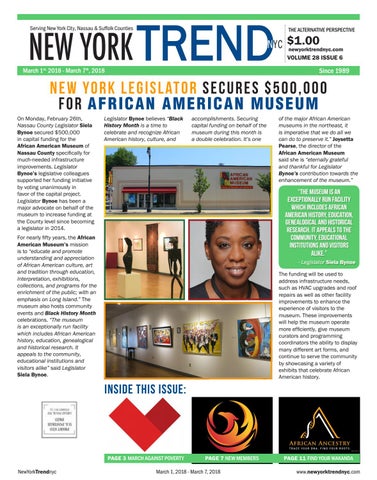
WITHi slator LIFETIMESeACHIEVEMENT NewHONORED York Leg c ure s $ 5 0AWARDS 0 ,0 0 0 For AFRICAN AM ERI CAN MUS E U M
The Black Stars News 2015 Annual Awards Dinner will honor Mayor David Dinkins, Rep. Charles Rangel, Rep. Yvette Clarke, R. Donahue Peebles, On Monday, February 26th,Barbara Legislator Bynoe believes “Black Arnwine, Inez Barron, Sabrina History Month is a time to Nassau County Legislator Siela Lamb, Dr. Rudy Crew, Stephen BynoeByrd, secured Alia $500,000 Jones, and the Centralcelebrate and recognize African in capital for theof gross injustice American history, culture, and Parkfunding Five survivors on American December Museum 18 from 6:00pm – African of 10:00pm MIST Harlem, Nassau Countyatspecifically for 46 West 116th Street. much-needed infrastructure “Each honoree chosen for improvements. Legislator recognition has demonstrated Bynoe’s legislative colleagues exceptional leadership and vision in supported funding initiative her orher his respective profession or by voting unanimously in significant endeavor and in some measure has contributed favor of the capital project. towards creating a more society Legislator Bynoe hasjust been a in this country,” says Black Star News major advocate on behalf of the founder and publisher Milton museum to increase funding at work Allimadi. “Obviously much the County needslevel to besince donebecoming here and around world.” a legislator inthe 2014.
York and a former chancellor of the New York public schools system.
accomplishments. Securing capital funding on behalf of the museum during this month is a double celebration. It’s one
David Dinkins
The gala at the 6:00pm with a For nearly fiftystarts years, African cocktail hour to be followed by the American Museum’s mission dinner and awards ceremonies. There is to “educate and promote will be musical entertainment by understanding and appreciation opera singer Cassandra Douglas and from harmonica phenomenon of African American culture, art William through Galison. education, David Dinkins is and tradition honored for Lifetime Achievement interpretation, exhibitions, — he was New York City’s first collections, and programs forand thealso African American mayor enrichment of the public; with anto the welcomed Nelson Mandela city after his release in emphasis on Long Island.”1990. The museum hosts community Rep.also Charles Rangel, also honored Lifetime has eventsforand BlackAchievement, History Month served in Congress since 1971. He is celebrations. “The museum a recipient of The Bronze medal for is an exceptionally run facility helping save soldiers behind enemy whichline includes American during African the Korean War. history, education, genealogical Rep. Yvette Clarke is a Democratic and historical research. It member of the US House of appeals to the community, Representatives from New York whose 9th district covers educational institutions and much of central Brooklyn. visitors alike” said Legislator Before entering Congress in 2007, she Siela Bynoe.
Charles Rangel
was a member of the New York City Council, representing the 40th council district in Brooklyn, succeeding her mother, Una S. T. Clarke. In the current 114th Congress Clarke serves on the Energy and Commerce Committee, responsible for consumer protection, food safety, energy development, public health, communications, the environment, and interstate and international commerce. R. Donahue Peebles, honoree, is a leading developer and founder of The Peebles Co., the nation’s largest African American-owned real estate firm with $3.5 billion worth of properties under development or management — he was one of the pioneering developerswho helped turn around and revitalize the once-blighted Anacostia neighborhood in Washington, D.C. A champion of African-American economic empowerment Peebles’ is contemplating a possible run for NYC mayor in 2017. Honoree Barbara Arnwine, civil rights lawyer, is a champion of protecting voting rights of ethnic minority groups — the emerging
Pioneering producers Stephen Byrd and Alia Jones, through their of thecompany major African Front American Row Production, brought “Cat on a Hot Tin museums in the northeast, it Roof” and “A Streetcar Named Desire” is imperative that we do all we with a multi-ethnic cast to can do to preserve it.” Joysetta Broadway. In 2016 they bring Pearse, the director of the Winner “Eclipsed” with Oscar African American Lupita NyongMuseum ’O to Broadway.
said she is “eternally grateful Honorees, the so-called Central and thankful for collectively Legislator and Park 5, are individually heroes. They are Bynoe’s contribution towards the survivors of one of the ugliest enhancement of the museum.”
miscarriage of justice in New York’s history; having been majority. She now leads The “The museum is anrailroaded and unjustly convicted for a crime Transformative Justice Coalition. exceptionally run facility they did not commit and for which Arnwine was for 26 years executive they served long prison sentences which includes African director of the Lawyers’ Committee ranginghistory, from seven years to 13 years for Civil Rights Under the Law. American education, before being exonerated when the Inez Barron, honoree, formerly a genealogical and historical actual rapist confessed. They are: State Assembly member, is now Yusef Abdus Salaam; Raymond research. It appeals to the a New York City council member Santana Jr., Antron McCray, Kevin community, educational and a champion of education for Richardson, and Kharey Wise. our youth. institutions and visitors The Black Star News, which focuses Honoree Imhotep Gary Byrd is alike.” journalism, has on investigative a legendary radio talk show host been featured as a result of some if - Legislator Siela Bynoe and executive producer, radio DJ, its news scoops, on CNN, The New poet, songwriter, music recording York Daily News, The New York artist and producer, rapper, writerThe funding will be used to Post, The Village Voice, and Brill’s and community activist. He beganaddress infrastructure needs, Content magazine. his career as a radio DJ in Buffalosuch as HVAC upgrades and roof Past Black Star News honorees at age 15. For over 30 years, he’s repairs as well as other facility been a talk show host at WBLS and have included: Gil Noble (Like It to enhance Is), Rep. Maxine Waters,the Soledad WLIB radio in New York City. Heimprovements experience of visitors the Cosby, O’Brien (CNN), Ms.toCamille also has a Friday night radio talk VozaThese Rivers improvements (New Heritage Theatre), show on WBAI. museum. Errol Louis (NY1 News), Amel
Honoree Sabrina Lamb, founderwill help the museum operate Larrieux (Entertainer), Dr. William of World of Money, is a champion more Pollard efficiently, give museum (Medgar Evers College), of financial literacy for youth-- shecurators and programming Herm Edwards (NY Jets), Nayaba teaches knowledge about handlingcoordinators the ability to display Arinde (Amsterdam News), La-Verna money, budgeting and planning.
many Fountain different(Columbia art forms,University), and
Dr. Rudy Crew, honoree, is one of Lillian (DC37), Desiree Dancy continue to Roberts serve the community the nation’s leading educators. He’s (New York Times), Greg Floyd (Local by showcasing a variety of 237), Rev. Al Sharpton (National president of Medgar Evers College thatNetwork), celebrateand African Action many others. of The City University of New exhibits
American history.
INSIDE T HIS ISSUE: IS SUE : INSIDE THIS
PAGE 2 Education FLY BLUE!pg.5
PAGE 3 MARCH AGAINST POVERTY NewYorkTrendnyc
NewYorkTrendnyc
BluePage Sky EPIC pg.8LIKE YUH! 7 BAD
PAGE 7 NEW MEMBERS
December 17, 2015 - December 23, 2015
March 1, 2018 - March 7, 2018
Page 11 NYC NEW YEARS!
PAGE 11 FIND YOUR WAKANDA
www.newyorktrendnyc.com
www.newyorktrendnyc.com
CULTURE
GIRLTREK is Walking the ULTIMATE 100-MILE TREK Along the Underground Railroad
“We realized that we can’t just talk the talk. We will show and prove that 2018 is about radical courage and unshakeable sisterhood,” says GirlTrek cofounder, T. Morgan Dixon. “We’re walking the Underground Railroad. To reach 1 million Black women by 2020, we knew we needed to be even bolder and hold this unprecedented trek. Harriet Tubman saved her own life first and then went back time after time to save the lives of others giving us the blueprint for the work GirlTrek does today. This is radical self-care at its core.” Since 2013, the 100th year anniversary of Harriet Tubman’s passing, GirlTrek has recognized Harriet Tubman each year by mobilizing thousands of Black women from across the country to walk in her honor in the largest moving tribute, #WeAreHarriet. Coming off the heels of Black History Month and squarely in the middle of Women’s History Month, this Underground Railroad crossing is monumental. There is a health crisis in America and Black women and girls are among the hardest hit. Every day 137 Black women die from heart disease. This is more than gun violence, HIV/ AIDS and smoking combined. And the
2 | NewYorkTrendnyc
WHO: GirlTrek is the largest public health movement and nonprofit for Black women and girls in the United States. WHAT: Harriet’s Great Escape: The entire GirlTrek national team will walk the ultimate 100-mile trek along the Underground Railroad. WHEN: Tuesday, March 6th through March 10th, Harriet Tubman Day. Public celebration is 12:30 to 2:30 p.m. at the Tubman Garrett Riverfront Park located at 815 Justison St. in Wilmington, Delaware, 19801. WHERE: 100 miles from the Eastern Shore of Maryland crossing the Mason Dixon Line into Delaware. HOW: Follow along social media using the hashtag #HarrietsGreatEscape. GirlTrek encourages women to use walking as a practical first step to inspire healthy living, families, and communities. In four years, GirlTrek has mobilized more than 100,000 Black women and girls nationwide. GirlTrek’s goal is to motivate 1 million Black women and girls to walk for better health. Cofounders, Vanessa Garrison and T. Morgan Dixon took the GirlTrek story to the global stage at TED 2017: Walking as a revolutionary act of selfcare. Contact Jewel Bush, National Director of Communications at jewel@girltrek.org to help coordinate media interviews. Visit www.girltrek.org for more information.
HE AD -S TA RT TH IS SU MM ER
The GirlTrek national team includes cofounders Vanessa Garrison of Seattle, Washington, currently living in Washington, D.C.; and T. Morgan Dixon of Sacramento, California; as well as Jewel Bush of New Orleans, Louisiana; Onika Jervis originally of Guyana, currently living in New Orleans, Louisiana; Chyna Johnson of Columbus, Ohio; Carla Harris of Atlanta, Georgia; Sandria Washington of Chicago, Illinois; Nicole Hubb of Prince George’s County, Maryland; Opa Johnson of Miami, Florida and Edisha Brandy from Haven, Connecticut by way of the United States Virgin Islands.
“The reality is Black women and girls are living under trying circumstances. Many of us live in communities that are under extreme stress whether it be from crime, lack of a living wage, blight or gentrification and the current political climate is only making matters worse,” adds GirlTrek cofounder, Vanessa Garrison. “Now, it is even more important that GirlTrek works to reestablish walking as a healing tradition. We believe that, as women, we are going to have to also liberate, one, ourselves and then come back and be examples and liberate our family. And one of the things we say is that, if Harriet Tubman could walk herself to freedom, we can certainly walk ourselves to better health.”
Co Op 3 mp en su le m to te m de up er gr se to e ss e on & io e ns no ye ar nav de of ai g la stu re bl dy e e st in u de th re nt e s mo Ca M nt lc ic hs ul ro us b An Ch at em iolo om gy is try y Ph & ys Ph ic ys s io & lo M gy or e
That’s right: 10 Black women setting out for Harriet’s Great Escape, the ultimate 100-mile trek along the Underground Railroad, on foot. The journey begins on Tuesday, March 6th and culminates with GirlTrek crossing the Mason Dixon Line into Delaware on March 10th, Harriet Tubman Day and a public celebration. The public celebration is 12:30 to 2:30 p.m. at the Tubman Garrett Riverfront Park located at 815 Justison St. in Wilmington, Delaware, 19801.
effects of chronic stress are wearing on Black women mentally, physically and spiritually. Black women die younger and at higher rates than any other group of women in the country: 82% of Black women are currently overweight, 53% are morbidly obese (CDC, 2014), and 95% of Black girls, ages 6-11, will be overweight or obese women by 2034 unless diet and levels of activity change. (Garko, Michael, The Journal of Obesity, 2013).
GE TA
In honor of Harriet Tubman, the greatest freedom fighter that ever was, GirlTrek, the largest national public health nonprofit and movement for Black women and girls, will follow in her footsteps – literally. The entire national team will start-off from the Eastern Shore of Maryland, where Harriet Tubman made her first escape, and walk the path she took to freedom.
718.260.5500 • WWW.CITYTECH.CUNY.EDU/SUMMER NEW YORK CITY COLLEGE OF TECHNOLOGY
CITY TECH
March 1, 2018 - March 7, 2018
300 Jay Street Downtown Brooklyn facebook.com/citytech • @citytechnews
www.citytech.cuny.edu
www.newyorktrendnyc.com
NE WS March Against Poverty to Commemorate the Legacy Of REV. DR. MARTIN LUTHER KING In light of the 50th anniversary of Dr. Martin Luther King's assassination, the social justice advocacy organization Love Beyond Walls in partnership with the Center for Civil and Human Rights launched the second March Against Poverty. Love Beyond Walls Founder and Executive Director Terence Lester will travel on foot from Dr. King’s birth city in Atlanta, GA to the historic Lorraine Motel in Memphis, TN. The 386 mile journey commemorated Dr. King’s legacy and bring awareness to fight against systemic poverty, social injustice and the homeless epidemic still present in America today. Love Beyond Walls along with the NAACP, Georgia Alliance for Social Change, Wheat Street Baptist Church and Atlanta influencers will host an official send off and press conference at the National Center for Civil and Human Rights on Saturday, March 3rd at 6:00pm. Before Dr. King was killed, he
planned his next initiative, “The Poor People’s Campaign.” Dr. King believed that the next step towards equality was to eradicate a system that even today keeps members of society enslaved to poverty. In 2016, Love Beyond Walls launched a national campaign to raise awareness for those fighting against systemic poverty. Executive Director, Terence Lester walked from Atlanta, GA to Washington D.C, over 700 miles to bring attention to poverty in the U.S. The campaign, March Against Poverty 2016, gathered thousands together and videos of the campaign reached over 5 million views.
on the millions of people across the nation from all walks of life and nationalities who experience the harsh realities of homelessness and poverty. It is time for the next generation to pick up the baton and we are on the frontlines to leading the charge,” says Terence Lester, Founder and Executive Director of Love Beyond Walls. The march kicks of on Saturday, March 3rd at 6:00pm at the National Center for Civil and Human Rights and will feature remarks from city officials and civil rights leaders.
Love Beyond Walls is a 501c(3) nonprofit based in Atlanta, Georgia. They’ve worked with hundreds of people transitioning out of homelessness and poverty. For more information on the event and campaign please visit marchagainstpoverty.com.
From the campaign, Love Beyond Walls created a documentary entitled, “Voiceless” that has been viewed by thousands, aired on AIB network, and started a national conversation on systemic poverty. “This march is a testament to the legacy of Dr. King and to shed light
NAACP DENOUNCES
FEDERAL COURT NOMINEE
Owner/Publisher Executive Editor Editor-In-Chief Dr. Teresa Taylor Williams Assistant to Publisher, Administrative Zoie Williams International Correspondent Ann Brown Travel Editor Jim Weaver Contributing Editor Justin Williams
The NAACP, the nation’s foremost civil rights organization, recently hosted a press conference in opposition to President Trump’s nomination of attorney, Thomas A. Farr, to the U.S. District Court for the Eastern District of North Carolina. NAACP President and CEO Derrick Johnson; NAACP North Carolina State Conference President Rev. Dr. T. Anthony Spearman; President of the Wendell Wake NAACP Charles Upchurch; President of the New Hanover County NAACP Deborah Maxwell; NAACP Legal Defense and Educational Fund Policy Director Todd Cox; Congresswoman
NewYorkTrendnyc
Eleanor Holmes Norton (D-DC) and other members of Congress were joined by about 50 members from the NAACP North Carolina State Conference at the press conference to speak out against the egregious nomination. The NAACP strongly opposed this nomination. Throughout his career, Mr. Farr has consistently stood on the wrong side of civil rights issues and worked to intimidate, misinform, or otherwise disenfranchise AfricanAmerican voters. Following the press conference, NAACP leadership took meetings with legislators on the Hill to continue to mobilize support against the nomination.
Circulation Manager Robert L. Taylor
Online Editorial Director Rachel Breton Hamlett Art Director Jessica R. Doughty Emeritus Office & Subscription Manager Sophie Taylor Social Media Zoie A. Williams Writers Ezra Mechaber Deardra Shuler Jim Weaver Anastasia Williams Justin Williams Teresa Williams
NewYorkTrendNYC Catalogued and displayed in the U.S. Library Congress. New York Trend welcomes letters to the editor. 14 Bond Street, Suite 176, Great Neck, N.Y. 11021 Tel (347) 551-1545 Fax (516) 626-3966 ISSN#1083-58 Email: NYTrend@aol.com | Website: www.newyorktrendnyc.com |“Like Us” on Facebook: www.facebook.com/newyorktrendnyc New York Trend is published by TTW Associated, Inc. which holds copyright to the content of this publication. ISSN: 1083-5822 Mail inquiries to: New York Trend NYC, 14 Bond Street, Suite 176, Great Neck, N.Y. 11021. New York Trend NYC is not responsible for the content of letters to the editor or opinions expressed by individual writers. New York Trend reserves the right to edit all letters to the editor. Photographs and manuscripts will not be returned.
VOLUME 28 ISSUE 6
March 1, 2018 - March 7, 2018
www.newyorktrendnyc.com | 3
COMMENTARY FEWER WOULD DIE IF THEY HAD KNOWN BY ADORA NWEZE
PRESIDENT OF THE NAACP FLORIDA AREA STATE CONFERENCE Floridians are getting sick, some more than others. For a long time now, the place people move to for retirement – to end their days in rest and leisure – is ending their days quicker. Their health is ailing faster in Florida and sometimes they’re dying faster, too. I’m not talking about the flu epidemic, but Lord, I do pray for those people. No, if what I was talking about was flu-like, Florida would have pneumonia.
loop. Emergency planners are not getting the voice and knowledge of the Black community, the low-income people, the elderly, and others before they do their evacuation plans and other kinds of climate change planning. So people are not only sick, but don’t have the information about how to escape circumstances like flooding, or what they need to do when there’s a hurricane or a tornado.
Think you’re safe? Climate change, while it impacts some people more than others, ultimately impacts absolutely everybody. No one, and I mean NO ONE, can escape it. No matter how many sandbags you can make or how many SUVs you can rent to get yourself out of the high waters. Just the other day, Dahr Jamail at Truthout wrote an article about
Who is most impacted by this epidemic? People who are already ill or have weak immune systems, people who cannot afford to leave the area and escape to better (for now) climates, and people of color who are at risk because of environmental racism. We call these groups frontline communities because they are the ones at the forefront of the problem but who are also taking action to get things done.
Why are Floridians getting sick? Because of the effects of climate change. The health problems from climate change are real. So real that Florida doctors are seeing the effects every day and are taking it upon themselves to do something about it. The Miami Herald wrote about the Florida Clinicians on Climate Action, a group of doctors who realize that not everyone knows a climate scientist, but they do know a doctor. These doctors explain that “Heat worsens asthma, heart and lung disorders and even mental illnesses. Rising seas push floodwater polluted by leaky sewage pipes into neighborhoods. A changing climate helps spread mosquito-bourne diseases (think Zika), and research shows it makes hurricanes stronger and more common.” They are working to make sure that “…everyone knows about the impacts of climate change and how to protect themselves, all the way from making sure high school coaches know how to teach their athletes the warning signs of heat exhaustion to explaining the benefit of community cooling centers in low-income neighborhoods to politicians.” At the same time Florida frontline communities are getting sicker because of climate change, they are also being left out of the information
4 | NewYorkTrendnyc
And Florida is getting hotter. Make NO mistake about that. These high temperatures mean more fires, bigger hurricanes, more frequent tornadoes, and the list goes on. Climate change caused the sea level to rise and flooded the roads in Key Largo and Big Pine Keys. The flooding got so bad that the county officials are looking into raising the roads – one of the first road projects in the Keys in response to the future impacts of sea level rise from climate change. These high temperatures also mean that people will get sicker faster and more often. People with asthma are going to suffer more and some won’t be able to afford to turn their air conditioning on to where it needs to be for their health so they’ll be having more asthma attacks. And some who depend on electricity for life-saving oxygen and other medical devices will be more at risk for health emergencies when the storms come and knock out their electricity and their devices stop working. More asthma attacks and medical emergencies means more hospital visits that some Floridians cannot afford. So they won’t go.
And Floridians will die.
what climate change means for our kids and grandkids. “Many of the humans being born right now will be alive in 2100. They will live in the conditions we are creating for them today: In a world where it will likely be impossible to feed the majority of the projected 9 billion people on the planet by 2050, water wars will be the new oil wars (the US military has already been practicing for water wars for years), major coastal cities will have long since flooded, and droughts and wildfires will have become year-round events.” This is not some apocalypse movie, this is real life. We cannot afford to debate about climate change for one more second. No. Climate change is real, it is making Floridians sicker faster, and it is destroying the potential for our future generations to thrive as we have done. We have to act NOW.
month I organized a training with, FEMA, the National Voluntary Organizations Active in Disaster (VOAD), and Citizen Corp to train 57 representatives from 25 Florida NAACP branches to not only be Community Emergency Response Team (CERT) members but to also be trained NAACP’s Human and Civil Rights in Emergency Management Monitoring. Now, every county in Florida has an NAACP representative who they can partner with so that they get their climate change emergency plans more in tune with the people they serve. Plus, more NAACP members can now provide basic medical care and attention to their neighbors and communities in a time of a hurricane or other event. I’m calling on every other NAACP State Conference President nationwide to follow Florida’s lead. Because this isn’t just a Florida problem. Every state has environmental and climate change issues – whether its wildfires, blizzards, droughts, or flooding. We need to be prepared for more heat, less drinkable water, bigger hurricanes, more storms, more asthma attacks and cardiovascular diseases, etc. But most importantly, we have got to take care of each other! We can’t be around destroying each other. We have to work together so that the next generation can profit just like how we profited from the last generation. If we join together NOW, we can make plans that will benefit everyone in the community, not just a few. We’ll get stronger, wiser, and safer as a family.
Fewer would have died if they had only known in time. We don’t want that to be our future as much as it has been our past. Join us.
I am the President of the NAACP Florida Area State Conference and the Chair of the NAACP Emergency Management Taskforce. And, I am calling on everyone to get involved. I am leading the environmental and climate justice work for Florida’s communities of color and low-income people. Just last
March 1, 2018 - March 7, 2018
www.newyorktrendnyc.com
Homeownership is closer than you think.
Citi can help you take the first steps toward owning a home with our exclusive HomeRun1 program. You’ll find that it’s an easier, more affordable way to homeownership. Plus, our dedicated Mortgage Representatives will provide the guidance you need throughout the process. The benefits of our HomeRun Program: • No mortgage insurance required • Competitive interest rates • Down payments as low as 3%
Get closer to your next home. Contact your local Mortgage Representative today.
Shawn Carson Home Lending Officer 718-915-8965 shawn.carson@citi.com citi.com/shawncarson NMLS# 1098281
Desaree Ethridge Home Lending Officer 917-744-1153 desaree.ethridge@citi.com citi.com/desareeethridge NMLS# 137044
Terms, conditions and fees for accounts, products, programs and services are subject to change. This is not a commitment to lend. All loans are subject to credit and property approval. Certain restrictions may apply on all programs. 1 HomeRun is available only in Citibank assessment areas for loans on the primary residence of borrowers who qualify and is subject to geographic, income, property, product and other restrictions. To be eligible for up to 97% financing, the property must be a single-family home with a loan amount up to $453,100. Single-family homes in certain high-cost markets with loan amounts between $453,101 and $679,650 are eligible for up to 95% financing. Condominiums and co-ops are eligible for up to 95% financing with loan amounts up to $453,100, or loan amounts up to $679,650 in certain high-cost markets. © 2018 Citibank, N.A. NMLS# 412915. Member FDIC and Equal Housing Lender. Citi, Citi and Arc Design and other marks used herein are service marks of Citigroup Inc. or its affiliates, used and registered throughout the world.
New York Trend Magazine Ad_JAN-2018.indd 1
NewYorkTrendnyc
March 1, 2018 - March 7, 2018
1/10/2018 12:49:42 PM
www.newyorktrendnyc.com | 5
COMMENTARY
BLACK HISTORY MONTH & CLIMATE JUSTICE MOVEMENT BY LIZ KENNEDY
RESEARCH AND POLICY FELLOW NAACP'S ENVIRONMENTAL & CLIMATE JUSTICE PROGRAM African-American history, herstory, and theirstory has a long and rich connection with the land and the environmental movement. From the days of slavery to Jim Crow and even now, African American women, men, and non-binary people have deep ties to the sacred earth and the relationship between the earth’s health and community wellbeing. Enslaved Africans brought vast ecological knowledge to American plantations, teaching their captors rice cultivation, herbal medicine, and more. After emancipation and the plantation economy shifted to a sharecropping economy, the fate of African Americans remained tied to the land as former slaves rented small plots of land from white landowners in exchange for some of their crops. It wasn’t until the Great Migration of African Americans to the North, which reached a peak between 1916 and 1970 that Black communities transitioned from being agricultural and land-based to urban and industrialized communities. Before then, 90% of African Americans lived in the rural South.
As Jim Crow laws were spreading like fire throughout the South, African Americans went from being bound to the land to being segregated from it. All over the country, segregation laws separated Black people from local, state, and federal public beaches and parks. Popular federal parks like Shenendoah and the Great Smoky Mountains were segregated by race, with separate entrances, camping grounds, rest rooms, cabins, and picnic ground facilities. And, public work programs like the Civilian Conservation Camps— which planted three billion trees and served more than 800 parks— forced African American members to live in segregated camps with less resources than their white counterparts. As a lasting result of these discriminatory Jim Crow laws, Black people are less likely to visit national parks. According to National Park Service data, to this day less than 10% of visitors to national parks are African American. Despite this blatant exclusion, our national park system would not have survived without African Americans, specifically because of the protection of Buffalo Soldiers. The all-Black regiments, formed after the Civil War, were some of the first American park rangers. According to National Park Service data, approximately
500 Buffalo Soldiers served in Yosemite National Park and nearby Sequoia National Park, doing everything from evicting poachers to extinguishing forest fires. Their contributions to protecting and preserving the land paved the way for generations of future Americans.
Throughout Black herstory, African American women like Harriet Tubman utilized their knowledge of the earth to fight for liberation. While Tubman was deliberately not taught how to read and write, her sophisticated reading of the stars, land, and waterways of the Chesapeake region allowed her to free thousands of enslaved people from captivity. And she wasn’t the only Black American who used natural knowledge to fight for liberation: The Underground Railroad, which ran from the deep South into Canada, was led by hundreds of brave survivalists like Tubman who shared their knowledge of the land to evade slave catchers, travel often inhospitable terrain at night, and survive in the American wilderness. In addition to the many Black women and men who fought for environmental and climate justice, nonbinary and/or transgender people also contributed a vital chapter to our black environmental
history. Unfortunately, our historical records of Black transgender and/or nonbinary environmental activists is lacking. We know that trans and nonbinary Black people have been engaged in environmental and climate justice from the beginning but their story (hence, theirstory) has yet to be fully documented. We are committed to including Black trans and nonbinary environmentalists in our work because race and gender – all genders – are inextricably linked. As black history, herstory, and theirstory month comes to a close and we reinvent ourselves for this coming year, we ask you to think about the black nonbinary and/or transgender people in your life, and how their contributions are adding to a legacy of activists, leaders, and revolutionaries whose contributions may have been silenced, but not forgotten. As we celebrate Black history, herstory, and theirstory, we remember that being an environmentalist is not and was not exclusively for white people. Whether it was bringing agricultural expertise from Africa, preserving natural beauty on national parks, or leading enslaved people to freedom, African-American history is inseparable from American environmental history.
NOW ON BROADWAY “A
joyous 90-minute fairy tale.
EVERYONE WILL DANCE DOWN THE STREET!” - THE NEW YORK TIMES
FEATURING
LEA SALONGA
TONY AWARD ® WINNER
ALEX NEWELL (“GLEE”)
MERLE DANDRIDGE (“GREENLEAF”)
QUENTIN EARL DARRINGTON (CATS)
SAVE UP TO $60 ON TICKETS! USE CODE: ISLANDDW
TelechargeOffers.com • 212-947-8844 • 6 | NewYorkTrendnyc
Circle in the Square Theatre, 235 W. 50th Street
March 1, 2018 - March 7, 2018
www.newyorktrendnyc.com
ENTER TAINMENT
Actors DANN Y G L O V ER a nd D EL R O Y L I NDO J o i n Leadership Aca dem y fo r Yo u ng M e n o f C o l o r
Leadership development, mentoring, and Rites of Passage are the focuses of the new From the Fire: Leadership Academy for Young Men on July 22-August 3, 2018. Operated by At the Well Conferences, Inc.; a provider of events for teens since 2009, the inaugural two-week boarding program at Princeton University is designed for young men of color in the ninth, tenth or eleventh grades of high school.
The Program Chair is the actor and director Delroy Lindo. He has provided memorable performances in films such as The Cider House Rules, Heist, Clockers, Crooklyn, Malcolm X, and Ransom. Lindo’s passion for the plight of minority boys is leading the actor to take an active role in the program’s development. Lindo states, “My hope is that the experience of From the Fire will give students a boost to take the next steps in whatever goals they have planned for their lives.” The keynote speaker is actor, producer,
and humanitarian Danny Glover. Glover has been a commanding presence on screen, stage, and television for more than 25 years. Additional speakers include former NBA stars Charlie Ward and Jason Richardson, Honorable Ras J. Baraka, Mayor of Newark, New Jersey, artist Hank Willis Thomas, attorney Kevin Harden, and music professor Aaron Dworkin.
From the Fire’s curriculum and programming is research-based and designed by educators and leaders with decades of experience in young adult education and social change activism. It is rooted in the spiritual and intellectual traditions forged in the justice struggles of African Americans. The Leadership Development component will provide transformative education in the form of small group projects, critical reading and writing sessions, and dynamic speakers. Mentorship is offered as a form of "deep caring" to overcome widespread indifference to these most vulnerable young men. Each
participant will be paired with a male mentor who will receive training and the opportunity to attend the event’s Closing Ceremony at Princeton University. The Rites of Passage component will be a journey of self-discovery that unlocks the hidden resilience of the students as fundamental to their manhood. The young men will participate in a host of experiential activities that create and hone life skills.
actress Nicole Ari Parker will serve as Program Chair. The application deadline for all programs is March 31, 2018. Partnerships and donors are sought to secure scholarships for students of both academies. For more information and to apply, go to www.atthewellconferences. org.
Full scholarships are available based upon need. Toby Sanders is the Co-founder and Director of Curriculum of From the Fire and holds a Master of Divinity degree from Princeton Theological Seminary. He states, “We are offering guidance and instruction that encourages these students to see the power within them and others.” Held simultaneously will be the eighth year of the At the Well Young Women's Leadership Academy for current 10th- and 11th-grade girls of color. The
OVER 4 MILLION WEEKLY WINNERS ©2017 New York Lottery. You must be 18 or older to purchase a lottery ticket. PLEASE PLAY RESPONSIBLY. For help with problem gambling, call 1-877-8-HOPE-NY or text HOPENY (467369). nylottery.ny.gov
NewYorkTrendnyc
2018 Ad 7, Size: Half Page H PUB: NY TrendMarch 1, 2018 - March
www.newyorktrendnyc.com | 7
HE ALTH
HEALTHIER SOUL FOOD COOKBOOK "Go Red" Heart Health Month
The Healthier Traditions Cookbook: Soul Food, a healthy twist on traditional Southern dishes, features 17 classic recipes and is available for complimentary download today. The cookbook, a collaboration of Transamerica Center for Health Studies® (TCHS) with the Association of Black Women Physicians (ABWP), helps maintain the integrity of these soul food dishes, while identifying easy steps people can take to enjoy healthier versions. Each recipe was adapted and tested by two nutritionists to ensure an increase in nutritional value and decrease in caloric value.
According to the American Heart Association, “heart disease is the No. 1 killer for all Americans, and stroke is also a leading cause of death. As frightening as those statistics are, the risks of getting those diseases are even higher for African-Americans. High blood pressure, obesity and diabetes are the most common conditions that increase the risk of heart disease and stroke.” The American Heart Association highlights more startling statistics: Cardiovascular diseases kill nearly 50,000 African-American women annually. Of African-American women ages 20 and older, 49 percent have heart diseases. Only 1 in 5 African-American women believes she is personally at risk. Only 52 percent of AfricanAmerican women are aware of the signs and symptoms of a heart attack. Only 36 percent of AfricanAmerican women know that heart disease is their greatest health risk. Recipes in the cookbook include Red Beans and Rice, Gumbo, Pan-fried Catfish, Smothered 8 | NewYorkTrendnyc
with Transamerica Center for Health Studies that help to spur healthier eating choices,” said Sherril Rieux, M.D., from the Association of Black Women Physicians. “Our patients are always asking for ways to eat healthier, and this cookbook was a great way to highlight the health benefits of dishes that have brought happy memories to families for generations.” The Healthier Traditions cookbook complements other ABWP initiatives like its wellness workshops, which are organized, implemented and facilitated by physician volunteers. The series is offered in community forums to educate families about diabetes, hypertension, asthma, HIV/ AIDS, obesity, and general health and wellness issues. These workshops serve as a bridge between health providers to empower individuals to be more active participants in their own health care. Pork Chops, and Peach Cobbler, and have a breakdown of the calories, fat, cholesterol, sodium, carbohydrate, fiber and protein content of the dish. In addition, how-to videos that highlight the preparation of some of the dishes are available on TCHS’s website and YouTube channel. “Transamerica Center for Health Studies is proud to partner with the Association of Black Women Physicians to create a soul food cookbook that increases the nutritional value of these recipes while keeping the heartiness of Southern favorites,” said Hector De La Torre, executive director of TCHS. “This is the third cookbook we have prepared and, consistent with our values, these recipes help to improve health and wellness. Soul food and Southern cuisine have a history as rich as
their flavors, and this cookbook includes interesting facts about soul food history, in addition to helpful nutrition facts.” With the impact of obesity, high blood pressure, and diabetes on the African-American community, the recipes are both nutritious and flavorful, and can help to empower healthier choices around the dinner table. For example, nutritionists make simple substitutions like swapping out regular flour for whole wheat flour in cornbread, and replacing bacon while keeping the smoky flavor with paprika in collard greens. “The Association of Black Women Physicians empowers Black Women to lead in health and wellness for ourselves and the community through premiere educational programs, resources, and partnerships like this one
March 1, 2018 - March 7, 2018
TCHS and ABWP remain committed to empowering consumers to achieve the best outcomes in their personal health and wellness. Please visit the TCHS website to download this cookbook for free and browse our previous cookbooks, American Classic and Traditional Mexican. Transamerica Center for Health Studies ® (TCHS) is a division of Transamerica Institute, ® a national non-profit, private foundation. TCHS informs the national healthcare conversation by bringing clarity to the complex decision-making regarding health coverage and personal health and wellness. TCHS is focused on empowering consumers and employers so that they can achieve the best value and protection from their health coverage, as well as the best outcomes in their personal health and wellness. www.newyorktrendnyc.com
HE ALTH
SECOND HAND SMOKE Affects Latino, Black and Young Adults The Health Department has released a new Vital Signs report on secondhand smoke exposure and smoke-free housing policies in New York City. Secondhand smoke exposure is the involuntary exposure to smoke from a burning cigarette or from another person exhaling smoke from a cigarette. According to the data, 44 percent of adult New Yorkers in 2016 reported being exposed to cigarette smoking while in their home – whether the source of smoke was from another apartment, house, or from the outside. The rate of secondhand smoke exposure was assessed by asking individuals if they smelled cigarette smoke. Secondhand smoke exposure was found to be more prevalent among Latino adults, Black adults and those in high-poverty neighborhoods. Latino adults (56 percent) were more likely to report being exposed to secondhand smoke from the outside than other nonLatino racial/ethnic groups. Black adults reported exposure in their home at higher rates than White and Asian/Pacific Islander adults (44 percent versus 38 percent and 35 percent, respectively). Additionally, New Yorkers living in medium-, high- and very-high poverty neighborhoods were more likely to report exposure to secondhand smoke at home than residents living in low-poverty neighborhoods. The Health Department’s annual Community Health Survey provided data for the report. “There is no safe level of exposure to secondhand smoke, and these troubling data show that too many New Yorkers are being exposed to that danger – especially in communities of color,” said Health Commissioner Dr. Mary T. Bassett. “Exposure to secondhand smoke can put families at higher risk of stroke and other tobaccorelated illnesses. We continue to encourage all New Yorkers to adopt smoke-free policies in their homes in order to protect their health and the health of their family.” The Vital Signs report also examines smoke-free housing in New York City. Forty percent of New Yorkers living in multiunit housing reported living in a building that prohibits smoking,
NewYorkTrendnyc
although White and Black adults were less likely than Latino and Asian/Pacific Islander adults to report they lived in a building with a smoke-free policy. In 2013, 77 percent of New Yorkers also had an “in-home smoke free policy,” meaning smoking was not allowed in their residence, up from 62 percent in 2002.
Additional Vital Signs data highlights: New Yorkers in multi-unit housing
(three or more units) were more likely to report being exposed to cigarette smoke from outside than those in one- or two-family homes. Latino and Black adults and younger adult New York City residents were more likely to report being exposed to secondhand smoke than White and Asian/ Pacific Islander adults and those ages 65 and older. In 2016, 40 percent of adult New Yorkers living in multi-unit buildings reported smoking was prohibited in all areas. In 2013, three-quarters of adult New Yorkers (77 percent) reported they had a smoke-free policy at home – meaning smoking was not allowed anywhere inside. Nonsmokers were more likely than smokers to have such a policy (81 percent versus 55 percent). Among smokers and nonsmokers, the percentage implementing in-home smoke-free policies has increased steadily
between 2002 and 2013 (from 29 percent to 55 percent for smokers; from 71 percent to 81 percent for non-smokers).
In addition to the Vital Signs report, the Health Department published a Health Bulletin this month, which educates New Yorkers on the harms of secondhand smoke at home. The Health Bulletin also provides information about making a home smoke-free, including tips on how to implement a smoke-free
policy in a building. "It is troubling that so many New Yorkers are still being exposed to the dangerous effects of secondhand smoke in their homes and during their daily routines," said State Senator Gustavo Rivera. "While we have implemented measures to curtail New Yorker's exposure, such as the laws I passed to prohibit smoking by school and after-school entrances, we still have to continue working to provide New Yorkers with the resources and support to protect themselves from secondhand smoke and help those who smoke to quit." “Too many New Yorkers are exposed to secondhand smoke in their homes. DOHMH data illuminates a clear danger to public health, particularly in communities of color. More action must be taken to help New Yorkers curb smoking habits, especially in their homes,” said Council Member
March 1, 2018 - March 7, 2018
Ritchie Torres.
In August 2017, Mayor de Blasio signed a series of bills to help reduce the number of smokers in New York City. These bills put New York City at the forefront of smoking and tobacco control by: (1) raising the minimum prices for all tobacco products, including cigarettes, and imposing a new 10 percent local tax on tobacco products other than cigarettes; (2) capping and reducing through
attrition the number of tobacco retailers citywide; (3) creating a retail license for e-cigarettes and capping the number of e-cigarette retailers; (4) increasing the fee for a cigarette retail dealer license; (5) requiring all residential buildings to create a smoking policy and disclose it to both current and prospective tenants; (6) prohibiting smoking and the use of e-cigarettes in common areas in multiple dwellings with fewer than ten units; and (7) banning the sale of tobacco products at pharmacies. In New York City, it is illegal to smoke in common areas in multiunit buildings. By August 2018, multi-unit buildings in New York City must also have a policy on smoking and disclose that policy to tenants and prospective tenants. Although this does not mandate smoke-free housing, it empowers people to make informed decisions to live in smoke-free buildings. ok.com/nycquits.
www.newyorktrendnyc.com | 9
HUMAN RIGHT S
S U I T F I L E D AGA I N S T MYR T LE BEACH FO R RACIALLY DISCRIMINATORY PRACTICES
The National NAACP, the Myrtle Beach Branch of the NAACP and three individuals filed a complaint and motion for preliminary injunction in U.S. District Court for the District of South Carolina alleging that the City of Myrtle Beach and the City of Myrtle Beach Police Department discriminate against AfricanAmerican tourists. The complaint alleges that there are stark differences in the treatment of African-American bikers during Black Bike Week compared to the treatment of majority-White bikers during Harley Week. Both events occur in May with Black Bike Week held over the Memorial Day Weekend and with Harley Week ending a week before Black Bike Week starts. The two events attract a similar number of visitors to the Myrtle Beach area. According to the complaint, the City of Myrtle Beach and its police department impose no formal traffic plan during Harley Week. However, during Black Bike Week they restrict the main two-way thoroughfare, Ocean Boulevard, to a single lane of southbound traffic. All vehicles
entering Ocean Boulevard at night are forced to travel through a 23-mile loop with just one exit. On Saturday night of Black Bike Week, it could take over six hours to complete the loop.
The complaint also alleges that the City deploys far more police officers during Black Bike Week than Harley Week and that the police officers utilize overly aggressive policing tactics against African Americans. As described in the complaint, the City seeks to make Black Bike Week sufficiently unpleasant for the mostly African-American motorcyclists, hoping that they stop attending the event and that it ceases to exist. The NAACP believes the city and police are attempting to deter African Americans tourists and bikers from visiting Myrtle Beach. “All citizens are entitled to equal protection under the law and have the rights of expression, assembly and association,” said NAACP President and CEO Derrick Johnson. “The City’s traffic plan and overly aggressive policing tactics during Black Bike Week violate those fundamental constitutional rights. The
Anson Asaka, NAACP National Office Associate General Counsel, speaking at a news conference in Myrtle Beach on Tuesday about the lawsuit.
10 | NewYorkTrendnyc
Association will continue to use the courts to fight such blatant discrimination.” In 2003, the NAACP successfully challenged the City’s previous traffic plan for Black Bike Week. In 2005, the district court granted the NAACP’s motion for preliminary injunction, finding that differences in the traffic plans between Black Bike Week and Harley Week were likely motivated by race and in violation of the Fourteenth Amendment to the Constitution. Shortly after this decision, a settlement agreement was entered requiring the City to impose the same traffic plans for Black Bike Week and Harley Week. However, in 2015, after that agreement expired, the City imposed a new traffic plan even more restrictive than the 2003 plan. “The Court found that the earlier plan was likely motivated by race and now just a few years after the consent order expired, the City has come back with an even more restrictive plan; it is clear that the City is once again discriminating against the African Americans who attend Black Bike Week,” said Reed Colfax of Relman, Dane & Colfax PLLC, which represents the Plaintiffs. “During annual Black Bike Week, the City of Myrtle Beach and its Police Department resort to behavior that subjects African Americans to rules and restrictions that are clearly racially motivated,” said Kristen Clarke, President and Executive Director of the Lawyers’ Committee for Civil Rights
March 1, 2018 - March 7, 2018
Under Law. “This draconian set of rules and restrictions don’t apply during Harley Week, the Country Music Festival or during other major public events. By subjecting African Americans who travel to Myrtle Beach for Black Bike Week to second-class treatment, officials are resorting to conduct from a bygone era. With our lawsuit, we are turning to the courts to protect the rights and dignity of those seeking equal treatment under the law.” Black Bike Week is the one time of the year when the majority of the tourists in Myrtle Beach are African American. It is also the only time of the year when the city and police impose such an obtrusive traffic plan for tourists. Such tactics are noticeably absent during the weeks of Spring Break, or Fourth of July celebrations. “The City’s traffic plan does not facilitate traffic,” said Myrtle Beach Branch NAACP President Mickey James. “It does not promote public safety. Unfortunately, it is designed to discourage African-Americans from attending Black Bike Week.” “White bikers do not have to go through that, so why should we?” said individual plaintiff Simuel Jones, a Black Bike Week attendee and former U.S. Marine. Relman, Dane & Colfax, PLLC, Lawyers’ Committee for Civil Rights Under Law, Law Office of Peter Wilborn, and the NAACP Office of the General Counsel represent the plaintiffs. www.newyorktrendnyc.com
END NO TE S
A TRIBE CALLED IDENTITY… FINDING YOUR WAKANDA
African Ancestry, Inc. (AfricanAncestry.com), the pioneers of genetic ancestry tracing for people of African descent, commemorates its 15th year by bringing focus on the importance of African ethnic groups, commonly referred to as Tribes. Along with helping people find out where they’re from in Africa, AfricanAncestry.com is the only DNA service that also pinpoints Tribes as a part of its results package. “T’Challa has a connection to his ancestors that I longed for,” said Black Panther’s Chadwick Boseman who traced three lines of his family tree to the Limba people in Sierra Leone, Djola people in Guinea-Bissau and the Yoruba people in Nigeria. “I took this DNA test because it doesn’t just tell the country. If you know you’re Yoruba from Nigeria, now you can pinpoint specific customs and rituals that are a part of your past.”
TOP FIVE TRIBES OF AFRICAN AMERICANS In America, our tribes are found in being from the ‘Southside’ or our northern accents or coastal cuisines, for example. AfricanAncestry.com is making it easy to connect the African American way of life with those of African Tribes such as the Hausa, Mandinka and Ibo peoples. Of the tens of thousands of families that have discovered their roots with AfricanAncestry.com, these are the top five Tribes of African Americans:
Fulani Spread throughout West Africa and bound by Fula language; largest pastoral community in the world.
Mende One of the two largest tribes in Sierra Leone; known for their role in the Amistad rebellion.
Balanta Largest ethnic group of Guinea-Bissau; Fishermen,
NewYorkTrendnyc
Herders and Cultivators. Yoruba Mainly found in Nigeria; spiritual system practiced by many Diasporic communities.
Tikar Major ethnic group of Cameroon; noted artists and mask-makers. Kicking off with the “Find Your Tribe” campaign during Black History Month 2018, AfricanAncestry.com will educate and engage consumers through advertising, social media campaigns, Tribal anecdotes and profiles of Africans, African Americans and celebrities and promotional discounts.
“Finding out what tribe you’re from is finding out what language your ancestors spoke or what traditions they had,” said AfricanAncestry.com President and Co-founder Gina Paige. “Ethnic groups are extremely important to knowing who we are because they are the social factors that dictate culture.” To find your Tribe (and your African country of origin) using a special Black History Month discount, visit www. AfricanAncestry.com through Feb. 28. Media can contact Nichole Taylor at taylor@
March 1, 2018 - March 7, 2018
taylorcommunicationsgroup.com. Founded in 2003, African Ancestry Inc. (AfricanAncestry. com) pioneered African lineage matching in the United States utilizing its proprietary DNAdatabase to more accurately assess present-day countries of origin for people of African descent. African Ancestry’s products include the MatriClan™ and PatriClan™ ancestry tests and customized memorabilia and informative resources. African Ancestry is Black-owned and headquartered in Washington, DC.
www.newyorktrendnyc.com | 11
T:7"
T:10"
HEADED FOR HISTORIC GAINS.
Introducing Better FuturesTM —a whole new kind of investment with a greater return than money. When you invest, it helps kids go to college. Because a mind is a terrible thing to waste but a wonderful thing to invest in.TM ©2013 UNCF
12 | NewYorkTrendnyc
Invest in Better Futures at UNCF.ORG/INVEST March 1, 2018 - March 7, 2018
www.newyorktrendnyc.com