New York
nurse Western NY Edition | september/october 2019
the official publication of the new york state nurses association
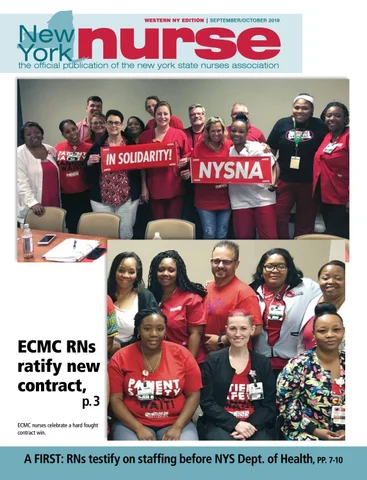
ECMC RNs ratify new contract,
p. 3
ECMC nurses celebrate a hard fought contract win.
A first: RNs testify on staffing before NYS Dept. of Health, pp. 7-10
2
New York Nurse september/OCTOBER 201
Global Youth Climate Strike
Judy SheridanGonzalez, RN, NYSNA President
Board of Directors President Judy Sheridan-Gonzalez, RN, MSN, FNP judy.sheridan-gonzalez@nysna.org First Vice President Anthony Ciampa, RN anthony.ciampa@nysna.org Second Vice President Karine M. Raymond, RN, MSN karine.raymond@nysna.org Secretary Tracey Kavanagh, RN, BSN tracey.kavanagh@nysna.org Treasurer Patricia Kane, RN pat.kane@nysna.org Directors at Large Anne Bové, RN, MSN, BC, CCRN, ANP anne.bove@nysna.org Judith Cutchin, RN judith.cutchin@nysna.org Seth Dressekie, RN, MSN, NP seth.dressekie@nysna.org Jacqueline Gilbert, RN jackie.gilbert@nysna.org Nancy Hagans, RN nancy.hagans@nysna.org Robin Krinsky, RN robin.krinsky@nysna.org Lilia V. Marquez, RN lilia.marquez@nysna.org Nella Pineda-Marcon, RN, BC nella.pineda-marcon@nysna.org Verginia Stewart, RN verginia.stewart@nysna.org Marva Wade, RN marva.wade@nysna.org Regional Directors Southeastern
Yasmine Beausejour, RN yasmine.beausejour@nysna.org
Southern
Sean Petty, RN sean.petty@nysna.org
Central
Marion Enright, RN marion.enright@nysna.org
Lower Hudson/NJ Jayne Cammisa, RN, BSN jayne.cammisa@nysna.org Western
Chiqkena Collins, RN chiqkena.collins@nysna.org
Eastern
(Pending)
Executive Editor Jill Furillo, RN, BSN, PHN Executive Director Editorial offices located at: 131 W 33rd St., New York, NY 10001 Phone: 212-785-0157 Email: communications@nysna.org Website: www.nysna.org Subscription rate: $33 per year ISSN (Print) 1934-7588/ISSN (Online) 1934-7596 ©2019, All rights reserved
Good afternoon Fearless Youth Warriors! I offer you the love, admiration and commitment that we, the 42,000 members of the New York State Nurses Association bring to this historic event. Why do I say warriors? Because war has been declared on our planet by greedy corporations who see profit instead of people, who embrace destruction instead of sustenance who are leading humanity down a path of total devastation… And we must fight them with every ounce of strength that we have. People ask me: Why are nurses concerned about the climate? What business is it of your union to get involved in something that has nothing to do with your profession? And we say, it has EVERYTHING to do with our profession, our union, our patients and our future. Who do you think rescues and cares for victims of... heat waves that cause untold deaths and serious heat related complications; wild fires that increase in severity as I stand here; floods that cause toxic molds, pneumonias, asthma, lung and heart damage; droughts that cause unprecedented food insecurity, starvation, malnutrition; fracking, pipelines, bomb trainsand diesel fuel exhaust that poison nature’s precious, life-sustaining gifts to humankind—our air, soil and water; super-hurricanes and typhoons that devastate whole populations and towns in a single day, obliterating islands in the global south, leading to long-term illnesses and creating conditions for new bacteria and viruses to thrive? When Hurricane Sandy hit
ALL OF THESE EVENTS lead to homelessness, depression, suicides and massive migration. The victims come to us desperate, lost, suffering, terrified, asking, “What happened? What kind of life can I look forward to now, now that I’ve lost everything…” When Hurricane Sandy hit New York and New Jersey, we were
On September 20, over 4 million, mostly young people, demonstrated across the globe to demand that adults take definitive action to staunch climate change. An estimated 250,000 people marched in NYC.
We literally saw with our own eyes where the bodies were buried when there was no refrigeration in morgues and no roads or fuel for transport. Imagine watching your mom take her last breath before your eyes because she couldn’t get oxygen or a nebulizer for her emphysema—and then burying her body in your back yard... We saw this… An honorable profession
Greta Thunberg, international leader and the inspiration for the Youth Climate Strike, backstage with NYSNA President Gonzalez.
awakened to the enormity of the storm. And as we cared for folks whose health and lives were upended by it, we knew we had a moral responsibility to not only treat patients, but to research, comprehend and take a stand against the CAUSES of the climate catastrophes that are engulfing our world. We formed collectives of volunteers who were ready and willing to go to regions impacted by the deadly effects of climate change. We sent multiple teams to Puerto Rico and the Virgin Islands after Hurricane María and we continue to travel all over the world to do what we can to mitigate the horrific impact of these events.
And so, our union, our nurses continue our work in our honorable profession inside the walls of our hospitals, on the mountainsides, and in marshlands, cities and jungles of our planet. But this work is only a Band-Aid on a gaping wound. Our planet is crying out to us to heal its wounds, to remove the cancer that is destroying the only body we have as a people, to save it from its ultimate destruction. We promise to work with each and every one of you, our youth, the unsung heroes of the universe. You hold the future in your hands and in your hearts. We stand by your side with our stethescopes, with our voices and with our bodies and souls, because saving the planet is saving ALL of our lives. And saving lives is our business!
NEW YORK NURSE/WESTERN
Western
September/october 2019
ECMC RNs ratify new contract
A
t Erie County Medical Center the NYSNA fighting spirit is alive and well. After the administration threatened to roll back critical benefits, namely vacation and sick days, ECMC nurses did what they do best—they took a stand. Members mobilized and entered into negotiations with confidence, emerging with a contract victory. The new contract, ratified by an overwhelming majority, keeps paid time off intact. Wage increases include three percent each year for four years and a per diem rate increase. Nurses also won an additional $50,000 in tuition reimbursement, improvements to on-call agreements, paid release time for committees and, significantly, the staffing of 45 additional positions, for which the allocation committee will establish a minimum number of RNs per unit and shift. “We got unprecedented safe staffing language in our contract, and we are already working hard through the new staffing committee to implement change,” said Chiqkena Collins, RN and NYSNA Board Member. “It’s really an exciting time at ECMC, and I’m happy to see nurses continue the momentum we built during the contract campaign.” Prepared to fight
Lauren Wallace, RN, became a registered nurse just last year after
ECMC nurses united in solidarity
NYSNA nurses come to the table.
working at a nursing home. She felt inspired by her fellow ECMC NYSNA members and dove into organizing. “You have to believe in yourself. You have to know that your union is supporting you, and you need to show support to them. Because if you don’t go down and show up at the table, you can’t expect change. It’s not a one-way street—you can’t ask for better safe staffing ratios and not be prepared to fight for it,” said Wallace. Among the issues nurses at the hospital are continuing to work to have addressed, staffing ratios loom largest. “A real disconnect”
Paula Staniorski, RN, who has been a nurse for 34 years, echoed the concern. “We’re always short staffed and having to do more with less. We just have to adjust when they pull our people, and there
doesn’t seem to be any real effort from management. It’s hard for them to truly understand the acuity with the patients and how things can pop up all the time,” she said. “There’s a real disconnect.” Despite the challenges that remain, Staniorski is very proud of the solidarity nurses showed during the contract fight and commend NYSNA for its support. “We’ve got amazing reps. Murnita Bennett is a bulldog when it comes to things at the negotiating table. We have people who’ve actually worked on the floors and know what it’s like,” said Staniorski. “They explained to management that enough is enough. We are valuable and this hospital ticks because of us and the care that we give.” Said Wallace: “We’re making steps each day towards progress, and that’s because of the support of NYSNA.”
“
“It’s really an exciting time at ECMC, and I’m happy to see nurses continue the momentum we built during the contract campaign.” Chiqkena Collins, RN and NYSNA Board Member
3
4
New York Nurse september/october 2019
Nursing has no boundaries
T By Jill Furillo, RN, NYSNA Executive Director
he Global Nurses Solidarity Assembly drew 1,500 people, mostly nurses, to San Francisco for three days commencing September 12. It was an extraordinary gathering. The event was organized by National Nurses United, the largest union of nurses in the U.S., with 185,000 members. NYSNA was honored to be invited and sent 35 participants representing upstate, downstate, public and private sector nurses. Truly an international effort, the Assembly hosted guests from 24 countries, all members of the global federation of nurses and healthcare workers unions, Global Nurses United. The problems we face, including austerity and privatization attacks on healthcare systems and other public services, the climate crisis, attacks on unions, safe nurse staffing and other nursing standards, and immigration and racial and gender justice issues—all were addressed and open to discussion. Shared experiences
Plenary Sessions at the Assembly included Global Health, Global Justice; Fighting Inhumane Immigration Policy; The Global Climate Emergency—The Fight for Environmental Justice. Breakout Sessions/Workshops were conducted on a range of topics, including Workplace violence, Veterans Health, and Racial and Gender Disparities in Healthcare and Organizing the Unorganized. Over the years NNU and NYSNA have shared our experi-
ences coordinating collective bargaining to build stronger contracts for nurses. In organizing the unorganized we achieved great success adopting many of their tactics. Pre- and post-Janus efforts to strengthen internal union organizations are underway at both NNU and NYSNA—taking on the corporate union-busting assault. NNU has supported our organizing campaigns—Albany Med a key example. NYSNA, in turn, has supported theirs, recently at Johns Hopkins Medical Center. Common ground
On the critical fight for universal healthcare, NNU was instrumental in launching the national campaign for Medicare for All. We are both a part of the Labor Campaign for Single Payer Healthcare. Here in New York, the New York Health Act, our state’s Medicare for All legislation, gains support. Recently, we were instrumental in helping Congressman Hakeem Jeffries reach a decision to sign on as a co-sponsor on HR 1384, the Jayaplan-Dingell House Medicare for All bill. NNU’s RNRN (Registered Nurse Response Network, which includes NNU members, other union RNs and non-union RNs) engages in disaster relief; we saw them in action after Katrina and in Haiti. They were here, volunteering in the aftermath of Hurricane Sandy. They were also coordinating relief in Guatemala and on the border—our nurses joined both these medical missions. In this way,
(r.) Jovana Woodley, RN, Coler Specialty Hospital & Nursing Facility
we were able to develop our New York Recovery Network (NYRN), now working with RNRN as well as launching relief missions of our own, most recently in Zimbabwe (see pages 12-13 for a report on our September mission there). The common ground we share with NNU/GNU is big and broad, and our two unions continue to coordinate on many issues: NYSNA members have been active in working in support of key NNUsponsored federal legislation, the Healthcare Workplace Violence Prevention Act and Safe Nurse Staffing Standards for Hospital Patients. We joined NNU members in support of the employee fairness act, on the right to organize, and to win a Robin Hood Tax on Wall Street speculation that would help fund programs like Medicare for All, for free college tuition, and for climate justice. As we look ahead to 2020, the united voices of nurses—in New York, around the nation and the world with NNU/GNU—are growing stronger and louder. Solidarity!
NEW YORK NURSE
5
September/october 2019
Contract wins with ratios in Brooklyn and on Staten Island
“I
feel happy that my patients are going to get the care they really need. It’s not really about me—it’s about giving the patients the care they deserve. With safe staffing ratios, nurses won’t feel burnt out trying to meet all the goals they need to meet.” These are the words of Christine Toomer, RN, Interfaith Medical Center, on winning their contract. Toomer and her fellow nurses ratified their contract on September 9. Other hospitals where NYSNA nurses fought hard and won contracts with ratios were Kingsbrook Jewish Medical Center on September 24 and Wyckoff Heights Medical Center on June 14. “Despite pushback from management, our NYSNA committee was able to forge ahead after almost one year of intense bargaining and we won ratios,” said Vivienne Phillips, RN, of Kingsbrook. “We also
trail-blazed by fighting for ratios at our skilled nursing facility,” added Phillips. Latest wins at RUMC
Richmond University Medical Center won their hard-fought contract on October 5. “RUMC Nurses came together like never before and that is what made administration realize we were not to be taken lightly,” Diane Donaghy, RN, LBU Chair, Labor and Delivery. “Our amazing info picket and overwhelming strike vote forced RUMC management to agree to ratios and retiree health.” “Safe ratios will assist nurses to work together with RUMC to provide the community with safe patient outcomes. The nurses fought hard to raise the bar for the SI community’s health care,” said Eileen Fitzgerald, RN, who served on the Bargaining Committee.
“Retirement benefits, included in the contract through the VEBA program, were also something we fought for and wouldn’t give in until we got something in the contract,” said Christine Toomer. “As we retire, we would like to know there is something there to help hold us down. You work so hard for all these years, it’s something you feel entitled to. You give 100% to your organization, you feel like they would give you something back.” Safe staffing above all
Every private sector facility that bargained in Brooklyn, Queens, and Staten Island in 2018/2019 now has ratios, or is actively building ratios, and/or will be building ratios over the life of their agreements. This is an outcome amidst immense economic pressure from what are largely safety net, underfunded, and under-resourced employers. The nurses in Brooklyn and at RUMC demanded that every patient be treated with the same safe ratios-- regardless of ability to pay. These contracts demonstrate the extraordinary commitment of NYSNA’s safety net facility nurses to safe staffing. As of today, all private sector hospitals have expedited, binding arbitration over all staffing violations. This constitutes a stricter enforcement mechanism than California law provides under its ratio law.
Interfaith Medical Center nurses with their Memorandum of Agreement
Wyckoff Heights Medical Center nurses with their Memorandum of Agreement
RUMC contract ratified, Oct. 7
Kingsbrook Jewish Medical Center ratification vote
“
I feel happy that my patients are going to get the care they really need. It’s not really about me— it’s about giving the patients the care they deserve.” Christine Toomer, RN, Interfaith Medical Center
6
New York Nurse september/OCTOBER 201
Toronto meeting features NYSNA members
M “
The Conference emphasized unity within the labor movement, the importance of supporting and mentoring millennials within the movement, and taking care of our mental and physical health while assessing the demands of being union leaders.” Jalisa Saud, RN
onifa Johnson, RN, and Sasha Pell, RN, both of Albany Medical Center; Corey Ellis, NYSNA Director, Upstate; Ari Moma, RN, Interfaith Medical Center; Jalisa Saud, RN, release time rep, Brooklyn; and Chiqkena Collins, RN, Erie County Medical Center traveled to Toronto in August to attend the regional conference of The Coalition of Black Trade Unionists (CBTU). Nurses Saud and Powell facilitated and presented a workshop on health and wellness. “The Coalition of Black Trade Unionists Conference is an important asset to the labor movement,” said Saud. “The Conference emphasized unity within the labor movement, the importance of supporting and mentoring millennials within the movement, and taking care of our mental and physical health while assessing the demands of being union leaders.” [Below, are excerpts from an article that appeared in Our Times, by Christopher Wilson.]
I
n August, over 150 members of the Coalition of Black Trade Unionists (CBTU) came to Toronto from across the U.S. and Canada for a regional conference with the theme “United for a Better Tomorrow.” CBTU, a communitybased organization that supports “workers’ rights and the communities we live in” was created in 1972 to provide a voice for Black trade unionists. It has chapters across the United States and in Canada, as well as some members in the U.K. and the Caribbean….
growth of the chapter since its founding over 20 years ago. “Unity requires commitment and purpose,” she said. “We need elected leaders ... to respect the rights of workers. ... What does a better tomorrow look like? Where Black men can walk free without fear of being executed and women do not live in fear of violence.” Veecock thanked CBTU for all its support over the years, saying: “CBTU is my home and where I belong.” “Green Is Not White” and “Man in the Mirror” workshop facilitators asked parJalisa Saud, RN, release time rep, at podium ticipants to discuss how to better connect Indigenous and tion within the labour movement is Black struggles to stop environoften difficult, but we need to take mental racism, and to reflect upon care of ourselves: mind, body and our own capacity to become agents soul.” Saud challenged the stigma of change. The workshops were associated with mental health: designed through a newly created “Mental health is criminalized for workshop committee, as well as Black men, and the strength perstanding committees of CBTU. ceived in Black women is why often [our] pain is not taken seriously Jalisa Saud, RN, is a member of and we are treated differently in CBTU’s New York Chapter. She childbirth and cancer diagnosis.” encouraged members to reflect upon health promotion within our Shaun D. Francois is president of communities, saying, “Stress reduc- Board of Education Employees Local 372, in New York City, and president of AFSCME DC37. He called for intergenerational unity by demanding more opportunities for millennials within CBTU and our broader labor movements. The underrepresentation of young workers is “unacceptable” he said during his luncheon address.
Terry Melvin, president of CBTU International, provided context for the gathering with a call to revive our labor movements in order to confront the rise of the right, xenophobia and hate. The need for unity could not be greater…. June Veecock, first president of the CBTU, Ontario Chapter, expressed her pride in the longevity and
(L to R) Chiqkena Collins, RN, Jalisa Saud, RN, and Sasha Powell, RN
The panel discussion on the trades, which focused on increasing diversity among their members, was chaired by Chris Campbell, a Carpenters Union Local 27 business representative. Rosemarie Powell from the Toronto Community Benefits Network observed that less than two percent of construction jobs are held by Black workers and less than four percent by women. Community benefits agreements are negotiated with the view to breaking that cycle of systemic exclusion.
New York
nurse special edition | september/october 2019
the official publication of the new york state nurses association
U
r p n
e c e
n e d
d te
8
New York Nurse september/OCTOBER 201
Before the NYS Department of Health
“
We know that patient outcomes improve when staffing is better. And for high-risk, higher-acuity patients like the ones in the One Brooklyn Health facilities, this would be a critical improvement to care delivery.” Ari Moma, NP, Interfaith Medical Center
NYSNA testifies for safe staffing at the DOH
W
hen on September 20 NYSNA nurses testified before the New York State Department of Health, it was a first: nurses and caregivers in hospitals and nursing homes giving formal testimony for a study on safe staffing. The hearing was one of two public hearings to elicit testimony for the NYS Department of Health (DOH). This groundbreaking effort was mandated in the 2019-20 New York State Budget and is the first time the DOH has examined the issue in detail—a crucial step in making policy—to bring safe staffing in New York State one step closer to reality. The public meeting, an unprecedented event in which NYSNA nurses gave testimony: David Curry, ARNP, PhD Champlain Valley Physicians Hospital; Ari Moma, NP, Interfaith Medical Center; NYSNA President Judy Sheridan-Gonzalez, RN, Montefiore Medical Center; Jayne Camissa, RN, Westchester
FY 2020 Executive Budget Briefing Book, page 89
Medical Center; Lenore Granich, RN, and Jen Bejo, RN of Albany Medical Center. How we got here
There is no way our fight for safe staffing could have come this far if it were not for the tireless efforts of countless nurses speaking out in one united voice: “Safe staffing
Members of the NYS Department of Health panel on Safe Staffing
saves lives!” Since 2013, NYSNA has waged an unrelenting advocacy campaign that harnesses lobbying at the state and local levels, political action and electoral strategy to elect legislators who support safe staffing legislation, bargaining for patient safety and winning landmark safe staffing in many of our contracts, creating facility-based staffing captain programs to document unsafe staffing levels in realtime, and working with frontline nurse leaders to advocate for each other and our patients unit-by-unit. NYSNA is not alone in bringing essential information to the DOH. Other unions participating in September with testimony of their own were: CWA – District 1, Public Employees Federation, 1199SEIU (Nursing Home Panel), and 1199SEIU (Hospital Panel). It’s been a tremendous effort on many fronts, in coalition with comContinued on page 10
(l.-r.) Ari Moma, NP, David Curry, ARNP, PhD, NYSNA Executive Director Jill Furillo, RN, NYSNA President Judy Sheridan Gonzalez, RN, NYSNA Board Member Jayne Cammisa, RN, representing NYSNA
NEW YORK NURSE
9
September/october 2019
In the words of David Curry, ARNP, PhD, Champlain Valley Physicians Hospital [excerpted]
M
y name is Dr. David Curry. I’m an Advanced Registered Nurse Practitioner at Champlain Valley Physicians Hospital in Plattsburgh, New York and Professor emeritus of Nursing at SUNY Plattsburgh. My doctorate is in Health Administration. I look forward to this staffing study being designed fairly and modeled to address the benefits safe staffing could bring to our hospitals through improved patient outcomes. The study must also address the serious workforce issues we face now and in the future. As a nurse in a rural setting, I know how important healthcare is to my area, not just for my community’s health, but my community’s economy as well. CVPH is one of
the largest employers in Plattsburgh aside from SUNY and state and local government. As I’m sure you’re aware, this is also the case for many hospitals across the state in rural New York. Unfortunately, rural hospitals have always struggled due to intense economic pressures. Our hospitals have to make decisions based on these pressures and not necessarily what our community’s healthcare needs are. One example is the pressure on all hospitals to reduce their number of beds in response to a decreased “length of stay” forced by the current reimbursement system. CVPH just yesterday ended a nearly 10-day Level II disaster scenario due to “capacity”—that is, all beds
David Curry, ARNP, PhD
were full. This results in transfers to other facilities or patients spending excessive time in the Emergency Department. Of course this is exacerbated by lack of additional RN staff to open additional beds. I would note that Albany Medical Center and SUNY Upstate were reportedly operating at full capacity for this time period, also. We’ve seen full service hospitals in rural areas close, or be converted into freestanding emergency departments that do not fully service the community’s needs. This happened in Lake Placid. Patients that have to travel longer distances to receive more complex care risk more complications and even death. And potential employers avoid areas that lack adequate healthcare facilities—their management teams won’t move there… That is why we need to think of safe staffing as an investment for our community, both for improved patient care and patient outcomes and our community’s local economy. By accessing grants to expand RN training opportunities in critical areas of rural New York, we can train and deploy the next generation of nurses and healthcare workers that will be hired to meet the real staffing needs across the state. I hope this study will be designed to reflect these elements of nursing and the healthcare workforce in rural New York.
“
[W]e need to think of safe staffing as an investment for our community, both for improved patient care and patient outcomes and our community’s local economy.” David Curry, ARNP, PhD, Champlain Valley Physicians Hospital
In the words of Ari Moma, NP, Interfaith Medical Center
M
y hospital is one of three hospitals, including Brookdale Hospital and Kingsbrook Jewish Medical Center that form the foundation of this health system, which is an important part of the DOH and the governor’s efforts to strengthen and transform access to quality care in Central Brooklyn. I believe that the governor’s efforts to transform healthcare in my hospital’s service area is a crucial first step to improving health outcomes for my patients and ensure that access to lifesaving medical care is available and affordable.
However, I believe that investing in better staffing for our healthcare facilities in Central Brooklyn and across the state is the next step in this project to revitalize and transform healthcare. We know that patient outcomes improve when staffing is better. And for highrisk, higher-acuity patients like the ones in the One Brooklyn Health facilities, this would be a critical improvement to care delivery. I believe that this study is an important first step towards understanding the staffing needs across the state. And when it comes to cost, I want to stress that our governor has demonstrated that he is
Sara Buckley, RN, CWA - District 1
Ari Moma, NP
willing to make an investment in healthcare transformation. I hope that he will continue to use this approach to benefit our patients in Central Brooklyn.
10
New York Nurse september/OCTOBER 201
In the words of Judy Sheridan-Gonzalez, RN, NYSNA President [excerpted]
I
’m an Emergency Room staff nurse for over 30 years at Montefiore Medical Center in the Bronx and I’m the president of the New York State Nurses Association, representing over 42,000 RNs—front line nurses who care for patients every day across the state. We—and our patients—are grateful that the Department of Health is working diligently to fulfill its charge to develop regulations that will seriously enhance safer staffing ratios in our facilities.
The state legislature has tasked the DOH with completing the staffing study before the legislature reconvenes in January 2020. The next DOH hearing will take place on October 22 from 9:30 AM – 3:00 PM at 90 Church Street in Manhattan. In order to attend, you must contact your rep and pre-register at health.sm.StaffingStudy@ health.ny.gov. This is an important time for nurses to remain focused and remind the NYS DOH of how enhancing safe staffing will increase patient safety and save lives.
Like Climate Change, the scientific evidence is overwhelming: safe nurse to patient ratios reduce medical complications, morbidity, mortality, inappropriate readmissions and enhance the quality of life of our patients, especially those most vulnerable and alone. Our union has successfully negotiated improved staffing ratios in
many facilities, resulting in better outcomes and, ultimately, cost savings as well. Why is that? Hospitals with consistently appropriate staffing have far fewer cases of RN burn-out, demoralization, abandonment of the institution— and even, the profession. Such facilities are able to retain experienced nurses, and see greatly enhanced patient satisfaction and successes. They avoid turnover--the costs of training new nurses are prohibitive—and the loss of nurses result in costly overtime and agency nurses. Well-staffed facilities avoid massive financial losses due to unreimbursed readmissions, prolonged length of stay and a multitude of medical complications and errors. An Institute of Medicine study over 10 years ago reported that over 400,000 reportable (with many more unreported) hospital deaths
occur every year—due to medical errors. Nurses are the primary mitigators of medical errors. While the dollar cost of such errors are astronomical, the moral costs and the pain associated with such deaths are indescribable. Staffing is regulated in transplant units—after celebrity deaths occurred due to understaffing. Not one transplant unit closed or went bankrupt after staffing regulations were implemented. How many more deaths must we bear witness to due to the scourge of unregulated hospital staffing? We believe the DOH recognizes the cognitive dissidence that exists for a government office committed to excellent care and recalcitrant employers who resist regulation at all costs. We trust in you to honor your mandate to protect and serve the public.
Ed Yoo, Director, NYSNA Department of Strategic Research [Yoo attended a stakeholder meeting with NYS Dept. of Health, June 27, 2019] Hospitals are not the only place we need to address staffing issues. Long-term care facilities are also facing an acute staffing crisis. According to an analysis by Kaiser Health News, on average, nursing homes on their worst-staffed days
have 14 residents per aide and 30 residents per nurse. These numbers get even worse on weekends, at 17-to-1 and 38-to-1 respectively. In New York we have a fairly dire staffing problem in our nursing homes. We support a proposed staffing standard that would require our colleagues in long-term care facilities to spend 291 minutes a day on average
with each resident. Unfortunately, only 8 percent of nursing homes in the state currently meet that threshold. This issue was recently highlighted in Western New York. One hundred and sixty-five NYC area investor-owned nursing homes in Erie and Niagara counties have dire staffing issues per data from CMS. This must be addressed.
Unprecedented testimony Continued from page 8
munity organizations, public health groups and other unions—whose ultimate aim is quality care for all patients. Winning in the political arena
This year the Safe Staffing for Quality Care Act passed out of committee for the first time. One of our own was elected to New York State Assembly, Karines Reyes,
RN, Montefiore Medical Center. And more than 20 town, city and county councils and legislatures passed resolutions for safe staffing. We have learned so much from our nurse members during the campaign for safe staffing. Whether Upstate/Downstate, public/private, or hospital/ambulatory, nearly all nurses have experienced limitations at some point because of unsafe staffing levels.
Staffing may affect nurses differently at different times, but all nurses understand that in order to protect their patients and practice, they need to achieve safe staffing in all their facilities. We know it is not, and has not been, easy. We know that profit-driven healthcare institutions and their lobbyists will not concede easily … but our unity and commitment to patients’ health and safety is winning out.
NEW YORK NURSE September/october 2019
Solidarity with EMTs and paramedics
T
he members of NYSNA pride themselves on providing care to ALL New Yorkers. This could not be done without the hard work and dedication of emergency medical technicians (EMTs) and paramedics. On September 25, NYSNA Board Member Anne Bove, RN, spoke at a rally on the steps of city hall on behalf of fellow nurses in extending support for EMTs and paramedics. In New York City, they are also part of the Fire Department of New York (FDNY), which provides more and more medical care. That’s reflected in the training for EMTs in NYC, which includes how to: l rush into burning buildings, l aid firefighters, l brave an active shooter (to reach the wounded), and l endure assaults from patients. Add to this list all the necessary requirements of giving advanced and life-saving care onsite and during transport of patients.
While they are a skilled workforce inside FDNY, the difference in pay and benefits with firefighters is very substantial.
Base pay for EMTs lags
There are 4,100 paramedics and EMTs in NYC. Medical calls, not fire calls, make up most of the FDNY work. While they are a skilled workforce inside FDNY, the difference in pay and benefits with firefighters is very substantial. In 2018, more than 80 percent of the 1.7 million incidents to which FDNY responded were medical. But base pay for EMTs lags. After five years on the job: l EMTs receive $50,604 annually; l paramedics receive $65,226 annually; l firefighters earn $85,292 annually. Regarding benefits, EMTs and paramedics (who come in contact with sickness) receive 12 days of sick time per year. Sick days for firefighter are unlimited. Firefighters, however, are more likely to die on the job than paramedics or EMTs.
NYSNA board member Anne BovĂŠ, RN, at EMT rally, City Hall, September 25
EMTs and paramedics regularly encounter hazards similar to those faced by police and firefighters. The injury rate of EMTs and paramedics is three times higher than the national average of the general population, according to a 2013
University of Maryland study. Assaults on paramedics and EMTs in NYC increased by nearly 50 percent between 2015 and 2018, according to a testimony from EMS Chief James Booth before the NYC Council.
11
12
New York Nurse september/october september/OCTOBER2019 201
Medical Mission Report: Zimbabwe
Zimbabwe Mission RNs: Patricia James, Kings County Christine DiLeo, Northwell Syosset Karen Davis, ECMC Heather McCartney, St. Luke’s Ashley Bishop, Bellevue Rose Mourdoukoutas, Northwell Southside Marie Boyle, Northwell Southside Mary Engelbert, Northwell Southside Destiny Johnson, Health Alliance Kingston (non-member) Yana Jeffers, non-member
T
he African country of Zimbabwe is undergoing a harsh economic crisis. With annual inflation running at 300 percent, the local
currency is devalued daily. The shortage of fuel keeps drivers waiting in line for hours and when they do get to the pumps they pay between $7-18 for a quarter gal-
lon of fuel. The economic crisis has affected the food supply, resulting in the worst food insecurity in recent memory, say residents. The severe cash shortage has reduced the use of ATMs. Therefore, most banks have resorted to internal transfers. The economic upheaval has also hit pharmacies, where critical drugs are in short supply. Even essential medicines are challenging to find. The most challenging
To make matters worse, millions of people, mostly in rural areas, have been left without water and electricity because there is no money to keep the treatment plants and power generators working. This was the most adventurous and challenging medical mission to date. The nurses faced many obstacles, but they persevered in an extraordinary effort. These were the conditions encountered by 10 dedicated NYSNA nurses and Dr. Michael Touger upon their arrival in Zimbabwe for NYSNA’s International Medical Mission in 2019, which brought our missions total to eight this year. Day one
On the first day, the group was received by the CEO of the Harare Hospital, the largest in the country, and nurses visited several departments. Next to the hospital
medical mission is the School of Nursing. The students welcomed our delegation. RNs Patricia James, Rose Mourdoukoutas, Marie Boyle and Heather McCartney were invited to lecture on different subjects, and nurses and others were very engaged. The team then traveled by car (for 9 hours!) to the remote southernmost part of Zimbabwe near the border with Mozambique for two days of medical mission work. Patients walk up to 15 miles
The region was devastated in March by Cyclone Idai, which killed hundreds of people and left thousands homeless. The two districts hit hardest were Chimanimani and Chipinge, and that's where the nurses focused their work. The team divided in two and visited two communities each day, with a total of four villages and 697 patients cared for in two days. The patients from the communities had to walk up to 15 miles for medical help. Next the group went to Chipinge where they lived in a forest lodge halfway up a mountain. The lodge had no running water and no electricity for most of the time. For the two days nurses spent there, they had to be transported for two hours on poor-quality gravel and earth roads to reach communities. It has been, so far, an extraordinary trip with nurses standing up to the difficult daily challenges in order to bring essential healthcare to hundreds.
NEW YORK NURSE NURSE/WESTERN September/october 2019
It has been, so far, an extraordinary trip with nurses standing up to the difficult daily challenges in order to bring essential healthcare to hundreds.
13
14
New York Nurse
upstate
september/october 2019
Reflection on Labor Day
F “
This is an event that I and family keenly look forward to each year— to proudly walk alongside our union sisters and brothers in solidarity.” Casey Paquin, RN, Massena Memorial Hospital
or many, Labor Day heralds the end of summer, the commencement of a new school year, or a welcome day off from work. For NYSNA RNs and others who celebrate a workers’ holiday it is the day to celebrate and reflect upon the hard-fought achievements of organized labor that have improved the lives of every American worker. NYSNA nurses in Upstate New York achieved so much in the last year. Through the activities on the picket line and at the negotiating table to lobby days in Albany, nurses demonstrated their passion and commitment to their union, patients, profession and the wellbeing of their communities.
Marching in parades
In September, nurses displayed this dedication as they took to the streets in our union’s red colors, marching in Labor Day parades in Albany, Buffalo and Massena. The annual Massena Labor Day parade was attended by some 20 Massena Memorial Hospital NYSNA nurses and their families. The nurses were especially well-received by the community as they marched for over two hours through the historic labor town. Despite rain showers, members completed the march with other labor and progressive allies in their hospital and community. MMH nurses hosted a blood pressure, blood sugar and cholesterol check at Springs Park at the parade’s end that was much-
Capital District nurses march in the Albany Labor Day Parade.
appreciated by all. Speaking for her colleagues, Casey Paquin, RN, who works in the operating room at MMH said, “This is an event that I and family keenly look forward to each year—to proudly walk alongside our union sisters and brothers in solidarity.” The state of unions
Labor Day has been an official holiday since 1894, and the day allows us to reflect on the current state of unions. As of this writing, auto workers at General Motors are on strike in what is the largest against any business since 2007. This is the longest work stoppage at GM since 1998, when a 67-day strike at two plants in Flint, Michigan, led to halted production at 30 other GM factories in the U.S. The current strike stopped work at 31 GM factories and 21 other facilities across nine states. GM took away health benefits
North Country NYSNA members show their union pride at the Labor Day parade in Massena.
from striking workers, but in a sign of progress restored those benefits on September 26. This year, a bill was introduced in Albany by Assemblywoman Aileen Gunther, RN, and Senator Robert Jackson that would establish a civil penalty or fine for violation of the mandatory overtime law. Far too often, nurses work in conditions that are not only understaffed, but where RNs are unable to take their breaks or are forced into overtime on the job. Nurses were instrumental in getting this legislation introduced. Every day, RNs stand in solidarity with their brothers and sisters in labor demanding fair and equal pay, benefits, safe working conditions, job security, and more. In unity there is strength, and NYSNA RNs displayed this strength on Labor Day, and on every day of the year.
NYSNA nurses celebrate Labor Day at the parade in Buffalo.
NEW YORK NURSE september/october 2019
long island – Nurses at Brunswick Hospital see long-awaited wage gains from their latest contract.
westchester /hudson valley – NYSNA members at three Montefiore facilities in Westchester and the Hudson Valley push for staffing ratios and retiree benefits.
Around the state 9
capital/north country
– Albany Medical Center
nurses hold a picket to demand safe staffing ratios and a fair contract.
central region
– Samaritan Medical Center NYSNA
members welcome nurses to new roles on the convention delegate committee. NYC's public nurses campaign for healthcare justice for the other New York
New York City – Safe staffing ratios achieved in
Brooklyn Hospitals.
– Big contract win with wage gains and staffing ratios at Richmond University Medical Center.
staten island
15
NEW YORK NURSE
Non-Profit US Postage Paid NYSNA
september/october 2019
131 West 33rd Street, 4th Floor New York, NY 10001 5 Western
INSIDE
Nursing has no boundaries, p. 4
Medical mission to Zimbabwe, pp. 12-13 Solidarity with EMTs and paramedics, p. 11