nurse NEW YORK
SUMMER 2026
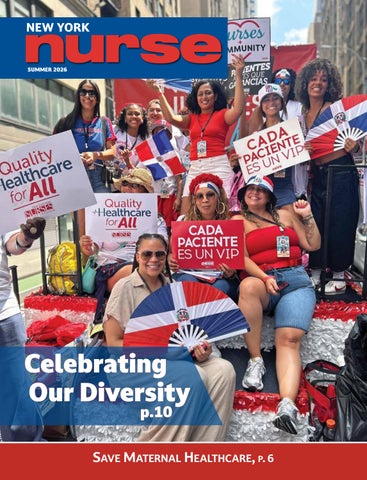
Celebrating Our Diversity p.10
Save Maternal Healthcare, p. 6
2
NEW YORK NURSE SUMMER 2026
Ending TPS Is a Public Health Issue
By Nancy Hagans, RN, BSN, CCRN NYSNA President
From the New York Daily News, Aug. 16
Advocating for patients. Advancing the profession.SM BOARD OF DIRECTORS President Nancy Hagans, RN, BSN, CCRN nancy.hagans@nysna.org First Vice President Judith Cutchin, DNP, RN judith.cutchin@nysna.org Second Vice President Bill Schneider, BSN, RN, CCRN bill.schneider@nysna.org Secretary Michelle Jones, MSN, RN, ANPC michelle.jones@nysna.org Treasurer Petar Lovric, BSN, RN, CPEN, CCRN petar.lovric@nysna.org Directors at Large Marie Boyle, BSN, RN marie.boyle@nysna.org Marion Enright, RN marion.enright@nysna.org Christina Evans, RN christina.evans@nysna.org Denash Forbes, MSN, RN denash.forbes@nysna.org Flandersia Jones, MPH, BSN, RN flandersia.jones@nysna.org Sonia M. Lawrence, BSN, RN sonia.lawrence@nysna.org Ari Moma, MSA, RN ari.moma@nysna.org Pauline Wallace, BSN, RN pauline.wallace@nysna.org Simone Way, BSN, RN simone.way@nysna.org Regional Directors Southeastern
Christopher Honor, RN, BSN, CAPA christopher.honor@nysna.org Southern Alizia McMyers, MSN, MHA, BSN, RN alizia.mcmyers@nysna.org Central Catherine Dawson, MSN, RN, CNOR catherine.dawson@nysna.org Lower Hudson/NJ Mary Lynn Boyts, RN MaryLynn.Boyts@nysna.org Western John Batson, RN john.batson@nysna.org Eastern Victoria Davis Courson, MSN, RN Victoria.Davis-Courson@nysna.org Editor Kristi Barnes Executive Editor Pat Kane, RN, CNOR Editorial offices located at: 131 W 33rd St., New York, NY 10001 Phone: 212-785-0157 Email: nynurse@nysna.org Website: www.nysna.org Subscription rate: $33 per year ISSN (Print) 1934-7588/ISSN (Online) 1934-7596 ©2026, All rights reserved
Healthcare delivery is now less secure, and we have the Trump administration to thank for it. Thousands of Haitian and Syrian immigrants have lost their temporary protected status (TPS) to legally live and work in the United States. As a proud HaitianAmerican who immigrated to the States as a child, and as a 30-plusyear nurse, I can unequivocally say that this decision will continue to disrupt healthcare delivery in and around New York City. My family moved to Staten Island in the late 1960s seeking safety, opportunity, and a chance to build a future — just like generations of people before us from all over the world. I chose to go into healthcare, and nursing specifically, because of the kindness of the Kings County Hospital nurses and healthcare professionals who cared for my family during our early days in New York. Being the new kid is never easy, but the discrimination we faced as Haitian immigrants was cruel, and the kindness of those Creole-speaking nurses and healthcare workers at Kings County stayed with me. Today I worry that future generations will lose access to this type of care. This decision to end TPS for Haitian immigrants is rooted in racism and hatred, and the effects are far reaching. Hospitals and healthcare workers are already reporting growing staffing concerns, as many workers are scared to leave their homes for fear of being targeted by ICE. During COVID we saw a tremendous shift in hospital staffing due to retirements, mental and physical distress, and even the loss of
publicly for our colleagues and patients who are directly impacted. Currently, the Trump administration is targeting Haitians and Syrians for deportation back to deadly conditions. Soon, the U.S. government could deport our neighbors from El Salvador, Sudan, Ukraine and Lebanon who escaped war and unrest once before, sending them back into dangerous conditions.1 Growing a more caring nation should start with the caregivers.
healthcare worker lives. NYSNA fought long and hard to increase staffing numbers and levels because we know that increased numbers of qualified, trained nurses save lives. So now hospitals are again struggling with growing staffing shortages, and the federal government is also cutting the critical healthcare programs on which millions of older adults, children, and lowincome families rely. These decisions do not happen in isolation. Together, they weaken our healthcare system at a time when patients need it to be stronger than ever. Each and every day, my fellow nurses, healthcare workers and I show up to care for and improve the lives of our patients. Some of us assist in delivery rooms, some of us administer medications, some of us advocate for our patients to insurance companies to make sure lifesaving is covered. We do this because we love our patients and know they deserve to be treated with dignity and respect. But what about those of us who provide care? Healthcare workers should not have to wonder whether going to work means risking separation from their families or losing the lives they have spent years building in this country. Patients should not have
to worry that the nurse who knows them best, the aide who helps them every morning, or the home care worker they trust will suddenly disappear because of a political decision. We don’t enter the field looking to get rich or gain clout. We choose to care because we do care — about our communities, about our patients, and about the future. This is not just an immigration issue; it is a public health issue. And ultimately, it is a question of what kind of country we want to be. For centuries, our shores have welcomed those from abroad looking for the opportunity to grow, build, and achieve. Once, the tired, poor and huddled masses from all over the world have helped grow this nation, and our beloved city. When we force caregivers out of our communities, everyone is less safe. If we truly value healthcare, we must value those who make it possible. SOURCE 1https://www. americanimmigrationcouncil.org/factsheet/temporary-protected-status-tpsoverview/
Shutterstock
I
wanted to share my opinion editorial that the New York Daily News recently featured about how revoking temporary protected status (TPS) for Haitians will not only harm Haitians living in the U.S. but the patients who depend on these healthcare workers every day. Although NYSNA is working behind the scenes to advocate for our members caught in the crosshairs of unjust immigration actions, it is also important that we use our platform to speak out
NEW YORK NURSE
3
SUMMER 2026
When Healthcare Is Under Attack
S
ince President Donald Trump was elected nearly two years ago, NYSNA nurses have been fighting back against attacks on our healthcare system. We knew from the pre-election policy blueprint, Project 2025, that the Trump administration was planning deep cuts to our healthcare system that would slash people’s access to healthcare and skyrocket healthcare costs. We are still in the midst of this fight. Since the One Big Beautiful Bill Act (OBBBA) passed last year, changes to Medicaid have stripped people of benefits and hospitals of revenue. Congressional Republicans refused to extend the Affordable Care Act subsidies that allow people of lower and middle income to afford health insurance, leaving even more people uninsured and causing insurance rates for everyone to soar. People who receive health benefits from their employers, including NYSNA members, have also felt the impact of healthcare cuts. Nurses directly experienced skyrocketing healthcare costs at the bargaining table, where hospitals have pressured nurses to accept higher costs and lesser benefits. When more OBBBA-driven cuts to Medicaid take effect in January 2027, after midterm elections, we expect millions more Americans to lose coverage.
NYSNA Members Fight Back NYSNA members have been active in sounding the alarm against cuts, marching, speaking out and lobbying at the state and local levels for increased hospital funding to stabilize New York’s struggling safety-net hospitals. We have also advocated to mitigate federal healthcare cuts through preserving New York’s Essential Plan and passing the New York Health Act, a long-term, sustainable solution to guaranteeing healthcare for all at the state level. We are putting into action that rallying cry you hear during our marches, rallies and lobby days: “When healthcare is under attack, what do we do? Stand up, fight back!” We are increasingly working with our communities to fight back. When the University of Vermont Health (UVMH) system proposed
By Pat Kane, RN, CNOR(E) NYSNA Executive Director
NYSNA nurses in New York City joined community allies to protect and expand Medicare and Medicaid.
closing the UVMH-Champlain Valley Physicians Hospital Adirondack Blood Donor Center, NYSNA members rallied and harnessed community support. We collected patient stories and invited patients and community members to join us outside the hospital to speak out against the closure of this essential service, which has successfully supplied blood to the entire North Country for decades.1 UMVH moved ahead with the closure, outsourcing its blood donation program to the American Red Cross. Within weeks, blood supplies were critically low. When North Star Health Alliance proposed closing the maternal health unit at Claxton-Hepburn Medical Campus,, we also sprang into action and organized with our community to fight back. NYSNA members spoke out multiple times, including at a Department of Health-required public hearing. We encouraged community members to sign our petition and submit testimony in opposition to the closure. We are continuing to engage the community to push back against this closure (see the story on page 6).
Labor and Community Unite We know it will take more than one union to make the kind of change we need. Joining community allies to celebrate 61 years of Medicare and Medicaid on July 30 reminded NYSNA nurses of this. Those programs to strengthen
America’s healthcare system and social safety net happened at a turbulent time — and only through the great efforts of healthcare workers, patient advocates and community activists across the country.
We Are Not Going Back It’s hard to imagine what our healthcare system was like before advocates successfully pushed the U.S. to create these essential public programs. Approximately half of the country was uninsured — including seniors, babies, expectant parents and people with disabilities. We had tens of millions of people who lacked access to quality, affordable healthcare and who suffered and died prematurely because of it. NYSNA leaders joined rallies in Buffalo, Albany and New York City to call attention to the need to fight back against healthcare cuts that threaten to take us back to those bad old days. They also spoke out to remind people what’s possible when we fight for it. If we were able to create these programs from scratch then, we can and must strengthen them now. We need to continue to build support for the NY Health Act at the state level and Medicare for All at the national level, and that begins with a strong fight that harnesses the solidarity of labor and communities to demand healthcare as a human right.
We are putting into action that rallying cry you hear during our marches, rallies and lobby days: “When healthcare is under attack, what do we do? Stand up, fight back!”
SOURCE 1 https://www.northcountrypublicradio. org/news/story/53646/20260702/cvphemployees-community-members-speakout-against-blood-center-closure
4
NEW YORK NURSE SUMMER 2026
Victory for NYP-Brooklyn Methodist Nurses!
I
n late August, after months of bargaining and taking action, NYSNA nurses at NewYorkPresbyterian (NYP) Brooklyn Methodist Hospital won a fair contract that protects nurse and patient safety and ensures quality care for their community! Methodist nurses began bargaining earlier this spring with several demands, including safe staffing and improved protections for nurses and patients against workplace violence. Management proposed making staffing standards at
the hospital less safe and failed to address several recent incidents of violence at the hospital. The new contract includes: 1. Improved enforceable safe staffing standards. 2. Strong protections against workplace violence, including improvements to emergency response teams and weapons detection systems, and additional paid time off for nurses who are victims of workplace violence. 3. Annual wage increases of 4% across the life of the contract.
The Fight for a Fair Contract
On Aug. 3, NYSNA nurses canvassed outside the Barclays Center with our labor and healthcare champions.
Methodist nurses’ fight for a fair contract did not come easily. Nurses held an informational picket and a candlelight vigil to call attention to the growing issue of workplace violence. This summer, they continued to build strong community support and launched a community petition calling on hospital administrators to settle a fair contract, earning more than 2,500 signatures. Nurses also canvassed in their community to build support for their contract campaign, including
at the Prospect Park farmers market and a New York Liberty game on Aug. 3. New York State Senator Jabari Brisport, Assembly Member Jo Anne Simon, New York City Council Member Tiffany Caban, former City Comptroller Brad Lander and the New York City Central Labor Council joined nurses to canvass at the Liberty game. In addition to supporting nurses’ efforts to educate their community, elected officials showed their solidarity by writing a letter to hospital leadership. On Aug. 6, Lander and New York City Council Member Shahana Hanif called on NYP Brooklyn Methodist leadership to return to the table, bargain in good faith, and settle a fair contract for Brooklyn nurses and patients. In all, NYSNA nurses, community members and Brooklyn’s elected officials were united in the fight for a fair contract. And with their community’s support, nurses were able to show hospital administrators that when we fight, we win! Congratulations on your hardfought victory, Methodist nurses!
Building Union Power on Long Island
A
Rob Barone, RN, president of Catholic Health/St. Charles’ local bargaining unit and intensive care nurse, speaks at a NYSNA press conference after the nurses’ strike authorization vote.
t the start of the year, more than 1,000 NYSNA nurses at Northwell/Huntington, Plainview and Syosset hospitals won fair contracts just days before they were scheduled to strike. Then in spring, NYSNA nurses at three Catholic Health hospitals united for fair contract fights. Catholic Health/St. Charles, St. Joseph and St. Catherine of Siena nurses launched a petition campaign, organized in their community and held joint campaign days at their hospitals to win!
nurses’ previous contract campaign, hospital management consistently disregarded the previously agreedupon ratios and New York’s safe staffing law. On July 10, just three days before the strike deadline, St. Charles nurses voted overwhelmingly to ratify a new three-year contract with enforceable safe staffing standards, a commitment to hire more nurses, workplace violence protections, artificial intelligence safeguards, wage increases and increases to retiree health benefits.
Catholic Health/St. Charles Hospital Set the Stage
Up Next: Catholic Health/ St. Joseph Hospital’s Victory
In June, approximately 300 NYSNA nurses at Catholic Health/ St. Charles Hospital voted nearly unanimously to authorize a strike. The vote came after more than a dozen bargaining sessions with management since the nurses’ contract expired months earlier. A serious staffing crisis motivated St. Charles nurses. Despite agreeing to safe staffing standards during
St. Charles nurses’ strong advocacy built momentum for the other Catholic Health hospitals still in contract bargaining. After months of demanding parity with other NYSNA-represented hospitals in the Catholic Health System, St. Joseph nurses marched on the boss and turned out in force with a petition to demand quick agreement on a fair contract. It worked!
On July 29, NYSNA nurses at St. Joseph voted unanimously to ratify a new three-year contract with improvements to staffing, new incentives to increase nurse retention and wage increases.
The Final Contract to Win: Catholic Health/ St. Catherine of Siena St. Catherine of Siena is the last of the Catholic Health Hospitals to bargain. The nurses are making steady progress on many of the same issues the nurses at other Catholic Health hospitals recently fought for and won. NYSNA union nurses at Catholic Health are leading the way on winning and enforcing safe staffing and strong contracts across Long Island. Their new contracts lift registered nurse standards on the island — which are increasingly important as St. Charles joins the larger, nonunion Good Samaritan University Hospital and as other nonunion hospitals are opening in the area. When we unite and fight, we win!
WORKER POWER TK
NEW YORK NURSE
5
SUMMER 2026
North Country Members Continue Fight to Defend Quality Care
L
ast year, NYSNA members at seven facilities joined forces to defend safe, quality patient care in New York’s North Country. Over the last decade, hospitals have eroded patient care1 in rural New York, and nurses and healthcare professionals saw an opportunity to advocate for their patients in upcoming contract campaigns. Since then, five hospitals have settled fair contracts, but two holdouts remain.
Nurses Face Off Against University of Vermont Health This summer, NYSNA nurses and healthcare professionals at the University of Vermont HealthChamplain Valley Physicians Hospital (UVMH-CVPH) have continued contract negotiations, and enforceable safe staffing language remains a key issue. Hospital administrators are once again2 attempting to change staffing ratios and remove staffing language from the contract altogether. This is not surprising, especially considering UVMH’s recent service closures and layoffs. In early June, UVMH announced systemwide layoffs and closures, including the Adirondack Blood Donor Center, which supplied 95% of the blood used at the network’s New York hospitals and served patients in a three-county region. CVPH members launched a digital petition and held a speak-out3 to protest the blood donor center closure. At the speak-out, Nancy Roberts, RN, an Adirondack Blood Donor Center nurse for 20 years, said: “In just a few short days, more than 1,000 community members have signed our petition to save the Adirondack Blood Donor Center. Since UVMH took over CVPH and other community hospitals in New York, they have reduced services here in the North Country. We are saying, ‘No more!’” Despite NYSNA members’ efforts, UVMH closed the Adirondack Blood Donor Center on July 10. Since the closure, nurses and healthcare professionals have continued to build community support for their campaign and keeping care and good jobs in New York by can-
On July 29, NYSNA nurses at Adirondack Medical Center held a speak-out, for the first time in 25 years, to demand a fair contract that includes affordable health benefits for nurses.
vassing and distributing store signs to local businesses and delivering letters to members of the CVPH board of trustees. They have also shown strong solidarity with our union siblings in Vermont. In July, CVPH members spoke at a town hall hosted by UVMH Medical Center Support Staff United and the Vermont Federation of Nurses and Healthcare Professionals; and in August, CVPH members traveled to Burlington, Vermont, to join our union siblings at an informational picket. Other UVMH facilities settled fair contracts earlier this year. NYSNA nurses at UVMH-Alice Hyde Medical Center settled a fair contract in June4, and UVMHElizabethtown Community Hospital nurses’ won a great new contract with entry into the NYSNA Benefit Fund in March. Now it’s CVPH members’ turn!
Frontline Nurses Deserve Affordable Health Benefits NYSNA nurses at Adirondack Medical Center have also continued to bargain for a fair contract that includes affordable health benefits for nurses and their families. Adirondack is the last NYSNArepresented facility in the North Country without access to the NYSNA Benefit Fund, but nurses are working to change that during this contract campaign.
Nurses held a speak-out5 on July 29 to make their demands for affordable health benefits clear to hospital administrators. At the speak-out, Bill Schneider, BSN, RN, CCRN, a PACU nurse at Adirondack and NYSNA second vice president, said: “Our hospital must work harder to draw nurses into our community and keep them here. Saranac Lake is beautiful and the people are welcoming, but other hospitals in the region provide more generous packages. Adirondack can change that by settling a fair contract that includes an affordable benefits package and respectful wages, especially in the midst of a cost-of-living crisis.” The July speak-out was the first time in 25 years that Adirondack nurses have spoken out or rallied outside the hospital.
What’s Next? Enforceable safe staffing language and affordable health benefits are key to keeping nurses, healthcare professionals and the communities they serve safe and healthy. And in a region that has been ravaged by hospital consolidation, service closures and takeovers by out-of-state health systems, it is more important than ever that NYSNA members settle contracts that will help them deliver the safe, quality care North Country residents deserve.
SOURCES 1 https://www.nysna.org/resources/ protecting-rural-patients-andcommunities-access-care-and-hospitalconsolidation-north 2 https://www.nysna.org/press/ nysna-members-champlain-valleyphysicians-hospital-hold-speak-outdemand-safe-staffing 3 https://www.nysna.org/news/cvphhealthcare-professionals-speak-out-saveadirondack-blood-donor-center 4 https://www.nysna.org/press/ uvm-alice-hyde-medical-center-nursesoverwhelmingly-ratify-new-contractagreement 5 https://www.nysna.org/news/ adirondack-medical-center-nurses-speakout-fair-contract
6
SAVE OUR SERVICES
NEW YORK NURSE SUMMER 2026
NYSNA Nurses Fight to Save Maternal Healthcare in the North Country
T
here is a national maternal healthcare crisis, and rural communities are the hardest hit. Between 2010 and 2022, 500 hospitals closed their maternity wards, which resulted in 52% of rural hospitals no longer having delivery services.1 New York state’s North Country is part of this devastating trend. Of the 10 North Country hospitals that provided maternity care
operates. North Star received stabilization funds from the New York State Department of Health (DOH) in March. Despite this financial support, on July 14, North Star announced a plan to close the maternal health unit at Claxton-Hepburn, the only birthing center within 30 miles of Ogdensburg.3 The closest hospitals to Claxton-Hepburn are CantonPotsdam Hospital and Samaritan Medical Center, both more than a 40-minute drive away in good weather and longer in difficult winters. If the unit closes, patients will have to travel far distances to give birth and receive maternal care, even in emergency situations.
NYSNA Nurses and Allies Speak Out The DOH must approve North Star’s proposal to close Claxton-Hepburn’s maternal health unit, and the DOH requires a public NYSNA nurse Snow Harper-Moulton, RN, raised her voice at the speak-out to save maternal hearing as part of health services at Claxton-Hepburn in July. that process. On July 29, NYSNA nurses from Claxtonin the last decade, three reduced Hepburn, Canton-Potsdam, their bed counts, and four closed Samaritan and Carthage hospitals their maternity units entirely. quickly mobilized and joined more These reductions and closures — than 300 residents to pack North compounded by long distances, SOURCES Star’s public hearing and to demand lack of access to transportation, 1 https://ajph.aphapublications. that the hospital maintain maternal and high rates of under- or uninorg/doi/full/10.2105/ health services. NYSNA nurses also sured patients — mean that North AJPH.2025.308236?role=tab held a speak-out beforehand with Country patients already struggle 2 https://www.nysna.org/resources/ 2 advocates and elected officials. to access the care that they need. protecting-rural-patients-andcommunities-access-care-and-hospitalNYSNA nurses who work in consolidation-north A New Threat to North Claxton-Hepburn’s maternal health Country Maternal Healthcare 3 https://northcountrynow.com/stories/ unit raised concerns about the highnurses-union-blasts-planned-claxtonServices risk patients they often care for. hepburn-maternity-closure-as-nshaAmber Palmer, RN shared, “Two of When North Star Health moves-forward-with-state,380641 our frequent populations come in Alliance declared Chapter 11 4 https://www.stlawco.gov/sites/ with no prenatal care and no warnbankruptcy in February 2026, default/files/PublicHealth/PDFs/ StLawrenceCounty_2025_CHA_CHIP_ ing: substance use disorder patients NYSNA nurses and others sucCSP_StLawrenceCountyPublicHealth_ and Amish patients who don’t have cessfully advocated for the state CHMC_RRH_CFH.pdf cars and rely on their neighto provide emergency funding 5 bit.ly/protectmaternalhealth bors for transportation. Both of to the health network to keep these groups arrive with dire ciropen Carthage Area Hospital cumstances and can have really and Claxton-Hepburn Medical severe adverse outcomes if they Campus, both of which North Star
don’t have access to timely care.” The obstetric unit’s nurses also warned about how longer commutes could lead to patients losing prenatal care. Snow HarperMoulton, RN, said, “I can’t tell you how many mothers have told me they couldn’t even afford the gas to go all the way to Potsdam to go to their prenatal visits. And then if they have a complication like high blood pressure and they’re going every week, it’s not feasible.” About 22% of St. Lawrence County households are experiencing poverty, and roughly 28% have limited transportation resources.4 If the maternal health unit closes, that will also greatly increase the strain on other North Country hospitals. Canton-Potsdam Hospital nurse Aaron O’Neill warned, “Canton-Potsdam’s maternal health unit is already over capacity. After delivery, patients are doubled up in rooms. If Claxton closes, will we need to triple up our rooms? If North Star’s plan for this closure is to send ClaxtonHepburn’s pregnant patients over to Canton-Potsdam Hospital, that will have devastating consequences on those new patients and our current patients.”
The Fight Continues For too long, healthcare systems have consolidated, cut or closed services in the North Country to maintain their bottom line. Patient care has suffered as a result. Amidst a national maternal mortality crisis, North Star seems to be intent on prioritizing profit over pregnant people and children. Harper-Moulton put it clearly at the speak-out: “If one baby or mother dies because a mom can’t get to the facility in time — how much is one life worth? We can save that life if we keep our services available.” Community members have signed a petition against the closure and shared their demands via the public comments that North Star is required to collect.5 NYSNA nurses will continue to fight to protect maternal healthcare, and their communities are with them. The North Country is not expendable!
NEW YORK NURSE SUMMER 2026
Many Facilities, One Goal By Margaret Franks, RN, BSN
A
s the NYSNA healthcare staffing coordinator, I have been working with our members statewide to identify where we can help nurses at the facility and state level to improve staffing. Employers have shown that their primary focus continues to be on improving their bottom line, which frequently means that nurses are working short-staffed, without adequate frontline support staff or a combination of both.
Seeing Staffing Around the State I have been working with multiple Clinical Staffing Committees (CSC) to educate and empower members as employers frequently try to dictate the meeting agenda and discussion and override staff. Although we have one staffing law, each employer interprets and follows it differently, leading to the need for individualized approaches at each facility. As I travel statewide, I’m struck by how similar management agendas are, no matter the size, owner or location, and the similarity in the nurse’s response — to stand up and advocate for themselves, their profession and their patients. This was very evident on Long Island where regionally there is chronic understaffing despite some of our wealthier systems owning many facilities, including Northwell, Mount Sinai and Catholic Health. I have worked with nurses at Northwell/ Huntington, Peconic Bay, South Shore and Catholic Health/St. Charles, and we have been able to change the narrative at their CSC. Nurses are sharing information with each other so they can address staffing issues all across Long Island. Staffing issues are not just limited to the private sector, and I am working with the nurses at NYC Health+Hospitals (H+H)/Jacobi and attending the NYC H+H monthly Nursing Practice Council meetings to identify areas for improvement. I visited Erie County Medical Center in Buffalo and handed out staffing palm cards so staff can have patients, family and visitors scan a QR code to file a complaint form
with New York State Department of Health (DOH). To date, I have distributed approximately 11,000 palm cards to members, staff and NYSNA representatives. DOH has traditionally responded to complaints from the public more quickly than to those from healthcare workers, so this is an effective way of engaging the public to fight with us on their behalf.
Recent Staffing Victories NYSNA is celebrating recent staffing victories at The Brooklyn Hospital Center, Maimonides Medical Center, Northwell/Staten Island University Hospital and Wyckoff Heights Medical Center. We also won recent arbitration victories at Ellis Hospital, Montefiore Nyack and NewYork-Presbyterian Children’s Hospital. Any victory reflects a lot of nurses’ and NYSNA staff’s hard work behind the scenes, and there are valuable lessons we all can learn from and build on.
Sharing Information Statewide NYSNA started the Statewide Staffing Committee (Resolution 21, NYSNA Convention 2025) that meets online each quarter and gives nurses a forum to discuss arbitrations, CSCs, DOH visits and staffing concerns. All nurses are invited to attend and hear how fellow members are collecting data for grievances and arbitrations and how they have been able to get DOH in to investigate staffing at their facil-
ity. NYSNA also has a staffing section in the My-Membership section of the NYSNA website where you can see DOH investigative reports, corrective plans of action, arbitration victories and links to staffing resources. Each section also has an area where you can comment or ask a question so we can follow up. At NYSNA, we recognize that the staffing law has its limitations, and to that end, we are working with other healthcare unions so that we have a unified approach to necessary amendments. Although facilities are supposed to include measures of acuity in their staffing plan, the majority fail to. Resolution 17 from the NYSNA Convention 2025 asked us to work on developing an acuity tool that nurses could use statewide. To date, University of Vermont Health/Elizabethtown Community Hospital nurses have reported that they use the acuity tool in EPIC, and Ellis Hospital nurses have reported that they use the American Nursing Association acuity tool. Westchester Medical Center is piloting an acuity tool, and members will report back on its efficacy. The staffing fight is multipronged, and NYSNA members can address it in multiple ways depending on the situation. If anyone would like me to come to their CSC, interregional, bargaining or labor bargaining unit meeting or town hall to discuss safe staffing, please reach out to me at margaretfranks@nysna.org.
Staffing palm cards give members information at their finger tips.
7
8
NEW YORK NURSE
NURSES V. AI
SUMMER 2026
What’s Disgusting? AI Union Busting
L Montefiore opted to lay off a group of nurses with the decades of bedside experience and clinical judgement needed to responsibly advocate for insurance approvals for patient care and treatment in the name of using AI to cut costs.
ast winter’s historic strike sent a clear signal to management that we are serious about the wages, benefits and staffing levels we need to keep our patients and ourselves safe. For nurses in the New York City private sector, including Montefiore Hospital, one of our wins was language requiring member input when introducing new technology, like artificial intelligence (AI). Unfortunately, no sooner did members at Montefiore return to work than utilization review nurses reported concerns with workflow changes. Utilization review nurses advocate for patients to insurance companies to make the case for coverage to pay for hospital stays, lifesaving surgeries, medications and other important care. Often, patients are dealing with multiple comorbidities, and the nurses’ years of experience help them understand the nuances that come with treating such complex cases. When the nurses raised with Montefiore management their concerns about how technology has changed their workflow, management instructed them to just keep working. Then in May, the unthinkable happened. Montefiore announced a plan to lay off the 12 utilization review nurses and replace them with a software program from Datavant, a privateequity-backed company that utilizes AI in its reports. To put this in perspective, Montefiore opted to lay off a group of nurses with the decades of bedside experience and clinical judgement needed to responsibly advocate for insurance approvals for patient care and treatment in the name of using AI to cut costs. The nurses had 45 days to find new positions.
plan. Over 200 members, news reporters and elected officials — including New York State Senator Nathalia Fernandez and Assembly Members Karines Reyes, Jeffrey Dinowitz and Amanda Septimo — joined the town hall. New York City Council Member and Labor Chair Shirley Aldebol also joined the call and demanded Montefiore reverse the layoffs, calling the use of AI “unproven technology that could compromise patient care.” News outlets Gothamist, WNYC and Crain’s covered the town hall.
The Impact on Our Patients Montefiore serves a diverse and vulnerable patient population, with many in the community already facing barriers to accessing care. In today’s political climate, protecting patients’ sensitive personal and medical information is more important than ever. Patients deserve to know who has access to their information, how it is being used and what safeguards are in place to protect it. A data breach or misuse of sensitive information could have consequences far beyond a violation of privacy — it could expose patients to discrimination, harassment or other serious harm. “It’s not just that there is no real data on the use of AI in utilization review that’s so bothersome; it’s also that Datavant is known for partnering with Palantir, another private-equity-backed company with a history of data breaches,” said Laurel Carlin-Leclerc, RN, a former utilization review nurse who was forced to retire early. Working in utilization review allowed her to work from home, where she oversees care for her sick husband.
“Our patients trust us to handle their incredibly sensitive data with care, and we have a responsibility to keep that data secure.” Both Shuler and Carlin-Leclerc stress that technological advances are an important part of providing care. But there’s a difference between using software to assist with charting and scheduling and allowing it to replace actual workers. Shuler and Carlin-Leclerc, like others in their department, each have over 40 years of nursing experience. Their years in the profession enable them to understand clinical context, ask follow-up questions and directly advocate for patients in ways AI simply cannot. They fear that the untested technology will increase patient denials, resulting in missed surgeries; reduced access to lifesaving medications; and denial of other patient claims, resulting in tragic outcomes.
Protecting Our Patients and Practice NYSNA has filed a grievance on the workers’ behalf and is continuing to advocate for our members whom the layoffs impacted. We are enforcing our contract and pushing for Montefiore to open positions so that no nurse is displaced. Although technology has encroached on our practice before, this is the first time that AI has replaced NYSNA nurses. We believe this threat will only increase in our facilities and around the state. We are continuing to raise awareness through the media and working with our healthcare partners and elected officials on policy solutions to create more safeguards for our patients and practice.
Nurses vs. AI “Montefiore gutted a department of veteran nurses months after we successfully struck and negotiated language to protect our positions from being outsourced to AI,” said Marilyn Shuler, RN, who lost her position in the utilization review department and was moved to the case management unit. NYSNA hosted a virtual town hall to push back on Montefiore’s
NYSNA nurses are demanding that hospitals use real workers, not artificial intelligence.
POLITICAL POWER
NEW YORK NURSE
9
SUMMER 2026
2026 Elections
O
ur ability to strengthen our public health infrastructure — our social safety net — and take action to support frontline workers depends on electing candidates who support nurses, healthcare professionals and our communities. This primary season, team NYSNA knocked on hundreds of doors and made thousands of calls to elect candidates who will join us as we fight for our profession, our patients and our communities.
MAKE A PLAN TO VOTE There’s more than one way to cast your ballot this election. From in person to mail, pick the option that works best for you so that you don’t miss your chance to cast your vote for our nurse champions!
PRIMARY WINS Tom DiNapoli Across the state, NYSNA hit the doors and the phones to successfully reelect New York State Comptroller Tom DiNapoli! Tom has been a steadfast supporter of NYSNA members his entire career in public service; and as comptroller, he has kept our public pensions solvent and strong. Thanks to NYSNA’s and our union siblings’ efforts, DiNapoli secured a comfortable victory in the primary and is ready to win again in the general election this November!
Brad Lander Brad Lander, a longtime New York City NYSNA champion and former council member and New York City comptroller mounted a primary campaign for NY12, running as a progressive champion ready to take on Washington, D.C., and he won in a landslide! Brad hasn’t waited to be sworn in to use
NYSNA board and Political Action Committee members Judith Cutchin, DNP, RN; Michelle Jones, MSN, RN, ANPC; Flandersia Jones, DrPH, RN; Alizia McMyers, MSN, MHA, BSN, RN; Pauline Wallace, BSN, RN; and Sonia Lawrence, BSN, RN, joined Tom DiNapoli at a campaign event in June.
his power as a member of Congress to support NYSNA; in August, he joined nurses from NewYorkPresbyterian-Brooklyn Methodist Hospital in their fight for a fair contract!
Jon Rivera A NYSNA champion also won big in a tough primary in Buffalo. Assembly Member Jon Rivera ran for New York State Senate on a pro-union platform and a record of always supporting union members and fighting for working people in Buffalo. With the support of NYSNA and our fellow local union siblings who knocked doors and made calls, Rivera is one step closer to the State Senate!
Looking Ahead to the General Election As we continue to feel the impacts of cuts to Medicare and Medicaid; increases in the cost of living; and the intensifying attacks on our immigrant members, patients and neighbors, electing leaders who share our values is more important than ever. Whether it is taking back control of Congress or sending nurse champions to Albany, team NYSNA will be hitting the ground this fall to get out the vote! You can find all our endorsed candidates and voter guide at www.nysna.org/ endorsements.
EARLY IN PERSON — The early voting period runs from Oct. 24-Nov. 1. New York City residents can only vote early at their assigned early voting site; all other voters can vote early at any of the early voting sites in their county. To find your early polling site, visit https:// voterlookup.elections.ny.gov/. Poll site hours vary during the early voting period, so make sure to check your poll site in advance. EARLY BY MAIL — Any registered voter can apply for an early mail ballot. You can apply in person at your county board of elections or online at https://ballotapplication. elections.ny.gov/home/ earlymail. The last day to request an early mail ballot is Oct. 24. Once you receive your mail ballot, you can return it by mail, ensuring that it is postmarked no later than Nov. 3, or you can return it in person to your county board of elections, your early voting site or Election Day poll site. You can track your mail ballot at https://voterlookup. elections.ny.gov/. ELECTION DAY — Election Day is Tuesday, Nov. 3. Polls will be open from 6 a.m. to 9 p.m. You can find your polling place by going to https://voterlookup. elections.ny.gov/.
Before a New York Liberty game in Brooklyn, Brad Lander joined NYSNA nurses to leaflet about their fight for a fair contract.
Jon Rivera joined NYSNA members at Erie County Medical Center at the Buffalo Pride parade.
10
NEW YORK NURSE SUMMER 2026
Meet NYSNA Staff
Michelle Crentsil
Edward Yoo
N
YSNA staff go the extra mile to support and empower our members. From new member orientation through winning complex contract and advocacy campaigns, NYSNA staff members use their expertise to improve working conditions for nurses and healthcare professionals and care conditions for our patients. Meet some of NYSNA’s newest hires and congratulate the staff who recently earned promotions.
Welcoming New Hires Emma Alabaster, communications coordinator, Downstate Jess Feldman, NYSNA representative, Downstate Mischa Gaus
Carrie Gleason, director of organizing Madeline St. Amour, communications coordinator, Upstate
Congratulations
Joseph Celestin
Michelle Crentsil, Deputy Executive Director Crentsil has served as NYSNA’s political director since March 2020. Her vision and leadership have
helped usher in better COVID-19 safety, workers comp and leave protocols, safe staffing legislation, protections against mandatory overtime and workplace violence, New York state budget and nurse practice victories, and the election of dozens of labor and nurse champions to office. As deputy executive director, she will play a leading role in enacting the member vision and direction of the entire union. Edward Yoo, Director of Strategic Initiatives and Campaigns Yoo has served as NYSNA research director since July 2013. Under his leadership, the department has expanded, developed new strategic research capacity and corporate campaigns, published original research, and helped win new organizing and countless contract campaigns for NYSNA members. In his expanded capacity, he will focus on integrating different NYSNA departments’ work into strategic campaigns. Mischa Gaus, Area Director Gaus has served as a NYSNA representative since April 2016. He
Nurses and Community
T
his summer, NYSNA members turned out in full force to celebrate our solidarity with the diverse communities we care for and to send a message that nurses support healthcare for all! NYSNA nurses marched in the Buffalo Pride and Juneteenth parades; the New York City Puerto Rican, Pride, Dominican and Caribbean American Day parades; the Albany Filipino Independence Day celebration; and Labor Day gatherings around the state. Nurses are proud to care for our communities!
has worked primarily with members at Montefiore facilities on contract campaigns and enforcement. First promoted to lead representative in 2020 and acting area director last year, he is now serving as area director for the Montefiore system and Bronx and lower Hudson Valley facilities. Soon he will lead bargaining for the second coordinated contract campaign in the lower Hudson Valley at Montefiore Mount Vernon, New Rochelle and Nyack. Joseph Celestin, Communications Manager Celestin has served as Upstate communications coordinator based in the Albany office since April 2024. He managed the development and training for NYSNA’s new website and has contributed to successful legislative victories as well as contract wins in Western New York, the Capital Region and the North Country. In his role as communications manager, he is based in the New York City office, supporting campaigns throughout the state and building NYSNA’s strategic communications capacity.
HEALTH & SAFETY
NEW YORK NURSE SUMMER 2026
TWENTY-FIVE YEARS LATER
Honoring 9/11 Survivors with Care
F
or those who lived through the horror of the World Trade Center and Pentagon attacks and the crash of United Airlines Flight 93 in Shanksville, Pennsylvania, on Sept. 11, 2001, it is hard to believe that 25 years have passed. Buildings may have been rebuilt and restored, but the bodies of rescue and recovery workers and area residents exposed to high levels of toxic dust continue to deteriorate. City and government agencies could have prevented or significantly reduced much of the toxic exposure that first responders and residents experienced— if they had enforced worker protections over the many weeks and months of recovery work. They didn’t — and ever since, those exposed in the aftermath of 9/11 have fought long and hard for a health program to monitor and provide treatment to these individuals. This ultimately resulted in the establishment of the World Trade Center Health Program (WTCHP).
The program now serves almost 150,000 patients who suffer from a wide range of health conditions linked to their toxic exposures.
Future WTCHP Funding Secured Every few years, Congress has had to vote to continue funding the WTCHP. Threats of budget cuts, budget moratoriums and government shutdowns due to budget fights have imperiled the program in the past. But in early 2026, bipartisan advocacy that New York state congressional representatives led resulted in a permanent fix to how the program is funded, creating permanent funding that ensures no future cuts or delays in funding. Congress also approved additional funding to ensure the program is fully funded through 2040.
Understaffing Plagues Program Unfortunately, problems still persist related to program staffing. Early this year, the Department of Government Efficiency (DOGE) decimated the National Institute
of Occupational Safety and Health (NIOSH), which administers the WTCHP. Almost all NIOSH staff members assigned to assist the WTCHP were fired, including the popular head of the program, Dr. John Howard. NYSNA was part of a lawsuit suing the government related to these cuts. Public pressure from unions, the scientific and medical communities, the public and elected officials finally resulted in restaffing the program, but staffing levels remain lower than they were before the DOGE cuts. These cuts have resulted in slower certification of new conditions that the program covered and administrative backlogs that have delayed patient care. With renewed focus on the program due to the upcoming anniversary, the Trump administration is pushing to fill these open positions. However, it will fill many positions by moving staff from other NIOSH health and safety programs. And as nurses know, floating staff from one unit to another never solves an understaffing problem.
Research Shows WTCHP Patients Live Longer A study released in June 2026 found that 9/11 responders who are enrolled in the WTCHP had a lower risk of death than responders who were not in the program. This is due to the exceptional health services that the program’s medical providers, including NYSNA registered nurses, offer. The WTCHP proves that federally funded health programs can play a major role in caring for disaster relief workers and affected disaster survivors through a combination of research, long-term medical monitoring and cohort-specific medical care.
Remembrance Through Care Bravo to all who have fought to maintain the WTCHP and those who continue to fight for full NIOSH staffing and especially to those healthcare professionals who have provided care to 9/11 responders and survivors for the past 25 years and for years to come. As the nation comes together to remember 9/11 and those we lost, we cannot forget the first responders and survivors of that day who require ongoing care.
11
12
NEW YORK NURSE SUMMER 2026
NURSES FACE HEALTH AND SAFETY RISK
Explosion of New Street Drugs
Make Your Voice Heard NYSNA’s Nursing Education and Practice department launched a learning needs assessment survey to tailor upcoming educational programs to meet member needs. We want to hear from you – the survey takes just a few minutes and is completely confidential.
O
n Easter Sunday 2026, correctional officers at the Mohawk Correctional Facility in Rome, NY, were exposed to unknown chemicals during a routine visitor search. Three were sent to the hospital, two in critical condition and one on a ventilator. Similar incidents have taken place at correctional facilities throughout New York and around the U.S. Many NYSNA nurses work in correctional settings, from county and city jails to hospital forensic units. Two intertwining trends — hundreds of new synthetic street drugs becoming available and the practice of soaking paper and other common materials in drug solutions that individuals later smoke — are heightening the risks faced by the many NYSNA members who provide clinical health services in correctional health and forensic settings.
“Wasping” and Slips of DrugSoaked Paper Drug use in correctional settings is not new — NYSNA members have for years raised the alarm about smoke from cannabis drifting throughout their work settings, for
New Discounted Online Degree Programs for NYSNA Members! NYSNA members and their family members are now eligible for a 20% discount on online degree programs from Post University. Nursing programs that Post offers include RN to BSN, MSN, DNP and more! Learn more and register today!
example. Then fentanyl brought additional hazards, with the potential for serious injury or death due to worker exposure to even tiny amounts. Fentanyl exposure causes legitimate alarm in correctional settings and also in many other care settings, including emergency departments, behavioral health units and home care. The number of synthetic drugs available on the streets has more than tripled in the last decade, with more than 1,440 new psychoactive drugs identified. New drugs are appearing all the time, many of which have unknown health effects. Some are extremely inexpensive to produce. Pest spray, for example, can be dried and then smoked. “Wasping” is the use of insecticide sprays alone or in combination with other controlled substances. Narcan is not effective on some of these substances, and the health effects of these substances, particularly when used in combination, are largely unknown. Worker hazardous exposures to these drugs can take place by inhaling smoke or powder and/or also potentially via skin contact. Nurses
and other healthcare workers in corrections are routinely in situations where exposure is possible.
Protecting Against a Growing Hazard In New York state, unions with members working in correctional settings have been meeting to develop materials and protocols to address this growing problem. The New York State AFL-CIO has hosted working sessions to discuss protective measures. As a result, the New York State Department of Corrections has adopted emergency response protocols that address some of the hazards. NYSNA has developed a new fact sheet on both the hazards and protective measures needed. For more information, download and share the fact sheet: https://www.nysna.org/ resources/protecting-correctionalstaff-hazardous-exposures. NYSNA members can also contact NYSNA’s Occupational Health and Safety representatives at healthandsafety@nysna.org for more information and to discuss strategies for promoting protective protocols in your workplace.
NYSNA Leaders Celebrate 61 Years of Medicare and Medicaid by Advocating for Medicare for All
O
n Thursday, July 30, NYSNA leaders attended events across New York to celebrate 61 years of Medicare and Medicaid — and to advocate for universal, single-payer healthcare! In New York City, Southern Regional Director Alizia McMyers, MSN, MHA, BSN, RN, spoke at a rally at NYC Health+Hospitals/ Bellevue Hospital; Central Regional
Director Catherine Dawson, MSN, RN, CNOR, spoke in Albany;
and Western Regional Director John Batson, RN, spoke in Buffalo alongside our community allies at Citizen Action. All three spoke on the critical need for our government to implement a universal, single-payer system to ensure that everyone has access to the care they need!
NYSNA Leaders Join NNU Members to Advocate for Medicare for All
O
n Wednesday, July 15, NYSNA President Nancy Hagans, BSN, RN, CCRN; Second Vice President Judith Cutchin, DNP, RN; and Secretary Michelle Jones, MSN, RN, ANPC, joined National
Nurses United (NNU) members — including nurses from the D.C. Nurses Association and the Michigan Nurses Association — in Washington, D.C., to lobby for universal, single-payer healthcare. Over the course of the day, nurses
met with legislators to express the critical need for universal healthcare, especially as the Trump administration is kicking millions of Americans off Medicaid and stripping billions in funding from our healthcare facilities.
AROUND OUR UNION
NEW YORK NURSE
13
SUMMER 2026
Montefiore Nyack Members Win First Staffing Arbitration
O Northwell Health/Putnam Hospital Nurses Continue Their Fight for Safe Staffing and a Fair Contract
O
n Tuesday, June 16, NYSNA nurses at Northwell Health/ Putnam Hospital held a speak-out to demand a fair contract that includes enforceable safe staffing language. For months, nurses have been bargaining with Northwell Health, their new employer, but management refuses to include staffing language in the contract and pro-
posed new ratios that would make staffing worse across the hospital. To push back on these proposed changes and to amplify their demands for a fair contract, nurses held a speak-out with allies. Since the speak-out, nurses have continued to escalate their campaign for a fair contract. On Friday, July 24, nurses gave notice to their chief
nursing officer (CNO) that nurses would not participate in nursing council meetings until management settles a fair contract with safe staffing. Nurses also delivered a petition in support of the notice, which more than 100 members of the bargaining unit signed. Don’t settle for anything less than the fair contract your community deserves, Putnam nurses!
Mount Sinai South Nassau Nurses March on the Boss to Demand a Fair Contract
O
n Monday, July 6, NYSNA nurses at Mount Sinai South Nassau (MSSN) marched on the boss to demand a fair contract! Nurses delivered a petition to their CNO that asks management to agree to bargaining with the help of a mediator, to make negotiations accessible to all members via Zoom, and to settle a contract that respects Long Island nurses and patients. MSSN nurses have been bargaining for a fair contract that would address the healthcare giant’s lack
n Thursday, July 30, NYSNA nurses at Montefiore Nyack Hospital won their first staffing arbitration! Nurses have been consistently tracking staffing at the hospital, and the arbitrator found that the evidence they collected — protests of assignment, assignment sheets and testimony — was enough to establish a pattern of staffing guideline violations. In total, the arbitrator ordered that the hospital pay monetary relief for 90 staffing violations to the nurses who worked short. This staffing arbitration decision is the first issued since Nyack nurses made enforceable safe staffing a centerpiece of their 2024 contract fight. “When staffing falls below the contractual guideline, the resulting burden is borne by the whole unit,” the arbitrator wrote. Nyack nurses’ hard work to include enforceable safe staffing language in their contract is paying off! Congratulations, Nyack nurses!
of investment in their community hospital and ensure there are always enough nurses at the bedside to provide safe, quality patient care. Great work, MSSN nurses!
Terrence Cardinal Cooke Nurses Ratify New Contract
O
n July 19, NYSNA nurses at Terrence Cardinal Cooke (TCC) Nursing Home ratified a new three-year contract! Highlights of the contract include increased wages across the life of the contract; maintaining the NYSNA Benefit Fund; and new contract language around lactation, paid time off after an assault at work, recovery-ready workplaces and parental leave. Congratulations, TCC nurses!
BronxCare Special Care Nurses Ratify New Contract
O
Ellis Nurses Secure Safe Staffing Ratios in Arbitration Victory
I
n May 2024, NYSNA nurses at Ellis Hospital won a staffing arbitration that included makewhole relief for 11 different units at the hospital. Management has
refused to pay in the two years since the initial victory, but this August, an arbitrator clarified the award, standing by the original make-whole remedy. In addition
to the financial award, nurses were also able to secure binding staffing language and have already seen improvements in staffing at the hospital. Great work, Ellis nurses!
n June 10, NYSNA nurses at BronxCare Special Care voted overwhelmingly to ratify a new contract! Highlights of the contract include improvements to staffing enforcement language, protections against discipline when using contractual sick time and 4% wage increases in each year of the contract. Congratulations, BronxCare Special Care nurses!
14
AROUND OUR UNION
NEW YORK NURSE SUMMER 2026
Sullivan County Nurses Ratify New Contract
O
n Monday, Aug. 3, NYSNA nurses voted overwhelmingly to ratify a new fouryear contract with Sullivan County! Highlights of the contract include a 25% increase in wages over the life of the contract and retention of the NYSNA benefit plan. Congratulations on your hard-fought victory, Sullivan County nurses!
NYSNA Nurses at The Brooklyn Hospital Center Continue Staffing Victories
I
n June, through the new staffing enforcement process won in their latest contract campaign,
NYSNA nurses at The Brooklyn Hospital Center (TBHC) secured another staffing victory! The
Major Staffing Victory at Maimonides Medical Center
N
YSNA nurses at Maimonides Medical Center won another major staffing victory. Through hard work, determination and advocacy, they successfully utilized the new staffing enforcement process to hold management accountable and improve safe patient care. Management agreed to reduce the nurse-to-patient ratio on these units from 1:5 to 1:4, a very significant improvement that will enhance patient safety; improve working conditions; and support nurses in providing the quality care our patients deserve. Most importantly, this change will require the hospital to hire additional full-time NYSNA nurses to properly staff 8E/8W and meet the new ratio requirements. The strong staffing enforcement language that the Executive Committee negotiated, the dedication of the nurses who raised concerns and documented staffing issues, and the persistent advocacy of NYSNA nurses on the Staffing Committee made this all possible.
emergency department will add 12 new full-time nurses, a muchneeded increase in staffing that will bring the department to the staffing levels that NYSNA members fought for and are contractually entitled to. This spring, NYSNA members at TBHC won increased staffing on three units: the intensive care unit, cardiac-telemetry unit and the emergency department. In total, these three staffing victories will add 37 new NYSNA nurses to the ranks at TBHC. Congratulations, TBHC nurses!
Wyckoff Nurses Win 21 New Emergency Dept. Positions
A
fter years of fighting for safer staffing, Wyckoff Heights Medical Center emergency department (ED) nurses secured a major victory. After a mediation session, multiple canceled dates and extensive negotiations, Wyckoff management agreed to hire 21 new NYSNA nurses for the ED in the coming months. As part of this agreement, ED nurses and the NYSNA Executive Committee will also return to mediation in October to pursue hiring an additional 10
nurses to achieve the overall staffing levels that our patients, community and nurses deserve. Wyckoff nurses documented unsafe conditions, attended meetings, participated in the staffing process, and stood together day
Court Upholds Arbitration Ruling for NYP CTICU Nurses
I
n 2024, an arbitrator ordered NewYork-Presbyterian (NYP) to recruit and retain critical care nurses and pay financial remedies to the cardiothoracic intensive care unit (CTICU) nurses who worked understaffed. Instead of adhering to the arbitrator’s order to make nurses whole, NYP spent an untold amount of money to take NYSNA nurses to court and tie up safe staffing in litigation. In
July, an appellate court ruled that the hospital must be accountable for its failure to abide by the staffing provisions in nurses’ contract and must make nurses whole! We are hopeful that this victory — for nurses, patients, safe staffing and hospital accountability — will send a strong message to NYP and other hospital systems to invest in safe staffing, not meritless lawsuits!
in and day out, working throughout this fight. The victory also belongs to the Wyckoff Executive Committee, which fought hard to win stronger and faster staffing enforcement language during the last round of contract negotiations!
NYSNA Nurses at St. Vincent’s Hospital Ratify New Contract
O
n July 22, after months of bargaining, NYSNA nurses at St. Vincent’s Hospital in Yonkers voted to ratify a new fouryear contract! Highlights of the contract include maintaining nurses’ health insurance, improvements to staffing enforcement language and 4% annual increases across the life of the contract. Congratulations, St. Vincent’s nurses!
CALL TO CONVENTION
NEW YORK NURSE SUMMER 2026
Official Call to Convention 2026 Convention of the New York State Nurses Association Michelle Jones, MSN, RN, ANPC, NYSNA Secretary
J
Oct. 26-27, 2026 | New York Hilton, New York, NY
oin NYSNA nurses and healthcare professionals from across New York on Oct. 26-27 at the New York Hilton at 1335 6th Avenue in New York, NY. The theme of this year’s Convention is NYSNA Healthcare Defender: Nurses Unite to Protect Our Patients, Practice and Union. We can’t wait to see you this year, celebrate our accomplishments and solidarity, strategize about our priorities and participate in union democracy. We will continually update online registration, delegate,
transportation, lodging and class information on our website at www.nysna.org/Convention. Proposed resolutions will also be available to review in advance on the NYSNA website. The deadline to register is Monday, Oct. 12. Due to limited space, on-site registration may not be available.
Looking Ahead We are using the NYSNA Convention app once again this year, which is a central hub for NYSNA members to access key information and make the most of their time
at Convention. The app gives NYSNA members access to the full conference schedule, allows them to plan their own schedule by adding sessions to their personal agenda, and notifies members of relevant updates and announcements. The NYSNA Convention app will also include a map of the Convention venue to help members find their way around. As we get closer to Convention, NYSNA will email all Convention registrants a personalized link to download and log in to the app. Stay tuned!
Register Now!
15
NEW YORK NURSE
Non-Profit US Postage Paid NYSNA
SUMMER 2026
INSIDE
131 West 33rd Street, 4th Floor New York, NY 10001
Safe Staffing, p. 7
AI Union busting, p. 8
Elections 2026, p. 9