Central Catherine Dawson, MSN, RN, CNOR catherine.dawson@nysna.org
Lower Hudson/NJ Mary Lynn Boyts, RN MaryLynn.Boyts@nysna.org
Western John Batson, RN john.batson@nysna.org
Eastern Victoria Davis Courson, MSN, RN Victoria.Davis-Courson@nysna.org
Editor Kristi Barnes
Executive Editor
Pat Kane, RN, CNOR
Editorial offices located at: 131 W 33rd St., New York, NY 10001
Phone: 212-785-0157
Email: nynurse@nysna.org
Website: www.nysna.org
Subscription rate: $33 per
New York and Labor Lead the Way
In early June, I traveled to the national AFL-CIO Convention in Minneapolis, for the first time ever. As a National Nurses United (NNU) delegate, I met with trade unionists from all over the country who are organizing and fighting for better workplaces and a better world.
Being directly connected to the national labor movement through NNU and feeling the energy over the course of several days was very inspiring. The convention hall was decorated with workers taking action to improve their working conditions, organizing into unions to have a voice and going on strike to fight for what’s right. Pictures and videos from our New York City private sector nurses’ strike were featured prominently throughout the convention, and I spoke with many union members who wanted to learn more about how NYSNA is winning great contracts and moving the needle forward for worker and healthcare justice in our state.
Go New York, Go!
New York is one of the bright spots in our country right now. And I’m not just talking about the excitement many of us felt about the New York Knicks (Go New York! Go New York! Go!). Throughout the state, there is a sense that it’s possible to do big things, and that does not exist in many other states. There is a feeling that we can do things our way. We can fight back and win against attacks on our patients, communities and healthcare system. And we can take bold steps to take care of one another and promote fairness, human rights and equal opportunity. These are all areas where unions in other states continue to be on defense.
Nationally, we may not be able to move the needle much against corporate greed, corporate healthcare and anti-democratic forces, but we are making progress here in New York. We saw that in the state budget process this year, where nurses fought for our practice; to save healthcare staff and services; to fund our safety net hospitals; to make sure that we protect our patients who are of low income, uninsured, immigrant or
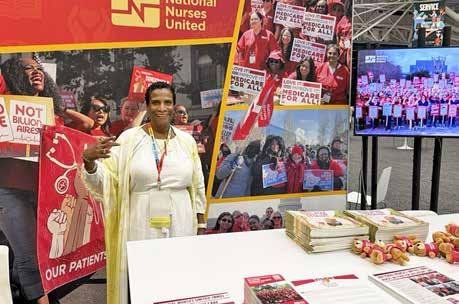
I presented on resolution 8, advocating for Medicare for All, at the AFL-CIO Convention on June 9.
transgender; and to make billionaires pay their fair share to help fund healthcare and other services that support the many, not the wealthy few.
The Fight Ahead
But we have so much more work ahead of us here in New York. Right now, there are still many people at risk of being denied care or losing their health insurance. The very late state budget delayed payments to our safety net hospitals around the state, straining operations and stressing staff. If you don’t work at a safety net hospital,
it might be hard to understand the lack of equipment and other resources that many of our members deal with daily. It might be hard to understand that staff often do not know whether their next paycheck is coming on time. At a time when the federal government has cut healthcare funding drastically, these stressors are intense for our members who are committed to taking care of a disproportionate number of uninsured and underinsured patients.
NYSNA nurses need to continue leading with our values to care for all New Yorkers and to treat every patient like a VIP. We need to continue building our community and political support to protect our patients, practice, union, and safety net and public hospitals.
To Survive and Thrive
We made more progress in New York this June through our get out the vote efforts. NYSNA helped elect worker and healthcare champions locally, statewide and nationally who will fight for nurses’ values. I am confident that we will continue to move the needle with the power we are building through our union actions and through our relationships with our communities, elected officials and the entire labor movement.
Connecting with union leaders at the AFL-CIO Convention reminded me that we are not only on the right path — but nurses and labor are leading the way in New York. By continuing to put in the work, we will not only survive, but we will thrive.
Advocating for patients. Advancing the profession.SM
BOARD OF DIRECTORS
I dropped by the National Nurses United booth at the AFL-CIO Convention.
Vote Like Your Life Depends On It
As we head into primary election season here in New York, voting has been on my mind. It was a major topic of conversation at the Coalition of Black Trade Unionists (CBTU) Convention in Atlanta in May because we are witnessing history in the making — or rather in the unmaking.
The voting rights that Black Americans fought and died for in the civil rights era of the 1960s are now under attack like never before. The conservative majority on the Supreme Court began dismantling the 1965 Voting Rights Act about a decade ago, but a recent decision has accelerated the attack on voting rights.1 In the lead-up to midterm elections, Southern states with a history of racial discrimination and voting disenfranchisement have capitalized on the Louisiana v. Callais Supreme Court decision to quickly redraw election districts to minimize the votes and representation of people of color.
President Donald Trump has tried to suppress the vote by limiting mail-in voting and requiring voters to present ID at the polls. Although the anti-voter bills have stalled and courts are likely to rule executive orders unconstitutional, the Trump administration’s attack on voting rights and the integrity of our electoral system will likely do damage and disenfranchise voters in this election cycle and beyond.2
Living History
I was so struck by meeting Claude Cummings, Jr., the president of the Communications Workers of America, at the CBTU Convention. He showed me and other NYSNA nurses a copy of the poll tax receipt he paid when he voted in 1946. It was a harsh reminder that it was not even one generation ago that we won the laws that we now have in place to protect citizens’ right to vote without violence, intimidation, barriers to participation and fines. The people who fought and died for voting rights were not only our grandparents and parents but our peers.
I felt blessed to stand in another pivotal moment for civil rights while I was with our CBTU siblings. Regardless of personal beliefs, I
found it very comforting being surrounded by many people of faith who can relate biblical parables to what we are going through today. When one of the pastors at the convention reminded attendees that “God can move mountains, but we need to bring the shovels,” I heard the unionists around me let out a collective cheer of recognition and affirmation.
“Shift Happens”
We are not the people who shrug and stand idly by and say, “Stuff happens.” We are the people who believe that “shift happens.” We are the people who — when confronted by change and seemingly insurmountable challenge — rise above, take action and are able to shift the outcome. Through organizing, we make shift happen.
Throughout the convention, my CBTU colleagues reminded me that when we work for a righteous cause, we can make a difference. And we already are making a difference — whether volunteering to get out the vote, advocating for a budget that puts the needs of working people first, or speaking out for
our most vulnerable patients and for healthcare justice, nurses are the people who take action so that shift happens.
We know it takes the work of many hands to make a change. I am so proud that NYSNA President Nancy Hagans, RN, BSN, CCRN, was elected to the CBTU executive council as a director at large so that we can continue building with this inspiring coalition of union members from around the country who are united for economic, social and racial justice.
As much as the convention was uplifting and a place to gather and feel the solidarity in the room, it was a reminder that we can and must foster that feeling year-round in our union as well. It wasn’t long ago that we fought hard for NYSNA members’ democratic rights as union members — to have transparent elections with one member, one vote.
NYSNA members have a proud tradition of supporting democracy and voting rights — in our own union and beyond. Now is the time to make “shift happen” and vote like our lives depend on it.
The FY 2026-2027 New York State budget has finally passed — and NYSNA nurses’ relentless advocacy led to several critical victories for nurses, our patients and our nursing practice.
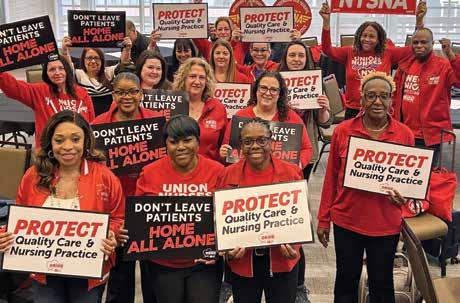
Preventing Patients From Staying Home All Alone
A chief priority for NYSNA nurses this budget season was keeping the dangerous Hospital at Home proposal out of New York state’s final budget. Under Hospital at Home programs, acute care patients are monitored virtually in their homes instead of receiving in-person, around-the-clock expert nursing care in a hospital. NYSNA nurses traveled to Albany twice this spring — in addition to launching a statewide social media and advertising campaign and gathering thousands of petition signatures in opposition to the proposal — to warn legislators of the program’s very real dangers. Thanks to our advocacy, elected officials ultimately listened to nurses’ expert opinions and rejected the dangerous proposal. NYSNA President Nancy Hagans, RN, BSN, CCRN, said, “This is a victory for every patient in New York. Nurses refused to stay quiet while corporate interests tried to push a program that would leave patients home all alone, with no hospital, no team and no around-the-clock care. We know what our patients need because we are at the bedside every single day, and we carried their voices straight to the halls of power in Albany.”
Victories for Our Nursing Practice
NYSNA also defeated several attacks on nursing practice standards, including:
l The proposal to allow “unlicensed medication aides” to administer medications in nursing homes.
l The proposal to allow “medical assistants” working in outpatient settings and physician offices to administer vaccinations to patients under physician supervision.
l The proposal to extend paramedicine programs and allow emergency medical technicians to engage in nursing practice in nonemergency settings.
In addition to removing these dangerous proposals from the final budget, nurses’ advocacy also led to an extension of the Nurse Practitioner Modernization Act for another four years, until 2030.
Public Sector Wins Tier 6 Pension Reforms
For years, nurses have been fighting alongside our fellow public sector unions to win real Tier 6 pension reforms, and this year we were able to secure reforms that will put more money in nurses’ pockets while still ensuring our pensions stay strong.
l The new employee contribution bands will mean that most nurses will see a 0.075% reduction in their contribution rate — which means 0.75% will be going back into nurses’ pockets! Those on lower salary scales will see an even larger reduction of up to 1.75% to their contribution rate.
l We were also able to secure an increase to the pensionable overtime amount from $22,500 to $30,000 with annual indexing of 3% as well as a two-year extension on the overtime exclusion, which ensures your contribution rate does not increase if your overtime pushes you into a higher income contribution rate — again ensuring more money is staying in nurses’ pockets. These reforms have taken years of advocacy to secure and will be crucial to recruiting and retaining public sector nurses.
More Budget Highlights
The legislature passed more NYSNA nurse priorities during the budget
and legislation session this year:
l The budget included more than $2 billion in additional hospital funding to help fill the gaps in funding due to the Trump administration’s cuts. The budget increases Medicaid and safety net hospital funding and adds $1.3 billion to a Safety Net Transformation Program1 that subsidizes new safety net hospital partnerships.2
l New legislation will tighten the oversight and regulation of temporary staffing agencies and give the health commissioner the power to limit profits at temporary healthcare staffing agencies.
What’s Next?
Although New York came through with additional funding to dampen the blow of federal healthcare cuts, there were still cuts to New York’s Essential Plan. Millions of New Yorkers will likely see their health premiums rise, or they’ll become uninsured. A new tax on billionaires’ second homes will raise revenues, but broader proposals to tax the rich to help fund healthcare and other needs fell short this year.3 The budget was historically late, leaving little time to tackle bigger pieces of legislation like the NY Health Act, a NYSNA priority that would guarantee healthcare for all.
NYSNA nurses will continue to advocate to strengthen New York’s healthcare system and workforce, especially as New Yorkers across the state brace themselves for the impacts of the Trump administration’s “One Big Beautiful Bill” Act.
NYSNA members lobbied in Albany on March 10 and May 5, 2026.
NYSNA Launches New Statewide Staffing Committee
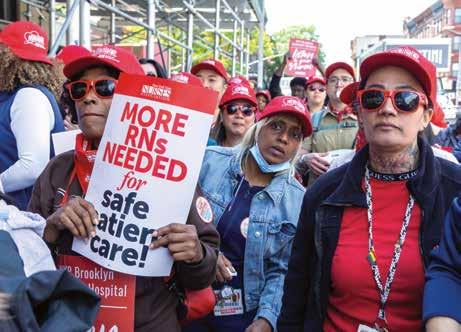
In 2021, NYSNA nurses and healthcare workers won groundbreaking legislation that established safe staffing standards at all hospitals in New York state. But since then, some hospitals and employers have continued to understaff units, prioritizing profits over patients and putting care at risk for all New Yorkers. While some nurses have been successful at pushing back against unsafe staffing levels, some hospitals continue to be chronically short staffed.
In an effort to support nurses seeking to improve staffing conditions and to create a resource hub for staffing-related issues across the state, NYSNA members voted at our 2025 Convention to establish a Statewide Staffing Committee — a space for members to connect, share challenges they’re facing, and work together on potential solutions to enforce and improve New York’s safe staffing law.
New Statewide Staffing Committee
NYSNA is excited to announce that, this spring, the new Statewide Staffing Committee launched, with members holding their first meeting in mid-March. The committee is comprised of members from NYSNA facilities across New York state. On March 19, 65 members met via Zoom, where they reviewed how New York’s safe staffing law works and discussed best practices and challenges around creating staffing plans, participating in hospital-based staffing committees, filing New York State Department of Health (DOH) complaints and using the law in conjunction with our union contract-based staffing enforcement tools.
Margaret Franks, MSN, RN, MEDSURG-BC, former NYSNA Treasurer and current NYSNA healthcare staffing coordinator, said: “Launching the new Statewide Staffing Committee is incredibly exciting. As a NYSNA member and former staffing captain at Northwell/Vassar Brothers Medical Center, I know how difficult it can be to manage chronic understaffing and effectively enforce the safe
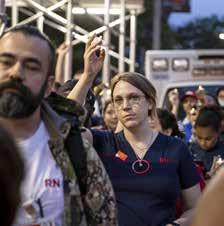
NYP-Brooklyn Methodist nurses recently rallied for safe staffing and a fair contract.
staffing law. Alongside my fellow Vassar nurses, though, we were able to successfully track staffing on our units, prompt an investigation from the DOH and ultimately work with hospital management on a corrective action plan. I hope that all NYSNA members will engage with this new committee, whether they have already made improvements to staffing at their facility or are fighting that battle, in order to protect patient care for all New Yorkers.”
A New Online Resource for Safe Staffing
In addition to forming the new Statewide Staffing Committee, NYSNA has also launched a new section of the website dedicated to the committee’s work. In the My Membership section of the website, NYSNA members will now find minutes from committee meetings as well as information, resources and case studies on how NYSNA members can use New York’s safe staffing law to effect change at their facilities. Members will also find a new, interactive feature in the Statewide Staffing Committee section of the website — commenting! NYSNA members from across the state will now be able to engage with one another by commenting on posts in this section. We hope that this will encourage dialogue between members with the goal of sharing
information and strategies and improving staffing at NYSNA facilities across New York. Franks will moderate comments.
Continuing the Fight to Improve Staffing and Protect Patient Care
Nurses know that healthcare facilities continually cut corners to shore up their bottom line — too often at the expense of safe staffing. As patient advocates, first and foremost, nurses and healthcare workers have a responsibility to push back on the shortcuts that put our patients at risk. We hope that members will engage with the new Statewide Staffing Committee to find new solutions and strategies for improving staffing at their facilities and, ultimately, ensuring safe, quality patient care for all New Yorkers. We encourage members to check out the Statewide Staffing Committee section of My Membership at https://www.nysna. org/my-membership#staffing, to review the resources there and to get involved in the fight for safe staffing at your facility. Each July, our employers review and revise clinical staffing plans and submit these to the DOH for approval, so there’s no time like the present to get reacquainted with the staffing law and the ways NYSNA members can work to improve staffing at every NYSNA facility!
‘‘Launching the new Statewide Staffing Committee is incredibly exciting. As a NYSNA member and former staffing captain at Northwell/Vassar Brothers Medical Center, I know how difficult it can be to manage chronic understaffing and and effectively enforce the safe staffing law.”
– Margaret Franks, MSN, RN, MEDSURG-BC
NYSNA Celebrates Nurses Week!
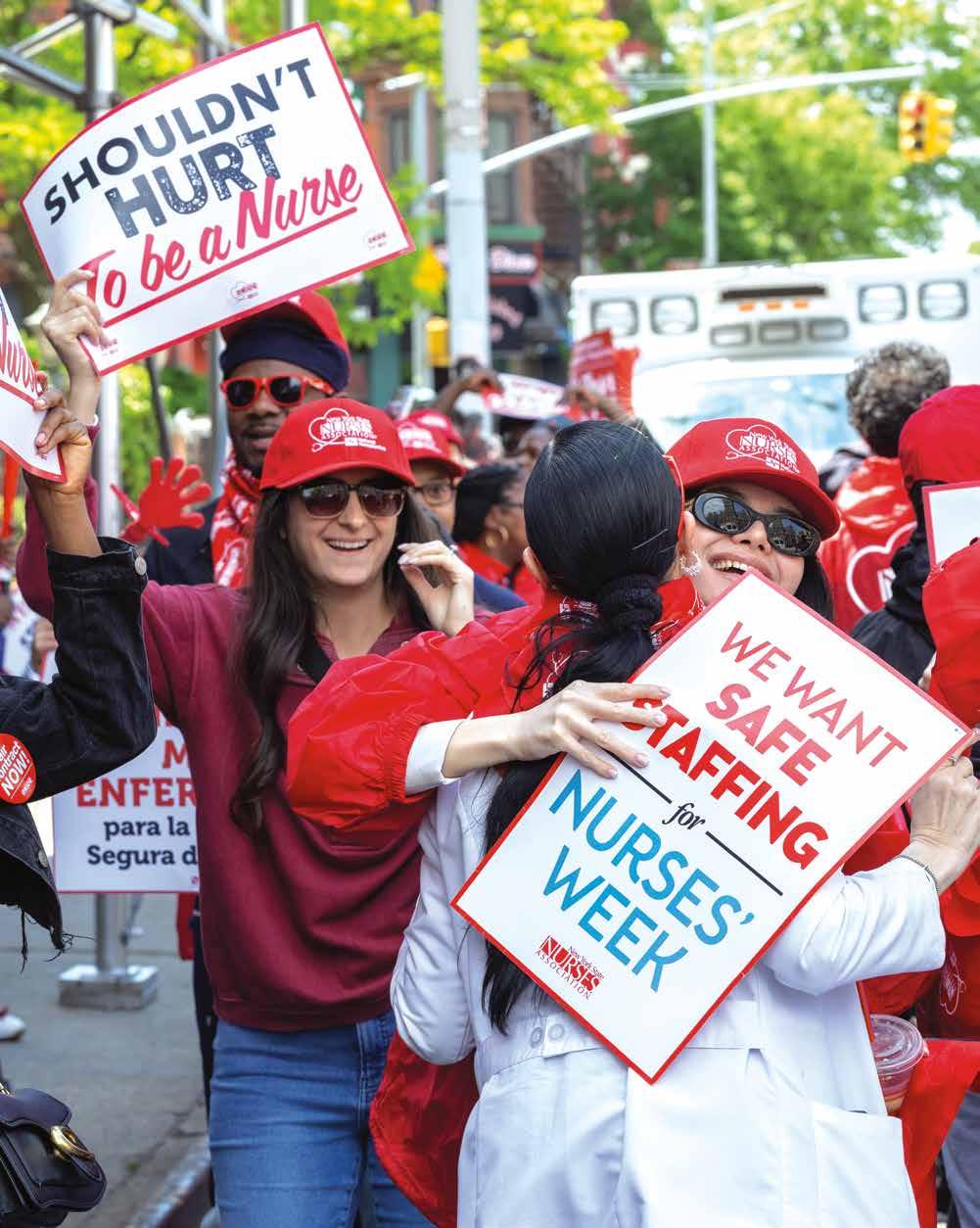
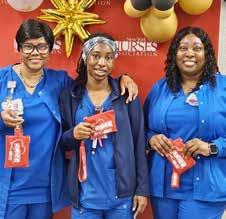
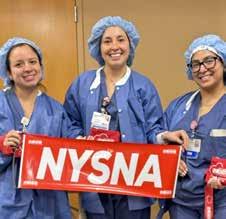
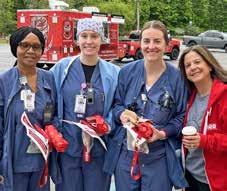
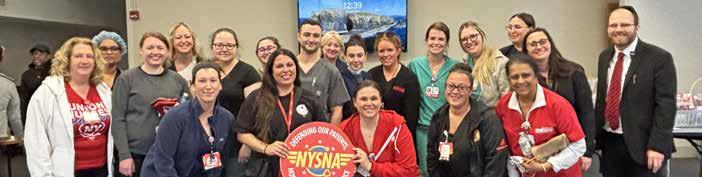
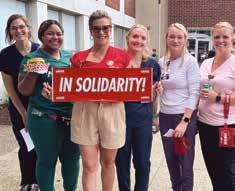
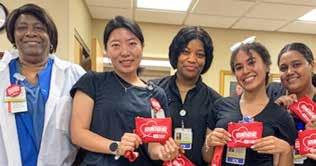
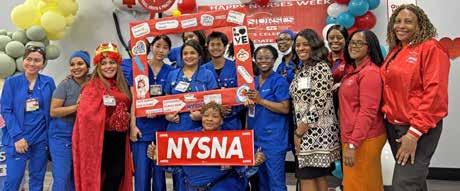
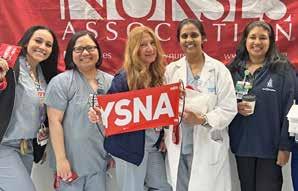
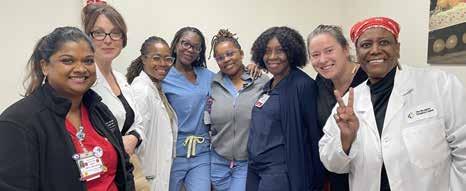
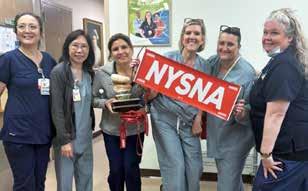
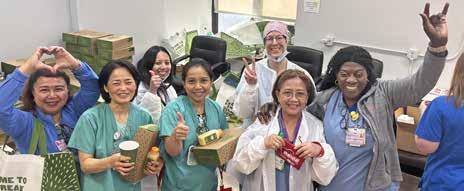
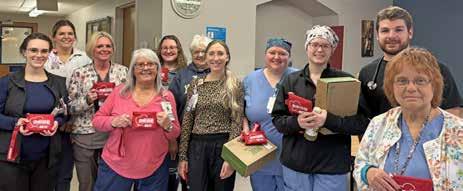
In May, NYSNA nurses across New York celebrated Nurses Week! This year, NYSNA members honored nurses’ power when we unite and fight for a better future for nurses and patients. Nurses work day and night to keep New Yorkers safe and healthy. The least we can do is celebrate ourselves and our fellow nurses throughout the month. After a year of hard-fought campaigns — including the historic New York City nurse strike and our fight for fair contracts across the North Country — there’s no better time to celebrate nurses’ power and the immense impact we have on the lives of all New Yorkers!
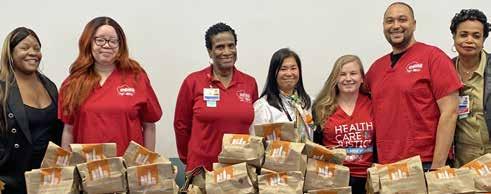
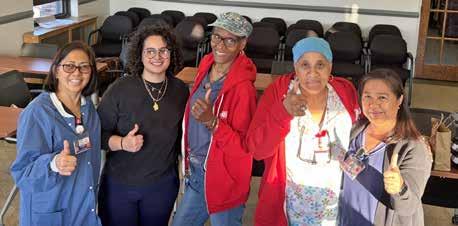
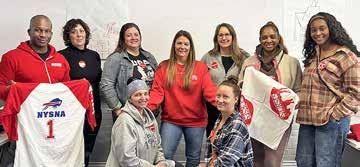
NYSNA President Nancy Hagans, RN, BSN, CCRN, celebrates Nurses Week with Maimonides nurses.
NYSNA Director at Large Sonia Lawrence, BSN, RN, celebrates Nurses Week with NYC H+H/Lincoln nurses.
NYSNA Lower Hudson/NJ Regional Director Mary-Lynn Boyts, RN, celebrates Nurses Week with Westchester Medical Center nurses.
NYSNA Nurse Heroes at the CBTU Convention
Several NYSNA and National Nurses United board members participated in the annual Coalition of Black Trade Unionists (CBTU), AFLCIO Convention in May. NYSNA leaders spoke out in support of Resolution #9, “Affirming the Support of Access and Availability of Gender Affirming Healthcare,” using their expertise and compassion as nurses to ensure CBTU delegates passed the resolution.
Their nursing expertise was also called upon in a more direct and immediate way at the convention that weekend. NYSNA members sprang into action to give aid to two attendees who were in medical distress during the gathering.
Once a Nurse, Forever a Nurse
Early one morning, Dr. Flandersia Jones heard an announcement over the loudspeaker that nurses were needed in the women’s bathroom. She answered the call and encountered a woman who was unwell. She quickly assessed the patient, spoke with her, and determined that she should go to the hospital.
Dr. Jones said, “I called 911 and after waiting for an ambulance for 30, 45 minutes, and nearly an hour, we requested a wheelchair and took the woman in an Uber to the hospital three blocks away. We stayed with her in the emergency room for a couple of hours to make sure she was fine.”
The woman came back to the Convention the next day and let the nurses know that the medical team found a larger issue at the hospital, and she has a follow-up scheduled with her doctor when she returns home.
Dr. Jones said, “There’s a saying, ‘once a nurse, forever a nurse.’
Western Regional Director John Batson, RN, Batson added, “If you want something done, ask a nurse. We are always on duty. Recognizing a person in need is in our training, it’s part of our profession.”
If You Want Something Done, Ask a Nurse
Batson and the other NYSNA nurse leaders put that training into
practice the very next day at the convention. After walking back through the hotel lobby after lunch, they witnessed someone lying on the ground near the entrance surrounded by several people.
Batson and NYSNA President Nancy Hagans, RN, BSN, CCRN, observed the man was not breathing. Batson immediately began compressions, even as one of the observers nearby who identified himself as a doctor was maintaining the patient’s airway and discouraged assistance.
God
Put Us There
“I feel God put us there at the moment we were needed most,” said Batson. “I could see he wasn’t breathing. I kneeled down and initiated CPR. We worked as a team. I did two minutes of compressions. Nancy was calling for the AED (automated external defibrillator). They handed me the pads over my shoulder as the next person did their compressions. I asked for the scissors. Someone there didn’t want his shirt off, but being nurses, we know
the right thing to do. Once we got the pads on, the AED analyzed his rhythm and advised the shock. We cleared the patient, initiated the shock, and continued CPR for about ten minutes. We had to shock two or three times. We continued until the fire department and paramedics arrived.”
Value of Nurses
They didn’t learn until the next day how the man was doing. Dr. Jones said: “The patient’s sister gave a beautiful testimony in church that morning. She said her brother was doing fine, and he thanked everybody who helped.”
The first vice president of CBTU also gave a special recognition to NYSNA/ NNU nurses during the last day plenary for their live saving work, reminding the union members gathered about the incredible value of nurses.
Batson said: “Nurses walk into a crisis and not only assess what is being done but also what else needs to be done. We walked away knowing we did our best.”
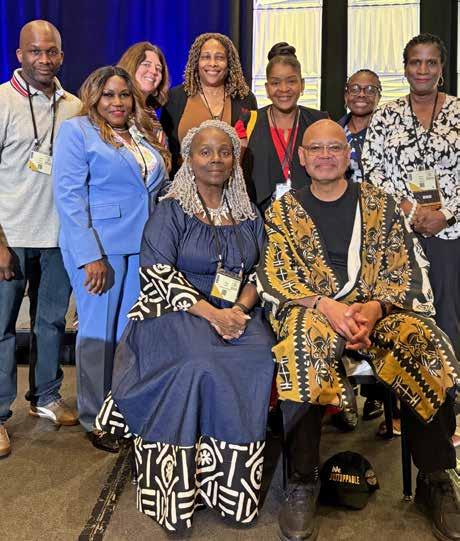
(left to right) NYSNA Western Regional Director John Batson, RN, Director at Large Flandersia Jones, DrPH, RN, Director at Large Sonia Lawrence, BSN, RN, First Vice President Judith Cutchin, DNP, RN, Secretary Michelle Jones, MSN, RN, ANPC, and NYSNA President Nancy Hagans, RN, BSN, CCRN, pictured here with CBTU President Terrence Melvin (bottom right) traveled to Atlanta to attend educational sessions and participate in setting the organization’s national agenda.
Brooklyn Hospital Nurses Win Battle to Restore Health and Pension Benefits
Earlier this year, hospital executives at The Brooklyn Hospital Center (TBHC) stopped making payments into nurses’ health and pension benefit fund. Despite this and without health benefits, nurses continued working and caring for patients while also fighting for the health coverage they need to keep themselves, their families and their patients safe. After months of advocacy, NYSNA nurses secured the benefits their hospital had promised them, showing that when NYSNA nurses fight, we win!
Broken Promises
Earlier this year, TBHC nurses fought alongside 20,000 New York City private sector nurses and won safe staffing, safety protections for nurses and patients, and the respectful wages and benefits necessary to recruit and retain nursing staff. They averted a strike when TBHC management, along with other safety-net hospitals, agreed to tentative agreements that secured nurses’ benefits. However, despite its commitment, TBHC reneged on its promise and failed to make the necessary payments to secure nurses’ health and pension benefits for months, forcing nurses to delay important treatments and medications.
While TBHC’s safety-net nurses continued to care for New York City’s most vulnerable patients without healthcare coverage of their own, hospital officials raked in millions and kept their own health coverage. Recent filings show that TBHC CEO Gary Terrinoni
brought in nearly $2 million in executive pay, all the while telling nurses that the hospital couldn’t afford their benefits. The hospital also received millions1 in stabilization funding — more than enough to pay for nurses’ health coverage — but only made a partial payment that was not enough to restore benefits. Although cuts to federal healthcare funding are undoubtedly impacting safety-net hospitals across the state, nurses know that the hospital’s failure to pay was due to poor financial management and disrespect for nurses and patients. While fighting for coverage, TBHC nurse leader Debra Ambrose, RN, said, “My colleagues and I go to work in fear of the worst-case scenario — that we will get sick, injured, hurt or our families will, and we won’t be able to afford out-of-pocket expenses. CEO Terrinoni is playing dangerous games with the hospital’s finances, and nurses refuse to be pawns!”
Nurses Take Action
After losing their benefits, NYSNA nurses took swift action and showed the hospital that they would not back down until they got what they deserved. Nurses held speak-outs outside the hospital; leafletted communities; marched to the CEO’s luxury condo; and lobbied lawmakers to share how the loss of coverage was forcing many nurses and their families to delay critical care, from routine checkups to lifesaving cancer treatments. Elected officials at the state and city levels joined nurses in calling for the hospital to restore nurses’
benefits and demanding action and transparency. Former NYSNA member and New York State Assembly Member Phara Souffrant Forrest, RN, published an op-ed2 in support. Together with allies, nurses made it clear that working without health coverage was dangerous for themselves, their families and the communities they cared for.
Nurses Restore Benefits
Finally, after months of speaking out and pressure from elected officials to use stabilization and other hospital funds to prioritize restoring nurses’ benefits, the hospital finally paid nurses’ benefits in full. The hospital reinstated nurses’ health coverage and, after a couple more weeks, also paid nurses’ pension benefits. After remedying these outstanding issues, nurses were finally able to vote on the contract they’d fought so hard to win earlier in the year, ultimately overwhelmingly ratifying the contract. In May, hospital administrators also agreed to reimburse nurses for medical expenses accrued during February, when nurses did not have coverage. While federal cuts to healthcare funding are impacting safety-net hospitals across New York, hospital management cannot make up the gaps by cutting frontline caregivers’ benefits. Every day, nurses work hard to care for New York’s most vulnerable patients, and hospital executives must protect the health and safety of patients and nurses. NYSNA nurses will not back down when hospital executives prioritize profits over patients!
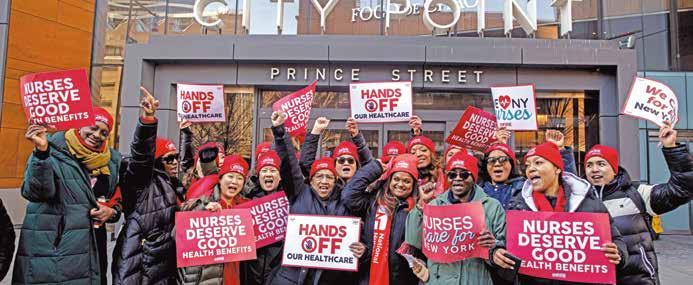
NYSNA nurses at The Brooklyn Hospital Center spoke out in March to demand hospital administrators restore their health and pension benefits.
NYSNA Nurses Push Back on Statewide Hospital Closures
Hospitals across New York are beginning to feel the impacts of the cuts to federal healthcare from the Trump administration’s “One Big Beautiful Bill” act — and NYSNA nurses are fighting back to ensure that their communities maintain access to the safe, quality care they need.
Fighting to Improve Rural Healthcare
On Tuesday, April 28, NYSNA nurses from North Star/Carthage Area Hospital and ClaxtonHepburn Medical Center traveled to Albany to hold a briefing for legislators, where they spoke on the critical need to improve access to rural healthcare. Recent cuts to federal healthcare funding, they said, have only worsened an existing crisis1
At the briefing, Jess Thornton, RN, NYSNA member at ClaxtonHepburn Medical Center, shared, “Often, North Country residents go without the care they need, and that is unacceptable. The crisis in the North Country is the result of decades of disinvestment, and the current crisis at Carthage and Claxton is the result of financial mismanagement by North Star. North Country patients, residents, communities and healthcare workers shouldn’t have to suffer the consequences of these actions.”
Earlier this year, North Star Health Alliance — the hospital group that manages Carthage and Claxton-Hepburn — filed for bankruptcy and announced potential service cuts and closures. NYSNA nurses immediately took action to push back and successfully advocated for the funds necessary to keep their hospitals open. Nurses know that it will take more than stabilization funds to repair the damage done to healthcare in the North Country, and they organized the legislative briefing to keep the fight going and engage more of New York’s elected officials beyond the North Country.
From the North Country to Albany to Brooklyn
Downstate, NYSNA nurses recently faced a similar fight at The Brooklyn Hospital Center (TBHC). Earlier this year, TBHC administrators stopped making payments for nurses’ health and pension benefits, citing a lack of funds. Nurses continued working and caring for patients while fighting for the health coverage they need to keep themselves, their families and their patients safe. After months of advocacy, TBHC finally paid nurses’ benefits in full, restoring their healthcare coverage and pensions. For more on TBHC nurses’ fight to restore their benefits, see page 8.
In April, NYSNA nurses from Albany Medical Center joined
1199SEIU healthcare workers to hold a speak-out to push back on a proposal to reduce beds and services at Albany Med Health System’s Columbia Memorial Hospital in Hudson. This is the only hospital in Columbia and Greene counties, and hundreds of thousands of New Yorkers rely on it for access to healthcare services. A reduction in services at the facility would force Columbia and Green County residents to rely on Albany Medical Center for care, undoubtedly putting strain on a hospital that already has some of the longest emergency room wait times in the country2
At the speak-out, NYSNA member and local leader at Albany Medical Center Jennifer Bejo, RN, said, “Converting Columbia Memorial to a critical access hospital will be disastrous for this community and for the surrounding region, whose hospitals will have to absorb the patients this hospital will no longer be able to serve, including my hospital, Albany Med. Without a doubt, this will impact Albany Med nurses’ ability to provide the safe, quality care every patient deserves.”
A Statewide Fight
While federal cuts to healthcare funding are impacting safety-net and community hospitals across New York, hospital management cannot cut costs on the backs of frontline caregivers or the vulnerable communities they serve. The solution to decreased funding is not stripping nurses of critical benefits or further reducing access to care for rural communities. In the face of these cuts, hospital executives must work harder to protect the health and safety of patients and nurses — not make short-sighted cuts at the expense of everyday New Yorkers.
State legislators must also prioritize fair funding for New York’s public, safety-net and rural hospitals and improving access to care for all New Yorkers in the face of federal attacks. NYSNA nurses will not back down when cuts to healthcare funding threaten the health and safety of our colleagues, our families and our communities!
‘‘Often, North Country residents go without the care they need, and that is unacceptable. The crisis in the North Country is the result of decades of disinvestment, and the current crisis at Carthage and Claxton is the result of financial mismanagement by North Star.”
NYSNA members Jess Thornton, RN, and Bonnie Jacobs, RN, traveled to Albany in April to hold a legislative briefing for elected officials on the ongoing access to care crisis in the North Country.
By Karen Broomes-James, DNP, RN, NPD-BC, CCRN-K, SCRN, PCCN-K, Director of Nursing Education and Practice
Celebrating Connection, Innovation and Community at Seminar at Sea 2026
Seminar at Sea (SAS) 2026 stood out as a remarkable and inspiring experience, bringing together nursing professionals, colleagues and families for a journey defined by learning, collaboration and connection. Guided by the visionary leadership of President Nancy Hagans, RN, BSN, CCRN, and Executive Director Pat Kane, RN, and energized by more than 155 attendees’ participation, this year’s seminar successfully transformed a shared voyage into a vibrant professional community. The event seamlessly blended intellectual exploration with meaningful interpersonal engagement, leaving participants both inspired and empowered.
Even before participants embarked, the tone for SAS 2026 was thoughtfully set through a dynamic prerequisite discussion forum. Participants engaged in meaningful dialogue around artificial intelligence (AI) in nursing, sharing perspectives on the technology’s evolving role in clinical practice, education, research and innovation. This early exchange fostered a sense of connection, encouraged diverse viewpoints and laid the groundwork for deeper collaboration during the seminar. As attendees gathered onboard, there was a palpable sense of excitement and purpose. Participants brought not only their professional expertise but also curiosity, openness and a shared commitment to advancing the nursing practice.
A Dynamic Learning Experience
The central theme of SAS 2026 — Artificial Intelligence in Nursing — provided a timely and forwardthinking focus as healthcare continues to evolve in response to
technological advancement. The educational sessions were carefully designed to progressively build, guiding participants from foundational understanding to critical analysis and future-focused thinking.
Session 1: AI Fundamentals for Nursing Professionals laid the groundwork by exploring AI’s historical context in healthcare alongside key technological concepts such as natural language processing and predictive analytics. Participants examined AI-driven patient monitoring systems and discussed the implications of AI failures and misuse. A case study highlighting realworld AI implementation challenges prompted thoughtful discussion and critical reflection.
Session 2: Integrating AI Into Patient Care shifted attention to clinical application. Participants explored how AI supports diagnostics in radiology, pathology and laboratory analysis as well as its role in enabling personalized patient care through predictive risk assessments and AI-assisted care planning. A hands-on activity comparing an AI-generated care plan with those that participants collaboratively developed underscored the importance of balancing technological insights with clinical judgment. This session reinforced best practices for responsibly integrating AI while maintaining the nurse’s essential decision-making role.
Session 3: Governance, Training and Responsible AI addressed the ethical, legal and regulatory dimensions of AI implementation. Discussions covered patient privacy; data protection frameworks such as the Health Insurance Portability and Accountability Act (HIPAA); and concerns surrounding bias, fairness and accountability in AI systems. Participants explored policy guidelines and risk mitigation strategies while considering the need for education and workforce readiness. An interactive group activity focused on AI innovation further encouraged participants to apply these principles in practical scenarios.
Session 4: Safeguarding Nursing Practice in the Era of AI provided a powerful forum for addressing professional concerns and advocacy. Participants explored feelings of uncertainty and loss of control
in the face of rapid technological change while examining strategies for reclaiming professional autonomy. Conversations included union perspectives, the implications of virtual nursing and the inclusion of AI safeguards in contract bargaining. The session also looked ahead to AI’s future in nursing, including projected workplace changes; the impact on jobs; and emerging innovations such as robotics, precision nursing and enhanced decision support systems. A lively closing debate, complete with judging and awards, brought energy and engagement to the seminar’s conclusion.
Lasting Impact
What distinguished SAS 2026 was the depth of participant engagement. Attendees did far more than passively absorb information — they actively contributed to discussions, challenged ideas and collaborated on solutions. Interactive activities, case studies and group exercises created an environment where learning was both experiential and impactful. Participants examined real-world challenges, exchanged insights and explored practical applications that can be integrated into their professional practice.
The seminar fostered a shared sense of purpose and reinforced the importance of leadership in navigating the evolving healthcare landscape. Participants left with not only a deeper understanding of AI but also the skills and confidence to critically evaluate its use and advocate for responsible implementation that preserves the integrity of nursing practice.
A Community Moving Forward
SAS 2026 exemplified the power of connection, innovation and community. The relationships that participants built, the ideas they exchanged and the knowledge they gained will continue to influence nursing practice well beyond the seminar’s duration.
The NYSNA Nursing Education and Practice team extends our deepest gratitude to all who contributed their time, perspectives and enthusiasm. Your engagement is what made this experience truly transformative. Together, we as nurses are not only witnessing the future of nursing; we are also shaping it.
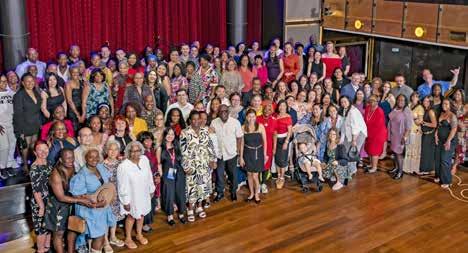
More than 100 nurses participated in Seminar at Sea 2025.
WEATHER EMERGENCIES AND DISASTER PREPAREDNESS
Is Your Facility Ready for the Inevitable?
Over the past several summers, rising temperatures and humidity have put unprecedented strain on healthcare facility heating, ventilation and air conditioning (HVAC) systems. Many of these systems are just not up to the environmental conditions we now live with. The results have been dangerously hot units, mold growth on sterilized equipment and miserable working conditions.
Record-breaking rainfall during storms has led to flooding from parking lots, roofs and sewer systems in numerous healthcare buildings. Extreme droughts have fueled wildfires, sending hazardous smoke across the Northeast. The small particulates found in this smoke can result in many adverse health conditions for both vulnerable and healthy individuals. Find more information on the effects of wildfire smoke at https://www.nysna.org/resources/ how-healthcare-facilities-can-prepare-wildfire-smoke-conditions
Climate change is not limited to extreme heat. Record-setting winter storms have brought to a standstill even cities accustomed to heavy snowfall, such as Buffalo.
To prepare for these extreme weather events, healthcare facilities must assess a wide range of services, infrastructure, policies and procedures.
Meeting staff needs
To be staffed appropriately during emergency situations, healthcare facility management must take into consideration staff needs. Will roads be closed and public transportation shut down? Then the employer must arrange ways to get staff to the facility. Will schools be closed? Then childcare may be required. If a storm is so severe that there is long-term damage to the community, then access to clean water, food and shelter may be needed for staff families. If these basic needs are not taken care of, staff will be unable to work.
Hospitals must also meet the human needs of staff members who are working at the healthcare facility during emergencies. Management should determine in advance the lim-
its to how long a medical professional can work. The New York State Education Department Office of the Professions considers nurses voluntarily working beyond 16 hours in a 24-hour period to constitute “willful disregard of patient safety and will be subject to a potential charge of unprofessional conduct.” Working this many hours under mandatory conditions should be considered equally dangerous to patient safety. The American Nurses Association recommends that nurses by allowed to sleep seven to nine hours in a 24-hour period. Does your facility have an adequate number of cots for staff to sleep on in a quiet, dark area? Is there enough food for staff? Are there enough staff to allow for breaks?
Patient
management
Healthcare facilities should also have plans in place for patient management in a crisis situation. They should cancel elective procedures, expedite discharges and put patient surge protocols in place. Weather emergencies can result in additional patients needing emergency care. With fewer staff members, potentially limited supplies and possibly damaged utilities, a patient surge can quickly overwhelm an emergency department.
Infrastructure assessment
Damage to a healthcare facility from extreme weather conditions is not unusual. Building surveys can identify weaknesses prior to catastrophic events to strengthen vulnerable areas. Hospitals should assess in advance utilities, communication systems, electronic medical records, supplies, ventilation systems, safe water and the ability to maintain lifesaving equipment. If the facility sustains a level of damage that makes it impossible to provide safe patient care, it should have evacuation protocols ready for activation.
What
can NYSNA members do before and after a weather emergency event?
l Raise weather emergency preparedness issues at labor-management meetings.
It’s going to be a hot summer – record hot. But that’s been standard for the last few years due to global warming. Unfortunately, an expected strong El Niño means temperatures are likely to be even higher than the levels we’ve come to expect, and erratic weather will follow over the winter months.
l Pressure management to address ongoing maintenance and repair issues so that they do not become major weak points during an emergency.
l After an extreme weather event, debrief and gather information that you can share with management. Consider demands related to areas where management failed to prepare adequately.
l Consider contract proposals that will improve emergency preparedness at your facility.
Find more information in NYSNA’s Inclement Weather Preparedness Guide at https://www.nysna.org/resources/ nysna-inclement-weather-preparedness-guide
NYSNA has formed a union-wide disaster and emergency preparation committee. If you’d like to participate, or have any questions or concerns related to this issue, please contact the NYSNA Occupational Health & Safety Representatives at healthandsafety@nysna.org.
New Requirement for Submitting Resolutions
Convention Delegates must now submit proposed resolutions online at https://nysna.tfaforms. net/5111105. The online form will guide you through the submission process. You can find guidelines to writing resolutions on the NYSNA website at www. nysna.org/Convention.
We are looking forward to hearing your ideas and taking advantage of this year’s Convention to share, learn and strategize together as union siblings.
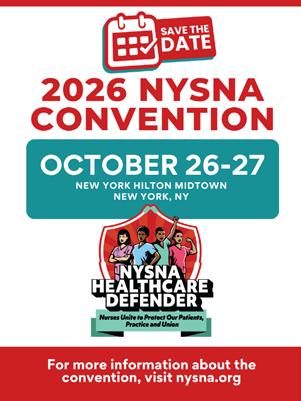
NYSNA Convention OCT. 26-27
New York Hilton, New York, NY
Save the date and get ready to meet fellow nurses and healthcare professionals from across New York on Oct. 26-27 at the New York Hilton in New York, NY. Online registration, delegate, transportation, lodging and class information will be continually updated on our website at www.nysna.org/ Convention.
The theme of this year’s Convention is NYSNA Healthcare Defender: Nurses Unite to Protect Our Patients, Practice and Union We can’t wait to see you this year, celebrate our accomplishments and solidarity, strategize about our priorities and participate in union democracy.
Bylaws Are Due Aug. 12, and
Resolutions Are Due Aug. 27
The NYSNA Secretary must receive amendments to the NYSNA bylaws no later than Aug. 12 and resolutions by Aug. 27. Convention Delegates can mail proposed amendments to: New York State Nurses Association
ATTN: NYSNA Secretary 131 W. 33rd St., 4th Fl New York, NY 10001
Or e-mail a Word document attachment to info@nysna.org with the subject line: “Bylaws Amendment.”
For Convention Delegates who plan to mail bylaws, please write “NYSNA” and indicate “Bylaws Amendment” on the envelope.
North Country Members Defend Nurse and Patient Safety
Since winter, NYSNA nurses and healthcare professionals in the North Country have been bargaining for fair contracts that guarantee safe, quality patient care in their communities. While some bargaining units have been able to settle new, strong contracts, others have faced challenges at the bargaining table.
The Fight for Safe Staffing
At University of Vermont (UVM)Champlain Valley Physicians Hospital (CVPH), safe staffing language has proven to be a key issue during bar-
gaining. Last year, CVPH management unilaterally changed staffing in several medical-surgical units, despite members’ objections. Now, management is once again putting patient care at risk by trying to remove staffing language from the contract altogether. In response, NYSNA members held a speak-out in April to call attention to ongoing staffing issues and an informational picket in May to bring their fight to the community. Hundreds of nurses and healthcare professionals came out in support of both actions, which leaders from the Northeast Central Labor Council, AFL-CIO, the Plattsburgh City Council and the Plattsburgh Town Council also attended.
Health Benefits on the Line
In addition to their fight for safe staffing, NYSNA nurses and healthcare professionals at CVPH are also fighting to preserve their health benefits. At the bargaining table, hospital management has proposed increases to healthcare costs that would drive up monthly payments for members, many of whom have families that rely on their affordable benefits to access care.
At Adirondack Medical Center, NYSNA nurses are facing a similar battle. Adirondack is the last remaining NYSNA facility in the North Country that does not have the NYSNA Benefit Fund, and
nurses there are locked into expensive, employer-provided benefits. They’re working to win entrance to the benefit fund during this round of negotiations, because it would save members from costly monthly payments and help recruit and retain nurses to the rural hospital. NYSNA nurses at UVMElizabethtown Community Hospital are showing that the battle over healthcare benefits is one that members can fight and win! In April, Elizabethtown nurses settled a new contract that secures entrance to the benefit fund. For some nurses, this win will reduce their monthly payments for health benefits by more than 90% — congratulations, Elizabethtown nurses!
United to Win
Despite the challenges they face, NYSNA members in the North Country — including at UVM-Alice Hyde Medical Center, where bargaining also continues — are not willing to give up without a fight. Nurses and healthcare professionals know that safe staffing language is key to ensuring that their patients have access to the safe, quality care that they need. And affordable health benefits are essential to make sure there are enough nurses to provide that care. With strong contracts already settled at four other North Country hospitals this year, though, members at Adirondack, Alice Hyde and CVPH are hopeful that they too will be able to settle the fair contracts that nurses and patients deserve.
In May, NYSNA nurses and healthcare professionals at University of VermontChamplain Valley Physicians Hospital held an informational picket to demand a solution to chronic understaffing issues and a fair contract for North Country nurses and patients.
Nurses at WMC-HealthAlliance Ratify Contract!
After months of bargaining for a fair contract that protects nurses and patients, NYSNA nurses at Westchester Medical Center (WMC)-HealthAlliance Hospital in Kingston ratified a strong
contract in late March. Nurses at WMC-HealthAlliance had been demanding protection from workplace violence, a problem that has only grown across the country over the last several years. Nurses spoke out on March 11
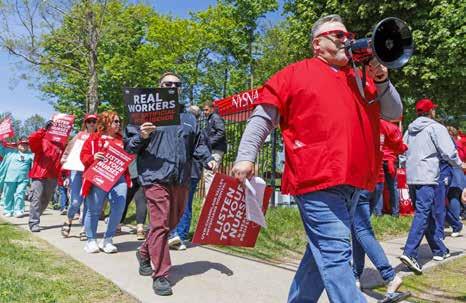
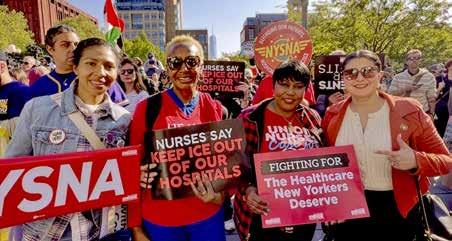
NYSNA Nurses Rally Across New York to Defend Workers’ Rights on May Day
On May Day, NYSNA nurses joined labor allies across New York state to march and rally to defend workers’ rights. In New York City, nurses joined the New York City Central Labor Council, AFL-CIO, New York Immigration Coalition, Mayor Zohran Mamdani, and thousands of our union siblings and elected officials to commemorate the holiday — also known as International
NYSNA Nurses Speak Out to Protect New York’s Essential Plan and Patients
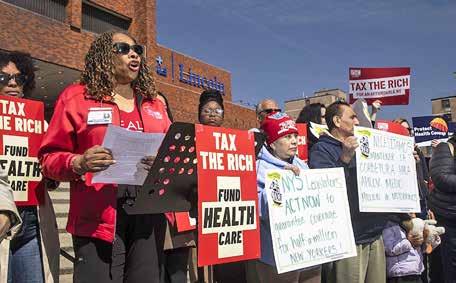
On Friday, April 10, NYSNA
Director at Large Sonia Lawrence, BSN, RN, spoke at NYC Health+Hospitals/Lincoln alongside labor and elected allies — including the Committee of Interns and Residents/Service Employees International Union (SEIU), Doctors Council/SEIU, Professional Staff Congress-CUNY, Democratic Socialists of America and others
— to demand that Albany fill in federal funding gaps in the Essential Plan. If the state doesn’t do more to protect our communities, nearly half a million New Yorkers on the Essential Plan could lose coverage this summer. Lawrence and others spoke about how vital it is for the state to use its own funds to continue the Essential Plan. Our state needs to use existing revenues and
and secured a contract agreement that makes significant steps toward addressing nurse and patient safety and secures strong wage gains and protected benefits. Congratulations, HealthAlliance nurses!
Workers’ Day — with a march from Washington Square Park to Foley Square.
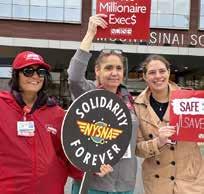
In Albany, Jennifer Bejo, RN, NYSNA member and local leader at Albany Medical Center, spoke at a Capital District Area Labor Federation rally in West Capitol Park. In her remarks, Bejo thanked community and labor allies for their support during last year’s contract fight. She also spoke on the critical need for solidarity in the labor movement, saying, “Remember that as workers, we have the numbers, and we have the power. Let’s not be afraid to use it! Let’s use our power to support one another. Let’s use our power for healthcare justice and economic justice. Happy May Day and solidarity forever!”
Great job, NYSNA nurses, for always fighting to defend workers’ rights across New York state!
resources to step in where our federal government has made drastic cuts and tax the rich to pay for the services that keep New Yorkers healthy; otherwise, our patients and communities will suffer.
New York City Health + Hospitals Conduct Maternal Health Trainings
In honor of April’s Black Maternal Health Week, nurses at NYC Health+Hospitals (H+H) conducted specialized maternal health training, focusing on high-risk obstetrics, postpartum hemorrhage and neonatal resuscitation. The simulations at H+H/Harlem Hospital used realistic mannequins, and nurses spoke about how to improve patient safety, with a special emphasis on reducing disparities for women of color. NYSNA nurses are on the front lines of the fight for health equity and addressing the Black maternal mortality crisis!
NYP-Brooklyn Methodist Hospital Nurses Take Action to Demand a Fair Contract
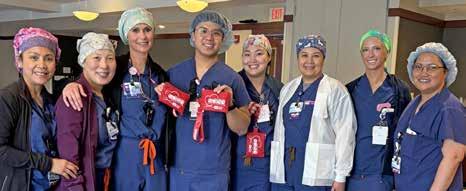
This spring, NYSNA nurses at NewYork PresbyterianBrooklyn Methodist Hospital are pulling out all the stops to demand a fair contract that ensures safe, quality patient care for their community! In April, nurses organized a button action and delivered a petition to management signed by more than 1,100 members calling on management to settle a fair contract that includes enforceable safe staffing standards and protections from workplace violence.
Nurses are deeply concerned about violence in healthcare settings and also launched a store sign campaign in their community to build awareness about the dangers workplace violence poses to nurses and patients. Within just a few days of launch, more than 50 Park Slope businesses displayed window signs to show their solidarity with nurses. In May, nurses — alongside community, labor, and faith allies — held an informational picket and candlelight vigil outside the hospital to spotlight the critical need for protection from workplace violence and amplify their demands for a fair contract.
In addition to nurses’ public actions, elected officials also sent an open letter to New York Presbyterian Hospital and NYPBrooklyn Methodist Hospital executives, calling on them to settle a fair contract. Don’t stop fighting until you secure the fair contract you and your community deserve, NYP-Brooklyn Methodist nurses!
Mount Sinai
South Nassau Nurses
Continue to Fight for Their First
Contract
This spring, NYSNA nurses at Mount Sinai South Nassau (MSSN) continued to take action and bargain for a fair first contract. In April, nurses held a teach-in to push back on management’s proposed changes to the established operating room schedule. When nurses tried to speak up about their right to bargain over these proposed changes, hospital administrators retaliated against them. In response, operating room nurses, alongside other members of the bargaining unit, gathered outside the hospital to show management that they would not be intimidated and would continue to fight for their rights!
Most recently, nurses launched a new community petition and ad campaign to educate the public and build support for their contract fight among patients on Long Island. In addition to their public-facing work, nurses are continuing to round and do outreach inside the hospital to get more members involved in the fight for their first contract. Keep up the fight, MSSN nurses!
St. Joseph’s Medical Center Nurses Ratify New Contract
In early May, NYSNA nurses at St. Joseph’s Medical Center in Yonkers voted overwhelmingly to ratify a new contract that protects nurses and patients! For months, NYSNA nurses had been speaking out about understaffing at St. Joseph’s. In the first three months of the year, nurses filed more than 130 official complaints of unsafe staffing. Despite management’s initial refusal to address the ongoing staffing issues, nurses were able to win a strong contract that includes improvements to telemetry and mental health staffing and the fair wages
and benefits necessary to recruit and retain enough nurses for safe patient care. Congratulations, St. Joseph’s
nurses, on your strong contract and holding the line for safe patient care in your community!
Erie County Medical Center Nurses Are Fired Up!
Erie County Medical Center (ECMC) nurses are getting fired up for two important campaigns — their campaign to secure paid family leave and their upcoming 2027 contract negotiations. To activate members, ECMC nurses are holding monthly membership meetings locally and lobbying to fight for the things that all our communities deserve at the state and national levels. After lobbying in Albany for fair hospital funding and Tier 6 public pension reform, ECMC nurses traveled to
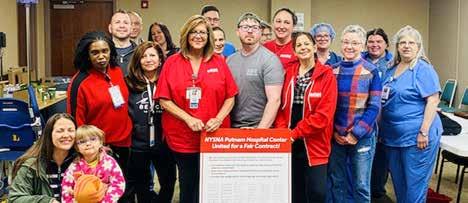
Northwell Health/Putnam Hospital
Nurses March on the Boss
the National Nurses United federal lobby day in Washington, D.C., ECMC members joined other
NYSNA members to fight for safe staffing, healthcare for all, taxing the rich, and more. They marched with hundreds to abolish U.S. Immigration and Customs Enforcement (ICE) and met with Senators Chuck Schumer, Timothy Kennedy and Nick Langworthy. ECMC nurses know that we are stronger together!
Monte Labor-Management Win
OIn Thursday, May 14, NYSNA nurses at Northwell Health/Putnam Hospital marched on the boss to demand a fair contract! For months, nurses have been fighting for a fair contract that includes enforceable safe staffing ratios and improved retirement and compensation that reflects nurses’ experience and value to the hospital and their community.
During their march on the boss, nurses delivered a petition outlining their demands that more than 80% of the Putnam bargaining unit signed. In addition to taking their demands to hospital administrators, nurses are also delivering their demands to the executives at Northwell headquarters on Long Island. Keep up the great work, Putnam nurses!
n May, Montefiore management tried to unilaterally change the length of labor-management meetings from two hours to one. NYSNA nurses pushed back against this change, citing the need for time to address the multitude of issues they experience at Montefiore, including payroll errors and management’s attempts to sidestep agreements reached during this winter’s historic contract campaign.
When management refused nurses’ demands, the Member
Action Team at Montefiore organized a digital campaign to express nurses’ frustration at the change and demand that Montefiore restore the original meeting time. Approximately 130 nurses sent emails to Montefiore decision-makers, and within one week, management had enough! It restored past practice, changing back labor-management meetings to two hours. Congrats, Montefiore nurses; let’s keep pushing for respect!
NYSNA Nurses Support New York for All in Albany!
On Tuesday, April 21, NYSNA nurses traveled to Albany to support the New York for All Act with the New York Immigration Coalition, New York American Civil Liberties Union and other allies. NYSNA nurses believe that all New Yorkers, regardless of immigration status, should be able to lead open lives in our state, participate in their communities,
provide for their families and access healthcare without intimidation. The New York for All Act will preserve state and local resources for our communities and ensure that the Trump administration cannot divert New York dollars to carry out a cruel, politicized immigration agenda. NYSNA nurses stand with our patients and communities for policies that protect all New Yorkers!
Our Dues, Our Power
Our NYSNA dues pay for member representation and arbitrations, winning great new contracts, political and community outreach to support our contract and healthcare advocacy campaigns, member education, our nursing practice resources and free certification exam prep courses, events like our annual Convention and Nurses Week celebrations, and our life insurance benefit.
As a dues-paying NYSNA member, you are part of a national movement to protect nursing and working people – as members of National Nurses United and the local, state, and national affiliates of our national union federation, the American Federation of Labor-Congress of Industrial Organizations (AFL-CIO).
Member Dues Rates for 20262027
Average dues increase is $3.02 per biweekly paycheck (Full-time)
NYSNA membership dues will take effect July 1.
Dues rates are based on the average base salary for NYSNA local bargaining unit (LBU) members in various regions of the state. Dues are lower for members who are not represented by NYSNA for collective bargaining, and discounts are applied for members in other special circumstances (see chart at right).
NYSNA dues are computed according to a formula approved by the members at the 2001 Voting Body. The formula uses a Regional Base Salary (RBS) to determine the dues for members in six different regions in New York state and one in New Jersey.
The RBS is the average of the starting salary paid to staff nurses at all NYSNA-represented facilities in each region as of Jan. 1, 2026. A calculation of 1.6 percent of this average determines the dues rate for members in that region who are represented for collective bargaining and work full time; and 1.2 percent for members who are represented for collective bargaining and work less than full time. Dues are not a percentage of each member’s individual salary.
MEMBERS DUES RATE FOR 2026- 2027
Part Time/Per Diem CBU Member
Part-time/Per Diem
Nurses Not Represented by NYSNA for Collective Bargaining
Employed nurses not represented by NYSNA for collective
Rate is 70% of 1.2% of the average starting salary in the region where you work.
Unemployed nurses or employed nurses age 62 and over and not earning more than allowed under Social Security
Rate is 50% of 1.2% of the lowest average starting salary in the region where you work or, if you are unemployed, where you live.
Nurses age 62 and over and unemployed, and RNs who are totally or permanently disabled (Social Security award letter required) or Lifetime Members (age 65 or over and paid NYSNA members for 25 years or more)
Rate is 25% of 1.2% of the average starting salary in the region where you live.
Retired category: Nurses not represented for collective bargaining, who are 62 years or older and retired and earning not more than what social security allows.