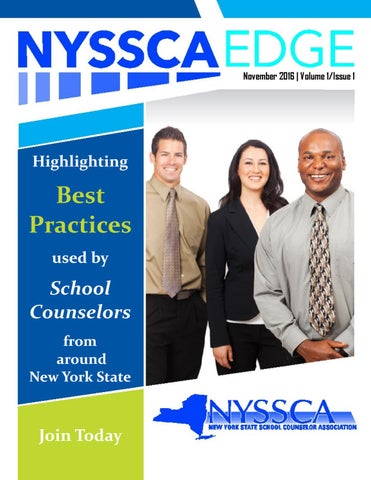
November 2016 | Volume 1/Issue 1
Highlighting
Best Practices used by
School Counselors from around New York State
Join Today
November 16-18, 2017 School Counselors: Prepared to Lead the Way The 2017 NYSSCA Conference will be held at a newly renovated gem located just ten minutes from downtown Syracuse and Syracuse University, the DoubleTree by Hilton Hotel Syracuse has been a fixture in Carrier Circle for forty years..
Call for Conference 2017 Programs! The New York State School Counselor Association is looking for presenters and programs that will meet the growing needs of today’s school counselors especially in the areas of accountability and best practice. The Call for Programs will be available on www.NYSSCA.org. You will be able to complete the form on-line. Submit either a hard copy or via email to conferenceprogram@NYSSCA.org. The deadline is May 2, 2017.
November 15-18, 2018
Lake George,
Bolton Landing, NY
NYSSCA EDGE | November 2016
NYSSCA Executive Board President
Rosemarie Thompson
Inside November 2016
President-Elect
Kristen Shearer President Elect-Elect
Dr. Gail Reed-Barnett Past President
Dr. Barbara Donnellan Executive Director
Dr. Robert Rotunda Executive Secretary Tom Wiggins
Level Vice Presidents VP Elementary Kathryn Haley VP Middle Carol Miller VP Secondary Steve Brown VP Directors/Supervisors Terrence Hinson VP Counselor Educators Dr. Cynthia Walley
Regional Governors Region I: Donna Craig Region II: John Cucurullo Region III: Juana Rivera Region IV: Lynne Jenkins Region V: Kandis Griffin Region VI: Joan Cawley Region VII: Maizy Jaklitsch Region VIII: Needed!
4 5 6 10 12 16 18 21 22
A Word from the NYSSCA President What NYSSCA Edge is all about: A Letter From the Editors A Roadmap to Goal Setting: A Communication Tool Between School Counselors and the Building Principal
Recipe for Success: A Co-Taught 3rd Grade Unit on Learning Styles 21st Century Technology in Your School Counseling Program Program Development Tips for New School Counselors The World Through Books Best Practices for School Counselor and Teacher Collaboration NYSSCA Tech Tip – Using Google Classroom to Keep Students Informed Using a Four Point Rubric For Obtaining Data from Your School Counseling Program
Region X: Dr. Charles Edwards
The NYSSCA EDGE is published by the New York State School Counselor Association as a service for its membership.
Region X: Kristy Lebron
© 2016 NYSSCA, P.O. Box 217, Leicester, NY 14481
Region IX: Beth Gerardi
Region X: Verinia Rodriques
www.NYSSCA.org
3
A Word from NYSSCA President, Rosemarie Thompson
O
ur association has made tremendous strides in bringing more focus to our school counseling profession.
We are awaiting the next steps from the New York State Education Department on the school counseling regulations that will provide more structure and better understanding to the role and work that we do every day. NYSSCA continues to be visible, having a seat at the table with various organizations
advocating about the importance of having school counselors in our schools at all levels. We are focused on maintaining the respect and dignity that we deserve.
being held in Tarrytown, NY, on November 18-19, 2016. Our students rely on us to be there for them — we are the go-to people in schools for our students to feel safe, supported, and become ready to sucNYSSCA strives to be the ceed. And now you have go-to association to sup- a best practices magazine, port the needs of all New the Edge, to provide you York State School Coun- with new yet proven ideas selors. Our new EDGE to develop your program! Magazine is our latest member benefit. I am so Contact Rosemarie proud the first edition will Thompson at be published as part of president@nyssca.org our annual conference,
NYYSCA Board (continued) Secretary
Sharon Comerford Treasurer
Deborah Rotunda Membership Chair
Gloria Jean
What NYSSCA EDGE is All About:
A Letter From the Editors
Public Relations Chair
Dr. Kathleen Corbett Director of Marketing
Julie Hogan
Parliamentarian
Dr. Gail Reed-Barnett
G
reetings and a warm welcome to For this first edition, we have solicited our very first issue of the NYSSCA articles from individuals whose practices Edge Magazine! Each of our biannual were known to Board members. In shareditions will feature “best practices” from school counselors around the state. In planning for this magazine, NYSSCA Board Members have had many discussions on what constitutes a “best practice.” In simple terms, we would like to spread the word about activities New York State State Counselors are conducting within their schools and communities to advocate for students and our profession.
Perhaps you have some great small group or classroom lessons where you have collected data to show student improvement. Maybe you have a really well designed school board presentation demonstrating the impact your programs have made on your student population. Rather than trying to reinvent the wheel, it is always nice to hear from other counselors who have had success with particular intervention strategies.
ing these great ideas with you, we are aware that there are many more school counseling practices and ideas within our state from which we all could learn. As you read these articles, we encourage you to reflect on your own practices and effectiveness data you have collected in hopes that you, too, will share your best practices for our upcoming editions of the NYSSCA Edge. We would like to close with a special thanks to our editorial board members who have worked tirelessly to get the NYSSCA Edge up and running.
Our Very Best,
Susan Dodd, Ph.D., NCC Editor, NYSSCA Edge
Andrea Maynard Assistant Editor, NYSSCA Edge
Prof Development Chair
Dr. Megyn Shea
Technology Co-Chair
Bernadette Condesso Technology Co-Chair
Dr. Sean Finnerty
Board Liaisons: NYSED PPS Advisory:
Rosemarie Thompson Kristen Shearer NYSCEA Liaison
Lynne Jenkins Affiliate Liaison:
Roger Forando Graduate Student Liaison:
Dr. Summer Reiner
NYSSCA EDGE | November 2016
A Roadmap to Goal Setting:
A Communication Tool Between School Counselors and the Building Principal
T
he communication channel between school counselors and the building principal is an essential component of implementing a comprehensive school counseling program. Counselors need to work with the building principal on developing and aligning department goals with building and district goals annually. Below is a timeline that outlines the goal planning process with your principal from the principal’s perspective.
1. As the school year winds down, usually 3. As the school year finishes, set aside time mid-May, schedule time with your principal when you can review specific pieces of to discuss department goals for next year. school data with the building principal At this time, identify the “burning questhat may support development of the tions” related to educational issues in your goals. This information may come in a vabuilding. (Young & Kaffenberger, riety of forms but specifically could be aca2009). While specific data points demic grades, attendance rec“ The communicamay not be complete and available ords and behavior data. At at this time of the year, counselors tion channel between this point in the process the generally have evaluated earlier daschool counselors counselors and principal will ta points or can at least start a conhave started to formulate poand the building versation based on observations of tential goals and can gather change in the building. To help principal is an essen- and analyze the data necessary with organizing your goals, discustial component of to support or develop them. sion topics should be categorized implementing a com- 4. In the early summer, as personal/social, academic, or prehensive school school principals will continue college & career. with their building level goal counseling pro2. Within a few weeks of completing setting and will be checking to gram. ” this activity, schedule a formal time make sure that what they to meet with the building principal. have developed aligns with This early planning helps counsedistrict level goals. As a relors get out in front of the process and posult of starting in late spring, you will have tentially influence or shape building and already collaborated with the principal and district goals. In advance of this meeting, provided your thoughts and ideas in the notify the building principal that you will areas which you believe would support and be asking about possible goals for the align with building goals. building. This meeting is not for specific goals to be formalized, but rather to out5. Understanding that you will want your line common areas that are going to impact goals to be developed by start of the new students. school year, it is essential that professional 5
development time be made available for counselors to work with the building principal in advance of the start of the new school year. This time should be separate from other summer work days with the focus only on development of goals and the relevant action plans. Because this professional development time will have budgetary implications, it is essential that requests for time be made within the budgetary timeline, which typically starts in early December. 6. Prior to this professional goal planning time, you need to consider how to develop your ideas into specific goals using the SMART Goals model (Specific/Strategic, Measurable, Attainable, Realistic, TimeBased). This preparation will help maximize the time spent on the process. As you work through this exercise with your principal, it is important to focus on the quality of the goal(s) as opposed to the number of goals. All of your goals should align
with district and building goals, and should be in the areas of academic, college/career development or personal/social supports. 7. As the start of school gets closer, you will be finalizing goals and developing action plans to carry out the goals. A timetable is also needed regarding when goals and the supporting data will be reviewed. These reviews should be done with the principal so together you can implement and adjust the plans as needed. 8. When the school year begins and goals are finalized, within the first month or two of school, there needs to be an opportunity to present these goals to a program Advisory Council, an important component of a comprehensive school counseling program. This representative stakeholder group can provide additional insight and input and they can help communicate your goals to students, parents and teachers.
Developing goals with your principal helps counselors develop focus for the school year. If formally planned and carried out, it can also provide an opportunity to cultivate your professional relationship with your building principal. We hope this outline helps school counselors propose and develop this process with your building principal. â–
Paul Ripchik Jr
Associate Principal Director of HS Counselors Shenendehowa High School
Craig Chandler
Shenendehowa High School is located in Clifton Park in New York’s Capital Region.
Assistant Principal Shenendehowa High School
References Young, A., & Kaffenberger, C. (2009). Making DATA Work (2nd ed.). Alexandria, VA: American School Counselor Association
NYSSCA EDGE | November 2016
Recipe for Success:
Kathryn Haley
A Co-Taught 3rd Grade Unit on Learning Styles
D
eveloping relevant lesson plans at the elementary level is an ongoing challenge for elementary school counselors. Developing plans as a co-taught lesson adds both relevancy and complexity. Fayetteville-Manlius is a suburban school district in the Syracuse area of New York State. As an elementary school counselor in this district, I regularly develop lessons to address the needs identified by teachers. Learning styles is one of those topics that I am consistently asked to develop. In order to ensure that the information provided in my units are both relevant to the students and helpful for teacher planning, I developed co-taught lessons. This provides perception data, as young students learn about their own learning style, as well as outcomes data, as teachers use the students’ individual and composite results to develop
curriculum lessons incorporating the learning styles present in their classroom. This third grade unit on learning styles was created as a spin-off of a fourth grade multiple intelligences unit developed and cotaught with my school’s Library Media Specialist. The fourth grade unit’s objectives were to increase students’ understanding of themselves, corresponding study skills and awareness of career possibilities. We wanted to provide a similar unit to third grade students to increase selfawareness, help students identify and utilize study skills and increase positive outcomes in group work with peers. In an inclusive school setting, students at this age are also becoming more aware of their differences and often want to look the same as their peers so we also wanted to increase self-confidence, selfmotivation and positive attitude.
Learning Objectives for this unit:
Students will explore three learning styles: auditory, kinesthetic and visual. Students will create a recipe card based on their learning styles survey outcome with corresponding study tips. Students will explore and reflect how their learning style affects how they learn and work with others.
Elementary School Counselor, FayettevilleManlius CSD, NY
In the first classroom lesson, students explore three different learning styles by visiting handson stations corresponding to each learning style. They are informed that at each station, they will pretend they are a baker who has been asked to memorize 9 ingredients used to make a dessert. Each of the 3 stations are based on a different dessert and consist of the following: Visual—Students look at pictures and names of ingredients Auditory—Students listen to ingredients sung to the tune of row, row, row your boat Kinesthetic—Students feel the ingredients placed in black bags (students are reassured the ingredients do not contain any allergens) This important first lesson pro-
The ASCA Mindsets and Behaviors addressed through this unit:
M 2. Self-confidence in ability to succeed M 6. Positive attitude toward work and learning B-LS 4. Apply self-motivation and self-direction to learning B-LS 5. Apply media and technology skills B-SS 2. Create positive and supportive relationships with other students 7
vides exposure to all learning styles, which we found to be important before expecting students at this age to discover their own preferred style. During the second classroom lesson, students take a learning styles survey to discover which styles fit them best. This survey can be given online or on paper and takes approximately 15-20 minutes for a class of 24 to complete. Taking the survey online is advantageous because it allows results to be stored in the student’s Google drive, which allows for easy collection of data via Google forms. After discovering their learning styles, students learn about corresponding study strategies such as: color-coding your notes and highlighting key words for visual learners; making a rhyme, rap or song of what you’ve learned for auditory learners; and, writing words in the air or on a surface with your fingers for kinesthetic learners. This provides a connection between learning about yourself and your daily work habits. Students then put their learning styles and study strategies together into their individual “recipe for success” based on their findings. This recipe includes “three cups” of a strategy related to their strongest mode, “two cups” from their next strongest, and “one cup” from the third strongest. By using this recipe format, we help students see that using more than one type of strategy will help them be successful.
As a final component, parents receive a copy of their child's Recipe for Success with study strategies and a link to our website for more information about learning strategies. This helps students communicate more easily what they learned about their own learning style and the strategies that are likely to help them succeed, while also providing more likelihood of use of these study strategies for homework and studying done at home. The cumulative results are made into a class book and copied into the student’s digital portfolios. Finally, through reflective discussion, students begin to develop appreciation of their classmates’ learning styles and needs. For instance, students understand that their need to move as a kinesthetic learner may distract a visual learner and they may need to move out their periphery; or that auditory learners may need to sing a song to remember their spelling words in order to do their best work.
By the end of the unit, students better understand how to identify and utilize study strategies to use within the classroom. Teachers receive a class book containing their class' recipe for success pages, learning styles composite graphs for the class and study strategies for students. Teachers indicated this data was helpful when forming classroom groups and partnerships as well as when presenting materials.
NYSSCA EDGE | November 2016
Data Process Data: Three (3) 40-minute lessons for all third grade students. Perception Data: Pre and post-test information was collected using a verbal questionnaire and reflection sheet that were given to students at the conclusion of the third classroom lesson:
Students will have a better understanding of how to identify and utilize learning/ study strategies to use within the classroom and when working with peers. A verbal questionnaire/reflection will be given to students at the conclusion of the third day lesson.
Outcome Data: 75% of third grade students will be able to define what learning styles are. 75% of third grade students will be able to provide at least 3 study strategies that can help them learn and succeed in school. 75% of third grade students will be able to provide at least one example of when their learning style would help in working with a classmate. By the end of the 2nd quarter, third grade students receiving a “NI” (needs improvement) on their 1st quarter report card for personal and social responsibility will decrease by 20%. ■ For all forms and charts, visit our website: http://www.fmschools.org/ webpages/khaley/ recipesforsuccess.cfm
9
stCentury Technology
21
In Your School Counseling Program
T
he other day, someone posed the question, “What would you do without the use of technology in your work as a school counselor?” Sure, I could get by. I could do my job, but I certainly wouldn’t make as much of an impact as I do now. I think back to when I started my career 20+ years ago. I used a computer to make schedule changes and type lists and to send notes home in backpack mail. I did not send email, and all notes to teachers were hand written and stuffed in their mailboxes. I did not send newsletters home to parents, and if I needed to communicate with someone in particular, I called.
Today, technology has transformed my program, and it can transform yours. There are a lot
of programs that can be used to track data, share documents, create posters and amazing presentations, and share information about the important work we do. In addi-
tion, using technology with students can help them grasp lesson content and empower their inner voice. Technology can bring visibility to your program, which can in
“ What would you do without the use of technology in your work as a school counselor? ” turn make a huge difference to stakeholders in understanding the importance of the work you do. So, how do you make your program visible while at the same time unleash student potential? Give students a voice. Teach them the importance of staying on top of their work, exploring careers, finding their passion, understanding compassion towards others, coming to school, and loving them-
Carol Miller
School Counselor Lansing MS, NY
selves, and then ask them to share what they learned with others. Even the shyest or the hard to reach student will have an opinion, an idea or advice to others. Record them. Take photos of every student answering the same question and post them in the hallways around school. Make sure to get a picture of every student, every administrator, every staff member, and every teacher and make them public. At Lansing Middle School (NY) we asked everyone to finish the statement, “I inspire others by. . .” There may be some resistant at first, but as you begin to document their responses and post them, those that originally were resistant will be coming to you and asking when their picture will be taken. Assign photographers and set up a photo area at lunch to speed up the process. The art of capturing one’s thoughts and posting it for public view makes it real, keeps one honest, and solidifies one’s intent. In addition to photos, making short films can help empower students to
NYSSCA EDGE | November 2016 find their inner voice. Videos allow students to take charge of their learning, capturing on film statements for the world to see. It is wonderful to see students embrace taking a risk and allowing others to see what they think and believe. The process of making a movie is a team effort. Everyone has a part; everyone is involved and everyone needs to work together in order to accomplish the task at hand. Students also learn to plan and organize, patience (when they are waiting for their section to be taped), how to handle criticism and feedback, and how to handle disappointment. The most important
lesson a student learns in a video project, however, is that no matter how young they are, no matter how small, no matter how popular or unpopular they think they are, and no matter how successful they believe themselves to be, their opinion and thoughts matter. Students have great pride in knowing that their movie will be shown to an-
other group of students, to administrators, to teachers, and to parents. Using technology to engage students, however is not enough. You need to use technology to promote your school counseling program as well. You may do the best job in the world, but if stakeholders do not know what you are doing all day, then you might as well hang a sign on your office door that says “Out to Lunch.” I interact with counselors all the time from across the country, that complain of colleagues thinking they don’t do anything all day long. Lack of communication usually is a common reason for these complaints. Sending home monthly newsletters is one way to dispel these beliefs. Online newsletters allow information about your program to be shared with others, but they also incorporate an interactive feature not found in traditional paper newsletters. www.Smore.com is a great example of an online newsletter. Smore allows the writer to include videos, links,
photos, forms, events, and text. You can also pick from a variety of stylish backgrounds and templates. Here is my latest newsletter: https://www.smore.com/hyzt6. Using this combination of movie making and online newsletters has transformed my program for the better. Students have reported feeling more confident, more connected to the school community, and happier in general. Parents love seeing their children excited and engaged, and administrators, faculty and community members see the value of your impact on the school as a whole.
Other great programs to try: Animoto—www.animoto.com— creates easy to use slideshows
Fotovidia hd— an iPad app to effortlessly create slideshows using your music
YouTube—www.youtube.com— watch and upload videos to share. Also included a video editor to create slideshows and movies.
When starting a video project, remember these important steps: 1. Have a vision. Know what message you want your students to convey. This can be lyrics from a song, a school theme, or an event. 2. Get permission. Even if your school has a school wide permission slip for student’s pictures to be posted on social media, create your own permission slip that states exactly what you are doing and where the end result will be posted. 3. Plan. Have a brainstorming session where everyone throws out ideas to capture the film’s vision. From there, create a story board and plan the scenes of your movie. 4. Film. Use a video camera or iPad to film each story board segment. Use iMovie if using an iPad or log onto www.wemovie.com if using a Chromebook or laptop. Make sure to hand off your video equipment to the students and let them take over this process. 5. Sit Back and Enjoy. Let your student movie makers have the first screening, and then share their message with others. ■
11
Program Development Tips for
Marie Wurtz School Counselor Afton CSD, NY
New School Counselors A re you creating a comprehensive and developmental school
counseling program? Are you overwhelmed with where to start? Here are a few pointers with specific ideas from my own program at the elementary school level.
1
Order supplies (including programming kits, room appropriate games, books, lessons, or toys). I use Second-Step and Kelso for classroom programming and I have many of Julia Cook’s books and social emotional games (Franklin Learning Systems, Mar*Co) that are both purchase and created (Pinterest helps with DIY ideas!!)
2
Plan appropriate introductions for staff, parents, and students. I have 2 introductory lessons for the kids based on their developmental stages. One incorporates group work where they have to work together to complete mini-puzzles that all represent the role of a school counselor, and the other is a toolbox with objects that help me explain my role which I pass around to the kids.
Develop a referral process and communicate this process to staff, parents, and students (go paperless?). I have a student referral form and one for teachers. I also have versions of these linked to my counseling webpage.
Get to know the students ASAP (lunch groups, bus dismissal, recess, etc‌). I greet kids in the hallways every single morning with a high-five and a smile! Learning their names is a big deal and I do my best to greet every single kid by name!
Find a good mentor (preferably another counselor) and schedule regular meetings with them to discuss thoughts, questions, and concerns. I met weekly with my mentor my first year. I ran things by her all the time and went to her with questions about everything.
3
4 5
NYSSCA EDGE | November 2016
6
Schedule weekly/bi-weekly meetings with your administrator to maintain transparency and keep open lines of communication. I meet bi-weekly with my boss to discuss student concerns and programs. This helps us plan for parent meetings and is a way to consult with each other on students, teachers, and parents alike. This also helps clarify my role with the building administrator!
7
Determine how you will document the lessons you will cover and have covered throughout the year with students. I use a spreadsheet with lessons written in one column and classroom teachers names along the top. For each lesson completed, I fill in the space under the teacher’s name with the date. I can clearly see how many lessons we’ve completed and how many are still left.
8
10
Fnd out how your district deals with records in compliance with state record laws and determine how you will keep and track student information. I have developed a form I use to track each student I meet with. I jot down basic ideas covered or basic social history information. All notes are kept in a locked filing cabinet and are shredded when they graduate from elementary school to middle school.
11
Create a counselor webpage. This is another great way to advertise and promote your counseling program and get information out to parents and the community!
12
Further advertise your program by starting a newsletter and/or blog. I send out a monthly newsletter based on topics like grit, time-management, and stress reduction.
13
Create a yearly program document that charts the progression of your plans for the school year . This is basically to help you stay on top of your programming. I like to do this using a simple spread sheet that I sort by grade and month for the whole year. It is a helpful visual for my program at-a-glance.
Stay professionally connected through ASCA, NYSSCA, and other professional conferences and programs. This helps you help others and encourages you in your professional role. I try to attend at least one conference per year.
Create a brochure (role description, contact info, mission, programs). This is a great way to introduce yourself to parents during presentations or parent meetings and it helps get your name, program and contact information out to the community.
Find out how you will be evaluated (e.g. program report, observation, evaluation) I write up a report to my boss using data to back-up my program. This is a very detailed report.
9
14
13
15
Develop a plan for scheduling lessons with teachers (e.g. 6-day cycle, MondayFriday schedule, Monthly). While our building runs on a 6-day cycle schedule, I plan on a Monday- Friday basis. This helps me to plan my classroom programming and make sure I have enough weeks in the year to complete every lesson. You have to do what works best for your building.
16
Develop a needs assessment for teachers, parents and/or students to determine what that population needs This can be a quick survey you create online or through discussions with different stakeholders. I used a self-created teacher assessment that I emailed to the classroom teachers.
17
Develop feedback assessments for individual and group counseling students, classroom lessons, and teachers I have different forms for individuals, groups, classroom lessons and teachers. These help me to write up my end-of-the year counseling report and help me to update my counseling program and goals for the following school year.
18
Develop a method of documenting student referrals for outside counseling as well as interviews with Child Protection Services (CPS) or other agencies. I use a self-created form for all outside interviews. If a child meets with someone from outside our building (e.g. CPS) I make sure to record that person’s name, the agency they work for, their work phone number as well as the date and who is present at the meeting. This can be a great resource.
Why you should do the following: Program Assessment and Evaluation This helps you to look through your feedback, and update your program goals for next year. It also allows you to take a look at where the gaps are in your developmental curriculum so that you can make additions where needed and take away what isn’t producing results.
Maintaining Accountability
Evaluation of Program Efficiency
This helps with your end of the year evaluation. Also, if you ever have to defend your position to the school board or the community members, it will be helpful to have your program clearly documented!
This keeps the program running smoothly and makes sure that services are provided where they are needed most!
Plans for a Substitute or Leave Replacement If something happens and you aren’t able to provide the curriculum, having it documented provides your replacement with easy to follow instructions so that the students can still get the same great counseling program.
NYSSCA EDGE | November 2016
19
Write out lesson plans for any lessons you create that you think you will repeat with another student or in another year. Give the lesson a title or topic, describe what standards it covers, what materials are needed, and the procedure/process. Always end with a discussion.
20
Come up with a short list of nearby referral agencies you can reference quickly if need be (e.g. local hospitals, counseling programs, enrichment programs) I have a list of the local CPS workers with their names and telephone numbers, as well as other county-wide programs that our students and their families would have access to.
Marie’s Advice
Build relationships with your co-workers and staff including maintenance workers - Relationships with others is everything. Maintain professionalism, but get to know the people you work with! This helps with consultation and it will certainly help you with the implementation of your programming.
Document everything (CPS calls, medication information, court paperwork, etc.) - It’s not enough to say you did something, have the proof that you did!
Make sure your room is inviting to the student population that you serve.
Don’t reinvent the wheel! Go online and look for ideas and then make them your own! Facebook has counseling professional groups you can join to help you with this as well
Come up with quick, easy ice breakers for students who find themselves in your office and aren’t able to open up right away - I use a “get-to-know-you Jenga” game that I created. I wrote discussion starters on each piece. This kids LOVE this game!!
Get organized- Record the major functions of your role/ office by month so that after one full year of work you will have a detailed document defining your major duties. For me this includes a description of when to submit my newsletter, when to begin my groups, and when to prepare/ submit my final counseling report.
Stay organized- Clean out your files yearly. Transition the files that need to be transitioned and shred those that are no longer important- Keep the original copy of all letters you send home!
Leave work at work- When you walk out the door don’t look at your work email, don’t stress over your day. Practice good self-care and leave work in your office. ■
15
T h e Wo r l d T h r ou gh
P
rofessional school counselors everywhere proudly share the same simple vision — to prepare today’s students to become tomorrow’s adults.” (American School Counselor Association (2004). Working in a small, rural, Catholic school, I felt that part of preparing students for their future meant asking them to expand their concepts of who they are within the context of the greater world and society.
Books Allison Rosenbaum School Counselor Saranac CSD, NY
At our school in northern New York, we have a student body of about 170 students in others, students could develgrades 6-12. Approximately op empathy and respect for 1/3 of our high school popuothers.. A second aim of the lation (grades 9-12) book club, is international stu...I felt that part from our dents. We live in a teachers’ perof preparing school with a great spective, was students for their to increase leicultural diversity, yet few students future meant surely reading ever talk about asking them to among our stutheir cultures and dents, specifiexpand their differences. I cally nonconcepts of who chose to create a fiction books, book club at both they are within the to align with the middle school context of the the Common and high school greater world and Core standlevels as ards. an extrasociety. curricular activity through One of our books in the high our school counsel- school book club was I am ing office. My goal Malala: The Girl Who Stood Up was to help stufor Education and was Shot by the dents expand their Taliban by Malala Yousafzai. worldviews in The book was announced to terms of how other students and those that wantteenagers live and ed to sign up did so in the to consider the difcounseling office. Books ferent perspectives were obtained through interof their classmates library loan and a group of 6 in how they relate students, representing grades to the world. 9, 10, and 11 were all given Through our small books. During our first group discussions meeting I gave the guidelines of the literature refor discussion: listen to othgarding the lives of ers, be respectful, and don’t
“
”
NYSSCA EDGE | November 2016 share what others contribute during the discussion. I opened up the discussion with a quote from the book “One child, one teacher, one book, one pen can change the world” (Yousafzai & Lamb, 2013). With this quote I asked others to share what they thought of the book and parts that stood out. The students were slow to open up at first, but as they got more comfortable with each other it became a very powerful discussion. One 11th grade female student who is Muslim listened to everyone before she shared how fortunate she felt that her parents left their home to come to our country so she and her siblings could have an education. In this moment I was in awe of this young woman, opening up to her classmates about what life could have been like for her. It was clear that these students were trying to wrap their brains around the things they sometimes take for granted, including their education, and how not every teenager in this world has the same experience. Other non-fiction books the high school students read include: Tuesdays with Morrie by Mitch Albom, Freedom’s Children by Ellen Levine, A Long Way Gone: Memoirs of a Boy Soldier by Ishmael Beah, and Elena Vanishing: A Memoir by Elena and Clare B. Dunkle. Although being a part of book club was considered an extra-
curricular activity, students found they could participate and then they took the knowledge they gained back to their classes. Multiple times that year the teacher of the 11th grade ELA class shared that students were using the books we read in book club for practice Regents assignments. This was a great way for the school counseling office to collaborate with the teachers and see an impact on both ends; within the classroom in their work and outside of the classroom, in having respect and understanding for an experience outside of their own. Ways to enhance the book club and reach more students would be to collaborate with classroom teachers in multiple disciplines to have the reading be a part of class or as extra credit. As students learn about the civil rights movement, books like Freedom’s Children by Ellen Levine, would be a great way to way for them learn about the experiences of teenagers during that era. When students are learning about mental health during a health class, a book like Elena Vanishing: A Memoir by Elena and Clare B. Dunkle could be used to explore eating disorders and a teenager’s experience. In preparing our students to be adults that give back and take care of each other, we have to
step outside of just academic rigor and help them understand each other and their differences. It is in understanding differences that we can learn to respect each other and other beliefs besides our own. It is our responsibility as counselors and educators to enhance our students’ emotional and social growth and we have found that a book club is a great way to do this. ■
“ It is in understanding differences that we can learn to respect each other and other beliefs besides our own. ” References: Albom, M. (1997). Tuesdays with Morrie: An old man, a young man, and life's greatest lesson. New York: Doubleday. American School Counselor Association (2004). ASCA National Standards for Students. Alexandria, VA: Author. Beah, I. (2007). A long way gone: Memoirs of a boy soldier. New York: Farrar, Straus and Giroux. Dunkle, E., & Dunkle, C. B. (2015). Elena vanishing: A memoir. Chronicle Books. Levine, E. (2000). Freedom's children: Young civil rights activists tell their own stories. Penguin Young Readers Group. Yousafzai, M., & Lamb, C. (2013). I am Malala: The girl who stood up for education and was shot by the Taliban. Little, Brown, & Company.
17
Best Practices
For School Counselor & Teacher Collaboration Charles C. Edwards Ph.D. NCC, NCSC Brooklyn College, City University of New York
A
careful reading of The American School Counseling Association (ASCA) key documents such the ASCA National Model (2012), the ASCA Mindsets and Behaviors for Student Success (2014) and the ASCA Ethical The centrality of Standards for School Counselors (2010) highlights the critical role that collaborative partnerships can play in supporting student success. The centrality the school counseling of the school counseling position often requires school counselors to build position often relationships with stakeholders in schools, homes and communities (ASCA, 2012; ASCA, 2012; Bemak, 2000).This article focuses on best practices for requires school school counselors who are seeking to collaborate with teachers. School counselors to build counselor interactions with teachers are often more frequent compared to other stakeholders and therefore these relationships require special attention. relationships with Teachers represent the largest group of professionals within schools; this makes it important to work collaboratively with them to support student stakeholders in success.
“
schools, homes and
In their delivery of services to students, a school counselor may interact with communities… teachers, parents/guardians, school principals and community stakeholders on a daily basis. Collaboration is a problem solving tool based on autonomy, mutual trust, respect and shared responsibility. The process is characterized by intentionality where the goals and principles that guide the relationship are specific (Wood & Gray, 1991). Simply working together therefore does not equate to collaboration or a collaborative practice. Today school counselors are trained in using collaboration as a problem solving tool in school as well as a strategy to build relationships that support students’ academic, personal social and career development (ASCA, 2012). The complexity of the challenges facing school systems have also lead to greater focus on collaboration as a problem solving resource (Bemak, 2000).
”
The teacher/school counselor relationship is essential in professional school counseling practice (Beesley, D. (2004). Students spend most of their time with teachers who often play a critical role in
NYSSCA EDGE | November 2016 their academic development while also impacting their personal social development. Teachers are often described as leaders of instruction, who are responsible for designing, interpreting and implementing curriculum as well as assessing student’s progress. Teachers therefore have a significant impact on students’ experiences within school systems. School counselors who are seeking to truly support student development are highly encouraged to develop collaborative relationships with teachers. The following best practices are recommended for school counselors who are seeking to develop collaborative relationships with teachers:
Invest time in becoming a lifelong learner about collaboration and collaborative relationships in schools. Seek to improve knowledge and skills related to collaboration and collaborative practices. Collaboration opens up the opportunity for school counselors to practice relational skills, emotional intelligence skills, interpersonal and intrapersonal skills in their work with teachers. School counselors can begin by assessing their current relationship with teacher(s); determining the extent to which the relationship can be described as collaborative. Determine the strengths, weaknesses and opportunities that exist for working collaboratively with teachers. Set broad and specific goals regarding collaboration with all teachers, specific groups of teachers or individual teachers. School counselors should keep in mind the ultimate goal of collaboration; that
is to solve problems by using various skills to build professional relationship that support students’ academic, personal social and career development.
School counselors may consider all their interactions with teachers as opportunities for building collaborative relationships. A collaborative relationship may exist between two individuals (dyadic) or may be school-wide. Consider the nature and requirements for building collaborative relationship with teachers of specific subjects. Collaboration with an English teacher may, for example involve an understanding that students’ writing assignments that indicate social emotional challenges should be shared with the school counselor in an effort to better serve the student. School counselors should consider legal and ethical issues involved in collaborative relationships with teachers and other school
personnel. Being able to balance the need to share information about students with teachers while protecting their privacy is critical.
School counselors should have a clear understanding of why they collaborate. The ability to articulate (to self and others) the benefits of collaboration as a problem solving tool versus other forms of unilateral action is important.
School counselors can use micro communication/ counseling skills to build your relationship with teachers. Empathic listening, appropriate nonverbal communication skills, reflection of feelings, paraphrasing among others are skills can be used to build collaborative relationships.
The intentional use of empathic skills can allow school counselors to better understand what it means to be a classroom teacher in their specific school. Empathic skills can be used to better un-
19
derstand a teacher’s motivations, concerns and behaviors. Empathic understanding requires school counselors to also take into consideration context. This does not mean that the school counselor agrees or takes sides with teachers, it just means that they understand the teacher’s perspective.
School counselors can seek to develop a reflective practice that allows them to assess their own collaborative skills and behaviors. The ability and willingness to be make adjustments, be flexible or make corrections where necessary. It is important for school counselors to be able to provide and receive feedback from teachers regarding their ef-
forts to collaborate (Beesley, 2004).
School counselors should be able to communicate the rewards and benefits of collaboration for student development. Identify opportunities to acknowledge good collaborative relationships with teachers that have ultimately benefitted students.
Schools are often described as a complex systems where several individual and institutions are forced to work together to educate students (Bemak, 2000). Interconnections and interdependence among multiple stakeholders makes collaboration a useful problem solving strategy (Bryan & Henry, 2012). Teachers are very important stakeholders with whom school counselors interact in their effort to serve students. While school systems and context may vary and require flexibility, the need to build collaborative partnerships with teachers remains a constant. Teachers are a critical variable in school counseling practice (Brown, Pryzwansky & Schulte, 2005; Kampwirth, 2006). Collaborative relationships are best built on daily interactions between teacher and counselor where there is an understanding that these encounters can ultimately support students’ success. Seemingly simple processes such as negotiating appropriate time to remove a student from a classroom or for the school counselor to provide services within the class can be critical to building relationships that ultimately supporting student development. ■
References American School Counselor Association. (2012). ASCA national model: A framework for school counseling programs. American School Counselor Association.
(2014). ASCA mindsets & behaviors for oration for student success. Education, student success: K-12 college- and ca125(2), 259. reer-readiness standards for every stuBrown, D., Pryzwansky, W. B., & Schulte, dent. Alexandria, VA: Author. A. C. (2005). Psychological consultation American School Counselor Association. and collaboration: Introduction to theoAmerican School Counselor Association. (2012). ASCA school counselor compery and practice. Allyn & Bacon. (2004). ASCA ethical standards. Alexantencies. Alexandria, VA: Author. Kampwirth, T. J. (2006). Collaborative condria, VA: Author. Bemak, F. (2000). Transforming the role of sultation in the schools: Effective pracAmerican School Counselor Association. the counselor to provide leadership in tices for students with learning and (2012). ASCA national model: A frameeducation reform through collaborabehavior problems. Prentice Hall. work for school counseling programs. tion. Professional School Counseling, 3(5), Wood, D. J., & Gray, B. (1991). Toward a American School Counselor Associa323. comprehensive theory of collaboration. tion. Beesley, D. (2004). Teachers’ perception of The Journal of Applied Behavioral Science, 27 American School Counselor Association. school counselor effectiveness : Collab(2), 139-162.
NYSSCA EDGE | November 2016
NYSSCA Tech Tip:
Using
Google Classroom to Keep Students Informed Dr. Sean Finner ty
NYSSCA Technology Co-Chair
O
Classroom school counselors can also monitor who has accessed the ne of the roles of a school provided information and even procounselor is providing students with vide feedback. How do school timely access to important inforcounselors get access to Google mation. With the ever increasing Classroom? Google Classroom is presence of technology, such as available to any school that has smart phones, students can be chal- Google Apps for Education. lenged not by a lack of information, but by an overabundance of it. A “ Google Classroom is high school junior using the internet to search on “applying to college” a learning platform that will end up with millions of hits providing a wide variety of answers. allows school Yet, technology can provide the means by which school counselors counselors a simple can reach out to all of their students. Products like Google Classway to distribute room provide a simple and inexpensive platform to meet this need.
information. ”
What is Google Classroom? Google seems to have worked hard Google Classroom is a learning plat- to keep the interface clean and simform that allows school counselors ple. a simple way to distribute information. Through the use of Google
In order to access your Google Classroom simply go to classroom.google.com and sign in with your school provided login and password. Your school district must participate in the Google Apps for Education in order for you to have full access. While a full explanation of how to use Google Classroom is well beyond the scope of this article, online information is available within the application. Simply click on the question mark “?” in the lower left hand corner to access help information. Lastly, a very simple demo has been setup for you to review: log into Google Classroom, at the top right click the plus sign “+” and select “Join Class,” enter the code “satp7ri” (don’t enter the quotes). ■ If you have any questions or concerns, feel free to email Sean Finnerty at sean.finnerty@oswego.edu
21
USING A FOUR POINT RUBRIC For Obtaining Data from School Counseling Program Activities Gloria A. Jean Adjunct Instructor, The College of Saint Rose Retired Director of K-12 Counseling Services Former Elementary, Middle and High School Counselor
Level 1, Level 2, Level 3, and Level 4 – Schools have become very familiar with this four point scale from State ELA and Math scoring. Students understand it, teachers certainly understand it, and parents understand that level 1 and 2 requires help. Adopting a similar scale for school counseling program activity data utilizes this important dimension: easy understandability. It also is a very flexible and adaptable approach to collecting data, especially when used for evaluating the effectiveness of individual assessments and interventions regu-
larly provided by school counselors as part of the comprehensive school counseling program. As an education consultant in the Capital Region of New York State, I have provided versions of this Four Point Rubric data approach to school counselors at the elementary, middle and high school levels. I first developed it in response to a request for a way to obtain data on senior interviews conducted with high school students regarding graduation status and post high school plans. Here is the rubric we developed:
SENIOR INTERVIEW RUBRIC Graduation Ready: 1
Not scheduled for enough credits to graduate
2
Is scheduled for credits needed to graduate but failing one or more needed courses
3
Is scheduled for credits needed to graduate and is borderline passing all courses
4 Is scheduled for credits needed to graduate and is achieving in all courses Career Ready: 1 Is not aware of abilities, knowledge and/or skills related to any career path 2
Is somewhat aware of abilities, knowledge and/or skills but needs help identifying a career path
3
Has some idea of a career path but has not put it into a plan
4
Is aware of abilities, knowledge and/or skills and has a relevant plan for a career path
College Ready: 1 Does not know how to research or select colleges to apply to 2 Knows how but has not yet researched or selected colleges to apply to 3
Has selected colleges to apply to but has not yet completed applications
4
Has selected colleges to apply to and has submitted applications
NYSSCA EDGE | November 2016 The school counselors who tried out this rubric maintained a binder with notes on the needs of their seniors, so a corresponding sheet was developed to allow them to quickly note the ratings as well as the interventions provided during the initial and subsequent meetings. Scoring a 1 or 2 in any category required additional support. Scoring a 3 required only a follow-up visit but not necessarily an intervention, and scoring a 4 moved the student’s page to the “Ready” section of the binder. Sheets could be sorted by level or type of intervention needed. It was a quick and easy way to keep track of which seniors needed assistance.
But what it also provided was data on how well specific interventions were working. Moving a student from a level 1 up to a level 2 shows a successful intervention; likewise, interventions that could move a student from a 1 or 2 up to a 3, and then a 4 could be identified and shared. Interventions became a topic at department meetings, with school counselors sharing approaches that were helping move students up a level or two. They began to give names to the interventions, e.g. “Homework Contract” or “Naviance instruction”, which brought consistency to the data and allowed them to pool their results for a bigger data picture.
Student: Graduation Ready Career Ready College Ready
1 1 1
2 2 2
3 3 3
4 4 4
Date:
2 2 2
3 3 3
4 4 4
Date:
2 2 2
3 3 3
4 4 4
Date:
Intervention:
Follow-up Needed:
Graduation Ready Career Ready College Ready
1 1 1
Intervention:
Follow-up Needed:
Graduation Ready Career Ready College Ready
1 1 1
Intervention:
Follow-up Needed:
23
Perhaps the most important outcome school counselors using interventions that bring was each counselor’s ability to look success to students. more closely at what interventions This same school district sought a they were each providsimilar approach to use when working and how likely they “ Perhaps the most im- ing with middle school students in were to move a stuportant outcome was study skills small groups and develdent up a level. This each counselor’s ability oped a four-point rubric and scoring was something to look more closely at sheet about homework. This rubric counselors were was designed to be used during the what interventions they first meeting with students to not able to do before sharing any inforwere each providing only assess the level of intervention mation with coland how likely they needed but also to create selfleagues, allowing were to move a student awareness. The rubric was also used each with teachers, and then the actual school up a level. ” teacher number shared with stucounselor dents. This led to a more producto assess the viability of tive group session focusing on what students interventions being used needed to do to be more successful in their clasand replace ineffective with ses: keep track of your homework due and turn more effective ones it in on time. The versatility of the rubric is such within the confines of that the school counselors decided to use it as an their office. This reassessment tool when meeting with students in duced some anxiety the classroom, and then using the data to deterabout one’s “success” data being shared mine who to invite to a follow-up group intereventually with colleagues. This also supported vention.
HOMEWORK: What’s Your Number? Your Name:
1
Date:
I don’t keep track of homework due. I often don’t turn in homework on time.
2
I sometimes keep track of homework due. I sometimes turn in homework on time.
Circle the number that fits your homework success:
1
2
3
4
3
I usually keep track of homework due. I usually turn in homework on time.
4
I always keep track of homework that’s due. I always turn in homework on time.
Circle the number you think your teachers would select:
1
2
3
4
NYSSCA EDGE | November 2016 This simple rubric structure was also used at the elementary level with smiley faces instead of num-
bers to allow it to be used with students in a similar manner as the middle school rubric was used:
FRIENDS and ME! Your Name:
1
I don’t have any friends and I don’t know why.
2
I have only a few friends and we don’t get along very well.
What’s your “friendship face”?
Intervention:
This rubric could be easily adapted to different grade levels by the size of the circles and the story or activity that went with it. It also could serve as an assessment following a classroom lesson, or be used with students referred by teachers or parents due to concerns about getting along and making friends. Like the other rubrics, using it after different interventions are tried provides data on the success of the intervention and provides feedback to the school counselor on the need for additional or alternate interventions. These rubrics are intended as examples. I hope you can see how the Four Point Rubric can be adapted for almost any program component and
3
I have a few friends and we get along okay.
4
I have enough friends and we get along.
What would you like it to be?
Date:
any grade level. It can be used with students or simply as a record keeping technique with embedded data. For the school counselors who have tried it out, it answered the question, “But how do I get data when I’m meeting with a student individually?” Departments can develop more involved rubrics for different situations, but the key is using the four points and keeping it simple: Never, Sometimes, Often, Always. That is the feature that makes the rubric easily adapted to different topics, useful for obtaining assessment and follow-up information from teachers and parents, and generally helpful as school counselors learn about using data to develop their comprehensive school counseling program. ■
25
NYSSCA is now accepting submissions for the next issue of
Do you have a program activity shown to be effective with your students? Submitting to The NYSSCA EDGE is easy! The submission form is online at: https://form.jotform.com/60416488016152 Just follow the guidelines and answer the prompts. Have questions? Contact the editor: EDGE@NYSSCA.org