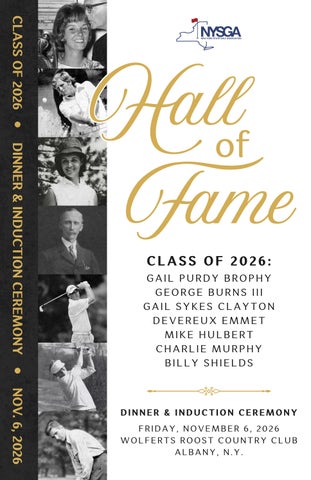
CLASS OF 2026 DINNER & INDUCTION CEREMONY
Hall H
of
Fame CLASS OF 2026:
GAIL PURDY BROPHY GEORGE BURNS III GAIL SYKES CLAYTON DEVEREUX EMMET MIKE HULBERT CHARLIE MURPHY BILLY SHIELDS
NOV. 6, 2026
DINNER & INDUCTION CEREMONY FRIDAY, NOVEMBER 6, 2026 WOLFERTS ROOST COUNTRY CLUB ALBANY, N.Y.
Hall of Fame Committee Mark Gaughan, Chairman John Blain, Central NY Pete Dougherty, Capital Region Dave Eaton, Rochester Doug Vergith, Western NY Gene Westmoreland, Metro NY Dottie Pepper, Hall of Fame Representative Andrew Hickey, Staff Liaison
About New York State Golf The New York State Golf Association is a non-profit organization whose membership consists of more than 260 clubs and 46,000 individual golfers throughout New York State. The NYSGA’s stated mission is to promote and conserve the best interests and true spirit of the game of golf as embodied in its ancient and honorable traditions. The NYSGA was slow - in fact the last - to form as a state golf association. The final push came from famed golf writer Grantland Rice who commented that New York still had yet to assemble an association to administer New York’s amateur golf championship. A group of individuals representing clubs throughout the state met at the Yahnundasis Golf Club in 1923 and unanimously approved the formation of the New York State Golf Association. The NYSGA’s purpose has shifted from simply conducting the state’s amateur championships to providing numerous services to the association’s member clubs and working closely with the USGA to conduct championship qualifiers.
Hall of Fame Members
Donald Allen Class of 2012
Ray Billows Class of 2012
Virginia Guilfoil Allen
Debbie Austin
Class of 2017
Class of 2025
Robert Biviano
Frederick Box
Class of 2022
Class of 2012
John Baldwin
Roslyn Swift Berger
Class of 2019
Class of 2022
Betty Deeley
Terry Diehl
Class of 2012
Class of 2022
Moira Dunn-Bohls
Alan Foster
Ed Furgol
Walter Hagen
Craig Harmon
Class of 2025
Class of 2017
Class of 2025
Class of 2018
Class of 2025
John Konsek
Wayne Levi
Mary Anne Levins
Dottie Pepper
Thomas Reidy
Class of 2015
Class of 2025
Class of 2019
Class of 2018
Class of 2015
Hall of Fame Members
Donald Ross
Gene Sarazen
Sherrill Sherman
Joey Sindelar
Class of 2012
Class of 2015
Class of 2018
Class of 2025
Class of 2019
Jeff Sluman
Lancy Smith
Jean Ramaker Trainor
Walter Travis
William Tryon
Class of 2022
Class of 2015
Class of 2022
Class of 2019
Class of 2012
Willie Turnesa
Sam Urzetta
George Zahringer 111
Class of 2018
Class of 2015
Class of 2025
Grantland Rice
Induction Ceremony Welcome........................................
Bill Moore Executive Director, NYSGA
Master of Ceremonies................
Mark Gaughan NYSGA Hall of Fame Committee Chairman
Class of 2026 Inductees..............
Presented by:
Devereux Emmet.........................
Mark Gaughan NYSGA Hall of Fame Committee Chairman
Billy Shields...................................
Brian McNamara Grandson of Billy Shields
Gail Sykes Clayton.......................
Elaine Sauers Sister of Gail Sykes Clayton
Gail Purdy Brophy.......................
Kristen Greczkowski & Mary Brophy Magnus Daughters of Gail Purdy Brophy
George Burns III...........................
Kelly Meerbott & Eileen Burns Daughters of George Burns III
Charlie Murphy............................
Mike Daniels Friend of Charlie Murphy
Mike Hulbert.................................
Joey Sindelar Friend of Mike Hulbert
Closing Remarks...........................
Bill Moore Executive Director, NYSGA
Devereux Emmet
Pelham, NY
D
evereux Emmet was one of the first American-born architects of golf's Golden Age — a gentleman sportsman who turned a privileged life of travel, hunting and competition into a body of work that shaped New York's golf landscape more than almost anyone of his era. Across a career spanning roughly 1897 to 1933, he laid out more than 150 courses worldwide, and nearly 50 in New York State. Born in Pelham in 1861 into a prominent family of Irish descent — his mother a painter, his great-grandfather the Irish patriot Thomas Addis Emmet — Emmet graduated from Columbia University and married into the family that founded Garden City. For two decades he lived the life of a sporting gentleman, buying hunting dogs in the American South each spring, training them on Long Island through the summer, selling them in Ireland in the autumn, and wintering in the British Isles, where he fell in love with golf. On one of those winters, he measured and sketched the great holes of Britain for his friend Charles Blair Macdonald — work that fed directly into the creation on Long Island of the National Golf Links of America, where Emmet served on the famed three-man design committee and was a founding member.
Emmet also was an accomplished player. He reached the quarterfinals of the 1904 British Amateur at Royal St. George's and, remarkably, won the Bahamas Amateur at the age of 66. His competitive career even left a permanent mark on the rules of the game: after he and his son Devereux Jr. won the 1916 father-son tournament at Sleepy Hollow, the USGA instituted its "architects rule," barring course designers from competing as amateurs. As an architect, Emmet was a naturalist. Working in the era of hickory shafts and horse-drawn scrapers, he fit his courses to the existing land rather than bending the land to his vision — wide fairways, bold and quirky mounding, deep grass-faced bunkers positioned to exact a penalty, blind shots played over robust natural landforms, and green sites that each carried their own personality. He admired and freely reproduced the game's great template holes; "You cannot go wrong with a Redan hole," he liked to say. Above all, his courses prized fun, strategy, choice and surprise.
Garden City GC, 1936 U.S. Amateur
His debut, the nine-hole Island Golf Links (1897), grew into the Garden City Golf Club (1899) — a layout Macdonald himself would soon rank among America's two greatest championship courses, and a cornerstone of the early American game. Garden City GC was ranked No. 52 in the world in a 2025 survey by Golf Magazine.
Devereux Emmet From there his work spread across the Empire State: Mohawk in Schenectady (1898), Leatherstocking in Cooperstown (1909), the Red Course at Eisenhower Park (1914), St. George's Golf & Country Club (1917), McGregor Links near Saratoga (1921), the Green Course at Bethpage (1923), Glen Head Country Club (1923), Schuyler Meadows near Loudonville (1927), the Seawane Club (1927), Bedford Golf & Tennis (1928), and Huntington Crescent (1931), among dozens of others. His reach extended well beyond New York — the original course at Congressional Country Club in Bethesda, Md., Wee Burn in Connecticut, and layouts in Bermuda. Congressional CC’s Blue Course has served as the host for seven men’s and women’s major championships. It underwent extensive renovations by numerous famous architects over the years. However, an overhaul by architect Andrew Green in 2019 to 2021 brought the course much closer to Emmet’s 1924 original design. In 1924, Emmet brought on Alfred H. Tull, making him a partner in 1929 in the firm of Emmet, Emmet & Tull.
Leatherstocking GC
St. George’s G&CC
As his best courses attest, Emmet believed in a good challenge. On difficult courses, he said: “Shall it be said of us American golfers that we cannot stomach the rigors of the ancient game and are so careful about losing a ball that we take all the sting out of our links? Let us be careful that in doing so we do not take all of the sting out of our game.” Devereux Emmet died on Dec. 30, 1934, in Garden City — within a mile of the course that launched his career nearly four decades earlier. Though suburban expansion and later renovations claimed some of his layouts, those that survive remain intelligent, characterful tests, and his standing among Golden Age architects has only grown with time. As the original designer of Garden City, a creative force behind the National Golf Links, and the most prolific golf course architect New York has ever produced, Devereux Emmet earns his place in the New York State Golf Association Hall of Fame.
McGregor Links
Schuyler Meadows
The Seawane Club
Devereux Emmet Architect Highlights Career spanning roughly 1897–1933; more than 150 courses designed worldwide, nearly 50 in New York State Original designer, Garden City Golf Club (1899) — grew from the nine-hole Island Golf Links (1897) Member of the three-man design committee and founding member, National Golf Links of America (with C.B. Macdonald and H.J. Whigham) Quarterfinalist, 1904 British Amateur (Royal St. George's) Winner, Bahamas Amateur (at age 66) Won the 1916 Sleepy Hollow father-son with Devereux Emmet Jr., prompting the USGA's "architects rule" Formed Emmet, Emmet & Tull with Alfred H. Tull (associate 1924, partner 1929) Selected New York courses: Garden City GC, Leatherstocking, Eisenhower Park (Red), St. George's G&CC, McGregor Links, Bethpage (Green), Schuyler Meadows, Seawane, Bedford G&T, Huntington Crescent, Engineers, Nassau, Pelham, Rye, Rockville Links, Powelton, Cherry Valley, and many more Beyond New York: National Golf Links committee; Congressional CC (Blue), Maryland; Wee Burn, Connecticut; courses in Bermuda Recognized as one of the first American-born pioneers of Golden Age golf course architecture
Billy Shields Shields qualified for the U.S. Amateur at age 21 in 1949. It would be the first of six times he played in the national amateur championship.
Albany, NY
B
illy Shields was the dominant force in New York amateur golf in the early 1950s - a three-time State Amateur champion from Albany whose game carried him to the U.S. Amateur quarterfinals, the Masters, and the match-play rounds of the British and French Amateurs. Few players have ever owned the NYSGA Men's Amateur the way Shields did during his five-year prime. Shields won the state title in 1951, 1952 and 1955. He lost in the final in 1953. He posted a 27-1 record in match play in the state tournament. Ray Kelly, a prominent area amateur who first met Shields as his caddie in the mid-1970s, told the Albany Times-Union in 2006: “I’ve played with just about everybody, and to this date he is the best amateur player I ever saw. Tee-to-green, far and away, he is the best." An Albany native and Christian Brothers Academy graduate, Shields transferred in 1947 from Notre Dame to Siena College, where he nearly matched the Notre Dame course record with a 64 and became a cornerstone of Leo Callahan's young program. A tireless practicer who honed his game at Wolferts Roost Country Club, he was the only Siena player to qualify for the 1948 Pinehurst tournament, and he would later become the first non-basketball athlete inducted into the Siena College Athletics Hall of Fame.
Shields broke through on the national stage at the U.S. Amateur in 1950 in Minneapolis. The tournament was entirely match play in that era, and Shields won his first five matches. In the round of 16, Shields scored a 2 and 1 victory over Dick Hackett of Rome, Ga. Shields hit all 17 greens in regulation and made 17 pars, vanquishing his opponent in a brilliant ball-striking exhibition. “That was the doggonest round I ever played,” Shields told the Minneapolis Star. Shields lost in the quarterfinals, 2 and 1, to John Ward of Clay, N.Y. But by reaching the final eight, he earned an invitation to the 1951 Masters Tournament in Augusta, Ga. Shields tied for ninth out of 16 amateurs and placed 50th out of 64 overall in the ’51 Masters, which was won by Ben Hogan, and Shields viewed the experience as the highlight of his career.
Billy Shields Spurred on by the major championship appearance, Shields captured the 1951 NYSGA Amateur in a field thick with former champions at Knollwood CC in Westchester County. In the quarterfinals, Shields upset Westchester CC’s Tommy Goodwin, 4 and 2. Goodwin was a three-time NYSGA champion at the time, and Shields played the final 16 holes in 2-under par to knock him off. In the final, Shields scored a 5-and-3 victory over Long Island’s Billy Edwards, a Colgate golfer.
The two were tied on the final hole, the 453yard 18th. Both players hit their second shots about 20 yards over the green. Goodwin hit his pitch to 10 feet and two-putted for bogey. Shields hit his to just 1 foot to save par. Shields played the last 18 in 1-under par, which included an eagle-2 on the 335-yard 13th, when his 110-yard shot hit the pin and dropped in the cup.
Later that summer, Shields reached the match play portion of the U.S. Amateur in Richmond, Va. He lost in the first round to Tom Strange, the father of future World Golf Hall of Famer Curtis Strange.
In 1952 on his home course at Wolferts Roost, Shields overwhelmed seven-time champion Ray Billows of Poughkeepsie, 6 and 5. It was a dominant showing. Shields won his semifinal over fellow Wolferts Roost member Lou Witt Jr., 10 and 9, in a match that was scheduled for 36 holes. Shields played the 27 holes in 5-under par. In all, played seven matches in 8 under par over six days. Shields’ bid for an unprecedented three-peat ended in the 1953 final at Yahnundasis CC, where Goodwin beat him 2 up over 36 holes. It was the 40-year-old Goodwin’s fourth state title. After missing 1954 for U.S. Navy service, Shields returned in 1955 at Jamestown’s Moon Brook CC and gained his revenge on Goodwin, grinding out a 36-hole final, 1 up.
Shields won the Eastern New York Golf Association championship four times, once carding a 65 at Van Schaick Island in Cohoes, and captured the first three Glens Falls Invitationals from 1951 to 1953. On the international stage he reached the quarterfinals of both the British and French Amateurs in 1952. His last U.S. Amateur was 1957. Shields competed in the U.S. Open at Rochester’s Oak Hill CC in 1956. Away from the course, Shields ran Ruch Distributors in Albany and remained a fixture of Capital Region golf until his death in 1983 at the age of 54. More than four decades later, no Capital Region player has matched his three State Amateur titles. A pioneer of New York amateur golf and the first golfer enshrined at Siena, Billy Shields takes his rightful place in the New York State Golf Association Hall of Fame.
Billy Shields Career Highlights 3x NYSGA Men's Amateur Champion (1951, 1952, 1955); runner-up 1953 1951 (Knollwood): def. Billy Edwards 5 & 3 1952 (Wolfert's Roost, home course): def. seven-time champion Ray Billows 6 & 5 1955 (Moon Brook): def. Tommy Goodwin, 1 up over 36 holes 27-1 career match-play record in the championship Quarterfinalist, 1950 U.S. Amateur (Minneapolis) — earned a 1951 Masters invitation Played in the 1951 Masters — finished 50th in a 64-man field 6-time U.S. Amateur participant (1949, 1950, 1951, 1952, 1955, 1957) Played in the 1956 U.S. Open at Oak Hill CC Quarterfinalist, 1952 British Amateur; quarterfinalist, 1952 French Amateur 4-time Eastern New York Golf Association champion (incl. a 65 at Van Schaick Island CC, Cohoes) Winner, first three Glens Falls Invitational Championships (1951, 1952, 1953) Transferred from Notre Dame to Siena (1947); only Siena player to qualify for the 1948 Pinehurst tournament First non-basketball inductee, Siena College Athletics Hall of Fame
Gail Sykes Clayton
Schenectady, NY
G
ail Sykes Clayton was one of the finest golfers Schenectady has ever produced, and one of the very few from the Capital Region to win on the national amateur stage, where she triumphed not once but twice. Sykes built an amateur résumé that few New York players, male or female, have ever matched. She announced herself as an elite golfer as a teenager. In 1964 she captured the NYS Girls' Junior 18U Championship, defeating Oneida's Debbie Austin (a future LPGA Tour winner) on the 19th hole. Sykes reached the quarterfinals of the prestigious North & South Amateur that same year.
The following summer, Sykes became the first New Yorker to win the U.S. Girls’ Junior Championship. She advanced through an 88player field stocked with future LPGA and USGA standouts at Hiwan Golf Club in Evergreen, Colo. In the championship match, the 17-year-old Sykes scored a 5 and 4 victory over Mary Louise Pritchett, a 16-yearold from Raleigh, N.C. Sykes sank a 4-foot putt for birdie on the 14th hole to close out the match. She needed only 25 putts for 14 holes, vs. 30 for Pritchett. Sykes still is one of only two players born and raised in New York to win the U.S. Girls title. The other was Elizabeth “Doll” Story of Clayville in 1967. Sykes is one of only five women to win three straight Northeastern Women’s Golf Association titles (in 1964-6566). Sykes’ game grew in college. Playing for Odessa College in Texas, she won the 1968 National Intercollegiate Women's Individual Championship. She then transferred to East Carolina University in Greenville, N.C. There she competed as an individual alongside the men's team from 1968 to 1971. In 1969, she became one of only six golfers named to the first Women's Intercollegiate All-America team, all while earning bachelor's and master's degrees in education.
Gail Sykes Clayton Sykes continued to compete at a high level well into adulthood. She came close numerous times in the NYSGA Women’s Amateur championship, reaching the semifinals in 1966 and 1968, the quarterfinals in 1967 and the finals in 1970, where she lost to NYSGA Hall of Famer Lancy Smith. But Sykes Clayton broke through as a state champion after moving to Ohio. She won the Ohio Women’s Amateur championship in her first try, in 1975. Sykes Clayton defeated twotime Ohio champion Sharon Keil of Toledo in the quarterfinals, then won the title match over Sheila Scott of Ashtabula, 6 and 5. “I think I’m playing about as well as I have at any time,” Sykes Clayton told the Toledo Blade. Asked if she ever gave a thought to turning pro, she said: “Never. I’m having too much fun playing amateur golf, and that’s the way it will be.” Sykes Clayton repeated as Ohio state champion again in 1976, playing while 6 1-2months pregnant. She scored a big win in the semifinals over Keil, making a 9-foot birdie putt on the 18th hole. Then, carrying a portable chair in one hand and a golf club in the other during the 36-hole final, she defeated 22-year-old Kay Kennedy of Dayton, 2 and 1, in the championship match. “It’s unbelievable,” Sykes Clayton told the Dayton Journal-Herald. “I had all these people telling me that I was pregnant and I wouldn’t be able to play golf this summer. I guess this’ll shut their mouths. I thank God that I was able to keep it together. I feel really good. I don’t feel any worse than anyone else. My doctor told me I could play golf up until the day I have the baby.” Off the course, Sykes Clayton devoted her life to young people as a longtime educator and golf and track coach at East Forsyth High
School in Kernersville, N.C. Her standing in New York golf endured: the Northeastern Women's Golf Association named one of its major better-ball events in her honor, and East Carolina inducted her into its Athletics Hall of Fame. Gail Sykes Clayton passed away on Jan. 20, 2017, in Kernersville at the age of 68. As one of only a handful of Schenectady players ever to win a national amateur title, and the only one to win two, she stands among the greatest competitors the Capital District has produced, and earns her place in the New York State Golf Association Hall of Fame.
Gail Sykes Clayton Career Highlights Winner, NYSGA Girls' Junior Amateur Championship (1964) — defeated Debbie Austin on the 19th hole Quarterfinalist, North & South Amateur (1964) Winner, U.S. Girls' Junior Amateur Championship (1965) — def. Mary Louise Pritchett 5 & 4 at Hiwan GC, Colo. Winner, National Intercollegiate Women's Individual Championship (1968), playing for Odessa College Named to the first Women's Intercollegiate All-America team (1969); one of only six selected Played alongside the East Carolina men's team (1968–71); earned bachelor's and master's degrees in education Runner-up, NYSGA Women's Amateur Championship (1970) Winner, Ohio Women's State Amateur Championship (1975, 1976) — defended in 1976 while pregnant Longtime educator and golf/track coach, East Forsyth High School (Kernersville, N.C.) NEWGA named a major better-ball championship in her honor (the Gail Sykes) East Carolina University Athletics Hall of Fame inductee (2005)
Gail Purdy Brophy Purdy made headlines in golf as a young teenager as well. She qualified for the U.S. Junior Girls Championship at age 14 in 1956. At age 16 in 1958, she shot 3-over 77 to win the Northeastern Women’s Golf Association championship. She reached the semifinals of the NYSGA Women’s Amateur in 1959.
Glens Falls, NY
G
ail Purdy Brophy was one of the most accomplished all-around athletes the Capital Region ever has produced — a twotime New York State Women's Amateur champion, a U.S. Women's Open competitor, a national-caliber speed skater, and, decades later, the author of one of the great comeback stories in New York golf. Purdy won the 32nd NYSGA Women’s Amateur as an 18-year-old in 1961, becoming the youngest woman ever to win the crown to that point. Purdy won the state title again as a 20-year-old in 1963. Such success was no surprise to anyone in the Capital Region paying attention to women’s sports of that era. Purdy was a child phenom in athletics who started garnering headlines in the Glens Falls Post-Star as a 9-year-old speed skater in 1951. As an 11-year-old in the winter of 1954, Purdy placed second in the juvenile division of the National Indoor Speed Skating Championships, and she won the Northeastern New York speed skating title that year. In 1957 at age 14, she won the Junior Girls National Speed Skating Championships for 440 yards and was second at 880 yards. Purdy almost made the first-ever U.S. women’s speed skating team for the 1960 Winter Olympic Games. Competing as a 16-year-old at the national trials in Minnesota in February 1959, Purdy placed fourth in the 1,500-meter event and fifth in the 3,000-meters. Only six women were picked to compete in four events (including the 500 and 1,000 meters) at the 1960 Games.
Her NYSGA breakthrough came in July 1960, even though she had spent most of that June in Norway training with some of that country’s best speed skaters. By this time, Purdy was an 18-year-old getting ready to enter her sophomore year at Paul Smith’s College. Purdy made a hole in one early in match play on the 150-yard seventh hole at Niagara Falls Country Club. “I’ve been playing since my dad got me started when I was 12 and have been in tournaments five years, but this was my first hole in one,” she said. In the 36-hole final, she faced Syracuse’s Virginia Guilfoil Allen, who had beaten her the year before and who won the title in 1941. Allen (an NYSGA Hall of Famer) had been runner-up in 1945, 1952 and 1959. In the final, Purdy chipped in for birdie from 45 and 38-feet, respectively, on the par-3 fourth hole and the par-3 30th hole (No. 12 at Niagara Falls CC). Purdy won the match, 3 and 2, with no bogeys over the last 10 holes.
Purdy qualified for the U.S. Women’s Open at Massachusetts’ Worcester CC in 1960 and at New Jersey’s Baltusrol CC in 1961. Competing as an amateur, she made the cut of the top 40 and ties after 36 holes both years.
Gail Purdy Brophy She won the NYSGA Women’s Amateur a second time in 1963, at the Whiteface Inn course in Lake Placid. Purdy defeated 15year-old Debbie Austin of Oneida in the final, 8 and 6. Austin was the youngest player ever to reach the finals and would go onto LPGA stardom. Purdy played in the U.S. Women’s Amateur in both 1962 and 1963.
She continued to rack up speed skating medals, including a second place finish at 200 meters at the North American Speed Skating Championships in Wisconsin in 1963. At the trials for the 1964 Winter Olympic Games, held in Minnesota in February 1963, she again almost made the team. She was sixth in the 3,000-meter race. The top four finishers in that event wound up being picked for the sixwoman team that would compete across four events at the Games. Overall, she won 7 North American, National and U.S. Open Short Track Championships. She also won over 100 skating titles in the northeast. At her home club, she was a ten-time Glens Falls Country Club champion. In 1967, she teamed with PGA star Gene Littler in an 18hole exhibition match against PGA star Billy Casper and Schenectady’s Gail Sykes. Then her competitive golf career went quiet for more than four decades — not for any lack of ability, but out of devotion to family and business. When her father fell ill in 1963,
Brophy left college and took the reins of the family enterprise, Purdy's Discount Wine & Liquor, running it for the rest of her life while raising two daughters. In 2006, after a 42-year hiatus, Brophy roared back to competitive golf and picked up right where she had left off. She won the inaugural NYS Women's Super Senior Amateur Championship in 2007, successfully defended the title in 2008, and added runner-up finishes in 2009, 2012 and 2013. Closer to home, she swept the 2012 Northeastern Women's Golf Association Senior and Super Senior championships and defended the Super Senior crown in 2013.
Brophy's standing in New York athletics was recognized well beyond the scorecard. In 1991 she became the first woman inducted into the Glens Falls Hall of Fame, and she remains one of only two women in the Saratoga Springs Hall of Fame, alongside LPGA star, broadcaster and NYSGA Hall of Famer Dottie Pepper. The NEWGA honored her with its Golf Achievement Award and, in 2017, named a tournament in her honor — a fitting tribute to a lifelong champion and a generous supporter of junior and women's golf. Gail Purdy Brophy passed away on Feb. 23, 2020, at age 77. Across two eras of competition separated by more than forty years, she embodied resilience, versatility and quiet excellence — the rare champion who won at the highest levels of two different sports. Her remarkable career earns her a lasting place in the New York State Golf Association Hall of Fame.
Gail Purdy Brophy Career Highlights 2x NYSGA Women's Amateur Champion (1961, 1963) 1961: defeated Ginny Allen 3 & 2 at Niagara Falls CC; youngest champion at the time 2x NYSGA Women's Super Senior Amateur Champion (2007, 2008); runner-up 2009, 2012, 2013 First champion of the inaugural NYS Women's Super Senior Amateur (2007), after a 42year competitive hiatus NEWGA Senior and Super Senior Champion (2012); Super Senior champion again (2013) Participant, U.S. Girls' Junior Amateur Championship (1956) Participant, U.S. Women's Amateur (1962, 1963) U.S. Women's Open: made the cut in both 1960 and 1961 1960: finished 39th (84-81-81-85—331) 10x Glens Falls Country Club champion First woman inducted into the Glens Falls Hall of Fame (1991) One of only two women in the Saratoga Springs Hall of Fame (with Dottie Pepper) NEWGA Golf Achievement Award The Gail Purdy Brophy Tournament named in her honor (2017) Champion short-track speed skater — 100+ Northeast titles, including seven North American, National and U.S. Open Short Track championships
George Burns 111 Fast forward just two years, to the summer of 1974. Burns won three major national amateur tournaments, the Porter Cup, the North-South Amateur and the Canadian Amateur. And he was on the 10-man team that helped the United States defeat Great Britain and Ireland in the Walker Cup.
Brooklyn, NY
G
eorge Burns III is the greatest touring professional golfer ever to come out of Long Island. He won four PGA Tour events and two European Tour events over an 18-year career. He had 66 top-10 finishes and 155 top-25 finishes on the PGA Tour. Few could have seen it coming when Burns was a collegian at the University of Maryland. In Burns’ sophomore year on the Maryland golf team, he was the No. 7 Terrapins’ finisher at the Atlantic Coast Conference championship. His junior year he was the fifth man on the team. His senior year, 1972, he placed 30th overall at the ACCs and again was the fifth Maryland finisher.
In 1975, Burns was the low amateur at the Masters with a 30th-place finish, turned pro, then tied for 10th at the British Open. He was off and running on an outstanding pro career. How Burns got so good so fast is an amazing story and a testament to his massive athletic ability, hard work and intense competitiveness. “I can’t tell you why that happened,” Burns says of his emergence to the PGA Tour. “I’m not that much of a religious guy, but this is obviously a gift from God. My exposure to great pros and great golf courses in New York, that helped me so much.” Burns will be honored on Nov. 6 as part of the 2026 Class in the New York State Golf Association Hall of Fame in a ceremony at Albany’s Wolferts Roost Country Club.
1974 Walker Cup Team
George Burns 111 Golf was Burns’ third sport, behind football and basketball, at Long Island’s Manhasset High School. A 6-foot-2 1-2, 220-pound defensive end, he enrolled at the University of Tennessee. After a shaky academic start, he transferred to Maryland. But in his first summer football camp, he suffered a knee injury and he realized he was not going to last on the Terrapins’ football squad. “My father told me you better find something to do or you’re going to wind up going to Vietnam,” Burns said, “so I went to the golf coach.” Maryland golf coach Frank Cronin saw something in Burns’ big, raw athleticism. He gave Burns a shot. “He gave me a start, and he stood by me through thick and thin as a college student,” Burns said. “My first year, I was like the 15th man – maybe – on the team.” Burns improved over the next three years, but his game was a long way from Tour caliber. Still, former Maryland teammate Rick Bendell says Burns’ talent was undeniable, and he wasn’t shocked by Burns’ Tour success. “I felt his potential was really good,” Bendell said from his home in Lynchburg, Va. “I thought he definitely had the ability to get
much, much better. I didn’t know how much better. He was a long hitter. And what really amazed me about George even then was he had a wonderful short game. He was beautiful to watch.” Burns says a lot of help from New York City area and Long Island golf professionals over those years, and then the two years he spent as an amateur after college, was the critical factor in taking a giant leap to tour stardom. “All these guys who were grass roots pros in the Met Section gave me time, pro bono,” Burns says. He rattles off a string of names of club and teaching pros who helped him: legendary Winged Foot Golf Club pro Claude Harmon (a PGA of America Hall of Famer), Deepdale and Garden City Golf Club pro Gil McNally, Westchester Country Club’s Lighthorse Harry Cooper (a World Golf Hall of Famer), and North Shore CC pro Carl Lohren. “I’m cutting the list off of guys who worked with me,” Burns said. “They’d fit me into their schedules, and I’d have time to practice. I went to all these teachers, and I got a tip of the week, and that’s what I worked on. I worked with guys like Bob Toski. I spent some time with Jack Nicklaus’ guy, Jim Flick. These guys would be there, and I became friends with them.”
George Burns 111 “I got exposed to great golf courses,” Burns said. “I was more not verbal but a visual learner, and I had the opportunity to play all those golf courses out east, like Shinnecock and the National in Southampton, which I’m still a member of. But my exposure to these great courses it gave me an idea how I could play.” His first season as a pro, after the low amateur Masters finish, was fantastic, starting with the top-10 finish at the Open Championship. It was played at Carnoustie and won by Tom Watson. Burns shot 71-7369-71, and his 1-under score on a windy Sunday tied for the second lowest in the final round. “There must have been some magic in the air,” Burns said. “I liked the salt water, being from Long Island. Visually, I played different there, landing the ball short of the green.“ In the ensuing weeks, Burns won European Tour events in Sweden and Ireland. Burns tied for 10th again at the 1976 British Open, then he tied for fifth in 1977. Those finishes spoke to his splendid short game. “There was a place on Long Island, Plandome CC, where I hung around, where my dad played,” Burns said. “And none of these places around there had ranges. So I ended up becoming an expert around the greens. I had to be. I was a little bit wild because these places didn’t have ranges. So I found myself there at night working on the short game.” Burns finished second to Jerry Pate at the grueling PGA Tour Q-School in late ’75 to earn his full-time tour card. He was a top-40 player on tour the next four seasons. He scored a breakthrough in October 1979 by pairing with Ben Crenshaw to get his first official Tour win, at the Walt Disney World Team Championship in Orlando.
“At the time, I had had five opportunities to win and I couldn’t get to the clubhouse,” Burns said. “I was sort of an emotional player in that I fed off things, and those kind of things weighed on me competitively. Let me tell you, being Scotch-Irish, I beat myself up inside. I was harder on myself than anyone else because I expected more of myself. So Ben knew this, and he tried to quiet me down. I looked at his easy mannerisms out there . . . and it helped me get on to my first win.” Just four months later, Burns got his first solo win, shooting a final-round 3-under 69 to capture the Bing Crosby National Pro-Am at Pebble Beach. Burns entered the final round three shots behind but blew past Nicklaus and Dan Pohl, who finished second by a shot.
George Burns 111 “Nicklaus had a three- or four-shot lead on the back nine, and I ended up making a 50-footer for birdie on the 16th hole,” Burns said. “Jack ended up shooting a high round (73), and it was sort of given to me. I never expected Jack to mess up, especially at Pebble where he was so good. That long putt got me the win by one shot.” Burns finished No. 7 on the money list in 1980. He ranked third on tour in birdies made and tied for second in putting, at 28.9 putts per round. “Any kind of success I had, in my own mind, I was sort of a master around the greens,” he said. The 1981 season featured a painful runner-up finish by Burns at the U.S. Open at Merion. He held a three-shot lead after 54 holes but shot 73 on Sunday. Burns’ competitiveness, which drove him to success, was a doubleedged sword. He was hard on himself after that close call. But the consistent top-10 and top-25 finishes kept coming.
Due to his good size and athleticism, Burns could hang with Norman off the tee in driving distance. “He was a big burly guy with what some people feel was an unorthodox swing, very upright,” Crenshaw said of Burns to the New York Daily News in 2013. “But boy, he had beautiful hand-eye coordination and tremendous touch. He could play some exquisite short shots and he was a very effective putter, a wonderful player, absolutely.” Burns’ last Tour win came at the Shearson Lehman Andy Williams Open in San Diego in 1987. He shot 22 under and made two eagles on the inward nine to fire a final-round 65. “I got to the 13th hole and knocked it on in two with a 2-iron and made about a 50-footer for an eagle,” Burns said. “I parred the next hole, then I holed a 9-iron from the fairway from about 130 yards. So that gave me some breathing room.” Burns also won the 1988 Chrysler Team Championship, a two-man better-ball tourney, with good friend Wayne Levi (a 2025 NYSGA Hall of Famer). A string of injuries to his knee, shoulder and finger cut short Burns’ career in his 40s and kept him from a substantive Champions Tour career.
In 1985, Burns broke through for his third Tour win at the Bank of Boston Classic. He finished 17-under, tying a tournament record with a six-shot win. Over the last two rounds, Burns outdueled Greg Norman, who finished second.
“Everybody gets these injuries,” Burns said. “I got them at the wrong time. I was basically retired in 1992. But golf was good to me. I was very lucky. Any success I might have had was from the free time the grass-roots guys gave me. I would have liked to be a little more composed and easier on myself. I was exposed to a lot of great people, so I can’t complain.” Burns lives in Delray Beach, Fla. He has two daughters, Eileen and Kelly.
George Burns III Career Highlights Winner, Monroe Invitational (1972) Winner, Long Island Amateur (1972) Winner, MGA Amateur (1972) Winner, Canadian Amateur (1973) Winner, NYSGA Men's Amateur (1974) Winner, Porter Cup (1974) Winner, The Ike Stroke Play Championship (1974) Winner, North & South Amateur (1974) Winner, Azalea Invitational (1974) Member, United States Walker Cup Team (1975) College golf: University of Tennessee (freshman), University of Maryland (sophomore–senior); also a one-year member of the Maryland football team Turned professional in 1975 2x winner, European Tour — Scandinavian Enterprise Open (1975) and Kerrygold International Classic (1975) 4x winner, PGA Tour: Walt Disney World National Team Championship, with Ben Crenshaw (1979) Bing Crosby National Pro-Am (1980) Bank of Boston Classic (1985) Andy Williams Open (1987) Winner, New York State Open (1982) Winner, Chrysler Team Championship, with Wayne Levi 571 PGA Tour events played; 70 top-10 finishes; 8 runner-up finishes U.S. Open: T2 (1981), held a three-shot lead entering the final round British Open: T5 (1977) PGA Championship: T19 (1977, 1978) Masters: T30 (1975), Low Amateur Senior PGA Tour member (1999); best finish T9 at the 2000 Brickyard Classic
Charlie Murphy
ALBANY, NY
C
harlie Murphy had just one golf lesson in his life.
It was 1968, he was 21 years old, and he had just finished an outstanding career at Siena College. He already was among the top amateur golfers in New York State.
and finished in the top 10 15 times. He was second twice, third four times and in the top five nine times. He won the inaugural NYSGA Mid-Amateur championship in 1984. He won six Eastern New York Golf Association titles when it was the Albany area’s premier amateur event. He won 10 Tri-County titles (six stroke play, four match play) and three Troy Invitationals. He played in the U.S. Junior Amateur, the U.S. Amateur, the U.S. MidAmateur and the British Amateur. He also was an NYSGA committee man for about 15 years and served on the USGA Green Section Committee for 10 years.
“I had won the district championship . . . and my father sprung for a lesson,” Murphy recalls. They went up to the Saratoga State Park course and saw a pro named Tom Creavy, who had won the 1931 PGA Championship and played in the first Masters in 1934. “At this time, he was probably 60 years old, and he’s sitting at a picnic table with a Panama straw hat on and an umbrella over his head,” Murphy said. “He says, ‘Hit a few balls.’ “I hit five 7-irons,” Murphy said, “and Tom Creavy went to my father and said, ‘There’s nothing I can do for that swing, it’s perfect.’ And that was the only lesson I ever had in my life.” Creavy knew what he was talking about. Murphy spent the next 30 years compiling one of the most consistent records of excellence at the amateur level New York State has seen. He’s the top amateur the Capital Region has produced since 1960. Murphy played in the New York State Amateur championship 30 consecutive years
The 79-year-old Murphy will be inducted into the 2026 Class of the New York State Golf Association Hall of Fame at a ceremony on Nov. 6 at Albany’s Wolferts Roost Country Club. Asked the key to his consistency, Murphy said: “I was an OK putter, but I always thought I prepared better than anybody. Course management and preparation. Remember back then, there were no range finders. Maybe you had a 150-yard bush on each side of the fairway. I had about 200 yardage books that I had prepared myself, by pacing. And I had the greens charted.” Murphy took advantage of that research with superb ball-striking. He had tremendous distance control with his irons and was a greens-in-regulation machine. “He was a very good ball striker,” said Murphy’s life-long friend Mike Daniels, who also had an excellent amateur career. “You know, he had this natural little draw, and he knew how to work the ball both ways. A very consistent player.
Charlie Murphy “But probably the best part of his game is his mental aspect of the game,” Daniels said. “He's a true student of the game in all aspects. . . . A lot of the courses used to have 150-yard bushes. But one would be 145, one would be 150, one would be 155. If you weren’t prepared you could be off by 10 yards. He had them all down, and he could hit the number he wanted.” Murphy got into golf as a little boy through his father, Charles Murphy Sr. “My father was a World War II veteran, a greatest generation guy who got married late, got back from the war and took up golf,” Murphy said. “My introduction to golf was, he would go out after work, and you had shag bags, and you had your own balls,” Murphy said. “I was there to pick up the balls. He had an olive drab canvas bag, which was Army issued. My father would give me his club and let me hit the last two balls in the bag.” Starting when Murphy was about 11, his mom would drop him off every day of the summer at the former Albany Municipal Golf Course, on a site where now sits a completely renovated course called Capital Hills at Albany. A youth season pass was $10. “Initially, my mother would drive us out, drop us off, morning to dark,” Murphy said. “Later we took our bikes out, and we played 36 holes a day, every day.” Murphy calls the Albany Muni “probably the worst golf course in the history the world.” “The fairways weren’t aerified from 1932 through the ‘60s, which is probably one of the reasons I’m a digger,” he said. “I dig down. You had to go down to get the ball. It wasn’t sitting up in the fairway. They never cut the rough. The rough was just weeds about a foot high.”
Murphy’s home-grown swing was good enough for him to qualify for the U.S. Junior Amateur in 1964, where he made match play and reached the Round of 32. “During the practice round, a kid came up to me on the range and said, ‘I don’t know why we’re here. See that kid over there? He’s from San Francisco. His name is Johnny Miller. He’s going to win.’” Miller, the future World Golf Hall of Famer, did win. Murphy, who had graduated high school a year early, thinks he might have drawn interest from a major college golf program if he was entering his senior year that summer. But he already had committed to Siena. After an outstanding college career, Murphy never considered trying to turn pro. There wasn’t much money in the pro game, and he hadn’t played at a big-time golf power. Thus began a stretch of domination in the Capital Region.
Charlie Murphy Murphy’s best chance to win the NYSGA Amateur came in 1977. He had a three-shot lead on the back nine in the final round but missed a short put on the 72nd hole and lost to Troy’s Rich Serian by a shot. Almost every year the next decade, Murphy was near the top of the leaderboard. But it arguably was tougher to win the State Am in the late ‘70s and early ‘80s than many other stretches of the tournament’s history. Finishing third in ’77 was Jeff Sluman, followed by Joey Sindelar (who would win in '80), George Zahringer and Dr. Alan Foster, all of them NYSGA Hall of Famers. In fact, there were eight future NYSGA Hall of Famers in the field in ’77. Sluman, the six-time PGA Tour winner, won the State Am in 1978. Mark Balen, a Big Ten champion and second-team All-America at Ohio State, won in ‘79. Syracuse’s Jim Roy, who subsequently qualified for the PGA Tour, won in 1981. Zahringer won in ’84. Murphy was a distant second to Christopher Lane in the 1985 State Am.
“Don was heartbroken that I lost, he really thought I was going to win,” Murphy said of ’77. “That loss was kind of hard. And that winter, Don called and said, ‘I want you to come out and play in the Country Club of Rochester Invitational.’ Now whether it was to soothe the State Am loss or not, I don't know. And I stayed at his house.” The prestigious CCR Invite attracts a great field, and it was played on Allen’s home course. That summer, Murphy defeated future PGA Tour standout Mike Hulbert (a fellow 2026 NYSGA Hall of Fame inductee) in the semifinals, 2 and 1. Then Murphy walloped Allen in the match-play final, 7 and 6. Murphy went back to the CCR Invite in 1979 and beat Allen again in the final, this time, 3 and 2. A 6iron from 170 yards to 1 foot on the par-5 10th hole put Murphy in command of that match. Murphy also teamed with Allen to win the prestigious Williams Invitational at Rochester’s Oak Hill Country Club in 1979 and ’81.
“The ‘77 tournament was probably the strongest field ever assembled for a state amateur,” Murphy said. All this time, Murphy had a full-time job with the New York State Department of Health. History shows collegiate stars have the obvious advantage over mid-amateurs in state championships. “The problem is I put so much pressure on myself for that one week, and other guys, you know, they were playing all the time,” Murphy said. “So all I had was four days, I didn't have four majors a year like Rory has now to try to win. I had one, but I kind of tried to peak for it, and you know, it kind of worked out, I played really well.” The loss in 1977 stung. By that stage of his career, he was long-time good friends with Rochester’s Don Allen, a six-time winner of the NYSGA Amateur (and a member of the inaugural NYSGA Hall of Fame).
“The proudest thing that ever occurred in my career is I lost that thing (the ’77 NYSGA Am) in kind of a heartbreaking fashion, and then went on from there, with Don Allen's help, to those CCRs, to the Oak Hills,” Murphy said. “And then what that really kicked off was the regional stuff, and I won all those regional tournaments, the six Tri-County championships. So it was really a pretty good bounce back.“
Charlie Murphy Murphy’s NYSGA Mid-Amateur title was free of drama. He shot 72-72-72 at Glens Falls Country Club and won by five shots. The final leaderboard included four NYSGA former or future NYSGA Am champions. “This was the first Mid-Am, it was in September, and we got there for a practice round and the greens had recently been aerified and they weren’t completely healed,” Murphy said. “I’m not criticizing Glens Falls in the least. You have to aerify your greens. Glens Falls is a top 100 club. But that wouldn’t happen today. I got there and said to myself, ‘This is great, because I’m not the best putter in this field, but now the best putters are going to be complaining. I’m a better ball-striker than I am a putter, so this could actually help me.’” “The other nice thing about it was the trophy was named for a guy named Bob Hogan, a local official, an educator, a principal,” Murphy said. “Winning it with his name on it and then coming home on Sunday and giving my trophy to my father – that was a big thing.” Later in his career, Murphy teamed with Daniels to win the prestigious Eastern Four Ball Championship at Congressional CC, the major championship course in Maryland. In five appearances, the duo posted first, second, third and fourth-place finishes. The year we won, we finished on the ninth hole at Congressional, which was a par-5 over a valley that neither of us could reach in two,” Daniels said. “We’re up by two shots. I hit first to the right side of a tiered green, a difficult two-putt to make par. Charlie hits his wedge from 110 yards, pull hooks it left of the green, hits an oak tree, bounces onto the green and rolls into the hole for an eagle. We won by four.” Murphy had a distinguished career at the NYS Department of Health, from 1974 to 2002. He was Director of the Bureau of Financial Analysis. Then he was Director of the Division of Health Facility Planning. In the latter role he headed a group of 60 professional and
support staff in the review, approval and monitoring of roughly 500 health facility construction projects. He developed a financial process program that saved member facilities and taxpayers millions of dollars annually. Murphy then moved to a management position with White Plains-based Cicero Consulting Associates, for whom he still works full time. Murphy and his wife Rose live in Naples, Fla. They have two sons, Keith and David. It would be hard to write the history of the New York State Golf Association without including Murphy. “From 11 years old when I started until today, amateur golf has been a big part of my life,” Murphy said. “Of the 40 people in the Hall of Fame, I’ve had contact with or played golf with half of them. The arc of me and the New York State Golf Association is beyond a casual thing.”
Charlie Murphy Career Highlights Winner, Northeastern Collegiate Conference Championship (freshman, Siena College) Winner, Capital City Tournament (sophomore) 3x MECAA individual medalist ECAC Championship qualifier (1966) Helped Siena win the MECAA team title (1967) Winner, MECAA Individual Championship (junior and senior seasons) Captain of Siena teams winning 14 and 15 matches (junior and senior seasons) Individual qualifier, NCAA Regional Tournament Inducted into the Siena College Athletics Hall of Fame (1980) Winner, NYS Men's Mid-Amateur Championship (1984) Runner-up, NYS Men's Amateur (1977, 1985) 14 top-10 finishes in the NYS Men's Amateur (1967–1994) Played in 30 consecutive NYS Men's Amateur Championships 6x winner, Eastern New York Golf Association Championship 6x winner, Tri-County Stroke Play Championship 3x winner, Tri-County Match Play Championship 3x winner, CC of Troy Invitational 2x winner, CC of Rochester Invitational Qualified: U.S. Junior Amateur (1964, advanced to 2nd round), U.S. Mid-Amateur (1983), U.S. Amateur (1984, 1986), British Amateur (1984) Qualified: U.S. Open Sectionals 6x
Mike Hulbert cruised to a 13th-place finish at Q-School and earned his spot on tour for 1986. Hulbert, in fact, thrived on tour for the next 15 years precisely because he could get it in the hole; he could score.
Elmira, NY
M
ike Hulbert was at the grueling, sixround PGA Tour Qualifying School Tournament in December of 1985. The final stage pitted 161 players fighting for 50 spots, although finishing in the top 20 was critical to have a good chance to get into early-season tournaments. Miss the top 50, and you were sentenced to another year struggling in golf’s minor leagues.
Hulbert won three official events in his PGA Tour career and three other unofficial PGA events. He placed second six times, had 21 top-five finishes, 43 top-10s and 118 top-25s. He made more than $4 million in official prize money.
Stuck in the middle of the pack after two rounds, Hulbert went to the driving range after 36 holes to tune up. He put an alignment stick on the ground and was about to hit. “The first two rounds I played with a kid from the Bahamas or Puerto Rico who I had played with a lot on the minitours,” Hulbert recalls. “And he wasn't any good, but his grandpa was loaded. . . . I mean, this guy couldn’t play dead in a cowboy movie. “All of a sudden, he comes running over to me,” Hulbert said. “He goes, ‘What are you doing?’ And I said, ‘Well, I'm seeing if I'm lined up.’ He says, ‘There's nothing wrong with your game.’ He kind of yelled it, and he's getting into my kitchen. He goes, ‘You know what your problem is? You're acting like a baby. You don't want to come back and play the minitours with me. Got it? So I'd advise you just to go hit it, find it, and get it in the hole.’ “So I packed up the stuff and went to my hotel room,” Hulbert said. Hulbert shot under par the next two days,
The 68-year-old native of Horseheads will be honored for his brilliant career on Nov. 6 when he is inducted into the New York State Golf Association Hall of Fame in a ceremony at Albany’s Wolferts Roost Country Club. A bottom-line difference between golfers who make the PGA Tour and elite amateurs who turn pro and never break through is the ability to go low. Shooting 66s, 67s and 68s is essential to surviving as a pro. Hulbert could score.
Mike Hulbert In 1986, Hulbert ranked sixth on the PGA Tour in birdies and tied for second in eagles. In 1989 he was second in birdies with 402, or 3.4 a round, and third in eagles. In 1991 he was 13th in birdies. He regularly ranked among the top 50 on tour in Greens in Regulation. “I had a very good short game and a very good iron game,” Hulbert said. “In order to be up there, you had to make birdies. I wasn’t one of these guys that made three birdies and all pars. Did I have some clean cards, yeah? But did I hit every fairway? No. I think my highest percentage of fairways hit back in ‘89-90 was about 65 percent. “I always thought back then one of the most important stats was Greens in Regulation, especially when we went to harder venues,” he says. “Come to think of it, if you’re one of the highest birdie guys per day per round, that’s a nice stat to have.” “He didn’t have holes in his game,” said former PGA Tour star Joey Sindelar, Hulbert’s lifelong friend and a NYSGA Hall of Famer. “He was a good putter. He became a really good short gamer. From 30 yards in, bunker shots. When he went in the bunker, he was trying to make it. He was a gifted short gamer, pitcher, chipper, sand game.” Sindelar was a long hitter on tour in the 1980s. Hulbert calls himself “sneaky long.” “I would say he was in the 80th to 90th percentile power level,” Sindelar said. “And back then the difference in distance was only like 15 yards. . . . No. 1, he had power. No. 2, for his whole career he was one of the best 3-wood players I’ve ever seen in my life. If it was a par-5 and he had a shot with his 3-wood, he’d make an eagle or a birdie. You couple that with his
Hulbert (left) Sindelar (right)
short game, he could be aggressive with his power component.” One of the most amazing facts in New York State golf history is that two men, born just 15 days apart and from a town with a population of only 19,000 – Horseheads -both became PGA Tour standouts. Sindelar was born March 30, 1958. Hulbert was born April 14, 1958. Sindelar lived by the No. 2 tee of what then was Francourt Farms Golf Club, now Soaring Eagles Golf Club, in Horseheads. Hulbert’s house was about 2 miles away. Hulbert’s father, William, was a single-digit handicap golfer who loved the game. Mike started swinging a club about age 8 or 9. “We had a very big backyard,” Hulbert recalls. “So I used to just grab a club. I remember the 4-iron with a leather grip. I used to just go out back and just hit it, and I could hit forever. . . . And eventually I went to the golf course with my dad.”
Mike Hulbert Hulbert met Sindelar when the two were at a state boys tournament at age 12 or 13. They became instant best friends.
“Guess where I was?” Hulbert asks. “I was down the fairway with my baseball glove catching the balls. I was good at baseball, but I got really good at it. I used to dive. I used to slide. I never got hit, which was good. I mean, did I miss some? Yeah, but it was so much fun.” “Mike is a really fantastic athlete and was a pitcher in high school,” Sindelar said. “As the dew formed at dusk, I’d be hitting 3woods with my dad going, ‘Too far inside, too far outside.’ And Michael is out there with a shag bag and a first baseman’s glove. Back in those days I’d be hitting it 240. I’d hit a few off line, and he’d go like a bird dog fielding these things. I’d hear him yelp when he got one in the palm of his hand.”
“In the summertime, I spent more time at his house than I did at mine,” Hulbert said. “A daily Monday through Friday during the summer, I would stay in his house. We would get up in the morning and we'd hit a few putts and his dad would go to work delivering the mail. And we'd go out and play as many holes as we could over at Soaring Eagles. And we had to be back by 3:30 because that's when Joey’s dad got home. And we had better be down at the bottom of his hill hitting 7-irons back in his yard when he got home.” Sindelar’s dad, Joe, was a self-taught scratch golfer and a first-rate instructor. After dinner, before dark, he would take his son out to the No. 2 tee for lessons.
Sindelar was the area phenom, the top recruit in the state, and he earned a scholarship to Ohio State University. Hulbert could have played golf at a lowerlevel golf school but believed he could play Division I. Reading Golf World magazine, he saw East Tennessee State had a ranked golf program. He visited and walked on as a freshman. By his senior year, he was a Division I third-team All-America selection.
Mike Hulbert It took Hulbert his fifth try at PGA Tour QSchool to make it on tour, for the 1985 season. He ranked 161st on the money list as a rookie. “I had more fun on tour than anyone who won only $18,000,” he said at the time. Then came the Q-School success in late 1985, and Hulbert was ready to thrive. He placed 21st on the money list in 1986. That included his first victory, at the FedEx St. Jude Classic in Memphis, Tenn. Hulbert finished 8-under for the week and won by a shot over Sindelar, who already had won twice on tour and had established himself as a top-12 player in the game. “I was probably the luckiest guy on the planet that week, with a little bit of talent,” Hulbert said. “I holed a shot every day. I holed out a 9-iron on the last hole, a par 5, the first day. The next day I holed a sand wedge and holed a bunker shot. The third round a knocked a pitching wedge in on the ninth hole for another eagle.” On Sunday Sindelar finished at 7-under, tied with Hulbert for the lead, and was watching when Hulbert, playing in the last group, came up the final hole. “I missed the fairway on the last hole, so I laid it up,” Hulbert said of the par-5. “I remember the yardage. I had 127 in, and I could see Joey standing behind the green. I hit the pitching wedge, drew it in above the hole, and here it comes back toward the hole. I whispered to my caddie, ‘I think we’ve made another one’. It stopped a foot below the hole. Birdie. I won by a shot. My picture’s up there. I had a bad pair of canary yellow pants on with a big white Titleist hat that looked like a conductor’s hat. I had a Cheshire Cat’s smile on my face. And Joey was the first guy who greeted me at the green.”
“My eyes are watering just remembering this,” Sindelar says, recalling the moment from 40 years ago. “Of course, I wanted to win. But when it’s your pal and it’s his first time. What’s the over-under on 127 from the fairway? Probably 12 feet. That’s what I was thinking. Then when he stuffed it, I thought, ‘Oh my God, he did it.’ Complete joy. Even today, it shakes me up telling the story. It was the greatest.”
Mike Hulbert Hulbert’s second win, in 1989, was just as memorable because it was in his backyard, at the B.C. Open, just 50 miles west of Horseheads. Hulbert shot 16 under and beat Bob Estes in a one-hole playoff. “I remember I played the second last group on Sunday with Fuzzy Zoeller, who was the best guy to play with in the world,” Hulbert said. “You know how easy going he was. I made a very nervy bogey on the first hole. I didn’t even hit the hole from 3 1-2 feet. There was about a 50-yard walk back to the second tee. Fuzzy’s whistling and talking. He says, ‘OK, Hub, let’s get after it now. We got that out of the way. Let’s start making some birdies.’” Hulbert birdied the next five holes in a row. “About 12 or 13, I hit it to 10 feet and missed the putt,” Hulbert said. “One of my buddies from high school said, “C’mon Hub, get it going.’ I looked right at him and said, ‘Listen pal, I’ve got it going!’” After his initial bogey, Hulbert played the last 17 holes 7 under, shooting 65.
“Mostly I was proud to make my mom and dad happy,” Hulbert said. “And for them to see me win at the B.C. Open, that was probably the highlight (of his career).” Hulbert’s third win also came in a playoff, over Kenny Knox at the 1991 AnheuserBusch Classic. But Hulbert also won three late-season events – the 1987 Chrysler Team Championship with good friend Bob Tway, the 1991 Ping Kapalua International in Hawaii (in a playoff over Davis Love) and the 1996 J.C. Penney Classic (a PGALPGA team event) with Donna Andrews. The team championship actually counted as an official win from 1974 to 1981. The Kapalua included a field of 49, with most of the top 50 money winners on tour. “They all count in my book,” said Hulbert, who averaged 32 tournaments a year over his first 15 seasons. “He kind of learned golf by osmosis, watching my dad teach me, not that my dad wouldn’t teach him,” Sindelar said. “He used his athletic ability and he learned how to intuitively put the club on the ball, so that it lived in him. He wasn’t doing a process, he was doing a sport. He was not technical, he was gifted.” A good example was the 1995 season, Hulbert’s 11th on tour, which was typical in that he ranked 16th in birdies and 33rd in Greens in Regulation. It was atypical in one big respect. “Only a few people know that outside of the first two tournaments of the year, I putted one handed all year,” Hulbert said. “I did not win, but I finished second at Torrey Pines.”
Mike Hulbert It wasn’t because Hulbert had the yips. “I did it as a drill with David Ledbetter for two years prior and I made everything,” Hulbert said. “At times, your left hand kind of gets in the way. Everybody talks about releasing the putter. It’s easier to release the putter right-handed vs. two hands on it. As simple as I can put it, I wasn’t afraid to miss. . . . My short game to this day is still pretty dang good, really good. I can fix anybody right now.” In 2002 came a career highlight when Hulbert served as the lone assistant captain to Curtis Strange for the U.S. side in the 2002 Ryder Cup matches.
“To me this is to this day still the highest honor,” Hulbert said. “He was a fabulous choice,” Sindelar said. “He has no bossiness. He’s an extreme competitor, but he wouldn’t carry that to a player. He’s the opposite of getting in somebody’s face. He’s a defuser. He’d say, ‘You beat my butt for two years straight, you can do this.’ I can’t imagine anybody not being instantly comfortable with him.”
Asked what he was most proud of in his career, besides winning in front of his parents and serving his country in the Ryder Cup, Hulbert said: “I never burned any bridges. I befriended a lot of people. I was a nice guy, and I think that actually helped me.” Hulbert lives in Orlando with his wife, Teresa. They have two sons, Justin and Trevor.
Mike Hulbert Career Highlights Runner-up, NYS Men's Amateur Championship (1979) College golf at East Tennessee State University Winner, Southern Conference Individual Championship (1980) 2x All-American (1979, 1980) Turned professional in 1981; PGA Tour member (1985–2007) 3 PGA Tour victories: FedEx St. Jude Classic (1986) — one stroke over Joey Sindelar B.C. Open (1989) — playoff over Bob Estes, in Endicott, N.Y. Anheuser-Busch Golf Classic (1991) — first-playoff-hole win over Kenny Knox Winner, Kapalua International (1991) 592 PGA Tour events played; 45+ top-10 finishes; 6 runner-up finishes PGA Tour Champions member (beginning 2008) U.S. Open: T6 (1992, Pebble Beach) Masters: T19 (1992) PGA Championship: T23 (1991), T7 (1986) British Open: T39 (1990) Director of Golf, East Tennessee State CBS Sports PGA Tour rules analyst Ryder Cup captain's assistant (2002) Inducted, ETSU Athletics Hall of Fame (2002) Member, Southern Conference 75th Anniversary Team
Foundation The NYSGA Foundation (501c3) provides support for two important initiatives: The NYSGA Scholarship Fund and Youth on Course. The NYSGA Scholarship Fund awards scholarships each year totaling $30,000 to exceptional high school students who are employed by NYSGA Member Clubs. These students are united by their impressive academic achievements, need for financial support, and passion for golf. Youth on Course is a national program that connects junior golfers with access to play participating golf courses for just $5 per round. These juniors also have access to unique work and leadership opportunities, and college scholarships. The support of these programs is not possible without the support of our members and their clubs. If you’d like to make a tax-deductible donation, please visit nysga.org/donate.
WOLFERTS ROOST COUNTRY CLUB
Special thanks to Wolferts Roost Country Club for hosting the 2026 NYSGA Hall of Fame Dinner & Induction Ceremony!