

Bridging Nature and Science: Biomimicry and its Influence in the Cosmetic Industry
…Michelle Han
The cosmetic industry is constantly evolving, driven by the need for innovation through sustainable practices.1,2 A key challenge in research has been to introduce materials that not only possess strong perfor mance but also enhance sustainability, as consumer demands for environmentally responsible and highperfor ming products continue to rise 1,2 Biomimicry, the practice of emulating nature’s designs and processes, offers promising solutions to this ongoing challenge 3,4 This article explores examples of how biomimicry drives innovation in the skin care, hair care, and color cosmetics sectors, and highlight its potential to shape the future of the cosmetic industry
Introduction
Biomimicry is the practice of using nature’s biological designs and processes to address human engineering and innovation challenges.1,5 It is based on the principle that over time, nature has produced optimized designs and solutions that can often provide better alter natives to current technology.1 4 By looking to nature for inspiration, researchers can lear n from its time-tested patter ns, methods, and strategies to solve human design challenges and create a healthier, more sustainable future 1,3,4 By applying these principles, biomimicry paves the way for the development of biomimetic materials that mimic the designs found in nature
Biomimetic materials in the cosmetic industry refer to ingredients inspired by or modeled after the processes, methods, or structures found in nature 6,7 These materials may address challenges such as improving product perfor mance, sustainability, and safety By studying natural systems and incorporating their functions, biomimetic materials can provide effective alter natives to synthetic chemicals commonly used in cosmetic products 6,7
Milk Protein-Derived Tetrapeptides: A Safer Approach to Address Hyperpigmentation
Hyperpigmentation is caused by excessive melanin production and can be triggered by factors such as hor monal changes, UV exposure, or genetic predisposition 8 Traditional treatments rely on tyrosinase inhibitors such as hydroquinone and kojic acid, to modulate melanin production.8,10 However, concer ns about their long-ter m safety, including cytotoxic and mutagenic effects, have led to the search for safer alter natives.8 9 Biomimetic tetrapeptides derived from milk protein show potential to reduce hyperpigmentation while maintaining an improved safety profile 10
In a study conducted by Kong et al , researchers synthesized tetrapeptides from milk proteins to assess their potential to inhibit tyrosinase activity, a key component in melanogenesis, and reduce hyperpigmentation 10 Notably, the methionine-histidine-isoleucine-arginine amide (MHIR) peptide, derived from milk protein beta-lactoglobulin, was found to effectively inhibit tyrosinase activity in mushroom tyrosinase, reduce melanin (continued on Page 6)

BOARD & COMMITTEE
Chair John Carola chair@nyscc.org
Chair-Elect
Anushka Nadkar ni chair-elect@nyscc org
Treasurer Diane Dabkowski treasurer@nyscc org
Secretary Mythili Nori secretary@nyscc org
Advisor Amber Evans advisor@nyscc org
Program Alexis Piterski program@nyscc.org
At Home Live Series
Susanna Fer nandes Susanna.Fer nandes@tri-k.com
By-Laws and Membership
Cathy Piterski cpiterski@essentialingredients com
Communications
Dejour Waite
Revathi Nair socialmedia@nyscc org
House Chair
Afam Okoro house@nyscc org
Special Events
Johanna Gigliotti
johanna e gigliotti@gmail com
Cosmetiscope Editor
Roger Mcmullen roger mcmullen@fdu.edu
Cosmetiscope Advertising
Bret Clark rbclark@ashland.com
Letter from the Chair …John
Happy New Year! I hope your Holiday season included quality time spent celebrating with family and friends!
From the moment I received confir mation that I would be the 2025 Chair, I started to focus on how the NYSCC is the nexus for its phenomenal membership: by connecting individuals, creating networking opportunities, and fostering partnerships and new collaborations The NYSCC is an incredible connector that brings hundreds of individuals together and advances cosmetic science.

Bringing this concept to life, “The Nexus of Science and Beauty” will be this year ’ s theme and foundation, while our programs celebrate, bolster, and recognize our members and propel them forward
New membership initiatives include:
• MVP (Member Volunteer Pathway): A monthly program that spotlights the dedication and contributions of our incredible members
• Exclusive gift boxes for members only at select monthly educational meetings.
• VIP pass giveaways: Given to 15 lucky members attending the 70th Anniversary Celebration, VIP passes were awarded and ranged in scope from free attendance to monthly programs and special events to full access passes to Suppliers’ Day (Including hotel!)
Expanding our theme and collaborative outreach with sister chapters, related associations, industry suppliers, and media partners will also be evident this year as we start off the year with a bang:
• Our first joint Press and Friends Breakfast will be co-hosted with FLSCC and IBA on January 22nd in Miami Beach, Florida
• The largest collaborative SCC Ski Event in history, January 31st – February 2nd. The NYSCC, CTSCC, LISCC, and NESCC will join forces for an unforgettable skiing and winter experience (for non-skiers and families) in Killington Mountain, Ver mont
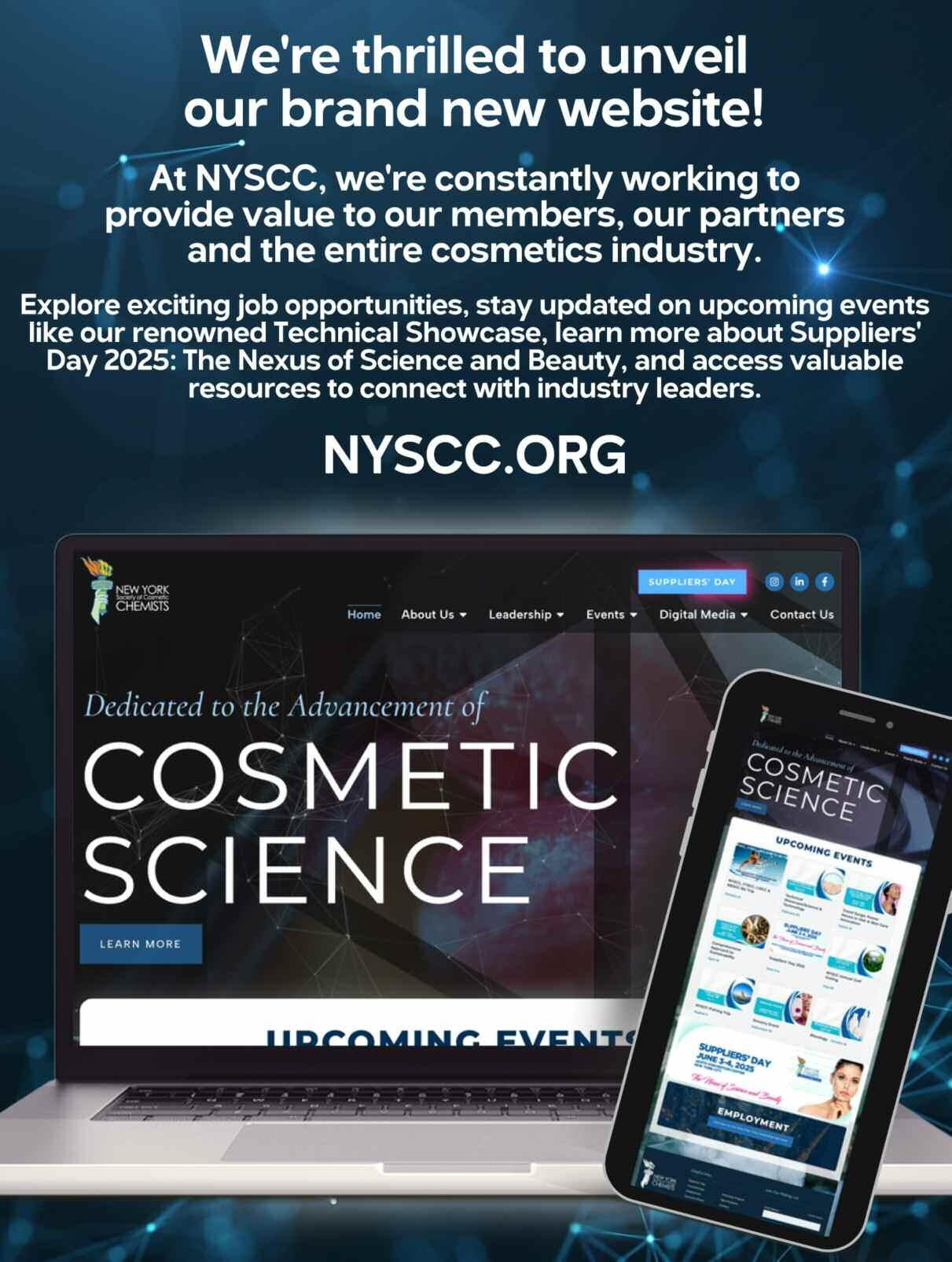
I am so excited for what is ahead and what is to come Our new website will launch at the end of the month please visit to see all that the NYSCC has to offer I am looking forward to another exciting year for the NYSCC filled with new and enhanced partnerships, important education, and of course, Suppliers’ Day in New York City. I am very grateful for the opportunity to serve the membership as Chair and hope to be worthy of the honor you have bestowed upon me
Cheers to: Collaboration + Partnership = Success!
Call for Papers

The Cosmetiscope editorial committee invites all interested partie to submit feature technical articles for publication in the NYSCC monthly newsletter. Authors of feature articles are eligible to win the prestigous NYSCC Literature Award ($1,000) for the best front-page article published during the calendar year. Authors also receive $200 reimbursement to attend a theatrical performance of their choice Writing an article for your peers is a very rewarding experience, both personally and professionally, and will ensure your place in NYSCC history. You may choose whatever topic you feel would be interesting to fellow colleagues in our industry. We also welcome any other types of commentaries or articles that may be published in the Career Cor ner, Technical Tidbit section, or as a Letter to the Editor
Please send correspondence to: roger mcmullen@fdu.edu.








production in cultured melanocytes, and demonstrate antioxidant properties 10 These findings position milk protein-derived peptides as promising safe alter natives to traditional treatments for hyperpigmentation and demonstrate the potential of biomimetic science in skincare for efficacy and safety.
Nature-Inspired Lipids: A Promising Solution to Restore the Protective Hair Barrier

The lipid 18-methyleicosanoic acid (18-MEA) is essential to the hydrophobicity and structural integrity of the hair due to its ability to for m a protective layer on the hair cuticle that helps reduce friction, improve smoothness, and protect the hair against exter nal damage 11,12 Chemical treatments such as coloring and per ming as well as aging can strip natural 18-MEA, leaving the hair feeling dry, frizzy, and more susceptible to damage 11,12 Since this lipid cannot be naturally reincorporated into the hair fiber structure once lost, there has been growing interest to seek innovative solutions to restore the hair’s lipid barrier in damaged hair 11,12
In a study conducted by Song et al , bioconjugation was used to develop 16-methyl heptadecanoic acid (16-MHA), a biomimetic lipid designed to replicate the properties of 18-MEA and restore the hair’s lipid barrier 11 Evaluation methods including differential scanning calorimetry and contact angle measurements confir med that the biomimetic lipid was able to restore hair hydrophobicity and moisture retention to levels comparable to virgin hair, even after repeated washing 11,12 These findings demonstrate the potential of 16-MHA to mimic the protective functions of its natural counterpart and highlights the transfor mative application of biomimetics to deliver innovative solutions that support hair health
Structural Colors: A Butterfly-Inspired Approach to Create Cosmetic Pigments
Pigments in the cosmetic industry primarily rely on chemical pigments, such as metal oxides and synthetic dyes, or minerals like mica, to provide color in for mulations However, concer ns about their potential toxicity, environmental impact, or ethical sourcing have prompted the search for safer, more sustainable alter natives Structural color uses nanoscale structures to manipulate light to produce vibrant, angle-independent hues and iridescence rather than relying on chemical pigments 2,13 This has inspired researchers to explore the application of structural color in color cosmetics, offering a sustainable alter native to traditional pigments.

The Morpho butterfly is a prime example of this phenomenon in nature Its wing scales feature complex multi-layered structures that reflect light to produce a brilliant blue hue visible from multiple angles and distances.14 15 In a study by Chung et al the structural color present in Morpho butterfl was replicated by combining silica microspheres w titanium dioxide and silicon dioxide layers to creat thin multi-layer film that mimicked the interferen and diffraction patter ns of the butterfly wings.15 resulting film produced a deep blue hue with c stability and angle-independent iridescence comp to the natural butterfly wings and even allowed for flexibility without losing color vibrancy 15 This biomimetic approach demonstrates the potential of structural colors to produce vibrant colors without the use of chemical pigments, opening the door for innovative, sustainable, and high-perfor ming colorants in the cosmetic industry
Conclusion
Biomimicry paves the way for innovation in the cosmetic industry by drawing from nature's designs to create impactful, sustainable solutions From milk protein-derived peptides to address hyperpigmentation, biomimetic lipids to restore the hair barrier, and structural colors inspired by butterflies to
create vibrant hues, these advances demonstrate the potential of biomimicry in the cosmetic industry.
While challenges remain, the current achievements highlight the potential of biomimicry to address consumer demands for safe, sustainable, and high-perfor ming ingredients and for mulations As research continues to refine these approaches, the future of biomimicry in the cosmetic industry holds exciting possibilities, bridging the gap between nature and science in remarkable ways
References
1 Lebdioui A Nature-inspired innovation policy: Biomimicry as a pathway to leverage biodiversity for economic development. Ecol Econ. 2022; 202:107585; https://doi.org/10.1016/j.ecolecon.2022.107585
2 Kiki MJ Biopigments of microbial origin and their application in the cosmetic industry Cosmetics. 2023; 10(2):47; https://doi.org/10.3390/cosmetics10020047.
3 Ilieva L, Ursano I, Traista L, Hoffmann B, Dahy H Biomimicry as a sustainable design methodology: introducing the ‘Biomimicry for sustainability’ framework Biomimetics 2022; 7(2):37; https://doi.org/10.3390/biomimetics7020037.
4 Bar-Cohen Y Biomimetics: Using nature to inspire human innovation Bioinspir Biomim 2006; 1(1):1-12; https://iopscience.iop.org/article/10.1088/1748-3182/1/1/P01
5. Lurie-Luke, E. Product and technology innovation: What can biomimicry inspire? Biotechnol Adv 2014; 32(8):1494-1505; https://doi.org/10.1016/j.biotechadv.2014.10.002
6 Barbinta-Patrascu ME, Bita B, Negut I From nature to technology: Exploring the potential of plant-based materials and modified plants in biomimetics, bionics, and green innovations. Biomimetics 2024; 9(7):390; https://doi.org/10.3390/biomimetics9070390
7 Cozzolino S, Gutfreund P, Vorobiev A, Devishvili A, Greaves A, Nelson A, Yepuri N, Luengo GS, Rutland MW. Mimicking the hair surface for neutron reflectometry. Soft Matter. 2024; 20:76347645; https://doi.org/10.1039/D4SM00784K
8 Handel AC, Miot LD, Miot HA Melasma: a clinical and epidemiological review An Bras Der matol. 2014; 89(5):771-82; https://doi.org/10.1590/abd1806-4841.20143063.
9 Lima TN, Pedriali Moraes CA Bioactive peptides: Applications and relevance for cosmeceuticals Cosmetics 2018; 5(1):21; https://doi.org/10.3390/cosmetics5010021
10. Kong S, Choi HR, Kim YJ, Lee YS, Park KC, Kwak SY. Milk protein-derived antioxidant tetrapeptides as potential hypopigmenting agents Antioxidants 2020; 9(11):1106; https://doi org/10 3390/antiox9111106
11. Song SH, Park HS, Lim BT, Son SK. Biomimetics through bioconjugation of 16methylheptadecanoic acid to damaged hair for hair barrier recovery Sci Rep 2024; 14(1):27387; https://doi.org/10.1038/s41598-024-78770-z.
12. Tokunaga S, Tanamachi H, Ishikawa K. Degradation of Hair Surface: Importance of 18-MEA and epicuticle Cosmetics 2019; 6(2):3; https://doi.org/10.3390/cosmetics6020031
13 Arora, EK, Shar ma, V, Sethi, G, Puthanagady MS, Meena, A Bioinspired designer surface nanostructures for structural color. Nanotechnol Environ Eng. 2024; 9:461–472; https://doi.org/10.1007/s41204-024-00368-7
14 S M Luke, P Vukusic An introduction to biomimetic photonic design Europhys News 2011; 42:10; http://dx.doi.org/10.1051/epn/2011302
15 Chung KJ, Yu SK, Heo CJ, Shim JW, Yang SM, Han MG, Lee HS, Jin YW, Lee SY, Park NK, Shin JH. Flexible, angle-independent, structural color reflectors inspired by Morpho butterfly wings. Adv Mater 2012; 24(18):2375-2379; https://doi.org/10.1002/adma.201200521
About the Author:
Michelle Han is an Associate Manager of Product Development at amika, where she leads blue-sky innovation and oversees new product launches. She holds a B S in Medical Science from Western University and brings over five years of experience in the cosmetic industry, spanning haircare, skincare, and color cosmetics Driven by a passion for novel ingredients and innovative technology, Michelle is dedicated to developing effective and sustainable solutions that advance the field of cosmetic science.


2025 NYSCC Events Calendar
• For updated NYSCC information, visit us on the web at: www.nyscc.org
• For National SCC information: www.scconline.org
January 31 NYSCC, CTSCC, LISCC, and NESCC Ski Trip - February 2 Killington, VT
February 20
Technical Showcase/Science and Technology
Liberty Science Center, Jersey City, NJ
March 19 Trend Surge: Power Moves in Hair and Skin Care Innovation
Legacy Castle, Pompton Plains, NJ
April 16 Comprehensive Approach to Sustainability

June 3-4
Brooklake Events, Morristown, NJ
Suppliers’ Day
Jacob Javits Convention Center, New York, NY
June 3 NYSCC Industry Awards Night
New York, NY
July 28 Golf Outing
Crystal Springs, Hamburg, NJ
August 9 Fishing Trip
Atlantic Highlands, NJ
September 10
October 16
November 12
Sensory Event
Venetian, Garfield, NJ
Rheology Event
Jay Conference Bryant Park, New York, NY
Demystifying Biotechnology: 360 Degree Look from Ingredient to Brand Liberty House, NJ
NYSCC Employment Section
Are you looking for a candidate that loves the personal care industry, who the thrill of designing a make-up product or shampoo? Or perhaps you are someone with expertise in raw materials. Maybe you need some help the lab and could use a tenacious inter n who wants to start their career in the personal care space
The NYSCC Chapter supports you and your business with FREE postings to our webpage Contact employmentadmin@nyscc.org to have passionate candidates apply to your roles. Recent postings include companies such as Lucas Meyer Cosmetics, Kenvue, Olaplex, and Symrise for roles in Sales, Marketing, For mulations, and Regulatory


Below are some positions in the personal care industry that are currently posted on the NYSCC website For a full description of the jobs, visit https://nyscc.org/jobs
• Technical Marketing Manager – Leading Edge Innovations – Branchburg, NJ
• Sales Representative – McKinley Resources – Remote Location
• Sample Program and Marketing Coordinator – Leading Edge Innovations – Branchburg, NJ
NYSCC, CTSCC, LISCC, and NESCC Hit the Slopes!
January
31 – February 2,
2025
Killington, VT
Join us for the biggest collaborative SCC Ski event in history!
From Friday, January 31st through Sunday, February 2nd, the NYSCC, CTSCC, LISCC, and NESCC team up for a weekend ski trip to Killington, Ver mont. Join us for skiing, snowboarding, food, networking, fer mentation/distillation chemistry tour, and a great educational event.
Space is limited for lodging, dinner, and the tour, so sign up today!
The Eventbrite for m has seperate ticket sections for each unique event/component. A discounted room block is available on a first come first serve basis.
Non-skiers, friends, and family are welcome! We have an entire day of activities planned around the mountain on January 31st that everyone can enjoy.


Questions?
Reach out to NYSCC co-chairs Gita Calton (gita.calton@aak.com) and Brian Ecclefield (brian@validatedcs.com) for more infor mation about the event. For help with ski lift tickets specifically, reach out to Ina Schlenoff (ischelenoff@estee.com) and Vlad Onyshchak (vonyshchak@estee.com) directly.


NYSCC History Project ...Steve Herman NYSCC History Project ...Steve
Estudar Cosméticos nos Estados Unidos
In English, the title of this article can be translated as, “Studying Cosmetics in the United States.”
The NYSCC is proud of its global reach and equally of its support of education What could exemplify this more than a report from Brazil in Portuguese in the publication Cosmética em Foco1 covering an NYSCC Chapter meeting held on March 13, 2019, on “Cosmetic Science in Academia”? The half-day program had the following topics and speakers:
• Cosmetic Science at Fairleigh Dickinson University – Prof Steve Her man
• Cosmetic Science at Long Island University – Prof. Arvind Shah
• Cosmetic Science at the University of Cincinnati – Dr. Kavssery Ananthapadmanabhan
• Cosmetic Science at the University of Toledo – Dr. Gabriella Baki
• Personal Care Science at Rutgers University – Prof. Abbe Rosenthal
• Poster Presentations and Awards – Dr. Robert Fuller – Poster Committee Chair

Photograph taken at the NYSCC Cosmetic Science in Academia Symposium in Totowa, New Jersey on March 13, 2019 From left to right: (a) Dr K P Ananth from the University of Cincinnati, (b) Professor Abbe Rosenthal of Rutgers University, (c) Prof Steve Herman of Farleigh Dickinson University; (d) Dr Gabriela Baki of the University of Toledo, and (e) Dr. Mahendra Dedhyia of the University of Long Island, Hudson.
The NYSCC support of education has been constant from the beginning. We find the earliest documentation of the Chapter commitment to education in 1959: “The work of the Chapter Education Committee has resulted in the establishment of a cosmetic chemistry course at Columbia University, College of Phar macy. This is, at the present time, an extension course given in the evening with full college credit ”2
The Fairleigh Dickinson University curriculum was established in 1980 with the strong support of the NYSCC Dr Sal Gimelli, who founded the program, sought guidance from the Chapter, which came primarily from Dave Steinberg On the flip side, Dr Gimelli was our Treasurer in 1985 and 1986 The first graduates in 1984 were Anna Gripp and Colleen Rocafort both later became key contributors to the
Chapter Also in 1984, the NYSCC donated $1,000 to Fairleigh Dickinson University for the Masters in Cosmetic Science lectures Since the beginning not only were many of the students our members or future members, but most of the adjunct faculty were drawn from the Chapter, a prime reason for the program ’ s success.

Photograph taken at the NYSCC Cosmetic Science in Academia Symposium in Totowa, New Jersey on March 13, 2019. Students from the University of Toledo received the award for Best Poster for their work on the effect of emollients on the sun protection factor and photostability of ultraviolet filters Appearing in the photo are Allie Schaefer on the left and Laura Lam-Phaure on the right.
Our “70th Anniversary Gala NYSCC Supports Education Night” on November 16, 2024, was the most recent display of our emphasis on academic pursuits with numerous scholarships and grants being awarded at the event It is certain that many future leaders received our tangible support and encouragement that night. You can read all the details in the December 2024 issue of Cosmetiscope. It is especially impressive the number of universities we have been able to influence in a positive way Whether you look at 1959, 1984, 2019, or 2025, the NYSCC has played a major role in supporting academia
References
1 I Souza; Estudar cosméticos nos Estados Unidos; May 1, 2009; https://cosmeticaemfoco.com.br/artigos/estudar-cosmeticos-nos-estados-unidos/; Accessed on January 12, 2025
2 New York Chapter, J Cosmet Sci , 10(2), 125 (1959)
