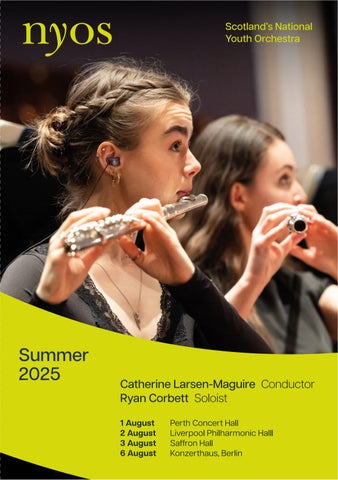
Scotland’s National Youth Orchestra
Summer 2025
Catherine Larsen-Maguire Conductor Ryan Corbett Soloist 1 August 2 August 3 August 6 August
Perth Concert Hall Liverpool Philharmonic Halll Saffron Hall Konzerthaus, Berlin
Programme Conductor Catherine Larsen-Maguire
Soloist Ryan Corbett Accordion
Programme Anna Clyne Jay Capperauld Hector Berlioz
This Midnight Hour Galvanic Dances Symphonie Fantastique
©
Summer 2025
S
ly al
Ju
bb
Welcome Welcome to tonight’s performance of the National Youth Orchestra of Scotland! We have an electrifying programme for our audiences this summer, featuring much-loved music from Anna Clyne and Berlioz alongside a premiere from composer Jay Capperauld. This summer’s tour is an incredible opportunity to play in amazing concert halls across the UK and Germany. It will be really rewarding to see all our hard work pay off when we take to the stage. When the orchestra heard Galvanic Dances for the first time, our faces lit up and we were mesmerised. Its themes and instrumentation are so interesting, and the inclusion of an accordion is unusual but exciting for an orchestral piece. Getting the opportunity to premiere a new concerto is a great way for us to introduce ourselves to new audiences and showcase our skills. When we play together, there’s so much passion and energy, and I’m particularly proud of our orchestra representing Scotland on the world stage – it’s a really big deal and it’s even better that we’re doing it together! It’s very special to be joined on tour by our fantastic Music Director, Catherine Larsen-Maguire, and our outstanding soloist, Ryan Corbett. Their guidance and expertise have been invaluable, especially as this is the first time many of us have been on an international tour. I hope you find tonight’s programme exciting and invigorating, and that you’re kept on your toes at all times!
Kenzie © Aly Wight
Kenzie Percussion, NYOS 2025
Conductor
Catherine Larsen-Maguire After a successful career as a bassoonist which included ten years as principal of the Komische Oper Berlin, Catherine Larsen-Maguire is now a sought-after conductor and a regular visitor to orchestras around the world. She will take up the position of Music Director of the Faroese Symphony Orchestra in 2026 and has in recent years conducted the London Philharmonic Orchestra, Scottish Chamber Orchestra, Royal Northern Sinfonia, Berlin Radio Symphony Orchestra, Orchestre National du Capitole de Toulouse, Orchestre de Chambre de Paris, Sinfónica de Galicia and Hong Kong Sinfonietta, among many others. Born in Manchester and based in Berlin, Catherine read music at Cambridge University and studied the bassoon at the Royal Academy of Music in London and the Karajan Academy in Berlin.
‘The NYOS Summer Tour is an incredible opportunity for our young people to perform in music halls across the UK and beyond, enriching their musical experiences and developing their own personal development. I am very excited to perform this programme with the NYOS orchestra, especially in Berlin where I know the German audiences will give us a very warm welcome.’
With a passion for mentoring the next generation of musicians, Catherine places great emphasis on working with young people both as conductor and educator. She has given masterclasses in Germany, the UK, Mexico, Brazil and Spain. She serves regularly as a jury member for conducting competitions and was a guest professor at the University of the Arts in Berlin. In June 2023 she was appointed as the first Music Director of NYOS, and we are proud to announce that she has agreed to extend her tenure and continue in this role until 2029.
Catherine Larsen-Maguire © Fraser Band
As well as performing repertoire from the standard orchestral canon, Catherine often works closely with living composers and has given a number of significant world and national premieres, including the world premiere of Alexander Goehr’s final work, The Master Said, with the BBC National Orchestra of Wales. We are therefore thrilled that our summer programme includes the world premiere of Jay Capperauld’s Galvanic Dances, a NYOS commission made possible through the generous support of the Richard Chester Creativity Fund and the Vaughan Williams Foundation.
Anna Clyne (b 1980)
This Midnight Hour Composer’s Notes The opening to This Midnight Hour is inspired by the character and power of the lower strings of L’Orchestre national d’Île de France. From here, it draws inspiration from two poems — one by Charles Baudelaire and another by Juan Ramón Jiménez. Whilst it is not intended to depict a specific narrative, my intention is that it will evoke a visual journey for the listener. La musica, Juan Ramón Jiménez, trans. Robert Bly Music — a naked woman running mad through the pure night. This immediately struck me as a strong image and one that I chose to interpret with outbursts of frenetic energy — for example, dividing the strings into sub-groups that play fortissimo staggered descending cascade figures from left to right in stereo effect. This stems from my early explorations of electroacoustic music. There is also a lot of evocative imagery in Charles Baudelaire’s Harmonie du Soir, the first stanza of which reads as follows (trans. William Aggeler):
Anna Clyne © Victoria Stevens
The season is at hand when swaying on its stem Every flower exhales perfume like a censer; Sounds and perfumes turn in the evening air; Melancholy waltz and languid vertigo! I riffed on the idea of the melancholic waltz about halfway into This Midnight Hour — I split the viola section in two and have one half playing it at written pitch and the other half playing 1/4 tone sharp to emulate the sonority of an accordion playing a Parisian-esque waltz. Anna Clyne
Year of Composition: 2015 Duration: 13 minutes The World in 2015 : – Lin-Manuel Miranda’s revolutionary musical Hamilton opens on Broadway. – Fossilised dinosaur footprints are discovered on the Isle of Skye. Further listening: Grażyna Bacewicz Concerto for String Orchestra If you enjoy the ferocious opening to Anna Clyne’s piece, Bacewicz’s string writing is similarly charged.
Supporting and Celebrating Creativity for NYOS Musicians Thank you to the supporters of the Richard Chester Creativity Fund for your generosity. To date, the Richard Chester Creativity Fund has raised almost £31,000 and supported commissions from two outstanding composers. The Richard Chester Creativity Fund honours Richard’s exceptional leadership of NYOS and lifelong dedication to music by raising funds in his memory. As the organisation approaches its 50th anniversary in 2029, we are now fundraising to ensure our birthday year will be a true celebration of our mission to offer worldclass musical opportunities to Scotland’s wonderful young musicians. It is only thanks to the generosity of our many supporters that we can programme the prestigious and inclusive opportunities with which Richard was synonymous, such as commissions from internationally renowned composers, creating access to our programmes for young people nationally, or providing a platform for a promising young conductor. To support the fund, please scan the QR code. You can also donate by sending a cheque made payable to ‘NYOS’ to Office 240, The Briggait, 141 Bridgegate, Glasgow, G1 5HZ.
Composer
Jay Capperauld Scottish composer Jay Capperauld graduated with a Master of Composition with Distinction from the Royal Conservatoire of Scotland in 2014 under the tutelage of Dr Gordon McPherson. He has since composed for various artists and organisations including BBC Proms, BBC Scottish Symphony Orchestra, Scottish Chamber Orchestra, Royal Scottish National Orchestra, Hebrides Ensemble, and Red Note Ensemble. Jay was commissioned by His Majesty King Charles III to compose Schiehallion!, a new work for the Honours of Scotland Ceremony which took place in 2023 at St Giles Cathedral, Edinburgh. In 2018, NYOS gave the premiere* of Jay’s piano concerto Endlings with the pianist James Willshire. Jay enjoys working with young composers to support their development and learning, and recently helped establish the West of Scotland Schools Orchestra Trust’s inaugural composition course. He currently acts as a mentor for young composers as part of the RSNO’s Notes from Scotland composition scheme. Jay was appointed as the Scottish Chamber Orchestra’s Associate Composer in 2022, a role that sees him embedded in all aspects of the SCO’s activities; he composes new works for the orchestra and works closely with the SCO’s Creative Learning and Marketing teams.
Composer Q&A
Q: Could you share any particular themes, imagery, or ideas that inspired the concerto?
Written in one continuous movement, this concerto for accordion and orchestra is a playful exploration of the macabre. Arranging a compelling mosaic of dance styles and forms such as tango, jig, and tarantella, the concerto reimagines a work of gothic fiction which has gripped audiences for over two hundred years. Ahead of its electrifying debut, we spoke to Jay about the process of making this specially commissioned piece.
Q: What standout characteristics of the piece are you most excited for audiences to hear?
Galvanic Dances is inspired by the pioneering electrical experiments of Luigi Galvani. These experiments became the inspiration for Mary Shelley’s Frankenstein, and this piece for solo accordion & orchestra retells that story through a series of energetic dances that have been stitched together to form a kind of musical Frankenstein’s monster.
I’m excited for the audience to hear the accordion in a virtuosic solo role, especially with Ryan Corbett at the helm. It can produce incredible sounds – from massive, vibrant cacophonies to the softest, most delicate whispers. Here, the accordion acts as an orchestra within an orchestra; there is a great deal of interplay between the soloist and the ensemble to build the emotional story of Frankenstein’s monster. Q: Did Ryan Corbett’s playing or artistry shape the music in any way? Given this is my first composition for the accordion, I consulted Ryan throughout my writing process to ensure the piece was playable but also pushes the soloist’s boundaries. I composed this piece very much with Ryan in mind, and his identity as a performer is imprinted onto the piece. Q: Contemporary music can sometimes feel intimidating — what would you say to listeners hearing this concerto for the first time? All music has been new music at some point in time, and I’m dealing with the same rudimentary musical elements as Mozart and Beethoven… namely dots on a page. Music is music and there is no right or wrong way to listen to anything, but I find listeners get the most when they approach music with a simple sense of curiosity. Q: What do you hope people take away from hearing this work?
Jay Capperauld © Euan Robertson
Enjoyment. And a sense that they’ve experienced an unusual or unique story that lifts a small corner of the universe to show the strange cogs that turn in the background of our lives. Q: What role do commissions and premieres like this play in keeping orchestral music vibrant and forward-facing? It continues the development of orchestral repertoire in a meaningful way by exciting and encouraging young musicians to explore new music with a living composer. It is also a chance for everyone to learn and grow together by collaborating in bringing to life a bespoke new work that has been made specially for the next generation of young performers. I find that galvanising!
NYOS Orchestra Brunelli Bonet Leader Leverhulme Trust Hanson Leverhulme Trust Tse Leverhulme Trust Zhu Leverhulme Trust Fitzgerald Cooper Kennedy Leverhulme Trust Gillan Fang Leverhulme Trust Assur Drysdale Leverhulme Trust Kitchin Wallace Jones Leverhulme Trust
Violin II Ruben Rebecca Eilidh Jia Lin Samuel Caitlin Nellie Aarush Eirene Wanting Christine Bethany Anna Siewlin Anna Emily Catherine Caitlin
Moreno Leverhulme Trust Greig Hong Jones Leverhulme Trust Williams Heinrich Bakshi Cai Sang Woodburn Ng Welsh Irvine Ke
Viola Aiden Merryn Gina Laura Sandy Adeline Alexandra Ailsa Cameron Liam Solomon-Jr
Macdonald Principal Leverhulme Trust Stephenson Leverhulme Trust Wright Leverhulme Trust Lau Reilly Boulet Leverhulme Trust Archibald Quantrill Clark Leverhulme Trust Jamieson Leverhulme Trust Makhatholela Leverhulme Trust
Cello Rhona Matilda Rebecca Johnny Euan Anthony Benjamin Paul Anna Carla Freddy
Matthew Ella Euan Adrian Susannah
Nowak Principal NYOS Endowment Trust Allen Coyle Maitland Brandon
Flute Lalleh Molly Olwenn Phoebe
Memar Principal Baird Educational Trust Gribbon Leverhulme Trust Stewart Jones
Oboe
Violin I Alberto Lucy Michelle Jessica Rhea Grace Meredith Ava Ziyi Lucy Zoe Kirsty Anna-Louise Emlyn
Double Bass
Pryce Co-Principal Sills Co-Principal Lynn Gray Leverhulme Trust Braddish Leverhulme Trust Clark Oggier Sciarretta Leverhulme Trust Brunelli Bonet Leverhulme Trust Beeston
Jason Rose Anjali Jamie
Chan Principal Leverhulme Trust Jamieson Pavri Dickinson Leverhulme Trust
Clarinet Anthony Jessica Cara Lewis
McKenna Principal Hannah Smith Leverhulme Trust Sutherland
Bassoon Anna Freya Freya Benjamin
Ghiro Principal Edington Liles Buckner
Leverhulme Trust Leverhulme Trust
French Horn Ben Abigail Ellie Emily Rhona Lucy
Dickinson Principal Wilson Wilson Morran Langford Arbuckle
Leverhulme Trust Leverhulme Trust Leverhulme Trust Leverhulme Trust
Prentice Co-Principal Bedwell Co-Principal Campbell Harby
Leverhulme Trust
Trumpet Ruaridh Nadia Rona Beth
Leverhulme Trust
Trombone Lorna Reuben Marcella Mark
Rae Principal McFarlane Boyle Gammon
Leverhulme Trust Leverhulme Trust
Smart Gaskell
Baird Educational Trust Leverhulme Trust
Tuba Sophie Eleanor
Co-Principal Co-Principal
Percussion Ellie Emma Catriona Emily Kenzie Ruaridh
Smillie Co-Principal NYOS Endowment Trust Dunn Co-Principal Duncan Hathaway Robertson Docherty
Harp Annabelle Genevieve Arianna Caitlin
Nordmann Nordmann Gagnon Dines
Ellie, Percussion, NYOS © Sally Jubb
Jay Capperauld (b 1989)
Galvanic Dances Composer’s Notes Galvanic Dances is a concerto for accordion and orchestra inspired by the early pioneering electric experiments of Luigi Galvani in the 1700s. Galvani’s experiments focused on the re-animation of dead frogs’ legs which moved and twitched when applied with an electrical current. This new discovery led to significant questions about the source of life itself and whether death could, in reality, be prevented. The moral panic that surrounded Galvani’s experiments captured the public’s imagination at that time, and a new word, ‘galvanise’, came into being in order to capture the action of shocking or exciting someone/something into action and animation. This new theory of galvanism and the existential implications of bringing the dead back to life eventually inspired the concept behind Mary Shelley’s Frankenstein. Shelley wrote Frankenstein on a trip to Geneva in 1816 where she met Lord Bryon, who challenged her to write a ghost story while the stormy weather prevented them from venturing outside. Shelley drew inspiration from conversations with the Scottish physician James Lind, who gave demonstrations of Galvani’s ‘galvanism’ to the wonderment and horror of the viewing public. These unsettling concepts led Shelley to write about the creation of a re-animated monster that is rejected by its creator, Dr Frankenstein, who is haunted and pursued by his abominable handiwork as though the monster is his own personal demon. Shelley gave this Romantic classic the subtitle of ‘The Modern Prometheus’ in reference to the Greek mythological Titan who created humans and gifted them with fire — a gift that liberated humans from the Gods, and for which Prometheus was punished.
Year of Composition: 2025 Duration: 18 minutes
This concerto for accordion and orchestra is written in one continuous movement that re-imagines and re-tells the Frankenstein story in a set of infernal dances through the nightmarish image of a chorusline of dancing dead frogs’ legs, as though Galvani’s morbid experiments have created a kind of musical Frankenstein’s monster. The accordion is shocked into animation by galvanising orchestral jolts which set in motion an unfolding narrative of high-drama and macabre tongue-in-cheek humour, with references to various musical dance forms such as tango, waltz, jig and tarantella. All of this culminates in a direct quotation of the infamous Dies irae Gregorian chant melody, which erupts and explodes at bar 666 in the score as an evocation of the infernal and grim elements that are at play in both Galvani’s experiments and Mary Shelley’s tale of Dr Frankenstein’s monster.
We are immensely grateful to the Richard Chester Creativity Fund and the Vaughan Williams Foundation, whose generous support made the commissioning of this piece possible.
Soloist
Ryan Corbett Hailed by Sir James MacMillan as ‘one of the most astonishing and surprising newcomers in Scottish music’, Ryan Corbett is a decorated Scottish accordionist. In 2022, Ryan became the first accordionist to be part of the prestigious BBC Radio 3 New Generation Artist scheme since its launch in 1999. He was nominated in the Young Artist category of the 2024 Royal Philharmonic Society Awards and has been listed as ‘one to watch’ by BBC Music Magazine, Interlude HK, The Scotsman and Scala Radio. He has given over eight hours of radio broadcasts and was part of the televised performance at the Scottish Coronation of HM King Charles III. Born in Glasgow in 1999, Ryan studied at the Music School of Douglas Academy, St Mary’s Music School, and the Royal Conservatoire of Scotland. He was introduced to the accordion aged eleven, when his grandmother bought a small instrument for him and his brother to try. As the instrument was not airtight, the only way to play it was like a piano, while the other pulled the bellows across the floor. It was soon fixed, and Ryan would spend hours playing Scottish folk music. He continued to teach himself accordion until the age of fourteen, when he began studying with Djordje Gajic. His studies were supported by Cross Trust, Drake Calleja Trust, Countess of Munster Musical Trust, RCS Scholarship Fund and Help Musicians UK.
Ryan Corbett © Andrej Grilc
Ahead of the debut performance of Jay Capperauld’s Galvanic Dances, we spoke with Ryan about what it was like to work on this extraordinary new accordion concerto commissioned especially for performance with the NYOS orchestra.
Soloist Q&A Q: You’re debuting Jay Capperauld’s brand-new accordion concerto — what has it been like bringing this piece to life? It’s been a proper collaboration. From the early stages of deciding on the general structure and language of the piece, to the latter stages of making a couple of impossible passages possible, it’s been a joy to work closely with such a fantastic composer. Q: What’s unique or exciting about premiering the piece with a youth orchestra? There’s a youthful energy and anticipation that fully grown orchestras would rarely surpass, and to be around all these people who love music is good for the soul. Q: Many audiences are more familiar with the accordion in folk traditions — what do you enjoy most about showcasing it in a classical orchestral setting? It’s nice to play an instrument that’s new to some in a classical setting, but honestly that’s not why I enjoy it — I enjoy it because I enjoy playing music. Q: How does it feel to represent Scotland with NYOS at Young Euro Classic in Berlin? I feel tremendously honoured to have been asked to do this, and I’m very excited about it. Everyone says they’re excited these days, but in this case I genuinely am.
Hector Berlioz (1803–1869)
In the final movement, he dreams he is at a witches’ sabbath. The object of his obsession is now a mocking caricature and the idée fixe a shrill and taunting dance on his grave. Berlioz’s early mastery of orchestration is on full display as bells toll, violins rattle, and the brass and bassoons intone the ‘Dies irae’ (day of wrath) chant from the Catholic mass for the dead.
Symphonie Fantastique
Several years later, Harriet attended a performance of the symphony and realised the work was about her. Surprisingly undaunted by the finer details of the plot, she invited Berlioz to meet her, and they soon entered a mismatched, volatile marriage that ended in separation.
I. Rêveries — Passions II. Un bal III. Scène aux champs IV. Marche au supplice V. Songe d’une nuit de sabbat
Symphonie Fantastique was written when Berlioz was just 26 and in the throes of romantic obsession with Shakespearean actor Harriet Smithson. After years of unanswered love letters, he translated his devotion into a grand, innovative and unhinged orchestral statement. Across five movements, we follow the figure of a young artist as he grapples with an all-consuming love for his muse. His obsession is represented by the idée fixe, a recurring melody that shifts and distorts as the story unfolds: at first tentative and fleeting, then a haunting memory, and finally satirical and mocking. In the opening movement we meet the artist as he recalls the moment he fell in love. The music is lyrical but turbulent. We are then transported to a ballroom where an elegant waltz theme is haunted by an underlying tension. The third movement opens with two shepherds calling to each other across a quiet field. Thunder rolls in the distance and, towards the end, the opening duet returns, only to fade away in unresolved despair.
Year of Composition: 1830 Duration: 49 minutes The World in 1830 : – A tumultuous year in European history with revolutions in France, Belgium, Poland, Switzerland and Italy. – Scottish-born social reformer Frances Wright embarks on a lecture tour, becoming the first woman in the USA to speak publicly to mixedgender audiences on political topics.
Wendy Carlos The Shining Main Theme An iconic and deeply unsettling reworking of the ‘Dies irae’ chant. The Police Every Breath You Take The idée fixe goes pop. Like Symphonie Fantastique, not quite the love song it first appears to be.
Conversely, the idée fixe exemplifies the Romanticera tendency to cast women as objectified symbols within male narratives of artistic suffering and genius. The transformation from muse to grotesque caricature at the end of the symphony reflects the pattern of exalting women only to punish them when they deviate from idealised roles. Despite this, nearly 200 years after its premiere, the symphony remains a vital and visionary artistic statement.
Hector Berlioz © Sally Jubb
The fourth and fifth movements are wild fever dreams. The artist imagines that he has murdered his beloved and is being marched to the scaffold. Just before the blade falls, the idée fixe returns as a haunting clarinet solo, representing the last thoughts of the condemned man, before the orchestra signifies the fall of the blade and the drop of his head into the basket.
Premiered six years after Beethoven’s infamous choral symphony, the Symphonie Fantastique marked a further break from the restraint and elegance of the Classical era. Its fusion of psychology and personal narrative anticipated the 19th century’s growing infatuation with the ‘artist’, an impassioned, outsider figure.
Further listening:
NYOS Bursaries ‘I am so grateful for this wonderful opportunity to participate in NYOS for another year. I have always thoroughly enjoyed every NYOS course I’ve gone to, right from NYOS Training Ensemble years and years ago. Even through lockdown, NYOS was such a breath of fresh air for me. I want to thank you for selecting me to receive a bursary, without which I wouldn’t be able to take part in NYOS’ Meredith, Violin
At NYOS, we want to ensure that no young person misses out on the opportunities we offer due to their financial circumstances. In 2025, 56% of our orchestra members have received bursary support. The generous support of our donors helps to ensure that NYOS remains as accessible as possible to young musicians from all backgrounds across Scotland. We provide bursaries to help cover the cost of courses and offer financial assistance for travel and accommodation. Scan the QR code to find out how you can support NYOS.
M
er
i ed
th
©
S
ly al
Ju
bb
Donors & Supporters
NYOS Team
Statutory Funder
NYOS Board Samuel White Chair Alistair Allan Francis Cummings Caroline Dooley Ken Fairbrother Kenneth Law Adam Lee Roger Wilson
Conductors’ Circle Ms Lindsay Pell and Professor Chris Morris Professor Marjorie and Dr David Rycroft Robert and Christine Maguire Principal Chair Sponsors Alistair Allan Cello Mrs A M Bennett Double Bass Mr and Mrs Timothy Laing Piano/Celeste Mr and Mrs Michael Pell Bassoon Alan and Jan Simpson NYOS Development Leader Dr Myra Soutar French Horn & Second Violin Sue Strudwick Clarinet Graeme and Ella Wilson Percussion Chair Sponsors Kirsty Adam Cello Charles Arbuthnot Tim and Sally Barraclough Percussion Mrs Isabella Brown Lord and Lady Cameron of Lochbroom Violin Andrew Hadden Violin Professor David Hamilton Lawson Oboe Fabienne Harrison Cello Duncan and Sarah MacIntyre Second Violin Mr and Mrs Thomas McCreery Mr Robin Pagett and Mrs Kate Longworth In memory of Ian Robertson Bassoon Mr and Mrs Mark Seymour Maureen Simpson Viola Mr A L Stewart French Horn Graham Taylor MBE Trombone Mrs Ann Verney Cello Mr and Mrs R M Williamson Dr and Mrs Paul Wilson Honorary Chair Sponsors Sarah Chester, In memory of Richard Chester MBE
Trusts & Foundations
National Youth Orchestras of Scotland Endowment Trust ABO Sirens Fund A M Pilkington Charitable Trust AMW Charitable Trust A Sinclair Henderson Trust Baird Educational Trust Bransford Trust Cockaigne Fund, administered by Foundation Scotland Countess of Dunmore’s Charitable Trust Cruach Trust Cruden Foundation Dunclay Charitable Trust Forteviot Charitable Trust Hinshelwood Gibson Trust Hope Scott Trust Hugh Fraser Foundation Jennie S Gordon Memorial Trust Jimmie Cairncross Charitable Trust John Mather Trust JTH Charitable Trust Leng Charitable Trust Len Thomson Charitable Trust Martin Charitable Trust McGlashan Charitable Trust MEB Charitable Trust Misses Barrie Charitable Trust Miss Jean R Stirrat’s Charitable Trust Mrs Rowena Goffin’s Charitable Trust Nancie Massey Charitable Trust Pear Tree Fund for Music P F Charitable Trust Radcliffe Trust Ronald Miller Foundation Scops Art Trust Sir Iain Stewart Foundation Stevenson Foundation Talteg Ltd Tay Charitable Trust Thomson Charitable Trust Tillyloss Charitable Trust Turtleton Charitable Trust Vaughan Williams Foundation W A Cargill Fund William Grant Foundation
Course Tutors
Chris George Violin I & Strings Bernie Docherty Violin II Felix Tanner Viola Su-a Lee Cello Ben Burnley Double Bass Fiona Fulton Flute Peter Dykes Oboe Joe Pacewicz Clarinet & Wind Luis Eisen Bassoon Patrick Broderick French Horn Erika Curbelo Trumpet Lance Green Trombone Mark Reynolds Tuba & Brass Sharron Griffiths Harp Zuzanna Olbryś Harp Tom Hunter Percussion
NYOS Team Kirsteen Davidson Kelly Chief Executive & Artistic Director Catherine Larsen-Maguire Music Director Neil Fox Director of Engagement Karen Smith Head of Finance & Administration Jack Johnson Head of Development Kate Fitzgerald Marketing & Communications Manager Nicola Pickavance Fundraising Consultant Natalie Brayshaw Orchestra Projects Manager Isaac Holden Engagement Projects Manager Marcus Cork-Keeling Communications Officer Sophie James Digital Support Apprentice Haley Hartle Executive Assistant Steven Lamb Stage Manager Jacobus De Jager Assistant Conductor Rufus Sullivan Tour Coordinator Danni Bastian Tour Coordinator Pastoral Team Yla Garvie Head David Cumming Simon Fullarton Rebecca Goodwin Duncan Hughes Chrissie Johnson David Paterson Emily Stokes Emily Topping Eun-Joo Yoon
We are grateful to all our funders and sponsors listed above, to those who wish to remain anonymous, and to the Friends of NYOS for their continued support. Please contact jackjohnson@nyos.co.uk if you would like to amend or add a supporter credit to future programmes. ©
ll Sa
y
Ju
bb
nyos.co.uk
National Youth Orchestras of Scotland Office 240, The Briggait 141 Bridgegate Glasgow G1 5HZ +44 7562 481397 info@nyos.co.uk www.nyos.co.uk Registered in Scotland No. 66497 NYOS Charity No. SC015482