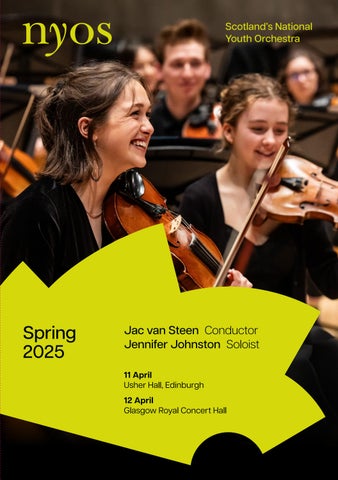
Scotland’s National Youth Orchestra
Spring 2025
Jac van Steen Conductor Jennifer Johnston Soloist 11 April Usher Hall, Edinburgh 12 April Glasgow Royal Concert Hall
Programme Conductor Jac van Steen
Soloist Jennifer Johnston Mezzo-soprano
Programme Tchaikovsky Alma Mahler Elgar
Romeo and Juliet Fantasy Overture Sieben Lieder (orchestrated by David and Colin Matthews) Falstaff
©
Spring 2025
e as Fr
rB
an
d
Welcome to the NYOS Spring Concert 2025. It’s such a pleasure to come together with dozens of old and new friends from across Scotland, to create something as a team. When dedicated young people get together, what we can communicate through music is really powerful. We’ve learned the importance of making mistakes, supporting each other, and creating a positive community where contributing ideas is always welcome. We’ve prepared some exciting and diverse repertoire, and we are especially honoured to work with mezzo-soprano Jennifer Johnston, whose captivating voice and artistry bring Alma Mahler’s Sieben Lieder to life. It's so inspiring to have the opportunity to also work with Jac van Steen, one of the world's most accomplished conductors and learn up-close what creative collaboration looks like. We invite you to immerse yourself in the beauty and energy of this evening’s performance and to join us in celebrating the future of classical music.
Sandy Reilly Viola, NYOS 2025
Sandy Reilly © Sally Jubb
Welcome
Conductor
Jac van Steen Jac van Steen was born in the Netherlands and studied orchestral and choral conducting at the Brabant Conservatory of Music.
Jac van Steen © Simon van Boxtel
Since attending the BBC Conductors Seminar in 1985, he has enjoyed a busy career conducting some of Europe's finest orchestras, including positions as Music Director and Principal Conductor of the Netherlands National Ballet, the Bochum and Nuremberg Orchestras, the Staatskapelle Weimar, the Dortmund Opera and Philharmonic, the Musikkollegium Winterthur and Principal Guest Conductor of the BBC National Orchestra of Wales. He is currently Honorary Principal Guest Conductor of the Ulster Orchestra and Guest Conductor of the Prague Symphony Orchestra.
‘Bringing young people together to make music in a large symphonic setting is a wonderful challenge and a privilege! Sharing my experience and preparing orchestral masterpieces with the talented young musicians of NYOS will surely be an unforgettable journey, presenting two exciting concerts of music inspired by literature: Shakespeare’s Romeo and Juliet, Elgar’s Falstaff, combined with songs by Alma Mahler, sung by Jennifer Johnston. A few hours of good music will bring us joy and happiness — and music is what we need!’
Jac van Steen built up a large opera repertoire during his long association with the opera houses of Weimar and Dortmund, where he was Principal Conductor and Musical Director. He returned to Opera North in 2015 and 2016, making his debut with Garsington Opera (Strauss, Intermezzo), followed by new productions of Pelleas and Melisande and Smetana's The Bartered Bride. In MayJune 2018 he conducted the Jette Parker Young Artists Showcase organised by the Royal Opera House Covent Garden London. At the Dutch Reisopera in the Netherlands, he recently opened the 2023–24 season with Korngold's opera The Miracle of Heliane. In addition to his work as a conductor, he is Professor of Conducting at the Royal Conservatory of Music in The Hague. He has also worked with the Royal Northern College of Music and the Chetham School of Music (Manchester), as well as the Royal Academy of Music and the Royal College of Music (both in London) as well as Cambridge University.
Pyotr Ilyich Tchaikovsky (1840–1893)
Romeo and Juliet Fantasy Overture Tchaikovsky composed some of the most beloved works of the Romantic era (c 1820–1900), not least his incredible ballet scores. The Romeo and Juliet Fantasy Overture, inspired by Shakespeare’s tragedy, is a sweeping musical portrait of the eponymous lovers’ doomed romance, distilling the complexity of the play into twenty minutes of passion and drama. Its soaring ‘love theme’ has become one of the most recognisable melodies in classical music, destined along with the ‘Hallelujah’ Chorus and opening notes of Beethoven’s Fifth to join the pantheon of works reduced ad infinitum to an ironic soundbite on tv shows across the decades*. Only when heard within the full context of the overture can the devastating power of the theme be appreciated. The overture opens in hushed, solemn tones. The churchlike harmonies depict Friar Laurence, one of the thoughtful, if misguided, adults in the play who attempt to shield the young couple from their families’ malice. Soon, the music erupts into violence as agitated strings portray the warring Montagues and Capulets, before the famous ‘love theme’ is heard for the first time. Over the course of the work, these three musical ideas return, confronting each other in new forms each time, mirroring the plot’s descent into confusion, violence and tragedy. Strikingly, rather than ending the work in a sad or brooding minor key, the closing bars offer a reflective, otherworldly postscript.
Duration: 20 minutes The world in 1869: – The Edinburgh Seven become the first group of matriculated undergraduate women students at any British university. Although they were not allowed to graduate, their campaign put the demands of women for a university education on the national agenda. – Leo Tolstoy’s War and Peace is published. Further listening: Shakespeare’s play has inspired music from artists from Berlioz to Bernstein to Taylor Swift.
* Sesame Street, South Park,
SpongeBob SquarePants and The Fresh Prince of Bel Air, to name a few.
Pyotr Ilyich Tchaikovsky c 1865
Tchaikovsky's own love life was no less tragic. Although, unlike Shakespeare’s star-crossed lovers, there were no poetic balcony scenes or defiant declarations of love, just a lifetime of anxiety caught between longing and fear. Desperate to hide his homosexuality, Tchaikovsky entered into an ill-fated marriage with an ex-student that lasted no more than two months. His final symphony, premiered days before his death, is haunted by resignation and regret.
Year of Composition: 1869 (rev. 1880)
Alma Mahler (1879–1964)
Sieben Lieder Alma Mahler was a promising student of the composer Alexander von Zemlinksy, and a prominent figure in artistic circles in Vienna at the turn of the twentieth century. After a brief romance with the artist Gustav Klimt, she married the composer Gustav Mahler in 1902. He had already made clear, in a 22-page letter soon after their engagement, that marriage and music-making were mutually exclusive (for Alma, at least) and essentially forbade her from composing. He changed his mind a decade later, on realising her frustration (and discovering she was having an affair) and encouraged the publication of a set of songs in 1910. A further set followed in 1915 after Gustav’s death. These seven songs are drawn from both sets and exemplify Alma’s dynamic compositional voice and bold use of harmony, which vacillates between conventional harmonic progression and startling chromaticism.
Year of Composition: 1911–1915 Duration: 21 minutes The World in 1911: – International Women’s Day is celebrated for the first time across Europe. – 100,000 people gather in Belfast to watch the launch of the RMS Titanic.
Alma Mahler c 1920 © Franz L-vy
Although Alma married twice more after Mahler’s death, she is generally known by his name. She became the leading authority on Mahler’s music but was subsequently found to have gone to great lengths to edit his letters and publish memoirs that many regarded as essentially fiction. This led musicologists to coin the term the ‘Alma problem’ to describe the wider phenomenon of the distorting effects of first-hand accounts. Recently, however, following #MeToo, a more nuanced appraisal of Alma’s actions has emerged, taking into account the chauvinism of the time, both within Alma’s marriage and in the wider academic community. A clearer picture of a complex, talented and stifled character is beginning to emerge. As Diane Follett writes in ‘Redeeming Alma’: ‘Her songs, perhaps even more than her writings… reveal Alma’s true nature. They verge on the melodramatic, as did Alma; they are complex, as was Alma; they are contradictory, as was Alma. It is in her songs that we meet her, and it is through her songs that she assumes her rightful place.’
The performance of Alma Mahler’s Sieben Lieder is made possible with funding from the ABO Trust’s Sirens programme, a ten-year initiative to support the performance and promotion of music by historical women composers.
Alma Mahler orch. David and Colin Matthews
Laue Sommernacht (Otto Julius Bierbaum)
Mild Summer Night
Sieben Lieder
Laue Sommernacht: am Himmel Stand kein Stern, im weiten Walde Suchten wir uns tief im Dunkel, Und wir fanden uns.
Mild summer night: in the sky Not a star, in the deep forest We sought each other in the dark And found one another.
I II III IV V VI VII
Fanden uns im weiten Walde In der Nacht, der sternenlosen, Hielten staunend uns im Arme In der dunklen Nacht.
Found one another in the deep wood In the night, the starless night, And amazed, we embraced In the dark night.
War nicht unser ganzes Leben So ein Tappen, so ein Suchen? Da: In seine Finsternisse Liebe, fiel Dein Licht.
Our entire life – was it not Such a tentative quest? There: into its darkness, O Love, fell your light.
Licht in der Nacht (Otto Julius Bierbaum)
A Nocturnal Light
Ringsum dunkle Nacht Hüllt in Schwarz mich ein. Zage flimmert gelb Ferneher ein Schein.
Dark night all around Envelops me in black. A hesitant yellow glow Shimmers from afar.
Ist als wie ein Trost, Eine Stimme still, Die dein Herz aufruft, Das verzagen will.
As though bringing solace, Like a tranquil voice Summoning your heart, When in despair.
Kleines, gelbes Licht, Bist mir wie der Stern Über'm Hause einst Jesuchrists des Herrn.
Little yellow light, You are like the star to me That once shone above the house Of our Lord Jesus Christ.
Die stille Stadt Laue Sommernacht Licht in der Nacht Waldseligkeit In meines Vaters Garten Bei dir ist es traut Erntelied
Die Stille Stadt (Richard Dehmel)
The Silent Town
Liegt eine Stadt im Tale, ein blasser Tag vergeht; es wird nicht lange dauern mehr, bis weder Mond noch Sterne nur Nacht am Himmel steht.
A town lies in the valley, a pale day is fading; it will not be long before neither moon nor stars but night alone will deck the skies.
Und da löscht es aus. Und die Nacht wird schwer. Schlafe, Herz, du hörst Keine Stimme mehr.
And now it is extinguished. And the night grows heavy. Sleep, o heart, you shall not hear A voice again.
Von allen Bergen drücken nebel auf die Stadt; es dringt kein Dach, nicht Hof noch Haus, kein Laut aus ihrem Rauch heraus, kaum Türme noch und Brücken.
From every mountain mists weigh on the town; no roof, no courtyard, no house no sound can penetrate the smoke, scarcely towers and bridges even.
Waldseligkeit (Richard Dehmel)
Woodland Rapture
Doch als dem Wandrer graute, da ging ein Lichtlein auf im Grund; und durch den Rauch und Nebel begann ein leiser Lobgesang aus Kindermund.
But as fear seized the traveller, a gleam appeared in the valley; and through the smoke and mist came a faint song of praise from a child's lips.
Der Wald beginnt zu rauschen, den Bäumen naht die Nacht, als ob sie selig lauschen, berühren sie sich sacht.
The wood begins to stir, night draws near the trees; as if blissfully listening, they gently touch each other.
Und unter ihren Zweigen, da bin ich ganz allein, da bin ich ganz mein eigen : ganz nur Dein!
And beneath their branches I am utterly alone, utterly my own; utterly and only yours.
In meines Vaters Garten (Otto Erich Hartleben)
In my Father’s Garden
Bei dir ist es traut (Rainer Maria Rilke)
I feel warm and close with you
In meines Vaters Garten — blühe mein Herz, blüh auf — in meines Vaters Garten stand ein schattender Apfelbaum — Süsser Traum — stand ein schattender Apfelbaum.
In my father’s garden – blossom, O my heart, blossom – In my father’s garden grew a shady apple tree – Sweet dream — grew a shady apple tree.
Bei dir ist es traut: Zage Uhren schlagen wie aus weiten Tagen. Komm mir ein Liebes sagen — aber nur nicht laut.
I feel warm and close with you: clocks strike hesitantly, like they did in distant days. Say something loving to me — but not aloud.
Drei blonde Königstöchter — blühe mein Herz, blüh auf — drei wunderschöne Mädchen schliefen unter dem Apfelbaum — Süsser Traum — schliefen unter dem Apfelbaum.
Three blond princesses – blossom, O my heart, blossom – three wonderfully beautiful girls slept beneath the apple tree – Sweet dream – slept beneath the apple tree.
Ein Tor geht irgendwo draussen im Blütentreiben. Der Abend horcht an den Scheiben. Lass uns leise bleiben: Keiner weiss uns so.
A gate opens somewhere out in the burgeoning. Evening listens at the window—panes. Let us stay quiet, no one knows us thus.
Die allerjüngste Feine — blühe mein Herz, blüh auf — die allerjüngste Feine blinzelte und erwachte kaum — Süsser Traum — blinzelte und erwachte kaum.
The youngest of the three beauties – blossom, O my heart, blossom – the youngest of the three beauties blinked and hardly awoke – Sweet dream – blinked and hardly awoke.
Erntelied (Gustav Falke)
Harvest Song
Die zweite fuhr sich übers Haar — blühe mein Herz, blüh auf — sah den roten Morgentraum — Süsser Traum —
The second ran her hand through her hair – blossom, O my heart, blossom – Saw the red morning dream – Sweet dream –
Der ganze Himmel glüht In hellen Morgenrosen; Mit einem letzten, losen Traum noch im Gemüt, Trinken meine Augen diesen Schein. Wach und wacher, wie Genesungswein.
The whole sky glows In the rosy morning light; With a last fleeting Dream still in my soul, My eyes drink in this radiance. Ever more awake like convalescent wine.
Sie sprach: Hört ihr die Trommel nicht — blühe mein Herz, blüh auf — Süsser Traum — hell durch den dämmernden Traum?
She said: ‘Don’t you hear the drums? blossom, O my heart, blossom – Sweet dream – Brightly through the dawn?
Und nun kommt von jenen Rosenhügeln Glanz des Tags und Wehn von seinen Flügeln, Kommt er selbst. Und alter Liebe voll, Daß ich ganz an ihm genesen soll, Gram der Nacht und was sich sonst verlor, Ruft er mich an seine Brust empor. Und die Wälder und die Felder klingen, Und die Gärten heben an zu singen.
And now from those hills of roses comes The splendour of day and the travail of its wings, He comes himself, full of old love; And that I should quite recover with him The sorrow of night and all that was lost, He summons me to his breast! And the forests and the fields ring And the gardens begin to sing.
Mein Liebster zieht in den Kampf — blühe mein Herz, blüh auf — mein Liebster zieht in den Kampf hinaus, küsst mir als Sieger des Kleides Saum — Süsser Traum — küsst mir des Kleides Saum!
My beloved is going to war blossom, O my heart, blossom – My beloved is going to war, Kisses as victor the hem of my dress Sweet dream – Kisses the hem of my dress.
Die dritte sprach und sprach so leis — blühe mein Herz, blüh auf — die dritte sprach und sprach so leis: Ich küsse dem Liebsten des Kleides Saum — Süsser Traum — ich küsse dem Liebsten des Kleides Saum. —
The third spoke, and spoke so quietly – blossom, O my heart, blossom – The third spoke and spoke so quietly: I kiss the hem of my beloved’s coat – Sweet dream – I kiss the hem of my beloved’s coat.
Fern und dumpf rauscht das erwachte Meer. Segel seh' ich in die Sonnenweiten, Weiße Segel, frischen Windes, gleiten, Stille, goldne Wolken obenher. Und im Blauen, sind es Wanderflüge? Schweig o Seele! Hast du kein Genüge? Sieh, ein Königreich hat dir der Tag verlieh'n. Auf! Dein Wirken preise ihn!
The awakened sea murmurs muffled from afar, I see sails on the distant horizon, White sails of fresh wind glide by, Silent golden clouds above, And are there wanderer’s wings in the blue? Hush, my soul, have you not had your fill? See, a wealthy king has granted you this day. Arise! May your works sing his praise!
In meines Vaters Garten — blühe mein Herz, blüh auf — in meines Vaters Garten steht ein sonniger Apfelbaum — Süsser Traum — steht ein sonniger Apfelbaum!
In my father’s garden – blossom, O my heart, blossom – In my father’s garden stands a sunny apple tree – Sweet dream – stands a sunny apple tree.
Translations © Richard Stokes, author of The Book of Lieder (Faber, 2005)
Soloist
Jennifer Johnston Esteemed mezzo-soprano Jennifer Johnston is recognised as one of the most imporant voices of her generation and celebrated for her performances of works by Mahler, Wagner, Britten, Beethoven, Schumann and Elgar among others. She was awarded Royal Philharmonic Society’s Singer Award in 2021 in recognition of her ‘commitment and emotional force’ to both performance and education. Johnston’s formidable reputation as a preeminent interpreter of Mahler is reflected in a 2024/25 season which features his works prominently. Jennifer sings Mahler’s Symphony No 8 with Royal Concertgebouw Orchestra under Klaus Mäkelä, Prague Philharmonic Orchestra under Semyon Bychkov, Bremer Philharmoniker under Marko Letonja, and with London Philharmonic Orchestra under Edward Gardner; Mahler’s Symphony No 3 with Cleveland Orchestra under Klaus Mäkelä and with Royal Liverpool Philharmonic Orchestra under Domingo Hindoyan; Mahler’s Symphony No 2 with Orchestre Philharmonique Royal de Liège under Gergely Madaras; and Mahler’s Das Lied von der Erde with Yomiuri Nippon Symphony Orchestra under Juraj Valčuha. Other highlights include Haydn’s Nelson Mass with BBC Symphony Orchestra under Hannu Lintu, Beethoven’s Symphony No 9 with City of Birmingham Symphony Orchestra under Kazuki Yamada, and Mendelssohn’s Lobgesang with Sinfonieorchester Basel under Ivor Bolton.
Jennifer Johnston © Gerard Collett
NYOS Orchestra Conductor Soloist
Jac van Steen Jennifer Johnston
Violin 1 Alberto Brunelli Bonet * Leader Michelle Tse * Rhea Fitzgerald Meredith Kennedy * Ziyi Fang * Zoe Drysdale * Anna-Louise Wallace Lucy Hanson * Jessica Zhu * Emlyn Cox Grace Cooper Ava Gillan Lucy Assur Kirsty Kitchin
Cello Rebecca Lynn Johnny Gray * Euan Anthony Braddish * Paul Oggier Carla Brunelli Bonet * Laudika Monaghan Anna Sciarretta * Freddy Beeston Gogo Boumpouna * Daniel Armstrong
Viola Aiden Macdonald * Gina Wright * Sandy Reilly Adeline Boulet * Alexandra Archibald Liam Jamieson * Merryn Stephenson * Laura Lau Ailsa Quantrill Cameron Clark *
Flute Lalleh Memar ^ Molly Gribbon * Olwenn Stewart Phoebe Jones Oboe Jason Chan * Rose Jamieson Anjali Pavri Jamie Dickinson * Clarinet Anthony McKenna Jessica Hannah Cara Smith * Lewis Sutherland
Trumpet Ruaridh Prentice * Nadia Bedwell Rona Campbell Beth Harby * Trombone Lorna Rae Reuben McFarlane Marcella Boyle * Mark Gammon *
© Sally Jubb
Violin 2 Ruben Moreno * Eilidh Jia Lin Hong Caitlin Williams Aarush Bakshi Christine Sang Siewlin Anna Ng Rebecca Greig Samuel Jones * Nellie Heinrich Eirene Wanting Cai Emily Welsh
Double Bass Matthew Nowak † Euan Coyle Susannah Brandon Ella Allen Adrian Maitland
French Horn Ben Dickinson * Abigail Wilson Ellie Wilson * Emily Morran * Rhona Langford Lucy Arbuckle
Tuba Sophie Smart ^ Eleanor Gaskell * Percussion Ellie Smillie † Emma Dunn Emily Hathaway Kenzie Robertson Amelia Leishman Harp Annabelle Nordmann Genevieve Nordmann
Bassoon Anna Ghiro Freya Edington * Freya Liles * Katharine Rowsell Ryan * * Leverhulme Arts Scholar † NYOS Endowment Trust Scholar ^ Supported by the Baird Educational Trust
NYOS Academy Are you a musician aged 9–14, looking to develop your skills in a fun and collaborative environment? NYOS Academy is the place for you! These two-day, non-residential courses offer young people the opportunity to expand their musicianship in a fun and inclusive environment.
Aberdeen: 19 & 20 July 2025 Fife: 22 & 23 July 2025 Glasgow: 24 & 25 July 2025
Scan the QR code to apply
Edward Elgar (1857–1934)
Falstaff
The work is a symphonic poem, which means the music is intended to portray something specific. Elgar’s approach is less to recreate the detailed narrative of the plays in which Falstaff features but rather to craft a carefully realised character study of Shakespeare’s loveable rogue, drawing on episodes from Henry IV Parts 1 and 2. In the first section of the work, the principal themes are introduced. Falstaff’s lumbering and pompous, dominated by the bassoons and tuba; Prince Hal’s noble and clear, growing in authority as the work progresses. The music depicts Falstaff’s riotous escapades at the Boar’s Head Tavern andand the the aforementioned robbery the Boar’s Head Tavern robbery at Gadshill. at Gadshill. In Interlude, the DreamFalstaff, Interlude, Falstaff,by overcome In the Dream overcome nostalgia, by nostalgia,himself remembers himselfman. as a young man. remembers as a young The final section covers the devastating ending to Falstaff’s story: Henry V ascends the throne, casting off his old companion, and Falstaff, heartbroken and humiliated, dwindles into silence. The last bars feature a soft, dying sigh in the basses, as we bid farewell to the character.
Year of Composition: 1913
Falstaff painting by Eduard von Grützner, 1906
Elgar regarded Falstaff as his most-accomplished orchestral work, although it has never enjoyed the popular success of the Enigma Variations or symphonies, let alone the almost unavoidable Pomp and Circumstance Marches.
Duration: 36 minutes The world in 1913: Stravinsky’s ballet – Stravinsky’s ballet The Rite of of Spring The Rite Spring premieres in Paris, itsits premieres in Paris, shocking, modernist shocking, modernist score leads to to riots in in score leads riots thethe concert hall. concert hall. Emily Davison, a British – Emily Davison, a British suffragette, runs outout in in suffragette, runs front of of thethe King’s horse, front King’s horse, Anmer, at at The Derby. Anmer, The Derby. She is trampled and dies She is trampled and dies four days later in hospital. four days later in hospital.
Who is Falstaff? Who is Falstaff?
Falstaff is one of Shakespeare’s great comic characters. Falstaff is one Shakespeare’s great comic characters. He appears in of Henry IV, Parts 1 and 2 as the rowdy He appears of in Henry 1 and 2Henry as theV), rowdy companion Prince IV, HalParts (the future leading companion of Prince (the future Henry V), spouting leading the young prince intoHal drunken mischief while the young into drunken mischief while endless witprince and self-serving philosophy. He’s aspouting coward, endless wit and self-serving philosophy. He’s and a coward, liar and opportunist, but not without warmth liar and opportunist, not without warmth and vulnerability, carefullybut written by Shakespeare to ensure vulnerability, written by Shakespeare the audiencecarefully falls in love with him all the same. to ensure the audience falls in love with him all the same. In one beloved scene, Falstaff and his band of misfits plan In beloved scene,travelers. Falstaff and his band of misfits plan to one rob some wealthy However, Prince Hal and to some wealthy travelers. However, Hal and hisrob friend Poins, playing a prank, disguisePrince themselves his Poins, playing a prank, themselves andfriend later ambush Falstaff, forcingdisguise him to drop the stolen and later ambush Falstaff, forcing drop the stolen goods and run away in terror. Thehim nexttoday, Falstaff spins goods and run terror. nextoffday, spins a ridiculous taleaway aboutinhow heThe fought an Falstaff entire army a ridiculous tale about how he fought off an entire army single-handedly, until his friends reveal the truth. single-handedly, until his friends reveal the truth. His story ends in rejection: when Hal becomes King, His story ends rejection: when Halof becomes King, he coldly castsinFalstaff aside, in one Shakespeare’s he coldly casts Falstaff aside, in one of Shakespeare’s most heartbreaking moments. Falstaff refuses to believe most heartbreaking Falstaff refuses it at first, thinking it’s moments. simply a joke. By Henry V, to hebelieve is dead, it at first, thinking it’s simply a joke. By Henry V, he is dead, ‘the king hath killed his heart’, leaving only the memories ‘the hath killed his heart’, leaving only the memories of hisking exploits. of his exploits.
Bursary support ‘The NYOS bursary has given me unforgettable experiences.’ At NYOS we want to ensure that no young person misses out on the opportunities we offer due to their financial circumstances. All NYOS courses are subsidised by 66%, but in recent years, we have seen an increased demand for financial support. 56% of our 2025 orchestral participants are receiving bursary support with nearly a third participating free of charge thanks to our bursary programme. The generous support of our donors make all the difference to the lives of our young musicians, ensuring that NYOS remains as accessible to young people from all backgrounds across Scotland. No young musician should miss out because of their financial circumstances — your support can make this a reality.
Donate today!
Scan the QR code to donate
Donors & Supporters
NYOS Team
Statutory Funder
NYOS Board Samuel White Interim Chair Alastair Allan Francis Cummings Caroline Dooley Ken Fairbrother Kenneth Law Adam Lee Kate Miguda Nicky Pritchett-Brown Roger Wilson
NYOS Team Kirsteen Davidson Kelly Chief Executive & Artistic Director Catherine Larsen-Maguire Music Director Neil Fox Director of Engagement Karen Smith Head of Finance & Administration Jack Johnson Head of Development Kate Fitzgerald Marketing & Communications Manager Nicola Pickavance Fundraising Consultant Isaac Holden Engagement Projects Manager Natalie Brayshaw Orchestra Projects Manager Sophie James Digital Support Apprentice Leo Brychta Stage Manager
Course Tutors
Pastoral Team
Conductors’ Circle Ms Lindsay Pell and Professor Chris Morris Professor Marjorie and Dr David Rycroft Robert and Christine Maguire Principal Chair Sponsors Alistair Allan Cello Mrs A M Bennett Double Bass Mr and Mrs Timothy Laing Piano/Celeste Mr and Mrs Michael Pell Bassoon Alan and Jan Simpson NYOS Development Leader Dr Myra Soutar French Horn & Second Violin Sue Strudwick Clarinet Chair Sponsors Kirsty Adam Cello Charles Arbuthnot Tim and Sally Barraclough Percussion Mrs Isabella Brown Lord and Lady Cameron of Lochbroom Violin Andrew Hadden Violin Professor David Hamilton Lawson Oboe Fabienne Harrison Cello Duncan and Sarah MacIntyre Second Violin Mr and Mrs Thomas McCreery Mr Robin Pagett and Mrs Kate Longworth In memory of Ian Robertson Mr and Mrs Mark Seymour Maureen Simpson Cello Mr A L Stewart French Horn Graham Taylor MBE Trombone Mrs Ann Verney Cello Mr and Mrs R M Williamson Graeme and Ella Wilson Dr and Mrs Paul Wilson Honorary Chair Sponsors In memory of Richard Chester MBE Sarah Chester
Trusts & Foundations
National Youth Orchestras of Scotland Endowment Trust ABO Sirens Fund A M Pilkington Charitable Trust AMW Charitable Trust A Sinclair Henderson Charitable Trust Baird Educational Trust Bransford Trust Cockaigne Fund, administered by Foundation Scotland Countess of Dunmore’s Charitable Trust Cruach Trust Cruden Foundation Dunclay Charitable Trust Forteviot Charitable Trust Hinshelwood Gibson Trust Hope Scott Trust Hugh Fraser Foundation Jennie S Gordon Memorial Trust Jimmie Cairncross Charitable Trust John Mather Trust JTH Charitable Trust Leng Charitable Trust Len Thomson Charitable Trust Martin Charitable Trust McGlashan Charitable Trust MEB Charitable Trust Miss E C Hendry Charitable Trust Misses Barrie Charitable Trust Miss Jean R Stirrat’s Charitable Trust Nancie Massey Charitable Trust Pear Tree Fund for Music P F Charitable Trust Radcliffe Trust Ronald Miller Foundation Scops Art Trust Sir Iain Stewart Foundation Stevenson Charitable Trust Talteg Ltd Tay Charitable Trust Thomson Charitable Trust Tillyloss Charitable Trust Turtleton Charitable Trust W A Cargill Fund William Grant Foundation
Meesun Hong Coleman Violin 1 & Strings Bernie Docherty Violin 2 Lev Atlas Viola Niamh Molloy Cello Ben Burnley Double Bass Fiona Fulton Flute Josef Pacewicz Clarinet & Wind Luis Eisen Bassoon Patrick Broderick French Horn Andy Duncan Tuba & Brass Sharon Griffiths Harp Kate Openshaw Percussion
Yla Garvie Head David Cumming David Paterson Duncan Hughes Emily Stokes Rebecca Goodwin Simon Fullarton Anita Govan Michelle Opit
We are incredibly grateful to all our funders and sponsors listed above and the Friends of NYOS for their continued support. NYOS also acknowledges those who wish to remain anonymous. Please do contact jackjohnson@nyos.co.uk if you would like to amend or add a supporter credit to future programmes. ©
S
ly al
Ju
bb
nyos.co.uk
National Youth Orchestras of Scotland Office 240, The Briggait 141 Bridgegate Glasgow G1 5HZ +447562 481397 info@nyos.co.uk www.nyos.co.uk Registered in Scotland No. 66497 NYOS Charity No. SCO15482