A Momentous Collaboration
Philanthropy’s Role in Supporting an Effective & Community-Engaged Mayoral Transition in New York City
NYC FORWARD FUND REPORT OCTOBER 2026
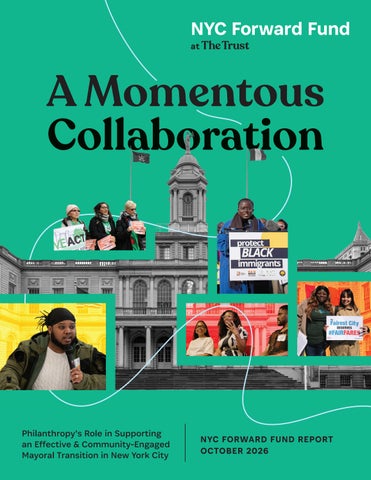
COVER: New York City Hall. Featured grantees (clockwise from top left): WE ACT for Environmental Justice, African Communities Together, Riders Alliance Fund, Association for Neighborhood & Housing Development, New York City Arts in Education Roundtable. Photos courtesy of grantees.
Table of Contents
4
From the New York City Forward Fund Co-Chairs
6
From The New York Community Trust
8
Fund Overview
12
A Momentous Collaboration for an Affordable City
28
Beyond 100 Days: Building a Stronger Partnership Between the City, Philanthropy, and Communities
32
A Philanthropy Playbook to Support Effective and Community-Engaged Mayoral Transitions
34
Fund Contributors
35
Fund Grantees
From the New York City Forward Fund Co-Chairs
T
he 2025–2026 mayoral transition came at a consequential time for New York City. New Yorkers were facing profound affordability challenges, growing uncertainty from Washington, and declining confidence in the ability of public institutions to improve their lives. At the same time, a new administration created an opportunity to strengthen how government, communities, and philanthropy work together around the city’s most pressing challenges. The NYC Forward Fund was our effort to meet that opportunity and put philanthropy’s resources to work at a time when they could be especially useful. Rather than wait for a new administration to take office, a group of funders organized early and pooled resources, asking how philanthropy could support the transition in a nonpartisan way and ensure community organizations had the capacity to inform priorities and engage with the incoming administration. We are grateful to the Steering Committee institutions that built and guided this effort: the Ford Foundation, Governing for America Fund, The New York Community Trust, the New York Foundation, the Scherman Foundation, and the Freedom Together Advised Fund, a fund maintained and managed by Assets Under Movement. We also want to recognize Shawn Morehead, who served as a founding co-chair while at The New York Community Trust and was instrumental in standing up the Fund and bringing together the partners who made this work
possible. We thank every funder that contributed and, most importantly, the community organizations whose leadership was the central focus of the Fund. This report shares what we learned, highlights the results of the collaboration, and explores how the transition opened the door to more strategic and durable partnerships among city government, philanthropy, and community organizations. It also offers practical guidance for funders in other cities considering how to prepare for and engage in charitable activities during mayoral transitions and the early stages of governing. New York’s experience may not translate in the same way to every city, but we believe there are lessons that can travel. Philanthropy can prepare earlier and organize more strategically, so its resources and relationships are ready when new governing priorities are taking shape. With this approach, philanthropy can help local governments and communities turn promising ideas into tangible public progress while reinforcing the responsibility of public institutions to deliver. We hope this report encourages funders to see mayoral transitions as nonpartisan opportunities to put philanthropy’s resources in service of the public good and build stronger partnerships that can endure well beyond the transition itself. —Elizabeth Guernsey Director, Governing for America Fund
—Rickke Mananzala President, New York Foundation
LEFT: New Yorkers United for Child Care at the Play Room in the War Room rally for universal child care in Albany. Photo courtesy of grantee.
NYC Forward Fund Report | 2026
5
From The New York Community Trust
T
he NYC Forward Fund was a collaborative effort by philanthropy, nonprofit organizations, and New York City’s new administration. Launched in 2025 by a group of local and national foundations, the Fund granted more than $4.6 million to nonprofits to bring community voices into the mayoral transition process and inform the early governing agenda through their experience and perspectives. As New York City’s community foundation, The New York Community Trust has strived to advance the city for more than a century. Recognizing that we are stronger together, we have led, over decades, countless funder collaboratives to address long-standing systemic issues such as workforce resilience, immigration, education, homelessness, and more. The Trust’s funder collaboratives are also known for responding rapidly to unforeseen challenges, from the advent of the AIDS crisis in the 1980s to the aftermath of the September 11th attacks to coordination of New York City’s foundation response to the COVID-19 pandemic. We were honored to host the NYC Forward Fund, a partnership that enabled the new administration to harness the creativity and expertise of New York City’s nonprofits in addressing long-standing municipal challenges. This report highlights how nonprofit leaders helped shape policy discussions on child care, housing, transportation, arts and culture, public safety, immigrant rights, worker rights, climate, and public revenue. It has made us immensely proud that fund grantees served on mayoral advisory committees, developed policy recommendations, connected residents with decision-makers, and helped the administration implement early priorities. We are equally pleased that the NYC Forward Fund represents a wide range of philanthropic partners—from individuals and locally focused family foundations to those with a national and international reach—that joined forces to make a better New York. Together, this diverse coalition demonstrates the impact that can be achieved when philanthropies of all sizes and scopes work in partnership toward shared goals. A central lesson in the pages ahead is that philanthropy can play a constructive role during mayoral transitions by organizing early, supporting community engagement, investing in nonprofit capacity, and helping government connect with residents. The report offers practical recommendations for funders and city leaders—in New York and beyond—for building long-term partnerships that strengthen public institutions, improve government effectiveness, and ensure residents have a meaningful voice in shaping public policy. A heartfelt thank you is due to the NYC Forward Fund co-chairs, Elizabeth Guernsey and Rickke Mananzala, as well as the members of the Steering Committee, who collectively dedicated their time and provided the wise counsel that helped drive the Fund’s success. We also want to acknowledge the efforts, resources, and staff of our partners in the Fund, without which the work would not have been possible.
6
And we want to recognize the commitment of the city’s public servants—appointed and career officials—whose expertise and openness to building a better New York played a central role in the Fund’s success. The NYC Forward Fund’s work would not have been possible without the expertise of Trust staff Barbara Taveras, Leigh Ross, and Marc Schell, who ably guided the day-to-day operations of this complicated endeavor. Special recognition is due to Shawn Morehead, whose vision, focus, energy, and tenacity brought the NYC Forward Fund to life and stewarded the partnership while she served as chief program officer of The Trust. Above all, we recognize that the achievements described in this report belong to nonprofit organizations and community leaders, whose daily work on the front lines of our city’s challenges is what makes these ideas, partnerships, and policy advances possible—and what moves New York City forward. —Carrie Trowbridge Interim President & General Counsel
NYC Forward Fund Report | 2026
—Irfan Hasan Interim Chief Program Officer
7
Fund Overview
I
n fall 2025, with then-Mayor Eric Adams dropping his bid for reelection, New York City faced a certain leadership transition heading into 2026. Although all moments of governing transitions create instability, this one came at a particularly important time. The city was facing its most serious housing crisis in 60 years. Thousands of New Yorkers were at risk of losing health coverage due to federal legislation passed in July 2025, and the food safety net remained in peril. At the same time, the federal administration was expressing its intent to dispatch the National Guard to the city. And many of the city’s immigrants—documented and undocumented—were living in fear of immigration detention and deportation. (We note that as of this writing, these
challenges and threats are ongoing.) Regardless of which candidate won the election, it was abundantly clear that the next mayor was going to have to grapple with these and other issues while keeping the city safe and running. The incoming administration would also have to contend with declining faith and trust in our institutions to produce meaningful change that can be seen and felt by those our economy has left behind. If they failed, New York City would become yet another example for those who argue that the public sector is hopelessly broken. But if they succeeded, that might lead to other opportunities to move toward our values of justice and dignity for all. All eyes were on New York. We knew it was critical that the next mayor
demonstrate a strong, prepared administration, partnering with communities, ready to lead our nation’s largest city. Facing these realities, a group of local and national philanthropic institutions came together in October 2025 to strategize on how philanthropy could support the next mayoral transition in New York City in nonpartisan ways. We knew from transitions in other places around the country that the charitable sector—nonprofits and philanthropy—would undoubtedly play a role in the next mayor-elect’s transition. Nonprofit leaders, their clients, and their funders bring a wealth of experience to inform a new administration’s priorities and plans. And with support, they can also make sure those plans are carried out effectively.
ABOVE: Association for Neighborhood & Housing Development members meet with NYC Housing Preservation & Development leadership in March 2026. Photo by Samuel Lahoz Photography.
8
New York City is home to more than 46,000 nonprofits that employ more than 600,000 workers, accounting for roughly 18 percent of the city’s entire private-sector workforce. These nonprofits generate close to $42 billion in annual wages and contribute roughly 9.4 percent of New York City’s total GDP.
and advocacy infrastructure in New York City that would undoubtedly be tapped by the incoming administration for ideas, policies, and people. This group of funders formed the Steering Committee of what we eventually named the New York City Forward Fund (NYC Forward Fund).
On October 6, the Ford Foundation and the Governing for America Fund hosted a strategy and learning conversation focused on the governing opportunities in New York after the November mayoral election. This was a purely nonpartisan conversation and did not focus on the candidates or their platforms. During our time together, we grounded ourselves in lessons learned from mayoral transitions in cities around the country. We also looked back on what worked well with past governing opportunities in New York City and New York State. The discussion among funders made it clear that there was interest in putting together a philanthropic fund to support New York City.
The NYC Forward Fund set a fundraising goal of $5 million by February 1, 2026. The New York Community Trust, the community foundation for New York City, Long Island, and Westchester, with a century of grantmaking expertise that includes hosting funder collaboratives, housed the Fund and, for this important civic effort, offered all grantmaking management and services inkind. The NYC Forward Fund began accepting contributions immediately, with the goal of distributing all grants by April 11, 2026, reflecting the end of the first 100 days of the incoming mayoral administration.
Shortly thereafter, a group of New York City local and national funders—the Ford Foundation, Governing for America Fund, The New York Community Trust, the New York Foundation, the Scherman Foundation, and the Freedom Together Advised Fund, a fund maintained and managed by Assets Under Movement— came together to explore what a fund would look like to support the mayoral transition moment in New York City. We worked through a strategy that would support both the incoming administration, regardless of who became mayor-elect, and the critical nonprofit organizing
NYC Forward Fund Report | 2026
Drawing upon lessons from past transitions and assessing the current landscape, the NYC Forward Fund strategy focused on three critical components we believed would need philanthropic resources: 1. Administration preparation infrastructure: Strong transition operations for the incoming administration, including preparedness to fully assume power and implement changes important to New Yorkers from day one.
NYC Forward Fund in Numbers
$5 million fundraising goal
$5.4 million + raised
$4.6 million +
in grants supporting the city’s nonprofit organizations’ engagement in the mayoral transition
$800,000 + to support transition operations and talent development
2. Talent recruitment: An external transition committee focused on attracting diverse talent into the new administration.
9
3. Robust community engagement to deliver on policy goals: A process for the incoming administration to have strong plans to deliver on policy goals, in partnership with community and nonprofit organizations, ensuring these policies were shaped to most positively affect New Yorkers.
of priority issues for the city that included housing, transit, environment, education, child care, immigration, public safety, arts and culture, worker rights, revenue, and policy research. We also identified potential grantees—nonprofits with deep expertise in the priority issues and large constituent bases.
work together to support an efficient and effective mayoral transition and the nonprofit infrastructure that would be key to the governing opportunities in New York City and New York State in the months and years ahead. We shared the goals and strategy of the NYC Forward Fund and our fundraising
ABOVE: The New Era Institute’s kickoff event at Trinity Commons. At right, Chief of Staff Elle Bisgaard-Church and Mayor Zohran Mamdani speak at the event. Photos courtesy of grantee.
While the NYC Forward Fund took seriously that we would need to raise and allocate resources to support transition operations and talent, we built our strategy around the third pillar—supporting the city’s nonprofits that we knew would be critical to the success of any incoming administration and that are always asked to do more during these governing moments. We decided that the majority of funds raised would support the city’s nonprofit organizations’ engagement in the transition, with a smaller portion allocated to support pillars one and two. Throughout October 2025, the Steering Committee met weekly to hone its strategy, including focusing on a set
10
We contacted all three mayoral campaigns to make them aware of the fund and to invite them to a meeting in mid-November if their candidate became the mayor-elect. During this time, Steering Committee members also talked with philanthropic institutions, both local and national, about their interest in the fund and securing pledges. By the end of October, we had $2.5 million committed to the NYC Forward Fund. On November 12, eight days after Zohran Mamdani became mayor-elect, the NYC Forward Fund convened the donors who had committed funds as well as other funders who were interested in contributing. We discussed ways funders who care about New York City could
progress to date. Mayor-elect Mamdani joined the meeting and expressed his enthusiasm for working together. We made our initial grants in mid-November to a group of nonprofit organizations working on child care, education, housing, and transit. At the same time, the Steering Committee began to meet with members of Mayor-elect Mamdani’s transition team to understand how the strategy of the NYC Forward Fund, specifically around talent and administration infrastructure, aligned with the goals of the incoming administration. Steering Committee members also continued to meet weekly to reach decisions on grantmaking
and update each other on funds raised. We continued providing grants to nonprofits working on arts and culture, environment, public safety, immigration, worker rights, revenue, and policy research. In addition, our meetings with the mayor-elect’s transition team made it clear that the administration wanted to train its senior team members on innovative ways of governing. We supported the New Era Institute, a new training program for deputy mayors, commissioners, and other senior staff focused on governing in a way that delivers for the people of New York. The New Era Institute launched in September 2026 with over 90 commissioners and office heads in attendance. At the launch, Mayor Mamdani shared his expectations of his commissioners and how the New Era Institute was an investment in their leadership. The mayor’s chief of staff, Elle Bisgaard-Church, highlighted the three core mandates for every commissioner to govern by—making New York City
affordable for every New Yorker, tackling corruption and waste, and demonstrating public excellence through exceptional service provision. After the training session, one commissioner who had served in multiple administrations wrote, “This is the first time I have felt so invested in by the Mayor’s Office! Thank you.” The Fund also made key investments to help the Mayor’s Office of Child Care and Early Childhood Education hit the ground running with information and staffing to make 2-K and expanded 3-K a reality for fall 2026. Shortly after Mayor Mamdani took office, the Fund exceeded its goal of raising $5 million. It ultimately raised over $5.4 million and made over $4.6 million in grants to support critical nonprofits in New York City that were key partners in the mayoral transition; the remaining funds were used for contracts to support transition operations and talent development. n
“
With the NYC Forward Fund, the Ford Foundation saw an opportunity to mobilize national dollars alongside local funders to provide direct resources to the community-based organizations that know New York best. This ensured community leaders had a seat at the decision-making table and the new incoming administration was equipped with community-driven insights to deliver for New Yorkers on day one.” —Javier H. Valdés Director of Civic Engagement & Government, Ford Foundation
NYC Forward Fund Report
A Momentous Collaboration for an Affordable City
ABOVE: Artists participate in the Artist as Entrepreneur program presented by the New York Foundation for the Arts in partnership with the College Art Association.
I
n “A People’s Pulse,” a February 2025 survey of 3,000 New Yorkers across the five boroughs, more than 60 percent of respondents said it was getting harder to meet their basic needs, particularly rent, food, child care, and health care. And 58 percent had lost faith in the government’s ability to improve their lives. Commissioned by The Trust, Brooklyn Org, the Staten Island Foundation, and the Altman Foundation and spearheaded by the 5BORO Institute, the survey shed light on issues affecting large swaths of New Yorkers in the lead-up to the November 2025 mayoral election.
12
60%
of New Yorkers said it was harder to meet their basic needs
As the mayoral election unfolded, it became clear to NYC Forward Fund donors that collaboration between the charitable sector—nonprofits and philanthropy—and the new city administration, regardless of who became mayor, would be essential to addressing the city’s affordability crisis and improving the lives of New Yorkers in ways they could see and feel. The city’s government relies on local nonprofits to meet New Yorkers’ needs for education, health care, housing, food, job training, and other essentials.
Yet nonprofits and the people they serve are often shut out of the policymaking process. The NYC Forward Fund dedicated over $4.6 million to help more than 40 nonprofit organizations ensure that the voices of everyday New Yorkers informed the priorities and plans of the new mayoral administration. Mayoral transitions are critical windows for influencing policy priorities, administrative infrastructures, and key appointments. For NYC Forward Fund grantees, the transition offered a rare opportunity to
advance ambitious child care, housing, transportation, arts and culture, and public safety priorities to make the city more affordable and equitable. Other pressing issues, such as immigrant and worker rights and climate justice, were also top of mind for grantee organizations. NYC Forward Fund grants allowed grassroots organizing groups, advocacy organizations, and service providers to “have a seat at the table during the mayoral transition and not be crowded out by others with money and influence,” noted Mike Pratt, former president and CEO of the Scherman Foundation, an NYC Forward Fund founding donor. The grants also filled a long-standing gap in philanthropic support for the mayoral transition work often expected of nonprofits. Leaders and senior staff from grantee organizations served on 11 of 17 mayoral transition advisory committees: housing, economic development, social services, youth and education, community safety, criminal
legal system, immigrant justice, worker justice, transportation and climate, arts and culture, and community organizing. In their role as advisors on these committees, NYC Forward Fund grantees helped shape the policy priorities of the new administration and weighed in on candidates for deputy mayors, commissioners, and agency heads. Prior to the election and during the mayoral transition, grantee organizations prepared detailed policy recommendation memos that provided actionable solutions for the new city administration. In coordination with the administration, the groups conducted robust communication and education campaigns to amplify New Yorkers’ voices and build broad public support for shared policy priorities. The collaboration between NYC Forward Fund grantees and the new administration demonstrates that co-creation of durable solutions to the affordability crisis and other issues affecting New Yorkers is both possible and essential. n
“
The Surdna Foundation was proud to contribute to the NYC Forward Fund because it brought community groups and their perspectives into the mayoral transition. When government and philanthropy listen to the people they serve, they’re far better positioned to tangibly improve life for New Yorkers. As a national foundation that has called New York City home for more than a century, we saw an opportunity to support that kind of collaboration in our hometown. That’s the goal of philanthropy and government alike, and we accomplish more when we work together.” —Don Chen President Surdna Foundation
ABOVE: The Center for Anti-Violence Education’s Community Safety Symposium. Photo by Gerard Gaskin.
NYC Forward Fund Report | 2026
13
SPOTLIGHT
Child Care
C
hild care is one of the city’s most urgent affordability issues. Lowand middle-income families rely on free early childhood education programs to make a living and raise children in New York. Under previous administrations, the city made sizable investments in early childhood care and education. It created full-day prekindergarten for all 4-year-olds, expanded free full-day early education programs for 3-yearolds, and increased subsidies (vouchers) to help low-income parents pay for child care. But even with these investments, child care remains unaffordable for 80 percent of New York's
families, according to a 2025 report by the Citizens Committee for Children. On average, parents not eligible for subsidies pay about $26,000 annually for center-based child care and $18,000 for home-based care for kids ages 2 and under. Compounding the situation is the city’s shortage of accessible, affordable child care, caused primarily by the untenable economics of the child care system. Although wages for workers are low and benefits are scant, personnel costs form the bulk of providers’ operating expenses, making it difficult for them to cut costs to increase profit margins. But families can barely afford current rates,
ABOVE: Chantal Hinds, a New Yorkers United for Child Care parent-leader, speaks at the Play Room in the War Room rally for universal child care in Albany. Photo by Alexandra Chan.
14
so increasing fees is not a viable option either. Finding qualified staff is difficult, and turnover in the field is high. Meanwhile, publicly subsidized child care programs reach just a fraction of eligible families and are vulnerable to political maneuvering. Making child care free for all children up to age 5 would reduce the economic burden for low- and middle-income families. Universal child care also would bring significant economic benefits to the city by increasing labor force participation and disposable income, according to a 2025 report by the city’s comptroller. New Yorkers United for Child Care, an NYC Forward Fund grantee, organizes local parents, caregivers, and allies to ensure that all children in New York City up to age 5 have access to free, full-day, year-round care. During the mayoral transition, the organization ensured that the new administration recognized universal child care as both an economic necessity and a quality-of-life issue. It also socialized its “2-Care for All” blueprint with incoming administration officials. The blueprint outlined how New York City could extend free child care access to 2-year-olds as the next phase of universal child care. New Yorkers United for Child Care mobilized its large membership base of parents to push for expanding and fully funding existing 3-K and pre-K
programs. It also amplified free child care for 2-year-olds. constituent voices through This made 2,000 seats available earned media, including in September 2026 in coverage by major select neighborhoods outlets. “Our job is across the city, with to demonstrate plans to serve constituent approximately demand for 12,000 children child care and to in 2027 and in public funding build constituent reach all eligible to expand free power via old2-year-olds by child care school community 2029. Looking organizing,” ahead, advocates explained Rebecca are poised to Bailin, the nonprofit’s continue pushing the founder and executive director. city and state to expand the system to serve infants and Concurrently, the Public Policy toddlers under age 2 and ensure and Education Fund, another that all universal child care NYC Forward Fund grantee, programs provide full-day, worked with the Alliance for year-round care. Quality Education to organize child care providers and raise By working in tandem with the awareness about the need to Mayor’s Office of Child Care improve wages, particularly and Early Childhood Education for family providers operating and bringing together families, out of residential settings. child care workers, and other On average, these providers concerned New Yorkers to make less than $10 an hour, advocate for systemic reform, depending on the number of New Yorkers United children served, according to a for Child Care and report by the Center for NYC the Public Policy and Affairs. The organization also Education Fund are successfully pressed the state moving the city closer to increase funding for to making universal child care vouchers, child care a reality helping to reduce in New York City gaps in care while for all children the system expands. up to age 5. n
$1B +
Early outcomes are promising. The city administration fully funded 3-K, making more seats available closer to where families live. The mayor secured more than $1 billion in state support to expand free child care in the city, including through the launch of
NYC Forward Fund Report | 2026
“
Too many people struggle to afford the basic things they need to live a good life. The NYC Forward Fund created an important opportunity to bring community voices and ideas into the conversation as a new administration prepared to govern. That early collaboration helped lay the groundwork for continued partnership around priorities like universal child care, where MCF has since invested $3 million to support the city’s efforts.” —Carmen Rojas President and CEO, Marguerite Casey Foundation (MCF)
LEFT: Members of New Yorkers United for Child Care in Washington Heights before the mayor’s 2K for 2-K event. Photo courtesy of grantee.
15
SPOTLIGHT
Housing
N
ew York City is facing its worst housing crisis in 60 years. Housing costs continue to soar, leaving many New Yorkers unable to afford rent and meet their other expenses. Zoning obstacles and lack of incentives for private developers to build affordable housing have limited construction of new housing. Additionally, stringent regulations have cut off the supply of many once-common types of housing without replacing them, leaving many residents vulnerable to unsafe,
unaffordable housing or, in the worst cases, unhoused. The 2025 Columbia University Communities Speak survey indicates that the city’s housing affordability crisis disproportionately affects Black, Hispanic, and Asian households, as well as people with disabilities, immigrants, and Bronx residents. “Ensuring that the new city administration centered the housing needs of vulnerable New Yorkers was top of mind for housing advocates,” noted Juanita O. Lewis, executive
director of Community Voices Heard, an NYC Forward Fund grantee. Prior to and during the mayoral transition, NYC Forward Fund grantees mobilized tenants across the city to ensure that a rent freeze would be a prominent housing commitment for the new mayor. During the transition period, grantee organizations brought deputy mayors, commissioners, and senior staff directly into rent-stabilized buildings to see conditions firsthand and hear directly from residents.
ABOVE: Housing Justice for All holds a Rental Ripoffs Rally in the Bronx in March 2026. Photo courtesy of grantee.
16
ABOVE: Dave Giffen, executive director of Coalition for the Homeless, speaks at the nonprofit’s City Hall rally to expand the City Fighting Homelessness and Eviction Prevention Supplement program in June 2026. Photo courtesy of grantee.
The city’s Rent Guidelines Board approved a rent freeze for one- and two-year leases in June 2026—a huge win for the more than 2 million New Yorkers who live in rentregulated apartments, most of whom are low-income people of color. The rent freeze “made millions of people in the city feel like their lives would get better because of this policy,” said Noemi Dann, managing director of Housing Justice for All, a statewide coalition of more than 80 grassroots organizations that represent tenants, people experiencing homelessness, and public housing residents. As housing grantees noted, the most effective government engagement with communities occurs when residents are
NYC Forward Fund Report | 2026
treated as ongoing partners in governance. Grantees’ collaboration with the incoming mayoral administration elevated tenants’ concerns and helped inform the city’s efforts to address the housing crisis. n RIGHT: Mercedes Escoto from Court Appointed Special Advocates (CASA) at an April 2026 Association for Neighborhood & Housing Development meeting with NYC Housing Preservation & Development leadership on code enforcement. Photo by Samuel Lahoz Photography.
17
SPOTLIGHT
Transportation
R
ising fares, unreliable trains, and slow buses are costing New Yorkers more than they can afford to get to work, school, or anywhere else they need to go in the city. Low-income subway and bus riders spend about 10 percent of their income on transportation expenses, according to research from the 2025 Columbia University Poverty Tracker. And a recent report by the New York City Independent Budget Office notes that slow bus service makes everyday trips for commuters far longer than they should be, particularly for outer-borough residents who rely on buses because of limited subway service.
18
The Mamdani administration created a meaningful opening for transportation advocates like the Riders Alliance Fund to advance the transit policies and legislation for which they had been fighting for years. Established in 2012, the Riders Alliance Fund is a membership organization of people who use public transit. It organizes subway and bus riders to ensure they have a voice in decisions affecting public transportation in the city and region. During the mayoral transition and in the early months of the new administration, the Riders Alliance Fund helped the administration conduct a public
awareness campaign centered around bus riders’ voices and leadership. The campaign sought to create excitement for faster buses. “If the new mayor is going to succeed in delivering fast and free buses, a lot more people will have to think about the bus than have ever thought about it before. A lot more people will need to understand that never in the history of New York City have we had fast buses—and that is why the challenge will be significant, but the rewards will be lasting and transformational on our streets and in the lives of New Yorkers,” said Betsy Plum, executive director of the Riders Alliance Fund.
The campaign also sought to restore faith in government. As the Riders Alliance Fund underscored in its recommendation memo to the administration, if riders did not see themselves reflected in the process, the messaging and proposals to reallocate street space could feel like a threat—sparking fears of displacement, gentrification, or other concerns—rather than an investment in shared infrastructure. The Riders Alliance Fund also convened transit advocates to identify ways (political, fiscal, and operational) for the administration to implement its agenda for fast and free buses. While the road to achieving faster and free buses may be long and arduous, early outcomes of the collaboration between transit advocates and the administration are encouraging. These include the largest expansion of Fair Fares eligibility, which gives low-income New York City residents a 50 percent discount on public transportation, since the program was created in 2018. This expansion will help another 340,000 low-income New Yorkers use subways and buses at a discounted price. Additionally, the city’s Department of Transportation and the Metropolitan Transit Authority have begun building faster bus corridors in highneed areas of the city. These and other improvements, such as countdown clocks and alldoor boarding, will save time and money for millions of bus riders across the city. n
ABOVE: Members the Mamdani Administration’s transition subcommittee on Transportation, Climate, and Infrastructure take a tour on a local NYC MTA bus route, hosted by the Riders Alliance Fund. Photo courtesy of grantee.
lower fares for an additional
340K New Yorkers
LEFT: The launch of the Next Stop bus plan, a comprehensive city and state plan to speed up buses. Photo courtesy of the Riders Alliance Fund. NYC Forward Fund Report | 2026
19
SPOTLIGHT
Arts & Culture
N
ew York City is known as the cultural center of the world, with myriad arts and culture offerings available to residents and visitors alike. Local artists, neighborhoodbased cultural groups, and arts service nonprofits are an integral, yet often unrecognized, part of the city’s vibrant arts and culture scene. These groups and organizations enhance community well-being, youth education, and social cohesion, and they are a vital part of the city’s economy. Yet they struggle year after year to stay afloat financially. Additionally, the affordability crisis has made it harder for artists and cultural workers to live and work in the city given the high cost of housing and workspace. The new administration’s emphasis on affordability resonated strongly with arts and culture grantee organizations, many of whom viewed the transition as an opportunity to reposition their field within broader policy conversations. “It was a natural opportunity to be at the table for conversations about arts and culture as part of affordability
20
and thriving communities in all five boroughs,” noted Talia Corren, executive director of A.R.T./New York, the leading service and advocacy organization for the city’s nonprofit theater community. To capitalize on the mayoral transition, grantee organizations worked together to identify opportunities to partner with the new commissioner of the Department of Cultural Affairs (DCLA). They established closer working relationships with the DCLA and pushed for increased funding for arts and culture organizations, protecting arts education, and strengthening the borough councils that are critical to local cultural infrastructure. They also provided real-time information, constituent stories, and data from artists and cultural workers to inform broader policy conversations about affordability, housing, workforce support, health care, and economic justice.
In June 2026, grantee organizations and their constituents were heartened by the administration’s record-breaking allocation of $323 million for arts and culture in the city’s fiscal year 2027 budget. Additionally, more than $4 million was baselined for arts instruction. The administration also established a “cultural stability fund” that will distribute $10 million annually over the next three years to help struggling arts organizations. These outcomes, and the hiring of a senior advisor for arts and culture within the Deputy Mayor’s Office of Economic Justice, point to increased recognition of arts and culture within city conversations about affordability and openness to addressing the needs of artists and cultural workers. Beyond these wins, NYC Forward Fund grantees celebrated a renewed sense of optimism among artists and cultural communities. Many noted that constituents are more engaged and confident that collective action can influence government decisions. n
LEFT: Jay Rodriguez Sierra performs at NYC First Amendment Day 2025, co-organized by New Yorkers for Culture & Arts. Photo by Tal Yarden. BELOW: The Student Honors Choir at PS 154 The Harriet Tubman Learning Center performs at the New York City Arts in Education Roundtable’s All Hands on Deck: A Policy Forum on Arts Education. Photo by Caleb Bryant Miller.
NYC Forward Fund Report | 2026
Record-breaking
$323M in city budget for arts & culture
21
SPOTLIGHT
Public Safety
P
ublic safety is a major concern for New Yorkers. Many residents feel unsafe because of real or perceived violence and crime problems in their neighborhood, the subway system, and other public spaces. Yet New York City is one of the safest places in the country, according to a recent report on crime and safety trends by the Brennan Center. Gun violence
But New Yorkers’ feelings of safety (or lack thereof) are often less about crime statistics and more about escalating social challenges, like increasing levels of homelessness and mental health conditions. Solving these problems and enhancing community safety require approaches that go beyond law enforcement and the criminal legal system.
ABOVE: The Center for Anti-Violence Education hosts a Community Safety Symposium, with guests including Deputy Mayor for Community Safety Renita Francois and Public Advocate Jumaane Williams. Photo by Gerard H. Gaskin.
and crime, including murder, are at or near record lows, the report noted. And, according to the New York Police Department’s own CompStat reports, the city is on track for its safest year on record, with overall major crime complaints dropping about 6.6 percent as of August 2026.
22
The new mayoral administration’s acknowledgment that things like stable housing, jobs, and mental health treatment are integral to building safer communities provided an opening for collaboration between the city and NYC Forward Fund grantees that for years had advocated for
preventative approaches to public safety. Closing the Rikers Island jail complex and relying less on the police to address crises related to mental health were shared priorities for NYC Forward Fund grantees and the new administration. (Rikers Island is a 14-jail complex where the city holds defendants awaiting trial who are not eligible for or cannot afford bail. In 2019, amid increasing reports of violence and dangerous conditions, Mayor De Blasio and the New York City Council agreed to shut down Rikers by 2027 and replace it with smaller, borough-based jails.) In June 2026, with support from the NYC Forward Fund, the Center for AntiViolence Education (CAE) convened advocates in the field of community safety and violence prevention to identify priorities for the city and ways to co-create a communitybased safety infrastructure rooted in prevention, care, and connection. More than 100 guests attended the meeting, including Renita Francois, deputy mayor for community safety, and Dr. Ayesha DelanyBrumsey, commissioner of the Mayor’s Office of Community Safety. Since the gathering, CAE has been meeting with the Office of Community Safety and partner organizations to discuss how best to spend the $26 million that the mayor announced would be allocated for hate-violence prevention in his 2027 budget.
organizes individuals, families, Public safety advocates and communities directly recognized early on that impacted by incarceration. significant public support was Freedom Agenda members going to be necessary for the have been among the leaders administration to shift the of the grassroots system toward healthcampaign to close centered, communityRikers Island. driven approaches Major crime to public safety. complaints During the transition, in “We knew we coordination with needed to build deputy mayors, massive public commissioners, support for year-to-date and senior City the new mayor as of August 2026 Hall staff, grantee to implement organizations [shared public conducted listening safety priorities]. The sessions, community forums, administration was going and public events to build to face the same forces of support for shared public-safety opposition that have always been policy changes. Grantees are there, including law enforcement encouraged by early outcomes groups and some media outlets,” of the collaboration with the city said Sarita Daftary, co-director administration. These include of Freedom Agenda, an NYC shifting to social workers and Forward Fund grantee that
6.6%
mental health professionals as responders to mental-healthrelated 911 calls, which will be handled by the Mayor’s Office of Community Safety, and closing Rikers Island’s North Infirmary Command facility and transferring detainees with mental illness to a new therapeutic unit at Bellevue Hospital. The collaboration of grantee organizations with the new mayoral administration demonstrated how important it is for community and government to work together to co-create public safety policies and interventions. The challenge ahead is building on the progress made during the transition period to ensure lasting change for New Yorkers. n
ABOVE: Freedom Agenda staff, members, and friends gather at Rainey Park in Astoria, NY, for their fifth annual Juneteenth barbecue. Photo courtesy of grantee.
NYC Forward Fund Report | 2026
23
SPOTLIGHT
Other Priority Issues
T
he NYC Forward Fund investments also fostered stronger relationships between nonprofits and the new city administration around other community issues such as immigration, worker rights, and climate justice. The NYC Forward Fund supported statewide advocacy efforts aimed at increasing public revenue to implement shared priorities as well as research on pressing social and economic issues facing the administration. Grantee organizations have spent years advancing policy solutions around immigrant rights and worker protections, often without meaningful partnership from City Hall. The prospect of a new administration created hope that these issues would finally receive sustained attention. There was a sense that the administration
was genuinely interested in serving the people and open to collaboration with nonprofits. “It was apparent to us that it’s not just lip service the way the administration has been centering workers and immigrants—that we have a seat at the table,” said Ligia Guallpa, executive director of the Worker’s Justice Project. The group organizes and advocates for more than 12,000 low-wage immigrant workers in the construction, house cleaning, and appbased delivery industries. ADVANCING WORKERS’ PROTECTIONS For worker rights grantees like the Worker’s Justice Project, the mayoral transition represented an opportunity to reverse policies they viewed as harmful for vulnerable
workers. It also was an ideal moment to work with the incoming administration on implementing delivery-worker infrastructure and enforcement of worker protections. The previous administration passed a policy that criminalized bike riders for any type of street traffic violation. Also, plans to create a hub for delivery workers in the city had stalled. The Worker’s Justice Project worked successfully with the deputy mayor for economic justice and the city’s Department of Consumer and Worker Protection (DCWP) to end the criminalization of e-bike riders. In collaboration with the city administration, the group won several high-profile settlements for back wages for delivery workers. A long-fought-for delivery-workers hub finally opened near City Hall. Some 80,000 delivery workers now have, for the first time, a place to rest, charge e-bike batteries, repair their bikes, and receive support services.
ABOVE RIGHT: Antonio Solis is a leader with Los Deliveristas Unidos, an advocacy campaign organized by the Worker’s Justice Project to improve the wages and treatment of app-based delivery workers. Photo by Ari Mintz. LEFT: African Communities Together at an Essential Workers Rally. Photo by Alexa B. Wilkinson.
24
PROTECTING IMMIGRANT NEW YORKERS Prior to the election, alarmed by sharp increases in community arrests by Immigration and Customs Enforcement (ICE) and federal threats to the city’s sanctuary policies, immigrant rights grantees prepared detailed policy recommendations and transition memos that provided actionable solutions for incoming officials. This made sense on multiple fronts given that New York City is home to about 3.1 million foreign-born residents, who make up 38 percent of the city’s total population. Grantees’ expertise and the experiences of constituents informed executive orders issued by Mayor Mamdani during the transition period. These included prohibiting city agencies from sharing residents’ personal data with federal immigration authorities, and banning ICE agents from entering schools, hospitals, and shelters. Grantee organizations were pleased that the administration moved quickly to address advocates’ concerns about data sharing and acted on sanctuary policy recommendations to protect immigrant New Yorkers.
NYC Forward Fund Report | 2026
CLIMATE More than two-thirds of greenhouse gas emissions in New York City come from buildings. In 2019, the city passed a package of legislative actions, the Climate Mobilization Act, to reduce greenhouse gas emissions to zero by 2050. Central to the act is Local Law 97, which came into effect in 2024, requiring buildings larger than 25,000 square feet to meet strict emission-reduction targets.
The New York City government is the second-largest landlord in the city. Its public housing agency, the New York City Housing Authority (NYCHA), owns and operates more than 2,000 buildings across the five boroughs. These buildings are home to close to 400,000 New Yorkers. Bringing NYCHA buildings into compliance with Local Law 97 is a key priority for the new city administration. Likewise, moving NYCHA buildings to clean energy has been a big priority for nonprofits like West Harlem Environmental Action (WE ACT for Environmental Justice). The organization engages
ABOVE: Eunice Ko and Daniel Chu of the New York City Environmental Justice Alliance speak at the NY Renews Climate Justice and Jobs rally in Albany. Photo courtesy of grantee. 25
ABOVE: A WE ACT for Environmental Justice march. Photo courtesy of grantee.
residents in environmental justice policy advocacy to improve community health. In 2021, in partnership with the Columbia University Mailman School of Public Justice and the Berkeley Air Monitoring Group, WE ACT for Environmental Justice launched a pilot project, Out of Gas, In with Justice, in 10 NYCHA apartment units in the Bronx to demonstrate the health benefits of replacing gas stoves with induction stoves. The data from WE ACT’s pilot project helped inform the administration’s NYCHA Sustainability Agenda. WE ACT is working with the
26
Mayor’s Office of Climate and Environmental Justice to replace gas stoves in NYCHA buildings and install heating and cooling systems that do not rely on fossil fuel. When fully implemented, these improvements will help the city meet its greenhouse gas emissions goal and contribute to lowering asthma rates among New Yorkers in low-income communities, where NYCHA complexes are primarily located. REVENUE & POLICY RESEARCH The new administration’s affordability agenda responded to widespread public demand for change and was aligned with several community priorities.
However, achieving meaningful change in child care, housing, and other priorities would require securing significant new revenue streams at the city and state levels. The Invest in Our New York campaign, a project of the Public Policy and Education Fund, focused its advocacy efforts on connecting revenueraising tax policies to the incoming administration’s agenda. The campaign identified universal child care as a major priority and sought to position it as a core investment issue for workingclass New Yorkers both in New York City and across the state.
Invest in Our New York is a statewide coalition that brings together grassroots organizations, community leaders, labor partners, housing advocates, and impacted residents. The campaign combined grassroots organizing, public education, media engagement, and statewide mobilization that complemented direct advocacy to state leaders by the mayor and administration officials. The coordinated approach by the Invest in Our New York campaign and the city administration helped elevate progressive tax revenue proposals. The group pointed to the pied-à-terre tax on luxury second homes,
growing public willingness to consider tax reforms to fund essential services, and greater coordination between city and state leaders around funding priorities as promising early outcomes. The work ahead includes pushing for state-level action to support city priorities and offset federal funding cuts. NYC Forward Fund grantees agreed that the mayor has helped create a vision of government as a positive force that can improve people’s lives. The administration’s openness to community expertise and its willingness to engage directly with nonprofit organizations and affected communities has accelerated progress toward universal child care and other
affordability initiatives. It has also strengthened public confidence that the government can deliver meaningful benefits. As Josh Wallack, program officer at the Ford Foundation, noted, “It made sense that the NYC Forward Fund invested in community power-building to work with the administration and hold it accountable for delivering on shared priorities.” Fund grantees underscored the need for continued organizing and advocacy to ensure that city leaders remain steadfast in their commitment to work with local nonprofits and their constituents as key partners in governance over the coming years. n
ABOVE: Dawn Wells-Clyburn, executive director of PUSH Buffalo, speaks at a rally with Invest in Our New York in Albany in March 2026. Photo by Ken Schles.
NYC Forward Fund Report | 2026
27
BEYOND 100 DAYS
Building a Stronger Partnership Between the City, Philanthropy, and Communities
T
he mayoral transition created a focused opportunity to partner with the incoming administration as it prepared to govern, bring strong talent into government, and engage community organizations around key policy priorities. It also gave the NYC Forward Fund, philanthropic partners, and the administration a chance to consider how collaboration between the city and philanthropy could extend into the governing years ahead. New York City is particularly well positioned for this kind of partnership. The city is home to one of the country’s largest concentrations of foundations and nonprofit organizations and is also a global center of finance and investment. Connecting these assets with public leadership around priorities that strengthen communities can make a tangible difference for people across the city.
2. Position the Mayor’s Fund to Advance New York City as a strategic partnership vehicle: Focus the Mayor’s Fund on defined public priorities where flexible philanthropic resources can support implementation, test promising approaches, and help build toward sustained public investment.
We approached these recommendations from a core belief that philanthropy should strengthen public investment and responsibility, not replace it. The government is responsible for delivering and sustaining public systems, while philanthropy can bring flexible grants, investment capital, and support for community organizing and advocacy around shared priorities.
3. Add impact capital alongside grantmaking: Build capacity to identify where foundations and other mission-aligned investors can help address financing gaps tied to the same priorities.
BUILDING STRONGER INFRASTRUCTURE FOR COLLABORATION New York City government and philanthropy have a long history
agencies and provide a clear front door for funders.
The NYC Forward Fund’s collaboration with the incoming administration led to three recommendations for a stronger long-term partnership between the city and philanthropy: 1. Create stronger coordination across City Hall: Establish an empowered point of leadership and institutional home to coordinate philanthropy across
28
ABOVE: ALIGN NY joins climate and labor leaders and University of Albany President Havidán Rodríguez to unveil a new $30 million decarbonization project at the university. Photo by Patrick Dodson.
of working together, but the partnership approach has varied across administrations and agencies. A key recommendation from the Fund’s Steering Committee to the new mayoral administration was to create a clearer and more consistent structure for this work. In an early step aligned with that recommendation, the administration hired a new philanthropic liaison. The liaison coordinates across City Hall, helps translate agency priorities into a coherent philanthropic agenda, and serves as a primary point of contact for funders. Philanthropy New York, a local philanthropic network of nearly 300 grantmaking organizations, is a key partner, working closely with the liaison to convene funders, share information, and coordinate philanthropic support around shared priorities. Together, this will create a stronger connection between City Hall and the broader philanthropic sector. USING THE MAYOR’S FUND STRATEGICALLY Since 1994, the Mayor’s Fund to Advance New York City has been an important vehicle for the city to partner with philanthropy on public initiatives, crisis response, and community partnerships. At its best, it has mobilized flexible resources around defined priorities, tested promising approaches, and helped successful models inform city policy and services. Building on that record, the transition recommendations call for a more focused strategy tied to clear city priorities, a more defined governance framework, and stronger relationships with foundations.
NYC Forward Fund Report | 2026
The Mayor’s Fund is most useful where philanthropic resources can add particular value, rather than as a general fundraising vehicle whenever outside money is needed. It can also provide space to test approaches before the government is ready to act at scale. Philanthropic support can help launch pilots, address early implementation barriers, and generate evidence that informs future policy, services, and budget decisions. An early Mayor’s Fund initiative under the Mamdani administration, the Child Care Action Fund, is putting this approach into practice. Philanthropic support is helping advance the path toward universal child care through provider stabilization, technical assistance, outreach, and implementation connected to city pilots. The goal is not for philanthropy to finance universal child care, but to address early barriers and help build toward a publicly supported system that can expand citywide. ADDING IMPACT CAPITAL TO THE PARTNERSHIP Grants are not the only tool philanthropy can bring to public priorities. As more foundations use impact investing alongside grantmaking, investment capital can help address financing barriers where conventional financing may not be available on the right timeline, terms, or risk profile.
“
The Kornfeld Foundation supported the NYC Forward Fund because a political transition during a democratic and economic crisis is exactly when community organizations need resources to bring their expertise to a new administration. The Fund put resources in their hands while creating more coherent, accountable partnerships. As a small local foundation, it offered a way to achieve impact far beyond our own grants.” —Katy Clark Executive Director The Kornfeld Foundation
The NYC Forward Fund is supporting development of an impact capital strategy alongside the city’s grant strategy. The administration’s philanthropic liaison is coordinating across
29
“
For local philanthropy, a mayoral transition is important, but the work cannot begin or end with an election. The organizations that helped shape this transition have been building relationships, organizing communities, and advancing solutions for years. Our role is to invest in that civic infrastructure for the long term, so communities have the power to shape government not just during a transition, but throughout an administration.” —Trish Adobea Tchume Vice President, Robert Sterling Clark Foundation
30
agencies and with foundations and other impact investors so grants and investment are organized around the same priorities. In child care, impact capital could finance facilities, equipment, code compliance, or working capital alongside Mayor’s Fund grants. It could also support cooperative models that help providers share costs, strengthen worker and provider ownership, and build more sustainable community-based child care infrastructure. In housing, it could support acquisition, predevelopment, bridge financing, or guarantees that preserve affordability and support nonprofit or community ownership. As these opportunities develop, investments would move through financing vehicles— including city structures such as the New York City Economic Development Corporation, community development financial institutions, and other mission-driven lenders—rather than the Mayor’s Fund. SUPPORTING COMMUNITY ORGANIZING AND ACCOUNTABILITY Partnership between government and philanthropy should be matched by strong, independent community organizing. That principle shaped the NYC Forward Fund from the beginning, with the vast majority of mayoral transition funding going directly to community organizations.
Organizing groups help communities shape priorities, influence implementation, and hold the government accountable. Philanthropy therefore has an important role both in partnership with government and independently alongside communities through sustained support for organizing and advocacy. LESSONS FOR PHILANTHROPY ENGAGEMENT IN FUTURE MAYORAL TRANSITIONS Mayoral transitions create a short but important window to establish relationships and structures that can shape the governing years ahead. Four lessons emerged from our experience: 1. Build on what already exists while strengthening what needs to work better: Understand existing relationships, structures, and partnership vehicles, then strengthen or adapt them rather than automatically creating something new. 2. Create an empowered point of leadership and a clear home for the work: City leadership should give a senior philanthropy liaison authority to coordinate across agencies and priorities, while giving philanthropy a clear front door for engaging the administration. 3. Start with shared priorities and use the full range of tools available: The city and philanthropy should align around a focused set of priorities where partnership can make a meaningful difference, then determine how grants, impact capital, relationships, and public resources can work together.
ABOVE: Justin Wood (first from right), director of policy for New York Lawyers for the Public Interest, and other members of the Mamdani Administration’s transition subcommittee on Transportation, Climate, and Infrastructure participate in a tour focused on transit and solid waste infrastructure. Photo courtesy of grantee.
4. Sustain community organizing and leadership: Philanthropy should sustain organizing and advocacy outside its partnership with government, while administrations create meaningful ways for communities to shape priorities and implementation. Supporting communities’ ability to shape priorities, organize residents, and hold a new administration accountable is as important as supporting their role in implementation.
NYC Forward Fund Report | 2026
NYC has one of the largest concentrations of foundations & nonprofits in the US.
TURNING PARTNERSHIP INTO PUBLIC PROGRESS Philanthropy has an opportunity to bring these lessons into partnership with mayors and cities, helping turn public priorities into policies that materially improve the lives of residents and reinforce confidence that government can serve the public good, with organized communities helping make that possible. n
31
A Philanthropy Playbook to Support Effective and Community-Engaged Mayoral Transitions
A
nonpartisan mayoral fund supported by philanthropy can provide the strategic capital to advance a community-engaged transition for an administration that is ready to govern from day one. This type of fund can help ensure that the nonprofit sector—especially advocacy, organizing, and service delivery organizations—is well equipped and positioned to contribute to a transition that changes what is possible for a city’s working people and families. Different jurisdictions have different rules about how public dollars can be allocated to support transition operations. Some incoming mayoral administrations will also raise their own funds, tapping their election and other donors, to support the transition operations and staffing needed during the months before inauguration day. We offer here some lessons learned from our experience in New York City, with the goal of helping funders in other locations that may be interested in supporting a mayoral (or other executive) transition that is informed by the nonprofit sector and local communities. WHAT TO DO BEFORE ELECTION DAY All 501(c)(3) organizations— public charities and private foundations alike—are absolutely prohibited from intervening in
32
a political election campaign. Therefore, a transition fund involving 501(c)(3) entities or using 501(c)(3) dollars cannot support or oppose, coordinate with, or operate to or for the benefit of, any particular mayoral candidate, election campaign, or political party. It can, however, engage every candidate’s campaign on an equal, nonpartisan basis, and in a manner that is not designed to support or oppose any particular candidate or party, with a fund designed to support whoever wins. Within those limits, philanthropy can organize donors and funds well before Election Day to support the next administration’s transition. Ahead of Election Day, donors can take steps to come together to pool resources to support the upcoming mayoral transition or future mayoral administration. Many transition activities following an election are permissible for a 501(c)(3) (subject to certain limits, depending on the nature of the activity). Even legislative lobbying can be conducted or supported by a transition fund, depending on the fund’s donors’ restrictions or limits. A 501(c)(3) public charity may conduct or support lobbying activities up to certain limits, while private foundations effectively cannot conduct or support lobbying, because lobbying expenditures are taxable expenditures (subject to certain exceptions).
The first step is to explore whether there is interest from philanthropic institutions, individual donors, and/or the business community in supporting a mayoral transition fund effort. This is best done in one-on-one conversations. If there is interest, it makes sense to form a steering committee of committed donors to explore who will develop the strategy for the fund, set fundraising goals, and own fundraising. The steering committee should have a high degree of trust for each other and ideally include local and national foundations. Next, it is helpful to hold a learning session with funders, both national and local, to dive deeper into mayoral transitions generally. Ideally, the steering committee will invite people to join the meeting, and lessons learned will be shared from other jurisdictions and potentially from other transition moments in the city’s history. At this meeting, the idea for a mayoral transition fund can be put on the table, or it can be proposed in follow up communications. While fundraising and strategy development is happening, it is also a good idea to notify all the various mayoral campaigns from all parties, on equal terms, that this fund is being set up, and to propose a potential meeting with the fund and the mayor-elect after the election.
WHAT TO DO AFTER ELECTION DAY One of the first things to do post-Election Day is to have a meeting with fund contributors (and potential contributors) and the new mayor-elect, who is now a future officeholder and no longer a candidate. While the mayor-elect needs to attend only for a short time, establishing a constructive working relationship and a shared understanding of transition needs is important. At this meeting, it is critical to go over the goals of the fund, the fundraising goal, and strategy and contours of permissible activities, especially given local laws and rules, to support an efficient and effective mayoral transition grounded in community needs and concerns, while also supporting the infrastructure needed to help the new City Hall be ready with effective operations and senior staff roles. During the transition period before inauguration day, regular (for example, biweekly) checkins with the transition team and the fund are recommended so the steering committee can understand the incoming administration’s priorities and share more about the fund’s strategy. These meetings are also important for understanding how the fund’s resources can be most effectively deployed in supporting the transition and talent operations and goals of the incoming administration. While close communication with the transition team is important, the fund’s activities and grantmaking must remain guided by the charitable purposes of the organizations sponsoring the fund. Government officials
NYC Forward Fund Report
and the incoming administration may inform the fund’s understanding of transition needs, but they should not direct the grantmaking decisions or activities. During this time, if grantmaking to nonprofits is part of the strategy, these grants should be made as quickly and judiciously as possible. One way to set strategy is to align grantmaking around issue-area priorities, focusing on groups that have a base of residents and power to help weigh in on issues of critical importance. FUND ADMINISTRATION & GOVERNANCE Ideally, the fund is housed at a local community foundation or other trusted local institution that can easily and quickly accept contributions and make grants. Grants can be made for charitable purposes to nonprofit subgrantees and should ideally be for general operating support rather than to support specific projects that may include lobbying activities (to address concerns of private foundation funders who cannot make grants earmarked for lobbying). The fund should ideally have cochairs and a steering committee that sets and approves its
strategy. All contributors to the fund should be able to weigh in on the grantmaking strategy. Ideally, a process is set up to streamline decision-making among fund contributors. For example, the committee could send a proposed grants list and invite contributors to ask any questions or make any amendments within a specific timeframe. A collaborative philanthropic fund can be a powerful way to support a city’s mayoral transition and the new administration’s ability to deliver policy and programmatic priorities for its city and residents. We offer these guidelines with deep humility and with consideration for local and national funders interested in supporting a mayoral transition. Of course, everyone will need to take into account the dynamics and realities in their particular jurisdiction when exploring the potential for a philanthropic fund and ultimately setting it up. Done well, and with forethought and judgment, it can be catalytic in helping a new administration start its term successfully. n
Fund Contributors (Contributions of $10,000 or more)
Abigail Disney The Andrew W. Mellon Foundation Brooklyn Org Democracy Fund Doris Duke Charitable Foundation Emily Davis & Joseph Kornfeld Foundation Ford Foundation Fordham Street Foundation
34
The Freedom Together Advised Fund, a fund maintained and managed by Assets Under Movement
Robert Sterling Clark Foundation
Governing for America Fund at Assets Under Movement
Robert Wood Johnson Foundation Rapid Response Fund of the Princeton Area Community Foundation
Marguerite Casey Foundation
Rockefeller Brothers Fund
Mertz Gilmore Foundation
The Scherman Foundation
Nazar M. Khan
Surdna Foundation
The New York Community Trust
Transit Center Foundation
New York Foundation
Unbound Philanthropy
Open Society Foundation
Unitarian Universalist Congregation at Shelter Rock - Veatch Program
Fund Grantees The following nonprofit organizations received grants from the NYC Forward Fund to engage communities in an effective and efficient mayoral transition:
African Communities Together ALIGN - The Alliance for a Greater New York Alliance of Resident Theatres/ New York Association for Neighborhood and Housing Development Bronx Council on the Arts Brooklyn Arts Council Center for Anti-Violence Education Center for Independence of the Disabled in New York Coalition for the Homeless Committee Against Anti-Asian Violence
Fiscal Policy Institute
New York Immigration Coalition
Freedom Agenda
New York Lawyers for the Public Interest
Housing Justice for All Invest in Our New York
New Yorkers for Culture and Arts
Lower Manhattan Cultural Council
New Yorkers United for Child Care
Make the Road New York
NYC Policy Forum
The Mayor’s Fund to Advance New York City
Public Policy and Education Fund of New York
Neighborhoods First Fund
Riders Alliance Fund
New Economy Project
Staten Island Arts
New York City Anti-Violence Project
Team Wonder
New York City Arts in Education Roundtable
Community Voices Heard
New York City Environmental Justice Alliance
DRUM – Desis Rising Up and Moving
New York Communities Organizing Fund
Engage New York
New York Foundation for the Arts
Tri-State Transportation Campaign VOCAL-NY WE ACT for Environmental Justice Women’s Community Justice Association Worker’s Justice Project
Acknowledgments We would like to thank all the funders and grantees who contributed to this report. We also extend our thanks to The New York Community Trust communications team for their role in producing the report, in particular the report’s designer, Nicole Stallings-Blanche, and editor, Elizabeth Mirarchi. LEFT: Members of the New Economy Project at a 2025 rally to support the Community Opportunity to Purchase Act (COPA), which the New York City Council passed on October 22, 2026. Photo courtesy of grantee.
NYC Forward Fund Report | 2026
35
Connect with us! For New York. Forever. thenytrust.org
New York 909 Third Avenue, 22nd Floor New York, NY 10022 (212) 686-0010 Long Island 50 Vanderbilt Motor Parkway Commack, NY 11725 (631) 991-8800 Westchester 1 Bridge Street, Suite 145 Irvington, NY 10533 (914) 948-5166