FALL 2025
MAGAZINE
For New York. Forever.
INSIDE
Special feature: Our 2025 Impact Report
Comic: A Japanese-Art Collector's Legacy
page 8
page 15
Welcome Showing Up for Our Community Distribution Committee Chair Jamie Drake was honored at the 10th anniversary of Healthy Materials Lab at Parsons School of Design for his ongoing commitment to health, equity, and creativity. Crain’s New York Business featured President Amy Freitag as a 2025 Notable Leader in Philanthropy. City & State New York named Westchester Vice President Laura Rossi a Westchester Power 100 nonprofit leader and recognized Long Island Senior Program Director Sol Marie Alfonso-Jones as a 2025 Long Island Trailblazer.
OUR VISION
Equitable and thriving communities throughout New York City, Long Island, and Westchester.
OUR MISSION
As New York’s community foundation, we foster and engage in enduring and innovative philanthropy.
Assistant Creative and Digital Director Mar Asayan presented our award-winning rebrand at the Communications Network’s annual COMNET conference in Denver. President Amy Freitag, Program Director Rachel Pardoe, and Vice President of Programs and Grants Irfan Hasan presented at a virtual meeting of the Queens Borough President’s Nonprofit Network.
We’d like to hear from you.
Director of Planned Giving Audra Lewton, Esq., presented on charitable giving strategies as part of “Advising with Impact,” a Trust webinar for professional advisors.
Inspired by what you read here?
During Climate Week in September, President Amy Freitag and Program Director Arturo Garcia-Costas participated in the Bloomberg Philanthropies Global Forum, the Doris Duke Foundation Treehouse, and McKnight’s Convening: Building Power in Place. We also co-hosted a Youth Climate Forum, “Envisioning a Fossil Fuel Free World,” on Governors Island.
Please contact us with questions or comments: (212) 686-0010 or info@thenytrust.org.
Join us. Make a difference. Give to the nonprofits in these pages directly or through your fund at The Trust.
Give with us!
To learn how The Trust can help you with your giving, contact Michael Nuno at mnuno@thenytrust.org or (212) 686-2234.
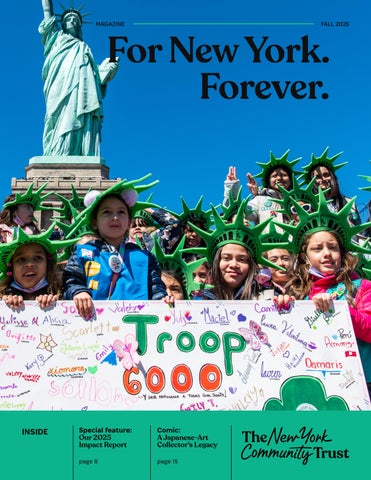
ON THE COVER: A grant from our Community Needs Fund helped the Girl Scouts’ Troop 6000 welcome young immigrants, providing services, safety, and belonging to children and their families living in city shelters. Photo courtesy of grantee
2
Assistant Creative and Digital Director Mar Asayan recommends Las Madres by Esmeralda Santiago. “It is a beautiful story examining the bonds and strength of womanhood at the intersection of race and disability. Moving between familial tragedy in 1975 and Hurricane Maria in 2017, Santiago leaves you feeling hopeful and awed by the resilience of ‘las Madres’ and those who call Puerto Rico home.”
From the Desk of ...
Making Dreams Come True as a Nonprofit Founder & Trust Donor Lynne Holden, M.D.
Lynne is a professor of emergency medicine and senior associate dean of community engagement and outreach at Albert Einstein College of Medicine; a cofounder, president emeritus, and board member of Mentoring in Medicine; and a donor and volunteer with WellMet Philanthropy at The New York Community Trust.
“I
’ve been a doctor since I was five years old— is helping to meet the nation’s health care needs by at least in spirit. TV characters like Marcus expanding the pipeline of diverse professionals— Welby, M.D., and Quincy, M.E., captivated me, people whose lived experiences translate into more and I knew early on that medicine was the perfect compassionate, effective care for all. way to solve problems and uncover mysteries while Our very first grant came from WellMet helping people. Philanthropy, a women’s giving circle housed at After graduating from medical school, I began The Trust. At the time, Mentoring in Medicine was my career in emergency medicine at Kings County a fledgling organization, and WellMet’s mission—to Hospital in Brooklyn and Montefiore in the Bronx. seed grassroots projects serving New Yorkers—was Then life threw me a curveball. Just one week a perfect match. Their continued engagement with after my husband and I welcomed our baby girl, I grantees inspired me to become a member myself. experienced heart failure due I now enjoy using my nonprofit I believe deeply in the experience to support others to postpartum cardiomyopathy. While I recovered, my husband power of community. and working alongside the encouraged me to find a way to incredible women of WellMet to With the right support others who shared my help small organizations grow support, we can take and thrive. dream of becoming a doctor. That moment planted the seed It’s been amazing to witness risks and explore for Mentoring in Medicine. the depth and creativity of new possibilities that work happening across New Eighteen years later, would be difficult to Mentoring in Medicine is York—from youth development thriving. We offer year-round and environmental safety to pursue alone.” programming that supports arts and historic preservation. students from elementary school through medical I especially look forward to WellMet site visits, school. Our initiatives include afterschool programs, where you can truly appreciate the impact these summer camps, and health science fairs for groups are making in their communities. grades three through 12, as well as medical school I believe deeply in the power of community. With application boot camps, citizen science research the right support, we can take risks and explore projects, and volunteer/shadowing internships for new possibilities that would be difficult to pursue college and post-baccalaureate students. With a alone. Our students go on to mentor the next strong network of mentors, we’ve helped hundreds generation, and WellMet connects philanthropists of students gain acceptance to U.S. medical schools with grassroots organizations that might otherwise and launch careers in health and science. go unnoticed. It’s all possible because of the I’m especially proud that Mentoring in Medicine strength of community.” n
“
Magazine | Fall 2025
3
Grants at Work
Young People With Disabilities Build Opportunity
The Adaptive Design Association used our grant to train young adults with intellectual disabilities to design and create customized adaptive equipment for children. Photo courtesy of grantee
4
A
piece of equipment made from a simple material like cardboard can make all the difference for a student with a disability—from a preschooler transitioning from their wheelchair to participate in circle time to a third-grader with low vision using their desk independently. “Our core belief is that every child deserves a chance to participate fully at school and at home and in the community,” said Jennifer Hercman, executive director of the Adaptive Design Association, a nonprofit that develops and constructs customized adaptive equipment— including floor-sitters and accessible desks—for children and adults with disabilities. With a Trust grant, the Association’s Made to Learn program is expanding the nonprofit’s reach by training young adults with intellectual and developmental disabilities in New York City public schools to design and create customized adaptive equipment for children. The program provides the equipment to classrooms free of charge. “It’s really important for our students to work directly with the children. This creates meaning for the work they’re doing because they’re able to see how it exists in the community,” Hercman said. Interacting with the children they are assisting also helps participants build social and emotional skills. Parents and teachers have reported improvements in eye contact, accountability in cleaning and organizing the workshop space, and greater participation in family activities. Funding for Made to Learn comes, in part, from The Trust’s Jack Goldring Fund, created by Judith Goldring in memory of her brother Jack, who had developmental disabilities. Magazine | Fall 2025
wThrough her volunteer work and philanthropy, Judith dedicated herself to providing a better quality of life for people with disabilities—a legacy that lives on through the innovative work her fund supports. Creating an inclusive workforce Paraprofessionals can provide vital support for people with disabilities to be able to live and work independently. But in 2023, a shortage of these workers caused half of all disability service providers in New York City to close or reduce their programming. Social services nonprofit Commonpoint saw an opportunity to address this shortage: Many of the young adults with disabilities involved in its programs wanted to work and could qualify for paraprofessional jobs with the right support and training. A grant from The Trust helped the nonprofit develop a program that prepares young adults with disabilities for jobs as
paraprofessionals. Participants receive training in communication, customer service, and cultural awareness as they work towards their paraprofessional certification. After graduating, they complete paid internships with the Greater New York Hospital Association in a continuing care or rehabilitation setting. The program then matches graduates with employment opportunities in the community, helps them prepare for interviews, and offers support for a year after job placement. “We’re proud to support nonprofits working on creative models that recognize the unique lived experiences and perspectives young adults with disabilities bring to the workforce,” said Rachel Pardoe, The Trust’s program director for accessibility. “These young people will be tomorrow’s leaders in building inclusivity and accessibility at school, work, and home.” n
This reclined chair, created in the Association’s Made to Learn program, provides a student with comfortable time out of their wheelchair. Photo courtesy of grantee
5
Your Philanthropy
Your Contribution at Work
Our Community Needs Fund answers the call
W
hen the Girl Scouts of Greater New York approached The Trust in 2024 with a plan to help newly arrived immigrants, the need could not have been more urgent. Thousands of children and their families, many of whom had made difficult journeys to flee danger and hardship in their home countries, were living in the city’s emergency shelters. Too often, they had limited support to navigate not only a new culture and language, but also the city’s massive public school and transit systems, amid a complex legal landscape. The Girl Scouts wanted to expand Troop 6000, the first-ever scouting troop for young people living in city shelters, to serve newly arrived, unhoused asylum-seeking families. “One of the hardest parts of grantmaking is making tough decisions when resources are limited, or earmarked for specific purposes,” said Shawn Morehead, The Trust’s executive vice president and chief program officer. “We created the Community Needs Fund so we could be nimble, responsive, and strategic in addressing new and abiding challenges in our region. It’s helped us fund nonprofits doing everything from mitigating the local effects of climate change to providing mental health care for survivors of domestic violence.” The Trust’s issue experts responded to the Girl Scouts’ proposal with a grant from our Community Needs Fund to help it adapt Troop 6000’s curriculum to include lessons on cultural acclimation, public transportation, and immigrant rights. The program also offers sessions on immigration law to caregivers and ongoing support as families move to new homes. “This expansion of Troop 6000 has been a lifeline for many,” said Marissa Stranieri, the Troop’s director of social work services. “Families found safety, stability, and belonging after experiencing loss, hardship, and trauma.” Because the Community Needs Fund pools onetime or recurring gifts of any size, many donors played a part in this grant. The fund offers a simple way to bring the community together to support effective nonprofits addressing urgent issues. Its flexibility and efficiency—every dollar donated goes into a grant—are just part of its appeal for donors. “With local needs growing every day, we often hear from New Yorkers who feel overwhelmed by choosing which cause to support, or who want
6
to improve the quality of life across our region— whether they’re contributing $50 or $50,000,” said Michael Nuno, The Trust’s vice president of development. “The Community Needs Fund was built for this. It offers everyone the chance to make a meaningful difference for their neighbors.” Other recent grants from the Community Needs Fund are helping Second Chance Foods put meals on the table in Westchester County, where one in three households experience food insecurity, and Pal-OMine, an equine-assisted therapy program on Long Island, provide job training for young people with disabilities. “Giving to the Community Needs Fund is an easy decision, because I know my support will make a difference where it’s needed most,” said Judith Rubin, one of the fund’s donors. “As a Trust board member, I get to see up close the thoughtfulness and expertise our grantmaking team pours into addressing local challenges.” The impact of the Fund can be felt across the region. The grant to Second Chance Foods is helping it redirect nutritious surplus food from grocery stores and regional farms to food pantries and community programs in Westchester. “Our work is all about breaking the cycle of wasted food and food insecurity,” said Executive Director Martha Elder. “When you hear that 40 percent of the food in the United States is wasted, you know there is enough to feed everyone. We just need to be distributing it properly.” And on Long Island, Pal-O-Mine is using its grant to connect young people with disabilities with promising opportunities. Its paid internships give participants hands-on work experience in a variety of fields. The program also helps build independence through financial literacy and job readiness training. “When I first came to Pal-O-Mine, I had very little trust. I would barely speak to people I didn’t know, and I wasn’t proud of myself,” a program participant told The Trust. “I am now living independently in my own apartment—a dream that I thought would never come true. Pal-O-Mine is my special family; it is the place I run to, the place I can go when I need support.” n Visit qrco.de/communityneeds or scan the QR code to give to the Community Needs Fund.
Second Chance Foods in Westchester connects volunteers, community gardens, and local farms with food pantries to provide healthy options for families in need. Photo courtesy of grantee Magazine | Fall 2025
7
Getting Results
Our 2025 Impact Report
I
t’s amazing what New Yorkers can accomplish when we come together to care for each other and our communities. This year, even as needs grew and nonprofits faced increasing challenges, our grants helped change policy, advance justice, and improve quality of life across the region— from Staten Island and Babylon to the Bronx and White Plains.
We’re excited to share some examples below, made possible thanks to our innovative nonprofit colleagues and the generous donors who established charitable legacies to fuel their work. Together, we’re driving bold solutions to ensure our region can weather any storm and become a place where everyone has the opportunity to thrive.
HOUSING
New rental assistance program helps prevent homelessness statewide Rising rents and a shortage of affordable housing have made it harder than ever for families across the state to stay in their homes. More than 158,000 New Yorkers experienced homelessness in 2024, a 53% increase from 2023. Women In Need led advocacy in Albany that secured $50 million in the 2025 state budget for the Housing Access Voucher Program, which is providing rental assistance to help New Yorkers afford safe, longer-term homes and ensure that low-income residents spend no more than 30% of their income on rent. Our Rhodebeck Fund for the Homeless (est. 1989), and Sheila Kelley Kaufman Fund (est. 2009), both of which were created to address homelessness, made this grant possible. Above: Trust grants funded efforts to get housing vouchers into the hands of families at risk of homelessness. Photo courtesy of grantee
8
WORKERS’ RIGHTS
Curbing employer wage theft for delivery workers After a yearlong collaboration with the office of the New York State Attorney General, the Worker’s Justice Project secured a landmark settlement of $16.75 million for DoorDash delivery workers whose tips the company had illegally pocketed from 2017 to 2019. The settlement also requires DoorDash to ensure that, going forward, 100% of customer tips go to its workers. This victory was made possible in part by our Lola G. Hanna Fund (est. 1995) and Herbert B. West Fund (est. 1989), which provide flexible funding for our competitive grantmaking. Left: Community members protest delivery worker wage theft. Photo courtesy of grantee
TRANSIT
Faster commutes across boroughs In 2018 and 2019, we supported the Regional Plan Association’s research and advocacy for the creation of a new transit service connecting Brooklyn, Queens, and the Bronx. The Interborough Express, now in its design and engineering phase, will be the biggest rail expansion in New York City since the 1930s. It will provide a much-needed transit option for nearly 900,000 New Yorkers, connecting them to 17 subway lines, multiple bus routes, and the LIRR. A 2025 grant is helping the Association advance advocacy for the project and ensure local communities have a voice in its development. These grants were made possible by several funds at The Trust, including our Wheaton B. Kunhardt Fund (est. 1949) and David and Mary Warfield Fund (est. 1995), both of which provide flexible funding for the benefit of our region.
Magazine | Fall 2025
FAMILY JUSTICE
Court victory protects victims of domestic violence & their children Until recently, New York City regularly mandated ongoing surveillance of parents who were survivors of domestic violence, causing further trauma and harm to them and their children. Earlier this year, two New York Appellate Courts ruled that this practice was illegal, thanks to landmark appeals brought by the Family Justice Law Center against the city’s Administration for Children’s Services. This grant was supported in part by our Charles Merz and Evelyn Scott Merz Fund (est. 1984) and S. Prentiss Bailey Fund (est. 1960), which provide flexible funding for our competitive grantmaking.
9
2025 Impact Report
CLEAN WATER
Long Islanders vote to restore their bays and beaches
For decades, nitrogen pollution from aging septic systems has contaminated Long Island’s waterways and drinking water and harmed marine life. With ongoing support from The Trust, a coalition of nonprofits, including Group for the East End and Citizens Campaign for the Environment, mobilized voters across party lines to overwhelmingly approve a ballot proposition in support of the Suffolk County Water Quality Restoration Act. In March 2025, financing went into effect for wastewater upgrades that will restore clean water, protect marine life, and preserve Long Island’s natural beauty for future generations. This work was supported by our Henry Phillip Kraft Family Memorial Fund (est. 1996), created to protect the environment. Trust grantees worked together to get stronger protections for Long Island waterways. Photo courtesy of the Clean Water Coalition
10
ARTS & CULTURE
ENVIRONMENT
Cash awards to playwrights serve as career springboards
Polluter legal settlement supports pollinator restoration projects
Time is money, and artists too often must choose between developing new work and paying the bills. The late theatrical agent Helen Merrill created a fund at The Trust in 1999 through her estate plan to provide awards that would help playwrights explore their unique visions with fewer financial pressures. Since then, her legacy has funded 115 awards totaling more than $2.6 million to playwrights who have gone on to win Pulitzer Prizes, Tony and Obie awards, and Guggenheim Fellowships, among other honors.
One in every three bites of food depends on pollination, yet as many as 60 percent of pollinator species native to New York are at risk of disappearing from the state. After securing a settlement from Bayer CropScience LP and Monsanto, the New York State Attorney General’s Office selected The Trust to administer the New York Pollinator Conservation Fund. In June 2025, the fund made more than $3.2 million in grants to 34 nonprofits powering a statewide pollinator restoration effort from Buffalo to the eastern tip of Long Island.
IMMIGRATION
New interpreter bank helps immigrants connect with services New Yorkers speak over 800 languages— more than any other city in the world—yet many struggle to access services in the languages they speak. To address this, African Communities Together used our grant to advocate for the city’s first-ever Community Interpreter Bank. The Bank was launched in January 2025 by the New York Immigration Coalition, the New York City Council, and the Language Justice Collaborative and is connecting immigrants with critical government resources, legal services, and city-funded programs—vital support to navigate rapidly changing policies. This grant was made possible by our Alice V. and Dave H. Morris Memorial Fund (est. 1958), created to further the study and improvement of communications.
LGBTQ+ NEW YORKERS
More affordable senior housing in Westchester In 2018, a Trust grant to The Loft helped it conduct a study, Stand Up and Be Counted, which revealed a severe lack of affordable senior housing for LGBTQ+ residents of Westchester County. After several years of planning, The Loft partnered with developers this year to begin construction on new affordable housing for seniors in downtown White Plains. The building will provide 141 affordable apartments for low-income seniors ages 55 and older. This grant was made possible by the Endowment for Westchester’s Future Fund (est. 1987).
Learn how you can help fuel community wins for generations to come. Visit giveto.nyc. Financial information about The New York Community Trust can be obtained by contacting us at: 909 Third Avenue, 22nd Floor, New York, New York 10022, (212) 686-0010, at www.thenytrust.org, or as stated below: Florida: SC No. CH9514 A COPY OF THE OFFICIAL REGISTRATION AND FINANCIAL INFORMATION MAY BE OBTAINED FROM THE DIVISION OF CONSUMER SERVICES BY CALLING TOLL-FREE, WITHIN THE STATE, 1-800-HELPFLA OR AT www.FloridaConsumerHelp.com REGISTRATION DOES NOT IMPLY ENDORSEMENT, APPROVAL, OR RECOMMENDATION BY THE STATE. Maryland: For the cost of postage and copying, from the Secretary of State. Michigan: MICS No. 22265. Mississippi: The official registration and financial information of The New York Community Trust may be obtained from the Mississippi Secretary of State’s office by calling 1-888-236-6167. New Jersey: INFORMATION FILED WITH THE ATTORNEY GENERAL CONCERNING THIS CHARITABLE SOLICITATION AND THE PERCENTAGE OF CONTRIBUTIONS RECEIVED BY THE CHARITY DURING THE LAST REPORTING PERIOD THAT WERE DEDICATED TO THE CHARITABLE PURPOSE MAY BE OBTAINED FROM THE ATTORNEY GENERAL OF THE STATE OF NEW JERSEY BY CALLING (973) 504-6215 AND IS AVAILABLE ON THE INTERNET AT http:// www.state.nj.us/lps/ca/charfrm/htm. New York: A copy of our most recent financial report is available from the Charities Registry on the New York State Attorney General’s website at www.charitiesnys.com or, upon request, by contacting the NYS Attorney General, Charities Bureau, at 120 Broadway, New York, NY 10271 or at 212-416-8401. North Carolina: Financial information about this organization and a copy of its license are available from the State Solicitation Licensing Branch at (888) 830-4989 (within N.C.) or (919) 814-5400 (outside N.C.). Pennsylvania: The official registration and financial information of The New York Community Trust may be obtained from the Pennsylvania Department of State by calling toll-free, within Pennsylvania, 1-800-732-0999. Virginia: From the State Office of Consumer Affairs in the Department of Agriculture and Consumer Affairs, P.O. Box 1163, Richmond, VA 23218. Washington: From the Charities Program at 1-800-332-4483, or www.sos.wa.gov/charities. West Virginia: West Virginia residents may obtain a summary of the registration and financial documents from the Secretary of State, State Capitol, Charleston, WV 25305. Wisconsin: A financial statement of the organization disclosing assets, liabilities, fund balances, revenue and expenses for the preceding fiscal year will be provided to any person upon request. CONTRIBUTIONS ARE DEDUCTIBLE FOR FEDERAL INCOME TAX PURPOSES IN ACCORDANCE WITH APPLICABLE LAW. REGISTRATION IN A STATE DOES NOT IMPLY ENDORSEMENT, APPROVAL, OR RECOMMENDATION OF THE NEW YORK COMMUNITY TRUST BY THE STATE.
Magazine | Fall 2025
11
Westchester
Celebrating 50 Years of Community Philanthropy in Westchester
“T
A recent open house at The Trust’s new Westchester office in Irvington brought together nonprofit leaders, donors, staff, and other caring members of the community. Photo by Margaret Fox
he need for nonprofit services in Westchester is often hidden,” said Laura Rossi, The Trust’s vice president for Westchester. “Many associate the county with a more comfortable, wealthier lifestyle, but the reality is that one in three households live paycheck to paycheck.” The New York Community Trust’s Westchester office, formerly known as the Westchester Community Foundation, has addressed challenges like this since 1975. With its local presence and long-serving leaders—there have been only three in its 50-year history—the office has a proven track record of building effective partnerships. Rossi and her team bring together funders, nonprofits, and donors to carry out The Trust’s work in Westchester, which ranges from feeding hungry neighbors, improving access to child care, helping immigrant families, and caring for the environment, to centralizing crucial data for policymakers. Over the last 25 years, The Trust’s Westchester staff has stewarded more than 400 donor-advised and legacy funds, fueling
12
$129 million in grants to local nonprofits. The Westchester office also actively fundraises to address unmet needs, supports grassroots advocacy for systemic change, acts as a thought leader, and makes early investments in innovative nonprofits. Its 50 years of impact can be felt, seen, and heard across Westchester. Pooling funds for the women of Westchester While attending a community foundation conference in 1992, former President Pat Larson and former Advisory Board Chair Rita Gilbert were struck by the scarcity of philanthropic dollars earmarked to support women and girls. They returned with a mission to mobilize the local community to establish a permanent fund supporting the needs of the county’s women and girls. At first, the men on Westchester’s advisory board didn’t grasp the need for such a fund. To persuade them, Gilbert invoked her experience of being asked to give up her Fulbright scholarship because of her status as a married woman. As more debate ensued, the late Board Member Vito Russo, thinking of his
wife and stepdaughters, committed to making the first donation. In its early years, the Westchester Fund for Women and Girls honored women leaders by holding annual breakfasts that attracted hundreds of community members, with speakers who included Hillary Clinton, Anita Hill, and Billie Jean King. By 1999, the Westchester team had reached its initial goal of raising $500,000, representing $1 for every woman and girl in the county. A dedicated volunteer committee led the effort to continue fundraising. Today, the fund has granted more than $2 million for a wide range of services, including legal aid for domestic violence survivors, leadership programs for high school girls, and support for female veterans. Raising the profile of the nonprofit sector In 2012, nonprofit organizations employed 13 percent of Westchester’s workers. Despite this, there was no membership organization dedicated solely to advocating on behalf of the county’s nonprofit sector. With support from The Trust, a new organization, Nonprofit Westchester, sought to change that. “We needed to have our own source of training, professional development, advocacy, collaboration, and connection, and we needed to be made visible,” said Jan Fisher, executive director of Nonprofit Westchester. “Catherine Marsh, The Trust’s Westchester executive director at the time, was integral to launching our organization, and current leader Laura Rossi remains a sounding board on all topics.” An early grant supported a study of the economic impact of the nonprofit sector in Westchester County, which, Fisher said, “helped to position nonprofits as the experts, and economic and social engines, that we are.” Families, businesses, and faith groups turn values into lasting legacies Many different types of donors use The Trust to champion the causes they care about, ensuring their generosity will make an impact today and decades from now. In 2014, the Dominican Sisters of Hope, whose congregational offices are in Ossining, N.Y., were looking for a way to continue responding to the community’s needs as more sisters retired. They worked closely with Catherine Marsh to develop the Dominican Sisters of Hope Empowerment Fund, with the purpose of promoting social justice and systemic change in keeping with key principles of Catholic social teaching. Since the fund’s inception, it has granted more Magazine | Fall 2025
Left to right: Laura Rossi, current leader of The Trust’s work in Westchester, and past leaders Catherine Marsh and Pat Larson.
than $2.3 million to support grassroots advocacy efforts that have led to policy and legislative victories for immigrants, kinship caregivers, and incarcerated older adults. Growing to meet today’s challenges “As our impact and reputation have grown, we’ve seen a 300 percent increase in total giving in the last 25 years, thanks to our generous and engaged donors,” Rossi said. “Many of our current donors are the children and grandchildren of our earliest champions.” Earlier this year, Vito Russo’s stepdaughter, Sandy Kaufman, honored the legacies of Vito and her mother, Diana Russo, by opening a donoradvised fund at The Trust. She plans to use the fund to support nonprofits like Neighbors Link, which serves the county’s immigrant communities, and Planned Parenthood. “As we look back at our history of shared impact with our incredible donors and grantees, we are also thinking about how we can continue to serve our community for the next 50 years,” said Rossi. “We’re committed to providing a platform for change and collaboration for those who are deeply invested in making Westchester a place where everyone can thrive.” n
The Westchester Index To better understand and address county-wide disparities across racial, ethnic, and socioeconomic divides, The Trust partnered with data analysts at nonprofit consultant CGR to launch the Westchester Index in 2022.
13
Long Island
Restorative Justice in Action
Huntington Youth Court offers hope & healing
F
or a young person, one encounter with the court system can too easily become a life sentence, sparking a cycle of trauma, stigma, and lost opportunities. Huntington Youth Bureau’s Youth Court on Long Island is working to change that. The Youth Court’s approach is rooted in restorative justice traditions, which emphasize accountability, empathy, and healing and have been shown to greatly reduce recidivism and improve public safety. In place of typical court procedures, young people’s peers serve as jurors, judges, attorneys, and advocates and assign them projects such as community service, counseling, or enrichment programs, designed to repair harm and rebuild trust. Since its founding in 2000, the Court has trained more than 750 volunteers and resolved over 500 cases in partnership with local schools and Suffolk County’s Department of Probation. “When our program was first introduced, restorative justice was still a new concept,” said Janine Salgado, executive director of the Huntington Youth Bureau. “The criminal justice system recognized that punitive practices weren’t changing behavior, and we saw an opportunity to guide young people instead of punishing them.” That vision has only expanded. Schools are now key referral sources, reflecting an investment in education and intervention, and program leaders have prioritized reaching more local teens and their families. As Huntington’s Latine communities grew significantly, a recent Trust grant supported translation devices, bilingual staff training, and new family-referral initiatives to meet this goal. “We successfully created the first and only Spanish-speaking youth court in New York State,” said Program Director Manuel Zelaya. “We can now hold peer jury trials entirely in Spanish, fully engaging families who once felt excluded.” The shift has been transformative: In the past year, 53 young people were referred to the program, 36 from Spanish-speaking families. The court trained 95 new volunteers and selected 13 program ambassadors, experienced youth court members who help train new volunteers, coordinate events, and serve as the public face of the court at schools and community programs.
14
High school students visit New York University with Huntington Youth Court. Photo courtesy of grantee
Many participants return as peer volunteers, and those referred to the program serve on the jury for a peer’s trial as a sanction. For Salgado, the program’s biggest achievement is how deeply it has engaged Latine young people and their families. “Parents who once worried about their child’s future now see a solution and a positive trajectory,” she said. “For the youth, it’s life-changing. They gain empathy, acceptance, and a chance to take responsibility in a nonjudgmental environment.” The program also boasts ripple effects for its participants, volunteers, and the broader community. “We’ve seen respondents turn their lives around completely,” Zelaya said. “Many become court peers themselves, and are inspired to pursue careers in law, social work, psychology, and other advocacy fields.” The Trust’s investment in Huntington Youth Court builds on its long-standing commitment to advancing restorative justice and fair policies for young New Yorkers—from supporting New York’s historic Raise the Age campaign, which ended the state’s treatment of minors as adults in criminal court, to helping city schools integrate restorative justice practices. “A single mistake should not define a young person’s future,” said Trust Senior Program Director Sol Marie Alfonso-Jones. “The Trust is proud to support this transformative effort.” n
To learn how you can create your own legacy at The Trust, visit giveto.nyc.
15
Nonprofit Org. U.S. Postage PAID Permit No. 1534 Hackensack, NJ
909 Third Avenue, 22nd Floor New York, NY 10022 thenytrust.org
Snap a pic with our transit ads and win a free gift bag! Riding the subway, Long Island Railroad, or MetroNorth? Keep an eye out for our new ad campaign. Take a selfie with an ad and tag @thenytrust on social media. You’ll have a chance to win a gift bag filled with great swag.
Connect with us!
We’d like to hear from you. Please contact us with questions or comments: (212) 686-0010 or info@thenytrust.org