This book is dedicated to every player who has ever worn our uniform. To the teammates who became lifelong friends, and to the moments—both victories and defeats—that shaped the story of this team.
It is also dedicated to the families, friends, and supporters who stood behind us, cheered from the sidelines, and understood that baseball was never just a game to us. Most of all, this story was written as a labor of love for the team, for men’s baseball, and for the Astros family.
.PROLOGUE
Most of us have been playing baseball since we were little kids, and some have been fortunate enough to still be playing today. In the present day, with so much technology and information available, we thought it would be meaningful to share our adult baseball experiences. The intention was never simply to document seasons or list records, but to preserve and tell the story of the people who built the organization, the players who carried it forward, and the friendships that grew along the way.
Over the past thirty years, the history of this men’s baseball team has been about far more than wins and losses. It is a reflection of loyalty, longevity, and the kind of commitment that allows a team to endure while many others fade away. From the earliest days as the Nassau Brewers to the present era of the New York Astros, one constant has remained — the players who kept showing up because the team meant something to them. Most of us are blue-collar guys. Men who put in long days and still found a way to make it to the field on weekends. Baseball was never about fame or recognition. It
was about competition, camaraderie, and the simple joy of continuing to play the game we all grew up loving.
Like any story that stretches across decades, not every detail survived the passage of time. Some records were lost, some memories blurred, and some moments exist only in the recollections of those who were there. Still, every effort was made to research, gather, and confirm as much of the team’s past as possible so that this history could be recorded as accurately as we could make it.
MSBL/MABL
For most of us, the final out of their organized career or playing days comes too early. Life moves on with jobs, families, and responsibilities. But the love of the game never quite disappears. The crack of the bat, the smell of the grass, those things stay with you. For some, that feeling never fades. The competitive fire is still burning with the glove still sitting somewhere nearby. Spring still feels like baseball season no matter how many years pass. Sooner or later, players like that begin looking for a way back onto the field — not to relive the past, but to keep the game alive in the present. Across the country, leagues began forming for players who simply were not ready to walk away. Some were former high school or college players. Others had played semi-pro ball, while many were simply lifelong baseball people who still loved the
competition. What they all shared was the same belief: the game should not have an expiration date.
The first and most important of those organizations was the Men’s Senior Baseball League and Men’s Amateur Baseball League, known to players everywhere as the MSBL/MABL. Founded in the 1980s by Long Island native Steve Sigler, the league began modestly with a small group of adult players who wanted to keep competing. Word spread quickly. What started with a few teams soon expanded into a nationwide network of leagues, tournaments, and divisions that allowed players to continue playing well into their adult lives. As the league grew, the MSBL/MABL became one of the largest adult baseball organizations in the country. Hundreds of local affiliates formed across the United States. Thousands of teams took the field each season. Tens of thousands of players pulled on uniforms again, many for the first time since their younger days. Age divisions created opportunities for players at every stage of life — from competitive 18+ leagues to 35+, 45+, and older divisions where experience and love of the game mattered just as much as raw ability.
Over time, the MSBL/MABL also created national tournaments that became major events on the adult baseball calendar. Teams traveled across the country to compete in tournaments such as the MSBL World Series in Arizona and the Fall Classic in Florida. For many players, these events became annual traditions — road trips built around baseball, friendships, and the stories that always follow a few days at the ballpark. In many ways, men’s baseball developed into its
own unique culture. It was competitive but grounded, serious on the field and relaxed once the final out was recorded. Players played hard, but they also understood why they were there. It was about staying connected to the game, making friendships, and proving that baseball could still be a part of life long after most people assumed those days were over. And in communities across the country — especially on Long Island, where the MSBL first began that culture continued to thrive.
LAYING THE FOUNDATION (1996-2002)
Every legacy has a starting point — a moment when a few people decide to build something that does not yet exist. It began with belief, friendship, and the simple idea that the team could belong to the players themselves.
In 1996, Giancarlo Battaglia and Billy Peck made a decision that would shape the next three decades of baseball. The two had played together the previous season in the Men’s Senior Baseball League with the Nassau Phillies. Rather than go their separate ways after that season, they decided to start a club of their own. The first organizational draft was held at SUNY Old Westbury . Players came from
across Nassau County and the surrounding Long Island baseball community. From the very beginning, the roster reflected the kind of team it would become — competitive, blue-collar, and built on players who simply loved the game. From that idea, the Nassau Brewers were born.
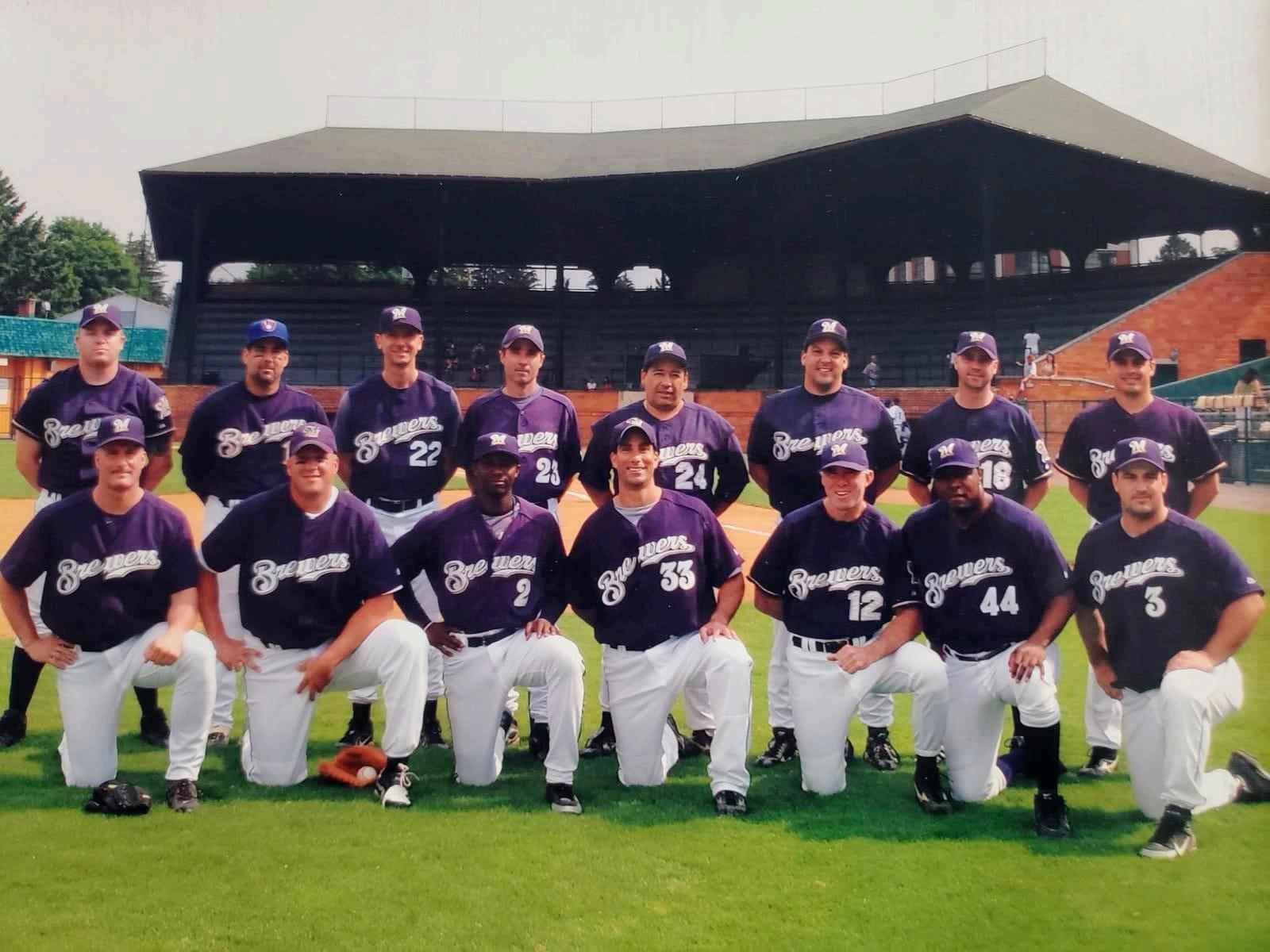
2003 Nassau Brewers
Billy Peck, one of the team’s founders, has remained a constant presence from the very beginning. A power-hitting outfielder and steady clubhouse voice which produced a culture of loyalty, accountability, and perseverance.. He helped shape both the on-field style and the cultural identity of the organization, laying the foundation that would prove strong enough to carry the organization into an entirely new era. Peck is still an integral part of today's team as Bench Coach, making him the longest-tenured member in team history.
Not long after the team’s creation, another key figure arrived. In 1998, Elmer Cruz joined the Brewers as a walk-on infielder. A dependable glove and line-drive hitter, Cruz quickly became known for his consistency and reliability. Season after season, up to the present, he keeps playing, quietly becoming one of the most respected and durable players becoming the second-longest tenured player in franchise history. Elmer is also responsible for creating the team's post game cooler tradition . Together, players like Peck and Cruz established something far more important than a win-loss record. They helped form the identity that future and present Astros players would inherit. Friendships and habits were already forming that would eventually define the organization .
In 1999, the team experienced its first moment of real history when right-handed pitcher Alan Charles threw the first no-hitter in franchise history. It was a truly remarkable
performance at any age and level .. For a young program still finding its footing, it was proof that the Brewers could compete with anyone in the league. Another key addition that year and early influence was Dan Romano . In the early years, while the team was growing and learning, Dan was teaching the Brewers how to win . He quickly became a force in the lineup and a top pitching talent . Cementing himself at the top of the rotation for years to come .
Around that time, leadership of the team transitioned to Frank Brocato, who started managing the club that same year. Brocato helped stabilize the organization and guide it through an important period of growth. Under his direction, the Brewers matured as a team and began to look toward long-term sustainability. The team's positive results sparked a jump in confidence and enthusiasm . Seeking a better competitive fit, the club moved into the MSBL’s 28+ division in 2000. The shift aligned the roster with players' talent level and baseball experience. The results improved with meaningful progress for a team building its identity. By the early 2000s, the team taking the field each weekend was no longer simply trying to survive in the league. The difficult early seasons had hardened the roster, and the lessons from those years began to show. Players understood the expectations, and trusted one another. The Nassau Brewers were beginning to look like a team that could compete with anyone. Each season added another piece of the foundation and that foundation is stronger today than ever.
SETTING THE STANDARD ( 2003-2007)
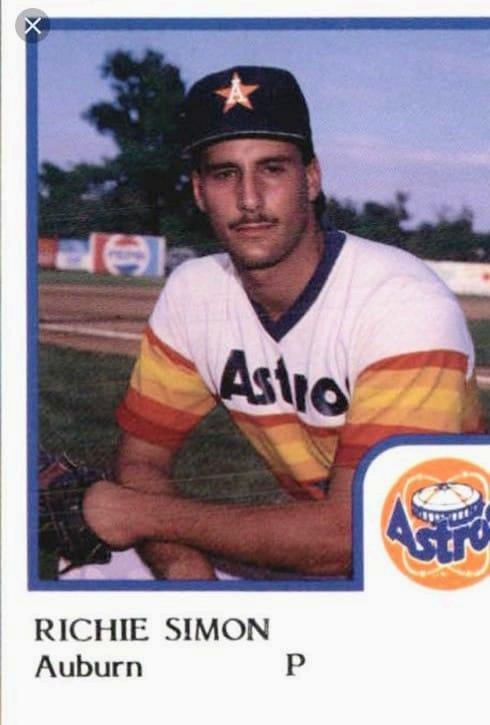
The addition of Rich Simon quickly changed the tone of the team. Long before putting on a Brewers uniform, Simon had already built a strong reputation in baseball circles. A standout player from Brooklyn, he was known for his competitiveness and intensity on the field. Being a top pitcher , his success carried into the college level, and eventually attracted the attention of professional scouts.
Rich Simon’s younger Days
In 2003, When he joined the Brewers, he brought that same mentality with him. His impact was felt immediately . Rich expected the same standard of excellence and accountability from those around him that he demanded from himself . It was only natural that he became the first team captain in franchise history . The title simply formalized the role he had already begun to assume by leading through performance.
At the same time, Billy Peck stepped into the manager’s role, guiding the program from the dugout while Simon helped drive the tone on the field. The partnership proved to be exactly what the Brewers needed. Peck brought discipline, organization, and structure, while Simon brought intensity and credibility between the lines. Together they began shaping the organization for years to come. Mitch Russo also played an integral part in the team’s success during this time. Coming on as a catcher , however his coaching and on field leadership was invaluable .
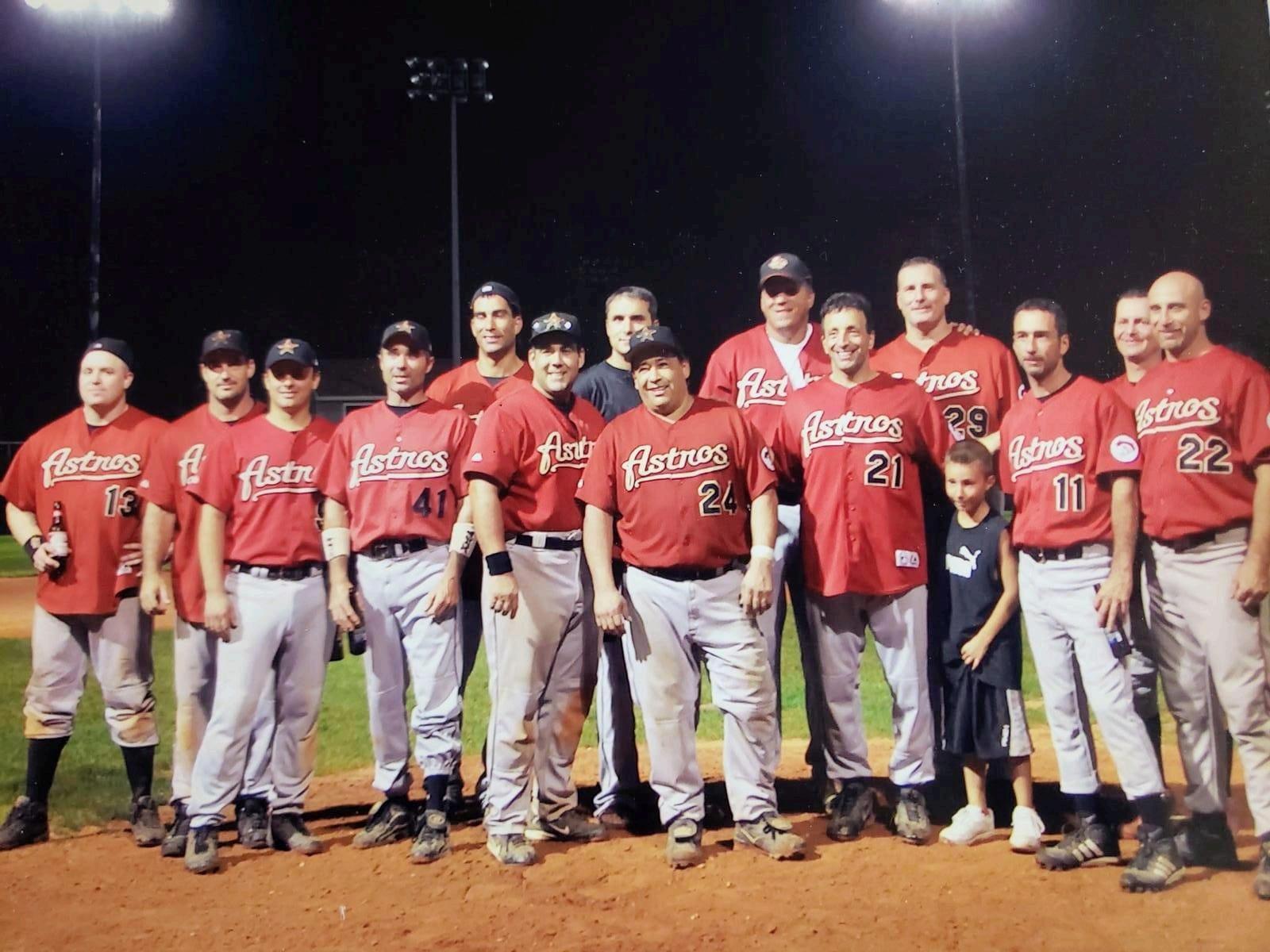
The results followed quickly. That 2003 team was fueled by Simon and longtime Brewer Dan Romano who won league "Pitcher of the Year” that season finishing 7-0 .The Brewers produced one of the strongest seasons in the young history of the franchise, finishing 19–6 and advancing all the way to the league finals. The championship slipped away, but for the first time, the team believed they belonged among the best teams in the league. That belief continued to grow and the
following year the team again reached the finals, establishing itself as a legitimate contender. Opponents began to realize that the Brewers were difficult to beat. Simon remained at the center of the team’s identity, whether pitching in big moments or delivering at the plate. By 2006 the Brewers were again among the league’s elite, returning to the finals once more. The championship still remained just out of reach, but the direction of the program was unmistakable.
Before the season began, the organization made a decision that reflected its growth. The Nassau Brewers would become the Long Island Astros, a name that represented a broader identity and wider appeal . Everything seemed to come together and that long pursuit finally paid off in 2007. The Long Island Astros played confident, balanced baseball throughout the year, finishing with an outstanding 20–5–1 record. Coasting through the playoffs and defeating the East Islip Angels to capture the first title in our history . For the players that endured the growing pains, it was a validation of all the early struggles . During that same season, Rich Simon added another milestone to the organization’s history by throwing a no-hitter, only the second in franchise history . By the end of the season the L.I. The Astros had set the standards and had become a respected program within the league .
BUILDING TODAY’S CORE (2008-2011)
After capturing the first championship in franchise history , the Long Island Astros returned the following season with a new understanding of what it meant to compete at the top. At
the same time, they also learned one of the oldest truths in baseball: repeating as champions is never easy. Every opponent comes a little harder, every game carries a little more weight, and every team wants to measure itself against the defending champions. The 2008 season reflected that challenge. The Astros once again played strong baseball, finishing above .500 and remaining competitive throughout the year. The season ultimately ended with a playoff loss, but the bigger picture remained encouraging. Leaders like Rich Simon, Billy Peck, and Elmer Cruz remained the backbone of the clubhouse, setting the tone for preparation, accountability, and competitiveness. Around them were players who had become part of the identity of the Long Island Astros, including Craig Francis, John Ochiogrosso, and Billy Burke. Together they represented the group that had helped shape the early years of the franchise.
While that leadership remained steady, the organization also began welcoming a wave of new players who over the next few years (08-11) would shape the future of the team. Patrick O’Donnell (IF) arrived first and quickly established himself as one of the most dependable players on the roster. Originally a middle infielder, he brought versatility, a steady bat, and a competitive presence that teammates respected immediately. In time he would settle in at third base, where he would anchor the position all the way to today . Patty over the years has become our on field general and is one of our most
respected leaders . O'Donnell is our third longest tenured player on the team . Christian Aguilera(IF) and Joe Reznick(C) then joined and added confidence and consistency . Both have long and successful baseball backgrounds , can play multiple positions while having high baseball I.Q. and instincts . “Aggie” is our emotional leader and “Rez” is Mr. Baseball and our team jokester . Both of their contributions are invaluable to our culture .
Pitcher Joe Lankford soon followed, bringing toughness and presence to the mound. A former FDNY standout, Lankford had the ability to control games and the mentality that fit perfectly with the culture already in place . Greg Vico (IF) came aboard as our leadoff hitter and shortstop. Solidifying the middle of the infield position for years to come . A fierce competitor who drives the team. At the same time, Frankie Parisi (1B) , a former college player, joined bringing a power bat and baseball experience to complement the roster . Helping the team at corner OF and pitching when needed.. 2011 Vinnie Lucarelli brought his athleticism and energy to the outfield and batting order . Individually they were valuable additions. Together they began reshaping the roster and all are part of today’s “Core”.
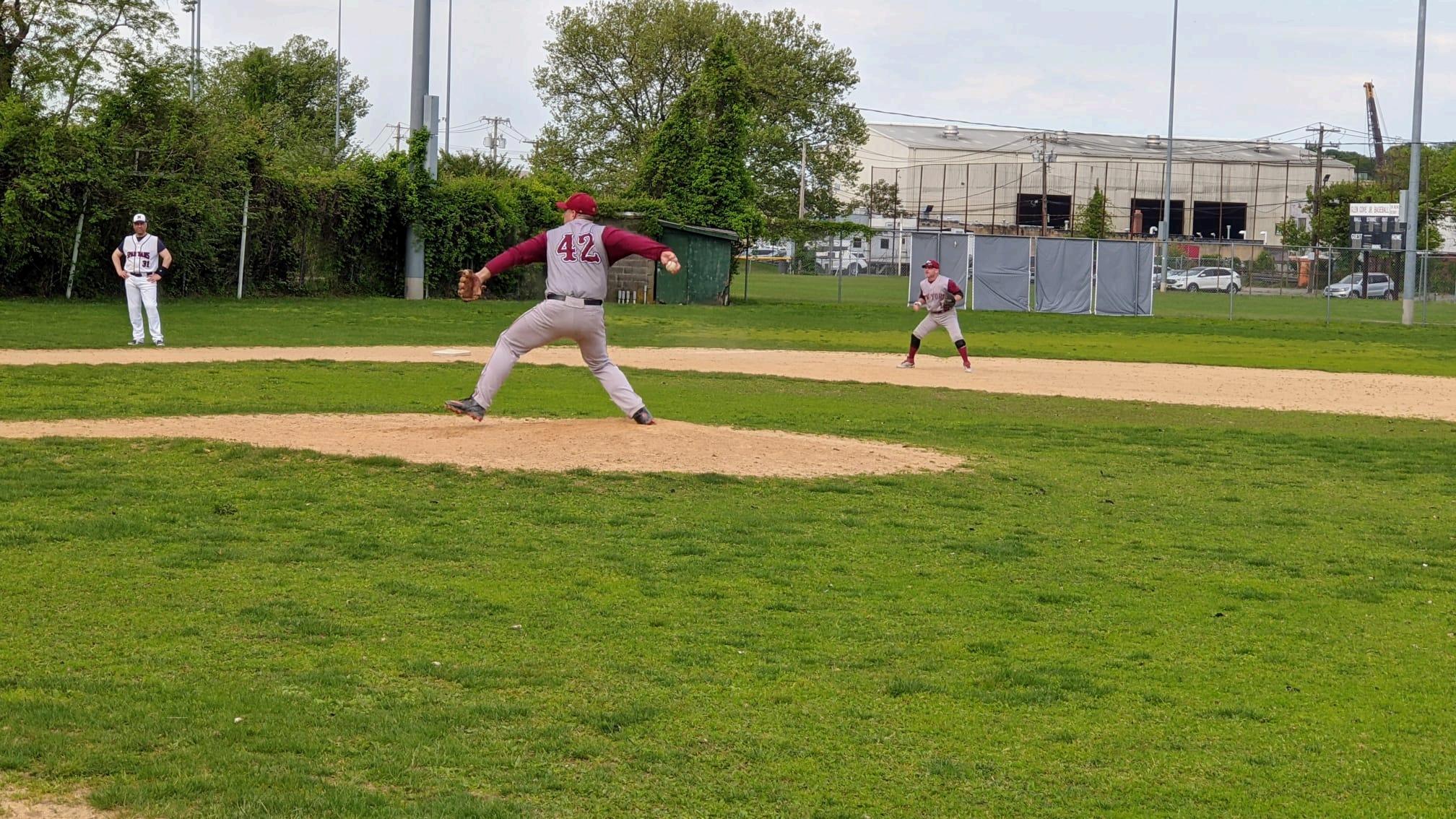
Lankford #42 and Odonnell #14 in Action
The progress, however, was gradual. In 2009 the Long Island Astros again finished above .500, but the season often felt uneven. The team battled inconsistency and searched for rhythm before falling short in the playoffs. It served as another reminder that talent alone does not win championships. Teams must grow together. By 2010 the club hovered around
the .500 mark.They were competitive nearly every week, but the roster was still evolving. New leaders were emerging, chemistry was developing, and expectations were rising. Looking back, those seasons represented something more important than standings. The veteran group that had built the organization was still guiding the team, while the next generation was beginning to take shape beside them. What made this period so important was not simply the talent arriving, but the loyalty that followed. All of those players would remain with the Astros for years, becoming the core of future championship teams and helping carry the culture forward. Slowly, almost quietly, the next era of Astros baseball was forming.
AGE OF EXPANSION ( 2011 - 2017)
By the start of the next decade, the Astros were entering a new chapter. We were no longer simply building a team, we were building a lasting program. In 2011 the club officially moved forward under the name New York Astros, and entered the highly competitive MSBL 35+ division. The change reflected both growth and ambition. The level of play was tougher, the opponents more experienced, and every season demanded consistency. Around the same time, leadership shifted when Frankie Parisi “ Coach Frank” stepped into the manager’s role. Having joined the team shortly before, Parisi understood the culture that had already
been built and focused on carrying those standards forward while preparing the club for the future.The early seasons of the new era required patience. The Astros were blending long-time veterans with players who were beginning to take on larger responsibilities. By 2012, the team was beginning to find its rhythm again. Joe Lankford was emerging as a dominant force, both on the mound and in the middle of the lineup, and his presence quickly grew into a leadership role. In time, he would become the second captain in team history. Alongside Joe, the steady influence of Rich Simon continued to anchor the identity of the Astros, helping guide the team as a new generation of players stepped forward.
That progress showed in 2013, when the Astros pushed their way through the season and reached the league finals. The championship slipped away, but the run signaled something important. The following year delivered one of the most memorable seasons in team history. In 2014 the New York Astros captured the MSBL 35+ championship, the first title under the New York name. The team finished with a remarkable record and played with the confidence of a group that believed in itself. During the playoff run, Lankford delivered a performance that quickly became part of team lore, pitching complete-game victories on consecutive days to secure the championship. It was the kind of moment that defined an era. Around this time the Astros also began expanding beyond the field. Media coverage, photos, and videos became part of the program, helping document the team’s journey and strengthening the sense of what players
often called the “Astros Family.” The team’s Facebook page was launched with youtube following shortly after . Through the years our social media presence has expanded further with the advancements of GameChanger and Livestreaming . We can be found on FB, Instagram, Youtube, and X .
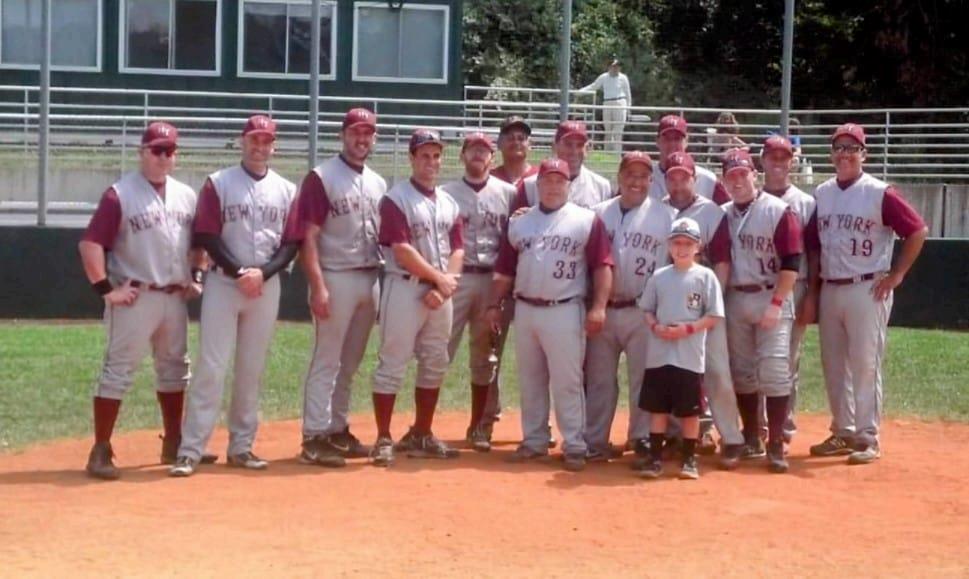
2014 New York Astros
All at the same time, another important development quietly began shaping the future of the organization. The Astros started entering tournament play, forming a team that would travel and compete against clubs from across the country. At first it was simply an opportunity to experience a different level of competition and spend more time together around the game they loved. Tournaments like the Liberty Bell Classic and the Chesapeake Classic introduced the Astros to teams and players outside their local league, while trips to the MSBL Fall Classic in Florida gradually became annual traditions. In those early tournament years the Astros were competitive but still finding their footing. The level of play was strong, the teams experienced, and success did not come immediately. Still, the experience helped the roster grow. Players bonded through travel, tougher games, and the shared challenge of competing on a larger stage. It also expanded the identity of the program beyond just the local schedule.
Having success the year before, however, often brings its own challenge. In baseball, repeating as champion is never easy. Every opponent circles the defending champion on the schedule and every game carries extra intensity. The Astros felt that reality in 2015 as the team again played outstanding baseball and battled its way back to the finals, but couldn’t reach their final goal. The loss reinforced how difficult
sustained success can be and how competitive the league had become.
By 2016 the organization was ready to take one of the boldest steps in its history. For the first time, the Astros decided to field a second team, entering a club in the MSBL 25+ division while continuing to compete with the main roster. Running two teams at once was an ambitious move and came with its share of challenges, but it also created a new level of excitement within the organization. The decision paid off almost immediately. The New York Astros (25+) quickly proved they belonged among the league’s best, building their success on strong pitching, solid defense, and timely hitting. Leading the way was MVP pitcher Mike Lospinuso, whose dominant performances set the tone throughout the season. One of the most memorable moments of that run came in the semifinals, when the Astros defeated the defending champion Indians on a dramatic walk-off hit by Carlos Diaz in extra innings, sending the team to the championship series. From there, the momentum continued as the Astros defeated the Long Island Brewers to capture the MSBL 25+ Division Championship in their very first season.
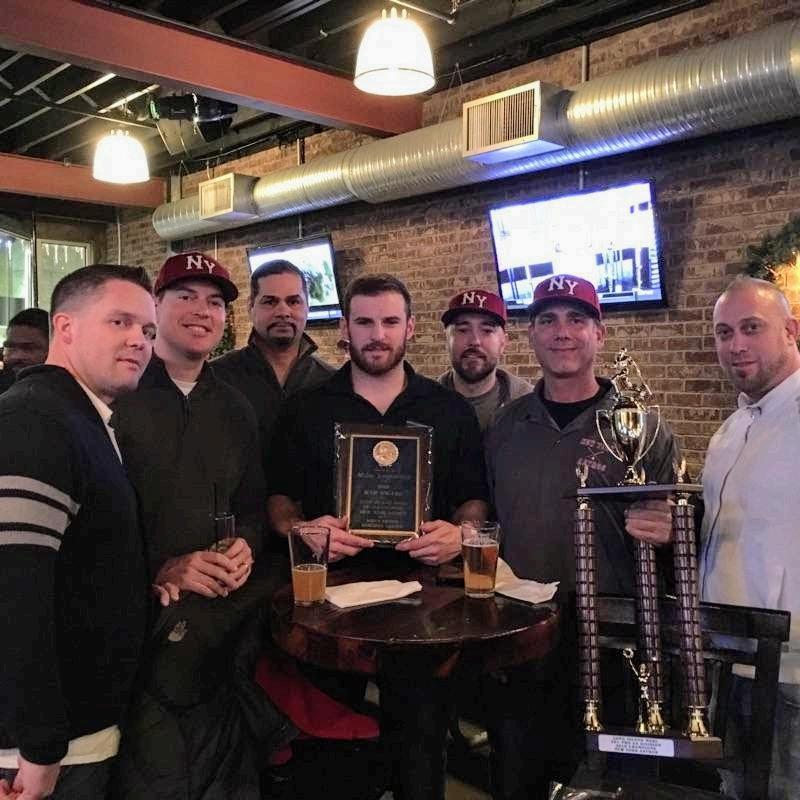
2016 New York Astros (25+) at MSBL Awards night
While the expansion team was celebrating its success, the main Astros roster experienced the growing pains that sometimes accompany progress. Injuries, roster depth, and the challenge of supporting two teams at once made the season difficult, and the results reflected it. The following year in 2017 brought similar challenges as both clubs battled through competitive seasons but ultimately fell short of their goals. That year Omar Norris joined the club as an Outfielder. A mainstay in MSBL, he brought a top glove and electric bat . Now going into his tenth consecutive season , Omar has cemented himself as a “CORE” player.
Even through those ups and downs, the core of the organization remained strong. The clubhouse still carried the standards that had been built over years of competition, with veteran players continuing to guide the team while the next generation stepped into larger roles. Looking back, the period from 2011 through 2017 represented a true era of transition and expansion for the Astros. The team had changed names, moved divisions, experimented with running multiple clubs, and began expanding its presence in tournaments and leagues beyond its original schedule. Some seasons brought championships, others brought lessons, but each year helped shape the identity of the program and prepare the Astros for the next chapter of their history .
THE ASTROS FAMILY
By the time the 2018 season arrived, the years of transition had settled, the Astros could feel the program beginning to move forward again. Just as important, something deeper was growing beyond the field. What players had casually called the “Astros Family” over the years had now become a true part of the organization’s identity. Teammates stayed connected outside the ballpark, families became more involved, and players who joined the team quickly understood that they were becoming part of something that extended far beyond a roster.
A major part of that stability came from the steady leadership of manager Frankie Parisi. From the time he became manager, he believed the Astros could be more than just another men’s league team. Frank's vision is to give players a place where they could compete at a high level while creating a fun, family type setting . Traditions before mattered, but so did building something sustainable. What players had casually referred to over the years as the “Astros Family” became something real and visible. “Coach Frank” encourages that atmosphere and understands that teams built on relationships often outlast teams built only on talent. The results on the field soon reflected that unity By 2019 the
team was playing some of its best baseball in years, finishing with an outstanding record and capturing the MSBL 35+ championship.
Then came the unforgettable summer of 2020 . The world slowed down and the baseball season itself was uncertain. Schedules shifted and openings delayed and no one knew exactly what the year would look like..
The Astros were prepared for anything . lol
When the games finally began the team responded, going 15-1-1 and capturing another championship . Although bitter sweet, the victory secured the first back-to-back titles in our
history. During these same years another part of the Astros program was quietly gaining momentum. The team’s tournament presence began to grow, and trips to national events became more serious and competitive. The presence of shortstop Mark Flatten had a lot to do with the improvement . He joined us in 2018 coming from the west coast with a long and impressive baseball resume . Since his addition, we have been steadily improving our play and talent level. The Astros were no longer just attending tournaments they were learning how to compete in them.
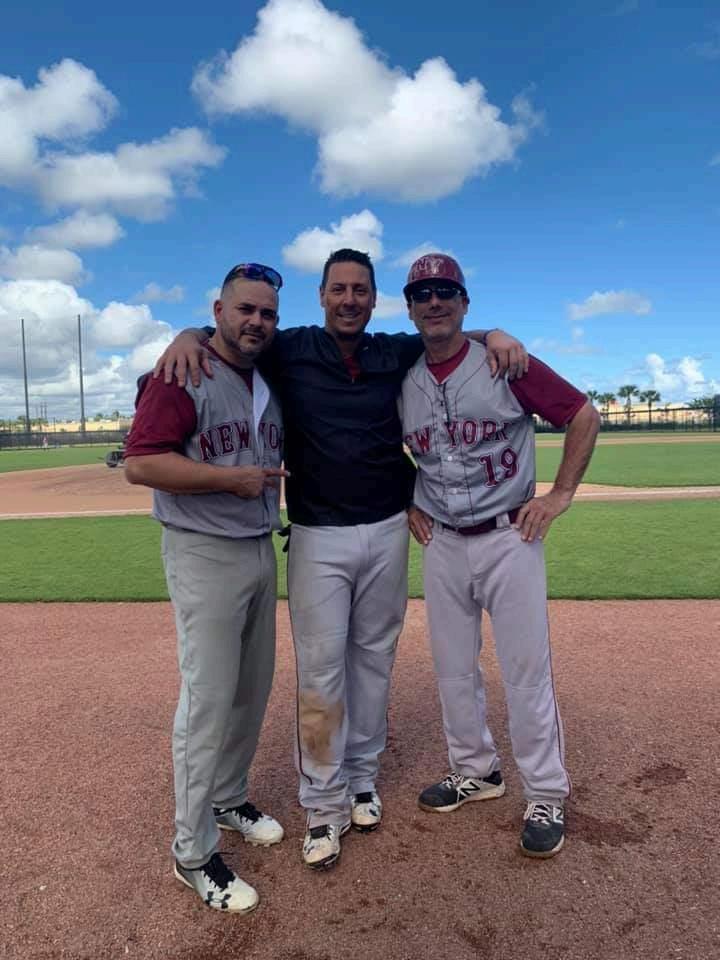
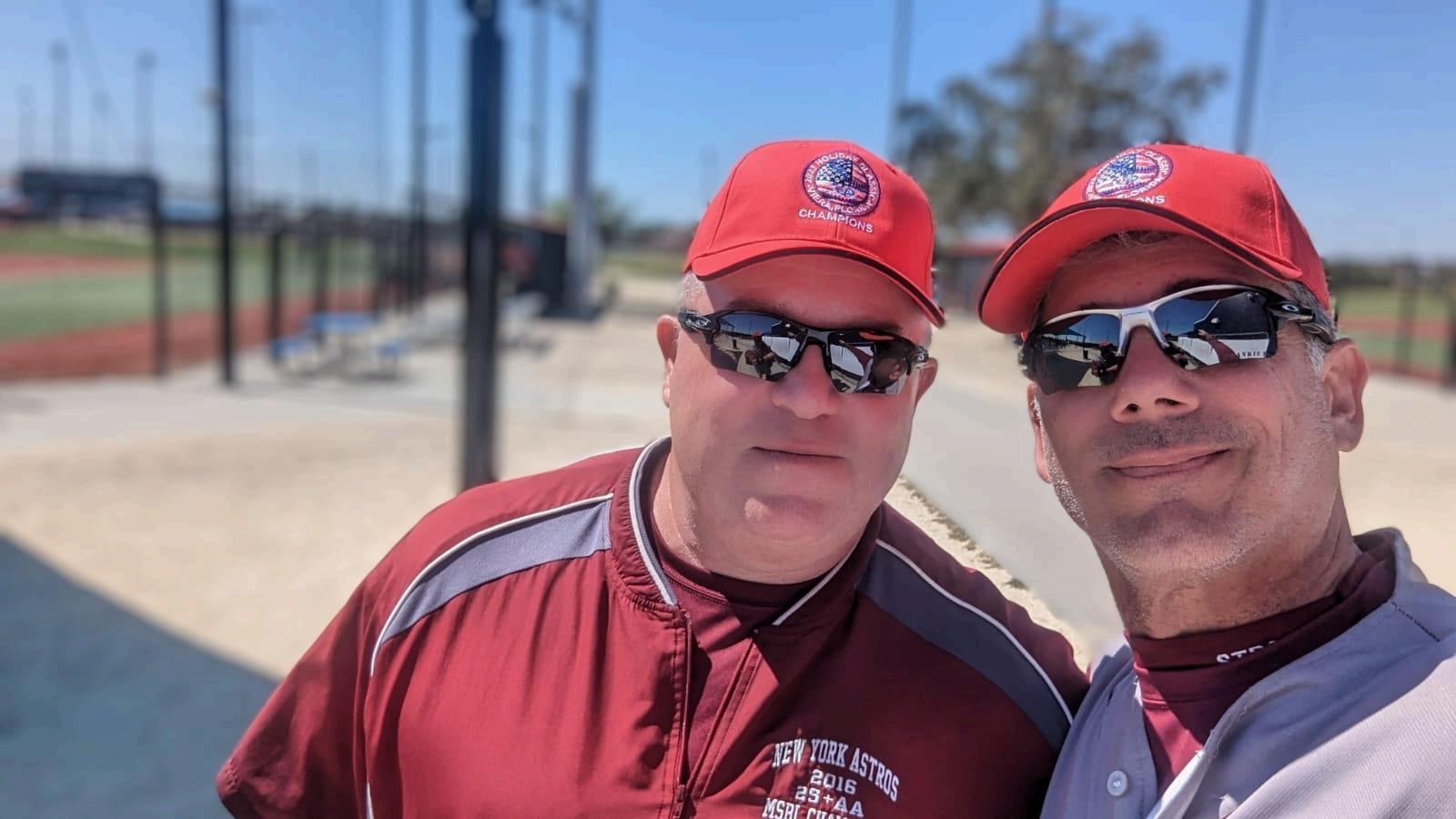
2024 Roy Hobbs World Series. (In Front) Parisi, Flatten and Brohman
By 2022 the organization took another step forward under Parisi’s leadership. Seeing the enthusiasm within the roster and the continued growth of the program, the Astros expanded into a second local team. In addition to the long-standing MSBL weekend club competing in the 35+ division, the Astros entered the Long Island Midweek Men’s Baseball League, creating a new team that would play during the week. It effectively doubled the number of games and allowed more players to stay active in the program.The midweek team proved competitive almost immediately. The Astros battled through the season and advanced all the way to the championship series, falling just short in the finals. Even without the title, the season demonstrated that the Astros could successfully operate across multiple leagues while still maintaining the identity that had carried them for decades.
By the end of the season, the Astros were clearly entering another chapter of their story. The program was stable, the roster remained strong, the tournament team was improving, and the Astros Family culture had grown stronger than ever. Much of that momentum could be traced back to the coach's steady hand protecting the traditions of the past while guiding the organization toward its future. The same idea that had started the team decades earlier was still alive: keep playing the game the right way, keep the clubhouse strong, and keep the Astros moving forward together.
TODAY'S NEW YORK ASTROS
By 2023, the Astros had reached a point where the past and the future were meeting at the same time. New leaders were emerging, the program was expanding, and the identity of the Astros remained as strong as ever.
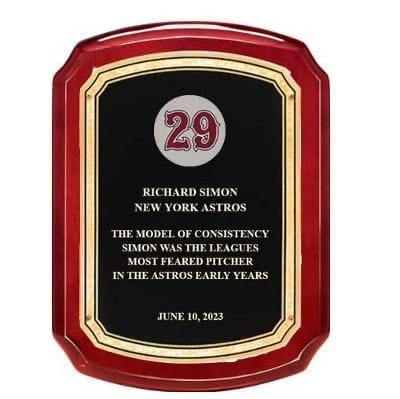
One of the most important moments of that season came with the recognition of a player who had helped shape the team. Rich Simon’s playing career with the Astros had come to an end the year before, closing a remarkable run that stretched nearly two decades. In 2023, the organization honored his legacy by retiring his number 29. It was a fitting tribute to the first captain in franchise history, a player whose intensity, leadership, and competitive fire helped define the culture of the team for an entire generation.
Richie Simon’s Dedication
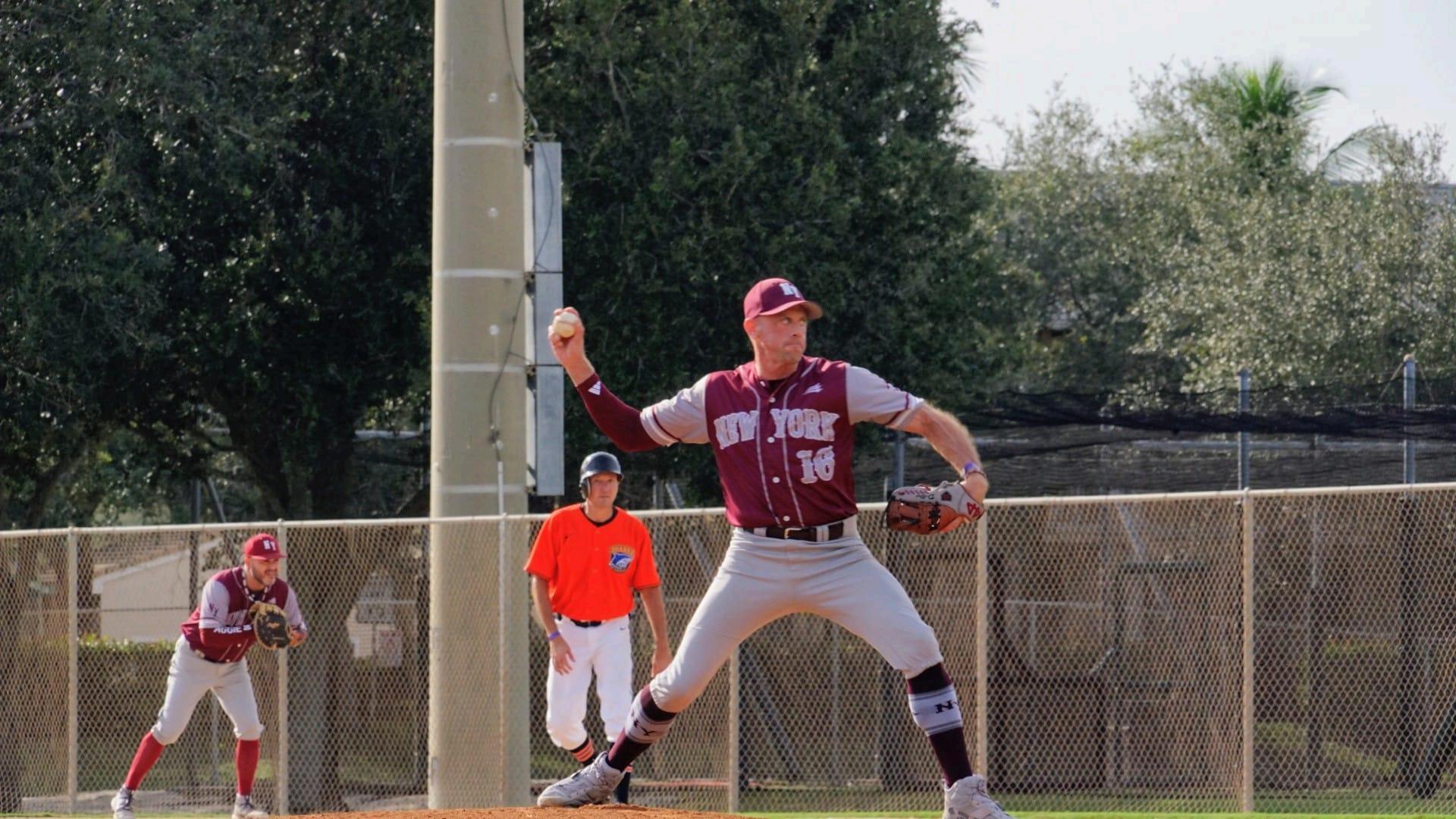
At the same time, leadership within the clubhouse continued to evolve. David Brohman joined the team and the impact was immediate. A versatile player capable of pitching, catching, and playing anywhere in the infield, he brought both talent and intensity to the roster. On the mound he developed into the team’s ace, while at the plate he quickly became one of the most dependable hitters in the lineup. Just as important, Dave carried himself with accountability and a competitive edge that had always defined the Astros. Very quickly Dave Brohman was named captain, third in Astros History .
Dave Brohman #16 in Action
The Astros also continued strengthening their structure behind the scenes. As the program grew, more players stepped into roles that helped manage the day-to-day operations of the team. Dave Brohman expanded his involvement beyond the field, serving as co-manager and director of operations. His responsibilities quickly grew to include coordinating facilities, organizing game-day operations, and overseeing team equipment and uniforms. Around the same time, Thomas Conley joined the management group as co-manager and director of finances. Conley had already contributed on the field as a pitcher capable of delivering important innings, but his impact off the field proved just as valuable. Conley brought stability and discipline to the financial side of the operation, helping ensure
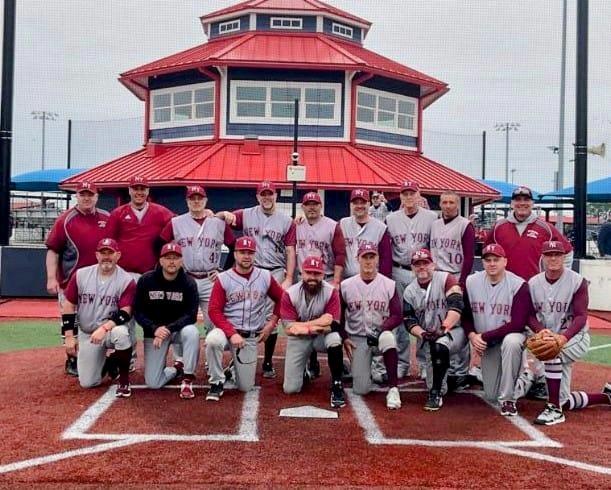
The Astros’ tournament program had spent years building toward a moment like this and finally took the next step. . What began as occasional trips to compete against teams from around the country had slowly grown into something more serious. The level of play improved, the roster strengthened, and the belief that the Astros could compete on the national stage continued to grow. Having great tourneys and close calls in Fall Classic 2021 & 2022 . That belief was finally validated at the 2023 MSBL Holiday Classic. In one of the most dramatic finishes in team history, the Astros defeated the Miami Yankees in the championship game when Mark Flatten delivered a walk-off hit in the bottom of the tenth inning, driving in Greg Visco for the tournament-winning run. The moment carried extra meaning for the team. Just months earlier, the Astros had fallen to that same Yankees club in the championship game of the MABL Fall Classic, a heartbreaking loss that ended with the tying run thrown out at the plate in the final inning. This time the outcome was different. The Astros finished the job, capturing their first major national tournament championship and proving that the program had truly arrived on the bigger stage.
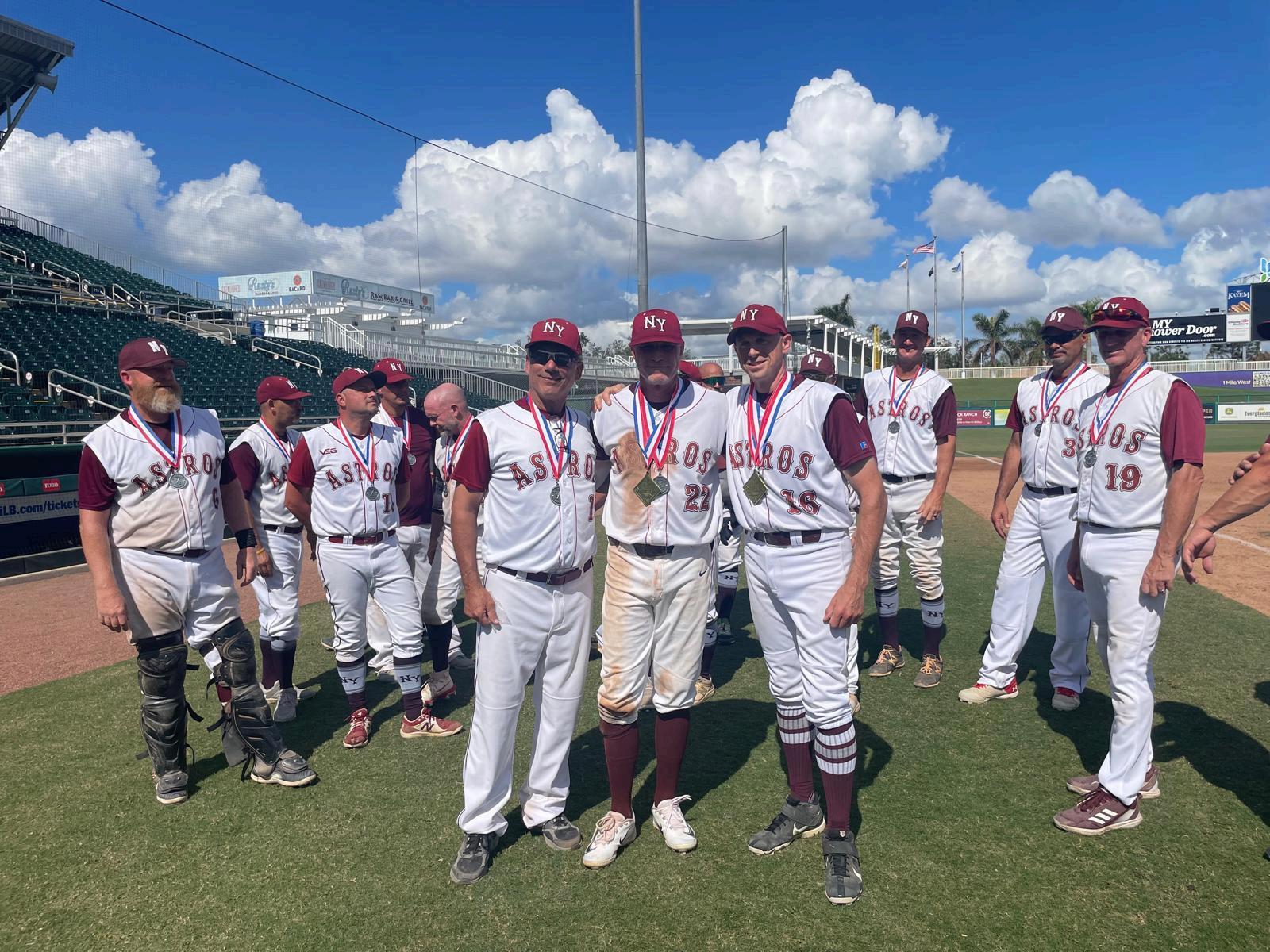
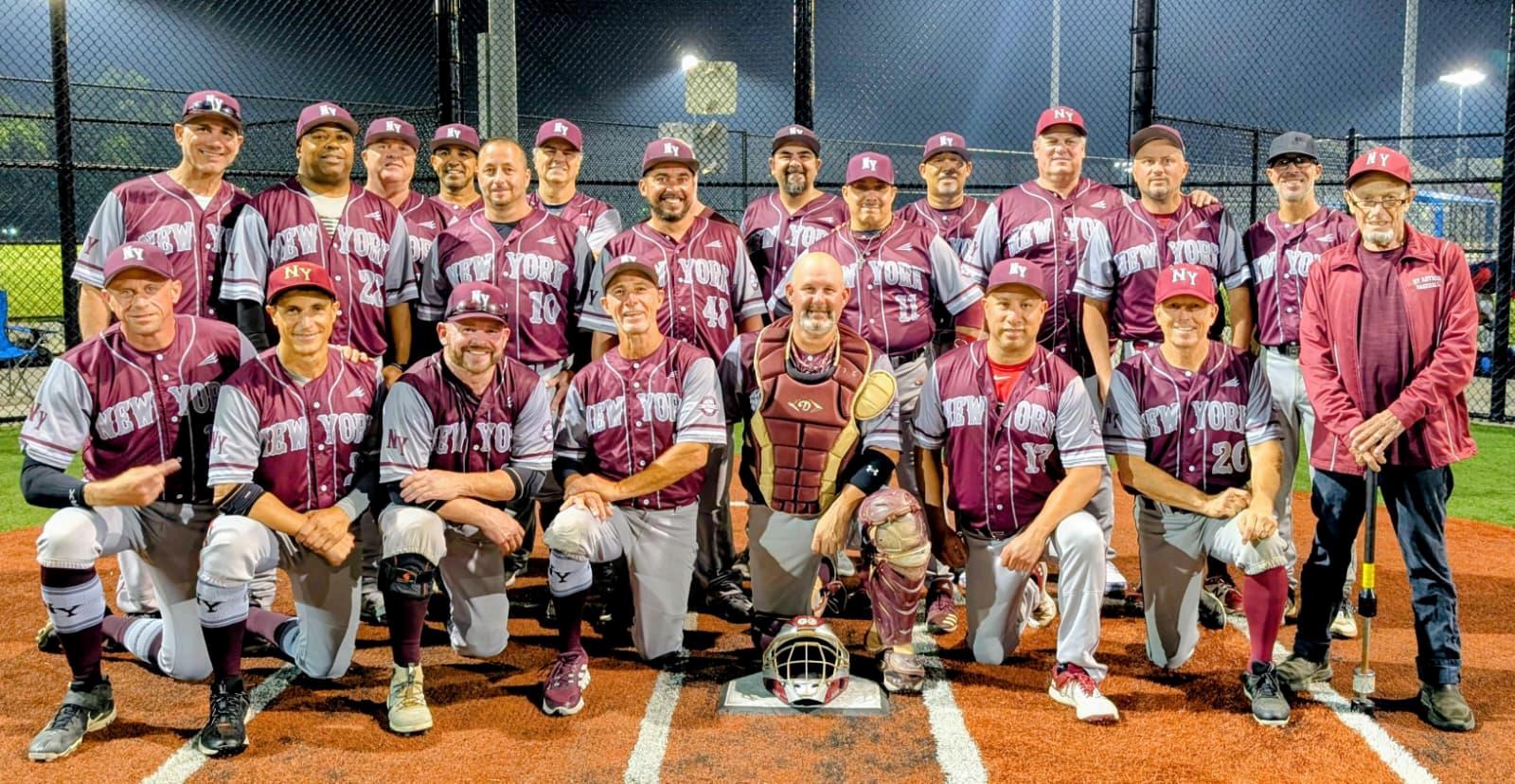
2023 Holiday Classic Team
On the field and at home, the Astros continued to compete at a high level. The 2023 season ended with another championship as the Astros captured the MSBL 35+ title, adding another banner to the organization’s long list of accomplishments. It was a moment that reflected both continuity and renewal the same competitive spirit that had
existed since the early Brewers years now carried forward by a new generation of players. Meanwhile, the Astros Midweek team continued to grow within the Long Island Midweek Men’s Baseball League. What began as an expansion effort quickly developed into another successful chapter in the organization’s story.
In 2024 the Astros captured the LIMSBL 45+ Midweek championship, proving the program could thrive across multiple leagues. The following year, in 2025, they did it again, winning the title for the second consecutive season. These Back to Back titles left us with a greater feeling of accomplishment than before . This year we may move our midweek to L.I. Stan Musial Baseball League due to unforeseen circumstances . Meanwhile the Astros weekend team made it to the finals both seasons (24” and 25”) . Losing two consecutive Championship series to the L.I. Sundevils in heart breaking fashion . Proving even today that the Men’s baseball on Long Island is as competitive as ever. These accomplishments demonstrated something that had been true for years: the Astros are a quality adult baseball team .
2025 L.I. Midweek Team
Astros look toward the future, the program remains in strong hands. The Captains and the leadership “Core” that has guided the team through its most successful years is still firmly in place, continuing to set the standard in the dugout. Around them still stands our Veteran Foundation of dependable players, including Willie Morales, Pat Smith, Dalton Young, Vic Lara, Carlos Diaz, Phil Baldwin, Erik Maldonado, Tom Conley and Ryan Gorecki . A talented group of experienced players who have become
essential to the team’s stability and competitiveness over the years.
Their love of the game, and commitment to the team help maintain the culture that has defined the Astros . Alongside them, a new wave of talent continues to emerge, bringing fresh energy and ensuring that the program keeps moving forward. Together, the blend of leadership, veteran presence, and developing players keeps the Astros strong and well positioned for the years ahead.
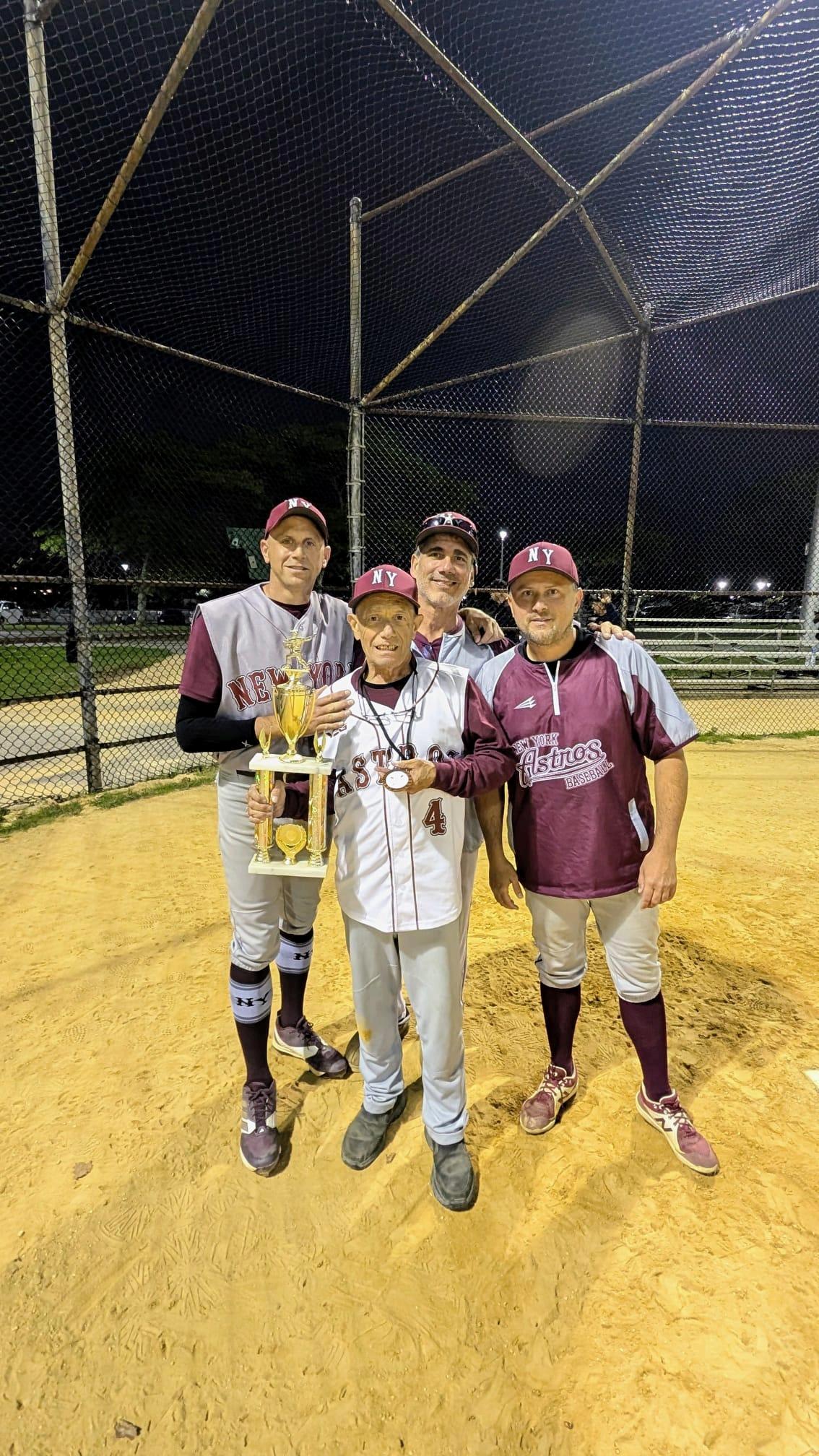
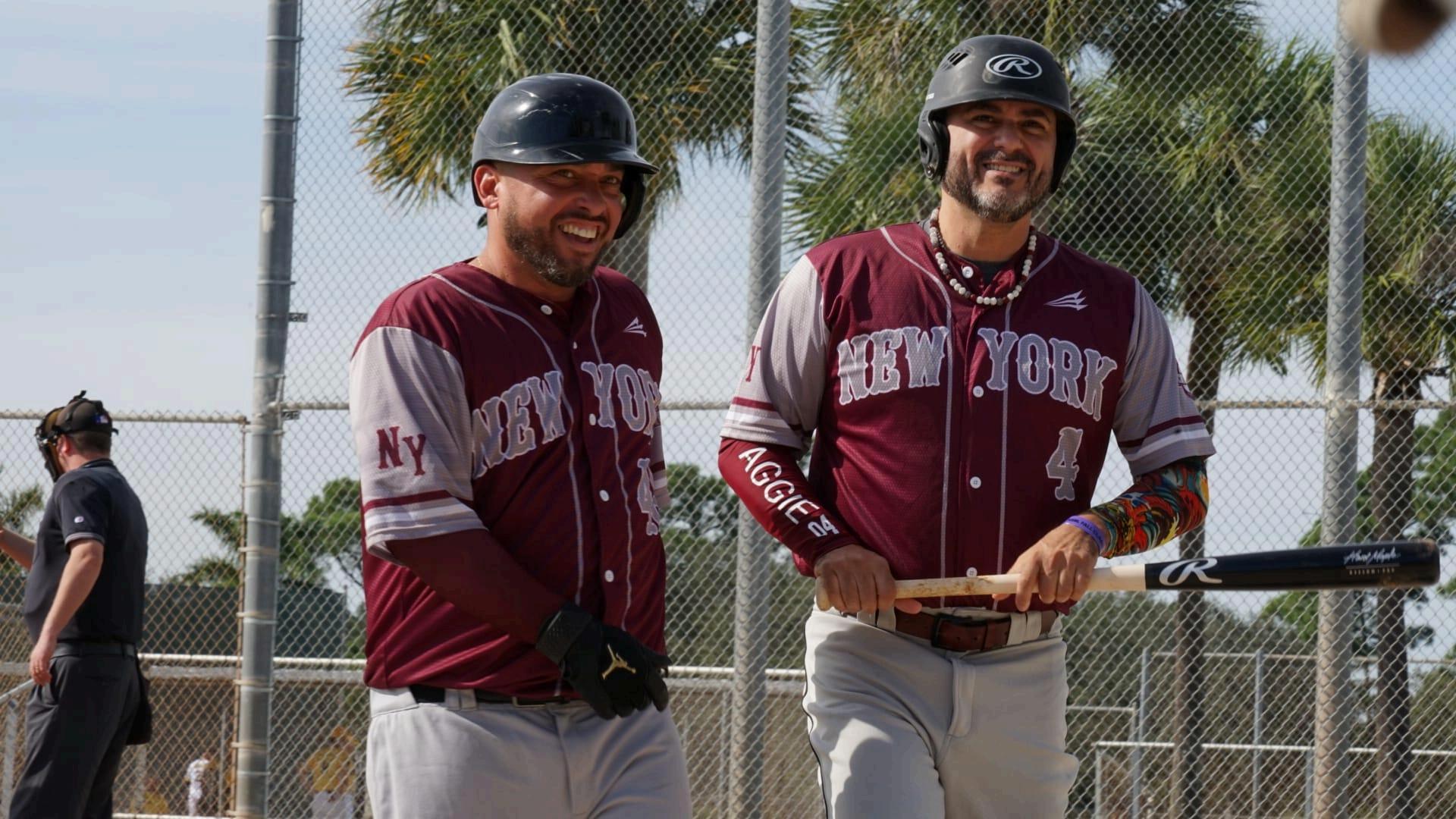
New Wave and The Core . . Maldonado #48 and “Aggie” #4
As the team moves toward the 2026 season, another milestone quietly approaches. The Astros are preparing to take the field for their 30th consecutive season of MSBL weekend baseball. Few teams in men’s baseball sustain that kind of longevity. Fewer still manage to remain competitive across multiple leagues and generations of players. Over the years the Astros have experienced the full spectrum of the game—tough losses, dramatic victories, championship pursuits, and the quiet pride that comes with simply taking the field together. From the early seasons of building the program, to the emergence of a strong core of leaders, to breakthrough moments like the unforgettable 2023 MSBL Holiday Classic championship, each chapter has added to a legacy built on perseverance and passion for the game. What makes the Astros special is the continuity of that spirit. Captains and veterans continue to lead the club, while new players bring fresh energy and talent. The clubhouse culture remains strong—rooted in respect for the game, respect for teammates, and the understanding that wearing the uniform carries a tradition that has been earned year after year.
Through every era Nassau Brewers, Long Island Astros, and New York Astros are blue-collar players who love the game, show up for their teammates, and compete the right way. Three decades later, the Astros are still doing exactly what they set out to do in the beginning.