CON V ERGING CA MPUS & COMMU NIT Y
NORTHWEST MISSOURIAN
THURSDAY, OCTOBER 8, 2026
MARYVILLE, MISSOURI
NWMISSOURINEWS.COM
VOL. 115, NO. 4
@THEMISSOURIAN
DESIGN BY DEMITRI OLIVER DESIGN EDITOR
AN INDEPENDENT STUDENT NEWSPAPER SINCE 1914.
PLEASE
RECYCLE
Oct. 8, 2026 @TheMissourian
A2
SPECIAL ISSUE
Farmers share AI data center impact on land MICAH STOLLEY Contributing Writer | @TheMissourian
Among the soybeans and flowers in rural Maryville, a small orange object covered in black spots soars through the sky. Despite its small size, it is one of the creatures that help plants thrive. The monarch butterfly found a home in farms outside of Maryville, but that could change. A farm along Highway 71 grows milkweed, one of the monarch butterfly’s top plants of choice. Wilmes Farm is also one of the farms bordering the Evergy Mullin Creek Natural Gas Plant. Tony Wilmes, owner of Wilmes farm, said the proposed data center would create serious impacts to his land. “The noise factor, I think, is going to be a big deal,” Wilmes said. “I understand there’s going to be a heat dome from the power plant that produces a lot of extra heat that may affect crop (or) a lot of stuff.” Wilmes owns 60-acres of farm land that he rents out to nearby farmers in the area. The farmers rotate crops each harvest season, which can optimize nutrients in the soil. Along with the farm land intended for crops, Wilmes has also spent 20 years working to add a pond and terraces to a portion of his land — which won the Outstanding Cooperator Award from the Nodaway County Soil and Water Conservation District in 1999. Along with renting the farm land to farmers, the family also hosts a collection of community events, including an overnight 4-H camping trip, as well as other recreation and party get-togethers. Community members also utilized it as a fishing ground during Covid-19, but hasn’t had many events recently. However, Wilmes said the water in the
pond could be affected by the nearby power plant. “I’ve got a ditch, a creek, on the back there that their water drains into my creek, so what kind of runoff are they going to have in the future?” Wilmes said. “Now they’ve got those apartments up there. I haven’t checked or anything, but where are they running their sewage? Those questions need to be answered.” The electrical generation industry withdraws around 15% of the total freshwater flow in the U.S. each year, according to the Clean Air Task Force. Power plants can produce a variety of pollutants, including mercury, arsenic, lead and selenium. While laws are in place to protect drinking water, recent changes made by the Trump administration have loosened these requirements. In November of 2025, the United States Environment Protection Agency announced plans to revise the 2015 Clean Water Rule. This September, the proposal stated that waters would need to be standing or continuously flowing every day under ordinary conditions to be federally protected. Wetlands would need to be connected to a perennial surface water connected to a protected waterway. The proposal is undergoing a 30-day public comment period that ends Oct. 9. The data center is not only expected to affect farms with crops; Wilmes said he is worried it will impact livestock as well. Cattle farmers near data centers, as well as recent social media posts, have claimed noise from data centers can cause stillbirths in cows, though no evidence proving these claims has been published, according to the Central European Digital Media Observatory.
PAUL SMITH MISSOURIAN PHOTOGRAPHER
Maryville resident Tony Wilmes explains the environmental impacts data centers could cause for farmers Oct. 5. Wilmes owns more than 60 acres of farmland that he rents out to nearby farmers in the area.
Susie Strauch owns a cattle farm right next to the land the proposed data center will be on. Strauch’s family has had farmland around Maryville since the 1940s but has continued gathering land since then. She said seeing the land utilized for data centers upsets her. “I’ve lived here for 81 years, and I’m not very happy with the way the land is being treated because
we farmed, we rented this when I was a kid,” Strauch said. “We farmed all this, and it’s personal — I hate to see good ground go.” Strauch has raised repeated concerns regarding the data center being built at Nodaway County Commission meetings. She said a data center could devalue resident’s land and could lead to increased water and noise pollutants. She raised spe-
cific concern about light pollution, which could impact how cows produce milk. Strauch said many residents by the data center are unsure of what their next move should be. “You don’t have any options,” Strauch said. “You just put up with it, and people say, ‘Well, just sell out.’ That’s not an option for people that’ve lived here all their lives.”
Office of Sustainability hosts food waste prevention event EMILY KRONE Missourian Reporter | @TheMissourian
Northwest’s Office of Sustainability celebrated Food Waste Prevention Week by spending an afternoon in Bearcat Commons collecting food waste from students as they left Sept. 30. The event debuted in 2021 after California’s Food Waste Prevention Week inspired a group to share how to prevent waste. The movement has reached 48 states, 11 countries and has over 600 partners. In the dining hall, two 22-quart tubs sat on either side of the food disposal site for students to dump their napkins and unfinished food into. Sustainability Coordinator Tim Hill and Bearcat Dining Marketing Manager Ashley Losson stood on both sides to explain the importance of composting food and share statistics. Bearcat Commons always garners waste, but the tubs were out during the lunch rush to measure and show students how much food waste is typically created on a daily basis. “We are collecting the food waste to see how much, so that people are aware of the food waste that they create, and to hopefully have people be more mindful of the food that they are consuming,” Losson said. Hill said food waste causes many environmental issues. The total amount of leftovers in the U.S. fill up 24% of landfills and produce the same greenhouse gas emissions as more than 42 coal-fired power plants, according to the United States Environmental Protection Agency. He said a large amount of energy is wasted just preparing the food. This is especially true in the U.S. “If you think about all of the resources that went into growing that food, to processing the food,
transporting the food, cooking the food, energy, fuels, water and human labor — that’s an enormous amount of resources that have been wasted,” Hill said. The Sustainability Office showcased statistics regarding food waste on a board by the food disposal site throughout the week. It also included graphics and explained how the University’s waste is collected.
“
“I think it’s important for people to be aware and conscious of the food that they are taking and what they’re eating.” ASHLEY LOSSON BEARCAT DINING MARKETING MANAGER
The amount of waste generated in the retail, food service and residential sectors of the U.S. was 66.2 million tons of food in 2019, according to EPA. Along with the waste of energy, Hill said the leftovers sent to landfills can cause other issues. The wasted food gets buried where it will later decay, but the lack of oxygen means that it produces a greenhouse gas called methane. “We know the greenhouse gasses are blamed for increasing greenhouse effects, increasing global temperatures in the atmosphere and contributing to climate change,” Hill said. He said Northwest tries to be environmentally sustainable and does not send its food to landfills.
Instead, waste from campus gets composted to reduce the greenhouse emissions as well as the University’s landfill expenses. Greenhouse gases are trapped in the planet’s atmosphere and keep heat near the Earth’s surface. At the composting center on campus, the food is mixed in with leaves, grass clippings and woodchips, as well as horse bedding. Hill said those are key ingredients to making compost, along with oxygen and moisture. Sophomore Kamryn Kennedy stopped to put the leftover food on her plate in the tubs. She said the school composting is a great thing. “Instead of throwing away food and just wasting it, we can reuse and do compost and stuff like that,” Kennedy said. “It’s a lot better than just throwing away your food and having a lot of waste on campus.” Compost from the university’s leftovers benefits the campus after it’s been processed. The compost is soil-like, and is used in landscaping projects and flower beds. Graduate student Bella Comparato said she thinks Food Waste Prevention Week is important for Maryville because it helps preserve the community the town has. She said this includes not wasting food, harming the land or putting data centers near the town. The office of sustainability has collected thousands of pounds of food waste on campus the past few months; seeing 3,400 pounds in July; 13,180 pounds in August and 15,730 pounds in September. “My boyfriend and I, we’re so bothered by it,” Comparato said. “I’m glad we’re starting to do more stuff about it.” She said she knew an international student last year and helped him implement recycling and food waste reduction habits into his daily routine.
8, 2026 SPECIAL ISSUE Oct. @TheMissourian
A3
Environmental efforts prevent plastic usage ANNA BAILEY Managing Editor | @AMBailey16
NATHAN NODA CO-PHOTO EDITOR
Sustainability Coordinator Tim Hill explains how food waste fills landfills during the Weigh the Waste event Sept. 30. Around 55 Elkay bottle filling stations across campus prevent the use of nearly 5,000 plastic water bottles each semester.
Hazardous waste event to take place this month LEAH COX News Editor | @byleahcox
A half-used 50-year-old can of paint sits in the back of a garage. An old bottle of pesticides collects dust in a shed. A broken smartphone with a lithium-ion battery rests in an old junk drawer. These items lie forgotten — until it’s time to throw them away. For area residents, getting rid of these materials doesn’t mean putting them in the trash. The Northwest Missouri Solid Waste Management District is holding a free collection event 8 a.m. to noon Oct. 17 to give residents a safer way to dispose of household hazardous waste. Northwest Missouri Regional Council of Governments Community Planner Kirk Kopper said those are some of the materials residents regularly bring to collection events. “We see a lot of old oil-based paint that people have sitting around in a garage or in a basement,” Kopper said. The program also collects pesticides, fertilizers, paint thinners, stains or varnishes, fluorescent bulbs, mercury and lithium-ion batteries. These items are considered household hazardous waste because they are either toxic, flammable or corrosive.
He said lithium-ion batteries are one of the materials the district particularly wants residents to keep out of regular trash bins. “An improperly disposed of lithium-ion battery is basically just a fire waiting to happen,” Kopper said. When damaged, the batteries have a higher risk of igniting and are difficult to extinguish. He said wrongly disposing them creates a risk for those working in trash transportation and at the landfill.
The NW Missouri Solid Waste Management District holds
4
hazardous waste collection events each year. The risks of improper disposal extend beyond fires. Hazardous materials can also enter into the environment’s groundwater systems when they are poured down drains, dumped on the ground or placed in regular trash cans. Missouri’s latest water-quality
assessment classified more than 5,500 miles of streams and about 234,000 lake acres as impaired, according to the Department of Natural Resources. This is due to hazardous waste contamination. DNR identifies pollutants such as mercury, heavy metals, pesticides and bacteria as a reason to label something as impaired. “If I had to pick one thing to make sure that isn’t thrown in the trash or dumped in a ditch, I would say mercury is definitely the most toxic of all the items that we typically receive,” Kopper said. Exposure to chemicals like mercury can affect wildlife and humans. DNR identified multiple cases of consumption through fish from state water in its assessment. Consuming contaminated fish can post greater health risks to children and pregnant women because nervous systems are more vulnerable as they develop. Kopper said one person’s decision can create an impact. “One person dumping their paint thinner, just, down the drain, but when you have several people doing that in our municipal water system, it’s going to add up to a really big problem,” Kopper said.
FULL STORY ONLINE:
NWMISSOURINEWS.COM
The University prevents the use of nearly 5,000 plastic water bottles each semester. Northwest’s Sustainability Coordinator Tim Hill said there are about 55 Elkay water bottle filling stations across campus; these fountains are used over 100,000 times each semester. The average fountain provides 15,000 20-ounce plastic water bottles’ worth of water each year, according to Elkay. The total amount of plastic bottles the University saves, according to these statistics, comes out to 5,000 bottles. Hill said these filling stations make a large impact at Northwest, both because of their convenience across campus and due to the number of people who use them. “I know that the water fill stations get a lot of use,” Hill said. “When I’m talking with students and faculty and staff too about sustainability, that’s one of the topics I always talk about, and I ask, you know, ‘Does anybody use the water bottle fill stations?’ and without exception, I always get lots of hands going up, or people hold up their reusable water bottles.” More than 60 million plastic water bottles are thrown away
each day in the U.S., according to the Container Recycling Institute. On average, a plastic water bottle takes 450 years to decompose. Hill said this plastic may never completely decompose. “It takes hundreds of years for a plastic bottle to break down, and in a lot of cases, it doesn’t actually break down; it just breaks into smaller microplastics,” Hill said. He said stations reduce the number of purchases of single-use bottles. Along with saving money, they give everyone on campus access to filtered, cold water. Elkay Customer Care Representative Maryann Alaa agree they are useful. “I know a lot more people are actually carrying their own bottles, since...we’re trying to move away from using plastic bottles, since it’s not, you know, very great for the environment,” Alaa said. “I think that helps also motivate people to get their own bottles...it’s got both great environmental impacts, because it helps reduce plastic waste, and just in general... it’s just a great convenience to have nowadays.” Elkay has over one million water bottle filling stations across the world; however, the brand is most prominent in the U.S.
FULL STORY ONLINE:
NWMISSOURINEWS.COM
Oct. 8, 2026 @TheMissourian
A4
SPECIAL ISSUE
Reliance on technology produces lazy minds DAKOTA OSWALT Editor-in-Chief @doswalt_NWMSRN
Artificial intelligence — machines that can do tasks humans have done since the beginning of time. It mimics — mocks, even — the human experience. AI’s prominence in the American classroom is causing a competency crisis in today’s youth, and educators need to stop encouraging their students to rely on this technology. AI in classrooms has generally been taboo; teachers often catch students using AI to write papers, cheat on quizzes and complete basic research. However, now it seems like AI is encouraged by some professionals, in education and in the workforce. I have had professors tell me about the benefits of AI. It can help employees cut back on tedious tasks and improve workplace efficiency, according to IBM. These pro-AI individuals seem to think it is a savior and the solution to the U.S. labor shortage or general problems in the American workforce. However, this technology is actually worse for labor in the U.S. than people think. If robots are smart enough to do simple human tasks, it could take over the job force, leaving Americans like you and me struggling to find work in our capitalist society. People in creative fields should especially worry. As a writer, I am anxious that bots will take opportunities from me. Eventually, I won’t be able to compete with this technology. OpenAI CEO Sam Altman announced that his technology will soon reach an advanced state of superintelligence that surpasses human cognitive abilities, according to IBM. What once seemed like something out of a dystopian novel is becoming reality — it should terrify people. I am beyond disgusted by educators and professionals who downplay how spine-chilling and threatening AI is. I cannot stand it when I am encouraged to use it to “help me” on a class assignment, as if it makes me smarter for utilizing it as a resource. The answer to America’s competency issues is not AI — in fact, it makes us all more stupid. People are relying too much on AI’s ability to think for them. When AI starts thinking for us all, we will become slaves to mind control. An unhealthy codependency on this technology weakens the imagination over time. If I went to AI every time I needed to make a decision, solve a problem or create something, I would merely be a zombie. AI is a threat to the concepts of freedom and individualism — a value this country claims to hold dear. An argument I often hear in support of AI is that it reduces human error. Do you know what else it reduces? Human effort. That’s not something society should be so willing to give up. It’s not like AI is flawless. When Google introduced its AI feature, it often told users the benefits of eating glue or rocks. These mistakes are the only thing stopping AI from coming for our jobs sooner. Professionals must stop insisting that we use AI. I will refuse to let it rule my world — until it actually does take over.
ANNA CASE CARTOONIST
AI has no place on campus, its use should be regulated OUR VIEW:
It seems like artificial intelligence has seeped its way into every aspect of our lives. From campus to entertainment to our government, it is everywhere — and the Editorial Board is worried about the permanent effects it may have on all of our lives and our futures. The more mankind relies on AI to think and create for us, we are likely to increasingly show signs of reduced critical-thinking skills, cognitive offloading and dependability on the technology. Human attention spans are also shortening due to the instant gratification AI provides. Environmental concerns also exist; AI data centers create sound and light pollution, take up hundreds of acres of land and use millions of gallons of clean water to operate. They also consume huge amounts of fossil fuels for electricity, which contributes to climate change. All of these effects impact not only us, but also the animals whose land the centers are taking. The Editorial Board does not believe the risks that come with using AI are worth it. Northwest is not immune to AI’s integration. A new minor in applied AI is available for students starting this year. This program includes multiple classes that discuss AI, including Introduction to Applied AI in the School of Computer Science and Information Systems. Northwest Provost Rose Marie Ward said during the Sept. 22 Student Senate meeting that the University is also working to create more AI courses for each department. In the classroom, we have seen our instructors encourage us to use AI for homework and larger assignments. The amount of times we are told to use the technology varies — some pro-
fessors tell us it can be used to help us study or do research, while others tell us we should use it to complete large portions of our projects for us. We hear our peers brag about relying on AI to learn for them. This is not OK. Some students, or their parents, pay thousands of dollars for tuition — all for a computer to earn their degree. This is not a proper way to learn. If we aren’t doing work ourselves, we can’t grow from our attempts, learn from our mistakes or eventually succeed. The University consistently advertises the motto “Career ready, Day one” — encouraging students to use AI does not align with this. For some of us, AI is the biggest opponent we will face in the professional setting. Pitting our rival against us feels degrading. AI is also seen outside of the classroom. The Athletics department has created multiple AI graphics to advertise games and go along with programming. Bearcat Sports is using AI to promote open media positions. This is ironic and embarrassing. The students on the Homecoming Executive Board allegedly used AI to create the designs on this year’s Tshirts. Many campus organizations also use the technology for social media posts or flyers to promote their events. This University has award-winning student journalists, graphic designers and artists. If Northwest organizations need a creative design, they should ask the plethora of students in these programs to help out. AI is a national issue. There are protests across the U.S., including Maryville, sharing concerns about AI development. Even individuals whose jobs are to engineer AI programs have expressed concerns about the speed at
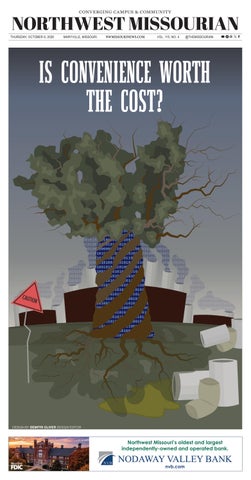
which the technology is advancing. Some developers have now deemed AI as superintelligence. U.S. President Donald Trump inaugurated an era of superintelligence on Sept. 29 in an executive order. For an entity to fall in this category, it has to be capable of surpassing human intelligence, according to Merriam Webster. This is the first technology that has earned this title. The capabilities of a superintelligent technology are unknown, and this scares us; but, this has not slowed its development. Last week, Trump launched America.gov, an AI chat bot advertised as a way to make information regarding the government easier for Americans to access. Eventually, we will be able to use this chat bot to complete governmental processes, like enrolling for medicare or renewing passports. This would include providing personal information to the chat bot — to the government. This is a bipartisan issue. While Trump may support it, other politicians have differing views. Both republicans and democrats have expressed concerns. Republican Sen. Josh Hawley and Democratic Sen. Chris Murphy recently created the AI Agent Accountability Act. This legislation’s purpose is to hold AI developers and operators accountable for hacking incidents. The Missourian Editorial Board does not support the intense rate AI is developing or being incorporated into University life. We believe the effects it causes negatively impact the wellbeing of humanity. We do not want to live in a world where our environment is ruined and our fellow humans do not know how to think for themselves or produce their own creativity. The cost of convenience is not worth it.
THE STROLLER:
Your Bearcat opposes cigs at Northwest No matter where I go on this campus, I either see cigarette butts scattered around like confetti or a construction worker sucking down a pack of cancer sticks. You know when construction workers are around because the air smells like burning spoiled fruit. The scent traps into my clothes — I can smell it on me after I leave campus. Just last week, as I walked around Colden Pond, I saw construction workers standing
around chain smoking. I gave them a smug look and continued on my walk, where I eventually sat down on a bench — and noticed a cigarette graveyard under my feet. Northwest is a tobacco-free campus, but it seems like the construction workers get a free pass because they’re too cool for school. If you’re going to ignore the policy, at least don’t litter. Our campus is beautiful, and construction workers undermine that by flicking their trash on the
ground like someone will pick it up for them — nobody will, that’s gross. I imagine the day when the squirrels carry them around instead of nuts. Just follow the trail of cigarette butts like a treasure map, and you’ll find a construction worker at the end. You may think I’m crazy for freaking out over one cigarette butt, but it’s never just one. It turns into 10, 10 turns into 100, and suddenly, everyone picks up on the trend and makes our University look like a landfill.
At this rate, we may as well imagine a future where instead of walking on dirt, our paths are consumed by cigarette litter. The ground is not your personal ashtray. We only get one Earth, and the environment shouldn’t have to suffer from our bad habits. That cigarette butt by the bench might still be there when I graduate. The Stroller has been a tradition since 1918 and does not reflect the views of the Northwest Missourian.
THE EVOLUTION OF AI IN OUR LIVES:
CADEN WILLMANN CARTOONIST
8, 2026 SPECIAL ISSUE Oct. @TheMissourian
A5
AI cannot YOUR VIEW: entertain, What is your take on artificial intelligence? has no spot Campus View: in industry MADYSEN THOMPSON Copy Editor @madysen_06
ELAINE MATTHES Freshman Marine Biology
JHAMEIR WARD Freshman Political science
JUNIOR SANCHEZ Freshman History
ME’ELELEI FAU Junior Psychology
“I think that there’s some things good about it and some things bad about it, like, you can create things to help you out but it’s also kind of destroying creativity.”
“I think that AI should be shut down and removed, and I think that it’s useless, and it just gives people ways to, like, cheat on stuff, and it’s, like, not healthy for the environment, because it takes as much firewater and kills animals and everything like that.”
“It has a lot of practical uses, but…I try avoiding it, but it’s kind of hard to avoid sometimes, so I end up using it anyway.”
“With me, I can go either ways. I feel like I’m for it, but only in the right of service…I feel like when people use it for every little thing, and like at that point, you’re not even thinking for yourself…if you want to use that as a tool, great, but whenever it becomes, like, it becomes a problem when you overuse it.”
Community View:
AMBER SOULE 38 years old Mosaic Medical Center-Maryville
SHANE GARNETT 44 years old Plumber
HEATHER PISTOLE 52 years old Accountant
JOSH OSBORN 36 years old Assembly worker at Kawasaki
“I have used AI. I think it can be a helpful tool, but we also don’t need to go crazy about it either. I mean, it’s going to ruin our, you know, ruin our resources and everything; but no, we shouldn’t have it.”
“I don’t use AI, and I think it’s going to ruin mankind.”
“I don’t know a lot about it, so that’s kind of why I don’t use it. People talk about all these things they’re creating with either Google or Chat GPT…I don’t even know how to do it. ”
“I’m pretty open to what it could be eventually. My opinions on it is it needs to be closely regulated and monitored. I feel like with all these large data centers, largescale information, it needs to be handled carefully…I feel like some of these large tech moguls are trying to play, like, God in a sense.”
CADEN WILLMANN CARTOONIST
EDITORIAL BOARD Dakota Oswalt Anna Bailey Leah Cox Olivia Wallace Nathan Noda Fletcher Proctor Madysen Thompson Lilly Hallmon
Editor-in-Chief Managing Editor News Editor Sports Editor Co-Photo Editor Co-Photo Editor Copy Editor Digital Media Editor
CONTACT US Advertising Phone: Advertising Email:
(660) 562-1635 nwmadv@nwmissouri.edu
NEWS STAFF Demitri Oliver Alex Pennington Ryan King Hannah Tate Ryan Pedee Anna Case Caden Willmann
Designer Designer News Reporter Sports Reporter Photographer Cartoonist/Designer Cartoonist
CONVERGING CAMPUS & COMMUNITY
NORTHWEST MISSOURIAN An Independent Student Newspaper since 1914.
CORRECTIONS POLICY
If you believe information within our publication is incorrect, please email us at northwestmissourian@gmail.com, call our newsroom (660) 562-1224, or leave us a comment on www.nwmissourinews.com.
LETTERS TO THE EDITOR
We publish letters from readers for free. All letters become the property of the Northwest Missourian, which reserves the right to edit them. Letters should include your name, address and telephone number. Letters should be between 150 and 300 words and sent to northwestmissourian@gmail.com.
Your first copy of the Northwest Missourian is free. Additional copies cost 25¢ each.
Artificial intelligence is starting to take over every aspect of our lives, and the entertainment industry seems to be its latest victim. Tilly Norwood is an AI-generated avatar created by Eline Van der Velden in partnership with her production studio Particle 6. Van der Velden made the avatar with hopes that it would become the next big actress in Hollywood. Obviously, this brought up concerns in the film and TV industry. The creators had to have an example to teach the AI character how to act, and it’s likely the skills came from films and TV shows that have already been released. This directly threatens so many actors’ and actresses’ likeness. That’s not the only concern people in the entertainment industry have — many worry these AI avatars are coming for their jobs. The avatars don’t need breaks, they don’t need time to memorize their lines, they don’t have protections or regulations to comply with, and they are much cheaper to use than real people. Actors aren’t the only ones in the industry affected. AI threatens the jobs of writers, producers, designers, editors and many other roles within this industry. With how greedy producers and executives are in the entertainment business, I wouldn’t be surprised if they use AI to cut costs, save time and add to their own pockets. TV and film is not the only aspect of the entertainment industry impacted by AI — music is also at risk. In the past couple of months, multiple AI-generated music artists and songs using AI in their production have made their way onto some of Billboard’s various music charts. Xania Monet is an AI-created avatar made by Telisha Jones. She made the avatar to be the voice and persona behind her music. I don’t understand why Jones couldn’t have collaborated with an established artist instead of turning to AI to produce her music. By working with other artists, she would still be able to see her work come to fruition, while also giving someone else the opportunity to be a part of a published song. Professionals in the music industry have collaborated for years — it’s not a new idea Jones couldn’t have known about. We are always told not to worry when a new type of technology comes out — we are told that it won’t affect us too much. But it seems like time and time again, these advances are taking over one industry after another. I agree that past technological advances made our world a better place — but they didn’t take over the world and threaten the livelihood of so many individuals. As someone who spends 75% of her time watching something or listening to music, I was in utter shock when I found out that AI actors and musicians are becoming the latest trend in the industry. AI avatars and personas can’t truly express emotions or come up with original thoughts, and they have no personal experiences to tell or show their audiences. That is how good actors and musicians connect with their audiences. Music and entertainment have been a part of human life since the dawn of time. It’s a way for people to express themselves and connect with others. If we let AI into the entertainment industry, all of that will be ruined.
800 University Drive, Wells Hall Maryville, MO, 64468 DIRECTOR Steven Chappell Madalyn Mosbauer
Student Publications Director General Manager/Ad Director
AD STAFF Parker Heller Caden Willmann Madison Bergan Braden Staudt Tyler Beeson Emercyn Koski
Advertising Manager Ad Design Manager Advertising Designer Account Executive Account Executive Account Executive
Oct. 8, 2026 @TheMissourian
A6
SPECIAL ISSUE
LILLY HALLMON DIGITAL MEDIA EDITOR
Northwest students use their computers before class in Colden Hall Oct. 2. On-campus and dual credit students are issued laptops for course work and personal use during the academic year.
Technology usage in education rises LILLY HALLMON Digital Media Editor | @lillian_hallmon
Every day, students send emails, submit assignments and use different resources for classes; throughout this process, screentime consumes a majority of students’ attention in the classroom. In the 2025-26 academic year, 88% of public schools in the U.S. reported having one technological device per student. At the Maryville R-II School District, students have access to technology every day. Brylee Wright, a business teacher at Maryville High School, instructs a multitude of courses in which her students are on technology a majority of the time. “In my class, they’re probably on it the whole 45 minutes that we’re in session,” Wright said. “In the other classes, I would say if we have seven class periods, they’re probably on their computers between three to four hours, I would say throughout the whole day.” Due to using computers at a young age, she said many students don’t understand appropriate usage of the technology. Often, students do not have well-structured typing mechanics by the time they reach high school due to using small computers, like Chromebooks, according to Education Week. There is a lack of typing classes for students to take in high school to strengthen these skills. In 2019, around 2.5% of high schools had typing classes compared to the 44% in 2000. “I’m seeing a lot of miscommunication when it comes to technology, where I wish there would be less, so then they are able to
use technology to the fullest,” Wright said. While technology restrictions in the classroom have increased nationwide, it is still in the hands of many students. The UNPLUGGED Schools Grant Act, a bipartisan bill promotes the phone ban in schools by providing federal grants to states that follow through, according to Education Week. Missouri has had a statewide ban of phones since July of last year, and the Maryville R-II School District follows these policies closely. On a collegiate level, there is more technological freedom than in the secondary school level — especially when it comes to phones in the classroom. Daniel Biegelson, a senior instructor in the School of Language, Literature and Writing at Northwest, said he has a hard time pulling students away from technology during class time. “Our laptops and our phones are a portal to other things,” Biegelson said. “I think you can be in a meeting or a classroom and — with all good intentions — and be looking at a text online, but then go, ‘Oh, click, I can check my email.’” From 2004 to today, the average attention span has dropped 103 seconds, with the average today being 47 seconds of focus, according to the American Psychology Association. Though this seems easy to blame on the student, Biegelson said he does not believe this is the case. “It’s culture and an economy that have incentivized and encouraged us, and pushed us and compelled us into this kind of state,” Biegelson said. “I think it requires a larger pushback around those things.”
MDC requests locals to report deer illnesses JASON NEUBAUER Missourian Reporter | @TheMissourian
Attempting to cool off on a hot summer day, a deer seeks water. While this could seem normal, the Missouri Department of Conservation said this may be a sign of something else — hemorrhagic disease. This disease is nothing new to deer. Missouri Department of Conservation Wildlife Health Program Coordinator Brigid Niemeyer said every year, the MDC receives reports of infected deer. “Hemorrhagic disease is something that happens and occurs naturally, and there is not any sort of specific intervention that we can implement to prevent this,” Niemeyer said. “There are these little midges called culicoides…little flies that actually transmit the disease to the animals.” It is caused by two different types of viruses: epizootic hemorrhagic disease virus and bluetongue virus In addition to deer, hemorrhagic disease can also spread to livestock. Niemeyer said the number of cases MDC has received this year is low compared to past averages. “Right now, we are at about 84 reports, and last year, we
had well over 100,” Niemeyer said. “We currently have seven confirmed positives, and that is probably a low number, and that’s due to staff being limited on how many calls that they can actually get out and respond to.” There are numerous signs for hemorrhagic disease including foaming around the deer’s mouth, approaching humans or looking weak. Additionally, Niemeyer said it can be difficult to confirm if a deer was infected. In this case, MDC must get to the animal quickly after it dies and before it decomposes. There are ways to test for infection before a death, but it is challenging. “We have to be able to catch that case really fast,” Niemeyer said. “That deer has to have passed away relatively recently for us to be able to collect a sample to be able to test for the disease.” However, the speed of responses from MDC has caused some frustration among community members. In a Facebook post made Sept. 23 by The Maryville Forum, the comments lit up with people voicing their opinions. Derrick Nicks, one of these commenters, said MDC has not properly done its job when it
“
I think those advance us as a society, but it is important to stop and think about what the cost might be — not just in dollars.”
Tim Wall Dean of the College of Education, Health and Human Services
Guadalupe Thomas is a parent to a Maryville sophomore. She said her daughter, Judith, is on her computer for the majority of the school day and then does homework after school. Thomas’ daughter has a children’s plan for her phone. The plan has limitations for app usage and regulates what content can be visible. “I believe all kids that are still in school are supposed to have a children’s plan, but not all of them do,” Thomas said. “That’s really just what we choose. Kids are on the phone way too much nowadays, it’s like Snapchat and all these other things.” Children ages 13-17 report using social media platforms such as TikTok, Snapchat and Instagram, according to The U.S. Surgeon General’s Advisory. Dean of the College of Education, Health and Human Services Tim Wall
said while there are issues with technology in the classroom, there are also upsides for online learning systems. “The root of assessment means to sit next to someone and o!er some feedback, and when that’s not possible — through distance or di!erent time of the day that people are working — having the opportunity to get great feedback is pretty meaningful,” Wall said. “In that regard, Canvas and Schoology are awesome. They’re exemplary, but there’s nothing quite like having that time with a teacher to get some coaching, help, feedback and opportunity for growth.” He said when looking at paper versus computer, there are drawbacks for both. However, a lot of the time, technology wins on practicality. “It’s an interesting catch-22, because I love the idea of being like, ‘Oh, here’s a text, here’s an essay, here’s a couple poems, read these online, and we don’t have to waste paper and all those things,’” Biegelson said. “It’s very convenient, because that allows students to be, ‘Oh, I’ve got half an hour here. I always have my assignments with me, so I can do it anywhere,’ so I understand the convenience of it is fantastic.” Wall said the technology access on campus across departments is important for education, but students and professors also need to focus on connection. “I think those advance us as a society, but it is important to stop and think about what the cost might be — not just in dollars,” Wall said. “If it pulls us away from connecting with each other, it’s probably not the right technology for that discipline.”
DEER DEATHS FROM HEMORRHAGIC DISEASE
SOURCE: MISSOURI DEPARTMENT OF CONSERVATION
comes to responding to alleged cases of hemorrhagic disease. “Gave up reporting when they had no interest in taking reports over the last few years,” Nicks said in the comment. “Our deer numbers are su!ering tremendously, quality and numbers both. Must’ve been too worried about the $$ in CWD culling, slaughtering deer over corn piles at night with thermals.” He referred to Chronic Waste Disease, which causes proteins to misfold in any infected animal, eventually leading to death. While there are no confirmed cases of CWD spreading to people, eating contaminated meat
INFOGRAPHIC BY ALEX PENNINGTON DESIGNER
can potentially cause variant Creutzfeldt-Jakob disease, which has similar e!ects. MDC had a program aimed to manage CWD in Missouri by removing the deer in areas with reported infections. MDC Director Jason Sumners announced July 7 that the program is ending. Brian Kinder liked and replied to Nicks’ Facebook comment. He said MDC should have taken action earlier. “Yep,” Kinder said in the comment. “Now they’re trying to make it seem like (they) care what we want or care about! Too little too late. They took the CWD $$$. Money hungry
period. MDC is not even close to how it was 30 years ago.” Regardless, MDC is asking the public to speak out when they see deer that could be contaminated. Those who see a sick or dead animal can report it to MDC through an online form. Niemeyer said public input is necessary for MDC to deal with the issue of unhealthy wildlife. “We welcome public reporting — in fact, we depend on the public to report cases to us,” Niemeyer said. “We wouldn’t know that they’re happening on the landscape otherwise, so we... welcome public reporting on our public facing web page.”
8, 2026 SPECIAL ISSUE Oct. @TheMissourian
A7
University implements new minor JASON NEUBAUER Missourian Reporter | @TheMissourian
Northwest is introducing an artificial intelligence minor in addition to numerous new AIrelated classes starting for the 2026-27 academic year. The minor requires 15 credit hours in addition to nine elective credit hours. New courses include Introduction to Applied AI in the School of Computer Science and Information Systems and an AI capstone project class. Associate Professor of History Robert Voss is the academic adviser for the AI minor. He said one of the primary reasons for introducing the minor is to ensure students have the opportunity to learn AI prior to applying for jobs after they graduate from Northwest. “The number one skill that is being requested by employers is AI,” Voss said. “I met with the Kansas City Tech Council, met with the job forces in Kansas City — that is routinely what businesses are asking for. So how are you going to get that? How is a student going to get that? How are you going to get that labeled to a degree? And that’s something that we should be considering.” At least 325 other institutions across the country have programs specializing in AI.
Freshman Elias Veulemans is a cybersecurity major in the Introduction to Applied AI course, offered in both the fall and spring semesters this year. He said he found the open discussions around AI helpful. “I think one of the most beneficial things is because we can discuss AI freely,” Veulemans said. “We can discuss the applications and also the risks of it. As a cyber security major, I have a very different experience than, for example, a business major who sees less of the technical side and more of the application side.” In addition to an Introduction to Applied AI course, the School of Language, Literature and Writing is offering a course titled AI Prompt Engineering. Professor John Gallaher said that while the course had different intentions, plans changed after Large Language Models, which transcribe English, were developed. “It was originally proposed as a prompt engineering course, but that was when LLMs were in their first iteration, which was kind of what would have been considered then kind of basically a prompt crunch,” Gallaher said. “Back in the first iteration, you ask it a prompt and it does its best to specifically answer that prompt. Now the mod-
NATHAN NODA | CO-PHOTO EDITOR
Northwest Professor John Gallaher speaks on the new AI Prompt Engineering course offered this year during an interview Sept. 23. Northwest is introducing an artificial intelligence minor starting the 2026-27 academic year.
els are more what they call reasoning models, where it goes through a first loop of thinking about or parsing what it thinks your intentions were by writing that prompt.” A major concern of AI use, however, is cognitive offloading, which is using external tools to put less on one’s mind. Cognitive offloading has been
Bearcat Athletics incorporates AI tools into daily operations OLIVIA WALLACE Sports Editor | @_oliviawallace_
As artificial intelligence rapidly reshapes media, Bearcat Athletics has increasingly used the technology to create graphics, write game recaps and produce programming. With its growth, Athletics has incorporated different AI tools into its presentation. Last year, Director of Athletics Andy Peterson implemented a chatbot called FanWord into the department to help generate game recaps and student athlete biographies after their seasons conclude. Peterson bought a 3-year plan for the department to help out Assistant Athletic Director Colin McDonough, who manages the department’s media, when writing post-game recaps. FanWord plugs in stats and names of players and generates the recaps in under one minute — where in recent years, it has taken hours to write post-game recaps. “I would say I have grown to like it,” McDonough said. “I was coming out from a strong journalism background. I was always kind of against AI and things that were not generated by me or my office — that was much different.” After each game, he writes one or two paragraphs and plugs in the NCAA stats then FanWord creates an XML file. Once the new document is done, he double checks names and statistics. On the coaching side, women’s basketball head coach Austin Meyer posted a graphic on Instagram Sept. 28, asking for videographers for the upcoming season. He used AI to generate the graphic. Both Peterson and McDonough said Meyer uses AI, but they see it as a way to save time and efficiently spread the word about important information. “Austin Meyer used it to create a lot of graphics,” McDonough said. “That’s different than what it might look like from (a) Bearcat Athletics-related graphic, but it’s still, he’s using it to help him with his program.” Meyer said he uses AI to simplify his tasks and save time when making graphics due to the department not having enough members to cover each sport. “It’s very helpful,” Meyer said. “I feel like if you use it for the right things, you know, I feel like you can waste a lot of time using it, but if you use it for the right thing, I just like it for messages to recruits.” Not every coach runs their own sports’ social media account, but with a number of roles vacant in Athletics, it is often left up to coaches to get the word out. Meyer has also used AI to make an MIAA Basketball Media Day post Oct. 6 to spread the word to fans. A social media post by the Bearcat Former Players Association circulated on Northwest student’s social media of a Bearcat paw with six toes instead of four. Not only was BFPA caught using AI for graphics, the official Northwest football account posted an infographic on Instagram for the first day of classes — featuring a player with six fingers on one hand. “It’s like anything else you put out though, you just have to make sure it’s accurate number one,” Peterson said. “It’s also portraying your brand in a way that everybody can be proud of. I think that’s maybe where some of the angst and stink has come from, is you don’t want to put a photo out there of a six fingered quarterback and the paw upside down.” Not only has Athletics seen an increase in AI usage, but University Marketing and Communication
has also used it to help generate ideas to showcase to incoming students. Northwest’s Digital Content Manager Ashlee Hendrix said she finds it to be useful — she said she saves time by using AI to search the Northwest website for graphics. “I think AI is a tool,” Hendrix said. “I started out as a graphic designer, so I used (Adobe) Photoshop and Illustrator and those things. Sometimes you grab a stock photo, and maybe you’ll manipulate it into the artwork you’re trying to express…I still think there’s like a human filter that has to use AI, because sometimes AI makes things up.” With the growth of the technology, neither departments have a written policy on AI use. Hendrix said members of her team have seen advertisements on social media depicting Bobby Bearcat with extra fingers — and they have asked them to be taken down. Both departments want to be fast and efficient with their graphics, but Hendrix said the marketing department has backed the “N” behind Northwest. With the growth of AI, the marketing team kept an eye out for incorrect information and wrong use of the copyrighted names.
“
“I would say I have grown to like it, I was coming out from a strong journalism background. I was always kind of against AI and things that were not generated by me or my office — that was much different.” COLIN MCDONOUGH ASSISTANT ATHLETIC DIRECTOR
“You can download the Northwest logos, if you want to use the paw, you have to ask Athletics…but in-house, we’re trying to keep control of respecting the brand, I guess is the best way to say it…We’re trying to keep our brand protected, anyway, the best way we can,” Hendrix said. “Where we’ve also struggled is AI Bobbies, people wanted AI Bobby all the time. There’s several of him on T-shirts and flyers and everything else.” Hendrix said Northwest students should go back to the fundamentals of schooling. “Don’t let it become your crutch,” Hendrix said. “I think it’s really easy to say ‘Oh, write this paper for me,’ or whatever, and prompt it, and maybe you can get really good at prompting and maybe that will be someone’s job. I don’t know because I haven’t studied it enough, but I do think it’s important we keep our own mental skills sharp. If we lean too hard on AI, maybe those facets of our skills will drop.”
connected to issues such as reduced critical thinking skills and creativity. Gallaher said he has seen cognitive offloading in the classes he teaches. “You just ask it a question like you’re pulling a slot machine at Las Vegas and whatever (it) spits out, you just copy and paste into your thing and you go,” Galla-
her said. “Which could be fine for some applications…but for a lot of the things that people are really gonna want to use AI for, you have to have to be more engaged than that.” As of now, the University has not announced an official policy on AI use in the classrooms; however, many professors have established their own.
Device usage Community raises concerns for technology reliance in classes. see A6
SPECIAL ISSUE Oct. 8, 2026
@TheMissourian
New minor program Northwest implements graduation track studying AI. see A7
Candidate for county commission shares data center view DAKOTA OSWALT Editor-in-Chief | @doswalt_NWMSRN
Scale Microgrids, the corporation behind Nodaway County’s proposed data center project, is soon partnering with another company to operate the facility, though that end user is not yet known. While the Nodaway County Commission said the company is close to announcing the details of the partnership, not everyone is so sure this is true. Missouri allows data center developers in the state to receive tax exemptions on their facilities. Scott Wilson is an independent candidate running for Nodaway County presiding commissioner this November. He said he feels like Scale Microgrids is waiting for the commission to give the company a tax abatement before the public receives more information. Last week, Wilson took these concerns to a Nodaway Says No informational meeting in Graham, Missouri. He said he worries about how a hyperscale data center could affect environmental safety and the local ecosystem. “There’s a lot of different ways that people talk about it, and a lot of the people, the citizens, have had to try to prove to the commissioners that the things that are being said are actually true, and I don’t know that that’s a 100% fair way to do it,” Wilson said. “It would seem more like that data center developer and the commissioners would have to prove to the citizens that it is safe, not the citizens having to prove to them that it’s not safe.”
Scale Microgrids will need at least
1.5 million gallons of water to operate its facility
He said he has heard many people talk about impacts data centers have on livestock. He heard it can reduce reproduction and increase stillbirths in cattle populations. Further, horses, sheep — and insects — are sensitive to sound. “They’ve talked about the bees, and they communicate with sound...it’s like being at a loud party, and they can’t figure out what’s going on, so they can’t even get back to their hives,” Wilson said. He said a data center in such an agriculture region feels invasive — to people and animals. Another concern for residents is water. Scale Microgrids needs at least 1.5 million gallons of water to operate its facility, but not all residents see how it is feasible. “Of course, the river, if they suck too much water, they’re going to run the river lower than it already is at times,” Wilson said. The Missourian reached out to the Nodaway County Public Water Supply District No. 1, which would supply the center’s water, and received a message in response. “When the project particulars are agreed to by all entities public and private maybe we could give a story with background on the whole thing,” the message said. “However since the district is in the middle of contract negotiations with suppliers and customers, we...can’t speak to much.” Wilson said officials at hand should strive to make the best decision possible regardless of money. “I believe that the commissioners should strive to make this as safe as possible, and it doesn’t really matter what the developer’s return on investment is,” Wilson said. “If it doesn’t work out for them, it just doesn’t work out.”
FLETCHER PROCTOR CO-PHOTO EDITOR
Northwest graduate student Zachary Eisentrager shares his thoughts on how artificial intelligence is used during an interview Oct. 1. AI technology has directly affected how he works at his job at GreenTower Press, as students who work there are heavily discouraged from using it.
Students share opinions about growing AI use
A
DAKOTA OSWALT Editor-in-Chief | @doswalt_NWMSRN
s people around the world increasingly rely on artificial intelligence to complete their day-to-day tasks, Northwest students see the impacts of the technology firsthand as it integrates into the educational landscape. Some students may have noticed a rise in AI-generated flyers on bulletin boards around campus, and some instructors might have observed an uptick in students using AI to complete their homework. Zachary Eisentrager is a master’s student studying English who works for GreenTower Press. He said Northwest’s College of Business, Mathematics and Technology recently faced heavy criticism for using AI. “They had a shirt, but the design that they had for that T-shirt is AI-generated, very blatantly so,” Eisentrager said. “It’s not even, like, a question…It looks very much like those food posters that are AI-generated for smaller food trucks.” It is not always easy to detect when art is made from AI, especially as the technology approaches superintelligence status and can effectively pass as human, according to IBM. Identifying AI-created artworks are easy to spot for others, as they typically feature similar design elements. AI-generated posters, for example, often overcrowd the space with text and iconography, making it hard for viewers to spot the most important information first — a critical step in the craft of design, according to USA Today. This is not the first time students have noticed something a little bit off about a T-shirt design. Recently, the University’s Homecoming Executive Board encountered a similar situation for allegedly using AI to create this year’s Homecoming T-shirts, which featured the school mascot, Bobby Bearcat. When the organization revealed the shirt designs on its Instagram page, multiple students and alumni claimed the design was “AI slop” and called out those who authorized the creative choice. A comment from one student said, “School filled with design and media majors and still use AI…Gross and disheartening.” After more messages shared similar thoughts, all garnering around 30 likes each, the organization disabled the commenting feature on the post.
“
While artificial intelligence can assist departments across the campus with operational tasks, including some design and visual production, it is poor at replicating intellectual property. AI creates a risk of manipulation of our Northwest logos that is inconsistent with the University’s brand standards and licensing process.”
ELISE HEPWORTH
DEAN OF THE COLLEGE OF ARTS, COMMUNICATION AND SOCIAL SCIENCES
U.S. and state lawmakers are actively refining policies about AI and intellectual property rights. While there are no federal regulations on AI, using the technology to make a profit off of copyrighted materials — such as Bobby Bearcat — may be considered infringement under the law, according to VLP Law Group. The Missourian reached out to Homecoming Chair for Public Relations & Communications Kelsey Tallman for an interview, but she declined on behalf of the executive board. In apparent response to this, Dean of the College of Arts, Communication and Social Sciences Elise Hepworth brought up AI in her email newsletter sent to Northwest employees Sept. 24. She discussed the implications AI use can have on the University’s credibility, and she said using the Bearcat paw logo is restricted in certain settings. “While artificial intelligence can assist departments across the campus with operational tasks, including some design and visual production, it is poor at replicating intellectual property,” Hepworth said in the email. “AI creates a risk of manipulation of our Northwest logos that is inconsistent with the University’s brand standards and licensing process.” On the academic side, Eisentrager said he doesn’t see AI as having
FLETCHER PROCTOR CO-PHOTO EDITOR
Northwest junior DeAngelo Harrison speaks about artificial intelligence during an interview Oct. 1. Harrison said AI helps him with his homework.
much use for him. From an ethical standpoint, he opposes AI generating images derived from real artists’ works, as well as the effects AI data centers can have on the environment — specifically, the water. He said he is wholly against the proposed AI data center that might be built south of town, which could lead to multiple kinds of pollution, including water contamination. The University sees no shortage of boil orders due to water main breaks; Eisentrager’s own stomping grounds, Colden Hall, had no water for more than 24 hours last week. The building was still under a strict boil advisory at the time of his interview with the Missourian. “I know the data centers come with a lot of, like, water problems,” Eisentrager said. “I don’t think Maryville is a town that can really live with more of those problems. We already have outdated infrastructure. I don’t know what AI would do to what we currently have.” Students in humanities fields are more likely to express negative attitudes toward AI, while STEM and business majors report positive views of the technology, according to College Board. DeAngelo Harrison is a junior studying pre-engineering. In the classroom, he said AI is a helpful tool that allows him to understand his homework better. “It makes it a lot easier because, like, it takes longer to, like, figure things out when you try to do it yourself,” Harrison said. In his case, he said many of his instructors have urged him and his peers to use AI to make study guides before exams. While this makes memorizing vocabulary terms easier, he said it comes with a cost. “I think it’s starting to get to the point where…people are getting to the, like, lazier side, and they want someone else to do it (their work),” Harrison said. Instructure, a leading educational technology company and owner of Canvas, conducted a poll earlier this year to find out how AI impacted the classroom. It found that 90% of college students and 61% of college instructors occasionally use AI in the classroom. Harrison recalls taking a psychology course where he had to complete roughly 20-30 assignments per week. When he had more difficult, major-specific classes to worry about, using AI for a general education course eased his stress. When it comes to the Homecoming T-shirts, Harrison said students, faculty and staff should be held to the same standard. “It’s crazy that the school (is) using AI, but hey, if the students use it, what’s wrong with the school using it?” Harrison said. “It’s helpful…(it) kills time, makes things faster, then also gives new ideas; but also, it kind of, like, takes away the artistic value of the T-shirts and stuff…just taking away the creativity out of it, honestly.” The student body as a whole is conflicted about where it stands on AI, and the future of the technology in higher education remains uncertain for now. Exactly 30 years ago this year, members of Northwest leadership navigated how they should incorporate the internet into classrooms; they will likely do the same with AI and every technology that follows.