MIKE RICKER OPERATING PARTNER ricker@leafmagazines.com
TOM BOWERS CHIEF OPERATING OFFICER tom@leafmagazines.com
DANIEL BERMAN CHIEF CREATIVE OFFICER daniel@leafmagazines.com
AMANDA LOPEZ STATE CONTENT DIRECTOR amanda@leafmagazines.com
MAKANI NELSON STATE SALES DIRECTOR makani@leafmagazines.com (808) 754-4182
BOBBY BLACK LEAF BOWL DIRECTOR & HISTORIAN bobbyblack@leafmagazines.com
MATT JACKSON SOCIAL MEDIA LEAD mattjackson@leafmagazines.com
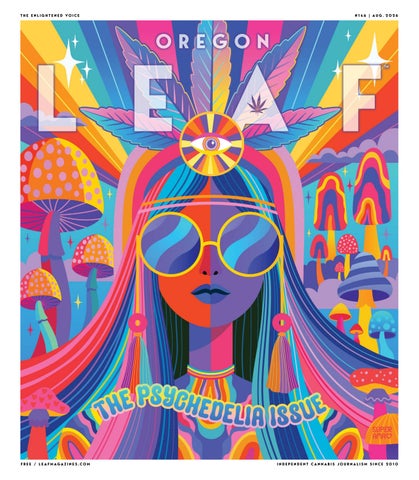
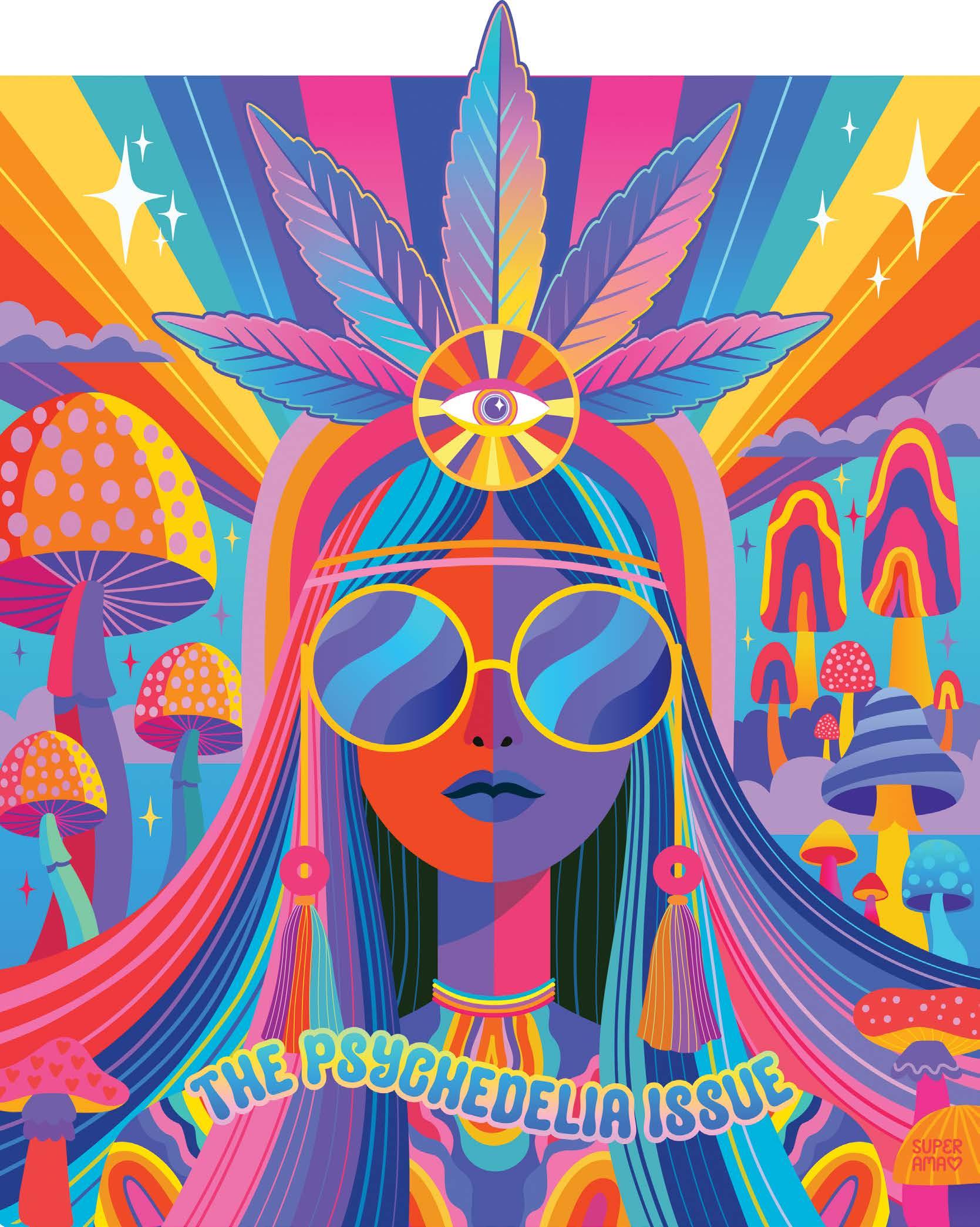
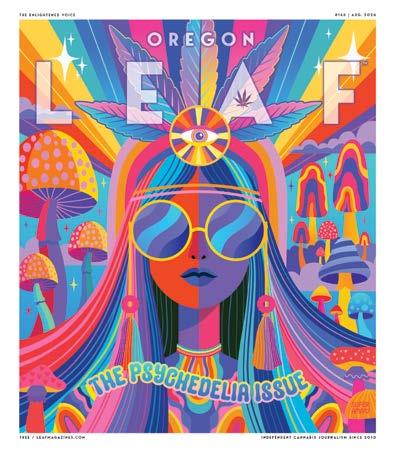
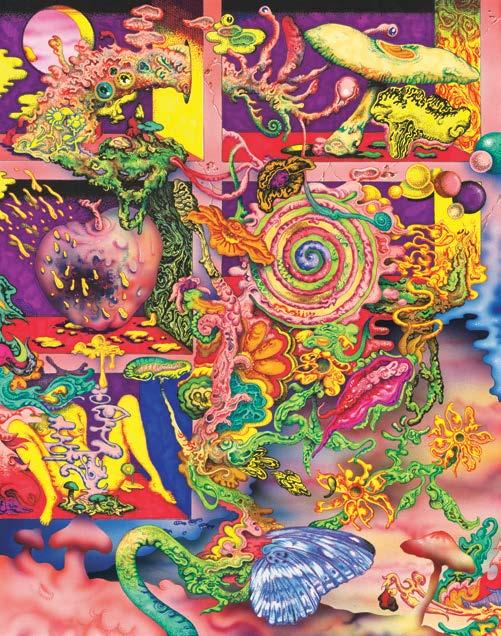
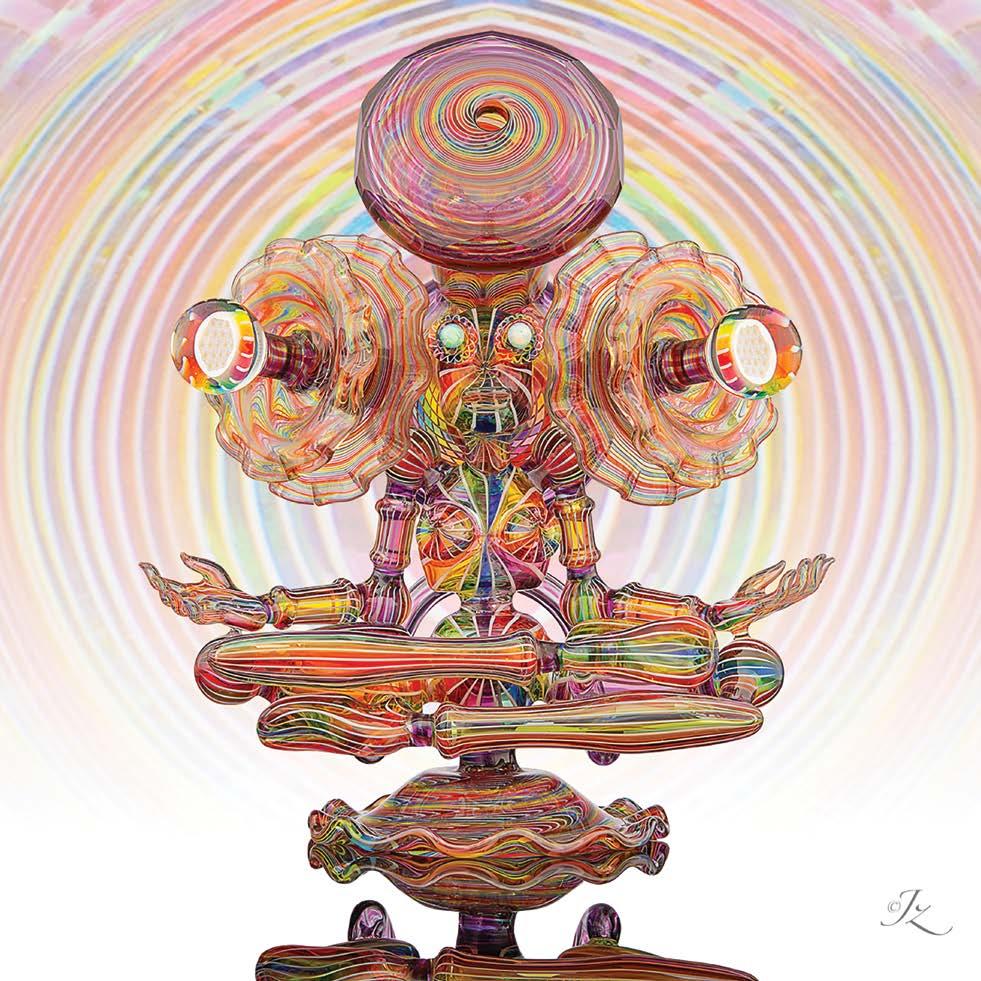
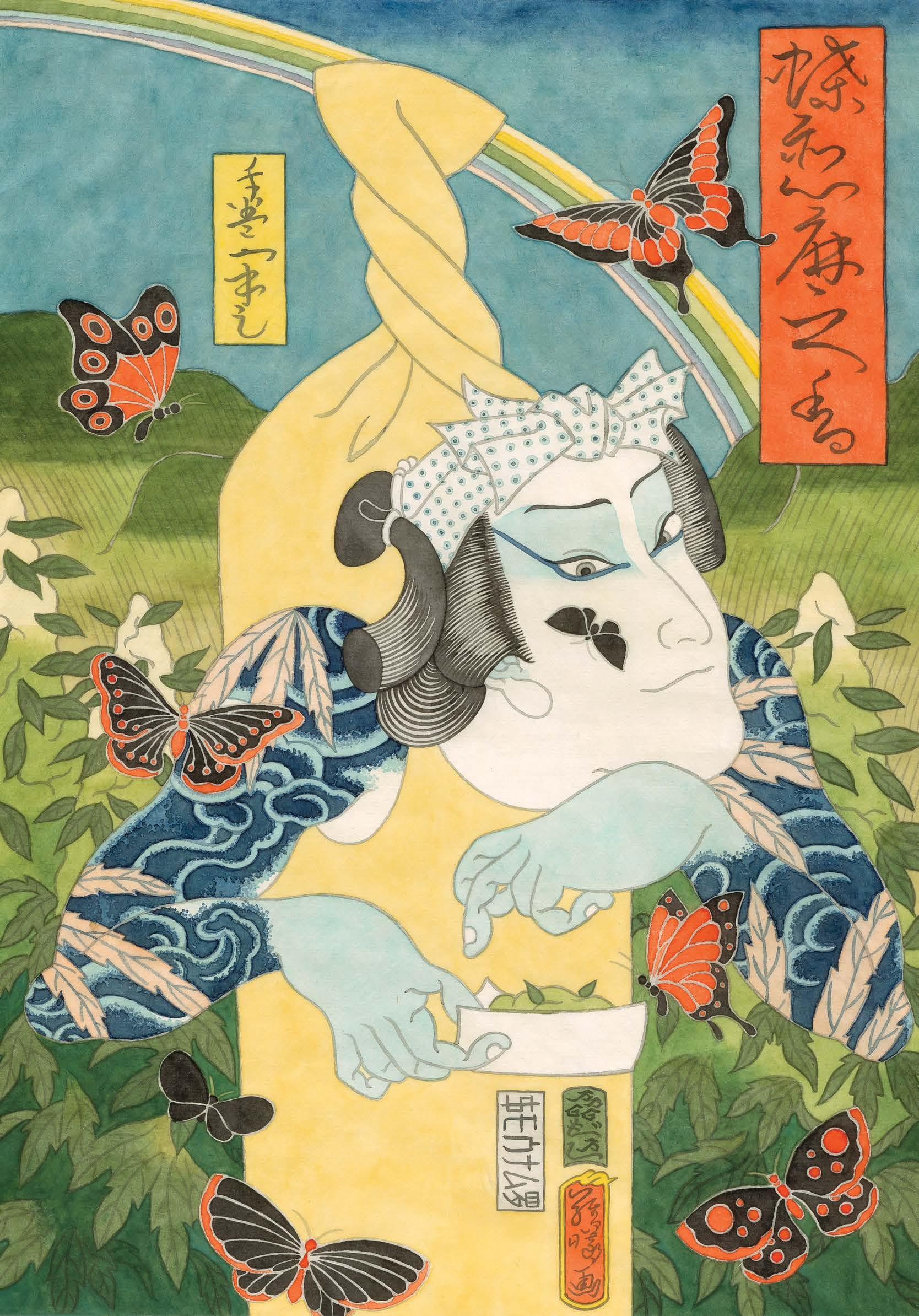
ABOUT THE COVER
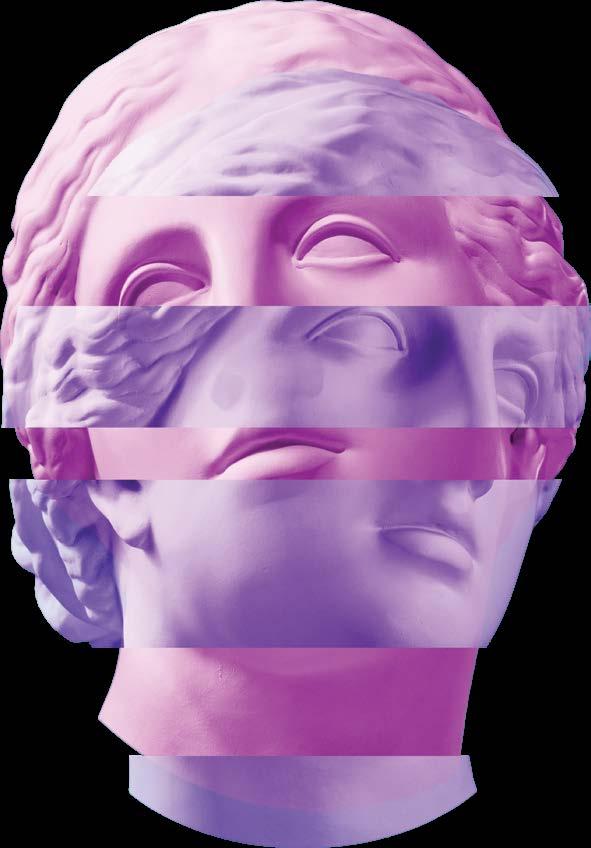
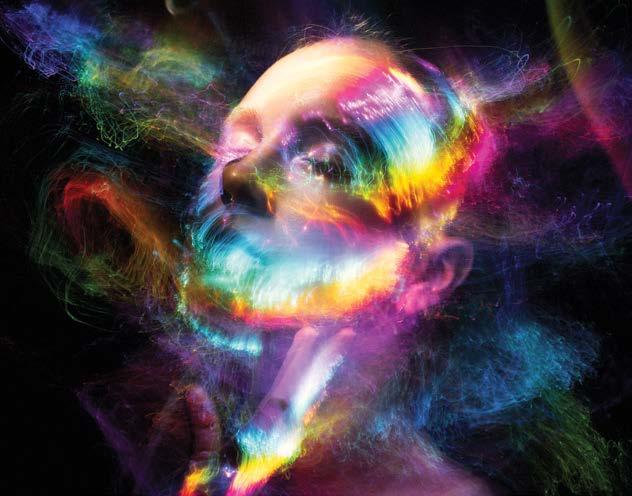
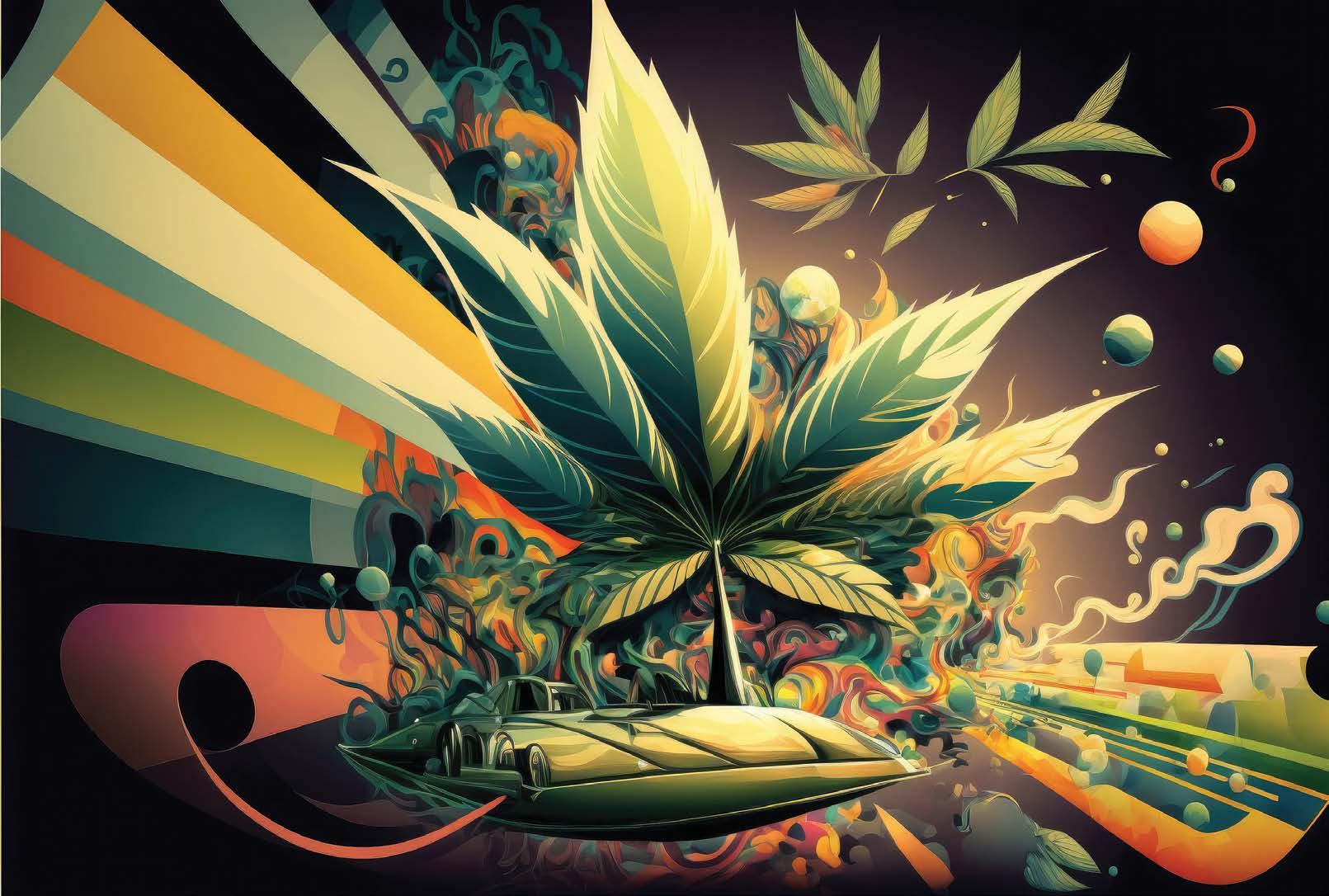
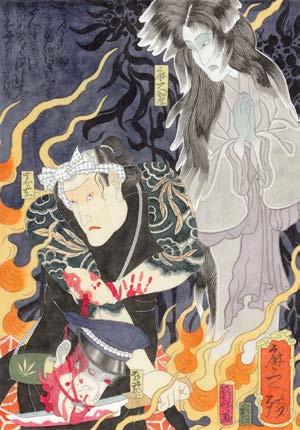
Amaranta Martinez, known as SUPERAMA, is a Venezuelan visual artist, Emmy Award winner, muralist and digital creator based in Miami. At the heart of her practice is the fusion of art and technology, creating experiences that go beyond the image itself. For The Psychedelia Issue, SUPERAMA channeled the Leaf's vision of a portal of perception — a figure standing at the threshold between ancient and future. But the portal doesn't stop at the page: Scan the QR code and follow the prompts, then point your camera at this month's cover to unlock an augmented reality experience and watch it come to life!
ILLUSTRATION BY SUPERAMA THESUPERAMA.COM/SHOP @SUPERAMA__
CONTRIBUTORS
WES ABNEY, FEATURES
AJ AGUILAR, FEATURES + PHOTOS
DANIEL BERMAN, DESIGN + PHOTOS
BOBBY BLACK, DESIGN
RUSSELL BOHR, PHOTOS
CRC PRODUCTIONS, PHOTOS
JACKIE BRYANT, FEATURES
TOM BOWERS, FEATURES
DAVID DOWNS, FEATURES
WYATT EARLY, FEATURES
RYAN HERRON, REVIEWS
REX HILSINGER, FEATURES + PHOTOS
ELLEN HOLLAND, FEATURES
MATT JACKSON, FEATURES
DEREK KELLY, PHOTOS
ROGER KISBY, PHOTOS
AMARANTA MARTINEZ, ILLUSTRATION
JAMIE OWENS, FEATURES
TIAN SCHERER, FEATURES
TERPODACTYL MEDIA, FEATURES + PHOTOS
CARA WIETSTOCK, FEATURES
BRUCE & LAURIE WOLF, RECIPES
MICHELLE NARANJO & CARA WIETSTOCK COPYDESK michelle@leafmagazines.com | cara@leafmagazines.com
KATHERINE WOLF, FEATURES
JAMIE ZILL, PHOTOS
We are creators of targeted, independent Cannabis journalism. Please email us to discuss advertising in an upcoming issue of Oregon Leaf. We do not sell stories or coverage. Email makani@leafmagazines.com to learn more about our range of affordable print and digital advertising options to help support Oregon Leaf, the state’s longest-running Cannabis magazine!
Editor’s Note
Thanks for picking up The Psychedelia Issue of Oregon Leaf!
Psychedelics are power! Modern medicine is all about sacrifice and substitution. Doctors treat Americans with an ailment by trading one problem for a medication with a side effect. Healthcare is now compromising one aspect of health to try to save another This is especially evident in mental health treatments, which have utterly failed to turn the tide of depression, anxiety or the myriad issues treated with selective serotonin reuptake inhibitors that are the modern version of lobotomies.
Psychedelics have the ability to rewire the brain and create new neural pathways and thought-behavior patterns, and they do so without any negative or compromising side effects. That is powerful medicine!
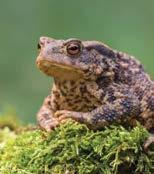
My belief that God gave us this Earth includes psychedelics and other entheogenic medicines. Our creator imbued psilocybin into mushrooms and dimethyltryptamine, aka DMT, into dozens of plants and animals, like the Sonoran Desert toad. Even man-made psychedelics, including LSD, come from natural sources, like ergot, a mold that grows on rye bread. And let’s not forget the healing power of Cannabis, the OG of psychedelics!
"PSYCHEDELICS REMIND US THAT WE HAVE MUCH MORE IN COMMON THAN THE LABELS USED TO SEPARATE AND DIVIDE US."
For hundreds of thousands of years, our species lived in tribal settings, where psychedelics played a critical role in coming-of-age ceremonies, social harmony and social structure. Imagine a tribal gathering with loving elders, family and community members as they guide a young adult on their first psychedelic journey
How much connection, bonding, shared community and interpersonal connections surely flowed through those ceremonies, touching everyone in the community. This is the power that the no-term-limit rulers in charge are scared of. That’s why we went from the 99% movement to an algorithmic march of division. Separating people by race, religion, gender, sexual orientation or politics serves those who seek division and control. When we are divided, we are weak. United, we are strong. Psychedelics remind us that we have much more in common than the labels used to separate and divide us. We must return power to our people and recognize that we are all part of one tribe, one species, living on a shared planet that is getting increasingly smaller.
Ethnobotanist Terence McKenna’s Stoned Ape theory promotes that psychedelics helped pave the way for the frontal cortex to grow in our brain, developing language centers and sensory-auditory connections that allowed language to develop.
Perhaps we’re only here because our ancestors took psychedelics. How ironic, then, that if we want future generations to thrive, we need to start tripping now! The future world depends on us setting aside differences and uniting. Luckily, there’s no better tool for connection, healing and community than the gifts God gave us with psychedelics.
FIRE FOLLOWER
Award-winning journalist/author and former Leafly Senior Editor David Downs’ monthly genetics intelligence dispatch.
THE LEGEND OF SEED JUNKY GENETICS'
CAKE STRAWS
GROWERS BIG AND SMALL in the U.S. have some updated Wedding Cake to bring back into their gardens all across the U.S. and beyond this year. One of the top breeders of all time — Seed Junky Genetics of Los Angeles — has improved their 2019 Leafly Strain of the Year, Wedding Cake, to make Cake Straws.
Cake Straws debuted online in May and in person at the Mary Jane Berlin conference in June. It currently sells online directly at seedjunkygenetics.com for $250 per pack of 10 regular seeds.
Seed Junky’s co-founder, J Beezy, told Fire Follower that the 7-year-old strain’s time is coming around again. (J Beezy has never released his full name, for security reasons.) A huge wave of Cake washed across the country in the late teens. Widespread production led to Cake strains that fell flat, and connoisseurs disengaged. But did they?
“People want Cake again,” J Beezy told me.
It’s true. I did the Good PizzZa podcast with host JP (who also protects his identity for security reasons) in Sacramento, California published June 29, and he said: “Wedding Cake is fire. … And a little cakey is not a good thing in today’s climate.”
JP continued, adding that Ice Cream Cake is “underwhelming compared to things out now. But Wedding Cake? Fuck that, bro, please bring Wedding Cake back.”
Wedding Cake mixes Triangle Kush and Animal Mints. The pale green bud can make you relaxed, horny and hungry, Leafly reviewers have said. Its layers of fuel cohere and flip into soft vanilla and cream.
“Fucking amazing. Great head high and gets the sex drive going. Tastes like vanilla icing. Need I say more?!” stated one Leafly reviewer.
At the core of Cake Straws — and all the new Straws crosses — is Sour Straws (Ztraws), which is reportedly Zkittlez, Kush Mints and Permanent Marker BX1. Those are three killers all on their own.
Z remains undefeated. Kush Mints helped launch Seed Junky. Permanent Marker BX1 comes from another Leafly Strain of the Year. It updates Jealousy, which is basically Gelato times 1,000.
Who knew Wedding Cake even had a pistil problem?
Cake Straws fits into tightly focused, twice-a-quarter genetics drops from Seed Junky. J Beezy makes and sells seeds “more for the flavors, and for the little guys. I enjoy doing it and giving home growers access.”
Seed Junky has a 50,000-square-foot converted rocket factory in Northridge, California, where they keep refining, refining, refining.
Seed Junky has a 50,000-square-foot converted rocket factory in Northridge, California, where they keep refining, refining, refining. They'll continue enhancing the smell, taste, size, color, potency and growth characteristics of stuff that’s already the best.
J Beezy can look at a flawless bud and see future fixes. For example, he shared how Cake Straws fixed an issue with Wedding Cake’s pistils while adding more greasiness, color and what he refers to as “dank.”
The company’s main revenue comes not from seeds, but from selling flower in California and licensing their intellectual property — including the genetics and know-how — to partners in New York, New Jersey, Michigan, Illinois, Arizona, New Mexico, plus Germany, the United Kingdom and Australia.
Also, don’t miss Straw Burst (Tropical Burst x Sour Straws) released July 1.
TAP THAT PACK MORE OF SEED JUNKY’S LATEST OFFERINGS
Lastly, for those hoping to capture some of the renewed hype from Seed Junky-bred strain Giraffe P****, check out the re-release of Zebra Ztripez (Z Animal BX1). Giraffe P**** originally came out in 2016 as Malibu, and then Z Animal in 2021. Doja Pak renamed it the vulgar animal part, Giraffe P****. The infamous Giraffe swept six top awards at the 2026 California Zalympix in June.
J Beezy encourages everyone to hunt their own elite selection. He said that lurking inside his packs are better strains than what he has found.
“There’s stuff here that’s better than Giraffe P****,” he said. “It all comes down to selecting it.”
SEEDJUNKY.COM
CAKE STRAWS
PINEAPPLE BANG
CAKE STRAWS
FRUITY BUBBLES
ZEBRA ZTRIPE
GLOBAL SCALE
Mary Jane Berlin shows it's a small world after all
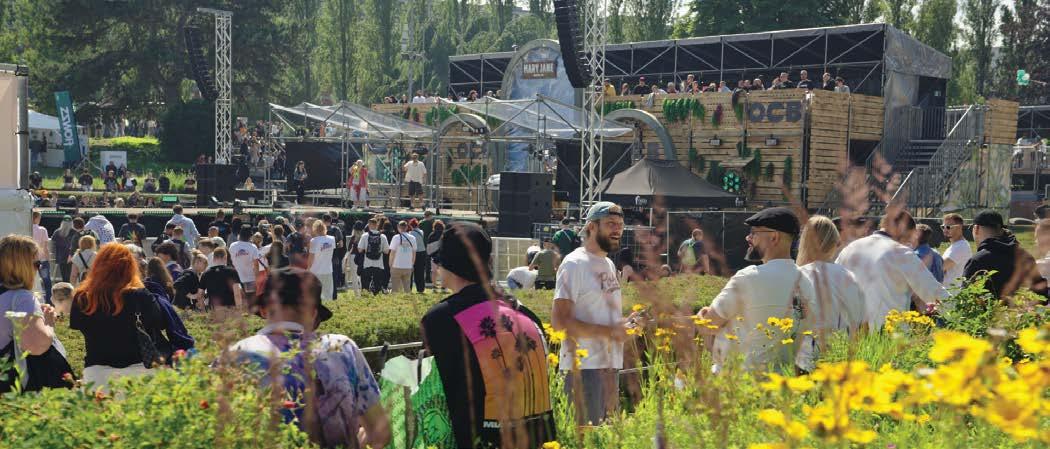
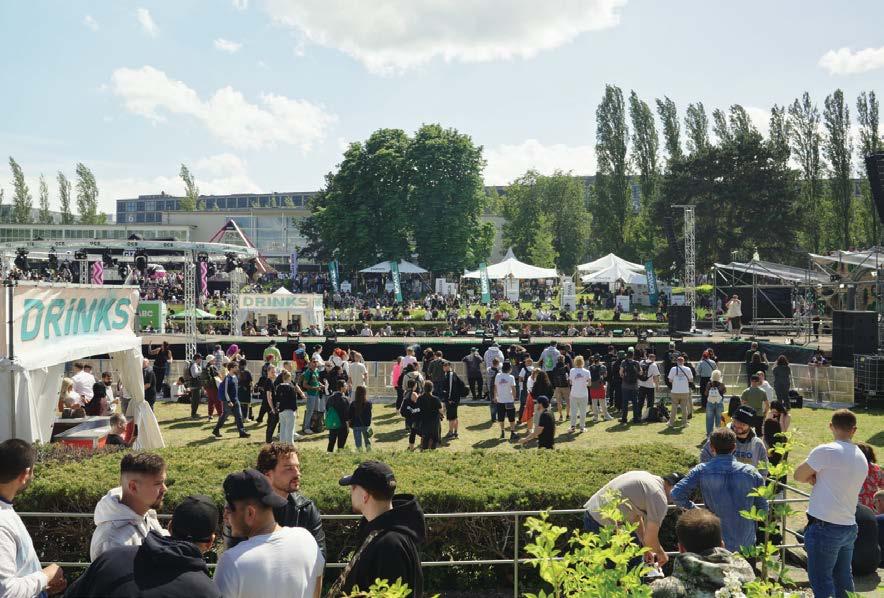
The scope and scale of the Mary Jane Berlin festival feel almost overwhelming. From sales of Cannabis seeds and clones to all sorts of weed-adjacent wares, the 10th annual event held in Berlin, Germany, boasted 75,000 attendees over four days in late June and was a maze of THC in transit.
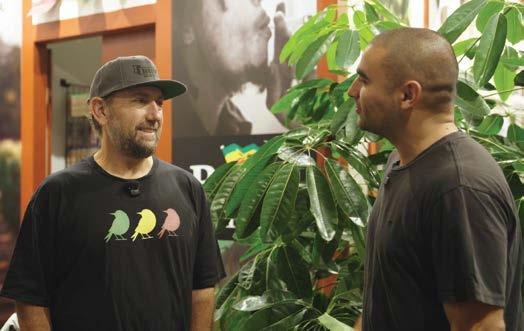
ON THE first day of the show, Dani Walton — the head of U.S. sales and marketing for Spain-based Blimburn Seeds — helps me make sense of the industry consolidation that’s happening behind the scenes.
“Everyone works with each other; it has to be that way,” Walton said. “People think about competition; it’s more about collaboration. … The industry is smaller than a lot of people think. We have to work together.”
As part of its business model, Blimburn white-labels its Cannabis seeds and works with its partners to handle logistics and fulfillment. Walton won’t land on a specific number, but said a good number of booths at the Mary Jane show are being powered by Blimburn Seeds; it’s all part of the merging motion within the global Cannabis industry.
“You saw a boom, and now you're seeing a consolidation as the European markets mature,” Walton said, specifically referenc-
ing collaborations between European and North American brands. “With the first couple of years of legalization, you had everyone rushing to get in here, and now it’s a little more consolidation because Germany actually imports a lot of their Cannabis.”
Germany’s medical Cannabis market opened in 2017 and imported Cannabis flowers from nearly 20 countries in the first quarter of 2026, according to figures released by Germany’s medical Cannabis regulator, the Federal Institute for Drugs and Medical Devices. Canada is by far the dominant supplier of Cannabis flowers to Germany, followed by Portugal and Denmark. Since 2024, there’s also another way for Germans to get weed. The country allows adults to grow up to three Cannabis plants at home through policies that include social clubs for growing and supplying weed to their members, which are supposed to only be for German citizens.
“If you would consider, like a Humboldt of Canada, it would be called the Kootenays,” Carmody told me. “It’s remote. It’s in the interior of British Columbia, kind of hard to get to from anywhere. And in the Vietnam War — when draft dodgers were escaping the war — they were looking for places to hide, and the Kootenays were one of them. They brought genetics with them and brought Cannabis culture with them, and that's why that area became a propagation point of Cannabis in Canada.”
In 2018, Canada became the second country in the world, after Uruguay, to allow Cannabis for adults. But before that, in 2014, Canada’s medical Cannabis policy allowed for the export of Cannabis that’s categorized under Canada's medical system.
Carmody is the co-owner of Kootenay Cultivar, and for the past year and a half, he has been selling 95% of the Cannabis flowers he grows in Canada to Germany. He started growing in his parents’ chicken coop as a teenager and said, “17-year-old me’s mind is fucking blown right now.”
“(Germany is) the best market in the world by a long shot,” he said. “The genetics that we have that we really sell a lot of in Germany is a strain called OJ Zainbow. So it’s Zainbow Mentz, but our pheno that we hunted and found has a really sweet, orange citrus flavor, and I called it OJ Zainbow.”
LET'S GET TOGETHER AND FEEL ALRIGHT
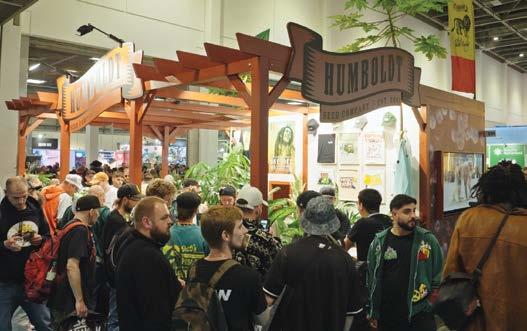
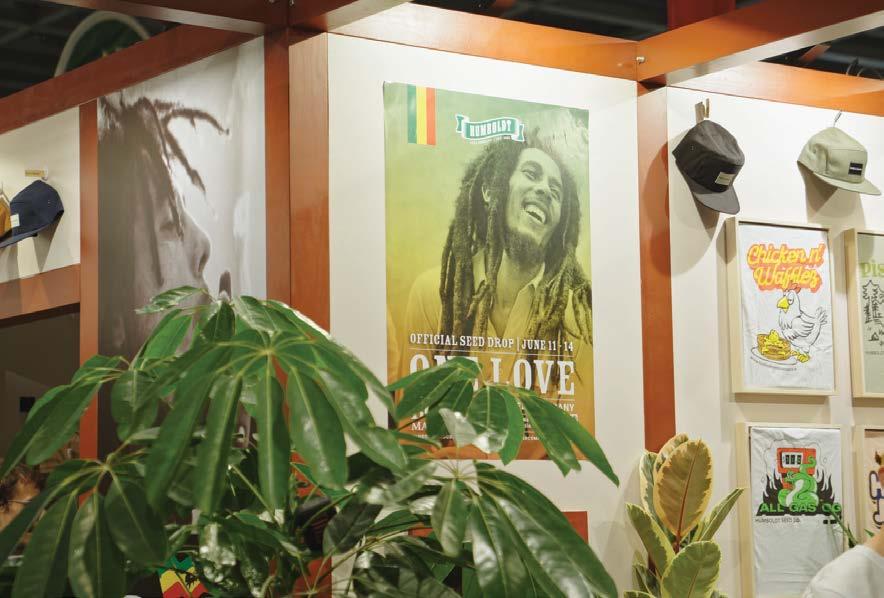
At this year’s Mary Jane festival, California-based Humboldt Seed Company debuted a seed collaboration with the family of reggae superstar Bob Marley. The seeds represent years of breeding work during which HSC partnered with local growers in Jamaica.
“If you make something of your own, usually you have time, then you want to perfect it, and it’s like your baby,” Nat Pennington, HSC co-founder and CEO, said.
Cannabis plants inherit traits from both of their parents, and like sisters in the same family, seeds can express different physical attributes. The time-consuming work for Cannabis breeders comes in stabilizing strain genetics to deliver a consistent product. But after that work is done, making a large quantity of seeds is easy, Pennington said.
After taking a dab with Walton, I walk out into the festival’s outdoor area and run into Tyeson Carmody, who was born and raised in the Kootenays, a wild mountainous area in southeastern British Columbia, Canada.
“California makes software; it’s like breeding (Cannabis),” Pennington said.
“You put a bunch of energy into breeding something, but you can just hit copy and paste to sell it. We put a bunch of energy into making a seed line, then when it comes time to multiply it, we've done our homework; now we just breed it.”
HSC’s explorations around the world to discover and preserve unique Cannabis genetics, documented on their YouTube channel, make the world feel smaller.
THE
CANNABIS
ECOSYSTEM GROWS
Simón Espinosa, founder of the Spanish-language Cannabis media platform En Volá, traveled from his native Chile to California this past summer to participate in HSC’s pheno hunt, where I last saw him.
Ellen Holland is a San Francisco Bay Area-based freelance writer, the former editor of High Times and the author of multiple books, including "Weed: Smoke It, Eat It, Grow It, Love It" (2024).
HSC'S NAT PENNINGTON TALKS WITH EN VOLÁ'S SIMÓN ESPIONOSA
When I meet up with Espinosa in Berlin, he arrives with the tale of taking Cannabis culture to the ends of the earth during a trip En Volá organized in October 2025 that brought 150 people to the Patagonia region, the southernmost tip of South America.
After Mary Jane, En Volá took a bus of Cannabis influencers from across the world to Demecan, one of the largest medical Cannabis providers in Germany, followed by a stay at a castle in Saxony.
“We found a castle in deep Saxony, which is where Romanticism was born,” Espinosa said. “I wanted to check it out personally, so I keep making shit up so I can go to places I like. … This started because I’m sharing my sponsors with my first ecosystem, who were other content creators who didn’t get to travel, and I told them, ‘It’s going to change your life, as it did to me.’”
En Volá calls these trips “Very Happy” and, through them, hopes to bring the worldwide Cannabis community closer together.
Trips like those organized by En Volá and events like Mary Jane show that as weed goes worldwide, partnership is the key to success. Together, they make it clear: The Cannabis industry is growing through collaboration and consolidation.
MARYJANE-BERLIN.COM
@MARY_JANE_BERLIN
HUMBOLDTSEEDCOMPANY.COM
@THEHUMBOLDTSEEDCOMPANY
KOOTENAYCULTIVAR.COM
@KOOTENAYCULTIVA
WWW.ENVOLA.CL
@EN_VOLA
KARISSA MCBRIDE
Karissa McBride is a budtender, shift leader and photographer at Emerald Triangle Dispensary in Albany. A medicinal patient for the entirety of her adult life, McBride recalls Cannabis having a ubiquitous presence in her family growing up.
“MY GRANDPA used it medicinally, and I watched him, growing up, taking care of his plants, and would see him use it for medicinal benefit,” she recollected. “He would refer to them as ‘tomato plants,’ and I just went with it until I got older and I realized what they were. My mom also used it medicinally.”
McBride first consumed Cannabis in high school after a traumatic car accident left her with feelings of heightened anxiety.
“My friends were like, ‘Hey, maybe if you smoke a little weed, that might help,’ and it really did help!” she said.
The addition of plant medicine was life-changing for her and incited a desire to help others in a similar way. Around 3 1/2 years ago, she started working at Emerald Triangle Dispensary, where she’s provided care for a diverse customer base ever since.
“I love being able to just connect with the different people that come in. I love hearing their stories and being able to help them out,” she explained. “(For example:) If someone with Parkinson’s or cancer is having a hard time getting down food, this RSO may be perfect for them. … I just love being able to give them better insight. That really inspires me.”
Prior to her work in the Cannabis industry, McBride’s interest in photography was initially sparked by a class in high school.
It has since grown into a roaring passion for her.
“I was a photo director for my journalism class, and I feel like journalism really sprouted that seed of my
love for photography. Once I started working at Emerald, they were like, ‘Hey, we have an Instagram page. Would you be interested?’ And I was like, ‘Yeah, I’ll totally start taking pictures!’” she said. “I saw a lot of work from Terpodactyl (Leaf Magazines’ Amanda Lopez) when I first joined the Cannabis industry, and she really inspired me. I especially loved when I realized that she was a woman in the industry, too.”
In her free time, McBride loves painting, making art, riding motorcycles and aquascaping. She also enjoys playing video games, citing The Elder Scrolls Online as one of her favorite games she’s played recently.
When asked what else she would want people to know about her, McBride responded succinctly: “I love weed, love taking pictures and love community.”
Given her sheer passion and love for the Cannabis community, it’s no surprise McBride was nominated for Budtender of the Month. Her drive to steep herself in Cannabis knowledge and her genuine enthusiasm to help others shine through like a sunbeam in every interaction at Emerald Triangle Dispensary. Her approach to industry work isn’t just inspiring — it’s galvanizing.
@DONTFORGETBLONDIE
EMERALD TRIANGLE DISPENSARY
“I LOVE WEED, LOVE TAKING PICTURES AND LOVE COMMUNITY.”
MYSTIC MOSS MYSTIC MOSS
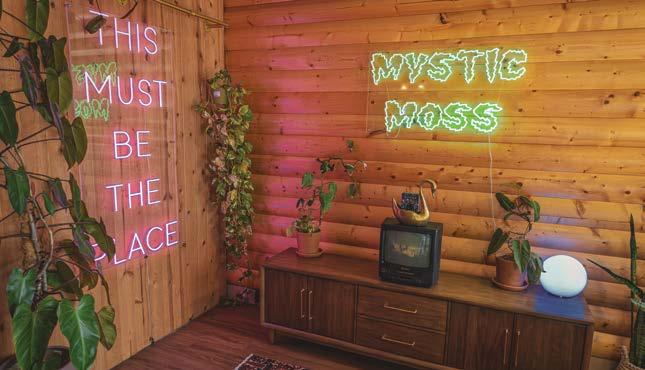
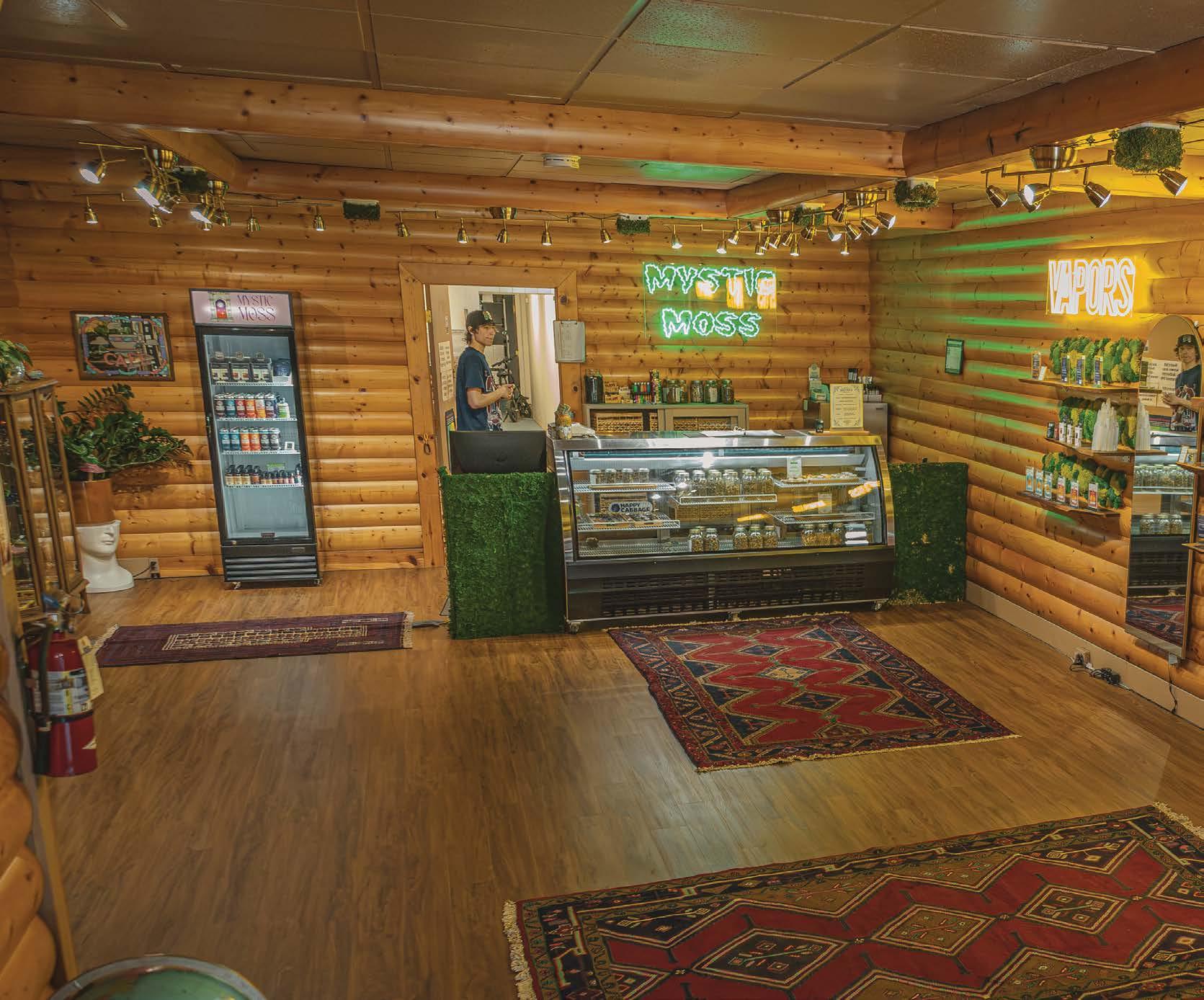
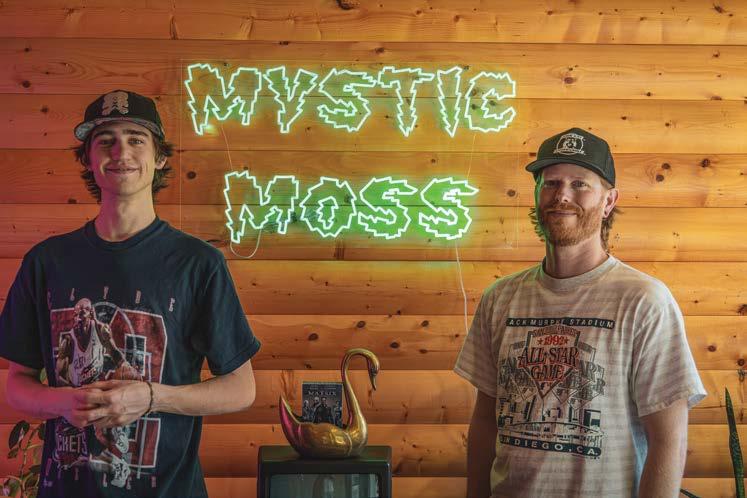
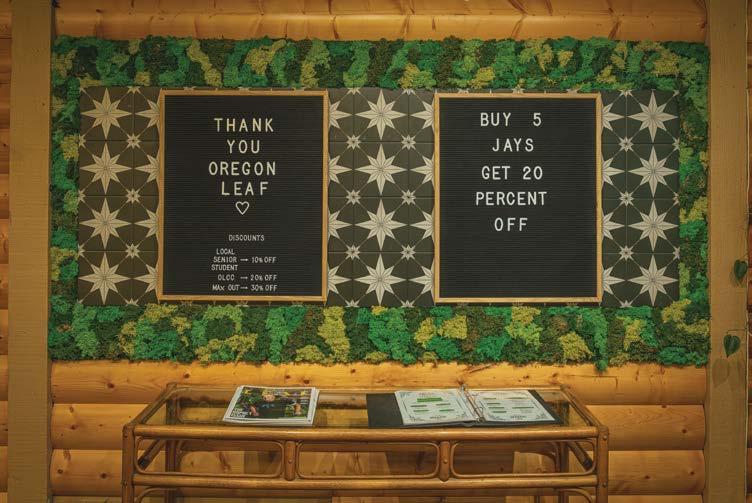
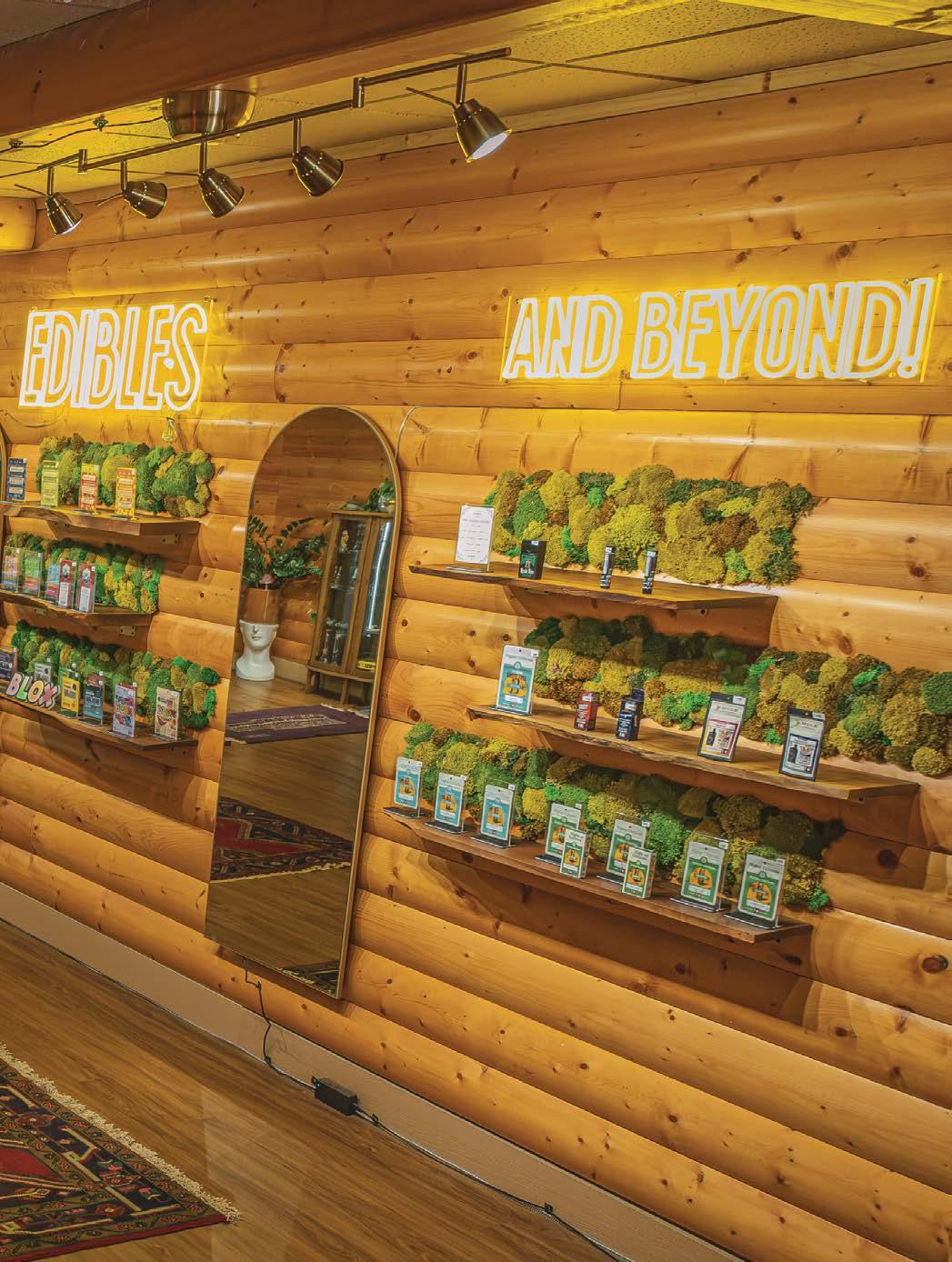
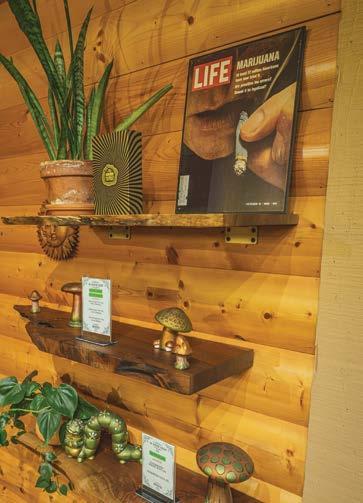
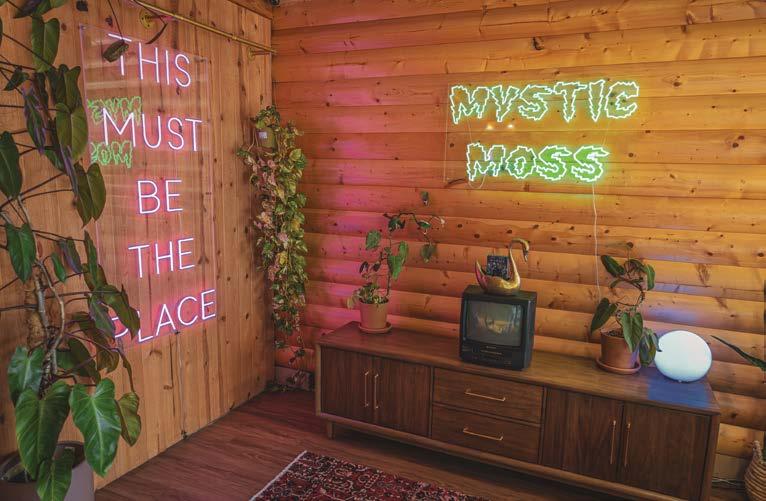
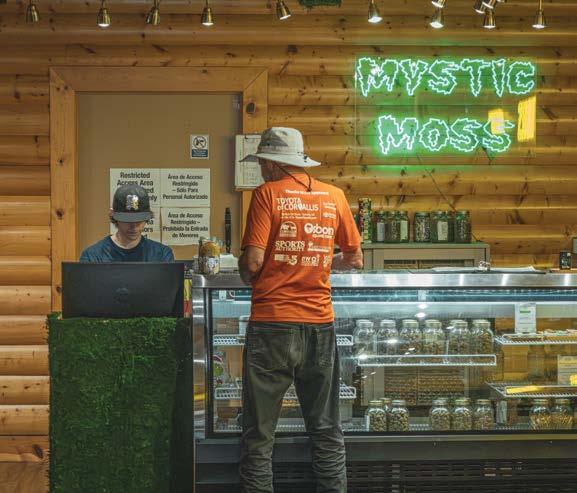
Mystic Moss is an independently owned dispensary located in Corvallis. After operating under a different moniker and proprietor prior to 2025, the space was revamped and reopened under new management in February of last year. The shop itself has a cool, almost trippy, PNW vibe to it, featuring cozy wood fixtures, live plants and vintage decorations all draped in the soft glow of polychromatic neon lighting. MYSTIC MOSS
Budtender Rhylan Coyle, above, and owner/budtender Derek NePote, right.
FOR CUSTOMERS visiting the establishment, there’s a high likelihood of running into Mystic Moss’ owner, Derek NePote, at the counter.
“I’m a budtender most of the days. I worked 44 days straight when we first opened; it’s pretty much just me and one employee,” NePote explained, highlighting just how truly independent Mystic Moss is.
As Mystic Moss’ owner, operator, buyer, roller and packager, NePote leverages his extensive knowledge to curate a retail setting that prioritizes quality as a baseline.
Having worked as a budtender at Floyd’s Fine Cannabis, a sales rep with Crown B Alchemy and a lab sampler for Rose City Labs, NePote has seen Cannabis products from essentially every producer in Oregon over the last half-decade. Given his breadth and depth of experience, he knows where to find top-notch inventory for the store and works hard to procure what customers are looking for.
One of the biggest factors that sets Mystic Moss apart is the presence of a processor license that’s been vertically integrated with the dispensary.
“We’re really sticklers on preserving the terpenes.”
“I can shop wholesale at the cost of my processor license and jar up and offer those offerings to the store at reasonable prices,” NePote explained. “For example, I have a 2-gram live resin for 15 out the door and a half-gram cured resin cart for $8.”
In terms of selection, the store stocks a wide variety of Cannabis goods with everything priced to be competitive. While producers like Flyte Co., Happy Cabbage, Brave Hearts and Bo’s Nose Knows are highly sought-after, the most popular item at Mystic Moss is actually their in-house preroll. Rolled in small batches with whole-flower buds, the consumables are a significant step above the average joint.
“We’re really sticklers on preserving the terpenes. They are usually rolled the morning of. We jar all the joints immediately into mason jars, and we keep the ones that are just about to sell in the fridge. We actually keep most of our products in the fridge for freshness,” NePote pointed out.
Mystic Moss carries a fervent following and comes highly recommended by Leaf readers. The die-hard support that customers give the dispensary is indicative of the elevated level of trust NePote has garnered through his curation, as well as the customer service experience both he and his singular employee provide for guests.
So what’s the key, the catalyst, the secret sauce that helps this two-person army run? What are the powers at play that make Mystic Moss so mystical?
“All of this is really just because we love weed with a passion,” NePote noted. “That’s the only way we are able to do it.”
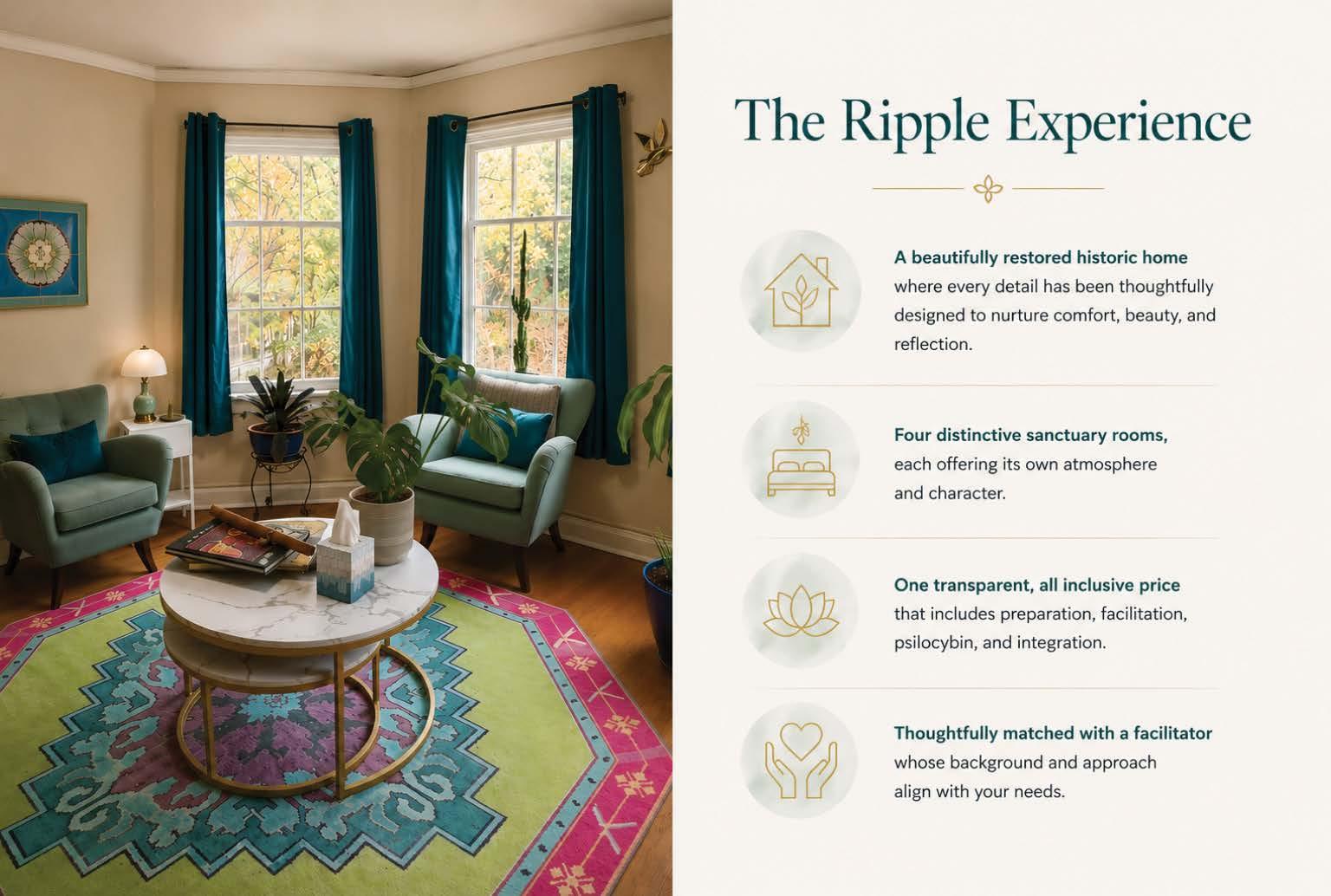
Ripple JOURNEYWORK
Shelah Wind-Smith, lead facilitator and co-founder of Ripple Journeywork, has had a close relationship with psychedelics and caregiving for most of her life. She grew up as a Jehovah’s Witness in what she describes as a “highly controlled religious environment.” After several formative encounters with psychedelics, she experienced a fundamental shift in her perception of herself and the world. Immersing herself in festival culture, she witnessed individuals who struggled as a result of not having enough support while using substances in overstimulating environments. She started volunteering in harm reduction, using her nursing experience to help others.
aBACKGROUND in medicine and watching her mother undergo a hellacious battle with cancer inspired her work in the Cannabis industry, eventually leading to her creation of the award-winning Cannabis brand Green Goddess Gardens. But when Oregon announced legislation to support psilocybin treatment centers, Wind-Smith had an epiphany.
“I thought about everything that I loved and didn't love about caring for people, being burned out with nursing, and wanting to serve people in a safe way. Given all the experience I had in harm reduction and safe access and community, I just wanted to get plugged into this unique opportunity,” Wind-Smith explained. With that, the seeds, or in this case, spores, for Ripple Journeywork were planted.
Ripple Journeywork is a psilocybin service center built out of the same ethos that shaped the Oregon Medical Marijuana Program era of Cannabis: craft, care and community first.
While Cannabis and psilocybin are both forms of ancient plant medicine that have reduced human suffering across cultures and time, Cannabis tends to be consumed more habitually and at a higher frequency than psilocybin, which is typically approached with increased intention.
Oregon’s model of psilocybin treatment is unique in that it is designed to be relationship centered between the facilitator and patient. Preparation, trust and integration are essential parts of the process that can be just as important as the psilocybin facilitation itself.
The service framework at Ripple Journeywork emphasizes providing as much space and time as necessary to identify the client’s support network and personal preferences prior to service delivery. Ideally, the more rapport and understanding developed between the facilitator and the recipient, the more effectively the facilitator can personalize the experience and provide support during the psilocybin session.
JOURNEYWORK
After psilocybin is administered, an integration session is encouraged within 72 hours, where the client debriefs the experience with a facilitator.
Preparedness reduces the likelihood or severity of a bad trip, but it also helps create an ideal container for the session, nurturing the opportunity for deeper levels of connection with one's true self in a safe environment.
“It's really just about building a relationship during preparation and then figuring out all of their personal preferences, what they want this container to actually look like, what things they might want to bring into the experience, whether it's religious or super ceremonial, or what music they might want. It's all customized to that individual,” WindSmith said.
After psilocybin is administered, an integration session is encouraged within 72 hours, where the client debriefs the experience with a facilitator. The Latin root of the word “integration” is to “make whole or complete” and, as such, it’s usually where the real work gets done in processing and making sense of the experience.
According to Wind-Smith and the Healing Advocacy Fund, over 20,000 individuals have received psilocybin services under this facilitated model of care in Oregon for a range of ailments from treatment-resistant depression to complex post-traumatic stress. Of those numbers, the vast majority of recipients experience reduced symptom severity as a result.
Ripple Journeywork sets strong intentions for supporting clients in the community, and they work hard to make the service accessible for individuals in need.
“I'd say about 35% of our clientele have either gotten sliding-scale pricing or scholarship assistance to be able to have access to this,” Wind-Smith explained.
“(I have a) long-term hope of seeing these services become accessible through the Oregon Health Plan, much like other alternative approaches such as massage or acupuncture.”
Significant progress has been achieved in making psilocybin services accessible through legalization, but there is still a lot of work to be done. Since the state first legalized psilocybin treatment in 2020, many service centers have opened and closed. Oregon’s model is centered on preparation, safety and integration, which is an incredibly important foundation for clients' well-being, but some current costs and regulations are prohibitive, creating barriers to access to care.
Current legislation is proposing to increase the license fee for service centers from $10,000 to $20,000 and for individual facilitators from $2,000 to $4,000.
“I absolutely love maintaining a safe program; it’s essential. But my concern is that if these licensing costs increase dramatically, it's eventually going to affect the clients. Every service center is trying to balance accessibility with being sustain able and keeping the lights on. My hope is that Oregon continues protecting safety while making sure this regulated care model remains financially viable for providers and accessible for the people who need it,”
Wind-Smith said.
“I hope that people remember Ripple as a place where they felt safe enough to be fully human. And I hope that clients remember it as a place where they were met with dignity and compas sion,” she noted.
“To watch people get reconnected with themselves and just be better for the world, it ripples out into families, which ripples out into communities and beyond. It's pretty amaz ing to watch people and how this work can really transform them.”
GRAPE SUNSHINE
SUNSHINE HASH ROSIN HASH ROSIN
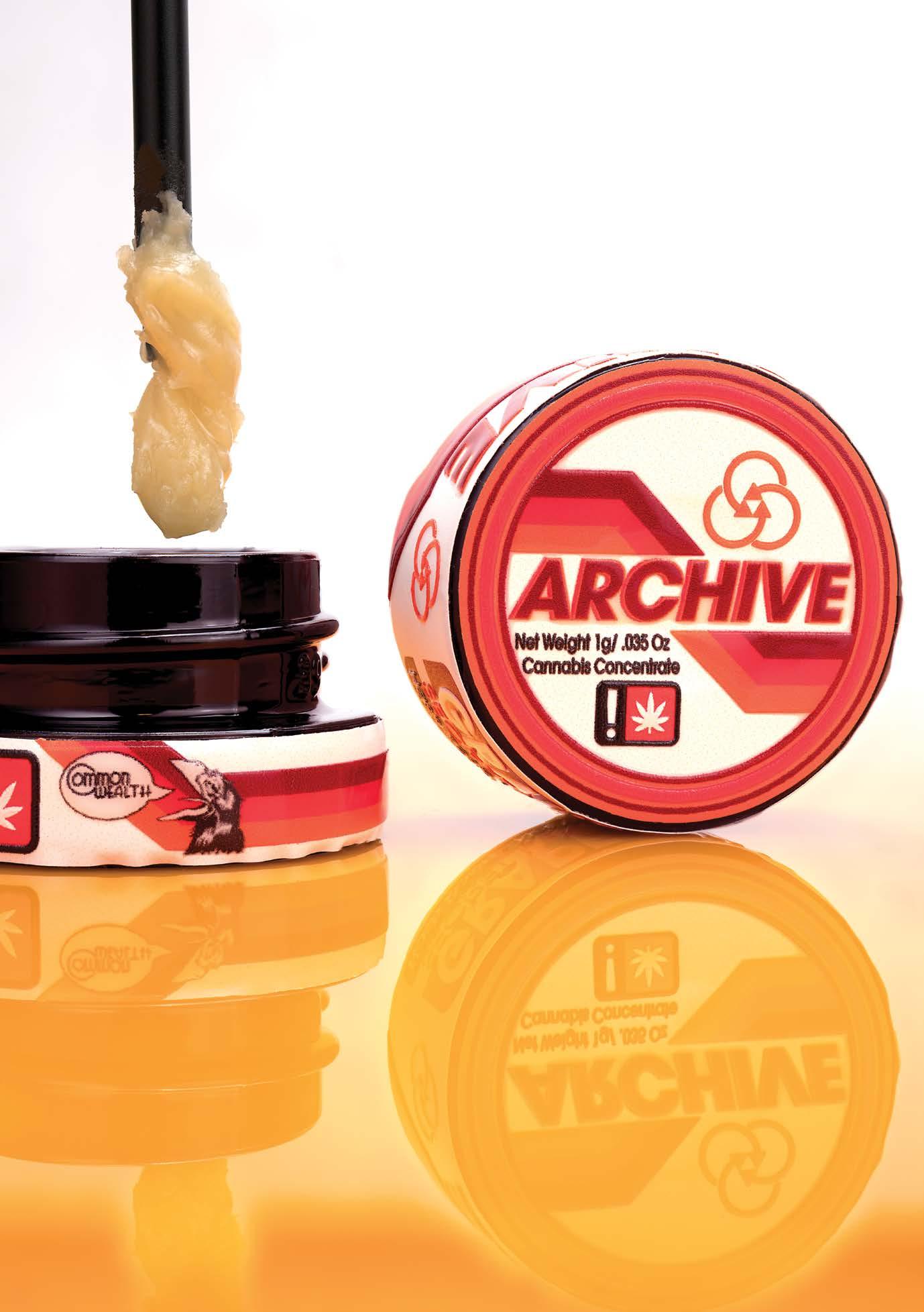
Archive Seed Bank has spent 20 years evolving from an archivist’s collection of fought-over and sought-after genetics into a world-class breeder in its own right. They’ve captured worldwide attention with a catalog of standout genetics that lead with layered flavor, high-resin yields and unique profiles. With a dispensary, grow and hash lab in Portland, the Leaf gets a front-row seat for its Oregon-based production.
COMMON WEALTH SEED CO. was born from that inner circle. Adam Bush has led the garden side of Archive Oregon since launch, earning a behindthe-scenes perspective on an extraordinary range of genetics. He’s seen the good, the bad, the ugly and the exceptional. Bush has pheno hunted at a scale most cultivators never encounter, singling out the outliers that make a garden look and smell otherworldly one round at a time.
So when Bush tells me the Grape Sunshine is a standout across every metric that matters, I believe him. Secret Lemon by Tallymon, the lineage reads like a fruit cocktail label. Secret Lemon itself is a pairing of the twice-renowned Lemon Peel and Moonbow, while Tallymon is (Banana OG x Dosidos) crossed with Papaya.
Nose to jar, the profile lands somewhere between “fierce” and “frost” on the sports drink spectrum — big grape up front, with banana rounding out the fruitiness and smoothing the funk that the Papaya contributes to the bouquet. Dosidos is present with just enough of its classic sweet, gassy lift to pull the notes together. The result is a remarkably stable, blond rosin with a killer nose.
“We popped around 50 seeds, and the Grape Sunshine didn’t really stand out at first,” Bush recalled. “We were still working with Dammit Bobby at the time — he’s actually the one who named it based on the grape smell none of the other plants had.”
That distinctive character translated directly to yield.
“It washed at 8% the first round and 9.2% the next. We knew it was special,” Bush said.
A plant that washes near double digits with a stable resin profile doesn’t stay a house secret for long. Bush and his brother Ryan began breeding with the Grape Sunshine specifically to see whether its resin production could carry into genetics that don’t wash — and they found their keepers.
“We really went for it,” Bush said. “And once we realized we wanted to bring it to the masses, Common Wealth Seed Co. was the natural next step.”
Their debut release of Grape Sunshine launched in 2025 at Mary Jane Berlin, followed by a second drop this past June.
The hard work is paying off. RoolabFlavours’ Box of GrapeZ — a Zkittles cross from Common Wealth’s Grape Sunshine line — won first place at the 2026 Masters of Rosin in Barcelona against some of the toughest competition in Europe. This recognition is a fitting milestone for a seed company built on the conviction that the best resin starts with the right plant.
DEGENERATE FLAME OFF
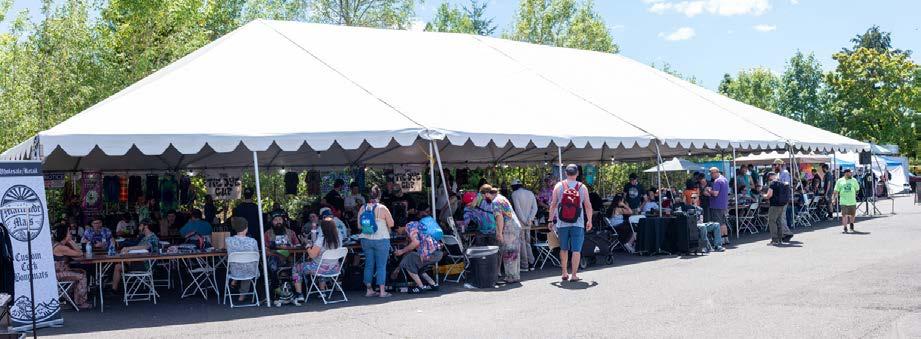
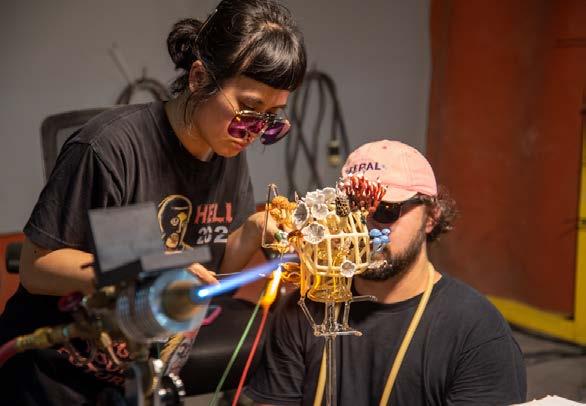
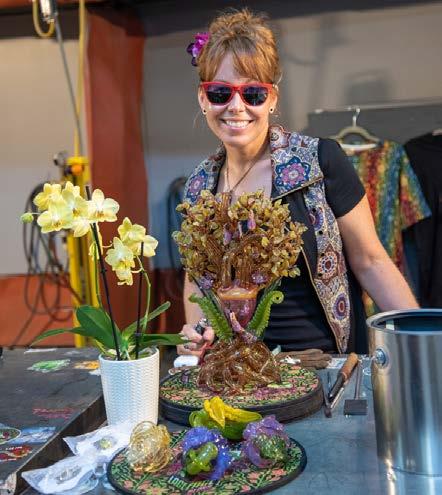
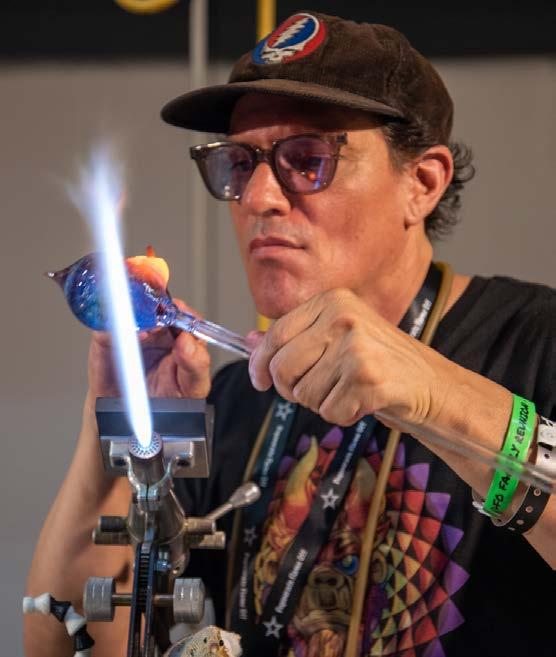
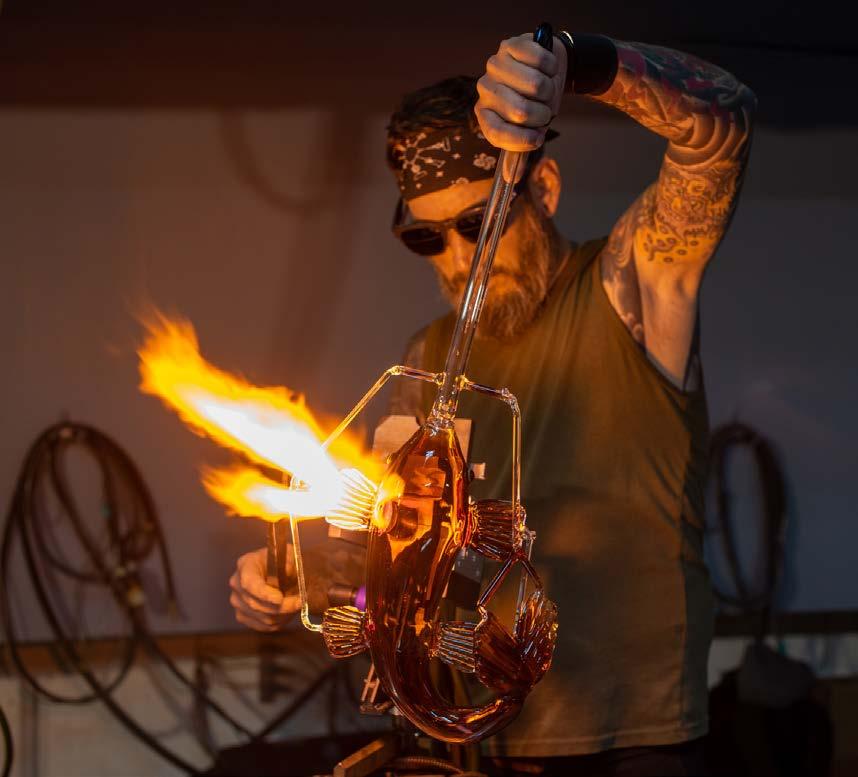
The 2026 Degenerate Flame Off came back to stoke the fires of passion and excitement that resonate deep within the heart of the glass community. DFO is one of the longest-standing celebrations and competitions for functional glass art in the world, boasting a storied history that’s grown over the last 17 years. After a brief hiatus in 2025, the event returned to Portland, Oregon, July 24-26. More than a festival, the gathering epitomizes glass culture by bringing together some of the most talented artists to ever grace a torch with their flameworking.
This year’s celebration took place at the headquarters of legendary borosilicate glass manufacturer Northstar Glassworks. The event’s lineup was stacked with interactive activities, including live glassblowing, music performances, vendor booths and a myriad of delicious food. Each day brought a multitude of individual demonstrations hosted by popular artists, like Mike Luna, Darby Holm, Northern Waters Glass and more.
On the first night, some of the biggest names in borosilicate glass worked in tandem to finalize massive, competition-grade masterpieces that were then pitted against each other on the second and third day for the honor of
winning a People’s Choice award. To say the art was fantastic is an understatement — the glass produced between the team competition and the individual demonstrations was absolutely mind-boggling.
Scott “Scomo” Moan mixed his signature scribble-tech stringer work with Adrienne “Babedrienne” DiSalvo’s sculptural skills in skeletal structures to create a life-size anatomical skull.
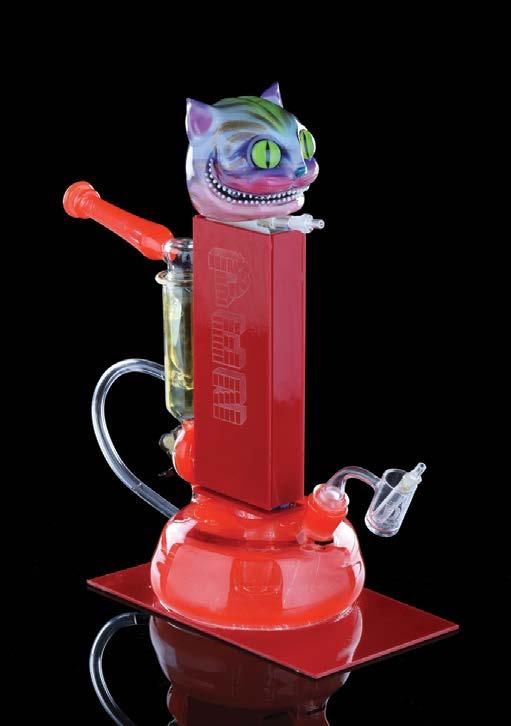
Punty and Nate Belmont created a surreal fusion of their individual skill sets in the form of a gigantic “Alice in Wonderland”-themed Pez dispenser, complete with a functional Cheshire Cat head.
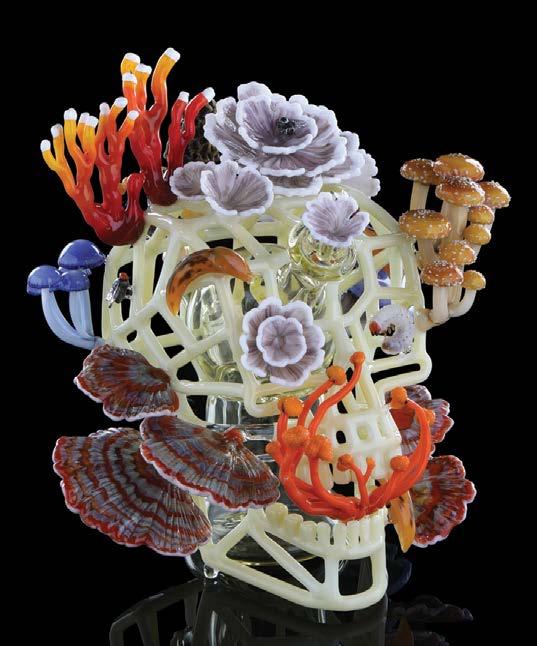
Jessica Tsai added a whole myconid colony worth of hyperrealistic fungi to a 3D skull made by Josh “Kid Glass” Vineyard in his signature style.
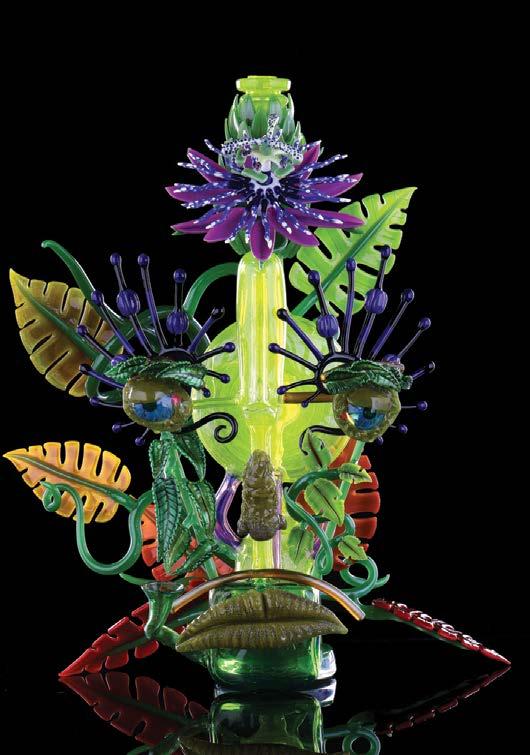
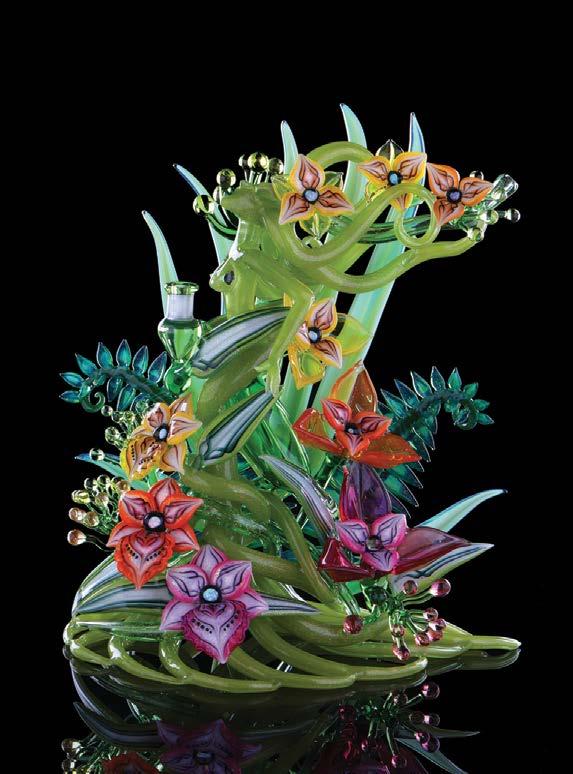
Joel “BlackSandGlass” Corley and Jupiter Nielsen came together to create a weeping face made out of botanical plants, leaves and flowers, representing nature crying for ecological tragedies, like deforestation and the extinction of endangered species.
Windstar Glass and Burtoni pushed outside of their comfort zones to forge a massive replica of the ship ‘Going Merry’ from the anime One Piece. We caught up with Shayla Behrman of Windstar Glass to ask about it.
“If you watch the series, it’s all about hope and freedom and standing up for what’s right. That’s what the piece represents. …We spent about 120 hours putting it together over the last five days.”
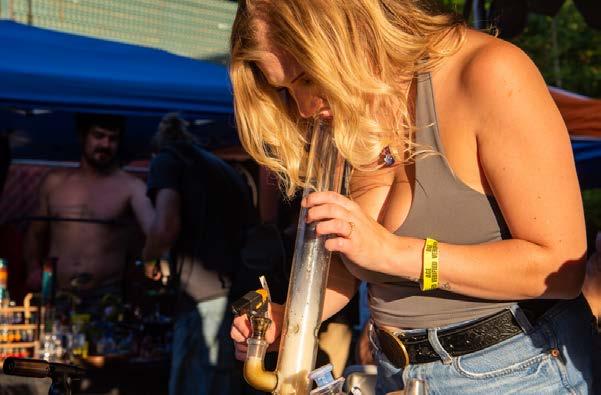
Kendal tries out one of the pieces.
Blusun
Laceface
Shaggy tames the flame.
Jessica Tsai
DFO backyard
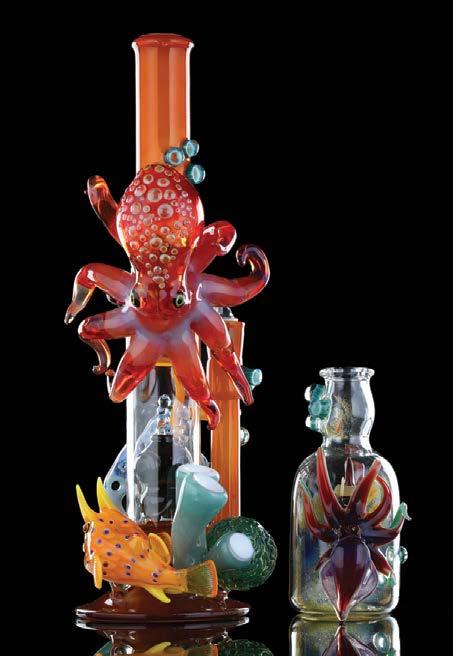
Subliminal Glass and Joe P Glass brought together their next-level sculpting and insanely intricate design abilities to create a borosilicate aquarium covered in realistic sea life. The entire piece — or collection of multiple pieces, rather — contained plasma. This meant that touching any given surface of the glass caused arcs of electrostatic energy to connect to the fingertip, like an old-school plasma lamp.
Finally, Blossom Glass Art and LaceFace Glass came together for a colossal collaboration titled “Golden Hour.” The work had an almost divine presence that brought it to life.
“All of you guys are necessary for this art movement to exist. Thank you for showing up, thank you for being here. The scene is not fucking dead; we’re still here raging.”
- Lacey Walton, LaceFace Glass
“The skeleton of the piece is inspired by the golden ratio,” Lacey Walton of LaceFace Glass explained. “If you look at the piece, you can actually see the swerve and the ratio. We did golden sunset colors to tie it all together. It’s a special blend of our styles; we just wanted to make something really beautiful.”
“This piece has a really good energy to it. … It’s really cool to come together and inspire each other,” Blossom Glass Art added.
As a spectator, it was practically impossible to compare the caliber and diversity of art on display to pick a favorite. Nonetheless, attendees voted with their
hearts, and winners were crowned. Blossom Glass Art and LaceFace Glass ended up taking home the firstplace People’s Choice prize, while Subliminal Glass and Joe P Glass nabbed a close second. Regardless of the outcome, the real winners of the competition were the attendees of DFO who got to see so many masterpieces up close and in production.
Walton left us with a powerful statement during the award ceremony that summed it up.
“Keeping the pipe movement alive — it takes everybody. All the shops, all the store owners, all the growers, all the hash makers. All of you guys are necessary for this art movement to exist. Thank you for showing up, thank you for being here. The scene is not fucking dead; we’re still here raging,” Walton said.
The spirit of the community is alive and well. Where culture is prioritized, it thrives, and DFO showcases the very essence of that idea.
A huge amount of respect and appreciation to Northstar Glassworks, the sponsors, exhibitors, volunteers, attendees and everybody who had a hand in making 2026’s DFO so special.
NORTHSTARGLASS.COM | @DFOFAMILYREUNION
Punty & Nathan Belmont
Jupiter Nielsen x Black Sand Glass
Laceface x Blossom
Josh Vineyard x Jessica Tsai
Windstar Glass & Burtoni
Joe P Glass & Subliminal Glass
GLASS ART PHOTOS BY WINDHOME
Whether you're hunting for a mind-expanding history lesson or a fungi-fueled adventure, these reads are well worth the trip.
wild mushrooms a cookbook and foraging guide by Kristen and Trent Blizzard @modernforager
Husband-and-wife duo Kristen and Trent Blizzard make the world of fungi foraging feel approachable with this practical field guide and forest-to-table cookbook. Learn how to confidently identify, harvest and preserve an array of mushrooms. Then, put your finds to good use in the kitchen with recipes ranging from Candy Cap and Walnut Scones to hearty Maitake Beef Stew. Get ready for the perfect combination of whimsy and wild flavors.
BLOTTER: THE UNTOLD STORY OF AN ACID MEDIUM
by
Erik Davis
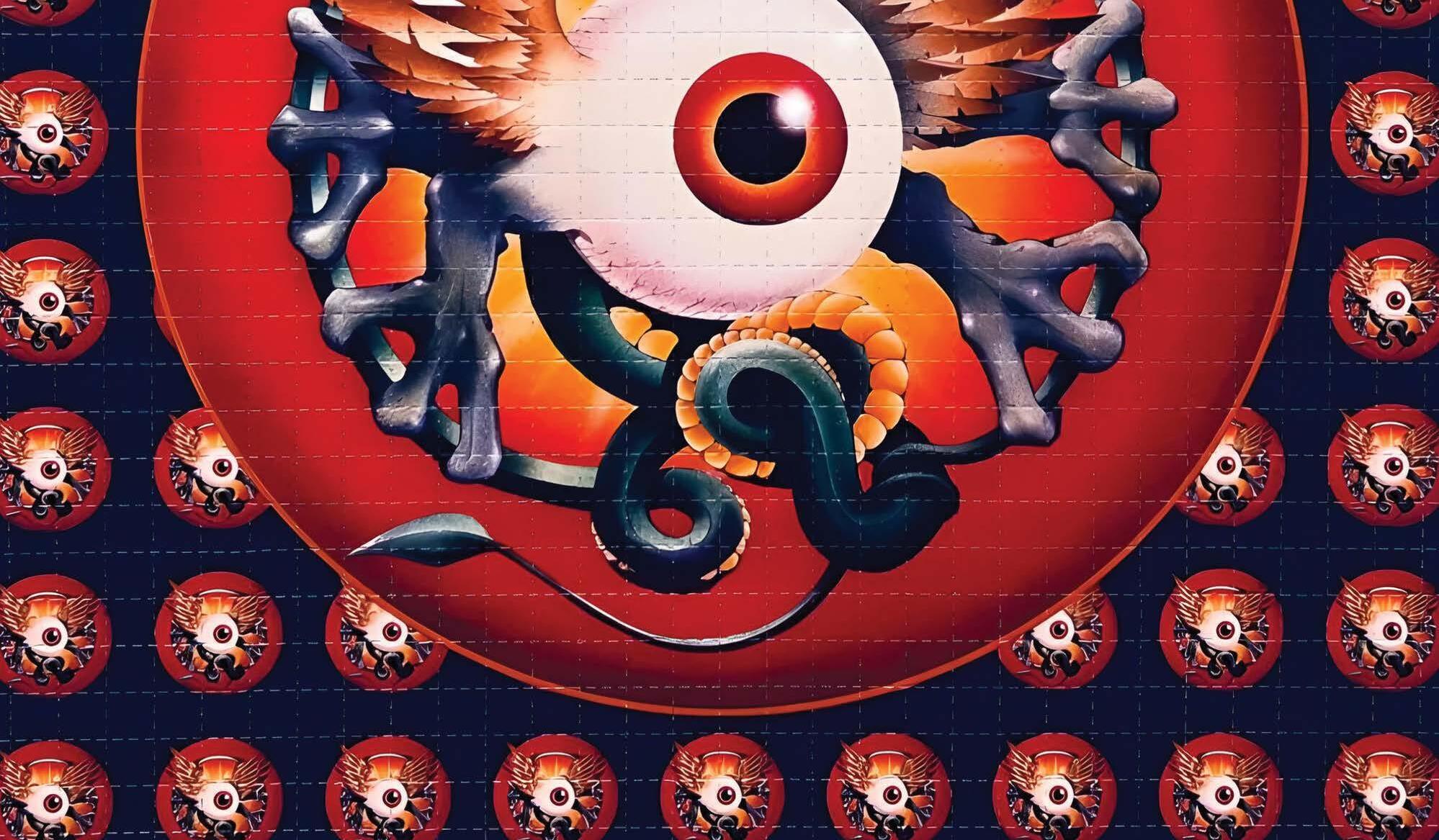
More than just a conversation-starting coffee table book, “Blotter” is a vibrant visual archive of psychedelic culture. Showcasing the world's largest collection of blotter art, Erik Davis explores just how these tiny perforated paper squares — originally designed to be collectible art objects — turned into the iconic delivery system for LSD. Filled with striking artwork and surprising history, it's a captivating look at one of psychedelia's most recognizable canvases.
the electric kool-aid acid test by
Tom Wolfe
Transport yourself to the summer of 1964 with a book that reads like a psychedelic fever dream. In what has been called the “best book on hippies,” Ken Kesey and his Merry Pranksters blaze across America in their neon-painted school bus to spread the gospel of LSD. Essential for anyone curious about the 1960s counterculture and the era of New Journalism it helped to define, all aboard the Transcontinental Bus Tour!
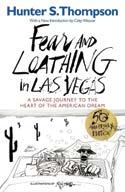
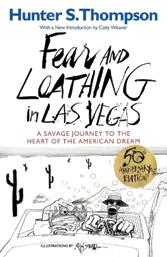
FEAR AND LOATHING IN LAS VEGAS
by Hunter S. Thompson
If psychedelic literature had its own Hall of Fame, “Fear and Loathing in Las Vegas” might have been the first book through its doors. Hunter S. Thompson’s gonzo classic follows journalist Raoul Duke and his attorney on a wildly unhinged road trip through the desert. With a trunk full of nearly every psychedelic substance in existence, will they be able to attain the ever-elusive American Dream? If you want to know more about gonzo journalism, hit our archive for Matt Jackson’s feature in the 2026 Adventure Issue.
esents
YOUR SMOKE FREE
FUTURE, EXPLAINED.
How high do I want to be today?
When Justin Clapick, owner and cultivator at Florekulture, told Oregon Leaf he had not one but two phenos of Skunk that were “like a time machine back to the ’80s,” we were ready to hop in the DeLorean of dank — all the way back to their Skunk No. 1 origins.
CLAPICK CO-FOUNDED Deschutes Growery back in the Oregon Medical Marijuana Program days, and the brand quickly became known for its futuristic, planetforward production policies, like solar-powered facilities, and fine flower. These days, his Florekulture operations remain intentionally smaller than his last project to stay “hands-on with every stage,” from genetics to soil building, harvesting and curing.
“I personally handle every part except trimming, which I leave to a small trusted crew,” Clapick explained.
This allows him to focus on finding his favorite flavors and preserving those he sees slipping away.
“Skunk is foundational to modern Cannabis. A lot of current breeding has moved away from those original expressions in favor of sweeter and more uniform profiles,” he said.
“Skunk is foundational to modern Cannabis.
“I wanted to go back to the source and work with the genetics as they originally showed up, before some of those traits were selected out over time.”
If you’re a relatively new flower fan, it’s hard to explain some of the traits he’s talking about, as the market has slowly shifted to favor fruit followers.
“What stands out is how much of that original Skunk chemistry is still present. The thiols and sulfur-forward compounds that defined the early Skunk lines are something you do not often see preserved in modern
pSYchEdElIa neWs
EVIDENCE CHANGING MINDS IN D.C.
IN 2021, psychedelic researcher Albert Garcia-Romeu said the next five years of clinical data could help convince leaders at institutions like the National Institute on Drug Abuse and the National Institutes of Health that psychedelics had legitimate medical value.
Five years later, the Johns Hopkins University scientist believes that evidence has begun to do exactly that.
“Did it hold up? It sure seems like it has,” Garcia-Romeu said, pointing to comments from Nora Volkow, director of the National Institute on Drug Abuse, during a recent presentation at the American Psychiatric Association’s annual meeting in San Francisco.
“If I can’t change my views based on evidence, then why do science at all?” Volkow said while discussing psychedelics.
For Garcia-Romeu, the shift represents the result of years of researchers building evidence one study at a time.
“If I can’t change my views based on evidence, then why do science at all?”
Early psychedelic trials often involved small groups of 12, 15 or 24 participants. Today, studies are expanding to include 80, 100 and even several hundred participants, incorporating stronger controls and larger datasets.
“There’s a lot more to be done, but I think we got over a big hump,” Garcia-Romeu said. “The first hump was to simply get the money to do these small studies. Then the next hump was to collect enough data in controlled clinical trials and to see if this data still holds up.”
As the evidence continues to accumulate, Garcia-Romeu believes psychedelic medicine is approaching a pivotal moment.
“Once we get that level of accumulation of data, this is where you reach the tipping point,” he said. “These could truly become new medicines in the next one to two years.”
After 14 years studying psychedelics, Garcia-Romeu said it has been remarkable to watch the field move from small research projects in Baltimore toward a much larger scientific effort.
“We’ve got the potential to move from our little studies here in Baltimore to doing them nationally or all over the world,” he said.
CALIFORNIA STUDY OFFERS NEW WINDOW INTO PSILOCYBIN'S EFFECTS
RESEARCHERS at the University of California, San Francisco and Imperial College London found that a single dose of psilocybin produced measurable changes in the brain that lasted up to a month.
Published in Nature Communications, a peer-reviewed scientific journal that showcases research across the natural sciences, the study followed 28 healthy volunteers who had never taken psychedelics, using EEG, MRI and other imaging techniques to track changes before, during and after a 25-milligram psilocybin experience.
“...
28 healthy volunteers who had never taken psychedelics ...”
Researchers found increased brain “entropy” — a measure of varied neural activity — during the psychedelic experience, which was linked to greater psychological insight and improved well-being one month later. The findings provide new clues into how psilocybin may create lasting therapeutic effects for conditions including depression, anxiety and addiction.
JOHNS HOPKINS EXPLORES PSYCHEDELIC THERAPY FOR VETERANS
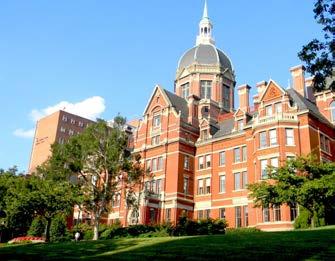
AT JOHNS HOPKINS UNIVERSITY in Baltimore, Maryland, researchers are examining whether psychedelic-assisted therapy can help veterans living with post-traumatic stress disorder through the PAM-VET study.
The Phase I clinical trial is exploring supervised sessions combining MDMA and psilocybin, alongside psychological support, to evaluate changes in PTSD symptoms and quality of life among military veterans.
The work comes amid an ongoing search for better treatments for trauma-related conditions, with nearly 6,400 veterans dying by suicide in 2023, according to Department of Veterans Affairs data. Researchers hope studies like PAM-VET can help determine whether psychedelic-assisted approaches may offer new options for veterans who have not found relief through traditional treatments.
$3.8B
Psychedelic medicine reached another milestone this month as pharmaceutical giant Eli Lilly and Company announced plans to acquire AtaiBeckley in a deal worth up to $3.8 billion. The acquisition would give Lilly access to BPL-003, an intranasal formulation of the psychedelic compound 5-MeO-DMT currently in late-stage clinical trials for treatment-resistant depression.
MASSACHUSETTS EYES NORTHEAST’S FIRST PSYCHEDELIC THERAPY PILOT
MASSACHUSETTS could soon become the first state in the Northeast to authorize a regulated psychedelic-assisted therapy program. Earlier this month, the House approved H.5576 with overwhelming bipartisan support, creating a five-year pilot allowing up to three licensed mental health clinics to provide supervised psychedelic-assisted therapy using naturally occurring psychedelics. The proposal now heads to the Senate before potentially reaching Governor Maura Healey’s desk. If signed into law, H.5576 would make Massachusetts just the second state in the nation to establish a state-authorized framework for psychedelic-assisted care, following Oregon’s pioneering psilocybin services program.
During the pilot, participating clinics would collect treatment and safety data to help lawmakers evaluate patient outcomes, regulatory safeguards and whether the program should expand statewide.
SavEd or SaNk?
OREGON’S ALT-MEDICINE MERGER MEANS UNCERTAINTY FOR PSILOCYBIN AND MEDICAL MARIJUANA PROGRAMS
TWO OF OREGON’S most groundbreaking drug-policy programs are being bundled into one agency. Industry insiders worry the state is about to price them out of sustainability.
In an email sent to Oregon Psilocybin Service partners, the Oregon Health Authority announced on July 1 that it is merging Oregon Psilocybin Services and the Oregon Medical Marijuana Program into a single new unit: the Oregon Psilocybin and Medical Cannabis Section.
“Both OPS and the Oregon Medical Marijuana Program (OMMP) are experiencing budget shortfalls. After taking steps to reduce costs … the next step in our resource-limited environment is to look for other impactful ways to increase efficiency and cost-effectiveness. To that end, OPS and OMMP will come together to form one section,”
Angela Allbee, MPA and Section Manager of Oregon Psilocybin Services Section, outlined in the email.
The announcement came less than a week after the OHA published OPS’ latest proposed psilocybin facilitation rules, which included significant fee hikes across the board. With a target date of Sept. 1 for the OPS/OMMP merger, there will be a revised draft of rules and a 21-day public comment period to follow.
While the program merger manifests concerns of its own, it seems to be set in stone. What’s just as hard but not solidified are the sweeping fee increases for the psilocybin side.
Under the currently drafted rules, annual licenses for service centers and manufacturers would double from $10,000 to $20,000. Facilitator licenses would double to $4,000. A worker permit needed just to work inside a center would jump eightfold, from $25 to $200. Discounted rates for nonprofits, veterans and low-income license holders would disappear entirely. If adopted as written, most fees would take effect Jan. 1, 2027. These fees aren’t final — for now.
But the numbers nudging the panic are real. As the psilocybin program paddles its lifeboat, it leaks trainees across state lines, and increased prices probably won’t patch the holes — especially when more centrally located states that cater to a wider geographical range are launching programs.
InnerTrek, one of Oregon’s psilocybin program’s original architects, is closing its Portland facilitator center and shifting to remote training.
“The truth is, a lot of our students would prefer to go to Colorado than Oregon for their practicums,” Lisa Snyder, InnerTrek’s director of operations, told Willamette Week.
Facilities are folding, too. Of 35 psilocybin service centers ever licensed, only 22 remain operational, according to Psychedelic Alpha’s tracker, with more than a dozen closing since early 2024. Of those that remain open, the future of their product testing is fuzzy.
“Under the currently drafted rules, annual licenses for service centers and manufacturers would double from $10,000 to $20,000. Facilitator licenses would double to $4,000. A worker permit needed just to work inside a center would jump eightfold, from $25 to $200. ”
In an interview, Daniel Huson, head of Rose City Laboratories, Oregon’s only accredited psilocybin testing laboratory, told the Oregon Capital Chronicle that the money his lab made last year didn’t even cover costs or the $10,000 yearly licensing fee, a rate regulators are looking to double by 2029.
In the same interview, Huson said that his lab will have to stop providing psilocybin testing services in 2029, likely leaving Oregon without a licensed lab.
“There’s no incentive to be a testing laboratory because it’s expensive,” he said. “And they’re going to be in trouble.”
Meanwhile, OPS’ merger mate, OMMP, may not be facing as many changes, but it certainly won’t be propping up the psilocybin side of things, as it’s slowly withered away since recreational legalization. At its peak, the program had roughly 80,000 patients, but it has plummeted to only about 15,000 today, according to Compassionate Oregon.
Despite both programs’ problems, regulators said the merger and fee hikes are the only option for programs required to fund themselves primarily through licensing fees and minimal tax dollars.
Microdose Your Way to a Macrodosed Life
small dOse hugE impaCt
While people have been self-medicating with psychedelics for decades, interest has recently expanded into mainstream medicine, with researchers exploring their potential to treat conditions such as depression and PTSD. At the same time, microdosing has gained popularity among everyone from Silicon Valley biohackers to perimenopausal moms seeking subtle cognitive and physical enhancement in everyday life. Although anecdotal reports on the topic are abundant, clinical research is still catching up.
MICRODOSING often involves taking a sub-perceptual dose of psilocybin or LSD, typically 5-10% of a common recreational dose, to produce subtly enhanced effects without cognitive distortion. By contrast, macrodosing requires perception-altering doses that can induce ego dissolution, a sense of interconnectedness and lasting psychological benefits, particularly in trauma therapy. However, full doses may also cause nausea, anxiety, paranoia and the classic “bad trip.”
Research on microdosing has yielded mixed results, partly because optimal dosing remains unclear. In “Microdosing for Health, Healing, and Enhanced Performance,” authors Dr. James Fadiman and Jordan Gruber argue that effective microdosing follows a Goldilocks principle: finding the sweet spot, where the dose is neither too high nor too low.
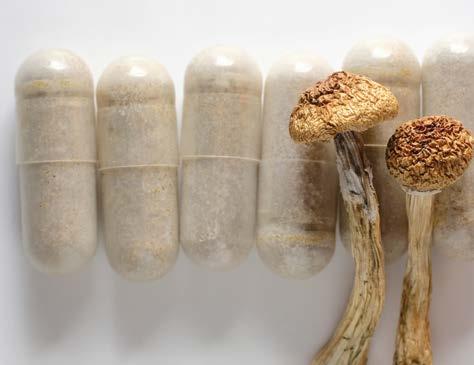
PSILOCYBIN
Magic mushrooms include over 200 species that contain the psychedelic compound psilocybin. The active psilocin molecule looks very similar to serotonin.
EFFECTS
-Enhanced creativity
-Deepened empathy and connection
-Calm and introspection
-Mood elevation
-Chronic pain tolerance
-Increased neuroplasticity to break bad habits (Lasts 4-6 hours)
A MICRODOSE is a subthreshold dose, landing just before a shift in consciousness. When you start to feel that slightly altered state, that is the threshold dose. Finding your ideal microdose depends on your metabolism and the potency of the mushrooms. Using a digital milligram scale, start with 0.1 grams of dried, ground mushrooms and increase by 0.1g on separate subsequent dosing days until you start to notice effects. A microdose is the amount just below that threshold. For Psilocybe cubensis, most microdoses fall between 0.10.5g. The body builds a tolerance to psilocybin, so a couple of protocols have been proposed to keep the microdose effective.
The Fadiman Protocol: Dr. Fadiman proposes dosing on day one, skipping the next two days and then dosing again on the fourth day, following this for 4-6 weeks.
The Stamets Stack: famed mycologist Dr. Paul Stamets suggests taking doses combined with lion’s mane and niacin for five days, then taking two days off for 4-6 weeks.
While psychedelic mushrooms have been used ceremonially for thousands of years, lysergic acid diethylamide (LSD) was discovered in 1943 when its potent psychoactive effects were accidentally revealed during ergot fungus research. Although its mechanisms are not yet fully understood, LSD is also believed to affect serotonin.
LSD is chemically synthesized, so dosing is easier than with mushrooms. LSD can be distributed on microdots, gelatin strips or blotter paper. A standard microdose is 10 to 20 micrograms. Experiment in incremental doses starting at 5μg to find your sweet spot. Absorbed sublingually, effects can be felt within 30 minutes.
EFFECTS
-Mental clarity
-Enhanced energy/stamina
-Increased motivation
-Uplift in creativity
-Mood elevation
(Lasts 8-12 hours)
Dr. Fadiman recommended a dosing protocol for LSD as well: Dose the first day, take two days off, then take another dose on the fourth day, following this for 4-6 weeks.
Psychedelics are microdosed in cycles to maintain mental balance, or simply used as needed for a creative boost or to tap into a flow state. Whether choosing psilocybin for grounding or LSD for subtle cerebral elevation, the key is finding the dose that works best for you.
5 psychedelic creatives to know
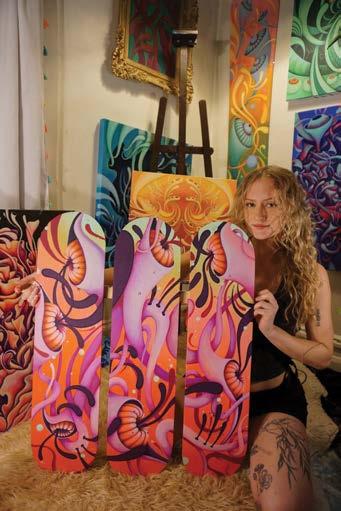
ThiRd EyE visuals
HAYL
ANNA
Based in Bellingham, Wash., Hayl Anna paints on canvas and murals around the Pacific Northwest town. She builds vivid, pleasant color palettes into visceral, mindbending figures that evoke comfort while testing the basis of reality. @visual.intrigue
DANIEL HERWITT
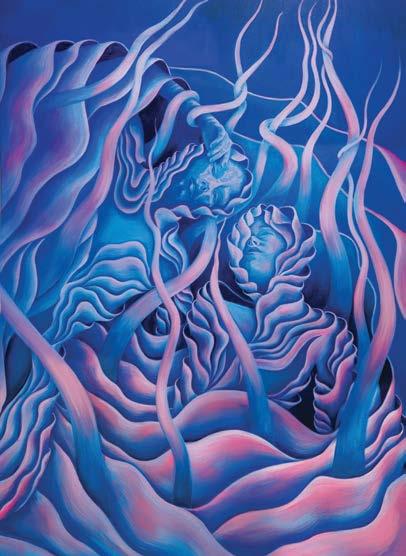
Herwitt’s works are often Grateful Dead-inspired, featuring the iconic dancing bears amid surreal illusions. He uses ink and paint to build detailed, fanciful worlds that frequently depict flowers and plants adorned with dripping visuals. @sunflower_form
EDIE FAKE
American artist and transgender activist Edie Fake creates boldcolored works — often with gouache — that play with shading, colors and shapes in a way that challenges the viewer to contemplate multiple perspectives. @ediefake
MIKI KIM
Fine-line Suminagashi tattoos, illustrations, ceramics and clothing — Miki Kim moves through mediums carrying surreal fantasy elements and Eastern themes with her. The unexpected combinations and optical illusions are sure to keep a viewer captivated. @_miki__kim www.kimmiki.love
STELLA STRZYZOWSKA
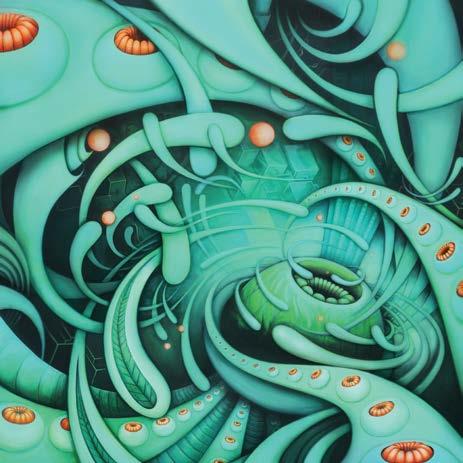
Stella Strzyzowska incorporates classic psychedelic iconography, including eyes, spirals and swirling shapes, in her works. She builds consciousness-expanding worlds using oil on canvas and panels, some of which are inspired by psychedelic journeys. An experience with psychedelics can change how a person sees the world around them. Great psychedelic works aim to do the same. These artists flip reality on its head with paint, pencil, ink and compelling perspectives. @stellastrzyzowska
Psychedelic trips often inspire creation , whether that is through visual arts, music or any other mediu m. The style known as psychedelic art was born through these experiences. Paintings, illustrations, sculptures and so many other pieces fit into this realm simply from being inspired by a trip. Using bold colors, contrast, swirling shapes, optical illusions, layered patterns, unexpected combinations and psychedelic-specific motifs — like fractals, spirals and eyes — are other indicators of the style. Engaging modern artists creating such works may take inspiration from those who came before, like Alex Grey and Salvador Dalí, but with a unique touch that makes it all their own.
pSYchEdElICS, inTIMaCy & ThE SciENcE Of SaCRED CONnEcTIOn
Can psychedelics deepen intimacy and help restore healthy sexual function?
for Indigenous cultures throughout the world, altered states of consciousness have never been solely about escape. They have been pathways toward healing, self-discovery and remembering our connection to spirit. Today, modern science is beginning to ask similar questions through a different lens: Can psychedelic-assisted therapy improve not only mental health but also the quality of our intimate lives?
ONE OF THE MOST compelling studies to date, Psychedelics and Sexual Functioning, published in Scientific Reports and indexed by the National Library of Medicine, found that participants who underwent psychedelic experiences, including those involving psilocybin, reported lasting improvements in sexual pleasure, communication with partners, body acceptance and overall sexual satisfaction. Researchers concluded these improvements appeared to reflect broader gains in psychological well-being rather than psychedelic substances acting as aphrodisiacs.
An emerging question is whether healing the mind naturally opens the door to healthier intimacy. In a clinical setting, conventional antidepressants, known as selective serotonin reuptake inhibitors, or SSRIs, remain a first-line treatment for depression, yet sexual dysfunction is one of their most commonly reported side effects. That contrast has inspired researchers to investigate whether psychedelic-assisted therapies might one day improve emotional health while preserving, or even enhancing, sexual well-being.
Dr. Celeste Saenz, clinical sex therapist and holistic wellness practitioner, believes emotional healing and sexual wellness are deeply connected.
“In taking psychedelics, you are healing the mind. Sexual functioning and satisfaction are all part of a human’s well-being, so both are important for a healthy functioning human,” Saenz said.
“If you open up and heal the mind, then you open up the body and have access to sexual function and satisfaction. We need both to be truly happy, healthy and passionate humans.”
She continued, “It all comes down to mental health. You have to really be ready to unfold and integrate the experience with your partner and yourself.”
When asked whether psychedelic-assisted therapy can heal sexual trauma, Saenz believes the benefits may be both direct and indirect.
Saenz believes that intentionally stepping into challenging experiences — when approached safely, consciously and with proper support — can cultivate resilience, deepen character and strengthen our relationships with both our inner and outer worlds.
When asked which entheogen she most associates with heart-centered connection, she smiled before offering a familiar expression.
“You know how they say, ‘The way to a person’s heart is through their stomach’? Well, I think mushrooms are the ticket for a deeper connection,” Saenz said.
From her clinical perspective, digestion and emotional openness are closely connected.
-Dr. Celeste Saenz, clinical sex therapist
“Because psychedelics alter perception, mood and numerous cognitive processes, taking them with the intention of healing sexual trauma can support healing directly and indirectly,” she said, pointing to growing clinical interest in MDMA-assisted psychotherapy for post-traumatic stress disorder because of its potential to increase empathy, emotional openness, self-compassion and feelings of social connection.
One of Saenz’s most thought-provoking observations is her description of psychedelic work as an act of intentional vulnerability.
“I feel psychedelics are a consensual trauma,” she said. “You are consenting to have your mind, heart and body busted open.”
She relates that experience to the concept of hormesis, a biological principle describing how carefully dosed stressors can sometimes strengthen an organism’s resilience. “I think mushrooms are the ticket for a deeper connection.”
“The rest and digest response is a parasympathetic function,” she said. “I believe mushrooms can be supportive of that process, helping people relax more deeply, reconnect with themselves and, for some individuals, awaken libido and sexual responsiveness.”
While research continues to explore how psychedelics may influence the autonomic nervous system, Saenz views the medicines as creating conditions that may help people shift toward a calmer, more receptive state where new emotional experiences become possible.
CONSCIOUS CONNECTION
Every experienced facilitator will tell you the same thing: set, setting and consent matter. For couples exploring intimacy, Saenz recommends discussing consent, boundaries, sexual health history, desires and hard stops weeks beforehand.
“The couple needs to agree to be open and willing to evolve or halt the experience if someone becomes uncomfortable or trauma is triggered,” she said.
Saenz continued, “Entheogens and sex are magical and powerful. The combination can open the doors of perception, but it also amplifies self-awareness. Couples must be willing to hold space for whatever arises.”
Perhaps that is where Indigenous wisdom and modern science quietly meet. Reminding us that healing begins with intention, preparation and reverence. Psychedelics may offer a doorway into new perspectives, but the real medicine lives in the courage to meet ourselves with honesty, compassion and love.
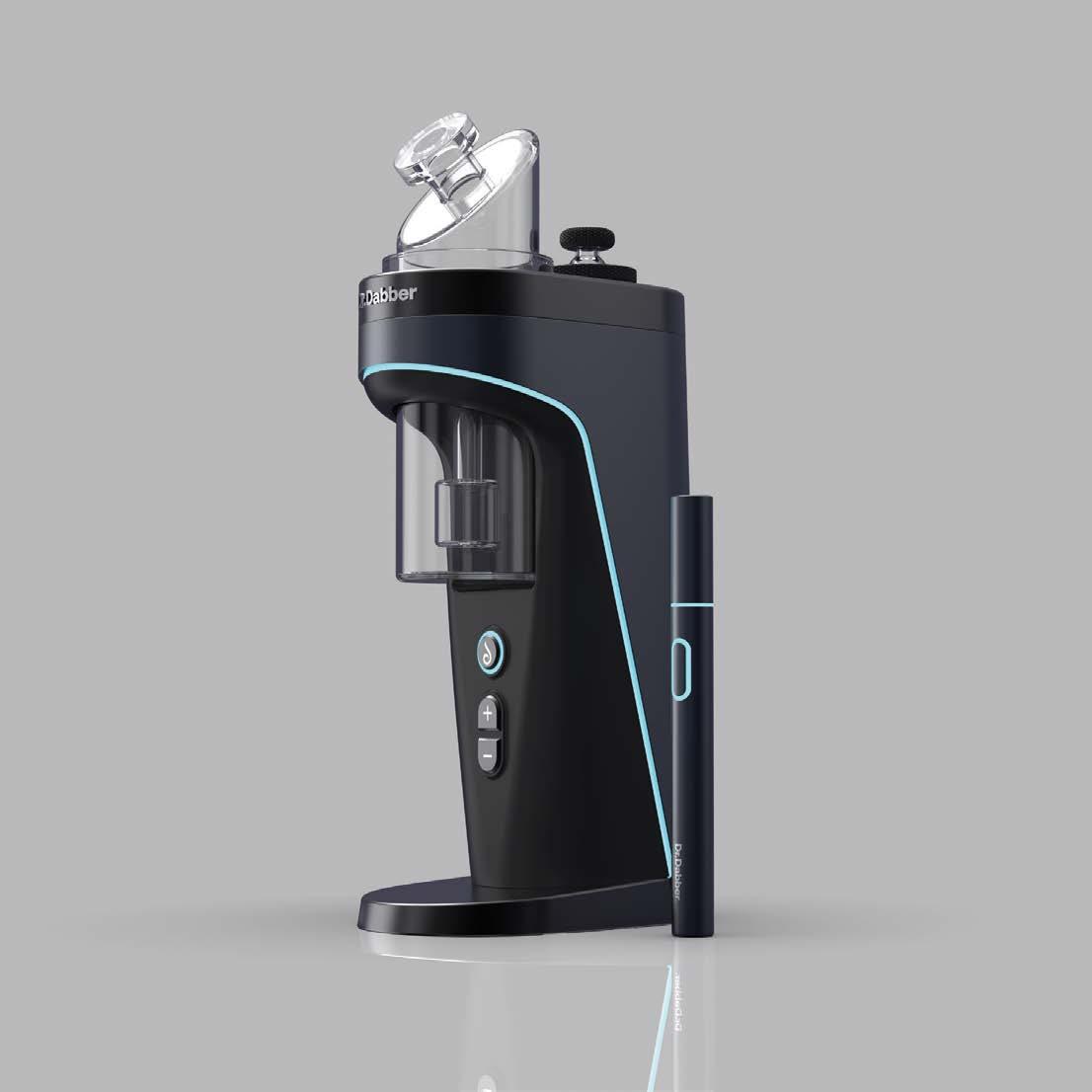
We accidentally created an eRig that has no atomizer to replace every few months.
Our apologies to companies before us that rely on their customers continuing to spend money on their devices based o a failing part.
No Atomizer Ever
Completely Customizable Heat Modes
Quartz Insert Out of the Box
Drop Heated Loading Tool Included Built to Last
The All-In-One eRig. No atomizer. Completely customizable heat modes.
lOSt & fOUnd
UNPACKING THE MYSTERY OF RARE & LOST PSYCHEDELICS
IN A MODERN WORLD fascinated with the esoteric, collectible rarities, there’s no better source of enlightenment and entertainment than a trip to set the mind and spirit free. Rare psychedelics are the long-lost power-ups that built our civilizations, united tribes, gave coming-of-age experiences to youth and even helped the ancients connect with God. Today, psychonauts are collecting, growing, synthesizing and sharing these psychedelics to ensure that they are not lost or forgotten. While Big Pharma has spent nearly 100 years poisoning America with petroleum-based drugs, these ancient tools are being rediscovered. A race is on for Big Pharma to patent medicines given by the creator, given freely for our spiritual, mental
and physical growth. These are the rare psychedelics, the ancient keys, that we are rediscovering today in our society that badly needs a reset to traditional human values.
If there is one thing that’s certain, humans were made to experience psychedelic trips, and the tools were given to unlock these mysteries in plants, animals and the natural world. This power was stolen by the war on drugs, and now a new spiritual war for freedom to pursue what our Constitution deems “the pursuit of happiness” is the front line of drug culture. What was given by the creator cannot be outlawed by man, or taken by law, for nature and God’s plan for humans to live free is undeniable.
AYAHUASCA
Once a rare tribal tradition dating back thousands of years, preparing ayahuasca involves the combination of boiling a vine called Banisteriopsis caapi, which is a MAO inhibitor, with Psychotria viridis (chacruna), which has DMT naturally, to release a brew ready for spiritual journeys and intense purge-and-heal experiences. Once only found in the jungles among traditional settings, ayahuasca ceremonies are now more common around the world.
BUFO
Explore new levels of consciousness via animal medicine.
Using the venom of the Bufo alvarius (Sonoran Desert toad), which contains high concentrations of 5-MeO-DMT, Bufo brings a major peak along with an experience many report as similar to a death and rebirth during the trip.
CANNABIS
Cannabis might seem commonplace today, but just 20 years ago, scoring a bag of green bud was pretty difficult. When I first started smoking, the drug seemed so mysterious — a plant that’s illegal! In my young mind, I thought the government only banned things that caused harm.
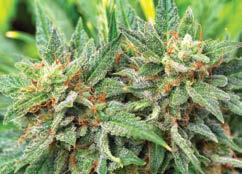
Buying seeds and growing Cannabis was safer than running cocaine in the ’80s, but still came with tremendous risk. Finding a strain or genetics was next to impossible. Despite the illegality, challenges and risk of prison, our Cannabis breeding heroes risked this to breed, clone and spread the plant underground. For this, we include Cannabis as a rare psychedelic. With the plant still illegal in many states and countries, there is still work to be done to share this healing medicine with the entire planet!
DMT
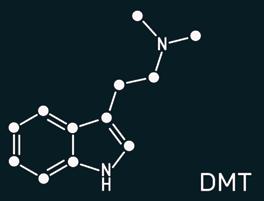
DMT — or N,N-dimethyltryptamine, also known as “the spirit molecule,” which is the title of an amazing book — can be found naturally in many plants and animals. Additionally, it’s produced endogenously in our brains when we are born, dreaming, and during death.
Traditionally consumed in ayahuasca form, today’s psychedelic scientists have extracted DMT to be smoked or vaporized. Effects are short, but a lifetime can be lived in other dimensions during a 15-minute earthly sesh. There’s also overseas research in IV drips for sustained DMT trips. The final frontier of consciousness, now in vape pen form!
KAMBO
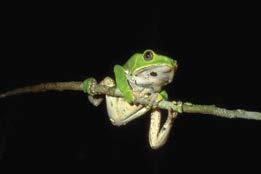
It’s funny to use the word “extract” when referring to a Phyllomedusa bicolor frog, but this medicine is taken from the frog and burned onto the skin, causing intense purging before imparting a sense of clarity, focus and purpose. It’s used for detoxing and purification.
MDMA
Molly, ecstasy and MDMA. These names cover the same chemical — 3,4-methylenedioxymethamphetamine — which is considered both a hallucinogen and a stimulant, and great for dance parties. Studies by the Multidisciplinary Association for Psychedelic Studies find that MDMA treats depression, PTSD and many other symptoms. Jump into a cuddle puddle and find out why MDMA was considered the best therapy drug of the ’80s, especially for couples, before the government locked it down for its recreational potential.
SALVIA
Salvia divinorum, aka “diviner’s sage,” hit gas stations and smoke shops in the 2000s, sending unwitting users on an intense, short-lived psychedelic trip. This writer once smoked a large bowl out of a pop can before climbing aboard, as the red Coke became a spaceship, piloted to the moon and back in an epic journey. Still legal today in most states, Salvia — from the Mexican Lamiaceae mint family and its nonalkaloidal hallucinogen salvinorin A — is one of the most potent naturally occurring psychedelics. Check out the “Gardening on Salvia” video for a trip back to the early internet, and see how this powerful drug works in the garden!
SASSAFRAS
More proof that plants are our friends, the sassafras tree (Sassafras albidum) contains essential oils rich in safrole, which can be synthesized into MDMA. Sassafras generally refers to an oil extract from the plant, which produces a more energetic and visual high that boosts serotonin, dopamine and norepinephrine release.
SECRET STASH ADVICE
The war on drugs created rebels and freedom fighters who chose mental, spiritual and physical freedom during a time when substances we call medicine led to decade-long prison sentences. Today, many secret stashes are being dusted off and shared with the world, which is leading to a new psychedelic renaissance. Remember to be careful when sharing psychedelics, always consume in safe settings and follow the golden rule: You can always eat more, but you can’t eat less!
“Today, psychonauts are collecting, growing, synthesizing and sharing these psychedelics to ensure that they are not lost or forgotten.”
at Tack of The Blobs
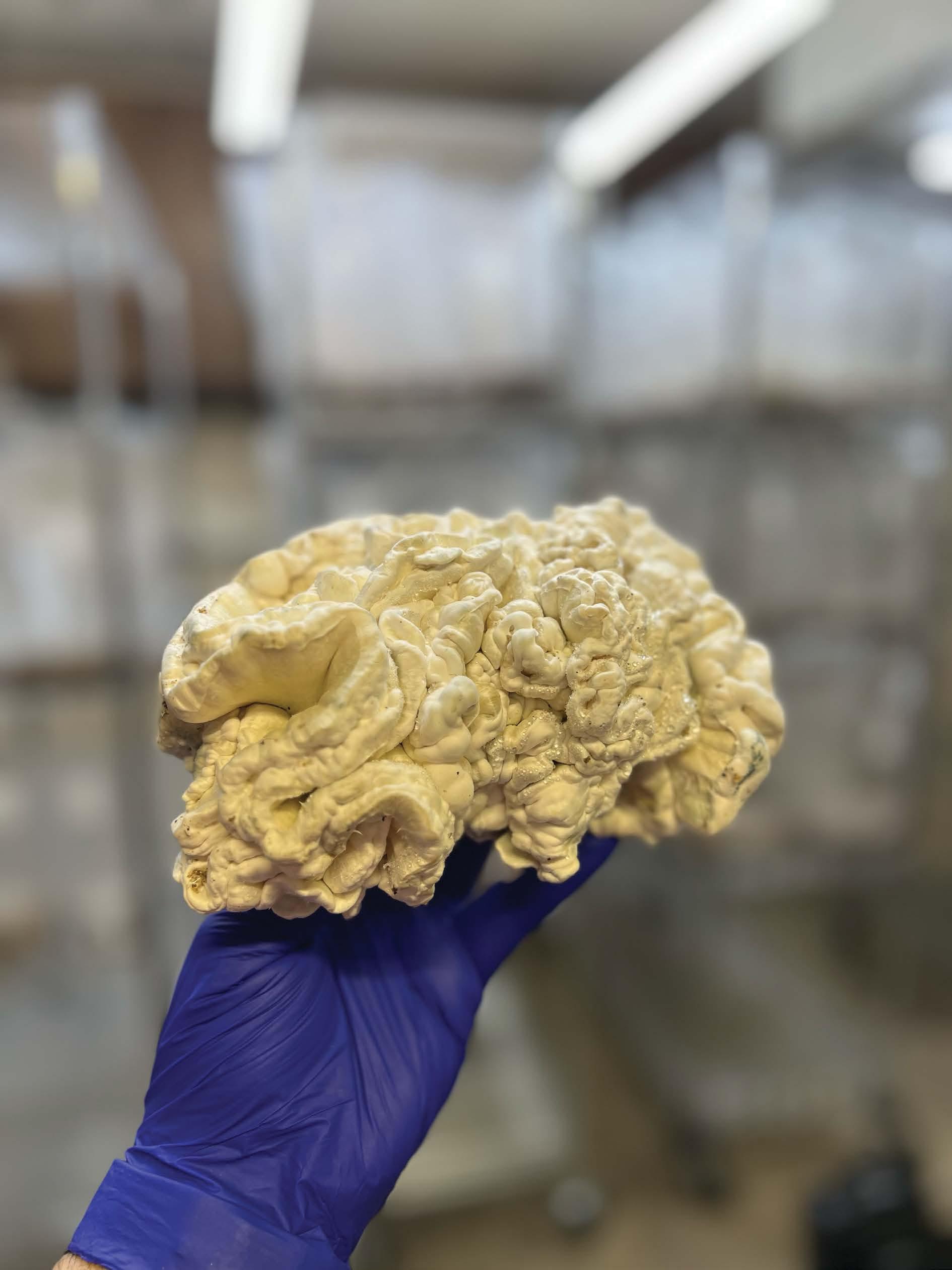
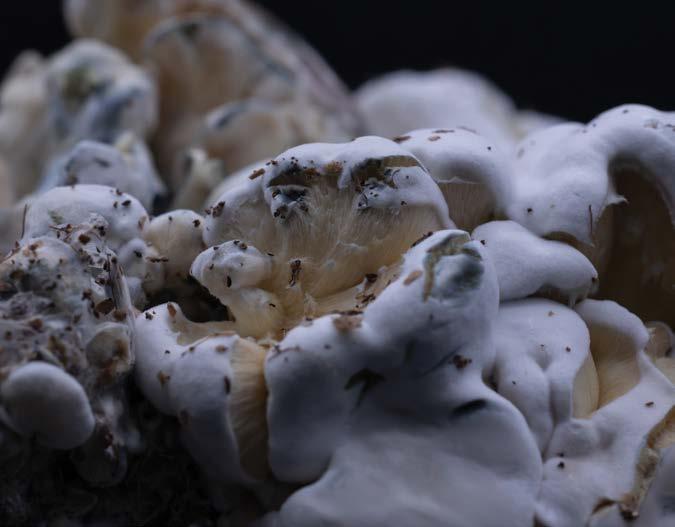
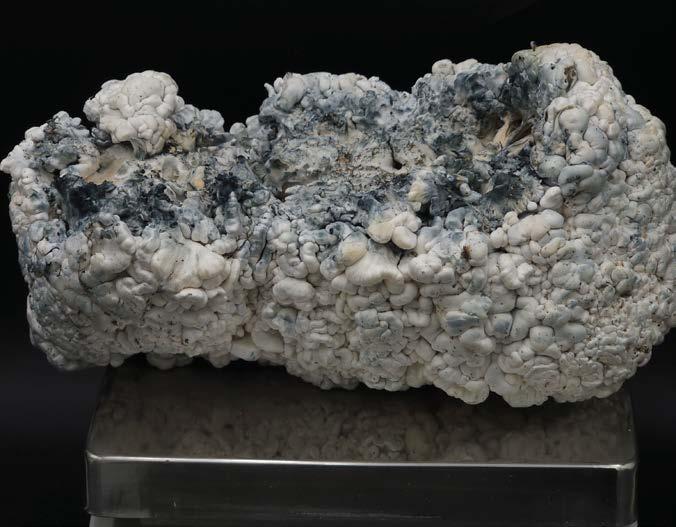
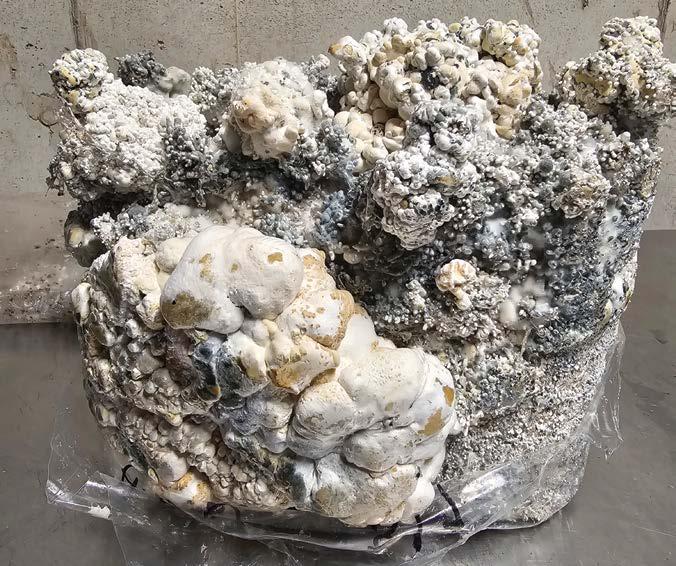
Psychedelic mushrooms have been known to alter perceptions, and mutations have been known to alter our comprehension of psychedelic mushrooms. The latter has resulted in wild-looking shrooms that have also proven extra potent.
Uncovering Psychedelic mushroom mutations
THERE ARE ASPECTS of Psilocybe cubensis and other species that the average layperson may know about. The stems often turn blue or black when bruised, for example. But certain morphologies are more unusual, like all-white albino mushroom strains or blob mutations.
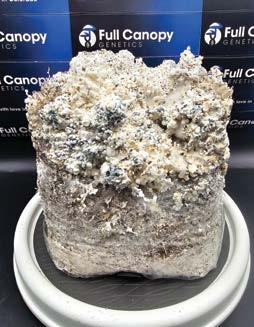
Blob mutations may display fins, coral, brain and finger formations. They do not have stems, gills or drop spores. Instead, they have been cloned after appearing in a wild-type sporulating culture. As of now, blobs are selected for, not bred, but liquid cultures have been isolated from the various structures, like the fins and coral. These should, in theory, produce a blob morphology, but they may not yield the same outcome in different environments.
Christopher Pauli, CEO of Tryptomics, explained more about this interesting fungus to the Leaf.
“It’s not truly understood, like, are all blobs this same mutation causing the same phenotype, or is this multiple different mutations that could happen that all lead to this weird morphology to occur?” Pauli said.
The molecular biologist has theories about the origins of blob formations, but has yet to test them. This morphology has been observed in Psilocybe cubensis, Psilocybe natalensis and Psilocybe aztecorum species, but some isolated mutations have reverted back to having gills. This indicates it may be an environmental or viral response, or even polyploidy, rather than a DNA mutation. Pauli has theories, but there is not much research on how these mushrooms form.
Why should they get into it? Because most blob mutations have tested with higher potency compared to the fruiting body counterparts they mutated from. The same thing that makes it hard to replicate blobby shrooms may be what makes them hit so hard. When mushrooms drop spores, they lose potency. But nongilled blobs may not turn off the alkaloid production genes after sporulation. This allows them to become increasingly more potent. If it is a virus causing this mutation, it is a good one. Some blobs are even showing higher dry-weight yields per flush.
MuShrOOm lINgO
MORPHOLOGIES
The structures and forms that certain mushrooms take.
SPORULATION
The production of spores from vegetative cells by fungi, bacteria, protozoa and plants.
POLYPLOIDY
This is when a whole genome duplicates during evolution (commonly desired in domesticated crops).
GUTTATION
The process by which plants and fungi push liquid metabolite drops from their tissue.
The brains, coral and fins look otherworldly, and some new formations have joined the family in the last few years. Toque F8, isolated from the Psilocybe cubensis strain Tidal Wave, has become highly coveted for its potent nerds morphology. It resembles the candy, and a unique little “hat” appears on the fruiting bodies. Guttation, a process commonly observed in bleeding tooth fungi Hydnellum peckii, has also popped up recently. Turns out, the resulting liquid could prove useful.
“We find those metabolites have antibiotics, anticancer compounds, all kinds of, you know, cool properties with what compounds this mushroom produces and excretes. And so we have seen some cubensis do more of this blob formation, but with like divots in it, and it produces a lot of mutation. And so that’s kind of one of the newer mutants that we’ve been able to see,” Pauli shared.
Sometimes a freak makes the cut, and when a hobbyist takes note, psychedelic enthusiasts are blessed with new, exciting anomalies that may also have impressive effects. And, if the resources flow in the right direction, biologists may find even more beneficial properties. For now, it is proven that these things look pretty cool.
TRYPTOMICS.COM
@TRYPTOMICS
@FCGENETICS3.0
@MOUNTAIN_HARVEST_MYCO
TOQUE F8
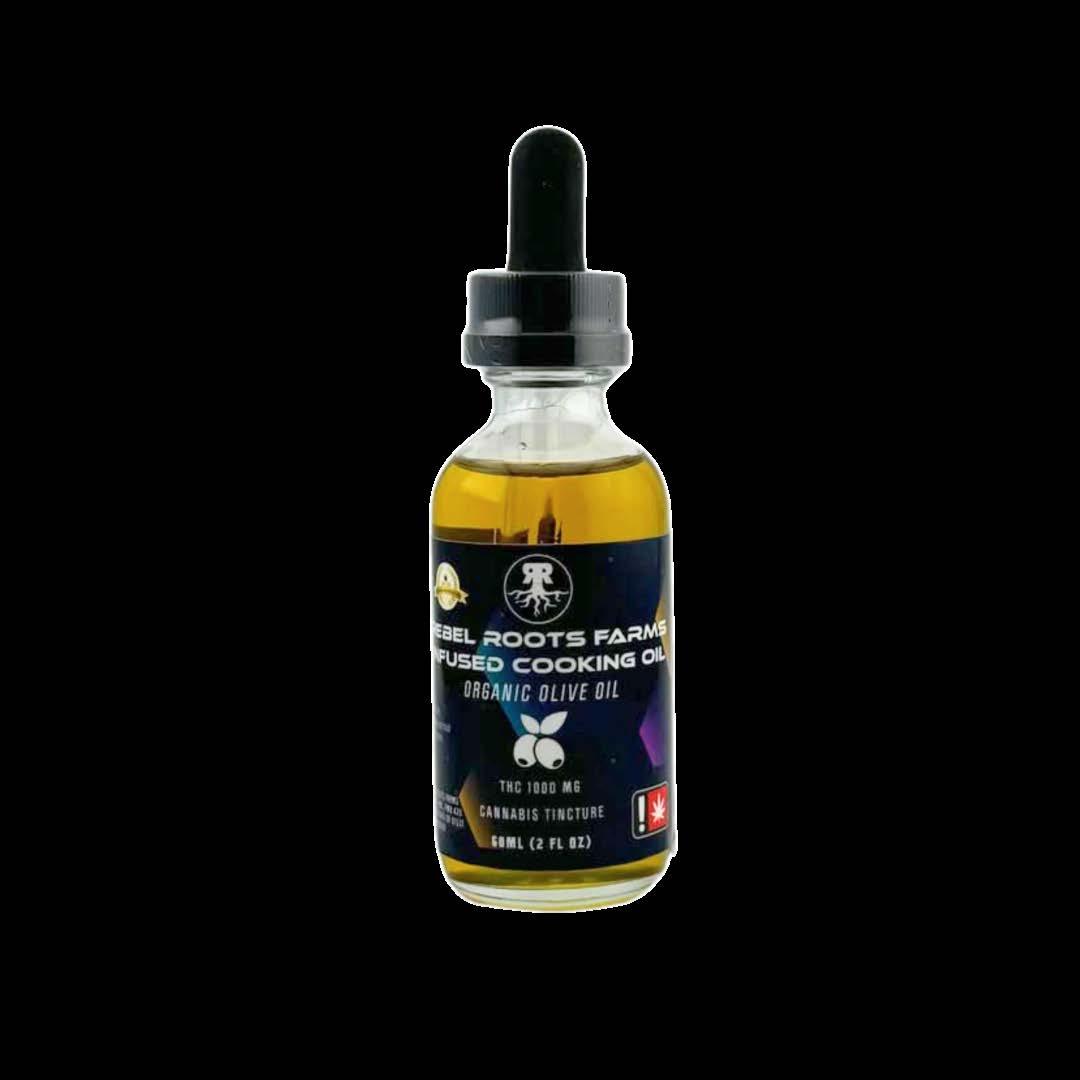
I n f u s e d C o o k i n g O i l 1000mg
SPLASHINGOUTSPLASHINGOUT
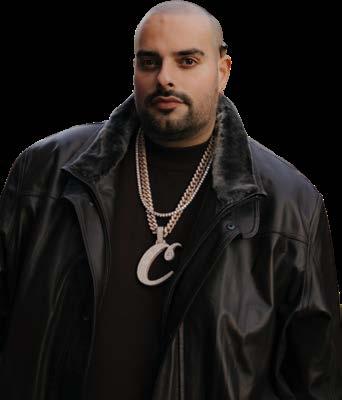
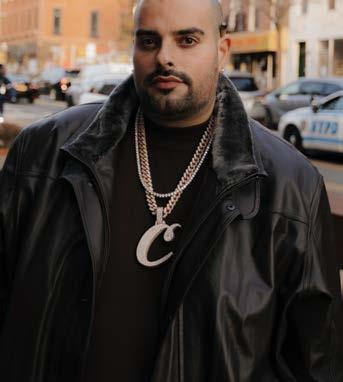
People know Berner through his global weed brand, Cookies, and through his music. But those who’ve been paying close attention know that Gilbert Milam Jr.’s vision and aspirations expand far beyond the music studio and helming the most well-known weed brand in the world. In an interview for a February 2022 Leaf Magazines cover story, Berner told me that his next frontier would be the film industry. A huge A24 buff, Berner wanted to build on the foundation laid by the greats of underground crime cinema.
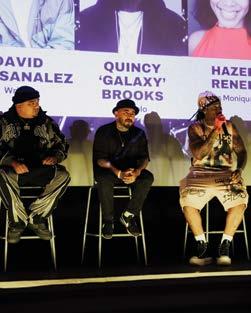
CUT TO PRESENT DAY, and I caught up with Berner in the midst of a promotional tour for “Splash City,” his first film, which he storyboarded before scripting with the help of David Mansanalez of 4 Ways Entertainment. Berner funded and produced the film himself.
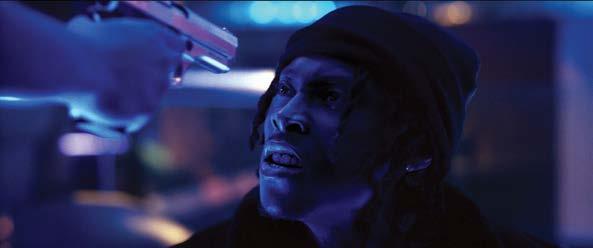
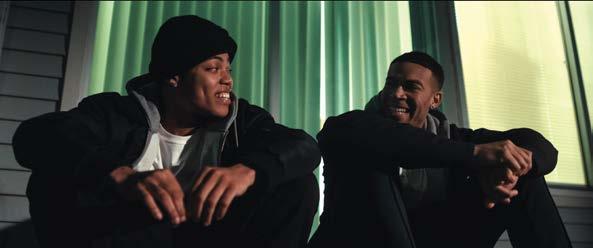
Berner wrote “Splash City” as a Bay Area crime drama inspired by the region’s notorious reputation for smash-and-grab car crime, aka “bipping.” It was recently picked up for this limited distribution run by Lionsgate, one of the most well-known film distribution companies in the industry. It features fresh Bay Area talent, including Zakee Brooks as Cloudy, and a downright frightening performance by Zakee’s older brother Quincy Brooks as the film’s nefarious villain, Dolo.
“It was just something that was going on,” Berner said about the plot of the film. “If you lived in San Francisco or visited San Francisco, you couldn’t get away from the bipping situation. And I was like, OK. I wanted to start with something that was really relevant. It was a really big problem. I felt like there’s some truth to some of these stories in this film, so I want to tell that.”
Over the course of our conversation, I brought up one of my personal favorite iconic hip-hop crime films, Hype Williams’ “Belly,” and asked if that was an inspiration for Berner’s film.
“A hundred percent,” he said. “I feel like people haven’t been hittin’ like that. ‘Belly,’ ‘Menace (II Society),’ ‘Boyz in the Hood,’ ‘Big Ballers,’ ‘Casino,’ ‘Blood In Blood Out,’ ‘American Me,’ you name it. We’re not really seeing those anymore.”
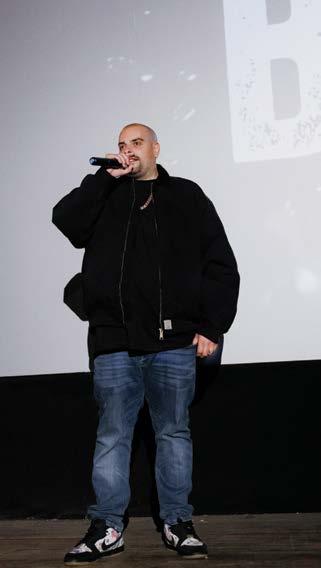
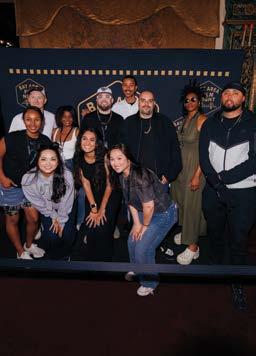
The people are ready. The first 11 cities on his Lionsgate tour sold out almost immediately, with people clamoring to get a chance to watch the film with Berner. It was obvious that the crowd at the screening in Bay-adjacent Sacramento felt that they were experiencing something close to home up on the silver screen. There were a lot of familiar faces in the crowd, many a part of the extended Cookies family.
The success of the first showings led to Lionsgate adding week-long runs at another 15 theaters across the country. With the initial success of “Splash City,” Berner’s fired up about his new career trajectory.
“I co-wrote it, co-directed it and definitely financed and produced it myself,” Berner said. “This movie was my film school. I learned everything I needed to learn from here. … The next one’s going to be a weed crime thriller, so it’s going to be all about trafficking and some of the dark things that come with that. It’s going to be based on true events. And you can expect to see our world that you’re very familiar with from the trap world of the Bay Area. I can’t wait for that one. I’m very, very anxious. I hope I could partner with Lionsgate on this as well. But that’s my next thing. I’ve already started writing it. It’s really, really, really, really sick.”
For Berner, it’s all about showing out for the city that made him.
“I just want to put light on the Bay Area,” he said. “That’s all I ever wanted to do, whether it be music or Cannabis. I remember moving to Arizona as a kid and people making fun of where I was from, and making fun of the city, and just saying what they had to say about it. And I’m like, let me just show people how dope we really are, how many trends we really set and how responsible we are for just really putting designer weed on the map. … We haven’t had a chance to tell our stories yet. And I feel like Boston and LA and New York and Chicago and many other cities have told their stories for many, many, many years. But this is our time, and I’m kicking it off for all of us. I want to inspire others to make films about NorCal. I want to inspire others to make films about the city. And whether people love it or hate it, it’s going to be that kind of creative juice that makes them want to go do the same thing.”
“THIS MOVIE WAS MY FILM SCHOOL. I LEARNED EVERYTHING I NEEDED TO LEARN FROM HERE.” -BERNER, DIRECTOR, ON “SPLASH CITY”
KEVIN KUHN
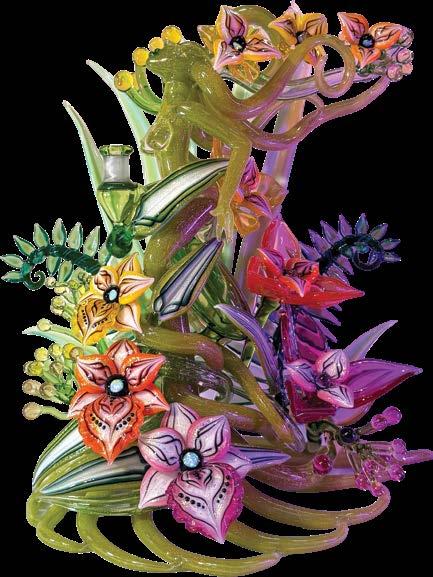
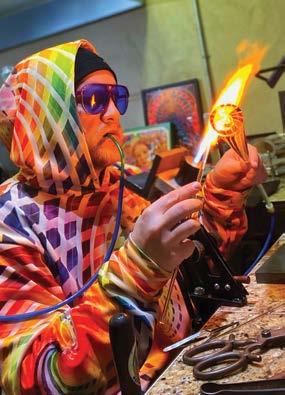
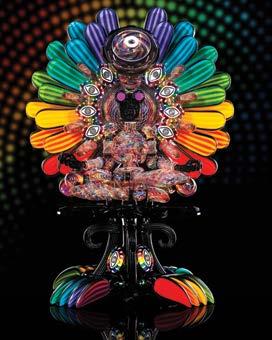
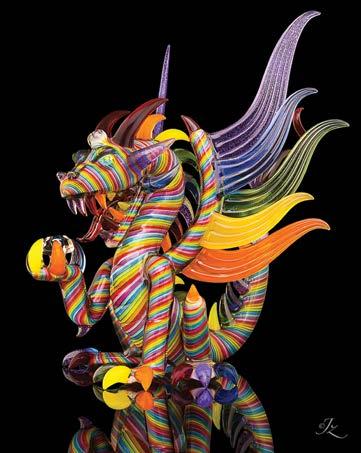
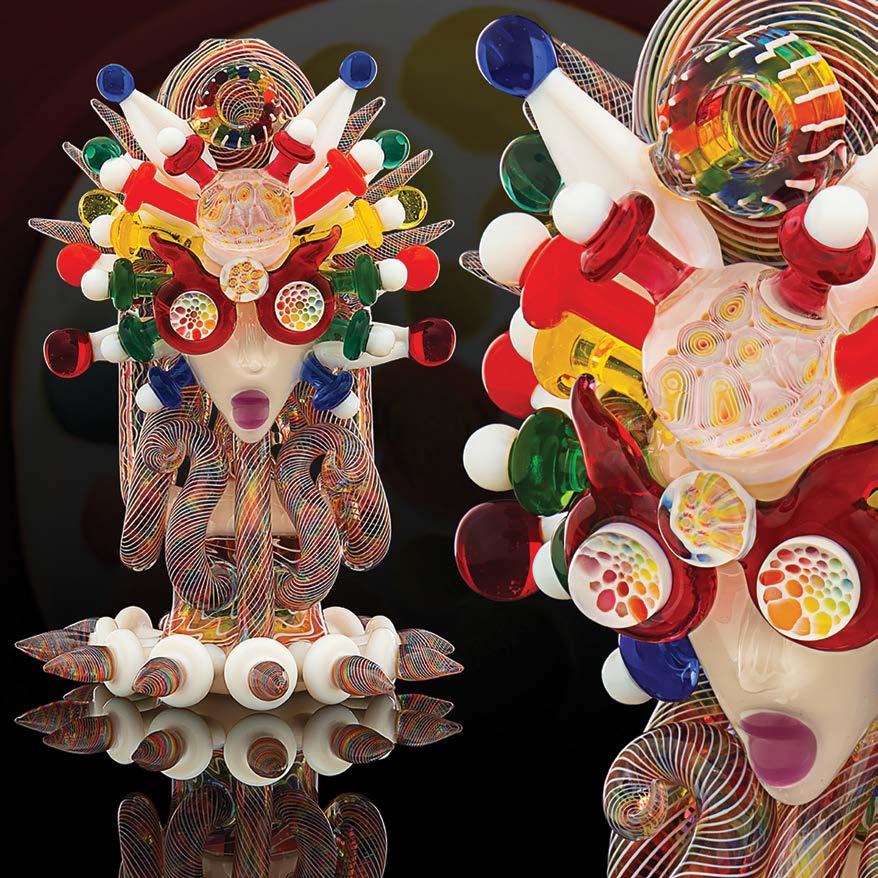
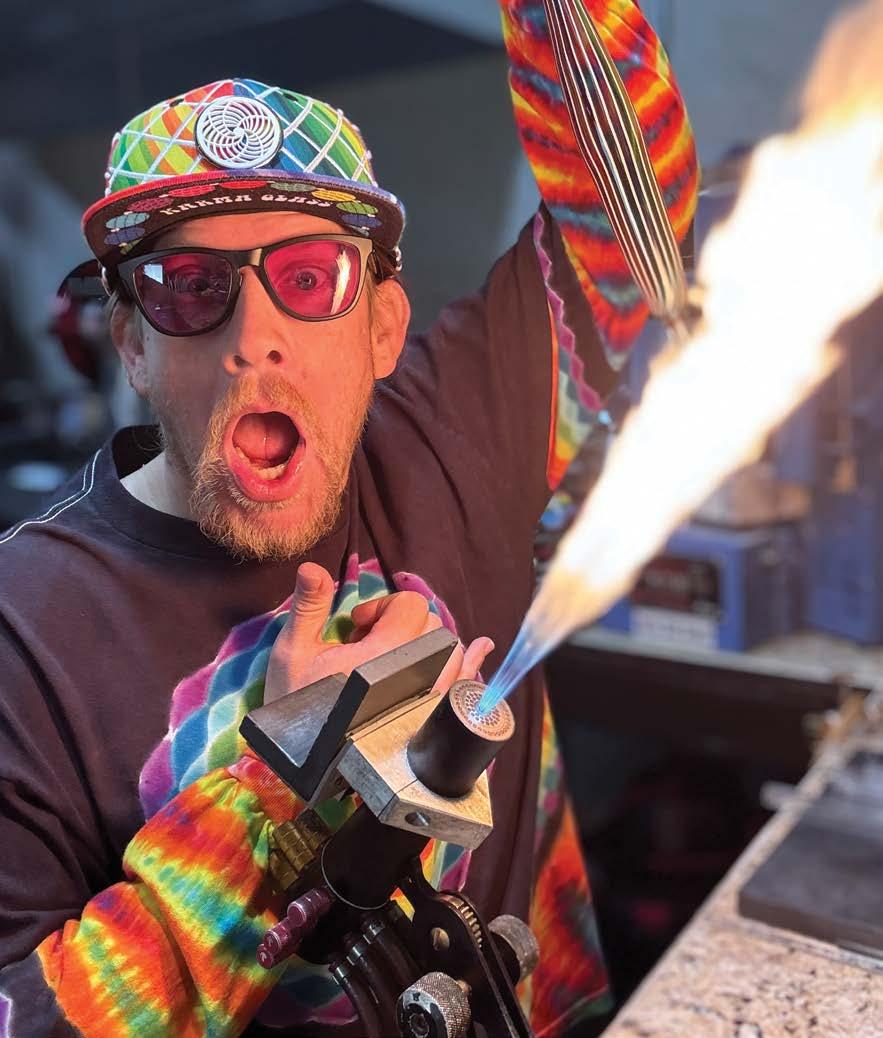
I’m sure we have all been out there and seen the sun shine through a blanket of moisture to create a rainbow. In our minds, we all wonder where it ends and if there is a pot of gold. Artist Kevin Kuhn, better known as Karma Glass, is most likely what you’d actually find at that end of the rainbow. His intentions are clear, positive and enduring. He is a particular kind of being, one that follows intuition with intention.
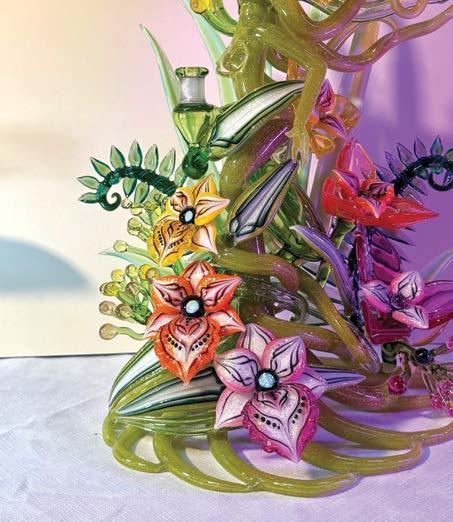
WHEN WE ASKED him about his chosen colorway, he said: “When we think of visionary art, we think of grandiose, the 22-petal lily across the room. With my ‘Karma Stack,’ I'm trying to distill down the psychedelic realm to the baseline of the experience to see what you can bring into this dimension.”
Kuhn continued, “You think of the rainbow trails you’ll see during a vision and the auras that you are able to read off of people. And that’s why tie-dye is so pervasive in our community, (it) is because it’s exciting to look at while you are having an experience. What I’ve tried to do is distill down this kind of loving experience of glass that is inclusive over exclusive. When you come to a show or have a viewing with my art, it’s meant to draw you in. Come celebrate, do a dance, enjoy the energy. That's what I stand for, and that's what my collector base stands for. A bit of the ‘One Love’ nature, I’m trying to distill that essence down to a technicolor pattern for all to experience.”
KARMA GLASS
From some of the largest names in the industry to the new glassblower next door, Kuhn has felt fortunate to collaborate with many artists. He views it as a mandatory effort to keep art growing in all facets.
Kuhn is not one to name-drop; he truly sees each experience as its own and learns and grows from them. When we asked him about the many collaborations he has been a part of over the years, he told us a story about the Pygmy people, the Indigenous tribes that survive in the remotest-ofthe-remote jungles of the Congo. They have a saying, a proverb, that has inspired and influenced his entire career: “If you want to go fast, go alone; if you want to go far, go together.”
"That's what I stand for and that's what my collector base stands for. A bit of the ‘One Love’ nature, I’m trying to distill that essence down to a technicolor pattern for all to experience.”
“Work with others” is more than a mantra for him; he truly believes in always having your heart open to creating with the next artist you encounter.
“The more isolated we are, the less we truly learn,” he stated. We went on to talk about life and growing up. Kuhn put it perfectly when he said, “I sit at all the lunch tables. I’ve never really met a stranger, and that is my mentality in life.”
This year, Kuhn is traveling west in preparation for his fall opening, “Vibratious,” which will be held in the Asheville, North Carolina, area. Stay tuned for more details on his social media.
KARMA
GLASS X SCOZ
KARMA
JAMIE ZILL @JLZILL
KARMA
GLASS X JSMART
JAMIE ZILL @JLZILL
KARMA GLASS X LACEFACE
JAMIE ZILL @JLZILL
COURTESY
summer Stoned
ZONED ZEST GRIDDLE HIGH MINI PANCAKES
GRIDDLE HIGH MINI PANCAKES
Serves 5, about 25 pancakes 3/4 cup milk
5 teaspoons melted canna-butter or -oil
1 teaspoon vanilla
1 egg, lightly beaten
2 tablespoons maple syrup
2 teaspoons baking powder
1. In a medium bowl, combine the milk, canna-butter or -oil, vanilla, egg and syrup.
2. In a small bowl, combine the dry ingredients and gently mix into the batter. Don’t overmix, just until smooth.
3. Heat a medium-sized skillet to medium. With a ladle or spoon, drop the batter into the pan to form a circle with a 2-inch diameter. Don’t overcrowd the pan.
4. Cook for about 2 minutes until bubbles form, then turn and cook for an additional minute. Golden brown is the dream.
5. Serve immediately or keep warm briefly in a very low oven.
6. Top with maple syrup and fresh summer fruit.
CANNA CRACKERS
Serves 2
3 whole graham crackers, 6 crackers
1/2 cup Nutella or other variety chocolate spread
2 teaspoons canna-oil
1 banana Dash lemon juice
1. Slice the banana, toss with lemon juice and pat dry. Set aside.
2. Place 2 half crackers on your work surface.
3. In a small bowl, combine the Nutella with the canna-oil.
4. Spread half of the Nutella between the 2 crackers. Top with banana slices.
5. Place another cracker half on top of the bananas.
6. Repeat the process with the remaining crackers, infused nutella and bananas. You might want to do the second layer on the work surface and then top; much less squishy.
So, I was in an Electric Lettuce in Sellwood-Moreland, Portland, one of my favorite dispensaries and neighborhoods. Wanting to get lots accomplished and be delightfully high, I decided to try a 50-50 hybrid. The “bud-ista” recommended Island Pie from my go-to brand, Pruf Cultivar. It was just what I was looking for: fresh, fruity, sweet and upbeat with a pleasant head and body feel. The strain was easy to cook with, lending an appealing lightness and some fruit — easy August. laurie@laurieandmaryjane.com
7. Wrap the finished product in foil, pulling it up around the individual firecrackers. Place near the fireplace, camping grill, or in an oven at 375 F for 10 minutes. Open carefully.
ZONED ZEST
Serves 2
1 large navel orange
2 scoops vanilla
1 cup fresh strawberries
2 tablespoons honey or sweetener of your choice
1 tablespoon lemon juice
2 teaspoons canna-oil
1. Slice the orange into 2 equal halves. Using a grapefruit spoon, scoop out the flesh from the orange and set aside.
2. Place the orange halves on a small freezer-safe tray and freeze for at least an hour.
3. Allow the ice cream to sit out just enough for you to scoop.
4. Remove the frozen orange shells from the freezer. Place a scoop of ice cream in each half, and return to the freezer.
5.
6. When you are ready to serve, place the oranges on plates and spoon the
Savory Gas Meets Sweet Cookie Funk
E ects:
Heavy Body
Sedating, Euphoric,
High Flavors: Garlic Gas, Sweet Dough Earthy Kush
Aroma: Pungent Funk, Diesel, Roasted Garlic
Lineage: Chemdawg X Girl Scout Cookie
THE NEUROTROPIC SOUNDWAVE
CAN MUSIC SPARK A PSYCHEDELIC EXPERIENCE?
The lights dimmed as hundreds of people closed their eyes. A single heartbeat emerged from the stage, followed by the haunting call of a didgeridoo. Native flutes answered from somewhere in the darkness. Ancient rhythms wove through Portland, Oregon’s Crystal Ballroom like smoke. Within minutes, strangers were breathing, swaying and elevating their spirits together. This wasn’t your typical concert; it felt like stepping inside a living ceremony. This is the essence of a Reciprocity Music gathering.
A NEW MOVEMENT is quietly taking root within conscious music communities. Rather than relying on plant medicines or synthetic compounds, artists are exploring how breath, vibration, ancestral instruments and intentional presence can guide audiences into deeply expanded states of awareness. Increasingly, these gatherings are becoming known as “Prayerformances,” where music becomes prayer, movement becomes meditation and presence becomes the medicine.
Reciprocity Music is curating immersive experiences that nourish not only the ears, but the heart, body and spirit. Their vision honors the timeless understanding that sound can reconnect us with ourselves, one another and the living Earth. That vision came alive this past Mother’s Day during Poranguí’s unforgettable performance.
Raised between the cultural traditions of Brazil, Mexico and the American Southwest, Poranguí has earned an international following not simply as a musician, but as a ceremonial guide. Layer by layer, he builds each performance in real time using voice, Indigenous instruments, percussion and looping technology, creating an ever-evolving soundscape that exists only in that moment.
awakening the oldest rhythm we have ever known, the heartbeat.
Then came Snow Raven, an Indigenous artist from the Sakha Republic of Arctic Siberia, whose breathtaking vocal expressions drifted somewhere between birdsong, wind and ancient elemental prayer. Her voice seemed to dissolve the walls of the ballroom, lifting the audience into a place beyond language.
Watching the room became as captivating as watching the stage. Some people stood motionless with tears quietly streaming down their faces. Others danced barefoot with eyes closed. Couples embraced. Children spun in joyful circles. The invisible line separating the audience from the performer slowly disappeared.
Poranguí was only one voice in an extraordinary gathering of Indigenous wisdom keepers.
Ten-time World Champion Jingle Dress Dancer Acosia Red Elk carried generations of healing into the room through every prayerful step. The gentle cascade of metal cones became an audible blessing, reminding everyone that movement can be medicine. Sisters of the One Drum followed with powerful songs rooted in ancestral memory, their voices and tribal drumming
For me, this was one of the most meaningful Mother’s Day celebrations I have ever witnessed. This was not honoring motherhood with flowers or brunch, but celebrating Mother Earth as our ancestral great-grandmother that has long understood music and movement as healing and ceremonial communion.
Neuroscientists study rhythmic entrainment, the tendency for brains and bodies to synchronize with repetitive rhythms. Researchers, including neuroscientist Dr. Daniel J. Levitin, author of “This Is Your Brain on Music,” have explored how rhythm can influence brain activity and social connection. National Institutes of Health studies have similarly examined how synchronized breathing, drumming and collective movement can strengthen feelings of connection and physiological coordination among participants.
Across Indigenous cultures, these same ceremonial practices have been cultivated for thousands of years to encourage presence, emotional release and spiritual connection. Whether interpreted through neuroscience, spirituality or both, many participants describe a similar phenomenon: time softens, self-consciousness fades and something larger begins to stir within the collective.
But reducing the evening to neuroscience alone would miss its deeper essence. What unfolded inside the Crystal Ballroom felt rooted in relationship with the Earth’s ancestral memory. Every heartbeat, every song and every footstep became part of a shared offering rather than a performance to consume.
As more people search for healing beyond pharmaceuticals and endless digital distraction, gatherings like these invite a profound question: What if expanded states of consciousness have always been readily accessible, living within the oldest technologies humanity has ever known, our very own breath, rhythm and community prayer?
When the final note dissolved into silence, people lingered, embracing strangers who now felt known. For a few beautiful hours, music had become far more than entertainment; it had become ceremony. Sometimes the most transformative medicine is not something we consume, OGs, but something that our very own breath surrenders to.
“The invisible line separating the audience from the performer slowly disappeared.”
SENTARO
IN AN INTERVIEW with the Leaf, Sentaro expressed that in China, there are a lot of people interested in this style of work; however, restrictions around the plant are much tougher than those we experience here in the U.S.
He sees the plant as something that is neither good nor bad, but something that is “natural, neutral and an original inhabitant of this planet.”
Sentaro got into the green scene back in 2011, he told the Leaf. As he put it, “My journey went from indifference to enjoyment and eventually to facing the consequences. Now, it serves merely as a spiritual totem for me.”
He continued, “My inspiration really exploded starting in 2024, with many ideas derived from friends and events around me.”
These are some of the examples you can see on his Instagram page: evil-looking preroll spirits, a kawaii one-eyed leaf on a schoolgirl’s body and a scene of a geisha using a grinder.
Sentaro told the Leaf, “Japanese culture has had a profound influence on me, stemming from my childhood impressions of anime and my professional style, which indirectly sparked an interest in ukiyo-e.”
The term, which means “pictures of the floating world,” is a wellrecognized style of Japanese art that depicts everyday people and life through colorful woodblock prints.
He brought up how almost all of the stoner art you find online or in galleries leans toward Western artists, styles and references. This is what “started me thinking about what fusing this with Eastern philosophy would look like,” he said.
Now, Sentaro said, he uses ukiyo-e as the framework for most of his work. The result is something he described as “both subtle and intriguing,” which feels insanely accurate.
Currently, he works out of a friend’s tattoo parlor in Kunming and travels abroad to work guest spots at other shops. When it comes to creating new ideas for a piece, Sentaro said he has three main approaches: working from a client’s experience, from the name of a strain or a character parody. When it’s time for the studio to come alive with a new tattoo or just a sketch session, he throws on something chill like Japanese hip-hop group Namedaruma or Taiwanese rappers Soft Lipa and GorDoN.
“I like relaxing vibes; listening to them feels like that first big gulp of a cold beer at the start of the day,” Sentaro said.
Sentaro is a tattoo artist living and working in Kunming, the capital city of Yunnan province in China. His tattoo designs roll together vivid scenes of stoner lifestyle, traditional Japanese tattooing, Eastern mythology and pop culture.
“Japanese culture has had a profound influence on me.”
SENTARO
12 MONTH’S FLOWER MATCH SPECIAL EDITION - OCTOBER
WEEDKU
ROLLICE
HEARTS OF GREEN GOLD
A GIRL GROOVING TO NAMEDARUMA
BLUE DREAM
From the hot rod circuits of Detroit to the acid-soaked streets of Haight-Ashbury, Stanley Mouse has spent the past 70 years helping to define the psychedelic, rock and pop culture aesthetics. As one of the so-called “Big Five” of 1960s poster art, Mouse designed some of the era’s most iconic rock posters and albums — establishing himself as one of the most prolific and influential artists of the 20th century.
The Mighty Mouse
EARLY YEARS
Growing up in Detroit in the 1950s, Stanley Miller became infatuated with muscle cars, Motown and Mad magazine. As the son of a Disney animator, he also mastered drawing and airbrushing at an early age. In middle school, he was always doodling in class (mostly monsters, hot rods and cartoon rodents), earning him the nickname “Mouse.”
used for Roth’s signature character, which Mouse accuses him of plagiarizing.
“He stole my mouse image,” Mouse complained to Seconds magazine in 1997. “He took a bunch of my catalogs back to LA and had his artists copy all my stuff and they created Rat Fink out of my characters.”
big concerts. To promote these shows, the organizers plastered trippy posters all over the Haight. It was those posters by artist Wes Wilson that inspired Mouse to switch from hot rod shirts to rock posters — an ambition quickly realized thanks to fellow artist and hot rod fan Alton Kelley.
After being expelled from high school for graffiti, he attended the Detroit Society of Arts and Crafts. There, at the adjoining Detroit Institute of Arts museum, he first saw paintings by Degas, Picasso and Van Gogh and thought to himself, “Someday, I’ll be able to paint like them.”
THE MOUSE AND THE RAT
As a teen, Mouse spent weekends smoking weed and painting shirts at car shows, drag races and state fairs. It was at one such race that he met his notorious frenemy, hot rod artist Ed “Big Daddy” Roth. The two often traded digs while working alongside one another: Mouse allegedly calling Roth “Bigg Fatty,” and Roth calling him “Rat Fink” — the name later
Mouse eventually dropped out of school to tour with the hot rod circuit. By 1960, he’d opened his own studio, and by 1963, he’d established his own company, Mouse Studios. In 1964, he partnered with Monogram to produce plastic model kits of some of his muscle car monsters. But by then, LSD and anti-war protests had made their way to Michigan, beckoning Mouse westward.
“I started to dabble with psychedelics and was searching for the next evolvement of my skills,” he told the Haight Street Voice in 2017. “San Francisco called to me like a siren out to sea.”
BAYWARD BOUND
In 1965, Mouse drove to San Francisco, where he became immersed in the psychedelic scene almost immediately — attending house parties where everybody was tripping. Unfortunately, he got drafted and had to return to Detroit, but got out of service by taking “huge amounts of LSD” before meeting with the draft board.
By the time he’d returned to the Bay in June 1966, those house parties had evolved into
THE FAMILY DOG
A self-taught artist raised in Connecticut, Kelley relocated to the Bay in ’64 after allegedly driving up from LA with 22 pounds of Mexican weed in his trunk. He and some friends began hosting psychedelic dance parties as “The Family Dog Collective.”
“We figured we had to do something other than deal pot, ’cause it was a dangerous business,” Kelley chuckled during a Q&A with Mouse at a 2000 Rock Poster Society event.
In February 1966, promoter Chet Helms began booking weekly shows at the Avalon Ballroom, featuring bands such as Jefferson Airplane, the Grateful Dead and Quicksilver Messenger Service. For each event, a local artist would design a promo poster — and this is where Mouse came in.
After meeting in 1965, Mouse and Kelley quickly became buddies, and in June 1966, Kelley brought him into the Collective. The combination of Kelley’s ideas and Mouse’s drawing skills proved to be a powerhouse partnership. Thus began one of the longest, most influential collaborations in art history.
Monogram’s Freddy Flopogger Speed Shift model.
Mouse’s booth at the Michigan state fair (1965).
BIG BROTHER & THE ZIG ZAG MAN
Helms also managed Big Brother and the Holding Company, who began practicing downstairs at Mouse’s studio — an old horsedrawn firehouse in the Lower Haight. It was at one such rehearsal that they first auditioned Janis Joplin. For Joplin’s debut at the Avalon on June 24-25, Mouse and Kelley designed a poster using an image that every stoner recognized: the Zig Zag Man.
Luckily, the rolling paper company viewed the posters as free advertising and never took legal action. But that wasn’t the only legal action they were worried about — they also feared it might draw heat from the police.
“We got really paranoid,” Kelley confessed in a 1989 interview. “We figured, ‘Oh no — now they know we smoke dope!’ And we took what little pot we had and flushed it down the toilet.”
POSTER BOYS
Nevertheless, two weeks later, they did another pot-themed poster: the “Keep California Green” poster featuring a stoned parody of Smokey Bear that was deliberately printed off register, making the image appear blurry to simulate being high.
Over the next year, Mouse and Kelley continued to churn out weekly concert posters, working side by side for hours on end. When not in the studio, they were often at the public library, scouring the art section for ideas.
“Stanley and I had no idea what we were doing. But we went ahead and looked at American Indian stuff, Chinese stuff, Art Nouveau, Art Deco, Modern, Bauhaus, whatever,” Kelley told the SF Chronicle in 2007. It was during one such library visit that they discovered an image that would become their most iconic poster of all time.
SKULL & ROSES
In the fall of 1966, Mouse and Kelley were seeking inspiration for a poster to promote a trio of Grateful Dead shows at Avalon. While thumbing through a book of 12th-century Persian poetry, they stumbled upon an illustration of a skeleton surrounded by roses and knew they’d struck gold.
“We saw that skeleton and said, ‘This says Grateful Dead all over it — we have to use this!’” Mouse told Rolling Stone in 2022.
Unfortunately, the book was too valuable to check out, so Kelley sliced out the page with his pocket knife. They then copied it, colored it and added the lettering. Alternately referred to as “Skull and Roses,” “Skullfuck” and “Bertha,” it’s now regarded as the most valuable concert poster ever made.
“I STARTED TO DABBLE WITH PSYCHEDELICS, A ND SAN FRANCISCO CALLED TO ME LIKE A SIREN OUT TO SEA.”
BYE, BYE, BAY-BAY
In early 1967, Mouse and Kelley opened a headshop on Haight called the Pacific Ocean Trading Company (POT Co., for short). At first, they enjoyed watching the throngs of hippies parade past their storefront, but before long, the Haight was so overrun that it became insufferable.
“Those first years — ’65, ’66, ’67 — it was really a great neighborhood... Everybody knew everybody. It was really fun,” Kelley told SF Gate in 2007. “By 1968, it had pretty much gone to hell with all the religious nuts coming, the politicos, the junkies, dope dealers … Then everyone got out of town.”
“The San Francisco scene and hippie culture died,” Mouse lamented to Phillips auction house in 2025. “There was racial strife on the streets and it was dangerous to be walking down Haight Street. So, I left.”
Mouse’s final impetus to leave came in late 1968 via a phone call from overseas. “Eric Clapton called me and asked, ‘Do you want to come to London to paint my Rolls-Royce?’” Mouse recalled to Phillips. “I said, ‘I’ll be right there.’”
Mouse spent a year in London, helping design the cover of Clapton’s “Blind Faith” album and working with the Beatles and Nova magazine.
ALBUM COVER ART
Mouse returned to the U.S. in August 1969 to attend Woodstock with Kelley, after which the duo spent some time working with a studio in Cambridge, Massachusetts, called Intermedia.
“They finally asked us to create a Jimi Hendrix album cover. We worked really hard on it and airbrushed a beautiful scarab,” Mouse told Phillips. “But just as we finished the artwork, (Jimi) died.”
GRATEFUL TO NOT BE DEAD
Mouse himself nearly died in 1993 — slipping into a coma when his liver gave out. He was in desperate need of a trans plant, but he didn’t have insurance, and the procedure cost over a quarter million dollars. Fortunately, several bands he’d worked with — including the Dead and Big Brother — pledged to help cover the costs. Thanks to their support, Mouse was able to get the transplant.
“They stuck a nineteen year old liver in me and I woke up and said, ‘Let’s go and get a beer,’” he joked to Seconds.
Mouse had another health emergency three years ago when he suffered a “debilitating stroke” and was “unsure if he will regain the ability to draw again,” per his June 26, 2023, Facebook post.
Iconic posters like these secured Mouse and Kelley’s place alongside fellow legends Wes Wilson, Rick Griffin and Victor Moscoso in what became known as the “Big Five” of poster art.
In 1971, he and Kelley returned to California, settling in San Rafael. There, they allegedly borrowed $500 from the Dead to start a new venture, The Monster Corporation. Throughout the ’70s and ’80s, they produced numerous calendars, T-shirts and album covers, including Styx’s “The Grand Illusion,” Steve Miller Band’s “Book of Dreams,” Jerry Garcia’s “Cats Under the Stars” and Journey’s “Departure,” using the scarab art from that unfinished Hendrix album.
While their official partnership lasted around 15 years, the pair remained close friends and collaborators until Kelley’s untimely death on June 1, 2008.
“With all the love, support and physical therapy, I should be on the road to recovery,” he posted the next day. “The outpouring of love has been astounding. Thank you everyone.”
FOREVER GRATEFUL
Over the past few decades, Mouse’s work has only grown in popularity. In June 2015, Soft Skull Press published “California Dreams: The Art of Stanley Mouse” — a comprehensive compendium featuring 240 works from his storied career.
His art has also been featured in numerous gallery shows — most recently, in the Haight Street Art Center’s new “Forever Grateful” exhibit that opened last month. The exhibit, which features “Bertha” and even a Mouse vending machine, runs until Sept. 20 before relocating to Golden Gate Park’s Hall of Flowers until Oct. 25.
Now 85, Stanley Mouse stands as one of the last two surviving members of the Big Five and an immortal icon among the psychedelic, hot rod and rock music communities.
“With his mix of irreverent humor, outlandish images, fearless freehand, bold lettering and inflammatory script, Mouse has drawn on the very same resources that also feed the heart of rock music,” the Casterline|Goodman Gallery wrote of him. “Musicians only play rock and roll. Mouse draws it.”