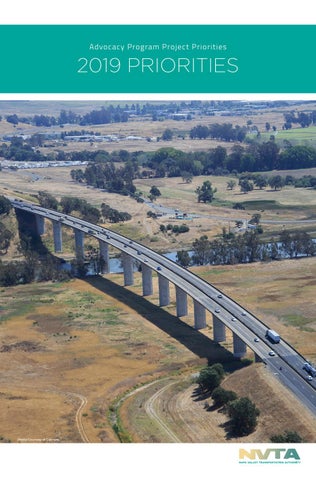
Advocacy Program Project Priorities
2019 PRIORITIES
Photo Courtesy of Caltrans
TRANSPORTATION PLAYS A CRUCIAL ROLE IN SHAPING NAPA’S ECONOMY Transportation infrastructure investments allow Napans to reach jobs and access necessities that are vital to a better quality of life, such as work, healthcare, education, food resources, recreational opportunities and to see family and friends. Ideally, each of these destinations should be easily accessible by many modes of transportation. Furthermore, transportation plays a broad role in shaping economies. Uncertain funding can impact the delivery of projects that help to decrease congestion, increase and maintain roadway safety, as well as boost economic throughput.
BOARD OF DIRECTORS
CITY OF AMERICAN CANYON
LEON GARCIA | Mayor MARK JOSEPH | Council Member
CITY OF CALISTOGA
CHRIS CANNING | Chair | Mayor GARY KRAUS | Council Member
NAPA COUNTY BOARD OF SUPERVISORS
ALFREDO PEDROZA | Vice Chair | District 4 BELIA RAMOS | District 5
CITY OF NAPA
JILL TECHEL | Mayor LIZ ALESSIO | Council Member
CITY OF ST. HELENA
GEOFF ELLSWORTH | Mayor PAUL DOHRING | Vice Mayor
TOWN OF YOUNTVILLE
JOHN F. DUNBAR | Mayor KERRI DORMAN | Council Member
PARATRANSIT COORDINATING COUNCIL BETH KAHIGA | Executive Director
NVTA
KATE MILLER | Executive Director
ABOUT The Napa Valley Transportation Authority serves as the congestion management agency for Napa County, responsible for administering State and Federal funds for local projects. A joint powers authority, NVTA oversees the County’s short and long term regional transportation planning. NVTA works closely with its local, regional, State and Federal partners to improve Napa Valley’s streets, highways, bicycle and pedestrian facilities. In addition to planning, NVTA also manages the Vine Transit system which serves over 1 million passengers annually. The Vine provides local fixed-route service in Napa, door-to-door paratransit, and community shuttles. The Vine also operates a regional express bus service throughout the Valley to key transit hubs like El Cerrito Del Norte BART station, Amtrak Capitol Corridor Fairfield-Suisun train depot and the San Francisco Bay Ferry terminal in Vallejo. NVTA | 1
Jameson Canyon Highway 12, Napa County Photo courtesy of Caltrans
LEGISLATIVE ADVOCACY HELPING TO SHAPE THE FUTURE OF TRANSPORTATION IN NAPA COUNTY
Each year the NVTA Board approves the Federal and State Legislative Programs and Project Priorities to establish direction and to authorize staff to advocate for various policy principles and projects.
The 2019 Federal and State Legislative Program and Project Priorities emphasize and redefine funding priorities to meet the current needs of the agency.
NVTA | 3
FEDERAL LEGISLATIVE ADVOCACY PROGRAM
REVENUES •
Support efforts to stabilize and increase revenues that flow to the Highway Trust Fund.
•
Support efforts to expand competitive grant programs.
•
Support grant programs that fund clean fuel technologies, including the FTA Low and No Emission Vehicle Deployment program.
•
Advocate for increased appropriations for the New Starts / Small Starts program, as well as establish a robust set aside for Small Starts projects in rural areas.
•
Support efforts that ensure continued protection of transportation programs subject to cuts through budget sequestration.
•
Respond to Federal Transit Administration’s and Federal Highway Administration’s implementation of Fixing America’s Surface Transportation Act (FAST), as rulemakings, circulars, and other administrative actions are issued.
4 | NVTA
•
Seek to modify language in the FAST Act to address the National Environmental Policy Act (NEPA) reciprocity language, effectively aligning the statute of limitations to file a claim to be consistent with California Environmental Quality Act (CEQA) or NEPA.
•
Support efforts that increase funding and existing FAST Act programs in anticipation of the 2020 reauthorization of the transportation authorization bill.
•
Support efforts to educate the Administration on the need for increased investment in transportation infrastructure.
•
Increase funding for advanced/ emerging technologies pilot and demonstration programs.
STATE LEGISLATIVE ADVOCACY PROGRAM
REVENUES •
•
•
•
•
6 | NVTA
Work closely with state legislators and agencies to maximize AB 32 Cap and Trade revenues for transportation projects, specifically expanding eligibility to include travel demand management programs and traffic congestion relief, grow transit service, and identify measures to advance funds.
revenues for transportation such as voluntary mileagebased program (that might arise from SB 1077 or other legislation). •
Protect transportation funds from being diverted for other purposes.
•
Protect existing formulas that maximize local and regional control of state transportation funds.
•
Support efforts to lower the two-thirds voting threshold for local transportation sales tax measures.
Support efforts to identify new revenues and mechanisms to implement redevelopment projects and support priority development areas.
•
Support efforts to increase Cap & Trade funds for public transit and other transportation programs that reduce emissions.
Identify and advocate for measures that would preserve and grow local streets and roads revenues.
•
Support efforts that encourage and fund affordable housing programs that honor existing urban growth boundaries, preserving agricultural lands and open space areas.
Support efforts that would increase investments in transit infrastructure projects eligible for Cap & Trade offsets.
Support funding innovations such as userbased fees that stabilize and or generate new
STATE
LEGISLATIVE ADVOCACY PROGRAM
CONGESTION RELIEF Congestion happens. But it doesn’t have to. • Support efforts to establish and maintain HOV lanes on State Highways. • Support Caltrans efforts to expand traveler information and other solutions that reduce congestion and increase throughput.
ENVIRONMENT Gas burning vehicles account for 29% of greenhouse gas emissions in the United States. By moving more people with fewer vehicles, public transportation can reduce greenhouse gas emissions. National averages demonstrate that public transportation produces significantly lower greenhouse gas emissions per passenger mile than private vehicles. • Support regulatory and legislative efforts to encourage van pools, transit use, and alternative commute options. • Support programs that assist employers in meeting the SB 1339 requirements.
PROJECT DELIVERY Improving project delivery will reduce transportation infrastructure 8 | NVTA
costs and deliver results more quickly. • Support efforts to streamline project delivery requirements and reduce costs for delivering projects, including efforts that streamline CEQA processes. • Support efforts to expand local and regional authority to enter into public-private partnerships for transportation improvement projects.
REGULATORY REFORM Common sense changes to regulation will help local agencies deliver transportation and housing more effectively. • Support legislation to exempt public transit vehicles from state and local truck route ordinances. • Support efforts that ease compliance for small operators, and provide financial assistance for infrastructure investments and vehicle purchases associated with the California Air Resources Board’s Innovative Clean Transit Rule. • Support Regional Housing Needs Allocation reform that expands the definition of acceptable dwelling units.
Highway 12/29/121/ Soscol Ferry Road, Napa County Photo courtesy of Caltrans
PROJECT PRIORITIES
NVTA HAS A MULTI-FACETED ARRAY OF PLANNING AND CAPITAL PROJECTS
•
Improvements to State Route 29, including improvements to key intersections such as Soscol` (SR 29/SR221/ SR12), Carneros (SR 121/SR 29/SR12), Airport (SR 29/ SR 12), and improvements on SR 29 in American Canyon between Napa Junction and American Canyon Road, and congestion relief projects and sea level rise mitigation on State Route 37.
•
Projects located in the County’s two Priority Development Areas.
•
Transit Maintenance Facility
•
Technology projects that increase transit operating efficiencies and reduce emissions.
•
Technology projects that improve highway and local street and road operations.
•
Projects included in Plan Bay Area and successor
10 | NVTA
Regional Transportation Plans for Napa’s jurisdictions. •
Pedestrian and Bicycle Infrastructure, Wayfinding, and Safety.
•
Rapid Bus corridor improvements on major corridors including the projects in NVTA’s 2017 Express Bus Study.
•
Upgrades to Soscol Gateway Transit Center.
•
Major Corridor Management, Operations, and Control Center Projects.
•
Vine bus fleet electrification.
•
Countywide electric vehicle charging network.
•
Safe and accessible routes and infrastructure to transit and schools.
NVTA PROJECTS
SOSCOL JUNCTION Soscol Junction will alleviate congestion and improve operations at the SR 29/221/Soscol Ferry Road intersection in south Napa County, as well as accommodate bicyclists along the corridor. The proposed alternative incorporates roundabouts underneath SR 29 to allow for continuous north-south movement of vehicles. The two roundabouts are located on SR 221 north of SR 29 and on Soscol Ferry Road south of SR 29. The roundabouts will accommodate turning movements on and off the highways. The total project cost for Soscol Junction is approximately $40M. Funding will be programmed from the State Transportation Improvement Program (STIP), Regional Measure 3 (RM3) and Senate Bill 1 (SB1) funds. Construction on the project is scheduled for 2022.
FUNDING PLAN
AMOUNT
State Transportation Improvment Program (STIP)
$14.4 Million
Local / Developer
3 Million
Regional Measure 3 (RM3)
2.6 Million
Future Senate Bill 1 (SB 1) Congested Corridor Funds
20 Million
TOTAL
$40 Million
NVTA | 11
NVTA PROJECTS
STATE ROUTE 29 OPERATIONAL AND MULTIMODAL IMPROVEMENTS State Route 29 (SR 29) in southern Napa County is a vital transportation corridor connecting three counties (Napa, Solano, and Sonoma). Residents, workers, and visitors rely on the four-lane highway to reach destinations locally and beyond. However, the highway is not equipped to meet the current and future demand of all modes. An increase in commute traffic, coupled with economic development and population growth, causes significant delays and frustrations for motorists. Chokepoints exist at numerous locations during peak commute hours, including at SR 29 and SR 12 (Carneros); SR 29 and SR 221 (Soscol Junction); SR 29/SR 12 and Airport Boulevard (Jameson Canyon) and through the City of American Canyon. The NVTA is seeking funding from a variety of state and federal sources and working with its partner agencies to improve traffic flow and pedestrian and cyclist safety along the stretch of highway. The shortfall cost for all projects is $31 Million. POTENTIAL FUNDING SOURCES
AMOUNT
Regional Measure 3 (RM3)
$17.4 Million
Local / Developer
3.6 Million
Future Federal / State Funds
10 Million TOTAL
12 | NVTA
$31 Million
NVTA PROJECTS
VINE TRANSIT MAINTENANCE FACILITY NVTA will build a new maintenance and administration facility to meet the growing needs of the transit operations. The current facility is ill-equipped to handle future growth. The project will allow NVTA to maintain and expand transit service for the next 50 years. This project will be funded with Transportation Development Act (TDA) and Federal Transit Administration (FTA) funds, and Transportation Infrastructure Finance and Innovation Act (TIFIA). Additional funding is sought for the $20M shortfall. Ground breaking is expected in Fall 2019 and in-service by Summer of 2021. Facility highlights include: • Six service bays • Modern bus wash • Transit Emergency Ops Center • Parking for transit vehicles, employees and visitors • Zero net energy photovoltaic system • Environmentally sustainable materials using LEED principles
POTENTIAL FUNDING SOURCES
AMOUNT
FTA
$.53 Million
State/Local
18.4 Million
Future TIFIA
18.2 Million TOTAL
$37.1 Million
NVTA | 13
Napa Valley Transportation Authority 625 Burnell Street Napa, CA 94559
Telephone: 707 259 8631 Fax: 707 259 8638 E-mail: info@nvta.ca.gov