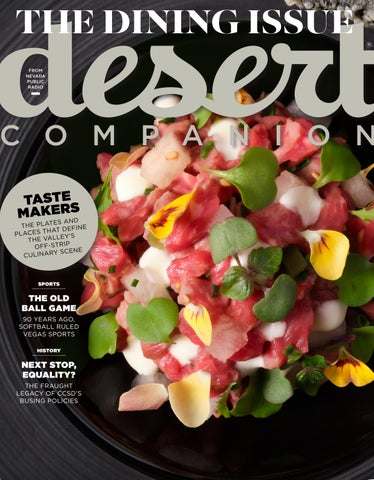
THE DINING ISSUE FROM NEVADA PUBLIC RADIO
TASTE MAKERS
ES AND THE PLAT E HAT DEFIN PLACES T EY’S THE VALL IP R T -S OFF CENE S Y R CULINA
SPORTS
THE OLD BALL GAME 90 YEARS AGO, SOFTBALL RULED VEGAS SPORTS HISTORY
NEXT STOP, EQUALITY? THE FRAUGHT LEGACY OF CCSD’S BUSING POLICIES
A WHOLE NEW
GOLF ADVENTURE Play a round on championship courses, newly re-seeded for the season. Then enjoy our resort amenities and new restaurants before relaxing in your remodeled room. It’s the perfect golf getaway in Mesquite. CA SA B L A N CA G O LF CO U R S E | PA LM S G O LF CO U R S E
R E M O D E LE D RO O M S | J E R S E Y J O E ’ S D I N E R | R ITA S & FA J ITA S 8 8 S E AT S R E S TAU R A NT
950 W. Mesquite Blvd. Mesquite, NV 89027
877.GETAWAY
Come See! As one of the nation’s top-selling master-planned communities, many have already discovered Cadence is a unique and special place. With its combination of value, lifestyle and community; it’s the perfect place to address your future. If you haven’t visited…come and see. Follow a walkway. Explore Central Park. Marvel at the views. Tour model homes. Meet potential neighbors. Because once you’re here, we’re confident you’ll want to address your future too.
HENDERSON’S PREMIER MASTER PLANNED COMMUNITY. Plan your visit at CadenceNV.com
SweaterWeather is SOUTHERN NEVADA WATER CONSERVATION • WINTER 2026
WINTER WATERING SEASON
It’s officially sweater weather in Southern Nevada, and that seasonal change is also a reminder to change our watering clocks to follow the community’s mandatory winter watering restrictions, in effect from Nov. 1 through Feb. 28. During the winter season, sprinkler irrigation is limited to one assigned day per week; sprinkler watering is prohibited on Sunday. Find your assigned watering day at snwa.com. Because water-efficient plants and trees need much less water than grass to survive even the coldest months of the year, you can save even more water— and manage your monthly bill—by running your drip system once every seven to 14 days for 30 to 90 minutes. Remember this simple fiveword watering tip: Drip It, Don’t Drown It!
Meanwhile, here are even more tips to help you save water this season: Water grass with spray irrigation during the midmorning hours to avoid freezing and prevent ice from forming on lawns and sidewalks. Water your lawn for a maximum of 12 minutes on your watering day in three 4-minute cycles, with an hour between each cycle. Change the time-of-day on your irrigation clock to coincide with the end of Daylight-Saving Time on Sunday, Nov. 1.
Following seasonal watering restrictions is one of the most effective ways to save water in our community. The majority of water consumed in Southern Nevada is used outdoors—and once it’s gone, it’s gone forever. In contrast, the water we use indoors is collected, highly treated, and returned to Lake Mead, where it can be reused. This process helps extend our community’s water supply. This sweater weather season, save water where it matters most— outdoors. Find more water-saving ideas and landscape care tips at snwa.com.
Find your assigned watering day at snwa.com Keep saving water where it matters most: outdoors
SOUTHERN NEVADA WATER CONSERVATION • WINTER 2026
WINTER WATERING RESTRICTIONS TAKE EFFECT IN SOUTHERN NEVADA
SNWA.COM
A CARIBBEAN STEAKHOUSE BY KWAME ONWUACHI
THE SECRETS OF SPICE AND SMOKE ARE NOT LEARNED THEY ARE UNEARTHED.
SAVOR THE FIRE Maroon, a new dining concept from James Beard award-winning chef Kwame Onwuachi, combines the untamed flavors of Caribbean-jerk cuisine with the signature flair of one of the culinary world’s most important innovators. Prepare to experience a truly new and unforgettable take on the Las Vegas steakhouse, at Maroon.
saharalasvegas.com
NEVADA BALLET THEATRE PRESENTS
DECEMBER 12-27 The Smith Center for the Performing Arts
Music by Peter Ilyich Tchaikovsky Choreography by George Balanchine
NEVADABALLET.ORG 702.749.2000 Box Office George Balanchine’s The Nutcracker® Choreography by George Balanchine © The George Balanchine Trust. Featuring NBT Company Artists. Photo by Virginia Trudeau.
LIVE MUSIC WITH LAS VEGAS PHILHARMONIC DEC 12-13
THE ONLY MICHELIN KEY RESORT & CASINO IN LAS VEGAS
Luxury has an Shops at Fontainebleau DISCOVER A COLLECTION OF CURATED BOUTIQUES ALAÏA | ALEXANDERWANG | AQUAMARINE BOTTEGA VENETA | BOUCHERON | CARTIER CHROME HEARTS | GRAFF | GUCCI | IDA AND HARRY MISSONI RICK OWENS | SAINT LAURENT | SANTA MARIA NOVELLA THE WEBSTER | ZIMMERMANN
The Culinary Collection INDULGE IN 30+ RESTAURANTS AND BARS
FROM CASUAL POOLSIDE BITES TO ONCE-IN-A-LIFETIME MEALS WITH A VIEW, OUR CAREFULLY CURATED SELECTION AT FONTAINEBLEAU LAS VEGAS OFFERS A DINING EXPERIENCE TO SUIT EVERY CRAVING, MOOD, AND OCCASION.
ew home LOCALS & REWARDS MEMBERS ENJOY FREE PARKING *SUBJECT TO BLACKOUT DATES AND HOLIDAYS.
Winter 2026 V O L U M E 2 4 I S S U E 4 l D E S E R TC O M PA N I O N .C O M
ALL THINGS 19
EDUCATION
Native languages in the classroom By Jimmy RomoBuenrostro
22
POLITICS
2028 campaigning ramps up in Nevada By Paul Boger HUMOR
A Vegas holiday rom-com, just for you By Scott and Spencer Dickensheets
28
GARDENING
Planting confidence By Sarah Calvo
30
GIFT GUIDE
Unwrap these stocking-ready gifts By Scott Dickensheets
FEATURES
64
EDIBLE ICONS A guide to Sin City’s 23 most culinarily defining dishes of the moment
64
NO RESERVATIONS Four restaurants we can’t stop returning to
( EXTRAS ) 72
These organizations turn gifts into impact
‘No Good Reason’ By Leath Tonino
10 | D E S E R T C O M P A N I O N .
CULTURE
33
41
Restaurants serve up something special By Lorraine Blanco Moss
’Tis the cultural season By Mike Prevatt
THE VEGAS DISH
35
DINING
Inside the Strip’s oldest steakhouse By Lissa Townsend Rodgers
THE SHORT LIST
42
FINE ART
Home is where the art is By Aleza Freeman
44
FIELD NOTES
Seeking perspective in two very different art experiences By Stacy J. Willis
DEPARTMENT 52
HISTORY
CCSD’s forced busing effort, revisited 50 years after integration By Aleza Freeman
57
SPORTS
Las Vegas’ early love affair with “Nightball” By Geoff Schumacher
( COVER )
60
GIVING GUIDE
DINING
POEM
WINTER 2026
PHOTO WAGYU TARTARE, COURTESY DOANBURI
E L L E H O P E : B R YA N H A I N E R B L AC K R I C E & O X TA I L R I S OT T O : C O U R T E S Y C A R S O N K I T C H E N / O F F T H E H O U S E S T U D I O S I L LU S T R AT I O N : M I G U E L M A N I C H
24
ART AND RHYTHM COME TO LIFE
NOV NATIONAL GEOGRAPHIC: CAITIE BARRETT - “THE GHOSTS OF POMPEII”
11
JAN THE LEGEND OF KORRA IN CONCERT
10
NOV HOOK IN CONCERT
ww
30
FEB WILLIAM SHAKESPEARE’S ROMEO + JULIET FILM IN CONCERT
ww
14
FEB KODO ONE EARTH TOUR 2027: LUMINANCE
ww
23
NOV
ELF THE MUSICAL
ww
3
FEB BALLET FOLKLÓRICO DE MÉXICO
ww
24-29
FEB THE TEMPTATIONS
ww
VISIT THESMITHCENTER.COM TO SEE THE FULL LINEUP
ww
5
MAR TWILIGHT IN CONCERT
ww
20
ww
BOARD OF DIRECTORS OFFICERS
AMANDA MOORE-SAUNDERS chair
Conduit Entertainment ANDREA GOEGLEIN, PH.D
Publisher’s Letter
vice chair
ServingSuccess
THE NEED IS NOW. THE MORE, THE MERRIER
SCOTT NIELSON treasurer
Nielson Consulting, LLC FAVIAN PEREZ secretary
Nevada Public Radio DIRECTORS
CYNTHIA A. DREIBELBIS
Brownstein Hyatt Farber Schreck
With gratitude, Favian Perez Publisher of Desert Companion
Favian Perez President & CEO Nevada Public Radio
FRED J. KEETON
Keeton Iconoclast Consulting, LLC EDWIN C. KINGSLEY, MD
Comprehensive Cancer Centers JEFFREY REIMAN
The Broadband Group ERNEST STOVALL
Mandalay Bay Resort & Casino ROB ZIEMS
Gaming Arts, LLC DIRECTORS EMERITI
CYNTHIA ALEXANDER
Dickinson Wright, PLLC SUSAN M. BRENNAN
The Brennan Consulting Group, LLC DAVE CABRAL
Business Finance Corp. LOUIS CASTLE
Childlike Wonder Games PATRICK N. CHAPIN, ESQ.
Patrick N. Chapin, Ltd.
ELIZABETH FRETWELL
C4ward Strategies, LTD DON HAMRICK
Retired
GAVIN ISAACS
Games Global CHRIS MURRAY
Avissa Corporation JERRY NADAL
Luna Entertainment Consulting Services WILLIAM J. “BILL” NOONAN
William J. Noonan Consulting KATHE NYLEN
Retired
ANTHONY J. PEARL
Baha Mar
MARK RICCIARDI, ESQ.
Fisher Phillips, LLP MICKEY ROEMER
Roemer Gaming TIM WONG
Arcata Associates LAMAR MARCHESE president emeritus
12 | D E S E R T C O M P A N I O N .
WINTER 2026
P H T O G R A P H Y : R I C K A R E VA LO
I
n November 2004 I moved to Las Vegas from my hometown in Southeast Los Angeles. I remember my first fall realization being that a thin, California-ready cardigan just wouldn’t keep me warm in the desert. All these years later I look forward to our fall transition, not only because I can dust off my heavier outerwear and corduroy jackets, but also because it means festivals, outdoor activities, and exploration without the need for an air-conditioned car. Fall has also become a professional career marker. I started working for Nevada Public Radio in October of 2013 and have fond (and sometimes tired) memories of fall membership drives, the cooling temperatures, and the shorter days. But I couldn’t have imagined seeing the elimination of the Corporation for Public Broadcasting after more than six decades of bipartisan support during my time in public media. This fall includes midterm elections and marks the start of Nevada Public Radio’s fiscal year. This is the second year since the elimination of federal funding in support of public broadcasting, which means we’re relying on 100 percent of support from the community for our work. We have big ideas, forward-thinking aspirations, and a team of dedicated professionals who strive daily to reflect Southern Nevada’s rich culture, landscape, and stories in our freely available news, information, and productions. But this work needs your support. If you’ve donated or are a current donor, we appreciate your vote of confidence. If you’ve never donated, please join us today. You’ll help us reflect on and amplify the Southern Nevada experience.
PRESIDENT & CEO Favian Perez MANAGING EDITOR Heidi Kyser ART DIRECTOR Scott Lien DIRECTOR OF PHILANTHROPY Susan Henry ASSISTANT EDITOR Anne Davis EDITOR-AT-LARGE Scott Dickensheets GRAPHIC DESIGNER Ryan Vellinga KNPR PRODUCERS AND REPORTERS
Paul Boger, Yvette Fernandez, Mike Prevatt, Jimmy Romo-Buenrostro ASSISTANT CORPORATE SUPPORT MANAGER
Allison Hall
ACCOUNT EXECUTIVES
Britt Quintana
EVENTS AND REVENUE SYSTEMS SPECIALIST
Crystal Jepson
BUSINESS DEVELOPMENT
Markus Van’t Hul Jeff Jacobs
CONTRIBUTING WRITERS
Josh Bell, Sarah Bun, Sarah Calvo, Rachel Cohen, Scott Franz, Aleza Freeman, Melissa Gill, Janis Hashe, Brent Holmes, Lorraine Blanco Moss, Reannon Muth, Heidi Knapp Rinella, Lissa Townsend Rodgers, Marvin Saines, Geoff Schumacher, Leath Tonino, Stacy J. Willis
Still the Best For Over 45 Years. For more than four decades, Sunburst Shutters has set the standard in custom window treatments. Proudly Made in America, our shutters and motorized shades are crafted for lasting beauty, energy efficiency, and a perfect fit in every room. Discover why homeowners continue to trust Sunburst Shutters to transform spaces with style, quality, and unmatched craftsmanship.
CONTRIBUTING ARTISTS
Rick Arevalo, Tim Bower, Ronda Churchill, Alysha Dawn, Bryan Hainer, Miguel Manich, Rick Sealock, Mark E. Silverstein CONTACT EDITORIAL: Heidi Kyser (702) 259-7855
heidi@desertcompanion.com
ART: Scott Lien (702) 258-9895
scott@knpr.org
ADVERTISING: (702) 259-7808
sales@nevadapublicradio.org SUBSCRIPTIONS: Marlies Davis
(702) 258-7822 subscriptions@desertcompanion.com Desert Companion is published quarterly by Nevada Public Radio, 1289 S. Torrey Pines Dr., Las Vegas, NV 89146. It is available by subscription at desertcompanion.vegas, or as part of Nevada Public Radio membership. It is also distributed free at select locations in the Las Vegas Valley. All photos, artwork, and ad designs printed are the sole property of Desert Companion and may not be duplicated or reproduced without the written permission of the publisher. The views of Desert Companion contributing writers are not necessarily the views of Desert Companion or Nevada Public Radio. Contact us for back issues, which are available for purchase for $7.95.
Shutters, Shades, Blinds & Drapes Sunburst Shutters — where better design begins at the window.
Save up to $500 (702) 367-1600 5626 Rafael Rivera Way Las Vegas, NV SunburstShuttersLasVegas.com
FOLLOW DESERT COMPANION
100% MADE
www.facebook.com/DesertCompanion
IN THE USA ISSN 2157-8389 (print) • ISSN 2157-8397 (online) WINTER 2026
.
D E S E R T C O M PA N I O N
| 13
PROMOTION
Editor’s Note
TIME FLIES I
VANESSA WILLIAMS & SETH RUDETSKY AT REYNOLDS HALL ON JANUARY 29, SIRIUS XM RADIO star and Broadway conductor Seth Rudetsky is bringing his critically acclaimed concert back to The Smith Center—this time starring one of the most respected and multi-faceted performers in the entertainment industry today, Vanessa Williams. Friday, January 29 thesmithcenter.com
t was F. Scott Fitzgerald who wrote a century ago that life starts all over again in the fall. Beyond its nagging presence in my brain acting as possible proof that I need to read less and get out more (’tis true), the sentiment sticks around for a reason: This latter part of the year and first part of the next unavoidably inspire both retrospection and anticipation. As 2026 wanes and 2027 looms, I — like many of you, I’m sure — have caught myself ruminating on both the ruthless passage of time and life’s inherent ephemerality. Coincidentally (or not …), that’s partially what this current issue is preoccupied with. A hazard of being on the editorial staff, I suppose! In these pages, you’ll find odes to Vegas past, present, and future. The past, well represented in the various history tentpoles this issue boasts, most notably in the two departments. The first features Geoff Schumacher’s dive into the drama and legacy of Vegas’ OG sport, softball (p. 57); the second Anne Davis tackles the controversial practice of forced busing Assistant Editor (p. 52), which reporter Aleza Freeman notes has Nevada Public Radio left CCSD with a complicated legacy among civil rights activists, even decades after integration. The present, of course, is found in our yearly dining feature (p. 64), this time casting a light on the 23 most nosh-able plates that represent the best of the city’s off-Strip dining culture du jour. The present is also, more obviously, found in Stacy Willis’ search for grounding in two very disparate art experiences (p. 44). Last but not least, the future, rounded out by solid, Nevada Public Radio staff-reported pieces on the 2028 election (p. 22), the reclaiming of Indigenous languages in the classroom (p. 19), and winter’s best events (p. 41). Those, augmented by a look inside a new kind of art gallery in a local home (p. 42). This is all to say: Think of this issue as a guided reflection on Vegas’ many eras, identities, and aspects, for auld lang syne. No ghostly Dickensian triad or green light needed! Enjoy the journey, Anne
CORRECTION Regarding the August 2026 issue: In “There’s No Place Like Home,” the National Home Education Research Institute’s estimation of the number of homeschoolers was erroneously attributed to the National Center for Education Statistics. Desert Companion regrets the error.
14 | D E S E R T C O M P A N I O N .
WINTER 2026
Fall in love with your backyard. well-designed, installed, and maintained landscape is an extension of your indoor living space. Take comfort in our expertise, and let us help you create your outdoor oasis. We want you to love where you live, indoors and out!
License #: 0057280
Design | Installation | Renovation | Consultation | Maintenance Tree Care | Hardscapes | Small Jobs | Irrigation | Lighting Call today to schedule your design consultation.
(702) 452-5272 schillinghorticulture.com
Connect with us!
Mojave Bloom Nursery
FOR OVER A DECADE
Visit our boutique garden shop & desert nursery. Open to the public, 7 days a week. Mon-Thu: 9am-2pm | Fri-Sun: 9am-4pm 702-279-2789 | 1401 Searles Ave, Las Vegas, NV 89101
VIVA LIVE
VEGAS
A LL THINGS
D E S E R T C O M PA N I O N .C O M
IDEAS, CULTURE, FOOD, AND OTHER WAYS TO CONNECT WITH YOUR CITY
APRIL BARRACKMAN
J I M M Y R O M O - B U E N R O S T R O / N E VA D A P U B L I C R A D I O
E D U C AT I O N
More Than Words Inside the ongoing effort across Nevada to reverse the loss of Indigenous languages BY Jimmy Romo-Buenrostro
I
n 1996, Jeanette Allen, a member of the Pyramid Lake Paiute Tribe, surveyed her tribe to see how many reservation members spoke the tribe’s ancestral language. She found 76 fluent speakers, with just one under the age of 50. Today, she estimates that there are fewer than 10 elders who can speak it. “We’re at a critical point right now with the language,” she says. It’s a problem that extends beyond the Pyramid Lake Paiute Tribe reservation and goes all the way back to the residential school system. This year marks almost 30 years since the last federally run Indian boarding school closed in Canada; in the U.S., many such schools remain
open but have changed hands into Native ownership. Closer to home, Nevada’s Stewart Indian School closed in 1980. These schools had a pattern: The U.S. government took Native children from their homes to send them to militaristic, government-funded institutions. Advocates say it was an effort to punish Native children for not properly assimilating to an Anglo-American lifestyle. “They were forced to go to boarding school, and so they couldn’t speak their language,” Allen says. Every Paiute, Shoshone, and Washoe from the Silver State has some connection to the boarding school era, according to Josh Bonde, a member of the Te-Moak Tribe of Western Shoshone.
WINTER 2026
.
D E S E R T C O M PA N I O N
| 19
20 | D E S E R T C O M P A N I O N .
Linguists estimate that there were once more than 300. In Nevada there would have been at least six dialects. “(The language), it’s our culture. It’s who we are. We’re the Cui-ui Ticutta people,” Allen says. “And if we don’t have the language, how do we identify ourselves?” This has pushed tribes to develop language-learning programs on most reservations within Nevada. The Pyramid Lake Paiute Tribe has implemented classes for both youth and elders. Allen substituted for one of those classes for about a dozen elders, who spend mornings gathered in an office building. They start the class with a prayer in Northern Paiute and later practice their introductions. The new materials for this class are the names of the tribe’s important animals. On the other side of the state, down along the Colorado River, is the Fort Mojave Indian Tribe’s reservation, which offers similar language-learning programs for its elders. This augments an ex-
WINTER 2026
LISTEN to an audio version of this story at KNPR.org.
isting state-of-the-art elementary school that opened in 2019, which incorporates the Mojave language into its own curriculum. Kids will often have a block of their day solely dedicated to speaking the language. The curriculum came to be after leadership within the Fort Mojave Tribe realized they were close to losing their language entirely. That’s when the conversation within the tribal council began a decade ago. “(The tribe) wanted the parents, the community members, (everybody) wanted their students to learn the language,” says April Barrackman, the lead teacher for the language program at Anya itpak Elementary School. Barrackman grew up understanding the Mojave (Hamakhav) language but did not speak it. With the initiative to get back their language, Barrackman and others met with elders who did speak the language to record and learn from them. “I think my grandmother thought that it would help her children to learn the white man world way. She just thought they would get further in life if they didn’t speak (Hamakhav),” she says. Now a decade into the program, Barrackman is seeing the language spoken naturally among the youth. “A lot of our students go home and the parents are like, ‘We don’t know what they’re saying. Could you tell us what he said?’ Or, ‘He’s always singing. We don’t know what this means,’” she says. This creates age gaps in the native speakers, between the remaining elders and the youngest members of the reservation. To solve this, Fort Mojave has opened classes to any member who wishes to learn the language. These steps bring Indigenous children and adults closer to full immersion, which Allen believes is crucial to becoming fluent in Indigenous languages. She recommends at least five years of it, which can be a long time for many. “That’s the scary part,” Allen says. “The scary part is our little ones are learning it, but they don’t have anyone to talk to.” ✦
M A R K E . S I LV E R S T E I N , I N S T A G R A M @ M R E L O S L E S E N
The schools’ stated purpose was to “Kill the Indian, save the man.” This was what Richard Henry Pratt, a U.S. Army officer and the founder of the Carlisle Indian Industrial School, said of one of the most infamous boarding schools in the U.S. Abuse ran rampant; death was common. Survivors didn’t want their children to experience the unspeakable harm they faced, so many didn’t pass down their traditional ways of life — including their Native languages. “My grandmother went to boarding school. My grandfather went to boarding school. My grandfather never spoke. He was a Shoshone. And my grandmother never lost the language,” Allen recalls. “She raised her children in the language, so when they went to boarding school, they would come home and get right back into the language, so they didn’t lose it.” But that’s not the case for every family. There are roughly 175 Native languages that have been preserved and are spoken around the nation.
Your Destination for Discovery
GARAGE S U KO S H I MANGO ROTHY’S
SCAN FOR INFO
T
22 | D E S E R T C O M P A N I O N .
WINTER 2026
POLITICS
Is It 2028 Already? Presidential candidates jockeying for early primary attention are showing Nevada a lot of love. But does it matter anymore? BY Paul Boger
to replace Trump as the leader of the GOP, visited Las Vegas over the summer to speak at the Republican Jewish Coalition’s 2026 Leadership Summit. He also appeared at the Bitcoin 2025 Conference, which drew other potential contenders such as President Trump’s son, Donald Trump Jr. So, what does it all mean for Nevadans? For years, Iowa’s and New Hampshire’s position as early primary/caucus states was seen as a way to secure early promises from the next president. It didn’t matter who won, because every candidate was willing to promise support for corn-growers and advanced manufacturing. That outsized influence was the main argument behind the late Senator Harry Reid’s and Nevada Democrats’ push to make the Silver State one of the first primary states. But that was before social media and the 24-hour news cycle. Today, campaigns are nationalized. A high-profile candidate can
be on the campaign trail in South Carolina, call fundraisers in California, and record a video for Instagram and TikTok all while preparing to appear on CNN, Fox News, or MS NOW. Just look at 2020. Senator Bernie Sanders of Vermont and Pete Buttigieg, former mayor of South Bend, Indiana, led the polls in early nominating states, even though then-former Vice President Joe Biden would ultimately take his party’s nomination. In 2024, Nevada Democrats voted for Biden in the primary but wound up with Vice President Kamala Harris on the November ballot. So, what does it matter if Nevada goes first or second? Probably not a lot. But, hey, your local political consultant, TV station, and ad agency stand to make some good money over the next year. Let's just hope you don’t mind the messaging. ✦
J A C Q U E LY N M A R T I N / A P P H O T O
he ink is barely dry on the 2026 midterm election ballots, never mind the results, and yet the 2028 presidential election cycle — at least here in Nevada — is already underway. That’s because the Silver State is now one of the earliest nominating states for both major parties. For Democrats, the primaries begin in South Carolina on January 22, 2028, then move to Nevada on February 1. For Republicans, Nevada is third on the primary schedule, after Iowa and New Hampshire. Just look at the recent travel itineraries of some high-profile Democratic politicians. Senator Mark Kelly of Arizona has visited Nevada three times in recent months, appearing at events such as the Washoe Dems annual fundraiser and The Nevada Independent’s IndyFest, an event known to draw the politically savvy and connected. Governor Andy Beshear of Kentucky has also suddenly taken an interest in the Silver State, appearing at events for Aaron Ford’s gubernatorial campaign and for congressional Democrats such as Dina Titus and Steven Horsford. And then there’s Congressman Ro Khanna, of California’s Bay Area, who has appeared at more than a dozen events across Nevada. That includes stops in Elko and Ely, as well as at the Walker River Indian Reservation — communities with only a handful of registered Democrats. However, those initial forays into the wilderness may prove fruitful in a primary where one vote could make the difference between building momentum and packing it up and going home. Republicans, on the other hand, have been more hesitant to declare their intent to run for president and build support in Nevada. That’s mostly because of President Trump’s iron grip on the party. While he’s constitutionally prohibited from serving a third term, his insistence on “joking” about it has pushed many Republicans to take a wait-and-see approach. It also likely has something to do with the continued confusion over the Nevada Republican Party’s nomination process, which in 2024 favored its traditional party-run caucus over the state’s official presidential preference primary And yet potential Republican office-seekers are still finding ways to visit. Vice President JD Vance, who polling suggests may be the candidate most likely
COURTESY UNCOMMONS
The true story of a destructive alien visitor that predates Area 51 BY Marvin Saines
W
hat if I told you that a visitor from outer space once landed at the Extraterrestrial Highway, near Alamo and Area 51? You would probably be skeptical. But it actually happened — during the Late Devonian Period, when Southern Nevada was beneath a shallow sea. The visitor was a bolide, a giant meteor. The Extraterrestrial Highway, Nevada State Route 375, runs 100 miles from U.S. 93, near Alamo, to Rachel and Warm Springs, passing the back gate to Area 51. Numerous UFO sightings have been reported along the road, and Rachel has long
It hit the future Extraterrestrial Highway area 382 million years ago, blasting a crater more than 60 miles in diameter and triggering tsunamis and underwater landslides.
➸ Season of Love: This love-filled town is overdue for its own fabulous, formulaic Hallmark holiday feature. Until Hollywood officially green-lights one, here’s our attempt to get the ornament rolling: all the classic Hallmark-style elements you need to package your own. Make sure you do it with love! —Scott and Spencer Dickensheets
served as home base for UFO-seekers. The Air Force has used Area 51 since the 1950s to test secret aircraft, becoming a big part of UFO folklore in the process. Forget all that. The Alamo impact event was a real-life catastrophic meteor strike by a space rock some three miles in diameter. It hit the future Extraterrestrial Highway area 382 million years ago, blasting a crater more than 60 miles in diameter and triggering tsunamis and underwater landslides. The resulting layer of broken and crushed rock, dubbed the Alamo breccia, was discovered in 1990 by Alan Chamberlain, a graduate student
Local Main Character
n Royal from tiny European monarchy stuck in Vegas for holidays
n Head Luxor lightbulb changer; emits authenticity
n Writer already in mid-30s somehow still looking for first cover story n Big-city wedding planner helping with holiday Elvis nuptials
24 | D E S E R T C O M P A N I O N .
WINTER 2026
Marvin “Nick” Saines has a doctorate in geology and is an adjunct professor of CSN’s Physical Sciences Department.
Create a locally themed holiday rom-com with our Vegas Hallmark Christmas Movie Generator!
Visiting Main Character
n Rural arborist helping dad run Las Vegas Christmas tree lot
at the Colorado School of Mines. (He now owns a mineralogical exploration company in Eureka.) The breccia contains such impact features as shocked quartz, iridium, and spherical lapilli (melted rock droplets). Evidence of said impact is found in more than 20 mountain ranges in Nevada and Utah. You can find mentions of the breccia appearing on Frenchman Mountain in literature by advocacy groups trying to create a national monument there, but it’s very difficult to reach. Better viewpoints can be found on the Extraterrestrial Highway at Hancock Summit, which are easily reached by a short hike from the road. Thirty years ago, in 1996, the Nevada Commission on Tourism officially named State Route 375 “The Extraterrestrial Highway.” Stars from Independence Day were on hand for the dedication. But even though the Alamo Impact Event had been discovered six years earlier, no one at the dedication mentioned the remarkable coincidence that there had indeed been a destructive extraterrestrial visitor where the highway now ran, a mere 382 million years earlier. ✦
n Bowl-cut billionaire seeking public funds for stadium eggnog machine n Paul, a real estate novelist, who never had time for a wife n Restauranteur struggling from F1 business losses
Adorable but Tense Romantic Complication n Trying to find parking in Arts District — will they miss Christmas?! n Data center drains Bellagio fountains just as couple goes for first kiss n “Fremont Street mistletoe” gives couple hives n Drunk, Ghost of Christmas Past leaves couple in London’s Black Death — will they miss Christmas?!
Lovably Quirky Secondary Character
It All Works Out in the End!
n Busker who wears Spirit of Christmas Speedos
n Bankrupted by resort fees, they realize holidays are about more than money
n Poet laureate of IKEA home goods section n Vesta Coffee Roasters barista who recites pumpkin spice “fun facts” n Nate Tannenbaum!
n He says, “Merry Christmas”; she says, “Happy holidays.” But they work it out! n Santa with yardlong margarita talks sense into bickering lovers n They kiss as giant Sphere eyeball sheds happy tear
ILLUSTRATION Tim Bower
V E G A S H A L L M A R K : I L LU S T R AT I O N R YA N V E L L I N G A / U N S P L A S H
It Came From Outer Space!
D E C E M B E R 3 - 1 2, 2 0 2 6 Round up the crew for free NFR viewing parties at Veil Pavilion. All ages welcome, with giveaways, prizes, and food and drink specials every night.
Swing by and tip your hat to the Rodeo Radio crew live on-site every night from 5pm – 7pm.
Free Concerts
Ned LeDoux DECEMBER 3
lounge
live
VISIT SILVERTONCASINO.COM/NFR FOR MORE INFORMATION
Schedule subject to change without prior notice. Management reserves all rights.
toby
DECEMBER 4
A Tribute to Toby Keith
DECEMBER 5
josh ward DECEMBER 10 & 11
FREELive Country Music nightlyAfter the Rodeo
I - 1 5 & B LU E D I A M O N D | 7 0 2 . 2 6 3 .7 7 7 7 | S I LV E RTO N CAS I N O.C O M
ENVIRONMENT
Murky Waters Years of Colorado River talks failed to produce a deal. How much should the public see? BY Rachel Cohen, KUNC, with reporting by Scott Franz
T
wo thick, orange bound books sit on a library table at Colorado State University. “This is the original compilation,” says Patty Rettig, a water resources archivist at the university. She’s the keeper of the detailed records of another time when states were fighting over how to share the Colorado River. “You can see here, this is the first 18 sessions, and then we have another volume,” she says, pointing to the second book. These hundreds of pages hold the transcripts of the 27 meetings that led to the Colorado River Compact in 1922. They provide an important window into the rooms where Western water was divided up. The verbatim minutes reveal which officials were present — almost always the commissioners from the seven Colorado River states and the federally appointed chairman, Herbert Hoover, and often a handful of
26 | D E S E R T C O M P A N I O N .
WINTER 2026
state engineers or other leaders. They also document when states disagreed and how, over more than a dozen meetings in Santa Fe, New Mexico, in November, they eventually hammered out an agreement. “In the end, they get to some word-smithing,” Rettig says. “Thankfully, we do have detailed meeting minutes. We can see what concepts they were discussing.” Aside from a series of public meetings around the West, the negotiators mostly met in private. But a century later, a public record of how they deliberated over the future of the Colorado River is preserved. Flash forward to today: For the last three years, the seven states have been negotiating a new set of rules for sharing a dwindling supply of water before current ones expire in December. But the public has had little view inside the negotiating rooms. John Berggren, with the nonprofit Western Resource Advocates, says the states would meet virtually or around conference tables in various Western cities. “But there’s no announcement; there’s no meeting agenda. There’s no minutes that are read out from those meetings,” he says. “The only way you even know they’re happening is you have to know someone who’s there.” The seven negotiators serve as the governors’ representatives on Colorado River matters and they’re not elected officials. But they play a vital public role in managing a shared resource that 40 million people rely on for drinking water, agriculture, energy, recreation, and more. KUNC requested work calendars for the seven negotiators earlier this year. The information wasn’t always easy to find. Some states — Arizona, New Mexico, and Utah — were either not responsive to the requests or their state offices said they didn’t hold the records. Colorado would have charged about $280 for the documents. California, Nevada, and Wyoming responded to the requests. The schedules of those state principals show frequent negotiating meetings, especially in the lead-up to a Valentine’s Day deadline to come up with a plan, and in the weeks after that deadline was missed.
A L E X H AG E R / KU N C
GRAND COUNTY, COLORADO
U. S . D E PA RT M E N T O F T H E I N T E R I O R
D E S E R T C O M PA N I O N .C O M
There were meetings with just the seven principals, several including federal officials from the Bureau of Reclamation, separate meetings for the upper basin and lower basin, and huddles of smaller state pairings. States have said this closed-door process is needed to reach a deal — and it’s worked in the past. But this time, it hasn’t. In the absence of an agreement, the federal government has stepped in with its own plan, and the states of Nevada and Arizona have filed a lawsuit. After following river negotiations as a reporter and now as a researcher at the University of New Mexico, John Fleck has come to appreciate that private spaces are sometimes needed to work out these thorny issues. Some important talks have happened in hallways or hotel bars. But the lack of a state agreement this time around has changed his perspective. “These people have lost my trust,” he says. “I no longer trust that behind those closed doors they are doing the kind of difficult discussions that need to happen. Instead, we seem to have reached a point now where the lack of transparency provides cover for hiding the accountability for the failures.”
He wants “messy, public conversations.” Berggren, who studied the topic of transparency in the Colorado River negotiations for his Ph.D thesis, says completely opening the door to the public would be a “nightmare.” He thinks private space for frank talks is still needed, especially given the complexity and tense nature of the subject. Still, he thinks states should share more with the public about what’s keeping them apart now, beyond usual talking points. “If more of the public knew what the seven states were doing, in terms of not reaching an agreement and the risk of going to the Supreme Court, I think more people would be upset,” he says. “Like, ‘Hey, my state is not doing everything they can to get to that seven state solution.’” Plus, the process can leave out some important voices, like the 30 tribes that rely on the river. Back in 1922, the compact talks completely excluded them. At a University of Colorado Boulder conference this summer, Amelia Flores, the chairwoman of the Colorado River Indian Tribes, said the inclusion of tribal nations has improved.
STAGNANT TALKS Interior Secretary Doug Burgum convenes Colorado River Basin governors in Washington, D.C.
LISTEN to an audio version of this story.
For example, an agreement between six upper basin tribes and the Upper Colorado River Commission stipulates regular meetings, and California’s governor appointed a tribal elected leader to its Colorado River Board. But Flores said tribes are still not always treated as “true partners.” “Make no mistakes, the failure to fully engage tribal nations in this process, leaving us to react to the decisions made by others, is a threat to our inherent sovereignty and to our very existence,” she said. State-level negotiators say they represent a wide range of constituents, and they go through different processes, depending on the state, to report back to stakeholders. Becky Mitchell, Colorado’s river negotiator, told KUNC earlier this year that there are also challenges in explaining publicly all of the finer details of the negotiations. “It’s not just one issue,” she said. “It’s how we move forward things as a package, and so we’re trying to be aware of that and not impede the ability for later progress.” Jim Lochhead has been in her shoes as Colorado’s negotiator through the early 2000s. He also agrees that there are good reasons for closed-door negotiations among states. “The negotiators need to be free to float ideas, to maybe reach tentative agreements on certain elements of the overall negotiation, to be able to have open communications, and that requires confidentiality and a closed door,” he says. But he thinks the negotiations have recently gotten too politicized and says the balance between confidentiality and transparency is off. He says the states need a reset and to focus on their shared interest in managing a shrinking river — whenever those talks may resume. ✦ This story was produced by the Mountain West News Bureau, a collaboration between Wyoming Public Media, Nevada Public Radio, Boise State Public Radio in Idaho, KUNR in Nevada, KUNC in Colorado, and KANW in New Mexico, with support from affiliate stations across the region.
WINTER 2026
.
D E S E R T C O M PA N I O N
| 27
T E S T YO U R K N O W L E D G E !
Take Our Invasive Species Quiz How well do you know the non-native plant species that began as tourists but became residents? BY Scott Dickensheets Southern Nevada is home to a staggering number of plant species classified as invasive. You probably see some every day. But how well do you know your bladder senna from your heart-podded hoary cress? Your garden rocket from your hairy crabgrass? Those names, and the ones below, derive from a master list of local invasive species compiled by the University of Nevada, Reno. Let’s see how you do! 1. Is Clammyweed (pick one) … a. What you get at an overhumidified dispensary? b. A hardy flowering plant common elsewhere in North America that often flourishes in “disturbed areas” (Wikipedia) where other plants don’t? 2. Is Creeping Bentgrass (pick one) … a. A perennial grass with tapering, blue-gray leaves? b. The third most obscure character in the Charles Dickens canon?
4. Is Swamp Timothy (pick one) … a. That zydeco player on Fremont Street who does the splits while playing accordion? b. A grass native to Europe that grows in patches; the stems are often pink or purple? 5. Is Brandon Flowers (pick one) … a. A white flower native to Africa with dark eyes and yellow rings, often with a reddish underside? b. Biologically uncertain (is he human or is he dancer?), but, having been born in Henderson, is definitely native … 6. Is Prostrate Spurge (pick one) … a. A ground-hugging annual weed; member of the spurge family? b. Admit it, you first read that as prostate spurge, which isn’t a plant, but sure sounds invasive!
5. B ANSWERS: 1. B / 2. A / 3. A (PLANT DESCRIPTION: ROUGH PIGWEED) / 4. B/ (PLANT DESCRIPTION: AFRICAN DAISY) / 6. A
3. Is Gruntweed (pick one) … a. A mossy-green monster from the video game Banjo-Kazooie: Grunty’s Revenge? b. A vertical-growing summer herb that reaches one to three meters in height?
GARDENING
Growth Spurt How Fancy Pants Gardens is democratizing growing food in the desert BY Sarah Calvo
“
I call myself a tree-hugger in high heels,” says JoJami Tyler, founder of Fancy Pants Gardens, as she adds fragrant basil and mint to a blender. “It used to be the most common thing in the world for people to have gardens. And it can be again!” Now in her third year of business, Tyler helps people create beautiful
and productive raised-bed kitchen gardens in Las Vegas and surrounding desert communities. Her services include designing and building custom garden beds, coaching gardeners, and teaching clients simple recipes to maximize their garden bounty. Clients such as Rosemary Cohen Burke, a local mother who recently got her yard certified as a wildlife habitat. “I grew up on a large farm, learning to grow what we give. I’m replicating that in my not-so-large yard,” she says, before we taste chimichurri sauce, baba ghanoush, and cucumber gazpacho — just a few recipes offered at a cooking class Tyler recently hosted, using herbs and vegetables harvested from her garden. “I want people to grow things they already eat so they can get immediate use and fulfillment,” Tyler says, adjusting her colorful scarf. It’s why she hosts a twice-monthly gardening class for members, along with hour-long consultations for PHOTOGRAPHY Ronda Churchill
B R A N D O N F LOW E R S : I L LU S T R AT I O N R YA N V E L L I N G A
JOJAMI TYLER
D E S E R T C O M PA N I O N .C O M
beginner gardeners. Her first piece of advice: Pick three veggies or herbs you eat and plant those. She says desert dwellers can feel discouraged about growing food — a sentiment that Tyler, who’s an East Coast transplant, arrived in Las Vegas with. “If we plant the correct thing at the correct time, we stop fighting the desert. It plays by different rules. There are two growing seasons here with warm and cool weather plants.” She adds that you can do it anywhere, even without a yard. That includes an apartment patio, which pollinators love, provided gardeners add a few flowers in the beds, such as marigold or alyssum. According to the National Gardening Association’s 2026 National Survey, “61 percent of those surveyed say they’d garden more if they simply knew more about it.” So, Tyler prioritizes both education and accessibility. As such, for those wanting to garden in small places in our climate, she says to use the largest container possible. “Small pots dry out quickly in our heat, and then plants die, and someone thinks they’re a terrible gardener,” Tyler says. Next, think about light. If your balcony is shady, you can grow plants that need less light. At least four hours of light can allow for lettuce, spinach, kale, and arugula to grow. At least four to six hours of light allows you to grow mint, parsley, cilantro, and chives. But Tyler says to remember that morning sun with afternoon shade is a sweet spot for most plants, since afternoon sun can scorch greens. Finally, herbs such as basil, and plants such as tomatoes and peppers, need a minimum of six hours of direct sun, so be careful with these popular garden choices. Fall is Las Vegans’ second chance to grow and gift their produce. For a fancy garden and plate, Tyler advises trying cool weather crops such as parsley, cilantro, and broccoli. “While growing vegetables in the desert is nothing like growing them anywhere else, it can absolutely be done,” she says. “Sometimes we just need a little help.” ✦
LOOK AT EVERYTHING YOU GET! EXCLUSIVE MERCHANDISE
HOME DELIVERY OF DESERT COMPANION
$25 MEMBER REWARDS CERTIFICATE MEMBER-PRICED TICKETS TO THE HOTTEST SHOWS INVITES TO EXCLUSIVE EVENTS
DOUBLE ENTREES IN TICKET GIVEAWAYS
IT FEELS REALLY GOOD
Become a member at knpr.org
WINTER 2026
.
D E S E R T C O M PA N I O N
| 29
GIFT GUIDE
The Well-Stuffed Stocking
5
Stop grabbing last-minute doodads. Stuff those stockings with intention with these local products BY Anne Davis and Scott Dickensheets
3
1
4
2
FOR THE EARLY RISER
Power that special someone’s morning with a bag of the good stuff (we reccomend the "Wush Wush" blend) from the coffee-bean magicians at Yaw Farm Coffee Roaster ($26). For extra local flava, toss in a sharp Nevada mug from which to drink it ($15). (yawfarmcoffeeroaster. site; homemeansnevada. com)
30 | D E S E R T C O M P A N I O N .
2
FOR THE SCENT-LOVER
Not just a candle — a celebration drink candle ($35) from Vegas-based Moonlit Charms. That’s right, your giftee can infuse their space with the warmth of a cocktail aroma without the need for a hangover cure. Aged bourbon, dirty martini, pink Moscato — we’re partial to the espresso martini, ourselves. (moonlitcharms. myshopify.com)
WINTER 2026
3
FOR THE ART-LOVER
By smartly crosspollinating art and science, Linda Alterwitz has become one the valley’s top photographers. For her book Injection Site ($55, MW Editions), she trained a heat-sensitive camera on 100-plus people who’d just received a COVID vaccine to track the medication’s movement. It’s both a document of that fraught time and an ongoing reminder that we’re all just bodies, very different and quite the same. (mweditions.com)
4
FOR THE OVERLY HARRIED PERSON
Bath truffles — not two words you’d think go together. Until someone you know needs a restorative soak, that is, at which time they’ll be delighted you gifted them a lavender eucalyptus bath truffle melt ($10) from Shmily Soap Company. Still hung up on “bath truffle?” It’s like a slo-mo bath bomb, luxuriant and soothing. (shmilysoap.com)
5
FOR THE HISTORY BUFF
Jon Else’s Frenchman Flat: The Rise and Fall of Atomic Bombs ($30, Harvard University Press) examines the Cold War and its many effects through the lens of a single nuclear test bomb, exploded in 1957 “above a custom-built minicivilization at Frenchman Flat, Nevada.” A granular look at our state’s complicated atomic history. (hup.harvard.edu/ books)
I M AG E S CO U RT E SY O F T H E B RA N DS
1
RESHAPE your
TOMORROW.
Consider weight-loss surgery TODAY
The Surgical Weight Control Center in Las Vegas offers a variety of quality weight-loss procedures and long-term management to help you take control of your lifestyle.
Marc R. Leduc, MD Medical Director
Call 702-313-THIN (8466) to learn more or scan the QR code to sign up for a FREE seminar.
Affiliated with West Henderson Hospital
2850 W. Horizon Ridge Parkway, Suite 100 | Henderson, NV 89052 surgicalweightcontrolcenter.com Individual results may vary. There are risks associated with any surgical procedure. Talk with your doctor about these risks to find out if bariatric surgery is right for you. Physicians are independent practitioners who are not employees or agents of West Henderson Hospital. The hospital shall not be liable for actions or treatments provided by physicians. For language assistance, disability accommodations and the nondiscrimination notice, visit our website. 266159710-6607251 10/26
A Legendary Affair OPEN 7 DAYS A WEEK FOR DINNER FOR RESERVATIONS, VISIT BARRYSDOWTOWNPRIME.COM
8 FREMONT ST. LAS VEGAS. NV 89101 • BARRYSDOWNTOWNPRIME.COM • @BARRYSPRIME
DINING DURANGO SOCIAL CLUB Mama’s Vietnamese classics make her new residency feel like home
COURTESY OFF THE HOUSE/ D AV I D FA R R I S
The Vegas Dish These neighborhood newbies are serving superior eats from some of the city’s finest talent BY Lorraine Blanco Moss
DINING DURANGO SOCIAL CLUB
is now in Henderson. These sandwiches are bursting with slow-cured, hand-sliced beef, piled high and juicy. Savor the tangy mustard and earthy rye. I’m already planning my next trip for classic poutine fries, house-made with smoked meat, cheese curds, and gravy. O Canada! DECADENT SUSHI
LESTER’S DELI
MAMA’S GOES ALL OUT ON VIETNAMESE COMFORT FOOD durangosocial.com
For more than pho, find Vietnamese comfort at Mama’s, the new permanent residency at Durango Social Club in Spring Valley. Sit at the chef’s counter to enjoy the pleasant scent of fresh mint and cilantro. This is Crystina Nguyen’s first time at the helm of a professional kitchen, but it’s not her first time making mouthwatering meals. IYKYK, she’s “Mama” to the city’s hospitality folks because she’s fed most of us after hours. Try the Cà Ri Vit, a slightly spicy, slow-simmered duck leg curry. Mama, it’s good.
REVIVED VALENCIAN GOLD FIRES UP Another industry favorite, chef Jeffrey Weiss, promises a big, fiery comeback for the much-missed Valencian Gold. Expect Spanish paellas and dishes such as foie gras Rice Krispie treats and goat’s milk Basque cheesecake at the new Arts District location. Weiss tells me, “There will (also) be fuego … so much fuego. We’re leaning even harder into live-fire cooking, and the new space gives us room … the way I always imagined it to be.” Feel the heat in 2027. TASTE THE CANADIAN SMOKE! lestersdeli.com
Speaking of smoke, Lester’s Deli — Montreal’s famous smoked-meat sandos —
34 | D E S E R T C O M P A N I O N .
WINTER 2026
There’s nothing simple about this sushi. It’s unique, decadent, and delicious. Simpli Sushi started as a mom-and-pop sushi catering company during the pandemic. Now Vong and Princess Manoroth operate their first brick-and-mortar in a tiny corner spot off Horizon Ridge and Valle Verde. Get the omakase box packed with 10 premium nigiri topped with delicacies such as A5 Wagyu, truffle, and caviar for $50! I can’t gatekeep this deal; it’s simply stunning. ELEVATED BOWLS AT DON RICE BAR Donricebar.com
Winter is perfect for warm, traditional donburi. Think ribeye glazed with miso butter or grilled salmon over steamed rice swimming in green tea dashi broth. Each bowl at Don Rice Bar is made to order with flavorful Japanese-inspired ingredients. Chef Nathan Asamoto hopes to bring the comfort he experienced growing up at a Japanese American family table. I’m floored by the quality of menu items offered for $15-24. ✦
L E ST E R ’ S D E L I : CO U RT E SY; D U RA N G O SO C I A L C LU B : CO U RT E SY
simplisushi.com
D E S E R T C O M PA N I O N .C O M
THE STEAKHOUSE AT CIRCUS CIRCUS
FOOD
The Steak-out Spending an evening at the oldest continually operating steakhouse on the Strip to observe its staying power
C O U RT E SY C I R C U S C I R C U S H OT E L A N D C A S I N O
BY Lissa Townsend Rodgers
N
othing lasts on the Strip. It’s a place defined by perpetual rebuilding and rebranding, endless attempts to create a new and trendy crowd draw. Yet amid the change, a rare constant has been THE Steakhouse at Circus Circus, serving charcoal-grilled steaks and old-school vibes since 1982. If a restaurant remaining on the Strip since the days of Hall & Oates and Reagan is unusual, so is locating a high-end, old-school steakhouse in a downscale, family-friendly casino. But, well, Circus Circus did open as an adult playground, hip enough for James Bond to chase diamonds around the big top once upon a time. Then again, in 2026, we move quickly through the sounds of slot machines and shrieking kids to a discreet entrance of oak and beveled glass. In the space of about 10 feet, the color palette, decibel level, and the age of the crowd shift dramatically. The decor is archetypical steakhouse: billiard-green walls, wood paneling, gleaming brass lamps, and oil paintings of livestock. We are handed a mini raspberry lemon drop cocktail and
escorted to the dining room. Beside the host stand is the glass-enclosed locker that displays the meat aging its mandated 21 days; continuing on, we pass the open kitchen area where filets and porterhouses sizzle on the grill. These things may be steakhouse standard now, but they were innovative 40 years ago. THE Steakhouse menu isn’t extensive — standards from shrimp cocktail to Caesar salad to crab cakes. If you expect the affordability of the rest of the casino to extend to the steakhouse, it does not, although entrées include potato, vegetable, and soup or salad. Our server has silver hair and a diamond pinky ring, right out of veteran Vegas waiter central casting. He explains that “rare plus” is the proper way to order “medium rare on the rare side” and advises on which cuts tonight would be best for that finish. The bar handles martinis and Manhattans better than tequila/ fig jam mixology — again, this is a place where you stick to the classics. But THE Steakhouse is all about THE steak. And how is it? My New York Strip had a nice marbling and was cooked perfectly rare plus, as was my companion’s ribeye. The accompanying baked potato came with all of the fixins on the side, and I do appreciate having control of my own sour cream. Bananas Foster for dessert was fine, but it should be flambéed in the dining room, not the kitchen. Overall, THE Steakhouse plays the standards well, but the range is pretty limited. It still seems weird to go to the pink plastic palace to drop $300 on dinner, but perhaps that incongruity has helped THE Steakhouse at Circus Circus survive for more than four decades, a calliope-colored life preserver that keeps it afloat because what else could you put there? A Sbarro won’t make the same money, and José Andrés is not opening a new spot next to the claw machines. The Steakhouse has been a Vegas stalwart for decades and will probably linger for decades more, or until someone finally takes a wrecking ball to the giant clown. ✦
WINTER 2026
.
D E S E R T C O M PA N I O N
| 35
DINING
ALIX EARLE
MASAHARU MORIMOTO, BYRON PUCK, WOLFGANG PUCK, AND MICHAEL MINA
DRINKS
Spirited Experimentation How mixologists are blurring the lines between the kitchen and the bar BY Lissa Townsend Rodgers
36 | D E S E R T C O M P A N I O N .
WINTER 2026
M
ost trends in bar culture are reflected in the glass — the rise of a new spirit, the return of a classic recipe, the virality of a new garnish. But one of the most influential changes can be found right on the bar top. Where there used to be a few lemons and limes, there is now a small garden of citrus, fruit, and herbs, as well as an array of flavored bitters, shrubs, and tinctures. The rise of foodie culture has shaped drinking culture, both in terms of the bartender’s arsenal of ingredients and techniques, but also patrons’ expectations. The impact of this change can be tasted in bars all over Las Vegas: Liquid Diet’s gin-curry shot, lavender-basil cocktails at Petrossian Bar, Nocturno’s condensed milk lemonade, and, of course, the countless Old Fashioneds and Manhattans served with a cloud of smoke. This trend was also in full effect at Drink Las Vegas, a weekend of tastings, dinners, parties, and other events at several Strip casinos. The September festival displayed the connection between mixology and gastronomy with planned menus and pairings, but also inside glasses, as bartenders shook up martinis enlivened with a splash
CHEERS! Celebs and bartenders mix it up at Drink Las Vegas.
D E S E R T C O M PA N I O N .C O M
ANDREW ZIMMERMAN & TOM HOLLAND
BRAZILIAN LEMONADE AT NOCTURNO
TOM COLICCHIO
NOCTURNO: COURTESY; DRINK LAS VEGAS: COURTESY
JEAN-GEORGES VONGERICHTEN, SHAQUILLE O’ NEAL, AND SAMMY HAGAR
of tarragon vinegar or milk punches garnished with shiso leaves. “We’ve all become more sophisticated over the last few decades,” says Prairie Rose, senior drinks editor at Food & Wine and host of a Drink panel discussion. “At the dawn of the craft cocktail movement, it all seemed a little magical. Now we know — and care — about the ingredients in our cocktails, too.” During the panel, award-winning bartender and author Lynnette Marrero reflected that the rise of food-influenced cocktail-making “expanded our tool kit of what we could use. Early craft cocktails in America were very classic — gin,
whiskey, cognac. But once we kind of shook up the restaurant world, so many other things opened up, and that gave us more flavors to explore.” The restaurant bar was one of the major paths to the crossover: Once a place to grab a few sips while waiting for your table, they became attractions in their own right. And their proximity to kitchens also offered opportunities — and materials — for experimentation. “I’m always looking at what they’re throwing away. We can use it,” says panelist and James Beard-honored mixologist Nicolas Torres, noting that shared ingredients support both environmental and economic
sustainability, as the same kumquats fermented for a cocktail shrub can be used on a restaurant salad. While mixologists develop ingredients and techniques, bar patrons are also expanding their horizons. “People are well-versed in amari and vermouths, and they can tell you what the mash bill looks like in a bourbon,” Rose says. “Now the average foodie and drinks enthusiast can nerd out about this stuff, and it’s not so esoteric; it’s approachable.” In the end, the influence of foodie culture on cocktails can be seen as a collaboration, where those behind the bar raised it to meet the drinkers on the other side. ✦
WINTER 2026
.
D E S E R T C O M PA N I O N
| 37
DINING TRADITION
Know Your Food For tribal members, hunting deer means they know where their meat comes from — and can be properly grateful BY Jimmy Romo-Buenrostro
W
hen’s the last time you knew where the meat you cooked for dinner came from? At a recent gathering in the Spring Mountains, hundreds of members from seven tribes all knew just where their deer meat was coming from that evening, before they told stories and sang songs around a campfire. During the fall, the Southern Paiutes (Nuwuvi) hunt elk, deer, and antelope. At one point they would also hunt bighorn sheep, to the Nuwuvi people a sacred protector of the mountains. And according to Darren Daboda, the tribal historic preservation officer for the Moapa Band of Paiutes, it used to be a rite of passage for boys when they got their first hunt. But this tradition dwindled once tribal households didn’t have to hunt in order to have food over the winter, when crops were not as plentiful. The stakes were high, but not crucial to survival. “The next generation, their shooting is on Xbox or PlayStation,” Daboda says. “They don’t know what a real kill is.” This dinner lived up to tradition. Thirty-two pounds of deer meat were donated for this meal; half of the meat came from a hunt by a Moapa Band of Paiutes member and the other half from the first hunt of a Colorado River Indian Tribes (CRIT) member. It’s tradition that a portion of the harvested meat from their first hunt go to an elder to ensure in the future they are good and fruitful hunters, as the Nuwuvi have a lot of respect for the animals. Every
38 | D E S E R T C O M P A N I O N .
WINTER 2026
living organism has taught tribal members valuable lessons and have stories that go along with them. A prayer is said before eating to give thanks for the meal. “Everything is sacred to us, all animals, creatures, the elements, the air, these rocks, the mountain range,” Daboda says. “So for us, the holistic principle that we grew up with as Native people is part of our DNA.” After the prayer, elders are the first served. Thanks to the two hunters, the deer meat fed many. With 32 pounds, Daboda and a handful of volunteers were able to give hungry campers a few options: a red sauce soup with bits of vegetables and beans with
either deer or just veggies, venison goulash, and strips of deer steak. He marinated the venison before grilling to cut some of its gamey flavor. As a side: salad, bread, and watermelon. Daboda received many compliments from the elders and the youth on a meat that’s been scarce recently. “(Deer meat) is a longing because this is one of our traditional foods that we haven’t had in a while,” he says. “(I’m) glad to see the smiles on the elders’ faces.” His secret: Cook with the heart. “If you don’t cook with your heart, someone’s going to get sick,” he remembers someone telling him. “You’re there for everyone to enjoy the food.” ✦ ILLUSTRATION Ryan Vellinga
FREE TO BE
captivated.
Step into our world of magic. Your neighborhood library beckons with enriching experiences and local talent. It is the place where all are invited and everything is free. You will find learning and personal growth, technology skills, homeworkWhat help, small business and careerfor? are you searching support, community, culture, art galleries, and live performances. Visit us in person or at TheLibraryDistrict.org and discover the power of a library card.
CULTURE
D E S E R T C O M PA N I O N .C O M
A
The Short List THE GUIDE
You must be on the nice list to be gifted this many excellent events BY Mike Prevatt
ILLUSTRATION Miguel Manich
h, the holidays are upon us. The Pacific Ocean weather system is all but promising a wet winter — don’t threaten Lake Mead with a good time, El Niño — but should that bear out, grab your VGK hoodie and hydroplane your CR-V toward some Las Vegas-style cultural yuletide. Sure, there’s the full complement of traditional holiday destinations (Glittering Lights, Enchant, Holiday Cactus Garden Lights, Mystic Falls Park Winter Wonderland, etc.), but I suspect your keister would rather nestle in a theater’s padded chair than repeatedly go splat on an under-Zamboni’d casino ice rink. Let’s start with the big kahuna of Vegas holiday stage shows. Nevada Ballet Theatre’s The Nutcracker (December 12-27, times vary, $43-236, Reynolds Hall at The Smith Center, nevadaballet.org) returns with the George Balanchine version that debuted in Las Vegas last year. Which is to say: If you haven’t nutcracker’d in at least a few years, consider revisiting in December. And for those who have never been to the Land of Sweets and need the incentive of Strip-esque spectacle: There’s a Christmas tree effect that takes a page out of the chandelier in the Phantom of the Opera. Bonus for those rushing to catch the first weekend of shows: The Las Vegas Philharmonic will provide live Tchaikovsky from the pit. Speaking of, the Phil has a very busy workload to close 2026. Its season’s late-fall concerts cover the spectrum of Christmas celebration; the more epic of the two undoubtedly being Handel’s Messiah (November 21, 7:30p, $46-162, Reynolds Hall, lvphil. org), last produced by the Phil in 2024. For this year’s performance, the UNLV Community Chorus returns to maximize the goose pimples, and new music director Rei Hotoda wields the baton. A week before, the Phil will orchestrate Danny Elfman’s Music from the Films of Tim Burton (November 13-14, 8p, $80-307, Resorts World Theatre, rwlasvegas.com), which, given the
WINTER 2026
.
D E S E R T C O M PA N I O N
| 41
CULTURE Addressing much more serious instances of violence will be a reading by and conversation with Black queer transmasculine gender theorist and writer Kelsey L. Smoot (December 11, 7p, free, The Writer’s Block, thewritersblock.org), the author of the 2026 poetry collection Soulmate as a Verb. They’ll chat with research analyst Chancie Calliham, who studies political and physical threats to bodily autonomy, about the endangerment and resiliency of the marginalized. Consider this also a nudge to, you know, buy the book beforehand. Finally, the Barrick is back. After a summer-into-fall renovation, Las Vegas’ de facto contemporary art museum has reopened with a tetrad of exhibitions: Facing Change, Krystal Ramirez’s More, Ingress, and Between Two Terms (through May 22, days and times vary, $5 suggested donation, Marjorie Barrick Museum of Art at UNLV, unlv.edu/ barrickmuseum), lasting until spring semester’s end. All four collections uniquely explore the artistic, historical, and political richness of Mexico and Iran, the two countries to which nearly all the exhibiting artists have a deep connection, and also the two countries in the crosshairs of the current administration. These final Shortlisted happenings may just prove that in 2026, enculturation is not just enrichment — it can also represent perseverance. ✦
THE BOOK OF MORMON
42 | D E S E R T C O M P A N I O N .
WINTER 2026
FIELD NOTES
‘A Big Counter Dose’ Two very different local venues bracket a world-weary writer’s search for a large art experience BY Stacy J. Willis
S
ome days — usually while arguing with self-checkout screens or losing brain cells to TikTok — I think about art. The other day, while pumping overpriced gas, I drifted into a memory of ambling around Museo Nacional del Prado in Madrid some years ago. I remembered losing myself in Hieronymus Bosch’s surreal “Garden of Earthly Delights,” then wandering to the transfixing horror of Goya’s “Saturn Devouring His Son,” only to later feel almost saved by Velázquez’s lighter, calmer “Las Meninas.” I spent the better part of a day there, then sat in the courtyard feeling I had added a whole new dimension to my life. I hadn’t done that lately. So I set out to create an intentional experience with art here in Las Vegas — a moment where art can stop you, pull you in, connect you with something beyond the aesthetic. I’ve had many such moments with art in local studios, street pop-ups, exhibits, murals, found art, library hallways, you name it. But the recent world zeitgeist has been massively dispiriting. I needed a big counter dose. I wanted that large-scale art experience, where the space itself could slow me down, transport me, and, if I was lucky, inspire awe. I decided to visit two wildly different art exhibitions in Las Vegas: the Rita Deanin Abbey Art Museum in the northwest valley and — indulge me here — the digital Michelangelo’s Sistine Chapel exhibit on the Strip. Yes, one is a museum created to house a single artist’s prolific, diverse work, and the other is a traveling digital-image tourist exhibition. One is tucked into 10 acres of near desert, and the other sits adjacent to Cartier and Van Cleef & Arpels in the Shops at Crystals. But they both offer, in different ways, a large aesthetic experience.
T H E B O O K O F M O R M O N : C O U R T E S Y C A P I T O L T H E AT R E / D A N I E L B O U D
time of year, should have Elfman reprising his all-Nightmare Before Christmas encore. Not everything on our local stages gets pulled into the capitalistic tractor beam of the holidays. The Venetian is dipping its toes back into the always unpredictable waters of Broadway on the Strip. The casino-resort will host a touring production of The Book of Mormon (November 4-15, times and prices vary, Venetian Theatre, venetianlasvegas.com), the third local go-around for the gut-busting but big-hearted skewering of organized religion. Speaking of satires, Nevada Conservatory Theatre will update Nikolai Gogol’s The Inspector General (November 12-22, times vary, $10-34, UNLV’s Black Box Theatre, unlv.edu/nct), which lampoons the bad judgment, corruption, and haplessness of a city council. Expect (g-) stinging barbs from this script! And the new year sees the Las Vegas debut of big Tony winner The Outsiders (January 19-24, times vary, $58-211, Reynolds Hall, thesmithcenter.com), a musical adaptation of the S.E. Hinton novel and Francis Ford Coppola movie. Here’s where I break the first rule of Broadway’s Fight Club: Those sitting close to the stage will be in the Gallagher-esque splash zone where drops of (washable) red-dyed liquid may fly into the crowd during the gang-on-gang action. (Quoting an usher from the Toronto stop of the touring show: “It tastes like peppermint!”)
D E S E R T C O M PA N I O N .C O M
C O U R T E S Y M I C H E L A N G E LO ' S S I S T I N E C H A P E L : T H E E X H I B I T I O N , L A S V E G A S
MICHELANGELO'S SISTINE CHAPEL, LAS VEGAS
The question was whether either could deliver that get-me-out-of-this-reality experience I was looking for. Opened in 2022, the Southwestern-style stucco Abbey museum was designed by the artist herself while living on the property in her private home and studio. She died in 2021 at 90. I am a desert lover, as was Abbey, so I was enchanted by the unusual location: a rugged residential neighborhood, surrounded by homes. Immediately upon entering through the massive double-arched wooden doors she designed, I felt that structured environment I was seeking. The museum is beautiful, clean, and light-filled, designed precisely to slow you down. I melted into a breathtaking array of Abbey’s work, displayed throughout 10,500 square feet of white walls, the traditional design creating a reverent silence, broken if someone speaks above a museum whisper. But the space is more than the classic white box; it uses skylights to accentuate specific sculptures, varying ceiling heights and angles in different rooms that subtly influence how you encounter the pieces. Outside, a sculpture garden places her work in conversation with the landscape, although it was closed
when I visited. The heat, a docent said. A little irony for a space so intertwined with desert themes. I loved spending time with “From Desert to Bible Vistas,” a series of colorful acrylic abstracts. I’ve always found a sense of spirituality in the desert, in nature — and in the bright colors and movement in that series, as well as the lighter, more fleeting strokes in “Rivertrip Series” and “Arches National Monument Series,” I found some redemption from my suburban, online life. I left an hour and a half later, the transcendence I sought close at hand yet still elusive — but I knew I’d visit again. Time to check out the other end of the dedicated art experience spectrum: Michelangelo’s Sistine Chapel in digital form. Of course, I knew this would not be like entering through Vatican City — the juxtaposition with the Strip was part of the intrigue — but it is billed as a 25,000-square-foot experience that would “transport” visitors into the Sistine Chapel through full-scale reproductions of all 34 of Michelangelo’s frescoes. The entry portal was a green neon circle reminiscent more of Star Wars than High Renaissance, but I took it as a nod, perhaps,
to an experience of time travel. When I stepped inside, though, I found myself in a multiuse room where the frescoes were set apart from each other against temporary gray walls that did not themselves come close to reaching the actual ceiling — an industrial space with exposed pipes and scaffolding, all painted black. The ceiling frescoes hung low from metal rigging at a 45-degree angle for easier viewing, again separated from one another. For me, that diminished the appeal of even a re-creation of the Sistine. Still, I wandered the cement floor and red rugs and took in the digital images. Did you know Michelangelo, who considered himself more a sculptor than painter, resented the Sistine Chapel commission? A religious ascetic, he disliked ostentation and crowds. I wondered how he might have felt about this display. I walked and stood and stared, amazed by Michelangelo’s fiercely detailed depiction of human bodies and his unique interpretations of Genesis. But I didn’t feel even remotely like I was seeing his revered brushstrokes applied in layers to lime plaster in the 16th century. Even though the high-def images are on cloth to allow texture into the equation, for me, the digital smoothness of the images registered as, well, digital photos. Like in Art History 101, only bigger. It was, and this is not to be discounted, a cool exhibit. I enjoyed it. The coolest thing was the separate replica of the Last Judgment Room, which had a few chapel pews and electric candles, and almost pulled off a Halloween-haunted-house-caliber cathedral vibe. Almost. After that, it was exit through the gift shop, where you could buy coffee mugs of Adam and God. I drove home in silence down the Strip, through scads of gargantuan digital billboards and crowds. That slowly dissolved into quiet suburbs with a distant view of the truly awe-inspiring Red Rock Canyon. The Abbey Museum gave me a holistic art experience in the desert. The Sistine exhibit was more about juxtaposition and time; it transposed 500-year-old art into a modern medium and set it in the middle of a 21st-century city little affiliated with Genesis. The fusion of the two experiences was interesting and made me think about the stories we tell about humanity, artistic will and skill, and the many environments in which we can create and encounter art and seek its mysteries. A solid day. ✦
WINTER 2026
.
D E S E R T C O M PA N I O N
| 43
CULTURE VISUAL ART
Art in the House For artists JK Russ and Matthew Couper, running a fine art gallery keeps them close to home BY Aleza Freeman
44 | D E S E R T C O M P A N I O N .
show, we can have a year show, or we can have an exhibition where we chop the show in half and change … the idea, so it’s very loose, and it’s very free.” The artwork on display at Couper Russ is either reflective of Las Vegas or made by Las Vegas artists. This includes what Couper calls “odd collisions” between international and local artists who might not otherwise know each other or have their work displayed together, “and sometimes the similarities are kind of uncanny.”
WINTER 2026
Las Vegas is an international destination, but Couper believes the city has struggled with its visual cultural identity. He credits the late Dave Hickey, renowned art critic, writer, and UNLV professor, with inspiring students to create high art out of the city’s lowbrow aesthetics, and he hopes Couper Russ builds on this vision while instilling more pride among locals. The duo enjoys supporting young Las Vegas artists, with Couper calling it “a pop-up kind of town,” where exhibits and artists tend to come
ART HOUSE Matthew Couper (left) and JK Russ (right) have a gallery where others might have a TV room.
C O U R T E S Y M AT T H E W C O U P E R A N D J K R U S S
F
or contemporary artists Matthew Couper and JK Russ, Las Vegas means freedom. Freedom to make art. Freedom to share art. Freedom to help young artists grow. A “stimulating and visual place,” as Russ puts it, this notoriously kitschy city is the perfect blend of welcoming and weirdness for the New Zealand transplants, who arrived here in 2010. “If you just want to be here and feed off the environment and make art, I think it’s actually one of the best places in the U.S.,” says Couper, whose pop-surrealist paintings have been exhibited all over the world. “You’re free. You don’t have any pressures of having to be in a scene or go to openings or anything like that. You can just do what you want.” So the artists did exactly that. Beginning in March 2022 with an exhibit titled GRÜÜP - The Desert Sea, the duo has operated a fine art gallery in their shed-style, split-story home. They curate the downstairs space with rotating, themed exhibits that are open to the public by appointment. “We don’t have to put ourselves around any other schedule,” Couper says, noting that he and Russ often accompany patrons in the gallery to answer questions and chat about the art. “We can have a one-week
D E S E R T C O M PA N I O N .C O M
and go. “This is just our little bit to try to help … all these other artists just out there fighting for visibility.” Russ, a renowned collage artist, points out that the Las Vegas art community is more accessible to artists and art enthusiasts than other large cities. “You can have conversations here, go around other studios and art spaces, and talk to people,” she says. Couper Russ has garnered attention locally, nationally, and internationally, even attracting curators from New York and Los Angeles.
Matthew Couper, ‘Painting #7 (1965), After Gordon Walters’, 1999 / 2026, Oil on found LP, 12” diameter
As for whether the greater art world is finally starting to see Las Vegas as a serious art town: “Who cares?” Couper asks. “We see possibilities, and we see talent, and we see interest, and we see some people getting it. Visual culture can be very specific to a place. And that’s what keeps us fired up to keep doing it.” ✦ The next exhibit at Couper Russ will open in mid-November and will deal with “Las Vegas simulacra aesthetics.” For more, visit couperruss.com.
WINTER 2026
.
D E S E R T C O M PA N I O N
| 45
CULTURE O N E G R E AT H U M A N
Elle Hope
When Clark County’s new poet laureate says she has big plans, you can book it
I
t’s hard enough just to write a decent poem, so tell us, poet Elle Hope, brand-new Clark County poet laureate, why also take on the additional duties of advocacy and programming that go with this new position? “You know, I wish I could just be a regular poet who just writes poems and enjoys that,” she says, smiling with a kind of wry self-knowledge. But that’s not who she is. “I’ve always had an appetite to do more and serve the community,” she says. She’s been running Spotlight Poetry, an organization that puts together open mics, showcases, and slams around the valley. So the county job’s extra duties and multitasking aren’t an issue. As poet laureate, she’ll compose poems for public events as needed, speak to various groups, and promote the art and craft of poetry. “We’re going to do a Clark County anthology,” she says. The volume will serve several purposes. It’ll showcase local talent — “We have so many different stories from different voices and perspectives, and I would love to gather those all in one space” — but it will also bring poets into the book-creation process from beginning to end, increasing their knowledge set. “As laureate, I want to make sure (poets) understand those different pathways you can take to success, however success looks for you.” —Scott Dickensheets FOR MORE from Hope, tune into the Desert Air podcast.
46 | D E S E R T C O M P A N I O N .
WINTER 2026
PHOTOGRAPHY Bryan Hainer
D E S E R T C O M PA N I O N .C O M
FILM
‘I Am So In’ Veteran character actress and new Las Vegan Dot-Marie Jones takes a wild leading role BY Josh Bell
“
C O U R T E S Y I F C E N T E R TA I N M E N T G R O U P ; S H U T T E R S T O C K
I hope it ma kes your skin crawl,” says actress Dot-Marie Jones about her new movie, Breeder, which opened in theaters in October. The recent Las Vegas transplant (she and her wife moved to town last year) is best known for her Emmy-nominated work as Coach Beiste on the Fox TV series “Glee,” but she’s been a working actress for more than 30 years. Breeder offers her a rare leading role, as reclusive poodle breeder Patti, who has decided to move on from breeding dogs to breeding people, and lures broke grad student Russell (Daniel Doheny) to her remote ranch to be her latest “stud.” Jones gives a chilling performance that she tells Desert Companion was influenced by Kathy Bates in Misery and John Goodman in 10 Cloverfield Lane, making the most of writer-director Alex Goyette’s showcase for her talents. What drew you to this role in Breeder? I read the script, and I was like, ‘Oh, my God, I love it.’ It was a chance for me to come in from the very beginning. We met and had coffee and went over everything: the character and how crazy she was. I’m always the big woman, the biker chick, the prison guard, the cop. I love every single one of those, because I’m still here and I’m still working, but it was such a different character. As crazy and as twisted as she is, it was still so fun for me to get to do something
Breeder Jones’ new horror flick is out now.
like this. I haven’t done anything this extreme. I love it, and I hope there’s a prequel.
to make the poodle lick me. It was cringey for me, so I can only imagine how it was for folks watching it.
Since you came onboard early, did you get the chance to shape your character? As far as shaping the character, Alex was such a good director. Everybody’s got different visions, so he would tell me certain things when we were filming, like to let certain things hit, (while) I was looking at something else in the dialogue between me and Russell. There was a lot of collaboration to make this happen.
It’s meant to make the viewer uncomfortable, isn’t it? I’ve watched it I think three times now, and it’s like, ‘Okay, that gives me chilly bumps because it’s so uncomfortable.’ And that’s the whole point.
What was it like working with poodles? It’s so funny because, in the trailer, it looks like I’m licking the poodle’s mouth. That did not happen. They put stuff around my face
What brought you to Vegas? For 15 years, we’ve been coming here, and every time we leave to go home, we’re like, ‘Ugh, I don’t want to go back to L.A. and deal with the traffic.’ We’re like 25 minutes off the Strip, but it’s close enough, yet far enough away so where we live is very quiet. We say we’ve done more things in this last year here than we probably did in the last 10 years in L.A. ✦
WINTER 2026
.
D E S E R T C O M PA N I O N
| 47
BOOKS
The Real Thing Indigenous poet Adrian C. Louis gets an overdue anthology
Y
ou won’t get too deep into this new anthology of poetry by the late Adrian C. Louis before you realize that the book’s title, Tellin’ It Like It Is ($34.95, University of Nevada Press), gets it doubly right, first in its promise of zero sugarcoating and then in its unfussy tone. After all, says the introduction, “There is no need for showiness, verbosity, and/or unnecessary adornment in the face of truth.” Although too little remembered in lit circles these days, the Nevada poet — he was born into the Lovelock Paiute tribe in 1946 — was a major figure in Indigenous letters until his death in 2018 (a role that a brace of thoughtful essays in the book’s latter section will help you contextualize.) Now, if you’re looking to nerd out on Native-flavored vanguard poetics or whatever, keep looking. “Lincoln Williams sat on his uncle’s/pee stained feather mattress in the attic,” one poem begins. This, then, is raw Indigenous life fearlessly transcribed: poverty, booze, racism, dissolution, romantic failure, depression. “Please help me/I want to die/or at least go to a honkytonk.” Ah, but the Tellin’ It Like It Is by Adrian C. Louis, curl of absurd humor 460 pages, $34.95 at the end of that line is your reassurance that while Louis is severe when he needs to be, he’s got plenty of other moves, too, from high spirits (in the book’s first poem, he dubs himself the desert’s “king in exile”) to flat-out joy. Here’s the king coming home after a sojourn in the big city: “I whirl like a stepped-on diamondback/and behold the miracle-mirage/of no telephone poles as far/as I can see.” No unnecessary adornment detected. —Scott Dickensheets
48 | D E S E R T C O M P A N I O N .
WINTER 2026
T H E AT E R
Jamming With the Bard Actors connect with Shakespeare’s words in a ‘low-stakes’ setting BY Janis Hashe
T
he large third-stor y room in the Arts District building has floorto-ceiling windows on two sides and little furniture other than a semicircle of about 25 chairs. In these sit attendees of the Nevada Shakespeare Festival’s monthly jam. Some are there to audit the session, led this time by company member Christopher Brown. Others are actors who’ve attended multiple jams and are using them to work on their classical monologues, required for many auditions. A young woman with bicolored hair and short, rust-colored overalls is in front of the group, declaiming what proves to be Falstaff ’s famous speech about honor from Henry IV, Part 1. She has it memorized; it’s a work in progress. Brown gives a suggestion: Can she visualize war’s carnage when the character talks about arms and legs? The actor takes a moment to absorb the idea, then starts again. This time, there is a contrast between Falstaff ’s jokey cynicism and his vivid memories of battle. An auditor says that hearing the speech analyzed and performed will help her understand an upcoming performance of the play. “Falstaff” is followed by an actor working on a speech by Angelo from Measure for Measure. “If we start at ‘predator,’ where is there to go?”
Brown asks. Another young woman essays Kate’s controversial final speech from The Taming of the Shrew. Brown suggests talking to a jam attendee as if he’s Petruchio. The NSF has been doing these jams since 2024, this year partnering with Third Street Arts & Media Incubator. “Chris and I wanted a space where people felt safe exploring the text, a space to explore and fail and learn and be supported,” NSF Executive Artistic Director Matthew Morgan says. The jams help NSF find more actors for its shows, but another goal, he says, is letting audience members “come and learn and play with the material. The objective is the same for everyone: a better understanding of the words and ideas.” During a break, professional actor Brown, who’s appeared with NSF as Mercutio, Henry V, and Claudius, among other roles, echoes these goals. “It’s a low-stakes environment, where you can align the words with the thoughts,” he says. “If a person has ever wanted to take a crack at embodying a Shakespeare character, this is the right room for them.” S ay s Mo r g a n , “We’ve had poets come in to learn to read in front of people so they can read their own poetry, teachers who have come to get a better understanding of the text in order to read better in class.” Brown doesn’t see his jams’ role as directing, but rather as illuminating how to make choices that are supported by the text. “My intent is to help people get to the clarity of word, thought, feeling,” he says. “We laugh a lot in the room together. It’s really just a group of people coming together with a shared love of the Bard.” The free jams will continue through this year, alongside free performances of Henry V, November 13 and 14 at the Windmill Library. ✦ For more, visit nevadashakespeare.com
T E L L I N ’ I T L I K E I T I S : C O U R T E S Y U N I V E R S I T Y O F N E VA D A P R E S S ; S H A K E S P E A R E : S C OT T L I E N
CULTURE
CULTURE
Sing City MUSIC
It’s not easy to keep a karaoke night running smoothly. Go behind the mic with some of the valley’s best hosts BY Reannon Muth
“
I’ve actually seen fights break out over karaoke songs,” Las Vegas karaoke host Joshua Baron says. Baron has been singing karaoke since high school and hosting it for decades. He’s seen a lot over the years, including brawls that erupted over a song someone didn’t like or a lyric they took offense to. Journey’s “Don’t Stop Believin’” and Coldplay’s “Yellow” both resulted in assaults, one of which injured a bartender. Baron had to testify in court. Of course, the real culprit is less often the song choice and more often the choice to overindulge — a hazard Karate Karaoke owner TJ Hampton, also known as KJ Sensei, says is par for the course. “You can’t feed people poison and then get mad at them …” Hampton says, before admitting it can be hard when “people get really, really hammered and they’re screaming
50 | D E S E R T C O M P A N I O N .
WINTER 2026
into the mic.” When this happens, karaoke hosts — or KJs, as they’re often called — can turn down the microphone or adjust the key to help struggling singers. But keeping a karaoke night running smoothly is only part of the job. Hosts also get asked to help people choose a song. “Sing something from the heart” is the advice host Casey Kraft, who goes by KJ Casey, likes to offer. “I think the perfect karaoke song is a balance of a song that everyone knows and one where you can get everyone on your side.” Some of her favorites include “Before He Cheats” by Carrie Underwood, “which has a really emotional moment that gets
everyone together,” as well as “Unwritten” by Natasha Bedingfield. “What makes a song good is the people singing them,” Hampton says, though picking a song that allows you to be energetic, dance, or entertain the crowd doesn’t hurt. “The hardest I ever laughed was when a brother and sister sang ‘My Heart Will Go On.’” As Hampton remembers it, the sister sang the Titanic ballad while her brother provided the sound effects, making dolphin noises and shouting about lifeboats. They had the audience in tears. For Baron, a good karaoke song makes you feel good; he argues that karaoke can have a healing ILLUSTRATION Rick Sealock
D E S E R T C O M PA N I O N .C O M
power, helping people recover from breakups or reconnect with memories from childhood. Baron himself became a karaoke host after recovering from Lyme disease, which left him bedridden and suffering from memory loss. “After watching thousands and thousands of other people sing, I firmly believe there is something healing about singing, particularly when it comes to our emotional and mental well-being,” Baron says. “You breathe differently when you sing. You express things you may not know how to say. You connect with a song, and sometimes you connect with an entire room of strangers.” On 1 October, Baron was at Circus Circus finishing up the national finals of the Karaoke World Championships USA, where he serves as national director, when he received news that some of his singers were locked down in various locations. It was a confusing and emotional time, so before he evacuated, Baron chose to close the show by singing the gospel arrangement of “Let It Be.” “Everyone was crying,” Baron recalls. Hampton has also witnessed how karaoke can provide comfort for the grieving. He once hosted karaoke at the funeral for a man named Randy who’d been a longtime regular at Karate Karaoke. “I was about 15 feet from the open casket. It was the craziest thing ever…” But then mourners came up to sing, requesting songs they thought Randy would have liked to hear, including dedicating songs like “It’s So Hard to Say Goodbye to Yesterday” by Boyz II Men to him. The mourners seemed to relish the collective music therapy session. “A cowboy was singing ‘He Stopped Loving Her Today,’ by George Jones while his mother wailed in grief. … The whole thing was surreal.” That begs the question: Are there any songs better left unsung? When pressed to name a few “bad karaoke songs,” Baron, Hampton, and Kraft all agree: There’s really no such thing. Kraft once had a karaoke singer come up and sing the Chili’s Grill and Bar “Baby Back Ribs” TV commercial song. “Everyone loved it,” she says. ✦
Have you listened lately? STATE OF NEVADA WEDNESDAY 9 A.M. AND 6 P.M. LISTEN ON 88.9 OR AT KNPR.ORG
WINTER 2026
.
D E S E R T C O M PA N I O N
| 51
HISTORY
A
rrick Foster was 5 years old when he rode a school bus across town for first grade in 1982. The commute to the former Paradise Elementary School on Tropicana Avenue, across from UNLV, was about 10 miles south of his home in what is now known as Historic Westside Las Vegas, a historically Black neighborhood, west of the railroad tracks near Downtown. For a young child, the school “seemed worlds away,” says Foster, now chairman of the Henderson nonprofit Elite Alumni Group (EAG). That same year, Jessica Grant also started first grade. She attended Tomiyasu Elementary School, which was within walking distance of her home in a new suburban neighborhood in southeast Las Vegas. She didn’t take the bus until 1987, when she was 11. That’s when she would ride with her friends to Jo Mackey Sixth Grade Center (now Jo Mackey iLead Academy) in Foster’s Westside neighborhood. “I had never been on a big yellow school bus before,” recalls Grant, a counselor at Francis H. Cortney Junior High in Las Vegas. “We were always riding our bikes or walking to school … so it was definitely a neat experience.” (This reporter lived up the street from Grant at the time and became disillusioned by the busing experience.) It was at this point that the forced busing of Clark County School District (CCSD) students was in full swing. Kids from Foster’s neighborhood were bused away from first through fifth grades, and then again for seventh through 12th, while students from historically white neighborhoods, including Grant’s, were bused to the Westside only for sixth grade. “On the surface, it wasn’t fair,” says former state assemblyman and activist Wendell Williams, founder of the Dr. Martin Luther King Jr. Parade in Las Vegas. “You pass up two or three schools in your neighborhood just to catch a bus to go outside your neighborhood.” The Sixth Grade Center Plan of Integration was implemented in 1972. It followed the landmark U.S. Supreme Court case Swann v. Charlotte-Mecklenburg Board of Education, which in 1971 upheld busing as a means to eliminate school segregation. Through the 1970s and 80s, school districts across the country, from San Francisco to Boston, used court-ordered busing to integrate schools. That’s even as African
52 | D E S E R T C O M P A N I O N .
WINTER 2026
History
THE LONG ROAD Remembering the era of forced busing to integrate CCSD schools By Aleza Freeman
American kids were pelted with eggs, bricks, and bottles by angry white protestors on the first day of classes “It was a step for integration,” UNLV history professor Michael Green says.
“It may not have been the best step … in terms of what we might call educational pedagogy, but I do think it meant that people were exposed to different people and cultural … religious differences. It might
ILLUSTRATION Alysha Dawn
Free and open to the public.
Enjoy free events, art exhibits, live performances, and festive learning programs.
is Your
Home for the Holidays Holiday Concert with Ms. BB
Winter Solstice Meditation
Enjoy an unforgettable evening of festive music and holiday cheer.
Through guided meditation, gentle breathwork, and quiet contemplation, we will honor the darkness, welcome the returning light, and release what no longer serves us.
AGE GROUP: Adults
A Holly Jolly Caroling Performance Let your jingle bells rock, get in the holiday spirit, and join us for an afternoon of festive Christmas carols presented by Vegas Voices. AGE GROUP: Adults
Clark County Library Tuesday, December 8 1 p.m. – 2 p.m.
West Las Vegas Library Friday, December 11 6 p.m. – 8 p.m.
A Hawaiian Holiday with Halau Hula ‘O Kaleimomi and Kawili Let the spirit of aloha brighten your holidays! AGE GROUP:
Kids, Teens & Adults
East Las Vegas Library Saturday, December 12 3 p.m. – 4 p.m.
Windmill Library Saturday, December 12 2 p.m. – 3 p.m.
West Charleston Library Sunday, December 13 3 p.m. – 4 p.m.
Quartet Elegancia Holiday Concert
Holiday Photoshoot
String quartet returns for the holidays with a festive performance you won’t want to miss.
Get a free, professional digital photo just in time for the holidays! Registration is strongly encouraged. AGE GROUP: All
Whitney Library Wednesday, December 9 5 p.m. – 7 p.m.
Holiday Craft Buffet
AGE GROUP: Adults
Sahara West Library Sunday, December 13 2 p.m. – 3:30 p.m.
The Lady and the Tramps: Holiday Jazz Concert
Celebrate the season and reduce that holiday stress with fun crafts!
Join us for a jazzy evening of musical delight with a festive program of seasonal tunes.
Clark County Library Friday, December 11 2 p.m. – 3:30 p.m.
Laughlin Library Wednesday, December 16 5 p.m. – 6 p.m.
AGE GROUP: Adults
AGE GROUP: Adults
AGE GROUP: Teens & Adults
Windmill Library Friday, December 18 3 p.m. – 4 p.m.
Kwanzaa Family Game Day Celebrate unity, culture, and community as we gather for a day filled with joy, connection, and traditional Kwanzaa values. AGE GROUP: Kids, Teens & Adults
West Las Vegas Library Wednesday, December 30 3 p.m. – 7 p.m.
Noon Year’s Eve Celebrate the New Year with a story, craft, sparkling cider, and a balloon drop as the clock strikes 12 (noon, that is!). For kids ages 3-11 and their caregivers. AGE GROUP: Kids,
Preschoolers & Tweens
Mesquite Library Thursday December 31 11:15 a.m. – 12:15 p.m. To learn more about our FREE programs, staff lists, and how to stream your favorite movies and music this season, scan here:
HISTORY have been a good thing … for education, broadly defined.” It was also a long time coming. During the height of Jim Crow laws allowing racial apartheid in the U.S., the local African American community was segregated to the Westside. The 40-block area, bordered by Rancho Drive, Carey Avenue, Bonanza Road, and Interstate 15 was the only place they could live, do business, or go to school. Even after segregation was abolished in Las Vegas in 1960, the neighborhood continued to suffer from the systemic impact of discrimination, marginalization, and racism. In 1968, CCSD was sued for de facto segregation. At the time, only 8 percent of the entire student body in Las Vegas was Black, but Black children accounted for 97 percent of students at the Westside’s six elementary schools. The upper grades were 70 percent white, but were somewhat integrated across the Las Vegas Valley since there weren’t any public middle or high schools in the Westside. Racial tensions peaked in 1969, with what was viewed as the unjust arrest of an African American man at his Westside home after he tried to intervene in the nearby arrest of a friend — also an African American man. A violent uprising against poverty and police brutality ensued, leading to similar incidents at Rancho and Clark high schools. In the aftermath of these riots, CCSD launched a voluntary integration plan. The idea was to attract white students to the Westside at a younger age by converting two elementary schools into “prestige schools,” with lower student-to-teacher ratios and other educational incentives. “It isn’t as if they hadn’t talked about school integration before,” Green says, “but the problem remained (as the result of ) residential segregation. It was not limited to K-12 itself.” Despite some interest from families outside West Las Vegas, enrollment in the voluntary program remained low. In 1970, the Ninth Circuit Court of Appeals ordered the district to implement a mandatory integration plan. In what would become known as the Sixth Grade Center Plan of Integration, the district opted to bus students out of the Westside rather than build new schools and allocated funds to convert the existing elementary schools into sixthgrade centers.
54 | D E S E R T C O M P A N I O N .
WINTER 2026
“On the surface, it wasn’t fair. ... You pass up two or three schools in your neighborhood just to catch a bus to go outside your neighborhood.” —Wendell Williams, former state assemblyman and activist
However, it wasn’t simply a matter of logistics. Williams, a CCSD teacher for more than a decade, notes a psychological component to busing. “If you’re going to have schools in your neighborhood, and then you get bused out of your neighborhood, that sort of psychologically tells you that the school in your neighborhood has no value,” he says. Mother and activist Marzette Lewis was an outspoken voice in the fight to improve educational opportunities for Black children in CCSD schools. She relentlessly raged against the forced busing plan and other inequities. “Eleven years being bused out and their kids (white students) only being bused out for one year?” she asked in a 2012 interview for African Americans in Las Vegas: A Collaborative Oral History Project (at the UNLV Center for Oral History Research). “That’s racism, and it’s racism in anybody’s book. Any way you cut it, slice it, dice it, it’s racism, and it was blatant racism. This was the best that we could get with our kids?” White parents were also angry. They formed groups to boycott CCSD, keeping 15,517 students home from school to protest the district’s plan to send their kids to the Westside for sixth grade. Some tried unsuccessfully to open their own schools, while enrollment in private schools surged for sixth grade. Over the next 20 years, many people considered sixth grade a throwaway year. Teachers such as former U.S. Marine Arturo Ochoa, who taught science at Madison Sixth Grade Center (now Wendell P. Williams Elementary School), refused to see it that way.
“We worked hard to teach our children,” he said during a 2019 interview for the Latinx Voices of Southern Nevada Oral History Project (an initiative of the UNLV University Libraries). “It had nothing to do with anything other than we were teachers; we were educators, and our job was to train and educate children.” Already aware of prejudices against Hispanic students, he discovered that Black students faced “even stronger” issues. “I opened my eyes even wider to see a lot of the issues that they faced just trying to be equal, just trying to be the same,” he said. “It made quite an impact on me that our children did not have an opportunity; that they were looked at as being inferior, as being less, as being different.” Vincent Kethen grew up in a drug-ravaged neighborhood near the former Moulin Rouge hotel-casino in the Westside. Sixth grade was the first time, apart from kindergarten, that he could walk to school. “We got the chance to sleep in, and we were more fresh at school,” he said in a 2009 Voices of the Historic John S. Park Neighborhood Oral History Project interview (another UNLV-sponsored effort). “So, the other 11 years … it would be later on at night when we got home … and we had to get our homework done and get ready for the next day, and of course we had to get up extra early to catch the bus.” Kethen recalled enduring racial slurs during third grade that led to fistfights, but he noted that he eventually became close friends with a white student. He had a pragmatic view of these childhood conflicts. “I think the only reasoning why they would use those terms is because it was embedded in them by their parents,” he explained. “So they were listening to their parents, and they would bring that to school, and … we would just beat them up.” Grant heard occasional racist comments from her parents as a kid, but interacted with a diverse group of students in elementary school. When she was invited to a Black friend’s birthday party in sixth grade, her parents were reluctant to drive her to the Westside. After she reminded them that, richer or poorer, Black or white, “If you cut us all up, we’re all the same inside,” they gave in. The Sixth Grade Center Plan of Integration ended with the 1992-93 school year, following a successful boycott by African American families. Lewis led the charge, even presenting a symbolic toilet to a school board
D E S E R T C O M PA N I O N .C O M
member who claimed CCSD would become a toilet if white children were bused to Black neighborhoods for additional grades. She also filed a lawsuit with the Office of Civil Rights and the U.S. Department of Justice. “I was at a school board meeting where Marzette Lewis … spoke the truth,” science teacher Ochoa recalls. “I didn’t always agree with the way she presented it, but she spoke the truth. She was saying, ‘I have always known that you are afraid of our Black men, but now you’ve shown me that you’re afraid of our Black children.’” CCSD eventually relented, converting sixth-grade centers back to elementary schools, adding resources to the schools through its short-lived Prime Six plan, and opening several magnet and charter schools. In the early 2000s, Williams, a facilitator for Prime Six, helped push through legislation to rebuild the old elementary schools on the Westside. “The people in those neighborhoods were paying taxes since the ’50s, and … those schools only got a facelift,” he said. “So, like my old Volkswagen in college, I painted it every summer, but it still broke down. Having
a new bike … (as) opposed to somebody giving you a second-hand bike, you’re going to value it, and you take care of it.” Today, the district continues to rebuild old schools in the valley and provide “positive, proactive learning spaces that enhance academic, social-emotional, and behavioral success for all students,” according to an email from CCSD’s communications department. There are still no public middle or high schools on the Westside, other than magnet and charter schools. CCSD declined to comment on the sixthgrade center plan, noting there’s no one “available with the historical knowledge necessary” to talk about it. However, the district says it’s committed to celebrating diversity and promoting inclusiveness at school. “CCSD Policy 5139 affirms the District’s commitment to rejecting all forms of racism and fostering equitable and inclusive school environments.” Of course, the politics of busing weren’t on Foster’s mind on his first day of first grade. As an adult, he thinks it’s “unfortunate that any neighborhood would have a sense of marginalization.” He expresses admiration
for people such as Lewis, who endured backlash and vitriol for demanding educational equality for Black children. “They fought the fight against the establishment that says we can’t and we won’t, and they kind of forced their hand to say, ‘Hey, we need to prioritize our kids,’” he says. “How can you say our kids matter and our kids are capable if you don’t believe in them and invest in them in their own neighborhoods?” Still, he admits busing had benefits for a kid from the “inner city,” from helping him mature and forge diverse relationships to letting him see parts of Las Vegas he wouldn’t have otherwise visited since his mom didn’t have a car. Best of all, he got to hang out at the mall with friends after middle and high school classes. No matter how you view the integration plan, Foster believes the takeaway is the need for equal education for all communities. “Schools matter. Teachers matter. Access to a quality education, K-12, matters for every neighborhood,” he says. “Whatever resources are needed … we have to be able to meet those needs.”✦
Personal Relationships. Powerful Results. The Henderson Chamber of Commerce connects entrepreneurs, leaders, and industry experts across Southern Nevada, fostering meaningful relationships that spark collaboration, innovation, and growth.
•
Association Health Plans - Quality, affordable health insurance
•
Networking Events - Build impactful relationships
•
Business Development Programs - Tools to scale your growth
•
Advertising Opportunities - Increase brand visibility
•
Government Advocacy - Your voice in public policy
SCAN & JOIN TODAY
JOIN 2,200+ SUCCESSFUL BUSINESSES SIGN UP TODAY AT HENDERSONCHAMBER.COM
WINTER 2026
.
D E S E R T C O M PA N I O N
| 55
SHOP SMALL SATURDAY 2026
INDIGENOUS AMERICAN HERITAGE CELEBRATION
SUNDAY NOV. 8 • 10AM - 3PM • FREE ADMISSION
VENDOR MARKET • FAMILY ACTIVITIES • HOLIDAY FUN
NOVEMBER 28 I 10AM-3PM ALL ALONG WATER STREET
D E S E R T C O M PA N I O N .C O M
I
Sports
A MOJAVE FIELD OF DREAMS In the summer of 1935, a fast-pitch softball league took Las Vegas by storm By Geoff Schumacher
ILLUSTRATION Ryan Vellinga
n the summer of 1935, Americans staggered through the depths of the Great Depression. Unemployment exceeded 20 percent. People flocked to breadlines and soup kitchens to stave off starvation. Massive dust storms ravaged the Great Plains, forcing thousands of families to abandon their farms. Las Vegans experienced slightly better economic conditions, thanks to the construction of nearby Hoover Dam. The federal project provided steady, good-paying jobs and attracted thousands of tourists eager to get a look at the engineering wonder. The dam was almost finished, however, and Las Vegans worried that its completion would end the town’s relative prosperity. At the time, Las Vegas was a small, remote community of 8,000 people lacking a solid foundation. It started as a railroad stop serving the mining districts of central Nevada. But the gold rush of the early 20th century was long past. The Hoover Dam project gave the town a big boost, supplemented by the state’s decision in 1931 to legalize gambling. Las Vegas would not recognize the full potential of the gambling law for another decade, but a few small casinos on Fremont Street attracted a healthy stream of bettors. If you weren’t a creature of the city’s nightlife, there wasn’t a whole lot to do in Las Vegas that summer. El Portal Theatre kept busy, in part because it had air conditioning — a rare luxury. Audiences enjoyed G Men, starring James Cagney, and Bride of Frankenstein, with Boris Karloff. The lawn outside the county courthouse was a popular destination. Lacking air conditioning, the court held its hearings and trials at night. It opened its windows to improve air circulation, allowing residents camped out on the grass to hear and see the legal proceedings. In the spring of 1935, City Park, a dusty expanse behind the U.S. Post Office and Courthouse on Stewart Avenue, was not much to look at. But its future appeared promising after the Federal Emergency Relief Administration announced plans to
WINTER 2026
.
D E S E R T C O M PA N I O N
| 57
beautify the park and improve the baseball diamond. Almost immediately, City Park became the town’s top attraction. The main draw was fast-pitch softball, a phenomenon of the era akin to the popularity of pickleball today. Las Vegas Evening Review-Journal editor and sports columnist John Cahlan colorfully described the frenzy: “This softball business, in the city of Las Vegas, is growing all out of bounds, according to reports I gather on the street corners and in the grog shops, and I understand the diamond at the City Park is so cluttered up with ambitious softball players that you can’t find a spot where there isn’t some guy warming up for a game. … Gents who haven’t taken any exercise since they clambered out of the trenches over in Yurrop are out getting their muscles stretched, and there’s barbers, grocery clerks, bank employees, bartenders, and just plain working stiffs out there every afternoon getting ready for the big push around the bases.” Cahlan reported that a handful of teams had been formed and that games were being played on Sunday afternoons. “Everywhere you go in the city these days, somebody is organizing a softball team, and if the present pace continues, the last gents to organize will be gathering their rookies from the cradle and the wheelchair,” he wrote. He noted a growing desire to install lights so that games could be played at night during the broiling summer months. He hoped the money could be raised for lights, “for softball will give the lads and lassies of Las Vegas, who don’t know what to do with themselves in the evening during the summer, plenty of entertainment.” League organizers met on June 3 at the Hotel Apache on Fremont Street. The assembled softball enthusiasts elected an executive committee and approved bylaws. The league would consist of 14 teams, each paying a $10 entrance fee. They would play three nights per week “as soon as the lighting equipment can be installed,” according to Review-Journal coverage.
58 | D E S E R T C O M P A N I O N .
THE OLD BALL GAME Midget (youth) League baseball, 1955, (top) and City Park (bottom)
WINTER 2026
That began on June 22, with the league securing donated equipment and labor from the Southern Nevada Power Company. Softball players volunteered time and sweat to dig post holes. With the lights in place, league play commenced in early July. The Review-Journal, which had a team in the league, covered the games with zest and detail — similar in style and substance to a sportswriter covering Major League Baseball. Each game earned an article and a box score, and the paper published standings and players’ batting averages. The R-J also handed the league a nickname: “nightball.” Some familiar names from Las Vegas history show up in the box scores. Reed Whipple was a pitcher for the First State Bank team. At the time, Whipple was a bank employee, but he would later serve two decades on the Las Vegas City Council.
Bill and Bob Peccole were the young stars of the Big Four bar team. Bill Peccole later served on the Las Vegas City Council and built the Peccole Ranch residential development in western Las Vegas. Bob Peccole went into the casino business, managing resorts in Reno, Lake Tahoe, and Las Vegas. Nightball games were a major spectator sport, with as many as 750 to 1,000 people showing up at City Park. People came to watch despite the absence of any bleachers. This was a problem because spectators would park themselves along the first and third base foul lines and behind home plate, making it difficult for fielders to catch foul balls without running somebody over. As the problem intensified, the league’s executive committee decided that “in every game where the men, women, and children crowd around the home plate and the first and third
M I D G E T L E AG U E B AS E B A L L : CO U RT E SY M I K E F E N N E L L ; C I T Y P A R K : C O U R T E S Y U N LV S P E C I A L C O L L E C T I O N S
SPORTS
D E S E R T C O M PA N I O N .C O M
baselines, the game will be halted and not continued until the spectators are removed back of the light poles.” And then it happened. Not two weeks after league officials voiced concerns about spectators crowding the field, a player identified as J. Miller chasing a foul ball ran over a 6-year-old boy, Victor Santa Cruz. The Review-Journal’s front-page headline was ominous: “Lad’s Skull Is Cracked at Vegas Softball Tilt.” “The player picked his way as carefully as possible amongst the crowd gathered on the base line and succeeded in getting halfway through when the Santa Cruz boy, watching the course of the ball, failed to get out of the way and was struck. Miller was traveling at such a rapid rate of speed that the concussion was of sufficient force to fracture the skull and depress a portion of the bone onto the lad’s brain.” Santa Cruz was rushed to the hospital, where doctors performed an emergency operation. The boy remained in critical condition afterward. The league’s executive committee issued a statement expressing regret about the accident but noting “that every effort had been made to avoid just such an occurrence and that little or no cooperation had been given by the public which nightly turns out for the games.” The community raised money for Santa Cruz’s medical expenses, and his condition improved. (Newspaper archives show that Victor continued to grow up in Las Vegas, entered the U.S. Navy in 1947, and became a low-level hoodlum in the 1950s.) Meantime, the accident accelerated plans for the construction of bleachers at City Park. The first set of bleachers was installed along the third base line in September. As league play wound down in September and early October, plans were announced for a “Little World Series” between the two best teams, the Big Four and the Barbers. Fans who wanted to sit in the bleachers for the best-of-five series would have to pay 25 cents. Cars parked around the field would pay 10 cents per occupant. The Big Four won the first game, 16-15, and the second as well, 11-7.
“This softball business, in the city of Las Vegas, is growing all out of bounds… ” –John Cahlan, Las Vegas Evening ReviewJournal editor and sports columnist
The second game was a miserable experience for everyone, as wintry conditions usurped the heat of summer. The Review-Journal reported: “With both spectators and players shivering in their teeth of an icy north wind, good baseball was impossible, and the game developed into a raggedly played contest featured largely by arguments with the umpires.” Although the Big Four prevailed in the second game, they protested before the first pitch was thrown because they claimed the Barbers had recruited players from other teams to fill in for injured or sick players. Further, Big Four captain Bill Peccole complained so vigorously about the umpiring that he was thrown out of the game. The Barbers roared back to win games three and four, setting up an epic and final fifth game of the “Little World Series.” But the game was never played. It started with a dispute between the teams over when the game would be played, but it expanded into more nefarious accusations from the Big Four team. Interestingly, the Review-Journal did not chronicle this dispute with the same detail as it had the games played during the season. This appears to be because the paper’s editor, John Cahlan, serving as an umpire, was a target of the Big Four’s complaints. The only way we know about the Big Four’s claims is from a censored advertisement it placed on the newspaper’s sports page. One of the more intriguing claims in the ad is that the Barbers never should have been in the championship series in the first place — that the team from the Westside, consisting of Black players, had been “maneuvered” out of that slot. Although the inaugural season of the Las Vegas Nightball Association ended on a dispiriting note, enthusiasm for softball remained high. The following summer, two Boulder City teams joined the Las Vegas league and the lights were upgraded. A playoff game in 1937 drew more than 2,000 spectators to City Park. With its ballfield, tennis courts, playground, Boy Scout cabins, and library, City Park became a focus
of community activity. In years to come, City Park was the primary venue for Midget (youth) League baseball games. Bob Coffin, whose family moved to Las Vegas in 1951, played on a Midget League team sponsored by St. Anne’s Catholic Church. He remembers riding his bike from the Huntridge neighborhood to City Park for the games. “We played early to stay out of the heat,” says Coffin, 84, who later served in the state Senate and on the Las Vegas City Council. Mike Fennell, 84, is a Las Vegas native whose Flamingo Hotel-sponsored team won the Midget League championship in 1955. “You’d walk the infield before the game picking out the rocks,” he says of the City Park diamond. “It’s just the way it was. They lined the field, and that was about it. It was dirt. There was grass in the outfield.” Despite the field’s challenges, the city’s first professional sports team, the Las Vegas Wranglers, played its inaugural minor league baseball season at City Park in 1947. The following summer, the Wranglers moved down the road to the fledgling Cashman Field. In 1954, City Park was renamed Squires Park, in honor of city pioneer Charles “Pop” Squires. Softball continued to be played at the park into the late 1960s, but the ballfield eventually made way for the U.S. 95 Expressway (now Interstate 11) and the Downtown Transportation Center (now defunct). The U.S. Post Office and Courthouse was transformed into the Mob Museum. Today, the Las Vegas Valley is home to hundreds of grassy, well-manicured ballfields, producing baseball legends such as Greg Maddux and Bryce Harper, as well as two recent youth teams that won the U.S. Little League World Series. In 1935, there was just one dusty diamond on the edge of town. But civic leaders saw the potential of City Park to become a community gathering place, and it didn’t take them long to make it happen. The Las Vegas Nightball Association was the beginning. ✦
WINTER 2026
.
D E S E R T C O M PA N I O N
| 59
SPECIAL ADVERTISING SECTION
W
ile “’tis the season for giving” may have joined h the ranks of cliché holiday sayings quite some time ago, the concept still resonates loud and clear with many Las Vegas businesses and organizations that work tirelessly to improve the quality of life for the metropolitan area’s 2 million-plus residents. Through efforts that range from offering various forms of assistance and support, to programs that empower less-fortunate individuals and families with the capabilities necessary to successfully engage in everyday life, to providing opportunities for educational and career advancement and success, philanthropy surely is alive and well in Las Vegas.
SPECIAL ADVERTISING SECTION
C O N TAC T
601 N. Pecos Road, Building D Las Vegas, NV, 89101 702-445-2272 casalasvegas.org
MISSION
More than 3,500 children are in foster care in Clark County, and many are waiting for someone to stand beside them, advocate for their needs, and help ensure their voices are heard. The Eighth Judicial District Court's Court Appointed Special Advocate (CASA) Program recruits and trains community volunteers to advocate for children in foster care. CASA volunteers build meaningful relationships, provide a consistent presence, and work with caregivers, caseworkers, and other professionals to help children achieve safe, stable, and permanent homes. The need for additional CASA volunteers is greater than ever. No legal experience or special degree is required—just compassion, commitment, and a desire to make a difference.
C O N TAC T
212 S. Jones Blvd. Las Vegas, NV, 89107 702-337-2466 championsforcasa.org
MISSION
Every child in foster care deserves stability, hope, and the chance to thrive. Champions for CASA makes this possible by recruiting CASA volunteers for advocacy and empowering them to stand up for children in foster care. As the only organization formally aligned with the court through a Memorandum of Understanding (MOU), Champions for CASA ensures every volunteer is equipped to make a powerful, lasting difference. Now, the mission is growing with the Champions for CASA Connections Center—a firstof-its-kind space where foster youth and their CASA volunteers can come together to learn, create, and heal. From a Music Studio to a Teen Room, a Full Kitchen to a Toddler Room, the Center will be filled with spaces that nurture growth and belonging. Make a direct impact on a child’s life by joining us in building hope: championsforcasa.org/donate.html
One volunteer can change a child's story. That volunteer could be you! Become a CASA volunteer today.
SPONSORED BY
SPONSORED BY
C O N TAC T
280 S. Green Valley Pkwy Henderson, NV 89012 702-707-2665 hendersonlibraries.com
MISSION
The mission of Henderson Libraries is to imagine possibilities, discover opportunities, and connect with our community. For more than 80 years, Henderson Libraries has been a place where our community comes together. We’re about more than books — we’re about ideas, connection, and discovery. There’s something here for everyone – storytimes, programs for teens and adults, technology help, and partnerships that bring important services to our neighbors. Our libraries are spaces where curiosity sparks, friendships form, and everyone has a chance to learn and grow. With your support, we can continue to expand programs, improve access, and create experiences that make a difference in people’s lives every day. Join us in shaping the next chapter of Henderson Libraries. Learn more at hendersonlibraries.com/donations
SPONSORED BY
IN THE SPIRIT OF GIVING
61
IN THE
A LEGACY OF COMPASSION Through planned giving, you can create a lasting legacy by supporting the causes, people, and places that matter most to you. Explore the many ways your gift can make an extraordinary difference in healthcare education, patient care, research and discovery, and through programs that strengthen and serve our community.
For more information on planned giving at Roseman, contact: Alyssa Sherick, MBA Senior Director, Philanthropy & Alumni Relations 702-968-7730 asherick@roseman.edu rosemanplannedgiving.org Transforming Education. Reimagining Healthcare. Embracing Discovery. Committed to Community.
roseman.edu | @rosemanuhs
62
IN THE SPIRIT OF GIVING
SPECIAL ADVERTISING SECTION
OF
2026
C O N TAC T
C O N TAC T
Pharar Foundation 1781 Village Center Circle, Ste. 110 Las Vegas, NV 89134 702-445-7075 phararfoundation.org phararfoundation@gmail.com
Nevada Child Seekers 6375 W. Charleston Blvd. Bld. L-180 Las Vegas, NV 89146 702-458-7009 NevadaChildSeekers.org
MISSION
“ABDUCTION” "MISSING" "RUNAWAY"
The Pharar Foundation is dedicated to transforming the lives of patients affected by cancer. Through a fierce commitment to protecting and enhancing their quality of life, we focus on dental health as a vital part of overall well-being. Cancer treatment can take a significant toll on oral health, and we believe no patient should face that burden alone. By providing care, support, and resources, we help patients maintain comfort, dignity, and confidence throughout their cancer journey. Guided by compassion and driven by purpose, we strive to ensure that every patient, and every life affected by cancer, is met with hope, advocacy, and meaningful improvements in their quality of life. The Foundation treats cancer patients, organ transplant recipients, and people with chronic conditions. With specialized training, our care team provides compassionate care before, during, and after treatment.
SPONSORED BY
MISSION
When a child goes missing, fear and helplessness overwhelm families. In Nevada, Nevada Child Seekers is the beacon of hope they turn to. For nearly 40 years, this nonprofit has worked tirelessly to reunite missing children with their families, driven by a dedicated team and a passionate community. Nevada Child Seekers isn’t just an organization; it’s a family committed to protecting Nevada’s children. Powered by volunteers, donors, and partners, they create a network of hope, proving that when a community unites, even the toughest challenges can be overcome. Their work saves lives.
SPONSORED BY
SPECIAL ADVERTISING SECTION
C O N TAC T
4000 E. Charleston, Ste. 230 Las Vegas, NV 89104 702-968-5000
MISSION
UNLV Health, a non-profit organization, is the practice plan of the Kirk Kerkorian School of Medicine at UNLV. The practice plan acts as a service to the community from multiple disciplines and provides opportunities for students to become doctors. Mojave Counseling is the behavioral health component of the practice plan providing comprehensive services to adults living with serious and persistent mental illness and children with severe emotional disturbances who are Medicaid eligible. Services include psychiatry, case management, therapy, day treatment, pharmacy, and primary care all under one roof. Mojave’s latest service is partnering with Ovation properties and others to provide supported housing to homeless and mentally ill individuals with services located in the apartment setting. This unique program puts us in the midst of the drive to find solutions to the intransigent problem of homeless, mentally ill service provision.
C O N TAC T
10650 West Charleston, Ste. 150, Las Vegas, NV 89135 coordinatedliving.org
MISSION
Coordinated Living of Southern Nevada (CLSN) is a Nevada nonprofit dedicated to expanding affordable housing and providing supportive services that promote independence, dignity, and quality of life for low-income seniors and vulnerable populations. Since 2014, CLSN has partnered with Ovation to develop more than 2,500 affordable housing units, including Sunhaven, a 50-unit permanent supportive housing community for individuals who have experienced homelessness.CLSN offers programs addressing residents' everyday needs. Three food assistance programs provide groceries and essential household items, while additional services include transportation assistance, bus passes, Loop shuttles, rental assistance for qualifying residents, recreational activities, wellness classes, educational workshops, technology assistance, social events, and community outings.Through local partnerships, CLSN brings vaccination clinics, health education, legal resources, and other services directly to residents, helping reduce social isolation, transportation costs, and barriers to wellbeing.As Southern Nevada grows, CLSN remains committed to expanding affordable senior and workforce housing while strengthening the programs and services that support its communities.
C O N TAC T
323 N. Maryland Pkwy Las Vegas, NV 89101
M I S S I O N:
WestCare Nevada empowers everyone with whom we come into contact to engage in a process of healing, growth, and change benefitting themselves, their families, coworkers, and communities. Through a continuum of personcentered care, we provide treatment and rehabilitation, mental health and wellness services, housing opportunities, veteran services, education and prevention, and support for women, children, and families - all with one purpose: uplifting the human spirit.
SPONSORED BY
IN THE SPIRIT OF GIVING
63
AZZURRA CUCINA ITALIANO
HOW W E
E AT
N OW 23 off-Strip dishes that showcase the vitality of the Las Vegas culinary scene
— BY — Sarah Bun, Brent Holmes, Lorraine Blanco Moss, Heidi Knapp Rinella, and Lissa Townsend Rodgers
Azzurra Cucina Italiano
n Wanna provoke a couple of Italian cooks into a raging battle? Just ask ’em whose Nonna makes the best meatballs. The legion of meatball recipes in existence attests to the personal nature of the beast, but the main requirement is that they have to have clearly been conceived with soul. And that’s the case with chef Alessandra’s Meatballs at Azzurra in Henderson. She’s been making them for 25 years, with a blend of veal, beef, and pork, deep-fried to retain the juices, cloaked in marinara sauce and — just to gild the lily — topped with a jot of basil oil. You’d swear there’s an ancient lady with rolled-down stockings in the kitchen, wielding an even older wooden spoon. They ’re six ounces each, and you can get
BUTTERSCOTCH BUDINO
a trio as an appetizer, or choose the spaghetti with meatballs, which comes with a pair. (azzurracucina.com) — Heidi Knapp Rinella BUTTERSCOTCH BUDINO
Esther’s Kitchen
n Esther’s Kitchen is the foundation of James Trees’ restaurant empire and perhaps the butterscotch budino is the foundation of Esther’s Kitchen — or at least embodies its sophisticated-yet-cozy aura. A ribbon of
whiskey caramel floats on top of creamy butterscotch, dollops of chantilly cream, and dots of honeycomb crunch. The mixture of textures and layers of flavors create the sort of dessert you intend to share, but wind up devouring yourself. (estherslv.com) —Lissa Townsend Rodgers GARLIC CHICKEN GIZZARD
Ichiza
n Oh love, oh wonder, oh simple pleasure! Were I to write an ode to offal dishes that
bring joy to enthusiasts of lesser-loved meats, this dish would dance couplets recto-verso! Chopped, silkened, and sauced gizzard meat is tossed in a blazing pan with diced garlic cloves and chopped garlic scapes. A frenzy of Allium sativum and chewy chicken that perfectly pairs with rice and a pitcher of dry lager. Ichiza has been serving it since the early 2000s and might still be the only game in town for this specific dish. A staple of the city’s late-night dining, it gives you a taste of midnight Tokyo with a view of the Vegas skyline. (ichizalv.com) —Brent Holmes CAMBODIAN CHICKEN CURRY
Nöm Pang
n Opened in 2024 in North Las Vegas, Nöm Pang, which means bread or sandwich in Khmer, offers more than sandwiches. In this family-style café you’ll find traditional Cambodian foods — such as chicken curry.
The curry is bold and spicy, made of red curry paste, lemongrass, root spices, bamboo shoots, potatoes, and onions, complemented with toppings, such as green and red cabbage, bean sprouts, and cucumber, that mellow the heat. For an authentic experience, squeeze some lime on top. For the growing Cambodian population in Clark County, this curry emerges as a symbol of strength for those who escaped the Khmer Rouge — or anyone who overcame undue hardships or has a spirit of adventure. Next, look for their yellow-green fish curry or nom banh chok. (nompanglv.com) —Sarah Bun CHICKEN-FRIED FROG LEGS & WAFFLES
Bar Boheme
n It’s a bit cheeky, but you won’t forget this adventurous take on a Southern diner classic. The “chicken-fried”
❤ LOCAL EATERIES WE LOVE LA MOJARRA LOCA
I grew up in Las Vegas not knowing more than a handful of restaurants. When I was a child, we’d go out to the same Mexican spots for two birthdays a year. La Mojarra Loca was one of the few places that could remind my parents of back home. The first time we went, we ordered the molcajete volcán, served in a giant, hot, volcanic grinding stone loaded with shrimp, octopus bits, shells, and crab legs bathing in a red sauce. My pops would always order a variation of a shrimp dish, camarones a la diabla … it had to be shrimp and have some heat. It’s a very common craving among northern Mexicans. But the thing is, it wasn’t a craving until he discovered La Mojarra Loca. Mojarra is tilapia in Spanish — I don’t have to explain loca. And, true to the name, its patrons are crazy for seafood, so this has been an enduring match made in heaven for my family. (lamojarralocalasvegas.net) —Jimmy Romo-Buenrostro
66 | D E S E R T C O M P A N I O N .
WINTER 2026
P R E V I O U S PAG E : CO U RT E SY A ZZ U R RA ; A B OV E : CO U RT E SY E ST H E R ’ S K I T C H E N ; B E LOW : C O U R T E S Y L A M O J A R R A LO C A
CHEF ALESSANDRA’S MEATBALLS
restaurateur Cory Harwell. Their black rice & oxtail risotto is a timeless favorite. It has all the elements of surprise: It’s hearty, velvety, and creamy. Unlike a traditional risotto made from Italian specialty rice, this dish uses black rice. Shredded braised oxtail is incorporated throughout, with the Parmesan cream sauce holding it together. The gremolata topping adds a contrast that cuts through the richness. This dish is like a loyal friend — it has stayed true and endured changes over the years. Classy and sophisticated, this elegant meal can soothe any ailment or a hard day at the slots, enjoyed in an environment that’s all about sharing. Simon would have approved. (carsonkitchen.com) —S.B.
A B OV E : CO U RT E SY B A R B O H E M E ; R I G H T: CO U RT E SY CARSON KITCHEN / OFF THE HOUSE
CHICKEN-FRIED FROG LEGS & WAFFLES
frog legs & waffles for brunch at Bar Boheme are fun and surprisingly memorable. They taste like chicken, b u t a b i t sw e et e r. The ample waffle is a zesty corn-forward delight. Paired with a spicy maple syrup and beautiful salted butter, this breakfast pick is anything but basic. (barbohemelv.com) — Lorraine Blanco Moss
rection, from mango and dulce de leche to Oreo and strawberry shortcake, and the combination of cake-like pastry with flavored filling is a winner. (thelasvegasbakery.com) —L.T.R.
STUFFED CONCHAS
n Le Bon Goût Chez Fa (“Good Taste at Fa’s Place” in French) is a 100 percent Halal-certified Senegalese restaurant in which owner Fatima Sy’s traditional home-cooked meals meet modern taste. One bite of Sy’s African beignets offers an experience unlike any other in town. Where many might be accustomed to the square or hybrid versions of beignets, these crispy round balls, which can be made with
The Las Vegas Bakery
n The Las Vegas Bakery’s stuffed conchas are the pastry of the moment, prompting viral videos and long lines. The traditional Mexican pastry is given a cream filling (and what isn’t improved by a cream filling?), crossing the panaderia with the donut shop. Flavors can lean in either di-
AFRICAN BEIGNETS
or without coconut, are deep-fried until golden brown, then topped with sugar or honey. This may be a treat that disrupts the conventional and starts its own trend. (lebongoutchezfa. com) —S.B.
BLACK RICE & OXTAIL RISOTTO
Carson Kitchen
n Opening a fine-dining restaurant Downtown was a gamble, but it paid off for the late Kerry Simon and
Le Bon Goût Chez Fa
NANEA SALMON POKE BOWL
Pa’ina Cafe
n When Pa’ina Cafe opened its first Vegas location 10 years ago in a humble strip mall, it boasted a small menu of authentic island fare consisting mainly of poke bowls, desserts, and drinks. Today, this fast-casual eatery has expanded its selections and opened a second location on Blue Diamond Road. This creation is a testament to that resiliency. It satisfies the curious and offers a bowl of comfort
BLACK RICE & OXTAIL RISOTTO
WINTER 2026
.
D E S E R T C O M PA N I O N
| 67
and familiarity to Las Vegas’ Ninth Island culture and beyond. The shoyu ginger-marinated salmon adds depth with its umami, savory, and sweet flavors, melding harmoniously with the pickled red onions, radish sprouts, shredded nori, and masago situated on a bed of rice. The lemon citrus aioli drizzle further exemplifies the elevated experience and shows how a simple dish bowled me over. Mahalo. (painacafe. com) —S.B.
capital holders, and creative class professionals collides in extremely generative ways. The carrot cake sums up the vibe in a single dish. Satisfying and thoughtful despite the restricted ingredients, it’s a fulfilling, memorable, ingenious take on a dish that could easily be predictable. (publicuslv. com) —B.H.
VEGAN CARROT CAKE
n In a culture characterized by extravagance, sometimes you want to quiet down to enjoy a nice meal — think white tablecloths — without the excess hype. Welcome to Fideuá Taste of Spain, opened in 2024 by Farman Khaligh. Eating the seafood fideuá can feel like being whisked away to coastal Valencia, Spain, where it is said to originate. Fideuá is similar to paella but uses noodles
n Rich, sweet, vegan, and beautiful — no, it’s not the they/them you swiped right on on Tinder last week. It’s the Carrot Cake at PublicUs. In many ways, this vanguard hipster eatery encapsulates the best intentions of the Tony Hsieh era in which it came to be. A flow state of creative p r o j e c t s, c u l t u r a l
Fideuá Taste of Spain
SEAFOOD FIDEUÁ
instead of rice. Here, the noodles are topped with clams and mussels, immersed in vegetables and herbs, such as ñora peppers, tomatoes, garlic, saffron, and housemade stock. Las Vegas is lucky to have it. (fideuatasteofspain.com) —S.B. CHANA BHATURA
Rani’s World Foods VEGAN CARROT CAKE
68 | D E S E R T C O M P A N I O N .
WINTER 2026
n Golden, puffed fried bread, a small styrofoam cup with warm, spiced
chickpeas, yogurt, sour chutney, and sliced red onions on the side? Yes, please! To be erroneously American in describing Chana Bhatura to the uninitiated, let’s say they are the Indian equivalent of chili cheese fries. Two parts crunchy and greasy to one part spicy and satisfying: a winning equation in any culture. We have wonderful Indian food all over the valley, but when Rani’s showed up on the scene in 2010, the Indian grocery chain was a revelation. Its spice
aisle remains a corridor of wonders; the fresh service counter is where you can find myriad northern Indian fare at reasonable prices, all vegetarian and all delicious. (ranisworldfoods.com) —B.H. TABLESIDE CAESAR SALAD
Golden Steer Steakhouse
n Much of the appeal of the tableside Caesar salad at the Golden Steer is watching the action, as
L E F T: C O U R T E S Y P U B L I C U S ; A B OV E : C O U R T E S Y F I D E U Á TA S T E O F S PA I N
PublicUs
SEAFOOD FIDEUÁ
PATATAS BRAVAS
pleasure. The patatas bravas at Braseria by EDO are satisfyingly sinful. Thinly sliced potato stacks offer tantalizing texture and so much ASMR crunch. Take one nibble of these flaky, salty, hot layers, and you’ll fantasize about your next visit. They come with a traditional Spanish brava sauce, smoky and tart. The wedges are larg e, but you won’t want to share. (braseriabyedo.com) —L.B.M PIZZA WALLET
A B OV E : CO U RT E SY B RAS E R I A BY E D O ; R I G H T: CO U RT E SY D OA N B U R I
the server mixes, blends, tosses, and plates the final creation. But it’s the ingredients that make it special, starting with Dijon mustard and progressing through minced garlic, ground anchovy, egg yolk, a blend of canola and extra-virgin olive oils, Worcestershire sauce, and red-wine vinegar. With flourishes of Tabasco sauce and freshly squeezed lemon, the mixture is tossed with romaine, showered with grated Parmesan cheese,
and crowned with house-made croutons. And it’s also served at the Golden Steer New York, which opened in January 2026 at 1 Fifth Ave. (goldensteer.com) —H.K.R. PATATAS BRAVAS
Braseria by EDO
n Are you a fry fanatic? For me, there’s nothing better than “the devil’s starchy fingers” (“Gilmore Girls” wink) when craving a guilty
a handheld portable pizza margherita for those on the run, and I’m all in for anything that makes devouring a pizza even easier. (signorapizza.com) —L.B.M.
blanket of mochi. Under the pliable cover, savor the umami of green tea ice cream and soy sauce caramel. The bottom layer of red beans feels homey and soothing. Jae Doan excels at both savory and sweet dishes. Desserts are crafted in-house with painstaking attention to detail. Just like this restaurant and its gifted chef, the mochi finale (which is an off-menu item) is at once comforting and elevated. (doanburi.com) —L.B.M.
MOCHI DESSERT
Doanburi
n It’s the turducken of Japanese pastry; you get mochi, ice cream, and red beans in one confection! I dream about the mochi dessert at Doanburi; it’s presented with a delicate translucent
Signora Pizza
n The World Pizza champion, Floriana Pastore, is known for her perfect Neapolitan pies served piping hot from her enormous Signora food truck or her newer Pizza Lab on North Rainbow, but have you tried her “pizza wallet”? In Naples, it’s called a Pizza a Portafoglio because it’s folded four ways. The traditional Italian street food originated in the 1700s. It’s
MOCHI DESSERT
❤ LOCAL EATERIES WE LOVE IZAKAYA GO
I’m instantly overwhelmed. The hostess seats us and plops down four menus — the Tolstoy-thick inventory of regular items, a trouble-beckoning drink roster, and laminated one-sheets for both monthly specials and catches of the day. Oh, there’s also a yakitori order form. My head never not spins at the prospects of what will be the best meal I experience that month. I’ve been going to Izakaya Go for years, and the first order never changes: a tuna roll and a pint of Kirin. From there, either some poke chips — Izakaya Go’s version of chips and salsa — a cucumber salad with octopus, and/or the sliced tomato with ponzu jelly sauce (trust me on this one). Nigiri beckons, and it’s here where capriciousness most rewards me; my last visit introduced me to the best uni (sea urchin) I’ve had in Las Vegas, generously included in the chef’s four-piece omakase selection. At this point, I may graduate to Japanese whisky and something grilled — maybe Korean-style ribs or a pair of skewers. A final round of nigiri? Sure. As I plunk down the plastic on the receipt tray, I think: This is supposed to be a pub. But it’s so much more. (izakayago.com) —Mike Prevatt
WINTER 2026
.
D E S E R T C O M PA N I O N
| 69
CAJUN BBQ SHRIMP
Main St. Provisions n I’m a sucker for succulent shrimp. And like many food fanatics, New Orleans remains among my top American dining destinations. For a flavor of NOLA in Vegas, get your paws on the Cajun BBQ Shrimp at Main St. Provisions in Downtown. Bold, buttery, and bathing in a warm bowl of blackening spices, it’s a nod to owner Kim Owens’ Louisiana heritage. Dip the grilled bread or pretty much anything in that sauce. This might be the best shrimp bite in the valley. (mainstprovisions. com) —L.B.M.
Nutriente Pastry Studio
n This hidden gem, shadowed by a car shop in the front, may be hard to find, but once
RUGELACH
Freed’s Bakery
CAJUN BBQ SHRIMP
you do, you’ll experience pastry bliss. The intimate space exudes a European vibe, but it’s owner Diana Dimitrova’s handcrafted desserts, with the majority being vegan and gluten-free, that showcase a blend of European
hospitality and Las Vegas creativity. One is the Earl Grey-infused mousse. It’s light, airy, and whimsical. It resembles a stack of flourless, cloudlike, madeleine-shaped cookies, displaying ombré hues of red, orange,
and yellow. Each layer unfolds with passion fruit jelly and crumbly almond cake. A bite of this tea-based dessert can transport you to the past or future. Alcohol not infused. (nutrientepastrystudio. com) —S.B.
n Compared to Freed’s multilayered, extravagantly finished cakes, its rugelach seem small and humbly made — but they’re equally responsible for the bakery’s reputation. The tiny fruitfilled cookies make for an irresistible breakfast, dessert, or snack. The pastry is cream cheese, not butter, creating a richer, sweeter dough. Choose from a half-dozen fillings, including faintly spicy walnut-cinnamon, fruity-sweet apricot-raisin, and rich raspberry-chocolate … and try not to eat the whole box. (freedsbakery.com) —L.T.R.
❤ LOCAL EATERIES WE LOVE NITTAYA’S SECRET KITCHEN As I was contemplating a restaurant that has gone “triple platinum,” so to speak, in my own household, I kept coming back (in both presence and mind) to Nittaya’s Secret Kitchen. There are many factors, really, starting with the complimentary fruit-infused water-of-the-day (fancy!) and continuing through chef Nittaya’s excellent massaman curry, Pad “Z-U” noodles, and — above all — the original spinach salad on the tapas menu. That last item is the star of the show on each visit, combining tempura spinach leaves with a spicy, pleasantly sharp, tart lemon-based dipping sauce. If that glowing description has you guessing that this salad almost single-handedly drives each of my returns, you’d be right. Part of the appeal also lies in the fact that I’m seldom alone when I go, which is another testament to the vittles. My partner and I have taken everyone we know here — always goaded on by the out-of-town guests saying some variation of, “Wow, I didn’t know you could find Thai food like this in Vegas!” as we’re settling the check. Speaking of which: Portions are generous and prices are reasonable, so you can leave both happy and full. Isn’t it nice to have it all? (nittayassecretkitchen.com) —Anne Davis
70 | D E S E R T C O M P A N I O N .
WINTER 2026
L E F T: C O U R T E S Y M A I N S T. P R OV I S I O N S ; R I G H T: CO U RT E SY N U T R I E N T E PAST RY ST U D I O
EARL GREY AND PASSION FRUIT MOUSSE
EARL GREY AND PASSION FRUIT MOUSSE
❤ LOCAL EATERIES WE LOVE LAWRY’S THE PRIME RIB You won’t find Lawry’s breaking any culinary ground. The name says it, and for years it said it all — basically all prime rib, all the time. But since it’s been going strong since 1938 (in all of its art deco splendor since 1997 in Las Vegas), it’s clear there’s a winning formula here. The menu’s expanded considerably in recent years, with entrées now including salmon Rockefeller, lamb chops, roasted Jidori chicken and king oyster mushrooms with farro, plus three steak cuts in addition to six cuts of prime rib. Traditionalists stick with the latter, which arrives on a gleaming cart wheeled by a chef who proceeds to cut just the right size and doneness, and serve mashed potatoes with gravy and creamed corn or spinach, if desired. Dinners also include an excellent sourdough, the justly popular Spinning Bowl Salad and laudable Yorkshire pudding, and optional starters and sides are numerous. (lawrysonline.com) —Heidi Knapp Rinella
CHEESEBURGER
C E N T E R : C O U R T E S Y F R E E D ’ S B A K E R Y ; C O U R T E S Y A R O M A L AT I N A M E R I C A N C O C I N A ; A B OV E : C O U R T E S Y L AW R Y ’ S T H E P R I M E R I B
Hamburger Hut
n You can’t get more Northtown than a cheeseburger from Hamburger Hut. Are there more elaborate and exceptional burgers populating our city? Possibly, but this small restaurant has produced one of the most satiating iterations of ground beef, cheese, and two buns this well-traveled eater has experienced anywhere. No frills, no hype, just a burger like the good Lord intended it to be. What Hamburger Hut lacks in style it makes up for with authenticity, and is a must-have experience if you want to understand where you’re at. ( hamburgerhutlasvegas.com) —B.H.
RUGELACH
ENCHILADAS
LARB
Lotus of Siam
n A comfort-food Larb might initially seem too simple, not what you expect as a must-order on the menu of a James Beard award-winner. It’s allegedly a salad, although the main ingredient is beef, chicken, or pork that is finely chopped and seasoned with fish sauce, chiles, sugar, and a variety of herbs. The taste unfolds with each forkful, a mixture of subtle, mouth-spreading spice with sweet/ sour undertones that lingers on the palate. (lotusofsiamlv. com) —L.T.R. ✦
ENCHILADAS
TROUT AND EGGS
Aroma Latin American Cocina
n Vicki’s Diner has had its ups and downs. From 1955 to 2014, Tiffany ’s Café was the only independent
n There are so many highlights on chef Steve Kestler’s new menu at Aroma Latin America Cocina, but I keep drooling over the enchiladas. They’re stuffed with gochujang
Vickie’s Diner
chicken tinga and served with a tangy salsa verde, queso fundido, guacamole, and Korean pickles. The dish also comes with a hearty and piquant kimchi rice. These enchiladas are the perfect Latin-Asian mashup, crave-worthy and delightful. (aromacocinalv.com) —L.B.M.
24-hour diner on Las Vegas Boulevard — a mainstay of late-night creature culture, providing meal breaks from the reckless debauchery of Downtown’s ever-evolving social scene. Even after the place changed its name and location, a n d w i n n ow e d i t s hours, the trout and eggs plate remains on the menu. As inexplicable in a desert greasy spoon as “that painting” is on Vickie’s wall. (If you know, you know.) It’s a beautiful breakfast to begin a fresh day or to finish an all-night bender. ( v i c k i e s d i n e r.c o m ) —B.H.
WINTER 2026
.
D E S E R T C O M PA N I O N
| 71
POEM
No Good Reason BY Leath Tonino
no good reason
i got this sunshine on my side
just cause we’re young and alive
but the shadow’s long
driving around all friday night boulder city and back four times it’s not a crime
( for Las Vegas)
it lingers
to get a flat
learned words counting on my fingers letters
and numbers
and homework
tire
riding bikes on bad dirt
city used to be much smaller
hitting jumps
you could know your neighbor
being young meant you could take a thump
drives up indian springs
and always
to see my father in the pen no good reason
always
another growth spurt growing up and out
why bother
just cause we’re young and alive and damn is the desert wide
the endings written deep in beginnings indian springs the circle of things
indian springs another time
boulder city
that time
for silly things
he died
our skin
the circling earth spinning sun rising if it weren’t for this flat officer i swear
we’d still be driving
I L LU S T R AT I O N : R YA N V E L L I N G A
LISTEN TO Tonino recite this poem at KNPR.org.
72 | D E S E R T C O M P A N I O N .
WINTER 2026
MORE ROOM FOR WHAT MATTERS
©2026 California Closet Company, Inc. All rights reserved. Each California Closets® franchised location is independently owned and operated. Local contractor licenses available at californiaclosets.com.
™
CUSTOMXCLOSETS
Downtown Summerlin 1825 Festival Plaza Dr, Ste 170 The District 2260 Village Walk Dr, Ste 106, Henderson
ENTRYWAY
PANTRY
SC H E D UL E YO UR C O M P L I M E N TA RY D ESI G N C O N SULTAT I O N 800.274.6754 | CA L I FO RN I AC LO SE TS.C O M
HOMEXOFFICE