ISSUE#139 JAN-JUN 2026
THE ALUMNI MAGAZINE OF THE NATIONAL UNIVERSITY OF SINGAPORE
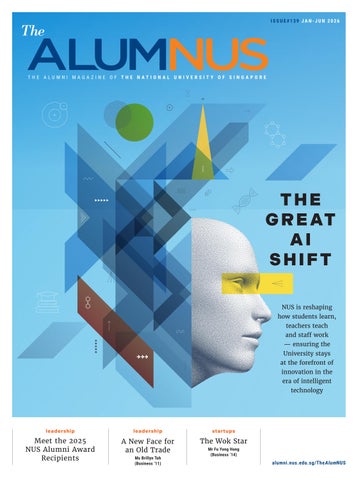
THE G R E AT AI SHIFT NUS is reshaping how students learn, teachers teach and staff work — ensuring the University stays at the forefront of innovation in the era of intelligent technology
leadership
leadership
startups
Meet the 2025 NUS Alumni Award Recipients
A New Face for an Old Trade
The Wok Star
Ms Brillyn Toh (Business ’11)
Mr Fu Yong Hong (Business ’14)
alumni.nus.edu.sg/The Alum NUS
GIVING JUST GOT EASIER It’s a piece of cake.
Add a little charm to your giving Scan to make a gift of S$20 and receive a special edition NUS120 bag charm* NUS Giving
NUS Giving
nus_giving
*Bag charm image for illustration purposes only. The bag charm is limited to one per donor while stocks last. No commercial fundraisers were engaged by NUS for this appeal.
first word
Reinventing for Tomorrow Welcome to 2026! As we enter a new year, we are taking the opportunity to celebrate and look towards the future.
STAY CONNECTED WITH US AT: NUS Alumni NUS Alumni @nus_alumni alumni.nus.edu.sg NUS 新国大校友会 uNivUS app
NUS graduates were recently ranked as the eighth most employable worldwide — and first in Asia — by the Global Employability University Ranking & Survey (GEURS) 2026 (p.4), a testament to the strength of the University’s education and its commitment to preparing students for a rapidly evolving global landscape. With artificial intelligence (AI) becoming increasingly ubiquitous, NUS must now equip students to thrive in an AI-driven reality, ensuring they remain resilient and ready for the challenges ahead. As such, this issue of The AlumNUS showcases how the University is adapting — and thriving — in the age of AI. Our Focus article (p. 11) presents an overview of the comprehensive approach NUS is taking, from enhanced pedagogical tools and academic programmes to an AI-themed residential college. Beyond the classroom, we also touch on how the
University is integrating AI into its research and operations. Regional university leaders further discuss how AI is redefining the role and purpose of higher education (p. 8), while alumni share their perspectives on the technology’s impact in their industries (p. 20). Alongside these forward-looking initiatives, we also take a moment to celebrate the accomplishments of our alumni: last November, our biennial NUS Alumni Awards recognised 22 graduates who have made outstanding contributions to the University, society and the world (p. 22). The articles feature inspiring stories from a selection of these awardees, offering insight into their leadership, impact and aspirations. As always, thank you for staying connected! Visit our newly revamped AlumNUS website to read our latest stories (alumni.nus.edu.sg/thealumnus/), follow us on social media or drop us a note at alumnihelpdesk@nus.edu.sg. We’d love to hear from you! Ovidia Lim-Rajaram (Arts & Social Sciences ’89) Chief Alumni Officer
contents
JAN – JUN 2026
11 news & events
focus
03 Past & Present
11 NUS: Reprogrammed for Tomorrow
04 NUS Graduates Ranked #1 in Asia in Global Employability Survey / Five NUS Academics Shine at the President’s Science and Technology Awards 2025
vox alumni
giving
20 Artificial Intelligence at Work
38 From One Family to Many: The Living Legacy of the Laus
05 NUS Scientists Discover DNA ‘Switch’ / Professor Joseph Liow Appointed Dean of LKYSPP / NUS Launches New PhD in Music Practices 06 NUS120 University Awards 07 NUS Faculty of Arts & Social Sciences Alumni-toAlumni Mentoring Initiative / Celebrating a Legacy of Growth and Global Impact 08 Navigating the Age of AI 10 Meet the Staff Mr Herman Felani bin Md Yunos (Arts & Social Sciences ’07)
leadership 22 Making Their Mark 26 Bridging Worlds Professor Lim Chwee Teck (Engineering ’90)
28 A Lifelong Devotion to Duty and Purpose Justice Judith Prakash (Law ’74)
30 NUS Outstanding Young Alumni Making a Difference
36 A New Face for an Old Trade Ms Brillyn Toh (Business ’11)
startups 40 The Wok Star Mr Fu Yong Hong (Business ’14)
42 alumni happenings
life 48 The AlumNUS Crossword
Mr Zamiq Azmeer bin Borhanudin (Law ’18) Ar. Chio Wen Tian (Design and Environment ’14, MArch ’14) Ms Chung Wing Lam (Science ’09)
33 Singapore’s High-Stakes Balancing Act in an Age of Titans
The AlumNUS clinched the following award at APEX 2024: AWARDS OF EXCELLENCE Magazines, Journals & Tabloids - Print
For more information or to read The Alum NUS online, please visit a l umni .nus.edu.sg / The Alum N US. OFFICE OF ALUMNI REL ATIONS 11 Kent Ridge Drive #05-01 Shaw Foundation Alumni House Singapore 119244 Tel: (65) 6516-5775
Advisor MS OVIDIA LIM-RAJARAM (Arts & Social Sciences ’89) Editors MR ROYSON POH, MS SUNANTHA HUANG & MS KATHERINE CHINN Production Advisor MS NOREEN KWAN Publishing Consultant MEDIACORP PTE LTD
The AlumNUS is published by the NUS Office of Alumni Relations. The views and opinions expressed are those of the authors and do not necessarily represent the views of the NUS Office of Alumni Relations or the National University of Singapore. Copyright 2026 by the National University of Singapore. All rights reserved. Printed in Singapore by KHL Printing Co Pte Ltd.
PAST & PRESENT Built in 1977, Yusof Ishak House (YIH) has been the heart of student life and activity on the University’s Kent Ridge campus for nearly five decades. In 2022, the building closed for a major redesign, officially reopening in October 2025 as part of the NUS120 celebrations. The rejuvenated YIH honours the original structure of the building while incorporating sustainable features — such as a hybrid cooling systems and rooftop solar panels — in line with the ambition to operate at net-zero energy.
Photo courtesy of NUS Libraries Photographs Collection
The building was named after Singapore’s first President, who was also the Chancellor of the University from 1965 to 1970.
The redesign features more naturally ventilated spaces, as well as occupancy-sensoractivated fans and lights to reduce energy wastage.
For more information, please visit nus.edu/yih
Photo by Finbarr Fallon
J A N – J U N 2 0 2 6 . 03
news & events
NUS graduates ranked #1 in Asia in global employability survey
NUS graduates rank as the most employable in Asia and the eighth most employable worldwide, according to the Global Employability University Ranking & Survey (GEURS) 2026. Released in October 2025, the 15th edition of the survey gathered 119,967 votes from 12,350 employers across 32 countries, identifying the world’s 250 leading institutions for employability.
“The global demand for NUS graduates stands as a powerful affirmation of their exceptional skills, adaptability and real-world impact, amidst today's complex global challenges. I am heartened by this continued strong showing, which is a clear testament to the confidence of employers in our graduates,” said Professor Aaron Thean, NUS Deputy President (Academic Affairs) and Provost.
Five NUS academics shine at the President’s Science and Technology Awards 2025 In October 2025, five NUS professors were bestowed the nation’s highest accolades for researchers and engineers at the President’s Science and Technology Awards, organised by the National Research Foundation. NUS President Professor Tan Eng Chye (Science ’85) was the recipient of the President’s Science and Technology Medal. Professor Lim Chwee Teck (Engineering ’90) of the NUS Institute for Health Innovation & Technology (iHealthtech) 04 . T H E A L U M N U S
and the College of Design and Engineering (CDE), along with Adjunct Professor Lisa Ng (Medicine PhD ’02) of the Yong Loo Lin School of Medicine and Duke-NUS Medical School, received the President’s Science Award. Assistant Professor Andy Tay (Engineering ’14) of CDE, iHealthtech and the NUS Tissue Engineering Programme, together with Assistant Professor Wang Xinchao of CDE, received the Young Scientist Award.
(From left to right) Asst Prof Andy Tay, Adj Prof Lisa Ng, Prof Tan Eng Chye, Prof Lim Chwee Teck and Asst Prof Wang Xinchao received the nation’s highest honours for their exceptional contributions to Singapore’s science and technology landscape.
NUS study: A simple DNA switch helps tropical butterflies change wing patterns with the seasons
Professor Joseph Liow appointed Dean of LKYSPP Professor Joseph Liow was appointed the third Dean of the Lee Kuan Yew School of Public Policy (LKYSPP), effective 15 October 2025. A renowned scholar of international relations and Asian strategic affairs, Professor Liow succeeds Associate Professor Leong Ching, who served as Acting Dean since July
2025. Also appointed as the Wang Gungwu Professor in East Asian Affairs, Prof Liow joins LKYSPP with close to three decades of academic and leadership experience from Nanyang Technological University, where he most recently served as Dean of the College of Humanities, Arts and Social Sciences.
A mating pair of dry-season (left) and wet-season (right) B. anynana butterflies. Credit: William Piel
A team of NUS scientists, led by Professor Antónia Monteiro from the Department of Biological Sciences, has discovered a simple DNA 'switch' that enables tropical butterflies to adjust the size of their wing eyespots between wet and dry seasons. The findings, published in Nature Ecology & Evolution, shed light on the evolution of environmental sensitivity, and may inform future efforts to understand and potentially bolster adaptation to a changing climate.
NUS launches new PhD in Music Practices The Yong Siew Toh Conservatory of Music (YST) has launched the Doctor of Philosophy (PhD) in Music Practices, its first doctoral programme and the first in Asia to integrate artistic practice with academic research. The newly launched PhD marks a major step forward for higher music education in Singapore and the region, offering a cross-disciplinary approach that draws on NUS’ world-class teaching and research environment. Professor Peter Tornquist, Dean of YST, described the PhD as “a landmark shift in how we understand and value artistic work within academia”. The next application window will open in February 2026 for the August 2026 intake. J A N – J U N 2 0 2 6 . 05
news & events
NUS120 University Awards: Scaling new peaks in education, research, mentorship and service NUS paid tribute to seven outstanding educators, researchers and professionals for their contributions to the University, Singapore and the global community at the annual NUS University Awards on 12 September 2025.
OUTSTANDING SERVICE AWARD Professor Cheong Koon Hean, Rector of NUS College and Chairman of the Centre for Liveable Cities Advisory Panel under the Ministry of National Development Mr Liew Mun Leong (Engineering ’70), CEO of Gelephu Mindfulness City, and Founder and Principal Consultant of Building People Consultancy Pte Ltd. UNIVERSITY RESEARCH RECOGNITION AWARD Professor Liu Xiaogang, Faculty of Science and Yong Loo Lin School of Medicine
YOUNG RESEARCHER AWARD Assistant Professor Hou Yi, College of Design and Engineering, and Solar Energy Research Institute of Singapore OUTSTANDING GRADUATE MENTOR AWARD Professor Yan Ning, College of Design and Engineering OUTSTANDING EDUCATOR AWARD Associate Professor Damith Chatura Rajapakse, School of Computing Associate Professor Peter Alan Todd, Faculty of Science and Tropical Marine Science Institute
Front row (from left to right): NUS President Prof Tan Eng Chye; NUS Pro-Chancellor Mrs Theresa Foo; NUS Chairman Mr Hsieh Fu Hua (Business '74); and NUS Deputy President (Academic Affairs) and Provost Prof Aaron Thean. Back row (from left to right): Assoc Prof Peter Alan Todd; Prof Yan Ning; Mr Liew Mun Leong; Prof Cheong Koon Hean; Prof Liu Xiaogang; Assoc Prof Damith Chatura Rajapakse; and Asst Prof Hou Yi.
06 . T H E A L U M N U S
NUS Faculty of Arts & Social Sciences rolls out its first alumni-to-alumni mentoring initiative The NUS Faculty of Arts & Social Sciences (FASS) marked a new chapter for its alumni community with the launch of its very first alumni-to-alumni mentoring initiative – the FASS Alumni Mentoring (FAM) programme – on 20 August 2025. The programme aims to connect senior and junior alumni to discuss career and industry insights, skills development and networking opportunities. It emphasises short-term, session-based mentoring and will be conducted twice a year.
Celebrating a legacy of growth and global impact NUS celebrated its 120th anniversary with a grand gala dinner on 3 July 2025 at Marina Bay Sands, gathering close to 2,000 alumni, donors, partners and friends, including Guest-ofHonour Minister for Foreign Affairs Dr Vivian Balakrishnan (Medicine ’85, MMed ’91), Emeritus Senior Minister Goh Chok Tong (Arts '64, HonLLD '15), and Senior Minister of State for Health and Manpower Dr Koh Poh Koon (Medicine ’96, MMed ’03). The evening paid tribute to NUS’ astounding journey of
service, innovation and impact since its founding in 1905 — celebrating its growth from the Straits Settlements and Federated Malay States Government
Medical School with only 23 students to a globally renowned institution spanning 15 colleges, faculties and schools across three campuses.
This news round-up of campus updates was adapted from NUS social media posts and articles on NUS News. For more stories, visit news.nus.edu.sg. J A N – J U N 2 0 2 6 . 07
news & events
Navigating the Age of AI At the Jakarta stop of the NUS Innovation Forum, regional university leaders and industry practitioners gathered to confront the pressing questions of today, particularly regarding the rapid pace of innovation.
W
ITH GENERATIVE ARTIFICIAL INTELLIGENCE (AI) NOW EMBEDDED IN EVERY ASPECT OF
INDUSTRY AND DAILY LIFE, what should universities be preparing students for? At a plenary session of the NUS Innovation Forum (NIF) Jakarta, panellists explored this defining question: “What are the most significant opportunities and challenges that AI presents to universities in Southeast Asia?” Held on 24 October 2025 at the Pullman Jakarta Indonesia Thamrin CBD, NIF Jakarta — organised by NUS Alumni Relations — brought alumni, thought leaders and industry experts together for in-depth discussions on emerging innovation trends. The seventh NIF since the series began in 2024 and the first in Indonesia, the event underscored NUS’ deepening engagement with its global alumni. 08 . T H E A L U M N U S
During the opening panel at NUS Innovation Forum Jakarta, panellists representing Universitas Indonesia, Universitas Gadjah Mada, Institut Teknologi Bandung and NUS discussed the opportunities and challenges that AI poses for universities.
Universities in the Age of AI The Rectors’ Panel — featuring Professor Hamdi Muluk from Universitas Indonesia, Dr Danang Sri Hadmoko from Universitas Gadjah Mada (UGM), Professor Lavi Rizki Zuhal from Institut Teknologi Bandung (ITB) and NUS President Professor Tan Eng Chye (Science ’85) — tackled the harder, underlying issue: what is the purpose of a university when machines can already perform so many tasks that academics once thought are exclusive to humans? Moderated by Professor Simon Chesterman, NUS Vice Provost (Educational Innovation) and Dean of NUS College, the discussion went beyond technological disruption to examine the future of learning itself. Early in the discussion, Prof Tan spoke candidly about the “tremendous opportunities and risks” presented by AI. To illustrate the speed and scale of change, he pointed to DeepMind’s breakthrough in protein folding, which modelled more than 200 million proteins in a single sweep — a feat that would otherwise have required “more than a billion PhD-years”. Such leaps, he noted, show just how dramatically AI can supercharge scientific discovery. They also reveal how quickly universities must adapt. At NUS alone,
TEXT ASHOK SOMAN
As AI transforms how knowledge is created, accessed and applied, universities will have to confront their own relevance, and address questions about the form, value and purpose of university education. Professor Tan Eng Chye, NUS President
134 faculty members were hired over the past two years; 27 are AI specialists, and another 53 incorporate AI into their research. “It shows how pervasive AI has become, transforming all disciplines” he said. Yet he also warned of a quieter academic danger: students using AI to avoid thinking rather than deepening their cognitive skills. He highlighted four risks — cognitive offloading, never-skilling, mis-skilling and de-skilling — that universities must actively guard against. “Learning must remain effortful,” he said. “AI cannot replace the process of thinking.” From the Indonesian institutions came a shared recognition that AI is not just a technological development but a philosophical shift. Prof Zuhal shared that current trends demand a rethink of curriculum design. ITB has already overhauled its programmes with the aim of preparing students to work alongside intelligent systems. “We cannot keep teaching the way we were taught,” he said. Many lecturers, he acknowledged, still resist AI because “they think their own brains still function”. But he added that that doesn’t take away a fundamental truth: that educators need to be skilled in AI, simply because students are. Dr Hadmoko emphasised the need for applied, crossdisciplinary research, particularly at the intersection of
human behaviour and technology. UGM is increasingly pairing computer scientists with experts from psychology, engineering, medicine, pharmacy and the social sciences to ensure AI tools are technically robust, sector-relevant and socially grounded. He also highlighted a key structural reality: AI research is expensive. Cloud-computing costs alone can exceed the annual budgets of some faculties, and few regional universities can sustain large-scale modelling independently. Multi-stakeholder collaboration is therefore essential, with shared supercomputing infrastructure, joint research clusters and industrysupported innovation centres becoming critical pillars for advancing research, and ensuring equitable access to computational power. Prof Muluk reminded the room that AI mirrors humanity’s strengths and vulnerabilities. He cited cases of young people seeking emotional support from AI — sometimes with tragic outcomes when models hallucinate or misjudge intent. Offline life and physical interaction still matter, he stressed. Universities must invest as seriously in human resilience as in digital infrastructure. Communitybuilding, peer support, service learning and mental-health programmes are essential safeguards in an era where digital companionship can feel deceptively comforting. “We must equip students with wisdom,” he said. “And wisdom is not something AI can provide.” The Business of Innovation Later in the Forum, discussions widened beyond universities to the broader startup and corporate ecosystem. A second session — ‘Ask Me Anything: Building Impactful Start-ups in an Uncertain World in the Age of AI’ — featured founders in biotech, media tech and industrial IoT, offering a candid look at what it takes to build resilient companies amid rapid technological change. Speakers Mr Adi Reza Nugroho (MYCL), Mr David Setiawan Suwarto (Business ’09) (SCTV and MOJI), Mr Pang Xue Kai (Engineering ’15) (ForU AI) and moderator Mr Danial Talib (PIER71™) shared insights on navigating uncertainty, earning user trust and using AI to accelerate — not replace — human creativity. NUS Enterprise also highlighted its expanding BLOCK71 network, now spanning 11 cities — including Jakarta, Bandung and Yogyakarta — and connecting founders to mentors, investors and markets. Together, the conversations at NIF Jakarta reflected a region not just adapting to technological change but shaping it, building on earlier stops in Manila, San Francisco, Suzhou, Beijing, Shanghai and Tokyo. J A N – J U N 2 0 2 6 . 09
M E E T T H E S TA F F
Herman Felani bin Md Yunos
As Associate University Librarian and Head of Archives & Digital Preservation, Mr Herman Felani bin Md Yunos (Arts & Social Sciences ’07) is helping to archive and expand the University’s collections — from rare bird drawings to prominent campus lectures — for future generations. KEEPING HISTORY ALIVE “At NUS Central Library, we don’t just preserve the past — we make our materials discoverable,” said Mr Herman Felani bin Md Yunos. His work includes digitising rare collections, advising departments on archiving milestones and expanding the Digital Gems platform — a growing digital repository of more than 500 rare Southeast Asian materials, including the Edwin Thumboo Private Papers, Chinese Newspapers of Southeast Asia, and books on Singapore’s history and heritage. “We focus on giving good metadata descriptions so that materials are searchable,” he explained. “Text is still the main way people search for things.”
STORIES THAT STICK Some of the most meaningful contributions made to the Central Library contain personal memories. Mr Herman fondly recalls a gift from Ms Fenella Madoc-Davis, an Englishwoman who donated her father’s hand-drawn book on birds, created while he was imprisoned in Singapore during the Japanese Occupation. “It’s not just the drawings, but the story behind how he made the book under difficult conditions that makes it special," he noted.
A PASSION FROM YOUNG Mr Herman’s love for libraries started young, as a school library club president who devoured encyclopedias and maps. As an undergraduate at NUS, the Central Library was his favourite hangout — especially during vacations when he would research flags and heraldry.
CELEBRATING 120 YEARS To mark NUS’ 120th anniversary, Mr Herman’s team curated an exhibition for the University’s gala dinner last July, featuring alumni-created creative works and commentaries, vintage student production posters, nostalgic campus photographs used as photobooth backdrops and in virtual reality and augmented reality challenges, as well as trivia quizzes. “We want to make history more interesting and interactive," he said.
ENSURING THAT LEGACIES LIVE ON Today, Mr Herman leads efforts to digitise rare materials like the Yeap Chor Ee Collection and Bugis ship captains’ logs. His team is also working to preserve old campus posters, photographs and cassette recordings of past lectures held at NUS. Despite the benefits of digitisation, Mr Herman acknowledges the challenges, too. “Digitisation is resource-intensive. We can’t digitise everything,” he admitted. “Data centres consume a lot of power, so we have to make careful decisions about what to preserve.”
10 . T H E A L U M N U S
MAKING A DIFFERENCE What brings Mr Herman the most joy? “Helping others — I think that’s the best joy one can receive.” From printing a last-minute exam cheat sheet to advising struggling new undergraduates, he is always happy to lend a hand.
READ MORE ONLINE
focus
LIVING WITH INTELLIGENT TECH
NUS:
Reprogrammed for Tomorrow
In just three years since the launch of ChatGPT, NUS has rolled out ambitious programmes to nurture AI-fluent students and use AI effectively in teaching, research and corporate functions. TEXT WONG SHER MAINE
J A N – J U N 2 0 2 6 . 11
focus
A
MONG THE COURSES ON GOVERNMENTS AND SINGAPORE POLITICS that first-
year political science student Tan Yong is taking, one involved trooping down to the headquarters of superapp Grab to observe how operations staff are using Artifcial Intelligence (AI) algorithms. The brand-new course Machines that Learn is being offered to the pioneer cohort of 220 residents at Acacia College, Singapore’s first AI-focused university residential college. “It was eye-opening because seeing AI at work helped me contextualise its capabilities,” said Tan Yong, 21, who chose Acacia College because he wanted to stay on top of AI developments. “I saw how AI was used to produce reviews for the businesses that were subscribed to Grab’s services.”
12 . T H E A L U M N U S
First-year law student and fellow resident Choo Hao Wen, 21, who joined the 18-student trip, added, “The Large Language Models (LLMs) that they used relate to words, syntax and language — and they are pertinent to law. It’s good to be wary of what AI has in store for us.” AI has already changed, and will continue to change, the world. Singaporeans seem particularly partial to the technology: recent data from OpenAI showed that the country has the highest per capita ChatGPT usage globally — one in four people use it weekly . Within higher education, AI has had an outsized impact. The turning point occurred when AI chatbot ChatGPT — the first of its kind— became publicly available in November 2022. A New York magazine article stated, “ChatGPT has unravelled the entire academic project”, quoting a study suggesting that just
NUS is mounting a robust and comprehensive approach to AI that spans our core mission areas of education, research and innovation, and administration. NUS will empower and uplift the whole organisation to fully leverage AI in all that we do. Prof Tan Eng Chye, NUS President
two months after its launch, 90 per cent of US college students were using ChatGPT to help with assignments . Vacillating between fears of student cheating and the potential AI offers, universities worldwide responded either by banning AI altogether, embracing it entirely or taking a middle path. NUS, as a university that prizes innovation, had explored AI much earlier. The NUS Artificial Intelligence Laboratory was started in 2019. In the opinion of Professor Simon Chesterman — the NUS Vice Provost (Educational Innovation) and Senior Director of AI Governance at AI Singapore — the best thing NUS has done when it comes to AI has always been “to encourage experimentation”. What the launch of ChatGPT did was to accelerate, deepen and consolidate the University’s efforts to harness AI in the most effective and responsible way possible.
Said NUS President Professor Tan Eng Chye (Science '85): “NUS is mounting a robust and comprehensive approach to AI that spans our core mission areas of education, research and innovation, and administration. NUS will empower and uplift the whole organisation to fully leverage AI in all that we do.” The goal, Prof Tan added, is "to set NUS up to be a leading institution at the forefront of AI.” AN AI RESEARCH POWERHOUSE A major milestone was in the setting up of the NUS AI Institute (NAII) in March 2024, which brought all of NUS’ existing AI research initiatives and talent under one roof. Comprising 29 Leads and over 200 faculty members, their three focus research areas are: foundational AI research, policy and societal implications of AI, and realworld applications across various domains.
Prof Simon Chesterman believes that NUS' early adoption of AI and openness to experiment with this new technology puts it in good stead for the future. J A N – J U N 2 0 2 6 . 13
focus
(Below) Rather than be replaced by AI, Assoc Prof Ben Leong believes human skills will play an especially important role in the future.
NAII also launched the NAII Seed Grant Call, which will disburse up to S$3.2 million per year to high-potential AI projects in NUS. NUS has taken its AI research capabilities a step further by recruiting and nurturing world-class AI research talents. Over the past two years, NUS has recruited 27 new AI faculty, some of whom are of international renown. Another 53 new hires are contributing to advancing AI in their
disciplines or incorporating AI tools to propel their research. To amplify the research and bring it closer to the real world, NUS is also working with industry partners and global tech superpowers like Microsoft Research Asia, Google, IBM and Nvidia. In its collaboration with Google, both partners will establish a joint research and innovation centre to accelerate applied AI research and nurture skilled AI practitioners. THE BREADTH OF AI IN NUS EDUCATION With the introduction of AI in the classrooms, students at NUS today have markedly different choices and experiences compared to their seniors just a few years ago. In terms of content, there are many more AI-centric courses, including those that layer an AI element on top of existing disciplines, or what is called “X + AI”. Among the more than 175 AI-themed courses now offered at NUS, over 70 of these are outside the School of Computing — in Business, Engineering, Sciences, Humanities and Social Sciences. These X + AI courses include topics
14 . T H E A L U M N U S
like analysing AI-generated fake news (Communications, New Media and Society), facilitating Socratic dialogue (Introduction to Psychology) and critiquing AI-composed music (Social and Cultural Studies through Music). To develop deep AI expertise, at least four Bachelor’s and Master’s degree programmes were launched in 2025, including the Bachelor of Computing in AI, the Master of Computing in AI, and the Bachelor of Engineering in Robotics and Machine Intelligence. As for alumni, the NUS School of Continuing and Lifelong Education (SCALE) offers a plethora of short courses and certifications for AI
and machine-learning in areas like predictive analytics, generative AI, and AI for Talent Management and Organisational Design. In terms of the educational experience, students who are very much digital natives are now using AI in their take-home assignments to summarise readings or lecture notes, craft essays and solve problems. They simply have to fill in a declaration form listing which AI tools were used. Associate Professor Ben Leong, Director at the AI Centre for Educational Technologies (AICET), said tongue-in-cheek at a recent talk, “We surrender. Ninety per cent of our students are probably using AI.”
Innovation Culture at Acacia College Taking over the Cinnamon Wing of NUS College, located in University Town, the physical premises of Acacia College are still being refurbished to align with its AI theme. The Acacia College branding (with letters A and I aptly highlighted) is in its final design stages while meeting rooms are being kitted out with futuristic blue lights. While the hardware is taking time, the software — the spirit of tech innovation — has already taken root in the new AI-themed residential college, themed “Fundamentals of Artificial and Human Intelligences”. The 220 residents, who comprise an equal gender mix spread across Year 1 and Year 2, get to take exclusive AI-centric modules. Cheryl Leong, 19, a first-year computer science student, enjoys taking a coding module that includes AI elements. At the same time, she is part of an
A passionate advocate of AI, Assoc Prof Heng Cheng Suang (third from left), is seen here with Acacia College residents.
interest group that is building an educational game related to coding and AI. Other unique interest groups within the College include the Hackathon Society, Coding Club and the AI Society, which organises AIthemed events and talks. The residents, who come from diverse faculties including FASS, Science, Medicine, Law and the Yong Siew Toh Conservatory of Music (YST), readily turn to AI for ideas. Inspiring his students at the inaugural Welcome Dinner, Associate Professor Heng Cheng Suang, Master of Acacia College, creatively delivered a welcome message
in 14 languages, in different cultural costumes, and from different locations — including a scene of him speaking French before the Eiffel Tower and a scene of him speaking Norwegian under the beauty of the Aurora Borealis — to the amusement and delight of the guests. Indeed, the one-minute 'deepfake' video was itself a showcase of the possibilities of AI. For first-year medical student Li Zhicheng, 21, living in Acacia College allowed him to form an inter-disciplinary team to take part in a medical innovation programme — NUS’
Medical Grand Challenge, taking place in mid-2026. His team of six includes three medical students and three from other faculties, such as the College of Design and Engineering, with knowledge of software. Said Zhicheng, “We went for it because my team members, who are all in Acacia College, have different expertise but we share an interest in focusing on AI — and that gives us a competitive advantage.” Assoc Prof Heng has big plans for Acacia College. He intends to invite eminent scholars and professional pundits to speak about AI as part of a distinguished speaker series, organise hackathons, drive performances that integrate technology with art (such as dance with AI light illusions), and expose the residents to new experiences like dining with 3D immersive light art and storytelling. Aiming to spark curiosity and ignite enthusiasm in his students, Assoc Prof Heng fervently expressed, “I hope that the students of Acacia College will surpass me in my vision and endeavours.” J A N – J U N 2 0 2 6 . 15
focus
As we move into an AI-driven future, human skills will become increasingly important. We are now taking advantage of advances in AI to teach these practical human skills. Assoc Prof Ben Leong, Director, AICET
16 . T H E A L U M N U S
In class, faculty are using AI to teach better. In a 2024 survey of faculty, it was found that about 23 per cent of NUS’ undergraduate and post-graduate courses utilised some aspect of AI. One of the best examples of this is the use of AI chatbots to role-play with students. For instance, within social work, if students needed to practise counselling in the past, an actor would be hired to work with one student while the rest would observe. But now, every student gets to practise individually with a bot. They engage in dialogue with ‘patients’ from diverse profiles and backgrounds, and the chatbot even describes behaviour — for instance, if the patient looks away or is mildly irritated. After a session is complete, the student gets personalised feedback, both from the bot and an instructor who can view the transcript of the exchange. Time-starved faculty are not doing this alone. NUS is strategically bringing the best ideas together, sharing these AI
tools across NUS and providing support when needed. In 2024, the Centre for Teaching, Learning and Technology (CTLT) was formed by the merger of the Centre for Development of Teaching and Learning (CDTL) and the Centre for Instructional Technology (CIT) to run workshops, courses and consultations on how to use technology to create more personalised or engaging learning experiences. Recently, CTLT collaborated with the NUS Teaching Academy (NUSTA) to develop a proficiency roadmap for AI in education. Then there is AICET, which has a team of consultants who work with NUS faculty to leverage AI and technology in their teaching through fast experimentation and prototyping of new ideas. AICET’s successes include grading tools that provide accurate, personalised feedback for short-answer quizzes, and chatbots that help nursing students with their research projects or train dental students in radiographic interpretation.
Many of the tools that have proved particularly useful are those involving role-play, where ironically AI enables students to hone human skills by simulating client interviews for social work or mock trials for law students. Said Assoc Prof Leong: “As we move into an AI-driven future, human skills will become increasingly important. We are now taking advantage of advances in AI to teach these practical human skills.” SAFEGUARDING FOCUS AND ORIGINAL THOUGHT But even as educators use AI to achieve better learning outcomes, they are well aware that if students
overuse or misuse it, AI can dull thinking ability — an outcome worse than technology merely taking away the need to memorise telephone numbers or read maps. Prof Chesterman — who likened the desire to resort to AI as the more pleasant choice, akin to choosing to eat ice-cream over broccoli — emphasised this several times in his interview: “If you can’t even form an opinion without asking ChatGPT, then it becomes a big problem.” According to an MIT study released in June 2025, ChatGPT may be eroding critical thinking skills. In the study of 54 people who were tasked to write an essay,
Why This World-Class AI Researcher Came to NUS In eight years of living in Singapore, Professor Dean Ho, an international leader in digital medicine, has found joy in several things: improving the lifestyle habits of taxi drivers, trudging up and down the five floors of the NUS Institute for Digital Medicine (WisDM), and imbibing on kopi o kosong (black coffee, no sugar and milk). But that isn’t his biggest joy. The AI aficionado came from the United States in June 2018 to use his research to save lives, and has found that he can make a bigger impact in Singapore at NUS, where he is Provost’s Chair Professor, Director of WisDM, Director of The N.1 Institute for Health (N.1), and Head of the Department of Biomedical Engineering.
“When it comes to AI research, the amazing element of Singapore is that its accessibility to stakeholders is truly unmatched,” said Prof Ho, who came from the University of California, Los Angeles (UCLA), and who found himself speaking to policymakers, regulators and global organisations like the World Health Organization for the first time once he came to Singapore. “Singapore allowed me to become way more globally connected than before.” He added, “NUS, with its proximity to the National University Hospital (NUH), is a truly multi-disciplinary university where I can also access patients. Technology alone will not transform health or healthcare. I need to learn from implementation scientists, people from the business school, even those in geopolitics, to talk
about potential crossborder treatments.” Prof Ho, who has won multiple global innovation awards, works on giving patients optimum personalised medical treatments with data and AI — because everyone is different. One of his most impactful projects is CURATE.AI, a tool that uses AI to optimise a patient's drug dosage by using only their own data to make adjustments over time — including the potential of lowering doses to improve efficacy.
He has also dived into gathering and analysing his own health data in a first-of-itskind human trial called Delta. The gamification element — scoring with biomarkers — has motivated Prof Ho to work out daily, eat just once a day (his sole meal on the day of the interview consisted of grassfed beef, red cabbage salad and a polyphenol powerhouse drink of blended old ginger, blueberry, broccoli and red cabbage) and sleep at 9.15pm every night. He is now writing two books on his research and is planning to expand Delta, which is now undergoing peer reviews, to “Delta for All” so that more people can benefit from personalisation and gamification to make lifestyle changes for health. He hopes to start small via a fasting trial for a small group of 10 to 20 women. He said, “Ultimately, data will become an intervention or therapy, towards longevity.” J A N – J U N 2 0 2 6 . 17
focus
We must be more intentional about cultivating what it is that makes us truly human. Prof Simon Chesterman
those who used ChatGPT had the lowest brain engagement and “consistently underperformed at neural, linguistic and behavioural levels”, compared to those who wrote without any help, or used Google search. Likewise, Assoc Prof Leong talked about the “AI Chasm of Death”: students who can only get things done with the help of AI will end up becoming stuck on one side of the chasm; they will only be able to cross over through sheer hard work, knowledge acquisition and critical thinking. “As educators, our job is to help them cross that chasm, by motivating them to put in the effort to think and
learn,” he said. “It’s like exercising in the gym. It’s hard work, but you need to do it to grow in strength. Our job is still to get them to exercise those mental muscles.” He added, “The future of education is really one where we — instead of focusing only on teaching students to do things right — place more emphasis on getting them to learn to do the right things.” Like eating broccoli or putting in the extra work to exercise, students must be taught to make learning choices that are possibly less pleasant but necessary and good for them — to focus and think without AI.
AI for the NUS Workforce Soon after the launch of ChatGPT, NUS leaders realised that staff would start exploring AI tools on their own, but issues would arise over data security, privacy and the responsible use of sensitive University information. “To harness the benefits of generative AI while mitigating these risks, the University made a strategic decision to develop a secure, institution-managed platform where staff could use AI safely
Staff from NUS Medicine (top) and the Faculty of Science at their respective AI workshops.
18 . T H E A L U M N U S
The NUS team at the Tech Leader Awards 2025 ceremony.
and confidently,” said Mr Irving Neil Kwok, Head of Enterprise Services at NUS Information Technology. Today, the AI-Know platform is used by over 65 per cent of the NUS staff population. AI-Know has made such an impact that the NUS IT team won a Digital Achievers (Team) award at the Singapore Computer Society’s Tech Leader Awards 2025. AI-Know is the gateway to a suite of diverse AI tools like AI-Minute (which generates meeting minutes and has saved an estimated 9,480 man-hours annually), AI-Create (on which staff have created over 3,000 personal or department AI agents on their own, even without knowledge of coding) and the most popular, AI-Chat (on which staff have generated over 200,000 conversations in the past 12 months).
The biggest challenge, said Mr Kwok, was in staff readiness. The NUS IT department worked with other departments to ramp up AI literacy through outreach and training sessions. It also partnered with the NUS Agility Office to run AI ideation workshops and help participating departments embed AI into their workflows. Beyond using AI-Know, all executive NUS staff are required to complete two basic courses in data literacy and AI. Over 4,300 staff have completed the basic level, and more than 500 have completed the intermediate and advanced levels. Said Mr Kwok, “Ultimately, existing roles will evolve rather than disappear, giving rise to new hybrid roles where AI and data literacy become core skillsets for the future workforce.”
NURTURING AI-PROOF QUALITIES With naysayers wondering if universities are still relevant in the age of AI, or if AI will one day surpass humans, NUS is cognisant of the need to produce graduates who are not only AI-literate and AI-fluent, but have the qualities that AI cannot replicate. There is a greater emphasis on equipping graduates with higher-level skills like judgement, adaptability and ethical reasoning. “Instructors deliberately raise the bar by designing tasks that go beyond what AI can produce,” said Associate Professor Melvin Yap (Arts & Social Sciences ’99), who serves as Associate Provost (Education & Technology), Head of CTLT, and faculty member in the Department of Psychology at the Faculty of Arts & Social Sciences (FASS). “These tasks require interpretation, critique and justification, where students question assumptions, evaluate evidence and construct their own reasoning.” He added that true AI-free thinking ability can still be assessed through in-person, supervised exams, as well as oral presentations, portfolios and lab performances. He said, “These formats demand originality and onyour-feet reasoning, making clear that learning outcomes cannot be outsourced to technology.” Learning how to adapt, work in a team and get along are human qualities that manifest outside of the classroom, and this is where NUSOne — an approach designed to encourage students to participate in outof-classroom activities for a well-rounded student life — comes in. Then there are human skills. A paper titled “Will AI make EQ more important than IQ?” by Prof Chesterman and Associate Professor Loy Hui Chieh, who is from the Department of Philosophy at FASS, questioned whether universities should switch from educating the mind to educating the heart. “There is emerging
literature about the 'feeling economy', which is the idea that your value is not just your brain but your heart — in your ability to persuade and engage people to do all sorts of things that, for the moment at least, AI can't do,” said Prof Chesterman. “We must be more intentional about cultivating what it is that makes us truly human.” What all this translates to are NUS graduates who are not only AI-literate and AI-fluent, but who are inherently employable. “AI is integrated thoughtfully to amplify humanistic values such as judgement, creativity and ethical leadership, while embedding critical engagement with AI across disciplines," said Assoc Prof Yap. "This approach ensures graduates are capable of questioning assumptions, critiquing outputs and making decisions with integrity. It prepares graduates not only to use AI effectively but also to lead with adaptability, discernment and integrity in a world where technology continues to evolve.”
Assoc Prof Melvin Yap says it is vital to design learning and curriculum that emphasise human agency.
J A N – J U N 2 0 2 6 . 19
vox alumni With artificial intelligence (AI) poised to change the way we work, we asked alumni about the technology’s disruptive potential for their industries — and how they are integrating AI into everyday practice.
ARTIFICIAL INTELLIGENCE MANUFACTURING
"At Augmentus, we’re using AI to automate robotic programming for high-mix manufacturing — enabling robots to 3D-scan parts, understand their geometry variations and autonomously generate motion paths for processes like welding, coating and polishing. This eliminates the need for manual programming and allows factories to adapt to new parts within minutes instead of hours.” Mr Daryl Lim (Arts & Social Sciences ’22) Co-Founder Augmentus
AT WORK MARKETING
"Artificial intelligence is transforming the marketing industry by making audience understanding more precise, and creative execution faster. At UniLah, we use AI to streamline campaign analysis, personalise content and uncover student trends that help brands connect more meaningfully with Gen Z audiences.” Mr Shawn Tham (MSc Venture Creation ’24), Founder UniLah
C
M
Y
CM
MY
CY
CMY
K
20 . T H E A L U M N U S
DENTISTRY
LAW
Dr Raymond Ang (Dentistry ’94) Chief Operations Officer Q&M Dental Group
Ms Charmaine Yap (Law ’18) Fulbright Scholar Columbia Law School
"Q&M Dental, together with AI Singapore, have developed a diagnostic AI for dentistry. Registered with Singapore's Health Sciences Authority and in six other countries, this homegrown AI is able to analyse dental X-rays, and is used by more than 1,000 dentists.”
"At the heart of the legal profession are the deeply human instincts of fairness and of being heard. By using AI to reduce effort spent on administrative and file management matters, we can free up bandwidth to exercise judgement more wisely, which reinforces the human core of the legal profession.”
MARITIME
"For mid-sized shipowners, AI closes the skills gap — standardising documentation and carbon reporting without expanding shore teams and making advanced sustainability practices accessible.” Mr Jon Jie (Engineering ’18) Co-Founder and Chief Operations Officer MarinaChain
Celebrating ��� Years of Excellence in Medicine
This year, NUS Medicine marks its 120th anniversary, celebrating more than a century of educating generations of healthcare professionals, advancing research, and improving lives through service to the community. Join us as we continue this proud legacy of impact. Your gift will support our students, research, and health initiatives that drive innovation and improve healthcare for the future. Make a minimum gift of $120 and receive a special edition of All for Health, a commemorative book honouring NUS Medicine’s 120-year journey.
Scan the QR code to make your gift today!
J A N – J U N 2 0 2 6 . 21
leadership
Making Their Mark Every two years, the NUS Alumni Awards honour exceptional alumni who have distinguished themselves in their respective fields and in service to the University. The 2025 award recipients are emblematic of the diversity and depth of NUS’ impact—as well as the spirit and values of the institution.
In the following pages, we spotlight just a few of the 22 recipients from 2025, sharing quotes and exclusive interviews that offer a glimpse into their stories and the motivations behind their success. For more details on the 2025 recipients, refer to the NUS Alumni Awards website: nus.edu.sg/alumnet/community/alumniawards 22 . T H E A L U M N U S
The 22 Alumni Awards recipients, together with NUS senior leadership and the Guest-of-Honour, Mr Desmond Lee, Minister for Education and Minister-in-Charge of Social Services Integration, at the 2025 awards ceremony.
The 2025 Award Recipients: EMINENT ALUMNI AWARD Ms Ho Ching (Engineering ’76) LIFETIME SERVICE AWARD Mr Andrew Lim Ming-Hui (Law ’85, LLM ’88) Mr Johnny Tan Khoon Hui (Science ’82) Mr Yeo Keng Joon (MBA ’85)
DISTINGUISHED ALUMNI AWARD Dr James Geng Jing (MPM ’11)
OUTSTANDING YOUNG ALUMNI AWARD Mr Zamiq Azmeer bin Borhanudin (Law ’18)
Professor Lim Chwee Teck (Engineering ’90)
Ms Chang Qingyang (Engineering ’21)
Mr Lim Huan Chiang (MPAM ’19)
Architect Chio Wen Tian (Design and Environment ’14, MArch ’14 )
Engineer Lim Peng Hong (Engineering ’83, MSc ’86)
Ms Chung Wing Lam (Science ’09)
Dr Sharon Nai (Engineering ’00, MEng ’03, PhD ’09)
Mr Alvin Lim (Business ’12)
Mr Ng Wai King (Law ’90 ) Professor Benjamin Ong (Medicine ’81, MMed ’85) Justice Judith Prakash (Law ’74) Mr Bahren Shaari (Business ’84)
Mr Harry Pham Van Anh (MPA ’17) Mr Janson Seah (Arts & Social Sciences + NOC ’18) Dr Sui Xiaonan (Science PhD ’16) Dr Jackie Tan (Science + USP ’12)
J A N – J U N 2 0 2 6 . 23
leadership
Mr Andrew Lim Ming-Hui (Law ’85, LLM ’88) LIFETIME SERVICE AWARD Partner, Allen & Gledhill LLP “I think what triggered my commitment and desire to serve was that I actually believe in the cause. I believe that NUS is actually doing good — not just educating, but preparing people for life. In my 12 years on the NUS Board of Trustees, I’ve probably learnt more and taken away more than I believe I put in. And it’s made me a more well-rounded person. The honour of the award is not lost on
Ms Ho Ching (Engineering ’76) EMINENT ALUMNI AWARD Chairman, Temasek Trust
me, and I’m humbled by it. But I will say, no one can contribute in isolation. You’re always contributing as part of a team, as part of a community.”
“The thing that is common between [students of my era and those of today], I think, has to be the sense of purpose of building beyond yourself, beyond your family. Even beyond the current generation to the next generation. And if we can keep to that purpose, this sense of always looking over the horizon, always — as Mr S Rajaratnam used to say — doing things today with tomorrow clearly in mind, I think it’ll be very, very interesting and very powerful, the sort of scale of opportunities that we can see.”
24 . T H E A L U M N U S
Mr Yeo Keng Joon (MBA ’85) LIFETIME SERVICE AWARD Chairman/Director, Bharat Luxindo Agrifeeds Pvt Ltd, India “My personal mantra has always been, be good, do good. As alumni, we can definitely help in mentoring some of these young students, and a lot of us have also contributed in terms of financial aid to needy students. We hope that each student, when they receive a bursary, understands that they
Mr Johnny Tan Khoon Hui (Science ’82) LIFETIME SERVICE AWARD Past Co-Chairperson, NUS Alumni Advisory Board (2018-2024)
have been helped, and moving forward, will also pay it forward and contribute back to NUS when they have the capacity to do so.”
“We belong to a smaller group of people who have had the chance, the opportunity, to experience a university education and benefitted from that. As alumni, the least that we can do is to pay it forward. But the question is not if we should help, but rather, if you are in a position to give and help uplift the community that you belong to, then how can you not?”
To view the full interviews with our Eminent Alumni and Lifetime Service Award recipients, please visit our NUS Alumni Relations YouTube channel: www.youtube.com/@nus_alumni
J A N – J U N 2 0 2 6 . 25
leadership
Bridging Worlds How NUS Distinguished Alumni Award recipient Professor Lim Chwee Teck (Engineering ’90) is helping power interdisciplinary research in Singapore. IT’S FITTING THAT PROFESSOR LIM CHWEE TECK (ENGINEERING ’90), NUS SOCIETY CHAIR PROFESSOR IN BIOMEDICAL ENGINEERING, holds the rare
WHO HE IS Scientist, innovator, mentor — Professor Lim Chwee Teck exemplifies excellence in discovery and its application. His breakthroughs and leadership continue to shape science and improve lives.
distinction of having received both the President’s Science Award (2025) and the President’s Technology Award (2011) — Singapore’s top honours for scientists and engineers. Few embody the spirit of both awards as completely as Prof Lim, who has consistently bridged scientific discovery and real-world innovation. Prof Lim's problem-solving ethos dates back to his childhood, when he saw how science could improve lives. Fascinated by simple household appliances such as washing machines, he realised how technology could ease daily living — a conviction that continues to drive his research, even as it takes increasingly interdisciplinary turns.
A pivotal moment came over coffee with a malaria researcher who described a challenge in measuring how infected red blood cells change. Prof Lim realised that mechanics might hold the key. Using laser tweezers and microfluidic devices, he quantified how malaria stiffens and alters red blood cells. This biomechanical profiling deepened understanding of the disease and marked his entry into mechanobiology, showing how mechanics can illuminate medicine. The work later paved the way for innovations such as liquid biopsy technology, which detects and analyses cancer cells through a simple blood test. Two decades ago, such cross-disciplinary research was rare. “At that point, people weren’t really into interdisciplinary research because they didn’t quite understand the possibilities,” he recalled. Prof Lim often had to knock on clinicians’ doors, learn their jargon and develop solutions rooted in mechanics. Today, such collaboration is common — thanks in part to iHealthtech, the NUS institute he directs, which bridges laboratory research with clinical and commercial applications. Among its projects, three particularly excite him: Making Sense This initiative explores biodegradable sensors that can be printed and implanted directly in the body without surgery. These laser-printed devices can monitor signals such as heart rate or bladder movement and, when placed near a tumour, measure stiffness to track cancer treatment effectiveness. The prototypes already work in animal models and degrade naturally after about 50 days. “We’ve shown that it works — we can print the sensor, and now we’re looking at how to improve its performance and capabilities,” said Prof Lim. See and Touch To address the lack of physical examination in teleconsultations, Prof Lim’s team developed a haptic glove that allows doctors to 'feel' patients during virtual consultations. “Imagine entering a virtual reality consultation where you can see the doctor and the doctor can examine you through, say, palpation, as if in person,” he explained. The glove is being tested for medical training and was recently trialled by Health Minister Mr Ong Ye Kung.
26 . T H E A L U M N U S
TEXT KEENAN PEREIRA
University’s Distinguished Alumni Award, which recognises alumni who exemplify excellence and leadership. He calls the recognition “humbling and gratifying” but insists he remains driven by the desire to make a positive impact. “It’s about pursuing meaningful research that truly makes a difference — the recognition will come naturally,” he said.
The ClearCell® System, together with the CTChip®, was developed as an advanced liquid biopsy platform to detect and isolate circulating tumour cells directly from patient blood samples.
The haptic glove developed by Prof Lim and his team can be used by doctors in virtual examinations. Here it is trialled by Health Minister Mr Ong Ye Kung.
Feel The Difference Beyond diagnostics, technology can empower patients to take charge of their health. Using MRI or CT scans, Prof Lim’s team creates 3D models of organs, letting patients feel the difference between healthy and diseased tissue. A heart disease patient can sense the weaker beat of their own heart compared with a healthy one, while someone with fatty liver disease can feel how stiff their organ has become. “Hopefully, it will motivate them to adopt a healthier lifestyle,” Prof Lim noted.
“I encourage my students to pursue research they truly enjoy, as they’ll be immersed in it for years,” he said. His mentoring philosophy is to give them space to explore, then help align their strengths and passions with meaningful projects. “Beyond that, I support them as they face challenges and pursue their ambitions, even as they move on to become academics, industry leaders or entrepreneurs.”
Taking Failure in Stride Not all projects succeed — and that’s fine with Prof Lim. “Failure doesn’t really bother me, because I’ve had many along the way. It’s part of the process,” he said. He often reminds younger colleagues that “failure is really a step closer to success” and encourages them to pivot when needed. Over the years, he has mentored more than 90 postgraduate students.
"Not About Chasing Accolades" Prof Lim’s dedication to nurturing young scientists and his relentless pursuit of discovery have earned him widespread recognition. He and his team have received over 120 research awards, including the Lifetime Achievement Award at the Nature Awards for Mentoring in Science, Asia’s Most Influential Scientist Award by Fortune Times, and the ASEAN Outstanding Engineering Achievement Award. In November 2025, he was honoured with the
A Class Like No Other Prof Lim smiles when recalling his days as an NUS Engineering student. “It was a close-knit batch,” he said. Their bond was so strong that then-Dean Prof Andrew Nee once quipped during their 35th anniversary that such a class “comes along only once in 50 years.” Prof Lim fondly remembers their barbecues, National Day celebrations, and how even professors were invited to join the fun. “We were very special,” he said with a laugh.
WINNING TOGETHER Notable breakthroughs from Prof Lim’s interdisciplinary research include: Liquid Biopsy Blending mechanics with medicine, Prof Lim designed a microfluidic chip that separates softer cancer cells from blood. The innovation gave rise to the ‘liquid biopsy’ — a simple blood draw that replaces invasive tumour sampling and allows doctors to track cancer more easily. Smart Insole Marrying engineering with workplace safety, his team and NUS startup FlexoSense built a sensor-equipped insole that detects slips and falls in real time. Trialled in Singapore’s maritime sector, it shows how cross-disciplinary research can prevent accidents before they happen.
J A N – J U N 2 0 2 6 . 27
leadership
A Lifelong Devotion to Duty and Purpose As a recipient of the NUS Distinguished Alumni Award, Justice Judith Prakash (Law ’74) has charted a remarkable journey over five decades, showing how conviction, intellect and family support can shape a meaningful career — and pave the way for generations of women after her. IN 1970, WHEN JUSTICE JUDITH PRAKASH FILLED IN HER COURSE APPLICATION FOR WHO SHE IS Justice Judith Prakash is Singapore’s first woman to be appointed as a permanent Judge of the Court of Appeal. A pioneer in arbitration law, she has played a key role in strengthening Singapore’s judicial excellence. An NUS Law alumna, she was named Her World Woman of the Year 2024 for her trailblazing contributions.
28 . T H E A L U M N U S
THE UNIVERSITY OF SINGAPORE, her father strongly encouraged her to pursue law. “My mother died when I was 13,” she recalled. “She had ambitions to be a lawyer. Living in Penang, her family didn’t have money to send her to London, which was the only way one could become a lawyer then.” Undeterred, her mother apprenticed at a law firm as an articled clerk, but her training was cut short by the Japanese Occupation. After the war, she worked for David Marshall, Singapore’s first elected Chief Minister and a celebrated criminal lawyer, as his secretary. “My father saw me
filling in for her,” said Justice Prakash with a laugh. “It was emotional blackmail.” What began as filial obedience became a genuine love for the law. “I started enjoying law school pretty early on,” she said. “I was happy with the kind of reasoning you had to do — it suited me very well.” Among her most memorable lecturers were Professor Tan Sook Yee — “a very elegant woman with a sharp and quick wit” — and Professor Tommy Koh (Law ’61, HonLLD ’22), who taught criminal law and served as Dean. Her 1970 cohort was the first to have 50 per cent women. It also had a strong Malaysian contingent. “National Service started in 1969, so the boys went into the
TEXT THERESA TAN
army, except the top 20 per cent who could defer,” she recalled. Law school gave her more than a career foundation. It also gave her lifelong friends — and a husband. She had met Mr Jaya Prakash (Law ’74) earlier when they were on the debating teams of Raffles Girls’ School and Raffles Institution, respectively. “Our teams didn’t debate against each other, but we met through that," she said. "Later, when we ended up in the same law class, things developed. There were quite a lot of romances in my class, I can tell you!” The couple graduated in 1974, were called to the Bar in 1975 and married in 1976. Breaking ground in the courtroom Justice Prakash began her career at Chor Pee & Hin Hong, handling commercial law, before joining Drew & Napier’s shipping division. In 1992, thenChief Justice Yong Pung How invited her to join the Supreme Court as a Judicial Commissioner. Three years later, she became a High Court Judge — and in 2016, made history as the first woman to be appointed a permanent Judge of the Court of Appeal. Over her 31 years on the Bench, she also served as the lead judge for arbitration cases and has been a role model for women in law. Her poise, intellect and discipline have earned admiration far beyond the courtroom, earning her recognition as Her World’s Woman of the Year 2024. Balancing family and the Bench “It was helpful that I became a judge quite young,” she reflected. “As a judge, I had a routine. I didn’t travel anymore or attend to clients, so I could be there for my family much more.” With four daughters and now three grandchildren, she knows the challenges working mothers face. “During court sessions between 10am and 1pm, and again from 2.30pm to 5pm, my children couldn’t reach me directly. They’d call my secretary, who would pass me notes for urgent matters. I could adjourn for a few minutes and call home to sort things out.” Her husband’s support was invaluable. “He was very helpful and involved with the children,” she said. “And I was lucky my mother-in-law cared for my two older children and later moved in when my third daughter was born. Having her and my fatherin-law under one roof was such a blessing — I never had to worry about what was happening at home.”
“I’m amazed at how forward-thinking the University is — improving not only its reputation but also the student experience. It’s been eye-opening.” Her advice to working mothers? “Choose work that allows regular family time. And check out your spouse very carefully — see how helpful he’s going to be! The right partner or reliable childcare makes all the difference.” With characteristic humour, she added: “My daughters have helpful husbands, but they still rely on nursery and childcare. As for me, I’m not the type to mind my grandchildren the way my mother-in-law did. I’m going to work till I drop!” Paving the way for women in law Justice Prakash has witnessed — and helped shape — great change for women in the profession. “My mother would have been a very good lawyer, but women then were expected to stay in the office, run things for the men and be grateful for it,” she said. “We didn’t have many women in court or the judicial service.” Today, she sees a far more level playing field. “Women are on a good course,” she said, crediting Chief Justice Yong for recruiting talented women into the judiciary. “The judicial clerkship system he introduced brought many bright young women into public service and private practice.” Continuing to serve — with gratitude Since 2024, Justice Prakash has served on the NUS Board of Trustees — returning to the institution where it all began. “When I was at university, there were 5,000 undergraduates, and 80 of us in law. Now there are 50,000 students across so many faculties. I’m amazed at how forward-thinking the University is — improving not only its reputation but also the student experience. It’s been eye-opening.” In 2025, she received the NUS Distinguished Alumni Award for her exceptional career and public service — an honour that still humbles her. “I’m very grateful I went to law school. It suited me down to the ground,” she said. “And I’m even more grateful to have come to the Bench — it suited me even better than being a litigator. It’s the icing on the cake to be recognised for something that has given me so much satisfaction.”
J A N – J U N 2 0 2 6 . 29
leadership
Redefining Success
NUS Outstanding Young Alumni Making a Difference From pharmacy to architecture to law, three Outstanding Young Alumni Award recipients share what success means to them, how NUS shaped their journeys and how they continue to uplift their communities through purpose-driven work.
MR ZAMIQ AZMEER BIN BORHANUDIN (Law ’18) Lawyer, mentor and community advocate Anchored in Values For lawyer Mr Zamiq Azmeer bin Borhanudin, success has remained constant since his student days — finding contentment while supporting those he loves. His time at NUS gave him not just legal knowledge but enduring values: pride in his work, a commitment to learning and compassion for the underprivileged. Giving Back Through Law Mr Zamiq contributes to the legal community through scholarship and service. He authors legal articles — including one for the Singapore Academy of Law Journal clarifying a topic in Muslim law — and regularly gives talks for the Malay/Muslim community through M3@Nee Soon and other mediums, such as on the Lasting Power of Attorney. He also serves as a graduate mentor at SMU School of Law, teaching undergraduates how to publish academic articles. “It’s my way of sharing the expertise I’ve gained,” he said. Empowering the Community As a pioneer of pro bono initiative Lawyers@M3, co-founder of legal society PEGUAM and pioneer Executive Committee member of the Muslim Legal Mentoring Network (a collaboration with the Association of Muslim Professionals), Mr Zamiq finds meaning in increasing legal awareness. “It’s heartening when people begin to see lawyers not as a last resort, but as partners in protecting their interests,” he said, noting that one of the biggest challenges in the Malay/Muslim community is the reluctance to seek legal advice early. His mission is to encourage early consultation and informed decision-making. Looking Ahead Mr Zamiq’s goals include publishing more articles, writing a textbook on Muslim law, and qualifying as a solicitor in England and Wales. His pursuit of knowledge remains constant — a reflection of his belief that law, at its best, is a tool for service.
“Success is achieving contentment in life while caring for my family, especially my parents.” 30 . T H E A L U M N U S
“Success now feels more about alignment and peace — a harmony between purpose, ambition and time for those dear to me.” alumni success stories to showcase diverse career paths. “By showing students the variety of paths open to them, we remind them they are part of a supportive, inspiring community,” he shared.
Photo: Tatler Homes
AR. CHIO WEN TIAN (Design and Environment ’14, MArch ’14) Architect, youth leader and community builder Finding Balance and Purpose For Ar. Chio Wen Tian, success has evolved from achieving milestones to finding harmony between purpose, ambition and personal well-being. “Success starts with self-awareness,” he said. “It’s about aligning your path with your values and creating the right conditions to sustain that journey.” Building Bridges in the Architecture Community As the current 1st Vice-President of the NUS Architecture Alumni Association, Ar. Chio is focused on connecting students, alumni and industry. He plans to help channel resources to student groups like The Architecture Society and spotlight
Design for Connection Ar. Chio’s project, Embrace! @ Yuhua, reimagines an underused MRT underpass into a community art gallery. Through participatory design, residents transformed steel hoarding panels into public art. The initiative demonstrates how design can foster dialogue, pride and belonging. “Design can heal invisible gaps in our city fabric,” he said. “It’s a call to architects to build not just structures, but communities.” Leading with Empathy A former Chair of the Young Architects League under the Singapore Institute of Architects, Ar. Chio sees leadership as empowering others and creating space for ideas to flourish. “The most impactful work doesn’t chase trends — it listens deeply and responds thoughtfully to real human needs,” he explained. His aspiration is to continue bridging design and society, showcasing architecture’s role as a force for empathy, sustainability and human connection.
J A N – J U N 2 0 2 6 . 31
leadership
MS CHUNG WING LAM (Science ’09) Pharmacist and mentor Learning, Purpose and Growth For Ms Chung Wing Lam, success has evolved from checking achievements off a list to focusing on personal growth and meaning. “Instead of comparing with others, my goal is to improve along my own path,” she said. “It’s about being purposeful in what we do — knowing the meaning behind our actions and letting our goals guide us.” Her definition of success now extends beyond professional advancement to include personal resilience, adaptability and helping others grow. NUS: The Spark of Lifelong Learning Reflecting on her time at NUS, Ms Chung describes it as a period of “growth and discovery”. The lessons from her lecturers — rich with real-world insights — continue to shape her career. Today, she gives back by mentoring students through NUS mentorship programmes and serving as a part-time tutor, a role she finds deeply fulfilling. Giving Back, Paying It Forward Ms Chung actively mentors pharmacy interns and pre-registration pharmacists at Watsons, guiding them through community pharmacy practice. She has also shared her expertise through NUS Health and Wellness talks, public health roadshows and international platforms such as the International Pharmaceutical Federation’s FIPWiSE Toolkit for Women in Science and Education. A committed blood donor with over 40 donations, she hopes to inspire others to give as well. “It’s a small gesture, but one that can save lives,” she said. Championing Preventive Health Ms Chung and her colleagues at Watsons are pioneering community pharmacy services like the Community Pharmacist Influenza Vaccination Sandbox, launched by the Ministry of Health in 2024. More than 1,200 vaccinations
32 . T H E A L U M N U S
“Success is continuing to learn and grow, and becoming a better version of myself every day.” have since been administered, with positive public feedback. “We’re now expanding the service and training more pharmacists,” she said. “It’s in line with Healthier SG’s focus on preventive care.” She is also involved in Watsons Diabetes Care, empowering participants to manage chronic conditions through personalised pharmacist support. “Health is wealth,” she added. “We all want to be in good health to do the activities we love.” Technology as an Enabler Ms Chung believes digital innovation is transforming pharmacy practice. From data-driven inventory management to teleconsultation and eConsultation services, technology enables pharmacists to reach more people conveniently. “It broadens access to healthcare while allowing us to focus on what matters most — patient care,” she said. Mentoring the Next Generation Ms Chung encourages young pharmacists to keep learning and stay open to change. “Healthcare evolves constantly,” she said. “Lifelong learning, resilience and adaptability are key.”
leadership
Singapore's High-Stakes Balancing Act in an Age of Titans As the US-China rivalry fractures the global order, the position of small states is becoming more precarious. At the NUS120 Homecoming, scholars dissected Singapore’s strategy, proposing a number of possibilities for the future. TEXT ASHOK SOMAN
A QUICK GLANCE AT ANY WORLD MAP REVEALS OBVIOUS DISPARITIES — and, from the perspective of small states like Singapore, a level of discomfort. Small states are naturally precarious. Yet, they succeed. Take any number of global economic metrics of success in which the leading countries or territories are overwhelmingly diminutive. In GDP per capita, for example, Singapore — with only five million people — ranks third in the world. This is one reason our island republic draws admiring assessments from international media. In 2024, The Economist called Singapore a “beacon of prosperity”. A quick Google search for “Singapore economic miracle” reveals just how widespread this idea has become. But this success is at risk of being overturned by great power manoeuvring. With the United States (US) and China locked in an escalating rivalry, Singapore finds itself having to navigate the treacherous cross-
currents of great power competition. Singapore’s survival and prosperity have always drawn on a stable, rulesbased world order — an order that now appears to be fracturing. For Singapore, this is not just a distant academic debate; it is an existential challenge that permeates every facet of its foreign and economic policy, as underscored in statements by Singapore Prime Minister Lawrence Wong and Senior Minister Lee Hsien Loong. Singapore’s trade-to-GDP ratio exceeds 300 per cent, making it a canary in the coalmine of global trade. Prime Minister Wong referenced this in a recent interview with the Financial Times, where he reiterated that increased US-China tensions are unfavourable for trade-dependent Singapore because they undermine regional stability and disrupt global trade networks.
SHIFTING ORDER Given the importance of this subject, the NUS120 Homecoming panel on "Singapore in a Shifting Global Order: Economic Ambition and Geopolitical Realities" was particularly germane. Held on 20 September 2025, the discussion explored the historical context of the contemporary reality we all share and suggested a few potential paths forward for Singapore and the region. The panellists included University Professor Wang Gungwu (Arts ’53, MA ’56, HonDLitt ’22), Professor Danny Quah, Li Ka Shing Professor in Economics at the Lee Kuan Yew School of Public Policy (LKYSPP), and Associate Professor Selina Ho (Arts & Social Sciences ’94), Vice Dean (Research and Development) and Dean’s Chair at LKYSPP. Mr Keith Yap (Yale-NUS ’21, MPP ’21) served as moderator.
J A N – J U N 2 0 2 6 . 33
leadership
The city-state’s predicament is how to maintain its sovereignty and economic vitality when the two powers most critical to its success increasingly demand that other nations choose a side. Prof Quah reminded the gathering of the joke that perhaps the powers should not press the question too hard, lest they receive answers they will not like. Assoc Prof Ho went further, asserting that Singapore need not choose a side but actively choose to work with a variety of partners based on its national interest. Prof Wang offered perhaps the starkest take of all: “The world order is now based on two things: wealth and power,” he said. “Singapore’s success came out of the fact that from the very beginning, it recognised that its future lay in becoming a global city. Very soon after Singapore became independent, it saw it had no future in this region unless it operated globally.” In fact, Singapore’s geopolitical position has been a masterclass in strategic hedging, a multi-layered approach that combines deep economic ties with China, a robust security partnership with the US, a strong commitment to regionalism through the Association of Southeast Asian Nations (ASEAN), and a credible domestic deterrent. 34 . T H E A L U M N U S
Prof Wang Gungwu outlined that Singapore's success has a lot to do with the realisation early on that it needed to adopt a global orientation.
FRIEND TO ALL, ALLY TO NONE At the core of Singapore's foreign policy is a pragmatic refusal to choose between what Prof Wang called two empires, one centred in Washington and the other in Beijing. This position, however, is becoming more costly and difficult to maintain. As NUS Associate Professor Chong Ja Ian argues in his article “Great Power Competition in Small States: The Case of Singapore”, published in Asian Perspective, maintaining this stance "depends on two key conditions: that Singapore does not have intractable and indivisible differences with both major powers; and that a significant overlap in interests exists between the United States and China". As that overlap shrinks, Singapore's diplomatic space narrows. Prof Quah acknowledged this, endorsing the idea that Singapore's economic statecraft might evoke the national security strategy that has evolved from the defensive "poisonous shrimp" concept of its early years to the "dolphin strategy" proposed more recently. A dolphin, he explained, is "agile, intelligent and builds networks", navigating dangerous waters collectively — just as Singapore must do with other like-minded small states. He stressed that smaller nations overwhelmingly desire three things: "a level playing field, peaceful dispute resolution and cooperation on the great global challenges". BUILDING RESILIENCE Recognising its extreme vulnerability to external shocks, Singapore has implemented a comprehensive strategy to bolster its economic resilience. The government has openly warned of the "weaponisation of economic tools" and is actively working to mitigate these risks. “Economically, everything is in disruption,” said Prof Quah. “It is very difficult to make long-term economic decisions — trade, investment, growth and governance — in such an environment. Yes, there are grand visions for world order, but I think for today, 2025, all we want is a bit of stability.” In a world beset by uncertainty, Singapore’s stability, rule of law and pro-business policies make it an increasingly attractive hub for finance and commerce. As geopolitical tensions rise, "connector countries such as Singapore are playing an increasingly crucial role", reported
Singapore’s success came out of the fact that from the very beginning, it recognised that its future lay in becoming a global city. University Professor Wang Gungwu
2. Upholding Multilateralism: A rules-based international order and free trade agreements like the RCEP and CPTPP remain the best protection for small states.
(From left) Deputy Director of NUS Alumni Relations, Ms Brenda Tan, with panellists Assoc Prof Selina Ho, Prof Danny Quah and University Prof Wang Gungwu, along with moderator Mr Keith Yap and NUS President Prof Tan Eng Chye.
The Business Times in 2024. Capital and talent flow to Singapore, further solidifying its status as a pivotal financial centre. To safeguard this much-needed stability, Singapore has aggressively pursued a web of Free Trade Agreements (FTAs). According to SG101, it has inked 26 such agreements that allow Singapore-based firms preferential access to markets representing over 85 per cent of global GDP. It is also a key member of both the Comprehensive and Progressive Agreement for Trans-Pacific Partnership (CPTPP) and Regional Comprehensive Economic Partnership (RCEP), placing it at the heart of the world’s two largest trading blocs. THE ASEAN SHIELD The Homecoming panellists are not alone in pointing out that as a small state, Singapore knows it cannot stand alone. What is novel here, in the context of the contemporary geopolitics of the region, is ASEAN. Singapore’s foreign policy is therefore anchored in the principle of "ASEAN centrality," as Assoc Prof Ho pointed out. ASEAN acts as a diplomatic force multiplier, allowing Singapore and its neighbours to address great power competition collectively. By championing a strong,
unified ASEAN, Singapore seeks to prevent Southeast Asia from becoming a battleground for external powers, according to Eurasia Review. However, ASEAN's internal divisions often blunt its effectiveness, with member states sometimes leaning towards either Washington or Beijing. This inconsistency weakens the bloc's collective bargaining power and represents a significant challenge for Singapore’s strategy. Both Prof Quah and Assoc Prof Ho agreed that ASEAN is not perfect, but the grouping has a lot to offer despite its limitations and has made an impact on the global stage, as evidenced by the July 2025 meeting in Kuala Lumpur, Malaysia. Assoc Prof Ho argued that as the world enters a protracted period of instability in the transition to a multipolar reality, Singapore cannot be passively neutral. Instead, she proposed three key strategies: 1. Active Choosing: Singapore must make choices based on its national interests, working with different partners on different issues, rather than being forced into a binary choice between the US and China.
3. Strengthening ASEAN: Assoc Prof Ho presented compelling survey data showing that regional elites see ASEAN as the most influential and relevant organisation for their future. She stressed that a resilient and integrated ASEAN is crucial for collective strength and stability. Ultimately, diplomacy and economics are backed by hard power. The nation invests heavily in the Singapore Armed Forces, maintaining the most advanced military in Southeast Asia. This formidable capability is not for aggression, but to ensure that the cost of any potential attack would be prohibitively high, thus guaranteeing its sovereignty. THE PATH FORWARD NARROWS For decades, Singapore has masterfully navigated the complexities of global politics. Its leaders have successfully balanced pragmatism with principle, securing a level of prosperity and stability that is the envy of the world. Yet, the path forward has grown fraught and narrow. The intensifying US-China rivalry is testing the limits of Singapore’s traditional strategies. The city-state’s ability to continue its delicate balancing act will hinge on its agility, the cohesion of ASEAN, and its capacity to remain economically and strategically indispensable to both giants. Singapore’s journey is a powerful lesson in how a small state can use its wits, wealth and strategic foresight to not only survive but also shape its own destiny in a world of titans. J A N – J U N 2 0 2 6 . 35
leadership
A New Face for an Old Trade Ms Brillyn Toh (Business ’11) of junk traders-turned-second-hand furniture darlings Hock Siong & Co. is breathing new life into a family legacy.
A SPRAWLING WAREHOUSE SPACE TUCKED AWAY IN A NONDESCRIPT LANE OFF MACPHERSON ROAD is where the savvy WHO SHE IS Ms Brillyn Toh is the Managing Partner of second-hand furniture business Hock Siong & Co. An NUS Business graduate, she modernised the enterprise through digital marketing and champions the repurposing of furniture. READ MORE ONLINE
36 . T H E A L U M N U S
crowd in Singapore snag designer furniture at bargain prices; where antique lovers scour for unexpected vintage finds; and where intrepid shoppers can find an eclectic collection of curios – from huge framed advertising posters from the early 1900s to what looked like a fullsize replica of a Chinese Han dynasty-era jade burial suit. Hock Siong & Co. is certainly not your average waste dealer. With a stylishly decorated showroom decked with pieces that put design and quality front and centre, this second-hand furniture retail space has been featured in many a glossy magazine and hip website over the past decade or so. However, it certainly didn’t start out as a ‘sexy’ trade — and certainly not one that might attract a young graduate. Thus, when Ms Brillyn Toh formally joined Hock Siong 14 years ago, it was a move
that was met with a few raised eyebrows. “My father’s friends would say to me, ‘Eh, uni grad, go get an office job lah !’” she recalled with a laugh. But for Ms Toh, the decision was deeply personal. Her father, Mr Toh Chin Siong, a Chineseeducated entrepreneur, had built up the karang guni (rag-and-bone) trading business to provide for their family. The eldest of four children, Ms Toh witnessed the hardship he went through – from arduously collecting old newspapers, clothing and electrical appliances from residences, to struggling to negotiate in English after he switched to procuring furniture and equipment from hotels during the 1998 Asian Financial Crisis. Acutely aware that it was with this hard-earned “karang guni money” that her father brought them up, Ms Toh was determined to give back by joining the family business. The challenges were many at the start. The rise of cheap, mass-produced furniture from China threatened their niche. Few would
TEXT KOH YUEN LIN PHOTOS AIK CHEN
spend on old things when they could get a brand-new piece cheaply. A warehouse fire in 2012 forced a painful but necessary pivot for them. “We learnt from the incident to streamline, to stay lean, and to curate and be selective about what we buy,” she said. This isn’t just about aesthetics or quality. “For example, we might forgo pieces that are beautiful but are too huge to fit into lifts, because they would be difficult to sell,” Ms Toh explained. Thankfully, her years as a marketing major paid off. “As a student, I’d look at case studies of multinational corporations and wonder if these could even be applied to a small family business such as ours,” she admitted. Yet, the lessons stuck. The famed ‘4 Ps’ of Product, Price, Place, Promotion that she learnt at NUS became her playbook when she was spearheading the company’s first foray into social media. “Facebook marketing was free in the early 2010s, so I thought, ‘Why not?’” she said. What began as casual posts showcasing quirky finds grew into a thriving online community. “We never paid for promotions – our community is organically built.” Today, Hock Siong's Facebook and Instagram accounts each have over 50,000 followers. THE CONFIDENCE TO THINK BIG Ms Toh is currently the Managing Partner of Hock Siong, handling myriad responsibilities from project tenders with high-profile clients spanning international luxury hotel groups to commercial offices, to setting procurement directions as the company’s buyer. She also oversees staff from departments across sales to carpentry. She remembers the turning point for the company, when they won the tender to take over the furniture and fixtures of a world-renowned luxury hotel in 2017. “We always see ourselves as a small business, and to be approaching an international company was very daunting to us,”
Entrepreneurs are innovators. Whether it’s through social media, sustainable practices or just better service, we have to keep evolving. she said, recounting how she helped her father with the proposals. “My father’s resilience set the groundwork, but NUS prepared me for the negotiations,” she said. While pitching for the project, she kept a holistic view of Hock Siong’s interests in focus: “I had to consider what we could sell through our B2B arm; how long the B2C items might take to sell; and how the project would bring value to us both in terms of profits and business development.“ The project paid off not just in terms of revenue, but also cemented Hock Siong’s reputation as a purveyor of high-quality finds, and expanded its clientele both on the trade and consumer side. EMBRACING CHANGE Ms Toh’s time at NUS brought her more than business smarts. A semester abroad in Manchester, England, opened her eyes to global perspectives, inspiring her to later attend summer school at New York’s Parsons School of Design. Those experiences not only inspired her to think bigger and deeper, but also taught her to embrace change. “The true ‘hidden treasures’ I have come across through Hock Siong are the
stories behind the pieces,” she shared, recounting stories of businesses going from boom to bust and of families parting ways. “These stories taught me about impermanence. Sometimes, the best thing you can do is let go.” This ethos extends to her leadership. Balancing familial bonds with professional boundaries is tricky, and conflict is inevitable. Yet she navigates it with patience. “The older generation fears the young will ruin the business; the young fear being stifled. Both sides need empathy," she noted. Now, Ms Toh faces a new challenge: staying relevant to millennials and Gen Z. With support from a National Heritage Board grant, Hock Siong is currently undergoing a brand refresh, partnering with a local creative agency to reimagine its identity. “We’re looking beyond Singapore: our aspiration is to expand Hock Siong’s reach into Asia.” Her advice to fellow alumni in family businesses? Respect the past, but don’t be shackled by it. “Entrepreneurs are innovators. Whether it’s through social media, sustainable practices or just better service, we have to keep evolving.” For Ms Toh, the goal goes beyond profits: “We are also a community – of both staff and customers,” she declared. “We change not just to better the business, but also to make the lives of those within our community better.”
On top of her corporate role, Ms Toh is very much involved in the day-to-day operations of Hock Siong. J A N – J U N 2 0 2 6 . 37
giving
From One Family to Many:
The Living Legacy of the Laus EVERY LEGACY GIFT HAS A LIFE STORY TO TELL, AND PRECIOUS VALUES TO PASS ON. For Mr Lau Chee Nam
(Science ’89) and his family, the story is one that already spans generations. Long before Mr Lau was born, his parents had already discovered the importance of education. As educators in the remote areas of Singapore, Mr Lau Kok Min and Mdm Seet Siang Hong had the opportunity to witness firsthand how quality education can uplift families. They passed on these lessons to their two sons, who both pursued their university studies at NUS. With these values inculcated from his parents, Mr Lau knew he would start his philanthropic journey by supporting education. “Education is something that we know will always help the next generation,” he explained. “I think it’s really a great feeling to be able to help young people to explore and develop their full potential.” Both alumni from the Faculty of Science, Mr Lau and his wife Ms Low Mei Wah (Science ’90) enjoyed their undergraduate experience at NUS. It was because of this shared positive experience that the couple knew they wanted to give back to their alma mater. This led to the establishment
Mr and Mrs Lau both enjoyed their time in NUS as undergraduates, and wanted to give back to their alma mater.
38 . T H E A L U M N U S
The Lau family’s legacy will impact many more generations of families through education. (From left to right: Mr Lau Kok Min, Mdm Seet Siang Hong, Mdm Low Mei Wah and Mr Lau Chee Nam)
of the Lau & Seet Bursary Fund, which will support financially needy undergraduate students at NUS. “While a majority of young people are able to afford a university education because of government support and other initiatives, there are still some who really need help, and we wanted to do our part to help these students,” Mr Lau shared. He encouraged more alumni to come together to create a bigger impact: “One person might not have enough on their own, but when a few of us come together and pool our resources, we can really help.” COMMITTING TO LONG-TERM IMPACT The Laus’ gift is unique because it is made through the NUS Gift Annuity programme, which offers donors not just the opportunity to support the University’s mission to make a positive impact, but also receive fixed annual payouts for life with a onetime contribution. Upon their passing, the payouts cease and the gift goes towards a cause they care about.
“I see the Gift Annuity programme as a long-term commitment — you pledge a desired amount and it’s set aside for good,” Mr Lau shared. “The plus point is that while we commit, we still receive some payouts during our lifetime. It also makes giving simpler, since the gift is already decided and my family won’t have to worry about handling it later.” Currently, the Gift Annuity programme is open to donors aged 60 years and older. “I turned 60 last April and just qualified,” Mr Lau recalled. “So the opportunity really was the right fit for what we wanted to do.” Through the lives of students who will benefit from the Lau & Seet Bursary Fund, the Lau family’s passion for uplifting families through education will be commemorated for generations. It is a heartwarming picture exemplifying the true meaning of legacy giving: being grateful for life’s blessings and passing them on for others to enjoy. Like the Lau family, you can shape brighter futures with your legacy. If you are keen to commemorate your story through legacy giving, please email Kate Cheong at legacygift@nus.edu.sg or call +65 6516 8000.
YOUR LEGACY THEIR FUTURE Your time at NUS gave you more than a degree. It gave you experience, perspectives and opportunities that shaped who you are today. Whether you were inspired by brilliant lecturers or formed lifelong friendships, these memories are part of your unique story. Now, you have the chance to give the same opportunity to future students. Through legacy giving, you’re not just supporting education. You’re creating ripples of impact that will touch countless families for years to come.
Here are 3 ways you can make a difference: Charitable Bequests
Anyone can make a charitable bequest regardless of financial status. Effective after your lifetime, you can leave a specific asset, sum of money, percentage of your estate, or what remains of your estate after you have provided for other beneficiaries.
CPF Monies CPF
Nominate NUS as a beneficiary using a CPF nomination form, available at the CPF Board Office or www.cpf.gov.sg.
Insurance Policies
Your family’s future comes first. Once their financial security is ensured, consider naming NUS as a beneficiary of your insurance policy. Alternatively, purchase an insurance policy and name NUS as both the owner and beneficiary.
Ready to explore your legacy giving options? Contact Kate Cheong at +65 6516 8000 or email legacygift@nus.edu.sg https://nus.edu.sg/nusgiving
www.facebook.com/NUS.Giving
startups
The Wok Star WHO HE IS Mr Fu Yong Hong, 36, is the CEO of Greendot Group — Singapore’s largest plant-based restaurant chain. Starting from a canteen stall as an NUS student, he has grown Greendot into a S$21 million empire with 14 outlets.
READ MORE ONLINE
40 . T H E A L U M N U S
How Mr Fu Yong Hong (Business ’14) transformed a canteen stall into the Greendot Group, beginning with testing classroom theories in the heat of a wok. HE WAS ONCE THE GUY WHO REMOVED LETTUCE FROM BURGERS AND BEAN SPROUTS FROM NOODLES. Yet today, Mr Fu Yong Hong is the CEO of the S$21 million empire that is Greendot Group, Singapore’s biggest plant-based restaurant chain. For the staunch meat lover, starting a vegetarian stall with his friend in his second year as an NUS Business student stemmed not from passion for plants — or food for that matter — but out of practicality. “Running the business while studying was the best way to apply the theories that were taught,” he said plainly of his early motivations. Mr Justin Chou, a secondary school friend of Mr Fu and lifelong vegetarian, was the one who came up with the idea of offering accessibly priced vegetarian options in schools. Mr Chou’s
family ran the established Lotus Vegetarian Restaurant and owned a food manufacturing facility in Johor. Seeing the opportunity to test his academic knowledge in real time, Mr Fu thought he would “skip the fun part of university life and instead try to make something of the business venture”. He agreed on one condition: that the business also targeted non-vegetarians like him. What followed was a hands-on journey that would define his entire NUS experience. To learn the ropes, the duo worked part-time for a year at Lotus restaurant, starting with food preparation and packing, before going on to run live stations. It was here that the bridge between academia and enterprise began to form. “Sometimes life is the best experience,” reflected Mr Fu. This synergy became the bedrock of his entrepreneurial education. He strategically tailored his university life to fuel his business ambitions. “I would go to school on Thursdays and Fridays, pegging my modules on what I could have the time for.” He even extended his degree course
TEXT KOH YUEN LIN MAIN PHOTO AIK CHEN
To succeed in a business, you have to avoid doing what is easy. Instead, you have to do something difficult but find a way to make it easy.
The evolution was an application of his NUS education. “NUS prepared us in terms of understanding customer segmentation to position the business,” he shared. The decision to expand into malls was also a calculated risk born from classroom theory and canteen reality. In fact, Mr Fu used this transition as a project at NUS, passing by half a year, taking a lighter course load to manage the with flying colours. pressure. Crucially, he leveraged NUS’ resources directly Over the last 14 years, Greendot has not only grown for Greendot, using the business as his project work, and in scale but has also evolved significantly. Apart from applying the feedback from professors and coursemates moving out of school canteens and into malls in 2013, to develop Greendot. the company transitioned to a franchise model during its NUS Enterprise provided further scaffolding, expansion phase, later reverting to being fully companyincubating the company and providing services such as owned for better management. The company portfolio has secretarial and accounting support. For Mr Fu, though, similarly expanded, now including the Lotus restaurant the accessibility of the NUS community was most brand, a patisserie specialising in vegan cakes, and a valuable of all. “Even while I was a student entrepreneur, line of ready-to-eat dim sum products named after his daughter, Xiaoman. professors would spend time listening to me and Mr Fu’s role has also evolved, from being a hands-on offering me free mentorship. The whole community co-founder who handled every aspect of operations — was very encouraging,” he recalled. from managing staff to changing lightbulbs — to the chief executive setting the direction for the company. And for GOOD THINGS OUT OF GOOD PEOPLE Mr Fu, who became vegetarian in 2019, the business goals However, good advice — and even good vibes — were of Greendot are not tied to sales targets, but to his personal not enough to bolster Mr Fu’s spirit through the gruelling mission of sharing goodness through vegetarian fare. early days. From having to throw out inedible food that Despite the changes, putting people at the core remains he had cooked, to the fatigue of 17-hour workdays seven a guiding philosophy for Mr Fu. “To succeed in a business, days a week that left no allowance for a social life, Mr Fu you have to avoid doing what is easy, with low barriers to had much to weather through — and little gains for his entry,” he explained. “Instead, you have to do something pains. For the first two years, Greendot ran losses. The difficult but find a way to make it easy — and among the circumstances made him doubt his abilities and choices, many factors that make this possible, most important of and he thought of quitting, every single day. Yet he trudged all is the team,” he explains. Team-building is a key focus on, mainly for the people who had been through thick and for him. He starts by setting the right culture, so that the thin with him: “My staff kept me going, and I didn’t want to disappoint them,” he revealed. right people are attracted and retained. Slowly but surely, he found Greendot’s niche. It pivoted “A lot of bosses put a lot of effort into understanding from Western-inspired burgers to local rice sets and noodle their customer, but not so much the staff they want to dishes that resonated with a broader audience. Today, the attract," he said. "There are management gurus who say company taps into new technology to gather consumer people are hard to change, and that business owners insights, which go on to guide Greendot’s product R&D. should spend time building and changing systems, instead. I find that to be short-sighted. Greendot is what it is today because of the people behind it.” His advice for aspiring NUS entrepreneurs is rooted in this hard-won patience and farsightedness. “Compared to my peers, I am a very average person. But I had more patience. In this line, Greendot's signature offerings include a vegetarian spin on laksa that appeals to meat lovers, Angelica Herbal Noodles and a Lion Mane Mushroom Rendang Bento set. that is critical,” he said. J A N – J U N 2 0 2 6 . 41
alumni happenings
Feeling Shrimp-Tastic On a Saturday in August, NUS Alumni Relations organised a tour of Blue Aqua’s sustainable shrimp farm and hatchery, offering alumni first-hand insights into the farm’s operations and the opportunity to sample freshly grilled shrimp together.
An Encore with Old Friends In a heartwarming reunion last July, over 100 NUS alumni — spanning graduating classes from 1989 to 2025 — gathered at the Stephen Riady Centre for a special orchestral session. Under the guidance of distinguished conductors Mr Lim Soon Lee and Mr Francis Tan, former NUS Symphony Orchestra members came together to recreate the magic of beloved classical pieces that once filled their university days. “Playing these pieces again, under the same conductors who guided us during our university days, brought back so many wonderful memories,” shared one participant. Submitted by Kirby Yap (Arts & Social Sciences ’23)
Celebrating SG60 with Music and Community Spirit In August, NUS Alumni Sing-Along was honoured to be one of the community partners at the SG60 National Day celebration, held at Block 48A Strathmore Avenue and hosted by the newly rebranded Cedar Tree Active Ageing Centre (formerly Esther Active Ageing Centre). The festive gathering brought together about 150 residents, who enjoyed a vibrant line-up of performances including dance, karaoke, and a delightful rendition of this year’s theme song 'Here We Are' by the children of PCF Sparkletots. The celebration was a meaningful way to mark SG60, bringing joy, music and togetherness to the community. Submitted by Cheong Lai Siong (Arts & Social Sciences ’86)
42 . T H E A L U M N U S
Friendship in Full Swing
In August, NUS and Universiti Malaya came together in Ipoh, Malaysia, to celebrate their longstanding social and academic ties through the 54th edition of the UM-NUS Inter-University Tunku Chancellor Golf Tournament, as well as
the concurrent UM-NUS Joint Academic Symposium on Precision Health. In 2025, the UM team emerged victorious at the tournament, capping off an eventful two days that reaffirmed more than six decades of friendship and collaboration.
Coffee, Chocolate and Connection NUS alumni gathered for the Vietnamese Coffee and Chocolate Tasting event at La Saigon Café in August, enjoying a journey through the country’s rich coffee and cacao heritage. From brewing Fine Robusta and Specialty Arabica to sampling sustainably crafted chocolates, the experience organised by NUS Alumni Relations blended learning, flavour and connection.
Shining Light on Community Initiatives in Vietnam In August, the LKYSPP–NUS Alumni Vietnam Chapter travelled to Trà Vinh province for their annual community trip, where they visited the ECO Vietnam Group Learning Center 3. Founded by Mr Harry Pham Van Anh (MPA ’17), the Center offers free, quality education to children in rural areas and spearheads a range of community initiatives. During the visit, Chapter members installed solar streetlights to enhance local safety and presented meaningful gifts to students from the Center’s summer programmes — recognising their dedication and encouraging their continued educational journeys. Submitted by Harry Pham Van Anh (MPA '17)
J A N – J U N 2 0 2 6 . 43
alumni happenings
Cheers to One Year The Chemical Engineering Class of 2024 Homecoming marked the first anniversary of graduation, bringing together alumni and faculty for a night of meaningful reconnection. Hosted by Class Ambassadors Bryan Tan Guang Jun (Design and Engineering ’24), Timothy Shawn Philbert Dharma (Design and Engineering ’24) and Htet Htlan Htay (Design and Engineering ’24), the evening featured lighthearted activities, including an interactive Bingo game that encouraged conversations among coursemates. Lecturers Dr Suraj Vasudevan and Dr Cindy Lee also joined the celebration, sharing in the warm atmosphere. Alumni enjoyed a buffet dinner and cakes, celebrating this milestone in a convivial setting. The event not only strengthened alumni bonds but also reaffirmed their enduring connection to the department and NUS community. Submitted by Bryan Tan Guang Jun (Design and Engineering ’24)
NUS Alumni Network Manila on Campus: Special Get-Together This special event took place following the NUS120 Homecoming @ Bukit Timah Campus on 20 September 2025, bringing together alumni based in Manila and Singapore. Attendees included alumni from Business, Computing, Design and Engineering, FASS, Law, Medicine, Public Health, and Science, as well as current Filipino students from LKYSPP, Business, FASS and Science. Networking over a sumptuous afternoon buffet encouraged deep conversations and meaningful introductions among alumni representing business, government, academia and the private sector. Submitted by Venus Oliva Cloma-Rosales (MPH ’13)
44 . T H E A L U M N U S
Dentistry Class of 2015’s 10-Year Reunion The Jolly Space was vibrant with energy on 20 September 2025 for the Dentistry Class of 2015’s 10year reunion, expertly organised by Dr Li Chun Fai (Dentistry ’15). The family-friendly event featured a dedicated children’s area with a ball pit and toys, allowing everyone to relax. Classmates bonded over delicious food and refreshing drinks, sharing stories that highlighted how swiftly the past 10 years have flown by. The camaraderie peaked during a lively karaoke session, where hidden talents were proudly unveiled. The evening’s highlight was a forward-thinking speech by Dr Raymond Ang (Dentistry ’94), who inspired us with his vision for the next decade, predicting a transformative era powered by AI and digital dentistry. It was a perfect night of nostalgia, family warmth and optimistic bonding, beautifully commemorating our shared past and exciting future. Submitted by Li Jingya (Dentistry ’15)
Golden Jubilee, Golden Mentor On a Saturday in October, a cheerful cohort from the Mechanical Engineering Class of 1975 gathered at the home of their beloved former lecturer Professor Bong Tet Yin to celebrate two milestones: the 50th anniversary of their graduation and Prof Bong’s 88th birthday. The reunion felt like a living laboratory — a blend of engineering education, camaraderie and irresistible food. What lingered after the plates were cleared wasn’t just the fragrance of durian, but the conviction that good engineering teaching changes lives. Prof Bong’s blend of rigour, relevance and curiosity set a standard that his former students still
measure themselves against — on engineering fabrication sites, in design offices, in research labs and in boardrooms. As the afternoon wound down, someone raised a toast
Recharge and Reconnect, 30 Years of Electrical Engineering Spirit In November, 50 Electrical Engineering alumni — including one who made a 24-hour journey from overseas — gathered at the Shaw Foundation Alumni House for the 30th graduation anniversary of the Class of 1995. Two lecturers who taught them 30 years ago, Professor John Thong and Professor SJ Chua, together with the present Head of the Electrical and
Computer Engineering Department, Professor Biplab Sikdar, and other current faculty, were in attendance. This made for a wonderful connection between the past and present. The alumni received an update on the latest College of Design and Engineering developments from the current Deputy Head, Electrical and Computer Engineering,
that neatly captured the mood: “To a class that still asks hard questions, and to a teacher who taught us how.” Submitted by Jacob Gan (Engineering ’75)
Dr Rajesh C Panicker, and also heard how paying it forward with donations to the bursary helps thousands of students yearly. Little quizzes and activities throughout the event brought much laughter and many fond memories of our four years at NUS Electrical Engineering. The three-hour event felt too short when it came to an end, and many continued their conversations in chat groups and are already preparing for outings together. A great success! Submitted by Lee Man Wei (Engineering ’95)
The AlumNUS thanks all contributors for the articles and photos in Alumni Happenings, showcasing our vibrant alumni community.
J A N – J U N 2 0 2 6 . 45
Scan to view more
life
The AlumNUS Crossword B Y J U L I A N L I M 1
2
4
3
12
6
8
7
13
16
27
33
28
29
41
48
59
67
69
70
72
57 61
66
39
51
56
60
38
47 50
49 55
54
37 43
42 46
45
32 36
35
40
53
25 31
30
62
58 64
63
65
68 71 73
74
ACROSS 1 4
Hawaiian tuna Term of address for British boys 8 Basics learned in preschool 12 Hotel freebie 13 Edinburgh residents 15 ___ con carne (Mexican stew) 16 Female artiste tied for the most Star Awards (nine) 18 Hulk of wrestling 19 Philosophy, history, theatre studies, etc. 20 Historian currently serving as President of SUSS 22 Body art, informally 24 Frequent performers at VCH
48 . T H E A L U M N U S
25 New Police Story actor Nicholas 26 Night ___ (late sleeper) 27 Sentosa, e.g. 31 Swimming champion ___ Peng Siong 33 Performer of 'My Island Home' (2006 NDP theme song) 36 Kids and their parents? 40 Semicircular entrance 41 Assistant Professor, e.g. 43 Stinky cheese option 44 Green lights 46 First woman cabinet minister in Singapore 48 Had murtabak, say 50 Use a Kindle 51 Kitchen crawler 52 "Kapow!" 55 C-suite degree
DOWN 1 2 3 4
24
34
44
11
21
23
26
10
18 20
22
9
15
14
17
19
52
5
57 Fifth or sixth word of the National Anthem 59 Pianist who was the youngest-ever student of the Yong Siew Toh Conservatory 64 Ingredient in many local desserts 66 Unwanted press 67 Perplexity user, perhaps, or what the NUS alumni in this puzzle are, per their names? 69 Final assessment of some seminars 70 Contact author Carl 71 Shakespearean "before" 72 "Sounds like a plan!" 73 It really smells 74 Feed letters in the blogosphere
'Daddy', in Daegu Character, values, etc. to the PAP Leaning to the right? 37-Down of George Soros and David Attenborough 5 No. on a POSB statement 6 Hamad International Airport city 7 Bewilder 8 Sailor's greeting 9 Intolerant sort 10 Associations once common on Telok Ayer Street 11 Char a little 14 Exams taken by some JC students 15 Party like mad 17 Restaurant bill add-on 21 BABYMONSTER main rapper/dancer 23 Star Alliance member 26 "Sounds good to me!" 28 London : GMT :: Singapore : ___ 29 Lane of Superman stories 30 Step inside 32 ___ Manchurian (Indian Chinese dish) 34 Pluribus actress Seehorn 35 Jubilation 37 Homecoming destination 38 Most NS enlistees 39 British pudding ingredient 42 Ride info in the Grab app: Abbr. 45 ___ of the Angels (Catholic church in Bukit Batok) 47 Google revenue source 49 Tempura option 52 Tower in the book of Genesis 53 Humiliate 54 In our ___ (among us) 56 "What a shame" 58 Deadly snake 60 What students try to raise 61 Mood when eng eng 62 "Beware, my lord, of jealousy" speaker 63 Contracts that protect company secrets, briefly 65 Miner's discoveries 68 '___ Fierce Hour' (Alfian Sa'at's first work of poetry)
SCAN HERE TO PLAY ONLINE OR VIEW THE ANSWERS.
Stay Connected with NUS Your alma mater is just a tap away with the uNivUS app
Access exclusive discounts and privileges
Discover NUS events you can attend to learn and network
Download uNivUS Today!
Stay on top of the latest NUS news and research