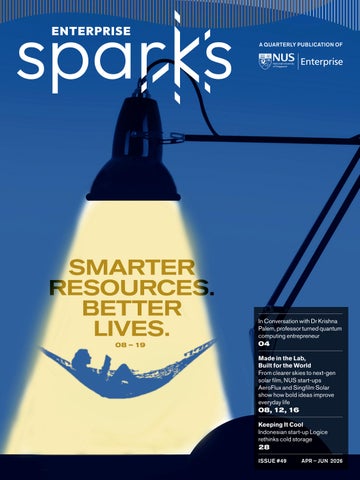
In Conversation with Dr Krishna Palem, professor turned quantum computing entrepreneur 04
Made in the Lab, Built for the World
From clearer skies to next‑gen solar film, NUS start ups
AeroFlux and Singfilm Solar show how bold ideas improve everyday life 08, 12, 16
Keeping It Cool Indonesian start up Logice rethinks cold storage 28
FROM THE SENIOR VICE PRESIDENT (INNOVATION AND ENTERPRISE)
The most enduring innovations aren't just clever — they are necessary. This issue of Enterprise Sparks explores a compelling idea: that efficiency isn't about cutting corners, but about making every resource count to improve lives. From AeroFlux's carbon capture technology, to Singfilm Solar's thin film solar powering the AI era, to Logice's reimagining of cold chain logistics in Indonesia through WhatsApp — our entrepreneurs show that resourcefulness and ambition aren't opposites. They're one and the same.
For In Conversation, we speak with Dr Krishna Palem, the pioneer behind inexact computing who proved that "good enough" could outmatch perfect. Now, through his new venture, Accelequant, he is applying that same contrarian philosophy to quantum computing, compressing what the industry assumes will take decades into a viable commercial reality today.
At NUS Enterprise, we believe the next wave of innovation will be defined by those who think smarter — not just bigger. Let's build ventures that are efficient by design and transformative by purpose.
TO The Intriguing Journey of a Professor Turned Entrepreneur
ACADEMIC HALLS QUANTUM LEAPS
By Lee Pui Mun
In a world where precision has long defined computing, Dr Krishna Palem pioneered inexact (probabilistic) computing, demonstrating how controlled trade offs in accuracy can unlock transformative efficiency gains.
Inexact computing influenced energy efficient chips in smartphones, data centres, and AI applications worldwide, fundamentally reshaping computational efficiency. Today
Accelequant, a venture founded by Dr Palem, is applying his mathematically grounded, engineering driven philosophy to existing quantum computing systems, accelerating the commercial deployment of viable quantum computing solutions for companies, shrinking decades into years.
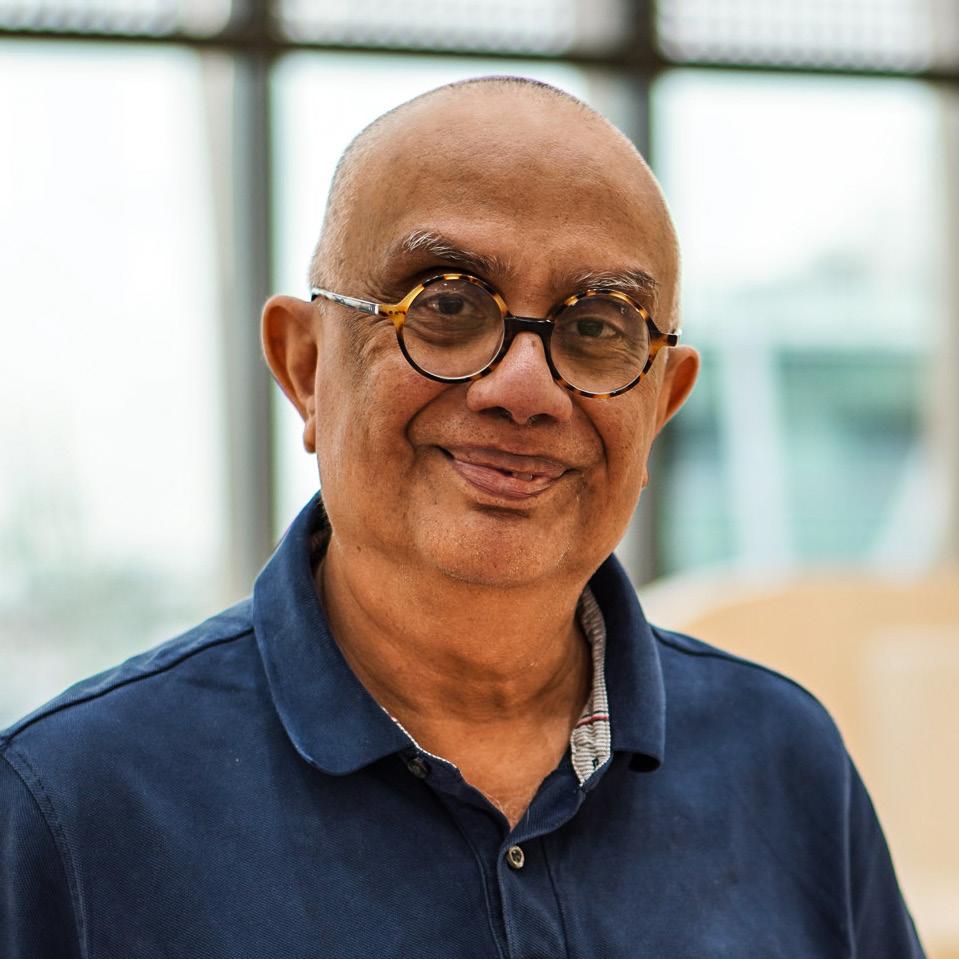
Dr Krishna Palem, previously the former Kenneth and Audrey Kennedy Professor of Computing at Rice University, has built his career on a powerful counterintuitive principle “good enough” solutions. In the mid 2000s, he pioneered inexact computing, postulating that circuits trading a small amount of accuracy for energy savings could revolutionise technology. His work was recognised by the Institute of Electrical and Electronics Engineers (IEEE) as one of seven world changing technologies, and named in MIT Technology Review’s annual top 10 list of technologies that are most likely to “alter industries, fields of research and even the way we live.”
THE SPARK OF AN IDEA: STEPPING INTO QUANTUM COMPUTING
For Dr Palem, the leap from professor to founder was a carefully considered pivot, catalysed by two key events that caused his perspective to, in his words, "really flip."
The first spark came during a summer visit to the Indian Institute of Technology in Hyderabad. There, he met a colleague teaching quantum computing. As Dr Palem listened, he recognised an intriguing connection between the quantum algorithms being discussed and his own deep expertise in semiconductors. As they discussed the field’s challenges, he had a moment of inspiration: quantum computing has inherited the fundamental crisis of the classical chip: the scarcity of the energy precision budget.
He, in collaboration with his graduate student and a colleague at IIT Hyderabad, started working in quantum computing.
THE POWER OF "INEXACT" COMPUTING
Today, Dr Palem is best known as one of the foundational figures in the field of inexact (probabilistic) computing. In the mid 2000s, when rising power consumption was becoming a critical concern for computer chips, he pioneered the notion of deliberately trading a small amount of computational accuracy for significant gains in energy efficiency. "They are supposed to be correct," he says, referring to traditional
chips, which are conventional, classical integrated circuits (ICs) based on CMOS (Complementary Metal Oxide Semiconductor) technology. These chips have been the foundation of modern digital electronics, processing data using binary bits via transistors for decades.
But Dr Palem challenged this assumption, questioning if "good enough" could unlock far greater efficiency than “perfect.”
Years later, he found himself staring down quantum computing's three great hurdles: the limited number of qubits, their quality, and the absence of scalable algorithms. He had an epiphany.
However, translating this revelation into practice was far from straightforward. "Quantum computing has very different internal mathematics," Dr Palem explains. Applying inexact principles from classical computing to the complex realm of quantum mechanics was the bridge he and his team had to build. This bridge, a mathematical framework developed with his student, gave him the optimism that his idea could be profoundly useful in today’s world.
BRINGING THE QUANTUM ADVANTAGE TODAY, NOT TOMORROW
This technological breakthrough crystalised Dr Palem’s core entrepreneurial philosophy: deep tech start ups, no matter how brilliant their technology, must have viable business models built on customer traction and sustainable revenue.
He outlines a pragmatic two path approach. The first path enhances existing businesses with proven revenue models. The second chases a futuristic application with huge potential, not necessarily with immediate commercial value, things that are currently unimaginable with classical computers.
His start up, Accelequant, chose the former as its entry point, a philosophy the company formalises as Quantum Commercial Advantage, the principle that quantum systems must deliver measurable business value, beyond theoretical supremacy.
This pragmatic focus on tangible, measurable value, whether through meaningful cost savings or revenue growth, is what attracts paying customers today rather than in a distant decade. This is a crucial distinction in an industry where commercial viability often lags years behind technological capability. To this end, Accelequant partners with best in class quantum hardware companies and is also active in the IBM Quantum Network.
“It is about delivering a substantial, valuable improvement that directly impacts a customer's bottom line. Imagine if you can take something that took a few hours and do it in minutes, that’s a win,” he said.
BUILDING
THE TEAM: THE QUEST FOR "QUANTUM READINESS"
“To execute this vision, we need quantum algorithm engineers,” Dr. Palem explains.
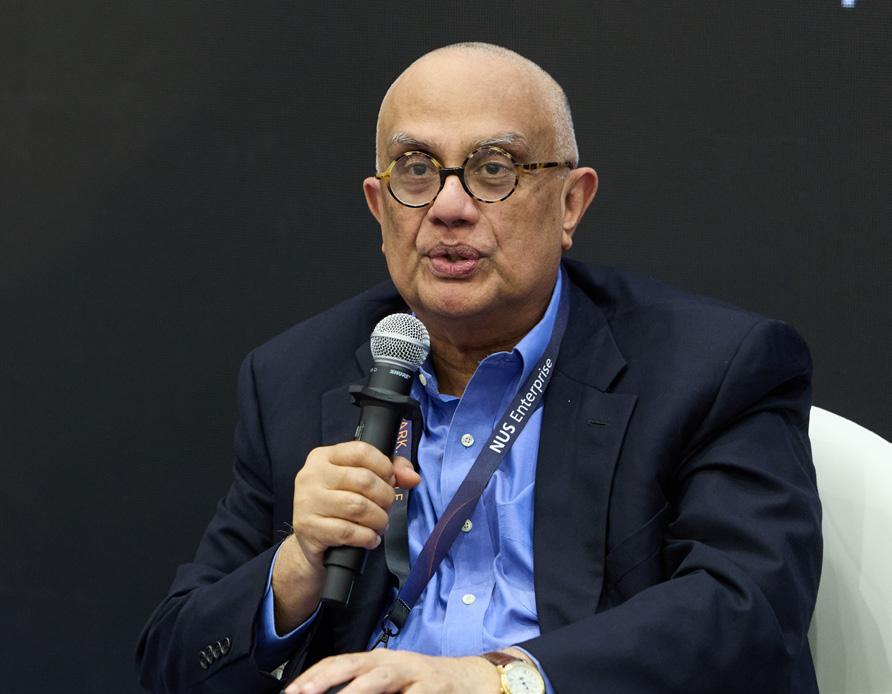
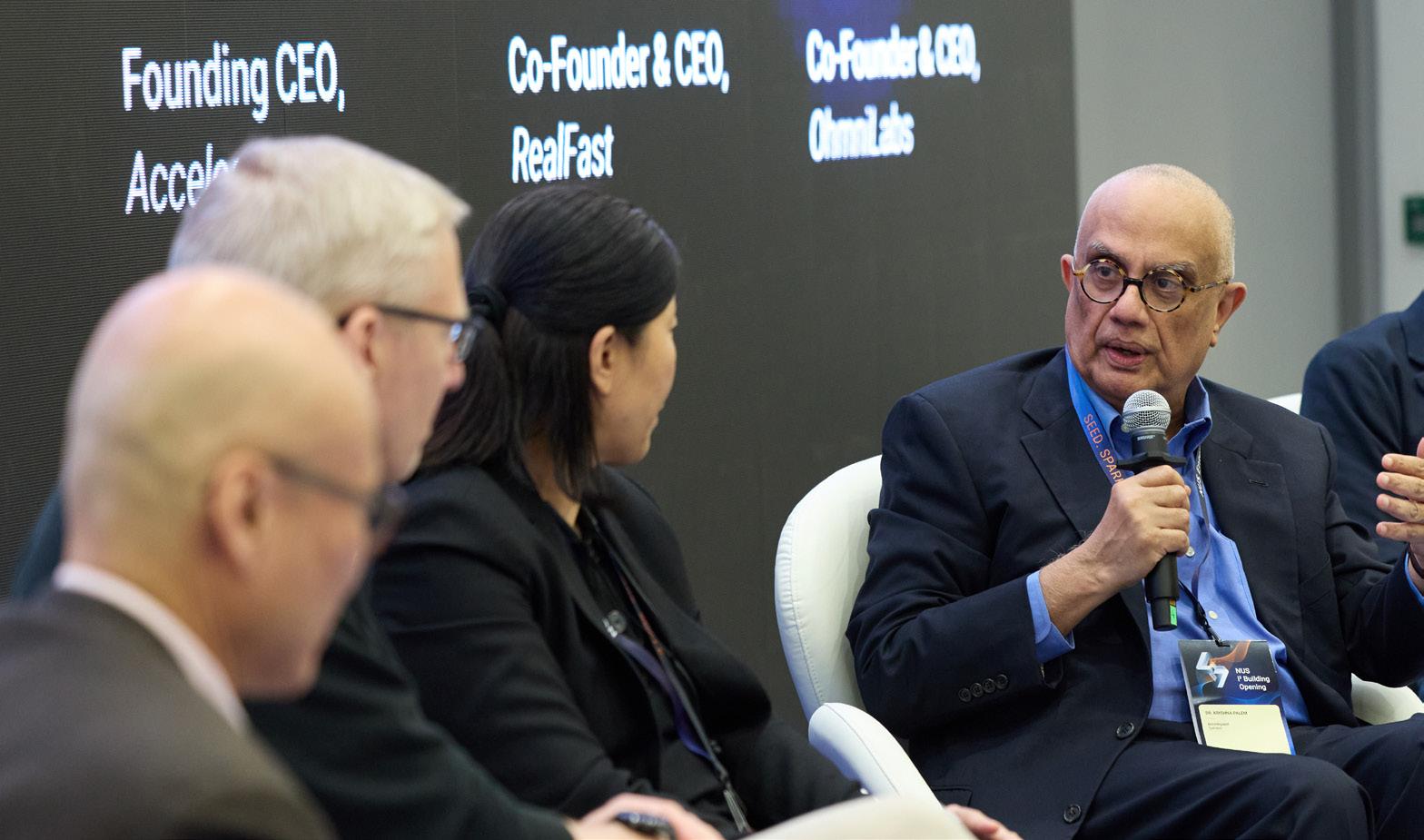
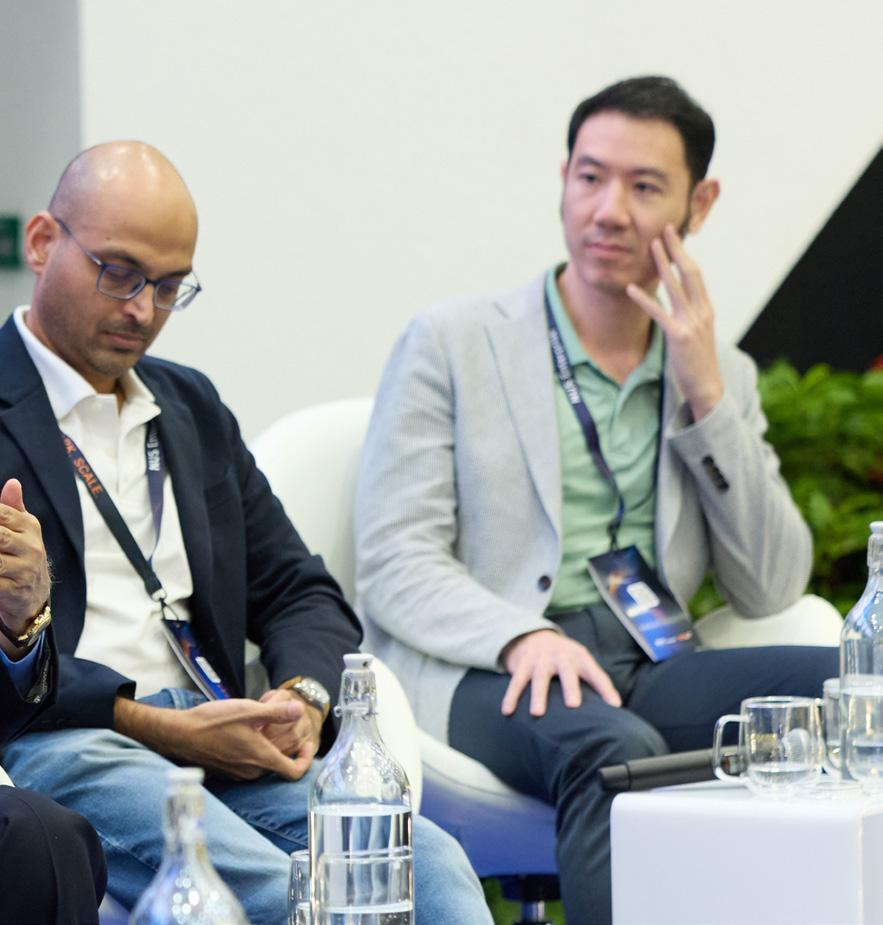
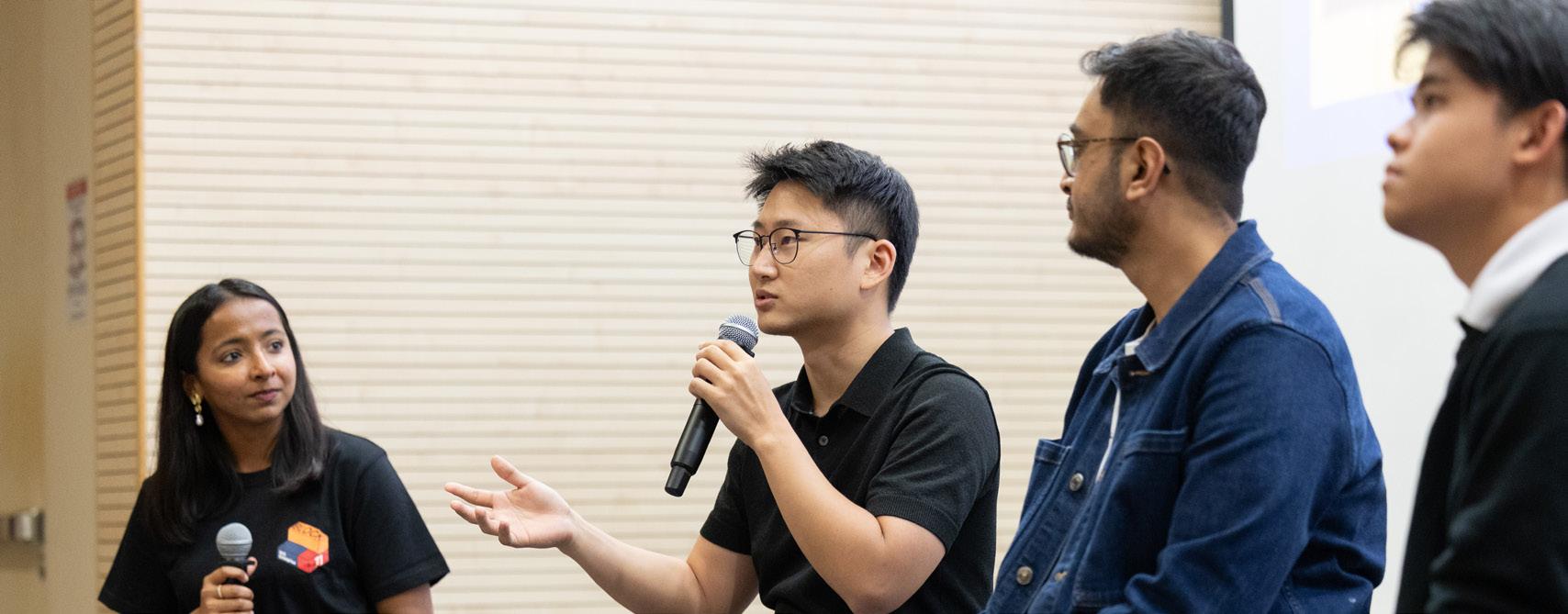
Dr Palem (centre) speaking at a panel discussion on software and AI at the official opening of i3 building, the hub for entrepreneurial collaboration and deep tech innovation in NUS.
These are experts who can navigate the complex mathematics of quantum computing while understanding how to map real world business problems onto quantum hardware. When assembling his team at Accelequant, he was clear about what he needed. “These individuals must be comfortable working with complex numbers, what mathematicians call Hilbert space, while also grasping the practical constraints of quantum gates and information transfer between qubits. The firm today has a world class group of such outstanding professionals.”
This focus on commercial scalability, he believes, will differentiate successful quantum companies from academic exercises in the rapidly growing quantum industry.
A PRAGMATIC PATH FORWARD
This same pragmatic approach extends to his investors. For a deep tech field known for long lifecycles and uncertainty,
“It is about delivering a substantial, valuable improvement that directly impacts a customer's bottom line. Imagine if you can take something that took a few hours and do it in minutes, that’s a win.”
Dr Palem has emphasised “patient, experienced money.” He reconciles the inherent risks by pulling the horizon of value creation forward. Accelequant’s thesis and vision is to “deliver measurable value within a three year window,” a stark contrast to the decade long projections often associated with quantum computing. “By proving commercial advantage now,” he notes, “you build
credibility and fuel growth.”
From a pivotal summer conversation in Hyderabad to founding Accelequant, a venture backed hybrid quantum company focused on accelerating real world adoption, Dr Palem’s journey is a masterclass in how translational research can catalyse commercial innovation.
Quantum computing may be the most theoretical of sciences, yet Dr Palem’s journey demonstrates that entrepreneurship is not confined to a particular career stage. It emerges when deep expertise, an openness to exploration and pragmatism meets massive market needs.
What distinguishes Dr Palem's approach is its intellectual honesty: a recognition that even transformative technology must solve real world problems for today’s customers. The quantum computing industry is often characterised by long term promises, "within the next decade." Dr Palem chose a different path, one that prioritises tangible value today over speculative moonshots tomorrow.
Dr Palem's journey stands as a powerful testament that the path to entrepreneurship is open to anyone with a novel idea and the courage to pursue it. For academics and researchers contemplating the entrepreneurial leap, his story offers practical encouragement. “You do not need to abandon rigor for hype or sacrifice scientific integrity for market appeal. What you need is clarity about the problem you are solving, a well defined path to market, and the resilience to bridge research and commercial practice.
Your most valuable asset isn't necessarily a Silicon Valley background or venture capital connections. It's the unique expertise you have cultivated and your ability to apply it in the most transformative manner to solve societies pressing problems.”
Dr Lee Pui Mun is a Technology Commercialisation Lead with the Technology Transfer and Innovation (TTI) team at NUS Enterprise, where she connects groundbreaking research with real-world impact. She is a published researcher with over 15 peer-reviewed articles in journals such as Nature Electronics and Nature Materials. During her postdoctoral fellowship with the NUS Wireless Bioelectronics Group, she focused on developing wireless electronic devices for wearables and implants. She earned her Ph.D. in Electrochemical Sensors Design from Nanyang Technological University.
A carbon capture system that fits anywhere. Even on a ship.
Most climate solutions sound impressive in powerpoint decks, but fall apart the moment they meet real world infrastructure. For the shipping industry, which emits roughly 1,000 million tonnes of CO₂ per year and accounts for three per cent of global emissions, the problem is not just ambition: it is physics. Retrofitting a vessel for decarbonisation means competing for space in a machine engineered with no room to spare. Conventional carbon capture systems are simply too large, too costly, and too disruptive to integrate, making shipping one of the sectors hardest to decarbonise due to its physical and operational constraints.
AeroFlux is built specifically to address this gap.
Founded by NUS Research Fellow Dr Feb Hillman, the Singapore based deep tech start up has developed a modular, retrofittable carbon capture system anchored in patented membrane technology. Designed for ships and other space constrained, heavy emitting industries, AeroFlux's system delivers 80 per cent lower costs, 70 per cent greater efficiency, and occupies 90 per cent less space than conventional carbon capture systems, making it a practical solution where others simply cannot fit.
From research lab to global climate venture
Dr Hillman's path to founding AeroFlux was shaped less by a single eureka moment than by a long held belief in circularity. "I've always been interested in starting my own business and wanted to do something related to the circular economy," he shares. The turning point came during his time supporting a government funded carbon capture research project at NUS, where he invented a new material that would eventually become the backbone of AeroFlux's patented membrane technology.
His PhD years reinforced what entrepreneurship would later demand: the ability to own a problem completely. "I really enjoyed solving a problem and leading a project. I find it rewarding when I can provide meaningful impact to society," he reflects. Founding AeroFlux gave him a vehicle to do exactly that, on a scale that laboratory research alone could not.
Breakthrough membrane technology built for the real world
At its core, AeroFlux's carbon capture system works by separating CO₂ from the mixture of gases produced when fuel burns, isolating it before it even reaches the atmosphere. What makes this more than an
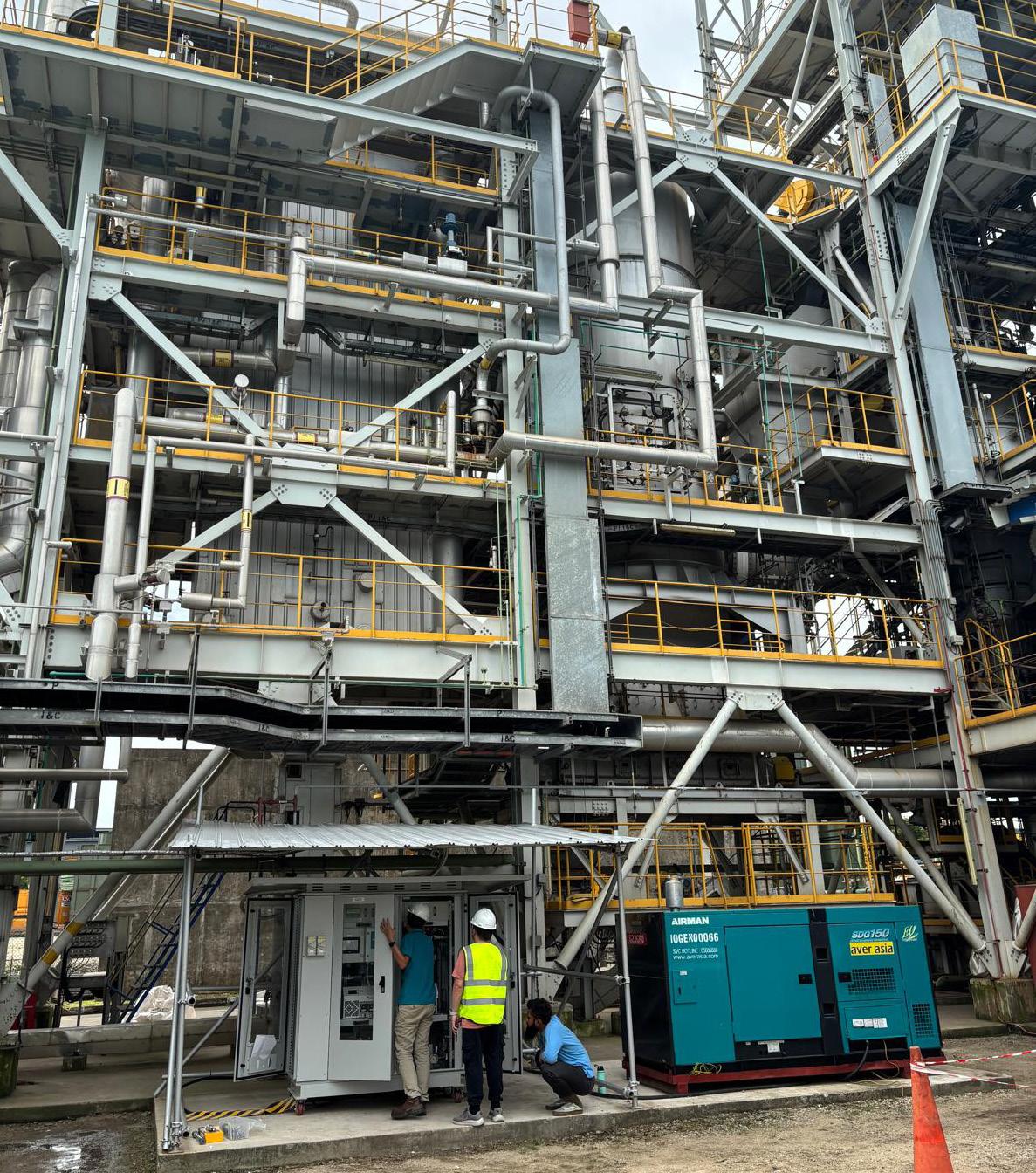
TOP: AeroFlux’s modular, retrofittable carbon capture system at a shipping site.
incremental improvement is the material enabling it: the company's patented membrane, essentially a high tech molecular filter that sieves CO₂ out of exhaust gas with far greater precision than conventional methods, is the first in the world to meet commercial target performance for carbon capture, a threshold the industry has long struggled to cross.
The start up is currently focused on scaling from lab prototype to real world industrial demonstration, with the immediate priority being proof of value testing across actual industrial settings. Beyond capturing CO₂, Dr Hillman has an eye on a longer term ambition: finding ways to create tangible value
"Think of our system like an air purifier for industry. Just like how a home air purifier filters out pollutants from the air in a room, our membrane filters and captures CO2 from exhaust gas before it even leaves a factory or a ship. It is modular, retrofittable into existing operations, and it takes up a fraction of the space of conventional systems. The goal is not just to capture carbon, but to eventually turn that captured CO2 into something of real value."
TOP:
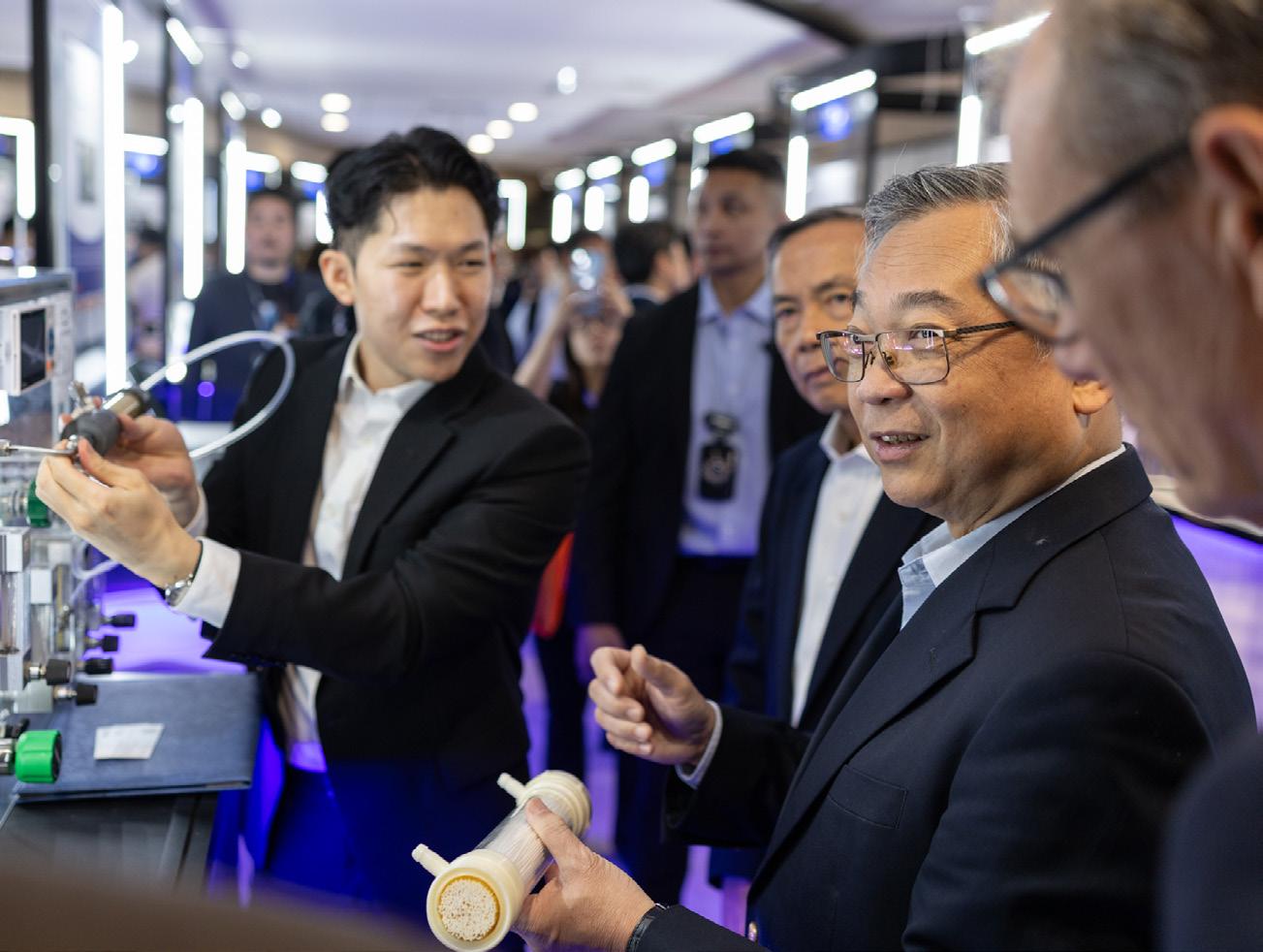
Deputy Prime Minister Gan Kim Yong (right) with AeroFlux Chief Executive and co-founder Dr Feb Hillman (left) at the National GRIP start-up showcase during the official opening of i3 building on 16 September 2025.
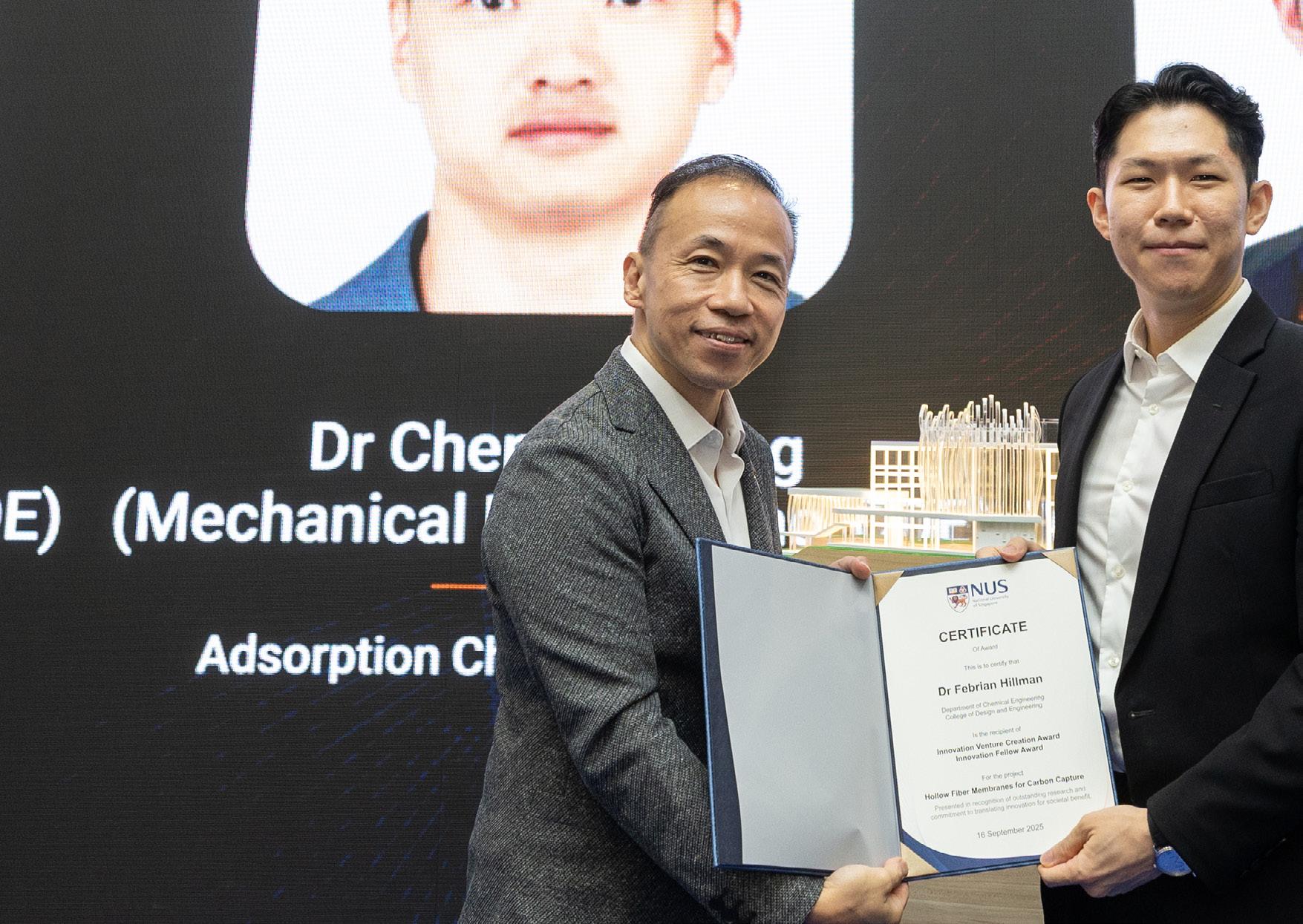
Dr Feb Hillman receiving the Innovation Venture Creation (IVC) Award certificate from Deputy President (Academic Affairs) and Provost Prof Aaron Thean at the official opening event of i3 building in NUS campus.
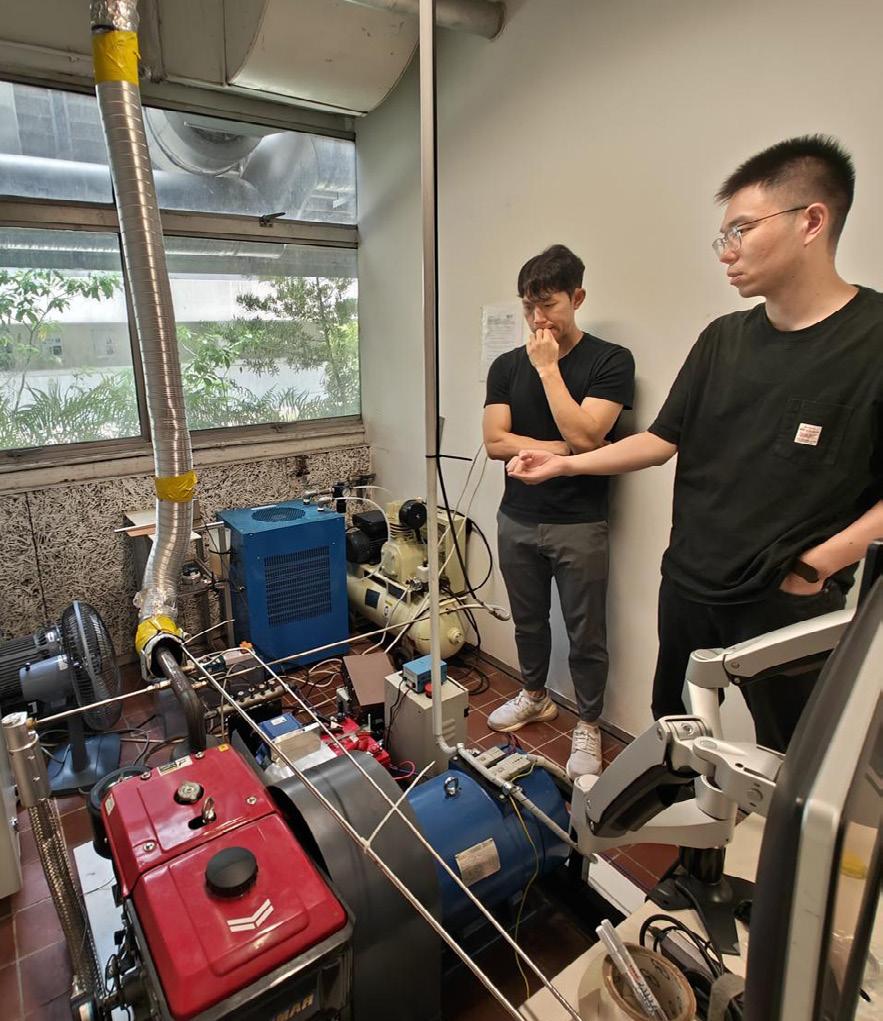
Testing AeroFlux's carbon capture system with real flue gas
meeting three distinct camps among potential customers: those who embrace it, those who are neutral, and those who are against it. Rather than be discouraged, he sees the sceptics as part of his life’s mission. "Hopefully one day I can convert the non believers to believers," he says.
The traction AeroFlux has built so far suggests that mission is gaining ground.
In 2024, the start up was selected as one of eight Elite Finalists in the MIT Climate and Energy Prize , chosen from over 160 start ups across 94 universities and 44 countries.
That same year, Feb was named an NUS Enterprise Innovation Fellow under the NUS Innovation Venture Creation (IVC) Award, and had the opportunity to present AeroFlux to Singapore's Deputy Prime Minister Gan Kim Yong, with the start up's work featured in The Straits Times. AeroFlux has since secured multiple industrial partnerships to bring its prototypes into real world testing environments, marking a critical step from research discovery to commercial proof of value.
That persistence is also what he credits as the most important trait for any deep tech founder. The global innovation ecosystem nurtured by NUS Enterprise, including the IVC Award funding provided and access to BLOCK71's global network of incubation nodes, has helped him connect with potential customers and investors, but he is clear that external support only goes so far.
Advice for aspiring entrepreneurs
For founders considering a similar path, Hillman's advice is blunt: "You have to really, really love your problem and your tech. There is no turning back. You are the only one who can make it or break it for your career."
2025
• Dr Hillman received Innovation Venture Creation (Innovation Fellow) Award, supported by NUS Enterprise
• Participated in the inaugural National GRIP Showcase at the official opening of i3 building, demonstrated innovation to DPM Gan Kim Yong
• Entry into the inaugural cohort of National GRIP (Graduate Research Innovation Programme), Singapore's national initiative to transform cutting edge research from its autonomous universities into market ready deep tech start ups.
• Received the Trailblazer award at the Connecting Future Cup 2025, a Shanghai based global innovation and entrepreneurship competition
• Participated in Asia Green Energy Innovation Challenge by BLOCK71
2024
• MIT Climate & Energy Prize (MIT CEP) London semi finalist
2023
• Won Grand Prize in both the Research and Venture Pitch tracks of the US ASEAN Science, Technology, and Innovation Cooperation (STIC) Competition
• Second Runner up in MIT 15k competition
from captured CO₂, so it becomes an asset rather than just a cost.
Turning sceptics into believers
Carbon capture is a technology that divides opinion. Dr Hillman describes
He adds that Singapore offers a genuinely supportive environment for this kind of conviction, with a growing start up community and infrastructure that rewards those willing to back themselves. For Hillman, that belief in both the problem and the place is not just motivational advice. It is the reason AeroFlux exists.
We See Blood. She Sees Opportunity.
Tan Peck Ying is the co founder and CEO of Blood, a Singapore based menstrual health company on a mission to normalise periods and make them more manageable. She met her co founder and husband Caleb Leow while enrolled in an entrepreneurship module at the National University of Singapore (NUS). Both went on to participate in the NUS Overseas Colleges (NOC) programme, where Peck Ying witnessed firsthand how curiosity could be the starting point for building something real. The itch to start a business was hard to ignore. Today, Blood's products are stocked at over 7,000 retail locations across Singapore, Malaysia and Indonesia including Guardian, Watsons, NTUC FairPrice, Cold Storage, and 7 Eleven. Its bestselling corn based sanitary pad, the first of its kind in the world, absorbs liquid three times faster than cotton, and is naturally hypoallergenic.
From
PS Love to Blood
Launched in 2014 as PSLove, the company's first product was MenstruHeat, a drug free adhesive heat patch born from Peck Ying's own struggle with debilitating period pain. Rather than seek
“Rebranding was bold, but it would have been risker to continue playing it safe. We saw what we often call “a sea of sameness”; brands portraying women skipping through white lily fields, smiling on their period. That just wasn’t our reality.”
Blood's best selling corn-based sanitary pads.
outside capital early on, the couple chose to maintain sustainable unit economics and reinvest profits back into the business, a carefully considered approach that allowed them to stay in control of their own trajectory.
The defining move came in 2022: a full rebrand to Blood, and the launch of the world's first corn based sanitary pad, designed absorbs liquid three times faster than cotton and naturally hypoallergenic.
“Periods are not blue liquid, they’re not always graceful. They can be messy, inconvenient and uncomfortable, and that’s completely normal. We wanted to build a brand that challenged those norms, to be openly contrarian yet real.”
Friends, investors and retailers were shocked. Some loved it, some didn't. But as Peck Ying intended, nobody could forget it.“From our brand name to packaging, it sparked conversations. Maybe that's how speaking about feminine health should have been all along.”
Finding the path to entrepreneurship with NOC
Peck Ying's pivot to entrepreneurship was less a lightning bolt moment and more a gradual reckoning. When studying Biomedical Science at NUS, she somehow felt restless. “I didn't enjoy the routine of lab work, the repetition and the inability to make things happen the way I wanted to." In her final year, she dropped her FYP and pursued a business minor instead, a decision that surprised her family and friends, and turned out to be the best one she made in university.
“I am someone who will go out of my way to pursue what I truly enjoy and find meaningful. And for me, that turned out to be entrepreneurship, being able to create meaningful impact at scale and build on my own terms.”
Participating in the iLead/NOC Singapore programme and working at NUS Enterprise was where she got immersed in the start up space.
Give to gain, on her own terms
Scaling Blood also meant growing as a leader and a mother, and that has come with real trade offs. “ The most significant sacrifice in the last few years has been time with my kids. When I first became a parent, I honestly
Tan Peck Ying (left), with her partner and co-founder Caleb Leow (right).
Photo Credit: Vulcan Post
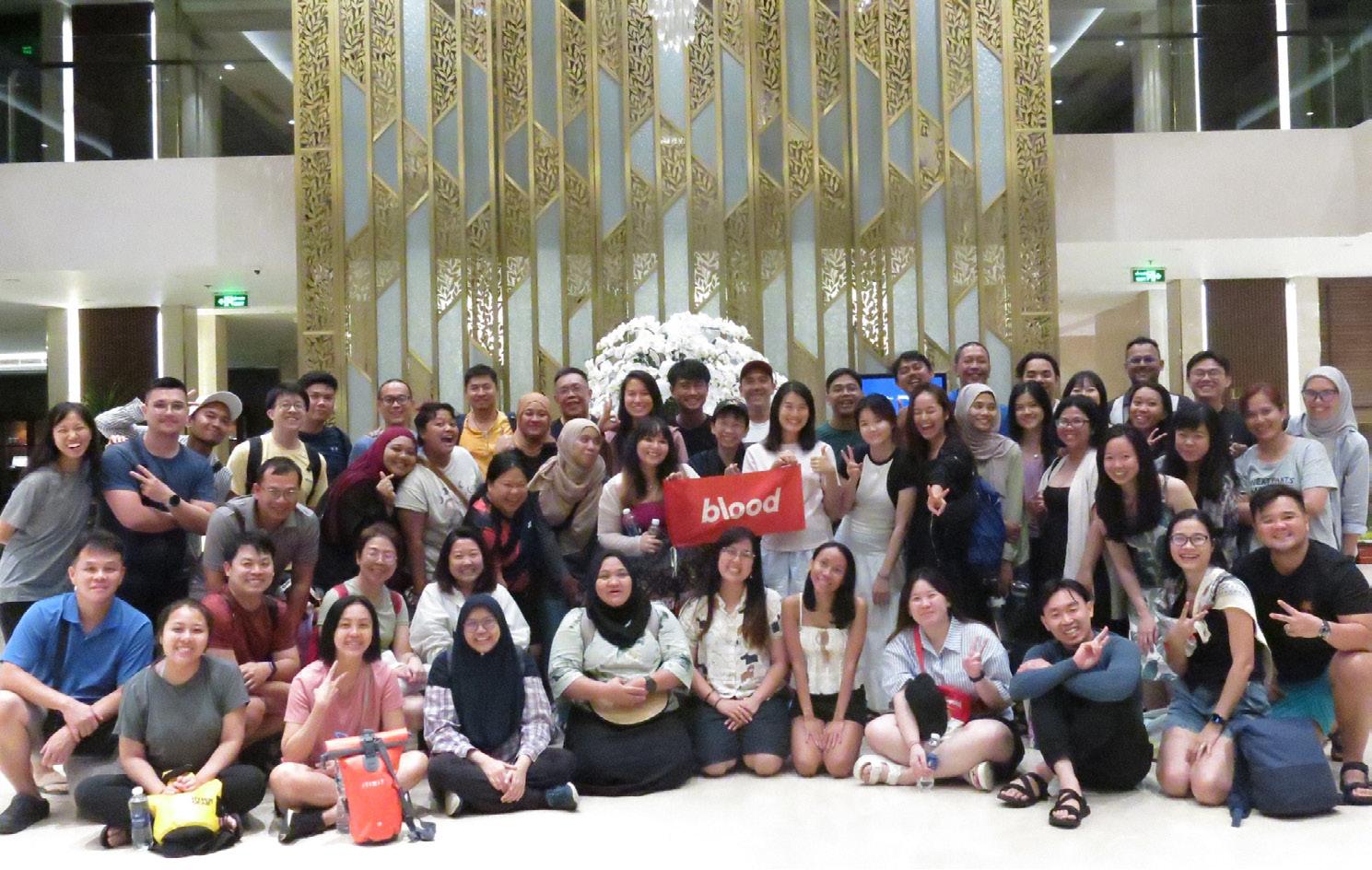
Blood's most anticipated annual event where the teams across regions meet physically to interact and bond.
didn't anticipate how challenging it would be. At the same time, the company was growing. My kids were growing. Both needed me in completely different ways. There were definitely seasons where it felt like a constant tug of war.”
An investor's words stayed with her “You have agency to build your life the way you want. Building the team in such a way that you can grow the business and still feel like engaged, involved parents; that should be the goal.”
She never liked the idea of having to choose between building a company and being present for her children. That discomfort pushed her to redesign how she led the business.
“I needed to build a company that was not dependent on me reacting to every fire or being involved in the day to day operations. This pushed me to become the kind of leader I needed to be: more strategic, less reactive, and supported by a team that was strong and dependable.”
“I don’t think of myself as a female entrepreneur.”
Peck Ying is measured and clear eyed on the subject of gender. “To me, an entrepreneur is an entrepreneur.” When asked what are her thought on the old idiom that behind every successful man stands a woman, she doesn’t hesitate. “If I were to rewrite that idiom, it wouldn’t be about who stands in front or behind. It would be: ownership and resilience aren’t gendered. Neither is success.”
By choosing to bleed happy and loud, periods today no longer just end sentences. They spark conversations.
"I have been connected to many good mentors through the ecosystem. For example, Brian Koh connected us to someone from P&G. Since they are in the consumer space, they know what works in the market, how the distributors work, how to manage exports, and marketing and pricing strategies."
2024 Achieved over 70% topline growth in revenue as Blood scales beyond Singapore.
2023 Expanded product range and retail presence across Singapore.
2019 Rebranded from PSLove to Blood as a modern period care brand.
2017 Launched its first pain relief heat patch and period care products.
Founded in Singapore (then called PSLove). 2014
Singfilm Solar: Powering the AI World from Devices to Data Centres
Singfilm Solar has set world record efficiencies, raised multi million dollar funding from leading investors, and earned a place in the Solar Cell Efficiency Tables, widely regarded as the most authoritative efficiency benchmark in the global photovoltaic community. Now, this NUS spin off is pushing perovskite solar beyond the rooftop, into both electronic hardware we use today and future AI infrastructure in low Earth orbit.
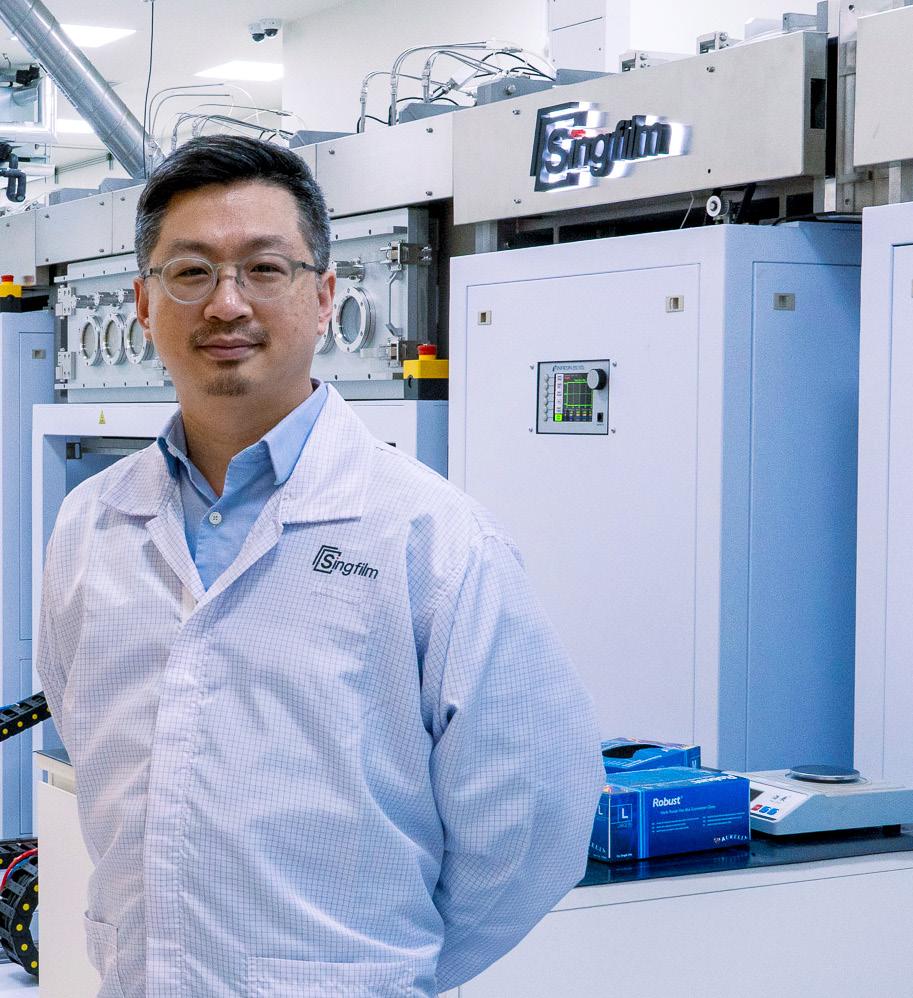
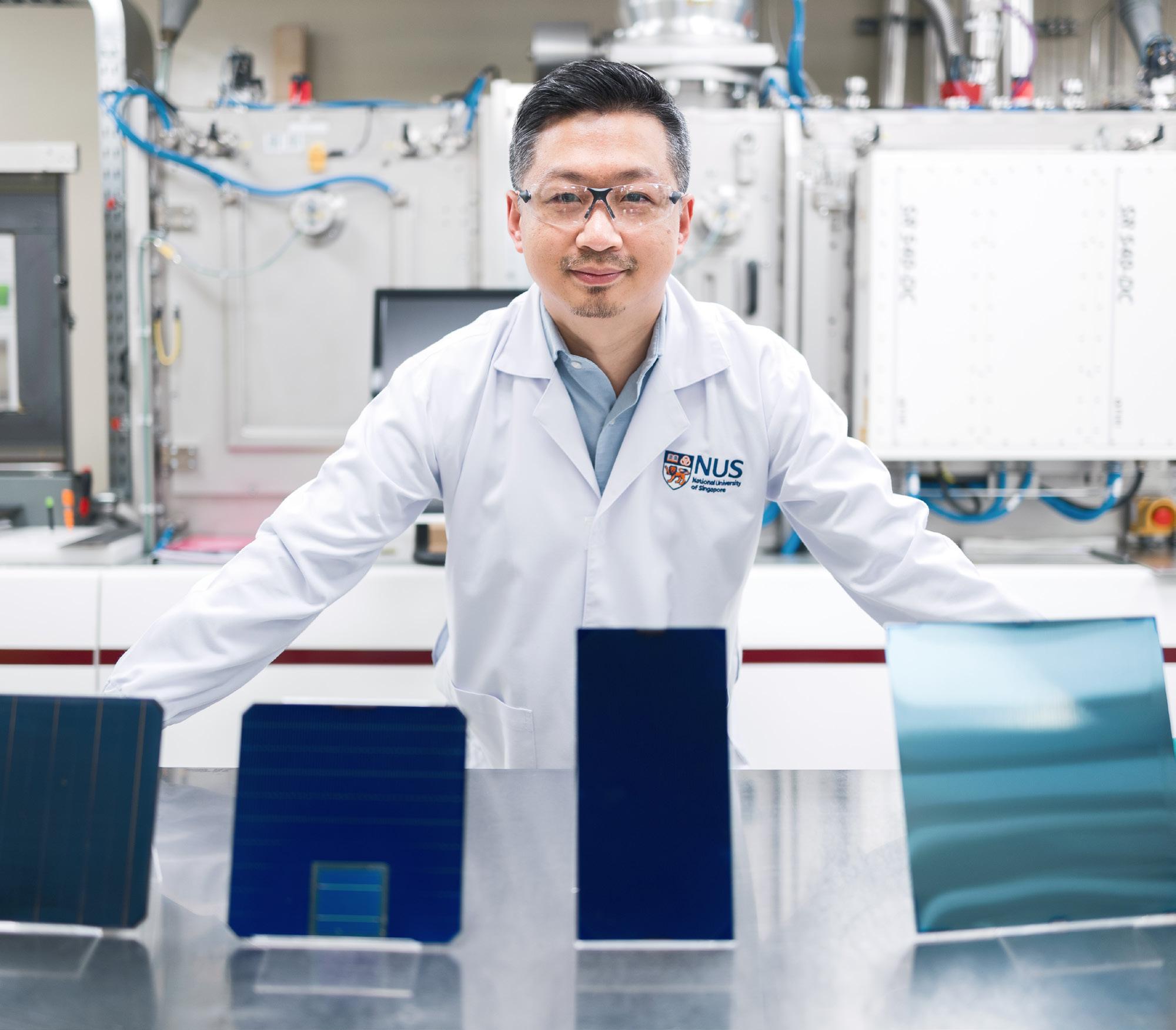
Singfilm Solar Founder Professor Yi Hou at the company’s production facility in Singapore. The facility is ASEAN's largest perovskite indoor photovoltaic production line with a capacity of 15MW, producing several million solar cell units per year.
Imagine wearing a smartwatch that never needs charging, its power drawn silently from the ambient light around you. Or walking through a supermarket where every electronic shelf label updates itself continuously, no battery changes required. These are not speculative futures. They are the immediate commercial applications of Singfilm Solar, a Singapore based start up that is quietly transforming how photovoltaic technology can improve our everyday lives.
Founded in 2023 by Assistant Professor Yi Hou, a Presidential Young Professor at the National University of Singapore (NUS) and named one of MIT Technology Review's Innovators Under 35 (Asia Pacific), Singfilm Solar is built on more than a decade of pioneering research into perovskite photovoltaics, a next generation solar material that has drawn global interest in scientific circles with its potential. Within just two years of operation, the company launched what is today ASEAN's largest perovskite indoor photovoltaic production line, and is among the world’s first to have achieved commercial scale product delivery.
On a mission born from responsibility
Singfilm Solar’s founder Prof Hou spent fourteen years working on perovskite photovoltaic materials. “During that time, I was fortunate to witness the field evolve from early scientific curiosity into a global race for efficiency records. Yet a question kept returning to me: what is the purpose of achieving record efficiencies if the technology never leaves the laboratory?”
Around 2022 and 2023, his team achieved several breakthroughs in efficiency and stability, particularly in multijunction architectures. Prof Hou realised then that the scientific foundation was strong enough.
It was a turning point that made the path forward clear.
“Singfilm Solar was founded that same year as an NUS spin off, representing a natural extension of my research mission: to ensure that fundamental discoveries in materials science evolve into manufacturable, durable and impactful
energy systems. In many ways, the company was born not from ambition alone, but from responsibility.”
Setting the pace on the global stage
Demand for continuous power, lightweight design, and high efficiency is growing across consumer electronics, IoT, and AI powered devices, conditions that have generally favoured the commercialisation of perovskite technology. The key question facing the industry has shifted from whether the technology performs well enough to whether it can be manufactured and delivered at scale.
Singfilm Solar has secured orders from a number of global companies, with its flexible perovskite cells being integrated into AI hardware, consumer electronics, IoT devices, and retail shelf labels. In these applications, the technology is being used to reduce reliance on conventional batteries and provide greater flexibility in device design.
The company is also developing applications for more demanding environments. Its Zenith series, a line of flexible perovskite photovoltaic products, is being designed for space
use, with low Earth orbit (LEO) validation planned for 2026 and 2027. The project has received funding support from the Office for Space Technology & Industry, Singapore (OSTIn), under the Space Accelerator Programme (SAP).
It is a mission that signals just how far perovskite solar has travelled from the laboratory bench.
A boarder vision for solar energy
Most people will not see Singfilm Solar’s's record holding photovoltaic layer. They will simply notice that their devices last longer, the technology around them runs more sustainably. From electronic shelf labels and wearables to lightweight drones, portable AI systems and orbital platforms, perovskite solar is quietly embedding itself into the fabric of our modern life.
At a larger scale, higher efficiency photovoltaics reduce land use and system costs, making renewable electricity accessible to more and more people. The deeper shift is conceptual.
"We no longer need rooftops and vast fields to harness solar energy," Professor Hou reflects. "We just need imagination— and, of course, a surface."
“The greater challenge was no longer discovery, but translation. After years of research, we wanted to see perovskites make a real impact in everyday life, so we chose to take on the scaling effort ourselves, while recognising that commercialisation across the industry is accelerating and positioning perovskites as a global trend.
If we did not take responsibility for scaling the technology ourselves, there was a real risk that perovskite would remain an academic success story rather than an industrial one.”
NUS Enterprise provided valuable support during our early days, helping with investor introductions, facilitating business opportunities, and lending the kind of institutional credibility that matters for a deep tech venture. They've been consistently engaged with Singfilm's progress, and we appreciate their role in opening doors along the way.
One moment stands out from our early days. I still remember Professor Chen Tsuhan personally accompanying me to Changi Airport to meet a strategic partner. That gesture of support, at such an early and uncertain stage, meant a great deal.
We are grateful for the support and encouragement we received during those formative stages—it helped set the foundation as we moved from research to market.
and space environments, and even consumer products including IoT devices and retail shelf labels.
2026 Secured million dollar purchase orders demonstrating early stage commercial validation and market traction
2025 NUS researchers led by Assistant Professor Hou Yi achieved a certified 26.4% efficiency for a perovskite organic tandem solar cell, published in Nature on 25 June 2025.
Launched ASEAN’s largest perovskite indoor photovoltaic production line
2024 Singfilm Solar announced that its perovskite solar module achieved 22.6% steady state conversion efficiency
2023 Singfilm Solar founded as NUS spin off
Prof Hou’s team has demonstrated a wide range of perovskite based tandem solar cells, many of which have been recognised in the world record solar cell efficiency tables, making it the only Singapore-based research group to achieve this distinction.
Crossing the “valley of death”:
Deep SAGE
backs deep tech start-ups
with S$1.5 million
Cold chain logistics. Insurance claims.
Personalised medicine. Three industries, three bold solutions, and three start ups ready to scale.
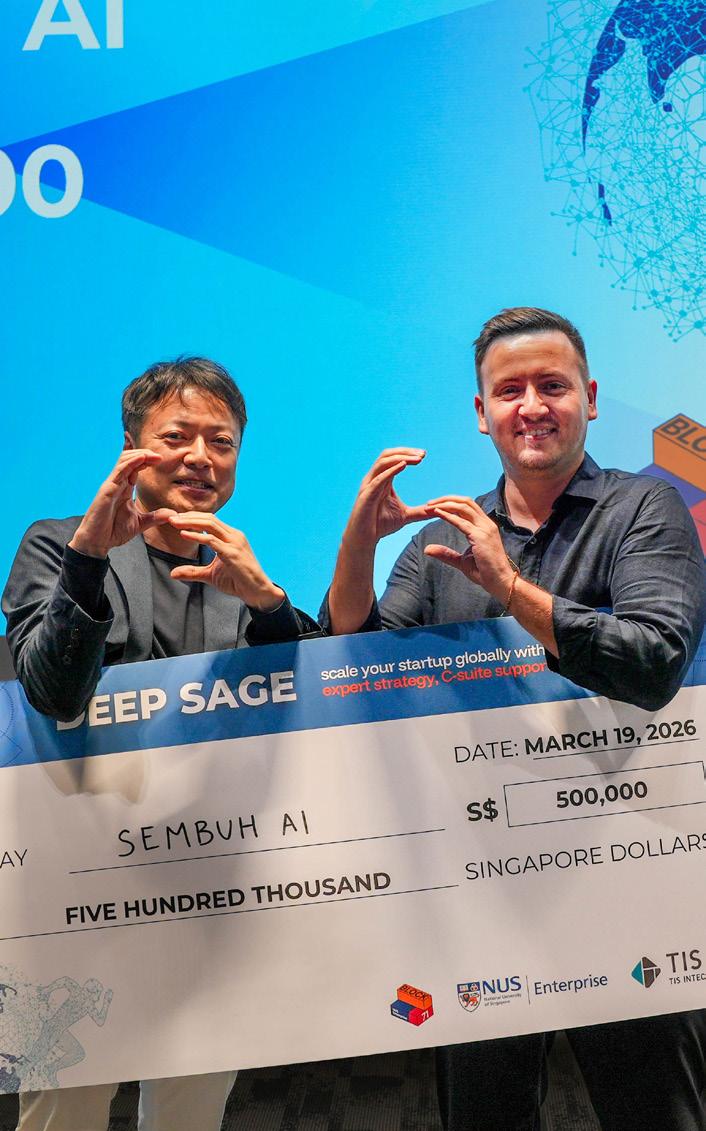
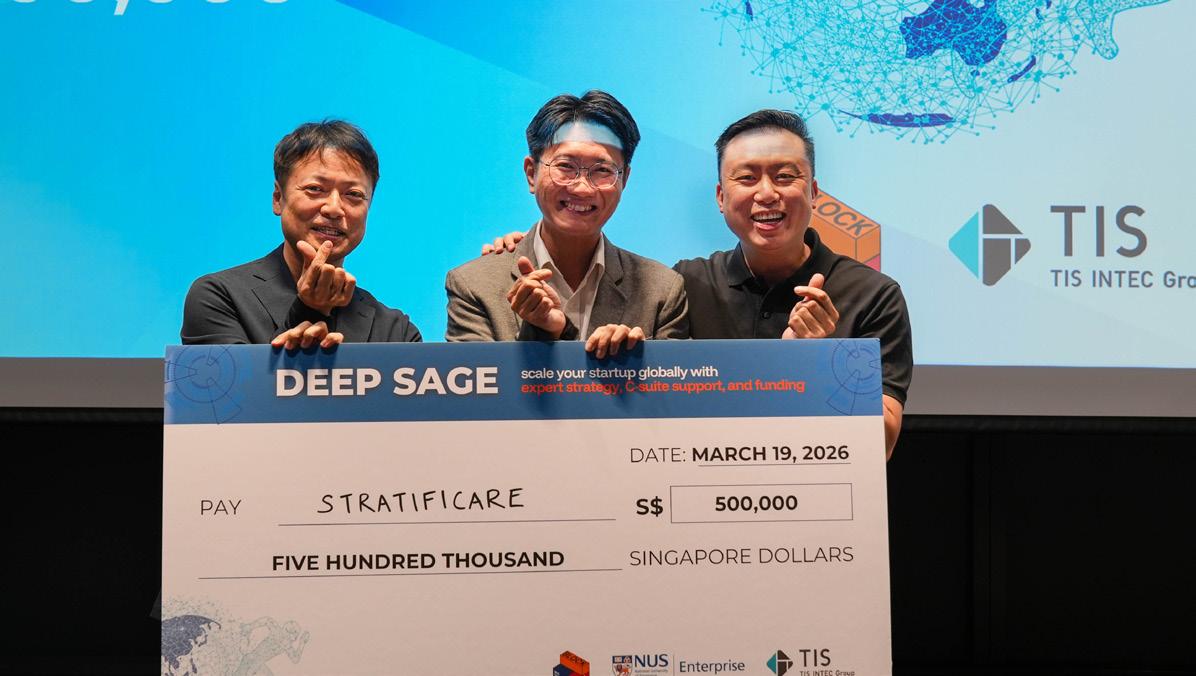
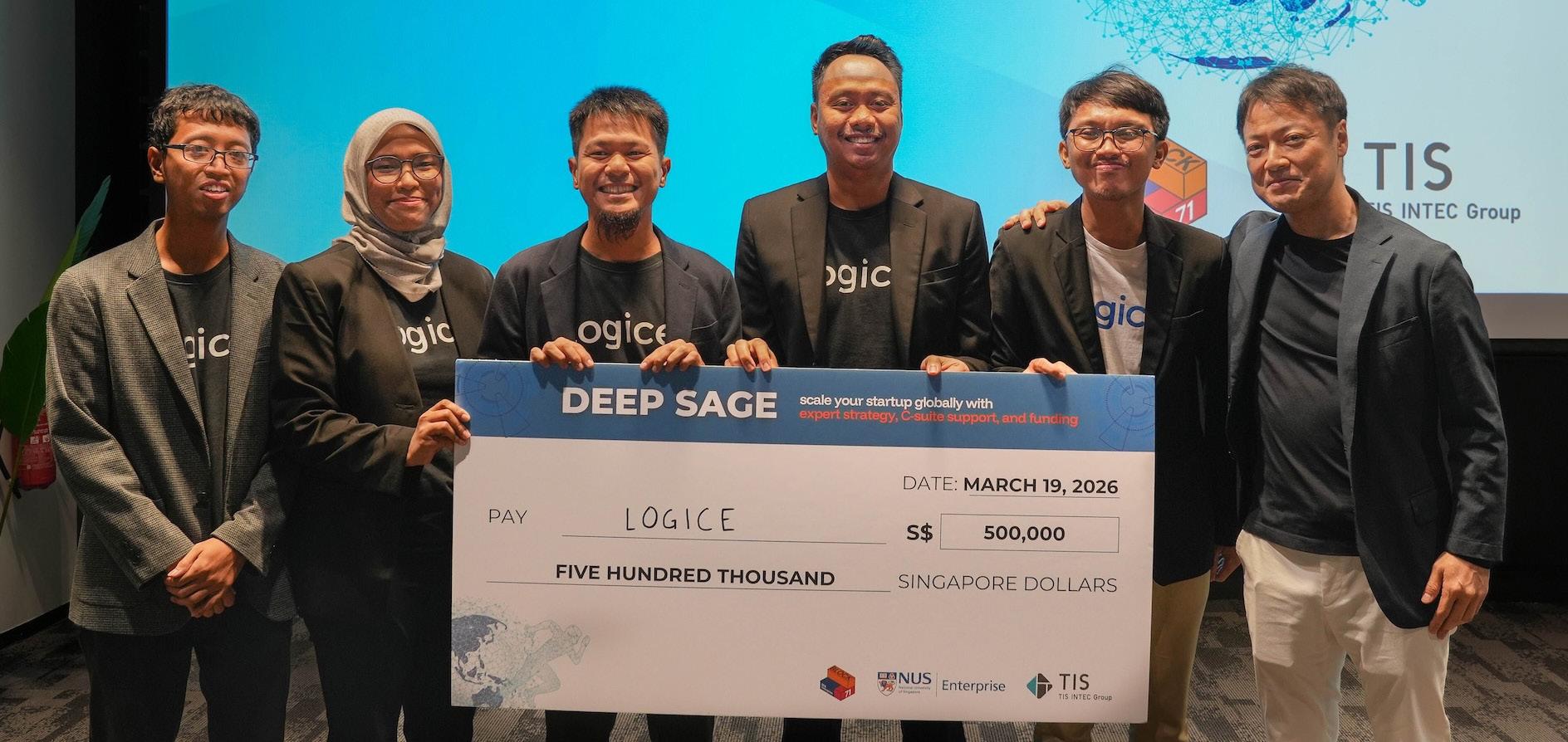
Logice, Sembuh AI and StratifiCare emerged as the top winners at the inaugural Deep Tech Seed to A Growth Expansion Programme (Deep SAGE) Demo Day. Deep SAGE is a collaboration between NUS Enterprise, the entrepreneurial heart of NUS, and TIS Inc., one of Japan’s leading IT companies. Each start up received S$500,000 in funding from TIS Inc., along with continued strategic and execution support through the programme.
Logice is building a more efficient cold chain ecosystem with integrated, technology enabled storage, transport and warehousing solutions for perishable goods. Sembuh AI is streamlining health insurance claims through an AI powered platform that automates processing while detecting fraud and overbilling. StratifiCare is
advancing precision medicine through diagnostic assays, including tools to guide liver cancer treatment decisions and support more personalised care. All three start ups were recognised for their technological strength, clear market potential and readiness to expand.
Where bold ideas take the first step
Over the afternoon, all 10 start ups in the programme’s first cohort presented their solutions to a closed door audience comprising management teams from NUS Enterprise and TIS Inc. Each team delivered a 10 minute pitch followed by a 10 minute Question & Answer session where they addressed questions on technology validation, business models, and strategies for regional and global expansion.
The judging panel, comprising Mr Heng Wui Liang, Head of BLOCK71 Singapore; Mr Yew Hock Meng, Managing Director, Wonwey Pte Ltd; Mr Furusho Kensaku, Managing Executive Officer of Global Business Division, TIS Inc.; Ms Sayaka Kinoshita, Director, TIS Ventures; and Mr Senthil Kumaran, Director, TIS Ventures, evaluated the start ups on both technological innovation and commercial readiness. The winners were announced during a networking dinner that evening.
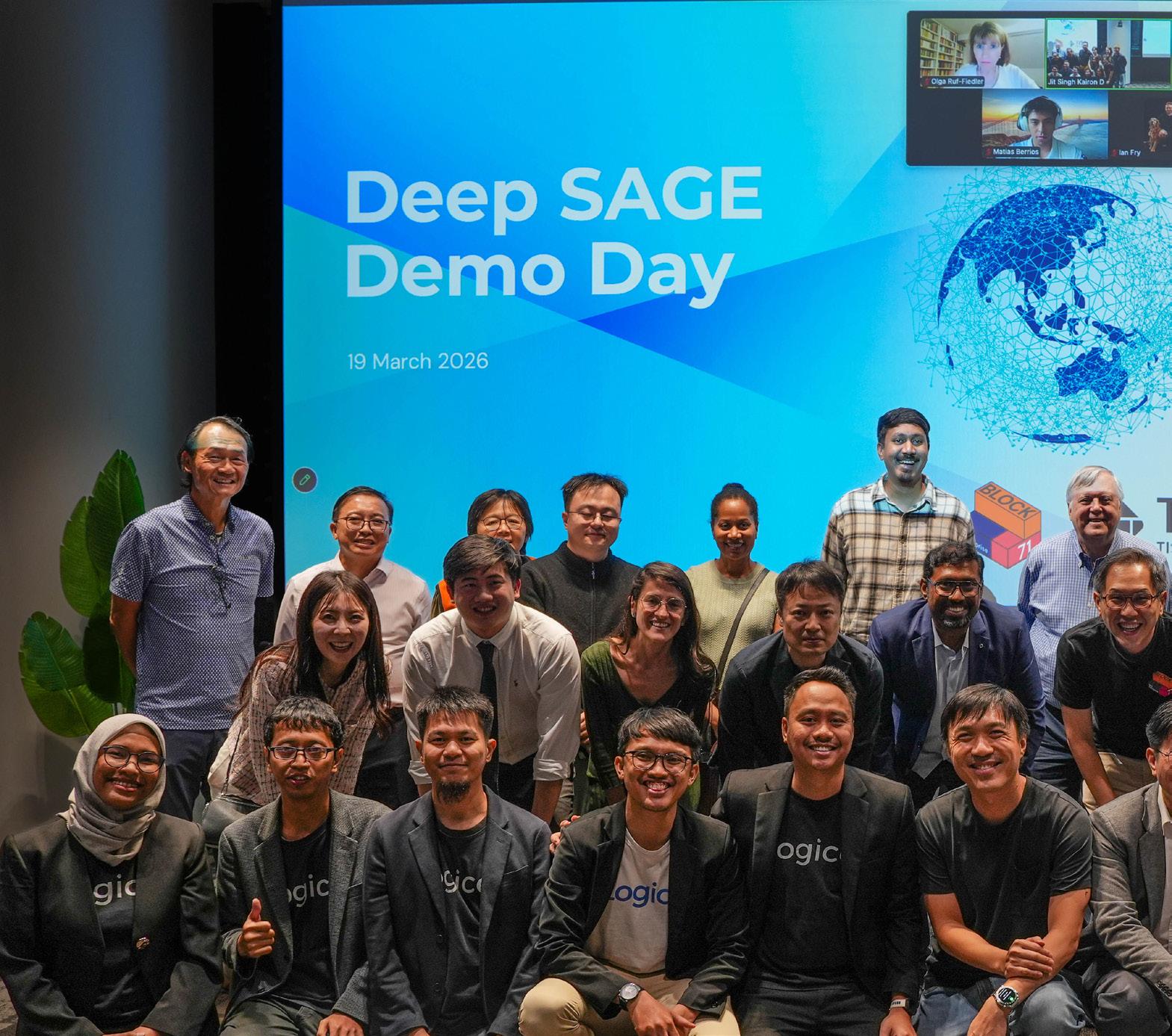
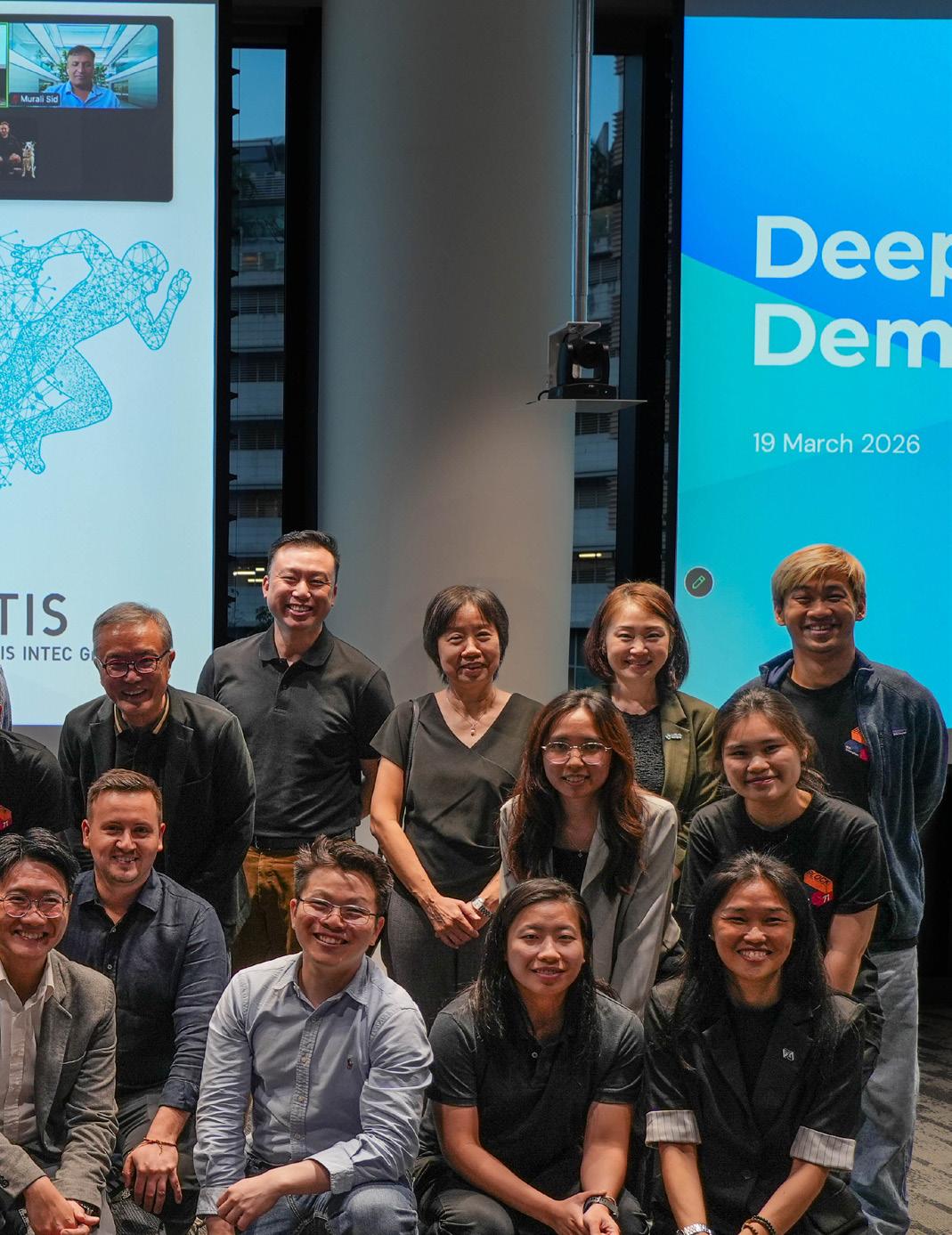
TOP: The 10 start-ups at the inaugural Deep Tech Seed to A Growth Expansion Programme (Deep SAGE) Demo Day. Deep SAGE is a tailored accelerator programme that supports seed-stage start-ups from around the world in scaling towards pre-Series A and Series A funding.
Building the bridge from innovation to scale
Deep SAGE is a tailored accelerator programme that supports seed stage start ups from around the world in scaling towards pre Series A and Series A funding. It addresses the “valley of death”, the critical phase between accelerator graduation and Series A funding, where technology may be validated but commercial traction often remains elusive.
The collaboration brings together complementary strengths from NUS Enterprise and TIS Inc. to support start up growth through an execution driven approach. TIS Inc. contributes capital and its expertise working with large enterprises to help start ups build execution capabilities and accelerate growth. It has committed S$7.6 million over three years, investing a minimum of S$500,000 in selected high potential start ups across cohorts. NUS Enterprise delivers the programme through BLOCK71, its global network of physical accelerators across 11 cities, including Singapore,
“Deep SAGE was only launched last year, but its early success shows the strong demand within the deep tech ecosystem for deeper execution support beyond mentorship and capital. By embedding seasoned executives directly with founders through our fractional C-suite model, we work side by side to drive execution. This hands-on approach builds commercial rigour, accelerates operational maturity, and better prepares start-ups to scale successfully towards pre-Series A and Series A funding.”
– Professor Benjamin Tee Vice President (Innovation and Enterprise), NUS Enterprise.
Tokyo, Silicon Valley, Saigon, and Suzhou. Participating start ups receive mentorship and structured workshops, followed by a six month incubation at BLOCK71 Singapore. During this period, they gain access to a global ecosystem that supports international market entry, pilot deployments and commercial partnerships.
Mr Furusho Kensaku, Managing Executive Officer, TIS Inc., said, “At TIS, we work closely with enterprises across industries, and we consistently see that the gap in deep tech is not innovation, but execution. Deep SAGE reflects our commitment to helping bridge that gap, not just through capital, but by supporting start ups with strategic direction and real world perspectives. We bring our industry experience to guide start ups and, where relevant, connect them with enterprise partners to support their growth.”
Fractional C-suites supporting global start-up growth
Unlike traditional accelerators that focus primarily on mentorship and funding, Deep SAGE is designed to close the execution gap. Over six months, seasoned mentors work closely with founders to refine strategy, develop go to market approaches, define Key Performance Indicators, and engage investors. Complementing this, the programme embeds experienced Fractional Executives (CXOs) within start up teams for 12 weeks to execute these initiatives and translate pipeline into revenue. While mentors and CXOs provide executive level guidance, final decisions remain with founders, preserving their autonomy while accelerating the start ups' operational and commercial maturity.
TOP:
Start-ups pitched their solutions to the judging panel.
BOTTOM:
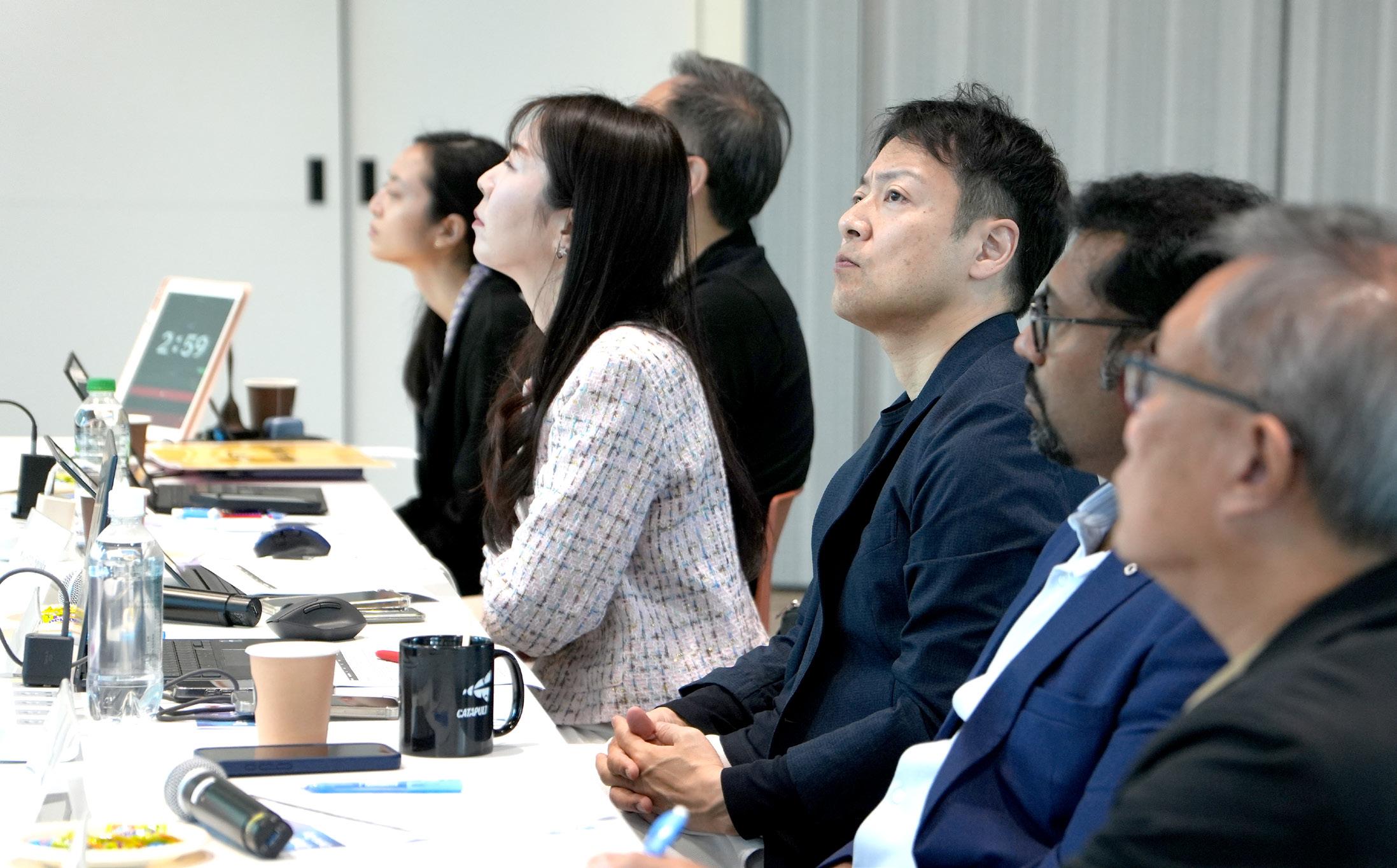
The judging panel assessed the start-ups’ solutions and discussed their readiness for growth.
“My experience as a fractional C suite for Logice is that the team is very diligent and ambitious in growing the business. For example, they took my advice to hire and operate a partner’s cold storage facility, which became a key enabler for securing more business. They also invested in reefer trucks to complete their distribution capabilities, laying the foundation to become a true cold chain logistics player. They deserve the S$500,000 funding as they have the potential, skills, knowledge, network and team chemistry to succeed in this industry,” said Mr Daru Kanugroho, Fractional Chief Product Officer, Logice.
Reflecting on the experience, the start ups highlighted the Deep SAGE’s impact on accelerating their growth, from unlocking new partnerships to fast tracking commercial deployment.
“We are deeply grateful to be part of the Deep SAGE programme and to have the opportunity to work with and be mentored by seasoned experts. The support from the embedded fractional C-suite has been very impactful, not only accelerating our pipeline expansion, but also giving us valuable lessons in market strategy, scaling operations and pricing.
From the start, we focused on accelerating our progress with the strong support provided. With many competitive start-ups in the programme, we knew winning would be tough, but we are deeply honoured to receive this recognition. This funding will be a significant boost as we expand into new markets and enhance our technology.”
– Ms Indah Kusumawardhani Co founder and CFO, Logice
“We joined Deep SAGE with an idea and left with a product companies are already buying. In a few months, we went from concept to enterprise deployment, with a growing pipeline behind it. The biggest unlock was the embedded fractional C-suite model, having experienced operators working with us every week forced speed and clarity. We made decisions faster, iterated faster, and closed our first enterprise customers while building a repeatable go-to-market playbook. We are excited to partner with TIS Inc. and deepen a collaboration already generating real commercial traction. This funding comes at the right moment as we open our seed round and scale distribution.”
“Deep SAGE is an accelerator programme that all startups should participate in. The traction made over nine months with the support provided is something that is valuable and hard to achieve otherwise.
As start-ups, we are often unable to hire experienced people who truly understand the industry, but our fractional C-suite helped us open doors using her network that would have taken years to achieve.
This award is a huge validation of our efforts, and we will continue pushing ahead with our clinical trials, overseas market entry and generating our first recurring revenue.”
– Dr Anthony Chua Co founder and CEO, StratifiCare
StratifiCare develops diagnostic tests to guide personalised liver cancer treatment.
– Mr Claudio Perlini Co founder and CEO, Sembuh AI
Sembuh AI uses AI to simplify insurance claims processing.
Apply here for Deep SAGE
Seeding Ideas, Sparking Innovations
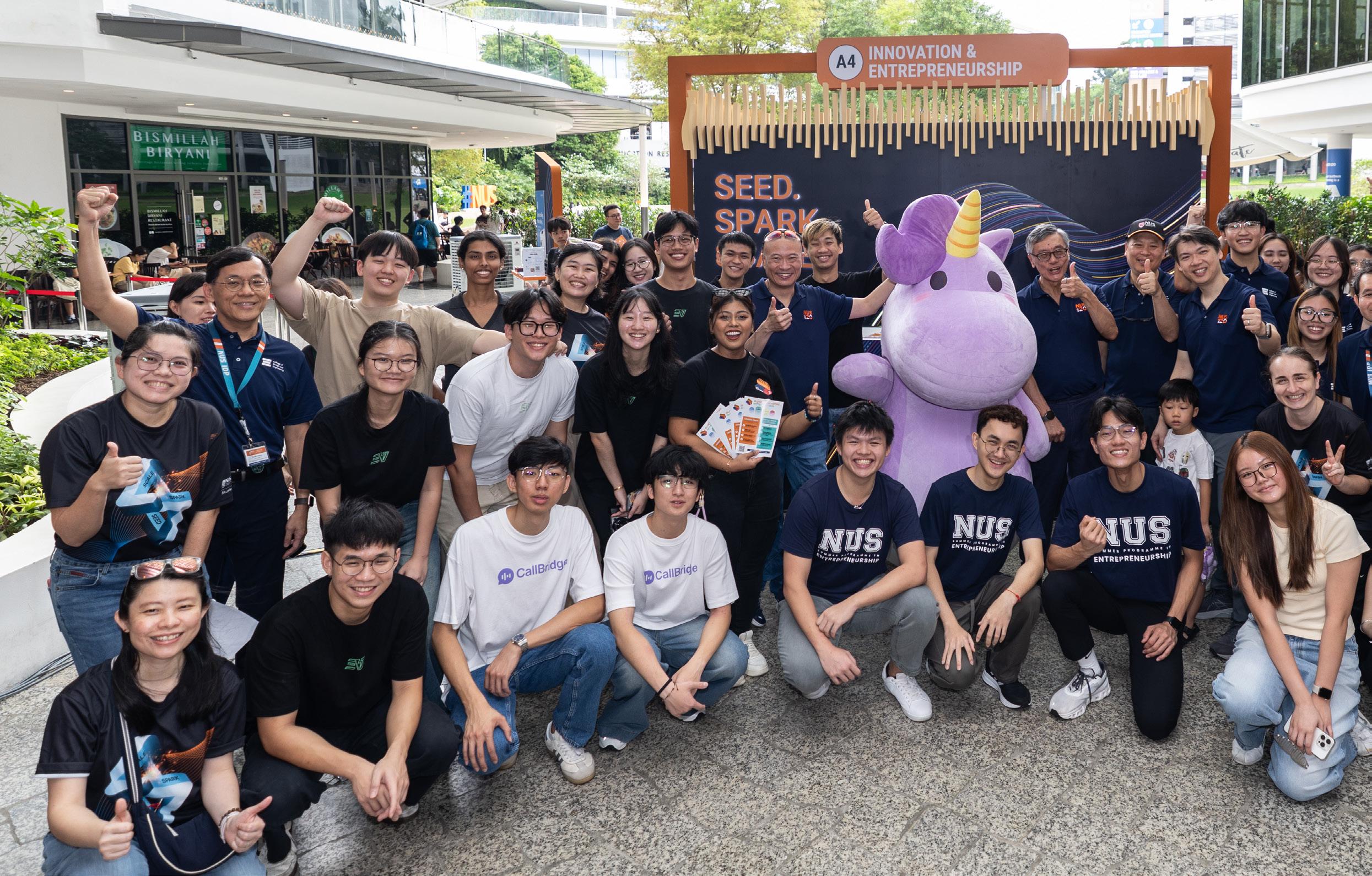
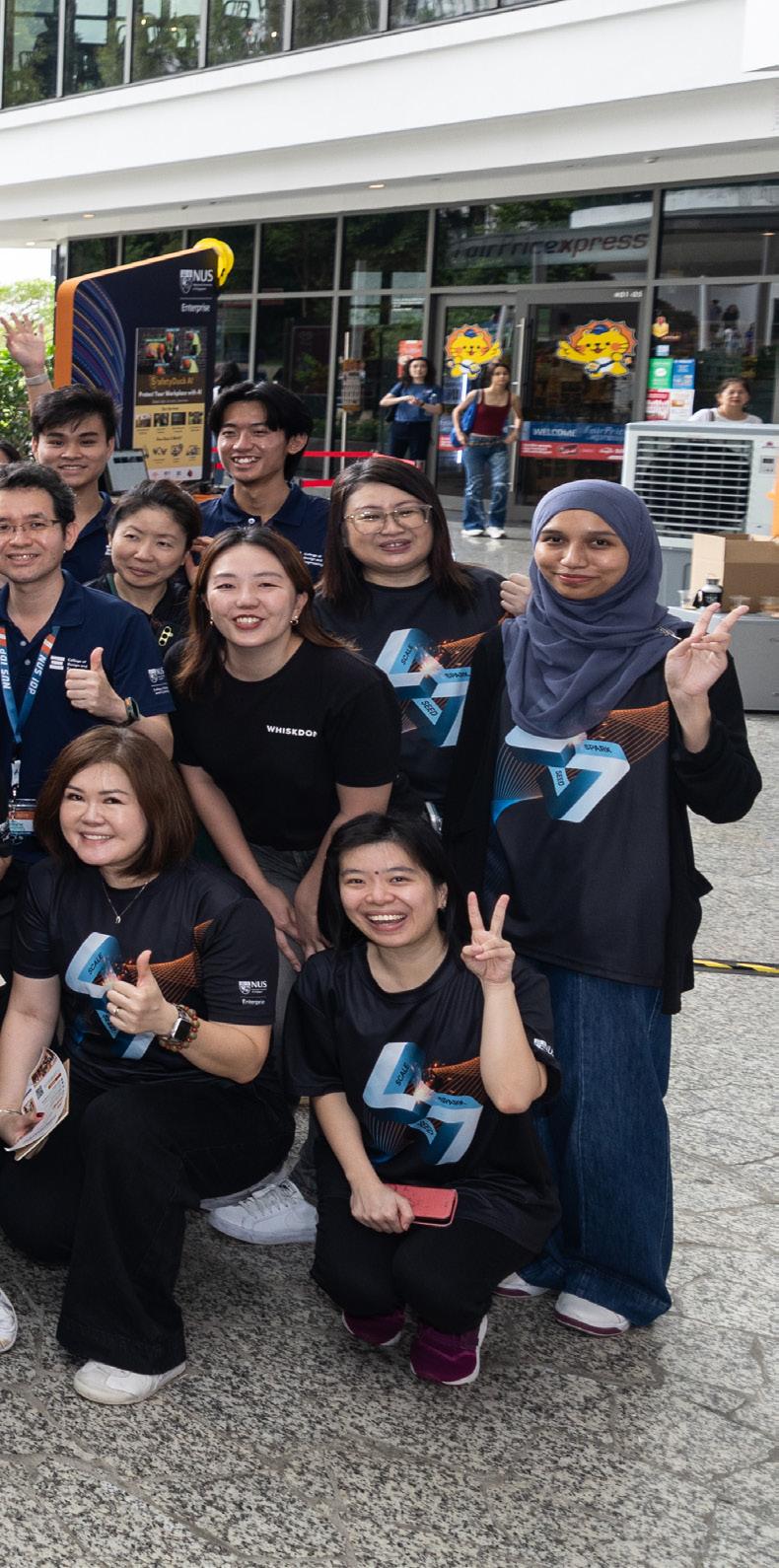
NUS Enterprise’s presence at NUS Open House 2026 marked one of its most dynamic showings yet, transforming University Town into a live showcase of innovation and entrepreneurial possibilities. At the Stephen Riady Centre Foyer, the full day annual event served as a key touchpoint for prospective students to explore how they can turn curiosity into global ventures through NUS Enterprise’s vibrant innovation ecosystem.
The Open House experience began online on 4 March with a live Zoom session tailored for students intrigued by start ups, innovation driven careers, and entrepreneurship.
On 7 March, the energy shifted on campus to the Innovation and Entrepreneurship booth where visitors were introduced to the programmes of NUS Enterprise that nurtures entrepreneurship and support venture creation – the NUS Overseas Colleges (NOC), NUS Enterprise Summer Programme in Entrepreneurship (NUSSP), BLOCK71, and the newly introduced NUS Stanford Global Engineering Design Innovation (GEDI) programme, which gives students hands on experience in international teams, co creating and prototyping solutions to real world challenges.
This year, NUS Enterprise brought NUS start ups and students’ pilot projects directly to the floor for a live showcase. Visitors got to meet founders and alumni from NOC, NUSSP, and BLOCK71 in person, experience their innovations firsthand, and discover how ideas that started in classrooms, hackathons, or overseas internships had grown into real products and services. All over freshly brewed specialty coffee and local ice cream.
The conversations were refreshingly candid and genuine, a reminder that building something meaningful rarely begins with a perfect plan. More often than not, it starts with a small bet, a window of chance, the right people, and the willingness to keep going when the going gets tough.
Beyond the booth, a series of Innovation and Entrepreneurship talks added depth to the NUS Open House experience. NUS alumni and start up founders took the stage to share their journeys, from navigating internships in global innovation hotspots across Asia, Europe and the Americas to building start ups that solve real world problems. Their unfiltered experiences highlighted both the unanticipated challenges and rewards of entrepreneurship, emphasising the importance of learning by doing, embracing uncertainty, and leveraging NUS Enterprise’s support at every step.
For many visitors, these sessions offered a rare, behind the scenes look at what it truly means to start and grow a venture as an NUS student.
As NUS Open House 2026 drew to a close, it was clear that the day has left its mark on aspiring students exploring their next steps after school. Through immersive showcases, meaningful conversations, and inspiring talks, NUS Enterprise demonstrated that innovation and entrepreneurship at NUS is not just an option for a select few, but an open invitation to any student ready to experiment, build, and make a difference.
The experience was great. We picked up quite a few leads from the NUS Open House, and we spoke to a good mix of parents and prospective students. The conversations with parents were especially encouraging, a good indication that there's always room to refine our product and go-to-market approach further.
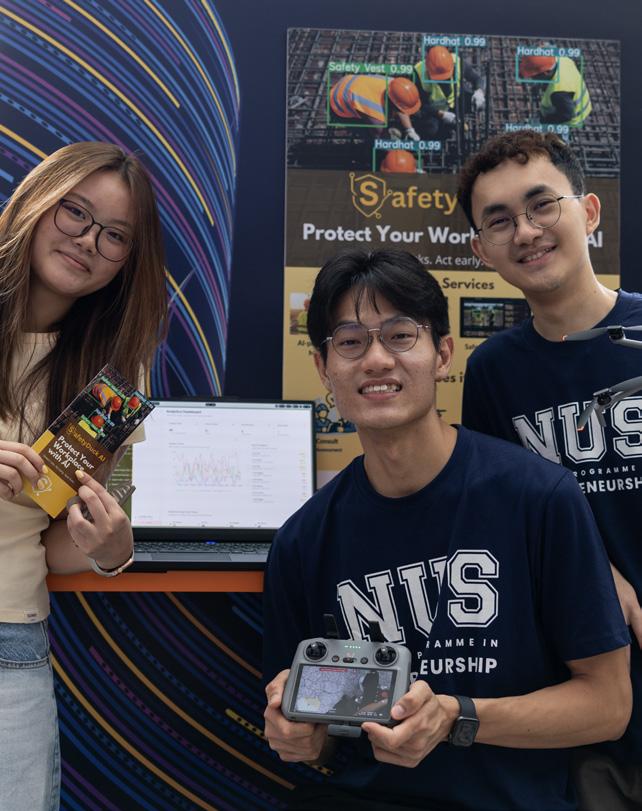
“Exhibiting at NUS Open House was really useful for us. Being an early-stage start-up, it's hard to find partnerships. Unlike cold emails, this time we got to meet people in person. We also met representatives from Amazon and BCA, who shared the possibility of implementing our solution in their workplaces. This event definitely helped us make connections that we look forward to following up on.
– Zhuang Hong (Zach) Chong Co founder, SafetyDuck AI
The founding team behind SafetyDuck AI at the NUS Enterprise Booth.
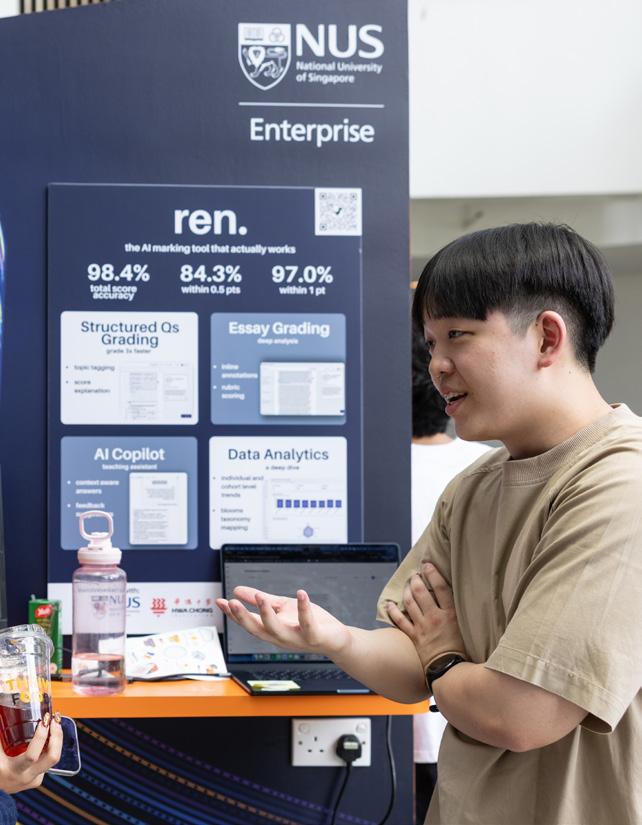
Eu En Wong, Co-founder, ren. speaking to a visitor about the technology behind ren.
– Eu En Wong Co founder, ren.
SINGAPORE AND VIETNAM TO BOOST CROSS-BORDER START-UP INNOVATION PIPELINE THROUGH BLOCK71’S UNIVENTURES
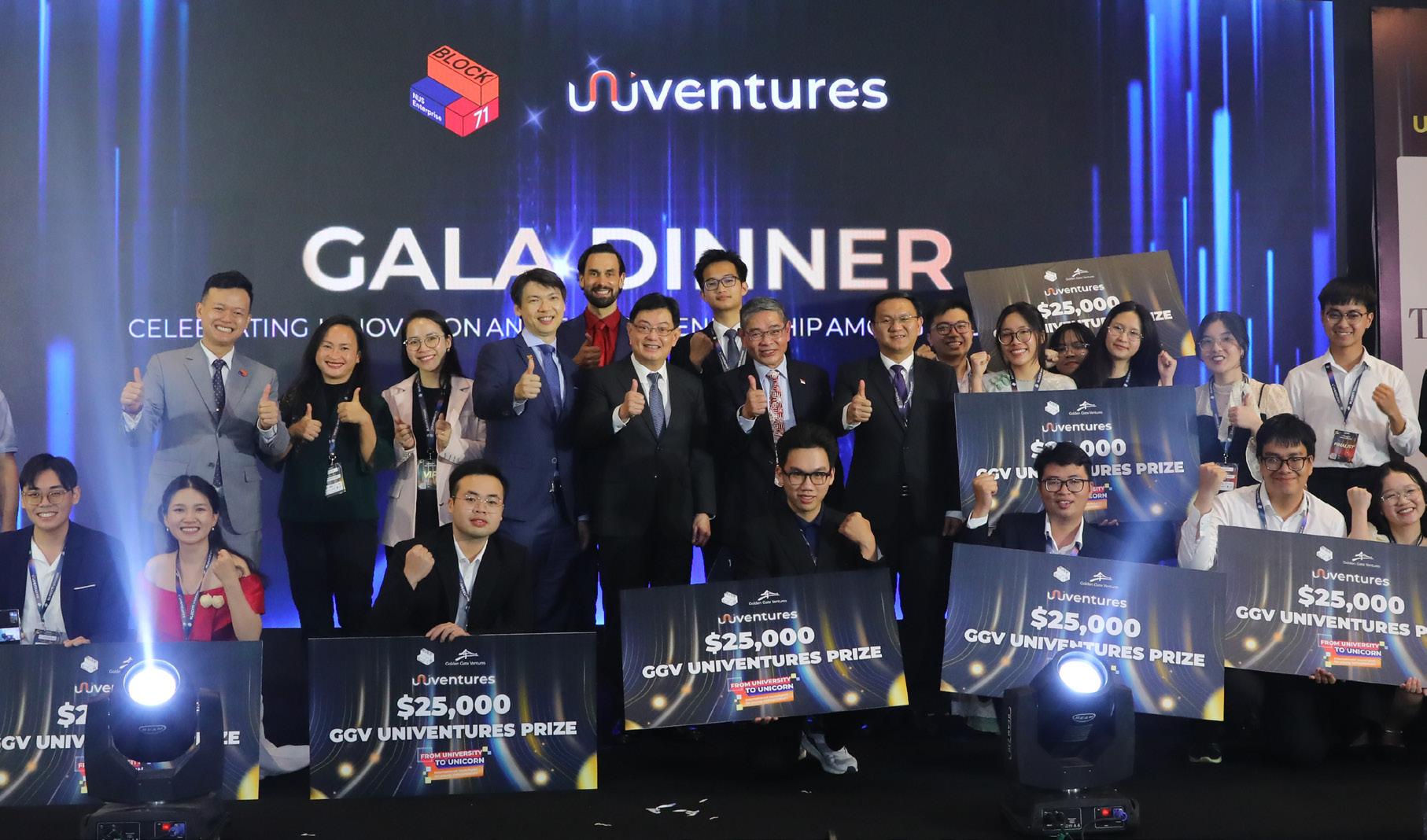
What if you could tell a chick’s gender before it hatches? Or deploy autonomous drones for rescue missions? These were just two of the bold ideas behind the 10 Vietnamese university start ups recognised at the UniVentures Gala Dinner, held on 29 January 2026 in Ho Chi Minh City.
Led by BLOCK71 Vietnam in collaboration with Temasek Foundation, UniVentures is a regional accelerator programme that supports Vietnamese university start ups with mentorship, funding and incubation. The Gala Dinner marked the announcement of its top 10 teams, reflecting a growing Singapore Vietnam collaboration under the Comprehensive Strategic Partnership and a shared commitment to nurturing university driven innovation.
Empowering founders to address real-world challenges
From classroom ideas to market ready ventures, UniVentures helps founders move fast. Built on BLOCK71’s global network of physical accelerators across 11 cities, including Ho Chi Minh City, the programme connects participants to mentorship, funding and regional market access across Vietnam and Singapore. Its goal is to develop practical, scalable solutions in healthcare, environmental sustainability, productivity and skills development, and financial literacy.
Supported by partners including the Singapore Global Network, Vietnam’s National Innovation Center, Golden Gate Ventures (GGV), the Start up and Innovation Hub of Ho Chi Minh City, the Youth Union of Ho Chi Minh City, Google Cloud, IBM, the Tony Blair Institute for Global Change and the Reactor School, UniVentures attracted more than 1,400 applications nationwide.
Through an intensive multi stage selection process, 30 teams were shortlisted to pitch in a closed door session for the GGV UniVentures Prize, which carries a total prize pool of around S$320,000 (US$250,000). From this group, the top 10 start ups were each awarded S$32,000 (US$25,000) and selected to participate in a three month incubation programme at BLOCK71 Vietnam, where they can gain hands on support, mentorship, and exposure to the local market.
Following the incubation, the teams will return for a final pitching round. The top two start ups demonstrating the strongest market traction will advance to a further three month incubation at BLOCK71 Singapore, gaining access to regional markets and opportunities to scale up their ventures.
Thinking beyond Vietnam and building for the region
The UniVentures Gala Dinner brought together government leaders, industry partners and university innovators to celebrate the ten winning teams. While still at an early stage, these start ups point to a broader shift in Vietnam’s innovation landscape. Founders are increasingly building their ventures with regional and global relevance in mind, not just domestic needs.
This momentum is fuelled by Vietnam’s fast growing digital economy and a young, ambitious talent base, reinforcing its position as one of Southeast Asia’s most dynamic start up ecosystems.
Here are three high potential start ups among the 10 recipients of the GGV UniVentures Prize:
• BioWraps: Develops biodegradable packaging from agricultural waste, offering a chemical free alternative that reduces plastic use and emissions.
• Trazen: Uses AI to help manufacturers train and upskill technical workers at scale, addressing Vietnam’s growing talent gap.
• Welgun BMS: Focuses on battery safety, using predictive diagnostics to detect early degradation in energy storage systems and electric vehicles.
In his opening remarks, Professor Benjamin Tee, Vice President (Innovation & Enterprise), NUS Enterprise, highlighted the importance of early support in shaping successful start ups.
“All start ups begin with a team of talented and passionate people. Great start ups need great founders. UniVentures provides a platform for such Vietnamese founders to meet and transform their ideas into practical, scalable solutions to tackle major needs,” he said. “By anchoring this unique early stage incubation programme in Vietnam and giving high potential teams the chance to scale in Singapore and globally, we continue to enhance our Singapore Vietnam partnership for bilateral innovations to flow between the two countries.”
Guest of Honour Mr Heng Swee Keat, Chairman of the National Research Foundation and former Deputy Prime Minister of Singapore, echoed these views in his keynote address. He noted that initiatives like UniVentures play a key role in developing regional talent and deepening cross border
collaboration: “This structure creates opportunities for founders to build, test, and learn. It also enables mutual exchange and learning between young innovators from Singapore and Vietnam. This is how robust innovation ecosystems are built in Vietnam and Singapore.”
Building on this, Mr Edward Lim, Country Director (Vietnam), BLOCK71 Vietnam, highlighted the programme’s tangible impact for the start ups themselves. He added, “With the right mindset, capabilities and networks, they can build companies that create real economic value for Vietnam and the region.”
Catalysing sustainable innovation through collaboration
The Gala Dinner also featured a panel discussion titled “Catalysing Sustainable Innovation: The
Next Frontier for Vietnam Singapore Partnership”, moderated by Ms Chen Huifen, Editor of The Business Times. Panellists included Ms Lim Hwee Hua, Chairwoman of Tembusu Partners and former Minister in the Prime Minister’s Office, Singapore; Ms Omi Dang, Chairlady of TTC AgriS; and Mr Nguyen Dung Do, CEO and Co founder of EnFarm.
The panel explored how cross border collaboration can accelerate sustainable innovation across agriculture, technology, and social enterprise. Ms Chen observed that Singapore, as a hub for capital and logistics, and Vietnam, as a manufacturing and resource engine, can succeed together only if “the gears are properly meshed”.
Ms Lim emphasised the critical role governments play behind the scenes. She pointed to Singapore’s whole of government approach, including dedicated agencies, digital registration systems, English language processes, and clearly defined grants and support programmes.
As Vietnam’s start up ecosystem enters a new phase of growth, UniVentures places these 10 teams at the heart of a regional initiative, one that supports early stage innovation locally, while opening pathways for cross border expansion.
““BLOCK71 Vietnam's UniVentures programme was a “high-ROI” learning journey that delivered practical insights into venture building in a compact format. Learning directly from experienced founders and experts helped us navigate key areas such as fundraising, accelerators, and earlystage execution. As a first-time founder building TRAZEN, an AI platform for manufacturing training, the programme’s strong network offered valuable guidance, inspiration, and potential business opportunities.”
– Quynh Co founder and CEO, Trazen
“BLOCK71 Vietnam's UniVentures programme worked closely with us to sharpen our understanding of the problem and solution. UniVentures also helped us build a clearer execution plan, and actively connected us with investors and potential business partners.”
– Minh Hoang Co founder, Welgun BMS
“BLOCK71 Vietnam's Univentures not only provided us with valuable knowledge, but also helped us realise that innovation must go hand in hand with environmental impact and community value.”
– Trinh Cong Qui Founder, BioWraps
Ten Vietnamese university start-ups received the Golden Gate Ventures UniVentures Prize at a Gala Dinner held on 29 January 2026 in Vietnam’s Ho Chi Minh City. UniVentures is a new regional accelerator programme led by BLOCK71 Vietnam in collaboration with Temasek Foundation.
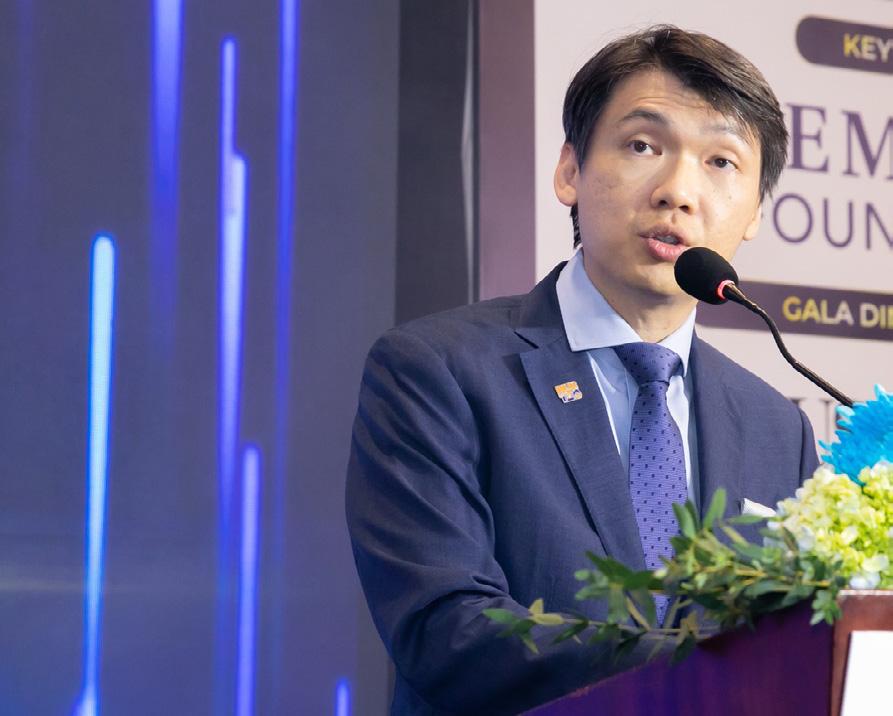
In his speech, Professor Benjamin Tee, Vice President (Innovation & Enterprise), NUS Enterprise, laid out how early-stage support helps founders translate ideas into scalable ventures.
Cold storage start up Logice was founded to solve a problem too costly to ignore. In Indonesia, between 20 to 40% of perishable goods are lost along the supply chain, from harvest to delivery, a burden borne most heavily by the small businesses, restaurants, and food suppliers who depend on reliable cold chain logistics to stay afloat.
Cold storage start up Logice was founded to solve a problem too costly to ignore.
In Indonesia, between 20 to 40% of perishable goods are lost along the supply chain, from harvest to delivery, a burden borne most heavily by the small businesses, restaurants, and food suppliers who depend on reliable cold chain logistics to stay afloat.
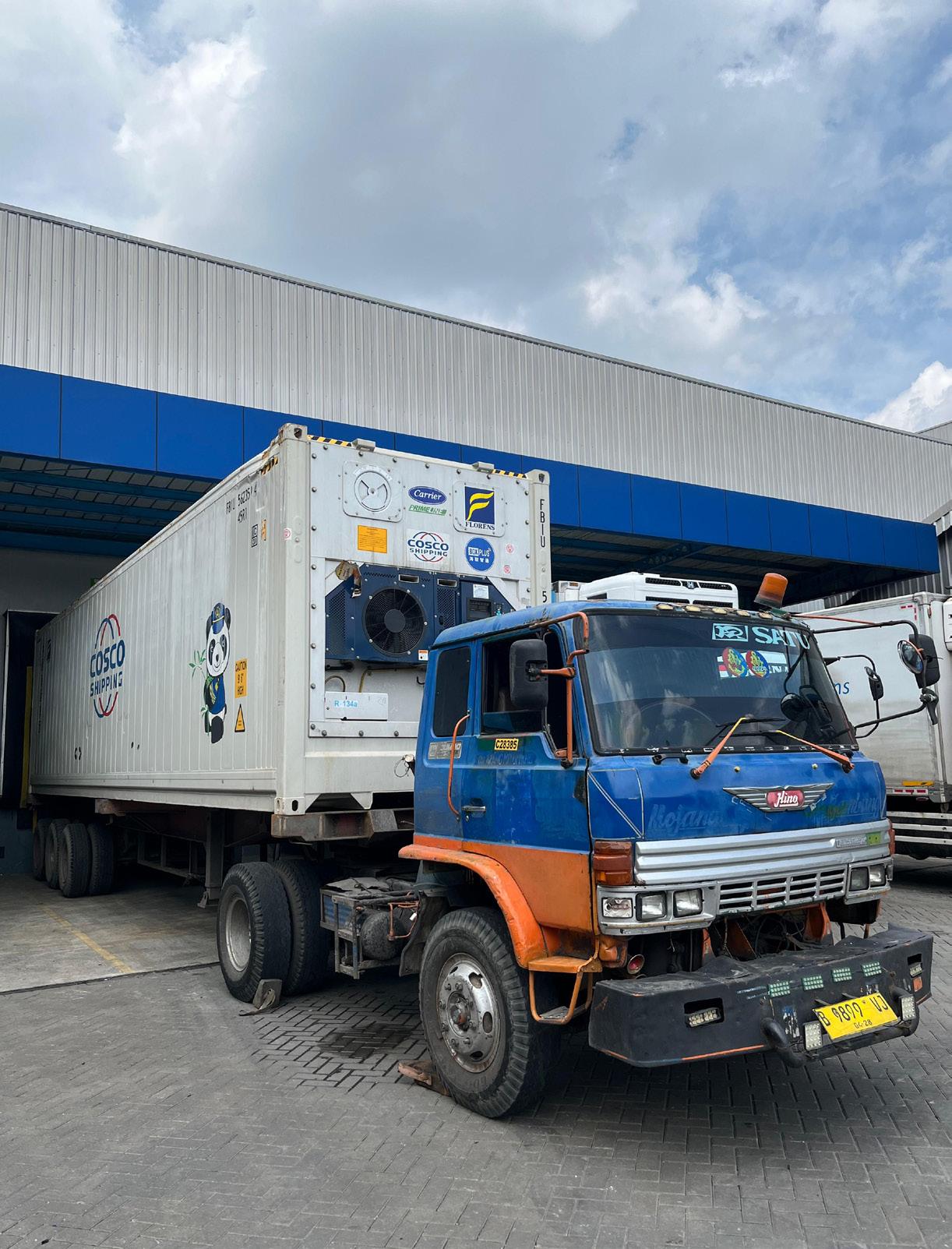
For Logice's five founders, Dwi Andika Irawan, Indah Kusumawardhani, Perry Anggidio, Fachrizal Arga, and Salman El Faresi, this wasn't an abstract statistic far from their daily lives. When they launched a fishery distribution business in 2020, they encountered a cold chain system riddled with inefficiencies firsthand: poor monitoring, limited transparency, and such scarce access to proper providers that they were routinely forced onto platforms like Lalamove and GoSend, services neither built nor priced for temperature sensitive goods.
The more they looked, the more systemic the problem proved to be. Supply and demand imbalances, uneven regional coverage, and an industry still largely resistant to modernisation. Rather than work around these service gaps, the five founders set out to build what the industry was severely missing.
An unexpected fix for a complex problem
The Logice team's first attempt at a solution didn't quite land. They built a complex warehouse management system, only to find that their customers had little inclination to use it. The wake up call came at a Ministry of Technology event, where watching their target customers struggle with their prototype in real time said everything. They decided to go back to the drawing board and doubled down on doing user research.
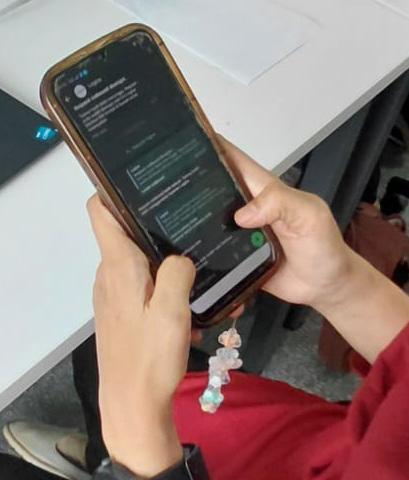
Their research revealed something telling: 95% of Indonesian SMEs were already running daily operations through WhatsApp. "We decided to focus first on technology development using WhatsApp services," said Logice’s co founder and CEO Dwi. Rather than reinvent the wheel, the founding team decided to rebuild their entire service flow around a platform their customers already trusted.
Logice’s resulting solution is deceptively simple. Through an automated WhatsApp chat, businesses can book cold storage, arrange deliveries, monitor real time delivery locations, and flag issues around the clock, without downloading any new app or learning new software. Orders placed before the daily cut off are delivered the same day, within two hours. Behind the scenes, a fully integrated warehouse and transportation management system handles the complexity.
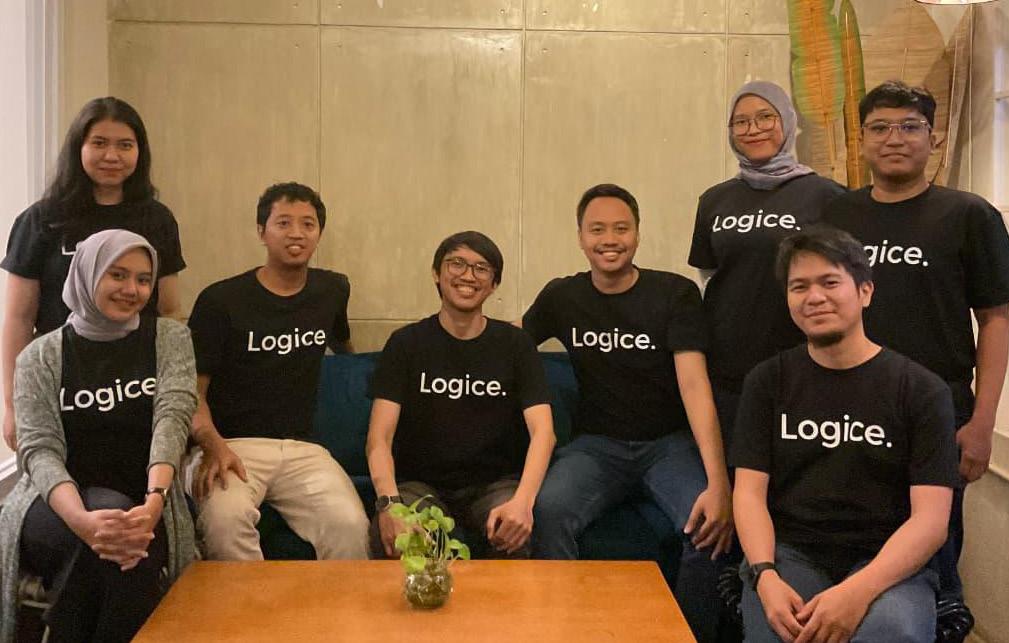
TOP: Dwi (co-founder) in centre, Arga (COO) third fromd left, Salman (CMO) fourth from right with their team at a townhall meeting on July 2023.
Delivery
BOTTOM:
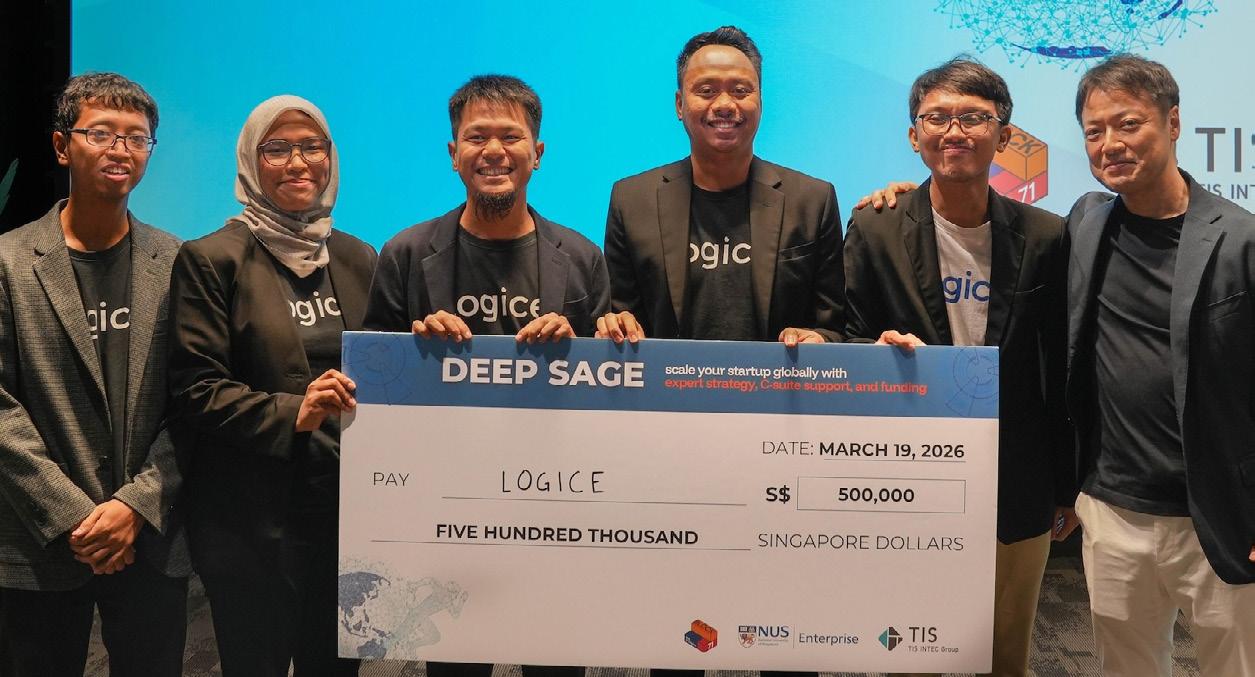
The Logice team pictured with Mr Kensaku Furusho, Managing Executive Officer of Global Business Division, TIS Inc at the recent Deep SAGE Demo Day. Logice was among three winning start-ups awarded S$500,000 by TIS Inc.
LEFT, RIGHT:
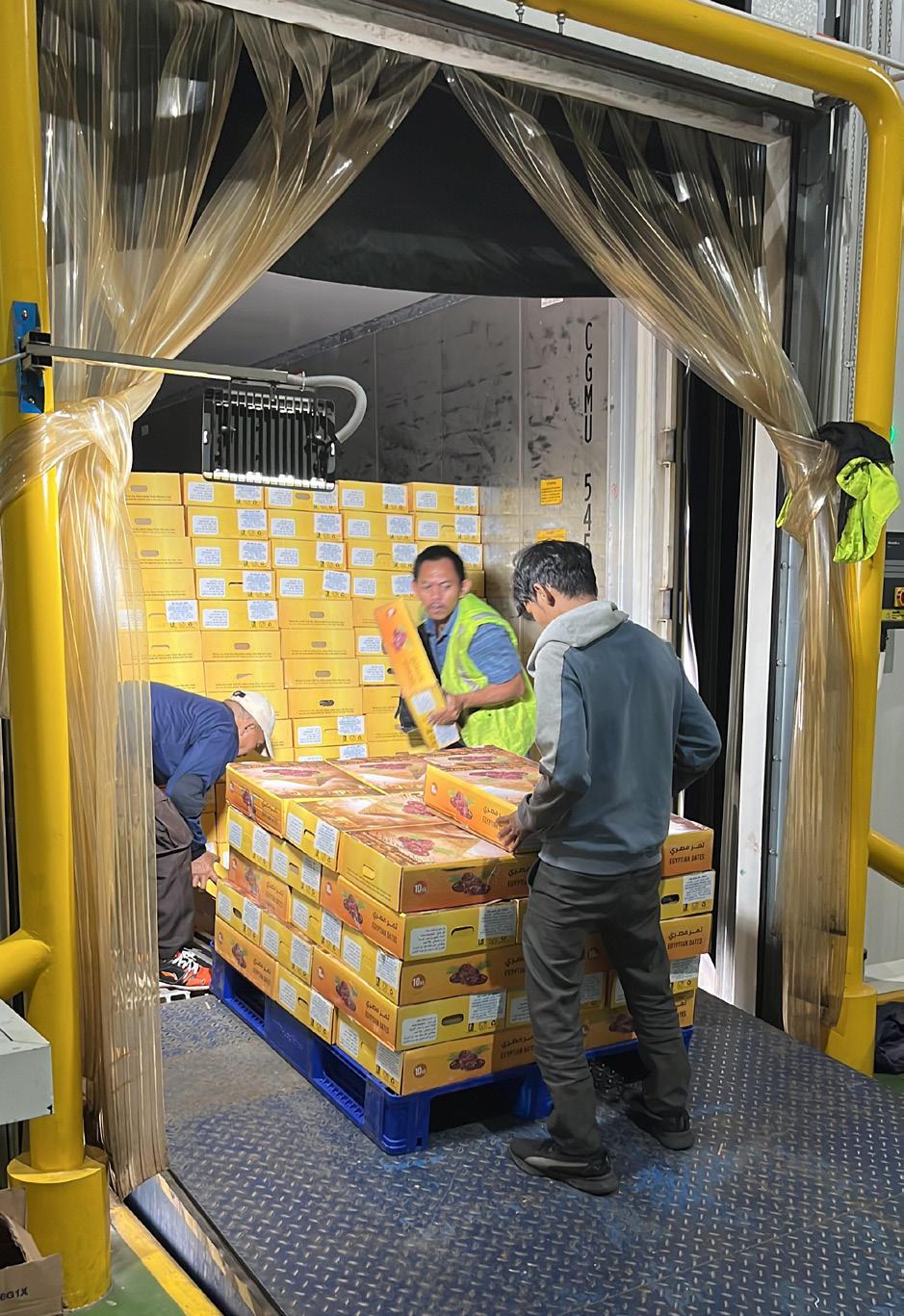
and handling process at Logice's partner facility in Bekasi, Java, Indonesia
Customers now receive deliveries 50% faster, missing items have fallen by 90%, and businesses using Logice's services have reported an average growth of 400% over the same period.
Scaling up from Jakarta to the national stage
The start up’s growth since 2020 has been steady and hard earned. Starting with a handful of customers in Jakarta, the company has grown to serve over 1,000 businesses, with annual revenues climbing from US$400,000 in its early years to over US$650,000 in 2025. Their customer base has also widened well beyond food and beverage, now including health equipment companies, importers and large consumer goods brands.
A significant milestone came in March 2026, when Logice was named one of the top three start ups at the inaugural Demo Day of the Deep Tech Seed to A Growth Expansion Programme (Deep SAGE), a collaboration between NUS Enterprise, BLOCK71 and Japanese IT company TIS Inc. Logice was among three start ups awarded S$500,000 by TIS Inc., as part of its S$7.6 million commitment to co develop and scale the accelerator programme.
The recognition reflects how far the team has come and signals where they are headed next. With expansion plans stretching island by island across Indonesia, Logice's ambition is to build a complete supply chain platform connecting suppliers, storage providers and delivery partners nationwide. Solving the right problem
Building a business in Indonesia is not for the impatient. "Scale is earned through disciplined execution, not speed alone," Dwi reflected. "If you scale too fast without structure, cracks appear quickly." Their advice to aspiring entrepreneurs is similarly grounded: solve problems that genuinely hurt people, build trust before you build scale, and spend carefully from day one.
What kept them going through the harder stretches was a focus on fundamentals. As long as customers were seeing real value and the numbers made sense, short term pressure felt manageable.
Indonesia's cold chain industry still has a long way to go. But with a proven model, fresh investment and a roadmap stretching across the archipelago, Logice is quietly laying the groundwork to change that. Sometimes, the most powerful technology is the one people already trust.
“We are not just growing. We are building an infrastructure grade platform designed to lead the market long term.”
2026
2025
• Named one of the top three start ups at the inaugural Demo Day of the Deep Tech Seed to A Growth Expansion Programme (Deep SAGE), a collaboration between NUS Enterprise, BLOCK71 and Japanese IT company TIS Inc.
• Awarded S$500,000 by TIS Inc.
• Launched whatsapp warehouse management system, serve to more B2B big enterprises, serve to many variance goods (fruit, meat, chicken, fish and health goods and equipment)
• Signed up for Deep SAGE
• Exceeded US$650,000 revenue
2024
2023
20212022
2020
• Official launch fulfilment services, first investment from Antler, served 20 fulfillment customers
• Participated in Skala incubator, FSIA accelerator
• Exceeded US$550,000 revenue
• Embarked on R&D fulfillment services
• Participated in Hub.id accelerator, cubic, incubator, astra, incubator and more
• Exceeded US$400,000 revenue
• Development of fish and commodities product line
• Achieved revenue of US$400,000 over 2 years
• Started Logice in September 2020
LOGICE'S GUIDE TO INDONESIA MARKET Practical tips for entrepreneurs
1
2
3
4
Solve real problems, not trendy ones
Indonesia is a high opportunity market, but customers are practical. If your business addresses a genuine pain point around efficiency, access or cost, adoption can be very strong. Sustainable businesses here are built on fundamentals, not hype.
Build relationships and trust early
Indonesia is relationship driven. Partnerships, credibility and long term trust matter as much as the quality of your product. Invest in trust early and growth will compound faster over time.
Understand the complexity before you scale
Infrastructure, regulations and partnerships vary significantly by region. Moving too fast without structure exposes cracks quickly. Operational discipline and local adaptation are not optional extras — they are the foundation.
Stay capital disciplined
The investment ecosystem has matured. Investors today look for clear unit economics and a credible path to profitability. Building with financial discipline from day one gives you resilience, and resilience wins in emerging markets.
FROM mining engineer Uber travel tech start-up founder
Darryl Han isn't your typical start-up founder and operator. Not many people pivot from mining engineering to travel tech start-up founder to growth bets at Uber, all within six years.
After working as a mining engineer and supervisor in Australia, he made the deliberate move to Southeast Asia, joining its budding tech start up scene while completing his Master of Science in Management of Technology and Innovation (MOTI) at NUS. After a NUS Overseas Colleges (NOC) posting in Ho Chi Minh City, he co founded travel tech start up, LFG, which was acquired by Fly Fairly, a next generation travel booking platform with over 100+ payment options. Now based in Sydney, he has joined Uber to work on growth bets, building and scaling new products for the next generation of riders. For Darryl, each move is a deliberate bet on growth over comfort.
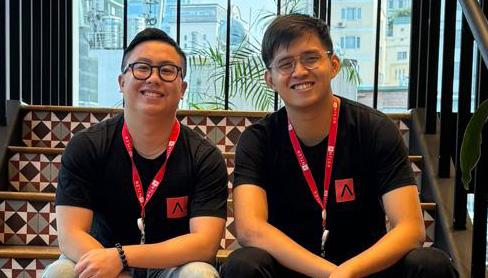
Darryl pictured with his LFG co-founder Foo Shi Hong while participating in Antler Vietnam.
Realising when it is time to go
Back in Australia, I always had ideas but never did launch anything. Yet, the itch was always there. I was in mining, a very traditional industry. It was bureaucratical and very hierarchical, with many steps and processes to follow because it is genuinely dangerous work. I had a good taste of the industry and when I was made supervisor out of the graduate programme, I could see the path forward clearly. Perhaps that was the problem. It just hit me at one point where I thought: I wanted to try something different before it’s too late. So, I left and decided to come to NUS as I saw it as a gateway to the Southeast Asian region. When doing my masters, I got the opportunity to join NOC and ended up doing an internship in Ho Chi Minh City. Learning in chapters, not a straight line Looking back, each move was its own learning chapter. NUS was a step into understanding the region and a completely new field of study. Going on to join NOC introduced me to what the early stage start up life is actually like from the inside. When I joined Quqo, a B2B supply chain and distribution platform start up in Ho Chi Minh City, as an NOC intern, I was already working closely with the team and the founder/CEO directly. At the end of six months, they closed a seed round and the opportunities to grow were too good to walk away from. I then took almost two years of leave of absence from my master's to continue building Quqo as Head of Growth and Marketing, acting as a Chief of Staff to the CEO . There's an internal joke that I'm the longest master's graduate, almost four years because of the break in between. But I have no regrets. Taking the leap to set up LFG
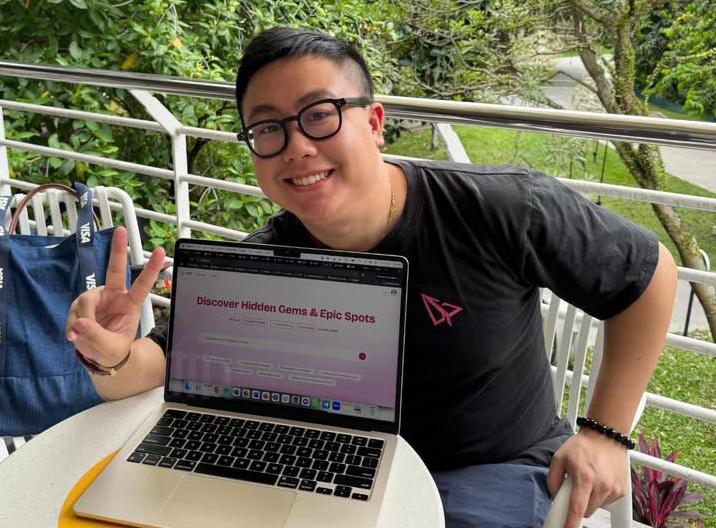
The idea for LFG came out of a spontaneous trip to Da Nang with my co founders. We had no plan, and that quickly became the problem: social media posts were buried and impossible to find after the fact, Google Maps told us how to get somewhere but not why we should go, and the recommendations we did find weren't from people we trusted. We kept asking: why is it so hard to discover places that are actually worth your time? That became our problem statement — and our starting point. We built LFG as a travel discovery platform, think Spotify meets Pinterest for travel. You can save spots you love, build "placelists" (playlists, but for places), uncover hidden gems, and get real recommendations from people who've actually been there. Our focus was Southeast Asia first, with a view to going global.
We pitched the idea at a crowd pitch event and the reception told us we were onto something real.
Things I would have loved to know, before starting out
Find a very painful problem, not just an exciting idea Travel, especially in the consumer space, is saturated and dominated by well funded incumbents. My advice to aspiring entrepreneurs: find a problem that genuinely hurts. There has to be a specific, recurring frustration your target audience feels — something painful enough to make them seek you out rather than settle for what already exists. Don't build an exciting feature. Build something functional, scalable, and most obviously, something people will actually pay for and come back to.
And stay alert: problems evolve. What your users need today may shift in ways you don't see coming. If you're not paying close attention, that shift can hit harder than any competitor. Relentlessness is the skill that carries you When it comes to building anything, it is about relentlessness. How much do you want it? How much do you want to grow, to learn, to be successful? It is all about framing your mindset to really do what it takes to get to where you want. If it means putting in the extra effort or going down to the markets and really understanding how the locals do things on the ground – do it.
Good work ethics, critical thinking, the ability to dive into a totally new space and figure
For the first full year I was still at Quqo, building LFG at nights and on weekends. But when it started finding its own momentum, we knew it had to become a full time commitment — and we made the leap.
Looking back, I never had a grand plan. Just a willingness to keep saying yes to the next chapter, even when it
it out. These are the soft skills you carry across industries and markets, regardless of what you are building.
Rejection is a redirect, not a full stop
After going through Antler Vietnam, a startup accelerator that operates in Ho Chi Minh City, we got to the final pitch and just didn't get the final vote. At that point we were asking ourselves whether to continue or find full time jobs. But we still believed in what we were building, so we pushed on, kept the business running, even signed an MOU with the Malaysia Tourism Board, and continued iterating on our product. I’m glad we did. It didn't just keep us going, it opened up a future we hadn't yet imagined.
The best opportunities are unplanned
None of these developments followed a written plan. The acquisition of LFG by Fly Fairly wasn't something engineered. It started with two LinkedIn pages interacting with each other, then a call which led to deeper conversations in Bangkok. The synergy was just there. With start ups, sometimes the founders have plans to be acquired by certain companies. This wasn't one of those. Honestly, I'm truly grateful for how it all unfolded. It's opened up a new evolution for us — a whole new learning curve.
looked nothing like the one before. The non linear path can feel wrong — even reckless. But think of it like art. The process is messy, unpredictable, and impossible to explain while you're in the middle of it. Yet when you step back, you see something that couldn't have been made any other way. That's the beauty of it. Your path doesn't have to make sense to anyone else. It just has to be yours. That, more than anything, is what got me where I am today.
Time to Accelerate Global Defense Innovation
Join 120+ of the world's most driven engineers, founders, and operators at the inaugural Singapore Defense Tech Hackathon (SDTH).
Co‑organised with the European Defense Tech Hub and TUM Venture Labs, this isn't a typical hackathon. It is a premier global launchpad for defense technology, bringing together international talent, defense innovators, and industry leaders to tackle real world security challenges head on.
now at luma.com/sdth-2026
WHAT TO EXPECT
Challenge tracks are shaped around real operational needs. Bring your own project and pressure test it with experienced mentors, getting as close as possible to real world deployment, fast.
WHAT YOU ARE HERE TO DO
1
Solve urgent security challenges in the Asia Pacific. From countering drone swarms to building resilient, multi domain defense systems, every problem you work on is one that actually matters, shaped together with operators, industry, and research partners.
2
3
4
Build deployable prototypes, not just ideas. This is a 48 hour sprint to ship. Teams move from concept to working prototypes that can be tested, iterated, and taken further after the event.
Launch companies and careers in defense tech. Whether you are entering the sector or already building, we put you in a position to continue, with pathways into incubation, funding, and real customers.
Strengthen Singapore as a global defense innovation hub. This is about more than a weekend. The hackathon is the starting point of a broader pipeline turning talent into deployable capabilities and new ventures.
FOCUS AREAS
10 to 15 challenges across mission critical domains , with a strong focus on multi domain systems and global security requirements.
COMPETE AND WIN
Win Big. Claim prizes worth up to $30,000, including a $10,000 top prize to accelerate your prototype.
Scale Fast. Winning teams receive exclusive incubation opportunities with NUS Enterprise and TUM Venture Labs to transform ideas into scalable ventures.
Expert Network. Work alongside mentors and investors who have launched global breakthrough technologies and raised international capital.