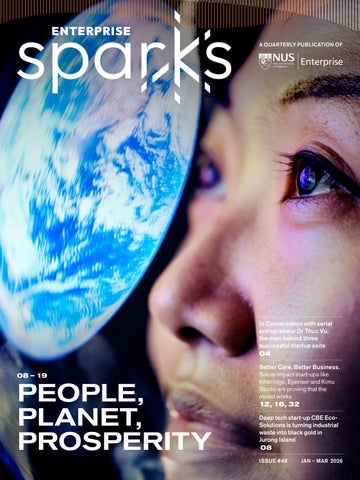
A QUARTERLY PUBLICATION OF
In Conversation with serial entrepreneur Dr Thuc Vu, the man behind three successful startup exits
04 08 – 19
PEOPLE, PLANET, PROSPERITY
Better Care. Better Business. Social impact start-ups like Inheritage, Eyeviser and Kimu Studio are proving that the model works
12, 16, 32
Deep tech start-up CBE EcoSolutions is turning industrial waste into black gold in Jurong Island
08
ISSUE #48
JAN – MAR 2026
ENTERPRISE sparks
CONTENT
2
04
20
30
38
IN CONVERSATION WITH
THE BUZZ
WIDE ANGLE
SPARKS EXCLUSIVE Big interview with an industry veteran
Events, announcements, initiatives worth a shout-out
Featuring start-ups expanding overseas, or what’s happening in the global start-up scene
04 Dr Thuc Vu's journey from code to
20 Seed, Spark, Scale: Inside NUS
32 Korea: Why Kimu Studio wants to be
three acquired companies (including one by Google) proves success is deliberate preparation meeting luck
Enterprise’s innovation formula at SWITCH 2025
24 TS2 Demo Day 2025: Social impact
start-ups tackle pressing challenges amidst Singapore’s evolving population
HATCHED Featuring Singapore-based start-ups and student teams, up close and personal
08
CBE Eco-Solutions: In search of black gold
12 Eyeviser: Bringing eyecare to
28 Smart Port Challenge 2025: PIER71™ celebrates record-breaking year for maritime innovation
the next Disney
RETHINK Perspectives and thought leadership to guide you on your entrepreneurial journey
38 Charging against the current: why
youth entrepreneurship is paramount to Singapore's future
30 Tinkering your way to the marketplace:
By Eugene Chia
Lessons from Raspberry Pi's founder and NUS Professors
Singapore's most vulnerable
16 Inheritage: Modernising Singapore's lion dance heritage with technology
Editorial Team Jennifer Toh Eileen Khoo Joanne Ong Tommy Lais
Contributors Eugene Chia
Enterprise Sparks NUS Enterprise 21 Heng Mui Keng Terrace, Level 5 Singapore 119613 Company Registration No: 200604346E
@NUSEnterprise Email
enterprise@nus.edu.sg Web
enterprise.nus.edu.sg
Enterprise Sparks is published by NUS Enterprise. The views and opinions expressed are those of the authors and individuals featured. Reproduction in whole or in part without written permission is prohibited. Contact us directly for permission to share or reproduce the content.
JAN – MAR 2026
3
FROM THE SENIOR VICE PRESIDENT (INNOVATION AND ENTERPRISE)
I
nnovation thrives when purpose meets action.
The entrepreneurs in this issue prove this: Weiwen Chen at Eyeviser brings accessible eye care to underserved communities; CBE Eco Solutions turns carbon waste into a usable resource. Real problems for real people fuel the most transformative innovations. At NUS Enterprise, we are building an ecosystem where deep tech meets deep impact. Serial entrepreneur Dr Thuc Vu of OhmniLabs shows what’s possible—democratising robotics and AI to deliver better, more affordable patient care. Through our programmes, venture capital partnerships, and global outposts, we create pathways for start-ups to drive lasting economic value while tackling global challenges. People. Planet. Prosperity. These aren’t competing priorities. They’re the foundation of ventures that matter. In 2026, our revitalised i³ building will continue to be the launchpad for this vision. When entrepreneurs address real community needs, they spark ripple effects that lift people, strengthen our planet, and drive shared prosperity. Let’s shape ventures that redefine industries and leave a legacy. DR TAN SIAN WEE
From to
Code Compa
JAN – MAR 2026
anies
5
“
Success is never about luck alone; it’s about being prepared to capture the luck when it presents itself,”
submits serial entrepreneur Dr Thuc Vu. His three start-up acquisitions are testament to how success is not chanced but built with deliberation.
IN CONVERSATION WITH
6
A
t an age when most teenagers were busy hanging out with friends, Thuc Vu was already immersed in code – studying, practising and winning computer science competitions in his home country of Vietnam. Convinced that technology would shape his future, he persuaded his parents to let him study in the US. “At that time, that was where the best undergraduate programme for computer science was,” he informs. From Ho Chi Minh City – which did not even have a US consulate at that time – to Carnegie Mellon University through to Stanford University where he received a PhD in computer science – Thuc, as he prefers to be called instead of Dr Vu – is no stranger to navigating uncharted waters. When he left for the US at the turn of the millennium, he was among the very few Vietnamese granted a study visa to the US. A decade later, his name was associated with more than 20 technology-powered start-ups. These include start-up robot KnightScope, English Language programme app ELSA, video chat app Umbala, online marketplace Groupon, and blockchainbased platform Kambria, to name a few – in addition to the three start-ups which were acquired – OhmniLabs, by Symbotic in 2024; Tappy, by Weeby.co in 2015; and Katango, by Google in 2011. While many entrepreneurs hold the view that success is largely determined by being in the right place at the right time, with a dash of good fortune thrown in, Thuc is more pragmatic. He acknowledges that luck plays a part, but maintains that one must also be primed and ready to seize the luck when it appears. Certainly, the acquisition of his start-up companies bears testimony to how luck favours the prepared. When Symbotic acquired OhmniLabs, the start-up was already known for its autonomous disinfection and telepresence robots for the healthcare sector. The purchase strengthened Symbotic’s market position by expanding its leading automation capabilities for supply chain customers, while delivering enhanced innovation to customers in healthcare.
Weeby.co, a cloud-based game-building platform, acquired Tappy for its talent and technology, and to direct its own expansion strategy. At that time, the Silicon Valley-based acquirer was looking to make inroads into Asia’s fast-growing mobile gaming market, and had explicitly targeted Vietnam-based Tappy – a hyperlocal social app that could transform any location into a virtual online community where users could connect with others of similar profiles or interests. Google, too, had looked to Katango for its talented team and technology. In this case, the start-up’s innovative approach to making social
ENTERPRISE sparks
autonomous UV-disinfecting robot into the customer’s workflow. Fitting in was more than a case of “just jumping in and plugging a gap”, conveys the former OhmniLabs CEO. For a month, they had stationed themselves at the hospital to observe the work processes, and talked to different people to understand the pain points. “We built around the user’s needs, not the other way around,” he highlights. “We made sure our robot addressed the customer’s pain points, and integrated smoothly into the hospital’s workflow. It was light and easy to use, with a clear interface and modular design. In fact, the robot could pretty much operate on its own.”
“This is because product-market fit The team continued communicating with the customer after product delivery, constitutes about to find out how else they could support the hospital. “We probably had the best 30 per cent of the customer success programme in the equation, go-to-market industry,” he discloses with pride. enterprise sales often move slowly, strategy makes up 50 Still, sometimes taking 12 to 18 months – per cent, and execution time that start-ups could ill afford. Thuc suggests trying to overcome this obstacle (scaling) forms the with a tried-and-tested method. “Make it for the champion of your product in last 20 per cent. When easy the organisation. Do the work – prepare the data, ROI projections, and materials all these are in place, they need to get internal approval. Follow that’s when luck really up regularly so you can stay in control of the process. Don’t just wait for decisions helps,” to happen.” circles “smarter” was deemed a good addition to Google+’s Circles. Having walked the entire founder’s journey from seed stage to exit, Thuc credits his success to a mix of passion, preparation and perspective. “I’ve been in academia, start-ups, and big tech,” he shares. “Each gave me insights into how things work, and how to make them work better.” FIT IN TO STAND OUT In business, standing out from the competition could well be a case of quietly fitting in. This was what Thuc and his team did with the OhmniLabs robots. Post-COVID-19, when labour was in short supply and there was a spike in demand for deep cleaning, they worked hard to fit their
Simultaneously, start-ups should be listening to customer feedback and making constant improvements to the products. When good fortune arrives in the form of contracts, funding or even a much-needed talent, they would be geared up to charge forward. FINDING YOUR “TRUE NORTH” Every founder encounters turbulence, but the roughest stretch, according to Thuc, is the “messy middle” – that uncertain period after the initial excitement fades but before any real traction takes hold. “You’ve built something, gained a small traction, but you’re burning through time and money,” he elaborates. “Your runway is getting shorter, and you need to be thinking about
JAN – MAR 2026
IN CONVERSATION WITH
your next round of funding.” This post-honeymoon period is critical as it can make or break a start-up. “You have to prove the product-market fit, and really show the investor that the traction you have is meaningful. It’s the time to boost product distribution and sales, and get them to the customers very efficiently, in such a way that the unit economics work out,” he explains.
Thuc (centre) and his co-founders with playfully colored eighth generation OhmniLab bots
“Make it easy for the champion of your product in the organisation. Do the work – prepare the data, ROI projections, and materials they need to get internal approval. Follow up regularly so you can stay in control of the process. Don’t just wait for decisions to happen.”
At this crucial juncture, Thuc’s advice is for the founder to stay grounded by focusing on the customers. “They are your true north,” he points out. “You need to truly understand their pain points, and build what really helps them.” He recalls an early episode at OhmniLabs, when a customer used one of their telepresence robots to locate his elderly mother, who lived some distance away. She had fallen down and could not get up. “He guided the robot around the house and found her on the kitchen floor. He called 911, and stayed with her remotely.” “When you see your product solving problems and making a real difference, that energy will carry you through the hard times,” he submits. NO PLACE FOR PERFECTION Thuc is an advocate of the lean start-up methodology of build-measure-learn (repeat). Drawing from his extensive experience, he asserts that perfection has no place in a founder’s playbook. “For start-ups, you need to launch fast, and take it from there.” In the early days of OhmniLabs, his team relied on 3D printing to make rapid improvements based on customer feedback. “We were rolling out new versions monthly, even weekly. That’s how you determine what the customers want.” Paraphrasing LinkedIn founder Reid Hoffman, the innovator pronounces, “If you’re not embarrassed by what you’ve launched, you’re launching it too late”. Simply put, the early versions of a product are not meant to be ideal, so polishing them to perfection will likely end up a costly mistake. “You’re building in a silo, with no idea if that’s what the customer wants. You could be working on features that no one really cares about. Essentially,
7
you are wasting time on the ‘wrong’ thing, if there is no demand for it,” he cautions. KNOWING WHEN TO LET GO Adaptability is a valuable trait for a founder as there will be many twists and turns along the way. “Pivoting is normal,” assures the business veteran, “but you need to do it quickly, supported by data.” Relating an experience when he was working at Katango, the team had spent months trying to fix a product that was not gaining users. “Our UI/UX (user interface/user experience) wasn’t great but, instead of cutting losses, we wasted six months trying to correct it.” A best practice would be to set clear metrics and a timeline – what he calls a “time box” – in which to validate a hypothesis. “If you don’t hit your goals within that window, it’s time to move on.” Data is important. From a business standpoint, it provides objectivity and eliminates emotion from the decisionmaking process. He has seen many founders who are overly attached to their ideas, refusing to let go even when good sense – and data – dictates otherwise. “They end up with a solution that’s looking for a problem, instead of the other way around. Remember, the problem must come first. Your customers are your compass – always.” HAVING THE “WRITE” IDEAS Since OhmniLabs’ acquisition in December 2024, Thuc has been “taking a break”, though his version of rest is relative. “I have a notebook with over a hundred ideas,” he admits with a smile. At any one time, he is actively exploring five to 10 of them. “But it’s a revolving list of ideas as my interest ebbs and flows.” For now, family time takes priority, though his fascination with how technology can do good remains undiminished. “It’s exciting to see what’s possible, especially in agentic AI or robotics,” he says. To the inevitable question about his next project, he gives no answer except a definitive refusal to confirm or deny. One can only guess at when and where the “revolving list” will stop at – and that is when the serial entrepreneur will embark on a new journey from code to company.
ENTERPRISE sparks
HATCHED
8
IN
SE ARCH
BL ACK
OF
GOLD
CBE Eco-Solutions CEO & Co-founder Dr Yao Zhiyi (Right), with CBE’s CTO & Co-founder Dr Cadiam Mohan Babu (Left)
JAN – MAR 2026
HATCHED
Standing under the blazing afternoon sun in at least two layers of protective outerwear, Dr Yao Zhiyi, co-founder and CEO of CBE Eco-Solutions, is in a chirpy mood as he welcomes visitors to his demonstration plant on Jurong Island. The nondescript building could easily be mistaken for just another industrial facility, but inside, industrial waste is given a new life. Jurong Island is synonymous with Singapore's petrochemical prowess, a sprawling industrial hub where refineries and chemical plants operate round the clock. It is not a place one visits for fresh air. But Dr Yao and his co-founder, Dr Cadiam Mohan Babu, are unfazed. They are knee-deep in solving a major environmental challenge: converting carbon soot—an unwanted industrial byproduct—into high-value materials for batteries, tires, sensors, and chemical production. Today, CBE Eco-Solutions is the world's first to commercialise this carbon soot recycling technology at scale. On an island built on extracting value from petrochemicals, the duo has serendipitously found a way to extract value from carbon soot that manufacturers had to pay to dispose. From NUS Lab to Jurong Island plant Carbon soot comes from the incomplete combustion or gasification of coal, wood, biofuels, and fossil fuels. As the second-largest man-made contributor to global warming, it's typically incinerated or sent to landfills, releasing greenhouse gases and toxins into the environment. In Singapore alone, 200 tons of carbon soot are produced daily from oil refineries and industrial gasification processes. The founders' journey began in 2018 as lab mates in Professor Wang ChiHwa's laboratory at NUS, working on a carbon soot recycling project under the Sembcorp-NUS Corporate Lab. "We had a shared passion for the environment," Dr Yao recalled.
Their pioneering carbon soot recycling technology soon attracted attention from NUS Graduate Research Innovation Programme (NUS GRIP), a 12-month deep tech venture creation programme, and they were selected for its second cohort. Since completing NUS GRIP, Dr Yao and Dr Babu have developed four patented technologies to convert carbon soot into two high-value materials:
black, a crucial ingredient in the 1 Carbon rechargeable batteries that power our phones, laptops, and electric vehicles. It's also used in energy storage systems and other advanced technologies. pentoxide for flow batteries, alloy steel, 2 Vanadium and chemical catalysts.
Building strong traction in Asia CBE's demonstration plant opened in July 2025—seven years in the making. The plant currently processes two tons of carbon soot per day, producing carbon black for manufacturers in China and Malaysia. Applications range from additives for low-hysteresis tires to car parts coating and light-blocking materials. The company has also partnered with a vanadium flow battery manufacturer to develop renewable energy storage solutions for Jurong Island, extracting vanadium to produce flow batteries.
9
10
HATCHED
ENTERPRISE sparks
“Entrepreneurship is a journey shaped by both luck and courage. Despite coming from a purely academic background with no prior industrial experience, we made it happen.” – Dr Yao
TOP: Filter press in operation. A filter press in carbon black processing is primarily used for solid-liquid separation to dewater a slurry, producing a compact, dry 'filter cake' of carbon black and liquid filtrate. RIGHT: Carbon Black powder, the final product that will go into battery manufacturing and other industrial processes.
JAN – MAR 2026
HATCHED
11
2025 •
Successfully completed demonstration run
•
Secured product orders
•
Developed a comprehensive IP package for carbon soot recycling
2024 •
Set up two-ton per day demonstration plant
2022 •
Closed Pre-Series A round investment of S$5.5M
•
Rented existing building at Seraya, Jurong Island
2021 • •
2020 • •
2016 •
Closed seed round investment of S$200K Set up 10kg/batch testing system CBE Eco-Solutions Pte. Ltd. is officially incorporated Founding team graduate from NUS GRIP Sembcorp-NUS Corporate Lab established with carbon soot recycling project initiated
FROM LEFT: Yao Zhiyi (CEO & Co-founder), Cadiam Mohan Babu (CTO & Co-founder), Mohammad Huzaifah Bin Rasidi (Assistant plant manager) and Tian Zhiguang (Senior mechanical engineer)
Supported by leading strategic investors and with NUS as their R&D partner, CBE has built a strong foundation for growth. The company has received carbon soot samples from five other gasification companies that are producing carbon soot and is in discussions to establish commercial plants closer to their production sites. An innovation where everyone wins Dr Yao's pride in CBE’s business model is evident. “We get paid for collecting the carbon soot from manufacturers. For every ton we process, we cut 1.4 tons of carbon emissions. Even our in-house wastewater treatment system reduces costs by more than 90 percent."
It's a solution where industry wins through cost savings, the environment wins through emissions reduction, and CBE wins through multiple revenue streams: gate fees, and sale of carbon black and vanadium pentoxide. As CBE prepares to scale from demonstration to commercial operations processing 50 tons daily, they are proving that deep tech innovation can turn waste into value. What was once an environmental headache is now black gold that powers a circular economy while cleaning up the planet. For Singapore, a city-state built on economic nimbleness and innovation, CBE's success represents exactly the kind of deep tech venture that builds our future, by turning environmental challenges into economic opportunities.
When selected for the NUS GRIP programme, we met Mr Jack So, the Venture Manager and our mentor back then. He provided tremendous guidance in helping us channel our vision, think bigger, and grow strategically. Even today, he continues to support us as we prepare for our next funding round (Series A). We would also like to sincerely thank Ms Yong Yoke Ping, and Mr Chia Mun Loong, Technology Commercialisation Lead, for their constant support in managing and strengthening our IP portfolio.
Find out more about CBE Eco-Solutions
12
HATCHED
She Left Government for Eyecare—
Now She's Closing Singapore's Vision Gap Most Vulnerable
ENTERPRISE sparks
JAN – MAR 2026
HATCHED
13
Twelve years ago, fresh off her INSEAD MBA, Weiwen Chen faced a crossroads. One path to return to her comfort zone of working for the public service, where she had already been for the past seven years —a natural fit given her career start at the Ministry of Social and Family Development—while the other path was to join Essilor Group, the world's largest spectacle lens manufacturer, heading their Base of Pyramid Innovation Lab to incubate inclusive business models to reach the 2.5 billion people with uncorrected vision living on less than US$10 a day. She chose the latter, and that experience profoundly shaped her entrepreneurship journey after. After immersing herself in areas where basic vision care barely existed, such as the villages of Dujiangyan, China and Gulbarga, India while working at Essilor, Weiwen witnessed first-hand how one's quality of life was affected by vision loss. She looks back on those times as the most transformative years of her career. “I remember meeting an elderly woman who told me she relied on her daughter-in-law to sew and cook as she could not see near. Ensuring regular eye screenings was a major challenge in rural areas. An eye hospital in a fourth tier city in China would go to nearby villages periodically in a van to screen seniors for cataract and then send them to the hospital for surgery if needed.
HATCHED
14
“I realised then that accessible eye disease screenings are critical in preventing blindness. 90% of blindness is actually preventable, yet millions go blind simply because they couldn't access basic eye care in time.” Those formative years working to provide eye care to underserved communities have now come full circle. In 2020, Weiwen founded Eyeviser to educate people about eye health and bring eyecare to homes, workplaces and communities through its in-house mobile eyecare screenings and network of optical stores and eye clinics in Singapore and Malaysia. In Aug 2025, Eyeviser opened Singapore's first inclusive eyecare centre at Vista, the new four-storey extension of Enabling Village that was officially opened by Prime Minister Lawrence Wong on 5 December 2025. Vista houses flexible community spaces and a refreshed lifestyle and retail mix designed to better support persons with disabilities with employment, social integration, and essential services like eye care. Quality eyecare for all Entering Eyeviser’s new inclusive eyecare centre is a treat for the senses. Beautiful hand-drawn artworks by school children welcome visitors, while natural sunlight floods the wide-open space through the windows, creating an inviting atmosphere of warmth and cosiness. Eyeviser operates on a simple but powerful premise: quality eyecare should be accessible to all, regardless of ability or income. The social enterprise serves three distinct groups:
COMMUNITIES 1 UNDERSERVED The inclusive eyecare centre at Enabling Village is
designed to serve everyone, including persons with mobility challenges and special needs. With adaptable equipment to suit different needs and a comfortable environment, everyone has access to affordable optometrist-led comprehensive eye examinations to detect eye diseases and eyewear. This includes individuals like Andy, a 30-year-old with autism who gave inconsistent responses at traditional eye checks and was sensitive to machines, and David, a 16-year-old non-verbal patient.
2 End-to-end eyecare services including home eye FAMILIES
examinations are provided through Eyeviser's in-house mobile services, the inclusive eyecare centre and network of optical stores and eye clinics in Singapore and Malaysia.
CLIENTS 3 CORPORATE Eyeviser has had more than 100 corporate clients
including Seagate, Motorola, and Nomura to provide onsite workplace eye screenings, eyecare education, and eyecare benefits management for employees.
ENTERPRISE sparks
Eyeviser’s business model is similarly straightforward - revenue from corporate services cross-subsidises care for those who need it most. From pilot to scale The company's results speak for themselves. Since 2020, Eyeviser has delivered over 4,000 mobile eye exams, served more than 1,000 underserved individuals, and achieved 60% revenue growth between 2024 and 2025. But Weiwen knows the real work is just beginning.
“What struck me was how easy it is to show pictures of successes in the media. What is often less featured is the 'hard stuff.' The daily hustle of ensuring a truly inclusive, well-run eyecare service that plugs a real service gap for the vulnerable. The challenge of reaching out to more people in need. The unlocking of systemic barriers to access, such as the gaps in public funding mechanisms and policies where comprehensive eye exams for persons with disabilities and seniors are largely out-of-pocket.” Eyeviser's immediate priorities are clear: expand the team to scale impact and automate processes where possible. Looking ahead five years, their goals are ambitious—reaching 10,000 people through eye health education and providing 1,000 underserved individuals annually with access to primary eye health exams. Eyeviser already conducts corporate eye screenings by invitation in Malaysia and is working to establish a more permanent presence there and across Southeast Asia. In Singapore, partnerships with social service agencies are underway to create more referral pathways to bring eye health services directly to vulnerable communities. "We dream of a world where everyone has access to an affordable eye examination, eyewear or treatment for their eye condition, and detects eye diseases early," Weiwen enthuses. Making that dream a reality requires more than vision. It needs action. Eyeviser is actively seeking corporate partners to integrate eye health into annual wellness programmes, social service agencies to include eye exams as a core service for
HATCHED
JAN – MAR 2026
15
beneficiaries and investors who understand that sustainable social impact starts with addressing real gaps in care. As Weiwen puts it: "The journey to inclusive eye health for Singapore has really just begun. We appreciate all the support, creative ideas and hands on deck to support our larger purpose."
2025
• •
2024
• •
Launched Singapore's first inclusive eyecare centre at Enabling Village Joined the TS2 Accelerator Programme by NUS Enterprise and raISE Established partnerships with Thomson Medical in Singapore First in-house eye screenings for HP and Motorola in Malaysia
2023
•
Featured on Channel 8 News for mobile eyecare service.
2022
•
Built a corporate client base including multinational companies and expanded network of optometrists and ophthalmologists in Singapore and Malaysia
2020
•
Eyeviser’s inclusive eyecare centre at Enabling Village is designed to serve people of all mobilities, and the underserved such as those with special needs.
Eyeviser founded to provide 360° eyecare and promote early detection of eye diseases
The TS2 Demo Day has been very helpful in profiling our business to the larger community. The mentorship coaching provided has helped me tremendously to clarify what is important to scale the business. Yuen Ping has also been instrumental in providing moral support and conviction in my mission.
Workplace eye health screening at Mercer Marsh Benefits
Last year, I applied to TS2 but failed to make the shortlist. She took an hour of her time to help clarify my mission and business model and expressed her faith and support for what I do. This year, I did not plan to reapply, but she encouraged me to do so, and that has made all the difference.
Find out more about Eyeviser
Home eye exam and cataract screening for an elderly man with mobility issues
HATCHED
16
Modernising Singapore's
lion dance heritage with technology TOP: Lynn guiding a senior participant on how to move the lion head and complete specific lion dance movements while performing.
ENTERPRISE sparks
JAN – MAR 2026
HATCHED
17
The lion dance drum beats a rhythm that Lynn Wong knows by heart. After all, she is a local fifth-generation disciple of Wong Fei Hung, a legendary martial arts and lion dance master whose lineage has been preserved in Singapore through Kong Chow Wui Koon, one of the oldest Chinese clan associations in Singapore. Today, Singapore's lion dance tradition has evolved into a vibrant multicultural art form, with troupes comprising members of different ethnicities practicing and performing together. Debuting “Silver Pride”, Singapore’s first group of lion dancing seniors While the vigorous movements and acrobatic choreography of traditional lion dance often beget the impression that it is an art form exclusively for the young and able-bodied, the opposite proved true with the debut of the Silver Pride Lion Troupe in January 2024, Singapore’s first group of lion dancing seniors. With members ranging from 63 to 99 years old, the Silver Pride Lion Troupe is one of Singapore's most inclusive performing groups. Lynn specifically developed choreography ensuring wheelchair users could participate as front dancers while ambulant seniors perform the footwork and maneuverer the wheelchairs—creating roles for everyone regardless of mobility. Since piloting in 2023, the Silve Pride Lion Troupe has won the President's Design Award this year—Singapore's highest design honour—and received the Singapore Good Design Award 2024, and Design for Asia Award 2024 Grand Award. Launching Silver Beats, the world’s first gamified lion dance training platform Today, as founder of Inheritage, a social enterprise providing active aging programmes based on heritage and cultural arts, Lynn isn't resting on her laurels. She wants to make lion dance accessible to all ages—and ensure everyone has fun too.
“I wanted to find a way to keep our seniors active and engaged in the community while keeping Singapore's lion dance heritage alive. As a team activity that requires people to come together, this would help reduce isolation and mobility decline in the long run too.” – Lynn Wong Founder of Inheritage
HATCHED
18
ENTERPRISE sparks
keeps the service accessible for centres while maintaining business sustainability. "During the initial weeks, our trainers will work with each AAC to ensure smooth implementation and facilitate onsite sessions where needed. Ultimately, we want seniors to enjoy the social, emotional, and physical benefits these gamified lion dance sessions offer," Lynn explains. So, what is Singapore’s answer to active aging? Having received numerous enquiries from interested parties since the debut of Silver Beats, Lynn is setting her sights on new horizons. With positive feedback on inheritage’s inclusive business model from Hong Kong lion dance practitioners after performing at the Design for Asia Awards, she's determined to establish a Singapore brand for active aging activities.
Founder of Inheritage, Lynn Wong demonstrating how to learn lion dance routines using Silver Beats, a gamified lion dance training platform she developed over a few months together with her designers. Photo Credits: Kuang Qicong for Lianhe Zaobao
With the support of the TS2 Accelerator Programme by NUS Enterprise and Singapore Centre for Social Enterprise (raiSE), Lynn launched Silver Beats, the world's first gamified lion dance training platform specifically designed for individuals to learn lion dance beats and drumming. Developed with a focus on selfpaced learning, the web platform comes complete with progression levels, learning pathways, and on-demand coaching. Silver Beats' minimalist interface simplifies lion dance rhythms and drumbeats into three colour-coded rows on screen, with colour prompts appearing in sync with music. Users simply hit the corresponding drum beats on a connected drum set, cymbal, and gong according to the onscreen prompts to complete each gaming level. Three NTUC Health Active Ageing Centres
(AACs)—Lengkok Bahru, Jurong Central Plaza, and Boon Lay—have already signed on to use Silver Beats in their activity sessions with seniors, Lynn shares. "With Silver Beats, AACs have a 'Shifu (Master) on demand’, giving them flexibility in organising group sessions at their own availability while allowing for self-paced learning and repetition when needed. Seniors can also get hands-on practice sessions with the lion head, guided in-person by a practitioner. Outstanding learners can also go on to join our Silver Pride Lion Troupe and participate in live performances." The tech setup for Silver Beats is deliberately straightforward. It runs on what every AAC in Singapore already has—a wifi network, projector, and screen. Through a monthly subscription model that includes equipment rental, Inheritage
"I noticed that in Singapore, many of our active aging activities are adopted from senior care programmes and methodologies already in place in other countries such as Japan.. So, I asked myself: What is the Singapore way? Let's create it, starting with the lion dance." Lynn is exploring how this business model can be applied to other forms of intangible cultural heritage and is in talks with other practitioners. Her immediate priority is scaling Silver Beats to at least ten AACs or Social Service Agencies (SSAs) by October 2026, in time for the inaugural Silver Beats E-sports Tournament to be organised by Inheritage, coinciding with World Mental Health Day and International Day for Older Persons. With Lunar New Year just weeks away, Lynn is seeing the order book for the Silver Pride Lion Troupe filling up. "It's a happy problem to have, and it motivates the team to train hard. We want to prove that age does not limit what you can achieve," Lynn says. Through this scalable business model that combines heritage preservation with cutting-edge technology, Lynn is proving that Singapore can lead the world in reimagining active aging—one drumbeat at a time.
HATCHED
19
Seniors watch attentively as an adapted lion dance choreography unfolds during their visit to the Lion Head Museum.
Lynn showcasing Silver Beats, the world’s first gamified lion dance training platform during the TS2 Demo Day held on 25 November 2025, together with other seniors from the Silver Pride Lion Troupe.
2025
•
Joined the TS2 accelerator programme and received funding to prototype gamified cymbal and gong modules, enabling multi-player troupe training
•
Developed prototype for Silver Beats gamified lion dance drumming with NHB’s Organisation Transformation grant
•
Silver Pride Lion Troupe wins President’s Design Award, Singapore’s highest design accolade
2024
•
Public debut of Silver Pride Lion Troupe at Holland Close CNY celebration, with Minister Chan Chun Sing eye-dotting the lion.
2023
•
Commissioned by Lien Foundation to reimagine lion dance for seniors; prototyped modified lion dance equipment with 30+ seniors and ran training sessions at Fei Yue AAC located at Holland Close.
Our mentor challenged us beyond our comfort zone, fast-tracking our timeline; and encouraged us to roll out our Minimum Viable Product (MVP) to continuously build on the Silver Beats module while working with and taking in the feedback of pilot partners.
Subscribe to Inheritage’s newsletter here for their latest events and news.
20
ENTERPRISE sparks
JAN – MAR 2026
THE BUZZ
21
SEED
S PA R K
SCALE Inside NUS Enterprise’s Innovation Formula at SWITCH 2025 Over 25,000 innovators converged in Marina Bay Sands from 29 to 31 October 2025 drawn into a powerhouse of ideas, connections, and breakthrough technologies. At the 10th edition of the Singapore Week of Innovation & Technology (SWITCH 2025), NUS Enterprise showcased why the university’s start-up ecosystem continues to captivate global attention. This year, NUS Enterprise unveiled a brand-new experiential booth that went beyond simply showcasing start-ups—it was designed to embody the entrepreneurial spirit and continuity. With dynamic lighting and sweeping arcs, the booth’s visual design captured start-up founders’ journey: ideas seeded with purpose, spark innovations that build momentum, driving business growth and scaling up for global impact. The "SEED, SPARK, SCALE" tagline drew attention to the centre of the booth, while every design element reinforced the connection between world-class infrastructure and the bold ventures emerging from NUS Enterprise's ecosystem.
THE BUZZ
22
“SWITCH 2025 was a massive success for Clearbot! Our strategic position at the NUS Enterprise booth was a gamechanger—it put us at the heart of the action, leading to non-stop visitor interactions, dozens of valuable new business connections, and even the privilege of meeting with Acting Transport Minister Jeffrey Siow,”
Around the centrepiece, eight NUS Enterprise start-ups showcased practical innovations targeting specific industry challenges: Environmental & Marine Solutions Clear Robotics’ AIpowered autonomous boats tackle marine waste with precision intelligence, while Cityscape Farms brought sustainable agriculture indoors with maintenance-free vertical farming. Manufacturing & Automation RoPlus automates production lines with soft gripping solutions powered by computer vision, and Senquire elevates quality control through AI-powered machine vision. Food Innovation tHEMEat unveiled VEME®—a vegetablebased ingredient delivering authentic meat properties that is reshaping the food industry. Healthcare & Accessibility StratifiCare's AIpowered diagnostic platform transforms clinical decision-making by predicting severe dengue progression and optimising liver cancer treatments. HealthGen's Empower+ app reimagines chronic disease management for patients, while FingerDance is shattering communication barriers with real-time sign language interpretation.
ENTERPRISE sparks
– Sidhant Gupta Co-founder, Clear Robotics
“Thanks to the opportunity by NUS Enterprise, we had engaging conversations with visitors from across industries. We look forward to the next SWITCH, and to collaborating with more likeminded partners on this smart and inclusive journey,” – Gong He Director, FingerDance.
JAN – MAR 2026
THE BUZZ
With Prof Ng See Kiong from AI Singapore moderating, the panel unpacked Singapore's strategic position at the forefront of regional AI innovation. The momentum continued into Day 2 when NUS Enterprise led a critical discussion on the Converge Stage: "Funding Winter or Selective Optimism? Navigating the AI Investment Landscape in 2025".
Day 1 of SWITCH delivered a milestone moment: the launch of BLOCK71's Winter Cohort Special Track: AI Accelerate programme. This strategic partnership between NUS Enterprise, Microsoft, and Enterprise Singapore is set to reshape the regional AI landscape, with plans to support up to 150 qualified start-ups over three years through a tenweek incubator and a go-tomarket track. The programme positions Singapore as the premier launchpad for AI ventures scaling across Asia and beyond. The Strategic Framework Agreement signing formalised the partnership's ambition. Associate Professor Benjamin Tee (Vice President, Innovation and Enterprise, NUS Enterprise), Mayank Wadhwa (President, Microsoft ASEAN), and Cindy Khoo (Managing Director, Enterprise Singapore) stood in unity behind Startup SG Tech grant access combined with Microsoft's vast global infrastructure. For AI start-ups, this meant unprecedented support for both technical advancement and international market entry. Assoc Prof Tee joined a panel discussion entitled "Accelerating AI Innovation: Singapore as the AI Gateway to Asia," alongside Microsoft Asia's Imane Jamal Eddine and Digital Industry Singapore's Philbert Gomez.
23
NUS Associate Professor Benjamin Tee speaking at SWITCH 2025.
The depth and multi-faceted nature of NUS Enterprise's ecosystem shone through at SLINGSHOT's start-up pitching finals. Five NUS startups—AQSolotl, Goldilock Secure, Peris.ai, GroundUp. Ai, and HiCura Medical— secured spots among the top 60 finalists, demonstrating that NUS-supported ventures don't just compete on the international stage—they excel on it. Out of the five representations, Goldilock Secure emerged glorious bagging the grand prize of S$400,000. SWITCH 2025 may be over but its legacy continues.
Goldilock Secure was crowned the grand winner of SLINGSHOT 2025. The start-up is supported by the CyberSG TIG Collaboration Centre and was participant of Cybercall, a programme by TIG.
The partnerships and programmes launched reflect an ecosystem gaining steady momentum and influence— one where world-class research fuels entrepreneurial ambition. NUS start-ups have proven their ability to compete with the best. The real test now lies ahead: shaping industries for lasting impact.
THE BUZZ
24
TS2 DEMO DAY 2025
ENTERPRISE sparks
Mr. Brian Koh, Director (Field – Ecosystem), NUS Enterprise (first row, third from right) posing together with the founders of ten social impact start-ups, and staff from NUS Enterprise.
Social impact startups tackle pressing challenges amidst Singapore’s evolving population Traditional mental healthcare often relies on self-reported symptoms, which can be misleading or result in delayed treatment. But what if early signs of anxiety could be detected through your heartbeat, voice, or facial expressions, even before you are aware of your symptoms? Universal Health, a social impact start-up from Singapore, is the first in Asia to pioneer this approach. Its AI-powered platform identifies stress markers and predicts mental health risks, enabling proactive, preventive care. For gig economy workers, earning a stable income is just as challenging. Without the right tools, financing, or career support, many struggle to increase their earnings. MeMove aims to change that. Its mobility platform provides flexible
e-bike financing and resources that empower food delivery riders to increase their income, unlock new opportunities, and move up the social and economic ladder. Universal Health and MeMove are two social enterprises that are part of the Technology for Sustainable Social Impact (TS2) Accelerator Programme, a collaborative initiative by NUS Enterprise and Singapore Centre for Social Enterprise (raiSE). Both startups showcased their latest tech-based innovations at the TS2 Demo Day on 25 November 2025 at the newly refreshed Temasek Shophouse, along with eight other promising social impact start-ups from Singapore, South Korea, Indonesia and The Philippines.
These 10 social impact start-ups make up the second cohort of the TS2 Accelerator Programme. Participating start-ups receive a grant of up to S$100,000 from raiSE to support the development and scaling of their tech-enabled innovations. With Singapore navigating demographic shifts and evolving social challenges, technology and social impact are essential partners. These start-ups prove that sustainable solutions can be both profitable and purposeful. With the right support through platforms such as the TS2 Accelerator Programme, today's innovations can become tomorrow's lifelines for communities in need. In his welcome address at the TS2 Demo Day, Mr Brian Koh, Director (Field
THE BUZZ
JAN – MAR 2026
25
“ Mr Brian Koh, Director (Field - Ecosystem) at NUS Enterprise
– Ecosystem) at NUS Enterprise, emphasised: “The double bottom line isn't built alone; it takes a village. We are calling on all who share this vision to work with us in creating start-ups that generate returns while impacting lives.” He highlighted the TS2 programme’s holistic support through mentorship, funding, and networks to help startups grow and scale their business. Turning technology into tangible impact Launched in 2024, TS2 is a highly customised 10-week venture development programme for impact-driven technology start-ups addressing community needs across four themes: Health & Wellness, Education, Seniors, and Social Mobility. Founders gain access to mentors, investors and social impact professionals, as well as opportunities to explore overseas markets through NUS Enterprise’s BLOCK71, a global network of physical accelerators in 11 cities. The tech-enabled innovations from the ten growth-stage, impact-driven tech start-ups in TS2 2025 are addressing diverse critical social needs in:
•
Health & Wellness: Eyeviser (Singapore), Ovy Health (Indonesia), Universal Health (Singapore)
•
Education: Assemblr (Indonesia), Pic-A-Talk (Philippines), Thinklery Group (Singapore)
• •
Seniors: Inheritage (Singapore), RetireGenie (Singapore) Social Mobility: KIMU STUDIO (South Korea), MeMove (Singapore)
An ecosystem that nurtures growth and success The seven start-ups from the inaugural TS2 cohort in 2024 have shown how early support can drive meaningful progress. Beyond the programme, they continue to receive guidance from the BLOCK71 Social Impact Hub through additional workshops, mentoring, check-ins, and structured progress reporting. Many have expanded overseas, earned global recognition, and empowered hundreds of underserved individuals.
•
FingerDance (Singapore): Supported by SBS Transit and the Deaf Association, it launched the Sign Language Virtual Assistant (SiLViA) at Chinatown MRT Station (B2, Exit E) on the Northeast Line, making public transport more inclusive for the hard-of-hearing.
•
GoTechUp (Singapore): Running pilot programmes in STEM (science, technology, engineering, and mathematics) at four community centres, it reached 82 underserved students with limited access to quality learning opportunities, trained 17 volunteer educators and is on track to engage 340 students in Singapore. The team is currently working with a partner to develop localised content for pilot deployment in Indonesia.
•
MADCash (Malaysia): Supported women micro-entrepreneurs through partnerships with YWCA, Mendaki, and Majurity Trust in Singapore, and delivered micro-business programmes in Indonesia in collaboration with Bettr Academy.
Our focus at raiSE is to embed impact into business models from day one, building ventures that are not just commercially viable, but also create lasting social change. We understand that visionary founders are the catalyst for this dual mission. Through the TS2 accelerator programme, we are proud to actively support these leaders in developing and harnessing innovations to reach underserved communities more efficiently and effectively. – Mr Alfie Othman Chief Executive Officer, Singapore Centre for Social Enterprise (raiSE)
ENTERPRISE sparks
THE BUZZ
26
QUOTES FROM “ “ “ Universal Health is eradicating the socioeconomic burden of mental illness and extending the health span for populations through non-invasive early detection powered by behavioural insights and accessible interventions. TS2 offers catalytic support designed to magnify our impact, foster valuable partnerships, and nurture our growth into a successful social enterprise.
– Clara Chen, Founder & CEO
“
At Inheritage, we reimagine heritage assets like the lion dance into a gamified, inclusive experience for all ages and abilities, engaging participants socially, emotionally, and physically. With mentorship and support from the TS2 programme, we have fast-tracked our growth, secured three paid pilot partners, and are now embarking on training seniors to perform in community lion dance showcases for Chinese New Year 2026. – Lynn Wong Yuqing, Co-Founder & CEO
“ “
Assemblr is leveraging the expertise and support of NUS Enterprise and raiSE to refine our business strategy, strengthen our social impact framework, and accelerate our go-to-market execution. Their guidance has equipped us with high-value mentorship, access to a broader innovation ecosystem, and strategic insights that directly enhance our long-term growth, scalability, and readiness for regional expansion. – Hasbi Asyadiq Founder & CEO
– Stephen Tang, Co-Founder & COO
RetireGenie is building an integrated eldercare platform where families can find answers, book trusted services, access community support, and unlock new income through our innovative Senior Care Hosting Programme. At TS2, we were well supported by NUS Enterprise and raiSE, accelerating our growth and amplifying our impact.
“
– Sean Tay, Co-Founder & CEO
MeMove is a social enterprise that supports Singapore’s food rider community. We provide affordable e-bike rentals for riders who cannot afford the high upfront cost of buying a bike. We also run MeMove Gigs, which links riders to extra jobs so they can earn more when delivery income is unstable. Through TS2 and the support of NUS Enterprise and raiSE, we are expanding MeMove Gigs so more riders can access extra work and improve their situation.
Thinklery is building a playful learning ecosystem that turns curiosity into confidence for every child. Our smart plush and digital missions make learning feel rewarding and accessible, not restricted. Through TS2 and the support of NUS and raiSE, we have been able to sharpen our impact model and grow our reach to more beneficiaries. – Jarrod Chua, Founder & CEO
“
– Jangwon Nam, Co-Founder & COO
At Kimu Studio, we’ve seen that creativity has no disability. Our role is simply to build the pathways so that neurodiverse artists can be recognised, commissioned, and included in the global creative economy.
Ovy Health is building Asia’s first hormone-first healthcare ecosystem, opening access to early hormone and fertility care for women who have traditionally been overlooked. We want to create a world where every woman can understand her hormones early, make informed decisions, and feel in control of her future. Our impact mission is to move women from confusion to clarity, and from late treatment to early detection. Through TS2, and with the support of NUS and raiSE, we’ve expanded our capacity and partnerships to bring Ovy’s education, testing, and clinical pathways into more communities and workplaces. These collaborations allow us to open access at scale, reaching women who otherwise would never step into a clinic. – Sastya Wardani, Co-Founder & CEO
“
“
– Chen Weiwen, Founder & CEO
We believe that quality eyecare should be accessible to all, regardless of ability or special needs. Eyeviser redefines eye health by bringing eyecare to workplaces, homes, and underserved communities, and just opened Singapore’s first inclusive primary eyecare centre at Enabling Village. TS2 has empowered us to broaden our reach to more persons with disabilities and vulnerable seniors. – Uma Roa, Co-Founder & CEO
We’re building a world where no child is left unheard. Pic-A-Talk helps non-verbal children expand their vocabulary, communicate more effectively, and connect with those around them. Through TS2, we now have the opportunity to bring Pic-A-Talk from the Philippines to Singapore and collaborate with partners to reach more children and measure real impact.
THE BUZZ
JAN – MAR 2026
27
TS2 START-UPS Clara Chen, Founder, Universal Health
Stephen Tang, Co-Founder, RetireGenie
Lynn Wong, Founder, Inheritage (2nd from right)
Hasbi Asyadiq, Founder, Assemblr (left)
Sean Tay, Co-founder, MeMove
Jarrod Chua, Founder, Thinklery (standing, first from right)
Jangwon Nam, Co-Founder, Kimu Studio Chen Weiwen, Founder, Eyeviser (left)
Sastya Wardani, Co-Founder, OvyHealth
Uma Roa, Co-founder, Pic-A-Talk" (2nd from left) with her team.
THE BUZZ
28
ENTERPRISE sparks
Now in its ninth edition, Smart Port Challenge 2025 drew a record 288 proposals from 35 countries, the highest in its history.
Smart Port Challenge 2025: PIER71™ celebrates recordbreaking year for maritime innovation Launched in 2017 by the Maritime and Port Authority of Singapore (MPA), the annual innovation competition seeks the best ideas and technologies from start-ups to address realworld challenges put forth by Singapore’s maritime corporates. It serves as a key entry point for maritime start-ups to validate their solutions, gain market access, and potentially pilot their innovations in one of the world’s busiest and most advanced ports—Singapore. This year saw stronger international participation, with new entrants from Bangladesh, Belgium, Bulgaria, Cyprus, Estonia, Greece, Iceland, Montenegro, and the United Arab Emirates, reflecting the growing global interest in Singapore’s maritime innovation ecosystem. This surge in participation followed PIER71’s expanded global outreach earlier this year, which included 15 roadshows across 13 cities worldwide. PIER71, established in 2018 by the Maritime and Port Authority of Singapore (MPA) and NUS Enterprise, the entrepreneurial heart of the National University of Singapore (NUS), has long been at the forefront of maritime innovation. Through initiatives such as the Smart Port Challenge, it continues to strengthen the city-state’s position as a leading maritime innovation hub. This year’s Smart Port Challenge was a testament to that growing momentum. Stronger ecosystem growth and investor confidence Since its inception, PIER71 has supported close to 170 start-
ups that have collectively raised over S$130 million in venture capital funding. Many have successfully commercialised their technologies and scaled their operations internationally, demonstrating the tangible impact of PIER71’s mentorship and industry connections. 2025 has also been a buoyant year for investor confidence. Seven PIER71-supported start-ups raised a combined S$39.8 million, up from S$29.4 million in 2024, reflecting the growing maturity of Singapore’s marinetech ecosystem. A record-breaking year for global participation From the 288 submissions, 19 start-ups were selected for the 10-week Smart Port Challenge Accelerate programme, offering tailored mentorship, hands-on workshops, and market validation support. Together, these start-ups have already secured more than 30 Letters of Intent with local maritime companies to explore proof-of-concept projects and pilot trials—evidence of real-world traction beyond the competition. Spotlight on Smart Port Challenge 2025 winners Among the Smart Port Challenge finalists, Cyntegra from the United Kingdom stood out in the start-up track with its simple yet powerful cybersecurity device, which works like a plug-and-play USB to restore ships’ computer systems after cyberattacks. The device brings critical operations back online within minutes, helping crews stay safe and keep ships running smoothly even
THE BUZZ
JAN – MAR 2026
29
As part of the kick-off week for the 19 start-ups selected for the Smart Port Challenge Accelerate programme, the cohort visited the PSA Singapore Innovation Centre, where they gained an exclusive look at the experiential multimedia showcase of PSA’s next-generation Tuas Port and the wider supply chain ecosystem.
This was the first time that roadshows were held in Boston, Los Angeles, China, Germany, India, the Netherlands, and the United Kingdom.
during ransomware or other digital threats. In the scale-up track, OneCare Group from Cyprus impressed with its platform that connects seafarers to medical, mentalhealth, and e-learning experts, enabling crews to access healthcare, wellbeing support, and training even while at sea. This holistic approach ensures seafarers remain healthy, safe, and up to date with the latest skills as the maritime sector becomes increasingly digital and global. Both Cyntegra and OneCare Group received S$15,000 for their innovative solutions. OneCare Group also won the Digitalisation thematic prize, earning an additional S$10,000. Other thematic prize winners included Beecharge Innovation Group from Singapore, which develops mobile charging systems currently tested on electric vehicles locally and now being extended to the maritime sector. Beecharge was recognised in the Maritime Green Technologies and Smart Port categories. Fathom Science from the United States, which turns complex ocean data into clear insights to support better decisions at sea, won the Smart Shipping category and received a Special Mention from the judges. Dr Tan Sian Wee, NUS Senior Vice President (Innovation and Enterprise), said, “With over 200 international shipping groups and a growing MarineTech start-up community, Singapore is steadily emerging as a vibrant hub for maritime innovation. The
record submissions for Smart Port Challenge 2025 and our startups raising nearly S$40 million this year, up from S$29.4 million in 2024, highlight the sector’s steady progress and strengthening foundations. These achievements underscore PIER71’s commitment to nurturing and connecting start-ups with partners and markets, turning bold ideas into scalable companies.”
“
The growing participation in the Smart Port Challenge shows that Singapore remains a key global maritime innovation hub. The PIER71 ecosystem will continue to bring together maritime companies, start-ups, investors, and partners from adjacent sectors to collaborate and learn from one another. Together, we can build a maritime industry that is innovative, resilient, and ready for the future. – Mr Ang Wee Keong MPA Chief Executive
THE BUZZ
30
Tinkering your way to the marketplace:
Lessons from Raspberry Pi's Founder and Singapore's computing veterans Raspberry Pi is a small, affordable single-board computer that can handle tasks ranging from basic computing and coding exercises to powering industrial automation, smart devices, and IoT systems. The device is renowned worldwide for enabling education in computer science, helping users build creative hardware projects, and serving as an entry point for learning programming languages like Python and Linux.
“
You have a finite number of days, right? And I think spending them on things which are fun and meaningful... there are huge numbers of problems that people can apply themselves to. – Dr Eben Upton
ENTERPRISE sparks
JAN – MAR 2026
Your brain is humming along right now on about 20 watts of power— roughly equivalent to a dim light bulb. Meanwhile, training a single large language model consumes megawatts, enough to power thousands of homes. Yet here's the critical insight from a recent fireside chat at NUS: in a world transformed by AI, the most valuable skill is shifting from flawless execution to strategic problem selection. When Dr Eben Upton, creator of Raspberry Pi, sat down with NUS Associate Professors Benjamin C.K. Tee and Ben Leong at NUS Enterprise, their message was clear: technical excellence remains essential, but knowing which problems are worth solving—and having the courage to tackle them imperfectly—is becoming the defining competitive advantage. The secret to building a billiondollar business Dr Upton shared a personal memory: "I used to drive around the United States with Liz in a car and go to a different space every night... for weeks. That was not a scalable way to build a business." Yet those gruelling nights are one of the reasons why the US became such a momentous market for Raspberry Pi "because we actually bothered to go, strut and just did the legwork." The lesson? Your first hundred customers deserve special treatment. This is where you learn and build crucial early advocates who become the foundation of your ecosystem. Amazon started by selling books. Raspberry Pi started with late-night talks to enthusiasts. The profitable small thing funds the audacious big thing. Among the attendees of the fireside chat was NUS Electrical Engineering student Lim Ji Yong, who noted: "Dr. Upton's story about starting Raspberry Pi with an 'I just went for what I believed in' mindset, while putting his house on the line, really
THE BUZZ
31
resonated with me and reminded me that even the best engineering ideas start with uncertainty. As an engineer exploring startups, it was insightful to hear that sometimes conviction comes before clarity, and action matters more than waiting for perfect proof."
Yet Dr Upton offered a contrarian view: "I haven't really observed any ability of any of these tools to write code better than a really smart 21-year-old programmer." Intrinsic engineering talent remains irreplaceable.
Why the best students struggle in today's marketplace
Your action plan: three things to do differently from today
Assoc Prof Benjamin Tee, who sold Dyson vacuums before doing his PhD at Stanford University, watched his patents "gather dust on the shelf." He realised that "technology itself doesn't add value to society." You need mechanisms to scale solutions, teams to execute them, and sales skills to convince people they matter.” This is why his students now learn project management and problem definition alongside their technical training.
First, find your Venn diagram sweet spot: Assoc Prof Benjamin Tee urged students to map the overlap between what they desire, what challenges them, and financial reward. Expand that intersection.
Assoc Prof Ben Leong also shared an observation based on his personal experience: "Asia focuses too much on advancement. Doing the right things not so well is better than doing the wrong things perfectly well." He revealed a sobering experience when pursuing his studies—a government scholarship that locked him into electrical engineering when he wanted to switch to computer science (CS), leaving him "one class short of a CS degree" and bonded for years. His message: technical excellence is essential, but if you can't identify which problems are worth solving, your perfect execution is worthless.
Lin Hong Yi, NUS Engineering scholar, reflected: "When asked what made him so sure about starting the company, Dr Upton mentioned being driven by passion and intrinsic want. This made me realise I can and should pursue my passion projects in a similar way." Second, embrace "mostly it works." Assoc Prof Ben Leong's new paradigm replaces traditional functions with AI agents. "Build in three days what would have taken months before." Perfection is dead— rapid iteration wins. Third, do something unscalable. Email your first ten users personally. Meet your customers in person. The most scalable businesses often begin with seemingly unscalable acts of commitment.
The AI reality check
The bottom line
The job market earthquake is real, but not what you think. Entry-level positions are disappearing—AI generates code that senior engineers would rather check than delegate to juniors. The twist? Top companies are hiring fewer engineers and paying them more.
The AI bubble will burst—all three speakers agreed. But the fundamental question remains: Are you solving a real problem, or executing perfectly on a wrong idea or approach?
Assoc Prof Ben Leong revealed the unsettling truth: "Bad AI code is odourless. It looks good, but it's not good." Traditional bugs have a smell experienced engineers recognize. AI-generated bugs hide in plain sight, making senior judgment more valuable than ever.
In a world where your human brain can still outthink megawatt data centres on the questions that matter most, the future belongs to those who choose their problems wisely and solve them with joyful imperfection. The question is: which problem will you choose to solve?
32
ENTERPRISE sparks
WIDE ANGLE
Why this creative studio working with special designers in Korea wants to be the next Disney
Guess which artwork was sold for over S$3 million. Top or bottom?
JAN – MAR 2026
WIDE ANGLE
33
Group Photo of the Kimu Studio Korea Team
At the recent SWITCH 2025 Signature Lab Crawl experience hosted by the BLOCK71 Social Impact Hub, Kimu Studio’s booth drew curious visitors with its bold prints and striking graphics on display. A cheeky cow, a blazing sun on its back, rendered in five contrasting colours? Check. An illustrated double-decker bus crowned with an impossibly lush rooftop garden? Check. Each piece seemed to challenge perception itself: vivid, playful, and unapologetically imaginative.
Workshop with Special Designers for ESG Campaign design development
WIDE ANGLE
34
ENTERPRISE sparks
O
ne might expect the creative force behind such mindbending illustrations to be equally flamboyant. Instead, as cofounder of Kimu Studio, Mr. Jangwon Nam cuts a quiet, unassuming figure, a sharp contrast to the bold illustrative art he champions. But this juxtaposition makes perfect sense once you understand his philosophy: the art isn't about him at all. It’s about showing the world the undeniable talent of his team of special designers behind the scenes. Working with Special Designers Kimu Studio is a social-impact creative studio that collaborates with individuals with development disabilities to produce distinctive artworks that challenge societal conventions, prejudice, and promote inclusion. The company operates a scalable business model that provides creative art products and services to B2B and B2C markets globally.
Besides its Art Signature collection, a limited edition art collection that allows people to own a piece of art by Special Designers, Kimu Studios has also partnered with Samsung Electronics, Ferrero Rocher, KOMSCO and other global companies on ESG campaigns by providing design and content development services.
Kimu Studio participating in TS2 Demo Day held on 25 November 2025 at Temasek Shophouse in Singapore. From left: Mr Jangwon Nam, Ms Jinjoo Park, Mr Jin Noh and Ms Sooyeon Kim.
“I want people to see the art first and foremost, experience it and tell me how they feel about it. Everyone has a different interpretation that, when shared, reveals a part of you, to me. There is no right or wrong in art, and that’s the beauty of it,” his eyes twinkling as he speaks to me through an interpreter. However, Mr. Nam is quick to clarify that his purpose here is not to “help the disabled.” Rather, he hopes the audience to appreciate art for what is it, to them, and see what he does as bringing talented people together, each person doing what they're best at. “I am a lover of art and I see their talents. For me, it’s about helping each other as people. To me, they are adults that possess the innocence of children.
Kimu Studio x KB Kookmin Bank’s card campaign
They're making the best use of their talent in producing art. I make the best use of my talent bringing them together, and commercialising their art.”
back, he reminisces that life seemed to have unfolded in such a way that entrepreneurship became a natural progression.
Artist-turned accidental entrepreneur
He was first exposed to social work when conducting art education sessions for individuals with developmental disabilities at a welfare centre. “When the session ended, I was supposed to throw away the art pieces drawn by the participants.
Becoming a business owner was never part of Mr. Kim’s game plan in life. As an arts major specialising in ceramics, Mr. Kim is an artist at heart. Yet, looking
JAN – MAR 2026
WIDE ANGLE
Kimu Studio designed the key visuals of “Blossom the Hope 2023” festival at the Coex Center organised by the Korea International Trade Association.
35
“I want people to see the art first and foremost, experience it and tell me how they feel about it. Everyone has a different interpretation that, when shared, reveals a part of you, to me. There is no right or wrong in art, and that’s the beauty of it.” Mr Kim's eyes twinkling as he speaks to me through an interpreter.
Mr Nam (centre) after the workshop with AHRC members with developmental disabilities, New York
WIDE ANGLE
36
I thought it was such a waste. These art pieces were great from my perspective, so I kept them as I wanted more people to see and appreciate them.” He then did a blind test, roping in his arts professors, colleagues and other professionals in fine arts — and they were really impressed by the quality and creativity behind the art pieces. “When someone asked, 'Who is the illustrator behind this piece? Can I buy it?' I knew there was genuine talent behind these art pieces and opportunities to bring out their full potential.” He then founded Kimu Studio with his wife, Jinjoo Park, and his childhood friends Seung-kyu Kong and Minseok Kim. Bringing inclusive art to the streets, into the world The art produced by Kimu Studios today has gone on the streets of Korea, and into the homes of art collectors around the world. Mr. Nam is most excited about the content IP marketplace his team is currently building, to realise what he terms as his ‘Disney dream’. “We are digitalising all our artworks and have over 40,000+ digital content IP assets to date. New designs are uploaded weekly so our customers anywhere in world can access and purchase them anytime based on their needs.” Breaking down barriers for disability employment Beyond bringing art to market, Mr. Nam wants his special designers to find a meaningful vocation. Having cultivated in-depth expertise in working with Special Designers, Kimu Studios now provides job
ENTERPRISE sparks
training services for individuals with development disabilities, employment matching support, and design support services for companies seeking inclusive employment. These bridging services are proving popular, driving 40% of the revenue for Kimu Bridge, with YG Entertainment and Eugene Investment & Securities Co. Ltd signed on as long-term partners. "Now that we're in Singapore, I want to bring this model of content collaboration with corporates and create limited art editions here. My goal is for society to see our Special Designers as artists—no different from anyone else. One of my best friends and co-founder, Seung-kyu has to use a wheelchair since childhood due to polio, and yet today he’s thriving in Silicon Valley. His journey is proof of what's possible when people have access to the right opportunities. That's what drives Kimu Studio: ensuring everyone can reach their full potential."
KIMU STUDIO'S GUIDE TO SOUTH KOREA Practical advice just for start-ups
1 2
3 4
Run a lightweight market test with Korean users These can be e-surveys, a landing page, or interviews via local partners. Do this before committing to relocating or investing heavily. Tradition meets hyper-digital here Korea is one of the world’s most advanced digital societies, with widespread 5G, e-commerce, fintech, and automated government services. Yet meetings still follow traditional etiquette, from seating order to business card exchange, so foreign founders must navigate a cutting-edge yet highly codified culture. Join at least one expat or founder community in South Korea Attend start-up or freelancer meetups and begin building your local network as early as possible. Fully Korean operations While foreigners can own a company in Korea, almost all core procedures—contracts, tax, courts, filings, banking—run in Korean and follow Korean regulations and standards. This makes a reliable Koreanspeaking partner or service provider critical to your business success.
WIDE ANGLE
JAN – MAR 2026
Kimu studio’s illustration on public ground installation in Gang-dong district, Seoul.
RIGHT: Kimu Studio’s art pieces on display as part of the i’mable Collective, an initiative that connects persons with disabilities to opportunities in the creative industry. The permanent exhibition is located at Vista, the new fourstorey extension of Enabling Village in Singapore.
37
2025
Selected for and participated in the TS2 Accelerator Programme, jointly organised by NUS Enterprise and raiSE (Singapore Centre for Social Enterprise) Successfully completed a KRW 500 million (USD ~370,000) investment round in Korea Awarded the Korea Arts Management Award, Minister of Culture, Sports and Tourism Award
2023
Winner of the Main Award at Chicago’s Good Design Award / Received Commendation for Social Innovation Companies from the Governor of Gyeonggi Province
2022
Secured a second round of investment for the KIMU Bridge partnership programme / Received the Excellence Award at the Social Contribution Partners Day by the Korea National Council on Social Welfare
2021
Excellence Award at the Impact Investment Pitch Competition organised by Uh!Ventures
2020
Grand Prize at the Impact Investment Pitch Competition (Seongdong District)
2019
Excellence Award at the Impact Investment Pitch Competition organised by the Korea Arts Management Service
2018
Incorporated KIMU Studios in Korea / Received seed investment from MashUp Ventures and Krypton VC
Through the TS2 Programme, we were able to clearly articulate how creative IP, inclusive employment, and commercial sustainability can work together. The programme helped us translate our values into a scalable model, and the support from the TS2 team has been instrumental in preparing KIMU Studio for global expansion. TS2 reaffirmed that social impact and business growth can—and should—go hand in hand.
RETHINK
38
Charging against the current: why youth
entrepreneurship is paramount to Singapore's future
By Eugene Chia
Eugene Chia cofounded Ecovolt Technologies, a green-tech start-up fighting "vampire energy" waste in buildings. A computer science graduate from NUS, he immersed himself in Paris's start-up ecosystem as a student participating in the NUS Overseas Colleges programme and has been deeply involved in the university's entrepreneurship communities like N-HOUSE, BLOCK71 Social Impact Hub, and the Hangar. His start-up, Ecovolt Technologies, is already delivering results at five local
schools including the Singapore Institute of Technology (SIT), where its smart-
plug system tracks and optimises energy use. In this commentary piece he gives his take on entrepreneurship and why other fresh graduates like him are giving the corporate rat race a miss.
The subject of youth entrepreneurship in Singapore is one that is almost philosophical to me. Being in the youth entrepreneurship scene at the university level for more than four years, and embarking on the entrepreneurship journey myself, I have adopted a very cynical attitude towards the future of the scene obstructed by the allure of a risk-free Singapore dream, lack of perspective, and a juxtaposition of institutional coddling (with certificates of achievements) and unfair internal competition.
ENTERPRISE sparks
entrepreneurship and local businesses succeeding abroad become a core part of our national strategy. Yet as cynical as I am, resignation is not an option. A society built on outsourced ambition content with multinational comfort - can only go so far. What Singapore’s youth entrepreneurship scene needs most is a hard reset. A collective willingness to tolerate genuine risk, to step off the prescribed tracks, and to escape the confines of government-sponsored boxes. For real entrepreneurial spirit to flourish, we must stop treating failure as a terminal disease. Instead, it should become an essential rite of passage, less celebration of certificates and resume-padding, more space for messy, unglamorous experimentation, and real exposure to industry, especially overseas, where the training wheels come off. Above all, the next five years must deliver open funding streams for truly novel ideas, brutally honest mentors who have tasted defeat and perseverance, and less crowding out by quasi-state actors. The future demands that youth-led ventures be given the space to lead, not just follow. If Singaporean youth are to build global companies and shape their future, we must finally get comfortable with being uncomfortable. Only then does hope become strategy, not wishful thinking.
But I have hope. Not hope born of idealism, but out of necessity. Our workforce and economy cannot remain perpetually beholden to foreign MNCs; true independence demands that
“Where will our next wave of inventors, creators, and independent thinkers emerge if the most promising youth are seduced by safety nets and the pursuit of accolades? ”
Ecovolt’s CEO & co-founder Raphael Chew doing 2026 planning with the team, after reviewing Ecovolt’s milestones and achievements the past year.
JAN – MAR 2026
RETHINK
39
(Middle row, from left) Ecovolt founding engineer & cofounders Manzel Seet, Eugene Chia, Raphael Chew and Glenn Quah with the growing Ecovolt team.
Hult Hult Prize Prize 2026 2026 25 Jan (2359) 25 Jan (2359)
Deadline to Register & Submit your Pitch Deck! Deadline to Register &
30 Jan
Announcement of Finalists Announcement of
30 Jan
IS YOUR IDEA WORTH 1 MIL? IS YOUR IDEA WORTH 1 MIL? At the NUS Campus Qualifier, student At the NUS Campus Qualifier, student teams will pitch innovative start-ups teams will pitch innovative start-ups that tackle real-world challenges that tackle challenges aligned withreal-world the UN SDGs. aligned with the UN SDGs. Top teams win cash prizes and qualify Topthe teams win cash prizes and for Singapore National Hultqualify Prize! for the Singapore National Hult Prize!
Submit your Pitch Deck!
Finalists 1-7 Feb 1-7 Feb
Mentorship (OTOT) Mentorship (OTOT)
10 Feb (2359) 10 Feb
Main Pitch Deck Submission Main Pitch
(2359)
Deck Submission
12 Feb (1830) 12 Feb
Final Pitching Final Pitching
(1830)
Scan for Handbook Scan for Handbook
Stick ‘Em Stick ‘Em
2025 Winner 2025 Winner
Organised by: Organised by:
Supported by Corporate SupportedPartner: by Corporate Partner: