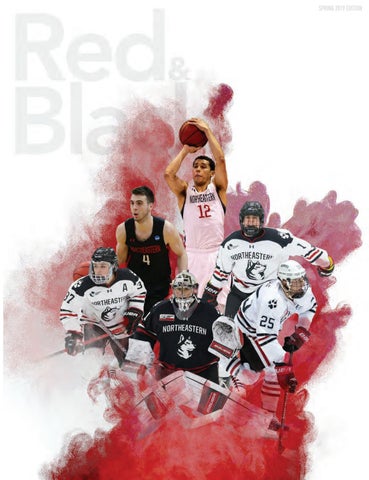
SPRING 2019 EDITION
LETTER FROM THE EDITORS As we embarked on our third edition of the Red & Black magazine, one thing became clear very early on in the wintry days of January. This wasn’t going to be just another year. The men’s and women’s hockey teams were making it look easy facing some of the best collegiate competition around. Men’s basketball returned nearly the same squad that came within a few points of an NCAA appearance. Women’s basketball was off to the team’s best start in decades. Deep postseason aspirations heated up with the weather. A second consecutive men’s Beanpot. Two Hockey East championships. A long-awaited March Madness tournament berth. A 20-win season for the first time since early 1990s women’s hoops. Now it’s our turn. Our athletic teams gave us countless reasons to shout, cheer and rejoice. But more importantly, they took us on a journey, and provided us with a common goal to which we can all unite around. There’s indeed a new breed on Huntington Avenue, and we couldn’t have been more excited to help cover it. We cordially invite you to join us in taking part of the growing Northeastern sports experience. Attire is Red & Black.
STAFF
EDITORS IN CHIEF
Jenna Ciccotelli Jake Sauberman
CHIEF OF DESIGN Isaac Milley
PHOTO DIRECTOR Albert Tamura
STUDENT-ATHLETE LIASION Adam Gostomelsky
CONTRIBUTING WRITERS
Noah Abrams Brittany Bugalski Tyler Dolph Adam Doucette Brian Fields Becca Gaddy Eve Goulet Noah Greany Jacob Horowitz Matt Levin Shelly Morris Dan Munch
GRAPHIC DESIGNERS
Megan Barrett Courtney LaPointe
PHOTOGRAPHERS
Brian Bae Tyler Dolph Alex Melagrano Lauren Scornavacca
FACULTY ADVISOR
Charles Fountain The Red & Black would also like to thank Jim Pierce for his support. Spring 2019 THIRD EDITION
M
at once my brain simply hurt. But the physical y family members filed into the house, one after another, greeting each other symptoms had a source. I knew my head hurt because with hugs and smiles. The house was loud, filled with laughter and conversaI was kicked and had 18 staples. It was the anxiety and tion between cousins catching up, grandparents checking in and siblings the depression that I couldn’t understand. It was the making fun of each other. My family gathered around the Thanksgiving table to fact that I would wake up every morning with a pit in celebrate the privilege of being in one place together and enjoy each other’s company. my stomach and an overwhelming sense of doom that But I couldn’t. I just could not understand. The worst part about it The sounds of their laughter pierced my ears. The thud of their footsteps vibrated all was the fact this was not a visible injury. It wasn’t my skull. The clanking & of forks and knives resembled nails on a chalkboard. The only like a broken arm that I could see. That could be thing that I could do to escape this, my family, the thing that means the most to me in proven with x-rays, that the doctor can put into a cast life, was to curl up in bed in a dark room, holding my head in my hands. These were the and tell me how long it will take to heal. moments where my mind went places where I wish they never went. For the first time There is no rehab. There is no clear diagnosis. in my life the idea of killing myself seemed liked a better alternative to living life in There is no timeline. The only thing that I could do constant suffering. I cried. Uncontrollably. Thinking about all that felt so far away from 25 FLOORMATES 3me MARKED MAN was sit in dark rooms and cry about everything that now. My friends, my soccer career, my education, my family. I was told that feeling Œ Œ
Œ was taken away from me, from my sport to my more emotional and sad was part of post-concussion syndrome but nothing could have   � �
identity. The only time that I felt some relief from the prepared me for what I was actually going to experience. constant suffering was when I drank. I’m the kind of person who is always in a genuinely great mood. I couldn’t turn off At least for a couple hours, my headache smile if I IN tried. always making jokes. It’s a part of me that I really love, something 6aDIAMOND THEI’m ROUGH 27 ENTER MAY disappeared and I forgot that I was in constant pain. that truly defines me. But in this moment, it felt like every smile, every laugh and every ƒ   ‚ ÂŽ ‘ After a night of drinking and my hangover state joke was the biggest lie. For months, I tried to put on this façade that I was still the same   Â? Â? returned the following morning, I returned back to Noah I had always been – believe me, I tried – but after my vision went black on that my regular thought process: If I jump over my my life turned upside down. 11field, LEGACY ONwas HUNTINGTON fifth-story fire escape, will all my pain and suffering go The actual play happened so quickly. Having watched the video replay hundreds of 31 SPECIAL DELIVERY Â? Â?  away? times since the injury, it's hard to figure out what I actually remember and what I think Â? „ ‚ Â?   I never got that close to the fire escape, but even I remember. My teammates who were closest to the play describe my head being    having those fleeting thoughts is scary enough. But whipped back like someone hitting a bobblehead. After the initial contact occurred, 13they JUNKYARD DOGgushing out the top of my head, seeping into the Parsons turf. An Elon when I experienced these dark thoughts and moments recall blood 33 A FAMILY DANCEI later realized the good in what it brought Â?    of suffering player ran full speed into me and the only way his speed was reduced was his knee Â? ‚    €  ‚  out in me. Prior to this injury, soccer was my main slamming into my skull. ‚ priority in life. What happened to me on that field Being significantly undersized and lacking god-given athleticism and speed for a D1 and in the six months that followed was the worst goalkeeper has led me to develop an aggressive playing style, always wearing my heart on 15 ROLLER COASTER 36 FULLthing CIRCLEthat’s ever happened to me, but also the best. my sleeve and making decisions without fear. When that bouncing ball came in, I didn’t ƒ  Having so much time away from the game changed Â? ‚ have to think twice about coming out for a play that even many goalies at the highest  ‚ ‚ „ „ my point of view. Feeling constantly anxious and   † level would avoid. That bouncing ball was the last thing I saw before I woke up to the depressed altered my perspective. I realized that life faces of my trainer and teammate standing over me and saying my name. 18blurry MY PURPOSE isn’t always about what is directly in front of me. I “I’m fine, I’m fine,â€? I drastically slurred as I felt a surging need to vomit. “I’m fine, Â… Â…  stopped thinking like soccer was my end-all, be-all, let me up.â€? 37 SECOND LAST CHANCE  ‚  „ my sole purpose, and my only source of happiness, Clearly, we weren’t on the same page and I was forced to stay on the floor and told Â’ †  and I started treating it like a passion that filled me, to relax for a second. Eventually, my trainer and coach helped me over to the bench  ‚   but did not define me. where I had an examination and told the trainer to stitch me up for the second half of There is no shame in admitting that sometimes the game. 21 TALENT AND CHEMISTRY things get so hard you can’t handle it on your own. If A few minutes later, I passed out again for about 15 seconds, woke up, touched my 39 VIRTUAL ARMS RACE this is going through a rough period ƒ Â? ƒ  ‚ anyone reading trainer’s arm and said, “Get me to a hospital. Now.â€?  “  Â? ‚ € in their life, sport related or not, I encourage you to These last six months since my concussion have been an extremely volatile and dark  Ž seek help from your loved ones, because some things time for me emotionally. I always thought that people who went through hard times in life are too difficult to take on by yourself. Without emotionally were soft or ungrateful. How could a person with such a great life have myTHE close friends, my teammates, my family and my anything to complain about? 41 OUT OF DARKNESS 23 INSIDE THE CLINCHER coaching staff supporting me, I don't think that I As my symptoms progressed, I felt like I lived in a state of hangover. I was constantly “  ‚ Â?   ‚  † would be here today. That doesn’t make you soft or nauseous, dizzy and had a headache. I couldn’t hang out with my teammates in our ” € †  …  ‡ˆ‰Š ‰‹ ungrateful, but it makes you human. If I could take it living room because the combination of their voices and the TV was too much † to back, I wouldn't have gone out for that ball, but I will handle. I wasn’t able to watch my team play the remaining 12 games of the season always be grateful for what the time since that injury because the lights on the field and the music in the locker room felt like I was being tortured. I wasn’t able to attend class because when I thought about more than one thing has taught me and how it has changed me.
Red Black.
SPRING 2019 RED & BLACK 2 SPRING 2019 RED & BLACK 42
Red Black. &
3 MARKED MAN
6 DIAMOND IN THE ROUGH
11 LEGACY ON HUNTINGTON
13 JUNKYARD DOG
15 ROLLER COASTER
18 MY PURPOSE
21 TALENT AND CHEMISTRY
25 FLOORMATES
27 ENTER MAY
31 SPECIAL DELIVERY
33 A FAMILY DANCE
36 FULL CIRCLE
37 SECOND LAST CHANCE
39 VIRTUAL ARMS RACE
23 INSIDE THE CLINCHER
41 OUT OF THE DARKNESS
SPRING 2019
RED & BLACK
2
BASEBALL
Sean Mellen shows off his delivery motion as he hurls a pitch towards homeplate at Parsons Field. By Jenna Ciccotelli
PHOTOGRAPH BY ALBERT TAMURA
S
ean Mellen is made up of moments. For a 20 year old kid from Norwood, 25 miles southwest of Boston, he has quite a few that stick out already – an NCAA tournament run, a high school state title, being named a second-team All-American and first-team All-CAA last season and a 2019 preseason All-American. But there are some moments that he’d like another go at. During last season, he herniated disks in his back. Instead of helping the Huskies through their historic NCAA tournament bid, the 6-foot-5, 215-pound left-hander watched from the dugout as they fell in the Raleigh Regional. When he should have been pitching for the Harwich Mariners in the prestigious Cape Cod League last summer, he was at home recovering from his surgery. “It was a helpless feeling,� Mellen said. “It was tough, and not just for me personally. We were like, ‘We deserve to be here, we should be here. We’ve earned it.’ And then we went there and we didn’t play the way we thought we could play. It was frustrating for me.� It was an early – and heartbreaking – end to a historic sophomore year that had followed a rocky freshman start. Mellen had
3
RED & BLACK
SPRING 2019
thrown just 20 innings as a freshman (28 BB, 22 SO, 10.80 ERA) in 2017. Head coach Mike Glavine remembers sitting down with Mellen, who was “a little unsure of himself,� to ask him if he knew how good he was. “It was a struggle for him,� remembered Huskies’ pitching coach Kevin Cobb. “It is for a lot of freshman. We had high expectations. It didn’t go the way we wanted to. In the sophomore year, all that stuff seemed to come back for him.� Having taken the hill as the Sunday starter for most of last season, Mellen tied the program single-season record for wins, going 10-3 while giving up just 49 hits and 20 earned runs in 79 innings. Opponents hit just .179 against him – he struck out 81 and walked 37. Behind him, his team went 36-21 (17-6 CAA, good for a CAA regular season title), falling in the NCAA regional after earning the program’s first-ever at-large bid. “Going through it, you don’t even realize how special of a group it was until you look back a year later,� Mellen said. “What we accomplished, it had never really been done here. It was really fun to be a part of. Every time we went somewhere, we expected to win.�
Mellen can pinpoint the moment that he knew last year’s team was unique. When he launched into the story, one of a March weekend in Alabama, it didn’t sound like a moment that was foretelling of success. On Friday night, Northeastern was no-hit by Auburn’s Casey Mize, who would be the first overall pick in the 2018 MLB Draft. The next morning, the first round of a double-header, was better, but not much – the Huskies’ trailed by 13 until the top of the ninth, when they used an seven-run rally to creep in and fall 14-8. It was between games, in the tunnel at Auburn’s Plainsman Park, that Mellen said the Huskies’ season changed. “Coach Glav said, ‘Hey, what are we
doing here? We’re better than this,’” Mellen remembered. “I remember just standing there, like this is on me. I need to step up right now. In my head, I was like, ‘If I go out there and pitch well, then everyone will feed off of that.’” Mellen returned Friday’s night’s favor, no-hitting Auburn through eight innings, striking out eight and walking three to secure a 2-1 win against the previously undefeated Tigers, who were then ranked 17th in the country. “The weekend of that trip, we thought we were good,” Mellen said. “We were playing well, but that was when we were like, ‘Yeah, this is real. We’re going to do this.’” That extra pressure that Mellen placed on
“I remember just standing there, like this is on me. I need to step up right now. In my head, I was like, ‘If I go out there and pitch well, then everyone will feed off of that.’” - Sean Mellen
himself in the midst of his team’s biggest moments wasn’t surprising to Cobb. Rather, this dedication to his team and the task at hand was one of the reasons Cobb knew he needed to bring Mellen to Northeastern. Cobb followed a 17-year-old Mellen through Norwood High School’s playoff run in 2015. The 2015 Massachusetts Baseball Coaches’ Association Championship MVP threw 14 strikeouts in a four-hit, complete-game state title victory. But the road to a state championship was made up of more than one moment: Mellen appeared in five of the Mustangs’ six playoff contests, picking up two wins and two saves, striking out 44 batters in 21.1 innings. “He ended up throwing every third day,”
SPRING 2019
RED & BLACK
4
Cobb remembered. “He was on the mound and really competitive. Obviously, he has really good stuff, but how competitive he was out there and the will to win, all of those things are extremely important.� That commitment to his team never wavered, even through the lost moments of Mellen’s freshman and sophomore seasons. It stood out still this year, when he talked about another lost moment, one he said will change the course of their season – a 1-7 run on the road in Florida this winter, with the lone win coming against No. 28 Illinois. “We’re going to look back on that trip right there and be like, ‘Yeah, that’s where we turned it around,’� he said. “Even though we didn’t have that signature moment like last year. It’s going to be like a rock bottom moment. We’re better than we showed down there.� Mellen, finally healthy, finally familiar
5
RED & BLACK
SPRING 2019
with the style of college ball, is performing again. He has posted a 3-0 record this season in seven starts. Batters hit just .153 against him – he’s struck out 46 batters in 40 innings, walking six and allowing just six runs for a 1.35 ERA. “[Expectations for Mellen] are high,� Glavine said. “And he knows that. He’s coming off an awesome season and is off to another unbelievable start. He’s something of a marked man in this conference and teams want to beat him. We need him to be great.� And as Mellen continues to meet, even surpass, those high expectations, there’s one moment that is slowly inching closer for him. This season, the left-hander will be eligible for the MLB Draft. “Be where your feet are,� is the advice Glavine offered to his staff’s brightest star. “[He should] enjoy being where he is and enjoy being with his teammates, because if he
keeps doing what he’s doing, that professional opportunity will be there for him.â€? And in those moments at Friedman Diamond, or somewhere else on the road, whenever his number 12 – after Patriots’ quarterback Tom Brady – is called, Mellen tries to follow that advice. It’s a confirmation that no matter how big the moments that are looming in front of him might be, there’s that place in his heart that will always be reserved for his humble roots in Norwood, his role in this growing Northeastern program and these moments he is living right now. “I’ve gotta pull my weight,â€? he said. “I don’t wanna let those guys down. Every single Saturday, Sunday, whatever day I pitch‌ it sounds like Bill Belichick, but you’ve got to do your job. You can only control what you can control, and I can try to go out there and put up some zeroes.â€?
BASEBALL
DIAMOND IN THE ROUGH By Jake Sauberman
PHOTOGRAPH BY ALBERT TAMURA
A 6-foot-4 junior quarterback takes the snap for Xaverian Brothers High School, drops back and reads the defense. Immediately he spots pressure on his left. Darting away from traffic, he continues to scan down the field, looking for an open man. A head fake to a receiver on a deep route draws the secondary away, and the QB pivots and lobs a short pass to the running back for a solid gain. Two years and a 40-minute drive down the road, another 6-foot-4 junior quarterback awaits a snap under the lights of Reading Memorial High School. Hike. The running back sprints forward to receive an easy handoff, but the ball slips out on the transfer. It isn’t long before the ball finds the quarterback’s arms once again, who charges forwards. One shed tackle, make it two. Fast forward another three and a half years, and senior Jake Farrell and redshirt freshman Corey DiLoreto aren’t putting on pads and a helmet. They’re buttoning up their jerseys and grabbing a glove to represent Northeastern baseball. After each starring in a trio of sports in high school, Farrell and DiLoreto chose the smell of fresh dirt, the snap of the glove, the crack of the bat.
For DiLoreto, the decision was made years before it had to be. “It all started with my family, my grandfather was a huge baseball fan. He always coached my dad, and then my dad always coached me growing up,” DiLoreto said. “I love all the sports I played throughout high school, but I’ve always had a higher passion for baseball.” His parents had him playing T-ball a few years after he could walk, and by the third grade, DiLoreto added football and basketball to his resume. By the time he received his high school diploma, DiLoreto collected five Middlesex League All-Star selections between those three sports. Despite the possible allure of other options,
SPRING 2019
RED & BLACK
6
choosing to pursue baseball in college over football or basketball was a no-brainer for him. “I knew baseball was for me; I just love everything about it,” DiLoreto said. “I love the hot summer days grinding out in summer ball, growing up playing with my friends in the town league. Playing the other sports was fun, but baseball is my calling.” Farrell started his athletic career equally early, picking up baseball and hockey by age five, and football a few years later. He also picked up Catholic Conference All-Star selections in all three sports he played, and as quarterback he led Xaverian Brothers to a state championship. At a school that features former NFL QBs Tim and Matt Hasselback as alumni, Jake Farrell is the all-time leader for wins as a quarterback. Unlike DiLoreto’s immediate attachment, however, baseball was a passion that grew fonder the more he played. “I was playing baseball for the longest period of time out of the year, March until August,” Farrell explained. “The amount of time I spent doing it, it grew on me more and more.” An unfortunately-timed labrum injury junior year left Farrell unable to throw footballs in front of scouts, but it only helped to pave the path for his diamond opportunity. “My junior year of high school I was getting recruited [for football] a little bit,” said Farrell. “It was difficult for me because I couldn’t throw at the time because I was recovering from labrum surgery. By the time it was my senior year, I got the opportunity to play baseball in college, and I jumped on it. It all fell into place and I decided I wanted to play baseball for the next four years.” Both Farrell and DiLoreto credit baseball head coach Mike Glavine as a main sticking point for their decision to play ball for the Huskies. A former multi-sport athlete in high school himself, Glavine actively seeks out recruits of a similar ilk. One reason? Multi-sport stars are no stranger to competition, growing up in an environment where challenge looms in every season’s forecast. The day one team’s hopes end is the day another’s begins. “Every season you’re competing, and I think in order to be a good athlete, you need that compete factor in you and the willpower to get better,” DiLoreto said. “Playing three sports always pushes you. You’re constantly competing, not just in practices, but in meaningful games. Going from football to basketball to baseball, you’re always dealing with adversity, which helps you grow as an individual – as a player and as a person.” “There’s a special kind of toughness there,” Glavine agreed. “These kids are mentally tough because they’re constantly playing a sport in a high-profile position.” “I can spin it any way,” he continued. “If the kid’s a wrestler, there’s some toughness and strength. If he’s a basketball player, there’s probably quickness and stamina. Football, there’s grit. Hockey, you get hit around. Whatever sport it is, there’s a benefit, and it shows up on the baseball field.” From a physical standpoint, the upside to multi-sport athletes is rather obvious: playing three different sports at an elite level takes a special type of athlete. But at the same time, it’s harder for these teenagers to keep up when the time most athletes use to improve their game is spent on another game entirely. “It was always difficult to find the time to workout and get bigger and stronger in high school because I never really had an offseason,” Farrell said. “In high school I would just pick it up after the other one ended, so I was relying on my raw ability and what was left over from the previous season to get me through it.” Which leads to the real clincher that gets Glavine so excited about the prospect of a multi-talented athlete joining the Husky ranks: the potential of that athlete if all of his or her efforts were directed at a singular sport.
7
RED & BLACK
SPRING 2019
“For me, multi-sport athletes have a higher ceiling. It’s like the best is still yet to come for those guys because they haven’t focused on one sport,” Glavine said. “The kids that are multi-sport athletes are willing to work; they haven’t burnt out on their sport. You’re getting a kid that’s athletic, that’s energetic, that’s ready to learn, and when they finally specialize on one sport, they have the ability to takeoff.” The possibility of a fountain of untapped potential in multi-sport athletes wasn’t lost on other recruiters, either. “The fact that I was playing three sports actually helped me,” Farrell said. “Coaches like to see that you can play different sports and that you can be athletic. I think the fact that I played two other sports in high school got them to see another side of me where I’m not just a baseball player – I’m an athlete. Once I get to school, I can harness that ability on just baseball.” And that was Glavine’s exact plan for his multi-sport recruits – unleash the players’ full
BASEBALL
“I think the fact that I played two other sports in high school got them to see another side of me where I’m not just a baseball player – I’m an athlete. Once I get to school, I can harness that ability on just baseball.” -Jake Farrell
athleticism magnified solely on baseball. He admitted that fall semester when freshmen first arrive on Huntington Avenue can be a grueling transition for those not accustomed to baseball workouts. “Those guys aren’t used to fall practices, and ours are tough,” Glavine said. “There’s a lot of running and your body’s aching. I’ll joke with the football guys, saying, ‘Did you ever think baseball practice would be tougher than football?’ That transition for them physically and mentally is really tough for their first three months on campus. They’re not used to playing this much baseball yet.” But beneath the heaving breathing and the profuse sweating is that golden new opportunity that Glavine can’t wait to provide his athletes: the chance to finally take a beat and reflect on what they need to do to become better baseball players. “Once I got here, all I was doing was baseball, so I got to sit down and really focus on my swing and focus on my arm strength and defensive ability,” Farrell remembered. “The amount of time I could dedicate to baseball was a huge difference for me and really helped me progress these last three years.” DiLoreto had an even more extreme transition to college ball than most freshmen. Not only was he shedding his football and basketball commitments, but as a redshirt, he was barred from the competitive play that surrounded him growing up. Nonetheless, he was able to turn the newfound downtime into growth. “It was really important for me because I learned a lot about the game,” DiLoreto said. “Not being able to focus all my time on baseball growing up, it gave me a lot of
room to grow. It was a huge learning experience for me getting to soak it all up. I’ve been playing my whole life and I was really surprised at how many things I still had to learn and how many different ways I could improve.” It was the same passion that drove DiLoreto and Farrell to choose the sport in the first place that kept them taking endless hacks in the cage or fielding grounders in the dirt. It’s a game centered around the expectation of failure, and any advantage to tip the scale against the opponent is only earned through hours of repetition. “Baseball is a more rewarding sport. It’s a longer season and it’s more of a grind,” DiLoreto said. “It takes a certain kind of individual to be willing to play the amount of games that we play. I embrace it, and I know our whole team embraces it, too.” Looking back on their decision, it appears the freshman and senior duo have no regrets. “In the end, everything happens for a reason. The lessons I’ve learned from playing multiple sports – the strategy from the football field, or the toughness from hockey – they transfer over to baseball,” Farrell said. “It’s the mentality that ties them together. The relationships and friendships I’ve made with my teammates over the years in each of those sports, I wouldn’t trade them for the world. Those memories will last me a lifetime, and I’m really grateful for those experiences.”
SPRING 2019
RED & BLACK
8
2018-19 MEN’S HOCKEY W, 5-0 AT L, 3-4 VS W, 5-2 AT L, 1-3 VS W, 4-1AT T, 5-5 VS W, 3-2 VS L, 1-4 AT
W, 3-2 VS
W, 9-1VS
W, 5-4 VS
W, 7-2 AT
W, 1-0 AT
W, 3-2 VS
W, 4-3 VS
W, 2-0 VS
W, 3-2 AT W, 4-0 AT W, 0-1VS L, 1-6 AT W, 2-1VS W, 2-1VS L, 1-4 AT L, 1-3 VS L, 0-3 VS W, 2-1VS L, 2-3 AT W, 4-2 AT W, 4-1 VS W, 4-2 VS W, 6-3 AT W, 2-1VS
W, 6-0 AT
W, 2-1VS
L, 1-3 AT
W, 2-1 VS
W, 4-0 VS
W, 3-2 VS
L, 5-1 VS
PHOTOGRAPH BY NORTHEASTERN ATHLETICS/ JIM PIERCE
M AT T F I L I P E NU LEGACY
HOCKEY
LEGACY ON HUNTINGTON Four decades after his father helped give Northeastern men’s hockey its first taste of success, Matt Filipe has become one of the most decorated Huskies in his own right.
By Noah Greany
PHOTOGRAPH BY ALBERT TAMURA
L
iving in Massachusetts, it’s almost impossible to grow up without at least trying a pair of skates on. It’s a way of life for so many growing up in the area, one that almost always finds a way to be passed down from generation to generation. Visit any rink, pond or flooded cranberry bog in the state – it will be littered with hockey enthusiasts young and old, past and present. For Matt Filipe, current Northeastern forward and third-round pick of the Carolina Hurricanes, the game was always in his blood. Yet there was something else in his blood that makes his story even more special: Northeastern University, the school he represents, and the school his father Paul represented 40 years ago. Filipe grew up in Lynnfield, Mass., a town 15 miles north of Boston. He was always playing sports, starring on the baseball and lacrosse fields. But it was on the ice where he shone the brightest. “Once we got him on skates and he started playing, he just loved it,” Paul Filipe said. “He wanted to play as much as he could. [Matt and his friends] would skate at Pillings Pond, play street hockey on the tennis courts. They were always doing something with hockey.” Matt attended Malden Catholic High School, known for its prestigious hockey programwhere he helped MC to Super 8 titles in his first two years. During his senior year, he played in the United States Hockey League for the Cedar Rapids Roughriders. After finishing the season in Iowa with 36 points in 56 games, it was time to decide where he would spend his next four years. *** Paul Filipe arrived at Northeastern in 1979, and immediately made an impact on the Huskies’ blue-line. A determined, physical defenseman, Paul was a part of a Northeastern team that became the measuring stick for the next four decades of Huskies hockey. His role in the team’s record-setting achievements earned him a place in the Northeastern Hall of Fame. Filipe and his teammates captured Northeastern’s first Beanpot title in 1980, and in 1982 made the NCAA tournament, also a first for the program. One of the elder Filipe’s teammates during that magical 1982 season: Jim Madigan, current head coach of the Northeastern Huskies, and the man that recruited Matt.
*** Deciding where to attend college can be a daunting task for any high school student, never mind one being recruited to play Division I hockey. Luckily for Matt, the decision was one made subliminally several years prior. “I spent a lot of time at Matthews Arena when I was younger, going to games,” Matt said. “I was around the rink a lot when I was a kid, trying to get sticks from players in the locker room. It was always somewhere that I just felt like was home for me. When the time came to choose a college, it was a no-brainer for me, really.” There was no pressure from his father, just support and love. “At the end of the day now, he’s just supporting me as a father,” Matt said. “First and foremost, that’s how he looks at it – he’s just supporting his kid. He’s my biggest fan, and just having him support me is huge.” Though he never pushed Matt towards Huntington Avenue, the elder Filipe hardly complains about his son flying around the same historic barn that hosted some of his finest hockey memories. Perhaps the only thing he needs to worry about is his son finishing his Northeastern tenure with a few more prizes on his hardware shelf. “He’s one-upped me; he has two Beanpots,” Paul said. “I’m sure he’s not going to let me live that one down. I’m really happy for him, for the team, the fans and the school. I couldn’t be prouder of him, blazing his own path there.” Another commonality between father and son – their style of play. Though they play different positions, Madigan recognized it immediately. “They both have that determination ingredient, and characteristic of hard work, second effort,” Madigan said. “Hockey was important to Paul and it’s important to Matt... that willingness to do whatever it takes to get better and make sure you leave it all out on the ice.” That hunger etched the Filipe name in Northeastern hockey history books twice over. But the story isn’t yet over for Matt, now preparing for his senior season on Huntington Avenue. There’s still time to add a few more pages to the family legacy before he walks across the stage at TD Garden, above the ice where he pushed the boundaries his father helped create.
SPRING 2019
RED & BLACK 12
T
he fast-paced and cutthroat nature of New York City breeds some of the grittiest, hard-nosed men and women the sports world has to offer. Swagger, confidence, edge. As Northeastern men’s hockey coach Jim Madigan describes it, a “junkyard dog mentality.� Beyond the stars blessed with talent lies that type of player – a fourth-line player waiting for his chance to prove himself. For the 2018-19 men’s hockey team, that player was Patrick Schule. Schule, along with many of his New England-raised teammates, was exposed to hockey at an early age. Hailing from Queens, New York, however, his path towards hockey was obstructed by the constant hype surrounding the dominant teams in the three other major sports. Schule resisted the temptation to enroll in more popular sports largely due to his older brother, Robert, who was inspired by the Rangers’ success to play roller hockey. “After the Rangers won in 1994, he told my dad that he wanted to play, so we both started playing roller hockey and it took itself from there,� he said. Schule realized from an early age that he was a cut above the others in the various leagues he bounced around, and eventually his play garnered attention from multiple collegiate programs. While a member of the New York Bobcats in the Atlantic Junior Hockey League (AJHL), he was approached by the Northeastern coaching staff, hoping to recruit the scrappy forward. When decision time came, Schule ensured his priorities were accommodated. “My most important thing was just getting a good education and being closer to a city, so I figured Northeastern would be a great fit,� he said. Schule’s moment in the spotlight would not come immediately. The beginnings of his collegiate career were spent in the shadows of the offensively-savvy Stevens brothers, John and Nolan, speedy Chicago Blackhawks wing Dylan Sikura, and Hobey Baker Award recipient and Vancouver Canucks center Adam Gaudette. Totaling no more than five points in each of his first two seasons, Schule was a small cog in one of the most potent offensive attacks in the nation by his junior season.
13 RED & BLACK
After capturing their first Beanpot in 30 years, the boys in the red and black made a strong case as a contender for a national championship, but a 3-2 defeat in the NCAA tournament squandered the dreams of one of the strongest teams in program history. With the imminent departure of graduating seniors Sikura and Nolan Stevens came the even more devastating news that Gaudette would be signing early with the Canucks. Overflowing with offensive talent not one year earlier, the Huskies were left with major holes to fill prior to the 2018-19 season. “Obviously we depended on those guys to score a lot last year so my role was more the grinder,� Schule said. “This year there has definitely been more opportunity to be on the ice.� Despite the looming mountain to scale when filling these holes, the new look Huskies approached the new season with optimism. “The coaches say that each year with a different team, you have to find your identity,� Schule’s teammate and close friend, Lincoln Griffin, said. Rather than dwell on what could have been, the dogs were hungry to return to the level of prominence they had reached just a season before. Griffin asserted that the name of the game for the Huskies in the upcoming season was opportunity. “Considering it’s our last season, we have to give it all. We [know] we [have] the opportunity to step up,� he said. With no one standing in Schule’s way but himself, the kid from Queens solidified a role for himself as an offensive threat in a revitalized offensive unit. A senior member of a new-look squad, he led by example and scrapped, gritted and grinded his way to a career-high 10 goals, more than his previous three seasons combined. “I’m not playing in the bottom six and I’m taking advantage of that,� Schule noted. The new breed of Huskies had a strong leadership presence emerge from the shadows, as Schule’s charismatic, team-first attitude shined in full form. By the end of the regular season, Schule led his team in both total penalties and penalty time. Rather than a dirty play style, it’s his “determination and grind that’s getting him
N
SPRING 2019
By Brian Fields
PHOTOGRAPH BY NORTHEASTERN ATHLETICS/ JIM PIERCE
NORTHEASTERN
HOCKEY
those penalties,� said Griffin, highlighting the exact characteristics head coach Jim Madigan once saw in a young Schule years prior. “He’s hard to play against, heavy on pucks for a small guy. He just keeps battling and battling,� Madigan lauded. “There’s definitely a little bit of swagger and a little bit of confidence that comes from growing up in [New York City].� The Huskies finished the season with a 23-10-1 record, featuring yet another hard-fought tournament en route to a second consecutive Beanpot championship. Schule was no longer an afterthought, scoring two essential goals in the tournament. “We certainly needed to win this year to prove that last year wasn’t a fluke and that we’re the real deal now and this is the standard moving forward,� Schule said. “I just tried to play my game, tried to be Paddy Schule every game and it worked out that I got two grade-A chances and took advantage of both.� Determined to make a statement, the Huskies stormed into the Hockey East tournament and captured the championship that had narrowly escaped their clutches a season before. Somehow, the new breed of Huskies had done something last year’s juggernaut couldn’t. In spite of a tough 5-1 defeat at the hands of Cornell in the national tournament, Schule and the Huskies had a season to remember, adding two temporary banners to the rafters of TD Garden while proving to the league that a new standard for Northeastern hockey had been established. A two-time member of the Hockey East All-Academic Team, the kid from Queens will be graduating from Northeastern with the education he prioritized from an early age on top of two Beanpot championships, two Hockey East championships and three national championship tournament berths to his name. Schule and the rest of his senior teammates will receive their degrees as part of the winningest class in program history. Though Patrick Schule may never have been the face of Northeastern hockey in his four years on Huntington Avenue, grit and love for the game certainly made the “junkyard dog� emblematic of the Husky mentality.
SPRING 2019
RED & BLACK 14
Ryan Ruck shot out of the gate in his Northeastern career, putting himself on an all-time path in his first two years. But new competition and a brutal injury had the goaltender fighting his way back to playing the game he loves.
By Jake Sauberman
PHOTOGRAPH BY NORTHEASTERN ATHLETICS/ JIM PIERCE
T
he clock reads 00:02.6. Down one goal, UMass Lowell has an empty net and an extra skater. Puck drops; the River Hawks win the faceoff. One second left, one last-ditch heave at the goal. The puck gets lost in a forest of skates and a storm of gloves fly into the air. On March 16, 2016, the Huskies won the Hockey East Championship for just the second time in program history, and freshman Ryan Ruck etched his name in Northeastern goaltending lore. His college career got off to a quick start; he first found himself between the pipes on Oct. 17 at the tail end of a blowout. By the very next game, he had established himself as the team’s go-to puck stopper. Despite the team’s early confidence in his abilities, with the team taking loss after loss, it took time for Ruck to see it in himself. “I didn’t have a ton of confidence in the start of my freshman year,� Ruck said. “Everyone kept telling me I was playing so well and it wasn’t my fault, but when you’re not winning, it was tough.� Then on Dec. 19 against Michigan State, a full two months after his debut, Ruck got his first taste of winning in the red and black. “From there, win after win, it was that much easier to find confidence,� he said. In a positive-feedback loop, the Huskies kept winning, and Ruck turned that momentum into zeroes, ones and twos on the scoreboard. After that Dec. 19 win, an average of just 1.83 pucks per game found
15 RED & BLACK
SPRING 2019
the back of Ruck’s net as Northeastern won 20 of their final 24 games until the Hockey East victory celebration. “At the time, I didn’t really know what to think, but now that I look back on it, it’s an experience I’ll never forget,� Ruck said about the team’s historic run. “It was the coolest thing I’ve ever been a part of, and there’s no words to describe how happy I was. It was just an unbelievable experience.� With nearly unprecedented success as a freshman, Ruck found himself with the weight of lofty expectations on his shoulders. “I didn’t let it get to my head,� Ruck said. “But there was a confidence in it. It shows that when you work hard towards something, you’ll be able to accomplish it. I took that into summer training, and come the start of the next year, we started off much better.� Quiet confidence was Ruck’s brand. He led by example, but always made sure to bring a blend of focused and fun. “He has a very serious side to him, but he also loves to have a good time. And he takes that with him on the ice,� backup goalie Curtis Frye said. “He’s always challenging guys to prove that they can score on him. He can focus on his game so much and progressing as a goaltender, but also still be part of the team and one of the guys, and still want to create a good team environment.� At 6-foot-1, 173 pounds, Ruck wasn’t big for a goalie. He relied on perfect positioning and innate quickness to foil his opponents.
That, and maybe a little bit of superstition. “He always takes great care of how he tapes his stick; he’s very particular about how when he’s taping the blade, how the creases line up,� Frye remembered. “They can’t be too overlapping.� Equipped with an analytical mind and a perfectly taped stick, it was, by all accounts, a solid sophomore campaign for the goaltender. The Huskies had no hardware to show for it at the end of the year, but Ruck had an .897 save percentage and a 2.94 goals against average. But every roller coaster has its drop. It was during the team’s exit interviews following that 2016-17 season that head coach Jim Madigan let his goaltender know that he had successfully recruited one of the nation’s top goaltending prospects – Montreal Canadiens’ seventh-round pick Cayden Primeau. “They asked me how I felt about it, and for some reason that question stuck with me,� said Ruck. “And my answer was, I’m my
best competition, and I know that I can push myself to very high levels. It’s always good to have some extra competition, especially someone as good as Cayden.” The two may have been internal competitors, but when Primeau first arrived on campus in 2017, he and Ruck developed a quick rapport. “When I first met him, I thought he was funny,” Primeau remembered. “He was always joking around. I knew he helped them get to the Hockey East championship, so I knew that he was a good goalie and I was going to have to battle him for the position. But I wanted it too so it was a good, friendly competition because he’s a great guy. He helped me a lot with the transition from juniors to college.” The respect was certainly mutual from the grizzled veteran to the prodigious rookie. “When I finally met [Primeau] junior year, he’s an incredible person. Just the nicest guy, very soft-spoken, but a great teammate,” Ruck said. “For as young as he is, he’s so
mentally mature. So there were actually somethings I was able to learn from him right away. It’s weird that he’s a little younger than me, but I was kind of looking up to him in a sense. He’s just so accomplished already.” And so began the position battle for starting goalie, between two netminders five years apart in age. The pair largely split time at the beginning of the year, rotating game by game. Ruck held up his end of the bargain, managing an 89.8 save percentage through his first four games. But a blow to the head from the elbow of Boston University’s Patrick Harper knocked him out of contention. Ruck was removed from the game with concussion symptoms, and Primeau became the team’s go-to goalie by default. In one fell swoop of an errant arm, one of the program’s most successful goaltenders was facing an uphill battle to return to the game he loved. “It was really tough, going from the goalie to the concussed goalie,” Ruck said. “It
wasn’t easy. I wanted to come back as soon as possible, but my brain wouldn’t allow me to.” Sitting in dark rooms, no physical exertion, avoid complex thinking. This was the rehab that awaited Ruck on his path back to the rink. “I felt for Ryan. When you work so hard to play the game you love and then not be able to play, that’s tough,” Curtis Frye, senior backup goalie, said. “Especially with a concussion, a lot of times can seem isolating, but he took everything with a grain of salt and made the best of it. That definitely changed him in some ways -- he has to be aware of some things that he didn’t have to before.” With all the frustration that came with being sidelined in perhaps the most pivotal stretch of his career, Ruck was able to take solace in one thing: his team was in capable hands. Under Primeau’s guise, the Huskies won their first beanpot in 30 years, and earned a berth in the NCAA tournament. “I knew that I was going to have to step
SPRING 2019
RED & BLACK 16
up big time, because we weren’t going to be able to split the time in goal anymore,” Primeau said. “Ryan was always there and really supportive the whole time he was injured.” The 18-year old goalie’s run of dominance took the pressure off Ruck to rush his rehab. As the knowledge around concussions continue to grow, there’s at least one consensus opinion. Recovery time is not to be messed with. “We took the time needed, and the doctors and the trainers and the coaching staff were awesome. No one ever pressured me to come back before I was ready, and I’m grateful for that,” Ruck said. He finally got his long-awaited medical clearance to play before the Huskies’ Nov. 30 matchup against Merrimack College. It was just over a year since his injury, and Ruck was ready to get back to work. But Primeau now had a firm grip on the position, and the team’s high aspirations had them wanting to ride their star goalie’s momentum. “[Ruck] came to work each and every day and worked his rear end off just to get better and challenge for the position,” Madigan said. “Cayden was on such a run there in that second half that we weren’t going to change that, and Ryan knew that.” It was a blowout early; the Huskies staked themselves to a 5-1 after the first period. Three more goals in the second period had the Warriors ready to hit the showers. “As soon as the score was getting up there in the second, [Ruck and I] were giving each other looks, like maybe there’s a chance for somebody to go in here,” Frye remembered. As the team sat in the locker room getting ready to close out an easy win in the third period, Madigan said the words Ruck had been thinking about all those hours in the dark room. He was getting back in goal. Armed with a perfectly-taped stick, Ruck sat between the pipes for the final 20 minutes, deflecting each of the three shots that came his way. “I still get the chills thinking about it,” Ruck said. “It felt like winning a huge game,
17 RED & BLACK
SPRING 2019
“It was really tough, going from the goalie to the concussed goalie. It wasn’t easy. I wanted to come back as soon as possible, but my brain wouldn’t allow me to.” -Ruck
just getting back on the ice for a game, because there were moments [during rehab] that I thought to myself, maybe I won’t be able to play hockey again, maybe this is the end of my career. So being out there against Merrimack was incredible.” Primeau had a front row seat to his friend’s comeback, feeling a number of different emotions. “It was a little nerve-wracking because he hadn’t played in a year,” he said. “You can practice every day but game speed and game feel is a little different. But it just shows what a great goalie he is and the talent he has because he stepped in and didn’t skip a beat.” But Madigan had more in mind than merely a feel-good moment for his veteran goalie. With Primeau set to join Team USA in their quest for gold in the World Junior Championships, the Huskies would be without their prodigy for a handful of games. In the three games Ruck started in Primeau’s absence, the Huskies went 2-1. Opponents tried to put 65 pucks past the 24-year old. Only three succeeded. This time under the lights of TD Garden with his teammates on the bench rather than holed up in a dark room, Ruck celebrated Northeastern’s second consecutive Beanpot in January. Then, two months later, something only he and one other goalie in school history had accomplished: a Hockey East championship. “It’s been an unbelievable experience, from freshman year until now,” Ruck reflected. “The amount of things I’ve learned over the years are… I can’t really describe it. I knew that I would learn a lot in college, but all the skills I’ve learned on the ice, off the ice, in the classroom, networking, it’s been huge.” Two Beanpots, two Hockey East championships. Friend and mentor to one of the program’s most talented goaltending prodigies. Eighth in program history among goalies in games played, sixth in minutes, fourth in goals against average, twelfth in saves, fifth in save percentage, fifth in wins, ninth in shutouts. Ryan Ruck made his mark.
MY PURPOSE I
f I could give freshman year Brittany one piece of advice, it would be to stop and appreciate more – embrace the people, the highlights, the failures and the day-to-day moments that you will never get back because this is what will shape you into the person you are now. I was the starting goalie that helped bring our team to the NCAA Tournament for the first time in program history – a huge accomplishment for the program. I received Hockey East All-Star honors, a handful of Defensive Player of the Week and Player of the Month awards, the Bertagna Award during the 2017 Beanpot and became the first freshman goaltender in program history to win 20-plus games in a season. I capped off a successful 2016 campaign by competing with the U.S. U22 Select Team later that summer in Calgary. I was fueled by the recognition and the statistical achievements. I was ambitious and wanted to be best goalie that had ever come through this program – which includes four-time Swiss Olympian Florence Schelling. And when you are young, you only think in terms of personal stats, number of wins, records broken, etc. All of this only sets up a roller coaster of emotions my junior year. A new freshman goalie had just joined our team, Aerin Frankel. I wanted to guide Aerin while showing her the ropes here – I knew she would be my successor and I wanted to leave her with as much knowledge as possible. I was in the best physical shape I had ever been. I had proven myself the previous two years. I had people who believed in me. And yet...my play slowly started to crumble. I couldn’t even seem to make it through a practice without feeling frustration deep enough that it consumed my every thought. The idea of making it through a full game without getting pulled seemed like an impossible task to conquer. I prided myself on my consistent play year after year – this was the first time in my playing career that I had ever been in a slump this significant, and I had no idea how to pull myself out of it. I didn’t understand why I had been putting out poor performances when I did all the right things to set myself up for success. I knew our coach believed in me; he had given me so many chances to continue to prove myself. It got to a point where I literally didn’t want to be in the net anymore and disappoint my teammates and my coaching staff –
By Brittany Bugalski
PHOTO COURTESY NORTHEASTERN ATHLETICS
something freshman Brittany could never imagine believing. It was a hard way of thinking – but the goaltender position is mentally challenging even when you’re doing well, not to mention when things aren’t going your way. I had been playing fine through the end of October and that’s when things started to trend downward. Long story short, I lost my job as the starter to Aerin, and we began to switch off game by game before she ultimately took the reins late in the season. But a funny thing happened when our coaches finally gave Aerin the starting job she had rightfully earned. The typical narrative you read and hear from the Michael Jordans of the world is one of anger, but I immediately felt at peace. This whole time I had been questioning what my role was, what my teammates thought of me, the value I brought to the team each day – so many questions ran through my head. But now I knew exactly what I had to do. My role shifted into supporting my teammates each day and finding a way to contribute to our team’s success without actually being in the net. And then we turned a disappointing .500 season into a Hockey East Championship – our first in program history. It was incredibly special to be a part of something so memorable to this program, especially after all the adversity we had faced over the course of the season. I had won a gold medal at the U18 Women’s World Championships, and this trumped that feeling. When what felt like the world’s longest season finally ended, I was ready for a much needed break from the ice. Over the next few months, I don’t think I thought about hockey once – I didn’t want to resurrect any of the feelings I had felt throughout the season, so I just avoided them. I was on co-op through the end of June, which provided a great distraction and escape for me in those coming months. Our head coach called me on my way to work during the summer to inform me that my teammates voted for me to be the captain of our team for the 2018-19 season. I will never forget that phone call. In that moment I felt excited, honored and ready for what was to come. I felt like I rediscovered my purpose and my role on this team. In that moment I felt a rush of confidence that I hadn’t felt in months. I continued my usual off-season training regimen, with the same intensity that I brought every summer before that. However, I dedicated a substantial amount of my energy and focus to becoming the best leader
SPRING 2019
RED & BLACK 18
I could possibly be for the group of girls I was given the privilege of leading. I read a handful of various leadership books, some of which included: Crucial Conversations, The Power of a Positive Team, and The Power of Positive Leadership, furiously taking notes and highlighting ideas that I could bring back to the team and present to the leadership group in the fall. One of those was Jon Gordon’s “One Word” idea - where each team member chooses one word that will inspire them to live with more meaning, mission, passion and purpose for the year. We took a spin on this and wrote each of our words down on small pieces of paper, encapsulating them in an empty bottle of “Mojo Cold Brew Coffee” – as one player each day would receive the bottle for bringing the mojo to the ice and to our team that day, becoming something we looked forward to at the end of each practice and game. I knew that being in this role meant my teammates respected me, valued my opinion and believed that I could lead them to where we wanted to go. Oddly enough, knowing this gave me back all of the confidence I had lost in myself last season. I felt like captaining this team was my purpose at Northeastern and why I was meant to be here. Since I was young, I was never the goalie that brought our team championships, and while I may have been close a few times, I’ve honestly never quite been that goalie. But somehow, I had always been the player that ended up with the “C” on my chest. Our leadership group established a value system, listing the values that embody a women’s ice hockey player at Northeastern – positive, humble, grateful, respectful, selfless. Our team mantra, decided by the upperclassman who have helped shape this program over the years – “Unity in Adversity”. We sat down with our strength coach bi-weekly to discuss what our values meant to each of us to ensure everybody understood why we had them. We brought back a clear sense of purpose and direction that we had lacked in years prior – we knew exactly where we wanted to go and how we were going to get this team there. Most importantly, we brought back a sense of family. Many teams refer to themselves as a “family”, but few teams actually feel what this truly means, and this was the first year we had genuinely felt that bond with one another. I made a personal effort to get to know each and every player a little better, and ensure that they knew how much I cared for them, and how much they were valued and appreciated on this team – we needed everyone on board if we were going to make a run at something special. We closed out the season with a 27-6-5 record, winning not only a Hockey East regular season championship for only the second time in program history, but a Hockey East championship for the second time in program history – in back to back seasons. In addition to that, we hosted a home ice NCAA Quarterfinal Game, another first for our program. Having sat comfortably at our highest rank in program history, No. 3 in the country, through the final week of our season, it’s hard to look back now that it’s over and think that there is anything I would have changed about how this season went. However, one of my favorite parts of all of this is that this kind of success is now an expectation for the team here. Going forward, the standard has been raised, the foundation has been set and the potential is limitless. I had one personal goal for myself at the start of the season: leave a
19 RED & BLACK
SPRING 2019
This whole time I had been questioning what my role was, what my teammates thought of me, the value I brought to the team each day – so many questions ran through my head. But now I knew exactly what I had to do.
lasting legacy and make a meaningful impact on my teammates’ lives. Being the captain of this team and having the opportunity to influence and impact each and every person has undoubtedly been the greatest honor I have ever received. At the end of the day, this is truly what it’s all about. Nobody is going to remember where you finish on the all-time wins list, or what your save percentage was that year – but what they are going to remember is what you left behind, the impact you had on them and the genuine relationship you created with them. As this chapter of my life comes to an end, I realize how grateful I am to have been a part of something much bigger than myself. Having to go through the battles I was fighting in my own head during my junior year was the hardest thing I’ve ever had to deal with; however, it lead me to the most memorable, rewarding and joyful season of hockey I’ve ever been a part of. I wouldn’t trade this experience for the world.
TALENT AND CHEMISTRY
Alina Mueller and Chloe Aurard brushed aside any questions about age or experience, as the freshmen duo fueled the majority of the Huskies’ points this past season.
By Jacob Horowitz PHOTOGRAPH BY BRIAN BAE
H
ockey may be Northeastern’s most well-decorated sport, and that success does not end with the men’s team. The women are back-to-back conference champions, were ranked third in the nation for most of this season and fresh off of another NCAA quarterfinals appearance. This year’s domination had been led by freshmen roommates Alina Mueller and Chloe Aurard, whose precocious talent and chemistry have held the collegiate hockey world rapt and cemented them as some of the world’s most promising hockey talents. The strength of their partnership is clear in their contribution: Mueller and Auarard have combined for 82 points (51 and 31 respectively). Mueller’s 21 goals and 30 assists leads the team in both categories while Auarard’s 12 goals and 19 assists places her fourth. Over their 27 conference games, only three conference games have gone by without Mueller and/or Aurard registering at least a point. That talent – and chemistry – formed long before the pair arrived at Northeastern, as they commanded international attention on the European stage. Mueller scored the
21 RED & BLACK
SPRING 2019
bronze medal-winning goal and became the youngest hockey player to ever win an Olympic medal when she led her home country of Switzerland in the 2014 Olympics. Later, as a member of the U18 National team, she competed against her future teammate, Aurard, who skated for France. “We just had so much fun on the ice,” Aurard remembered. “I think [Mueller is] so good and in my head, I'm thinking, ‘what if one day I get to play with her.?’ Then it happened. We got really close on the ice during the first practice at Northeastern and then being roommates with her made us closer. I think we just really think alike.” “It was just fun and I enjoyed [the team environment] and every week was better and better,” Mueller said, “We got to know each other better and better. . . We had this bond right away.” And while no one questioned the impact the pair could have when they were finally skating together, their different hockey backgrounds created different expectations from the Husky coaching staff. For Mueller, Flint expected instant contribution.
“I saw [Mueller] competing in the Olympics at that point . . . and kinda followed her along the way through World Championships and those subsequent years after,” recalled head coach Dave Flint. “We just hung on and lucky for us she chose Northeastern.” “Chloe's a little different – she committed early to us but we knew that she needed to work on her English. So she had to come over to prep school in the United States to learn English so she could get into Northeastern.” Unsurprisingly, Mueller’s dominance began as soon as she arrived, scoring her first goal and notching her first assist in the second game of the season. That month, she led all NCAA rookies with 11 points in nine games and won National Rookie of the Month. Mueller continued to contribute game after game, building an NCAA-leading 22-game point streak lasting 111 days, picking up countless conference honors along the way. “[Mueller] made the transition pretty smoothly and hit the ground running when she got on campus. She's had an amazing
Hock year for us. . . She’s impactful every game,” said Flint, who described Mueller as a “joy to work with.” “They made it really easy for me and the team was [behind me] right away,” Mueller remembered. “From the beginning, it was just so much fun and we kept rolling and rolling and winning games. Now we are [in the NCAA tournament] and it's pretty cool.” For Aurard, though, it was unclear how long of an adjustment period was going to be needed. “Where she went to prep school [at Vermont Academy], the level wasn't real high,” Flint said. “She was pretty much the best player on the ice every time. It was gonna be a big jump for her to college so we weren't sure how quickly she would make that transition. We know how talented she was, we knew the ability she had, it was just a matter of how quickly she could get up to speed.” But it took Aurard no time at all, as she scored her first goal in the first game of the season and winning National Rookie of the Month in November (right after Mueller won it the month before).
For Coach Flint and the overall success of his program, their chemistry is instrumental. “I think they've developed a good chemistry and friendship,” he explains, “It's really translated on the ice for the both of them.” And it has. Of the 98 Northeastern goals scored during the regular season, Mueller and/or Aurard played a hand in 53 of them. Between the two of them, they’ve won two Commissioners Association National Rookie of the Month honors, five Pro Ambitions Women’s Hockey East Rookie of the Month, five Pro Ambitions Women’s Hockey East Rookie of the Week, three Women’s Hockey East Player of the Week and two NCAA Stars of the Week. Aurard says it’s her international experience that prepared her most for NCAA play and allowed her to make such an instant impact. “I think that playing against teams like Russia and Switzerland [for whom Mueller played] really helped me get used to the speed in college. I think my national team got me ready.” While Mueller’s consistent contribution
has been less of surprise, her impact off the ice has impressed coach Flint. “She's so outgoing, she's so respectful of her teammates,” Flint lauds, “She's a kid who you can tell is happy to be where she's at and enjoys every moment. That's kind of infectious with the team. As big of an impact as she's had on the ice, she's had as big of an impact in our locker room this year.” Unfortunately, the season ended on a sour note: an overtime loss to Cornell in the NCAA quarterfinals, a game Alina Mueller missed due to injury. Thankfully, Mueller will be fit by fall and both her and Aurard look ahead with excitement. “The team is obviously going to be different because we are losing people like Kassidy [Anderson] and goalies and they're really great leaders,” admitted Aurard, “Our juniors are great too, and they're going to be really great leaders. I look forward to meeting the freshman and making them feel like how the team made me feel.” “Everything is open – if we play our best hockey we can beat anyone,” said Mueller. “We will do it big.”
SPRING 2019
RED & BLACK 22
By Becca Gaddy
PHOTOGRAPH BY BRIAN BAE
T
he women’s hockey team continued to make history since winning the Hockey East Championship for the first time ever last season. The team went 27-6-5 this season as they clinched the Hockey East regular season title – and second consecutive conference championship. This season the team faced their neighborhood foe, Boston College, five times, going 3-2 in the series. The final meeting at the Hockey East championship, like the first at Matthews Arena in November, was a decisive overtime victory. With the energy of the championship win still buzzing, four integral members of the team reflected back on their second Hockey East Championship win, and second nail-biting overtime win over the Eagles. Senior captain Kasidy Anderson: “We knew where we went wrong in the losses and what we did right when we beat them. I made sure I focused on getting the team ready to be all over them.� Sophomore defender Skylar Fontaine: “Individually, for some reason I wasn’t as nervous. I think because as a team we‘re always so united and have each others’ back. So I think my teammates helped me just
23 RED & BLACK
SPRING 2019
relaxed and go out there and just be confident. As a team we went out there and were like, we just need to play our game and go in expecting their best game.� Anderson: “I think one of the most important messages we said was that when we are a unit and play together, then we are not easy to beat. BC may have all these big names and players, but I don’t think any other team in the NCAA has a bond like our team has.� Sophomore goalie Aerin Frankel: “I was just focused on not over-moving. I’ve talked to my coaches a lot about that recently. Just playing simple and going back to the basics. I know that they have a lot of good shooters but if I was in position I knew I would be able to make the first save. I knew I could rely on my defense to clear out loose pucks and limit the opportunities that they got.� The overtime thriller was a close game from the start. The first goal of the game was scored by Northeastern’s Andrea Renner on a power play just before the end of the first period. Junior forward Renner: “I just jumped on the ice and then I saw Skylar skate the puck into the zone. She was kind of fumbling with it a little bit but then she collected it really well. I think she was trying to toe drag and shoot. The shot kind of hit off their shin pad or skate. I was just trying to go to the net and see what would happen and when the puck came off of her stick, it came right to my stick as it went through their feet. I shot it and it happened to go in. When it
happened, I kind of blacked out for a second and as I turned around, everyone was jumping on me. It was a pretty cool feeling.� Fontaine: “I remember looking up at the clock and there was about two seconds left in the power play. I was like, crap their player is going to come out and I'm either going to get the puck taken from me or something. Matti just fired it across the ice and I took it, skated, and I knew I didn’t have a good shooting angle from where I was so I tried cutting in and shooting. It ended up hitting weird and bouncing off into Renner’s stick and she just shot it and it went in.� Frankel: “It was good we scored first because a lot of times it puts the other team back on their heels. I know that when we get scored on first then it's hard to respond to that.� Fontaine: “It was a huge momentum thing for us. We needed that first goal. We just needed to calm the nerves I think. Our matchup going in was that they won two and we won two and it was going to be a big game. That first goal was huge for us.� Boston College evened the score two minutes into the middle period, resulting in a 1-1 stalemate that would hold until the final frame. Frankel: “I felt some pressure. But I would say that times when I am at my best I am most composed and calm.� Renner: “Aerin bailed us out a lot because with a good team like that, you have to keep your game simple and I don’t think we were
doing that. We knew we needed to simplify.” Anderson: “Once we started to realize that we were getting away from what’s working, we turned back and started simplifying our game. In the third period I think we completely dominated. They really had no time or space with the puck. We knew how important the next goal was.” Fontaine: “We just needed to keep working hard and pressuring them. One way or another someone was going to win and we were determined for it to be us. As a team we were all just staying united and supportive and just trying to keep each other positive.” Alina Mueller’s goal with 4:07 left to play put the Huskies up 2-1, and looked to be the winner the defending champions needed.. Fontaine: “It was on a power play and I remember I was like ‘Oh my god, someone just shoot it, shoot it please.’ She was coming around the top and I was like, she's going to fire this right now. Her shot is insane and she has such a great aim. I was thinking if she shoots this right now, it‘s going in.” Renner: “I was in the box, so I was just banging on the box door trying to get her attention. It was just so exciting. I had to celebrate by myself but I just saw the whole bench go crazy and it was just a great feeling overall.” But with five seconds left in regulation, BC’s Kali Flanagan tied the game to send the two teams into overtime. Frankel: “I was honestly in shock for a while after they scored the goal. I knew what they were trying to do. I think we all went
The Huskies celebrated their second consecutive Hockey East title in fashion — by taking down Boston College in an overtime thriller for the second time this season. over the fact that they were going to try to win the faceoff back to that player who was set up for a one timer, but we lost the faceoff cleanly. The girl got the shot off almost immediately as the puck got to her stick. I was in shock when I saw the puck come right by me and couldn’t even believe that it had even happened.” Frankel: “In between the third period and overtime everyone was talking about just taking a deep breath and relaxing. We had been in big games before, we had been in overtime before, and we had been successful in overtime before. We had been there before. It was going to come down to heart and who out-worked the opponent.” Fontaine: “We went in the locker room and told ourselves that that part of the game is over, on to the next. This is completely different and we can’t focus on the past. We need to focus on this 20 minutes and that's all.” A turnover in the neutral zone resulted in the puck finding its way to Anderson’s stick, and her overtime goal secured the back-to-back title for the Huskies with 12:39 gone.
Fontaine: “I think it was their defenseman or their forward who just flipped the puck super high and it went over everyone and I was the last one back. I remember seeing it coming and thinking, oh no I have to stop this. So I went on one knee and stopped it with my hands and just wanted to get rid of it so fast because I didn’t want someone to poke me and go on a breakaway. So I hit it off the boards and fired to Kasidy.” Renner: “I know that pretty much everytime Kas gets the puck it's dangerous. I know that she has a huge size advantage to a lot of players in the NCAA. So I knew that once she lowered her shoulder and carried it across her body, I knew it was going to go in.” Anderson: “I remember as soon as I saw the puck coming towards Barnes I was like, she is going to whiff this right to me. As soon as I saw the puck I jumped on it and when I got it I knew I was going to lower my shoulder and stick my left leg out to protect it. Coach Carp always jokes that I go back hand and I went back hand and flicked it over her blocker. I knew that to score on this goalie you needed to move her laterally.” Frankel: “It didn’t really set in until we were on the way home and I just was like, wow, we just won Hockey East and just beat a really good team, BC. It’s just a testament to the kind of team we are.” Anderson: “As soon as I watched it go in, I sprinted to the boards. It didn’t really hit me that the game was over; I was just excited to score. For that to be the game-winning game that was even more meaningful.”
SPRING 2019
RED & BLACK 24
BASKETBALL
Since the very first day at Northeastern, Jess Genco and Gabby Giacone built a deep friendship that shows on and off the court.
By Jenna Ciccotelli
PHOTOGRAPH BY TYLER DOLPH
THERE’S A NATURAL CHEMISTRY on the court between Jess Genco and Gabby Giacone. It’s a chemistry that translates over to the box scores: Genco, a two-time All-CAA First Team selection, finished as this season’s team leader in points (559), field goal percentage (.418) and free throw percentage (.913), among other categories, and the program’s all-time leader in games started, minutes played, assists and three-pointers. Giacone was at the top in rebounds (195) and blocks (17) this season. And it’s a chemistry that has been brewing since the pair first descended onto campus four years ago, when they were paired together as roommates in Stetson East – a bond that still stands between the duo as their senior year draws to a close. “It’s something special to have teammates that room together all four years and still keep that consistent friendship off the court,� Giacone said. “It’s like someone that kind of knows all of your stresses throughout the day,� Genco agreed, “Whether it be basketball or even something outside of basketball.� And while their sport was what initially brought Giacone and Genco together, their friendship has expanded beyond the walks to and from practice and the countless drills on the court. On move-in day four years ago, both Genco and Giacone pulled up to West Village (where they would live for the summer before moving into Stetson East) in their mothers’ Suburbans. Genco set up her bedroom with the help of her parents and siblings, said her goodbyes and according to Giacone, went immediately to the gym. “Up until like the first two weeks, Jess would go to the gym from like, 7 a.m. to 10 p.m.,� Giacone said. “She was never in the room all day. Eventually, I just started going to the gym with her.� It wasn’t anything personal for Genco, who, after all, admitted to doing “the whole Instagram stalking thing� and finding her future
25 RED & BLACK
SPRING 2019
Â
roommate on social media before moving in. “I’m a quiet person, but like, I thought she was normal,” Genco defended. “It just takes me a certain amount of time to open up.” And so there was another difference at the center of the friendship between Genco and Giacone – a guard and a forward, 5-foot-5 and 6-even, shy and extroverted. But these differences are at the core of their friendship, providing the foundation that has carried them through their four years at Northeastern. Genco laughed as she remembered one winter when her roommate opened the window to yell that a snow day had been called and all classes for the next day were canceled. It wasn’t true, Genco insisted, but Giacone’s call had convinced the whole hallway to buzz with excitement.
In the same way that Giacone’s energy stands out to Genco, it’s the ability of the quieter friend to emerge from her shell that excites Giacone – Genco would be called to the front of the bus to freestyle rap about Olive Garden breadsticks on rides between practices and dinner. “My favorite memories are when I see Jess step outside of her comfort zone with other people,” Giacone said. “Just seeing her in her goofy element, when she’s not staying in her own bubble.” After four years, Giacone has edged Genco out of that bubble, and the encouragement is evident amid the laughter as one eggs the other on, telling her to just “say her line” about having connected with her teammate and roommate so many years ago. “You go to college for two things,” Genco said, laughing, “To find a best friend and a husband. One out of two ain’t bad.”
SPRING 2019
RED & BLACK 26
ENTER
MAY By Matt Levin
PHOTOGRAPH BY ALBERT TAMURA
K
atie May set the bar high in her inaugural season for Northeastern women's basketball. The freshman guard from Rydal, PA, started 28 out of the 29 games she played in this season, averaging 4.6 points and 3.2 rebounds. Her stability within the rotation helped the Huskies reach the 20-win plateau for the first time since May herself was born. She was born into a basketball family; her mom, aunt and uncle all played in college. They made sure to put a basketball into May’s hands as soon as possible, and by the time she was seven she fell irrevocably in love with the game. However when May entered high school, it became apparent that basketball was becoming more than just a hobby. May played at Archbishop Wood High School with her sister and two cousins. Her taste for the big stage began there, as May led her team to two state championship victories in four years. The high school culture “taught a lot
27 RED & BLACK
SPRING 2019
about winning,” she said. “It made my game so much better. It also made the game serious to me, not just fun.” May came into Northeastern at the perfect time. Claudia Ortiz, one of Northeastern’s starting guards over the last three seasons, graduated, meaning the team had an opening in the starting lineup. Coaches were looking for someone to step up in summer practices and take the reins. Enter May. “As soon as [May] stepped on the court, it felt natural. She is a kid that gets it. I don't have to spend a lot of time explaining stuff to her,” said senior forward Gabby Giacone. “She is a naturally born leader, sees the floor well, is a great listener and communicates really well, especially as a freshman being able to come in and take direction.” In the Huskies’ first conference game of the season against Elon on Jan. 4, May scored 18 points and corralled 10 rebounds. Not only did she have her first double-double, but she was a perfect 5-5 on three pointers. It
BASKETBALL
was a sign of things to come for May, who ended the season shooting a robust 38 percent from beyond the arc, good for third on the team. That first performance, which helped lead the Huskies to a 79-71 victory, helped May feel secure in her new role, after what could have been an otherwise difficult transition to the pace of college ball. “I was in the zone, knocking down the shots that were there,” May said. “It gave me a lot of confidence going into conference play.” May has noticed many improvements to her game throughout the season. “I’ve become more of an offensive threat than in the beginning of the season and I’ve been able to spread the floor for other people because of my shooting,” she said. Through shooting she found confidence, whereas when she first arrived on campus, she “came in just thinking about defense and not screwing up.” Next year, Northeastern will sustain more losses to their offense, as two of their three top scorers from this season, Jess Genco and Gabby Giacone, are graduating. To make up for the loss of scorers, May looks to improve her “ball handling and becoming more productive and quicker on the offensive end of the floor.” Despite her age, Giacone believes May has the intangibles to step up and command a leadership position in the locker room. “Upperclassman look up to her. She is going to have a bigger and bigger role at Northeastern and is going to be a go-to person for next season,” she said. Even though she prepares to enter just her second season as a Husky, May always keeps an eye on the future. She would welcome any opportunity post-graduation to play basketball overseas, or perhaps even transition into coaching. However, May didn’t choose Northeastern solely for its basketball program. Her academic interests lie in marketing, with dreams of working in print media or fashion. In the meantime, there’s work to be done on Huntington Avenue as May helps usher in a new tradition of winning for women’s basketball.
SPRING 2019
RED & BLACK 28
NORTHEASTERN W 82-74
HOFSTRA C A A
T O U R N A M E N T
NORTHEASTERN L 53-87
KANSAS
NCAA TOURNAMENT
PHOTOGRAPH BY ALEX MELAGRANO
By Tyler Dolph
PHOTOGRAPH BY ALBERT TAMURA
From Jordan Roland’s first steps on the hardwood donning the Husky on his chest, he emerged as a driving force on Northeastern’s road to the NCAA tournament.
A
fter watching a couple of Northeastern men’s basketball games, one thing becomes clear: Jordan Roland is a nightmare to guard. Whether it’s sprinting along the baseline rubbing off a down screen, or slashing back door for an easy layup, he’s always moving. He can score at every level, keeps even the very best defenders looking over their shoulders and doesn’t need more than a few inches of space to swing the momentum of a game. Players with his type of game-changing talent are typically keen on letting everybody know how good they are. But when asked about the source of his offensive abilities, Roland was quick to answer, “It’s all because of the great system I’m in and guys finding me open looks.� The 6-foot-1 guard is a redshirt junior and transferred to Northeastern in 2017. But you wouldn’t know it was Roland’s first full year playing with the Huskies. His synergy with his teammates on both ends of the floor made it seem like he’s been around for a couple of seasons. Jordan Roland plays in what would be his last game as a member of George Washington. He finishes with five points on 2-6 shooting as the Colonials are bounced out of the 10th annual College Basketball Invitational by the University of Illinois-Chicago. Roland, a Syracuse, N.Y. native, began his collegiate career at George Washington University. But after two years with the Colonials, he decided it was time for something new. “There was a coaching change and a lot of guys were leaving,� Roland said. “I had talked with Northeastern during the first round of recruiting and when it was time for me to transfer I was sold on the school. I saw what they had done for T.J. Williams and thought they did a great job developing their guards.� NCAA rules require transfer students to spend an academic year in residence at the school to which they’re transferring before competing. This meant Roland had to spend the entire 2017-18 season on the sidelines. Transfer students aren’t allowed to travel with their team to away games, which can be hard on players trying to assimilate into a new team culture. But for Roland, it provided a unique opportunity to recharge and get ahead of schoolwork. “It was really relaxing actually,� he said. “I had two weeks off for Christmas, when normally I would’ve only had four days. It was nice to go home on weekends during the season and allowed to me focus on school too.� But when the 2018-19 season rolled around, he was ready to show his new team,
31 RED & BLACK
SPRING 2019
and the rest of the country, just how prepared he was. Jordan Roland sprints up the left side of the floor late in the first half against Harvard. Point guard Vasa Pusica finds him with an outlet pass up the court. Roland corrals the ball with two hands, feints to the corner and puts down one powerful right-handed dribble towards the basket. With his defender now off balance, Roland steps back and sinks a wide open three to give the Huskies their first lead since the opening two points of the game. Roland’s performance propelled the team to their first win of the season. He finishes his second-ever Northeastern appearance with 35 points, tied sixth for all-time single-game scoring, on 9-13 shooting from the field, 7-10 from three and a cool 10-11 from the free throw line. In a performance that came to typify Roland’s ability to efficiently dominate any given matchup, he focused not on his more-than-respectable accomplishments, but instead on how he could improve. “I actually remember having two early turnovers in that game,� he said. “I came off the bench and don’t even think I scored in the first 10 minutes or so.� Roland’s first basket in the game was a three that came with 5:12 left in the first half. The bucket gave the Huskies their first lead of the game since the opening bucket. They never trailed the rest of the way. “It speaks, first and foremost, to his personality,� said head coach Bill Coen. “When he did score that 35, he came off the bench. There are a lot of guys that would let their egos get the best of them and limit their own production because they feel they’re being slighted. But Jordan is the type of guy who just wants to help the team anyway he can.�
BASKETBALL
101 3 POINTERS MADE THIS SEASON *PROGRAM
RECORD
After setting a program record with 101 three-pointers this season, Roland ranked in the top 10 in the CAA in three-point percentage, free throw percentage, +/- and true shooting percentage. He was also second on the team in points produced. “In my opinion, Jordan Roland is one of the most efficient scorers in college basketball,� iterated Coen. “He’s an outstanding shooter and he combines that shooting ability and shooting range with elite quickness, which is a very rare combination.� Roland’s tremendous offensive efficiency wasn’t just the opinion of his coach. For much of the season, Synergy Sports reported Roland’s offensive efficiency at around 1.22 points per game, just behind players like Zion Williamson of Duke and Brandon Clarke of Gonzaga. Even more extraordinary was the performance level while Northeastern dealt with key injuries. Players like reigning CAA Defensive Player of the Year Shawn Occeus and First-Team All-CAA member Vasa Pusica missed big stretches this past year. “When guys can’t play, of course you think you have to raise your play. But it’s more about how everyone on the team raises their play, not just one person,� Roland said. In the final game of the regular season, Roland opens up the contest with 16 points in the first nine minutes of play, giving the Huskies a 22-9 cushion on the road.
Roland concludes the outing with 26 points on 52 percent shooting as Northeastern cruise to victory over CAA rival Drexel, solidifying the number two seed ahead of the conference tournament in Charleston. Moving forward, Roland echoed his same mindset of self-improvement and placing the team first. “My goal is to obviously go as far as possible. For me personally, it’s just to bring whatever I can to the team.� With the year freshly in the books, Roland already has certain aspects of his game he’d like to work on before next year. “I want to improve as a ball handler and be able to find open guys better. I think that’ll really round out my game." Coen elaborated a similar attitude on Roland’s future. “Going forward into next year, even greater things are in store for him,� he said. “We’ve asked him to handle the ball, to get into ball screens and to dribble, pass and shoot. I think he has accepted the challenge and excelled in his development.�
SPRING 2019
RED & BLACK 32
A FAMILY
DANCE
By Adam Doucette PHOTOGRAPH BY ALBERT TAMURA
The day was finally here. A chance at redemption. After a year of working and waiting, the Northeastern men’s basketball team fought its way back to the CAA basketball championship game. Tomas Murphy, Northeastern’s sophomore forward, was ready. After a heartbreaking loss in the CAA championship game last year, he knew what it was going to take. “We were so close last year. Can’t really be much closer,� said Murphy before the tournament began. “Obviously, it’s win or go home so those games are tough, but we’re getting better and guys are doing what they need to be doing.� With under 10 minutes left in the game, the Huskies watched their 16-point first half lead over Hofstra University dwindle to just three. Murphy was in the low post, with the smaller Eli Pemberton guarding him. The 6-foot-8 forward got himself open, demanded the basketball and put up a hook shot. He initiated contact but got the whistle to blow, and the ball softly dropped through the net. He turned around to walk to the free throw line with his fists clenched and let out a yell of excitement. His older brother, Alex, stood in the crowd, passionately cheering for the team he played on just two years ago. His oldest brother, Erik, currently playing professional basketball in Spain, couldn’t be at the game but watched from Europe. Support from family and playing with intense emotion seems to be a winning formula for Tomas and his brothers. *** When people talk about the best basketball families, there are a few that come to mind. Maybe you think of the Curry family. Stephen continues to dominate the NBA, and his brother Seth is carving out his niche for the Portland Trail Blazers. Their father Dell was an NBA All-Star. Maybe you think of the Plumlee brothers: Miles, Mason and Marshall, all three of whom played at Duke and have seen NBA action. Or maybe the Zellers come to mind. Brothers Luke, Tyler and Cody were all Division I players who spent varying lengths of time in the NBA. Their uncle, Al Eberhard, was also an NBA player. But right up with the best of them is one with roots right here at Northeastern University – the Murphys.
33 RED & BLACK
SPRING 2019
This year was Tomas Murphy’s second playing for the Huskies. Erik, 28, was drafted by the Chicago Bulls following his graduation from the University of Florida, and now plays in Spain for BAXI Manresa of the Spanish ACB league. Alex, 25, most recently played in Hungary and is currently home in the US rehabbing a foot injury. He played at Duke and Florida before finishing his collegiate career at Northeastern. Their father, Jay Murphy, was an NBA player for the Los Angeles Clippers and Washington Bullets, and their mother, Paivi Murphy, played professionally in her home country of Finland. The Murphy brothers grew up in Wakefield, R.I., not far from the University of Rhode Island. It was there that their father met current Northeastern head coach Bill Coen in the late 1980s. Coen was on the coaching staff at URI with a college teammate of Murphy’s. Murphy was working out in the gym as he finished up his pro career, and the two met through the mutual connection. Fast forward 30 years, and Jay’s youngest son Tomas is in uniform for Coen at Northeastern, with Alex having played the 2016-2017 season here. “He’s the ultimate teammate,� Coen said of Tomas. “He’s got a ton of emotion. He plays with emotion, whether he’s in the game or on the bench supporting his teammates. He’s an outstanding player, but more importantly, he’s a great human being and a great teammate.� Alex echoed Coen’s sentiments about Tomas, saying that he is “extremely hard working, definitely a team-first guy. He’s got a lot of skill and still has a lot of potential. I think he’s just scratching the surface of what he can be as a player.� Tomas averaged over eight points and 3.5 rebounds per game this season, up from 6.6 points and 2.4 rebounds per game last season. This steady improvement is crucial for him to reach that potential, especially since he has goals to play professionally. “Obviously, everyone’s dream is the NBA,� Tomas said. “You can never, no matter what the situation ends up being, you can never rule that out. There are so many guys that end up playing way later in their career – as long as you keep that dream.� In the world of professional basketball however, little is guaranteed. One thing that is guaranteed is that Tomas will have his brothers to lean on if he heads overseas to play. Erik was the first to move to Europe, and there was a learning curve in his transition. “It’s been wild. It’s been a crazy, crazy ride,� Erik said of playing overseas. “You get over here, and I’ve played on some good teams and some high level organizations, but you’re not getting taken care of the way you are in the NBA or at a high major college.� Fortunately for Alex, when he made the jump overseas after his year at Northeastern, he had his older brother to learn from. “I feel like I had a little bit of a head start and an advantage. He let me know what to expect when I got over there on the court and off the court,� Alex said. If Tomas does end up playing overseas, he’ll have both of them for support. However, it’s not the only way the brothers have helped each other. “I think growing up in a basketball family definitely gave me a unique experience but also was really helpful,� Tomas said.
BASKETBALL
NORTHEASTERN W 73-58
TOWSON
2 1 P T S
1 2 R E B
3 A S T
SPRING 2019
RED & BLACK 34
NORTHEASTERN W 84-64
WILLIAM & MARY 24PTS 2REB 1AST
Having two older brothers forced him to be tough, especially because the 20-year old is so much younger. “With Tomas, there’s a little bit bigger age gap, but you look up to your older brothers so he would see us doing stuff and it lit a fire in him,” Erik explained. “He was kind of feisty. He would never back down. He would always be the one initiating little scuffles. He would always be throwing elbows, because he had to hang. He was pretty tough.” Even as they have gotten older, the three of them remain competitive. “I’ll just add that I am still the best player out of the three of us, and I am the best shooter out of the three of us,” Erik said with a laugh. “I’m still the reigning one-on-one-on-one champion, and I don’t think I’ll ever be dethroned until I feel like being dethroned.” “I can’t really argue the shooter thing,” Alex quipped. “But, the one v. one v. one thing – that I will contest. I’ve won a couple of those before. I’m ready to get back in there with those two this summer.” As far as Tomas is concerned, it’s only a matter of time. “Erik is still the best brother for now, but I’m the youngest so all I need to do is wait until they get old,” he joked. As competitive as they are, Erik, Alex and Tomas are best friends. “Us three have a great relationship. We’re all very close,” Erik said. Sometimes, the trio enjoys trading in the hardwood and basketball for open water and a fishing pole. “That’s one thing I miss about being home,” Tomas said, smiling. “Me and my brother Erik spend a lot of time fishing together. Alex too, but mostly me and Erik will go.” Alex admitted that he’s not as into it as the other two are, but he still enjoys going with them. He laughed, “You put us three in a small canoe and it’s a funny picture.” The Finland national basketball team is also something that connects the three of them. Their mother, Paivi, is a Finnish citizen
35 RED & BLACK
SPRING 2019
and the three brothers saw it as an opportunity to play for a national team that represented their heritage. Tomas played on the U20 team in 2016, and having just turned 18, he was competing against older players. Both Erik and Alex have played for the men’s team and all three of them have the goal of playing together there one day. “If all three of us were to play together, especially at that level on a national team, that would be a dream come true for all three of us,” said Alex. “That would be something special.” *** The clock wound down from 10 as the Huskies pushed the ball up the court one last time. They were free to run out the clock in this CAA championship game as Hofstra’s Justin Wright-Foreman gave one last half-hearted attempt at a foul. The whistles stayed quiet as the Northeastern bench exploded. Tomas and the team frantically jumped up and down in celebration. The Huskies were going back to the NCAA tournament. As fans stormed onto the court, Alex randown from the stands to meet his brother. When he finally got to him, they yell, cry, laugh, and hug. Only someone who’s been in this position as a player could really know what it was like to earn a trip to the big dance; only his brothers could know what this meant for Tomas. Erik, over 4,000 miles away in Spain, beamed at the sight of his youngest brother continuing the family tradition. “I’m just proud of him,” he said. “Murphy men four-for-four on going to the tournament.” Their father Jay went when he played at Boston College. Erik went when he played for Florida. Alex made it playing for Duke and Florida. Now Tomas got to do the same. There are all sorts of factors that add up to equal success: lots of hard work, perseverance, and a little bit of luck. But there’s no question that the love and support the brothers show each other is one of the biggest reasons why they have come this far.
FULL CIRCLE By Shelly Morris
PHOTOGRAPH BY BRIAN BAE
I
am an NCAA Division I head coach who is lucky enough to coach at my alma mater. It is an opportunity that is only afforded to a few. A true full circle of life, that my naïve 18-year-old self would have never seen coming. I grew up in western Massachusetts, playing street hockey with my brother, who to this day still takes full credit for my field hockey career. In 9th grade, I was introduced to the sport of field hockey in phys-ed class. Before I knew it, I had given up on soccer and was eager to play the sport I loved in college. There was not a lot of field hockey played in western Mass., but Springfield College provided an oasis for the sport. My friends and I would go to their night games - “under the lights” - to see the best field hockey played in our area. It was at one of their games that I was given a game program with a fall schedule on the back. Little did I realize, that game program would serve as my map for my college selection. Without internet back then, I whittled down the list by researching the schools that had a major I wanted and those that played on Astroturf, which was rare back then. After all these years, I still have that program. Academics, team success, and the facility brought me to Northeastern University. I had no idea they had just finished competing in the NCAA field hockey Final Four, but I was given an opportunity to try out for the team and my name was on the list after the three-day tryout. I was about to embark on the challenges and opportunities Northeastern University was going to give me and some of the best four years of my life. As a walk-on, I worked hard during preseason, oblivious to the hierarchy, and made the travel team to fly to Chicago opening weekend to play Northwestern and Iowa. It was my first time on a plane. I played against Northwestern, and started in the second game vs. Iowa. To say my first few weeks at Northeastern impacted my life is an understatement – it was a whirlwind. Time seemed to fly over the next four years. We made four trips to the NCAA tournament, and got to the Elite Eight three times. We appeared in four conference title games and won two championships. I was so fortunate to be a part of this history. In my senior year, I did my last co-op at Brookline High School, in the assistant athletic director position. They created a permanent position for me when I graduated which allowed me to stay with the field hockey program, as the second assistant coach. Juggling a full time job, then racing to be at practice was a lot, but it afforded me the chance to be with the team during their 1995 Final Four appearance. That’s when I knew, I really just wanted a job as a full-time coach.
Northeastern Field Hockey’s success continued after I left to pursue my coaching career, making another trip to the Final Four in 1996, winning several conference titles and appearing in several NCAA Tournaments. I followed from afar and even played against my alma mater twice when I was a head coach at Ohio University. But returning to coach at Northeastern was always in the back of my mind, despite having success coaching with my other programs. In 2015, I was able to do just that. Knowing [former head coach] Cheryl [Murtagh] wasn’t far from retirement, the aspiration was there to eventually take over and continue the success she had built for the last 30 years. I came back to work side-by-side with Cheryl as the associate head coach for three seasons, getting reacquainted with Northeastern and all its changes. My days of walking across Huntington Ave, navigating the tunnels, and spending time on co-op, helps me relate to the student-athlete’s experience here. Knowing what it takes to be successful and having been at the highest level of collegiate field hockey during my playing and coaching career also helps me speak to the success we are striving for. This program and my experience as a student at Northeastern has shaped who I am as a person and guided me through my career. I have built my philosophy as a coach around it. I was fortunate enough to have an incredible experience as a student-athlete and I want my student-athletes to look back on their time here with the same admiration, feelings of accomplishment and positive memories that will stay with them forever. As cliché as it is, the wins bring you to those memorable moments, but it’s the friends you make, the perseverance, and feelings of triumph that truly shape you. This is the environment I strive to create for them each day. The determination and exhilaration of playing the sport you love with some of your best friends, on a daily basis. Being in this position for just over a year now, I know there is still work to be done. My life has come full circle and once again I am faced with challenges and opportunities at Northeastern. Our athletic programs have never been more successful, the university has become one of top schools in the country and the CAA is getting stronger each year. I am excited at what the future holds. We are having a great spring season, there have been some exciting changes within the athletic department, we are adding some very talented recruits and we are even heading to Argentina this summer, one of the best field hockey countries in the world. It should be an incredible bonding and playing experience for the entire program. As enthusiastic as I am for the future, I can’t help but look back and be grateful at how all of this started with a simple game program in Springfield, Massachusetts.
SPRING 2019
RED & BLACK 36
SECOND LAST CHANCE By Eve Goulet
PHOTOGRAPH BY BRIAN BAE
“I can understand almost losing an intangible thing that you love, and cannot remember living without. While I can feel these emotions because I came so close to the end of my journey, I am blessed to have a second chance at my senior year.”
I
remember when I was four years old. I could not believe I was being forced by my own mother to run around a muddy field with a bunch of grimy children I did not know. I thank god my mother was cruel enough to physically toss me out of the car while I was hysterically crying, lock the doors to our Toyota Sienna minivan (classic soccer-mom car), and drive away. Frankly, that was one of the best things that ever happened to me, because as I grew older I fell in love with the game of soccer. As a shy, pudgy little butterball, soccer was my outlet. I gained confidence each time I walked onto that field, and it became a part of me. I have shed many tears, layers of skin and a lot of pounds these 17 years that soccer has been my life. It becomes so ingrained into who you are that you almost forget that it eventually does end. And it did...or so everyone thought. I entered senior year with one CAA championship, and was prepared to go for a second. Although this is true, in the back of my mind, I knew there was at least a possibility that I could just maybe play throughout my fifth year at school, but I tried to not think about it. I never mentioned this thought to anyone besides my parents during my “senior” season. I wanted to be present. I wanted to focus on this year, without the assumption I would play one more. I wanted to proceed through the season with the pressure that this is our final chance. I did not want to think, “maybe next year.” With that being said, I was a true senior at the time and felt the emotions that any college athlete whose career is coming to
37 RED & BLACK
SPRING 2019
otherwise experienced if I were not part of this program. As I developed as a player, my personal growth paralleled that. I have discovered an unwavering faith in myself and what I believe in. Having a resilient attitude and work ethic fosters success. I have learned how rewarding being part of something so much bigger than myself is. These memories of my teammates and I sacrificing anything for the betterment of the team flood my mind when I think about soccer. I can understand how it feels to be playing what I thought was my last game ever. I can understand almost losing an intangible thing that you love, and cannot remember living without. While I can feel these emotions because I came so close to the end of my journey, I am blessed to have a second chance at my senior year. The girls in my class that started this journey must continue on with their lives, but I have the opportunity to stay where my heart is, on the soccer field. These girls, my best friends, have taught me that this journey means nothing without the unbreakable bonds all us teammates share. For that, I want to play for them. I will play passionately to help accomplish a goal our 2018 roster could not, but that the 2019 roster can. I have always said that one of the biggest reasons I play soccer is because I feel that there is nothing else in this world that grants me the ability to experience emotions so deeply indescribable as soccer does. This personal thirst to feel this fulfillment is quenched through winning. I want that second CAA ring. And I am ready to strive for this wholeheartedly for one last round.
a close would feel in their final wins and losses. I like to think my time here with Northeastern began as a sophomore in high school when I verbally committed. Shortly after, in my junior year of high school, I was in Pennsylvania playing with my club team, The Stars of Massachusetts (#starsnation forever), and went into a slide tackle that I knew felt wrong from the first initial step into it. Not to my surprise, I broke my fibula and tore almost every ligament in my inner ankle. One nine-hour ride back to Massachusetts, a few years, one CAA championship ring, and five surgeries later, I was already in my senior year of college. Very shortly after playing what I thought would be my last game, I approached my coach with this idea of trying to get back my freshman year, which was lost due to the countless surgeries that prohibited my ankle from being anything besides a pirate’s wooden peg-leg. I was nervous, actually scared, that this daydreamed idea I had would burst and my hopes at another chance to play again would be lost. Thankfully, [head coach] Ashley [Phillips] was fully on board with the notion and did not realize it would have even been possible for me eligibility-wise. Quickly (although it felt slower than me running a fitness test) she, the rest of our coaching staff, compliance, athletic trainers and advisors all helped me officially obtain my 5th year of eligibility from the NCAA. The opportunity to play soccer and live with my best friends at Northeastern is something I will forever be grateful for. I have learned many life lessons I would have never
EVE GOULET #24
SPRING 2019
RED & BLACK
4
V I R T U A L A R M S R A C E By Tyler Dolph
PHOTOGRAPH BY TYLER DOLPH
O
n a hot and humid Saturday in July of last year, Matt Lucido left his Brooklyn Airbnb and began to make his way towards the Barclays Center. The 20,000 seat arena was sold out ahead of the afternoon’s big matchup, so naturally he wanted to get there early. The match began and Lucido sat on the edge of his seat, surrounded by his friends, analyzing every move made during the match. One of the top players in the world himself, Lucido always looks to learn from the pros so he can figure out the little details. “I’m always trying to improve faster than the rest of the player base,” he affirmed. As the game inched closer and closer to its end, every fan in the Barclays Center tensed. Replays of mistakes and heroic plays were broadcasted on the big screen, and just like that, the London Spitfire defeated the Philadelphia Fusion to win the inaugural season of one the most successful esport leagues in the world: the Overwatch League. The opening season of the Overwatch League performed unexpectedly well, earning over $1 billion in revenue. Similarly, Lucido, Northeastern’s Overwatch team captain and president, began his foray into video games in an equally surprising fashion. “I was in the hospital,” Lucido recalled. “I had a pretty serious accident and the bed I was in was hooked up with a Nintendo 64 and I was playing Super Mario thinking, ‘This is the coolest thing ever.’” Lucido came a long way from his first-ever video game and now occupies a rare echelon of gamer as one of the top 500 players in the world of the online game Overwatch. Overwatch is a six vs. six team-based, multiplayer first-person shooter video game, developed and published by Blizzard Entertainment in 2016. Since then, the game gained a traction of over 40 million unique players across both console and PC platforms. In 2018, Blizzard launched an ambitious professional league based around the game. The Overwatch League, or OWL, began with 12 city-based franchises. Each franchise cost $20 million to purchase and parties like Comcast and the Kraft Group, owned by Robert Kraft, quickly bought teams. Northeastern as a whole feels the same, and in 2017 established an esports student organization. The club is compiled of both casual and competitive players. There are different teams amongst the club for games like Fortnite, Rocket League, CSGO, Hearthstone and Overwatch. The competitive teams for each game play against colleges around the country and across varying leagues for titles and prize money. Lucido said the team usually practices two times a week and plays their matches on Sunday nights during the season. He usually plays around 25 hours of the game a week. The team travels throughout the Northeast to compete in local area network (LAN) tournaments during the year and also competes in an online Blizzard-organized collegiate gaming league called TESPA, which runs from January through April. “We’ve never lost a LAN tournament,” Lucido said. “At one point last year we were third in TESPA, too. We ended seventh, and this
39 RED & BLACK
SPRING 2019
season I think we’re going to be top five.” The opportunity surrounding esports scaled the Northeastern Athletics ladder, piquing the curiosity of Athletic Director Jeff Konya. “There’s a lot of interest in esports and gaming technology. In a business sense, I think it’s an industry that’s projected to grow quite rapidly,” Konya said. While Northeastern is just getting its esports presence off the ground at a club level, other schools have been all-in on the economic potential of esports, and more specifically, Overwatch. “Esports for college used to be buddies from class come together and play games. Now it’s almost like an arms race,” Lucido emphasized. “A lot of central U.S. schools are giving full-ride scholarships to European professional players. Maryville has a full-pro team and Harrisburg just dropped $400,000 on a team and coach.” This may seem like a risky business at first glance, but if the monetary success of the first OWL season is anything to go off, the risk may be minimal. OWL garnered sponsors from electronic companies like Intel and HP, but additionally boast sponsorship from Toyota, Coca Cola and T-Mobile. Viewership of the first season was unprecedented. Over 400 thousand people across the globe tuned in to the streaming platform Twitch for the opening matches, and the grand finals were broadcasted nationally in the U.S. on both ABC and ESPN. Konya was quick to highlight how he feels about the impending growth of esports and how it relates to the school: “With the DNA of Northeastern it’s something that aligns really well with being on the forefront of a changing environment and a changing landscape. We have to keep evaluating our options in the marketplace.” Season two of OWL kicked off in early February and has already shown marked improvements from season one. In addition to Twitch, matches are now broadcasted on ESPN3 and Disney XD. Eight teams were added to the league in the offseason, and the price of each team was reported to be between $30–$60 million. Lucido, a sophomore who came from a background of soccer, basketball and tennis, said he’s eager for the future of the Northeastern Overwatch Team. “We’re a pretty young group,” he said. “I think the average year of our team is sophomore so I’m excited. I started recruiting aggressively when I became president and I can’t wait to see what some of our younger prospects have to offer.” But for Lucido, the best thing about competing with the team is the community it organically creates. “We’re very close. I mean it’s just like any other sport, if you spend that much time hanging out with other people obviously you’re going to become close.” For him, emphasizing that feeling of community around esports is ultimately crucial. He urged all levels of video game fans to check out the NU esports club. “Even if you just play games casually, definitely join our discord, join our community. It’s a super cool group of people.”
SPRING 2019
RED & BLACK 40
OUT OF THE DARKNESS
“It was the anxiety and the depression that I couldn’t understand. It was the fact that I would wake up every morning with a pit in my stomach and an overwhelming sense of doom that I just could not understand. The worst part about it all was the fact this was not a visible injury.” — Noah Abrams
By Noah Abrams
PHOTOGRAPH BY NORHTEASTERN ATHLETICS / JIM PIERCE AND NOAH ABRAMS
41 RED & BLACK
SPRING 2019
LETTER FROM THE EDITORS As we embarked on our third edition of the Red & Black magazine, one thing became clear very early on in the wintry days of January. This wasn’t going to be just another year. The men’s and women’s hockey teams were making it look easy facing some of the best collegiate competition around. Men’s basketball returned nearly the same squad that came within a few points of an NCAA appearance. Women’s basketball was off to the team’s best start in decades. Deep postseason aspirations heated up with the weather. A second consecutive men’s Beanpot. Two Hockey East championships. A long-awaited March Madness tournament berth. A 20-win season for the first time since early 1990s women’s hoops. Now it’s our turn. Our athletic teams gave us countless reasons to shout, cheer and rejoice. But more importantly, they took us on a journey, and provided us with a common goal to which we can all unite around. There’s indeed a new breed on Huntington Avenue, and we couldn’t have been more excited to help cover it. We cordially invite you to join us in taking part of the growing Northeastern sports experience. Attire is Red & Black.
STAFF
EDITORS IN CHIEF
Jenna Ciccotelli Jake Sauberman
CHIEF OF DESIGN Isaac Milley
PHOTO DIRECTOR Albert Tamura
STUDENT-ATHLETE LIASION Adam Gostomelsky
CONTRIBUTING WRITERS
Noah Abrams Brittany Bugalski Tyler Dolph Adam Doucette Brian Fields Becca Gaddy Eve Goulet Noah Greany Jacob Horowitz Matt Levin Shelly Morris Dan Munch
GRAPHIC DESIGNERS
Megan Barrett Courtney LaPointe
PHOTOGRAPHERS
Brian Bae Tyler Dolph Alex Melagrano Lauren Scornavacca
FACULTY ADVISOR
Charles Fountain The Red & Black would also like to thank Jim Pierce for his support. Spring 2019 THIRD EDITION
M
at once my brain simply hurt. But the physical y family members filed into the house, one after another, greeting each other symptoms had a source. I knew my head hurt because with hugs and smiles. The house was loud, filled with laughter and conversaI was kicked and had 18 staples. It was the anxiety and tion between cousins catching up, grandparents checking in and siblings the depression that I couldn’t understand. It was the making fun of each other. My family gathered around the Thanksgiving table to fact that I would wake up every morning with a pit in celebrate the privilege of being in one place together and enjoy each other’s company. my stomach and an overwhelming sense of doom that But I couldn’t. I just could not understand. The worst part about it The sounds of their laughter pierced my ears. The thud of their footsteps vibrated all was the fact this was not a visible injury. It wasn’t my skull. The clanking & of forks and knives resembled nails on a chalkboard. The only like a broken arm that I could see. That could be thing that I could do to escape this, my family, the thing that means the most to me in proven with x-rays, that the doctor can put into a cast life, was to curl up in bed in a dark room, holding my head in my hands. These were the and tell me how long it will take to heal. moments where my mind went places where I wish they never went. For the first time There is no rehab. There is no clear diagnosis. in my life the idea of killing myself seemed liked a better alternative to living life in There is no timeline. The only thing that I could do constant suffering. I cried. Uncontrollably. Thinking about all that felt so far away from 25 FLOORMATES 3me MARKED MAN was sit in dark rooms and cry about everything that now. My friends, my soccer career, my education, my family. I was told that feeling Œ Œ
Œ was taken away from me, from my sport to my more emotional and sad was part of post-concussion syndrome but nothing could have   � �
identity. The only time that I felt some relief from the prepared me for what I was actually going to experience. constant suffering was when I drank. I’m the kind of person who is always in a genuinely great mood. I couldn’t turn off At least for a couple hours, my headache smile if I IN tried. always making jokes. It’s a part of me that I really love, something 6aDIAMOND THEI’m ROUGH 27 ENTER MAY disappeared and I forgot that I was in constant pain. that truly defines me. But in this moment, it felt like every smile, every laugh and every ƒ   ‚ ÂŽ ‘ After a night of drinking and my hangover state joke was the biggest lie. For months, I tried to put on this façade that I was still the same   Â? Â? returned the following morning, I returned back to Noah I had always been – believe me, I tried – but after my vision went black on that my regular thought process: If I jump over my my life turned upside down. 11field, LEGACY ONwas HUNTINGTON fifth-story fire escape, will all my pain and suffering go The actual play happened so quickly. Having watched the video replay hundreds of 31 SPECIAL DELIVERY Â? Â?  away? times since the injury, it's hard to figure out what I actually remember and what I think Â? „ ‚ Â?   I never got that close to the fire escape, but even I remember. My teammates who were closest to the play describe my head being    having those fleeting thoughts is scary enough. But whipped back like someone hitting a bobblehead. After the initial contact occurred, 13they JUNKYARD DOGgushing out the top of my head, seeping into the Parsons turf. An Elon when I experienced these dark thoughts and moments recall blood 33 A FAMILY DANCEI later realized the good in what it brought Â?    of suffering player ran full speed into me and the only way his speed was reduced was his knee Â? ‚    €  ‚  out in me. Prior to this injury, soccer was my main slamming into my skull. ‚ priority in life. What happened to me on that field Being significantly undersized and lacking god-given athleticism and speed for a D1 and in the six months that followed was the worst goalkeeper has led me to develop an aggressive playing style, always wearing my heart on 15 ROLLER COASTER 36 FULLthing CIRCLEthat’s ever happened to me, but also the best. my sleeve and making decisions without fear. When that bouncing ball came in, I didn’t ƒ  Having so much time away from the game changed Â? ‚ have to think twice about coming out for a play that even many goalies at the highest  ‚ ‚ „ „ my point of view. Feeling constantly anxious and   † level would avoid. That bouncing ball was the last thing I saw before I woke up to the depressed altered my perspective. I realized that life faces of my trainer and teammate standing over me and saying my name. 18blurry MY PURPOSE isn’t always about what is directly in front of me. I “I’m fine, I’m fine,â€? I drastically slurred as I felt a surging need to vomit. “I’m fine, Â… Â…  stopped thinking like soccer was my end-all, be-all, let me up.â€? 37 SECOND LAST CHANCE  ‚  „ my sole purpose, and my only source of happiness, Clearly, we weren’t on the same page and I was forced to stay on the floor and told Â’ †  and I started treating it like a passion that filled me, to relax for a second. Eventually, my trainer and coach helped me over to the bench  ‚   but did not define me. where I had an examination and told the trainer to stitch me up for the second half of There is no shame in admitting that sometimes the game. 21 TALENT AND CHEMISTRY things get so hard you can’t handle it on your own. If A few minutes later, I passed out again for about 15 seconds, woke up, touched my 39 VIRTUAL ARMS RACE this is going through a rough period ƒ Â? ƒ  ‚ anyone reading trainer’s arm and said, “Get me to a hospital. Now.â€?  “  Â? ‚ € in their life, sport related or not, I encourage you to These last six months since my concussion have been an extremely volatile and dark  Ž seek help from your loved ones, because some things time for me emotionally. I always thought that people who went through hard times in life are too difficult to take on by yourself. Without emotionally were soft or ungrateful. How could a person with such a great life have myTHE close friends, my teammates, my family and my anything to complain about? 41 OUT OF DARKNESS 23 INSIDE THE CLINCHER coaching staff supporting me, I don't think that I As my symptoms progressed, I felt like I lived in a state of hangover. I was constantly “  ‚ Â?   ‚  † would be here today. That doesn’t make you soft or nauseous, dizzy and had a headache. I couldn’t hang out with my teammates in our ” € †  …  ‡ˆ‰Š ‰‹ ungrateful, but it makes you human. If I could take it living room because the combination of their voices and the TV was too much † to back, I wouldn't have gone out for that ball, but I will handle. I wasn’t able to watch my team play the remaining 12 games of the season always be grateful for what the time since that injury because the lights on the field and the music in the locker room felt like I was being tortured. I wasn’t able to attend class because when I thought about more than one thing has taught me and how it has changed me.
Red Black.
SPRING 2019 RED & BLACK 2 SPRING 2019 RED & BLACK 42
SPRING 2019 EDITION