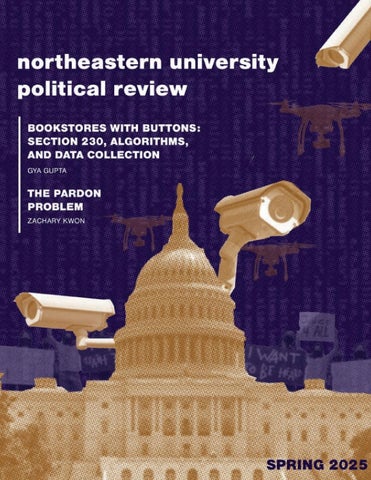
Welcome
LETTER FROM THE EDITOR AND THE PRESIDENT The political landscape is evolving with unprecedented speed, increasingly shaped by technology’s rapid integration into every facet of society. From the proliferation of artificial intelligence to the ethical dilemmas of digital privacy and governance, technological shifts are no longer merely tools of power; they are reshaping the very foundations of power itself. This redefinition of authority and influence intersects with complex issues of identity, economics, climate, justice, and beyond, creating a global discourse that demands new frameworks of understanding. At the Northeastern University Political Review (NUPR), we’re embracing this moment of transformation, recognizing that technology doesn’t exist in a vacuum. Instead, it operates as a force deeply embedded within broader societal struggles and ambitions. As a student-run publication, our mission is to critically engage with how technology both challenges and enhances our understanding of governance, activism, and cultural movements. Our contributors pour months of research and effort into crafting thoughtful, nuanced pieces that question established paradigms and push the boundaries of political thought. NUPR continues to publish work spanning a wide array of topics, acknowledging that technology’s impact reaches across all dimensions of political life. Whether exploring the implications of new digital infrastructures or tackling broader debates on justice and policy, we strive to produce provocative content that invites readers to rethink their assumptions and engage with the complexities of our time. Join us as we navigate the intricate intersections of technology, society, and politics— where the future remains uncertain but open to exploration. Thank you for your creativity this semester—we’re excited to present your Spring 2025 magazine!
Anjali Aggarwal Editor-in-Chief
nupoliticalreview.org
Zoë Goffe President
SPRING 2025 — 03
Welcome
MEET THE TEAM EXECUTIVE BOARD
MISSION STATEMENT
Zoë Goffe, President Anjali Aggarwal, Editor-in-Chief Veer Dave, Design Director Mary Beirne, Social Media & Marketing Director Zoe Jagelski, Communications Director Laura Weppner, Communications Director Aishi Kapoor, Digital Director Sangya Gupta, Treasurer
Founded in 2010, the Northeastern University Political Review seeks to be a non-affiliated platform for students to publish articles and podcasts of the highest possible caliber on contemporary domestic and international politics, as well as critical reviews of political books, film, and events. We aspire to foster a culture of intelligent political discourse, promote awareness of political issues, and provide a forum for students to discuss their views and refine their options. We hope to reflect the diversity of thought and spirit at Northeastern, including the dual ethic of academic and experiential education our school embodies.
EDITORIAL BOARD
FOR MORE INFORMATION
Irena Zervas, Managing Editor Sangya Gupta, Managing Editor Claire Satkiewicz, Junior Managing Editor Kennedy Little, Junior Managing Editor Mary Raines Alexander, Magazine Editor Margaret Barnes, Magazine Editor Alex Booker, Magazine Editor Jessica Gudin, Magazine Editor Zachary Kwon, Magazine Editor Hannah Libelo, Magazine Editor Alisha Werry, Magazine Editor Isabelle Young, Magazine Editor Michelle Zhong, Magazine Editor
Check out our website at nupoliticalreview.org. Want to write for NUPR? Email nupreic@gmail.com. Questions? Email nupoliticalreview@gmail.com. Magazines printed by Puritan Capital
LAYOUT TEAM Veer Dave, Design Director Anjali Aggarwal, Layout Editor Matthew Chavez Cruz, Layout Editor Amy Eng, Layout Editor Annika Frey, Layout Editor Zoe Jagelski, Layout Editor Claire Satkiewicz, Layout Editor
04 — SPRING 2025
nupoliticalreview.org
Welcome
TABLE OF CONTENTS FEATURED The Pardon Problem Zachary Kwon (6)
COLUMNS Our 47th President: Welcome Back, William McKinley Zachary Kwon (26)
Bookstores with Buttons: Section 230, AI, and Data Collection Sangya Gupta (10)
GLOBAL
NATIONAL Make America Healthy Again: A Step Backwards for Public Health Irena Zervas (12)
Rewriting Economic Narratives: China's Innovation Imperative
Trump, Social Media, and the Decline of Civility
Stay in School, Democracy is Depending on You
The 2016 and 2024 Election Results Reveal a Dangerous Truth About America
Anjali Aggarwal (8)
Su Shen Ooi (14)
Emilia Pérez, Intersectionality, and “Good” Representation
Mary Beirne (18)
Claire Satkiewicz (20)
Trump Is Bad News For Justice Dario Nardini (24)
Claire Satkiewicz (28)
Boston Congestion: How A MBTA-Sponsored Bikeshare Can Help Massachusetts Kiran Denbow (30) nupoliticalreview.org
SPRING 2025 — 05
Featured
THE PARDON PROBLEM ZACHARY KWON / ECONOMICS AND POLTICAL SCIENCE 2027
T
he president’s power to pardon has been enshrined in the Constitution ever since it was first ratified at the Constitutional Convention of 1787. Among the convention’s Framers, it was Alexander Hamilton who argued most fervently for the existence of pardon powers. Hamilton argued in Federalist 74 that the president’s ability to grant clemency and pardons would be essential for the United States’ future ability to reconcile the nation in times of crisis and to reprieve egregious miscarriages of justice. Hamilton’s original vision for the pardon has been realized many times throughout American history. For example, Franklin Pierce pardoned Noah Hanson, a free Black man who helped slaves escape on the Underground Railroad in 1854, and Abraham Lincoln reconciled Confederate soldiers by pardoning those who reneged on the Confederacy and swore allegiance to the Union in 1863. Pardons by recent presidents, however, have illustrated a backwards trend of pardoning friends, family, or close loyalists for dubious reasons.
06 — SPRING 2025
Most recently and perhaps most egregiously, Donald Trump pardoned the January 6th insurrectionists, clearly superseding America’s rule of law in one of the most norm-breaking pardons since Gerald Ford’s pardon of Richard Nixon in 1974. As the scope of the pardon has bloated substantially beyond what Hamilton and the Framers intended, it is essential that the power of the pardon be weakened through the amendment process. In fact, Hamilton himself noted two important restrictions on the president’s pardoning power in Federalist 74: that the pardon could not be used in cases of impeachment, and that the pardon should only be used in exceptional cases. Only the former is enshrined in the Constitution. While some Founders argued that pardon powers be granted to multiple people to force deliberation and avoid the pardon’s abuse, Hamilton disagreed, believing that political parties would pardon based on ideology and not ethics; further, Hamilton believed the responsibility of the pardon was so huge that the president would naturally exercise “scrupulousness and caution” due to the threat of reelection and public opinion. It is clear that Hamilton’s prediction was inaccurate, and the conditions of
the pardon must urgently be reassessed. Besides Trump pardoning the perpetrators of his own insurrection and Biden’s pardon of his son, many presidents of both political parties have been guilty of granting unwarranted pardons for dubious reasons. For example, Barack Obama fully pardoned Willie Shaw Jr., who was imprisoned for armed robbery of a bank in 1974, and George HW Bush pardoned those involved in the IranContra Affair. The most glaring first step in amending
nupoliticalreview.org
Featured
the pardon clause would be to clearly delineate that the president should not be able to pardon members of his family, members of his Cabinet, or other officials he appointed, based on the principle that such a pardon can never be fair-minded or impartial. Just as judges and jurors are required to recuse themselves when they are acquainted with the accused, a president should be constitutionally mandated to recuse himself when asked to pardon family
“
Pardons by recent presidents, however, have illustrated a backwards trend of pardoning friends, family, or close loyalists for dubious reasons.
members or his officials. Of course, it is extremely difficult to find impartial judges and juries in high-profile cases, but it has been done before, such as in Derek Chauvin’s trial or Trump’s legal cases. The lack of this safeguard has caused numerous unjustifiable pardons, such as Bill Clinton’s pardon of his half-brother for cocaine use or Trump’s pardon of Charles Kushner, his co-father-in-law, for tax evasion and campaign finance mismanagement. Secondly, the Constitution should clarify that a president cannot pardon himself,
nupoliticalreview.org
as the Constitution does not explicitly prohibit the so-called “self-pardon.” Critics
argue that a president may be subject to dubious lawsuits or indictments that might force a self-pardon due to the inherent prominence of the presidency. This is unlikely, as the presidency has developed numerous mechanisms to protect the president from such attacks over time, such as implied executive privilege or the presidential immunity granted in Trump v. United States. These mechanisms are perhaps why the self-pardon has never been attempted by a president; regardless, an attempt at a self-pardon would still be an abhorrent endeavor to violate the country’s rule of law. Just like any other citizen, a president should not be the judge of his own case. These two mechanisms cover cases in which a president attempts to pardon himself or someone he is close to, but they do not cover cases in which a pardon simply cannot be justified. In such a case, the Constitution should be amended such that if two thirds of the Senate and House object to a questionable pardon, the power to pardon the individual is instead granted to the Supreme Court. Such an amendment does two things: it allows the Legislative branch to check an unrestrained Executive power, and it ensures that the Supreme Court has jurisdiction over uncharted pardon-related territory, such as Trump’s pardon of the January 6th insurrectionists. Further, the two-thirds requirement means a moderate degree of bipartisanship is necessary
to challenge pardons, meaning a president’s opposing party cannot perennially challenge the president. Allowing the Supreme Court such jurisdiction could have established judicial precedent for Ford's pardon of Nixon or Jimmy Carter’s pardon of Vietnam draft dodgers, both of which were wide-sweeping, impactful pardons that had never been tried before. Note that none of these propositions would hinder the pardon from its intended use. A virtuous president would still be able to pardon individuals to reconcile the nation or in cases of extreme judicial grievances. Further, as Hamilton also noted in Federalist 74, the pardon serves the important function of checking the criminal justice system and unjust laws that may come with it. Unjust pardons should be checked just as much as unjust laws. While it was enshrined in the Constitution for virtuous reasons, the use of the pardon by recent presidents is an archaic remnant of a tyrannical past and a grim reminder that American rule of law is not invincible from the whims of a brash president. As it has been 27 times since its ratification, the Constitution must be additionally amended to weaken the presidential pardon.
“
SPRING 2025 — 07
Global
REWRITING ECONOMIC NARRATIVES: CHINA'S INNOVATION IMPERATIVE ANJALI AGGARWAL / ECONOMICS AND BUSINESS ADMINISTRATION 2025
T
he United States has long been a dyIn the same vein, the US’ push for tariffs namic force of creativity, media, and on Mexico, Canada, China, and other global entrepreneurship, using the idea of partners seemingly attempts to replicate Chithe market economy to limit government na’s protectionist outlook on trade—though interference in business activities. From their strategies vary in longevity, approach, this position of influence, US politicians and intention. In many respects, Chinese have cultivated an “America-first” narrative protectionism is an embedded quality of its that inflates the US’ economic success and economic structure. The United States, on demeans the economies of competing na- the other hand, often uses protectionist politions—a narrative that consistently antago- cies in quick bursts as political attacks. nizes China, often portraying its state-conThese fundamental differences have trolled economy as a barrier to true worked against the US in their efforts to innovation and success. Yet, in some ways, boost its domestic economy. As China’s reChina is at the center of the global economy. cent accomplishments in AI, technology, Though China’s economy continues to grap- and media production begin to compete ple with inefficiency, low consumer confidence, with US innovations, the US must instead and rampant corruption, spend time on managing the effects of weait is also the largest ponized tariffs and political polarization. exporter of goods US government officials must take a step worldwide with a back and reevaluate America’s economic growing force in the strategy to amplify the main proponents of tech industry: two po- its successes—trade, competition, and the sitions of power that working class—instead of trying to beat Chithreaten America’s na at their own game. brand of economic superiority. For US politicians, the Media Conglomerates, Data highest form of praise is Privacy, and Free Speech imitation. With Elon Musk’s stay at the White House and American media dominates global aira line-up of billionaires at waves. Hollywood movies thrive in the Trump’s most recent in- global box office, with organizations like auguration, it has become the Motion Picture Association of Amerabundantly clear that the ica (MPAA) historically acting as a key US has started to blur the proponent of free trade and cross-country lines between government releases. US-based artists rake in mass apand business in a way that peal—making up 66 percent of the songs both mirrors and contrasts on Spotify’s Global Top-50 playlist towards China’s command econo- the end of December—generating revemy. In China, several com- nues of around $39 billion. ponents of the economy are Despite its popularity, Americans have state-owned, while in the less faith in their media than ever. In 2024, US, more and more aspects only 31 percent of Americans expressed a of the government appear to “great deal” or “fair amount” of confidence in be “business-owned” or con- US media, falling drastically from the 60–70 trolled by major economic percent range of the seventies. For a counplayers.
SPRING 2025 — 08
try that prides itself on free speech, particularly in comparison to censorship-heavy countries like China and Russia, American consumers are experiencing a crisis of confidence in their First Amendment rights. The confidence crisis recently peaked once more with the US Government’s latest attempt to ban Tik Tok: one of the most popular social media platforms and news sources for young adults today. Government officials cite data privacy concerns, claiming that Tik Tok could become a vessel of Chinese espionage and propaganda if its parent company, ByteDance, refuses to sell it to an American company. Critics of the ban state that the US’ actions represent its descent into censorship, suggesting that the US wants to control the narrative of younger generations and reshape their political ideologies to align with traditional nationalistic views. Yet, in their rush to avoid China, American politicians have inadvertently conformed to stereotypically Chinese tactics. Citizens residing in Mainland China cannot access the global version of Tik Tok, instead confined to Douyin: a version of Tik Tok that excludes the rest of the world. US officials have long admonished China’s strict censorship regulations, most notably in Beijing. Chinese citizens cannot publicly discuss the economy, let alone examine or evaluate the Chinese government. Though to a lesser extent, Americans have started to grapple with the same issues. Activists and academics around the US have raised concerns over the removal of diversity-related web pages from government-owned websites and the cuts to federal research funding. These cuts disproportionately impact the healthcare community and researchers that advocate for marginalized groups, banning the dialogue around gender, race, and sexuality altogether in many cases. The Trump Administration is on a mission to end the “woke” agenda, but in doing so, Americans lose the ability to speak their minds and form their own—evidence-based—opinions.
nupoliticalreview.org
Global
While the US inches closer towards China’s flaws, China has taken a step closer towards the US’ strengths, starting with innovation. China’s innovation ecosystem has grown leaps and bounds since the twentieth century, with its high-volume, hyper-adaptable population fueling sustained growth. In 2018, WeChat Pay saw 1.2 billion transactions per day on average, while Apple Pay saw an average of 1 billion transactions per month. In 2020, China led the global production in 70 percent of advanced industries, with the US leading the remaining 30 percent. Even in the box office, the Chinese film “Ne Zha 2” became the first non-Hollywood studio production to cross $1 billion in ticket sales. China’s innovation, combined with its self-sufficiency, poses a great threat to America’s rapidly dividing culture and loss of identity. In the age of technological marvels like Generative Artificial Intelligence (GenAI) and smart technology, the US’ ability to innovate has skyrocketed in geopolitical importance.
The Great AI Race The US has long led the charge for high-tech goods and services, and Artificial Intelligence (AI) is no different. American AI models—owned by companies like OpenAI, Meta, Google, and X—have disrupted not only the tech industry, but almost every sector of the global economy. When OpenAI launched ChatGPT in November 2022, it revolutionized human-AI interaction, generating contextual, adaptable, and stylistic responses with proficiency across different disciplines. Nearly three years later, US AI companies have continued to dominate, with major tech giants aiming to spend over $300 billion by the end of 2025. However, Chinese startup Deepseek has found a way to disrupt the disruptors, performing as well as its predecessors despite being developed behind the “Great Firewall” of China. Deepseek matches OpenAI’s capa-
nupoliticalreview.org
bilities while surpassing OpenAI’s cost-ef- State-Owned Economies and fectiveness; for the same quality and “reaBusiness-Owned Governments soning” capabilities, Deepseek uses less memory and fewer costs—costing $6 milThe current US economy runs like its own lion to train compared to OpenAI’s $100 milentity, with billionaires as its most influenlion—and subsequently has caught the eye tial shareholders. In the era of Muskian-era of tech giants in Silicon Valley and investors politics, more and more Americans are left in the greater market. to ponder whether their votes matter more For general audiences, Deepseek’s entry than the market shares of the wealthy, esdid not go unnoticed. Deepseek became the pecially in comparison to prominent tech most-downloaded free app on the Apple App leaders like Mark Zuckerberg and Jeff Bezos. Store once it became available in the United America’s “tech oligarchy” and China’s States, with enough traffic for technical out“socialist market economy” both blend polages and enough users for global controversy. itics and economics to favor those in power. Artificial intelligence models in China must Nevertheless, the American government is avoid topics that the Chinese government no stranger to effective branding, particuconsiders politically sensitive, raising conlarly when it comes to the global mistrust cerns around the involvement of the governof China. However, highlighting comparament in the website itself. Countries outside tive strengths only works when the entities of the US have taken defensive actions due being compared are legitimately different; to this mistrust, including Australia, South the US cannot effectively leverage China’s Korea, and Taiwan, who have banned Deepreputation of corruption and censorship if seek on government systems. its government continues to reach worldThough the US has yet to ban Deepseek wide headlines for its newfound tension altogether, it has tried to keep its innovations with allies and growing divide within its under lock and key. This is a bipartisan effort; own social structure. Biden’s “AI Diffusion Rule” limits the spread For the US to live up to its own expectaof cutting-edge technology to China and othtions, it must uplift innovations beyond its er political adversaries, and representatives inner circle of tech giants. Instead of hamfrom the Trump administration have suggestmering down on diversity, it must actively ed that additional restrictions are on the way. seek out diverse perspectives to amplify It is likely that Chinese policymakers anticithe inventions and inventors hidden bepate such legislation, as the previous Trump tween different tax brackets. administration fiercely advocated against the Policymakers need to move fast—as global reach of Chinese tech company Huathe US slows down, China ramps up. Acwei: a significant rival to smartphone compacording to the 2024 Global Innovation nies like Samsung and Apple. Index, China ranks seventh place in inIn the face of global competition, the US novation outputs, moving up in the ranks government—regardless of political affiliayear over year, while the US ranks fifth: a tion—will prioritize the profitability of US notable decline from previous reports. If companies. This protection, though benthe US fails to promote political and ecoeficial to the American tech industry, has nomic progression, the country may fall transformed government leadership, deepvictim to its own ambition. ly intertwining politics with the success of individual tech giants.
SPRING 2025 — 09
National
A
law derived from a 1950’s legal battle over obscene books currently dictates freedom of speech on the internet. Section 230 of the 1996 Communications Decency Act ruled that social media platforms cannot be blamed for the content posted on their site, just as a bookstore cannot be held liable for the sale of obscene books on its shelves. The internet, however, is not a bookstore. 72 percent of Americans visit the social media “bookstore” almost every day. The “bookstore” wheels users through the aisles with horse blinders, as robotic arms extend from the shelves, offering books in exchange for likes, all while cameras scan users’ retinas for slight interest. All of this ensures that the system eventually drops users off in a dusty corner, surrounded by similar people and a constant flow of addicting, niche content. Section 230 was passed three decades ago, an era that predates the creation of the modern internet giants: Google and Facebook. Since then, social media algorithms have developed rapidly, and are now capable of creating filter bubbles which lead to ignorance and misinformation. In addition, the rise of Artificial Intelligence (AI) chatbots poses new risks of misinformation. One of the most alarming risks being that the machine learning model behind ChatGPT reinforces racial and gender bias within its pattern recognition, which is then embedded into its responses. When users depend on AI softwares for answers, despite its inherent biases, society loses control of truth.
SPRING 2025 10 — FALL 2024
People have virtually no warranty over their content choices, as the algorithm feeds them recommended content which guarantees user engagement, and thus generates a surplus of advertisement revenue for the tech giants. The government must hold these corporations accountable, otherwise algorithms will continue to polarize the nation and facilitate cycles of violence.
Everyone is Worried about Data Collection Social media regulation could easily become a bipartisan issue. It is a new, developing topic that troubles both the right and the left, yet both parties are unable to identify what exactly is wrong with speech on the internet. Misinformation troubles Democrats, while censorship infuriates Republicans. The center of both these issues is unregulated data mining. Data is a commodity that is uncertain and powerful. Social media companies “mine” data by tracking millions of user profiles and using this information to draw conclusions and patterns about populations and their habits. Big Tech companies extract user data, storing it in large banks of information and then using it to generate algorithms that can target users and boost engagement with precision and secrecy. With the development of AI, data privacy concerns have grown exponentially. AI
software relies on data, whether it is harvested with intentional consent or not. Many current models harvest data through the “shadows” of clicks and scrolls that consumers leave behind on other internet sites, as well as facial recognition and data from wearable technology. The inefficient and outdated Section 230 does not account for data mining: the economic and social epicenter that fuels Big Tech. Most suggested approaches for regulating social media, such as former President Biden’s, only address algorithms, but dismiss the concept that algorithms can only function with data collection. Lawmakers need to pass regulations that limit the amount of personal data an internet platform can store, and enforce accountability to allow users to see and edit the data that is influencing the content on their feeds. Transparency with data collection is an evolving standard that can help combat future technologies from inconspicuously using personal information to target users.
It’s Broken, Let’s Fix It This data collection transparency act would be similar to the data privacy protection law that ensures users the right to either opt in or out of cookies on sites, meaning that users will be able to see exactly what data is being collected on each platform and customize their algorithm. This would give users the agency to dictate the content that is shown and
nupoliticalreview.com nupoliticalreview.org
Featured National
recommended to them. In this way, Big Tech companies evade blame for recommending content, and people can view content outside of their interests. This would balance the need for limiting the creation of filter bubbles and protecting free speech on the internet. Lobbying this act begins with making sure bipartisan interests are at the forefront of the conversation. With TikTok and Chinese data collection concerns at the forefront of the social media discussion, it should not take much to convince Republicans that data management must be transparent, given their anti-China policy stance. In addition, data transparency will address the conservative concern of censorship and restriction of free speech because users can bypass the algorithm and view content holistically. On the other side of the aisle, misinformation concerns trouble liberals. Misinformation stems from algorithms repeatedly showing similar and niche content to target susceptible users, as well as deceptive AI generated content. Big Tech corporations can weaponize this spread of misinformation as a form of unchecked power over election outcomes. Shrouded in secrecy, data is Big Tech’s largest asset, thus Democratic lawmakers should be thrilled about taking power away from Big Tech billionaires. At this point, the panic around data collection has disseminated into the public sphere on both sides of the political aisle. As of 2020, 69 percent of mobile app users are concerned about how their personal data is being collected and analyzed. In addition, 81 percent of consumers feel they need to trust a brand before they consume their product.
nupoliticalreview.com nupoliticalreview.org
If more than half of Big Tech’s users begin to drop off the platforms because they fear data privacy breaches, the companies must create transparency. Other than a bill introduced in the Senate in 2007, which was abandoned, there has been no federal action taken to regulate data mining. Almost two decades later, social media has become ubiquitous, and with it, data even more precious. There is a severe lack of urgency when it comes to data privacy laws because American politics finds itself stuck between a select number of polarizing issues that make the headlines. As polarization rises in the country, fewer and fewer bills are passed each year. Lawmakers from both parties must push for accountability from Big Tech companies before technology continues to become more invasive.
significance social media and algorithms have in the modern world. Reforming Section 230 and advocating for Big Tech accountability can only be successful if legislators are aware of the rising technology-dependent generation of voters who will be taking the reins of business, policy, and society within the next decade.
Modern Problems Require Modern Policymakers Algorithms, artificial intelligence, and social media are just the tip of the flood of new technologies entering the market, thus lawmakers must be prepared to create regulations that keep these tech conglomerates in check. Legislators’ ignorance of social media, AI, and algorithm function is contributing to the lack of legislation on this topic. There is an immediate need for younger legislators who understand the functions and
SPRING 2025 — 11 FALL 2024
National
MAKE AMERICA HEALTHY AGAIN: A STEP BACKWARDS FOR PUBLIC HEALTH IRENA ZERVAS / INTERNATIONAL AFFAIRS AND HISTORY 2026
A
merica is not healthy. Despite being a world economic leader and carrying the designation of the “greatest country in the world,” the American life expectancy is 78.4 years, while the average for all other comparable countries is 82.5 years. Furthermore, the United States drastically outperforms its peer countries in negative birth outcomes, heart disease, chronic lung disease, drug mortality, and sexually transmitted diseases. Former presidential candidate and current Secretary of Health Robert F. Kennedy, Jr., has proposed a plan to “make America healthy again”: a promise that, for many Americans, feels comforting and necessary. Kennedy—who has no medical training, nor requires it to join his team—has planned to take an anti-science, anti-establishment approach to his tenure as Secretary of Health. His campaign promises to limit the usage of medical drugs and vaccines, as well as “remove harmful chemicals” from our foods. Many of Kennedy’s claims stem from legitimate concerns, but his solutions blatantly ignore the actual problem with American health: systemic inequality.
MAHA's Goals The Make America Healthy Again (MAHA) campaign marks a sharp pivot away from processed foods, turning towards more “natural foods” like raw milk as means of nutrients. This is a misguided attempt at solving a real issue: though Americans consume ultraprocessed foods at extreme, unhealthy rates, the introduction of irresponsible ingredients into American diets is not only completely useless, but harmful.
12 — SPRING 2025
For instance, Kennedy advocates for ingredients like beef tallow, which restaurants and schools initially replaced with vegetable and seed oils because of its high levels of saturated fats—a major proponent of obesity rates. Despite beef tallow’s nutritional risks, Kennedy blames childhood obesity rates on seed oils, vegetable oils, and grains in school lunches, and aims to reinstate beef tallow and other animal-based ingredients. Many health conspiracists have linked seed oils to inflammation and other long term chronic diseases, but the reality is that diets that are high in saturated fats are directly linked to higher obesity rates. Instead of limiting ingredients that are actually linked to obesity and promoting foods that are nutrient dense, Kennedy’s campaign takes a regressionary stance on health and wellness.
The idea that “food is medicine” is a common stance amongst MAHA supporters, who often cite the benefits of a healthy diet. Though this can lead to longevity, this rhetoric has been used to dismiss the positive impact of modernday science and medicine. Kennedy has criticized FDA funding towards the regulation of prescription drugs, seeking to cut the Prescription Drug User Fee Act (PDUFA), which requires that drugmakers cover the costs of vetting their products. Without the PDUFA, this cost will fall onto consumers. Kennedy has every right to critique the FDA for its flaws, but what he should focus on is how its policies have led to high drug prices, making simple treatments inaccessible for millions of Americans. Kennedy is no stranger to harmful rhetoric; his decades-long skepticism for vaccinations has helped perpetuate ideas that create a sicker America. Thus, it is unsurprising that “vaccine choice” is a key pillar of MAHA. While proponents of “vaccine choice” advocate for the freedom to choose what happens to one’s body—a necessary aspect of democracy— this choice should not come at the expense of public health. Vaccines are effective because of herd immunity, meaning
“
Kennedy is stranger to rhetoric; hi long skepti vaccination helped perp ideas that c sicker Ame
nupoliticalreview.org
National
that they work best when the majority of the population develops immunity to the disease. Because of vaccines, we have effectively eliminated many fatal diseases, such as smallpox and rinderpest. Choice is important, but what is more important is the government’s responsibility to protect its citizens.
Policy Recommendations for Kennedy The common pattern with MAHA is not the problems it identifies, but its backwards methods of solving them. The United States has a health problem, but this stems from the fact that a healthy lifestyle and access to healthcare have become privileges. 54 million Americans are food insecure, and 23.5 million Americans live in food deserts: areas where access to healthy food options is limited or nonexistent. Food deserts occur in low income communities, often because grocery retailers see these communities as a bad market for their products. Additionally, those who have lower incomes will often aim to eat the cheapest option, which in most cases, is fast food. Fast food is notoriously detrimental to human health because of its lack of nutrients, high caloric density, and excess amounts of sugar, saturated fats, and sodium. This has tangible effects on these communities, as people of lower incomes are significantly more likely to be diagnosed with preventable diseases, such as COPD, diabetes, pneumonia, and asthma. The most effective way to combat this issue would be to regulate grocery store monopolies, which drive up the price of groceries for consumers. Another important step would be to create financial incentives for grocery retailers that open in food deserts. Not only does Kennedy have no plan to address food deserts at all, let alone take action, but he plans to terminate many of the programs aimed at aiding those struggling with food insecurity. He has stated that he plans to limit Supplemental Nutrition Assistance Program (SNAP) users from purchasing “very unhealthy foods.” Unsurprisingly, he has done so without
s no harmful is decadesicism for ns has petuate create a erica.
“
nupoliticalreview.org
acknowledging that these processed foods are sometimes the only foods available. Low income communities are undoubtedly the most affected by the shortfalls of the American healthcare system. About half of Americans say that healthcare is difficult to afford, and 8 percent of Americans lack health coverage all together. Even with health insurance, the price of healthcare remains astronomically high. Despite these high prices, the American healthcare system ranked 69th in the world. This system is not just unfortunate, but lethal, as more than 26,000 Americans die each year because of a lack of access to healthcare. During the COVID-19 pandemic, over half of low income communities nationwide had no access to ICU beds, and hospitals in economically disadvantaged communities have a lower quality of care on average. The idea of universal healthcare has been deemed “radical” and seems like an outlandish concept in the United States, and therefore is overlooked. It is outlined in our Declaration of Independence that all Americans are entitled to life, liberty, and the pursuit of happiness, but as things stand, American politicians are denying Americans life in favor of the facade of liberty. Accessible healthcare saves lives, and an advanced country like the United States should make this a priority.
Universal healthcare might be an obstacle too high to climb, as it would require a significant change in either the allocation of the United States budget, taxation protocol, or both. Because hospitals are businesses, they increase prices for profit, just as any other business does. For example, a hip replacement in the United States costs $28,167, while it costs $16,622 in New Zealand, the next most expensive country. Regulating profits of large healthcare entities and promoting initiatives to increase access to healthcare in underserved areas should be a priority, but Kennedy has directed his attention elsewhere. What MAHA completely misses is that health is a privilege in this country, and that is what needs to change. While Kennedy promotes plans that simply sound good, Americans who need access to quality healthcare and affordable healthy food suffer. As a population, we must learn to think critically about public health and seek to bridge the inequality gaps both in our healthcare and food systems. Instead of crafting amorphous issues that are only solved by making our population sicker, Kennedy should be listening to those who need help the most and working to make a healthy life a basic right.
SPRING 2025 — 13
National
STAY IN SCHOOL
DEMOCRACY DEPENDS ON YOU SU SHEN OOI / BUSINESS ADMINISTRATION 2025
D
emocracy: the esteemed pillar of American values that many deem as the foundational bedrock of the United States of America. An educated society is essential for a thriving democracy, as it empowers citizens to engage in critical discourse, make informed decisions, and safeguard democratic principles. Yet, with 54 percent of American adults holding literacy skills below a sixth-grade level, the majority of our country lacks the necessary skills to support a functioning democracy and identify a threatened one. In spite of America’s literacy crisis, the current Trump administration has aggressively targeted the Department of Education—cutting funding, reducing its workforce, and rolling back policies designed to promote educational equity—with the goal of dismantling the agency and weakening public education. The systematic attack on education by far-right movements is a deliberate political strategy
aimed at suppressing critical thinking, limiting access to diverse perspectives, and undermining democratic institutions. By censoring curriculum, defunding public education, and replacing scholarly expertise with ideological conformity, conservative forces seek to dismantle intellectual freedom and erode the very foundation of democracy. This coordinated effort not only stifles dissent, but also conditions future generations to accept authoritarian rule, making the fight for educational integrity an urgent battle in the broader defense of democratic values. A democracy is only as strong as its education system. The principles of democracy consider education as a universal human right. Effective democracies are dynamic forms of government that demand independent thinking from their citizens for the betterment of society. Under democratic values, the opportunity for positive social and political change is intended to rest in the hands of citizens and determined through ongoing discussions and research. As informed citizens are better positioned to improve their nation’s legislation and governing bodies, quality education is vital to the survival of a democracy. However, the current administration’s deliberate weakening of public education
threatens this foundation, which relies on an informed and engaged citizenry.
FASCISM AND THE HISTORICAL ASSAULT ON EDUCATION Fascism is a mass political movement that emphasizes extreme nationalism, militarism, and the supremacy of the nation over the individual. Fascist regimes often seek to control and restrict education, fearing that an informed populace could challenge their authority and ideological dominance. The Trump administration’s actions reflect these same authoritarian tendencies, using funding cuts and
14 — SPRING 2025
nupoliticalreview.org
National
U
curriculum restrictions to suppress critical perspectives and reinforce a nationalist, revisionist version of history. Historically, the far-right has sought to undermine education, recognizing it as a powerful source of societal progression. From the Scopes Trial—where a high school teacher was prosecuted for teaching Darwin’s theory of evolution—to Engel v. Vitale—when the Supreme Court ruled that the government cannot encourage prayer in public schools— public education has maintained its position as a political battlefield in the United States. These trials have been pivotal in shaping the debate over the role of traditional values in academic spaces, highlighting the ongoing struggle between conservative ideology and academic freedom. By framing education as a threat to their ideological dominance, the far-right has consistently pushed for policies that
nupoliticalreview.org
limit academic freedom and promote a revisionist curriculum that aligns with their worldview. Due to the Trump administration’s funding cuts, West Virginia University is shutting down nearly 10 percent of its academic offerings. Several high schools in Arkansas no longer offer credit for students taking the Advanced Placement (AP) course f o r African American History, effectively discouraging students from enrolling in the class and allowing a whitewashed, biased view of history to remain the dominant narrative in education. The push to restrict education aligns with a broader effort by extreme conservatives to exert greater control over public schools, framing their actions as a defense of “parents’ fundamental right to direct the upbringing and education” of their children. T h e
new Families’ Rights and Responsibilities Act would allow parents to bring legal action if they believe a violation of their parental rights is occurring. Although the far-right attempts to portray themselves as heroes, fighting for the democratic right of parents to censor their childrens’ education, they blatantly reject the democratic value of learning as a public good in itself in favor of promoting conformity and anti-intellectualism. The current administration’s political moves, such as threatening to defund public schools with Diversity, Equity, and Inclusion (DEI) programs and supplementing academic materials with conservative ideology, reflect fascist ambitions to impose indoctrination into public education.
THE RISE OF CENSORSHIP AND ANTI-INTELLECTUALISM The Trump administration attempts to censor content under the rationality of returning American academics back to “facts over feelings.” However,
SPRING 2025 — 15
National
it simultaneously disregards the findings of individuals most qualified to articulate such “facts,” unless those individuals support the desired right-wing agenda. The removal of expertise from our academic spaces is extremely dangerous for American students and democracy, as it enables a small number of people to interject their personal priorities for a child’s education into the school curriculum for all students. This emphasis on giving individual perspectives as much weight as evidence-based facts leads to an unhealthy conflation of opinions with truth, faith with science, and memory with history. Limiting student’s access to expert-developed materials that introduce them to new ideas reduces their ability to analyze sources for reliability and accuracy, making our society more vulnerable to propaganda and brainwashing. In Florida, K-12 public schools can now supplement their curricula teachings with cartoons developed by Prager University Foundation: a far-right, non-accredited institution that promotes radical conservative ideas like advocating for the use of fossil fuels and sanitizing the harrowing details of American history. In PragerU’s educational video, “Leo & Layla Meet Christopher Columbus,” an animated Columbus
16 — SPRING 2025
describes the natives as “far from peaceful,” and defends slavery by stating, “Being taken as a slave is better than being killed, no? I don’t see the problem.” While far-right conservatives continue to argue that these policy changes aim to “remove liberal indoctrination” from schools, they inject instructions that conform to their own ideologies. With America’s long record of racial inequality and systemic oppression of minorities, students need an uncensored and unbiased education on the US’ true history to confront and understand the societal issues we face today, even when the truth is uncomfortable.
LEGISLATIVE ATTACKS ON EDUCATION From public education institutions facing the risk of losing federal funding to the banning of books, current legislation is just the latest in a long line of attempts to denounce
knowledge, intimidate curiosity, and discourage individuals from critical thinking. In March 2023, Florida lawmakers enacted two laws dedicated to limiting access to information in public education: “Stop Wrongs to Our Kids & Employees (WOKE) Act” and the “Parental Rights in Education” Bill (better known as the “Don’t Say Gay” bill). Rob DeSantis’s Stop-WOKE Act “prohibits educational institutions and businesses from teaching students and employees anything that would cause anyone to feel guilt, anguish or any form of psychological distress due to their race, color, sex or national origin.” The goal of the “Don’t Say Gay” bill is to ban classroom discussion about sexual orientation or gender identity in Florida’s primary schools. These legislative acts actively stifle critical contextual facts about America’s dark history and limit broader awareness of the society we live in. Though the stated intention of the StopWOKE act was to remove liberal indoctrination in public education and prevent students from feeling guilty about historic injustices, legal professionals believe that the bill is an attempt to shield students from learning about institutional
nupoliticalreview.org
National
racism: the idea that racial discrimination is not just the consequence of a few racist individuals but a structured system that is ingrained into our country’s institutions. By preventing students from learning about institutional racism and the white supremacy it upholds, young people are less likely to question our systems of oppression. Florida legislator Joe Harding drafted the “Don’t Say Gay” bill to empower parents to create boundaries at an early age of what is appropriate in schools. Though the bill’s supporters intend to protect “the fundamental rights of parents to make decisions regarding the upbringing and control of their children,” LGBTQ+ activists fear the law will restrict education on sexual and gender identities and cultivate hostile school climates for LGBTQ+ educators, students, and families. These measures are not just symptoms of an ongoing culture war between the left and the right, but fascist tactics to promote conformity, limit critical thinking, and erase the presence of minorities in academic spaces. The US Department of Education’s threat to cut federal funding for schools with diversity programs endangers the representation of marginalized groups in academia, where they are already underrepresented. Furthermore, the Department of Education recently announced in March that it plans to eliminate almost 50 percent of its workforce as the Trump administration proceeds with its plans to dismantle the agency. As the Department of Education oversees critical responsibilities, including distributing federal financial aid and enforcing non-discrimination policies in school, academics have expressed concern over the presence and safety of minority students in public schools.
oppression of education is not exclusive to the United States. Narendra Modi, India’s autocratic nationalist Prime Minister, has characterized his administration with his constant political assaults on India’s elite universities, claiming that they’re “anti-India.” Victor Orban, Hungary’s Prime Minister, has started a political campaign bombardment on the Central European University in Budapest due to his prejudice against their gender-related courses. These occurrences parallel with historical fascist attacks on education from the Stalin regime and the Nazi Party, exemplifying how fascist regimes across different periods, countries, and contexts have consistently used education as a form of suppression. History warns us of what happens when democracy is eroded: the suppression of diverse thought, the weakening of open debate, and the loss of collective responsibility. Yet, it is in our educational institutions—especially higher education—that democracy finds its strongest anchor. One
of the sharpest weapons against a threatened democracy is education and the truth. Knowledge is a power that no institution, leader, or enemy can take away. As the Trump administration attempts to shield Americans from difficult or differing perspectives, we must question our systems and enrich our intellect to fight for the future that justice demands and humanity deserves. A democratic republic requires not just diverse perspectives but the ability to assess them critically. Restricting intellectual freedom will not only stunt the next generation’s ability to articulate arguments, but will also blind them to the sobering realities of the world. Whether we call it fascism or not, the greatest danger we face is ignorance itself.
GLOBAL AND HISTORICAL PARALLELS Unfortunately, the rise of facism and
nupoliticalreview.org
SPRING 2025 — 17
National
TRUMP, SOCIAL MEDIA MEDIA, AND THE DECLINE OF CIVILITY MARY BEIRNE / POLITICS, PHILOSOPHY, AND ECONOMICS 2025
T
he 2012 Presidential Debate between President Barack Obama and Senator Mitt Romney opens up with a cordial meeting: a handshake and congratulations on an anniversary. Viewers saw a constructive, mature discussion on policies between two opponents. Four years later, Donald Trump and Hillary Clinton took the debate stage. Words like “crooked” and “criminal” were thrown around loosely and low blows to character are commonplace. Four years later, President Trump and Vice President Joe Biden don’t even shake hands and Trump later refuses to accept Biden’s victory. Finally, in 2024, Trump unfoundedly denies Vice President Kamala Harris’s racial background and “weird” became the go-to word used by Democrats. This behavior is a result of how Trump framed his 2016 political campaign: creating the “Trump Effect”—the idea that Trump’s voter base is more devoted to him than any party or their country. The Make America Great Again (MAGA) movement quickly strengthened partisanship, with Republicans distrustful of the media and Democrats distrustful of Trump. We have seen this decline in political cordiality increasing over the years, fueled by the rise of social media. Each side defends their own so strongly, and with the ability to reach widespread audiences in an instant, can incite a flurry of misinformation that widely targets middle and lower class voters. The rhetoric that Donald Trump has used on social media since 2016 have had a direct impact on political discourse as we know it today.
Donald Trump's Rise to Power
with midwestern, middle class voters. He marketed himself as “anti-establishment.” Those who were fed up with inflation or the job market saw him as a fresh face, and thus, a beacon of hope. He argued that Democrats represent an elitist class, creating a division in the American electorate that repelled many middle class voters from progressive ideas. More importantly, he aimed to distance himself from the GOP, despite running as a republican candidate, highlighting different policy initiatives than long-time politicians like former New York City Mayor Rudy Giuliani and former New Jersey Governor Chris Christie. He pointed out discrepancies across the political spectrum, targeting voters who felt disillusioned with the current state of politics. Despite Trump growing up with a trust-fund and his father held political and corporate influence in New York City, his base believed he fought for the common man, laying the groundwork for his campaign to flourish. So, how did this transpire into the MAGA extremism we see today? After gaining the loyalty of many conservative voters, Trump successfully won the Republican primary nomination. When he faced Clinton in the general election, the media played a significant role. Most mainstream media and Hollywood superstars were outspoken against Trump, largely over accusations of racism and sexual assault. Thus fueling the narrative Trump has stuck by for the past 8 years: the media cannot be trusted, regardless of the legitimacy of their concerns. On October 16, 2016, Trump tweeted “Election is being rigged by the media, in a
“
A slew of [Trump's] tweets built a disdain for the media among his increasingly loyal supporters, enabling Trump to create his own narrative.
It came as a shock in 2016 when a reality TV star decided to run for president. His victory came as a greater shock, beating former Secretary of State Hillary Clinton, a highly qualified politician. Trump’s rise to power can be attributed to his unique platform. His message primarily resonated
18 — SPRING 2025
nupoliticalreview.org
“
National
coordinated effort with the Clinton campaign, campaign began with online rumors implying by putting stories that never happened into Clinton and other prominent Democrats were news!” This and a slew of similar tweets built a running a trafficking ring in a Washington disdain for the media among his increasingly D.C. pizza shop. While the rumors were loyal supporters,enabling Trump to create his disproven, many members of the public were own narrative. The 2016 presidential race saw not convinced. One man even opened fire at a shift in campaigning tactics, with Clinton the pizza shop. While no one was physically and Trump taking to social media to promote harmed, the violence caused unnecessary their candidacy, oftentimes without a third distress at the hands of a conspiracy. What party media outlet filtering the content. While started as whisperings on the internet this could be an effective way to communicate escalated into a full-fledged rampage due to with voters without succumbing to media bias, the spread of misinformation. Social media users can knowingly spread it instead spread more propaganda at a much faster rate. The constant online battle between false rumors in an attempt to evoke an emotional Clinton and Trump translated to a debate response. Due to the anonymity of online full of insults and minimal policy discussion, profiles, there are little to no repercussions that mobilizing voters to take an “all-or-nothing” would stop users from posting falsehoods for approach to politics. This mentality paved virality. The University of Michigan notes that the way for a political intolerance that haunts "anger is one of the most potent forms of political online discourse and family gatherings, but is expression on social media”. People take to the internet when they are upset, which can Trump entirely to blame? certainly be a useful tool in holding politicians accountable. On the other hand, when people post on social media in a rage, it creates an intolerant environment where users are not looking to have Global connectivity is at our fingertips, meaningful and has become a primary method of discourse, but rather argue communication and absorbing news. This and place is not necessarily a blame on the other bad thing. Those who side. There is no otherwise would not incentive to find common ground— have access to a large if a user disagrees audience can cultivate with someone widespread attention else’s opinion, they for charities, protests, can press the block and the like. However, button and never a separate culture has think of it again. emerged from the rise We see this on of social media. One both sides of the where rumors and hate political spectrum, run rampant and users so how does Trump spread outlandish lies contribute to this in an attempt to gain culture? It would fleeting internet fame, be a sweeping or to push a divisive generalization to political narrative. The blame one man Pizzagate scandal that for overwhelming plagued Clinton’s 2016 intolerance on the internet. However, the “Trump Effect” fosters a cult-like mentality among his voter base, whom he primarily reaches via social media. Throughout his presidency, Trump took to Twitter anytime he disagreed with someone, calling them names and urging his supporters to do the same. So, when Trump tweeted that the 2020 election was fraudulent, his followers listened. On December 19th, 2020, Trump tweeted, “Big protest in D.C. on January 6th. Be there, will be wild!” likely aware the electors from each state met to count the electoral votes on January 6th. His words of rage mobilized
The Age of Social Media and Political Immaturity
“
nupoliticalreview.org
When people post on social media in a rage, it creates an intolerable environment where users are not looking to have meaningful discourse, but rather argue and place blame on the other side. There is no incentive to find common ground.
“
his loyal followers to commit what some are calling domestic terrorism, and a coup on democracy. Thousands of Trump supporters stormed the U.S. Capitol, overtaking Capitol police and breaking into the Senate Chambers. Later, the House of Representatives impeached Trump for inciting the insurrection. Despite federal investigations proving the election results were legitimate, many were more trusting of Trump’s tweets due to their online echo chamber. Even on the 2024 campaign trail, Trump and his running-mate, Senator JD Vance, refused to concede the 2020 election. Trump does not tolerate constructive criticism, and has conditioned his supporters to do the same. Now, in 2025, conspiracy theorists are distrusting of even the most basic information: that vaccines do not cause autism and immigrants aren’t eating cats and dogs. In the first month of his second term, President Trump condemned Diversity, Equity, and Inclusion (DEI) initiatives, citing them as the cause of a deadly plane crash in Washington D.C. He returned to X, formerly Twitter, to garner public disapproval of minorities in the workplace, claiming that they are not qualified for their positions and were only hired due to their gender or the color of their skin. This has already had catastrophic consequences with the shutdown of agencies such as the U.S. Agency of International Development which provided economic support to those in need across the globe. The White House has claimed the United States Agency for International Development (USAID) has been wasting government funds to “advance DEI in Serbia’s workplace… [and] for a transgender opera in Colombia,” among others. Many of these initiatives associated with USAID have actually been approved under the State Department with the goal of improving mental health and economic growth to “reflect the values of the United States and friendship between the countries,” Yet, Trump and Elon Musk have made numerous statements and social media posts claiming the inefficiency of the agency, which ultimately led to its dissolution. While Trump didn’t necessarily create the culture of online hate that has become so prevalent, he has certainly enabled it. America is left with a cycle of misinformation entailing real world consequences and promoting dangerous rhetoric that can threaten our democracy.
SPRING 2025 — 19
National
THE 2016 AND 2024 ELECTION RESULTS REVEAL A DANGEROUS TRUTH ABOUT AMERICA CLAIRE SATKIEWICZ / POLITICS, PHILOSOPHY, AND ECONOMICS 2027
S
“
America wasn't ready for its first female president. These assumptions led to a precarious post-2016 narrative, one that crowded out critical thinking and prevented the Democratic Party from addressing major issues.
20 — SPRING 2025
“
hortly after the results of the 2016 election were finalized, Saturday Night Live (SNL) parodied the typical election watch-party. The skit depicts White, liberal voters gathered together, confident in the election of Democratic candidate Hillary Clinton as the United States’ first female president. Their optimism parallelled the skepticism of comedian guests Dave Chapelle and Chris Rock, who portrayed two Black voters that did not share their faith in America’s ability to elect a woman over the highly problematic GOP candidate, Donald Trump. As each hour passed, more swing states were called red, and viewers saw the partygoers progress through all five stages of grief. America failed to anticipate Trump’s 2016 victory. The shock that followed characterized Trump’s presidency as an unlikely fluke. He lost the popular vote. America failed to anticipate Trump’s 2016 victory. The shock that followed characterized Trump’s presidency as an unlikely fluke. He lost the popular vote. Election polling was incorrect because the majority that preferred Clinton still weren’t enthusiastic enough about her character to show up at the polls. Green Party candidate Jill Stein attracted enough voters on the left to skew Clinton’s chances. Most importantly, America wasn’t ready for its first female president. These assumptions led to a precarious post2016 narrative, one that crowded out critical thinking and prevented the Democratic Party from addressing major issues. Four years, two impeachments, and one insurrection later, the country saw underdog Joe Biden stall a second Trump term. The GOP was divided, COVID-19 was rampant, and the public decidedly had enough with the Make America Great Again (MAGA) movement. With the highest voter turnout in the twenty-first century, voters were driven to the polls by a hatred of Trump and a fear of repeating the momentous twist of fate that was the 2016 election.
nupoliticalreview.org
National
Vice President Kamala Harris’s 2024 campaign aimed to adopt the best of Clinton and Biden. With a focus on reaching moderate voters and the middle class, she received some of the largest donations in history, breaking records with $200 million raised in the first week of her campaign. The Democratic Party felt revitalized, with a wildly successful Democratic National Convention in Chicago and Harris’s revolutionary social media presence. The Harris campaign capitalized on what worked digitally during COVID-19, while simultaneously catering to the in-person community that voters had been craving. They ditched Clinton’s focus on identity politics, excluding Harris’s status as the potential first woman and first woman of color to be president from central campaign messaging. On November 5th, 2024, Democratic voters gathered their friends, powered on their TVs, and once again optimistically tracked the results of the election. States like Florida were an expected loss for Harris. Few held out hope after she lost swing states like Georgia and North Carolina, but Pennsylvania was the final nail in the coffin. For the first time in twenty years, a Republican won the popular vote. Democrats are left to ponder: was Trump’s first victory ever a fluke? As he makes his way back to the oval office a convicted felon, alleged sexual abuser, and rambling 78-year-old man, it is difficult to discern whether America is truly enamored with his candidacy, or if Harris and Clinton were simply less appealing options. The minds of voters are quickly drawn to the common denominator: gender. The Harris-Walz campaign’s late start in July posed a challenge for the ticket. However, this challenge was matched by a rigorous and methodical campaign strategy, and it is dangerous to reduce the complexities of such a crucial race to gender alone. While Harris was painstakingly close to being the first woman elected president, minimizing her loss to the assumption that America is not ready for a female leader is antithetical to the message her campaign aimed to send. While the entrenched double standards female politicians face undoubtedly influenced Harris’s 2024 race, it is problematic to frame a female candidate’s loss solely through a
“
nupoliticalreview.org
It is problematic to frame a female candidate's loss soley through a gendered lens. Doing so undermines the agency of the candidate and reduces her political identity to one defined by sex rather than ambitions, abilities, or policies.
“
SPRING 2025 — 21
National
gendered lens. Doing so undermines the agency of the candidate and reduces her political identity to one defined by sex rather than ambitions, abilities, or policies. Harris worked tirelessly to prove that her nomination was merited. Her experiences as California’s attorney general, her work on criminal justice reform, and her positions on healthcare, climate change, and economic equality all demonstrate a level of competence and dedication that rival Trump’s qualifications and boisterous, unfounded promises to the country. The primary failure of Harris’s campaign was her struggle to distance herself from Biden. To chalk Harris’s 2024 defeat up to the fact that America isn’t ready for a female president is to overlook the complexities that defined both the election and the larger political climate. It’s a tempting narrative, one that fits neatly into the framework of historical gender bias, but it ultimately stalls a deeper conversation about why Trump’s appeal has endured and blossomed. Democrats risk avoiding a full reckoning with the conditions that allowed a figure like Trump to remain a central force in American politics. His victory in 2024 was not an anomaly, but rather a reflection of underlying issues like the increasing radicalization of the electorate, the deepening distrust of traditional institutions, and the broader disillusionment with the political establishment. The Harris campaign made crucial mistakes: many Democratic voters felt alienated by her staunchly moderate positions on issues like fracking and Gaza, most notably costing her the state of Michigan. The Democratic Party missed the mark on what America was
22 — SPRING 2025
“
To chalk Harris's 2024 defeat up to the fact that America isn't ready for a female president is to overlook the complexities that defined both the election and the larger political climate.
“
nupoliticalreview.org
National
“
nupoliticalreview.org
America is ready for a female president.
“
looking for—a drastic change from Biden, better communication with non-collegeeducated voters, and a campaign centered on economic policy—failing to offer the level of transformation demanded by the electorate. Harris’s loss is one Democrats must examine carefully and critically, else they risk ignoring the deeper systemic problems that have made populism such a potent force in American politics. As the public mistakenly dismissed Trump’s 2016 victory as a catastrophic misstep, treating his 2024 win as a product of gender bias against Harris risks repeating that same oversimplification. The uncomfortable reality is Trump’s political standing strategically targets a larger trend of discontent among voters who feel alienated, unheard, and mistrustful of the political system. His appeal to these sentiments, combined with a fractured political landscape and the rise of digital misinformation, bred the perfect storm for resurgent right-wing populism. Without direct confrontation of this disillusionment, the same cycle of polarization will continue to be perpetuated—a cycle that has led us to a moment where the concept of democracy is in peril. America is ready for a female president. However, a woman cannot win without an engaged electorate. The same forces that led to Trump’s victories in 2016 and 2024 will continue to prosper unless Democrats understand and address the underlying causes behind a new wave of populism. The Democratic Party must shed its elitist reputation and regain the trust of voters who don’t go to college, while expressing a clear message that is not strategically moderate, but socially and economically innovative. For the time being, we may all be stuck to our couches, doomed to endure the deceptively optimistic watch-party. Sorry SNL, Pennsylvania falls again.
SPRING 2025 — 23
National
TRUMP IS BAD NEWS FOR JUSTICE
I
n his 2025 inaugural address, the commander-in-chief of the United States promised, among other things, that “the vicious, violent, and unfair weaponization of the Justice Department (DOJ) and our government [would] end.” This bold statement identifies three flawed, un-democratic characteristics within our Justice Department, and promises to bring these flaws to an “end.” This is a seemingly fantastic message from the man that we, the American people, elected to lead us back toward a “great” America; a strong and powerful message that, while acknowledging problems within our great nation, claims the future will be brighter. In this first public address to the nation, our leader calls upon us to have hope because he will fix what is broken. However, what appears to be an honest message represents Trump’s underlying distaste for the DOJ and his fear for the lack of powe r he has over its investigative and prosecutorial discretion. Trump has a vision to override the system of checks and balances within the executive branch, which should worry the American public, as this vision threatens our justice system.
Prosecutorial Discretion: the Basis of Justice in America Within the field of criminal law, federal prosecutors work alongside various federal agencies to investigate crime and prosecute criminals. These federal prosecutors work within the DOJ and are granted incredible power to choose what cases they want to take on in order to balance the scale o f justice within the nation. T h i s power
24 — SPRING 2025
DARIO NARDINI / INTERNATIONAL AFFAIRS AND INTERNATIONAL BUSINESS 2027
to determine whether or not to charge someone with a crime is called prosecutorial discretion. Robert H. Jackson, former Attorney General and Supreme Court Justice, argues that “what every prosecutor is practically required to do, is to select the cases for prosecution and to select those in which the offense is the most flagrant, the public harm the greatest, and the proof the most certain.” Though people at both ends of the political spectrum have debated the ethics of prosecutorial discretion, the Constitution outlines it as a form of intra-executive branch checks and balances, necessary for our democracy. Furthermore, it is expected that during a presidential transition, the goals of federal prosecutors and the DOJ as a whole, will change to match those of the incoming administration. In 2021, Merrick Garland, nominated by President Biden, focused on restoring the DOJ’s independence and depoliticizing law enforcement, following concerns about political influence under the Trump administration. In 2017, Jeff Sessions, nominated by President Trump, signaled a tough-on-crime approach, reversing Obama-era policies on criminal justice reform. This trend continued on February 5th, when recently confirmed Attorney General Pam Bondi released fourteen memos outlining priorities to prosecute cartels and transnational criminal organizations in a greater goal to secure national borders and enforce immigration laws. These guidelines are meant to steer federal prosecutors in a new direction in order to align their discretion with the goals of the new administration. What is not expected or encouraged, however, are strict guardrails for prosecutors to operate within. Since his
inauguration, Preside n t Trump’s actions have reflected an abuse of power and breach of ethics, which constrains the discretion that prosecutors have.
“
Returning to offic January of 2025, D began his revenge system, executing within the DOJ an federal charges to his allies. nupoliticalreview.org
National
Donald Trump promises to crack down on the vicious, violent, and unfair DOJ Following Trump’s defeat in the 2020 election, he was indicted on two federal charges and two state charges, one state charge of which he was found guilty on 34 counts. Returning to office as a felon in January of 2025, Donald Trump began his revenge against the justice system, executing systematic firings within the DOJ and calling for federal charges to be dropped against his allies.
President Trump quickly worked to pardon over one thousand January 6th rioters who were all convicted and charged— by the DOJ—with attacking the United States Capital in his name. He then fired several DOJ prosecuting attorneys who played a significant role in litigating criminal charges against him, and called for corruption charges to be dropped against Trump ally and New York City mayor Eric Adams. Additionally, Trump appointed Pam Bondi as Attorney General, a woman who claimed that “‘the bad’ prosecutors will be prosecuted” within the DOJ. Within the first hundred days of his second term, President Trump has used his executive power to free himself and his allies from the restraints of prosecution and chosen a DOJ leader that has vowed to legally punish ‘bad prosecutors’ within the DOJ. Such actions are cause for concern as they could be argued to reflect a greater goal to diminish a fundamental democratic ideal that America has stood for since its installation: justice. Federal prosecutors are celebrated for their political independence, displaying a commitment to administer justice, but organized firings and pardons of Trump allies have sent a clear message: regardless of wrongdoing, Trump and his allies are not to be investigated. Though prosecutors may identify a case in which the ‘offense is flagrant, the public harm is great, and proof is certain’, it may not be pursued if it involves Trump or a Trump loyalist. Trump is aggressively molding the DOJ into a tool for his own personal gain, and the consequences of these actions will be catastrophic. Trump’s actions contradict a historic ethical trend that the DOJ is separate from the president and therefore cannot and should not be prone to interference or direction from them. It is this very breach of ethics that threatens federal prosecuting attorneys, as it puts their job and their work in question. If justice is the goal for prosecutors, what incentive is there to open a case against Trump or his allies if it risks termination and the case will certainly close? What amount of discretion is left for prosecuting attorneys?
“
ce as a felon in Donald Trump e against the justice g systematic firings nd calling for o be dropped against
nupoliticalreview.org
“
Prosecutorial Discretion Under the Trump Administration Trump’s ongoing efforts to tighten control over the DOJ threaten to undermine a justice system that has long relied on prosecutorial independence as a safeguard for democracy. Federal prosecutors––and the discretion they have––are necessary for a functioning republic. When the acting No. 2 at the DOJ ordered the Southern District of New York (SDNY) to close the Eric Adams’ case, a group of resignations occurred, including the Trump nominated SDNY interim US Attorney, Danielle Sassoon. These resignations have historical parallels to President Nixon’s “Saturday Night Massacre,” when DOJ officials resigned en masse rather than comply with politically motivated orders. Though this
Federal prosecutors–– and the discretion they have––are necessary for a functioning republic.
“
sort of opposition is not sustainable, it is an example of how prosecutors have responded to this new administration. While the full extent of prosecutorial discretion under his administration remains uncertain, the mass firings, pardons, and direct interference into legal proceedings suggest a dangerous shift toward a justice system that serves the president rather than the people. An independent justice system is the last line of defense in Trump’s attack on democracy: we must continue to defend it.
SPRING 2025 — 25
National
OUR 47TH PRESIDENT: WELCOME BACK, WILLIAM MCKINLEY ZACHARY KWON / PHILOSOPHY, POLITICS, AND ECONOMICS 2027
I
n his second inaugural address, president Donald Trump rattled off a list of legislative initiatives that he claimed would “completely and totally reverse a horrible betrayal” that had been levied upon the American people. Among them were solutions to various hot-button issues which compelled voters to elect Trump to a second term, such as illegal immigration or a bloated bureaucracy. He promised not only to declare an emergency at the Southern Border and create Elon Musk’s Department of Government Efficiency, but also to plant an American flag on Mars and end the chronic disease epidemic. But one of his proposals was completely unrelated to the rest, and negligible in the grand scheme of his policy goals: Trump pledged to rename Denali, a mountain in Alaska, to Mount McKinley. It is unsurprising that Trump wants to rename the mountain after William McKinley, an Ohio Republican who served as the 25th
“
politics: gunboat diplomacy and high protective tariffs. Although he is seldom remembered in America’s cultural consciousness today, historians largely credit McKinley as America’s last imperial president who initiated and won the Spanish-American War. diplomacy in his efforts to expand American influence abroad, most blatantly when he As such, he expanded the Union by gaining control of former Spanish subjects like Puerto did not rule out military force to control Rico, Guam, and the Philippines; the annex- Greenland and said he would claim “owneration of the Philippines was the most violent, ship” of Gaza. Trump is disturbingly much culminating in the Philippine-American War more open about his expansionist ideals than McKinley was. Although McKinley was and the deaths of two hundred thousand Filipino civilians. McKinley later absorbed against imperialism in principle and outright stated in his first inaugural address that more territory by bloodlessly annexing the Republic of Hawaii and giving the United “[The United States] must avoid the temptation of territorial States a geopolitically auspicious edge in the aggression,” Trump has instead promised American ownership of Greenland and the Panama Canal in his own address. And unlike his 2016 promise to control Greenland, Trump seems much more serious about his current ambitions overseas. In fact, Danish aides say that Pacific at the cost of Native Hawaiian sover- Trump’s phone call with the Danish prime eignty. While American ownership of Hawaii, minister—the leader of a NATO ally—degenPuerto Rico, and Guam ended up being advan- erated into an “aggressive and confrontational” shouting match. His antagonistic demeanor tageous in the long run, scholars consider the to the leaders of American allies is perturbing, scourge of the Philippine-American War to be such as his taunts that Canadian prime ministhe most heinous blot on McKinley’s legacy. ter Justin Trudeau is the “governor of Canada” Though Trump probably does not plan to expand the Union through warfare, it is trou- or renaming the Gulf of Mexico to the “Gulf bling that he has revived McKinley’s gunboat of America” on official government websites.
McKinley’s presidency is considered to be above-average by historians, but it is incredibly unsettling that Trump seeks to revive the imperialistic ambitions of the nineteenth century that largely faded from world affairs after World War II.
president from 1897 until his assassination in 1901. Besides being one of the two presidents Trump specifically name-dropped in his second inaugural address—the other being McKinley’s vice president and presidential successor, Theodore Roosevelt—everything about Trump’s first month in office signals that, for better or for worse, he aims to model his second presidency after McKinley’s
26 — SPRING 2025
“
nupoliticalreview.org
National
Similarly, as a slight to Panama, Trump sent his Secretary of State Marco Rubio to Latin America to negotiate American ownership of the Panama Canal as his first diplomatic trip. Much like McKinley, Trump also seeks to exercise confrontational economic diplomacy, displayed through his tariff threats to Mexico and Canada. While serving as a representative in Congress, McKinley pioneered the Tariff Act of 1890, also known as the McKinley Tariff, leading to a Democratic landslide in the 1890 Congressional midterm elections—in which McKinley himself lost his seat in the House—and later, the Panic of 1893. Like McKinley, Trump is willing to place tariffs on other countries, even at the expense of his own party’s welfare. Tariffs would raise production costs for American manufacturers, many of whom are located in states that voted for Trump in 2024. It is deeply telling that Trump specifically praised McKinley in his second inaugural address and only briefly mentioned his more popular more and
nupoliticalreview.org
successful successor, Theodore Roosevelt. Perhaps it was Roosevelt’s ardent protection of the environment that Trump disagrees with, as demonstrated by his off-the-cuff promise that the United States will “drill, baby, drill.” Or maybe Trump disagrees with Roosevelt’s trust-busting that stifled the power of big corporations, as evidenced by Trump wooing tech leaders at his inauguration by giving them better seats than future members of his Cabinet. It is also deeply telling that Trump has shed his first-term admiration for Andrew Jackson, the seventh U.S. president, whose policies ironically served as a framework for the modern-day Democratic Party. Jackson was elected to the presidency in the election of 1828 when voters wanted a candidate who represented the common man and would challenge the elites in Washington. This may have applied to Trump in his first term, but not necessarily his second, as evidenced by Trump’s close friendship with tech billionaires like Elon Musk, who Trump entrusted with communicating with top Iranian ambassadors. McKinley’s presidency is considered to be
above-average by historians, but it is incredibly unsettling that Trump seeks to revive the imperialistic ambitions of the nineteenth century that largely faded from world affairs after World War II. Time will tell whether these ambitions will manifest, but one thing is assured: for better or for worse, Americans should be ready to once again welcome President McKinley.
SPRING 2025 — 27
Global
EMILIA PÉREZ, PÉREZ, INTERSECTIONALITY INTERSECTIONALITY,, AND “GOOD” REPRESENTATION
CLAIRE SATKIEWICZ / POLITICS, PHILOSOPHY, AND ECONOMICS 2027
W
ith thirteen Academy Award nominations, twelve British Academy Film and Television Arts (BAFTA) nominations, and ten Golden Globe nominations, Netflix’s Emilia Pérez defined the 2024 awards scene. Critics initially praised the movie-musical for its inclusivity, covering underserved topics such as Mexico’s cartel crisis and, within that, the struggles of the transgender community. Yet, with a director and production crew entirely composed of White, French people, a comically extravagant musical spin, and a controversially turbulent plot, Emilia Pérez has met a slurry of discontent and offense from every community it aims to represent. Emilia Pérez follows a Mexican drug lord, Manitas, who fakes his death and undergoes a sex change operation with the help of kidnapped lawyer, Rita. After a successful transition, Manitas— now, Emilia Pérez—seeks justice for the country’s “disappeared,” or victims of drug and crime related violence. The audience sees Emilia’s struggles as
“
28 — SPRING 2025
she reconnects with her former wife and child and confronts shadows of her past, all while concealing her former identity. Forty-three songs comprise the movie-musical's soundtrack in its two hour ten minute running time, and it earns just over five out of ten stars on IMDB despite being only three spots away from the most nominated film of all time. Emilia Pérez undeniably made a splash in the world of cinema and brought widespread attention to neglected issues, but attention alone may not be worth celebrating when thousands of watchers feel misrepresented by the film.
Shot entirely in France, the film cast only one Mexican lead, Adriana Paz, who appears halfway through the movie.
Mexico’s Cartel Crisis The drug war in Mexico has seen over 460,000 homicides since 2006, with reported disappearances of over 100,000 people since 1964. The Mexican government has been at war with the country’s drug cartels for almost two decades with minimal progress, with citizens feeling
helpless amidst the immense loss and persistent violence. Efforts to dismantle cartels and end the war through police action, protests, and foreign intervention have been immense, but the cartels' stronghold on political power and the Mexican state remains unbroken. Cinematic interpretations of the crisis, like Emilia Pérez, can certainly raise awareness, but risk downplaying the gravity of the issue for entertainment value. Critics question the creators’ decision to portray a violent cartel boss as a human rights advocate, while the film pushes the tragedy of Mexico’s disappearances into the periphery. Arguably, the movie makes a spectacle of a devastating and ongoing conflict, failing to accurately convey the pain of the war and instead leaning on extravagant musical and dance numbers to advance the plot. The film’s controversy isn’t limited to its on-screen content, as its White, French director and production team lack a cultural connection to Mexico. Shot entirely in France, the film cast only one Mexican lead, Adriana Paz, who appears halfway through the movie. Finally, its Director, Jacques Audiard, does not speak Spanish—the primary language of the film. With Netflix’s wallet and a star-studded cast, any film of
“
nupoliticalreview.org
Global
Emilia Pérez’s caliber could reach millions: a potential that comes with the responsibility to tell such a sensitive story respectfully and accurately. This is not possible without Mexican leadership within the movie, coupled with a dialogue greatly informed by firsthand experience with Mexican culture and the history of its cartel violence. Emilia Pérez lacks both. Critics from Mexico see the film as exploitative, using a current tragedy to entertain the masses and generate awards buzz. Emilia Pérez did not see initial commercial success, as its box office revenue made up for a little over half of the film's $26 million budget. However, the film’s success in the awards scene is undeniably impressive. No other non-English-language film has reached its record of thirteen Oscar nominations. While exposure usually entails education, Mexican viewers very quickly realized that the film was created to impress critics or organizations like the Academy, rather than resonate with Mexican residents. In an interview with BBC Mundo, Eugenio Derbez, Mexican actor and producer, noted that the film’s dialogue sounds strange to Mexicans and misrepresents Mexican speech to viewers who do not speak Spanish. The movie wasn’t released in Mexico until 2025—five months after its debut in France, making the creators’ intentions clear. Emilia Pérez was, for the most part, not made by nor for Mexicans; Audiard created Emilia Pérez for a long awards run at the expense of the serious topics it addresses.
“
Emilia Pérez’s attempt to represent multiple modern crises feels less like an authentic depiction of how two communities intersect, and more like a halfhearted attempt to levy support for the film.
The Transgender Community In a climate where the trans community is at risk, Emilia Pérez’s take on the trans experience—if executed thoughtfully—has the capacity to raise i n t e r n a t i o n - al awareness and change
nupoliticalreview.org
the narrative surrounding gender. Particularly, the film’s star, Karla Sofía Gascón, was the first openly trans actor to be nominated for an Academy Award. While milestones like Gascón’s undoubtedly deserve to be celebrated, the film’s controversies make it difficult to appreciate the historical significance of its success. For one, journalist Sarah Hagi exposed Gascón’s bigoted tweets from 2020 about George Floyd and the Muslim and Asian communities. Due to Gascón’s misuse of social media and accusations she made against another Oscar nominee, Netflix distanced Gascón from the tailend of the film’s marketing, but she still appeared at the Oscars ceremony. It is near impossible for a film like Emilia Pérez to spread a message of acceptance and inclusivity when its star and title-character actress repeatedly put down other minority groups, contradicting the intersectionality the film intends to embody. Apart from Gascón’s problematic behavior, many members of the trans community see Emilia Pérez as a step back for LGBTQ+ representation. Film critic and trans activist Amelia Hansford said it best: “Emilia Pérez is primarily a film about being reborn, and it tries to use the idea of transitioning to convey that through her transition, Emilia is trying to repent for the sins she committed in her time as cartel boss,” wrote Hansford. “The issue with this is that transition isn’t a moral decision, and the act of transitioning alone doesn’t somehow absolve you of your past self. It isn’t a death, nor is it a rebirth.” A litany of other trans voices in the film community share Hansford’s reservations. Many believed that the film sensationalized the process of transitioning, while others believed it unabashedly perpetuated harmful, negative stereotypes surrounding trans women. The character Emilia Pérez is portrayed as reckless, violent, and
“
dangerous. She leaves her family behind, and uses her power and wealth to achieve her goals without regard for others.
Intersectionality and Representation Emilia Pérez’s attempt to represent multiple modern crises feels less like an authentic depiction of how two communities intersect, and more like a half-hearted attempt to levy support for the film. The dangers of gang culture and the stigma around transitioning are portrayed shallowly, skewed in a desperate grab for critical acclaim and entertainment value—funnily enough, as the film was widely seen as “terribly executed.” Praising filmmakers for baseline inclusion of underrepresented communities incentivizes disingenuous inclusion, not authenticity. Representation must be holistic, equitable, and highly informed by real-world experiences. In a society that marginalizes trans people and ignores Mexico’s war, films like Emilia Pérez greatly influence each community’s reputation and the world’s treatment of its members. It is not only disappointing that the film’s director failed to adequately consider these needs and include more diverse voices in the film’s creation, but it is upsetting to see acclaimed organizations like the Academy, BAFTA, and Golden Globes reward this behavior amidst a sea of complaints from Mexican and transgender activists. These prestigious award ceremonies have the unique ability to define the best cinema of the year and draw attention to the dy n a m i c n a t u re of f i lm . Let Emilia Pérez be a reminder to them, representation is only step one.
SPRING 2025 — 29
National KIRAN DENBOW / POLICY, PHILOSOPHY, AND ECONOMICS 2025
BOSTON CONGESTION:
HOW A MBTA-SPONSORED BIKESHARE CAN HELP MASSACHUSETTS RESHAPE THEIR TRANSIT INFRASTRUCTURE
I
n 2024, Boston had the fourth highest congestion rate in the United States with each driver spending approximately seventy nine hours in traffic. On average, this cost each driver $1,414 and the city $2.7 billion in total. Beyond the nuisance and cost of sitting in traffic, congestion causes numerous health issues. The longer people commute by vehicle, the more likely they are to have higher blood pressure and body mass index as well as lower rates of physical activity. Vehicle congestion also generates air pollution causing blood pressure to rise and arteries to inflame, increasing the risk of heart attack and stroke for people who live near traffic-prone areas. Massachusetts residents view transportation and infrastructure as the biggest issue facing the state. They cite heavy traffic, increasing public transportation rates, and unreliable transit service as the main problems that will affect the incentive to work in the state. When cities face congestion, most Departments of Transportation and urban planners look at their highways and how they can be improved but, paradoxically, if you build more highway lanes, traffic increases. This phenomenon is called induced demand. While increas-
30 — SPRING 2025
ing access to roadways promises to decrease the time drivers spend on the roads, it only leads to more people driving on the roads and congestion returns to its original volume. If the Commonwealth continues to spend tens of millions of dollars on road and highway infrastructure, congestion will only get worse.
CARBON EMISSIONS Traffic congestion doesn’t just lead to health issues and extra expenses, it’s also a major contributor to US carbon emissions. In 2019, the Environmental Protection Agency (EPA) released data showing that transportation contributes to one-third of US emissions, of which 83 percent came from motor vehicle use. The transportation sector was the largest source of greenhouse gas emissions in Massachusetts, comprising 37 percent of total emissions. A typical passenger vehicle emits about 4.6 metric tons of carbon dioxide per year. Cars emit 274g of Co2 per person per mile compared to 4.9g by e-bikes. A study based in Oregon found that if 15 percent of daily
trips in Portland were taken using e-bikes instead of cars, it would achieve an 11 percent reduction in carbon emissions, amounting to around 900 metric tons per day. To fight increasing carbon emissions, both the Commonwealth and City of Boston have pledged to achieve net-zero greenhouse gas emissions by 2050. Katherine Antos, the undersecretary of decarbonization and resilience at the Executive Office of Energy and Environmental Affairs (EEA) stated that “the steepest emissions reductions are set to occur between 2025 and 2030… that’s when the most action needs to be happening.” The EEA’s 2022 Clean Energy and Climate Plan explains how e-bikes can replace car trips for commuters and that incentives and infrastructure improvements are critical to make the most of this technology. Not only could e-bikes help Massachusetts achieve its climate goals, they’re also a fast-growing market. In 2021, the e-bike market was valued at $27 billion. Projections indicate that the market value will grow to nearly $55 billion by 2027, and nearly $119 billion by 2030. Annual e-bike sales
nupoliticalreview.org
National
were boosted by 240 percent between 2019 and 2021, four times the rate of increase in sales of traditional bikes, during what became known as the COVID “bike boom.”
INCENTIVIZE E-BIKES AND TRANSIT OPTIONS If Massachusetts wants to achieve their goal of net-zero emissions by 2050 and reduce traffic congestion, they must invest in the ever-expanding market of e-bikes and modernize their transit system. The state can do this by becoming a sustained sponsor of Bluebikes, and supplementing the Bluebikes’ current revenue sources which come from municipalities, membership fees, and sponsorships like Blue Cross Blue Shield. With more authority over bike station placement, the Commonwealth can prioritize placing bike stations and racks at public transportation stops for a more fluid commuting experience. The state can also place bike stations in communities along heavily congested roadways like I-93, so commuters aren’t left with sitting in traffic everyday as their only option. To incentivize transit use, the MBTA should develop a one-stop-shop for all Massachusetts Public Transit (T, Bus, Ferry, Commuter Rail, Bluebikes) where users can buy and charge their CharlieCard, purchase commuter rail or ferry tickets, and unlock Bluebikes with one app. Additionally, the MBTA should work towards a more efficient subscription system in which CharlieCard weekly, monthly, and annual passes can be purchased and used across all transit systems on a single MBTA app. This new payment system should feature free transfers between bike share and public transit. For example, after tapping their CharlieCard at a T stop, users who pay per ride are automatically given a single unlock for a Bluebike for a certain amount of time after purchase and vice versa. This is similar to the existing system that allows T riders to transfer between bus and light-rail transit. Other states and cities are implementing new technology and improving infrastructure to promote transit use and discourage car use. An example is Milwaukee’s BUBLR transit card which integrates the Milwaukee County Transit System (MCTS) and bike provider Bublr into a single card used to unlock bikes and get on
nupoliticalreview.org
public transportation. Similarly, Pittsburgh uses a linked “ConnectCard” which provides a free fifteen-minute bike ride when users tap their transit card on the back of a public bike. While there is an undeniable reduction in Bluebike use during the colder months in Massachusetts, Bluebikes can counteract this trend by making single-use bike unlocks cheaper as it gets colder.
CUTTING BACK CAR USAGE
might not be the best option for Boston, repurposing highway lanes, implementing tolls, and increasing city parking costs are a good starting point. These efforts must be coupled with significant improvements to the transit network in order to push drivers to switch to public transportation. If Massachusetts fails to do this, it will be extremely difficult for the state to achieve net-zero emissions by 2050 and meaningfully improve their transportation infrastructure. If Massachusetts does reshape their transit system to favor e-bikes and improves their infrastructure, the air will be less polluted, residents will be healthier, and commuters won’t have to face hours of traffic every day.
Incentives to use public transportation must work hand in hand with disincentives to use cars, such as cutting back highway funding to finance a bikeshare expansion. Massachusetts should repurpose highway lanes or highways altogether and phase out a portion of funding from highway construction and transfer that to public transit funding. This will place the state in a much better position to expand their transit network and improve their lines. Similar initiatives have been taken in places like Seoul, South Korea. In 2002, the mayor planned to replace a highway that ran over the Cheonggyecheon River with a restored stream along the old riverbed. This created a 1,000-acre park in the center of the city, lower pollution, and cooler temperatures city-wide. The most unexpected change, however, was a reduction in the city’s traffic volumes. Prior to the highway’s destruction, the road carried 160,000 cars a day, but the highway’s closure convinced thousands of people to drive less as the city offered better public transportation options. While entire highway closures
SPRING 2025 — 31