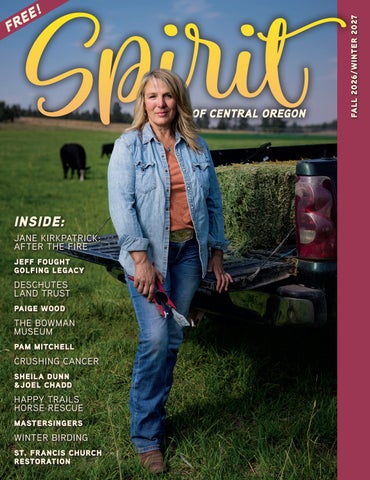
Spirit !
OF CENTRAL OREGON
INSIDE: JANE KIRKPATRICK: AFTER THE FIRE JEFF FOUGHT GOLFING LEGACY
DESCHUTES LAND TRUST PAIGE WOOD
THE BOWMAN MUSEUM PAM MITCHELL
CRUSHING CANCER SHEILA DUNN &JOEL CHADD
HAPPY TRAILS HORSE RESCUE MASTERSINGERS
WINTER BIRDING ST. FRANCIS CHURCH RESTORATION
FALL 2026/WINTER 2027
F
E E R
30 years of partnering with our clients to bring
dreams to life CUSTOM BUILT HANDCRAFTED LOG HOMES Our beautiful hand-drawn logs and full-scribe joinery make for an old-world WORK OF ART Visit our gallery and view plans at
RichardsonLogHomes.com
NEW CONSTRUCTION • LOG HOME RESTORATION SERVICES WE OFFER: New builds: Preliminary planning Maintenance: Fall log home wash Inspections and consultation Full restoration services: Includes log replacement, media blasting, stain, top coat, pest control, and more
CALL 541-728-8787 TODAY!
Our seasoned professionals are waiting to help you with your log home needs!
CCB# 207650 • Licenced-Bonded-Insured
www.NuggetNews.com • 1
Contents
Connecting Central Oregon’s farms & families.........................4 Crushing cancer one local family at a time..................8
29
Jeff Fought leaves a golfing legacy at Black Butte Ranch .... 12 The Bowman Museum: A gem of Western heritage and art in Central Oregon......... 14
Pam Mitchell: A life rooted in the land................................. 18 Caretakers of our land & water............................................20 On the road to recovery: Paige Wood...................................26 Central Oregon originals......................................................29 Winged winter wonders: bundle up and bird!.......................32 Historic St. Francis Church restoration: 100 years of legacy and history in downtown Bend..............34 Giving horses happy trails one rescue at a time.................... 37 Jane Kirkpatrick: After the fire............................................40 Making meaningful music: from Oregon to Italy with the Mastersingers........................................................44
The Nugget N E W S PA P E R
442 E. Main Ave. | P.O. Box 698 | Sisters, OR 97759 541-549-9941 | www.NuggetNews.com ©2026 The Nugget Newspaper, LLC, for Spirit of Central Oregon. All rights reserved. Reproduction in whole or in part without written permission is prohibited. All advertising which appears in Spirit of Central Oregon is the property of The Nugget Newspaper, LLC, and may not be used without explicit permission. The Nugget Newspaper, LLC/Spirit of Central Oregon assumes no liability or responsibility for information contained in advertisements, stories, etc. within this publication. All submissions to Spirit of Central Oregon will be treated as unconditionally assigned for publication and copyrighting purposes and that all rights are currently available.
Contact us
Editor in Chief: Jim Cornelius, editor@nuggetnews.com Creative Director: Jess Draper, jess@nuggetnews.com Distribution/Subscriptions: nugget@nuggetnews.com Advertising: ads@nuggetnews.com 2 • Spirit of Central Oregon
From the editor... The greatest privilege a journalist can be offered is
Those who most exemplify the spirit of Central
to be entrusted with people’s stories. There is no more
Oregon are a diverse lot — but they have common traits.
important role in this trade than to record the trials and
They are creative and innovative, unafraid to test their
triumphs that make up the tapestry of a life. It’s a privi-
capabilities. They are resilient in the face of difficulty,
lege the writers and photographers that create Spirit of
and even tragedy. And they are all committed to paying
Central Oregon take seriously. And we take literally the
it forward, to contributing to the joy and well-being of
title of this magazine: We seek to capture the spirit of
others.
this remarkable region — from those who till its soil and
We are privileged to live in a remarkable place,
reap its harvests, to those who build iconic monuments
and we are privileged to tell
upon it, to those who tap the beauty of the place for their
remarkable stories. Thank you
own artistic expression.
for sharing them with us.
Jim Cornelius, Editor in Chief editor@nuggetnews.com Photo by Jarod Gatley
SERVING SISTERS BLACK BUTTE RANCH CENTRAL CENTRAL OREGON OREGON
Local Knowledge. Lasting Results. BUY, SELL, INVEST. DISCOVER WHAT’S NEXT.
Ross Kennedy PRINCIPAL BROKER
541-408-1343
rosskennedyrealty@gmail.com
SCAN TO CONNECT www.NuggetNews.com • 3
CONNECTING CENTRAL OREGON’S
Farms & Families BY BILL BARTLETT PHOTOS COURTESY HDFFA
4 • Spirit of Central Oregon
In a region defined by juniper flats, irrigation canals, and short growing seasons, a Bend nonprofit is quietly proving that a strong local food system is possible in the high desert. The High Desert Food & Farm Alliance, known as HDFFA, has spent more than a decade building bridges between the farmers who grow Central Oregon’s food and the neighbors who need it. HDFFA’s Executive Director Kristin Points tells Spirit of Central Oregon, “Farm-to-table is about knowing where our food comes from and supporting the people who grow it. When we buy from local farmers and producers, we keep more food dollars in our community, enjoy food that is fresher and more nutritious, and help local farms thrive for years to come. “At HDFFA, our guiding belief is that everyone deserves good food. That means everyone in our community should have access to fresh, nutritious food grown right here in Central Oregon. By bringing farmers, ranchers, and our community together, we make local food more accessible and help support the farms that nourish our community.” Founded in 2010 by Katrina Van Dis in Bend, and formally established in 2012, HDFFA works across the Central Oregon high desert with a mission that sounds simple but runs deep: Support a healthy and thriving food and farm network. The organization’s vision is a food system where farmers and ranchers earn fair value for their work, residents can find nutritious food, and the local economy benefits from strong agriculture. That vision plays out on two fronts at once. HDFFA treats food security as more than an emergency response. It works on access, farm viability, education and policy together, strengthening the relationship between growers and eaters rather than treating them as separate problems. On the access side, HDFFA buys food directly from Central Oregon farmers and ranchers and moves it into the community through food pantries, meal sites, and its own programs. Fresh Harvest Kits deliver boxes of local produce along with recipes. Grow & Give purchases farm food for neighbors facing food insecurity. Points’ organization puts up impressive numbers. “HDFFA’s impact comes from connecting the people, farms, and resources that make our local food system stronger. We support local agriculture, help increase access to fresh food, and give our community more opportunities to learn about and enjoy local food. “The results speak for themselves,” Points said. “Last year alone we collected more than 34,000 pounds of produce from farms — that’s enough for nearly 30,000 meals. We invested $180,000 into the farms and ranches we work with, and distributed more than 30,000 Local Food Guides throughout our community. “But we’re also facing new challenges as federal funding continues to decline. Community support is more important
than ever, and now is the time to invest in the local food system we all depend on. With our community behind us, we can keep this work growing and ensure Central Oregon’s farms, food producers, and community members have the support they need to thrive.” One of their programs, VeggieRx, connects participants with fresh produce and nutrition support. In 2025, those efforts added up to real numbers: $180,000 invested in local farms and ranches, 34,000 pounds of farm-fresh food distributed through pantries and meal sites, and 15,600 Fresh Harvest Kits delivered. More than 85,000 people benefit from HDFFA’s programs each year. The other half of the mission looks toward the fields themselves. HDFFA supports more than 100 farmers and ranchers, many of them working small acreages in a region where water is limited and the economics of small-scale farming are tight. “We think of our work in three pillars,” Points said. “Food access, agricultural support, and community education. All three play an important role in connecting our community with good, local food.” The organization offers technical assistance, education, grants and other resources aimed at helping producers stay viable for the long haul. Just as important, HDFFA says it listens, folding farmers’ and ranchers’ own experience into its programs and advocacy rather than dictating from the outside. HDFFA also works to close the distance between consumers and the people who grow their food. Its Central Oregon Local Food Guide, recipes, cooking demonstrations, and farm-to-table events give residents practical ways to find and use local products. The High Desert Food Trail maps out farms, ranches, restaurants, markets, and other businesses tied to the region’s agriculture, turning a trip to the grocery store or a weekend drive into a chance to meet the source. The organization also partners with healthcare and community groups, reflecting a belief that food, nutrition, farming, and community health are all part of the same picture. As a 501(c)(3) nonprofit, HDFFA operates less like a traditional food bank or farm agency and more like a connector, linking farmers, ranchers, food businesses, health providers, and nonprofits into one working network. That collaborative approach lets the organization address two questions at once: how to get nutritious food to people today, and how to keep Central Oregon’s farms and ranches in business for tomorrow. The result is a food system that works from both ends of the chain, helping the people who grow the food and the people who eat it meet somewhere in the middle.
One Farm,
– Many Ventures – On Bend’s east side, Lost Grace Farm shows what a small Central Oregon farm can become when it grows in more than one direction at once. The farm calls itself a quaint farm in the high desert, where flora and fauna come together to feed the local community, and its operation backs that up with a mix of quail, vegetables, farm products, direct sales, and education. The farm’s signature enterprise is Coturnix quail, raised for both eggs and meat. Lost Grace also sells live chicks and fertile hatching eggs, along with value-added products like pickled quail eggs, preserves and other farm goods. Quail make sense for a small operation. The birds need far less space than conventional livestock, letting a compact farm produce an animal protein it can sell locally. Vegetables are the other core piece. Owner Kate Grace grows mixed vegetables for wholesale markets, according to the High Desert Food & Farm Alliance, which sets Lost Grace apart from a backyard hobby farm. The farm sells directly through its own farm stand, offers local delivery, and lists seasonal vegetables, microgreens, garlic scapes, rhubarb, and preserved products online as they come into season. Lost Grace has also become a vendor at the Sisters Farmers Market, selling quail meat and eggs there as well. The farm’s reach extends into education, with HDFFA crediting Lost Grace for programming that connects the community with local agriculture. Grace is looking ahead, too, with plans to add sheep and bison to the operation in coming years. That kind of expansion reflects the farm’s larger goal: becoming a financially sustainable business built to last for decades rather than a lifestyle operation. Grace was recently awarded a scholarship to attend Ranching for Profit, a program focused on farm and ranch business management. www.NuggetNews.com • 5
HDFFA has backed that growth directly. In 2026, Lost Grace received an On-Farm Efficiency Grant to build a solar-powered outbuilding for year-round hatching, brooding and plant starting, a project meant to stretch the farm’s growing season and strengthen its long-term resilience. Lost Grace Farm captures the direction many small Central Oregon farms are heading: diversified rather than tied to a single product, selling through several channels at once, and pairing food production with education and business development. Whether the product is a dozen quail eggs, a bundle of rhubarb or a lesson for a visiting group, the farm shows how a modest plot of high desert land can support several income streams at the same time, and how partners like HDFFA can help that kind of small, ambitious farm find its footing.
“Treating my client’s investment as though it is my own” … is the defining principle in my client-focused philosophy.
Call me to discuss, or scan the QR code to begin your search.
This concept has allowed me to create great success in the real estate industry as a top-producing agent. I experience great joy representing buyers and sellers with residential, commercial, bare land, and farm properties, Jen McCrystal, Broker and I look forward to assisting you in reaching your jennifermccrystal@stellarnw.com real estate investment goals.
16921 Lady Caroline Dr., Aspen Lakes $1,699,000 MLS#220220342
541-420-4347
Inspiring Quilters, Knitters, & Makers for over 50 Years! 311 W. Cascade Ave. Sisters • 541-549-6061 6 • Spirit of Central Oregon
Your local manufacturer of custom pre-engineered metal buildings
wsbnw.com
503.668.7211 S A N D Y, O R E G O N
www.NuggetNews.com • 7
Crushing Cancer One Local Family at a Time
BY DANI NICHOLS • PHOTOS PROVIDED Rachel Wheeler is a fun-loving millennial mom. Anyone in her orbit ends up in a better mood, almost by default: she has a wicked sense of humor, a go-get-'em mentality and a penchant for making everyday life feel like an adventure. She has a vibrant friend group and family life (happily married with two young boys), and in 2023, she was diagnosed with Stage 4 colon cancer at the age of 37. Cancer is a world-rocking diagnosis at any time, but to have cancer with significant progression at such a young age, with little kids to care for, is overwhelming. Cindy and Roger Grossman, owners of Faith Hope and Charity Vineyards in Terrebonne, know this from personal experience. When the Grossman’s daughter-in-law, Summer, was diagnosed with terminal cancer in 2011, they experienced the very real needs of cancer patients firsthand, so they started a fundraising run at the vineyard called “Crush Cancer” in 2013. In 2025, they brought all the funds in-house and started disbursing them to local families themselves. Just since December 2025, they have supported 26 families with more than 8 • Spirit of Central Oregon
$60,000, covering mortgages, rent, utilities, and childcare. Often, those going through chemotherapy and other cancer treatments are unable to work, and even if you have good health insurance, patients and their families can suddenly find themselves struggling to make mortgage or rent payments, pay utility bills, cover childcare, or afford expenses like gas and lodging when traveling for treatments. Crush Cancer is a fund specifically for Central Oregon locals, and it covers the expenses that many other grants or insurances won’t, but that still add up when your life has been completely altered by disease. Wheeler is one of those recipients of the Crush Cancer fund. “I love that the funds are being used in Central Oregon,” she said. “Because I’m employed and have commercial insurance I don’t qualify for a lot of financial aid. But paying for medical bills is just the beginning. These funds allowed me to have some stress alleviated.
Especially now with flying all the time for my medical trial [in Houston Texas]. Just one less thing to worry about.” Anyone who has walked through a medical diagnosis knows that sometimes the hardest thing is telling the story, asking for help (or refusing unhelpful “help”) and knowing how and what to share. Wheeler said that the Crush Cancer team has been above and beyond generous, helping her to feel understood and loved with no strings attached.
www.NuggetNews.com • 9
“I am just so grateful for the support,” she said. “They paid for six months of our childcare, and because of that, our preschool has been able to join in with my story. The conversation around the fund has allowed for me to be more honest about my needs.” Rowe Zachmann, a local 5-yearold, was diagnosed in 2025 with acute lymphocytic leukemia. A friend of the family told them about Crush Cancer
10 • Spirit of Central Oregon
Run, so the family organized a team for the run called “Rowe’s Runners.” “We had people travel in from Wisconsin, Minnesota, and even North Carolina to run,” said Ali Slater, Rowe’s mom. “There was almost a year of treatment where we were driving to and from Portland weekly, there were a lot of medical bills we were navigating, and the team at Faith Hope and Charity covered a month of our mortgage on an especially hard month. We are so grateful for what they do for cancer families in the community. We were blown away by the event. We were so emotional when he crossed the finish line at the run, it felt like a tangible representation of the fight and race we were up against all year.” The run has been extremely successful, but it’s just one aspect of this high-impact nonprofit. “Our big fundraiser for Crush Cancer has traditionally been the annual Crush Cancer Run,” said Miriam Lea, vice president of the Crush Cancer board of directors and organizer of the new quilt sale. “But now that we have
begun disbursing funds and supporting patients and families in-house, we have realized that the need is even greater than we imagined. That’s why we’re launching a second major fundraiser: Threads of Hope, a community quilt sale. “Central Oregon has an incredible community of quilters and fabric artists, and I honestly cannot begin to tell you how generous they have been. The response has been overwhelming. “The stories behind these donations are just as meaningful as the quilts themselves. Almost every day I open my email to another quilter saying something along the lines of, ‘I’m a cancer survivor, and I have some quilts I would like to sell.’ “The items range in price from $50 for table runners to $500 for a beautiful bed-sized quilt. I understand that those prices may make someone gasp at first. But these aren’t mass-produced quilts. They are works of art made by incredibly talented local artists, and every purchase is also an opportunity to provide hope and practical support to a Central Oregon family facing cancer. When you buy one of these quilts, you aren’t just taking home something beautiful. You are helping a neighbor pay a utility bill, helping a parent afford
gas to get to treatment, or helping a family stay in their home during one of the hardest seasons of their lives.” The Threads of Hope event had more than 100 pieces for sale to support Crush Cancer, and raised more than $7,000 at the one-day event. The winery will continue to have quilts for sale through the holiday season, as well as at their annual Christmas
Marketplace held on November 28 and 29. “It is a celebration of the incredible talent and generosity of local quilters — and, more importantly, a way for our community to wrap its arms around people fighting cancer,” Lea said. “Something that is so special about Central Oregon is how we show up for our neighbors. I lived in Portland for many years and never saw this incredible sense of community. When people here learn that their friends are hurting or need help, they step up!”
Faith Hope and Charity Vineyards’ Crush Cancer nonprofit is a great example of the unique magic of our community. Through a local family comes a local business, which then creates a local nonprofit, which feeds back to local families in need. Crush Cancer will continue to grow through the support of runners, quilters, and anyone who likes good wine, good food, and supporting a good cause. For more information on how you can support the vineyard and the life-changing work of Crush Cancer, visit www.faith hopeandcharityevents.com or email crushcancer@fhcvineyards.com
Central Oregon is home! Let’s find yours... Your home. Your community. Your next chapter. www.KhivaSellsCentralOregon
2025 INTERNATIONAL STERLING SOCIETY
Khiva Beckwith Broker
Grateful to my incredible clients and community for your trust and support. This achievement is because of you! – Khiva
khivarealestate@gmail.com
Top 11% of Coldwell Banker Agents Worldwide
541-420-2165
809 SW Canyon Dr., Redmond, OR
www.NuggetNews.com • 11
T
JEFF FOUGH
Leaves a y c a g e L g n i f l Go NCH
T AT BLACK BU
TE RA
DER BY KATY YO PHOTOS BY LT CODY RHEAU
On December 15, Jeff Fought will leave the pro shop at Big Meadow Golf Course for the last time. The Director of Golf at Black Butte Ranch was hired in 2001. Over the last 26 years, he’s stewarded the Big Meadow and Glaze Meadow courses, oversaw construction of a new pro shop and renovation of the courses all while honoring Black Butte Ranch’s original visionaries including Mike Hollern, Bill Smith and golf course architects Robert Muir Graves and Bunny Mason. Fought’s time at the Ranch holds cherished memories of Ranch residents who made him part of their family. As his last day gets closer, he knows he’s going to miss the people, the place, and the golfing career that included epic travels to Scotland and competing in countless tournaments around the country. Growing up, golf was a family activity with golfing elders including his father and grandmother Donna Acchison, who was a city champion and the first teacher for the Fought children. Fought’s brother John Fought is a former U.S. Amateur Champion, a PGA Tour player, and a golf course designer. 12 • Spirit of Central Oregon
“I was the Oregon Junior State Champion; I was runner-up in the amateur division and won multiple junior amateur tournaments. I received a golf scholarship from Brigham Yo u n g U n i v e r s i t y where our team was National Champions. As a professional, I won a Pacific Northwest section PGA tournament which was a very high honor. That was in 1995 and at the Portland Golf Club where Jack Nicklaus also won there,” said Fought in his office at the Big Meadow Golf Course. After college, Fought went to work for a golf management company where he was involved in building golf courses, pro shops and setting up operations for new golf courses. He found the traveling with 14 days out and two days home wasn’t sustainable for his young family. When he heard that Director of Golf, JD Mowlds was leaving his position at Black Butte Ranch, Fought decided to apply. His background in golf course construction projects made him a great choice for the position. He described the Big Meadow clubhouse as not much more than a shack with a pro shop, snack shack, and a place for golfers to eat and have a beer. It was time to modernize. Fought worked with Big Meadow course designer, Robert Muir Graves on a three-phase master plan that asked what was needed for the next 10 years. “We fulfilled a lot of that plan. I think Bob would be very proud of us and what we accomplished. Later Bob’s vision was passed on to my brother John who did the redesign of Glaze Meadow and the design of the putting course at Big Meadow. After Bob died in 2003, Damian Pascuzzo from his firm did the remodel of Big Meadow Golf Course. We moved the bunkers out because they were designed in
1969. Who knew golfers would drive the ball the way they are driving it today? The next phase will happen after I’m gone. The greens will be reformed and redone back to the original bent grass,” said Fought. “We just made it, so it’s played the way it was meant to be played. We kept the character of the course.” Through the ebb and flow of the last 26 years, Fought has stewarded the two courses at Black Butte Ranch, doing his best to maintain the original intention of the early planners. He’s seen the golf industry rise and fall with the economy and other factors. During his tenure at Black Butte Ranch, he’s seen the number of golf courses in Central Oregon go from 12 to 30. He recognizes Brooks Resources, who built Black Butte Ranch, and John Gray, who built Sunriver, as visionaries who saw Central Oregon’s potential. “I’m proud of my staff who have helped Black Butte Ranch make a difference in the golf industry. I’m also proud of taking Black Butte Ranch’s golf courses to another level. We’ve remodeled the courses and buildings, added new buildings, and made sure our staff all offer a great experience for golfers. It’s our intention to make every person who comes here feel welcome. Our two golf courses used to be more siloed with staff only working at one course or the other. It took time, but we’ve become one team working together with a common message and focus,” said Fought. Working with Robert Muir Graves for his first few years at Black Butte Ranch is one of his favorite memories. Fought became an adopted member of the family, attending family gatherings and working with Graves as his battle with cancer began to curtail his ability to finish plans for the Ranch. “Bob was always there to help me when I needed it. He gave me advice, and, because I was part of the family, his help was at no charge. He truly loved Black Butte Ranch,” said Fought.
“I’m proud of working with him, and, I’m glad he was proud of me. I’m also proud to work with my brother John on the Glaze Meadow renovation. I think he did a fabulous job.” Fought will never forget a Christmas present he received from six Black Butte Ranch homeowners. The gift was a trip to Scotland with them in appreciation for the job he was doing for the Ranch golf courses. The group played 12 rounds in 14 days on iconic courses like St. Andrews, Carnoustie, Dornoch, Bora, North Barrack, and Gullane 2 courses. At 66, Fought’s ready to find other things to do. The question is what’s next for the Fought family? “I opened the store every morning. I’m not proud of it, but I haven’t taken much time off. I’ve been here every morning grinding a fresh cup of coffee, getting to emails, then after a few hours dealing with computers, getting out greeting people,” he said. “Now I can travel. I have a son who’s getting married in Vietnam, and he has a oneyear-old. It’s time for me to put time in with my grandkids, watch them play tee ball and soccer and be dancing ballerinas. I could have kept going, but I’ve seen too many people in my industry go until they can’t do anything. That’s not the way I want to end it. I’m giving up one of the greatest jobs in the world, and I love all these people. I love my staff; I love the homeowners and their guests. Fought is leaving while he still has more fuel in the tank to enjoy his family, see the world, and play more golf. He and his wife, Cynthia, have a trip planned in January to visit friends in Belize. He’ll do some fishing and hang out with friends. Some of his golf buddies are planning a trip to Cancun in February... all golf games free from worrying about playing in tournament golf. It’s time to relax and just have fun. The one thing he wants to do is shoot his age. He knows he can do it. It’ll take just a few more rounds of golf and the time to do it. www.NuggetNews.com • 13
THE BOWMAN MUSEUM:
A Gem of Western Heritage and Art in Central Oregon STORY BY DANI NICHOLS • PHOTOS BY GARY EIDESMOE From Cowboy Poetry to Family Events, the Bowman Museum is preserving the past and inspiring the future of Central Oregon culture. My kids call the Bowman Museum “the train house” because of the bright yellow caboose outside. You can climb through the caboose and imagine yourself riding the rails of the Old West, a flight of fancy which my boys often indulge in, paired of course with the belief that they, too, are cowboys and bandits and cattle rustlers and train conductors. In an increasingly tech-forward age, the Bowman Museum is a beacon of real, humanmade things. Their slogan is “Preserving our Past. Inspiring our Future.” And if my kids are any indication, the tangible memories encased in the Bowman Museum are inspiring. Visitors can climb aboard the caboose, try out the “misery whip” (a double-handled logging saw) for themselves on a replica old-growth evergreen, and touch the cook-stove, saddles, and other everyday artifacts 14 • Spirit of Central Oregon
of a rural life in the high desert. The museum is housed in a 1911 bank building on the corner of 3rd and Main in Prineville, and as the diesel trucks and passenger cars rumble by, it’s easy to imagine that thoroughfare as it was when the bank was operational, a hub for local farmers, ranchers, and homesteaders, working out a living from the plains and buttes of Crook County.
“I think what makes the Bowman Museum so special is how personal the museum is to the community,” said Carter Bond, collections specialist for the museum. “So many people have grown up coming here or have deep roots in the area, and the museum gives them a chance to look back at some of these moments in Central Oregon history. All the outreach and education we’ve been doing recently is hopefully inspiring our community to learn more about the history of where we live and exciting younger generations to take an interest in local history, so that our history can be preserved for years to come.” The outreach and education piece of the museum’s mission is no small undertaking. The Bowman is becoming known for its art and history events, as well as events for children and families. One unique event is called “Around the Campfire: Cowboy Poetry Open Mic.” It began in 2024 as a way to help keep the cowboy poetry tradition alive during Crooked River
www.NuggetNews.com • 15
said Sean Briscoe, executive director of the museum. “Our goal is to make Prineville the Cowboy Poetry Capital of Oregon.” “The Bowman Museum is special because it doesn’t just preserve old things, it preserves the stories, values, and sense of place that make Central Oregon what it is. It’s about the ranchers, cowboys, loggers, business owners, railroad workers, pioneers, teachers, veterans, and the families who have made a life here,” said Dawn Alexander, one of the Bowman Museum’s board members. Alexander is a retired public school teacher and has a passion for inspiring the next generation to engage with agriculture and our shared history. “It’s a place to protect the physical evidence of our past so that future Roundup. The event is held each year talented poet. He is the six-time winner generations have a connection to on the Saturday of the Roundup and of the IWMA Youth Poetry Contest, and those who came before them. When has grown exponentially in just a few won 4th in State for FFA Creed Speak children come to the Bowman, they years, from a few performers and a (a competitive public speaking event aren’t simply learning history. They’re small gathering of listeners in 2024, to through Future Farmers of America). learning that this place has a story, more than 100 attendees and 15 per- He has performed at the Bowman and they are part of it. They begin formers in 2026. many times and is a critical part of the to understand why ranching matters, why timber, the railroad matter, how After the success of the 2025 youth contingent of the IWMA. event, Tom Swearingen, the president Spirit Magazine asked him what got water shaped Central Oregon, why of the International Western Music him into this art form: “I first heard people save pictures and letters, why Association (IWMA) Columbia Chapter, cowboy poetry from my dad, who has old buildings matter, why where their said it was an obvious choice to host always loved it,” Fitzgerald said. “I like roots are matter,” she said. “Bringing their annual meeting in Prineville at to write about things that are familiar a variety of children’s programs allows the Bowman, which includes perfor- to me and really enjoy performing for children to be curious, ask questions, and discover things they probably mances by their members. The event audiences.” was even more successful than antic“This year, we partnered with the never would have experienced had ipated, with a full house. “You always Rural Oregon Community Foundation, it not been for the Bowman. This is have a good time in Central Oregon,” whose mission includes preserving something I am excited to help expand, Swearingen said. “The hospitality is the Western heritage and way of life, a place for stories, a place to create incredible, the people really appreciate to create a larger September event,” memories and build a bridge between generations.” our heritage and art, and they love The Bowman Museum is worth cowboy poetry and western music. a visit, and their community proWe had a packed house this year grams are inspiring, educational, and it has continued to grow every and appeal to everyone in the time we come. It’s just incredible.” 246 N. Main St., Prineville, Oregon family. If you’re lucky, maybe you “I mean, it’s no surprise, Hours: Tuesday–Friday 10 a.m.–5 p.m. will even get an enthusiastic tour Prineville — really all of Central Saturday 11 a.m.–4 p.m. from some little boys in your life, Oregon — is cowboy country. The Closed major holidays and January who will race you out to see the Western roots are strong and the caboose and deafen the neighAdmission is free, but donations are people are proud of it.” borhood with their “choo-choo” accepted. The museum has a gift shop that Thomas Fitzgerald is a Central sounds. specializes in local authors and artists, Oregonian high school student and and supports their mission and programs.
THE BOWMAN MUSEUM
16 • Spirit of Central Oregon
A Cowboy’s Home By Thomas Fitzgerald
A cowboy sits on a mountain top, on his horse, all alone. Looking out into the range, a place a cowboy calls his home. Down below him are the cattle, stretching miles from here to there. Cookie setting up the camp, the hands are everywhere. He relaxes in the saddle and says, "this is the place to be" His horse nods as if in approval, and nickers lovingly. Sitting there in the silence, he thinks about his life. He wonders when he’ll get home, to see his kid and wife. He notices the beauty that’s gathering all around. Making him mighty glad that he moved outta town. The wind is whistling through the trees, a coyote’s cry can be heard. He hears the bugle of an elk, and the soft chirp of a bird. A commotion breaks the stillness, and the cowboy looks down. To see that Cookie’s ready and gathering the hands around. They hear what’s for supper, and the hands all give a groan. The cowboy grins and heads his horse, to a place a cowboy calls his home. © Thomas Fitzgerald 2025
www.NuggetNews.com • 17
Pam Mitchell: A life rooted in the land
By Bill Bartlett • Photo by Cody Rheault
Before Pam Mitchell could walk, she already belonged to Cloverdale’s dirt. She was born at Redmond Hospital in the middle of potato harvest, into a family whose Oregon roots trace back to the Oregon Trail. By the time she was old enough to toddle after her grandmother, she’d already earned a nickname: the “Toad Girl” for her habit of showing up with her hands full of whatever creature she’d found that day. She lived next door to her grandparents until she was about 5, surrounded by sheep, rabbits, and ponies. Some mornings she and her brothers followed their mother out to the fields, still in their pajamas, while she changed the flood irrigation, and the kids waded the ditches catching tadpoles and pollywogs. Pam was one of five children, bracketed by two older brothers and two much younger ones, and to this day the family gatherings are, in her words, “large and noisy.” Farm life meant more than play. 18 • Spirit of Central Oregon
“The children fed cattle and learned to drive equipment early, and three-wheelers were the favorite ride around the property long before any of us were legally old enough to drive on a road,” Mitchell recalls fondly. Her father made sure Pam learned to run both farm and construction equipment, a decision that would shape the rest of her life. School started in Sisters, where she attended kindergarten in the building that now houses the school district office. First through third grade meant the Cloverdale School, essentially one room, where younger students absorbed lessons meant for the older kids alongside their own. When the family’s address east of Camp Polk Road placed them in the Redmond School District starting in fourth grade, the school day came with an hour-plus bus ride each way. At Redmond High School, Pam made the Honor Roll and graduated third in her class. She followed her brothers into FFA while still showing
sheep through 4-H, and the organization became a proving ground: chapter president, State Farmer Degree, parliamentary procedure competitions, and a spot representing Oregon at the National FFA Livestock Judging Contest. Scholarships followed, first to LinnBenton Community College and then Oregon State University, where she competed on livestock judging teams, took on student leadership roles, and became president of the agricultural honor organization Alpha Zeta. She helped launch an agriculture newsletter, earned the Outstanding Undergraduate honor for the College of Agriculture, and graduated with a degree in Animal Science, a minor in Agricultural Business Management, and a concentration in Communications. “The plan was for me to work for an agricultural commodity organization,” Mitchell told Spirit. “Instead, my dad asked me to come home, just temporarily, to help run equipment during the construction of Aspen Lakes.”
Temporary became a career. Pam kept operating heavy equipment through the building of the golf course, work that would carry into the next chapter of her life almost without her noticing the shift. She met Sykes Mitchell in 1993, and married him the following year. After the couple made Central Oregon home, Sykes founded Sykes Seafood while Pam stayed behind the controls of her equipment. She finally stepped away from the 32-yard paddle-wheel scraper while pregnant with their first son, Sam, born in 2000. Their second son, Nolan, arrived in 2002. “My boys grew up the way I did, tagging along to work and picking up cooking, cattle, lambing, fencing, construction, and the day-to-day realities of running a business,” Mitchell said. “Of every title I have held, the one of which I am proudest of is simply ‘Mom.’” Service runs alongside family as the other constant. She has given her
time to 4-H, Farm Bureau, Ag in the Classroom, school organizations, and a long list of community committees, but it’s the Cloverdale 4-H Club that has held her longest: 41 years as leader. “This year, with a strong team of co-leaders and parents behind us, we helped bring a record 73 children to the Deschutes County Fair,” Mitchell said. On 20 acres of pasture, Mitchell cares for 20 sheep and three goats. Her cattle are interspersed with her parents’ herd, about 50 cows in all with calves. “I lend a hand when Mom and Dad need help with lambing,” she said. She’s seemingly always at the side of her four-legged friends or nurturing kids with their livestock. Her tie to firefighting runs through Sisters Aggregate & Construction, where, for more than 30 years, she has supported dozers contracted to build firelines, serving as transport and chase-vehicle support for the
operators and their equipment. That instinct didn’t start with her. “My parents helped found the Cloverdale Volunteer Fire Department after watching a neighbor’s home burn,” she said ardently. Her parents also served on school boards, water boards, planning commissions, and committees of every kind. It’s a fitting arc: the same impulse that sent her parents to build a fire department generations ago now sends Mitchell out to support the crews holding the lines today. “I draw my inspiration from both directions — the people who came before me and the younger ones now showing their own resilience, faith, and hope,” she said. For Pam Mitchell, giving back was never really a lesson. It was handed down like the family’s Oregon Trail roots, and she’s already passing it forward, one fair, one fireline, and one more generation of 4-H kids at a time.
www.NuggetNews.com • 19
CARETAKERS of our LAND & WATER STORY BY SUE STAFFORD
Photo by Sue Stafford
For more than 30 years, the Deschutes Land Trust (DLT) has been “caring for the land and water that sustain Central Oregonians for generations to come.”
Over those three decades, DLT has protected 18,742 acres (current figure) in perpetuity. They have connected 18,742 people, and volunteers have donated 132,457 hours to maintain and support the mission of the Land Trust. Rika Ayotte, DLT executive director, lauded the many volunteers who make all the restoration, conservation, and education work possible. They pull weeds, plant, lead tours and hikes, conduct surveys, help in the DLT office, do trail cleanup and maintenance, provide event support, and act as ambassadors through their photography and art. They are a dedicated bunch. Preserves are open for exploration on your own or as part of a guided tour lead by knowledgeable volunteers. Each reserve offers its own unique terrain, trails, and experience. There are four major Land Trust preserves: Camp Polk Meadow (151 acres), Indian Ford Meadow (63 acres), Metolius Preserve (1,240 acres), and Whychus Creek Preserve (930 acres). Community Preserves include: Aspen Hollow, Ochoco, Paulina Creek, Priday Ranch, Rimrock Ranch, Thomas Preserve, and Willow Springs. A variety of hikes/tours are available through November. Besides the Community Preserves, the Land Trust works with private landowners to conserve their land by protecting plant and animal habitat, helping to strengthen climate 20 • Spirit of Central Oregon
resilience, and helping protect local working farms, forests, and ranches. Occasional tours of these properties are arranged by staff. Privately held properties include: Alder Springs, Aspen Valley Ranch, Coffer Ranch, Spring Creek, and Trout Creek Conservation Area. Through their restoration and conservation efforts, DLT has increased the viability of their protected properties, helping slow or diminish the effects of wildfire. Ayotte told The Nugget, “Central Oregon is on the front line of the changing climate and wildfire is the most visceral impact. The summer fires of 2025 and 2026 were clear reminders of that change.” In 2025, the Cram Fire impacted the Priday Ranch Preserve north of Madras and the Flat Fire burned portions of Rimrock Ranch and the Whychus Creek Preserve outside Sisters. Before the fire, DLT had been working on controlling invasive annuals like cheat grass and fallow alfalfa fields which feed wildfire. They planted native bunch grasses that slow the spread of fire. Forest thinning, especially juniper removal, is another tool for creating resiliency. At Rimrock Ranch and the Metolius Preserve, prescribed burns removed ground fuel which spreads fire. Work on Whychus Creek started in July 2016 with the remeandering of the creek at Camp Polk Meadow, returning
From thoughtful design to quality craftsmanship, we bring experience and attention to detail to every project.
A remodel isn’t just about how your home looks, it’s about creating a space that feels right for the way you live.
ccb#249737
We’re proud to help Central Oregon homeowners create spaces they’re excited to come home home to.
Scan QR code or call
541-382-6281
for a free in-home estimate
www.powersbathremodel.com
www.NuggetNews.com • 21
Remeandering of Oregon Whychus Creek at Camp Polk Meadow. PHOTO BY WASIM MUKLASHY 22 • Spirit of Central
www.NuggetNews.com • 23
The Flat Fire burned in the canyon yet left the restored areas untouched, providing refugia for wildlife. PHOTO COURTESY DLT the flood plain. In July 2018, trees were put into the steam to slow the creek and create pools for returning salmon. In 2025, the Flat Fire (23,346 acres) burned through the Whychus Creek Preserve east of Sisters. Despite the loss of massive amounts of vegetation on the walls of the canyon, where the DLT had completed restoration work on the creek and its surroundings, the landscape didn’t burn and remained a healthy green oasis providing food, water, and shelter for wildlife displaced by the fire. In 2025, Aspen Hollow acted as a wet line for the Flat Fire, demonstrating that the restoration and resiliency work mattered. “We know the conservation work we are doing is important for wildfire resiliency, and the Flat Fire in 2025 demonstrated that clearly on the floor of Whychus Canyon,” said Ayotte. “We are doubling down on our effort.” Following the Flat Fire, Whychus Creek Preserve was closed for 11 months to enable the DLT staff to work in collaboration with their partners at the Bureau of Land Management to clear hazard trees that need to be removed due to the likelihood of their posing danger by falling on trails and other public use areas. DLT marked the trees to be removed, and BLM brought in crews to do the removal. Once that was complete, staff and volunteers were able to clear burn debris and make repairs to eroded trail sections as well as replacing trail signage destroyed in the fire. Planting new shrubs and trees while eliminating invasive grasses and plants will be ongoing work. The Preserve finally reopened to the public in July 2026 only to have to close one week later following Level 2 evacuation notices due to the Akawa Butte Fire, which was started by lightning west of the Flat Fire burn scar. No DLT preserves in the Sisters area were impacted by fire this year, although there were evacuations. Unfortunately, the same can’t be said for DLT preserves 24 • Spirit of Central Oregon
further to the east. The most impacted was a private DLT easement on Aspen Valley Ranch in the Post/Paulina area where 7.000 acres were burned in the Coyote Butte Fire, which became part of the Rowe Complex. The Priday Ranch was under an evacuation notice but the, fire stopped short of the ranch. During fires, the DLT staff works with first responders, attending cooperating meetings with others involved in fighting the fires. At their preserves, they are able to provide property for staging areas. DLT provides a list of local resources to help people recover from the fire impact. They also provide education on the positive aspects of fire. Ayotte indicated that changes in federal funding are directly impacting their efforts, and they are even more reliant on their donors and volunteers. They will be working on stream restoration design into 2027 for the last stretch of Whychus Creek that flows through the Whychus Canyon Preserve. Trout Creek and the Priday Ranch will also get some attention. Other preserves will be receiving attention as well. There is always work to be done.
www.NuggetNews.com • 25
Y R E V O C E R O T D A O R E H T N O
d o o W Paige
PROVIDED S • PHOTOS IU L E N R O C BY JIM
When Spirit of Central Oregon connected with Paige Wood late this summer, the Prineville teen was two days away from her 20th surgery. She had been on a long and hard road since August 10, 2025, when she fell asleep at the wheel during a drive from Eugene to Prineville, and crashed into the trees on the side of Highway 126, near Blue Pool. She was trapped in the crumpled wreckage of her vehicle, her legs pinned. See story in Spirit of Central Oregon, Fall 2025. Paige survived the wreck, and kept her vision and her legs — both of which were touch-and-go for a while. The past year has been an arduous climb back — and the climb hasn’t all been steady. But Paige has earned wisdom and faith beyond her years through an ordeal she wishes she could have avoided, but must accept. Spirit talked to Paige just after the oneyear anniversary of her wreck. “It was a little bit hard,” she said. “It kind of put my mind and myself back in that day.” The memories were vivid — the smells, and what it felt like to be trapped in her vehicle as emergency crews cut her out. “It got better throughout the day,” she said. Paige is used to things getting dark, and having to simply hold on until they get better. She makes no pretense that any of this has been easy. “There are days when I think I should have just died,” she said. “That would have been the easier way.”
26 • Spirit of Central Oregon
Both of her legs were severely mangled in the accident and it looked for a time like she might have to have her lower left leg amputated. Her kidneys were lacerated, she had a broken elbow, and the force of the crash had damaged her retinas. Paige has undergone dozens of surgeries to stabilize her legs with rods and pins, and a 10-hour procedure to graft a 10-by-4-inch piece of skin from her upper left leg to her lower left leg. The 20th surgery “is going to be my last reconstruction that’s not plastic surgery,” she said. The physical ordeal has been strenuous, but Paige has also had to face loss, and being forced to question her sense of herself. “Who is Paige now, without volleyball, without sports, without going out and about, going for a hike?” she mused. “I do like to be myself sometimes and just think: What do I have now? What am I being given now?” The high school athlete is coming to terms with the reality that she will not be able to play the sport she loves most at the level she was at before the accident. “My passion was volleyball,” she said. “That’s a hard one... It really is — the fact that volleyball is really done for me. That’s hard to even say. I think my chapter as a player is done.” She was able to get back onto the hardwood to serve on senior night, and she is looking forward to participating in track and field this spring. She expects to be cleared for that. “I’m not going to be knocked back down,” she said. “I’m going to keep climbing.” She’s willing to push herself — hard. “The first day I got cleared (for walking), I walked three miles,” she said. She laughed a little and added: “Though I shouldn’t have done that, because now I’m suffering for it.” One of the things that Paige has learned in her ordeal is that words alone — while they may be appreciated — don’t change harsh realities. www.NuggetNews.com • 27
“Nobody has the right words for anybody,” she said. “Nothing’s going to make it go away. It’s there. It’s real.” Sometimes grim reality can be overwhelming. But Paige has learned something else: Not every day is a good day, but there is good in each day. “You keep going,” she said. “You have to find things in your everyday life that are good and not bad.” She has put her faith in God, “seeing all the good things God has provided me.” That includes a family that has rallied to her support with love and dedication, a school community that has been flexible and supportive — and hundreds of people who have stepped forward to offer their love, kindness, and support, many of them strangers. “In my journey, I have met so many people that I would never have met,” Paige said. “Those are the kind of people who make me believe there is a purpose in my life.”
28 • Spirit of Central Oregon
It is important to her to put faith in a plan that she may not always be able to discern. “If we can put our trust in that, that’s all that matters,” she said. “Although we may not see it, it comes with so much more than we know.” Paige’s current plans include education in cosmetology. She particularly wants to do bridal hair. “I want to make people feel beautiful,” she said. “I know what it’s like to feel ugly and be looked at in a weird way.” Paige Wood has a deep perspective on life that only someone who has been annealed in the fires of hardship and pain can truly possess. She has a deeper empathy, and a realization of how fleeting life and its passions can be. “We don’t know what everyday people go through,” she said. “Give people more grace. Hug your loved ones a little bit tighter. Live every day like it’s your last.”
Central Oregon originals Story by Katy Yoder Photos by Jen Lee Photography
Sheila Dunn and Joel Chadd are quintessential examples of creative folks making a living and doing what they love in Central Oregon. Whether it’s making their art, Sheila with a paintbrush and Joel with a guitar, they’re living lives that keep them curious, challenged, and always looking for ways to expand their inspired ideas. Bend became the couple’s home offering all the activities they love and like-minded people who share their interests in the arts, music, and outdoor recreation.
Sheila Dunn’s oil portraits can be found in a shared creative space called Team 224 at 224 NW Oregon Ave. in downtown Bend, in collectors' homes, and on Bend Cider Company’s cider cans. Her images are iconic, unique, and exude the essence and energy found in Central Oregon landscapes and animals. Dunn’s journey to Central Oregon began in her mid-twenties after living in Guatemala for six months. She and her sister grew up in Colorado and wanted to live somewhere else for a year. In 2009, they picked Bend. For Dunn, Central Oregon was the right choice. “I didn’t think I’d be here for more than a year, but this place sucks you in,” said Dunn. “It’s the beauty of this place. The diversity of landscapes is incredible, and I’ve developed a great
community of friends.” A Folk Americana songwriter, Joel Chadd’s roots in Central Oregon were planted when he was a baby traveling with his family to a summer campsite along the Metolius River from their home in Philomath. He never lost his love for the area and still has the old tent the family of six used to sleep in each night. When he was 18, he got a job at Breedlove Guitars doing quality control on instruments before they were sent to customers. He transitioned through a variety of jobs at Breedlove before accepting a position in Sisters for Preston Thompson Guitars. Working for founder Preston Thompson was an honor for Chadd as he learned new skills and worked his way up into management positions. “It was a small company where www.NuggetNews.com • 29
you wore a lot of hats. It was inspiring and exciting and groomed me for what it takes to be self-employed,” said Chadd. “I managed their repair department, then the setup department and ran the CNC machine. I handled quality control and traveled for the company to trade shows and festivals. I also did photography for them. I appreciate Preston Thompson’s encouragement and generosity so much,” said Chadd at the couple’s studio in Tumalo. Even though Chadd and Dunn had many friends in common, they didn’t meet until they tried online dating. The timing of their eventual meeting became a blessing as they both walked the difficult path of having a parent diagnosed with cancer. Having that experience in common brought them together quickly. Understanding what was really important in life and being able to have raw, honest conversations positioned them well for a healthy relationship built on trust and shared values. “I’d only known Joel for two weeks. My dad was really sick and entering the end of his life. Joel just happened to be with Thompson Guitars in Colorado at a festival. I told him I’d really like him to meet my dad. He was able to spend three days with my dad,” she said. On that trip, Chadd traveled to Colorado with co-worker, mentor, and
30 • Spirit of Central Oregon
dear friend, Gareth Jenkins who listened as Chadd explained the situation with Dunn’s father. What Jenkins told him affirmed his desire to meet Dunn’s father. “He told me as a father with a daughter, no matter what happens with your relationship, it’s a gift for a father to know his daughter is in good hands. I remember that as a moment when I understood the timing of Sheila and I being in Colorado at the same time. It was all lining up so I could be with her father. Two days in a row, my flights were canceled so I had more time with him. It was the only time I got to spend with him. It was one of the most meaningful moments in my life. I wrote a song called, "Built on Love," which is on my first album,” said Chadd. Over the years, Sheila’s business continued to grow. Chadd left Preston Thompson Guitars to support her business. Seven years ago, when they’d grown out of their present studio, they heard about a rustic studio/garage in Tumalo. They drove out and decided they could make it into a studio and production space. Chadd has been busy turning the space into a lightfilled, snuggly location for Sheila’s art and his music and eventual return to working on instruments. Chadd came to his craft later in life. He was 23 when his mother gave
him her nylon string guitar and a Bob Dylan songbook. He grew up in a musical family with a father who was a semi-professional musician in the 1960s, and a grandmother who was a professional singer in the 1940s in the San Francisco Bay Area. Part of his reticence to play music was seeing how hard it was to have a family and raise kids while being a touring musician. “I grew up writing poetry, doing photography, and keeping a journal. Building guitars was a way to be involved in music,” said Chadd. “Helping manage Sheila’s business, what I’ve done before helped me see a vision for a company like hers. Thinking about where it can grow and what we can do, I’m able to use my woodworking and photography skills and my CNC and machinery experience to use our Giclee printer.” Dunn laughs when she recalls that art school didn’t teach her about being your own marketing and accounting department... unless you can afford to hire someone. She wonders how she wore all those hats while trying to paint and expand her business. After working through the fear and reticence of fully relying on her artwork for her income, she decided to take the leap and focus on making art her sole profession. As terrifying as the decision
was, the risk was worth the reward. With Chadd taking some of the duties off Dunn’s shoulders, she’s able to paint more. With a more flexible schedule, Chadd can tour and do gigs. He’s one of Preston Thompson Guitar’s
featured touring artists that include folk icon Peter Rowan and Laurie Lewis and blues legend Eric Bibb. “We work really hard, but we get to play hard on our own schedule. We both made that individual choice before
we met,” said Chadd. “It’s about pursuing your passion. Maybe it’s because my mom was diagnosed with cancer when I was young? Work has never been about money; it’s always been about pure passion and love of what I’m investing my time into.” When it’s time to relax and play, the couple love spending time at Summer Lake and the Playa desert in Eastern Oregon. They also love getting over to the coast for some beach time pulling a vintage trailer that Chadd built from the flatbed up. He jokes that the only things original are the windows and the cookstove. The couple has spent years building their own foundation from the ground up with connection, purpose, and creativity at its core. Their experiences in Central Oregon from solo hikes up the South Sister, finding the Divine in nature, and navigating their own styles of painting and writing music have shaped who they are today. The spirit of Central Oregon is strong in these two and anyone who has the pleasure of seeing or hearing their creations will benefit from the experience. You can view more of Dunn’s ongoing collections or check for online availability directly through Sheila Dunn Art. To learn more about Joel Chadd and find out where he’s playing visit his website, www.joelchaddmusic.com.
new season
MEANS TIME FOR A
new look
We’ve got a beautiful selection of felt hats this season. Let us help you find the perfect fit and nail your look! Mention this ad for a sweet little something extra! 161 E. Cascade Ave., Ste. D, Sisters Open at 11 a.m. daily; Closed Tues.
sistershatsandco.com www.NuggetNews.com • 31
Winged winter wonders
P U E L D N U B AND BIRD! Story & Photos By Sevilla Rhoads
GREAT GRAY OWL Winter is my favorite time of year to bird in Central Oregon. The hotspots tend to be quieter and landscapes offer a special seasonal beauty. Many interesting and handsome species migrate here from the north to overwinter. A surprising number of local birds stay year-round and fascinate us with their unique winter survival behaviors. Fair-weather birders, who hang up their binoculars at the end of autumn migration, are missing out! The secret to enjoyable winter birding is knowing how to layer for weather, planning, and a shift in expectations. Central Oregon’s weather is unpredictable, so I prepare for changing conditions. I choose places close to warmth and shelter, like a lodge or developed day-use area. Unlike migration peaks, I do not expect huge variety, rather I anticipate more deeply savoring a more manageable selection of birds. The difference is like sitting down for a special multicourse meal, rather than an all-you-can-eat buffet! A great introduction to winter birding is finding open water with a comfortable viewing area. The lakes by the Sunriver Nature Center and Black Butte Ranch’s Bistro Cafe do not freeze due to bubblers, making them popular with birds. The Deschutes River tends to stay ice-free in Bend, so a riverside stroll through town, like near the Old Mill shopping center, is an easy and enjoyable birding outing. Suttle Lake Lodge has a covered lake-viewing area. For those with kids, all these locations are close to cafes 32 • Spirit of Central Oregon
with snacks and hot cocoa! The Crooked River Wetlands Complex near Prineville has restrooms, sheltered seating, and some level-path viewing options suitable for families and many mobility devices. All these locations have varied accessibility features. Cornell University’s eBird website is an excellent resource to find out where the winter birds gather. Visit www.eBird.org, then use the Explore tab for area lists organized by month. The checklist provides a photo of the bird to help you identify it, but if you need more help, try Cornell’s All About Birds website, www.allaboutbirds.org. When the aspen and cottonwood leaves flutter down, it is time to start looking up in anticipation of the return flight of our beautiful Bucephala winter ducks, includ ing Buffleheads, Barrow’s and Common Goldeneyes. While watching these lovely ducks, I marvel how each one, when a day or less old, leapt from the safety of a high tree cavity nest to bounce on the forest floor and then run to mother duck calling from the nearest waterway! To learn more and link to a video of
NORTHERN SHRIKE
a duckling “jump” check the Sunriver Nature Center’s bird blog: www.snco.org/bird-blog. Beyond our waterways, frost-tipped meadows offer the wonder of snow-adapted birds of prey like Roughlegged Hawks, Northern Shrikes, and Great Gray Owls. Rough-legged Hawks migrate here from the arctic tundra. We benefit from their annual visits as they consume large numbers of rodents when our less hardy birds of prey are wintering in the south. Their name comes from being the only raptor with feathers all the way down to their toes. These fluffy leggings are perfect for hunting wind-chilled prairies. As temperatures drop, Northern Shrikes, known as ‘butcher birds’, sneak into our landscapes to take advantage of winter-weakened prey. A deceptively cute songbird, the Shrike uses its sharp hooked bill to sever the victim’s spinal cord, then impale the paralyzed bodies on thorns and barbed wire. This efficient killer has a surprising sweet call that brightens a gray day with warbles and trills. For many, the prize of winter birding is a Great Gray Owl sighting. Our riparian meadows are winter buffets for these tall ghostly owls that fly as silently as snowfall. An unusual daytime hunter, you might encounter this owl sitting still and listening for rodents deep under the snowpack. Winter’s snowbound silences are a birding blessing allowing us to hear the world’s smallest songbird, the Golden-crowned Kinglet. Like the tinkle of distant reindeer bells, Kinglets constantly call to each other to stay alive, because if they don’t clump together for warmth at night, they often die of cold. Puffs of fluff living on the edge, these birds must eat insects every ninety minutes! Between holidays, hotels and resorts often have cooler season discounts allowing for budget winter birding getaways. Camp Sherman’s Lake Creek Lodge, for example, has a year-round open pond, birding trails onsite, and nearby access to the Metolius River. At night, bundle up on your cabin porch to listen for owls hooting and screeching because they breed midwinter. Finally, consider joining an Audubon Christmas Bird Count, our nation’s longest running community science event. Find local counts at www.audubon.org/community-science/christmas-bird-count. The Sunriver count welcomes all ages and skills with family-friendly programs at the Nature Center and Resort. Find details at www.sunriverresort.com. Sevilla lives with her family in Sisters, Oregon. A former homeschool parent, she now offers custom nature programming with a focus on accessible bird-themed events for all ages and skills. Her programs are easy, entertaining, and inspiring. She offers outdoor guiding and indoor programs for many, including parks, campgrounds, schools, libraries, clubs, resorts, assisted living, nonprofits, and faith groups, as well as families, couples, and individuals.
INGLET
GOLDEN-CROWNED K
ROUGH-LEGGED
HAWK
BUFFLEHEAD
www.NuggetNews.com • 33
HISTORIC ST. FRANCIS CHURCH RESTORATION:
100 Years of Legacy and History in Downtown Bend BY DANI NICHOLS • PHOTOS PROVIDED
Walk into the historic St. Francis of Assisi church building on the corner of Franklin and Lava in downtown Bend, and it feels as though you’ve walked back in time. The narrow wooden pews, ornate altarpieces and sculptures all beckon as though from the past. Lit candles hold the prayers of the faithful, and the mystery and beauty of a long-held tradition seem to whisper around every corner. In today’s fast-paced world, the old church is a relief, a reminder to slow down. It’s easy to imagine what respite the quiet, cool beauty of a sanctuary like this must’ve been to farmers, millworkers, and exhausted pioneers here at what seemed like the edge of the world in 1920. But without the vision of the modern caretakers of the parish, the old church might’ve slipped away and been forgotten, left to the past as so many old buildings are. In 1910, when the first Catholic priest, Father Luke Sheehan, arrived in Central Oregon, he wrote this: “I was sent to find a new experience in the Wild and Wooly West. My introduction to this country was in the romantic days just passing into the annals of history. I arrived in Shaniko on a bleak, blustery December night. After the hospitalities of the night in a frontier town, I took my seat on the rocky, bumping stage. The stagedriver cracked his long lash, and away we started, over rocks and ruts, over dreary plains, over steep hills, and 34 • Spirit of Central Oregon
through endless canyons... Seventeen long monotonous hours were spent covering a distance of 45 miles. Away again early next morning to repeat the experience of the previous day, and then we found ourselves in Bend.” Father Luke was an industrious man, despite the difficulties of the frontier, and so the first Catholic Church was an old schoolhouse purchased for $75 in 1912. Father Luke was also instrumental in bringing nuns to Bend in order to provide better medical care for millworkers, loggers, and other residents. The Bend hospital is now St. Charles Medical Center and Health System, but it started as a 14-bed wooden building on the banks of the Deschutes River. It would likely have not survived the flu epidemic of 1918 without Father Sheehan and the five sisters he brought to Bend from the midwest to serve the community. Father Sheehan wrote in a letter, “From what I saw and heard about these Sisters, they are excellent for the needs of the diocese. They have all the fervor of youth and seem not to be afraid of the pioneer conditions.” As if milling and logging injuries, remote location, and difficult weather patterns weren’t enough to contend with, Father Sheehan also encountered good old-fashioned bigotry when he tried to grow the St. Francis parish. Once the hospital and the church were constructed, he set out to build a parochial school, the first in Oregon.
However, the Ku Klux Klan had other ideas. The KKK’s main goal in Oregon was the suppression of Catholicism, and so the members burned crosses on top of Pilot Butte, marched in robes, and vandalized the church and hospital, trying to dissuade the parish from growing or adding a school. In hopes of bringing an end to the reign of terror, Father Luke attended a Klan meeting at the Liberty Theater in Bend, where Klan leadership gave him only eight minutes to speak. After what must have been a stirring oratory, however, a brittle peace was brokered between the Klan and the Catholics, and so construction on the school (still a thriving private K-8 institution on the east side of Bend) continued. The reason to note these difficult conditions is two-fold: on the one hand, it’s a remarkable testament to the faith and fortitude of those who came before
us, not all that long ago. On the other, it seems that there is the debt we owe their memories — without these brave souls, it seems likely that Bend as we know it would not exist. In that spirit, the St. Francis Parish, along with the Diocese of Baker, decided to invest in renovating the historic St. Francis of Assisi Catholic Church, which was built in 1920 at the whopping cost of $55,000 by the Brosterhous brothers. The renovation would cost a tiny bit more 100 years later, with the total scope of the project ringing in at $1.9 million. But, after knowing about the great costs to the faithful Catholics of the past, it certainly seems it was a worthwhile endeavor to restore the old church. Deacon Phil McCarty said it this way: “The historic church is an icon in downtown Bend, but what people don’t always know, is that it’s a vibrant piece of the community as well.” “I was involved in the early stages of the project,” said Deacon Steve McGlone. “One challenge was making the case of 'Why spend so much on this project?' My answer was always this: 'St. Francis parish can’t abandon downtown Bend.'” In a letter to his parishioners, Father Jose Thomas Mudakodiyil set out to explain why it was important to care for the old church: “The Historic Church is
Central Oregon has grown. Sweeney Plumbing has grown with it. Serving local families for generations with experience, knowledge, and hometown service you can count on.
541-549-4349 260 N. Pine St., Sisters
Licensed / Bonded / Insured / CCB#87587
Family Owned • Local • Reliable • Professional
www.NuggetNews.com • 35
a beacon of hope and the visible landmark of the presence of the Catholic faith in Bend. We want to make sure that it remains an attractive lighthouse that witnesses the beauty of the Catholic faith for many more years,” he wrote. “My grandfather contributed to the original construction,” said Peter Baer, the architect of record for the project. “All my grandfather’s family attended the school and church as did my family and my children. It is a community connection with the past. It feels good to be a part of continuing the tradition and being part of the community.” Kevin Link was on the restoration committee. He chuckled when he talked about the seemingly endless tasks associated with the renovation. “It all started with a failing piece of plaster behind the altar,” he said. “We just kept looking at it, and eventually, I told Fr. Jose, if we’re going to spend thousands to put scaffolding up for that patch, maybe it’s time to renovate.” He laughed. “Of course it snowballed from there.” As the committee started looking into the renovations, they discovered that Daprato Rigali, the original designers of the altarpieces and statues in the church, were still in business and more than willing to help restore their original, 100-year-old sacred work. Mike Rigali, one of the owners, was instrumental in
the decisions, design, and restoration of the art and altars within the church, bringing the endeavor full circle. “It was an incredible project, and so meaningful to be part of a church project that my ancestors worked on,” said Mike Rigali. “We are a family business. Nothing gets thrown away, everything gets reused and repurposed, the pews, the tabernacle... everything got fixed... made to work in accordance with a long-term vision for a usable, beautiful space.” While the old church is beautiful (the restored altarpieces being no small part) of course there were lots of safety issues and modern retrofitting to be done. “The bell was unsafe, and there was 12–18 inches of pigeon poop in the bell tower,” Link said. “The church never had A/C, never had a sewer connection — the little sinks [used mostly for ceremonial washing, the church still does not have a bathroom] inside just drained into cracks in the basement floor! Once we got going, the projects just kept adding up.” After years of effort, fundraising, and construction, the historic church renovations are complete. After a century, the church bells still ring (now with an electric ringer, no rocking required) out over downtown Bend. While they are meant to call the faithful to mass, it’s nice to think there’s
another purpose to the stirring sound of tower bells. Perhaps the ringing over downtown Bend is meant to remind Central Oregon: we inherit a great wealth of grit, beauty, and courage from those who came before us, whether we share their faith or not. As Baer said, a parting thought shared by all the restorers: “Just invite everybody to come and sit quietly during a visit and feel the peace and security of the place. All are welcome.” The historic church is open for mass, prayer, or visits from anyone who needs a moment of calm in our busy, loud world. Or, you simply need a reminder that the pioneering spirit of the frontier still endures in Central Oregon.
St. Francis of Assisi Catholic Historic Church
599 NW Lava Rd., Bend (corner of Franklin & Lava) Sunday Mass at 4:30 p.m. Tues.–Fri. Mass at 12:15 p.m. Saturday Mass at 8 a.m.
You can also learn more about the history of the parish, church, and school at McMenamins Old St Francis School location across the street from the historic church. There is even a live music venue called Father Luke’s Foundation Room on the McMenamins property.
“Quite possibly, the best independent movie theatre in Oregon” Four screens, beer & wine, 24-seat cafe & patio
541-549-8800 www.sistersmoviehouse.com
Find us at the FivePine campus in east Sisters (Across from Three Creeks Brewing)
36 • Spirit of Central Oregon
Happy Trails Horse Rescue in Tumalo is, one might say, a horse of a different color...
GIVING HORSES
Happy Trails ONE RESCUE AT A TIME STORY AND PHOTOS BY DANI NICHOLS
Happy Trails has been a 501(c)(3) organization since May 2023, but property owners and co-founders Dianne and Dave Scott have been involved in animal welfare for many years. When they moved to Central Oregon, they immediately noticed that horse rescues and surrender sites were a large local need, and knew they wanted to help in some way. They spent some time working with other rescues, but still felt that everything was not being done for local horses. Because of this, when they purchased their
property in Tumalo, they decided to start their own rescue, but with a twist: rather than simply saving horses from euthanasia or surrender like most rescues, they have a training plan in place to help those horses go on to long, fulfilling lives with new owners. Dianne Scott, co-founder and president of Happy Trails, described their philosophy this way: “We have found that hiring good trainers is instrumental to refresh training and find great homes for the horses that come to us. Whether it’s a behavioral issue (hard to catch/halter) or
simply unridden for years, our onsite and offsite trainers make it possible to find the golden personalities of the horses who previously were unwanted.” Of course, sometimes a horse has to be surrendered for reasons other than poor training or bad habits. “We rescue, rehab, and rehome horses, but we also have a unique Surrender Prevention Program that offers ways for responsible horse owners going through a temporary hard time to keep their horses rather than surrender them into the rescue www.NuggetNews.com • 37
system,” Scott said. “We offer hay, feed, low cost vet and farrier clinics, as well as temporary boarding and some equine medical assistance.” “Most people don’t want to surrender their horses, but they think they don’t have a choice,” said Barbara Hayden, vice president of the board for Happy Trails. “We advocate for them and their horses, and we love what we do.” Everyone I interviewed spoke in glowing terms about the care, kindness, and good practices of Happy Trails. “Our rescue is at the top of the list — it’s such a therapeutic environment with high standards of care,” Hayden said. “It’s a very special place.” Volunteers, board members, and horse adopters aren’t the only ones who think so. Happy Trails became accredited recently by the Global Federation of Animal Sanctuaries (GFAS), a highly prestigious award that took one and a half years to complete. GFAS accreditation means the rescue has met the highest standards for animal care, ethical operations, and transparency — verified through an independent and rigorous review process. “Achieving the GFAS accreditation is a huge milestone we are incredibly proud of. As someone who spent much of my career as a project manager, I appreciated how thorough and structured the accreditation process was. It pushed us to tighten our systems, strengthen our documentation, and ensure that every area of operation meet the highest standards,” Scott said. “This achievement reflects years of dedication to doing what’s right for the horses who depend on us.” Alex Hale is a local horsewoman who adopted “Kody” a middle-aged Appaloosa gelding from Happy Trails. She told me that she appreciates the rigorous vetting and contracts that Happy Trails uses for all horses and adopters. She is contractually required to meet certain standards of veterinary, farrier care, fence and paddock safety, 38 • Spirit of Central Oregon
etc. and is expected to give Kody a lifelong home. However, if something were to happen and she could no longer care for Kody, the contract states that Happy Trails would take Kody back, to prevent the alltoo-common outcome of horses returning to bad situations. “He was a $200 auction horse, probably going to a meat buyer,” Hale said. “Now, he’s got a great training foundation, and he’s wonderful to work with. He and I even walked with the Happy Trails banner in the Sisters Rodeo parade!” Sue Getzen is a frequent volunteer at Happy Trails and adopted two horses and a pony from the rescue this year. “I hadn’t had horses in 15 or 20 years,” she said. “But my granddaughter fell
in love with the pony (Stewie) and so I knew I had to take him home. When Dianne delivered all three of them to my house it was incredible. It reignited something in me I didn’t even know was missing. “Now my granddaughter asks to come to ‘horse riding camp’ at my
house!” Getzen said with a laugh. “These horses got the treatment they deserved at Happy Trails and now they are so loved at my house. It’s an unrivaled program.” If you are interested in supporting the work of Happy Trails, they welcome volunteers and supporters to come to New Volunteer Orientations on the first and third Sundays of each month at 10 a.m., and Scott says they are glad to arrange alternate times if those times are not feasible. Happy Trails is always looking for help caring for the herd, but also with the fundraising committee or emergency preparedness committee. Learn more about Happy Trails and how to support their mission at www.happytrailshr.org.
www.NuggetNews.com • 39
Jane Kirkpatrick:
After the Fire
Dani Nichols brings us an exclusive interview with award-winning, bestselling local author Jane Kirkpatrick on love, loss, and living with the threat of wildfire.
PHOTOS COURTESY THE KIRKPATRICK FAMILY 40 • Spirit of Central Oregon
Jane Kirkpatrick is a New York Times best-selling author of more than 40 books, and she’s also a local legend. If you’ve been lucky enough to attend one of her talks or book signings, you know that she communicates with humor, grace, and passion, sharing the hard-won wisdom of a rugged, distinctly Northwestern life. She’s a modern pioneer woman, having built a homestead from bare land, with her husband Jerry, on the banks of the John Day River. She also worked with tribal members on Warm Springs Reservation as a mental health and early childhood specialist. Her books earned numerous literary honors — including the Wrangler, WILLA, Will Rogers Medallion, and Carol Awards — and continue to inspire readers of all ages. (You can often hear her speak at our local bookstores, and of course pick up copies of her wonderful work all over Central Oregon and beyond.) Unfortunately this summer, the homestead which she and Jerry built was burned to the ground by a lightning strike, as part of the Starvation Lane Wildfire. Wildfires are an increasingly common part of life in Central Oregon, and Jane was kind enough to sit down with us and share some of her insights and stories from a life well-lived, and a legacy that cannot burn. (Some comments have been edited for clarity and length.) Spirit of Central Oregon: Tell us about the “Homestead”: Jane Kirkpatrick: We bought the 160 acres along the lower John Day River in Sherman County in 1979. Jerry, his brother, and a friend built the barn in April 1984 using a generator as we had no electricity until the fall of that year. The lumber my parents brought from Wisconsin, we dried and planed it ourselves. Trusses and framing lumber
"We seek neither convenience nor ease, but to live at the edge of possibility." came from Bend three hours away. Spirit: How long did you live at the Homestead? JK: We lived there for 27 years. We grew watermelon we sold in The Dalles, Goldendale, and Madras; raised and sold beef cattle, grew alfalfa, and in the 90s we planted about three acres of grapes. In 2010 we moved back to Bend. In 2013 we sold the property to a private family who generously let us return to hunt and fish. They didn’t live there full time. In 2018 they sold it to the state of Oregon to become part of Cottonwood Canyon State Park (which is 11 miles upriver). The park was the owner at the time of the fire. Spirit: How did the unique experience of building the Homestead inspire your writing life? JK: I started writing articles for magazines before we moved to the Homestead but saw myself as a writer after "HOMESTEAD," my first book [about the property and life there — you can read all the details of the building process in that memoir]. The experience of building and living at the homestead has informed my writing life. People say writing is a lonely occupation but I have to say I am never less alone than when I’m writing than at any other time. The homestead and Jerry’s faith in me led me to writing for other people to read. The ranch taught me discipline as I wrote most of my novels between 4 and 7 a.m. before I went to work. I wasn’t a morning person until then. Spirit: Did you ever doubt that the homestead would be worth it? JK: When we moved there I was pretty skeptical, I told Jerry I’d give us a year to have a house, running water,
electricity, and a phone or I’d be out of there. We made every target except the phone. But there were so many challenges and I often thought of pioneer women who didn’t have the luxury of leaving if they didn’t have those amenities. So I began to explore where they drew their strength from and found that their lives could touch my own and maybe even the lives of others. It’s a question I now ask of all my characters based on the lives of real people. I usually find the answer in their faith, family, the creative arts, how the landscape nurtured them, friends near and far. I explore wilderness places people find themselves in — isolation, abandonment, forgetting who they are in caring for others, dealing with grief and great joy. Their lives inspire me.
Spirit: Do you have perspective on wildfires that would be helpful to others? JK: I'm not sure I have any wisdom about wildfires. We did survive a bad one in 2002. We had irrigation and green space around the house and brought the horse and mules into the fenced yard. We watched the fire come toward us for hours. Just before the flames came up a small ravine next to the house, The Dalles fire department guys told us to go inside and they backfired at the edge of the green. It was all smoke for a few minutes but that worked and the fire went up and around behind the house/ greenspace but then moved into the vineyard. Local farmers with their fire response trucks came down and put out hot spots by the barn. Spirit: There was another close call in 2025, and I’m sure many others over the years — what do you learn by loving such a place? JK: When it burned, the homestead had no irrigation around it. It would take much love and sweat to deal with
www.NuggetNews.com • 41
the work of irrigating in such a distant place; much love and effort to deal with the many inconveniences of living seven miles from one’s mailbox and 11 miles from a paved road trying to make a living there. The state, as the owner had to make their decisions about resources that would have been necessary to keep irrigating, and fire people had to put resources to fight fires threatening homes where people lived year-round. The sign on our gate said “We seek neither convenience nor ease, but to live at the edge of possibility.” And so we did. Our being there was in part a spiritual journey and those who visited often said it was a spiritual kind of place. It pleased me that the young researcher from New Jersey staying there (who lost personal possessions in getting out) said it was the most beautiful place she’d ever lived. Spirit: What do you hold onto, now that the homestead buildings are gone? JK: I will be forever grateful that we visited there in May before the fire as a memorial to Jerry putting some of his compost in various places. (He died July 29, 2025.) I put mine under some big pine trees we’d planted (that survived the fire) where we also buried all our dogs so Jerry was with his bird dogs again. With several friends and family, we told stories about laying the phone lines, about the rattlesnakes in the watermelon field, deer who planted watermelon all over neighbors' wheat fields, and so many more. Our life in Sherman County was an adventure that could not have happened without Jerry’s vision, and the help of family and neighbors. At the time, I did say to myself: if there was a wildfire, the homestead would be gobbled up by hungry flames, a feast after burning 42 • Spirit of Central Oregon
grass and sage. And so it was. Our native goddaughter reminded me that fire is cleansing and so I know there’ll be wildflowers there in the spring and when I go there, I’ll remember Jerry on the hillside with his surveying equipment telling me the site he’d picked would work. My granddaughter said, “... you and grandpa did it together.” That’s what I’ll remember. Spirit: Share another memory from your time at the homestead (pretty please)? JK: I tell this story often: after the plane accident [a year after buying the homestead property, Jane and Jerry were in a serious small aircraft crash], after so many things had gone wrong, I was dusting the furniture one day listening to Linda Ronstadt and Aaron Neville sing “I don’t know much but I
know I love you” on the radio. Jerry said, “When you get done dusting I might like to dance to this song.” I told him that if I kept dusting the song would be over. So he stood up, wearing his blue coveralls and took my lemon pledge rag from my hands and we started to dance. It was awkward as we were still recovering from three of our four legs being in casts after the accident, but we adjusted which is what life is about, really, learning to take new steps when the old ones aren’t working anymore. We danced around the living room, the dogs staring at us with strange looks, and I could see out the window with the grapes planted, the rocks along the John Day and I told him ‘I could not be happier in my life than I am at this moment. And I almost passed it up.’”
The Nugget Newspaper
READ IT YOUR WAY!
Pick up a FREE print copy of The Nugget at locations throughout Sisters, and at select locations in Black Butte Ranch, Camp Sherman, Tumalo, and Redmond. Have the paper delivered to your mailbox. Subscriptions are $60/year inside 97759, 97730, 97703, 97756; $100/ year all other zip codes. Subscribe at www.nugget news.com/subscribe Read the digital version for FREE. Just like the print edition but a PDF on your eReader or computer. Email jess@nuggetnews.com to be added to the list. Read at NuggetNews.com — most stories from the paper are free to read anytime. Read ALL the stories online at NuggetNews.com with an online subscription. Supports community journalism and gives you access to extra content including "Nuggets from a Small Town," behind the scenes, and more. $50/ year; visit NuggetNews.com/ subscribe. Substack: "Nuggets from a Small Town" Supports community journalism with twice monthly articles from Editor in Chief Jim Cornelius that do not appear in print. www.NuggetNews.com • 43
Making Meaningful Music: Story by Dani Nichols • Photos Provided
From the silly to the sacred, holiday songs are some of the most memorable music that humans make, a way to mark the passing of time and the traditions we value. At holiday time here in Central Oregon, one can hear the ancient story of Christmas shared as a sing-along, carolers walking the shopper-heavy holiday streets, and vocalists with the talent and knowhow to sing for the Vatican, all from one amazing group: The Central Oregon Mastersingers, and their newest creative project, The Understory. “For this season, I’m especially excited about the launch of The Understory, our new chamber ensemble,” said Christian Clark, artistic director for the Mastersingers. “It gives us a chance to explore music that benefits from a smaller, more intimate group of singers, while the full Mastersingers can continue taking on
44 • Spirit of Central Oregon
larger works and collaborations. The Understory will present our fall concert, and participate in the holiday and spring concerts. “We’ve had opportunities to sing in some extraordinary places (New York, Rome, London) and collaborate with wonderful artists (Moira Smiley, Chanticleer), but some of the most meaningful moments are the ones that happen right here with our community,” said Clark. “You don’t have to know anything about choral music to enjoy our concerts. We cover a pretty wide range of music, from centuries-old melodies to works by living composers and arrangements of contemporary songs. We always try to include something for everyone!” While holiday-time is the busiest for the Mastersingers, with multiple concerts, caroling opportunities, and special events planned, they’ve also
had the chance to showcase their talent internationally. In July of 2024, the Mastersingers were invited to sing for mass at the Vatican in Rome - literally singing for the Pope. “It felt like a once-in-a-lifetime opportunity, but I really hope it wasn’t,” said Riley Sheets, Mastersinger and Understory choral member and one of the Mastersingers board of directors. “It was really something special.” While singing in Rome is certainly a peak moment, Sheets said that her involvement in the Mastersingers has gone far beyond the memorable trips and experiences. “Being part of the Mastersingers has given me back a piece of myself I didn’t even know was missing,” she said. “I studied music in college and took 10 years away from it. I missed it so much, and being part of this group has been a joy. It’s like getting to go
FROM OREGON TO ITALY WITH THE back to extracurriculars, things I love to do.” Both Clark and Sheets shared the need for more music opportunities in Central Oregon, and the specific need for sponsors of the Mastersingers, a 501(c)(3) nonprofit. “Sheet music is expensive (between $30 and $50 per singer), we pay our orchestra members, we have to pay for the rights to music, it all adds up,” Sheets said. “But it’s worth the fundraising and work to make music. It’s the hug of creativity and community, something we love to share." “Directing the Mastersingers is incredibly rewarding, for so many reasons! We have singers from all different backgrounds — music teachers, doctors, accountants, students, retirees, you name it! — who come together simply because they love to
Mastersingers
sing,” Clark said. “We know that music has the power to change lives, and it is an absolute gift to be part of that process.” It’s hard to hear the transcendent sound of “Hallelujah Chorus” or nostalgic favorites like “White Christmas”
without feeling the warmth and joy of a festive and meaningful season. The Mastersingers help make holiday time special in Central Oregon, and thankfully, there are a lot of opportunities for locals and visitors alike to join in the music.
For more information on the Mastersingers visit www.centraloregonmastersingers.org
Deck the Halls! — December 12 Deck the Halls! — December 13 Messiah Sing-Along — December 19 Plus Caroling at the Old Mill District and more! Spring Concert — April 25
www.NuggetNews.com • 45
“We continue to get praise from our neighbors on our new driveway. The BANR crew is professional, kind, and thoughtful, leaving a clean worksite behind each day. We have already recommended BANR to others!” — Jeff & Theresa R., Bend • Clearing & removal of trees, stumps, brush • Sewer, water, electrical, and drainage lines
• Foundation excavation • Gravel and asphalt asph hallt and backfill; site driveways; concrete grading sidewalks • Curbs, driveways, • Rock and border patios, and RV pads retaining walls
BANR Enterprises, LLC P.O. Box 1108 | Sisters, OR 97759 | ccb#165122 46 • Spirit of Central Oregon
541-549-6977 • BANR.net