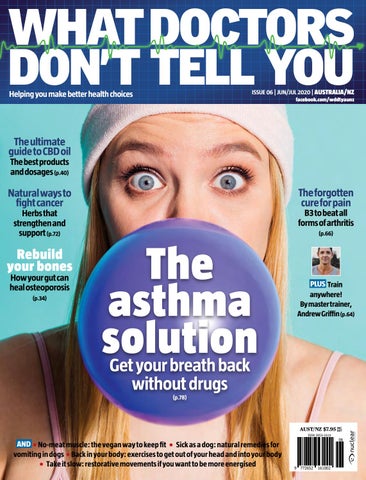
ISSUE 06 | JUN/JUL 2020 | AUSTRALIA/NZ
Helping you make better health choices
facebook.com/wddtyaunz
The ultimate guide to CBD oil The best products and dosages (p.40)
The forgotten cure for pain
Natural ways to fight cancer Herbs that strengthen and support (p.72)
Rebuild your bones How your gut can heal osteoporosis (p.34)
B3 to beat all forms of arthritis (p.66)
The asthma solution Get your breath back
PLUS Train anywhere! By master trainer, Andrew Griffin (p.64)
without drugs (p.78)
INC AUST/NZ $7.95 GST
AND • No-meat muscle: the vegan way to keep fit • Sick as a dog: natural remedies for vomiting in dogs • Back in your body: exercises to get out of your head and into your body • Take it slow: restorative movements if you want to be more energised
Helping you make better health choices
AUSTRALIA/NZ facebook.com/wddtyaunz
SUBSCRIBENOW ANDSAVE!
LAUNCH OFFER!
Get What Doctors Don’t Tell You Australia/NZ delivered to your door for 12 months (6 issues) and
save ALMOST 10% off the cover price! ONLY $39.95 for 6 issues! (Australia only)
Head to: subscribe.wddty.com.au now! Prefer a digital subscription? Search What Doctors Don’t Tell You Australia/NZ through one of our digital partners
2 WDDTY | ISSUE 06 | JUN/JUL 2020
FACEBOOK.COM/WDDTYAUNZ
Welcome
Lynne McTaggart and Bryan Hubbard
Published under exclusive license in Australia and New Zealand by:
Nuclear Media PO Box 230 Double Bay NSW 1360 Australia +612 9363 1464
Editors Lynne McTaggart & Bryan Hubbard Managing Editor Joanna Evans Design TTM&R: 07923 361303 and Luke Shaddock Production Editor Emilie Croisier Production Rick Greer Master Trainer Andrew Griffin Contributors Dr Rob Verkerk Dr Rohini Sathish Charlotte Watts Cate Montana Celeste McGovern Jane Turney, Alison Waring Edric Kennedy-MacFoy Kelly Turner, Vani Hari International licensing Bruce Sawford +44 (0)1280 860185 Advertising Natalie Downs ndowns@nuclear.com.au Print subscriptions (Australia only) CRM Australia (02) 8227-6486 subscriptions@nuclear.com.au
subscribe.wddty.com.au LIABILITY STATEMENT While every care is taken in preparing this material, the publishers cannot accept any responsibility for any damage or harm caused by any treatment, advice or information contained in this publication. You should consult a qualified practitioner before undertaking any treatment. © WDDTY News Ltd 2020 No part of this publication may be reproduced without permission. This magazine is published under license from WDDTY News Limited a company incorporated and registered in the UK. All rights in the licensed material belong to WDDTY News and may not be reproduced whether in whole or in part without its prior written consent. The name ‘What Doctors Don’t Tell You’ is the property of WDDTY News Limited.
FACEBOOK.COM/WDDTYAUNZ
Editors
Breathing easy
W
e literally cannot breathe. The latest figures, Certain supplements such as fish oils, vitamin C, according to the US Centers for Disease Control magnesium, selenium and zinc have all been shown to and Prevention (CDC), show that 1 in 13 of help alleviate breathlessness, particularly when all taken all Americans have asthma, adding up to more than 25 together, as have herbs such as the Ayurvedic treatment million, or about 8 percent of all adults and children. Amrita Bindu. Figures for asthma in the UK are proportionately just as In one study of children given 250–500 mg of Amrita bad, with 5.4 million British people—or 1 in 11 children Bindu twice a day after meals, most were able to stop their and 1 in every 12 adults—currently receiving treatment. asthma medication and no longer suffered asthma attacks. And though the number of cases isn’t increasing in the Yoga and acupuncture also have fared well in improving UK, it’s not going down, either. Currently, Great Britain lung function. has some of the highest rates of asthma in Europe—so But perhaps the most surprisingly effective treatment of bad, in fact, that every single day about three people can be all doesn’t require any extra products, supplements, music, expected to die from it. yoga mats or even a practitioner to work. Pollution, from car and exhaust fumes, is said to As we feature on page 78, alternative therapist Alison account for about a quarter of all cases, but other culprits Waring has been healing her asthmatic patients by simply include everything from food allergies to household helping them learn how to breathe better. bleach, PVC and other indoor air pollutants and chlorine While suffering from asthma herself, Alison came across in swimming pools. the Buteyko breathing technique, developed Intractable But whatever the various causes, by Russian doctor Konstantin Buteyko in the conventional medicine has only managed to illnesses like 1950s after he observed the breathing patterns combat asthma by suppressing symptoms hundreds of hospitalised patients. asthma may not of Buteyko through the use of inhalers, containing drugs developed a system of breathing such as long-acting beta-agonists (LABAs) require expensive based on the theory that most asthma patients or steroids, considered the mainstay of most and sophisticated overbreathe, reducing the body’s carbon asthma treatment. dioxide levels and starving the body’s tissues solutions But LABAs have been linked to a risk of of oxygen as a result.He went on to create a anaphylactic reaction to the drug and even cancer, which system that retrains the body to breathe properly. can prove fatal. But even if the drugs don’t kill you, they What independent research has been done on this could lead to . . . severe asthma. method is impressive, showing that patients following the Inhaled steroids don’t fare much better, as they’ve been Buteyko technique are able to lower their medication. shown to leave patients at higher risk of potentially fatal In one, when compared to a sham yoga breathing pneumonia, stunted growth (an issue especially for children technique among 90 patients, those using Buteyko reported using these puffers), lower bone density, skin thinning and improved symptoms and the use of less inhaled medication, even altered fat metabolism. as did the Buteyko group in two other studies when All this, and as research from the University of Pittsburgh compared with a‘dummy’ breathing technique. has discovered, the drugs don’t work in up to 10 percent Although the studies were at most four months long, all of asthmatics, and they’re only making symptoms such as showed that patients were able to continuously lower their inflammation even worse. medication. In one Australian study, the patients using All steroid inhalers have been found to restrict children’s Buteyko had stopped hyperventilating. growth, particularly in the first year after starting treatment. Practitioners like Alison who use Buteyko are With these kinds of dangers, patients are desperate for demonstrating that intractable illnesses like asthma may a safer alternative. In fact, one University of Cincinnati not require expensive and sophisticated solutions, but study found that 80 percent of young people with asthma simply altering something fundamental in the way we live. were turning their backs on these conventional drugs The problem isn’t so much that so many of us can’t breathe, and seeking out alternative medicine—everything from but that in our modern, frantic lives, we’ve simply never meditation, herbs and relaxation technique to prayer. learned how to slow down and take a deep breath.
❝
❞
ISSUE 06 | JUN/JUL 2020 | WDDTY 3
CONTENTS JUNE/JULY 2020
34
The secret to strong bones The latest evidence on osteoporosis shows it has little to do with not enough calcium and everything to do with the state of your ability to absorb food
40
CBD oil for pain and more Cate Montana has the ultimate guide to doses, products and benefits
54
The 48-hour toxin takedown Give your body a quick cleanse with Vani Hari’s simple two-day detox, bursting with foods that will get your elimination systems up and running
58
No-meat muscle Vegan bodybuilder Edric Kennedy-MacFoy explodes the myths about fitness and animal protein
64
Train anywhere Advice from master trainer, Andrew Griffin
78
The asthma solution Discover the non-drug therapy helping sufferers get their breath back 6 WDDTY | ISSUE 06 | JUN/JUL 2020
FACEBOOK.COM/WDDTYAUNZ
NEWS
10
News
Processed foods can trigger depression; losing weight reduces breast cancer risk. Yoga is the best exercise for chronic low back pain; mobile phones do cause brain tumors
22
Finding cancer’s sweet spot
The discoveries of Otto Warburg are finally being recognized, with new research adding to his theories of glucose and cancer
25
Drug news
Heartburn drug linked to stomach cancers; opioids not relieving pain in 90 percent of cases
26
The myth of activity and burning calories Exercise has little to do with losing weight, a new study has discovered
EVERYPICTURE
30
We’re in the money Pharmaceutical sales keep going up and up, and the industry is set to hit US$1.18 trillion in global sales by 2024
FACEBOOK.COM/WDDTYAUNZ
32
When I’m 64
The five golden rules to a long and healthy life, according to science
HEALTHYLIVING
46
Back in your body
50
Get out of your head and into your body to alleviate stress and anxiety, says Charlotte Watts
Take it slow
Turn off, tune out and focus on slow, restorative movements if you want to be more energised, says Charlotte Watts
ALTERNATIVES
66
Beat arthritis with B3 A neglected vitamin used decades ago to reverse arthritis in hundreds of patients is finally being revived by new science
72
The best supplements for cancer Kelly A. Turner rounds up the herbs that strengthen and heal
FAMILYHEALTH
80
Sick as a dog
Wondering what to do if your dog keeps vomiting? Vet Rohini Sathish shares her top holistic remedies
REGULARS
9 29
Eating ❝ more
vegetables and less meat and dairy could lower your risk of heart disease and help you live longer ❞
See page 15
Readers’letters
The politics of health
Don’t trust the mainstream media’s reporting on keto diets, says Rob Verkerk
82
The last word
A pet dog is good for you, mentally and physically, says Bryan Hubbard
Your views are important to us. Please contact us at: WHAT DOCTORS DON’T TELL YOU
PO BOX 230 DOUBLE BAY NSW 1360 AUSTRALIA
TELEPHONE: +61293631464 EMAIL: INFO@WDDTY.COM.AU WEB: FACEBOOK.COM/ WDDTYAUNZ
Subscriptions (AU S only): (02)82276486
ISSUE 06 | JUN/JUL 2020 | WDDTY 7
EDITORIAL PANEL
Editorial Panel
What Doctors Don't Tell You is supported by some of the world's leading pioneers in nutritional, environmental and alternative medicine. Each is an authority in his or her field; many have broken new ground and inspired new practices in medicine.
8 WDDTY | ISSUE 06 | JUN/JUL 2020
Dr. Jean Monro, medical director of the Breakspear Hospital, is an internationally recognized specialist in environmental medicine, including such conditions as chronic fatigue syndrome, Lyme disease and multiple chemical sensitivity. She is Fellow of the American Academy of Environmental Medicine and a Board Certified US examiner.
of Wales’ Foundation for Integrated Health, Dr. Gaier is author of numerous scientific papers and The Encyclopedia of Homeopa thy.
President of Green & Blacks Organic Chocolate. Currently he is director of Soil Association Certification, executive chairman of Carbon Dr. Sarah Gold Ltd, a carbon Myhill has worked in the sequestration business based on the use UK National Health Service of biochar as a soil and private practice since improver, and a trustee 1981. For 17 years she was of the Slow Food Trust UK. He is also the theHonorary Secretary author of four books, of the British Society for including The Little Ecological Medicine, a medical society interested Food Book. in the environmental Sally causes of disease and Bunday is non-drug treatments. She founder is a frequent lecturer and of the The has written several books Hyperactive including Sustainable Medicine (ChelseaGreen, Children’s Support 2018) and Diagnosisand Group, the first organization to draw Treatment of Chronic attention to the role Fatigue Syndrome and of diet and nutrition, Myalgic Encephalitis particularly the effect (ChelseaGreen,2018). of food additives and essential fatty Janet acid deficiencies, in Balaskas, childhood behavior who named problems. The registered and inspired charity has helped the Active thousands of families of Birth Movement in children with attention the 1970s, helped to deficit/hyperactivity revolutionize many issues since it started maternity practices around the world. Janet is more than 30 years ago. the founder and director of the Active Birth Centre in North London and the author of nine books including Active Birth, Preparing for Birth with Yoga and Easy Exercises for Pregnancy. (APMA) and the International College of Advanced Longevity Medicine, he has published 11 books.
Dr. Michel Odent, a Frenchtrained surgeon and obstetrician, is the foremost pioneer of the natural birth movement, emphasizing home and waterbirth.Founder of the Primal Health Dr. Damien Research Centre in the Downing, whose practice UK, he has written some 50 scientific papers and specializes 11 books, now in 21 in allergy, environment languages. and nutrition, is current president of the British Dr. Melvyn Society for Ecological Werbach, Medicine and on trained as a the editorial board psychiatrist, of Orthomolecular is an expert in Medicine News Service. nutritional and botanical Chief Medical Advisor influencesonillnessand of cancer charity Yes to mentalillness.Hehasheld Life (www.yestolife.org. afacultyappointmentin uk), he is also the author psychiatryattheUCLA of numerous books, Schoolof Medicine, including The Vitamin served as president of Cure for Allergies. the Biofeedback Society of California in 1977, Dr. Harald and authored numerous Gaier, books, including arguably the award-winning the UK’s Nutritional Influences on most knowledgeable Mental Illness. practitioner of the major alternative Dr. Jonathan medical disciplines, is Wright, registered in the UK as an medical osteopath, homeopath, director of the acupuncturist, Craig Samsis Tahoma Clinic naturopath and medical co-founder in Renton, Washington, herbalist. Former of Whole pioneered nutritional director of medical Earth Foods, medicine in the US. A research at The Hale a leading Clinic and the Diagnostic boardmember of the organic food company, American Preventive Clinic and a committee and founder and Medical Association member of the Prince
FACEBOOK.COM/WDDTYAUNZ
HAVE YOUR
SAY
GET IN TOUCH: Share your views on What Doctors Don’t Tell You AU/NZ via email or Facebook. Address: What Doctors Don’t Tell You, PO Box 230, Double Bay NSW 1360 Australia Email: info@wddty.com.au Facebook: www.facebook.com/ wddtyaunz
FACEBOOK.COM/WDDTYAUNZ
Just a card I am a subscriber to your brilliant magazine and, from my own personal experience, can help Val Kearney, who wrote in your Apr/ May 2020 letters page about her difficulties with electrosensitivity. Twenty years ago, while using a work computer, I suddenly felt as if my fingers were plugged into an electricity socket. I was, internally, constantly shaking and could not stop. It got worse on my commute to work when the bus went under power lines. I then experienced the same thing at home and could not function or sleep, though I continued my day job throughout. Shortly after this started, I went to a local osteopath about a bad neck and mentioned these symptoms to him. He immediately knew what it was. He said that I was extra-sensitive to electromagnetic fields and needed to carry a charged card on me, which works by acting as a barrier between electromagnetic fields and your body. He gave me the name and telephone number of a company that sells these cards, and, with one of them in my pocket (or on the cabinet next to my bed) I no longer have any problems. As they are not expensive, I recommend buying two or three of these cards. I used to have only one, and once while away from home, I lost it, and all the symptoms came back. I now carry one on me at all times. I have one in my handbag, one in my bedside drawer, and I always have two with me when I go away. I have been told by doctors, when I tried to recommend them, that it is a “placebo effect.” I can categorically assure you that it is not. One time I went to bed and woke up shaking, only to discover that I had forgotten to put the card by my bed—it was in another room. You “charge” the cards by using a coin across the dots (it explains all in the info sent with it), and all you have to do is “recharge” it on
❝ A well-respected urologist always told his patients who presented with anemia to eat dark chocolate ❞
a regular basis—this is especially important if anyone else should touch it. I cannot recommend these charged cards highly enough, and it’s wonderful to be able to use a computer (or do anything) again without any problems. I sincerely hope you improve, just as I have.
Jill Lindley, via email
A quick thank you We read every issue. My husband is a diabetic, and we appreciate the great research and dependable advice. Eileen Whitesell, via Facebook
chocolate (70 percent cacao or higher). He was reluctant to treat these patients with conventional iron supplements.
Christine Peacock, via email
Oxalate info Thanks so much for the interesting article on oxalates in your Apr/May 2020 edition (“How I beat my back and joint pain” on pg 74). Is there anywhere I can find a more comprehensive list of foods and drinks that are high in oxalates? I’d love to know whether there are any issues with tea or coffee, as I drink a lot of both of them. Margaret, via email
Sweet treatment I have just read the latest issue of your magazine, which I found very interesting, and I am very much looking forward to the next one. I just wanted to share this piece of information. During my nursing career, I knew a well-respected urologist who always told his patients who presented with anemia to eat dark
The editors reply: Oxalate expert Sally Norton has plenty of information about high- and low-oxalate foods and drinks on her website, www.sallyknorton. com. We’ve had a quick look for you and it seems coffee is low in oxalate, while black, green and white teas are high in oxalate. Herbal teas tend to be low in oxalate, Sally says. ISSUE 06 | JUN/JUL 2020 | WDDTY 9
UPFRONT
Keto diet is anti-diabetic – but only for the first week The high-fat, low-carb ketogenic diet could be good for you—but only for one week. After that, it starts to have negative health effects, a new study suggests. The keto diet is a dramatic way to kick-start the immune system and reverse signs of diabetes and inflammation. And it delivers all those positive effects in just a week. But continue any longer than that, and the body starts storing the fat it
should be burning, say researchers from Yale School of Medicine who studied mice on the diet. Eating keto tricks the body into thinking it’s in starvation mode by dramatically reducing carb consumption. As a consequence, the body starts burning fats instead of carbs, which triggers the release of chemicals called ketone bodies as an alternative source of fuel.
This process also releases immune T-cells, which can regulate inflammation and improve overall metabolism. After a week on the diet, blood sugar levels and general inflammation decline.But, at least in mice, these health benefits go into reverse after seven days on the diet, when their bodies began to store the large amounts of fat they were consuming.
No,eatinganeggadayisn’t badforyourheart Despite what we’ve been told for the past 40 years or more, eating an egg for breakfast isn’t bad for your heart. But, as with everything, moderation is the key, and having one egg a day won’t do you any harm, even if you’re already suffering from heart disease or diabetes. It won’t even raise your levels of cholesterol, which was always the great worry about eggs. Researchers from McMaster University in Canada took another look at three major studies that had researched the egg-eating habits of 146,000 people, whose heart health was compared with that of more than 31,000 patients with cardiovascular disease. Average egg consumption in both groups was one or fewer a day, and it wasn’t affecting the participants’ health. Previous studies had suggested that people should eat no more than three eggs a week, but it’s advice that may have been too cautious.
With one in three Americans prediabetic—with blood sugar levels already too high—anything that can reverse that should be welcome. And even better, it can be done in just seven days. “Who wants to be on a diet forever, anyway?” said researcher Vishwa Dixit. For details on the limitations of this study, see Rob Verkerk's opinion on page 29. Nat Metab, 2020; 2: 50
HEALTH FACT
Neurofeedback therapy has proven to be as effective as stimulant drugs for treating symptoms of ADHD—especially inattention and impulsivity
Am J Clin Nutr, 2020; nqz348
10 WDDTY | ISSUE 06 | JUN/JUL 2020
FACEBOOK.COM/WDDTYAUNZ
UPFRONT
Women low in vitamin D twice as likely to have breast cancer Women with low levels of vitamin D are almost twice as likely to develop breast cancer, a major review has concluded. It’s a key vitamin that has anticancer properties, and it’s been linked to preventing a range of other cancers, including colon, bladder, prostate and colorectal. But we have to get out into the sun to top up our levels. Only a small amount of what we need comes from food and supplements, say researchers from Zhejiang University, in Hangzhou, China. They looked at 20 studies that included more than 35,000 breast cancer patients, whose blood levels of vitamin D were compared with those of healthy women. They estimate that women with the lowest levels of the vitamin were 97 percent more likely to develop breast cancer than those with the highest levels. Every additional 5 nmol/L of vitamin D in the blood was associated with a 6 percent drop in breast cancer risk. Aging, 2019; 11: 12708–32
There’s no such thing as a typical resting heart rate Watches and apps that monitor every aspect of our health constantly remind us of our resting heart rate. It’s seen as an important indicator of our overall health—but a new study has found that it tells us next to nothing. For one, there’s no such thing as a typical resting heart rate. In fact, it can vary from one person to another by as much as 70 beats per minute, say researchers from the Scripps Research Translational Institute. It doesn’t end there. Our own heart rate can change with the seasons—it tends to be higher in January and lower in July—and even vary by 10 beats or more in a short time. But the biggest difference is seen across individuals, as the researchers discovered when they analyzed data gleaned from wrist monitors that had been worn by over 92,000 people for 320 days. The resting rate varied by as much as 70 beats across the group, and the researchers were at a loss to understand why. Factors of age, sex, body mass index (BMI) and sleep patterns together accounted for less than 10 percent of the variation. PLoS One, 2020; 15: e0227709
FACEBOOK.COM/WDDTYAUNZ
ISSUE 06 | JUN/JUL 2020 | WDDTY 11
UPFRONT
MOBILE PHONES #1
Mobile phones do cause brain tumours... Long-term mobile phone use can cause brain tumours, one of Italy’s highest courts has confirmed. It upheld an earlier ruling that a man had developed acoustic neuroma, a benign tumor of the head, as a direct consequence of using a mobile phone for long periods. Judges at the Court of Appeal in Turin said they reviewed all the scientific studies and concluded there was “strong evidence” that EMF (electromagnetic field) frequencies from a mobile phone could cause the cancer. It’s the second time an Italian court has ruled that mobile phones can cause cancer. A 2010 ruling in favor of an Italian worker was upheld two years later by the country’s highest court. In the latest ruling, the appeals court judges noted it was difficult to find good independent research that hadn’t been funded by the mobile phone industry. These clear conflicts of interest should be highlighted from the offset, the judges said, and less weight should be given to them. www.phonegatealert.org; January 15, 2020
MOBILE PHONES #2
...but it could have to do with genetics Mobile phones can cause cancer—and especially among those who have a genetic disposition, a new study has concluded. The phones double the risk of thyroid cancer for people with certain genetic variations known as SNPs, or “snips.” Researchers from the Yale School of Public Health say that people should be
12 WDDTY | ISSUE 06 | JUN/JUL 2020
screened before using a cell phone, especially as cases of thyroid cancer have been rising around the world— and our phones could be an unsuspected cause. There are around 53,000 new cases of thyroid cancer reported every year in the US, with around 2,180 people dying from the disease. The researchers looked at the biological profiles of over
900 people in Connecticut to discover that those with specific genetic variations were more likely to develop thyroid cancer—and the risk doubled if they were regularly using a cell phone. They add that the risk may be reduced by people texting instead of calling. Environ Res, 2020; 182: 109013
FACEBOOK.COM/WDDTYAUNZ
UPFRONT
Optimism makes effects of stroke less severe
Optimists who suffer a stroke are more likely to have a good recovery. The damage caused by the stroke is lower among those who maintain a positive outlook, researchers have found. Three months after a stroke, the optimists had less inflammation and better physical mobility, say researchers from the University of Texas Health Science Center who monitored the progress of 49 stroke survivors. They discovered that those who remained positive had lower blood levels of inflammatory markers—and inflammation after a stroke harms mental capacity and influences recovery. Other studies have seen similar benefits of a positive mental attitude on other chronic health conditions. American Stroke Association International Stroke Conference, February 18–21, 2020
Aluminum could be a factor in Alzheimer’s after all The theory about a link between aluminum and Alzheimer’s disease just won’t go away—and 40 years after it was first proposed, researchers think they have finally discovered a connection. Brain tissue from Alzheimer’s patients often has higher than normal levels of aluminum, say researchers from Keele University in the UK. But the metal wasn’t found in every case the researchers examined, suggesting there is also a genetic predisposition that makes some people more susceptible. This subgroup is more likely to start suffering from Alzheimer’slike symptoms much earlier in life, often from around the age of 50, the researchers think. Genetic mutations interfere with the way amyloid proteins work, and they can destroy neural pathways—affecting healthy brain activity—when they start malfunctioning, a process that could be triggered by the presence of aluminum. In an earlier study, the Keele researchers had discovered that 11 out of 12 brain samples from Alzheimer’s patients had high concentrations of aluminum that were “pathologically concerning.” For their new study, the researchers examined 83 brain tissue samples, 45 of which had high levels of aluminum. J Alzheimers Dis, 2020; 10.3233/JAD-191140
FACEBOOK.COM/WDDTYAUNZ
Zinc lozenges don’t shorten the common cold
(but, then, they don’t contain much zinc) Sucking a zinc lozenge won’t make your cold go away any sooner—but that could be because most popular brands contain very little zinc. A lozenge typically contains little more than 13 mg of zinc, and that’s too little to have any effect on the common cold. People who suck lozenges every day still suffer from a cold for around five days, along with the rest of us. Researchers from the University of Helsinki in Finland tested the effectiveness of zinc lozenges on a group of 88 volunteers who had a cold; half were asked to suck six lozenges a day for five days, and the rest were instead given a placebo lozenge with no active ingredient. But there was no difference in the duration of the cold between the groups— although surprisingly those given a placebo recovered quicker afterward. The results don’t mean zinc lozenges are useless against the common cold, researcher Harri Hemilia said. Instead, it suggests that manufacturers should make lozenges with a higher zinc content and that dissolve more slowly on the tongue. BMJ Open, 2020; 10: e031662
ISSUE 06 | JUN/JUL 2020 | WDDTY 13
UPFRONT
10,000 steps won’t help you lose weight Walking 10,000 steps a day has become a gold standard for achieving a healthy life—but it’s more an urban myth, and it certainly doesn’t help you lose weight. In fact, people who are walking up to 15,000 steps a day are still putting on the pounds, a new study has discovered. Having said that, the study group were all students enrolled in their first year at a university, and freshmen typically gain up to 9 lb (4 kg) as home-cooked food is replaced by takeout.
The walkers at least put on less weight than that; they gained 3.5 lb (1.5 kg) over the six-month study. But some weight gain was seen across all the groups, whether they were walking 10,000, 12,500 or 15,000 steps six days a week. It’s the conclusion of many studies: you can’t outrun (or walk) a bad diet. The latest research was carried out by a team from Brigham Young University, who monitored 120 freshmen to see if walking could help them keep off the pounds. “Exercise alone is not always the most effective way to lose weight. If you track
steps, it might have a benefit in increasing physical activity, but our study showed it won’t translate into maintaining weight or preventing weight gain,” said lead researcher Bruce Bailey. Although walking didn’t help the students lose weight, the extra activity could have a positive impact on the students’ emotional wellbeing and overall health. And it has to be better than sitting in front of a screen all day, the researchers add. J Obes, 2019; 2019: 4036825
HEALTH FACT
Supplementing with niacinamide (vitamin B3) can reduce arthritis pain and stiffness (see page 66)
Sugar in the day, no sleep at night Not sleeping well? It could be down to your diet, and especially the refined carbs and added sugars you’re eating. People who eat the ”white stuff”—processed snacks, white bread and soda, for instance—will find it harder to sleep at night because of the bodily processes their diet is triggering. In particular, the body releases insulin to break down the sugars in refined carbs, and the sudden drop in glucose (blood sugar) leads to an increase in the hormones adrenaline and cortisol. This, in turn, causes sleepless nights, researchers from Columbia University Irving Medical Center have found. By comparison, people eating more vegetables and fruits were less likely to have a bad night’s sleep. Although these foods also contain sugar, their fiber content reduces spikes in blood sugar. With a third of adults regularly experiencing insomnia, new ways of improving sleep patterns need to be explored, especially as sleeping pills come with side-effects, the researchers say. Am J Clin Nutr, 2019; 111: 429–39
14 WDDTY | ISSUE 06 | JUN/JUL 2020
FACEBOOK.COM/WDDTYAUNZ
UPFRONT
Less protein and more vegetables will help you live longer Eating more vegetables and less meat and dairy could lower your risk of heart disease and help you live longer. It’s all to do with a special class of amino acids that contain the element sulfur. These are primarily found in protein-rich foods, such as meat, dairy, nuts and soy products. A diet low in these amino acids increases longevity and health, at least according to animal studies—and the average American eats nearly three times the amount of sulfur amino acids that the body actually needs. Researchers from Penn State College of Medicine wanted to determine the impact of the amino acids on health, and tracked the
Yoga is the best exercise for chronic low back pain Yoga is the best exercise for chronic low back pain—but when the pain is acute, tai chi is the better option. Both have their benefits, and a third “alternative” exercise, qigong, does as well—but there just aren’t enough studies that prove it, say
FACEBOOK.COM/WDDTYAUNZ
diets and biomarkers of more than 11,000 healthy people. The average consumption of sulfur amino acids was two and a half times higher than the recommended daily allowance of just 15 mg per kg (6.8 mg/lb) of body weight—and those eating the most also had the highest levels of biomarkers for heart disease. Conversely, those who ate less of the amino acids had fewer biological markers for heart disease and other chronic conditions. Foods that are low in the acids include grains, vegetables and fruits. EClinicalMedicine, 2020; 100248
researchers in a review of the evidence so far. With around 80 percent of adults suffering from low back pain at some point, it’s important to discover positive ways to counter it. Researchers from Florida Atlantic University took another look at 32 studies that had researched the benefits of yoga, tai chi, which uses gentle exercises and stretching, and qigong, where slow and fluid movements are employed. All three exercises helped with the low back pain itself—they reduced pain intensity, improved function and lessened the degree of disability caused by the pain. They also helped with psychological problems related
to back pain, including depression and anxiety. Overall, regular yoga exercise was the best for reducing pain, but tai chi was better for easing acute pain, especially among men in their twenties. There were only three studies into qigong, and although the findings did show the exercise helped, more evidence is needed, the researchers felt. But all three could be promising effective treatments and alternatives to pain medication, surgery and nerve-blockers, the standard responses from conventional medicine, lead researcher Juyoung Park concluded. Holist Nurs Pract, 2020; 34: 3–23
ISSUE 06 | JUN/JUL 2020 | WDDTY 15
UPFRONT
ANTI-AGING#1 We could live to 500, new research discovers How long might people expect to live? The latest research is putting it at between 400 and 500 years, and scientists have identified cellular pathways that could make it a reality. Anti-aging science has focused on finding the single gene that could help us live longer, but the new research has determined it’s not one gene but two cellular pathways that determine longevity, and these pathways have a magnified effect when they work together. Researchers from the Mount Desert Island Biological Laboratory in the US and Nanjing University in China have manipulated the two pathways— IIS (insulin signaling) and TOR (nutrient sensing)—and calculated that, although the individual effects of the two pathways amounted to a 130 percent improvement in
ANTI-AGING#2 Lifestyle changes can reverse signs of aging It isn’t only possible for us to slow biological signs of aging—we may be able to reverse them. Researchers have identified four markers of bodily aging, and people who change their lifestyles have reversed several of these, at least for a little while. A research team from Stanford University School of Medicine has proposed there are four biological pathways that regulate the aging process, controlling the metabolism, immune system, liver and kidneys. They measured the pathways in 43 healthy men and women for two years and discovered that some of the participants weren’t showing any signs of biological aging, and some were seeing their markers reversing, even for a short time, when they changed their lifestyle, such as through diet or exercise. Reversals were usually found in kidney function. One of the biggest impacts on aging was insulin resistance, the body’s inability to properly break down blood sugars. Lead researcher Michael Snyder said his own pathways were showing average aging. “I was a bit disappointed to see that I was aging at a pretty average rate, and so I started lifting weights. It’ll be interesting to see if that influences my aging pathways in another year’s time.” Nat Med, 2020; 26: 83–90
16 WDDTY | ISSUE 06 | JUN/JUL 2020
longevity, their combined effect means that longevity actually improved by 500 percent in their experiments. Applied to humans, this would give us the capacity to live for 400 to 500 years. “The synergistic extension is really wild,” said researcher Jarod Rollins, who based his studies on the C. elegans worm, a common animal model used in antiaging research. “The effect isn’t one plus one equals two, it’s one plus one equals five. In order to develop the most effective anti-aging treatments, we have to look at longevity networks rather than individual pathways.” The discovery opens the door to a range of longevity therapies—some drug-based, some not—that focus on the pathways and their interplay. Furthermore, the researchers agree with earlier findings that the mitochondria play a key role in aging, and dysfunctional mitochondria speed the usual symptoms of aging. Cell Rep, 2019; 28: 1050–62; Also see page 24
ANTI-AGING#3 Yoga is good for the aging brain Its proponents have known it for millennia, and now Western experts finally agree: yes, yoga is good for you, and especially for your brain as you get older. Although hatha yoga—the exercise-based yoga—has many physical benefits, such as flexibility and muscle strengthening, researchers from the University of Illinois wanted to find out how it impacted brain health. They took another look at 11 studies—where participants’ brains were monitored with MRI scans while they took part in courses of yoga—and discovered the exercises were helping to maintain the hippocampus, which is associated with memory processing. The hippocampus can shrink as we get older, affecting our ability to remember events, and it’s often the first structure in the brain that deteriorates with dementia and Alzheimer’s. Another area of the brain, the amygdala, which helps regulate emotions, tended to be larger in people who practiced yoga, as were the prefrontal cortex, cingulate cortex and some of the brain’s networks, the researchers said. The prefrontal cortex helps us plan and make decisions. The brain’s physical improvements were played out in cognitive tests where yoga practitioners often outperformed people who didn’t use the exercise. Brain Plast, 2019; 5: 105–22
FACEBOOK.COM/WDDTYAUNZ
UPFRONT
Coffee after cake helps keep the pounds off If you have a sweet tooth, drink some coffee: it may help you keep off the pounds. Coffee and other caffeinated drinks help reduce the amount of body fat you accumulate, even if you like your cake, cookies and other processed, sugary food. Thus far, it’s an approach that has been tested only on laboratory rats, so nobody can be sure the same results would be seen in people, but it’s looking encouraging. In their tests, researchers from the University of Illinois discovered that the rats given caffeinated drinks gained 16 percent less weight, and accumulated 22 percent less body fat, than other rats that weren’t given the drink—even though both groups ate exactly the same sugary foods. J Funct Foods, 2019; 64: 103646
PROCESSED FOODS CAN TRIGGER DEPRESSION If you suffer from chronic depression, stop eating the sweet stuff. Food with processed sugar can trigger inflammation, and this can cause depression, researchers say. It’s a vicious circle. People will often reach for the candy jar to lift their depression, which always seems worse in the winter, but those sweets are a false friend that lifts the mood momentarily but ends up triggering a depressive episode. Physiologically, processed sugars cause inflammation and weight gain, two factors that also make people feel more depressed. Like alcohol, sugars can be addictive and act like a drug, researchers from the University of Kansas say. Processed foods are responsible for 10 percent of depressive episodes, the researchers estimate, and the problem is worse in the winter months when the lack of sunlight interferes with our sleep patterns. Around 30 percent of people suffer some symptoms of winter-onset depression, and the best way to cope is by eating a diet rich in plant-based foods and omega-3 fatty acids. Medical Hypotheses, 2019; 134: 109421
Losing weight reduces breast cancer risk Losing weight after the age of 50 is one way to reduce your chances of breast cancer. Although it has been well established that being overweight or obese raises the likelihood of breast cancer, nobody was sure if shedding the pounds would reduce the risk. However according to a new review of the evidence, there seems to be a direct link between the amount of weight lost and the reduction in risk. The greatest risk reduction was 26 percent FACEBOOK.COM/WDDTYAUNZ
for those who lost 9 kg (20 lb) or more, but women who lost much less—between 2 and 4.5 kg (4.4–10 lb)—still reduced their risk by 13 percent. But weight loss had no effect on women who were taking HRT (hormone replacement therapy) after menopause; their risk remained the same, reinforcing earlier studies that found the drug is an independent risk factor for breast cancer. Researchers from the Harvard T H Chan School of Public Health analyzed 10 studies involving more than 180,000 women who were age 50 and older. J Natl Cancer Inst, 2019; djz226
ISSUE 06 | JUN/JUL 2020 | WDDTY 17
UPFRONT
The essential oils that speed wound healing Lavender, rosemary and ylang ylang essential oils help speed wound healing—and so can a few herbs and spices, such as black pepper. They all contain the chemical compound betacarophyllene, the active ingredient that gives them their healing qualities. The compound not only heals wounds faster, it also reduces the chances of scar tissue. The oils are natural anti-inflammatories, and they help new cells grow. Researchers from Indiana University think the oils speed the healing process by shortening the inflammatory phase of the wound. Lavender also contains linalool, a compound that helps ease anxiety.
‘
PLoS One, 2019; 14: e0216104
Havingadogprotects againstschizophrenia People who grew up with a dog are less likely to suffer from schizophrenia when they reach adulthood. But it must be a dog—cat owners don’t get the same mental health benefits. Those who had a pet dog in their first 12 years were up to 24 percent less likely to have schizophrenia. But it didn’t protect against bipolar disorder—and the pet cat didn’t have any impact on either problem, say researchers at the Johns Hopkins Children’s Center. They questioned a group of 1,371 people between 18 and 65 years old—396 of whom had schizophrenia, 381 who were bipolar, and the rest who didn’t have any mental health issues—about having a pet dog or cat growing up. The greatest protection seemed to be between birth and the age of three, although the researchers said there was a positive effect up to the age of 12. The researchers don’t really know why having a dog has such a positive impact on mental health, but they think it may have a physical cause, with perhaps something in a dog’s microbiome bolstering a person’s immune system in a way that protects them against psychiatric disorders. PLoS One, 2019; 14: e0225320; Also see page 82
18 WDDTY | ISSUE 06 | JUN/JUL 2020
FACEBOOK.COM/WDDTYAUNZ
UPFRONT
Orthopedic surgeons can be keen to get the patient out of the hospital even on the same day of total hip or knee replacement surgery—but it’s a dangerous practice that doubles the chances of lung or heart complications. Even staying in the hospital overnight dramatically reduces the risk of serious complications, say researchers from the Weill Medical College at Cornell University Patients who leave the hospital the day of the procedure are nearly twice as likely to suffer serious cardiac or pulmonary complications within the first 30 days—often within the first few days—and in some cases, the risk was nearly four times greater than for patients who stayed in the hospital overnight. The risk was also slightly higher among patients who had undergone total hip arthroplasty (replacement or rebuilding). The practice of same-day discharge goes against traditional best practice guidelines, but it has become increasingly common in the past decade because of financial restraints, along with improvements in surgical procedures and rehabilitation care. In 2018, total knee replacement surgery became a same-day procedure, and hip replacement is expected to be similarly recognized by the Center for Medicare and Medicaid Service (CMS) very soon. But the practice is not as safe as earlier studies had found. Of the 226,000 knee replacement procedures tracked by the researchers, 3,118 had been sent home the same day, as had 2,600 of the 140,000 patients given a new hip—and they were twice as likely to develop complications.
SAME-DAY RELEASE AFTER HIPOP ‘DANGEROUS’
Why ‘safe’ skin creams can still cause a rash Skin creams, toothpastes and fragrances can trigger an itchy rash called contact dermatitis, a type of eczema, even if they have been tested and passed all the safety checks. Compounds in the products pass under the radar in standard safety tests, but they are still being seen by the body’s immune system because of a complex chemical reaction that happens when they are put on the skin. Chemicals in the products interact with a common immune molecule in the skin called CD1a, essentially by replacing natural fat molecules (lipids) in the molecule to change its structure—and it’s this process that makes it a target of our immune system’s T cells and ultimately causes the rash. Among the compounds tested, those most likely to cause a skin rash are balsam of Peru and farnesol, which are both found in many skincare products, say researchers from Columbia University Irving Medical Center. Benzyl benzoate and benzyl cinnamate are the main active ingredients in balsam of Peru that cause the reaction, and overall the researchers discovered some 12 small molecules that could have a similar effect. The only solution is to stop using the cosmetics, while topical ointments can help soothe the rash, and severe cases may have to be treated with oral corticosteroids, the researchers say—but they are also looking at ways of developing an ointment that applies other lipids to the skin first, thus blocking the process from the start. Sci Immunol, 2020; 5: eaax5430
Quarter of autism cases not diagnosed Around 25 percent of cases of autism are not being diagnosed—especially among Hispanic and African American children in the US. This suggests the disorder— already described as an epidemic that affects one in 42 boys—is even more prevalent than previously thought. Researchers from Rutgers University’s New Jersey Medical School looked at the medical reports of 266,000 children who were eight years old in 2014 to discover how many showed symptoms of the disorder but had not been clinically diagnosed. Of the 4,500 children identified as having autism symptoms, 25 percent— or one in four—had never been diagnosed. Most of the undiagnosed cases were found among black or Hispanic boys.
Symptoms included difficulties with mental ability, social skills and daily activities—and yet families were not getting any help or assistance. Language, communication or cultural barriers could all be playing a part in not getting a diagnosis, the researchers think, and this could be coupled with a fear about the stigma of having an autistic child and the complicated diagnosis process. Early signs of autism could also be incorrectly seen as a behavioral or medical problem, said researcher Walter Zahorodny. Screening all toddlers, preschool and school-age children could help identify cases that are currently slipping under the radar, and clinicians could overcome language barriers by using pictures to improve communication, he added. Autism Res, 2019 Dec 23
BMJ Open, 2019; 9: e031260 FACEBOOK.COM/WDDTYAUNZ
ISSUE 06 | JUN/JUL 2020 | WDDTY 19
UPFRONT
Drinking every day raises cancer risk – slightly Lead link to heart disease Postmenopausal women are at high risk of developing atherosclerosis, or hardening of the arteries, because of the level of lead in their body. Lead—a toxic metal that can build up from cigarette smoke, drinking water and car exhaust— raises the risk of artery disease by 72 percent in this population. The metal seems to affect the carotid arteries—which run along either side of the neck and feed oxygen to the brain—and so any blockage of these can increase the risk of stroke. Although many studies have linked lead exposure to cardiovascular disease, researchers from Sahlgrenska University Hospital in Sweden are among the first to focus on its effects on postmenopausal women. They think the women are particularly vulnerable because menopause can increase bone mineralization, which allows lead stored in the bones to pass into the bloodstream. Artery stiffness can also increase during menopause, and this could be another factor. Overall, lead is estimated to be the cause of 2 percent of all cases of cardiovascular disease and is directly responsible for 240,000 deaths around the world every year. People with kidney disease were also at a higher risk of developing atherosclerosis, probably because they were less able to process the lead.
Drinking a little alcohol every day—even a single glass or two— increases your risk of cancer, but only just a little bit. Drinking one drink every day for 10 years, or two drinks a day for five years, raises the risk by 5 percent. One drink contains 23 grams of ethanol, which is the equivalent of a bottle of beer, a six-ounce glass of wine or two ounces of whisky. Although the amount we drink is a factor, the risk is more linked to the frequency of drinking, and so the antidote is to drink less often or not at all, researchers at the University of Tokyo report. They have taken a special interest in the causes of cancer because it is the biggest killer in Japan and is far more lethal than heart disease, which remains the deadliest disease in the West. They analyzed clinical data from 63,232 cancer patients and compared them to a similar number of healthy controls. Both groups reported on the amount and frequency of the alcohol they drank. Cancer, 2020; 126: 1031–40
Can’t remember? Tryagainlaterintheday Forgetful? Well, that could depend on the time of day you’re trying to recall something. Try again later in the day, and you may remember the name that had slipped your memory. It could all be to do with the activity of a protein called BMAL1. Levels are often low first thing in the morning, and this can be the time when we find it more difficult to recall something, but as levels build during the day, so does our ability to remember. The protein plays a key role in the activity of the hippocampus, an area of the brain associated with learning and memory. The next stage could be to find ways of stimulating BMAL1 activity, say researchers from the University of Tokyo, as this could help dementia and Alzheimer’s patients. Nat Commun, 2019; 10, 5766
Environ Health Perspect, 2019; 127: 127002
20 WDDTY | ISSUE 06 | JUN/JUL 2020
FACEBOOK.COM/WDDTYAUNZ
UPFRONT
Sun-starved kids get vit D supplements Children are so starved of vitamin D, the “sunshine vitamin,” that doctors are handing out more supplements than ever before—and prescriptions for the vitamin have jumped 25-fold in the last 10 years. Children deficient in the vitamin can suffer seizures and rickets, and high levels are needed to maintain healthy teeth, bones and muscles. But a combination of “safe sun” advice—where almost any exposure to sunlight is considered dangerous—and a life spent indoors has meant an entire generation of young children is deficient in the vitamin. As a result, family doctors have stepped in and are prescribing the supplements. Reports that cover 723 practices in the UK have found that 12,277 children were given vitamin D prescriptions for the first time, suggesting a 25-fold jump between 2008 and 2016. However, only a third of the children had symptoms of vitamin D deficiency, which can also include aches and pain, tiredness and fatigue, and doctors hadn’t tested for any deficiency in most of the cases. BMJ Open, 2019; 9: e031870
Mental burnout can lead to heart problems Burnout—when you’re feeling tired all the time—has already been linked to heart disease and raises the chances of a heart attack or stroke. And new research tells us that atrial fibrillation, or irregular heartbeat, is yet another consequence of mental and physical exhaustion. Burnout is caused by constant and prolonged stress, often when people feel hopeless or unable to control a situation at home or work. It’s different from depression, which is characterized by feelings of low mood, guilt and poor self-esteem, say researchers from the University of Southern California in Los Angeles. They tracked more than 11,000 people and monitored their antidepressant use and signs of exhaustion, anger and irritability for 25 years. Those who registered the highest scores for burnout were also 20 percent more likely to develop atrial fibrillation, they discovered—although people with anger problems didn’t run a higher risk. Although atrial fibrillation is a common complaint, affecting around 27 million people in the US and Europe, doctors are still unclear about its cause. “The importance of avoiding exhaustion through careful attention to, and management of, personal stress levels as a way to preserve overall cardiovascular health cannot be overstated,” said researcher Parveen Garg. Eur J Prev Cardiol, 2020; 2047487319897163
FACEBOOK.COM/WDDTYAUNZ
ISSUE 06 | JUN/JUL 2020 | WDDTY 21
NewsFocus Don’t mention the Warburg: finding cancer’s sweet spot The discoveries of Otto Warburg are finally being recognized, with new research adding to his theories of glucose and cancer
W
hat’s going on in the body when we have cancer? The standard definition is that healthy cells mutate and grow rapidly. As the abnormal cells cluster, they form a tumor, which can spread to other parts of the body—and this gets treated with chemotherapy, radiotherapy or surgery. It’s a description that leaves a lot unanswered. Why, for instance, do cells mutate in the first place? And how can cancer cells grow far more quickly than healthy cells? The questions aren’t trivial; if we could answer them, we would know how to prevent cancer and treat it without destroying the immune system in the process. Several new theories have emerged that could answer these questions—and both see sugar as playing a key role in the cause and development of cancer. They build on discoveries made by German biochemist Otto Warburg in the 1920s. Despite being awarded the Nobel Prize
22 WDDTY | ISSUE 06 | JUN/JUL 2020
for his research, these breakthroughs have been largely ignored since then, and the “Warburg effect” reduced to a footnote in cancer research. Oncologists have long recognized glucose as a marker for cancer, and they use positron emission tomography (PET) scans to identify areas in the body that consume excessive amounts of it. The more glucose being consumed, the more pessimistic the prognosis. But while conventional cancer
Oncologists have long recognized glucose as a marker for cancer. The more glucose being consumed, the more pessimistic the prognosis
therapy recognizes high glucose consumption is a sign of cancer, it has never accepted Warburg’s belief that it is integral to the process of cancer. However, that has been slowly changing with new research focusing on cancer’s biochemistry and the source of its energy. The insulin connection One of the researchers at the vanguard of the Warburg revival is Dr Lewis Cantley from the Meyer Cancer Center at Weill Cornell Medical School in New York. He’s become convinced that most cancers are caused by an excess of sugar, or, more precisely, insulin—a hormone the body releases to break down sugars from carbohydrates in our diet. Forty years ago, Dr Cantley identified an enzyme, called PI3K (phosphoinositide-3-kinase), that he described as a master switch for cancer. It plays a key role in the body’s interplay between insulin and glucose (also known as blood sugar). If the process slows, the body becomes insulin resistant, and cells cannot absorb enough glucose for their energy needs. This is type 2 diabetes. But if the process instead goes into overdrive, then cells—and especially mutated, cancerous cells—get an abundance of glucose, which fuels their growth, and that is cancer. It’s exactly as Warburg saw the cancer process unfolding in his laboratory— healthy cells feed off oxygen, but cancerous cells instead feed off sugar, even though it is far less efficient. He called it “aerobic glycolysis.” In theory, the cancer cells can feed off oxygen, too, but something happens to make them prefer sugar. That “something” is a mutation that occurs earlier in the biological process, and it happens because of an excess of insulin, Dr Cantley believes. The PI3K enzyme is mutated more often than any other gene, and he estimates it is responsible for 80 percent of all cancers, including breast, brain and bladder. The PI3K theory is still not widely accepted, but Cantley continues researching his hypothesis, over 30 years after he first proposed it.1 Don’t forget lactate Resistance to the theory could be because there’s something missing, as other researchers are seeing something else in FACEBOOK.COM/WDDTYAUNZ
NEWS FOCUS
The new cancer cycle
Glucose from carbs
New research, building on the discoveries of Otto Warburg nearly a century ago, shows how sugar in the diet promotes the growth of cancer, both directly and indirectly through its byproduct, lactate
Mutated (cancerous) cells release high levels of insulin to break down the glucose
This feeds the cancer cell with sugar
Which releases lactate
FACEBOOK.COM/WDDTYAUNZ
Lactate helps cancer cells grow and communicate
ISSUE 06 | JUN/JUL 2020 | WDDTY 23
NEWS FOCUS
Cancer rates have been steadily increasing over the past hundred years. Some of this can be laid at the door of environmental factors, but the increase also coincides with the rise of fast-food processing
the cancer puzzle where insulin plays no part at all. Although sugar may kickstart the cancer process, another new theory suggests it’s driven by lactate, a molecule usually found in muscles that causes athletes to stiffen up after a workout and, more seriously, is also a sign of sepsis and congestive heart failure. Warburg had also seen lactate cluster around cancer cells, but he had assumed it was a useless byproduct— biological garbage. But new research suggests that lactate is the fuel that keeps cancer cells growing and spreading. The latest to take on the lactate hypothesis is a research team from the University of Colorado School of Medicine, headed up by Inigo SanMillan.“We discovered that lactate is a catalyst that triggers a mechanism in mutated cells necessary to continue the cancer-forming process,” he says.2 In experiments he carried out three years ago, San-Millan fed glucose to a line of breast cancer cells, which, as expected, started to produce lactate— and that increased the activity of the mutated cells by up to eight times. But lactate may not only provide the fuel for cancer growth, it could also be the disease’s signaling system. This means therapies that focus only on glycolysis—the metabolism of glucose—may not be effective if they are started too late, once the process has already moved into a later phase where lactate plays the preeminent role. San-Millan and his team aren’t the first to suspect lactate as the driver of cancer. Professor George Brooks at the University of California, Berkeley, first proposed his “lactate shuttle” theory in 1985, and it has been explored by other researchers who suspect lactate is a key player in various other cancers, including sarcoma3 and spinal cancer.4 24 WDDTY | ISSUE 06 | JUN/JUL 2020
Stopping the Warburg effect Mutated, cancerous cells feed off glucose, or blood sugar, and then produce lactate, which helps them grow and communicate. One way to stop the Warburg effect, as it’s called, is to eliminate sugar from your diet. Another way is to take curcumin, a compound found in turmeric, which is a spice commonly used in Asian cooking. Researchers have tested it on lines of lung, breast, cervical, prostate and kidney cancer cells, and noted it blocked the cells’ glucose uptake and lactate release. REFERENCES
1
Sci Rep, 2018; 8: 8323
Exercise cancer away So how does this change the treatment landscape? Extraordinary as it may sound, San-Millan and his team are devising a series of personalized exercise programs for cancer patients. Although exercise is recognized as a healthy lifestyle choice to help prevent chronic disease, nobody before has suggested it could be used to treat cancer.
If San-Millan’s program is anything like the advice handed out after a strenuous workout, it could include hydrating with plenty of water, light stretches and taking magnesium. He’s also researching compounds that can block lactate from leaving the cell. “When lactate is produced, it has to leave the cell through a transporter. We are trying to block the transporter as well as lactate production inside the cancer cell with different compounds. “If you block the door, the lactate cannot leave, and the cancer cell will burst,” he explained. Dr Cantley’s approach is less esoteric: eat less sugar, or, in his case, none at all. “I have a very simple rule. I eat fruit but I don’t eat anything that has sugar added to it. And I guarantee everybody would be better off if they ate zero sugar,” he says.5 He points to reports from the World Health Organization that the average American consumes 126 grams of sugar a day, which is four times the recommended amount the body needs. “If I say to someone ‘Don’t eat anything sweet for two days,’ they’ll look at me like, ‘That’s impossible, nobody can do that.’ It’s very much like an opioid addiction or an addiction to nicotine.” Cancer rates have been steadily increasing over the past hundred years. Some of this can be laid at the door of environmental factors such as smoking and pollutants, while the most-cited reason is simply that we’re living longer, and cancer is a disease of old age. But the increase also coincides with the rise of fast-food processing, which uses an abundance of sugars. This recent surge of interest in his theory came too late for Warburg, who died in 1970. He was convinced to the end that he had discovered the cause of most cancers, and that future generations would recognize his discoveries. As a reassurance, he had a framed quote from quantum physicist Max Planck that he kept above his desk: “A new scientific truth does not triumph by convincing its opponents and making them see the light, but rather because its opponents eventually die.”
Bryan Hubbard REFERENCES
1 2 3
Cell, 1987; 50: 1021–9 Front Oncol, 2019; 9: 15363. Cancer Cell, 2014; 26: 851–62 Ann Transl Med, 2019; 7: 2205. MedicalXpress, March 20, 2019 FACEBOOK.COM/WDDTYAUNZ
UPFRONT
Heartburn drug Zantac linked to stomach cancers The heartburn drug Zantac may have been taken off the shelves late last year, but the repercussions go on. More than a dozen lawsuits have been filed that claim the drug causes cancer, especially of the digestive tract. One complainant, Californian Ronald Johnson, has been taking 150 mg of the drug regularly since 2004. He was diagnosed with cancer in 2018. He joins more than 12 other complainants to file damages against the drug manufacturers Boehringer Ingelheim, Sanofi, Pfizer and GlaxoSmithKline, who have all made versions of Zantac (ranitidine), including over-the-counter remedies. The complaints relate to a range of digestive cancers, including colon, rectal, esophageal, stomach, bladder and liver cancers. The drug contains the cancer-causing chemical NDMA (N-nitrosodimethylamine), but the public was not aware of the large amounts in the drug until an independent pharmacy carried out its own tests and discovered that a 150-mg Zantac pill could contain up to 3 million nanograms (ng) of NDMA, when the safe upper limit is just 96 ng. Zantac was launched in 1986, and just two years later became the first drug to surpass $1 billion in sales in one year. www.aboutlawsuits.com, January 23, 2020
FDA loosens approvals process The US drug regulator, the Food and Drug Administration (FDA), is fast-tracking drug approval with less evidence, so increasing the risk of a dangerous pharmaceutical getting onto the market. A rush of new and generic drugs has been putting the regulator under pressure to grant approvals quicker. Review times have fallen dramatically, and drugs are being passed with less safety data. It’s a recipe for dangerous drugs to slip through the regulatory net, as researchers from PORTAL (Program on Regulation, Therapeutics and Law) have discovered after reviewing FDA approvals from the 1980s until 2018. In the earlier years, an average of 34
FACEBOOK.COM/WDDTYAUNZ
new drugs were approved every year, but the average has now risen to 41 drugs a year. An even bigger jump was seen among generic drugs—where a drug has passed out of patent protection and chemical modifications have been made to it by other manufacturers—with annual approvals rising from an average of 136 from 1970– 1984 to 588 from 2013–2018. A typical approval 20 years ago was based on at least two clinical trials to demonstrate a drug’s safety and effectiveness, but today half of drug approvals are granted with just one trial being completed. This is also reflected in the time taken to give approval. In 1983, average approval time was three years, but this had fallen to less than a year by 2017. This fast-track approach has resulted in more dangerous drugs getting onto the market. One analysis discovered that fast-tracked drugs were getting one serious “label” warning a year, which highlight lifethreatening adverse reactions. JAMA, 2020; 323; 164–76
HPV vaccines aren’t working The HPV (human papillomavirus) vaccine to protect against cervical cancer isn’t working, a new study has found. The two major HPV vaccines, Gardasil and Cervarix, are taking credit for stopping cervical abnormalities that never would have developed into cancer. These benign abnormalities—called low-grade cervical changes—can resolve themselves spontaneously, without progressing to anything more serious, whether or not a person has the HPV vaccine. Studies investigating the effectiveness of the vaccines should have focused solely on high-grade cervical disease that often becomes cancerous, but only after 10 years, say researchers from Newcastle and Queen Mary universities. The researchers looked at 12 studies that had assessed the effectiveness of the two vaccines. Not only had the studies included low-grade cervical changes, they had also tested cervical samples every six to 12 months, instead of the more usual 36 months, and so were picking up many more cases of benign abnormalities. “We found insufficient data to clearly conclude that HPV vaccine prevents the higher-grade abnormal cell changes,” said researcher Claire Rees. In other words, there was no evidence the vaccines were working. Instead, the researchers recommend that women should have regular screening
as a more effective way to protect against cervical cancer. Further proof that the vaccine may not be working came with the news that cervical cancer rates have been rising dramatically among women in their late 20s. There has been a 54 percent increase in cases in the UK in the past decade, which researchers from Cancer Research UK say is due to a drop in the rate of smear tests. Since 2010, screening rates have fallen by around 8 percent. The HPV vaccines were introduced in 2008. J R Soc Med, 2020; 113: 64–78
Opioids not relieving pain in 90 percent of cases Opioid painkillers have turned people into addicts and destroyed whole communities—and now a new report has revealed they don’t work in 90 percent of cases. Most people with chronic debilitating pain aren’t being helped by the drugs, the UK’s leading pain experts have said. Despite their ineffectiveness, opioid prescriptions have doubled in the last 20 years in the UK. Today one in eight adults is regularly taking them. Dr Cathy Stannard, a pain expert, has told a conference that opioids aren’t effective. They merely stop pain signals reaching the brain, and there should be more emphasis on helping people cope with emotional issues. Chronic pain is often linked to trauma, and prescribing opioids to treat psychological distress is wrong, she explained. The overprescribing of opioids has happened because doctors don’t have enough time to properly assess patients, and there is an expectation among patients that they want a quick and easy answer to their pain. Furthermore, doctors upping the opioid dose may be making addicts of patients—but it’s not reducing the pain. A stronger dose isn’t any more effective at lowering pain than the original, lower dose of the powerful painkiller, a new research study has discovered. Researchers from the Central Arkansas and Minneapolis VA healthcare systems looked at the records of more than 50,000 VA patients who were taking opioids and discovered that the 21,000 whose dose was increased weren’t seeing any “meaningful improvements” in their pain. Daily Telegraph, February 5, 2020; Pain, 2020 Jan 7
ISSUE 06 | JUN/JUL 2020 | WDDTY 25
NEWS FOCUS
The myth of activity and calorie-burning Exercise and activity are vital—but they have very little to do with losing weight, as a new study has discovered
H
ave you noticed the overweight person in the gym who sweats it out three or four days a week on the treadmill, but never seems to get any thinner? The evidence of our own eyes goes against everything we’re told. The weight-loss dictum is that the more active we are, the more calories we burn, and if our calorie intake falls below our calorie expenditure, we will shed the pounds. In fact, a lack of exercise has far more to do with obesity than the food we’re eating, a review by Stanford University School of Medicine has claimed. A national health survey that tracked Americans from 1988 to 2010 found a huge increase in rates of obesity and inactivity, but not in the number of calories being consumed.1 But if that’s right, how does it explain the fat guy on the treadmill? It doesn’t seem to be that simple: the more we look, the more that direct line between activity and calorie expenditure starts to disappear, as researchers from Baylor University in Texas have demonstrated.
26 WDDTY | ISSUE 06 | JUN/JUL 2020
They’ve been studying two very different groups of eight-year-olds. One is of the Shuar tribe in Amazonian Ecuador, where a typical day includes working on the family farm and foraging for food. The other is more familiar: eight-year-olds from the West who sit in a classroom and then lounge at home in front of a gaming console or tablet. Not surprisingly, the Shuar children in the Amazon are around 25 percent more active than their counterparts in the West. But here’s the kicker: both groups are burning similar amounts of calories every day.2
Diet is the best way to lose weight consistently and for a long period
It works for a while It could all be down to evolution and the way the body has adapted to burn calories, the researchers think. Our metabolic system is like a cautious spender who budgets carefully and will stop buying the moment their account balance runs low. The Shuar children are much leaner than typical Western children, and their bodies “know” to stop burning calories so that the essential physiological processes are protected; at least, that seems to be what’s happening, the Baylor researchers suggest. Other researchers have reported a similar phenomenon. A team from City University of New York discovered that strenuous exercise had an immediate effect on weight—but then weight loss slowed and eventually stopped completely, even though the amount of exercise stayed constant. Diet is the best way to lose weight consistently and for a long period, the researchers concluded.3 But it’s a dangerous idea at a time when one in five children is obese as they begin school, and health guardians are trying to counter this obesity epidemic by encouraging children to become more active. The Baylor researchers point out there are plenty of good reasons to exercise— your cardiovascular system, for one, will thank you—but doing so only to lose weight isn’t one of them. Leading cardiologist Aseem Malhotra agrees. Regular physical activity reduces the risk of a range of diseases, from some cancers to diabetes, dementia and heart disease—but it’s not an essential part of any strategy to lose weight. It’s the diet That’s because obesity and weight loss are almost exclusively a response to diet and the type of food we eat, and it’s the sugary, high-carbohydrate processed foods that are the main culprit. As the title of one of Dr Malhotra’s papers puts it, you can’t outrun a bad diet.4 “People are drowned by an unhelpful message about maintaining a healthy weight through calorie counting, and many still wrongly believe that obesity is entirely due to lack of exercise,” he says. And we’re not even getting the right message about food. We get our energy from fats and carbohydrates—essentially, FACEBOOK.COM/WDDTYAUNZ
There are plenty of good reasons to exercise—your cardiovascular system, for one, will thank you— but doing so only to lose weight isn’t one of them
FACEBOOK.COM/WDDTYAUNZ
ISSUE 06 | JUN/JUL 2020 | WDDTY 27
NEWS FOCUS
Slim, but sick
Levels of physical activity haven’t changed much in the past 30 years, although obesity rates have skyrocketed sugars—and we’re told that to lose weight, we must cut back on fats. But that is simplistic, and often fueled by a food industry that makes its major profits from low-fat foods and drinks. As a result, we eat more carbs, despite the fact that in reality it’s the sugars, not the fats, that put on the pounds. And not only are the carbs responsible for weight gain, the other message is that “a calorie is a calorie.” It was coined by the sugar industry in the 1950s, and updated by Coca-Cola in 2013 as “all calories count.” In its campaign, CocaCola blamed the obesity epidemic on inactivity—and not on its sugary drinks. But all calories are not created equal. Sugar calories (from carbs) promote fat storage and hunger, and studies have shown that at the country-wide level, the incidence of diabetes goes up by 1 percent for every 150-calorie increase in citizens’ daily sugar consumption, while increases in fat or protein had no such effect.5 The health hazards of a processedfood diet could be magnified in people who are insulin-resistant, or alternatively, perhaps people are becoming resistant—a precursor of diabetes—as a result of the diet. Not enough evidence The mainstream view still holds to the calorie-control theory. Advocates of exercise point to evidence demonstrating that it’s the most effective way to lose weight, as a study by researchers from Massey University in New Zealand concluded. They had taken another look at 15 trials, involving 556 people who each lost an average of 8 lb (3.7 kg) by exercising for up to 36 weeks. But some of the studies had been poorly designed. At best, the researchers say there is some evidence that exercise can reduce body fat, but even less that it helps improve metabolic processes such as 28 WDDTY | ISSUE 06 | JUN/JUL 2020
cholesterol levels and insulin control.6 Another review of 29 trials determined it was “unclear” whether exercise had a significant impact on some characteristics of obesity, such as body-mass index and waist circumference, although it did seem to help people lose weight.7 Dissenters like Dr Malhotra say the evidence isn’t conclusive about exercise—and maintain that levels of physical activity haven’t changed much in the past 30 years, although obesity rates have skyrocketed. Researchers have seen this happen in real time in sub-Saharan Africa. Rates of obesity jumped by almost 35 percent in the period from 1992 to 2005, and this coincided with cheap, processed foods becoming much more widely available in the region.8 The emphasis on calorie-counting is shielding the real problem of a diet of processed food—and the World Health Organization agrees, citing a bad diet for causing more disease than inactivity, smoking and alcohol combined. “We must abandon the myth that lower-fat, lower-calorie products lead to less weight gain. This illusion leads to paradoxical policies that focus on total calories, rather than food quality, so there’s a ban on whole milk but sugar-sweetened, fat-free milk is allowed,” said Professor Dariush Mozaffarian of Tufts University. Bryan Hubbard
REFERENCES
1 2 3 4 5 6 7 8 9
Am J Med, 2014; 127: 717–27, e12 Sci Adv, 2019; 5: eaax1065 Curr Biol, 2016; 26: 410–7 Br J Sports Med, 2015; 15: 967–8 PLoS ONE, 2013; 8: e57873 Sports Med, 2016; 46: 1737–51 Int J Environ Res Public Health, 2015; 12: 566–94 BMC Public Health, 2009; 9: 465 Lancet Diabetes Endocrinol, 2016; 4: 633–5
It’s not just about losing weight and keeping it off. You can still be slim, but as Dr Malhotra put it (see main article), you can’t outrun a bad diet. Dave McGillivray, an organizer of the Boston Marathon who runs the course every year even as a 65-yearold, was diagnosed with severe coronary artery disease six years ago. McGillivray was shocked. “I’ve been running all my life. I’ve done eight Ironman Triathlons and 140 marathons. I’ve run across the United States. How can I have blocked arteries?” he asked. The reason was simple. He was eating a fast-food diet and believed that running gave him a free pass to eat what he liked. “As a runner, I just felt that if the furnace was hot enough, it would burn whatever you put in it. So I would eat anything and everything I wanted,” he told the magazine Runner’s World in 2018. He should have spoken with his cardiologist, Aaron Baggish, sooner. Baggish, director of the Cardiovascular Performance Program at Massachusetts General Hospital Heart Center, said that McGillivray’s attitude is typical, especially among runners who jog to get in shape and lose weight. Overindulgence in simple sugars is “the single most common dietary transgression” of runners, and foods such as white bread, white pasta, white rice and refined sugars get broken down into “bad molecules, bad types of fat, and bad oxidative sugar species” that harm the heart and arteries. FACEBOOK.COM/WDDTYAUNZ
U
ncertainty is a strange thing. Take the latest coronavirus disease, COVID-19. We can’t be sure what’s going to happen next. Yes, transmission continued at an ever-increasing rate around the world. But was its virulence increasing or subsiding? Are the new mutations going to wipe us out, or will they be smoke without a fire? Despite all this uncertainty, the way the media reports on COVID-19 is very consistent— certain, even. The mainstream media maintains its view that the virus represents a very real threat we must take very seriously. Our immune systems are ill-adapted to such threats, we must rely on our trusted medics to save our lives, and we need a vaccine. Whether the worst is over or yet to come, we must be united in our stand against this viral threat and do what it takes to reduce transmission risk. What about ketogenic diets? Obesity and obesityrelated illnesses such as type 2 diabetes and coronary heart disease are among the greatest threats to our health. That’s a certainty no one disputes. There are no effective drug cures (also a certainty). Diet and lifestyle are the main causes, and excessive, chronic consumption of refined carbohydrates in particular is one of the single biggest triggers of the hormonal disturbances that end up tipping the body into this complex disease state, which affects energy storage, appetite control and associated behaviors. Ketogenic diets are among the most widely studied therapeutic diets. Invented in the 1920s at Johns Hopkins University to
OPINION
Rob Verkerk The Politics of Health
OFKETOAND CORONAVIRUS Don’t trust the mainstream media’s reporting on keto diets, says Rob Verkerk help children overcome epilepsy when drugs and even brain surgery had failed, they have now been successfully applied to many more diseases, including obesity, type 2 diabetes, brain tumors, autism, dementia, Parkinson’s and ALS. But have you noticed how uncertain the media reporting is on this subject? Conflicting stories abound. There was a swathe of publicity last November following publication of a peerreviewed article by the Dixit lab
protect us against the flu. Then, in February of this year, the media reported that keto diets don’t work on weight loss or obesity. Remember: people’s positive experiences of weight loss using ketogenic diets, often in modified forms with a few more non-starchy carbs (but still zero refined carbs), has been one of the big drivers behind the recent popularity of keto diets. But looking deeper, you find the bad press is triggered by another mouse study.2
The media moved from uncertainty about a drug-free, dietary approach to certainty that it wouldn’t work at Yale Medical School, showing that mice fed a low-carb, high-fat (aka ‘keto’) diet increased their numbers of fast-acting T cells, known as “delta gamma” type.1 These T cells, which act as sentinels and intermediaries between the two sides of our incredibly sophisticated immune system, namely the innate and adaptive sides, are key players determining just how successfully we get on top of infections. Some media outlets hailed the research as a sign that keto could
Not only that, it comes from the very same lab—the Dixit lab at Yale—that published the earlier research. Their new study found that obese mice did very well on their ketogenic diet, but only for a week. After that, their health went downhill. So much so that, within two or three months, they had gotten fatter and more diseased than before they started. The media gulped this up. Stories with headlines like “Yale researchers find keto diet can be healthful or harmful, depending
on the timing,” and “Keto diet works best in small doses, researchers find” abounded. I particularly loved the Gladstone Observer “Real reason keto diet doesn’t work” title from Queensland, Australia. Now the media had moved from uncertainty about a drug-free, dietary approach that might or might not be helpful for some of the most troublesome diseases faced by humanity, to certainty that it wouldn’t work. All based on a few mice, ignoring the wealth of human studies and the tens of thousands who have personally experienced profound benefits. There was no discussion or balanced reporting of the study’s limitations, such as the fact it involved mice, not humans, or that their ketogenic diet was so extreme (just 0.1 percent energy from carbs), it would make any mammal sick if taken long-term, being entirely deficient in fiber or plant nutrients. Or that the mice were given the diet ad libitum, so they could eat all the time, whenever they wanted—meaning they couldn’t benefit from fasting, a critical process for the metabolic reset necessary to normalize the hormone dysregulation associated with obesity. The common thread here is that when you have a nondrugbased approach that doesn’t have a multibillion-dollar industry behind it, don’t trust what the media says about it. Equally, if it does have a multibillion-dollar industry behind it, don’t trust what the media says about it. It’s just one more reminder of why magazines like this one, and nonprofits like the one I head up, are so important as communicators of evidencebased, life-saving, healthpromoting information. REFERENCES
1 Sci Immunol, 2019; 4: eaav2026 2 Nat Metab, 2020; 2: 50–61
Robert Verkerk PhD is the executive and scientific director of the Alliance for Natural Health International, a consumer group that aims to protect our right to natural healthcare and nutrition. For more information and to get involved, go to www.anhinternational.org, or check out ANH’s Facebook and Twitter pages (www.facebook.com/ANHInternational and www.twitter.com/anhcampaign). FACEBOOK.COM/WDDTYAUNZ
ISSUE 06 | JUN/JUL 2020 | WDDTY 29
EVERY PICTURE...
We’re in the money Pharmaceutical sales keep going up and up, and the industry is set to hit US$1.18 trillion in global sales by 2024
O
verprescribing and addiction to the powerful opioid painkillers have been headline news for several years—and you’d be forgiven for assuming the drugs are fueling the annual growth of prescription drug sales around the world. But they don’t even come close. Pharmaceutical sales are growing by an average of 6 percent a year and are anticipated to hit $1.18 trillion globally by 2024—but opioids play a minor part in that growth. In the 10 years from 2008 to 2018, opioid sales have increased by around 20 percent—but that’s dwarfed by a range of other drugs. Over the same period, the epilepsy and anxiety drug Lyrica (pregabalin) has seen sales rocket by 660 percent, and the anticonvulsant Neurontin (gabapentin) by 319 percent. Antidepressants have also shown strong growth, with a 97 percent rise in annual sales. Growth is one thing; revenue generated by sales is another, and way out in the lead are the anticancer drugs, whose anticipated revenues by 2024 will reach $236.6 billion worldwide. That’s more than the next six drug categories combined. In 2018, the drugs generated sales of $123.8 billion, and industry experts are expecting those sales to rise by 11 percent as up to one in two of us are diagnosed with cancer.1 Diabetes drugs are also expected to continue their growth—aided by our diet of fast food— with sales expected to reach $57.6 billion globally by 2024, while vaccine sales are forecast to hit $44.8 billion, showing a growth spurt of 6.6 percent, thanks to the various health scares about measles and the rest. With 50 percent of adults in America now taking at least one prescription drug every month, and one in four taking three or more drugs, the take-home message is simple enough: don’t sell your shares in Big Pharma just yet.
Future-proofing: the best-selling drugs by 2024 DRUG TYPE
WORLDWIDE SALES ($BN) 2018 2024
Anticancer
123.8
236.6
Diabetes
48.5
57.6
Rheumatics
58.1
54.6
Vaccines
30.5
44.8
Antivirals
38.9
42.2
Immunosuppressants
14.2
36.1
Dermatological
15.8
32.1
Bronchodilators
28
30.7
Sensory organs
22.3
30.5
Anticoagulants
19.3
24.5
% GROWTH
11.4 2.9 -1 6.6 1.4 16.9 12.6 1.6 5.3 4.1
The drugs most likely to succeed Underlining the dominance of the cancer drugs, the best-selling drugs anticipated by 2024 are almost all new cancer therapies DRUG
MANUFACTURER
Keytruda
Merck + Otsuka Holdings
Humira
AbbVie + Eisai
Eliquis
Bristol-Myers Squibb
Opdivo
Bristol-Myers Squibb
Imbruvica
AbbVie + Johnson & Johnson
Ibrance
Pfizer
Revlimid
Celgene
Stelara
Johnson & Johnson
Eylea
Regeneron Pharmaceuticals
Biktarvy
Gilead Sciences
SALES BY 2024 ($MILLIONS)
17,009 12,403 12,021 11,232 9,514 9,128 8,057 7,791 7,313 6,977
EvaluatePharma World Preview 2019 REFERENCES
1 EvaluatePharma World Preview 2019 30 WDDTY | ISSUE 06 | JUN/JUL 2020
FACEBOOK.COM/WDDTYAUNZ
Anti-epilepsy/ anti-anxiety
EVERY PICTURE...
661%
Looking back: drug best-sellers Increase in sales, 2008 to 2018 (Source: NHS UK)
Anti-seizure drugs
319%
Who’s taking the drugs?
Antidepressants
(Source: National Center for Health Statistics)
97% Opioid painkillers 22%
American adults taking five or more prescription drugs each month
12.6%
American adults taking at least one prescription drug each month
American adults taking three or more prescription drugs each month
48.4%
24%
When you go to the doctor Every year, 2.9 billion prescriptions are written by American family doctors. Analgesics, cholesterollowering agents and skin medications are the three most commonly prescribed drugs in doctor’s offices (Source: National Ambulatory Medical Care Survey)
FACEBOOK.COM/WDDTYAUNZ
When you go to the hospital
80.4%
73.9%
of doctor visits end with a prescription being written
of hospital visits end with a prescription being written
Analgesics, anti-vertigo agents for dizziness, and minerals and electrolytes are the three most commonly prescribed drugs in hospitals (Source: National Hospital Ambulatory Medical Care Survey)
ISSUE 06 | JUN/JUL 2020 | WDDTY 31
EVERY PICTURE...
When I’m 64 Longevity and antiaging are trending as the big sciences, and the days when we might be living way beyond current life expectancy levels may not be too far in the future
H
ow long can we expect to live? New research is suggesting humans could live for up to 500 years—just as long as we can get two cellular pathways, IIS (insulin signaling) and TOR (nutrient sensing), working together (see News, page 8). Until we get back to these Biblical lifespans, the current aim is to be a “superduper centenarian,” that is, someone who lives for more than 120 years. Not many have achieved that; the oldest person whose birth date has been verified was French woman, Jeanne Calment, who died in 1997 at the age of 122. The biggest clusters of centenarians are found in Japan, and while the numbers may be inflated for benefit fraud, the real figures are still high, with around 42 out of every 100,000 Japanese living to 100 and beyond. Fascinated by the phenomenon, researchers have analyzed the lifestyles of centenarians and come up with five golden rules for longevity.
REFERENCES
1 2 3 4 5 6 7
Curr Treat Options Gastroenterol, 2019; 17: 577–86 BMJ, 1997; 314: 553–8 Am J Public Health, 1992; 82: 1089–92 Br J Sports Med, 2015; 49: 743-8 J Pers, 2019 Sep 8; doi: 10.1111/jopy.12513 Clin Interv Aging, 2017; 12: 1887–902 Mech Aging Dev, 2017; 165: 180–4
32 WDDTY | ISSUE 06 | JUN/JUL 2020
The Five Golden Rules
Eat healthy (and don’t eat processed food)
People who regularly eat processed food suffer more chronic disease and live shorter lives than those who follow a healthier diet of whole grains, fish, fruits and vegetables. There’s a stark difference in the health and longevity of people across much of the US who regularly eat potato chips, sugarsweetened drinks, sweets, refined grains and processed meat compared to those in the “blue zone” regions, where people more commonly live to 100 and older without suffering chronic disease, say researchers from George Washington University.1
Avoid stress While short-term stress can be healthy, chronic stress—often the result of feeling helpless or not in control—can trigger many health problems, especially related to the heart. Heart attacks and stroke are more likely in people suffering long-term stress, one study discovered.2
Be part of a community Don’t be isolated and alone. Instead, find a community of which you’re a part—it could be the local church or amateur dramatics society—and it will help you live longer. It’s often called the “Roseto effect,” after a small town in Pennsylvania where a group of Italian immigrants set up home. While they were relatively poor, they lived close to each other and lived far beyond the average American life expectancy, but once they became more affluent, they moved into bigger houses and didn’t see so much of each other—and started dying at the same age as other Americans.3
FACEBOOK.COM/WDDTYAUNZ
EVERY PICTURE...
And here are three more Other researchers studying longevity have come up with a few more ideas to add to the “Golden Five.”
1. Don’t eat too much of anything
Stay active No, it doesn’t mean sweating it out in the gym when you’re in your seventies—any sustained activity, from cycling to brisk walking or gardening, can help you live longer.4
Have a sense of purpose You need a reason to get up every day. It’s a sense of purpose, or a feeling of worth that you can matter to others and make a difference. The Japanese call it ikigai, which translates to “a life worth living.” Physicians call it “conscientiousness.” Researchers from the University of Helsinki in Finland discovered that people with low conscientiousness die earlier than others who have goals and a sense of purpose in life.5
FACEBOOK.COM/WDDTYAUNZ
Eating less at each meal, restricting the hours when you do eat, or even fasting a few days a week—when your intake is just 700 calories—could all help you live longer. In fact, calorie restriction is one of the best ways to slow all the usual biological markers of aging, say researchers at Bari University in Italy.6
2. But when you do, make sure it’s antioxidants There are plenty of healthy foods to eat, but the antioxidants are some of the most important. Antioxidant-rich foods include dark chocolate, berries (strawberry, blackberries, raspberries, goji), artichoke, kale and spinach.
3. Be kind to your gut There’s something different about centenarians, aside from their great age. They seem to have better genes, and distinct environmental and cultural backgrounds, say researchers at the University of Bologna in Italy. But most of all, they have a healthy gut microbiome, with its universe of bacteria, and that can be influenced as much by a positive outlook as a healthy diet.7
ISSUE 06 | JUN/JUL 2020 | WDDTY 33
SPECIAL REPORT
ABONE TOPICK The latest evidence about osteoporosis shows that it has little to do with not enough calcium and everything to do with the state of your ability to absorb food. Cate Montana investigates
34 WDDTY | ISSUE 06 | JUN/JUL 2020
FACEBOOK.COM/WDDTYAUNZ
SPECIAL REPORT
In the Keith early 1970s,McCormick
pulled this book off the shelf and opened it up to osteoporosis with this list of 20 things to check for, and started at the top of the list. I was just aghast.” McCormick matched none of those known causes of osteoporosis. He didn’t smoke. He didn’t drink. He’d exercised all his life and wasn’t obese. Osteoporosis didn’t run in his family. When he’d reached the end of the list, the doctor told him,“Well, it looks like you’ve got just regular osteoporosis,” and handed him prescriptions for a bisphosphonate (a class of drugs that prevents the loss of bone density) and a thiazide diuretic to decrease the loss of calcium in his urine. “I said,‘Doctor, I’m not here for a prescription. I just want to find out why I’ve got osteoporosis. I’m 45, and you want me to take these drugs for the next 45 years?’ It didn’t make any sense to me.” Determined to stay off pharmaceuticals, understand the disease that was crippling him and heal himself naturally, Keith launched into a long period of study, eventually teaming up with Dr Lawrence Raisz, head of the Division of Endocrinology and Metabolism at the University of Connecticut Health Center, who was doing experimental research on the disease. With Dr Raisz’ help, Keith improved his diet, adding more calcium-rich veggies, and started taking supplements. But the process of recovery was slow— too slow. With a T-score of -4.3, his bones were just too weak for his lifestyle, and even though he radically cut back on his athletic activities, within the next five years he broke or fractured at least 15 bones. “I would barely do anything, and I would break a rib,” he says.“I was really fragile, and I didn’t know what the heck I was doing. It was terrible. You get so caught up in yourself and so worried, and you think you are this fragile terrible person that didn’t take care of themselves. I never took a drug in my life. I never drank alcohol. I never did anything bad. But osteoporosis lays this huge guilt trip on you that you didn’t take care of yourself. Psychologically, it’s traumatic.” After the fifteenth broken bone, he capitulated and started on Forteo, an injectable hormone that stimulates
was winning Junior National Championships in the pentathlon, an athletic competition made up of five events: pistol shooting, fencing, horse jumping, swimming and crosscountry running. The ancient Olympic pentathlon—running, jumping, spear-throwing, discus and wrestling—was considered the most difficult event of all, with the winner crowned Victor Ludorum, “the winner of the games,” and its modern equivalent is no less grueling. Keith was a powerful athlete who trained anywhere from 12 to 15 hours a day for years. In 1976, he was an alternate member of the US Summer Olympic pentathlon team in Montreal, Canada. He also competed and placed second and fourth with several World Championship teams. His passion for fitness extended to his career, and in 1982 Keith graduated from the National College of Chiropractic and became a sports-oriented chiropractor. He also kept up a regular training routine and continued to compete in triathlons and Ironman competitions. And then in 1999, at age 45, his hip started hurting badly during a track workout.“I couldn’t even finish the workout, which was very weird,” he says.“I messed around with it for a couple of weeks or so, and since it wasn’t getting better, I saw a friend of mine who’s an orthopedic surgeon, and he took X-rays of my hips.” The surgeon didn’t like what he saw, so he ordered a bone density scan. It came up with a T-score of -4.3, well into the osteoporosis range. The T-score shows how much a person’s bone density differs from the bone density of a healthy 20-year-old. A T-score of -2.5 or below is diagnosed as osteoporosis. McCormick next went to an endocrinologist close to his practice in Belchertown, Massachusetts, but the new doctor didn’t know anything more about osteoporosis than his patient. “Back then, 20 years ago, I knew zero about it,” McCormick says.“He sat me down in his office,
FACEBOOK.COM/WDDTYAUNZ
I never took a drug in my life. I never drank alcohol. I never did anything bad. But osteoporosis lays this huge guilt trip on you that you didn’t take care of yourself ISSUE 06 | JUN/JUL 2020 | WDDTY 35
SPECIAL REPORT
the activity of bone-building cells (osteoblasts and osteoclasts) in the bone matrix. In two years, he went from a T-score of -4.3 to -3.3, at which point the fractures stopped, and he took himself off the drug, ramping up his own natural healing approach. He’d learned a lot in the preceding years— especially about the relationship between gut health, the immune system and osteoporosis. He discovered he had the markers indicating an allergy to gluten and went gluten-free. He began taking alpha-lipoic acid because his research showed it to be one of the most important supplements for osteoporosis, along with
Winning against osteoporosis
Keith McCormick was a worldclass pentathlete, but severe osteoporosis sidelined his active lifestyle when he was only in his forties. As a chiropractor, he dedicated himself to learning about the underlying causes of the disease. A decade later, he was back competing in the Ironman Triathlon World Championships, and he applies the same competitive intensity to helping others recover from osteoporosis. “When I work with patients, I am for winning this game.”
N-acetyl cysteine (NAC), calcium, magnesium, trace minerals and vitamins D and K. He also added fish oil and probiotics to his diet. By 2010, he was back competing at an international level, placing seventh in his age group in the Ironman Triathlon World Championships in Hawaii. In 2011, he placed ninth.Today he is still a competitive athlete and a globally renowned specialist in helping people recover from osteoporosis. “When I work with patients, I am for winning this game,” he says.“I don’t care how I have to win it except to not hurt the person in the process. I don’t intend 36 WDDTY | ISSUE 06 | JUN/JUL 2020
Osteoporosis tests A bone density scan is the only test used to diagnose osteoporosis because it tells you if you have normal bone density, low bone density (osteopenia) or osteoporosis. However, as Dr Eugene Zampieron warns, “A bone scan shows that osteoporosis is there, but it doesn’t show the cause. You really need to get lab work done, because the lab work will determine the way the practitioner should go with handling the case.” Dr Keith McCormick agrees. He says two of the most important tests to have done are those for markers of bone reabsorption and bone formation. Bone resorption markers include tartrateresistant acid phosphatase (TRAP) and collagen breakdown products (such as pyridinium cross-links, galactosyl hydroxylysine and cross-linked telopeptides CTx and NTx.) If these markers are high, it indicates that the osteoclasts are ramped up, and if the osteoclasts are proliferating, that is a strong indicator some sort of inflammation may be involved. A test for P1nP (total procollagen type 1 N-terminal propeptide) is the preferred marker for bone formation and an indication of how much osteoblast activity is happening. If that’s low, you know your body is not making bone. A 24-hour urine calcium test screens for calcium loss from the blood serum. If that’s high, it indicates you might have a parathyroid issue. There is a PTH test to see if the parathyroid hormones are elevated. Primary hyperparathyroidism (PHPT) is considered a cause of secondary osteoporosis because the condition promotes osteoclast activity and bone resorption.1
A cytokine panel blood test measures cytokines—small proteins that immune cells use to communicate—including interleukin (IL)-1 beta, IL-6, IL-8 and tumor necrosis factor alpha, all of which are involved in inflammation and can induce damage when elevated. Dr Zampieron recommends a test for the amino acid homocysteine, because a high serum homocysteine concentration may weaken the bone by interfering with collagen structures, thereby increasing the risk of osteoporotic fracture.2 If you are on pharmaceuticals As Zampieron points out, patients who take certain pharmaceutical drugs longterm are likely candidates for osteoporosis. If you’re on proton pump inhibitors or H2 blocking drugs, which many people take in an attempt to limit stomach acid production, it’s going to inhibit your ability to absorb amino acids and create a general malabsorption of nutrients vital to building and keeping bone. If you’re taking such drugs, he suggests running a full nutrient profile to look at calcium, manganese, magnesium, strontium, boron, zinc and other nutrient levels. Zampieron also recommends testing for deficiencies in vitamin D and vitamin K, especially for people who take blood-thinning drugs.
REFERENCES
1 Aging (Milano), 1998; 10: 225–31 2 N Engl J Med, 2004; 350: 2042–9
FACEBOOK.COM/WDDTYAUNZ
SPECIAL REPORT
for them to be on a drug for a long time, and if they don’t have to take a drug then I don’t put them on it. We simply adjust nutrition, diet and exercise, things like that. “People come to me with T-scores commonly below -4.5, and this is an emergency kind of thing. We have to get these people out of trouble quick. If they only have a -2.8 or -3.0, that’s not a big deal. We can usually handle that with just nutrition. But everybody is different.” Getting to the cause Osteoporosis doesn’t just happen. A sedentary lifestyle, obesity, excessive alcohol consumption and a protein-rich diet are commonly cited factors, and cigarette smoking increases the risk of bone fractures by 15 percent.1 Chronic psychological stress ups the risk for osteoporosis as well.2 A wide variety of drugs can promote bone loss and increase the risk of fracture, including the blood thinners heparin and warfarin, diuretics (so-called “water pills”), the immune suppressants cyclosporine and cortisone, SSRI antidepressants, medroxyprogesterone (used in birth control), diabetes drugs, thyroid hormone, chemotherapy drugs and drugs such as proton pump inhibitors that reduce the amount of acid in the stomach.3 A feature of many of these drug classes is that they interfere, directly or indirectly, with phosphorous and calcium metabolism in the body. But the common denominator in most, if not all of the “causes” of osteoporosis cited above is the fact that they negatively impact gut health and trigger inflammatory responses that adversely affect the immune system. “Anything that ramps up the immune system is going to affect your bones because the osteoclasts that break down bone are a form of white blood cell,” says McCormick.“So they are extremely closely related to your immune system.” The bone marrow contains two kinds of stem cells, the “starter” cells that develop into all the cells in the body: hematopoietic (HSCs) and mesenchymal (MSCs). MSCs become, among other things, osteoblasts, the cells that build bone, while the osteoclasts that break down bone are one of the cell types originating from HSCs.4
The common denominator in most, if not all the “causes” of osteoporosis is the fact that they negatively impact gut health and trigger inflammatory responses
FACEBOOK.COM/WDDTYAUNZ
The trouble with DEXA
measurements taken with different instruments is often poor.3 DEXA, or dual-energy X-ray “The main reason why there are a absorptiometry, is a noninvasive test lot of errors in DEXA scans is the way to measure bone mineral density the technician sets the person up and (BMD). The US National Osteoporosis sets up the machine,” says Dr Keith Foundation recommends a bone McCormick. “And then there’s also the density test of the hip and spine using way the radiologist reads it. So when a central DEXA machine as the goldI do a consult with somebody, I don’t standard test for bone strength and to ask for the radiologist’s report. I want diagnose osteoporosis. the bone density printout from the A DEXA scanner is a machine that machine itself.” takes a two-dimensional picture of a DEXA scans are recommended every three-dimensional object (your bones). year or so for people with osteoporosis It produces two X-ray beams, one high- to monitor the amount of change energy beam and the other low-energy. in bone density, so the attending The machine measures the level of physician can adjust treatment X-rays that pass through the bone from accordingly. But the vagaries of DEXA each beam. Based on the difference scans are often easily seen when scans between the two beams, your doctor are compared over time. can calculate your bone density, based “The report is usually about four on the amount of bone mineral content pages and has little pictures on it,” divided by the bone area. says McCormick. “And if I can see the Unfortunately, DEXA results can be pictures and I can say, ‘Oh, look! They imprecise for a number of reasons. A internally rotated that femur more major problem is that with this test, this year than last year,’ that’s going a larger bone will seem to indicate to change the results. It’s really easy superior strength, but may in fact have to screw it up. There are regions of the same density as a smaller bone.1 interest that we want scanned, and This means people with a smaller if the technician puts the region of frame stand a statistically higher risk of interest just a millimeter different being misdiagnosed with a DEXA scan from one scan to another, it can than someone who is large-boned. change the reading.” In addition, studies show that McCormick nevertheless continues to total body mass index (BMI) impacts use bone density scans. “You just really “precision errors” when scanning the have to look at them closely. You have lumbar spine, femoral neck, total hip to hope that the technician is good. And and total body bone mineral density.2 if it isn’t good, I ask for a re-do on it.” In other words, obesity affects the results of the scan. This means that two people might have the exact same bone density, levels of calcium and strength in their REFERENCES 1 Clin Diabetes Endocrinol, 2018; 4: 12 bones, but the DEXA scanner frequently 2 J Clin Densitom, 2012; 15: 315–9 reads the bone density information 3 Nat Clin Pract Rheumatol, 2008; 4: 667–74 differently because of their weight. Another serious issue with DEXA scans is technician error. An accurate BMD reading is largely dependent on the skill of the technologist in placing the patient in the same position for different scans. On top of that, measurements from different brands of DEXA machines vary and are often subject to different standards, and the accuracy of comparative ISSUE 06 | JUN/JUL 2020 | WDDTY 37
SPECIAL REPORT
Normally, osteoblasts and osteoclasts work together to break down older, weaker bone tissue and rebuild it stronger than before. But, as McCormick explains, if there is a disruption in the way the HSCs and MSCs differentiate, you can experience increased osteoclast activity and decreased osteoblast activity. This means that, over time, you have more and more cells breaking down bone and fewer and fewer cells building it up, resulting in bone loss. “Anything that riles up your immune system, like gut issues, is going cause immune cells to send out what’s called pro-inflammatory cytokines like interleukins and tumor necrosis factor, and all these different chemical messengers ramp up the immunological response system,” says McCormick. “Osteoclasts respond to that inflammatory response in the gut and ramp up.” Because they are essentially specialized white blood cells, osteoclasts are extremely sensitive to inflammatory cytokines. Chronic inflammation in any area of the body can stimulate them to speed up bone resorption.1 Osteoporosis is also highly related to collagen. “Your bones are made up of minerals, osteoblasts, osteoclasts and collagen, which itself is made up of many types of protein, which are in turn made up of various amino acids,” says Dr Eugene Zampieron, a naturopath and expert on osteoporosis from Woodbury, CT. “Amino acids are the smallest part of the protein, and without proper hydrochloric acid in the stomach you can’t digest amino acids such as glycine, lysine, thiamine, glutamine and proline. And all of these are very important amino acids that build collagen. “If you don’t have the raw materials for the body to build the collagen in the first place, then you can never rebuild it. So osteoporosis is very much a collagen disease.” Zampieron has successfully treated many patients with severe osteoporosis without pharmaceutical drugs, and says it really depends on how dedicated a person is to uncovering the underlying cause, looking for the things that conventional doctors don’t consider, and then sticking to a program of healing. “It might take some time and detective work, but you’ve got to do your due diligence,” he says.“I had one patient who had had osteoporosis for years. She’d
It really depends on how dedicated a person is to uncovering the underlying cause, looking for the things that conventional doctors don’t consider
38 WDDTY | ISSUE 06 | JUN/JUL 2020
The milk myth Calcium has many functions in the body, including bone development and maintenance, regulating blood pressure, and blood clotting and wound healing. However, despite the continuing insistence by the milk industry that calcium from dairy products builds strong bones, calcium deficiency is no longer considered to be the culprit at work behind osteoporosis. Studies now show that dietary calcium intake is not associated with fracture risk. And there is no clinical evidence to show that increasing calcium from food sources prevents fractures.1 In fact, studies show that women who drink large amounts of milk have a higher incidence of bone fractures than those who don’t.2 And hip fractures are more common in people who consume more dairy products and take in high levels of calcium.3 REFERENCES
1 BMJ, 2015; 351: h4580 2 Am J Public Health, 1997; 87: 992–7 3 J Nutr, 1986; 116: 2316–9
tried minerals and totally changed her diet, and it had no effect. Finally she came to me, and I did a stool analysis looking for indicators of malabsorption. “I looked at the foods she was eating, and sure enough, she was highly sensitive to wheat gluten and that created almost a subclinical celiac disease. So, no matter how many minerals she would take, she couldn’t absorb them. Once she got off of those inflammatory foods, her amino acid levels went up, and now we are finally making some progress.” Science is only now beginning to make headway on the subtle and systemic causes of osteoporosis. After 20 years of work and study, to this day McCormick isn’t sure what triggered the condition in him. “I think it’s usually a combination of things,” he says.“For me, gluten was one major part. But I think a huge part was that I trained really hard when I was in the ’76 Olympic Games. I’ve been on seven world championship teams. I’ve done five Ironmans. I’d do a five-hour bike ride and wouldn’t take any nutrition with me at all. “I think it all caught up with me. I thought I was indestructible. But the reality is that I am a little bit vulnerable. We all are.”
RESOURCES Dr Keith McCormick, DC: www.mccormickdc.com Dr Eugene Zampieron, ND: www.drznaturally.com REFERENCES
1
Clin Cases Miner Bone Metab, 2015; 12: 111–5 2 J UOEH, 2015; 37: 245–53 3 Mayo Clin Proc, 2011; 86: 338–43; Osteoporos Int, 2017; 28: 2741–6 4 Exp Hematol, 1997; 25: 19–25 FACEBOOK.COM/WDDTYAUNZ
SPECIAL REPORT
Things to take and do “Osteoporosis is more than a calcium deficiency,” says naturopath Eugene Zampieron. “And it’s not about what you eat. It’s about what you absorb. As far as diet goes, you find really bad osteoporosis in vegetarians and really bad osteoporosis in meat eaters. There’s really no consensus as to what the best diet is. It’s based on the individual.” That said, here are a few recommendations for preventing osteoporosis from occurring in the first place.
Supplements Calcium malate chelate.
Suggested daily dose: 500–700 mg/day
Magnesium malate chelate.
Suggested daily dose: 300–400 mg/day
Microcrystalline hydroxyapatite concentrate.
Suggested daily dose: 500 mg/day
Vitamin K. (in the form of MK4)
Suggested daily dose: 50–90 micrograms/day
you need. “Some of my patients take 7,000 mg a day, and some people take 1,000,” says McCormick. “Test in March or April because that’s at the end of winter. If you test at 50 [nanograms per milliliter, ng/mL] then take 1,000 mg a day. If you’re at 20 [ng/mL], then jack it up to 5,000 mg per day.”
Vitamin D. Get tested to see how much
Herbs Rehmannia, an herb used in Chinese medicine that helps osteoblasts make new bone and downregulates the osteoclasts that destroy bone. Rehmannia may reduce blood glucose. Do not take if on diabetes medication. Suggested daily dose: as a tincture, use 4–12 mL/day; dried herb, 10–30 g/day
Black cohosh, a selective estrogen receptor modulator that has been shown to have good effects on the bone. Black cohosh may not be safe for women who are pregnant, have had breast cancer or who have endometriosis. Do not take if you are at risk for seizures, stroke, blood clots or have liver disease. Do not take if you are using birth control pills, hormone replacement therapy, blood pressure medication or sedatives. Suggested daily dose: 20–40 mg tablets of extract twice/day. Not recommended to take for more than six months
Drynaria fortunei (Gu-Sui-Bu), a Chinese herbal remedy known as “mender of shattered bone,” is good for trauma to the bones and possibly osteoporosis.
Suggested daily dose: 1 mL/day
Exercise Walk. Play tennis or pickleball. Jog. If you play golf, walk instead of using a cart and carry your own bag. Take the stairs. Strength training and resistance exercise are known to be highly beneficial for the preservation of bone and muscle mass. Use a rebounder. If you are not mobile, use a full body vibrating machine like the ones NASA developed to maintain bone mass in astronauts.
FACEBOOK.COM/WDDTYAUNZ
ISSUE 06 | JUN/JUL 2020 | WDDTY 39
SPECIAL REPORT
CBD oil is the latest magic bullet out there, used for everything from pain to IBS. But although some products are powerfully effective, some are little more than snake oil. Cate Montana guides you through the best—and worst
40 WDDTY | ISSUE 06 | JUN/JUL 2020
FACEBOOK.COM/WDDTYAUNZ
SPECIAL REPORT
C
Vastly encouraged with her own healing progress, she put onstance Finley was an her entrepreneurial hat back on (now that she could use her entrepreneur who traveled arms and hands again), and San Francisco-based Constance extensively for her own company Therapeutics was born, a company that specializes in making investments in lowproducing cannabis extracts with high cannabinoid content. income housing projects. By the time she turned 40, her health had The wild, wild west started to decline, and she began As species of cannabis, both hemp and marijuana contain having difficulty using her hands cannabinoids—a class of chemical compounds that act on and arms. the cannabinoid receptors in the brain, where they affect Following shoulder surgery, suddenly both of her arms neurotransmitter release. CBD is found in both marijuana became unusable, and she had to stop working. Soon she was and hemp. an invalid, locked in her California home. For 15 years, she Today, the majority of commercial CBD products are only went outside for doctors’ appointments. derived from the hemp plant, because hemp is high in CBD “For 10 years I didn’t have a diagnosis, which is very and low in THC, which causes the euphoric high associated often the case with chronic diseases,” she says.“I was finally with marijuana (see box, page 35). CBD from industrial diagnosed with a severe form of ankylosing spondylitis with hemp, which is defined as containing less than 0.3 percent cubital tunnel syndrome on both sides.” THC, has been removed from the Controlled Substances Act Ankylosing spondylitis is a form of arthritis primarily in the US and is legal at 0.2 percent THC content in the UK. affecting the spine, and cubital tunnel syndrome is a With the steady legalization of medical marijuana and condition that involves the ulnar nerve in the wrist, causing the growing number of positive studies on the symptomnumbness or tingling in the fourth and fifth fingers, pain in reducing and healing effects of CBD, the market for CBD the forearm, and weakness in the hand. products—oils, soft gels, topical creams and lotions—has The drugs the doctors put her on, including the exploded (see box, page 28). rheumatoid arthritis drug Humera, Today we’re being flooded with produced severe reactions and did WITH THE STEADY LEGALISATION CBD products, from CBD-enhanced nothing to alleviate her symptoms. OF MEDICAL MARIJUANA AND toothpaste and hair products to CBD After a drug reaction that almost suppositories, potato chips, hand killed her, she reluctantly turned to THE GROWING NUMBER OF tampons, CBD-impregnated medicinal cannabis as a last resort POSITIVE STUDIES ON CBD, THE sanitizer, socks, even CBD toilet paper. because it was legal in California, and MARKET FOR CBD PRODUCTS— CBD oil has even become a after her near-death experience, her popular additive to smoothies and doctors refused to prescribe more OILS, SOFT GELS, TOPICAL morning coffee. It’s all part of the prescription drugs. Much to her CREAMS AND LOTIONS profitable CBD market, which has a surprise, she found using medical compound annual growth rate of over cannabis to be “extraordinarily —HAS EXPLODED 38 percent and is expected to surpass effective.” $3.5 billion annually by the year 2024. A trained chef with a graduate “It is really the wild wild West,” says Dr Michael D. Lewis, an degree in clinical psychology and a fierce desire to get expert on CBD, brain health and the prevention, management well, Finley turned her basement wine cellar into a private and rehabilitation of concussions and traumatic brain injury. laboratory so she could experiment with cannabis and find “Technically, CBD is not a dietary or nutritional supplement, out how to make it more medically potent. but essentially in the US that’s the model it’s being sold under. She was also intrigued by cannabidiol, or CBD, a molecule “You can buy a glucosamine product, and you don’t even discovered in 1940 that accounts for up to 40 percent of the know if there’s any glucosamine in it. It could be flour in a hemp plant’s extract. CBD is a cannabinoid—the family of capsule. You have no idea, because FDA oversight in the US is compounds found in cannabis—but unlike the cannabinoid THC (delta-9-tetrahydrocannabinol), it was not linked to the about safety. If it’s not going to hurt anybody, the FDA really doesn’t regulate it, and it doesn’t regulate CBD oils being sold “high” of cannabis. as health supplements. This means you don’t know what She wondered,“What if we could get similar effects with you’re getting. You don’t know if the quality is going to be CBD, without the psychoactive euphoria from THC?” something that is going to be effective, number one, and it An early pioneer in CBD extraction, Finley soon found may even be harmful.” that CBD was extremely helpful for her symptoms in The same unregulated situation exists in the UK. Hempcombination with THC, and that it was also helpful for many based CBD with less than 0.2 percent THC is legal as a food conditions by itself. In particular, CBD helped tremendously supplement, so you can go to a health food shop or online and with the neuropathic pain she was experiencing, and it also get a CBD product without a doctor’s involvement. helped reduce her sense of anxiety. She also needed the THC, however, because of the severe Buyer beware inflammation.“CBD and THC work on different pathways The lack of regulation is a major issue for the industry.“It in inflammation,” she says,“and when they are combined, it is causes a big problem for the consumer,” says Professor the most powerful of all.”
FACEBOOK.COM/WDDTYAUNZ
ISSUE 06 | JUN/JUL 2020 | WDDTY 41
SPECIAL REPORT
Topical vs ingestible
Michael Barnes, a neurologist and rehabilitation medicine specialist and founder of the Medical Cannabis Clinicians Society in the UK (see box, page 33).“There’s a lot of media Dr Michael D. Lewis, an expert on CBD and brain health, attention on CBD and its medical uses, but you can’t get says topical application of CBD creams, oils and ointments medical-grade CBD (containing THC) except privately can be great for localized pain such as tennis elbow through doctors writing a prescription. And medical CBD and joint pain. “It’s also excellent for skin issues like with THC is expensive. eczema and psoriasis and things like that because they’re “So, quite rightly, people are going through food shops inflammatory diseases.” and getting CBD over the counter. Unfortunately, this is Although some people are concerned about using CBD not particularly good because of the highly variable quality. topically, thinking it will affect them systemically, Lewis And the manufacturers can’t make any medical claims for says that’s not really a concern. But topical application something that’s not registered as a medicine. So, there’s a lot has the great advantage of being extremely quick to have of confusion. an effect. Many people experience relief from pain in a “Every day I have people asking me,‘I got this product at matter of seconds. the food shop, how much should I take for my whatever-it Whether it’s capsules or softgels, sprays, drops or is problem?’ And I don’t have an answer because there’s no tinctures, ingestible CBD has a much slower onset knowing what kind of product the person really has.” because you have to digest it. For quickest delivery, he Dosages for over-the-counter CBD products are another recommends putting drops on your tongue. issue (see box, page 35). Most CBD products on the market “CBD ingestibles may take 20 or 30 minutes to help,” average a CBD dose of somewhere from 5 to 25 mg. And yet, he says. “But compare that to an SSRI prescription drug according to Finley, most people knowledgeable about CBD that will take 20 to 30 days to kick in. I’ve seen it work believe that’s a placebo or, at best, a low maintenance dose. that quickly, especially with anxiety. There’s a reason raw “Take for example using CBD as a sleep aid,” she says. hemp oil has the nickname ‘nature’s ibuprofen.’” “People say that CBD helps them get more sleep, but research When working with a patient with chronic pain, shows that it takes at least 1,800 mg of CBD before it is sleep especially joint pain, Lewis says he attacks it topically to inducing. But if they’re anxious and they take CBD, they help locally with the nerves and inflammatory mediators. will feel less anxious and thus sleep will be easier. If they He also has patients ingest raw hemp oil softgels, which have certain kinds of pain or certain spasticity or if they are help with both pain and inflammation. depressed, they will have those symptoms relieved. So, then they’re able to sleep. “In general, what people have done is they’ve taken THC dosing and applied it to CBD without any evidence that that is necessary or correct. Dosing should be considered more scientifically than it is.” People are also confused about the EVERY DAY I HAVE PEOPLE difference between THC and CBD, ASKING ME, ‘I GOT THIS PRODUCT, how they work and which is good for HOW MUCH SHOULD I TAKE?’ a particular condition.
AND I DON’T HAVE AN ANSWER
The cannabinoid system BECAUSE THERE’S NO KNOWING The human body has an in-built (endogenous) cannabinoid system, WHAT KIND OF PRODUCT THE which means that it can produce PERSON HAS cannabinoids on its own (called endocannabinoids), along with producing two cannabinoid receptors, called CB1 and CB2, that bind to cannabinoid molecules. Most CB1 receptors are located in the brain and appear to affect cognitive function. CB2 receptors, on the other hand, are mostly found in the immune system. This makes them more responsible for the body’s response to pain and inflammation. THC mainly attaches to the CB1 receptors, producing the psychoactive euphoric “high” of cannabis. CBD, on the other hand, does not bind strongly to either receptor. Instead, it interacts with other molecular pathways, such as to activate serotonin receptors and encourage higher levels of endocannabinoids like anandamide. 42 WDDTY | ISSUE 06 | JUN/JUL 2020
FACEBOOK.COM/WDDTYAUNZ
SPECIAL REPORT
“Our own body makes cannabinoids,” says Lewis.“Our bodies are really meant for these made-on-demand chemicals, and anandamide is literally our ‘happy molecule.’” Anandamide is a neurotransmitter named after the Sanskrit “ananda,” which means “joy, bliss and delight.”As it turns out, CBD inhibits the enzyme in our bodies that breaks down anandamide, thereby increasing its short lifespan in our bodies. CBD is generally considered to be “non-psychoactive,” meaning it has no effects on people’s state of mind. However, Finley’s research has led her to believe that is not actually true. “People say that CBD isn’t psychoactive and that THC is,” she says.“But the truth is, THC is euphoria-producing and CBD is focus-producing. It’s just that it’s an effect most people want, and it doesn’t produce disorientation. CBD is incredibly powerful for ADD and bipolar conditions, anxiety and all those kinds of issues.” According to Finley, CBD and THC both work on different pathways involved in inflammation. For severe chronic inflammation, she says, a combination of the two is most effective. Low doses of THC can also be highly effective for the shaking symptoms that accompany Parkinson’s disease. But CBD, she says, is “miraculous” for relieving other Parkinson’s disease symptoms, such as muscular rigidity and impaired balance and posture. “CBD is neuro-regenerative,” she says,“so it can actually rebuild neural pathways. We’ve worked so far with 5,500 people who were out of options, who were referred by their doctors because they were looking for something that regular medicine couldn’t give them. “With CBD, what we saw is pretty much miraculous results with people suffering from neurodegenerative diseases such as Huntington’s and Parkinson’s. In as little as two or three days it brought them some comfort from symptoms.”
Health breakthroughs Ever since the story of Charlotte Figi from Colorado broke in 2011, one of the most famous applications for CBD oil has been in treating epilepsy, especially in children. Charlotte began having seizures at three months old, and by the time she was five, she was having 300 grand mal seizures a week. Often her heart would stop, and her mother would have to do CPR. Eventually, she was diagnosed with Dravet syndrome, a rare and untreatable form of epilepsy that cannot be controlled by medication. Unable to function, all normal childhood development ceased, and doctors recommended placing Charlotte in
The entourage effect In our reductionist culture, we tend to look for the “magic bullet.” We single out one compound or molecule from plants such as cannabis, and think, “That’s it!” This has very much been the case with CBD. Cannabis and hemp are known to contain 113 cannabinoids. So far, medical science has only investigated a handful, including CBD, THC and, to a lesser degree, CBG (cannabigerol) and CBN (cannabinol). In addition, cannabis and hemp contain over 200 terpenes (aromatic oils) and many different flavonoids (plant pigments). “All the current cutting-edge research suggests that it’s the synergy of all these things that’s important,” says Constance Finley, founder of Constance Therapeutics in San Francisco. “Until we know which of the over 500 compounds are the most important, why would we try to be smarter than the plant? What’s the research on taking CBN without all the other aspects of the plant over time?” Both Barnes and Lewis agree and mention that a full-on “pure” extract CBD oil misses out on what is known as the entourage effect. “None of the individual cannabinoids have medicinal broad-spectrum properties,” says Lewis. “Even just a trace amount of THC can actually make CBD more effective. The reality is, the entourage effect of the broad spectrum of all of these things together— cannabinoids, terpenes, flavonoids—makes it more effective. And you need lower doses. Doing so widens the safety profile tremendously.”
WITH CBD, WHAT WE SAW IS PRETTY MUCH MIRACULOUS RESULTS WITH PEOPLE SUFFERING FROM NEURODEGENERATIVE DISEASES SUCH AS HUNTINGTON’S AND PARKINSON’S FACEBOOK.COM/WDDTYAUNZ
ISSUE 06 | JUN/JUL 2020 | WDDTY 43
SPECIAL REPORT
CBD CAN IMPROVE SYMPTOMS OF GENERALISED ANXIETY AND SOME SLEEP DISORDERS a medically induced coma to give her body a chance to rest and recuperate. In desperation, her terrified parents turned to marijuana, illegally purchasing a couple ounces of cannabis bred to be high in CBD and low in THC and paying for the oil to be extracted. After the very first dose, Charlotte’s seizures stopped. Her parents continued to give her the CBD oil twice a day in her food and were shocked that she had no seizures for a whole week. By the age of six when her story first made headlines, Charlotte was still taking CBD oil twice a day, and was otherwise a normal thriving little girl. She only had seizures two to three times per month, almost always at night in her sleep. Since Charlotte’s case, the US Food and Drug Administration (FDA) has approved Epidiolex, a prescription form of CBD, for this rare form of epilepsy. Green horizons Recent studies confirm that CBD reduces the number of seizures—not just in Dravet syndrome but in all types of epilepsy in both children and adults—by an average of 50 percent.1 It also has other seemingly calming effects on the brain. For example, CBD can improve symptoms of generalized anxiety and some sleep disorders,2 and when people with Parkinson’s disease were put in a stressful situation (giving a speech), CBD reduced their anxiety and the strength of their tremors compared to placebo.3 In addition to anxiety disorders, the biochemical properties of cannabinoids suggest that CBD could be used as a treatment for bipolar disorder and for curbing addictions.4 It’s also helped people with PTSD, particularly those with frequent nightmares, reduce their symptoms.5 CBD has been shown to reduce chronic neuropathic pain, as well as pain caused by rheumatoid arthritis.6 And although there hasn’t been a clinical trial of CBD for osteoarthritis in humans yet, CBD has been shown to relieve pain, inflammation, peripheral nerve damage and other symptoms of osteoarthritis in rats.7 In cancer patients, cannabinoids are used to relieve pain and nausea and improve appetite. But beyond helping with symptoms, they may be cancer-fighting themselves (see page 60,“Best supplements for cancer”). Laboratory studies have revealed antitumor effects in several types of cancer, although these haven’t yet been replicated in humans.8 44 WDDTY | ISSUE 06 | JUN/JUL 2020
How should I choose a CBD oil? In the UK, Professor Michael Barnes says the only way you can tell if an over-the-counter CBD product has been made to a high standard is if it meets good manufacturing practice (GMP) guidelines. He recommends calling or writing to a manufacturer and asking for a certificate of analysis, which will list the contents of the product. “Otherwise, find a product that says clearly on the label how many milligrams of CBD it contains per drop or per milligram, per spray or whatever unit of dosing they’re using, as well as a listing of whatever else is in it.” In the US, Dr Michael Lewis advises researching the industry leaders. “Choose companies that have had a product line for more than 20 minutes,” he says, “companies you can you reach out to and get a third-party independent analysis of the product by lot number.” Lewis says that only a handful of companies have been around for very long. The industry leaders include CV Sciences and Charlotte’s Web, now called CW Hemp. CBD also appears to have effects on the vascular system, as it has been shown to reduce blood pressure and heart rate in rats put under stressful circumstances, and to increase cerebral blood flow in mouse models of stroke.9 Additionally, CBD is being studied as a potential new approach for mitigating irritable bowel disease—it’s proven effective in animal studies as well as anecdotally for patients.10 Dr Adam Abodeely, a board-certified surgeon and chairman of the Dispensary Review Committee for the Association of Cannabis Specialists in the US, says he’s had several patients who have been able to decrease or stop medications for a variety of gastrointestinal conditions including inflammatory bowel and irritable bowel syndrome (IBS) by supplementing with cannabinoid-based therapy. He says it’s equally effective for many other conditions.“I had one lady write me that she was ready to have her leg FACEBOOK.COM/WDDTYAUNZ
SPECIAL REPORT
How much do I take? For back pain or pain in general, Professor Michael Barnes, MD, founder and president of the World Federation of Neurological Rehabilitation, recommends taking between 60 and 100 mg CBD daily by mouth, split into two doses. (It’s easiest to use an eyedropper or a 1-milligram syringe to measure the dose.) The best rule of thumb, however, is to “Start low and go slow,” he says. “About 10 percent of the population are quite sensitive, and they metabolize CBD quite slowly,” he says. “So start with say 10 mg a day for four or five days or a week— whatever is easiest to keep track of—and then move it up to 20 and then 30 and 40 milligrams until you get to what is for you the most efficacious dose.” (It varies with every person.) Barnes says that if you haven’t gotten a proper response with about 150 to 200 mg daily of CBD, chances are you’re not going to get one. At that point, he recommends thinking about using a CBD product with added THC. Nevertheless, there is no real upper limit for CBD dosage. According to Constance Finley, founder of Constance Therapeutics in San Francisco, there have been no studies that show CBD ingestion to be harmful. “It’s plant-based medicine,” she says. “In the instance of CBD, we can’t find that it does any permanent harm.” She adds the important and little-known or understood point that CBD has unusual dosing cycles. “Let’s say 50 mg of CBD does X. And then you may find that 150 mg doesn’t do X. But then maybe 300 mg does again. This is a gross exaggeration, but CBD dosage has some unusual properties. THC is the same.” That’s why customizing it for your own body is important. As far as topical creams and ointments are concerned, they are very safe because there is very little systemic absorption, and the dose is less important. amputated because she was in such bad pain,” he says.“She was on opioids and didn’t want to continue with those anymore and was literally ready for them to take her leg. She started CBD therapy with one of my formulas, and now she can walk again and is pain-free. “I also had an 80-year-old farmer who was completely disabled, couldn’t ride his tractor anymore. He started on CBD oil, and now he’s back on his tractor.” How is it possible that CBD can have such wide-ranging effects? “Underlying all these conditions is inflammation, and that’s the connecting piece,” says Lewis. “That’s how CBD can impact all these things. Is it a cure? No, absolutely not. But if you decrease inflammation consistently and effectively, you can definitely impact these different disease processes.”
FACEBOOK.COM/WDDTYAUNZ
HOW IS IT POSSIBLE THAT CBD CAN HAVE SUCH WIDE-RANGING EFFECTS? UNDERLYING ALL THESE CONDITIONS IS INFLAMMATION
But is it legal? The US Food and Drug Administration (FDA) approved Epidiolex, a treatment for a rare form of pediatric epilepsy that contains CBD, and it is available nationwide. While individual states still have differing laws about medical marijuana and marijuana-derived CBD, hemp-derived CBD is legal on a federal level. On December 20, 2018, the 2018 Farm Bill was signed into law, allowing broad hemp cultivation and the transfer of hemp-derived products across state lines for commercial and other purposes. It puts no restrictions on the sale, transport or possession of hemp-derived products as long as those items are produced in a manner consistent with the law, which states that hemp cannot contain more than 0.3 percent THC. Any cannabis plant that contains more than 0.3 percent THC would be considered non-hemp cannabis. In the UK, hemp-based CBD with less than 0.2 percent THC is legal as a food supplement. REFERENCES
1 Drugs, 2018; 78: 1791–804 2 J Psychopharmacol, 2011; 25: 121– 30; Exp Clin Psychopharmacol, 2019; 27: 383–401 3 J Psychopharmacol, 2020; 34: 189–196 4 J Psychopharmacol, 2005; 19: 293–300 5 J Altern Complement Med, 2019; 25: 392–7 6 Anesth Analg, 2017; 125: 1638–52; Rheumatology (Oxford), 2006; 45: 50–2 7 Eur J Pain, 2016; 20: 936–48; Pain, 2017; 158: 2442–51 8 Bosn J Basic Med Sci, 2019; 19: 14–23 9 Front Pharmacol, 2017 ;8: 81 10 Phytother Res, 2013; 27: 633–6
RESOURCES: Dr Michael Lewis , MD, MPH, MBA: www.braincare.center Constance Finley, Constance Therapeutics: www.constancetherapeutics.com Professor Michael Barnes, MD: www.themedicalcannabisclinics. com CBD Industry Association: www.cbdindustryassociation.org Adam Abodeely, MD: www.reservemdhealth.com
ISSUE 06 | JUN/JUL 2020 | WDDTY 45
HEALTHY LIVING
Get out of your head and into your body to alleviate stress and anxiety, says Charlotte Watts
46 WDDTY | ISSUE 06 | JUN/JUL 2020
FACEBOOK.COM/WDDTYAUNZ
HEALTHY LIVING
o you find you get so caught up in what’s going on in your head that you forget to think about your body? Lots of us do. But being aware of your body and the sensations you feel in the present moment—what’s known as “embodiment” or “embodied awareness”—is crucial for mental and physical health. Many therapies that address the mind and mental health are now recognizing the need to bring embodied awareness into practices and its importance in achieving true relaxation. A recent study of cognitive behavioral therapy (CBT)—a widely accepted talking therapy for anxiety, panic attacks, depression, eating disorders and other mental health issues— suggested that integrating CBT with embodiment practices can improve outcomes for a variety of emotional disorders.1 Central to embodied awareness is the idea that the mind and body are not distinct entities, but integrated and interactive. Indeed,
although emotional trauma used to be addressed purely in the realms of the psychological, it’s now recognized to have longlasting effects on the body as well as the mind. As Bessel van der Kolk writes in his book The Body Keeps the Score, “We remember trauma less with words and more with our feelings and bodies.” Mindful movement Learning to become more conscious of your body and how you feel in the here and now can help to alleviate stress, anxiety and depression. Research suggests that when you are lost in the anxiety of worrying thoughts and cut off from your inner body experience, you’re more likely to experience mental distress.2 A focus on the breath is often used as an anchor in mindfulness and embodied practices because breathing is very real, holds you in the present moment and, for most people, is a neutral experience. A useful breathing exercise is diaphragmatic breathing, or “belly breathing,” where you focus on breathing into your belly rather than higher up into the chest. Shallower breathing into the chest tends to be associated with stressful states such as anxiety and can lead to tension in the upper body.
Embodiment exercises The following exercises are designed to be playful, physical, mindful practices to help you reconnect with your body. They are floor-based, so you can be more fluid in your movement (you don’t need to hold yourself up from the ground) and easily release any habitual tension that has crept in and become the norm from stress, trauma and postural issues (such as poor sitting or driving posture, or the way you hold your phone). These movements may not seem like you are doing much, but they move deeply into tissues and create a meditative focus in the body. This is especially helpful for those with anxiety or those who may feel “locked in” with still meditation. Fostering embodied awareness in this way also helps with coordination and what is often referred to as “grace.” If a person cannot access their lower brain and muscle memory—i.e. they are not embodied—they may move more awkwardly, from the higher brain—thinking into movement, rather than moving in an integrated way with the whole body involved.
REFERENCES
1 Behav Sci (Basel), 2018; 8: 29 2 Behav Res Ther, 2016; 85: 43–52
FACEBOOK.COM/WDDTYAUNZ
ISSUE 06 | JUN/JUL 2020 | WDDTY 47
1 2
Exercises for embodiment W Lie down comfortably with your legs bent, feet about hipwidth apart and head supported so the chin tucks lightly into the throat. If you’re tight in the lower back, place the feet wider, turn in the toes and drop the knees in toward each other. Find the foot placement where you don’t need any effort to rest there.
W Place one hand on your belly, the other on your diaphragm at the lower ribs—where your shoulders and wrists can be fully comfortable. Tune into the movement of your breath at your belly; the rise on the inhale, fall on the exhale and any changes in breath that this awareness creates. W Release your lower jaw to
W From your position on the floor, reach out each arm one at a time to yawn and stretch, exploring this motion known as a pandiculation—where you contract tissues and then consciously release them to reset the nervous system via the sensory motor cortex or “brain map.” This is the region that communicates to
4
allow any tension in the jaw and neck to soften, and relax your upper body down through the whole diaphragm area. Allow the movement of the breath into the front, sides and back of the diaphragm, sighing out or
expressing any noises that create a sense of release and emptying out with the exhalation. W Do this breathing exercise for 5–10 minutes whenever you can, or during times of stress to release tension.
particular body areas and muscles. W Animals pandiculate all throughout the day, which prepares them for normal sensing and moving, readying the brain and body for efficient functioning.
3
W Lying out straight, breathe here to settle into your whole body. Then on an exhale, let your head roll to one side, inhaling back to center. Just roll into an easy range of motion without pushing, so you feel opening space at the base of the skull. W Change the breath pattern, so you inhale while moving the head to one
side, reaching the opposite arm out from the body at about 45° from the hip. W Exhale back to center, releasing fully, and move to the other side, so that you alternately reach down from the side of the neck to the fingers, in this motion that has a pandiculating affect.
W Bend the legs back up again, with feet as wide apart as a yoga mat, arms reaching above the shoulders where the hands can fully drop. On an inhalation, let the knees roll to one side, head to the other, rolling over the sides of the feet. W Exhale back to center and follow this motion side to side, guided by the natural pace of your breath and full exhalations. This creates a spine undulation, where inhaling opens the chest as the lungs fill, and the emptying of the exhale decompresses back to the center line.
5
W At the center, walk the feet back hipwidth apart and extend the arms out at shoulder height. As you inhale, arch the back to open the chest (tailbone moving toward the ground), and as you exhale, let the belly and chest drop (tailbone rises off the floor). W Add in the arm movements to follow the motion of the ribs as you breathe. As the waist lifts with the inhale, turn both arms from deep into the shoulders to rotate them toward the head, thumbs toward the ground. As the waist moves to the ground with the exhale, turn
48 WDDTY | ISSUE 06 | JUN/JUL 2020
the arms in the opposite direction, away from the head with palms to the ground and even further around. W Let the head move up and down as feels natural and just move in as deeply as feels appropriate for each breath. This movement is a strong “lymphatic pump” around the diaphragm, so it gets fluids moving there to support immunity. W Rest fully, comfortably, for a good few moments afterward to allow these effects to settle and become embedded into body tissues.
FACEBOOK.COM/WDDTYAUNZ
6
HEALTHY LIVING
W Bring your knees up to your chest and hug around the top of your chest. Coming to this fetal pose lets your body know that you are safe, so that your breath can soften and soothe accordingly. Less room at the chest also brings awareness of the need to breathe into the diaphragm and belly. Roll around and massage with the hands in any way that feels good.
8
7
W Lengthen out the left leg and bend up the right, with arms about 45° out from the hips. On an inhalation, move the right knee over the midline into a twist, keeping the inside edge of the foot on the ground. Exhale the knee back to center, foot fully on the ground. W Follow this rhythm on one side, arching into the lower back until it feels organic to reach the right arm along the ground from the shoulder as you inhale into the
W Come back to the first side with right foot on the ground and interlink your hands behind your head, elbows out to the side. Begin with the same twisting movement (inhaling in, exhaling back), now with more openness through the side ribs, chest and armpits. W As you twist, slide the arms and ribcage to the right without lifting the left arm, so you come into a side stretch, opening the whole of the left side of the body. As you exhale the knee back to center, slide the arms and head back to the middle.
9
W Back with your feet on the ground, inhale with one knee out to the side, rolling fully onto the outer leg (so the other buttock is lifted) while the other leg stays rooted to the ground. Exhale back to center and inhale while taking the other leg out, so the pelvis turns fully as you move side to side. Let the head turn away from the leg coming out to the side and lift up through the heart as you inhale and the lungs fill.
FACEBOOK.COM/WDDTYAUNZ
twist. Exhale back to fully relax, and during the reaching movements that follow, turn the head to look at the right hand. You can hold and stay in this position whenever it feels helpful to breathe and explore the sensations there. W Move to the other side, taking time to start with the twist, so you only add in the reach when you have freed up the movement to do so. You may find you want to rush to the end, but take your time.
W As before, hold this position whenever it feels good to feel the rhythm of the breath and also notice the pandiculating effect of reaching through the side body in this way. Let yourself fully yawn and sigh out as feels good. Slowly move to the other side.
W Let the leg coming out to the side fully lengthen and begin to move it up and down along the floor, dragging rather than lifting so you feel the resistance up into the hip. Moving the leg further into its full range of motion (like “angel wings” with the legs), you
can turn the head away from the leg as it moves down to the center and toward the leg as it reaches out to the side. W Feel free to play with any other motion there that feels right through your body and
into any yawning and stretching pandiculations that it prompts. W After the second side, come back to the diaphragmatic breathing at the start to feel the effects of the movements on body, breath and mind.
ISSUE 06 | JUN/JUL 2020 | WDDTY 49
Turn off, tune out and focus on slow, restorative movements if you want to be more energised, says Charlotte Watts
50 WDDTY | ISSUE 06 | JUN/JUL 2020
FACEBOOK.COM/WDDTYAUNZ
T
he modern world, with its constant barrage of information, is highly stimulatory and often overwhelming. It’s easy to become desensitized to how much the continual watching, reading, scrolling and listening steals your energy. It’s vital, therefore, to make time to rest and recover. Accessing restorative states and movements where you are able to breathe deeply and actually regain energy can bring benefits for both body and mind. Your body’s energy states Within the nervous system— the complex system of nerves from the brain to the outer body that coordinates all body activity and sensory information—there are counterbalanced active and resting states. The sympathetic nervous system is involved in more excitatory, active and energycreating states. It engages the stress response known as “fight-or-flight,” which involves an immediate release of the stress hormones adrenaline and cortisol along with a redirection of blood flow from the skin to the muscles, brain and heart— ready for you to take quick, decisive, full-body action to
protect yourself or others from perceived threats. Many people go into this state when exercising, which can help to create strength, quick reactions, speed and a toned body. But if it’s the only type of exercise you do, it can wear tissues down, lead to tight muscles and fascia and even lead to injury. Being on constant alert may also cause burnout and fatigue, as well as related issues such as addictive tendencies and mood swings. The opposite state, that of rest, is activated by the parasympathetic nervous system (PNS). All systems slow down, and reactions that occur to keep up heightened responses—such as tense shoulders, a clenched jaw and fast breathing—have the chance to release and soften. In long-term chronic stress or trauma, this letting go, or even just being able to feel where in the body you are tense, can be difficult, so many people end up held in body patterns that use up energy. This is also true of the immune system. Inflammation is a protective part of the stress response and uses up energy at much higher rates than when we are resting and in a relaxed state. Energy-draining inflammation is common in those with chronic fatigue;
they may have a racing mind and be hypervigilant but appear and feel physically drained. This mind-body fracture can be extremely difficult to live with, causing its own stress and exhaustion. Boosting energy through mindful movement The exercises on the following pages are designed to be practiced slowly and mindfully to release tension and help you conserve energy and use it more efficiently. This type of practice, with its roots in yoga and qigong, has been shown in many studies to promote the self-soothing mechanisms of the calming PNS.1 This is partly through focusing on your breathing but also the fostering of embodied awareness—a relationship with your inner world that helps you to relax in the moment rather than be constantly on high alert. It is not uncommon for people to ricochet between high and low energy and mood states. Finding the “middle way” (to borrow Buddhist terminology) is the route to finding sustainable and adaptable energy levels. If you can learn to recognize when your resources are depleted and need replenishing, you can adapt your exercise to be supportive and restorative. REFERENCES
1
Health Psychol Rev, 2015; 9: 379–96
Restorative states and movements where you are able to actually regain energy can bring benefits for both body and mind FACEBOOK.COM/WDDTYAUNZ
ISSUE 06 | JUN/JUL 2020 | WDDTY 51
Exercises for energy Simple joint movements Performing these simple motions before other exercise routines, after work or before bed can release tension held in joints that can interfere with restoration processes and energy conservation. They can be done in various positions (such as lying down, sitting on a chair or cross-legged) to feel the different relationship with gravity. Slow down to feel the sensory experience without getting into the story of your body— why it might feel this way, labeling it ‘bad’ or bringing a diagnosis to
the experience—and only move within your comfortable range of motion. • Open and close your hands to open out across all of the finger joints • Make fists and rotate into your wrist joints, one direction and then the other • Hold your arms comfortably out to the side with palms up, then draw your hands in toward your shoulders and back again, through the elbow joints • With your ankles still, wiggle and move your
Energising sequence Standing poses can provide a firm, physical rooting, grounding and earthing through the feet and creating energy that does not steal from the mind or body. In this sequence, you come down to the earth in stages toward restorative, meditative positions, helping to transition from the more active to the more receptive. Focus on noticing when sensations or strength intensifies and breathe in toward it rather than constricting around it. Exhale fully to release and relax wherever possible. For instance, you don’t need to clench your jaw to hold a strong pose, and if you relax the shoulders, the arms can be held up from the belly rather than via tension in the shoulders, neck and chest. Take your time between postures, standing with feet hip-width apart and with soft knees, focusing on your inner state and breath.
52 WDDTY | ISSUE 06 | JUN/JUL 2020
toes, opening them out as best you can and moving up to the top and bottom of your foot • Move your ankles in full circles, one way and then the other • Point and flex your toes with your feet in the same pattern as each other and then alternating for added focus. Squeeze your toes together as you point, spread them out as you flex. • From lying down with legs bent or sitting on a chair, draw one knee at a time into the chest and lift the foot up and down
for movement through the knee joint, focusing on feeling the movement equally through the inside and outside of the knees to support their natural range of movement. • From lying down with legs bent or sitting on a chair, lift each leg, one at a time, and rotate the knee to move the head of the thigh bone deep into the hip socket.
• Move your jaw around and scrunch into your face to release tension and habits of expression there—note if pain has led to holding a frown or clenched teeth, and even exaggerate these to direct muscles to let go where they’ve been locked in contraction.
1
Start from standing, feet hip-width apart and parallel, with soft knees and letting the arms drop. On an exhalation, lift the arms forward to shoulder height and drop the bottom down to squat, retaining the same uplift through the spine. Inhale to lift back up to standing. Continue those movements, led by the rhythm of your breath.
2
From the standing position, focus your eyes on one spot in front of you and then lift up one leg, bent at the knee, circling it at the hip, out and up from the center. Continue lifting up the inner standing leg and spine, keeping the jaw and eyes soft. Repeat on the other side.
3
Stand with feet apart and turned out 90° from each another in a wide horse stance. Bend the knees to a comfortable height. Inhale to lift the arms out and around to above your head as you straighten the legs, and then exhale to bend again and bring your hands together at the heart. Continue this movement, letting the shoulders soften as you lift the arms. FACEBOOK.COM/WDDTYAUNZ
FAMILY HEALTH
4
5
Turn one foot in about 45°, keeping the other parallel to its own thigh. Keep your hands on your hips to breath fully with strong work in the legs as you bend the front knee, only lifting the arms up if you can keep the shoulders soft and the breath long and full. Softly move to the other side.
From hip-width apart, step one foot back into a high lunge and let the torso drop in line with the back leg, neck lengthened up from the shoulders. Open the arms out from the shoulders to open the chest and breathe fully before moving to the other side.
6
Come back to the side of the first lunge and bring the opposite hand from the front knee down to the ground (or blocks or a chair seat) to twist toward the front leg from the belly. Only lift the top arm if it feels free in the shoulder, or bring that hand down to the top hip. You can bring the back knee down if you need.
7
After the other side of the last pose, come down via downwardfacing dog, with knees bent and heels lifted to open the chest and shoulders.
8
Come down through (or as an alternative to downward dog) to knees bent, walking the hands forward so elbows come to the ground with hips above the knees. You can bring blocks under your head if you need, so you can find the position where you can fully drop in to resting the heart in this supported inversion.
Ease yourself back into full rest in child’s pose or fully onto your front body if this doesn’t suit your knees or hips.
9 bl
Sitting in a “z-legs” position, twist away from the bent legs to twist and drop down onto your elbows or as low as feels natural, allowing your head to fully rest. Breathe into your belly to feel the twist unlocking tension there. Move to the other side gently.
bm
Come to a fully resting position, with as much lift as your legs need to feel fully open in your lower back. Spend at least 3 minutes there (10 minutes if possible) to truly allow the space created in movement to permeate your body’s tissues—feeling how deep rest restores energy reserves.
FACEBOOK.COM/WDDTYAUNZ
Resources Why Zebras Don’t Get Ulcers by Robert Sapolsky The Body Keeps the Score by Bessel van der Kolk Yoga, Fascia and Anatomy by Joanne Avison Cranial Intelligence by Ged Sumner and Steven Haines ISSUE 06 | JUN/JUL 2020 | WDDTY 53
ALTERNATIVES
The 48-hour toxin takedown Give your body a quick cleanse with Vani Hari’s simple twoday detox, bursting with foods that will get your elimination systems up and running
W
e can accumulate toxins by ingesting or inhaling chemicals from household cleaners, beauty products, air pollution, pesticides, heavy metals and even additives in our food. The result of exposure can be the gradual accumulation of toxins in your body that, in turn, can put a major burden on your body’s organs of elimination. The liver, kidneys, skin and intestines, which normally filter out wastes and toxins, can become overloaded and have difficulty doing their jobs. When this happens, your digestion, circulation and metabolism can be thrown out of whack. You may experience symptoms such as constipation, bloating, weight gain, poor skin tone and fatigue—and vulnerability to chronic health problems if toxic exposure goes unchecked. In addition to helping you avoid harmful health effects and improve your wellbeing, certain foods help your body to detoxify from health-injuring substances by boosting the action of detoxification enzymes, which help filter the blood and eliminate toxins. Science already tells us, for example, that people who eat a lot of brassica vegetables, such as broccoli, cabbage and cauliflower, tend to have a lower lifetime 54 WDDTY | ISSUE 06 | JUN/JUL 2020
risk of getting cancer.1 One of the reasons is that these veggies contain an anticancer chemical called indole-3-carbinol.2 This compound maximizes the work of detoxification enzymes in the liver, which in turn helps prevent the buildup of carcinogens in the body. Produced naturally in the body, detoxification enzymes are found in every organ system, including the breast, lung, stomach and liver. These enzymes are your first line of defense against all the toxins that come into your body. This is why the food you eat is so important: it ramps up their power. Resetting the system My 48-Hour Toxin Takedown is a twoday plan in which you’ll infuse your body with a high concentration of foods that boost the action of these enzymes and help your body maximize its ability to purge itself of environmental toxins. Later on, and hopefully for a lifetime, you’ll incorporate these foods and nutrients into your diet so that your
detoxification enzymes can do their work, day in and day out, and rid your system of unwanted toxins. Research backs this up. An excellent example has to do with bisphenol A (BPA), a toxic chemical found in the lining of cans used for food and soft drinks. As an endocrine disruptor, it messes with your hormones, which can lead to cancer, obesity and reproductive issues. A 2012 study conducted by researchers at the US Environmental Protection Agency found that a 48-hour water-only fast eliminated significant amounts of BPA from people who had this chemical in their systems.3 I’m definitely not advocating a two-day water fast, but this study shows that a nasty toxin like BPA can leave the body rather quickly, given the right resources. By giving your body certain foods and nutrients for 48 hours, you’re fortifying your detoxification system and allowing your body to detox on its own. You can try it for 48 hours to see how you feel and continue on from there by following a consistently healthy, organic diet with foods that support detoxification. FACEBOOK.COM/WDDTYAUNZ
ALTERNATIVES
The Toxin Takedown plan Day 1: First thing in the morning: warm lemon juice Breakfast: one to two pieces of organic fruit and 2 Tbsp of ground flaxseed mixed with pasture-raised dairy yogurt or steel cut oats Midmorning: Takedown Juice (see page 57 for recipes) Lunch: large salad of raw greens (baby spinach, baby kale, arugula) topped with other veggies such as artichokes, broccoli florets, shredded carrots, red onion, sliced hardboiled egg (optional) and raw pumpkin seeds. Drizzle with Coconut Oil Dressing (page 57) Midafternoon: Takedown Juice Dinner: Quinoa Stir-fry (page 57). Option to add lentils, black beans, chicken or fish.
Or, you can use the Takedown as a form of “intermittent fasting”—by using it once a week. Research shows that intermittent fasting is one of the most effective interventions for normalizing your weight, activating your body’s fatburning mode, regulating blood sugar, reducing your risk of chronic disease and preventing dementia.4 Another way to incorporate the Takedown is for “damage control,” such as after a weekend when you’ve overindulged on alcohol, sweets, too much sodium, processed foods and so forth. You can even extend the Takedown to five or seven days, if you’re brave and like your results. A 2000 study published in Alternative Therapies in Health and Medicine investigated whether a seven-day detox was beneficial. The diet included fruits, vegetables, nuts and seeds, rice, legumes and optional foods such as turkey, fish and various grains (buckwheat, millet, amaranth, quinoa and brown rice). Not allowed were sweets, caffeine products, alcohol, eggs or gluten-containing foods. FACEBOOK.COM/WDDTYAUNZ
Day 2: First thing in the morning: warm lemon juice. Breakfast: one to two pieces of organic fruit and 2 Tbsp of ground flaxseed mixed with pastured-raised dairy yogurt or steel cut oats Midmorning: Takedown Juice Lunch: simple avocado salad with artichoke hearts, drizzled with Coconut Oil Dressing, served on sliced organic tomato, or green raw salad from Day 1, or leftover Quinoa Stir-fry (as a time saver) Midafternoon: Takedown Juice Dinner: grilled wild salmon or grilled chicken breast or ¾ cup black beans or lentils; Garlic Mashed Cauliflower (page 57); small mixed green salad with balsamic vinegar and a side of kimchi or sauerkraut.
Guidelines for both days
A nasty toxin like BPA can leave the body rather quickly, given the right resources
Eat whole, organic foods. This will limit the amount of food additives and toxins you ingest from processed foods, making it easier for your liver to do its job. Drink water, at least 64 ounces (1.9 liters) of spring or filtered water each day, to help flush out toxins. This also helps your body absorb nutrients. Include herbal teas in addition to water. Good choices include decaffeinated green tea, dandelion, hibiscus, chamomile (best in the evening because this herb promotes restful sleep), mint and dandelion. Drink a cup of warm lemon water with cayenne pepper as soon as you get up in the morning. Squeeze one-half of the lemon into a cup of warm water, and sprinkle with cayenne pepper (for extra detoxifying and metabolism
boosting). If you don’t like lemon or cayenne, lime water or apple cider vinegar is a great substitute. For midmorning and midafternoon snacks, enjoy a glass of my 48-Hour Toxin Takedown Juice, made with vegetables known to rid the body of toxins. The juice recipe also calls for the addition of super green powder, a supplement that contains spirulina, chlorella, wheatgrass and other concentrated plant sources of detoxifying nutrients. Give up for 48 hours: coffee, caffeinated foods, regular tea, salt, dairy products (with the exception of yogurt), alcohol, sweets, sweeteners (including artificial sweeteners), soft drinks, diet drinks, nondairy coffee creamers and any processed foods.
ISSUE 06 | JUN/JUL 2020 | WDDTY 55
ALTERNATIVES
In many ways, the food plan was similar to the 48-Hour Toxin Takedown. After the seven-day experimental period ended, all laboratory measures showed improved detoxification capacity, and the participants reported that they felt better.5
What to eat on the detox For two days, you will reward your body with wholesome foods and rid your system of waste and toxins. The Takedown focuses on some key detoxification foods: Artichokes. Few detoxifying diets would be complete without artichokes, which taste delicious on salads. Artichoke leaves have properties that stimulate the production of bile, which helps shuttle toxins out of the liver and, ultimately, out of the body.6 Artichokes are also packed with antioxidants including silymarin (known to protect the liver from toxins). Beans. You can substitute ¾ cup of black beans for animal protein on the Takedown, as well as put them on salads. Beans are a top source of fiber, which scrubs your digestive tract so it’s free of toxins. They also provide the protein from which phase 1 and phase 2 liver enzymes are manufactured. Beets. Beets contain an antioxidant called betanin, which increases the activity of phase 2 detoxification enzymes, according to a 2013 study published in the British Journal of Nutrition, in which researchers found that betanin protects the liver—the body’s main organ for detoxification—and helps prevent cancer. 7 56 WDDTY | ISSUE 06 | JUN/JUL 2020
Brassica vegetables. These include kale, broccoli, Brussels sprouts, cauliflower and cabbage. They are excellent sources of phytochemicals known to turn on our detoxification enzymes and protect against cancer. Cilantro (coriander). This popular salsa ingredient has a direct “chelating” (removal) effect on a number of heavy metals including mercury and lead, both of which are highly toxic to the body and particularly the brain. Garlic and onions. Enjoying these veggies on a regular basis powerfully boosts the activity of phase 2 detoxification enzymes, according to a 2003 report published in Free Radical Biology and Medicine.8 Green leafy vegetables. Spinach, kale, collards, lettuces and other green leafy vegetables are thought to have several beneficial properties such as antioxidant, anticancer and detoxification activity, according to a 2016 study published in the biomedical journal PeerJ.9 The report mentions that one of the key detoxifying components in these veggies is chlorophyll, which gives these foods their green color. This pigment helps plants absorb light energy for use in photosynthesis and growth, and it is essential to all life on earth. Probiotic/fermented vegetables. Two fermented foods are included in the plan: kimchi and sauerkraut. Kimchi is a traditional fermented Korean dish made of vegetables with a variety of seasonings. It is teeming with probiotics. The main ingredients in kimchi are brassica vegetables, along with other detox foods and spices, including garlic, ginger and red pepper powder. A 2014 review of kimchi published in the Journal
of Medicinal Food found that kimchi fights obesity, constipation and other digestive problems, abnormally high cholesterol levels, immune disorders, poor skin and brain degeneration.10 As for sauerkraut, not only does it supply probiotics, but it is made solely from cabbage. Cabbage contains compounds known as glucosinolates, which turn on our detoxification enzymes and help the liver, according to an article published in the Journal of Nutrition in 2005, along with many other studies in the scientific literature.2 Fruit. You’ll enjoy two fresh fruits daily (and more fruit as part of a freshly made juice). The fruits I recommend for detoxification are any of the citrus fruits—such as oranges, lemons and grapefruit—and berries. Citrus fruits contain limonoids, which influence the activity of phase 2 detoxifying enzymes, according to a study published in BMC Complementary and Alternative Medicine in 2010.11 Berries, such as blueberries, raspberries, strawberries, blackberries and cranberries, are loaded with flavonoids, natural plant nutrients that increase the activity of liver detoxification enzymes. Fruits (and veggies) are also a good source of soluble and insoluble fiber, which helps usher toxins out of the intestinal tract. Fruits in general are also high in water content, which aids in detoxification. Grains. These foods are “absorbent” carbohydrates, meaning that they’re brilliant for clutching on to and clearing out toxic waste buildup in the intestines. The two grains I emphasize on this plan are quinoa and steel cut oats. Although technically not a grain (it is referred to as a grain because it resembles grains in appearance), quinoa is actually a seed. The kernels can be red, black, white or golden in color. It does not contain gluten, making it a terrific carb if you’re sensitive to gluten in any way, and it does not belong to the same plant family FACEBOOK.COM/WDDTYAUNZ
ALTERNATIVES
Recipes
Takedown Juice Serves 1 Prep time: 10 minutes INGREDIENTS
2 cups dandelion greens, kale or spinach 1 cucumber 1 handful parsley 1-inch (2.5-cm) piece of ginger root 1 green apple, core removed ½ lemon, peel removed
DIRECTIONS
Wash all vegetables thoroughly before juicing. Juice each vegetable in this order: greens, cucumber, parsley, ginger, apple and lemon. Stir before serving.
Coconut Oil Dressing Serves 1 Prep time: 5 minutes INGREDIENTS
2 Tbsp melted coconut oil 2 Tbsp lemon juice 1 clove garlic, peeled and minced 1 tsp raw honey ½ tsp grated turmeric root (or
¼ tsp ground turmeric) Sea salt and ground pepper, to taste DIRECTIONS
Place all the ingredients in a bowl and whisk vigorously to combine. Serve with your favorite salad.
Quinoa Stir-fry Serves 1 Prep time: 10 minutes Cook time: 15 minutes INGREDIENTS
1 Tbsp coconut oil 1 tsp grated ginger root 1 carrot, sliced on the bias ½ red bell pepper, sliced ½ cup chopped bok choy 1 scallion, chopped 2 Tbsp low-sodium tamari 1 cup (185 g) cooked quinoa Sea salt and ground pepper, to taste
DIRECTIONS
1 Heat the oil in a sauté pan over medium heat. 2 Add the ginger and cook for 1 minute. 3 Add the carrot, pepper, bok choy and scallion and cook for 4 to 5 minutes. 4 Add the tamari and 2 Tbsp of filtered water and cook for 2 to 3 minutes. 5 Add the quinoa to the sauté pan and mix to combine. 6 Season with salt and pepper and serve.
REFERENCES
1 2 3 4
5 6 7 8 9 10 11 12
National Cancer Institute, “Cruciferous Vegetables and Cancer Prevention.” www.cancer.gov J Nutr, 2005; 135: 2972S–7S Environ Int, 2012; 50: 7–14 New Scientist, “Calorie restriction diet extends life of monkeys by years.” January 2017. www. newscientist.com; Los Angeles Times, “Longer fasts might help with weight loss but Americans eat all day long.” September 24, 2015. www. latimes.com Altern Ther Health Med, 2000; 6: 70–6 Phytomedicine, 2002; 9: 687–93 Br J Nutr, 2013; 110: 2138–49 Free Radic Biol Med, 2003; 34: 1200–11 PeerJ, 2016; 4: e1879 J Med Food, 2014; 17: 6–20 BMC Complement Altern Med, 2010; 10: 51 Healthline, “Top 11 Science-Based Health Benefits of Pumpkin Seeds.” www.healthline.com
Garlic Mashed Cauliflower Serves 1 Prep time: 10 minutes Cook time: 10 minutes INGREDIENTS
2 cups chopped cauliflower florets 1 clove garlic, peeled 1 tsp grass-fed butter Sea salt and pepper, to taste 2 Tbsp chopped chives
FACEBOOK.COM/WDDTYAUNZ
DIRECTIONS
1 Bring a pot of water to boil. Add the cauliflower and garlic clove and cook for 8 to 10 minutes or until tender. Drain thoroughly and place back in the pot. 2 Add the butter and mash with a potato masher until a creamy purée has formed. 3 Season with salt and pepper. Stir in the chives and serve warm.
Adapted from Feeding You Lies by Vani Hari (Hay House, 2019)
as wheat. It’s an excellent source of B vitamins, potassium and phytonutrients. Steel cut oats retain more nutrients than rolled oats and other varieties. And they’re packed with detoxifying fiber. Lean proteins. You have the choice of organic free-range chicken or wildcaught salmon for dinner. Vegetarians and vegans can opt for black beans or lentils. All are high-quality, wellabsorbed proteins that supply key amino acids to help build detoxification enzymes in the body. Fats and oils. I recommend coconut oil for detoxification, mainly because it provides quick, carb-like fuel for energy. Coconut oil is made up primarily of medium-chain triglycerides (MCTs), a type of fat that is metabolized differently from other fats. It is less likely to be stored as fat and has a thermogenic effect, meaning that it increases fat burning. It also has antimicrobial properties and helps restore gut health. Avocado. Besides supplying essential fats for whole-body health, the avocado is a significant source of glutathione, an important detoxifying substance in the liver. Dairy. The Takedown includes grass- or pasture-raised dairy yogurt, which provides probiotics for gut health and intestinal detoxification. Because it contains protein, yogurt also provides amino acids necessary for creating phase 2 detoxifying enzymes. Seeds. Pumpkin seeds pack a punch in terms of protein, healthy fats, carotenoids and vitamin E. In research, they’ve been found to help control blood sugar, fight cancer, normalize blood pressure and protect the heart.12 A source of good fats, flaxseeds are excellent for “spring cleaning” the intestinal tract to eliminate toxins. ISSUE 06 | JUN/JUL 2020 | WDDTY 57
ALTERNATIVES
Edric Kennedy-MacFoy, a vegan and bodybuilder, makes the case against the myths about fitness and animal protein
58 WDDTY | ISSUE 06 | JUN/JUL 2020
FACEBOOK.COM/WDDTYAUNZ
ALTERNATIVES
he biggest myth out there about veganism is that it’ll leave you weak, at risk of anemia, lacking in energy and struggling to build muscle. In fact, nothing could be further from the truth. Protein, like the other macronutrients (carbohydrates and fats), is an essential part of a healthy diet. To build and repair muscle tissue, organs and bones, we undoubtedly need protein. But how much? Protein has become big business, with vested interests perhaps distorting our perception of how much we really need. The whey (milk‑based) protein industry alone is worth US$6.9 billion globally, which is predominantly a result of the body-building and fitness industries. Supplement companies sponsor athletes and celebrities who promote their products, which in turn inspires their fans to purchase the product. The protein myth I’ve been eating a vegan diet for more than three years now. When I started, I believed I already had an excellent understanding of nutrition and how it affected the human body. It’s something I’ve been interested in for a long time, and as a bodybuilder, I’d spent a lot of time researching. But since becoming vegan and adapting my diet, I’ve radically changed my perspective on nutrition. I discovered that I’d bought into a protein myth: I believed I needed far more protein than I really did to maintain and build muscle. I was consuming about 200–240 grams of animal protein daily as an omnivore, the ideal amount according to traditional bodybuilding knowledge, which recommends 1–1.5 grams of protein per pound of body weight per day. But the evidence to support the amount of protein I was consuming was extremely flimsy. Once I started to look beyond fitness magazines and bodybuilding blogs, searching for credible scientific evidence to back this up, I simply couldn’t find any proof. I’ve reduced my protein further in the past year after I came across a meta‑analysis (a large study taking its results from several other studies) that measured the effect of protein supplementation in resistance training.1 It showed optimal results could be achieved with a far lower protein intake than had previously been thought necessary. Protein, it turns out, has been seriously overhyped by the bodybuilding community. When you’re bodybuilding, the aim is to tear your muscle fibers (microtears), which the body will then repair using protein. You want to achieve an optimal amount of microtearing, and consuming sufficient protein to repair and grow the muscles is a necessity. As somebody who had trained consistently since my teens, through my 20s and into my 30s, I often supplemented my meat and egg‑based meals with extra protein in the form of whey powders and supplements. My cupboards were full of huge plastic tubs of whey protein powders, and various boxes of protein bars that I considered “healthy snacks.” My fridge had been packed with pints of milk, and I’d sometimes guzzle most of a bottle at breakfast, and eat chicken, minced beef and vegetables from my plastic Tupperware containers. I didn’t even like milk—I only drank it because I was told it would make me big and strong and give me healthy bones. But after years of FACEBOOK.COM/WDDTYAUNZ
ISSUE 06 | JUN/JUL 2020 | WDDTY 59
ALTERNATIVES
How much protein do you need? The EAR is the daily Estimated Average Requirement for individuals. It was formerly known as the minimum daily requirement, but considering emerging research, some are using it as a guideline for optimal nutrition. The EAR is 0.5–0.6 grams (0.01 oz) of protein per 1 kg (2.2 lb) of body weight per day, considerably less than the bodybuilding figure I used to go by! A woman who weighs 60 kg (132 lb) needs only 30–45 grams (1–1.5 oz) of protein per day, for instance. And if she was to eat the following meals and snacks (approximate protein levels shown), she’d be getting more than she needs, and plenty to support an intensive training regime: Breakfast (10.5 g protein): Porridge made with soy milk (9 g protein) 50 g stewed dried apricots (1.5 g protein) Snack (1.8 g protein): 150 g raspberries (1.8 g protein) Lunch (12.5 g protein): Bowl of lentil soup (8 g protein) Half an avocado (1.5 g protein) Slice of whole wheat toast (3 g protein) Snack (6 g protein): 1 serving of almonds (6 g protein) Dinner (14 g protein): 50 g falafel (6.5 g protein) 15 g of hummus (0.75 g protein) 75 g quinoa served with finely chopped beef tomato, a drizzle of olive oil and parsley (7.5 g protein) 190 g broccoli (2.5 g protein) Men don’t require much more than this—just work it out according to your body weight (your weight in kilograms × 0.5 is the number of grams of protein you need per day). 60 WDDTY | ISSUE 06 | JUN/JUL 2020
consuming lots of it, drastically reducing my intake felt a bit scary. I was worried I’d lose strength. But as I got used to it, and kept on training, increasing the intensity of my exercise regime and reducing my protein intake, I continued to make progress. I now know that the amount of protein I need for optimum health is 5–10 percent of my total calories per day. This is a tiny amount in comparison to the other macronutrients (carbohydrates and fat). Vegan muscle I don’t go in for any of the gels, shakes or isotonic drinks. Instead, I get my protein from lentils, tofu, quinoa, buckwheat, tempeh and plenty of vegetables on the side. I occasionally use a combination of brown rice and pea protein because they have a high amino‑acid profile. Since I’ve gone vegan, my pound‑for‑pound strength has increased, and I feel more energized and stronger than I previously did eating meat and dairy products. My endurance has increased considerably since I’ve stopped eating animal products. Long‑distance running used to kill me, but now I can keep on going, comfortably, for at least 15 miles. In the past, I’d have said I simply didn’t have the physique for endurance exercise: power and strength were my forte. But now I can see that many of the assumptions I made about my body and my fitness were based on my response to a diet high in animal products that left me feeling sluggish and heavy. My BMR (basal metabolic rate—the minimum daily amount of energy the body requires when at rest, including when asleep) increased week by week. Before I discovered the benefits of a plant‑based diet, I used to down whey protein (milk‑based) drinks almost every day. A typical day back then might include six eggs, salmon and avocado for breakfast, chicken and rice for lunch and a similar dinner, occasionally swapping the chicken out for fish. I aimed for 1–1.5
Since I’ve gone vegan, my pound-for-pound strength has increased
Coconut quinoa delight Serves 2
Whether sweet or savory, quinoa tastes great, and it’s super‑nutritious. It’s low on the glycemic index (GI) scale, meaning it digests slowly, so it won’t cause a rapid spike in your blood sugar levels followed by an inevitable crash. It’s also a great source of protein. I often have this recipe without the agave syrup as I find the fruit makes it sweet enough. You may want to try with and without. 1 oz (½ cup/90 g) quinoa, cooked to packet instructions 1½ pints (3 cups/880 mL) coconut milk ½ tsp cinnamon 1 Tbsp agave/maple syrup 1 tsp vanilla extract 2 Tbsp chopped kiwi 2 Tbsp chopped mango 2 Tbsp chopped pineapple 1 Tbsp chia seeds 1 Tbsp flax seeds 1 Tbsp sunflower seeds 1 Combine the quinoa, coconut milk, cinnamon, agave syrup and vanilla extract in a saucepan and cook until the quinoa can be fluffed with a fork. 2 Divide the quinoa between two bowls and top with kiwi, mango and pineapple. Drizzle a little coconut milk over the fruit and top with seeds.
grams of protein per 1lb (0.5 kg) of body weight a day, which is twice what I eat now. It was far more than I needed. Over time, my digestion slowed, and I became constipated on a few occasions. I only put two and two together and realised protein was the culprit when I reduced my protein consumption and upped my fruit and vegetables, and finally found my bowels began operating normally again. A life‑changing decision Soon after the transition, I began to follow a cardio‑based exercise routine. Running and endurance had always been my fitness nemesis, but the first time I FACEBOOK.COM/WDDTYAUNZ
ALTERNATIVES
took to the roads was when I noticed the power that plant‑based nutrition had on me. A slow 3‑mile jog turned into a quick 3‑mile run. Here are seven reasons why I believe plant‑based diets are the best way to support a fit, healthy, athletic body:
are NO MORE LIKELY to #1 Vegans be anemic than meat eaters
You’ve probably heard that vegetarians and vegans are more likely to be deficient in iron. Iron is essential for energy, and a deficiency will leave you feeling weak and tired— not ideal if exercise is important to you. But a closer look at the evidence shows there’s nothing much to back up this pervasive belief. A 1994 study found that the rate of irondeficiency anemia was no higher in those eating a vegan diet.2 A subsequent wide‑ranging study published in 2009 by the American Dietetic Association, with data drawn from a range of studies, states that: “Incidence of iron‑deficiency anemia among vegetarians is similar to that of nonvegetarians.”3 So why are vegetarians and vegans no more likely to be anemic if meat offers a far more ‘bioavailable’ source of iron than plant‑based sources? It’s partly because dairy decreases iron absorption by up to 50 percent. And partially because vegans usually eat more vitamin C‑rich foods, which significantly increase iron absorption. Vegetarians also tend to eat more iron overall than most meat eaters, although the iron in meat is the more readily absorbed heme type. Too much heme iron, however, can lead to constipation, stomach pain and nausea, and excessive supplementation has been found to lead to elevated risk of liver and bowel cancer and type 2 diabetes.4 If you’re worried about your iron levels, cutting down on caffeine, which interferes with iron absorption, and drinking a glass of orange juice with your meal will boost your iron absorption. FACEBOOK.COM/WDDTYAUNZ
#2Vegansdon’tstinkoutthegym
Despite the anti‑bean propaganda, milk and dairy products are one of the leading causes of excess gas, mainly due to the surprising number of people who are lactose intolerant. If you’re of East, Central or Southern Asian origin, or African or Afro‑Caribbean heritage, you’re far more likely to suffer from this affliction. Some studies put lactose intolerance rates at around 90 percent for some populations, so it might be worth investigating your risk.5 Several studies have measured whether upping consumption of legumes leads to a matching increase in the incidence and quantity of gas. Research reveals a mixed picture, with minor and temporary increases in flatulence appearing to fade after a few weeks. Researchers concluded the gassy reputation of beans has been exaggerated.6
Vegetables count as #3 ‘performance‑enhancing’ substances To take one incredible example, beets have been shown to enhance performance in endurance cycling to the extent that athletes drinking nitrate‑rich beet juice before a long ride saw an astonishing increase in their oxygen efficiency and endurance.7 The benefit exceeded improvements in oxygen uptake observed in previous studies focusing on sprint training, endurance training and even hyperoxia (in which athletes wear a mask to breathe a higher percentage of oxygen while exercising). In a 2009 study, cyclists were able to work at the same intensity with 19 percent less oxygen uptake than a placebo group. In the same study, those who drank beet juice took
Thai red lentil curry with wild rice Serves 4
This curry is packed with antioxidants and antibacterial properties. Curries with the right ingredients are super good for you and also have medicinal properties. 12 oz (1 cup/350 g) red lentils, rinsed and cooked to packet instructions 12 oz (1 cup/350 g) wild rice, rinsed and cooked to packet instructions 1½ pints (3 cups/600 mL) water or vegetable broth 2 Tbsp coconut oil 2 garlic cloves, minced 2 onions, diced ½ in (1.5 cm) fresh ginger, chopped 1 red pepper, diced ½ tsp turmeric ½ tsp cumin 2 Tbsp Thai red curry paste 1 Tbsp tomato puree 14 fl oz (1¾ cups/400 mL) vegetable broth 2 handfuls fresh spinach 14 oz (400 g) can coconut milk 2 Tbsp vegan coconut yogurt 2 Tbsp fresh coriander (cilantro), chopped 1 Cook the wild rice and lentils as per packet instructions. 2 While the rice and lentils are cooking, heat the coconut oil in a wok over medium heat and gently stir fry the garlic, diced onions, ginger, red pepper, turmeric and cumin for about 5 minutes. 3 Add the cooked red lentils, Thai curry paste and tomato puree and gently stir before pouring in the broth and bringing to a boil. Reduce heat, add the spinach and the coconut milk and simmer for a further 15 minutes. 4 Serve the curry on top of the wild rice. Top with the yogurt and a sprinkle of coriander.
ISSUE 06 | JUN/JUL 2020 | WDDTY 61
ALTERNATIVES
90 seconds longer to reach exhaustion than the non‑beet group.8 Just a single shot of beet juice has been found to allow free‑divers to hold their breath for half a minute longer than usual, and similar benefits have been observed in runners, too. Eating beets a couple of hours before training should give you a boost. Just grate raw beets into a sandwich, salad or slaw, or cook them with tomatoes, vegetable stock and a little garlic to make a delicious and nutritious ‘red soup.’
Legumes #4 tick the ‘high‑quality’ protein box
Until recently, the dietary assessment of protein quality was based on the impact of different foods on rats. This led to the undervaluing of the quality of protein from legumes. Now, the World Health Organization has adopted an alternative way to measure protein efficiency, correcting for human digestibility. The protein scores of beans, when measured in this new way, are better.9 Soybeans, in particular, score extremely high on the revised scale.10
diets strike an excellent #5 Vegan ratio of macronutrients Even the most mainstream omnivorous diet advice recommends eating a high ratio of vegetables and complex carbohydrates to protein. By choosing a vegan diet, you take the hard work out of the calculations, as you’ll already be drawing your calories from plants. Vegans and vegetarians eat far fewer calories than omnivores, on average, which has been shown to improve metabolism and reduce central obesity, both of which will help to balance the hormones leptin and ghrelin that regulate appetite.
muscles bounce #6 Vegan back faster As any athlete knows, recovery between training sessions is essential. Adequate recovery enhances performance and endurance and allows the body to repair itself. The only way to build muscle is to overload your muscles progressively by challenging them to exhaustion. I used to suffer really badly with delayed onset muscle soreness (DOMS)—pain 12–72 hours after training resulting from the microtears in my muscles. When I was eating a meat‑based diet, it would sometimes take three days for the soreness to subside after an intense workout. From a physiological point of view, the pain is a result of inflammation, the body’s response to the oxidative damage of exercise. Foods that raise muscle glycogen levels are what the body needs to repair the damage. These are found in carbohydrates, and plant‑based carbs and whole grains are the best sources.
have more #7 Vegans stamina
The image of meat is one of strength. We associate it with satiation and sustenance, and it taps into the hunter‑gatherer idea of feasting on sustaining proteins. But in a famous study at Yale way back in 1907, even sedentary vegetarians had greater stamina than meat‑eaters who exercised—with sedentary meat‑eaters coming off worst of all in the tests.11
Date, cacao and coconut energy balls Makes 15
This is a tasty and healthy snack you can make in advance and freeze. I make a big batch every month to keep me energized—they keep really well and have become my lifesaver. I keep them on hand for a quick pre‑workout bite. They taste so good; even my daughter is obsessed. You can freeze them for up to one month and keep them in the fridge for up to a week. 7 oz (2 cups/200 g) ground almonds 14 oz (1 cup/400 g) Medjool dates, destoned and chopped 4 Tbsp raw cacao powder 1 Tbsp chia seeds 2½ Tbsp almond butter 2 heaped Tbsp coconut oil 4 oz (1 cup/100 g) desiccated coconut 1 Put the dates into a medium bowl and soak in water for 1 hour. 2 Place the ground almonds, almond butter, dates, cacao powder, desiccated coconut (reserving enough to coat the finished balls) and chia seeds in a blender or food processor and whizz until smooth. If the mixture seems too thick, add a little water and blend again. 3 Transfer the mixture to a bowl and allow 30 mins for the chia seeds to soften. 4 Divide the mixture into 15 equal portions and roll each one into a ball using your hands. 5 Place the remaining coconut in a shallow dish, add the balls in and shake them up to coat.
REFERENCES
1 2 3 4 5 6 7 8 9 10 11 62 WDDTY | ISSUE 06 | JUN/JUL 2020
Br J Sports Med, 2018; 52: 376–84 Am J Clin Nutr, 1994; 59(5 Suppl): 1233S–7S J Am Diet Assoc, 2009; 109: 1266–82 Am J Clin Nutr, 2009; 89: 1627S–33S Evol Hum Behav, 2005; 26: 301–12 Nutr J, 2011; 10: 128 Nutrients, 2017; 9: 43 J Appl Physiol (1985), 2009; 107: 1144–55 J Sports Sci Med, 2004; 3: 118–30 Compr Rev Food Sci Food Saf, 2008; 7: 14–28 Yale Med J, 1907; 13: 205–21; J Biol Chem, 1915; 20: 231–41
Excerpted from The Fit Vegan by Edric Kennedy-MacFoy (Hay House, 2020) FACEBOOK.COM/WDDTYAUNZ
FAMILY HEALTH
TRAINANYWHERE! A
From master trainer Andrew Griffin, director of GRIFFIT Outdoor Fitness + Pilates and creator of 28 Day BODY BLITZ.
s the shock of the current health crisis begins to subside, we must all consider how to move forward with our training programs without going to our regular studios, fitness groups and gyms. Living in Australia, we are generally spoiled for choice for amazing places to workout in the great outdoors. With social distancing in mind, all you need is a pair of running shoes, a stopwatch and these exercises for a great workout with no equipment in your local area.
Here are five of my favourite outdoor sets, scientifically designed to get your blood pumping and improve your mood and well-being, all while absorbing your important daily dose of Vitamin D.
Hill Warrior ● Jog to a hill in your local area that is 100m plus in length ● Run a lap at full speed recording your time at the apex of the hill ● Walk recovery down the hill ● Continue to repeat until you are unable to reach the apex of the hill in the allocated time ● 2-3 laps = beginner ● 3-5 laps = intermediate ● 5+ laps = expert mountain goat!
64 WDDTY | ISSUE 06 | JUN/JUL 2020
FACEBOOK.COM/WDDTYAUNZ
FAMILY HEALTH
AMRAP Resistance Training This session will require you to complete as many rounds as possible over a 20-minute period. Each exercise will require 20 reps Warm up jog to a local park that has a bench available. ● Exercise 1: Tricep Dip on the bench ● Exercise 2: Single leg Step up using bench (20 reps per leg) ● Exercise 3: Incline wide arm push up (hands on the bench) ● Exercise 4: Squats or squat jumps ● Exercise 5: 400m maximum effort run
Core Attack Five core exercises to be completed in order: 1. Boat Hold 2. Plank 3. Side plank left side 4. Side plank right side 5. Wide arm push-up with rotation Round 1: ● 1 minute per exercise ● Minute recovery at the completion of exercise 5
Round 3: ● 40 seconds per exercise ● 40 seconds recovery at the completion of exercise 5 Round 4: ● 30 seconds per exercise ● 30 seconds recovery at the completion of exercise 5
Cardio Circuit Challenge This challenge will require you to mark out a 400m loop. I would suggest marking out four equal sides so you can run in a square. Use a stopwatch to record lap 1 overall time. At the completion of each lap, participants will receive half the lap 1 total time in recovery… enjoy! The course will require two running speeds: 1. 50% of maximum speed
Cross Trainer
FACEBOOK.COM/WDDTYAUNZ
Round 2: ● 50 seconds per exercise ● 50 seconds recovery at the completion of exercise 5
2. Maximum speed ● Lap 1 = 50% of maximum x 4 corners ● Lap 2 = Corner 1 maximum and corners 2-4 at 50% ● Lap 3 = Corner 1-2 at maximum and corners 3-4 at 50% ● Lap 3 = Corner 1-3 at maximum and corner 4 ● Lap 4 = Corner 1-4 at maximum
Round 1: ● Alternating legs travelling lunges x 1 minute ● Wide stance squat pulses x 1 minute ● Plank x 1 minute ● 3-minute run at 50% of maximum
Round 3: ● Alternating leg travelling lunges x 1 minute ● Wide to narrow squat jumps ● Mountain climbers x 1 minute ● 7 -minute run at 50% of maximum
Round 2: ● Alternating leg travelling lunges x 1 minute ● Narrow stance squats x 1 minute ● Crunches x 1 minute ● 5-minute run at 50% of maximum
Round 4: ● Alternating leg travelling lunges x 1 minute ● Wide squat to calf-raise ● Cycling leg abdominals x 1 minute ● 10-minute run at 50% of maximum ISSUE 06 | JUN/JUL 2020 | WDDTY 65
The forgotten cure A neglected vitamin used decades ago to reverse arthritis in hundreds of patients is finally being revived by new science. Celeste McGovern investigates
66 WDDTY | ISSUE 06 | JUN/JUL 2020
FACEBOOK.COM/WDDTYAUNZ
ALTERNATIVES
T
he patient, who we’ll call Alice, was a 78-year-old woman who had enjoyed excellent health until six months earlier when her younger sister had a stroke. Rather than see her sister cared for by strangers in a hospital, she had decided to nurse her at home, which meant many trips up and down the stairs to her sister’s bedroom on the second floor. Being so busy, she found herself eating a lot of easy-to-prepare carbohydrate foods rather than her usual high-protein diet. About a month into this routine, Alice first noticed pain and swelling in her joints and began taking 8–10 aspirin tablets a day, which only took the edge off her discomfort. She had always been able to go up and down stairs without difficulty, but now she climbed the stairs gripping the banister with her left hand and pulling herself upward step by step or sometimes crawling, hand-over-hand and foot-over-foot,“like an animal.” Alice’s sister was improving, and she was back on her lower-carbohydrate diet, yet she still experienced constant severe pain in her neck, low back pain, and painful swelling of the knees, ankles, wrists, hands, elbows and shoulder joints. Her hands, she said, were always numb or “tingling.” They were swollen, and she couldn’t make a fist for the doctor. She felt stiff every morning for several hours before the aspirin “took hold,” and the stiffness returned in the evening when the medication was of no help. She was not sleeping well because of the pain. The cold, damp weather made her condition worse, she noticed. Plus, she’d lost 16 pounds in the past three months and felt she was becoming progressively weaker. She almost always felt exhausted. The doctor examining Alice noticed that her wrists and ankles were hot to the touch.“She seems dull mentally,” he observed in his detailed physical exam, which included measurements of the range of motion in 20 joints indicating “severe joint dysfunction.” Her posture was forward-bent. Her joints were swollen as in “classic rheumatoid arthritis.” Additionally, he noted that her skin was yellowishbrown, and her liver was slightly enlarged and tender when palpated. Her tongue was slightly swollen, as were her gums. The remedy Alice was prescribed 150 mg of vitamin B3—in the form of niacinamide—to be taken every three hours for six doses daily (900 mg/day). Three weeks later at Alice’s next exam, much of her joint swelling had resolved, although she was still experiencing some pain and stiffness. She had better balance when she walked, and she sat more erectly than on her first visit. Her joints’ range of motion had also improved measurably. Nearly three months after starting the vitamin, the range of motion in her joints had improved again, though her ankles were still swollen. The sedimentation FACEBOOK.COM/WDDTYAUNZ
rate index of her blood—a measure of inflammation— had decreased from 1.80 mm/min to 1.00 mm/min, and she was taking only one aspirin a day for her pain. In her doctor’s words,“She seemed to be more alert mentally and more vigorous physically.” Alice continued to improve at subsequent check-ups, and a little over a year after she started taking vitamin B3, she had no signs of joint pain or swelling and was finally able to walk upstairs normally again. Entirely free from bone and joint pain, Alice had not taken any aspirin for about 8 months. Her sedimentation rate index had improved to 0.56 mm/min. The muscle strength in her hand (grip strength, measured in pounds per square inch) had improved from an initial measurement of 20 to 50 in her right hand, and from 12 to 46 in her left hand—putting her back into the normal range for women her age. She had no evidence of liver enlargement or swelling of the liver on palpation. “In addition to the objective improvement in all of her joints and in her general health, there was a striking decrease in her apparent age,” her doctor observed.“With considerable satisfaction, she reported a renewed interest in being with people, and in entertaining guests,” he noted.“She looked younger
A little over a year after she started taking vitamin B3, Alice had no signs of joint pain or swelling and was finally able to walk upstairs again than when first seen, appearing to be closer to 60 than 80 years of age.” Alice’s case is one of hundreds recounted in William Kaufman’s 1949 paper,“The Common Form of Joint Dysfunction” which describes, sometimes in exhaustive detail, his experience using niacinamide, a form of vitamin B3, to treat arthritis. Kaufman was an American medical doctor and physiology researcher who took a special interest in vitamin therapy in the 1940s and ‘50s. His preoccupation with something as simple as vitamin B3 to treat a condition as disabling as arthritis may seem simplistic to modern doctors, but from the perspective of his era, it makes perfect sense. Forgotten plague Kaufman had grown up during the now-forgotten plague of deadly pellagra—considered the greatest epidemic of nutritional deficiency in American history. Pellagra was a frightening new disease at the time, which affected twice as many women as men. The condition was diagnosed by the “four Ds”: 1) dermatitis, a scaly rash that often appeared like a collar on the victim’s neck and extremities, 2) dementia, involving frightening mental and emotional outbursts ISSUE 06 | JUN/JUL 2020 | WDDTY 67
Sir Frederick Hopkins were and irrationality, 3) diarrhea and awarded the Nobel Prize for other gastrointestinal complaints Physiology or Medicine for their and finally 4) death. discoveries linking beriberi disease Other symptoms (observed to a deficiency in vitamin B1, also later in X-ray studies) included known as thiamine. Beriberi is extensive osteoporosis, mineral another condition with diffuse depletion and tooth decay in more symptoms, from swelling of the than half of the patients studied, as limbs to heart failure and confusion, well as a swollen tongue. In most that was dramatically cured by cases, dental decay was associated infusion of a single vitamin. with “severe gingival retraction, The B3–arthritis connection: William Kaufman, MD, PhD Kaufman wondered if many of sepsis, exposure of cementum, and the symptoms he saw in patients loosening of teeth.”1 Dr Kaufman was an early pioneer in the use of high-dose vitamin in his practice were just milder Pellagra expanded so rapidly therapy to treat disease. His onceversions of similar deficiencies— in the US during the early 1900s forgotten discovery that vitamin perhaps they were metabolic that many doctors believed it was B3, in the form of niacinamide, disorders in people who for genetic some sort of infectious epidemic. can reverse signs of osteo- and or other reasons required far Between 1906 and 1940, more rheumatoid arthritis, first proposed more of the vitamins for optimal than 3 million Americans had the in the 1940s, is now gaining traction functioning. disease, and at least 100,000 of as new research has confirmed and extended his findings. He began using niacinamide them died.2 in large doses to treat his private By 1926, Dr Joseph Goldberger, patients in 1941, before compulsory enrichment of assigned to study pellagra by the US Surgeon General, refined cereal products with vitamins and iron began in demonstrated that the disease was linked to a grainthe US in 1943. based diet deprived of meat, fish, eggs and milk. Old In a 1943 monograph, he stated that when ways of preparing grain had been abandoned for new processing, and this had stripped the grains of nutrients, niacinamide was administered orally to 30 patients with obvious arthritis in divided doses amounting to 400 to causing the deficiency disease to suddenly materialize. By introducing fresh meat, milk and even brewer’s yeast 1,000 mg per day, it had a number of benefits including into the diet, Goldberger demonstrated that the disease increased joint mobility and decreased stiffness, swelling, deformity and pain. could be reversed and prevented. He was not alone in beginning to experiment with vitamins as medicine, as other doctors were reporting Dramatic cure similar success using niacin to treat patients with a In 1937, Conrad Elvehjem, a biochemistry professor variety of conditions. at the University of Wisconsin-Madison, discovered In Canada, psychiatrist Abram Hoffer suspected that the vitamin niacin (also called vitamin B3) cured a common cause of the dementia that occurred in black tongue in dogs—the canine equivalent of pellagra and the cases of schizophrenia he was seeing. human pellagra. The next year, doctors Tom Spies, He reported that 80 percent of schizophrenic patients Marion Blankenhorn and Clark Cooper were named he treated with high-dose vitamin B3 in the form of TIME magazine’s “Men of the Year” for their research niacin showed marked improvement.3 establishing that niacin also cured pellagra in humans. It was the same year that Kaufman graduated from Internist William Parsons and others at the Mayo the University of Michigan Medical School after also Clinic, following Hoffer’s suggestion, conducted trials completing his doctorate in physiology. Kaufman beginning in 1955 showing that niacin significantly was witness to one of the most dramatic public health improved the lipid profiles of cardiac patients, lowering initiatives in history over the next few years, as the “bad” LDL cholesterol and serum triglycerides while dreaded pellagra was nearly wiped off the US map. raising “good” HDL cholesterol.4 Niacin—known as After 1942, when niacin was added to flour and the “flushing” form of vitamin B3 due to its side-effect average consumption rose from 11 mg to 17 mg daily, of red, warm and sometimes itchy skin (see box, page the disease was considered pretty much eradicated, and 65)—went on to be widely used for decades as the only it has since become forgotten medical history. cholesterol-lowering remedy available. It was fresh in Kaufman’s mind, however, during a In 1959, Hoffer tried to shine a light on Kaufman’s time when doctors considered nutritional deficiency work, publishing his own experience with six patients as a cause of disease, and vitamin therapy was awardwho had seen remarkable joint improvement while winning and mainstream, not pushed to the fringe as taking vitamin B3 (either niacin/nicotinic acid or dangerous quackery. niacinamide).5 Besides the spectacular reversal of the pellagra One case was a 68-year-old woman who had epidemic with vitamin B3, not 10 years earlier Dutch experienced prolonged stress due to the severe and physician Christiaan Eijkman and English biochemist lingering illness of her husband. She had begun to age 68 WDDTY | ISSUE 06 | JUN/JUL 2020
FACEBOOK.COM/WDDTYAUNZ
ALTERNATIVES
very rapidly and complained of severe pain in both arms, failing vision in one eye, insomnia and pain and restricted movement in her hands, which were becoming deformed with arthritic nodes on all fingers. She started taking 1,000 mg of niacin per day in two divided doses, and after about three months she experienced a marked improvement both mentally and physically. Her arm pain vanished, along with the distortion in her wrists and nodes on her fingers (though she reported that the nodes had swelled slightly first before disappearing one by one).“Her hands became normally mobile,” Hoffer observed. He also noted that her skin looked more youthful. “For the remainder of the year and over the next two years, she continued to be subjected to severe stress and during that interval suffered the loss of her husband, some difficulty with the estate, etc. She has remained mentally and physically normal,” Hoffer said. Another of his cases was a previously healthy boy who had developed pain and stiffness in his knees at age 14 in 1952. In the summer of 1953, he was hospitalized and given physiotherapy and aspirin. He improved considerably at first, but by the fall of that year, his condition worsened again. In the fall of 1954, he was in bed for five weeks with severe pain in his hips, back and the joints of his foot. In December 1954, the boy was started on 2,000 mg of nicotinic acid (niacin) per day divided into two doses, along with 100 mg of ascorbic acid (vitamin C) per day in addition to aspirin. Five days later, he returned to school somewhat improved.“He has continued to improve since that time,” Hoffer reported. Within six months, his feet, which had swollen to a size E width, were reduced to a size C. His fingers were
She started taking 1,000 mg of niacin per day, and after three months she experienced a marked improvement both mentally and physically less swollen and more mobile. He had quartered his daily aspirin dose by 1956. By 1957, his condition had continued to improve, though he still had pain in his back, which remained slightly stiff. He reduced his niacin dose to 1,000 mg per day but reported that whenever he took less, he felt a return of joint stiffness. His sedimentation rate measure of inflammation had normalized.“His scholastic career continues uninterrupted, but medication [vitamin B3] cannot be stopped,” Hoffer wrote. Hoffer added that Kaufman had observed hundreds of similar cases in which, “without exception, those patients who took adequate amounts of niacinamide continuously, experienced clinically significant, measurable improvement in joint mobility and FACEBOOK.COM/WDDTYAUNZ
Killer drugs Arthritis patients are still treated with medicines that are known to have limited control of symptoms and to carry a host of serious and even deadly dangers. Doctors’ most frequent response to arthritis, prescribed to half of all elderly patients with osteoarthritis, is NSAIDs like Aleve, Motrin and Advil. In 2015 the US Food and Drug Administration (FDA) upgraded its warnings on these drugs, which have been known to elevate the risk of heart attack and stroke, and said that the risk is present after just two weeks of first use of the drugs even in patients with no history of cardiovascular disease. The higher the dose and the longer the use of NSAIDs, the greater the risk.1 NSAIDs are also linked to gastrointestinal ulcers, which claim 7,000 to 10,000 victims each year, as well as acute kidney injury.2 Doctors also prescribe opioid painkillers to patients with arthritis, but these drugs have caused the greatest addiction and overdose crisis in medical history, as well as having the lesser-known risks of increased pain, liver damage, infertility, insomnia, constipation and nausea.3 Arthritis sufferers are also frequently treated with prescription corticosteroid drugs, which are a fast and effective way to control inflammation, but with a price: side-effects range from potentially life-threatening adrenal suppression, which leaves adrenal glands sluggish and unable to properly respond to illness or REFERENCES injury, to dangerous 1 US FDA, Drug Safety spikes in blood sugar, Communication, July 9, 2015. www.fda.gov bone loss, weight gain 2 Drugs Aging, 2019; 36(Suppl 1): and conditions such 15–24 3 Health Canada, About Opioids. as diabetes and eye www.canada.ca damage that may be 4 Arthritis Foundation, 4 permanent. Corticosteroids. www.arthritis.org
joint function and often such additional benefits as improvement in muscle strength and working capacity, decreased fatigability, improved sense of equilibrium, and relief of certain mental syndromes, including depression.” Joint deformities often lessened in severity or disappeared with niacinamide treatment in cases of what would be diagnosed today as osteo- or rheumatoid arthritis, according to Kaufman’s reports. Elevated sedimentation rates tended to normalize, but the benefits of therapy continued only so long as the vitamin was taken.“Perhaps these massive quantities of vitamin force some improvement in intracellular oxidative respiration,” Hoffer speculated, but as a psychiatrist with experience using vitamin B3, he said, ISSUE 06 | JUN/JUL 2020 | WDDTY 69
he only wanted to confirm Kaufman’s findings and ask that rheumatologists do their own study. It would be decades before that study was undertaken. In 1996, researchers at the US National Institutes of Health (NIH) tested the vitamin on 72 patients who’d had osteoarthritis for at least five years and were all taking nonsteroidal anti-inflammatory drugs (NSAIDs) daily for pain. They were randomly divided into two groups—one receiving six 150 mg doses of niacinamide throughout the day (for a total of 3,000 mg/day) and the other given identical placebo pills. Neither the patients nor doctors doling out the pills knew who was receiving the treatment vs. the control. The results were a clear confirmation of Kaufman and Hoffer’s earlier reports. Arthritis patients taking niacinamide experienced an overall improvement of 29 percent during the 12-week study compared to those taking the placebo, whose condition worsened by 10 percent. Pain levels did not change, but those on niacinamide reduced their NSAID intake by 13 percent. Niacinamide reduced sedimentation rates by 22 percent and increased joint mobility by 4.5° over controls. Side-effects were more common in the niacinamide group (40 percent vs 27 percent) but considered minor, with gastrointestinal upset being the most common. Most of these issues were managed by taking the vitamin with food. One patient was hospitalized for gastric bleeding, but she was in the placebo group and had developed an ulcer from her NSAID use. The niacinamide patients’ blood levels of glucose, uric acid, cholesterol and other markers did not change significantly during the trial. One marker— serum glutamic oxaloacetic transaminase (SGOT), a
Modern medicine catches up: 1996 NIH study In a double-blind, placebo-controlled study by researchers at the National Institutes of Health, arthritis patients who took niacinamide for 12 weeks saw a 29% improvement in “global arthritis impact.” Those who took a placebo instead got 10% worse. People taking the vitamin also needed fewer NSAID painkillers and had better mobility.
Test patients:
Overall improvement of 29%
Placebo patients:
Condition worsened by 10% 70 WDDTY | ISSUE 06 | JUN/JUL 2020
B3’s relative dangers Vitamin B3 is not entirely risk-free. One 2017 case study describes a 22-year-old athlete who took 20 grams of niacin in one dose—high by even Kaufman and Hoffer’s enthusiastic standards— and developed acute liver toxicity requiring an emergency liver transplant.1 A 1992 review of the literature on liver toxicity from niacin reported adverse reactions in six patients resulting from the exclusive use of highdose unmodified niacin (also called nicotinic acid, the “flushing” version of vitamin B3 known for causing recipients’ skin to become warm and red), and in two patients from the exclusive use of timerelease preparations. Another 10 patients developed adverse liver reactions after abruptly changing from flushing to time-release preparations. Signs of liver toxicity developed in less than seven days in four of these patients. All of these cases were reversed when niacin was stopped.2 A more recent case study describes a 74-year-old woman who was using 500 mg of flushing niacin three times per day that was changed suddenly to extended-release form. This is thought to be the first case of death due to the resulting liver toxicity.3 Niacinamide is not associated with the same level of liver toxicity risk as niacin. In 1955, Kaufman wrote that niacinamide (alone or combined with other vitamins), in his “thousand patient-years of use,” had caused no adverse side-effects.4 The 1996 NIH study suggests that liver damage is something to watch out for, and the higher the dose, the higher the risk.5 Though toxicity is exceedingly rare, especially in comparison to drugs commonly used to treat arthritis, it is important to have a doctor oversee high-dose vitamin B3 use and to be on the alert for symptoms of liver damage, which include nausea and vomiting, skin and eyes that appear yellowish REFERENCES (jaundice), abdominal 1 Am J Gastroenterol, 2017; 112: pain and swelling, 1345–6 swelling in the legs and 2 Am J Med, 1992; 92: 77–81 3 Hepatol Commun, 2018; 2: ankles, dark urine and 1293–8 loss of appetite. 4 J Am Geriatr Soc, 1955; 3: 927–36 5 Inflamm Res, 1996; 45: 330–4
measure of liver function—was slightly elevated in the niacinamide treatment group, but not to a concerning level in any patient. The researchers, led by W. B. Jonas, cautioned that SGOT levels should be followed in patients taking niacinamide, but concluded that “niacinamide may have a role in the treatment of osteoarthritis” because it “improved the global impact of osteoarthritis, improved joint flexibility, reduced inflammation, and allowed for reduction in standard anti-inflammatory FACEBOOK.COM/WDDTYAUNZ
ALTERNATIVES
medications when compared to placebo. More extensive evaluation of niacinamide in arthritis is warranted.”6 Jonas surmised in his paper that large amounts of niacinamide might work by increasing levels of niacinamide adenine dinucleotide (NAD), an essential coenzyme for more than 200 reactions in the body, including energy production in mitochondria—the powerhouses of cells that decline in function as we age and are exposed to metabolic stress. Niacinamide’s boost of NAD would provide energy and materials important for cartilage repair, he thought. New research An avalanche of subsequent research seems to be confirming Jonas’s idea. Studies have begun to focus on how supplementing vitamin B3 precursors to NAD—niacin, niacinamide and, of special new interest, nicotinamide riboside (NR)—increases NAD production, triggering a host of wide-ranging longevity benefits at the cellular level. A 2018 Nature paper reported that NR supplementation was safe and increased NAD by 60 percent in healthy, middle-aged people.7 NR has become a trendy supplement as a result, but the discovery has also renewed interest in the effects of the much cheaper and easily supplemented NAD precursor, niacinamide. A 2019 review of niacinamide’s diverse functions describes it as anti-inflammatory, with antidepressant and anti-anxiety effects. Niacinamide has been shown to protect the skin from UV light and skin cancer, to improve acne and other skin conditions and to ward off vision and hearing loss. It also has brain-protective properties, including against neurodegenerative diseases like Alzheimer’s and Parkinson’s.8
Arthritis on the rise A total of 54.4 million Americans suffered from arthritis in 2015, amounting to 23% of the entire adult population of the country. And in 20 years this number is expected to grow to a whopping 78 million people—more than one in four US adults.
54.4 million Americans in 2015
How much to take: Kaufman’s protocol Kaufman only prescribed niacinamide in frequent, smaller divided doses totaling 900 mg to 4,000 mg per day, and he considered more frequent 250 mg doses to be 40 to 50 percent more effective than 500 mg doses for arthritis. He preferred thin gelatin capsules (over thick ones) for delivery and generally expected it to take about three months from the patient starting niacinamide to see a measurable improvement in arthritis. No follow-up Surprisingly, there has been no follow-up by the NIH or others on Jonas’ promising findings. For the nearly quarter-century since then, arthritis has been the leading cause of work disability in the US. The Centers for Disease Control and Prevention (CDC) reports that arthritis affected 54.4 million Americans in 2015, and the rate is predicted to soar. By 2040, the agency estimates that 78 million adults (more than a quarter of the entire adult population of the US) will have doctor-diagnosed arthritis.9 “These estimates may be conservative,” the CDC states,“as they do not account for the current trends in obesity, which may contribute to future cases of osteoarthritis.” Like pellagra, arthritis strikes women disproportionately, with nearly two-thirds of those diagnosed being female. How and why did a public health agency—and researchers worldwide—ignore a study that showed the potential of a relatively safe vitamin to give a substantial improvement in arthritis symptoms after just three months of use? For Andrew Saul, coauthor with Abram Hoffer of the book, Niacin: The Real Story (Basic Health Publications, Inc., 2015), the reason is two-fold. First, the history of niacin deficiency is forgotten not just by the public. “Most medical doctors have never studied nutrition any more than superficially,” he explains. “Second, there is no money in cheap nutrient therapy. With niacinamide, you can treat a patient for a month for less cost than a single day on many patented drugs. No pharmaceutical company is going to encourage use of an economical, non-prescription solution to a lucrative problem.” REFERENCES
By 2040: 78 million adults will have doctor-diagnosed arthritis FACEBOOK.COM/WDDTYAUNZ
1 2 3 4 5 6 7 8 9
J Natl Med Assoc, 1952; 44: 241–2 Yale J Biol Med, 1992; 65: 211–21 Psychosomatics, 1970; 11:522–5 AMA Arch Intern Med, 1959; 103: 783–90 Can Med Assoc J, 1959; 81: 235–8 Inflamm Res, 1996; 45: 330–4 Nat Commun, 2018; 9: 1286 Metabolomics, 2019; 15: 137 US CDC, Arthritis-Related Statistics. www.cdc.gov ISSUE 06 | JUN/JUL 2020 | WDDTY 71
ALTERNATIVES
The natural cancer-fighters
Kelly Turner, author of Radical Remission and now Radical Hope, offers the best natural supplements shown to help the body heal from cancer
72 WDDTY | ISSUE 06 | JUN/JUL 2020
FACEBOOK.COM/WDDTYAUNZ
ALTERNATIVES
T
he main difference between chemotherapy and vitamin or herbal supplements is that most chemotherapy is designed to kill cancer cells directly, while most supplements are designed to strengthen the immune system so that it can remove cancer cells on its own, as it was designed to do. In general, radical remission survivors take supplements for one of three reasons. First, they may want to boost their immune system and overall health (i.e., add something to the body that it is lacking, such as vitamin D or melatonin). Second, they may wish to detoxify their body of something that should not be there, such as parasites, heavy metals, harmful bacteria or toxins. Finally, they may take supplements to help them digest their food better, such as prebiotics, probiotics or digestive enzymes (see box, page 63). Integrative oncology physician Keith Block, MD, believes strongly in the importance of an anticancer diet complemented by targeted nutraceuticals (i.e., supplements). His supplement recommendations are based on the results of a patient’s microenvironment, terrain and molecular laboratory testing, the specific type of cancer they’re facing, and their conventional treatment regimens, which he routinely gives using time-sensitive protocols. These supplement recommendations are then modified as the patient progresses through treatment. Dr Block favors supplements based on food concentrates and whole-herb extracts. For example, his interventions include a highly concentrated formula of green tea1 with reishi and chaga mushrooms and an organic green drink supplement, both made in the US and laboratory tested for purity. He uses a multivitamin-mineral supplement that—unlike what is readily available on store shelves and online—he has tailored specifically to cancer patients. This customization includes omitting iron and copper, both of which can fuel oxidative stress and angiogenesis, and adding cancerfighting food and botanical extracts. More and more cancer patients are seeking out information about herbs FACEBOOK.COM/WDDTYAUNZ
and supplements, asking their doctors about which ones to take, and seeking an integrative provider if needed. One recent study found that among breast and gynecological cancer patients, one-third of the women had worked with their medical teams to add either herbal supplements, homeopathy or vitamins to their healing regimens.2 Homeopathy Clinical studies of homeopathic remedies used in combination with conventional medical treatment have shown that homeopathic remedies can improve patients’ quality of life, reduce symptom burden and improve survival time in cancer patients.3 For example, homeopathy has been shown to reduce the severity of the difficult side-effects of chemotherapy, radiation and surgery, including nausea, fatigue and foggyheadedness.4 Researchers at the Medical University of Vienna found that patients suffering from advanced stages of cancer who used homeopathy enjoyed significantly longer survival time compared to a control group.5 In one impressive study conducted in India, 15 patients with various types of advanced brain cancer were treated with a homeopathic dilution of Ruta 6 (isolated from the plant Ruta graveolens) as well as calcium phosphate. They drank two drops of Ruta 6 in a teaspoon of water and took a small dose of calcium phosphate twice a day. All the patients gradually improved as they were regularly tracked by CT scans and clinical exams. Amazingly, eight of the nine patients with glioma showed a complete regression of their tumors, while the ninth experienced partial regression. One of three patients with meningioma showed complete regression, while the other two had a prolonged period of tumor stability. One patient with neurinoma achieved tumor stability, while one patient with craniopharyngioma and another with a malignant pituitary tumor both showed complete regression. The time it took from the first homeopathic treatment to complete regression and/or a stable state ranged from three months to seven years.
The science of herbs for cancer There are many studies reporting the cancerfighting effects of nutritional supplements. Here are a few examples.
• Patients with multiple myeloma who were undergoing chemotherapy and stem cell transplantation were able to significantly strengthen their immune systems by taking the mushroom supplement AndoSan.1 • Prostate cancer patients who had high prostate-specific antigen (PSA) levels (indicative of a prostate cancer recurrence) found that white button mushroom powder lowered PSA levels and increased other blood markers related to strengthening the immune system.2 • A probiotic kefir product was found to induce the death (apoptosis) of cancer cells.3 •Vitamin D supplementation has been shown to inhibit the growth of estrogenreceptor-positive breast cancer.4 •Ginseng has been shown to significantly boost immune function in patients with non-small cell lung cancer.5
REFERENCES
•Lycopene (found in tomatoes) helped to lower PSA in prostate cancer patients in just three weeks.6
1 2 3 4 5 6
BioMed Res Int, 2015; 2015: 718539 Cancer, 2015; 121: 2942–50 Int J Oncol, 2014; 44: 830–7 Breast Cancer Res Treat, 2018; 167: 797–802 J Tradit Chin Med, 2014; 34: 641–5 Clin Nutr, 2017; 36: 672–9
ISSUE 06 | JUN/JUL 2020 | WDDTY 73
ALTERNATIVES
Natural supplements for cancer Cancer survivors take three main categories of supplements to aid their recovery:
1. Digestive supplements To help digest your food, including digestive enzymes and prebiotics/probiotics to assist the good bacteria in your gut.
2. Detoxification supplements To help eliminate from your body anything that is slowing down healing, such as parasites, bacteria, viruses, fungi and heavy metals.
3. Immune boosters To help bring vitamins and hormone levels within a normal range. These include supplements such as cannabis, mistletoe, vitamin B12, vitamin C, vitamin D, fish oil, melatonin, mushrooms and trace minerals. Remember to always consult a health professional before embarking on a supplement regimen to ensure you maximize your healing and avoid any negative interactions with your current medications or other supplements.
Meanwhile, across the globe, researchers at MD Anderson Cancer Center who were working in collaboration with the Indian team were investigating the effects of Ruta 6 and calcium phosphate on brain cancer cells in vitro (i.e., in petri dishes). They discovered that the homeopathic treatment caused brain cancer cells to die by eroding their telomeres—the endcaps of chromosomes—while allowing healthy white blood cells to survive.6 This promising pilot study indicates that homeopathy may be a potential treatment option for cancer with minimal side-effects, and one which warrants further study, especially for brain cancer patients. Cannabis The medical use of cannabis (marijuana) is one of the hottest topics in the cancer world right now. Proponents of medicinal marijuana claim it is a wonder drug that can be used for hundreds of conditions, including irritable bowel syndrome, multiple sclerosis, sleep disorders, HIV/AIDS, 74 WDDTY | ISSUE 06 | JUN/JUL 2020
Cannabis can do more for sick patients than just alleviate side-effects and boost the power of chemotherapy rheumatoid arthritis, fibromyalgia, epilepsy and cancer.7 They contend that cannabis is safe, easy for patients to use and relatively inexpensive compared to pharmaceutical drugs.8 In fact, no recorded cases of overdose deaths from cannabis have ever been found, even after extensive literature reviews.9 Opponents of medicinal cannabis argue that there are not yet enough randomized trials to confirm its benefits, harms or potency. They point out that cannabis impairs coordination and judgment, and that there is potential for dependence, addiction and abuse.10
Despite these objections, the fact that marijuana has proven invaluable in easing numerous symptoms— nausea, pain, motor dysfunction and gastrointestinal problems, to name a few—helps explain why so many states in the US have already legalized it for medicinal use.11 The cannabis plant contains more than 500 different biologically active compounds,12 including tetrahydrocannabinol (THC), which is psychoactive and gets you “high,” and cannabidiol (CBD), which does not produce the high that THC does. Cannabis affects your body by stimulating the endocannabinoid system, a complex cell-signaling system found in your central nervous system, internal organs, connective tissues, glands and immune cells—in other words, nearly everywhere.7 In general, your endocannabinoid system helps your body eat, sleep, relax, forget and protect.13 A variety of processes occur when you ingest cannabis and your cannabinoid receptors are stimulated, including regulation of sleep, increased appetite and reductions in stress, pain, nausea and inflammation.14 While cannabis is perhaps best known for reducing the side-effects of chemotherapy, it is helpful to know that cannabis itself produces very few side-effects, and even those are mild. In a recent study, the World Health Organization reported that CBD is generally well-tolerated, with a good safety profile and no addictive effects.15 In a different study looking at the effects of medical cannabis over a 40-year period, the researchers found that less than 15 percent of all study participants had any side-effects at all, and the few side-effects reported included dizziness, vomiting and urinary tract infections. Notably, however, there were no significant differences between the side-effects reported by the people who received medical cannabis and those who received either a placebo or nothing at all.16 The use of cannabis in the palliative care of cancer patients is well established, with hundreds of clinical studies showing a significant improvement in treatment-related symptoms such as pain, nausea and being underweight.18 FACEBOOK.COM/WDDTYAUNZ
ALTERNATIVES
When it comes to nausea, cannabis is especially helpful. In a review of 23 randomized controlled trials, patients who received cannabis experienced significantly less nausea and vomiting than subjects who received a placebo.19 In addition to reducing the side-effects of When you find a qualified health professional to guide you in taking chemotherapy, cannabis personalized supplements, you will want to do some testing with has been shown to them first to see exactly which supplements your body needs. improve how well it 20 Here is a partial list of conditions that many radical remission works. In one study, survivors get tested for before they start taking supplements: researchers found that THC and CBD • Heavy metals (via a blood or urine test, or hair analysis) significantly increased the • Parasites (via a blood, stool and/or urine test) effectiveness of common chemotherapies, including • L eaky gut (via a blood, stool and/or urine test complemented by cytarabine, doxorubicin, genetic testing) cisplatin and others.21 •O vergrowth of Candida or other fungi (via a blood, stool and/or Similarly, a recent urine test) randomized, placebocontrolled trial looked at • Bacterial and viral infections (via a blood, urine and/or stool test) the effects of cannabis on •V itamin deficiencies (via a blood test complemented by genetic patients with recurrent testing) glioblastoma multiforme (GBM), a particularly aggressive brain tumor with a very poor prognosis. These cancer patients took either chemotherapy plus THC and CBD, or chemotherapy plus placebo. After one year, 83 percent of the patients in the THC/CBD group were still alive, compared to only 53 percent of the patients in the placebo group.22 Recent research suggests that cannabis can do more for sick patients than just alleviate side-effects and boost the (apoptosis), and can act as a direct power of chemotherapy. For example, antitumor agent.20 one study of HIV patients found that In mouse studies, CBD has been cannabis activates immune function and shown to inhibit the progression reduces systemic inflammation.23 of many types of cancer, including Anything that can reduce glioblastoma, breast, lung, prostate and inflammation and boost immune colon cancer.20 Other studies with mice function can help your body heal. If have found that CBD inhibits breast cannabis can reduce inflammation and tumor growth and reduces tumor size, boost immune function in patients which leads to significantly longer with HIV, it may have similar healthsurvival time.24 promoting benefits for cancer patients. One study of mice showed that CBD The most promising cannabis studies, could inhibit the growth of triplein our opinion, are those that look at negative breast tumors,18 while another the direct anticancer properties of found that THC slowed the growth of cannabis. Several studies have shown breast tumors by inducing apoptosis in that cannabis has a strong effect on cancer cells.25 tumor reduction and cancer cell death
Get tested for toxins
More than half the patients who took mistletoe were in full remission after only 12 weeks
FACEBOOK.COM/WDDTYAUNZ
Humans are different from mice, of course, so we will need to wait for human trials to be conducted before declaring cannabis an official anticancer supplement. In the meantime, CBD appears to fall into the category of “can’t hurt, will help with treatment-related sideeffects, and might help inhibit tumor growth and/or kill cancer cells.” [For more on CBD and cannabis, turn to page 26 for our Special Report] Mistletoe Another promising supplement gaining in popularity is the liquid extract from mistletoe berries, leaves and stems. Mistletoe has been used for decades in Europe and Asia, both as a first-line cancer treatment and an addon therapy to help alleviate the sideeffects of chemotherapy and radiation. In fact, mistletoe extract is one of the supplements that European doctors prescribe most to cancer patients.26 Usually given by self-injection under the skin every two days, the benefits of mistletoe therapy include reducing tumor activity26 and increasing survival time, 27 all with fewer sideeffects than conventional treatment alone, as well as improving patients’ quality of life by increasing energy and reducing nausea.28 In a German clinical trial of the safety of mistletoe therapy, a group of bladder cancer patients received weekly injections of mistletoe for six weeks, instead of chemotherapy or surgery. Amazingly, more than half the patients who took mistletoe were in full remission after only 12 weeks.29 In addition to these highly encouraging results, the side-effects of the mistletoe were very mild, including a rash at the site of injection and a few low-grade fevers. Another study looked at melanoma in mice to evaluate the effects of Korean mistletoe as a cancer treatment. Researchers found that the mice given mistletoe had a significant reduction in tumor size and a significantly higher survival rate compared to the control group of untreated mice. In addition, the mistletoe extract induced both early- and late-stage apoptosis (i.e., cell death). This is crucial in cancer healing because one ISSUE 06 | JUN/JUL 2020 | WDDTY 75
ALTERNATIVES
BOB’S STORY
Expand your healing team
A healing plant
M
istletoe helped Bob Granata, a nononsense Midwesterner, heal from cancer of the appendix. After surgery, several rounds of chemo, and working with naturopathic doctors to make changes to his diet, begin taking supplements and taking steps to reduce his stress levels, Bob traveled to Kliniken Essen-Mitte, a health clinic in Germany, 15 months after his initial
diagnosis. There, he started taking subcutaneous shots of mistletoe into his abdomen. Mistletoe injections have been shown to “wake up” a patient’s immune response. Bob continued taking mistletoe injections every other day for nearly two years, from April 2014 until March 2016. Mistletoe is not yet FDAapproved, so it cannot
of the ways cancer cells malfunction is that they “forget to die” when they are supposed to and then accumulate into bulky tumors.30 In an exciting development, Johns Hopkins University School of Medicine is currently running the first clinical trial in the US to analyze the effects of mistletoe on cancer patients, its safety, appropriate
currently be prescribed by US medical doctors, but it can be prescribed by naturopathic doctors, since it is considered a supplement. Bob was able to work with his naturopathic clinic in Ann Arbor to receive his mistletoe supply.
dosing and any possible side-effects. Not only is it the first step toward getting FDA approval for mistletoe as a first-line cancer treatment, but it also helps the therapy to be reimbursed by health insurance companies. As of this writing, the trial is still accepting new participants.
DIY detox In addition to taking detoxifying supplements from a qualified health professional, here are some other ways you can help detoxify your body while at home: • Exercise until you build up a good sweat to flush out impurities. • Take a hot bath, either with Epsom salt or baking soda for extra detoxification. • Drink a lot of water, ideally half your body weight in ounces (e.g., a 150-pound person should try to drink at least 75 ounces of water per day). • Do an at-home enema, either with filtered water or organic coffee made with filtered water. • Spend 20 minutes per day in a one-person, at-home infrared sauna, which generally costs less than $200 (about £150).
76 WDDTY | ISSUE 06 | JUN/JUL 2020
Your primary doctor will be able to test your basic vitamin and mineral levels with a simple blood test, but to determine your full supplement needs, you will need to see a practitioner who specializes in looking at your body holistically, conducts thorough testing and has extensive training in the use of supplements. Here is a partial list of various specialists who have such training, along with their professional organizations, so that you can find a practitioner to work with locally (or remotely via video conferencing):
Functional medicine doctors:
Institute of Functional Medicine (www.ifm.org)
Naturopaths:
American Association of Naturopathic Physicians (naturopathic.org)
Nutritionists:
Academy of Nutrition and Dietetics (www.eatright.org)
Homeopaths:
Society of Homeopaths (homeopathy-soh.org)
Traditional Chinese herbalists:
National Certification Commission for Acupuncture and Oriental Medicine (www.nccaom.org)
Cannabis dispensaries: Marijuana Doctors (www. marijuanadoctors.com)
Trained mistletoe practitioners: BelieveBig.org
You may also find out more from Believe Big about your eligibility for the mistletoe clinical trial mentioned in the main text (page 68). FACEBOOK.COM/WDDTYAUNZ
ALTERNATIVES
REFERENCES
IVELISSE’S STORY
1
Defying the odds
I
n 2008, Ivelisse was a happy wife and mother of four with a deep faith when she was diagnosed with stage 4 colon cancer. She was 37 at the time, the exact same age her father had been when he was diagnosed with advanced colon cancer. Because Ivelisse was deeply affected by her father’s two-year decline and ultimate death from the cancer when she was only 13, she and her sisters had vowed to be hypervigilant about preventing it. For years, Ivelisse had received routine colonoscopies, eaten organically and exercised regularly. So she was understandably shocked when she was diagnosed with a rare, asymptomatic, yet highly aggressive form of metastatic colon cancer, despite doing everything she could to prevent it. She agreed to have immediate surgery to remove 15 inches of her colon and 28 lymph nodes, the biopsies of which confirmed her cancer diagnosis. Five weeks later, she had a second surgery to remove 20 percent of her liver, because scans showed that the cancer had already spread there. At this point, her surgeon recommended immediate and aggressive chemotherapy. However, Ivelisse pushed back because she felt that chemotherapy was “burning down the forest for one rotten tree.” Besides, her intuition told her that chemotherapy would kill her because she was so chemically sensitive. During this time, Ivelisse’s husband had been on a search for complementary therapies. Ultimately, their searching (plus a little serendipity) led Ivelisse to find Peter Hinderberger, a homeopathic medical doctor working near Ivelisse in Baltimore, Maryland. He had received his medical degree in Europe and was therefore trained in mistletoe therapy. After careful evaluation, and always keeping her four children in mind, Ivelisse felt she had everything to FACEBOOK.COM/WDDTYAUNZ
gain and nothing to lose by trying mistletoe. For Ivelisse’s cancer, her everyother-day mistletoe injections, along with other radical remission healing factors, helped to keep her cancer at bay without the use of chemotherapy. In terms of her diet, she limited her consumption of meat and processed foods, eliminated all dairy, and kept eating the large amount of organic fruits and vegetables she already ate. Exercise came back into the picture as soon as she was strong enough after
After being given an 8% chance of surviving, Ivelisse is as energetic as ever surgery, and staying alive for her family provided her with ample reasons for living. She experienced a huge emotional release during a time of prayer her friends held for her, focused on staying positive about the future throughout her treatment, and empowered herself by building a team of both naturopathic and conventional doctors. Finally, Ivelisse continued to follow her intuition and deepened her already strong spirituality by surrendering her healing outcome to God. Ivelisse’s surgeon was strongly opposed to forgoing chemotherapy, and her oncologist was “cautiously optimistic” until three years later, when her scans continued to show
2
that she was still in full remission since the surgery—something they had not imagined possible given the aggressive nature of her cancer. They told her not to change a thing and to continue whatever she was doing, including the mistletoe injections. To this day, more than 11 years later, Ivelisse’s cancer has never returned. For those wishing to follow in her footsteps, Ivelisse warns: “Mistletoe is not just a supplement; it is definitely a science. Because it’s a natural substance, everyone’s body is going to respond differently. “There are different types and strengths of mistletoe. There’s mistletoe grown on ash trees, pine trees, apple trees—they’re all different based on the type of cancer you have. In addition, as your body is healing, you may need different grades or formulations. So you really need to be seen by someone who is trained.” Ivelisse is still on mistletoe therapy, which often surprises people. However, to Ivelisse, stopping the mistletoe is not an option, given its effectiveness and relatively low cost ($140 per month). Today, after being given an 8 percent chance of surviving her stage 4 colon cancer all those years ago, Ivelisse is as energetic as ever and a vibrant wife and mother who spends her days running the nonprofit she cofounded with her husband, BelieveBig.org, to help other cancer patients. Scientists know for a fact that different cancers are caused by a variety of factors— toxins, viruses, bacteria, mitochondrial failure, genetic mutation—therefore, it makes sense that the supplements a cancer patient should take will also depend on a variety of factors. The main thing to remember is that everyone’s body is different, which means you will need individual testing with a qualified health professional to determine the best options for you.
3 4 5 6 7 8 9 10 11 12 13 14 15
16 17 18 19 20 21 22
23 24 25 26
27 28 29 30
J Nutr Biochem, 2017; 41: 56–64; Cancer Lett, 2018; 412: 10–20; Bioengineered, 2019; 10: 374–82 Breast Care (Basel), 2019; 14, 35–40 Curr Oncol Rep, 2015; 17: 43 J Exp Ther Oncol, 2019; 13: 71–6 Complement Ther Med, 2016; 27: 65–7 Int J Oncol, 2003; 23: 975–82 P T, 2017; 42: 180–8 BMJ, 2003; 327: 635–6; Med Sci Monit, 2011; 17: RA249–61 American Scientist, 2006; 94: 206 Innov Clin Neurosci; 2016; 13: 13–22; medicalmarijuana. procon.org Front Pharmacol, 2019; 10: 339 Nat Prod Rep, 2016; 33: 1357–92 Br J Pharmacol, 2015; 172: 737–53 Science, 2002; 296: 678–82; Nat Rev Immunol, 2005; 5: 400–11 World Health Organization, “Cannabidiol (compound of cannabis).” Last modified December 2017. www.who.int CMAJ, 2008; 178: 1669–78 Br J Clin Pharmacol, 2011; 72: 735–44 Int J Mol Sci, 2019; 20: 1673 Cochrane Database Syst Rev, 2015; 11: CD009464 J Neuroimmune Pharmacol, 2015; 10: 255–67 Adv Pharmacol, 2017; 80: 397–436 GW Pharmaceuticals, “GW Pharmaceuticals Achieves Positive Results in Phase 2 Proof of Concept Study in Glioma.” Press release, 7 Feb 2017; ClinicalTrials. gov identifiers NCT01812616, NCT01812603. Clin Infect Dis, 2018; 66: 1872–82 Drug Metab Dispos, 2008; 36: 1917–21 J Pharmacol Exp Ther, 2006; 318: 1375–87 National Cancer Center, U.S. National Institutes of Health. “Mistletoe Extracts (PDQ)– Patient Version.” Last modified April 25, 2019. www.cancer.gov. Eur J Cancer, 2013; 49: 3788–97 Eur J Med Res, 2007; 12: 103–19 J Urol, 2015; 194: 939–43 Mol Cell Biochem, 2015; 408: 73–87
Excerpted from Radical Hope by Kelly A. Turner and Tracy White (Hay House, 2020) ISSUE 06 | JUN/JUL 2020 | WDDTY 77
How I heal...asthma Buteyko practitioner Alison Waring talks to Joanna Evans about how she helps people beat asthma with better breathing
T
he standard treatment for asthma is drugs—perhaps just a steroid inhaler to relieve symptoms if you’re lucky, or a combination of inhalers, pills and even injections if you’re not. But for naturopath Alison Waring, the key to beating asthma is far more natural and has to do with something we do constantly without a second thought: breathing. An asthma sufferer herself, Alison is an advanced practitioner of the Buteyko breathing technique (BBT), a method of breathing retraining she uses to overcome her own symptoms as well as help others with asthma and other chronic conditions. First developed by Russian doctor Konstantin Buteyko in the 1950s, Buteyko breathing is now a popular nondrug therapy all over the world and is even endorsed in the British Guideline on the Management of Asthma as a complementary therapy, which means it can be recommended by nurses and doctors. At the heart of the method is learning to become more conscious of your breathing—and especially how to slow it down, breathe through your nose rather than your mouth and into your belly rather than your chest. According to Buteyko, poor breathing patterns such as “overbreathing” and mouth breathing can lead to illness by reducing carbon dioxide levels in the body and thereby starving the tissues of oxygen. Through a series of exercises and techniques, the Buteyko method is designed
78 WDDTY | ISSUE 06 | JUN/JUL 2020
to retrain the body’s breathing patterns to improve health and specific conditions like asthma, rhinitis, sleep apnea and anxiety. Holistic healing Buteyko breathing forms the basis of Alison’s approach to asthma at her practice in York, North Yorkshire, but she also draws on various other natural therapies she is trained in, such as breathing biofeedback, hypnotherapy and emotional release work, as well as her own breathing technique, Dynamic Breath Release (see box, page 71), which she first developed to quickly stop her asthma attacks without medication. Alison will also take into account environmental factors such as nutrition and sources of stress.“It’s a truly holistic approach,” she says. “You will definitely get results just by following the breathing exercises alone. But it’s far more effective if you come at the condition from all angles.” Steps to better breathing Taking a full case history is the first thing Alison will do when seeing a client with asthma.“It’s important to know how long they have suffered for, how their breathing issues may have developed, what triggers an attack and whether they are medicated or not,” says Alison. Alison will assess the client’s breathing with some simple exercises, for example, counting how many breaths they take per minute at rest, or getting them to place one
hand on their chest and one on their belly and notice which hand is moving more when breathing. “The average breathing rate is around 12 to 15 breaths per minute at rest,” says Alison. “The Buteyko method aims for closer to six breaths per minute. Slowing the breathing and using the diaphragm to breathe into your abdomen is one of the most important aspects of retraining your breathing.” Alison will also use a biofeedback device called a capnotrainer, which measures the amount of carbon dioxide (CO2) in the outbreath as it comes out of the nose. This allows the client to see on a computer screen how changes in their breathing correspond to changes in CO2 levels. “Asthma sufferers usually have a lower CO2 level to begin with,” says Alison.“As the breathing slows, the CO2 raises a little, enabling better oxygenation of the tissues. This helps to relax airways and blood vessels.” Another area Alison will check and aim to improve is a person’s control pause—the length of time you can comfortably pause from the end of your outbreath to your next inbreath. Although it’s not recommended in certain cases, ideally the goal is to be able to pause for up to 45 seconds at the end of the outbreath, then be able to immediately resume normal, slow, relaxed breathing. Also crucial is nose breathing, which helps to “warm and filter the air and allow it to move smoothly into the lungs,” says Alison. But it should be quiet—you shouldn’t hear your breath or feel it much when you place a finger under your nose. “Asthma sufferers tend to be less able to maintain nose breathing under stress,” says Alison.“Breathing through your mouth rather than your nose causes you to overbreathe—breathe more air than the body needs—and blow out more carbon dioxide than is ideal at rest.” Building health To foster Buteyko breathing—quiet, slow nose breathing, both in and out through the nose, into the abdomen, interspersed with pauses between the breaths—Alison will take clients through a number of exercises (see box, page 71) they will then need to practice for 20 minutes three times a day. Generally, it will take the body about four weeks to become comfortable with the new breathing techniques, says Alison, but it may take six to 12 months to stabilize health, depending on the severity of the condition. FACEBOOK.COM/WDDTYAUNZ
Ruth’s story
out—I would start coughing and couldn’t stop.” Ruth suffered from Ruth was prescribed a seasonal asthma that steroid inhaler, but hated would start in winter and using it as she would get continue until late spring. the fungal infection thrush “It had a significant impact at the back of her throat. on my life,” says Ruth. Ruth came across Buteyko “I couldn’t exercise breathing through her outdoors in cold air. In fact, yoga classes, and went to every time I experienced a see Alison Waring at her change in air temperature— practice in York to learn for example, when I went the technique. “Alison had outside to put the trash lots of practical suggestions
about how to incorporate Buteyko into everyday life. “I commute by bike, so Alison suggested I build my ‘control pause’ by counting the number of lampposts that I passed. Day by day I could see improvements.” Ruth no longer needs to use an inhaler and loves the fact that she can now enjoy cycling and walking on crisp winter mornings without coughing.
Exercises for better breathing Alison uses a variety of breathing exercises to help clients with asthma and other conditions, and everyone can benefit from improving their breathing, Alison says. Here are two techniques you can try for yourself.
Nip and nod
This is used to help clear the nose to encourage nose breathing. ! Close each nostril in turn and blow out gently to see if one or both are blocked. " If there is a blockage, take a breath in and out through the nose as best you can and, at the end of the outbreath, pinch your nose and nod four times (“nip and nod”). # Take a couple of recovery breaths through the nose and repeat the nip and nod four times. $ Repeat this four times or until your nose is clear. % If your nose is very congested, you may need to breathe out, nip your nose and blow into your cheeks as though popping your ears to help clear your nose.
Dynamic Breath Release
# Repeat for three minutes, then on the third This is a method Alison pause, use the “sink and developed to ease drop” technique: focus on asthmatic breathing and your chest and allow it to help cope with an asthma sink while imagining your attack. head dropping into it and the tension melting away. ! Focus on ujjayi Think of a warm sensation breathing—a beginning to expand and yogic technique open outward through the that involves chest, spreading through slightly the whole body. constricting the back of your throat $ Continue until you can and making a “haaa” breathe normally sound as you inhale and again. exhale, but with your mouth closed. Breathe from your belly rather than your chest. " Do this for one minute, then on the outbreath, pause for a couple of seconds or as long as feels comfortable, before resuming the ujjayi breathing.
This should help to keep asthma symptoms under control and reduce the need for medication (which should only be adjusted under a doctor’s supervision). In fact, there are several clinical trials on Buteyko to back this up. In one study, Buteyko users halved their use of steroids and reduced their use of beta-2 agonists by 85 percent—results that far exceeded those in the placebo group.1 Alison also teaches a technique called Dynamic Breath Release (see box, left) that can be used if an asthma attack does occur. Plus, she looks at other factors that might be creating unhealthy breathing patterns, for example fear or anxiety surrounding asthma triggers like food or pets, and how to address them with relaxation and breathing techniques. She may additionally recommend dietary changes, such as avoiding mucus-forming foods like dairy. “It’s about looking at all the things that can cause a stress response in the body—the fight or flight reaction that can affect breathing—and seeing what can be changed,” says Alison.“There’s no single quick fix. I look at the whole person and focus on building health rather than treating disease.” Using this approach, Alison has successfully helped many clients take control of their asthma, whether it’s provoked by allergens or exercise. And Alison herself can now comfortably cuddle up with cats—something she could never do before she retrained her breathing. “My breathing is optimal the vast majority of the time,” says Alison. “I don’t take medication. But as with most things, you have to maintain the effort to keep seeing results.” Resources For more information, check out Alison Waring’s book, Breathe with Ease (Dot Dot Dot Publishing, 2018), and website, www.breathewithease.co.uk Alison practices at York Natural Health in North Yorkshire, UK (www.yorknaturalhealth. co.uk), but to find a Buteyko practitioner near you, visit www.buteykobreathing.org or www.buteykoclinic.com
REFERENCES
1 FACEBOOK.COM/WDDTYAUNZ
N Z Med J, 2003; 116: U710 ISSUE 06 | JUN/JUL 2020 | WDDTY 79
NATURAL VET Sick as a dog Holistic vet Rohini Sathish shares her top natural remedies for vomiting in dogs
Q
Our dog, Enzo, has been vomiting on and off for months. Is this something we need to investigate? He seems to be fine between these episodes. We don’t want to be negligent but at the same time don’t want to spend a lot of money if there is nothing wrong. We would like to explore holistic options first. L.C., via email
A
Vomiting, which can be acute (less than a day’s duration) or chronic (intermittent vomiting on and off, or persistent vomiting for weeks or months), can be a symptom of many conditions in dogs and cats (see box, page 51). Vomiting can actually be useful to your pet as it’s an efficient way to remove irritants or toxic substances from the stomach. But when it keeps happening, it’s important to get your pet checked out. Diagnosis After taking a full history and performing a clinical exam, your vet may recommend blood tests to rule out metabolic and infectious causes. X-rays and ultrasound may be required if there is suspicion of a foreign body or obstruction. Endoscopy is a useful tool to rule out foreign bodies in the esophagus, stomach or duodenum and to diagnose ulcers. Other tests may also be suggested, depending on the suspected cause.
Conventional treatment If vomiting persists longer than a day and your pet is not eating, fluid therapy with drugs such as antiemetics (antivomiting medication) and antacids may be necessary until your pet can keep food and water down. Proton-pump inhibitors like omeprazole are often 80 WDDTY | ISSUE 06 | JUN/JUL 2020
prescribed in chronic cases. If irritable bowel disease is the cause, steroids may be prescribed, while antibiotics and worming medications are needed in cases of infection. If a foreign body is identified, surgery may be necessary. Vomiting can be caused by something very simple or something very serious, so always take your pet to a vet if he or she is no better after trying the home remedies suggested here. If you suspect that your pet has eaten a foreign body, rush to the vet, as it’s an emergency. Pets that can’t even hold water down may have an obstruction.
lethargy. At my clinic, I’ve found ginger to be a useful remedy for dogs and cats suffering from travel sickness and nausea due to chemo- or radiotherapy treatment for cancer. Try feeding Enzo a tiny piece of fresh ginger to quell the nausea. Peppermint. As a tea, this can be helpful for both dogs and cats to settle an upset stomach.
Holistic options Diet
The most common cause of vomiting is dietary indiscretion, so fasting your pet for 12 to 24 hours and giving him small amounts of water (try ice cubes) is usually all that’s needed. After that, feed him bland food warmed to room temperature.
Herbs Ginger is helpful as a digestive aid for animals and humans suffering from nausea, colic, flatulence, vomiting and
I’ve ❝ found ginger
to be a useful remedy for dogs and cats suffering from travel sickness and nausea ❞ FACEBOOK.COM/WDDTYAUNZ
FAMILY HEALTH
Aromatherapy Chamomile essential oil placed in a simple diffuser or nebulizer can be very effective in calming an upset stomach and alleviating nausea. Allow Enzo to breathe in the scent for several hours. Alternatively, dilute the essential oil with vegetable oil (1:1) and rub a little onto the tips of his ears.
Possible causes of vomiting in cats and dogs ACUTE VOMITING
CHRONIC VOMITING
Food indiscretion (eating rapidly and scavenging), food allergies, a sudden change in diet
Diseases of the esophagus like hiatal hernia, reflux or inflammation
Drugs like NSAIDs, steroids and chemotherapy
Infections like Helicobacter
Inflammation of the stomach or intestines due to viruses like parvo and canine distemper and bacterial disease such as Campylobacter
Metabolic disease like kidney, liver and gall bladder disease, diabetes, chronic pancreatitis and electrolyte abnormalities In cats, cholangiohepatitis (liver and bile duct inflammation) and hyperthyroidism
Worms—puppies and kittens especially may vomit worms
Inflammatory bowel disease Partially obstructing gastrointestinal disease —gravel, foreign bodies or bony pieces and intussusception
HomeoPet Digestive Upsets, available from www.homeopet.com, can be helpful.
Gastrointestinal obstruction, foreign bodies in the stomach or intestine, cancer, intussusception (when one part of intestine “telescopes” inside of another) and constipation Infections in the abdomen such as pyometra, pancreatitis and peritonitis
Abnormal growths such as cancer or polyps
Flower remedies
Poisons or toxins including household plants, antifreeze, etc.
Neurological problems like brain tumors or vestibular syndrome
Liver or kidney failure
Post-surgical motility disorders
Suggested dosage: add 6–8 drops of each essence to an ounce of spring water and give ¼–½ a dropperful four times a day
Hormonal disorders like diabetic ketoacidosis and Addison’s disease
Food allergies and intolerances
Traditional Chinese medicine
Heat stroke, motion sickness, fear
Toxicity and constipation
Homeopathy The homeopathic remedies useful for vomiting are: Nux Vomica 6c.
Suggested dosage: 3–4 times daily until vomiting stops
Arsenicum Album 30C. This is especially good if your pet is very thirsty and vomits immediately after drinking. It can also help if your pet has diarrhea. Suggested dosage: give every 15 min up to 4–6 times daily for a few days
Suggested dosage: follow the label instructions
Vomiting can be brought on by anxiety and stress, so if this might be the case for Enzo, try using Bach’s Rescue Remedy combined with crab apple essence.
‘Curing Pills’ are a traditional Chinese remedy used to treat nausea and prevent vomiting. You can put these tiny pills directly on your pet’s tongue or dissolve them in water and syringe them into your pet’s mouth. But for chronic vomiting, it’s best to a see a traditional Chinese veterinary practitioner and get an individual diagnosis. Suggested dosage: for dogs weighing 15–50 pounds (7–23 kg), take up to 15 pills; for smaller dogs, take around 10 pills
lower leg (tibia) joins the knee. LIV 14. “Liver 14” is located at a tiny bump along the top of the seventh rib (sixth intercostal space). PC 8. “Pericardium 8” is located near the dewclaw on the front leg, half an inch above the wrist pad.
Acupressure
Reiki
Applying gentle pressure on the following points for one minute twice daily can help to relieve nausea: ST 36. “Stomach 36” is located behind or lateral to the tibial crest, on the outer side of the back leg, just below the knee in a depression where the
Animal reiki or other forms of energy healing can be a fantastic complement to veterinary care and can be safely given by you to your pet. See chapter 5 of my book You Can Heal Your Pet for full details on how to do this.
FACEBOOK.COM/WDDTYAUNZ
Rohini Sathish, DVM, MSC, MRCVS, MHAO, MCIVT Dr Sathish is an award-winning holistic vet with 22 years of experience. After training in acupuncture, acupressure, energy healing, Emotional Freedom Technique (EFT), animal communication and herbal medicine, she now actively integrates conventional veterinary treatments with complementary therapies and is co-author of You Can Heal Your Pet (Hay House UK, 2015). You can contact Dr Sathish at her website: www.rohinisholisticvetcare.com ISSUE 06 | JUN/JUL 2020 | WDDTY 81
THE LAST WORD
A pet dog is good for us, mentally and physically
Doctor Dog Bryan Hubbard
D
id you hear about the woman who went to see her doctor about her insomnia? First, a cat walked into the exam room and sniffed her, followed by a dog that licked her. The doctor then wrote out an invoice and handed it to her. “What’s that for?” she exclaimed.“You haven’t done anything.” The doctor replied: “That’s for the cat scan and the lab test.” It’s true, not only is a dog man’s best friend, the family pet can be our doctor and therapist, as a new study confirms that people who grew up with a pet dog are less likely to suffer from psychiatric problems when they’re adults. Those who were around a dog in the first three years of their life seemed to have special protection and were 24 percent less likely to be schizophrenic. This would translate into 840,000 fewer cases of the condition in the US alone—just from having a pet dog. The family dog also protected against bipolar disorder, although the effect wasn’t so marked, say researchers from Johns Hopkins School of Medicine (see page 10).1 Strangely, a pet cat—or pet anything else, come to that—didn’t have similar health benefits. In fact, having a pet cat when you’re between the ages of nine and 12 slightly increased your risk of schizophrenia, and the researchers think it may have something to do with exposure to the cat parasite that causes toxoplasmosis. For good or bad, the researchers think it all has to do with animal bacteria and viruses, but this sounds rather reductive and doesn’t capture the richness of the relationship we have with our family pet, as the good people who run Pets As Therapy (PAT) know only too well. They have been bringing family dogs into UK hospitals and care homes to give patients a boost since 1983. More than 6,000 volunteers 82 WDDTY | ISSUE 06 | JUN/JUL 2020
turn up with well-behaved dogs—jumping, licking or putting a paw out isn’t allowed—in what PAT calls “animal-assisted interventions.” These days, you might be more likely to bump into a dog in a hospital than a doctor or nurse, who seem to be in short supply.And these Doctor Dogs don’t only give people a boost, they can sniff out cancer. Dogs have 56 times more smelling receptors than humans and can detect even very low concentrations of aromas emitted by malignant tumors. A cat is less sensitive to smells, but still has twice the number of olfactory receptors as we have.2 In one of the first such cases recorded in the medical literature, a Border Collie detected cancer through its owner’s clothing at such an early stage that it was successfully treated. Doctors were convinced the dog had saved its owner’s life.3
A Border Collie detected cancer through its owner’s clothing at such an early stage that it was successfully treated; doctors were convinced the dog had saved its owner’s life
In another case, a 75-year-old man went to his local hospital after his pet Alsatian kept licking behind his ear. The dog had detected early signs of skin cancer, and again it was successfully treated. Doctors think that dogs can detect bladder, breast, colorectal, lung, ovarian, prostate and skin cancers.4 Inspiring as these stories are, they still don’t get to the essence of the special bond between people and pets. Other researchers have come closer; in one test, dogs could recognize emotions in other dogs—and in people. They were picking up visual and auditory clues to know if the person’s emotion was happy or playful, or angry or aggressive.5 This recognition also has a physiological effect on dogs, as their heart rate can change with the emotion—angry, happy, sad or neutral—that people act out around them, another study found.6 And, if we’re in a bind, a dog has our back. When their owners were locked in a box and pretended to be in distress, around half the dogs that were tested had spontaneous instincts to help them, even though they hadn’t had any rescue training beforehand, researchers discovered.7 Then there are all the other health benefits of walking a dog every day, and the calming effect that patting a dog can have. It can even lower your heart rate. So, if you have Doctor Dog, who needs the human variety? REFERENCES
1 2 3 4 5 6 7
PLoS One, 2019; 14: e0225320 Oncoscience, 2019; 9: 376–7 Lancet, 1989; 1: 734 BMJ Case Rep, 2013; 2013: bcr2013008566 Biol Lett, 2016; 12: 20150883 ARC J Am Vet Sci, 2017; 2: 46–55 Anim Cogn, 2020 Jan 6
FACEBOOK.COM/WDDTYAUNZ