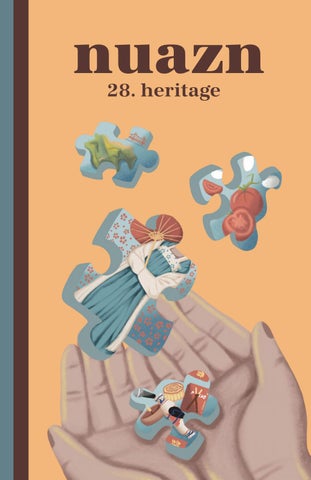
nuazn 28. heritage
letter from the editor Let me make this clear: our heritage isn’t just our ethnicity. Our heritage is a bond to the past.
It’s family dinners where loud aunts and uncles fight over the bill. It’s unintentionally hilarious messages from your parents who don’t quite understand texting culture. It’s making misshapen dumplings with your friends for your first Lunar New Year away from home. It’s seeing beautiful clothing and knowing that there’s a deep and rich history behind its creation. It’s traveling to your family’s country for the first time and gaining a newfound ethnic consciousness. It’s seeing tourists ogle your home without understanding that it’s not just a spectacle. It’s feeling pride in your language, but hiding it to fit in. It’s knowing that people expect things from you as the “model minority”, but failing to meet those expectations because that’s not what you want or what you even have. It’s fighting with your parents because you want to take sandwiches to school, not rice. It’s quitting Korean school because it’s your choice, but realizing you’re making a decision for your future children too. It’s a long history of pain, rejection, even imprisonment from the country you were born in because of something you can’t change. These are just a small glimpse into what forms our idea of heritage. The stories you will read in this issue touch the part of us that we see as Asian or Asian-American. Some are raw and painful. Others are funny and sweet. But most importantly, I hope that through this issue, you see who we really are.
Sarah Han | Ediitor-in-chief
contributors editor-in-chief: Sarah Han
managing editor: Cynthia Zhang
creative director: Stephanie Zhu
photo director: Skye Li
webmaster: David Deloso
treasurer: Lily Meng
editors:
Tracy Zhang, Michelle Kim, Joan Gwak, Jennifer Zhan
writers:
Kexin Wang, Josh Chen, Ryan Kim, Russel Leung, Anushuya Thapa, Cynthia Zhang, Katie Liu, Alex Chun, Clare Zhang, Olivia Liu, Skye Li, Christi Wang
designers:
Angela Zhou, Josh Chen, Anushuya Thapa, Agnes Lee, Michelle Hong, Clare Zhang, Amy Chen, Hank Yang, Cynthia Zhang
table of contents 4
returning to the roots
8
home for the holidays?
Ryan Kim
Russell Leung
11
the view from the valley
17
hanfu 101: a q&a with xuan zhao
20
chinatown, wo ai ni
24
root rot
28
interlude: endearing exchanges
32
white supremacy took my tongue. yikes.
36
rina sawayama’s dynasty
40
Anushuya Thapa Kexin Wang Josh Chen Olivia Liu
Cynthia Zhang Alex Chun
Clare Zhang
poetry in prison: remembering Angel Island Katie Liu
cover illustration by Stephanie Zhu
returning to the roots written by Ryan Kim For many Korean Americans, visiting South Korea is more than an ordinary trip. It is formative; a rite of passage; a fact. To this day, I have yet to travel to Korea—and it seems like I won’t be any time soon. From high airline costs to having few relatives in the country, there are various factors that prevent me from making the trip. Yet as a child, I watched my friends return from their visits with flashy sneakers, color-streaked hair, those mechanical pencil cases I only ever saw in pictures, and captivating stories from Lotte World. I wanted it all, to say the least.
4 | designed by Hank Yang
What I envied the most, however, was their newfound ethnic consciousness. One friend returned with manhwa, or comic, books and read them aloud with their refined language skills. Another friend raved about local foods and snacks that I never heard of. I always regarded visiting South Korea as an integral part of growing up as a Korean American, and it did not help to see all my friends return from their visits more Korean than ever. I began to wonder what I was missing out on and, more importantly, what was missing from me.
Granted, I was lucky enough to grow up in predominantly-Korean spaces. I had Korean language classes on Saturdays and went to a Korean church on Sundays. Every school that I attended had a significant Korean student population as well. All of this considered, I knew that visiting Korea would gift me a different and necessary perspective to view my heritage through; the missing piece of the puzzle. I would be able to realize what both my Korean and American identities meant to me. I would be able to grasp what life was like for my parents before immigrating to the United States. I would be able to immerse myself in the traditions, food, culture, and language that I’ve only ever experienced filtered bits of.
across the term “heritage seeker,” or someone who visits their ancestral country to learn more about the history, culture, and themselves. And that’s exactly what I would be considered if I chose to study abroad in South Korea. I could already envision myself savoring different street foods and visiting the Han River. Maybe I would travel to the historical sites that my parents always reminisced about. Perhaps, simply studying at a Korean university would teach me what it means to be a Korean young adult. Solidifying my heritage and identity now seemed more feasible than ever.
“I wanted it all, to say the least”
This is all speculation, of course, but I wanted to make these thoughts a reality. I began to research study abroad opportunities when I came
To aid me in this process, I talked to other Northwestern students who considered themselves “heritage seekers” of China and Hong Kong. Among all the places and people they told me about, these individuals shared one thing in common: after their visits, they slowly understood what being Asian American meant to them.
Here are their stories.
issue #28 heritage | 5
“I used to think that the model minority was something to be proud of, and it wasn’t until after my trip that I reflected on these thoughts. [...] Now with the rise of the coronavirus and racist crimes, I thought, ‘if I didn’t go to China, maybe I would have given into some of that.’ But because I did go to China and had personal experiences with the people and culture abroad, I gained a stronger sense of my identity. Just feeling more confident in who I am and being able to connect with more Chinese people now is so important and strengthens my love for my heritage, especially in the American context.” “Soon after my trip, I started trying to break out of my shell. I joined activities that weren’t considered stereotypically-Asian like theatre and choir. Part of me almost wanted to quit, especially because of how hard it was to be in theatre as one of the only Asians surrounded by White actors, and I probably would have if I didn’t have this new confidence in my Chinese heritage. I realized that it was a big part of who I was that no one could take away from me.”
Jenna Wang | China
“I wish I had visited later in life because I didn’t appreciate it as I would now. Even so, I definitely gained some perspective from the trip. It was good to be aware that I’m not just American because when you grow up in the United States, you’re surrounded by American culture your whole life. [...] I realized that there’s more to me than just what White America taught me to be. On the one hand, I grew up with the label of being Chinese-American. But when I went to China, I finally saw what that meant and realized that I’m a child of two nations. I got to explore a deeper meaning behind my racial and ethnic identity and realized that it’s actually important, rather than just a box I could tick off on the census.”
Russell Leung | China
“There was one class that I took through my exchange program that was especially illuminating. We basically took a lot of field trips throughout Hong Kong, learned about the Hong Kong refugee experience, and explored topics that I hadn’t been previously exposed to or thought of. Through my study abroad experience, it was such a privilege to be able to embrace my heritage, and it was almost easy in Hong Kong because it was a place that I had so long wished to be at.” “Cantonese is a source of pride for Hong Kongers, especially because the country had been colonized by the British for some time. The language withstood Western influence, colonization, and warfare. Knowing Cantonese made me feel very affirmed in my language abilities, especially by being able to understand the signs, people, and daily aspects of living in Hong Kong. If I didn’t have that language ability, I would feel like I was almost grasping at threads for me to solidify my own beliefs in my identity as a Hong Kong American.” Chloe Wong | Hong Kong “Hong Kong is a very developed city, so it wasn’t too different from what I was used to in Chicago. But the cultures are still very different, and going back to Hong Kong was when I realized that I was more American than I thought. American culture has always been White American culture to me, and because I don’t identify with that, I always felt more connected to my Asian side. It was only when I went back to Hong Kong that I realized I wasn’t all that Asian. I was struggling to communicate with my family members and realized my Chinese wasn’t as good as I thought it was. I’m from Rogers Park where there are very few Asians, so I feel like I stuck out growing up here in America. But I also felt like I stuck out in Hong Kong, despite looking Asian and being aware of the social cues.”
Kate Chu | Hong Kong
home for the holidays? written by Russell Leung
The holiday season will look different for everyone this year because of COVID-19, but college students are no strangers to unconventional celebrations. Many holidays occur while NU students are in Evanston, far away from the homes where they’ve always eaten good food and received their cultural inheritances. Instead, they must celebrate with their loved ones over video chat and develop new traditions with friends. Identity-based clubs also play a role in bringing students together during this time. Here, students tell me their on-campus holiday stories:
PEPERO DAY “Pepero [a chocolate-covered cookie stick similar to Pocky] Day: “In Korea, what they do is they usually give those little Pocky boxes to either a significant other, a secret crush or even a close friend. So it’s a holiday for really good community … In KASA, we have a Google Form where members can register to buy Pockys and they can leave messages for their significant other or even keep it as anonymous.”
Danny Lee [junior, Weinberg]
8 | designed by Agnes Lee
CHRISTMAS “So with Kaibigan, we like to have Christmas parties, don’t know how that’s going to look like this year. But from our past few years we’ve done karaoke night and we’ve done this thing… it’s basically Secret Santa, and you can choose to be someone’s ‘mañanita’ … I think at any Filipino party, there’s always karaoke … Some people will do Mariah Carey’s ‘All I Want for Christmas Is You’ just because you have to, it’s part of the whole thing.” Marcianni Morillo [senior, Weinberg]
CHINESE NEW YEAR Last year, a friend and I bought a bunch of White Rabbit candies and the little red candies—I think they’re called wedding candies—but basically just Chinese candy, and then we put them in red envelopes and we handed them out. Not because anyone was like, oh, Chinese culture, but you know, the New Year, right? And you want to give something, even if it’s not money. So that’s another thing, just giving people red envelopes. Sometimes with money, to put under their belt, put under their pillow for yā suì qián (压岁钱) so the more you press down, the more wealth or abundance you’ll have. Not that any of us have, you know, wealth and abundance as college students.
Isabell Liu [junior, Weinberg]
“I’ve celebrated Chinese New Year with the same group of friends … and that’s the one time any of us really try to cook real, real Chinese food. We try to make dumplings every year, and they’re never amazing because we can’t fold them well at all. But what it did was give me a big appreciation for my relatives who can actually cook Chinese food well, but also connecting more individually with our culture, too, instead of just as a family.” Tyler Huang [junior, Weinberg]
GARBA & FESTIVAL OF LIGHTS “For Garba, we book a hall at Northwestern and everybody gets to dance. Garba’s a traditional form of dance that you do for Navratri … And then there’s usually a puja [a prayer], a lot of food. But since it was online this year, we did it on Zoom and it was pretty cool … And then for Festival of Lights this year, it’s usually a dance showcase to celebrate cultures so all the dance teams on campus like Bhangra, Raas and all of them will perform. But because we can’t do that, we did a website so we can showcase everybody. And there’s a religious organization on campus called OM, and they put together a video about the way people are celebrating Diwali right now.” Shreya Narla [junior, Weinberg]
MID-AUTUMN FESTIVAL “This year, me and my friend went to Argyle [Street in Chicago] to get mooncakes from a bakery [Chiu Quon Bakery] because we couldn’t find them anywhere else, which was really tragic … we ate them after dinner and then we went to the roof of our apartment to go look at the moon … So even though we were away from our families, it was still really lovely to celebrate it together. And we both love mooncakes!”
Abbey Zhu [junior, Weinberg]
“Kathmandu wasn’t made to be a spectacle. It’s how we lived.”
Once the abode of the kings of the Kathmandu Valley in Nepal, the Durbar Squares are now places of commerce, worship and congregation.
the view from the valley written and photographed by anushuya thapa
issue #28 heritage | 11
1
2
3
12 | designed by Anushuya Thapa
1 Some of the installments come from the 14th century, and others from 2015.
2 A photograph Subham’s grandfather took in 1973. A woman buys groceries.
3 These days, Durbar Square shops sell souvenirs and artwork instead.
The Durbar Squares, which directly translate to “Palace Squares,” are outgrowths of the palaces where the Malla kings used to reside, made up of various temples and shrines built during the Malla Dynasty. Today, they are recognized as United Nations World Heritage sites and they are at the heart of each of the three cities that make up the Kathmandu Valley-Patan, Bhaktapur, and Kathmandu.
Subham Manandhar is a member of the indig enous Newari community. The Newars were the first inhabitants and once the rulers of the valley. Manandhar, however, said he appreciates the layers of history that have been added on to the Squares since their establishment by Malla kings. “It’s not just the arts of one culture, or only about the Newars. It’s the whole history of Nepal shown and left in one spot,” Manandhar said.
During the Malla dynasty, each king would add new temples during their rule. But even after that dynasty crumbled, new kings and rulers built peripheral buildings, leading to an amalgamation of woodwork and architecture from different eras of Nepali history. According to Manandhar, the Squares have always been a point of trade in addition to serving as the royal headquarters of various dynasties. Even before the modern map of Nepal existed, the Kathmandu Valley was a meeting point for Tibetan and Indian merchants.
“I’ve got a picture that my grandfather took,” Manandhar said. “It’s very beautiful, beside the Durbar Square, and you can see many little vegetable stalls laid out.”
issue #28 heritage | 13
1 A child buys a balloon from a vendor along the main street of Patan Durbar.
2 Masked and far apart — the typical Durbar Square crowd is nowhere to be seen.
3 A couple prays before the mighty figure of Bhairav, a Hindu God of destruction.
Mela, the Sanskrit word for festive
gatherings, is how Suyasha Shakya, a Patan native, describes the constant flow of commerce in and out of the Durbar squares. Shakya says she often informally takes friends and family on tours of the Squares and wants to show people that Nepal is more than just “the home of mountains.” Though the usual flow of commerce is nowhere to be seen, even during the pandemic, businesses are open. From jewelry peddlers to restaurants owners, locals continue to exchange goods and services. “Because so many people come there, locals and tourists alike, it’s become a hub of sorts,” Shakya said. “And right now it’s very sad to see how empty it is.”
But the tradition of trade isn’t the only one to have survived all these years.
The Golden Temple in Patan Durbar Square is still under the guthi system, where old lineages take on cleaning and priestly duties associated with various places of interest in the Durbar Squares. According to Shakya, she would often explain to visitors how a young boy from one of these families looks after the temple as its chief priest before handing it over to another family, in a tradition of guardianship that is over 1,000 years old.
Each guthi has special calendar days where they clean, polish or otherwise take care of what has been assigned to them. Though the number of indigenous families who still carry out their guthi duties has dwindled, the system remains in place.
14 | nuazn magazine
1
2
3
issue #28 heritage | 15
“That’s what strikes me the most about Patan Durbar Square and Patan as a whole,” Shakya said. “It is a living tradition, even though it’s this historic thing that’s been passed down. It’s not just put into a museum.” Manandhar’s family, too, is a part of a guthi. He says it’s “not a temple or anything cool like that,” but he was still looking forward to the guthi’s small festivities, which likely won’t be happening this year.
Outside of the indigenous people who are part of this intricate system, locals and domestic tourists come to the Durbar Squares as a place of worship. They bring flowers, colored rice, fruits and spare change to offer as gifts at the various shrines which have become important in shaping their day to day lives. “It isn’t like the Egyptian pyramids,” Manadhar says. “Kathmandu Durbar Square isn’t a spectacle. It wasn’t made to be a spectacle, it’s how we lived.”
16 | nuazn magazine
hanfu 101:
a q&a with xuan zhao written by Kexin Wang and photos by Xuan Zhao The definition of “Hanfu” is quite literal: with “Han” referring to the biggest ethnic group in China, which makes up 91% of the Chinese population, and “fu” standing for “clothing” in Chinese, Hanfu refers to the traditional clothing worn by Han people as opposed to other ethnic minorities.
Like many traditional clothing, Hanfu quickly declined as people no longer wore them in daily life. Yet on November 22, 2003, electrician Letian Wang became the first person reported by the media who showed up in a full set of Hanfu outfit in public, signaling the commence of the Hanfu revival in China. Xuan Zhao, a 20-year-old Chinese girl, was one of the many inspired by Wang’s story. As someone who barely knows anything about Hanfu culture, I have always been impressed by the fascinating portraits of Zhao in which she dresses up in various styles of Hanfu clothing. With the intention to learn more about this heritage, I did an interview with her where she shared her own story and thoughts about the revival of Hanfu culture.
Some of Zhao’s customized neck and hair accessories. The hairpin on the right is worth almost $150.
issue #28 heritage | 17
Q: How did you know about Hanfu and its culture?
A: It was about five years ago on a school organized Hanfu performance show when I first got to know what Hanfu was. Although the one I wore was more like a studio-made clothing, I was literally so surprised and touched to see myself dressing up in those gorgeous dresses for the first time. When I later learned the story of Letian Wang, I was so proud of him that I immediately determined to join him and take part in the revival the Hanfu culture. Q: What attracts you the most in Hanfu culture?
A: It has an irreplaceable charm as every dynasty had its distinctive Hanfu style and design. Hanfu is not simply a piece of clothes, but more like a historical figure who uses its unique voice to narrate the story in its period of history. For example (referring to her portraits), the first set is called “Waist Ru skirt,” and the second is called “Chest Ru skirt.” The latter style was made and wore particularly during the Sui Tang and the Five dynasties. You can tell from its more exposed design that people in that period had a more open mindset relative to other dynasties. Q: Correct me if I’m wrong, but why did the Chest skirt you were wearing seem more conservative?
A: It was a very rainy day, so I tied the dress a much higher to avoid stepping into the mud (laughed). Styles in other periods can only be more conservative.
18 | designed by Angela Zhou
Q: What do you think the biggest misinterpretation people have about Hanfu culture is?
A: I feel like they tend to consider Hanfu culture to be an exclusive community which is difficult for them to join in. I instead believe that Hanfu is a production of acceptance, an open space for cultural communication without any boundaries for people who are willing to know more about it. Q: You mentioned “acceptance” – does it mean that you will also accept knock-off Hanfu?
A: No. You can actually spot the counterfeits at the very first sight. They are very disrespectful to both Hanfu designers and the culture itself. Q: What effort have you made in creating the “open space” for Hanfu culture? How might Hanfu be popularized among the majority for your perspective?
A: I have been an active member of XiTang Han-Fu Culture Festival and Chinese National Costume Day for five years, and I’m interested in mixing up Hanfu with modern outfits to create more casualness for daily wearing. We need to confess that Hanfu was still a niche culture nowadays. Only if more and more people get to know about Hanfu and gradually make it an integral part of modern culture, would they be willing to wear it on a daily basis. That’s how the outcome of the revival of Hanfu culture should eventually be.
Left: Waist Ru skirt (475 B.C. ~ 1600s A.D.)
Right: Waist Ru skirt (581 A.D. ~ 960 A.D.)
issue #28 heritage | 19
20 | designed by Josh Chen
chinatown, wo ai ni photo series on 35mm film by Josh Chen
My family’s weekend trips to Chicago’s Chinatown are among my fondest childhood memories: walking through Chinatown Square, picking out my favorite Chinese pastries in the small bakeries, begging my parents to buy my siblings and me boba. As a child growing up in Indiana, having almost no Chinese friends, no one to share experiences with, I struggled to connect with the Taiwanese/Chinese culture of my parents. Looking back, those trips to Chinatown every one or two months were my closest experience to authentic Chinese culture in an otherwise very white environment. This photo series of Chinatown — its colors, buildings, people, food — is a visual nod to these distinct memories of my childhood.
issue #28 heritage | 23
root rot written by Olivia Liu
“a feeling, a taste of familiarity”
My father liked to grow tomatoes. In the springs of my childhood, we would weather the balmy rain and go peruse Home Depot’s finest selection of tomato plants. 24 | designed by Amy Chen
image: Douguo
番茄炒蛋
(tomato and egg stir fry)
He would pace the aisles of tender vines, smelling the sweetness of the oil coating them to find the best one. If they were 香 (xiang), or fragrant, then the tomatoes were sure to be too. After long deliberation, he would load our car up with as many plants as he could muster, pleased with his new growing treasures. When we got home, he would dig through the frosty topsoil to find the perfect spot underneath while I watched. Every year I’d tell him that nothing would grow. Their roots would not take to the foreign soil, too wet and cold. My father would grow silent. “You’ll see,” he always said. ‘香’ (xiang) is a Chinese word that’s English translation is widely
debated. Typically, it’s translated to fragrant, in reference to food. Other times, it means savory, or depth of flavor. Yet, it never means the same thing it does in Mandarin. 香 is just a feeling, a taste of familiarity.
Whenever I was younger, my father would be in the kitchen after school, tending to a pot or a pan of whatever dinner would be. Removing the lid revealed any number of boxed treasures, but usually, it was my father’s favorite: 番茄炒鸡蛋 (tomato and egg stir fry), It was easy and the longer the sauce sat, the better it would taste. Over a steaming bowl of rice, we would talk about our days, interrupting only to ask if the food was 香. “香,” “How
I are
would reply. the tomatoes?”
Our dinner conversations became quieter as I grew older and our relationship became more and more fractured. I grew resentful of my father, every conversation a fight that ended in screaming and tears. As my time at home became more of a pain than a luxury, I would hole myself up in coffee shops to find some quiet. Nevertheless, my father would wait with dinner at home, taking our meals in newborn silence.
sugar, and most importantly heirloom tomatoes cubed into my father’s favorite tomato and egg stir-fry. After my first bowl, my father would say, “See, I told you so. They will grow.” I wonder whether my father thought of me like his tomato plants. When he first held me, hospital lights glaring on my sickly skin,
After the first harvest, the plants would begin to bear an endless bounty. There was never a day in July that our fridge was not overflowing with tomatoes. Grape and cherry, romas with
One time in my sophomore year of college, I woke up with the worst craving for tomato and egg stir fry. Stumbling into my kitchen with old tomatoes and wilting green onions, I set out to work. I’ve watched my father cook so many times, but never really learned how to do it myself, pushing aside his constant offers to teach me.
We found pockets of peace in tending to his tomato plants. Any fading leaves would be snipped, any bugs, squashed. Beef fat was sprinkled once a day, sinking into hungry roots. Soon, we’d watch their buds fill out into yellow and red gems, their leaves smelling as ‘香’ as we’d hoped.
I wonder whether my father thought I would take root in foreign ground too.
It wasn’t ‘香’. It didn’t taste like home. If my father’s stir fry was a treasure box full of red and gold, then my final slimy recreation over stale rice was more like a cheap rock you would purchase at a roadside gift store.
Funnily enough, the word ‘香’ has the same pinyin as 想, which means to miss. I made this mistake once when texting my mom to tell her that my food wasn’t as 想 as my father’s. She laughed at me, telling me that I had misused the character and that if I missed my father, I should just tell him. When my father planted me in this rough American soil, he tried so hard to make sure that I would grow as strongly as his tomatoes. All of the years of Chinese school, of hot lunches over rice, of Mandarin flashcards, were to prune the leaves of assimilation around me. My father never let me forget my roots, and for that, I resented him. I haven’t spoken to my father in two years. When I struggle in my
kitchen to recreate a stir fry that would take him five minutes, I wish I could just pick up the phone and ask him what to do. I wish I wouldn’t have to piece together basic sentences with Google translate, that my mother tongue would feel familiar again instead of a foreign growth in my mouth. I wish that I could eat 番 茄炒鸡蛋 with my father again before I forget what ‘香’ tastes like. When I uprooted myself from my father’s garden, I thought that I could always come home. Now, I am left with the question:
where is home if I don’t even remember what it feels like? issue #28 heritage | 27
interlude:
endearing exchanges written by Cynthia Zhang In this time of isolation and pandemic anxiety, it’s more important than ever to stay connected with the loved ones we can’t visit in person. Thankfully, friends and family members can be reached easily with the help of mobile devices and apps such as FaceTime, Skype, and iMessage. Many Asian and Asian American students, however, face a rather unique challenge with texting. The language barrier which exists among many immigrant families combined with our beloved older generation’s often shaky grasp of modern technology can lead to some pretty hilarious conversations. And so here, for your enjoyment, is a gallery of screenshots, all sourced from our very own NUAZN staff, which best capture these endearing exchanges between us and those we love from afar.
Jennifer Zhan “I feel like dad jokes are a part of every culture.”
28 | designed by Cynthia Zhang
Cynthia Zhang “The best thing is that there was literally nothing else to this conversation. My dad just wanted to say hi.”
Sarah Han
Tracy Zhang Translation: “Get my package on your way home.”
“Mom loves you.”
Jennifer Zhan
“My favorite dish is tomato egg drop soup, so this was how my sister decided to lure me out of my room.”
Cynthia Zhang
“These are the important events my mom likes to keep me updated on while I’m away.”
30 | nuazn magazine
Sarah Han “Basically, my dad got Galaxy Buds for free.”
Tracy Zhang Translation: “I want to order fried chicken.”
“Somebody stop me.”
issue #28 heritage | 31
white supremacy took my tongue. yikes. ok but where are you really from like where are your parents from how do you say my name in your language how do you say hello in your language shouldn’t you know how to speak korean if you’re a korean person you’re so whitewashed wow i don’t even think of you as asian even i’m more asian than you i watch anime so i’m like an honorary asian i wish my parents spoke another listen to my indian language i bet it’s so much easier than trying to learn it on your accent it’s really good own haha your language sounds so funny ching chong it’s why can’t you take a i’m honestly barely joke no need to be so you’re not like one of those asians with weird e ven who asian i don’t speak that lansensitive i didn’t mean accents and weird food and weird clothes are like obsessed with asian stuff you know i guage at hom at all i’m not a genius i get to offend you i really don’t think we could be friends if you were like bad grades i don’t like asian really that you know it’s just too different like i don’t food asians are so weird i’ve never even been to asia i don’t want to go there ever yeah i love asian jokes some
written by Alex Chun
this is america speak english just go back to where you aks dfj;aklsd jf;aklsd i don’t understand why you jf;laks djf;alksare having so much trouble djf laskjdf lakwith jsdfh this whylajksdfh can’t you remember to say this kajsdfhhowkaljsdeveryone f h ; welse i o in h fyour o i h class is doingwewell and you’re ;feahsl;dkf failing you don’t even try to learn jas;dlk fja;lsk i raised you better than this ejfa;woifj akjlsh have;asdfh some respect for your ;alsdfh culture how will youfhspeak to a;lskdfh ;aklsd your grandparents how will your children learn their own language i’m so disappointed in you how could you do this
...
I used to have nightmares about “Korean school.”
Why? Because nothing was more terrifying to 2nd grade me than the shame of inadequacy.
Image: Adobe Stock
“Korean school” is a local after-school program hosted through Minnesota’s largest Korean Presybeterian church, and almost all my Korean American friends studied there when they were in elementary school. The program helped young Korean Americans in Minnesota connect with their heritage and ancestry.
I studied there for a bit, too — until I dropped out in the 2nd grade because I could never pass a comprehension test beyond the kindergarten level. The limited Korean that I spoke was in reference to my family. For example, my mom was always omma to me, and my dad was always appa. Besides that, I couldn’t say a single sentence in Korean, so I asked my parents if I could study at “Korean school” to try to learn. I don’t remember much, but I remember the smell of the carpeted hallways that my friends and I would run down, watching communion from the balcony I sat in class, not understanding windowed that overlooked the a single word and not feeling congregation and then the “Korean school” “Korean enough” to belong. that would follow.
32 | designed by Clare Zhang
I also remember the
embarrassment and a growing frustration fueled by my inability to understand Korean. The characters and words were jumbled in my brain, and all of my peers entered the program already able to speak Korean conversationally. With my comprehension below the entrant level, the instructors seemed to forget about me, and I fell further and further behind. I sat in class, not understanding a single word and not feeling “Korean enough” to belong. When I really think about it, though, I stopped speaking Korean to fit in with White people. I lost my tongue in a twisted desperation to assimilate into Whiteness. The Whiteness of my hometown was so pervasive and toxic, and it’s something I hadn’t reckoned with until recently. My elementary school was White. And it was designed to be so. My hometown changed district boundaries in the early 2000s. With the new district lines, wealthy White families could self-segregate their children by elementary school. The school that I attended happened to be one of the Whitest.
When I started 2nd grade, my younger sister Ellie started kindergarten. Ellie had exclusively referred to me as oppa — “big brother”. She never called me “Alex.” It was just oppa because anything else felt unnatural. But when we passed each other in the elementary school hallways, Ellie would excitedly call oppa, and my cheeks would flush. Over family dinner that night, I insisted that Ellie refer to me only as “Alex” from then on. I don’t know which is sadder: the fact that I thought my White second-grade peers were so cruel and unforgiving, or that I felt such a need to earn the approval from Whiteness. Before I knew it, the frustration and aversion to the Korean language cost me my tongue.
I avoided using any of the little Korean I knew. I whitewashed how I referred to my omma and appa, calling them “mom” and “dad” instead. The White supremacy that I had internalized spread through my family, until it killed the small bits of native language spoken in the house. I entered middle school and became too busy to even consider going back to Korean school. My family became accustomed to speaking
E n g l i s h exclusively, and I lost the fire to learn Korean. It was replaced with muddled memories of aversion and frustration. Almost all of my friends were White, and to fit in, I adopted the mentality that I just happened to be Korean. I didn’t view my
Korean identity as a part of my being. I could never shake the guilt at having been labeled “proficient” in Spanish but unable to string a sentence together in Korean. And I was always ashamed that I adopted the ignorance of my hometown and conformed to it. So what changed?
I took a hard look at the internalized White supremacy that simmered deep feelings of self-hate.
Last winter, my mental health crumbled to a newfound low after I confronted ongoing racial and emotional abuse from someone close to me. Looking back, I couldn’t be more thankful for it. It took the emotional low for me to take a hard look at the effects of internalized White supremacy.
I could never shake the guilt at having been labeled “proficient” in Spanish but unable to string a sentence together in Korean.
When the COVID-19 pandemic disrupted the normal happenings of my life and sent me back to my childhood bedroom, I felt alone in so many ways. And I embraced it.
I thought about my identity and questioned why I often felt unaccepted by myself.
I thought of when I felt most accepted by others; it was when I was surrounded by friends who unapologetically loved their identity. They were showing me how to do the same.
Since I’ve been home, every time my mom calls me “Alex” in conversation with my younger sister, I just interrupt and remind her that to Ellie, “I’m oppa not Alex!”
Although I can’t speak Korean, it’s not something that exists separately from me. When I hear Korean, it’s a familiar feeling, like being with my family. I used to feel that I didn’t fit into a Korean space; at times, I didn’t want to. Deconstructing White power structures and their pervasiveness goes beyond reclaiming my tongue. It goes far beyond me. But reclaiming my tongue and my relationship with my Korean identity is one of the first steps I’ve taken to identify and dismantle the internalized White supremacy that shaped my perception of the world and myself. So… what does my journey reclaiming my tongue look like?
For now, I’ll start with Duolingo.
issue #28 heritage | 35
36 | designed by Michelle Hong
rina sawayama’s dynasty breaking the silence around generational trauma written by Clare Zhang It seems strange that the album SAWAYAMA, which tackles everything from capitalism to public image to broken friendships, opens with “Dynasty,” a somber portrait of familial pain. For an album composed of universal themes, the topic of transgenerational trauma — trauma that affects the descendants of the person who originally experienced it — feels both too intimate and too clinical for the pop sphere. Even for the artist, Rina Sawayama, this debut album completely diverges from her previous music. Her 2017 extended play (EP) RINA centered around the impact of technology on emotions. “I can’t write about myself, so I write about other people and then make it academic,” she told DIY Magazine in 2018. But “Dynasty” throws Sawayama’s family life Image: AJE World
into the light, or at least reveals a silhouette. She insists on breaking the silence surrounding Asian families: “I’m gonna take the throne this time/All the words all mine, all mine.” When I listen to the song, I can’t help but wonder how her mother feels about it. The lyrics don’t detail her family situation, but they seem explicit to the point of betrayal: “Mother and father, I know you were raised differently/Fighting about money and his infidelity.” Though I am Chinese American and Sawayama is Japanese-
running in my bloodstream, my bloodstream dynasty and if that’s all that I’m gonna be born British, our Asian cultures both pressure us to keep any family trouble to ourselves, to make sure we look pictureperfect from the outside. My family would always manage to get into arguments on the car ride to some Asian party, and my mom never seemed so concerned about resolving the issue as she was about me being caught frowning, or, God forbid, not greeting one of the adults loudly enough. The constant nitpicking in private, combined with my mom’s apparent database of knowledge of every Chinese American child vaguely my age who was off changing the world, made me more indignant than anything. I felt like a large, child-shaped ribbon to show off at parties. “Saving myself/Is all I really know,” as Sawayama sings in the intro to “Dynasty.” Silence was protection; I didn’t want to share myself with my parents only to hear that I had become someone they couldn’t be proud of.
My parents were just as unwilling to share their own flaws. Anytime they mentioned their childhoods, it seemed like another point of comparison: You don’t want to eat this meat? Well, when I was your age, my family couldn’t even afford to buy meat, so you’ll eat it and you’ll be happy about it. You don’t want to go to school today? When I was your age, I walked for hours in the snow for the chance to get an education. I learned to tune it out.
The shutdown of communication is dangerous for any relationship, yet it seems almost inherent in many Asian families. In a study by the Sigmund Freud Institute in Germany, researchers
Freshman Clare Zhang (left) with her family in 2007.
interviewed Chinese adults who — like my parents — grew up during the 1966-1976 Cultural Revolution. During this period, Chairman Mao Zedong called on Chinese youth to destroy anything that represented old, outdated culture and ways of thinking. Public perception was a matter of life and death, and young people were so heavily indoctrinated that some would turn in their own parents.
reached a point of grim acceptance—“it is what it is.” But inheriting something means you’re not the first person to bear its weight; if pain runs in my bloodstream, as Sawayama says, it runs in my parents’ as well. Silently bearing the pain is the problem, not the solution. The only way to move forward is to understand the ways that we’ve all hurt each other.
When I first heard this song, I felt like a victim who had
There’s undeniable courage in facing centuries of pain head-on, and honestly, I don’t feel courageous. But as I’ve begun finding the words of my own narrative, it’s easier to picture myself starting that conversation with my parents, and trying together to heal the wounds of our shared history.
Researchers found that the interviewees had an impaired ability “to experience and establish good relationships,” because of their parents’ trauma during the Cultural Revolution. In the aftermath of the revolution, parents worked to reinstate authority over their children while keeping their own thoughts and feelings close to their chests. For the overwhelming majority of the study’s participants, this translated to an “achievementoriented, strict, and imperious” upbringing, which they later modeled with their own children.
At the core of “Dynasty” lies a call to action: “Won’t you break the chain with me?” In an interview with Pitchfork, Sawayama mentions cornering her mother with uncomfortable questions to delve into their family history for the album, reopening the lines of communication.
won’t you break the chain with me?
- rina sawayama issue #28 heritage | 39
poetry in prison:
remembering angel island written by Katie Liu Henry Wong came to America as Wong Gung Jue, a paper son. Yet to his children, he was far more than a false identity. He was a calligrapher, a teacher, a craftsman. He dreamed and sang and hoped. He was also an Angel Island poet. With his godfather’s fountain pen, he scratched a nowvanished poem upon the walls. “For half a year, I have gazed at the American Dream,” he wrote in one of his lines. “As for ‘Equality’ and ‘Liberty,’ I still ask, ‘When?’”
These were the Chinese immigrants who carved their stories upon the walls of their prisons at Angel Island. Their poems are relics of our Chinese American heritage. They’re dualities of both rejection and resilience. Angel Island, now a state park, was once an immigration station off the coast of San Francisco. It operated from 1910 to 1940, in the
wake of the Chinese Exclusion Act of 1882, the first federal law to limit immigration based on ethnicity. Chinese immigrants arriving at San Francisco were detained, as immigration officials verified their documents to see if they were in classes “exempt” from the Exclusion Act. Imprisoned in cramped barracks and forced into brutal interrogations and humiliating medical examinations, Chinese immigrants were held for weeks to months to years, waiting to see if they would be allowed into America. Only after it burned down was Angel Island closed. Its poems are a physical reminder that the roots of a Chinese American heritage begin with unbelonging. Now, as a Chinese American living in a pandemic that has exposed decades-old anti-Asian sentiments, I’m reminded that these poems, these symbols of my heritage, were once open wounds. Even generations later, we still bear those scars.
40 | designed by Stephanie Zhu
image from SF Chronicle
美有強權無公理, 囹圄吾人也罹辜。 不由分說真殘酷, 俯首回思莫奈何。
America has power, but not justice. In prison, we were victimized as if we were guilty. Given no opportunity to explain, it was really brutal. I bow my head in reflection, but there is nothing I can do.
陳題
(By Chan) [33]
Our heritage is unbelonging. Since the first Chinese immigrants came to America in the 1800s, they were unwelcome. Fears of a yellow peril that endangered Western existence coalesced with economic downturns, and Chinese people were deemed fundamentally unassimilable. Reading this poem now, I can hear old chants of, “The Chinese must go,” among new words spat like venom - “China virus.”
There is no doubt that the prisoners of Angel Island and I hold different experiences. However, in our own ways, we still do not belong. To be Chinese in America was to be ashamed and feared. It is to accept that part of our heritage will always be foreign. It is to constantly prove our love for this country, even when that love is not returned.
issue #28 heritage | 41
浪大如山頻駭客, 政苛似虎倍嘗蠻。 毋忘此日君登岸, 發奮前程莫懶閑。 香山許生勉客題 Waves big as mountains often astonished this traveler. With laws harsh as tigers, I had a taste of all the barbarities. Do not forget this day when you land ashore. Push yourself ahead and do not be lazy or idle. (By One named Huie from Heungshan) [10]
Our heritage is also ferocity. There is an anger in this poem that I can recognize, a spiteful urge to live on despite the cruelty. When officials covered up the poems inked on Angel Island’s walls, considering it mere graffiti, the prisoner poets began to carve their words into their barracks instead. This poetry
was an act of defiance as much as it was an expression of pain. This poet’s words are as much a testament to strength as they are a command for Chinese Americans to remember where we came from, and what it cost us to be here.
寄語同居勿過憂, 且把閒愁付水流。 小受折磨非是苦, 破崙曾被島中囚。 “This is a message to those who live here not to worry excessively. Instead, you must cast your idle worries into the flowing stream. Experiencing a little ordeal is not hardship. Napoleon was once a prisoner on an island.”
[Poem 124]
Our heritage is hope. Chinese immigrants hoped for the American Dream. For them, that was not a reality. Yet some of those imprisoned upon Angel Island still found the audacity to hope their ordeals would pay off. Some of them still hoped they would one day step off the island.
In a way, the prisoner was right. These poems are visceral reminders to future generations that our displacement was not a far-off nightmare. We are separated by only a short lifetime. Yet, we are still here anyway.
壁上題詩過百篇, 看來皆是嘆迍邅。 愁人曷向愁人訴, 蹇客偏思蹇客憐。 得失豈知原有命, 富貧誰謂不由天。 此間困處何須怨, 自由英雄每厄先。 香山許生自慰題 “Over a hundred poems are on the walls Looking at them, they are all pining at the delayed progress. What can one sad person say to another? Unfortunate travelers everywhere wish to commiserate. Gain or lose, how is one to know what is predestined? Rich or poor, who is to say it is not the will of heaven? Why should one complain if he is detained and imprisoned here? From ancient times, heroes often were the first ones to face adversity.” (One Named Huie from Heungshan) [Poem 38]
Our heritage is courage. The archetypal hero of the story is both challenged and also overcomes. Chinese immigrants did fight back against discrimination. They went to court, they protested against exclusionary laws and they led boycotts against American goods. That heroic tenacity underlies our actions.
Despite the hurt Chinese Americans inherited, we’ve also inherited spirit. Amidst the COVID-19 pandemic that brought exclusion upon many Asian communities, we have come together to uplift one another. We have reclaimed and found beauty, instead of peril, in yellow.
Reading these poems now, I am unsettled because this happened not too long ago. The Chinese Exclusion Act was repealed in 1943, less than 80 years ago, and Angel Island only burned about three years prior.
were once imprisoned. We can still carve our own identities too. That is the freedom that comes with living in between worlds.
That is why we must keep remembering and honoring the prisoners of Angel Island, for their experiences are still modern.
In remembering these poems, I can see that our displacement could, in a way, be our strength. Chinese immigrants left permanent marks where they
So, hundreds of poems later, traditional Chinese rhythms broken apart by English translations, I have realized that our heritage is indeed many things.
Our heritage is not just melancholy. Our heritage is not all sadness and not all unbelonging. Our heritage is pain and endurance and bruised hope, too.
Our heritage is surviving and living on.
thank you for reading!