
Nebraska Suicide Prevention Data
The intent of this data brief is to spur local and state conversations about suicide prevention. The University of Nebraska Public Policy Center organizes suicide prevention activities across Nebraska under a cooperative agreement with the Centers for Disease Control and Prevention (CDC). We placed questions on the Nebraska Annual Social Indicators Survey (NASIS) to gauge the impact of these prevention activities. This survey is conducted each year by the University of Nebraska-Lincoln Bureau of Sociological Research (BOSR) and is administered via regular mail and online. After collection, responses are weighted by region, age, and gender to closely resemble the Nebraska population. Survey participants in 2024 included 2,232 Nebraska adults. See the survey methodology report for more information. 1 For those who are interested, detailed summary data tables are included in the appendix.
Suicide prevention includes increasing the time and space required to access a lethal or deadly method (like guns or pills) to reduce the risk of suicide. We asked if someone in the household owned at least one gun or firearm. A little over half of those surveyed indicated that someone in their household owned a gun (53%).
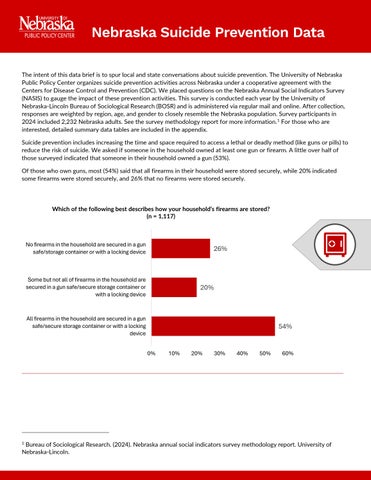
Of those who own guns, most (54%) said that all firearms in their household were stored securely, while 20% indicated some firearms were stored securely, and 26% that no firearms were stored securely.
Which of the following best describes how your household’s firearms are stored? (n = 1,117)
No firearms in the household are secured in a gun safe/storage container or with a locking device
Some but not all of firearms in the household are secured in a gun safe/secure storage container or with a locking device
All firearms in the household are secured in a gun safe/secure storage container or with a locking device
1 Bureau of Sociological Research. (2024). Nebraska annual social indicators survey methodology report. University of Nebraska-Lincoln.
Nebraska Suicide Prevention Data
The practice of securing ammunition away from a gun can also put time and distance between the person thinking of suicide and a firearm. Most survey respondents with firearms said they store ammunition in a locked cabinet with guns or they keep the ammunition in a location away from the gun storage. Only 14% said they keep ammunition unlocked with guns.
Which of the following best describes where ammunition is stored in your household? (n = 1,117)
There is no ammunition in the household
Unlocked in the same physical location as gun(s)
Unlocked in a location physically separate from gun(s)
Locked in a location physically separate from gun(s)
Locked in a gun safe/secure storage container with gun(s)
Suicide prevention is also furthered when households keep only small, non-lethal quantities of medications on hand. Locking up large quantities of potentially lethal medication is also a safe alternative. A little over one-third (38%) of respondents said they had medications at home that could pose a risk of harm if misused. Most of these 791 households (88%) indicated these medications are not in locked storage.
Which of the following best describes how your household’s medications are stored? (n = 791)
Some but not all medications are in locked storage No medications are in locked storage
All medications are in locked storage
Nebraska Suicide Prevention Data
We asked respondents how much of the time in the past four weeks they experienced feelings that could be associated with depression or anxiety (often present in someone who has thoughts of suicide). The most endorsed feelings were being nervous (55% at least a little of the time), restless or fidgety (49%), that everything was an effort (43%), and being lonely (35%). For each of these items, over 5% of respondents indicated they felt this way “All or most of the time.”
We asked how confident respondents in two areas that are critical to getting someone help who may be thinking of suicide. First, we asked about their confidence in being able to tell when someone is suicidal. Second, we asked how confident they are in knowing what to say to someone thinking about suicide. Not quite half (42%) of respondents felt confident they could tell when someone is suicidal and about the same proportion (43%) indicated they were confident they know what to say.
Percent of Respondents
… you can tell when someone is suicidal? … you know what to say to someone who is thinking about
Nebraska Suicide Prevention Data
Nebraska participates in the nationwide program offering 988 voice, text, or chat to connect someone with a trained crisis counselor who can provide support and resources for anyone in crisis or experiencing thoughts of suicide. Over two-thirds of Nebraska respondents (69%) said they had not heard of 988.
Have you heard of 988? (n = 2106)
Learn more….
Find Nebraska suicide prevention resources (https://suicideprevention.unl.edu/home)
Find information on 988 (https://988lifeline.org)
Find information on Nebraska 988 (https://dhhs.ne.gov/Pages/988-Suicide-andCrisis-Lifeline.aspx)
Nebraska Suicide Prevention Data
Appendix: Detailed Summary Data Tables
Nebraska Suicide Prevention Data
During the past 4 weeks, how much of the time did you feel: