President’s Message Artificial intelligence is changing how we learn, teach, and conduct research. For universities, the challenge is not simply to adopt new technologies, but to consider what students need to learn in order to use them effectively and critically. At NTNU, this means strengthening the foundations of education while creating more opportunities for learning and research across disciplines. In this issue of the NTNU Newsletter, we examine why mathematics remains important in the age of AI. Mathematics is more than a set of techniques for solving problems. It teaches us to reason, recognize patterns, evaluate evidence, and question assumptions. As AI takes on more routine tasks, these abilities become increasingly valuable. Our goal is to help students develop the judgment to understand what technology can do, recognize its limitations, and apply it responsibly. The research featured in this issue shows what can be achieved when different disciplines work together. One project combines historical records and meteorological data to reconstruct more than six centuries of typhoon activity. Others bring together methods from public health, education, and engineering. These studies demonstrate how collaboration can open up new questions and approaches to research. Our alumni stories offer a complementary perspective, showing how the knowledge and skills acquired at NTNU can be put to use in different professions and communities. Together, these articles reflect an important aim of our university: to provide a strong academic foundation while encouraging students and researchers to explore beyond their own fields.
National Taiwan Normal University Newsletter Issue 10
Autumn / Winter 2026 Publisher
Yao-Ting Sung Published by
National Taiwan Normal University Editorial Director An-Pan Lin
Editor-in-Chief Min-Ping Kang
Editorial Board
Cheng-Hung Lin Li-Chun Teng Yi-De Liu Copy Editor Daniel Hu Content
Yvonne Kennedy Po-Jui Chen Photography Shi Chang Po-Jui Chen
Graphic Design
UNIQUE Design Studio
Contact Us
Yao-Ting Sung, PhD President National Taiwan Normal University
WEBSITE www.ntnu.edu.tw LINKEDIN national-taiwan-normal-university MAILBOX pr@ntnu.edu.tw
2
2026 NTNU Newsletter
06
12
17
Features
04 Across Disciplines
Regulars
06 Beyond Boundaries: NTNU’s Next Chapter
02 President’s Message 11 Distinguished Alumni 16 NTNU Connects the World 19 Trailblazer
Research Spotlight
From typhoon history to classroom AI and humanoid robots, NTNU researchers are combining methods across fields to tackle complex questions in science, health, education and engineering.
Cover Story
President Yao-Ting Sung sets out his vision for more interdisciplinary learning, thoughtful use of AI and stronger connections between academic study and the world beyond the university.
12 Mathematics, Then and Now Focus
As the Department of Mathematics marks its 80th anniversary, it reflects on a long tradition in mathematics education and looks ahead to new directions in research, computing and AI.
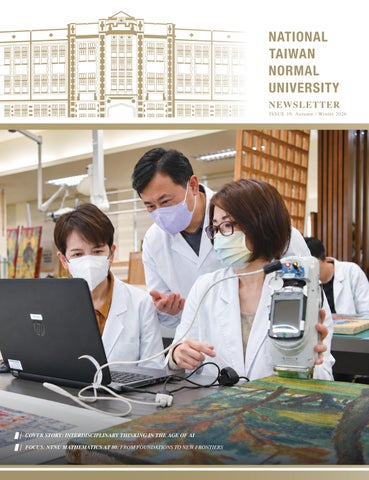
ON THE COVER: At the Research Center for Conservation of Cultural Relics, Director Yuan-Feng Chang (far left) and her
team bring together art, science, and technology to preserve cultural heritage, demonstrating the value of interdisciplinary expertise and human judgment in the age of AI.
2026 NTNU Newsletter
3
Research Spotlight
Across Disciplines From centuries-old typhoon records to robots learning to steer, NTNU researchers are bringing together methods from different fields to investigate problems in climate science, public health, education and engineering.
Classroom Air as an Early Warning System Yao-Hua Ho | Environmental sensing, artificial intelligence and public health
Could classroom air-quality measurements provide early warning of respiratory disease outbreaks? Researchers developed CROP–IAQ, a prediction system that uses environmental sensor readings to identify classrooms at risk of infection clusters. Student epidemic-prevention leave records were used to determine which air-quality measurements corresponded to potential infection periods. Researchers monitored temperature, humidity, airborne particles, carbon dioxide and other environmental indicators, then trained and compared four neural-network models. The strongest-performing model achieved an F1 score of 0.72 and sensitivity of 0.76. Although the findings do not establish that air-quality measurements alone can predict outbreaks, the proposed system could help schools identify potential risks and take preventive measures, including improved ventilation. (Li, P.-E., & Ho, Y.-H. (2025). Predicting the occurrence of respiratory diseases based on campus indoor air quality. ACM Transactions on Intelligent Systems and Technology, 16(2), Article 39. https://doi.org/10.1145/3709008)
What 600 Years of Records Reveal About Typhoons
Kuan-Hui Lin | History, climate science and meteorology What can historical documents reveal about changing typhoon patterns? Using Chinese documentary records validated against early instrumental observations, researchers reconstructed tropical cyclone activity in the northwestern Pacific as part of a 653-year chronology spanning 1368 to 2020. They found that typhoons were most frequent between 1650 and 1680, during the Maunder Minimum, a period of unusually low solar activity. Cooler land temperatures and anomalously warm western Pacific waters may have altered summer monsoon circulation, contributing to heightened tropical cyclone activity and greater variability along China’s southern and eastern coasts. The findings extend our understanding of tropical cyclone behavior well beyond the modern observational record and offer historical evidence for studying its relationship with ongoing climate change. (Lin, K. E., Tseng, W. L., Lin, Y. S., Lee, C. Y., Lin, Y. H., Hsu, H. H., & Wang, P. K. (2025). Intensified tropical cyclone activity in East Asia during the Maunder (solar) Minimum. Proceedings of the National Academy of Sciences, 122(52), e2419759122. https:// doi.org/10.1073/pnas.2419759122)
4
2026 NTNU Newsletter
Teaching a Humanoid Robot to Ride a Scooter
Jacky Baltes and Saeed Saeedvand | Robotics, artificial intelligence and control engineering Balancing and steering a two-wheeled scooter presents a difficult control problem for humanoid robots. Researchers investigated whether deep reinforcement learning, which improves performance through repeated trial and feedback, could outperform conventional PID controller methods. Using a three-dimensional simulation, they compared the two approaches across different speeds, steering conditions and routes, including tests involving external disturbances. Although the conventional controller successfully maintained balance, the reinforcement-learning system achieved an average improvement of 52 percent across the conditions tested, with stronger path-tracking performance. Tests of controller commands on the physical robot and scooter further supported the feasibility of the steering controls, although the principal performance comparisons were conducted in simulation. (Baltes, J., Christmann, G., & Saeedvand, S. (2023). A deep reinforcement learning algorithm to control a two-wheeled scooter with a humanoid robot. Engineering Applications of Artificial Intelligence, 126, Article 106941. https://doi.org/10.1016/j.engappai.2023.106941)
Who’s in Charge When AI Enters the Classroom?
Learning English, Thinking Like a Programmer
How can teachers make use of generative AI more effectively in the classroom without relinquishing control over instruction? This study examines the challenges that large language models present for teachers and students and proposes a framework for designing pedagogical AI agents. It sets out the main concepts, design considerations, principles, functions, procedures and templates involved in developing these tools, illustrating the approach through an AI agent designed to teach sequencing words in language lessons. Rather than treating AI as an independent teaching tool, the framework places it within instructional activities designed by teachers. The paper offers a basis for further research into how generative AI can support teaching while preserving teachers’ agency.
Can a board game develop English-language skills and computational thinking simultaneously? In a study involving 52 third-grade students, researchers compared two educational robot-themed board games that integrated English learning with computational thinking activities. Both groups made significant gains in English vocabulary, sentence patterns and computational thinking. Students using the machine-robot game achieved greater improvements in both areas and reported lower learning anxiety. Analysis of student interactions also indicated greater development of computational problem-solving skills among students who played the machine-robot game. The findings suggest that carefully designed interdisciplinary games can help young learners develop linguistic and computational skills together.
Yu-Ju Lan | Generative AI, learning science and language education
(Lan, Y.-J., & Chen, N.-S. (2024). Teachers’ agency in the era of LLM and generative AI: Designing pedagogical AI agents. Educational Technology & Society, 27(1), i–xviii. https://doi.org/10.30191/ETS.202401_27(1). PP01)
Ting-Chia Hsu | Computer science, game-based learning and language education
(Hsu, T.-C., Chang, C., & Liang, Y.-S. (2024). Sequential behavior analysis of interdisciplinary activities in computational thinking and EFL language learning with game-based learning. IEEE Transactions on Learning Technologies, 17, 270–279. https://doi. org/10.1109/TLT.2023.3311331)
2026 NTNU Newsletter
5
Cover story
Beyond Boundaries: NTNU’s Next Chapter As universities rethink education in the age of AI, NTNU’s new president, YaoTing Sung, is placing interdisciplinary learning at the heart of the university’s future. His vision builds on a century of educational expertise while opening new avenues for research, collaboration and learning beyond the classroom.
6
2026 NTNU Newsletter
NTNU welcomed 45 students from 11 universities worldwide to its 2026 Taiwan AI & Semiconductor Tech Summer Program (August 10–21), featuring English-taught courses, hands-on learning, industry visits, and cross-cultural engagement. 2026 NTNU Newsletter
7
Interdisciplinary applications will become increasingly important in an AI-driven world. At NTNU, researchers combine sports science, engineering, and data analysis to improve gymnastics training and reduce injury risks.
What should a university education look like when students can obtain answers in seconds, careers increasingly cross disciplinary boundaries and society’s most pressing problems demand expertise from many fields? For NTNU, these questions are shaping a new phase of development. Under President Yao-Ting Sung, who took office in February 2026, the university is seeking to bring its strengths in education, the humanities, arts, sciences and technology into closer conversation. The goal is to give students greater freedom to connect different fields of knowledge and apply what they learn. Sung inherits a university that has already undergone considerable change. Once primarily a teacher-training institution, NTNU developed into a comprehensive university following reforms to Taiwan’s teacher education system in the 1990s. Its academic scope has since expanded, as have its international partnerships and connections with industry. Declining birth rates, technological advances and changing career expectations are now prompting another reassessment of the university’s role. Sung’s vision seeks to build on this transformation while preserving the educational expertise that continues to distinguish NTNU.
“ What form of learning will matter most in a world where access to more information does not necessarily lead to greater understanding? ”
8
2026 NTNU Newsletter
As NTNU enters its second century, President Yao-Ting Sung envisions interdisciplinary learning, strong academic foundations, and thoughtful use of AI to prepare students for the future.
Curated by a team led by NTNU design professor Hsin-Chien Huang, Digital Interstellar: Metaverse Special Exhibition at the 2025 Taiwan Lantern Festival combined visual art, immersive technology, and performance.
Learning across disciplines
Interdisciplinary education is already taking tangible shape at NTNU. In June 2026, the university celebrated the first graduates of its University Interdisciplinary Bachelor’s Degree Program, which allows students to design individualized pathways beyond the boundaries of traditional departments. Their projects illustrate the possibilities. One graduate combined Chinese literature, special education and communication studies to create a picture book exploring sensory differences and social inclusion. Another brought together the humanities, language technology and data analysis to develop an AI-assisted language-learning system. Both projects grew from students’ interests and required them to acquire knowledge and methods from more than one discipline. Such programs represent a shift from degree structures organized primarily around individual departments. They also place new demands on universities, from academic
advising and curriculum coordination to assessment methods that recognize work spanning different fields. Sung intends to take this approach further. His proposed initiatives include a residential college bringing together the liberal arts and sciences, alongside a broader effort he calls a “New Renaissance,” aimed at encouraging the humanities and social sciences to develop in concert with emerging technologies. This kind of integration becomes especially important as new technologies continue to reshape everyday lives. Understanding technology’s effects on people and society requires more than simply adding technical skills to existing degree programs. It requires perspectives from education, psychology, ethics and the arts, as well as computing and engineering.
“ Cognition can be outsourced, but a sense of achievement cannot. ”
A student explores a 3D simulation at NTNU, where the Metaverse Narrative Program combines storytelling, digital arts, and emerging technologies, supported by hands-on learning opportunities at the university's NVIDIA-partnered motion capture laboratory.
2026 NTNU Newsletter
9
Combining communication studies and immersive technology, a VR game showcased at NTNU’s media literacy project event lets players become fact-checking journalists, using visual clues to reconstruct news stories.
Teaching students to think with AI
Artificial intelligence makes the case for this approach particularly urgent. Generative AI can summarize texts, solve problems and produce convincing arguments almost instantaneously. For educators, its speed and accessibility raise difficult questions about what students are learning and how their understanding should be assessed. Sung has argued that neither prohibiting AI nor allowing its unrestricted use offers an adequate educational response. Particularly for younger learners, relying on AI before establishing fundamental knowledge and independent judgment may undermine the learning process itself. His preferred approach is to design learning activities that use AI to stimulate questioning, discussion and critical analysis rather than simply deliver answers. “Cognition can be outsourced, but a sense of achievement cannot,” Sung has said. Students must still learn to evaluate evidence, recognize errors and explain their reasoning. This also changes the teacher’s role. “If a teacher’s job is simply to transmit knowledge, then being replaced by AI is only a matter of time,” Sung has said. He advocates greater attention to listening, speaking and discussion alongside the reading and writing that have traditionally dominated academic assessment. Future teachers will need to understand how to use AI tools while also designing lessons that preserve the intellectual work of learning. NTNU’s ambitions extend beyond its own classrooms. In September, it announced that it would lead a Ministry of Education initiative connecting 14 universities in northern Taiwan through shared AI courses, digital learning resources and faculty development. The initiative is intended to make AI education accessible to students across disciplines.
Experience beyond the classroom
For Sung, preparing students for a changing world also means giving greater weight to experiences that technology cannot replicate. He has emphasized social and emotional learning, communication and the ability to navigate
10
2026 NTNU Newsletter
unfamiliar situations. These capabilities develop through interaction, reflection and practical experience. Closer relationships with industry form another part of his plans. Under a proposed “one college, one industry cluster” strategy, NTNU would develop partnerships that connect academic study with professional practice. Sung has also discussed paid summer internships and industry mentors as ways to help students explore career possibilities and apply their knowledge to real-world problems. The approach extends beyond engineering and technology. Faculty and students in education, the arts, the humanities and the social sciences also have opportunities to collaborate with professional communities and contribute their expertise in new settings.
Building a university for the future
Sung’s plans extend to the conditions that make teaching, learning and research possible. They include long-term campus planning, more effective use of university resources, and stronger support for the wellbeing of students, faculty and staff. He has also identified international collaboration, research development and social engagement as priorities, alongside a proposed AI Computing Center to support teaching, research and administration. The challenge will be to translate these ambitions into sustainable institutional changes across the university. Interdisciplinary programs need flexible academic structures and effective advising, while industry partnerships must offer meaningful educational experiences. The adoption of AI likewise requires careful decisions about where technology can support learning and where it may begin to replace work that students need to do for themselves.
Distinguished Alumnus
A Head Start for Life Profile in Brief
A graduate of NTNU’s Department of Mathematics, Tom Su ( 蘇春槐 ) went on to earn a master’s degree from National Tsing Hua University and a PhD in mathematical statistics from Columbia University. He subsequently served as chief statistician for New York City’s Human Resources Administration and became an active member of the Taiwanese-American community. Recently appointed a Presidential Advisor in Taiwan, Su is also the father of AMD Chair and CEO Lisa Su. Throughout his career and family life, he has remained a firm believer in education, independent thinking, and lifelong learning.
You trained to become a teacher at NTNU but pursued a career in statistics. What led you in that direction? Mathematics was largely theoretical when I was studying, but I wanted to apply it to real-world problems. I continued my studies at National Tsing Hua University before going to Columbia to specialize in mathematical statistics, a relatively uncommon field at the time. Later, working for New York City, I used mainframe computers to analyze data, evaluate government programs, and estimate budgets. Very few people had those technical skills then. Today, statistical analysis is indispensable in everything from healthcare and government to manufacturing and business. How did living and working in New York spark your interest in the Talmud? I noticed that many of my Jewish colleagues were very successful, and I became curious about their tradition of devoting the Sabbath to religious study. That led me to the Talmud. I approached it from a secular perspective and discovered something quite different from what I had expected. It was full of stories and practical cases about solving problems, making decisions, and dealing with life’s uncertainties. What particularly interested me was its emphasis on education and lifelong learning. You can return to the same story at different stages of life and discover something new. How did those ideas influence the way you raised your children? I believe one of a parent’s greatest responsibilities is education, but that doesn’t mean deciding what a child should become. Every child has different talents, and boys and girls should have equal opportunities to develop them. When Lisa
Tom Su
(Chun-Hwai Su)
was little, she loved taking things apart. Rather than scolding her when something broke, I bought her more complicated things to dismantle. I wanted her to explore her interests, challenge herself, and learn from failure. Parents and mentors are like a GPS: they can help you find the route, but you must first decide where you want to go. You have remained active in the Taiwanese-American community and recently became a Presidential Advisor. What motivates your continued involvement? When we first arrived in America, many of us needed help adjusting to a new society. Through organizations such as the Taiwan Center in New York, those who had arrived earlier could share their experience and help newcomers. I have always valued that spirit of mutual support. As a Presidential Advisor, I can also offer a perspective from outside Taiwan, without personal interests influencing my advice. What matters to me is contributing different ideas that can help society progress. What advice would you give today’s NTNU students as they prepare for an increasingly AI-driven world? Find your direction, keep learning, and be willing to take risks. AI is a powerful tool, but you must know how to ask the right questions and judge its answers. Whatever field you choose, don’t limit yourself to what you learned at university. Keep developing your abilities and challenging yourself. Opportunities don’t always arrive when you expect them, and success rarely follows a straight line. But when an opportunity does appear, you need to be prepared to seize it.
2026 NTNU Newsletter
11
Focus
Mathematics, Then and Now As NTNU’s Department of Mathematics celebrates its 80th anniversary, its longstanding commitment to mathematics education continues alongside an expanding research agenda spanning pure mathematics, scientific computing and artificial intelligence.
12
2026 NTNU Newsletter
From medical imaging and disease detection to drone navigation, NTNU’s Department of Mathematics is looking toward new applications of mathematical research as it enters its ninth decade.
2026 NTNU Newsletter
13
Professor Ulrich Menne lectures on higher-order pointwise differentiability of functions and sets, a topic in geometric measure theory that explores the mathematical properties of shapes and surfaces, reflecting NTNU’s engagement with the international mathematics research community.
When NTNU established its Department of Mathematics in August 1946, mathematics teacher education was central to its work. Eighty years later, preparing teachers remains an important part of the department’s mission, but its academic activities now extend from fundamental mathematical research to scientific computing, medical imaging and machine learning. The department’s anniversary program reflects this breadth. A June reunion brought together more than 160 alumni, retired professors, faculty members and students, while a series of academic events throughout 2026 has included symposia on applied mathematics and scientific computing, an international conference on optimization and machine learning, and workshops devoted to specialized areas of mathematical research. Together, these activities offer an occasion to consider how the department has developed over eight decades and where it intends to go next.
A Legacy in Mathematics Education
The department’s development reflects the changing needs of mathematics education in Taiwan. Its early teachertraining programs were followed by the establishment of a master’s program in 1970 and a doctoral program in 1990. In 2014, it founded the Mathematics Education Center, extending its work in mathematics teaching and learning. The generations of teachers and graduates who have passed through the department remain an important part of its history. At the June 6 anniversary reunion, Jin-Pyng Wang, a 1965 graduate and former president of Taiwan’s Legislative Yuan, recalled how his mathematical training had helped him analyze information and approach consensus-building
NTNU Professor Daniel Spector presents his research at an international workshop hosted by the Computational Astrophysics and Geometric Gravity (iCAG) project at NTNU in 2024.
14
2026 NTNU Newsletter
during his political career. Retired school principal KuangFeng Hsueh remembered the encouragement and personal attention he received from his teachers. Former department chair Fu-Lai Lin, an influential figure in mathematics education in Taiwan, reflected on the department’s contributions to mathematics teaching, secondary-school curriculum reform and international academic collaboration. His own career illustrates the close relationship between mathematics research, teacher preparation and curriculum development that has characterized much of the department’s history. These different recollections suggest how mathematical training can remain useful long after graduation, whether in a classroom, an academic career or another profession.
Mathematics in New Settings
The department’s research agenda now encompasses both pure and applied mathematics, with its 2026–2030 development plan identifying several areas for further investment. One is the integration of computational mathematics, optimization and statistics in AI and data science. Among the proposed applications are mathematical techniques for medical image analysis, including tumor segmentation and the reconstruction of magnetic resonance elastography images. The department also plans to investigate methods for combining MRI, PET scans and clinical assessments in models intended to support the early detection of Alzheimer’s disease. Another priority is high-performance scientific computing. By developing algorithms that combine numerical mathematics with AI and parallel computing, the department aims to support complex simulations and real-
The Department of Mathematics established its master’s program in 1970, followed by a doctoral program in 1990.
Founded in 1946 to train mathematics teachers, NTNU’s Department of Mathematics has grown into a hub for advanced research and international collaboration.
time control systems. Potential applications range from drone flight control and object tracking to medical imaging and engineering design. Alongside these applied directions, the department intends to strengthen research in geometric measure theory, mathematical analysis, combinatorics, algebra and number theory. Its plans include rebuilding its algebra research group, recruiting younger scholars and exploring connections between fundamental mathematics and fields such as cryptography, information security and computational science. The anniversary’s academic program has provided a forum for many of these interests. Its July events included two applied mathematics workshops and an international conference on optimization and machine learning. Student symposia in scientific computing have also created opportunities for younger researchers to present their work and exchange ideas.
Rethinking the Mathematics Classroom
While its research interests have broadened, the department continues to develop its teacher preparation programs. Alongside their undergraduate or graduate studies, students can undertake secondary mathematics teacher preparation or bilingual teacher preparation, or pursue an International Baccalaureate (IB) certificate or a scientific computing certificate. The bilingual teacher preparation program responds to the growing demand for teachers able to teach mathematics in English and Chinese. Under the curriculum introduced for students admitted from the 2025–26 academic year, participants must complete at least 10 credits of English-
All six members of Taiwan’s NTNU-trained team won medals at the 2026 International Mathematical Olympiad, bringing home one gold, three silver, and two bronze medals.
taught coursework, including bilingual teaching methods, teaching practice and bilingual education. The department is also considering how AI might change mathematics education itself. At the anniversary reunion, NTNU President Yao-Ting Sung discussed the importance of mathematical thinking across disciplines, drawing on his own use of mathematical modeling in psychometrics. Among the department’s priorities for the next five years are research into the mathematical literacy students will need in the AI era and the development of AI-assisted teaching and assessment systems. It also plans to bring mathematics education and the history of mathematics into closer dialogue with emerging technologies, helping future teachers understand both the development of mathematical ideas and their contemporary applications.
The Years Ahead
International collaboration is another priority for the department. Its development plan calls for additional conferences, international research partnerships, Englishmedium graduate courses and opportunities for students to participate in research and academic competitions. The anniversary program will continue with a workshop on geometric variational problems and geometric measure theory from September 29 to October 1, followed by an intercollegiate applied mathematics student symposium scheduled for December. The department enters its ninth decade with an established role in mathematics education and plans to develop its research in several new directions. Its challenge for the coming years will be to sustain its strengths in fundamental mathematics and teacher preparation while expanding the opportunities available to students and researchers across disciplines.
“ The tools may be changing, but the habits of mind are familiar: defining the problem, identifying what matters and judging whether the answer makes sense. ”
2026 NTNU Newsletter
15
NTNU Connects the World
Three Islands, One Shared Vision NTNU partners with universities in Japan and the UK to bring international perspectives on sustainability into the classroom and beyond.
NTNU faculty and students at the University of Glasgow, where they completed a two-week summer program on sustainable leadership.
16
2026 NTNU Newsletter
Professor Alistair Hunter’s discussion on climate change, health, and resilience inspires students to consider the challenges of sustainable development.
From water management in Japan to forest restoration in Scotland, sustainability takes different forms in different communities. In 2026, NTNU explored these varied approaches through three international programs developed with the University of Glasgow in the United Kingdom and Kyushu University in Japan. The collaboration began in January with the International Sustainability Winter Institute and the Transnational Forum on Sustainability, both held in Taiwan. In June, over 40 NTNU students traveled to Scotland for a twoweek sustainability leadership program at the University of Glasgow’s Dumfries campus. Sustainability in Focus Held from January 20 to 30, 2026, the International Sustainability Winter Institute featured English-language courses taught by scholars from NTNU and its two partner universities, covering climate change, water management, AI and sustainability education, sustainable design, regional revitalization, and sustainable tourism. Open to students
Students learn about wildlife conservation and biodiversity on a visit to Edinburgh Zoo.
from universities in Taiwan’s NTU System and other universities, as well as members of the public, the institute attracted 311 registrants. Among the visiting scholars, Associate Professor Yuichiro Fujioka of Kyushu University examined the relationship between environmental change and society through the management of agricultural reservoirs in Japan. His lecture explored how water management is shaped by environmental conditions, social institutions, and the distribution of resources. The January 23 forum, themed “Three Islands, One Shared Vision: Shaping a Sustainable Future Together,” extended these discussions to university governance, climate action, and community resilience. The morning session was moderated by Ambassador Eugene Chien, chairman of the Taiwan Institute for Sustainable Energy. Konstantinos Kontis, the University of Glasgow’s Dean for Global Engagement for China and East Asia, introduced the university’s Glasgow Green strategy and its approach
Andy, founder of a forest restoration project, shares his experiences in community-based reforestation and sustainability initiatives.
2026 NTNU Newsletter
17
Ambassador Eugene Chien delivers the opening keynote on Taiwan’s strategies for sustainable development, highlighting the roles of government, business, and universities.
to integrating net-zero targets into institutional decisionmaking. Kyushu University Senior Vice President Johan Lauwereyns discussed the university’s interdisciplinary approach to education, which encourages students to address complex sustainability problems by combining knowledge from different fields.
Naomi Richards and Marian Krawczyk introduced Indigenous perspectives on land and environmental stewardship. Gokce Ozdemir Umutlu drew on examples from Edinburgh and the Isle of Skye to discuss sustainable tourism and the challenges of balancing visitor numbers with local needs.
The afternoon sessions turned to climate adaptation and community resilience. Professor Fabrice Renaud of the University of Glasgow examined coastal climate risks, while Professor Noriko Sato of Kyushu University presented examples of sustainable forest management and community-led disaster recovery in Japan. NTNU Professor Hsiang-Lin Liu outlined the university’s renewable energy initiatives, low-carbon transportation programs, and emissions-reduction goals.
Beyond the classroom, students visited Edinburgh Zoo, joined a beach cleanup, and explored a forest restoration project established by local residents concerned about continued land development. The visits introduced students to conservation and community-led environmental initiatives in Scotland.
From the Classroom to the Scottish Countryside The partnership continued in June with “Leadership for Sustainable Futures,” a ten-day course at the University of Glasgow’s Dumfries campus. The program brought together 45 NTNU undergraduate and graduate students from eight colleges, combining lectures with field visits across Scotland. Designed by Professor Douglas Shand, the course introduced students to sustainability leadership, decisionmaking, and environmental, social, and governance (ESG) principles. David Clelland explored globalization and regional development, while Alistair Hunter and Sandy Whitelaw examined climate-related health risks, food insecurity, and community resilience.
Konstantinos Kontis discusses the University of Glasgow’s sustainability strategy and its goal of achieving net-zero carbon emissions by 2030.
18
Speakers at the University Sustainability Governance forum. From left: Ambassador Eugene Chien (TAISE), Konstantinos Kontis (University of Glasgow), Johan Lauwereyns (Kyushu University), and Hsiang-Lin Liu (NTNU).
2026 NTNU Newsletter
The program also encouraged exchanges among students from different academic backgrounds. ChiaWen Chang, from NTNU’s Graduate Institute of European Cultures and Tourism, appreciated the different perspectives her classmates brought to discussions and case studies. English major Hsin-Jen Yao was particularly impressed by the course’s international outlook and the lecturers’ practical approach to complex issues, including overtourism. For the participating NTNU students, the course offered a chance to study sustainability alongside classmates from different disciplines and see how communities in Scotland are responding to environmental challenges. Students who completed the course and passed its assessments were eligible to receive three NTNU course credits.
Kyushu University’s Yuichiro Fujioka discusses sustainable water management in Japan amid climate change and demographic shifts.
Trailblazer
The Science of Hope Susan Solomon When Tang Prize laureate and atmospheric scientist Susan Solomon received an honorary doctorate from NTNU in September 2026, she joked that she could now call herself an NTNU alumna. The university's Alumni Office promptly presented her with an alumni card, complete with lifetime library access and discounts on campus facilities and services, as well as at participating businesses across Taiwan.
The lighthearted exchange marked a visit honoring a scientist whose research helped explain one of the most alarming environmental discoveries of the twentieth century: the Antarctic ozone hole. Solomon, now the Lee and Geraldine Martin Professor of Environmental Studies at the Massachusetts Institute of Technology (MIT), received the 2026 Tang Prize in Sustainable Development for her contributions to atmospheric chemistry and climate science. Solving the Ozone Mystery
Born and raised in Chicago, Solomon developed an early fascination with science through the underwater documentaries of Jacques Cousteau. Although she initially imagined pursuing marine biology, chemistry proved more appealing. As she recalled in a 2024 interview with The Guardian, discovering atmospheric chemistry opened up an entirely new possibility: studying chemical reactions on a planetary scale rather than in a laboratory. In the mid-1980s, scientists discovered that the protective ozone layer above Antarctica was thinning dramatically each spring. Solomon proposed that chemical reactions on the surfaces of polar stratospheric clouds could explain why ozone depletion was particularly severe over Antarctica. In 1986 and 1987, she led expeditions to the continent, where atmospheric measurements provided compelling evidence for her explanation.
Her research helped establish the scientific basis for the Montreal Protocol, adopted in 1987 to phase out chlorofluorocarbons (CFCs) and other ozone-depleting substances. The agreement became a landmark in international environmental cooperation, with every United Nations member state eventually joining it. Scientists have since documented signs of recovery in the Antarctic ozone layer. Lessons from Environmental Success
Solomon's subsequent research has addressed the longterm consequences of carbon dioxide emissions and other aspects of climate change. She also co-chaired the scientific working group of the Intergovernmental Panel on Climate Change's Fourth Assessment Report, published in 2007. That year, the IPCC shared the Nobel Peace Prize with former US Vice President Al Gore.
Despite the scale of today's environmental challenges, Solomon remains optimistic. Her 2024 book, Solvable: How We Healed the Earth, and How We Can Do It Again, examines successful efforts to tackle ozone depletion, smog, lead pollution, and other environmental threats. Drawing on these examples, she argues that scientific evidence, public pressure, technological innovation, and government regulation can work together to bring about change. At NTNU, Solomon distilled those lessons into three conditions that can turn an environmental problem into a solvable one: it must affect enough people personally, the problem must be visible or readily understood by the public, and practical solutions must be available. She pointed to the battles against smog and DDT as examples of how those conditions can come together. Severe air pollution in countries such as the United States and the United Kingdom caused widespread health problems and generated growing public pressure for action. In the United States, that pressure helped drive stronger environmental regulation and technological responses such as catalytic converters. DDT followed a similar pattern. Because the pesticide breaks down slowly and accumulates in ecosystems, its effects became increasingly visible as bird populations suffered. Rachel Carson's Silent Spring brought the problem to public attention, while scientific research and citizen action added pressure for change. The United States eventually banned most agricultural uses of DDT in the early 1970s. Turning to global warming, Solomon acknowledged that limiting the rise in global temperature to 1.5°C, the more ambitious goal associated with the Paris Agreement, now poses an enormous challenge. Even so, she argued that there is still reason for hope and that keeping warming below 2°C remains possible. Her message urged students to turn optimism into action. Scientific understanding, she suggested, matters most when it moves beyond the laboratory and helps society respond to the problems it reveals. That conviction also runs through Solvable. In a 2024 interview with The Guardian, Solomon emphasized the importance of collective action and urged people not to lose hope: “For goodness sake, let’s not give up now, we’re right on the cusp of success.” Her September 23 lecture at NTNU, “Science, Society, and Solvable Environmental Problems Give Us Hope,” offered the same message in a different form. Environmental progress can be slow and politically difficult, but history shows that serious problems can be solved when scientific understanding, public awareness, workable technology, and collective action come together.
2026 NTNU Newsletter
19