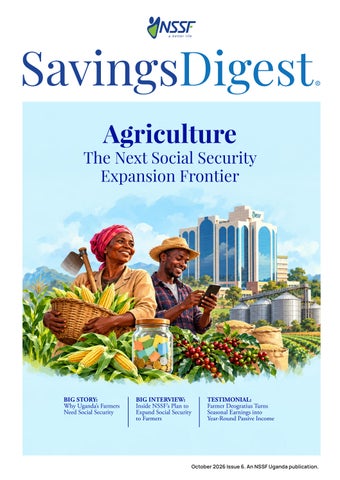
Agriculture
The Next Social Security Expansion Frontier
BIG STORY: Why Uganda’s Farmers Need Social Security
BIG INTERVIEW: Inside NSSF’s Plan to Expand Social Security to Farmers
TESTIMONIAL: Farmer Deogratius Turns Seasonal Earnings into Year-Round Passive Income
October 2026 Issue 6. An NSSF Uganda publication.
3
SavingsDigest - ISSUE 6 - OCTOBER 2026
Contents Big Story
Testimonial
6. Why Uganda’s Farmers
32. Farmer Deogratius Turns Seasonal Earnings into Year-Round Passive Income
Need Social Security Personal Finance
10. From Seasonal
Incomes to Secure Retirements: Solving the Social Security Challenge for Farmers
News
36. Yield Uganda
6
Investment Fund opens doors to catalytic agribusiness funding
16. Key Facts And Figures Big Story
News
17. From the Farm to the
37. Airtel Uganda
Future: Global Approaches to Social Security for Farmers
Hands Over UGX 42.6 Billion Dividend to NSSF
Testimonial
Regional News
22. How Kakira Sugar
39. Ruto Directs NSSF
Limited Is Leading Social Security Inclusion in Agriculture
23 26
Kenya to Pay Retirement Benefits Within 10 Days
33
Big Interview
Regional News
40. NSSF Tanzania
25. Inside NSSF’s Plan to
Reaches 592,791 Informal Workers
Expand Social Security to Farmers
From our Research Desk
30. What Should Worry You and Your Agemates About Retirement
13
18
Editorial continues on next page
Our Office National Social Security Fund Plot 1 Pilkington Road, Workers House, 14th Floor, Kampala
customerservice@nssfug.org Toll Free 0800286773 (Call Center) +256312234400
www.nssfug.org
Follow us
© COPYRIGHT AND CONTENT DISCLAIMER This publication contains a mix of original in-house articles and curated content sourced from external sources. NSSF disclaims responsibility for third-party content and prohibits reproduction of this publication without prior permission, except for brief quotations and non-commercial uses.
4
SavingsDigest - ISSUE 6 - OCTOBER 2026
Editorial
Agriculture: The Next Social Security Expansion Frontier
F
or decades, agriculture has been described as the backbone of Uganda’s economy. The sector remains a major contributor, accounting for approximately 26.2% of gross domestic product, according to the Uganda Bureau of Statistics (UBOS) Labour Market Survey 2025. Its 6.8% growth rate broadly matched the pace of expansion in the wider economy. According to the 2024 National Population and Housing Census, more than 60% of Ugandan households are engaged in crop production, while 37% participate in livestock farming. However, subsistence farming still accounts for a significant share of agricultural activity, at 53%, compared with 17% for commercial agriculture. Agriculture currently accounts for approximately 37.1% of total employment.
Much of the sector relies on informal savings groups that are vulnerable to fraud, against a backdrop of seasonal and volatile incomes. These constraints, however, do not define the sector’s long-term potential.
Despite the sector’s scale and reach, social security coverage remains limited. Only about 1,300 agricultural employers are registered with the Fund, while contributions in the latest financial year were nearly UGX 60 billion from approximately 42,000 workers. Several structural factors underpin this low coverage. Much of the sector relies on informal savings groups that may be vulnerable to fraud, against a backdrop of seasonal and volatile incomes.
Plan, and the proposed Group Savings Plan is expected to broaden access further for agricultural workers and enterprises seeking entry into the formal social security system. Public investment in agriculture is also increasing through higher direct budget allocations. Agro-industrialisation received UGX 2.26 trillion this financial year—the largest allocation to date and an increase from UGX 1.8 trillion in the previous financial year. Targeted interventions—including the Parish Development Model (PDM), the four-acre model, support for agro-processing, and value-addition initiatives—are helping to address persistent supply-side constraints. NSSF’s market-development and market-access interventions, implemented alongside partner initiatives to stimulate demand, could accelerate formalisation, strengthen incomes, and expand the uptake of social security and other regulated savings products. Together, these measures could bring more agricultural employers and workers into the formal social security system.
Victor Karamagi Editor
These constraints, however, do not define the sector’s long-term potential. Several developments could substantially expand social security coverage. Recent social security reforms have removed key regulatory barriers to coverage in the agricultural sector. NSSF can now register employers regardless of workforce size, while sole proprietors and entrepreneurs are also eligible to enrol. Individuals may participate through the NSSF Voluntary Savings
Disclaimer: The information in this edition of the magazine is for general informational and educational purposes only. Readers should consult a qualified financial or investment adviser before making any decisions, as investing involves risk and individual circumstances vary.
5
SavingsDigest - ISSUE 6 - OCTOBER 2026
Editorial Team
Barbra Teddy Arimi
Victor Karamagi
Executive Editor
Editor
Paul Busharizi
Carol Beyanga
Tito Winyi
Consulting Editor
Contributing Editor
Design Editor
Christine Kasemiire
John Ssenkeezi
Julius Businge
Digital Editor
Copy Editor
Ian Namanya Graphics
Lead Writer
Mike Kyeyune Contributor
6
SavingsDigest - ISSUE 6 - OCTOBER 2026
Big Story
Why Uganda’s Farmers Need Social Security Paul Busharizi
Financial Journalist
For most Ugandans, retirement is not a destination. It is a hope.
Yet behind these impressive figures lies an uncomfortable reality. The majority of Uganda’s farmers remain smallholder and subsistence producers. Many live from season to season, harvest to harvest, and sometimes meal to meal.
The civil servant hopes their pension will be paid. The teacher hopes their NSSF savings will be enough. The banker hopes decades of contributions and investments will secure a comfortable old age.
Their concern is often not how they will retire comfortably in 20 years. It is how they will pay school fees next term, buy farm inputs for the next season, or survive a poor harvest.
The farmer, however, often has no such certainty. And yet the farmer is arguably the Ugandan worker who needs social security the most.
This hand-to-mouth existence creates a dangerous vulnerability. If today’s earnings are barely sufficient for today’s needs, the prospect of saving for old age becomes almost impossible.
Agriculture remains one of Uganda’s largest employer, supporting more than 37.1 percent of the population directly or indirectly. It feeds the nation, supplies raw materials to industry and generates billions of dollars in export earnings every year. Coffee alone now earns the country more than $2 billion annually.
That is why Uganda’s conversation about agricultural transformation must expand beyond yields, fertilisers and markets to include a subject we rarely associate with farming: social security.
$2 Billion Coffee earnings annually
Story continues on next page
7
SavingsDigest - ISSUE 6 - OCTOBER 2026
Big Story Farming - a High-Risk Occupation Few professions face as many risks as farming. The first is weather. Across Uganda, farmers are increasingly struggling with unpredictable rainfall patterns. Droughts have become more frequent. Floods are becoming more destructive. Seasons that were once relatively predictable are now increasingly erratic. A coffee farmer in Bushenyi, a maize farmer in Iganga or a cattle keeper in Nakasongola can invest time, money and labour for months only to see a season’s effort destroyed by circumstances beyond their control. The second risk is disease. Crop diseases periodically devastate coffee, bananas and other staple crops. Livestock diseases wipe out herds built over decades. The farmer’s workplace is exposed to nature in all its unpredictability. The third risk is illness and accidents. Unlike formal sector workers, farmers typically have no paid sick leave, or employer-provided insurance or disability benefits. When a farmer falls sick, income often stops immediately. For many rural households, illness is not simply a health challenge. It is a financial crisis.
Success Does Not Guarantee Security Even when weather is in their favour and yields are good, farmers face another problem—prices. Agricultural prices are among the most volatile in the economy. Coffee prices fluctuate on international markets. Maize prices collapse after bumper harvests. Milk prices vary seasonally. Input costs rise unexpectedly. In fact, the irony is that a successful harvest can sometimes reduce a farmer’s earnings. When production rises sharply, prices often fall because supply exceeds demand. In essence, the farmer is working harder and producing more, but
Agricultural prices are among the most volatile in the economy. Coffee prices fluctuate on international markets. Maize prices collapse after bumper harvests.
earning less. This reality creates a cycle of uncertainty that makes long-term planning extremely difficult. Most Ugandan farmers do not earn predictable monthly incomes. Their earnings come in seasonal bursts. Yet their expenses — food, education, healthcare and household needs — occur every day.
When a farmer falls sick, income often stops This mismatch between irregular income and continuous expenditure immediately. keeps many farming households trapped in financial insecurity. For many rural The Retirement Crisis Hidhouseholds, ing in Plain Sight Perhaps the greatest risk facing farmillness is not ers is one we rarely discuss. simply a health Old age. challenge. It Agriculture is physically demanding work. It depends heavily on strength, endurance and mobility. Eventually is a financial every farmer reaches a point where digging, planting, spraying and harcrisis. vesting become increasingly difficult. Story continues on next page
8
SavingsDigest - ISSUE 6 - OCTOBER 2026
Big Story The principle is simple: Save consistently during productive years. Invest those savings. Allow compounding to work over time.
Many elderly farmers find themselves owning land but lacking income.
Traditionally, the extended family acted as Africa’s social security system. Parents raised children who in turn supported them in old age. This arrangement is weakening. Urbanisation has drawn young people away from the villages. Family sizes are shrinking, and economic pressures make it hard for children to support ageing parents. As a result, many elderly farmers find themselves owning land but lacking income. They possess assets but struggle to convert them into regular cash flows. They find that they have spent decades feeding the country yet remain vulnerable to poverty in old age. For a nation whose economy rests on agriculture, this should concern us all.
Why Social Security Matters Social security provides something that farming rarely does: certainty. It enables individuals to convert a portion of today’s earnings into future income. Instead of depending entirely on land sales, family support or continued physical labour, farmers can build financial assets that generate income during retirement.
Traditionally, the extended family acted as Africa’s social security system. Parents raised children who in turn supported them in old age. This arrangement is weakening.
Retire with dignity. This model has transformed lives across the world. There is no reason it cannot work for Uganda’s farmers. Technology has already solved many of the logistical challenges. Mobile money, agency banking and digital payments have extended financial services into rural areas at an unprecedented scale. The challenge now is designing products that match agricultural realities. A coffee farmer does not earn a monthly salary. A dairy farmer earns daily or weekly. A sugarcane farmer receives periodic payments. So social security systems for farmers must accommodate these irregular cash flows.
The Bigger Opportunity: Mobilising Uganda’s Savings The argument for farmer social security is not only about protecting farmers. It is also about transforming Uganda’s economy. Millions of Ugandans save small amounts individually. Those sums appear insignificant in isolation but become powerful when pooled together. Story continues on next page
9
SavingsDigest - ISSUE 6 - OCTOBER 2026
Big Story sector workers. Rwanda has demonstrated how digital technology can dramatically expand financial inclusion. Tanzania has explored mechanisms for extending social protection beyond formal employment. The common lesson is that informal workers can save successfully when products are designed around their realities. Uganda can learn from these experiences while developing solutions suited to its own agricultural economy.
A Matter of Dignity The genius of NSSF was not merely encouraging people to save. It was creating a mechanism that made saving automatic.
The National Social Security Fund offers perhaps the best example. By mobilising contributions from less than a fifth of Uganda’s workforce, NSSF has become one of East Africa’s most powerful institutional investors, managing assets worth tens of trillions of shillings. Those resources have financed infrastructure, deepened capital markets, supported private sector growth and provided retirement security for workers. The lesson is profound. Uganda is not poor because it lacks money. We are poor largely because we struggle to aggregate our resources into pools large enough to finance transformational investments. Now consider the possibilities if the country’s largest workforce — its farmers — were incorporated into a structured savings system. More than 37.1 percent of Ugandans depend on agriculture for their livelihoods. Mobilising even a fraction of their savings would create one of the largest domestic pools of long-term capital in East Africa. Such resources could finance infrastructure, housing, agribusiness, manufacturing and private sector expansion while simultaneously providing retirement security to millions of citizens. The benefits would extend far beyond the individual farmer.
Why Voluntary Saving Will Not Be Enough There is, however, an uncomfortable truth that policymakers must confront. A purely voluntary system is unlikely to succeed, not because farmers are irresponsible, but because human nature and economic realities work against long-term saving. When incomes are uncertain and immediate needs are pressing, retirement savings are often postponed. This is precisely why social security systems around the world rely on compulsory contributions. Formal sector workers save because the system requires them to save. The same principle should apply to agriculture. A small percentage of proceeds from coffee sales, milk deliveries, tea earnings or sugarcane payments could automatically be directed into individual retirement accounts. The deductions need not be large. But they must be consistent. The genius of NSSF was not merely encouraging people to save. It was creating a mechanism that made saving automatic. A farmer-focused social security scheme should borrow that lesson.
Lessons from East Africa Uganda would not be starting from scratch. Kenya has experimented with pension products aimed at informal
At its heart, social security is not simply a financial product. It is a dignity product. The farmer who spends 40 years feeding the nation should not spend old age worrying about the next meal. The woman who plants coffee, bananas or maize throughout her life deserves more than uncertainty in retirement. The cattle keeper who builds herds over decades deserves financial security when age stops him from working as hard. As Uganda seeks to transform agriculture, we should remember that agriculture is ultimately about people, not crops. The true measure of agricultural transformation is not only higher yields or larger exports. It is whether the people who create that wealth can enjoy security, independence and dignity throughout their lives. Extending social security to farmers would help protect them from old age, illness, accidents, climate shocks and volatile markets. But it would do something even bigger. It would enable Uganda to mobilise the savings of the majority of its people and channel them into national development. That would not simply be social protection. It would be one of the most important nation-building projects of our generation.
10
SavingsDigest - ISSUE 6 - OCTOBER 2026
Personal Finance
From Seasonal Incomes to Secure Retirements: Solving the Social Security Challenge for Farmers Paul Busharizi
Financial Journalist
One Saturday morn- A few months later, the money was all ing in 2024, in Kyeused up. izooba Sub-county, Bushenyi District, a Part of it had paid school fees — he coffee farmer in his and his wife had raised six children through coffee farming. Some had late 50s sat under a gone into extending the family home. mango tree counting Much had simply been consumed by relentless demands of daily life. the proceeds from his the Today, he still works his coffee garden harvest. It had been from dawn to dusk because he has no pension, no retirement savings and a good season; their safety net beyond the hope that cooperative paid him no his children will support him when nearly Shs12 million he is too old to do much for himself. — the largest lump His story is not unique. It is the story sum of money he had of millions of Ugandan farmers. ever received. His And it illustrates one of the greatest wife suggested putpolicy challenges—and opportunities—Uganda faces today: how to ting some aside for extend social security services to agriold age. His friends cultural workers, especially those operating in the informal economy. advised him to buy another motorcycle. A local trader encour- aged him to expand his coffee acreage.
More than 37.1% of Ugandans derive their livelihoods directly or indirectly from agriculture.
Story continues on next page
11
SavingsDigest - ISSUE 6 - OCTOBER 2026
Personal Finance The majority of Ugandans remain excluded from this success story. More than 37.1 percent of Ugandans derive their livelihoods directly or indirectly from agriculture. Most are self-employed, seasonal earners operating outside the payroll systems through which social security contributions are traditionally collected. Many are also smallholder and subsistence farmers who live from one harvest to the next, leaving little room for deliberate retirement planning. In effect, Uganda’s largest workforce has the least retirement protection. This is not merely a social welfare issue. It is an economic issue of national importance. If Uganda could successfully mobilise even a fraction of agricultural incomes into long-term savings, the impact on both household welfare and national development would be transformative.
Understanding lenges
the
The National Social Security Fund (NSSF) has grown into one of East Africa’s largest institutional investors. It manages trillions of shillings in assets, finances major infrastructure projects, supports capital markets, and provides retirement savings for millions of workers.
Unlike salaried employees who receive predictable monthly wages, farmers earn irregular incomes. A coffee farmer may receive one or two large payments a year. A maize farmer may wait months between harvests. Dairy farmers experience seasonal fluctuations, while weather shocks can wipe out expected earnings altogether. Traditional pension systems were designed around steady monthly pay-
Yet there is a paradox.
This is an economic issue of national importance.
roll deductions. But agriculture does not operate that way. A second challenge is financial literacy. Many farmers are highly skilled pro-
Chal- ducers but have limited exposure to
The Missing Piece in Ugan- The challenge begins with the nature of agricultural income itself. da’s Social Security System Uganda’s formal social security framework has achieved remarkable success where it has been applied.
Uganda’s largest workforce has the least retirement protection.
concepts such as retirement planning, compound interest or long-term wealth accumulation. This is not irrational behaviour. When school fees are due, a child is sick or farm inputs must be purchased, saving for retirement 20 years away feels like a luxury, and understandably so. Third is geography. Many agricultural workers live in remote areas where access to formal financial services remains limited. Although financial inclusion has improved considerably over the past decade, distance from branches and service centres still discourages participation in formal savings schemes. Then there is trust. Farmers have seen cooperative societies collapse. Some have lost money in failed savings schemes. Others remain sceptical of financial institutions. Convincing them to lock away money for decades requires confidence that their savings will remain secure. Finally, there is the challenge of scale.
Majority of Ugandan’s remain excluded from the success story of NSSF.
Millions of smallholder farmers contribute relatively small amounts. ColStory continues on next page
12
SavingsDigest - ISSUE 6 - OCTOBER 2026
Personal Finance pension contributions. Uganda could build on these experiences by integrating pension deductions directly into agricultural payments. A coffee farmer delivering beans to a cooperative, for example, could have a small percentage of the proceeds automatically transferred into a retirement account before the balance is paid out. The process would resemble PAYE deductions for salaried workers, except that contributions would occur whenever agricultural income is earned rather than every month. Technology makes this possible. The challenge is designing systems that are simple, affordable and trusted by farmers.
The Voluntary Savings Problem
Digital financial services now reach places where banks have never established branches.
lecting and administering those contributions efficiently requires systems capable of operating at a very low cost.
The Technology Opportunity Ironically, one of the biggest challenges — technology penetration — is increasingly becoming part of the solution. Mobile money has penetrated deep into rural Uganda. Digital financial services now reach places where banks have never established branches. Coffee cooperatives, dairy processors, sugar companies and grain aggregators are increasingly digitising payments. This creates an opportunity that barely existed a decade ago. Contributions to retirement accounts can potentially be deducted automatically when farmers receive payments for produce. Rwanda’s Ejo Heza long-term savings scheme already demonstrates how digital platforms can enrol informal workers and accept flexible contributions, while Kenya’s Mbao Pension Plan uses mobile money to make small, low-cost
Purely voluntary systems rarely achieve significant participation among lowincome populations. We prioritise today’s needs over tomorrow’s obligations.
Many policymakers instinctively turn to voluntary savings schemes as the solution. The logic sounds appealing: create a pension product tailored for farmers and allow them to contribute whenever they wish. Unfortunately, evidence from around the world suggests that purely voluntary systems rarely achieve significant participation among low-income populations. Human beings are naturally inclined toward present consumption. Behavioural economists call this “present bias.” We prioritise today’s needs over tomorrow’s obligations. This tendency is especially pronounced when incomes are uncertain. A farmer receiving a seasonal payout may genuinely intend to save for retirement. But between family obligations, social pressures and immediate consumption needs, the money often disappears before savings occur. Uganda already has evidence of this behaviour. Many people understand the importance of saving, yet relatively few save consistently. Expecting millions of farmers to voluntarily contribute substantial amounts to retirement accounts on a regular basis is therefore unrealistic.
Learning from NSSF’s Success NSSF’s greatest innovation is not inStory continues on next page
13
SavingsDigest - ISSUE 6 - OCTOBER 2026
Personal Finance vestment management. It is compulsory saving. Every month, contributions are deducted before workers can spend the money. The system removes the temptation to consume funds intended for the future. Over time, small contributions accumulate into meaningful wealth, and the result has been extraordinary. Savings mobilised from less than one-fifth of Uganda’s workforce have created an institution capable of investing in government securities, real estate, infrastructure and capital markets. NSSF has become a regional financial powerhouse. Imagine the possibilities if similar mechanisms could reach the agricultural sector. The issue is not whether farmers can save. Many already do — through livestock, land acquisition, rotating savings groups or simply keeping cash at home.
Farmers are far more likely to participate in savings programmes introduced through institutions they already know like Cooperatives.
The challenge is channelling those savings into structured systems that provide retirement security while simultaneously mobilising capital for national development.
The Cooperative Advantage Farmer organisations may hold the key. Cooperatives already aggregate production, provide extension services and market produce. They also possess something critical: trust. Farmers are far more likely to participate in savings programmes introduced through institutions they already know. A cooperative-linked social security model could allow deductions at source while giving members visibility into their savings balances through mobile platforms. The cooperative movement once played a central role in mobilising rural savings and investment. A modern version, powered by digital technology, could do so again. Agricultural value chains also pres-
Over time, small contributions accumulate into meaningful wealth, and the result has been extraordinary.
ent an enormous opportunity. When a coffee exporter pays a cooperative, or a dairy processor pays a milk collection centre, an agreed percentage of each farmer’s proceeds could automatically be remitted into that farmer’s retirement account before the remaining balance is paid out. The processor would simply act as a collection agent — much like an employer remits PAYE or NSSF contributions today — while the savings remain the property of the individual farmer. This approach dramatically reduces collection costs while increasing participation.
Beyond Farming: The Agricultural Value Chain It is important to remember that agriculture is not only about farming. It includes transporters, processors, warehouse operators, agro-input dealers, exporters, traders and numerous service providers. As Uganda pushes agro-industrialisation, more people will enter formal segments of agricultural value chains where social security contributions can be collected more easily. This is Story continues on next page
14
SavingsDigest - ISSUE 6 - OCTOBER 2026
Personal Finance must recognise that relying entirely on voluntary participation is unlikely to achieve the desired scale. The goal should be to create mechanisms that make saving automatic whenever agricultural income is earned. Just as formal workers contribute to social security before spending their salaries, farmers should have opportunities — and perhaps obligations — to save a small percentage of every harvest payment before consumption begins. The principle is not punishment. Collectively, millions of small savings become powerful pools of capital capable of financing roads, factories, power plants and industries.
encouraging because it naturally expands the pool of contributors. Yet it also highlights the central challenge: the farmer remains the most difficult person to reach. Many farmers are informal producers operating at subsistence level and living largely hand-to-mouth. They have limited surplus income and face constant vulnerability to weather shocks, fluctuating prices and household emergencies. Any social security solution that ignores this reality is unlikely to succeed.
come powerful pools of capital capable of financing roads, factories, power plants and industries. NSSF has already demonstrated this principle. By aggregating contributions from less than one-fifth of Uganda’s workforce, it has become one of East Africa’s largest institutional investors. Extending it to agriculture could become one of Uganda’s most transformative economic reforms.
The farmer under the mango tree may not think much about retirement when the harvest money arrives. Few of us do. But the purpose of public policy is not merely to accommodate human behaviour. It is to help people achieve outcomes they would struggle to achieve on their own. Uganda has already demonstrated through NSSF that disciplined savings can transform individual lives and national fortunes.
Few policy interventions offer such a powerful double dividend.
The next frontier is taking that lesson from the payroll to the garden.
The case for agricultural social security extends far beyond retirement security.
Success will require a different mindset from conventional pension design.
At the household level, it reduces vulnerability. Older farmers with retirement savings are less dependent on children and relatives. Families can invest more confidently knowing that future support obligations are reduced.
First, products must accommodate seasonal incomes rather than monthly contributions.
One of the reasons poor countries remain poor is not necessarily because they lack resources, but because they fail to aggregate them. Individually, households save very little. Collectively, millions of small savings be-
Protection against old-age poverty, against economic vulnerability and against the all-too-human tendency to sacrifice tomorrow for today.
The resulting savings pool could finance infrastructure, housing, industrialisation, agro-processing and agricultural transformation itself.
Why This Matters Beyond Retirement The Way Forward
At the community level, savings pools provide resources that can be invested productively. At the national level, the implications are even greater.
It is protection.
Second, technology must make participation simple and inexpensive. Third, financial literacy campaigns must help farmers understand the benefits of long-term saving. Fourth, partnerships among government, financial institutions, cooperatives and agribusinesses will be essential. Most
importantly,
policymakers
If we succeed, the greatest beneficiaries will not only be farmers. It will be the entire economy.
15
SavingsDigest - ISSUE 6 - OCTOBER 2026
16
SavingsDigest - ISSUE 6 - OCTOBER 2026
Key Facts & Figures Agriculture Sector FY 2025-26
Number of Agriculture Sector Employers
Agriculture Sector NSSF Collections
USh
1,236
56.8 Billion
Contribution to GDP:
Ugandans employed in Agriculture:
26.2% 37.1%
Agro-industrialisation 2026/27 budget allocation:
USh
2 . 2 6 Trillion
(2.7%) of total budget
Top agriculture export:
C o ff e e
Agriculture contribution to total tax:
1.63%
Coffee export earnings, 12 months to March 2026:
USD
2 . 46 billion
Sources: Ministry of Finance and Economic Planning National Budget Speech 2026/27 Uganda Revenue Authority Annual Data Book 2024/25
Leading coffee export destination:
Italy
17
SavingsDigest - ISSUE 6 - OCTOBER 2026
Big Story
From the Farm to the Future: Global Approaches to Social Security for Farmers Paul Busharizi
Financial Journalist
Agricultural workers have historically been among the least protected members of the society.
Agriculture does not fit neatly into They live largely from one harvest to When most people that model. the next, selling only modest surplusthink about social es after meeting household needs. immediate concern is rarely security, they picture Farmers are largely self-employed. Their Their incomes fluctuate with seasons, retirement 20 or 30 years away. It office workers, teach- weather patterns, commodity pric- is finding enough money for school ers, bankers and civil es and harvest cycles. Many operate fees, farm inputs or a medical emerformal payroll systems alto- gency. That hand-to-mouth existence servants contributing outside gether. As a result, agricultural work- makes voluntary long-term saving exa portion of their sala- ers have historically been among the traordinarily difficult and leaves milleast protected members of society, lions vulnerable to poverty in old age. ries every month tooften spending a lifetime feeding the wards retirement. nation only to face old age without There are several countries that That is hardly surprising. Most social security systems around the world were designed around formal employment, where employers deduct contributions from salaries and remit them to pension funds.
pensions, health insurance or income security.
For Uganda, this is not a marginal policy issue. It is a national economic challenge. More than 37.1 percent of Ugandans derive their livelihoods directly or indirectly from agriculture. Yet the overwhelming majority are smallholder and subsistence farmers.
have found ways to overcome this challenge. Brazil, Poland, Rwanda, Kenya, Ghana and India have all experimented with extending social security coverage to farmers and informal workers. Their experiences offer important lessons for Uganda as it considers how to provide retirement security to the majority of its population. Story continues on next page
18
SavingsDigest - ISSUE 6 - OCTOBER 2026
Big Story The stakes are much bigger than pensions. Done correctly, social security for agricultural workers could become one of the most important economic reforms of the next generation.
of the largest and most stable sources of household income, improving nutrition, keeping grandchildren in school and sustaining local businesses during periods when farm incomes were low or unpredictable.
fit into systems designed for urban workers.
ly a welfare programme. It is an economic development tool capable of reducing poverty while strengthening rural economies.
In Rwanda, the Ejo Heza long-term savings scheme uses digital enrolment, flexible contributions and government incentives to attract informal-sector workers. The programme has achieved impressive enrolment figures and demonstrated how technology can lower barriers to participation. Its challenge remains contribution consistency, as many low-income participants struggle to save regularly.
Brazil: Social Security as Ru- Brazil demonstrated an important ral Development principle: social security is not mere-
Poland: Adapting to Agricultural Realities
Lessons from Africa and Asia Other countries have experimented with contributory schemes aimed at informal workers and farmers.
Photo Credit: www.isglobal.org
Brazil’s experience is perhaps the most ambitious. Before the 1980s, social security coverage was largely concentrated among urban workers. The country’s 1988 Constitution dramatically expanded protection to rural populations, including smallholder farmers, fishermen and other agricultural workers. Rather than attempting to fit farmers into a conventional payroll-based pension system, Brazil’s Rural Social Insurance Programme recognised the realities of agricultural livelihoods. Eligibility was based primarily on proof of participation in agricultural activity rather than monthly payroll contributions. The scheme is financed through a combination of general taxation and levies on agricultural production, acknowledging that most farmers earn seasonally rather than through regular monthly salaries. Millions of rural households consequently gained access to old-age pensions and income security. The results were remarkable. Today, Brazil’s rural pension programme reaches more than nine million beneficiaries and has been credited with significantly reducing rural poverty and inequality. In many municipalities, pension payments became one
Photo Credit: www.bonduelle.com
Poland took a different route. Recognising that farming differs fundamentally from salaried employment, it established the Agricultural Social Insurance Fund (KRUS), a dedicated institution serving farmers separately from the general social security system. KRUS is financed through farmer contributions complemented by government support and provides pensions, disability benefits, accident insurance and survivor benefits through a framework designed specifically for agricultural households.
Photo Credit: Rwanda Social Security Board Official
Kenya’s Mbao Pension Plan was designed around a simple idea: allow informal workers to contribute very small amounts through mobile money. The scheme proved that technology can dramatically reduce transaction costs, but it also highlighted the limits of voluntary participation. Many contributors save irregularly because competing household needs take priority.
The rationale was straightforward. Farmers earn seasonally rather than monthly, which means their incomes fluctuate significantly while family labour and ownership are often intertwined. A standard payroll-based pension model would therefore have excluded much of the rural population. Poland’s experience highlights an important lesson: social security systems must adapt to the realities of agriculture rather than expecting farmers to Story continues on next page
19
SavingsDigest - ISSUE 6 - OCTOBER 2026
Big Story Ghana has relied on community-based structures and digital platforms to expand pension coverage among informal workers. The lesson from Ghana is that trust matters as much as technology. People are more likely to participate when they understand the scheme and trust those administering it.
Photo Credit: www.m-kopa.com
India has expanded coverage through contributory pension schemes supported by government co-contributions. These incentives have boosted enrolment but have also raised questions about long-term fiscal sustainability. Taken together, these experiences reveal a common lesson. Voluntary participation alone rarely achieves mass coverage. When incomes are irregular and immediate needs are pressing, retirement savings are almost always postponed. School fees come first. Food comes first.
Agriculture is Bigger Than But it still leaves one critical challenge unresolved. Farming One important point often gets overlooked. Agriculture is not merely farming; it is an entire economic ecosystem stretching from the farm to the consumer’s table. It includes input suppliers, agro-dealers, transporters, warehouse operators, processors, exporters, retailers, financiers, insurers and numerous service providers.
The farmer.
The Smallholder Challenge Uganda’s agricultural sector remains dominated by smallholders, many of whom are subsistence producers.
As economies develop, fewer people work directly on farms while more find employment in activities linked to agriculture.
They may sell coffee once or twice a year, deliver milk daily but in small quantities, or grow maize, beans, cassava or bananas primarily for household consumption and sell only occasional surpluses.
This process — agro-industrialisation — is one of the most powerful drivers of economic transformation.
These farmers rarely receive regular salaries, maintain formal payroll records or enjoy predictable cash flows.
A worker in a dairy processing plant, coffee hulling factory, grain mill, logistics company, export warehouse or agro-processing facility can easily be brought into the social security system through conventional payroll deductions.
This creates the central policy challenge: how do you bring into the social security system people whose economic lives are largely informal?
In many respects, agro-industrialisation is itself a social security strategy. The more value addition Uganda undertakes domestically, the more workers naturally move into formal employment and become contributors to existing pension schemes. This is one more reason Uganda should aggressively pursue agro-industrialisation. It creates jobs, raises incomes, broadens the tax base and expands social security coverage simultaneously.
The answer lies in recognising that the collection mechanism must follow the farmer’s income stream. Rather than expecting farmers to make monthly pension contributions voluntarily, contributions can be linked directly to agricultural transactions. Coffee farmers can contribute when they sell coffee. Milk producers can contribute through dairy collection centres. Tea growers can contribute through factory deliveries. Sugarcane farmers can contribute through mill payments. Livestock producers can contribute through formal livestock markets and abattoirs.
Medical bills come first. Farm inputs come first. Retirement problem.
becomes
tomorrow’s
That is why the world’s most successful pension systems rely heavily on automatic deductions or mandatory contributions.
Uganda needs a dedicated approach tailored to agricultural realities - one built around farmer contributions, integrated into agricultural transactions and designed to minimise dependence on the Treasury. Story continues on next page
20
SavingsDigest - ISSUE 6 - OCTOBER 2026
Big Story Commodity buyers, cooperatives, processors, exporters and digital payment platforms can become collection agents. In effect, social security contributions become integrated into agricultural value chains. The product follows the farmer’s money.
Why Farmer Contributions Matter Whenever discussions about extending social security arise, there is a natural temptation to look towards the Treasury for funding. That would be a mistake. The long-term success of social security systems around the world rests on a simple principle: contributors largely fund their own benefits. This principle is particularly important in Uganda. Governments change. Fiscal priorities shift. Economic crises emerge. Budget pressures intensify. In the end, a pension system heavily dependent on Treasury transfers eventually becomes vulnerable to politics and fiscal constraints. A contributor-funded model offers a more durable alternative.
Farmers need systems that make saving automatic, regular and sustainable.
Most importantly, it mobilises longterm savings for investment and national development. Uganda’s National Social Security Fund provides perhaps the best example. By mobilising mandatory savings from less than one-fifth of the country’s workforce, NSSF has become one of East Africa’s largest institutional investors, financing government securities, supporting capital markets, investing in real estate and strengthening financial stability. Now imagine applying the same principle to agriculture.
When farmers contribute towards their own retirement, they develop ownership of the system. Their savings accumulate and are invested. Investment returns strengthen the fund over time.
More than 37.1 percent of Ugandans derive their livelihoods from agriculture and related activities. Mobilising even modest contributions from this segment would create one of the largest pools of domestic capital in East Africa.
The government still has an important role to play by providing regulation, oversight, consumer protection and targeted incentives during the early years. But it should not become the primary financier.
Those savings could finance infrastructure, agro-industrialisation, housing, manufacturing and private enterprise while simultaneously providing retirement security to millions of farming households.
Together, they point towards a common conclusion; farmers need more than encouragement to save. They need systems that make saving automatic, regular and sustainable. For Uganda, the solution lies in combining agro-industrialisation with value-chain-based pension contributions. Agro-industrialisation will naturally bring more workers into formal employment. But millions of smallholder farmers will remain outside conventional pension arrangements for years to come. That is why Uganda needs a dedicated approach tailored to agricultural realities — one built around farmer contributions, integrated into agricultural transactions and designed to minimise dependence on the Treasury. If Uganda gets this right, the benefits will extend far beyond retirement security. It will create a culture of longterm saving among the majority of the population, mobilise vast pools of domestic capital and bring the country’s largest economic sector into the heart of its financial system.
The Bigger Prize
A Reform Whose Time Has That would not simply transform retirement security. Come The debate about social security for farmers is often framed narrowly as a retirement issue. That misses the bigger opportunity. Social security protects people from poverty in old age. It builds resilience against illness and economic shocks.
The experiences of Brazil and Poland demonstrate that farmers can be successfully incorporated into social security systems. Rwanda, Kenya, Ghana and India show both the promise and the limitations of contributory schemes aimed at informal workers.
It would help transform Uganda itself.
21
SavingsDigest - ISSUE 6 - OCTOBER 2026
22
SavingsDigest - ISSUE 6 - OCTOBER 2026
Testimonial
How Kakira Sugar Limited Is Leading Social Security Inclusion in Agriculture Julius Businge
Financial Journalist
Photo Credit: kakirasugar.com
Kakira Sugar Limited has more than 13,225 workers enrolled and making monthly contributions to NSSF.
into employment, work- dictable. Uganda’s agricultural integrated force welfare and long-term business sector employs 37.1% sustainability. “Kakira Sugar Limited is the largest employer in the country and thereof the total working With more than 13,225 employees fore one of the largest contributors population. It remains enrolled with the National Social to NSSF. Our people are our number Security Fund (NSSF) and month- one asset. It is not only about busione of the country’s contributions ranging between ness; it is about ensuring that those most important eco- lyShs700 million and Shs800 million, who contribute to our success are Kakira Sugar Limited stands out as protected even beyond their working nomic pillars. Yet despite its significance, many workers in the sector still lack access to formal social security, leaving them vulnerable in retirement and during periods of economic uncertainty. At Kakira Sugar Limited, one of Uganda’s largest agribusinesses, social security is viewed not as a statutory obligation but as a critical investment in people. The company has built a culture where saving for the future is
one of the country’s leading contributors to social security and a powerful example of how agricultural enterprises can safeguard the future of their workers. According to Susan N. Mataka, who until recently was the Human Resources Manager at Kakira Sugar Limited, social security is an essential component of responsible employment, particularly in sectors such as agriculture where work can often be seasonal and income patterns unpre-
lives,” she said.
Beyond agriculture Kakira Sugar’s operations demonstrate the evolving nature of modern agriculture. While many people associate the company solely with sugarcane growing, its business extends beyond farming. Story continues on next page
23
SavingsDigest - ISSUE 6 - OCTOBER 2026
Testimonial Kakira has expanded into green energy generation, producing 52 megawatts of electricity from bagasse, a by-product of sugarcane processing. The company also produces molasses, extra neutral alcohol, spirits and confectionery products. Its spirits have gained international recognition and are exported to markets including the United Kingdom and the United States. Beyond its direct workforce, Kakira supports approximately 8,000 outgrower farmers who supply sugarcane to the company, creating an extensive agricultural ecosystem that supports livelihoods across eastern Uganda. This combination of agriculture, manufacturing and value addition has enabled the company to maintain a large and stable workforce while demonstrating how agribusiness can contribute to national development.
Culture of saving Long before social security became a major national conversation, Kakira had already embedded a savings culture within its workforce. Mataka explained that the company has historically encouraged employees to save through cooperatives, gratuity arrangements and other internal mechanisms designed to support financial security. “This company has always encouraged saving. Even before many modern systems existed, there was already a cooperative structure helping workers develop a culture of saving,” she said. Today, that culture is reinforced through mandatory NSSF contributions and continuous financial literacy programmes. Every October, the company dedicates time specifically to employee development and financial wellness. Workers receive training on personal financial management and how to maximise their NSSF benefits. The objective is not merely to prepare employees for retirement but to help them build sustainable financial futures while they are still actively employed.
Kakira supports approximately 8,000 outgrower farmers who supply sugarcane to the company.
“The company conducts conversations on financial literacy, financial management, early retirement planning and how employees can prepare themselves to continue earning even after they leave formal employment,” Mataka explained. These programmes have helped workers appreciate the importance of saving consistently and planning for life beyond active employment.
Workers benefit The benefits of social security have extended beyond compliance. According to Mataka, one of the most visible outcomes has been employee retention. Many workers joining Kakira from other organisations are often surprised to discover that their social security contributions are consistently remitted and that the company places significant emphasis on retirement planning. The result has been workforce stability. “Ninety-nine percent of our people do not resign and leave. Employees feel secure because they know their future is being protected,” she said. The company currently has hundreds
of employees who have worked well beyond the conventional retirement age, demonstrating strong employee loyalty and long-term commitment. Former employees also frequently express appreciation after accessing their NSSF benefits, Mataka says, adding that many return to thank the company for consistently contributing throughout their careers, often acknowledging that those savings have enabled them to establish businesses, support families and maintain financial independence in retirement. “They tell us, ‘At least for you, people paid for me.’ When they eventually access their savings, they appreciate the value of what was contributed over the years,” Mataka said.
Kakira Sugar Limited is one of the largest employers in the country and therefore one of the largest contributors to NSSF. Story continues on next page
24
SavingsDigest - ISSUE 6 - OCTOBER 2026
Testimonial “Of course, many people are still unaware of NSSF Smartlife Flexi, so the Fund should continue creating awareness about the product to increase its uptake,” Mataka said. “If they cannot manage the traditional contribution structure, then they should encourage workers to save through Smartlife Flexi. Even small amounts saved consistently can make a difference over time,” she said. Her message is important even for those not in large agricultural enterprises. Whether employing workers on farms, plantations, estates or even in households, employers have an opportunity to contribute to the financial security of those who help build their businesses.
Photo Credit: kakirasugar.com
Sector leadership
“I do it even for my maid,” Mataka said. “Anyone employing another person should think about saving for them.”
As NSSF intensifies efforts to expand social security coverage across Uganda’s agricultural sector, Kakira’s experience offers valuable lessons for employers and workers alike.
As Uganda seeks to deepen social security coverage and extend protection to both formal and informal workers, agriculture represents one of the greatest opportunities for growth.
Agriculture often presents unique challenges. Seasonal employment arrangements, casual labour and fluctuating production cycles can make social security planning more complex than in other sectors.
Kakira Sugar’s experience demonstrates that social security and agricultural productivity are not competing priorities. Rather, they are complementary investments that strengthen businesses, protect workers and contribute to national development.
Kakira Sugar Limited is praised for providing a conducive work environment.
Moses Wesonga, a Mechanical Supervisor at Kakira Sugar Limited, says the company provides a conducive working environment and good employment conditions. Wesonga, who has worked at Kakira since 2006, says the company has consistently remitted his National Social Security Fund (NSSF) contributions, with the employer contributing 10% of his salary and he contributing the mandatory 5%. “I would like to see salaries increased so that my NSSF savings can grow while also enabling me to meet my day-to-day needs,” he says. Beyond the mandatory NSSF contributions, Wesonga says he is willing to save more voluntarily with the Fund, provided the terms and conditions are clearly explained and products such as SmartLife are introduced in a way that employees can easily understand. He also says he would be willing to continue making voluntary contributions to NSSF after retirement if the annual interest earned remains attractive. The increasing use of digital platforms such as the NSSF mobile app has also made it easier for members to access services, track contributions and process benefits, further strengthening confidence in the system.
However, Mataka believes these challenges should not be used as an excuse for non-compliance. “It starts with planning,” she said. “If you know the workforce you require and the duration they will be engaged, then social security contributions should form part of your budgeting process from the beginning.” She argued that employers who invest in social security create more stable, productive and loyal workforces while helping employees secure their futures. For employers who may find it difficult to implement traditional contribution arrangements, she encouraged consideration of voluntary savings options such as NSSF Smartlife Flexi.
By enrolling all its employees in NSSF, maintaining full compliance, and fostering a culture of long-term saving, Kakira Sugar has shown what is possible when employers place people at the centre of their business strategy. For the wider agricultural sector, the message is clear — growing crops is important, but securing the future of the people who grow them is equally essential.
25
SavingsDigest - ISSUE 6 - OCTOBER 2026
Big Interview
Inside NSSF’s Plan to Expand Social Security to Farmers Although agriculture employs 37.1% of Uganda’s population, its contribution to formal savings remains disproportionately low. NSSF’s Chief Strategy and Performance officer, Alex Rumanyika shares the innovative solutions that the Fund is rolling out, aimed at making saving more accessible, affordable and practical for farmers. Julius Businge
Financial Journalist
1. The agriculture sector is one of the biggest employers of people in Uganda. But does that number trickle down to their contributions and add to the savings culture? Indeed, the agriculture sector employs 37.1% of the country’s population, but contribution to formal savings remain disproportionately low. 2. What challenges have you identified among farmers when it comes to saving for their future? Farmers are faced with a host of challenges which affect their income inflows, hence their ability to save. The first major issue that needs to be addressed is their high dependence on rain-fed agriculture. The second major issue is to avail technical expertise to enable the farmers increase their productivity. Then there is the unaffordable cost of inputs and cash constraints the farmers face prior to harvest season. 3. How is NSSF trying to address these challenges? We are taking a multi-faceted approach to this; first was the introduction of the SmartLife Flexi savings option. It is a brilliant initiative because it introduced mainstream investment products to what we commonly refer
NSSF is taking a multi-facted approach including digitalisation to tackle social security for farmers.
to as the informal sector. Majority of Unit Trust products to-date require a minimum investment of UGX 100,000. The same is true if you want to invest in bonds. Smartlife Flexi broke this threshold by bringing the minimum saving amount to UGX 500. In many ways this was analogous to how Yunus Grameen pioneered micro-finance banking, which targeted the lowest earning farmers in Bangladesh with flexible credit that was tailored to their micro-businesses. With 80% of smallholder farmers earning UGX 1 million or less per year, persuading them to invest UGX 100,000 of that would be a tall order. Smartlife Flexi can be tailored to help them progressively build the liquidity to graduate into higher-earning opportunities.
With 80% of smallholder farmers earning UGX 1 million or less per year, persuading them to invest UGX 100,000 of that would be a tall order. Story continues on next page
26
SavingsDigest - ISSUE 6 - OCTOBER 2026
Big Interview
“
Farmers need an integrated intervention that seamlessly enables them to access all necessary services in one platform whether its inputs like fertilizer or even credit to pay school fees. These should be linked to his or her expected earnings via the assured market that NAMCO offers. Alex Rumanyika Chief Strategy and Performance Officer,NSSF
Story continues on next page
27
SavingsDigest - ISSUE 6 - OCTOBER 2026
Big Interview 6. These are wonderful initiatives. How does NSSF plan to extend these services not only to urban areas, but also the rural underserved areas across the country?
Farming Technical Assistants (FTAs) have an engagement model with the farmers where they are encouraged to save voluntarily on top of the automated deductions.
4. But even with a minimum threshold, farmers have irregular incomes. How does the SmartLife Flexi model enable farmers and informal workers to save consistently despite seasonal earnings? We have worked within the lifestyle of the farmers to integrate Smartlife Flexi savings seamlessly from their earnings. The farmers largely face two major problems. Liquidity to purchase farming inputs and survive in the pre-harvest season, and certainty that their harvest will be purchased at a fair price. With the pilot we have done, we attempted to solve these problems by strategically partnering with a large-scale off-taker to: a. Train the farmers to practice more sustainable agronomy – which increases their harvest quality and productivity (which leads to better earnings) b. Integrate financial literacy training into the training curriculum to explain the benefits of savings (and saving with Smartlife Flexi) c. Automate the savings deductions from the payments to the farmers at source via a simple formula (e.g. UGX 20 per kilo for maize last season)
d. Through the farming technical assistants (FTAs), we have created an engagement model with the farmers where they are encouraged to save voluntarily on top of the automated deductions.
Partnerships are at the core of how we conduct business. NSSF services are available across different agent points thanks to our partnerships with third parties. Agent banking has become ubiquitous in Uganda. One can perform pretty much every type of banking transaction with an agent as they would in a bank branch. To date, we have 20,000 agents deployed in the field to support with onboarding people to Smartlife Flexi. To this extent, agents have eased the cost of access to financial services across Uganda. By integrating our saving products into some of the credit and telco products, agents will accelerate the uptake of pension products in under served areas of Uganda. We are piloting these integrated saving models with key partners in the telco and banking sectors and are hopeful that the market will be receptive towards them.
5. Are there solutions for farmer communities to build a saving culture collectively? Farmers are increasingly organized in village loan and saving associations (VLSAs) and/or saving and credit cooperatives (SACCOs). These membership-based organizations enable farmers access services and financial products that would not easily be accessible to them if they transacted individually. We have a Smartlife Group savings model which simplifies the registration process of the members of these groups via a bulk registration capability. But it also simplifies the role of the group administrators to track the progress of savings as a group as well as nuances such as particular individuals that may be falling behind.
With our partner, Asili Farms, we have integrated financial literacy training into their agronomy academy which is now accessed by close to 10,000 farmers Story continues on next page
28
SavingsDigest - ISSUE 6 - OCTOBER 2026
Big Interview
7. With mobile money now widely used by farmers and informal workers, how has NSSF integrated mobile money channels to make saving more accessible and convenient? The NSSF purpose speaks to this. To make life better through saving as a lifestyle. Rather than reinventing the wheel, we have simply integrated a flexible saving solution into existing lifestyle services. The two largest channels enabling access to Smartlife today are MTN’s Mobile Money, Flexi-pay by Stanbic and Airtel Money. These channels are used to replenish the saving accounts of our members and withdraw funds. We have also simplified saving by enabling automated and scheduled deductions from both bank and telcos. 8. NSSF has plans for creating the National Marketing Company. What is the progress and how is NAMCO expected to support farmers? NAMCO is expected to provide market access guarantees to farmers. If we take maize as an example, the farmers face a myriad of challenges. To begin with, when they plant their maize they do so with an earning expectation in mind. However, the market tends to behave in such a way that at the peak harvest season where there is a glut, prices fall considerably. The logical thing to do is to wait for the prices to match the expectations at the beginning of the season, but the farmers lack storage facilities. In the pilot we have conducted, our off-take partner offers the farmer guaranteed storage supported by a voucher that certifies the quantity and quality of
maize delivered. The farmer gets regular updates on price movements and can choose to liquidate the voucher once the price in the market matches his/her expectations. This service, which is called “storage-as-a-service” or saas, gives workers more certainty over their earnings and is slowly addressing unethical exploitation by middlemen. It is still very early days in terms of availing a comprehensive solution to the agricultural workers. For now, NAMCO is offering the assured market, assurance that the harvest will be bought and a savings platform for the farmer. Farmers need an integrated intervention that seamlessly enables them to access all necessary services in one platform whether its inputs like fertilizer or even credit to pay school fees. These should be linked to his expected earnings via the assured market that NAMCO offers. We will continue to build additional services and products into a comprehensive ecosystem for the farmers.
financial literacy training into their agronomy academy which is now accessed by close to 10,000 farmers organized as VLSAs and/or SACCOs. This model can be replicated across other agricultural value chains.
9. How many agricultural workers has NSSF targeted through SmartLife Flexi, and what growth milestones does the Fund hope to achieve with this initiative?
a. Crowdfund assets: where members can pool resources to access land, tools and resources b. Monitor progress of the farm c. Enable access to markets d. Simplify accounting and payments e. Automate savings from earnings
We are very much in the dawn of the NAMCO journey. The pilot started just two months ago and to-date we have right around 1,000 farmers that have saved with Smartlife Flexi, with a combined saving of about UGX 15M. The goal of the pilot was to secure at least 1,000 farmers saving on the platform, which has been achieved. As the January season beckons, we plan to scale up the intervention. 10. How does NSSF ensure that small contributions, such as Ugx 500 per transaction, can translate into meaningful long-term financial security for members? The major problem that we need to address is access to reliable markets. We need to integrate this with deliberate efforts to build the capacity of small-holder farmers to serve these markets with the right quality and quantity consistently. With our partner, Asili Farms, we have integrated
11. What is NSSF’s long-term vision for using digital platforms, group savings models, and market linkages to transform savings among Uganda’s agricultural workforce? Our Vision is to transform agriculture into a mainstream investment and enterprise opportunity in Uganda. Digital technologies have given the lower-earning segments of our society the opportunity to invest in mainstream financial assets like bonds and public equities. The same can happen to agriculture. Agriculture is a high-yielding investment where technology can intervene to:
29
SavingsDigest - ISSUE 6 - OCTOBER 2026
30
SavingsDigest - ISSUE 6 - OCTOBER 2026
From our Research Desk
What Should Worry You and Your Agemates About Retirement Mike Kyeyune
Product Development Analyst
Talk openly with your family about financial responsibilities. Planning can help prevent unexpected demands from repeatedly derailing your savings.
Imagine waking up one morning feeling unwell, visiting a hospital and being asked to pay for treatment you had not budgeted for. Now imagine facing that bill when you have no health insurance and your savings are already stretched by rent, school fees and family responsibilities.
For many Ugandans, this is more than a frightening thought. It is a reminder of how quickly an unexpected illness can disrupt financial plans, including plans for retirement. Findings from a study of members needs undertaken by the Fund in May 2026 reveals an interesting picture of what different generations worry about when it comes to social security. Notably, 47% of respondents reportedly do not have health insurance cover, even as healthcare ranks among their leading social security concerns. This points to a potential gap between people’s need for protection and the cover they currently have. The concern cuts across generations, although priorities differ with age.
78%
The percentage of respondents who relied mainly on one source of income.
47%
The percentage of respondents who do not have health insurance cover.
Story continues on next page
31
SavingsDigest - ISSUE 6 - OCTOBER 2026
From our Research Desk So, what does this mean for you and your agemates? Retirement planning is not just about how much money you will need when you stop working; it is also about protecting yourself against unexpected events that could drain your savings long before retirement arrives. Immediate financial pressures cannot be ignored. Members’ social security priorities also need to be understood within the context of their everyday financial pressures.
When respondents were asked about their biggest financial challenges, school fees emerged highest at 24%, while housing and starting or expanding a business were each cited by 20%. Daily household expenses accounted for a further 13%. These pressures become even more significant when considered alongside household income patterns. 78% of respondents reported relying mainly on one source of income, with only 22% having another regular source of income apart from their salary or main business.
Biggest financial challenges currently faced Many Gen Zs are still finding their footing in the job market, building businesses or starting careers, with retirement seemingly decades away.
For Gen Z, aged 30 and below, healthcare ranks as the top social security need, followed by unemployment support and old-age income security. Many are still finding their footing in the job market, building businesses or starting careers. With retirement seemingly decades away, healthcare and the fear of losing income can feel more immediate than saving for old age. For Millennials aged 30 to 45, unemployment support takes the lead, with healthcare coming second. This is often the stage of life when responsibilities pile up: school fees, rent or mortgage payments, loans and support for relatives. Losing a job can affect not just one person but an entire household. Gen X, aged 41 to 60, also ranks unemployment support first and healthcare second. Many in this group may be approaching retirement while still supporting children and ageing parents. They face the challenge of preparing for a future without a regular salary while meeting today’s financial demands. For Baby Boomers aged above 60, healthcare ranks first, followed by family support and old-age income security. As people grow older, medical needs may become more pressing, while earning opportunities can become limited. Without adequate savings or insurance, healthcare expenses can threaten the financial security they worked for over many years.
If you fell ill or lost your income tomorrow, would your finances withstand the shock?
This means that for many households, an illness, job loss or business slowdown could quickly disrupt their finances, making it harder to meet daily expenses and save for the future. That is why preparing for retirement should start long before you leave the workforce. Understand your NSSF benefits, set aside money for emergencies, explore affordable health insurance options and build a consistent saving habit, even if you can only start small. Where possible, consider developing an additional source of income to cushion yourself against unexpected financial shocks. After all, whether you are 25 or 65, the question remains the same: If you fell ill or lost your income tomorrow, would your finances withstand the shock? Finally, talk openly with your family about financial responsibilities. Planning for school fees, supporting relatives and preparing for emergencies can help prevent unexpected demands from repeatedly derailing your savings.
32
SavingsDigest - ISSUE 6 - OCTOBER 2026
Testimonial
Farmer Deogratius Turns Seasonal Earnings into Year-Round Passive Income Julius Businge
Financial Journalist
Mbabazi is now using NSSF Smartlife Flexi to continue growing his savings and securing his family’s future.
For many Ugandan farmers, the focus is often on the next planting season, the next harvest, or the next market day. Retirement planning rarely features prominently in conversations around agriculture, especially among smallholder farmers whose incomes fluctuate with weather patterns and market prices.
Yet for Deogratius Mijumbi Mbabazi, a 69-year-old farmer from Butema Parish in Buhanika Sub-county, Hoima District, planning for the future has become just as important as tending to his crops. After decades in formal employment and years of building a diversified farming enterprise, Mbabazi is now using NSSF Smartlife Flexi to continue growing his savings and securing his family’s future.
Roots in farming Mbabazi is a husband, father of five children and a retired economist whose life has combined public service and farming. His agricultural activities are as diverse as they are productive. On his farm in Hoima, he grows coffee on
UGX
500k Deogratius’ initial contribution to Smartlife Flexi
Story continues on next page
33
SavingsDigest - ISSUE 6 - OCTOBER 2026
Testimonial
“
People should not wait until they stop working to think about their future Deogratius Mijumbi Mbabazi
Farmer
Story continues on next page
34
SavingsDigest - ISSUE 6 - OCTOBER 2026
Testimonial
Mbabazi’s agricultural activities are as diverse as they are productive.
two acres, keeps 30 beehives for honey production, rears goats, chickens and pigs, and cultivates maize, bananas, mangoes, avocados and jackfruit, among other seasonal crops. He also keeps cattle that supplement household income through milk production and livestock sales. Although farming now occupies much of his time, Mbabazi spent decades in formal employment. He began his career in June 1975 with the then East African Posts and Telecommunications Corporation before serving under various successor entities, including Uganda Telecom Limited. Along the way, he studied and acquired a degree in Economics and Political Science, and later undertook professional training in project management. Like many workers of his generation, he contributed to retirement savings schemes throughout his employment and eventually benefited from NSSF when he retired. “When I got my payout, I built this house and made other investments. It helped me a lot. Establishing myself here was built on that foundation,” he says.
Discovering Smartlife Although Mbabazi had heard about NSSF’s voluntary savings products
through newspapers and public awareness campaigns, he did not immediately enroll after retirement. That changed in October last year (2025) when he met NSSF staff at an exhibition at Bulindi Zonal Agricultural Research and Development Institute (BuZARDI). Out of curiosity, he approached the team to learn more about Smartlife Flexi, NSSF’s voluntary savings product designed for self-employed workers, farmers, entrepreneurs and others outside mandatory social security arrangements. “I told them I wanted to join,” he recalls. With guidance from an NSSF staff member named Miriam, Mbabazi completed the registration process and began his voluntary savings journey. He started modestly, making an initial contribution of Shs500,000 in October last year. What followed surprised even him. “I continued saving little by little. The target I had set for myself, I have already surpassed and even doubled it,” he says. Within just six months, he had not only achieved his savings goal but exceeded it, demonstrating that consistent saving, even in small amounts, can produce impressive results.
I continued saving little by little. The target I had set for myself, I have already surpassed and even doubled it.
Story continues on next page
35
SavingsDigest - ISSUE 6 - OCTOBER 2026
Testimonial
Following a successful harvest, a farmer can set aside part of the proceeds into savings and allow the funds to grow.
The experience reinforced an important principle for him: financial security is built gradually.
The power of saving As an economist by training, Mbabazi says one of the biggest attractions of Smartlife Flexi is the power of compound interest. “The biggest beauty with this scheme is compound interest,” he explains. “Most people do not understand it, but it is very powerful,” he adds. He believes many Ugandans, including farmers, often leave money idle or invest in assets that depreciate over time without understanding the longterm benefits of disciplined saving. “If people understood how their money grows, many would save differently. You can keep your principal intact and benefit from the growth over time,” he says. For farmers especially, whose earnings are often seasonal, he sees Smartlife Flexi as an opportunity to convert harvest proceeds into long-term financial security. Following a successful harvest, a farmer can set aside part of the proceeds into savings and allow the funds to grow rather than spending everything immediately. Mbabazi says this approach helps farmers build resilience and prepare for future needs, including retirement, healthcare, family responsibilities and unforeseen challenges.
He also appreciates the flexibility of the product, which allows him to save according to his income patterns and on his mobile phone from wherever he is.
Message to farmers Agriculture remains one of Uganda’s largest employers, employing 37.1% of the total working population, with the vast majority operating on smallholder or subsistence farms, according to the Ministry of Finance Planning and Economic Development. Yet a large proportion of agricultural workers operate outside formal social security systems. For Mbabazi, this represents both a challenge and an opportunity. He believes many farmers still view retirement planning as something meant only for salaried workers. However, he argues that every farmer should think about what happens when age, illness or changing circumstances reduce their ability to work. “People should not wait until they stop working to think about their future,” he says. His advice is simple: start small but start now. He acknowledges that some farmers face difficult circumstances, including unpredictable weather, pests, diseases and market fluctuations. In fact, he points to recent hailstorms in parts of his area that destroyed entire tobacco and banana crops and wiped out farmers’ investments.
If people understood how their money grows, many would save differently. You can keep your principal intact and benefit from the growth over time. He insists that whenever farmers have surplus income from a good season, they should consider setting aside a portion for long-term savings. “I encourage farmers who are doing well to save. If you pick money from your sales and put it into this scheme, it keeps growing. It is very good,” he says. Today, Mbabazi sees his savings journey as part of a broader legacy for his children. “My future is my children. I am preparing their future,” he says. His story demonstrates that social security is not only relevant to office workers and salaried employees. It can also play a transformative role in agriculture by helping farmers build financial discipline, preserve wealth and prepare for life beyond active farming. As NSSF continues expanding social security coverage to both formal and informal workers, including those in agriculture, farmers like Mbabazi are proving that with the right savings culture, today’s harvest can become tomorrow’s security. And for those still hesitant about voluntary saving, his message is clear - start where you are, save what you can, and give your future a chance to grow.
36
SavingsDigest - ISSUE 6 - OCTOBER 2026
News
Yield Uganda Investment Fund opens doors to catalytic agribusiness funding Source: Pearl Capital Limited
The Yield Uganda Investment Fund was launched in 2017.
In an effort to catalyse investment in the agriculture value chain, the National Social Security Fund (NSSF), together with other partners, in 2017 launched the Yield Uganda Investment Fund, a €20 million fund to provide access to capital for small and medium agri-businesses in Uganda. Partners are the European Union (EU), the International Fund for Agricultural Development (IFAD), Open Society Foundation, and FCA Investments. It is managed by Pearl Capital Partners Uganda (PCP). Yield Uganda Investment Fund has invested in 15 entities across the value chain, impacting thousands of farmers across the country. The Fund is now in the divestment phase to exit some of the earlier investments. Some of the companies the Fund divested
include Clark Farm Limited and Enimiro. Todate, the Fund has invested in the following entities across the agricultural value chain: 1. Pristine Foods Limited ventured into the production of extended shelf-life egg products, with its core line of business being the manufacturing and sale of liquid, frozen, and powdered egg products. 2. Sesaco Limited is an agro-processing company, processing and manufacturing soy-based products. 3. Central Coffee Farmers Association Ltd (CECOFA) is a farmer-owned primary coffee processor. 4. Clarke Farm Ltd’s core business is the production of fine speciality Robusta coffee, a grade of defect-free coffee. 5. Raintree Farms is an agri-ceutical company whose business operation is centred around the growing and processing of moringa. 6. Chemiphar provides services to SME businesses operating in food and beverages, agro-products, environment, pharmaceuticals, cosmetics, and agricultural seeds. 7. NASECO produces, processes,
and distributes certified seeds in Uganda and across the regional East African community. 8. AMFRI Farms is a top organic food exporter to organic markets in the EU, USA and the Middle East. 9. Pura deals in cassava, producing cassava cuttings for smallholder farmers, and has evolved into cassava processing and value addition. 10. Sekajja Agro Farms Limited (SAF) deals in the rearing of dayold chicks (DOCs) until maturity and the distribution of the mature birds as live birds and dressed chicken. 11. Sausage King is a meat processing company that specializes in value addition and processing of beef, poultry, and pork into convenient premium meat products. 12. Enimiro is in the vanilla marketplace, connecting the smallholder farmers to the international market for vanilla, Arabica coffee, and dried pineapple. 13. Kamp Group Limited is in the SME agribusiness sector. 14. Newman Foods Ltd is an agro-processor, producing and marketing branded consumer foods, and exporting fresh fruits and vegetables. 15. Quality Milk Dairies Limited is a vertically integrated milk production, aggregation, processing, and distribution company. Targeting agriculture-related businesses across all value chains, the Fund is a model example of catalytic investment in the agricultural sector that has successfully contributed to agribusiness expansion, access to markets, job creation, and an increase in farmers’ incomes, providing opportunities for social security expansion in the sector.
37
SavingsDigest - ISSUE 6 - OCTOBER 2026
News
Airtel Uganda Hands Over UGX 42.6 Billion Dividend to NSSF
Patrick Ayota, NSSF Managing Director (right) receives the UGX42.6billion dividend cheque from Airtel Uganda Managing Director Soumendra Sahu(left) for the period ended December 2025.
The handover, held in Kampala, came Airtel Uganda has days after NSSF declared a record interest rate of 22.53% for the Finanhanded over a divicial Year 2025/26, the highest in the dend cheque worth Fund’s history. UGX 42.6 billion to Speaking at the event, NSSF Manthe National Social aging Director Patrick Ayota said the demonstrates the imporSecurity Fund (NSSF) dividend tance of strategically investing memsavings in profitable businesses for the financial year bers’ capable of generating sustainable ended December long-term returns. 2025, underscoring “We hold a fund on behalf of our 2.6 million members with balances, the growing value of the investment we made in Airtel, the Fund’s investment so buying 4.21 billion shares for rough199 billion, was on their bein the telecommunica- lyhalf.UGX Thanks to the volume discount, our effective purchase price was UGX tions company.
UGX
199 Billion
Investment in Airtel since IPO in 2023
47.17 per share. By the end of June
Story continues on next page
38
SavingsDigest - ISSUE 6 - OCTOBER 2026
News 2026, that share value grew to UGX 152, a growth of over 300%. When people wonder where our record 22.53% interest rate came from, part of it came from Airtel,” Ayota stated. In 2023, NSSF invested approximately UGX 199 billion to acquire slightly over 4.21 billion shares in Airtel Uganda during the company’s Initial Public Offering (IPO), at an effective purchase price of UGX 47.17 per share. The acquisition gave the Fund a 10.547% stake in the telecommunications company, making it one of Airtel Uganda’s significant shareholders. Since then, the investment has delivered steadily increasing dividend returns. In 2023, the year Airtel Uganda listed on the Uganda Securities Exchange, NSSF earned UGX 8 billion in dividends. This increased to UGX 31.7 billion for the financial year ended December 2024, before rising further to UGX 42.6 billion for the year ended December 2025.
In 2023, Airtel Uganda listed on the Uganda Securities Exchange.
Equity in Airtel
4.21
The latest payout brings NSSF’s cumulative gross dividend earnings from Airtel Uganda to UGX 82.3 billion over the past three years.
Billion shares (10.547%)
Airtel Uganda Managing Director and Chief Executive Officer Soumendra Sahu congratulated NSSF on its record performance and reaffirmed the company’s commitment to delivering consistent value to shareholders. “We have done this through growing the network footprint, improved operational efficiencies and better service to our customers – the reason we exist,” Sahu said. Ayota, in turn, commended Sahu and the Airtel Uganda management team for their strategic leadership, which he said has strengthened the company’s profitability and contributed to the Fund’s investment returns. Airtel Uganda reaffirmed its commitment to sustained investment in network expansion, technology and strategic partnerships aimed at accelerating Uganda’s digital transformation and economic growth, while creating long-term value for its customers and shareholders.
Dividends Earned
YEAR
DIVIDEND
2023
UGX 8.0 billion
Dec 2024
UGX 31.7 billion
Dec 2025
UGX 42.6 billion
TOTAL
UGX 82.3 billion
39
SavingsDigest - ISSUE 6 - OCTOBER 2026
Regional News
Ruto Directs NSSF Kenya to Pay Retirement Benefits Within 10 Days By Kenyans.co.ke
10
The days within which benefits should be paid.
same approach applied to all workers across the public service.
His Excellency Dr. William Samoei Ruto, President of the Republic of Kenya.
President William Ruto has directed the National Social Security Fund (NSSF) and other agencies responsible for retirement benefits to ensure public servants receive their benefits within 10 days of retirement. Speaking during the World Teachers’ Day celebrations at Kasarani on Monday, October 5, Ruto said the changes would help end long delays that have forced retirees to wait months before receiving their benefits. “The agencies responsible have assured me that within the next three months, we will be able to pay a teacher’s retirement benefit within ten days of their retirement,” Ruto stated.
Ruto said the Pension Management Information System (PMIS), rolled out on July 1 by the Teachers Service Commission (TSC) and the National Treasury, forms part of the measures aimed at speeding up retirement payments. According to the President, officials are currently uploading records into the system, a process expected to reduce delays in processing retirement benefits. Ruto said teachers should not be left to struggle after leaving the classroom, adding that retirees must be spared the stress of moving from one government office to another to access their benefits. “We want to change that culture of retired public servants moving from one public office to another to check if their retirement benefits are in order,” Ruto added. The Head of State stressed that the changes will not benefit teachers alone, as his administration wants the
Ruto said he has given clear instructions to the NSSF that all retirement benefits for public workers must be ready and paid within 10 days of retirement. In practice, this means a retiring civil servant, teacher, or other public worker should receive their money about ten days after leaving service, once the system is fully running. Before the recent reforms and introduction of the digital Electronic Pension Management Information System (e-PMIS), retirees often faced unpredictable delays, with benefits taking months or even years to process. Although the law provided a 90day processing window, bureaucratic backlogs and manual paperwork caused severe delays, with some Ombudsman cases involving retirees who waited between 4 and 26 years. The delays were blamed on missing physical files, inaccurate pension records, audit discrepancies, and late documentation, with some government departments preparing retirees’ profiles only after they had already left office.
40
SavingsDigest - ISSUE 6 - OCTOBER 2026
Regional News
NSSF Tanzania Reaches 592,791 Informal Workers By Dailynews.co.tz
NSSF Tanzania Director General, Mr Masha Mshomba.
The National Social Security Fund (NSSF) has expanded social security services to the informal sector through its improved Self-Employed Hifadhi Scheme, with nearly 593,000 people already registered as the Fund moves to widen coverage in line with Dira 2050.
NSSF Director General Masha John Mshomba said that the Fund had redesigned the scheme to allow self-employed people to contribute according to their income patterns, replacing the previous fixed monthly contribution model that proved difficult for many informal workers. Speaking during a working session between media editors and NSSF, Mr Mshomba said 592,791 members had registered under the scheme by June 30 this year, while the Fund aims to enrol another 279,371 members during the 2026/27 financial year. “We have made major improvements to this scheme to enable self-employed people to contribute more
easily. Previously, an entrepreneur had to contribute a fixed amount every month, just like an employed person,” he said. Mr Mshomba said the previous arrangement posed challenges because many self-employed people earn income that fluctuates with seasons, business cycles and different economic activities. He said the improved scheme had received an encouraging response and now includes healthcare benefits after the Fund assessed members’ needs. “We have a network of hospitals with which we have signed agreements and the medical service is progressing well,” he said. Story continues on next page
41
SavingsDigest - ISSUE 6 - OCTOBER 2026
Regional News
Self-Employed Hifadhi Scheme
The minimum contribution is TZS 30,000/- a month for an individual member, while members covering a spouse and up to four children contribute TZS 52,200/- monthly.
Mr. Mshomba said NSSF had developed products tailored to self-employed people and others who are not required to contribute to mandatory social security funds. Under the scheme, members can contribute daily, weekly or monthly, depending on their financial capacity and can also make backdated contributions for up to 12 months under prescribed conditions. “The aim is to give people an opportunity to make decisions that correspond with their income circumstances,” he said. The scheme targets farmers, fishermen, motorcycle and tricycle riders, food vendors, small-scale miners, petty traders and other informal-sector workers. The minimum contribution is TZS 30,000/- a month for an individual member, while members covering a spouse and up to four children contribute TZS 52,200/- monthly. Members may also contribute above the minimum amount, with higher contributions potentially increasing their benefits. The expansion supports Tanzania’s Development Vision 2050 (Dira 2050), which seeks to build an inclusive social security system that reaches more citizens, particularly those in the informal sector, through technology-driven and efficient service delivery.
The vision recognises that many Tanzanians, especially those in rural areas and the informal economy, remain outside existing social security systems because of low public awareness and administrative barriers. It also calls for increased access to social security benefits while enabling more informal-sector workers to contribute to the national social protection system. Head of the Public Relations and Communication Unit at the Office of the Treasury Registrar (OTR), Mr Sabato Kosuri, said public institutions and agencies have a critical role in implementing Dira 2050 through investment, efficient service delivery and programmes that improve the economy and people’s welfare. “We believe that public institutions and agencies have a major role to play in implementing Dira 2050. Their contribution can be seen through the investments they make, efficiency in service delivery and efforts to ensure that our country’s economy and people’s welfare reach the targets set out in the Vision,” he said. Mr Kosuri said OTR had resumed engagements with media organisations to strengthen public understanding of the roles and responsibilities of state institutions in implementing the national development agenda.
Under the scheme, members can contribute daily, weekly or monthly, depending on their financial capacity and can also make backdated contributions for up to 12 months under prescribed conditions.