Content




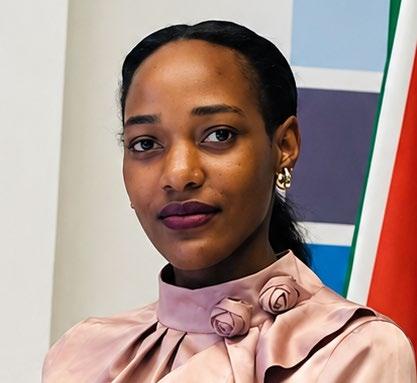
Pg. 3 EXCLUSIVE INTERVIEW WITH DONNAH KYAKUWAIRE
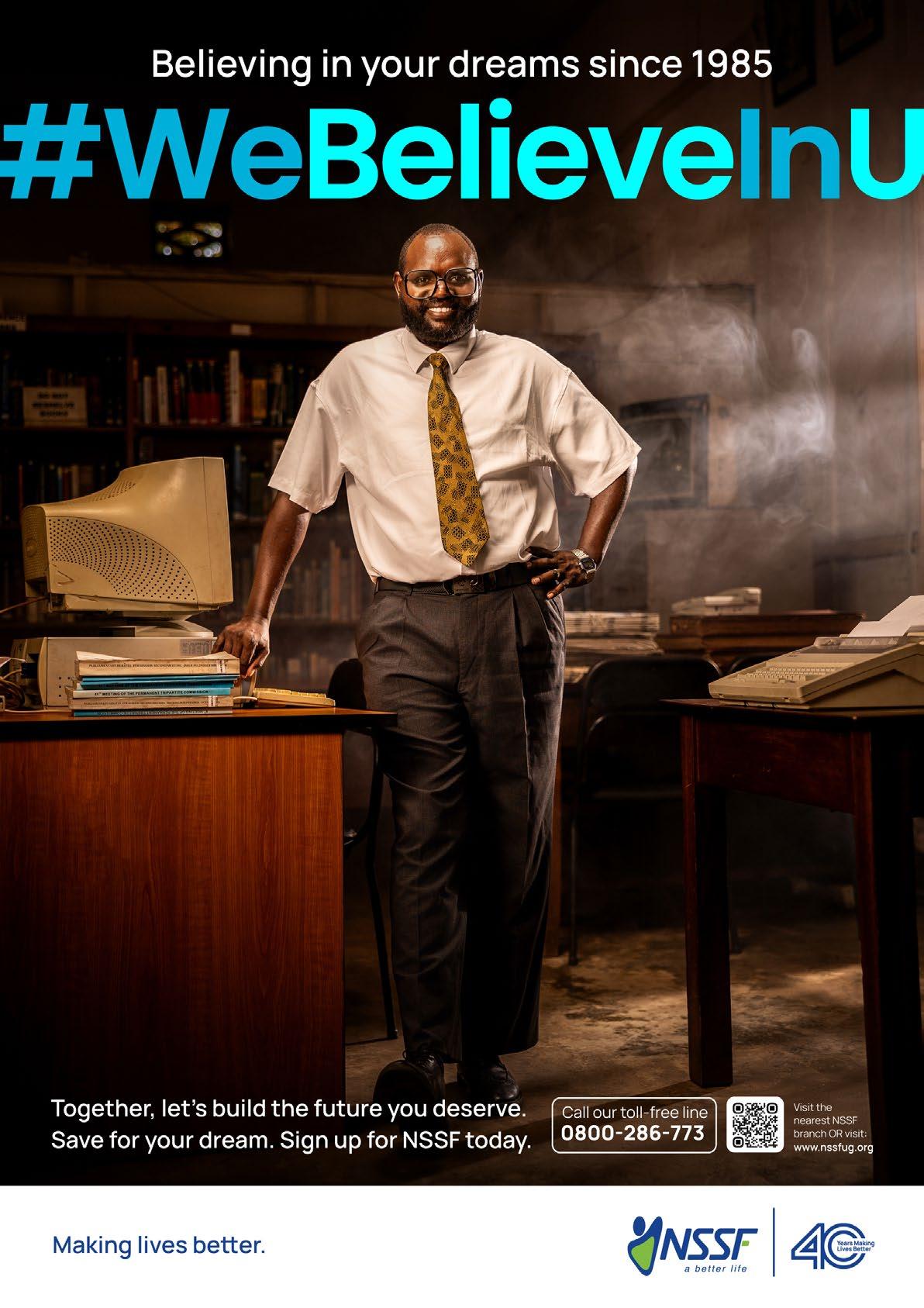
Pg. 7 WE BELIEVE IN US
Pg. 11 40 YEARS OF INNOVATION
Pg. 15 AFRICA AT THE AI CROSSROADS
Pg. 21 TIKTOK, TEA AND THE ATTENTION TRAP
Pg. 25 MOMS LET'S GATHER
Pg. 32 THE COST OF WAITING
Foreword
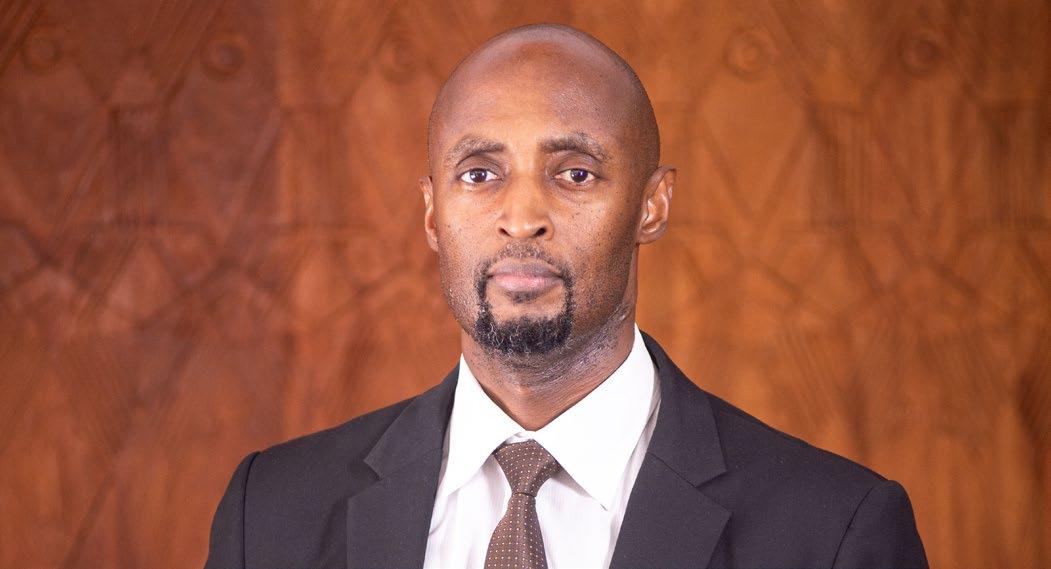
Dear Colleagues,
As we close one financial year and embark on another, I would like to take a moment to reflect on what has been a remarkable journey and, most importantly, to thank each one of you for the role you have played in making it successful.
Congratulations to the entire NSSF staff community on the successful completion of the financial year. Together, we have delivered another year of meaningful impact for our members, staying true to our purpose and continuously raising the bar in how we serve them. The achievements we celebrate today are a direct result of the dedication, resilience, professionalism, and hard work demonstrated by staff across the Fund.
I would like to particularly appreciate everyone who has gone beyond the call of duty and given their discretionary effort to ensure that the Fund remains relevant, responsive, and valuable to our members. These efforts may not always be visible, but they make all the difference. They reflect the strong culture that
continues to define who we are. My hope is that this spirit of togetherness, teamwork, and shared commitment continues to flourish as we take on new opportunities and challenges.
“ The decision to stretch our AUM ambition to UGX 80 trillion by 2035 reflects our confidence in the future and our determination to create even greater value for our members.
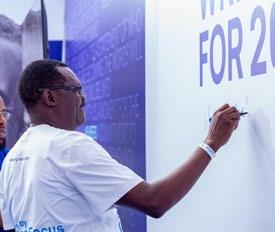
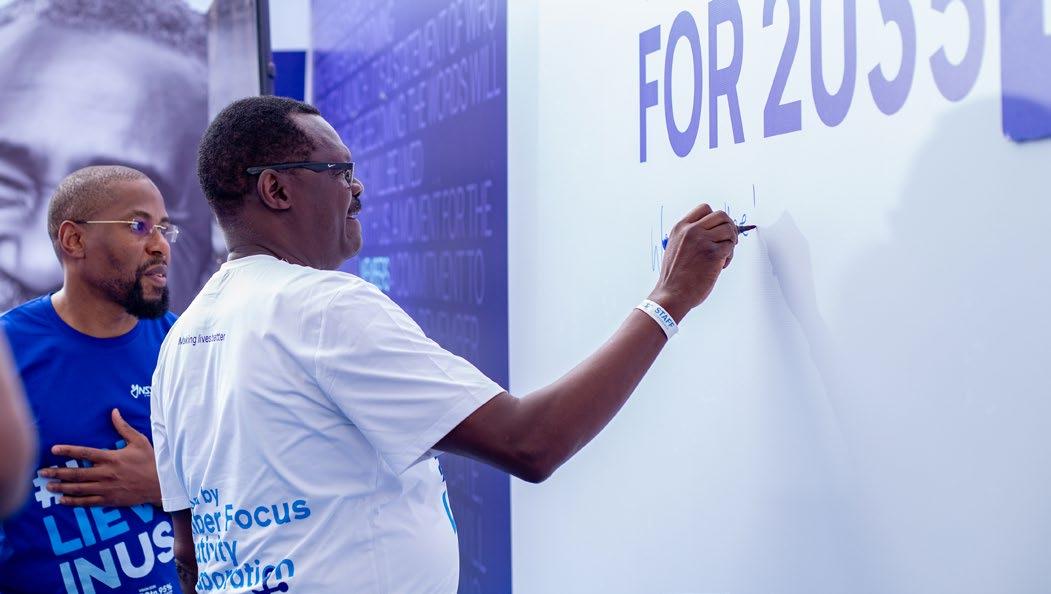
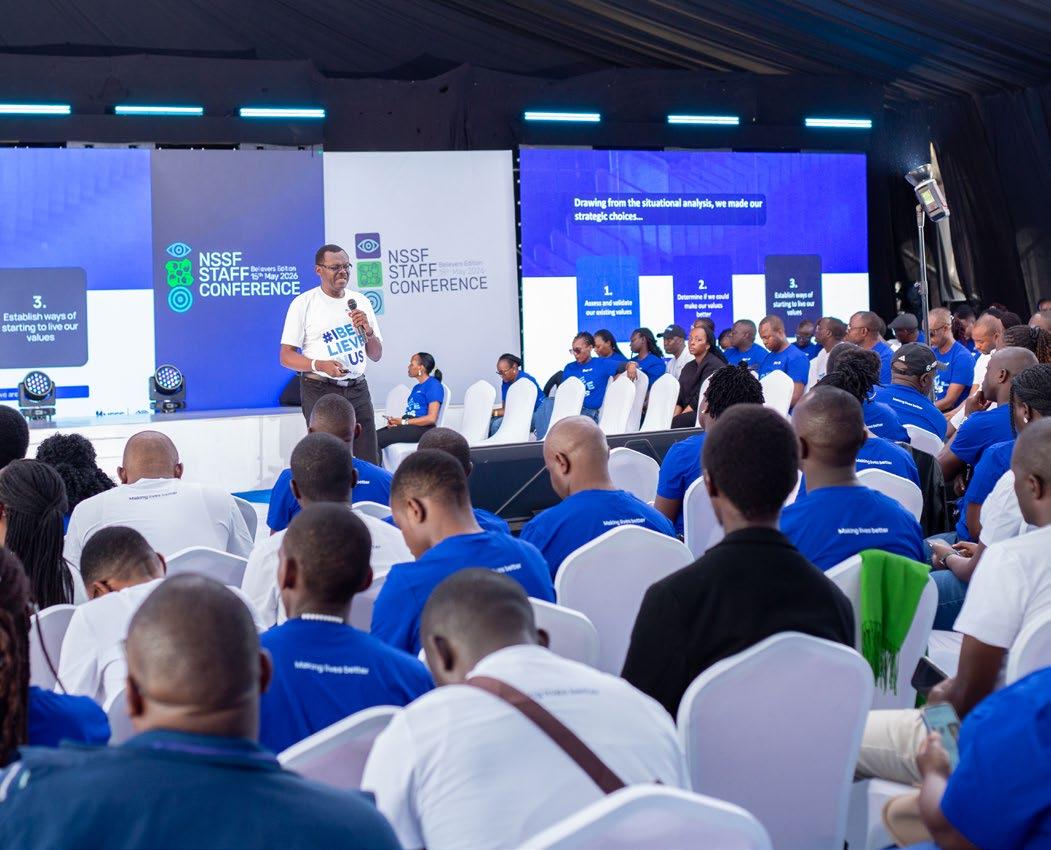
One of the highlights of the year was the launch of our refreshed Fund Values during the Annual Staff Conference. The values of Collaboration, Creativity, Member Focus, and Integrity are more than words on a wall; they represent the behaviours and mindset that will guide us as we pursue our ambitions and serve our stakeholders. A key moment that captured my attention was seeing colleagues engage in candid conversations about the kind of culture we want to build together. It reinforced the fact that regardless of our different roles and backgrounds, we all share a common desire to serve our members better. I would like to extend special appreciation to the Project Ignite Team for the leadership, passion, and commitment they have demonstrated in driving this important initiative. The journey of revitalising our culture is a critical part of our broader intention to preserve the strong DNA of the Fund while ensuring that we continue to evolve in ways that remain relevant and meaningful to us, our members, and stakeholders.
This year also marked an important milestone in our Vision 2035 journey. The decision to stretch our AUM ambition to UGX 80 trillion by 2035 reflects our confidence in the future and our determination to create even greater value for our members. This number is NOT just a target; it is a shared aspiration to make life better for more Ugandans – through saving as a way of life (I should add). I am confident that it is achievable because of the commitment, ingenuity, and passion that our people demonstrate every day.
Our confidence is also anchored in the strategic initiatives being undertaken across the Fund to position us for the future. Projects such as Dolphin, which positions TRUST as a revolutionary customer experience that will lead the charge to 15 million members; or Project NAMCO, which is poised to connect millions of smallholder farmers to lucrative markets – enabling them to earn enough to save for retirement. These bold initiatives demonstrate our commitment to embrace an uncertain future with conviction and purpose. They are investments in the Fund's long-term relevance and sustainability, ensuring that we remain a trusted partner to our members in a
rapidly changing environment.
As we begin the new financial year, we also enter an important season of performance reflection. How did we do? What did we learn? Where are we going? What can I do better this time? Spare time to prioritise these important conversations with your supervisor over the next several weeks. A new financial year is upon us and you will want to hit the ground running. As we set new targets and chart the course for the financial year ahead, let us do so with clarity, accountability, and a shared commitment to raising the Fund's flag even higher.
As I conclude, I wish you all a fulfilling and rewarding new financial year. Always remember! The People and Culture Department remains ready and committed to supporting your professional and personal growth. They're here to build a workplace where you can thrive.
But to thrive, you must stay alive. Look after your health! You can’t win if you’re not in the game. Take full advantage of all our wellness initiatives.
Your health and wellbeing are foundational to everything we aspire to achieve.
After all, a healthy worker is a productive worker, able to pursue organisational and personal goals with energy and purpose.
Thank you once again. Here's to another year of impact and financial success for the Fund, through deeds great and small. As the Swahili saying goes, “haba na haba hujaza kibaba” (little by little, great things get accomplished).
Wishing you all the very best for the year ahead.
Alex Rumanyika Kalimugogo Chief Strategy and Performance Officer

Interview

BBeyond the Desk: A Mother's Journey of Growth,
Purpose and Professional Excellence
Remigious Kaggwa Engagement Specialist
ehind every successful professional is a story of resilience, purpose, and the people who matter most. In this edition of The Vibe, Remigious Kaggwa sits down with Donnah Kyakuwaire, Compliance Team Lead in the Commercial Department, to explore a journey shaped by determination, continuous learning, and an unwavering commitment to both family and career.
As a mother of four, a seasoned finance and compliance professional, and a passionate advocate for personal growth, Donnah shares valuable insights on navigating life’s different seasons, embracing challenges, and thriving both at work and at home. Her story is a reminder that success is not about choosing between career and family, but about finding purpose, growth, and excellence in both.
1. Tell us about yourself and your journey at NSSF?
I'm Donnah Kyakuwaire and I serve as a Compliance Team Lead in the Commercial department. I joined the Fund from Standard
Chartered Bank in December 2019 as Compliance Auditor and transitioned to my current role in 2022. I also serve as a trustee on the Board of Trustees of the Staff Provident Fund and previously on the ACCA Uganda Member Network Panel. I hold a Master of Business Administration with a Specialism in Strategy from Edinburgh Business School. I am a Fellow of the Association of Chartered Certified Accountants and a Certified Public Accountant. I am also an IFC/LPI Certified Trainer and a Workplace Coach.
2. Outside the office, who is Donnah? What are the roles and relationships that matter most to you?
Donnah is a child of God, wife of one, a mother of 4, a daughter, sister and friend. God is my anchor and source. Second comes my spouse and children. My family is my north star. I am also a reader, a writer and a lover of people. I love nature, taking long walks, good food and a cup of tea any time.
3. What does motherhood mean to you, and how has it influenced your outlook on life?
Motherhood is a God ordained responsibility. I believe I will be asked to account for each of the lives entrusted in my care and so I purpose give it the best I can. I have also not known a love so fierce and deep as the one motherhood awakened within me.
Motherhood has also been the thing that has humbled me the most. Navigating the unpredictability of pregnancy, birth, and parenting strips away the illusion of absolute control. This has profoundly shaped my outlook, making me a much calmer, empathetic, and highly adaptable person.
4. Looking back, what has been the most challenging season of your life, and what helped you get through it?
Serving in an upcountry location for the first time was my most challenging season. It meant moving away from my family and already established support systems. I adapted by building a new support system with fellow employees, keeping a positive attitude and working with my spouse to alternate family care routines and travel schedules.
5. Many people struggle with competing
priorities. What practical strategies help you remain effective at work while staying present for your family?
I have embraced the philosophy that ‘Done is better than Perfect'. For example, a room cleaned by my 10-year-old is far better than an unclean room waiting to be perfectly cleaned by me. At work I apply this by coaching, delegating and trusting my team's capacity to deliver without micromanagement. This frees up my time to focus on strategic and essential work. At home, I invest in outsourcing, delegating and mechanizing all non-essential tasks, utilizing my time to engage in family value adding activities. Ultimately balancing these priorities successfully requires proactive communication and transparency with both my colleagues and family.

What accomplishment are you most proud of - either professionally or personally—and why?
My most proud achievement is earning my ACCA, CPA qualification and MBA while working full-time, growing professionally and raising four
Who have been the most influential people in your journey, and what impact have they had on your growth?
Professionally, my journey has been accelerated by mentors, coaches, and sponsors. They held me to high standards, advocated for me in rooms I wasn't yet in, and pushed me outside my comfort zone. I am deeply grateful to them because they owed me nothing, yet they
chose to light the path forward. Personally, my spouse and family have been my backbone. They provide a strong, dependable support system.
8. NSSF has invested in initiatives such as Pathfinder and Workplace Coaching. How have these programmes contributed to your resilience, confidence, and career progression?
Pathfinder provided me with real life examples of leaders who have navigated complex professional and personal realities and triumphed. These stories have become my personal reference points giving me the resilience to know that my current demanding seasons are navigable.
The coaching program emboldened me. Previously, I felt a heavy pressure to know it all and dreaded complex situations and difficult stakeholders. I now engage confidently with my colleagues and stakeholders to find solutions.
9. What is one lesson you wish you had learned earlier in your career and family journey?
That the circumstances are never going to be perfect, just start, just do! I have learned not to wait for the situation to change, I get on with what I need to do regardless of the circumstances. I lost time while waiting yet each new day presented even tougher challenges.
10. If you could leave one message for fellow employees striving to succeed at work while nurturing their families, what would it be?
Understand that life happens in seasons but never use your current season as an excuse to stand still. You will experience fast periods of career growth and slower seasons focused on your family. Give yourself grace without losing momentum and maximize each season. Most importantly, always strive for continuous, incremental improvement.
“ Professionally, my journey has been accelerated by mentors, coaches, and sponsors. They held me to high standards, advocated for me in rooms I wasn't yet in, and pushed me outside my comfort zone. I am deeply grateful to them because they owed me nothing, yet they chose to light the path forward. Personally, my spouse and family have been my backbone. They provide a strong, dependable support system.
Our New Values Come to Life

We Believe in Us: A Cultural Journey of Passion and Professionalism
Makubuya Abdul Kigozi Senior Manager Organisational Development
The theme for FY25/26, “We Believe in Us” has not been just a statement—it has been a lived experience, a shared commitment, and a collective journey of reflection and renewal across the organisation.
This year, we embarked on a deliberate process to reflect on our behaviours as an organisation with the intention of building a culture capable of enabling the achievement of Vision 2035. This vision is anchored on three ambitious parameters: 95% stakeholder satisfaction, 50% coverage, and UGX 80 trillion in value creation. These targets are not merely numerical goals; they represent a transformation in how we think, behave, and deliver as a unified institution.
A Journey of Reflection and Honest Dialogue
The cultural transformation journey began with a powerful and inclusive exercise—focus group discussions involving more than 650 employees across the organisation. This process created space for honest reflection on our existing values: what they meant, how
they were interpreted, and where gaps existed between intention and practice.
What emerged was both enlightening and humbling.

For example, the value of Teamwork, which was intended to promote unity across the organisation, was often interpreted narrowly as collaboration within departments or sections rather than across the entire institution. Similarly, the value of Innovation was frequently associated only with technology. Through dialogue, staff reimagined it more broadly as collaboration and creativity, expanding its meaning to reflect everyday problem-solving and shared thinking.
These discussions became more than corporate exercises—they became moments of reflection and, at times, emotional release. They served as a form of collective “therapy,” allowing teams to openly express frustrations, acknowledge past shortcomings, and confront the realities of transitions the organisation had experienced.
There was also an honest recognition of disappointment—an acknowledgment that, at times, we had not lived up to the values we set for ourselves, nor had we always shared a common understanding of what those values truly meant.
Key Lessons from the Journey:
From this process, three profound lessons emerged:
1. The Power of Humanity
When we centre humanity in our work, we unlock extraordinary potential. Understanding each other, listening deeply, and recognising our shared purpose enables us to achieve far more than systems and structures alone ever could.
2. The Brilliance of Collective Wisdom
The most meaningful values are not imposed— they are co-created. Through collaboration, we developed values that are not only relevant but enduring, with a strong focus on placing members and stakeholders at the centre of everything we do.
3. The Importance of Candid Conversations
Progress requires openness. We learned that many of our challenges could be addressed more effectively if we embraced honest, respectful, and solution-oriented dialogue
across all levels of the organisation.
A Defining Moment: The Staff Conference
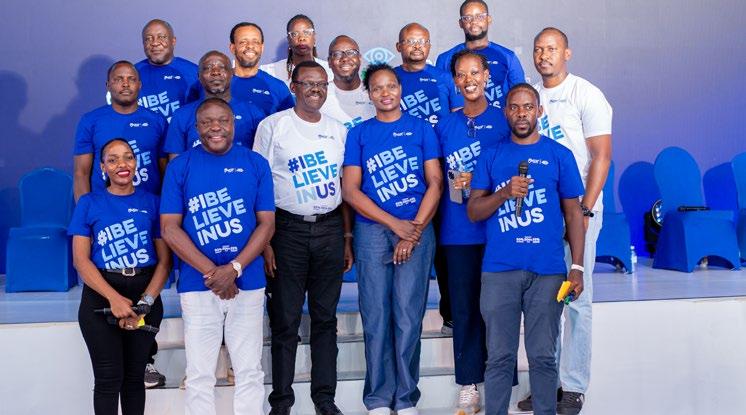
The journey reached its climax at the Staff Conference, where the refreshed organisational values were officially launched. The atmosphere was one of renewal and shared ownership. It was not just a presentation of values—it was a celebration of co-creation.
In that moment, there was a visible sense of new beginnings. The more than 650 participants could see themselves reflected in the values they had helped shape. It was a powerful reminder that culture is not defined in boardrooms alone—it is built through participation, dialogue, and shared belief.
Moving Forward with Passion and Professionalism
As we move forward, the spirit of “We Believe
in Us” calls us to embody both passion and professionalism in equal measure. Passion gives us the energy to care deeply about our mission and the people we serve. Professionalism ensures that this passion is translated into disciplined execution, accountability, and excellence.
Together, these qualities will shape how we engage, how we lead, and how we deliver on our Vision 2035 ambitions.
This journey has shown us that culture is not a destination—it is a continuous practice. And as we continue to build, refine, and live our values, one truth remains clear:
When we believe in us, we unlock the best of who we are—and the future we are capable of creating.

40 Years of Innovation: From Paper Trails to Intelligent Systems
Ronald Aripa Benefits Officer
For four decades, the Fund’s story has been one of deliberate evolution. What began as manual record keeping and paper bound processes has transformed into a digitally enabled, data driven institution shaping the future of financial services.
This is not merely a timeline of technology upgrades. It is a story of institutional courage, adaptation, and a relentless commitment to serving members better with every passing decade.
The 1980s: Foundations Built on Paper and Process
In the early years, operations were defined by manual systems and physical documentation. offices relied heavily on filing cabinets, ledger books, rotary telephones, and typewriters.
Record keeping was deliberate but slow. Communication was structured yet constrained. Workflows depended on physical movement of files.
These systems, while foundational, limited scale and introduced risk. Yet they
established something critical: discipline in documentation and process integrity. That culture of accountability would later become the bedrock of digital governance.

The 1990s: The Dawn of Digitization
The 1990s marked the first major shift. Desktop computers and CRT monitors entered the workplace. Basic software tools improved workflow accuracy and introduced structured digital storage.
This was a hybrid era. Manual paperwork coexisted with emerging digital systems. It was experimental, transitional, and necessary.
The Fund was not abandoning its foundations. It was modernizing them.
The 2000s: Integration and Automation
The 2000s brought integration. The adoption of ERP systems, unified finance, human resources, and member services onto a single digital platform. This was transformative.
Routine tasks became automated. Processes that once required physical verification became system driven. Collaboration improved through shared digital dashboards and portals.
Automation did more than increase efficiency. It liberated people. Staff could now focus on strategic thinking rather than repetitive manual processing.
The Fund began shifting from operational survival to strategic growth.
The 2010s: Mobile, Cloud, and Data-Driven Decisions
The next decade introduced mobility and intelligence.
Tablets and smartphones enabled agile service delivery. Cloud computing reduced reliance on paper and improved accessibility of information.
More importantly, analytics dashboards began guiding decision-making. Data was no longer archived history. It became insight.
The Fund moved from reporting what happened to understanding why it happened and what
should happen next. This was the decade where information became strategic capital.
The 2020s: Digital Transformation and Member Centric Innovation
The current decade represents acceleration. The integration of Artificial Intelligence, robotic process automation, biometric verification, electronic signatures, chatbots and predictive analytics.
Operations are streamlined. Security is enhanced. Authentication is simplified. Member interaction is personalised.
Digital transformation is no longer about internal efficiency alone. It is about the member experience.
Service is becoming real-time. Engagement is becoming intelligent. Trust is becoming technology-enabled.
“ More importantly, analytics dashboards began guiding decisionmaking. Data was no longer archived history. It became insight.
The Future: Intelligent, Secure, and Immersive
Smart contracts and blockchain promise secure automated transactions. AI-powered fraud detection will proactively identify threats. Virtual and immersive technologies will redefine how members interact with the Fund.
The direction is clear.
The Fund is not reacting to technological change. It is positioning itself at the frontier of it.
Beyond Technology: The Real Innovation
While systems evolved from paper ledgers to intelligent dashboards, one constant remains: institutional intent.
Innovation at the Fund has never been about adopting tools for appearance. It has always
been about strengthening governance, improving service delivery, enhancing transparency, and building long-term sustainability.
The journey from filing cabinets to artificial intelligence reflects more than modernization. It reflects maturity.
A Legacy Still Unfolding
Forty years ago, efficiency meant organized files. Today, it means predictive analytics and automation.
Tomorrow, it will mean seamless, intelligent, and immersive engagement. The arc is unmistakable. Each decade built upon the last. Each upgrade strengthened resilience. Each innovation reinforced trust.
The Fund's 40-year journey is proof that transformation is not an event. It is a discipline. And the next chapter is already being written.


Annual Staff Conference 2026

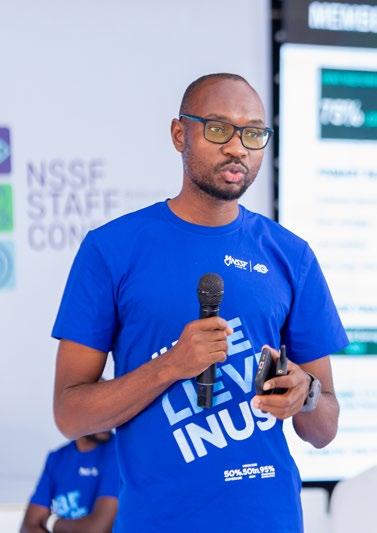
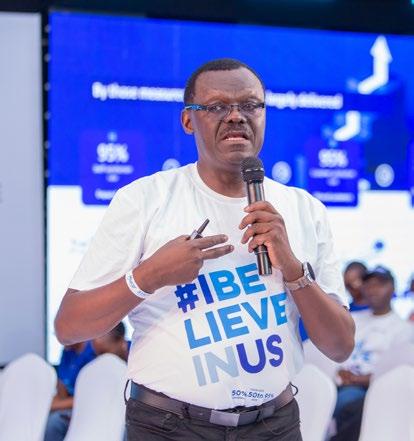
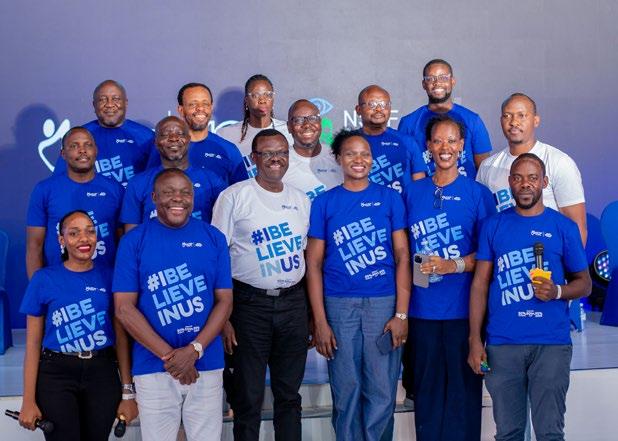

The Artificial Intelligence Question

Africa at the AI Crossroads: From Consumer to Creator
And what it means for the Fund
Noble Akandinda Financial Accountant
I attended the Summit (19–21 May 2026) in Nairobi representing the Finance department, where one question cut across every discussion: WillAfricashapeAI,orwillAIsimplyshapeAfrica?
This is not just a continental question; it is immediately relevant for institutions like the Fund. With its scale, data, and public mandate, the Fund sits at the center of this shift.
The urgency is clear. Africa is participating in the global AI economy, but largely as a consumer, not a creator reflected in its 1% share of global data centre capacity, limited compute infrastructure, and heavy reliance on externally developed AI systems
As Hon. Dr. Monica Musenero Musanza put it: “Using AI makes you a market. Creating using AImakesyouapower.”
The summit reinforced a critical point: Africa's AI challenge is not just technical, it is strategic.
Why Africa Risks Remaining a Consumer
The Framing Problem
At the heart of the issue is how AI is perceived. Across many discussions, a consistent pattern emerged: Africa is still treating AI as a tool to adopt, rather than a platform to build upon.
“ Using AI makes you a market. Creating using AI makes you a power.
_
Dr. Monica Musenero
This distinction matters.
• Treating AI as a tool leads to importing solutions and outsourcing capabilities.
• Treating AI as a platform enables local innovation, ownership, and value creation.
This framing gap is not theoretical; it directly shapes where value is created and who captures it.
Data Sovereignty and Trust
The consequences are already visible in how data is handled. Much of Africa's data is stored and processed outside the continent, meaning African-generated insights often benefit external systems.
This creates an urgent need to move beyond traditional privacy frameworks toward AIaware data governance focusing not just on protection, but on:
• How data is used
• How systems learn from it
• How value is distributed
For institutions like the Fund, which manage sensitive and structured member data, this is especially critical. The challenge is closely tied to trust.
where a lawyer relied on AI-generated, nonexistent legal cases that nearly influenced proceedings. As he noted: “The system only held because the fabricated citations were notusedinthefinaljudgement.”
The lesson is clear: AI systems are powerful but not inherently reliable. Their effectiveness depends on strong governance, validation, and human oversight.
What Is Required for AI Sovereignty
Infrastructure and Energy
True AI begins with infrastructure, and this remains one of Africa's most significant constraints.
At an organisational level, Samwel Magesa, Chief Data Officer at NBC Tanzania, offered a useful perspective through the 10–20–70 model:
• 70% people and processes
• 20% technology
• 10% algorithms
The insight is simple but often overlooked: organisations tend to over invest in technology while underinvesting in the human and processes where most value is actually created.

Kenya provides a useful example. The country is making progress in legal AI through court transcription (75% accuracy), legal chatbots, and tools like Hakimu.AI. However, this progress has exposed risks.
Hon. Justice Isaac Lenaola shared a case
Beyond organisational readiness lies a more fundamental constraint: physical infrastructure. Africa's limited data centre capacity and unreliable energy supply both restrict the ability to store and process data locally.
Albert Murungi, Chief ICT Officer at UEDCL, pointed to solar-enabled energy solutions and tailored electricity tariffs for data centres as practical, context-specific responses.
Addressing these constraints requires innovation and investment. Initiatives such as Cassava Technologies' data centre in Rwanda and partnerships like Safaricom and iXAfrica signal progress, yet fragmented regulation and uneven energy access continue to slow large-scale adoption.
As Alessandro Curioni, IBM's VP for Europe and Africa, cautioned: "Stop building for Silicon Valley. Africa needs offline first, not mobile first."
“ AI systems are powerful but not inherently reliable. Their effectiveness depends on strong governance, validation, and human oversight.
Governance and Trust
If infrastructure determines capability, governance determines trust.
Without clear frameworks covering how AI systems are used, how data is governed, and how accountability is assigned; even well-
resourced initiatives will struggle to deliver impact.
Africa does not need to replicate global models. It needs to adapt them, anchored in:
• Local realities
• Cross-border collaboration
• Public-private partnerships
Importantly, governments must evolve from passive regulators into active co-investors in infrastructure, skills, and research. Without this shift, Africa risks remaining in an ecosystem designed and controlled elsewhere.
Why Resilience and Skills Matter
As AI adoption accelerates, so do the risks associated with it. Resilience and skills are therefore not separate concerns they are core enablers of responsible AI deployment.
Cybersecurity
Greater connectivity expands the attack surface. AI is already transforming cybersecurity on both sides enabling more sophisticated attacks while strengthening defense capabilities.
Yet, resilience depends as much on people as it does on technology. With proper training, employees become “human firewalls.”
Tim Theuri, Head of Cybersecurity at M-Pesa, highlighted a critical imbalance: attackers collaborate far more effectively than defenders.
Ransomware groups share tools and intelligence, while organisations often operate in isolation. This makes collaboration, shared threat intelligence and public-private coordination essential.
One message stood out: most organisations fall into two categories: those that know they have been breached, and those that do not yet know it.
As one speaker put it: "Zero risk in 2026 and beyond means zero business." The goal is not

to eliminate risk, but to anticipate, simulate, and manage it.
Education and National Strategy
Sustainable AI adoption ultimately depends on people.
Many African education systems are still preparing workers for roles that AI is rapidly transforming, while other regions like China are embedding AI into early education.
Closing this gap requires action at three levels:
• Foundational literacy for all workers
• Intermediate skills for professionals
• Advanced capabilities for system builders
At a national level, this is about more than workforce readiness, it is about economic positioning. Countries that build capability will gain strategic advantage, while those that only consume technology risk falling further behind.
What This Means for the Fund
For the Fund, AI is not an abstract opportunity, it is a strategic lever across service delivery, compliance, operations, and investment. With over 3.5 million members, the Fund operates at the intersection of finance, data, and public trust, making it a strong candidate for responsible AI leadership in Africa.
Effective leadership requires intentionality: it is not enough to deploy technology; leaders must understand its limits, ask the right questions, and translate potential into measurable impact.
Opportunities
Applied effectively, AI can:
Enhanceservicedelivery
• Always-on, multilingual member support
• More responsive and personalised engagement
Strengthenriskandcompliance
• Detect fraud and under-remittance at scale
• Improve monitoring across the ecosystem
Improveinvestmentdecision-making
• Generate deeper insights from structured and unstructured data
Increaseoperationalefficiency
• Streamline internal workflows
• Enable intelligent knowledge management
The value, however, lies not in the technology itself, but in its application.
The guiding principle must remain: human judgement combined with AI execution, not replacement.
Risks
Alongside these opportunities, material risks must be actively managed.
Cybersecurity exposure grows as systems become more interconnected linking banks, telecoms, government agencies, and thirdparty vendors expanding the attack surface and making layered defenses essential.
Data sovereignty is another critical concern. Reliance on external platforms may result in sensitive member data being processed outside Uganda's jurisdiction, raising both regulatory and ethical challenges.
AI hallucinations present an additional risk. As demonstrated in the Nairobi legal example, inaccurate outputs in high-stakes contexts can have serious consequences. For the Fund, errors affecting benefits or eligibility decisions could create both financial and reputational liabilities.
Algorithmic bias must also be addressed. Any
system influencing decisions about individuals whether in recruitment, compliance, or eligibility must be transparent, auditable, and fair.
Across all these areas, one principle remains non-negotiable: human oversight. A useful guiding question emerges: Is AI solving a business problem or a technology problem? The answer should determine how it is applied and governed.
Immediate Actions
Translating these insights into action, the Fund should prioritise four key areas:
Identify high-value use cases by mapping processes and prioritizing areas where AI can deliver measurable impact. This should be guided by the 10–20–70 framework, ensuring equal emphasis on people and processes.
Establish clear data governance policies for AI. This includes defining what data can be used, where it is stored, how outputs are validated, and how errors are addressed.
Strengthen cyber resilience through realistic simulations, including ransomware attacks and vendor breaches, ensuring readiness before incidents occur.
Take an active role in shaping Uganda's AI ecosystem. Given its scale, structured data, and public trust, the Fund has both the influence and responsibility to contribute to national AI strategy.
Conclusion: From Adoption to Strategic Leadership
Africa's AI moment is already here, but it will not remain open indefinitely. Its outcome will be shaped by infrastructure, sovereignty, skills, governance, and leadership.
For the Fund, the stakes are particularly high. It holds a powerful strategic asset: a structured dataset representing the financial lives of millions. Used responsibly, this can unlock significant value not just for members, but for national development.
The greatest risk is not failing to adopt AI. It is treating AI as a narrow IT initiative rather than a strategic transformation.
The defining question is not whether the Fund should engage with AI but how intentionally it chooses to do so.

“ Is AI solving a business problem or a technology problem? The answer should determine how it is applied and governed.
TikTok, Tea and the Attention Trap: Beating Phone Addiction
Aaron Allan Kalanda Business Performance Analyst
Picture someone who wakes up and immediately reaches for their phone to check messages, social media, emails and news-all before prayer, breakfast, or even saying hello to their spouse.
What is phone addiction?
The phone stays glued to their hand en route to work and they keep checking throughout the da. They then head home and spend hours doomscrolling through X, Snapchat, TikTok before falling sleep to wake up and do it all again. If you feel personally attacked, this article may just be for you. For many people, this isn't occasional but rather a daily ritual.
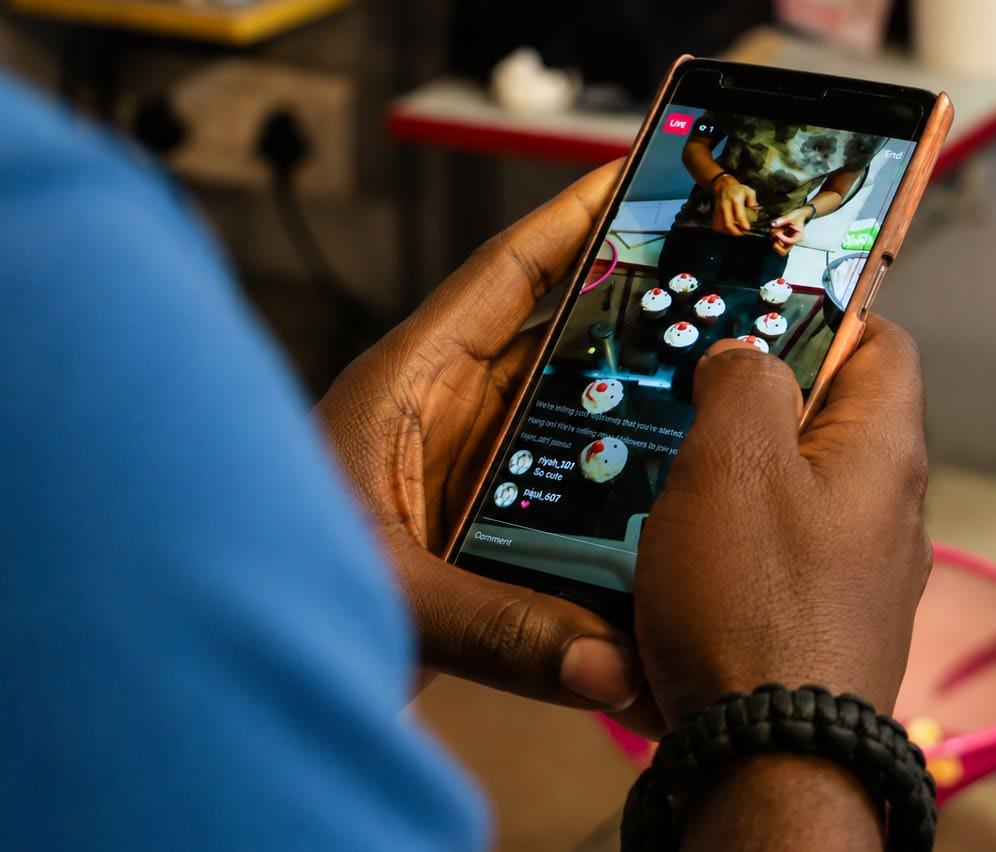
It's now common to notice people texting while driving or watching videos on the phone in traffic, I have even seen Boda Boda riders with phone holders attached to their bike, not for navigation, but to watch TikTok as they ride. As a passenger you assume he is focusing on the road, only to realise he keeps glancing down to watch Kasuku live. Everywhere you look someone's head is bent, eyes glued to a screen. The only exception is downtown, where staring too comfortably at your phone may leave you admiring your empty fingers.
When one thinks of addiction, alcohol & drugs usually come to mind, it's easy to assume you are safe from its consequences. But phone addiction is not necessarily addiction to the physical device itself. Its an addiction to the connectivity, validation, tea(gossip) and entertainment that the device delivers.

Its symptoms seem harmless and creep up unnoticeably until it's too late. They include;
• Automatically reaching for your phone during idle moments as though being bored is a personal emergency.
• Feeling compelled to immediately respond to texts and notifications.
• Constantly checking the device even when there is nothing to check.
• Experiencing “ghost notifications” where you feel your phone vibrate or hear a notification ping only to check and find nothing.
• Spending much longer on the phone than intended. You simply wanted to check the time at 10pm only to realise it's now 12:30am and you are still arguing with a random Arsenal fan from Nigeria.
• Using the phone while walking, driving or in meetings.
Why it’s easy to get addicted
Unlike most addictions, problematic phone use isn't frowned upon. Imagine attending a meeting on 14th Floor and, midway through MD's presentation, you light up a cigarette or pull out a bottle of Uganda Waragi. The meeting would most likely end there, and you may be recommended to Dr. Okullo for a psychiatric evaluation. But pull out your phone and no one will bat an eye, despite how rude or distracting it may be.
Smartphones are undoubtedly remarkable tools, but tools become problematic when they begin to control users' behaviour. The brain does not distinguish between the thrill from substances and the thrill from hot tea spilled by Senga Acid. It releases the same chemical called Dopamine. Think of Dopamine as a chemical that helps in motivation and reward or to ‘feel good'. Your brain associates the phone to that reward and let's face it, who doesn't want to feel good? So as an alcoholic needs more bottles gradually to get to the same level of inebriation, you too will gradually
need more time on the phone.
The algorithm is designed to keep you hooked. It is not unusual for someone to spend an entire Saturday doomscrolling. Social media is purposely designed to keep you coming back. Ever wondered why all these apps are “free”? It's because you are the product. The evolution of Artificial Intelligence, has worsened it. Algorithms no longer simply react to what you like or comment on, they analyse your behaviour and predict the content most likely to grab your attention. Phones are suspected to actively listen to you, so next time you complain about being hungry, don't be surprised when the first ad you find is from Glovo. Imagine someone who knows exactly what you like, sometimes even before you know you' ll like it, and then constantly gives it to you. Isn't that your dream partner?
“ Social media is purposely designed to keep you coming back. Ever wondered why all these apps are “free”? It's because you are the product.
The Impact on Mental Health
While drugs and alcohol may destroy lives through overdose, illness or criminal behaviour, phone addiction works silently. It slowly steals time, attention and focus to other more significant aspects of your life.
Research has linked excessive social media use with higher rates of anxiety, sleep disturbances, depressive symptoms, loneliness and reduced life satisfaction due to the constant comparison with the scripted life of content. This is particularly among young people. The issue is not how much time we spend on the phones but how that use affects our mood, sleep, relationships and attention.
Impact in Children
Parents have unintentionally delegated the role of childcare to phones and tablets. An energetic or restless child will sit quiet in a corner on Instagram, YouTube or Coco melon. For a tired parent, this presents a moment of respite.
However, in the long run this is can be quite detrimental. The constant mental stimulation from devices make activities like reading, studying or simply listening in class painfully boring and they seek stimulating distractions. So, the next time your child brings a poor report, or the teacher complains he struggles to pay attention in class, you may inadvertently be a contributor.

Impact at Work
If you slept at 3am tweeting, it is highly unlikely that you will be physically and mentally at 100% by 8am. Constantly notifications break concentration, delay tasks and make it harder to achieve deep focus. Before you know it, its 5pm and half the day is lost to messages, memes and the latest tea from Kyamagero despite having zero relevance to your BSC.
Another evident impact is the reduction in physical interaction. Human conversation became the sacrificial lamb at the phone addiction altar. Whether in a lift, cafeteria or even office, it is now common for people to opt for their phones rather than the person next to them.
How to overcome
A recovering alcoholic can avoid the bottle, a recovering junkie can avoid the drugs. But for a phone addict, it would be nearly impossible to avoid a phone as they have become integral to our lives. A phone means having a social club, entertainment centre, shopping mall, bank and office.
The goal therefore isn't to avoid phones entirely, but to rather to use them without becoming dependent on them. Here are a few ways to start:
• Track your daily screentime. This is often the wake-up call. Once you see how much time spent on your phone, you can set a reduction target for yourself.
• Use the grey scale mode. Most phones allow you to use them in black & white. This may seem minor, but try watching TikTok in black & white and you' ll understand the point.
• Create phone free zones. The bedroom is a start. Ensure the phone stops at the door.
• Schedule phone-free periods. Set aside specific times during the day where you do not use the phone unless it is truly necessary.
• Do Not Disturb- DND isn't just for sleeping or ignoring calls from a bitter ex. You can use it to limit your phone interaction.
• Fight the FOMO. You don't need to be updated on every trend in real time.
Smartphones have transformed how we live, work, and communicate. They help us stay informed, connected, and productive. Yet their benefits come with a challenge: protecting our attention and focus in a world designed to capture it. Overcoming phone addiction is not about abandoning technology altogether but rather about using technology intentionally. The question isn't whether smartphones are useful, they undoubtedly are. The real question is whether you are using the phone or it is using you.
For the Love of our Mothers
Moms Let’s Gather:
To nurture and be nurtured
Article contributed by: Several Authors
An email popped, and before we knew it, the first ten lucky mothers had clicked "yes Ready to grab the opportunity that would leave us feeling seen, celebrated, and refreshed.
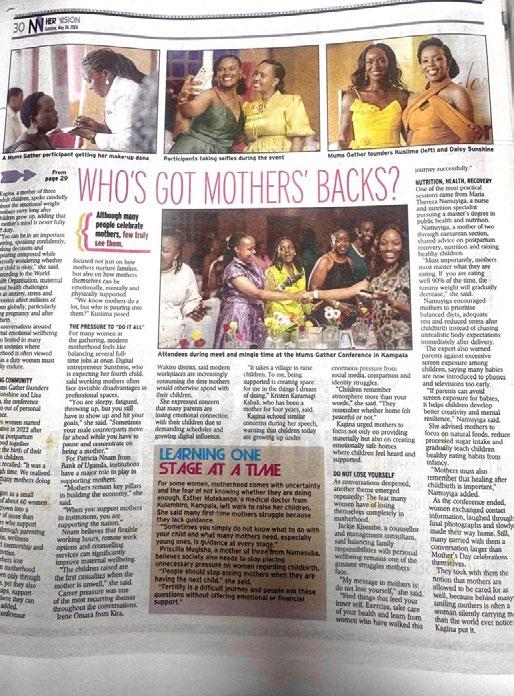
Ahead of Mother's Day 2026, we joined mothers from different walks of life at the annual Moms' Gather, an inspiring initiative founded by Lisa Kusiima and Daisy Prim Busingye Kisakye (Daisysunshine), Under the theme "To Nurture and Be Nurtured," the event created a safe space for mothers to pause, connect, share stories, learnt from one another, and simply be reminded that they are not alone in the beautiful, but yet demanding journey of motherhood.
We extend our heartfelt appreciation to Fund Management for continually investing in the well-being of its mothers. From the Pathfinder Catalyst Academy to, the Staff Book Club to the Crèche, Health Insurance, wellness programs, and initiatives such as Moms' Gather, the Fund continues to demonstrate that supporting working mothers is not just an initiative—it's a culture. Notably, 90% of this year's sponsored participants are alumni of the Pathfinder

Academy, a testament to its impact, and when mothers are supported, families, workplaces, and communities thrive.
What a panel it was! Featuring Brenda Kabibi, Apophia Segwaya, Patricia Rutiba, and Christine Musinguzi, the discussions tackled the real-life emotional, spiritual, and practical realities of modern motherhood. Here are some of the GEMS we took away from the speakers.
Christine: taught mothers how to navigate their own emotional well-being while maintaining peace and healthy relationships at home.
Apophia: provided guidance on how to embrace and grow through the different seasons of your life. From being a stay-at-home mother to now a school owner sometimes the dream doesn't disappear; it simply waits for the right season. "Clock it!"
Patricia: emphasized how to intentionally raise and nurture Godly children in a Volatile,
Uncertain, Complex, and Ambiguous (VUCA) world.
Brenda: Shared Insights on navigating the unique, often stressful realities of caring for children with difficult medical or behavioral conditions amidst the pressures of career growth, family responsibilities, and the many other challenges modern mothers face.
"Just when we thought we had heard it all, the remarkable keynote speaker, Allen Catherine Kagina, took the conversation to another level."
Allen, an experienced corporate mother, spoke directly to the modern woman's struggle to harmonize professional ambition with family life. “Bringing Christianity to the Boardroom.” She offered a vital reminder: women are distinct individuals with unique identities, goals, and passions long before they transition into motherhood. She urged mothers to :
• Do what you can, where you are — it is good enough.
• Allow yourself to be nurtured; you matter too.
• Add value where value is needed.
Furthermore, she emphasized the profound impact of a praying mother, encouraging women to seek divine guidance through life's trials and, to consistently pray for their husbands as vital partners in this shared parenting journey. She beautifully encouraged moms to build a sisterhood of mutual elevation, where women actively support and grow with one another both at work and at home.
And then came the question many of us were secretly wondering... "How do you still look so young at 65?" one of the mums asked. With a smile, she responded: "God... and
I choose my battles well."
What We Took Home
Beyond the photos and laughter, these are the lessons that stayed with us.
Can Moms Dream Too?
Cyber Hugs to all the moms who feel lost in their identity as they juggle through life. As a proud Pathfinder Alumni, one of my biggest lessons from the Pathfinder Academy journey was that my purpose in life is bigger than just me and my family; it's my legacy on earth. Moms out there, your dreams are not gone; they're waiting for you to reclaim them. Start small—reflect on what excites you and sets your soul on fire, set boundaries, and carve out time for yourself. My key learning from the Moms Gather Event 2026 was to nurture myself without any mom's guilt; it is not selfish, it's wisdom and stewardship, that when my cup is full, I can shine my light unto the world. And when I have done my part, I then cast all my cares upon God, and he will carry them for me!
“ Start small—reflect on what excites you and sets your soul on fire, set boundaries, and carve out time for yourself.
- Patricia Komuhendo
The Power of Intentional Communication and Prayer
My takeaway was that a united home stands on two pillars: transparent communication and purposeful prayer. Too often, mothers carry the mental load in silence, expecting spouses to instinctively know their needs. We were reminded that clarity beats assumption, and prayer transforms where criticism fails.
Mothers were challenged to communicate the "why" behind their needs during calm moments, framing a father's involvement as an essential partnership rather than a favor. We were urged to pray for and not criticize our spouses as they learn on the job alongside us. Vulnerability in parenthood is a strength; sharing your heart clearly and anchoring your partnership in faith creates the safest landing ground for your children.
“ Vulnerability in parenthood is a strength; sharing your heart clearly and anchoring your partnership in faith creates the safest landing ground for your children.
- Winfred Atugonza


Who’s in Your Corner?
One of my biggest takeaways from Moms Gather was that no mother is meant to do life alone. As I reflected on my own journey of nearly 11 years in the Fund, seven of them spent working upcountry while raising a family, I realized that what made it possible was having a strong support system, “my tribe.” I often joke that I have a Soroti baby, an Mbale baby, and a corporate baby because each season of my life came with different demands. Mom's Gather reminded me that support systems don't just happen; they are built intentionally. Let the people in your corner know they matter, appreciate them, and show up for them, too. To any mother wondering who will be in her corner as she pursues her dreams: trust God, build your tribe, and take the step. The right support system can help you grow beyond what you ever imagined.
Brendah Arinda
What story resonated with you most and why?
Brenda's story resonated with me the most. Her journey of raising a child with autism and later epilepsy was a powerful reminder of a mother's
strength, resilience, and unconditional love. It also reminded me that every child develops differently and that every small step forward is worth celebrating. The key lesson I took away is that mothers need to nurture themselves too. During difficult parenting seasons, it is important to give yourself grace and seek support when needed. You do not have to be a perfect mother to be a good one your love, patience, and presence make a lasting difference. Norah Atenia
“ The key lesson I took away is that mothers need to nurture themselves too.
- Norah Atenia
Has Your Employer Got Your Back?
One of my biggest takeaways from Moms Gather was the realization that growth never stops. Sitting in that room with my Pathfinder mentor -Patricia was a humbling experience. Seeing someone so accomplished still willing to learn, unlearn, and grow reminded me that I am in the right place, on a journey worth taking.
A few years ago, I had the opportunity to learn from some of the greatest minds in the corporate space. people who challenged, guided, and shaped the leader I aspire to become. What a blessing it is to work for an employer that sees potential, invests in growth, provides mentors and coaches, and creates safe spaces through counselling and wellness support.
Dearest Fund, thank you for seeing me, believing in me, and paving the way. Some employers offer jobs; the best ones help you become who you are meant to be! Mastulla.N.
My expectation Vs What I got?
One thing motherhood has taught me is that sometimes you don't realize how much you need other mothers until you're in a room full of them. At Moms Gather, I found myself nodding along to stories that felt so familiar, moments of joy, exhaustion, self-doubt, and triumph. It was comforting to realize that many of the things I thought I was carrying alone were shared experiences. I left with a renewed appreciation for the power of community and the reminder that mothers need support too. We spend so much time caring for others that we often forget we also need spaces where we can simply be heard, encouraged, and understood. For me, that was the greatest gift of Moms Gather. - Jacqueline Nalubega.
In Conclusion
" When you empower a woman, you empower a generation."
Mom's Gather was a beautiful reminder that mothers thrive when they are seen, supported, and celebrated. Our appreciation goes to the Fund Management and People and Culture Department for investing not only in its people, but also in the families and communities they influence. To the organizers and leadership, thank you for pouring into the women who pour so much into others. Here's to stronger mothers, stronger careers, and stronger communities.
See you at the next Moms Gather!
Article credits: Winfred Atugonza, Brendah Arinda, Patricia Komuhendo, Jacqueline Nalubega, Mastulla Nalubega and Norah Atenia.
Meet the Authors

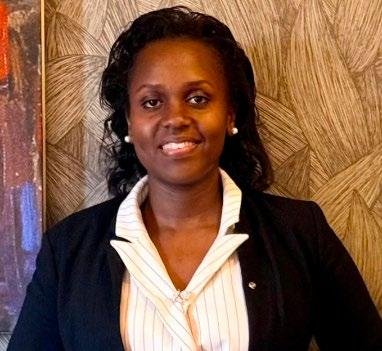


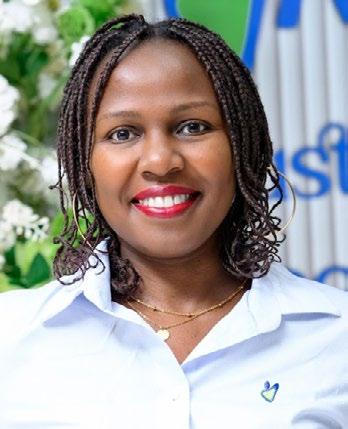
Article credits (L-R): Winfred Atugonza, Brendah Arinda, Patricia Komuhendo, Jacqueline Nalubega, Mastulla Nalubega and Norah Atenia.
Wellness Corner
The Cost of Waiting: Why You Should Start Working Out Now
Irene Doreen Ankunda Service Quality Officer
Irecently fell very sick, and after a full medical check-up, everything seemed fine. There was no clear diagnosis, no major concern—yet I didn't feel well. That's when it hit me: could it be my lack of exercise? Deep down, I already knew the answer. I had been postponing workouts for a long time, always finding excuses, always pushing it to “tomorrow.”
That very week, I decided to start again. I didn't wait for another Monday or a new month—I simply began. And honestly, the difference was immediate. I felt lighter, more energized, more alive. It was a powerful reminder that sometimes, the problem isn't a disease—it's neglecting our bodies.
Today, many of us—especially those in desk jobs—are stuck in this same cycle. We constantly delay taking care of our health. We say things like, “I' ll start next week,” “I'm too busy,” or “I'm not that unfit.” What seems like a harmless delay slowly turns into a dangerous habit. Ignoring early signs of unfitness doesn't make them go away—it only makes them worse.
The Problem with Sitting Too Much
Modern work has changed how we live. Many of us spend long hours sitting—at desks, in meetings, in cars, or in front of screens. Movement has become minimal, yet our bodies were created to move.
When we sit for too long and too often, the body begins to weaken. Muscles become stiff, posture suffers, and important systems such as the heart and metabolism slow down. Over time, this lack of activity quietly damages our health.
The Bible also reminds us of the value of discipline in caring for our bodies. In 1 Timothy 4:8, it says: “For physical training is of some value, but godliness has value for all things…” This shows that while spiritual growth is essential, physical well-being still matters and should not be neglected.
Signs You Shouldn't Ignore; The body always speaks before it breaks down. Unfortunately, we rarely listen.

Some of the most common warning signs include:
• Constant tiredness even after rest
• Getting tired from simple activities
• Unexplained weight gain
• Back, neck, or joint pain
• Stiffness and reduced flexibility
• Increased stress or anxiety
These may seem small or “normal,” especially when we blame them on work or aging. But they are not normal—they are signals. They are signs that the body is not functioning at its best.
Proverbs 27:12 wisely says: “The prudent see danger and take refuge, but the simple keep going and suffer for it.” Ignoring these warning signs is like ignoring danger—the consequences will eventually catch up with us.
Why Delaying Exercise Is Risky; Every time we postpone exercise, we are choosing inactivity—and the body adapts to that choice. Metabolism slows down, muscles weaken, and fat begins to accumulate. Energy levels drop, and even simple tasks become more tiring.
For those with desk jobs, prolonged sitting can lead to:
• Increased risk of heart disease
• Poor blood circulation
• Higher chances of developing diabetes
• Chronic body pain and posture-related issues
• Mental health challenges like anxiety and depression
The longer we delay, the harder it becomes to recover. Life itself requires action. As Ecclesiastes 11:4 reminds us: “Whoever watches the wind will not plant; whoever looks at the clouds will not reap.” In other words, waiting for the perfect time will only delay results.
The Good News: It's Not Too Late. No matter how long you've been inactive, there is always an opportunity to begin again. The body is resilient and responds positively to movement, even after long periods of inactivity.
When you resume exercise, you begin to restore what was lost. You feel the difference not just physically, but mentally and emotionally.
Some benefits of getting back into activity
include:
• Increased energy and reduced fatigue
• Improved mood and emotional balance
• Stronger muscles and better posture
• Reduced stress levels
• Better heart health
• Improved weight management
Even simple activities—like walking, stretching, or light home workouts—can make a big difference when done consistently. You don't need to start with intense gym sessions. What matters is starting.
How to Start Again
If you've been inactive for a while, the key is to start small and stay consistent. You don't need perfection—you need commitment.
Here are some simple steps to help you restart:
1. Start small – Begin with 10–15 minutes a day. Gradually increase your time as your body adjusts.
2. Move often – Don't sit for hours without a break. Stand, stretch, or walk around regularly.
3. Set realistic goals – Focus on consistency, not intensity. Small daily efforts lead to big results.
4. Choose what you enjoy – Whether it's walking, dancing, or light workouts, enjoyment makes it easier to stay committed.
5. Listen to your body – Avoid overdoing it. Progress step by step.
6. Build a routine – Treat exercise like an important appointment you cannot miss.
7. The goal is not to be perfect—it's to be consistent.
Change Your Mindset
One of the biggest barriers to exercise is how we think about it. Many people see it as
punishment or a burden. But exercise is selfcare. It is one of the best ways to show love and respect for your body.
When you take care of your physical health, everything improves—your focus, your productivity, your mood, and even your confidence. A healthy body supports a healthy life.
Personally, I realized that awareness alone is not enough. Knowing the importance of health did not change anything until I decided to act. I had to move from intention to action. Now, I am intentional about staying active.
Kudos to Eva Namukoli and Jemimah Akedi for the encouragement to break free!
Final Thoughts
Ignoring your health is a silent risk that grows over time. For those of us in desk-based jobs, the danger is even greater because inactivity has become part of our daily routine.
But the choice is always ours. We can continue postponing and risk our well-being, or we can take a step today—no matter how small— toward a healthier life.
Your body is already sending you signals. Don't wait for a crisis to respond.
There is a time to act—and that time is now. Start today. Move your body. Stay consistent.